TEN THOUSAND WONDERFUL THINGS. (continued 11)
Reading edition
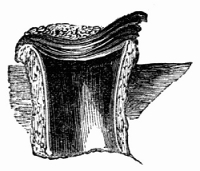
SECTION OF NESt.
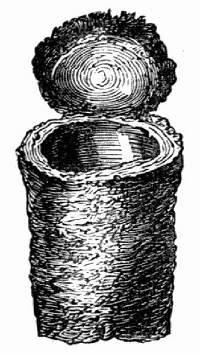
NEST OF TRAP-DOOR SPIDER.
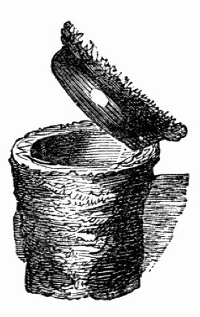
TRAP-DOOR OPENING BY A LEVER
As might be expected, there are varieties in the shape and size of these nests. Some specimens found in the island of Zante had the silken layers of the lid extended into a sort of handle, or lever, just above the hinge, on pressing which, in ever so slight a degree, the trap-door opened. From this it would appear, that the entrance to such a nest could be effected as easily by the enemies of the spider as by the spider itself; this, however, is not the case; for repeated observation has shown that the spider keeps guard at the entrance, and actually holds the door with her fore-feet and palpi, while the hind-feet are extended down the side of the nest, and the mandibles are thrust into the opposite side near the door. By this means the insects gets such power as to resist with considerable force the opening of the door. If it be asked how this is known, we are able to refer to the experiments of careful observers, who extracted a number of nests from the ground, and opening them at the lower end, looked up, and saw the spider so occupied. A section view of the nest will show that the curved form of the cover, and the shape of the side walls, must favour this method of keeping the door shut. In some cases, small hollows were formed round the interior edge of the lid, into which the spider thrust its feet when keeping guard. It is a curious fact, that when several of these spiders enclosed in their nests were kept as a matter of curiosity in a box of earth, and the doors frequently opened to examine their proceedings, one or two of them, as if wearied at these repeated interruptions, effectually closed their doors by weaving a piece of silken tapestry, which was spread over the interior of the opening, and rounded like the inside of a thimble. This was so strongly attached to the door and to the side walls, that no opening could be made without destroying the nest.
PRICES OF GREEK VASES.
In the ancient times of Rome the vases of Greek pottery bore a high value, and sold for enormous sums to connoisseurs, which has also been the case in modern times. Cleopatra spent daily, on the fragrant or flowery ware of Rhossus, a Syrian town, six minæ. Of the actual prices paid for painted vases, no positive mention occurs in classical authorities, yet it is most probable that vases of the best class, the products of eminent painters, obtained considerable prices. Among the Greeks, works of merit were at all times handsomely remunerated, and it is probable that vases of excellence shared the general favour shown to the fine arts. For works of inferior merit only small sums were paid, as will be seen by referring to the chapter on inscriptions, which were incised on their feet, and which mentioned their contemporary value. In modern times little is known about the prices paid for these works of art till quite a recent period, when their fragile remains have realised considerable sums. In this country the collections of Mr. Townley, Sir W. Hamilton, Lord Elgin, and Mr. Payne Knight, all contained painted vases. A sum of £500 was paid in consideration of the Athenian vases in Lord Elgin's collection, which is by no means large when the extraordinary nature of these vases is considered, as they are the finest in the world of the old primitive vases of Athens. £8,400 were paid for the vases of the Hamilton collection, one of the most remarkable of the time, and consisting of many beautiful specimens from southern Italy. The great discoveries of the Prince of Canino, in 1827, and the subsequent sale of numerous vases, gave them, however, a definite market value, to which the sale of the collection of Baron Durand, which consisted almost entirely of vases, affords some clue. His collection sold in 1836 for 313,160 francs, or about £12,524. The most valuable specimen in the collection was the vase representing the death of Crœsus, which was purchased for the Louvre at the price of 6,600 francs, or £264. The vase with the subject of Arcesilaus brought 1,050 francs. Another magnificent vase, now in the Louvre, having the subject of the youthful Hercules strangling the serpents, was only secured for France after reaching the price of 6,000 francs, or £240: another, with the subject of Hercules, Dejanira, and Hyllus, was purchased for the sum of 3,550 francs, or £142. A crater, with the subject of Acamas and Demophoon bringing back Æthra, was obtained by M. Magnoncourt for 4,250 francs, or £170. A Bacchic amphora, of the maker Execias, of the archaic style, was bought by the British Museum for 3,600 francs, or £142 in round numbers. Enough has, however, been said to show the high price attained by the most remarkable of these works of art. The inferior vases of course realised much smaller sums, varying from a few francs to a few pounds; but high prices continued to be obtained, and the sale by the Prince of Canino in 1837, of some of his finest vases, contributed to enrich the museums of Europe, although, as many of the vases were bought in, it does not afford a good criterion as to price. An œnochoe, with Apollo and the Muses, and a hydria, with the same subject, were bought for 2,000 francs, or £80 each. A cylix, with a love scene, and another with Priam redeeming Hector's corpse, brought 6,600 francs, or £264. An amphora with the subject of Dionysius, and a cup with that of Hercules, sold for 8,000 francs, or £320 each. Another brought 7,000 francs, or £280. A vase with the subject of Theseus seizing Helen, another with the arming of Paris, and a third with Peleus and Thetis, sold for 6,000 francs, or £240. Nor can the value of the finest specimens of the art be considered to have deteriorated since. The late Mr. Steuart was offered 7,500 francs for a large crater, found in southern Italy, ornamented with the subject of Cadmus and the dragon; 3,000 francs, or £120, were paid by the British Museum for a fine crater ornamented with the exploits of Achilles: 2,500 francs, or £100, for an amphora of Apulian style, with the subject of Pelops and Œnomaus at the altar of the Olympian Zeus. For another vase, with the subject of Musæus, 3,000 francs, or £120 were paid, and 2,500 francs, or £100, for the Athenian prize vase, the celebrated Vas Burgonianum, exhumed by Mr. Burgon. At Mr. Beckford's sale, the late Duke of Hamilton gave £200 for a small vase, with the subject of the Indian Bacchus.
The passion for possessing fine vases has outstripped these prices at Naples; 2,400 ducats, or £500, was given for the vase with gilded figures discovered at Cumæ. Still more incredible, half a century back, 8,000 ducats, £1,500, was paid to Vivenzio for the vase in the Museo Borbonico representing the last night of Troy; 6,000 ducats, or £1,000, for the one with a Dionysiac feast; and 4,000 ducats, or £800, for the vase with the grand battle of the Amazons, published by Shultz. But such sums will not be hereafter realised, not that taste is less, but that fine vases are more common. No sepulchre has been spared when detected, and no vase neglected when discovered; and vases have been exhumed with more activity than the most of precious relics.
OLD WALKING STICKS.
It would seem that at the present time the fashion of carrying walking-sticks has to a considerable extent "gone out." So great is the bustle in our city thoroughfares, that the use of a staff, except by those who are lame, is seldom adopted by business people. Professional men still affect the custom, however; and your City man, although he may repudiate the use of a walking-stick in town, straps a good sapling to his portmanteau whenever he has a chance of getting amongst the woods and green fields. About a century and a-half ago everybody carried a cane. Dr. Johnson, Oliver Goldsmith, and a host of others, considered a good stick as necessary as a coat; and a collection of these staves would, if they could be had at the present day, be valuable, not only as relics, but also as an indication of the characters of the owners, perhaps.
In former times, a golden-mounted stick or staff was commonly used by both the male and female heads of families. Queen Elizabeth carried one of these towards the end of her life. They were then more frequently used, however, as a sign of authority than for any other purpose.
The staff was a weapon long before flint-headed arrows and such-like instruments were invented. Sheriffs, and others high in authority, have wands or staffs borne before them on important occasions; the bishops' pastoral staff is as old as episcopal authority.
In former times the running footmen, who, in a body of half-a-dozen, on each side of a carriage ran to alarm robbers and to assist the lumbering vehicle out of the ruts, were well armed with stout staves. At the present time they are still carried by the Plush family, although the use of them is not so clear. In the royal state processions, the footmen with their staves walk as in former days, and we should be sorry were these little bits of ceremony dispensed with, inasmuch as they bring to recollection a former condition of things, which makes us feel comfortable by comparison.
The monstrous sticks shown in the engraving are drawn from specimens which have been preserved by dealers in London, and put as a sort of sign at the doors of umbrella and walking-stick dealers. These were, however, a century ago, common enough, and might have been seen by the hundred together, borne by tall footmen behind ladies dressed in the old hooped dresses which we are trying now to imitate. At that time there was also a taste for various kinds of monsters, in China, wood, and other materials. Monkeys and pug-dogs were made pets of, and the sticks of the footmen fashioned into such ugly forms as no modern bogey ever dreamed of.
These clubs, sticks, maces, or whatever they may be called, were about six feet high, and were in parts painted and gilt. The centre one is an elm-sapling, and the natural bumps have been taken advantage of by the artist to model a sort of Moorish head, with ornamental covering; lower down, the knobs are fashioned into terrible heads, in which are mounted glass eyes of various and impossible colours.
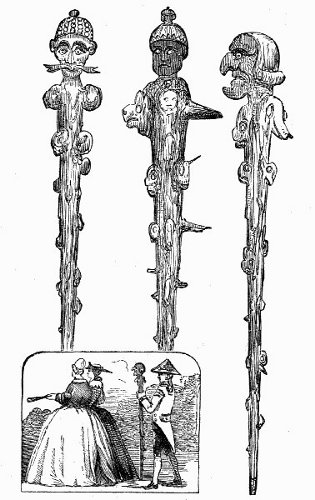
No doubt before long these staffs, which might be necessary for the protection of the ladies from the "Mohawks" of the time, will have disappeared, and people will look with curiosity at Hogarth's representation of them. Perhaps good specimens of such objects, which have passed out of use, would be worthy of a place in our national museum. One of the old-fashioned tinder-boxes would be a curiosity there now. Although but a few years have passed since the introduction of lucifer matches, it is no easy matter to get one of those old-fashioned machines.
THE SANCHI TOPE.
Under the name of topes are included the most important class of Buddhist architecture in India. They consist of detached pillars, towers, and tumuli, all of a sacred or monumental character. The word is a corruption of the Sanscrit sthupa, meaning a mound, heap, or cairn.
By far the finest as well as the most perfect tope in India is that of Sanchi, the principal one of those opened near Bilsah, in Central India. It is uncertain whether it ever contained relics or not, as it had been dug into in 1819 by Sir Herbert Maddock, since which time it has remained a ruin, and may have been plundered by the natives. At any rate it must have been a spot of peculiar sanctity, judging both from its own magnificence, and from the number of subordinate topes grouped around it. In fact there are a greater number of these monuments on this spot, within a space not exceeding 17 miles, than there are, so far at least as we now know, in the whole of India from the Sutlej to Cape Comorin.
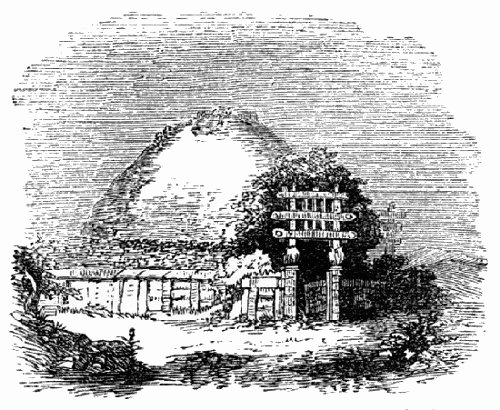
The general appearance of the Sanchi Tope will be understood from the annexed view of it. The principal building consists of a dome somewhat less than a hemisphere, 106 feet in diameter, and 42 feet in height, with a platform on the top 34 feet across, which originally formed the basis of the tee or capital, which was the invariable finish of these monuments.
The dome rests on a sloping base, 14 feet in height by 120 in diameter, having an offset on its summit about 6 feet wide. This, if we may judge from the representations of topes on the sculptures, must have been surrounded by a balustrade, and was ascended by a broad double ramp on one side. It was probably used for processions encircling the monument, which seem to have been among the most common Buddhist ceremonials. The centre of this great mound is quite solid, being composed of bricks laid in mud; but the exterior is faced with dressed stones. Over these was laid a coating of cement nearly 4 inches in thickness, which was, no doubt, originally adorned either with painting or ornaments in relief.
The fence by which this tope is surrounded is extremely curious. It consists of stone posts 8 ft. 8 in. high, and little more than 2 ft. apart. These are surmounted by a plain architrave, 2 ft. 4 in. deep, slightly rounded at the top. So far this enclosure resembles the outer circle at Stonehenge; but between every two uprights three horizontal cross-pieces of stone are inserted of an elliptical form, of the same depth as the top piece, but only 9 in. thick in the thickest part. This is the only built example yet discovered of an architectural ornament which is found carved in every cave, and, indeed, in almost every ancient Buddhist building known in India. The upright posts or pillars of this enclosure bear inscriptions indicating that they were all given by different individuals. But neither these nor any other inscriptions found in the whole tope, nor in the smaller topes surrounding it (though there are as many as 250 inscriptions in all), contain any known name, or any clue to their age.
Still more curious, however, than even the stone railing are the four gateways. One of these is shown in our view. It consists of two square pillars, covered with sculptures, with bold elephant capitals, rising to a height of 18 ft. 4 in.; above this are three lintels, slightly curved upwards in the centre, and ending in Ionic scrolls; they are supported by continuations of the columns, and three uprights inserted in the spaces between the lintels. They are covered with elaborate sculptures, and surmounted by emblems. The total height is 33 ft. 6 in. One gateway has fallen, and if removed to this country would raise the character of Indian sculpture, as nothing comparable to it has yet been transported from that part of the world to Europe.
BURIAL PLACES OF DISTINGUISHED MEN.
Chaucer was buried in the cloisters of Westminster Abbey, without the building, but removed to the south aisle in 1555; Spenser lies near him. Beaumont, Drayton, Cowley, Denham, Dryden, Howe, Addison, Prior, Congreve, Gray, Johnson, Sheridan, and Campbell, all lie within Westminster Abbey. Shakspeare, as every one knows, was buried in the chancel of the church at Stratford, where there is a monument to his memory. Chapman and Shirley are buried at St. Giles'-in-the-Fields; Marlow, in the churchyard of St. Paul's, Deptford; Fletcher and Massinger, in the churchyard of St. Saviour's, Southwark; Dr. Donne, in Old St. Paul's; Edward Waller, in Beaconsfield churchyard; Milton, in the churchyard of St. Giles', Cripplegate; Butler, in the churchyard of St. Paul's, Covent Garden; Otway, no one knows where; Garth, in the churchyard at Harrow; Pope, in the church at Twickenham; Swift, in St. Patrick's, Dublin; Savage, in the churchyard of St. Peter's, Dublin; Parnell, at Chester, where he died on his way to Dublin; Dr. Young, at Welwyn, in Hertfordshire, of which place he was the rector; Thomson, in the churchyard at Richmond, in Surrey; Collins, in St. Andrew's Church, at Chichester; Gray, in the churchyard at Stoke-Pogis, where he conceived his "Elegy;" Goldsmith, in the churchyard of the Temple Church; Falconer, at sea, with "all ocean for his grave;" Churchill, in the churchyard of St. Martin's, Dover; Cowper, in the church at Dereham; Chatterton, in a churchyard belonging to the parish of St. Andrew's, Holborn; Burns, in St. Michael's churchyard, Dumfries; Byron, in the church of Hucknall, near Newstead; Crabbe, at Trowbridge; Coleridge, in the church at Highgate; Sir Walter Scott, in Dryburgh Abbey; Southey, in Crosthwaite Church, near Keswick.
A REGAL HUNTING PARTY.
The following is an account of the destruction of game in Bohemia, by a hunting party of which the Emperor Francis made one, in 1755. There were twenty-three persons in the party, three of whom were ladies; the Princess Charlotte of Lorraine was one of them. The chase lasted eighteen days, and during that time they killed 47,950 head of game, and wild deer; of which 19 were stags, 77 roebucks, 10 foxes, 18,243 hares, 19,545 partridges, 9,499 pheasants, 114 larks, 353 quails, 454 other birds. The Emperor fired 9,798 shots, and the Princess Charlotte 9,010; in all, there were 116,209 shots fired.
ANTIPATHIES.
Certain antipathies appear to depend upon a peculiarity of the senses. The horror inspired by the odour of certain flowers may be referred to this cause. Amatus Lusitanus relates the case of a monk who fainted when he beheld a rose, and never quitted his cell when that flower was blooming. Scaliger mentions one of his relations who experienced a similar horror when seeing a lily. In these instances it is not the agreeableness or the offensive nature of the aroma that inspires the repugnance; and Montaigne remarked on this subject, that there were men who dreaded an apple more than a musket-ball. Zimmerman tells us of a lady who could not endure the feeling of silk and satin, and shuddered when touching the velvety skin of a peach. Boyle records the case of a man who felt a natural abhorrence to honey. Without his knowledge, some honey was introduced in a plaster applied to his foot, and the accidents that resulted compelled his attendants to withdraw it. A young man was known to faint whenever he heard the servant sweeping. Hippocrates mentions one Nicanor who swooned whenever he heard a flute: our Shakspeare has alluded to the effects of the bagpipe. Julia daughter of Frederick, king of Naples, could not taste meat without serious accidents. Boyle fainted when he heard the splashing of water; Scaliger turned pale at the sight of water-cresses; Erasmus experienced febrile symptoms when smelling fish; the Duke d'Epernon swooned on beholding a leveret, although a hare did not produce the same effect. Tycho Brahe fainted at the sight of a fox, Henry the Third of France at that of a cat, and Marshal d'Albert at a pig. The horror that whole families entertain of cheese is generally known. Many individuals cannot digest, or even retain certain substances, such as rice, wine, various fruits, and vegetables.
A YOUNG BUT CRUEL MURDERESS.
On the 3d of July, 1772, was executed at Lisbon, pursuant to her sentence, Louisa de Jesus, for the murder of the thirty-three infants, that were at different times committed to her care by the Directors of the Foundling Hospital at Coimbra; for which (as appears by the sentence published) she had no other inducement but six hundred reals in money, a coverda of baize, and a cradle, that she received with each of them. She was but twenty-two years of age when executed. Going to execution, she was pinched with hot irons, and at the gallows her hands were struck off; she was then strangled, and her body burnt.
BECTIVE ABBEY.
Bective Abbey, the ruins of which form the subject of the annexed engraving differs in its general arrangement from every other monastic structure in the kingdom. It was, in fact, a monastic castle, and, previous to the use of artillery, must have been regarded as a place of great strength. It is for this reason that we select it as one of our "Wonderful Things."
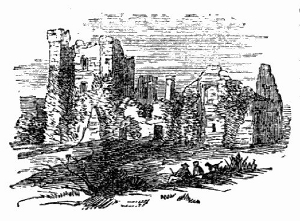
The ruins are in the immediate neighbourhood of Trim, and about thirty miles from Dublin.
The ruins combine a union of ecclesiastical with military and domestic architecture in a remarkable degree. Their chief feature is a strong battlemented tower, the lower compartment of which is vaulted, placed at the south-west corner of the quadrangular space occupied by the various buildings, and in the centre of which the cloisters remain in excellent preservation. The cloister arches are late in the first pointed style, and are cinque-foiled. The featherings are mostly plain, but several are ornamented with flowers or leaves, and upon one a hawk-like bird is sculptured. A fillet is worked upon each of the clustered shafts, by which the openings are divided, and also upon their capitals. The bases, which are circular, rest upon square plinths, the angles of which are ornamented with a leaf, as it were, growing out of the base of the moulding.
Of the church there are scarcely any remains. As the northern wall of the cloister is pierced with several windows, which have now the appearance of splaying externally, it is extremely probable that it also served as the south wall of the church, no other portion of which can at present be identified. Those buildings which were for the most part devoted to domestic purposes are for the most part situated upon the east side of the quadrangle. Their architectural details are of a character later than those of the tower and of the other portions, but additions and alterations have evidently been made.
NOVEL MODE OF CELEBRATION.
Upon the occasion of the christening of the 21st child of Mr. Wright, of Widaker, near Whitehaven, by the same woman, in the year 1767, the company came from 21 parishes, and the entertainment consisted of 21 pieces of beef, 21 legs of mutton and lamb, 21 gallons of brandy, three times 21 gallons of strong ale, three times 21 fowls, roasted and boiled, 21 pies, &c.
ANTIQUE HEAD ORNAMENT.
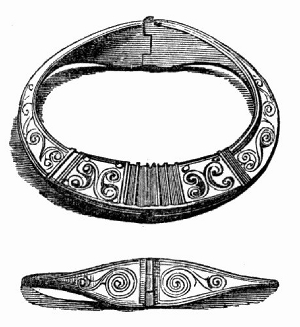
The annexed engraving represents an exceedingly beautiful bronze relic, apparently of the class of head rings, in the collection of the Society of Antiquaries of Scotland, which was discovered in the year 1747, about seven feet below the surface, when digging for a well, at the east end of the village of Stitchel, in the county of Roxburgh. It bears a resemblance in some respects to relics of the same class in the Christiansborg Palace, yet nothing exactly similar to it has yet been found among Scandinavian relics; while some of its ornamental details closely correspond to those which characterize the British horse furniture and other native relics of this period. One of its most remarkable peculiarities is, that it opens and shuts by means of a hinge, being clasped when closed by a pin which passes through a double catch at a line intersecting the ornament; and so perfect is it that it can still be opened and secured with ease. It is probable that this also should rank among the ornaments of the head, though it differs in some important respects from any other object of the same class. The oval which it forms is not only too small to encircle the head, but it will be observed from the engraving that its greatest length is from side to side, the internal measurements being five and nine-tenth inches by five and one-tenth inches.
RELICS.
At the commencement of the seventeenth century there was a crucifix belonging to the Augustine friars at Burgos in Spain, which produced a revenue of nearly seven thousand crowns per annum. It was found upon the sea, not far from the coast, with a scroll of parchment appended to it, descriptive of the various virtues it possessed. The image was provided with a false beard and a chesnut periwig, which its holy guardians declared were natural, and they also assured all pious visitors that on every Friday it sweated blood and water into a silver basin. In the garden of this convent grew a species of wheat, the grain of which was peculiarly large, and which its possessors averred was brought by Adam out of Paradise. Of this wheat they made small cakes called pançillos, kneaded with the aforesaid blood and water, and sold them to the credulous multitude for a quartillo a piece. These cakes were an infallible remedy for all disorders, and over those who carried them the devil had no power. They sold also blue ribands of the exact length of the crucifix, for about a shilling each, with this inscription in silver letters, "La madi del santo crucifisco de Burgos." These ribands were a sovereign cure for the headache.
LONG MEG AND HER DAUGHTERS.
As there is something remarkable or out of the way in this family of heavy stone, we present it to the reader. This venerable Druidical monument, which is by the country-people called Long Meg and her Daughters, stands near Little Salkeld, in the county of Cumberland. It consists of 67 massy stones, of different sorts and sizes, ranged in a circle of nearly 120 paces diameter; some of these stones are granite, some blue and grey limestone, and others flint; many of them are ten feet high, and fifteen or sixteen feet in circumference: these are called Long Meg's Daughters. On the southern side of this circle, about seventeen or eighteen paces out of the line, stands the stone called Long Meg, which is of that kind of red stone found about Penrith. It is so placed, that each of its angles faces one of the cardinal points of the compass; it measures upwards of eighteen feet in height, and fifteen feet in girth; its figure is nearly that of a square prism; it weighs about sixteen tons and a half. In the part of the circle the most contiguous, four large stones are placed in a square form, as if they had been intended to support an altar; and towards the east, west, and north, two large stones stand a greater distance from each other than any of the rest, seemingly to form the entrances into a circle. It is remarkable that no stone-quarry is to be found hereabouts. The appearance of this circle is much hurt by a stone wall built across it, that cuts off a considerable segment, which stands in the road. The same ridiculous story is told of these stones, as of those at Stonehenge, i. e., that it is impossible to count them, and that many persons who have made the trial, could never find them amount twice to the same number. It is added, that this was a holy place, and that Long Meg and her Daughters were a company of witches transformed into stones, on the prayers of some saint, for venturing to prophane it; but when, and by whom, the story does not say. Thus has tradition obscurely, and clogged with fable, handed down the destination of this spot, accompanied with some of that veneration in which it was once undoubtedly held, though not sufficiently to protect its remains from the depredations of avarice; the inclosure and cultivation of the ground bidding fair to destroy them. These stones are mentioned by Camden, who was either misinformed as to, or mis-reckoned their number; unless, which seems improbable, some have been taken away. "At Little Salkeld, (says he,) there is a circle of stones seventy-seven in number, each ten feet high; and before these, at the entrance, is a single one by itself, fifteen feet high. This the common people call Long Meg, and the rest her Daughters; and within the circle, are two heaps of stones, under which they say there are dead bodies buried; and, indeed, it is probable enough that this has been a monument erected in memory of some victory." The history of the British Druidical Antiquities having been thoroughly investigated, since Camden's time, these circles are now universally agreed to have been temples and places of judgment, and not sepulchral monuments. Indeed his editor has, in some measure, rectified his mistake, by the following addition: "But, as to the heaps in the middle, they are no part of the monument, but have been gathered off the ploughed lands adjoining; and (as in many other parts of the county) thrown up here in a waste corner of the field; and as to the occasion of it, both this, and the Rolrick stones in Oxfordshire, are supposed by many, to have been monuments erected at the solemn investiture of some Danish Kings, and of the same kind as the Kingstolen in Denmark, and Moresteen in Sweden; concerning which, several large discourses have been written."
CURIOUS PARTICULARS RELATIVE TO DRESS AT THE COMMENCEMENT OF THE FIFTEENTH CENTURY.
Cloth of gold, satin, and velvet, enriched by the florid decorations of the needle, were insufficient to satisfy the pride of nobles; robes formed of these costly materials were frequently ornamented with embroidery of goldsmiths' work, thickly set with precious stones; and the most absurd and fantastic habits were continually adopted, in the restless desire to appear in new inventions. John of Ghent is represented in a habit divided straight down the middle, one side white, the other half dark blue; and his son, Henry IV., on his return from exile, rode in procession through London in a jacket of cloth-of-gold, "after the German fashion." The dukes and earls who attended his coronation wore three bars of ermine on the left arm, a quarter of a yard long, "or thereabouts;" the barons had but two: and over the monarch's head was borne a canopy of blue silk, supported by silver staves, with four gold bells, "that rang at the corners." "Early in the reign of Richard II. began," says Stowe, "the detestable use of piked shoes, tied to the knees with chains of silver gilt; also women used high attire on their heads with piked horns and long training gowns. The commons also were besotted in excesse of apparel; in wide surcoates reaching to their loines; some in a garment reaching to their heels, close before and sprowting out at the sides, so that on the backe they make men seeme women, and this they call by a ridiculous name—gowne. Their hoodes are little, and tied under the chin."
ECCENTRIC FUNERAL.
Mr. John Oliver, an eccentric miller of Highdown Hill, in Sussex, died, aged eighty-three, the 27th of May, 1793. His remains were interred near his mill, in a tomb he had caused to be erected there for that purpose, near thirty years ago; the ground having been previously consecrated. His coffin, which he had for many years kept under his bed, was painted white; and the body was borne by eight men clothed in the same colour. A girl about twelve years old read the burial service, and afterwards, on the tomb, delivered a sermon on the occasion, from Micah 7, 8, 9, before at least two thousand auditors, whom curiosity had led to see this extraordinary funeral.
EGYPTIAN STANDARDS.
The engraving which we here lay before our friends, represents a group of Egyptian standards, as they were used in the army in the time of Pharaoh.
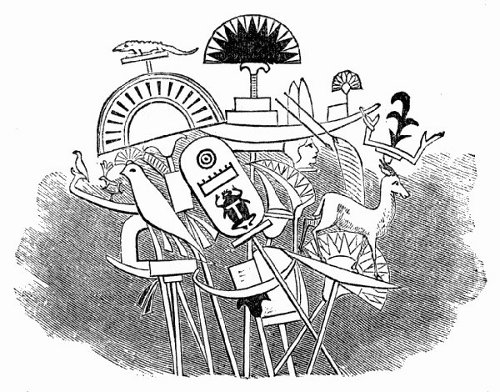
Each regiment and company had its own peculiar banner or standard, which were therefore very numerous, and various in their devices. A beast, bird, or reptile, a sacred boat, a royal name in a cartouche, or a symbolic combination of emblems, were the most common forms. As they appear to have been objects of superstitious veneration that were selected for this purpose, they must have contributed greatly to the enthusiasm so highly valued in battle; and instances are common in all history of desponding courage revived, and prodigies of valour performed, on behalf of those objects which were so identified with national and personal honour.
Allusions to standards, banners, and ensigns are frequent in the Holy Scriptures. The four divisions in which the tribes of Israel marched through the wilderness had each its governing standard, and tradition has assigned to these ensigns the respective forms of the symbolic cherubim seen in the vision of Ezekiel and John—that of Judah being a lion, that of Reuben a man, that of Ephraim an ox, and that of Dan an eagle. The post of standard-bearer was at all times of the greatest importance, and none but officers of approved valour were ever chosen for such a service; hence Jehovah, describing the ruin and discomfiture which he was about to bring on the haughty King of Assyria, says, "And they shall be as when a standard-bearer fainteth."
THE SHREW ASH.
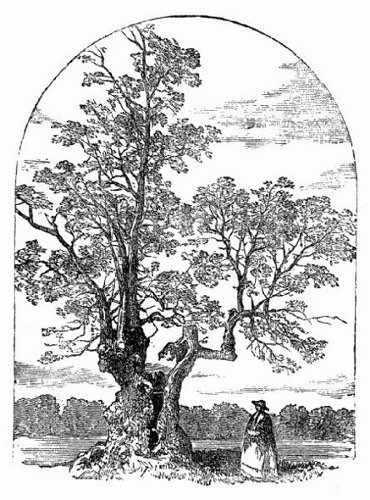
At that end of Richmond Park where a gate leads to Mortlake, and near a cottage in which resides one of the most estimable gentlemen of the age—Professor Owen—there still lives and flourishes a tree that has been famous for many ages: it is the Shrew Ash, and the above is a correct engraving of it. It stands on rising ground, only a few yards beyond the pond which almost skirts the Professor's lawn. White, in his Natural History of Selborne, describes a shrew-ash as an ash whose twigs or branches, when gently applied to the limbs of cattle, will immediately relieve the pains which a beast suffers from the running of a shrew-mouse over the part affected; for it is supposed that a shrew-mouse is of so baleful and deleterious a nature, that wherever it creeps over a beast, be it horse, cow, or sheep, the suffering animal is afflicted with cruel anguish, and threatened with the loss of the use of the limb. Against this evil, to which they were continually liable, our provident forefathers always kept a shrew-ash at hand, which, when once medicated, would maintain its virtue for ever. A shrew-ash was made potent thus:—Into the body of a tree a deep hole was bored with an auger, and a poor devoted shrew-mouse was thrust in alive, and plugged in, no doubt with several quaint incantations, long since forgotten. The shrew-ash in Richmond Park is, therefore, amongst the few legacies of the kind bequeathed to their country by the wisdom of our ancestors.
Our readers will perceive that across the hollow of the tree near the top there is a little bar of wood. The legend runs that were this bar removed every night, it would be replaced in the same spot every morning. The superstition is, that if a child afflicted with what the people in the neighbourhood call "decline," or whooping-cough, or any infantine disease, is passed nine times up the hollow of that tree, and over the bar, while the sun is rising, it will recover. If the charm fails to produce the desired effect, the old women believe that the sun was too far up, or not up enough. If the child recovers, of course, the fame of the tree is whispered about. There is a sort of shrew-mother to every shrew-ash, who acts as guide and teacher to any young mother who has an afflicted child and believes in the charm. The ash in Richmond Park is still used, and still firmly believed in.
A DRUM MADE OF HUMAN SKIN.
John Zisca, general of the insurgents who took up arms in the year 1419 against the Emperor Sigismund, to revenge the deaths of John Huss, and Jerome of Prague, who had been cruelly burnt to death for their religious tenets, defeated the Emperor in several pitched battles. He gave orders that, after his death, they should make a drum of his skin; which was most religiously obeyed, and those very remains of the enthusiastic Zisca proved, for many years, fatal to the Emperor, who, with difficulty, in the space of sixteen years, recovered Bohemia, though assisted by the forces of Germany, and the terror of Crusades. The insurgents were 40,000 in number, and well disciplined.
EARTHQUAKE IN JAMAICA.
The Earthquake of Jamaica, in 1692, is one of the most dreadful that history has to record. It was attended with a hollow rumbling noise like that of thunder, and in less than a minute all the houses on one side of the principal street in the town of Port Royal sank into a fearful gulf forty fathoms deep, and water came roaring up where the houses had been. On the other side of the street the ground rose up and down like the waves of the sea, raising the houses and throwing them into heaps as it subsided. In another part of the town the street cracked along all its length, and the houses appeared suddenly twice as far apart as they were before. In many places the earth opened and closed again, so that several hundred of these openings were to be seen at the same time; and as the wretched inhabitants ran out of their tottering dwellings, the earth opened under their feet, and in some cases swallowed them up entirely; while in others, the earth suddenly closing, caught them by the middle, and thus crushed them to death. In some cases these fearful openings spouted up cataracts of water, which were attended by a most noisome stench. It is not possible for any place to exhibit a scene of greater desolation than the whole island presented at this period. The thundering bellowing of the distant mountains, the dusky gloom of the sky, and the crash of the falling buildings gave unspeakable horror to the scene. Such of the inhabitants as were saved sought shelter on board the ships in the harbour, and remained there for more than two months, the shocks continuing with more or less violence every day. When, at length, the inhabitants were enabled to return, they found the whole face of the country changed. Very few of the houses which had not been swallowed up were left standing, and what had been cultivated plantations were converted into large pools of water. The greater part of the rivers had been choked up by the falling in of detached masses of the mountains, and spreading over the valleys, they had changed what was once fertile soil into morasses, which could only be drained by cutting new channels for the rivers; while the mountains themselves had changed their shapes so completely, that it was conjectured that they had formed the chief seat of the earthquake.
CURIOUS EXTRACTS FROM THE HOUSEHOLD BOOK OF LADY MARY, DAUGHTER OF THE KING, IN VARIOUS YEARS, FROM THE 28TH TO THE 36TH OF HENRY VIII. ROYAL MSS. BRIT. MUS.
"Item, geven to George Mountejoye drawing my Layde's Grace to his Valentine, xls.
"Item, geven amongs the yeomen of the King's guard bringing a Leke to my Lady's Grace on Saynt David's Day, xvs.
"Item, geven to Heywood playeng an enterlude with his children before my Lady's Grace, xls.
"Item, payed for a yerde and a halfe of damaske for Jane the fole, vijs.
"Item, for shaving of Jane fooles hedde, iiijd.
"Payed for a frountlet lost in a wager to my Lady Margaret, iiijli.
"Item, payed for a brekefast lost at bolling by my Lady Mary's Grace, xs."
GIVING DOLES.
A bishop of Durham, in the reign of Edward III, had every week eight quarters of wheat made into bread for the poor, besides his alms-dishes, fragments from his table, and money given away by him in journeys. The bishop of Ely, in 1532, fed daily at his gates two hundred poor persons, and the Lord Cromwell fed the same number. Edward, earl of Derby, fed upwards of sixty aged poor, besides all comers, thrice a week, and furnished, on Good Friday, two thousand seven hundred people with meat, drink, and money. Robert Winchelsey, archbishop of Canterbury, gave, besides the daily fragments of his house, on Fridays and Sundays, to every beggar that came to his door, a loaf of bread of a farthing value; in time of dearth he thus gave away five thousand loaves, and this charity is said to have cost his lordship five hundred pounds a year. Over and above this he gave on every festival day one hundred and fifty pence to as many poor persons, and he used to send daily meat, drink, and bread unto such as by age and sickness were not able to fetch alms from his gate; he also sent money, meat, apparel, &c., to such as he thought wanted the same, and were ashamed to beg; and, above all, this princely prelate was wont to take compassion upon such as were by misfortune decayed, and had fallen from wealth to poor estate. Such acts deserve to be written in letters of gold.
FEMALE ORNAMENT OF THE IRON PERIOD.
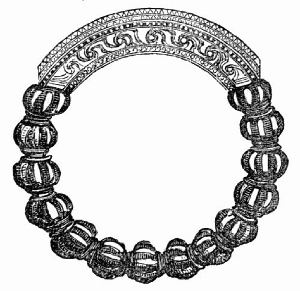
One of the most beautiful neck ornaments of the Teutonic or Iron Period ever found in Scotland is a beaded torc, discovered by a labourer while cutting turf in Lochar Moss, Dumfriesshire, about two miles to the north of Cumlongan Castle; and exhibited by Mr. Thomas Gray, of Liverpool, at the York meeting of the Archæological Institute. We here annex an engraving of it. The beads, which measure rather more than an inch in diameter, are boldly ribbed and grooved longitudinally. Between every two ribbed beads there is a small flat one formed like the wheel of a pulley, or the vertebral bone of a fish. The portion which must have passed round the nape of the neck is flat and smooth on the inner edge, but chased on the upper side in an elegant incised pattern corresponding to the ornamentation already described as characteristic of this period, and bearing some resemblance to that on the beautiful bronze diadem found at Stitchel in Roxburghshire, figured on a subsequent page. The beads are disconnected, having apparently been strung upon a metal wire, as was the case in another example found in the neighbourhood of Worcester. A waved ornament, chased along the outer edge of the solid piece, seems to have been designed in imitation of a cord; the last tradition, as it were, of the string with which the older necklace of shale or jet was secured. Altogether this example of the class of neck ornaments, to which Mr. Birch has assigned the appropriate name of beaded torcs, furnishes an exceedingly interesting illustration of the development of imitative design, in contradistinction to the more simple and archaic funicular torc, which, though continued in use down to a later period, pertains to the epoch of primitive art.
CURIOUS LANTERN.
In 1602, it is related that Sir John Harrington, of Bath, sent to James VI King of Scotland, at Christmas, for a new year's gift, a dark lantern. The top was a crown of pure gold, serving also to cover a perfume pan; within it was a shield of silver, embossed, to reflect the light; on one side of which were the sun, moon, and planets, and on the other side, the story of the birth and passion of Christ, as it was engraved by David II King of Scotland, who was a prisoner at Nottingham. On this present, the following passage was inscribed in Latin—"Lord, remember me when thou comest into thy kingdom."
ANCIENT SCANDINAVIAN BROOCH.
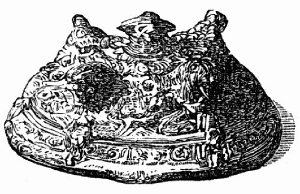
The characteristic and beautiful ornament, usually designated the shell-shaped brooch, and equally familiar to Danish and British antiquaries, belongs to the Scoto-Scandinavian Period. In Scotland many beautiful examples have been found, several of which are preserved in the Museum of Scottish Antiquaries. From these we select the one represented in the annexed engraving, as surpassing in beauty of design and intricacy of ornament any other example of which we are aware. It consists, as usual, of a convex plate of metal, with an ornamental border, surmounted by another convex plate of greater depth, highly ornamented with embossed and perforated designs, the effect of which appears to have been further heightened by the lower plate being gilded so as to show through the open work. In this example the gilding still remains tolerably perfect. On the under side are the projecting plates, still retaining a fragment of the corroded iron pin, where it has turned on a hinge, and at the opposite end the bronze catch into which it clasped. The under side of the brooch appears to have been lined with coarse linen, the texture of which is still clearly defined of the coating of verd antique with which it is now covered. But its peculiar features consist of an elevated central ornament resembling a crown, and four intricately-chased projections terminating in horses' heads. It was found in September, 1786, along with another brooch of the same kind, lying beside a skeleton, under a flat stone, very near the surface, above the ruins of a Pictish house or burgh, in Caithness. It measures nearly four and a half inches in length, by three inches in breadth, and two and two-fifth inches in height to the top of the crown. Like many others of the same type, it appears to have been jewelled. In several examples of these brooches which we have compared, the lower convex plates so nearly resemble each other, as to suggest the probability of their having been cast in the same mould, while the upper plates entirely differ.
STREET CRIES OF MODERN EGYPT.
The cries of the street hawkers in Egypt at the present day are very singular, and well deserve a place in our repertory of curiosities. The seller of tir'mis (or lupins) often cries "Aid! O Imba'bee! aid!" This is understood in two senses: as an invocation for aid to the sheykh El-Imba'bee, a celebrated Moos'lim saint, buried at the Imba'beh, on the west bank of the Nile, opposite Cairo; in the neighbourhood of which village the best tir'mis is grown; and also as implying that it is through the aid of the saint above mentioned that the tir'mis of Imba'beh is so excellent. The seller of this vegetable also cries, "The tir'mis of Imba'beh surpasses the almond!" Another cry of the seller of tir'mis is, "O how sweet are the little children of the river!" This last cry, which is seldom heard but in the country towns and villages of Egypt, alludes to the manner in which the tir'mis is prepared for food. To deprive it of its natural bitterness, it is soaked, for two or three days, in a vessel full of water; then boiled, and, after this, sewed up in a basket of palm-leaves (called furd), and thrown into the Nile, where it is left to soak again, two or three days; after which, it is dried, and eaten cold, with a little salt. The seller of sour limes cries, "God make them light [or easy of sale]! O limes!" The toasted pips of a kind of melon called 'abdalla'wee, and of the water-melon, are often announced by the cry of "O consoler of the embarrassed! O pips!" though more commonly, by the simple cry of "Roasted pips!" A curious cry of the seller of a kind of sweetmeat (hhala'wee), composed of treacle fried with some other ingredients, is, "For a nail! O sweetmeat!" He is said to be half a thief: children and servants often steal implements of iron, &c., from the house in which they live, and give them to him in exchange for his sweetmeat. The hawker of oranges cries, "Honey! O oranges! Honey!" and similar cries are used by the sellers of other fruits and vegetables; so that it is sometimes impossible to guess what the person announces for sale; as, when we hear the cry of "Sycamore-figs! O grapes!" excepting by the rule that what is for sale is the least excellent of the fruits, &c., mentioned; as sycamore-figs are not so good as grapes. A very singular cry is used by the seller of roses: "The rose was a thorn: from the sweat of the Prophet it opened [its flowers]." This alludes to a miracle related of the Prophet. The fragrant flowers of the hhen'na-tree (or Egyptian privet) are carried about for sale, and the seller cries, "Odours of paradise! O flowers of the hhen'na!" A kind of cotton cloth, made by machinery which is put in motion by a bull, is announced by the cry of "The work of the bull! O maidens!"
THE BLACK PESTILENCE.
The black pestilence of the fourteenth century caused the most terrific ravages in England. It has been supposed to have borne some resemblance to the cholera, but that is not the case; it derived its name from the dark, livid colour of the spots and boils that broke out upon the patient's body. Like the cholera, the fatal disease appeared to have followed a regular route in its destructive progress; but it did not, like the cholera, advance westward, although, like that fearful visitation, it appears to have originated in Asia.
The black pestilence descended along the Caucasus to the shores of the Mediterranean, and, instead of entering Europe through Russia, first appeared over the south, and, after devastating the rest of Europe, penetrated into that country. It followed the caravans, which came from China across Central Asia, until it reached the shores of the Black Sea; thence it was conveyed by ships to Constantinople, the centre of commercial intercourse between Asia, Europe, and Africa. In 1347 it reached Sicily and some of the maritime cities of Italy and Marseilles. During the following year it spread over the northern part of Italy, France, Germany, and England. The northern kingdoms of Europe were invaded by it in 1349, and finally Russia in 1351—four years after it had appeared in Constantinople.
The following estimate of deaths was considered far below the actual number of victims:—
Florence lost 60,000 inhabitants
Venice " 10,000 "
Marseilles " in one month 56,000 "
Paris " " 50,000 "
Avignon " " 60,000 "
Strasburg " " 16,000 "
Basle " " 14,000 "
Erfurth " " 16,000 "
London " " 100,000 "
Norwich " " 50,000 "
Hecker states that this pestilence was preceded by great commotion in the interior of the globe. About 1333, several earthquakes and volcanic eruptions did considerable injury in upper Asia, while in the same year, Greece, Italy, France, and Germany suffered under similar disasters. The harvests were swept away by inundations, and clouds of locusts destroyed all that floods had spared, while dense masses of offensive insects strewed the land.
As in the recent invasion of cholera, the populace attributed this scourge to poison and to the Jews, and these hapless beings were persecuted and destroyed wherever they could be found. In Mayence, after vainly attempting to defend themselves, they shut themselves up in their quarters, where 1,200 of them burnt to death. The only asylum found by them was Lithuania, where Casimir afforded them protection; and it is, perhaps, owing to this circumstance that so many Jewish families are still to be found in Poland.
THE DUCHESS OF LAUDERDALE.
Few mansions are more pleasantly situated than Ham House, the dwelling of the Tollemaches, Earls of Dysart. It stands on the south bank of the Thames, distant about twelve miles from London, and immediately opposite to the pretty village of Twickenham. It was erected early in the seventeenth century; the date 1610 still stands on the door of the principal entrance. Its builder was Sir Thomas Vavasour, and it subsequently came into the possession of Katherine, daughter of the Earl of Dysart, who married first Sir Lionel Tollemache, and for her second husband Earl, afterwards Duke, of Lauderdale.
The Duchess of Lauderdale was one of the "busiest" women of the busy age in which she lived. Burnet insinuates that, during the life time of her first husband, "she had been in a correspondence with Lord Lauderdale that had given occasion for censure." She succeeded in persuading him that he was indebted for his escape after "Worcester fight" to "her intrigues with Cromwell. She was a woman," continues the historian, "of great beauty, but of far greater parts. She had a wonderful quickness of apprehension, and an amazing vivacity in conversation. She had studied, not only divinity and history, but mathematics and philosophy. She was violent in everything she set about,—a violent friend, but a much more violent enemy. She had a restless ambition, lived at a vast expense, and was ravenously covetous, and would have stuck at nothing by which she might compass her ends." Upon the accession of her husband to political power after the Restoration, "all applications were made to her. She took upon her to determine everything; she sold all places; and was wanting in no method that could bring her money, which she lavished out in a most profuse vanity."
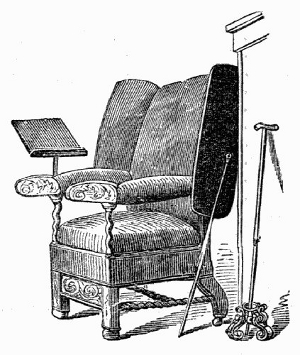
This Duchess of Lauderdale—famous during the reigns of four monarchs—the First and Second James, and the First and Second Charles, and through the Protectorship of Cromwell—refurnished the house at Ham, where she continued to reside until her death at a very advanced age.
Among other untouched relics of gone-by days, is a small ante-chamber, where, it is said, she not only condescended to receive the second Charles, but, if tradition is to be credited, where she "cajoled" Oliver Cromwell. There still remains the chair in which she used to sit, her small walking cane, and a variety of objects she was wont to value and cherish as memorials of her active life, and the successful issue of a hundred political intrigues.
MODERN EGYPTIAN MUSICAL INSTRUMENTS.
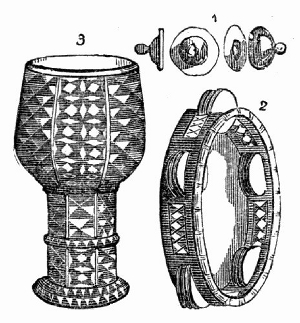
Sa'ga't (1), Ta'r (2), and Dar'abook'keh (3).
The durwee'shes, who constitute a sort of religious mendicant order in Egypt, often make use of, in their processions and in begging, a little tubl, or kettle-drum, called ba'z; six or seven inches in diameter; which is held in the left hand, by a little projection in the centre of the back, and beaten by the right hand, with a short leather strap, or a stick. They also use cymbals, which are called ka's, on similar occasions. The ba'z is used by the Moosahh'hhir, to attract attention to his cry in the nights of Rum'ada'n. Castanets of brass, called sa'ga't are used by the public female and male dancers. Each dancer has two pairs of these instruments. They are attached, each by a loop of string, to the thumb and second finger, and have a more pleasing sound than castanets of wood or ivory. There are two instruments which are generally found in the hharee'm of a person of moderate wealth, and which the women often use for their diversion. One of these is a tambourine, called ta'r, of which we insert an engraving. It is eleven inches in diameter. The hoop is overlaid with mother-of-pearl, tortoise-shell, and white bone, or ivory, both without and within, and has ten circular plates of brass attached to it, each two pairs having a wire passing through their centres. The ta'r is held by the left or right hand, and beaten with the fingers of that hand and by the other hand. The fingers of the hand which holds the instrument, striking only near the hoop, produce higher sounds than the other hand, which strikes in the centre. A tambourine of a larger and more simple kind than that here described, without the metal plates, is often used by the lower orders. The other instrument alluded to in the commencement of this paragraph is a kind of drum, called dar'abook'keh. The best kind is made of wood, covered with mother-of-pearl and tortoise-shell, &c. One of this description is here represented with the ta'r. It is fifteen inches in length, covered with a piece of fishes' skin at the larger extremity, and open at the smaller. It is placed under the left arm; generally suspended by a string that passes over the left shoulder; and is beaten with both hands.
REMARKABLE OAKS.
The oaks most remarkable for their horizontal expansion, are, according to Loudon, the following:—"The Three-shire Oak, near Worksop, was so situated, that it covered part of the three counties of York, Nottingham, and Derby, and dripped over seven hundred and seventy-seven square yards. An oak between Newnham Courtney and Clifton shaded a circumference of five hundred and sixty yards of ground, under which two thousand four hundred and twenty men might have commodiously taken shelter. The immense Spread Oak in Worksop Park, near the white gate, gave an extent, between the ends of its opposite branches, of an hundred and eighty feet. It dripped over an area of nearly three thousand square yards, which is above half an acre, and would have afforded shelter to a regiment of nearly a thousand horse. The Oakley Oak, now growing on an estate of the Duke of Bedford, has a head of an hundred and ten feet in diameter. The oak called Robur Britannicum, in the Park, at Rycote, is said to have been extensive enough to cover five thousand men; and at Ellerslie, in Renfrewshire, the native village of the hero Wallace, there is still standing 'the old oak tree,' among the branches of which, it is said, that he and three hundred of his men hid themselves from the English."
CURIOUS ADVERTISEMENT.
A few years ago the following actually appeared in one of the London papers: certainly a most economical speculation for the use of soul and body:—
"Wanted, for a family who have bad health, a sober, steady person, in the capacity of doctor, surgeon, apothecary, and man-midwife. He must occasionally act as butler, and dress hair and wigs. He will be required sometimes to read prayers, and to preach a sermon every Sunday. A good salary will be given."
CHANGES OF MOUNT ETNA.
Signor Maria Gemmellario has given, from a meteorological journal kept at Catania, a very interesting view of the successive changes of Mount Etna, at a period in which it was in the phase of moderate activity; and no description could convey so accurate a conception of the ever-changing phenomena.
On the 9th of February, 1804, there was a sensible earthquake. Etna smoked ninety-seven days, but there was no eruption nor any thunder.
On the 3rd of July, 1805, there was an earthquake. Etna smoked forty-seven days, and emitted flame twenty-eight days. There was an eruption in June, but no thunder.
There were earthquakes on the 27th of May and 10th of October, 1806. The mountain smoked forty-seven days, flamed seven, and detonated twenty-eight: little thunder.
On the 24th of February and 25th of November, 1807, there were earthquakes. Etna smoked fifty-nine days: little thunder.
In August, September, and December, 1808, earthquakes were frequent. Etna smoked twelve days, flamed one hundred and two, and often detonated. Thunder storms were frequent.
From January to May, and during September and December, 1809, there were thirty-seven earthquakes. The most sensible shock was on the 27th of March, when the mountain ejected lava on the western side. This eruption lasted thirteen days, and part of the Bosco di Castiglione was injured. The mountain smoked one hundred and fifty-two days, flamed three, and detonated eleven. Little thunder.
On the 16th and 17th of February, 1810, there were four earthquakes. On the 27th of October, Etna was in a state of eruption on the eastern side, and the lava flowed into the Valle del Bue. There were about twenty thunder storms.
1811, no earthquakes, but the mountain continued until the 24th of April to eject lava from the east. At this time the Mount St. Simon was formed. No thunder.
Earthquake on the 3rd and 13th of March, 1813. The mountain smoked twenty-eight days. On the 30th of June, and on the 5th of August, St. Simon smoked. There were twenty-one thunder storms.
On the 3rd of November, 1814, there was an earthquake, preceded by a discharge of sand from that part of the mountain called Zoccolaro. There were twelve thunder storms.
On the 6th of September, 1815, there was an earthquake. The mountain smoked forty-two days, and there were eleven thunder storms. On the 6th, 7th, and 11th of January the lightning was tremendous.
1816, no earthquakes. On the 13th of August a part of the interior side of the crater fell in. Ten thunder storms.
There was an earthquake on the 18th of October, 1817. The mountain smoked twenty-two days. There were eight thunder storms.
During 1818 there were twenty-five earthquakes. The most violent was in the neighbourhood of Catania, on the 20th of February. The mountain smoked twenty-four days. No thunder.
CHARITY INSTEAD OF POMP.
According to the "Annual Register" for August, 1760, there were expended at the funeral of Farmer Keld, of Whitby, in that year, one hundred and ten dozen of penny loaves, eight large hams, eight legs of veal, twenty stone of beef (fourteen pounds to the stone), sixteen stone of mutton, fifteen stone of Cheshire cheese, and thirty ankers of ale, besides what was distributed to about one thousand poor people, who had sixpence each in money given them.
THE BEDFORD MISSAL.
One of the most celebrated books in the annals of bibliography, is the richly illuminated Missal, executed for John, Duke of Bedford, Regent of France, under Henry VI.; by him it was presented to that king, in 1430. This rare volume is eleven inches long, seven and a-half wide, and two and a-half thick; contains fifty-nine large miniatures, which nearly occupy the whole page, and above a thousand small ones, in circles of about an inch and a-half diameter, displayed in brilliant borders of golden foliage, with variegated flowers, etc.; at the bottom of every page are two lines in blue and gold letters, which explain the subject of each miniature. This relic, after passing through various hands, descended to the Duchess of Portland, whose valuable collection was sold by auction, in 1786. Among its many attractions was the Bedford Missal. A knowledge of the sale coming to the ears of George III., he sent for his bookseller, and expressed his intention to become the purchaser. The bookseller ventured to submit to his majesty the probable high price it would fetch. "How high?" exclaimed the king. "Probably, two hundred guineas," replied the bookseller. "Two hundred guineas for a Missal!" exclaimed the queen, who was present, and lifted her hands up with astonishment. "Well, well," said his majesty, "I'll have it still; but since the queen thinks two hundred guineas so enormous a price for a Missal, I'll go no further." The biddings for the Royal Library did actually stop at that point; a celebrated collector, Mr. Edwards, became the purchaser by adding three pounds more. The same Missal was afterwards sold at Mr. Edwards' sale, in 1815, and purchased by the Duke of Marlborough, for the enormous sum of £637 l5s. sterling.
CALICINATED RINGS.
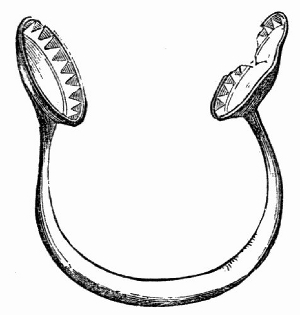
There is a particular class of antique gold ornaments, belonging to the Bronze Period, which is deserving of especial attention, from the circumstance that the British Isles is the only locality in which it has yet been discovered. These ornaments consist of a solid cylindrical gold bar, beat into a semicircle or segmental arc, most frequently tapering from the centre, and terminated at both ends with hollow cups, resembling the mouth of a trumpet, or the expanded calix of a flower. A remarkable example of these curious native relics is engraved in the "Archæological Journal." The cups are formed merely by hollows in the slightly dilated ends; but it is further interesting from being decorated with the style of incised ornaments of most frequent occurrence on the primitive British pottery. It was dug up at Brahalish, near Bantry, county Cork, and weighs 3 oz. 5 dwts. 6 grs. In contrast to this, another is engraved in the same journal, found near the entrance lodge at Swinton Park, Yorkshire, scarcely two feet below the surface. In this beautiful specimen the terminal cups are so unusually large, that the solid bar of gold dwindles into a mere connecting-link between them. The annexed figure of a very fine example found by a labourer while cutting peats in the parish of Cromdale, Inverness-shire, somewhat resembles that of Swinton Park in the size of its cups. It is from a drawing by the late Sir Thomas Dick Lauder, and represents it about one-half the size of the original. Similar relics of more ordinary proportions have been brought to light, at different times, in various Scottish districts.
EXTRAORDINARY CRICKET MATCHES.
Every day in summer wagers are made at Lord's cricket ground, upon matches there to be played; but there have been more extraordinary matches elsewhere relative to this exercising game; for a cricket match was played on Blackheath, in the year 1766, between eleven Greenwich pensioners who had lost each an arm, and eleven others who had lost each a leg. The former won with ease. And again, on the 9th of August, 1796, a cricket match was played by eleven Greenwich pensioners with one leg, against eleven with one arm, for one thousand guineas, at the new cricket ground, Montpelier gardens, Walworth. At nine o'clock the men arrived in three Greenwich stages; about twelve the wickets were pitched, and they commenced. Those with but one leg had the first innings, and got 93 runs; those with but one arm got but 42 runs during their innings. The one-leg commenced their second innings, and six were bowled out after they had got 60 runs; so that they left off one hundred and eleven more than those with one arm. Next morning the match was played out; and the men with one leg beat the one-arms by one hundred and three runs. After the match was finished the eleven one-legged men ran a sweep-stakes of one hundred yards distance for twenty guineas, and the three first had prizes.
MUMMY CASES.
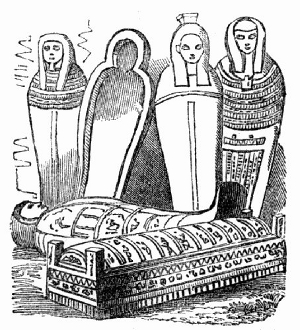
The annexed engraving represents a set of Egyptian mummy cases, several of which were used for the interment of one body, the smaller one being enclosed within the larger. On the death of a king in Egypt, "three score and ten days" was the period that intervened from his departure to the termination of the embalming operations; the earlier and more important of which, exclusive of the soaking in natron, occupied forty days. The coffin, or wooden case, in which the embalmed body of Joseph was preserved, till at the exodus it was carried from Egypt, was, doubtless, of such a form and appearance as those with which we are familiar at our museums. An account of some specimens of these, and of the internal shells which were considered requisite for persons of rank, will be read with interest.
Before the better kind of mummies were put into their wooden cases, they were placed in a shell in the following manner:—Nine thick layers of hempen or linen cloth were well gummed together, so as to make a strong flexible kind of board, something like a piece of papier mâché. This was formed into the shape of the swathed mummy, which was inserted in it by means of a longitudinal aperture on the under side, reaching from the feet to the head. The two sides of this long aperture were then drawn together by a coarse kind of stitching, done with a large needle and thin hempen cord. The inside of this hempen case was covered with a thin coating of plaster, and the outside was also covered with a similar sort of plaster, on which were painted rude figures of beetles, ibides, &c., &c., apparently with ochrous earths tempered with water; they could be easily rubbed off with the finger, except where they were fixed by an outer coating of gum. On the upper part of this case a human face was represented, and for the purpose of giving additional strength and firmness to that part of the hempen covering, a considerable quantity of earth and plaster was stuck on the inside, so that it would be more easy to mould the material on the outside, while still flexible, into a resemblance of the human form. The face was covered with a strong varnish, to keep the colour fixed. The outer case was generally made of the Egyptian fig-sycamore wood, and the parts of it were fastened together with wooden pegs. This wood was used by the Egyptians for a variety of purposes, as we find even common domestic utensils made of it. The pegs of the sycamore cases were not always of the sycamore wood, which, when cut thin, would hardly be so suitable as some more closely-grained wood; the pegs, therefore, of the inner cases were of a different wood, generally of cedar. Bodies embalmed in the highest style of fashion, had, in addition to the inner coffin which we have described, an outer wooden box, such as Herodotus mentions, with a human face, male or female, painted on it. Some of these cases were plain, and others highly ornamented with figures of sacred animals, or with paintings representing mythological subjects.
The wooden case which contained the body was sometimes cut out of one piece of wood, and the inside was made smooth, and fit for the reception of the painted figures, by laying on it a thin coat of fine plaster. This plaster was also used as a lining for the wooden cases which were not made of a single piece. There was often a second wooden case, still more highly ornamented and covered with paintings secured by a strong varnish. These paintings were intended to embody the ideas of the Egyptians as to the state of death, the judgment or trial which preceded the admission into the regions below, and other matters connected with the ritual of the dead and the process of embalming.
The upper part of each of the wooden cases was made to represent a human figure, and the sex was clearly denoted by the character of the head-dress, and the presence or absence of the beard. Both the head-dress and the ornaments about the neck, as far as the bosom, were exactly of the same character as those which we see on the sculptures and paintings. The brief remark of Herodotus, that the friends put the swathed mummy "into a wooden figure made to resemble the human form," is amply borne out.
INSTINCT OF ANIMALS.
Gall and various observers of animals have fully ascertained that the attention of dogs is awakened by our conversation. He brought one of these intelligent creatures with him from Vienna to Paris, which perfectly understood French and German, of which he satisfied himself by repeating before it whole sentences in both languages. A recent anecdote has been related of an old ship-dog, that leaped overboard and swam to shore on hearing the captain exclaim, "Poor old Neptune! I fear we shall have to drown him!" and such was the horror which that threat inspired, that he never afterwards would approach the captain or any of the ship's company, to whom he had previously been fondly attached. It must, however, be observed that in the brute creation, as in ours (sometimes more brutal species), peculiar attributes, that do not belong to the race, distinguish individuals gifted with what in man we might call a superior intellect, but which in these animals shows a superiority of what we term instinct. Spurzheim relates an instance of a cow belonging to Mr. Dupont de Nemours, which, amongst the whole kindred herd, was the only one that could open the gate leading to their pastures; and her anxious comrades, when arriving at the wished-for spot, invariably lowed for their conductor. It is also related of a hound, who, unable to obtain a seat near the fire without the risk of quarrelling with the dozing occupants that crowded the hearth, was wont to run out into the court-yard barking an alarm that brought away his rivals in comfort, when he quietly re-entered the parlour, and selected an eligible stretching-place. This animal displayed as much ingenuity as the traveller who, according to the well-known story, ordered oysters for his horse for the purpose of clearing the fireside.
BELL OF ST. MURA.
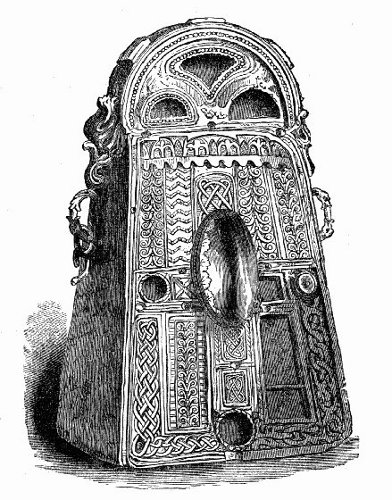
This curious relic, engraved over leaf, two-thirds the size of the original, is remarkable as a work of art, as well as a genuine relic of the most venerable antiquity; it was formerly regarded with superstitious reverence in Ireland, and any liquid drunk from it was believed to have peculiar properties in alleviating human suffering; hence, the peasant women of the district in which it was long preserved, particularly used it in cases of child-birth, and a serious disturbance was excited on a former attempt to sell it by its owner. Its legendary history relates that it descended from the sky ringing loudly; but as it approached the concourse of people who had assembled at the miraculous warning, the tongue detached itself and returned towards the skies; hence it was concluded that the bell was never to be profaned by sounding on earth, but was to be kept for purposes more holy and beneficent. This is said to have happened on the spot where once stood the famous Abbey of Fahan, near Innishowen (County Donegal), founded in the seventh century by St. Mura, or Muranus, during the reign of Abodh Slaine. For centuries this abbey was noted as the depository of various valuable objects, which were held in especial veneration by the people. Amongst these were several curious manuscripts written by St. Mura, his crozier, and this bell; which ultimately came into the possession of a poor peasant residing at Innishowen, who parted with it to Mr. Brown, of Beaumaris, at whose sale in 1855 it was purchased by Lord Londesborough. The material of the bell is bronze, and its form quadrangular, resembling other ancient Irish bells, and leading to the conclusion that it is the genuine work of the seventh century. The extreme feeling of veneration shown towards it in various ages is proved by the ornament with which it is encased. By the accidental removal of one portion of the outer casing, a series of earlier enrichments were discovered beneath, which were most probably placed there in the ninth century. The portion disclosed (the lower right hand corner) consists of a tracery of Runic knots wrought in brass, and firmly attached to the bell by a thin plate of gold;—whether the remainder of these early decorations, now concealed, be similar, cannot be determined without removing the outer plates. These exterior ornaments consist of a series of detached silver plates of various sizes diversely embossed in the style known to have prevailed in the eleventh century. The centre is adorned with a large crystal, and smaller gems have once been set in other vacant sockets around it, only one of amber remaining. The two large spaces in front of the arched top were also most probably filled with precious stones, as the gold setting still remains entire. The best workmanship has been devoted to these decorations; the hook for suspending the bell is of brass, and has been covered with early bronze ornament which has been filled in with niello, the intervening space being occupied by silver plates ornamented like the rest of the later decorations which cover its surface. From the absence of any traces of rivets on the back or sides of the bell, the decoration it has received may have been restricted to the casing of the handle and the enrichment of the front of this venerated relic.
CURIOUSLY-SHAPED DRINKING CUP.
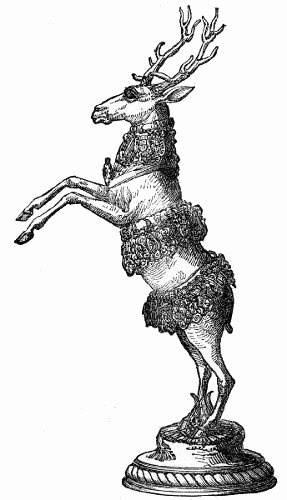
Drinking cups of a fantastic shape were very much in vogue in the sixteenth century. Sometimes they assumed the shape of birds, sometimes of animals. In general it is the head that takes off, and serves as a lid or cover; but sometimes the orifice is in another part of the body, as, for example, on the back. The specimen now before us is from Lord Londesborough's collection.
The stag is of silver, gilt all over; the collar set with a garnet. Silver bands encircle this curious figure, to which are appended many small silver escutcheons engraved with the arms and names of distinguished officers of the Court of Saxe Gotha, the latest being "Her Von Maagenheim, Camer Juncker und Regierung Assessor in Gotha, d. 15 Augusti, Ao 1722." It has probably been a prize for shooting, successively won by those persons whose arms decorate it.
BANQUETS TO QUEEN ELIZABETH.
Few English sovereigns were so well acquainted with their dominions as was Queen Elizabeth: she may be said to have visited every corner of her empire, and in these royal journeys or "progresses," as they are called, her loyal subjects strove to outvie each other in the splendour of their receptions. Nothing could surpass the magnificence of the entertainments thus planned for the queen's gratification, either as respects the splendour of show, or the costliness of the more substantial banquet. These occasions are too numerous to mention; and we can only notice one of the queen's visits to the palace at Greenwich, as described by a German, who travelled in England in 1598. It was Sunday, and after attending service in the chapel, the queen prepared for dinner. A gentleman entered the room bearing a rod, and with him another bearing a table-cloth, which, after they had both kneeled three times, he spread upon the table, and after kneeling again, they both retired: then came two others, one with the rod again, the other with a salt-cellar, a plate, and bread, which, after kneeling, they also placed on the table: then came an unmarried and a married lady, bearing a tasting-knife, and having stooped three times gracefully, they rubbed the table with bread and salt. Then came the yeomen of the guard, bringing in, at each time, a course of dishes, served in plate, most of it gilt; these dishes were received by a gentleman, and placed upon the table, while the lady-taster gave to each guard a mouthful to eat of the particular dish he had brought, for fear of any poison. During the time that this guard (which consisted of the tallest and stoutest men that could be found in all England, being carefully selected for this service) were bringing dinner, twelve trumpets and two kettle-drums made the hall ring for half an hour together. After this a number of unmarried ladies appeared, who lifted the meat from the table, and conveyed it to the queen's inner and more private chamber, where, after she had chosen for herself, the rest was sent to the ladies of the court. The queen dined and supped alone, with very few attendants.
THE GREAT FOG OF 1783.
It prevailed over the adjoining continent, and produced much fear that the end of all things was at hand. It appeared first at Copenhagen on the 29th of May, reached Dijon on the 14th June, and was perceived in Italy on the 16th. It was noticed at Spydberg, in Norway, on the 22nd, and at Stockholm two days later; the following day it reached Moscow. On the 23rd it was felt on the St. Gothard, and at Buda. By the close of that month it entered Syria; and on the 18th of July, reached the Altai Mountains. Before its appearance at these places the condition of the atmosphere was not similar; for in this country it followed continued rains; in Denmark it succeeded fine weather of some continuance; and in other places it was preceded by high winds. The sun at noon looked rusty-red, reminding one of the lines of Milton. The heat was intense during its continuance, and the atmosphere was highly electric. Lightnings were awfully vivid and destructive. In England many deaths arose from this cause, and a great amount of property was lost. In Germany public edifices were thrown down or consumed by it; and in Hungary one of the chief northern towns was destroyed by fires, caused by the electric fluid, which struck it in nine different places. In France there were hailstones and violent winds. In Silesia there were great inundations. The dry fogs of 1782-83 were accompanied by influenza; at St. Petersburgh 40,000 persons were immediately attacked by it, after the thermometer had suddenly risen 30 degrees. Calabria and Sicily were convulsed by earthquakes; in Iceland a volcano was active, and about the same time one sprung out of the sea off Norway. The co-existence of dry fogs with earthquakes and volcanic eruptions had been previously observed—e.g., in the years 526, 1348, 1721; and since then, in 1822 and 1834.
A somewhat similar fog overspread London before the cholera of 1831, and the influenza of 1847. Hecker ("Epidemics of the Middle Ages") has collected notices of various phenomena of this kind, which have preceded the great continental plagues, and have often been characterised by offensive odours.
MONKEYS DEMANDING THEIR DEAD.
Mr. Forbes tells a story of a female monkey (the Semnopithecus Entellus) who was shot by a friend of his, and carried to his tent. Forty or fifty of her tribe advanced with menacing gestures, but stood still when the gentleman presented his gun at them. One, however, who appeared to be the chief of the tribe, came forward, chattering and threatening in a furious manner. Nothing short of firing at him seemed likely to drive him away; but at length he approached the tent door with every sign of grief and supplication, as if he were begging for the body. It was given to him, he took it in his arms, carried it away, with actions expressive of affection, to his companions, and with them disappeared. It was not to be wondered at that the sportsman vowed never to shoot another monkey.
BARA.
Mr. Howel, in his descriptive travels through Sicily, gives a particular account of the magnificent manner in which the festival of the Assumption of the Virgin is kept by the Sicilians under the title of Bara, which, although expressive of the machine he describes, is also, it appears, generally applied as a name of the feast itself. An immense machine of about 50 feet high is constructed, designing to represent Heaven; and in the midst is placed a young female personating the Virgin, with an image of Jesus on her right hand; round the Virgin 12 little children turn vertically, representing so many Seraphim, and below them 12 more children turn horizontally, as Cherubim; lower down in the machine a sun turns vertically, with a child at the extremity of each of the four principal radii of his circle, who ascend and descend with his rotation, yet always in an erect posture; and still lower, reaching within about 7 feet of the ground, are placed 12 boys, who turn horizontally without intermission around the principal figure, designing thereby to exhibit the 12 apostles, who were collected from all corners of the earth, to be present at the decease of the Virgin, and witness her miraculous assumption. This huge machine is drawn about the principal streets by sturdy monks; and it is regarded as a particular favour to any family to admit their children in this divine exhibition.
CRADLE OF HENRY V.
Most of our readers have probably seen, in the illustrated newspapers of the day, sketches of the magnificently artistic cradles which have been made for the children of our good Queen, or for the Prince Imperial of France. It will be not a little curious to contrast with those elaborately beautiful articles the cradle of a Prince of Wales in the fourteenth century. We here give a sketch of it.
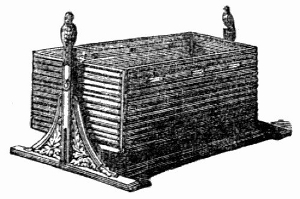
It was made for the use of Henry Prince of Wales, afterwards King Henry V, generally called Henry of Monmouth, because he was born in the castle there in the year 1388. He was the son of Henry IV of Bolingbroke, by his first wife Mary de Bohun. He was educated at Queen's College, Oxford, under the superintendence of his half uncle, the great Cardinal Henry Beaufort. On the accession of his father to the throne, he was created Prince of Wales, and, at the early age of sixteen, was present at the battle of Shrewsbury, where he was badly wounded in the face. After having greatly distinguished himself in the war against Owen Glendour, he spent some years idleness and dissipation, but on his coming to the throne, by the death of his father, April 20, 1413, he threw off his former habits and associates, chose his ministers from among those of tried integrity and wisdom in his father's cause, and seemed everywhere intent on justice, on victory over himself, and on the good of his subjects. After a short but glorious reign of ten years, in which the victory of Agincourt was the principal event, he expired at the Bois de Vincennes, near Paris, on the last day of August, 1422, in the thirty-fourth year of his age. He was engaged at the time in a war with the Dauphin of France. His heart was warm as his head was cool, and his courage equal to his wisdom, which emboldened him to encounter the greatest dangers, and surmount the greatest difficulties His virtues were not inferior to his abilities, being a dutiful son, a fond parent, an affectionate brother, a steady and generous friend, and an indulgent master. In a word, Henry V., though not without his failings, merits the character of an amiable and accomplished man, and a great and good king. Such was the sovereign, for whose infant years the plain, but still not tasteless, cradle was made, which we have here engraved, as it is preserved in the castle of Monmouth, his birthplace.
THE FONT AT KILCARN.
The venerable old church at Kilcarn, near Navan, in the county of Meath, contains a font of great rarity, and we have selected it as a fitting object for our work, inasmuch as it is a striking instance of the union of the beautiful with the curious.
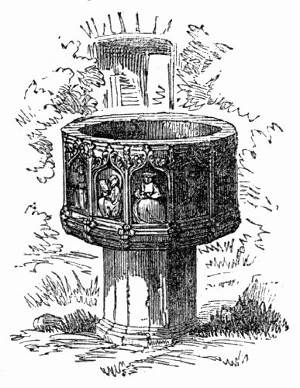
Placed upon its shaft, as represented in the cut, it measures in height about three feet six inches; the basin is two feet ten inches in diameter, and thirteen inches deep. The heads of the niches, twelve in number, with which its sides are carved, are enriched with foliage of a graceful but uniform character, and the miniature buttresses which separate the niches are decorated with crockets, the bases resting upon heads, grotesque animals, or human figures, carved as brackets. The figures within the niches are executed with a wonderful degree of care, the drapery being represented with each minute crease or fold well expressed. They are evidently intended to represent Christ, the Virgin Mary, and the twelve apostles. All the figures are seated. Our Saviour, crowned as a King, and holding in his hand the globe and cross, is in the act of blessing the Virgin, who also is crowned, the "Queen of Heaven." The figures of most of the apostles can easily be identified: Saint Peter by his key; Saint Andrew by his cross of peculiar shape; and so on. They are represented barefooted, and each holds a book in one hand.
THE BLOOD-SUCKING VAMPIRE.
Captain Stedman, who travelled in Guiana, from 1772 to 1777, published an account of his adventures, and for several years afterwards it was the fashion to doubt the truth of his statements. In fact, it was a general feeling, up to a much later period than the above, that travellers were not to be believed. As our knowledge, however, has increased, and the works of God have been made more manifest, the reputation of many a calumniated traveller has been restored, and, among others, that of Captain Stedman. We shall, therefore, unhesitatingly quote his account of the bite of the vampire:—"On waking, about four o'clock this morning, in my hammock, I was extremely alarmed at finding myself weltering in congealed blood, and without feeling any pain whatever. Having started up and run to the surgeon, with a firebrand in one hand, and all over besmeared with gore, the mystery was found to be, that I had been bitten by the vampire or spectre of Guiana, which is also called the flying dog of New Spain. This is no other than a bat of monstrous size, that sucks the blood from men and cattle, sometimes even till they die; knowing, by instinct, that the person they intend to attack is in a sound slumber, they generally alight near the feet, where, while the creature continues fanning with his enormous wings, which keeps one cool, he bites a piece out of the tip of the great toe, so very small indeed, that the head, of a pin could scarcely be received into the wound, which is consequently not painful; yet, through this orifice he contrives to suck the blood until he is obliged to disgorge. He then begins again, and thus continues mucking and disgorging till he is scarcely able to fly, and the sufferer has often been known to sleep from time into eternity. Cattle they generally bite in the ear, but always in those places where the blood flows spontaneously. Having applied tobacco-ashes as the best remedy, and washed the gore from myself and my hammock, I observed several small heaps of congealed blood all around the place where I had lain upon the ground; upon examining which, the surgeon judged that I had lost at least twelve or fourteen ounces during the night. Having measured this creature (one of the bats), I found it to be, between the tips of the wings, thirty-two inches and a-half; the colour was a dark brown, nearly black, but lighter underneath."
LUXURY IN 1562.
The luxury of the present times does not equal, in one article at least, that of the sixteenth century. Sir Nicholas Throckmorton, the Queen's ambassador at Paris, in a letter to Sir Thomas Chaloner, the ambassador at Madrid, in June, 1562, says,
"I pray you good my Lord Ambassador sende me two paire of parfumed gloves, parfumed with orrange flowers and jacemin, th'one for my wives hand, the other for mine owne; and wherin soever I can pleasure you with any thing in this countrey, you shall have it in recompence thereof, or els so moche money as they shall coste you; provided alwaies that they be of the best choise, wherein your judgment is inferior to none."
SINGULAR PHENOMENON—PHOSPHORESCENCE OF THE SEA.
The sea has sometimes a luminous appearance, a phenomenon that has been observed by all sailors, who consider it the forerunner of windy weather. It is said to occur most frequently in the summer and autumn months, and varies so much in its character, as to induce a doubt whether it can always be attributed to the same cause. Sometimes the luminous appearance is seen over the whole surface of the water, and the vessel seems as though floating upon an ocean of light. At other times, the phosphorescence is only seen immediately around the ship. A portion of water taken from the sea does not necessarily retain its luminous appearance, but its brilliance will generally continue as long as the water is kept in a state of agitation. Some naturalists imagine the phosphorescence of the sea to arise from the diffusion of an immense number of animalculæ through the medium, and others attribute it to electricity. Dr. Buchanan has given an account of a very remarkable appearance of the sea, observed by him during a voyage from Johanna to Bombay. About eight o'clock in the evening of the 31st of July, 1785, the sea had a milk-white colour, and upon it were floating a multitude of luminous bodies greatly resembling that combination of stars known as the milky way, the brightest of them representing the larger stars of a constellation. The whiteness, he says, was such as to prevent those on board from seeing either the break or swell of the sea, although, from the motion of the ship and the noise, they knew them to be violent, and the light was sufficiently intense to illuminate the ropes and rigging. This singular phenomenon continued till daylight appeared. Several buckets of water were drawn, and in them were found a great number of luminous bodies, from a quarter of an inch to an inch and a half in length, and these were seen to move about as worms in the water. There might be, he said to Dr. Buchanan, four hundred of these animals in a gallon of water. A similar appearance had been observed before in the same sea by several of the officers, and the gunner had seen it off Java Head, in a voyage to China.
MARRIAGE VOW.
The matrimonial ceremony, like many others, has undergone some variation in the progress of time. Upwards of three centuries ago, the husband, on taking his wife, as now, by the right hand, thus addressed her:—"I. N. undersygne the N. for my wedded wyfe, for better, for worse, for richer, for porer, yn sickness, and in helthe, tyl dethe us departe, (not "do part," as we have erroneously rendered it, the ancient meaning of "departe," even in Wickliffe's time, being "separate") as holy churche hath ordeyned, and thereto I plygth the my trowthe." The wife replies in the same form, with an additional clause, "to be buxom to the, tyl dethe us departe." So it appears in the first edition of the "Missals for the use of the famous and celebrated Church of Hereford, 1502," fol. In what is called the "Salisbury Missal," the lady pronounced a more general obedience: "to be bonere and buxom in bedde and at the borde."
LOVE OF GARDENS.
Louis XVIII., on his restoration to France, made, in the park in Versailles, the facsimile of the garden at Hartwell; and there was no more amiable trait in the life of that accomplished prince. Napoleon used to say that he should know his father's garden in Corsica blindfolded, by the smell of the earth! And the hanging-gardens of Babylon are said to have been raised by the Median Queen of Nebuchadnezzar on the flat and naked plains of her adopted country, to remind her of the hills and woods of her childhood. We need not speak of the plane-trees of Plato—Shakspeare's mulberry-tree—Pope's willow—Byron's elm? Why describe Cicero at his Tusculum—Evelyn at Wotton—Pitt at Ham Common—Walpole at Houghton—Grenville at Dropmere? Why dwell on Bacon's "little tufts of thyme," or Fox's geraniums? There is a spirit in the garden as well as in the wood, and the "lilies of the field" supply food for the imagination as well as materials for sermons.
ANCIENT DANISH SHIELD.
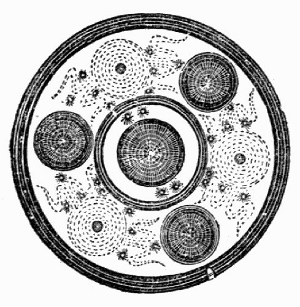
In Asia, from whence the greater number, probably all, of the European nations have migrated, numerous implements and weapons of copper have been discovered in a particular class of graves; nay, in some of the old and long-abandoned mines in that country workmen's tools have been discovered, made of copper, and of very remote antiquity. We see, moreover, how at a later period attempts were made to harden copper, and to make it better suited for cutting implements by a slight intermixture, and principally of tin. Hence arose that mixed metal to which the name of "bronze" has been given. Of this metal, then, the Northmen of "the bronze period" formed their armour, and among numerous other articles, three shields have been discovered which are made wholly of bronze; and we here give a sketch of the smallest of them, which is about nineteen inches in diameter, the other two being twenty-four. These shields are formed of somewhat thin plates of bronze, the edge being turned over a thick wire metal to prevent the sword penetrating too deeply. The handle is formed of a cross-bar, placed at the reverse side of the centre boss, which is hollowed out for the purpose of admitting the hand.