TEN THOUSAND WONDERFUL THINGS. (continued 17)
Reading edition
DINNER PARTY IN THE SEVENTEENTH CENTURY.
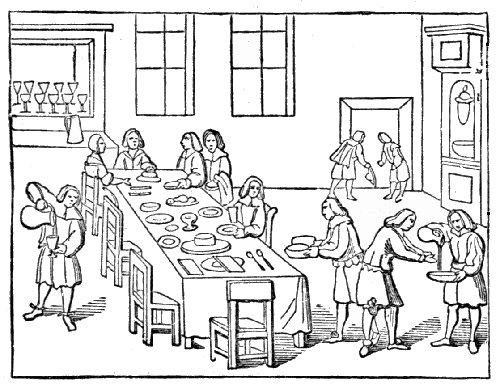
The cut which we here present to our readers is taken from the English edition of the Janua Linguarum of Comenius, and represents the forms of dining in England under the Protectorate. It will be best described by the text which accompanies it in the book, and in which each particular object is mentioned. "When a feast is made ready," we are told, "the table is covered with a carpet and a table-cloth by the waiters, who, besides, lay the trenchers, spoons, knives, with little forks, table napkins, bread, with a salt-cellar Messes are brought in platters, a pie in a plate. The guests being brought in by the host, wash their hands out of a laver or ewer, over a hand-basin, or bowl, and wipe them with a hand towel: they then sit at the table on chairs. The carver breaketh up the good cheer, and divideth it. Sauces are set amongst roste-meat in sawsers. The butler filleth strong wine out of a cruse, or wine-pot, or flagon, into cups or glasses, which stand on a cupboard, and he reacheth them to the master of the feast, who drinketh to his guests." It will be observed here that one salt-cellar is here placed in the middle of the table. This was the usual custom; and, as one long table had been substituted for the several tables formerly standing in the hall, the salt-cellar was considered to divide the table into distinct parts, guests of more distinction being placed above the salt, while the places below the salt were assigned to inferiors and dependents. This usage is often alluded to in the old dramatists. Thus, in Ben Jonson, it is said of a man who treats his inferiors with scorn, "he never drinks below the salt, i. e. he never exchanges civilities with those who sit at the lower end of the table." And in a contemporary writer, it is described as a mark of presumption in an inferior member of the household "to sit above the salt."
SAND-COLUMNS IN AFRICA.
Of this remarkable phenomenon, we extract the following interesting account from the Rev. N. Davis's "Evenings in my Tent";—
"The heat, during the last day or two, has been intense. The thermometer in my tent, during day and night, has been almost stationary at 100 degrees. My men have done, and still do, everything in their power to keep the tent cool, by erecting a high palm-branch fence around it, and by a constant immersion of the ground, but all this to very little effect. The wind, during this day, has been as hot as the flames issuing from a furnace; and the clouds of sand it raised, and carried along in its furious march, have been immense. In the distance could be seen numbers of sand columns; but these did not retain their form any considerable length of time. A contrary blast brought them in collision with each other; and these, blending their contents, raised a complete and dense barrier between us and the country beyond. I am no lover of danger; but, I must confess, I had an inward desire to see this phenomenon—one of the horrors of the desert—in greater perfection. I believe Bruce witnessed one of the most stupendous exhibitions of sand columns or sand spouts, caused by circular or whirl-winds, on record. In his journey through the desert of Senaar, his attention was attracted to a number of prodigious pillars of sand, at different distances, moving at times with great celerity, at others, stalking on with majestic slowness: at intervals, he thought they were coming in a very few minutes to overwhelm him and his companions. Again they would retreat, so as to be almost out of sight, their tops reaching to the very clouds. There the tops often separated, from the bodies; and these, once disjoined, dispersed in the air, and appeared no more. Sometimes they were broken near the middle, as if struck with a large cannon-shot. About noon, they began to advance with considerable swiftness upon them, the wind being very strong at north. Eleven of these awful visitors ranged alongside of them, at about the distance of three miles. The greatest diameter of the largest appeared to him, at that distance, as if it would measure ten feet. They retired from them, with a wind at south-east, leaving an impression upon the mind of our intrepid traveller to which he could give no name, though he candidly admits that one ingredient in it was fear, with a considerable deal of wonder and astonishment. He declares it was in vain to think of flying; the swiftest horse, or fastest sailing ship, could be of no use to carry them out of this danger,—and the full persuasion of this riveted him to the spot where he stood. Next day they were gratified by a similar display of moving pillars, in form and disposition like those already described, only they seemed to be more in number, and less in size. They came several times in a direction close upon them; that is, according to Mr. Bruce's computation, within two miles. They became, immediately after sunrise, like a thick wood, and almost darkened the sun, his rays, shining through them for near an hour, gave them an appearance of pillars of fire. At another time they were terrified by an army of these sand pillars, whose march was constantly south, a number of which seemed once to be coming directly upon them, and, though they were little nearer than two miles, a considerable quantity of sand fell around them. On the 21st of November, about eight in the morning, he had a view of the desert to the westward as before, and saw the sands had already begun to rise in immense twisted pillars, which darkened the heavens, and moved over the desert with more magnificence than ever. The sun shining through the pillars, which were thicker, and contained more sand apparently than any of the preceding ones, seemed to give those nearest them an appearance as if spotted with stars of gold. A little before twelve, the wind at north ceased, and a considerable quantity of fine sand rained upon them for an hour afterwards."
ANTIQUITY OF INTOXICATING DRINKS.
It is a common belief that wine was the only inebriating liquor known to antiquity, but this is a mistake. Tacitus mentions the use of ale or beer as common among the Germans of his time. By the Egyptians, likewise, whose country was ill adapted to the cultivation of the grape, it was employed as a substitute for wine. Ale was common in the middle ages, and Mr. Park states that very good beer is made, by the usual process of brewing and malting, in the interior of Africa. The favourite drink of our Saxon ancestors was ale or mead. Those worshippers of Odin were so notoriously addicted to drunkenness, that it was regarded as honourable rather than otherwise; and the man who could withstand the greatest quantity was looked upon with admiration and respect: whence the drunken songs of the Scandinavian scalds: whence the glories of Valhalla, the fancied happiness of whose inhabitants consisted of quaffing draughts from the skulls of their enemies slain in battle. Even ardent spirit, which is generally supposed to be a modern discovery, probably existed from a very early period. It is said to have been first made by the Arabians in the middle ages, and in all likelihood may lay claim to a still remoter origin. The spirituous liquor called arrack has been manufactured in the island of Java, as well as in the continent of Hindostan, from time immemorial. Brandy was made in Sicily at the commencement of the fourteenth century. As to wine, it was so common in ancient times as to have a tutelar god appropriated to it; Bacchus and his companion Silenus are as household words in the mouths of all, and constituted most important features of the heathen mythology. We have all heard of the Falernian and Campanian wines, and of the wines of Cyprus and Shiraz. Indeed, there is reason to believe that the ancients were in no respect inferior to the moderns in the excellence of the vinous liquors, whatever they may have been in the variety. Wine was so common in the eastern nations that Mahomet, foreseeing the baleful effects of its propagation, forbade it to his followers, who, to compensate themselves, had recourse to opium. The Gothic or dark ages seem to have been those in which it was the least common; in proof of this it may be mentioned that, so late as 1298, it was vended as a cordial by the English apothecaries. At the present day it is little drunk, except by the upper classes, in those countries which do not naturally furnish the grape. In those that do, it is so cheap as to come within the reach of even the lowest.
RUINS OF CLONMACNOIS.
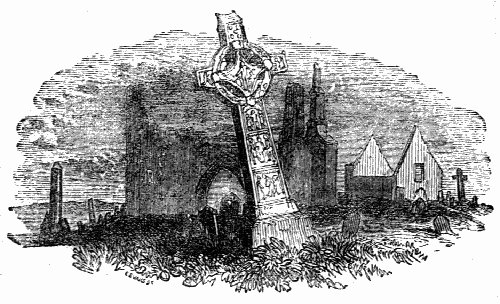
A few miles south of Athlone are the famous ruins of Clonmacnois, the school where, according to Dr. O'Connor, "the nobility of Connaught had their children educated, and which was therefore called Cluan-mac-nois, 'the secluded recess of the sons of nobles.'" It was also, in ancient times, a renowned cemetery of the Irish kings; and for many centuries it has continued a favourite burial-place, the popular belief enduring to this day, that all persons interred here pass immediately from earth to heaven. The abbey is said to have been founded by St. Kieran about the middle of the sixth century, and soon became "amazingly enriched," so that, writes Mr. Archdall, "its landed property was so great, and the number of cells and monasteries subjected to it so numerous, that almost half of Ireland was said to be within the bounds of Clonmacnois." The ruins retain marks of exceeding splendour. In the immediate vicinity there are two "Round Towers." The above engraving represents one of the many richly-carved stone crosses that are scattered in all directions among the ruins.
THE BRICKS OF BABYLON.
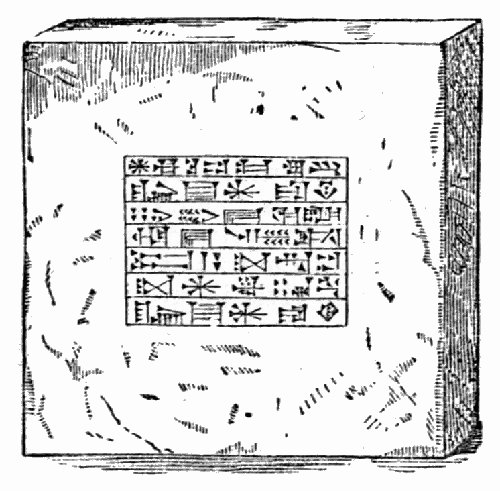
Besides sun-dried bricks, remains of kiln-baked or burnt bricks are found in all the principal ruins of ancient Babylonia, and were used for the purpose of revetting or casing the walls. Like the sun-dried bricks they are made of clay mixed with grass and straw, which have, of course, disappeared in the baking, leaving, however, traces of the stalks or stems in the clay. Generally they are slack-burnt, of a pale red colour, with a slight glaze or polish. The finest sort, according to Mr. Rich, are white, approaching more or less to a yellowish cast, like our Stourbridge, or fire-brick; the coarsest are red, like our ordinary brick. Some have a blackish cast, and are very hard. The finest are those which come from the ruins of the Akerkuf. The general measurement of the kiln-dried bricks, at the Birs Nimrúd, is 1 ft. 1 in. square, and 3 in. thick. Some are submultiples, or half of these dimensions. A few are of different shapes for particular purposes, such as rounding corners. Those at the Akerkuf measured a trifle less, or 12½ in. square, and 2¾ in. thick, and are placed at the base of the monument. The bricks of Al Hymer, on the eastern bank, measure 14 in. long, 12¾ in. broad, 2½ in. thick, and are of fine fabric. There are bricks of two dimensions at this ruin of the Birs Nimrúd; those on the northern brow, a little way down it, measure 12 in. square, and 3¼ in. thick; they are of a pale red colour, and used for revetting the monument. Lower down to the east of this, they are 4¾ in. broad, and 12¾ in. long. Similar bricks were found at the Mujellibe, and in one place was an entire wall of them 60 feet thick. The whole plain here is covered with masses of brick work, and on one of the mounds the bricks are so red, that it looks one bright gleaming mass. The bricks from the Mujellibe or Kasr are described as very hard, and of a pale yellow colour; and this edifice presents a remarkable appearance of freshness. We have seen only one fragment of a brick from Niffer; it is of a white, or rather yellowish white colour, and sandy, gritty texture. This spot, it will be remembered, is supposed to be the site of old Babylon. All these bricks are made by the same process as those of Assyria, namely, stamped out of a wooden or terra-cotta mould, and are also impressed with several lines of cuneiform character. This impression is always sunk below the superficies, rectangular, and often placed obliquely on the brick, with that disregard to mechanical symmetry which is so usual on works of ancient art. The stamp is generally about 6 inches long, by 4 inches wide, and the number of lines varies from three to seven: an arrangement quite different from that observed on the bricks of Assyria, and rather resembling that adopted by the brick-makers of Egypt. The engraving on previous page is of a brick stamped with the name of Nebuchadnezzar, which is now in the possession of the Royal Society of Literature. The inscriptions sometimes commence with the figure of a lion, a bull, or what may be intended for an altar. These read, according to Sir H. Rawlinson,—
[of] Nebuchadnezzar, the king of Babylon, founder of Beth Digla, or Saggalu, and of Beth Tzida son of Nebopalasar [I am].
A TURKISH BAZAAR.
A Turkish bazaar is one of the most wonderful sights in the world, and well deserves a place in our record of curiosities. We cannot do better than quote the description which Mr. Albert Smith gives of one of these extraordinary places in his "Month at Constantinople:"—
"Smyrna had, in some measure, prepared me for the general appearance of an oriental bazaar; but the vast extent of these markets at Constantinople created a still more vivid impression. To say that the covered rows of shops must altogether be miles in length—that vista after vista opens upon the gaze of the astonished stranger, lined with the costliest productions of the world, each collected in its proper district—that one may walk for an hour, without going over the same ground twice, amidst diamonds, gold, and ivory; Cashmere shawls, and Chinese silks; glittering arms, costly perfumes, embroidered slippers, and mirrors; rare brocades, ermines, Morocco leathers, Persian nick-nacks; amber mouthpieces, and jewelled pipes—that looking along the shortest avenue, every known tint and colour meets the eye at once, in the wares and costumes, and that the noise, the motion, the novelty of this strange spectacle is at first perfectly bewildering—all this, possibly, gives the reader the notion of some kind of splendid mart, fitted to supply the wants of the glittering personages who figure in the Arabian Nights' Entertainments; yet it can convey but a poor idea of the real interest which such a place calls forth, or the most extraordinary assemblage of treasures displayed there, amidst so much apparent shabbiness. No spot in the world—neither the Parisian Boulevards, nor our own Regent-street—can boast of such an accumulation of valuable wares from afar, as the great bazaar at Constantinople. Hundreds and thousands of miles of rocky road and sandy desert have been traversed by the moaning camels who have carried those silks and precious stones from Persia, with the caravan. From the wild regions of the mysterious central Africa, that ivory, so cunningly worked, in the next row, has been brought—the coal-black people only know how—until the Nile floated it down to Lower Egypt. Then those soft Cashmere shawls have made a long and treacherous journey to Trebizond, whence the fleet barks of the cold and stormy Euxine at last brought them up the fairy Bosphorus to the very water's edge of the city. From the remote active America; from sturdy England; from Cadiz, Marseilles, and all along the glowing shores of the Mediterranean, safely carried over the dark and leaping sea, by brave iron monsters that have fought the winds with their scalding breath, these wares have come, to tempt the purchasers, in the pleasant, calm, subdued light of the bazaars of Stamboul."
VARNISH-TREE OF THE JAPANESE.
The urusi or varnish-tree, of which they make so extensive a use, is a noble tree when grown to its full size. On incision it yields a rich, milky, glutinous juice, out of which the Japanese make the celebrated varnish, known by the name of Japan. With this varnish they cover and coat all their household furniture, all their dishes and plates, and all their drinking-vessels, whether made of wood or of paper. The use of plate, or porcelain, or glass appears to be very limited, and is probably interdicted by some rule of nationality or religion: from the emperor down to the meanest peasant, all make use of the light varnished or japanned cups and dishes, the inner substance of which is wood or paper, or what we term papier-maché.
Another tree, called forasi, renders a varnish of an inferior quality.
TORTURE-CHAMBER AT NUREMBERG.
Nuremberg, being a "free city," was governed by its own appointed magistrates, having independent courts of law. The executive council of state consisted of eight members, chosen from the thirty patrician families, who, by the privilege granted to them from the thirteenth century, ruled the city entirely. In process of time these privileges assumed the form of a civic tyranny, which was felt to be intolerable by the people, and occasionally opposed by them. The fierce religious wars of the sixteenth century assisted in destroying the monopoly of power still more; yet now that it is gone for ever, it has left fearful traces of its irresponsible strength. All who sigh for "the good old times," should not moralise over the fallen greatness of the city, and its almost deserted but noble town-hall; but descend below the building into the dark vaults and corridors which form its basement; the terrible substructure upon which the glorious municipal palace of a free imperial self-ruled city was based in the middle ages, into whose secrets none dared pry, and where friends, hope, life itself, were lost to those who dared revolt against the rulers. There is no romance-writer who has imagined more horrors than we have evidences were perpetrated under the name of justice in these frightful vaults, unknown to the busy citizens around them, within a few feet of the streets down which a gay wedding procession might pass, while a true patriot was torn in every limb, and racked to death by the refined cruelty of his fellow-men. The heart sickens in these vaults, and an instinctive desire to quit them takes possession of the mind, while remaining merely as a curious spectator within them. The narrow steps leading to them are reached through a decorated doorway, and the passage below receives light through a series of gratings. You shortly reach the labyrinthine ways, totally excluded from external light and air, and enter, one after another, confined dungeons, little more than six feet square, cased with oak to deaden sounds, and to increase the difficulty of attempted escape. To make these narrow places even more horrible, strong wooden stocks are in some, and day and night prisoners were secured in total darkness, in an atmosphere which seems even now too oppressive to bear. In close proximity to these dungeons is a strong stone room, about twelve feet wide each way, into which you descend by three steps. It is the torture-chamber, which we here engrave.
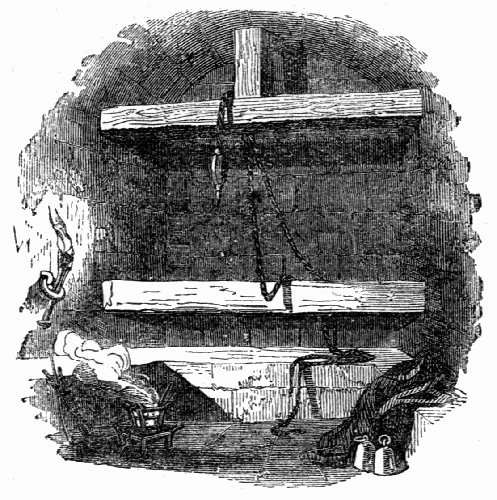
The massive bars before you are all that remain of the perpendicular rack, upon which unfortunates were hung with weights attached to their ankles. Two such of stone, weighing each fifty pounds, were kept here some years back, as well as many other implements of torture since removed or sold for old iron. The raised stone bench around the room was for the use of the executioner and attendants. The vaulted roof condensed the voice of the tortured man, and an aperture on one side gave it freedom to ascend into a room above, where the judicial listeners waited for the faltering words which succeeded the agonising screams of their victim.
SEPULCHRAL VASES OF GREEK POTTERY.
The number of these vases deposited in the great public museums of Europe is very large, and from calculations derived from catalogues, or from observations made on the spot, may be stated in round numbers as follows:—The Museo Borbonico, at Naples, contains about 2,100; the Gregorian Museum in the Vatican, about 1,000; Florence has about 700; and at Turin there are 500. On the side of the Alps, the Imperial Museum of Vienna possesses about 300; Berlin has 1,690; Munich about 1,700; Dresden, 200; Carlsruhe, 200; the Louvre, at Paris, about 1,500; while 500 more may be found in the Bibliothèque Imperiale. The British Museum has about 2,600 vases of all kinds. Besides the public collections, several choice and valuable specimens of ancient art belong to individuals. The most important of these private collections are those of the Duc de Luynes, the Duc de Blacas, the Count de Pourtales-Gorgier, the Jatta collection, that belonging to M. St. Angela at Naples, and a fine and choice one belonging to the Marquis Campana at Rome. In England, the collections of Mr. Hope, of Mr. Jekyll, of the Marquis of Northampton, and of Mr. Hertz, contain several interesting examples. In addition to these, several thousand more vases are in the hands of the principal dealers, as S. Barone, of Naples; and the heirs of S. Basseggio, Capranesi and Messrs. Sotheby, in London. The total number of vases in public and private collections probably amounts to 15,000 of all kinds.
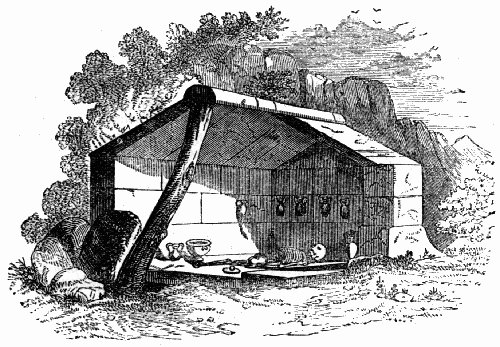
All these were discovered in the sepulchres of the ancients, but the circumstances under which they were found differ according to locality. In Greece, the graves are generally small, being designed for single corpses, which accounts for the comparatively small size of the vases discovered in that country. At Athens, the earlier graves are sunk deepest in the soil, and those at Corinth, especially such as contain the early Corinthian vases, are found by boring to a depth of several feet beneath the surface. The early tombs of Cività Vecchia and Cære, or Cervetri, in Italy, are tunnelled in the earth; and those at Vulci and in the Etruscan territory, from which the finest and largest vases have been extracted, are chambers hewn in the rocks. In Southern Italy, especially in Campania, they are large chambers, about 5¼ palms under the surface.
The engraving on previous page will convey an idea of the manner in which the vases are arranged round the bodies of the dead in the tombs of Veii, Nola, and Cumæ.
The tomb there represented is constructed of large blocks of stone, arranged in squared masses, called the Etruscan style of wall, in contradistinction to the Cyclopean. The walls are painted with subjects, the body is laid upon the stone floor, and the larger vases, such as the oxybapha and craters are placed round it. The jugs are hung upon nails round the walls.
GAMES WITH CARDS IN THE SIXTEENTH CENTURY.
Cards were used by every one. The game of Gleek was played by three persons. The dealer dealt twelve cards and left eight on the table for stock, seven were bought, and the ace turned up for the dealer; if it was Tiddy (four of trumps) such player gave four to the dealer. The ace was called Tib, the knave Tim, the fifth Towser, and the sixth Tumbler. The players then begin bidding for the stock in hopes of bettering their game, the buyer taking in seven cards and putting out seven. If Tib was turned up, it counted fifteen to the dealer. The players then picked for Ruff, the one having most of a suit winning it—unless any one had four aces, which always carried it. The first then said, "I'll vie the Ruff;" the next, "I'll see it:" the third, "I'll see it, and revie it;" the first again, "I'll see your revie;" and the middle, "I'll not meddle with it." They then showed their cards, and he that had most of a suit won six of him that held out longest, and forty of him who said he could see it, and then refused to meddle with it.
Ombre, Basset, Whist, Costly Colours, and Five Cards, were, we believe, of later introduction. Of our period, are Ruff, Bone, Ace, Pult. The great game in the West of England was Post and Pair, as All Fours was in Kent, and Five Cards in Ireland. In Post and Pair, the ace of trumps was the best card; at Post the best cards were one and two, but a pair of court cards one. The daring of the game consisted in the vye, or the adventuring upon the goodness of your hand to intimidate your antagonist.
RESCUED RELICS.
The following is a list—translated from the original in the chartulary of the University of Glasgow; of the relics which were carried away from Glasgow Cathedral, by the Archbishop, before the work of demolition began, in 1560:—
The image of Christ in gold, and those of the twelve apostles in silver, with the whole vestments belonging to the church.
A silver cross, gilt in the upper part, and adorned with precious stones in the lower part, with a small portion of the cross of our Saviour!
Another silver cross, adorned with precious stones, with several other portions of the cross of Christ!
A silver casket, gilt, containing the hair of the blessed Virgin!
A square silver coffer, containing several of the scourges of St. Kentigern, and St. Thomas of Canterbury, and a portion of the hair garment worn by the former saint!!
Another silver casket, gilt, containing part of the skin of Bartholomew, the apostle!!
A silver casket containing a bone of St. Ninian!
A silver casket, containing part of the girdle of the Virgin Mary!!
A crystal case, containing a bone of some saint and of St. Magdalene!!
A small vial of crystal, containing the milk of the blessed Virgin, and part of the manger of Christ!!!
A small phial of a saffron colour, containing the fluid which formerly flowed from the tomb of St. Mungo!
A phial, containing several of the bones of St. Eugene, and of St. Blaze!
A phial, containing a part of the tomb of St. Catherine the virgin!
A small hide, with a portion of the cloak of St. Martin!
A precious hide, with portions of the bodies of St. Kentigern and St. Thomas of Canterbury!!
Some other hides, with bones of saints and other relics!
A wooden chest, containing many small relics!
Two linen bags, with the bones of St. Kentigern, St. Thanew, and other deceased saints!!
PAPER.
With respect to the paper now in use, Dr. Blair says, the first paper-mill (in England, we suppose) was erected at Dartford, in the year 1588, by a German of the name of Speillman; from which period we may, perhaps, date its manufacture in this country.
It appears, however, that it was known in the East much earlier; it being observed that most of the ancient manuscripts in Arabic and other Oriental languages, were written upon cotton paper, and it is thought the Saracens first introduced it into Spain.
Anderson, in his "History of Commerce," says that, till the year 1690, there was scarcely any paper made in England but the coarse brown sort. Paper was previously imported from France, Genoa, and Holland. However, the improvement of this article in England, in consequence of the French war, produced a saving to the country of £100,000 annually, which had been paid to France for paper alone.
LOTTERIES.
If the antiquity of a practice could justify its existence, lotteries might claim peculiar reverence. The Romans, we are told, used to enliven their Saturnalia with them, by distributing tickets, all of which gained some prize. Augustus instituted lotteries, that consisted, however, of things of little value. Nero also established lotteries, for the people, in which 1,000 tickets were daily distributed, and several of those who were favoured by fortune got rich by them. The first lottery of which we find any record in our annals, was in the year 1659, which, according to Stow, consisted of 40,000 lots, at 10s. each. The prizes were plated; and the profits were to be applied to the purpose of repairing the havens of the kingdom. This lottery was drawn at the west door of St. Paul's cathedral; and began on the 11th July, 1569, and continued incessantly, day and night, till the 6th May following. The tickets were three years in being disposed of. In the year 1612, King James granted a lottery to promote the plantation of English colonies in Virginia, which was also drawn at St. Paul's.
TEMPLE AT SIMONBONG.
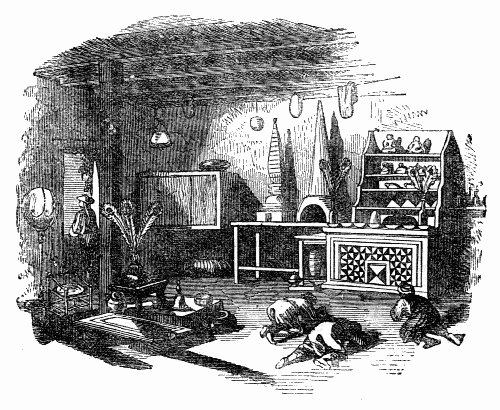
The above is a correct representation of the great Lepcha temple at Simonbong, in Sikkim, a district of India near Thibet. We take the following account of it from the Journal of Dr. Hooker, who visited it in 1848:—"Simonbong is one of the smallest and poorest goompas, or temples, in Sikkim, being built of wood only. It consists of one large room, raised on a stone foundation, with small sliding shutter windows, and roofed with shingles of wood; opposite the door a wooden altar was placed, rudely chequered with black, white, and red; to the right and left were shelves, with a few Tibetan books, wrapped in silk; a model of Symbonath temple in Nepal, a praying-cylinder, and some implements for common purposes, bags of juniper, English wine-bottles and glasses, with tufts of Abies Webbina, rhododendron flowers, and peacock's feathers, besides various trifles, clay ornaments and offerings, and little Hindoo idols. On the altar were ranged seven little brass cups, full of water; a large conch-shell, carved with the sacred lotus; a brass jug from Lhassa, of beautiful design, and a human thigh-bone, hollow, and perforated through both condyles.
"Facing the altar was a bench and a chair, and on one side a huge tambourine, with two curved iron drumsticks. The bench was covered with bells, handsomely carved with idols, and censers with juniper-ashes; and on it lay the dorge, or double-headed thunderbolt. Of all these articles, the human thigh-bone is by much the most curious; it is very often that of a Lama, and is valuable in proportion to its length. As, however, the Sikkim Lamas are burned, these relics are generally procured from Tibet, where the corpses are cut in pieces and thrown to the kites, or thrown into the water."
IMPLEMENTS USED IN BUDDHIST TEMPLES.
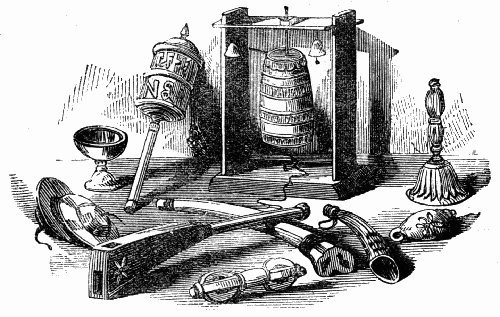
The above sketch places before us the implements generally used in the Buddhist temples of India:—a praying cylinder in stand, another to be carried in the hand, cymbals, bell, brass cup, three trumpets (one of them made of a human thigh-bone), conch, and dorje, or double-headed thunderbolt, which the Lama, or high-priest, holds in his hand during service. The praying cylinder is made to revolve by means of an axle and string, and a projecting piece of iron strikes a little bell at each revolution. Within such cylinders are deposited written prayers, and whoever pulls the string properly is considered to have said his prayers as often as the bell rings. The worshippers, on entering the temple, walk up to the altar, and, before or after having deposited their gifts, they lift both hands to the forehead, fall on their knees, and touch the ground three times with head and hands. They then advance to the head Lama, kotow similarly to him, and he blesses them, laying both hands on their heads, and repeating a short formula. Sometimes the dorje is used in blessing, as the cross is in Europe, and when a number of people request a benediction, the Lama pronounces it from the door of the temple with outstretched arms, the people all being prostrate, with their foreheads touching the ground.
PROCLAMATION FOR THE PERSON OF GEORGE II.
On the young Pretender landing in Scotland, Government issued a proclamation, offering a reward of £30,000 for his head, alive or dead. In opposition to this, the following curious paper was issued by the Prince and his council, which, Mr. Beloe says, "is so rare, that I never heard of any other than that which accident lately deposited in the British Museum."
"Charles, Prince of Wales, &c.
Regent of the Kingdoms of Scotland, France, and Ireland, and the Dominions thereunto belonging,
Whereas, we have seen a certain scandalous and malicious paper, published in the style and form of a proclamation, bearing date the 1st instant, wherein, under pretence of bringing us to justice, like our Royal Ancestor, King Charles I. of blessed memory, there is a reward of £30,000 sterling promised to those who shall deliver us into the hands of our enemies, we could not but be moved with a just indignation at so insolent an attempt; and though, from our nature and principles, we abhor and detest a practice so unusual among Christian Princes, we cannot but, out of just regard to the dignity of our person, promise a like reward of £30,000 sterling to him, or those, who shall seize and secure till our further orders, the person of the Elector of Hanover, whether landed, or attempting to land, in any part of his Majesty's dominions. Should any fatal accident happen from hence, let the blame be entirely at the door of those who first set the infamous example.
"Charles, P. R.
"Given at our Camp, at Kinlockeill, August 22, 1745. "By his Highness's Command.
"John Murray."
DOGS IN JAPAN.
Dogs or common curs they have, and in superfluous numbers. These dogs are as much the pest of the towns of Japan as they are of Constantinople and the other foul cities and towns of the Ottoman Empire. This vast increase of the canine species, and the encouragement and immunity accorded to it, arose (according to the popular account) out of a curious superstition and an extravagant imperial decree. An Emperor who reigned at the close of the eighteenth century chanced to be born under the Sign of the Dog, the Dog being one of the twelve celestial signs of the Japanese Zodiac. For this reason the Emperor had as great an esteem for dogs as the Roman Emperor Augustus is reported to have entertained for rams. When he ascended the throne, he willed and ordained that dogs should be held as sacred animals; and, from that time, more puppies saw the light, and were permitted to live in Japan than in any other country on the face of the earth, Turkey, perhaps, excepted. These dogs have no masters, but lie and prowl about the streets, to the exceeding great annoyance of passengers, especially if they happen to be foreign travellers, or Christians in Christian dresses. If they come round you in packs, barking, snarling, and showing their teeth; nay, even if they fall upon you and bite you, you must on no account take the law into your own hands, and beat them off or shoot them. To kill one of them is a capital crime, whatever mischief the brute may have done you. In every town there are Guardians of the Dogs, and to these officers notice must be given in case of any canine misdemeanour, these guardians alone being empowered to punish the dogs. Every street must keep a certain number of these animals, or at least provide them with victuals; huts, or dog-hospitals, stand in all parts of the town, and to these the animals, in case of sickness, must be carefully conveyed by the inhabitants. The dogs that die must be brought up to the tops of mountains and hills, the usual burying-places of men and women, and there be very decently interred. Old Kæmpfer says:—"The natives tell a pleasant tale on this head. A Japanese, as he was carrying the carcase of a dead dog to the top of a steep mountain, grew impatient, grumbled, and cursed the Emperor's birthday and whimsical command. His companion bid him hold his tongue and be quiet, and, instead of swearing, return thanks to the gods that the Emperor was not born under the Sign of the Horse, for, in that case, the load would be heavier."
LAGMI, AND THE USE MADE OF IT.
Mohammed, we are told, prohibited the use of wine, owing to a drunken quarrel among the chiefs of his army, which produced great disorder and confusion in his affairs, and almost caused the prophet's death in one of his daring military engagements. He, therefore, addressed his followers in these words: "The devil desires to sow dissensions among you, through wine and games of chance, to divert you from remembering God, and praying to him. Abandon wine and games of chance. Be obedient to God and the prophet, his apostle, and take heed unto yourselves." But the prophet, who could so minutely delineate the furniture of heaven, and the instruments of torture of hell—who could describe the mysterious occurrences before the creation was formed into its present shape, and predict stupendous events to happen in thousands of years to come—could not forsee that man would stupify himself by any other beverages besides "wine." The believers in the Koran at Tozar, a city near the Great Desert, in Africa, certainly abstain from wine, and thus obey the prophet's precept, but then they indulge freely in lagmi, or the juice of the palm-tree, which, when fermented, is as pernicious in its effect, when taken in excess, as the wine possibly can be. This juice is easily obtained, and more easily still prepared. An incision is made in the tree, just beneath the branches, and a jar so fastened that it receives every drop of liquid flowing out. During a night they procure from a tree "in a producing condition" (in which it is not always) from a quart to three pints of lagmi. When drunk immediately it tastes like genuine rich milk, and is perfectly harmless; but when allowed to stand one night, or, at most, twenty-four hours, it partakes (with the exception of the colour, which is whitish,) of the quality and flavour of champagne, and that of a far superior sort than is usually offered in the British markets. This date-tree wine, (for so it may be called,) procured at so little trouble and expense, is to be found in every house, and has its victims reeling through the streets of Tozar, just as the stupifying porter has in the streets of English cities. But the curious part in connexion with this is, that "the faithful" persist in their justification that they do not transgress their prophet's precept! "Lagmi is not wine," they say, "and the prophet's prohibition refers to wine."
ANGLO-SAXON UMBRELLA.
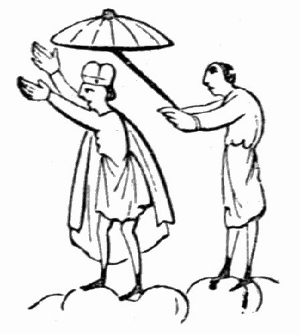
In Anglo-Saxon times the traveller always wore a covering for his head, which, though in various shapes, in no instance resembled our hat, though it was characterised by the general term hæt. He seems to have been further protected against the inclemency of the weather by a cloak or (mentel). One would be led to suppose that this outer garment was more varied in form and material than any other part of the dress from the great number of names which we find applied to it, such as—basing, hæcce, hæcla, or hacela, poell, pylca, scyccels, wæfels, &c. The writings which remain throw no light upon the provisions made by travellers against rain; for the dictionary makers who give scur-scead (shower-shade) as signifying an umbrella are certainly mistaken. Yet that umbrellas were known to the Anglo-Saxons is proved beyond a doubt by a figure in the Harleian MSS. which we have engraved above. A servant or attendant is holding an umbrella over the head of a man who appears to be covered at the same time with the cloak or mantle.
THE HEJIRA.
The Hejira, Hegira, or Hejra. The flight of Mohammed from Mecca to Medina is the epoch of the Mohammedan nations. Omar, the second Caliph, instituted the Hegira in imitation of the Christians, who counted their years from their persecution by Diocletian, (A.D. 284,) and who called it the era of the martyrs. Thus the Mohammedans wished to commence their calculation of time from the period of the most memorable persecution they had suffered. The learned Mohammedan astronomers have been divided in opinion on the exact year of the Christians which corresponds with the Hegira. But the generality of writers place this epoch on Friday, the 16th of July, A.D. 622. The ancient Arabs counted time by solar months; these months always returned in the same season, and their names correspond with the employments which the seasons rendered necessary. Since the epoch of the Hegira was fixed the Mohammedans count time by lunar months, the Arabian year consisting of 354 days, eight hours, and forty-eight minutes. The intercalary days are adjusted by a cycle of thirty lunar years, of which nineteen are of 354 days, and eleven of 355 days. The years of excess are in the following order:—2, 5, 7, 10, 13, 15, 18, 21, 24, 26, 29.
CHINESE PAILOOS.
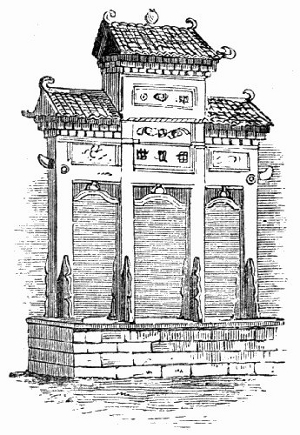
The Pailoos, or, as they are commonly but erroneously called, triumphal arches, form an object of Chinese architecture which, from its constant recurrence in views of Chinese scenery, is almost as familiar to us as the pagoda. They are, in fact, monuments to deceased persons of distinction, generally of widows who have not married a second time, or of virgins who have died unmarried. The smaller and less important ones consist merely of two upright posts of wood or granite, supporting a flat board with an inscription, like, both in purpose and design, to the wooden rails which are used as substitutes for tombstones in some districts in England. The more important Pailoos have three openings, supported by several boards, with more or less ornament and carving. Sometimes they are wholly of wood; in others no material is used but stone, generally granite; and these two materials are combined in various proportions in other examples. Sometimes they are raised on platforms as in the annexed example, from a peculiarly graceful one near Canton.
At other times they are placed on the ground, and even across roads, so as to form arches, if they may be called, though certainly not triumphal ones.
REMARKABLE GROTTO, AND STORY CONNECTED WITH IT.
Near Lunel, in France, on the eastern bank of the river Hérault, is the grotto, known in this part of the country as la Baume de las Donmaisellas, or des Fées. This grotto consists of many large, deep apartments, some of which are indeed inaccessible; the second (and they are all one below the other), presents to the eye of the beholder four beautiful pillars, about thirty feet high, terminating at the top like palm trees; they are detached from the roof, which is only to be accounted for by supposing that the bottom, or floor, has, in some concussion of nature, sunk from its original level: the third chamber, still descending, and like the former only to be reached by ropes and ladders, presents, at the farther end, one vast curtain of crystal, to which the lights, carried on such occasions, give the appearance of all manner of precious stones. Some of the stalactites of this apartment are solid and white as alabaster, some clear and transparent as glass; they are of every fantastic form and description, as well as displaying perfect representations of cascades, trees, festoons, lances, pillars, fruits, flowers, and even the regular arrangement of architecture in a cathedral. The fourth chamber is a long gallery covered with fine sand: beyond this three great pillars present themselves, and behind, there is a lake of thick muddy water. All these grottoes have been long known to the peasantry, but another was lately penetrated, in which every former variety of stalactite was seen, but, in addition to these was found an altar, white, like fine china, having regular steps to it, of the same material: it is composed apparently of layers of the opaque stalactite, of a dazzling white and exquisite polish: four twisted columns, of a yellow colour and transparent, whose height is lost in the vast roof; an obelisk, perfectly round, of a reddish colour, of a great height, and a colossal figure of a woman, holding two children in her arms, and placed upon a pedestal, completed the astonishment of the daring explorers of this subterraneous cavern. But alas! this astonishment was changed into feelings of a more melancholy description, when they recalled the circumstance, still current in the neighbourhood, that, during the religious wars, a family (whether Protestant or Catholic is not ascertained), consisting of a father and mother and one or two children, sought refuge in these subterraneous grottoes from the persecution of their enemies, and there preserved a miserable existence, far from the cruelty of
Man, whom Nature formed of milder clay, With every kind emotion in his heart, And taught alone to weep.
For some years they supported themselves with berries, and now and then they were seen endeavouring to secure a stray kid or goat for food. The solitude and silence of their almost inaccessible dwelling, imbued them and their fate with an awful character; and from being objects of pity, they became at length objects of terror, to the neighbouring peasantry, who told strange stories of the unfortunate beings thus consigned to cold and hunger, and compelled to seek a wretched home within the bowels of the earth. Their spare forms, their pale countenances, their tattered garments waving in the breeze, all threw a mystic feeling over their appearance, and they were transformed into fairies and spectres. The shepherds fled when they appeared, and the children, as they clung affrighted to their parents, with strained eyes and parted lips, followed the rapid movements of the mountaineers, as they in their turn, alarmed at the sight of their fellow-creatures, fled from height to height, until they gained their rocky asylum. Such an accumulation of suffering and misery was not, however, calculated to prolong existence: terror and fear destroyed the mind, as hunger and cold destroyed the body, and after the lapse of a few years, one by one, these spectres disappeared: but still they figure in all the local stories and traditions peculiar to the neighbourhood, under the form of witches, fairies, and sorcerers. The question is, whether the altar and the figure are not the work of these unfortunate beings, who might find in this employment a transitory solace for their misery.
CRUELTY OF HINDOO RITES.
We extract the following account from "The Land of the Veda," as it affords an extraordinary instance of the lengths to which the fanaticism of a gross superstition will induce men to proceed:—
"To satisfy ourselves of the sanguinary character of some of the Hindoo deities, and of the influence they exert over the deluded victims of superstition, we must witness some of the cruel practices which the popular goddess, Kali, imposes on her worshippers. The most remarkable festival is the one called Charak Puja.
"This festival derives its name from chakra, a wheel or discus; in allusion to the circle performed in the act of rotating, when suspended from the instrument of this horrible superstition. Being desirous of witnessing the ceremony in all its parts, I went to the spot where one of these ceremonies was about to take place. An upright pole, twenty or thirty feet in height, was planted in the ground, across the top of which, moving on a pivot, a long pole was placed. From one end of this transverse beam a long rope was suspended and left to hang loosely, whilst a shorter rope was attached to the other end, bearing a couple of strong iron hooks. A good-looking man, perhaps thirty years of age, came from the midst of the crowd, and doing obeisance beneath the instrument of torture, presented himself as a candidate for the honour he aspired to. The attendant, before whom he stood erect, struck a smart blow on the small of the back, and fixed one of the hooks in the flesh, and then did the same on the other side. The man then laid hold of the rope just above the hooks and held it, whilst certain persons in the crowd, seizing the loose rope, pulled him up, by depressing the other end of the beam. As he rose he relinquished his hold of the rope by which he was suspended, and resigned himself to the rotary motion, by which he was whirled round and round in mid air, suspended by the flesh of his own body. Whilst he was thus enduring the torture incident to this horrid service, at once gratifying the cruel goddess Kali and the crowd of admiring spectators, he drew from his girdle fruits and flowers, which he scattered among the attendants. These were picked up by the crowd, with the greatest eagerness, as precious relics that might avail as charms in cases of personal or domestic extremity. This wretched dupe of a foul superstition remained in the air at least a quarter of an hour, and, of course, in his own estimation and in that of the spectators, gained by this brief infliction a large amount of merit, and consequent title to certain rewards to be reaped in a future state of being. No sooner had he descended, than another was ready for the ceremony. These cruel practices are carried on in various parts of the native town, from day to day, as long as the festival lasts. It not unfrequently happens that the ligaments of the back give way, when the man, tossed to an immense distance, is dashed to pieces. In such cases, the inference is, that the victim of such accident, by virtue of demerit in a former state of existence, was not merely unworthy of the privileges attached to this privileged ceremonial, but destined to expiate his evil deeds by this dreadful accident."
CURIOUS MUSICAL INSTRUMENT.
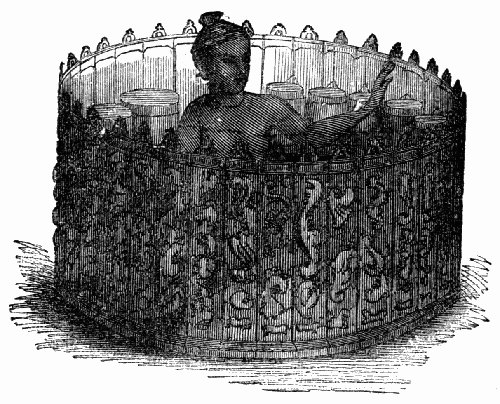
The musical instrument which we engrave below, is used in the Burman empire, and is thus described by Captain Yule, in his "Mission to Ava," writing from the town of Magwé, in Burmah. The Captain says;—
"This evening the members of the mission made their first acquaintance with the Burmese drama; an entertainment which from this time would occupy a very large place in the daily history of our proceedings if all were registered.
"The Governor had provided both a puppet play and a regular dramatic performance for our benefit, and on this first occasion of the kind the Envoy thought it right that we should visit both.
"Each performance was attended by a full Burmese orchestra. The principal instruments belonging to this are very remarkable, and, as far as I know, peculiar to Burmah.
"The chief instrument in size and power is that called in Burmese pattshaing, and which I can only name in English as a drum-harmonicon. It consists of a circular tub-like frame about thirty inches high and four feet six inches in diameter. This frame is formed of separate wooden staves fancifully carved, and fitting by tenon into a hoop which keeps them in place. Round the interior of the frame are suspended vertically some eighteen or twenty drums, or tom-toms, graduated in tone, and in size from about two and a-half inches diameter up to ten. In tuning the instrument the tone of each drum is modified as required by the application of a little moist clay with a sweep of the thumb, in the centre of the parchment. The whole system then forms a sort of harmonicon, on which the performer, squatted in the middle, plays with the natural plectra of his fingers and palms, and with great dexterity and musical effect."
BURMESE MUSICAL INSTRUMENTS.
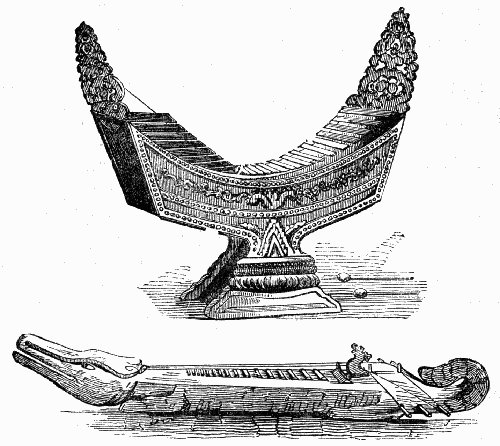
The two Burmese musical instruments which we here engrave are thus described by Captain Yule in his "Mission to Ava:"—
"The bamboo harmonicon or staccato is a curious example of the production of melody by simple and unexpected means. Its use, though unknown in India, extends throughout the Eastern Archipelago; and something similar is possessed, I believe, by the negro slaves in Brazil. Eighteen to twenty-four flat slips of bamboo, about an inch and a half broad, and of graduated length, are strung upon a double string and suspended in a catenary over the mouth of a trough-like sounding box. The roundish outside of the bamboo is uppermost, and whilst the extremities of the slips are left to their original thickness, the middle part of each is thinned and hollowed out below. The tuning is accomplished partly by the regulation of this thinning of the middle part. The scale so formed is played with one or two drumsticks, and the instrument is one of very mellow and pleasing tone. Though the materials are of no value, a good old harmonicon is prized by the owner, like a good old Cremona, and he can rarely be induced to part with it.
"There was one example at the capital, of a similar instrument formed of slips of iron or steel. It was said to have been made by the august hands of King Tharawadee himself, who, like Louis Seize, was abler as a smith than as a king. The effect was not unpleasing, and strongly resembled that of a large Geneva musical box, but it was far inferior in sweetness to the bamboo instrument.
"Another instrument used in these concerts is a long cylindrical guitar of three strings, shaped like an alligator and so named. It is placed on the ground before the performer."
DRESS REGULATED BY ACT OF PARLIAMENT.
The foreign knights and visitors who came to Windsor in Edward the First's reign, and brought with them a continual succession of varying fashions, turned the heads of the young with delight, and of the old with disgust. Douglas, the monk of Glastonbury, is especially denunciative and satirical on this point. He says that in the horrible variety of costume,—"now long, now large, now wide, now straight,"—the style of dress was "destitute and devert from all honesty of old arraye or good usage." It is all, he says, "so nagged and knibbed on every side, and all so shattered and also buttoned, that I with truth shall say, they seem more like to tormentors or devils in their clothing, and also in their shoying and other array, than they seemed to be like men." And the old monk had good foundation for his complaint; and the Commons themselves having, what the Commons now have not, a dread of becoming as extravagant as their betters in the article of dress, actually sought the aid of Parliament. That august assembly met the complaint by restricting the use of furs and furls to the royal family and nobles worth one thousand per annum. Knights and ladies worth four hundred marks yearly, were permitted to deck themselves in cloths of gold and silver, and to wear certain jewellery. Poor knights, squires, and damsels were prohibited from appearing in the costume of those of higher degree. As for the Commons themselves, they could put on nothing better than unadorned woollen cloth; and if an apprentice or a milliner had been bold enough to wear a ring on the finger, it was in peril of a decree that it should be taken off,—not the finger, but the ring,—with confiscation of the forbidden finery.
The consequence was that the Commons, being under prohibition to put on finery, became smitten with a strong desire to assume it; and much did they rejoice when they were ruled over by so consummate a fop as Richard of Bordeaux. All classes were content to do what many classes joyfully do in our own days,—dress beyond their means; and we find in old Harding's "Cronicle" that not only were
"Yemen and gromes in cloth of silk arrayed, Sattin and damask, in doublettes and in gownnes."
but that all this, as well as habits of "cloth of greene and scarleteen,—cut work and brodwar, was all," as the Chronicler expresses it, "for unpayed;" that is, was not paid for. So that very many among us do not so much despise the wisdom afforded us by the example of our ancestors as didactic poets and commonplace honest writers falsely allege them to do. And those ancestors of Richard the Second's time were especially given to glorify themselves in parti-coloured garments of white and red, such being the colours of the King's livery (as blue and white were those of John of Gaunt); and they who wore these garments, sometimes of half-a-dozen colours in each, why they looked, says an old writer, "as though the fire of St. Anthony, or some such mischance," had cankered and eaten into half their bodies. The long-toed shoes, held up to the knee by a chain and hook, were called crackowes, the fashion thereof coming from Cracrow in Poland. The not less significant name of "devil's receptacles" were given to the wide sleeves of this reign, for the reason, as the Monk of Evesham tells us, that whatever was stolen was thrust into them.
A CAT-CLOCK.
The following curious incident is to be found in Huo's "Chinese Empire:—
"One day when we went to pay a visit to some families of Chinese Christian peasants, we met, near a farm, a young lad, who was taking a buffalo to graze along our path. We asked him carelessly, as we passed, whether it was yet noon. The child raised his head to look at the sun, but it was hidden behind thick clouds, and he could read no answer there. "The sky is so cloudy," said he; "but wait a moment;" and with these words he ran towards the farm, and came back a few minutes afterwards with a cat in his arms. "Look here," said he, "it is not noon yet;" and he showed us the cat's eyes, by pushing up the lids with his hands. We looked at the child with surprise, but he was evidently in earnest; and the cat, though astonished, and not much pleased at the experiment made on her eyes, behaved with most exemplary complaisance. "Very well," said we; "thank you;" and he then let go the cat, who made her escape pretty quickly, and we continued our route.
To say the truth, we had not at all understood the proceeding; but we did not wish to question the little pagan, lest he should find out that we were Europeans by our ignorance. As soon as ever we reached the farm, however, we made haste to ask our Christians whether they could tell the clock by looking into the cat's eyes. They seemed surprised at the question; but as there was no danger in confessing to them our ignorance of the properties of the cat's eyes, we related what had just taken place. That was all that was necessary; our complaisant neophytes immediately gave chase to all the cats in the neighbourhood. They brought us three or four, and explained in what manner they might be made use of for watches. They pointed out that the pupil of their eyes went on constantly growing narrower until twelve o'clock, when they became like a fine line, as thin as a hair, drawn perpendicularly across the eye, and that after twelve the dilation recommenced.
When we had attentively examined the eyes of all the cats at our disposal, we concluded that it was past noon, as all the eyes perfectly agreed upon the point.
We have had some hesitation in speaking of this Chinese discovery, as it may, doubtless, tend to injure the interest of the clock-making trade, and interfere with the sale of watches; but all considerations must give way to the spirit of progress. All important discoveries tend in the first instance to injure private interests, and we hope, nevertheless, that watches will continue to be made, because, among the number of persons who may wish to know the hour, there will, most likely, be some who will not give themselves the trouble to run after the cat, or who may fear some danger to their own eyes from too close an examination of hers."
EARLY ENGLISH HELMET.
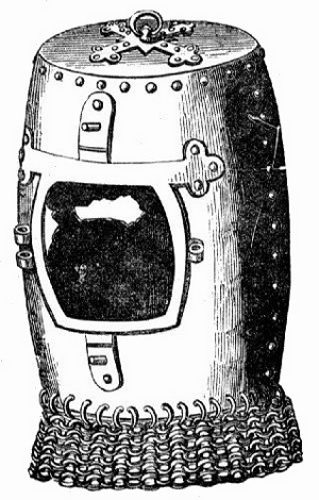
The above is a correct representation of a helmet of the latter part of the twelfth century, resembling those seen on the great seals of Richard I. The aventaille, or moveable grating for covering the face, has been lost, but the hinges, staples, and other means of fastening it still remain. Its form may be seen on the great seals of Henry III. and Edward I.
ILLUSTRIOUS FARMERS.
Adam was a farmer while yet in Paradise, and after his fall was commanded to earn his bread by the sweat of his brow. Job, the honest, upright, and patient, was a farmer, and his firm endurance has passed into a proverb. Socrates was a farmer, and yet wedded to the glory of his immortal philosophy. Cincinnatus was a farmer, and the noblest Roman of them all. Burns was a farmer, and the Muse found him at his plough, and filled his soul with poetry. Washington was a farmer, and retired from the highest earthly station to enjoy the quiet of rural life, and present to the world a spectacle of human greatness. To these names may be added a host of others, who sought peace and repose in the cultivation of their earth. The enthusiastic Lafayette, the steadfast Pickering, the scholastic Jefferson, the fiery Randolph, all found an El Dorado of consolation from life's cares and troubles, in the green and verdant lawns that surrounded their homestead.
ANCIENT COUTEAU-DE-CHASSE.
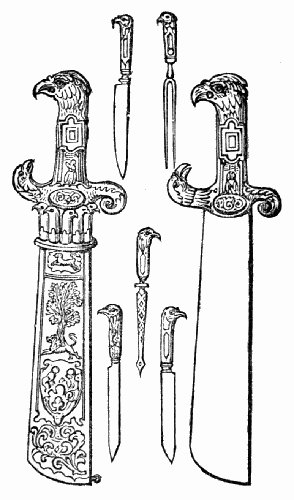
As the chase was regarded as the honourable and most instructive occupation of an age in which warlike prowess was deemed the principal object of emulation and applause, every respectable mansion had, in former times, its hall decorated with hunting implements. One of these we here present to our readers. It is a couteau-de-chasse of the time of William III. The left-hand figure represents it in its sheath, which is highly ornamented; the other figures represent the blade drawn, and the three knives, fork, and bodkin, which the sheath also contains. The form is precisely like those engraved in the "Triumph of Maximilian," which shows that no variation had taken place since the commencement of the sixteenth century. Erasmus, in his "Praise of Folly," thus alludes to this weapon, Kennet translating it "a slashing hanger." Speaking of those engaged in the chase, he says, "When they have run down their game, what strange pleasure they take in cutting it up! Cows and sheep may be slaughtered by common butchers, but what is killed in hunting must be broke up by none under a gentleman, who shall throw down his hat, fall devoutly on his knees, and drawing a slashing hanger (for a common knife is not good enough), after several ceremonies, shall dissect all the parts as artistically as the best skilled anatomist; while all that stand round shall look very intently and seem to be mightly surprised with the novelty, though they have seen the same an hundred times before; and he that can but dip his finger and taste of the blood shall think his own bettered by it."
DIVISION OF TIME IN PERSIA.
Time is of no value in Persia, from which reason it must be that so complicated a system has been maintained as that of counting by solar time, lunar time, and the Toork cycle. The first is observed by astronomers, and was in general use in Persia until it was superseded by Mahommed's lunar year. It consists of twelve months of thirty days each, with the required number of intercalary days. The second, which is now in general use, consisting of three hundred and fifty-four days, is therefore perpetually changing: an event commemorated in one year will come round ten days earlier the succeeding year. The third is a curious method of counting introduced by the Toorks into Persia, but which we are told has been forgotten in Turkey. They divide time into cycles of twelve years, each year having a separate name, but they have no designation for the cycles. Thus, if they wanted to describe an event which happened sixty-five years ago, they could only mention the name of the fifth year. These years are solar, and are thus designated:—
Sichkan eel Year of the Mouse.
Ood eel " Bull.
Bars eel " Leopard.
Tavishkan eel " Hare.
Looee eel " Crocodile.
Eelan eel " Snake.
Yoont eel " Horse.
Kooree eel " Ram.
Beechee eel " Monkey.
Tekhakoo eel " Cock.
Eet eel " Dog.
Tenkooz eel " Hog.
It seems strange their number should be twelve, as if there were a zodiac of years, instead of months.
This method of marking time is preserved only in government documents, such as firmans, grants, &c. No one seems able to account for its origin, excepting that, according to tradition, the Toorks of old brought it from Tartary.
DIFFERENT SORTS OF HORSES IN THE SIXTEENTH CENTURY.
The different sorts of horses in use among the nobility and others, may be collected from the following entry in the Northumberland household-book, first printed in the year 1768. It is entitled the regulations and establishment of Algernon Percy the Earl of Northumberland, 1512.
"This is the ordre of the chequir roule of the nombre of all the horsys of my lordis and my ladys, that are apoynted to be in the charge of the hous verely, as to say gentill hors, palfreys, hobys, naggis, clothsek hors.
"First, gentill hors, to stand in my lordis stable, six. Item, palfreys of my ladys, to wit, oone for my lady, and two for her gentill-women, and oone for her chamberer. Four hobys and naggis for my lordis oone saddill, viz. oone for my lorde to ride, oone to led for my lorde, and oone to stay at home for my lorde. Item, chariot hors to stand in my lordis stable yerely: Seven great trottynge hors to draw in the chariott, and a nagg for the chariott-man to ryde, eight. Again, hors for my lorde Percy, his lordis sonne. A great doble trottynge hors to travel on in winter. Item, double trottynge hors, called a curtal, for his lordship to ryde on out of townes. Another trottynge gambaldyn hors, for his lordship to ryde upon when he comes into townes. An amblynge hors, for his lordship to journey on daily. A proper amblyng little nag, for his lordship when he gaeth on hunting or hawkin. A gret amblyng gelding to carry his male."
The gentill horse was one of superior breed, so called in contrast to such as were of ordinary extraction.
Palfreys, were an elegant and easy sort of horses, used upon common occasions by knights, and others, who reserved their great and managed horses for battle and the tournament.
Hobys, were strong, active horses, of rather a small size. They are said to be originally natives of Ireland.
Nags were of the same description.
Clothseck, was a cloak-bag horse; as a male horse was one that carried the portmanteau. Horses to draw the chariots, were waggon horses; from the French word charrette, whence, the English word cart.
A great double trottynge horse, was a tall, broad horse, whose best pace was the trot, being too unwieldly to be able to gallop.
A curtail, was a horse whose tail was cut, or shortened.
A gambaldynge horse, was one of shew and parade; a managed horse.
An amblynge horse, received this appellation, from the ease and smoothness of its pace. In former times almost all saddle horses were broke to perform it.
THE NAORA.
The Oasis of Tagius or Wodian, in the Desert of Sahara, in Africa, comprehends these villages—D'kash, Krees, Wozorkan, Owlad, Majed, Sedadah, Zowiat Elarab, and Sidy Bohlan.
These villages are situated at short distances from each other, numbering together a population of between 25,000 and 30,000, whose chief employment consists in cultivating the palm, or date tree. At Kreez they have an excellent spring, but which does not suffice to water all their plantations, and hence they are forced to have recourse to the naora, so common on the coast. The naora is the name given to the rude, though ingenious contrivance, by means of which, through the agency of either a camel, a mule, or a horse, water is raised from a deep well in earthen jars, which, as soon as they have emptied their contents into a wooden trough, descend for fresh supplies. The water from the trough is then conducted by the planters into channels and trenches, as occasion requires. These are again easily diverted, and as soon as it is considered that the trees in one particular direction have had a sufficient supply, fresh trenches are opened in another direction, and in this manner the whole plantation receives the requisite moisture and nourishment. We here engrave the naora.
The pain and labour which the inhabitants of such an oasis take with their vast date plantations are immense, but their toil is amply repaid by the "lord of the vegetable world." Independent of its picturesque appearance, grateful shade, luscious fruit, and agreeable beverage, it supplies them with fuel, and wood for the construction of their houses. From its leaves they manufacture baskets, ropes, mats, bags, couches, brushes, brooms, fans, &c. From the branches they make fences, stools, and cages. The kernels, after being soaked in water for two or three days, are eagerly eaten by camels.
Every palm-tree shoots forth a number of suckers, which are removed at the proper season and transplanted. With care, these will produce fruit in about ten years, whereas those raised from kernels will only yield dates when they reach to the age of twenty. The tree reaches its vigour at thirty, and continues so till a hundred years old, when it begins to decline, and decays about the end of its second century. During its vigorous years, a good tree will produce between twenty and thirty clusters, each weighing about thirty pounds.
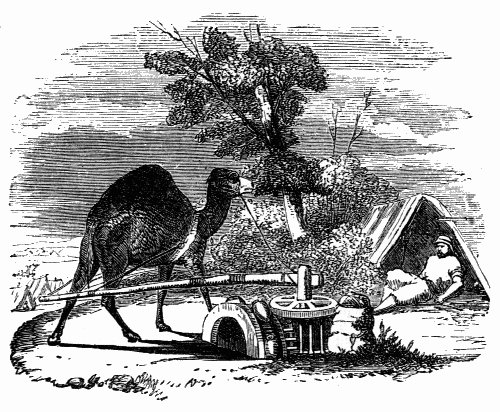
Mr. Morier relates an anecdote, which greatly illustrates how highly the date-tree is appreciated by those who are from their infancy taught to value it. An Arab woman who had been in England, and who returned in the suite of the English ambassador to Persia, on her reaching home, told her countrywomen of the riches and beauty of the country she had visited, and described the roads, the carriages, the scenery, the splendour of the cities, and the fertility of the well-cultivated soil. Her audience were full of admiration, and had almost retired in envy, when she happened to mention that there was but one thing wanting to make the whole almost a Paradise. "And what is that?" said they. "Why, it has not a single date-tree. All the time that I was there, I never ceased to look for one, but I looked in vain." The charm was instantly broken; the Arabs turned away in pity for men, who, whatever might be their comforts, or their magnificence, were doomed to live in a country where there are no date-trees.
PRIMITIVE PAIR OF BELLOWS.
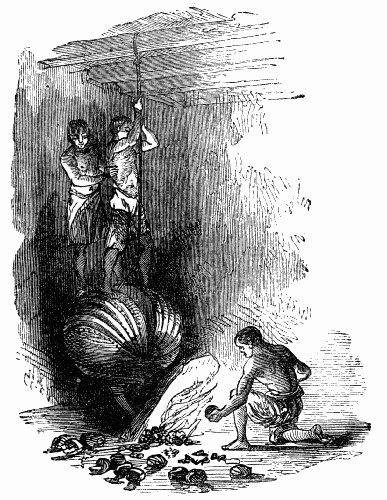
Atmospheric denudation and weathering have produced remarkable effects on the lower part of the Nonkreem valley, in the Khasia mountains, in India, which is blocked up by a pine-crested hill, 200 feet high, entirely formed of round blocks of granite, heaped up so as to resemble an old moraine; but, like the Nunklow boulders, these are not arranged as if by glacial action. The granite is very soft, decomposing into a course reddish sand, that colours the Boga-panee. To procure the iron sand, which is disseminated through it, the natives conduct water over the beds, and as the lighter particles are washed away, the remainder is removed to troughs, where the separation of the ore is completed. The smelting is very rudely carried on in charcoal fires, blown by enormous double-action bellows, worked by two persons, who stand on the machine, raising the flaps with their hands, and expanding them with their feet, as shown in our cut. There is neither furnace nor flux used in the reduction. The fire is kindled on one side of an upright stone (like the head-stone of a grave), with a small arched hole close to the ground: near this hole the bellows are suspended: and a bamboo tube from each of its compartments meets in a larger one, by which the draft is directed under the hole in the stone to the fire. The ore is run into lumps as large as two fists, with a rugged surface: these lumps are afterwards cleft nearly in two to show their purity.
PRESERVATION OF DEAD BODIES.
About a mile distant from Palermo in Sicily, is a celebrated Monastery of Capuchins, in which there is a vault made use of as a receptacle for the dead. It consists of four wide passages, each forty feet in length, into which the light is admitted by windows, placed at the ends. Along the sides of these subterraneous galleries are niches, in which the bodies are placed upright, and clothed in a coarse dress, with their heads, arms, and feet bare. They are prepared for this situation by broiling them six or seven months upon a gridiron, over a slow fire, till all the fat and moisture are consumed. The skin which looks like pale-coloured leather, remains entire, and the character of the countenance is, in some degree preserved.
THE CAGOTS.
In the Department of the Hautes Pyrénées in France is sometimes to be met with a creature about four feet high, with an enormous head, stiff, long hair, a pale countenance, a dead-looking eye, legs that have the appearance of being in the last stage of a dropsy, and an enormous goitre on the neck, which sometimes hangs down below the stomach. This unhappy being begs for charity by extending his hand, smiling vaguely, and by uttering inarticulate sounds or suppressed cries, which his desolate and degraded situation alone interprets. These Cagots, for so they are here called, live isolated from the rest of the world; twenty years ago, if any one of these unfortunate beings left his hut, and ventured into the towns or villages, the children would exclaim—Cagot! Cagot! and this cry would bring the smith from his forge, the shopkeeper from his counter, the private individual from his fireside; and, if the poor being did not hasten his flight, and slow was his progress, he not unfrequently lost his life by the stones that were flung after him. There was, however, one day in the week—Sunday, the Lord's day—and one asylum—the church, the Lord's house—that was free to them; yet man there made a distinction between him and his fellow man. A narrow door, through which no one passed but the Cagots, a chapel, which no one entered but these unhappy Cagots, was reserved for their sole use, where they offered up their imperfect prayers, without seeing or being seen by any one. Even in these days, they are still considered an outcast race; and an alliance of a peasant girl of the plains with a Cagot, would excite as much commotion among the inhabitants of the valleys of the Pyrénées, as the famed one between Idamore and Néala, in M. Delavigne's celebrated tragedy of the Paria. Yet it is strange that these deformities do not show themselves until a child has passed the age of six or seven: he is before this period like other healthy children; his complexion is fresh, his eye lively, and his limbs in proportion; but at twelve, his head has increased prodigiously, his complexion has become sallow, his teeth have lost their whiteness, his eye its fire. Three years later his skin is shrivelled, his teeth open with difficulty, and he pronounces all the consonants with a whistling indistinctness, that renders his language unintelligible to strangers. His mind partakes of the deformity and weakness of his body, for he is, at fifteen, little better than an idiot. Such are the Cagots of the Pyrénées.
DISCONTINUANCE OF TORTURE.
Torture had been applied, down to the close of Elizabeth, to the investigation of all kinds of crime; but after that time it was chiefly confined to state offences. Its favourite instrument was the dreadful rack, or break, traditionally said to have been introduced under Henry VI. by John, Duke of Exeter, constable of the Tower, whence it was called the Duke of Exeter's daughter. A milder punishment was inflicted by Skevington's gyves, which compressed the victim closely together, whilst the rack distended his whole frame in the most painful manner. In 1588 the manacles were introduced, and soon became the most usual mode of torture, but their precise character is not well understood. A variety of instruments of torture are still shown in the Tower, taken, it is said, out of the Spanish Armada, but at all events admirably suited to the gloomy dungeon wherein they appear, and in which half-starvation, and the horrid cells called Little Ease and Rat's Dungeon (the latter placed below high water mark, and totally dark, so that the rats crowded in as the tide rose,) added to the sufferings of the poor victim when released for a brief space from the fell grasp of the prison-ministers. Torture was not abolished in Scotland till 1708; in France till 1789; in Russia till 1801; in Bavaria and Wurtemberg till 1806; in Hanover till 1822; nor in the Grand Duchy of Baden till 1831.
THE MODERN NAMES OF REGIMENTS.
The modern names of regiments were first given to them in the reign of Charles II., the Coldstreams or Foot Guards being formed in 1660, when two regiments were added to one raised about ten years before by General Monk at Coldstream on the borders of Scotland; to these were added the 1st Royal Scots, brought over from France at the Restoration. The Life Guards were raised in 1661, with the Oxford Blues (so called from the first commander, Aubrey, Earl of Oxford); and also the 2nd or Queen's Foot. The 3rd or Old Buffs were raised in 1665, and the 21st Foot or Scotch Fusileers (from their carrying the fusil, which was lighter than the musket), in 1678. In that year the Grenadiers (so named from their original weapon, the hand grenade) were first brought into our service, and in 1680 the 4th or King's Own were raised. James II. added to the cavalry the 1st or King's Regiment of Dragoon's Guards, and the 2nd or Queen's ditto in 1685; and to the infantry, in the same year, the 5th and 7th, or Royal Fusileers; and in 1688 the 23rd or Welsh Fusileers.
WATCH PRESENTED BY LOUIS THE THIRTEENTH OF FRANCE TO CHARLES THE FIRST OF ENGLAND.
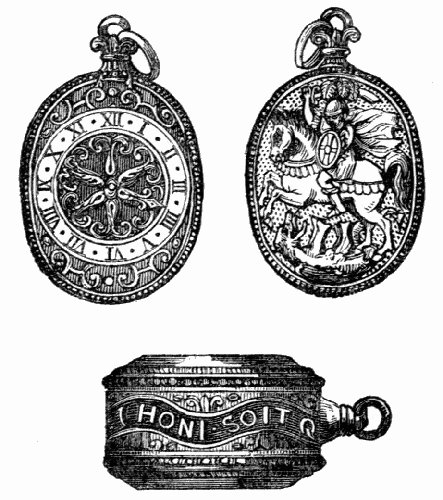
The annexed engraving represents the watch which was made for Louis XIII. to present to King Charles I. It is of silver, richly gilt, the ornaments covered with transparent enamel in white, red, green, blue, and yellow. The numbers are on a band of deep blue; the wheel-like ornament in the centre on a ruby ground. The back is chased in high relief with a figure of St. George conquering the Dragon; the horse is covered with white enamel; the flesh tints on St. George are also of enamel; his tunic is red, and his scarf blue. On the side of the watch is the motto of the Order of the Garter; the fleurs-de-lys above and below it on a ruby ground. The interior of the case is enriched by a delicately executed arabesque filled with black enamel upon a dotted ground. The entire works take out of the case, being secured thereto by springs, and are all more or less decorated with engraving, the whole interior being chased and gilt. The maker's name is S. Vallin.
A WEDDING A HUNDRED YEARS AGO.
On the 7th June, 1750, was married at Rothbury, Mr. William Donkin, a considerable farmer, of Tosson, in the county of Northumberland, to Miss Eleanor Shotten, an agreeable young gentlewoman, of the same place. The entertainments on this occasion were very grand, there being provided no less than one hundred and twenty quarters of lamb, forty quarters of veal, twenty quarters of mutton, a large quantity of beef, twelve hams, with a suitable number of chickens, which was concluded with eight half ankers of brandy made into punch, twelve dozen of cider, and a great many gallons of wine. The company consisted of five hundred ladies and gentlemen, who were diverted with the music of twenty-five fiddlers and pipers; and the evening was spent with the utmost unanimity.
GRACE KNIVES.
There is a curious class of knives, of the sixteenth century, the blade, of which have on one side the musical notes to the benediction of the table, or grace before meat, and on the other the grace after meat. We here engrave a specimen.
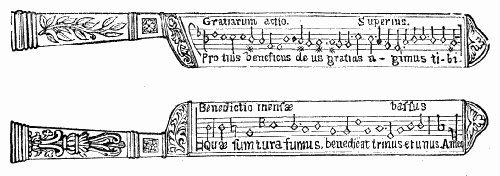
The set of these knives usually consisted of four. They were kept in an upright case of stamped leather, and were placed before the singer according to the adaptation of each part to the voice indicated upon them.
GARDEN AT KENILWORTH WHEN IN ITS PRIME.
Gossiping Laneham is very eloquent about the Kenilworth Garden, at which he took a timid and surreptitious peep. It was an acre or more in extent, and lay to the north of the stately castle: a pleasant terrace, ten feet high, and twelve feet broad, even under foot and fresh with trim grass, ran beside it along the castle wall. It was set with a goodly show of obelisks and spheres, and white bears of stone, raised upon goodly bases. At each end was a fine arbour, redolent with sweet trees and flowers. The garden-plot near had fair alleys of turf, and others paved with smooth sand, pleasant to walk on as the sea-shore when the wave has just retired. The enclosure was divided into four even quarters: in the midst of each, upon a base of two feet square, rose a porphyry square pilaster, with a pyramidical pinnacle fifteen feet high, pierced and hollowed, and crowned with an orb. All around was covered with redolent herbs and flowers, varied in form, colour, and quantity, and mixed with fruit trees.
In the midst, opposite the terrace, stood a square aviary, joined to the north wall, in height twenty feet, thirteen long, and fourteen broad; it had four great windows, two in front and two at each end, and each five feet wide. These windows were arched, and separated by flat pilasters, which supported a cornice. The roof was of wire net, of meshes an inch wide; and the cornice was gilded and painted with representations of precious stones. This great aviary had also eaves in the wall, for shelter from sun and heat, and for the purpose of building. Fair holly trees stood at each end, on which the birds might perch and pounce. They had a keeper to attend to their seeds and water, and to clean out their enclosure. The birds were English, French, and Spanish. Some were from America; and Laneham is "deceived" if some were not from the Canary Islands.
In the centre of this miniature Paradise stood a fountain with an octagonal basin rising four feet high; in the midst stood the figures of two Athletes, back to back, their hands upholding a fair marble bowl, from whence sundry pipes distilled continual streams into the reservoir. Carp, tench, bream, perch, and eel disported in the fresh falling water; and on the top of all the ragged staff was displayed; on one side Neptune guided his sea-horses with his trident, on another stood Thetis with her dolphins. Here Triton and his fishes, there Proteus and his herds, Doris and her daughter, and half the Nereids, disported in sea and sand, surrounded by whales, sturgeons, tunnies, and conch shells, all engraven with exquisite device and skill. By the sudden turn of a tap, the spectator could be drenched at the pleasure of any wit.
EGYPTIAN ANTIQUITIES.
It appears from a paper recently read in the Academy of Archæology, at Rome, that Father Secchi has found a new interpretation of the Egyptian hieroglyphics, which enables him to declare, that most of them are not mere tombstone inscriptions, as is generally assumed, but poems. He has given several of his readings, which display great ingenuity, and professes to be able to decipher the inscriptions on the Obelisk of Luxor, at Paris.
THE BAYEUX TAPESTRY.
The cathedral at Bayeux is a gothic building, dedicated to the Virgin. The portal and three belfries, which belong to it, are objects of curiosity. It is in this cathedral that the celebrated tapestry, denominated of Bayeux, is kept. Its length is one hundred and thirty-two feet; its breadth, seven and a half. "I had," says Dr. Ducarel, "the satisfaction of seeing that famous piece of furniture, which, with great exactness, though in barbarous needlework, represents the history of Harold, King of England; and of William, Duke of Normandy; from the embassy of the former to Duke William, at the command of Edward the Confessor, to his overthrow and death, at the battle fought near Hastings. The ground of this piece of work is a white linen cloth, or canvas. The figures of men, horses, &c. are in their proper colours, worked in the manner of the samplers, in worsted, and of a style not unlike what we see upon the China and Japan ware; those of the men, particularly, being without the least symmetry or proportion. There is a small border, which runs at the top and the bottom of the tapestry; with several figures of men, beasts, flowers, and even fables, which have nothing to do with the history, but are mere ornaments. At the end of every particular scene there is a tree, by way of distinction; and over several of the principal figures there are inscriptions, but many of them obliterated. It is annually hung up on St. John's day, and goes round the nave of the church, where it continues eight days; and at all other times it is carefully kept locked up in a strong wainscot press, in a chapel on the south side of the cathedral, dedicated to Thomas à Becket. By tradition it is called, Duke William's toilet, and is said to be the work of Matilda, his queen, and the ladies of her court, after he had obtained the crown of England." Mr. Strutt, in his "Complete View of the Dresses and Habits of the People of England," affirms, that it is the work of half a century later than the time of the Conqueror.
ROMAN STAMP.
This curiosity is preserved in the British Museum. It is the very earliest specimen we possess of printing, by means of ink or any similar substance. It is made of metal, a sort of Roman brass; the ground of which is covered with a green kind of verdigris rust, with which antique medals are usually covered. The letters rise flush up to the elevation of the exterior rim which surrounds it. Its dimensions are, about two inches long, by one inch broad. At the back of it is a small ring for the finger, to promote the convenience of holding it. As no person of the name which is inscribed upon it is mentioned in Roman History, he is therefore supposed to have been a functionary of some Roman officer, or private steward, and who, perhaps, used this stamp to save himself the trouble of writing his name. A stamp somewhat similar, in the Greek character, is in the possession of the Antiquarian Society, of Newcastle-on-Tyne.
TYRIAN PURPLE.
The shell-fish portrayed on next page is that from which the Tyrian purple dye is obtained. The ancients were very devoid of chemical knowledge; their list of adjective dye-stuffs was therefore restricted, and all the most celebrated dyes of antiquity belonged to the substantive division, of which Tyrian purple was undoubtedly the chief. The purple dye of Tyre, which admits with great propriety of being included amongst the dyes of Greece and Rome, was discovered about fifteen centuries before the Christian era, and the art of using it did not become lost until the eleventh century after Christ. It was obtained from two genera of one species of shell-fish, the smaller of which was denominated buccinum, the larger purpura, and to both the common name murex was applied. The dye-stuff was procured by puncturing a vessel in the throat of the larger genus, and by pounding the smaller entire. Having been thus extracted, salt was added, also a certain amount of water. The whole was then kept hot about eight or ten days in a vessel of lead or tin, the impurities as they rose being assiduously skimmed off. The dye-stuff was now ready to receive the texture to be dyed (wool, universally), and the operation of dyeing was simple enough; nothing further being required than the immersion of the whole for a sufficient time, when, at the expiration of a certain period, the whole of the colouring matter was found to have been removed, and to have combined with the textile fabric.
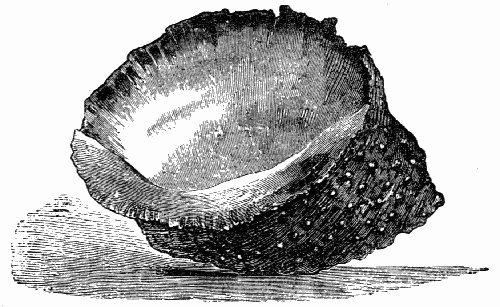
The tints capable of being imparted by this material were various—representing numerous shades between purple and crimson. Amongst these a very dark violet shade was much esteemed, but the right imperial tint, we are informed, was that resembling coagulated blood. The discovery of Tyrian purple dye is referred to the fifteenth century before Christ. That it was known to the Egyptians, in the time of Moses, is sufficiently obvious from the testimony of more than one scriptural passage. Ultimately, in later ages, a restrictive policy of the eastern emperors caused the art to be practised by only a few individuals, and at last, about the commencement of the twelfth century, when Byzantium was already suffering from attacks without, and dissensions within, the secret of imparting the purple dye of Tyre became lost.
The re-discovery of Tyrian purple as it occurred in England was made by Mr. Cole of Bristol. About the latter end of the year 1683, this gentleman heard from two ladies residing at Minehead, that a person living somewhere on the coast of Ireland, supported himself by marking with a delicate crimson colour the fine linen of ladies and gentlemen sent him for that purpose, which colour was the product of some liquid substance taken out of a shell-fish. This recital at once brought to the recollection of Mr. Cole the tradition of Tyrian purple. He, without delay, went in quest of the shell-fish, and after trying various kinds without success, his efforts were at length successful. He found considerable quantities of the buccinum on the sea-coast of Somersetshire, and the opposite coast of South Wales. The fish being found, the next difficulty was to extract the dye, which in its natural state is not purple, but white, the purple tint being the result of exposure to the air. At length our acute investigator found the dye stuff in a white vein lying transversely in a little furrow or cleft next to the head of the fish.
THE INCARNATIONS OF VISHNU.
There is a part of the mythology of India which seems to be blended with the history of that country. It relates to the different avatars of Vishnu, or his incarnations and appearances on earth.
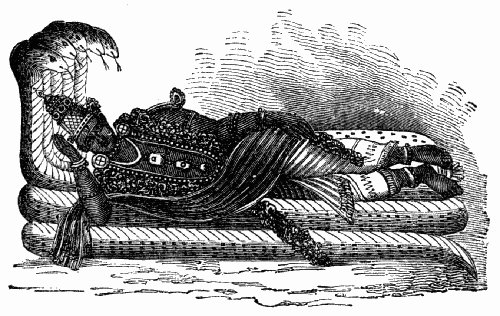
The first of these avatars has reference to that general deluge of which all nations have preserved some traditions. Vishnu, we are told, metamorphosed himself into a fish.
The second incarnation is that of Kourma, or the tortoise. The gods and the giants, wishing to obtain immortality by eating amourdon, delicious butter, formed in one of the seven seas of the universe, which the Indians call sea of milk, transported, by Vishnu's advice, the mountain of Mandreguivi into that sea: they twisted round it the serpent Adissechen, and alternately pulling, some by his hundred heads, others by the tail, they made the mountain turn round in such a manner, as to agitate the sea and to convert it into butter; but they pulled with such rapidity, that Adissechen, overcome with weakness, could no longer endure it. His body shuddered; his hundred trembling mouths made the universe resound with hisses; a torrent of flames burst from his eyes; his hundred black pendent tongues palpitated, and vomited forth a deadly poison, which immediately spread all around. The gods and giants betook themselves to flight. Vishnu, bolder than the rest, took the poison, and with it rubbed his body, which became quite blue. It is in memory of this event, that this colour is given to his image in almost all the temples.
The gods and the giants, encouraged by Vishnu's example, fell to work again. After they had laboured a thousand years, the mountain was on the point of sinking in the sea, when Vishnu, in the form of a tortoise, quickly placed himself beneath, and supported it. At length they saw the cow Camadenu, the horse with seven heads, and the elephant with three trunks, coming out of the sea of milk; also the tree calpaga vrutcham; Lacshmi, goddess of riches, wife of Vishu; Saraswadi, goddess of the sciences and of harmony, married to Brama; Mondevi, goddess of discord and misery, whom nobody would have, and who is represented riding on an ass, and holding in her hand a banner, on which a raven is delineated; and, lastly, Danouvandri, the physician, carrying a vessel full of amourdon, which the gods instantly seized, and greedily devoured, without leaving a morsel. The giants, disappointed in their expectations, dispersed over the earth, prevented mankind from paying worship to the gods, and strove to obtain adoration for themselves. Their insolence occasioned the subsequent incarnations of Vishnu, who endeavoured to destroy this race, so inimical to the gods. He is adored in this second metamorphosis, by the name of Kourma Avatara. The followers of Vishnu believe that this god, though omnipresent, resides more particularly in the vaicondom, his paradise, amidst the sea of milk, reclined, in contemplative slumber, on the serpent Adissechen, which serves him for a throne: in this state he is called Siranguan. In all the temples of Vishnu is to be seen the figure of this god; but as the serpent on which he lies cannot be represented with his hundred heads, he is delineated with only five.
There are altogether ten incarnations of Vishnu; nine of these have already been fulfilled, and one is yet to be manifested, it is expected about ninety thousand years hence. The account of many of the transformations is exceedingly extraordinary, but we have room for no more than the one we have given.
ORIGIN OF LONG-TOED SHOES.
Long-toed shoes were invented by Fulk, Count of Anjou, to hide an excrescence on one of his feet. These toes were so long as to be fastened to the knees with gold chains, and carved at the extreme point with the representation of a church window, a bird, or some fantastic device.