TEN THOUSAND WONDERFUL THINGS. (continued 7)
Reading edition
This custom was kept up till late in the reign of George III.
PARLOUS DAYS.
Bloodletting, considered during the last century to be necessary for every one in health or not, at spring and fall, was an operation performed by the country surgeons on the labourers on a Sunday morning, at a charge of 6d. each. Bleeding in bed by a barber was, in the reign of Charles II., sometimes charged, for a lady, so high as 10s., and for a gentleman, 1s. and 2s. 6d. The operator perhaps barboured the patient at an additional charge. Barbouring by the year was charged 16s. Superstition had marked certain days in each month as dangerous for bloodletting, which were called parlous days. In July, the 1st, 7th, 13th, 12th, 25th, and 20th were of the above kind.
As the whole population had recourse to bloodletting twice a year, bleeders or barbers were in constant demand.
A FUNERAL APPROPRIATELY CONDUCTED.
During the year 1700, the minister of a parish in Kent was interred at the age of 96 years; the gentleman who preached his funeral sermon was 82; he who read the service 87; the clerk of the parish was the same age; the sexton was 86; in addition to which list of aged persons, there were several present from the adjacent parishes 100 years old each, and upwards.
ANCIENT NUT-CRACKERS.
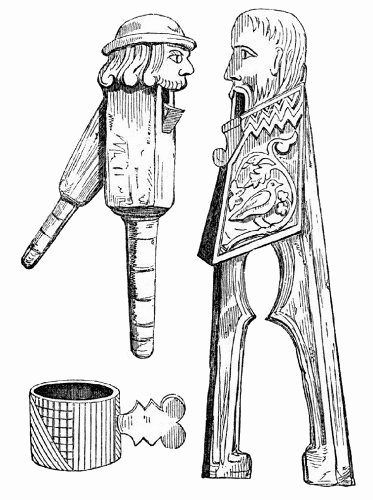
The two quaint instruments pictured in our engraving, of about the time of Charles I. or II., are made of hard wood rather rudely carved; and look as if in their time they had seen good service. The grotesque heads, with the mouth, affording the means of cracking the nuts, are examples of the fitness of design for a particular purpose, which characterize many of the objects in domestic use in the middle ages, and up to the reign of Queen Anne, after which ornamental art for household uses seems almost to have been disused. Even in the time of George III., our chairs, tables, side-boards, &c., were made heavy, very ugly, and without any attempt at appropriate pattern.
NELL GWYNNE'S LOOKING-GLASS.
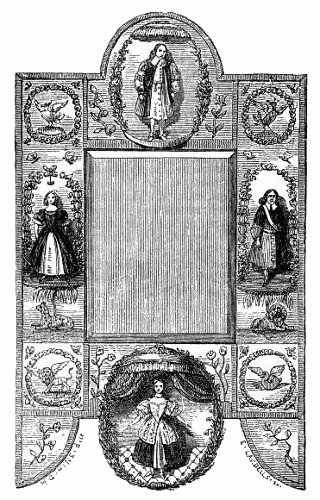
This glass is in the possession of Sir Page Dicks, of Port Hall. It bears the likeness of Nell Gwynne and King Charles, which are modelled in wax; and also the supporters, or crest, which Nell assumed, namely, the lion and the leopard. The whole is curiously worked in coloured glass beads, and the figures, with the dresses, made to project in very high relief; indeed, they are merely attached to the groundwork. In the upper compartment is Charles in his state dress; and the bottom one, that of Nell Gwynne, in her court dress—the pattern of which is very tasteful. On the right is Charles in his hunting dress. The beads have retained their colours, which are very appropriate to the subject, and must have been a work of considerable time and patience; but whether done by Nell or not, there is no record.
A REMARKABLE HIGHLANDER.
In August, 1827, John Macdonald expired in his son's house, in the Lawnmarket, Edinburgh, at the advanced age of one hundred and seven years. He was born in Glen Tinisdale, in the Isle of Skye, and, like the other natives of that quarter, was bred to rural labour. Early one morning in his youth, when looking after his black cattle, he was surprised by the sight of two ladies, as he thought, winding slowly round a hill, and approaching the spot where he stood. When they came up, they inquired for a well or stream, where a drink of water could be obtained. He conducted them to the "Virgin Well," an excellent spring, which was held in great reverence on account of its being the scene of some superstitious and legendary tales. When they had quenched their thirst, one of the ladies rewarded Macdonald with a shilling, the first silver coin of which he was possessed. At their own request he escorted them to a gentleman's house at some distance, and there, to his great surprise and satisfaction, he learned that the two "ladies" were Flora Macdonald and Prince Charles Stewart.
This was the proudest incident in Macdonald's patriarchal life; and, when surrounded by his Celtic brethren, he used to dilate on all the relative circumstances with a sort of hereditary enthusiasm, and more than the common garrulity of age. He afterwards turned joiner, and bore a conspicuous part in the building of the first Protestant church which was erected in the island of North Uist. He came to Edinburgh twenty-three years before his death, and continued to work at his trade till he was ninety-seven years of age.
Macdonald was a temperate, regular-living man, and never paid a sixpence to a surgeon for himself, nor had an hour's sickness in the whole course of his life. He used to dance regularly on New-year's day, along with some Highland friends, to the bagpipe. On New-year's day, 1825, he danced a reel with the father, the son, the grandson, and great-grandson, and was in more than his usual spirits. His hearing was nothing impaired, and till within three weeks of his demise he could have threaded the finest needle with facility, without glasses.
CATS WITH KNOTTED TAILS.
We extract the following paragraph from the narrative of a voyager in the Indian Ocean, because it contains an account of a rarity in natural history with which few, we believe, are acquainted.
"The steward is again pillowed on his beloved salt fish, and our only companion is a Malacca cat, who has also an attachment for the steward's pillow. Puss is a tame little creature, and comes rubbing herself mildly against our shoes, looking up in our faces, and mewing her thoughts. Doubtless she is surprised that you have been so long looking at her without noticing the peculiarity in her tail, which so much distinguishes her from the rest of the feline race in other quarters of the globe. Take her up in your lap, and see for yourself. Did you ever observe such a singular knot—so regular, too, in its formation? Some cruel monster must have tied it in a knot whilst puss was yet a kitten, and she has outlived both the pain and inconvenience. But here comes a kitten, all full of gambols and fun, and we find that her tail is in precisely the same condition. So, then, this is a remarkable feature amongst the whole race of Malayan cats, but for which, no one we meet with, is able to give us a satisfactory explanation."
CURIOUS FEATS.
In 1553, the following extraordinary exhibition was performed in the presence of Queen Mary, in her passage through London to Westminster.—It is thus described by Holinshed, in his "Chronicle," printed 1577:—"When shee didd come to Sainte Paule's churchyarde, Maister Haywood sat in a pageant under a vine, and made to her an oration in Latine; and then there was one Peter, a man of Holland, who didd stand upon the weathercocke of St. Paule's steeple, holdyng a streamer in his handes of five yardes long, and waving thereof. Hee sometimes stood on one foot and shock the other, and then hee kneeled on his knees to the verie grate marvel of al the people. Hee hadd made two scaffolds under him—one above the cross, having torches and streamers sett upon it, and another over the ball of the cross, likewise sett with streamers and torches which could not burne, the wind was so greate." Our chronicler further informs us, that "Peter didd have xvi pounds xiii shillings and iii pence given to him by the citie of London for his costes and pains, and for all his stuffe."
IMPUDENCE OR CANDOUR, WHICH IS IT?
The following advertisement appeared in the St. James's Chronicle of 1772. "Wanted immediately, fifteen hundred, or two thousand pounds, by a person not worth a groat; who, having neither houses, land, annuities, or public funds, can offer no other security than that of simple bond, bearing simple interest, and engaging the repayment of the sum borrowed in five, six, or seven years, as may be agreed on by the parties. Whoever this may suit, (for it is hoped it will suit somebody), by directing a line for A. Z. in Rochester, shall be immediately replied to, or waited on, as may appear necessary."
THE SOUTH STACK LIGHTHOUSE.
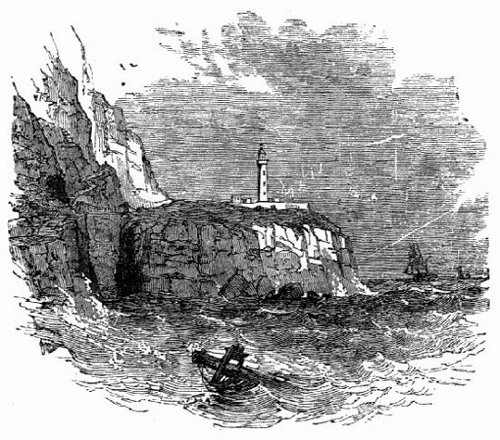
Though not so celebrated as the Eddystone, the South Stack Lighthouse is unquestionably one of the marvels of science, and as such may be appropriately described in our pages. It is erected on the summit of an isolated rock, three or four miles westward from Holyhead, and separated from the main land by a chasm ninety feet in width. This splendid structure was raised in the year 1808. The elevation of the summit of the rock on which it is erected is 140 feet above the level of the sea at high-water mark; the height of the tower, from the base to the gallery, is sixty feet; and the lantern is twelve feet high from the gallery; making the total elevation of the light 212 feet above high-water mark. The light is produced by twenty-one brilliant lamps, with powerful reflectors, placed on a revolving triangular frame, displaying a full-faced light every two minutes, which, in clear weather, is distinctly visible at a distance of ten leagues. Latterly there has been an addition of three red lights placed at the rock, which are more distinctly visible in foggy weather than the lighthouse lights. The rough sea caused by the strong tides about the head rendered the communication by boat very precarious. In order to obviate the danger, a passage was contrived by means of two ropes thrown across the gulf, along which the individual was drawn in a box or cradle, by the assistance of pulleys affixed at each end. This plan was superseded by a bridge of ropes, which was used some years after, though always considered unsafe, on account of the constant wear of the ropes. In 1827, a modern suspension chain-bridge was thrown over the sound, the span of which is 110 feet, the chains being firmly bolted in the rock on each side, and carried over two massive stone pillars erected for the purpose. The chain supports a platform of timber five feet wide, and seventy feet above high-water mark. The bridge is attained by descending the Holyhead mountain in a zigzag direction by a flight of 380 steps.
BRASS MEDAL OF OUR SAVIOUR.
In 1702, the late Rev. H. Rowlands, author of Mona Antiqua, while superintending the removal of some stones, near Aberfraw, Wales, for the purpose of making an antiquarian research, found a beautiful brass medal of our Saviour, in a fine state of preservation, which he forwarded to his friend and countryman, the Rev. E. Llwyd, author of the Archeologiæ Britannica, and at that time keeper of the Ashmolean library at Oxford.
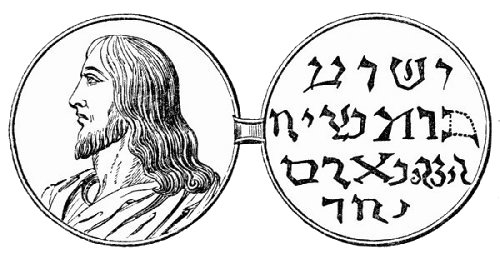
This medal, of which an engraving is subjoined, has on one side the figure of a head exactly answering the description given by Publius Lentulus of our Saviour, in a letter sent by him to the emperor Tiberius and the senate of Rome. On the reverse side, it has the following legend or inscription, written in Hebrew characters, "This is Jesus Christ, the Mediator or Reconciler;" or "Jesus, the Great Messias, or Man Mediator." And being found among the ruins of the chief Druids resident in Anglesea, it is not improbable that the curious relic belonged to some Christian connected with Brân the Blessed, who was one of Caractacus's hostages at Rome from A.D. 52 to 59, at which time the Apostle Paul was preaching the gospel of Christ at Rome. In two years afterwards, A.D. 61, the Roman General Suetonius extirpated all the Druids in the island. The following is a translation of the letter alluded to, a very antique copy of which is in the possession of the family of Kellie, afterwards Lord Kellie, now represented by the Earl of Mar, a very ancient Scotch family—taken from the original at Rome:—
"There hath appeared in these our days, a man of great virtue, named Jesus Christ, who is yet living among us, and of the Gentiles is accepted as a prophet, but his disciples call him 'the Son of God.' He raiseth the dead, and cures all manner of diseases; a man of stature somewhat tall and comely, with very reverend countenance, such as the beholders both love and fear; his hair the colour of chesnut, full ripe, plain to his ears, whence downwards it is more orient, curling, and waving about his shoulders. In the midst of his head is a seam or a partition of his hair after the manner of the Nazarites; his forehead plain and very delicate; his face without a spot or wrinkle, beautified with the most lovely red; his nose and mouth so formed that nothing can be reprehended; his beard thickish, in colour like his hair, not very long but forked; his look, innocent and mature; his eyes, grey, clear, and quick. In reproving, he is terrible; in admonishing, courteous and fair spoken; pleasant in conversation, mixed with gravity. It cannot be remarked that any one saw him laugh, but many have seen him weep. In proportion of body, most excellent; his hands and arms most delicate to behold. In speaking, very temperate, modest, and wise. A man, for his singular beauty, surpassing the children of men!"
The representation of this sacred person which is in the Bodleian library, somewhat resembles that of the print of this medal, when compared together. It was taken from a likeness engraved in agate, and sent as a present from the sultan for the release of his brother, who was taken prisoner. There is a well-executed drawing of this at the Mostyn library, much worse for age.
MONSTROUS HEAD-DRESS.
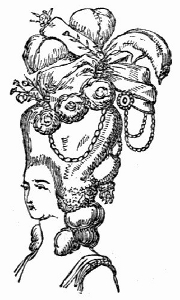
At no period in the history of the world was anything more absurd in head-dress worn than that here depicted, which was in vogue with the fashionables of 1782. The body of this erection was formed of tow, over which the hair was turned, and false hair added in great curls, bobs, and ties, powdered to profusion; then hung all over with vulgarly-large rows of pearls, or glass beads, fit only to decorate a chandelier; flowers as obtrusive were stuck about this heap of finery, which was surmounted by broad silken bands and great ostrich-feathers, until the head-dress of a lady added three feet to her stature, and the male sex, to use the words of the Spectator, "became suddenly dwarfed beside her." To effect this, much time and trouble was wasted, and great personal annoyance was suffered. Heads, when properly dressed, "kept for three weeks," as the barbers quietly phrased it; that they would not really "keep" longer may be seen by the many recipes they give for the destruction of insects which bred in the flour and pomatum so liberally bestowed upon them. The description of "opening a lady's head," after a three weeks' dressing, given in the magazines of this period, it would be imagined, would have taught the ladies common sense; but fashion could reconcile even the disgust that must have been felt by all.
PRICE OF HUMAN HAIR.
Long flaxen hair was bought from the head at 10s. the ounce, and any other fine hair at 5s. or 7s. the ounce in 1662.
Within the present century the heads of hair of whole families in Devonshire were let out by the year at so much rent per poll. An Exeter perriwig maker went round periodically, cut the locks, and oiled the numskull of each thus left in stubble.
INTERESTING AND FANCIFUL RELIQUE.
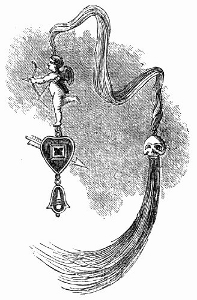
The enamelled jewel, of which we give an engraving, was presented by Mary, Queen of Scots, to George Gordon, fourth Earl of Huntley. The precise period at which the gift was made is not now known, though the time was not improbably during the residence of the Queen in France, when the Order of St. Michael was conferred on the Duke of Chatelherault, the Earl of Huntley, and several other Scottish nobles, about 1548. The lock of Mary's hair which is attached to the small ivory skull, is of a light auburn, inclining to a gold-colour; and if allowance be made for some fading in the course of years, and for the hair of the Queen having generally become darker as she advanced in life, the accuracy of Melvil will be confirmed, when, in speaking of her after her return to Scotland, he says, "her hair was light auburn; Elizabeth's more red than yellow." In this particular little reliance can be placed upon the portraits of Queen Mary; since it is well known, that in the latter part of her life, it was a fashionable practice to wear false hair of various hues, though in some of her pictures the colour of the locks is nearly similar to the hue of that represented in the present. The skull, from which it issues is connected by a twisted skein of silk with the figure of a Cupid shooting an arrow, standing on a heart enamelled red, transfixed with a dart. On one side the heart is a setting for a precious stone, now vacant; and, on the other, in white letters, the words "Willingly Wounded." From the point of the heart is a pendant, containing on one side a small ruby, and having the other enamelled blue with an ornament in white. Our engraving represents one side of the jewel, of the exact size of the original.
FASTIDIOUSNESS IN DRESS AT AN OLD AGE.
Jonn Benbow, of Northwood, in the parish of Prees, Salop, died 1806, aged 107. His occupation was that of a maker of clocks and watches. His steadiness of hand, clearness of intellect, and complete command of all his faculties, were such that, till within a very few years of his decease, he was enabled to execute the most intricate and delicate manipulations connected with his business. He lived in three centuries; and, at the time of his decease, had a son, a grandson, and several great-grandchildren, living in the house with him. He was remarkable for industry, sobriety, early rising, and soon retiring to rest, and was universally respected for his integrity and ingenuity. His favourite beverage was "small beer" brewed of molasses. To the very close of his life he was remarkable for his extreme attention to his dress and everything relating to his personal appearance, as will be seen by the following anecdote. About three years before his death, his tailor brought him home a new coat; on examining which he discovered that the man, either through not being provided with the necessary material or inadvertence, had substituted a cloth collar for a velvet one, which he was accustomed to have added to his garment. Mortified at this circumstance, and learning that the tailor had not velvet of the necessary quality by him, he took up his walking-stick and straitway went off to Whitchurch, a distance of seven miles, to purchase the materials proper to make a new collar, and, to the astonishment of all his family, returned home in a few hours.
SUPERSTITION OF THE JAVANESE.
Nowhere has superstition a greater power over the human mind than among the inhabitants of Java.
When the proper chord is touched, there is scarcely anything too gross for the belief of these islanders. Mr. Crawfurd relates that some years since, it was almost accidentally discovered, that the skull of a buffalo was superstitiously conveyed from one part of the island to another. The point insisted upon was, never to let it rest, but to keep it in constant progressive motion. It was carried in a basket, and no sooner was one person relieved from the load than it was taken up by another; for the understanding was, that some dreadful imprecation was denounced against the man who should let it rest. In this manner, the scull was hurried from one province to another, and after a circulation of many hundred miles, at length reached the town of Samarang, the Dutch governor of which seized it and threw it into the sea, and thus the spell was broken. The Javanese expressed no resentment, and nothing further was heard of this unaccountable transaction. None could tell how or where it originated.
The same writer relates a still more extraordinary instance of infatuation. During the occupation of Java by the English, in the month of May 1814, it was unexpectedly discovered, that, in a remote but populous part of the island, a road, leading to the top of the mountain of Sumbeng, one of the highest in Java, had been constructed. An enquiry being set on foot, it was discovered that the delusion which gave rise to the work had its origin in the province of Banyunas, in the territories of the Susunan, and that the infection had spread to the territory of the Sultan, and thence extended to that of the Europeans. On examination a road was found constructed twenty feet broad, and from fifty to sixty miles long, and it was wonderfully smooth and well made. One point which appears to have been considered necessary, was, that this road should not cross rivers, and in consequence it wound in a thousand ways. Another point as peremptorily insisted on was, that its straight course should not be interrupted by any private rights; and in consequence trees and houses were overturned to make way for it. The population of whole districts, occasionally to the amount of five or six thousand labourers, were employed on the road, and, among a people disinclined to active exertion the laborious work was nearly completed in two months—such was the effect of the temporary enthusiasm with which they were inspired. It was found in the sequel that the whole work was set in motion by an old woman, who dreamt, or pretended to have dreamt, that a divine personage was about to descend from heaven on the mountain in question. Piety suggested the propriety of constructing a road to facilitate his descent; and it was rumoured that divine vengeance would pursue the sacrilegious person who refused to join in the meritorious labour. These reports quickly wrought on the fears and ignorance of the people, and they heartily joined in the enterprise. The old woman distributed slips of palm-leaves to the labourers, with magic letters written upon them, which were charms to secure them against sickness and accidents. When this strange affair was discovered by the native authorities, orders were issued to desist from the work, and the inhabitants returned without a murmur to their wonted occupations.
SIZE OF THE BRITISH ISLANDS.
The exact size of our own country is a legitimate object of curiosity. We believe the following will be found strictly accurate:—
The area of England is estimated at 31,929,340 acres.
" Wales 4,320,000 "
" Scotland 16,240,000 "
" S. Isles adjacent to the coast 1,055,080 "
" W. Isles 851,200 "
" Orkneys 153,606 "
" Shetlands 643,840 "
CASE CONTAINING THE HEART OF LORD EDWARD BRUCE.
Lord Edward Bruce was eldest son of Sir Edward, baron of Kinloss, so created by James I. in 1603, to whom the king gave the dissolved abbey of Kinloss, in Ayrshire, after he had been instrumental in his succession to the crown of England; whither accompanying the king, he was made master of the Rolls in 1604, died in 1610, and was buried in the Rolls chapel. His son, the lord Edward, killed in duel by Sir Edward Sackville in 1613, was succeeded by his brother, who was created Earl of Elgin in 1633, and an English baron in 1641.
Sir Edward Sackville, by whose hand the Lord Edward Bruce fell, was younger brother to Richard Sackville, Earl of Dorset, on whose death he succeeded to the title. He was lord president of the council, a joint lord keeper, and filled several other distinguished offices under Charles I., to whom he adhered, by whose side he fought at the battle of Edge-hill, and whose death he took so much to heart, that he never afterwards stirred out of his house in Salisbury-court, but died there on the 17th of July, 1652.
Between these noblemen there arose a quarrel, which terminated in their duel; and all that is, or probably can be known respecting it, is contained in the following correspondence, preserved in a manuscript in Queen's college library, Oxford.
A Monsieur, Monsieur Sackvile.
"I that am in France, hear how much you attribute to yourself in this time, that I have given the world leave to ring your praises; and for me, the truest almanack, to tell you how much I suffer. If you call to memory, when as I gave you my hand last, I told you I reserved the heart for a truer reconcilliation. Now be that noble gentleman, my love once spoke, and come and do him right that could recite the tryals you owe your birth and country, were I not confident your honour gives you the same courage to do me right, that it did to do me wrong. Be master of your own weapons and time; the place wheresoever, I will wait on you. By doing this, you shall shorten revenge, and clear the idle opinion the world hath of both our worths.
"Ed. Bruce."
A Monsieur, Monsieur Baron de Kinloss.
"As it shall be always far from me to seek a quarrel, so will I always be ready to meet with any that is desirous to make tryal of my valour, by so fair a course as you require. A witness whereof yourself shall be, who, within a month, shall receive a strict account of time, place and weapon, where you shall find me ready disposed to give honourable satisfaction, by him that shall conduct you thither. In the mean time, be as secret of the appointment, as it seems you are desirous of it.
"E. Sackvile."
A Monsieur, Monsieur Baron de Kinloss.
"I am at Tergose, a town in Zeland, to give what satisfaction your sword can render you, accompanied with a worthy gentleman for my second, in degree a knight. And, for your coming, I will not limit you a peremptory day, but desire you to make a definite and speedy repair, for your own honour, and fear of prevention; at which time you shall find me there.
Tergose, 10th of August, 1613. "E. Sackvile.""
A Monsieur, Monsieur Sackvile.
"I have received your letter by your man, and acknowledge you have dealt nobly with me; and now I come, with all possible haste, to meet you.
"E. Bruce."
The combat was fierce, and fatal to Lord Bruce.
It has always been presumed that the duel was fought under the walls of Antwerp; but the combatants disembarked at Bergen-op-Zoom, and fought near that town, and not Antwerp.
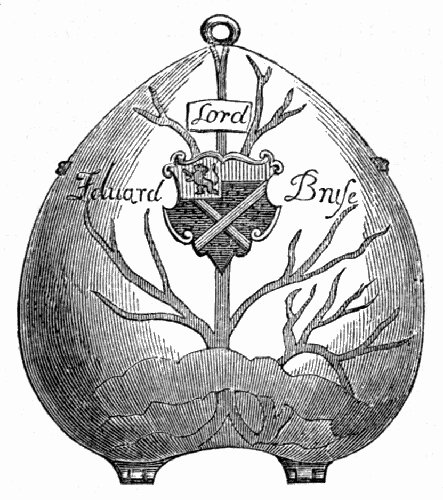
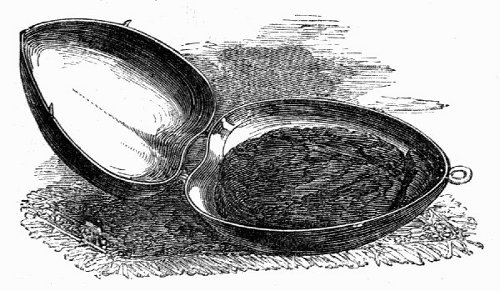
In consequence of a tradition, that the heart of Lord Edward Bruce had been sent from Holland, and interred in the vault or burying-ground adjoining the old abbey church of Culross, in Perthshire, Sir Robert Preston directed a search in that place in 1808, with the following result:— Two flat stones, without inscription, about four feet in length and two in breadth, were discovered about two feet below the level of the pavement, and partly under an old projection in the wall of the old building. These stones were strongly clasped together with iron; and when separated, a silver case, or box, of foreign workmanship, shaped like a heart, was found in a hollow or excavated place between them. Its lid was engraved with the arms and name "Lord Edward Bruse;" it had hinges and clasps; and when opened, was found to contain a heart, carefully embalmed, in a brownish coloured liquid. After drawings had been taken of it, as represented in the present engravings, it was carefully replaced in its former situation. There was a small leaden box between the stones in another excavation; the contents of which, whatever they were originally, appeared reduced to dust.
Some time after this discovery, Sir Robert Preston caused a delineation of the silver case, according to the exact dimensions, with an inscription recording its exhumation and re-deposit, to be engraved on a brass plate, and placed upon the projection of the wall where the heart was found.
It is a remarkable fact, that the cause of the quarrel between Lord Bruce and Sir Edward Sackville has remained wholly undetected, notwithstanding successive investigations at different periods. Lord Clarendon, in his "History of the Rebellion," records the combat as an occurrence of magnitude, from its sanguinary character and the eminence of the parties engaged in it. He does not say any thing respecting the occasion of the feud, although Lord Bruce's challenge seems to intimate that it was a matter of public notoriety.
The exact day of the duel is not known, but it was certainly in 1613, and most probably in August from the date of one of the above letters.
EXTRAORDINARY FEMALE INTREPIDITY.
Early on the 24th of January, 1822, the turnpike-house, about four miles from Basingstoke, on this side of Overton, was attacked, with intent to enter, by two men, who had taken off some tiles at the back part of the premises (the roof being very low) to effect their purpose. These villains knew, it would appear, that a lone woman, Mrs. Whitehouse, received the tolls at this gate, and that her husband attended a gate as far distant as Colebrook. Mrs. Whitehouse, however, very fortunately possessed three loaded pistols, one of which she fired—then a second, and a third, without effect. These determined ruffians (notwithstanding being thrice fired at) were, it appears, resolved not to depart without accomplishing the projected robbery. Mrs. Whitehouse's little boy, only 11 years of age, in the mean time had re-loaded a brace of pistols, one of which Mrs. Whitehouse fired, and wounded one of the desperadoes full in the face—he fell, and the blood flowed profusely; yet, strange to relate, the accomplice had hardihood enough to drag away the wounded robber! On observing this, Mrs. Whitehouse fired the fifth pistol at them, but missed them. The fellow who received the contents of the fourth pistol being supposed to have been killed, and some persons residing at a considerable distance from the spot having heard of the circumstance, assembled, and made diligent search at daybreak to discover the body of the deceased; but, although the blood could be traced some distance from the house, the body could not be found; nor were those concerned in the attack ever found out. The successful resistance, however, deserves to be recorded.
GIGANTIC BONES.
Whenever any bones of unusual magnitude were discovered, it was invariably the custom to ascribe them to some giant. This was always so up to recent years, and no wonder it was intensely the case at the early period of 1660. About that period, when the brook or rivulet from which the town of Corbridge, in the north of England, derives its name, had been worn away by some impetuous land-flood, a skeleton, supposed to be that of a man of extraordinary and prodigious size, was discovered. The length of the thigh bone was nearly six feet, and the skull, teeth, and other parts proportionably monstrous, so that the length of the whole body was computed at twenty-one feet. It is conjectured, by the more enlightened men of modern times, that these strange bones belonged to some large animal that had been sacrificed by the Romans at the altar dedicated to Hercules, which was found here some years ago. Notwithstanding that the superstition of our forefathers has lost nearly all its credit and influence, a singularly large bone found here is now exhibited in the Keswick Museum as the rib of the giant Cor.
NEW STYLE OF ADVERTISEMENT.
The following editorial announcement is taken from the Philadelphia Weekly Mercury, of November 30, 1752, because it forms a complete novelty in its way, and also affords us an insight into the degree of communication which existed at that period between the large towns and the provinces in America. It is, moreover, a curious jumble of information, strangely mixing up the starting of the stage coach with the news of the day:—
On Monday next the Northern Post sets out from New-York, in order to perform his Stage but once a Fortnight, during the Winter Quarter; the Southern Post changes also, which will cause this Paper to come out on Tuesdays during that Time. The Colds which have infested the Northern Colonies have also been troublesome here, few Families having escaped the same, several have been carry'd off by the Cold, among whom was David Brintnall, in the 77th Year of his Age; he was the first Man that had a Brick House in the City of Philadelphia, and was much esteem'd for his just and upright dealing. There goes a Report here, that the Lord Baltimore and his Lady are arrived in Maryland, but the Southern Post being not yet come in, the said Report wants Confirmation.
MAKING A CANDLESTICK OF GUNPOWDER.
A marvellous escape from destruction is related in the MS. Life of Alderman Barnes.—"One of his brother-in-law's (Alderman Hutchinson's) apprentices, stepping up into the back-lofts to fetch somewhat he wanted, in his heedlessness and haste, stops his candle into a barrel of gunpowder whose head was struck off, to serve instead of a candlestick. But the man reflecting what he had done, was struck with affrightment, his heart failed him, nor durst he stay any longer, but running down stairs, leaves the candle burning in the gunpowder cask, and with horror, trembling, and despair, tells the family what indiscretion he had committed; they were all immediately as their wits' end, and well they might, for the lofts were three stories high, very large, and stowed full with whatever is combustible, as brandy, oil, pitch, tar, rosin, flax, alum, hops, and many barrels of gunpowder. Had the candle fallen to one side, or had the least spark fallen from the snuff into the cask, the whole town had been shaken, and the whole of the house immediately blown up and in a blaze; but one of the labourers, a stout fellow, ran forthwith into the loft, and joining both his hands together, drew the candle softly up between his middlemost fingers, so that if any snuff had dropped, it must have fallen into the hollow of the man's hand, and by this means was Newcastle saved from being laid in ashes." This must have happened about the year 1684.
THE CAMDEN CUP.
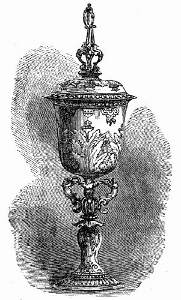
The subjoined engraving represents the Silver-gilt Standing Cup and Cover bequeathed by the celebrated historian, William Camden, Clarenceux King at Arms, to the Worshipful Company of Painter Stainers'. Camden's will is recorded in the Prerogative Court of Canterbury (in the register designated III Swann 3, probate granted November 10, 1623), and it has been printed by Hearne in his Collection of Curious Discourses, Ox. 1720. After directing the sum of eight pounds to be given "to the poore of that place (Chislehurst) when it shall please God to call me to his mercie," Camden continues—"I bequeath to Sir Foulke Greville, Lord Brooke, Chancellor of the Exchequer, who preferred me gratis to my Office, a peece of plate of ten pounds; Item, to the Company of Painter-Stainers of London, to buy them a peece of plate in memoriall of mee, sixteene pounds;" the inscription upon which is directed to be—"Guil. Camdenus Clarenceux, filius Sampsonis, Pictoris Londinensis, dono dedit." This stately and richly-decorated cup and cover is used on Corporation Festivals, in memory of the illustrious donor. In height, it is altogether twenty-three inches and a quarter, the cover only being eight inches and three-quarters; and the cup, independent of the stand, five inches and a-half, its greatest diameter being five inches and a-half. The inscription encircles the upper rim of the cup; and directly under it is an engraved escutcheon of Camden's arms; Or, a fess engrailed, between six cross crosslets fitchée, Sable. The cover presents an object of much elegance, a richly ornamented open pyramid, based on the heads of birds, the breasts bending gracefully with cartouche ornaments: the pinnacle of the pyramid surmounted by a female figure, the right hand resting on a shield, charged with the same arms as shown on the side of the cup. The birds' heads have apparently a reference to the phœnix heads in the second and third quarters of the armorial ensigns, and to the crest of the Company of Paper-Stainers.
RICHARDSON, THE SHOWMAN.
This eccentric individual, who died in 1836, left behind him upwards of £20,000. He was born in the workhouse of Marlow, Bucks, but ran away from that place in order to seek his fortune in London. After various vicissitudes, he became the landlord of the Harlequin public-house, in Drury-lane, where he saved some money, which he embarked in fitting up a portable theatre, and was known for forty years as the "Prince of Showmen," and used frequently to boast that Edmund Kean and several other eminent actors were brought out by him. His property, after various legacies to the itinerant company which had attended him for many years, descended to two nephews and a niece, and he desired by his will to be buried in Marlow churchyard, in the same grave as his favourite "spotted boy," a lad who, some years before, was exhibited by him, and attracted great notice in consequence of the extraordinary manners in which he was marked on various parts of his body. Some years since the scenery, dresses, and decorations of Richardson's theatre were exposed for auction by Mr. George Robins, and £2,000 were bid for them. They were bought in; the "old man," as he was technically denominated, considering them to be worth at least £3,000.
PRESERVATION OF DEAD BODIES.
There is an arched vault, or burying-ground, under the church of Kilsyth, in Scotland, which was the burying-place of the family of Kilsyth, until the estate was forfeited, and the title became extinct in the year 1715; since which it has never been used for that purpose, except once. The last Earl fled with his family to Flanders, and, according to tradition, was smothered to death about the year 1717, along with his lady and an infant child, and a number of other unfortunate Scottish exiles, by the falling in of the roof of a house in which they were assembled. What became of the body of the Earl is not known, but the bodies of Lady Kilsyth and her infant were emboweled and embalmed, and soon afterwards sent over to Scotland. They were landed, and lay at Leith for some time in a cellar, whence they were afterwards carried to Kilsyth, and buried in great pomp in the vault above mentioned. In the spring of 1796, some rude regardless young men, having paid a visit to this ancient cemetery, tore open the coffin of Lady Kilsyth and her infant. With astonishment and consternation, they saw the bodies of Lady Kilsyth and her child as perfect as in the hour they were entombed. For some weeks this circumstance was kept secret, but at last it began to be whispered in several companies, and soon excited great and general curiosity.
"On the 12th of June," says the Minister of the parish of Kilsyth, in a letter to J. Garnet, M.D., "when I was from home, great crowds assembled, and would not be denied admission. At all hours of the night, as well as the day, they afterwards persisted in gratifying their curiosity. I saw the body of Lady Kilsyth soon after the coffin was opened; it was quite entire. Every feature and every limb was as full, nay, the very shroud was as clear and fresh, and the colours of the ribbons as bright, as the day they were lodged in the tomb. What rendered this scene more striking and truly interesting was, that the body of her son and only child, the natural heir of the title and estates of Kilsyth, lay at her knee. His features were as composed as if he had been only asleep. His colour was as fresh, and his flesh as plump and full, as in the perfect glow of health; the smile of infancy and innocence sat on his lips. His shroud was not only entire, but perfectly clean, without a particle of dust upon it. He seems to have been only a few months old. The body of Lady Kilsyth was equally well preserved; and at a little distance, from the feeble light of a taper, it would not have been easy to distinguish whether she was dead or alive. The features, nay the very expression of her countenance, were marked and distinct; and it was only in a certain light that you could distinguish anything like the ghastly and agonizing traits of a violent death. Not a single fold of her shroud was decomposed nor a single member impaired.
"Let the candid reader survey this sketch; let him recal to mind the tragic tale it unfolds; and say, if he can, that it does not arrest the attention and interest the heart. For my own part, it excited in my memory a thousand melancholy reflections; and I could not but regret that such rudeness had been offered to the ashes (remains) of the dead, as to expose them thus to the public view.
"The body seemed to have been preserved in some liquid, nearly of the colour and appearance of brandy. The whole coffin seemed to have been full of it, and all its contents saturated with it. The body had assumed somewhat the same tinge, but this only served to give it a fresher look. It had none of the ghastly livid hue of death, but rather a copper complexion. It would, I believe, have been difficult for a chemist to ascertain the nature of this liquid; though perfectly transparent; it had lost all its pungent qualities, its taste being quite vapid.
"The head reclined on a pillow, and, as the covering decayed, it was found to contain a collection of strong-scented herbs. Balm, sage, and mint were easily distinguished; and it was the opinion of many, that the body was filled with the same. Although the bodies were thus entire at first, I confess I expected to see them crumble into dust; especially as they were exposed to the open air, and the pure aromatic fluid had evaporated; and it seems surprising that they did not. For several weeks they underwent no visible change, and had they not been sullied with dust and drops of grease from the candles held over them, I am confident they might have remained as entire as ever; for even a few months ago (many months after), the bodies were as firm and compact as at first, and though pressed with the finger did not yield to the touch, but seemed to retain the elasticity of the living body. Even the shroud, through torn by the rude hands of the regardless multitude, is still strong and free from rot.
"Perhaps the most singular phenomenon is, that the bodies seem not to have undergone the smallest decomposition or disorganization. Several medical gentlemen have made a small incision into the arm of the infant; the substance of the body was quite firm, and every part in its original state." To the above remarkable instance we may add the following:—The tomb of Edward the First, who died on the 7th July, 1307, was opened on the 2nd of January, 1770, and after the lapse of 463 years, the body was found not decayed; the flesh on the face was a little wasted, but not putrid.
The body of Canute the Dane, who got possession of England in the year 1017, was found very fresh in the year 1766, by the workmen repairing Winchester Cathedral. In the year 1522, the body of William the Conqueror was found as entire as when first buried, in the Abbey Church of St. Stephen, at Caen; and the body of Matilda, his wife, was found entire in 1502, in the Abbey Church of the Holy Trinity in the same city.
No device of art, however, for the preservation of the remains of the dead, appears equal to the simple process of plunging them over head and ears in peat-moss.
In a manuscript by one Abraham Grey, who lived about the middle of the 16th century, now in the possession of his representative, Mr. Goodbehere Grey, of Old Mills, near Aberdeen, it is stated, that in 1569, three Roman soldiers in the dress of their country, fully equipped with warlike instruments, were dug out of a moss of great extent, called Kazey Moss. When found, after a lapse of probably about fifteen hundred years, they "were quite fresh and plump."
PERFUMES.
So perfect were the Egyptians in the manufacture of perfumes, that some of their ancient ointment, preserved in an alabaster vase in the Museum at Alnwick, still retains a very powerful odour, though it must be between 2,000 and 3,000 years old.
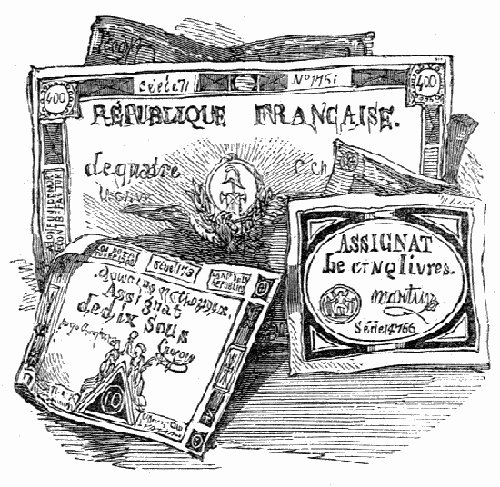
FRENCH ASSIGNATS—THEIR ORIGIN.
Extraordinary devices for raising money are legitimate subjects for our pages. Of these devices, the French Assignats are not the least remarkable. They originated thus—in the year 1789, at the commencement of the great Revolution in France, Talleyrand proposed in the National Assembly a confiscation of all church property to the service of the state. The Abbé Maury opposed this project with great vehemence, but being supported by Mirabeau, it received the sanction of the Assembly by an immense majority on the 2nd of November. The salaries fixed for the priesthood were small, and, moreover, were not sufficiently guaranteed; whence originated much misery to all classes of priests, from the archbishops down to the humble cures; and as monastic institutions were treated in the same way, monks and nuns were suddenly placed in precarious circumstances regarding the means of subsistence. Here, however, an unexpected difficulty sprang up; the National Assembly were willing to sell church property, but buyers were wanting; conscience, prudence, and poverty combined to lessen the number of those willing to purchase; and thus the urgent claims of the treasury could not be satisfied. Applications for loans were not responded to; taxes had been extinguished; voluntary donations had dwindled almost to nothing; and 400,000,000 of livres were necessary for the vast claims of the year 1790. The municipalities of Paris and other cities sought to ameliorate the state of affairs by subscribing for a certain amount of church property, endeavouring to find private purchasers for it, and paying the receipts into the national exchequer. This, however, being but a very partial cure for the enormity of the evils, the National Assembly fell upon the expedient of creating state-paper or bank-notes, to have a forced currency throughout the kingdom. Such was the birth of the memorable assignats. Four hundred millions of this paper were put in circulation; and a decree was passed that church property to that amount should be held answerable for the assignats. Our sketch represents several of the different forms in which the Assignats were issued to the public.
EXECUTION OF LOUIS XVI.
The judicial murder of Louis XVI. was the climax of the Revolution in France. The Convention voted his death at three o'clock on the morning of the 20th January, 1793, and he was taken to execution in twenty-six hours afterwards.
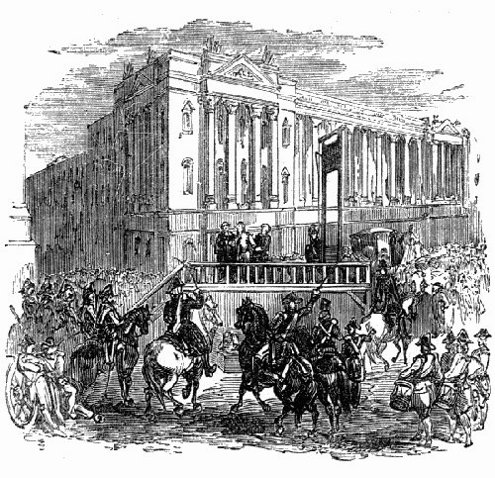
The guillotine was erected in the middle of the Place Louis XV., a large open square, having the Champs Elysées on one side, and the gardens of the Tuileries on the other. The Place bristled with artillery, and every street and avenue leading to it was crowded with troops and armed multitudes, who had cannon with them charged with grape-shot; while the carriage was surrounded by picked men, who had orders to despatch the king with their carbines in case of any rescue being attempted. At about half-past ten, the king, who had been engaged in prayer during the ride, arrived at the spot; he descended from the coach, and his confessor followed him. Three executioners approached to remove his upper garments, but he put them back, and performed that simple office for himself. He resisted somewhat the indignity of having his hands tied, and only yielded on the entreaty of his confessor; and had also to yield on the subject of cutting off his back hair. He ascended the steps that led to the platform with a firm bearing, still followed by M. Edgeworth. When on the top, he made a sudden movement towards the edge of the scaffold, and exclaimed with a loud and firm voice: "Frenchmen, I die innocent; it is from the scaffold, and when about to appear before my God, that I tell you so. I pardon my enemies; I pray that France"——Here Santerre, on horseback, raised his right hand, and cried: "Drums! Executioners, do your duty!" Several drummers immediately began by their noise to drown the sound of the king's voice: and six executioners brought him to the centre of the scaffold. He exclaimed again: "I die innocent; I ever desired the good of my people;" but his voice could be heard only by the executioners and the priest. He then knelt down, in order to place his head in the appointed spot; the confessor, bending over him said: "Son of St. Louis, ascend to heaven!" The spring of the machine was touched, the heavy axe descended in its grooves, and the once royal head was severed from the body. Samson, the chief executioner, took up the bleeding head by the hair, and walked three times round the scaffold, holding it up at arm's-length to show it to the people. The troops and the spectators shouted: "Vive la République!" put their hats and caps upon their bayonets and pikes, and waved them in the air, with prolonged and re-echoing cries of "Vive la République!" "Vive la Nation!" "Vive la Liberte!" Many of the savage men standing near the scaffold dipped their pike-heads into the king's blood, and others their handkerchiefs—not as a sacred memento, but as a symbol of the downfall of all kings; they even paraded these gore-stained objects before the windows of the Temple, that perchance the queen and her children might see them. The headless trunk of Louis was put into a large wicker-basket, placed in the coach, and carried to the cemetery of La Madeleine; where, without coffin or shroud, it was thrown into a deep pit, partly filled up with quicklime. On that same morning, one Benoit Leduc, a tailor, who had on some occasions worked for Louis, presented a petition to the Convention, praying to be allowed, at his own expense, to bury the body of the king by the side of his father, Louis XV., and under the monument raised to that prince by the city of Sens; but the Convention rejected his petition, and ordered the executive council to see that Louis was buried like other criminals.
A MAN AGED ONE HUNDRED YEARS CLAIMING A BOTTLE OF WINE.
John Bull, of London, stock-broker, died 1848, aged 100 years. When at the age of about 93, and in the employ of Messrs. Spurling, stock-brokers, he left by mistake in the office of the accountant of the Bank of England, a large number of bank notes. On discovering his loss, after diligently searching for the missing parcel, he went back to the accountant's office, partly to acquaint Mr. Smee with the circumstance, and partly as a last hope that he might there find the missing treasure. To his great joy he found the parcel safe in the accountant's possession, whom he earnestly implored to keep the secret, lest his employers should think his faculties were failing. Mr. Smee of course gave him the required assurance, and goodnaturedly added, that when Mr. Bull should attain the age of 100 years, he would treat him to the finest bottle of wine in his cellar. Some time before his becoming a centenarian, he was pensioned off by his employer, and Mr. Smee had, in all probability, quite forgotten the affair; when, true to the engagement, the venerable, but still active old clerk, made his appearance at the bank on the important day, and claimed the promised bottle of wine. The claim was promptly allowed; and the last birthday of the aged official was one of the happiest among his friends of the long list of such events which had been its precursor. After continuing vigorous and active, and almost free from indisposition up to this time, he, along with many other aged persons, fell a victim to that fatal influenza which prevailed so extensively throughout the country, and more especially in London and its suburbs, during the autumn of 1847 and the winter of 1848.
CHARITY REWARDED BY A RICH AND LIBERAL MENDICANT.
Within the present century, a beggar in Moorfields used daily to have a penny given him by a merchant on his way to the Exchange. The penny was withheld, and the appearance of the merchant manifested his embarrassment and distress. The beggar at length spoke to him, offered him a loan of £500, and another of the same sum if it were required. It re-established his affairs.
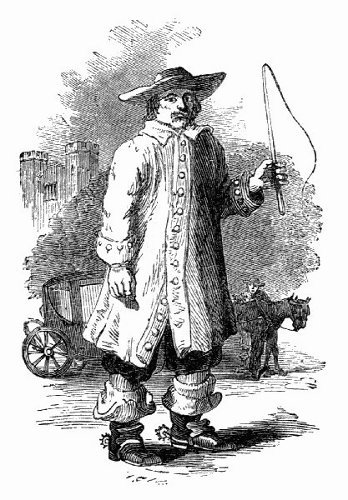
HACKNEY COACHMAN OF THE TIME OF CHARLES II.
The print from which the engraving on next page is taken, is one of a set published by Overton, at the sign of the "White Horse" without Newgate; and its similarity to the figures given by Francis Barlow in his Æsop's Fables, and particularly in a most curious sheet-print etched by that artist, exhibiting Charles the Second, the Duke of York, &c., viewing the Races on Dorset Ferry, near Windsor, in 1687, sufficiently proves this Hackney Coachman to have been of the reign of that monarch.
The early Hackney Coachman did not sit upon the box as the present drivers do, but upon the horse, like a postillion; his whip is short for that purpose; his boots, which have large open broad tops, must have been much in his way, and exposed to the weight of the rain. His coat was not according to the fashion of the present drivers as to the numerous capes, which certainly are most rational appendages, as the shoulders never get wet; the front of the coat has not the advantage of the present folding one, as it is single breasted.
His hat was pretty broad, and so far he was screened from the weather. Another convincing proof that he rode as a postillion is, that his boots are spurred. In that truly curious print representing the very interesting Palace of Nonsuch, engraved by Hoefnagle, in the reign of Queen Elizabeth, the coachman who drives the royal carriage in which the Queen is seated, is placed on a low seat behind the horses, and has a long whip to command those he guides. How soon, after Charles the Second's time, the Hackney Coachmen rode on a box we have not been able to learn, but in all the prints of King William's time the coachmen are represented upon the box, though by no means so high as at present; nor was it the fashion at the time of Queen Anne to be so elevated as to deprive the persons in the carriage of the pleasure of looking over their shoulders.
In 1637, the number of Hackney Coaches in London was confined to 50, in 1652 to 200, in 1654 to 300, in 1662 to 400, in 1694 to 700, in 1710 to 800, in 1771 to 1,000, and in 1802 to 1,100. In imitation of our Hackney Coaches, Nicholas Sauvage introduced the Fiacres at Paris, in the year 1650. The hammer-cloth is an ornamental covering of the coach-box. Mr. S. Pegge says, "The coachman formerly used to carry a hammer, pincers, a few nails, &c., in a leather pouch hanging to his box, and this cloth was devised for the hiding of them from public view."
It is said that the sum of £1,500, arising from the duty on Hackney Coaches, was applied to part of the expense in rebuilding Temple Bar.
A LONDON WATER-CARRIER IN OLDEN TIMES.
The conduits of London and its environs, which were established at an early period, supplied the metropolis with water until Sir Hugh Middleton brought the New River from Amwell to London, and then the conduits gradually fell into disuse, as the New River water was by degrees laid on in pipes to the principal buildings in the City, and, in the course of time, let into private houses.
When the conduits afforded a supply, the inhabitants either carried their vessels, or sent their servants for the water as they wanted it; but we may suppose that at an early period there were a number of men who for a fixed sum carried the water to the adjoining houses.
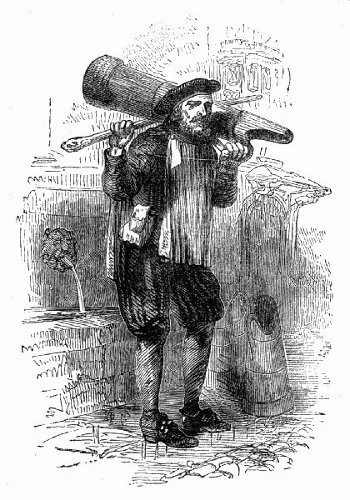
The figure of a Water-carrier in the following engraving, is copied from one of a curious and rare set of cries and callings of London, published by Overton, at the "White Horse" without Newgate. The figure retains the dress of Henry the Eighth's time; his cap is similar to that usually worn by Sir Thomas More, and also to that given in the portrait of Albert Durer, engraved by Francis Stock. It appears by this print, that the tankard was borne upon the shoulder, and, to keep the carrier dry, two towels were fastened over him, one to fall before him, the other to cover his back. His pouch, in which we are to conclude he carried his money, has been thus noticed in a very curious and rare tract, entitled, Green's Ghost, with the merry Conceits of Doctor Pinch-backe, published 1626: "To have some store of crownes in his purse, coacht in a faire trunke flop, like a boulting hutch."
EXPENSES OF A ROYAL PRISONER TWO HUNDRED YEARS AGO.
The following curious document is a return, by the Parliamentary Committee of Revenue, of the expenses of Charles the First and his retinue, during a residence of twenty days, at Holdenby, in Northamptonshire, in the year 1647, commencing February the 13th and ending March the 4th inclusive. Sir Christopher Hatton had built a splendid mansion at Holdenby in the time of Queen Elizabeth, and to it King Charles was conveyed a prisoner by the Parliamentary Commissioners, after he had been given up to them by the Scottish army:—
His Majestie's diet of xxviij dishes at xxxl. per diem £700
The Lords' diet of xx days 520
For the Clarke of the green cloth, kitchen, and spicery, a messe of vij dishes 40
Dyetts for the household and chamber officers, and the guard 412
Board wages for common houshold servants, pott and scourers, and turnbroaches 36
Badges of Court and riding wages 140
For linnen for his Majestie's table, the lords and other diets 273
For wheat, wood, and cole 240
For all sorts of spicery store, wax-lights, torches, and tallow-lights 160
For pewter, brasse, and other necessaries incident to all officers and carriages 447
WOMAN'S CLEVERNESS.
It is a singular fact that on one occasion the lives of thousands, probably, of the Irish Protestants, were saved by a clever device, which the unaided wit and presence of mind of a woman enabled her to plan and execute.
At the latter end of Queen Mary's reign, a commission was signed for the purpose of punishing the heretics in that kingdom, and Dr. Cole, Dean of St. Paul's, was honoured with this humane appointment, to execute which, he set off with great alacrity. On his arrival at Chester, he sent for the mayor to sup with him, and in the course of conversation related his business; then going to his cloak-bag, he took out the box containing the commission, and having shewn it, with great joy exclaimed, 'This will lash the heretics of Ireland.' Mrs. Edmonds, the landlady, overheard this discourse, and having several relations in Ireland, who were Protestants as well as herself, resolved to put a trick upon the doctor; and while he went to attend the magistrate to the door, took the commission out of the box, and in its room placed a pack of cards, with the knave of clubs uppermost. The zealous doctor, suspecting nothing of the matter, put up his box, took shipping, and, arriving safe in Dublin, went immediately to the Viceroy. A council was called; and, after a speech, the doctor delivered his box, which being opened by the secretary, the first thing that presented itself was the knave of clubs. This sight surprised the Viceroy and the council, but much more the doctor, who assured them that he had received a commission from the Queen, but what was come of it, he could not tell. 'Well, well,' replied the Viceroy, 'you must go back for another, and we will shuffle the cards in the mean time.' The doctor accordingly hastened across the channel; but at Holyhead he received the intelligence of the Queen's death, and the accession of Elizabeth, who settled on Mrs. Edmonds a pension of forty pounds a year, for saving her Protestant subjects in Ireland.
DRESS IN THE PROVINCES IN 1777.
In the days when mail-coaches had not begun to run, and when railroads and telegraphs had not entered into the imagination of man, the style of dress in the provinces was often very different to what it was in London, and on this account the following paragraph is deserving of record. We have taken it from a copy of the Nottingham Journal, of September 6, 1777, where it is headed "Ladies undress."—"The ladies' fashionable undress, commonly called a dishabille, to pay visits in the morning, also for walking in the country, on account of its being neat, light, and short, consists of a jacket, the front part of which is made like a sultana; the back part is cut out in four pieces; the middle part is not wider at the bottom than about half an inch; the sides in proportion very narrow. The materials most in vogue are, white muslins with a coloured printed border chintz pattern, printed on purpose, in borders about an inch deep. The silks, which are chiefly lutestrings, are mostly trimmed with gauze. The gauze is tuckered upon the bottom of the jacket, and edged with different-coloured fringes. The petticoat is drawn up in a festoon, and tied with a true lover's knot, two tassels hanging down from each festoon. A short gauze apron, striped or figured, cut in three scollops at the bottom, and trimmed round, with a broad trimming closely plaited; the middle of the apron has three scollops reversed. The cuffs are puckered in the shape of a double pine, one in the front of the arm, the other behind, but the front rather lower. To complete this dress for summer walking, the most elegant and delicate ladies carry a long japanned walking-cane, with an ivory hook head, and on the middle of the cane is fastened a silk umbrella, or what the French call 'a parasol,' which defends them from the sun and slight showers of rain. It opens by a spring, and it is pushed up towards the head of the cane, when expanded for use. Hats, with the feathers spread, chiefly made of chip, covered with fancy gauze puckered, variegated artificial flowers, bell tassels, and other decorations, are worn large."
A GROUP OF RELICS.
The Dagger of Raoul de Courcy, of which a representation is included in the cut over leaf, is an interesting relic, and its authenticity can be relied upon. Raoul de Courcy, according to the old French chroniclers was a famous knight, the lord of a noble castle, built upon a mountain that overlooks the Valée d'Or, and the descendant of that haughty noble who took for his motto: "Neither king, nor prince, nor duke, nor earl am I, but I am the Lord of Courcy"—in other words, greater than them all. He fell in love with the wife of his neighbour, the Lord of Fayel, and the beautiful Gabrielle loved him in return. One night he went as usual to meet her in a tower of the Château of Fayel, but found himself face to face with her lord and master. Raoul escaped, and Gabrielle was ever after closely guarded. Still they found the opportunity for numerous interviews, at which they interchanged their vows of love. At length, Raoul, like a true knight, set out to fight beneath the banner of the Cross, for the possession of the Holy Sepulchre. Ere he went, at a stolen meeting, he bade the fair Gabrielle adieu, giving to her "a silken love-knot, with locks of his own hair worked in with the threads of silk." She gave him a costly ring, which she had always worn, and which he swore to wear till his last breath. What tears were shed—what kisses were exchanged at this last meeting!—for the Holy Land was very far from France in the Middle Ages.
On his arrival in Syria, Ralph de Courcy became known as the "Knight of Great Deeds," for it seems he could only conquer his love by acts of daring valour. After braving every danger, he was at length wounded in the side by an arrow, at the siege of Acre. The king of England took him in his arms with respect, and gave him the kiss of hope, but the arrow was a poisoned one, Raoul felt that he had little time to live. He stretched out his arms towards France, exclaiming, "France, France! Gabrielle, Gabrielle!"
He resolved to return home, but he was hardly on board the ship that was to waft him there, ere he summoned his squire, and begged of him after he was dead, to carry his heart to France, and to give it the Lady Fayel, with all the armlets, diamonds, and other jewels which he possessed, as pledges of love and remembrance.
The heart was embalmed, and the squire sought to deliver his precious legacy. He disguised himself in a mean dress, but unluckily met with the Lord of Fayel, and, not knowing him, applied to him for information as to how admittance into the château could be gained. The Lord of Fayel at once attacked and disarmed the poor squire, who was wounded in the side with a hunting-hanger. The precious packet was soon torn open, and the heart discovered. The Lord of Fayel hastened home, and, giving it to his cook, desired that it might be dressed with such a sauce as would make it very palatable.
Raoul's heart was served up at table, and the fair Gabrielle partook of it. When she had finished eating, the Lord of Fayel said—"Lady, was the meat you eat good?" She replied, that the meat was good. "That is the reason I had it cooked," said the Castellan; "for know that this same meat, which you found so good, was the heart of Raoul de Courcy."
"Lord of Fayel," said Gabrielle, "the vengeance you have taken corresponds with the meanness of your soul; you have made me eat his heart, but it is the last meat I shall ever eat. After such noble food I will never partake of any other."
She fainted, and only recovered her consciousness a few minutes before death. Such is the history of Raoul de Courcy and the Lady Gabrielle, as told in the language of the old chroniclers.
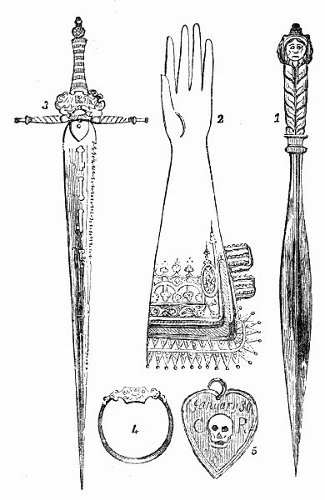
1. Dagger of Raoul de Courcy. 2. Embroidered Glove, presented by Mary Queen of Scotland, on the Morning of her Execution, to one of her Attendants. 3. Spanish Dagger of the Sixteenth Century. 4. Ring, with Inscription, "Behold the End," formerly the Property of Charles I. 5. Silver Locket, in Memory of the Execution of Charles I.
The glove shown in the engraving is said to have been presented by the unfortunate Queen Mary, on the morning of her execution, to a lady of the Denny family. The embroidery is of tasteful design, and may be useful as a contrast with many of the patterns for needlework at present in fashion. Moreover, the sight of this memorial brings to recollection a few particulars in connection with this somewhat important part of both male and female costume.
The ancient Persians wore gloves, and the Romans, towards the decline of the empire, began to use them. In England they seemed to have been introduced at a very early period. In the Anglo-Saxon literature we meet with glof, a covering for the hand, and in the illuminated MSS. of that period the hands of bishops and other dignitaries are shown encased in gloves which, in many instances, were ornamented with costly rings; while on the tombs of kings and queens, &c., the hands are shown almost invariably covered.
It is related of the patron Saint of Brussels, who lived in the sixth century, that she was famous for only two miracles: one consisted in lighting a candle by means of her prayers, after it had been extinguished; the other happened in this way—the fair saint being in a church barefooted, a person near, with respectful gallantry, took off his gloves and attempted to place them under her feet. This comfort she declined; and, kicking the gloves away, they became suspended at some height in the church for the space of an hour.
On opening the tomb of Edward the First, some years ago, in Westminster Abbey, the antiquaries assembled on that occasion were surprised to find no traces of gloves. It has been suggested that in this instance linen or silk gloves had been used at the burial of the king, but which are supposed to have perished with age.
The practice of throwing down a glove as a challenge, is mentioned by Matthew Paris as far back as 1245; and a glove was worn in the hat or cap as a mistress's favour, as the memorial of a friend, and as a mark to be challenged by an enemy.
At a time when the Borders were in a state of incessant strife, Barnard Gilpin, who has been so justly called "the Apostle of the North," wandered unharmed amid the confusion. On one occasion, entering a church (we believe that of Rothbury, Northumberland,) he observed a glove suspended in a conspicuous place, and was informed that it had been hung up as a challenge by some horse-trooper of the district. Mr. Gilpin requested the sexton to remove it; who answered, "Not I sir, I dare not do it." Then Gilpin called for a long staff, took down the glove, and put it in his bosom, and in the course of his sermon, said, "I hear that there is one among you who has even in this sacred place hung up a glove in defiance;" and then producing it in the midst of the congregation, he challenged them to compete with him in acts of Christian charity.
Gloves, in former times, were common amongst other gifts offered to friends at the new year; and they were received without offence by the ministers of justice. It is related that Sir Thomas More, as Lord Chancellor, decreed in favour of Mrs. Crooker against the Earl of Arundel. On the following New-year's day, in token of her gratitude, she presented Sir Thomas with a pair of gloves containing forty angels. "It would be against good manners," said the chancellor, "to forsake the ladies' New-year's gift, and I accept the gloves; the lining you may bestow otherwise."
The custom of the presentation by the sheriff of a pair of white gloves to the judge on the occasion of a maiden assize is still in vogue; and, judging from the reports in the newspapers, such presents appear to be of frequent occurrence.
"Gloves, as sweet as damask roses," were highly prized by Queen Elizabeth, and, in her day, formed such an important item of a lady's expenses, that a sum was generally allowed for "glove money."
The old fashioned gloves have now a considerable value amongst the curious. At the sale of the Earl of Arran's goods in 1759, the gloves given by Henry VIII. to Sir Anthony Denny, sold for 38l. 17s.; those given by James I. to Edward Denny, sold for 22l. 4s.; and the mitten given by Queen Elizabeth to Sir Edward Denny's lady, for 25l. 4s.
Some of the English towns which formerly were famous for the manufacture of gloves, still keep up their character. Amongst these Woodstock, Yeovil, Leominster, Ludlow, and Worcester may be mentioned.
The Spanish dagger formerly belonged to a governor of Castile, in the sixteenth century, as is shown by the perforated fetter-lock on the blade; and although the initials are engraven there also, we have not been able to discover any particulars of the original owner. The workmanship and style of the dagger are of great beauty.
The little ring with the inscription "Behold the end," was once the property of Charles I., and was presented by him to Bishop Juxon on the morning of his execution. The silver lockets, on which are the emblems of death, were extensively manufactured and sold after the execution of Charles I. They generally bore the date of the king's death.
THE HAMSTER RAT.
There are various kinds of rats, and one of these is the Hamster, of the genus Cricetus of Cuvier. Though rare in Europe to the west of the Rhine, it is widely spread from that river to the Danube on the south-west, and north-easterly through a vast extent of country into Siberia. We notice it in our pages on account of its extraordinary habits. Its life appears to be divided between eating and fighting. It seems to have no other passion than that of rage, which induces it to attack every animal that comes in its way, without in the least attending to the superior strength of its enemy. Ignorant of the art of saving itself by flight, rather than yield, it will allow itself to be beaten to pieces with a stick. If it seizes a man's hand, it must be killed before it will quit its hold. The magnitude of the horse terrifies it as little as the address of the dog, which last is fond of hunting it. When the hamster perceives a dog at a distance, it begins by emptying its cheek-pouches if they happen to be filled with grain; it then blows them up so prodigiously, that the size of the head and neck greatly exceed that of the rest of the body. It raises itself on its hind legs, and thus darts upon the enemy. If it catches hold, it never quits it but with the loss of its life; but the dog generally seizes it from behind, and strangles it. This ferocious disposition prevents the hamster from being at peace with any animal whatever. It even makes war against its own species. When two hamsters meet, they never fail to attack each other, and the stronger always devours the weaker. A combat between a male and a female commonly lasts longer than between two males. They begin by pursuing and biting each other, then each of them retires aside, as if to take breath. After a short interval, they renew the combat, and continue to fight till one of them falls. The vanquished uniformly serves for a repast to the conqueror.
KNAVERY OF THE PRIESTS IN BURMAH.
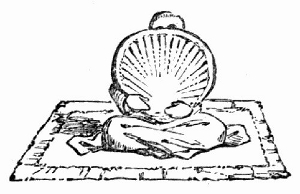
BURMESE PRIEST PREACHING.
The manner in which an uncivilized people will calmly submit to be duped by the extortionate rascality of their priests, is strongly exhibited in the kingdom of Burmah. The people who are there held in the highest estimation are the priests. Any one who pleases may be a priest. The priests pretend to be poor, and go out begging every morning with their empty dishes in their hands; but they get them well filled, and then return to their handsome houses, all shining with gold, in which they live together in plenty and in pride. They are expected to dress in rags, to show that they are poor; but not liking rags, they cut up cloth in little pieces, and sew the pieces together to make their yellow robes; and this they call wearing rags. They pretend to be so modest, that they do not like to show their faces, and so hide them with a fan, even when they preach; for they do preach in their way, that is, they tell foolish stories about Buddha. The name they give him is Guadama, while the Chinese call him Fo. They have five hundred and fifty stories written in their books about him; for they say he was once a bird, a fly, an elephant, and all manner of creatures, and was so good whatever he was, that at last he was born the son of a king. Is it not marvellous that a whole people should, for generation after generation, not only submit to be thus scandalously cheated, but should also hold those who cheat them in the highest esteem? A curious fact, indeed, in the history of mankind.
MIRACULOUS ESCAPE.
One of the most singular circumstances occurred a few years ago that ever came within our observation. Mr. Charlton, surgeon, of Wylam, near Newcastle-on-Tyne, having at a late hour been called upon in haste to give his attendance at Ovingham, borrowed a spirited horse of a friend, that he might proceed with the least possible delay. He had not gone above half a mile when he perceived his horse stumble, and he immediately threw himself from the saddle. It was fortunate he did so, for the next instant his horse had fallen down a precipice of near seventy feet; and, incredible as it may seem, the animal sustained no injury, but immediately dashed into the Tyne, and swam to the opposite side. Search was made after him, and hearing his master's voice, he was heard to neigh even across the water in token of recognition, and was ultimately restored without speck or blemish.
A NATIONAL TASTE FOR GAMING.
It is a remarkable fact that a taste for gaming appears in some cases to pervade a whole people, and to become one of the chief national characteristics. No where is this more manifest than among the inhabitants of the Asiatic Islands.
Games of hazard are the favourites of these islanders. Some of them they have learned of the Chinese, the most debauched of gamesters, and others of the Portuguese. The only game of hazard, of native origin, among the Javanese consists in guessing the number of a certain kind of beans which the players hold in their hands.
But of all the species of gaming that to which the Indian islanders are most fondly addicted is betting on the issue of the combats of pugnacious animals, and particularly the cock. The breed in highest estimation is the produce of Celebes. The people of Java fight their cocks without spurs; but the Malays and natives of Celebes with an artificial spur, in the shape of a small scythe, which, notwithstanding its barbarous appearance, is in reality less destructive than the contrivance employed among ourselves.
Quail fighting also is extremely common in Java. The most famous breed of this bird is found in the island of Lombok; and it is a singular fact, that the female is used in these bitter but bloodless combats, the male being comparatively small and timid. Neither do the Javanese hesitate to bet considerable sums on a battle between two crickets, which are excited to the conflict by the titillation of a blade of grass judiciously applied to their noses. They will likewise risk their money on the strength and hardness of a nut, called kamiri; and much skill, patience and dexterity, are exercised in the selection and the strife. At other times two paper kites decide the fortune of the parties; the object of each in this contest being to cut the string of his adversary. On a favourable day fifty or sixty kites, raised for this purpose, may sometimes be seen hovering over a Javanese city.
A FRIEND TO PHYSIC.
Mr. Samuel Jessup, who died at Heckington, Lincolnshire, in 1817, was an opulent grazier and of pill-taking memory. He lived in a very eccentric way, as a bachelor, without known relatives, and at his decease was possessed of a good fortune, notwithstanding a most inordinate craving for physic, by which he was distinguished for the last thirty years of his life, as appeared on a trial for the amount of an apothecary's bill, at the assizes at Lincoln, a short time before Mr. Jessup's death, wherein he was defendant. The evidence on the trial affords the following materials for the epitaph of the deceased, which will not be transcended by the memorabilia of the life of any man. In twenty-one years (from 1791 to 1816) the deceased took 226,934 pills (supplied by a most highly respectable apothecary and worthy person of the name of Wright, who resided at Bottesford), which is at the rate of 10,806 pills a year, or 29 pills each day; but as the patient begun with a more moderate appetite, and increased it as he proceeded, in the last five years preceding 1816, he took the pills at the rate of 78 a-day, and in the year 1814, he swallowed not less than 51,590. Notwithstanding this, and the addition of 40,000 bottles of mixture, and juleps and electuaries, extending altogether to fifty-five closely written columns of an apothecary's bill, the deceased lived to attain the advanced age of sixty-five years.
AN INCULPATORY EPITAPH.
The following epitaph at West Allington, Devon, is deserving a place in our record of curiosities, inasmuch as it appears to be a successful attempt in making a monumental stone, both a memorial of the deceased, and also a means of reproving the parson of the parish:—
"Here lyeth the Body of Daniel Jeffery the Son of Michael Jeffery and Joan his Wife he was buried ye 22 day of September 1746 and in ye 18th year of his age. This Youth When In his sickness lay did for the minister Send + that he would Come and With him Pray + But he would not atend But When this young man Buried was The minister did him admit + he should be Caried into Church + that he might money geet By this you See what man will dwo + to geet money if he can + who did refuse to come pray + by the Foresaid young man."
HUNTING A SHEEP KILLER.
It has been remarked, that when once a dog acquires wild habits, and takes to killing sheep, he does far more mischief than a wild beast, since to the cunning of the tamed animal he adds the ferocity of the untamed. A remarkable case of this sort is mentioned in the following paragraph, which we have copied from the Newcastle Courant of the year 1823. It is also curious to note the account of the chase, and of the joy which the whole country-side seems to have manifested at the slaughter of the animal.—September 21—A few days ago a dog of a most destructive nature infested the fells of Caldbeck, Carrock, and High Pike, about sixteen miles south of Carlisle. Little doubt remains of its being the same dog which has been so injurious to the farmers in the northern parts of Northumberland, as no less than sixty sheep or upwards have fallen victims to its ferocity. It was thought proper to lose no time in attempting to destroy it, and Tuesday last was fixed upon. Sir H. Fletcher, Bart., of Clea Hall, offered his pack of hounds, and several other dogs with about fifty horsemen set out from Hesket New-market. Several persons with firearms were stationed at different parts. The dog was descried upon an eminence of Carrock-fell, and on sight of the pursuers set off by way of Hesket New-market, Stocklewath, and Barwick-field, then returned by Cowclose, Castle Sowerby, and attempted to gain the fells again, when Mr. Sewell, farmer at Wedlock, lying in ambush at Mossdale, fired, and succeeded in shooting him. He appears to be of the Newfoundland breed, of a common size, wire-haired, and extremely lean. During the chase he frequently turned upon the dogs which were headmost, and so wounded several as obliged them to give up the pursuit. The joy manifested on this occasion was uncommon, insomuch that on the day following about thirty persons sat down to a dinner provided at Mr. Tomlinson's, Hesket New-market. Upon the most moderate computation, excluding the various windings, the chase could not be less than thirty miles, and occupied no less than six hours.
LONGEVITY.
Henry Jenkins, of Ellerton-upon-Swale, Yorkshire, died 1670, aged 169. He remembered the battle of Flodden Field, fought between the English and the Scotch, September 9, 1513, when he was about twelve years old. He was then sent to Northallerton with a cartload of arrows, but an older boy was employed to convey them to the army. At Ellerton there was also living, at the same time, four or five other old men, reputed to be of the age of one hundred years and thereabouts, and they all testified that Jenkins was an elderly man when first they knew him. Jenkins was once butler to Lord Conyers; he perfectly remembered the Abbot of Fountain's Dale before the dissolution of the monasteries. In the last century of his life he was a fisherman, and often swam in the river after he was a hundred years old. In the King's Remembrancer Office in the Exchequer, there is a record of a deposition in a cause, taken April, 1665, at Kettlewell, Yorkshire, where Henry Jenkins, of Ellerton-upon-Swale, labourer, aged 157 years, was produced, and made deposition as a witness. He was buried at Bolton, Yorkshire. In 1743, a monument, with a suitable inscription, was erected to perpetuate his memory.
THE PULPIT OF JOHN KNOX AT ST. ANDREW'S.
John Knox, the great precursor of the Protestant Reformation, having been driven from Edinburgh by the threats of his opponents, reluctantly withdrew to St. Andrew's, in the county of Fife, where he continued with undiminished boldness to denounce the enemies of the reformed faith. It was in that place that he had first discoursed against the degeneracy of the Church of Rome, and there he occupied the Pulpit represented in the accompanying engraving; and the following curious and characteristic anecdote connected with his preaching in it, is related in the Manuscript Diary of James Melville, then a student at the college of St. Andrew's, and subsequently Minister of Anstruther. "Of all the benefits I haid that year (1571) was the coming of that maist notable profet and apostle of our nation, Mr. Jhone Knox, to St. Andrew's: who, be the faction of the Queen occupying the castell and town of Edinburgh, was compellit to remove therefra, with a number of the best, and chusit to come to St. Andrew's. I heard him teache there the Prophecies of Daniel that simmer, and the winter following; I haid my pen and my little buike, and tuk away sic things as I could comprehend. In the opening up of his text he was moderat the space of an half houre; but when he onterit to application, he made me so to grew (thrill) and tremble, that I could not hold a pen to wryt. He was very weak. I saw him every day of his life go hulie and fear (hoolie and fairly—slowly and warily) with a furring of marticks, (martins) about his neck, a staffe in the ane hand, and gud godlie Richard Ballanden, his servand, haldin up the uther oxier (arm-pit), from the Abbey to the Parish-Kirk; and be the said Richart and another servant lifted up to the Pulpit, whar he behovit (was obliged) to lean at his first entry: bot er he had done with his sermone he was sa active and vigourous, that he was lyk to ding the pulpit in blads (beat it into shivers) and flie out of it."
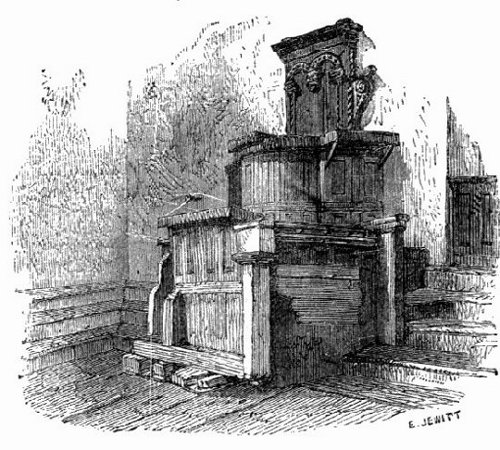
The interesting relique commemorated in this curious extract, is of that stately style of carving which was introduced towards the close of the sixteenth century in Protestant preaching-places; and continued, though of a more heavy character, throughout the whole of the succeeding century. A scroll-bracket remaining on the preacher's left hand, and some broken pieces at the top of the back, appear to indicate that it was once more extended, and had probably a canopy or sounding-board.
THE BIBLE USED BY KING CHARLES THE FIRST ON THE SCAFFOLD.
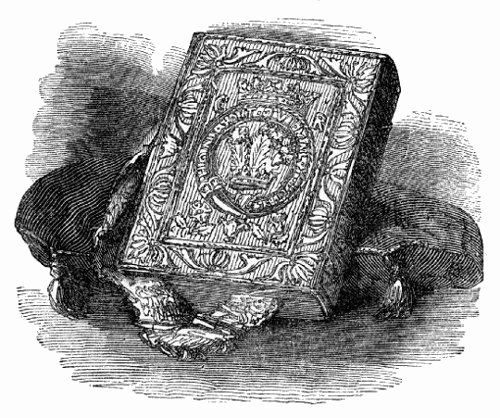
There is so much external evidence of the genuineness of this very beautiful and interesting relique, that no doubt can exist as to its perfect authenticity, though the circumstance of the King having a Bible with him on the scaffold, and of presenting it to Dr. Juxon, is not mentioned in any contemporaneous account of his death. The only notice of such a volume, as a dying gift, appears to be that recorded by Sir Thomas Herbert, in his narrative, which forms a part of the Memoirs of the last Two Years of the Reign of that unparalleled Prince of ever-blessed memory, King Charles I. London, 1702, 8vo, p. 129, in the following passage:—"The King thereupon gave him his hand to kiss: having the day before been graciously pleased under his royal hand, to give him a certificate that the said Mr. Herbert was not imposed upon him, but by his Majesty made choice of to attend him in his bed-chamber, and had served him with faithfulness and loyal affection. His Majesty also delivered him his Bible, in the margin whereof he had with his own hand, written many annotations and quotations, and charged him to give it to the Prince so soon as he returned." That this might be the book represented in our engraving, is rendered extremely probable, by admitting that the King would be naturally anxious, that his son should possess that very copy of the Scriptures which had been provided for himself when he was Prince of Wales. It will be observed that the cover of the volume is decorated with the badge of the Principality within the Garter, surmounted by a royal coronet in silver gilt, inclosed by an embroidered border; the initials C. P. apparently improperly altered to an R., and the badges of the Rose and Thistle, upon a ground of blue velvet: and the book was therefore bound between the death of Prince Henry in 1612, and the accession of King Charles to the throne in 1625, when such a coronet would be no longer used by him. If the Bible here represented were that referred to by Herbert, the circumstance of Bishop Juxon becoming the possessor of it might be accounted for, by supposing that it was placed in his hands to be transmitted to Charles II. with the George of the Order of the Garter belonging to the late King, well known to have been given to that Prelate upon the scaffold, January 30th, 1648-9.
LAMBETH WELLS, THE APOLLO GARDENS, AND FINCH'S GROTTO.
Among the numerous public places of amusement which arose upon the success of Vauxhall Gardens, which were first opened about 1661, was one in Lambeth Walk, known as Lambeth Wells. This place was first opened on account of its mineral waters, which were sold at a penny per quart. The music commenced at seven o'clock in the morning, and the price of admission was three pence. A monthly concert under the direction of Mr. Starling Goodwin, organist of St. Saviour's Church Southwark, was afterwards held here, and Erasmus King, who had been coachman to the celebrated Dr. Desaguliers, read lectures and exhibited experiments in natural philosophy, the price of admission being raised to sixpence.
This place was open before 1698, and existed as late as 1752, when "A Penny Wedding after the Scotch fashion, for the benefit of a young couple," was advertised to be kept there.
Lambeth Wells at length becoming a public nuisance, the premises were shut up, and ultimately let as a Methodist Meeting-house. The music gallery was used as a pulpit; but the preacher being greatly disturbed in his enthusiastic harangues, he was obliged to quit, when the premises were converted to various purposes, except the dwelling, which is now known by the sign of the Fountain public-house.
On the site of Messrs. Maudslay's factory, in the Westminster Road, formerly stood the Apollo Gardens. This place of amusement was opened in 1788, by an ingenious musician named Clagget, who published, in 1793, a small quarto pamphlet, entitled "Musical Phenomena: An Organ made without Pipes, Strings, Bells, or Glasses; the only Instrument in the world that will never require to be re-tuned. A Cromatic Trumpet, capable of producing just Intervals, and regular Melodies in all Keys, without undergoing any change whatever. A French Horn answering the above description of the Trumpet."
The Apollo Gardens had one spacious room elegantly fitted up, and decorated in taste suitably to its intention. The gardens consisted of a number of elegant pavilions or alcoves, well adapted for the accommodation of different companies; they were ornamented chiefly with a succession of paintings, relating to romantic histories, particularly the different adventures of Don Quixote. It had a fine orchestra erected in the centre of the gardens. The place being ultimately converted into a receptacle for loose and dissolute characters, the magistracy very properly suppressed it about the year 1799.
In Gravel Lane, Southwark, was Finch's Grotto, a public garden and place of amusement, so named from William Finch, the proprietor. The Grotto was opened to the public in 1770 upon the plan of Vauxhall gardens. An orchestra and a band of musicians, added to the rural character of the place, and drew a numerous body of visitors.
Very little is known about the Grotto, but it is supposed to have been closed early in the present century.
THE DUCK-BILLED PLATYPUS, OR, ORNITHORYNCHUS PARADOXUS.
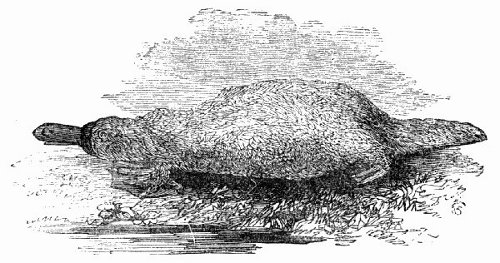
Of the genus Ornithorynchus only one species—the Paradoxus—has yet been discovered in the whole world, and it is, therefore, one of the great curiosities of animal life. It appears to be a union of a quadruped and a bird, and is only to be found in New Holland, where it inhabits the reeds by the side of rivers. Our engraving represents it very accurately. It is about twenty inches long, having a flattened body, somewhat like the otter, and is clothed with a dark soft fur. The elongated nose very much resembles the beak of a duck, like which these animals feed upon water insects, shell-fish, and aquatic plants. The feet are five-toed and webbed, and in the fore-feet this membrane extends beyond the nails: the male is armed with a spur on each hind leg. This curious animal, in which a duck's beak is united to the body of a quadruped, rolls itself up like a hedgehog, when it sleeps in its burrows on the banks of the streams whence its food is derived.