TEN THOUSAND WONDERFUL THINGS. (continued 15)
Reading edition
STYLE OF LIVING AMONG THE NOBILITY OF THE FIFTEENTH CENTURY.
The ordinary meals were now increased to four a day—breakfast at seven in the morning, dinner at ten, supper at four in the afternoon, and "liveries," which were taken in bed, between eight and nine at night. These latter, as well as the breakfast, were of no light or unsubstantial character, consisting of good beef and mutton (or salt fish in Lent), with beer and wine in the morning; and of a loaf or two, with a few quarts of mulled wine and beer, at nights. At dinner the huge oaken table, extending the whole length of the great hall, was profusely covered with joints of fresh and salt meat, followed by courses of fowl, fish, and curious made-dishes. The Lord took his seat on the dais or raised floor at the head; his friends and retainers were ranged above or below the salt, according to their rank. As forks were not yet in use, the fingers were actively employed, whilst wine and beer in wooden or pewter goblets were handed round by the attendants. Over head the favourite hawks stood upon their perches, and below the hounds reposed upon the pavement.
The dinner generally lasted for three hours, and all pauses were filled up by the minstrels, jesters, or jugglers, or by the recitation of some romance of chivalry. At the end of each course they sometimes introduced a dish called subtlety, composed of curious figure in jellies or confectionery, with a riddling label attached for the exercise of social wit. The monasteries were especially noted for their good dinners, and the secular clergy, not to be outdone in their hospitality invented glutton-masses in honour of the Virgin. These were held five times a year in the open churches, whither the people brought food and liquor, and vied with each other in this religious gormandizing. The general diet of the common people continued, however, to be coarse and poor, and severe famines not unfrequently occurred.
ORIGIN OF THE TITLE "SFORZA."
James Sforza, the father of Francis the first duke, was the founder of the house of Sforza, which gave six dukes to Milan, and was allied with almost every sovereign in Europe during the fifteenth and sixteenth centuries. He was born in 1369, at Catignuola, near Faenza; his father, according to tradition, was a day labourer, and to others, a shoemaker, but probably wrought as both. Perceiving some soldiers pass, he was struck with the desire of bearing arms. "I will go," said he to himself, "and dart my hatchet against that tree, and if it stick fast in the wood I will immediately become a soldier." The hatchet stuck fast, and because, says the Abbot of Choisi, he threw the axe with all his force, he assumed the supposed fortunate name of Sforza, as his real name was Giacomuzzo, or James Attendulo.
MAY-POLE IN THE STRAND.
During the austere reign of the Puritans, when theatres were closed, and every sort of popular amusement was considered sinful, the May-poles fell into disrepute, and were pulled down in various parts of London. Among the rest, the famous May-pole in the Strand came to the ground. With the restoration of the monarchy, the people saw the restoration of their ancient sports; and on the very first May-day after the return of Charles II., the May-pole in the Strand was set up again, amid great popular rejoicing. The following account of the ceremony is taken from a rare tract of the times, entitled "The Citie's Loyaltie displayed. London, 4to., 1641," and quoted in the first volume of Hone's "Every-Day Book," page 557:—
"Let me declare to you the manner in general," says the loyal author, "of that stately cedar erected in the Strand, 134 feet high, commonly called the May-pole, upon the cost of the parishioners there adjacent, and the gracious consent of His Sacred Majesty, with the illustrious Prince the Duke of York. This tree was a most choice and remarkable piece, 'twas made below bridge, and brought in two parts up to Scotland Yard, near the King's Palace, and from thence it was conveyed, April 14th, to the Strand, to be erected. It was brought with a streamer flourishing before it, drums beating all the way, and other sort of music. It was supposed to be so long that landsmen, as carpenters, could not possibly raise it. Prince James, the Duke of York, Lord High Admiral of England, therefore commanded twelve seamen to come and officiate the business; whereupon they came, and brought their cables, pulleys, and other tackling, with six great anchors. After these were brought three crowns, borne by three men bareheaded, and a streamer displaying all the way before them, drums beating, and other music playing, numerous multitudes of people thronging the streets, with great shouts and acclamations all day long.
"The May-pole then being joined together, and hooped about with bands of iron, the crown and vane, with the King's arms, richly gilded, was placed on the head of it: a large top, like a balcony, was about the middle of it. This being done, the trumpets did sound, and in four hours' space it was advanced upright; after which being established fast in the ground, again great shouts and acclamations did the people give, that rang throughout all the Strand. After that came a morris-dance, finely decked with purple scarfs, in their half shirts, with a tabor and pipe, the ancient music, and danced round about the May-pole, and after that danced the rounds of their liberty. Upon the top of this famous standard is likewise set up a royal purple streamer, about the middle of it are placed four crowns more, with the King's arms likewise. There is also a garland set upon it, of various colours, of delicate rich favours, under which are to be placed three great lanthorns, to remain for three honours, that is, one for Prince James, Duke of York, Lord High Admiral of England; the other for the Vice-Admiral; the third for the Rear-Admiral. These are to give light on dark nights, and to continue so as long as the pole stands, which will be a perpetual honour for seamen. It is placed as near hand as they could guess in the very same pit where the former stood, but far more glorious, higher, and bigger, than ever any one that stood before it; and the seamen themselves do confess that it could not be built higher, and there is not such an one in Europe besides, which doth highly please His Majesty and the illustrious Prince, Duke of York. Little children did much rejoice, and ancient people did clap their hands, saying that golden days began to appear. I question not but it will ring like melodious music throughout every county in England when they read this story exactly penned. Let this story satisfy for the glories of London, that other loyal subjects may read what we here do see."
COSTUME OF A GERMAN NOBLE.
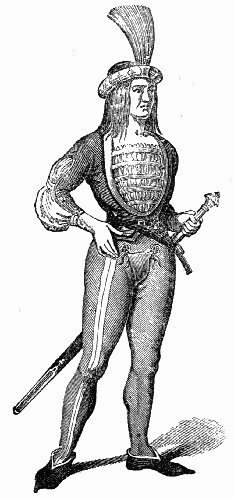
The annexed cut represents the dress of a young noble of the year 1443, from the extremely interesting genealogical history of the baronial family of Haller von Halleostein. The figure is that of Franz Haller von Halleostein, who died unmarried in the above year. He wore an open jerkin of a greenish colour, and very finely plaited chemisette. The jerkin has a white silk trimming with a black border throughout, and is held together by fine white silk ribbons, beneath which appears the white shirt. The sword-couple and sheath, are black, hilt and mountings are of the colour of steel. The stockings are vermilion, and on the right leg is a white and yellow stripe. The shoes are black, turned with white. The hair is long, and over it is worn a neat cap with lappets and a golden agraffe and love-knot, to support the hair.
At the period of this costume very great attention was bestowed by the German nobility to their dress. The sums they expended on it were enormous, and in many instances families were reduced to ruin by the extravagant decorations of their person. Jewellery, furs, silks, and laces, all of which were far more expensive and difficult to be obtained than they are now, were used in reckless profusion, and one nobleman vied with another in the magnificence, novelty, and expensiveness of their attire. The illustrated books of that period abound in sketches of the most beautiful costumes, and are a fund of interest to those who are curious in such matters.
ABSURDITIES OF THE TOILET.
The ladies of Japan are said to gild their teeth, and those of the Indies to paint them red, while in Guzerat the test of beauty is to render them sable. In Greenland, the women used to colour their faces with blue and yellow. The Chinese must torture their feet into the smallest possible dimensions—a proof positive of their contracted understandings. The ancient Peruvians, and some other Indian tribes, used to flatten their heads: and among other nations, the mothers, in a similar way, maltreat the noses of their offspring.
AN EGYPTIAN DINNER.
The complicated, and, at first sight, somewhat incomprehensible sketch which we here lay before our readers, was taken from an interior wall of a palace in Egypt. It is, of course, by Egyptian artists, and the subject of it is no other than an Egyptian dinner-table set out and adorned for a banquet.
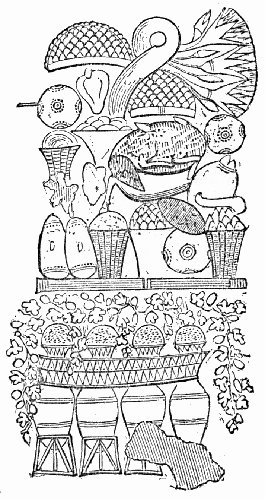
At a dinner in ancient Egypt, small and low circular tables were used, standing on a single pillar, with a dilated base; sometimes one of these was apportioned to every guest, the viands being brought round by the servants successively, from a larger pillar-table which had been brought in readily set out by two men. The accompanying engraving shows a table thus laid out, requiring, however, a little allowance for the lack of perspective. Round and oblong cakes of bread flattened and pricked in patterns, a goose, a leg of a kid or antelope, baskets of figs and other fruit, are crowned by a huge bunch of the lotus-lily. Under the table are bottles of wine placed on stands in a series, and crowned with a lotus-garland, upon which is thrown a long withe of what seems from the tendrils a vine, loaded with clusters of grapes, as well as thickly set with foliage.
ELEPHANT-GOD OF BURMAH.
A white elephant is a great rarity, and whenever one is caught, the Burmese treat it as a god and pay worship to it. Captain Yule thus describes the white elephant of 1855, and his palace at Amarapoora, the capital of Burmah:—
"In the area which stretches before the Hall of Audience are several detached buildings. A little to the north is the "Palace," or state apartment, of the Lord White Elephant, with his highness's humbler every-day residence in rear. To the south are sheds for the vulgar herd of the same species, and brick godowns in which the state carriages and golden litters (the latter massive and gorgeous in great variety of design) are stowed away. Temporary buildings, used as barracks and gunsheds, run along the wall. The present white elephant has occupied his post for at least fifty years. I have no doubt he is the same as Padre San-germano mentions as having been caught in 1806, to the great joy of the King, who had just lost the preceding incumbent, a female, which died after a year's captivity. He is a very large elephant, close upon ten feet high, with as noble a head and pair of tusks as I have ever seen. But he is long-bodied and lanky, and not otherwise well made as an elephant. He is sickly and out of condition, and is, in fact, distempered during five months of the year, from April to August. His eye, the iris of which is yellow with a reddish outer annulus, and a small clear black pupil, has an uneasy glare, and his keepers evidently mistrust his temper. We were always warned against going near his head. The annulus round the iris of the eye is pointed out as resembling a circle of the nine gems. His colour is almost uniform all over; nearly the ground-tint of the mottled or freckled part of the trunk and ears of common elephants, perhaps a little darker. He also has pale freckles in the same parts. On the whole, he is well entitled to his appellation of white. His royal paraphernalia, which are set out when visitors are expected, are sufficiently splendid. Among them was a driving-hook about three feet long, the stem of which was a mass of small pearls, girt at frequent intervals with bands of rubies, and the hook and handle of crystal tipped with gold. His headstall was of fine red cloth, plentifully studded with fine rubies, and near the extremity having some valuable diamonds. To fit over the two bumps of the forehead were circles of the nine gems, which are supposed to be charms against evil influences. When caparisoned he also wore on the forehead, like other Burmese dignitaries, including the King himself, a golden plate inscribed with his titles, and a gold crescent set with circles of large gems between the eyes. Large silver tassels hung in front of his ears, and he was harnessed with bands of gold and crimson set with large bosses of pure gold. He is a regular "estate of the realm," having a woon or minister of his own, four gold umbrellas, the white umbrellas which are peculiar to royalty, with a suite of attendants said to be thirty in number. The Burmese who attended us removed their shoes before entering his 'Palace.' The elephant has an appanage or territory assigned to him 'to eat,' like any other dignitary of the empire. I do not know where his estate is at present, but in Burney's time it was the rich cotton district of Taroup Myo."
SUPERSTITION IN 1856.
In April, 1856, a poor woman, residing in a village about three miles from Pershore, acting upon the advice of her neighbours, brought her child, who was suffering from whooping cough, to that town, for the purpose of finding out a married couple answering to the names of Joseph and Mary, and soliciting their interference on behalf of her afflicted child, as she had been informed that if two married persons having those names could but be induced to lay their hands on her child's head, the whooping cough would be immediately cured. After scouring the town for a considerable time in search of "Joseph and his fair lady," they were at length discovered in the persons of a respectable tradesman and his wife residing in Bridge Street, to whom the poor silly woman made known her foolish request, which at first excited a smile from the good woman of the house, but was quickly followed, not by "the laying on of hands," but by good advice, such as mothers only know how to give in these matters. The poor mother then thankfully departed a wiser woman.
PRAYING BY WHEEL AND AXLE.
The Japanese, like the inhabitants of Thibet, are not content with devout prayers, pilgrimages, prostrations, offerings to the gods in order to secure blessings here and hereafter; they also pray by machine, by wheel and axle. There is a square post, nearly eight feet in length, and near the centre, at a convenient height to be reached by the hand, is fixed vertically a wheel, which moves readily on an axle passed through the post. Two small rings are strung upon each of three spokes of the wheel. Every person who twists this instrument in passing is supposed to obtain credit in heaven for one or more prayers inscribed on the post, the number being graduated according to the vigour of the performer's devotion, and the number of revolutions effected. The jingle of the small iron rings is believed to secure the attention of the deity to the invocation of the devout, and the greater the noise, the more certain of its being listened to. Some of the inscriptions on this post are worth remembering:—"The great round mirror of knowledge says, 'wise men and fools are embarked in the same boat;' whether prospered or afflicted, both are rowing over the deep lake; the gay sails lightly hang to catch the autumnal breeze; then away they straight enter the lustrous clouds, and become partakers of heaven's knowledge."
"He whose prescience detects knowledge says:—'As the floating grass is blown by the gentle breeze, or the glancing ripples of autumn disappear when the sun goes down, or as the ship returns home to her old shore, so is life: it is a smoke, a morning tide.'"
"Others are more to the point—as to the machine—'Buddha himself earnestly desires to hear the name of this person (who is buried), and wishes he may go to life.'"
NOVEL WAY OF DESIGNATING A HOUSE.
In the "New View of London," published in 1708, it is mentioned as a remarkable circumstance attaching to the history of Prescott Street, near the Strand, that instead of signs, the houses were distinguished by numbers, as the stair-cases in the Inns of Court, and Chancery. The following advertisement, taken from newspapers a century and a half old, is interesting at this distance of time, as it shows the shifts to which advertisers were reduced, to point out their houses to their customers:—
"Doctor James Tilborgh, a German doctor, states that he liveth at present over against the New Exchange, in Bedford Street, at the sign of the 'Peacock,' where you shall see at night two candles burning within one of the chambers before the balcony; and a lanthorn with a candle in it upon the balcony: where he may be spoke with all alone, from 8 in the morning till 10 at night."
DYAK WAR-BOAT IN BORNEO.
The Malay war-boat, or prahu, is built of timber at the lower part; the upper is of bamboo, rattan, and kedgang (the dried leaf of the Nepa palm). Outside the bends, about a foot from the water line, runs a strong gallery, in which the rowers sit cross-legged. At the after-part of the boat is a cabin for the chief who commands, and the whole of the vessel is surmounted by a strong flat roof, upon which they fight, their principal weapons being the kris and spear, both of which, to be used with effect, require elbow-room.
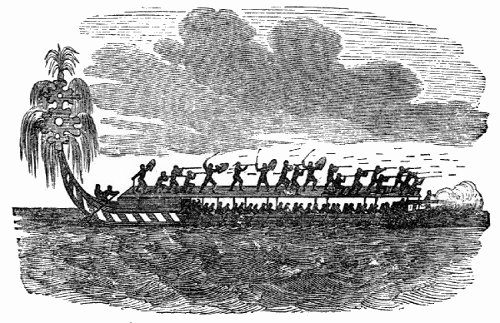
The Dyak war-boat, as represented in the annexed sketch, is a long-built canoe, more substantially constructed than the prahu of the Malays, and sufficiently capacious to hold from seventy to eighty men. This also has a roof to fight from. They are generally painted, and the stern ornamented with feathers.
Both descriptions of war-boats are remarkably swift, notwithstanding such apparent top-weight.
WAR-DANCE OF THE DYAKS OF BORNEO.
Almost every savage nation has its peculiar war-dance, and the different steps, movements, and cries, in each depict different stages in the supposed fight. An account of the various kinds of dances would form an interesting work, and as a contribution to it we here call attention to the following description of a war-dance which was practised for the entertainment of the officers of the Semarang, on the occasion of their visiting a Dyak Chief. It is taken from Captain Marryat's "Borneo:"—
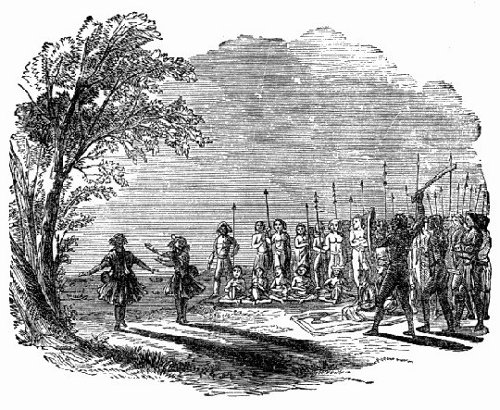
"A space was cleared in the centre, and two of the oldest warriors stepped into it. They were dressed in turbans, long loose jackets, sashes round their waists descending to their feet, and small bells were attached to their ankles. They commenced by first shaking hands with the rajah, and then with all the Europeans present, thereby giving us to understand, as was explained to us, that the dance was to be considered only as a spectacle, and not to be taken in its literal sense, as preparatory to an attack upon us, a view of the case in which we fully coincided with them.
"This ceremony being over, they rushed into the centre, and gave a most unearthly scream; then poising themselves on one foot, they described a circle with the other, at the same time extending their arms like the wings of a bird, and then meeting their hands, clapping them and keeping time with the music. After a little while the music became louder, and suddenly our ears were pierced with the whole of the natives present joining in the hideous war-cry. Then the motions and screams of the dancers became more violent, and every thing was worked up to a state of excitement, by which even we were influenced. Suddenly, a very unpleasant odour pervaded the room, already too warm, from the numbers it contained. Involuntarily we held our noses, wondering what might be the cause, when we perceived that one of the warriors had stepped into the centre, and suspended round the shoulders of each dancer a human head in a wide-meshed basket of rattan. These heads had been taken in the late Sakarron business, and were therefore but a fortnight old. They were encased in a wide network of rattan, and were ornamented with beads. Their stench was intolerable, although, as we discovered upon after examination, when they were suspended against the wall, they had been partially baked and were quite black. The teeth and hair were quite perfect, the features somewhat shrunk, and they were altogether very fair specimens of pickled heads; but our worthy friends required a lesson from the New Zealanders in the art of preserving. The appearance of the heads was the signal for the music to play louder, for the war-cry of the natives to be more energetic, and for the screams of the dancers to be more piercing. Their motions now became more rapid, and the excitement in proportion. Their eyes glistened with unwonted brightness. The perspiration dropped down their faces, and thus did yelling, dancing, gongs, and tom-toms become more rapid and more violent every minute, till the dancing warriors were ready to drop. A farewell yell, with emphasis, was given by the surrounding warriors; immediately the music ceased, the dancers disappeared, and the tumultuous excitement and noise was succeeded by a dead silence. Such was the excitement communicated, that when it was all over we ourselves for some time remained panting to recover our breath. Again we lighted our cheroots, and smoked for a while the pipe of peace."
WONDERFUL FISH.
The Greek Church of Baloukli contains an extraordinary instance of the credulity of superstition. Some wonderful fish are there preserved, which are thus described by Mr. Curzon in his admirable book on the "Monasteries of the Levant:"—
"The unfortunate Emperor Constantine Paleologus rode out of the city alone to reconnoitre the outposts of the Turkish army, which was encamped in the immediate vicinity. In passing through a wood he found an old man seated by the side of a spring, cooking some fish on a gridiron for his dinner; the emperor dismounted from his white horse, and entered into conversation with the other; the old man looked up at the stranger in silence, when the emperor inquired whether he had heard anything of the movement of the Turkish forces: 'Yes,' said he, 'they have this moment entered the city of Constantinople.' 'I would believe what you say,' replied the emperor, 'if the fish which you are broiling would jump off the gridiron into the spring.' This, to his amazement, the fish immediately did, and, on his turning round, the figure of the old man had disappeared. The emperor mounted his horse and rode towards the gate of Silivria, where he was encountered by a band of the enemy, and slain, after a brave resistance, by the hand of an Arab or a Negro.
"The broiled fishes still swim about in the water of the spring, the sides of which have been lined with white marble, in which are certain recesses in which they can retire when they do not wish to receive company. The only way of turning the attention of these holy fish to the respectful presence of their adorers is accomplished by throwing something glittering into the water, such as a handful of gold or silver coin: gold is the best; copper produces no effect; he that sees one fish is lucky, he that sees two or three goes home a happy man; but the custom of throwing coins into the spring has become, from its constant practice, very troublesome to the good monks, who kindly depute one of their community to rake out the money six or seven times a day with a scraper at the end of a long pole. The emperor of Russia has sent presents to the shrine of Baloukli, so called from the Turkish word Balouk, a fish. Some wicked heretics have said that these fishes are common perch: either they or the monks must be mistaken; but of whatever kind they are, they are looked upon with reverence by the Greeks, and have been continually held in the highest honour from the time of the siege of Constantinople to the present day."
CURIOUS MARRIAGE CUSTOM.
At Petzé, in the department of Finisterre, in France, the following singular marriage custom still prevails:—"On an appointed day, the paysannes, or female pretenders to the holy state of matrimony, assemble on the bridge of the village, and, seating themselves upon the parapet, there patiently await the arrival of the intended bridegrooms. All the neighbouring cantons contribute their belles to ornament this renowned bridge. There may be seen the peasant of Saint Poliare, her ruddy countenance surrounded by her large muslin sleeves, which rise up and form a kind of framework to her full face; by her may be seated the heavy Touloisienne, in her cloth caline, or gown; the peasant of la Léonarde, in a Swiss boddice, bordered with different coloured worsted braid, and a scarlet petticoat, may next appear, presenting a gaudy contrast to her neighbour from Saint Thegonnec, in her nun-like costume. On one side extends la coulie de Penhoat, bordered with willows, honeysuckles, and the wild hop; on the other, the sea, confined here like a lake, between numerous jets of land covered with heath and sweet broom; and below the bridge, the thatched town, poor and joyous as the beggar of Carnouailles. The bay is here so calm, that the whole of this gay scene is reflected in its still waters; and a few scenes of rural festivity present a more animated or diverting picture.
"The arrival of the young men, with their parents, is the signal for silence among the candidates for a husband. The gentlemen advance, and gravely parade up and down the bridge, looking first on this side, and then on that, until the face of some one of the lasses strike their fancy. The fortunate lady receives intimation of her success by the advance of the cavalier, who, presenting his hand, assists her in descending from her seat, making at the same time a tender speech; compliments are exchanged, the young man offers fruit to his intended bride, who remains motionless before him, playing with her apron strings. In the mean while the parents of the parties approach each other, talk over the matter of their children's marriage, and if both parties are agreeable they shake hands, and this act of friendly gratulation is considered a ratification of the treaty between them, and the marriage is shortly afterwards celebrated."
FOREIGN COSTUME IN 1492.
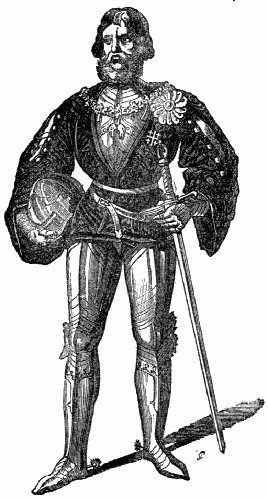
The nobleman portrayed here is Count Eberhard the elder, first Duke of Wurtemberg, in a festival habit at Stuttgardt, in the year 1492, on the occasion of his receiving the order of the Golden Fleece, the first which Austria instituted for herself (King Maximilian inherited it from Burgundy) and which he received together with King Henry VIII. of England. His costume is taken from an old illumination which, in the year 1847, was copied for King William of Wurtemberg, and which is now preserved in his private library at Stuttgardt. This exemplifies the quilled doublet, made of a kind of damasked black velvet, which appears to have been worn over the defensive armour improved by King Maximilian. Upon the black surcoat appear the orders of the Golden Fleece and the Holy Sepulchre. According to contemporary statues and monuments, Georg von Ekingen and Heinrich von Wællwerth, officers of the court of Eberhard, wore this kind of doublet. The former, according to a portrait, of a red colour; the latter authority is in the Wællwerth Chapel, in the cloister of Lorch near Schw. Gmuend.
PETER THE GREAT AT ZAANDAM.
We learn from authentic records that Peter the Great, Czar of Russia, entered himself, in the year 1697, on the list of ship's carpenters at the Admiralty Office of Amsterdam, in Holland. This is true; but before Peter so enrolled himself, he had made an attempt to fix his abode, for the purpose of study, at Saardam, or Zaandam, a little town situated on the river Zaan, about half an hour's voyage, by steam, from the populous and wealthy city of Amsterdam.
Zaandam, though then, as now, one of the most primitive, original little towns in Europe, had for some time held important commercial intercourse with Russia; and Peter had long seen the advantage to be derived from studying at its head-quarters the art which he felt sure would elevate his country in an extraordinary way. He therefore opened a private correspondence with some trusty friends in Holland, and set forth, with his hand of intelligent companions, early in the summer of 1697; in the autumn of the same year he disembarked at Zaandam, and, alone and unattended, sought an humble lodging from a man of the name of Gerrit Kist, who had formerly been a blacksmith in Russia, and who, as may well be imagined, was astonished at the "imperial apparition;" indeed he could not believe that Peter really wished to hire so humble an abode. But the Czar persevered, and obtained permission to occupy the back part of Kist's premises, consisting of a room and a little shed adjoining, Kist being bound to secresy as to the rank of his lodger: Peter's rent amounted to seven florins (about eleven shillings) a week.
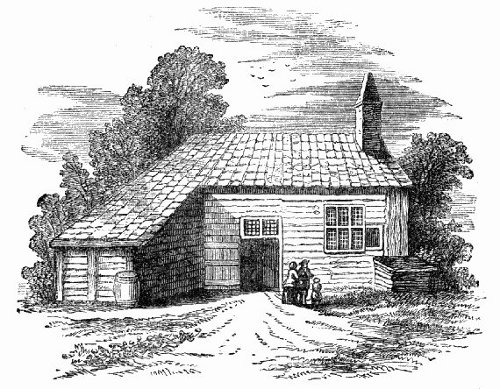
The maisonnette, or hut, of Peter the Great now stands alone, and has been encased in a strong wooden frame in order to preserve it. It is in much the same state as when occupied by the Czar. The chief apartment is entered by the door you see open, the projecting roof covers the room probably occupied by Peter's servant, and on the left of the larger room is the recess or cupboard in which Peter slept. Formerly the rear of this abode was crowded with inferior buildings; it is now an airy space, with trees waving over the wooden tenement, and a garden full of sweet-scented flowers embalms the atmosphere around it. A civil old Dutchwoman is the guardian of the property, which is kept up with some taste, and exquisite attention to cleanliness.
The maisonnette has but one door. In Zaandam the old Dutch custom of closing one entrance to the house, except on state occasions, is still kept up; the purpose of the other, the porte mortuaire, or mortuary portal, is sufficiently explained by its name.
After Peter's departure, his dwelling passed from hand to hand, and would have fallen into oblivion had not Paul the First of Russia accompanied Joseph the Second of Austria and the King of Sweden to Zaandam, on purpose to visit the Czar's old abode. After this it became a sort of fashion to make pilgrimages to the once imperial residence; and it acquired a still greater celebrity when the Emperor Alexander visited it in 1814, and made a great stir in the waters of the Zaan with a fleet of three hundred yachts and innumerable barges, gaily decked with flying pennons. In 1818, William the First of Holland purchased the property, and gave it to his daughter-in-law, the Princess of Orange and a royal Russian by birth: it is to her care the building owes its present state of preservation. Her royal highness appointed a Waterloo invalid as first guardian of the place.
Bonaparte brought Josephine here in 1812. Poor Josephine had no idea of old associations; she jumped from the sublime to the ridiculous at once on entering the "mean habitation," and startled the then proprietor by a burst of untimely laughter.
Many royal and illustrious names may be read on the walls of the principal chamber, and in the book in which the traveller is requested to write his name. Verses and pictures challenge, somewhat impertinently, the attention of the wayfarer; but as we sat down in the triangular arm-chairs, and turned from the dark recess in which Peter slept, to the ingle-nook of the deep chimney, and from the ingle to the dark recess again, we could realize nothing but Peter in his working dress of the labours of the day. There he was in the heat of an autumnal evening still at work, with books and slates, and instruments connected with navigation, before him on the rude deal table, and he plodding on, as diligently as a common mechanic, in pursuit of that knowledge by which nations are made great.
SUPPLY OF WATER FOR LONDON IN OLDEN TIMES.
In 1682 the private houses of the metropolis were only supplied with fresh water twice a-week. Mr. Cunningham, in his "Handbook of London," informs us that the old sources of supply were the Wells, or Fleet River, Wallbrook and Langbourne Waters, Clement's, Clerk's, and Holy Well, Tyburn, and the River Lea. Tyburn first supplied the city in the year 1285, the Thames not being pressed into the service of the city conduits till 1568, when it supplied the conduit at Dowgate. There were people who stole water from the pipes then, as there are who steal gas now. "This yere" (1479), writes an old chronicler of London, quoted by Mr. Cunningham, "a wax charndler in Flete-stre had bi craft perced a pipe of the condite withynne the ground, and so conveied the water into his celar; wherefore he was judged to ride through the citee with a condite upon his hedde." The first engine which conveyed water into private houses, by leaden pipes, was erected at London-bridge in 1582. The pipes were laid over the steeple of St. Magnus; and the engineer was Maurice, a Dutchman. Bulmer, an Englishman, erected a second engine at Broken Wharf. Previous to 1656, the Strand and Covent Garden, though so near to the river, were only supplied by water-tankards, which were carried by those who sold the water, or by the apprentice, if there were one in the house, whose duty it was to fill the house-tankard at the conduit, or in the river. In the middle of the seventeenth century, Ford erected water-works on the Thames, in front of Somerset House; but the Queen of Charles II.—like the Princess Borghese, who pulled down a church next to her palace, because the incense turned her sick, and organ made her head ache—ordered the works to be demolished, because they obstructed a clear view on the river. The inhabitants of the district depended upon their tankards and water-carriers, until the reign of William III., when the York-buildings Waterworks were erected. The frequently-occurring name of Conduit-street, or Conduit-court, indicates the whereabout of many of the old sources whence our forefathers drew their scanty supplies.
DRINKING BOUTS IN PERSIA.
In their drinking parties the Persians are reported, among even the highest classes, to exceed all bounds of discretion. Half a dozen boon companions meet at night. The floor is covered with a variety of stimulating dishes to provoke drinking, for which no provocation whatever is required; among these are pickles of every possible variety, and salted prawns or cray-fish from the Persian Gulf—a food which ought to be an abomination to a true Sheeah. Singers and dancing-boys enliven the scene. A Persian despises a wine-glass; a tumbler is his measure. He has an aversion to "heeltaps," and he drains his glass to the dregs, with his left hand under his chin to catch the drops of wine, lest he should be detected next morning in respectable society by the marks on his dress. They begin with pleasant conversation, scandal, and gossip; then they become personal, quarrelsome, abusive, and indecent, after the unimaginable Persian fashion. As the orgies advance, as the mirth waxes fast and furious, all restraint is thrown aside. They strip themselves stark naked, dance, and play all sorts of antics and childish tricks. One dips his head and face into a bowl of curds, and dances a solo to the admiring topers; while another places a large deeg, or cooking-pot, on his head, and display his graces and attitudes on the light fantastic toe, or rather heel.
GERMAN COSTUMES OF THE SIXTEENTH CENTURY.
The costume-sketch which we give on next page, is taken from an original drawing, having the following superscription:—
"Varium et mutabile semper foemina Faec suo quem amat scripsit. Georgius Wolfgang Von Kaltenthal. 1579."
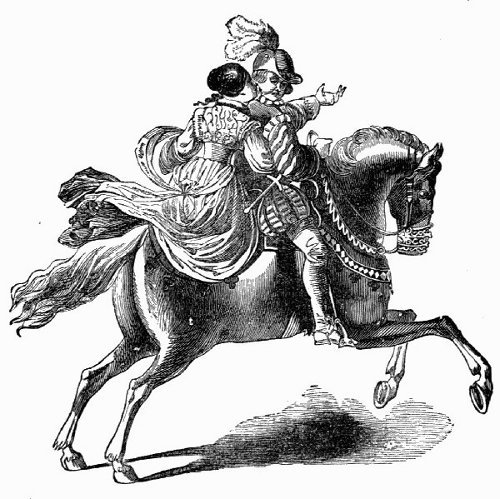
The group represents the above-named young knight, with his youthful wife, taking a ride. She wears a blue silken dress, with a boddice of gold brocade, trimmed with fur, and a rose-coloured silk scarf; the head-dress is quite plain, the hair being fastened with a golden dagger set in jewels. The knight's dress consists of a light green doublet, with dark green stripes; slashed hose, edged with white; yellowish leather surcoat without sleeves, riding boots of untanned leather, and grey felt hat with red and white plume, dagger, and sword. The accoutrements of the horse are simply black, with some metal ornaments. The young lady is the beautiful Leonora Caimingen, who was at that time a great favourite of the Court at Wurtemberg. In travelling thus (which was at that time the only mode), females of the higher rank only were accustomed to make use of masks, or veils, for the preservation of their complexions, that custom being generally unusual. The ancestral castle of the knights of Kaltenthal was situated between Stuttgardt and Boeblingen, on the summit of a rock overhanging the valley of Hesslach. It exists no longer.
ANCIENT TRIPOD.
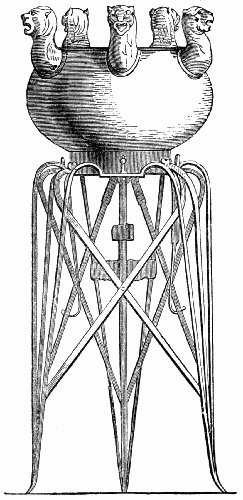
Tripods are, next to vases, the most ancient furniture in the world; the imagination of the ancients invested them with fanciful forms, and we meet with designs which, although very simple, show already the power exercised by the re-productive faculties of the mind upon the objects surrounding these ancient nations. Representations of the kind were, however, exceedingly rare till the last forty years, and it must be considered an especial piece of good fortune that the excavations made in several parts of Etruria, have afforded more than one example of this description. The specimen engraved was found in the Gailassi Regulini tomb of Cervetri, in Etruria, and in it we see a large vessel placed on the tripod, from the edge of which five lions' heads start forth with hideous expression. These monsters lend to the whole that fanciful aspect distinguishing objects of the archaic period. When we imagine to ourselves this kettle boiling, and these cruel animals wreathed and enveloped in smoke, we can understand how the fancy of superstitious worshippers, who were wont to make use of these implements in their religious ceremonies, may have found in them an allusion to the spirits of the victims whose remains were exposed to the destructive fire glowing underneath. To us, at least, this representation may illustrate the terrific but grand passage of Homer, where the bodies of the slaughtered sun bulls become once more instinct with life, demanding vengeance with fearful cries: Odyssey, Book xii, verse 395.
"The skins began to creep, and the flesh around the spits bellowed, The roasted as well as the raw. And thus grew the voice of the oxen."
The careful construction of the three-legged mechanism which lends a firm support to this fire-stand, has been restored according to the indication of some fragments found on the spot. It presents a graceful aspect, and forms, in some respects, a remarkable contrast to the heavy character of the vessel occupying so lofty a position, as the proportions of the legs are exceedingly slender, and the feet themselves, instead of being broad and shapeless, are all composed of a great many fine articulations.
FONDNESS OF THE ROMANS FOR PEARLS.
Of all the articles of luxury and ostentation known to the Romans, pearls seem to have been the most esteemed. They were worn on all parts of the dress, and such was the diversity of their size, purity, and value, that they were found to suit all classes, from those of moderate to those of the most colossal fortune. The famous pearl ear-rings of Cleopatra are said to have been worth about £160,000, and Julius Cæsar is said to have presented Servilia, the mother of Brutus, with a pearl for which he had paid above £48,000; and though no reasonable doubt can be ascertained in regard to the extreme exaggeration of these and similar statements, the fact that the largest and finest pearls brought immense prices is beyond all question. It has been said that the wish to become master of the pearls with which it was supposed to abound, was one of the motives which induced Julius Cæsar to invade Britain. But, though a good many were met with in various parts of the country, they were of little or no value, being small and ill-coloured. After pearls and diamonds, the emerald held the highest place in the estimation of the Romans.
THE BLACK STONE AT MECCA.
Near the entrance of the Kaaba at Mecca, at the north-eastern corner, is the famous Black Stone, called by the Moslems Hajra el Assouad, or Heavenly Stone. It forms a part of the sharp angle of the building, and is inserted four or five feet above the ground. The shape is an irregular oval, about seven inches in diameter. Its colour is now a deep reddish brown, approaching to black; and it is surrounded by a border of nearly the same colour, resembling a cement of pitch and gravel, and from two to three inches in breadth. Both the border and the stone itself are encircled by a silver band, swelling to a considerable breadth below, where it is studded with nails of the same metal. The surface is undulated, and seems composed of about a dozen smaller stones, of different sizes and shapes, but perfectly smooth, and well joined with a small quantity of cement. It looks as if the whole had been dashed into many pieces by a severe concussion, and then re-united—an appearance that may perhaps be explained by the various disasters to which it has been exposed. During the fire that occurred in the time of Yezzid I. (A.D. 682), the violent heat split it into three pieces; and when the fragments were replaced, it was necessary to surround them with a rim of silver, which is said to have been renewed by Haroun el Raschid. It was in two pieces when the Karmathians carried it away, having been broken by a blow from a soldier during the plunder of Mecca. Hakem, a mad sultan of Egypt, in the 11th century, endeavoured, while on the pilgrimage, to destroy it with an iron club which he had concealed under his clothes; but was prevented and slain by the populace. Since that accident it remained unmolested until 1674, when it was found one morning besmeared with dirt, so that every one who kissed it returned with a sullied face. Though suspicion fell on certain Persians, the authors of this sacrilegious joke were never discovered. As for the quality of the stone, it does not seem to be accurately determined. Burckhardt says it appeared to him like a lava, containing several small extraneous particles of a whitish and yellowish substance. Ali Bey calls it a fragment of volcanic basalt, sprinkled with small-pointed coloured crystals, and varied with red feldspar upon a dark black ground like coal, except one of its protuberances, which is a little reddish. The millions of kisses and touches impressed by the faithful have worn the surface uneven, and to a considerable depth. This miraculous block all orthodox Mussulmans believe to have been originally a transparent hyacinth, brought from heaven to Abraham by the angel Gabriel; but its substance, as well as its colour, have long been changed by coming in contact with the impurities of the human race.
PARAGRAPH FROM THE "POSTMAN" IN 1697.
"Yesterday being the day of thanksgiving appointed by the States-General for the peace, His Excellency, the Dutch ambassador, made a very noble bonfire before his house in St. James's Square, consisting of about 140 pitch barrels placed perpendicularly on seven scaffolds, during which the trumpets sounded, and two hogsheads of wine were kept continually running amongst the common people."
LORD MAYOR'S FEAST IN 1663.
Pepys gives a curious account of a Lord Mayor's dinner in 1663. It was served in the Guildhall, at one o'clock in the day. A bill of fare was placed with every salt-cellar, and at the end of each table was a list of the persons proper there to be seated. Here is a mixture of abundance and barbarism. "Many were the tables, but none in the hall, but the Mayor's and the Lords' of the Privy Council, that had napkins or knives, which was very strange. I sat at the merchant-stranger's table, where ten good dishes to a mess, with plenty of wine of all sorts; but it was very unpleasing that we had no napkins, nor change of trenchers, and drank out of earthen pitchers and wooden dishes. The dinner, it seems, is made by the Mayor and two Sheriffs for the time being, and the whole is reckoned to come to £700 or £800 at most." Pepys took his spoon and fork with him, as was the custom of those days with guests invited to great entertainments. "Forks" came in with Tom Coryat, in the reign of James I.; but they were not "familiar" till after the Restoration. The "laying of napkins," as it was called, was a profession of itself. Pepys mentions, the day before one of his dinner-parties, that he went home, and "there found one laying of my napkins against to-morrow, in figures of all sorts, which is mighty pretty, and, it seems, is his trade, and he gets much money by it."
THE CUPID OF THE HINDOOS.
Among the Hindoo deities Camdeo, or Manmadin differs but little from the Cupid of the ancients. He is also called Ununga, or, without body; and is the son of Vishnu and Lacshmi. Besides his bow and arrows, he carries a banner, on which is delineated a fish: his bow is a sugar-cane; the cord is formed of bees; the arrows are of all sorts of flowers; one only is headed, but the point is covered with a honeycomb—an allegory equally just and ingenious, and which so correctly expresses the pleasures and the pangs produced at one and the same time by the wounds of love. Manmadin is represented, as in the annexed plate, riding on a parrot.
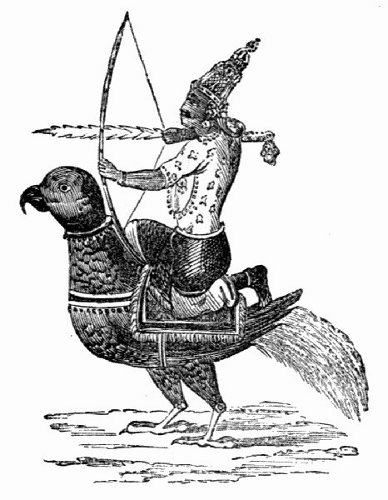
One day, when Vishnu, to deceive Sheeva, had assumed the figure of a beautiful young female, Manmadin discharged an arrow, which pierced the heart of the formidable deity, and inflamed it with love of the nymph. The latter fled, and at the moment when Sheeva had overtaken her, Vishnu resumed his proper form. Sheeva, enraged at the trick played upon him, with one flash of his eyes burned and consumed the imprudent Manmadin, who hence received the name of Ununga. He was restored to life by a shower of nectar, which the gods in pity poured upon him: but he remained without body and is the only Indian deity who is accounted incorporeal. Camdeo is particularly worshipped by females desirous of obtaining faithful lovers and good husbands.
OLD DIAL AND FOUNTAIN IN LEADENHALL-STREET.
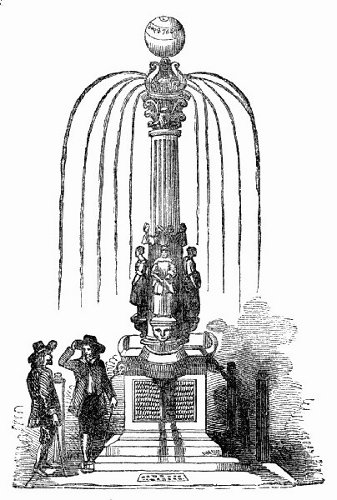
The above sketch is taken from an old work on astronomy and geography by Joseph Moxon, and printed by him, and sold "at his Shop on Cornhill, at the signe of Atlas, 1659." We cannot do better than give Moxon's own words with reference to the dial:—"To make a dyal upon a solid ball or globe, that shall show the hour of the day without a gnomon. The equinoctial of this globe, or (which is all one) the middle line must be divided into 24 equal parts, and marked with 1, 2, 3, 4, &c., and then beginning again with 1, 2, 3, &c. to 12. Then if you elevate one of the poles so many degrees above an horizontal line as the pole of the world is elevated above the horizon in your habitation, and place one of the twelves directly to behold the north, and the other to behold the south, when the sun shines on it, the globe will be divided into two halfs, the one enlightened with the sunshine, and the other shadowed; and where the enlightened half is parted from the shadowed half, there you will find in the equinoctial the hour of the day, and that on two places on the ball, because the equinoctial is cut in two opposite points by the light of the sun. A dyal of this sort was made by Mr. John Leak and set up on a composite columne at Leadenhall Corner, in London, in the majoralty of Sir John Dethick, knight. The figure whereof I have inserted because it is a pretty peece of ingenuity, and may, perhaps, stand some lover of the art in stead either for imitation or help of invention."
MAGNIFICENCE OF MADYN, THE CAPITAL OF PERSIA, WHEN INVADED BY THE SARACENS, A.D. 626.
The invaders could not express their mingled sensations of surprise and delight, while surveying in this splendid capital the miracles of architecture and art, the gilded palaces, the strong and stately porticoes, the abundance of victuals in the most exquisite variety and profusion, which feasted their senses, and courted their observation on every side. Every street added to their astonishment, every chamber revealed a new treasure; and the greedy spoilers were enriched beyond the measure of their hopes or their knowledge. To a people emerging from barbarism, the various wonders which rose before them in all directions, like the effect of magic, must have been a striking spectacle. We may therefore believe them when they affirm, what is not improbable, that the different articles of merchandise—the rich and beautiful pieces of manufacture which fell a prey on this occasion—were in such incalculable abundance, that the thirtieth part of their estimate was more than the imagination could embrace. The gold and silver, the various wardrobes and precious furniture, surpassed, says Abul-feda, the calculation of fancy or numbers; and the historian Elmacin ventured to compute these untold and almost infinite stores at the value of 3,000,000,000 pieces of gold.
One article in this prodigious booty, before which all others seemed to recede in comparison, was the superb and celebrated carpet of silk and gold cloth, sixty cubits in length, and as many in breadth, which decorated one of the apartments of the palace. It was wrought into a paradise or garden, with jewels of the most curious and costly species; the ruby, the emerald, the sapphire, the beryl, topaz, and pearl, being arranged with such consummate skill, as to represent, in beautiful mosaic, trees, fruits, and flowers, rivulets and fountains; roses and shrubs of every description seemed to combine their fragrance and their foliage to charm the sense of the beholders. This piece of exquisite luxury and illusion, to which the Persians gave the name of Baharistan or the mansion of perpetual spring, was an invention employed by their monarchs as an artificial substitute for that loveliest of seasons. During the gloom of winter they were accustomed to regale the nobles of their court on this magnificent embroidery, where art had supplied the absence of nature, and wherein the guests might trace a brilliant imitation of her faded beauties in the variegated colours of the jewelled and pictured floor. In the hope that the eyes of the Caliph might he delighted with this superb display of wealth and workmanship, Saad persuaded the soldiers to relinquish their claims. It was therefore added to the fifth of the spoil, which was conveyed to Medina on the backs of camels. But Omar, with that rigid impartiality from which he never deviated, ordered the gaudy trophy to be cut up into small pieces, and distributed among the chief members of the Mohammedan commonwealth. Such was the intrinsic value of the materials, that the share of Ali alone, not larger than the palm of a man's hand, was afterwards sold for 20,000 drachms (£458 6s. 8d.), or, according to others, for as many dinars (£9,250). Out of this vast store the Caliph granted pensions to every member of his court in regular gradation, from the individuals of the Prophet's family to the lowest of his companions, varying from £275 to £4 11s. per annum.
The military part of the booty was divided into 60,000 shares, and every horseman had 12,000 dinars (£5,550); hence, if the army consisted of 60,000 cavalry, their united shares would amount to the incredible sum of £333,000,000 sterling.
COURTSHIP OF WILLIAM THE CONQUEROR.
The following extract from the life of the wife of the Conqueror, is exceedingly curious, as characteristic of the manners of a semi-civilized age and nation:—"After some years' delay, William appears to have become desperate; and, if we may trust to the evidence of the 'Chronicle of Ingerbe,' in the year 1047 way-laid Matilda in the streets of Bruges, as she was returning from mass, seized her, rolled her in the dirt, spoiled her rich array, and, not content with these outrages, struck her repeatedly, and rode off at full speed. This Teutonic method of courtship, according to our author, brought the affair to a crisis; for Matilda, either convinced of the strength of William's passion, by the violence of his behaviour, or afraid of encountering a second beating, consented to become his wife. How he ever presumed to enter her presence again, after such a series of enormities, the chronicler sayeth not, and we are at a loss to imagine."
BRAMA, THE HINDOO DEITY.
Brama, Birmah, or Brouma, is one of the three persons of the Indian Trinity, or rather the Supreme Being under the attribute of Creator. Brama, the progenitor of all rational beings, sprung from a golden egg, sparkling like a thousand suns, which was hatched by the motion imparted to the waters by the Supreme Being. Brama separated the heavens from the earth, and placed amid the subtle ether the eight points of the universe and the receptacle of the waters. He had five heads before Vairevert, one of Sheeva's sons, cut off one of them. He is delineated floating on a leaf of the lotus, a plant revered in India. The Bramins relate, that the fifteen worlds which compose the universe were each produced by a part of Brama's body. At the moment of our birth he imprints in our heads, in characters which cannot be effaced, all that we shall do, and all that is to happen to us in life. It is not in our power, nor in that of Brama himself, to prevent what is written from being fulfilled.
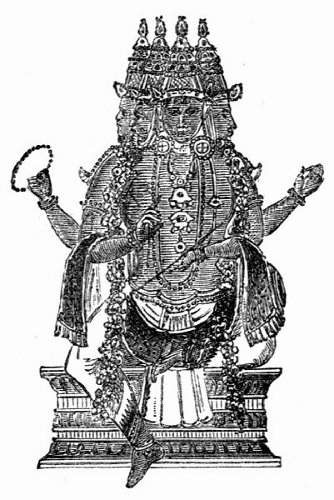
Brama, according to the vulgar mythology, takes but little notice of human affairs. Identified with the sun, he is adored by the Bramins in the gayatri, the most sacred passage of the vedas (or sacred books), which is itself ranked among the gods, and to which offerings are made. One of the most important attributes of Brama is that of father of legislators; for it was his ten sons who diffused laws and the sciences over the world. He is considered as the original author of the vedas, which are said to have issued from his four mouths; though it was not till a later period, that is, about fourteen hundred years before Christ, that they were collected and arranged by Vyasa, the philosopher and poet. The laws which bear the name of Menu, the son of Brama, and the works of the other richeys, or holy persons, were also re-copied, or perhaps collected from tradition, long after the period when they are said to have been published by the sons of Brama.
Brama, the father of the legislators of India, has a considerable resemblance to the Jupiter of the Greek poets, the father of Minos, whose celebrated laws were published in the very same century that Vyasa collected the vedas. Jupiter was worshipped as the sun, by the name of Anxur or Axur, and Brama is identified with that luminary. The most common form in which Brama is represented, is that of a man with four heads and four hands; and it is remarkable that the Lacedæmonians gave four heads to their Jupiter. Lastly, the title of Father of Gods and Men is equally applicable to Brama and to Jupiter.
Brama is delineated, as in the engraving, holding in one hand a ring, the emblem of immortality; in another, fire, to represent force; and with the other two writing on olles, or palm-leaves, the emblem of legislative power.
JAMES II. AND THE CHURCH OF DONORE.
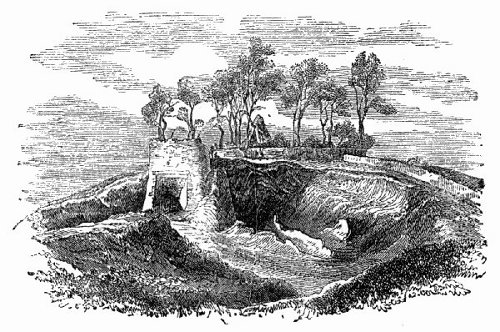
The annexed engraving represents a celebrated locality. It is the ruin of the little church on the hill at Donore, in the county of Meath, the spot where James II. was stationed when he beheld the overthrow of his army and the ruin of his cause at the battle of the Boyne, Tuesday, July 1st, 1690. The Boyne is a very beautiful and picturesque river; it winds through the fertile valleys of Meath, and from its richly-wooded banks the hills rise gradually; there are no lofty mountains in the immediate neighbourhood. The depth, in nearly all parts, is considerable, and the current, consequently, not rapid; its width, near the field of battle, varies little, and is seldom less than fifty or sixty yards. James had the choice of ground, and it was judiciously selected. On the south side of the river, in the county of Meath, his army was posted with considerable skill: on the right was Drogheda; in front were the fords of the Boyne, deep and dangerous, and difficult to pass at all times; the banks were rugged, lined by a morass, defended by some breastworks, with "huts and hedges convenient for infantry;" and behind them was an acclivity stretching along the whole of "the field." James fixed his own tent upon the summit of a hill close to the little church of Donore, now a ruin; it commanded an extensive view of the adjacent country, and the opposite or south side of the river—the whole range, indeed, from Drogheda to Oldbridge village—and looked directly down upon the valley, in which the battle was to be fought, and the fords of the Boyne, where there could be no doubt the troops of William would attempt a passage. From this spot, James beheld his prospering rival mingling in the thick of the mêlée, giving and taking blows; watched every turn of fortune, as it veered towards or against him; saw his enemies pushing their way in triumph, and his brave allies falling before the swords of foreigners—a safe and inglorious spectator of a battle upon the issue of which his throne depended. The preceeding night he had spent at Carntown Castle, from whence he had marched, not as the leader, but as the overseer, of the Irish army; having previously given unequivocal indications of his prospects, his hopes, and his designs, by despatching a commissioner to Waterford, "to prepare a ship for conveying him to France, in case of any misfortune."
HANGING GARDENS OF BABYLON.
When Babylon the Great was in the zenith of her glory, adjoining the grand palace, and within the general enclosure, the Hanging Gardens were constructed by the king to gratify his wife Amytis, who being a native of Media (she was the daughter of Astyages, the king of Media), desired to have some imitation of her native hills and forests.
"Within the walls was raised a lofty mound, Where flowers and aromatic shrubs adorn'd The pensile garden. For Nebassar's queen, Fatigued with Babylonia's level plains, Sigh'd for her Median home, where nature's hand Had scooped the vale, and clothed the mountain's side With many a verdant wood: nor long she pined Till that uxorious monarch called on Art To rival Nature's sweet variety. Forthwith two hundred thousand slaves uprear'd This hill—egregious work; rich fruits o'erhang The sloping vales, and odorous shrubs entwine Their undulating branches."
These gardens, as far as we learn from ancient accounts, contained a square of above 400 feet on each side, and were carried up in the manner of several large terraces, one above the other, till the height equalled that of the walls of the city. The ascent from terrace to terrace was by stairs ten feet wide. The whole pile was sustained by vast arches, raised on other arches one above another, and was defended and condensed by a wall, surrounding it on every side, of twenty-two feet in thickness. On the top of the arches were first laid large flat stones, sixteen feet long and four broad; over these was a layer of weeds mixed and cemented with a large quantity of bitumen, on which were two rows of bricks closely cemented together with the same material. The whole was covered with thick sheets of lead, on which lay the mould of the garden. And all this floorage was so contrived as to keep the moisture of the mould from running away through the arches. The earth laid thereon was so deep that large trees might take root in it: and with such the terraces were covered, as well as with the [...] plants and flowers proper to adorn an eastern pleasure-garden. The trees planted there are represented to have been of various kinds. Here grew the larch, that, curving, flings its arms like a falling wave; and by it was seen the grey livery of the aspen; the mournful solemnity of the cypress and stately grandeur of the cedar intermingled with the elegant mimosa; besides the light and airy foliage of the silk-tasselled acacia, with its vast clusters of beauteous lilac flowers streaming in the wind and glittering in the sun; the umbrageous foliage of the chesnut, and ever-varying verdure of the poplar; the birch, with its feathered branches light as a lady's plumes—all combined with the freshness of the running stream, over which the willow waved its tresses.—
"And the jessamine faint, and the sweet tuberose, The sweetest flower for scent that blows; And all rare blossoms from every clime Grew in that garden in perfect prime."
All these varied delights of nature were ranged in rows on the side of the ascent as well as on the top, so that at a distance it appeared to be an immense pyramid covered with wood. The situation of this extraordinary effort of human skill, aided by human wealth and perseverance, adjoining the river Euphrates, we must suppose that in the upper terrace was an hydraulic engine, or kind of pump, by which the water was forced up out of the river, and from thence the whole gardens were watered, and a supply of the pure element furnished to the fountains and reservoirs for cooling the air. In the spaces between the several arches, on which the whole structure rested, were large and magnificent apartments, very lightsome, and commanding the most beautiful prospects that even the glowing conceptions of an eastern imagination could dream to exist.
THE GREAT BELL OF BURMAH.
At a temple in the environs of Amarapoora, the capital of Burmah, there is an enormous bell, which is thus described by Captain Yule:—"North of the temple, on a low circular terrace, stands the biggest bell in Burmah—the biggest in the world, probably, Russia apart. It is slung on a triple beam of great size, cased and hooped with metal; this beam resting on two piers of brickwork, enclosing massive frames of teak. The bell does not swing free. The supports were so much shaken by the earthquake, that it was found necessary to put props under the bell, consisting of blocks of wood carved into grotesque figures. Of course no tone can now be got out of it. But at any time it must have required a battering-ram to elicit its music. Small ingots of silver (and some say pieces of gold) may still be traced, unmelted, in the mass, and from the inside one sees the curious way in which the makers tried to strengthen the parts which suspend it by dropping into the upper part of the mould iron chains, round which the metal was run. The Burmese report the bell to contain 555,555 viss of metal (about 900 tons). Its principal dimensions are as follow:—External diameter at the lip, 16 feet 3 inches; external diameter 4 feet 8 inches above the lip, 10 feet; interior height, 11 feet 6 inches; exterior ditto, 12 feet; interior diameter at top, 8 feet 6 inches. The thickness of metal varies from six inches to twelve, and the actual weight of the bell is, by a rough calculation, about eighty tons, or one-eleventh of the popular estimate. According to Mr. Howard Malcolm, whose authority was probably Colonel Burney, the weight is stated in the Royal Chronicle at 55,500 viss, or about ninety tons. This statement is probably, therefore, genuine, and the popular fable merely a multiplication of it by ten."
This monster Burmese bell is, therefore, fourteen times as heavy as the great bell of St. Paul's, but only one-third of that given by the Empress Anne to the Cathedral of Moscow.
BANDOLIERS.
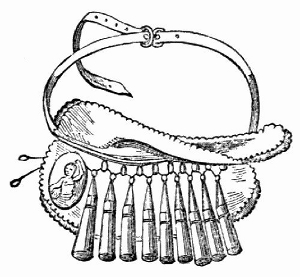
We here engrave a set of bandoliers, a species of weapon much in vogue about the close of the sixteenth century. The specimen before us consists of nine tin cases covered with leather, with caps to them, each containing a charge of powder, and suspended by rings from a cord made to pass through other rings. The caps are retained in their places by being contrived so as to slip up and down their own cords. Two flaps of leather, on each side, are intended to protect the bandoliers from rain, and attached to one of these may be perceived a circular bullet-purse, made to draw with little strings. This specimen was buckled round the waist by means of a strap; others were worn round the body and over the shoulder. The noise they made, agitated by the wind, but more especially the danger of all taking fire from the match-cord, occasioned their disuse, as Sir James Turner tells us, about the year 1640.
TOMB OF DARIUS.
Among the most remarkable tombs of the ancients, may be noticed the sepulchre carved out of the living rock, by order of Darius, the warrior and conqueror king of Persia, for the reception of his own remains; and which is existing to this day at Persepolis, after a duration of twenty-three centuries.
The portico is supported by four columns twenty feet in height, and in the centre is the form of a doorway, seemingly the entrance to the interior, but it is solid; the entablature is of chaste design. Above the portico there is what may be termed an ark, supported by two rows of figures, about the size of life, bearing it on their uplifted hands, and at each angle a griffin—an ornament which is very frequent at Persepolis. On this stage stands the king, with a bent bow in his hand, worshipping the sun, whose image is seen above the altar that stands before him, while above his head hovers his ferouher, or disembodied spirit. This is the good genius that in Persian and Ninevite sculpture accompanies the king when performing any important act. On each side the ark are nine niches, each containing a statue in bas-relief. No other portion of the tomb was intended to be seen, excepting the sculptured front; and we must, therefore, conclude that the entrance was kept secret, and that the avenues were by subterranean passages, so constructed that none but the privileged could find their way. We are told by Theophrastus, that Darius was buried in a coffer of Egyptian alabaster; and also that the early Persians buried their dead entire, preserving their bodies with honey or wax.
THE GATE ON OLD LONDON BRIDGE.
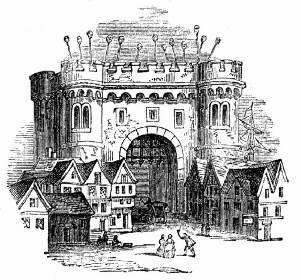
In the reign of Queen Elizabeth, a strongly embattled gate protected the entrance from Southwark to Old London Bridge, and it was usually garnished with traitors' heads in "rich abundance," as may be seen in the accompanying cut, which is copied from Visscher's view, in 1579. The bridge was at that period covered with houses, a narrow road passing through arcades beneath them, and they abutted on props over the river on either side. The bridge was proudly spoken of by our ancestors. Thus, in the translation of Ortelius, published by J. Shaw, in 1603, he says of the Thames:—"It is beautified with statelye pallaces, built on the side thereof; moreover, a sumptuous bridge sustayned on nineteen arches, with excellent and beauteous housen built thereon." Camden, in his great work, the "Britannica," says, "It may worthily carry away the prize from all the bridges in Europe," being "furnished on both sides with passing faire houses, joining one to another in the manner of a street."
EXTRAORDINARY PONDS AND FISH.
The ponds in the department of Ain in France are 1667 in number. The industry and ingenuity of man have converted the marshes into fertile plains and productive ponds, by constructing dykes from one hill to the other, for the plateaux are covered with small hills. When the proprietor of one of these ponds wishes to cultivate it, he draws off the water into the dyke attached to it. Wheat, barley, and oats are then sown, and the seed thus fertilised by the slime produces a crop double that produced by the land in the vicinity. After the harvest is collected, the water is permitted to return to its former bed, and carp, tench, and roach are then thrown into it. Some of these ponds will support 100,000 of carp, and 100 pounds of little tench and roach. In the course of two years these carp, which weighed only one ounce and a-half, will have attained the size of two pounds and a half. The fishing begins in April, and is continued until November. The increase of the fish is as one to five.
THE CEREMONIAL OF MAKING THE KING'S BED.
The following account of the old ceremony of making the King's bed in the time of Henry the Eighth, was sent to the Society of Antiquaries, in 1776, by Mr. J. C. Brooke, of the Heralds' College, F.S.A. &c. In a letter to the president, he says,—
"It is extracted from an original manuscript, elegantly written, beautifully illuminated, and richly bound, which was some time in the library of Henry, Duke of Norfolk, earl marshal of England, to whom it came by descent from Thomas, the great Duke of Norfolk, beheaded in the reign of Queen Elizabeth; who married Mary, daughter and coheir of Henry Fitz-Alan, Earl of Arundel, lord chamberlain to King Henry the Eighth. It contains the whole duty of the lord chamberlain, and of the officers in his department; is the original copy kept for the information of that earl; and had been compiled by order of, and approved by, the King himself in council."
"The oolde ordre of Makynge the Kynges Bedd not to used nor done, but as Hys Grace woll comaund and apoynte from tyme to tyme herafter.
"Furste, a groome or a page to take a torche, and to goo to the warderobe of the kynges bedd, and bryng theym of the warderobe with the kynges stuff unto the chambr for makyng of the same bedde. Where as aught to be a gentylman-usher, iiii yomen of the chambr for to make the same bedde. The groome to stande at the bedds feete with his torch. They of the warderobe openyng the kinges stuff of hys bedde upon a fayre sheete, bytwen the sayde groome and the bedds fote, iii yeomen, or two at the leste, in every syde of the bedde; the gentylman-usher and parte commaundyng theym what they shall doo. A yoman with a dagger to searche the strawe of the kynges bedde that there be none untreuth therein. And this yoman to caste up the bedde of downe upon that, and oon of theym to tomble over yt for the serche thereof. Then they to bete and tufle the sayde bedde, and to laye oon then the bolster without touchyng of the bedd where as it aught to lye. Then they of the warderobe to delyver theym a fustyan takyng the saye therof. All theys yomen to laye theyr hands theroon at oones, that they touch not the bedd, tyll yt be layed as it sholde be by the comaundement of the ussher. And so the furste sheet in lyke wyse, and then to trusse in both sheete and fustyan rownde about the bedde of downe. The warderoper to delyver the second sheete unto two yomen, they to crosse it over theyr arme, and to stryke the bedde as the ussher shall more playnly shewe unto theym. Then every yoman layeing hande upon the sheete, to laye the same sheete upon the bedde. And so the other fustyan upon or ii with such covervnge as shall content the kynge. Thus doon, the ii yomen next to the bedde to laye down agene the overmore fustyan, the yomen of the warderobe delyverynge theym a pane sheete, the sayde yoman therewythall to cover the sayde bedde. And so then to laye down the overmost sheete from the beddes heed. And then the sayd ii yomen to lay all the overmost clothes of a quarter of the bedde. Then the warderoper to delyver unto them such pyllowes as shall please the kynge. The sayd yoman to laye theym upon the bolster and the heed sheete with whych the sayde yoman shall cover the sayde pyllowes. And so to trusse the endes of the sayde sheete under every ende of the bolster. And then the sayd warderoper to delyver unto them ii lyttle small pyllowes, werwythall the squyres for the bodye or gentylman-ussher shall give the saye to the warderoper, and to the yoman whych have layde on hande upon the sayd bedde. And then the sayd ii yomen to lay upon the sayde bedde toward the bolster as yt was bifore. They makyng a crosse and kissynge yt where there handes were. Then ii yomen next to the feete to make the feers as the ussher shall teche theym. And so then every of them sticke up the aungel about the bedde, and to lette down the corteyns of the sayd bedde, or sparver.
"Item, a squyer for the bodye or gentylman-ussher aught to sett the kynges sword at hys beddes heed.
"Item, a squyer for the bodye aught to charge a secret groome or page, to have the kepynge of the sayde bedde with a lyght unto the time the kynge be disposed to goo to yt.
"Item, a groome or page aught to take a torche, whyle the bedde ys yn makyng, to feche a loof of brede, a pott wyth ale, a pott wyth wine, for them that maketh the bedde, and every man.
"Item, the gentylman-ussher aught to forbede that no manner of man do sett eny dysshe upon the kynge's bedde, for fere of hurtying of the kynge's ryche counterpoynt that lyeth therupon. And that the sayd ussher take goode heede, that noo man wipe or rubbe their handes uppon none arras of the kynges, wherby they myght bee hurted, in the chambr where the kynge ys specially, and in all other."
ORIGIN OF SANDWICHES.
To the memory of "Lord Sandwich" belongs the name of that edible. Being, during his administration (as was very usual with him), at a gambling-house, he had, in the fascination of play, for more than five and twenty hours forgotten fatigue and hunger, when suddenly, feeling disposed to break his fast, though still riveted to the table, he called to bid some one bring anything that was to be had to eat, which happened to prove a slice of beef, and two pieces of bread. Placing them together for the sake of expedition, he devoured them with the greatest relish. The most ecstatic encomiums published his discovery, and giving it his name, bequeathed it as a memento to his country, as one of the most important acts of his administration.
THE TREATY-STONE AT LIMERICK.
The city of Limerick is very famous in history. Before it, in 1651, Ireton "sate down;" there he continued to "sit" for six months; and underneath its walls the fierce republican died of plague. Greater celebrity, and higher honour, were, however, obtained by Limerick in 1690. Early in August, William summoned it to surrender; the French general, Boileau, who commanded the garrison—"rather for the King of France than the King of England"—returned for answer, that "he was surprised at the summons, and thought the best way to gain the good opinion of the Prince of Orange was to defend the place for his master King James." The siege was at once commenced. The flower of the Irish army were within its walls, or in its immediate neighbourhood; the counties of Clare and Galway were open to them, from which to draw supplies; and a French fleet rode triumphantly in the Shannon. The garrison, however, were little disposed to act in concert: the jealousy of the commanders of the French and Irish had spread to their troops; and they cherished feelings of contempt or hatred towards each other, that argued ill for their success in opposing the steady and disciplined forces of William.
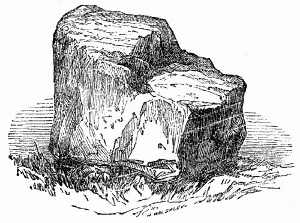
Yet the Irish succeeded; the siege was raised on the 30th of August. But, in the autumn of 1691, it endured a second, which occupied about six months; when the garrison, wearied of a struggle from which they could derive nothing but glory, on the 23rd of September, a cessation of hostilities took place; an amicable intercourse was opened between the two armies; and articles of capitulation were, after a few brief delays, agreed upon. The "violated treaty" was signed on the 3rd of October, 1691; it consisted of two parts, civil and military. It is said to have been signed by the several contracting parties on a large stone, near to Thomond Bridge, on the county of Clare side of the river. The stone remains in the position it occupied at the period, and is an object of curiosity to strangers, as well as of interest to the citizens of Limerick. We, therefore, thought it desirable to procure a drawing of the relic, which retains its name of "the Treaty Stone."
THE TEMPLARS' BANNER CALLED BEAUSEANT.
When Constantine the Great was on the eve of a battle with Maxentius, we are told that a luminous standard appeared to him in the sky with a cross upon it, and this inscription:—"In hoc signo vinces—By this sign you shall conquer;" and that this sign so encouraged Constantine and his soldiers that they gained the next day a great victory.
When Waldemar II. of Denmark was engaged in a great battle with the Livonians in the year 1219, it is said that a sacred banner fell from heaven into the midst of his army, and so revived the courage of his troops, that they gained a complete victory over the Livonians; and in memory of the event, Waldemar instituted an order of knighthood, called "St. Danebrog," or the strength of the Danes, and which is still the principal order of knighthood in Denmark. Now, taking these legends for as much as they are worth, and no more; what do they prove? Not that this miraculous standard and cross came to the assistance of Constantine; not that this miraculous banner came to the aid of Waldemar; but they prove that such was the paramount importance attached to the sacred banner among the forces, that wherever it was present, it was a great means of inspiriting the men with increased confidence and courage, and so contributed to the victory.
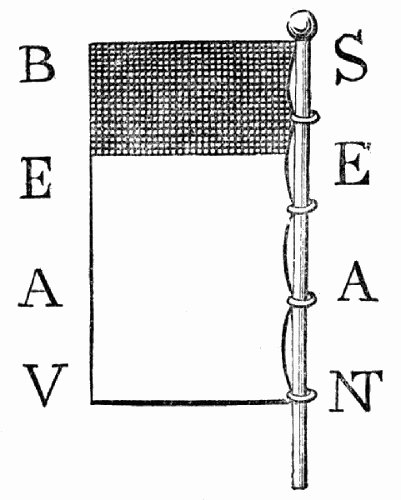
The great importance attached to the banner in the middle ages is not to be wondered at, when we consider that it was a kind of connecting link between the military and the clergy; it was a religious symbol applied to a military purpose, and this was the feeling which animated the Crusaders and the Templars in their great struggle against the enemies of Christianity. The contest then was between the crescent and the cross—between Christ and Mahomet. The Knights Templars had a very remarkable banner, being simply divided into black and white, the white portion symbolising peace to their friends, the black portion evil to their enemies, and their dreaded war cry, "Beauseant."
SWORD-FISH v. WHALES.
So boundless is the sword-fish's rage and fury against whales in particular, that many observers imagine his sallies against rocks and timber to originate in an error of judgment, that all these lunges are intended to punish leviathan, and are only misdirected in consequence of the imperfect vision which prevents this scomber, like many of his family, from accurately distinguishing forms. Whenever a supposed whale is descried, our savage sabreur rushes forward to intercept his progress, and suddenly flashing before his victim, either alone or in conjunction with some other unfriendly fish, instantly proceeds to the attack. Relations of such sea-fights, attested by credible eye-witnesses, are not uncommon; we content ourselves with the citation of one of unimpeachable accuracy. Captain Crow, cited by Mr. Yarrell, relates that in a voyage to Memel, on a calm night, just off the Hebrides, all hands were called up to witness a strange combat between some thrashers (carcharias vulpes) and a sword-fish leagued together against a whale; as soon as the back of the ill-starred monster was seen rising a little above the water, the thrashers sprang several yards into the air, and struck him with their descending tails, the reiterated percussions of which sounded, we are told, like a distant volley of musketry. The sword-fish meanwhile attacked the whale from below, getting close under his belly, and with such energy and effect that there could be little doubt of the issue of a fray, which the necessity of prosecuting their voyage prevented the crew from watching to its close. The sword-fish is not less remarkable for strength than pugnacity, the depôt of its great physical powers being, as in most scombers, in the tail.
WEALTH OF SPAIN UNDER THE MOORS.
The Moors, whose conquest and expulsion were attended with such atrocities, and such triumphs to the Catholic church, were by far the most industrious and skilful part of the Spanish population, and their loss was a blow to the greatness and prosperity of that kingdom from which it has never recovered. The literary activity and commercial enterprise of the Arabs, which the wise policy of their Caliphs encouraged, contributed both to enrich and adorn their adopted country. Cordova, the seat of the Ommiades, was scarcely inferior, in point of wealth and magnitude, to its proud rival on the banks of the Tigris. A space of twenty-four miles in length, and six in breadth, along the banks of the Guadalquiver, was occupied with palaces, streets, gardens, and public edifices; and for ten miles the citizens could travel by the light of lamps along an uninterrupted extent of buildings. In the reign of Almansor it could boast of 270,000 houses, 80,455 shops, 911 baths, 3,877 mosques, from the minarets of which a population of 800,000 were daily summoned to prayers. The seraglio of the Caliph, his wives, concubines, and black eunuchs, amounted to 6,300 persons; and he was attended to the field by a guard of 12,000 horsemen, whose belts and scimitars were studded with gold. Granada was equally celebrated for its luxury and its learning. The royal demesnes extended to the distance of twenty miles, the revenues of which were set apart to maintain the fortifications of the city. Of the duty on grain, the king's exchequer received about £15,000 yearly, an immense sum at that time, when wheat sold at the rate of sixpence a bushel. The consumption of 250,000 inhabitants kept 130 water-mills constantly at work in the suburbs. The population of this small kingdom under the Moors is said to have amounted to 3,000,000, which is now diminished perhaps to one-fifth of that number. Its temples and palaces have shared the same decay. The Alhambra stands solitary, dismantled, and neglected. The interior remains of the palace are in tolerable preservation, and present a melancholy picture of the romantic magnificence of its former kings. Seville, which had continued nearly 200 years the seat of a petty kingdom, enjoyed considerable reputation as a place of wealth and commerce. The population in 1247 was computed at 300,000 persons, which, in the sixteenth century, had decreased one-third. It was one of the principal marts for olives in the Moorish dominions; and so extensive was the trade in this article alone that the axarafe, or plantations round the suburbs, employed farm-houses and olive-presses to the amount of 100,000, being more than is now to be found in the whole province of Andalusia.
THE FIRST OPERA.
The first composer who tried his hand at setting an opera to music was Francisco Bamirino, an Italian artist; and the piece to which he lent the charm of a melodious accompaniment, was the "Conversion of St. Paul," which was brought out at Rome in 1460.
RUINS OF EUROPA.
Lady Sheil, in her "Life in Persia," thus describes some wonderful ruins which she saw about thirty miles from Tehran:—
"From near Verameen a most remarkable antiquity still survives the lapse of twenty centuries, that is, if what we hear be true. It consists of an immense rampart, twenty or thirty feet in height, and of proportional thickness, including a space of about half a mile in length and nearly the same in breadth. It is in the form of a square; the rampart is continuous, and at short intervals is strengthened by bastions of prodigious size. The whole is constructed of unbaked bricks of large dimensions, and is in a state of extraordinary preservation. The traces of a ditch of great size, though nearly filled up, are evident in front of the rampart. No buildings are found inside, where nothing is visible excepting a few mounds,—not a single habitation or human being. The solitude of this striking vestige of antiquity adds to its solemnity. It stood alone; Elboorz, distant only a few miles, gazing down on its hoary walls, with Demawend, in its garments of snow, to complete the scene. From no place have I had a finer view of this grand mountain, which seemed to lie exactly to the north. I am informed that these magnificent ruins represent Europa, a city built by Seleucus, which, if true, would make it upwards of two thousand years old. On seeing the perfect state of the ruins, and the materials of which they are composed, one feels no hesitation in crediting so venerable an antiquity. Seleucus chose the spot well. The district of Verameen is renowned for its fertility, though not at this period for the salubrity of its climate. The surrounding country is covered with earthen mounds, denoting former edifices, which, if explored, might reveal objects worthy of the erudition and intellect of even Sir Henry Rawlinson."
CELEBRATED GUN.
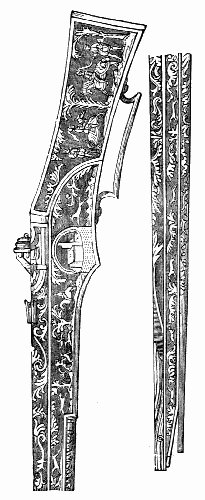
The gun, of which the annexed is a sketch, is one of the many curiosities of the Londesborough Museum. It once formed part of the collection of Prince Potemkin, and was originally the property of Charles IX. of France; it is traditionally reported to have been the gun he used in firing on his Huguenot subjects, from one of the windows of the Louvre, during the massacre of St. Bartholomew. The barrel is richly chased in high relief, with a stag-hunt amid foliage. The stock is inlaid with ivory, sculptured into a series of hunting scenes, knights on horseback.
The dreadful massacre of Saint Bartholomew commenced at Paris on the night of the festival of that saint, August 24th, 1572. Above 500 persons of rank, and 10,000 of inferior condition, perished in Paris alone, besides those slaughtered in the provinces. The king, who had been persuaded that the destruction of the Huguenots to the last man was necessary to the safety of his throne, beheld the slaughter from a window, and being carried away by the example of those whose murderous doings he witnessed, ordered some long arquebusses to be brought, and on their being loaded, and handed to him one after another, he for some time continued to fire on the unfortunate fugitives as they passed, crying at the same time with a loud voice, "Kill, kill." He afterwards went and inspected the bodies of the slain, and expressed his satisfaction at the effective manner in which his orders had been executed.
TOMB OF RAFFAELLE.
The great painter Raffaelle died at Rome, April 7th 1520, at the early age of thirty-seven. He was buried in the Pantheon, in a chapel which was afterwards called Raffaelle's Chapel. For more than a century and a half his tomb had only a plain epitaph, but Carlo Maratti desired to place a more striking memorial of Raffaelle's resting-place than the simple inscription, and accordingly, in the year 1764, a marble bust of the painter, executed by Paolo Nardini, was placed in one of the oval niches on each side of the chapel. The epitaph to Maria Bibiena (Raffaelle's betrothed) was removed to make way for Maratti's new inscription; and it was currently believed that the skull of Raffaelle was removed; at least such was the history given of a skull shown as the painter's, religiously preserved by the Academy of St. Luke, and descanted on by phrenologists as indicative of all the qualities which "the divine painter" possessed. But scepticism played its part; doubts of the truth of this story led to doubts of Vasari's statement respecting the exact locality of Raffaelle's tomb. Matters were brought to a final issue by the discovery of a document proving this skull to be that of Don Desiderio de Adjutorio, founder of the society called the Virtuosi, in 1542. Thereupon, this society demanded the head of its founder from the Academy of St. Luke; but they would neither abandon that, nor the illusion that they possessed the veritable skull of the great artist. Arguments ran high, and it was at length determined to settle the question by an examination of the spot, which took place on the 13th of September 1833, in the presence of the Academies of St. Luke and of Archæology, the Commission of the Fine Arts (including Overback and others), the members of the Virtuosi, the governor of Rome (Monsignor Grimaldi), and the Cardinal Zurla, the representative of the pope.
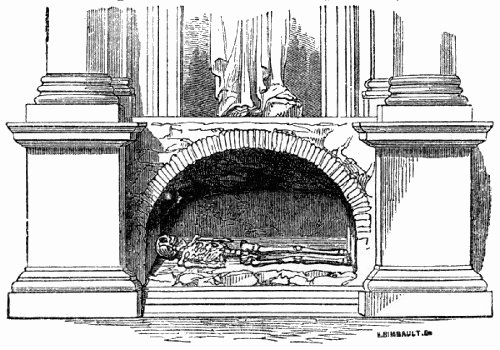
The result will be best given in the words of an eye-witness, Signor Nibby (one of the Commission of Antiquities and Fine Arts), who thus described the whole to M. Quatremere de Quincy, the biographer of Raffaelle:—"The operations were conducted on such a principle of exact method as to be chargeable with over nicety. After various ineffectual attempts in other directions, we at length began to dig under the altar of the Virgin itself, and taking as a guide the indications furnished by Vasari, we at length came to some masonry of the length of a man's body. The labourers raised the stone with the utmost care, and having dug within for about a foot and a half, came to a void space. You can hardly conceive the enthusiasm of us all, when, by a final effort, the workmen exhibited to our view the remains of a coffin, with an entire skeleton in it, lying thus as originally placed, and thinly covered with damp dust. We saw at once quite clearly that the tomb had never been opened, and it thus became manifest that the skull possessed by the Academy of St. Luke was not that of Raffaelle. Our first care was, by gentle degrees, to remove from the body the dust which covered it, and which we religiously collected, with the purpose of placing it in a new sarcophagus. Amongst it we found, in tolerable preservation, pieces of the coffin, which was made of deal, fragments of a painting which had ornamented the lid, several bits of Tiber clay, formations from the water of the river, which had penetrated into the coffin by infiltration, an iron stelletta, a sort of spur, with which Raffaelle had been decorated by Leo X, several fibulæ, and a number of metal anelli, portions of his dress." These small rings had fastened the shroud; several were retained by the sculptor Fibris, who also took casts of the head and hand, and Camuccini took views of the tomb and its precious contents; from one of these our cut is copied.
On the following day the body was further examined by professional men: the skeleton was found to measure five feet seven inches, the narrowness of the coffin indicated a slender and delicate frame. This accords with the contemporary accounts, which say he was of a refined and delicate constitution; his frame was all spirit; his physical strength so limited that it was a wonder he existed so long as he did. The investigation completed, the body was exhibited to the public from the 20th to the 24th, and then was again placed in a new coffin of lead, and that in a marble sarcophagus presented by the pope, and taken from the antiquities in the Museum of the Vatican. A solemn mass was then announced for the evening of the 18th of October. The Pantheon was then illuminated, as for a funeral; the sarcophagus, with its contents, was placed in exactly the same spot whence the remains had been taken. The presidents of the various academies were present, with the Cavalier Fabris at their head. Each bore a brick, which he inserted in the brickwork with which the sepulchre was walled in. And so the painter awaits "the resurrection of the just," and the fellowship of saints and angels, of which his inspired pencil has given us the highest realisation on earth.
ANTIMONY.
The origin of the use of anti-moine, or antimony, is a remarkable circumstance. Basil Valentin, superior of a college of religionists, having observed that this mineral fattened the pigs, imagined that it would produce the same effect on the holy brotherhood. But the case was seriously different; the unfortunate fathers, who greedily made use of it, died in a short time, and this is the origin of its name, according to the pure French word. In spite of this unfortunate beginning, Paracelsus resolved to bring this mineral into practice; and by mixing it with other preparations make it useful. The Faculty at Paris were on this occasion divided into two parties, the one maintaining that antimony was a poison; the other affirmed that it was an excellent remedy. The dispute became more general, and the Parliament and the College of the Sorbonne interfered in the matter; but sometime afterwards people began to judge rightly concerning this excellent mineral; and its wonderful and salutary effects have occasioned the Faculty to place it among their best medicines.