TEN THOUSAND WONDERFUL THINGS. (continued 8)
Reading edition
ORIGIN OF BOLTON ABBEY.
About midway up the Vale of Bolton, amidst the gloomy recesses of the woods, the Wharfe, which is otherwise a wide and shallow river, is suddenly contracted by two huge rocks, which approach each other so nearly, that the country folk, or rather the villagers, call it the Strid, because adventurous people stride or leap from one rock to the other. In ancient days, the whole of this valley belonged to Baron Romillie, whose eldest son having died, left a younger brother, of the name of Egremont, sole heir of the domains and inheritance of this family. One day, however, when this young man, familiarly called the "Boy of Egremont," was returning from hunting with the hounds in the leash, he, as he had done many times before, was going to leap the Strid, when, just as he had attempted it, the hounds held back, and precipitated him headlong into the deep and awful chasm, which the impetuous fall of water (thus produced by the sudden contraction of the river) had worn in the base of the two rude rocks, and he was never seen afterwards. The Baron, being now left childless, built the Abbey, and endowed it with the domains of Bolton.
LENGTH OF LIFE WITHOUT BODILY EXERCISE.
The Rev. William Davies, Rector of Staunton-upon-Wye, and Vicar of All Saints, Hereford, died 1790, aged 105. The life of this gentleman displays one of the most extraordinary instances of departure from all those rules of temperance and exercise, which so much influence the lives of the mass of mankind, that is, probably to be found in the whole records of longevity. During the last thirty-five years of his life, he never used any other exercise than that of just slipping his feet, one before the other, from room to room; and they never after that time were raised, but to go down or up stairs, a task, however, to which he seldom subjected himself. His breakfast was hearty; consisting of hot rolls well buttered, with a plentiful supply of tea or coffee. His dinner was substantial, and frequently consisted of a variety of dishes. At supper he generally eat hot roast meat, and always drank wine, though never to excess. Though nearly blind for a number of years, he was always cheerful in his manners, and entertaining in his conversation, and was much beloved by all who knew him. He had neither gout, stone, paralysis, rheumatism, nor any of those disagreeable infirmities which mostly attend old age; but died peaceably in the full possession of all his faculties, mental and corporeal, save his eyesight. Like most long livers he was very short of stature.
EXTRAORDINARY FASHION IN CIGARS.
A taste for tobacco in some form or other seems to extend over the whole inhabitable globe. In this respect it matters not whether nations are civilized or uncivilized; and however completely they may differ from each other in everything else, they all agree in a fondness for "the weed." In the mode, however, of indulging in the luxury, there is the greatest diversity, and no where is this more strikingly manifested than in the Philippine Islands.
"It is not till evening that the inhabitants of the higher class begin to stir; till that time they are occupied in eating, sleeping, and smoking tobacco, which is no where more general than on the island of Luzon; for children, before they can walk, begin to smoke segars. The women carry their fondness for it to a greater height than the men; for, not content with the usual small segars, they have others made for them, which are a foot long and proportionably thick. These are here called the women's segars, and it is a most ludicrous sight to see elegant ladies taking their evening walk, with these burning brands in their mouths."
How widely does the fashion in Luzon differ from the fashion at Paris!
NOVEL WAY OF PURCHASING A HUSBAND.
The following paragraph, which we have copied from a magazine of 1790, not only gives us a curious instance of female determination in the pursuit of a husband, but tells us of the price which human hair was worth at the period when ladies wore such monstrous head-dresses of false curls.
"An Oxfordshire lass was lately courted by a young man of that country, who was not willing to marry her unless her friends could advance 50l. for her portion; which they being incapable of doing, the lass came to London to try her fortune, where she met with a good chapman in the Strand, who made a purchase of her hair (which was delicately long and light), and gave her sixty pounds for it, being 20 ounces at 3l. an ounce; with which money she joyfully returned into the country, and bought her a husband."
GLOVES.—ORIGIN OF "PIN MONEY."
Gloves were very common as New Year's gifts. For many hundreds of years after their introduction into England in the 10th century, they were worn only by the most opulent classes of society, and hence constituted a valuable present. They are often named in old records. Exchange of gloves was at one period a mode of investiture into possession of property, as amongst the ancient Jews was that of a shoe or sandal; and "glove-money" is to this day presented by High Sheriffs to the officers of their courts, upon occasion of a maiden assize, or one in which no cause is tried. Pins, which at the commencement of the sixteenth century displaced the wooden skewers previously in use, became a present of similar consequence; and at their first introduction were considered of so much importance in female dress, that "pin-money" grew into the denomination of dower, which, by the caution of parents, or justice of a consort, was settled upon a lady at her marriage.
HABITS AND HABITATIONS OF THE DYAKS OF BORNEO.
It is impossible to appreciate properly the courage, determination, and skill which have been displayed by the gallant Sir James Brooke, unless we make ourselves acquainted with the character and habits of the extraordinary race of men over whom he triumphed. The Dyaks are a savage people who inhabit Borneo. They lived there before the Malays came, and they have been obliged to submit to them. They are savages indeed. They are darker than the Malays; yet they are not black; their skin is only the colour of copper. Their hair is cut short in front, but streams down their backs; their large mouths show a quantity of black teeth, made black by chewing the betel-nut. They wear but very little clothing, but they adorn their ears and arms, and legs, with numbers of brass rings. Their looks are wild and fierce, but not cunning like the looks of the Malays. They are not Mahomedans; they have hardly any religion at all. They believe there are some gods, but they know hardly anything about them, and they do not want to know. They neither make images to the gods, nor say prayers to them. They live like the beasts, thinking only of this life; yet they are more unhappy than beasts, for they imagine there are evil spirits among the woods and hills, watching to do them harm. It is often hard to persuade them to go to the top of a mountain, where they say evil spirits dwell. Such a people would be more ready to listen to a missionary than those who have idols, and temples, and priests, and sacred books.
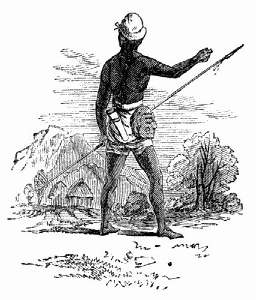
DYAK WITH HEADS.
Their wickedness is very great. It is their chief delight to get the heads of their enemies. There are a great many different tribes of Dyaks, and each tribe tries to cut off the heads of other tribes. The Dyaks who live by the sea are the most cruel; they go out into the boats to rob and bring home, not slaves, but HEADS!! And how do they treat a head when they get it? They take out the brains, and then they dry it in the smoke, with the flesh and hair still on; then they put a string through it, and fasten it to their waists. The evening that they have got some new heads, the warriors dance with delight,—their heads dangling by their sides;—and they turn round in the dance, and gaze upon their heads,—and shout,—and yell with triumph! At night they still keep the heads near them; and in the day they play with them, as children with their dolls, talking to them, putting food in their mouths, and the betel-nut between their ghastly lips. After wearing the heads many days, they hang them up to the ceilings of their rooms.
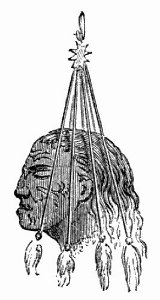
HEAD OF A DYAK.
No English lord thinks so much of his pictures, as the Dyaks do of their heads. They think these heads are the finest ornaments of their houses. The man who has most heads, is considered the greatest man. A man who has no heads is despised! If he wishes to be respected, he must get a head as soon as he can. Sometimes a man, in order to get a head, will go out to look for a poor fisherman, who has done him no harm, and will come back with his head. When the Dyaks fight against their enemies, they try to get, not only the heads of men, but also the heads of women and children. How dreadful it must be to see a poor baby's head hanging from the ceiling! There was a Dyak who lost all his property by fire, but he cared not for losing anything, so much as for losing his precious heads; nothing could console him for his loss; some of them he had cut off himself, and others had been cut off by his father, and left to him!
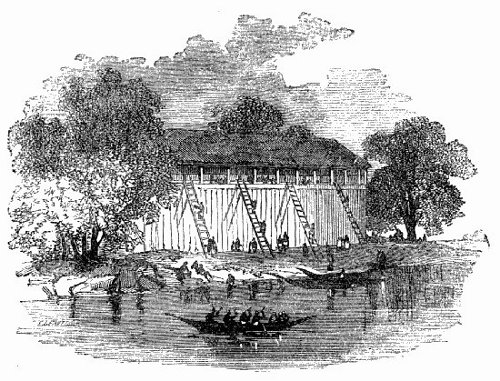
HOUSE OF SEA DYAKS.
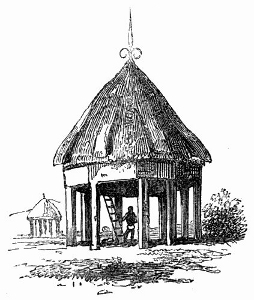
SKULL HOUSE.
People who are so bent on killing, as these Dyaks are, must have many enemies. The Dyaks are always in fear of being attacked by their enemies. They are afraid of living in lonely cottages; they think it a better plan for a great many to live together, that they may be able to defend themselves, if surprised in the night. Four hundred Dyaks will live together in one house. The house is very large. To make it more safe, it is built upon very high posts, and there are ladders to get up by. The posts are sometimes forty feet high; so that when you are in the house, you find yourself as high as the tall trees. There is one very large room, where all the men and women sit, and talk, and do their work in the day. The women pound the rice, and weave the mats, while the men make weapons of war, and the little children play about. There is always much noise and confusion in this room. There are a great many doors along one side of the long room; and each of these doors leads into a small room where a family lives! the parents, the babies, and the girls sleep there, while the boys of the family sleep in the large room, that has just been described.
The Hill Dyaks do not live in houses quite so large. Yet several families inhabit the same house. In the midst of their villages, there is always one house where the boys sleep. In this house all the heads of the village are kept. The house is round, and built on posts, and the entrance is underneath, through the floor. As this is the best house in the village, travellers are always brought to this house to sleep. Think how dreadful it must be, when you wake in the night to see thirty or forty horrible heads, dangling from the ceiling! The wind, too, which comes in through little doors in the roof, blows the heads about; so that they knock against each other, and seem almost as if they were still alive. This is the Dead-house. Such are the men whom the Rajah Brooke subdued!
SCOTTISH WILD CATTLE.
The wild white cattle, a few of which are still to be found in Chatelherault Park, belonging to the Duke of Hamilton, in Lanarkshire, are great objects of curiosity, inasmuch as they are identical with the primitive source of all our domestic cattle.
The following description of their habits is abridged from an article by the Rev. W. Patrick, in the Quarterly Journal of Agriculture:—
"I am inclined to believe that the Hamilton breed of cattle is the oldest in Scotland, or perhaps in Britain. Although Lord Tankerville has said they have 'no wild habits,' I am convinced, from personal observation, that this is one of their peculiar features. In browsing their extensive pasture, they always keep close together, never scattering or straggling over it, a peculiarity which does not belong to the Kyloe, or any other breed, from the wildest or most inhospitable regions of the Highlands. The white cows are also remarkable for their systematic manner of feeding. At different periods of the year their tactics are different, but by those acquainted with their habits they are always found about the same part of the forest at the same hour of the day. In the height of summer, they always bivouac for the night towards the northern extremity of the forest; from this point they start in the morning, and browse to the southern extremity, and return at sunset to their old rendezvous; and during these perambulations they always feed en masse.
"The bulls are seldom ill-natured, but when they are so they display a disposition more than ordinarily savage, cunning, pertinacious, and revengeful. A poor bird-catcher, when exercising his vocation among the 'Old Oaks,' as the park is familiarly called, chanced to be attacked by a savage bull. By great exertion he gained a tree before his assailant made up to him. Here he had occasion to observe the habits of the animal. It did not roar or bellow, but merely grunted, the whole body quivered with passion and savage rage, and he frequently attacked the tree with his head and hoofs. Finding all to no purpose, he left off the vain attempt, began to browse, and removed to some distance from the tree. The bird-catcher tried to descend, but this watchful Cerberus was again instantly at his post, and it was not till after six hours' imprisonment, and various bouts at 'bo-peep' as above, that the unfortunate man was relieved by some shepherds with their dogs. A writer's apprentice, who had been at the village of Quarter on business, and who returned by the 'Oaks' as a 'near-hand cut,' was also attacked by one of these savage brutes, near the northern extremity of the forest. He was fortunate, however, in getting up a tree, but was watched by the bull, and kept there during the whole of the night, and till near two o'clock the next day.
"These animals are never taken and killed like other cattle, but are always shot in the field. I once went to see a bull and some cows destroyed in this manner—not by any means for the sake of the sight, but to observe the manner and habits of the animal under peculiar circumstances. When the shooters approached, they, as usual, scampered off in a body, then stood still, tossed their heads on high, and seemed to snuff the wind; the manœuvre was often repeated, till they got so hard pressed (and seemingly having a sort of half-idea of the tragedy which was to be performed), that they at length ran furiously in a mass, always preferring the sides of the fence and sheltered situations, and dexterously taking advantage of any inequality in the ground, or other circumstances, to conceal themselves from the assailing foe. In their flight, the bulls, or stronger of the flock, always took the lead! a smoke ascended from them which could be seen at a great distance; and they were often so close together, like sheep, that a carpet would have covered them. The cows which had young, on the first 'tug of war,' all retreated to the thickets where their calves were concealed; from prudential motives, they are never, if possible, molested. These and other wild habits I can testify to be inherent in the race, and are well known to all who have an opportunity of acquainting themselves with them."
BELLS OF THE ANCIENTS.
Bells were known in the earliest ages of which we have any certain account. But the bells of the ancients were very small in comparison with those of modern times, since, according to Polydore Virgil, the invention of such as are hung in the towers, or steeples of Christian churches, did not occur till the latter end of the fourth, or beginning of the fifth century; when they were introduced by Paulinus, Bishop of Nola. The Jews certainly employed bells, since they are spoken of in Scriptures; and the mention of them by Thucydides, Diodorus Siculus, Suidas, Aristophanes, and other ancient writers, proves that they were used in Greece; while Plautus, Ovid, Tibullus, Statius, and a variety of Latin authors, speak of bells as in use among the Romans. But these bells of the ancients were all made for the hand; or were of a size to be affixed to other musical instruments, like those which were occasionally appended to the drum. Whether, when detached from other instruments, they were used on other occasions, or only in particular ceremonies, or as signals, is not known; nor have we any clue by which to guess whether they were tuned in concordance with any scale, or whether they were unisons to each other, or not formed to any particular pitch, but merely used as sonorous auxiliaries to other instruments, without any regard to their agreement of tone, either with one another, or with the instruments they accompanied.
EARTHQUAKE AT NOTTINGHAM IN 1816.
Earthquakes are providentially occurrences of great rarity in England. The one which took place on the 17th of March, 1816, was one of the most dangerous that has ever been experienced in this kingdom. It extended over a vast area of country, and in some localities its effects were felt very severely. As a proof of this, we have copied the following paragraph from a Nottingham paper of the day:—
Nottingham, in common with a great part of the North Midland district, experienced a smart shock of an earthquake. It was felt at half-past twelve p.m., and as Divine service, it being Sunday, was not over at the churches, great alarm was expressed by the congregations. At St. Peter's and St. Nicholas's, the consternation was so great, that service had to be suspended for a few seconds, and one lady was borne out in a state of insensibility. The pillars supporting St. Mary's tower shook very visibly, but, fortunately, the attention of the crowded congregation was so engrossed by the eloquence of the sheriff's chaplain, and the presence of the Judge and his retinue, that the alarm was but slight, or the rush and loss of life might have been great. In various parts of the town and neighbourhood, glasses were shaken off of shelves, articles of domestic use displaced, window-casements thrown open, and other indications manifest of the influence of the subterranean movement.
SINGULAR STATE OF PRESERVATION OF A DEAD BODY.
According to a statement in Holinshed, in 1495, while digging for a foundation for the church of St. Mary-at-hill, in London, the body of Alice Hackney was discovered. It had been buried 175 years, and yet the skin was whole, and the joint pliable. It was kept above ground four days without annoyance, and then re-interred.
ASYLUM FOR DESTITUTE CATS.
Of all the curious charitable institutions in the world, the most curious probably is the Cat Asylum at Aleppo, which is attached to one of the mosques there, and was founded by a misanthropic old Turk, who being possessed of large granaries, was much annoyed by rats and mice, to rid himself of which he employed a legion of cats, who so effectually rendered him service, that in return he left them a sum in the Turkish funds, with strict injunctions that all destitute and sickly cats should be provided for, till such time as they took themselves off again. In 1845, when a famine was ravaging in all North Syria—when scores of poor people were dropping down in the streets from sheer exhaustion and want, and dying there by dozens per diem before the eyes of their well-to-do fellow creatures, men might daily be encountered carrying away sack loads of cats to be fed up and feasted on the proceeds of the last will and testament of that vagabond old Turk, whilst fellow creatures were permitted to perish.
TOMB OF SAINT GEORGE.
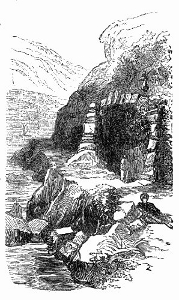
The tomb of Saint George, England's patron-saint, is situated in the Bay of Kesrouan, between the Nahr-et-Kelb and Batroun, surrounded by luxuriant gardens and groups of romantic-looking villages and convents. The Arabs venerate St. George, whom they style Mar Djurios, and point to a small ruined chapel (as in our engraving), originally dedicated to him to commemorate his victory over the dragon, which, they say, took place near to the spot. The tradition is, that the dragon was about to devour the king of Beyrout's daughter, when St. George slew him, and thus saved the lady fair; and the credulous natives point to a kind of well, upwards of sixty feet deep, where they stoutly affirm that the dragon used to come out to feed upon his victims.
All this is very curious, inasmuch as it gives an Arabian interest to the career of the patron saint of England, whose portrait, in the act of slaying the dragon, constitutes the reverse of most English coin, and is regarded as the embodiment of English valour.
BEGGARS SELECTED AS MODELS BY PAINTERS.
Michael Angelo Buonarotti often drew from beggars; and report says, that in the early part of his life, when he had not the means of paying them in money, he would make an additional sketch, and, presenting it to the party, desire him to take it to some particular person, who would purchase it. Fuseli, in his life of Michael Angelo, says that "a beggar rose from his hand the patriarch of poverty." The same artist, in one of his lectures, delivered at the Royal Academy, also observes, that "Michael Angelo ennobled his beggars into Patriarchs and Prophets, in the ceiling of the Sistine Chapel."
Annibal Caracci frequently drew subjects in low life. His Cries of Bologna, etched by Giuseppe Maria Mitelli: pub. 1660, in folio, are evidently from real characters. It will also be recollected, that some of the finest productions of Murillo, Jan Miel, and Drogsloot, are beggars. Callot's twenty-four beggars are evidently from nature; and among Rembrandt's etchings are to be found twenty-three plates of this description.
Sir Joshua Reynolds frequently painted from beggars, and from these people have originated some of his finest pictures, particularly his "Mercury as a Pickpocket," and "Cupid as a Link-boy." His Count Ugolino was painted from a paviour, soon after he had left St. George's Hospital, from a severe fever. Mr. West painted the portrait of a beggar, on the day when he became a hundred years old; and considered him as a pensioner for several years afterwards. The same person was used also as a model, by Copley, Opie, &c. Who can forget the lovely countenance of Gainsborough's "Shepherd's Boy," that has once seen Earlom's excellent engraving from it? He was a lad, well known as a beggar to those who walked St. James's-street seventy years ago. The model for the celebrated picture of the "Woodman," by the same artist, died in the Borough, at the venerable age of 107.
Mr. Nollekens, in 1778, when modelling the bust of Dr. Johnson, who then wore a wig, called in a beggar to sit for the hair. The same artist was not equally fortunate in the locks of another great character; for on his application to a beggar for the like purpose, the fellow declined to sit, with an observation that three half-crowns were not sufficient for the trouble.
SUPPLY OF WATER FOR OLD LONDON.
Leaden pipes conveyed spring water to London city from Tyburn in 1236; and in 1285 the first great conduit of lead was begun there. In 1442 Henry VI. granted to John Hatherley, Mayor, license to take up 200 fother of lead. The pipes from Highbury brought in the water in 1483. We may learn how much was thought of this useful work by the fact that the Lord Mayor, Aldermen, and many worshipful persons used to ride and view the conduit heads at Tyburn; and after dinner there, somewhat different from recent sportsmen, they hunted a fox.
The water-works at London Bridge were established in 1512. In 1534, two-fifteenths were granted by the Common Council for defraying the expense of bringing water from Hackney to Aldgate to a conduit. But Peter Morris did not bring his supply of water to the highest parts of London till the year 1569, and Sir Hugh Middleton's far-famed New River was only rendered available in 1618, that is, a space of sixty-eight years after the introduction of a stream of pure water into the western parts of the town of Lyme in Dorset.
COMBINATION OF INSTINCT AND FORCE OF HABIT IN A DOG.
A dog which had been accustomed to go with his master regularly for some time to Penkridge church, still continued to go there by himself every Sunday for a whole year, while the edifice was under repair, and divine service was not held. Whenever he could, he would get into the family pew and there pass the proper time. His instinct enabled him to perceive the occasion, and to measure the regular time, but it could carry him no further. A remarkable exemplification of the difference between instinct and reason.
YORKSHIRE IN THE LAST CENTURY.
Anecdotes which are apparently trifling in themselves, are often of importance, as exhibiting in a striking light the dialect and social condition of the people, and the period they refer to. An instance of this is the following, which has been recorded as the bellman's cry at Ripon, on the occasion of a great frost and fall of snow, about 1780:—
"I is to gie notidge, that Joanie Pickersgill yeats yewn to neit, to moarn at moarn, an to moarn at neit, an nea langer, as lang as storm hods, 'cause he can git na mare eldin."
The Translation.
I am to give notice, that John Pickersgill heats his oven to-night, to-morrow morning, and to-morrow at night, and no longer as long as the storm lasts, because he can get no more fuel.
INSTANCE OF MANY AGED PERSONS DYING ABOUT THE SAME DATE.
The following is taken from a copy of Nile's "Weekly Register," published at Baltimore, in the month of January, 1823. It is the list of deaths which had been notified to the paper within one week, and we give it, as a singular instance of the decease of so many persons above one hundred years old being announced in the same paragraph.
"In Franklin co. Pennsylvania, Elizabeth Campbell, aged 104—several of her relatives had reached 100.—At Troy, N. Y., Ann Fowler, 100.—At Tyngsboro', N. Y., Abigail Hadlock, 104.—At Somers, N. Y., Michael Makeel, 103.—At Rutland, Oswego, N. Y., Mrs. Buroy, 110.—At Brunswick, Maine, Gen. James W. Ryan, 107—his wife is yet living, aged 94; they were married together 75 years before his death.—At Georgetown, Col. Yarrow, a Moor, (supposed) 135!—At the city of New York, a woman, a native of St. Domingo, 106. At Sargus, Mass., Mrs. Edwards, 101.—In Edgecomb county, N. C., William Spicer, aged about 112.—In Boston, William Homer, 116."
CORPSE BEARERS DURING THE PLAGUE.
Of all the calamities with which a great city is infested, there can be none so truly awful as that of a plague, when the street doors of the houses that were visited with the dreadful pest were padlocked up, and only accessible to the surgeons and medical men, whose melancholy duty frequently exposed them even to death itself; and when the fronts of the houses were pasted over with large bills exhibiting red crosses, to denote that in such houses the pestilence was raging, and requesting the solitary passenger, to pray that the Lord might have mercy upon those who were confined within. Of these bills there are many extant in the libraries of the curious, some of which have borders engraved on wood printed in black, displaying figures of skeletons, bones, and coffins They also contain various recipes for the cure of the distemper. The Lady Arundel, and other persons of distinction, published their methods for making what was then called plague-water, and which are to be found in many of the rare books on cookery of the time; but happily for London, it has not been visited by this affliction since 1665, a circumstance owing probably to the Great Fire in the succeeding year, which consumed so many old and deplorable buildings, then standing in narrow streets and places so confined, that it was hardly possible to know where any pest would stop.
Every one who inspects Agas's Plan of London, engraved in the reign of Elizabeth, as well as those published subsequently to the rebuilding of the City after the fire, must acknowledge the great improvements as to the houses, the widening of the streets, and the free admission of fresh air. It is to be hoped, and indeed we may conclude from the very great and daily improvements on that most excellent plan of widening streets, that this great city will never again witness such visitations.
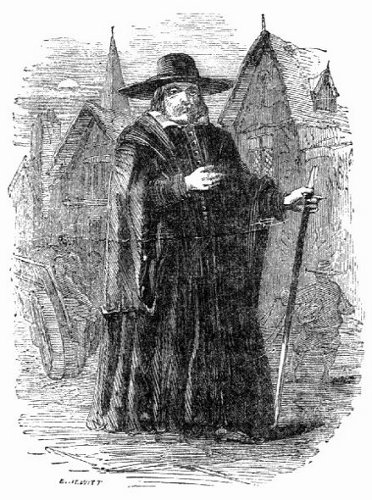
When the plague was at its height, perhaps nothing could have been more silently or solemnly conducted than the removal of the dead to the various pits round London, that were opened for their reception; and it was the business of Corpse Bearers, such as the one exhibited in the preceding engraving, to give directions to the carmen, who went through the city with bells, which they rang, at the same time crying "Bring out your Dead." This melancholy description may be closed, by observing that many parts of London, particularly those leading to the Courts of Westminster, were so little trodden down, that the grass grew in the middle of the streets.
A MEMENTO-MORI WATCH.
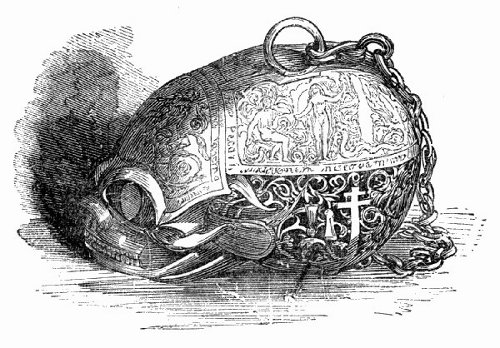
The curious relic, of which we herewith give an engraving, was presented by Mary, Queen of Scots, to her Maid of Honour, Mary Seaton, of the house of Wintoun, one of the four celebrated Maries, who were Maids of Honour to her Majesty.
"Yestreen the Queen had four Maries, The night she'll hae but three; There was Marie Seaton, and Marie Beaton, And Marie Carmichael and me."
The watch is of silver, in the form of a skull. On the forehead of the skull is the figure of Death, with his scythe and sand-glass; he stands between a palace on the one hand, and a cottage on the other, with his toes applied equally to the door of each, and around this is the legend from Horace "Pallida mors æquo pulsat pede pauperum tabernas Regumque turres." On the opposite, or posterior part of the skull, is a representation of Time, devouring all things. He also has a scythe, and near him is the serpent with its tail in its mouth, being an emblem of eternity; this is surrounded by another legend from Horace, "Tempus edax rerum tuque invidiosa vetustas." The upper part of the skull is divided into two compartments: on one is represented our first parents in the garden of Eden, attended by some of the animals, with the motto, "Peccando perditionem miseriam æternam posteris meruere." The opposite compartment is filled with the subject of the salvation of lost man by the crucifixion of our Saviour, who is represented as suffering between the two thieves, whilst the Mary's are in adoration below; the motto to this is "Sic justitiæ satisfecit, mortem superavit salutem comparavit." Running below these compartments on both sides, there is an open work of about an inch in width, to permit the sound to come more freely out when the watch strikes. This is formed of emblems belonging to the crucifixion, scourges of various kinds, swords, the flagon and cup of the Eucharist, the cross, pincers, lantern used in the garden, spears of different kinds, and one with the sponge on its point, thongs, ladder, the coat without seam, and the dice that were thrown for it, the hammer and nails, and the crown of thorns. Under all these is the motto, "Scala cæli ad gloriam via."
The watch is opened by reversing the skull, and placing the upper part of it in the hollow of the hand, and then lifting the under jaw which rises on a hinge. Inside, on the plate, which thus may be called the lid, is a representation of the Holy Family in the stable, with the infant Jesus laid in the manger, and angels ministering to him; in the upper part an angel is seen descending with a scroll on which is written, "Gloria excelsis Deo, et in terra pax hominibus bonæ volu——" In the distance are the shepherds with their flocks, and one of the men is in the act of performing on a cornemuse. The works of the watch occupy the position of the brains in the skull itself, the dial plate being on a flat where the roof of the mouth and the parts behind it under the base of the brain, are to be found in the real subject. The dial plate is of silver, and it is fixed within a golden circle richly carved in a scroll pattern. The hours are marked in large Roman letters, and within them is the figure of Saturn devouring his children, with this relative legend round the outer rim of the flat, "Sicut meis sic et omnibus idem."
Lifting up the body of the works on the hinges by which they are attached, they are found to be wonderfully entire. There is no date, but the maker's name, with the place of manufacture, "Moyse, Blois," are distinctly engraven. Blois was the place where it is believed watches were first made, and this suggests the probability of the opinion that the watch was expressly ordered by Queen Mary at Blois, when she went there with her husband, the Dauphin, previous to his death. The watch appears to have been originally constructed with catgut, instead of the chain which it now has, which must have been a more modern addition. It is now in perfect order, and performs wonderfully well, though it requires to be wound up within twenty-six hours to keep it going with tolerable accuracy. A large silver bell, of very musical sound, fills the entire hollow of the skull, and receives the works within it when the watch is shut; a small hammer set in motion by a separate escapement, strikes the hours on it.
This very curious relic must have been intended to occupy a stationary place on a prie-dieu, or small altar in a private oratory, for its weight is much too great to have admitted of its having been carried in any way attached to the person.
A MONSTER.
It is almost incredible that such a monster, as the one we are about to describe should have been allowed to continue his wicked career for some years, in a civilized country like France, little more than a hundred years ago, but the following paragraph is copied from a Paris journal of that period—1755, January the 17th—and there is every reason to believe that it is strictly correct. "What was his fate we do not know, but can hardly doubt.—The Marquis de Plumartin, whose execrable crimes are known over all France, has at last been taken in his castle, by 300 men of the King's Own regiment of foot, and carried to Poitiers, loaded with irons. The king is going to appoint a commission to try him. This monster turned away his wife some years ago, and became the terror of Poitou. Neither woman nor man durst appear in the neighbourhood. Having one day lost a cause in one of the king's courts, he caused the usher and his man, who came to intimate the sentence to him, to be burnt alive. Some days after, having drawn six of his creditors into his castle, where he had shut himself up with several of his crew, he ordered some of his people to drag them into a pond, tied to the tails of horses, and afterwards fastened them to a stake near a great fire, where three expired, and the other three died a few days after. Thirty of the Marshalsea guards, who were sent to apprehend him, having beset his castle, he barricaded the doors and fired on them from the garret window, killing the commanding officer and five others. After which he left the kingdom, but absurdly imagining that his crimes were forgot, he lately returned."
PERSEVERANCE REWARDED BY FORTUNE.
We have copied the following paragraph from the pages of a local historian, because it gives us a striking instance of what perseverance and good fortune will accomplish, in raising a man to comparative distinction from the humblest walks of life.
August 26, 1691—Sir John Duck, bart., departed this life, being Wednesday at night, and was buried upon the Monday after, being the 31st of August. The wealthiest burgess on the civic annals of Durham. Of Sir John's birth, parentage, and education, the two first have hitherto remained veiled in impenetrable obscurity; as to the third, he was bred a butcher under John Heslop, in defiance of the trade and mystery of butchers, in whose books a record still exists, warning John Heslop that he forbear to sett John Ducke on worke in the trade of a butcher. John Duck however grew rich, married the daughter of his benefactor, and was created a baronet by James II. He built a splendid mansion in Silver-street, where a panel still exists recording his happy rise to fortune. The baronet, then humble Duck, cast out by the butchers, stands near a bridge in an attitude of despondency; in the air is seen a raven bearing in his bill a piece of silver, which according to tradition fell at the feet of the lucky John, and was naturally calculated to make a strong impression on his mind. He bought a calf, which calf became a cow, and which cow being sold enabled John to make further purchases in cattle, and from such slender beginnings, to realise a splendid fortune. On the right of the picture is a view of his mansion in Silver-street, and he seems to point at another, which is presumed to be the hospital he endowed at Lumley. He died without issue, and was buried at St. Margaret's, where his wife, Pia—— Prudens—— Felix, lies buried beside him.
On Duck the Butchers shut the door; But Heslop's Daughter Johnny wed: In mortgage rich, in offspring poor, Nor son nor daughter crown'd his bed.
TRAVELLING IN THE UNITED STATES EXACTLY ONE HUNDRED YEARS AGO.
The American advertisement, of which we here give a literal copy, is deserving of preservation on account of the quaintness of the inn-signs, the peculiarity of the spelling and diction, the "shifting" of the passengers which it announces, and the general idea it gives us of the way in which travelling was performed in America at the time when it was issued.
Philadelphia STAGE-WAGGON, and New-York STAGE BOAT performs their Stages twice a Week.
John Butler, with his waggon, sets out on Mondays from his House, at the Sign of the Death of the Fox, in Strawberry ally, and drives the same day to Trenton Ferry, when Francis Holman meets him, and proceeds on Tuesday to Brunswick, and the passengers and goods being shifted into the waggon of Isaac Fitzrandolph, he takes them to the New Blazing-Star to Jacob Fitzrandolph's the same day, where Rubin Fitzrandolph, with a boat well suted, will receive them, and take them to New-York that night. John Butler returning to Philadelphia on Tuesday with the passengers and goods delivered to him by Francis Holman, will again set out for Trenton Ferry on Thursday, and Francis Holman, &c. will carry his passengers and goods, with the same expedition as above to New-York.
Weekly Mercury. March 8, 1759.
FÊTE OF THE FEDERATION. PARIS 1790.
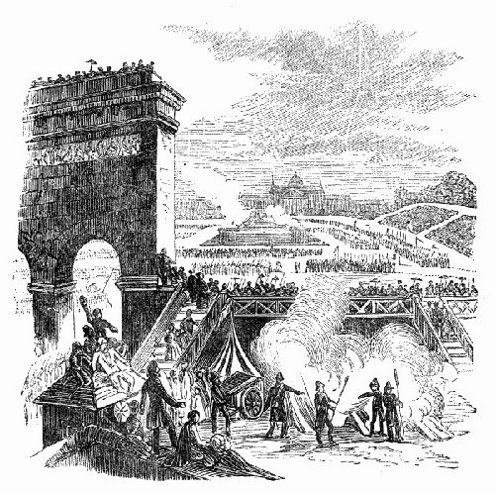
The leading events of the great Revolution in France, may be fairly classed with the marvellous, and among our "Ten Thousand Wonderful Things" there will be found few more wonderful than the civic festival of the general federation of the National Guards of France, which took place on the 14th of July, 1790, and of which the above is a correct representation, taken from a view by Duplessis Bertaux. The proceedings of that memorable day had in them a mixture of religious celebration apparently singular among a people who had lately so much trampled on religion; but as this celebration was more pagan than Christian in its character, the singularity becomes less marked. On the preceding evening, a Hiérodrame was performed at the cathedral of Nôtre Dame—a kind of sacred drama, made up by M. Désaugiers of scraps from the Bible mixed with other matter, and set to music; it professed to tell the story of the taking of the Bastille, and to typify the sadness, trouble, confusion, joy, and alarm of the Parisians. Then succeeded a Te Deum, chanted in presence of some of the principal federal and municipal bodies. Early in the morning of the 14th, amid dense clouds and heavy rain, the National Guards from all the eighty-three departments of France, together with deputations from the state army and navy, began to assemble, and speedily formed an immense line from the Porte St. Antoine to the Porte St. Martin; whence they marched, with bands playing and colours flying, to the Champ de Mars, regaled and cheered by the Parisians on the route. On reaching the great square of the Tuileries, the procession was headed by the municipality of Paris and the members of the National Assembly, and followed by a body of gray-headed veterans. The procession traversed the Seine by one of the bridges, greeted by salvos of artillery drawn up on the quays, and entered the Champ de Mars under a triumphal arch almost hidden by flags and patriotic inscriptions. One o'clock had arrived before the various bodies forming the procession had taken their destined places in the enclosed parallelogram, surrounded by nearly 300,000 spectators on the raised terraces, most of whom were by this time drenched by the continuous rain. In the centre of the area was a lofty altar, half pagan, half Catholic in its adornments; and around this altar the provincial National Guards danced and sang in very excited fashion. The royal family appeared at three o'clock. In an immense gallery near the altar, the National Assembly were seated, with the king and the president on two chairs of state exactly equal in height and richness, and the queen and the rest of the court seated behind—a significant interpretation of the decree just announced. At the instant of the king taking his seat, the air was rent with cries of Vive le Roi! Vive la Nation! The banners were unfurled; 1,800 musicians burst forth with jubilant strains; cannon poured out continuous volleys; Talleyrand, as bishop of Autun, assisted by sixty chaplains of the Paris National Guards, performed mass at the altar; and the banners were blessed by sprinkling with holy-water. Then Lafayette, dismounting from his white charger, received from the hands of the king a written form of oath; he swore to this oath at the altar, and with his raised arm gave a signal for the countless host to do likewise—every one raising his right hand, and saying Je le jure! The king took the oath prescribed to him; and the queen held up the dauphin in her arms, as if to denote that he also, poor child, had sworn to defend the national liberties. At five o'clock the royal family retired, and the crowd began to leave the Champ de Mars. Twenty-five thousand federates or provincial deputies went to a royal château about a mile distant, where a dinner had been prepared for them by order of the municipality of Paris, with Lafayette as chairman of the banquet. At night all Paris was illuminated; and for three or four days the feastings, reviews, and celebrations were numerous, including a grand dance on the site of the demolished Bastille. On the 18th, Lafayette reviewed the provincial or federate National Guards, and on the 19th they were reviewed by the king. Paris was intoxicated for an entire week, each man displaying at once his delight and his vanity.
A MAN CARRIES HIS HOUSE ON HIS HEAD.
Simeon Ellerton, of Craike, Durham, died 1799, aged 104. This man, in his day, was a noted pedestrian, and before the establishment of regular "Posts," was frequently employed in walking commissions, from the northern counties to London and other places, which he executed with singular fidelity and despatch. He lived in a neat stone cottage of his own erecting; and what is remarkable, he had literally carried his house on his head; it being his constant practice to bring back with him from every journey which he undertook, some suitable stone, or other material for his purpose, and which, not unfrequently, he carried 40 or 50 miles on his head.
IGNORANCE AND FEAR.
In the year 1712, Whiston predicted that the comet would appear on Wednesday, 14th October, at five minutes after five in the morning, and that the world would be destroyed by fire on the Friday following. His reputation was high, and the comet appeared. A number of persons got into boats and barges on the Thames, thinking the water the safest place. South Sea and India stock fell. A captain of a Dutch ship threw all his powder into the river, that the ship might not be endangered. At noon, after the comet had appeared, it is said that more than one hundred clergymen were ferried over to Lambeth, to request that proper prayers might be prepared, there being none in the church service. People believed that the day of judgment was at hand, and acted some on this belief, more as if some temporary evil was to be expected. There was a prodigious run on the bank, and Sir Gilbert Heathcote, at that time the head director, issued orders to all the fire offices in London, requiring them to keep a good look out, and have a particular eye upon the Bank of England.
ARABIAN HORSES.
It is a singular circumstance, that it is to the Arabian that England is indebted for her improved, and now unrivalled, breed of horses for the turf, the field, and the road.
The Arabian horses are divided into two great branches; the Kadischi whose descent is unknown, and the Kochlani, of whom a written genealogy has been kept for 2000 years. These last are reserved for riding solely, they are highly esteemed and consequently very dear. They are said to derive their origin from King Solomon's studs. However this may be they are fit to bear the greatest fatigues, and can pass whole days without food. They are also said to show uncommon courage against an enemy. It is even asserted, that when a horse of this race finds himself wounded and unable to bear his rider much longer, he retires from the fray, and conveys him to a place of security. If the rider falls upon the ground, his horse remains beside him, and neighs till assistance is brought. The Kochlani are neither large nor handsome but amazingly swift. The whole race is divided into several families, each of which has its proper name. Some of these have a higher reputation than others on account of their more ancient and uncontaminated nobility.
We may not believe, perhaps, all that is told us of the Arabian. It has been remarked that there are, on the deserts which his horse traverses, no milestones to mark the distance, or watch to calculate the time; and the Bedouin is naturally given to exaggeration, and most of all when relating the prowess of the animal which he loves as dearly as his children; yet it cannot be denied that at the introduction of the Arabian into the European stables, there was no other horse comparable to him.
HEAD-QUARTERS OF PRINCE RUPERT AT EVERTON, DURING THE SIEGE OF LIVERPOOL, IN 1644.
Prince Rupert, assisted by the Earl of Derby, having taken Bolton by storm, and refreshed his army there for some days, advanced on Liverpool, where the Parliament had a strong garrison under the command of Colonel More, of Bank-hall; and finding on his approach to the town, the high ground near it favourable to his design, compared it to a crow's nest, probably imagining it would be taken with as little difficulty; but the resistance he met with, induced him to declare it was more like an eagle's nest, or a den of lions.
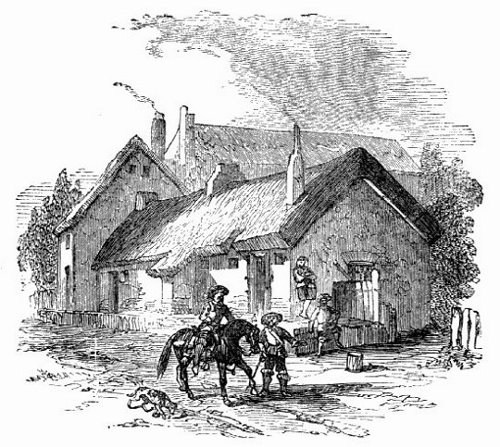
The siege began about the 2nd of June, and the view exhibits his head-quarters from that time till the reduction of the place. His main camp was established round the beacon, about a mile from the town, and his officers were placed in the adjoining villages, from whence a detachment marched every day, being relieved every twenty-four hours, to open trenches and erect batteries. From these advances Prince Rupert frequently attacked the besieged and their works in the way of storm, but was constantly repulsed with great slaughter of his men. At length, Colonel More, finding the town must of necessity surrender, and desirous of ingratiating himself with the Prince, for the preservation of his house and effects at Bank Hall, gave such orders for his soldiers to retire, that the works on the enemy's side were abandoned, and the royalists entered the town at three o'clock in the morning of June 26, putting to the sword all they met with, till they arrived at the High Cross, which then stood on the site where the Exchange now stands. Here the soldiers of the Castle, drawn up in line, beat a parley, and demanded quarter, which, on their submitting as prisoners of war, and surrendering the Castle to the Prince, was granted. The soldiers were then sent to the tower, St. Nicholas's Church, and other places of security; but the Parliament-army, soon after the siege, repossessed themselves of the Castle, and appointed Col. Birch, as governor.
FIRE AT BURWELL, CAMBRIDGESHIRE. 1727.
Some strollers brought down a puppet-show, which was exhibited in a large thatched barn. Just as the show was about to begin, an idle fellow attempted to thrust himself in without paying, which the people of the show preventing, a quarrel ensued. After some altercation, the fellow went away, and the door being made fast, all was quiet; but the same man, to gain admittance privately, got over a heap of hay and straw, which stood near to the barn, and accidentally set it on fire. The spectators of the show, alarmed by the flames, which had communicated to the barn, rushed to the door; but it happened unfortunately that it opened inwards, and the crowd pressing violently against the door, there could be no escape. Thus the whole company, consisting of more than 160 persons, were kept confined till the roof fell in, and covered them with fire and smoke: six only escaped with life; the rest, among whom were several young ladies of fortune, were reduced to one undistinguishable heap of mangled bodies, totally disfigured. The friends of the dead, not knowing which were the remains they sought, caused a large hole to be dug in the churchyard, and all the bodies were promiscuously interred together, and a tablet erected in the church to perpetuate this most melancholy event.
AN APPARENT SINGULARITY ACCOUNTED FOR.
It is generally well known that birds are very active agents in the extension of vegetation, and that fruit and flowers are, to a great extent, rendered prolific by the insects which visit their blossoms; but few people are aware of the means through which fish are formed in lakes and ponds, which are not connected with other waters. Here, also, an insect is the principal agent. The large water-beetle, which is in the habit of feeding upon the spawn of fish, occasionally in the evening climbs up the stems of rushes, &c. out of the water, sufficiently high to enable it to take wing; in these circumstances it has been caught, and, putting it into water, has been found to give out the spawn with which it had gorged itself previous to taking flight, both in a digested and undigested state; so that, on trial, it has been found that it produced fish of various kinds.
EUROPEAN BALANCING EQUAL TO THE INDIAN JUGGLERS.
The astonishing dexterity of the Indian jugglers is known to all, but many years ago a Spaniard named Cadenas made himself equal, if not superior to them. He may be truly said to be superior to them, inasmuch as several of his feats have never been attempted by them. Don Cadenas extended himself flat on his back on a large table. He then elevated his legs until they were at right angles with his body; he was assisted in keeping this position by a sort of pyramidal cushion, which was placed under him, a little below the lower end of his back. His feet and ankles were covered with boots, on which were many small castanets and little bells. The tranca, which is a round piece of wood, about 8 feet long and five inches in diameter, handsomely painted, was then laid horizontally on the soles of his feet, his legs being perpendicular. Having exactly balanced the tranca, he alternately struck his feet against it, the castanets, &c., keeping time with the music. In proportion to the strength with which he struck the tranca, with one foot or both feet, was the height to which he elevated it, always catching it, in its descent, with great accuracy, on the soles of his feet. Sometimes by bending his knees and then striking out with his limbs, he threw the tranca several feet into the air, catching it, in its descent, on his feet, with as much neatness and more certainty than the Indian jugglers used to catch the brass balls in their hands. He concluded the performance with the tranca, by exactly balancing it on the sole of his left foot, and then by repeated strokes of his right foot set it rapidly in motion like a horizontal fly-wheel.
MOB-WISDOM.
A singular instance of a mob cheating themselves by their own headlong impetuosity, is to be found in the life of Woodward, the comedian. On one occasion, when he was in Dublin, and lodged opposite the Parliament House, a mob who were making the members swear to oppose an unpopular bill, called out to his family to throw them a Bible out of the window. Mr. W. was frightened, for they had no such book in the house, but he threw out a volume of Shakespere, telling the mob they were welcome to it. They gave him three cheers, swore the members upon this book, and afterwards returned it without discovering its contents.
COMMUNICATION BETWEEN ANIMALS.
The means by which animals contrive to communicate their ideas to each other is a phenomenon which has never been satisfactorily explained. The two following instances of it are very curious. A gentleman who was in the habit of occasionally visiting London from a distant county performed the journey on horseback, accompanied by a favourite little terrier dog, which he left at an inn at some distance from London till his return. On one occasion on calling for his dog the landlady told him that it was lost; it had had a quarrel with the great house dog, and had been so worried and bit that it was thought he would never recover, but at the end of a few days he crawled out of the yard, and no one saw him for almost a week, when he returned with another dog bigger than his enemy, on whom they both fell and nearly destroyed him. This dog had actually travelled to its own home at Whitmore in Staffordshire, had coaxed away the great dog in question, which followed him to St. Alban's to assist in resenting the injury of his friend. The following story is related of a little spaniel which had been found lame by a surgeon at Leeds. He carried the poor animal home, bandaged up his leg, and after two or three days turned him out. The dog returned to the surgeon's house every morning till his leg was perfectly well. At the end of several months, the spaniel again presented himself in company with another dog, which had also been lamed; and he intimated, as well as piteous and intelligent looks could intimate, that he desired the same assistance to be rendered to his friend as had been bestowed upon himself. The combination of ideas in this case, growing out of the recollection of his own injury, and referring that to the cure which had been performed; the compassion he had for his friend to whom he communicated the occurrence, and induced to seek relief under his guidance, together with the appeal to the humane surgeon, is as extraordinary a piece of sagacity as can be found in all the annals of animals.
STRANGE CUSTOM ABOUT NAMES.
The following anecdote forcibly illustrates the absurd custom which prevailed many years ago in America, of giving children names, made up of Scripture sentences. We record the anecdote as being descriptive of a curious local custom. About the beginning of the present century a New England sea captain having some business at a public office, which required him to sign his name, was rather tedious in performing the operation, which did not escape the observation of the officer, who was a little impatient at the delay, and curious withal to see what sort of a name it could be that required so long a time to spread it upon paper. Perhaps the captain had a long string of titles to grace it, such as honorable, esquire, colonel of militia, selectman of the town of ——, &c., which he chose to make an ostentatious parade of; or perhaps it was his whim to subscribe the place of his nativity and that of his residence, together with his age, height, and complexion. He was mistaken; for the captain had subscribed nothing but simply his name, which, when he had done, the officer, after some trouble in decyphering, found to read thus:—Through-Much-Tribulation-We-Enter-Into-the-Kingdom-of-Heaven Clapp. "Will you please to tell me, Captain Clapp," said he, with as demure a face as his violent inclination to indulge in a hearty laugh would allow him to put on, "what might your mother have called you in your infancy, to save herself the trouble of repeating a sermon whenever she had occasion to name her darling?" "Why, sir," replied Captain Clapp, with laughable simplicity, "when I was little they used to call me Tribby, for shortness."
DRESS IN LONDON DURING THE LAST CENTURY.
The seven illustrations which accompany this article represent the progress of dress in London from 1690 to 1779. They speak for themselves, and tell their own tale far better than any description in words could tell it for them. The scale in society to which the persons depicted in the engravings belong, is what may be called the upper middle class, and we thus obtain a more correct idea of the general style of dress, than we should have done had we confined our observations solely to the higher ranks.
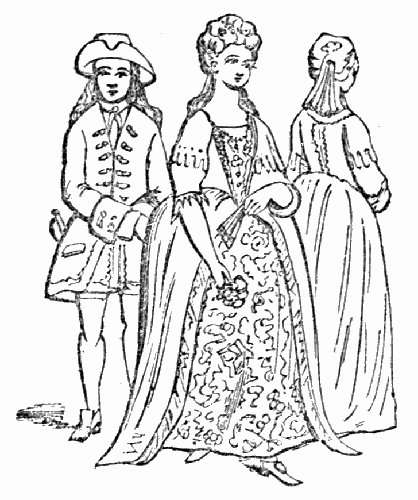
DRESS 1690-1715.
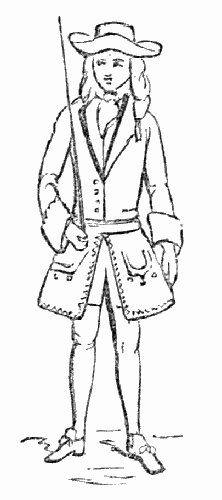
DRESS 1721.
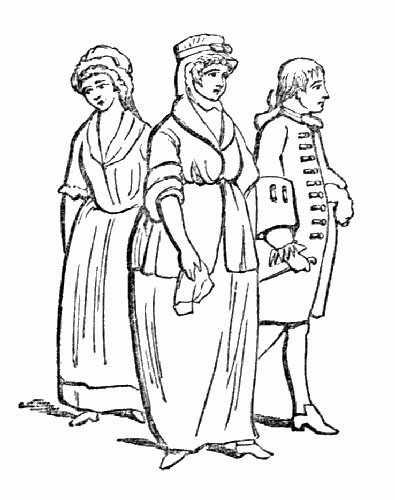
DRESS, 1735—COMMON LIFE.
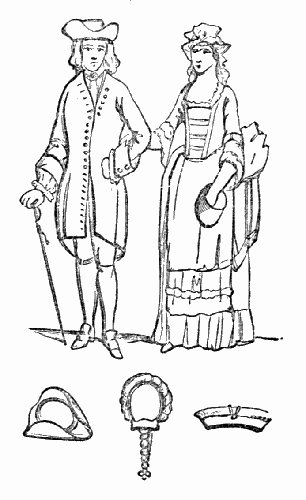
DRESS, 1738.
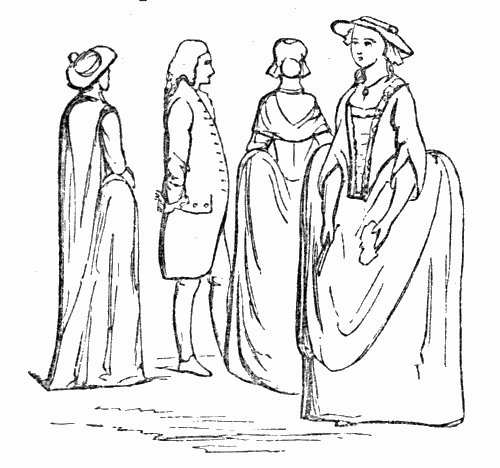
DRESS, 1752.
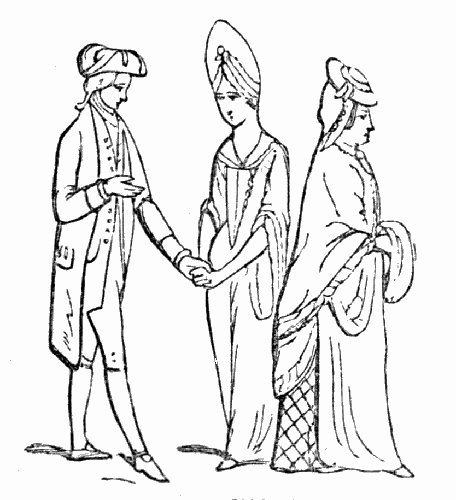
DRESS CIRCA 1773, 1778.
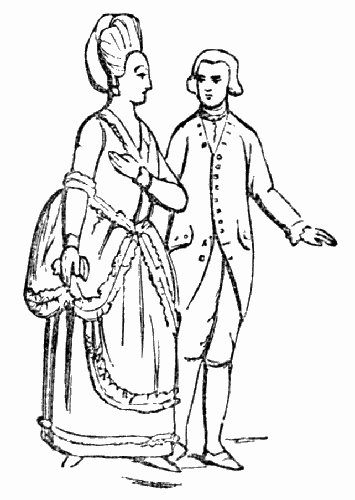
DRESS, 1779.
It is, however, very curious to notice the value placed upon dress during the period indicated; and how frequently its loss is recorded. Thus we find it mentioned that Lady Anderson, whose house was robbed at a fire in Red Lion Square in 1700, lost a gown of orange damask, lined with, striped silk. The family of George Heneage, Esq., at the same time, and by the same casualty, lost "a head, with very fine looped lace of very great value, a Flanders' laced hood, a pair of double ruffles and tuckers, two laced aprons, one edged with point lace, and a large black scarf embroidered with gold." At the same period the ladies wore Holland petticoats, embroidered in figures with different coloured silks and gold, with broad orrice at the bottom. In 1702 diamond stomachers adorned the ladies; they were composed of that valuable stone set in silver, and sewed in a variety of figures upon black silk. The men imported the Champaign wig from France. They were made very full, curled, and eighteen inches in length to the point, with drop locks. In the Post Boy, of November 15, 1709, there were advertised as stolen, "A black silk petticoat, with red and white calico border, cherry-coloured stays, trimmed with blue and silver, a red and dove-coloured damask gown, flowered with large trees; a yellow satin apron, trimmed with white Persian, and muslin head-clothes, with crow-foot edging; a black silk furbelowed scarf, and a spotted hood." Black and beaver hats for ladies were advertised in 1719, faced with coloured silks, and trimmed with gold and silver lace. A man of fashion in 1720 wore the full flowing curled wig, which fell in ringlets half-way down his arms and back, a laced coat, straight, formal, with buttons to the very bottom, and several on the pockets and sleeves; his shoes were square at the toes, had diminutive buckles, a monstrous flap on the instep, and high heels, a belt secured the coat and supported the sword. Perukes were a highly important article of dress in 1734. Fans were much used, ladies seldom appeared without this useful ornament in their hands. The hoop underwent many important changes; sometimes it projected at the sides only, or, like its ancestor, the fardingale, it spread itself all round in imposing majesty. High-heeled shoes maintained their place. In 1740 tight sleeves with full ruffles, small pointed waists, enclosed in whalebone, loose gowns, called sacques, and cloaks with hoods, named cardinals, were la grande monde. Among the gentlemen's costumes, the most striking was the Ramilies tail, which was a plaited tail to the wig, with an immense bow at the top and one at the bottom. Claret coloured clothes were considered as handsome; and light blue with silver button-holes, and silver garters to the knees, was very fashionable between 1740 and 1751. The change to wearing the natural hair instead of wigs took place about 1765. From that date the female dress altered by degrees: the cap was enlarged to an enormous size, and the bonnet swelled in proportion. Hoops were entirely discontinued. Hats and bonnets of straw, chip, and beaver, became well proportioned, and velvet pelisses, shawls and silk spencers were contrived to improve rather than injure the form. The male dress also insensibly changed from formality to ease, and thus, by degrees, the fashion became what our illustrations represent it to have been in 1779.
ATTAR OF ROSES.
Lieutenant Colonel Polier gives a full history of extracting this essential oil, in vol i. p. 332, of the Asiatic Researches. The roses grow, cultivated near Lucknow, in fields of eleven acres each. The oil is procured by distillation; the petals of the flowers only are used; and in that country no more than a quantity of about two drachms can be procured from an hundred-weight of rose leaves, and even that in a favourable season, and by the process being performed with the utmost care. The oil is by accident of different colours; of a bright yellow, of a reddish hue, and a fine emerald. It is to the mother of Mebrul Nessa Begum, afterwards called Nourjehan Begum, or, Light of the World, that the fair sex is indebted for this discovery. On this occasion the emperor of Hindostan rewarded the inventress with a string of valuable pearls. Nourjehan Begum was the favourite wife of Jehangir, and her game the fiercest of India. In a hunting party she killed four tigers with a matchlock, from her elephant, and her spouse was so delighted at her skill, that he made her a present of a pair of emerald bracelets, valued at a lack of rupees, and bestowed in charity a thousand mohurs.
FLEET MARRIAGES ABOUT 1740.
Many of the early Fleet weddings were really performed at the chapel of the Fleet; but as the practice extended, it was found more convenient to have other places within the Rules of the Fleet, (added to which the Warden was compelled by act of parliament not to suffer them,) and thereupon many of the Fleet parsons and tavern-keepers in the neighbourhood fitted up a room in their respective lodgings or houses as a chapel. The parsons took the fees, allowing a portion to the plyers, &c., and the tavern-keepers, besides sharing in the fees, derived a profit from the sale of liquors which the wedding party drank. In some instances the tavern-keepers kept a parson on their establishment at a weekly salary of twenty shillings; while others, upon a wedding-party arriving, sent for any clergyman they might please to employ, and divided the fee with him. Most of the taverns near the Fleet kept their own registers, in which (as well as in their own books,) the parsons entered the weddings.
EFFECTS OF THE GREAT EARTHQUAKE AT LISBON.
The earthquake happened on November the 1st, 1755, and its sphere of action embraced many cities and states. St. Ubes was totally destroyed. At Cadiz the sea broke down the outer wall, flooded the town, and drowned some hundreds of persons. The Cathedral of Seville was seriously damaged, several houses overthrown, and many persons injured. The shock was felt, indeed, throughout the whole of Spain, except in Catalonia, and also in Germany. In many parts of Great Britain the water in lakes and ponds was violently upheaved, and ebbed and flowed over the banks. A solemn Fast was consequently commanded to be observed on the 6th of February next ensuing, in the hope to avert, by prayer and penitence, a similar calamity from this country. A ship at sea, 100 leagues to the westward of Lisbon, had her cabin windows shattered to fragments, and many vessels in deep water quivered as if they had struck against a rock. In Morocco the effects of the shock were most disastrous. In Mequinez two-thirds of the houses were destroyed, and above 300 in Fez. A caravan of 200 persons going along the coast from Sallee to Morocco were overwhelmed by the sea, and a still more numerous caravan was swept away by the sudden rise of the inland rivers. In France and Holland earthquakes were repeatedly felt during the entire month of November, and occasionally even in December.
SNAKE-CHARMERS.
In the East Indies, the Pambatees, or snake-charmers, come from the mountains called the Ghauts. They make a trade of catching serpents, training them and exhibiting them for money. These reptiles are commonly the cobra-di-capello, the hooded or spectacle serpent, and of other similar species. A Pambatee will sometimes carry eight or more of them in a low round basket, in which the serpents lie coiled round one another.
As soon as the lid is removed from the basket, the serpent creeps out of it. The master plays on an instrument somewhat resembling the bagpipe, and the snakes are taught to mark the cadence by the motion of their heads, till at length they fall asleep. In order to rouse them, the Pambatee suspends his music and shakes a ring round his arm to which a piece of red cloth is fastened. The irritated serpent darts at the ring; but as the master has taken care to extract the pouch containing the poison, and to file his teeth, he can do no harm.
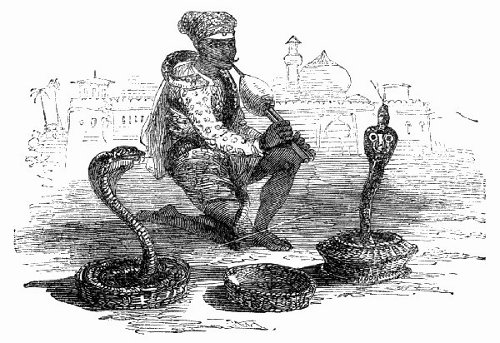
The musical instrument just mentioned is called magootee. It is composed of a hollow calebash, to one end of which is fitted a mouthpiece similar to that of the clarinet. To the other extremity is adapted a tube perforated with several holes, which are successively stopped by the fingers, like those of the flute, while the player blows into the mouthpiece. In the middle of the instrument is a small mirror, on which the serpents fix their eyes while dancing. The above engraving will convey a correct idea of the Pambatee and his instrument.
WONDERFUL ESCAPE.
In 1785, at Winster, in Derbyshire, a show being exhibited at a public-house, some gunpowder being scattered on the floor of an upper chamber, took fire, and communicated to the remainder of a barrel, by which the whole upper part of the house was blown up; about sixty persons were below, and not one hurt.
FAC-SIMILE OF THE FIRST STEAM BOAT.
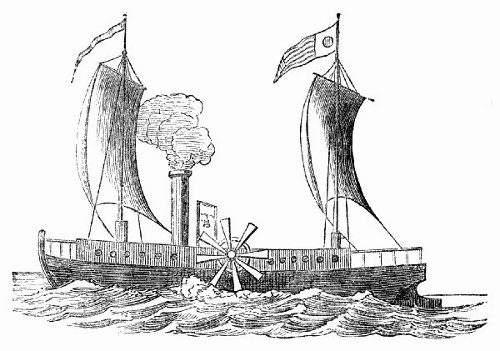
The triumph of steam navigation is one of the wonders of science; and, traversed in all directions as the navigable waters of the earth now are, by vessels propelled by steam, it is not a little curious to look at the first rude effort, and to examine the attempt which has been followed by such extraordinary success.
The world stands indebted, not for the discovery, but for the successful application of steam power to navigation, to Robert Fulton, who was born in Pennsylvania in 1765, being the son of a poor Irish labourer who had emigrated to America. He came to London in 1786, and subsequently, in the character of an inventor and projector, proceeded to Paris, where, however, he did not meet with much success or encouragement. It is evident, from the following letter to a friend, that while residing in the French capital, that his attention was even then turned to the subject of propelling vessels by mechanical power:—
Paris, the 20th of September, 1802.
To Mr. Fulner Skipwith. Sir,—The expence of a patent in France is 300 livers for three years, 800 ditto for ten years, and 1500 ditto for fifteen years; there can be no difficulty in obtaining a patent for the mode of propelling a boat which you have shewn me; but if the author of the model wishes to be assured of the mirits of his invention before he goes to the expence of a patent, I advise him to make the model of a boat, in which he can place a clock spring which will give about eight revolutions; he can then combine the movements so as to try oars, paddles, and the leaves which he proposes; if he finds that the leaves drive the boat a greater distance in the same time than either oars or paddles, they consequently are a better application of power. About eight years ago the Earl of Stanhope tried an experiment on similar leaves in Greenland Dock, London, but without success. I have also tried experiments on similar leaves, wheels, oars, paddles, and flyars similar to those of a smoak jack, and found oars to be the best. The velocity with which a boat moves, is in proportion as the sum of the surfaces of the oars, paddles, leaves, or other machine is to the bow of the boat presented to the water, and in proportion to the power with which such machinery is put in motion; hence, if the sum of the surfaces of the oars is equal to the sum of the surfaces of the leaves, and they pass through similar curves in the same time, the effect must be the same; but oars have this advantage, they return through air to make a second stroke, and hence create very little resistance; whereas the leaves return through water, and add considerably to the resistance, which resistance is increased as the velocity of the boat is augmented: no kind of machinery can create power; all that can be done is to apply the manuel or other power to the best advantage. If the author of the model is fond of mechanics, he will be much amused, and not lose his time, by trying the experiments in the manner I propose, and this perhaps is the most prudent measure, before a patent is taken.
I am, Sir, with much respect, yours, Robt. Fulton.
In the following year, 1803, he appears to have made an experiment in France of propelling a vessel by mechanism, and though it failed in consequence of the timbers of the boat being too weak, it served to convince him so completely of ultimate success, that he immediately gave instructions to Watt and Boulton to prepare a suitable steam engine for him, and send it to New York. Having returned to that city in 1806, he set about building a boat, and having received the engines he had ordered, he successfully started the first steam-boat in the world on her trial trip to Albany from New York in August, 1807. Her name was the "Clermont," and the above engraving is a correct representation of her. She was in length 133 feet, in depth 7, and in breadth 18.
SEVERE ENACTMENT AGAINST BEGGARS.
At the commencement of the reign of Edward VI., a most severe and extraordinary statute was made for the punishment of vagabonds and relief of poor persons. It does not appear who were the contrivers of this instrument, the preamble and general spirit of which were more in accordance with the tyrannical and arbitrary measures of the preceding reign, than with the mild and merciful character of the infant sovereign, who is well known to have taken a very active part in the affairs of government. It repeals all the former statutes on this subject, and enacts, that if any beggar or other person, not being lame or impotent, and after loitering or idly wandering for the space of three days or more, shall not offer himself to labour, or being engaged in any person's service, shall run away or leave his work, it shall be lawful for the master to carry him before a justice of peace, who, on proof of the offence, shall cause the party to be marked with a hot iron with the letter V on the breast, and adjudge him to be his master's slave for the space of two years, who shall feed him "on bread and water, or at his discretion, on refuse of meat, and cause the said slave to work by beating, chaining, or otherwise in such work or labour (how vile soever it be) as he shall put him unto." If the slave should run away or absent himself for a fortnight without leave, the master may pursue and punish him by chaining or beating, and have his action of damage against any one who shall harbour or detain him. On proof before the justice of the slave's escape, he is to be sentenced to be marked on the forehead or ball of the cheek with a hot iron with the letter S, and adjudged to be his master's slave for ever; and for the second offence of running away, he is to be regarded as a felon and suffer death. The children of beggars to be taken from them, and, with other vagrant children, to be apprenticed by the magistrate to whoever will take them; and if such children so apprenticed run away, they are to be retaken, and become slaves till the age of twenty in females, and twenty-four in males, with punishment by chains, &c., and power to the master to let, sell, or bequeath them, as goods and chattels, for the term aforesaid. If any slave should maim or wound the master, in resisting correction, or conspire to wound or murder him, or burn his house or other property, he is to suffer death as a felon, unless the master will consent to retain him as a slave for ever; and if any parent, nurse, or bearer about of children, so become slaves, shall steal, or entice them away from the master, such person shall be liable to become a slave to the said master for ever, and the party so stolen or enticed away restored. If any vagrant be brought to a place, where he shall state himself to have been born, and it shall be manifest that he was not so born there, for such lie he shall be marked in the face with an S, and become a slave to the inhabitants or corporation of the city for ever. Any master of a slave may put a ring of iron about his neck, arm, or leg, for safe custody, and any person taking or helping to take off such ring, without consent of the master, shall forfeit the sum of ten pounds.
This diabolical statute, after remaining for two years, was repealed, on the ground that, from its extreme severity, it had not been enforced.
JUDGES IN THEIR ROBES ATTENDING PUBLIC BALLS.
That the ideas of good taste and propriety which now prevail are greatly in advance of those which our ancestors entertained, is strikingly manifested by the fact, that the dreadful scenes which followed the last business of a county assize did not prevent a festive beginning of the same. On the commission day at each county town was held an assize ball. The judges attended in black silk gowns with band and two-curl bob-wig. They did not dance, but usually played at whist. What would be thought now-a-days of judges who went to a public ball room on commission day, and played at whist in their robes?
ST. WINIFRED'S WELL.
The most copious spring in Great Britain is St. Winifred's Well, near the town of Holywell, in Flintshire. The well is an oblong square, about twelve feet by seven. The water passes into a small square court through an arch; it has never been known to freeze, and scarcely ever varies in quantity either in drought or after the greatest rains. The water thrown up is not less than eighty-four hogsheads every minute.
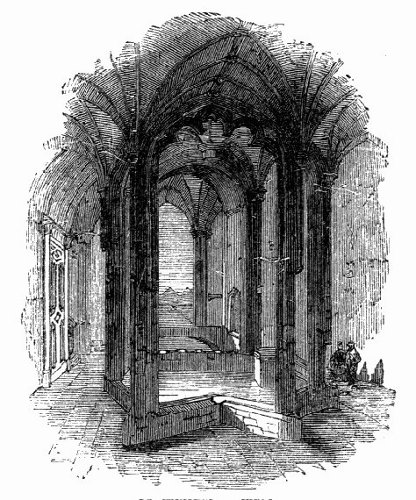
ST. WINIFRED'S WELL.
This sacred well is the object of many pilgrimages, even in the present day, and several modern miracles are related of the influence of its waters. Pope Martin V. especially enjoined such pilgrimages, and the monks of Basingwerk were furnished with pardons and indulgences to sell to the devotees. James the 2nd visited the well in 1686, and Leopold, King of the Belgians, in 1819. Apart from all superstitious notions, its waters doubtless possess many curative properties.
Over the well, Queen Margaret, the mother of Henry VII., erected a beautiful chapel, whose elegantly fretted roof, and graceful columns and arches, are generally admired as examples of good architecture. Our engraving is a correct representation of the interior.
INSTANCE OF ASSIDUITY AND PERSEVERANCE.
The Rev. Wm. Davy, a Devonshire curate, in the year 1795, begun a most desperate undertaking, viz., that of printing himself twenty-six volumes of sermons, which he actually did, working off page by page, for fourteen copies; and continuing this almost hopeless task for twelve years, in the midst of poverty! Such wonderful perseverance almost amounts to a ruling passion.
PHENOMENON AT THE POWERSCOURT FALL.
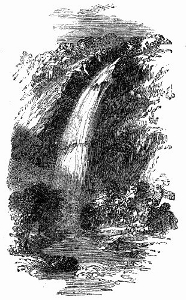
The Powerscourt Fall, of which the annexed is an engraving, is formed by the river Dargle, and is situated in the county of Wicklow. When the river is full, it presents a very grand appearance. The stream precipitates itself over a nearly perpendicular cliff, 300 feet in height, and falls into a natural basin or reservoir, encircled by rocky masses of considerable magnitude, whilst the whole scene is backed by mountains. This fall exhibits rather a singular phenomenon, in the different degrees of velocity with which the water descends in different parts of the cascade. Thus, on one side, the water may be observed to pour down with considerable velocity; while, on the other side, the fall, in the upper part, presents the appearance of a continued stream of frothy foam, gliding slowly down the face of the cliff, though the lower part moves with greater velocity. This circumstance is, however, readily accounted for; being, in fact, mainly attributable to the comparatively small body of water which forms the cascade. The water, on the one side, that which descends with the greater velocity (and this forms by far the larger portion of the cascade) meets with no interruption in its descent, but falls, almost from the top, to the bottom in an unbroken sheet. On the other side, however, the cliff in the upper part deviates from the perpendicular, and the consequence is, that, owing to the slope or inclination of the rock over which it flows, the progress of the water is checked in that particular part, though lower down, where the cliff is again perpendicular, it regains its velocity. If the body of water in this cascade were greater, this phenomenon would not occur.
HOW CHESS ORIGINATED IN INDIA.
By the unanimous consent of all nations, chess holds the first place among social amusements. The history of this game has exercised many able pens. According to Sir William Jones, it is decidedly of Hindoo invention. "If," says he, in a learned memoir on this subject inserted in the second volume of the Asiatic Researches, "evidence were required to prove this fact, we may be satisfied with the testimony of the Persians, who, though as much inclined as other nations to appropriate the ingenious inventions of a foreign people, unanimously agree that the game was imported from the west of India in the sixth century of our era. It seems to have been immemorially known in Hindoostan by the name of Cheturanga, the four angas, or members of an army, which are elephants, horses, chariots, and foot-soldiers; and in this sense, the word is frequently used by epic poets in their description of real armies. By a natural corruption of the pure Sanscrit word, it was changed by the old Persians into chetrang; but the Arabs, who soon after took possession of their country, had neither the initial nor the final letter of that word in their alphabet, and consequently altered it farther into shetranj, which presently found its way into the modern Persian, and at length into the dialects of India, where the true derivation of the name is known only to the learned. Thus has a very significant word in the sacred language of the Brahmins been transformed by successive changes into axedrez, scacchi, echecs, chess, and by a whimsical concurrence of circumstances given birth to the English word check, and even a name to the exchequer of Great Britain."
Of the origin of this game various accounts are given. Some Hindoo legends relate, that it was invented by the wife of Ravanen, king of Lanca, or Ceylon, to amuse her husband with an image of war, when Rama, in the second age of the world, was besieging his capital. The high degree of civilization which the court of Ravanen had attained at so remote a period is worthy of notice. An ancient Hindoo painting represents his capital regularly fortified with embattled towers. He there defended himself with equal skill and valour, whence he and his subjects were denominated magicians and giants. Ravanen seems to have been the Archimedes of Lanca; and his science must have appeared supernatural to the invader, Rama, and his wild horde of mountaineers, who were termed in derision satyrs or apes, whence the fable of the divine Hanooman.
According to another account, the occasion of this invention was as follows:—Behub, a young and dissolute Indian prince, oppressed his people in the most cruel manner. Nassir, a Brahmin, deeply afflicted by his excesses, and the lamentations of his subjects, undertook to recal the tyrant to reason. With this view he invented a game, in which the king, impotent by himself, is protected only by his subjects, even of the lowest class, and frequently ruined by the loss of a single individual.
The fame of this extraordinary invention reached the throne, and the king summoned the Brahmin to teach him the game, as a new amusement. The virtuous Brahmin availed himself of this opportunity to instil into the mind of the young tyrant the principles of good government, and to awaken him to a sense of his duties. Struck by the truths which he inculcated, the prince conceived an esteem for the inventor of the new game, and assured him of his willingness to confer a liberal remuneration, if he would mention his own terms. Nassir demanded as many grains of wheat as would arise from allowing one for the first square, two for the second, four for the third, and so on, doubling for each square of the sixty-four on the chessboard. The king, piqued at the apparently trivial value of the demand, desired him somewhat angrily to ask a gift more worthy of a monarch to bestow. When, however, Nassir adhered to his first request, he ordered the required quantity of corn to be delivered to him. On calculating its amount, the superintendents of the public granaries, to their utter astonishment, found the demand to be so enormous, that not Behub's kingdom only, but even all Hindoostan would have been inadequate to the discharge of it. The king now admired the Brahmin still more for the ingenuity of his request than for the invention, appointed him his prime-minister, and his kingdom was thenceforward prosperous and happy.
The claim of the Hindoos to the invention of chess has been disputed in favour of the Chinese; but as they admit that they were unacquainted with the game till 174 years before Christ, and the Hindoos unquestionably played it long before that time, the pretensions of the latter must naturally fall to the ground.
DISORDERS CURED BY FRIGHT.
Fabritius makes mention of a gentleman, with whom he was familiar, who, being unjustly suspected, was tortured upon the rack, and, when released, found himself quite cured of the gout, which was, before this violent remedy, rather troublesome. Again, we have instances of disorders being cured by fright. We find, in the Journal de Henri IV., that, "On Friday, June the 9th, 1606, as Henry IV. of France, and his Queen, were crossing the water in the ferry-boat of Neuilly, the Duke of Vendome being with them, they were all three in great danger of being drowned, especially the queen, who was obliged to drink a great deal more than was agreeable to her; and had not one of her footmen, and a gentleman called La Chatagnieraie, who caught hold of her hair, desperately thrown themselves into the water to pull her out, she would have inevitably lost her life. This accident cured the king of a violent toothache; and, after having escaped the danger, he diverted himself with it, saying he had never met with so good a remedy for that disorder before, and that they had ate too much salt meat at dinner, therefore they had a mind to make them drink after it."
THE WINGLESS BIRD OF NEW ZEALAND.
One of the chief wonders of the world of Ornithology is the Apteryx, a bird which is found only in New Zealand, and even there, is rapidly becoming extinct. It is a creature so strange, that no imagination could have fancied a bird without wings or tail, with robust legs, and with claws which are suited for digging, and are actually used in forming excavations, in which this singular bird lays its eggs, and hatches its young. If the Apteryx were to become extinct, and all that remained of it, after the lapse of one or two centuries, for the scrutiny of the naturalist were a foot in one Museum, and a head in another, with a few conflicting figures of its external form, the real nature and affinities of this most remarkable species would be involved in as much obscurity and doubt, and become the subject of as many conflicting opinions among the ornithologists of that period, as are those of the Dodo in the present day.
The Apteryx is not larger than a full-grown fowl, and has only a rudimentary wing, so covered with the body feathers as to be quite concealed; the terminating slender claw may, however, be discerned on examination.
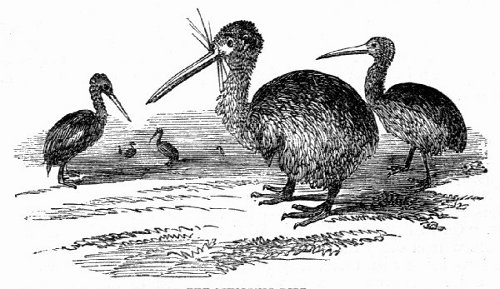
THE WINGLESS BIRD.
The bill is long and slightly curved, having the nostrils at the extremity; its feathers, the sides of which are uniform in structure, do not exceed four and a-half inches in length, and are much prized as material for mantles or cloaks by the chiefs. It is a nocturnal bird, using its long bill in search of worms, upon which it principally feeds; it kicks with great power, and burrows at the root of the rata, at the base of which tree is also found the extraordinary Sphæria Robertsia, a species of vegetating caterpillar. Retaining the form of the caterpillar, the fungus pervades the whole body, and shoots up a small stem above the surface of the ground, the body of the caterpillar being below the earth in an erect position. The Apteryx frequently leans with its bill upon the earth—one of its chief characteristics—and thus, when viewed from a distance, appears to be standing on three legs.
By the natives of New Zealand, these birds are called Kiwis, from the cry they utter, and they are frequently caught by a cunning imitator of their tone, who, when they approach, dazzles and frightens them with a light previously concealed, and throwing his blanket over them thus secures them.
A FLOATING CITY.
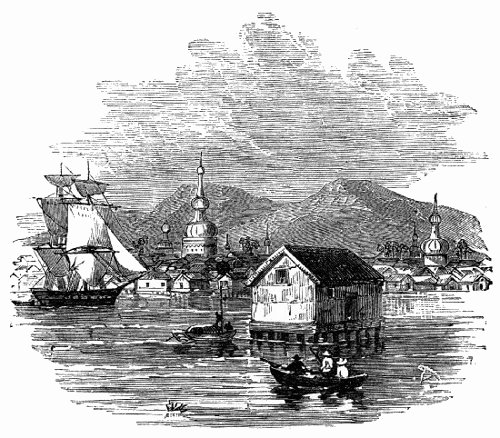
FLOATING CITY OF BANKOK.
One of the most wonderful cities in the world is Bankok. It is the capital of Siam, and is situated on—or rather in—the great river Meinam. Our engraving represents a portion of this unique metropolis, and we find the following graphic account of it in a volume of recent travels—"The capital of Siam! Did you ever witness such a sight in your life? On either side of the wide, majestic stream, moored in regular streets and alleys, and extending as far as the eye can reach, are upwards of seventy thousand neat little wooden houses, each house floating on a compact raft of bamboos; and the whole intermediate space of the river presents to our astonished gaze one dense mass of ships, junks, and boats, of every conceivable shape, colour, and size. As we glide along amongst these, we occasionally encounter a stray floating house, broken loose from its moorings, and hurrying down the stream with the tide, amidst the uproar and shouts of the inhabitants and all the spectators. We also observe that all the front row of houses are neatly painted shops, in which various tempting commodities are exposed for sale; behind these again, at equal distances, rise the lofty and elegant porcelain towers of the various watts and temples. On our right-hand side, far away as we can see, are three stately pillars, erected to the memory of three defunct kings, celebrated for some acts of valour and justice; and a little beyond these, looming like a line-of-battle ship amongst a lot of cockle-shells, rises the straggling and not very elegant palace of the king, where his Siamese Majesty, with ever so many wives and children, resides. Right ahead, where the city terminates, and the river, making a curve, flows behind the palace, is a neat-looking-fort, surmounted with a tope of mango-trees, over which peep the roofs of one or two houses, and a tall flag-staff, from which floats the royal pendant and jack of Siam—a flag of red groundwork, with a white elephant worked into the centre. That is the fort and palace of the prince Chou Fau, now king of Siam, and one of the most extraordinary and intellectual men in the East. Of him, however, we shall see and hear more, after we have bundled our traps on shore, and taken a little rest. Now, be careful how you step out of the boat into the balcony of the floating house, for it will recede to the force of your effort to mount, and if not aware of this, you lose your balance and fall into the river. Now we are safely transhipped, for we cannot as yet say landed; but we now form an item, though a very small one, of the vast population of the city of Bangkok.
We take a brief survey of our present apartments, and find everything, though inconveniently small, cleanly and in other respects comfortable. First, we have a little balcony which overhangs the river, and is about twenty yards long by one and a half broad. Then we have an excellent sitting-room, which serves us for parlour, dining-room, and all; then we have a little side room for books and writing; and behind these, extending the length of the other two, a bed-room. Of course we must bring or make our own furniture; for, though those houses inhabited by the Chinese are pretty well off on this score, the Siamese have seldom anything besides their bedding materials, a few pots and pans to cook with, a few jars of stores and fishing-net or two. Every house has a canoe attached to it, and no nation detests walking so much as the Siamese; at the same time they are all expert swimmers, and both men and women begin to acquire this very necessary art at a very early age. Without it a man runs momentary risk of being drowned, as, when a canoe upsets, none of the passers-by ever think it necessary to lend any aid, supposing them fully adequate to the task of saving their own lives. Canoes are hourly being upset, owing to the vast concourse of vessels and boats plying to and fro; and, owing to this negligence or carelessness in rendering assistance, a Mr. Benham, an American missionary, lost his life some twelve years ago, having upset his own canoe when it was just getting dusk, and though surrounded by hundreds of boats, not one deemed it necessary to stop and pick the poor man up."
BEQUESTS FOR LIGHTING THE STREETS.
There cannot be a greater contrast than between the present and the ancient mode of lighting the streets of London. What a picture do the two following bequests present to us of the state of things a hundred years ago!
John Wardall, by will, dated 29th August, 1656, gave to the Grocers' Company a tenement called the White Bear, in Walbrook, to the intent that they should yearly, within thirty days after Michaelmas, pay to the churchwardens of St. Botolph, Billingsgate, £4, to provide a good and sufficient iron and glass lantern, with a candle, for the direction of passengers to go with more security to and from the water-side, all night long, to be fixed at the north-east corner of the parish church of St. Botolph, from the feast-day of St. Bartholomew to Lady-Day; out of which sum £1 was to be paid to the sexton for taking care of the lantern. This annuity is now applied to the support of a lamp in the place prescribed, which is lighted with gas.