TEN THOUSAND WONDERFUL THINGS. (continued 6)
Reading edition
STORMING OF THE BASTILLE AT PARIS.
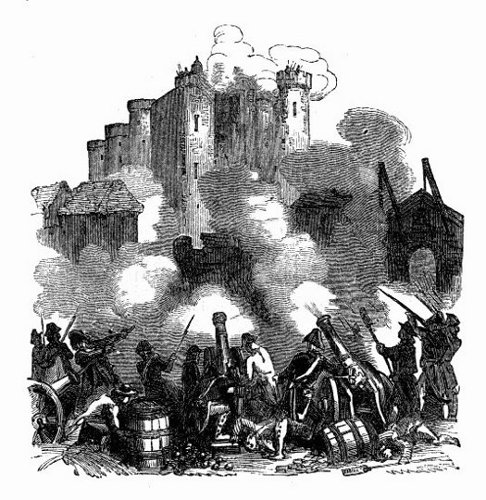
The great Revolution in France, at the close of the last century, was full of wonderful events, many of which might be appropriately recorded in our pages. One of the most striking among them was the storming and capture of the Bastille, a vast state-prison which was begun to be built in 1369 by Charles V., and finished by his successor in 1383. The demolition of this fortress was the first triumph of the armed populace of Paris, and it rendered the progress of the revolution irresistible. As the day closed in on the evening of Monday, the 14th of July, 1789, a reckless multitude of rioters, after seizing 30,000 muskets and several pieces of artillery at the Hotel des Invalides, rushed in wild excitement to the Bastille, rendered hateful to the people by the political imprisonment of many hapless men in past times, although less frequently applied to similar purposes under the milder rule of Louis XVI. An armed mob of at least 100,000 men, aided by troops who joined them in whole regiments at a time, had not long to contend against the old fortress. The governor, De Launay, made such a defence as a brave officer might at such a juncture; but his few troops were bewildered and wavering; he received orders from the Hotel de Ville which he knew not whether to obey or resist, but no instructions from the court or the ministers; and the military aid to the mob became stronger than any force he could bring to bear against them. The chains of three drawbridges were broken by hatchets; straw, wood, oil, and turpentine were brought and kindled, to burn down the gates; and after many volleys from the mob had been answered by a few from the fortress, De Launay, seeing no hope of succour, resolved to blow up the place rather than yield. In this he was prevented by the Swiss guards, who formed a part of the small garrison, and who, after a parley with the insurgents, opened the gates, and surrendered. The Bastille was taken. The ruffians, heeding nothing but their own furious passions, disregarded the honourable rules of capitulation; they beheaded De Launay in a clumsy and barbarous manner, and putting his head on a spike, carried it through the streets shouting, laughing, and singing; they were prevented only by an accidental interruption from burning alive a young lady whom they found in one of the court-yards; they hung or maltreated many of the Swiss and invalid soldiers; and they fearfully hacked the bodies of three or four officers in the endeavour to decapitate them. The prisoners within, only seven in number, were liberated, and treated with a drunken revel; while the Châtelet and other prisons became scenes of renewed disorders. The sketch which we give above, of the attack on the Bastille, is taken from a medallion by Andrieu.
DURATION OF LIFE AMONG ARTISTS.
In Gould's Dictionary of Artists, published in 1839, the names, with the ages, of 1,122 persons are given; which furnish the following remarkable facts as to the longevity of this class of men. Died under 60 years old, 474; 60 years and under 70, 250; 70 years and under 80, 243; 80 years and under 90, 134; 90 years and under 100, 19; above 100, 1. The mean age at death of the whole number being 55 years; from which it would appear that the pursuit of the fine arts has a tranquilizing effect upon the spirits, and a tendency to moral refinement in the habits and manners of its professors extremely favourable to the prolongation of life.
CHANGE IN THE VALUE OF LAND.
At Brighton, within the present century, a spot of ground was offered to a hair-dresser in fee, upon condition of shaving the possessor for life. The terms were declined, and the land soon became of immense value.
UNACCOUNTABLE ANTIPATHIES.
The following are a few of the more striking manifestations of that unaccountable feeling of antipathy to certain objects, to which so many persons are subject, and with instances of which—in a modified form perhaps—most people are acquainted with:—
Erasmus, though a native of Rotterdam, had such an aversion to fish, that the smell of it threw him into a fever.
Ambrose Paré mentions a gentleman, who never could see an eel without fainting.
There is an account of another gentleman, who would fall into convulsions at the sight of a carp.
A lady, a native of France, always fainted on seeing boiled lobsters. Other persons from the same country experienced the same inconvenience from the smell of roses, though they were particularly partial to the odour of jonquils or tuberoses.
Joseph Scaliger and Peter Abono never could drink milk.
Cardan was particularly disgusted at the sight of eggs.
Uladislaus, king of Poland, could not bear to see apples.
If an apple was shown to Chesne, secretary to Francis I., he bled at the nose.
A gentleman, in the court of the emperor Ferdinand, would bleed at the nose on hearing the mewing of a cat, however great the distance might be from him.
Henry III. of France could never sit in a room with a cat.
The Duke of Schomberg had the same aversion.
M. de Lancre gives an account of a very sensible man, who was so terrified at seeing a hedgehog, that for two years he imagined his bowels were gnawed by such an animal.
The same author was intimate with a very brave officer, who was so terrified at the sight of a mouse, that he never dared to look at one unless he had his sword in his hand.
M. Vangheim, a great huntsman in Hanover, would faint, or, if he had sufficient time, would run away at the sight of a roasted pig.
John Rol, a gentleman in Alcantara, would swoon on hearing the word lana, wool, pronounced, although his cloak was woollen.
The philosophical Boyle could not conquer a strong aversion to the sound of water running through a pipe.
La Mothe le Vayer could not endure the sound of musical instruments, though he experienced a lively pleasure whenever it thundered.
The author of the Turkish Spy tells us that he would rather encounter a lion in the deserts of Arabia, provided he had but a sword in his hand, than feel a spider crawling on him in the dark. He observes, that there is no reason to be given for these secret dislikes. He humorously attributes them to the doctrine of the transmigration of the soul; and as regarded himself, he supposed he had been a fly, before he came into his body, and that having been frequently persecuted with spiders, he still retained the dread of his old enemy.
LONDON RESORTS A HUNDRED YEARS AGO.
In addition to the regular theatres, there were many places of amusement, such as the Vauxhall and Ranelagh Gardens, the site of the latter being now occupied by the houses that hem in Chelsea College; the Rotunda, famous for its music, its gardens, and its piece of water; Bell-size House and Gardens on the Hampstead Road, where tea, coffee, and other refreshments could be had, together with music, from seven in the morning,—with the advantage of having the road to London patrolled during the season by twelve "lusty fellows," and of being able to ride to Hampstead by coach for sixpence a-head; Perrot's inimitable grotto, which could be seen by calling for a pot of beer; Jenny's Whim, at the end of Chelsea Bridge, where "the royal diversion of duck-hunting" could be enjoyed, "together with a decanter of Dorchester" for sixpence; Cuper's Gardens, in Lambeth, nearly opposite Somerset House, through which the Waterloo Road was ruthlessly driven; the Marble Hall, at Vauxhall, where an excellent breakfast was offered for one shilling; Sadler's Wells, celebrated both for its aquatic and its wire-dancing attractions; the Floating Coffee-House, on the river Thames, the Folly House at Blackwall, Marybone Gardens, the White Conduit House, and a multitude of others, to enumerate which would be tedious and unprofitable. On Sunday, we are told, the "snobocracy," amused themselves by thrusting their heads into the pillory at Georgia, by being sworn at Highgate, or rolling down Flamstead Hill in Greenwich Park. Some regaled their wives and families with buns at Chelsea and Paddington; others indulged in copious draughts of cyder at the Castle in the pleasant village of Islington; while the undomestic cit, in claret-coloured coat and white satin vest, sipped his beer and smoked his pipe at Mile End, or at the "Adam and Eve" in Pancras, or "Mother Red Cap's" at Camden.
QUEEN ELIZABETH'S STATE COACH.
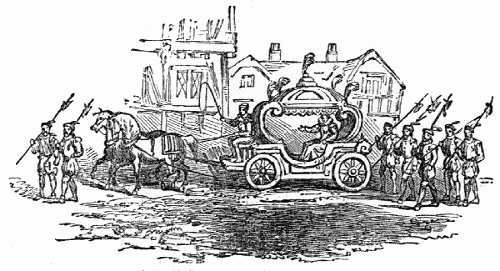
The accompanying engraving is taken from a very old print representing the state procession of Queen Elizabeth on her way to open Parliament on 2nd April, 1571. This was the first occasion on which a state coach had ever been used by a Sovereign of England, and it was the only vehicle in the procession; the Lord Keeper, and the Lords Spiritual and Temporal, all attending on horseback. It was drawn by two palfreys, which were decked with trappings of crimson velvet; and, according to an old authority, the name of the driver was William Boonen, a Dutchman, who thus became the first state coachman.
THE ORIGIN OF EATING GOOSE ON MICHAELMAS DAY.
Queen Elizabeth, on her way to Tilbury Fort on the 29th of September, 1589, dined at the ancient seat of Sir Neville Umfreville, near that place; and as British Bess had much rather dine off a high-seasoned and substantial dish than a simple fricassee or ragout, the knight thought proper to provide a brace of fine geese, to suit the palate of his royal guest. After the Queen had dined heartily, she asked for a half-pint bumper of Burgundy, and drank "Destruction to the Spanish Armada." She had but that moment returned the glass to the knight who had done the honours of the table, when the news came (as if the Queen had been possessed with the spirit of prophecy) that the Spanish fleet had been destroyed by a storm. She immediately took another bumper, in order to digest the goose and good news; and was so much pleased with the event, that she every year after, on that day, had the above excellent dish served up. The Court made it a custom, and the people the same, ever since.
PRE-ADAMITE BONE CAVERNS.
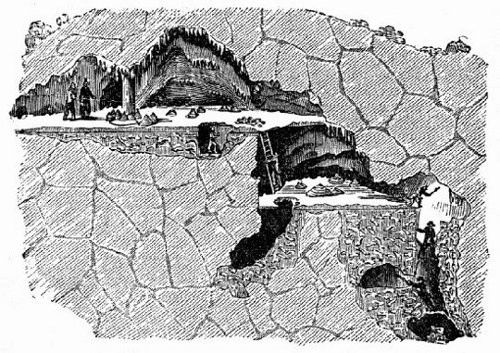
Among the wonders of the world, the bone caves of the pre-Adamite period deserve a prominent place. It is to this period that the extensive remains of Mammiferæ found in the strata of the Pampas of Buenos Ayres, and in the caverns which are scattered in such vast numbers over the continents of Europe and America, and even in Australia, are to be ascribed. We regret that we can find room for a description of only one of these caverns, but it is a most extensive one, and among the first which attracted attention. It is situated at Baylenreuth, in Franconia, and the engraving which we here give represents a section of it.
The entrance of this cave, about seven feet in height, is placed on the face of a perpendicular rock, and leads to a series of chambers from fifteen to twenty feet in height, and several hundred feet in extent, in a deep chasm. The cavern is perfectly dark, and the icicles and pillars of stalactite reflected by the torches present a highly picturesque effect. The floor is literally paved with bones and fossil teeth, and the pillars and corbels of stalactite also contain osseous remains. Cuvier showed that three-fourths of the remains in this and like caverns were those of bears, the remainder consisting of bones of hyenas, tigers, wolves, foxes, gluttons, weasels, and other Carnivora.
HOW DISTANT AGES ARE CONNECTED BY INDIVIDUALS.
Mr. Robert Chambers, in a curious and interesting chapter in the "Edinburgh Journal," entitled "Distant Ages connected by Individuals," states, in 1847, "There is living, in the vicinity of Aberdeen, a gentleman who can boast personal acquaintance with an individual who had seen and conversed with another who actually had been present at the battle of Flodden Field!" Marvellous as this may appear, it is not the less true. The gentleman to whom allusion is made was personally acquainted with the celebrated Peter Garden, of Auchterless, who died in 1775, at the reputed age of 131, although there is reason to believe that he was several years older. Peter, in his young days, was servant to Garden, of Troup, whom he accompanied on a journey through the north of England, where he saw and conversed with the famous Henry Jenkins, who died 1670, at the age of 169. Jenkins was born in 1501, and was of course twelve years old at the period of the battle of Flodden Field; and, on that memorable occasion, bore arrows to an English nobleman whom he served in the capacity of page. "When we think of such things," adds Mr. Chambers, "the ordinary laws of nature seem to have undergone some partial relaxation; and the dust of ancient times almost becomes living flesh before our eyes."
THE EARTHQUAKE AT LISBON.
On the 1st of November, 1755, a few minutes before 10 a.m. the inhabitants of Lisbon were alarmed by several violent vibrations of the ground which then rose and fell several times with such force that hundreds of houses came toppling into the streets, crushing thousands of people. At the same time the air grew pitchy dark from the clouds of dust that rose from the crumbling edifices. Many persons ran down to the river side, in the hope of escaping to the shipping; but the water suddenly rose some yards perpendicularly, and swept away everything before it. The quay, with nearly 200 human beings standing on it, all at once disappeared. Large ships, which were lying high and dry, floated off, and were dashed against each other or carried down the river. In every direction the surface of the water was overspread with boats, timber, casks, household furniture and corpses. The scene on dry land was yet more horrifying. Churches, government buildings, and private houses, were all involved in the same ruin. Many thousands of trembling fugitives had collected in the great square, when it was discovered that flames were spreading in every quarter. Taking advantage of the universal panic and confusion, a band of miscreants had fired the city. Nothing could be done to stay the progress of the flames, and for eight days they raged unchecked. Whatever the earthquake had spared fell a prey to this new calamity. "It is not to be expressed by human tongue," writes an eye-witness, "how dreadful and how awful it was to enter the city after the fire was abated; and looking upwards, one was struck with horror in beholding dead bodies, by six or seven in a heap, crushed to death, half buried and half burnt; and if one went through the broad places or squares, nothing was to be met with but people bewailing their misfortunes, wringing their hands, and crying, 'The world is at an end.' If you go out of the city, you behold nothing but barracks, or tents made with canvass or ship's sails, where the poor inhabitants lye."
Another eye-witness is still more graphic. "The terror of the people was beyond description: nobody wept,—it was beyond tears;—they ran hither and thither, delirious with horror and astonishment—beating their faces and breasts—crying 'Misericordia, the world's at an end;' mothers forgot their children, and ran about loaded with crucifixed images. Unfortunately, many ran to the churches for protection; but in vain was the sacrament exposed; in vain did the poor creatures embrace the altars; images, priests, and people, were buried in one common ruin. * * * The prospect of the city was deplorable. As you passed along the streets you saw shops of goods with the shopkeepers buried with them, some alive crying out from under the ruins, others half buried, others with broken limbs, in vain begging for help; they were passed by crowds without the least notice or sense of humanity. The people lay that night in the fields, which equalled, if possible, the horrors of the day; the city all in flames; and if you happened to forget yourself with sleep, you were awakened by the tremblings of the earth and the howlings of the people. Yet the moon shone, and the stars, with unusual brightness. Long wished-for day at last appeared, and the sun rose with great splendour on the desolated city. In the morning, some of the boldest, whose houses were not burnt, ventured home for clothes, the want of which they had severely felt in the night, and a blanket was now become of more value than a suit of silk."
STRANGE CURE FOR RHEUMATISM.
Bridget Behan, of Castle-waller, in the county of Wicklow, Ireland, retained the use of all her powers of body and mind to the close of her long life, 110 years, in 1807. About six years preceding her death she fell down stairs, and broke one of her thighs. Contrary to all expectation, she not only recovered from the effects of the accident, but actually, from thence, walked stronger on this leg, which, previously to the accident, had been a little failing, than she had done for many years before. Another remarkable circumstance relating to this fracture was, that she became perfectly cured of a chronic rheumatism of long standing, and from which on particular occasions she had suffered a good deal of affliction. A short while before her death she cut a new tooth.
SILVER TEA SERVICE WHICH BELONGED TO WILLIAM PENN.
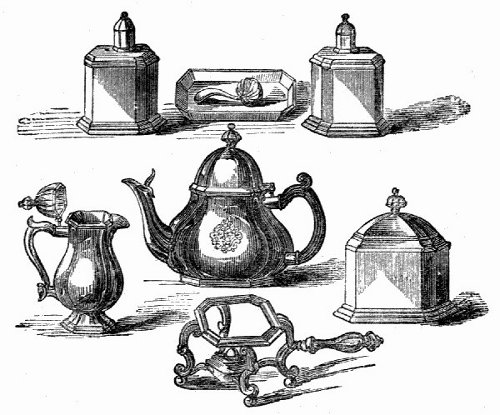
Articles of ordinary use, however small may be their intrinsic value, which have once been the property of men who have been good and great—how rare the conjunction!—are always invested with a peculiar interest. They often afford a clue to the tastes of those who once possessed them. On this account we have great pleasure in laying before our readers a representation of the silver tea-service which belonged to the celebrated William Penn, the founder and legislator of Pennsylvania, whom Montesquieu denominates the modern Lycurgus. He was the son of Admiral Penn, was born at London in 1644, and was educated at Christchurch, Oxford. At college he imbibed the principles of Quakerism, and having endeavoured to disseminate them by preaching in public, he was thrice thrown into prison. It was during his first imprisonment that he wrote "No Cross, no Crown." In March, 1680-81, he obtained from Charles II. the grant of that territory which now bears the name of Pennsylvania. In 1682 he embarked for his new colony; and in the following year he founded Philadelphia. He returned to England in 1684, and died in July, 1718. He was a philosopher, a legislator, an author, the friend of man, and, above all, a pious Christian. In addition to the reasons above given, the sketch of the tea-service is an object of curiosity, as showing the state of silversmith's work in England, at the close of the seventeenth century, for articles of domestic use.
CURIOUS FIGURES ON A SMALL SHRINE.
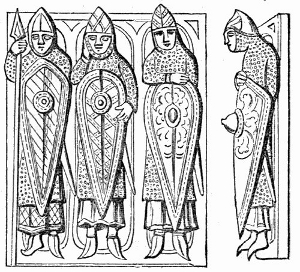
The figures here given are copied from a curious little bronze, strongly gilt, which was engraved in the "Gentleman's Magazine" for 1833, accompanied with a description, by A. J. Kempe, Esq., the author of the letterpress to "Stothard's Monumental Effigies," whose intimate knowledge in these matters enables him to well authenticate dates; and he considers this relic may safely be attributed to the early part of the twelfth century; it was discovered in the Temple Church, and had originally formed a portion of a pyx, or small shrine, in which the consecrated host was kept. Our engraving is more than half the size of the original, which represents the soldiers watching the body of Our Lord, who was, in mystical form, supposed to be enshrined in the pyx. They wear scull-caps of the Phrygian form, with the nasal like those in the Bayeux Tapestry; and the mailles or rings of the hauberk appear, as in the armour there, sewn down, perhaps, on a sort of gambeson, but not interlaced. They bear kite-shaped shields, raised to an obtuse angle in the centre, and having large projecting bosses: the third of these figures is represented beside the cut in profile, which will enable the reader more clearly to detect its peculiarities. On two of these shields are some approaches to armorial bearings; the first is marked with four narrow bendlets; the second is fretted, the frets being repeated in front of his helmet, or chapelle de fer: all the helmets have the nasal. A long tunic, bordered, and in one instance ornamented with cross-lines, or chequered, appears beneath the tunic. The sword is very broad, and the spear carried by the first figure, obtuse in the head,—a mark of its antiquity. The shoes are admirable illustrations of that passage of Geoffry of Malmesbury, where, representing the luxury of costume in which the English indulged at the time when Henry I. began his reign, he says: "Then was there flowing hair, and extravagant dress; and then was invented the fashion of shoes with curved points: then the model for young men was to rival women in delicacy of person, to mimic their gait, to walk with loose gesture, half-naked." The curvature of the points of the shoes in the little relic before us, in conformity with the custom censured by Malmesbury, is quite remarkable. One turns up, another down; one to the left, another to the right; and scarcely any two in the same direction.
THE QUEEN'S SHARKS.
The harbour of Trincomalee swarms with gigantic sharks, and strange to relate, they are all under British protection; and if any one is found molesting or injuring them, the fine is £10, or an imprisonment! How this ridiculous custom originated, it is hard to say; but we are told, that in the early days of British conquest in the East, sailors were apt to desert, and seek refuge in the then inaccessible wilds of the interior; and of later years, when civilisation has unbarred the gates of Cingalese commerce to all nations of the world, the soldiers of the regiment stationed at Trincomalee, discontented with their lot in life, were wont to escape from the thraldom of the service, by swimming off to American and other foreign vessels, preferring chance, under a strange flag, to a hard certainty under their own. Thus the Queen's sharks are duly protected as a sort of water-police for the prevention of desertion both from the army and navy.
OLD VERSES ON QUEEN ELIZABETH.
The following quaint and curious verses are taken from a very old volume, entitled A Crowne Garland of Goulden Roses, Gathered out of England's Royall Garden, &c., &c. By Richard Johnson.
A SHORT AND SWEET SONNET MADE BY ONE OF THE MAIDES OF HONOR UPON THE DEATHE OF QUEENE ELIZABETH, WHICH SHE SOWED UPON A SAMPLER IN RED SILKE.
To a new tune, or "Phillida flouts me."
Gone is Elizabeth, Whom we have lov'd so deare; She our kind mistres was Full foure and forty yeare. England she govern'd well, Not to be blamed; Flanders she govern'd well And Ireland tamed. France she befrended, Spaine she hath foiled, Papists rejected, And the Pope spoyled. To princes powerfull, To the world vertuous, To her foes mercifull, To her subjects gracious. Her soule is in heaven, The world keeps her glory, Subjects her good deeds, And so ends my story.
RANELAGH.
Ranelagh, of which no traces now remain, was situated on part of Chelsea Hospital garden, between Church Row and the river, to the east of the Hospital. It takes its name from a house erected in 1691, by Viscount Ranelagh. This house, in which the Viscount had resided from the period of its being built, was sold in 1733 to an eminent builder named Timbrell for £3,200, who advertised it for sale in the following year, as a freehold with garden, kitchen garden, and offices, and a smaller house and garden with fruit trees, coach-houses, &c., &c. These were the first vicissitudes of Ranelagh, preparatory to its conversion into a place of public amusement.
Walpole, in one of his entertaining letters to Mann, April 22nd, 1742, thus speaks of the gardens, which were then unfinished:—
"I have been breakfasting this morning at Ranelagh Garden; they have built an immense ampitheatre, with balconies full of little alehouses; it is in rivalry to Vauxhall, and cost above twelve thousand pounds. The building is not finished, but they got great sums by people going to see it and breakfasting in the house: there were yesterday no less than three hundred and eighty persons, at eighteen-pence a piece." Again, under the date May 26th, 1742, he writes to his friend as follows:—
"Two nights ago, Ranelagh Gardens were opened at Chelsea; the prince, princess, duke, much nobility, and much mob besides were there. There is a vast ampitheatre, finely gilt, painted, and illuminated; into which everybody that loves eating, drinking, staring, or crowding, is admitted for twelve pence. The building and disposition of the gardens cost sixteen thousand pounds. Twice a week there are to be ridottos at guinea tickets, for which you are to have a supper and music. I was there last night, but did not find the joy of it. Vauxhall is a little better, for the garden is pleasanter, and one goes by water."
"The only defect in the elegance and beauty of the ampitheatre at Ranelagh," says the London Chronicle for August, 1763, "is an improper and inconvenient orchestra, which, breaking into the area of that superb room about twenty feet farther than it ought to do, destroys the symmetry of the whole, and diffuses the sound of music with such irregular rapidity, that the harmonious articulations escape the nicest ear when placed in the most commodious attitude; it also hurts the eye upon your first entry.
"To remedy these defects, a plan has been drawn by Messrs. Wale and Gwin, for adding a new orchestra, which being furnished with a well-proportioned curvature over it, will contract into narrower bounds the modulations of the voice, and render every note more distinctly audible. It will, by its form, operate upon the musical sounds, in the same manner as concave glasses affect the rays of light, by collecting them into a focus. The front of this orchestra being planned so as to range parallel to the balustrade, the whole area also will be disencumbered of every obstruction that might incommode the audience in their circular walk. There is likewise provision made in this plan for a stage capable of containing 30 or 40 performers, to officiate as chorus-singers, or otherwise assist in giving additional solemnity on any extraordinary occasion."
"At Ranelagh House, on the 12th of May, 1767," says the Gentleman's Magazine, "were performed (in the new orchestra) the much admired catches and glees, selected from the curious collection of the Catch Club; being the first of the kind publickly exhibited in this or any other kingdom. The entertainments consisted of the favourite catches and glees, composed by the most eminent masters of the last and present age, by a considerable number of the best vocal and instrumental performers. The choral and instrumental parts were added, to give the the catches and glees their proper effect in so large an amphitheatre; being composed for that purpose by Dr. Arne."
The Rotunda, or amphitheatre, was 185 feet in diameter, with an orchestra in the centre, and tiers of boxes all round. The chief amusement was promenading (as it was called) round and round the circular area below, and taking refreshments in the boxes while the orchestra and vocalists executed different pieces of music. It was a kind of 'Vauxhall under cover,' warmed with coal fires. The rotunda is said to have been projected by Lacy, the patentee of Drury Lane Theatre. "The coup d'œil," Dr. Johnson declared, "was the finest thing he had ever seen."
The last great event in the history of Ranelagh was the installation ball of the knights of the Bath, in 1802, shortly after which the place was pulled down.
THE FIRST EAST INDIA HOUSE.
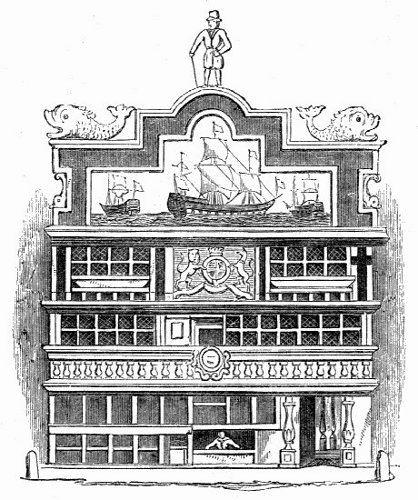
The tradition is, that the East India Company, incorporated December 31st, 1600, first transacted their business in the great room of the Nag's Head Inn, opposite St. Botolph's Church, Bishopsgate Street. The maps of London, soon after the Great Fire of 1666, place the India House on a part of its present site in Leadenhall Street. Here originally stood the mansion of Alderman Kerton, built in the reign of Edward VI., rebuilt on the accession of Elizabeth, and enlarged by its next purchaser, Sir W. Craven, Lord Mayor in 1610. Here was born the great Lord Craven, who, in 1701, leased his house and a tenement in Lime Street to the Company at £100 a year. A scarce Dutch etching, in the British Museum, of which the annexed engraving is a correct copy, shows this house to have been half timbered, its lofty gable surmounted with two dolphins and a figure of a mariner, or, as some say, of the first governor; beneath are mecrhant ships at sea, the royal arms, and those of the Company. This grotesque structure was taken down in 1726, and upon its site was erected the old East India House, portions of which yet remain; although the present stone front, 200 feet long, and a great part of the house, were built in 1798 and 1799, and subsequently enlarged by Cockerell, R.A., and Wilkins, R.A.
ADVERTISEMENTS IN THE LAST CENTURY.
The following strange advertisements have been culled at random from magazines and newspapers circa 1750. They give us a good idea of the manners and tastes of that period:—
"Whereas a tall young Gentleman above the common size, dress'd in a yellow-grounded flowered velvet (supposed to be a Foreigner), with a Solitair round his neck and a glass in his hand, was narrowly observed and much approved of by a certain young lady at the last Ridotto. This is to acquaint the said young Gentleman, if his heart is entirely disengaged, that if he will apply to A. B. at Garaway's Coffee House in Exchange Alley, he may be directed to have an interview with the said young lady, which may prove greatly to his advantage. Strict secresy on the Gentleman's side will be depended on."
"A Lady who had on a Pink-coloured Capuchin, edged with Ermine, a black Patch near her right eye, sat in a front seat in the next Side Box but one to the Stage on Wednesday night at Drury Lane Playhouse; if that Lady is single and willing to treat on terms of honour and generosity of a married state, it would be deemed a favour to receive a line directed to C. D., at Clifford's Inn Old Coffee House, how she may be address'd, being a serious affair."
"To be seen this week, in a large commodious room at the George Inn, in Fenchurch-street, near Aldgate, the Porcupine Man and his Son, which has given such great satisfaction to all that ever saw them: their solid quills being not to be numbered nor credited till seen; but give universal satisfaction to all that ever saw them; the youth being allowed by all to be of a beautiful and fine complexion, and great numbers resort daily to see them."
"A Bullfinch, that pipes 'Britons rouse up your great magnanimity,' at command, also talks, is to be sold at the Cane Shop facing New Broad street, Moorfields; likewise to be sold, two Starlings that whistle and talk extremely plain.
"Great variety of fine long Walking Canes."
THEODORA DE VERDION.
This singular woman was born in 1744, at Leipsic, in Germany, and died at her lodgings, in Upper Charles-street, Hatton Garden, London, 1802. She was the only daughter of an architect of the name of Grahn, who erected several edifices in the city of Berlin, particularly the Church of St. Peter's. She wrote an excellent hand, and had learned the mathematics, the French, Italian, and English languages, and possessed a complete knowledge of her native tongue. Upon her arrival in England she commenced teaching of the German language, under the name of Dr. John de Verdion.
In her exterior, she was extremely grotesque, wearing a bag wig, a large cocked hat, three or four folio books under one arm, and an umbrella under the other, her pockets completely filled with small volumes, and a stick in her right hand. She had a good knowledge of English books; many persons entertained her for her advice relative to purchasing them. She obtained a comfortable subsistence from teaching and translating foreign languages, and by selling books chiefly in foreign literature. She taught the Duke of Portland the German language, and was always welcomed to his house, the Prussian Ambassador to our Court received from her a knowledge of the English language; and several distinguished noblemen she frequently visited to instruct them in the French tongue; she also taught Edward Gibbon, the celebrated Roman Historian, the German language, previous to his visiting that country. This extraordinary female has never been known to have appeared in any other but the male dress, since her arrival in England, where she remained upwards of thirty years; and upon occasions she would attend court, decked in very superb attire; and was well remembered about the streets of London; and particularly frequent in attending book auctions, and would buy to a large amount, sometimes a coachload. Here her singular figure generally made her the jest of the company. Her general purchase at these sales was odd volumes, which she used to carry to other booksellers, and endeavour to sell, or exchange for other books. She was also a considerable collector of medals and foreign coins of gold and silver; but none of these were found after her decease. She frequented the Furnival's Inn Coffee-house, in Holborn, dining there almost every day; she would have the first of every thing in season, and was as strenuous for a large quantity, as she was dainty in the quality of what she chose for her table. At times, it is well-known, she could dispense with three pounds of solid meat; and we are very sorry to say, she was much inclined to the dreadful sin of drunkenness. Her death was occasioned by falling down stairs, and she was, after much affliction, at length compelled to make herself known to a German physician, who prescribed for her, when the disorder she had, turned to a dropsy, defied all cure, and finished the life of so remarkable a female.
DRIVING STAGS LIKE CATTLE.
Buried at Disley, Cheshire, June 2nd, 1753, Mr. Joseph Watson, in the 105th year of his age. He was born at Moseley Common, in the parish of Leigh, in the county of Lancaster; and married his wife from Etchells, near Manchester, in the said county. They were an happy couple 72 years. She died in the 94th year of her age. He was park-keeper to the late Peter Leigh, Esq., of Lime, and his father used to drive and show red deer to most of the nobility and gentry in that part of the kingdom, to the general satisfaction of all who ever saw them; for he could have driven and commanded them at his pleasure, as if they had been common horned-cattle. In the reign of Queen Anne, Squire Leigh was at Macclesfield, in Cheshire, in company with a number of gentlemen, amongst whom was Sir Roger Mason, who was then one of the members for the said county; they being merry and free, Squire Leigh said his keeper should drive 12 brace of stags to the Forest of Windsor, a present to the Queen. Sir Roger opposed it with a wager of 500 guineas, saying that neither his keeper, nor any other person, could drive 12 brace of red deer from Lime Park to Windsor Forest on any account. So Squire Leigh accepted the wager from Sir Roger, and immediately sent a messenger to Lime for his keeper, who directly came to his master, who told him he must immediately prepare himself to drive 12 brace of stags to Windsor Forest, for a wager of 500 guineas. He gave the Squire, his master, this answer, that he would, at his command, drive him 12 brace of stags to Windsor Forest, or to any part of the kingdom by his worship's direction, or he would lose his life and fortune. He undertook, and accomplished this most astonishing performance, which is not to be equalled in the annals of the most ancient history. He was a man of low stature, not bulky, of a fresh complexion, pleasant countenance, and he believed he had drank a gallon of malt liquor a day, one day with another, for above sixty years of his time.
ECCENTRIC WILL.
The following will, as an exhibition of strange eccentricity, is not inappropriate to our pages. Mr. Tuke, of Wath, near Rotherham, who died in 1810, bequeathed one penny to every child that attended his funeral (there came from 600 to 700); 1s. to every poor woman in Wath; 10s. 6d. to the ringers to ring one peal of grand bobs, which was to strike off while they were putting him into the grave. To seven of the oldest navigators, one guinea for puddling him up in his grave. To his natural daughter, £4 4s. per annum. To his old and faithful servant, Joseph Pitt, £21 per annum. To an old woman who had for eleven years tucked him up in bed, £1 1s. only. Forty dozen penny loaves to be thrown from the church leads at twelve o'clock on Christmas day for ever. Two handsome brass chandeliers for the church, and £20 for a set of new chimes.
EXTRAORDINARY FROST.
As an instance of great rarity in England of the severity of a frost, it is worth notice, that in January, 1808, the rain froze as it fell, and in London the umbrellas were so stiffened that they could not be closed. Birds had their feathers frozen so that they could not fly, and many were picked up as they lay helpless on the ground.
ANCIENT SNUFF-BOXES.
These ancient snuff-boxes furnish proof of the love of our ancestors for the titillating powder. An admiring writer of the last century, reflecting on the curious and precious caskets in which snuff was then imprisoned, asks—
"What strange and wondrous virtue must there be, And secret charm, O snuff! concealed in thee, That bounteous nature and inventive art, Bedecking thee thus all their powers exert."
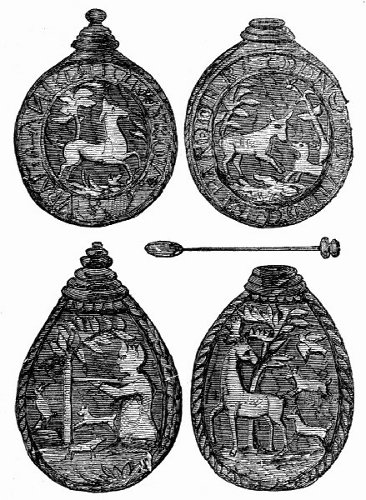
But every age, since snuff was in use, appears to have cherished great regard for the beauty and costliness of its snuff boxes, and even at the present time, the snuff box is the recognised vehicle of the highest honour a corporation can bestow. Those here represented are not so much boxes as bottles. They are richly and elaborately ornamented with sporting subjects, and no doubt once belonged to some famous personage. Judging of their very antique form and figures, we are inclined to think they must have been in use earlier than it is generally supposed that snuff was introduced into this country.
SEEING THE FIRST AND THE LAST OF TWO GENERATIONS.
Frances Barton, of Horsley, Derbyshire, died 1789, aged 107. She followed the profession of a midwife during the long period of eighty years. Her husband had been sexton of the parish seventy years; so that this aged pair frequently remarked, that she had twice brought into the world, and he had twice buried, the whole parish. Her faculties, her memory in particular, were remarkably good, so that she was enabled well to remember the Revolution in 1688, and being present at a merry making on that glorious occasion.
THE EARLIEST HACKNEY-COACH.
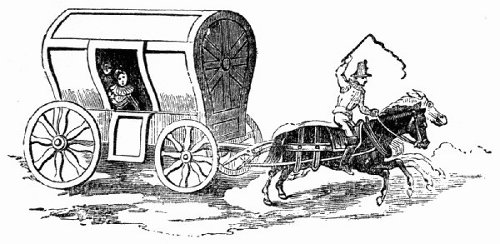
The above is a correct representation of one of the earliest forms in which coaches for hire were first made. They were called Hackney, not, as is erroneously supposed, from their being first used to carry the citizens of London to their villas in the suburb of Hackney, but from the word "hack," which signifies to offer any article for sale or hire. Hackney coaches were first established in 1634, and the event is thus mentioned in one of Strafford's Letters, dated April in that year:—
"One Captain Bailey hath erected some four Hackney-coaches, put his men in livery, and appointed them to stand, at the May-pole in the Strand, giving them instructions at what rates to carry men into several parts of the town, where all day they may be had. Other hackney-men seeing this way, they flock to the same place, and perform their journeys at the same rate. So that sometimes there is twenty of them together, which disperse up and down; that they and others are to be had everywhere, as watermen are to be had by the water-side. * * * Everybody is much pleased with it."
A UNIQUE LIBRARY.
A singular library existed in 1535, at Warsenstein, near Cassel; the books composing it, or rather the substitutes for them, being made of wood, and every one of them is a specimen of some different tree. The back is formed of its bark, and the sides are constructed of polished pieces of the same stock. When put together, the whole forms a box; and inside of it are stored the fruit, seed, and leaves, together with the moss which grows on the trunk, and the insects which feed upon the tree; every volume corresponds in size, and the collection altogether has an excellent effect.
DRESS FORTY YEARS AGO.
Caricature, even by its very exaggeration, often gives us a better idea of many things than the most exact sketches could do. This is more especially the case with respect to dress, a proof of which is here given by the three caricatures which we now lay before our readers. They are copied from plates published at the period to which they refer, and how completely do they convey to us a notion of the fashions of the day!
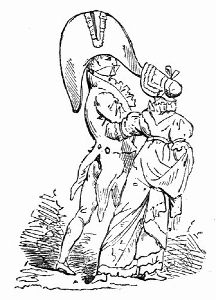
With the peace of 1815 commenced a new era in English history; and within the few years immediately preceding and following it, English society went through a remarkably rapid change; a change, as far as we can see, of a decidedly favourable kind. The social condition of public sentiment and public morals, literature, and science, were all improved. As the violent internal agitation of the country during the regency increased the number of political caricatures and satirical writings, so the succession of fashions, varying in extravagance, which characterised the same period, produced a greater number of caricatures on dress and on fashionable manners than had been seen at any previous period. During the first twelve or fifteen years of the present century, the general character of the costume appears not to have undergone any great change. The two figures here given represent the mode in 1810.
A few years later the fashionable costume furnished an extraordinary contrast with that just represented. The waist was again shortened, as well as the frock and petticoat, and, instead of concealment, it seemed to be the aim of the ladies to exhibit to view as much of the body as possible. The fops of 1819 and 1820 received the name of dandies, the ladies that of dandizettes. The accompanying cut is from a rather broadly caricatured print of a dandizette of the year 1819. It must be considered only as a type of the general character of the foppish costume of the period; for in no time was there ever such a variety of forms in the dresses of both sexes as at the period alluded to.
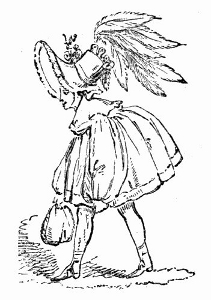
DANDIZETTE.
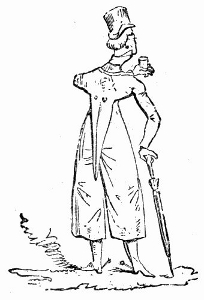
DANDY.
We give with the same reservation, a figure of a dandy, from a caricature of the same year. The number of caricatures on the dandies and dandizettes, and on their fopperies and follies, during the years 1819, 1820, and 1821, was perfectly astonishing.
FASHIONABLE DISFIGUREMENT.
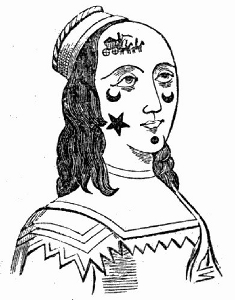
The extent to which people may be led to disfigure themselves by a blind compliance with the fashion of the day, was never more strikingly displayed than in the custom of dotting the face with black patches of different patterns. It might easily be supposed that the annexed sketch is a caricature, but such is not the case; it is a correct likeness of a lady of the time of Charles the First, with her face in full dress. Patching was much admired during the reign of that sovereign, and for several succeeding years. Some authors think that the fashion came originally from Arabia. No sooner was it brought to England and France, than it became an absolute fureur. In the former country, old and young, the maiden of sixteen and the grey-haired grandmama, covered their faces with these black spots, shaped like suns, moons, stars, hearts, crosses, and lozenges; and some even, as in the instance before us, carried the mode to the extravagant extent of shaping the patches to represent a carriage and horses.
A REMARKABLE OLD MAN.
Mr. Ingleby, of Battle Abbey, Sussex, died 1798, aged 117. He had been for upwards of ninety-five years a domestic in the family of Lady Webster. The following narrative of this remarkable man is by a gentleman who visited him in the autumn of 1797:—
"To my great surprise," he says, "I found Mr. Ingleby in a situation very far removed from the luxuries of life, or the place which might be deemed necessary for his years. He was in an antique outbuilding, near the Castle Gate, where his table was spread under an arched roof; nearly the whole of the building being filled with billet-wood, and scarcely affording room for the oaken bench on which this wonder of longevity was reclining by the fire. His dress was a full-bottomed wig, and a chocolate-coloured suit of clothes with yellow buttons. His air and demeanour was pensive and solemn; though there was nothing in his look which impressed the mind with the idea of a person more than fourscore years old, except a slight falling of the under jaw, which bespoke a more advanced age. We were introduced by a matron, who served as a sort of interpreter between us—Mr. Ingleby's deafness not permitting any regular conversation. When the nurse explained our errand, he replied, in a very distinct but hollow voice, 'I am much obliged to the gentlemen for the favour they do me; but I am not well, and unable to converse with them.' He then turned his face to the higher part of the bench on which he reclined, and was silent. In each of his withered hands he held a short, rude, beechen walking stick, about three feet high, by the help of which he was accustomed not only to walk about the extensive premises in which he passed the most part of his life, but also to take his little rambles about the town; and once (for, occasionally, the old gentleman was irascible,) he set out on a pedestrian excursion to Hastings, to inquire for another situation in service, because his patroness desired him to be more attentive to personal neatness. It is but justice to the lady alluded to, to add, that the uncouth abode in which Mr. Ingleby dwelt was the only one in which he could be persuaded to reside, and which long familiarity had rendered dear to him. The choice appeared very extraordinary; but such persons, in their conduct, are seldom governed by the fixed and settled rules by which human life is ordinarily regulated."
CURIOUS MANUSCRIPT.
A very curious manuscript was presented to the Antiquarian Society of Yorkshire in 1828. It contains sundry rules to be observed by the household of Henry the 8th, and enjoins the following singular particulars:—"None of his Highness's attendants to steal any locks, or keys, tables, forms, cupboards, or other furniture, out of noblemen's, or gentlemen's, houses where he goes to visit. No herald, minstrel, falconer, or other, to bring to the Court any boy or rascal; nor to keeps lads or rascals in Court to do their business for them. Master cooks not to employ such scullions as shall go about naked, or lie all night on the ground before the kitchen fire. Dinner to be at ten, and supper at four. The Knight Marshal to take care that all such unthrifty and common women as follow the Court be banished. The proper officers are, between six and seven o'clock every morning, to make the fire in and straw his Highness's Privy Chamber. Officers of his Highness's Privy Chamber to keep secret every thing said or done, leaving hearkening or inquiring where the King is or goes, be it early or late, without grudging, mumbling, or talking of the King's past time, late or early going to bed, or any other matter. Coal only allowed to the King's, Queen's, and Lady Mary's Chambers. The Queen's Maids of Honour to have a chet loaf, a manchet, a gallon of ale, and a chine of beef, for their breakfasts. Among the fishes for the table is a porpoise, and if it is too big for a horse-load, a further allowance is made for it to the purveyor." The manuscript ends with several proclamations. One is "to take up and punish strong and mighty beggars, rascals, and vagabonds, who hang about the Court."
WONDERFUL ESCAPE.
In 1809, a barge was going along the new cut from Paddington with casks of spirits and barrels of gunpowder. It is supposed that one of the crew bored a hole in a powder-barrel by mistake, meaning to steal spirits; the gimlet set fire to the powder, and eleven other barrels were driven to the distance of 150 yards; but only the single barrel exploded.
DAVID HUME ON HIS OWN DEATH.
The letter which we here lay before our readers was addressed by David Hume to the Countess de Boufflers, and is supposed to be the last that was ever written by that great historian, as he died only five days afterwards, August 25th. With what calmness did that illustrious philosopher contemplate the rapid approach of his own death!
The letter was torn at the places where the words are printed in italics:
"Edinburgh, 20th of August, 1776.
"Tho' I am certainly within a few weeks, dear Madam, and perhaps within a few days, of my own death, I could not forbear being struck with the death of the Prince of Conti, so great a loss in every particular. My reflection carried me immediately to your situation in this melancholy incident. What a difference to you in your whole plan of life! Pray, write me some particulars; but in such terms that you need not care, in event of decease, into whose hands your letter may fall.
"My distemper is a diarrhœa, or disorder in my bowels, which has been gradually undermining me these two years; but within these six months has been visibly hastening me to my end. I see death approach gradually without any anxiety or regret. I salute you with great affection and regard for the last time.
"David Hume."
SCRIPTURAL ANTIQUITIES.
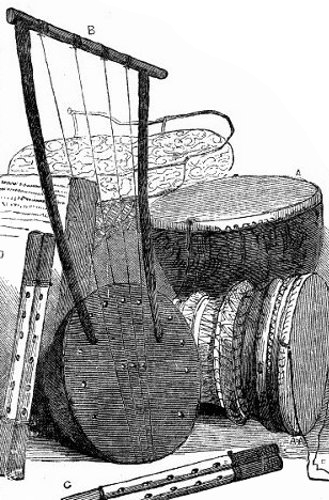
A. Drum, or Timbrel, of Baked Potter's Clay. —AA. Drum in use in the East.—B. Harp.—C. Lutes.—D. Inscribed Stone.—E. Sandals.
The rude musical instruments here represented, have been collected by modern travellers, and are but little changed from the ancient forms. The drum or timbrel marked A, is made of thin baked clay, something in the shape of a bottle, with parchment stretched over the wider part. On being struck with the finger, this instrument makes a remarkably loud sound. These relics are lodged in the London Scriptural Museum, and are all ticketed with the texts they serve to illustrate. This arrangement is very judicious, and gives a great additional interest to the sacred objects while under inspection.
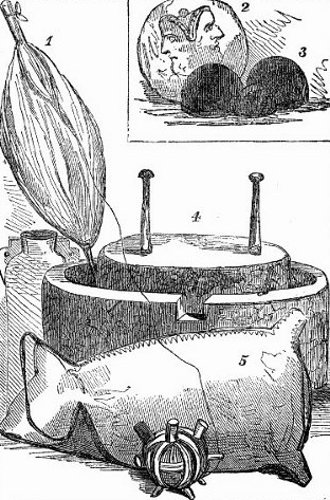
1. Distaff.—2. Roman Farthing.—3. Stone Money Weights.—4. Hand Mill. 5. Eastern Wine and Water Bottles.
The distaff was the instrument which wrought the materials for the robes of the Egyptian Kings, and for the "little coat" which Hannah made for Samuel; by it, too, were wrought the cloths, and other fabrics used in Solomon's temple. By reference to the above engraving, it will be seen that nothing can be more simple than this ancient instrument, which is a sort of wooden skewer, round which the flax is wrapped; it is then spun on the ground in the same manner as a boy's top, and the thread wrought off, and wound upon a reel shown in the foreground of the picture. "Querns," or stone hand-mills of various sizes, similar to that represented in our engraving, have been repeatedly found in connection with Roman, Saxon, and other ancient remains in this country. They are still to be met with in constant use over the greater part of India, in Africa, and also those districts of the East which are more particularly associated with Holy Writ. It may be worth while to mention that this description of mill is an improvement upon the method of simply crushing the corn laid on a flat stone with another held in the hand. The "Quern" is a hard stone roughly rounded, and partly hollowed, into which another stone, which has a handle, is loosely fitted. The corn required to be ground is placed in the hollow receptacle, and the inner stone is moved rapidly round, and, in course of time, by immense labour, the wheat &c. is ground into flour. The Scripture prophecies mention that of two women grinding at the mill, one shall be left, and the other taken—the two-handled mill will explain the meaning of this passage.
CHRONOLOGICAL TABLE OF REMARKABLE EVENTS.
The following curious table is extracted literatim from Arthur Hopton's Concordancie of Years, 1615:—
1077.—A blazing star on Palm Sunday, nere the sun.
1100.—The yard (measure) made by Henry I.
1116.—The moone seemed turned into bloud.
1128.—Men wore haire like women.
1180.—Paris in France, and London in Englande, paued, and thatching in both left, because all Luberick was spoiled thereby with fire.
1189.—Robin Hood and Little John lived. This yeare London obtained to be gouerned by sheriffes and maiors.
1205.—By reason of a frost from January to March wheate was sold for a marke the quarter, which before was at 12 pence. Anno Regni 6. John.
1209.—London bridge builded with stone; and this yeare the citizens of London had a grant to choose them a maior.
1227.—The citizens of London had libertie to hunt a certain distance about the citie, and to passe toll-free through England.
1231.—Thunder lasted fifteen daies; beginning the morrow after St. Martin's day.
1233.—Four sunnes appeared, beside the true sunne, of a red colour.
1235.—The Jews of Norwich stole a boy and circumcised him, minding to have crucified him at Easter.
1247.—The king farmed Queene-hiue for fifty pounds per annum, to the citizens.
1252.—Great tempests upon the sea, and fearful; and this year the king (Henry III.) granted, that wheretofore the citizens of London were to present the maior before the king, wheresoeuer he were, that now barons of the exchequer should serue.
1292.—The Jewes corrupting England with vsury, had first a badge giuen them to weare, that they might be knowne, and after were banished to the number of 150,000 persons.
1313.—This yeare the king of France burned all his leporous and pocky people, as well men as women: for that he supposed they had poysoned the waters, which caused his leprosie. About this time, also, the Jews had a purpose to poyson all the Christians, by poysoning all their springs.
1361.—Men and beasts perished in diuers places with thunder and lightning, and fiends were seene speake unto men as they trauelled.
1372.—The first bailiffes, in Shrewsbury.
1386.—The making of gunnes found; and rebels in Kent and Essex, who entred London, beheaded all lawyers, and burnt houses and all bookes of law.
1388.—Picked shooes, tyed to their knees with siluer chaines were vsed. And women with long gownes rode in side-saddles, like the queene, that brought side-saddles first to England; for before they rode astrid.
1401.—Pride exceeding in monstrous apparrell.
1411.—Guildhall in London begun.
1417.—A decree for lantherne and candle-light in London.
1427.—Rain from the 1st of Aprill to Hollontide.
1510.—St. John's College in Cambridge being an ancient hostell, was conuerted to a college by the executors of the Countesse of Richmond and Derby, and mother of Henry VII., in this yeare, as her will was.
1552.—The new service book in English.
1555.—The first use of coaches in England.
1606.—The cawsies about London taken down.
1610.—Britaines Bursse builded. Hix Hall builded. Aldgate builded new. Sutton's Hospitall founded. Moore fields new railed and planted with trees. Westminster palace paued.
COCK-FIGHTING AT SCHOOLS.
Many years ago the scholars at our large schools had regular cock-fights, which would appear to have been an affair of the school, recognised by the masters, and the charges for which were defrayed by them, to be afterwards paid by the parents, just as some innocent excursions and festivities are managed now a days. The credit of the school was, without doubt, often involved in the proper issue of the fight.
Sir James Mackintosh, when at school at Fortrose in 1776-7, had this entry in his account, in which books were charged 3s. 6d.:—
To cocks'-fight dues for 2 years, 2s. 6d. each, 5s.
Associated are three months' fees at the dancing-school, minuet, country-dances, and hornpipe, &c. Cock-fighting up to the end of the last century was a very general amusement, and an occasion for gambling. It entered into the occupations of the old and young. Travellers agreed with coachmen that they were to wait a night if there was a cock-fight in any town through which they passed. A battle between two cocks had five guineas staked upon it. Fifty guineas, about the year 1760, depended upon the main or odd battle. This made the decision of a "long main," at cock-fighting an important matter. The church bells at times announced the winning of a "long main." Matches were sometimes so arranged as to last the week. When country gentlemen had sat long at table, and the conversation had turned upon the relative merits of their several birds, a cock-fight often resulted, as the birds in question were brought for the purpose into the dining-room.
COMMON TRAVELLING.
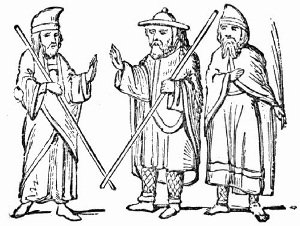
We have here the common travelling dress in use at the commencement of the 12th century, tempus Henry I. and Stephen. The original is intended for the Saviour meeting the two disciples on the road to Emmaus. The Saviour wears an under tunic, and his mantle, fastened by a narrow band across the chest, is held up by the right hand. The figures of the disciples are, however, the most curious, the central one particularly so, as he would seem to wear a dress expressly invented for travelling: his large round hat, with its wide brim, seems to be the original of the pilgrim's hat so well known in later times, and which formed so distinguishing a mark in their costume. His short green tunic, well adapted for journeying, is protected by a capacious mantle of skin, provided with a "capa" or cowl, to draw over the head, and which was frequently used instead of a hat. He wears white breeches ornamented with red cross-stripes; they end at the ankle, where they are secured by a band or garter, the foot being covered by close shoes. His companion wears the common cap so frequently met with, and he has his face ornamented to profusion by moustaches and beard, each lock of which appears to be most carefully separated and arranged in the nicest order. He has an under-tunic of white, and an upper one of red, and a white mantle bordered with gold; he also wears the same kind of breeches, reaching to the ankle, but he has no shoes, which frequently appears to have been the case when persons were on a journey.
FASHIONABLE DANCES OF THE LAST CENTURY.
The style of dancing which was fashionable at the latter part of the last century, may be seen from the following advertisement from a dancing-master, which we have copied from a newspaper of the year 1775:—
"At Duke's Long Room, in Paternoster Row, Grown Gentlemen or Ladies are taught a Minuet, or the Method of Country Dances, with the modern Method of Footing; and that in the genteelest, and most expeditious, and private Manner. And for the greater expedition of such gentlemen, as chuse to dance in company, there's a complete Set of Gentlemen assembled every Monday and Wednesday evening for the said purpose. Gentlemen or Ladies may be waited on at their own Houses by favouring me with a line directed as above. Likewise to be had at my House, as above, a Book of Instructions for the figuring part of Country Dances, with the Figure of the Minuet annex'd thereon, drawn out in Characters, and laid down in such a Manner, that at once casting your Eye on it, you see the Figure directly form'd as it is to be done; so that a person, even that had never learnt, might, by the help of this book, soon make himself Master of the figuring Part. Such as reside in the Country, I doubt not, would find it of immediate Service, as they have not always an Opportunity of having Recourse to a Dancing Master. Price 10s. 6d. N. Dukes, Dancing Master."
PREACHING FRIARS.
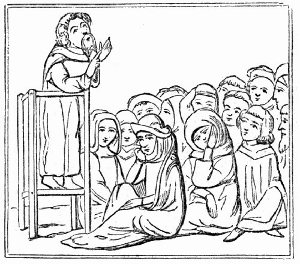
In the romance of "St. Graal," executed in the fourteenth century, we have this representation of one of these preaching friars in his rude portable pulpit. From the contrast afforded by their mendicancy, and enthusiasm in teaching, to the pride and riches of the higher clergy, and their constant mixing with the people, they became excessively popular. The preacher in the cut has a crowded and attentive audience (though one lady seems inclined to nap); the costume of the entire body, who are all seated, after a primitive fashion, on the bare ground, is worthy of note, and may be received as a fair picture of the commonalty of England about the year 1350.
THE ECCENTRIC LADY LEWSON.
Mrs. Jane Lewson, widow, of No. 12, Coldbath Square, London, died 1816, aged 116. Mrs. Lewson, from the very eccentric style of her dress, was almost universally recognised as Lady Lewson. She was born in Essex Street, Strand, in the year 1700, during the reign of William and Mary; and was married at an early age to a wealthy gentleman then living in the house in which she died. She became a widow at the early age of 26, having only one child, a daughter, living at the time. Mrs. Lewson being left by her husband in affluent circumstances, though she had many suitors, preferred to remain in a state of widowhood. When her daughter married, being left alone, she became very fond of retirement, and rarely went out or permitted the visits of any person. For the last thirty years of her life she had kept no servant, except one old female, who died in 1806; she was succeeded by the old woman's granddaughter, who was married about 1813; and she was followed in the situation by an old man, who attended the different houses in the square to go on errands, clean shoes, &c. Mrs. Lewson took this man into her house, and he acted as her steward, butler, cook, and housemaid; and with the exception of two old lap-dogs and a cat, he was her only companion. The house she occupied was elegantly furnished, but after the old style; the beds were kept constantly made, although they had not been slept in for about fifty years. Her apartment was only occasionally swept out, but never washed; the windows were so encrusted with dirt that they hardly admitted a ray of light to pass through them. She had used to tell her acquaintances that if the rooms were wetted, it might be the occasion of her taking cold; and as to cleaning the windows, she observed that many accidents happened through that ridiculous practice; the glass might be broke, and the person wounded, when the expense of repairing the one, and curing the other, would both fall upon her. A large garden at the rear of the house was the only thing connected with her establishment to which she really paid attention. This was always kept in good order; and here, when the weather permitted, she enjoyed the air, or sometimes sat and read by way of pastime; or else chatted on times past with any of the few remaining acquaintances whose visits she permitted. She seldom visited any person except Mr. Jones, a grocer at the corner of the square, with whom she dealt. She was so partial to the fashions prevailing in her youthful days, that she never changed the manner of her dress from that worn by ladies in the reign of George the First. She always wore powder with a large toupée made of horsehair on her head, nearly half a foot high, over which her front hair was turned up; a cap over it, which knotted under the chin, and three or four curls hanging down her neck. She generally wore silk gowns, the train long with a deep flounce all round, a very long narrow waist, very tightly laced up to her neck, round which was a ruff or frill. The sleeves of her gown, to which four or five large ruffles were attached, came below the elbow; a large straw bonnet, quite flat, high-heeled shoes, a full-made black silk cloak trimmed round with lace, and a gold-headed cane, completed her every-day costume for the last eighty years of her life, and in which habiliments she occasionally walked round the square, when she was uniformly spoken of by all spectators as Lady Lewson. She never practised ablutions of any kind, or hardly in any degree, because, as she alleged, those persons who washed themselves were always taking cold, or laying the foundation of some dreadful disorder. Her method was to besmear her face and neck all over with hog's lard, because that was soft and lubricating; and then, because she required a little colour in her cheeks to set off her person to advantage, she had used to paint them with rose-pink. Her manner of living was so methodical, that she would not take her tea out of any other than a favourite cup. She was equally particular with respect to her knives, forks, plates, &c. At breakfast she arranged, in a particular manner, the paraphernalia of her table: at dinner she always observed a particular rule as to the placing of the two or three empty chairs, by which the table was surrounded, but herself always sat in one favourite chair. She constantly enjoyed an excellent state of health; assisted at all times in regulating the affairs of her household; and never, until a little previous to her decease, had an hour's illness. She entertained the greatest aversion to medicine; and, what is remarkable, cut two new teeth at the age of 87, and was never troubled with the toothache. Towards the close of her life her sight failed her. She lived in five reigns, and was believed to be the most faithful living chronicler of the age. A few days previous to her decease, an old lady who was her neighbour died suddenly, which had such an effect upon her that she frequently said her time was also come, and she should soon follow. She enjoyed the use of all her faculties till that period, when she became weak and took to her bed; but steadily refused all medical aid. Her conduct to a few relations was extremely capricious; and she would never see any of them; and it was not until a few hours before her dissolution that any relaxation in her temper was manifested. She was interred in Bunhill Fields burying-ground.
WHEN FIRE ENGINES WERE FIRST MADE.
The Phœnix was the first fire-office established, in 1682. There were used, in towns, squirts or syringes, for extinguishing fire, which did not exceed two or three feet in length. These yielded to the Fire Engine, with leathern pipes, which was patented in 1676. Water-tight, seamless hose was made in Bethnal Green in 1720. About this date—
£ s. d.
A fire engine and pipe for Lyme cost 6 0 0
A square pipe, 23 feet long 1 18 0
12 leather fire-buckets 2 3 3
A Fire Engine was considered an appropriate present for an aspirant to a borough. At Lewes, in 1726, T. Pelham, Esq., gave one, and having been chosen representative in 1731, he presented a second.
EXTRAORDINARY CATARACT.
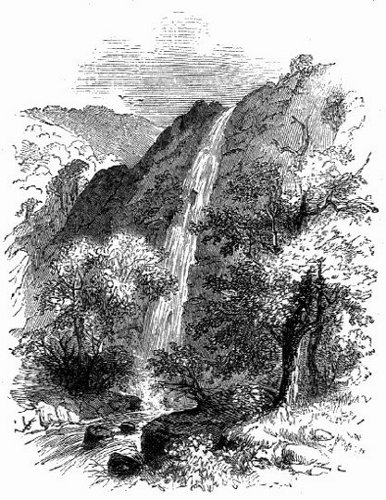
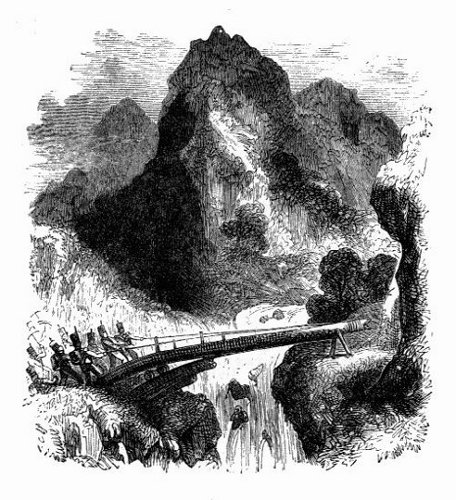
In the Island of Pulo Penang, in the Straits of Malacca, there is a cataract which is surpassed by very few in the four quarters of the earth. It is rarely visited, and, therefore, has been but seldom described; but those who have been fortunate enough to witness it all agree in the opinion that it forms one of the wonders of the world. The stream which supplies it is of considerable volume, and after traversing a long tract of comparatively level country, is suddenly precipitated almost without a break into a ravine nearly two hundred feet below the summit of the fall. The annexed engraving gives an excellent representation of the scene. The stream descends with a mighty roar, and rushes on with a lightning speed. If you take the trouble of bringing a small looking-glass in your pocket, and come here about an hour before noon, you will be able to produce some very beautiful artificial rainbows. But, whatever you do, never attempt to clamber to the top of the rocks; for though, doubtless, the scenery is very sublime up there, the pathway is slippery and dangerous in the extreme; and the guides can tell how two hapless youths, officers belonging to a regiment stationed here some twenty years ago, clambered up that hill, and how they shouted with triumph on reaching yon summit, and waved their handkerchiefs bravely; but they can also tell the gloomy and disastrous end of all this; how the wild screams echoed far and wide, as both slipped and fell headlong into the surging torrent, and the sun shone brightly upon the bright red uniforms as they were hurried over the precipice, and dashed from rock to rock; and, whilst yet the horror-stricken spectators gazed with speechless agony and terror, the bodies of the poor young men were borne away and hid by the blood-stained waters from human recovery.
DANCES OF THE NATIVES IN NEW SOUTH WALES.
The manners and customs of the uncivilized are always legitimate objects of wonder and curiosity to the civilized. It is on this account that we give the above sketch of one of the festival dances of the natives of Australia.
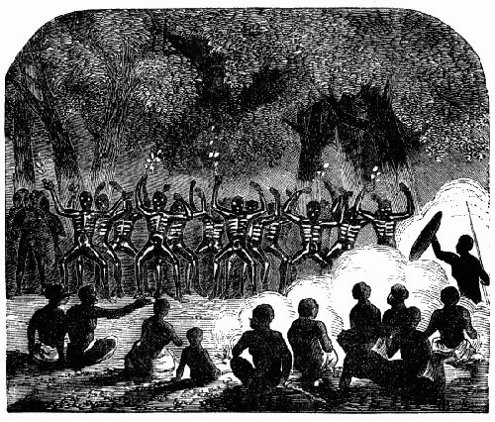
These dances are not only the usual close of their combats, but are frequent in time of peace. They appear almost necessary to stir up their blood; and under the excitement they produce, the whole nature of the people seems to be changed. To a spectator the effect of one of these exhibitions almost equals that of a tragic melo-drama.
A suitable place for the performance is selected in the neighbourhood of their huts. Here a fire is built by the women and boys, while such of the men as are to take a share in the exhibition, usually about twenty in number, disappear to arrange their persons. When these preparations are completed, and the fire burns brightly, the performers are seen advancing in the guise of as many skeletons. This effect is produced by means of pipe clay, with which they paint broad white lines on their arms and legs, and on the head, while others of less breadth are drawn across the body, to correspond to the ribs. The music consists in beating time on their shields, and singing, and to it the movements of the dancers conform. It must not be supposed that this exhibition is a dance in our sense of the word. It consists of violent and odd movements of the arms, legs, and body, contortions and violent muscular actions, amounting almost to frenzy. The performers appear more like a child's pasteboard supple-jack than anything human in their movements.
This action continues for a time, and then the skeletons, for so they appear to be, since they truly resemble them, suddenly seem to vanish and reappear. The disappearance is effected by merely turning round, for the figures are painted only in front, and their dusky forms are lost by mingling with the dark background. The trees, illuminated by the fire, are brought out with some of the figures in bold relief, while others were indistinct and ghost-like. All concurs to give an air of wildness to the strange scene. As the dance proceeds, the excitement increases, and those who a short time before appear only half alive, become full of animation, and finally are obliged to stop from exhaustion.
A PUDDING AS AN ADVERTISEMENT.
The following fact is interesting, inasmuch as it gives us an insight into the popular tastes of the period, and the power of mob-law:—
In 1718, James Austin, inventor of the Persian ink powder, invited his customers to a feast. There was a pudding promised, which was to be boiled fourteen days, instead of seven hours, and for which he allowed a chaldron of coals. It weighed 900 pounds. The copper for boiling it was erected at the Red Lion in Southwark Park, where crowds went to see it; and when boiled, it was to be conveyed to the Swan Tavern, Fish Street Hill, to the tune of "What lumps of pudding my mother gave me." The place was changed to the Restoration Gardens in St. George's Fields, in consequence of the numerous company expected, and the pudding set out in procession with banners, streamers, drums, &c., but the mob chased it on the way and carried all off.
THE DESOLATION OF EYAM.
The ancient custom of hanging a garland of white roses, made of writing paper, and a pair of white gloves over the pew of the unmarried villagers who die in the flower of their age, prevailed up to the year 1837 in the village of Eyam, and in most other villages and little towns in the Peak of Derbyshire. In the year 1665, the plague was conveyed to this unfortunate village, which for a time had been chiefly confined to London. The infection, it appears, was carried in a box of woollen clothes; the tailor, to whom they were directed was, together with his family, the immediate victims of this fatal importation; and a few days sufficed to confirm the fact, that the entire hamlet was deeply infected. A general panic ensued, the worthy and truly christian Rector, the Rev. William Mompesson, at this eventful and awful crisis, summoned the parish, and after energetically stating the case, and declaring his decided intention of remaining at his post, induced his hearers to adopt the measures he was about to propose, if not for their own preservation, at least for the more important cause, the preservation of the surrounding country. Eyam, from this moment, like a besieged city, was cut off from the living world, and to the zeal and fidelity of this ever-to-be-respected minister was confided the present, as well as eternal welfare of those who were about to prove to posterity, that devotion to their country, as well as to their God, was combined in the truly christian creed taught them by this reverend man. But alas! it was the will of the Almighty that the ranks of this devoted flock should be rapidly thinned, though Mr. and Mrs. Mompesson had been hitherto spared; but in August, the latter was carried off by the fatal disease, in the 27th year of her age; her monument may still be seen at no great distance from the chancel door. A number of grave-stones, bearing date 1666, in the churchyard, show that for a time, at least, the dead had been deposited there in the usual manner. Soon after the death of Mrs. Mompesson, the disorder began to abate, and in about two months might be said to have entirely ceased. The pious and amiable Rector was graciously preserved.
CURIOUS PLAY BILL.
The following remarkable theatrical announcement is worth preservation, inasmuch as it forms a curious effusion of vanity and poverty, in the shape of an appeal to the taste and feelings of the inhabitants of a town in Sussex:—
(Copy.)
At the old theatre in East Grinstead, on Saturday, May 5th, 1758, will be represented (by particular desire, and for the benefit of Mrs. P.) the deep and affecting Tragedy of Theodosius, or the Force of Love, with magnificent scenes, dresses, &c.
Varanes, by Mr. P., who will strive, as far as possible, to support the character of this fiery Persian Prince, in which he was so much admired and applauded at Hastings, Arundel, Petworth, Midworth, Lewes, &c.
Theodosius, by a young gentleman from the university of Oxford, who never appeared on any stage.
Athenais, by Mrs. P. Though her present condition will not permit her to wait on gentlemen and ladies out of the town with tickets, she hopes, as on former occasions, for their liberality and support.
Nothing in Italy can exceed the altar, in the first scene of the play. Nevertheless, should any of the Nobility or Gentry wish to see it ornamented with flowers, the bearer will bring away as many as they choose to favour him with.
As the coronation of Athenais, to be introduced in the fifth act, contains a number of personages, more than sufficient to fill all the dressing rooms, &c., it is hoped no gentlemen and ladies will be offended at being refused admission behind the scenes.
N.B. The great yard dog, that made so much noise on Thursday night, during the last act of King Richard the Third, will be sent to a neighbour's over the way; and on account of the prodigious demand for places, part of the stable will be laid into the boxes on one side, and the granary be open for the same purpose on the other.
Vivat Rex.
THE EAR OF BIRDS NOT TO BE DECEIVED.
The sense of hearing in birds is singularly acute, and their instinct leads them instantly to detect the slightest variation in the song of those of their own kind. The following is a laughable instance of this:—
A bird-catcher, wishing to increase his stock of bullfinches, took out his caged bird and his limed twigs, and placed them in such a situation of hedge and bush as he judged favourable to his success. It so happened that his own bird was one of education, such as is usually termed a piping bullfinch. In the first instance a few accidentally thrown out natural notes, or calls, had attracted three or four of his kindred feather, which had now taken their station not far distant from the cage. There they stood in doubt and curiosity, and presently moving inch by inch, and hop by hop towards him and the fatal twigs, they again became stationary and attentive. It was in this eager and suspended moment that the piping bullfinch set up the old country-dance of "Nancy Dawson." Away flew every astounded bullfinch as fast as wings could move, in such alarm and confusion as bullfinches could feel and they only can venture to describe.
FLYING COACH.
If the Exeter Flying Stage arrived from London at Dorchester in two days, and at Exeter at the end of the third day, about 1739, the speed must have been considered surprising. Those who made use of such a conveyance were doubtless looked upon as presumptuous, neck-or-nothing mortals.
There was a "Devizes chaise" from London at this time which took a route through Reading, Newbury, and Marlborough.
There is a good house at Morcomb Lake, east of Charmouth, now no longer in the road, owing to this having been diverted. This was a road-side inn, where the judges slept. The Fly Coach from London to Exeter slept there the fifth night from town. The coach proceeded the next morning to Axminster, where it breakfasted, and there a woman barber shaved the coach.
AN AGED SPIRIT DRINKER.
Daniel Bull M'Carthy, of the county of Kerry, Ireland, died 1752, aged 111. At the age of eighty-four he married a fifth wife, a girl little more than fourteen years of age, by whom he had twenty children—one every subsequent year of his life. It was remarked that he was scarcely ever seen to expectorate; nor did any extent of cold ever seem to affect him. For the last seventy years of his life, when in company, he drank plentifully of rum and brandy, which he always took neat; and, if in compliance with solicitations he took wine or punch, always drank an equal sized glass of rum or brandy, which he designated a wedge. The temperature of his body was generally so hot that he could bear but little clothing, either by day or night upon his person.
GIANT TREE.
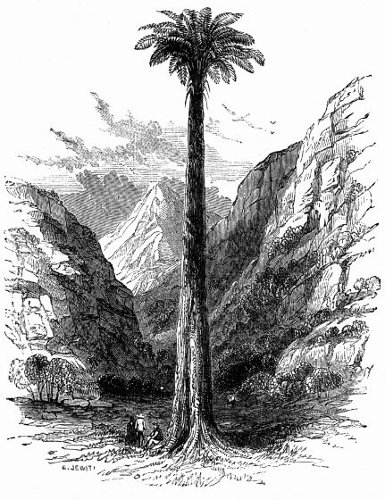
There are few trees in the world like the giant tree in the island of Pulo Penang, of which the annexed engraving is a correct representation. It is one of the various kinds of palm, and some idea may be formed of its height from the fact that it is twice as tall, and quite as straight, as the mainmast of a line-of-battle ship; there are no branches, no twigs anywhere to be seen, save just at the very summit, and here they bend over gracefully, something like what one would imagine a large-sized palm-tree to be if gazed at through Lord Rosse's telescope. It is a only specimen of its kind to be met with in the whole island.
PUNISHING FALSE ACCUSERS.
Wisdom may sometimes be learned at a Quarter Sessions, and it would be advantageous if we occasionally took a hint from our ancestors. The magistrates at sessions in Charles the First's reign could and did address themselves to questions arising between parties moving in humble life, very important to them, and who could now-a-day in vain seek redress in the same quarter. A modern Bridget might continue to charge men with a breach of promise of marriage without legal measures being available against her. This was not so in 1626. Her case was considered, and her injurious conduct and mode of life were duly estimated, with what result we shall learn from the following entry in the minute book of a quarter sessions in Devonshire of that date:—"Forasmuch as it hath appeared unto this Court that Bridget Howsley of Langton, spinster, liveth idly and lewdly at home, not betaking herself to any honest course of life, and hath lately falsely and scandalously accused one [left blank in the original] of Honiton, in Devon, challenging a promise of marriage from him, which tended much to his disgrace, and that she is a continual brawler and sower of strife and debate between her neighbours, inhabitants of Langton aforesaid, this court doth therefore think fit and order that the said Bridget Howsley be forthwith committed to the House of Correction, there to be set on work and remain for the space of six whole months, and from thenceforth until she shall find very good sureties for her appearance at the next Sessions, after the said six months shall be expired, or until she shall procure a master that will take her into service."
A PHASE OF THE SOUTHCOTTIAN DELUSION.
One of the most remarkable cases on record of combined knavery, credulity, and superstition, is the belief which so extensively prevailed about fifty years ago in the mission and doctrines of Joanna Southcott, and of which, strange to say, some traces remain even to the present day. Is it not astonishing that so recently as the year 1814, August 3rd, the following paragraph—which we believe gives a correct statement of the facts—should have appeared in the Courier newspaper? "Joanna Southcott has lately given out that she expects in a few weeks to become the mother of the true Messiah. She is nearly seventy years of age. A cradle of most expensive and magnificent materials has been bespoken by a lady of fortune for the accouchement, and has been for some days exhibited at the warehouse of an eminent cabinet maker in Aldersgate-street. Hundreds of genteel persons of both sexes have been to see this cradle, in which her followers believe the true Messiah is to be rocked. The following has been given us as a correct description: 'A child's crib, three feet six inches, by two feet, of satin wood, with brass trellis, side and foot board; turned feet, carved and gilt, on castors; a swing cot, inside caned, to swing on centre; at each end gilt mouldings, top and bottom for gold letters; a canopy cover, with blue silk; carved and gilt under it, a gold ball, and dove, and olive branch; green stars at each corner, gilt; blue silk furniture; an embroidered celestial crown, with Hebrew characters, gold letters; a lambs'-wool mattress, with white fustian down bed, down pillow, and two superfine blankets.'"
HOUSEHOLD EXPENSES OF KING EDWARD THE FIRST.
Edward the First kept three Christmasses at Rhuddlan castle, in Flintshire; and it is a fact not generally known, that his queen Eleanor, exclusively of the young prince Edward, born at Caernarvon, was delivered of a princess there in 1283. This shows that his entire household must have been transferred into Wales, at the time his policy was directed to complete the annexation of the principality of Wales to that of England. In an ancient record in the tower of London, dated 1281-2, and translated by Samuel Lysons, Esq., is a curious roll of Edward's expenses when at Rhuddlan. It consists of four sheets, containing the particulars, under proper heads, of the sums of money paid for the maintenance of his household. The sum of the expenses in this roll is £1,395 10s., which sum, with the expenses of the other roll of the queen's household is £2,220 2s. 10-1/2d. The roll is very curious, but too long to be inserted here. We append the following as a specimen of the various items it contains:—
Paid on the day of the queen's churching in oblations to mass £0 3 0
The queen's gift to divers minstrels attending her churching 10 0 0
The queen's gift to a female spy 0 1 0
A certain female spy, to purchase her a house as a spy 1 0 0
For the brethren at the hospital at Rhuddlan 0 1 1
For a certain player as a gift 0 8 0
For the celebration of mass for the soul of William de Bajor 0 1 10
For the messenger carrying letters to the king at London, to be sent to the court of Rome, for his expenses 0 1 0
Paid sundry bailiffs at the castle 0 4 10
For the carriage of 80 casks of wine from the water to the castle 0 22 0
For a cart bringing lances and cross bows from Ruthlan to Hope 0 1 4
For the carriage of £3,000 from the king's wardrobe to the queen's wardrobe 0 10 5
For 600 turves, to place about the queen's stew pond in the castle 0 1 0
Carriage of figs and raisins to Aberconway 0 0 1
Paid wages for 1,060 archers at twopence, with 53 captains at fourpence, with 10 constables of cavalry at 12d. a day 68 8 6
Paid the same for 1,040 archers, &c. &c. 67 4 0
GARRICK'S CUP.
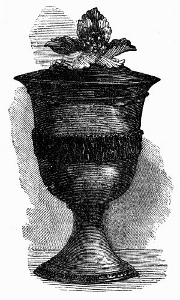
This celebrated Shakspearean relic was presented to David Garrick, by the Mayor and Corporation of Stratford-upon-Avon, in September, 1769, at the Jubilee which he instituted in honour of his favourite Bard. It measures about 11 inches in height. The tree from which it is carved was planted by Shakspeare's own hand, in the year 1609, and after having stood 147 years, was, in an evil hour, and when at its full growth and remarkably large, cut down, and cleft to pieces for fire-wood, by order of the Rev. Francis Gastrell, to whom it had become an object of dislike, from its subjecting him to the frequent importunities of travellers. Fortunately, the greater part of it fell into the possession of Mr. Thomas Sharp, a watchmaker of Stratford, who, "out of sincere veneration" for the memory of its immortal planter, and well knowing the value the world set upon it, converted the fragments to uses widely differing from that to which they had been so sacrilegiously condemned. Garrick held this cup in his hand at the Jubilee, while he sung the beautiful and well-known air, which he had composed for the occasion, beginning
"Behold this fair goblet, 'twas carved from the tree, Which, O my sweet Shakspeare, was planted by thee; As a relic I kiss it, and bow at the shrine, What comes from thy hand must be ever divine! All shall yield to the Mulberry tree, Bend to thee, Blest Mulberry; Matchless was he Who planted thee, And thou like him immortal be!"
QUICK WORK.
Mr. John Coxetter, of Greenham Mills, Newbury, had two South down sheep shorn at his factory exactly at five o'clock in the morning, from the wool of which, after passing its various processes, a complete damson coloured coat was made, and worn by Sir John Throckmorton, at a quarter past six in the evening, being two and three-quarter hours within the time allotted, for a wager of 1,000 guineas. The sheep were roasted whole, and a sumptuous dinner given by Mr. Coxetter.
ORIGIN OF THE GREAT WALL OF CHINA.
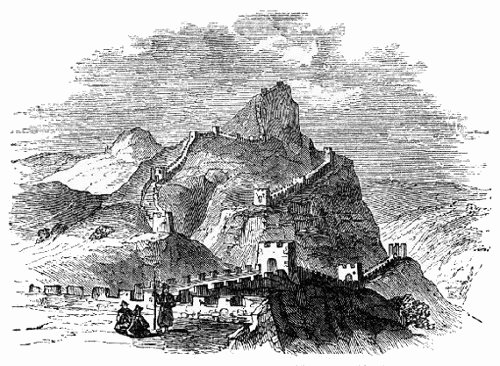
As has been invariably the case in the early history of all the leading nations of the earth, great confusion and civil discord existed in the empire of China in its first stages. It was divided into petty princedoms, each prince striving to outwit the other, and all anxiously aiming at the supreme power of the land, till the Emperor Chi-hoang-ti, who came to the throne about three hundred years before the Christian era, conquered the whole of the jealous petty princes, and united their states into one vast empire. But no sooner had he achieved this, than the Tartars began to be troublesome, and, hoping effectually to exclude their invasions, this emperor caused to be constructed the often-read-of great wall of China, a stupendous work of masonry, extending from the sea to the western province of Shensee and carried over a tract of fifteen hundred miles, comprising high mountains, deep valleys, and broad rivers, the wall being supported over the latter by gigantic arches. Fortified towers were erected at every hundred yards, and its summit admitted of six horsemen riding abreast. This sovereign is said to be the founder of the Hau dynasty. The wall proved an insignificant barrier to the Huns or Tartars, who harassed the princes of the Hau dynasty, and were a very scourge to the farmers of the frontier provinces. About the year 264, the Hau dynasty gave way to the Tsin, which latter was founded by a lineal descendant, through many generations, of the builder of the great wall. In the sketch which we have given, our chief object has been to show the extraordinary inflexibility of the Chinese in carrying their wall strictly along their frontier line, in spite of the stupendous obstacles which, intervened in the shape of mountains and valleys.
PRIVY PURSE EXPENSES OF CHARLES II.
Malone, the well known editor of Shakespeare, possessed a curious volume—an account of the privy expenses of Charles II, kept by Baptist May. A few extracts from this MS., taken from Malone's transcripts, are here offered:—
£ s. d.
My Lord St. Alban's bill 1,746 18 11
Lady Castlemaine's debts 1,116 1 0
Sir R. Viner, for plate 850 0 0
For grinding cocoa-nuts 5 8 0
Paid Lady C., play money 300 0 0
For a band of music 50 0 0
To the footman that beat Teague 5 7 6
To Mr. Pears, for the charges of a body dissected before the king 5 1 0
Lady C., play money 300 0 0
To the Morrice Dancers at Ely 1 1 0
Lady C., play money 300 0 0
Mr. Knight for bleeding the king 10 10 0
For a receipt of chocolate 227 0 0
Mr. Price, for milking the asses 10 0 0
To one that showed tumblers' tricks 5 7 6
For weighing the king 1 0 0
Paid Hall for dancing on the rope 20 0 0
The Queen's allowance 1,250 0 0
Paid Lord Lauderdale for ballads 5 0 0
To a bone-setter attending the Duchess of Monmouth 10 0 0
Paid Terry for waiting on the king swimming 10 0 0
For 3,685 ribbons for the healing 107 10 4
Mrs. Blague, the king's valentine 218 0 0
Nell Gwyn 100 0 0
Lost by the king at play on Twelfth-night 220 0 0
Paid what was borrowed for the Countess of Castlemaine 1,650 0 0
COLOUR OF THE HAT FOR CARDINALS.
Innocent IV. first made the hat the symbol or cognizance of the cardinals, enjoining them to wear a red hat at the ceremonies and processions, in token of their being ready to spill their blood for Jesus Christ.
SEVERITY OF THE LAWS A HUNDRED YEARS AGO.
Two lads were hanged for stealing a purse containing two shillings and a brass counter. Of ten criminals convicted at one sessions, four were hanged and six transported. Very often half a dozen were sentenced to death at a single sessions. On the 17th March, 1755, eight malefactors were hanged together at Tyburn. It was recorded as a matter of surprise, that, "only six convicts received sentence of death at Gloucester Assizes." One of these was a woman named Anne Ockley, who was executed on the following day, on the charge of murdering an illegitimate child. To the last she denied her guilt, except in not having called in medical advice for her infant after a bad fall. She took the Sacrament, and begged for more time to prepare herself for the change; this favour being denied, she remained praying for two hours on the drop before she would give the signal.
MARKING THE KING'S DISHES WITH THE COOK'S NAMES.
King George II. was accustomed every other year to visit his German dominions, with the greater part of the officers of his household, and especially those belonging to the kitchen. Once on his passage at sea, his first cook was so ill with the sea-sickness, that he could not hold up his head to dress his majesty's dinner; this being told to the king, he was exceedingly sorry for it, as he was famous for making a Rhenish soup, which his majesty was very fond of; he therefore ordered inquiry to be made among the assistant-cooks, if any of them could make the above soup. One named Weston (father of Tom Weston, the player) undertook it, and so pleased the king, that he declared it was full as good as that made by the first cook. Soon after the king's return to England, the first cook died; when the king was informed of it, he said, that his steward of the household always appointed his cooks, but that he would now name one for himself, and therefore asking if one Weston was still in the kitchen, and being answered that he was, "That man," said he, "shall be my first cook, for he makes most excellent Rhenish soup." This favour begot envy among all the servants, so that, when any dish was found fault with, they used to say it was Weston's dressing: the king took notice of this, and said to the servants, it was very extraordinary that every dish he disliked should happen to be Weston's; "In future," said he, "let every dish be marked with the name of the cook that makes it." By this means the king detected their arts, and from that time Weston's dishes pleased him most.