A CYCLOPÆDIA OF PRACTICAL RECEIPTS, &c. VOLUME II (continued 9)
Reading edition
The generality of the samples of preserved meat from Australia are excellent in quality and flavour,[33] except that in most cases the meat has been overcooked, which has arisen from the too prolonged contact of the meat with the steam, which it is judged necessary shall be generated in such quantities as to ensure the certainty of the exclusion of the air. Another inconvenience attending the process, viz. the liability of the sides of the tin to collapse, owing to the vacuum formed in its interior, has been remedied by the introduction into the vessel of some inert gas, such as carbonic acid, or nitrogen.
Preserved meat at the present time forms a very considerable article of export both from Australia and South America. In the former country there are several establishments of a colossal character, where the work of tinning the meat is carried on, in many of which establishments hundreds of cattle are slaughtered daily. The largest establishments of the kind are at Sydney and Melbourne, whence extensive shipments are being constantly made. The following figures are taken from the Board of Trade returns:—
Value of Meat preserved otherwise than by Salting.
Imports from Australia. Total Imports.
1871 £481,093 £610,228
1872 657,945 816,463
1873 557,552 733,331
1874 509,698 757,001
1875 249,611 592,196
Since 1876 tinned meat has been imported from North America.
Several methods have been proposed for the preservation of meat by subjecting it to such conditions that the surrounding temperature should be sufficiently low to arrest putrefaction. In Mr Harrison’s process the reduction of temperature was effected by the application of melting ice and salt, made to run down the outside of the iron chambers containing the meat. It is affirmed that although the joints submitted to this treatment were solidly frozen, no loss of either flavour or immediate decomposition of the meat took place. Mr Harrison’s experiment was perfectly successful in Australia, but broke down during the voyage of a large cargo of meat shipped from Australia in 1873, owing to a defect in the construction of the ice chamber of the vessel and the failure of the supply of ice.
Of other forms of refrigeration applied for this purpose we may mention the process of M. Tellier, by which he proposes to place (on ship-board or elsewhere) joints of meat in a chamber through which a current of air charged with ether or other volatile substance may be passed, with a view to reduce the temperature to 30° F. Also that of M. Poggiale, from whose report to the Paris Academy of Medicine it appears that in chambers contrived on principles similar to M. Tellier’s, all kinds of butcher’s meat and poultry have been hung for ten weeks, at the end of which time they were found perfectly
The process, however, of refrigeration which has proved not only the most, but in every respect successful, was first satisfactorily carried out since 1876, in which time large cargoes of dead meat have been constantly sent to our metropolitan markets, as well as to Glasgow, from New York. The following extract from the ‘Dundee Advertiser’ gives some interesting details of this process:—
“As to dead meat, the first sale was held on the 5th of June, when 100 carcases of beef and 72 of mutton were disposed of. Since then there has never been a smaller supply, and on the average about 150 carcases have been sold weekly. Last week 210 carcases were sold, and on Wednesday evening there were no fewer than 33 lorries, each laden with three tons of butcher’s meat. The freight paid for carriage to Glasgow, Liverpool, and London, last week amounted to £1900. Altogether, since the importation began, a million and a quarter pounds of dead meat have been sold in Glasgow. The result of this importation has been a reduction in retail price of 1d. per lb., instead of an increase in price, which must have taken place without the increased supply.
“The oxen are collected chiefly in the states of Illinois and Kentucky. They are there reared in enormous numbers on the prairies. Before they reach New York they are driven over railway for fully a thousand miles. Those animals the carcases of which are to be sent to this country are killed the day before the departure of the steamer. As soon as the carcases are dressed they are put into a cooling room capable of containing 500, and subject to a constant current of cold air, supplied by means of a 25 horse-power engine. This sets the beef and extracts the animal heat. Each carcase is next cut into quarters, and these are sewn up in canvas, and during the night transferred on board the vessel. Six of the Anchor Line mail steamers have been fitted up with refrigeration compartments, constructed on a patented principle specially for the conveyance of meat.
“After the quarters have been hung up in the room the door is hermetically closed. Adjoining the compartment is a chamber filled with ice. Air tubes are connected with the beef room, and through them the animal heat ascends, and by means of a powerful engine it is blown across the ice, and returned to the beef room in a cold state. A temperature of about 38° is thus maintained in the beef-room. If it were to get so low as 32°—freezing-point—the meat would be seriously injured.[34] The heat is, therefore, regulated by a thermometer, and when the temperature gets too low, the speed of the engine is slackened, the normal degree of cold being thus maintained almost without variation during the voyage. Cattle killed on Thursday in New York are sold that day fortnight in Glasgow.”
The first patent for the preservation of food by means of ice was granted to Mr John Ling in 1845.
Lastly, mention must not be omitted of another method for the preservation of meat, which consists in the application to it of certain antiseptic substances, the action of which in preventing putrefaction is due to their power of destroying minute parasitic organisms of low animal or vegetable life, that would otherwise attack and set up decomposition in the meat. Our ordinary salted meats owe their immunity from decay, as is well known, to the presence in their tissues of common salt. Meat preserved, however, by this means is tough, indigestible, and wanting in many of its most important soluble constituents, which, dissolving part of the salt, run off from the meat and are lost.
Amongst other agents which have been found serviceable as antiseptics, and for which from time to time numerous patents have been taken out, are nitrate of potash, acetate and hydrochlorate of ammonia, the sulphates of soda and potash, and bisulphate of lime. The writer remembers partaking, some years since, of some Canadian turkey, which had been preserved by means of this latter substance, and the turkey having been killed some two months before being eaten. It was perfectly sound and of excellent flavour. In this instance the bird had been sent from Canada, with several others, packed in waterproof casks, filled up with a weak solution of bisulphite of lime.
In some cases the saline solution is merely brushed over the outside of the meat; whilst in others it is injected into the substance of the flesh.
Thiebierge’s process consists in dipping the joints for five minutes into dilute sulphuric acid, of the strength of about ten of water to one of acid. The meat after being taken out is carefully wiped and dried, and is then hung up for keeping.
Sulphurous acid also forms the subject of several patents for the preservation of meat. In the process of Laury, for which a patent was taken out in 1854, the gas was introduced into the vessels containing the food. In that of Belford, for which a provisional specification was granted the same year, the meat was soaked for 24 hours in a solution of sulphurous and hydrochloric acids (the latter being in the proportion of a hundredth of the volume of the former). The addition of the hydrochloric acid was made with the intention of decomposing any alkaline sulphites that might be formed by the combination of the alkaline salts of the meat with the sulphurous acid.
Dr Dewar’s process, which is very similar to the foregoing, proposes, instead of exposing
In the patent of Demait, which dates from 1855, the meat was directed to be hung up in a properly constructed chamber, and exposed for some time to the action of the gas. More recently, Professor Gamgee has taken out a patent, which is a modification of Demait’s, and which consists in hanging up the carcase of the animal, previously killed when under the influence of carbonic oxide, in a chamber filled with this latter gas, to which a little sulphurous acid has been added, the chamber having been first exhausted of air. The carcase is allowed to remain in the chamber from 24 to 48 hours, after which it is hung in dry air. It is stated that meat subjected to the above treatment has been found perfectly sound and eatable after an interval of five months.
M. Lanjorrois proposes to preserve animal substances from decay by the addition to them of 1 per cent. of magenta. He states the process had been applied to slices of beef, which, after being kept for several months, yielded, after being washed and boiled, very good soup. Commenting on this suggestion for the preservation of meat, the ‘Chemical News’ very sensibly and properly remarks: “It is to be hoped the magenta employed will be free from arsenic.”
The patent of M. de la Peyrouse (which dates from 1873) also consists in excluding the air by enveloping meat in fat. In this process, however, the fat is mixed, when in a melting condition, with a certain quantity of the carbonates of sodium, potassium, and ammonium, as well as with some chlorides of magnesium and aluminium, with the object of preventing the fat becoming rancid and decomposing, and thus imparting a disagreeable flavour to the meat.
In M. George’s process the meat is partially dried, and then steeped in successive waters containing hydrochloric acid and sulphate of soda.
MECON′IC ACID. H3C7HO7. Syn. Acidum meconicum, L. A peculiar acid, first obtained by Sertuerner from opium, in 1804.
Prep. Meconate of lime is suspended in warm water, and treated with hydrochloric acid. Impure meconic acid crystallises on cooling, and may be purified by repeated treatment in the same way with hydrochloric acid. Its purity is ascertained by its leaving no residue when heated in a platinum or glass capsule.
Prop. Meconic acid forms beautiful pearly scales; possesses a sour astringent taste; is soluble in boiling water, and to a less extent in cold; it is also soluble in alcohol. With the acids it forms salts called ‘meconates,’ most of which are crystallisable. Meconate of lime is obtained by heating a solution of chloride of calcium with an infusion of opium made with cold water, and neutralised by powdered marble, and collecting the precipitate. Meconate of potassa is prepared by direct solution of the base in the impure acid obtained from meconate of lime till the liquor turns green, heat being applied, when the salt crystallises out as the liquid cools; it may be purified by pressure and recrystallisation.
Tests. Meconic acid is characterised by—1. Turning ferric salts red, and the red colour not being destroyed by the action of corrosive sublimate.—2. Precipitating a weak solution of ammonio-sulphate of copper green.—3. With acetate of lead, nitrate of silver, and chloride of barium, it gives white precipitates, which are soluble in nitric acid.—4. It is not reddened by chloride of gold.
MEC′ONIN. C10H10O4. A white, crystalline, odourless, neutral substance, discovered by Couerbe in opium.
MECO′NIUM. See Opium.
MED′ICINES. However skilful the medical practitioner may be, and however judicious his treatment, both are interfered with, and their value more or less neutralised, if the remedies he orders are not administered precisely according to his instructions. It is the duty of the attendant on the sick to follow implicitly the directions of the physician, as well in exactly complying with his orders as in doing nothing that she has not been ordered to do. At the same time there are exceptions to this rule, in which a suspension of the remedy, or a deviation from the order of the physician, is not only allowable, but is absolutely required. Thus, from idiosyncrasy or some other cause, the remedy in the doses ordered may have no effect, or may produce one widely different from that intended or expected. In such cases it is evident that a strict adherence to the direction of the physician would be productive of evil; but he should be immediately apprised of the circumstance. The common practice of neglecting to administer the doses of medicine at the prescribed time, or after prescribed intervals, and then, to compensate for the omission, giving the medicine more frequently or in larger doses, cannot be too severely censured, as destructive to the welfare of the patient and injurious to the credit of the physician.
For the purpose of disguising the taste of medicine, or lessening their nauseating properties, Dr Pollio has recommended a means founded on the physiological fact that a strong impression on the nerves (whether of vision, hearing, or taste) renders that which follows less perceptible than under the usual circumstances. Instead, therefore, of applying toDose and Prescribing.
MEDICINES FOR PASSENGER SHIPS. The annexed scale of medicines, medical stores, and instruments for ships clearing under the Passengers Acts, other than steamships engaged in the North Atlantic trade, has been issued and caused to be published by the Board of Trade, and is intended to supersede the scales hitherto in force.
The quantities mentioned in the scale are for every 100 passengers, when the length of the passage, computed according to the Passengers Act, is 100 days and upwards. Half the quantity of medicines indicated, but the same kind and quantity of medical stores should be taken when the passage is less than 100 days.
N.B.—There is a separate scale for North Atlantic steam passenger ships.
The medicines are to be prepared according to the British Pharmacopœia, to be plainly labelled in English, and the average doses for an adult stated, according to the British Pharmacopœia.
All bottles are to be stoppered, and all medicines indicated thus (*) are to be marked with a red poison label. All fluid quantities are to be measured by fluid lbs., oz., or dr.
Lbs. oz. dr.
Acid, Acetic 0 6 0
* Acid, Carbolic 0 1 0
* Acid, Carbolic (a powder containing not less than 20 per cent. of pure carbolic or cresylic acid) 112 0 0
Acid, Citric 0 3 0
Acid, Gallic 0 1 0
Acid, Hydrocyanic Dil. 0 0 4
Acid, Nitric 0 1 0
Acid, Sulph. Dil. 0 6 0
Æther 0 1 0
Alumen 0 1 0
Ammon. Carb. 0 6 0
Amylum 1 0 0
Argent. Nit. (Stick) 0 0 2
Calx Chlorate 7 0 0
Camphor 0 6 0
Charta Epispatica, 4 sq. ft., in case
* Chlor. of Zinc (Burnett’s sol. of) 16 0 0
* Chloroform 0 8 0
Copaiba 0 8 0
Creosote 0 0 2
Cupri Sulph. 0 1 0
Emp. Cantharidis 0 1 0
Ferri et Quiniæ Cit. 0 1 0
Ferri Sulph. 0 0 4
Glycerin 0 6 0
Glycerin Acid. Tannic 0 4 0
* Hydrat. Chloral 0 1 6
Hydrarg. cum Cretâ 0 0 4
Hydrarg. Subchloridi 0 0 4
Lini Farina 6 0 0
Lin. Camph. 0 8 0
Lin. Opii 0 2 0
Lin. Saponis 1 0 0
* Liq. Atropiæ 0 0 1
Liq. Calcis 1 0 0
* Liq. Morphiæ Acetatis 0 1 0
* Liq. Plumbi Subacetatis 0 2 0
Liq. Potassæ 0 2 0
* Liq. Potassæ Permanganatis (B. P. or Condy’s Crimson Fluid) 3 0 0
Magnes. Sulph. 4 0 0
Mist. Sennæ Co. (omit Extract of Liquorice and substitute Aromatic Spirit of Ammonia, 1 oz. to 1 pint of the mixture) 3 0 0
Ol. Croton 0 0 1
Ol. Lini 0 8 0
Ol. Menthæ Pip. 0 0 2
Ol. Morrhuæ 3 0 0
Ol. Olivæ 1 0 0
Ol. Ricini 2 0 0
Ol. Terebinthinæ 1 0 0
* Opium 1 0 0
Plumbi Acetatis 0 1 0
Potassæ Bicarb. Pulv. 0 4 0
Potassii Iodid. 0 2 0
Pulv. Antimonialis 0 0 3
* Pulv. Astringens (double the quantity indicated to be taken to all tropical ports. Pulv. Catechu Co., Pulv. Cretæ Arom. cum Opiô—equal parts) 1 0 0
Pulv. Cretæ Arom. cum Opiô. 0 2 0
Pulv. Ipecac. 0 2 0
Pulv. Ipecac. Co. 0 2 0
Pulv. Jalapæ Co. 0 3 0
Pulv. Potassæ Nitratis 0 4 0
Pulv. Rhei Co. 0 4 0
Pulv. Scammon. Co. 0 0 6
Quiniæ Sulph. (double the quantity indicated to be taken to all tropical ports) 0 1 0
Sodæ Bicarb. 1 0 0
Sp. Æther. Nitrosi 0 8 0
Sp. Ammon. Arom. 0 8 0
Sp. Rectif. 0 4 0
Sp. Sulphur Sublimatum 3 0 0
Syr. Ferri Iodidi 0 4 0
* Sol. Morphiæ Acetat. (a neutral solution containing 4 grains in a drachm, and so marked. To be labelled—for hypodermic injection) 0 0 4
Tr. Arnicæ 0 6 0
Tr. Camphoræ Co. 0 8 0
Tr. Digitalis 0 0 6
Tr. Ergotæ 0 6 0
Tr. Ferri Perchloridi 0 4 0
* Tr. Opii 0 6 0
Tr. Scillæ 0 2 0
Tr. Valerian. Ammon. 0 3 0
Ung. Cetacei 1 0 0
Ung. Hydrargyri 0 2 0
Ung. Hydrargyri Ox. Rub. 0 1 0
Ung. Sulph. 1 0 0
Ung. Zinci 0 2 0
Vin. Colchici 0 1 0
Vin. Ipecac. 0 1 0
Zinci Sulphatis 0 1 0
Desiccated Soup 4 0 0
All pills to be made and marked 5 grains.
Pil. Aloes cum Myrrhâ 2 doz.
Pil. Col. c. Hyoscy 4 doz.
Pil. Hydrarg. 3 doz.
Pil. Ipecac. cum Scillâ 5 doz.
Pil. Quiniæ 6 doz.
Pil. Sapon. Co. 6 doz.
Medical Stores.
Lint 10 oz.
Tow 1 lb.
Adhesive Plaster 3 yds.
Male Syringe 1
Male Syringe Glass 1
Female Syringe 1
Phials (assorted) 2 doz.
Phial corks 6 doz.
Sponges 3
Bed-pan 1
Paper of Pins 1
Hernia Truss, 36 in., reversible 1
Paper of Pill Boxes 1
Gallipots 6
Leg and Arm Bandages 6
Calico 3 yds.
Flannel Bandages, 7 yds. long, 6 in. wide 2
Flannel 2 yds.
Triangular Bandages, base 48 in., sides 33 in. each 2
† Minim Measures 2
† 1 oz. Measures 1
† 2 oz. Measures 1
† Set of Splints 1
† Waterproof sheeting 4 yds.
† Oiled Silk 1 yd.
† Enema Syringe and Stomach Pump 1
† Box of Small Scales and Weights 1
† Wedgwood Mortar and Pestle 1
Wedgwood Funnel 1
† Spatulas 2
† Authorised Book of Directions for Medicine Chests 1
† British Pharmacopœia 1
† One set only of these articles required, irrespective of number of passengers.
N.B.—Only one set of instruments required, without regard to the number of surgeons, passengers, or the length of the voyage.
Instruments.
In Pocket Case 1 Tenaculum.
1 Artery Forceps.
1 Operating ditto.
1 Finger Knife.
1 Curve Bistoury, Probe Point.
1 Curve Bistoury, Spear Point.
2 Probes.
1 Silver Director.
1 Caustic Case.
1 Scissors.
1 Spatula.
12 Needles.
1 Skein Ligature Silk.
3 Lancets.
1 Amputating Saw.
2 Amputating Knives.
1 Bone Forceps.
3 Tooth Forceps.
1 Skull Forceps.
1 Trephine.
1 Elevator.
1 Hey’s Saw.
1 Trephine Brush.
2 Scalpels.
1 Hernia Knife.
2 Trocars and Canulas.
1 Aneurism Needle.
1 Hernia Director.
1 Tourniquet.
2 Silver Catheters (Nos. 4 and 8).
4 Elastic Gum Catheters (Nos. 3, 5, and 7).
1 Clinical Thermometer.
1 Hypodermic Syringe.
1 dozen charged Tubes for Vaccination.
1 Set of Midwifery Instruments.
MEER′SCHAUM. Syn. Ecume de mer, L. A native silicate of magnesia. It has a sp. gr. ranging between 2·6 to 3·4; is readily acted on by acids, and fuses before a powerful blowpipe into a white enamel. The finest qualities are found in Greece and Turkey. Its principal application is to the manufacture of tobacco-pipes. The Germans prepare their pipes for sale by soaking them in tallow, then in white wax, and, finally, by polishing them with shavegrass. Genuine meerschaum pipes are distinguished from mock ones by the beautiful brown colour which they assume after being smoked for some time. Of late years some of the pipemakers have produced a composition clay pipe, which closely resembles meerschaum in appearance, and is “warranted to colour well.” The composition, which is comparatively valueless, is made up into pipes of suitable patterns, which are frequently sold to the ignorant for “meerschaums.” See Cements, Hydraulic.
ME′GRIM. Syn. Meagrim, Hemicrania, L. A pain affecting one side of the head only, often periodic, like an ague, and generally of a nervous, hysterical, or bilious character. It is clavus when there is a strong pulsation, conveying the sensation of a nail piercing the part. See Headache.
MEG′RIMS. Syn. Meagrims, Vertigo. In veterinary medicine this term is applied to horses which when at work reel, then stand for a minute dull and stupid, or fall to the ground, and lie partially insensible for a few minutes. “Horses subject to this affection should be driven with a breastplate or pipe collar, so as to prevent pressure on the veins carrying the blood from the head; the bowels should be kept in good order; an occasional laxative is advisable, and a course, either of arsenic or quinine, or of arsenic and iron.” (Dun.)
MEL′ANCHOLY. See Hypochondriasis and Insanity.
MELIS′SIC ALCOHOL. A substance obtained
MELLA′GO. The old name for a medicine having the consistence of honey, with a somewhat sweetish taste. Mellago taraxaci is fluid extract of dandelion.
MELTING-POINT. The temperature at which solids assume the liquid form.
MEN′STRUUM. [L.] A solvent or dissolvent. The principal MENSTRUA employed in chemistry and pharmacy to extract the active principles of bodies by digestion, decoction, infusion, or maceration, are water, alcohol, oils, and solutions of the acids and alkalies.
MERCU′′RIAL BAL′SAM. See Ointment of Nitrate of Mercury.
MERCU′′RIAL DISEASE′. Syn. Morbus mercurialis, Hydrargyriasis, L. This results from the injudicious or excessive use of mercury, or exposure to the fumes of this metal. The common and leading symptoms are a disagreeable coppery taste; excessive salivation; sponginess, tumefaction, and ulceration of the gums; swollen tongue; loosening of the teeth; exfoliation of the jaws; remarkably offensive breath; debility; emaciation; ending (when not arrested) in death from exhaustion. Fever, cachexia, violent purging and griping, a species of eczema (ECZEMA MERCURIALE, LEPRA MERCURIALIS), and other forms of skin disease, are also phases of the same affection, the first of which occasionally proves fatal under the influence of sudden and violent physical exertion.
The treatment, in ordinary cases, may consist in free exposure to the open air, avoiding either heat or cold; the administration of saline aperients, as Epsom salts, phosphate of soda, &c.; the free use of lemon juice and water as a common drink; with weak gargles or washes of chloride of soda or chloride of lime to the gums, mouth, and throat. Severe cases often resist every variety of treatment, and instances are recorded in the medical journals in which the use of even small doses of mercurials, administered by the faculty, have, owing to the peculiar idiosyncrasy of the patients, been followed by the most horrible sufferings, terminating in death.
MER′CURY. Hg. Syn. Quicksilver, Hydrargyrum (B. P., Ph. L. E. and D.); Mercure, Vif argent, Fr.; Quecksilber, Ger. A remarkable metal, which has been known from a very early period. The Romans employed it as a medicine externally, as did the Arabs; but the Hindoos were probably the first to prescribe it internally.
Sources. The most important are the mines of Idria, in Carniola; Almaden, in New Castile; and New Almaden, in California, where it exists combined with sulphur, under the form of cinnabar. From this ore the pure metal is obtained by distilling it with lime or iron filings, in iron retorts, by which the sulphur it contains is seized and retained, while the mercury rises in the state of vapour, and is condensed in suitable receivers. Quicksilver is commonly imported in cylindrical iron bottles; containing 1⁄2 cwt. to 1 cwt. each. It is also imported in small quantities from China, contained in bamboo bottles holding about 20 lbs. each.
Prep. Mercury, as imported, is usually sufficiently pure for medicinal purposes without any further preparation. Mere mechanical impurities, as floating dust, dirt, &c., may be got rid of by squeezing the metal through chamois leather or flannel, or by filtering it through a small hole in the apex of an inverted cone of paper. It can be further cleaned by shaking well with a little strong nitric acid, washing with distilled water, and drying by blotting paper, or filtering through warm chamois leather.
Prop., &c. Mercury, at all common temperatures, is a heavy liquid, possessing a nearly silver-white colour, and a brilliant metallic lustre; solidifies (freezes) at -40° Fahr., and is then ductile, malleable, and tenacious; boils at 662° Fahr., and escapes in colourless transparent vapour, of great density; it also volatilises slowly at the ordinary temperature of the atmosphere. The presence of minute quantities of lead and zinc greatly retard its evaporation at its boiling heat. It unites with oxygen, chlorine, iodine, &c., forming numerous compounds. With the metals it unites to form AMALGAMS. The only acids which act directly on metallic mercury are the sulphuric and nitric, but for this purpose the former must be heated and concentrated. Nitric acid, however, even when dilute and in the cold, dissolves it freely. Pure mercury is unalterable in the air at ordinary temperatures. Sp. gr. 13·59 at 60° Fahr.; about 14· when in the solid state.
Uses, &c. Mercury is applied to various purposes in the arts; as the amalgamation of gold and silver, ‘wash gilding,’ the silvering of looking-glasses, the manufacture of barometers and thermometers, and the preparation
Mercury has been employed in one or other of its forms in almost all diseases; but each of its numerous preparations is supposed to have some peculiarity of action of its own, combined with that common to all the compounds of this metal. The mercurials form, indeed, one of the most important classes of the materia medica.
Tests. 1. Metallic mercury is detected by its liquid condition and volatility; and, when in a finely divided or pulverulent state, by the microscope, or by staining a piece of copper white when the two are rubbed together.
Mercury, when present in combination, can be detected as under:
When intimately mixed with anhydrous sodium carbonate, and heated in a small test-tube, under a layer of the carbonate, decomposition ensues, and a crust of grey sublimate forms on the cooler portion of the tube. When examined by a lens this crust is seen to consist of minute metallic globules. By friction with a bright glass or iron rod these are united into globules, which are visible to the naked eye.
A perfectly clean and bright piece of copper, immersed in a slightly acid solution of mercury, becomes in a short time covered with a grey or whitish stain, which assumes a silvery lustre when gently rubbed with a piece of soft cork or leather, and is removed by the subsequent application of heat. A single drop of liquid may be tested on a bright copper coin in this way.
The plate of copper with the deposit of mercury, obtained as above, after being washed with a weak solution of ammonia, and in distilled water, and dried by pressure between the folds of bibulous paper, may be cut into small pieces, and heated in a test-tube, in order to obtain metallic globules. When the suspected solution contains organic matter, bright copper filings may be employed, and the process modified so as nearly to resemble Reinsch’s test for arsenious acid. According to Orfila, “scraped copper plate” is capable of detecting the presence of 1⁄80000th part of corrosive sublimate in a solution. MM. Trousseau and Reveil state that a plate of yellow copper (brass) is even more susceptible than one of red copper.
(Smithson’s electrolytic test.) This consists in the use of a polished wire or plate of gold or copper round which a strip or thread of zinc or tin is wound in a spiral direction. The suspected liquid is acidulated with a few drops of hydrochloric acid, and after immersion for a longer or a shorter period (as half an hour to an hour or two), the gold will have become white if any mercury is present. The coil of zinc or tin is then removed from the gold, and the latter, after being washed and dried between the folds of bibulous paper, is heated in a test-tube, to obtain metallic globules, as before.
An ingenious extemporaneous application of the electrolytic test may be made as follows:—Place a drop or two of the suspected liquid on a clean and bright gold or copper coin, and apply a bright key, so that it may at once touch the edge of the coin and the solution. (See engr.) An electric current will then be established as before, and a white spot of reduced mercury will appear on the surface of the metal, which may be recognised in the manner already explained.
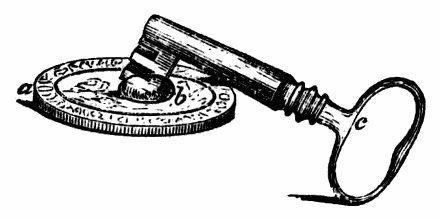
a. A gold or copper coin. b. Drop of suspected solution. c. A bright key.
The salts of mercury are divided into two classes—mercurous, where mercury is a monad element, and unites with one atom of chlorine; and mercuric salts, where it plays the part of a dyad element, or unites with two atoms. The latter of these will be taken first.
Mercury, Pure. (Ph. B.) Syn. Hydrargyrum purum. Place commercial mercury, 3 lbs., in a glass retort or iron bottle, and applying heat cause 21⁄2 lbs. of the metal to distil over into a flask employed as a receiver. Boil on this for five minutes hydrochloric acid, 3 dr., diluted with distilled water, 9 fl. dr., and having by repeated affusions of distilled water, and decantations, removed every trace of acid, let the mercury be transferred to a porcelain capsule, and dried first by filtering paper, and finally on a water bath.
Mercuric Salts. Tests. Sulphuretted hydrogen and ammonium sulphide, added in very small quantities, produce on agitation a perfectly white precipitate, which acquires successively a yellow, orange, and brownish-red colour, as more of the test is added; and, ultimately, when the test is added in considerable excess, an intensely black colour. This precipitate is insoluble in excess of the precipitant, potassium hydrate, potassium cyanide, hydrochloric acid, or nitric acid, even when boiling; but it dissolves readily and completely in potassium sulphide and in ‘aqua regia’ with decomposition. These reactions are characteristic.
Ammonia gives a white precipitate.
Potassium hydrate gives a reddish precipitate, turning yellow when the test is added in excess. The presence of ammonia causes the precipitate to be white, and when the solution
Alkaline carbonates give a brick-red precipitate.
Potassium iodide gives a scarlet precipitate, which is soluble in excess, and in alcohol, and solution of sodium chloride.
The alkaline bicarbonates either do not disturb the solution, or only cause a slight degree of opalescence.
Mercuric Acetate. Hg(C2H3O2)2. Syn. Protacetate of mercury. Prep. By dissolving mercuric oxide in warm acetic acid. It crystallises in brilliant micaceous lamina, soluble in their own weight of cold water, and somewhat more soluble in boiling water. According to Robiquet, this is the basis of Keyser’s antivenereal pills, which do not contain subacetate of mercury, as has been asserted.
Mercuric Bromide. HgBr2. Syn. Protobromide of mercury, Hydrargyri bibromidum. Prep. Two equal parts of bromine and mercury and sublime. Soluble reddish mass; resembles the iodide in its action.—Dose, 1⁄20 to 1⁄8 gr.
Mercuric Chloride. HgCl2. Syn. Protochloride of mercury, Perchloride of mercury, Bichloride of mercury, Corrosive sublimate; Hydrargyri perchloridum (B. P.), Hydrargyri bichloridum (Ph. L.), Sublimatus corrosivus (Ph. E.), Sublimatum corrosivum (Ph. D.), Hydrargyri chloridum corrosivum (Ph. U. S.), Hydrargyri murias corrosivus, L. This is the ‘corrosive sublimate’ of the shops.
Prep. 1. (Ph. L.) Mercury, 2 lbs.; sulphuric acid, 211⁄2 fl. oz.; boil to dryness, and rub the residuum, when cold, with sodium chloride, 11⁄2 lb., in an earthenware mortar; lastly, sublime by a gradually increased heat.
2. (Ph. E.) Mercury, 4 oz.; sulphuric acid, 2 fl. oz. 3 fl. dr.; pure nitric acid, 1⁄2 fl. oz.; dissolve, add of sodium chloride, 3 oz., and sublime as before.
3. (Ph. D.) ‘Persulphate of mercury’ (mercuric sulphate), 2 parts; dried sodium chloride, 1 part; triturate, &c., as before.
4. (Ph. B.) Reduce sulphate of mercury, 20 oz., and chloride of sodium, dried, 16 oz., each to fine powder, and having mixed them add black oxide of manganese, in fine powder, 1 oz., thoroughly by trituration in a mortar, place the mixture in an apparatus adapted for sublimation, and apply sufficient heat to cause vapours of perchloride of mercury to rise into the less heated part of the apparatus arranged for their condensation.
Obs. In preparing corrosive sublimate, as well as calomel, by the common process, the solution of the mercury is usually made in an iron pot, set in a furnace under a chimney, to carry off the fumes; and the sublimation is conducted in an earthen alembic placed in a sand bath, or in an iron pot, covered with a semi-spherical earthen head. Corrosive sublimate may also be made by the direct solution of mercuric oxide in hydrochloric acid, or by bringing its constituents together in the state of vapour. The latter plan was patented by the late Dr A. T. Thomson.
Prop. The mercuric chloride of commerce occurs in white, semi-transparent, crystalline masses, of considerable density; it possesses an intense coppery taste, is soluble in about 16 parts of cold, and in 3 parts of boiling water; the boiling solution deposits its excess of salt in long white prisms as it cools; soluble in alcohol and ether, in the latter so much so that it has even the property of withdrawing it from its aqueous solutions; the addition of hydrochloric acid, ammonious chloride or camphor, increases its solubility in all these menstrua. It is decomposed by contact with nearly all metallic bodies, and in solution by various organic substances, and by exposure to light. Sp. gr. 5·2 (5·14 to 5·42—Liebig). It melts at about 509° Fahr., and boils and volatilises at a higher temperature.
Tests. The presence of mercuric chloride may, under most circumstances, be readily detected by the tests given. To distinguish it from other salts, special tests for chlorine or hydrochloric acid must be applied. If on filtering the solution, acidulating it with dilute nitric acid, and testing it with silver nitrate, a cloudy white precipitate be formed, which is insoluble in excess of the precipitant, and in nitric acid, but soluble in ammonia water, and blackened by lengthened exposure to light, corrosive sublimate is shown to be present in the substance examined. Calomel, the only compound of mercury with chlorine besides corrosive sublimate, is an insoluble powder, which could not, therefore, be found in the filtered liquid. Calomel, or the white precipitate formed by the mercurous salt, with hydrochloric acid and the soluble chlorides, is soluble in excess of the precipitant, and is not only insoluble in liquor of ammonia, but is immediately blackened by it.
For the purpose of demonstrating the presence of corrosive sublimate in a highly coloured liquid, or one loaded with organic matter, it is necessary to agitate it for some minutes with an equal volume of ether. After repose for a short time, the ethereal solution is decanted, and allowed to evaporate spontaneously. The residuum (if any) contains the corrosive sublimate, which, after being dissolved in distilled water, is readily recognised by the above characteristics.
When the substance under examination consists of food, or the contents of the digestive canal, or of animal tissue, it is in general necessary to destroy the organic matter in a nearly similar way to that described under Arsenious acid. The process adopted by Devergie for this purpose consists in dissolving the substance in concentrated hydrochloric acid, and passing a stream of chlorine through the liquid.—Flandin first carbonises the mass1⁄3 or 1⁄2 its weight of concentrated sulphuric acid, at 212° Fahr., and then saturates the acid in the cold, with dry ‘chloride of lime,’ added in fragments, assisting the action by stirring, and further adding, by degrees, as the matter thickens and becomes white, a sufficient quantity of distilled water.—Lassaigne boils the suspected mixture for some time with a solution of sodium chloride; a method which, according to Orfila, is not sufficiently delicate to withdraw minute portions of mercury from flesh.—Millon agitates organic liquids (more especially blood, milk, &c.) in large flasks containing gaseous chlorine, which is frequently renewed.—Orfila either dissolves the matter in aqua regia, and passes a stream of chlorine through the liquid, or he carbonises it by means of concentrated sulphuric acid, in close vessels.—Personne proceeds by a similar method, but avoids raising the temperature of the substances operated on.—Reveil employs either the last method or that of Millon. In all cases it is advisable to operate in close vessels, on account of the volatility of the bichloride; Orfila’s apparatus consists of a matrass, provided with a bent tube, the one end of which is plunged into a jar of cold distilled water. The corrosive sublimate is found both in the volatilised matter and in the carbonised residuum, and is extracted from the latter by boiling it for 15 or 20 minutes in aqua regia.
When the organic matter has been destroyed by any of the above processes, and a colourless and filtered solution in distilled water obtained, the usual tests may be at once applied. But in this way we can only detect the presence of mercury, but are unable to decide in what way it has entered the system, although we may infer it from other circumstances. It is, therefore, absolutely necessary, in all medico-legal investigations, to previously employ ether (see above), in order that we may be enabled to examine the deleterious matter in its original form, or that in which it was swallowed.
Uses, &c. Mercuric chloride is employed as an alterative, diaphoretic, and resolvent, in the chronic forms of secondary syphilis, rheumatism, scrofula, cancer, old dropsies, numerous skin diseases, &c.; and externally, as a caustic, in cancer, and made into an ointment, lotion, or injection, in a vast number of skin diseases, ulcers, gleet, &c., and as a preventive of contagion. It acts quicker than the other preparations of mercury, and it is less apt to induce salivation; but it has been said that its effects are less apparent.—Dose, 1⁄10 to 1⁄4 gr., either made into a pill, or in solution. It is highly poisonous, and must be exhibited and handled with the greatest caution. Its use is contra-indicated in cases complicated with pulmonary affections or nervous derangement.
Pois.—1. Symptoms. Strong coppery or metallic taste; intense pain in the mouth, pharynx, œsophagus, stomach, and intestines; nausea, vomiting (often bloody), diarrhœa, and (sometimes) violent dysentery (these evacuations are generally more frequent than in poisoning by other metallic compounds). After a certain time there is generally an abatement of the severity of the symptoms; the circulation becomes slower, the pulse small and thready, the respiration gentle, and the skin cold; syncope then supervenes, and great general insensibility, always commencing at the pelvic extremities; and sometimes convulsions occur; the secretion of urine is generally diminished, sometimes even entirely suppressed; but the patients always urinate if the sublimate has been employed in a very diluted state, and if drinks have been administered. Death often appears to result from the shock to the nervous system, from intense exhaustion, or from mortification or intense inflammation of the primæ viæ. Poisoning by corrosive sublimate is distinguished from that by arsenic, by the countenance being flushed, and even swollen; whereas, in poisoning by arsenic, it is wholly contracted and ghastly, and by the whitened condition of the epithelium of the mouth.
2. Antidotes. White of egg, hydrated ferric sulphide or ferrous sulphide, and gluten, are each of them powerful antidotes. White of egg has proved efficacious in numerous cases. It requires the white of one egg to decompose 4 gr. of corrosive sublimate. (Peschier.) The recently precipitated protosulphuret of iron is, however, according to Mialhe, the antidote par excellence, not only to corrosive sublimate, but to the salts of lead and copper. The gluten of wheat has also been recommended (Taddei); or, what is equally efficacious, wheat flour mixed up with water. When any of the above are not at hand, copious draughts of milk may be substituted. Iron filings have been occasionally used as an antidote. All these substances should be taken in considerable quantities; the dose should be frequently repeated, and the general treatment similar to that in cases of poisoning by arsenic. Vomiting should be, in all cases, immediately induced, to remove, if possible, the poisonous matter from the stomach.
Mercuric-ammonium Chloride. HgNH2Cl. Syn. Ammonio-chloride of Mercury, Ammoniated chloride of mercury, White precipitate, Lemery’s w. p., Cosmetic mercury; Hydrargyri ammoniatum (B. P.), Hydrargyri ammonio-chloridum (Ph. L.), Hydrargyrum precipitatum album (Ph. E.)
Prep. 1. (Ph. L.) Mercuric chloride, 6 oz.; distilled water, 3 quarts; dissolve, with heat, and when the solution has cooled, add of liquor of ammonia 8 fl. oz., frequently shaking it; lastly, wash the precipitate with water, and dry it. The formulæ of the Ph. E. & D. are nearly similar.
2. Mercuric chloride and ammonium chloride, of each 1⁄2 lb.; water, 3 quarts; dissolve,
Prop., &c. A white, inodorous, light mass, or powder; insoluble in alcohol, partially soluble in boiling water, and wholly dissolved by sulphuric, nitric, and hydrochloric acids, without effervescence. It is totally dissipated by heat. When heated with solution of potash, it exhales ammonia, and assumes a yellow colour. Used to make an ointment, which is employed in herpes, porrigo, itch, and other skin diseases, &c.; and by the lower orders as a dusting powder to destroy pediculi, an application which, from its liberal employment, is not always a safe one. It is highly poisonous, and must not be swallowed.
Mercuric and Ammonium Chloride. NH4Cl,HgCl2. Syn. Chloride of mercury and ammonium, Sal alembroth; Hydrargyri et ammonii chloridium, L. Prep. (P. Cod.) From mercuric chloride and ammonium chloride, equal parts, triturated together. “The object in adding the ammonium chloride here is to render the corrosive sublimate more soluble in water. The action of the latter is not otherwise altered.” (Redwood.) It is chiefly used for lotions and injections.
Mercuric and Quinine Chloride. Syn. Chloride of mercury and quinine; Hydrargyri et quinæ chloridum, L. Prep. (M’Dermott.) From mercuric chloride, 1 part; quinine chloride, 3 parts; separately formed into saturated solutions with water and then mixed; the crystalline precipitate is collected and dried by a gentle heat.—Dose, 1⁄8 to 1⁄2 gr., made into a pill with crum of bread; daily, as an alterative in debilitated habits; or combined with opium thrice daily, to produce salivation.
Mercuric Cyanide. HgCy2 or Hg(CN)2. Syn. Cyanide of mercury; Hydrargyri cyanidum, H. bicyanidum, H. cyanuretum (Ph. U. S.), L. Prep. 1. (Pb. L. 1836.) Ferric ferrocyanide (pure Prussian blue), 8 oz.; mercuric oxide, 10 oz.; distilled water, 4 pints; boil for half an hour, filter, evaporate, and crystallise; wash what remains frequently with boiling distilled water, and again evaporate, that crystals may form. This is Proust’s process. The formula of the Ph. U. S. is similar.
2. (Ph. D. 1826.) Prussian blue (pure), 6 parts; mercuric oxide, 5 parts; distilled water, 40 parts; as the last.
3. (Desfosses.) Potassium ferrocyanide, 1 part, is boiled for 1⁄4 hour with mercuric sulphate, 2 parts, and distilled water, 8 parts; the deposit is separated by filtration, and the liquid evaporated to crystallising point.
4. (Winckler.) Saturate dilute hydrocyanic acid with mercuric oxide; evaporate and crystallise. Pure.
Prop., &c. Heavy, colourless, inodorous, square prisms; tasting strongly metallic; soluble in 8 parts of cold water; slightly soluble in alcohol. Those made by the first two formulæ are of a pale yellow colour. It is transparent and totally soluble in water. The solution, on the addition of hydrochloric acid, evolves hydrocyanic acid, known by its smell; and a glass moistened with a solution of nitrate of silver, and held over it, gives a deposit soluble in boiling nitric acid. When heated it evolves cyanogen, and runs into globules of metallic mercury. It has been administered in some hepatic and skin diseases, and has been proposed as a substitute for corrosive sublimate. (Parent.) It has been said to act directly on the skin and bones, and to have proved useful in allaying the pain of nodes and in dispersing them. (Mendaga.) It is, however, principally used as a source of cyanogen and hydrocyanic acid.—Dose, 1⁄16 to 1⁄4 gr. (beginning with the smaller quantity), made into pills with crum of bread, or in alcoholic solution; as a gargle or lotion, 10 gr. to water, 1 pint; as an ointment, 10 or 12 gr., to lard, 1 oz.
Mercuric Iodide. HgI2. Syn. Protiodide of mercury, Red iodide of mercury, Iodide of mercury, Biniodide of mercury; Hydrargyri iodidum rubrum (B. P.), Hydrargyri iodidum, H. biniodidum (Ph. E.), H. iodidum rubrum (Ph. D.), L. Prep. 1. (B. P.) Mercuric chloride (corrosive sublimate), 4; potassium iodide, 5; boiling distilled water, 80. Dissolve the mercuric chloride in 60 of water, and the potassium iodide in the remainder, and mix the two solutions. Allow to stand, decant the supernatant liquor, and collect the precipitate on a filter, wash twice with cold water, and dry at 212° F.
2. (Ph. L. 1836.) Mercury, 1 oz.; iodine, 10 dr.; rectified spirit, q. s. (2 or 3 fl. dr.); triturate until the globules of mercury disappear, and the mixture assumes a scarlet colour, then dry it in the shade, and preserve it in a well-stoppered vessel.
3. (Ph. E.) Mercury, 2 oz.; iodine, 21⁄2 oz.; spirit, q. s.; triturate together as last, dissolve the product, by brisk ebullition, in concentrated solution of sodium chloride, 1 gall., filter whilst boiling hot, wash the crystals that are deposited as the solution cools, and dry them.
4. (Ph. D.) Mercuric chloride, 1 oz.; hot distilled water, 25 fl. oz.; dissolve potassium iodide, 11⁄2 oz.; water, 5 fl. oz.; dissolve; when the solutions are cold, mix them, collect the precipitate on a paper filter, drain it, wash it with distilled water, 10 fl. oz., and dry it at a heat not above that of boiling water.
Prop., &c. A bright scarlet powder, insoluble in water, but soluble in alcohol and ether, and in the solutions of several of the iodides and chlorides. It is also soluble in cod-liver oil, and in several other fixed oils. Readily sublimed.—Dose, 1⁄16 to 1⁄4 gr., dissolved in alcohol or made into a pill; in the same cases as the subiodides, from which it
Mercuric Oleate. See Ointment of Oleate of Mercury.
Mercuric and Potassium Iodide. HgI2.KI. Syn. Iodide of mercury and potassium, Iodo-hydrargyrate of potassium; Hydrargyri et potassii iodidum, L. Prep. 1. (M. Boullay.) Mercuric iodide, potassium iodide, and water, equal parts; dissolve by heat, and crystallise by evaporation or refrigeration, or gently evaporate to dryness.
2. (Puche.) From mercuric iodide and potassium iodide, equal parts, triturated together.—Dose, 1⁄16 to 1⁄8 gr., dissolved in water; in the same cases as the biniodide, and in chronic bronchitis, hooping-cough, inflammatory sore throat, &c.
Mercuric and Potassium Iodo-cy′anide. Syn. Hydrargyri et potassii iodo-cyanidum, L. Prep. To a concentrated solution of mercuric cyanide add a rather strong solution of potassium iodide, and dry the precipitate by a gentle heat.
Prop., &c. Small, white, pearly, crystalline plates or scales. It is chiefly used as a test of the purity of hydrocyanic acid. When put into this liquid it is instantly turned red if any mineral acid is present.
Mercuric Nitrate. Hg(NO3)2. Syn. Protonitrate of mercury, Pernitrate of mercury. Prep. 1. (Neutral.) This is obtained by solution of mercuric oxide, in excess of nitric acid. The solution, evaporated in a bell-jar over sulphuric acid, yields crystals which are neutral. The same compound is obtained as a crystalline powder when the syrupy liquid is dropped into strong nitric acid.
(Basic.) 1st. 2Hg(NO3)HO.H2O. Prep. a. By saturating hot dilute nitric acid with mercuric oxide. The salt, which is bibasic, crystallises on cooling.
b. By dissolving mercury in excess of nitric acid, with heat, until the solution, when diluted with distilled water, ceases to give a precipitate with common salt. It is now a mixed solution of the neutral and bibasic pernitrates; but by evaporation crystals of the latter salt only are deposited. The acid solution (before evaporation) is used as a caustic in cancerous, syphilitic, and other ulcerations; but it frequently produces intense pain, and occasionally the usual constitutional effects of mercury. It was formerly given in similar cases to those in which the bichloride is now employed.—Dose (of the dry salt), 1⁄20 to 1⁄12 gr. This is the preparation ordinarily referred to under the name ‘pernitrate of mercury.’
2nd. 2Hg(NO3)HO.HgO. c. By saturating strong nitric acid with mercury, by heat, throwing the solution into cold water, and collecting and drying the precipitate. This salt, which is tribasic, is also formed when the preceding crystallised salts are put into hot water.
Obs. This last preparation is a heavy, yellow powder, but the shade varies according to its basicity, which increases with the temperature of the water employed to effect the precipitation, until, at the boiling temperature, the colour is a dull red. It is extensively employed for the extemporaneous preparation of the ointment of nitrate of mercury, according to the formula on the following label which accompanies each bottle:—“Hydrarg. subnitras.” “Two scruples, mixed with one ounce of simple cerate, make the ung. hydrarg. nit. of the London Pharmacopœia.” We need scarcely add that this statement, so unblushingly uttered, is a dangerous falsehood. An ointment so made possesses neither the quantity of mercury nor of nitric acid employed in the Pharmacopœia preparation, besides wanting many of its most sensible and valuable properties.
Mercuric Oxide. HgO. Syn. Protoxide of mercury, Red oxide of mercury, Oxide of m., Binoxide of m., Deutoxide of m., Peroxide of m.; Hydrargyri oxydum, H. o. rubrum, B. & L. There are several methods by which this substance may be prepared. The following are those which have been ordered at different times in the Pharmacopœias:—
1. By precipitation (Hydrargyri binoxydum—Ph. L. 1836.). Mercuric chloride (corrosive sublimate), 4 oz.; distilled water, 6 pints; dissolve and add of liquor of potass, 28 fl. oz.; drain the precipitate, wash it in distilled water, and dry it by a gentle heat.
Obs. A bright orange-red powder. It usually contains a little combined water; hence its readier solubility in acids than the oxide prepared by heat. When heated sufficiently it yields oxygen, and the mercury either runs into globules or is totally dissipated. It is entirely soluble in hydrochloric acid. (Ph. L. 1836.) The preparation of the shops has frequently a brick-red colour, and contains a little oxychloride, arising from too little alkali being used.
2. By calcination of the nitrate (Red precipitate; Hydrargyri nitrici oxydum Ph. L. Hydrargyri oxidum rubrum, B. P., Ph. L., Ph. D.) Prep. B. P. Mercury, by weight, 8; nitric acid, 41⁄2; water, 2. Dissolve half the mercury in the water and acid, evaporate to dryness, and triturate with the rest of the mercury until well blended. Heat in a porcelain capsule, repeatedly stirring, until acid vapours cease to be evolved.
Mercury, 3 lbs.; nitric acid, 18 fl. oz. (11⁄2 lb., Ph. L. 1836); water, 2 quarts; dissolve by a gentle heat, evaporate to dryness, powder, and calcine this in a shallow vessel, with a gradually increased heat, until red vapours cease to arise. The process of the Ph. E. and D. are similar, except that the Dublin College directs the evaporation and calcination
Obs. Bright red crystalline scales, which usually contain a little undecomposed pernitrate of mercury; in other respects it resembles the last two preparations. It is more generally used as an escharotic and in ointments than the precipitated oxide. It is volatilised by heat without the evolution of nitrous vapours.
According to Mr Brande it contains about 21⁄2 per cent. of nitric acid. According to Mr Barker the process of the Ph. D. yields the finest coloured product; but Mr Brande states that “the nitrate requires to be constantly stirred during the process, which is usually performed in a cast-iron pot.” On the large scale, the evaporation is generally conducted in a shallow earthen dish, and as soon as the mass becomes dry a second dish is inverted over it, and the calcination is continued, without disturbance, until the process is concluded. The heat of a sand bath is employed. 120 lbs. of mercury, and 48 lbs. of nitric acid (sp. gr. 1·48) yields 112 lbs. of red precipitate. (Brande.)
Uses, &c. Red oxide of mercury, whether obtained by calcination or precipitation, possesses the same general properties. It is very slightly soluble in water, but sufficiently so to give that fluid an alkaline reaction, and a metallic taste. It was formerly employed in medicine to induce salivation; but is now chiefly used as an escharotic, either in the form of powder or made into an ointment.—Dose, 1⁄8 to 1 gr., combined with opium. It is very poisonous.
Mercuric Sulphide. HgSO4. Syn. Protosulphate of mercury; Hydrargyri sulphas (Ph. B.), H. persulphas, H. bipersulphas, L. Prep. 1. (Neutral.)—a. By boiling together sulphuric acid and metallic mercury until the latter is wholly converted into a heavy, white, crystalline powder; the excess of acid is removed by evaporation. Equal weights of acid and metal may conveniently be employed.
b. (Ph. D. 1826.) Dissolve mercury, 6 parts, in a mixture of sulphuric acid, 6 parts, and nitric acid, 1 part, by boiling them in a glass vessel, and continue the heat until the mass becomes perfectly dry and white. Used to make calomel.
c. (Ph. B.) Place 20 oz. of quicksilver in a porcelain capsule with 12 fl. oz. of sulphuric acid, and apply heat until nothing remains but a white, dry, crystalline salt. Used to make perchloride and chloride of mercury.
2. (Basic.) HgSO4,2HgO. Syn. Tribasic sulphate of mercury, Turpeth mineral, Turbith m., Queen’s yellow, Subsulphate of mercury†, Tribasic persulphate of m.; Hydrargyri subsulphas, H. s. flavus, Terpethum minerale, L.—a. Dissolve mercury in an equal weight of sulphuric acid by boiling them to dryness, fling the mass into hot water, and wash and dry the resulting yellow powder.
b. (Ph. D. 1826.) Mercuric sulphate, 1 part; warm water, 20 parts; triturate together in an earthen mortar, wash well with distilled water, drain, and dry it.
Prop., &c. A heavy, lemon-yellow powder, soluble in 2000 parts of cold, and about 600 parts of boiling water. By long-continued washing with very hot water it loses all its remaining acid, and is at length converted into red oxide of mercury.—Dose. As an alterative, 1⁄8 to 1⁄2 gr.; as an emetic, 3 to 5 gr.; as an errhine, 1 gr.; mixed up with a pinch of liquorice powder or fine snuff. It is a powerful poison, and one of the least useful of the mercurial preparations.
Obs. The temperature of the water employed to decompose the neutral sulphate influences the shade of colour of the resulting salt in a similar manner to that pointed out under the nitrate. It is now superseded as a pigment by chrome yellow and orpiment, which are not only more beautiful, but cheaper preparations.
Mercuric Sulphide. HgS. Syn. Protosulphide of mercury, Red sulphuret of mercury, Factitious cinnabar, Vermilion, Sulphuret of mercury, Sulphide of m., Bisulphuret of m.†; Hydrargyri bisulphuretum (Ph. B. & Ph. L.), Cinnabaris (Ph. E.), H. sulphuretum rubrum. L. Prep. (Ph. L.) Quicksilver, 24 oz.; sulphur, 5 oz.; melt together, and continue the heat till the mixture swells up, then cover the vessel, remove it from the heat, and when cold, powder and sublime it. (Ph. B.) Quicksilver, 2 lbs.; sulphur, 5 oz.
Prop., &c. Mercuric sulphide has a dark-red semi-crystalline appearance in the mass, but acquires a brilliant scarlet colour by powdering. It is tasteless, odourless, and insoluble. It is chiefly used as a pigment; but it is occasionally employed in medicine as a diaphoretic and vermifuge, and in some cutaneous diseases and gout.—Dose, 10 to 30 gr.; as a fumigation, about 1⁄2 dr. is thrown on a plate of iron heated to dull redness. For the last purpose it is inferior to mercurous oxide, owing to the more irritating nature of its vapour.
Tests. Mercurous salts. Sulphuretted hydrogen and ammonium sulphide give black precipitates, insoluble in dilute acids, ammonium sulphide, potassium cyanide, and hot nitric acid, but slightly soluble in sodium sulphide, and decomposed by nitro-hydrochloric acid.
Potassium hydrate and ammonia give black grey or black precipitates, which are insoluble in excess of the precipitant.
Hydrochloric acid and the soluble metallic chlorides occasion a precipitate, which assumes the form of a very fine powder of dazzling whiteness, insoluble in excess, but soluble in aqua regia and liquid chlorine. Potassium
Potassium iodide gives a greenish-yellow precipitate, soluble in ether, and subliming in red crystals when heated.
Mercurous Acetate. Hg(C2H3O2). Syn. Acetate of mercury, Subacetate. Prep. (P. Cod.) Dissolve mercurous nitrate, 1 part, in water (slightly acidulated with nitric acid), 4 parts, and precipitate the liquid with a solution of sodium acetate, gradually added, until in slight excess; carefully wash the precipitate with cold water, and dry it in the shade.
Prop., &c. Small, white, micaceous, flexible scales; insoluble in alcohol; soluble in about 300 parts of water; blackened by light; and carbonised by a strong heat. It has been said to be one of the mildest of the mercurials; but this cannot be the case, as it occasionally acts with great violence on both the stomach and bowels, producing much pain and prostration.—Dose, 1⁄6 to 1 gr., night and morning, gradually increased.
Mercurous Bromide. HgBr. Syn. Subbromide of mercury; Hydrargyrum bromidum, L. Prep. (Magendie.) By precipitating a solution of mercurous nitrate by another of potassium bromide. It closely resembles calomel in both its appearance and properties.—Dose, 1 to 5 gr.
Mercurous Chloride. HgCl or Hg2Cl2. Syn. Calomel, Subchloride of mercury, Mercury chloride; Hydrargyri subchloridum (B. P.), Hydrargyri chloridum (Ph. L.), H. c. mite (Ph. U. S.), Calomelas (Ph. E. & D.), L. This substance is one of the best known, and probably the most valuable, of all the mercurials.
Prep. 1. (Ph. L.) Mercury, 2 lbs.; sulphuric acid, 211⁄2 fl. oz.; mix, boil to dryness (in a cast-iron vessel), and when the resulting mass has cooled, add of mercury, 2 lbs., and triturate the ingredients in an earthenware mortar until they are well mixed; then add of sodium chloride, 11⁄2 lb., and again triturate until the globules are no longer visible; next sublime the mixture, reduce the sublimate to the finest possible powder, diligently wash it with boiling distilled water, and dry it.—Prod. 117 or 118% of the weight of mercury employed.
2. (Ph. F.) Mercury, 4 oz., is dissolved in a mixture of sulphuric acid, 2 fl. oz. 3 fl. dr., and nitric acid, 1⁄2 fl. oz., by the aid of heat; when cold, mercury, 4 oz., is added, and the remainder of the process is conducted as before.
3. (Calomelas sublimatum.—Ph. D.) Sulphate of mercury, 10 parts; mercury, 7 parts; dry sodium chloride, 5 parts; triturate, &c., as before, and afterwards resublime it into a large chamber or receiver.
4. (Ph. B.) Same as Dublin.
5. (Apothecaries’ Hall.) Quicksilver, 50 lbs., and sulphuric acid, 70 lbs., are boiled to dryness in a cast-iron vessel; of the dry salt, 62 lbs. are triturated with quicksilver, 401⁄2 lbs., until the globules are extinguished, when sodium chloride, 34 lbs., is added, and after thorough admixture the whole is sublimed, &c., as before.—Prod. 96 to 100 lbs.
6. (Jewel’s Patent.) The receiver, which is capacious, is filled with steam, so that the calomel vapour is condensed in it in a state of extremely minute division. The engr. represents the apparatus now usually employed when this plan is adopted. The product is extremely white, and of the finest quality. It is sometimes called ‘hydrosublimed calomel’ and ‘hydrosublimate of mercury.’ The ‘flowers of calomel,’ of old pharmacy, were prepared in a nearly similar manner.
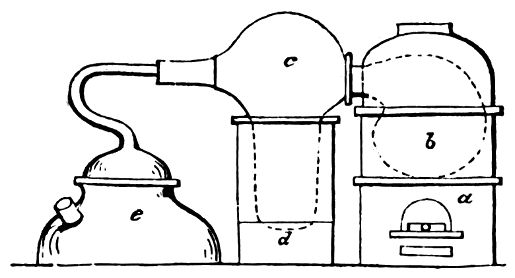
a. Furnace.
b. An earthenware retort, having a short and wide neck, containing the ingredients for making calomel.
c. An earthen receiver, having three tubulatures.
d. A vessel containing water.
e. A steam-boiler.
7. (Soubeiran.) The crude calomel mixture is heated in an earthen tube in a furnace, and a current of air is directed uninterruptedly into the tube by means of a small ventilator. This sweeps away, as it were, the vapours of calomel, and in a straight tube will carry them a distance of 60 feet, to avoid which the end of the recipient is immersed in water, by which means the calomel is moistened and falls down. This plan, slightly modified, is now extensively adopted in this country.
8. (Precipitated calomel; Calomelas præcipitatum, L.) Digest pure quicksilver, 9 parts, in nitric acid (sp. gr. 1·02 to 1·25), 8 parts, until no more metal will dissolve, applying heat as the effervescence ceases; then mix the hot liquid quickly with a boiling solution of sodium chloride, 8 parts, dissolved in water (slightly acidulated with hydrochloric acid), 64 parts; lastly, well wash the precipitate in boiling distilled water, and dry it. The product, when the process is skilfully managed, is perfectly white and pure.
Prop. A heavy, white, tasteless powder; insoluble in water, alcohol, and cold dilute nitric acid; volatilises at a temperature below redness, and yields a white or yellowish-white sublimate; hot nitric acid oxidises and dissolves it; alkalies, the alkaline carbonates, and lime water, decompose it, with the production of the black oxide; ammonia converts it into a dark slate-grey coloured powder (BLACK PRECIPITATE—Kane). Sp. gr. 7·14 (Boullay; 7·156—Pelouze and Fremy; 7·176—Ure).
Pur. Calomel is frequently contaminated with small quantities of corrosive sublimate, which may be detected by digesting a little in alcohol, decanting the clear portion, and testing it with a drop or two of potassium hydrate, when a reddish precipitate will be formed if any mercuric chloride be present. It is pulverulent, whitish, and sublimes entirely by heat. It becomes black on the addition of potassium hydrate, then, heat being applied, it runs into globules of mercury. Neither silver nitrate, lime water, nor sulphuretted hydrogen, being added to the water in which it has been washed, or boiled throws down anything.
Uses. Calomel is one of the milder mercurials, and in this respect takes its position immediately after blue pill, mercury with chalk, and the grey oxide; but it probably ranks before all the other salts of mercury. Universal experience appears to show it to be a most valuable alterative when judiciously administered. With this intention it is given in doses of 1⁄4 to 1 gr., generally combined with antimonials, as in Plummer’s pill, and repeated every night, or every other night, for some time, followed by a mild saline aperient in the morning. As a purgative, 2 to 5 gr., either combined with or followed by other purgatives, as jalap, rhubarb, senna, colocynth, Epsom salts, &c. As a vermifuge, 2 to 5 gr., over-night, followed by a sufficient dose of castor oil next morning. Combined with opium it is frequently used in various complaints to produce salivation, or bring the system under the influence of mercury. It is also employed as a sedative and errhine, and in a vast number of other indications. It is, indeed, more frequently used, and in a greater variety of complaints, than probably any other medicine.
Obs. Of the two methods of preparing calomel, that by precipitation is not only the best, but the most economical. That by sublimation is, however, the one generally adopted in England. Mr Brande states that “a small portion of sodium chloride is apt to remain combined with it, which might affect its medical uses.” Such a contamination is not found in carefully prepared precipitated calomel, although we doubt whether the quantity of it which exists in any of the samples we have met with (being merely a trace) would at all interfere with its therapeutical action; more especially when it is recollected that alkaline chlorides are present in, not merely the primæ viæ, but also in every part of the animal body. The late Mr Fownes, a chemist who was unsurpassed in the accuracy of his researches, and the caution and delicacy with which he expressed his opinions, once assured us that calomel was more easily and cheaply prepared of the best quality by precipitation than by sublimation, and that if, from careless manipulation, it occasionally contained a minute quantity of common salt, this was of much less importance than the contamination of corrosive sublimate, which was frequently present in samples of sublimed calomel.
To produce a superior article of calomel in the dry way is a somewhat difficult task, and the process frequently fails in the hands of inexperienced operators. The solution of the mercury is best made in an iron vessel, and the sublimation should be conducted (preferably) in an earthenware retort with a short but very wide neck, and fitted in a spacious receiver, having a large flat bottom, also of earthenware, and containing a little cold water. On the small scale the heat may be applied by means of a sand bath. The form above given for calomel, by precipitation, produces a large product, perfectly free from corrosive sublimate and mercurous nitrate, and is consequently free from the objections frequently raised against that mode of preparing it.
“The form in which calomel sublimes depends much upon the dimensions and temperature of the subliming vessels. In small vessels it generally condenses in a crystalline cake, the interior surface of which is often covered with beautiful quadrangular prismatic crystals, transparent, and of a texture somewhat elastic or horny. In this state it acquires, by the necessary rubbing into powder, a decided yellow or buff colour, more or less deep, according to the degree of trituration it has undergone. If, on the contrary, the calomel be sublimed into a very capacious and cold receiver, it falls in an impalpable and perfectly white powder, which requires only one elutriation to fit it for use; it then remains perfectly colourless.” (Brande.)
The long-continued action of steam on calomel in a state of minute division is attended by the formation of a small quantity of corrosive sublimate. (Righini.) Boiling water, hot air, and light, also produce a like effect.
Mercurous Iodide. HgI. Syn. Subiodide Of mercury, Green iodide of mercury, Mercurous iodide; Hydrargyri iodidum viride (B. P.), Hydrargyri subiodum, H. iodidum (Ph. L.), H. i. viride (Ph. D.), L. Prep. 1. (B. P.) Mercury, 1 oz.; iodine, 278 gr.; rectified spirit, a sufficiency. Rub the iodine and mercury in a porcelain mortar, moistening occasionally with a few drops of spirit, and continue the trituration until the mass assumes a uniform green colour, and no metallic globules are visible.
2. Precipitate a solution of mercurous nitrate by another of mercurous potassium iodide; wash the precipitate, first in a solution of sodium chloride, and then in pure water; lastly, dry it in the shade.
3. (Ph. L.) Mercury, 1 oz.; iodine, 5 dr.; triturate together, gradually adding of rectified spirit, q. s. (about 1 to 2 fl. dr.), until globules are no longer seen; dry the powder, by a gentle heat, in the shade, as quickly as possible, and preserve it in a well-stoppered black glass vessel. The formula of the Ph. D. is similar.
Prop., &c. A heavy, greenish-yellow powder; insoluble in water, alcohol, and a solution of common salt; soluble in ether, and slightly so in an aqueous solution of iodide of potassium. “Freshly prepared, it is yellowish. Heat being cautiously applied, it sublimes in red crystals, which quickly turn yellow, and, on access of light, blacken. It is insoluble in a solution of chloride of sodium.” The process of the Ph. L. and F. P. does not answer when larger quantities than 4 or 5 oz. are prepared at once, owing to the great heat generated by the reaction of the ingredients, and the consequent volatilisation of a portion of the iodine, by which the colour of the product suffers.—Dose, 1⁄8 to 1 gr., made into pills; “in syphilis and scrofula, especially where they occur in the same individual.” It is also used externally, in the form of ointment. It is very poisonous.
Mercurous Nitrate. HgNO3. Syn. Subnitrate of mercury; Hydrargyri subnitras, H. nitras, H. protonitras, L. Prep. 1. (Neutral.) By digesting mercury in excess of cold dilute nitric acid, observing to remove the short prismatic crystals within a short time after they are formed; these, when drained, and redissolved in water slightly acidulated with nitric acid, furnish crystals of pure neutral mercurous nitrate by cautious evaporation.
2. (Basic.) Deposited after some time, when excess of mercury has been employed as above. A fine crystallised salt.
Prop., &c. Both the above are decomposed by water, but the former may be dissolved in a very small quantity without decomposition. When the neutral salt is triturated with an excess of sodium chloride, and water subsequently added, the whole of the mercury is thrown down as calomel, and the filtered supernatant liquid does not contain corrosive sublimate. If this salt is detected, the salt examined contained mercuric nitrate, and if any basic mercurous nitrate was present, the newly formed calomel has a grey or black colour, due to presence of oxide.—Dose. Of the neutral salts, 1⁄16 to 1⁄8 gr. It is seldom used internally. A solution is sometimes employed as a mild caustic to ulcers; and, more dilute, as a lotion in lepra, porrigo, psoriasis, etc.; or made into an ointment, in the same diseases.
Mercurous Oxide. Hg2O. Syn. Suboxide of Mercury, Grey o. of m., Black o. of m., Mercurous o., Dioxide of m., Protoxide of M.†; Hydrargyri Suboxydum, H. oxydum, H. o. cinereum, H. o. nigrum, L. Prep. 1. (Ph. L. 1836.) Calomel, 1 oz.; lime water, 1 gall.; mix, agitate well together, decant the clear liquid after subsidence, and well wash the sediment with distilled water; lastly, drain and dry it, wrapped in bibulous paper, in the air.
2. (Ph. D. 1826.) Sublimed calomel, 1 part; solution of potassium hydrate (warm), 4 parts; triturate together, &c., as last.
3. Briskly triturate calomel in a mortar with pure potassium hydrate, in excess; wash it with water, and dry it in the shade.
Prop., &c. A very dark grey or black powder, suffering decomposition by exposure to light and air, becoming olive coloured, from a portion being resolved into metallic mercury and binoxide. Digested for a short time in dilute hydrochloric acid, it remains undissolved, and the filtered liquid is not affected by potassium hydrate, or by ammonium oxalate. It is totally soluble in acetic acid, and entirely dissipated by heat. As a medicine pure mercurous oxide is one of the mildest of the mercurials, and is used both internally and externally; but chiefly as a fumigant, or made into an ointment.—Dose, 1⁄2 gr. to 3 gr. twice a day.
Mercurous Phosphate, Syn. Hydrargyri phosphas, L. Prep. Add a solution of mercurous nitrate (slightly acidulated with nitric acid) to a solution of sodium phosphate, and wash and dry the precipitate which forms. In its physical characters it closely resembles calomel, than which it is said to be more appropriate in certain cases, especially in secondary syphilis. Alkalies turn it black.—Dose, 1⁄4 to 1 gr., made into a pill with sugar and aromatics.
Mercurous Sulphate. Hg2SO4. Syn. Subsulphate of mercury, Sulphate of the suboxide of m., Protosulphate of m.†; Hydrargyri subsulphas, L. Prep. By adding sulphuric acid to a solution of mercurous nitrate. The salt falls as a white crystalline powder.
Mercurous Sulphide. Hg2S. Syn. Subsulphate of mercury; Hydrargyri subsulphuretum cum sulphure, H. s. nigrum, L. Prep. 1. (Pure.) This falls as a black precipitate when a solution of mercurous nitrate is treated with sulphuretted hydrogen or ammonium sulphide.
2. (Impure; Ethiops mineral; Hydrargyri sulphuretum cum sulphure, H. s. nigrum—Ph. L. 1824 & Ph. D. 1826); (Æthiops mineralis—Ph. L. 1836 & Ph. D. 1826.) (Quicksilver and sulphur, equal parts, triturated together in a stoneware mortar—Ph. D.) until globules are no longer visible.
Prop., &c. The last preparation of mercurous sulphide is alone employed medicinally. It is a heavy, insoluble, black powder. It is frequently met with imperfectly prepared, and sometimes adulterated. It is said to be a mixture of mercurous sulphide and sulphur, in variable proportions depending on the length of the trituration. On the large scale it is generally made by melting the ingredients together, and afterwards reducing the mass to a fine powder in a mill or mortar. It is said to be vermifuge and alterative, and has been used in some cutaneous and glandular diseases, but appears to be nearly inert.—Dose, 5 to 30 gr.
Mercurous Tartrate. (P. Cod.) Syn. Proto-tartrate of mercury, Hydrargyri tartras. Made by adding a solution of proto-nitrate of mercury in water, slightly acidulated with nitric acid, to a solution of tartrate of potash as long as a precipitate forms. Wash it with distilled water, dry it in the shade, and keep it in bottles covered with black paper.—Dose, 1 to 2 gr.
MERCURY, Other Preparations of.
Mercury, Hahnemann’s. Syn. Hahnemann’s soluble mercury, H.’s black oxide of m., Black precipitate of m.; Hydrargyri præcipitatum nigrum, Mercurius solubilis Hahnemanni, L.—a. By dropping weak ammonia into a solution of mercurous nitrate as long as the precipitate formed is of a black colour; the powder is washed, dried in the shade without artificial heat, and then preserved from the light and air.
(Ph. Bor. 1847.) Solution of mercurous nitrate (recent; sp. gr. 1·1), 91⁄4 oz.; distilled water, 2 lbs.; mix, filter, and add to the solution of ammonia (sp. gr. ·960), 1⁄2 oz., diluted with water, 4 fl. oz.; collect the powder immediately on a filter, wash it with water, 3 fl. oz., and dry it, &c., as before. A very black powder.—Dose, 1⁄4 to 1 gr.
Mercury, Precipitates of. 1. Black precipitate, Hahnemann’s soluble mercury (basic mercurous and ammonium nitrate). 2. Green p. (MERCURIUS PRÆCIPITATUS VIRIDIS, LACERTA VIRIDIS), from equal parts of mercury and copper, separately dissolved in nitric acid, the solutions mixed, evaporated to dryness, and then calcined until red fumes cease to arise. Caustic. 3. Red p., mercuric oxide. 4. White p., ammonio-chloride of mercury.
Mercury, Ward’s. Syn. Ammonio-nitrate of mercury; Hydrargyri ammoniæ nitras, L. To nitric acid, 4 parts, contained in a spacious bolt-head or matrass, add, gradually, ammonium sesquicarbonate, 2 parts; afterwards add of mercury, 1 part, and digest in a gentle heat, until the solution is complete.
Mercury with Chalk. Syn. Hydrargyrum cum Cretâ. Grey powder (B. P.) Prep. Rub 1 oz. (by weight) of mercury, and prepared chalk, 2 oz., in a porcelain mortar, until metallic globules cease to be visible to the naked eye and the mixture acquires a uniform grey colour.—Dose. From 3 to 8 gr.
A little water is said to aid in the extinction of the mercury. Mr Bottle suggests a slight departure from the Grey modus operandi followed by the British Pharmacopœia in the above preparation. He proposes to substitute for the tedious process of trituration in a porcelain mortar the agitation of the mercury with the chalk in a wide-mouthed glass bottle; by which means the metal may be minutely subdivided, at a considerably less expenditure of time and labour.
Mercury with Magnesia. (Ph. D.) Syn. Hydrargyrum cum magnesiâ. Pure mercury, 1 oz., carbonate of magnesia, 2 oz. Rub together in a porcelain mortar until the globules cease to be visible and the mixture acquires a uniform, grey colour.—Dose, 3 to 8 grains.
Mercury, Yellow Oxide of. (Ph. B.) Syn. Hydrargyri oxydum flavum. Prep. Perchloride of mercury, 4 oz.; solution of soda (Ph. B.), 2 pints; distilled water, q. s. Dissolve the perchloride in 4 pints of distilled water, adding the solution by the application of heat, and add this to the solution of soda. Stir them together, allow the yellow precipitate to subside, remove the supernatant liquor by decantation, thoroughly wash the precipitated oxide on a calico filter with distilled water, and finally dry it by the heat of a water bath.
MES′LIN. A mixture of various kinds of grain. (Brande.)
METAGAL′LIC ACID. Obtained by heating dry gallic acid, by a quick fire, to about 480° Fahr., or until it froths, melts, and becomes black and solid, then dissolving the residuum in an alkali, filtering, and precipitating by an acid. An insoluble, black powder.
ME′TAL. Syn. Metallum, L. See Metals.
METAL′LICA. [L.] Preparations of the metals. One of the divisions of the Ph. L.
METAL′LIC TREES. See Vegetation (Metallic).
METAL′LO-CHROMES. A name given by Nobili to extremely thin films of peroxide of lead deposited by electrolytic action upon plates or polished steel, so as to produce an iridescent play of colours. The effect is often very beautiful.
MET′ALLOIDS. A name sometimes applied to the NON-METALLIC ELEMENTS.
METAL′LURGY. “The art of extracting metals from their ores, and adapting them to various processes of manufacture.” (Percy.)
“Notwithstanding the striking analogy which exists between common chemical and metallurgic operations, since both are employed to isolate certain bodies from each other, there are essential differences which should be carefully noted. In the first place, the quantity of materials being always very great in metallurgy, requires corresponding adaptations of apparatus, and often produces peculiar phenomena; in the second place, the agents to be employed for treating great masses must be selected with a view to economy, as well as chemical action. In analytical chemistry, the main object being exactness of result and purity of product, little attention is bestowed upon the value of the reagents, on account of the small quantity required for any particular process. But in smelting metals upon the large scale, profit being the sole object, cheap materials and easy operations are alone admissible.”[35]
The limits of this work do not permit of more than a general reference to the leading operations of metallurgy under this head. These are—digging, picking or sorting, stamping
MET′ALS. Syn. Metalla, L. Metals are elementary bodies, which are generally distinguished by their lustre and power of conducting heat and electricity. When their solutions are electrolysed, the metals always appear at the electro-negative surface, and are hence termed electro-positive elements.
Formerly, when science was much less advanced than at present, the metals constituted a well-defined class. The properties which were regarded as specially characteristic were physical, and were not founded on chemical relations; thus, lustre and high specific gravity were considered to be essential characters of all metals. But we are now acquainted with metals which have a lower specific gravity than water (lithium, sodium, &c.), and with so-called non-metallic elements which present a strong metallic lustre (carbon in the state of graphite, crystallised silicon). It will therefore be seen that the term ‘metal’ is rather conventional than strictly scientific. By far the greater number of elementary bodies at present known are metals. Their physical characters and leading chemical properties are noticed under each of them in its alphabetical place. The following table exhibits some useful particulars:—
Table of some of the properties of some of the metals.
Names arranged in the order of their
Ductility. Malleability.
Gold. Gold.
Silver. Silver.
Platinum. Copper.
Iron. Tin.
Nickel. Platinum.
Copper. Lead.
Zinc. Zinc.
Tin. Iron.
Lead. Nickel.
Names arranged in the order of their
Power of conducting Heat. Power of conducting Electricity.
Silver. Silver.
Copper. Copper.
Gold. Gold.
Tin. Zinc.
Iron. Iron.
Lead. Tin.
Bismuth. Lead.
Antimony.
Bismuth.
METANTIMON′IC ACID. H4Sb2O7. The name given by M. Fremy to that variety of antimonic acid obtained by decomposing pentachloride of antimony with excess of water. It differs from common antimonic acid in being tetra, and forming two different classes of salts with the acids. The acid metantimoniate of potassium is the only reagent which yields a precipitate with the sodium salts, and is therefore of great value in chemical analysis. It is prepared by fusing antimonic acid with excess of potassa, in a silver crucible, dissolving the fused mass in a little cold water, and allowing it to crystallise in vacuo. The resulting crystals (metantimoniate of potassa), by solution in pure water, are resolved into free potassa and the acid salt. See Antimony.
METAPEC′TIC ACID. See Pectin.
METAPEC′TIN. See Pectin.
METAPHOSPHOR′IC ACID. See Phosphoric acid.
METHEG′LIN. Syn. Hydromeli, H. vinosum, Mellis vinum, L. Prep. From honey, 1 cwt.; warm water, 24 galls.; stir well until dissolved; the next day add of yeast, 1 pint, and hops, 1 lb., previously boiled in water, 1 gall.; along with water q. s. to make the whole measure 1 barrel; mix well, and ferment the whole with the usual precautions adopted for other liquors. It contains on the average from 7% to 8% of alcohol. See Mead.
ME′THYL. CH3. The hypothetical radical of PYROXYLIC SPIRIT (WOOD-SPIRIT, METHYLIC ALCOHOL) and the methyl series. It forms a number of compounds analogous to those of ethyl.
METHYLAMINE. Syn. Methylia. CH3H2N. A colourless gas possessing a very powerful odour of ammonia, and a strongly alkaline reaction. It differs from ammonia, however, in being non-inflammable. In other respects it bears a considerable resemblance to it. Water at 55° Fahr. dissolves more than eleven hundred times its bulk of methylamine. It may be easily condensed to a liquid by means of a freezing mixture.
To obtain it nascent hydrogen is made to react on prussic or formic acid. Methylia exists in herring brine, and is a frequent product of the destructive distillation of substances containing nitrogen. Most of its salts are very soluble in water.
METHYLATED SPIRIT. A mixture of 1 part of methylic alcohol (wood spirit) and 9 parts of ethylic alcohol (spirit of wine). See Spirit.
METHYLENE CHLORIDE. CH2Cl2. Syn. Methylene bichloride. There are various methods of obtaining this compound:—1. By heating chloroform with zinc filings and dilute sulphuric acid. 2. By acting on methylene iodide with chlorine. In this process prolonged treatment with chlorine, at ordinary temperatures, is required to remove the last traces of iodine. (Buttlerow.) Chloride ofMETHYLENE ETHER is a mechanical mixture of bichloride of methylene and ethylic ether. Dr Richardson says of this latter it is not so quick in its action as the methylene chloride, but that it is safer. See Anæsthetics.
METHYLIC ALCOHOL. See Wood Spirit.
MEZE′REON. Syn. Garou; Mezereon bark, Mezerei cortex (B. P.); Mezereon—Ph. L., E., & D. The dried bark of the Daphne Mezereum, mezereon; or Daphne Laureola, spurge, or wood-laurel. The “bark of the root of Daphne Mezereum,” or spurge olive. (Ph. L.) A stimulant and diuretic. It is employed as a sudorific and alterative, in syphilis, rheumatism, scrofula, and chronic cutaneous diseases, usually in conjunction with sarsaparilla. It has also been used as a masticatory in toothache, paralysis of the tongue, &c. On the Continent it is used as a vesicant. For this purpose it is softened by soaking it in hot vinegar, and is then bound on the part, and renewed after intervals of some hours, until vesication is produced.
MICE. See Rats.
MI′CROSMIC SALT. NaNH4HPO4, Syn. Tribasic phosphate of sodium and ammonium. Prep. 1. Phosphates of soda and ammonia, equal parts; water, q. s.; dissolve separately, mix the solutions, evaporate, and crystallise. A slight excess of phosphate of ammonia aids the crystallisation.
2. (Fownes.) Phosphate of sodium, 6 parts; water, 2 parts; liquefy by heat, and add of sal ammoniac (in powder), 1 part; common salt separates, and after its removal the liquid is concentrated so that crystals may form. Used as a flux in blowpipe assays.
MI′CROSCOPE. The value of the microscope in chemistry and the collateral sciences is now so generally acknowledged that it would be folly to do more than merely allude to the subject here.
In the COMPOUND MICROSCOPE, which has quite superseded the ‘simple microscope’ as an instrument of research, the object is magnified in the first instance by the object-glass, and then remagnified by the eye-piece. It follows, therefore, that the magnifying power of the instrument may be increased either by increasing the power of the object-glass or that of the eye-piece. It must be borne in mind, however, that in increasing the power of the eye-piece we do not magnify the object itself in a greater degree, but simply increase the image of the object formed by the object-glass. Any imperfections which may exist in the latter are thus greatly increased. At first the great drawback to the use of the compound microscope was its deficiency in achromatism; but the researches of Mr Lester and Dr Goring led to the achromatising of the object-glass, which was the first of the rapid strides towards perfection made by this instrument during the last twenty years. The two most useful object-glasses are the ‘quarter-inch,’ which should magnify from 200 to 220 diameters, and the ‘inch,’ which should magnify from 30 to 40 diameters. The definition of these glasses should be good, and they should transmit plenty of light. Any lines in a structure examined by them should appear sharp and distinct, and there should be no coloured fringes around the object. It is of great importance that the object-glasses are kept perfectly free from dust. A few shreds of wash-leather of the finest quality should be kept in a pill-box for cleaning them. Before rubbing them with the leather they may be breathed upon, but no whiting or liquid of any kind should be used, as each object-glass, being achromatic, is a very delicate piece of workmanship, consisting of two lenses of flint and crown-glass cemented together by Canada balsam. Compound microscopes are now sold by the best London makers at very low prices. A really good instrument, adapted to most of the wants of the chemical, pharmaceutical, or medical student, may be obtained for five guineas.
The following formulæ for the preparation of the chief substances, together with the principal reagents required in the working of the microscope, are from Dr Lionel Beale’s valuable book, ‘How to Work with the Microscope,’[36]
Reagents—
1. Alcohol, of various strengths.
2. Ether, to dissolve oil globules.
3. Nitric acid (1 part of strong acid to 5 of water)
4. Sulphuric acid (1 to 5).
5. Hydrochloric acid.
6. Acetic acid, glacial and dilute (1 to 5).
7. Chromic acid, very dilute, to harden tissues.
8. Solution of potash, saturated and dilute (1 to 10).
9. Solution of soda (25 gr. of fused soda to 1 oz.).
10. Ammonia (1 part of the strongest solution to 3 of water).
11. Nitrate of baryta, a cold saturated solution of.
12. Nitrate of silver (120 gr. to 2 oz.). These two are for the mineral acids.
13. Oxalate of ammonia in solution. Test for lime.
14. Solution of iodine saturated, i.e. 1 to 7000 parts of water. Another solution is—1 gr. of iodine and 3 of iodide of potassium in 1 oz. of distilled water.
1. Cements.—1. Brunswick Black. Boil together 1⁄4 lb. foreign asphaltum and 41⁄4 oz. of linseed oil (previously thickened with litharge), then mix to a proper consistence with oil of turpentine (about 1 pint).
2. Gold Size. Boil 25 parts of linseed oil1⁄3rd part of umber for 3 hours; pour off the clear fluid, and mix with equal parts of powdered white lead, and yellow ochre, added in small successive portions. Then boil well the whole again, and pour off the clear fluid. It dries slowly, but firmly. Both this and the last are dissolved by turpentine.
3. Goadby’s Marine Glue. Dissolve separately in coal naphtha equal parts of shell-lac and india rubber. Mix thoroughly with heat.
4. Sealing-wax Varnish. Dissolve the best sealing-wax in enough strong spirit of wine to reduce it to the proper consistence. This is brittle.
5. Canada Balsam. This dries spontaneously.
Solutions of shell-lac, gum, and various other cements and glues are employed by microscopic manipulators.
Preservative Fluids. Canada balsam, spirit and water, glycerin, solution of gelatin, saturated solution of alum, chloride of zinc, and chloride of calcium, are all used to preserve microscopic objects.
The following formulæ will be found useful:—
1. Goadby’s Solution. Bay salt, 4 oz.; alum, 2 oz.; corrosive sublimate, 4 gr.; boiling water, 4 pints. Mix and filter. It may often be more diluted.
2. Thwaite’s Fluid. Mix spirit of wine, 1 oz., with creosote sufficient to saturate it; rub up with chalk to form a thin paste, and mix gradually with 16 oz. of water. To this may be added an equal quantity of water, saturated with camphor.
3. Simple Creosote Solution. Dissolve creosote, 1 dr., in pyroligneous acid, 1 dr., and mix gradually with cold water, 1 pint.
4. Passini’s Solution. For blood-globules, nerves, and white tissues generally. Perchloride of mercury, 1 part; chloride of sodium, 2 parts; glycerin, 13 parts; distilled water, 113 parts.
MIL′DEW. Syn. Rust, Blight. The mouldy appearance on the leaves of plants produced by innumerable microscopic fungi. The hop, wheat, and the choicest garden fruit trees, are those most commonly attacked. The causes are said to be excess of moisture, and absence of the free circulation of air and sunshine. On the small scale, finely powered sulphur is occasionally dusted over the parts affected, as a remedy.
MIL′IARY FEVER. Syn. Miliaria, L. Among the other symptoms are—anxiety and frequent sighing, the perspiration has a strong and peculiar smell, and there is a sensation of pricking on the neck and breast, followed by an eruption of small red pimples, which in two or three days become white vesicles, dry up, peel off, and are succeeded by others. The moist weather of spring and autumn are the periods in which it is most prevalent; and delicate females, particularly in child-bed, are those most liable to its attacks. Sometimes it assumes a malignant character. The treatment of this affection consists chiefly in combating the depression of the system by a supporting diet; but everything that heats or stimulates the skin should be avoided. The apartment should be kept cool and well ventilated, and cooling saline laxatives and bitter tonics, with cooling drinks, should also be had recourse to.
MILK. Syn. Lac, L. The value of milk as an article of food is clearly shown by the fact of it being sufficient to support, and to increase the growth of, the young of every species of the mammalia; at once supplying materials for the formation of the osseous, fleshy, and liquid portions of the body. “The substances present in milk are wonderfully adapted to its office of producing materials for the rapid growth and development of the animal frame. It contains an azotised matter, casein, nearly identical in composition with muscular flesh, fatty principles, and a peculiar sugar, and, lastly, various salts, among which may be mentioned phosphate of lime, held in complete solution in a slightly alkaline liquid.
“The white and almost opaque, appearance of milk is an optical illusion. Examined by a microscope of even moderate power, it is seen to consist of a perfectly transparent fluid, in which float about numbers of minute transparent globules; these consist of fat surrounded by an albuminous envelope, which can be broken mechanically, as in the churning, or dissolved by the chemical action of caustic potassa, after which, by agitating the milk with ether, the fat can be dissolved.” (Fownes.)
Comp. Cows’ milk, of average quality, contains from 10% to 12% of solid matter when evaporated to dryness by steam heat, and has the mean sp. gr. 1·030; while that of the skimmed milk is about 1·035; and of the cream, 1·0244. (Ure.) The average CREAM of cows’ milk contains 4·5% of butter, 3·5% of curd, and 92% of whey. (Berzelius.) The SKIMMED MILK consists of water, 92·9%; curd, 2·%; sugar of milk, 3·5%; lactic acid, lactate of potassa, and a trace of lactate of iron, ·6%, chloride of potassium, phosphate of potassa, and earthy phosphates (lime), ·2%. (Berzelius.)
The following analysis of fresh milk is by M. Haidlen:—
Water 873·00
Butter 30·00
Casein 48·20
Milk sugar 43·90
Phosphate of lime 2·31
Phosphate of magnesia ·42
Phosphate of iron ·07
Chloride of potassium 1·44
Chloride of sodium ·24
Soda in combination with casein ·42
————
1000.
Professor Wanklyn has devised and published in his excellent little manual ‘Milk[37] a process by which a very thorough chemical examination of milk may be accomplished with great facility and expedition.
In his preliminary remarks he condemns, as utterly unreliable and misleading, the inferences to be drawn from those hydrometric instruments, the lactometer or lactodensimeter, and creamometer. “A very little consideration,” he says “will suffice to make intelligible the obliquity of the indications of the lactometer and to show how untrustworthy it must be. The lactometer, as of course will be understood, is simply the hydrometer applied to milk; and readings of the instrument are neither more nor less than specific gravities. The more milk-sugar, and casein, and mineral matter there is in a given specimen of milk, the greater (other things being equal) will be its density or specific gravity, and the higher the lactometer reading.
“If, however, fat globules (as happens in the instance of milk) be diffused through the fluid, then, because fat is lighter than water, the effect of the other milk solids on the gravity of the liquid, will be more or less neutralised. The density of milk-fat is about 0·9, water being 1·0. Now, if a solution of casein and milk-sugar, of specific gravity 1·030, be sufficiently charged with fat globules, its specific gravity may be sent down even below the gravity of water. How much would be required to bring about such a result is a matter of simple calculation.
“This being understood, it will be obvious that if the specimens of milk differ in specific gravity, there must be two distinct and equally valid ways of accounting for the difference.
“The milk with the lower gravity may be milk let down with water, or let down with fat, i. e. milk let down by being enriched.”
In support of this last assertion Professor Wanklyn quotes corroborative instances afforded by the examination of different specimens of milk known as ‘strippings,’ these being the last portions of milk yielded by the cow at the termination of the milking. All these ‘strippings’ had a lower specific gravity than normal milk.
Further, Professor Wanklyn points out that the specific gravity of organic fluids is a fallacious index of the amount of solids they may contain, as is illustrated by the fact, that whilst a 10 per cent. solution of chloride of potassium has a specific gravity of 1·065 at 15° C., and a 10 per cent. solution of casein and milk sugar, has a specific gravity of only about 1·035.
The creamometer meets with equal condemnation in Professor Wanklyn’s little book, since different specimens of milk vary considerably in their yield of cream, and a perfectly pure sample of milk may yield less cream than one which has been tampered with.
A complete analysis of milk involves the determination of the water, the fat (the essential constituent of the cream), the casein, milk-sugar, and ash.
The following is an outline of Professor Wanklyn’s neat and ingenious method of analysis:—
By means of an accurately graduated pipette, he first places 5 cubic centimetres of the milk in a small weighed platinum dish (about 14 grammes in weight) just previously ensuring the sample from which the milk is taken being thoroughly mixed.