A CYCLOPÆDIA OF PRACTICAL RECEIPTS, &c. VOLUME II (continued 17)
Reading edition
The precipitate is now to be washed from off the filter-paper with the morphiated water previously described, and digested therein for a few minutes, which removes some more colouring matter, together with any salts soluble in water, but insoluble in alcohol, which may have adhered to the precipitated morphia; then once more collect the precipitate on a filter, washing it with morphiated spirit, after this once with ether, and finally thrice, or more with benzine; this completely frees it from narcotina, which is very soluble in benzine; morphia, on the contrary, being insoluble in this liquid. It now remains to drain and dry at a low temperature, say 100° F., the resulting pure and white morphia, the weight of which will indicate the amount
7. (Ph. E.) Macerate 100 gr. of opium for 24 hours in 2 fl. oz. of water, filter, and strongly squeeze the residue; then precipitate the infusion with carbonate of sodium, 1⁄2 oz., dissolved in cold water, 2 fl. oz.; gently heat the precipitate until it shrinks and fuses, then cool and weigh it. It should weigh at least 10 gr., and, when powdered, be entirely soluble in a solution of oxalic acid. See also Watts’ ‘Dic. of Chemistry,’ article Opium.
Tests. These depend chiefly on the chemical and physical characters of morphia and meconic acid, the tests for which have been already noticed. In operating upon the contents of the stomach, or upon solid organs, in cases of suspected poisoning, the best method or proceeding is that already described under Alkaloid.
Another method is to boil the substances in water slightly acidulated with acetic acid, next to evaporate the solution to the consistence of a thick syrup, and then to treat it twice with boiling rectified spirit; the tincture thus obtained is to be filtered when cold, and again evaporated to the consistence of a syrup; it is now re-dissolved in distilled water, the filtrate treated with solution of subacetate of lead, and the precipitate of meconate of lead, separated by filtration, and carefully preserved. A current of sulphuretted hydrogen is then passed through the solution to precipitate excess of lead, and after again filtering it the liquid is evaporated, at first in a water bath, and afterwards under the receiver of an air-pump. The shapeless mass of crystals thus obtained present all the characters of morphia, if the substance examined contained opium. In the meantime the precipitate of meconate of lead is to be boiled with water acidulated with sulphuric acid, and the insoluble sulphate of lead separated by filtration; the filtered liquid, by evaporation, furnishes meconic acid, either under the form of crystals or an amorphous powder, the solution of which precipitates ferric salts of a deep blood-red.
The following are additional tests to those already noticed:—
1. From the peculiar odour of opium, often perceptible when the drug has been taken only in very small quantities.
2. A solution containing crude opium is turned of a deep red colour, or if coloured, it is turned of a reddish brown, and is darkened by tincture of ferric chloride.
3. (Hare.) A portion of the suspected liquid is poured into a beaker glass, and a few drops of solution of acetate of lead are added to it; the whole is stirred frequently for 10 or 12 hours, and then allowed to settle, after which the supernatant liquid is decanted; 20 or 30 drops each of dilute sulphuric acid and solution of ferric sulphate are next poured on the precipitate (meconate of lead), when a deep and beautiful red colour will be developed if the original liquid contained opium.
4. (Dr Rieget.) The suspected substance is mixed with some potassa, and is then agitated with ether; a strip of white unsized paper is next several times moistened with the solution, and when dry it is re-moistened with hydrochloric acid, and exposed to the steam of hot water. The paper assumes a red colour, more or less deep, if opium is present.
Uses, &c. Opium is one of the most valuable substances employed in medicine. In small doses it acts as a powerful and diffusible stimulant, in somewhat larger ones it is narcotic, and in excessive doses it proves an active narcotic poison. It is also anodyne, antispasmodic, diaphoretic, soporific, and sedative, its peculiar action being greatly modified by the dose and the condition of the patient. Its action as a stimulant is followed by sedative effects, which are, in general, much more marked than could be expected from the degree of previous excitement it induces. It is employed to fulfil a variety of indications—to procure sleep, to lull pain, allay irritation, check morbid discharges, alleviate cough and spasm, &c. &c. It also, when judiciously administered, renders the body less susceptible of external impressions, as those of cold, contagion, &c.; but it is injurious when the pulse is high, the heat of the body above the natural standard, and the skin dry, or when there is a disposition to local inflammation or congestion. When applied externally, in the form of frictions, liniments, ointments, &c., it is absorbed, and produces similar effects to those produced by swallowing it, but in this way it requires to be used in larger quantities.—Dose. As a stimulant, 1⁄4 gr., every 2 or 3 hours; as an anodyne and antispasmodic, 1⁄2 to 1 gr.; as a soporific, 1⁄2 to 2 gr.; in violent spasms, neuralgia, acute rheumatism, &c., 2 to 4 gr., increased in delirium tremens, hydrophobia, mania, tetanus, &c., to several times that quantity, according to circumstances.
The use of opium as a stimulant and intoxicant is common among the nations of the East. The Turks chew it, and the Chinese smoke a watery extract of it, under the name of ‘chundoo,’ the preparation of which from the crude article constitutes a special business. Messrs Flückiger and Hanbury, in their ‘Pharmacographia,’ published in 1874, say this particular business is not confined to the celestials, since, in 1870, a British firm at Amoy opened an establishment for preparing chundoo for the consumption of the Chinese in California and Australia.
The qualities most valued by the Chinese in opium are its fulness and peculiarity of aroma, and its degree of solubility. The amount of morphine it contains is a secondary consideration.
The practice of opium smoking yearly increases in China. It appears to be openly followed, and no odium attaches to it, provided
In the larger cities and towns adjacent to Amoy the proportion of opium smokers, according to Mr Hughes, Commissioner of Customs at Amoy, is estimated at from 15 to 20 per cent. of the adult population.
In the country districts 5 to 10 per cent. of the population are believed to be opium smokers.
In many of the Western States of America the practice has become so notoriously common that in 1872 the legislature of Kentucky passed a bill by which any person who, through the excessive use of opium, is incapacitated from managing himself or his affairs, may, upon the affidavit of two citizens, be confined in an asylum, and subjected to the same restraint as lunatics or habitual drunkards.[77]
Of late years opium-eating and laudanum-taking have, unfortunately, been greatly on the increase in this country, and the employment of this drug as a soporific for infants and young children has become so general amongst the poor and dissipated as to call for the interference of the legislature.
Of the 250,000 lbs. of opium which, as shown by the recent returns made by the Custom House, are imported into this country, it has been computed that not more than a third of this quantity is used for medicinal purposes.
According to Dr Chevers the practices of opium-eating and opium-smoking are very common among the natives of India. The same authority also states that in that country a large number of female infants are purposely poisoned by it, by introducing the drug into the child’s mouth, and in various other ways.
The first effect of opium as a stimulant is to excite the mental powers and to elevate those faculties proper to man; but its habitual use impairs the digestive organs, induces constipation, and gradually lessens the energy of both the mind and body. In excessive quantities it destroys the memory, induces fatuity and a state of wretchedness and misery, which after a few years is mostly cut short by a premature death. In this respect the effects of the excessive use of opium closely resemble those of fermented liquors.
Opium is somewhat uncertain in its action; some persons being able, sometimes from idiosyncrasy, but more frequently from previous indulgence in it, to take a much larger dose than others. The smallest quantity which is said to have proved fatal with an adult is 4 grains of the crude opium. In contrast with this may be quoted the statement of Dr Garrod, of a young man who not only swallowed 60 gr. of Smyrna opium night and morning, but very frequently, in addition to this, 1 oz. to 11⁄2 oz. of laudanum during the day.
Dr Chapman also cites the case of a patient to whom a wineglass of laudanum had to be administered several times in 24 hours.
Pois.—Symptoms. Headache; drowsiness; stupor; frightful reveries; vertigo; contracted pupil (generally); scanty urine; pruritus or dry itching of the skin, often accompanied by a papular eruption; thirst; dryness of mouth and throat; weak and low pulse; vomiting; respiration, generally, natural. Sometimes the drowsiness or sleep is calm and peaceful.—Ant., &c. Vomiting must be induced as soon as possible, by means of a strong emetic and tickling the fauces. If this does not succeed, the stomach-pump should be applied. The emetic may consist of a 1⁄2 dr. of sulphate of zinc dissolved in 1⁄2 pint of warm water, of which one third should be taken at once, and the remainder at the rate of a wine-glassful every 5 or 10 minutes, until vomiting commences. When there is much drowsiness or stupor, 1 or 2 fl. dr. of tincture of capsicum will be found a useful addition; or one of the formulæ for emetic draughts given at page 588 (especially No. 7) may be taken instead. Infusion of galls, cinchona, or oak-bark, should be freely administered before the emetic, and water soured with vinegar and lemon-juice, after the stomach has been well cleared out. To rouse the system, spirit-and-water or strong coffee may be given. To keep the sufferer awake, rough friction should be applied to the skin, an upright posture preserved, and walking exercise enforced, if necessary. When this is ineffectual, cold water may be dashed over the chest, head, and spine, or mild shocks of electricity may be had recourse to. To allow the sufferer to sleep is to abandon him to destruction. Bleeding may be subsequently necessary in plethoric habits, or in threatened congestion. The costiveness that accompanies convalescence may be best met by aromatic aperients; and the general tone of the habit restored by stimulating tonics and the shower bath. The smallest fatal dose of opium in the1⁄2 gr. Children are much more susceptible of the action of opium than of other medicines, and hence the dose of it for them must be diminished considerably below that indicated by the common method of calculation depending on the age. See Doses, &c.
Concluding Remarks. Opium is a very complicated substance, and contains a number of alkaloids and other proximate vegetable principles, besides a certain portion of saline matter. The substances already detected in it are caoutchouc, codein, fatty matter, lignin, meconic acid, meconia, morphia, narceia, narcotia, odorous matter, opiania, papaveria, pseudomorphia (?), porphyroxin, resin, saline matter, &c. It is doubtful, however, whether some of these substances are not generated from other principles existing in opium during the processes adopted to obtain them.
According to Mulder, 100 parts of ordinary Smyrna opium contain—
Morphia 10·842
Codeia ·678
Narcotia 6·808
Narceia 0·662
Meconia ·804
Meconic acid 5·154
Resin 3·582
Gummy matter 26·242
Mucus 19·086
Fatty matter 2·166
Caoutchouc 6·012
Water 9·846
Matter undetermined and loss 2·118
————
100·
The sp. gr. of Smyrna opium is 1·336.
The following chart, showing the natural alkaloids of opium and a few of their artificial derivatives, is taken from the ‘Pharmacographia’ of Messrs Flückiger and Hanbury:
C. H. N. O.
Discovered by Wöhler, 1844 Cotarnine Formed by oxidising narcotine, soluble in water. 12 13 1 3
Hesse, 1871 1. Hydrocotarnine Crystallisable, alkaline, volatile at 100°. 12 15 1 3
Matthiesen and Wright, 1869 Apormorphine From morphine by hydrochloric acid, colourless, amorphous, turning green by exposure to air, emetic. 17 17 1 2
Wright, 1871 Desoxymorphine 17 19 1 2
Sertürner, 1816 2. Morphine Crystallisable, alkaline, levogyre. 17 19 1 3
Pelletier and Thibouméry, 1835 3. Pseudomorphine Crystallises with H2O, does not unite even with acetic acid. 17 19 1 4
Discovered by Matthiesen and Burnside, 1871 Apocodeine From codeine by chloride of zinc; amorphous, emetic. 18 19 1 2
Wright, 1871 Desoxycodeine 18 21 1 2
Robiquet, 1832 4. Codeine Crystallisable, alkaline, soluble in water. 18 21 1 3
Matthiesen and Foster, 1868 Nornarcotine 19 17 1 7
Thibouméry, 1835 5. Thebaine Crystallisable, alkaline, isomeric with buxine. 19 21 1 3
Hesse, 1870 Thebenine 19 21 1 3
Hesse, 1870 Thebarcine From Thebaine or Thebenine by hydrochloric acid. 19 21 1 3
Hesse, 1871 6. Protopine Crystallisable, alkaline. 20 19 1 5
Matthiesen and Foster, 1868 Methylnornarcotine 20 19 1 7
Hesse, 1871 Deuteropine Not yet isolated. 20 21 1 5
Hesse, 1870 7. Laudanine An alkaloid, which, as well as its salts, forms large crystals; turns orange by hydrochloric acid. 20 25 1 4
Hesse, 1870 8. Codamine Crystallisable, alkaline, can be sublimed; becomes green by nitric acid. 20 25 1 4
Merck, 1848 9. Papaverine Crystallisable, also its hydrochlorate; sulphate in sulphuric acid precipitated by water. 21 21 1 4
Hesse, 1865 10. Rhœadine Crystallisable, not distinctly alkaline, can be sublimed; occurs also in Papaver Rhœas. 21 21 1 6
Hesse, 1865 Rhœagenine From rhœadine, crystallisable, alkaline. 21 21 1 6
Armstrong, 1871 Dimethylnornarcotine 21 21 1 7
Hesse, 1870 11. Meconidine Amorphous, alkaline, melts at 58°, not stable, the salts also easily altered. 21 23 1 4
T. and H. Smith, 1864 12. Cryptopine Crystallisable, alkaline, salts tend to gelatinise, hydrochlorate crystallises in tufts. 21 23 1 5
Hesse, 1871 13. Laudanosine Crystallisable, alkaline. 21 27 1 4
Derosne, 1803 14. Narcotine Crystallisable, not alkaline, salts not stable. 22 23 1 7
Hesse, 1870 15. Lanthopine Microscopic crystals, not alkaline, sparingly soluble in hot or cold spirit of wine, ether or benzol. 23 25 1 4
Pelletier, 1832 16. Narceine Crystallisable (as a hydrate), readily soluble in boiling water, or in alkalies, levogyre. 23 29 1 9
⁂ The following preparations, once famous, are now nearly obsolete in this country. Those that are made with cold water or by fermentation are supposed to be milder than crude opium, and in this respect to be similar to ‘BLACK DROP,’
Opium, Homberg’s. Opium exhausted by repeated coction in 10 or 12 times its weight of water, and the mixed liquors evaporated to one third, and kept boiling for 2 or 3 days, adding water from time to time, then straining and evaporating to a pilular consistence. Baumé’s purified opium is similar.
Opium, Launcelotte’s. Opium, 1 lb.; quince juice, 1 gall.; pure potassa, 1 oz.; sugar, 4 oz.; ferment for some time, evaporate to a syrup, digest in rectified spirit, filter, and evaporate the tincture.
Opium, Let′tuce. Lactucarium.
Opium, Newmann’s. Infusion of opium, strained, mixed with a little sugar, and fermented for some months in a warm place; and, lastly, strained and evaporated to an extract, or preserved in the liquid form.
Opium, Powell’s. Opium, exhausted by coction with water, the residuum treated with spirit of wine, and the mixed tincture and decoction evaporated to an extract.
Opium, Pu′′rified. Syn. Opium purificatum, L. The purified opium of old pharmacy is now represented by the aqueous extract of the Pharmacopœias. (See page 703.) Formerly, picked opium, beaten to a pilular consistence, with the addition of a little water or proof spirit, was called ‘SOFT PURIFIED OPIUM’ (OPIUM PURIFICATUM MOLLE); and picked opium, dried in a water bath until brittle enough for powdering, was called ‘HARD PURIFIED OPIUM’ (O. P. DURUM). Cornette’s and Josse’s purified opium are similar to the extract of Ph. L.
Opium, Quercetan’s. Vinegar of opium evaporated to an extract.
Opium, Strained. Syn. Extractum thebaicum, Opium colatum, Opium purificatum, L. Opium dissolved or softened in an equal weight of water, passed through canvas, and evaporated to the consistence of an extract. It is now superseded by the aqueous extract.
Opium, Tor′refied. Syn. Roasted opium; Opium torrefactum, L. Opium, dried, cut into thin slices, and roasted on an iron plate, at a low heat, as long as it emits vapours, care being taken not to burn it.
OPODEL′DOC. 1. See Liniment of soap.
2. (Steer’s opodeldoc.) This, which differs from common opodeldoc chiefly in containing more soap, is prepared as follows:—
a. White Castile soap (cut very small), 2 lbs.; camphor, 5 oz.; oil of rosemary, 1 oz.; oil of origanum, 2 oz.; rectified spirit, 1 gall.; mix, and digest in a strong bottle (closely corked), by the heat of a water bath, until solution is complete; when the liquid has considerably cooled, add of liquor of ammonia,
b. Soap, 4 oz.; camphor, 1 oz.; oil of rosemary and origanum, of each 1 dr.; rectified spirit, 1 pint; liquor of ammonia, 11⁄2 fl. oz. Mix.
c. (Phil. Coll. of Phar.) White soap, 28 oz.; camphor, 8 oz.; rectified spirit, 61⁄2 pints; dissolve, suffer the impurities to subside, add of liquor of ammonia, 4 fl. oz.; oils of rosemary and horsemint, of each 1 fl. oz.; and pour it into phials, as before.
OPOPONAX. A resinous substance obtained from the roots of the Opoponax chironium. It occurs in lumps of a reddish-yellow or brown colour, and has a waxy fracture. It has a powerful odour, which somewhat resembles garlic, and a bitter taste.
Opoponax is only partially soluble in alcohol, According to Payen it consists of a little volatile oil, a resin that melts it at 100° C., gum, inorganic and organic salts, and mechanical admixtures. It is used in French pharmacy; and was held in great esteem by Hippocrates, Theophrastus, and Dioscorides, all of whom employed it therapeutically.
ORANGE. Syn. Aurantium, L. The common SWEET ORANGE is the fruit of Citrus Aurantium. The Seville or BITTER ORANGE is produced by Citrus vulgaris or Bigaradia.
Oranges are probably about the most wholesome and useful of all the subacid fruits. Their juice differs from that of lemons chiefly in containing less citric acid and more sugar. In their general properties the two are nearly similar.
Factitious orange juice is made by dissolving citric acid, 1 oz., and carbonate of potassa, 1 dr., in water, 1 quart, and digesting the solution on the peel of half an orange until sufficiently flavoured; Narbonne honey or white sugar is then added to impart the necessary sweetness. Instead of orange peel, 5 or 6 drops of oil of orange peel, with 1⁄2 fl. oz. of tincture of orange peel, may be used.
Orange peel (CORTEX AURANTII) is an agreeable, stomachic, bitter tonic, especially useful as an adjunct to more active medicines. That ordered to be used in medicine is the exterior (yellow) rind of the Citrus Bigaradia, or bitter orange, dried in the months of February, March, or April. See Candying, Infusion, Issue peas, Oils (volatile), &c.
ORANGEADE′. Syn. Orange sherbet. 1. Juice of 4 oranges, thin peel of 1 orange, lump sugar, 4 oz.; boiling water, 3 pints.
2. Juice and peel of 1 large orange, citric acid, 15 gr.; sugar, 3 oz.; boiling water, 1 quart.
Orangeade, Effervescing or Aerated. 1. Mix 1 lb. of syrup of orange peel, a gallon of water, and 1 oz. of citric acid, and charge it strongly with carbonic acid gas with a machine.
2. Syrup of orange juice, 3⁄4 fl. oz.; aerated water, 1⁄2 pint.
3. Simple syrup, 1⁄2 fl. oz.; tincture of orange peel, 1⁄2 dr.; citric acid, 1 scruple; fill the bottle with aerated water.
4. Put into a soda-water bottle 1⁄2 oz. to 1 oz. of syrup of orange peel, 30 gr. of bicarbonate of potash, 8 oz. of water, and, lastly, 40 gr. of citric acid, in crystals, and cork immediately.
5. Put into each bottle 2 or 3 dr. of sugar, 2 drops of oil of orange peel, 30 gr. of bicarbonate of potash, or 25 gr. of bicarbonate of soda water to fill the bottle, and 40 gr. of citric acid, as before.
OR′ANGE CHROME. Prep. 1. From a solution of chromate of potash and diacetate of lead, as chrome yellow.
2. From chrome yellow or chromate of lead, by acting on it with a weak alkaline lye, until sufficiently darkened. Used as a pigment.
ORANGE DYES. These are produced from mixtures of red and yellow dyes in various proportions; or by passing the cloth, previously dyed yellow, through a weak red bath.
1. A very good fugitive orange may be given with annotta, by passing the goods through a solution made with equal parts of annotta and pearlash, or, still better, through a bath made of 1 part of annotta, dissolved in a lye of 1 part each of lime and pearlash and 2 parts of soda. The shade may be reddened by passing the dyed goods through water acidulated with vinegar, lemon juice, or citric acid, or through a solution of alum. The goods are sometimes passed through a weak alum mordant before immersion in the dye bath.
2. (For Cotton.) For 40 lbs. 21⁄2 lbs. annotta, 24 lbs. of bark, 3 quarts of chloride of tin. Boil the annotta, put off the boil, enter and wince until it has a good body. Then wring out, wash well, wring again, and shake out. Next, in a clean boiler, boil the bark in a bag for a quarter of an hour, add the chloride of tin, and enter, wince at the spring till the required shade is got.
3. (For Silk.) For 10 yards. Annotta, 13⁄4 oz.; bark, 11⁄4 oz.; chloride of tin, 11⁄2 oz. Give a good body of annotta at 212° Fahr.; wash in one water, then top with the bark and chloride of tin.
4. (For Wool.) For 50 lbs. Boil 10 lbs. of bark and 11⁄2 lbs. of cochineal; add 2 lbs. of tartar, 21⁄2 quarts of yellow spirits. Enter at 200° Fahr.; boil 30 minutes. See Annotta, Dyeing, &c.
ORANGE RED. Syn. Sandix. From white lead, by calcination, in a nearly similar manner to that by which red lead is prepared from the protoxide. Brighter than red lead. Used wholly as a pigment.
OR′ANGERY. The gallery, building, or enclosure in a garden, in which orange trees are preserved or cultivated, to shield them from the effects of the external winter, or to assist their growth by artificial heat.
OR′CHARD. See Cider.
OR′CEIN. C7H7NO2. Syn. Lichen lake. A brownish-red powder, obtained by dissolving orcin in ammonia, exposing the solution to the air, and then precipitating with dilute acetic acid. It is nearly insoluble in water, but dissolves freely in solutions of ammonia and the fixed alkalies, with the production of a rich purple or violet colour. It probably constitutes the leading tinctorial ingredient in ARCHIL, CUDBEAR, and LITMUS. (See below.)
OR′CHIL. See Archil.
OR′CIN. C7H8O2. The general product of the decomposition of the acids obtained from the tinctorial lichens under the influence of heat or the alkaline earths.
Prep. 1. The powdered lichen is treated with boiling alcohol, the tincture filtered whilst hot, and again after it has become cold; the alcohol is then removed by distillation, and the remainder evaporated to the consistence of a syrup; this is redissolved in water, and the solution is again filtered and evaporated to a syrup; it is then set aside some days in a cool place, and the crystals of orcin which form are collected, and dried by pressure in bibulous paper. Impure.
2. Lecanoric or orsenillic acid (impure will do) is boiled in baryta water, and the excess of baryta is precipitated by carbonic acid; the filtered liquid is then evaporated to a small bulk, and set aside to crystallise, as before.
Prop., &c. Large, square, prismatic crystals; slightly yellowish; intensely sweet; very soluble in both water and alcohol; melt to a syrupy liquid, and then distil unchanged. Alkalies decompose it; when exposed to the air, it gradually reddens. (See above.)
OREIDE. A variety of brass, in appearance very much like gold. The following, according to MM. Menrier and Valient, its inventors, is the composition of this alloy:—Copper, 100 parts; zinc, 17 parts; magnesia, 6 parts; sal ammoniac, 3·6 parts; quicksilver, 1·80 parts; tartar of commerce, 9 parts. The copper being first melted, the other ingredients are added by small portions at a time, the whole being kept in fusion for about half an hour, and during which time they are kept skimmed. The oreide has a fine grain, is malleable, is capable of being brilliantly polished, and has its lustre restored by the use of acidulated water.
OR′ELLIN. A yellow colouring matter contained together with bixin in annotta. It is soluble in water and in alcohol, slightly soluble in ether, and dyes alumed goods yellow. Also the name sometimes given to purified annotta. The commercial annotta is dissolved in an alkaline solution, either caustic or carbonated, and then precipitated by an acid. See Annotta.
ORES. The mineral bodies from which metals are obtained. The processes adopted for this purpose constitute OPERATIVE METALLURGY; those by which their value is determined, MINERAL ASSAYING.
A very small proportion only of the metals are met with in nature in the free or elementary condition, by far the greater number found being united with some non-metallic element or elements, in definite atomic proportions, and as such forming true chemical compounds, in which in almost every instance the physical and chemical properties of the metal are obliterated. In these bodies, which, when they are used as sources of the metals commonly employed by man, are called ORES, the metal is mostly combined with oxygen or sulphur, sometimes with carbonic acid, and less frequently with chlorine, and other negative elements. Thus we have the native combinations of iron and oxygen constituting the minerals known as hæmatite iron ore (Fe2O3), bog iron ore (Fe2O3,3H2O), and magnetic iron ore (Fe2O3,FeO), of tin and oxygen in tin stone (SnO2), and of copper and oxygen known as red copper ore (Cu2O). Of the principal ores into which sulphur enters as a chemical ingredient, we may mention native sulphide of antimony (Sb2S3); the two native sulphides of arsenic, realgar (As2S2) and orpiment (As2S3); galena, or native sulphide of lead (PbS), blende, or native sulphide of zinc (ZnS), and cinnabar, or native sulphide of mercury (HgS). Besides the above, there are also certain double native sulphides, such as the double sulphide of iron and copper, known as Peacock ore, and having the composition Fe2S3,3Cu2S; iron and copper pyrites (Fe2S3,Cu2S); and red silver ore (Sb2S3,3AgS).
In the state of carbonate, ores occur—as malachite native carbonate of copper (CuCO3.Cu(HO)2), as calamine, or native carbonate of zinc (ZnCO3), and as spathose iron ore, or native carbonate of iron (FeCO3). Horn silver and horn lead, the former having the composition AgCl, and the latter PbCO3 + PbCl2 are illustrations of ores containing chlorine.
The process of obtaining the metal from the ore of course varies with the nature and character of the latter. Before, however, this operation can be undertaken, the ore itself is subjected to certain mechanical operations, in order to remove the gangue or the adhering earthy, rocky, stony, and other matters with which it is always more or less mixed up. The amount of attention which is given to this preparatory treatment of the ores greatly depends upon their value; those, for instance, of copper and lead as commanding a higher market price than those of zinc and iron being submitted to commensurate treatment. This process of freeing the ores from the gangue, which is termed dressing, is generally conducted as follows, mostly near the pit entrance of the mine whence the ores have been extracted.
If the material brought up to the pit’s mouth is a lead or a copper ore, it mostly contains a number of lumps, which are considered sufficiently pure for the smelting oven, and these are set aside without being dressed. Generally, however, the ore is first broken by
The remaining or inferior portions are then crushed under the large and horizontal cylinders of a grinding mill, to which they are supplied by hoppers. After being ground the ore is separated by being made to pass through coarse sieves, the coarser portions being set aside for the stampers, whilst the finer ones are subjected to the operation of jigging. This consists in a workman separating the contents of the sieve under water by imparting to them such a movement that the bits of ore (particularly if they are of a friable nature like galena) become broken, and thus pass through the meshes of the sieve to the bottom of the water, whilst the less friable and specifically lighter matter, mostly consisting of gangue, remains behind on the sieve. This residue, being mixed with the coarser portions resulting from the first sifting, and which have not been subjected to the jigging process, is transferred to the stamping mill, whilst those portions of ore found at the bottom of the well are reserved for smelting. If the ore be one containing tin, it does not undergo the above processes, but passes at once to the stamping apparatus.
This stamping apparatus consists of five or six large wooden beams, each weighing 1⁄8th of a ton. Each beam is covered at the bottom with iron, and is made to rise and fall in succession by means of projections from a horizontal axle, made to revolve either by water or steam power. Behind the stampers is an inclined board, upon which are placed the residue and coarser portions of the ore already described, and when the stampers are in motion the ore slides down the inclined plane under them, and thus gets crushed. When it is thought the ore has been sufficiently crushed, it is, by means of a current of water running through the mill, carried away through a grating in front of the mill into a channel in which there are two pits, with the result that the more valuable and heavier portion of the ore becomes deposited in the first pit, whilst the inferior portion is carried on, and falls into the second one.
The crushed ore has, however, to undergo other operations before it is considered sufficiently pure for the furnace. That part (the purer portion, called the crop by the Cornish miner) which has deposited in the first pit after removal therefrom, is subjected to a series of further washings, the different apparatus by which these are effected being known in Cornish language as a buddle and a kieve.
“The crop is first subjected to washing in the buddle; this is a wooden trough about 8 feet long, 3 wide, and 2 deep, fixed in the ground with one end somewhat elevated. At the upper end a small stream of water enters, and is reduced to a uniform thin sheet by means of a distributing board, on which a number of small pieces of wood are fastened to break the stream. The ore to be washed is placed in small quantities at a time on a board just below the distributing board, and somewhat more inclined than the body of the buddle, and as the ore is spread out into a thin layer the water carries it forward.
“The richer portions subside near the head of the trough, and the light ores are carried further down. ‘The heads’ are then tossed into the kieve, a covered wooden tub, which is filled with water and ore added by a workman, who keeps the contents of the kieve in continual agitation by turning an agitator, the handle of which projects through the lid of the tub. When the vessel is nearly full the agitation is stopped; the kieve is struck sharply upon the side several times, and its contents are allowed to subside; the upper half of the sediment is again passed through the buddle. Various modifications of the washing process are resorted to, but they are all the same in principle.”[78]
The water which has been used in washing the ore on the buddle, as well as that in the kieve, contains in addition to the débris of the gangue more or less of small pieces of the ore itself. Hence this water is not allowed to escape, but conveyed into a narrow channel cut at the end of the buddle, where it deposits the solid materials. These being then removed undergo a second washing on an inclined stage, a process by which any remaining mineral is recovered, followed in Cornwall.
The above is the method of dressing the ores of lead and tin, and, with some modifications, those of copper.
Some metals, as, for example, certain iron and zinc ores, previous to being dressed, require a preliminary exposure for some time to the atmosphere. This operation, which is called ‘weathering,’ has the effect of aiding the subsequent removal by water of certain materials of a clayey, slatey, or marly nature, which sometimes adhere very tenaciously to the ores in question.
Again, in some cases weathering is had recourse to for obtaining a metallic compound in a soluble form. It is by this means that iron pyrites if exposed to the air after a time becomes converted into a sulphate of the metal.
Large quantities of commercial sulphate of iron or green vitriol are manufactured from this natural sulphate after it has been dissolved by the rain, and then crystallised. Sometimes the ores after dressing, and previous to roasting or smelting, are subjected to a process of calcination without access of air, with the object of depriving them of water, carbonic acid and bituminous matters, and also of rendering the ore softer and in a favorable condition to be acted upon by the subsequent metallurgic operations.
The ores having been by these various processes sufficiently freed from extraneous matters, are next, according to their composition, either submitted to the operations of roasting or smelting, and in many cases to both.
Roasting. This operation is mostly carried out in a reverbatory furnace. The result of the process upon the ores containing sulphur, which are those chiefly subjected to it, varies with the nature of the ore. Thus, when the sulphides of antimony, arsenic, or zinc are roasted, the sulphur escapes as sulphurous anhydride with the formation of the volatile oxides of arsenic, antimony, or zinc, which sublime, and are afterwards collected and purified with cinnabar or native sulphide of mercury.
Sulphurous anhydride is evolved with the vapours of metallic mercury, these being at the same time condensed by cooling. When copper pyrites (the double sulphide of copper and iron) is placed in the reverbatory furnace, the copper and iron become converted into oxides.
When galena or lead sulphide is exposed to the roasting process, lead oxide and sulphate, with the copious escape of sulphurous acid, are at first formed. The oxide and sulphate become eventually decomposed, leaving behind metallic lead, with a small portion of a subsulphide of the metal. In most cases, however, the effect of roasting on an ore is to convert it into an oxide.
Clay ironstone, which is that from which the greater part of the iron is manufactured in Great Britain, and that known as the black band of the Scotch coal fields, are impure carbonates of iron, and these when roasted yield ferric oxide. The roasting in the case of these minerals is sometimes effected in kilns, but more frequently in the open air; in the latter case by the firing of stacks composed of alternate layers of the ore and of small coal. Calamine or native carbonate of zinc is converted into oxide sometimes by being roasted in kilns, but more frequently in a reverbatory furnace.
Smelting. Except in those cases in which the ore is directly reduced from the state of a sulphide to that of a metal, it is, as has been shown, converted into an oxide. If, therefore, it be required to procure the metal per se, some method must be adopted for the removal of the oxygen from its oxide.
This process, which is called smelting, and is applied to most metallic oxides, whether of natural or artificial origin, consists in heating the oxide with a substance which has a stronger attraction for oxygen than the metal has. Such bodies are coal, coke, or charcoal, which when raised to very high temperatures in contact with certain metallic oxides, rob them of their oxygen, and thus reduce them to the state of metals, carbonic oxide or carbonic anhydride being at the same time formed and carried off. A mechanical impediment, however, to the reducing action of the fuel upon the ore exists in the rocky, earthy, and other impurities mostly present in large quantities, even after the dressing, which envelop the mineral, and afford it a protective covering. To remove these it is not only necessary that some substance should be added which has the power of combining with them, but of one which is capable of forming a compound which shall become fusible by the heat of the furnace, so that the molten metal as it sinks through it by reason of its greater specific gravity, and falls to the bottom of the furnace, shall be protected in doing so from contact with the air. Many substances, varying with the nature of the gangue accompanying them, are thus employed as fluxes, such as limestone, fluor spar, gypsum, heavy spar, &c., and they act by combining with the silicious compounds contained in the gangue attached to the ore, and forming a fusible silicate known as slag, which is from time to time run off by an aperture at the side of the furnace. Considerable knowledge and experience are required in the selection of suitable fluxes.
The smelting furnaces in which the deoxidation of iron is accomplished are of considerable size. The following description of one, together with the engraving, are from Professor Bloxam’s able work, ‘Chemistry: Inorganic and Organic,’
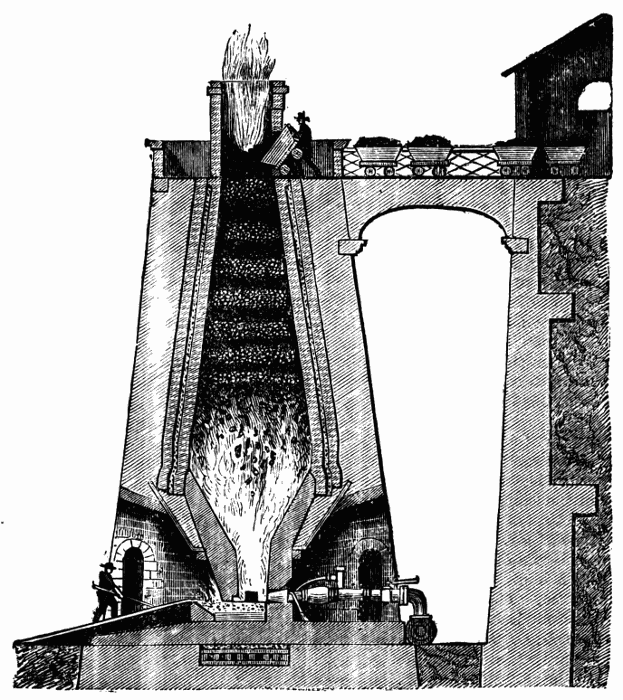
“Great care is necessary in first lighting the blast furnace, lest the new masonry should be cracked by too sudden a rise of temperature, and when once lighted, the furnace is kept in constant work for years, until in want of repair.
“When the fire has been lighted the furnace is filled up with coke, and as soon as this has burnt down to some distance below the chimney, a layer of the mixture of calcined ore with the requisite quantity of limestone is thrown upon it; over this there is placed another layer of coke, then a second layer of the mixture of ore and flux, and so on in alternate layers, until the furnace has been filled up; when the layers sink down fresh quantities of fuel, ore, and flux are added, so that the furnace is kept constantly full.
“As the air passes from the tuyères pipes into the bottom of the furnace, it parts with its oxygen to the carbon of the fuel, which it converts into carbonic acid, the latter passing the red-hot fuel as it ascends in the furnace is converted into carbonic oxide by combining with an additional quantity of carbon. It is this carbonic oxide which reduces the calcined ore to the metallic state when it comes in contact with it at a red heat, in the upper part of the furnace, for carbonic oxide removes the oxygen at a high temperature from the oxides of iron, and becomes carbonic acid, the iron being left in the metallic state.
“But the iron so reduced remains disseminated through the mass of ore until it has passed down to a part of the furnace which is more strongly heated, where the iron enters into combination with a small proportion of carbon to form cast-iron, which fuses or runs down into the crucible or cavity for its reception at the bottom of the furnace.
“At the same time the clay contained in the ore is acted upon by the lime of the flux, producing a double silicate of alumina and lime, which also falls in the liquid state into the crucible, where it forms a layer of slag above the heavier metal. This slag, which has five or six times the bulk of the iron, is allowed to accumulate in the crucible and to run over its edge down the incline upon which the blast furnace is built; but when a sufficient quantity of cast iron is collected at the bottom of the crucible, it is run out through a hole provided for the purpose, either into channels made in a bed of sand, or into iron moulds, where it is cast into rough semi-cylindrical masses, called pigs, where cast-iron is also spoken of as pig-iron.
“The temperature of the furnace is, of course, highest in the immediate neighbourhood of the tuyères; the reduction of the iron to the metallic state appears to commence at about two thirds of the way down the furnace, the volatile matters of the ore, fuel, and flux being driven off before this point is reached.
“Some idea may be formed of the immense scale upon which the smelting of iron ores is carried out, when it is stated that each furnace consumes in the course of 24 hours about 50 tons of coal, 30 tons of ore, 6 tons of limestone, and 100 tons of air.
“The cast-iron is run off from the crucible once or twice in 12 hours, in quantities of 5 or 6 tons at a time. The average yield of calcined clay-iron stone is 35% of iron.
“The gases escaping from the chimney of the blast furnace are highly inflammable, for they contain, beside the nitrogen of the air blown into the furnace, a considerable quantity of carbonic oxide and some hydrogen, together with the carbonic acid formed by the action of the carbonic oxide upon the ore. Since the carbonic oxide and hydrogen confer considerable heating power upon these gases, they are employed in some iron-works for heating steam-boilers, or for calcining the ore, or for raising the temperature of the blast.
“The composition of the gas issuing from a hot blast furnace (fed with uncoked coal) may be judged of from the following table:
“Gas from Blast Furnace.
Nitrogen 55·35 vols.
Carbonic oxide 25·97 ”
Hydrogen 6·73 ”
Carbonic acid 7·77 ”
Marsh gas 3·75 ”
Olefiant gas 0·43 ”
————
100·00 ”
“The carbonic oxide of course renders these gases highly poisonous, and fatal accidents occasionally happen from this cause. Although the bulk of the nitrogen present in the air escapes unchanged from the furnace, it is not improbable that a portion of it contributes to the formation of the cyanide of potassium which is produced in the lower part of the furnace, the potassium being furnished by the ashes of the fuel.” See Metallurgy.
Assay. Three general methods are adopted for this purpose:—
1. (Mechanical.) This consists in pulverising the ore by any convenient method, and expertly washing a given weight of it (say 1000 gr.) in a wooden bowl or capsule with water, so as to remove the earthy gangues from the denser and valuable metallic matter in such a way that none of the latter may be lost. This is the common plan adopted with auriferous sands, the ores of tin after they have passed the stamping-mill, galena, grey antimony, &c., and may either be employed as an independent process or merely as preparatory to more exact investigations. When galena is thus tested, the product is a nearly pure sulphide of lead, of which every grain is equivalent to ·8666 of metallic lead, the rest being sulphur. The results with grey antimony ore are still more direct, since the product is only melted into pigs before being sent to market. In this state it contains 73% (nearly) of metallic antimony.
2. (Humid.) Assays in the ‘humid way’ are true chemical analyses, and are described under the head ‘Estim.’ attached to most of the more important minerals noticed in this work. This plan offers greater facilities and gives more accurate results than either of the other methods.
3. (Dry.) Of the methods of assay in the ‘dry way’ the following are the most accurate, generally useful, and easily applied:—
a. (Dr Abiche.) The mineral is reduced to powder, and mixed with 5 or 6 times its weight of carbonate of barium, also in powder; this mixture is fused at a white heat in a platinum crucible, and the resulting slag, after being powdered, is exhausted with hydrochloric acid. This process answers well with both stony and metallic minerals, the most refractory of which give way under this treatment.
b. (Liebig.) Into a crucible containing commercial cyanide of potassium, a weighed quantity of the ore, in the state of fine powder, is sprinkled, when the metallic oxides and sulphides which it contains are almost immediately reduced to the metallic state, and may be separated from the scoria by edulcoration with water. With the oxides and sulphides of antimony and tin this reduction occurs at a dull red heat; with the compounds of copper it occurs with the disengagement of light and heat; but an ore of iron requires to be mixed with a little carbonate of potassium or of sodium before throwing it into the fused cyanide, and to be then submitted to a full red heat for a short time, before it is reduced to the reguline state. In this case any manganese present in the ore of iron is left under the form of protoxide. A mixture of about equal parts of dry carbonate of sodium and cyanide of potassium answers better for the crucible than the cyanide alone. See Alloys, Metallurgy, &c.; also Percy’s metallurgy.
ORGAN′IC BA′SES. These interesting bodies may be divided into two classes: the first comprising those which occur ready formed in nature (ALKALOIDS); and the second those produced by artificial processes in the laboratory (ARTIFICIAL ALKALOIDS, ARTIFICIAL ORGANIC BASES). They all contain the element NITROGEN. The natural bases have already been described under ALKALOID. Hitherto they have none of them been produced by artificial means. The bases of artificial origin are mostly volatile, and their constitution is much simpler than that of the native bases. Of the vast number which have been formed the following are, perhaps, the most interesting:—Ethylamine, METHYLAMINE, AMYLAMINE, ANILINE, NAPHTHYLAMINE, CHINOLINE, and PICOLINE. These and other bodies of the class are noticed under their respective heads.
By Berzelius the natural organic bases (owing to the invariable presence in them of hydrogen and nitrogen) were regarded as compound ammonias, or combinators of ammonia with a variety of neutral principles.
He conceived the greater part of these neutral bodies were incapable of isolation, and further more that the closest union existed between them and the ammonia. Thus it was his opinion that quinine C20H12NO2, 3HO (halving the modern formula) was a compound of the group C20H9O2 with oxide of ammonium and water of crystallisation thus (C20H9O2H4NO)2HO. He believed the organic base owed its basicity to the ammonia. Berzelius’ opinion carried weight at the time, from the circumstance that certain neutral substances when directly combined with ammonia were capable of forming a number of artificial bases very similar in qualities and also in composition to the natural ones, or those obtained from living plants. Thus, the artificial base thiosinamine having the formula C4H5NS is produced by the combination of oil of mustard and ammonia; and another base may be artificially obtained from the union of oil of bitter almonds with ammonia.
Liebig, who was one of the first chemists to dispute the correctness of Berzelius’ hypothesis, by showing that the natural organic bases never gave any indication of the presence in them of ready formed ammonia, replaced it by the suggestion that they might be bodies into the composition of which amidogen (H2N) entered, and that these, instead of being compounds of ammonia and an organic group, might be derivatives from ammonia; or ammonia in which an atom of hydrogen had been displaced by an equivalent organic radicle.
The labours of subsequent chemists, notably those of Messrs Wurtz and Hofman, have developed Liebig’s theory, and have proved the analogy in structural arrangement between ammonia and the greater number of organic bases; whilst they have further shown, not only in one, as supposed by Liebig, but for all three of the hydrogen atoms in ammonia, may be substituted certain compound radicles.
ORGAN′IC SUBSTANCES. We have reserved a notice of the method of estimating the quantity of carbon, hydrogen, oxygen, and nitrogen, in organic compounds, until now, in order to present them to the reader in a more useful and connected form. The operation essentially consists, in respect of the first three, in causing the complete combustion of a known quantity of the substance under examination, in such a manner that the carbonic acid and water thus produced shall be collected, and their quantity determined. From these the proportions of their elements are easily calculated. The estimation of the quantity of nitrogen (as is also the case with chlorine, phosphorus, sulphur, &c.) requires a separate operation. The two great classes of organic bodies (azotised and non-azotised) are readily distinguished from each other by heating a small portion with some solid hydrate of potassium, in a test tube. If nitrogen is present, it is converted into ammonia, which may be recognised by its characteristic odour and its alkaline reaction.
1. Estimation of the CARBON, HYDROGEN, and OXYGEN.—a. The method of Prof. Liebig, now almost exclusively adapted for this purpose, is as follows:—The substance under examination, reduced to powder, is rendered as dry as possible, either by the heat of a water bath or by exposure over concentrated sulphuric acid, in vacuo; 5 or 6 gr. of it are then weighed in a narrow open test tube, 2 or 3 inches long, and to ensure accuracy this tube and any little adhering matter is again weighed after its contents have been removed—the difference between the two weights being regarded as the true quantity of the substance employed in the experiment. A ‘combustion tube,’ of hard white Bohemian glass (·4 to ·5 inch diam.; 14 to 18 inches long), is next taken, and about 2-3rds filled with black oxide of copper, prepared by the ignition of the nitrate, and which has been just re-heated to expel hygrometric moisture. Nearly the whole of this oxide, whilst still warm, is then gradually poured from the tube and triturated with the organic sample in a dry and warm mortar, after which the mixture is transferred to the combustion tube, and the mortar being rinsed out with a little fresh oxide, which is added to the rest, the tube is, lastly, nearly filled with some warm oxide fresh from the crucible. The contents of the tube are next arranged in a proper position by a few gentle blows, so as to leave a small passage for the evolved gases from the one end of the tube to the other. (See engr.)
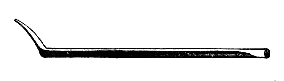

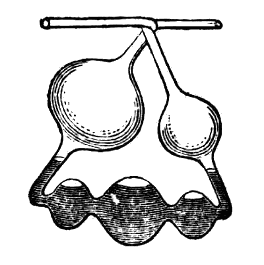
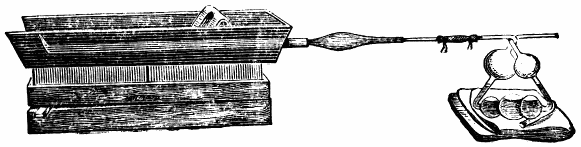
The ‘combustion tube’ with its ‘charge’ is next placed in a ‘furnace’ or ‘chauffer’ of thin sheet iron (see middle figure above). Its open end is then connected with a ‘drying tube’ filled with fragments of fused chloride of calcium, and carefully weighed. This tube is, in its turn, connected with a small glass (‘Liebig’s potash bulbs’) containing solution of pure potassa of sp. gr. 1·27, also carefully weighed. The junction with the first is made by means of a perforated cork; that with the second by means of a small tube of india rubber tied with silk, the whole being made quite air-tight. The apparatus is then tested by sucking a few bubbles through the liquid with the dry lips, when, if the level of the solution of potassa in the two legs continues unequal for some minutes, the joints are regarded as perfect. The whole arrangementengr.), burning charcoal is now placed in the furnace around the front part of the combustion tube, and when this has become red-hot the screen is slowly moved back, and more burning charcoal is added, until the furthest extremity of the tube has been exposed to its action. (Gas, burned in furnaces specially contrived for the purpose, is now usually employed instead of charcoal.) The firing is so regulated that the gas enters the potassa apparatus in bubbles easily counted, without any violence or inconvenience, and it is kept up as long as gas is extricated. As soon as the apparatus is complete, and the slightest retrograde action is observed, the charcoal is removed from the combustion tube, and the extreme point of this last is broken off. A little air is then sucked through the apparatus in order to seize on any remaining carbonic-acid gas and moisture. The potash apparatus and the chloride of calcium tube are, lastly, detached, and again accurately weighed. The increase in the weight of the first gives the weight of the carbonic acid formed during the combustion; that of the second the weight of the water.
Gr. Gr.
1 gr. of Carbonic acid = 0·27273 of Carbon + 0·72727 of Oxygen,
1 ” Water = 0·11112 ” Hydrogen + 0·88888 ”
— ———— ————
2 less 0·38385 equal to 1·61615 ”
— ———— ————
b. In applying the preceding method to volatile liquids, it is necessary to enclose them in a small bulb with a narrow neck, instead of mixing them directly with the protoxide of copper. The bulb with its contents is introduced into the combustion tube, and after some 6 or 8 inches of the protoxide is heated to redness, a hot coal is applied near where the bulb is situated, so that the liquid which it contains may be slowly volatilised and passed through the heated mass in the state of vapour, and be thus completely burned. For further information, consult Fresenius’ ‘Chemical Analysis.’
2. Estimation of the NITROGEN—a. Several methods are employed for this purpose, but the only one of general application, and adapted to the non-scientific operator, is that of MM. Varrentrap and Will, described under Guano. To ensure correct results, the caustic soda must be pure, and the lime of good quality and well burnt. The last, having been properly slaked with a little water, holding the former in solution, the mixture is thoroughly dried in an iron vessel, and then heated to full redness in an earthen crucible. The ignited mass is rubbed to powder in a warm dry mortar, and either used at once or carefully preserved from the air. The best quantity of the organic substance to operate on is, in this case, about 10 gr., which must be dried, and accurately weighed with the usual precautions. Bodies very rich in either nitrogen or hydrogen are best mixed with about an equal weight of pure sugar before triturating them with the soda-lime. MM. Varrentrap and Will weigh the nitrogen under the form of double chloride of platinum and ammonium, dried at 212° Fahr. This salt contains 6·272% of nitrogen.
b. M. Péligot has modified the preceding plan by conducting the gaseous matter extricated during the operation into a three-bulb tube charged with a standard solution of sulphuric acid. This he subsequently pours into a beaker-glass, and after tinging it with a single drop of tincture of litmus, he tests it with either a standard aqueous solution of soda or one of lime in sweetened water, after the common method of alkalimetry. The difference between the saturating power of the acid in its normal condition and after its exposure in the condenser indicates the amount of ammonia formed. (See Guano.) Each grain of ammonia contains ·82353 gr. of nitrogen.
Concluding Remarks. The successful application of the above processes requires considerable care and some aptitude in manipulating, as well as the employment of a very delicate balance for determining the weights. A greater error in the weighings than the 1⁄250 gr. cannot be tolerated when exact results are desired. The method of MM. Varrentrap and Will for the determination of nitrogen answers admirably for all organic compounds containing it, except those in which it exists under the form of hyponitrous, nitrous, and nitric acids; for which, however, it is not required. When extreme accuracy is aimed at, the atmospheric air in the apparatus, and that absorbed during the preliminary operations by the substances employed, must be expelled before the application of heat to the combustion tube. (See Water, Analysis of.)
OR-MOLU′. [Fr.] This name is given to gold-coloured brass or bronze, so finished off as to have the appearance of gold, or of being gilt; but it is often applied in a more general sense. The French more particularly excel in working in or-molu, and the products of this branch of their industry hold an important position in the art manufactures of France.
To give or-molu its richest appearance, “it is not unfrequently brightened up after ‘dipping’ (that is, cleaning in acid) by means of a scratch-brush (a brush made of very fine brass wire), the action of which helps to produce a very brilliant gold-like surface. It is protected from tarnish by the application of lacquer.” (Ure.)
Ure says or-molu contains more copper and less zinc than ordinary brass, and that although, in many of its applications, the colour is heightened by means of a gold lacquer, in some cases the true colour of the alloy is best preserved after it has been properly developed by means of dilute sulphuric acid.
ORMSKIRK MEDICINE. A nostrum supposed to prevent hydrophobia, so named after the residence of its inventor, Mr Hill, of Ormskirk. It is said to have consisted of the ingredients named below, but nothing certain is known on the subject, as the inventor died without revealing its secret:—Chalk, 1⁄2 oz.; Armenian bole, 3 dr.; elecampane root, 1 dr.; alum, 10 gr.; oil of aniseed, 5 or 6 drops; all in fine powder. For a dose, to be taken for 6 successive mornings, in a glass of weak milk and water.
OR′PIMENT. Native yellow sulphide of arsenic. The finest samples used by artists (golden orpiment) come from Persia. See Arsenic (Tersulphuret).
OR′RIS. Syn. Orris root, Florentine r.; Radix iridis, L. The dried rhizome of Iris Florentina, pallida, and Germanica. Sialogogue, irritant, subacrid, and errhine. Chiefly employed to impart a violet odour to oils, tooth powder, snuffs, spirits, &c.; and when cut into peas to keep open issues.
ORSE′DEW. Dutch leaf-gold.
ORSEL′LIC ACID. Two compounds pass under this name—ALPHA-ORSELLIC ACID and BETA-ORSELLIC ACID. They closely resemble each other, and are obtained in a similar manner; the first from the South American variety of Rocella tinctoria, the last from that grown at the Cape.
ORSELLIN′IC ACID. Syn. Lecanoric acid. A compound formed along with picroerythrine, by boiling erythric acid for some time with water. It is also formed by boiling alpha-orsellic acid with water. In both cases, if the ebullition is too long continued, the new acid is wholly or in part converted into orcin.
Prop., &c. Crystallisable; bitter-tasted; soluble in water; its aqueous solution, by exposure to the air, assumes a beautiful purple colour.
ORTHOCLASE. Syn. Potassium felspar. This material, which is a double silicate of potassium and aluminium, enters into the composition of many rocks, and is a common ingredient in granite. It has the following composition:—Silica, 64·8 parts; alumina, 18·4 parts; and potash, 16·8 parts. Part of the potassium is frequently replaced by small quantities of calcium, magnesium, and sodium.
Orthoclase is used for glazing the finest varieties of porcelain, a very intense heat being necessary to effect its fusion in the porcelain furnace. By the Chinese potters it is called petuntze. “The name ‘orthoclase’ is generally restricted to the subtranslucent varieties, there being many subvarieties (founded on variations of lustre, colour, and other differences), of which the following are some of the principal, viz. adularia, a transparent or translucent felspar, met with in granitic rocks (frequently in large crystals); moonstone; sunstone; Murchisonite, erythrite; glassy felspar or lanadine, a transparent variety found in volcanic rocks, containing 4 per cent. of soda or upwards.”[79]
ORTHOPÆ′DIA. In surgery, the straightening, correcting, or curing deformities of children. See Surgery.
OSIER. The osier, which is a species of willow (salix), and is largely used in the construction of baskets and other wickerwork, is extensively cultivated at Nottingham and on the level lands of Cambridgeshire and Huntingdonshire, as well as on the banks of the Thames, Severn, and other rivers. The small islands in these rivers, when planted with osiers, are known as osier HOLTS. But large as is the supply of shoots afforded by the English osier beds, it is insufficient for home consumption; hence great quantities of ozier rods are imported into this country from Holland, Belgium, and France. There are a great variety of oziers, and it is found that those which have been the most highly cultivated yield the toughest and finest wood, and those best adapted for the superior kinds of basket work. The branches of the wilder and less domesticated kind, which are more liable to break, are used for making hoops and coarse baskets. This last variety, which is known as the Common osier (Salix viminalis), grows on the alluvial grounds of Britain, and in other European countries, and is often planted on the banks of rivers to prevent their being washed away.
The following are the principal varieties of osier indigenous to this country, and which yield the most valuable wood:—1. The fine basket osier (Salix Forbyana). 2. The Green-leaved osier, or ORNARD (Salix rubra). 3. The Spanish rod (Salix triandra). 4. The Golden osier, or Golden willow (Salix vitellina).
The osier requires plenty of water, and hence it thrives best in those localities and low grounds which are washed by a river. The soil best adapted for it is a rich but not clayey one. In planting an osier bed an important condition is that the trees should be placed sufficiently closely together, since it is found that, with too much space, the shoots do not develop into long and slender branches, which are so much sought after. The shoots are cut once a year, at any time between the fall of the leaf and the rising of the sap in spring. After being cut they are divided into those destined for brown, and those for white baskets. In the latter ease the rods have to be peeled, but as this operation cannot be performed at once, and the rimous of thebreak. If the spring has been a cold one, they have, previous to peeling, to be laid for some time under a layer of litter.
When they have been peeled they are stacked, preparatory to being sold. With the rods intended for brown baskets, no peeling is of course necessary. They are therefore carefully stacked in some place protected from the rain, and diligently watched to see that no heat is set up in them, as is sometimes the case with freshly stacked hay, and which, if not stacked, would cause the rods to rot and render them useless.
In England, besides the native produce, 5000 tons of osiers are annually imported, valued at about £40,000. Of late years the Australian colonists have turned their attention to the cultivation of the osier, in the hopes of supplying the demand for it in Great Britain.
OS′MAZOME. The substance on which the peculiar odour and flavour of boiled meat and broth were formerly supposed to depend.
Prep. From lean meat, minced, and digested in cold water, with occasional pressure; the filtered infusion is gently evaporated nearly to dryness, and then treated with alcohol; the alcoholic tincture is, lastly, evaporated. The product has a brownish-yellow colour, is soluble in water, and its aqueous solution is precipitated by infusion of galls and the mineral astringent salts.
OS′MIUM. Os. A rare metal found associated with the ores of platinum by M. Tennant, in 1803.
These ores mostly consist of a mixture of platinum, palladium, rhodium, osmium, ruthenium and iridium. When they are treated with aqua regia, the insoluble residue which remains, chiefly consists of an alloy and osmium, iridium, ruthenium and rhodium. To separate the osmium from the other metals, Fremy takes advantage of its easy oxidability, and of the volatility of its tetroxide.
In the first part of this process (which is a great improvement upon the methods previously followed) the above residue or alloy is heated to redness in a platinum or porcelain tube. In that part of the tube which projects from the furnace, some fragments of porcelain are placed, and the tube is connected with a series of glass flasks, in which the tetroxide of osmium is condensed as it distils over, any tetroxide that may have escaped condensation is retained by a solution of caustic potash, placed in the last flask of the series. This last flask is connected with an aspirator, by means of which a current of air is drawn through the apparatus.
Before being allowed to enter the heated tube the air is dried by being made to pass through tubes filled with pumice-stone, moistened with sulphuric acid. During the operation the osmium and ruthenium become oxidised, the tetroxide of osmium condenses in needles in the flasks, and mechanically carries forward the deoxide of ruthenium, which is deposited upon the pieces of porcelain.
There are several processes for obtaining osmium in the metallic condition. We give two of the most simple of these. 1. By treating the volatile tetroxide of osmium obtained by Fremy’s method, as above described, with hydrochloric acid and metallic mercury in a closed vessel at 140° C.
The mercurous oxide which is first formed at the expense of the oxygen contained in the tetroxide of osmium is decomposed by the hydrochloric acid, and calomel is produced, together with metallic osmium.
The water and excess of acid are removed by evaporation to dryness, and on heating the residue in a small porcelain retort, the excess of mercury and calomel is drawn off, pure osmium being left behind in the form of a fine powder.
2. Deville and Debray procure it in the metallic form by passing the tetroxide of osmium, in a current of nitrogen, over carbon which has been obtained by passing the vapour of benzine through a porcelain tube at a high temperature. The metal procured by this process is of a fine blue colour, with a tinge of grey.
The specific gravity of osmium in the pulverulent form is about 10; but after having been heated to the fusing point of rhodium in the oxyhydrogen jet, it acquires a density of 21·4, and in the crystalline state it has a sp. gr. of 22·477. Osmium appears to be the least fusible of all the metals.
There are five known oxides of osmium:
1. Osmium protoxide. (OsO). The anhydrous protoxide is of a greyish-black colour. It is insoluble in acids. Its bluish-black hydrate, which dissolves in hydrochloric acid, forms a solution of osmium dichloride of a deep indigo blue colour. The solution absorbs oxygen readily, and becomes converted into the tetrachloride (OsCl4).
2. Osmium sesquioxide. (Os2O3.) This has never been isolated. Its salts, which are uncrystallisable, are of a rose-red colour.
3. Osmium dioxide. (OsO2.) This is black.
4. Osmium trioxide. (OsO3.) This possesses feebly acid properties. It has never been obtained in a separate form; with potassium it forms a crystalline, sparingly soluble compound, having the composition K2OsO4, 2H2O, a dipotassic osmite.
5. Osmium tetroxide. Syn. Osmic Acid (OsO4). This oxide may be obtained by operating, according to Fremy’s process, on the ores of platinum, as already described.
There are four chlorides of osmium, the best known of which are the dichloride and the tetrachloride.
1. Osmium dichloride. (OsCl2). Syn. Osmious dichloride, Osmium protochloride. This is green, and sublimes in green needles. It may be obtained by heating metallic osmium in a current of dry chlorine gas. It forms double salts, which are of a green colour.
2. Osmium tetrachloride. (OsCl4). Syn. Osmic tetrachloride, Osmium bichloride. This may be procured in the same manner as the dichloride, using, however, an excess of chlorine. It occurs as a red, crystalline, fusible, deliquescent powder. It is more volatile than the dichloride. Both the dry chloride and the tetrachloride of osmium are dissolved by water, which decomposes them into tetroxide of osmium, hydrochloric acid and the metal.
OSTEOCOL′LA. A rough sort of glue or gelatin obtained from bones by digestion in dilute hydrochloric acid, to remove their earthy matter, and afterwards acting on the residuum with water at a high temperature, until it is wholly dissolved.
OTAL′GIA. Pain in the ear. See Earache.
O′′THYL. In chemistry, a radicle having the formula C2H3O, assumed by Professor Williamson to exist in acetic acid.
OT′TO OF ROSES. See Oils (Volatile).
OVALBU′MEN. White of egg; to distinguish it from seralbumen, or the albumen of the serum of the blood.
O′VENS. A very ingenious and useful improvement in the apparatus for baking was introduced some years ago by Mr Sclater, of Carlisle. It consists in causing the articles to be baked to traverse a heated earthenware tube. This tube forms the oven. It is of considerable length, and the biscuits or other articles are slowly traversed through it, from end to end, at such a rate as will allow of the baking being completed during the passage. The biscuits are carried on trays, set on travelling chains; or the trays are made into an endless web or chain. The oven is thus entirely self-acting, and the articles demand no attention whatever from the attendants, whilst the system combines superior economy with the best results. A ‘pyrometer,’ or heat indicator, is attached externally, so that the attendant can regulate the heat with great facility. The object of these improvements is to reduce the cost of baking, and to improve the appearance of the baked articles. The apparatus is applicable as well to the baking of articles of clay or earthenware as to bread or biscuits.
Of the ovens now in common use by the bakers, that known as the ‘hot-water oven’ is perhaps the best; not merely in reference to economy, but also with reference to its superior cleanliness, and the ease with which the articles operated on may be turned out of that delicate yellowish-brown tint for which the bread of the Viennese and Parisian bakers is so celebrated. See Baking, Bread, &c.
OWNER. For the purposes of the Public Health Act this term is thus defined:—“‘Owner’ means the person for the time being receiving the rack-rent of the lands or premises in connection with which the word is used, whether on his own account, or as agent or trustee for any other person, or who would so receive the same if such lands or premises were let at a rack-rent.”
OX. The Bos Taurus (Linn.), one of the ruminantia. In its more limited sense the word is restricted to the emasculated animal. The flesh, milk, skin, horns, bones, and blood of this animal are all serviceable to man. Goldbeater’s skin is prepared from the peritoneal membrane of its cæcum. Its blood, fat, horns, and excrement were among the simples of the Ph. L. 1618. See Beef, Gall, Milk, and below.
Ox-Gall. Syn. Ox-bile; Fel bovinum, F. Bovis, F. tauri, L. Crude ox-gall is noticed at page 774. Refined ox-gall (Fel bovinum purificatum) is prepared as under:—
1. Fresh ox-gall is allowed to repose for 12 or 15 hours, after which the clear portion is decanted, and evaporated to the consistence of a thick syrup by the heat of a water bath; it is then spread thinly on a dish, and exposed in a warm situation near the fire, or to a current of dry air, until nearly dry; it is, lastly, put into wide-mouthed bottles or pots, and carefully tied over with bladder. In this state it will keep for years in a cool situation. For use a little is dissolved in water.
2. Fresh gall, 1 pint; boil, skim, add powdered alum, 1 oz.; boil again till the alum is dissolved, and when sufficiently cool pour it into a bottle, and loosely cork it down. In a similar manner boil and skim another pint of gall, add to it 1 oz. of common salt, and again boil, cool, and bottle it, as above. In three months decant the clear from both bottles, and mix them in equal quantities; the clear portion must then be separated from the coagulum by subsidence or filtration.
Uses, &c. Both the above are employed by artists to fix chalk and pencil drawings before tinting them, and to remove the greasiness from ivory, tracing paper, &c. The first is also used in medicine.
OX′ALATE. Syn. Oxalas, L. A salt of oxalic acid. The soluble oxalates are easily formed by directly neutralising a solution of oxalic acid with a metallic hydrate, carbonate, or oxide; and the insoluble oxalates, by double decomposition. See Oxalic acid and the respective bases.
OXAL′IC ACID. H2C2O4. Syn. Acidum oxalicum, L. This substance was discovered by Bergman in 1776. It occurs both in the mineral and organic kingdoms, and is produced artificially by the action of nitric acid on sugar, starch, woody fibre, &c. It abounds in wood-sorrel, in which it exists in combination with a little potassa. With the exception of gum and sugar of milk all starchy and saccharine substances yield oxalic acid when treated with nitric acid at a somewhat elevated temperature.
Prep. 1. From sugar:—
a. Nitric acid (sp. gr. 1·42), 5 parts, diluted with water, 10 parts, is poured on sugar, 1 part, and the mixture is digested at a gentle heat as long as gaseous products are evolved; the liquid is then concentrated by evaporation until it deposits crystals on cooling; the crystals, after being drained and freed from superfluous moisture, are redissolved in the smallest possible quantity of boiling water, and the solution is set aside to crystallise. The residuary ‘mother-water’ is treated with a little fresh nitric acid (say 11⁄2 part) at a gentle heat, after which it is evaporated, as before, for a second crop of crystals. This process is repeated until the solution is exhausted. The brownish-coloured crystals thus obtained are allowed to effloresce by exposure to dry air, and are then redissolved and recrystallised. By repeating this treatment they yield pure colourless oxalic acid at the third crystallisation.
b. (Schlesinger.) Sugar (dried at 257° Fahr.), 4 parts, and nitric acid (sp. gr. 1·38), 33 parts, are digested together, as before, and as soon as the evolution of gas ceases the liquid is boiled down to one sixth of its original volume, and set aside to crystallise. The whole process may be completed in about 2 hours, and in 1 vessel, and yields of beautifully crystallised oxalic acid, at the first crystallisation, a quantity equal to 56 to 60% of the weight of the sugar employed.
c. (Ure.) Nitric acid (sp. gr. 1·4), 4 parts, and sugar 1 part, are digested together by the heat of a water bath, and as soon as gas ceases to be extricated the vessel is removed from the heat, and set aside to cool and crystallise. The use of a little sulphuric acid along with the nitric acid contributes to increase the product.
2. From POTATO- or DEXTRIN-SUGAR:—(Nyren.) From the washed pulp of potatoes, boiled for some hours with water, q. s., in a leaden vessel, with about 2% of oil of vitriol, until the fecula of the pulp is converted into saccharine matter, shown by the liquid being no longer turned blue by iodine; the whole is then filtered through horse-hair bags or strainers, and the filtrate is evaporated until its density is such that a gallon of it weighs 14 to 141⁄2 lbs.; in this state it is converted into oxalic acid by treatment with nitric acid in the way already described. A similar process was patented some years ago by Messrs Davy, Macmurdo, and Co.
3. From SAWDUST:—(Roberts, Dale, & Co. Patent.) This process is the one now usually employed for the manufacture of oxalic acid on the large scale. It is based on Gay-Lussac’s discovery, that wood and similar substances are converted into oxalic acid by fusion with caustic alkali. The practical details of the process are thus given by Dr Murray Thomson, of Edinburgh:—(1) Hydrate of sodium and hydrate of potassium, mixed in the proportion of 2 equivalents of the former to 1 equivalent of the latter, are dissolved, and solution evaporated until of specific gravity 1·35; sawdust is now stirred in until a thick paste results. (2) This paste is then heated on iron plates, during which it is constantly stirred; water is first given off; the mass then swells; inflammable gases, hydrogen and carburetted hydrogen, are evolved, along with a peculiar aromatic odour. When the temperature has been maintained at 400° for one or two hours, this stage of the process is complete; the mass has now a dark colour, and contains only 1 to 4 per cent. of oxalic acid, and about ·5 per cent. of formic acid. The bulk, therefore, of the mass at this stage consists of a substance whose nature is not yet known, but which is intermediate between the cellulose and oxalic acid. (3) The next stage consists in a simple extension of the last, in which the mass is heated till quite dry, care being taken that no charring takes place. It now contains the maximum quantity of oxalic acid, 28 to 30 per cent. (4.) This oxalic acid now exists as oxalate of potassium and sodium in the grey powder resulting from stage 3. This powder is now washed on a filter with solution of carbonate of sodium, which seems to have the singular and unexpected power of decomposing the oxalate of potassium and converting it into oxalate of sodium. At all events, it is quite true that all traces of potassa are washed out with the solution of carbonate of sodium. The only explanation that occurs to account for this unusual decomposition is that oxalate of sodium is a more insoluble salt than oxalate of potassium, and therefore may be formed by preference. (5) This oxalate of sodium is now decomposed by boiling milk of lime. Oxalate of calcium falls as a precipitate, and soda remains in solution. This soda is boiled down, and again made use of with fresh sawdust. This recovery of alkaliProd. By this ingenious process 2 lbs. of sawdust are made to yield 1 lb. of oxalic acid.
Prop., &c. Colourless, transparent, prismatic crystals, possessing a powerful sour taste and acid reaction; these effloresce in warm dry air, with loss of 28% (2 eq.) of water, and then form a white powder, which may be sublimed in part, without decomposition; the crystals are soluble in 8 parts of water (9 parts, “and form a solution of sp. gr. 1·045,”—Ure) at 60° Fahr., in their own weight or less of boiling water, and in about 4 parts of alcohol; with the acids, it forms salts called oxalates.
Tests.—1. Solution of chloride of barium occasions a white precipitate in neutral solutions of oxalic acid (oxalates), which is soluble in both nitric and hydrochloric acid.—2. Solution of nitrate of silver, under like circumstances, gives a white precipitate, which is soluble in nitric acid, and in ammonia, and which, when heated to redness, yields pure silver.—3. Lime water and solutions of all the soluble salts of calcium produce white precipitates, even in highly dilute solutions of oxalic acid or of the oxalates, which is freely soluble in both nitric and hydrochloric acid, but is nearly insoluble in either acetic or oxalic acid, and is converted into carbonate of calcium upon ignition.—4. Oxalic acid (or an oxalate), when heated, in the dry state, with oil of vitriol in excess, is converted into carbonate anhydride and carbonic oxide; the former produces a white precipitate with lime water, and the latter, when kindled, burns with a faint blue flame. Of the above tests, solution of sulphate of calcium (vide No. 3) is the most delicate and characteristic.—5. It is distinguished from Epsom salt by its acid reaction, its solubility in rectified spirit, its complete dissipation by heat, and by emitting a slight crackling noise during its solution in water. See Magnesia (Sulphate).
Uses, Pois., &c. Oxalic acid is chiefly used in the arts of calico printing and bleaching; to remove ink-spots and iron moulds from linen, and to clean boot-tops. It is extremely poisonous. The treatment, in cases of its having been swallowed, is to promote vomiting, and to administer chalk, whiting, or magnesia, mixed up with water, in considerable quantities. The use of the alkalies or their carbonates must be avoided, as the compounds which these form with oxalic acid are nearly as poisonous as the acid itself. The remaining treatment is noticed under Acids. In poisoning by oxalic acid the nervous system is almost always affected, and the patients experience numbness, formication of the extremities, and sometimes convulsions, so that the symptoms somewhat approach those produced by strychnia, from which it is distinguished by its corrosive action on the tissues, and its effect upon the heart and circulatory system.
Concluding Remarks. The manufacture of oxalic acid is an important one. The process of Roberts, Dale, and Co. has so much cheapened the price of oxalic acid, that in 1851 it sold for 16d. per lb., and in 1864 it only cost from 8d. to 9d. per lb. More than half the amount of oxalic acid used all over the world is now made from sawdust. In manufacturing the acid from sugar, on the large scale, the first part of the process is either conducted in salt-glazed stoneware pipkins of the capacity of 3 to 5 quarts each (which are about two thirds filled and set in a water bath), or in wooden troughs lined with lead, and heated by means of a coil of steam-pipe. On the small scale, a glass retort or capsule is commonly employed. The most appropriate temperature appears to be about 125° Fahr. and the best evidence of the satisfactory progress of the decomposition is the free but not violent evolution of gas, without the appearance of dense red fumes, or, at all events, any marked quantity of them. When these are disengaged with violence and rapidity, a greater quantity of the newly formed acid suffers decomposition, and flies off in a gaseous form. The sp. gr. of the nitric acid commonly used on the large scale ranges from 1·22 to 1·27 equivalent quantities being taken. The evaporation is preferably conducted by the heat of steam. The evolved nitrous vapours are usually allowed to escape, but this loss may be in part avoided by conveying them into a chamber filled with cold damp air, and containing a little water, when they will absorb oxygen, and be recondensed into fuming nitric acid. Various modifications of this plan have been patented. That of Messrs McDougall and Rawson, which is one of the simplest and best, consists in passing the mixed nitrous fumes through a series of vessels containing water, and connected together by tubes, so that the fumes which collect at the top of one vessel are conveyed to nearly the bottom of the next one, and then, bubbling up through the water, mix with the air, a supply of which is provided for the purpose. The nitrous fumes are thus brought alternately into contact with air and water, and by the time they reach the last vessel are reconverted into nitric acid. Another plan is to pass the mixed nitrous vapours through a vessel stuffed with some porous substance, as pumice-stone or pounded glass, conjointly with a supply of steam from a boiler and a supply of oxygen by a blowing machine.
The product obtained by skilful manipulation are—from good dry sugar, 128%; from1⁄2 cwt. of sulphuric acid, will generate sufficient nitric acid to decompose 1 cwt. of good sugar, and yield, as above, 140 lbs. of fair marketable oxalic acid, free from superfluous moisture.” (Ure.) On the small scale, 5 parts of sugar yield nearly 6 parts of crystallised acid.
Chemically pure oxalic acid is best prepared by precipitating a solution of binoxalate of potassium with a solution of acetate of lead, washing the precipitate with water, decomposing it, whilst still moist, with dilute sulphuric acid or sulphuretted hydrogen, and gently evaporating the filtrate so that crystals may form as it cools.
OXALURIA. Also known as the oxalic-acid diathesis; is an abnormal condition of the system, marked by the presence in the urine of crystals of oxalate of lime. The crystals occur as minute transparent octahedra, and sometimes in the form of dumb-bells. They can be easily recognised under a microscope with a power of from 200 to 250 diameters, when they present a very beautiful appearance. They differ from phosphatic deposits in being insoluble in acetic acid. Their presence is mostly indicated by the appearance in the urine of a cloud of mucus, which forms after the urine has stood some little time.
Oxaluria most generally affects persons of dyspeptic and sedentary habits and of nervous temperament; those suffering from skin affections and neuralgia are also occasionally attacked by it. In ordinary cases the treatment consists in the administration of the nitro-hydrochloric acid, in infusion of gentian two or three times a day, or of a course of quinine and iron, aided by plenty of exercise in the open air, care being taken to avoid fatigue. If it can be borne the shower bath should also be had recourse to. Rhubarb tarts and tomatoes, which contain oxalic acid, must be excluded from the diet; so also should aerated water and too much sugar.
If after a short time the oxalates should not disappear from the urine under this treatment, the patient should seek proper medical advice; since the persistent presence of this deposit is of very serious significance, as indicating the existence in the bladder of that dangerous form of urinary concretion known as ‘mulberry calculus.’
OXIDA′TION. Syn. Oxydation. The combination of bodies with oxygen, forming oxides; the operation or process adopted to induce or facilitate such conversion.
OX′IDE. Syn. Oxyd; Oxydum, L. A compound formed by the union of oxygen with another body.
OXYCHLO′′RIDE. Syn. Oxichloride; Oxychloridum, L. A term often loosely applied to compounds of an oxide and chloride, whether in definite or variable proportions. See Antimony (Oxychloride), &c.
OX′YCRATE. Syn. Oxycratum, L. The old name of a mixture of vinegar and water, dulcified with honey.
OXYCRO′CEUM. See Plasters.
OX′YGEN. O. Syn. Oxygen gas, Dephlogisticated air†, Empyreal a., Vital a.†; Oxygenium, L. An elementary body discovered by Scheele and Priestly in 1774. It is remarkable that, although this substance forms a large proportion of our atmosphere (nearly one fourth), and confers upon it the power of supporting respiration and combustion, and also constitutes the principal portion of the water of our rivers and seas (eight ninths), and enters largely into the composition of the majority of the various mineral bodies that form the bulk of our globe, its existence should have remained unsuspected, or at least undetermined, until a comparatively recent date. Oxygen is an essential constituent of all living organisms. It is absorbed by animals during respiration, and evolved in a free state by growing vegetables when exposed to sunlight. The oxygen gas of the atmosphere is mechanically mixed, not chemically combined, with the nitrogen.
Prep. 1. From red oxide of mercury, heated over a spirit lamp or a few pieces of ignited charcoal. The operation is usually performed in a small green-glass retort, or in a short tube of hard Bohemian glass, closed with a perforated cork furnished with a piece of bent glass tube of small bore, to convey the liberated gas to the vessel arranged to receive it. Pure. 1 oz. yields about 100 cubic inches.
2. From chlorate of potassium, as the last. Pure. 100 gr. yield nearly 100 cubic inches (Brande; 115—Ure). This is the plan adopted in the P. Cod. The decomposition occurs with both the above substances at a heat below that of redness.
3. From a mixture of chlorate of potassium (in coarse powder), 3 parts; powdered binoxide of manganese, 1 part; both by volume. Pure. 100 gr. of the mixture yield about 110 cubic inches as oxygen. This method, which has received the approval of Faraday, is exceedingly convenient. The gas is evolved with a rapidity which is entirely at the command of the operator by simply increasing or lessening the heat. The residuum in the retort may be kept for another operation, if not exhausted; or it may be at once washed out with a little warm water, and the manganese, which is uninjured by the process, reserved for future use. Red lead, black oxide of copper, red oxide of iron, and several other substances, answers nearly as well as binoxide of manganese.
4. From a mixture of bichromate of potassium, 3 parts; oil of vitriol, 4 parts; gently
5. From binoxide of manganese and oil of vitriol, equal parts; as the last. 44 gr. of pure binoxide of manganese yield 8 gr., or 24 cubic inches, of oxygen; 1 oz. yields 88 gr., or 256 cubic inches. (Liebig.)
6. (On the large scale.)—a. From nitre exposed to a dull red heat in an iron retort, or gun-barrel. 1 lb. yields about 1200 cubic inches of gas, contaminated, more or less, with nitrogen. (Ure.)
b. From binoxide of manganese, as the last. 1 oz. of the pure binoxide yields 44 gr., or 128 cubic inches, of oxygen (Liebig); 1 lb. of good commercial binoxide yields from 1500 to 1600 cubic inches, or from 5 to 6 galls.
c. M. Boussingault has reinvestigated a process, long known, although not usefully applied, by which pure oxygen gas may be obtained from the atmosphere at a trifling cost, so as to enable it to be collected in unlimited quantities and preserved in gasometers, like coal-gas, for application in the arts, manufactures, and sanitation. This process depends upon a peculiar property possessed by the earth baryta, of absorbing atmospheric oxygen at one temperature and evolving it at another; or rather, the ready conversion of hydrate of barium into peroxide of barium by a current of atmospheric air at a dull red heat, and the decomposition of this peroxide, by steam, at a lower temperature, even at 212° Fahr., with reproduction of hydrate of barium, the process being in reality a continuous one. The baryta is mixed with a portion of hydrate of calcium or of magnesium, and the mixture being placed in an appropriate earthen tube heated to dull redness, is oxidised by passing a current of dry atmospheric air over it. As soon as the oxidation is complete, the tube is connected with the gas-holder, and a jet of steam allowed to act upon it; this reconverts the peroxide of barium into hydrate of barium, the excess of oxygen being given off and collected in the gas-holder. The baryta is then again oxidised by a fresh current of air and deoxidized by steam, and the whole process is repeated as frequently as required. One ton of baryta, thus treated, is capable of yielding 2500 cubic feet of pure oxygen every 24 hours; and this, as it does not waste or lose its properties, at the mere cost of the fuel and labour required in the process.
d. From ferrate of potassium, prepared on the large scale. When exposed to moisture or thrown into water, pure oxygen is evolved. This method has been successfully adopted to maintain the air of diving-bells, and of other confined spaces, in a state fit for respiration.
e. The decomposition of sulphuric acid has been recommended by MM. Deville and Debray as a means whereby large quantities of oxygen gas may be obtained at a low price. Into a tubulated retort are put fragments of fire brick, and upon these, when raised to a full red heat, sulphuric acid is made to fall drop by drop, by passing through an iron tube, which passes through and is luted to the tubulure. The tube reaches to the bottom of the retort, and the acid is poured into it through a bent funnel. The sulphuric acid becomes decomposed into sulphurous anhydride, oxygen, and water. The volatilised products are sent through a spiral condenser, by which the water and any undecomposed acid become liquefied; whilst the sulphurous acid is removed by subsequent washing with water, and oxygen is collected in the usual manner.
f. A process for obtaining oxygen on a large scale, and which has been made the subject of a patent in this country, has been devised by MM. Marechal and Tessié du Mothay. It consists in heating in a current of steam the manganates, permanganates, chromates and ferrates of the alkalies and alkaline earths, and regenerating the residue by passing air over it at a red heat.
g. Mallet procures oxygen in large quantities as follows:—He puts into retorts revolving on horizontal axes, a mixture of cuprous chloride, and kaolin or sand. He moistens this with water, heats it to 100° C., and passes air through the retorts for some hours. His oxygen he obtains from heating the resulting cupric oxychloride to about 400° C.; the aqua residual cuprous chloride becomes converted into oxychloride on cooling 100 kilograms of cuprous chloride, after conversion into oxychloride, about 3 cubic mètres of oxygen.
7. Oxygen gas at the ordinary temperature. Boettger states that when a mixture is made of equal weights of the peroxides of lead and barium, and dilute HNO3 of a strength of 9° Baumé is poured thereon, a current of pure O, free from ozone and antozone, is given off abundantly. This mixture of the two peroxides may be kept dry in a stoppered bottle for any length of time. Boettger also prepares pure oxygen, free from ozone, by submitting permanganate of potassium to a gentle heat.
8. Fleitman[80] has found that when chloride of lime in solution is heated with a small quantity of freshly prepared peroxide of cobalt, it is completely resolved into chloride of calcium and oxygen. A concentrated solution consisting of 35 per cent. of chloride of lime, which must be previously filtered to prevent frothing, yields when heated with 1⁄10th to 1 per cent. of peroxide of cobalt, a volume of oxygen from 25 to 30 times as great as that of the liquid, and always rather more than the calculated quantity, probably in consequence of the absorption of oxygen from the air. The remaining peroxide may always be employed again. A like result follows if, instead of the peroxide, an ordinary salt of
Prop. Oxygen gas is colourless, tasteless, inodorous, and incombustible; the sp. gr. is 1·057 (Dumas; 1·1026—Berzelius & Dulong; 1·111—Thomson); 100 cubic inches at 60° Fahr., and 36 inches of the barometer, weigh 34·29 gr. (Dumas; 34·109 gr.—Berz.; 34·6 gr.—Brande; 33·85 gr.—Ure). Its density to that of atmospheric air is, therefore, as about 11 to 10. It is a powerful supporter of combustion, and its presence is essential to the existence of both animal and vegetable life. It forms 21% (20·81%) by volume, and 23% by weight, of the atmosphere. (M. Dumas.) Water dissolves about 5 per cent. by volume of oxygen, and by pressure a much larger quantity, forming oxygenated water (AQUA OXYGENII). Oxygen has recently been liquified.