A CYCLOPÆDIA OF PRACTICAL RECEIPTS, &c. VOLUME II (continued 3)
Reading edition
For cleaning knives, a proper knife-cleaning machine, purchased of a good maker, is best. But where this is not used, the knife-board ought to be covered with very thick leather, upon which emery powder should be placed. The emery gives a good polish to the knives, and does not wear them out so quickly as Bath-brick. When the points of the knives become worn very thin, they should be rounded by the knife-grinder. Where the handles are good it will sometimes be worth while to fit them to new blades.
KNOX’S POW′DER. Prep. From common salt, 8 parts; chloride of lime, 3 parts; mixed together. An ounce of it dissolved in a tumblerful of water furnishes a solution
KŒCHLIN’S LIQUID. Prep. From copper filings, 96 gr.; liquor of ammonia, 2 fl. oz.; digested together until it turns of a full blue colour, and then mixed with hydrochloric acid, 5 fl. dr.; distilled water, 5 lbs.—Dose, 1 to 2 teaspoonfuls daily; in scrofula. It is poisonous in large doses.
KOOCH′LA NUT. See Nux vomica.
KOU′MISS. A liquor prepared by the Calmucs, by fermenting mare’s milk, previously kept until sour, and then skimmed. By distillation it yields a spirit called rack, racky, or araka. 21 lbs. of fermented milk yield about 3⁄4 pint of low wines, and this, by rectification, gives fully 1⁄4 pint of strong alcohol. It has lately come into use as a remedy for phthisis and general debility.
The following formula from the Zeitschrift des Oesterr. Apoth. Ver. (1876, 526), for the preparation of so-called Koumiss Extract, is said to be a good one:—
Powdered sugar of milk 100 parts
Glucose (prepared from starch) 100 ”
Cane sugar 300 ”
Bicarbonate of potassium 36 ”
Common salt 33 ”
Dissolve these ingredients in 600 parts of boiling fresh whey of milk, allow the solution to cool, then add 100 parts of rectified spirit, and afterwards 100 parts of strained fresh beer yeast. Stir the mixture well and put into bottles containing a quarter of a litre each. The bottles must be well corked and kept in a cool place.
For the preparation of Koumiss add 5 to 6 tablespoonfuls of this extract to a litre of skimmed, lukewarm milk, contained in a bottle of thick glass; cork well, keep the bottle for half a day in a moderately warm room (at 16°-20° C.), and afterwards in a cool cellar, shaking occasionally. The bottle should be filled to within 3-4 centimètres of the cork. After two days the Koumiss is ready for use.
KOUS′SO. Syn. Cusso, Kosso. This substance is the dried flowers of the Brayera anthelmintica, an Abyssinian tree which grows to the height of about 20 feet, and belongs to the natural order Rosaceæ. It is one of the most effective remedies known for both varieties of tapeworm. The dose for an adult is 3 to 5 dr., in powder, mixed with about half a pint of warm water, and allowed to macerate for 15 or 20 minutes. The method prescribed for its successful administration is as follows:—The patient is to be prepared by a purgative or a lavement, and the use of a very slight diet the day before. The next morning, fasting, a little lemon juice is to be swallowed, or a portion of a lemon sucked, followed by the dose of kousso (both liquid and powder), at 3 or 4 draughts, at short intervals of each other, each of which is to be washed down with cold water acidulated with lemon juice. The action of the medicine is subsequently promoted by drinking weak tea without either milk or sugar, or water flavoured with lemon juice or toasted bread; and if it does not operate in the course of 3 or 4 hours, a dose of castor oil or a saline purgative is taken.
The flavour of kousso is rather disagreeable and nauseating. Its operation is speedy and effectual; but at the same time it is apt to produce, in large doses, great prostration of strength, and other severe symptoms, which unfit it for administration to the delicate of both sexes, or during pregnancy or affections of the lower viscera. Care should be taken not to purchase it in powder, as, owing to its high price, it is uniformly adulterated. The powdered kousso of the shops is, in general, nothing more than the root-bark of pomegranate, coloured and scented.
KRE′ASOTE. Syn. Creasote, Creosote, Kreosote; Creasotum (B. P., Ph. L. & D.), Creazotum (Ph. E.), L. A peculiar substance, discovered by Reichenbach, and so named on account of its powerful antiseptic property. It is a product of the dry distillation of organic bodies, and is the preservative principle of wood smoke and pyroligneous acid.
Prep. Kreasote is manufactured from wood-tar, in which it is sometimes contained to the amount of 20% to 35%, and from crude pyroligneous acid and pyroxilic oil.
1. (P. Cod.) Wood-tar is distilled in a wrought-iron retort until white vapours of paraffin appear; the heavy oily matter which forms the lower layer of the product is collected, washed with water slightly acidulated with sulphuric acid, and then distilled in a glass retort, rejecting the first portions, which are chiefly eupion; the distillate is treated with a solution of potassa (sp. gr. 1·12), the mixed liquids being shaken strongly together; after it is settled, the layer of eupion which forms is removed from the surface, and the potash-solution of kreasote exposed to the air until it becomes black; it is then saturated with dilute sulphuric acid, the water liquid rejected, and the remainder (consisting of crude kreasote) submitted to distillation in glass; the treatment by exposure, potassa, sulphuric acid, and distillation is repeated three times or oftener, until the combination of kreasote and potassa ceases to become coloured by the action of the air; it is, lastly, saturated with concentrated phosphoric acid, and again distilled, rejecting the first portion that comes over.
2. (M. Simon.) A copper still, capable of containing 80 Berlin quarts, is filled to one third with the oil of wood-tar, and heat is applied; first, the more volatile matters pass over; these do not contain kreasote, and are, therefore, rejected; but when, by gradually increasing the temperature, there passes over a very acid liquid, which becomes turbid, and at the same time an oil separates from it when mixed with water, the product is collected, and4⁄5ths of its volume of water, fresh water being added from time to time, as long as any eupion comes over with the distilled liquor; when this has ceased to pass over, sulphuric acid is poured into the still in quantity exactly sufficient to saturate 1⁄3rd only of the potassa formerly employed, and the distillation is again renewed; kreasote now distils over, the first portions of which, however, still contain eupion, after which pure kreasote follows; that is to say, “a kreasote which, when mixed with 6 or 8 times its quantity of a solution of pure potassa, furnishes a mixture which, by the addition of any further quantity whatever of water, does not become turbid.” The combination of kreasote remaining in the still is now mixed with sulphuric acid in slight excess, and the distillation renewed, the water coming over with it being from time to time returned into the still; and when no further oil passes over with the water, the process is complete. The kreasote thus obtained is redistilled with the water which has passed over with it, whilst the distilled water, as before, is allowed from time to time to run back into the still. The kreasote thus obtained is then colourless; but it contains a considerable quantity of water in solution, which is separated by distillation in a glass retort. The water distils first, and then kreasote, which, after cleaning the neck of the retort from the water, must be received in another dry receiver. If the kreasote assumes a red colour after being exposed for some time to the air, it must be re-distilled, and then it keeps very well. Korne found that tar prepared from turf furnishes much more kreasote than that from fir-wood, &c.
3. (Ure.) In operating upon pyroligneous acid, if we dissolve effloresced sulphate of soda in it to saturation, at the temperature of 267° Fahr., the kreasote separates, and floats upon the surface; it is then decanted, and left in repose for some days, during which it deposits a fresh portion of salt and vinegar; it is next saturated whilst hot with carbonate of potassa, and distilled along with water; a pale yellow oily liquid passes over, which is rectified with phosphoric acid, &c., like the crude product of kreasote from tar.
Prop. Kreasote is a colourless, transparent liquid, heavier than water, of a peculiar unpleasant penetrating odour resembling that of smoked meat, and a very pungent and caustic taste; its vapour irritates the eyes; it boils at 400° Fahr., and is still fluid at -16·6° Fahr.; it produces on white filter paper greasy spots, which disappear if exposed to a heat of 212° Fahr.; dissolves in 80 parts of water, and mixes in all proportions with spirit of wine, the essential and fatty oils, acetic acid, naphtha, disulphide of carbon, ammonia, and potassa; it dissolves iodine, phosphorus, sulphur, resins, the alkaloids, indigo blue, several salts (especially the acetates and the chlorides of calcium and tin); reduces the nitrate and acetate of silver; is resinified by chlorine, and decomposed by the stronger acids. The aqueous solution is neutral, and precipitates solutions of gum and the white of eggs. It kindles with difficulty, and burns with a smoky flame. When quite pure, it is unaltered by exposure to the air. Sp. gr. 1·071, at 68° Fahr. A slip of deal dipped into it, and afterwards in hydrochloric acid, and then allowed to dry in the air, acquires a greenish-blue colour. It turns a ray of polarised light to the right, whereas carbolic acid does not affect polarisation.
Pur. The fluid commonly sold in the shops for kreasote is a mixture of kreasote, picamar, and light oil of tar; in many cases it is little else than impure carbolic acid, with scarcely a trace of kreasote. Pure kreasote is perfectly soluble in both acetic acid and solution of potassa; shaken with an equal volume of water in a narrow test-tube, not more than the 1-80th part disappears; otherwise it contains water, of which kreasote is able to assume 1-10th without becoming turbid. If it can be dissolved completely in 80 parts by weight of water, at a medium temperature, it then forms a perfectly neutral liquid. An oily residue floating on the surface betrays the presence of other foreign products (EUPION, KAPNOMOR, PICAMAR), which are obtained at the same time with the kreasote during the dry distillation of organic substances.
Kreasote is “devoid of colour, has a peculiar odour, and is soluble in acetic acid. When it is dropped on bibulous paper, and a boiling heat is applied for a short time, it entirely escapes, leaving no transparent stain.” (Ph. L.) “Entirely and easily soluble in its own weight of acetic acid.” (Ph. E.) Sp. gr. 1·046 (Ph. L.), 1·066 (Ph. E. & D.). The density and boiling point of absolutely pure kreasote is given above. When prescribed in pills with oxide of silver, the mass will take fire unless
Uses. Kreasote has been recommended in several diseases of the organs of digestion and respiration, in rheumatism, gout, torpid nervous fever, spasms, diabetes, tapeworm, &c.; but its use has not, in general, been attended with satisfactory results. It is given in the form of pills, emulsion, or an ethereal or spirituous solution. Externally it has been employed in various chronic diseases of the skin, sores of different kinds, mortifications, scalds, burns, wounds (as a styptic), caries of the teeth, &c.; mostly in the form of an aqueous solution (1 to 80); or mixed with lard (5 drops to 1 dr.), as an ointment; dissolved in rectified spirit, it forms a useful and a popular remedy for toothache arising from decay or rottenness. In the arts, kreasote is extensively employed to preserve animal substances, either by washing it over them, or by immersing them in its aqueous solution. A few drops in a saucer, or on a piece of spongy paper, if placed in a larder, will effectually drive away insects, and make the meat keep several days longer than it otherwise would. A small quantity added to brine or vinegar is commonly employed to impart a smoky flavour to meat and fish, and its solution in acetic acid is used to give the flavour of whisky to malt spirit. See Carbolic acid.
KRE′ATIN. C4H9N3O2·Aq. Syn. Creatin. A crystallisable substance obtained from the juice of the muscular fibre of animals. It was first obtained by Chevreul, but has recently been carefully studied by Liebig.
Prep. (Liebig.) Lean flesh is reduced to shreds, and then exhausted with successive portions of cold water, employing pressure; the mixed liquid is heated to coagulate the albumen and colouring matter of the blood, and is then strained through a cloth; pure baryta water is next added as long as a precipitate forms, the liquid is filtered, and the filtrate is gently evaporated to the consistence of a syrup; after repose for some days in a warm situation, crystals of kreatin are deposited; these are purified by redissolving them in water, agitating the solution with animal charcoal, and evaporating, &c., so that crystals may form.
Prop., &c. Brilliant, colourless, prismatic crystals; readily soluble in boiling water, sparingly so in cold water and in alcohol; the aqueous solution is neutral, bitter tasted, and soon putrefies.
KREAT′ININ. C4H7N3O. This substance exists in small quantities, both in the juice of flesh and in conjunction with kreatin in urine. It is also produced by the action of the stronger acids on kreatin. It forms colourless prismatic crystals, which are soluble in water, and the solution has a strongly alkaline reaction. It is a powerful organic base, and produces crystallisable salts with the acids.
KRE′NIC ACID. See Crenic acid.
KRYSTAL′LINE. The name originally applied by Unverdorben to ANILINE.
KUSTITIEN’S METAL. Prep. Take of malleable iron, 3 parts; beat it to whiteness, and add of antimony, 1 part; Molucca tin, 72 parts; mix under charcoal, and cool. Used to coat iron and other metals with a surface of tin; it polishes without a blue tint, is hard, and has the advantage of being free from lead and arsenic.
KYANI′ZING. A method of preserving wood and cordage from decay, long known and practised; patented by Mr Kyan many years since. It consists in immersing the materials in a solution of corrosive sublimate, 1 part, and water, 50 or 60 parts, either under strong pressure or the contrary, as the urgency of the case or the dimensions of the articles operated on may require. See Dry rot.
KY′ANOL. A substance obtained from coal-tar oil, and at first thought to be an independent principle, but since shown to be identical with ANILINE.
LABARRAQUE’S FLUID. See Solution of Chloride of Soda.
LAB′DANUM. Syn. Ladanum. An odorous, resinous substance found on the leaves and twigs of the Cystus creticus, a plant growing in the island of Candia and in Syria. It was formerly much used for making stimulating plasters. The following compound is often vended for it:—
Labdanum, Facti′′tious. Prep. From gum anime, resin, Venetian turpentine, and sand, of each 6 parts; Spanish juice and gum Arabic, of each (dissolved in a little water), 3 parts; Canada balsam, 2 parts; ivory black, 1 part; balsam of Peru, q. s. to give a faint odour.
LA′BELS capable of resisting the action of OILS, SPIRITS, WATER, SYRUPS and DILUTE ACIDS, may be obtained as follows:—Lay a coat of strained white of egg over the label (an ordinary paper one), and immediately put the vessel into the upper portion of a common steam-pan, or otherwise expose it to a gentle heat till the albumen coagulates and turns opaque, then take it out and dry it before the fire, or in an oven, at a white heat of about 212° Fahr.; the opaque white film will then become hard and transparent. The labels on bottles containing STRONG ACIDS or ALKALINE SOLUTIONS should be either etched upon the glass by means of hydrofluoric acid, or be written with incorrodible ink. See Etching and Ink.
LAB′ORATORY. Syn. Laboratorium, L. A place fitted up for the performance of experimental or manufacturing operations in chemistry, pharmacy, and pyrotechny. For full information respecting the best mode of fitting up a chemical laboratory, the reader is referred to works especially devoted to chemical manipulation.[11] Almost any well-lighted spare room
The principal philosophical instrument-makers sell chests or cabinets filled with apparatus and chemicals, under the name of ‘PORTABLE LABORATORIES,’ Those sold by Mr J. J. Griffin and by Messrs Jackson and Townson are, perhaps, the most complete. They are well adapted for illustrating all the more valuable facts of chemical science, and performing all the ordinary operations of qualitative analysis.
LABURNINE. A poisonous alkaloid, found in the unripe seeds of the laburnum plant, associated with another poisonous alkaloid called Cytisine.
LAC. Syn. Lacca, L. A resinous substance combined with much colouring matter, produced by the puncture of the female of a small insect, called the Coccus lacca or ficus, upon the young branches of several tropical trees, especially the Ficus Indica, Ficus religiosa, and Croton lacciferum. The crude resinous exudation constitutes the STICK-LAC of commerce. Shell-lac or SHELLAC is prepared by spreading the resin into thin plates after being melted and strained. Seed-lac is the residue obtained after dissolving out most of the colouring matter contained in the resin.
Shell-lac is the kind most commonly employed in the arts. The palest is the best, and is known as ‘orange-lac.’ The darker varieties—‘liver-coloured,’ ‘ruby,’ ‘garnet,’ &c.—respectively diminish in value in proportion to the depth of their colour.
Uses, &c. Lac was formerly much used in medicine; its action, if any, is probably that of a very mild diuretic. It is now chiefly used in DENTIFRICES, VARNISHES, LACQUERS, and SEALING-WAX.
Lac, Bleached. Syn. White lac; Lacca alba, L. By dissolving lac in a boiling lye of pearlash or caustic potassa, filtering and passing chlorine through the solution until all the lac is precipitated; this is collected, well washed and pulled in hot water, and, finally, twisted into sticks, and thrown into cold water to harden. Used to make pale varnishes and the more delicate coloured sealing-wax.
LAC DYE. Syn. Lac, Lac-lake, Indian cochineal. A colouring substance used to dye scarlet, imported from India.
Prep. By dissolving out the colour of ground stick-lac by means of a weak alkaline solution, and then precipitating it along with alumina by adding a solution of alum.
Obs. To prepare the lac for dyeing, it is ground and mixed with diluted ‘lac spirit,’ and the whole allowed to stand for about a week. The ‘cloth’ is first mordanted with a mixture of tartar and ‘lac spirit,’ and afterwards kept near the boil for three quarters of an hour, in a bath formed by adding a proportion of the prepared lac dye to the mixture used for mordanting. Lac dye is only applicable to woollen and silk. The colours it yields are similar to those obtained from cochineal, but less brilliant.
LAC SPIRIT. See Tin mordants.
LACE. This decorative fabric is made by interweaving threads of linen, cotton, or silk, into various patterns and designs. Although in some instances lace is made by hand, the greater part is now manufactured by machinery worked by steam or water. The hand-made lace was called bone, pillow, or bobbin lace, these two latter names having been given it from its having been woven upon a pillow or cushion by means of a bobbin. The manufactured article is bobbin net. Lace and the machinery by which it is produced is of so complex a nature that Dr Ure says of one particular form of it “it is as much beyond the most curious chronometer in the multiplicity of mechanical device as that is beyond a common roasting jack.”
Owing to the improvements in machinery introduced of late years, it may be mentioned that a piece of lace which twenty years since could only be produced at a cost of 3s. 6d. for labour, may now be turned out for 1d., and a quantity of the fabric which sold for £17, now realizes only 7s. A pair of curtains, each four yards long, may be made in one frame in two hours.
The following statistics relating to the British lace industry are of interest:—“In 1843 there were 3200 twist net and 800 warp frames, returning £2,740,000 that year; in 1851, 3200 bobbin net and 800 warp, giving a return of £3,846,000; and in 1866, 3552 bobbin and 400 warp, returning £5,130,000.[12]
Lace, Gold and Silver, to Clean. Reduce to fine crumbs the interior of a 2-lb. stale loaf, and mix with them 1⁄4 lb. of powder blue. Sprinkle some of this mixture plentifully on the lace, afterwards rubbing it on with a piece of flannel. After brushing off the crumbs rub the lace with a piece of crimson velvet.
Lace, to Scour. Take a perfectly clean wine bottle; wind the lace smoothly and carefully round it; then gently sponge it in tepid soap and water; and when clean, and before it becomes dry, pass it through a weak solution of gum and water. Next pick it out and place it in the sun to dry. If it be desired to bleach the lace, it should be rinsed in some very weak solution of chloride of lime, after removal from which it must be rinsed in cold water. Starch and expose it; then boil and starch, and again expose it if it has not become sufficiently white.
The following method is also said to whiten lace:—It is first ironed slightly, then folded and sewn into a clean linen bag, which is then placed for 24 hours in pure olive oil. Afterwards the bag, with the lace in it, is to be boiled in a solution of soap and water for 15 minutes, then well rinsed in lukewarm water, and finally dipped in water containing a small quantity of starch. The lace is then to be taken from the bag, and stretched on pins to dry.
To scour point lace proceed as follows:—“Fix the lace in a prepared tent, draw it tight and straight, make a warm lather of Castile soap, and with a fine brush dipped in rub over the lace gently, and when clean on one side do the same on the other; then throw some clean water on it, in which a little alum has been dissolved, to take off the suds; and, having some thin starch, go over with it on the wrong side, and iron it on the same side when dry; then open with a bodkin and set it in order. To clean the same, if not very dirty, without washing, fix it as before, and go over with fine bread, the crust being pared off, and when done, dust out the crumbs.” (Ernest Spon.)
Black lace may be cleaned by passing it through warm water containing some ox-gall, rinsing it in cold water, and then passing it through water in which a small quantity of glue has been previously dissolved by means of heat; it should then be taken out, clapped between the hands, and dried on a frame.
LAC′QUER. A solution of shell-lac in alcohol, tinged with saffron, annotta, aloes, or other colouring substances. It is applied to wood and metals to impart a golden colour. See Varnish.
LACTALBU′MEN. See Casein.
LAC′TATE. Syn. Lactas, L. A salt of lactic acid. The lactates are characterised by yielding an enormous quantity of perfectly pure carbonic oxide gas when heated with 5 or 6 parts of oil of vitriol. Most of these salts may be directly formed by dissolving the hydrate or carbonate of the metal in the dilute acid.
LACTA′TION. See Infancy, Nursing, &c.
LACTIC ACID. H2C6H10O6. Syn. Acid of milk; Acidum lacticum, L. A sour, syrupy liquid, discovered by Scheele in whey. It is also found in some other animal fluids, and in several vegetable juices, especially in that of beet-root.
Lactic acid is by no means an unimportant constituent of the human organism. It is contained in the gastric juice, and is frequently formed in the sweat. It has also been detected in the saliva of persons suffering from diabetes. A modification of the acid, termed sarkolactic acid, occurs in the fluids of the muscular tissue.
It is likewise a product of the fermentation of many vegetable juices, such as turnips, carrots, beet-root, and cabbage, which latter vegetable, after undergoing the lactic fermentation, becomes converted into the sauer kraut of the Germans.
In the form of calcic lactate it occurs in nux vomica.
Prep. 1. Dissolve lactate of barium in water, precipitate the barium with dilute sulphuric acid, carefully avoiding excess, and gently evaporate to the consistence of a syrup, or until it acquires the density 1·215. Lactate of calcium may be used instead of lactate of barium, in which case a solution of oxalic acid must be employed as the precipitant. Pure. (See No. 5.)
2. Milk (skimmed or stale), 1 gall.; bicarbonate of sodium, 1⁄2 lb.; dissolve and expose the liquid to the air for some days, until it becomes sour, then saturate the excess of acid with some more bicarbonate of sodium, and again expose it to the air; repeat this as often as the liquid becomes sour; next heat the liquid to the boiling point, filter, evaporate to dryness (or nearly), and exhaust the residuum with rectified spirit; filter the alcoholic solution, which contains lactate of sodium, add sulphuric acid as long as it causes a precipitate to form, again filter, and concentrate the clear liquid by evaporation.
3. (Boutron and Fremy.) Milk, 3 or 4 quarts; sugar of milk, 200 to 300 gr.; mix, and expose for 2 or 3 days in an open vessel at 70° to 80° Fahr., then saturate with bicarbonate of sodium, again expose at a moderate temperature, saturate with more bicarbonate of sodium, and repeat the process until the whole of the sugar of milk is decomposed;
4. (Scheele.) Evaporate sour whey to 1⁄8th of its bulk, saturate with slaked lime, filter, add 3 or 4 times the quantity of water, cautiously precipitate the lime with a solution of oxalic acid, filter, and gently evaporate to dryness in a warm bath; digest the residuum in strong rectified spirit, and again filter and evaporate.
5. (Wackenroder.) Sugar of lead, 25 parts; finely powdered chalk, 20 parts; skimmed milk, 100 parts; water, 200 parts; digested together at about 75° Fahr. In six weeks the chalk will be dissolved; the whole is then heated, but not to boiling; the cheese is strained off, pressed, and the decanted liquid is clarified by albumen and evaporated, to let the lactate of calcium crystallise; the salt is recrystallised and decomposed, either by sulphuric acid or by the exact quantity of oxalic acid. This is, perhaps, the most effective mode of preparing lactic acid.
6. (Wholesale.)—a. Good raw cane-sugar, 7 lbs., is dissolved in milk (skimmed or stale), 2 galls., and cheese (in a moist or putrescent state), 1⁄2 lb., and chalk, 4 lbs., previously rubbed to a cream with water, 11⁄2 gall., is then added; the mixture is then exposed in a loosely covered jar, at a temperature of 80° to 86° Fahr., with occasional stirring, for 2 or 3 weeks, or until the whole is converted into a semi-solid mass of crystals of lactate of calcium; this is purified either by draining off and expressing the liquid portion, dissolving the residue in water, and evaporating the solution for crystals; or the whole is put into a stoneware vessel and heated to the boiling-point, by which the casein is coagulated, and the lactate of calcium is dissolved; the solution filtered whilst hot, furnishes the salt in crystals on cooling; these crystals are subsequently dissolved in water, and the filtered solution decomposed by oxalic acid, as before.
b. From cane-sugar, 4 parts; moist cheese, 1 part; chalk, 3 parts; water, 20 parts; as the last.
Obs. Lactic acid prepared by any of the used formulæ may be rendered quite pure by dilution with water, saturation with baryta, evaporation, crystallisation, re-solution in water, and the careful addition of dilute sulphuric acid, as in No. 1; the liquid is, lastly, again filtered and evaporated. Another plan is to convert the acid into lactate of zinc, by the addition of commercial zinc-white, and to redissolve the new salt in water, and then decompose the solution with a stream of sulphuretted hydrogen. In all cases the evaporation should be conducted at a very gentle heat, and, when possible, finished over sulphuric acid, or in vacuo. For particular purposes this last product must be dissolved in ether, filtered, and the ether removed by a very gentle heat. Care must also be taken to remove the solid lactate of calcium at the proper period from the fermenting liquid, as otherwise it will gradually redissolve and disappear, and on examination the liquid will be found to consist chiefly of a solution of butyrate of calcium.
Prop. The product of the above formulæ is a solution of lactic acid. It may be concentrated in vacuo over a surface of oil of vitriol until it appears as a syrupy liquid of sp. gr. 1·215; soluble in water, alcohol, and ether; exhibiting the usual acid properties, and forming salts with the metals, called LACTATES. Heated in a retort to 266° Fahr.; a small portion distils over, and the residuum on cooling concretes into a yellowish, solid, fusible mass, very bitter, and nearly insoluble in water. This is lactic acid, which has lost half (1 equiv.) of its basic water. By long boiling in water this substance is reconverted into lactic acid. Heated to 480° Fahr., it suffers decomposition, lactide (the anhydrous, concrete, or sublimed lactic acid of former writers) and other products being formed. This new substance may be purified by pressure between bibulous paper and solution in boiling alcohol from which it separates in dazzling white crystals on cooling. By solution in hot water and evaporation to a syrup, it furnishes common lactic acid.
Uses. Lactic acid has been given in dyspepsia, gout, phosphatic urinary deposits, &c. From its being one of the natural constituents of the gastric juice, and from its power of dissolving a considerable quantity of phosphate of calcium, it appears very probable that it may prove beneficial in the above complaints.—Dose, 1 to 5 gr.; in the form of lozenges, or solution in sweetened water.
LAC′TIC FERMENTA′TION. The peculiar change by which saccharine matter is converted into lactic acid. Nitrogenous substances, which in an advanced state of putrefactive change act as alcohol-ferments, often possess, at certain periods of their decay, the property of inducing an acid fermentation in sugar, by which that substance is changed into lactic acid. Thus, the nitrogenised matter of malt, when suffered to putrefy in water for a few days only, acquires the power of acidifying the sugar which accompanies it; whilst in a more advanced state of decomposition it converts, under similar circumstances, the sugar into alcohol. The gluten of grain behaves in the same manner. Wheat flour, made into a paste with water, and left for four or five days in a warm situation, becomes a true lactic acid ferment; but if left a day or two longer, it changes its character, and then acts like common yeast, occasioning the ordinary panary or vinous fermentation. Moist animal membranes, in a slightly decaying condition, often act energetically in developing lactic acid. The rennet employed in the manufacture
In preparing lactic acid from milk, the acid formed, after a time, coagulates and renders insoluble the casein, and the production of the acid ceases. By carefully neutralising the free acid by carbonate of sodium, the casein becomes soluble, and resuming its activity, changes a fresh quantity of sugar into lactic acid, which may be also neutralised, and by a sufficient number of repetitions of this process all the sugar of milk present may, in time, be acidified. This is the rationale of the common process by which lactic acid is obtained. Cane-sugar (probably by previously becoming grape-sugar) and the sugar of milk both yield lactic acid; the latter, however, most readily, the grape-sugar having a strong tendency towards the alcoholic fermentation. If the lactic fermentation be allowed to proceed too far, the second stage of the process of transmutation commences, hydrogen gas and carbonic acid gas are evolved, and the butyric fermentation, by which oily acids are formed, is established.
Pasteur ascribes the lactic fermentation to the agency of a specific kind of ferment, which occurs in the form of a greyish layer deposited upon the surface of the sediment formed during the fermentation of the sugar, casein, and chalk (see Lactic acid, b), in the manufacture of lactic acid.
If to a mixture of yeast, or any nitrogenous substance, and water, sugar, and then chalk, be added, and finally a very small quantity of this greyish substance, taken from a portion of a liquid undergoing active lactic fermentation, lactic acid fermentation is almost immediately set up, the chalk disappears owing to the formation of calcic lactate, and the greyish substance is copiously deposited. When placed under the microscope this ferment is seen to be composed of “little globules, or very short articulations, either isolated or in threads, constituting irregular flocculent particles, much smaller than those of beer yeast, and exhibiting a rapid gyratory motion.” If these little particles be washed thoroughly in pure water, and then placed in a solution of sugar, lactic acidification immediately commences in the saccharine liquid, and goes on steadily until stopped by the excess of free acid.
LAC′TIDE. See Lactic acid.
LAC′TIN. See Sugar of Milk.
LAC′TOMETER. Syn. Galactometer. An instrument for ascertaining the quality of milk. Milk may be roughly tested by placing it in a long graduated tube sold for the purpose, and allowing it to remain until all the cream has separated and measured, then decanting off the clear whey, and taking its specific gravity; the result of the two operations, when compared with the known quantity of cream and the density of the whey of an average sample of milk, gives the value of the sample tested. See Milk.
A little instrument called a ‘milk-tester’ is sold in London at a low price. It is essentially a hydrometer which sinks to a given mark on the stem in pure water, and floats at another mark at the opposite end of the scale in pure milk. The intermediate space indicates the quantity of water (if any) employed to adulterate the article. As the sp. gr. of pure milk varies, the indications of the ‘tester’ cannot be depended on.
LAC′TOSE. See Sugar of Milk.
LAC′TUCA. (B. P.) Syn. Lettuce. The leaves and flowering tops of the wild indigenous plant Lactuca virosa. They are sedative, narcotic, and powerfully diuretic; also mildly laxative and diaphoretic. Given in dropsy and visceral obstructions. See Lettuce, Extract of.
LACTUCA′′RIUM. Syn. Lettuce opium. Thridace; Lactucarium (Ph. E. & D.). The inspissated milky juice of the Lactuca sativa (common garden lettuce), or the Lactuca virosa (strong-scented wild lettuce), obtained, by incision, from the flowering stems, and dried in the air. The latter species yields by far the greatest quantity. M. Arnaud, of Nancy, adopts the following method of procuring this substance, which appears to be the most productive and simple of any yet published:—Before the development of the lateral branches, the stems of twelve plants are cut, one after another, a little below the commencement of these branches; returning to the first one, a milky exudation is found on the cut portion, and on that which remains fixed in the earth; this milky exudation is adroitly collected with the end of the finger (or with a bone knife), which is afterwards scraped on the edge of a small glass; the same operation is performed on twelve other heads, and so on; on the third day it is repeated on every portion of the plant remaining in the ground, a thin slice being first cut off the top; this is done every day until the root is reached. As soon as the lactucarium is collected it coagulates; the harvest of each day is divided into small pieces, which are placed on plates, very near each other, but without touching, and allowed to dry for two days, after which they are set aside in a bottle. In this way 15 or 20 times the ordinary product is obtained.
Prop., &c. Lactucarium is anodyne, hypnotic, antispasmodic, and sedative, allaying pain and diminishing the force of the circulation. It has been recommended in cases in which opium is inadmissible, and has been administered with advantage in chronic rheumatism, colic, diarrhœa, asthma, and troublesome cough of phthisis, the irritability and watchfulness in febrile disorders, &c.—Dose, 2 to 5 gr.; made into pills, lozenges, or tincture.
LACTU′CIN. Syn. Lactucinum, L. This is the active principle of lactucarium, and is found in the juice of several species of lettuce.
Prep. Exhaust lactucarium with hot rectified spirit, agitate the tincture with a little
Prop., &c. A nearly colourless, odourless, fusible, neutral, bitter substance; sparingly soluble in cold water and in ether, but freely soluble in alcohol. It possesses feeble basic properties. Good lactucarium contains fully 20% of this substance.
LAD′ANUM. See Labdanum.
LAENNEC’S CONTRA-STIMULANT. See Draught.
LAKE. Syn. Lacca, L. Animal or vegetable colouring matter, precipitated in combination with oxide of tin or alumina; usually the latter. The term was formerly restricted to red preparations of this kind, but is now indiscriminately applied to all compounds of alumina and colouring matter. The term ‘LAKE,’ when unqualified by an adjective, is, however, understood to apply exclusively to that prepared from cochineal.
Prep. Lakes are made—1. By adding a solution of alum, either alone or partly saturated with carbonate of potassa, to a filtered infusion or decoction of the colouring substance, and after agitation precipitating the mixture with a solution of carbonate of potash.—2. By precipitating a decoction or infusion of the colouring substance made with a weak alkaline lye, by adding a solution of alum.—3. By agitating recently precipitated alumina with a solution of the colouring matter, prepared as before, until the liquid is nearly decoloured, or the alumina acquires a sufficiently dark tint. The first method is usually employed for acidulous solutions of colouring matter, or for those whose tint is injured by alkalies; the second, for those that are brightened, or at least uninjured, by alkalies; the third, for those colouring matters that have a great affinity for gelatinous alumina, and readily combine with it by mere agitation. By attention to these general rules, lakes may be prepared from almost all animal and vegetable colouring substances that yield their colour to water, many of which will be found to possess great beauty and permanence. The precise process adapted to each particular substance may be easily ascertained by taking a few drops of its infusion or decoction, and observing the effects of alkalies and acids on the colour. The quantity of alum or of alumina employed should be nearly sufficient to decolour the dye liquor; and the quantity of carbonate of potassa should be so proportioned to the alum as to exactly precipitate the alumina without leaving free or carbonated alkali in the liquid. The first portion of the precipitate has the deepest colour, and the shade gradually becomes paler as the operation proceeds. A beautiful ‘tone’ of violet, red, and even purple, may be communicated to the colouring matter of cochineal by the addition of perchloride of tin; the addition of arseniate of potassa (neutral arsenical salt) in like manner gives shades which may be sought for in vain with alum or alumina. After the lake is precipitated, it must be carefully collected, washed with cold distilled water, or the purest rain water, until it ceases to give out colour, and then carefully dried in the shade. In this state it forms a soft velvety powder. That of the shops is generally made up into conical or pyramidal drops (drop lake), which is done by dropping the moist lake through a small funnel on a clean board or slab, and drying it by a gentle heat as before. A very little clear gum water is commonly added to the paste to give the drops consistence when dry.
Lake, Blue. Syn. Lacca cœrulea, L. Prepared from some of the blue-coloured flowers; fugitive. The name is also applied to lump archil (lacca cœrulea), to moist alumina coloured with indigo, and to mixed solutions of pearlash and prussiate of potash, precipitated with another solution of sulphate of iron and alum. These are permanent and beautiful, but are seldom used, in consequence of indigo and Prussian blue supplying all that is wanted in this class of colours.
Lake, Brazil-wood. Syn. Drop lake; Lacca in globulis, L. Prep. 1. Take of ground Brazil-wood, 1 lb.; water, 4 galls.; digest for 24 hours, then boil for 30 or 40 minutes, and add of alum, 11⁄2 lb., dissolved in a little water; mix, decant, strain, and add of solution of tin, 1⁄2 lb.; again mix well and filter; to the clear liquid add, cautiously, a solution of salt of tartar or carbonate of soda, as long as a deep-coloured precipitate forms, carefully avoiding excess; collect, wash, dry, &c., as directed above.
Obs. The product is deep red. By collecting the precipitate in separate portions, lakes varying in richness and depth of colour may be obtained. The first portion of the precipitated lake has the brightest colour. An excess of alkali turns it on the violet, and the addition of cream of tartar, on the brownish red. The tint turns more on the violet red when the solution of tin is omitted. Some persons use less, others more, alum.
2. Add washed and recently precipitated alumina to a strong and filtered decoction of Brazil wood. Inferior to the last.
Lake, Carminated. Syn. Cochineal lake, Florence l., Florentine l., Paris l., Vienna l.; Lacca Florentina, L. Prep. 1. The residuum of the cochineal left in making carmine is boiled with repeated portions of water, until it is exhausted of colour; the resulting liquor is mixed with that decanted off the carmine, and at once filtered; some recently precipitated alumina is then added, and the whole gently heated, and well agitated for a short time; as soon as the alumina has absorbed sufficient colour, the mixture is allowed to settle, after which the clear portion is decanted, the lake collected on a filter, washed, and dried, as before. The decanted liquor, if still coloured, is now treated with
2. To the coloured liquor obtained from the carmine and cochineal as above, a solution of alum is added, the filtered liquor precipitated with a solution of carbonate of potassa, and the alum or alumina; this brightens the lake collected and treated as before. Scarcely so good as the last.
Obs. Some makers mix a little solution of tin with the coloured liquor before adding colour. The above lake is a good glazing colour with oil, but has little body. It may be made directly from a decoction of cochineal. (See below.)
Lake, Cochineal. Prep. 1. Cochineal (in coarse powder), 1 oz.; water and rectified spirit, of each 21⁄2 oz.; digest for a week, filter, and precipitate the tincture with a few drops of solution of tin, added every two hours, until the whole of the colouring matter is thrown down; lastly, wash the precipitate in distilled water, and dry it. Very fine.
2. Digest powdered cochineal in ammonia water for a week, dilute the solution with a little water, and add the liquid to a solution of alum, as long as a precipitate falls, which is the lake. Equal to the last.
3. Coarsely powdered cochineal, 1 lb.; water, 2 galls.; boil 1 hour, decant, strain, add a solution of salt of tartar, 1 lb., and precipitate with a solution of alum. By adding the alum first, and precipitating the lake with the alkali, the colour will be slightly varied. All the above are sold as CARMINATED or Florence lake, to which they are often superior.
Lake, Green. Made by mixing blue and yellow lake together. Seldom kept in the shops, being generally prepared extemporaneously by the artist on his palette.
Lake, Lac. Prep. Boil fresh stick-lac in a solution of carbonate of soda, filter the solution, precipitate with a solution of alum, and proceed as before.
Lake, Lichen. See Orcein.
Lake, Madder. Syn. Lacca rubiæ, L. columbina, L. Prep. 1. (Sir H. C. Inglefield.) Take of Dutch grappe or crop madder, 2 oz.; tie it in a cloth, beat it well in a pint of water in a stone mortar, and repeat the process with fresh water (about 5 pints) until it ceases to yield colour; next boil the mixed liquor in an earthen vessel, pour it into a large basin, and add of alum 1 oz., previously dissolved in boiling water, 1 pint; stir well, and while stirring, pour in gradually of a strong solution of carbonate of potassa (‘oil of tartar’), 11⁄2 oz.; let the whole stand until cold, then pour off the supernatant yellow liquor, drain, agitate the residue with boiling water, 1 quart (in separate portions), decant, drain, and dry. Product, 1⁄2 oz. The Society of Arts voted their gold medal to the author of the above formula.
2. Add a little solution of acetate of lead to a decoction of madder, to throw down the brown colouring matter, filter, add a solution of tin or alum, precipitate with a solution of carbonate of soda or of potassa, and otherwise proceed as before.
3. (Ure.) Ground madder, 2 lbs.; water, 1 gall.; macerate with agitation for 10 minutes, strain off the water, and press the remainder quite dry; repeat the process a second and a third time; then add to the mixed liquors, alum 1⁄2 lb., dissolved in water, 3 quarts; and heat in a water bath for 3 or 4 hours, adding water as it evaporates; next filter, first through flannel, and, when sufficiently cold, through paper; then add a solution of carbonate of potassa as long as a precipitate falls, which must be washed until the water comes off colourless, and, lastly, dried. If the alkali be added in 3 successive doses, 3 different lakes will be obtained, successively diminishing in beauty. See Madder, Madder, Red, &c.
Lake, Or′ange. Prep. Take of the best Spanish annotta, 4 oz.; pearlash, 3⁄4 lb.; water, 1 gall.; boil for half an hour, strain, precipitate with alum, 1 lb., dissolved in water, 1 gall., observing not to add the latter solution when it ceases to produce an effervescence or a precipitate; strain, and dry the sediment in small squares, lozenges, or drops. The addition of some solution of tin turns this lake on the LEMON YELLOW; acids redden it. See Lake, Yellow.
Lake, Red. Prep. Take of pearlash, 1 lb.; clean shreds of scarlet cloth, 31⁄2 lbs.; water, 5 galls.; boil till the cloth is decoloured, filter the decoction, and precipitate with a solution of alum, as before. See the Lakes noticed above (Brazil-wood, Carminated, Cochineal, and Madder).
Lake, Yellow. Prep. 1. Boil French berries, quercitron bark, or turmeric, 1 lb., and salt of tartar, 1 oz., in water, 1 gall., until reduced to one half, then strain the decoction, and precipitate with a solution of alum.
2. Boil 1 lb. of the dye-stuff with alum, 1⁄2 lb.; water, 1 gall., as before, and precipitate the decoction with a solution of carbonate of potash. See Lake, Orange (above).
LAMB in its general qualities closely resembles mutton, of which, indeed, it is merely a younger and more delicate kind. It is well adapted as an occasional article of food for the convalescent and dyspeptic; but it is unequal for frequent use, more especially for the healthy and robust, to the flesh of the adult animal.
LAMBS, DISEASES OF. Among other diseases, these animals are particularly prone to one affecting the lungs, in consequence of the existence of parasites (Strongylus bronchialis) in the air-passages. See Parasites.
LAMP. A contrivance for producing artificial light or heat by the combustion of inflammable liquids. The term ‘lamp’ is also applied to a portable gas-burner (GAS-LAMP), and to a tubular candle-holder, which, by theCANDLE-LAMP).
Oil lamps were employed for illumination among the nations of antiquity, at the earliest period of which any record exists. The Assyrian, Greek, and Roman lamps preserved in our museums are generally noble specimens of art-workmanship. Though elegant in form, and rich in external embellishment, the ancient lamp was simply a vessel to contain the oil, with a short depression or spout on the one side, in which the wick is laid. Lamps of this rude construction are still in common use in many countries.
No important improvement in the principle and construction of lamps as a source of light occurred until a comparatively recent date; the smoke, dirt, and disagreeable odour of the common lamp having previously led to its disuse among the superior classes in favour of candles. At length, in 1789, M. Argand made a revolution in illumination by the invention and introduction of the well-known lamp which bears his name. In the Argand lamp a hollow tubular wick of woven cotton replaces the solid bundles of fibres, and is so arranged that air passes through it into the interior of the flame. Over the burner is placed a cylindrical glass chimney, open at the bottom, and surrounding the flame at a short distance from it, by which another current of air is made to act on the exterior portion of the flame. In this way a due supply of oxygen is secured, and sufficient heat generated for the perfect combustion of the gaseous products of the oil, and the smoke and soot which escape from the ordinary lamp are converted into a brilliant and smokeless flame.
The earliest table-lamps constructed on Argand’s principle had one serious defect—the oil vessels had to be placed almost on a level with the burners, in a position which caused them to cast objectionable shadows. This defect was almost entirely removed by making the oil vessel in the form of a flattish ring, connected by slender tubes with the burner. The more elegant contrivances, known as the MODERATOR LAMP and Carcel lamp, which are now so much used for burning colza and similar oils, cast no shadow. In these the oil, instead of being sucked up by the wick, or descending to it by the force of gravity, is driven up by mechanical means from the oil-reservoir contained in the foot or pedestal. A spiral spring, acting upon a piston, elevates the oil in the ‘moderator,’ while a little pump worked by clockwork does the same duty in the ‘Carcel.’ The burner and wick in each are formed on Argand’s principle.
For burning the hydrocarbon oils distilled from coal and petroleum, lamps of very simple construction are used. These oils, in consequence of their diffusive character, rise to a considerable height up a wick, and therefore do not require mechanical lamps. The wicks of HYDRO-CARBON LAMPS are usually flat, but sometimes circular. To cause perfect combustion, a strong draught of air is created by placing over the flame a tall glass chimney, usually much contracted above the flame. A metallic cap, with an orifice the shape of the flame, is placed over the burner, its use being to deflect the currents of air upon the flame. The reservoirs of hydro-carbon lamps ought always to be constructed of some bad conductor of heat, as glass or porcelain.
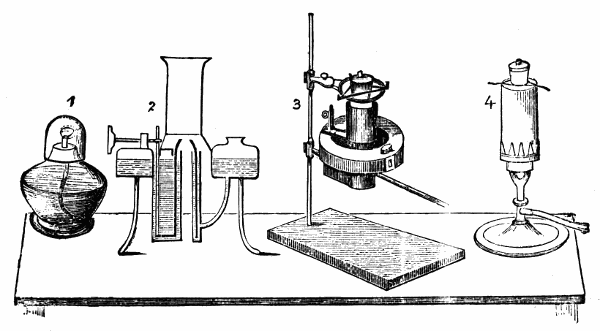
For chemical operations, many forms of lamp are used. The ordinary glass SPIRIT-LAMP, fitted with a ground-glass cap, is quite indispensable for minor experiments. (See engr. 1.)
The Argand lamp, when intended as a source of heat for chemical purposes, is so modified as to adapt it to burn either oil, spirit of wine, or wood-spirit, and the combustion is greatly aided by the chimney, which in this case is made of copper. (See engr. 2 and 3.) The lamp itself is also made of metal, and furnished with ground caps to the wick-holder and aperture by which the spirit is introduced, in order to prevent loss of spirit by evaporation when the lamp is not in use. When in use this aperture must always be left open, otherwise an accident is sure to happen, as the heat expands the air in the lamp, and the spirit is forcibly expelled.
In those situations in which coal-gas is cheap, it may be used with great economy and advantage as a source of heat in most chemical operations. Retorts, flasks, capsules, and other vessels, can be thus exposed to an easily regulated and constant temperature for many successive hours. Small platinum crucibles may be ignited to redness by placing them over the flame on a little wire triangle. Of the various gas-lamps now used in the laboratory, the first and most simple consists of a common Argand gas-burner fixed on aengr. 4.) With this arrangement it is possible to obtain any degree of heat, from that of the smallest blue flame to that which is sufficient to raise a moderately large platinum crucible to dull redness. When gas mixed with a certain proportion of air is burnt, a pale blue flame, free from smoke, and possessing great heating power, is obtained. A lamp for burning the mixture may easily be made by fitting a close cover of fine wire gauze over the top of the chimney of the last-mentioned contrivance. The gas is turned on, and after a few minutes ignited above the wire gauze. (See page 946). The ingenious and useful burners of Bunsen and Griffin are so constructed that gas and air mixed in any proportions, or gas alone, may be burnt at pleasure. Bunsen’s is a most efficient and convenient form of burner. (See illustration on next page.) It consists of a gas jet, surrounded by a metal tube, about 6 to 9 inches high and about 1⁄2 inch in diameter; having at the bottom four large holes. On the admission of air, when the gas is turned on, the air rushes in by these orifices, and mingling with the gas, the mixture ascends to the top of the tube and is there ignited, giving rise to a flame of great heat, but without luminosity, owing to the simultaneous combustion of the carbon and the hydrogen. The burner, however, is so contrived that by shutting off the supply of air entirely, or limiting it, the flame may be made more or less luminous at pleasure. To distribute the flame, a rosette burner is placed on the top of the tube.
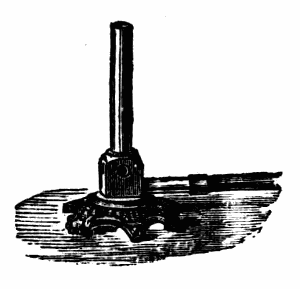
An improved variety of this burner has been designed by Bunsen, and is figured below.
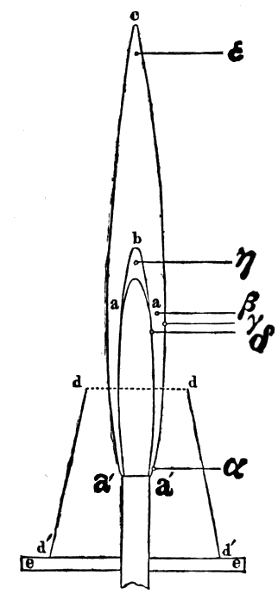
Fig. 1.
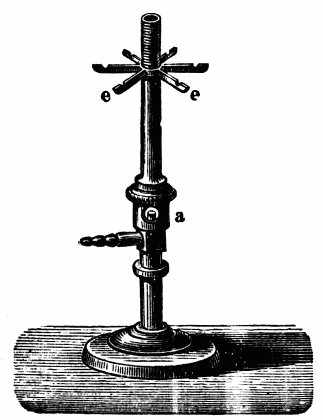
Fig. 2.—Improved Bunsen burner.
It is so contrived as to give a flame that is a very much better substitute for the flame of the blowpipe, than the ordinary Bunsen’s burner, and may hence be employed for reducing, oxidising, fusing, and volatilising, as well as for the observation of coloured flames. Fig. 1 is a sheath which, by turning round, regulates the admission of air. When it is used the conical chimney, d d d d, is placed in e e; it is of a size sufficient to allow of the flame burning tranquilly. In fig. 1 the flame is represented of half its natural size. This flame it will be seen consists of three divisions, viz.—1, a a a a the dark zone, which is composed of cold gas mixed with about 62 per cent. of air. 2, a c a b the mantle formed by the burning mixture of gas and air. 3, a b a, the luminous tip of the dark cone, which only appears when the orifices for the air are partially closed. Reductions may be performed in this part of the flame.
Bunsen, however, divides the flame into six parts, to which he attributes as many functions. These six divisions of the flame he names as follows:—
1. The base at α has a relatively low temperature, because the burning gas is here cooled by the constant current of fresh air, and also because the lamp itself conducts the heat away. This part of the flame serves for discovering the colours produced by readily volatile bodies, when less volatile matters which colour the flame are also present. At the relatively low temperature of this part of the flame, the former vaporises alone instantaneously, and the resulting colour imparted to the flame is for a moment visible unmixed with other colours.
2. The Fusing Zone. This lies at β, at a distance from the bottom of somewhat more than one third of the height of the flame, equidistant from the outside and the inside of the mantle, which is broadest at this part. This is the hottest part of the flame, viz., about 2300°, and it therefore serves for testing substances, as to their fusibility, volatility, emission of light, and for all processes of fusion at a high temperature.
3. The lower Oxidising Zone lies in the outer border of the fusing zone at γ, and is especially suitable for the oxidation of oxides dissolved in vitreous fluxes.
4. The upper Oxidising Flame at ε consists of the non-luminous tip of the flame. Its action is strongest when the air holes of the lamp are fully open. It is used for the roasting away of volatile products of oxidation, and generally for all processes of oxidation, when the highest temperature is not required.
5. The lower Reducing Zone lies at δ, in the inner border of the fusing zone next to the dark cone. The reducing gases are here mixed with oxygen, and, therefore, do not possess their full power, hence they are without action on many substances which are deoxidised in the upper reducing flame. This part of the flame is especially suited for reduction on charcoal or in vitreous fluxes.
6. The upper Reducing Flame lies at η, in the luminous tip of the dark inner cone, which, as already explained, may be produced by diminishing the supply of air. This part of the flame must not be allowed to get large enough to blacken a test tube filled with water and held in it. It contains no free oxygen, is rich in separated incandescent carbon, and therefore has a much stronger action than the lower reducing zone. It is used more particularly for the reduction of metals collected in the form of incrustations.
The subjoined is a drawing of the gauze burner, which is an open cylinder with wire gauze at the top.
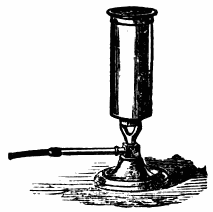
Argand’s lamp, with wire-gauze cap.
When this is placed over the gas burner, a supply of air is drawn in at the bottom by the ascending current of gas, and the mixture burns above the gauze, with a very hot flame, quite free from smoke, the metallic meshes preventing the flame from passing down to the gas below. See Illumination, Fuel, Furnace, Gas, Laboratory, &c.
Lamp, Flame′less. Syn. Glow lamp. A coil of fine platinum wire is slipped over the wick of a spirit lamp, the greater part being raised above the cotton; the lamp is supplied with ether or alcohol, lighted for a moment and then blown out. The coil continues to glow in the mixed atmosphere of air and combustible vapour, until the liquid in the lamp is exhausted.
Lamp, Monochromat′ic. A lamp fed with a mixture of a solution of common salt and spirit of wine. It gives a yellow light, and makes every object illuminated by it appear either yellow or black. The human features are changed in a remarkable degree; the countenance appearing truly ghastly and unearthly.
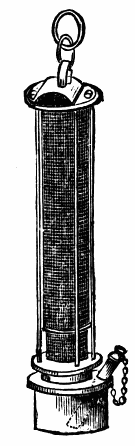
Lamp, Safety. Syn. Miner’s lamp, Davy, Geordy. The safety lamp of Sir H. Davy and George Stephenson are similar in principle, and were independently invented about the same time. That of Sir H. Davy consists of a common oil lamp, surmounted with a cylinder of wire gauze, the apertures of which are not greater than the 1⁄20th of an inch square, and the wire of which it is made to the 1⁄40th to the 1⁄60th of an inch in diameter. (See engr.) The fire-damp (carbonetted hydrogen) along with air passes through the meshes into the interior of the gauze cylinder. Here it ignites, but the flame which is produced
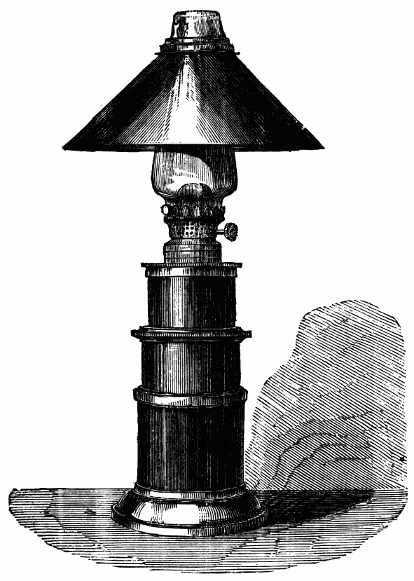
Lamp, Telescope. This ingenious contrivance, invented by Messrs Murray and Heath, is intended for microscopic illumination. It consists of three brass tubes, sliding one within the other, the oil vessel being contained in the inner tube. The height of the lamp is regulated to the greatest nicety by simply turning one tube in the other, interior spiral guides preventing all chance of slipping. The great advantage of this arrangement is absence of the stand and bar usually employed for raising and lowering the lamp, which enables it to be used on all sides, and to be brought much closer to the microscope than other lamps. See engr., below.
LAMP BLACK. See Black pigments.
LAMP′REY. Syn. Great lamprey, Seal. This fish is the Petromizon marinus of Linnæus. It generally quits the sea in the spring, for the purpose of spawning, and remains in our rivers for a few months. Its flesh is soft and glutinous, and though esteemed a delicacy, is extremely difficult of digestion, if not otherwise unwholesome. Potted lampreys are usually so highly seasoned as to become a dangerous article of food. Henry I is said to have lost his life from the effects of a surfeit of lampreys.
LAUDANINE. C20H25NO3. An alkaloid obtained by Hesse from the aqueous extract of opium. It is homologous with morphine and codeine. It dissolves in strong sulphuric acid with a rose-red colour, in strong nitric acid with an orange red colour, and in ferric chloride with emerald green colour.
LANTHA′NIUM. La92. A rare metal, discovered by Mosander, associated with oxide of cerium. Oxide of lanthanium is a pale salmon-coloured powder, unaffected by ignition in open vessels. According to Zschiesche the atomic weight of lanthanium is 90·18. See Cerium.
LANTHOPINE. C23H25NO4. A base obtained by Hesse in small quantity, associated with other bases from the aqueous extract of opium. It is homologous with papaverine. Strong nitric acid dissolves it, giving rise to an orange red colour. Strong sulphuric acid gives with it a faint violet colour.
LA′PIS. [L.] A stone. The term was much employed by the old chemists, and is still commonly applied to several preparations used in medicine.
Lapis Causticus. See Potassium.
Lapis Divi′nus. Syn. Divine Stone; Lapis ophthalmicus, L.; Pierre divine, Fr. Prep. 1. (Beer.) Verdigris, nitre, and alum, equal parts, melted together.
2. (P. Cod.) Alum, nitre, and blue vitriol, of each 3 oz.; camphor, 1 dr.; as last.
3. (Woolfuss.) Blue vitriol, nitre, alum, and camphor, equal parts, melted together, adding the camphor last. Astringent and detergent. 1 oz., dissolved in water, 1 pint, formed a once celebrated lotion. 1 dr. in water, 1 pint, is still used as a collyrium.
Lapis Inferna′lis. See Nitrate of Silver.
Lapis Lazu′li. See Ultramarine.
Lapis Lydius. Syn. Lydian stone. A siliceous slate, used as a touchstone by jewellers.
Lapis Medicamento′sus. Syn. Medicinal stone; Lapis mirabilis, L. Prep. (Ph. L. 1746.) Alum, litharge, and Armenian bole, of each 6 oz.; colcothar of green vitriol, 3 oz.; vinegar, 4 fl. oz.; mix, and evaporate to dryness. Formerly used to make an astringent and detergent lotion:—1 oz. to water, 1 pint. Once a popular application to ulcers, and in other cases; now disused.
Lapis Vulnerar′ius. Very similar to Lapis divinus.
LARCH BARK. The inner bark of the Larix Europœa, the common larch, has been lately introduced, under the form of a tincture, into the British Pharmacopœia.
Dr Stenhouse obtained from the bark a peculiar volatile constituent, possessed of acid properties for which the name of lariximic acid has been proposed. The other trees of the pine family are deficient in this acid. The young bark abounds most in it. Gum, starch, resin, and that variety of tannic acid, which forms olive green precipitates with the salts of iron, have also been found, in addition to other substances, in larch bark.
The inner bark, employed internally, has a special action on the mucous membranes, and acts as an astringent and mild stimulant. It is said to have been given with excellent results in hæmoptysis, as well as in bronchitis attended with copious expectoration, and in diseases of the urinary passages. Externally has been found serviceable in psoriasis, chronic eczema, and some other skin diseases. It is best to combine its extract or tincture with glycerin when it is to be used outwardly. See Tincture of larch bark.
LARD. Syn. Hog’s lard, AXUNGE; Adeps (Ph. L.), Axungia (Ph. E.), A. suillus (Ph. D.), A. porci, A. præparatus (B. P.), L. The fat of the pig (Sus scrofa—Linn.) melted by a gentle heat, and strained through flannel or a hair sieve. The fat about the loins yields the whitest and hardest lard. “That which has been cured with chloride of sodium is not to be employed.” (Ph. L.) “It is not to be used without being first carefully washed with water.” (Ph. L. 1866.) Used chiefly to make ointments, and in cookery. See Adeps.
LARD′ING. By many this is regarded as belonging to the higher style of cookery only, and too troublesome and extravagant to be adapted to the kitchens of the middle classes and the poor. This, we are assured, is not the case. On the contrary, “it is an economical process, and will make lean meat go much farther than without it.” The process of larding is as follows:—“Get what is called a larding needle, that is, a piece of steel from 6 to 9 inches long, pointed at one end, and having four slits at the other to hold a small strip of bacon when put between them. It will, perhaps, cost tenpence. Cut the bacon into pieces 2 or 3 inches long, and 1⁄4 to 1⁄2 an inch square; put each one after the other in the pin, insert it in the meat, and leave only about half an inch out; using 8 pieces to each pound.” (Soyer.)
LARK. The Alauda arvensis (SKYLARK) and the Alauda cristata (FIELD-LARK), with several other species of the same genus, form a light and nutritious article of food, by many esteemed a delicacy. The last, according to Galen and Dioscorides, eaten either roasted or boiled, ‘helps the colic.’ The heart, applied to the thigh, was also regarded to possess the same virtue.
LARYNGITIS. Inflammation of the larynx, or upper part of the windpipe. The symptoms that indicate this most dangerous malady are sore throat, accompanied with considerable pain in front of the throat, difficulty in breathing and swallowing, considerable hoarseness, change or loss of voice, a sense of suffocation, fever, restlessness, flushing of the face, and an eager desire for fresh air. We have described the accompaniments of this dread disease, in order that any one seized with an attack may know its nature, and at once send for his medical attendant. Should circumstances prevent his doing so immediately, as many leeches as possible should be applied to the centre of the throat.
LAUD′ANUM. This name is now understood to denote, exclusively, the common tincture of opium of the Pharmacopœia; but formerly the term was applied to several preparations of opium differing greatly from each other, both in their strength and mode of preparation. (See below.)
Laudanum, Dutchman’s. From the flowers of bull’s hoof or Dutchman’s laudanum (Passiflora merucuja—Linn.) infused in rum. Narcotic. Used as a substitute for tincture of opium in the West Indies.
Laudanum, Ford’s. This is merely the common tincture of opium aromatised with a little cloves and cinnamon.
Laudanum, Houlton’s. Prep. From opium 21⁄2 oz.; distilled vinegar, 11⁄2 pint; digested together for a week, the filtered tincture gently evaporated nearly to dryness, and then redissolved in weak spirit (1 of rectified spirit to 7 of water), 1 quart.—Dose, 10 to 60 drops.
Laudanum, Neumann’s. A fermented infusion of opium evaporated to the consistence of honey.
Laudanum, Quince. Syn. Extractum opii cydoniatum, Laudanum cydoniatum, L. Prep. 1. Extract of opium made with quince juice; a few drops of the oils of cinnamon, cloves, and mace being added before the mass cools. Now seldom used.
2. Laudanum, liquid-quince; (Laudanum liquidum cydoniatum, L.) (L. c. paratum fermentatione, L.) A fermented infusion of opium prepared with quince juice, aromatised with cloves, cinnamon, aloes wood, and yellow sandal wood, and evaporated so as to possess about twice the strength of the ordinary tincture. Now obsolete.
Laudanum, Rousseau’s. Wine of opium prepared by fermentation. See Wine.
Laudanum, Smith’s Concentrated. Resembles Battley’s LIQUOR OPII SEDATIVUS, but possesses about 6 times its strength.
Laudanum, Swediaur’s. Prep. From extract of opium, 2 parts, dissolved in a mixture of alcohol, 1 part, distilled water, 8 parts. Every 5 drops contain 1 gr. of opium.
Laudanum, Sydenham’s Liquid. Syn. Laudanum liquidum Sydenhami, L. Similar to Wine of Opium—Ph. L., but rather stronger, and aromatised with a little cloves and cinnamon. Wine of opium is now always sold for it.
Laudanum, Tartarised. Syn. Laudanum liquidum tartarizatum, L. A tincture of opium prepared with spirit alkalised with salt of tartar, and flavoured with aromatics. Obsolete.
LAUGH′ING GAS. See Nitrous oxide.
LAUR′EL. See Cherry laurel, Sweet bay, Oil, &c.
LA′VA. The matter thrown out by volcanoes. The beautiful ornamental vases, jugs, and other objects sold under the name, are a superior sort of unglazed coloured porcelain.
LAVE′MENT. See Enema.
LAV′ENDER. The flowers or flowering tops of Lavandula vera or common garden lavender. An essential oil, spirit, and tincture, prepared from it, are officinal in the Pharmacopœias.
Lavender Dye (for COTTON). For 100 yards of material. Take 1 lb. of logwood, and 2 lbs. of sumach, and scald them separately. Then decant them into a proper sized tub, let them cool to 150° Fahr., and add 2 gills of vitriol. Winch the goods in this 20 minutes; lift, and run them slightly through acetate of iron; wash them in two waters; then give 1 lb. of logwood as before, raise with a pint of chloride of tin, wash in two waters; then in a tub of cold water put 4 oz. extract of indigo, enter and winch in this 15 minutes, lift; give one water, and dry.
Lavender Dye (for WOOL). Boil 51⁄2 lbs. of logwood with 2 lbs. of alum. Then add 10 oz. of extract of indigo. When cold put in the goods, and gradually raise to the boiling point. For 50 lbs.
Lavender, Red. See Tincture.
Lavender, Smith’s British. Prep. From English oil of lavender, 2 oz.; essence of ambergris, 1 oz.; eau de Cologne, 1 pint; rectified spirit, 1 quart. Very fragrant. See Water (Lavender).
Lavender, to Dye Silk. (Mustpratt.) Into a vessel with warm water, as hot as the hand can bear, dissolve a little white soap, enough to raise a lather; then add one gill of archil liquor, and work the goods in this for fifteen minutes; ring out and dry.
Boil one ounce of cudbear, and add the solution to the soap and water instead of archil, which will give a lavender having a redder tint than with the archil. If a still redder shade of lavender be required the soap may be dispensed with.
Lavender Water. See Spirits, Perfumed.
LAX′ATIVES. Syn. Lenitives; Laxativa, Laxantia, Lenitiva, L. Mild purgatives or cathartics. The principal of these are—almond oil, cassia pulp, castor oil, confection of senna, cream of tartar, figs, grapes, honey, phosphate of soda, prunes, salad oil, tamarinds, &c.
LAY′ERS. Among gardeners, a mode of propagating plants, by laying down the shoots of young twigs, and covering a portion of them with the soil, without detaching them from the parent plant. To facilitate the rooting of such layers, the part beneath the soil is fractured by twisting or bruising it, or it is partly cut through with a sharp knife, immediately under a bud. When the layer has taken root, it is divided from the parent stem, and transplanted or potted. In this way, with a little care, nearly all plants may be multiplied.
LEAD. Pb. Eq. 207. Syn. Plumbum. This metal, like gold, silver, and iron, appears to have been known in the most remote ages of antiquity. The ore from which it is almost
Prep. On the large scale lead is obtained by roasting galena in a reverberatory furnace, and smelting the residue along with coal and lime. The lead thus obtained generally contains small quantities of both silver and gold, which it often pays to extract, by a method termed ‘Pattinson’s process.’ This process is founded on the circumstance that, when melted, lead containing silver is allowed to cool. The lead crystallises out first, leaving an alloy of lead and silver still fused. By removing the crystals of lead, as formed, until about four fifths are removed, the residue is an alloy of lead and silver much richer than the original. Repeated several times, this yields a rich alloy of silver and lead that is expelled and the silver obtained.
Another method for the removal of silver from lead is one employed in Glasgow, and known as the ‘Flack-Guillim’ process. It is thus described in ‘Dingler’s Polytechnic Journal,’ ccxxxv, 67-70, and in ‘Engineering’ for September 15th, 1876. “Eighteen tons of rich lead are melted, and one per cent. of zinc added. The molten mass then allowed to cool, the crust which forms is removed, and the lead sweated out in a small pot. The lead in the large pot is then treated with another half per cent. of zinc in the same way. A third addition of a quarter per cent. of zinc suffices to remove the greater part of the remaining silver, 5 dwts. being left in the lead per ton. This lead is then run into the improving pan, and the last traces of zinc oxidised out.”
Pure lead for chemical purposes may be obtained as follows, although the lead of commerce is nearly pure:
By reducing nitrate of lead with charcoal.
By heating the oxide left by igniting pure acetate of lead with black flux.
Prop., &c. The general properties of lead are too well known to require notice here. The sp. gr. of that of commerce is about 11·35; but in a state of absolute purity its greatest density is 11·45. It melts at about 600° Fahr., and when very slowly cooled, crystallises in octahedrons. At a white heat it boils, and is volatilised. When exposed to moist air, it soon becomes covered with a grey film. It is scarcely acted on by hydrochloric or sulphuric acids, although after some time both coat it with a film of chloride or sulphate. It is rapidly acted on by nitric acid, with formation of the nitrate. Pure water put into a leaden vessel and exposed to the air soon corrodes it, and dissolves the newly formed oxide; but river and spring water have little action upon lead, provided there is no free carbonic acid present, the carbonates and sulphates in such water destroying their solvent powers. It has been found that a very small amount of phosphate of sodium or of iodide of potassium, dissolved in distilled water, prevents its corrosive action on this metal. The lead in contact with such water gradually becomes covered with a superficial film of an insoluble salt of lead, which adheres tenaciously, and prevents further change. From this it appears that ordinary water (‘hard water’), which abounds in mineral salts, may be more or less safely kept in leaden cisterns; but distilled water and rain water, and all other varieties that contain scarcely any saline matter, speedily corrode, and dissolve a portion of lead, when kept in vessels of that metal. When, however, leaden cisterns have iron or zinc fastenings or braces, a galvanic action is set up, the preservative power of saline matter ceases, and the water speedily becomes contaminated with lead, and unfit for consumption as a beverage. Water containing carbonic anhydride also acts on lead, and this is the reason why the water of some springs (although loaded with saline matter), when kept in leaden cisterns, or raised by leaden pumps, possesses unwholesome properties.
M. Fordos, in a communication to the ‘Journal de Pharmacie et de Chimie,’ xix, 20, states that in the course of some experiments on the applicability of lead for water pipes and cisterns he could not detect a trace of lead in ten litres of river water taken from the leaden cistern of one of the Paris hospitals. But upon shaking pure water with shot and air, a coating of carbonate of lead was formed on the sides of the bottle, which almost rendered the glass opaque. On dissolving the film in nitric acid, and estimating the lead, it was found that one litre of water had produced five milligrammes of the carbonate. Wine and vinegar would also dissolve that film; and as shot is commonly used for cleaning wine bottles, lead frequently finds its way into wines, a fact which may account for many of the cases of chronic poisoning by lead which occur in large towns. The detection of small quantities of lead in forensic investigation would afford, therefore, no proof of any intentional poisoning.
Orfila’s erroneous statement that lead is a normal constituent of the human organism may also be accounted for in this way.
Free carbonic acid is evolved during the fermentation or decay of vegetable matter, and hence the absolute necessity of preventing the leaves of trees falling into water-cisterns formed of lead. The ‘eau de rose’ and the ‘eau d’orange’ of commerce, which are pure distilled water holding in solution small quantities of essential oil, and are imported in leaden canisters, always contain a small quantity of lead, and deposit a sediment, which is not the case when they are kept in glass or incorrodible vessels.
Lead and all its preparations are highly poisonous; and whether imbibed in almost infinitesimal quantities with our daily beverages and food, or swallowed in larger and
Mr G. Bischof[13] writes:—Some eight months ago a tube was passed in my laboratory, which is supplied with water by the New River Company, into the slate cistern so as to act as a syphon to supply some apparatus with water. The external surface of the tube inside the cistern was therefore alternately exposed to the action of air and water, according to the level of water in the cistern.
Recently I noticed a white efflorescence on the greater part of the tube inside the cistern. An adjoining cistern of sheet lead, with a lead overflow pipe fixed into the bottom, shows nowhere any such corrosion.
On cutting the tube it became evident that it is a composition tube, that is to say, a lead tube, containing some antimony. On analysis it was found to be composed of—
Lead 98·3
Antimony 1·7
——
100·0
Although the external diameter of the tube is only half an inch, 0·29 gram of efflorescence was obtained per foot by gentle rubbing. This dried at 100° C. contained 1·02 per cent. of sulphuric acid, corresponding with 4·1 per cent. of sulphate of lead. The remainder, except 1·13 per cent. of a residue insoluble in nitric acid, is carbonate of lead.
The alternate exposure to air and water appears not essential to the corrosion, as I have observed a similar effect when the same tubing remained constantly under water. The interior of the tube has also been corroded, although of course no permanent efflorescence could be formed, owing to the rapid flow of the water.
The frequent practice of plumbers of using composition tubing in connection with water supplies is therefore highly reprehensible, being fraught with considerable danger to the health of those using the water for drinking or cooking.
Mr Louis Siebold detected lead in eight out of ten samples of concentrated solution of acetate of ammonia as well as in a sample of the ordinary solution of the British Pharmacopœia. In pursuing his investigations Mr Siebold found that solutions of acetate of ammonium are capable of dissolving lead from glass. He therefore advises that all forms of the solution, more particularly the concentrated liquor employed by many chemists for making the weaker solutions, should be kept in bottles free from lead.
With the acids lead or its oxides form salts, usually white in colour, and in the majority nearly insoluble in water, but readily soluble in acids.
Tests. The oxides and salts of lead, mixed with a little carbonate of soda, and exposed on a charcoal support to the reducing flame of the blowpipe, readily yield a soft and ductile globule of metallic lead, and the charcoal, at the same time, becomes covered with a yellowish incrustation of oxide of lead. Both metallic lead and its oxides are soluble in nitric acid, furnishing a solution which may be examined with ease.
Solution of lead salts may be recognised by the following reactions:—Sulphuretted hydrogen, sulphydrate of ammonium, and the alkaline sulphides, give black precipitates, insoluble in the cold dilute acids, alkalies, alkaline sulphides, and cyanide of potassium. Potassium and sodium hydrates give a white precipitate, soluble in excess. Ammonia (except with the acetate) gives a white precipitate, insoluble in excess. The carbonates of potassium, sodium, and ammonium, give a white precipitate, insoluble in excess. Dilute sulphuric acid (in excess), and solutions of the sulphates give a white precipitate, sparingly soluble in dilute acids, but soluble in a hot boiling solution of potassium carbonate. Chromate and bichromate of potassium give yellow precipitates insoluble in dilute nitric acid, and soluble in solution of potassium hydrate. Iodide of potassium gives a yellow precipitate, soluble in great excess by heat, and separating in small, brilliant, golden-yellow scales, as the liquid cools. A piece of polished zinc precipitates metallic lead in an arborescent form, hence called the lead tree. To prepare for these tests, a solid supposed to contain lead should be digested in nitric acid, when the solution, evaporated to dryness and redissolved in water, may be tested as above.
Estim. This has been already referred to under previous heads. The ores of lead (galena) may be digested in nitric acid, when the solution may be treated with sulphuric acid, and the lead estimated from the weight of the precipitated sulphate. This is called an assay in the wet way. The method adopted by practical mineralogists is an assay in the dry way, and is conducted as follows:—A small but powerful air-furnace, charged with coke, is brought to as high a temperature as possible, and a conical wrought-iron crucible plunged into the midst of it; as soon as the crucible has attained a dull-red heat, 1000 gr. of the galena, reduced to powder, are thrown into it, and stirred gently with a long piece of stiff iron wire flattened at the one end, in order to expose as large a surface of the powdered ore to the air as possible, observing now and then to withdraw the wire, to prevent it becoming red hot, in which case some of the ore would permanently adhere to it, and be reduced before the intended time; the roasting is completed in 3 or 4 minutes, and any portion of the ore adhering to the stirrer being detached by a knife, and returned into the crucible, the latter is covered up, and allowed to attain a full cherry-red1⁄2 spoonful of flux, and after being cleansed with a piece of green wood, as before, is at once poured into a second mould, which is instantly inverted; the little button of lead thus obtained is added to the lead in the other mould, and the whole is accurately weighed. The weight, divided by 10, gives the per-centage of lead (including silver, if present) in the ore examined.
One half of the lead thus obtained is put into a dry cupel of bone ash, and placed in the cupelling furnace, and treated as described in the article on assaying; the metallic button left on the cupel is then detached and weighed. The weight, divided by 5, gives the per-centage of pure silver.
Obs. The flux commonly employed in the above assay is composed of red argol, 6 parts; nitre, 4 parts; borax, 2 parts; fluor spar, 1 part; well pulverised and thoroughly mixed together. When the ore is very refractory, about a spoonful of carbonate of potassium should be added for each 1000 grains of ore, in which case the roasting may be dispensed with. The quantity of silver in argentiferous galena varies from 3⁄10000 to 1⁄3 part of the whole. Whenever this ore contains above 2 parts of silver in the 1000, it is found to be profitable to extract the latter. Indeed, by Pattison’s process it is found that as small a proportion as 1 in 8000 can be extracted with profit.
Uses. The uses of lead in the arts are well known. It enters into the composition of many important alloys (pewter, type-metal, shot-metal, solder, &c.), it furnishes us with several valuable pigments (chrome yellow, &c.), and it is extensively used in dyeing. Some of its preparations are employed in medicine.
Ant., &c. Administer an emetic of sulphate of zinc or sulphate of copper, and, if necessary, tickle the fauces with the finger or a feather, to induce vomiting. Should this not succeed the stomach-pump may be had recourse to. Epsom or Glauber’s salts, or alum, dissolved in water, or water acidulated with sulphuric acid, followed by tea, water gruel, or barley water, are the proper antidotes, and should be taken as soon after the poison has been swallowed as possible. In poisoning by white lead, Dr Alfred Taylor recommends the administration of a mixture of sulphate of magnesium and vinegar, as preferable to the sulphate alone. When the symptoms are those of painter’s colic, the treatment recommended under that head should be adopted. In paralysis arising from lead, small doses of strychnine and its preparations may be cautiously administered. A symptom of poisoning by lead is the formation of a narrow leaden blue line, from 1⁄20th to 1⁄6th of an inch wide, bordering the edges of the gums, attached to the neck of two or more teeth of either jaw. (Dr Burton.) This discoloration may often be detected or rendered more conspicuous by rinsing the mouth out with water holding a little sulphuretted hydrogen or sulphydrate of ammonium in solution. Chevallier and Rayer recommend the use of sulphurous or hepatic mineral waters, or of artificial solutions of sulphuretted hydrogen or alkaline sulphides in water, both in cases of acute and chronic poisoning by lead; but the practical success of this plan does not appear to have been in proportion to theoretical anticipations. The moist and freshly precipitated sulphides of iron are said by their advocates to be infallible if taken sufficiently early.
Lead in Aerated Water. Some time since Sir Robert Christison condemned the use of syphons for lemonade, owing to the action of free tartaric acid upon lead, and the rapidity with which waters containing any free acid become charged with lead in syphons. According to Professor Miller, 0·0175 gr. of lead per gallon is not an unusual amount for average cistern water. Mr John S. Thompson, however, reports to the Edinburgh University Chemical Society that, after such water has been aerated and put into a syphon, the amount of lead dissolved in it begins to rise in a rapid manner. Thus in potash water, drawn from a syphon, 0·0408 grain of lead per gallon was found to be present, being nearly 25 times the quantity found in the same water before it entered the syphon. Pure aerated water again drawn in a similar manner from a syphon gave 0·0816 gr. of lead per gallon, or exactly double the amount found in the potash water, showing at once the well-known protective action that salts of the alkalies and alkaline earths have on lead. “Although,” says the ‘Medical Journal,’ “these results are sufficiently high and alarming; still, when the water is drawn off in small quantities at a time, as is frequently the case with invalids, the results are found to be still higher; thus, when potash water was so treated, 0·0455 gr. of lead per gallon was found, while aerated water, drawn off in small quantities, gave 0·0933 gr. of lead per gallon, showing a very marked rise in both cases. The cause of this increase in quantity of the lead appears to be owing, not so much to the lengthened period of contact between the liquid and the metal as to the fact that the nozzle of the
Lead, Acetate of. Pb(C2H3O2)2. Syn. Plumbic acetate, SUGAR OF LEAD, PLUMBI ACETAS. (B. P.) Prep. Litharge (in fine powder) 24; acetic acid, 40; distilled water, 20; mix the acetic acid and the water, add the litharge, and dissolve with the aid of a gentle heat, filter, evaporate until a pellicle forms, and crystallise. Drain and dry the crystal.
Acetic acid (sp. gr. 1·0843), 23 parts, is gently heated in a copper boiler rendered electro-negative by means of a large flat piece of lead soldered within it, and litharge (pure, and in fine powder), 13 parts, is sprinkled in; the heat is then continued, with constant stirring, until the acid is saturated, when the mother-waters of a former process, if any, are added, and the whole is heated to the boiling point, and allowed to settle until cold; the clear portion is now decanted, and evaporated in a similar vessel until the liquor has the sp. gr. 1·266 or 1·267, when it is run into salt-glazed stone-ware vessels (the edges of which have been well smeared with candle grease), and allowed to crystallise. The product is 38 to 381⁄2 parts of crystallised sugar of lead. It is found to be advantageous to preserve a very slight excess of acid during the boiling and crystallisation, to prevent the formation of any basic acetate the presence of which impedes the formation of regular crystals.
From litharge, 112 lbs.; acetic acid (sp. gr. 1·057), 128 lbs. Prop. 180 to 184 lbs.
Prop. Pure acetate of lead forms colourless, transparent, prismatic crystals, slightly efflorescent in dry air; it is soluble in 8 parts of alcohol and in 11⁄4 part of cold water; the aqueous solution has a sweet astringent taste, and feebly reddens litmus, but turns turmeric and the juice of violets green; when gently heated, it melts in its water of crystallisation; by continuing the heat, the whole of the water is expelled, and the dry acetate obtained; at a higher temperature the salt suffers decomposition, and acetic acid, acetone, &c., is given off. Commercial acetate of lead is in general a confused crystalline mass, somewhat resembling broken lump sugar. It is powerfully astringent and poisonous.
When pure it is completely soluble in distilled water acidulated with acetic acid forming a transparent colourless solution, “38 grains dissolved in water require for complete precipitation 200 grains measures of the volumetric solution of oxalic acid.” (B. P.)
Uses, &c. Acetate of lead is extensively employed in dyeing and calico-printing. In medicine it is used as an astringent, styptic, and hæmostatic; in pulmonary, uterine, and intestinal hæmorrhage, colliquative diarrhœa, phthisical sweats, &c. It is usually combined with morphia or opium, and with acetic acid to prevent it passing into the state of the poisonous carbonate in the stomach.—Dose, 1⁄2 gr. to 2 gr. (Collier); 1 to 2 gr. to 8 or 10 gr., twice or thrice a day (Pereira); 3 gr. to 10 gr., every 6 or 8 hours (A. T. Thomson). Externally, as a collyrium, 10 gr. to water, 8 fl. oz. (A. T. Thomson); as a lotion, 20 gr. (A. T. Thomson), 1 dr. (Collier) to water, 8 or 10 fl. oz.; as an injection, 40 gr. to rose water, 1⁄2 pint. The lotion is cooling and sedative, and is commonly used in excoriations, local inflammations, &c.
Basic Acetates. There are several of these salts, but only one is of any importance.
Tribasic Lead Acetate or Double Plumbic Acetate, and Dioxide. Pb(C2H3O2)2 2PbO. Syn. Subacetate of lead; Basic lead citrate; Goulard’s acetate of lead; Plumbi subacetas (B. P.). Prep. Litharge, 7; acetate of lead, 10; and distilled water, 40; are boiled half an hour, and evaporated down, and allowed to crystallise out of contact with air.
Used under the form of “Plumbi subacetas liquor” v. (B. P.)
Lead, Arse′′niate of. Pb3(AsO4)2. Syn. Arsenate of l.; Plumbi arsenias, L. Prep. Gradually add a solution of acetate of lead to another of arseniate of sodium. A white, insoluble powder. Proposed as an external application in certain forms of cancer.
Lead, Bro′mide of. PbBr2. Syn. Plumbi bromidum, L. Prep. By precipitating a solution of neutral acetate or nitrate of lead with a solution of bromide of potassium. A white, crystalline powder, sparingly soluble in water. It fuses by heat into a red liquid, which turns yellow when cold. It has been used in the same cases as iodide of lead.
Lead, Car′bonate of. PbCO3. Syn. Plumbi carbonas, L. Prep. By precipitating a cold solution of either acetate or nitrate of lead with a solution of an alkaline carbonate, observing to well wash the precipitate and dry it in the shade. This preparation is seldom employed, the commercial carbonate (WHITE LEAD) being substituted for it. See White pigments.
Lead, Chloride of. PbCl2. Syn. Chloride lead; Plumbi chloridum (Ph. L. 1836). Prep. (Ph. L. 1836). Dissolve acetate of lead, 19 oz., in boiling water, 3 pints; next dissolve chloride of sodium, 6 oz., in boiling water, 1 pint; mix the two solutions, and when cold wash and dry the precipitate. A white, crystalline powder.
Dissolve finely powdered litharge in boiling
Prop. Soluble in 135 parts of cold and in 22 parts of boiling water; it melts when heated, and solidifies on cooling, forming a horn-like substance (horn lead; plumbi corneum).
Uses, &c. In the Ph. L. 1836, chloride of lead was ordered to be employed in the preparation of ‘hydrochlorate of morphia.’ Mr Tuson highly recommends it in cancerous affections, to allay pain and restrain morbid action, either in the form of a lotion or ointment.
Various mixtures of lead chlorides and oxide are employed as a white pigment under the name of ‘Pattison’s white.’ It is prepared by rapidly mixing a boiling solution of lead chloride with an equal volume of lime water. Another similar compound is called ‘patent yellow’ or ‘Turner’s yellow.’
Lead, Chromate of. PbCrO4. Syn. Lemon yellow, Leipsig yellow, Paris yellow. Prep. By adding a filtered solution of acetate or nitrate of lead to a like solution of chromate of potassium, as long as the precipitate forms, which is collected, washed with water, and dried. For information respecting the manufacture of this substance on the large scale, as a colouring substance (chrome yellow), see Yellow pigments.
Lead, Dichromate of. Syn. Chrome orange, Chrome red. PbCrO4.PbO. Prep. By adding to a solution of nitrate or acetate of lead a solution of chromate of potassium, to which an equivalent of potassa has been added. This compound is of a splendid scarlet colour. See Red pigments.
Lead, Cy′anide of. PbCy2. Syn. Plumbi cyanidum, L. Prep. By adding hydrocyanic acid to a solution of acetate of lead, as long as a precipitate forms, which, after being washed with distilled water, is dried by a very gentle heat, and preserved from the light and air. Sometimes used as a source of medicinal hydrocyanic acid.