A CYCLOPÆDIA OF PRACTICAL RECEIPTS, &c. VOLUME II (continued 12)
Reading edition
Prop., &c. Nicotina is a colourless, volatile liquid; highly acrid and pungent; smelling strongly of tobacco; boiling at 375° Fahr. (482°—Pereira); soluble in water, ether, alcohol, and oils; and combining with the acids, forming salts, many of which are crystallisable. It is a frightful poison; 1⁄4 of a drop will kill a rabbit; a single drop will kill a large dog. Nicotina is the substance which was employed by the Count Bocarmé for the purpose of poisoning his brother-in-law, Gustave Fougnies, the particulars of which were developed in the celebrated trial, in Belgium, of that nobleman, in 1851. Good Virginia and Kentucky tobacco, dried at 212° Fahr., contain from 6% to 7% of nicotina; Havannah tobacco (cigars) less than 2%. (Schloesing.)
NIGHT′MARE. Syn. Incubus, Ephialtes, L. The common causes of nightmare are indigestion and the use of narcotic and intoxicating substances. Its prevention consists in the selection of proper food, and in duly attending to the state of the stomach and bowels. Heavy and late suppers should be particularly avoided, as well as all articles of diet that are of difficult digestion, or apt to induce flatulency. When it arises from strong drink, tobacco, or opium, these should be abandoned, or employed in smaller quantities. A teaspoonful of aromatic spirits of ammonia, magnesia, or bicarbonate of soda, taken in a glass of cold water on going to bed, is a good and simple preventive. In cases accompanied by restlessness, a few drops of laudanum or tincture of henbane may be added. An occasional aperient is also excellent. See Chamomile.
NIGHT′SHADE (Deadly). Syn. Belladonna (B. P., Ph. L. E. & D.). “The leaf, fresh and dried (leaves and root—Ph. D.), of Atropa belladonna, Linn.” “The fresh leaves and branches to which they are attached; also the leaves separate from the branches, carefully dried, of Atropa belladonna, gathered, when the fruit has begun to form, from wild or cultivated plants in Britain” (B. P.). “Oval, acute, very perfect, glabrous, when bruised, exhaling a disagreeable odour. The herb which grows spontaneously in hedges and uncultivated places is to be preferred to that which is cultivated in gardens.” (Ph. L.)
Belladonna is a powerful narcotic, and is used as an anodyne, antispasmodic, and discutient, in a variety of diseases,—neuralgia, arthritic pains, migratory rheumatic pains, spasmodic rigidity and strictures, angina pectoris, hooping-cough, fevers, phthisis, &c.; also as a prophylactic of scarlet fever, as a resolvent in enlarged and indurated glands, to produce dilatation of the pupil, &c., &c.—Dose. Of the powder, commencing with 1 gr., gradually and cautiously increased until dryness of the throat or dilation of the pupil occurs, or the head is affected. See Atropia.
NIGHTSHADE (Woody). Syn. Bittersweet; Dulcamara (B. P., Ph. L. E. & D.), L. The “new shoots (caules) of Solanum Dulcamara, Linn.” “The dried young branches of the Solanum Dulcamara (Bittersweet) from indigenous plants which have shed their leaves” (B. P.). “It is to be collected in autumn, after the leaves have fallen.” (Ph. L.) Diaphoretic, diuretic, and (in large doses) narcotic. See Infusion of Dulcamara.
NIO′BIUM. See Tantalum.
NIP′PLES (Sore). The most common form of this affection is that termed “chapped nipples” by nurses. As a preventive measure, the part may be moistened morning and evening, for some weeks before the period of lactation, with a little rum or brandy, which is more effective if slightly acidulated with a few drops of dilute sulphuric acid. Some persons employ tincture of tolu, or compound tincture of benzoin (Friar’s balsam) for this purpose.
When chaps, cracks, or like sores, arising from lactation, are once developed, one of the safest and most effective remedies is tincture of catechu, applied 3 or 4 times a day, by means of a camel-hair pencil.
The celebrated nostrum of Liebert for cracked nipples, “Cosmétique infaillible et prompt contre les gerçures ou crevasses aux seins et autres,” is a lotion formed of 10 gr. of nitrate of lead dissolved in 4 fl. oz. of rose water, and tinged with a little cochineal. The parts are moistened with the liquid, and are then covered with fine leaden nipple-shields, two of which are provided for the purpose. This is repeated soon after each time the child leaves the breast; and the nipple is carefully washed with a soft sponge and lukewarm water, and gently dabbed dry with a very soft towel, before the infant is again applied to it. This remedy is very successful, and has acquired great popularity and patronage in Brussels, Paris, Frankfort, and other parts. It must be recollected, however, that all applications of an active or poisonous nature should be employed with the greatest possible caution, as, unless unusual care is taken, a portion of the remedy may remain concealed
NITRAN′ILINE. This substance is obtained by acting on nitrobenzol with a mixture of fuming nitric acid and oil of vitriol; Dinitro-benzol is formed, which is dissolved in alcohol, and the resulting solution subjected to the reducing action of ammonia and sulphuretted hydrogen, as described under aniline. Nitraniline forms yellow, acicular crystals, little soluble in cold water, but freely soluble in alcohol and ether. Its salts are crystallisable.
NI′TRATE. Syn. Nitras, L. A salt of nitric acid (e.g. AgNO3, nitrate of silver). The nitrates are very easily prepared by the direct solution of the metal, or its oxide, or carbonate, in nitric acid, which, in most cases, should be previously diluted with water. By evaporation, with the usual precautions, they may be obtained either in the pulverulent or crystalline form.
The nitrates are characterised by deflagrating when thrown on red-hot charcoal; also by their aqueous solutions, after being mixed with half their bulk of strong sulphuric acid and thoroughly cooled, yielding a brown cloud with a crystal or concentrated solution of ferrous sulphate. See Nitric acid, and the respective metals.
NI′TRE. Nitrate of Potassa. See Potassium.
NI′TRIC ACID. HNO3. Syn. Azotic acid; Acidum nitricum (B. P., Ph. L., E., & D.); Aquafortis.
Prep. 1. (Ph. E. and Ph. L. 1836.) Purified nitre (dried) and sulphuric acid, equal parts; mix in a glass retort, and distil with a moderate heat, from a sand bath (or naked gas flame—Ph. E.) into a cool receiver, as long as the fused materials continue to evolve vapours. “The pale yellow acid thus obtained may be rendered nearly colourless (if desired) by gently heating it in a retort.” (Ph. E.) Sp. gr. 1·500. In the present Ph. L. this acid is included in the materia medica. (See below.)
2. (Ph. D.) The nitrate of potassa is dissolved in water, the solution treated with a little nitrate of silver, filtered, evaporated to dryness, weighed, and then treated as above.
3. Nitrate of soda (cubic nitre, Chili saltpetre) is introduced, in quantities varying between 4 and 10 lbs., into a cylindrical iron retort, which it will only half fill, and after the lid is luted on and the connection made with the condensers, an equivalent of oil of vitriol is poured in through an aperture provided for the purpose, and the charge is worked off with a gradually increased heat. The condensing apparatus consists of a series of 5 or 6 salt-glazed stoneware receivers, about 1⁄6th part filled with cold water. The product of this process is the strongest brown and fuming ‘NITROUS ACID’ of commerce (AQUAFORTIS, FUMING NITRIC ACID; ACIDUM NITROSUM; ACIDUM NITRICUM FUMANS), and has usually the sp. gr. 1·45. It is rendered colourless by gently heating it in a glass retort, when it forms COMMERCIAL NITRIC ACID (sp. gr. 1·37 to 1·4.)
4. (Pure monohydrated nitric acid.) By mixing the strongest commercial acid with about an equal quantity of oil of vitriol; redistilling; collecting apart the first portion which comes over, and exposing it, in a vessel slightly warmed and sheltered from the light, to a current of dry air made to bubble through it until the nitrous acid is completely removed.
Prop. Pure liquid nitric acid is colourless, highly corrosive, and possesses powerful acid and oxygenising properties. The sp. gr. of the strongest liquid acid (monohydrated nitric acid) has the sp. gr. 1·517 at 60° Fahr. “On boiling nitric acid of different degrees of concentration at the ordinary atmospheric pressure, a residue is left boiling at 249° Fahr., and 29 in. barometer, having a sp. gr. 1·414 at 60° Fahr.” (Fownes.) Acid of less density than 1·414 parts with water, and gradually becomes stronger by boiling; but acid of less sp. gr. than 1·414 is weakened by exposure to heat. When exposed to intense cold, liquid nitric acid freezes. It is rapidly decomposed, with loss of oxygen, by contact with most organic and many metallic and non-metallic bodies. In many cases these reactions occur with considerable violence, and the production of light and heat.
Pur. The nitric acid of commerce is generally contaminated by hydrochloric acid, nitrous acid, sulphuric acid, or chlorine, or by their soda or potassa salts, and, occasionally, iodine, together with an excess of water. The last is readily detected by the sp. gr., and the others by the appropriate tests. “Colourless. Contains 70% of HNO3. Sp. gr. 1·42. 90 gr. by weight, mixed with 1⁄2 oz. of distilled water, require for neutralisation 1000 grain measures of the volumetric solution of soda. Evaporated, it leaves no residue. Diluted with six volumes of distilled water, it gives no precipitate with chloride of barium or nitrate of silver—indicating absence of sulphuric and hydrochloric acids.” (B. P.) 5 measures of acid, sp. gr. 1·5, mixed with 2 of water, condensed into 61⁄2 measures, and makes the sp. gr. 1·42. “Free from colour. Sp. gr. 1·42. Exposed to the air, it emits very acrid vapours. Totally volatilised by heat. Diluted with 3 times its volume of water, it gives no precipitate with either nitrate of silver or chloride of barium. 100 gr. of this acid (sp. gr. 1·42) are saturated by 161 gr. of crystallised carbonate of soda.” (Ph. L.) The Ph. E. states the density of commercial nitric acid is 1·380 to 1·390. “If diluted with distilled water it precipitates but slightly, or not at all, with solution of nitrate of baryta or nitrate of silver.” The best ‘double aquafortis’ of the shops (aquafortis duplex) has usually the sp. gr. 1·36; and the single aquafortis
Tests.—1. It stains the skin yellow.—2. When mixed with a little hydrochloric acid or chloride of ammonium, it acquires the power of dissolving gold leaf.—3. Morphia, brucia, and strychnia, give it a red colour, which is heightened by ammonia in excess.—4. When placed in a tube, and a solution of protosulphate of iron is cautiously added, a dark colour is developed at the line of junction, which is distinctly visible when only 1⁄24,000th part of nitric acid is present. This test may be often conveniently modified by dropping into the liquid a crystal of protosulphate of iron; the fluid immediately surrounding this crystal then acquires a dark brown colour, which disappears upon simple agitation of the fluid, or by heating it.—5. When mixed with a weak solution of sulphate of indigo, and heated, the colour of the latter is destroyed.—6. When saturated with carbonate of potassium or sodium, and evaporated to dryness, the residuum deflagrates when thrown on burning coals.—7. When the mixture of a nitrate with cyanide of potassium, in powder, is heated on a piece of platinum, a vivid deflagration follows, attended with distinct ignition and detonation. (Fresenius.) It is stated that sulphate of aniline is an extremely delicate test for nitric acid. The following is the method of its application:—About a cubic centimètre of pure concentrated sulphuric acid (sp. gr. 1·84) is placed in a watch-glass; half a cubic centimètre of a solution of sulphate of aniline (formed by adding ten drops of commercial aniline to 50 c.c. of diluted sulphuric acid in the proportion of 1 to 6) is poured on, drop by drop; a glass tube is moistened with the liquid to be tested, and moved circularly in the watch-glass. By blowing on the mixture during the circular agitation, when a trace of nitric acid is present, circular striæ are developed of a very intense red colour, tinting the liquid rose. With more than a trace of nitric acid the colour becomes carmine, passing to a brownish red. This process serves to detect the presence of nitric acid in the sulphuric acid of commerce. It will also reveal the presence of nitrates in water.[46]—8. Take a quantity of diphenylamine, about the size of a mustard seed, put it into a test-tube, and pour a little sulphuric acid over it, then add a drop or two of water, so as to increase the temperature sufficiently to effect the solution of the diphenylamine, and the test is ready for use. Now add very gently the solution to be tested, and if only a trace of nitric or nitrous acid be present, a beautiful and very permanent blue colouration is produced at the junction of the two liquids, but if there be any quantity of the nitrogen compound, the colour becomes almost black. This reaction is so delicate and certain that, in the case of a solution of nitric acid containing about 1 part B. P. acid in 10,000 of water, the reaction is most distinct; one part of nitrite of potassium in 30,000 of water gives also almost unmistakable evidence of the presence of the nitrogen acid.
The following process for the quantitative estimation of nitric acid is by Fischer:[47]—Indigotin prepared by reduction of indigo by means of grape sugar, alcohol, and caustic soda, oxidation in the air, and solution in sulphuric acid, may be kept unchanged for years. Five c.c. of such a solution, diluted with water and mixed with 30 c.c. of pure sulphuric acid, is titrated by adding a standard nitric acid solution until the blue colour gives place to a light green; the indigo solution is then diluted, so that 1 c.c. shall be equal to 0·0025 milligramme equivalents of nitric acid, or 0·2525 milligramme of potassium nitrate. If a water is being examined it is run into 4 c.c. of the titrated indigo solution, mixed with 20 c.c. of sulphuric acid, until the blue colour changes to light green. Ten, divided by the number of c.c. of water used, expresses the milligramme equivalents of nitric acid per litre; thus, if 4 c.c. of water are used, there are 2·5 milligramme equivalents of nitric acid, equal to 252·5 milligrammes of potassium nitrate per litre. If a preliminary test with brucine has shown that the water contains very little nitric acid, 2 c.c. only of the indigo solution must be used, or sometimes as little as 1 c.c. If more than 8 c.c. of water is required to destroy the blue colour, 100 c.c. must be evaporated down to the volume of 8 c.c. and then titrated. The volume of sulphuric acid must be at least double the sum of the volumes of indigo and water; the temperature must not sink under 110°.
The nitrates may all be tested as above by first adding a small quantity of pure sulphuric acid, which will liberate the nitric acid of the salt.
Estim.—The strength of nitric acid may be roughly estimated by its sp. gr.; but more accurately by ascertaining the amount of carbonate of sodium, or other salt of known composition, which is required to neutralise it. To render this assay trustworthy, it must be, in all cases, also tested to detect the presence of impurities. See Acidimetry.
Ant., &c. See Acids.
Uses. Nitric acid is employed in assaying, in dyeing, in etching on copper, in the preparation of gun-cotton, oxalic and sulphuric acids, &c. In medicine it is used as a caustic to corns and warts; and in doses of 1 to 10 drops, in a tumbler of water, in liver complaints, fevers, dyspepsia, syphilis, to remove the effects of mercury, or as a substitute for that drug, &c. Externally, it is employed in the form of baths, lotions, and ointment. Dr Collier states that a strong lotion of nitric acid is almost a specific
Concluding Remarks.—The common source of nitric acid is nitrate of potassium, but it may also be obtained from other nitrates by a similar process. Nitrate of sodium is frequently used instead of nitrate of potassium, and is more convenient in some respects, as the residuum is more easily dissolved out of the retort or cylinder. The residuum of the common process with nitre (‘sal enixum’) is chiefly employed as a flux by the glass-houses, and as a source of potash in the manufacture of alum.
By proper management nitre yields more than 2⁄3 of its weight of pure nitric acid, sp. gr. 1·500; and nitrate of soda, its own weight of acid, sp. gr. 1·4.
By the patent process of M. Mallet, dried nitrate of soda is decomposed by dried or monohydrated boracic acid, by heating the two together. The products are liquid nitric acid, which distils over, and biborate of soda (borax), which remains in the retort.
The crude coloured nitric acid of commerce (aquafortis) was originally prepared by distilling a mixture of nitre and copperas, and is still sometimes obtained in this way.
The nitric acid of commerce may be freed from the impurities alluded to above by one or other of the following methods:—
1. By the addition of a little nitrate of silver, as long as it produces any cloudiness, and, after repose, decanting the clear acid, and rectifying it at a heat under 212°. To ensure a perfectly colourless product, a small portion of pure black oxide of manganese should be put into the retort. (Murray.)
2. By agitating the acid with a little red oxide of lead, and then rectifying it, as before.
3. By adding 1% of bichromate of potassa to the acid before rectifying it. This answers well for acid not stronger than sp. gr. 1·48.
4. By rectification at a gentle heat, rejecting the first portion that comes over, receiving the middle portion as genuine acid, and leaving a residuum in the retort. (Ure.)
According to Apjohn and others, the strongest liquid nitric acid, sp. gr. 1·520, is a monohydrate; that of the sp. gr. 1·500, a sesquihydrate; that of 1·486, a binhydrate; and that of 1·244, a quadrihydrate; or containing respectively 1, 11⁄2, 2, and 4 atoms of water. (See below.)
Nitric Acid, Anhy′drous. N2O5. Syn. Nitric anhydride. This interesting substance was first obtained in a separate form by M. Deville, in 1849.
Prep. (M. Deville.) Nitrate of silver is dried by exposure to a current of dry carbonic acid at a temperature of 356° Fahr., and the tube containing it is then immersed in a water bath heated to 203° Fahr.; pure dry chlorine gas is next passed through the apparatus, and, as soon as the reaction commences, the temperature is retraced to 154° or even 136°, but not lower; the production of crystals in the receiver, which must be cooled by a powerful freezing mixture, soon commences; lastly, the liquid portion of the product is removed by a current of dry carbonic-acid gas.
Prop., &c. Colourless prismatic crystals, which melt at 86° Fahr., boil at about 115°, and at 122° begin to suffer decomposition; added to water, much heat is generated; it rapidly attacks organic bodies, even caoutchouc; sometimes it explodes spontaneously. The process for its preparation is tedious and difficult.
Nitric Acid, Dilute. Acidum nitricum dilutum (B. P., Ph. L., E., & D.), L. Prep. 1. (Ph. L.) Nitric acid (sp. gr. 1·42), 3 fl. oz.; distilled water, 17 fl. oz.; mix. Sp. gr. 1·082. “1 fl. oz. is saturated by 154 gr. of the crystals of carbonate of soda.” It contains about 12% of pure anhydrous acid.
2. (Ph. E.) Nitric acid (1·500), 1 fl. oz.; distilled water, 9 fl. oz. Or, commercial nitric acid (1·390), 1 fl. oz. 51⁄2 dr.; water, 91⁄2 fl. oz. Sp. gr. 1·077. It contains 11·16% of pure dry nitric acid.
3. (Ph. D.) Nitric acid (1·500), 4 fl. oz.; water, 29 fl. oz. Contains about 9·7% of pure acid. The above are used for convenience in dispensing.—Dose, 15 drops to 1⁄2 fl. dr., or more. The above must not be confounded with the acidum nitricum dilutum, Ph. D. 1826, which had the sp. gr. 1·280, nor with the following:—
4. (Henry’s.) Sp. gr. 1·143; equal in saturating power to hydrochloric acid sp. gr. 1·074, and sulphuric acid 1·135. Used in assaying.
5. (B. P.) Nitric acid, 6; distilled water sufficient to make the mixture when cooled to 60° Fahr., measure 31. Contains 15 per cent. of anhydrous nitric acid. Test. Sp. gr. 1·101. Six fluid drachms (361·3 grains) by weight require for neutralisation 1000 grain measures of the volumetric solution of soda, and, therefore, contain exactly one equivalent in grains of anhydrous acid, namely, 54 gr.—Use. Tonic, astringent, lithonlytic.—Dose, 10 to 30 minims.
Nitric Acid, Fuming. Syn. Nitrous acid‡; Acidum nitricum fumans, L. The red fuming nitrous or nitric acid of commerce is simply nitric acid loaded with nitric peroxide (which see). That of the Ph. Bor. is distilled from nitre, 2 parts; oil of vitriol, 1 part.
NI′TRIC ANHY′DRIDE. See Nitric acid, Anhydrous.
NI′TRIC OXIDE. See Nitrogen, Oxides of.
NI′TRITE. A salt of nitrous acid; e.g. KNO2, nitrite of potassium.
NITRO-BEN′ZOL. C2H5NO2. Prep. By treating benzol with strong fuming nitric acid, with heat; after the violence of the reaction is over, the liquid is diluted with water, and the heavy oily fluid which separates is collected, washed, and dried.
Prop., &c. Yellowish, very sweet; smells of bitter almonds; insoluble in water; little affected by reagents; boils at 415° Fahr.; sp.Binitrobenzol is made by dissolving benzol in a mixture of equal volumes of the strongest nitric and sulphuric acids, and boiling the liquid for a few minutes; the crystals (dinitrobenzol) which form as it cools are insoluble in water, but are freely soluble in alcohol. Nitro-benzol is extensively used as a substitute for the essential oil of bitter almonds, in perfumery. It is very poisonous, a quality, which Letheby asserts, it acquires owing to its conversion in the animal economy into aniline. M. Ferrand states that the presence of nitro-benzol in essence of bitter almonds may be detected as follows:—Heat to ebullition, in a test tube, three or four c.c. of a 20 per cent. alcoholic solution of potash, together with ten drops of the suspected essence. If nitro-benzol be present, the mixture takes a red colour; if the essence of bitter almonds be pure, it becomes a pale straw colour.
NI′TROGEN. N. Syn. Azote; Nitrogenium, Azotum, L. A gaseous elementary substance, discovered by Rutherford, in 1722, and found to be a constituent of the atmosphere by Lavoisier, 1755. It is found both in the organic and inorganic kingdoms of nature; it forms about 4⁄5, or 78% of the bulk of the atmosphere, enters largely into the composition of most animal substances, and is a constituent of gluten, the alkaloids, and other vegetable principles.
Prep. 1. A small piece of phosphorus is placed in a capsule floating on the surface of the water of the pneumatic trough, and after setting it on fire a gas or bell-jar is inverted over it; as soon as the combustion is over, and the fumes of phosphoric anhydride have subsided, the residual gas is washed by agitation with recently boiled distilled water, or with a solution of pure potassa. It may be dried by either letting it stand over fused chloride of calcium, or, what is better, by passing it through concentrated oil of vitriol.
2. A porcelain tube is filled with copper turnings, or, preferably, with spongy copper (obtained by reducing the oxide with hydrogen), and is then heated to redness, a stream of dry atmospheric air being at the same time directed through it. By repeating the process with the same air, and finally passing it over fragments of pumice moistened with strong solution of potassa to absorb carbonic anhydride, the product is rendered quite pure.
3. Chlorine gas is passed into a solution of pure ammonia, care being taken to employ a considerable excess of the latter; the evolved gas, after being dried, is pure nitrogen. There is some danger of producing the explosive compound, chloride of nitrogen, with this process.
4. (Corenwinder.) From solution of nitrate of potassium, 1 volume; concentrated solution of chloride of ammonium, 3 vols.; gently heated together in a flask, and the evolved gas passed through sulphuric acid. Pure.
5. By boiling a solution of nitrite of ammonium, or, which amounts to the same thing, a mixture of one measure of a solution of nitrite of potassium and three measures of a solution of chloride of ammonium. Both solutions must be concentrated. This is the easiest method of preparing nitrogen and of obtaining the gas in a pure state.
Note.—The nitrite of potassium to be employed in this process is best prepared by passing nitrous anhydride, evolved from starch and nitric acid, into a solution of potassa (sp. gr. 1·38) till it imparts an acid reaction to test-paper, and then neutralising by the addition of potassa.
6. From lean flesh digested in nitric acid, at a gentle heat.
Prop., &c. Pure nitrogen is a colourless, odourless, tasteless gas, neither combustible nor capable of supporting combustion or respiration. It is neutral to test-paper, does not affect lime water, and is only slightly absorbed by pure water. Its sp. gr. is ·9713. It is recognised by its purely negative qualities.
Nitrogen, Chlo′′ride of. NCl3. Syn. Nitrogen trichloride, Terchloride of nitrogen. This compound was discovered by Dulong in 1811, but its nature was first accurately determined by Sir H. Davy.
Prep. (Liebig.) Dissolve chloride of ammonium, 1 oz., in hot water, 12 or 14 oz., and as soon as the temperature has fallen to 90° Fahr., invert a wide-mouthed glass bottle full of chlorine over it. The gas is gradually absorbed, the solution acquires a yellowish colour, and in the course of 15 to 20 minutes yellow, oil-like globules of chloride of nitrogen form upon the surface of the liquid, and ultimately sink to the bottom. The globules, as they descend, should be received in a small leaden saucer, placed under the mouth of the bottle for the purpose.
Prop., &c. Chloride of nitrogen should consequently be only prepared in very small quantities at a time. Both its discoverer and Sir H. Davy met with severe injuries while experimenting on it. Its sp. gr. is 1·653; it volatilises at 160° Fahr., and between 200° and 212° fulminates violently. Contact with combustible bodies at ordinary temperatures immediately causes detonation. The explosive power of this compound seems to exceed that of every known substance, not even excepting fulminating silver: A minute globule, no larger than a grain of mustard seed, placed on a platina spoon, and touched with a piece of phosphorus stuck on the point of a penknife, immediately explodes, and shivers theNitrogen, Iodide of (below).
Nitrogen, I′odide of. NI2. Syn. Nitrogen tri-iodide, Teriodide of nitrogen. A dark brown or black insoluble powder, which is most safely and conveniently prepared by saturating alcohol (sp. gr. ·852) with iodine, adding a large quantity of the strongest pure solution of ammonia, and agitating the mixture; water must now be added, when iodide of nitrogen will be precipitated, and must be carefully washed with cold distilled water. The filter containing the precipitate should be spread out on a sheet of glass and torn into small pieces while the iodide is still moist. The precipitate should be simply exposed to air only.
Prop., &c. It detonates violently as soon as it becomes dry, by the slightest pressure or friction, even that of a feather, and often spontaneously; but this explosion is scarcely so powerful as that of the chloride of nitrogen. It also explodes whilst moist, though less readily. It should only be prepared in very small quantities at a time. Recent researches induce the belief that both the above compounds contain hydrogen.
Nitrogen, Ox′ides of. Nitrogen forms 5 distinct compounds with oxygen.
1. Nitrous ox′ide. Syn. Protoxide of nitrogen; Lauging gas; Nitrogenii protoxydum, L. Prep. From fused nitrate of ammonium, introduced into a glass retort, or a flask furnished with a bent tube, and then exposed, over a spirit-lamp, or charcoal-chauffer, to a temperature of about 389° Fahr.; the evolved gas may be collected in bladders, gas-bags, a gasometer, or in the pneumatic trough over warm water. The gas may be purified by pouring it through three wash-bottles, one containing water, one a solution of sulphate of iron, and the other a solution of potassa.
Prop., &c. Colourless; possesses an agreeable odour, and a sweetish taste; at 32°, under a pressure of 30 atmospheres, it is liquid; this, when exposed under the receiver of a powerful air-pump, changes into a snow-like solid; at -180° Fahr., it is a transparent, colourless, crystalline body; it supports combustion, and is absorbed by cold water. Sp. gr. 1·520. Its most remarkable property is its action on the system when inspired. A few deep inspirations are usually succeeded by a pleasing state of excitement, and a strong propensity to laughter and muscular exertion, which soon subside, without being followed by languor or depression. Its effects, however, vary with different constitutions. From 4 to 12 quarts may be breathed with safety. It produces temporary insensibility to pain, like chloroform or ether; but its use is dangerous when affections of the heart, lungs, or brain are present. This gas is now successfully and extensively employed as an anæsthetic in dental surgery.
Obs. No particular caution is required in preparing the above compound, except the use of too much heat. The temperature should be so arranged as to keep the melted mass in a state of gentle ebullition, and should not be allowed, under any circumstances, to exceed about 500° Fahr. Should white fumes appear within the retort after the evolution of the gas has commenced, the heat should be at once lowered, as, when heated to about 600°, nitrate of ammonia explodes with violence.
Nitrous oxide may also be made in the same way, from crystallised nitrate of ammonia, or by exposing nitric oxide for some days over iron filings moistened with water, but, without great care, the product is not always fit for respiration. When pure, it is colourless, has an agreeable odour, and does not affect solution of nitrate of silver. See Anæsthetics.
2. Nitric oxide. NO. Syn. Deutoxide of nitrogen, Nitrous gas, Binoxide of nitrogen; Nitrogenee binoxydum, L. Prep. By pouring nitric acid, sp. gr. 1·2, on metallic copper, in the form of turnings, clippings, or wire. Effervescence ensues, and nitric oxide is evolved, and may be collected over water or mercury in the pneumatic trough. The residual liquid yields crystals of nitrate of copper on evaporation.
Prop., &c. A colourless, tasteless, inodorous, irrespirable, and incombustible gas. In contact with free oxygen, it produces dense orange or red vapours of nitric peroxide (NO2), which are freely absorbed by water. Nitric oxide is absorbed by a solution of ferrous sulphate, which it turns of a deep brown or nearly black colour, which is removed by boiling. Sp. gr. 1·039.
Nitrous Anhydride. N2O3. Syn. Nitrogen trioxide, Anhydrous nitrous acid. The easiest method of obtaining this compound consists in heating 1 part of powdered starch with 8 parts of nitric acid of sp. gr. 1·25, and passing the evolved gases, first through a drying tube two feet long containing fused chloride of calcium, and then into a dry and empty U-tube cooled to 20° Fahr. by surrounding it with a mixture of pounded ice and crystallised2). See Nitrous acid.
Nitrogen Pentoxide. N2O5. Syn. Nitric Pentoxide, Nitric anhydride, Anhydrous nitric acid. See Nitric Acid (Anhydrous).
Nitrogen Peroxide. NO2. Syn. Nitric peroxide, Peroxide of nitrogen, Nitrogen tetroxide, Hyponitric anhydride. This compound forms the chief constituent of the red fumes which develop on mixing nitric oxide with air or oxygen. It is most readily prepared by heating thoroughly dried nitrate of lead in a retort, and conducting the evolved gases into a U-tube surrounded with a freezing mixture of ice and salt for the purpose of condensing the nitric peroxide. If the U-tube be perfectly dry, and the cold intense, the nitric peroxide obtained assumes the form of transparent crystals, but the presence of the slightest trace of moisture prevents their formation and produces instead a colourless liquid which, as the temperature rises, acquires a yellow and ultimately a red colour. Nitric peroxide dissolves in nitric acid and turns it of a yellow or red hue. The so-called ‘nitrous acid’ or ‘fuming nitric acid’ of commerce owes its deep red colour to the presence of this compound. At very low temperatures water converts nitric peroxide into nitric and nitrous acids; at ordinary temperatures it transforms it into nitric acid, nitrous acid, and nitric oxide.
NITRO-GLYCERIN. Syn. Glonoin, Nitrate of Glyceryl, Trinitrite, Nitroleum, Fulminating oil, Tri-nitroglycerin. This dangerously explosive compound, from the use of which in mining, quarrying, and such like operations so many fatal accidents have occurred, is glycerin in which 3 atoms of hydrogen have been replaced by 3 molecules of nitroxyl (NO2), as illustrated by the following formulæ:

It was discovered in 1847 by Dr. Sobrero, a pupil of Pelouze.
Kopp prepares nitro glycerin by mixing 3 parts of sulphuric acid, of sp. gr. of 1·767, with 1 part of fuming nitric acid. 2800 grammes of the mixed acids are added to 350 grammes of glycerin, great care being necessary to avoid any elevation of temperature, which would lead to a violent reaction, resulting in the conversion of the glycerin into oxalic acid.
After standing 5 or 10 minutes, the mixture is poured into four or six times its bulk of very cold water to which a rotatory motion has been imparted. The nitro-glycerin falls to the bottom of the vessel as an oily-looking liquid, which is washed by decantation. The manufacture of nitro-glycerin is attended with considerable danger, since very slight friction or pressure is sufficient to determine its explosion. Hence many methods have been suggested for guarding against accidents from it during storage. One of these consists in mixing it with finely powdered glass.
Wurtz advises the nitro-glycerin to be mixed with solutions of nitrate of lime, zinc, or magnesia, the solutions to have a sp. gr. equal to the nitro-glycerin. By this means a harmless emulsion would be formed, and the nitro-glycerin would be recoverable when required for use by simply adding water. Nobel’s plan consists in dissolving it in wood spirit.
Prop. Nitro-glycerin is a fluid of a yellow or brownish colour, having a sp. gr. of 1·6. It dissolves in alcohol, ether, and wood naphtha, from all of which it may be recovered by the addition of water. Dissolved in either of these solutions it becomes converted into a crystalline mass when exposed to a low temperature. If subjected to a blow it explodes with fearful violence, a single drop placed upon paper, and struck upon an anvil, giving rise to a report that is almost deafening. Neither a spark nor the application of a lighted body is said to cause its ignition, which takes place with difficulty even if it be applied to a thin layer of the substance. 100 parts of nitro-glycerin yield on combustion:
Water 20 parts.
Carbonic acid 58 ”
Oxygen 3·5 ”
Nitrogen 18·5 ”
———
100·0[48]
As the specific gravity of nitro-glycerin is 1·6, one part by bulk will yield by combustion:—
Aqueous vapour 554 volumes.
Carbonic acid 469 ”
Oxygen 39 ”
Nitrogen 236 ”
———
1298[48] ”
Other experimenters affirm that, instead of free oxygen, nitrous oxide is one of the products of the combustion of nitro-glycerin. According to Nobel the heat liberated when nitro-glycerin is exploded, causes the expansion of the gases to be eight times their original bulk; therefore, one volume of the substance will yield 10,384 volumes of gas, whilst one part by bulk of gunpowder only yields 800 volumes of gas. If these data be correct the explosive force of nitro-glycerin is thirteen times greater than that of powder, bulk for bulk, and eight times greater weight for weight.
Böttger has devised a process for the preparation of nitro-glycerin, which being, as he affirms, entirely free from danger, adapts it for lecture experiments:—A few grains of pure
Remove the water with a few pieces of fused chloride of calcium. Then the nitro-glycerin is in such purity that it may, without danger, be kept any length of time for lecture experiments.
NITRO-HYDROCHLO′RIC ACID. Syn. Nitro-muriatic acid; Aqua regia, Acidum nitro-hydrochloricum (B. P.), A nitro-muriaticum, L.; Eau régale, Fr. Prep. 1. (B. P.) Nitric acid, 3; hydrochloric acid, 4; water, 25. Mix the acids twenty-four hours before adding the water. (This precaution is necessary to allow of the development of the chlorine, and the chloronitrous and chloronitric gases which result from the mutual decomposition of the two acids, and upon which the therapeutic activity of the agent depends). Colourless. Keep the mixture in a cool and dark place.
2. (Ph. D. 1826). Nitric acid, 1 part; hydrochloric acid, 2 parts (both by measure); mix in a refrigerated bottle, and keep the mixture in a cold and dark place. Used to dissolve gold and platinum; and in medicine, in liver complaints, syphilis, the exanthemata, &c., either externally, in doses of 5 to 15 drops in water, or externally, as a foot- or knee-bath. It is also occasionally employed as a caustic.
3. (Aqua regia with sal ammoniac.) Nitric acid (sp. gr. 1·2), 16 fl. oz.; sal ammoniac, 4 oz.; dissolve. Occasionally used by dyers; does not keep well.
4. (Dyers’ aquafortis.) Colourless nitric acid (sp. gr. 1·17), 10 lbs.; hydrochloric acid (sp. gr. 1·19), 1 lb.; mix. Used by dyers.
NITRO-PRUS′SIDES. A series of salts discovered by Dr Playfair, and obtained by the action of nitric acid on the ferrocyanides and ferridcyanides. The most important of these salts is the nitroprusside of sodium (NA2 (NO) FeCy5. 2Aq.). Prep. Dissolve 2 parts of powdered ferrocyanide of sodium in 5 parts of common nitric acid, previously diluted with its own volume of water. When the evolution of gas has ceased, digest the solution on a water bath until it no longer yields a blue but slate-coloured precipitate with ferrous sulphate. Cool the liquid, filter, neutralise the filtrate with carbonate of sodium, and again filter. This filtrate, on evaporation, yields crystals consisting of a mixture of nitro-prusside of sodium and nitrate of potassium; the former, which may be recognised by their rhombic shape and their fine ruling colour, should be picked out and preserved.—Use. As a test for soluble sulphides, with which nitro-prusside of sodium strikes a beautiful violet tint. According to Playfair this is the most delicate test for alkaline sulphides.
NI′TROUS ACID. HNO2 See Nitrous Anhydride, under Nitrogen, Oxides of.
NITROUS OXIDE. See Nitrogen, Oxides of.
NODE. Syn. Nodus, L. A hard tumour proceeding from a bone, and caused by the swelling of its external membrane. The bones of the leg, forehead, and forearm, are those most commonly attacked. Nodes are generally accompanied with considerable pain, and often with caries and loss of vitality.
NOLI ME TANGERE. See Lupus.
NOMENCLATURE (Chemical). The following information will doubtless prove useful to many of our readers, as serving to explain terms which are necessarily of frequent occurrence in this work:
Acids.—a. When a substance produces only one acid compound, the name of this acid is formed by adding the termination -IC to that of the radical, or to the leading or characteristic portion of it; as sulphuric acid, an acid of sulphur. This is Latinised by changing -IC into -ICUM; as, acidum, sulphurICUM.—b. When a body forms two acid compounds containing oxygen, the name of the one containing the smaller proportion of that substance ends in -OUS; as nitrOUS acid, which contains 1 atom of nitrogen and 2 of oxygen; nitrIC acid, containing 1 atom of nitrogen and 3 of oxygen. In this case the Latin name ends in -OSUM; as, acidum nitrOSUM.—c. When a substance forms more than two acids with oxygen, the Greek preposition HYPO- (below or under) is prefixed to the name of the acid in -OUS or -IC next above it; as, HYPOchlorous acid.—d. When a new acid compound of a substance is discovered, containing more oxygen than another acid of the same substances already known, the name of which ends in -IC, the prefix PER- or HYPER- is added; as, PERiodic acid. This may be illustrated by the oxygen acids of chlorine:—
Hypochlorous acid ( acidum hypochlorosum) HClO
Chlorous ” ( ” chlorosum) HClO2
Chloric ” ( ” chloricum) HClO3
Perchloric or Hyperchloric ” ( ” perchloricum) HClO4
OXIDES. The names of these have, in general, reference to the number of atoms of oxygen which they contain. When a metal forms only one basic compound with oxygen, this compound is simply called the oxide of such base; but as most substances form more than one compound with oxygen, certain prefixes are introduced to express the proportions. In such cases it is generally found that one out of the number has a strongly marked basic character,
Suboxide or dioxide (suboxydum, dioxydum) M2O
Oxide, protoxide, or monoxide (oxydum, protoxydum) MO
Sesquioxide (sesquioxydum) M2O3
Binoxide, dioxide, or deutoxide (binoxydum, deutoxydum) MO2
Teroxide or trioxide (teroxydum, tritoxydum) MO3
Peroxide (peroxydum) That containing the largest proportion of oxygen.
Salts.—a. Acids having names ending in -IC give rise to salts whose names end in ATE; thus nitrIC acid yields nitrATES, e.g. nitrate of silver. -ATE is Latinised by -AS, e.g. nitrate of silver becomes argenti nitrAS.
b. Acids possessing names ending in -OUS form salts having names ending in -ITE; thus sulphurOUS acid produces sulphITES, e.g. sulphite of sodium. -ITE is Latinised by -IS; e.g. sulphite of sodium becomes sulphIS.
c. The preceding names are presumed to refer to neutral compounds. In acid salts the prefixes noticed above are added to express the preponderance of the acid radical over the metal. KHSO4 is called acid sulphate of potassium, BIsulphate of potassium, or BIsulphate of potash, the neutral sulphate being K2SO4.
d. In basic salts, or those in which the metal is in excess of the acid radical, the prefixes -SUB and -DI are employed; e.g. the formula of neutral acetate of lead is PbĀ2. This salt, when boiled with oxide of lead (a base), furnishes [PbĀ2PbO] and [PbĀ22PbO]. They are both, therefore, basic acetates; and to distinguish one from the other the former is called DIacetate and the latter TRIacetate of lead; -di referring to the presence of two atoms of lead and -tri to three.
Formerly the salts of the metals of the alkalies and alkaline earths received names which indicated the existence in them of the oxides of such metals. Thus, the terms carbonate of soda, nitrate of potash, carbonate of lime, sulphate of magnesia, names by which these fluids are still designated by some chemists are now substituted by the more systematic and less speculative names of carbonate of sodium, nitrate of potassium, carbonate of calcium, and sulphate of magnesium. Another, and in the opinion of the editor, a still better system of nomenclature is that in which the metallic or basic radical is mentioned first; e.g. calcium sulphate instead of sulphate of calcium, ammonium chloride for chloride of ammonium. When the same radicals form more than one series of salts, each series is distinguished by appending the terminations -IC and -OUS to that part of the name which refer to the basic radical; e.g. mercurOUS chloride (HgCl), mercurIC chloride(HgCl2); ferrOUS sulphate (FeSO4), ferrIC sulphate(Fe2(SO4)3).
Non-metallic bodies, &c. The names of the compounds formed by the union of the non-metallic elements, and certain other bodies, with the metals and with each other, either terminate in -IDE, Latinised by -IDUM, or in -URET, Latinised by -URETUM; as, arsenIDE or arseniURET (arsenIDUM, arseniURETUM), bromIDE, carbIDE or carbURET, chlorIDE, cyanIDE fluorIDE, hydrIDE, iodIDE, sulphIDE or sulphURET, &c. The first of these terminations now prevails among English scientific chemists. The prefixes already noticed are also employed here.
Metals. The names of the metals (those of them, at least, that have been given during the present century) end in -IUM or (less frequently) in -UM; as potassIUM, sodIUM, platinUM. The Latin names of several of the non-metallic elementary bodies also end in -IUM; as, iodinIUM, nitrogenIUM, &c.
Alkaloids. The names of the organic bases which resemble the alkalies in their properties end either in -IA, -NA, or -INE; as, morphIA, quiNA, strychnINE. These terminations are now limited, as much as possible, to substances exhibiting basic properties, but were formerly very loosely applied.
Many chemists reject the first two terminations, and apply -INE to every substance of this class; as, morphINE, quinINE, anilINE, &c.
Other organic substances. The names of organic radicles generally terminate in -YL; as, ethYL, methYL, benzOYL, &c.; they mostly contain carbon, hydrogen, and oxygen. Compounds corresponding to the electro-negative elements have the termination -OGEN, as cyanOGEN, amidOGEN. Neutral compounds of carbon and hydrogen, mostly liquid, have the termination -OL, or -OLE; as, benzOL, pyrOLE. Other neutral substances, generally solid, have the termination -IN; as, paraffIN, naphthalIN. Compounds resembling ammonia, and generally considered as ‘substitution compounds’ of that body, terminate in -AMINE; as, ethylAMINE, propylAMINE.
The Latin genitive or possessive of the above compounds in—
-as is -atis
-is ” -itis
-icum ” -ici
-osum ” -osi
-idum ” -idi
-etum ” -eti
-ium ” -ii
-um ” -i
-ia -a -na ” -æ
Ex. Acetas (acetate), acetatis of acetate; arsenis, arsenitis; citricum, citrici; arseniosum, arseniosi; iodidum, iodidi; sulphuretum, sulphureti; sodium, sodii; platinum, platini; morphia, morphiæ; quina, quinæ;
NORFOLK FLUID. Prep. Take of linseed oil, 3 pints; black resin, 1⁄2 lb.; yellow wax, 12 oz.; melt, and add, of neat’s-foot oil, 1 quart; oil of turpentine, 1 pint. Used to preserve and soften leather.
NOR′IUM. An unexamined metal, the oxide of which, according to Svanberg, exists in certain varieties of ZIRCON.
NOS′TRUMS. See Patent Medicines, &c.
NOTICES. The following sections of the Public Health Act refer to serving and delivery of notices under that Statute:
(S. 266.) Notices, orders, and other such documents under the Public Health Act may be in writing or print, or partly in writing and partly in print; and if the same require authentication by the local authority, the signature thereof by the clerk to the local authority or their surveyor or inspector of nuisances shall be sufficient authentication.
(S. 267.) Notices, orders, or any other documents required or authorised to be served under the said Act may be served by delivering the same to or at the residence of the person to whom they are respectively addressed, or where addressed to the owner or occupier of premises, by delivering the same or a true copy thereof to some person on the premises, or if there is no person on the premises who can be so served, by fixing the same on some conspicuous part of the premises; they may also be served by post by a prepaid letter, and if served by post shall be deemed to have been served at the time when the letter containing the same would have been delivered in the ordinary course of post, and in proving such service it shall be sufficient to prove that the notice, order, or other document was properly addressed and put into the post.
Any notice required to be given to the owner or occupier of any premises may be addressed by the description of the ‘owner’ or ‘occupier’ of the premises (naming them) in respect of which the notice is given, without further name or description.
Enforcing the Drainage of Houses.
(S. 23.) Notice is to be given to the owner or occupier, but in case of the failure of either to comply, and the authority having to do the work, the expenses fall on the owner.
Insufficient Privy Accommodation.
(SS. 36 and 37.) The same procedure as under the above section.
The Cleansing and Whitewashing of Houses.
(S. 46.) Notice to the owner or occupier.—
The person on whom the notice is served is liable to a penalty if it is not complied with.
The Removal of Manure or Filth, &c., in an Urban District.
(S. 49.) Notice to be served on the person to whom the manure belongs, or to the occupier of the premises whereon it exists. If the urban authority have to remove it themselves, the expense of removal falls upon the owner of the manure, &c., or the occupier of the premises, or where there is no occupier, the owner of the premises.
In the case of Nuisances.
(S. 94.) Notice is to be served upon the person causing or permitting the nuisance to remain, or, if he cannot be found, on the owner or occupier of the premises on which the nuisance arises; but if the nuisance arises from the want or defective construction of any structural convenience, or where there is no occupier, notice is to be served on the owner.
In the case of Houses, &c., requiring Disinfection.
(S. 120.) Notice is to be given to the owner or occupier, and in case of non-compliance, the person on whom the notice is served is liable to penalties, and the expenses of the authority doing the necessary works falls upon that person (with certain exceptions, in case of poverty).
NOVAR′GENT. Prep. From recently precipitated chloride of silver by dissolving it in a solution of either hyposulphite of sodium or of cyanide of potassium. Used chiefly to restore old plated goods. The liquid is rubbed over the metal to be coated with a little prepared chalk, and the part is afterwards polished off with a piece of soft leather. A powder recently sold under the same name is formed by mixing the preceding article with chalk, and drying the mass. It is made into a paste with a little water, spirit of wine, or gin, before applying it.
NOVAUR′UM. From a solution of neutral trichloride of gold, as the last.
NOYAU. Syn. Crème de Noyau. This is a pleasant nutty-tasted liqueur; but from the large proportion of prussic acid which it contains, a small quantity only should be taken at a time.
Prep. 1. Bitter almonds (bruised), 3 oz.; spirit (22 u. p.), 1 quart; sugar, 1 lb.; (dissolved in) water, 3⁄4 pint; macerate for 10 days, frequently shaking the vessel; then allow it to repose for a few days, and decant the clear portion.
2. As the last, but substituting apricot or peach kernels (with the shells, bruised), for the almonds.
3. To either of the above, add of coriander seed and ginger, of each, bruised, 1 dr.; mace and cinnamon, of each 1⁄2 dr.
4. (Wholesale.) To plain cordial, at 54 to 60 u. p., containing 3 lbs. of sugar per gallon,
5. (Crême de noyau de Martinique.) Loaf sugar, 24 lbs.; water, 21⁄2 galls.; dissolve, add, of proof spirit, 5 galls.; orange-flower water, 3 pints; bitter almonds (bruised), 1 lb.; essence of lemons, 2 dr.; as above. See Liqueurs.
NUISANCE. The following are the chief clauses of the Public Health Act respecting nuisances:
Definition of Nuisances.
1. Any premises in such a state as to be a nuisance or injurious to health.
2. Any pool, ditch, gutter, water-course, privy, urinal, cesspool, drain, or ashpit, so foul as to be a nuisance or injurious to health.
3. Any animal so kept as to be a nuisance or injurious to health.
4. Any accumulation or deposit which is a nuisance or injurious to health.
5. Any house, or part of a house, so overcrowded as to be dangerous or injurious to the health of the inmates, whether or not members of the same family.
6. Any factory, workshop, or workplace (not already under the operation of any general Act for the regulation of factories or bakehouses) not kept in a cleanly state, or not ventilated in such a manner as to render harmless as far as practicable any gases, vapours, dust, or other impurities generated in the course of the work carried on therein that are a nuisance or injurious to health, or so overcrowded while work is carried on as to be dangerous and injurious to the health of those employed therein.
7. Any fireplace or furnace which does not, as far as practicable, consume the smoke arising from the combustible used in such fireplace or furnace, and is used for working engines by steam, or in any mill, factory, dye-house, brewery, bakehouse, or gaswork, or in any manufacturing or trade process whatsoever; and—
Any chimney (not being the chimney of a private dwelling-house) sending forth black smoke in such quantity as to be a nuisance;
Shall be deemed to be nuisances liable to be dealt with summarily under the Public Health Act: Provided—
First. That a penalty shall not be imposed on any person in respect of any accumulation or deposit necessary for the effectual carrying on any business or manufacture, if it be proved to the satisfaction of the court that the accumulation or deposit has not been kept longer than is necessary for the purposes of the business or manufacture, and that the best available means have been taken for preventing injury thereby to the public health.
Secondly. That where a person is summoned before any court in respect of a nuisance arising from a fireplace or furnace which does not consume the smoke arising from the combustible used in such fireplace or furnace, the court may hold that no nuisance is created within the meaning of this Act, and dismiss the complaint, if it is satisfied that such fireplace or furnace is constructed in such a manner as to consume as far as practicable, having regard to the nature of the manufacture or trade, all smoke arising therefrom, and that such fireplace or furnace has been carefully attended to by the person having the charge thereof. (P. H., s. 91.)
The Act also defines and specifies:—1. The duty and powers of a local authority to inspect a district with the view to an abatement of any nuisance. 2. The process of information to be pursued in representing a nuisance to any local authority. 3. Procedure on failing to comply with notice. 4. The power of the court to make an order dealing with such nuisance. 5. The penalty for neglecting to obey such order. 6. The power of complaint by private individuals. 7. The power of the police to proceed in certain cases. 8. The cost and expense of executing the provisions relating to nuisances. 9. The power of sale of manure, &c. 10. The supervision of nuisances caused by drains, privies &c. 11. The proceedings to be taken in certain cases against nuisances in ships, &c.
NUR′SING. Milk is the natural food of the mammalia during the earlier period of their existence. It contains all that is necessary for the nourishment of their bodies, and on it they thrive and grow. Its secretion only actively commences at the time when it is required for the sustenance of the offspring, and it either materially lessens in quantity, or wholly disappears, as soon as the necessity of its existence has passed away, and the little being who depended on it has acquired sufficient age and strength to exist on cruder aliment. The nursing mother, when in a state of perfect health, and properly supplied with a sufficiency, without excess, of nutritious food, elaborates this secretion in the fittest condition to ensure the health and vigour of her offspring. Her bosom is the fountain whence flows the beauty and stamina of the future adult, and whilst giving strength and life to another, she increases and prolongs her own.
The milk of woman varies with the food, health, age, &c., of the nurse. That produced from a mixed animal and vegetable diet, neither acesces nor coagulates spontaneously, like cows’ milk; and when gently evaporated in an open vessel, “the last drop continues thin, sweet, and bland.” Acids and rennet, however, coagulate it readily, and so does the gastric juice of the infant, as shown by the condition in which it is often ejected by the latter. The milk of a woman who lives wholly on vegetable food acesces and coagulates with equal readiness and in a precisely similar manner to cows’ milk. The quality of the milk also varies with the progress of the digestion. Within the first hour or two after a meal itInfancy, Milk, Infants, Food for, &c.
NUT′MEG. Syn. Myristicæ nucleus, Nucista, Nux moschata, N. myristica, N. aromatica, Myristica (B. P., Ph. L.), L. “The shelled seed of Myristica officinalis (Linn.; M. moschata—Thunberg),or nutmeg-tree.” It is chiefly used as a spice and condiment, but it is also esteemed as an aromatic in flatulency and diarrhœa.—Dose. Half a teaspoonful, or more, grated. The distilled and expressed oils (OLEUM MYRISTICÆ) are also officinal.
Of the different varieties of nutmegs met with in commerce, those known as Penang are the most valuable. Next to these rank the Dutch or Batavian kind, and after these the Singapore nutmegs. In the Dutch or Batavian variety the exterior is composed of a number of white furrows, with brown projections, which aspect is caused by their having been dusted over with lime previous to their exportation. Besides the above, there is also a very inferior description, known as the long or wild nutmeg, which are met with either in the shell, out of the shell, or in the shell with the mace attached.
Nutmegs are subject to the ravages of a worm which would seem to devour or destroy their aromatic principle, since when attacked by this parasite they lose both their odour and taste.
In 100 parts sound nutmegs contain—
Volatile oil 6·0
Liquid fat 7·6
Solid fat 24·0
Acid 0·8
Starch 2·4
Gum 1·2
Ligneous fibre 54·0
Loss 4·0
———
100·0
(Bonastre.)
NUTRI′′TION. The phenomena of life are accompanied by the constant and unceasing waste of the materials of which the animal body is composed. Every act of volition, every exertion of muscular power, every functional action of the organism, whether perceptible or imperceptible and involuntary, every play of chemical affinity and decomposition, even thought itself, occasions the disorganisation and destruction, as living matter, of a portion of ourselves. But the process of respiration, and the various important changes with which it is connected, tends, more than all the other vital functions, to waste the substance of the body, the temperature of which it is its special office to support. This loss, this change, which commences with life and terminates only with death, is compensated for by the constant renewal of the whole frame by the deposition and assimilation, or organisation, of matter from the blood, which thus becomes gradually thinner and impoverished, unless, in its turn, it receives a corresponding
The food of animals, or, rather, the nutritious portion of that food on which we live, is wholly organic matter, and is either directly or indirectly produced by the powers of vegetation from the inorganic world. The plant elaborates food for the herbivora, and these, in their turn, serve as food for the flesh-eating animals. In both cases the leading alimentary principles are the same; the difference is in their proportions. Flesh is identical in composition with blood, and with the body of the animal that blood is destined to nourish. It abounds in albumen, casein, and fibrin. The vegetable substances used as food also contain nitrogenised principles of a precisely similar character and chemical constitution to those found in flesh, and which we are, therefore, bound to believe are absolutely the same. The gluten of wheat, when purified from gliadin, presents all the characteristics of pure fibrin. The albumen extracted from vegetable juices, when coagulated by heat, cannot be distinguished from the boiled white of egg in a divided condition. The legumen or vegetable casein of almonds, peas, beans, and many of the oily seeds, bears the most striking resemblance to the casein of milk. These facts clearly show that the leading nitrogenised principles of animal bodies pre-exist in vegetables, and that the substances employed as food must have the same, or nearly the same, chemical composition as the body itself. The striking contrast of animal and vegetable food, as far as this point is concerned, is more apparent than real. The actual difference between the two is to be found in the existence of a large quantity of non-nitrogenised matter (sugar, starch, &c.) in the last, which is not contained in the other—matter which abounds in carbon, and which, by its combustion in the system, serves to support the animal heat at a less sacrifice of the organic fabric. In the flesh-eating animal the waste of the organic tissues is very rapid, and the tax upon the vital energies proportionate; for the temperature of its body is kept up, for the most part, by the burning of the nitrogenised matter of which these tissues are composed.
The process of digestion is that by which the available portions of the food are reduced to a form adapted for absorption by the vessels by which it is introduced into the system. In the flesh-eating animal this process is extremely simple, and consists in the mere comminution of the food by the teeth, and its reduction to the liquid state in the stomach, after which, from the nature of its composition, it is nearly all taken up, and at once conveyed into the blood. In the herbivora, however, the process of digestion is much more complicated, and occupies a longer period. Besides the ordinary principles of flesh, their food contains starch, sugar, gum, &c., mixed with much inert vegetable fibre and other useless substances, from which it must be separated. The first of these supply materials for the waste and growth of the body, the second meet the requirements of respiration, and the last pass unaltered through the alimentary canal.
The nature of the digestive process is not clearly established. The principal objects effected appear to be the conversion of starch, coagulated albumen, fibrin, casein, &c., into a liquid form. It is known that the saliva contains a peculiar principle (ptyalin) resembling diastase, capable of transmuting starch into sugar, and that when a little starch is held in the mouth for a short time this change actually occurs. It is also known that the gastric juice contains a peculiar organic principle named ‘pepsin,’ and that this substance, in conjunction with dilute hydrochloric acid, which is likewise present in the stomach, possesses the property of dissolving the albuminous principles of food. (See Pepsin.) These changes occur whenever these conditions are established out of the body, and hence it is inferred that the process of digestion is effected by similar means. Of this, however, there is no direct evidence.
The use of food, as already noticed, is twofold. It supplies the materials of nutrition to balance the waste of the tissues continually taking place in the body, and it conveys into the system those elements which, by their chemical combinations, produce heat. To effect this purpose in the most beneficial manner, the food should not only be sufficient in quantity, but the proportions of its nitrogenised and carbonaceous principles should bear such relations to each other as to amply meet the demands of the system for each, without the existence, however, of an undue excess of either.
When the muscular movements of a healthy animal are restrained, a genial temperature kept up, and an ample supply of food containing much amylaceous or oily matter given, an accumulation of fat in the system rapidly takes place; this is well seen in the case of stall-fed cattle. On the other hand, when food is deficient, and much exercise is taken, emaciation results. These effects are ascribed to differences in the activity of the respiratory function. In the first instance, the heat-food is supplied faster than it is consumed, and hence accumulates in the form of fat; in the second, the conditions are reversed, and the creature is kept in a state of leanness by its rapid consumption. The fat
“The origin of fat in the animal body has recently been made the subject of much animated discussion; on the one hand, it was contended that satisfactory evidence exists of the conversion of starch and saccharine substances into fat, by separation of carbon and oxygen, the change somewhat resembling that of the vinous fermentation; it was argued, on the other side, that oily or fatty matter is invariably present in the food supplied to the domestic animals, and that this fat is merely absorbed and deposited in the body in a slightly modified state. The question has now been decided in favour of the first of these views, which was enunciated by Professor Liebig, by the very chemist who formerly advocated the second opinion. By a series of very beautiful experiments, MM. Dumas and Milne-Edwards proved that bees exclusively feeding upon sugar were still capable of producing wax, which was pointed out as a veritable fact.”
Professor Liebig divided the principles found in food into two classes:—plastic elements of nutrition, or flesh-and-blood-making principles; and elements of respiration, or those which, by their decomposition or combustion in the system, generate heat. They are as follows:—
Elements of Nutrition. Elements of Respiration.
(Plastic or Nitrogenous.) (Heat-producing.)
———— ————
Animal flesh Fat
Blood Starch
Vegetable albumen Gum
Vegetable casein Cane sugar
Vegetable fibrin Grape sugar
Milk sugar
Pectin sugar
Alcohol
This division is in the main warranted by fact, but, no doubt, the nitrogenous elements of food produce heat as well as the non-nitrogenous.
NUX VOMICA. Syn. Koochla nut, Poison n., Vomit n.; Nuces vomicæ, Nux vomica (B. P., Ph., L., E., & D.), L. “The seed of Strychnos Nux vomica, Linn.” (Ph. L.), imported from the East Indies (B. P.). This drug is chiefly known as a violent excitant of the cerebro-spinal system. In small doses, frequently repeated, it is tonic, diuretic, and, occasionally, laxative; in slightly larger ones, it is emetic; and, in large doses, it is an energetic and fearful poison.—Dose, 1 to 3 gr.; in paralysis, nervous affections, impotence, chronic dysentery, chronic diarrhœa, &c. Its frequent use is said to render the system proof against the poison of serpents. See Strychnine, its active principle.
OAK. The British oak is the Quercus Robur of Linnæus, of which there are two varieties, Q. peduncata and Q. sessiflora. The wood of the oak is more durable than that of any other tree, and “for at once supporting a weight, resisting a strain, and not splintering by a cannon shot, it is superior to every other kind.” It, nevertheless, “warps and twists much in drying; and, in seasoning, shrinks about 1-32nd of its width.” Foreign oak is less durable, but more brittle and workable. The bark (OAK BARK; QUERCÛS CORTEX, QUERCUS—B. P., Ph. L., E., & D.) is used as an astringent and febrifuge, in doses of 30 to 120 gr., frequently; an astringent decoction is also made of it, but its chief employment is in tanning leather. The peculiar appearance of old oak or ‘wainscoting’ is given to the new wood by exposing it, whilst very slightly damp, to the fumes of ammonia.
OAT. Syn. Avena, L. The common cultivated oat is the Avena sativa (Linn.), a graminaceous plant, of which there are several varieties, as the Avena sativa alba, or white oat; A. s. nigra, or black oat; the potato oat, &c. Other species are also cultivated, as Avena nuda (Linn.), pilcorn, or naked oat;A. strigosa, or Spanish oat, &c. The seed (OATS; CARYOPSIDES, SEMINA AVENÆ CRUDA) form the common horse-corn of this country, but in the northern parts of the country it is extensively used as food for man. The husked grain constitutes GROATS, and its meal OATMEAL. The latter does not form a dough with water, as wheaten meal or flour does.
Oats consist of from 24% to 28% of husk, and 74% to 78% of grain. According to M. Payen, they contain of starch, 60·59%; azotised matter, 14·39%; saccharine and gummy matter, 9·25%; fatty matter, 5·50%; cellulose, 7·60%; silica and saline matter, 3·25%. The husks contain between 6 and 7% of saline matter. (Prof. Norton.) The ash amounts to 2·18%, and consists of potassa and soda, 26·18%; lime, 5·95%; magnesia, 9·95%; oxide of iron, ·40%; phosphoric acid, 43·84%; sulphuric acid, 10·45%; chlorine,·26%; silica, 2·67%; alumina, ·06%. (Johnston.)
The yield of oats is from 20 bushels per acre in poor soils, up to 60, 70, and even 80 bushels per acre in rich soils. The weight per bushel varies from 35 to 45 lbs., and the product in meal is about one half the weight of the oats.
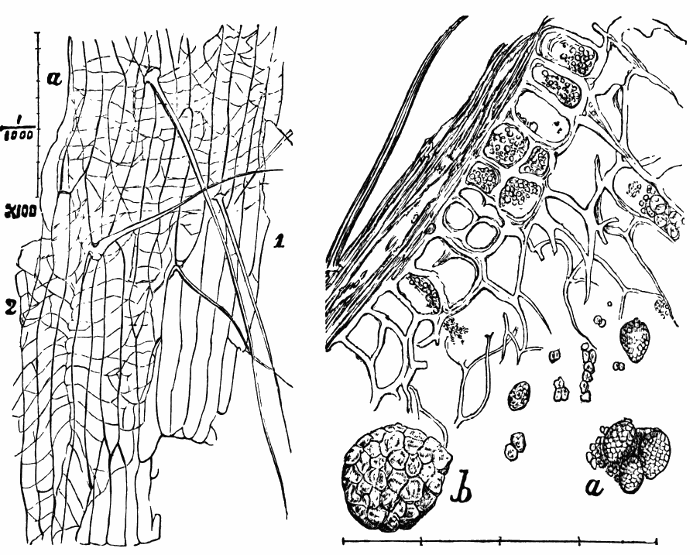
White oat—Long, sect., 2nd and 3rd coats not separable. a. Compound grains x 100; b. One do. x 500.
A large proportion of the oats given to horses passes off undigested. It has hence been proposed to prevent this loss, by either coarsely bruising them in a mill, or by pouring boiling water over them, and allowing them to macerate till cold, when they are to be given to the horses without straining off the water. It is stated on good authority that oats thus treated will not only fatten quicker, but go twice as far as without preparation. Oat bruisers are now manufactured by most agricultural implement makers.
Under the microscope the oat is seen to consist of two or three envelopes; the outer being composed of longitudinal cells; the second obliquely transverse and not very clearly seen; in this, the cells are wanting in part or pass into the cells of the third coat; the third envelope consists of a layer, usually single, of cells, like wheat. Before the envelopes are searched for the husks must be removed. The starch-cells are small, many sided, and cohere into round composite bodies, which are very characteristic, and which, by pressure, may be divided into separate grains. A high power is necessary for the examination of these latter. The starch of the oat does not polarise light.
OAT′MEAL. Syn. Avenæ farina, F. ex seminibus avenæ (Ph. D), L.
Oatmeal is the grain of the oat deprived of the skin, kiln-dried, and afterwards ground. It is regarded as one of the most nutritious of our cereals, being rich in nitrogenous matter, fat, starch, and sugar. According to Letheby it contains in 100 parts:—
Nitrogenous matter 12·6
Carbo-hydrates 63·8
Fatty matter 5·6
Saline matter 3·0
Water 15·0
———
100·0
Kreusler has shown that the nitrogenous principle of oatmeal contains gluten-casein, a substance very similar to the legumin of peas and beans. Letheby points out that, although it contains more nutrient material than wheat, its higher price renders it less economical as an article of diet. Oatmeal forms the staple of the food of the farm labourer both in Scotland and in England, being consumed more largely by the Scotch than the English peasant. Scotch oatmeal is superior to English in nutritive value. Oatmeal, when mixed with water, does not possess sufficient tenacity to enable it to be made into bread. It can, however, be baked into excellent cakes, which, when made in Yorkshire, are leavened, and when in Scotland, unleavened.
The qualities of indigestibility and a tendency to produce irritability of the bowels and skin, have been ascribed to oatmeal; before it was so prepared as to effectually remove from it the husk and hairs by efficient screening, it was in Scotland a frequent source of intestinal concretion. These concretions, the nature of which was unravelled by Dr Wollaston, consisted principally of phosphate of lime mixed with the hairs and husks of the oat.
Of thirty samples of oatmeal examined by the ‘Lancet Sanitary Commissioner,’ no fewer than sixteen samples, or more than one half, were adulterated. The substance generally used for this purpose is barley meal, which is
Grits or Groats are the decorticated grain of the oat, which when bruised or crushed constitute Embden groats. Flummery (known in Scotland as sowans) is made by steeping the husks of the grain in water, until they become slightly sour, the strained liquid being boiled down to the consistence of gruel. Oatmeal soon becomes sour and rancid. It should be purchased at such shops as have a quick sale for it. See Acari, Stir-about.
OBE′′SITY. Syn. Obesitas, Polysarca, L. Unhealthy or troublesome fatness or corpulency. Sometimes the secretion of fat, and its accumulation in the adipose membrane, is almost as rapid as that of water in anasarca; on which account some of the old writers have called obesity a dropsy of fat. Persons in easy circumstances, of indolent habits, who live freely, and who are of a cheerful and contented deposition, are those most liable to obesity. The treatment consists in the very gradual reduction of the diet, until it falls rather below the average quantity required by a healthy adult; the very gradual disuse of fermented liquors, more especially beer; the gradual abridgment of the time devoted to repose, until it does not exceed 5 or 6 hours; the employment of several hours daily in exercise in the open air, at first moderate, but increased day by day in energy, until it becomes laborious; and, lastly, arousing the mind from a state of lethargy to one of active or even harassing employment.
In some cases the accumulation of fat has been enormous. Bright, of Maldon, weighed 728 lbs.; Daniel Lambert, of Leicester, 739 lbs.; a girl, 4 years old, noticed in the ‘Phil. Trans.,’ 1813, weighed 256 lbs.
Persons affected with obesity are generally short-lived.
OBSTRUCTION OF LOCAL AUTHORITY. Various penalties are mentioned in different sections of the Public Health Act for the offence of obstructing officers, &c., representing the local authority, in carrying out the Act. The following section, which we select, deals with the subject generally:—
Sec. 306. “Any person who wilfully obstructs any member of the local authority, or any person duly employed in the execution of this Act, or who destroys, pulls down, injures, or defaces any board on which any bye-law, notice, or other matter is inscribed, shall, if the same was put up by authority of the Local Government Board or of the local authority, be liable for every such offence to a penalty not exceeding £5.
“Where the occupier of any premises prevents the owner thereof from obeying or carrying into effect any of the provisions of this Act, any justice, to whom application is made in this behalf, shall by order in writing require such occupier to permit the execution of any works required to be executed, provided that the same appear to such justice to be necessary for the purpose of obeying or carrying into effect the provisions of this Act; and if within 24 hours after the making of the order such occupier fails to comply therewith, he shall be liable to a penalty not exceeding £5 for every day during the continuance of such non-compliance.
“If the occupier of any premises, when requested by or on behalf of the local authority to state the name of the owner of the premises occupied by him, refuses or wilfully omits to disclose, or wilfully misstates the same, he shall (unless he shows cause to the satisfaction of the court for his refusal) be liable to a penalty not exceeding £5.”
O′CHRES. These are native earthy compounds of clay, coloured with oxide of iron, with frequently a little chalk, or magnesia. The differences in the colour arise partly from the quantity of iron present, and partly from the state of oxidation in which the iron is found. Several varieties are known in commerce—Brown ochre, French o., Oxford o., Red o., Roman o., Yellow o. All these, with the exception of the first and fourth, have a yellow colour. Armenian bole, Indian red, Venetian r., and Spanish brown, are also ochres.
All the ochres are darkened by calcination. The yellow ochres acquire a red or reddish-brown colour by this treatment. The pigment called ‘light red’ is thus prepared from yellow ochre.
ODONTAL′GIA. See Toothache.
O′DORAMENTS. Syn. Odoramenta, L. Substances employed in medicine on account of their odour. They differ from disinfectants, in only disguising, but not destroying, noxious vapours, &c. Ammonia, STRONG VINEGAR, and PASTILLES, furnish the most familiar examples of this class of substances. See Disinfectants, Perfumes, &c.
O′DOUR. The emanation of an odoriferous or scent-giving body. See Perfumes.
ŒNAN′THIC ETHER. See Ether (Œnanthic).
OFFIC′INAL. Syn. Officinalis, L. A term applied to substances or medicines ordered in the Pharmacopœia.
OIL. Syn. Oleum, L.; Huile, Fr. This name is given to numerous liquid or semi-liquid substances, expressed or drawn from animal or vegetable bodies; to various products of the distillation of bituminous minerals; and to several unctuous mixtures in perfumery and pharmacy. To facilitate reference, we haveOils (Drying); Oils (Empyreumatic): Oils (Fixed); Oils (Medicated); Oils (Mineral); Oils (Mixed); Oils (Perfumed); Oils (Volatile). See these articles also below:—
Oil, Consol′idated. Syn. Campticon, Factitious caoutchouc. A substance having most of the properties of india rubber, prepared by oxidising boiled linseed oil, or any other oil that hardens on exposure to the atmosphere. To obtain the solid oil, plates of glass are dipped into linseed oil, the films are then allowed to dry, and the process is repeated again and again until the plates are coated with many layers of perfectly oxidised oil. Instead of plates of glass, extensive surfaces of prepared cloth are employed when the manufacture is carried out on a large scale. The solid oil, having been scraped or peeled off the surfaces, is worked with a small proportion of shell-lac, by means of a mixing machine with hot rollers, until a material singularly like caoutchouc is produced. The consolidated oil can be rolled on to fabrics, so as to form a waterproof cloth, having the finish and flexibility of rubber-cloth. By the action of heat the consolidated oil may be converted into a hard substance resembling vulcanite and ebonite. Its useful applications appear to be very numerous, but its manufacture has not as yet made much progress.
OIL-GAS. A mixture of several gaseous hydrocarbons, obtained by passing common whale fat, resin, the heavy petroleum or shale oil, or the tarry residues left after the distillation of these two latter substances, or other cheap animal oil, through red-hot tubes, or by allowing it to fall in drops on red-hot stones or bricks arranged in an iron retort, or other suitable apparatus. The gas has great illuminating power, requires no purification, and is quite free from the ammoniacal and sulphur compounds which vitiate coal-gas. The sp. gr. of oil-gas varies with the heat employed in its production. It averages from 0·76 to 0·90, but it may rise as high as 1·1.
The composition of coal gas, as given by Payen, is as follows:—
Oil Gas. Gas from Petroleum residues.
Olefiant gas and homologues 22·5 17·4
Marsh gas 50·3 58·3
Hydrogen 7·7 24·3
Carbonic oxide 15·5 —
Nitrogen 4·0 —
OILS (Drying). All the fixed oils have an attraction more or less powerful for oxygen, and, by exposure to the air, they either become hard and resinous, or they only thicken slightly, and become sour and rancid. Those which exhibit the first property in a marked degree, as the oils of linseed, poppy, rape, and walnut, are called ‘drying oils,’ and are used as vehicles for colours in painting. The others are frequently termed ‘glutinous’ or ‘non-drying oils.’
The resinifying or drying property of oils is greatly increased by boiling them, either alone or along with some litharge, sugar of lead, or white vitriol, when the product forms the ‘boiled oil’ or ‘drying oil’ (oleum desiccativum) of commerce. The efficacy of the process, according to Liebig, depends on the elimination of substances which impede the oxidation of the oil. The following formulæ are adopted for this purpose:—
1. Linseed oil, 1 gall.; powdered litharge, 3⁄4 lb.; simmer, with frequent stirring, until a pellicle begins to form; remove the scum, and when it has become cold and has settled decant the clear portion. Dark coloured; used by house-painters.
2. Linseed oil and water, of each 1 quart; white vitriol, in powder, 2 oz.; boil to dryness. Paler than the last.
3. Pale linseed or nut oil, 1 pint; litharge or dry sulphate of lead, in fine powder, 2 oz.; mix, agitate frequently for 10 days, then set the bottle in the sun or a warm place to settle, and decant the clear portion. Very pale.
4. Linseed oil, 100 galls.; calcined white vitriol (‘sulphate of zinc’), in fine powder, 7 lbs.; mix in a clean copper boiler, heat the whole to 285° Fahr., and keep it at that temperature, with constant stirring, for at least one hour; then allow it to cool, in 24 hours decant the clear portion, and in 3 or 4 weeks more rack it for use. Used for varnishes.
5. (Liebig.) Sugar of lead, 1 lb., is dissolved in rain water, 1⁄2 gall.; litharge, in fine powder, 1 lb., is then added, and the mixture is gently simmered until only a whitish sediment remains; levigated litharge, 1 lb., is next diffused through linseed oil, 21⁄2 galls., and the mixture is gradually added to the lead solution, previously diluted with an equal bulk of water; the whole is now stirred together for some hours, with heat, and is, lastly, left to clear itself by exposure in a warm place. The lead solution which subsides from the oil may be used again for the same purpose, by dissolving in it another lb. of litharge, as before.
6. (Wilks.) Into linseed oil, 236 galls., pour oil of vitriol, 6 or 7 lbs., and stir the two together for 3 hours; then add a mixture of fuller’s earth, 6 lbs., and hot lime, 14 lbs., and again stir for 3 hours; next put the whole into a copper, with an equal quantity of water, and boil for about 3 hours, lastly, withdraw the fire, and when the whole is cold, draw off the water, run the oil into any suitable vessel, and let it stand for a few weeks before using it. Patent.
7. (‘Allg. Polytech. Zeitung.’) Binoxide of
Obs. There is often a difficulty in obtaining the oils ‘bright’ after boiling or heating them with the lead solutions; the best way, on the small scale, is either to filter them through coarse woollen filtering paper, or to expose the bottle for some time to the sun or in a warm place. On the large scale, the finer oils of this kind are often filtered through Canton-flannel bags. The litharge and sulphate of lead used in the above processes may be again rendered available for the same purpose, by washing them in hot water, to remove adhering mucilage.
OILS (Empyreumat′ic.) Syn. Olea empyreumatica, L. The ’empyreumatic oils’ of the old pharmaceutical writers were oily fluids obtained by the dry distillation of various substances, animal, vegetable, and mineral. But few of them are in use at the present day, though formulæ are given for them in some of the foreign pharmacopœias. Two or three have useful applications in the arts, and it is therefore necessary that we should briefly describe their preparation. When the ingredients are of a liquid or pasty nature, or become so when heated, they are usually mixed with about twice their weight of sand, powdered glass, or other like substance, to divide them, and thus expose them more effectually to the action of the fire. Care must also be taken to provide a well-cooled receiver, which must be furnished with a tube to carry off the non-condensable gases liberated at the same time as the oil. The products of the first distillation are generally purified by rectification, either alone or along with water. In general, they require to be preserved from the light and air.
The following are the principal substances belonging to this class:—
Oil of Al′oes. Syn. Aloetic oil; Oleum aloeticum, L. 1. From Socotrine or hepatic aloes distilled along with sand.
2. (Batavian—Cadet de Gassincourt.) Olive oil, 1 lb.; hepatic aloes and myrrh, of each in powder, 2 oz.; olibanum, 1⁄2 oz.; distil in a sand bath, from a stoneware retort. Used as an external vermifuge for children; a portion is rubbed 2 or 3 times a day over the umbilical regions.
Oil of Am′ber. Syn. Oleum succini, L. From coarse pieces of amber, distilled in an iron retort, either alone or reduced to powder and mixed with sand. The oil is separated from the fetid liquor and succinic acid which passes over, and rectified along with about 6 times its volume of water, by a gentle heat. It then forms ‘RECTIFIED OIL OF AMBER’ (OLEUM SUCCINI—Ph. L. 1836, O. S. RECTIFICATUM—Ph. D. 1826, O. S. PURISSIMUM—Ph. E. 1841). Prod. 20%.
Prop., &c. It has a pale yellow colour, a strong, ungrateful odour, and a hot, acrid taste; heat and air blacken and thicken it; it boils at 186° Fahr. Sp. gr. ·758 at 75° Fahr. It is antispasmodic, rubefacient, and stimulant.—Dose, 5 to 12 drops, made into an emulsion with mucilage; in hysteria, epilepsy, and convulsive affections. Externally, as a friction, either alone or combined with laudanum or sweet oil, in rheumatism, tic douloureux, hooping-cough, &c.
Oil of Amber, Oxydated (Artificial Musk). Pat into a cup 1 dr. of oil of amber, and add to it, drop by drop, 31⁄2 fl. dr. of strong nitric acid; let it stand for 36 hours, then separate and wash the resinous matter. Antispasmodic and nervine.—Dose, 5 to 10 gr. For children, 1⁄2 gr. to 1 gr.
Oil, An′imal. 1. (Empyreumatic or Fetid; Oil of hartshorn, Dippel’s o.; Oleum animale empyreumaticum, O. cornu cervi, O. Dippelii, L.) Chiefly obtained as a secondary product in the manufacture of bone-black. Fetid and dark coloured. Used chiefly to make lampblack.
2. (Ethereal; Rectified oil of hartshorn; Oleum animale æstherium, O. cornu cervi rectificatum, Loco olei animalis Dippelii, L.)—a. A finer kind of animal oil, made by slowly distilling oil of hartshorn, and collecting only the first portion that comes over. Pale and limpid. Exposure to light discolours it.
b. (Ph. Bor.) Fetid animal oil distilled in a sand bath, and the product rectified with four times its volume of water. White, limpid, fragrant. Light discolours it.
Prop. The refined product is said to be antispasmodic, anodyne, and diaphoretic.—Dose, 5 to 30 drops, in water; in large doses it acts as an irritant poison.
Oil of Birch. Syn. Oleum betulæ, L. From the inner bark of the birch, by heating it in an earthen pot with a hole in the bottom, to allow the oil to flow through into another jar sunk in the ground and luted to it. Thick, balsamic, fragrant. Used chiefly to dress russia leather.
Oil of Box-wood. Syn. Oleum buxi, O. b. empyreumaticum (Ph. L. 1746), L. From box-wood sawdust. Reputed resolvent; anodyne, antispasmodic, and diaphoretic.—Dose, 5 to 20 drops; in convulsions, epilepsy, gonorrhœa, &c. Externally, in toothache, &c.
Oil of Bricks. Syn. Oleum lateritium (Ph. L. 1746), L. From olive oil, mixed with brickdust, and distilled; or, from hot bricks steeped in olive oil, then broken to pieces, and distilled.
Oil of Bricks (Factitious). Syn. Oleum lateritium factitium, L. From linseed oil, 1 lb.; oil of turpentine, 1⁄2 lb.; oil of bones or of hartshorn and Barbadoes tar, of each 1 oz.;
Oil of Cade. Syn. Oleum cadinum, L.; Huile de cade, Fr. From the Juniperus oxycedrus or Languedoc juniper. Used as oil of tar, which is commonly sold for it.
Oil of Coal. Syn. Coal oil. From the gas-works. See Naphtha.
Oil of Gua′iacum. Syn. Oleum guaiaci, O. g. empyreumaticum, L. From guaiacum shavings or raspings. Reputed balsamic, pectoral, and resolvent.
Oil of Harts′horn. Bone oil and rectified bone oil are commonly sold for it, but are inferior to it. See Oil, Animal (above).
Oil, Paper. Syn. Rag oil, Pyrothonidæ; Oleum chartæ, L. On the small scale, by burning paper on a cold tin plate, and collecting the oil; on the large scale, by the destructive distillation of paper or linen rags. In baldness, toothache, ear-ache, &c.
Oil, Par′affin. See Oils, Mineral.
Oil, Petro′′leum. See Oils, Mineral, Petroleum.
Oil, Rag. See Oil, Paper, above.
Oil, Rock. See Naphtha, Oils, Mineral, Petroleum.
Oil, Shale. See Oils, Mineral.
Oil of Soot. Syn. Oleum fuliginis (Ph. L. 1746), L. From wood-soot. Fetid; reputed antispasmodic and nervine.
Oil of Tar. Syn. Spirit of t.; Oleum pini, O. p. rubrum, O. tædæ, O. picis liquidæ, L. By simple distillation from wood-tar. Reddish and strong scented. By one or more rectifications it becomes colourless and limpid. It soon gets thick. Used in ringworm and several other skin diseases, made into an ointment with lard. It is poisonous if swallowed in large doses.
Oil of Tobac′co (Empyreumatic). Syn. Oleum tabaci empyreumaticum (Ph. U. S.), L. From tobacco, in coarse powder, gradually heated in a green-glass retort to dull redness, and kept at that temperature as long as any oil passes over; the oily portion is then separated from the water in the receiver, and kept for use. Highly narcotic and poisonous.
Oil of Wax. Syn. Oleum ceræ, L. From beeswax and sand distilled together; the product is rectified once or oftener. Reputed diuretic.—Dose, 3 to 6 drops.
OILS (Fixed). Syn. Fat oils, Unctuous o.; Olea fixa, O. expressa, L.; Huiles grasses, Fr. The fixed oils are compounds of carbon, hydrogen, and oxygen (oxyhydro-carbons), obtained from the organic kingdom, and characterised by their insipidity, unctuosity, insolubility in water, and being lighter than that fluid. Olive oil, which is obtained from the vegetable kingdom, and spermaceti oil, which is obtained from the animal kingdom, may be taken as types of the rest.
The fixed oils are chiefly found in the fruit and seeds of plants, and in thin membranous cells, forming what is called the adipose tissue, in the bodies of animals. According to their consistence, they may be classed into ‘OILS,’ ‘BUTTERS,’ and ‘TALLOWS,’
Prop., &c. Among the best-known properties of the fixed oils are—the permanent stain they give to paper, which they render translucid; their non-volatility at the ordinary temperature of the atmosphere, or at that of boiling water, or, indeed, at any temperature insufficient for their decomposition; their constantly floating on the surface of water when added to it; and, lastly, their inability to mix with that fluid. Some of them, as palm oil and cocoa-nut oil, are solid at ordinary temperatures; but the majority are fluid, unless they have been considerably cooled, when they separate into two portions—the one solid, consisting chiefly of stearin, or some analogous substance, and the other liquid, consisting chiefly of olein or elain. Nearly all of them, when exposed to the air, absorb oxygen rapidly, and either gradually harden or become rancid and nauseous. From the first are selected the ‘drying oil’ used by painters; the last are used as food, in cookery, and for machinery, lamps, &c. The whole of these oils, when heated to their boiling points (500° to 600° Fahr.), suffer decomposition, yielding various hydrocarbons; and when suddenly exposed to a red heat, they furnish a gaseous product (oil-gas), which was formerly employed for illumination. It is owing to this property of oil and liquid fats that candles and lamps give their light. The wick is a gas-producing apparatus in miniature. With the caustic alkalies and water the fixed oils unite to form soap. When some of these oils are absorbed by porous bodies, and thus expose a vastly increased surface to the air, they absorb oxygen with such rapidity as to generate a considerable degree of heat. Paper, tow, cotton, wool, straw, shavings, &c., slightly embued with oil, and left in a heap, freely exposed to the air or sun, often spontaneously inflame. In this way many extensive fires have arisen. The above is more particularly the case with linseed, rape, nut, and olive oil. The first, made into a paste with manganese, rapidly becomes hot, and ultimately inflames spontaneously.
The specific gravities of the fixed oils range between ·865 and ·970, water being 1·000.
Prep. The fixed oils, except where otherwise directed, are obtained from the bruised or ground fruit or seed, by means of powerful pressure, in screw or hydraulic presses, and are then either allowed to clarify themselves by subsidence or are filtered. Both methods are frequently applied to the same oil. In some cases the impurities are removed by ebullition with water, and subsequent separation of the pure oil. Heat is frequently employed to increase the liquidity of the oil, and thus lessen the difficulty of its expulsion from the mass. With this object the bruised mass, placed in bags, is commonly exposed to
Another method is by boiling the bruised seed in water, and skimming off the oil as it rises to the surface. This is the plan adopted for castor oil in the West Indies.
In a few cases, for medicinal purposes, the bruised mass is mixed with 1⁄2 its weight, or an equal weight, of alcohol or ether, and after 24 hours’ digestion the whole is submitted to pressure, and the alcohol or ether removed by distillation at a gentle heat. The first menstruum is commonly employed for croton oil on the Continent; the second, for that of ergot of rye.
Purif. Several methods are adopted for refining or purifying the fixed oils, among which are the following:—
1. The oil is violently agitated along with 11⁄2 to 2% of concentrated sulphuric acid, when it assumes a greenish colour, and, after about a fortnight’s repose, deposits much colouring matter, becomes paler, and burns with greater brilliancy, particularly if well washed with steam or hot water, and clarified by subsequent repose or by filtration. This answers well for most of the recently expressed vegetable oils. It also greatly improves most of the fish oils.
2. A modification of the last method is to well mix the acid with the oil, then to blow steam through the mixture for some time, and afterwards to otherwise proceed as before.
3. Fish oil (WHALE, SEAL, &c.) is purified by—
a. Violently agitating it with boiling water or steam, by placing it in a deep vessel with perforated bottom, through which high pressure steam is forced for some time; it is afterwards clarified by repose, and filtered through coarse charcoal.
b. The oil is violently agitated with a boiling hot and strong solution of oak bark, to remove albumen and gelatin, and next with high-pressure steam and hot water; it is, lastly, dried and filtered.
c. The oil, gently heated, is stirred for some time with about 1% of good chloride of lime, previously made into a milk by trituration with water; about 11⁄2% of oil of vitriol, diluted with 20 times its weight of water, is then added, and the agitation renewed and maintained for at least 2 hours; it is, lastly, well washed with steam or hot water.
d. Mr Davidson treats the oil first with a strong solution of tan, next with water and chloride of lime, then with dilute sulphuric acid, and lastly, with hot water.
e. Mr Dunn’s method, which is very effective, and admirable on account of its simplicity, is to heat the oil by steam to from 180° to 200° Fahr., and then to force a current of air of corresponding temperature through it, under a flue or chimney, until it is sufficiently bleached and deodorised; it is, lastly, either at once filtered or is previously washed with steam or hot water.
f. Another method, formerly very generally adopted and still in use, is to violently agitate the oil for some time with very strong brine, or with a mixed solution of blue vitriol and common salt, and then either to allow it to clarify by repose or to filter it through freshly burnt charcoal.