A CYCLOPÆDIA OF PRACTICAL RECEIPTS, &c. VOLUME II (continued 10)
Reading edition
The dish is then placed over a water-bath (the water in which must be kept vigorously boiling the whole time) for three hours, at the end of which time all the water having been driven off, there will remain in the dish a completely dried up residue.
The increase in weight between the empty dish and the residue, will give the weight of the ‘milk solids’ from 5 c.c. of milk. Of course, if this weight be multiplied by 20, the yield from 100 c.c. of milk will be obtained.
To reduce this to a percentage statement it is necessary to remember that 100 c.c. of average milk weigh 102·9 grammes. The next proceeding consists in the determination of the fat. This is done by treating the dried milk solids resulting from the 5 c.c. of milk with ether. There are several important minutiæ necessary to be observed in connection with this part of the process, for the particulars of which the reader is referred to Professor Wanklyn’s book. Suffice it to say, that if properly performed, the whole of the fat is dissolved by the ether, and being separated from the non-fatty portion of the residue is weighed and calculated as ‘fat.’
If, then, the amount found as fat be deducted from the whole of the milk solids previous to their treatment with ether, the ‘milk solids, not fat,’ will be arrived at. Professor Wanklyn estimates the casein[38] as follows:—He treats the milk solids, not fat, with hot alcohol, by which means he dissolves out from them, and removes the milk-sugar and the soluble chlorides. The remaining residue, consisting of casein and phosphate of sodium (chemically combined with the casein), is dried on a water-bath until it ceases to lose weight. It is then weighed along with the vessel containing it, and ignited. The combined weight of the vessel and phosphate of sodium remaining after ignition being deducted from the weight previous to ignition, the difference is the casein.
Another and quicker method, recommended by Professor Wanklyn, for the determination of the casein, is to measure it by the amount of albuminoid ammonia it is capable of yielding when subjected to the ‘albuminoid ammonia process,’ invented by Messrs Wanklyn, Chapman, and Smith.
The alcoholic solution filtered off from the combined casein and phosphate of sodium, contains the milk sugar and soluble chlorides.
For the determination of the ash it is only necessary to ignite the milk solids from 5 c.c. of milk, in the small platinum dish, by which operation all the organic matter being driven off, that which remains behind constitutes the ‘ash’ and is weighed as such.
It will be obvious that in order to determine with anything like rigid accuracy the quality of any sample of milk by analysis, not only must a normal standard for the purpose of comparison be adopted, but such normal standard must represent very closely and with but little variation the definite composition of all sound and genuine milk.
Professor Wanklyn says that “the following, which is the result of several concordant analyses of country-fed milk, may be taken as representing normal milk. In 100 grammes of milk—
Solids (dry at 100° C) 12·5 grammes.
Water 87·5
———
100·0
“The 12·5 grammes consist of 9·3 grammes of ‘solids which are not fat,’ and 3·2 grammes of fat.” The above data, which are founded on the examination of a very large number of different samples of milk, are confirmed by the researches of Müller and Eisenstuck, who were employed by the Royal Agricultural Society of Sweden in a similar investigation. The labours of these chemists extended over a twelvemonth, and the result of them was to show that the milk yielded day by day, for a whole year, by a herd of cows was remarkably constant in composition.
Professor Wanklyn gives the following formulæ for the calculation and statement of the results of milk analysis. He says, treating the question quite rigidly, which I believe is the proper way of dealing with it, we arrive at the following:—
Problem 1. Given the percentage of ‘solids, not fat’ (= a), in a specimen of sophisticated milk (i. e. milk, either watered, or skimmed, or both)—required the number of grammes of genuine milk which was employed to form 100 grammes of it.
Answer. Multiply the percentage of ‘solids, not fat’ by 100, and divide by 9·3.
Or— (100 / 9·3)a.
Problem II.—Given the percentage of ‘solids, not fat’ (= a), also the percentage of fat (= b), in a specimen of sophisticated milk—required the number of grammes of fat which have been removed by skimming from the genuine milk which was employed to form 100 grammes of it.
Answer.— (3·2 / 9·3)(a - b).
In translating fat into cream, the rule is that a removal of 0·2 gramme of fat equals a removal of 1·0 gramme of cream. This rule is directly founded on experiment. I do not, however, claim a high degree of accuracy for the measurement of the cream.
Finally, a slight refinement may be noticed. If a specimen of sophisticated milk has been produced by both skimming and watering, it will be obvious, on consideration, that the extraneous waters employed in manufacturing 100 grammes of it is equal to the difference between 100 and the quantity of genuine milk employed to make 100 grammes of sophisticated milk, together with a quantity of water equal to that of fat removed by skimming.
Extraneous water = 100(100 / 9·3)a + (3·2 / 9·3)(a - b)
= 100[(100 + 3·2) / 9·3](a - b)
Save for the purpose of finding out the presence of matters other than an excess of water in the milk (a contingency regarded as very improbable), the estimation of the casein and milk sugar is unnecessary. The determination of the ash is for the object of learning if foreign mineral matters, such as chalk or any other inorganic impurity, are present. Professor Wanklyn says he believes that such like extraneous bodies are never employed. The chief, if not the sole, form of dishonesty are watering and skimming.
The amount of ash, however, is a good criterion as to the extent of dilution that has been practised, a deficient amount being, of course, confirmatory of a watered milk.
The determination of the amount of ‘solids, not fat,’ is, in almost every instance, all that is necessary to enable an opinion to be arrived at as to whether the sample of milk has had water added to it or not.
Out of fifty-six samples of milk supplied to the different London unions in 1873, Professor Wanklyn reports that he found only fifteen unwatered, or nearly unwatered. Of these fifteen samples nine had been skimmed, leaving only six that were at once unwatered and unskimmed. These figures, therefore, show that only about 10 per cent. of the milk supplied in the above year to the Metropolitan unions was genuine. He adds—“It is curious to compare the language of the contract under which (as it appears from Mr Rowsell’s report) the dealer supplied the various unions with milk, with the quality of the article as exhibited by the analysis. ‘New unskimmed milk unadulterated,’ ‘genuine as from the cow,’ ‘best
Prop. These are well known. Perfectly fresh milk is slightly alkaline, but soon becomes acid on exposure to the air, and after a time white coagula of casein (CURDS) separate from it. This change is immediately effected by the addition of rennet or an acid. That from the first, when dried and pressed, constitutes cheese.
Pur., Tests, &c. The common frauds practised by the milk-dealers are the addition of water and the subtraction of part of the cream. Sometimes potato starch is added to the milk, to give it a creamy or rich appearance, and this addition is still more frequently made to cream, to increase its consistence and quality.
The presence of potato starch may be determined by boiling some of the milk with a little vinegar, and after separating the coagulum by a strainer, and allowing the liquid to become cold, testing it with solution or tincture of iodine. If it turns blue, starch, flour, or some other amylaceous substance, has been used to adulterate it. In most cases it will be sufficient to apply the test to the unprepared suspected milk.
It has frequently been stated that chalk, plaster of Paris, gum, gelatin, sugar, flour, mucilage of hemp-seed, the brains of animals, and other similar substances, are often added to London milk, but there is no reason to suppose there is any truth in these assertions, as some of these articles are too costly to be used, and the presence of others would so alter the flavour or appearance of the milk, or would so soon exhibit themselves by subsidence, as to lead to their detection.
Pres. Milk may be preserved in stout bottles, well corked, and wired down, by heating them, in this state, to the boiling-point, in a water bath, by which means the oxygen of the small quantity of enclosed air becomes absorbed. It must be afterwards stored in a cool situation. By this method, which is also extensively adopted for the preservation of green gooseberries, green peas, &c., milk will retain its properties unaltered for years. A few grains of carbonate of magnesia, or, still better, of bicarbonate of potassa or soda, may be advantageously dissolved in each bottle before corking it.
Under Bethel’s patent the milk or cream is scalded, and, when cold, strongly charged with carbonic-acid gas, by means of a soda-water machine, and the corks are wired down in the usual manner. The bottles should be kept inverted, in a cool place.
An excellent method of preventing milk from turning sour, or coagulating, is to add to every pint of it about 10 or 12 gr. of carbonate or bicarbonate of soda. Milk thus prepared may be kept for eight or ten days in temperate weather. This addition is harmless, and, indeed, is advantageous to dyspeptic patients. According to D’Arcot, 1⁄2000th part of the bicarbonate is sufficient for the purpose. An excess of alkali used in this manner may be detected by the milk turning turmeric paper brown, even after it has been kept some hours, and by the ash obtained by evaporating a little to dryness, and then heating it to dull redness, effervescing with an acid. (See below.)
⁂ Milk should not be kept in lead or zinc vessels, as it speedily dissolves a portion of these metals, and becomes poisonous.
Concluding Remarks. The principal difference between cows’ milk and human milk consists in the former containing more casein and less sugar of milk than the latter. The remarkable indisposition to coagulate is another character which distinguishes human milk from cows’ milk. Prof. Falkland, who has practically investigated the subject has prepared a nutritive fluid for infants from cows’ milk, closely resembling that of the healthy adult woman. His process is, however, unnecessarily complicated, and, therefore, unsuited to those who would have to employ it in the nursery. To remove this objection we have adopted the following formula:—Sugar of milk, 2 oz.; hot water, 1⁄4 pint; dissolve, and, when the liquor has become quite cold, add it to fresh cows’ milk, 3⁄4 pint, and stir them together. This quantity, prepared morning and evening, will constitute the proper food for an infant of from 5 to 8 months old. More may be allowed it if it ‘craves’ it; but there must be no ‘cramming.’ At first it will be advisable to remove a little of the cream from the milk before adding to it the saccharine solution; but after a few days this will be found to be unnecessary, and, indeed, injurious. One very important particular to be attended to is, the employment of pure cows’ milk, obtained from a healthy grass-fed animal only. With this precaution, and the use of a good FEEDING-BOTTLE, the infant will thrive nearly as well as on the breast of any human female, excepting its mother’s. (See below.)
Asses’ milk closely resembles human milk in colour, smell, and consistence, but it contains rather less cream. (See below.)
Ewes’ milk closely resembles cows’ milk, than which, however, it is slightly richer in cream.
Goats’ milk, for the most part, resembles cows’ milk, but its consistence is much greater, and it contains much more solid matter. (See below.)
Mares’ milk, in consistence; is between that of cows’ and human milk. Its cream is not converted into butter by agitation. See Butter, Cheese, Lactic Acid, &c.
Milk as a cause or carrier of disease.—Milk of a mother labouring under strong mental emotion is, as is well known, capable of seriously endangering the health of the suckling babe. Payne narrates the case of a woman suffering under a nervous affectionColchicum autumnale. It also appears that in the Western States of America the milk of cows that have fed on the poison-oak, the Rhus toxicodendron, has on several occasions given rise to attacks of illness in children, marked by extreme weakness, vomiting, fall in bodily temperature, swollen and dry tongue, and constipation. Boiling seems to remove the dangerous properties of the milk.
Milk, as has been shown by Fuchs, is sometimes infested by a fungus, the Oidium lactis or Penicillium, which is capable of giving rise to gastric irritation, and sometimes to severe febrile gastritis.[39]
Although the evidence as to the power of the milk of animals affected with epizootic diseases to convey the particular affection to human beings is contradictory, there is little reason to doubt that soured milk may become a carrier of infection from the ailing or convalescent subject to the healthy one.
Typhoid and scarlet fever have been known to have originated in this manner.
The outbreak of the former malady in Marylebone in 1874 was traced to the contamination of milk by the remains of the water which had been used in rinsing the milk pans. This water had been obtained from a well into which the excrete from a typhus patient had percolated from a privy.
At Leeds a similar outbreak was caused by the absorption by the milk of the typhoid effluvium. In the case of scarlet fever the malady has been conveyed by means of the throat-discharges and cuticle falling into the milk from the persons of servants and others employed in dairies.
Milk, Al′mond. See Emulsion and Mixture.
Milk, Arrowroot. Prep. From arrowroot, 1 table-spoonful, first wetted and stirred with a little cold water, afterwards adding, gradually, of boiling water, 1⁄4 pint; and, lastly, of boiling milk, 1⁄2 pint; with sugar, spice, wine, &c., to palate. Very nutritious, and excellent in chronic diarrhœa. Some persons employ all milk.
Milk, Choc′olate. Prep. Dissolve chocolate (scraped), 1 oz., in boiling new milk, 1 pint. Nutritious; but apt to offend delicate stomachs.
Milk, Cof′fee. Prep. 1. Coffee, 1 oz.; boiling water, 1⁄4 pint; infuse for 10 or 15 minutes in a warm situation, and add the strained liquid to boiling milk, 3⁄4 pint.
2. Coffee, 1 oz.; tie it loosely in a piece of muslin, and simmer it for 15 minutes in milk, 1 pint. Both the above have been recommended for persons of spare habits, and for those disposed to affections of the lungs, more especially for the asthmatic.
Milk, Facti′′tious. Syn. Artificial milk. Of the numerous compounds which have been proposed as substitutes for natural milks, the following are examples:—
1. (Factitious asses’ milk; Lac asininum factitium, Lac a. artificiale, L.)—a. Cows’ milk, 1 quart; ground rice, 1 oz.; oringo root (bruised), 1 dr,; boil, strain, and add sugar candy (or white sugar), 1 oz.
b. Whites of 2 eggs; lump sugar, 1 oz.; cows’ milk (new), 3⁄4 pint; mix, then add syrup of tolu, 3⁄4 oz.
c. Water, 1 pint; hartshorn shavings, 1 oz.; boil to a jelly; then add lump sugar, 2 oz.; cool, add new milk, 1 pint; syrup of tolu, 1⁄2 oz. Used as substitutes for asses’ milk, taken freely as a beverage. A cupful, with or without a spoonful of rum, 3 or 4 times daily, is a popular remedy in consumption and debility.
2. (F. goats’ milk—A. T. Thomson.) Fresh mutton suet (minced), 1 oz.; tie it in a muslin bag, and boil it in cows’ milk, 1 quart; lastly, add of sugar candy, 2 gr. In scrofulous emaciation, and in the latter stages of phthisis. The proportion of suet in the above may be advantageously increased a little. The LAC CUM SERO of Guy’s Hospital is a similar preparation.
3. (F. human milk; Lac humanum factitium, L.)—a. See above.
b. (Rosenstein.) Almonds (blanched), 2 in number; white sugar, 1 dr.; water, 4 fl. oz.; make an emulsion, strain, and add of fresh cows’ milk, 6 fl. oz. As a substitute for the breast in nursing.
Milk, Preserved′. Syn. Milk powder; Lactis pulvis, Lac pulveratum, L. Prep. 1. Fresh skimmed milk, 1 gall.; carbonate of soda (in very fine powder), 11⁄2 dr.; mix, evaporate to 1⁄3rd by the heat of steam or a water bath, with constant agitation, then add of powdered white sugar, 31⁄2 lbs., and complete the evaporation at a reduced temperature; reduce the dry mass to powder, add the cream (well drained) which was taken from the milk, and after thorough admixture put the whole into well-stoppered bottles or tins, which must be at once hermetically sealed.
2. (Legrip.) Carbonate of soda, 1⁄2 dr.; water, 1 fl. oz.; dissolve, add of fresh milk,
Obs. About an ounce of the powder agitated with a pint of water, forms an agreeable and nutritious drink, and a good substitute for milk at sea. It may also be used for tea or coffee in a solid form. This process, which is very old, has been recently patented. See Milk (above).
The condensed or preserved milk, now in such general use, and which is met with in tins as milk which has been more or less deprived of water by evaporation in vacuo. It occurs in the market in two forms—in one simply as condensed milk, and in the other as condensed milk mixed with a large quantity of sugar. Milk preserved as above without sugar will keep only for two or three days; whereas with sugar it may be preserved for an almost indefinite time. Either variety mixed with the proper quantity of water becomes normal milk again, the sweetened kind being, of course, milk with the addition of a considerable amount of cane sugar. Professor Wanklyn says he has examined the principal brands of preserved and condensed milk sent to the London market, and finds they contain their due proportion of fat. He gives the following analyses of the produce of the English Condensed Milk Company:
Preserved Milk.
In 100 parts by weight.
Water 20·5
Fat 10·4
Casein 11·0
Ash 2·0
Cane and milk sugar 56·1
———
100·0
Condensed Milk.
Water 51·12
Fat 12·11
Casein 13·64
Milk sugar 20·36
Ash 2·77
———
100·00
Roses, Milk of. Syn. Lac rosæ, L. Prep. 1. (English.)—a. Almonds (blanched), 1 oz.; oil of almonds and white soft soap, of each 1 dr.; rose water, 1 pint; make an emulsion.
b. From liquor of potassa and oil of almonds, of each 1 fl. oz.; hot water, 2 fl. oz,; agitate together until mixed, then add of rose water and distilled or filtered soft water, of each 1⁄4 pint, and again agitate well.
c. As the last, but using half a tea-spoonful of salt of tartar for the liquor of potassa.
d. (Redwood.) Blanched almonds, 8 oz.; rose water, 3 pints; make an emulsion, add of white Windsor soap, white wax, and oil of almonds, of each 1⁄2 oz.; previously melted together by a gentle heat; triturate until united, and strain; lastly, add a solution of oil of bergamot, 1⁄2 oz.; oil of lavender, 1 dr.; and attar of roses, 1⁄2 dr.; (dissolved in) rectified spirit, 12 oz.
2. (French.)—a. From rose water, 1 quart; tinctures of benzoin and styrax, of each 1 fl. oz.; spirit of roses, 1⁄2 fl. oz.; rectified spirit, 1⁄2 fl. oz.; mix.
b. (Augustin.) Tincture of benzoin, 1⁄2 fl. oz.; liquor of carbonate of potassa, 21⁄2 fl. dr.; rose water, 1⁄2 pint; agitate well together. As a lotion in acne.
c. (Gianinni.) Tincture of benzoin, 1 dr.; tincture of balsam of Peru, 20 drops; rose water, 1 pint; as the last.
d. (Schubarth.) Almond paste, 3 dr.; rose water, 1⁄2 pint; tincture of benzoin, 1⁄2 fl. oz. As before. The addition to the last 3 of a little rectified spirit is an improvement.
3. (German.) From dilute solution of diacetate of lead (Goulard water), and spirit of lavender, of each 1 fl. oz.; rose water, 6 fl. oz.; soft water, 1 pint.
Obs. All the above are used as cosmetic washes, and to remove scurf, pimples, and eruptions, in slight cases.
Milk, Sa′go. Syn. Lac sago, L. Prep. (Dr A. T. Thomson.) Sago, 1 oz.; cold water, 1 pint; macerate half an hour, pour off the water, add of milk, 11⁄2 pint, and boil slowly until the sago is dissolved. Very nutritious; also in lieu of arrow-root milk.
Milk of Sulphur. See Sulphur (Precipitated).
Milk, Thick. Mix one table-spoonful of flour with a pint of milk, and boil for ten minutes, stirring it well the whole time. It may be flavoured either with a little salt, or sugar.
Milk, Vanil′la. Syn. Lac vanillæ, L. Prep. 1. Essence of vanilla, 12 drops; lump sugar, 1 oz.; triturate, and add gradually, new milk, 1 pint.
2. (Bèral.) Vanilla sugar, 1⁄2 oz.; milk, 16 oz.; dissolve.
MILK FEVER. Syn. Febris lactea, L. A febrile condition of the system that sometimes occurs at the time the milk begins to be secreted after parturition. It often assumes a malignant character. See Puerperal Fever.
MIL′LET. Syn. Milium, L. Several varieties of grain are known by this name. That commonly referred to under the name is the produce of Panicum miliaceum (‘Indian millet’). The husked seeds (MILIUM MUNDATUM) are used to make gruel, and are ground for flour. ‘Turkish millet,’ or ‘Guinea corn,’ is produced by Sorgham vulgare; and the ‘German’ and ‘Italian millet’ by species of Setaria. In some parts of the world millet flour is used for bread, but it is chiefly cultivated as food for domestic animals.
Letheby says millets are a little more nutritious than rice.
In the subjoined table, is given the composition of three different samples of millet meal, free from bran.
Panicum miliaceum, common millet. Penicillaria spicata, a kind of millet, much used in India under the name of Bajia. Sorghum vulgare, Dharra of the Arabs, Goar of India.
Water 12·22 11·8 11·95
Nitrogenous substances 9·27 10·13 8·64
Dextrin 9·13 ... 3·82
Sugar 1·80 ... 1·46
Fat 7·43 4·62 3·90
Starch 59·04 71·75 70·23[40]
Silicin 0·11 ... ...
MINCE MEAT. Prep. From stoned raisins, currants, sugar, and suet, of each 2 lbs.; sultana raisins and boiled beef (lean and tender), of each 1 lb.; apples 4 lbs.; juice of 2 lemons; the rind of 1 lemon, chopped very fine; mixed spice, 1⁄4 lb.; candied citron and lemon peel, of each 2 oz.; brandy, a glassful or two; the whole chopped very fine. It may be varied by adding other spice or flavouring, and by the addition of eggs, or the substitution of chopped fowl or veal for beef, according to the state of the cuisinier.
MINCE PIES. Take 3 apples, 3 lemons, 1 lb. of raisins, 3⁄4 lb. of currants, 1 lb. of suet, 1⁄4 lb. of raw beef, 2 lbs. of moist sugar, 1⁄4 lb. of mixed candied peel, 1⁄4 of a rind of a fresh orange, 1 teaspoonful of powdered mixed spice, composed of equal parts of cloves, cinnamon, and nutmeg, 1⁄2 pint of brandy, and 1 glass of port wine. Peel the apples and cut out the cores very carefully, and then bake the pieces until they are quite soft. The raisins must be carefully stoned, and the currants well washed, dried, and picked. Chop the suet very finely, as well as the raw meat and lemon-peel. Mix all the ingredients thoroughly together, add the brandy last of all, and press the whole down into a stone jar, and place a piece of paper soaked in brandy on the top. Remove the paper and stir up the mixture thoroughly every three days, replacing the paper. If this is done the mincemeat will keep a long time. To make the pies, roll out some thin puff-paste, butter a small round tin, and line it with a piece of paste, then put in a generous quantity of the mincemeat, cover it over with a similar piece of puff paste, and bake it in a moderate oven. Mince pies are none the worse for being warmed up, but pray take care they are sent to table hot. (Cassell.)
MINDERE′′RUS’ SPIRIT. See Ammonia (Acetate of), and Solution.
MINERAL CHAME′LEON. Prep. From a mixture of binoxide of manganese and potassa and nitre, equal parts, heated to redness. It must be preserved in a well-corked bottle until required for use.
Prop., &c. When dissolved in water, its solution, at first green, passes spontaneously through all the coloured rays to the red, when, if potassa be added, the colour retrogrades until it reaches the original green. The addition of oil of vitriol, or of chlorine, renders the solution colourless. The addition of a weak acid, or even boiling or agitating the liquid, turns it from green to red. See Manganic Acid.
MIN′ÉRALISERS. Substances which, by association with metallic bodies, deprive them of their usual properties, and impart to them the character of ores. Their removal belongs to metallurgy. The term ‘MINERALISED’ has been applied to caoutchouc, gutta percha, bitumen, &c., which has been combined with sulphur, silica, or metallic matter.
MIN′IM. Syn. Minimum, L. A measured drop, of which 60 are equal to a fluid drachm. The size of drops vary so greatly with different liquids and are also so much influenced by the size and shape of the vessels from which they are poured, that they afford no reliable measure of quantity for medicinal purposes. The poured drop has, in some cases, only 1⁄3rd the volume of the measured drop, or minim; whilst, in others, it is nearly 3 times as large. According to Mr Durande, “liquids which contain a small proportion of water, afford a small drop; while, on the contrary, liquids containing a large quantity of water furnish a large drop.” “Among liquids containing a large proportion of water, those which are not charged with remedial substances, give a larger and heavier drop than the same liquids when containing extraneous bodies in solution.” In all cases in which the word ‘drop’ is mentioned in this work a minim is intended, and the quantity should be determined by means of a graduated minim measure.
MIN′IUM. See Red Pigments.
MINT. Syn. Spearmint, Green m.; Mentha viridis (Ph. L.), L. “The recent and the dried flowering herb” of Mentha viridis. It is aromatic and carminative, but its flavour is less agreeable than that of peppermint. It is employed in flatulence, colic, nausea, diarrhœa, &c.; also to make sauce.
MIR′RORS. See Amalgam (Silvering), Silvering, Speculum Metal, &c.
MITES. See Acari.
MITH′RIDATE. Syn. Damocrate’s Confection; Mithridatium, Confectio Damocratis, L. “This composition originally consisted of but few ingredients; viz. 20 leaves of rue, 2 walnuts, 2 figs, and a little salt. Of this we are informed that Mithridates took a dose every morning, to guard himself against the effects of poison. It was afterwards altered, and the number of the ingredients increased to sixty-one. In this more complex form it contained opium, and was, in effect, an aromatic opiate, of which the confection ofCONFECTION or ELECTUARY OF CATECHU may be considered as the representatives, in our modern Pharmacopœias, of the once celebrated recipes for Confectio Damocratis and Theriaca Andromachi.” (Redwood.) Mithridate was formerly conceived to be good for nearly every disease, and an antidote for every known poison.
MIXTURE. Syn. Mistura, L. A compound liquid medicine, taken in divided doses. Mixtures are usually extemporaneous preparations, and in prescribing them care should be taken not to bring together substances that decompose each other, nor to order heavy powders, that speedily separate from the body of the liquid by subsidence. Emulsions, JULEPS, and MUCILAGES, are included in the ‘MISTURÆ’ of the London Pharmacopœia.
Mixtures are usually dispensed in flat octagonal 6-or 8-oz. bottles, with long necks; or in regular ‘octagons’ with short necks, having the doses marked on the glass, to which the strength of the medicine is made to correspond.
Our remarks respecting ‘DRAUGHTS’ equally apply here. By putting the active ingredients of six draughts into a 6-oz. mixture bottle, and filling it up with distilled water, a mixture will be made of corresponding properties, of which the dose will be 2 table-spoonfuls. When the formula for the draughts includes a decoction or infusion as the vehicle, instead of water, four of them only must be taken, which will then fill the 6-oz. bottle, and the proper dose will be 3 table-spoonfuls, or a small wine-glassful.
The following formulæ embraces the whole of the ‘MISTURÆ’ of the British Pharmacopœia, as well as a few others in general use. These will serve as examples for the like preparations of medicinals which are not included in the list. (See also Draught, Emulsion, Julep, Water, &c.)
Mixture, Absor′bent. See Mixture, Antacid.
Mixture, Aca′cia. See Mixture, Gum.
Mixture, Ace′tate of Ammo′′nia. Syn. Mindererus’s mixture; Mistura ammoniæ acetatis, L. Prep. From solution of acetate of ammonia, 11⁄2 fl. oz.; nitre, 40 gr.; camphor mixture, 6 fl. oz.; rose syrup, 1⁄2 fl. oz.—Dose, 1 to 3 table-spoonfuls, every third or fourth hour, as a diaphoretic in inflammatory fevers, &c.
Mixture of Acetic Acid. Syn. Mistura acidi acetici. Prep. Distilled vinegar, 2 fl. dr.; syrup, 4 fl. dr.; water, 2 fl. oz. A fourth part every three hours. For children with scarlatina.
Mixture of Aconite. (Mr Fleming.) Syn. Mistura aconiti. Prep. Tincture of aconite, 1 fl. dr.; carbonate of soda, 11⁄2 dr.; sulphate of magnesia, 11⁄2 oz.; water, 6 oz. A table-spoonful when the pain is urgent. In gastralgia this should only be administered under medical supervision or advice.
Mixture, Al′kaline. See Mixture, Antacid.
Mixture, Al′mond. Syn. Emulsion of almonds, Milk of a.; Mistura amygdalæ (B. P., Ph. L., E., & D.), Lac amygdalæ, L. Prep. 1. (Ph. L.) Confection of almonds, 21⁄2 oz.; distilled water, 1 pint; gradually add the water to the confection while triturating, until they are mixed; then strain the liquid through linen.
2. (Ph. E.) From almond confection, 2 oz., and water, 1 quart; as the last. Or, from sweet almonds (blanched), 10 dr.; white sugar, 5 dr.; mucilage, 1⁄2 fl. oz. (or powdered gum, 3 dr.); made into an emulsion with water, 1 quart.
3. (Ph. D.) Sweet almonds (blanched), 5 dr.; refined sugar, 2 dr.; powdered gum, 1 dr.; distilled water, 8 fl. oz.; as the last.
4. (B. P.) Compound powder of almonds (sweet), 1; water, 8; triturate and strain.
Obs. The last formula produces the article usually employed in dispensing in the shops. The addition of a little more sugar renders it more pleasant; and 2 or 3 bitter almonds, as in the formula of the Ph. D. 1826, or 1 or 2 fl. dr. of rose or orange-flower water, may occasionally be added, to diversify the flavour.—Dose, 2 or 3 table-spoonfuls, ad libitum; as a demulcent and emollient in coughs and colds, or as a vehicle for more active medicines.
Mixture of Ammonia, Muriate of. (Sir G. Lefevre.) Syn. Mistura ammoniæ muriatis. Prep. Muriate of ammonia, 60 gr.; extract of liquorice, 3 dr.; tartarised antimony, 2 gr.; distilled water, 8 oz. A tablespoonful every 2 hours in pleurisy, congestion of mucous membranes, &c.
Mixture, Ammoni′acum. Syn. Emulsion of ammoniacum, Milk of a.; Mistura ammoniaci (B. P., Ph. L. & D.), Lac ammoniaci, L. Prep. 1. (Ph. L.) Prepared ammoniacum, 5 dr.; distilled water, 1 pint; rub the ammoniacum with the water, gradually added, until they are perfectly mixed.
2. (Ph. D.) Ammoniacum, 1⁄4 oz.; water, 8 fl. oz.; as the last, but straining through muslin.
3. (B. P.) Ammoniacum, 1⁄4 oz.; rubbed down with water, 8 oz., and strain.—Dose, 1⁄2 to 1 gr.
Obs. The last formula produces the best and most effective mixture, owing to the use of the raw instead of the strained drug.—Dose, 1 to 2 table-spoonfuls, either alone or combined with squills or ipecacuanha; as an expectorant and demulcent in chronic coughs, humoral asthma, &c.
Mixture, A′nodyne. Syn. Mistura anodyna, Julepum calmans, L. Prep. 1. Prepared chalk, 2 dr.; syrup of poppies, 1 oz.; fetid spirit of ammonia, 11⁄2 dr.; oils of dill and aniseed,1⁄4 fl. oz.—Dose. A teaspoonful 3 or 4 times a day; in the diarrhœa and colic of infancy.
2. (P. Cod.) Syrup of opium, 2 dr.; syrup of orange flowers, 6 dr.; lettuce water, 4 fl. oz. To allay pain, induce sleep, &c. Dose, 1 table-spoonful.
3. (Vicat.) Ammoniated alcohol, 3⁄4 fl. oz.; powdered opium, 1 dr.; powdered camphor, 1⁄2 dr.; proof spirit, 11⁄2 fl. oz.; digest, with agitation, for 3 or 4 days, and filter. In toothache arising from caries, and as a lotion to the temples in headache.
Mixture, Antac′id. Syn. Absorbent Mixture, Alkaline m.; Mistura Alkalina, M. Antacida, L. Prep. 1. Liquor of potassa and spirit of nutmeg, of each 2 fl. dr.; tincture of rhubarb, 3 fl. dr.; tincture of opium, 1 fl. dr.; water, 5 fl. oz. In dyspepsia, heartburn, &c., accompanied with flatulence.
2. Spirit of sal volatile and orange-flower water, of each 1 fl. oz.; simple syrup, 11⁄2 fl. oz; water, 21⁄2 fl. oz. In acidity, &c., accompanied with languor and low spirits.
3. Sesquicarbonate of ammonia, 2 dr.; syrup of orange peel and tincture of gentian, of each 1 fl. oz.; water, 4 fl. oz. In dyspepsia, heartburn, &c., arising from excessive indulgence in spirituous or fermented liquors. It also possesses considerable stimulating properties, and will partially remove the fit of drunkenness.
4. (Collier.) Prepared chalk, 2 dr.; tincture of ginger, 2 fl. dr.; compound tincture of cardamoms, 11⁄2 fl. oz.; pimento water, 6 fl. oz. In diarrhœa accompanied with acidity.
5. (Collier.) Chalk mixture, 5 fl. oz.; tinctures of catechu and cinnamon, of each 1⁄2 fl. oz. In chronic diarrhœa.
6. (Ryan.) Liquor of potassa, 2 fl. dr.; tincture of opium, 1 fl. dr.; calcined magnesia, 1 dr.; oil of peppermint, 5 drops; lime water, 8 fl. oz. In dyspepsia accompanied with acidity, flatulence, and constipation.
Mixture, Anticroup′al. Syn. Mistura Senegæ, L. Prep. (Jadelot.) Infusion of senega, 4 oz.; syrup of ipecacuanha, 1 oz.; oxymel of squills, 3 dr.; tartarised antimony, 11⁄2 gr.; mix. By spoonfuls, in croup.
Mixture, Anti-eme′tic. Syn. Mistura anti-emetica, L. Prep. 1. Creasote, 12 drops; acetate of morphia, 11⁄2 gr.; camphor, 10 gr. rectified spirit, 1⁄2 fl. oz.; syrup of orange peel, 11⁄2 fl. oz.; distilled vinegar, 4 fl. oz. In sea-sickness, &c.—Dose, 1 table-spoonful on the approach of vomiting, and repeated at intervals of half an hour until the vomiting ceases.
2. (Dr. Barker.) Compound tincture of camphor, 1 fl. dr.; burnt brandy, 1 fl. oz.; sugar, 1⁄2 oz.; infusion of mint, 6 fl. oz.—Dose, 1⁄2 to 1 table-spoonful, every 1⁄4 hour, until the vomiting ceases.
Mixture, Anti-epilep′tic. Syn. Mistura anti-epileptica, L. Prep. (M. Lemoine.) Liquor of ammonia, 12 drops; syrup of orange flowers, 1 oz.; distilled water of linden flowers, 2 oz.; do. of cherry laurel, 1⁄2 oz.; mix. According to M. Lemoine, this is a specific in epilepsy.—Dose, 1 table-spoonful, or more.
Mixture, Antihyster′ic. Syn. Mistura antihysterica, L.; Potion antihysterique, Fr. Prep. (Dr Josat.) Cyanide of potassium, 13⁄4 gr.; distilled lettuce water, 41⁄2 fl. oz.; syrup of orange flowers, 11⁄2 fl. oz.—Dose, 1 or 2 teaspoonfuls every ten minutes, when the fit is expected; during the fit it may be given in double doses. Dr Josat declares its efficacy to have been indisputably proved in upwards of 55 cases.
2. (Magendie.) Cyanide of potassium, 2 gr.; lettuce water (distilled), 4 oz.; syrup of marshmallow, 2 oz. Resembles the last.
3. (Dr Paris.) Assafœtida, 1 dr.; peppermint water, 5 fl. oz.; make an emulsion, and add of ammoniated tincture of valerian, 2 fl. dr.; tincture of castor, 3 fl. dr.; sulphuric ether, 11⁄2 fl. dr.—Dose, 1 table-spoonful, 3 or 4 times a day, or oftener.
4. (P. Cod.) Syrup of wormwood, 1 oz.; tincture of castor, 1⁄2 dr.; valerian water and orange-flower water, of each 2 oz.; ether, 1 dr. As the last.
Mixture, Antimo′′nial. See Mixture, Contra-stimulant.
Mixture, Antipertus′sic. Syn. Mistura antipertussiens, L. Prep. 1. Cochineal (powdered), 2 dr.; carbonate of potassa, 1 dr.; boiling water, 8 fl. oz.; infuse for 1 hour, strain, and add of lump sugar, 11⁄2 oz.
2. (Dr Bird.) Extract of hemlock, 12 gr.; alum, 25 gr.; syrup of red poppies, 2 fl. dr.; dill water, 3 fl. oz.
3. (Dr Reece.) Tincture of assafœtida, 1 fl. dr.; tincture of opium, 10 or 12 drops; powdered ipecacuanha, 10 gr.; water, 2 fl. oz.—Dose. A teaspoonful every 3 hours, in hooping cough, for a child 2 or 3 years old, and other ages in proportion.
Mixture, Antiscrof′ulous. Syn. Mistura antiscrofulosa, L. Prep. From tincture of bichloride of gold, 30 drops; tincture of iodine, 40 drops; tincture of gentian, 1 fl. dr.; simple syrup, 7 fl. dr.; rose water, 5 fl. oz.—Dose. A dessert-spoonful, 3 or 4 times daily, in a wine-glassful of water; observing to shake the bottle before pouring out the liquid. Mr Cooley states that he has seen repeated instances of the excellent effects of this medicine in scrofula, syphilis, and various glandular diseases, even under all the disadvantages of a salt-meat diet and confinement on shipboard.
Mixture, Antispasmod′ic. Syn. Mistura antispasmodica, L. Prep. 1. Tincture of castor, 6 fl. dr.; sulphuric ether and laudanum, of each 1 fl. dr.; syrup of saffron, 1 fl. oz.; cinnamon water, 4 fl. oz.
2. (Dr Collier.) Assafœtida and camphor mixtures, of each 21⁄2 fl. oz.; tincture of valerian, 1 fl. oz.
3 (P. Cod.) Lime or linden-flower water and orange-flower water, of each 2 oz.; syrup1⁄2 dr.—Dose. (Of each of the above) 1 to 2 table-spoonfuls.
Mixture, Ape′′rient. Syn. Mistura aperiens, L. Prep. 1. (Abernethy.) Sulphate of magnesia, 1 oz.; manna, 1⁄2 oz.; infusion of senna, 11⁄2 fl. oz.; tincture of senna, 1⁄2 fl. oz.; mint water, 2 fl. oz.; distilled water, 4 fl. oz.; mix. This is the true ‘Abernethy Black Draught,’
2. (Dr Christison.) Sulphate of magnesia, 11⁄2 oz.; water, 4 fl. oz.; dissolve, and add, of tincture of senna, 1 fl. oz.; infusion of roses, 4 fl. oz.—Dose. A wine-glassful hourly, until it begins to operate.
3. (Dr Collier.) Sulphate of iron, 20 gr.; Epsom salts, 1 oz.; pennyroyal water, 1 pint; dissolve.—Dose. A wine-glassful twice a day, in atonic amenorrhœa.
Mixture, Aromat′ic. Syn. Mistura aromatica, L. Prep. 1. (P. Cod.) Syrup of clove gilliflowers, 1 oz.; spirit of cinnamon, 1⁄2 oz.; confection of hyacinth, 2 dr.; peppermint water and orange-flower water, of each 2 oz.
2. (Guy’s Hosp.) Aromatic confection (Ph. L., in powder), 3 dr.; peppermint water, 9 fl. oz. Sometimes a little tincture of calumba is added.
3. (St Barth. Hosp.) Aromatic confection, 21⁄2 dr.; water, 5 fl. oz.; pimento water, 3 fl. oz.; mix. The last two are excellent aromatic absorbents in diarrhœa, heartburn, flatulence, acidity, &c.—Dose, 1 or 2 table-spoonfuls every 2 or 3 hours, or as required.
Mixture, Aromatic Iron. Pale bark, in powder, 4; calumba, in powder, 2; cloves, bruised, 1; iron wire, 2; compound tincture of cardamoms, 12; tincture of orange peel, 2; peppermint water, 50; macerate the first four ingredients in the last one for three days, agitating occasionally, filter, add the tinctures, and make up to 50. Used as a tonic.—Dose, 1 to 2 oz.
Mixture, Arsen′ical. Syn. Mistura arsenicalis, L. Prep. From liquor of arsenite of potassa—Ph. L., 2 fl. dr.; compound tincture of cardamoms, 4 fl. dr.; cinnamon water, 2 fl. oz.; pure water, 3 fl. oz.; mix.—Dose. A small table-spoonful, twice a day, after a full meal; in agues, periodic headaches, lepra, psoriasis, chronic rheumatism, &c. It should be exhibited with caution, and its effects watched; and after 5 or 6 days the dose should be reduced to half the quantity.
Mixture, Astrin′gent. Syn. Mistura astringens, L. Prep. 1. (Pradel.) Tannin, 12 gr.; tincture of rhatany, 1 dr.; simple syrup, 7 dr.; mucilage, 1 oz.; camphor mixture, 4 oz.
2. (A. T. Thomson.) Extract of catechu, 2 dr. (or tincture 1 oz.); cinnamon water, 8 oz.; dissolve.—Dose, 1 to 3 table-spoonfuls, after every liquid dejection, in diarrhœa and dysentery.
Mixture, Atroph′ic. Syn. Mistura atrophica, L.; Potion atrophique, Fr. Prep. (Magendie.) Iodide of potassium, 4 dr.; lettuce water, 8 oz.; peppermint water, 2 dr.; syrup of marshmallow, 1 oz.—Dose, 1 tablespoonful, twice a day; in hypertrophy (enlargement) of the heart. Sometimes 1 to 2 dr. of tincture of foxglove is added to the mixture.
Mixture, Balsamic. (P. Cod.) Syn. Mistura balsamica. Prep. Balsam copaiba, 2 oz.; rectified spirit, 2 oz.; syrup of tolu, 2 oz.; peppermint water, 4 oz.; nitric ether, 2 dr. Mix the alcohol and ether, add the balsam, then the syrup and water.
Mixture, Bar′ley. Syn. Mistura hordei, L. See Decoction.
Mixture of Bismuth. (St Th. Hosp.) Syn. Mistura bismuthi. Prep. Subnitrate of bismuth, 10 gr.; compound powder of tragacanth, 5 gr.; water, 1 oz. For 1 dose.
Mixture of Bisulphide of Carbon. (Clarus.) Syn. Mistura bisulphureti carbonis. Prep. Bisulphide of carbon, 20 minims; sugar, 2 dr.; milk, 6 oz.—Dose, 1⁄2 oz. 4 times a day.
Mixture of Boracic Acid. (Chaussier.) Syn. Mistura acidi boracici. Prep. Camphor mixture, 4 oz.; boracic acid, 60 gr.; syrup of orange peel, 1 oz.
Mixture of Burnt Hartshorn. See Decoction, White.
Mixture, Brandy. Syn. Mixture of spirit of French wine, Egg flip‡; Mistura spiritus vini Gallici (B. P., Ph. L.), L. Prep. 1. (Ph. L.) Brandy and cinnamon water of each 4 fl. oz.; yolks of 2 eggs; white sugar, 1⁄2 oz.; oil of cinnamon, 2 drops; mix. A valuable stimulant and restorative in low fevers, and in extreme exhaustion from hæmorrhages, &c.; but scarcely a fitting subject for the labours of the College of Physicians, since almost every cook and housewife could produce a better compound than the product of the College formula.
2. (B. P.) Brandy, 4 gr.; cinnamon water, 4 oz.; the yolks of 2 eggs; sugar, 1⁄2 oz.; mix.—Dose, 1⁄2 to 11⁄2 oz., in prostration and last stages of fever.
Mixture of Caffein. (Vanden-Corput.) Syn. Mistura Caffeinæ. Prep. Caffein, 7 gr.; distilled water, 3 oz.; hydrochloric acid, 2 drops; syrup of orange-flower water, 1⁄2 oz.; mix.—Dose, 1 tablespoonful.
Mixture, Cam′phor. Syn. Camphor julep, Camphor water; Mistura camphoræ (Ph. L. & D.), Emulsio camphoræ (Ph. E.) Mistura camphorata, L. Prep. 1. (Ph. L.) Camphor, 1⁄2 dr.; rectified spirit, 10 drops; triturate together, gradually adding of water, 1 pint; and strain through linen.
2. (Ph. D.) Tincture of camphor, 1 fl. oz.; distilled water, 3 pints; agitate well together, and after 24 hours filter through paper.
3. (Ph. E.) See Emulsion.
Uses, &c. Camphor julep is chiefly used as a vehicle for other medicines.—Dose, 1⁄2 to 1 wine-glassful.
4. (With MAGNESIA: Mistura camphoræ—Ph. E. & D., Aqua camphoræ—Ph. U. S.)—a. (Ph. E.) Camphor, 10 gr., carbonate of magnesia, 25 gr.; triturate together, then gradually add of water, 6 fl. oz., still continuing the trituration.
b. (Ph. D.) Camphor, 12 gr.; carbonate of magnesia, 1⁄2 dr.; water, 6 fl. oz.; as last.
c. (Ph. U. S.) Camphor, 2 dr.; rectified spirit, 40 drops; triturate, add of carbonate of magnesia, 4 dr., and again triturate, adding, gradually, of water, 32 fl. oz. Antacid, antispasmodic, and anodyne.—Dose, 1 to 2 table-spoonfuls. Used without straining. It is stronger than the simple mixture.
d. Carbonated camphor mixture. Syn. Mistura camphor carbonica. Water strongly charged with carbonic acid gas, agitated with powdered camphor and strained.
Mixture, Carmin′ative. Syn. Mistura carminativa, L. Prep. (Dr Paris.) Calcined magnesia, 1⁄2 dr.; peppermint water, 21⁄2 fl. dr.; compound tincture of lavender, 1⁄2 fl. dr.; spirit of caraway, 4 fl. dr.; syrup of ginger, 2 fl. dr.; mix. Antacid and carminative. For 1 or 2 doses.
Mixture of Cassia. (Fr. Hosp.) Syn. Mistura cassiæ, L.; Eau de casse, F. Cassia pulp, 2 oz.; hot water, 11⁄2 pint. May be taken by the wineglass. Laxative.
Mixture of Cassia, Antimoniated. (Foy.) Syn. Mistura cassiæ antimoniata, Eau de casse. Emitisée. Prep. Pulp of cassia, 1 oz.; boiling water, 11⁄2 pint. Macerate, strain, and add sulphate of magnesia, 1 oz.; emetic tartar, 3 gr. By cupfuls. In painters’ colic.
Mixture, Cathar′tic. See Mixture, Aperient, M. Senna, &c.
Mixture, Chalk. Syn. Cretaceous mixture; Mistura cretæ (B. P.), Mistura creta (Ph. L. E. & D.), M. cretacea, L. Prep. 1. (Ph. L.) Prepared chalk, 1⁄2 oz.; sugar, 3 dr.; mixture of acacia (mucilage), 11⁄2 fl. oz., triturate together, then add of cinnamon water, 18 fl. oz.
2. (Ph. E.) Prepared chalk, 10 dr.; white sugar, 5 dr.; mucilage, 3 fl. oz; spirit of cinnamon, 2 fl. oz.; water, 1 quart; as the last.
3. (Ph. D.) Prepared chalk, 2 dr.; syrup and mucilage, of each, 1⁄2 oz.; cinnamon water, 7 fl. oz.
4. (B. P.) Prepared chalk, 1; gum Arabic, in powder, 1; syrup, 2; cinnamon water, 30; mix by trituration.—Dose, 1 to 2 gr., with astringent tinctures and opium.
Obs. The above are antacid and absorbent.—Dose, 1 to 3 table-spoonfuls, either alone or combined with aromatic confection; in heartburn, and in diarrhœa after every liquid motion. In the latter affection, a little tincture of catechu or laudanum is often added; and when there is vomiting or nausea, either peppermint or spearmint water is generally substituted for the whole or a part of the simple water ordered in the above formulæ.
Mixture of Chlorine. Syn. Mistura chlorinii. Dr Watson prescribes 2 fl. dr. of the solution to 1 pint of water. The dose of the mixture is 4 fl. dr. every 3 hours, according to age, in scarlatina.
Mixture of Chloroform. (Ph. U. S.) Syn. Mistura chloroformi. Prep. Chloroform, 1⁄2 oz. (by weight); camphor, 1 dr.; yolk of 1 egg; water, 6 oz. Rub the yolk first by itself, then with the camphor, previously dissolved in the chloroform, and lastly, with the water gradually added.
Mixture, Cincho′na. Syn. Bark mixture; Mistura cinchonæ, L. Prep. (Copland.) Confection of roses, 1⁄2 oz.; boiling decoction of bark, 1 fl. oz.; triturate, in 10 minutes strain, and add diluted sulphuric acid, 11⁄2 fl. dr.; spirit of nutmeg, 4 fl. dr. Febrifuge, tonic, and stomachic.—Dose, 1 to 3 table-spoonfuls, 2 or 3 times a day.
Mixture of Citrate of Caffein. Syn. Mistura caffeinæ citratis, Potion contre migrainæ. Syrup of citrate of caffein, 1 fl. oz.; water (or any agreeable diluent), 5 oz. A table-spoonful frequently.
Mixture, Col′chicum. Syn. Gout mixture; Mistura antarthritica, M. colchici, L. Prep. (Sir S. Scudamore.) Magnesia, 11⁄2 dr.; vinegar of colchicum and syrup of orange peel, of each 4 fl. dr.; peppermint water, 3 fl. oz. A table-spoonful every 3 or 4 hours during the fit of gout.
Mixture, Contra-stim′ulant. Syn. Mistura contra-stimulans, Julepum c., M. antimonii potassio-tartratis, L. Prep. (Laennec.) Tartar emetic, 3 gr.; infusion of orange leaves, 8 fl. oz.; syrup of do., 1 fl. oz.—Dose. A wine-glassful, or more, every 2 hours; in inflammation of the lungs, hooping-cough, &c.
Mixture of Copaiba. (Guy’s Hosp.) Syn. Mistura copaibæ. Prep. Balsam of copaiba, 3 dr.; solution of carbonate of potash, 11⁄2 dr. Rub together and gradually add decoction of barley, 8 oz.; spirit of nitric ether, 3 dr.—Dose, 1 oz. 3 times a day. See Mixtures, Balsamic.
Mixture, Cough. Syn. Mistura bechica, L. Prep. 1. Almond mixture, 4 fl. oz.; oxymel of squills, 1 fl. oz.; ipecacuanha wine and syrup of tolu, of each 1⁄2 fl. oz.
2. Tincture of tolu, 1⁄8 fl. oz.; paregoric elixir and tincture of squills, of each 1 fl. oz.; syrup of poppies, 3 fl. oz.; water, 31⁄2 fl. oz.
3. Mixture of ammoniacum, 4 fl. oz.; syrup of squills, 2 fl. oz. In the coughs of old persons.
4. Antimonial wine, 3 fl. dr.; syrup of poppies, 11⁄2 fl. oz.; water, 4 fl. oz. In dry, husky coughs.—Dose (of each of the above), 1 table-spoonful, 2 or 3 times a day, or oftener.
5. (Dr Monro.) Paregoric, 1⁄2 fl. oz.; sulphuric ether and tincture of tolu, of each 1⁄4 oz.—Dose. A teaspoonful in water, night and morning, or when the cough is troublesome.
6. (Dr Radcliff.) Syrup of poppies, syrupDose. As the last. In all cases the bowels should be kept gently moved by some mild aperient.
7. (Dr Wood’s Brown Mixture.) Extract of liquorice, 2 dr.; powdered gum Arabic, 2 dr.; boiling water, 4 oz.; dissolve, and add antimonial wine, 2 dr.; laudanum, 20 minims.—Dose. A table-spoonful occasionally. A popular American remedy.
Mixture, Cre′asote. Syn. Mistura creasoti, M. creazoti (B. P., Ph. E.), L. Prep. 1. (Ph. E.) Creasote and acetic acid, of each 16 drops; mix, then add of compound spirit of juniper and syrup, of each 1 fl. oz.; water, 14 fl. oz.; and agitate well together.—Dose, 1⁄2 to 1 wine-glassful, in nausea and vomiting, especially to prevent or relieve sea-sickness.
2. (B. P.) Creasote, 16 minims; glacial acetic acid, 16 minims; spirit of juniper, 1⁄2 dr.; syrup, 1 oz.; distilled water, 15 oz.; mix.—1 to 2 oz.
Mixture of Cubebs. Syn. Mistura cubebæ. Powder of cubebs, 1 oz.; sugar, 2 dr.; mucilage, 2 oz.; cinnamon water, 6 oz.—Dose, 1⁄2 oz. to 1 oz.
Mixture, Demul′cent. Syn. Mistura demulcens, L. See Almond Mixture, Gum M., &c.
Mixture, Diaphoret′ic. Syn. Mistura diaphoretica, L. Prep. 1. Solution of acetate of ammonia, 3 fl. oz.; antimonial wine, 2 fl. dr.; tincture of henbane, 11⁄2 fl. dr.; camphor mixture, 3 fl. oz.—Dose, 1 table-spoonful every 3 or 4 hours; in fevers, &c.
2. To the last add of sweet spirit of nitre, 1⁄2 fl. oz. As above.
Mixture for Diarrhœa. (Board of Health.) Syn. Mistura pro diarrhœa. Aromatic powder, 3 dr.; compound spirits of ammonia, 3 dr.; tincture of catechu, 10 dr.; compound tincture of cardamoms, 6 dr.; tincture of opium, 1 dr.; chalk mixture to make 20 oz.—Dose. For an adult, 1 oz.; for a child of 12 years of age, 1⁄2 oz.; for 7 years, 1⁄4 oz.; after each liquid stool.
Mixture, Diarrhœ′a. See Mixture, Chalk, &c.
Mixture, Diuret′ic Syn. Mistura diuretica, L. Prep. 1. Nitrate of potassa, 2 dr.; sweet spirit of nitre, 3 fl. dr.; syrup of squills, 11⁄2 fl. oz.; peppermint water, 4 fl. oz.
2. (A. T. Thomson.) Infusion of foxglove, 51⁄2 fl. oz.; tincture of foxglove, 1⁄2 fl. dr.; acetate of potassa, 2 dr.; spirit of juniper, 1⁄2 fl. oz.; tincture of opium, 1⁄2 fl. In dropsy.—Dose, 1 to 2 table-spoonfuls, every 2 or 3 hours. The last must be used with caution.
Mixture, Effervescing. (P. Cod.) Syn. Mistura effervescens; Potion Gazeuse de Rivière. Prep. Dissolve 1⁄2 dr. of bicarbonate of potash in 2 oz. of water, and add 4 dr. of syrup. Mix also 1⁄2 dr. of citric acid with 1⁄3 oz. of syrup of citric acid and 2 oz. of water. Mix an equal quantity of each, and give it while effervescing.
Mixture of Elaterium. (Dr Ferriar.) Syn. Mistura elaterii. Prep. Elaterium, 1 gr.; spirit of nitric ether, 2 fl. oz.; tincture of squills, 1⁄2 oz.; oxymel of colchicum, 1⁄2 oz.; syrup of buckthorn, 1 fl. oz.—Dose, 1 dr. 3 times a day in water.
Mixture, Emet′ic. Syn. Mistura emetica, L. Prep. 1. (Copland.) Sulphate of zinc, 40 gr.; ipecacuanha wine and tincture of serpentary, of each 4 fl. dr.; tincture of capsicum, 40 drops; oil of chamomile, 12 drops; peppermint water, 41⁄2 fl. oz. As an excitant emetic; in cases of poisoning by narcotics, &c.
2. (Magendie.) Coloured emetine, 4 gr. (or white emetine, 1 gr.); acetic acid, 8 drops; mix, and add of infusion of orange leaves or lime flowers, 31⁄2 fl. oz.; syrup of marshmallows, 1 fl. oz.
3. (A. T. Thomson.) Ipecacuanha, 1⁄2 dr.; tartar emetic, 1 gr.; tincture of squills, 1 fl. dr.; water, 6 fl. oz. Dose, 1 to 2 table-spoonfuls, followed by half the quantity every 10 or 15 minutes, until vomiting is produced; at the same time assisting the action of the medicine by drinking copiously of warm water.
Mixture, Emmen′agogue. See Mixture, Steel, &c.
Mixture, Expec′torant. Syn. Mistura expectorans, L. Prep. 1. (Collier.) Oxymel of squills and mucilage, of each 1 oz.; syrup of marshmallows, 2 oz.; camphor julep, 3 fl. oz.—Dose, 1 to 2 table-spoonfuls, 2 or 3 times a day; in coughs, hoarseness, asthma, &c.
2. (A. T. Thomson.) Almond mixture, 5 fl. oz.; ipecacuanha wine and tincture of squills, of each 1 fl. dr.; syrup of tolu, 6 fl. dr.—Dose, 1 table-spoonful; in humoral asthma, catarrh, &c., when the cough is urgent.
Mixture, Feb′rifuge. Syn. Mistura febrifuga, L. See Acetate of Ammonia Mixture, Diaphoretic m., &c.
Mixture of Gentian. (Ph. B.) Syn. Mistura gentianæ. Prep. Macerate gentian root, sliced, 1⁄4 oz.; bitter orange peel, cut small, and coriander fruit, bruised, of each 30 gr., in proof spirit, 2 fl. oz., for 2 hours. Add distilled water, 8 fl. oz.; macerate again for 2 hours, and strain through calico.—Dose, 1 oz.
Mixture, Gentian (Compound). Gentian, bruised, 11⁄2; bitter orange peel, bruised, 3⁄4; cardamom seeds, bruised, 1⁄4; proof spirit, 20: macerate for forty-eight hours with 15 of the spirit, agitating occasionally, pack in a percolator, let it drain, and then pour on the remaining spirit; when it ceases to drop, wash the marc with spirit to make up 20.—Dose, 1 to 2 drachms.
Mixture, Gregory’s. See Powders.
Mixture, Griffith’s. See Mixture, Steel.
Mixture, Guai′acum. Syn. Emulsion of guaiacum, Mili of g.; Mistura guaiaci (B. P.), (Ph. L. & E.), Lac g., L. Prep. (Ph. L.) Gum guaiacum, 3 dr.; white sugar, 1⁄2 oz.; gum acacia, 2 dr. (all in powder); triturate together, and to these, whilst rubbing, gradually add of cinnamon water, 1 pint.
2. (Ph. E.) Guaiacum, 3 dr.; sugar, 1⁄21⁄2 fl. oz.; cinnamon water, 191⁄2 fl. oz.; as before.—Dose, 1 to 3 table-spoonfuls, 2 or 3 times a day; in chronic rheumatism, gout, &c.
3. (B. P.) Guaiac resin, in powder, 2; sugar, 2; gum Arabic, in powder, 1; cinnamon water, 80; triturate, adding the cinnamon water gradually.—Dose, 1⁄2 to 2 oz.
Mixture, Gum. Syn. Mucilage; Mistura acaciæ (Ph. L.), Mucilago (Ph. E.), Mucilago acaciæ (Ph. D.), Mucilago Arabici gummi, L. Prep. 1. (Ph. L.) Gum acacia (in powder), 13 oz.; boiling distilled water, 1 pint; rub the gum with the water, gradually poured in, until solution is complete.
2. (Ph. E.) Gum, 9 oz.; cold water, 1 pint; macerate, with occasional stirring, until dissolved, then strain through linen or calico.
3. (Ph. D.) Gum (coarsely powdered), 4 oz.; water (cold), 6 fl. oz.; dissolve, and strain through flannel.
Uses, &c. Mucilage of gum acacia is chiefly employed to render oily and resinous substances miscible with water. “Oils require about 3⁄4 their weight; balsams and spermaceti, equal parts; resins, 2 parts; and musk, 5 times its weight,” for this purpose. (Montgomery.) The Gum mixture, Ph. E., will be found under ‘Emulsion,’
Mixture of Hemidesmus. (Mid. Hosp.) Syn. Mistura hemidesmi. Prep. Bruised root of hemidesmus, 10 oz.; extract of liquorice, 10 gr.; distilled water, 10 oz. Digest for 12 hours, heat the strained liquor to 180° F., and strain again.—Dose, 1⁄3 part 3 times a day.
Mixture of Hemlock, Compound. (Guy’s Hosp.) Syn. Mistura conii composita. Prep. Extract of hemlock, 1 dr.; carbonate of soda, 11⁄2 dr.; decoction of liquorice, 11 oz.; spirit of pimento, 6 dr.—Dose, 1 oz. to 2 oz. Myrrh mixture is sometimes substituted for decoction of liquorice.
Mixture of Horseradish, Compound. (Dr Paris.) Syn. Mistura armoraciæ composita. Prep. Horseradish root, 1⁄2 oz.; mustard seed, 1⁄2 oz.; boiling water, 1 pint. Macerate for an hour, and to 7 oz. of the strained infusion add aromatic spirit of ammonia, 1 fl. dr.; spirit of pimento, 1⁄2 oz. In paralysis.
Mixture, Hydrocyan′ic. Syn. Mixture of prussic acid; Mistura acidi hydrocyanici, L. Prep. From medicinal prussic acid, 15 drops; simple syrup (pure), 1 fl. oz.; distilled water, 5 fl. oz.;—Dose, 1 table-spoonful, 2 or 3 times daily. Each dose contains 11⁄4 drop of medicinal prussic acid. The bottle should be shaken before pouring out the dose. Magendie’s formulæ for this mixture are omitted, because the acid which he orders is not kept in the shops in England.
Mixture of Iodine with Sarsaparilla. (Magendie.) Syn. Mistura iodinii cum Sarza. Prep. Decoction of sarsaparilla, 11⁄2 pint; iodide of potassium, 1 dr.; syrup of orange, 2 oz.
Mixture, I′ron. See Mixture, Steel.
Mixture, I′ron (Compound). See Mixture, Steel.
Mixture, Marshmallow. Syn. Mistura Althææ (Ph. E.), L. Prep. (Ph. E.) Marshmallow root (dried), 4 oz.; stoned raisins, 2 oz.; water, 5 pints; boil to 3 pints, strain through linen, and after the sediment has subsided, decant the clear portion.
2. (Ph. D.) See Decoction. Demulcent.—Dose. A few spoonfuls ad libitum, so as to take 1 to 3 pints in the 24 hours; in strangury, calculus, coughs, fevers, &c.
Mixture of Monesia. (Neligan.) Syn. Mistura Monesiæ. Prep. Extract of monesia, 2 scruples; water, 71⁄2 oz.; compound tincture of cardamoms, 1⁄2{?} oz.
Mixture of Musk. (Ph. L.) Syn. Mistura Moschi. Prep. Musk, 3 dr.; triturate it with white sugar, 3 dr.; gum acacia, 3 dr.; and gradually add rose water, 1 pint.—Dose, 1 to 2 oz.
Mixture of Musk-seed. (Dr Reece.) Syn. Mistura abelmoschi. Prep. Tincture of musk-seeds, 1 oz.; aromatic spirit of ammonia, 3 fl. dr.; compound spirit of lavender, 4 fl. dr.; camphor mixture, 6 oz.—Dose, 1⁄2 oz. to 1 oz.
Mixture, Myrrh. Syn. Emulsion of Myrrh; Mistura myrrhæ, L. Prep. (Copland.) Myrrh, 11⁄2 dr.; add to it gradually, triturating all the time, decoction of liquorice, 6 fl. oz., and strain.—Dose, 1 to 2 table-spoonfuls, twice or thrice a day, combined with carbonate of soda, dilute hydrochloric acid, or paregoric; in debility, and diseases of the digestive organs.
Mixture, Narcot′ic. Syn. Mistura narcotica, M. febrifuga, L. Prep. 1. Tincture of henbane, 2 fl. dr.; solution of acetate of ammonia, 3 fl. oz.; water, 23⁄4 fl. oz.; mix.—Dose, 1 to 2 table-spoonfuls, to relieve pain, procure sleep in fevers, &c.
2. (W. Cooley.) Laudanum, 11⁄2 fl. dr.; syrup of poppies, sulphuric ether, and spirit of cinnamon, of each 1 oz.; tincture of henbane, 21⁄2 fl. dr.; tincture of capsicum, 4 fl. dr.; water 2 fl. oz.—Dose, 1 to 2 table-spoonfuls, at the commencement of the hot fit of ague.
Mixture, Oleo-balsam′ic. Syn. Mistura oleo-balsamica, L. Prep. (Hamb. Cod.) Oils of cedrat, cinnamon, cloves, lavender, mace, and marjoram, of each 20 drops; oil of rue, 10 drops; balsam of Peru, 1⁄2 dr.; rectified spirit, 10 oz.; digest and filter.
Mixture of Oxalic Acid. (Nardo.) Syn. Mistura acidi oxalici. Prep. Oxalic acid, 8 gr.; mucilage, 3 oz.; syrup, 1 oz. In inflammation, of the fauces and digestive tube.
Mixture of Phosphorus. (Soubeiran.) Syn. Mistura phosphorici. Prep. Phosphorated oil, 2 dr.; powdered gum acacia, 2 dr.; peppermint water, 3 oz.; syrup, 2 oz. Mix the gum with 10 dr. of water, and thin with the oil, and gradually add the others. Contains 1 gr. of phosphorus.—Dose, 1⁄2 fl. oz.
Mixture of Platinum Chloride. (Hoeffer.)Syn. Mistura platini chloridi. Prep. Perchloride of platinum, 11⁄2 gr.; gum juleps, 6 oz.
Mixture of Potassium Iodide. (Cazenave.) Syn. Mistura potassii iodidi. Prep. Iodide of potassium, 2 dr.; distilled water, 16 oz.; syrup, 2 fl. oz. 2 or 3 table-spoonfuls per diem.
Mixture, Pur′gative. Syn. Mistura cathartica, M. laxativa, M. purgans. L. Prep. 1. From any of the purging salts (Epsom, Glauber, tasteless, &c.), 2 oz.; infusion of senna, 5 fl. oz.; syrup of orange peel, 1 fl. oz.; tincture of ginger, 1⁄2 fl. oz.; spirit of pimento, 2 fl. dr.; mix.—Dose, 1 to 3 table-spoonfuls, early in the morning; as an aperient in stomach complaints, &c.
2. (Dr Copland.) Manna, 11⁄2 oz.; cream of tartar, 1⁄2 oz.; whey, 1 quart. By wine-glassfuls, as an aperient drink, in fevers, &c.
3. (Corvisart.) Borotartrate of potassa (soluble tartar), 1 oz.; tartar emetic, 1⁄2 gr.; sugar, 2 oz.; water, 11⁄2 pint; dissolve. By wine-glassfuls, until it begins to operate. This has been called ‘Napoleon’s medicine,’ from its having been frequently taken by Napoleon I. See Mixtures of Scammony, Senna, &c.
Mixture of Quinine and Coffee. Syn. Mistura quiniæ et caffeæ; Café quinine. Prepare 5 oz. of infusion from 4 dr. of ground coffee by percolation, and add 24 gr. of neutral sulphate of quinine and 4 dr. of sugar.—Dose. A tablespoonful. The coffee conceals the bitterness of the quinine.
Mixture of Quinine with Iron. Syn. Mistura quiniæ cum ferro. Sulphate of quinine, 1 gr.; sulphate of iron, 2 gr.; dilute sulphuric acid, 5 minims; water, 1 oz. For 1 dose.
Mixture of Rhubarb with Magnesia. (St Thom. Hosp.) Syn. Mistura rhei cum magnesia. Prep. Rhubarb, 71⁄2 gr.; carbonate of magnesia, 15 gr.; peppermint water, 11⁄2 oz. For 1 dose.
Mixture, Saline. Syn. Mistura salina, L. See Draught and Lemonade.
Mixture, Scam′mony. Syn. Scammony milk; Mistura scammonii (B. P.), L. Prep. 1. (Ph. E.) Resin of scammony, 7 gr.; unskimmed milk, 3 fl. oz.: gradually mix, triturating all the time, so as to form an emulsion. Purgative.—Dose. One half.
2. (Planche’s Purgative potion.) To the last add of white sugar, 1⁄4 oz.; cherry-laurel (or bitter-almond) water, 4 or 5 drops. The above are the most tasteless and pleasant purgatives of an active character known.
3. (B. P.) Resin of scammony, 4 gr.; fresh milk, 2 oz.; triturate and form an emulsion.—Dose. The quantity of the formula for an adult, half for a child.
Mixture, Senega, with Ammonia. (St Th. H.) Syn. Mistura senegæ cum ammonia. Prep. Infusion of senega, 1 oz.; carbonate of ammonia, 4 gr. For 1 dose.
Mixture, Sen′na (Compound). Syn. Black draught, Abernethy’s d., Cathartic Mixture; Mistura sennæ composita (B. P.), L. Prep. 1. Infusion of senna, 3⁄4 pint; tincture of senna, 11⁄2 fl. oz.; Epsom salts, 4 oz.; carbonate of ammonia, 1⁄2 dr.; sugar, 3 oz.; agitate until the solids are dissolved.
2. Senna, 13 oz.; boiling water, 2 quarts; digest for 4 hours in a hot place, then press out the liquor in a tincture press, and add, of compound tincture of senna, 3⁄4 pint; Epsom salts, 1 lb.
3. East India senna, 2 lbs.; boiling water, 9 quarts; tincture of senna and Epsom salts, of each 31⁄4 lbs.; as the last.
4. Senna, 8 lbs.; boiling water, 9 galls.; Epsom salts, 16 lbs.; tincture of senna, 11⁄2 galls.; treacle and colouring, of each 1 quart.
5. (Guy’s Hosp.) Senna and mint, of each 11⁄4 oz. (say 11⁄2 oz.); boiling water, 1 quart; Epsom salts, 71⁄2 oz. (say 1⁄2 lb.).
6. (Redwood.) Infusion of senna, 18 oz.; tincture of senna, 3 oz.; sulphate of magnesia, 6 oz.; extract of liquorice and spirit of sal volatile, of each 3⁄4 oz.; oil of cloves, 6 drops.
7. (B. P.) Infusion of senna, 14; sulphate of magnesia, 4; extract of liquorice, 1⁄2; tincture of senna, 21⁄2; compound tincture of cardamoms, 11⁄4: dissolve and mix.—Dose, 1 to 11⁄2 oz.
Obs. As the above mixture contains very little spirit, and from its great consumption being made in large quantities at a time, it frequently spoils before the whole is sold especially in hot weather. To avoid this, 11⁄2 dr. of cloves, and 3 dr. of mustard seed, both bruised, may be added to every gall. of the strained liquor at the same time with the salts, spirit, and colouring, after which it must be shaken up repeatedly for a few days, and then allowed to repose for a few days more when it will become quite clear. It may be filtered through a flannel bag, but there is much loss and delay, owing to the consistence of the liquid. It is purgative in doses of 1 to 11⁄2 fl. oz.
It is a singular circumstance, that although an enormous quantity of this preparation is consumed in these countries, there is no standard formula for it in the British Pharmacopœias. See Mixture, Aperient, &c.
Mixture, Steel. Syn. Mistura ferri composita (B. P.), Mistura chalybeata, L. Two compounds of this class are officinal:—
1. (Griffith’s mixture, Compound iron m.; Mistura ferri, M. f. protoxydi, M. f. composita—Ph. L. E. & D.) Prep.—a. (Ph. L. & E.) Carbonate of potassa, 1 dr.; powdered myrrh, 2 dr.; spirit of nutmeg, 1 fl. oz.; triturate together, and whilst rubbing, add gradually, of sugar, 2 dr.; rose water, 18 fl. oz.; mix well; then add of sulphate of iron (powdered), 50 gr.; and place it at once in a bottle, which must be kept closely corked.
b. (Ph. D.) Powdered myrrh and sugar, of1⁄2 dr.; essence of nutmeg, 1 fl. dr.; rose water, 7 fl. oz.; sulphate of iron, 1⁄2 dr.; (dissolved in) rose water, 1 fl. oz.;—Dose, 1 to 2 oz., 3 or 4 times a day, as a mild and genial chalybeate tonic and stimulant; in amenorrhœa, chlorosis, debility, &c., when there is no determination of blood to the head.
2. (Heberden’s mixture, H.’s ink; Atramentum Heberdii; Mistura ferri aromatica—Ph. D.) Pale cinchona bark, 1 oz.; calumba root, 3 dr. (both in coarse powder;) cloves (bruised), 2 dr.; iron filings, 1⁄2 oz.; peppermint water, 16 fl. oz.; digest in a close vessel for 3 days, agitating frequently, then strain, and add of tincture of cardamoms (comp.), 3 fl. oz.; tincture of orange peel, 3 fl. dr. Bitter, stomachic, and aromatic.—Dose, 1 or 2 table-spoonfuls, or more, 3 or 4 times a day. It is very slightly chalybeated. See also Mixture, Aromatic iron.
3. Sulphate of iron, 25 gr.; carbonate of potash, 30 gr.; myrrh, 60 gr.; sugar, 60 gr.; spirit of nutmegs, 4 dr.; rose water, 91⁄2 oz. Reduce the myrrh to powder, add the carbonate of potash of sugar, and triturate them with a small quantity of rose water so as to form a thin paste, then gradually add more rose water, and the spirit of nutmegs, continuing the trituration and further addition of rose water until about eight fluid ounces of milky liquid is formed, then add the sulphate of iron previously dissolved in the remainder of the rose water and cork the bottle immediately.—Dose, 1 to 2 oz. as a stimulating tonic.
Mixture of Sulphuric Acid. (Ph. G.) Syn. Mistura acidi sulphurici; Haller’s elixir. Prep. To 3 oz. (by weight) of rectified spirit add gradually 1 oz. (by weight) of pure sulphuric acid.—Dose, 5 to 20 drops diluted.
Mixture, Ton′ic. Syn. Strengthening mixture; Mistura tonica, L. Prep. 1. Infusion of cascarilla, 5 fl. oz.; tincture of orange peel, 7 fl. dr.; aromatic sulphuric acid, 2 fl. dr.
2. (Collier.) Decoction of bark, 51⁄2 fl. oz.; tincture of do., 3 fl. dr.; aromatic confection, 20 gr.; aromatic spirit of ammonia, 1 fl. dr.
3. (Thomson.) Infusion of calumba, 51⁄2 fl. oz.; compound tincture of cinnamon and syrup of orange peel, of each 2 fl. dr.—Dose, 1 to 3 table-spoonfuls, 2 or 3 times a day; in debility of the digestive organs, loss of appetite, to check nausea and vomiting, &c.
Mixture of Wine. (Guy’s Hosp.) Syn. Mistura vini. White wine, 6 fl. oz.; yolks of 2 eggs; sugar, 1⁄2 oz.; oil of cinnamon, 3 drops.—Dose, 1 oz.
Mixture, Worm. Syn. Mistura anthelmintica, M. vermifuga, L. Prep. 1. (Collier.) Sulphate of iron, 20 gr.; infusion of quassia, 8 fl. oz.—Dose. Two table-spoonfuls every morning fasting.
2. (Copland.) Valerian, 2 dr.; worm-seed, 4 dr.; boiling water, 8 fl. oz.; macerate 1 hour, strain, and add of assafœtida, 1 dr., previously triturated with the yolk of one egg. As the last.
3. (Richard.) Root of male fern, 1 oz.; water, 9 fl. oz.; boil to 6 fl. oz., strain, and add, of sulphuric ether, 1 dr.; syrup of tansy, 1 fl. oz. In tapeworm; as above.
Mixture, Zinc. Syn. Mistura zinci, M. z. sulphatis, L. Prep. (Collier.) Sulphate of zinc, 5 gr.; sulphate of quinine, 10 gr.; compound infusion of roses, 2 fl. oz. Tonic.—Dose. A teaspoonful 2 or 3 times a day, in a glass of water. Said to be very efficacious in the cure of coughs of a spasmodic character.
MIXTURES (Arithmetic of). The constantly recurring necessity in business and chemical manipulations of determining the value of mixtures, and of producing articles and preparations of different strengths or prices to those already in stock, has rendered a ready means of making such calculations an indispensable qualification in almost every department of trade and industrial art. As we address ourselves to the intelligent operative and busy tradesman, as well as to those more blessed by education and leisure, we feel we are bestowing a boon on many of our readers in giving a short, but sufficient, outline of this useful branch of commercial arithmetic, which is most intimately connected with the objects of the present work.
1. To determine the price of a mixture from the value and quantity of each ingredient of which it is composed.—Rule. Divide the ‘gross value’ by the ‘gross saleable’ or ‘useful quantity,’ the quotient is the value or cost per gallon, pound, &c., as the case may be.—Example. Required, the value per gallon of a hogshead of wine containing—
s. d. £ s. d.
30 gallons @ 10 6 = 15 15 0
20 ” 12 6 = 12 10 0
13 ” 14 6 = 9 8 6
— —— —— ——
63 divide into 37 13 6
—— —— ——
Cost per gallon 0 11 111⁄2
2. To determine the proportions of substances or articles of different values or strengths which must be taken to prepare a mixture of any other value or strength.—Rule. Arrange the ‘prices’ or ‘strengths of the ingredients’ in a column, and link them together in pairs; each of those above the required price being always connected with another below it. Then set the difference between the required price and these numbers, alternately against those they are linked to; when they will indicate the quantities to be taken, as in the following examples:—a. Required the proportions of tea at 3s., 4s., 6s., and 7s., that must be taken to produce a mixture 5s. the pound. Here
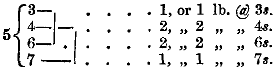
b. (When the number of the ingredients or prices is odd.) Required the proportions of teas at 3s., 5s., and 6s., the pound, to sell at 4s. Here the odd number must be taken a second time:—

c. (When the number of the ingredients is not merely odd, but the prices are unequally distributed either above or below the required price.) A dealer having wines of the same name at 7s., 9s., 11s., 12s., and 14s., per gallon, wishes to produce a mixture of them worth 10s. per gallon:—
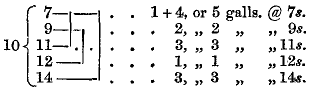
It will be seen that by varying the manner of linking the numbers, different answers may often be obtained to the same question. It also often happens that the dealer or operator desires to use a given quantity of one particular article, or to produce a certain quantity only of the mixture instead of those indicated by the above calculations. In these instances he has simply to apply the common rule of ‘practice’ or the ‘rule of three,’ as the particular case may demand.
In the above manner the proportions of the constituents of a compound may be determined from their specific gravity, when no change of volume has arisen from their admixture; but when this is the case, as in alloys, alcoholic mixtures, &c., it is either quite inapplicable or the results obtained are mere approximations to the truth. It may, however, be conveniently employed for calculations connected with the ‘mixing’ and ‘reduction’ of spirits and other liquids, by substituting their per-centage value in ‘proof gallons’ or other corresponding denomination, for the prices in the above examples; water, when introduced be reckoned, = 0. Thus:—A spirit merchant having two puncheons of rum of the strengths of 17 and 21 o. p., wishes to know what proportions of each and of water he must take to form a spirit 10 u. up. The proof value of 100 gallons of these spirits are respectively equal to 121, 117, 90, and 0 (water). Therefore—

Suppose the dealer required to use different proportions of the spirits referred to, instead of equal measures, he has only to take such aliquot parts of the quantities thus found referring to the smaller proportion; or such multiples of those referring to the larger one, as he wishes them to bear to each in the new mixture. Numerous other applications of this rule will occur to the ingenious reader.
Questions in ‘alligation,’ as the department of arithmetic above referred to is called, are very easily resolved by the ‘method of indeterminate analysis,’ even by persons but slightly conversant with rudimentary algebra; of which, indeed, they form a simple class of problems, often admitting of an almost indefinite number of solutions.
MO′HAIR. The hair of a goat indigenous in Asia Minor. It is dyed and manufactured by similar materials and in a similar manner to wool.
MOIL. See Cider.
MOIRÉE METALLIQUE. [Fr.] A beautiful crystalline appearance produced on the surface of tin plate by acids. The tin plate is submitted for a few seconds, whilst gently heated, to the action of dilute aqua regia, by which it acquires a variegated primrose appearance. It is afterwards washed in hot water, dried, and lacquered. The degree of heat and dilution of the acid modifies the beauty and character of the surface. The effect is also varied by employing dilute sulphuric acid, either alone or mixed with a portion of nitric or hydrochloric acid; or by using a solution of citric acid or caustic potassa. According to Herberger, the best metal for the purpose is plate iron, which has been coated by dipping it into a tin bath composed of pure tin, 200 parts; copper, 3 parts; arsenic, 1 part. The varnish should consist of copal in highly rectified spirit. Moirée metallique is in much less demand now than formerly.
MO′LASSES. See Treacle.
MOLES. The small, soft excrescences and discolorations of the skin which are popularly known under this name may, when slight, be removed by touching them every day with a little concentrated acetic acid, by means of a hair pencil, observing due care to prevent the application from spreading to the surrounding parts. This does not discolour the skin. The application of lunar caustic is also very effective, but it turns the spot temporarily black. In the pure mole there is always a considerable production of hair. When other means fail, they may be easily and safely removed by surgical means. The operation is trifling; and when judiciously performed no trace of such a proceeding is left behind.
MOLUC′CA BALM. See Liqueur.
MOLYBDATE OF AMMONIUM. (NH4)2 MoO4. Syn. Molybdenic acid, Peroxide of molybdenum; Acidum molybdicum, L. Prep. Native sulphide of molybdenum, after being well roasted, is reduced to fine powder, digested with ammonia, and the mixture filtered, and the filtrate evaporated to dryness; the residue, molybdate of ammonium, is then
Prop., &c. Small white scales, soluble in 570 parts of water; the solution reddens litmus paper; dissolves in the alkalies, forming alkaline molybdates, from which it is again precipitated by strong acids. It is used in the preparation of molybdenum blue, and in calico-printing, but its scarcity precludes its extensive employment in the arts. Molybdate of ammonium is the salt principally used in dyeing. Silks and cottons passed through a solution of this salt, then through a bath soured with hydrochloric acid, and, lastly (without washing), through another of protochloride of tin, are dyed of a rich and permanent blue colour. A solution of molybdate of ammonia in excess of nitric acid forms a valuable agent as a test for phosphates, with which it gives a beautiful yellow precipitate (phospho-molybdate of ammonia). See Phosphoric acid.
MOLYB′DENUM. Mo. A very rare metal, having a white colour, discovered by Hielm in 1782.
Prep. By exposing molybdic acid, mixed with charcoal and placed in a covered crucible, to the strongest heat of a smith’s forge.
Prop., &c. It is brittle and very infusible; when heated in contact with the air, it is converted into molybdic anhydride, MoO3.
MOMOR′DICINE. See Elaterin.
MOMRAUGHAN FOR HARNESS, &c. A correspondent of the ‘Field’ newspaper gives the following formulæ for momraughan, a substance used in India for preserving saddles and every description of leather. It is made as follows:—1 lb. white wax, 3 lb. mutton fat, 1 pint spirits of turpentine; melt, and mix well together while liquid. The saddle or leather should be rubbed well with a lime in the sun, then scrubbed with a brush with soap and water; when thoroughly dry, rub it well with the momraughan (letting it soak in) in the sun. One tablespoonful will be enough for a saddle. Another recipe is:—1 pint neats-foot oil, 2 oz. beeswax, 2 oz. spirits of turpentine, other directions as above. This latter mixture, with the addition of 1 oz. Burgundy pitch, makes a very good waterproof composition for boots.
MONE′SIA. Syn. Monesia bark, Buranheim b.; Cortex monesiæ, L. The bark of Chrysophyllum Buranheim, a tree growing in the Brazils. The rough, imported extract of this drug also commonly passes under the name of MONESIA. It is astringent, and possesses no advantage over rhatany or catechu.—Dose (of the latter), 18 to 20 gr.
MONE′SIN. A peculiar acrid principle, analogous to saponin, found in monesia bark, to the extent of 4·7%.
MONOBROMATED CAMPHOR. See Camphor, monobromated.
MONOMA′NIA. See Insanity.
MOR′DANT. In dyeing and calico printing, any substance employed to fix the colouring matter of dye-stuffs in the fibres of organic bodies, and to give it brilliancy and permanency. This it effects either by serving as a bond of union between the two, owing to its attraction for each of them; or it acts by uniting with the colouring particles in the minute pores of the fibres, and rendered them insoluble in the alkaline, soapy, and other liquids, to the action of which they will subsequently be exposed. When an infusion of some dye-stuff, as cochineal or madder, for example, is mixed with alum or acetate of alumina, and a little alkali, a precipitate immediately forms, consisting of alumina in combination with colouring matter, constituting a LAKE. It is by a similar reaction occurring within the fibres that the permanent dyeing of the cloth is effected. Here the colouring matter of the dyeing materials not only passes from the soluble to the insoluble form, but it enters into chemical combination with other substances, and in the new compounds it assumes greater brilliancy and permanency than it previously possessed. Annotta and safflower afford instances of the second mode of action above referred to, by which substances operate as mordants. The colouring matter of these dye-stuffs is soluble in alkaline lyes, and into a solution of this kind the cloth is dipped. It has now received an extremely fugitive colour only; but by passing it through acidulated water the alkaline solvent is abstracted, and the tinctorial matter is precipitated in an insoluble and minutely divided state within its pores, and it becomes permanently dyed. A similar reaction takes place in dyeing with the ‘indigo vat,’ in which atmospheric oxygen performs the part of a mordant. It is believed that even in these cases the colouring principle, during its transition from the liquid to the solid form, enters into combination with the fibres of the organic substance, and that, in proportion to the affinity existing between the two, is the integrity and excellence of the dye. In wool and silk the affinity between their filaments and the tinctorial particles of the dye-bath is, in general, so considerable, that a permanent stain is very easily communicated to them; but with cotton and flax, the materials of which calico and linen goods are made, the reverse is the case, and the intervention of a third material, in the shape of a mordant, is absolutely necessary to dye them of a permanent colour.
“Experience has proved that, of all the bases, those which succeed best as mordants are alumina, tin, and oxide of iron; the first two of which, being naturally white, are the only ones which can be employed for preserving to the colour its original tint, at least without much variation. But whenever the mordant itself is coloured, it will cause the dye to take a compound colour quite different from its own. If, as is usually said, the mordant enters into a real chemical union with the stuff
“In order that a combination may result between two bodies, they must not only be in contact, but they must be reduced to their ultimate molecules. The mordants to be united with stuffs are, as we have seen, insoluble in themselves, for which reason their particles must be divided by solution in an appropriate vehicle. Now, this solvent or menstruum will exert in its own favour an affinity for the mordant, which will prove to that extent an obstacle to its attraction for the stuff. Hence we must select such solvents as have a weaker affinity for the mordants than the mordants have for the stuffs. Of all acids which can be employed to dissolve alumina, for example, vinegar (acetic acid) is the one which will retain it with the least energy, for which reason the acetate of alumina is now generally substituted for alum, because the acetic acid gives up the alumina with such readiness that mere elevation of temperature is sufficient to effect the separation of these two substances. Before the substitution of the acetate, alum alone was employed; but without knowing the true reason, all the French dyers preferred the alum of Rome, simply regarding it to be the purest; it is only within these few years that they have understood the real grounds of this preference.
“The two principal conditions, namely, extreme tenuity of particles and liberty of action, being found in a mordant, its operation is certain. But as the combination to be effected is merely the result of the play of affinity between the solvent and the stuff to be dyed, a sort of partition must take place, proportioned to the mass of the solvent, as well as to its attractive force. Hence the stuff will retain more of the mordant when its solution is more concentrated, that is, when the base diffused through it is not so much protected by a large mass of menstruum; a fact applied to very valuable uses by the practical man. On impregnating, in calico printing, for example, different spots of the same web with the same mordant in different degrees of concentration, there is obtained in the dye-bath a depth of colour upon these spots intense in proportion to the strength of their various mordants. Thus, with solution of acetate of alumina in different grades of density, and with madder, every shade can be produced from the fullest red to the lightest pink, and with acetate of iron and madder, every shade from black to pale violet.” (Ure.)
In the employment of mordants in the ordinary processes of dyeing the goods are passed through the solution for a period varying, under different circumstances, according to the object in view. The cloth is subsequently aired, dried, and well rinsed, before immersing it in the colouring bath. In calico printing the mordant is applied partially or topically to the cloth by means of wooden blocks, or some similar contrivance; or certain parts of the cloth are stopped out by a suitable preparation, or ‘resist,’ by which means a pattern is produced, as the colouring matter of the dye-bath is removed from the other portions by the washing or scouring to which it is subsequently subjected. The substances used to thicken the mordant by the calico printers, to prevent them spreading, are starch and British gum. The first is prepared for neutral solutions; the last for acidulous ones. The removal of the undecomposed particles of the mordant, so as to preserve the other portion of the cloth from their action, is effected by the process of DUNGING (which see).
The process of GALLING or ROOTING, commonly employed as a preparation of cotton and linen for fast dyes, consists in working the stuff for some time, at a good hand heat, in a decoction of galls or an infusion of sumach. In this case the astringent matter plays the part of a mordant. About 21⁄2 oz. of galls, or 5 oz. of sumach, and 3 or 4 pints of water, are commonly taken for every lb. of cotton. See Calico printing, Dyeing, and the respective dye-stuffs and mordants.
Mordant. In gilding, any sticky matter by which gold-leaf is made to adhere. Prep. 1. Water or beer, rendered adhesive by the addition of a little gum, sugar, or honey, and tinged with a little gamboge or carmine, to mark the parts to which it is applied. Used to attach gold leaf to paper, taffety, vellum, &c.
2. (Mixtion.) From asphaltum, 1 part; mastic, 4 parts; amber, 12 parts; fused together, and then mixed with hot boiled oil, 1 pint. Used for gilding wood, &c. See Gold size.
MORPHIA. C17H19NO3. Syn. Morphine (Ph. D.), Morphina, Morphium, L. The chief active principle of opium. Morphia was discovered by Ludwig in 1688, but it was first obtained pure, and its precise nature pointed out by Sertuerner in 1804. It is peculiar to the Papaveraceæ, or poppy family.
Prep. 1. (Ph. D.) Turkey opium (cut into thin slices), 1 lb., is macerated for 24 hours in water, 1 quart, and the liquid portion decanted; the residuum is macerated for 12 hours with a second quart of water, and the process is repeated with a third quart of water, after which the insoluble portion is subjected to strong pressure; the mixed liquids are evaporated by water or steam heat to a pint, and filtered through calico; to the filtrate is added a solution formed of chloride of calcium, 6 dr., dissolved in distilled water, 4 fl. oz., and the liquid is further evaporated until it is so far concentrated that nearly the whole of it becomes solid on cooling; this is enveloped in a couple of folds of strong calico, and subjected to powerful pressure, the dark liquid1⁄2 pint of boiling water, and the undissolved portion is washed on a paper filter; the filtered solution is again evaporated, and the solid portion thus obtained submitted to pressure, as before; if the product is not quite white, this process is repeated a third time; the squeezed cake is now dissolved in boiling water, 6 fl. oz., and the solution filtered through animal charcoal (if necessary); to the clear solution is added ammonia, in slight excess; the crystalline precipitate which forms as the liquid cools is collected on a paper filter, washed with cold distilled water, and, lastly, the filter is transferred to a porous brick, in order that the morphia which it contains may become dry. (From the liquids reserved from the expressions more morphia may be obtained by dilution with water, precipitation with ammonia, re-solution in boiling water, and treatment with a little animal charcoal, &c., as before.)
2. (Ph. L. 1836.) Hydrochlorate of morphia, 1 oz., is dissolved in distilled water, 1 pint; and ammonia, 5 fl. dr. (or q. s.), previously diluted with water, 1 fl. oz., is added, with agitation; the precipitate is well washed in distilled water, and dried by a gentle heat. By a similar process morphia may be obtained from its other salts.
3. (Merck.) A cold aqueous infusion of opium is precipitated with carbonate of sodium, in excess; the precipitate washed, first with cold water, and then with cold alcohol of sp. gr. 85; the residuum is dissolved in weak acetic acid, the solution filtered through animal charcoal, and precipitated with ammonia; the precipitate is again washed with cold water, dissolved in alcohol, and crystallised. A good process where spirit is cheap.
4. (Mohr.) Opium, 4 parts, is made into a strong infusion with water, q. s.; lime, 1 part, reduced to a state of milk with water, is then added; the mixture is next heated to boiling, at once filtered through linen, and treated, whilst still hot, with chloride of ammonium, in fine powder, in slight excess (about 1 oz. to each lb. of opium); the morphia is deposited as the liquid cools, and may be purified by a second solution in lime and precipitation by chloride of ammonium. This process is remarkably simple, and in many points is preferable to any other, either on the small or large scale.
5. (Pure.) A filtered solution of opium in tepid water is mixed with acetate of lead in excess; the precipitate (meconate of lead) is separated by a filter, and a stream of sulphuretted hydrogen is passed through the nearly colourless filtrate; the latter is warmed, to expel excess of the gas, once more filtered, and then mixed with a slight excess of ammonia, which throws down narcotine and morphia; these are separated by boiling ether, in which the former is soluble.
Prop. The morphia of commerce is a white crystalline powder; but when crystallised from alcohol, it forms brilliant prismatic crystals of adamantine lustre, and the formula C17H19NO3.H2O. It exerts an alkaline reaction on test paper; imparts a perceptible bitter taste to water; requires 1160 parts of cold water, and 94 parts of boiling water, for its solution; insoluble in ether; dissolves in 90 parts of cold and about 30 parts of boiling alcohol; it also dissolves in the fixed and volatile oils, and in solutions of the alkalies; heated in close vessels, it forms a yellow liquid, like melted sulphur, which becomes white and crystalline on cooling; heated in the air, it melts, inflames like a resin, and leaves a small quantity of charcoal behind. With the acids it forms salts, which are mostly soluble and crystallisable. These may all be made by the direct solution of the alkaloid in the dilute acid. The only ones of importance are the acetate, hydrochlorate, and sulphate.
Pur. Commercial morphia and its preparations are often contaminated with codeine, narcotine, and colouring matter. The proportion of the first two may be estimated by the loss of weight which the sample suffers when digested in ether; or by dissolving out the morphine by digestion in weak liquor of potassa. Pure morphia “is scarcely soluble in cold water, sparingly so in boiling water, and readily so in alcohol. This solution is alkaline to test paper, and by evaporation leaves crystals, which are wholly dissipated by heat. It is soluble in pure potassa.” (Ph. L. 1836.)
Tests. 1. Potassium hydrate and ammonia precipitate morphia from solution of its salts, under the form of a white crystalline powder, which is very soluble in excess of hydrate of potassium, and, with somewhat more difficulty, in excess of ammonia. The solution formed by excess of the first is precipitated on the addition of bicarbonate of potassium. The precipitate in either case is soluble in a solution of chloride of ammonium, and in dilute acetic acid, and is insoluble in ether. A careful inspection of the precipitate through a lens of small power shows it to consist of minute acicular crystals; and seen through a glass which magnifies 100 times, these crystals present the form of right rhombic prisms.—2. The carbonates of potassium and sodium produce the same precipitate as hydrate of potassium, and which is insoluble in excess of the precipitant.—3. The bicarbonates of potassium and sodium also give similar precipitates from neutral solutions, insoluble in excess. In each of the above cases stirring with a glass rod and friction on the sides of the vessel promote the separation of the precipitate.—4. If to a mixture of morphia and oil of vitriol a minute fragment of bichromate of potassium be added, oxide of chromium is set free, and a fine green colour developed.—5. A drop or two of solution of terchloride of gold added to a weak solution of morphia gives a yellow precipitate,
Another test, given by Siebold,[41] is the following:—“Heat the substance which is believed to be, or to contain, morphia, gently with a few drops of sulphuric acid, add a very small quantity of pure perchlorate of potassium. The liquid immediately surrounding the perchlorate will at once assume a deep brown colour, which will soon spread and extend over the greater part of the acid. Warming increases the delicacy of the test. 0·0001 gramme of morphia can be distinctly recognised in this way, and no other alkaloid is acted upon in a similar way by the substances named. It is indispensable, however, for the success of the experiment that the perchlorate of potassium be absolutely free from chlorate.” See Alkaloids.
The above are the most reliable precipitates for morphia; the first two may, indeed, be regarded as characteristic, and the remainder as almost so. The following are often referred to by medical writers, but are less exclusive and trustworthy:—Morphia and its salts are—7. Reddened by nitric acid, and form orange-red solutions, darkened by ammonia in excess, and ultimately turning yellow, with the production of oxalic acid.—8. They are turned blue by ferric chloride, either at once or on the addition of an alkali, and this colour is destroyed by water and by alkalies, or acids in excess.—9. Iodic acid added to their solutions turns them yellowish brown, by setting iodine free, and the liquid forms a blue compound with starch.
Uses. Morphia and its salts are exhibited either in substance, made into pills, or in solution, generally the latter; or externally, in fine powder, applied to the dermis denuded of the cuticle. They are principally employed as anodynes and hypnotics in cases in which opium is inadmissible, and are justly regarded as the most valuable medicines of their class. “In cases wherein both opium and the morphine salts are equally admissible, I prefer the former, its effects being better known and regulated; moreover, opium is to be preferred as a stimulant and sudorific, and for suppressing excessive mucous discharges.” (Pereira.)—Dose. Of pure morphia, 1⁄12 to 1⁄6 gr.; of its salts, 1⁄8 to 1⁄4 gr.; externally, 1⁄2 to 11⁄2 gr. Morphine is chiefly used for the preparation of the acetate, and some of its other salts.
Good opium yields from 10% to 13% of morphia. See Opium.
Morphia, Ac′etate of. C17H20NO3C2H3O2. Syn. Morphiæ acetas (Ph. L., E., & D.), L. Prep. 1. (Ph. L. 1836.) Morphia, 6 dr.; acetic acid (Ph. L.), 3 fl. dr.; distilled water, 4 fl. oz.; dissolve, gently evaporate, and crystallise.
2. (Ph. E.) Hydrochlorate of morphia, 1 part, is dissolved in warm water, 14 parts; and the solution, when cold, is precipitated with ammonia, in slight excess, the precipitate is washed in cold water, and dissolved by means of acetic acid, in excess, in warm water, 12 parts; from the solution crystals are obtained as before.