A CYCLOPÆDIA OF PRACTICAL RECEIPTS, &c. VOLUME II (continued 18)
Reading edition
Tests. 1. It is distinguished from other gases by yielding nothing but pure water when mixed with twice its volume of hydrogen and exploded, or when a jet of hydrogen is burnt in it.—2. A recently extinguished taper, with the wick still red hot, instantly inflames when plunged into this gas.—3. A small spiral piece of iron wire ignited at the point, and suddenly plunged into a jar of oxygen, burns with great brilliancy and rapidity. Charcoal does the same.
Estim. The estimation of the quantity of oxygen in an organic compound has already been described. For determining the quantity present in atmospheric air, and other like gaseous mixtures, Dobereiner has proposed the use of pyrogallic acid. The air under examination (freed from moisture) is measured into an accurately graduated tube over mercury, capable of holding about 30 cubic centimètres, and which it should 2⁄3rds fill. A solution formed of 1 part of dry hydrate of potassium and 2 parts of water, and in volume about 1⁄35th that of the air, is next introduced by means of a pipette with a curved point, and is gently agitated therewith in the gas for a short time; the decrease of volume gives the proportion of carbonic anhydride present. A solution of pyrogallic acid (1 gramme in 5 or 6 centimètres of water), equal in volume to one half that of the solution of potassa already used, is then introduced by means of another pipette, and the mixed liquids are cautiously shaken together over the inner surface of the tube. When absorption ceases (which it does in a few minutes), the quantity of residual gas (nitrogen) is read off from the graduations; the difference in volume before and after the introduction of the pyrogallic acid indicates the proportion of oxygen. This is a mere modification of Prof. Liebig’s method. 1 gramme of pyrogallic acid in combination with hydrate of potassium is capable of absorbing about 189 cubic centimètres of oxygen. (Dobereiner.) Other methods employed for the analysis of air, depending on the increase or loss of weight when the air is passed over finely divided copper heated to redness, the loss of volume when the air is exploded in a eudiometer with half its bulk of hydrogen, or when a stick of phosphorus is left in it for some hours, are well known, and described at length in every elementary work on chemical analysis. The last method, although less accurate than the others, has the advantage of extreme simplicity.
Uses. Oxygen has been employed to increase the illuminative and heating power of lamps, and to render vitiated air respirable, &c.; and when largely diluted with atmospheric air, or condensed in water, as a remedial agent in asphyxia arising from the inhalation of carbonic acid and carbonic oxide.
Dr Ringer says that if oxygen be administered as a gaseous bath for an hour or two at a time, and the bath repeated six or eight times a day, it is of great service in senile gangrene.
Concluding Remarks. Oxygen gas may be collected in the usual way, either over water, mercury, or in bags; or, on the large scale, in gasometers. The purity of the products of the several processes given above depends on the substances from which the gas is obtained being themselves pure. For particular experiments the first portion of gas should be allowed to escape, or be received apart, as with this, as with the other gases, it is contaminated with the atmospheric air of the apparatus. The gas procured from manganese or nitre may be purified by passing it through milk of lime or a solution of caustic potash; it will still, however, retain some traces of nitrogen. M. Limousin[81] has devised an apparatus for the preparation of oxygen by the attendants of hospitals, which obviates the risk of bursting of the retorts, attending its preparation by the old method. The apparatus consists of two cast-iron hemispheres, whose edges, which are well polished and about two centimètres thick, can be fitted hermetically upon each other, and fastened by three screws. The mixture of chlorate of potash and peroxide of manganese is placed in the lower hemisphere, which rests upon a tripod; the upper hemisphere, from which projects an iron tube, is now screwed on, and the iron tube connected with india-rubber and glass tubing with a Wolf’s wash-bottle, from which the gas after being washed passes through a second glass tube, and is thus ready for use. It may be conducted into an air-tight bag, in which it will keep for several weeks. Such a bag when supplied with a tube and stop-cock will afford a ready means for inhalations. Oxygen in a condensed or compressedOrganic substances, Ozone, Gases, Liquefaction of, &c.
OXYGENA′TION. Syn. The act or process of combining with oxygen. Formerly it was of more general application than the word ‘oxidation,’ with which it has been regarded as synonymous. ‘Oxygenation’ is, however, at the present day practically obsolete.
OXYGENI′SED LARD. Syn. Oxygenated axunge; Axungia oxygenata, L. Prep. (Ph. Bat. 1805.) From prepared lard, 16 parts, melted over a slow fire, and then mixed with nitric acid, 1 part; the combination being promoted by constant stirring with a glass rod, until it ceases to affect litmus paper. It should be extremely white, and should be kept in the dark. See Ointment of Nitric acid.
OXYHYDROGEN BLOWPIPE. See Blowpipe. Deville and Debray (‘Ann. Ch. Phys.’ [3], lvi, 385) employ the oxyhydrogen blowpipe in the following manner for effecting the fusion of platinum and the refractory metals which accompany it. The apparatus consists of the blowpipe C (see below), a furnace ABD, and a crucible GHI. The blowpipe is composed of a copper tube about half an inch in diameter, terminating below in a slightly conical platinum jet about 11⁄2 inch long. Within this tube, which is supplied with hydrogen or coal-gas through the stop-cock H, is a second copper tube C′ for supplying oxygen, terminated also by a platinum nozzle with an aperture of about a twelfth of an inch in diameter.
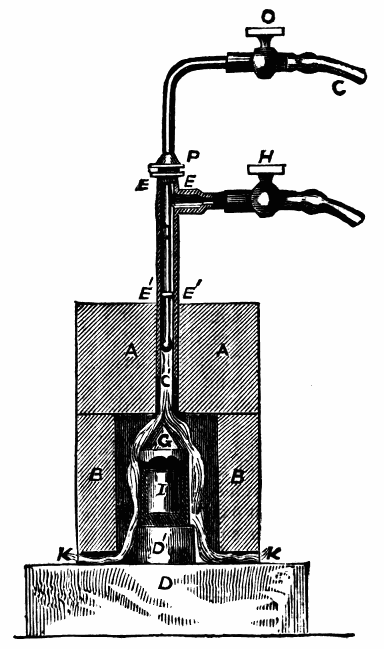
The furnace ABD consists of three pieces of well-burnt lime of slightly hydraulic quality, which may be turned at a lathe with ease. The cylinder A is about 21⁄2 inches thick, and is perforated by a slightly conical hole into which the blowpipe fits accurately, passing about half-way through the thickness of the mass. A second somewhat deeper cylinder of lime, B, is hollowed into a chamber wide enough to admit the crucible, and leave an interval of not more than a sixth of an inch clear around it. KK are four apertures for the escape of the products of combustion.
The outer crucible HH is also made of lime, but it contains a smaller crucible I of gas coke, provided with a cover of the same material; and in this the substance to be used is placed, the crucible resting on the lime support D′. The conical cover G is made of lime, and its apex should be placed exactly under the blowpipe jet, at a distance from it of 3⁄4 to 11⁄2 inch.
The different pieces of the furnace must be bound round with iron wire to support them when they crack. The oxygen is admitted under a pressure of a column of 16 inches of water. The temperature is gradually raised to the maximum, and in about eight minutes from this time the operation is complete.
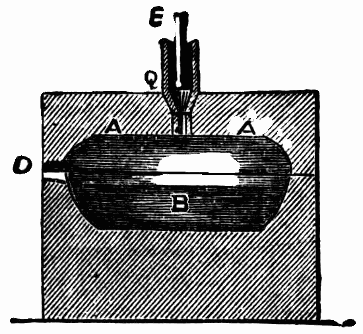
By employing a jet of mixed coal-gas and oxygen (EQ, see engr.) in a furnace of lime, Deville and Debray succeeded, at an expense of about 43 cubic feet of oxygen, in melting and refining, in 42 minutes, 25·4 lbs. avoirdupois of platinum, and casting it into an ingot in a mould of gas coke; and much larger masses have since been melted by this method. Lime is so bad a conductor of heat that if a cup of lime not more than 0·8 inch thick be filled with melted platinum the exterior scarcely rises beyond 300° Fahr. (Miller’s ‘Elements of Chemistry,’ 3rd. ed., pt. ii, p. 825.)
OX′YMEL. Syn. Oxymel, L. An acidulous syrup made of honey and vinegar. There are only two oxymels in the last Ph. L. The ingredients in an oxymel should be of such a character, and in such proportions, as to produce a mixture of the proper consistence without evaporation.
Oxymel of Col′chicum. Syn. Oxymel colchici cormi, Oxymel colchici, L. Prep. (Ph. D. 1826.) Fresh corms (roots) of meadowDose, 1 to 3 dr., twice or thrice a day; in gout, rheumatism, dropsy, &c.
Oxymel of Gar′lic. Syn. Oxymel alii, L. Prep. (Ph. L. 1746.) Sliced garlic, 11⁄2 oz.; caraway seed and sweet fennel seed, of each 2 dr.; boiling vinegar, 8 fl. oz.; infuse, strain, and add of clarified honey, 10 oz. In hooping-cough, chronic diarrhœa, rheumatism, &c.
Oxymel of Narcissus. (Van Mons.) Syn. Oxymel Narcissi. Prep. Vinegar of Narcissus (made with 1 part of fresh flowers of daffodil to 8 of vinegar), 1 part; honey, 4 parts. Dissolve.—Dose. A teaspoonful. In hooping-cough and spasmodic asthma.
Oxymel, Pec′toral. Syn. Oxymel pectorale, O. inulæ compositum, L. Prep. (Ph. Br.) Elecampane, 1 oz.; orris root, 1⁄2 oz.; water, 11⁄2 pint; boil to 1⁄2 pint, strain, add of honey, 16 oz.; ammoniacum, 1 oz.; (dissolved in) vinegar, 3 fl. oz.; lastly, boil to an oxymel.—Dose, 1 spoonful, occasionally; in coughs, humid asthma, &c.
Oxymel, Sim′ple. Syn. Vinegar syrup, Acetated honey; Oxymel (Ph. L. & D.), Oxymel simplex, Mel acetatum, L. Prep. 1. (Ph. L.) Acetic acid (sp. gr. 1·048) 7 fl. oz.; distilled water, 8 fl. oz.; mix, and add them to honey, 5 lbs., previously made hot. This contains only one half the acid ordered in the Ph. L. 1836.
2. (Ph. D.) Clarified honey, 1 lb.; acetic acid (sp. gr. 1·044), 3 oz.; as before. Stronger than the last.
3. (Ph. L. 1836.) Honey, 10 lbs.; acetic acid (1·048), 11⁄2 pint; as before. This contains too much vinegar. (See No. 1.)
4. (Wholesale.) From honey (thick and good), 12 lbs.; melt it by a gentle heat, add of distilled vinegar (of fully 5%), 2 quarts, and strain the mixture through flannel. No evaporation is required.
Uses, &c. Demulcent and refrigerant.—Dose, 1 to 4 fl. dr., either gradually sucked from the spoon or dissolved through some simple liquid. Dissolved in water, it forms a useful and pleasant cooling drink or gargle in fevers, sore throats, hoarseness, &c.; but in some individuals it occasions griping. It is commonly used as an adjunct, in mixtures, &c.
Oxymel of Squills. Syn. Honey of Squills; Oxymel Scillæ (B. P.), Mel Scillæ (Ph. L.), O. Scilliticum (L.) Prep. 1. (B. P.) Mix and evaporate on a water bath vinegar of squills, 1 pint, and clarified honey, 2 lbs., till the product when cold has a specific gravity of 1·32.
2. Vinegar of squills, 21⁄2 pints; gently evaporate it to 12 fl. oz., and add of honey (previously made hot), 5 lbs.
3. (Ph. L. 1836.) Strained honey, 3 lbs.; vinegar of squills, 11⁄2 pint; boil to a proper consistence. The formula of the Ph. D. 1826 was similar.
Uses, &c. Expectorant, and in large doses nauseant.—Dose, 1⁄2 to fl. 2 dr.; in chronic coughs, hoarseness, humeral asthma, &c.
Oxymel of Ver′digris. See Liniment Of Verdigris.
OXYR′RHODYNE. Syn. Oxyrrhodinon. An old compound formed of 1 part of vinegar of roses and 2 parts of oil of roses.
OXYSAC′CHARUM. A syrup acidulated with vinegar. See Syrup.
OXYSUL′PHIDE. A name given to certain compounds or mixtures of metallic oxides and sulphides. See Antimony, Oxysulphide, &c.
OYS′TER. Syn. Ostrea, L. This well-known shell-fish is the Ostrea edulis (Linn.)
“The oyster is a genus of lamellibranchiate molluscs of the section with a single adductor muscle. The shell consists of two unequal and somewhat irregularly-shaped valves of laminated and closely foliated structure, and the hinge is without tooth or ridge, the valves being held together by a ligament lodged in a little cavity in each. The animal is in its organisation among the lowest and simplest of lamellibranchiate molluscs. It has no foot, and, except when very young, no power of locomotion, or organ of any kind adapted to that purpose. Its food consists of animalcules, and also of minute vegetable particles, brought to it by the water, a continual current of which is directed towards the mouth by the action of the gills. The gills are seen in four rows when the valves of the shell are separated, a little within the fringed edge of the mantle. In the most central part is the adductor muscle; and between the adductor muscle and the liver is the heart, which may be recognised by the brown colour of its auricle. The mouth—for, as in the other lamellibranchiata, there is no head—is situated beneath a kind of hood formed by the union of the two edges of the mantle near the hinge. It is jawless and toothless. The ovaries are very large during the season of reproduction, which extends over certain months when oysters are out of season for the table. Oysters are hermaphrodite.”[82]
The fecundity of the oyster is amazing. Leeuwenhoek estimated that an oyster, when full of spawn, contained from 3000 to 4000 of its offspring, and it has also been computed that one oyster alone produces nearly a million and a quarter of eggs. The eggs are hatched and the young produced within the shell and mantle of the parent, where they continue floating or swimming about in the vicinity of the gills in a creamy-looking kind of mucus or fluid until expelled. Their expulsion is preceded by a change of appearance in the fluid to a brownish or muddy colour; a circumstance that may possibly indicate an
When they leave the parent shell the young oysters, which in this condition are called spat, are not more than 1⁄120th of an inch in length; and two millions of them when closely packed do not occupy a space of more than a cubic inch. Thus cast adrift they are carried away by currents, their multitudinous numbers being considerably diminished by their falling a prey to numerous fish, as well as from their frequent inability to find a suitable resting-place. This obtained, the young oyster or spat attaches itself to it, and makes it the permanent home on which it eats, grows, and breeds, and, debarred of locomotion, passes its existence unless, of course, removed by external causes. Pending its obtaining a suitable locality the young oyster is provided with a powerful swimming apparatus which, it has been surmised, becomes absorbed or otherwise disappears when its function is rendered unnecessary by the stationary life of the oyster after it has secured a habitat.
The objects to which it attaches itself are numerous. The Ostrea parasitica, a species of oyster found in warm climates, fixes itself to the roots and branches of trees growing within reach of and washed by the tide. Again, in some of the southern states of North America, large oyster-beds, which are sometimes of such magnitude as to form buttresses against the force of the tides and winds, originate from the habit of young oysters attaching themselves to the shells of old ones. Similarly the banks of some of the rivers of Georgia, which run up some few miles inland from the sea, are composed of masses of living oysters attached to each other. These banks, which are so massive as to make a channel for the river, are known as racoon banks, because this animal is one amongst others which frequents them for the sake of devouring the oysters.... In some of the French parcs, or artificial oyster-beds, the young oysters attach themselves to large unglazed tiles, or to faggots or other solid bodies which are placed in suitable situations for the purpose; in the English artificial beds hurdles are frequently employed, upon which the spat become deposited. It appears the young oysters select dark objects, such as slate or black stones, in preference to bodies of a lighter colour to fix themselves to, and that they choose, where practicable, the inner side of the object, or that portion of it away from the light. After a time the young oysters are removed from the breeding beds, placed in the fattening beds, from whence they are removed when they have attained a sufficient size, and sent upon the market. In England oysters are not regarded as fit to be eaten until they are at least three years old; whereas in France they are served up to table about a year earlier. The chief enemy of the young oyster is a species of whelk, known in France as the bigourneau, dog whelk, or piercer. These creatures, which are found in immense quantities in the celebrated oyster-beds at Arcachon, near Bordeaux, cause great destruction amongst the bivalves. Part of their anatomy consists of a boring apparatus, with which they pierce the shell of the oyster; whatever of the dead oyster is left by the whelk is devoured by the crabs, which creep into the aperture in the shell made by the former.
We have already alluded to the abundance of oysters in parts of Georgia, where, we may add, they are not only confined to the alluvial shores of the rivers, but are also found in large numbers amongst the long grass of the adjoining low lands.
In these districts it is by no means an uncommon practice for the inhabitants to improvise a meal by picking up a bunch of oysters and roasting them over a fire kindled on the spot. In many of these localities the oysters occur in quantities so immense that a vessel of 100 tons might be loaded within three times her own length.[83]
There are also many other parts of America in which the yield of the oyster-beds is enormous. In the State of Maryland 6000 persons are said to be employed dredging, and nearly 11,000,000 bushels of oysters were taken in 1870-71.
In Baltimore as many as 10,000 persons are employed in tinning this bivalve. Comparing the plenteousness of the oyster in America with its great scarcity of late years in our country, and the consequent much lower price of the foreign bivalve, we should be prepared to learn that considerable supplies of oysters, both alive and preserved in tins, come to us from America. The bulk of those consumed in Britain are a small variety, and come from Maryland and Virginia.
In 1872, owing to the diminished yield of the English oyster-beds, an attempt was made to introduce the American oyster into British waters; and we believe the depôt for this purpose still exists at Cleesethorpes, at the mouth of the Humber, where operations in this branch of oyster culture are being carried on by the Conway Company. If, however, the opinion of an eminent pisciculturist be correct, viz. that the American oyster will not breed in our waters, we should conceive the experiment will be abandoned, since nothing will be gained by relaying them, that cannot be attained by simply importing them and sending them to the market, since it is asserted they are kept alive out of water for a month.
A few years back a Select Committee appointed by Parliament to inquire into the causes of the scarcity of oysters issued in 1876 a report in which, endorsing the opinion of1⁄2 or 3 inches in diameter. Commenting upon the above report, ‘Nature’ very sensibly remarks:—“What is really wanted for the protection of the oyster is the assurance that these animals shall not be sold before they have a chance of reproducing their kind. Since the introduction of the railway system, the demand for oysters in distant places has become so great and the price has risen so high, that oyster culturists are tempted to send immature animals to market, and it is this fact, more than any failure of spat, that is leading to the scarcity. There are not, in consequence of the unceasing demand and consequent high price, so many full-grown oysters left to spat as there ought to be; hence the scarcity. Any Act of Parliament that decrees two oysters to grow where only one grew before will be greedily welcomed both by oyster culturists and by the public, and we hope that the issue of the present Report will lead to some effective measures being taken for the preservation of this delicious creature ere it be too late.” Previous to 1846 the wholesale price of best English natives was £2 2s. a bushel; since then the price has risen rapidly to £4 4s. in 1865, in 1866 to £5, and in 1869 it had advanced to £8; that is, they had risen nearly 300 per cent. in 8 years, which is equivalent to an advance of from 1⁄2d. to 2d. each. At the present time they are, we believe, sold at from 3s. to 3s. 6d. a dozen by the retail dealer.
Oysters are nutritious and easy of digestion when fresh, but are apt to prove laxative to those unaccustomed to their use. It is generally believed that they are in season each month of the year the name of which contains the letter R. Whitstable in Kent, and Colchester and other places in Essex, are the great nurseries or feeding-grounds for supplying the metropolis, and, indeed, the whole of England, with the most esteemed variety (NATIVES) of this shell-fish. The shells (TESTÆ PREPARATÆ, T. OSTREARIÆ) were formerly used in medicine as an absorbent.
Of the various species of oysters, that which holds the foremost place in the estimation of the gourmet is the ‘English native,’ now, alas! owing to the unwise rapacity of the collector, nearly dredged out of existence.
The native has a historic reputation too, since it appears it was eagerly sought after by the old Romans, and was a frequent dish at their tables. The enthusiasm of the celebrated Dr Kitchener for this particular oyster was very intense. He is very particular in directing its shell to be opened with the greatest care so that it may be eaten alive and “tickled to death by the teeth.”
The green oyster of Ostend is also prized by epicures; it acquires its colour from its food, which consists chiefly of green monads and confervaæ. Some of the American oysters are excellent in flavour, and are said to be without the copper taste occasionally to be met with in English oysters. They smack a little of the mussel.
Payen gives the following as the composition of the oyster:—
Mean of two Analyses.
Nitrogenous matter 14·010
Fatty matter 1·515
Saline matter 2·695
Non-nitrogenous matter and loss 1·395
Water 80·385
————
100·00
See Shell fish, Sauces, &c.
Oyster, Scalloped. Put them with crums of bread, pepper, salt, nutmeg, and a bit of butter, into scallop shells or saucers, and bake them before the fire in a Dutch oven.
Oysters, Fried (to garnish boiled fish). Make a batter of flour, milk and eggs, add a little seasoning to it; dip the oysters into it, and fry them a fine yellow brown. A little nutmeg should be put into the seasoning, and a few crumbs of bread into the flour.
Oysters, Stewed. Open them, and separate the liquor from them, then free them from grit by washing, strain the liquor, and add it to the oysters with a small piece of mace and lemon peel, and a few white peppercorns. Simmer very gently, and add some cream and a little flour and butter. Let them be served with sippets.
Oysters, To Feed. Pat them into water, and wash them with a birch broom till quite clean. Then place them bottom downwards in an earthenware pan; sprinkle them with flour, oatmeal, and salt, and then cover with water. Repeat this treatment every day, taking care to make the water pretty salt.
OZOKERIT. Syn. Fossil wax, Mineral wax. This substance, which has within the last few years been utilised as a source of paraffin and the mineral hydrocarbon oils, is found in various localities in the tertiary strata, mostly occurring in, or in close proximity to, the coal measures. But although extensive deposits of it are to be met with in Gallicia and on the slopes of the Carpathian
Neft-gil is a substance very similar to ozokerit, and is formed on the island of Swätoi-Ostrow in the Caspian Sea. According to Rossmässler, neft-gil is treated in the following manner:—15 cwt. of the crude material is put into iron stills provided with a leaden worm, and submitted to fractional distillation, yielding 68 per cent. of distillate, consisting of 8 per cent. of oil, and 60 per cent. of crude paraffin. The oil thus obtained is yellow, opalescent, possesses an ethereal odour, and a sp. gr. of 0·75 to 0·81. Each distillation yields a quantity of a light oil boiling below 100° C., which is used for the purpose of purifying the paraffin. The crude paraffin obtained by the first distillation is tolerably pure, has a yellow colour, and can at once be treated by the hydraulic press and centrifugal machine; the oil from these operations is again submitted to fractional distillation in order to obtain more paraffin. The pressed paraffin is melted and treated at 170° to 180° C. with sulphuric acid, which is next neutralised by means of lime, and the paraffin again rapidly distilled, then again submitted to strong pressure, and the material obtained treated with 25 per cent. of the light oil; then again melted, again pressed, and finally treated with steam for the purpose of eliminating the last trace of essential oil. The material obtained by this treatment is a perfectly pure, colourless material, free from smell, transparent, and so hard as to exhibit in large blocks almost a metallic sound. The fusing point is 63° C.
OZONE (Greek, όζωh, I smell) is a peculiar variety of oxygen, characterised by its greater weight, its peculiar chlorous smell, its intensely active oxidising powers, and, finally, by the ease with which it passes into common oxygen. The history of ozone may be summed up as follows:—In 1785 Van Marum observed the production of a peculiar smell when electric sparks were passed through oxygen. This smell, which every one who has worked with an electric machine must have noticed, Van Marum regarded as the “smell of electricity,” thinking that electricity was a substance. In 1840 Schönbein, of Basle, proved the existence of a definite substance, to which he assigned the name of ozone, and discovered several modes of producing it, a delicate test for it, and several of its most striking properties. He subsequently added many new facts, but to the time of his death he never held a correct theory in regard to its nature. Later researches by Marignac and Dedalline, Becquerel and Fremy, Andrews and Tait, Soret, Brodie, and others, have established the true nature of this remarkable body. It is now generally admitted that it only differs from common oxygen in containing three atoms of oxygen in each molecule instead of two. In fact, as the formula for oxygen is O2, that of ozone is O3. It follows that ozone is half as heavy again as oxygen, and it has accordingly been demonstrated that its specific gravity is 24 (H = 1), that of oxygen being 16. All the known reactions of ozone are easily explained in accordance with this view.
Ozone may be generated in several ways. 1. By the action of electricity on oxygen or air, sparks are far less efficacious than the silent or ‘slow’ discharge; but the best apparatus is the induction-tube of Siemens. This consists of two tubes, one inside the other. The inner side of the inner and the outer side of the outer tube are coated with tinfoil, and these coatings are connected with the terminals of a powerful induction-coil. Dry air or oxygen streams between the tubes and passes out, strongly charged with ozone.
2. M. Boillot has proposed a modification of Siemens’ apparatus, which consists of two glass tubes, one fitting within the other, and each coated externally with powdered coke made to adhere by means of gelatin. The coatings of the two tubes are connected with the poles of an induction coil, and a stream of oxygen is made to pass between the tubes, and becomes thus exposed to the influence of the silent discharge, as in Siemens’ contrivance.
3. Hozeau has invented an apparatus which he calls an ‘ozoniser,’ by means of which ozone is produced in considerable quantities. In an ordinary straight gas-delivery tube is placed a wire of copper, lead, or, better, platinum, 4 to 6 décimètres long, with one of its extremities passing through the side of the upper portion of the tube. On the exterior of the tube is coiled a similar wire over the path of the preceding. When the two are placed in communication with a Ruhmkorff’s coil, giving a 2 or 3 centimètre spark, a slow stream of oxygen passing through the tube will be strongly charged with ozone. By this apparatus Hozeau has prepared oxygen containing 60 to 120 (once 188) milligrams of ozone per litre. Electrolysis of water furnished only 3 to 5 milligrams, barium peroxide and sulphuric acid 10 milligrams per litre.[84]
4. During certain processes of oxidation a piece of phosphorus, half covered with water in a bottle of air, absorbs a portion of the oxygen, while another portion becomes partially ozonised.
5. By plunging a clean glass rod heated to about 260° C. into a jar containing a few drops of ether.
6. By mixing very gradually 3 parts of
7. It has been shown that ozone is formed in small quantity during the burning of hydrogen at a jet, and in several analogous reactions.
8. During the liberation of oxygen at low temperatures, when barium dioxide is moistened with sulphuric acid, the odour of ozone is at once apparent, and the evolution proceeds for a considerable time.
9. In the electrolysis of water the oxygen evolved consists partly of ozone, especially if the poles are small.
10. Linder has suggested an easy method for the production of ozone for hygienic purposes, which is as follows:—Make a mixture of manganese peroxide, potassium permanganate, and oxalic acid. Two spoonfuls of this powder, if placed on a dish and gradually mixed with water, will generate ozone sufficient for a room of medium size; more water is added in small portions from time to time as the evolution ceases; the powder may be kept in a bottle ready for use.
Ozone has never been isolated. By the use of Siemens’ apparatus, oxygen containing, as a maximum, twenty volumes per cent. of ozone may be obtained. This represents a contraction of about 1-11th during formation. But it is at present impossible to separate the one from the other. Ozone is entirely converted into oxygen by a temperature of 270° C. The conversion is effected more slowly at lower temperatures. Silver, iron, copper, when moistened, are oxidised on the surface immediately at ordinary temperatures by ozone.
Silver even becomes converted into a peroxide, although it will not combine with ordinary oxygen, either when moist or dry. Little or no absorption of ozone takes place when the metals are perfectly dry, except with dry mercury and dry iodine, both of which remove it immediately. It was conclusively shown by Andrews and Tait that little or no contraction followed the absorption of ozone by these or any other agents. Hence, as suggested by these observers, it seems probable that the ozone is resolved into a quantity of ordinary oxygen equal in bulk to itself, which is liberated at the moment when another portion of its oxygen enters into combination with the metal or the iodine.
Ozonised air becomes deozonised when passed over cold manganese dioxide, silver dioxide, or lead dioxide. When ozone is mixed with peroxide of hydrogen, water and oxygen are formed. In these cases the ozone is converted into ordinary oxygen, and the peroxides into monoxides.
Antozone, which Schönbein surmised to be oxygen in an oppositely electrified condition to ozone, has been shown with great probability by Van Babo to be peroxide of hydrogen.
From the ease with which it gives up its third atom of oxygen, ozone has been proposed when mixed with air, as a means of decolorising wax, stearin, and other organic substances which cannot be subjected to the fumes of sulphurous acid or chlorine, or at any rate only partially so. Ozone does not appear, however, to have been much, if at all adopted, for bleaching the above products, which are still, we believe, mostly whitened by the old method of exposure to the air.
Being one of the most energetic oxidising agents known, it is not surprising that the claims of ozone as a disinfectant should have found many supporters. One of its strongest advocates for this purpose is Dr Cornelius Fox, who says,—“Ozone should be diffused through fever-wards, sick rooms, the crowded localities of the poor, or wherever the active power of the air is reduced and poisons are generated. Its employment is especially demanded in our hospitals, situated as they mostly are in densely populated districts, where the atmosphere is almost always polluted by rebreathed air, decomposing substances and their products, and where no mere ventilation can be fully effective. If practicable, it would be highly advantageous to direct streams of sea-air, or air artificially ozonised into the fever and cholera nests of our towns. Ozone may be easily disseminated through public buildings, theatres, and other confined atmospheres, where numbers of people are accustomed to assemble in order to maintain the purity of the air.”
Another ardent believer in the hygienic value of ozone is Linder, who is also a strong advocate for its medical application, and recommends it both in the form of ozonised air and water in tuberculosis, rheumatism, asthma, and many other diseases. Linder, it is said, has set up an ozone manufactory, and vends ozone inhalations by the cubic foot.
To the contention of those who assert that it is impossible to convey such an unstable body as ozone into the blood without the ozone becoming decomposed into ordinary oxygen, this instability is denied upon the authority of Lehone and Hozeau, who state that it is less liable to change than is generally supposed, for they found, after working with it, that its peculiar odour remained on their hands and garments for some time. These views, largely shared by many others, as to the beneficial effects of ozone have, however, not been allowed to pass unchallenged. M. P. Thénard considered it important that both the public and medical men should be apprised of the erroneous character of the opinions generally entertained respecting the action of ozone on the organism. Ozone, he says, so far from exerting a beneficial effect, is one of the most energetic of poisons; and the serious accidents which have occurred in his own laboratory do not leave the slightest room for doubt in the matter.
Writing to the ‘Comptes Rendus,’[85] M. P.1⁄30th after the exposure of the animal for a quarter of an hour to an atmosphere charged with ozone. He states that under the influence of ozone, even when very largely diluted, the blood-corpuscles rapidly cohere and change their form. Other instances are recorded in which the blood, contrary to anticipation, has been found in the venous condition.
Drs Dewar and M’Kendrick found that ozone acted as a very powerful irritant upon the mucous membranes. Further, an experiment was made by placing some small birds in a mixture of oxygen and ozone, containing 10 per cent. of the latter. In two minutes the birds were dead.
Ozone is frequently present in the atmosphere, formed by electricity and perhaps by other means. Payen states that it does not amount to more than 1⁄450,000th weight, and 1⁄70000 by volume of atmospheric air. Other observers state that it varies in amount, according to height, locality, temperature, electricity, &c. Dr Buchanan says it is more abundant “on the sea-coast than inland, in the west than in the east of Great Britain, in elevated than in low situations, with south-west than with north-east winds, in the country than in towns, and on the windward than on the leeward side of towns.” According to the Scottish Meteorological Society, ozone is most prevalent in the atmosphere from February to June, when the average amount is 6, and lasts from July to January, when the average is 5·7. The maximum 6·2 is reached in May, and the minimum 5·3 in November.
These results are said to be in accordance with the conclusions arrived at by Dr Berigny and M. Hozeau.
Although there appears no ground for doubting that artificially prepared ozone, by reason of its actively disinfectant properties, may prove a valuable auxiliary in checking the spread of certain diseases; it seems far from satisfactorily established that the same quality is possessed by the ozone in the atmosphere, or on the contrary, as has been asserted, that certain ailments are caused by it. During an outbreak of influenza at Berlin, Schönbein states that the air contained a large quantity of ozone; a circumstance confirmed by Dr Pietra-Santa during the prevalence in another locality of the same epidemic, which it was imagined might be caused by the irritating effect of the ozone on the organs of respiration. Billard, Wolf, Bœckel, and Strambis all state that, during the prevalence of cholera at Strasbourg, Berlin, and Milan ozone was absent from the atmosphere, and that the decline of the malady was marked by its reappearance. Uhle ascribes the accumulation of malaria at night to the non-formation of ozone by solar heat.
The above facts have, however, been disputed by some observers, whilst others have refused to regard them as anything more than coincidences, and have indeed cited evidence of a totally opposite character; thus Grellois has stated that he found more ozone in a marsh than elsewhere.
Mr Kingzett has shown the incorrectness of Schönbein’s statement that, when oil of turpentine and other essential oils are oxidised by exposure to the air, ozone is formed. Schönbein was misled because from the oxidised oil and the air in its vicinity he obtained the ozone reaction with potassium iodide.
Mr Kingzett has demonstrated that the compound can be neither ozone nor hydrogen dioxide, because it is destroyed at the boiling point of oil of turpentine, viz. 160°, at which temperature ozone and hydrogen dioxide are permanent; besides which it resists to a certain extent the action of sodium thiosulphate, and its solution in water retains its properties after long-continued boiling. Mr Kingzett believes the active properties of the oxidised turpentine oil are due to the formation of monohydrated terpene oxide (C10H16O.H2O).
One of the most delicate tests for ozone is potassium iodide, either alone or mixed with starch. A brown colour in the former case, a blue in the latter, indicates the liberation of iodine. In the ozometer, strips of paper saturated with starch and potassium iodide are exposed to the action of a definite volume of air in a dark chamber. The comparative quantities of ozone in different samples of air are judged of by the intensity of the colour compared with a fixed scale on which 1 is the lightest and 10 generally the darkest shade. See Ozonometer.
Ozone acts as a reducing agent in certain curious cases. Thus, hydrogen peroxide and ozone reduce one another, water and oxygen being the sole products; and some substances, such as platinum black and manganese peroxide, convert it into oxygen without suffering change themselves, being probably oxidised and reduced alternately.
OZONOM′ETER. This name has been given to paper prepared with a mixed solution of starch and iodide of potassium. It is white, but is turned blue by ozonised air when exposed to it in a slightly moistened state.
The following are the proportions given by Schönbein for the preparation of the paper:—1 part of pure iodide of potassium, 10 parts of starch and 200 of water. Lowe gives 1 part of iodide to 5 of starch; Moffatt, 1 to 21⁄2. The best arrowroot must be used for the starch. It must be dissolved in warm water and filtered, so that a clear solution is obtained.
The iodide is dissolved in another portion of water, and gradually added. The paper, cut in slips and previously soaked in distilled water, is placed in the mixed iodide and starch for several hours; and lastly, slowly dried in a cool dark place, the slips being hung horizontally.
Payen’s ozonometer, which is an improvement on the above, is made of red litmus paper with half its surface impregnated with a 1% solution of potassium iodide. The portion of the paper becomes blue by contact with air containing ozone, in consequence of oxidation and the formation of potash. The unimpregnated portion of the paper undergoes no change unless the air contains ammoniacal vapours, and then the paper becomes blue over its entire surface.
M. Davy states that he has obtained very satisfactory results in the estimation of ozone in the atmosphere, by employing a mixture of iodide of potassium and arsenite of potassium.
The value of the ozonometer as an indicator of atmospheric ozone must be looked upon as uncertain, when it is borne in mind that there are other bodies besides ozone frequently present in the air, such as nitrous acid, chlorine, &c., which give similar reactions with the above reagents.
PACK′FONG. Syn. Pakfong, Chinese white copper. An alloy formed by fusing together, in a covered crucible, arsenic, 2 parts, and copper clippings, 41⁄2 to 5 parts, arranged in alternate layers, and covered with a capping of common salt. The product contains about 10% of arsenic.
Prop., &c. White, slightly ductile, and permanent at ordinary temperatures; at a temperature below that of redness it suffers decomposition, with the extrication of fumes of arsenious acid. Formerly much used for the scales of thermometers and other instruments, dial plates, candlesticks, &c. It is now almost superseded by the alloy of nickel and copper called German silver, to which the name is also applied by some recent writers.
PACK′ING. As there is considerable art in packing brittle hollow-ware, as glass, china, &c., in such a way that it will stand exposure to the jolting, blows, and agitation of land carriage, it is better, when it is of much value, or in quantity, to employ a person qualified for the job. A man accustomed to packing such articles may be readily procured at any glassworks or china warehouse for a trifling consideration. When this cannot be done, it must be recollected that the great secret of safe packing consists in the articles being carefully preserved from undue pressure or contact with each other, yet so firmly arranged, and so surrounded with some material as hay, straw, sawdust, &c., that they cannot be shaken into such a condition by the ordinary contingencies of transport. Loose packing must always be avoided.
PAD′DING. Among calico printers this term is applied to the operation of impregnating the pores of their cloth with a mordant. It is now almost exclusively performed by means of a simple piece of machinery (padding machine), which essentially consists of—a ‘large reel,’ around which the unprepared cloth is wound—a ‘guide roller,’ over which it passes to smooth and adjust it before entering the liquor—a copper cylinder, or ‘dip-roller,’ nearly at the bottom of the ‘mordant-trough,’ under which it is carried from the guide-roller—a half-round polished ‘stretched-bar,’ to give it equal tension—a pair of ‘padded cylinders,’ to remove superfluous moisture—and, lastly, a ‘reel’ to receive the mordanted (‘padded’) cloth. The degree of tension is regulated by a weight suspended on a lever, and motion is given to the whole by an endless band from the driving shaft. This machine is also applicable to many of the operations of dyeing, bleaching, and starching textile fabrics.
PAINT′ER’S CREAM. Prep. Take of pale nut oil, 6 oz.; mastic, 1 oz.; dissolve, add of sugar of lead, 1⁄4 oz., previously ground in the least possible quantity of oil; then further add of water, q. s., gradually, until it acquires the consistence of cream, working it well all the time. Used by painters to cover their work when they are obliged to leave it for some time. It may be washed off with a sponge and water.
PAINT′ING. The art or employment of laying on colour. In the fine arts, the production of a picture or a resemblance in colours on a flat surface. The artistic and mechanical consideration of this subject does not come within the province of our volume; but notices of the leading materials employed by both artists and house painters are given under the respective names. See the various pigments, Colours, Oils, Varnishes, &c., and below.
Painting, Distem′per. A method of painting generally adopted by the ancients. Water was the principal medium, but various gelatinous and albuminous ‘binders’ were added to fix the pigments. Of these the most important were glue, size, and white of egg. In modern distemper, as executed by the painters of theatrical scenery, panoramas, &c., spirit of turpentine is largely employed as a medium.
Painting, Elydor′ic. A method of painting invented by M. Vincent, of Montpelier, having for its object to combine the fresh appearance and finish of water colours with the mellowness of oil painting. The liquid employed as a vehicle for the pigments is an emulsion formed of oil and water by the intervention of certain portion of gum or mucilage.
Painting, Enam′el. In this variety of painting, vitrifiable colours are laid on thin plates of metals, and fused into it. The outline is first burnt in, after which the parts are filled up gradually, with repeated fusions at an enameller’s lamp, to the most minute finishing touches. “The enamel painter has to work, not with actual colours, but with mixtures which he only knows from experience will produce certain colours after the operation of the fire.” (Aikin.)
Painting, Encaus′tic. This method is very ancient, but is now seldom practised. According to Pliny, the colours were made up into crayons with wax, and the subject being traced on the ground with a metal point, they were melted on the picture as they were used. A coating of melted wax was then evenly spread over all, and when it had become quite cold was finally polished.
The art of encaustic painting, after lying dormant for about 15 centuries, was revived by Count Caylus, in 1753. In its new form, the wood or canvas to be painted on is first well rubbed over with wax, and then held before the fire, so that the wax may penetrate and fill up all the interstices, and form a perfectly even surface. The coloured pigments are next mixed with the powder noticed below, which is then rubbed smooth with some thick gum water, and applied with brushes in the same manner as ordinary water colours. When the painting is finished, and quite dry, it is brushed over with pure white wax in a melted state, the surface being equalised by the skilful application of heat; it is, lastly, polished off; as before.
The powder.—To white wax, melted in an earthen pipkin, add, in small portions at a time, an equal weight of powdered mastic, stirring continuously until the whole is incorporated; then pour it into cold water, and afterwards reduce it to powder in a wedgwood-ware mortar. A small quantity only of this powder is used with light colours; but more is required with the darker ones, until, on approaching black, the two may be mixed in almost equal proportions.
Painting, Fres′co. This method of painting was known to the ancient Egyptians, and was commonly practised by the Greeks and Romans. It is confined to the decoration of the walls of buildings, and is executed by incorporating the colours with the still moist plaster, or gesso. The pigments employed are entirely mineral or vitreous. As it is extremely difficult to alter the work after the colours are once absorbed, or after the ground has hardened, the whole must be carefully designed before commencing the picture, and no more commenced at once than can be executed during the day.
Of all the varieties of painting, fresco is “undoubtedly the most virile, most sure, most resolute, and most durable” (Vasari), and the one most adapted for the purposes of historical painting in its grandest and most exalted forms. In comparison with it, it has been said that even oil painting is “employment fit only for women and children.” (Michael Angelo.)
Painting, Glass. See Stained glass.
Painting, Oil. This well known and much practised method of painting takes its name from the vehicle employed for the colours. The last may be any of those of a permanent character, and whose natural tint is not altered by admixture with oil. Linseed, nut, and poppy oil, are those which are principally employed. The first requires the addition of ‘driers,’ and hence is generally used under the form of ‘boiled oil.’ Spirit of turpentine is commonly used to thin down the prepared colours, and the finished picture is frequently covered with a coat of varnish.
Painting, Por′celain. See Pottery, Stained glass, &c.
Painting, Vel′vet. Any of the ordinary non-corrosive pigments or liquid colours, thickened with a little gum, may be employed in this art; preference being, however, given to those that possess the greatest brilliancy, and which dry without spreading. See Stains, &c.
Painting, Water-colour. In its strictest and modern sense, ‘water-colour painting’ means the painting on paper with colours diluted with water. The English school of water-colour painting has produced works which bear comparison with the great masterpieces in oil, and even surpass them in the delicacy of atmospheric effects. The old practice of making the entire drawing in light and shade by washes of Indian ink or neutral tints, and then adding the various local colours in transparent washes, has given place to the more healthy system of painting every object in its appropriate local colour at the outset.
PAINTINGS. Many valuable paintings suffer premature decay from the attacks of a microscopic insect, a species of acarus or mite. The best method of preventing this variety of decay, is to add a little creasote (dissolved in brandy or vinegar), or a few grains each of corrosive sublimate and sal ammoniac (dissolved in a little water), to the paste and glue used to line the picture, as well as to add a few drops of pure creasote or of an alcoholic or ethereal solution of corrosive sublimate to the varnish, when any is to be applied. If the destruction alluded to has already commenced, the painting should be at once carefully cleaned and re-lined, observing to employ one or other of the remedies just mentioned.
The most appropriate and only safe situation in which to keep paintings, is where there is a pure and moderately dry atmosphere. To protect pictures from the effects of damp, it has been suggested to dip the canvas into a solution of silicate of potash, and afterwards dried, previous to its being used. Impure air abounds in carbonic acid and sulphuretted hydrogen. It is the presence of the last in the air that blackens the ‘lights,’ and causes most of the ‘middle tints’ and ‘shades’ to fade; and it is exposure to damp that produces mouldiness and decay of the canvas. For this reason valuable paintings should not be kept in churches, nor suspended against heavy walls of masonry, especially in badly ventilated buildings. Excess of light, particularly the direct rays of the sun, also acts injuriously on paintings, since it bleaches some colours and darkens others.
The blackened lights of old pictures may be instantly restored to their original hue byPeroxide of Hydrogen.
Pettenkofer observing the colours of many of the oil paintings in the Munich galleries apparently fading, discovered that the dim and grey appearance they then presented, was not really due to any decay of colour, but to a discontinuity of the molecules of the vehicle, and the resinous substances mixed with the pigments; the effect of which was to break up and lessen the mass of transparent colour and to diminish its intensity. This separation from each other, of the alternate particles, he conceived was owing to the shrinking and contraction they underwent after long years of exposure to a moist atmosphere. To remedy it Pettenkofer subjected the affected picture to two simple processes, which he is said to have found absolutely successful. The first, which he terms the ‘regeneration’ process, consists in enclosing the picture in a flat box, where it is exposed to the vapours of alcohol, part of which being absorbed by the resinous molecules, restore them to their original volume. Hence it follows that the gaps between the molecules being thus filled up, there is presented to the eye a continuous mass of transparent colour, as when the picture was freshly painted.
In the previous operation the resinous constituents only of the picture have been acted upon and restored to their normal condition. The hardened molecules of the oil which have been employed as a vehicle have likewise diminished in bulk, from the same causes, and in so doing have contributed to the lessening of the brightness of the picture. In cases where it is found the increased volume of resinous particles has failed to fill up the intervals between the shrunken oil molecules, Pettenkofer subjects the picture to a further process. In this, which he terms ‘nourishing it,’ the picture is simply rubbed over with balsam of copaiba.
Oil, which was formerly employed for this purpose, is very strongly condemned by Pettenkofer.
Oil paintings, as probably most of our readers are aware, are mostly executed either on wood (‘panel’) or canvas, now principally on the latter. Both these substances have to undergo a preliminary operation known as ‘priming,’ the priming being, in short, the ground on which the paint is placed. This priming may consist either of a number of layers composed of a mixture of chalk or plaster, with paste or glue, or else of a series of coats of oil colour. When a canvas or panel is prepared with the former, it is called ‘distemper priming,’ when with the latter, ‘oil priming.’ The distemper is the more quickly prepared, but is open to the objection of being easily broken, and of a liability to absorb moisture, by which it becomes liable to separate from the canvas.
If the priming be of oil colour it is desirable that the chief pigment used in making it should be white lead, and that if any other colours are added, they should be in comparatively small quantities. Dr R. Liebreich cites an example in which a departure from this precaution, persevered in from the middle of the 16th to that of the 17th century, by a celebrated school of Italian painters (the Bologna), has resulted in the destruction in their works of all the glazing of the picture, “so that those colours only can be recognised which either contain white, or are glazed on white.” Furthermore, that the dark priming used by these artists has caused the dark parts of their pictures to become still darker.
This priming which was of a reddish-brown colour, was composed of a mixture of bole Armenian and umber; and it is conjectured it was employed with the object of modifying or softening too violent contrasts of light and dark colours, and thus of easily securing effective chiaroscuro, and of aiding rapid execution.
The Dutch and Flemish painters mostly employed a light coloured priming; sometimes it was of a light oak colour. Vandyke is said to have used grey grounds for his pictures, and in some few instances dull red ones; and since his pictures are free from the objectionable qualities met with in the works of the Bologna artists, it has been surmised that in this method of working, he had recourse to impasto colouring.
In the selection of wood, which is subsequently to be used for the picture, considerable judgment and experience are required, that from the toughest and soundest oaks, nut trees, or cedar, being sought after. The cutting it into boards, and seasoning it, are also points exacting a great amount of time and care.
The backs of pictures, if made of wood, in addition to their liability to attacks from insects, not unfrequently warp, or fissures form in them, or they may become hopelessly rotten.
When the picture warps, it should be moistened with water at the back, on which it should be lain for 24 hours, at the end of which time, or sometimes less, it becomes perfectly straight. Fissures may be filled up by pieces of wood cut to the required size. Small pieces of rotten wood, if not too near the painting, may be cut out and the gaps filled up with wedge-shaped pieces of wood. Where the loss is insignificant it may be stopped up with cement. When the panel is very rotten and decayed, it may be necessary to remove the picture from it altogether, and to place it either on a new panel, or upon what Dr Liebreich regards as better still, a piece of canvas.
This is by no means so formidable and astonishing an operation as it may at first sight appear; in short, as will be directly shown, the picture may, if necessary, be freed from its priming even, without any difficulty.
Hacquin, of Paris, was one of the first to remove an oil painting from its base, and to
“First of all the surface of the picture is pasted over with gauze and paper; after that the wood is made straight by moistening, or, if necessary, by making incisions with the saw, into which cuneiform pieces of wood are driven. By means of a tenon-saw the panel is to be sawn into little squares, which must be removed by a chisel, and in this way the thickness of the wood is reduced to half an inch; it is then planed until it becomes no thicker than paper, and the rest is removed by means of a knife and with the fingers.
“The painting being thus severed from its basis, it can be fixed on canvas if the priming is sufficiently preserved. In the opposite case a mixture made of chalk and glue, or something of the kind, must be put on first, and very evenly smoothed after being dry. This done the new canvas has to be fixed upon it by means of a mixture of glue, varnish, and turpentine, and the substance of the picture pressed tightly and evenly against it by means of warm irons.”[86]
Defects in the priming of an oil painting, when they are confined to a slight separation of the priming of a canvas, may be remedied by pouring into the gap caused by the severance a little solution of size, and then pressing the separated surfaces gently together. Slight cracks must be filled up with fresh priming.
For paintings in which the whole of the priming seems insecure, or has extensively separated from the canvas, it is recommended to remove them entirely from the old basis and to transfer them to new panels or canvas.
The property of unchangeableness, or indisposition to fade, as exemplified in the retention of its freshness of colour by a picture, is one which, it is asserted, is very much more generally met with in the pictures of the Italian,[87] and Dutch painters of the 15th, 16th, and 17th centuries, than in those of the French and English schools of the last hundred years. Opinions have been advanced in explanation of this circumstance. One is, that the older masters used pigments and vehicles of much greater purity and freedom from adulteration than the latter generations of painters; another, that they worked by a method and prepared their colours by a process unknown since their time, in fact, that they were possessed of a technical secret, which, as they never divulged it, has died with them; a third, that they had choice of many colours unknown in the present day.
One of the later and most valuable contributions to our knowledge of these points has been made by Dr R. Liebreich, in his lecture “On the Deterioration of Oil Paintings,” delivered at the Royal Institution, March 1st, 1878, which also embraces the practical deductions to be drawn from the results of his investigations. The plan adopted by Dr Liebreich for unravelling the so-called secret by which the old masters so generally contrived to secure permanency for their colours was ingenious and logical; it consisted in dissecting the structure and chemically analysing the pigments, vehicles, &c., of the pictures of the pupils of the great masters, for “fortunately they painted with the same material and by the same methods as the masters, and thousands of pictures by the pupils, well preserved and in different stages of decay, may be easily secured.”
The third explanation previously given as a reason for the superior durability of the colouring of the old over the later oil paintings is thus disposed of by him. He says:—
“We meet very often with the idea that the old masters had been in possession of colours, that is, pigments, the knowledge of which has been lost, and that this accounts principally for the difference between the oil paintings of the 15th and 16th centuries, on the one hand, and that of the 18th and 19th on the other. But this is a great mistake. We know perfectly well the pigments used by the old masters; we possess the same and a considerable number of new ones, good as well as bad, in addition.”
He adds, “In using the expression of good and bad, I am thinking principally of their durability. From this point of view the pigments can be placed under three headings:—
“1. Those that are durable in themselves and also agree well with the other pigments with which they have to be mixed.
“2. Such as when sufficiently isolated remain unaltered, but when in contact with certain other pigments change colour, or alter the others, or produce a reciprocal modification.
“3. Those which are so little durable that, even when isolated from other pigments, the mere contact of the vehicle, the air, or the light, makes them in time fade, darken, or disappear altogether.
“The old masters used without reserve only those belonging to the first of these three categories. For those belonging to the second they imposed on themselves certain limits and precautions. Those belonging to the third they did not use at all.
“That some of the modern masters have not followed these principles is not owing to a lost secret, but to the fact they disregarded those well known principles, and even consciously acted against them. In Sir Joshua Reynolds’ diary, for instance, we read that in order to produce certain tints of flesh, he mixed orpiment, carmine lake, and blue black together.
“Now, orpiment is one of the colours of the
Unfortunately some of the most brilliant colours are perishable to such a degree that they ought never to be used; yet it seems to me that just in one branch of art, in which of late remarkable progress has been made, I mean landscape painting, the artists, in order to obtain certain effects of colour not easy to be realised, do not always resist the temptation to make use of a number of pigments, the non-durability of which is proved beyond doubt.”
Another point which Dr Liebreich regards as of much more importance even than the selection and treatment of their pigments, and in which he says the old masters exercised great discretion, was the more sparing use of the vehicles and liquids they mixed with their colours.
He points out that there are certain pigments which when mixed with the oil impede its drying, whilst others there are which hasten it. “Supposing now,” he says, “we should add to each of the different pigments the same quantity of oil, the drying of it would progress at different rates. But in reality this difference is very greatly increased by the fact that the different pigments require very different quantities of oil, in order to be ground to the consistency requisite for painting.”
Pettenkofer quotes the following figures given to him by one of the colour manufacturers:—
100 parts (weight) White lead require 12 parts of oil.
” ” Zinc white ” 14 ”
” ” Green chrome ” 15 ”
” ” Chrome yellow ” 19 ”
” ” Vermilion ” 25 ”
” ” Light red ” 31 ”
” ” Madder lake ” 62 ”
” ” Yellow ochre ” 66 ”
” ” Light ochre ” 72 ”
” ” Camel’s brown ” 75 ”
” ” Brown manganese ” 87 ”
” ” Terre verte ” 100 ”
” ” Parisian blue ” 106 ”
” ” Burnt terre verte ” 112 ”
” ” Berlin blue ” 112 ”
” ” Ivory black ” 112 ”
” ” Cobalt ” 125 ”
” ” Florentine brown ” 150 ”
” ” Burnt terra sienna ” 181 ”
” ” Raw terra sienna ” 140 ”
According to this table, a hundred parts of the quick drying white lead are ground with twelve parts of oil, and on the other hand, slow-drying ivory black requires one hundred and twelve parts of oil.
It is very important that artists should have an exact knowledge of these matters. But it seems to me that they are insufficiently known to most of them. All, of course, know perfectly how different the drying quality of different colours is. But that these different colours introduce into the picture so different a quantity of the oil, and how large the quantity is in the colours they buy, and, further, that the oil as well as the mediums or siccatives they add to dry the colours are gradually transformed into a caoutchouc-like opaque substance, which envelopes and darkens the pigments, and, moreover, that the oil undergoes, not in the beginning, but much later on, when it is already completely dry, changes of volume, and so impairs the continuity of the picture—all this is not sufficiently known. Otherwise, the custom of painting with the ordinary oil colours, to be bought at any colourman’s, would not have been going on for nearly a hundred years, in spite of all the clearly shown evil results—results due chiefly to the principal enemy of oil painting, that is to say, the oil.
A close optical examination and accurate study of the pictures of the French and English masters of the last hundred years have revealed to Dr Liebreich their principal defects, which he says are:—
1. Darkening of the opaque bright colours.
2. Fading of the transparent brilliant colours.
3. Darkening, and above all, cracking of the transparent dark colours. He states that these cracks are so characteristic and distinctive of the pictures of this period that they might be used as a test as to whether or not a picture really belonged to this school, or was only a copy.
This peculiar cracking in the paint is, according to Dr Liebreich, particularly observable in Guericault’s ‘Wreck of the Medusa’ in the Louvre, and also in Ingres’ ‘Portrait of Cherubini,’ and as the same defect is not to be seen in the works of the Dutch and Italian artists, the very rational inference to be drawn is that the methods followed by these schools were sounder than those adopted by their English and French successors. Dr Liebreich believes the cracks were owing to the practice of painting over one colour with another before the first was perfectly dry.
“The study of the alterations,” says Dr Liebreich “already fully developed within the last hundred years only, and their comparison with the works of the old masters would suggest the following rules for the process of painting:—
“1. That the oil should in all colours be reduced to a minimum, and under no form should more of it than absolutely necessary be introduced into a picture.
“2. All transparent colours which dry very slowly should be ground, not with oil at all, but with a resinous vehicle.
“3. No colour should be put on any part of a picture which is not yet perfectly dry, and above all, never a quick-drying colour upon a
“4. White and other quick-drying opaque colours may be put on thickly. On the contrary, transparent and slowly-drying colours should always be put on in thin layers. If the effect of a thick layer of these latter is required, it must be produced by laying one thin layer over another, taking care to have one completely dry before the next is laid on. If transparent colours are mixed with sufficient quantity of white lead they may be treated like opaque ones.”
Dr Liebreich concludes his interesting lecture with some judicious advice on the subject of picture cleaning, and points out that, since different pictures require to be differently operated upon, all universal agents and methods suggested for the purpose are open to suspicion and should be discarded.
For pictures the varnish of which has become cracked or dim he recommends Pettenkofer’s treatment with alcoholised vapour, already described. For those in which the varnish may have become dark yellow, brown, or dirty, he advises its removal altogether, being very careful to specify the conditions under which this should be accomplished, and the risk the picture may run of being spoiled if entrusted to an unintelligent and ignorant manufacturer. “If a picture,” he says, “is throughout painted in oil, if its substance has remained sound and even, and it has been varnished with an easily soluble mastich or dammar varnish, there will be neither difficulty nor danger in removing the varnish. This can, in such a case, be done either by a dry process, that is by rubbing the surface with the tips of the fingers and thus reducing the varnish by degrees to a fine dust, or by dissolving the varnish by application of liquids which, when brought only for a short time into contact with the oil painting, will not endanger it. We have, however, seen that the works of the old masters are not painted with oil colours like those used by modern painters, but, on the contrary, that certain pigments, and especially the transparent colours used for glazing, were ground only with resinous substances. These latter have in the course of time been so thoroughly united with the layer of varnish spread over the surface of the picture that there no longer exists any decided limit between the picture and the varnish. It is in such pictures that a great amount of experience and knowledge of the process used for the picture, as well as precaution, are required, in order to take away from the varnish as much only as is indispensable, and without interfering with the picture itself.
“Numberless works of art have been irreparably injured by restorers, who, in their eagerness to remove dirt and varnish, attacked the painting itself. They then destroyed just that last finishing touch of the painting without which it is no longer a masterpiece.”
“The cleaner is, then, reminded that if the removal from the pictures of their varnish, when this is known to consist of a spirituous solution of the gums mastich or dammar, requires the amount of discretion and judgment before specified, still greater care and prudence are necessary when dealing with pictures whose surfaces have been covered with oil, oil varnish, or oleo-resinous varnish. All these substances, which in time more or less obscure the picture, form on its face a dark and opaque film, and this frequently requires for its removal the application of some agent, which, in dissolving the layer of varnish, is very liable at the same time to dissolve the substance of the picture also.”
As a recent instance of the injurious effects of injudicious picture cleaning, Dr. Liebreich mentions the case of a valuable picture in the Pitti Palace, at Florence, the ‘St John of Andrea del Sarto.’ The softness of the outline of the face of the figure, which he remembers previous to its attempted restoration, had been entirely destroyed, which disastrous result Dr Liebreich conceived had been caused by the entire removal of the glazing.
A new method for cleaning pictures is described by E. Von Bibra in the ‘Journal für Praktische Chemie.’ A very indistinct oil-painting was freed from dust with a feather, washed with a sponge and water, and then covered for eight minutes with a layer of shaving soap. The soap was then washed off with a brush and then left to dry. It was next thoroughly cleaned with linen cloth soaked in nitro-benzol. The picture was now distinct, but the colours dull. Finally, it was treated with olive oil, and a coating of quick-drying varnish laid on. (Academy, May 6th, 1878.)[88]
PAINTS. In trade, this term is commonly applied to pigments ground with oil to a thick paste, ready to be ‘thinned down’ with oil or turpentine to a consistence adapted for application with a brush.
Paints are prepared on the small scale by grinding the dry pigments with the oil by means of a stone-and-muller; on the large scale they are ground in a colour mill. There are several pigments, as King’s yellow, Scheele’s green, verdigris, white lead, &c., which from their poisonous character cannot be safely ground by hand, except in very small quantities at a time, and then only by the exercise of extreme caution.
In mixing or thinning down paints for use it may be useful to mention that—for outdoor work, boiled oil is principally or wholly employed, unless it be for the decorative parts of houses, when a portion of turpentine and pale linseed oil is often added.—For in-door work, linseed oil, turpentine, and a little
To preserve mixed paints in pots from ‘skinning over’ or drying up, they should be kept constantly covered with water; or, what is better, with a thin film of linseed oil.
Brushes, when out of use, may be preserved in a similar manner to mixed paints. When dirty, or required for a paint of another colour, they may be cleaned with a little oil of turpentine, which may be either preserved for the same purpose another time, or may be allowed to deposit its colour, and then used to thin down paints as usual. In no case, however, should it be thrown back into the cistern or pan with the pure ‘turps.’
Paints, Flex′ible. Prep. Take of good yellow soap (cut into slices), 21⁄2 lbs.; boiling water, 11⁄2 gall.; dissolve, and grind the solution whilst hot with good oil paint, 11⁄4 cwt. Used to paint canvas.
Paints, Vitrifi′able. See Enamel, Glaze, Stained Glass, &c.
PALLA′DIUM. Pd. A rare metal discovered by Dr Wollaston in the ore of platinum, in 1803.
Prep. 1. A solution of the ore of platinum in aqua regia, from which most of the metal has been precipitated by chloride of ammonium, is neutralised by carbonate of sodium, and then treated with a solution of cyanide of mercury; the white insoluble precipitate (cyanide of palladium) is next washed, dried, and heated to redness; the residuum of the ignition (spongy palladium) is then submitted to a gradually increased pressure, and welding at a white heat, so as to form a button, in a similar manner to that adopted with platinum. Prod. Columbian ore of platinum, 1%; Uralian do., ·25% to ·75%.
2. The native alloy of gold and palladium (from the Brazils) is submitted to the operations of quartation and parting, the nitric acid employed being of the density of 1·3; the silver is next precipitated from the solution by means of a solution of common salt or dilute hydrochloric acid, and the decanted supernatant liquid, after evaporation to one half, is neutralised with ammonia, and concentrated so that crystals may form; these (chloride of palladium and ammonium) are cautiously washed in a little very cold water, dried, mixed with borax, and exposed in a crucible to the strongest heat of a powerful blast furnace, when a solid button of pure palladium is formed.
Prop., &c. Palladium closely resembles platinum in appearance, fusibility, malleability, and ductility; but it is less dense, and has a rather more silvery colour than that metal; it is freely soluble in aqua regia, and is slowly attacked by nitric acid, but the other acids exert little or no action on it; heated to redness in the air, a very superficial blue or purple film of oxide forms on the surface, which is again reduced at a white heat. It melts at 156°—Wedgwood. Sp. gr. 11·3 to 12·1 (11·8—Wollaston; 12·14—Vauquelin). It readily unites with copper, silver, and some other metals, by fusion.
Tests. 1. The neutral solutions of palladium are precipitated in the metallic state by ferrous sulphate, dark brown by sulphuretted hydrogen, olive by ferrocyanide of potassium, and yellowish white by cyanide of mercury.—2. A drop of tincture of iodine placed on the surface of metallic palladium, and then evaporated by the heat of a spirit lamp, leaves a black spot. By the last two tests palladium is readily distinguished from platinum.
Uses. It has been employed to form the scales of mathematical and astronomical instruments, and is used in dentistry. Its alloy with silver is a very valuable white metal. It is also used for making the smaller divisions of grain and gramme weights. Palladium is not tarnished by sulphuretted hydrogen. An alloy of 1 part of palladium and 100 parts of steel is well adapted for cutting instruments which require to be perfectly smooth on the edge.
PALMIT′IC ACID. HC16H31O2. Prepared from palmitin (see next article), by saponification, as stearic acid is prepared from stearin. It forms pearly scales, and melts at 140° Fahr., like margaric acid, which it closely resembles.
PAL′MITIN. Syn. Tripalmitin. C3H5 (C16H31O2)3. The solid portion of palm oil, purified by crystallisation from hot ether. White; soluble in ether and slightly so in hot alcohol; melts at 118° Fahr.; by saponification it is converted into palmitic acid. (See above.)
PALPITA′TION. Syn. Palpus, Palpitatio cordis, L. A violent and irregular beating or action of the heart, either temporary or occasional. When it does not arise from sudden or violent agitation or distress of mind, it may be regarded as a symptom of a disturbance of the nervous functions by disease, in which case attention should be directed to the removal of the primary affection.
PAL′SY. See Paralysis.
PANACE′A. A term formerly applied to chose remedies which were supposed to be capable of curing all diseases, and still applied to some quack medicines.
PANA′DA. See Bread jelly (under Jelly).
PAN′ARY FERMENTA′TION. The vinous fermentation as developed in the dough of bread.
PAN′CAKES. These are essentially fried batter, variously enriched and flavoured, according to the taste of the cook. When they contain fruit, fish, meat, or poultry, or areFRITTERS.
Prep. (M. Soyer.) Break 2 to 4 eggs into a basin, add 4 small table-spoonfuls of flour, 2 teaspoonfuls of sugar, and a little salt; beat the whole well together, adding, by degrees, 1⁄2 pint of milk, or a little more or less, depending on the size of the eggs and the quality of the flour, so as to form a rather thick batter; next add a little ginger, cinnamon, or any other flavour at will; lastly, put them into the pan, and when set, and one side brownish, lay hold of the frying-pan at the extremity of the handle, give it a sudden but slight jerk upwards, and the cake will turn over on the other side; when this is brown, dish up with sifted sugar, and serve with lemon. See Fritters.
PANCREAS. This gland, popularly known as the sweet-bread, secretes a colourless and slightly viscid fluid, which possesses the properties of—1. Converting starch into sugar; 2. Of emulsifying fats and oils. And since it is necessary that the starchy and the fatty ingredients of the food should undergo this preparatory change before they are in a condition to become assimilated by the animal economy, it will be seen that pancreatin (as the secretion from the pancreas is called) performs an important function in bodily nutrition.
With a knowledge of these facts before them, it is not surprising that the employment of pancreatin in disease should have been recommended by therapeutists. Dr Harley, we believe, first brought this remedy to the notice of medical men in 1858, since which time its principal advocate has been Dr Horace Dobell, whose method of preparing an emulsion from it, as well as for procuring the pancreatin pure and simple, are given below.
Bernard, correctly divining that the pancreatic fluid was concerned in the process of digestion, conceived that it aided the assimilation of the fatty and oily portions of the food, by saponifying them. Subsequent physiologists have, however, shown, “that the action of the pancreatic secretion is evidently to break up the large granules, crystals, and globules of oil and fat into myriads of minute particles of from 1⁄3000th to 1⁄15000th of an inch in diameter. In this way the fat is emulsified and converted into a milky liquid, which mixes freely with water, and passes through the tissues of the intestines into the lacteals.”[89]
Pancreatin has an alkaline reaction, and putrefies very quickly. It seems to contain a nitrogenous organic principle, resembling ptyalin or diastase in properties. It is coagulated both by heat and nitric acid, and is one of the few secretions in which albumen is present in a soluble condition.
Even when rendered acid, pancreatin does not lose its power of emulsifying fatty bodies. At the moment of food being introduced into the stomach the pancreas gives out this secretion, which is not very abundant at first, but gradually continues to increase for about four hours, when it as gradually diminishes for three hours more, and then ceases altogether.
Bidder and Schmidt give the following as the composition of the pancreatic fluid or pancreatin:—
Water 900·76
Organic matter (pancreatin) 90·38
Chloride of sodium 7·36
Free soda 0·32
Phosphate of soda 0·45
Sulphate of soda 0·10
Sulphate of potassa 0·02
Combinations Lime 0·54
Magnesia 0·05
Oxide of iron 0·02
————
1000·00
PANCREATIN. Syn. Pancreatinum. 1. (Pereira.) Cut the fresh pancreas of the pig, freed from fat and all foreign matters, into small pieces, and digest with ether. If the ether be afterwards distilled off from the filtered liquid, the pancreatin will be left as an oily product.
2. (Griffith.) It is obtained from the pancreas of recently killed animals by treating the colourless, viscous juice with alcohol, and drying the precipitate in vacuo. Pancreatin is given for stimulating the digestion of fatty compounds.
The ordinary dose is 10 grains, taken in a glass of wine or water after a meal.
Dr Dobell’s “Crude Pancreatic Emulsion” is prepared as follows:—After freeing from fat and all foreign matters the pancreas of a freshly-killed pig, 21⁄2 lbs. of purified pancreas are bruised in a marble mortar, and to it are added 21⁄2 lbs. of lard; these are well beaten together, and then to the mixture 3 lbs. of water are added, very gradually, so as to ensure the perfect absorption of the latter.
The pancreatised fat is prepared by shaking up one part of the ‘crude emulsion’ with three parts of ether, allowing the mixture to stand, drawing off the ethereal solution, and carefully distilling off the ether. The pancreatised fat remains. Dr Dobell says that pancreatised fat, unlike the crude fat, has no tendency to putrefy. His ‘purified pancreatic emulsion’ is made by mixing very carefully together 5 parts of pancreatised fat, 71⁄2 parts of distilled water, and 21⁄2 parts of rectified spirit, and flavouring with oil of cloves.
3. Saccharated pancreatin. Mr Mattison[90] adopts the following process for the preparation of this substance:—The pancreas is dissected and macerated in water acidulated with hydrochloric acid for about forty-eight hours, then separated, and the acidulated solution of pancreas passed through a pulp filter until it is perfectly clear. To this clear
PANIFICA′TION. The changes which occur in flour-dough under the influence of the fermentative process and heat, by which it is converted into bread.
PAPA′VERINE. Syn. Papaverina. An alkaloid discovered by Merck in opium. It crystallises in needles; is insoluble in water; is slightly soluble in cold alcohol and in ether; and forms crystallisable salts with the acids which possess little solubility. The hydrochlorate, one of the most characteristic of these compounds, crystallises in beautiful colourless prisms, which possess a high refractive power, and are only very slightly soluble in dilute hydrochloric acid. Flückiger states that papaverine is much less active than thebaine, that it is not soporific either with men or animals, that it does not arrest diarrhœa, and is but slightly analgesic.
PALAMOND. Chocolate 1 oz.; rice flour, 4 oz.; potato arrowroot, 4 oz.; red sanders, in fine powder, 1 dr. Mix. (In the above, by chocolate is meant the cacao beans roasted and pulverised without addition. Indian arrowroot, or Tous les mois, may be substituted for the potato arrowroot.)
PAPER. Syn. Charta, Papyrus, L.; Papier, Fr. The limits of this work preclude the introduction of a description of the manufacture of this well-known and most useful article, which is now almost exclusively made by machinery of an elaborate and most ingenious description. We must, therefore, content ourselves with a short notice of a few of the preparations of the manufactured article. (See below.)
Good white paper should be perfectly devoid of odour, and when burnt it should leave a mere nominal amount of ash; digested in hot water, the liquid should be neutral to test paper, and not affected by sulphuretted hydrogen or the alkaline sulphurets, or by tincture of iodine. Coloured papers should not contain any deleterious matter.
Paper, Antirheumatic. Syn. Charta antirheumatica. (M. Berg.) Euphorbium 30 parts; cantharides, 15 parts; alcohol, 150 parts. Digest eight days, filter, and add resin, 60 parts; and turpentine, 50 parts. Thin paper is to be brushed over two or three times with this varnish.
Paper, Atropine. Syn. Charta atropiæ. Paper is impregnated by steeping in solution of sulphate of atropia in such a manner that a piece 1⁄5th of an inch square shall contain 1⁄250th of a grain of the salt; a square of 1⁄10th of an inch the 1⁄1000th of a grain. This square inserted between the eyelid will dilate the pupil.
Paper, Atropine, Gelatinised. Tablets of gelatin are impregnated with sulphate of atropia, as above.
Paper, Anti-asthmatic. (P. Codex). Syn. Charta fumifera, L. Carton anti-asthmatique, Fr. Unsized grey filtering paper, 12 oz.; nitre, 6 oz.; belladonna, stramonium, digitalis, lobelia inflata, phellandrium, all in powder, 1⁄2 oz. of each; myrrh and olibanum, in powder, 1 oz. each. Tear the paper in pieces and soak it in water till quite soft; drain off the greater part of the water, and beat it into a paste; incorporate with it the powders previously mixed. Then put into tinned iron moulds, and dry by a stove.
Paper, Blistering. See Vesicants.
Paper, Cloth. This is prepared by covering gauze, calico, canvas, &c., with a surface of paper pulp in a ‘Foudrinier machine,’ and then finishing the compound sheet in a nearly similar manner to that adopted for ordinary paper.
Paper, Co′loured. For those papers which are merely coloured on one side the pigments, ground up with gum water or size, or the stains thickened with a little of the same, are applied with a brush, after which the sheets are suspended on a line to dry.
For paper coloured throughout its substance the tinctorial matter is usually mixed with the pulp in the process of manufacture; or the manufactured paper is dipped into a bath of the colouring substance, and then hung up to dry.
Paper, Cop′ying. Prep. Make a stiff ointment with butter or lard and black lead or lamp black, and smear it thinly and evenly over soft writing paper by means of a piece of flannel; the next day wipe off the superfluous portion with a piece of soft rag.
Use, &c. Placed on white paper and written on with a style or solid pen, a copy of the writing is left on the former. By repeating the arrangement, 2, 3, or more copies of a letter may be obtained at once. This paper, set up in a case, forms the ordinary ‘manifold writer’ of the stationers. The copying or transfer paper used for obtaining fac-similes of letters written with ‘copying-ink’ is merely a superior quality of bank-post paper.
Paper, Em′ery. See Emery.
Paper, Glass. Prep. From powdered glass, as emery paper. Used to polish wood, &c. See Glass (Powdered).
Paper, Gout. Syn. Charta anti-arthritica, L.; Papier fayard, Fr. Prep. 1. Euphorbium, 1 part; cantharides, 2 parts (both in powder); rectified spirit, 8 parts; ether, 3 parts; digest in a stoppered bottle, with frequent agitation, for a week; to the strained tincture add of Venice turpentine, 1 part;
2. (Mohr.) Euphorbium, 1 dr.; cantharides, 4 dr.; rectified spirit (strongest), 5 oz.; make a tincture, to which add of Venice turpentine, 11⁄2 oz., previously liquefied with resin, 2 oz.; and spread the mixture, whilst warm, very thinly on paper. Used as a counter-irritant in gout, rheumatism, &c.
Paper, Hydrograph′ic. An absurd name given to paper which may be written on with simple water or with some colourless liquid having the appearance of water.
Prep. 1. A mixture of nut-galls, 4 parts, and calcined sulphate of iron, 1 part (both perfectly dry and reduced to very fine powder), is rubbed over the surface of the paper, and is then forced into its pores by powerful pressure, after which the loose portion is brushed off. Writes black with a pen dipped in water.
2. From persulphate of iron and ferrocyanide of potassium, as the last. Writes blue with water.
3. As the last, but using sulphate of copper instead of sulphate of iron. Writes reddish brown with water.
4. The paper is wetted with a colourless solution of ferrocyanide of potassium, and after being dried is written on with a colourless solution of persulphate of iron. Writes blue.
Obs. The above applications, we need scarcely say, are more amusing than useful. See Sympathetic ink.
Paper, Incombus′tible. See Incombustible fabrics.
Paper, Irides′cent. Prep. (Beasley.) Sal ammoniac and sulphate of indigo, of each 1 part; sulphate of iron, 5 parts; nut-galls, 8 parts; gum Arabic, 1⁄8th part; boil them in water, and expose the paper washed with the liquid to (the fumes of) ammonia.
Paper, Issue. Syn. Charta ad fonticulos, L. Prep. (Soubeiran.) Elemi, spermaceti, and Venice turpentine, of each 1 part; white wax, 2 parts; melt them together by a gentle heat, and spread the mixture on paper. Used to keep issues open.
Paper, Lithograph′ic. Prep. 1. Starch, 6 oz.; gum Arabic, 2 oz.; alum, 1 oz.; make a strong solution of each separately, in hot water, mix, strain through gauze, and apply it whilst still warm to one side of leaves of paper, with a clean painting-brush or sponge; a second and a third coat must be given as the preceding one becomes dry; the paper must be, lastly, pressed, to make it smooth.
2. Give the paper 3 coats of thin size, 1 coat of good white starch, and 1 coat of a solution of gamboge in water; the whole to be applied cold, with a sponge, and each coat to be allowed to dry before the other is applied. The solutions should be freshly made.
Use, &c. Lithographic paper is written on with lithographic ink. The writing is transferred by simply moistening the back of the paper, placing it evenly on the stone, and then applying pressure a reversed copy is obtained, which, when printed from, yields corrected copies resembling the original writing or drawing. In this way the necessity of executing the writing or drawing in a reversed direction is obviated. See Lithography, Ink, &c.
Paper, Paste. Boil white paper in water for five hours; then pour off the water, and pound the pulp in a mortar; pass it through a sieve and mix with some gum water or isinglass glue. It is used in modelling by artists and architects.
Paper, Oiled. Prep. Brush sheets of paper over with ‘boiled oil,’ and suspend them on a line till dry. Waterproof. Extensively employed as a cheap substitute for bladder and gut skin to tie over pots and jars, and to wrap up paste blacking, ground white lead, &c.
Paper Parch′ment. Syn. Papyrin, Vegetable parchment. Prep. 1. (Poumarède and Figuier.) Dip white unsized paper for half a minute in strong sulphuric acid, sp. gr. 1·842, and afterwards in water containing a little ammonia.
2. (W. E. Gaine, Patent 1857.) Plunge unsized paper for a few seconds into sulphuric acid diluted with half to a quarter its bulk of water (this solution being of the same temperature as the air), and afterwards wash with weak ammonia. This process, now extensively worked by Messrs De la Rue and Co., produces a much better material than does that of Poumarède and Figuier.
Prop. A tough substance, resembling animal parchment, and applicable to the same purposes. It is largely used for covering pots of pickles and preserves, and by the chemist for the intervening membrane in experiments in diffusion. See Dialyser, Dialysis, &c.
Paper, Protective. Various attempts have from time to time been made to prepare paper which might make the fraudulent alteration of cheques and other documents difficult or impossible. These attempts have taken two different directions, which may be briefly described.
The first and best known method consists in printing, in some delicate and easily destroyed colour, a complicated pattern on the face of the paper. Any reagent which will remove the writing will, of course, destroy the pattern below, and so render the alteration evident. The cheques used by Messrs Coutts and Co. are fine examples of this kind of protection, the whole of the paper being printed over with the name of the firm in characters so delicate, that they can scarcely be read without the assistance of a lens.
The obvious objection to this method is, that it is possible for a skilful forger to replace the printed design before the completion of the alteration.
The other method consists in the introduction into the paper during its manufacture of some substance or mixture of substances which
One of the earliest attempts of this kind was that of Stephenson, who introduced ferrocyanide of potassium into the pulp. When any acid was applied to the writing, Prussian blue was formed with the aid of the iron of the ink. In another process iodide of potassium and starch were introduced into the paper, the application of chlorine then producing a blue stain (iodide of starch), while in a third (Robson’s) the pulp was stained with the ingredients of common writing ink.
None of these methods gave, however, any very efficient protection against fraud, for in each case it was tolerably easy to restore the paper to its original condition. But another process which followed upon the others has proved more successful, and, when properly applied, gives a paper which is practically secure. This process was patented by Barclay, and consists in the introduction into the pulp of ferrocyanide of manganese. When any acid is applied to the writing on this paper the blue stain of Prussian blue appears. This can, it is true, be removed by alkalies, but in that case the manganese is precipitated as the brown peroxide, an effect also produced by bleaching powder. This brown stain can be removed by sulphurous acid, but in that case Prussian blue appears simultaneously, so that the forger has merely a choice between a brown and a blue stain.