A CYCLOPÆDIA OF PRACTICAL RECEIPTS, &c. VOLUME II (continued 42)
Reading edition
Bisulphide of Tungsten. (WS2.) By heating a mixture of bitungstate of potash with sulphur, and washing the product with hot water, a black crystalline substance, having the above composition, may be obtained, resembling plumbago in appearance.
Of the salts of tungsten, tungstate of baryta has been used as a substitute for white lead in painting; but the most important of these is the tungstate of soda, described below. See also Tungstic glue.
TUNGSTATE OF SODIUM. Na2WO4. This salt is used for rendering linen, cotton, and other fabrics uninflammable; also as a substitute for stannate of sodium as a mordant in dyeing. It may be prepared by adding 9 parts of finely-powdered tungsten to 8 parts of fused carbonate of sodium, and continuing the heat for some time; on boiling the cooled and pulverised mass with water, evaporating the filtrate to dryness, and treating the residue with luke-warm water, the salt dissolves out. Muslin steeped in a 20% solution of this salt is perfectly uninflammable when dry, and the saline film left upon its surface is so smooth that the muslin may be ironed without difficulty.
TUNGSTIC GLUE. Tungstic glue has been suggested as a substitute for hard india rubber, as it can be used for all the purposes to which this latter is applied. It is thus prepared:—Mix together a thick solution of glue with tungstate of soda and hydrochloric acid. A compound of tungstic acid and glue is precipitated, which, at a temperature of 86° to 104° F., is sufficiently elastic to be drawn out into very thin sheets.
TUNNY FISH, a la Parisienne. As a rule tunny fish is very indigestible, and may be described as “neither fish, flesh, fowl, nor good red herring;” nevertheless, some of our readers may come across this fish, and will be
TUR′BOT. The Rhombus maximus (Cuvier), said to be the best, and excepting the halibut, the largest of our flat fishes. Dutch turbots are the most esteemed.
Composition of the turbot:
Nitrogenous matter 18·1 per cent.
Fat 2·9 ”
Saline matter 1·0 ”
Water 78·0 ”
———
100·0
TUR′KEY. See Poultry.
TUR′MERIC. Syn. Curcuma (Ph. L. & D.), L. The rhizome of Curcuma longa. The best is imported from Ceylon. It is stimulant and carminative, but is chiefly used in dyeing yellow, and as an ingredient in curry powder; also as a test for alkalies. It gives a fugitive golden yellow with wold, and an orange tinge to scarlet. It dies wool and silk, mordanted with common salt, or sal ammoniac, a fugitive yellow.—Dose, 10 to 30 gr. See Curcumine.
Composition of an average sample of Curcuma longa:
Water 14·249
Curcumin 11·000
Turmeric 12·075
Volatile oil 1·000
Gum 8·113
Starch 3·627
Extractive 3·388
Woody fibre 46·548
Ash, included in above weights [5·463]
————
100·000
Under the microscope turmeric presents a very characteristic structure, viz. “a cellular tissue containing large, loose, yellow cells, with here and there small, but very distinct, starch granules, similar in shape and size to those of Curcuma arrowroot, and some woody fibre and dotted ducts. The yellow granular cells can readily be identified whenever they occur.[242]
TURNBULL’S BLUE. Syn. Ferricyanide of iron; Ferri ferricyanidum, L. Prep. Precipitate a solution of protosulphate of iron with another of red prussiate of potash (ferricyanide of potassium.)
Obs. This is a variety of Prussian blue, remarkable for its beautiful colour, and may be distinguished from the ordinary Prussian blue of commerce by its action on the yellow prussiate of potash. When boiled in a solution of the latter it is decomposed, a portion is dissolved, and a grey residue remains.
TURNER’S YELLOW. See Yellow pigments.
TURNIP. The Brassica napus. This vegetable possesses but little nutritive value, as will be inferred from the annexed description of its composition given by Letheby:
Nitrogenous matter 1·2
Starch 5·1
Sugar 2·1
Salt 0·6
Water 91·0
———
100·0
Turnips should always be thoroughly cooked, otherwise they are very liable to produce indigestion.
TURN′SOLE. See Litmus.
TUR′PENTINE. Syn. Turpentin; Terebinthina. (Ph. L., E., D.), L. “An oleo-resin flowing from the trunk, the bark being removed, of Pinus palustris (pitch or swamp pine) and Pinus Tœda (loblolly or old field pine).” (Ph. L.) “From Pinus sylvestris (the Scotch fir).” (Ph. D.) “From various species of Pinus and Abies.” (Ph. E.) It is viscid, of the consistence of honey, and transparent; by distillation it is resolved into oil of turpentine, which passes over into the receiver; and into resin, which remains in the still.
Turpentine, Bordeaux. Syn. French turpentine. From the Pinus maritima, or cluster pine. Solidifies with magnesia. (Lindley.)
Turpentine, Chian. Syn. Chio turpentine, Cyprus t., Scio t.; Terebinthina Chia (Ph. L. & E.), L. “An oleo-resin flowing from the incised trunk of Pistachia terebinthus” (Linn.). (Ph. L.) It is pale, aromatic, fragrant, and has a warm taste, devoid of acrimony or bitterness. It is much adulterated. A factitious article (terebinthina Chia factitia), made as follows, is also very generally sold for it:—Black resin, 7 lbs.; melt, remove the heat, and stir in of balsam of Canada, 7 lbs.; oils of fennel and juniper, of each 1 fl. dr.
Turpentine, Venice. Syn. Terebinthina veneta (Ph. E.), L. Liquid resinous exudation from the Abies Larix, or larch tree. It is sweeter and less resinous-tasted than common turpentine, but is now scarcely ever met with in trade. That of the shops is wholly a factitious article, made as follows:—Black resin, 48 lbs.; melt, remove the heat, and add of oil of turpentine, 2 galls.
TUR′PETH MINERAL. Basic sulphate of mercury.
TURRET OF CHESTNUTS. A ‘Turret of Chestnuts’ (Tourelle de Marrons) is the name of a most toothsome dish. Take rather over two pounds of chestnuts, peel, and cook them in water, with a pinch of salt therein, then put them, whilst hot, into a colander. Beat into a paste, with a little milk, sugar, and vanille. Put the mixture into a mould in the form of a turret, about an inch thick; when quite firm, open the mould and turn out the
TUR′TLE. Syn. Green turtle. The Testuda midas (Linn.), a chelonian reptile, highly esteemed for its flesh, eggs, and fat.
TUSSILA′GO. See Coltsfoot.
TU′TENAG. A name sometimes applied to German silver; at others, to pale brass and bell metal. “In India zinc sometimes goes under this name.” (Brande.)
TUT′TY. Syn. Tutia, Tuthia, Impure oxide of zinc. The sublimate that collects in the chimneys of the furnaces in which the ores of zinc are smelting. Drying; astringent. Used in eye-waters and ointments.
TYPE METAL. An alloy formed of antimony, 1 part; lead, 3 parts; melted together. Small types are usually made of a harder composition than large ones. A good stereotype metal is said to be made of lead, 9 parts; antimony, 2 parts; bismuth, 1 part. This alloy expands as it cools, and, consequently, brings out a fine impression.
TYPHOID FEVER. Syn. Gastric fever, Enteric or Intestinal fever, Low fever, Common continued fever, Infantile remittent, Endemic fever, Pythogenic fever. Although the term ‘typhoid’ expresses the fact that this particular form of fever resembles typhus, the researches of later pathologists, including Perry, Lombard, Stewart, and Jenner, have satisfactorily demonstrated that the two diseases are altogether distinct.
“Typhus and typhoid fevers differ,” says Sir Thomas Watson, “notably and constantly in their symptoms and course, in their duration, in their comparative fatality, in the superficial markings which respectively belong to them, and which warrant our classing them among the exanthemata, in the internal organic changes with which they are severally attended, and (what is the most important and the most conclusive) in their exciting causes.”
About the beginning of the present century, the French practitioners, after several post-mortem examinations, were the first to point out that the specifically distinguishing feature of this disease was an internal exanthema. This salient characteristic, coupled with the highly infectious nature of typhoid fever, have caused it to be defined by pathologists as “a contagious eruptive fever occurring on the mucous membrane of the intestines, and therefore removed from view.”
The morbid appearance presented by the intestinal mucous membrane, varies with the time that elapses between the period of seizure and death. If the patient dies within the week, the follicles on the membrane present a thickened appearance, and are raised above it, whilst they are seen to be filled with a yellowish, cheesy-looking substance. The result of these details is to give the bowels the appearance of being covered with pustules.
When death has occurred at a later period ulceration more or less extensive has been observed to have set in.
The influence of age in predisposing to typhoid fever is forcibly illustrated in the following table extracted from Dr Walter Blyth’s ‘Dictionary of Practical Hygiène’:
Years of Age. Per cent.
Under 5 0·98
From 5 to 9 9·44
” 10 ” 14 18·16
” 15 ” 19 26·86
” 20 ” 24 19·69
” 25 ” 29 10·15
” 30 ” 34 5·36
” 35 ” 39 3·40
” 40 ” 44 2·09
” 45 ” 49 1·08
” 50 ” 54 0·60
” 55 ” 59 0·33
” 60 ” 64 0·33
” 65 ” 69 0·08
” 70 ” 79 1·33
Dr Murchison asserts that those under thirty are more than four times as liable to be attacked by typhoid fever as persons over that age. The practical bearing of the above figures is obvious. Typhoid patients should only be nursed by the middle aged.
The season of the year also exercises an influence over the development and spread of this disease. In most countries it prevails with the greatest violence, and is most general, in Autumn, and much more frequently follows a very hot and dry summer than a damp one. The carriers of the typhoid poison are the alvine and possibly the cutaneous and other excretions. The disease may therefore be conveyed by contact with the hands or skin of an infected patient, by his urine, by his body linen, the bed clothes, or by dissemination from these into the surrounding air. But the most fertile and unquestionable cause of propagation is the contamination of drinking water by matter derived from the fœcal discharges of typhoid patients, which having soaked into the soil from the privy into which they had found their way, filtered from thence into a neighbouring well, or by means of drains proceeding from a privy or cesspool, into a stream. We can easily understand that the disease when traced to potable water, should always assume so virulent and frequently fatal a character. The fever poison is thus directly conveyed into the stomach, and hence easily reaches the intestines, whence the disease originates. This will also account for the very small quantity of infected water which it has found communicates the disease.
The outbreak of typhoid fever in Marylebone, in 1874, which attacked some 500 persons, was traced to the milk vended by a certain company; this milk having been placed in cans that had merely been washed out and cooled with water obtained from a well into which it was discovered the excreta from a
The best method of effecting this will be to follow the instructions given by Dr William Budd, for the prevention of the propagation of this disease, which are as follows:
“The means by which typhoid fever may be prevented from spreading are very simple, very sure, and their cost, next to nothing.
“They are founded on the discovery that the poison by which this fever spreads is almost entirely contained in the discharges from the bowels.
“These discharges infect (1) the air of the sick room; (2) the bed and body linen of the patient; (3) privy and the cesspool, or the drains proceeding from them.
“In these various ways, including the contamination of drinking water, already described, the infection proceeding from the bowel discharges often spreads the fever far and wide. The one great thing to aim at, therefore, is to disinfect these discharges on their very escape from the body, and before they are carried from the sickroom. This may be perfectly done by the use of disinfectants. One of the best is made of green copperas.
“This substance, which is used by all shoemakers, is very cheap, and may be had everywhere. A pound and a half of green copperas to a gallon of water is the proper strength. A teacupful of this liquid put into the night-pan every time before it is used by the patient renders the bowel discharge perfectly harmless. One part of Calvert’s liquid carbolic acid in fifty parts of water is equally efficacious.
“To disinfect the bed and body linen, and bedding generally, chloride of lime, or Macdougal’s, or Calvert’s powder is more convenient.
“These powders should be sprinkled by means of a common dredger on soiled spots on the linen, and about the room to purify the air.
“All articles of bed and body linen should be plunged, immediately on their removal from the bed, into a bucket of water containing a tablespoonful of chloride of lime, or Macdougal’s or Calvert’s powder, and should be boiled before being washed; a yard of thin white gutta percha, placed beneath the blanket, under the breech of the patient, by effectually preventing the discharges from soaking into the bed is a great additional safeguard. The privy or closet, and all drains communicating with it, should be flushed twice daily with the green copperas liquid, or with carbolic acid diluted with water.[243]
“In towns and villages where the fever is already prevalent, the last rule should be put in force for all the houses, whether there be fever in them or not, and for all public drains.
“In the event of death, the body should be placed as soon as possible in a coffin sprinkled with disinfectants. Early burial is on all accounts desirable.
“As the hands of those attending on the sick often become unavoidably soiled by the discharges from the bowels, they should be frequently washed.
“The sick room should be kept well ventilated day and night.
“The greatest possible care should be taken with regard to the drinking water. When there is the slightest risk of its having become tainted with fever poison, water should be got from a pure source, or should at least be boiled before being drunk.
“Immediately after the illness is over, whether ending in death or recovery, the dresses worn by the nurses should be washed or destroyed, and the bed and room occupied by the sick should be thoroughly disinfected. These are golden rules.
“Where they are neglected the fever may become a deadly scourge; where they are strictly carried out it seldom spreads beyond the person first attacked.”
No part of the globe appears to be exempt from the visitations of typhoid fever, since it occurs not only in all the older countries of Europe and Asia and Africa, but in those also included in the North and South American Continents, as well as in Australia, Tasmania, and New Zealand. It would appear also to have prevailed in the earliest ages, since it is evidently alluded to in the works of Hippocrates, Galen, and others. Later writers, including Sydenham and Hoffman, also constantly refer to it under a different name.
Pathologists differ as to the time that this disease lies dormant in the system before developing itself. Some practitioners contend that the usual period is from ten to fourteen days, whilst others think it is much less than this, and, in some instances, that it may not exceed one or two days.
The late Dr Murchison entertained the latter opinion. The symptoms, when they show themselves, are as follows:—An irritable condition of the stomach, accompanied by sickness or vomiting; pain, with more or less tenderness, about the abdomen; sometimes the patient suffers from great constipation, at others from diarrhœa; he also experiences great prostration of strength, has a feeble pulse, and a brown furred tongue; he is extremely restless, and at night frequently delirious; the lower limbs are frequently cold; he passes but little urine, and that of an offensive smell; the stools are dark, offensive, and very frequently bloody, this latter being a very characteristic accompaniment of typhoid fever. Bleeding from the nose sometimespetechiæ make their appearance on the skin.
Treatment.—The abdomen should be leeched, and mustard poultices applied. If not too prostrated, the patient should be given a hot bath; but if he be not sufficiently strong to venture upon this, ablution of the whole of the body with hot water and soap should be had recourse to, the operation being performed by means either of a sponge or a flannel.
An effervescing draught, consisting of twenty grains of carbonate of ammonia, dissolved in water, to which a tablespoonful of lemon-juice should be added, ought to be administered, and drunk whilst effervescing, every three or four hours. The diet should consist of beef tea, nutritious broth, milk, and eggs.
The necessity of thorough ventilation of the patient’s apartment, together with the methods of disinfection of the bodily discharges, the linen, &c., have been already emphasised in the directions given by Dr Budd for the prevention of the propagation of this fever.
It is, perhaps, needless to state that the outline of treatment given above is intended only for adoption by the emigrant, or of any one so unfortunately situated with regard to locality as to be unable to secure the services of a medical practitioner. Where these are obtainable the patient or his friends should use all speed in procuring them.
Horses.—Horses are occasionally attacked with typhoid fever, the symptoms of which bear a general resemblance to those which characterise the disease in the human subject. The appearances presented after death are also very similar, particularly in the lesions observable in the mucous membrane of the intestines. As in man, the disease is greatly aggravated by insanitary surroundings and depressing external agencies, and by the animals partaking of water containing decaying organic matters.
Upon the commencement of the attack give a few doses of calomel or laudanum, or of tincture of aconite, and if the bowels are costive two or three drachms of aloes, afterwards keeping up the laxative effect by mild clysters and mashes. Afterwards administer, three or four times a day, a drachm each of chlorate of potash and chloride of ammonium, adding to these an ounce of oil of turpentine or ether, or sweet spirit of nitre, if the animal exhibit dulness or weakness. If there is tenderness or pain about the abdomen, apply hot fomentations constantly, and should there be much flatulence give occasional drenches of ammonia, carbonate of ammonia, or whiskey and water.
The food of the animal must be nutritive and generous. He should be kept in a loose box, his legs should be bandaged in flannel, and warm rugs should envelop his body. Rest and quiet are essential. During convalescence let him have small doses of gentian, chloride of iron, with ale.[244]
TYPHUS FEVER. This fever is known under various names, such as Spotted typhus, Jail fever, Ship fever, Camp fever, Military fever, Irish ague, Famine fever, Brain fever, Pestilential fever, Malignant fever, Ochlotic fever, Typho-rubeoloid.
“1. Typhus prevails for the most part in great and wide-spread epidemics.
“2. The epidemics appear during seasons of general scarcity and wants, or amidst hardships and privations arising from local causes, such as warfare, commercial failures, and strikes among the labouring population. The statement that they always last for three years and then subside is erroneous.
“3. During the intervals of epidemics, sporadic cases of typhus occur, particularly in Ireland, and in the large manufacturing towns of Scotland and England.
“4. Although some of the great epidemics of this country have commenced in Ireland, and spread thence to Britain, appearing first in those towns on the west coast of Britain where there was the freest intercourse with Ireland, it is wrong to imagine that all epidemics have commenced in Ireland, or that typhus is a disease essentially Irish. The disease appears wherever circumstances favorable to its development are present.
“5. In many epidemics typhus has been associated with relapsing fever, and the relative proportion of the two fevers has varied greatly.
“6. From the earliest times, typhus has been regarded as a disease of debility, forbidding depletion, and demanding support and stimulation.
“7. The chief exception to the last statement originated in the erroneous doctrines taught in the early part of this century, according to which the disease was looked upon as symptomatic of inflammation or congestion of internal organs.
“8. The success believed at one time to follow the practice of venesection was only apparent. It was due to the practice, for the most part, having been resorted to in cases of relapsing fever and acute inflammations, and to the result having been compared with those of the treatment by stimulation of the much more mortal typhus.
“9. Although typhus fever varies in its severity and duration at different times, and under different circumstances, there is no evidence of any change in its type or essential characters. The typhus of modern times is the same as that described by Fracastorius and Cordames. The period during which epidemic fever was said to present an inflammatory type was that in which relapsing fever was most prevalent, and the times in which the type has been described as adynamic
In the article ‘Typhoid fever’ it has been stated that its propagation was mainly due, and had been very clearly traced, to the drinking of water contaminated by the alvine discharges of typhoid patients; in the dissemination of typhus, on the contrary, the air in the neighbourhood of the infected person appears to be the great medium for the conveyance of the disease, the poison, it is conceived, being disseminated into the surrounding atmosphere from the surface of the body or the lungs of the patient, or from the cloths, body linen, &c., worn and discarded by him. Hence it is we find, as we should expect, in the past no less than in the present, that the spread and degree of virulence of the malady have always been associated with overcrowding and bad ventilation. Although amongst the causes that predispose and induce susceptibility to its attacks, as shown above, are poverty and consequent deficiency of food and clothing, and squalor, it has been demonstrated that, with all these unfavorable conditions, patients may often recover from typhus provided they are supplied with a sufficiency of fresh air.
The fact that of late years typhus has rarely visited the inmates of our prisons, barracks, or shops, and that their comparative immunity from it has been coincident with improved ventilation and the avoidance of overcrowding, can lead to no other deduction than that previous to this reform these sanitary conditions were altogether neglected. We may narrate some of these outbreaks of typhus that have taken place previous to the application of hygienic principles to the treatment of the disease. During an assize held at Cambridge in 1522, the disease which had broken out amongst the prisoners, spread to the justices, the bailiffs, and other officers, as well as to many people frequenting the court-house, with the result that many of those so seized died.
Another outbreak of a very malignant character occurred at Exeter in 1586. Some Portuguese were captured at sea, and (the words of the old historian who records the fact clearly indicate the cause of the virulent nature of the malady) were “cast into the deep pit and stinking dungeon.” When brought into court they imparted the contagion to those around them. The judge and eleven out of the twelve jurymen who were thus attacked died, whilst the disease spread through and devastated the whole country.
A fourth case is recorded by Howard “at the Lent assizes in Taunton in 1730. Some prisoners who were brought there from Ivilchester Jail infected the court, and Lord Chief Baron Pengelly, Sir James Shepherd, serjeant, John Pigot, Esq., sheriff, and some hundreds besides, died of the jail distemper.”
Another eruption, which broke out during an assize held at the Old Bailey in 1750, resulted in the contraction of the disease by the Judge, the Lord Mayor, and the Alderman, and caused the death of forty persons who were present in the close and narrow court-house during the judicial proceedings. One circumstance recorded in connection with this last attack needs no comment. It is to the effect that “a hundred prisoners were put into two rooms measuring fourteen feet by eleven feet, and seven feet high.” The instances above quoted explain why it was this disease acquired the name of jail fever.
During the present century six different epidemics of typhus have broken out amongst the convicts on board the Toulon Galleys. They occurred in 1820, 1829, 1833, 1845, 1855, and 1856. Although the above statement of facts indisputably points to the intimate connection existing between the prevalence and violent character of typhus and overcrowding, and consequent contamination and vitiation of the air breathed by the patient, it is still a moot point with pathologists whether the disease can be generated de novo by these conditions, or whether they merely assist to disseminate and intensify it. Dr Parkes, writing on this subject, says:—“With reference to the particular kind of fever in Metz, it may be noticed that an important argument against the production of exanthematic typhus from simple overcrowding has been drawn from the experience both of Metz and Paris. In both places during the sieges there was overcrowding, wretchedness, and famine, particularly at Metz; yet, as pointed out by Professor Chauffard to the Académie de Médicine, there was scarcely any or no typhus, as there had been in the wars of the first Napoleon. There was typhus in the German besieging force, but so strict was the blockade that it was not imported into Metz, and was not generated there.”[245]
The mortality which has been caused in large armies by the ravages of typhus has been enormous. During the ‘thirty years’ warfare that desolated Germany from 1619 to 1648, innumerable soldiers fell victims to it, the Bavarian army alone having lost 20,000 men from this cause. Typhus also committed appalling havoc among the legions of the first Napoleon, the Bavarian contingent of the French army in the Campaign in 1812, lost nearly 26,000 men from this cause; whilst in Mayence 25,000 of Napoleon’s soldiers in garrison perished from the same cause in six months. More lately, viz. during the Crimean campaign (in 1856), typhus slew more than 17,000 French soldiers.
It frequently infested the German armies during the Franco German war of 1869-70, and committed great havoc both amongst the hosts of Russia and Turkey in the late war between those countries.
When we turn to the civil population, we
In one of these visitations, viz. that of 1840, 80,000 people are estimated to have died from the disease. The largest recorded epidemic of typhus within our islands during the present century was that of 1846. It extended over the whole of the British islands, and the number of persons attacked by it were nearly 1,400,000, out of which 1,000,000 occurred in Ireland. “The Irish flocked to England in thousands, bringing the pestilence with them. It therefore was extremely prevalent in Liverpool, no less than 10,000 persons dying of typhus in that city.”[246] The latest outbreaks in England have been in 1862 and 1869; they were principally confined to London.
Dr Murchison says that 14,000 persons were admitted to the London Fever Hospital during the two epidemics, and that amongst them a small number only were Irish.
All European countries, as well as North America and some parts of Asia, suffer from the ravages of this alarming disease. Africa, however, as well as Australia and New Zealand, are said to be exempt from it.
Symptoms.—The symptoms of typhus are thus described by Dr Murchison:—“More or less sudden invasion, marked by rigors or chilliness; frequent compressible pulse; tongue furred, and ultimately dry and brown; bowels in most cases constipated; skin warm and dry; a rubeloid rash appearing between the fourth and seventh days, the spots never appearing in successive crops, at first slightly elevated, and disappearing on pressure, but after the second day persistent, and often becoming converted into true petechiæ; great and early prostration; heavy flushed countenance; injected conjunctivæ; wakefulness and obtuseness of the mental faculties, followed, at the end of the first week, by delirium, which is sometimes acute and noisy, but oftener low and wandering; tendency to stupor and coma, tremors, subsultus, and involuntary evacuations, with contracted pupils. Duration of the fever from ten to twenty-one days, usually fourteen. In the dead body no specific lesion, but hyperæmia of all the internal organs, softening and disintegration of the heart and voluntary muscles, hypostatic congestion of the lungs, atrophy of the brain, and œdema of the pia mater, are common.”
Treatment.—The following remarks, bearing on this branch of the subject, are suggested for adoption by the non-medical reader, in the event of his being precluded by circumstances from calling in the aid of the medical practitioner. The most important points to be observed are the isolation of the patient and the thorough ventilation of his apartment by the continuous admission into it of fresh air without stint or hindrance. Dr Parkes recommends the patient to be put in the top room of the house or hospital, since there is strong evidence to show that the contagious virus is volatile and ascends through the atmosphere.
The forms of disinfection best suited for adoption in this disease, together with the method of employing them, will be found fully described in the article ‘Disinfectants,’
The body of the patient should also be frequently sponged with Condy’s fluid, properly diluted, or covered with olive oil, to which has been added a small quantity of carbolic acid.
As internal remedies, dilute hydrochloric or nitro-hydrochloric acids have been highly commended. Chlorate of potash, in large doses, was formerly much employed.
These remedies may be supplemented by the use of saline medicines, sudorifics, and moderate purgatives. The diet should consist largely of milk and water, beef tea, broth, and such like digestible and nutritious food.
UDDER, Inflammation of. Syn. Garget mammitis. Amongst domestic animals, cows are the most frequently subject to this affection. It is most common amongst those cows that have lately calved or have been thoroughly milked. Heifers and even young cows that have never had a calf, however, are not exempt from it, and occasionally suffer from its attacks. The inflammation varies in intensity, in some cases only showing itself in a dryness, tenseness, heat and tenderness of the skin of the udder, whilst in others it is much more serious, and extends to the interior parts and vessels; in the latter case, giving rise to hard lumps amongst the softer texture of the udder.
Inflammation of the udder appears to result from various causes—indigestion, over driving, the too long retention of the milk in the udder, and cold; it is also very frequently associated with murrain, rheumatism, and swelling of the joints.
Treatment.—If the disease be constitutional, as indicated by the suddeness of the attack, the best course will be to administer at once a good dose of Epsom or Glauber salts combined with a little ginger, and to give copious doses of nitre. A modified form of this treatment should be kept up for some little time by means of gentle aperients, and smaller doses of nitre. In the milder form of inflammation, viz. in that confined to the exterior of the udder, it will be best to have recourse to spirit lotions or refrigerant applications, such as ice water, or a mixture of chloride of ammonium and nitre applied immediately after mixing with water. The udder should be kept constantly cool by means of these. When the inflammation is deeper seated, as evidenced by the presence of lumps
ULCERATED SORE THROAT. This form of sore throat, in which ulcers develop themselves upon the tonsils, is a very frequent accompaniment of scarlatina, syphilis, and other diseases, in which cases to prescribe the method of treatment would be beyond our province. For ordinary ulcerated sore throat arising from cold, chronic inflammation of the part, or a low state of health, the best course will be to gargle the throat four or five times daily with either of the following gargles: 1. Alum, 30 gr.; infusion of rose, 6 oz. 2. Sulphate of zinc, 30 gr.; distilled water, 6 oz. 3. Hydrochloric acid, 1 dr.; water, 6 oz. Should these fail, touch the ulcers every morning with a solution of nitrate of silver, containing ten grains of the nitrate to an ounce of distilled water.
ULCERS. These are open sores, mostly accompanied by a discharge of pus, or serous matter. They differ from ordinary wounds by the edges showing no disposition to unite. When they extend or deepen, it is by a process of absorption; while they heal by granulation, whereby they become filled up with little granular growths of flesh. Ulcers may appear on all parts of the body, but they most frequently attack the legs and arms.
In enfeebled states of the body, wounds, boils, and abscesses may degenerate into ulcers; they are also a consequence of enlarged or varicose veins, or the result of some specific poison in the system.
Ulcers may be classed into simple, irritable, indolent, and specific.
Treatment.—When an ordinary wound or sore shows a disinclination to heal, but on the contrary, extends or deepens, it should be poulticed with bread and water or linseed meal. Should these remedies be ineffectual, an old fashioned but useful one, viz. a carrot poultice, may be applied. When the ulceration is irritable or painful, the poultices may be supplemented by the frequent use of a lotion consisting of four parts of water to one of tincture of opium, or of a warm decoction of poppy heads applied by means of a linen rag. Filling the cavity with prepared chalk has been recommended.
It sometimes happens that during poulticing, proud flesh may form in an ulcer. When this is the case, a little sugar in powder may be sprinkled over the unhealthy excrescence, or some red precipitate ointment be applied to it. Taking care not to use too much of either. When the ulcer has a bad or fetid odour, it should be washed with a lotion composed of one part of solution of chlorinated soda to sixteen parts of water; or it may be sprinkled over with charcoal powder; or with a mixture of starch and salicylic acid. The best application to bad smelling ulcers caused by varicose veins is a lotion consisting of nitric acid considerably diluted with water. Directions are given for the treatment of varicose veins, under Varix, further on. If the veins be ulcerated, the ulcers should be dressed with acetate of lead ointment previous to the application of the bandage. Very irritable ulcers are often greatly relieved by the gentle application to them of lunar caustic, and indolent ones by dressing with yellow basilicon ointment, or by the judicious use of black wash. The general health should be attended to by the administration of tonics consisting of the mineral acids, gentle aperients, and a digestible and nourishing diet. Small ulcers on the mucous membrane of the mouth or on the gums may be made to disappear instantly upon touching them with a piece of lunar caustic. Where any difficulty is experienced in the healing of an ulcer, or if it be at all of a serious nature, the medical practitioner should be consulted.
UL′MIN, ULMIC ACID. By boiling sugar in dilute sulphuric acid for a long time, a brownish-black substance is produced. Boullay and Malaguti state that this is a mixture of two distinct bodies—ulmin (sacchulmin—Liebig) and ulmic acid (sacchulmic acid—Liebig). The first is insoluble in solutions of the alkalies; the latter dissolves in them freely. A number of black uncrystallisable substances, produced by the action of powerful chemical agents upon vegetable matter, have been confounded under these names.
ULTRAMARINE′. Syn. Lapis-lazuli blue, Ultramarine b.; Cæruleum ultramontanum, L. This beautiful pigment is obtained from the blue mineral azure stone, lazulite, or lapis lazuli, the finest specimens of which are brought from China, Persia, and Great Bucharia.
Prep. Pure lapis lazuli (reduced to fragments about the size of a pea, and the colourless pieces rejected), 1 lb., is heated to redness, quenched in water, and ground to an impalpable powder; to this is added, of yellow resin, 6 oz.; turpentine, beeswax, and linseed oil, of each 2 oz.; previously melted together; the whole is next made into a mass, which is kneaded in successive portions of warm water,
Obs. Ultramarine is the most costly, but at the same time the most splendid and permanent, of our blue pigments, and works well in oil.
Ultramarine, Artificial. Syn. Azure blue, Meissner ultramarine, Paris b., Vienna b.; Cæruleum ultramontanum factitium, L. From the researches of Clement, Desormes, and Robiquet, it has been inferred that the colour of ultramarine depends on the presence of sulphuret of sodium in a peculiar state of combination with the silicates of soda and alumina; but, according to Elsner and Tirnmon, a minute quantity of sulphuret of iron is also an essential ingredient. It is by heating mixtures of this kind that the artificial ultramarine of commerce is prepared. The finer specimens, thus obtained, are quite equal in durability and beauty of colour to those prepared from lazulite, while they are very much less expensive.
Prep. 1. Kaolin, 37 parts; sulphate of soda, 15; carbonate of soda, 22; sulphur, 18; charcoal, 8; intimately mixed and heated from 24 to 30 hours, in large crucibles; the product is then heated again in cast-iron boxes, at a moderate temperature, till the required tint is obtained; it is, finally, pulverised, washed, and dried.
2. (Gmelin.) Sulphur, 2 parts; dry carbonate of soda, 1 part; mix well; gradually heat them in a covered crucible to redness, or till the mixture fuses, then sprinkle in, by degrees, another mixture of silicate of soda and ‘aluminate of soda’ (containing 72 parts of silica and 70 parts of alumina), and continue the heat for an hour. The product contains a little free sulphur, which may be separated by water.
3. (Robiquet.) By exposing to a low red heat, in a covered crucible, as long as fumes are given off, a mixture of pure kaolin, 2 parts; anhydrous carbonate of soda and sulphur, of each 3 parts. Some manufacturers who adopt this process use 1-3rd less carbonate of soda.
4. (Tirnmon.) Take of crystallised carbonate of soda, 1075 gr.; apply a gentle heat, and, when fused in its water of crystallisation, shake in of finely pulverised orpiment, 5 gr., and, when partly decomposed, add as much gelatinous hydrate of alumina as contains 7 gr. of anhydrous alumina; finely sifted clay, 100 gr., and flowers of sulphur, 221 gr., are next to be added, and the whole placed in a covered crucible, and at first gently heated, to drive off the water; but as soon as this is effected, raised to redness, the heat being so regulated that the ingredients only ‘sinter’ together, without actually fusing; the mass is then to be cooled, finely pulverised, suspended in river water, and brought upon a filter; the product has now a very beautiful delicate green or bluish colour, but on being heated in a covered dish, and stirred about from time to time, until the temperature reaches that of dull redness, at which it must be kept for 1 or 2 hours, it changes to a rich blue. If the heat of the first calcination has been properly regulated, the whole of the mass taken from the crucible will have uniform colour; but if too little heat has been used, and the ingredients have not been properly mixed, there will be colourless parts, which should be rejected; if too much heat has been used, or the mass allowed to fuse, brown parts will appear, especially if the crucible is of a bad kind, or easily destroyed; these must also be rejected. (‘Compt. Rend.,’ 1842.)
Ultramarine Ashes. Syn. Saunder’s blue. Obtained from the resinous mass from making ultramarine, by melting it with fresh oil, and kneading it in water containing a little potash or soda; or, by burning away the wax and oil of the mass and well grinding and washing the residue with water. Very permanent, but much less brilliant than ultramarine.
Ultramarine, Cobal′tic. Syn. Chinese blue, Cobalt b., Louisa b., Höffner’s b., Thénard’s b. A very rich blue pigment, with many synonymes, prepared by slowly drying and heating to dull redness a mixture of freshly precipitated alumina (freed from water as much as possible), 8 to 10 parts; arseniate or phosphate of cobalt, 1 part. By daylight it is of a pure blue, but by artificial light the colour turns on the violet. For other formulæ see Blue pigments.
U′PAS. The Javan name for several deadly poisons. ‘Bohun upas’ is a gum-resin obtained from the bark of the Antiaris toxicaria. (See Antiarine.) The ‘upas tieuté’ is obtained from the Strychnos Tieuté, and owes its fatal power to strychnine. They are both used to poison arrows and other deadly weapons.
URA′′NIUM. U. A rare metal, discovered by Klaproth in 1789. It occurs in the pitchblende of Saxony, and the uranite of Cornwall. The chief oxides of uranium are the protoxide and the sesquioxide, or uranic oxide.
Uranic Oxide (U2O3) may be obtained in the anhydrous state by heating the hydrated sesquioxide to a temperature of 572° Fahr. The sesquioxide is capable of acting both as an acid and a base. The uranic salts are yellow.
Uranous Oxide. (UO.) This may be procured by igniting uranium oxalate in a closed vessel, or in a stream of hydrogen gas. Acids are without action upon this oxide. When, however, it is obtained as an hydrate (which it may be by treatment of its chloride with ammonia) this latter is easily acted upon by acids, and gives rise to salts having a green colour, which rapidly absorb oxygen. Peligot proposed to call this oxide Uranyl (UO.), from the tendency it showed to follow the deportment of a metal when it combined with elementary bodies.
Chlorides of Uranium. Uranium forms two chlorides, U2Cl3 and UCl2.
Uses. Its ores and oxides are occasionally used to colour glass and enamels.
U′RATES. Salts of uric acid.
U′REA. COH4N2. Syn. Cyanate of ammonium (Anomalous). A crystalline, colourless, transparent substance, discovered by Fourcroy and Vauquelin in urine, and by Wöhler as the first organic compound artificially produced.
Urea generally occurs in slender, striated, colourless prisms, as shown on next page. It is slightly deliquescent. It has a neutral reaction and a bitterish taste. It is extremely soluble in water and in hot alcohol, but very slightly so in ether. At about 248° Fahr. it melts. At a little higher temperature it becomes decomposed into ammonia, carbonate, cyanate of ammonium, and cyanuric acid; this latter being left in the retort.
The ammoniacal odour acquired by urine after a few days is due to the conversion of the urea into carbonate of ammonia, as shown by the following equation:
Urea. Water. Carb. Ammonia.
CH4ON2 + 2H2O = (NH4)2CO3.
This change is effected by the mucus of the bladder present in the urine. A solution of pure urea may be kept at ordinary temperature, or even boiled, without undergoing alteration.
Urea occurs as an essential component of the urine of man and animals, being more particularly abundant in the urinary excretion of the flesh-eating mammalia; nor is it altogether absent from the urine of birds and amphibia. According to Bischoff and Voit, urea is the result of tissue metamorphosis. The greater number of inquirers, however, hold an opposite opinion, and believe that it is derived from the albuminous constituents of the food, when these preponderate over the quantity required for the nutrition of the body. Dr Lionel Beale says his “own researches render it probable that all pabulum entering the system must, before its elements can he applied to the nutrition of the tissues, or removed by the organs of respiration or secretion, be first of all taken up by cells (chyle-corpuscles, white blood-corpuscles), and become living or germinal matter, which, after passing through certain definite stages of existence, becomes serum of the blood, and the formed matter of the red blood-corpuscles.
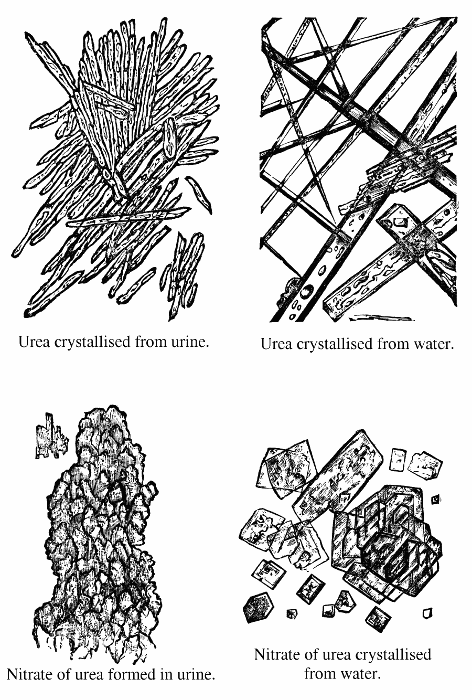
The whole of the cuts illustrating “Urea,” “Urinary diseases,” and “Urine” are taken from Dr Beale’s work on ‘Kidney Diseases, Urinary Deposits, and Calculous Deposits,’ by that gentleman’s kind permission.
“The products resulting from the disintegration of this formed matter may be taken up by the germinal matter of the tissues, and at length become tissue, or by that of secreting cells, in which case it is removed in the form of the constituents of various excretions from the body altogether.” About an ounce and a quarter of urea is daily excreted by a healthy man, although of course there will be a variation in this amount principally depending upon the quantity of animal food and active exercise taken during the twenty-four hours. As might be anticipated a smaller quantity of urea is excreted by women than by men, since they are unable to indulge to the same extent in muscular exercise. A diminished quantity also results from breathing impure air, and from a diseased and unhealthy condition of the lungs or of the circulation, and also, as might be expected, from an insufficiency of food.
Prep. (Thénard.) Fresh urine, gently evaporated to the consistence of a syrup, is treated with its own volume of nitric acid of sp. gr. 1·19; the mixture is shaken and immersed in an ice bath, to solidify the crystals of nitrate of urea (p. 1689); these are washed with ice-cold water, drained, and pressed between sheets of blotting paper; they are next dissolved in water, and the solution is decomposed and precipitated with carbonate of potassium (or carbonate of barium); the whole is then gently evaporated nearly to dryness, and the residuum is exhausted with pure alcohol, which dissolves the urea, which crystallises out as the solution cools.
Urea, Factitious. Mix 28 parts of well-dried ferrocyanide of potassium with 14 of black oxide of manganese (both in fine powder), and heat them to dull redness on an iron plate. Lixiviate with cold water, add 221⁄2 parts of dry sulphate of ammonia, concentrate by evaporation with a heat not exceeding 212° F., decant the concentrated liquid, treat it with rectified spirit, and crystallise. This is intended as a cleanly substitute for the preceding.
Urea, Ni′trate of. Syn. Ureæ nitras, L. Prep. From urine, as described above; or it may be prepared by saturating artificial urea with nitric acid. Diuretic.—Dose, 2 to 5 gr. twice or thrice daily; in dropsy.
U′RIC ACID. C5H4N4O3. Syn. Lithic acid; Acidum lithicum, A. uricum, L. A substance discovered by Scheele, and peculiar to the urine of certain animals, and the excrement of serpents and several birds. The fæces of the boa constrictor consist of little else than urate of ammonium. It constitutes one of the commonest varieties of urinary calculi, and of the red gravel or sand which is voided in certain morbid states of the urine.
Prep. Dissolve the chalk-like excrement of serpents, reduced to fine powder, in a solution of caustic potassa, by boiling; then add hydrochloric acid in excess, again boil for 15 minutes, and well wash the precipitate with water.
Prop., &c. Brilliant, very minute, white and silky scales, which are tasteless, inodorous, slightly soluble in boiling water, and dissolve in strong sulphuric acid, but are again precipitated by water. It forms salts with the bases called urates, all of which are very sparingly soluble. The characteristic reaction of uric acid is, that when moistened with nitric acid and heated, it dissolves, and by evaporation yields a red compound, which, upon the addition of a drop or two of solution of ammonia, assumes a magnificent crimson colour, being converted into murexide.
Uric acid is a constituent of healthy human urine, in which it exists combined with bases in the form of urates, which, being in small quantity, are soluble in the urine. 1000 grains of the urine contain from 1⁄2 grain to 1 grain of the acid. Drs Beale and Thudichum respectively estimate the amount of uric acid excreted in twenty-four hours by a healthy adult man at from 5 to 8 grains. To determine the amount of uric acid in urine proceed as follows:—To a certain weight of the urine, hydrochloric or nitric acid is added, and the urine set aside for some hours, at the end of which time, the insoluble crystals of uric acid which are formed, are washed, dried, and weighed.
With the exception of the urates, uric acid is one of the deposits most frequently met with in abnormal urine, wherein it occurs as a small reddish powder adhering to the bottom or sides of the containing vessel. As a urinary deposit, uric acid assumes a great variety of forms, that of most frequent occurrence being the rhombic, modified in many of the crystals by the rounding of two of the angles, as shown in the engraving on next page.
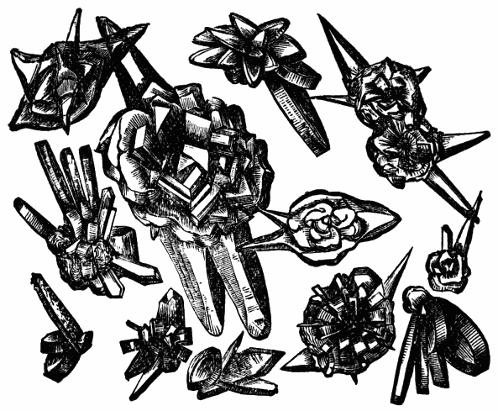
Uric acid. (Beale.)
URINARY DISEASES. This class of disorders, which in general terms may be said to embrace affections of the kidneys, bladder, ureters, &c., comprises diseases of these parts varying greatly in character and pathological importance.
The most serious forms of kidney disease are CONGESTION of the kidney, a very frequent accompaniment of heart or lung disease; PYELITIS, or inflammation of the pelvis of the kidney; SUPPURATIVE NEPHRITIS, or inflammation of the substance of the kidney, which ends in suppuration; ACUTE NEPHRITIS, or acute Bright’s disease, acute inflammation of the kidney, frequently arising from scarlatinaCHRONIC NEPHRITIS, or chronic Bright’s disease, a formidable and incurable variety of kidney affection, giving rise to dropsy, and, owing to the disintegration of the organ, to poisoning of the blood by urea. In advanced cases of this disease the urine contains a large quantity of albumen and casts of the urinary tubes.
Calculus of the Kidney. The most dangerous diseases of the bladder are those caused by the deposition in it of earthy and other concretions, known as URINARY CALCULI, which are described in the present work under Calculus. The presence of these calculi is indicated by acute pain in the bladder and urinary passages, extending to the adjacent parts, the pain being excruciating immediately after passing the urine. Sometimes during the act of excretion the stream of water is suddenly stopped.
Inflammation is another dangerous disease of the bladder, calling for the prompt summoning of the medical practitioner wherever possible.
The following particulars as to its symptoms and treatment are offered for adoption to emigrants and others so placed as to be beyond the means of medical succour.
Inflammation of the bladder commences with pain in the region of that organ, the pain becoming continuous and increasing in violence, and being accompanied with a sense of burning heat and of tenderness on pressure. The urine is frequently voided. The inflammation is sometimes so acute as to give rise to suppuration and the consequent discharge of pus with the urine. Sometimes the disease assumes a chronic character.
In the acute form of the disease recourse should be had to leeches, hot fomentations, and warm baths; a dose of calomel, to be
Should the disease become chronic, the best method of treatment will be the repeated use of mild aperients, the combined employment of uva ursi in infusion or powder, with either tincture of perchloride of iron, or the mineral acids. Spirituous liquors of any kind must be avoided. Demulcent drinks form the best beverage, and a farinaceous or milk diet the most desirable food.
Neuralgia of the Bladder. The pain which attends this disease is unaccompanied either by inflammation or irritation, and is recurrent in character. It may generally be arrested by tincture of perchloride of iron, or of iron and quinine, administered three times a day.
Irritation of the Bladder. The patient affected with this disorder gratifies the frequent desire he has to pass his urine, the operation being accompanied with pain and forcing, the most severe pain being experienced after the excretion has taken place. The tincture of perchloride of iron will also be found the best remedy for this disorder. It should be given in conjunction with the infusions of uva ursi, Pareira brava, or buchu.
Mucilaginous drinks should also be had recourse to.
Catarrh of the Bladder. The symptoms of this disease are irritation, and the presence of much mucus in the urine. The same treatment may be adopted as recommended for irritation of the bladder. If there be an absence of pain, spirits of nitre and copaiba balsam in moderate doses frequently afford relief.
Strangury. Constant micturition, only a few drops of urine passing at the time, occasioning burning and cutting pains around the parts. Strangury is generally due to some irritating cause, which should, if possible, be discovered and removed. Cantharides taken either internally, or applied externally, as in the form of a blister, will sometimes give rise to it. The patient should drink copiously of mucilaginous beverages, such as linseed tea, slippery elm bark, barley water, with gum Arabic dissolved in it. An injection consisting of thirty or forty drops of laudanum in a spoonful of gruel will be found to afford immediate relief. If the above means fail, a pill containing a grain of camphor in five grains of extract of henbane should be given, and a warm bath taken. See Gravel.
U′RINE. The density of the urine varies from 1·005 to 1·030;[247] the average, in health, being 1·020, when it contains about 380 gr. of solid matter in the pint. According to Berzelius, the proportion is about 63⁄4%, the rest being pure water. It exhibits a decidedly acid reaction, and is never alkaline, except during disease, or the use of large quantities of alkaline salts of the vegetable acids. The average quantity secreted during 24 hours may be taken at 2 pints to 3 pints; as might be supposed, a larger quantity is passed during the summer than in the winter months.
Miller gives the following as the composition of healthy urine:
Specific gravity 1·020 In 100 parts of solid matter.
Water 956·80
Solid matters, 43·2. Organic matters, 29·79 Urea 14·23 33·00
Uric acid 0·37 0·86
Alcoholic extract 12·53 29·03
Watery extract 2·50 5·80
Vesical mucus 0·16 0·37
Fixed salts, 13·35 Sodic chloride 7·22 16·73
Phosphoric anhydride 2·12 4·91
Sulphuric anhydride 1·70 3·94
Lime 0·21 0·49
Magnesia 0·21 0·28
Potash 1·93 4·47
Soda 0·09 0·12
Loss 0·03
——— ———
1000·00 100·00
The presence of bile in urine, or other like fluids, may be detected as follows:—Put a small quantity of the suspected liquid into a test-tube, and add to it, drop by drop, strong sulphuric acid, until it becomes warm, taking care not to raise the temperature above 122° Fahr.; then add from 2 to 5 drops of syrup (made with 5 parts of sugar to 4 of water), and shake the mixture. If the liquid contain bile, a violet coloration is observed. Acetic acid may be substituted for sugar.
Another test for bile consists in pouring a little of the suspected urine into a test tube, and adding to it a few drops of tincture of iodine, when if bile be present the fluid becomes distinctly green. Rosenbach says that urine containing bile, when passed through white filtering paper, imparts a yellow or brown colour to the paper. On allowing one drop of strong nitric acid to run down the side of the moist filter it leaves a yellow streak, soon changing to orange, with a violet border, on the outside of which blue and emerald-green zones may be observed. These colours remain visible for some time.
Dark-coloured urine, owing to substances other than bile, does not produce this play of colours.
The reagents most generally employed for detecting the presence of sugar in urine are Trommer’s (see Sugar) and Fehling’s solutions. For the effective application of Fehling’s test, Dr Roberts[248] advises the following method of procedure:—Pour some of the Fehling’s solution into a narrow test tube to the depth of 3⁄4 of an inch; heat until it begins to boil; then add 2 or 3 drops of the suspected urine. If the sugar be abundant, a thick yellow opacity or deposit of yellow suboxide are produced (and this changes to a brick-red at once if the blue colour of the test remains dominant). If no such reaction ensue, go on adding the urine until a bulk nearly equal to the test employed has been poured in; heat again to ebullition, and no change occurring, set aside without further boiling. If no milkiness is produced as the mixture cools, the urine may confidently be pronounced free from sugar, or, at any rate, it contains less than 1⁄40th percent.
If the quantity of sugar is very small, viz. from a 1⁄2 to 1⁄40th per cent., the precipitation of the yellow or cuprous oxide does not take place immediately, but occurs after some time as the liquid cools, and the manner of the change is peculiar. First, the mixture loses its transparency, and passes from a clear bluish green to a light greenish opacity, just as if some drops of milk had fallen into the tube. This green milky appearance is quite characteristic of sugar.
Before using the Fehling’s solution it should be always examined previously to the addition of the urine, by being first boiled alone, when if it remains clear it may be pronounced in fit condition. On the contrary, should the preliminary boiling give a deposit, the solution must be discarded, and some freshly made employed instead.
Böttger has proposed the following quantitative test for the presence of sugar in urine:
He first adds some potash to the sample of urine, and then a small quantity of subnitrate of bismuth, and boils the mixture. If sugar is present, the suboxide is reduced, and metallic bismuth being liberated is precipitated as a black powder.
Another method of applying the bismuth test is as follows:—One part of crystallised carbonate of soda is dissolved in three parts of water, and added to an equal quantity of the urine. A small quantity of basic nitrate of bismuth is then added to the mixture, which is then heated to the boiling point. A black precipitate is formed if the urine contains sugar.
Horsley’s test consists in boiling with the suspected urine a mixture of equal parts of neutral chromate of potash and solution of potash, when, if sugar be present, a green colour will be produced, owing to the formation of the sesquioxide of chromium.
M. Luton’s, which is a modification of Horsley’s test, a solution of bichromate of potash is decomposed by excess of sulphuric acid, and upon the urine being boiled with the mixture, a splendid green colour is imparted to it. Urea, albumin, and the urates do not interfere with this reaction.
Vidau has observed that a mixture of equal parts of hydrochloric acid and oil of brune (oil of sesame), either in the cold, or when slightly heated, assumes a distinct rose colour in the presence of cane or grape sugar, provided 0·001 gramme of sugar is present for every c.c. of mixture.
One of the best methods for the accurate and quick estimation of the amount of sugar in urine is, perhaps, the volumetric, devised by Fehling, who employed a standard copper solution, known as ‘Fehling’s solution,’ of the following composition:
Sulphate of copper 901⁄2 grains.
Neutral tartrate of potash 364 ”
Solution of caustic soda, sp. gr. 1·12 4 fl. oz.
Add water to make up exactly 6 ”
Of this solution 200 grains are exactly decomposed by one grain of sugar.
The following is the mode of performing the analysis given by Dr Roberts[249]:—Measure off 200 grains of the above standard solution in a 200-grain tube, pour this into a flask, and add about twice its volume of water; then place over a spirit lamp to boil. While the copper solution is being heated the urine to be analysed should be diluted with water to a known degree. In the case of ordinary diabetic urines the best dilution is one in ten. This is obtained by carefully filling a 6-ounce measure with water to the depth of 41⁄2 ounces, and then adding urine so as to make up exactly 5 ounces. The mixture will then contain exactly one tenth of urine (when the quantity of sugar in the urine is very small, a dilution of one in five, or even the undiluted urine may be employed). The next step is to fill a burette (which must be graduated to grains) with the diluted urine to 0. Then proceed to add it in successive small portions to the boiling copper solution until the blue colour has entirely disappeared. After each fresh addition from the burette, the mixture should be raised to the boiling point, and then allowed to stand a few seconds, so that the precipitated copper may subside, and the observer may see, by holding the flask between the eye and the light, whether the mixture still retains any blue colour.
As soon as the blue colour has disappeared the analysis is complete, and the quantity of diluted urine may be read off. The percentage of sugar in the urine can now be readily calculated. Suppose 125 grains had been added from the burette, this represents one tenth, or 12·5 grains of undiluted urine, and contains exactly one grain of sugar; by dividing 12·5 into 100 the per-centage of sugar is obtained, or 100⁄12·5 = 8; the urine contains 8 per cent. of sugar.
Another process for the quantitative determination of sugar in urine, called by its author, Dr Roberts, “the differential density method,” is based upon the loss of density, experienced by diabetic urine, after all the sugar has been removed by fermentation. Dr Roberts says repeated examples derived from diabetic urine so treated, together with corresponding experiments made with solutions of sugar of known strength in normal urine, and in pure water, as well as theoretical calculation have warranted the conclusion, that the number of degrees of density so lost indicates as many grains of sugar per fluid ounce.
The method, which is extremely simple, is thus performed:—Into a 12-ounce bottle measure 4 fluid ounces of the diabetic urine, and drop into it a piece of fresh German yeast, about as large as a cobnut or walnut; insert a cork in the bottle, and let the cork have a nick cut in the side, to allow of the escape of the carbonic acid. Then fill an ordinary 4-ounce bottle with the same sample of urine, omitting to add any yeast, and cork it in the ordinary manner. Place both bottles in a warm situation, where the temperature is about 80° or 90° Fahr., for twenty or twenty-four hours; at the end of which time, the fermentation being over, the scum will either have cleared off or subsided. The fermented urine is then poured into a proper urine-glass, and its specific gravity ascertained.
The specific gravity of the unfermented companion portion is also taken, and by comparing the two results the loss of density is thus arrived at. Before the respective densities are taken it is best to remove the two samples to a cool place, where they should remain for two or three hours, in order that they may acquire the temperature of the surrounding air.
The two following examples may serve as illustrations of the method.
I. II.
Density before fermentation 1053 1038
Density after fermentation 1004 1013
Degrees of density lost 49 25
—— ——
Grains of sugar per fluid ounce 49 25
If it be desired to bring out the result as so much per cent., this is accomplished by multiplying the number indicating the “density lost” by the coefficient 0·23. Thus, in the first of the above examples, 49 × 0·23 = 11·27; and in the second 25 × 0·23 = 5·69, which are amounts of sugar respectively per 100 parts.[250]
In taking the densities Dr Roberts advises the operator to employ a urinometer having a long scale, since the degrees are much further apart than in the scales of the short-stemmed instruments, and are therefore more distinct and can be more easily read off.
The following are examples of diabetic urine:
No. 1 (Simon).
Specific gravity 1018·
Water 957·00
Solid constituents 43·00
Urea Traces.
Uric acid Traces.
Sugar 39·80
Extractive matter and soluble salts 2·10
Earthy phosphates 0·52
Albumen Traces.
No. 2 (Dr Percy).
Specific gravity 1042·
Water 894·50
Solid constituents 105·50
Urea 12·16
Uric acid 0·16
Sugar 40·12
Extractive matter, and soluble salts 53·06
No. 3 (Bouchardat).
Water 837·58
Solid constituents 162·42
Urea 8·27
Uric acid Not isolated.
Sugar 134·32
Extractive matters, and soluble salts 20·34
Earthy phosphates 0·38
“Diabetic urine usually possesses a peculiar smell, which has been compared with that of violets, apples, new hay, whey, horses’ urine, musk, and sour milk. Such comparisons serve only to show how difficult it is to give by description a correct idea of a particular odour. The colour of diabetic urine is generally pale. Sometimes, but not usually until after two or three days, the surface becomes coloured with a whitish film, owing to the development of the sugar fungus, and the penicillium glaucum, and gradually the urine becomes opalescent in consequence of these fungi multiplying in great numbers in every part of the fluid. See Urinary deposits (FUNGI).
“Diabetic urine has a sweet taste, and often numbers of flies are attracted to it, which fact sometimes leads the patient to suspect that the urine is not healthy.”[251]
White merino, that has been wet with a solution of bichloride of tin, is also said to form a ready test for sugar in urine.
Albumen in urine may be detected by the nitric acid, or by the heat test. The nitric acid test is performed as follows.—Fill a test tube to about an inch with the urine, then incline the tube and pour in strong nitric acid down the side of the tube, so that the acid sinks to the bottom and displaces the urine, which by reason of its smaller specific gravity rests above it. Let the acid be added till it forms a stratum about a quarter of an inch thick at the bottom.
If the urine contain albumen three layers will be perceptible—one, perfectly colourless, of nitric acid at the bottom; immediately above this an opalescent zone of the coagulated albumen; and, on the top, the unaltered urine.
In his work, ‘Kidney Diseases and Urinary Deposits,’ Dr Lionel Beale directs attention to the very important fact that “two or three drops of nitric acid to about a drachm of albuminous urine in a test tube will produce a precipitate of albumen which will be dissolved on agitation, while, on the other hand, about half as much strong nitric acid as there is of urine will redissolve the precipitate of albumen, unless the quantity present be excessive. Albumen precipitated by nitric acid is soluble in weak nitric acid, and in a considerable excess of urine, and it is also soluble in strong nitric acid. It is therefore necessary in employing the nitric acid test to add from ten to fifteen drops of the strong acid to about a drachm of the urine suspected to contain albumen.”
Dr Roberts gives the following directions for applying the heat test:—If the urine have its usual acid reaction it becomes turbid on boiling when it contains albumen, and this turbidity persists after the addition of an acid. There are two points to be remembered on using heat alone as a test for albumen. First, that albumen is not coagulated by heat when the urine is alkaline; in such cases, therefore, it is necessary before boiling to restore the acidity by a few drops of acetic acid (carefully avoiding excess). Secondly, when the urine is neutral or very feebly acid, it may become turbid on heating, from precipitation of the earthy phosphates, but turbidity from this cause is easily distinguished from albumen by a drop of nitric or acetic acid, which instantly causes the phosphates to disappear. It may sometimes happen that the patient whose urine is to be submitted to examination for albumen may be taking large doses of nitric or hydrochloric acid. Under these circumstances Dr Bence Jones recommends the addition of ammonia to the urine, nearly to the point of neutralisation.
Mr Louis Siebold proposes a modification of Dr Roberts’s method of applying the heat test in acid states of the urine, which is as follows:—Add solution of ammonia to the urine until just perceptibly alkaline, filter, and add diluted acetic acid very cautiously until the urine acquires a faint acid reaction, avoiding the use of a single drop more than is necessary. Now place equal quantities of this mixture into two test tubes of equal size, heat one of them to ebullition, and compare it with the cold sample contained in the other test tube. The least turbidity is thus distinctly observed, and gives absolute proof of the presence of albumen, the error of confounding phosphates with albumen being out of the question, as they are precipitated by the ammonia and removed by filtration.
M. Galipe[252] says the following is a delicate as well as trustworthy test for albuminous urine. A few drops of the urine are carefully added to a solution of picric acid contained in a small conical test glass. If albumen be present a well-marked turbidity will be produced at the point of contact
In order to determine the quantity of albumen in urine proceed as follows:—Add a little acetic acid to the urine, and then heat it in a water bath until it boils. Or the albuminous urine may be dropped into boiling water acidulated with acetic acid. In either case collect the precipitate on a weighed filter, wash it well, dry it, and weigh it. The albumen must afterwards be incinerated, and the resulting residue, which consists of earthy salts, must be deducted from the dried precipitate.
Stolnikow[253] adopts the following method for the quantitative estimation of albumen in urine:—The urine is diluted with water until a sample poured upon some nitric acid contained in a test tube produces still a faint white ring at the point of contact after the lapse of forty seconds. The number of volumes of water added to the volume of urine (which may be taken as one) is divided by 250, and the quotient will be the percentage of albumen in the urine. This relation has been established and confirmed by gravimetric determinations.
It is sometimes desirable to remove the albumen from the urine before proceeding to search for other substances. There are several methods of accomplishing this. If the urine be boiled the albumen will become coagulated, but in many cases it may happen, owing to the urine being slightly alkaline or neutral, that a small quantity may remain in solution. Hence it will be advisable to add a little acetic acid to the urine before applying heat to it, to remove the precipitated matters by filtration, and to exactly neutralise the acid in the filtrate. If a few crystals of sulphate of soda be heated with albuminous urine, the albumen and allied matters may be entirely removed without injury to other organic matters dissolved, and without interfering with the employment of other reagents. When it is desirable to free the urine from albumen previous to testing for sugar, this latter method will be found the best and most convenient.
The following analyses represent the amount of albumen present in the urine of two patients suffering from Bright’s disease:
No. 1 (Simon).
Specific gravity 1014·
Water 966·10
Solid constituents 33·90
Urea 4·77
Uric acid 0·40
Fixed salts 8·04
Extractive matters 2·40
Albumen 18·00
No. 2 (Dr Percy).
Specific gravity 1020·
Water 946·82
Solid constituents 53·18
Urea 7·68
Uric acid, and indeterminate animal matter 17·52
Fixed soluble salts 5·20
Earthy phosphates 0·14
Albumen 22·64
Dr Parkes records the case of a patient suffering from albuminuria, who excreted 545 grains of albumen in twenty-four hours. See Urates.
Urine frequently contains an abnormally large quantity of urea. Such urine is of high specific gravity—1·030 or more. When present in large excess the urea becomes deposited in ‘sparkling crystalline lamellæ’ of the nitrate, if it be mixed with an equal quantity of strong nitric acid in the cold.
The crystals vary slightly in character, according to the amount of nitric acid employed and the degree of concentration of the urine. Urine which thus yields, without previous concentration, the nitrate, is said to contain an excess of urea. See page 1689.
The quantity of urea present in urine is best determined by a process invented by Liebig. When a solution of pernitrate of mercury is added to one of pure urea the urea and mercuric salt unite and form an insoluble compound, of undetermined constitution. If, however, the chlorides of the alkalies and alkaline earths are present, this combination does not take place, owing to the decomposition of the mercuric nitrate, and the formation of bichloride of mercury, and a nitrate of the alkali or alkaline earth, both of which are soluble. When, however, the decomposition of the chloride has been completed, the urea may be entirely precipitated, provided a sufficient quantity of mercuric nitrate be added to the solution. In estimating the amount of urea in urine, therefore, it is only necessary to add to the urine a solution of the mercuric salt of known strength, since from the quantity of this latter which has been employed in throwing down the urea, this can easily be calculated.
In performing this analysis, three special solutions are requisite:
1. A solution consisting of one part by measure of a cold saturated solution of barium nitrate with two parts (also by measure) of saturated baryta water. This serves for the removal of the phosphates and sulphates, the presence of which in the urine would interfere with the analysis.
2. The standard solution of mercuric nitrate, which is made as follows:—772 grains of red oxide of mercury placed in a beaker are dissolved in a sufficient quantity of nitric acid (sp. gr. 1·20) by a gentle heat, and evaporatedexcess of free acid is driven off. This may be known by the liquid becoming dense and syrupy in appearance. It is then poured into a properly graduated vessel and diluted to 10,000 grain-measures. Of this solution, 10 grain-measures = 0·1 grain of urea.
3. A solution of carbonate of soda in distilled water, 20 grains to the ounce. This solution is employed to indicate when the titration is complete, and to show the operator that all the urea has been precipitated by the mercuric salt.
The operation is thus performed:
(a.) 400 grain-measures of the clear urine are mixed with 200 grain-measures of the baryta solution, No. 1. The mixture is poured into a filter, and of the clear filtrate which passes through 150 grain-measures are carefully measured off, and poured into a small beaker. This quantity of course contains two thirds, or 100 grain-measures of wine.
(b.) A graduated burette (each division of which equals a grain-measure of water) is next filled with the solution (No. 2) of mercuric nitrate, which is then dropped into the beaker containing the filtered urine, until the mixture becomes turbid. The quantity of solution that has been required to just reach the point of turbidity is then noted down; it shows that all the chloride of sodium has been decomposed, and that the urea is now beginning to precipitate.
(c.) The solution (No. 2) is now added more liberally, and thoroughly mixed with the contents of the beaker by means of a glass rod; a copious white precipitate is being formed. The operation is completed, when, of course, no more precipitate is thrown down.
(d.) This point is ascertained by means of the solution of carbonate of soda (No. 3), to a few isolated drops of which dotted about a white plate, or slab, or placed on a watch glass, give, when mixed by means of the stirring rod with a drop of the turbid mixture from the beaker, a yellow tinge, owing to the formation of hydrated oxide of mercury.
(e.) The quantity of solution of mercuric nitrate that it has taken to produce the above reaction is then noted down, and from this the portion used before the occurrence of the turbidity is deducted, the remainder, of course, being the amount required to precipitate the urea. By bearing in mind the statement already made that 10 grain-measures of the mercurial solution indicate 0·1 grain of urea, the quantity excreted in 24 hours may be arrived at by a very easy and obvious calculation.
Dr Davy’s method of estimating Urea. This consists in the decomposition of a known quantity of urine by sodium hypochlorite, the amount of urea being calculated from the resulting nitrogen. A glass tube, 12 or 14 inches in height, and graduated to tenths and hundredths of a cubic inch, is filled to more than a third of its length with mercury; a measured quantity of urine, varying from a quarter of a drachm to a drachm, is next poured into the tube, which is then filled up with a solution of sodium hypochlorite (the liquor sodæ chlorinatæ of the Dublin Pharmacopœia). This latter must be poured in quickly, and the open end of the tube immediately closed with the thumb. The tube is then shaken to ensure admixture between the urine and hypochlorite, and stood with the open end downwards in a cup filled with a saturated solution of common salt; the mercury escapes into the tube, its place being filled by the solution of salt, which being heavier than the mixture of urine and hypochlorite, retains them in the upper part of the tube. The urine becomes soon decomposed, the carbonic acid, which is one of the products of its decomposition, being absorbed by the excess of chloride of sodium present, whilst the liberated nitrogen bubbles up to the top of the tube. When no more evolution of gas takes place, the volume of nitrogen is read off, and from its amount the quantity of urea present in the amount of urine experimented upon is calculated: one-fifth of a grain of urine = 0·3098 parts of a cubic inch of nitrogen at 60° Fahr. and 30” barometric pressure.
Haughton’s method of estimating Urea from the specific gravity of the Urine. After having measured the urine voided during 24 hours, and determined the specific gravity of the whole collected amount, and then consulting the accompanying table, compiled by Professor Haughton, the number of grains of urea excreted per diem is immediately ascertained. This quantity will be shown by the figures which stand at the points where the lines running respectively from the number of fluid ounces and the ‘specific gravity’ intersect each other. Thus, suppose the daily amount of urine to have been 30 ounces, and the specific gravity 1006, the number of grains of urea contained in it will be 85. This method is inserted for urines containing sugar and albumen.
Determination of the Water. The amount of water in any sample of urine may be determined by weighing 1000 grains of the recently excreted urine into a counterpoised platinum or porcelain dish, and ascertaining the loss it has undergone after evaporation to dryness. The operation should be performed as speedily as possible. The best plan is to concentrate the urine in a water bath, the evaporation should be continued in vacuo over strong sulphuric acid, until the weight of the residue remains constant. By way of control, another sample of the same urine, consisting of 500 grains, may be operated upon at the same time, and under the same conditions.
Urinary Deposits, &c. These differ from the albumen, sugar, bile, &c., previously described, in being insoluble in abnormal
Of the numberless insoluble substances met with in urine, both in health and disease, our limits will only permit us to notice those which are most important, and of frequent occurrence.
For the detection of the generality of these the microscope is indispensable. An instrument magnifying 200 to 220 diameters (1⁄4 of inch objective) will generally be found sufficiently powerful, and in some instances an inch objective, magnifying 40 diameters (as in the larger forms of crystalline deposit) will answer all the purposes.
Some of the varieties of these deposits admit of a double examination, viz. a microscopical and chemical one. When this is the case, the particulars applying to each kind of investigation will be given.
Mucus. Mucus is always present in small quantity in healthy urine, in which it shows itself within a few hours after the urine has been excreted in the shape of a transparent cloud towards the bottom of the vessel containing the urine.
Pus. The presence of pus in urine is indicated by an opaque, more or less bulky, cream-like deposit at the bottom of the vessel holding the urine, to which some separated pus globules, finding their way to the supernatant liquid, give an appearance of slight turbidity. By shaking the vessel the whole of the liquid becomes turbid, owing to the equal dissemination through it of the pus globules. The pus again deposits on standing. A small quantity of albumen is always met with in the clear part of urine which contains pus; the albumen being derived from the liquor puris, the liquid by which the pus-corpuscles are surrounded.
Whenever it can be obtained in sufficient quantity, pus should always be examined chemically, as follows:—The supernatant urine being decanted, the suspected sediment is shaken up with liquor potassæ, when if it become converted into a gelatinous, viscid substance, incapable of being dropped from the tube, and when poured from it running as a slimy and almost continuous mass, it may be pronounced pus. This same gelatinous viscid mass is met with in alkaline urines containing pus, adhering to the sides of the vessel in which the urine is placed, where it has been formed by the action of the carbonate of ammonia (caused by the decomposition of the urea) upon the pus. The reaction upon the pus is the same as that which takes place when liquor potassæ is employed. The stringy viscid substance due to the last cause is frequently, but erroneously, termed mucus.
Professor Haughton’s Table for the Estimation of the Daily Excretion of Urea from the Specific Gravity.
Fluid Ounces. Specific Gravity.
1003 1004 1005 1006 1007 1008 1009 1010 1011 1012 1013 1014 1015
20 35 36 43 57 71 85 100 103 106 119 130 136 142
22 38 40 47 62 78 95 110 113 116 130 149 142 156
24 42 43 51 68 85 101 120 123 127 142 156 163 170
26 45 47 55 73 92 110 130 131 137 153 169 176 184
28 48 50 59 79 99 118 140 144 148 165 182 190 198
30 52 54 64 85 106 127 150 155 159 177 195 204 213
32 55 57 68 90 113 135 160 165 169 188 208 217 227
34 58 61 72 96 120 144 170 175 180 200 221 231 241
36 61 64 76 102 127 153 180 185 191 212 234 244 255
38 65 68 80 108 134 161 190 195 201 224 247 258 269
40 69 72 85 114 142 170 200 206 212 236 260 272 284
42 74 75 89 119 148 178 210 216 222 247 273 285 298
44 76 79 93 125 156 186 220 226 233 259 286 299 312
46 80 82 96 130 163 195 230 236 243 271 299 312 326
48 84 86 101 136 170 203 240 246 254 283 312 326 340
50 87 90 106 142 178 212 250 257 265 295 325 340 355
52 90 94 110 147 185 220 260 267 276 307 338 353 369
54 94 98 114 153 192 229 270 277 286 319 351 367 383
56 96 100 119 159 199 238 280 288 297 331 364 380 397
58 100 104 123 165 206 246 290 298 308 343 377 394 411
60 104 108 128 171 213 255 300 309 310 355 391 408 426
62 108 110 132 176 220 263 310 319 329 404 421 440 468
64 110 114 136 182 227 271 320 329 340 378 417 435 454
66 114 118 140 187 234 280 330 340 351 390 431 448 468
68 116 122 144 193 240 288 340 350 361 402 443 462 482
70 120 126 149 199 248 297 350 361 372 414 456 476 497
72 122 128 153 204 255 305 360 371 382 425 469 489 511
74 126 132 157 210 262 314 370 381 393 437 482 503 525
76 130 136 161 216 269 323 380 391 404 449 595 516 539
78 134 140 165 222 276 331 390 401 414 461 508 530 553
80 139 144 170 228 284 340 400 412 445 473 521 544 568
Fluid Ounces. Specific Gravity.
1016 1017 1018 1019 1020 1021 1022 1023 1024 1025 1026 1027 1028
20 151 160 196 233 241 249 257 265 274 276 278 279 280
22 166 176 215 257 265 274 282 292 301 303 305 306 308
24 181 192 235 280 289 299 308 319 329 331 333 334 336
26 196 208 254 303 313 324 334 346 356 359 360 362 364
28 221 224 274 326 337 349 360 372 383 386 388 390 392
30 226 240 294 349 361 374 386 399 411 414 416 418 420
32 241 256 313 373 385 398 411 425 438 442 443 446 448
34 256 272 333 396 409 423 437 451 466 469 471 474 476
36 271 288 352 419 433 448 462 477 493 497 499 502 504
38 286 304 372 442 457 473 488 503 520 524 527 530 532
40 302 320 392 465 484 498 514 530 548 552 555 558 560
42 317 336 411 489 506 523 540 557 575 580 582 585 588
44 332 352 431 512 530 548 556 584 603 607 610 613 616
46 347 368 450 535 554 573 592 611 630 635 638 641 644
48 362 384 470 558 578 598 618 637 657 662 666 669 672
50 377 400 490 581 602 623 644 665 685 690 694 697 700
52 393 416 509 605 626 648 669 692 711 718 721 724 728
54 408 432 529 628 650 673 695 718 740 745 749 752 756
56 423 448 548 651 674 698 720 745 767 772 776 780 784
58 438 464 568 674 698 723 746 772 794 800 804 808 812
60 453 480 588 697 722 748 772 798 822 828 832 836 840
62 496 607 719 746 772 797 824 849 856 859 864 864 868
64 483 512 627 742 770 797 823 851 877 883 887 862 896
66 498 528 646 766 794 822 849 877 904 911 915 920 924
68 513 544 666 790 818 847 875 904 931 939 943 948 954
70 528 560 686 814 843 872 901 930 959 966 971 976 980
72 544 576 705 838 867 896 926 956 986 994 998 1004 1008
74 558 592 725 861 891 921 951 982 1014 1021 1026 1032 1036
76 573 608 745 884 915 946 977 1008 1041 1049 1054 1060 1064
78 588 624 765 907 939 971 1002 1034 1068 1076 1082 1088 1092
80 604 640 785 930 964 996 1028 1060 1096 1104 1110 1116 1120
In urines containing pus, the clear portion should always be examined for albumen, since where this is found, except in small amount, some form of kidney disease may be suspected.
But it sometimes happens that the pus is present in such small quantity in the urine as to preclude its chemical examination. Under these circumstances, recourse must be had to the microscope. Dr Lionel Beale says, “Pus-globules, which have been long removed from the body, always have a granulated appearance in the microscope, and, when fresh, do not always exhibit a well-defined nucleus; the outline is usually distinct and circular, but it is finely crenated. Upon the addition of acetic acid the globule increases somewhat in size, becomes spherical, with a smooth, faint outline, and from one to four nearly circular bodies are developed in the centre of each. If the pus-corpuscles have lain some days in the urine they will have undergone complete disintegration.”
Epithelium. A great many varieties of epithelium, derived from different parts of the kidneys, ureters, bladder, urethra, vagina, &c., are more or less present in urine. A few of these are given in the accompanying engraving. In the various diseases peculiar to the urinary and genito-urinary organs the quantity of epithelium present in the urine is frequently considerable, and as in some cases it presents itself in an imperfect or disintegrated form, its identification, except to the experienced microscopist and physiologist, becomes a matter of great difficulty.
Casts. Casts or moulds which have been formed in the tubes of the kidneys, or in the uterus and vagina, are constantly finding their way into the urine of persons affected with acute or chronic renal diseases and uterine affections. They are very varied both in character and appearance, and difficult of recognition, except by the skilled microscopist and pathologist.
Blood-corpuscles. These, when present in quiescent urine, occur as a sediment at the bottom of the vessel. Some few globules, however, are diffused throughout the supernatant urine, and impart to it a smoky appearance, if the fluid have a marked acid reaction; whereas if the reaction be alkaline the corpuscles assume a bright red colour.
In the accompanying plate the three upper groups represent blood-corpuscles taken from the human body; the three lower those found in urine. Of these latter some will be seen to have lost their circular outline, and to have become jagged or crenated. In some cases,
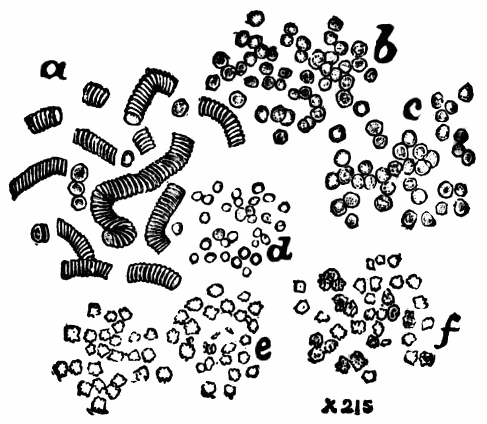
(Beale.)
Fungi. The chief vegetable organisms found in urine are the sugar fungus and the Penicillium glaucum. The sugar fungus is precisely the same as the yeast plant (the Torula cerevisiæ). The Penicillium is very frequently present in albuminous urine, with an acid reaction, as well as in diabetic.
Uric acid. See back.
Urates.—According to Bence Jones the soluble urates met with in healthy urine consist of uric acid, potassium, ammonium, and sodium.
In abnormal urine the urates of ammonium and sodium sometimes occur, the latter, which are the more general, presenting under the microscope the appearance shown below.
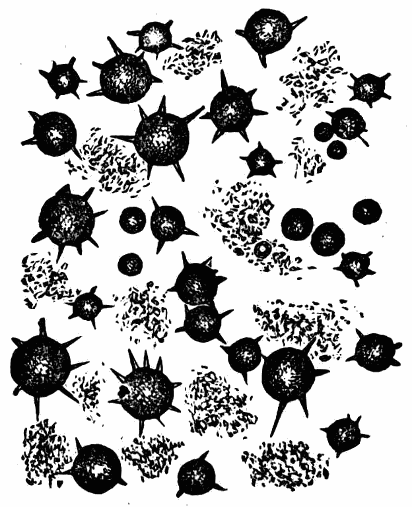
(Beale.)
Urate of sodium is, however, much more common in the urine of children than of adults, when it presents itself in the form of spherical crystals.
In both cases the urates are associated with uric acid (resulting from their partial decomposition), represented by the small spiked crystals protruding from the spheres in the form of needle-shaped crystals. Urate of sodium occurs as the concretions known as ‘chalk stones’ in gout. But by far the most abundant kind of urates met with in abnormal urine is that known as amorphous urates, which constitute the most common variety of urinary deposits.
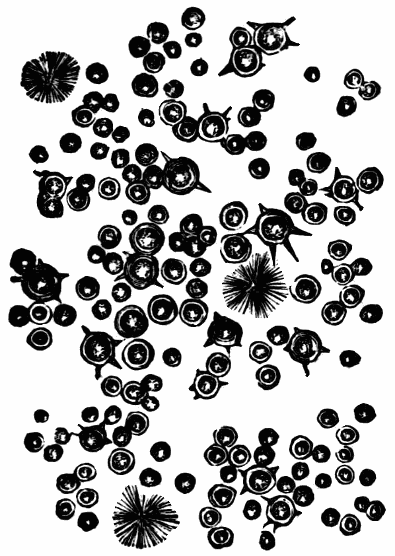
Urate of soda in a globular form commonly found in the urine of children.
Heintz states that they are a mixture of urate of sodium with small quantities of the urates of ammonium, lime, and magnesium. They are very frequently seen in the urine of persons in excellent health, in which, owing perhaps to too abundant or nitrogenous diet and an insufficiency of muscular exercise, being in excess, they are thrown down when the urine cools.
An excess of the amorphous urates in urine, like the presence of pus and phosphates, is indicated by the bulky precipitate more or less diffused throughout the vessel containing the urine. A very easy test will decide as to which of the three classes of substances (if only one of them be present) the precipitate belongs. The supernatant fluid being decanted from the deposit, about an equal bulk of liquor potassæ is added to the latter, when one of three results will ensue:
1. If it be pus, and become viscid, it will exhibit the qualities already mentioned under the description of that substance.
2. If phosphates, no alteration will ensue.
3. If amorphous urate, it will at once dissolve.
When amorphous urates are uniformly distributed throughout the urine they give it a milky appearance, which may sometimes lead to its being mistaken for chylous urine, or urine throughout which fatty particles of chyle are diffused. This latter doubt, however, may be easily set at rest by gently heating it. If the turbidity is owing to the urate it will disappear; if to chyle it will remain.
If the amorphous urate be decomposed by a little hydrochloric acid, it will yield uric acid, easily recognised by its characteristic form under the microscope, or when treated with nitric acid and ammonia, will answer to the murexed test.
It sometimes happens that in testing an acid urine suspected to contain albumen, the urine may contain so large an amount of uric acid in solution that, upon adding a drop of nitric acid to it, a bulky precipitate of uric acid, exactly resembling albumen, is thrown down, and it may be erroneously regarded as this substance if examined under the microscope immediately upon its formation. Upon being allowed, however, to stand some time, and then placed under the microscope, the well-known crystals of the acid will reveal themselves.
In such urine no precipitate takes place when the liquid is heated, another essential feature in which it diverges from albumen.
Phosphates.—The urinary earthy phosphates occur under two varieties, viz. the phosphate of ammonia and magnesia, known as the triple phosphate, and the phosphate of lime.
In the engravings below, the principal crystalline forms of the triple phosphate are shown.
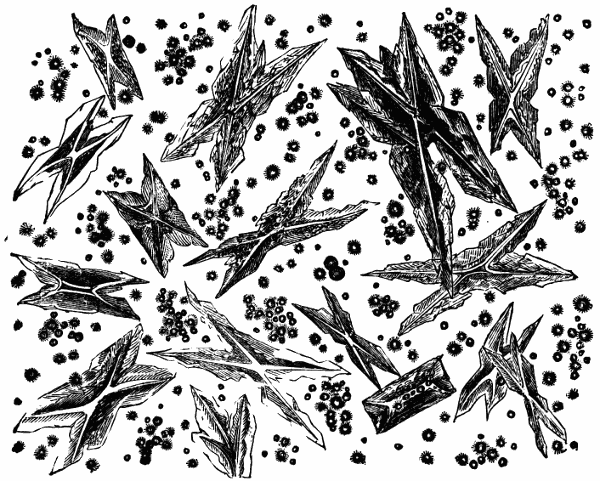
Fig. 1.—Crystals of triple phosphate with spherules of urate of soda. (Beale.)
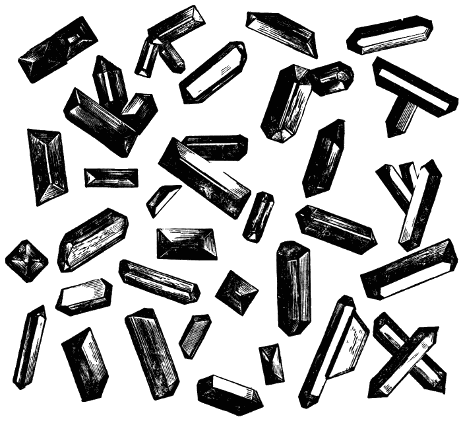
Fig. 2.—Crystals of triple phosphate with triangular prisms, with truncated extremities. (Beale.)
Of these the triangular prismatic, with the truncated extremities, is the most common. In some cases the prisms are so much reduced in length as to resemble the octahedral crystals of oxalate of lime, for which they are sometimes mistaken by the inexperienced. When any doubt exists on this point it must be set at rest by having recourse to the chemical tests given further on. The triple phosphate is rarely met with alone, urate of ammonia, and sometimes uric acid and oxalate of lime, being present, although generally occurring in neutral or alkaline urine. The triple acid is sometimes found in that which is acid.
When ammonia is added to fresh urine the triple phosphate is precipitated, and if it be then examined by the microscope it will be found to consist of beautiful stellate crystals, and to form a most attractive object. The presence of phosphoric acid can be demonstrated by the ordinary reagents.
Phosphate of lime dissolves in strong acids without effervescence. The presence of lime, as well as of phosphoric acid, can easily be verified by the usual tests.