A CYCLOPÆDIA OF PRACTICAL RECEIPTS, &c. VOLUME II (continued 22)
Reading edition
The principal use of crude picric acid is for dyeing yellow. It is said to be largely employed for the adulteration of beer. It is, however, highly poisonous. According to Prof. Rapp, it acts deleteriously both when swallowed and applied to the unsound skin. Five grains seriously affected a large dog, and killed it within twenty-four hours. It induces vomiting, feebleness, and general loss of nervous tone. The tissues of animals poisoned by it (even the white of the eye) were tinged of a yellow colour. See Porter, &c.
PICROTOX′IN. C12H14O5. Syn. Picrotoxine, Pictrotoxia, Picrotoxina. A poisonous principle discovered by Boullay in the fruit of Anamirta paniculata, or Cocculus indicus.
Prep. 1. Precipitate a decoction of Cocculus indicus with a solution of acetate of lead, gently evaporate to dryness, redissolve the residuum in alcohol of ·817, and crystallise by evaporation; repeat the solution and crystallisation a second and a third time. Any adhering colour may be removed by agitating it with a very little water; or by animal charcoal, in the usual manner.
2. (Kane.) Alcoholic extract of Cocculus indicus is exhausted with the smallest possible quantity of water, and the mixed liquors filtered; to the filtrate hydrochloric acid is added, and the whole set aside to crystallise. The product may be purified as before.
Prop., &c. It forms small, colourless, stellated needles; soluble in alcohol, ether, and acetic acid, and feebly so in water; boiling water dissolves it freely; taste of solutions inexpressibly bitter; reaction neutral. It does not combine with acids, as formerly asserted, but it forms feeble combinations with some of the bases. It is a powerful intoxicant and narcotico-acrid poison. It acts powerfully on the spinal cord and nervous system generally, occasioning an increase of the animal temperature, and peculiar movements, similar to those described by Flourens as resulting from sections of the cerebellum. It is frequently present in malt liquors, owing to their common adulteration with Cocculus indicus.
PICTURES, Oil. To clean. See Paintings, Oil.
PIERRE DIVINE. Syn. Cuprum aluminatum. See Lapis divinus.
PIES. Alexis Soyer gives the following instructions for making pies:—
To make a pie to perfection,—when your paste (half-puff or short) is carefully made, and your dish or form properly full, throw a little flour on your paste-board, take about a 1⁄4 lb. of your paste, which roll with your hand until (say) an inch in circumference; then moisten the rim of your pie-dish, and fix the paste equally on it with your thumb. When you have rolled your paste for the covering, or upper crust, of an equal thickness throughout, and in proportion to the contents of your pie (1⁄2 inch is about the average), fold the cover in two, lay it over one half of your pie, and turn the other half over the remaining part; next press it slightly with your thumb round the rim, cut neatly the rim of the paste, form rather a thick edge, and mark this with a knife about every quarter of an inch apart; observing to hold your knife in a slanting direction, which gives it a neat appearance; lastly, make two small holes on the top, and egg-over the whole with a paste-brush, or else use a little milk or water. Any small portion of paste remaining may be shaped to fanciful designs, and placed as ornaments on the top.
“For meat pies, observe that, if your paste is either too thick or too thin, the covering too narrow or too short, and requires pulling one way or the other, to make it fit, your pie is sure to be imperfect, the covering no longer protecting the contents. It is the same with fruit; and if the paste happens to be rather rich, it pulls the rim of the pie to the dish, soddens the paste, makes it heavy, and, therefore, indigestible as well as unpalatable.”
Meat pies require the addition of either cayenne, or black pepper, or allspice; and fruit pies, of enough sugar to sweeten, with mace, ginger, cloves, or lemon peel, according to taste and the substance operated on. See Pastry, &c.
PIG. The pig or hog (Sus scrofa—Linn.), one of the common pachydermata, is now domesticated in all the temperate climates of the world. Its flesh constitutes pork, bacon, ham, &c.; its fat (lard) is officinal in the Pharmacopœias. The skin, bristles, and even the blood and intestines of this animal, are either eaten as food or turned to some useful purpose in the arts. See Pork, Leather, &c.
PIG′MENTS. These are noticed under the respective colours.
PIG-STYE. In order that a pig-stye may not become a nuisance and a danger to health it is essential that the liquid excrement of the pig should be carried off by means of an effective and well-covered drain, and that the solid matters should be frequently removed.
Should it come to the knowledge of the sanitary inspector of the district that a pig-stye is deficient in this particular, the inspector has power to compel the owner of the stye to construct proper drainage.
Urban authorities have full powers in the matter of pig-styes, since under section 26 ofs. or less, and to a further penalty (if the offence is continued) of 5s. a day. The authority can also, if they choose, abate the nuisance themselves, and recover the expenses of such action from the occupier of the premises in a summary manner.
A rural authority has power to deal with the matter under provision 3, section 91, of the Public Health Act, which defines as a nuisance “any animal so kept as to be a nuisance or injurious to health.”
PIKE. The Esox lucius (Linn.), a fresh-water fish. It is remarkable for its voracity, but is highly esteemed by epicures. Various parts of it were formerly used in medicine. The fat (OLEUM LUCII PISCIS) was one of the simples of the Ph. L. of 1618, and was esteemed as a friction in catarrhs. It is even now used in some parts of Europe to disperse opacities of the cornea.
PIL′CHARD. The Clupea pilchardus, a fish closely resembling the common herring, than which, however, it is smaller, but thicker and rounder and more oily. It abounds on the coasts of Devon and Cornwall, where it is not only consumed as food, but pressed for its oil.
PILES. Syn. Hemorrhoids; Hæmorrhoides, L. A painful disease occasioned by the morbid dilatations of the veins at the lower part of the rectum and surrounding the anus.
Piles are principally occasioned by costiveness and cold; and, occasionally, by the use of acrid food. They have been distinguished into—BLIND PILES, or a varicose state of the veins without bleeding,—MUCOUS PILES, when the tumours are excoriated, and mucus or pus is discharged,—BLEEDING PILES, when accompanied with loss of blood, and—EXCRESCENTIAL PILES, when there are loose fleshy excrescences about the verge of the anus and within the rectum.
The treatment of piles consists in the administration of mild aperients, as castor oil, or an electuary of sulphur and cream of tartar. When there is much inflammation or bleeding, cold and astringent lotions, as those of sulphate of zinc or alum, should be applied; and when the pain is considerable, fomentations of decoction of poppy heads may be used with advantage. To arrest the bleeding, ice is also frequently applied, but continued pressure is more certain. When the tumours are large and flaccid, the compound ointment of galls is an excellent application; and if there is a tendency to inflammation, a little liquor of diacetate of lead may be added. In confirmed piles the internal use of copaiba, or, still better, of the confection of black pepper, should be persevered in for some time, together with local applications. In severe cases the protruded tumours are removed by surgeons, by the knife or ligature. See Ointments, Electuaries, &c.
PILL COCHIA. See Compound Colocynth Pills (below).
PILL RUFI. See Pills of Aloes with Myrrh (below).
PILLS. Syn. Pilulæ (Ph. E. & D.), Pilula (Ph. L.), L.; Pilules, Saccharolés solides, Fr. Pills are little balls, of a semi-solid consistence, composed of various medicinal substances, and intended to be taken whole. The facility with which they are made and administered, their comparatively little taste, their power of preserving their properties for a considerable length of time, and, lastly, their portability and inexpensiveness, have long rendered them the most frequently employed and the most popular form of medicine.
The rapid and skilful preparation of pills, from all the numerous substances of which they are composed, is justly considered to demand the highest qualifications in the practical dispenser. The medicinals employed must be made into a consistent and moderately firm mass, sufficiently plastic to be rolled or moulded into any shape, without adhering to the fingers, knife, or slab, and yet sufficiently solid to retain the globular form when divided into pills. A few substances, as certain extracts, &c., are already in this condition; but the others require the use of an excipient to give them the requisite bulk or consistence. As a general rule, all the constituents of a pill which can be pulverised should be reduced to fine powder before mixing them with the soft ingredients which enter into its composition; and these last, or the excipient, should next be gradually added, and the mixture triturated and beaten until the whole forms a perfectly homogeneous mass. It is then ready to be divided into pills. This is effected by rolling it on a slab, with a pill or bolus knife, into small pipes or cylinders, then dividing these into pieces of the requisite weight; and, lastly, rolling them between the thumb and finger to give them a globular form. A little powdered liquorice-root or starch is commonly employed to prevent the pills adhering to the fingers, or to each other, after they are made. Magnesia, so frequently used for this purpose, is unsuited for pills containing metallic salts or the alkaloids, or other remedies, which are exhibited in very small doses.
Instead of forming the mass into pills by hand, in the manner just referred to, a convenient and simple instrument, called a ‘pill-machine,’ is now generally used by the druggists for the purpose. This consists of two pieces. The first (see fig. 1) is divided into three compartments:—c is a vacant space to receive the divided mass, which is to be rolled into pills:—b is a grooved brass plate, which assists in dividing the mass into pills; and a is a box for containing the powder for covering the pills, and to receive them as theya), grooved to match the plate b in fig. 1, and bounded at both ends by movable projecting plates (b b), containing each two wheels under the ledge of the plate (b); and a wooden back (c), with two handles (d d), to which this plate is affixed. In using this machine, the pill-mass is rolled into a cylindrical form on the front part of it, by means of fig. 2 inverted; the small roll is then laid on the cutting part of the instrument (1, b), and divided by passing fig. 2 over it, the little wheels enabling the latter to run easily on the brass plate which forms the margin of the bed of the machine. The pills, thus formed, are then drawn forward on to the smooth bed on which the mass was first rolled, and receiving a finishing turn or two with the smooth side of the ‘cutter,’ by which they are rendered more nearly spherical. They are, lastly, thrown over into 1, c, ready to be transferred to the pill-box.
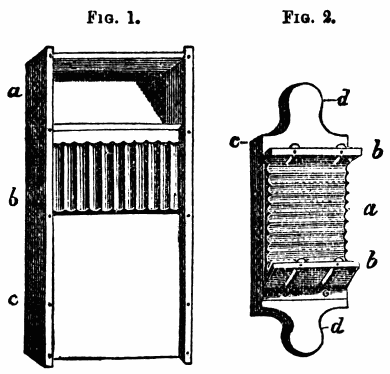
Fig. 1 and Fig. 2.
The nature of the excipient should be suited to that of the active ingredients in pills, as well as in all other forms of medicine. Furthermore, it should be of such a nature “that,” to quote Dr Redwood, “it will modify as little as possible the action of the pills, either by causing them to become hard, or in any other way, and will not unnecessarily or inconveniently increase their size.” Soft extracts, and other substances of a like character, may be rendered more consistent by the addition of any simple powder, as that of liquorice or sugar. Vegetable powders are generally beaten up with syrup or treacle, and heavy powders with conserve of roses or extract of liquorice. Castile soap (made of olive oil and soda) and medicinal soft soap (made of olive oil and potash) are commonly employed for fatty and resinous matters, as well as for many others which are not decomposed by alkalies. When the chief ingredient of the mass is resin, rectified spirit is frequently used to soften it, either with or without the addition of soap to increase its solubility in the stomach. For many substances no excipient is required. Thus, most of the gum-resins and stiff extracts may be at once made into pills, or, at all events, after being slightly softened by heat. Mucilage, formerly so much used in the preparation of pills, is now only employed for those which are to be taken within a day or two after being made; as pills containing it become so hard and insoluble when kept for some time as to resist the action of the stomach, and frequently to pass through the bowels without even losing their form. Glycerin, as well as a mixture of glycerin and tragacanth made into a paste of proper consistence, are also employed as pill-excipients.
The use of glycerin as a pill-excipient has been advocated on account of its generally neutral properties, and also because its substitution for syrup, the conserves of roses, treacle, and such like substances, results in the production of a pill of smaller bulk. It seems to be suited for pills containing chemical substances, such as quinine, tannic acid, &c. It is said, however, to possess the disadvantage of making the pills moist on their surfaces. To obviate as much as possible this inconvenience, and to provide an absorbent for the superfluous moisture, Mr Martendale, an experienced pharmacist, recommends the employment of a mixture of glycerin and flour, of which he writes as follows:—“By stirring constantly and heating together until a temperature of about 240° F. is reached, 5 parts of glycerin by weight, and 1 part of flour, a firm adhesive paste is formed, which I shall call glycerin mass. As an excipient for vegetable powder it answers well, and for other substances on which it can exert a partially solvent action it is eminently useful. Among these are such salts as valerianate of zinc, 4 gr., which with 1 of the glycerin mass forms a good pill.
Quinine, 3 parts, with 1 of the glycerin mass, P. B. strength, works well. Compound powder of ipecacuanha, 5 gr., with 3⁄4 gr. of the mass, makes a good pill. Oxide of zinc, too, 4 gr. with 1, makes a good mass.
But for most mineral and insoluble powders it is too moist, and will not form with them a firm mass; some additional absorbent is necessary, and for this purpose I found nothing better than flour; equal parts of the glycerin mass and flour form a tolerably firm, solid, adhesive paste, somewhat resembling dough, but it is not so elastic; this I call bread mass. It possesses great capacity for the absorption of insoluble powders, such, for example, as calomel (3 gr. with 11⁄2 gr. of this mass makes a good pill), nitrate and carbonate of bismuth, arsenic, &c. Of reduced iron, 3 parts with 2 of it, form a good mass, in which the iron is not liable to oxidation. Carbolic acid, too, of which it is a good solvent, is readily made into a pill with the bread mass, a little additional flour being necessary for this substance. Then again, substances which are given in minute doses, as the salts of morphia, resin of podophyllum, and other active principles to
This pill mass, made strictly according to the Pharmacopœia, soon becomes set into a condition resembling a piece of soap, in which state much beating is necessary to make it again plastic.
Of the glycerin mass to be added to the Pharmacopœia quantities of—
Pil. cambogiæ comp. (vice syrup), 1 oz., makes a good mass.
Pil. colocynth comp. (vice water), 3 dr., makes a good mass, and does not get so hard.
Pil. hydrarg. subchlor. comp. (vice castor oil), 11⁄2 oz., makes a good mass, but becomes slightly moist.
Pil. ipecac. cum scilla (vice treacle), 1 oz., makes a good mass, which does not crumble.
Pil. rhei comp. (vice 4 oz. of treacle), 2 oz., makes a good mass, and keeps tolerably plastic.
Among the other official pill masses which I have not tried with these excipients are pilula colocynthidis et hyoscyamic and pilula conii composita. These I find do not generally require any excipient, and pilula ferri iodidi, the starch contained in the flour, with that would not form an elegant preparation.
Nitrate of silver is generally recommended in works on materia medica to be made into a pill with bread crumb, but this contains common salt, with which it is incompatible. I recommend the following formula, which is a modification of the bread mass:—
℞ Nitrate of silver 6 gr.
Distilled water 6 minims.
Dissolve, and add—
Glycerin mass 12 gr.
Flour 24 gr.
Mix to form a mass which may be divided into 2 gr. pills, each containing 1⁄4 gr. of nitrate of silver. The mass rolls out well. Keep them from exposure to the air and light.
For Perchloride of Mercury Pills:—
℞ Perchloride of mercury 6 gr.
Distilled water 48 minims.
Heat in a test-tube till dissolved, and add to it—
Glycerin mass 48 gr.
Flour 96 ”
Mix well, and divide into 96 2-gr. pills, each of which will contain a sixteenth of a grain of perchloride of mercury.
Substances like nitrate of silver and perchloride of mercury may form different combinations with the albuminoid principles contained in the flour, but in such state they will probably be quite as readily assimilated, and have a similar medicinal action, as physiologists affirm that most metallic substances enter into the blood as albuminates. I have had some fear lest the gluten contained in the flour might favour some decomposition similar to fermentation, but such, from nearly two years’ use of them, I have never yet seen take place; the glycerin seems to check anything of the kind.
The crude gluten obtained in the moist condition from flour I find is nearly entirely soluble in glycerin, the solution does not appear to undergo any change when kept.
A mixture of glycerin and tragacanth is often used, and produces very similar results to those I have obtained from the glycerin mass. I have not had much experience with such a mixture, but I find it makes a more elastic paste, which is often a disadvantage, as it causes the pills to have a certain amount of springiness, and renders them difficult to form perfectly globular.
For dried sulphate of iron, of which a large quantity is sometimes ordered in a pill, I find syrup the best excipient. By this means 5 grains of this can be thus made into a pill.[106]
It may be further remarked, that no deliquescent salt should enter into the composition of pills not intended for immediate use; and that when efflorescent salts are so employed they should be first freed from their water of crystallisation.
When the mixed ingredients are made into a mass (pill-mass), which it is not intended at once to divide into pills, it should be preserved in a piece of bladder or gut-skin placed in a covered stoneware or earthenware pot. In this state it may be occasionally moistened with a little weak spirit to prevent its getting hard.
The weight (size) of pills varies from 1⁄2 gr. to 6 gr. If heavier than this, they are called ‘boluses.’ Formerly, as a general rule, they were made of 5 gr. each; but pills of this weight are, in general, so large that some persons find a difficulty in swallowing them. Another disadvantage of large pills is the trouble of nicely apportioning the dose,—one pill being, perhaps, too small a quantity, and two pills the reverse. Hence, 2 to 3-gr. pills are now the favourite size with both pill-takers and dispensers, notwithstanding that 5-gr.
Pills are occasionally coated with gold, silver, and other substances, to render them more agreeable to the eye, or to prevent the taste of nauseous ingredients affecting the palate during deglutition. They are gilded and silvered by placing them, in the moist state, on a leaf or two of the metal in a small gallipot, and covering them in a similar manner with another leaf of metal; over the mouth of the gallipot is laid a piece of smooth writing paper, and on this the palm of the hand; a sudden and rapid circular motion is then given to the whole. If the pills are not sufficiently moist or sticky, they should be rendered so by rolling them between the fingers very slightly moistened with mucilage, before proceeding to silver them. Another method is to shake them in a similar manner with a little gold or silver dust.
Mr Haselden recommends a varnish composed as follows:—Resin[107] of tolu, 3 parts; rectified spirit, 6 parts; methylated ether, 2 parts. Well shake until all that will is dissolved. Use the clear solution. Mr Hasleden says iodide of iron pills are well preserved by this coating, and also granules of secale cornutum.
When pills are to be covered with gelatin, each pill, being stuck on the point of a very thin wire four or five inches in length, is dipped into a solution of gelatin, so as to coat it completely, and the wire is then inserted into a pin-cushion, or a vessel containing fine sand, and left until the gelatin is firm, which occurs in about a quarter of an hour; the pins may then be easily removed by simply warming them, by placing the centre of each wire for a second or two in the flame of a spirit lamp or candle. ‘Sugar-coated pills’ are prepared in nearly the same way, but substituting hot and highly concentrated syrup, to which a little gelatin has been added, for a simple solution of gelatin.
The following details for coating pills with sugar are taken from the ‘Chemist and Druggist,’[108]—“The pills are first varnished with the following liquids—
Ether 100 parts.
Bals. tolu 10 ”
Colophonium 1 ”
Absolute alcohol 10 ”
“By first rolling them in a mortar with this ethereal solution, and then transferring to a sheet of writing paper with the sides bent upwards, shaking being continued till they are perfectly dry. Then to a small quantity of the saccharated albumen (see next recipe) add a few drops of water, at the same time beating for a short while, so that a thick paste will be formed. Into this mass the pills are stirred, and when moistened on all sides, quickly poured into a wooden pill-box, which has been previously filled about one third with the finest powdered sugar obtainable, and immediately shaken, or rather rolled in a lively way with great force, separating from time to time those cohering. When no more sugar will adhere they are dried over a gentle fire, taking care not to bring them too near the stove lest they should crack. Shaking, of course, must be continued till dryness is effected.”
Albumen cum Saccharo. Take the white of an egg, and in an evaporating dish beat with it as much powdered sugar, passed through a very fine sieve, as will make rather a thick fluid. Then place it in a water bath and evaporate to dryness, stirring constantly, that no sugar may be deposited. Pulverise and set aside for further use.
M. Durden covers pills with collodion. Others have recommended for this purpose a solution of gutta percha in either chloroform or bisulphide of carbon. The ready solubility in the stomach of pills thus covered has, with justice, been questioned. Gelatin, or, still better, gelatin mixed with a little sugar, is unexceptionable in this respect; whilst it undoubtedly excludes the taste of nauseous medicines more effectually than any other substance. Mr Furley employs a thin coating of albumen to render pills tasteless.
As pill-masses are likely to get hard and brittle by keeping, an excellent plan is to keep the dry ingredients powdered and mixed together in well-corked bottles or jars, when a portion may at any time be beaten up with syrup, conserve, soap, &c.; according to the formula, and as wanted for use. The mixed ingredients in this state are technically known as ‘species’ or ‘powder’ for the respective pills.
“It is generally said that pills should be taken on an empty stomach, and at a considerable distance from a meal; but for ourselves we think that it is nearly always better to take them during a meal; first, because the stomach does not then find itself immediately under the influence of substances which, if not always dangerous, seldom fail to act more or less disagreeably; secondly, because its absorbent action is more certain; and, lastly, because they are then taken more easily.” (Trousseau and Reveil.) The meal here referred to should be a light one, from which acidulous and other substances likely to interfere with the action of the remedy should be excluded. The dose should also be increased.
In the London Pharmacopœia the singular number (‘pilula’) is now very properly employed to express the names of the officinal pill-masses; but in the other Pharmacopœias the names are given in the plural form. As the latter is almost universally adopted in speaking of magistral formulæ and nostrums, we have used it in all cases, for the sake of uniformityBolus Extract, Prescribing, and below.
Pills, Abernethy’s. See Abernethy medicines (page 6).
Pills of Ac′etate of Lead. Syn. Pilulæ plumbi acetatis, L. Prep. 1. Acetate of lead, 20 gr.; powdered camphor, 15 gr.; conserve of roses, q. s.; mix and divide into 12 pills.
2. (Radius.) Acetate of lead and powdered mallow or liquorice root, of each 1⁄2 dr.; simple syrup, q. s.; divide into 18 pills.—Dose, 1 to 5 daily, washed down with water soured with vinegar; as a powerful astringent in hæmorrhages, diarrhœa, the night-sweats in phthisis, &c. See Opiated Lead pills.
Pills of Acetate of Mercury. Syn. Pilulæ hydrargyri acetatis, L. Prep. 1. Subacetate of mercury, 18 gr.; sugar of milk (or manna), 1 dr.; mucilage, q. s.; divide into 24 pills.—Dose. As an alterative, 1 daily; as a sialogogue, 1 every four or five hours, or oftener; in syphilis, &c. See Keyser’s pills.
3. (Opiated—Carmichael.) Acetate of mercury, camphor, and opium, of each 30 gr.; syrup of poppies to mix. For 30 pills. Less apt to affect the stomach and bowels than the last.
Pills of Acetate of Mor′phia. Syn. Pilulæ morphiæ acetatis, L. Prep. 1. Acetate of morphia, 2 gr.; sugar of milk, 15 gr.; conserve of roses, 20 gr.; for 12 pills. Anodyne, sedative, and soporific.—Dose. One, as required.
2. (Dr A. T. Thomson.) Acetate of morphia, 1 gr.; powdered foxglove, 6 gr.; powdered camphor, 10 gr.; powdered gum Arabic, 8 gr.; syrup of tolu, q. s.; to be divided into 6 pills. Sedative and antispasmodic.—Dose. One, every 3 or 4 hours; in phthisis, palpitations, spasms, &c. The hydrochlorate of morphia may be used instead of the acetate, with advantage.
Pills of Ac′onite. Syn. Pilulæ aconiti, P. extracti a., L. Prep. (Dr Turnbull.) Alcoholic extract of aconite, 1 gr.; liquorice powder, 12 gr.; simple syrup, q. s.; mix, and divide the mass into 6 pills.—Dose. One pill, every 3 or 4 hours; as a powerful anodyne and sedative in excessive action of the heart, acute rheumatism, gout, neuralgia, &c. The utmost care should be taken both in their preparation and administration.
Pills, Alibert’s. See Pills, Aperient.
Pills of Aloes. Syn. Pilula aloes Socotrinæ (B. P.), Pilulæ aloeticæ, Pilulæ aloës (Ph. E.), L. Prep. 1. (Ph. E.) Socotrine aloes (in powder) and Castile soap, equal parts; conserve of red roses, q. s. to form a pill-mass.
2. (Ph. U. S.) Powdered aloes and Castile soap, equal parts, beat into a mass, and divided into 4-gr. pills.
3. (B. P.) Pilula aloes Barbadensis. Prep. Barbadoes aloes, in powder, 2 oz.; hard soap, in powder, 1 oz.; oil of caraway, 1 fluid dr.; confection of roses, 1 oz. Beat all together until thoroughly mixed.
Obs. “This pill may be also correctly made with the finer qualities of East Indian aloes, as the (true) Socotrine variety is very scarce; and many, not without reason, prefer (pure) Barbadoes aloes.” (Ph. E.) The dose, as a laxative, is 5 to 10 gr.; as a purgative, 12 to 20 gr., or more. See Pills of Aloes and Soap.
Pills of Aloes and Assafœtida. Syn. Pilulæ aloës et assafœtida (B. P.). Prep. Socotrine aloes, in powder, 1; assafœtida, 1; powdered hard soap, 1; confection of roses, 1 (1⁄4 confection sufficient—Squire). Mix. Cathartic and antispasmodic.—Dose, 5 to 10 gr.
Pills of Aloes (Compound). Syn. Pilulæ aloeticæ compositæ, Pilula aloës composita (Ph. L.), Pilulæ a. compositæ (Ph. D.), L. Prep. 1. (Ph. L.) Socotrine aloes (in powder), 1 oz.; extract of gentian, 1⁄4 oz.; oil of caraway, 40 drops; treacle, q. s.; the whole to be beaten together until they form a mass proper for making pills.
2. (Ph. D.) Hepatic aloes (in powder), 2 oz.; extract of gentian and treacle, of each 1 oz.; oil of caraway, 1 fl. dr.; as the last.
Obs. The above is a very valuable purgative in habitual costiveness and indigestion, in all cases in which the use of aloes is not contra-indicated. The dose is from 5 to 15 gr., or more.
Pills of Aloes (Diluted). Syn. Pilulæ aloës dilutæ, L. Prep. 1. (Dr Marshall Hall.) Barbadoes aloes, Castile soap, extract of liquorice, and treacle, equal parts; water, q. s.; dissolve, with heat, strain, and evaporate to the consistence of a pill-mass. Resembles the Pilula aloës cum sapone—Ph. L.
Pills of Aloes and Assafœti′da. Syn. Pilulæ aloës et assafœtida (Ph. E.), L. Prep. (Ph. E.) Aloes (Socotrine or East Indian, powdered), assafœtida, and Castile soap, equal parts; beat them with conserve of red roses to a proper pill-mass.—Dose, 5 to 10 gr., once or twice daily, as a stomachic tonic and laxative, in dyspepsia, flatulence, &c.; and 12 to 20 gr., as a purgative in similar cases. It is extremely useful in costiveness, with flatulency, occurring in hysterical and hypochondriacal subjects. The B. P. preparation is the same as this, except that hard soap is used instead of Castile soap.
Pills of Aloes and Gin′ger. Syn. Pilulæ aloës et zingiberis, L. Prep. (Ph. D. 1826.) Aloes, 1 oz.; Castile soap, 1⁄2 oz.; ginger, 1 dr.; oil of peppermint, 1⁄2 dr.; beaten to a mass. A useful laxative in cold habits.—Dose. As the last.
Pills of Aloes and Ipecac′uanha. Syn. Dr Baillie’s dinner pills; Pilulæ aloës et ipecacuanhæ, L. Prep. (Dr Baillie.) Powdered aloes, 30 gr.; powdered ginger (finest), 45 gr.; ipecacuanha, 12 gr.; syrup of orangeDose. One, about an hour before dinner.
Pills of Aloes and I′ron. Syn. Pilulæ aloës et ferri (Ph. E.), L. Prep. 1. (B. P.) Barbadoes aloes, 2; sulphate of iron, 11⁄2; compound powder of cinnamon, 3; confection of roses, 4; mix (6 of confection required—Squire).—Dose, 5 to 10 gr.
2. (Ph. E.) Sulphate of iron, 3 parts; Barbadoes aloes, 2 parts; aromatic powder, 6 parts; conserve of red roses, 8 parts; powder the aloes and sulphate of iron separately, beat the whole to a mass, and divide this into 5-gr. pills. An excellent medicine in chlorosis, hysteria, and atonic amenorrhœa.—Dose, 1 to 3 pills daily.
Pills of Aloes and Mas′tic. See Pills, Dinner.
Pills of Aloes and Mer′cury. Syn. Pilulæ aloës cum hydrargyro, L. See Pills, Aperient (8).
Pills of Aloes and Myrrh. Syn. Rufus’s pills; Pilula aloës cum myrrhâ (Ph. L. & D.), Pilulæ Rufi or COMMUNES (Ph. L. 1720), P. aloës et myrrhæ (B. P., Ph. E.), L. Prep. 1. (Ph. L.) Socotrine or hepatic aloes (in powder, 1⁄2 oz.; saffron, myrrh powdered), and soft soap (Ph. L.), of each 2 dr.; treacle, q. s. to form a pill-mass.
2. (Ph. D.) Hepatic aloes, 2 oz.; myrrh, 1 oz.; dried saffron, 1⁄2 oz.; all in powder; treacle, 21⁄2 oz.
3. (Ph. E.) Aloes (Socotrine or East Indian), 4 parts; myrrh, 2 parts; saffron, 1 part; beat them to a pill-mass with conserve of red roses, q. s.
4. (Ph. L. 1836 and Ph. D. 1826.) Aloes (in powder), 2 oz.; saffron and powdered myrrh, of each 1 oz.; syrup, q. s. to form a pill-mass.
5. (B. P.) Socotrine aloes, 2; myrrh, 1; dried saffron, 1⁄2; confection of roses, 21⁄2 (3 are required—Squire). Mix. Stimulant and cathartic.—Dose, 5 to 10 gr.
Obs. This compound is a most excellent stomachic purgative and emmenagogue, when there are no febrile symptoms present. It is said to have been employed ever since the time of Rhazes, and is still in extensive use.—Dose, 10 to 20 gr.
Pills of Aloes and Rhu′barb. Syn. Pilulæ aloës et rhei, P. r. cum rheo, L. Prep. Powdered Socotrine or hepatic aloes, powdered rhubarb, and soft soap (Ph. L.), of each 1⁄2 dr.; oil of chamomile, 10 drops; for 30 pills.—Dose, 1 to 5, either as a stomach tonic or laxative; especially in dyspepsia, with loss of appetite.
Pills of Aloes and Rose-juice. Syn. Pilulæ aloës rosatæ, L.; Pilules angeliques, Grains de santé, Fr. Prep. Take aloes and rose juice, of each 4 oz.; juice of borage and chicory, of each 2 oz.; dissolve with heat, evaporate to an extract; add, of rhubarb, 2 dr.; agaric, 1 dr.; and divide the mass into 11⁄2-gr. pills.—Dose, 4 to 12, as a purge.
Pills of Aloes with Soap. Syn. Pilulæ aloës cum sapone (Ph. L.), L. Prep. (Ph. L.) Powdered extract of Barbadoes aloes, soft soap, and extract of liquorice, equal parts; treacle, q. s. to form a pill-mass.—Dose, 10 to 20 gr.; in the usual cases in which aloes is administered. It is more readily soluble in the juices of the primæ viæ, and is milder than most of the aloetic pills without soap. See Pills of Aloes (Diluted).
Pills, Aloes and Turpentine. (Bois.) Syn. Pilulæ aloes et terebinthinæ. Prep. Boiled turpentine, 2 dr.; aloes, 1⁄2 dr. Divide into 40 pills.
Pills, Al′terative. Syn. Pilulæ alterantes, L. See Pills, Calomel, Mercurial, and Plummer’s, &c.
Pills of Al′um. Syn. Pilulæ aluminis, P. a. compositæ, L. Prep. 1. (Augustin.) Alum, 20 gr.; benzoic acid, 6 gr.; powdered gum and white sugar, of each 10 gr.; water, q. s. to form a mass. For 36 pills. In phthisis and atonic mucous discharges. The whole to be taken in the course of 2 or 3 days.
2. (Capuron.) Catechu, 1 dr.; alum, 1⁄2 dr.; opium, 10 gr.; syrup of red roses, q. s.; divide into 5-gr. pills.—Dose, 1 to 3; in chronic diarrhœa and leucorrhœa.
3. (Radius.) Alum and catechu, equal parts; extract of gentian, q. s. to mix; divide into 2 or 3-gr. pills.—Dose, 2 to 4, every four hours; in passive hæmorrhages, mucous discharges, and chronic diarrhœa.
Pills of Ammoni′acum. Syn. Pilulæ ammoniaci, L. Prep. 1. Gum ammoniacum, 1 dr.; powdered sugar, 1⁄2 dr.; conserve of hips, q. s. In old coughs and hysterical affections.
2. (Compound.)—a. (Ainslie.) Ammoniacum, 1 dr.; mercurial pill, 15 gr.; powdered squills, 6 or 8 gr.; simple syrup, q. s. For 16 pills. In asthmatic coughs, with deranged action of the liver.—Dose. One, 2 or 3 times a day.
b. (W. Cooley.) Ammoniacum and sagapenum, of each 1 dr.; dried sulphate of iron, 1⁄2 dr.; conserve of hips, q. s. In obstructed menstruation, and in the chronic diarrhœa of hysterical subjects.
Pills of Ammo′′niated Cop′per. Syn. Pilulæ cupri ammoniati (Ph. E.), P. c. ammoniureti, L. Prep. (Ph. E.) Ammoniated copper (in fine powder), 1 part; bread-crum, 6 parts; solution of carbonate of ammonia, q. s. to make a mass, which is to be divided so that each pill may contain 1⁄2 gr. of ammoniated copper. In epilepsy, and in some other spasmodic diseases.—Dose, 1 pill, night and morning, gradually increased to 5 or 6.
Pills of Ammoniated I′ron. Syn. Pilulæ ferri ammoniati, P. f. ammonio-chloridi, L. Prep. 1. (Dr. Copland.) Ammoniated iron, 1 dr.; aloes and extract of gentian, of each 1⁄2 dr.; for 30 pills. In scrofula, chlorosis, amenorrhœa,
2. (Radius.) Ammoniated iron and galbanum, of each 1 dr.; assafœtida, 2 dr.; castor, 20 gr.; tincture of valerian, q. s. For 3-gr. pills.—Dose, 2 pills, night and morning; in atonic nervous disorders, epilepsy, &c.
Pills of Ammo′′nio-cit′rate of Iron. Syn. Pilulæ ferri ammonio-citratatis, L. Prep. (Beral.) Ammonio-citrate of iron, 1 dr.; white sugar, 3 dr.; mucilage, q. s. to mix. For 3-gr. pills.—Dose, 1 to 3, or more; as a mild chalybeate tonic.
Pills, Analep′tic. See Pills, James’, Analeptic, &c.
Pills, Anderson’s Scot’s. Various formulæ for these pills are extant, the products of which differ widely from the genuine article. Dr Paris, some years since, declared that they consisted of Barbadoes aloes, jalap, and oil of aniseed. “A careful examination of the proprietary article, with other facts that have come to our knowledge, leads us to believe that the first of the following formulæ is the one now employed in the preparation of the ‘Grana Angelica,’ or ‘Anderson’s True Scot’s Pills,’ of the present day.” (Cooley.)
Prep. 1. From Barbadoes aloes, 7 lbs.; jalap (in fine powder), 21⁄4 lbs.; treacle, 1⁄2 lb.; soap, 6 oz.; melted together by the heat of a warm bath, and, when partly cold, aromatised by stirring in of oil of aniseed, 1 oz. The mass is divided into about 31⁄2-gr. pills, of which 26 or 27 are placed in each 1s. 11⁄2d. box. A mild and useful aperient.—Dose, 5 to 15 gr., or more.
2. (Original formula.) Socotrine aloes, 1 oz.; best myrrh, 1⁄4 oz.; saffron, 1 dr.; separately pounded very fine; mix them, in an earthen pipkin, with a spoonful each of water and sweet oil, by the heat of a slow fire, and form the mass into “common-sized pills.” From a copy of the original document in the Chapel of the Rolls.
3. (P. Cod.) Aloes and gamboge, of each 6 dr.; oil of aniseed, 1 dr.; syrup, q. s.; mix, and divide into 4-gr. pills. Much more powerful than the preceding, and closely resembling Morison’s ‘No. 2 pills.’
4. (Phil. Coll. of Pharm.) Barbadoes aloes (in powder), 3 lbs., Castile soap, 1⁄2 lb.; colocynth and gamboge (both in fine powder), 2 oz.; oil of aniseed, 1 oz.; beat to a mass with water, q. s., and divide it into 3-gr. pills. Less active than the last, but more so than the ‘True Scot’s Pills.’
Pills, An′odyne. Syn. Pilulæ anodynæ, L. Prep. 1. (Hosp. F.) Opium (in powder), 6 gr.; camphor, 15 gr.; conserve of roses, q. s.; divide into 12 pills.—Dose, 1 to 3, as required.
2. (A. T. Thomson.) Calomel, potassio-tartrate of antimony, and opium, equal parts; syrup of saffron, q. s.; divided in 31⁄2-gr. pills. In acute rheumatism and neuralgia.—Dose, 1 pill, at bedtime.
Pills, Antibil′ious. All the ordinary aperient and stomachic pills may be classed under this head. See the names of their proprietors or reputed inventors, or those of their leading ingredients.
Pills Antichlorot′ic. Syn. Pilulæ antichloroticæ, L. Prep. 1. (Radius.) Aloes and carbonate of iron, of each 1⁄2 dr.; gum ammoniacum, 1 dr.; extract of taraxacum, q. s. For 3-gr. pills.—Dose, 2 to 6, night and morning; in chlorosis, amenorrhœa, &c.
2. (Trousseau & Reveil.) Porphyrised iron filings, 1 dr.; extract of wormwood, q. s. For 36 pills.—Dose, 3 or 4; as the last.
Pills, Antimonial (Compound). Syn. Pilulæ antimonialis compositæ, P. antimonii co., L. Prep. 1. Antimonial powder, 1⁄2 dr.; calomel, camphor, and powdered opium, of each 6 gr.; conserve of roses, q. s.; divide into 4-gr. pills.—Dose, 2, at night; in acute rheumatism, neuralgia, chronic coughs, &c.
2. (St B. Hosp.) Tartar emetic, 1 gr.; guaiacum and pill of aloes and myrrh, of each 1⁄2 dr.; treacle, to mix. For 16 pills. As the last.
Pills, Antispasmod′ic. Syn. Pilulæ antispasmodicæ, L. Prep. (Dr A. T. Thomson.) Opium, 1 gr.; Russian castor, 13 gr.; powdered digitalis, 2 gr.; syrup, to mix; divide into 4 pills.—Dose, 1 or 2, two or three times a day; in spasmodic asthma, difficulty of breathing, &c. Several other formulæ for antispasmodic pills will be found both above and below.
2. (Trousseau & Reveil.) Musk, 15 gr.; extract of valerian, 1⁄2 dr.; liquorice powder, q. s. For 20 pills.—Dose, 1 every two hours, until there is a marked improvement in the symptoms; in pneumonia, accompanied by delirium, especially in drunkards; in spasms of the uterus, and in various other spasmodic affections.
Pills, Ape′′rient. Syn. Pilulæ aperientes, L. Prep. 1. Hepatic aloes, 2 dr.; rhubarb and Castile soap, of each 1 dr.; scammony, 1⁄2 dr. (all in powder); essential oil (at will), 10 or 12 drops; beaten to a smooth mass, and divided into pills.
2. Compound extract of colocynth (Ph. L. 1836), 11⁄2 dr.; extract of gentian, 1⁄2 dr.; powdered ipecacuanha, 20 gr.; oil of cloves, caraway, or cassia, a few drops. In dyspepsia, loss of appetite, &c.
3. (Abernethy’s.) See page 6.
4. (Alibert’s.) From calomel, resin of jalap, and Castile soap, of each 1 dr.; oil of orange peel or citron, 6 or 8 drops. For 60 pills. As an occasional mild purgative, especially in bilious habits and worms.
5. (Sir B. Brodie.) Compound extract of colocynth and mercurial pill, of each 1⁄2 dr.; scammony and Castile soap, of each 15 gr.; oil of caraway, 6 or 7 drops. For 24 pills. As the last.
6. (W. Cooley.) Aloes, 11⁄2 dr.; jalap and Castile soap, of each 1 dr.; rhubarb and cardamoms, of each 1⁄2 dr. (all in powder); oil
7. (Dr Copland.) Compound extract of colocynth (Ph. L. 1836), 40 gr.; extract of henbane, 30 gr.; Castile soap, 12 gr.; ipecacuanha, 6 or 7 gr. For two dozen pills.—Dose, 2, on retiring to rest. As an aperient in nervous affections and irritable habits.
8. (Harvey.) Mercurial pill and powdered aloes, of each 1⁄2 dr.; ginger, 20 gr. For 24 pills. In constipation, attended with a deficiency of bile.
9. (Dr Neligan.) Compound colocynth pill and soap of jalap, equal parts; either with or without a few drops of some aromatic essential oil. For 4 or 5-gr. pills. As an aperient for general use.
10. (Sir C. Scudamore.) Compound extract of colocynth, 40 gr.; extract of rhubarb, 1⁄2 dr.; scammony and soap, of each 12 gr.; oil of caraway, 5 or 6 drops. For 20 or 24 pills.
11. (Stahl’s; Pilulæ aperientes Stahlii—Ph. Hannov.) Powdered aloes, 1 oz.; compound extract of colocynth, 1⁄2 oz.; iron filings, 2 dr.; mucilage, q. s. In amenorrhœa, low habits, and worms.
12 (Vance.) Compound extract of colocynth, 80 gr.; extract of rhubarb, 12 gr.; Castile soap, 6 or 8 gr.; oil of cinnamon, 4 or 5 drops.
Obs. The products of the above formulæ may be divided into pills of any size deemed most agreeable to the patient, and they may be aromatised by the addition of any essential oil at will. The dose varies, according to circumstances, from 5 to 10 or 12 gr., or more. Those containing aloes or mercurials are best taken at bedtime. For other formulæ see the various officinal and other pills containing aloes, colocynth, gamboge, rhubarb, scammony, &c.
Pills, Aromat′ic. Syn. Pilulæ aromaticæ, L. Prep. (Ph. L. 1746.) Compound powder of aloes, 3 oz.; balsam of Peru, 1⁄2 oz.; syrup of orange peel, q. s. Aperient, sudorific, and nervine.—Dose, 10 to 20 gr.
Pills of Arse′′niate of Iron. Syn. Pilulæ ferri arseniatis, L. Prep. (Biett.) Arseniate of iron, 3 gr.; extract of hops, 2 dr.; powdered mallow-root, 1⁄2 dr.; syrup, q. s. For 48 pills.—Dose, 1 to 2, daily; in cancerous, scrofulous, and herpetic affections. See Pills, Arsenical.
Pills of Arseniate of So′da. Syn. Pilulæ sodæ arseniatis, L. Prep. (Erasmus Wilson.) Arseniate of soda, 2 gr.; distilled water, the smallest possible quantity to dissolve it; powdered gum guaiacum, 1⁄2 dr.; oxysulphuret of antimony, 20 gr.; mucilage, q. s. For 24 pills.—Dose, 1 pill, as the last; in herpes, &c. See Pills, Arsenical.
Pills, Arsen′ical. Syn. Asiatic pills, Carnatic p., East Indian p., Tanjore p.; Pilulæ arsenici, P. arsenicalis, P. Asiaticæ, P. acidi arseniosi, L. Prep. (P. Cod.) Arsenious acid, 1 gr.; black pepper (in fine powder), 12 gr.; rub them together for some (considerable) time in an iron mortar, then add, of powdered gum, 2 gr.; water, q. s. to make a mass; which is to be accurately divided into 12 pills. Each pill contains 1⁄12 gr. of white arsenic.
Obs. This compound is commonly employed in the East Indies in syphilis, elephantiasis, intermittents, the bites of venomous snakes, &c.; and as a preventive to hydrophobia. The common practice in England is to employ 16 gr. of pepper to 1 gr. of arsenious acid, and to divide the mass into 16 instead of 12 pills. The dose is one or two pills daily, taken after a meal. The use of all compounds containing arsenic demands great caution.
Pills, Arsenical (Opiated). Syn. Pilulæ arsenici cum opio, L. Prep. (A. T. Thomson.) Arsenious acid, 2 gr.; powdered opium, 8 gr.; Castile soap, 20 gr.; simple syrup, q. s. For 34 pills.—Dose. As the last; in intermittents, herpes, lepra, psoriasis, periodical headaches, neuralgia, &c. (See above.)
Pills, Asiat′ic. See Pills, Arsenical.
Pills of Assafœt′ida. Syn. Pilulæ assafœtida (Ph. E. & U. S.), L. Prep. 1 (Ph. E.) Assafœtida, galbanum, and myrrh, of each 3 parts; conserve of red roses, 4 parts, or q. s.; mix, and beat them to a proper pill-mass.
2. (Pb. U. S.) Assafœtida, 11⁄2 oz.; Castile soap, 1⁄2 oz.; water, q. s.; divide into 240 pills.
Obs. The above (particularly the last) are stimulant and antispasmodic—Dose, 5 to 10 gr.; twice or thrice daily; in hysterical affections, &c. (See below.)
Pills of Assafœtida (Compound). Syn. Pilulæ assafœtidæ compositæ (B. P., Ph. D.) Prep. 1. (Ph. D.) Assafœtida, 2 oz.; galbanum, myrrh, and treacle, of each 1 oz.; mix in a capsule, by the heat of steam or a water bath, and stir until it becomes a uniform mass.—Dose, &c. As the last. The B. P. directs the quantity of galbanum to be double the above.
2. (Hosp. F.) Assafœtida, 1 dr.; soft soap (Ph. L.), 20 gr.; ipecacuanha and squills, of each (in powder), 12 gr.; syrup, q. s.—Dose, 5 to 10 gr.; in chronic asthmas, coughs, &c.
Pills of Assafœtida with I′ron. Syn. Pilulæ assafœtidæ cum ferro, L. Prep. (W. Cooley.) Assafœtida, 1 dr.; extract of chamomile, 1⁄2 dr.; mix with a slight heat; add, of dried protosulphate of iron, 15 gr.; oil of cajeput, 10 drops; and divide into 36 pills. In hypochondriasis, hysteria, amenorrhœa, chlorosis, &c., after an aperient.
Pills, Asthma. Syn. Pilulæ antasthmaticæ, L. Prep. 1. (Expectorant.) From compound squill pill, 20 gr.; calomel, 5 gr.; powdered opium, 3 gr.; made into 6 pills.—Dose, 1 or 2, at bedtime. Expectorant, and sometimes laxative.
2. (Tonic.) From compound iron pill, 2 dr.; extract of gentian, 1 dr.; mix, and divide intoDose, 2, night and morning, with an occasional dose of laxative medicine.
Pills, Astringent. Syn. Pilulæ astringentes, L. See Pills of Acetate of Lead, Alum, Gallic acid, Nitrate of Silver, Sulphate of Iron, Sulphate of Copper, Tannin, &c.
Pills of Atropine. (P. Cod.) Syn. Pilulæ atropiæ. Prep. Atropia, 11⁄2 gr.; sugar of milk, 1 dr.; gum Arabic, 12 gr.; syrup of honey, q. s. Triturate the atropia for a long time with the sugar of milk, and make into 100 granules and silver them. Granules of arsenious acid, digitalin, and strychnia, are prepared in the same way.
Pills, Bacher’s Ton′ic. Syn. Pilulæ tonicæ Bacheri, L. Prep. 1. (Dr Paris.) Extract of black hellebore and powdered myrrh, of each 1 oz.; powdered blessed thistle, 3 dr.; mix, and divide into 1-dr. pills.—Dose, 2 to 6, three times a day.
2. (P. Cod.) Alkaline extract of hellebore and extract of myrrh, of each 2 dr.; powdered blessed thistle, 1 dr. For 4-gr. pills.—Dose, 1 to 2, as the last. An alterative tonic, hydragogue, and emmenagogue; in debility, dropsy, amenorrhœa, &c. A favourite remedy in some parts of Europe.
Pills, Dr Baillie’s. Prep. (Cooley.) Aqueous extract of aloes and compound extract of colocynth, of each 3 dr.; Castile soap, 1 dr.; oil of cloves, 15 drops. For 4-gr. pills. A good occasional aperient.—Dose, 1 to 3, at bedtime, or early in the morning. See Pills, Dinner.
Pills, Balsamic. (Morton.) Syn. Pilulæ balsamica. Prep. Powdered millipedes, 18 dr.; gum ammoniacum, 9 dr.; benzoic acid, 6 dr.; saffron, 1 dr.; balsam of tolu, 1 dr,; anisated balsam of saffron, 6 dr., or sufficient.
Pills, Barbarossa’s. These are supposed to have been the first mercurial preparation employed in medicine. They consisted of quicksilver, rhubarb, musk, and amber.
Pills, Rev. D. Barclay’s. Prep. (Cooley.) Resinous extract of jalap, 1 dr.; almond or Castile soap, 11⁄2 dr.; extract of colocynth, 2 dr. (or powdered colocynth, 3 dr.); gum guaiacum, 3 dr.; potassio-tartrate of antimony, 10 gr.; oil of juniper, 8 or 10 drops; oils of caraway and rosemary, of each 4 drops; make a mass with syrup of buckthorn (the smallest possible quantity), and divide into 4-gr. pills. A diaphoretic aperient.—Dose, 1 to 3, at bedtime.
Pills, Dr Baron’s. Prep. From compound rhubarb pill, 30 gr.; compound extract of colocynth, 20 gr.; powdered ipecacuanha, 6 gr. For 3-gr. pills. An excellent stomachic aperient.—Dose, 1 to 3 pills, at bedtime; in dyspepsia, loss of appetite, &c.
Pills, Barthez’s. Prep. From myrrh, 1 dr.; aloes, 1⁄2 dr.; musk, 15 gr.; camphor, 12 gr.; balsam of Peru, q. s. to form a mass. For 31⁄2-gr. pills.—Dose, 2, thrice daily; in hysteria, amenorrhœa, chlorosis, &c.
Pills, Bath Digestive. Prep. (Cooley.) Rhubarb, 2 oz.; ipecacuanha and Castile soap, of each 1⁄2 oz.; capsicum, ginger, and gamboge, of each 1⁄4 oz. (all in powder); syrup of buckthorn, q. s. For 4-gr. pills.—Dose, 1 as a dinner pill; 2 or 3 as an aperient.
Pills of Be′beerine. Syn. Pilulæ bebeerinæ, L. Prep. From sulphate of bebeerine, 1⁄2 dr.; aromatic confection, q. s.; oil of cajeput, 6 or 6 drops. For 18 pills.—Dose, 1 to 3, every four hours; as an antiperiodic, instead of bark or quinine.
Pills, Be′chic. Pilulæ bechicæ, L. Prep. (Trousseau and Reveil.) Extract of digitalis, 15 gr.; white oxide of antimony, 30 gr.; extract of liquorice, 40 gr.; mix carefully, and divide into 40 pills. Expectorant and sedative.—Dose, 2 to 12, or more; in cases of irritating coughs, catarrh of the pulmonary capillaries or bronchia, &c. See Pills, Cough.
Pills, Beddoe’s. Prep. From dried (effloresced) carbonate of soda, 1 dr.; soap, 11⁄2 dr.; oil of juniper, 12 drops; syrup of ginger, q. s.; divide into 30 pills. In gravel, stone, &c.—Dose, 2 to 5.
Pills of Belladon′na (Compound). Syn. Pilulæ belladonnæ compositæ, L. Prep. 1. (Ainslie.) Extract of belladonna, mercurial pill, and powdered ipecacuanha, equal parts. For 3-gr. pills.—Dose, 1 night and morning, in cancerous and glandular affections.
2. (Debreyne.) Camphor and assafœtida, of each 1 dr.; extract of belladonna, 20 gr.; extract of opium, 5 gr.; syrup, q. s. For 48 pills.—Dose, 1 pill, gradually increased to 6, daily. In hysteria, amenorrhœa, &c.
Pills, Belloste’s. See Pills, Mercurial.
Pills, Bennet’s. See Pills, Fuller’s.
Pills, Benzoic. (Dr Paris.) Syn. Pilulæ benzoes. Prep. Benzoic acid, 12 gr.; extract of poppies, 18 gr. Mix, for 6 pills.—Dose, 1 pill. Expectorant.
Pills of Bichlo′′ride of Mercury†. Pills of corrosive sublimate.
Pills of Bichlo′′ride of Plat′inum. Syn. Pilulæ platini bichloridi, L. Prep. (Dr Hoefer.) Bichloride of platinum, 71⁄2 gr.; extract of guaiacum, 1 dr.; liquorice powder, q. s. For 24 pills.—Dose, 1 pill, twice or thrice daily; as an alterative, in syphilis, &c.
Pills, Bicker’s. Prep. From rust (carbonate) of iron, 2 dr.; aloes, myrrh, and sulphur, of each 1 dr.; ox-gall, q. s. to mix. For 4-gr. pills.—Dose, 1 to 6, morning and evening; in debility, chlorosis, &c.
Pills of Bit′tersweet. Syn. Pilulæ dulcamaræ, L. Prep. (Radius.) Extract of bittersweet (dulcamara), 1 dr.; crude antimony and bittersweet (in powder), of each 1⁄2 dr. For 3-gr. pills.—Dose, 6 to 12, twice or thrice a day; in obstinate skin diseases.
Pills, Blaud’s. Syn. Pilulæ antichloroticæ, L. Prep. (Trousseau and Reveil.) Sulphate of protoxide of iron, 2 parts; reduce it to powder, and dry it in a stove at 104° Fahr.; add to this dry carbonate of potassa, 2 parts; honey, 1 part; and form the mass into 50Dose, 1 to 10, daily; in debility, chlorosis, &c.
Pills, Blue. See Pills, Mercurial.
Pills, Bontius’s. Syn. Pilulæ hydrogogæ, P. h. Bontii, L. Prep. (B. Cod.) Socotrine aloes, gamboge, and gum ammoniacum, of each 1 dr.; white-wine vinegar, 6 dr.; dissolve by heat at twice, press out the liquor, evaporate to a pilular consistence, and divide into 4-gr. pills.—Dose, 1 to 3; as a strong cathartic, in dropsy.
Pills, Brigg’s Gout and Rheumatic. This nostrum closely resembles in appearance, odour, and properties, the Plummer’s pill of the Pharmacopœia; the two are probably identical. (Cooley.)
Pill of Bro′mide of I′ron. Syn. Pilulæ ferri bromidi, L. Prep. (Magendie.) Bromide of iron and powdered gum Arabic, of each 12 gr.; conserve of roses, 20 gr.; mix, and divide into 20 pills. They should be kept in a dry, corked phial. Tonic and alterative.—Dose, 1 to 2, night and morning; in debility, especially that of scrofulous habits, in chlorosis, &c.
Pills of Bru′cine. Syn. Pilulæ bruciæ, L. Prep. (Magendie.) Brucine, 12 gr.; confection of roses, 1⁄2 dr.; carefully mixed and divided into 24 pills, which are recommended to be silvered. The quantity of the confection may be advantageously doubled.—Dose, 1 pill, night and morning; in the same affections as those for which strychnine is administered. The acetate hydrochlorate, or sulphate of brucine may be substituted for the alkaloid in the above formula, in a slightly larger quantity.
Pills of Calomel. Syn. Pilulæ calomelanos, P. e. calomelane, P. hydrargyri subchloridi, P. h. cloridi†, P. h. c. mitis (Ph. U. S.), L. Prep. 1. Calomel, 4 dr.; powdered gum Arabic, 1 dr.; simple syrup, q. s.; mix and divide into 240 pills. Each pill contains 1 gr. of calomel. A convenient form of exhibiting this drug when uncombined with other remedies.—Dose, 1 to 5 pills, according to the indication.
2. (U. C. Hosp.) Calomel, 2 dr.; rhubarb, 11⁄2 dr.; confection of senna, q. s. For 4 dozen pills. An excellent alterative aperient, especially in hepatic affections.
Pills of Calomel (Compound). Syn. Plummer’s pills, Red p.; Pilula hydrargyri subchloridi composita, Pilulæ calomelanos compositæ (Ph. E. & D.), Pilulæ Plummeri, Pilula hydrargyri chloridi composita, L. (Ph. L.). Prep. 1. (Ph. L.). Chloride of mercury (calomel) and oxysulphide of antimony, of each 2 dr.; rub them together, add of guaiacum (in powder) and treacle, of each 4 dr., and form the whole into a pill-mass.
2. (Ph. E.) Calomel and golden sulphide of antimony, of each 1 part; guaiacum (in powder) and treacle, of each 2 parts; beat the whole to a pill-mass, and divide it into 6-gr. pills.
3. (Ph. D.) Calomel and precipitated sulphide of antimony, of each 1 dr.; triturate them together, then add, of guaiacum resin (in powder), 2 dr.; castor oil, 1 fl. dr.; and beat the whole to a uniform mass.
4. (B. P.) Calomel, 1; sulphurated antimony, 1; guaiac resin (in powder), 2; castor oil, 1; mix.—Dose, 5 to 10 gr.
Obs. An excellent alterative pill; very useful in lepra, in secondary syphilis affecting the skin, and in various other chronic cutaneous diseases; also in dyspepsia and liver complaints.—Dose, 3 to 10 gr., night and morning.
Pills of Calomel and Opium. Syn. Pilulæ calomelanos et opii (Ph. E.), L. Prep. (Ph. E.) Calomel, 3 parts; opium, 1 part; conserve of red roses, q. s.; divide the mass so that each pill may contain 2 gr. of calomel.—Dose, 1 or 2 pills, in rheumatism, facial neuralgia, and various inflammatory affections. They offer a convenient form for gradually introducing mercury into the system, and, if continued, induce salivation.
Pills of Cam′phor. Syn. Pilulæ camphoræ, P. camphoratæ, L. Prep. Camphor and sugar, of each (in powder) 2 parts; conserve of hips, 1 part. For 3-gr. pills. Anaphrodisiac, sedative, diaphoretic, and nervine.—Dose, 1 to 5, twice or thrice a day.
Pills of Camphor (Compound). Syn. Pilulæ camphoræ compositæ, P. camphoratæ c., L. Prep. 1. (Dupuytren.) Camphor, 24 gr.; pure musk, 8 gr.; opium, 2 gr.; syrup, q. s.; divide into 12 pills.—Dose, 1 to 4, three or four times daily; in putrescent sores, hospital gangrene, &c.
2. (Fr. Hosp.) Gum ammoniacum, 40 gr.; camphor, 30 gr.; musk, 10 gr.; opium, 5 gr.; tincture of valerian, q. s.; divide into 4-gr. pills.—Dose, 2 to 6 pills, daily; in nervous and hysterical affections, &c.
3. (Ricord.) Camphor and lactucarium (or extract of lettuce), equal parts; divide into 4-gr. pills.—Dose, 3 to 6 pills daily; as an anaphrodisiac.
4. (U. C. Hosp.) Camphor, 20 gr.; assafœtida, 1 dr.; extract of valerian, 2 dr. For 30 pills. As No. 2.
Pills of Canthar′ides. Syn. Pilulæ cantharidis, P. c. compositæ, L. Prep. 1. Cantharides (in very fine powder), 8 gr.; extract of gentian, 1⁄2 dr.; liquorice powder, 10 gr. For 12 pills.—Dose, 1 to 4 daily; as a diuretic, emmenagogue, &c.
2. (Ellis.) Cantharides (in very fine powder), 18 gr.; opium and camphor, 36 gr.; mix, and divide into 36 pills.—Dose, 1 pill, at bedtime; as an aphrodisiac, in parties labouring under general debility. They should be used with extreme caution, and but seldom.
Pills of Caout′chouc. Syn. Pilulæ gummi elastici, L. Prep. (Bouis.) India rubber, cut into small squares or spheres, then moistened with syrup of tolu, and, lastly, shaken in a box with a mixture of powdered gum andDose, 1 pill, three or four times a day. They pass through the primæ viæ unaltered, and may therefore fairly be presumed to be inert.
Pills of Cap′sicum. Syn. Cayenne pepper pills; Pilulæ capsici, L. Prep. 1. (Guy’s Hosp.) Capsicum, 1 part; rhubarb, 2 parts (both in powder); treacle, q. s.; mix, and divide into 31⁄2-gr. pills—Dose, 1 to 3, an hour before dinner, to create an appetite and promote digestion.
2. (Radius.) Powdered capsicum, 20 gr.; extract of gentian, 1 dr.; powdered gentian, q. s. to form a mass. For 60 pills.—Dose, 2 to 4 pills, thrice daily; in chronic dyspepsia, especially in the loss of tone of the stomach arising from intemperance.
Pills of Carbolic Acid. Syn. Pilulæ acidi carbolici. Prep. Carbolic acid, 3 drops; soap powder, ·60 gram; lycopodium, ·06 gram; powdered tragacanth, q. s. For six pills. The two first ingredients form a semi-fluid mass, which the lycopodium does not absorb, but which is solidified by means of the tragacanth.
Pills of Car′bonate of I′ron. Syn. Vallet’s pills; Pilulæ ferri carbonatis (Ph. E), L. Prep. (B. P., Ph. E.) Saccharated carbonate of iron, 4 parts; conserve of red roses, 1 part; mix, and divide the mass into 5-gr. pills.—Dose, 1 to 3, or more; as a mild chalybeate and antichlorotic. 5 to 20 gr., B. P. For another formula, see Pills, Blaud’s (above).
Pills, Carbonic Acid. (Mr Morson). Syn. Pilulæ Acidi carbonici. Prep. Mix 1⁄2 dr. of bicarbonate of soda and 25 gr. of tartaric acid, coarsely powdered, with the smallest possible quantity of syrup and mucilage to form a mass. Divide into 12 pills.
Pills, Catarrh′. Syn. Pilulæ anticatarrhales, L. Prep. 1. (Trousseau and Reveil.) Turpentine, 4 dr.; ammoniacum, 1 dr.; balsam of tolu, 1⁄2 dr.; aqueous extract of opium, 5 gr.; liquorice powder, q. s.; mix, and divide into 80 pills.—Dose, 5 or 6 daily; in chronic catarrh of the bronchi and bladder.
2. (Trousseau & Reveil.) Alcoholic extract of aconite, 30 gr.; sulphuret of calcium, 16 gr.; powdered sugar, q. s. For 24 pills.—Dose, 1 pill, three or four times daily; in chronic pulmonary catarrh.
Pills, Cathar′tic. Syn. Pilulæ catharticæ, L. Prep. 1. (Dr Collier.) Calomel, 10 gr.; powdered jalap and prepared chalk, of each 1⁄2 dr.; oil of caraway, 10 drops; syrup of buckthorn, to mix; divide into 5-gr. pills.—Dose, 1 to 4.
2. (Dr A. T. Thomson.) Scammony, 4 gr.; extract of taraxacum, 16 gr.; divide into 6 pills.—Dose, 3 pills, twice daily; in hypochondriasis and chronic inflammation of the liver.
3. (A. T. Thomson.) Calomel, 15 gr.; powdered jalap, 45 gr.; mucilage, q. s. to mix. For 18 pills.—Dose, 1 to 3, at night, to empty the bowels, in bilious affections. Other formulæ for cathartic pills will be found both above and below.
Pills, Cathartic (Compound). Syn. Pilulæ catharticæ compositæ, L. Prep. (Ph. U. S.) Compound extract of colocynth, 4 dr.; powdered extract of jalap and calomel, of each 3 dr.; powdered gamboge, 40 gr.; water, q. s.; mix, and divide into 180 pills. An excellent purgative, especially in bilious affections, dyspepsia, &c.—Dose, 1 to 3 pills.
Pills of Cetrarine. (Dr Neligan.) Syn. Pilulæ cetrarinæ. Cetrarine, 24 gr.; extract of calumba, 1⁄2 dr.; make into 12 pills; one every four hours as a febrifuge.
Pills, Chamberlain’s Restor′ative. A nostrum composed of cinnabar and milk of sulphur, equal parts; beaten up with conserve of hips.
Pills of Cham′omile. Syn. Pilulæ anthemidis, P. florum chamæmeli, L. Prep. Extract of gentian, 1 dr.; powdered aloes, 1⁄2 dr.; powdered rhubarb, 20 gr.; oil of chamomile, 10 drops. A tonic and stomachic aperient.—Dose, 5 to 15 gr. This forms the ‘chamomile pills’ of the shops. They should be kept in a corked phial. (See below.)
Pills of Chamomile (Compound). Syn. Pilulæ anthemidis compositæ, L. Prep. 1. (Ainslie.) Extract of chamomile, 1 dr.; assafœtida, 1⁄2 dr.; powdered rhubarb, 20 gr.; divided into 30 or, better, 36 pills.—Dose, 1, as a dinner pill; or 2 to 3, twice a day, in flatulent dyspepsia.
2. (Beasley.) Aqueous extract of aloes, 12 gr.; extract of chamomile, 36 gr.; oil of chamomile, 3 drops. For 12 pills.—Dose, 2 at night, or twice a day; in dyspepsia, loss of appetite, &c. See Pills, Norton’s Chamomile.
Pills, Chapman’s. Prep. Mastic, 12 gr.; aloes, 16 gr.; rhubarb, 24 gr. For 12 pills. An excellent stomachic aperient.—Dose, 2 to 4.
Pills of Chiray′ta. Syn. Dr Reece’s pills; Pilulæ chiraytæ, L. Prep. From chirayta, 2 dr.; dried carbonate of soda, 20 gr.; powdered ginger (best), 15 gr.; divided into 36 pills.—Dose, 2, twice a day. In acidity, flatulence, and dyspepsia, especially when complicated with gout or debility.
Pills of Cho′′ride of Ba′′rium. Syn. Pilulæ barii chloridi, L. Prep. 1. (Pierquin.) Chloride of barium, 1 dr.; resin of guaiacum, 4 dr.; conserves of fumitory, q. s.; divided into 188 pills.—Dose, 1 pill, morning and evening, afterwards increased to 2; in tapeworm, and in the rheumatism of scrofulous subjects.
2. (Walsh.) Chloride of barium, 15 gr.; powdered marshmallow or liquorice root and mucilage of tragacanth, of each q. s. to make 200 pills.—Dose, 3, gradually increased to 10 or 12, daily; in cancer, scrofula, goitre, syphilis, &c.
Obs. The above are very poisonous, and their exhibition demands great caution.
Pills of Chloride of Cal′cium. Syn. Pilulæ calcii chloridi, L. Prep. 1. As the last.
2. (Gräfe.) Chloride of calcium, 1 dr.; extract of opium, 10 gr.; mucilage, q. s. For 54 pills.—Dose, 1, every two or three hours, gradually increased until 10, or even 12, are taken every hour; in gonorrhœa, more especially when occurring in scrofulous subjects.
Pills of Chloride of Gold. Syn. Pilulæ auri chloridi L. Prep. From terchloride of gold, 3 gr.; powdered liquorice, 1 dr.; syrup, q. s. For 48 pills.—Dose, 1 pill, twice or thrice daily.
Pills of Chloride of Gold and So′dium. Syn. Pilulæ auri et sodi chloridi, P. a. sodio-chloridi, L. Prep. (Magendie.) Soda-chloride of gold, 1 gr.; extract of mezereon, 2 dr.; divide into 60 pills.
Pills of Chloride of Lime. Syn. Pills of chlorinated lime; Pilulæ calcis hypochloritis, L. Prep. 1. Chloride of lime, 12 gr.; starch powder, 24 gr.; conserve of hips, q. s.; divide into 36 pills.
2. (Dr Copland.) Chloride of lime, 15 gr.; compound powder of tragacanth, 90 gr.; syrup, q. s. For 24 pills.—Dose, 1 to 3, twice or thrice daily; in various putrid affections, fevers, &c.
Pills of Chloride of Mercury†. Pills of calomel.
Pills, Chol′era. Syn. Pilulæ anticholericæ, E. Prep. 1. Powdered camphor, 15 gr.; powdered capsicum (pure), 1⁄2 dr.; bicarbonate of soda, 1 dr.; conserve of roses, q. s. For 36 pills.—Dose, 2 to 4, every 15 minutes, washed down with a wine-glassful of cold water containing half a teaspoonful of ether; repeated every 15 or 20 minutes until reaction ensues. They should be freshly made.
2. (Pilula anticholerica Arabica.) Prep. Assafœtida, asclepias gigantea, and opium, of each 11⁄2 gr. in each pill. One every half or three quarters of an hour, broken down in a spoonful of brandy and water, till the symptoms yield. After vomiting and purging have ceased, if prostration and spasms are urgent, give 1⁄2 or 1⁄4 doses. Black pepper is substituted for asclepias in this country.
3. (Pilulæ cambogiæ compositæ. B. P.) Prep. Gamboge, aloes pods, and compound cinnamon powder, of each 1 part; soap, 2 parts; syrup, q. s.—Dose, 5 gr. to 10 gr.
Pills of Ci′trate of I′ron and Quinine′. Syn. Pilulæ ferri citratis cum quina, L. Prep. From citrate of iron and quinine, 1 dr.; powdered citric acid, 20 gr.; conserve of hips, q. s. For 36 pills. An excellent tonic in debility, chlorosis, &c.—Dose, 1 to 3, twice or thrice daily.
Pills, Sir C. Clark’s. See Dinner pills.
Pills, Coindet’s. See Pills of Iodide of Mercury.
Pills of Col′chicum. See Pills, Gout.
Pills of Col′ocynth. Syn. Pilulæ è duobus, P. ex colocynthide simpliciores, L. Prep. (Ph. L. 1746.) Colocynth and scammony, of each 2 oz.; oil of cloves, 2 dr.; syrup of buckthorn, q. s. An active hydragogue cathartic.—Dose, 2 to 12 gr.
Pills of Colocynth (Compound). Syn. Pill of cochia; Pilulæ cocciæ, Pilulæ cochiæ, Pilula colocynthidis composita (B. P.), P. colocynthidis compositæ (Ph. L. & D.), P. colocynthidis (Ph. E.), L. Prep. 1. (Ph. L.) Extract of colocynth (simple), 1 dr.; powdered extract of aloes, 6 dr.; powdered scammony, 2 dr.; powdered cardamoms, 1⁄2 dr.; soft soap (Ph. L.), 11⁄2 dr.; mix, and beat them altogether, so that a mass may be formed. This is intended as a substitute for the compound extract of colocynth of the Ph. L. 1836.
2. (Ph. E.) Socotrine or East Indian aloes and scammony, of each 8 parts; sulphate of potassa, 1 part; beat them together; add of colocynth, in fine powder, 4 parts; next add of oil of cloves, 1 part; and, with the aid of a little rectified spirit, beat the whole to a mass and divide this into 5-gr. pills.
3. (Ph. D.) Colocynth pulp, scammony, and Castile soap, of each (in powder) 1 oz.; hepatic aloes, 2 oz.; treacle, 10 dr.; oil of cloves, 1 fl. dr.; mix, and beat them into a mass of uniform consistence.
4. (Ph. L. 1746.) Socotrine aloes and scammony, of each 2 oz.; pulp of colocynth, 1 oz.; oil of cloves, 2 dr.; syrup of buckthorn, q. s. to form a pill-mass. This is the original formulæ published by Galen for ‘pilulæ cochiæ minores,’ and, under various slight modifications, it has continued in use ever since.
5. Aloes, 11⁄2 lb.; colocynth, 3⁄4 lb.; jalap, 6 oz. (all in powder); oil of cloves, 11⁄2 oz.; syrup or treacle, q. s. to mix. Prod. About 43⁄4 lbs. This forms the common ‘pil. cochiæ’ of the druggists. A few, more conscientious than the rest, add to the above, scammony, 6 oz. It is greatly inferior to the Ph. pill.
6. (B. P.) Colocynth, in powder, 1; Barbadoes aloes, in powder, 2; scammony, in powder, 2; sulphate of potash, in powder, 1⁄4; oil of cloves, 1⁄4; distilled water, a sufficiency (about 1⁄4); mix. Dr Gregory’s favourite pill.—Dose, 5 to 10 gr.
Obs. Compound colocynth pill is a cheap and excellent cathartic, more powerful than the other officinal aloetic pills, and well adapted to cases of habitual costiveness. It has long been extensively used by the poorer classes, and in domestic medicine generally.—Dose, 5 to 15 gr.
Pills of Colocynth and Hen′bane. Syn. Pilulæ colocynthidis et hyoscyami (B. P., Ph. E.), Prep. 1. (Ph. E.) Colocynth pill-mass, 2 parts; extract of henbane, 1 part; beat them up with a few drops of rectified spirit (if necessary), and divide them into 5-gr. pills.—Dose, 1 to 3 pills; as an anodyne purgative, in irritable bowels.
2. (B. P.) Colocynth, in powder, 2; Barbadoes aloes, in powder, 2; scammony, in powder, 2; sulphate of potash, in powder, 1⁄4;1⁄4; extract of hyoscyamus, 3; distilled water, a sufficiency; mix.—Dose, 5 to 10 gr.
Pills of Copai′ba. Syn. Pilulæ copaibæ, L. Prep. (Ph. U. S.) Pure balsam of copaiba, 2 oz.; recently prepared calcined magnesia, 1 dr.; mix thoroughly, then set the mixture aside until it acquires a pillular consistence, and lastly, divide it into 200 pills.
Obs. Unless the magnesia has been very recently calcined, the copaiba hardens very slowly or not at all. It is said that “lime produces the effect more completely and uniformly than magnesia,” and that “specimens of copaiba which are old and contain the most resin harden quickest.” (Redwood.) For present use, the quantity of magnesia may be at least doubled. Dr Pereira orders copaiba, 1 oz.; magnesia, 5 or 6 dr.—Dose, 10 to 30 gr., frequently; in diseases of the mucous membranes of the urinary organs. Cubebs are often added.
Pills, Dr Copland’s. See Pills, Aperient and Pectoral.
Pills of Corro′sive Sub′limate. Syn. Pills of chloride of mercury; P. of bichloride of m. †, Hoffman’s p.; Pilulæ sublimatis corrosivi, P. hydrargyri bichloridi†, P. majores Hoffmanni, L. Prep. 1. Corrosive sublimate, 3 gr.; white sugar, 1⁄2 dr.; triturate together in a glass mortar for some time, then add of powdered gum Arabic, 20 gr., and beat the whole to a mass with dilute hydrochloric acid, q. s. For 36 pills, each containing 1⁄12 gr. of corrosive sublimate.
2. (Brera.) Corrosive sublimate, 3 gr.; rectified spirit, the smallest possible quantity to dissolve it; bread-crum, q. s. to form a mass. For 24 pills, each containing 1⁄8 gr. of the corrosive sublimate.
3. (Dr Paris.) Corrosive sublimate and sal-ammoniac, of each 5 gr.; water, 1⁄2 fl. dr.; triturate together until solution is complete, then add of honey, 1⁄2 dr.; liquorice powder, 1 dr. (or q. s.), and divide into 40 pills. Each pill contains 1⁄8 gr. of corrosive sublimate.
4. (Ph. Hannov.) Corrosive sublimate, 15 gr.; distilled water, 1⁄4 fl. dr.; crum of bread, q. s. to form a mass. For 120 pills, each containing 1⁄8 gr.
5. (Pilulæ hydrargyri bichloridi cum guaiaco. Dupuytren.) Prep. Perchloride of mercury in subtle powder, 3 gr.; extract of opium, 6 gr.; extract of guaiacum, 12 gr. Make into 20 pills.
Obs. The above formulæ are among those most usually employed. Other authorities order pills containing 1⁄16th of a gr. Dzondi orders 1⁄20 gr., and Hüfeland only 1⁄30 gr., in each pill. The commencing dose should not exceed 1 pill containing the 1⁄12 of a grain, twice or thrice a day. It may afterwards be safely kept at 1⁄8th of a grain. They are chiefly employed in syphilis, but are also occasionally exhibited with great advantage in glandular indurations and enlargements, and in cancer; due caution being observed.
Pills, Cough. See Pills, Pectoral, Expectorant, &c.
Pills of Cre′asote. Syn. Pilulæ creasoti, L. Prep. 1. (Pitschaft.) Creasote, 6 gr.; powdered henbane, 24 gr.; conserve of hips, q. s. For 24 pills.—Dose, 1 three times daily; in sea-sickness, the vomiting during pregnancy, &c.
2. (Rieche.) Creasote, 1 dr.; extract of liquorice and gum galbanum, of each 1⁄2 dr.; powdered mallow-root, 2 dr.; to be divided into 2-gr. pills.—Dose, 3 to 6, four times a day; in acute rheumatism, bronchitis, neuralgia, phthisis, &c.
Pills, Crespigny’s. See Pills, Dinner.
Pills of Cro′ton Oil. Syn. Pilulæ crotonis, P. tiglii, L. Prep. 1. Croton oil, 3 drops; oil of cloves, 4 drops; bread-crum, q. s. For 3 pills, one of which is a dose.
2. (Dr Copland.) Croton oil, 6 drops; pill of aloes and myrrh, 11⁄2 dr.; soap, 20 gr.; liquorice powder, q. s. For 30 pills.—Dose, 2 to 4.
3. (Dr Reece.) Croton oil, 6 drops; Castile soap, 1⁄2 dr.; oil of caraway, 8 drops; liquorice powder, q. s. For 12 pills.—Dose, 1 to 3. In dropsy, visceral obstructions, &c. See Croton oil.
4. (With MERCURY—Dr Neligan.) Croton oil soap, 3 gr.; extract of henbane and mercurial pill, of each 24 gr.; oil of pimento, 12 drops; divide into 12 pills.—Dose, 2 at bedtime. (See above.)
Pills of Cy′anide of Mer′cury. Syn. Pilulæ hydrargyri cyanidi, P. h. cyanureti, L. Prep. (Guibourt.) Cyanide of mercury, 6 gr.; opium, 12 gr.; bread-crum, 60 gr.; honey or syrup, q. s. For 96 pills.—Dose, 1 night and morning; in syphilis, chronic inflammation of the viscera, &c.
Pills of Cyanide of Potas′sium. Syn. Pilulæ potassii cyanidi, L. Prep. (Golding Bird.) Cyanide of potassium, 2 gr.; arrowroot, 20 gr.; simple syrup, q. s. For 18 pills.—Dose, 1, twice or thrice a day; as a sedative in hysteria, gastrodynia, extreme nervous excitability, &c. See Draught and Mixture, Hydrocyanic.
Pills of Dandeli′on. See Pills, Taraxacum.
Pills, De Haen’s. Prep. (St Marie.) Gum ammoniacum and pill aloes with myrrh, of each 1 dr.; extracts of hemlock and Castile soap, of each 11⁄2 dr. For 2-gr. pills.—Dose, 3 to 6 daily; in painful or obstructed menstruation, chlorosis, &c.
Pills of Del′phine. Syn. Pilulæ Delphiniæ, L. Prep. (Dr Turnbull.) Delphine, 1 gr.; extracts of henbane and liquorice, of each 12 gr. For 12 pills.—Dose, 1 to 3, twice a day; in dropsy, gout, rheumatism, &c., instead of veratrine.
Pills, Deobstruent. (L. Ph., 1746.) Syn. Pilulæ ecphractica. Prep. Aromatic pill,1⁄2 oz.; syrup of roses, q. s.
Pills of Deuto-iodide (Biniodide) of Mercury. Syn. Pilulæ hydrargyri deuto-iodidi. (Magendie.) Prep. Deuto-iodide (biniodide) of Mercury, 71⁄2 gr.; extract of juniper, 75 gr.; powdered liquorice, q. s. for 100 pills.
Pills, Diaphoret′ic. Syn. Pilulæ diaphoreticæ, L. Prep. 1. Antimonial powder, 1⁄2 dr.; opium, 10 gr.; calomel, 5 gr.; confection of opium, q. s. to mix; divide into 10 pills.—Dose, 1 at bedtime; in coughs and bronchial irritability, after an aperient.
2. Guaiacum, 19 gr.; emetic tartar and opium, of each 1 gr.; simple syrup, q. s. to mix; divide into 3 pills.—Dose, 1 to 2, in acute rheumatism, &c.
3. Camphor and antimonial powder, of each 1⁄2 dr.; opium, 10 gr.; aromatic confection, q. s. to mix. For 12 pills. In fevers, and in some spasmodic diseases.—Dose, 1 pill.
4. Powdered guaiacum, 10 gr.; compound powder of ipecacuanha, 5 gr.; confection of roses, q. s. to mix; for a dose. As a diaphoretic, in inflammatory affections and rheumatism.
Pills, Diarrhœ′a. Syn. Pilulæ antidiarrhœales, L. Prep. (Trousseau & Reveil.) Soft extract of opium, 11⁄2 gr.; calomel and powdered ipecacuanha, of each 3 gr.; conserve of hips, q. s.; divide into 10 pills.—Dose, 1, two or three times daily; in chronic and choleraic diarrhœa.
Pills, Diges′tive. Under this head are generally classed all the stomachic and milder aperient pills. See Pills, Bath; Pills, Dinner, &c.
Pills of Digita′line. Syn. Pilulæ digitalinæ, L. Prep. 1. Digitaline, 1 gr.; powdered sugar, 1⁄2 dr.; thick mucilage, q. s. For 24 pills.—Dose, 1 to 4 daily, watching the effects; as a sedative to reduce the force of the circulation, in phthisis, enlargement of heart, &c. See Pills, Foxglove.
Pills, Din′ner. Syn. Pilulæ dictæ antecibum, L.; Grains de santé, Fr. Prep. 1. Aloes, 1 dr.; rhubarb and extract of gentian, of each 1⁄2 dr.; ipecacuanha and capsicum, of each 12 gr.; syrup of ginger, q. s. to mix. For 31⁄2-gr. pills.
2. (Dr Baillie’s.) See above.
3. (Bath digestive pills.) See above.
4. (Pills of aloes and mastic; Lady Crespigny’s pills, Lady Hesketh’s p., Lady Webster’s p., Digestive p., Stomach p., Pilulæ aloës et mastiches, P. a. cum mastiche, P. stomachicæ mesues; Grains de vie, Grains de mesues.) From aloes (powdered), 6 dr.; powdered mastic and petals of red roses, of each 2 dr.; syrup of wormwood, q. s. to form a pill-mass. For 3-gr. pills. In small doses they excite the appetite; in larger ones they produce a bulky and copious evacuation. This is the formula of the old Paris Codex. Rhubarb is now frequently substituted for the rose petals.
5. (Sir C. Bell’s.) From sulphate of quinine, 4 gr.; mastic, 6 gr.; rhubarb, 50 gr.; syrup of orange peel, q. s. to mix. For 12 or, preferably, 18 pills.
6. (Sir Chas. Clarke’s.) From extract of chamomile, 1⁄2 dr.; myrrh and rhubarb (in powder), of each 20 gr.; powdered Socotrine aloes, 10 gr.; oil of chamomile, 8 drops; mucilage, q. s. to form 20 pills. “These pills, which were originally prescribed by Sir Chas. Clarke, are much used in London.” (Redwood.)
7. (Frank’s.) From aloes and jalap, of each 4 parts; rhubarb, 1 part; syrup of wormwood, q. s. For 3-gr. pills.
8. (P. Cod.) Aloes, 6 dr.; extract of cinchona bark, 3 dr.; cinnamon, 1 dr.; syrup of wormwood, q. s.
The dose of the above is 3 to 5 gr., about an hour before dinner, to promote the appetite; or, as a purgative, 10 to 15 gr.
Pills, Diuret′ic. Syn. Pilulæ Diureticæ, L. Prep. 1. From powdered foxglove, 12 gr.; calomel, powdered squills, and opium, of each 4 gr.; conserve of hips, q. s. For 12 pills.
2. (Dr A. T. Thomson.) Mercurial pill, 1 dr.; powdered squills, 20 gr.; confection of roses, q. s.; divided into 20 pills. The dose of either of the above is 1 pill, twice or thrice daily; in dropsy, &c.
Pills, Dixon’s. According to Dr Paris these pills consist of aloes, scammony, rhubarb, and a little tartar emetic, beaten up with syrup. “The following formula produces a pill precisely similar to this nostrum:—Take of compound extract of colocynth (Ph. L. 1836), 4 dr.; powdered rhubarb, 2 dr.; potassio-tartrate of antimony, 8 gr.; syrup of buckthorn, q. s.; mix, and divide into 120 pills. Aperient and diaphoretic.—Dose, 2 or 3, at bedtime.” (Cooley.) Although a nostrum it is really an excellent medicine, adapted for numerous cases.
Pills, Duchesne’s. Prep. From aloes and gum ammoniacum, of each 30 gr.; mastic and myrrh, 10 gr.; carbonate of potassa and saffron, of each 3 gr.; syrup, q. s. In the dyspepsia of hysterical patients, in engorgements of the abdominal viscera, following intermittent fevers, &c.
Pills, Dys′entery. Syn. Pilulæ dysentericæ, L. Prep. Pure alumina and tannic acid, of each 20 gr.; antimonial powder, 15 gr.; castor oil, 1⁄2 dr.—Dose, 5 to 10 gr.; frequently.
Pills of Elate′rium. Syn. Pilulæ elaterii, L. Prep. (Radius.) Elaterium, 6 gr.; extract of gentian and Castile soap, of each 9 gr.; mix, and divide in 12 pills.—Dose, 1 to 4; in obstinate constipation, and as a purge in dropsy, &c.
Pills, Emet′ic. Syn. Pilulæ emeticæ, P. cupri sulphatis compositæ, L. Prep.Dose, 1 pill, repeated every 15 minutes, until vomiting comes on. See Emetics.
Pills, Epilep′sy. Syn. Pilulæ antepilepticæ, P. ad epilepsiam, L. Prep. 1. (Griffith.) Powdered indigo, 75 gr.; assafœtida, 15 gr.; Russian castor, 7 gr.; mix, and divide the mass into 20 pills.—Dose, 1 every hour.
2. (Récamier.) Oxide of iron, 9 gr.; camphor and extract of belladonna, of each 6 gr. For 12 pills.—Dose, 1 to 3, every 3 or 4 hours.
Pills, Er′got of Rye. Syn. Pilulæ ergotæ, P. secalis cornuti, L. Prep. 1. (Dewees.) Powdered ergot, 1⁄2 dr.; extract of gentian, 1 dr.; divide into 15 pills. In obstructed and painful menstruation, hæmorrhages, &c.—Dose, 1 pill, thrice daily.
2. (Lallemande.) Aloes, ergot, and rue, of each 8 gr.; for 12 pills. As the last.
Pills of Er′gotine. Syn. Pilulæ ergotinæ, L. Prep. (Bonjean.) Ergotine (Bonjean’s), 24 gr.; liquorice powder, 40 gr.; syrup, q. s. For 24 pills.—Dose, 3 to 6 daily; as an internal hæmostatic, &c.
Pills, Everlast′ing. Syn. Perpetual pills; Pilulæ æternæ:, P. perpetuæ, L. Small spheres of metallic antimony. They possess the property of purging as often as swallowed, but have now long fallen into disuse.
Pills, Expec′torant. Syn. Pilulæ expectorantes, L. Prep. 1. Myrrh, 11⁄2 dr.; powdered squills, 1⁄2 dr.; extract of henbane, 2 dr.; syrup, q. s.; divide into 30 pills.—Dose, 2, night and morning.
2. (A. T. Thomson.) Powdered squills and extract of hemlock, of each 1⁄2 dr.; ammoniacum, 11⁄2 dr.; divide into 30 pills.—Dose, 2 twice or thrice a day. In chronic coughs, asthma, &c., after an aperient. See Pills, Pectoral, &c.
Pills of Extract of Walnut Leaves. (Negrier.) Syn. Pilulæ juglandis. Prep. Extract of walnut leaves, 1 dr.; powdered walnut leaves, sufficient to form a mass; to be divided into 20 pills, 2 or 3 to be taken in the day.
Pills, Family Antibil′ious. Syn. Aloe pills; Aloës rosata, Pilulæ aloës rosatæ, L. Prep. Socotrine or hepatic aloes, 3 oz.; juice of roses, 1 pint; dissolve by heat, strain through a piece of coarse flannel, evaporate to a proper consistence, and form it into pills. Purgative, in doses of 5 to 15 gr.
Pills, Fe′ver. Syn. Pilulæ febrifugæ, L. Of these the principal are those containing antimonials, bark, quinine, and salicine (which see).
Pills, Fordyce’s. An active purgative, closely resembling in composition the compound gamboge pill of the Ph. L.
Pills, Dr Fothergill’s. Prep. (Cooley.) Aloes, 4 dr.; extract of colocynth and scammony, of each 1 dr.; diaphoretic antimony, 30 gr.; syrup, q. s. For 31⁄2-gr. pills. A diaphoretic aperient.—Dose, 1 to 4 pills at bedtime.
Pills of Fox′glove and Hen′bane. Syn. Pilulæ digitalis et hyoscyami, L. Prep. (Dr A. T. Thomson.) Powdered foxglove, 4 gr.; powdered camphor, 12 gr.; extract of henbane, 18 gr. For 6 pills—Dose, 1 or 2 at bedtime; as a sedative in maniacal and spasmodic affections, &c.
Pills of Fox′glove and Squills. Syn. Pilulæ digitalis et scillæ (Ph. E.), L. Prep. (Ph. E.) Powdered foxglove and squills, of each 1 part; aromatic electuary (Ph. E.), 2 parts; conserve of red roses, q. s.; divide into 4-gr. pills. A valuable diuretic in dropsies.—Dose, 1 to 2 pills.
Pills, Frankfort. These are the Pilules Angeliques noticed among Patent medicines, formed into 2-gr. pills, and silvered.
Pills, Franks’. See Pills, Dinner.
Pills of Fuligoka′li. Syn. Pilulæ fuligokali, L. Prep. (Deschamps.) Fuligokali, 5 dr.; starch, 21⁄2 dr.; powdered tragacanth, 10 gr.; syrup, q. s. For 100 pills, which must be covered with 2 or 3 coats of gum, and preserved from the air. The pills of sulphuretted fuligokal (Pilulæ Fuligokali Sulphurati) are prepared in a similar manner.
Pills, Fuller’s. Syn. Bennet pills; Pilulæ benedictæ, L. Prep. (Cooley.) Aloes and sulphate of iron, of each 1⁄2 dr.; myrrh and senna, of each 20 gr.; assafœtida and galbanum, of each 10 gr.; mace and saffron, of each 6 gr.; syrup, q. s.; mix and divide into 4-gr. pills. Antispasmodic, emmenagogue, and tonic, and slightly aperient.—Dose, 1 to 4, according to the object in view.
Pills, Gairthorn’s Mild Provi′′sional. Prep. (Cooley.) Compound gamboge pill, 60 gr.; aqueous extract of aloes, 40 gr.; sulphate of potassa and extract of senna, 30 gr.; compound scammony powder, 15 gr.; balsam of Peru, 6 or 8 gr.; emetic tartar, 3 gr.; mix, and divide into 36 pills. Purgative.—Dose, 1, 2, or more, when required.
Pills of Gal′banum (Compound). Syn. Pilula galbani composita (Ph. L.), Pilulæ g. compositæ, L. Prep. 1. (Ph. L.) Myrrh and prepared sagapenum, of each 3 dr.; prepared galbanum and soft soap, of each 2 dr.; prepared assafœtida, 1 dr.; treacle, q. s. to form a pill-mass.
2. (Ph. L. 1836.) As the last, omitting the soap.
3. (Ph. D. 1826.) As the Ph. L., except that treacle is substituted for syrup.
Obs. These pills are stimulant, expectorant, antispasmodic, and emmenagogue.—Dose, 10 to 20 gr.; in hysteria, chronic coughs, chlorosis, amenorrhœa, &c.
Pills of Galbanum with Iron. Syn. Pilulæ galbani cum ferro, L. Prep. (Guy’s Hosp.) Compound galbanum pill, 2 parts; precipitated sesquioxide of iron, 1 part; water, q. s.1⁄2-gr. pills. An excellent tonic emmenagogue.—Dose, 10 to 20 gr.; in chlorosis, amenorrhœa, &c., when chalybeates are not contra-indicated.
Pills of Gam′boge (Compound). Syn. Gamboge pills, Fordyce’s p.; Pilulæ cambogiæ composita (PH. L.), P. cambogiæ. (Ph. E.), L. Prep. 1. (Ph. L.) Powdered Socotrine or hepatic aloes, 3 dr.; powdered gamboge, 2 dr.; powdered ginger, 1 dr.; soft soap (Ph. L.), 4 dr.; mix, and beat them to a pill-mass. The formulæ of the Ph. L. 1836 and Ph. D. 1826 are precisely similar.
2. (Ph. E.) Gamboge, East Indian or Barbadoes aloes, and aromatic powder, of each (in powder) 1 part; Castile soap, 2 parts; syrup, q. s.
Obs. All the above are active cathartics.—Dose, 5 to 15 gr., at bedtime; in obstinate constipation, &c.
Pills of Gen′tian (Compound). Syn. Pilulæ gentianæ compositæ, L. Prep. (W. Cooley.) Extract of gentian, 1 dr.; powdered rhubarb and cardamoms, of each 1⁄2 dr.; ipecacuanha, 12 gr. For 3-gr. pills. Stomachic.—Dose, 2 or 3, twice or thrice daily, to improve the appetite and digestion.
Pills, Gout. Syn. Pilulæ antarthriticæ, L. Prep. 1. (Bouchardat.) Extract of colchicum and compound extract of colocynth, of each 1 dr.; aqueous extract of opium, 3 gr.; mix, and divide into 3-gr. pills.—Dose, 1 or 2, according to their purgative action, as required.
2. (Sir H. Halford’s.) From acetic extract of colchicum, 1⁄2 dr.; Dover’s powder and compound extract of colocynth, of each 18 gr. For 12 pills.—Dose, 1 pill.
3. (Lartigue’s.) From compound extract of colocynth, 20 gr.; alcoholic extract of colchicum seeds and alcoholic extract of digitalis, of each 1 gr. For 2-gr. pills.—Dose, &c. As the last.
4. (St George’s Hosp.) Acetic extract of colchicum, 12 gr.; Dover’s powder, 30 gr. For 12 pills.—Dose, 2 pills.
5. (Sir C. Scudamore’s.) From acetic extract of colchicum, 1 dr.; powdered marshmallow root, q. s. to form a mass. For 40 pills.—Dose, 1 to 3, or more, with caution, as required.
6. (Trousseau & Reveil.) Powdered colchicum seeds, 1⁄2 dr.; powdered digitalis and sulphate of quinine, of each 15 gr.; calomel and extract of colocynth, of each 8 gr.; syrup, q. s. For 20 pills.—Dose, 1 to 4, during the day, at the commencement of an attack of gout. Other formulæ for gout pills will be found under the respective names.
Pills, Dr Griffith’s. Powdered rhubarb, 11⁄2 dr.; sulphate of iron, 1⁄2 dr.; Castile soap, 40 gr.; water, q. s. to form a mass. For 48 pills. An excellent remedy in costiveness, with loss of tone of the bowels.—Dose, 2 to 4, at bedtime.
Pills, of Gu′aiacum (Compound). Syn. Pilulæ guaiaci compositæ, L. Prep. 1. Powdered resin of guaiacum, 1 dr.; oxysulphide of antimony, 40 gr.; oil of cajeput, 12 drops; extract of gentian, q. s. to form a mass. For 4-gr. pills.—Dose, 3 to 6, thrice daily; in gout, rheumatism, secondary syphilis, various obstinate cutaneous affections, &c.
2. (St B. Hosp.) Guaiacum, 30 gr.; ipecacuanha and opium, of each 3 gr.; syrup, q. s. For 12 pills.—Dose, 1 to 3. As the last.
Pills, Halford’s. See Pills, Gout.
Pills, Dr Hamilton’s. The same as the colocynth and henbane pill of the Ph. E. The compound pills of gamboge, now vended under the title of ‘Morison’s No. 2 Pills,’ were long known in Scotland as Dr Hamilton’s Pills.
Pills, Head′ache. Syn. Cephalic pills; Pilulæ cephalicæ, P. anticephalalgicæ, L. Prep. 1. Caffeine, 15 gr.; aloes, 20 gr.; conserve of hips, q. s. For 12 pills.—Dose, occasionally; when only one side of the head is affected.
2. (Broussais.) Extract of opium, 6 gr.; extracts of belladonna and henbane, of each 15 gr.; extract of lettuce, 30 gr.; butter of cacao, 4 dr. For 120 pills.—Dose, 1, twice or thrice daily; in headache, accompanying spasmodic affections, &c.
3. (Dr Wilson Philip.) Powdered nutmeg and rhubarb, of each 20 gr.; extract of chamomile, 20 gr.; oil of peppermint, 10 or 12 drops. For 30 pills.—Dose, 1 to 3, thrice daily; in nervous headaches.
Pills, Helvetius’s. Syn. Pilulæ aluminis Helvetii, L. Prep. Alum, 2 dr.; dragon’s blood, 1 dr.; honey of roses, to mix. For 48 pills. Astringent.
Pills of Hem′lock (Compound). Syn. Pilulæ conii composita (B. P., Ph. L.), L. Prep. (Ph. L.) Extract of hemlock, 5 dr.; powdered ipecacuanha, 1 dr.; treacle, q. s. Antispasmodic, expectorant, and narcotic.—Dose, 4 to 8 gr. (B. P. 5 to 10 gr.), twice or thrice daily; in hooping-cough, bronchitis, incipient phthisis, &c.
Pills of Henbane (Compound). Syn. Pilulæ hyoscyami et zinci, L.; Pilules de Meglin, Fr. Prep. (P. Cod.) Extracts of henbane and Valerian, and oxide of zinc, equal parts. For 3-gr. pills.—Dose, 1 to 10; as an anodyne or sedative in neuralgia, nervous attacks, &c.
Pills, Lady Hesketh’s. See Pills, Dinner.
Pills, Hoffmann’s. See Pills of Corrosive sublimate.
Pills, Holloway’s. See Patent medicines.
Pills, Hooper’s Female. Prep. 1. (Gray.) Sulphate of iron and water, of each 8 oz.; dissolve, add, Barbadoes aloes, 21⁄2 lbs.; white canella, 6 oz.; myrrh, 2 oz.; opopanax, 1 oz.
2. (Phil. Coll. of Pharm.) Barbadoes aloes, 8 oz.; dried sulphate of iron, 21⁄4 oz.; myrrh, extract of black hellebore, and Castile soap, of each 2 oz.; canella and ginger, of each 1 oz.; water, q. s.; divide the mass into 21⁄2- or 3-gr. pills, and put 40 in each box. Cathartic andDose, 2, or more. “If we omit the soap, lessen the quantity of extract of hellebore, and increase that of the aloes, we think the form will be nearer that of the original.” (Cooley.)
Pills of Hound’s-tongue. (P. Cod.) Syn. Pilulæ cum cynoglossô. Prep. Root-bark of hound’s-tongue, 4 dr.; henbane seeds, 4 dr.; extract of opium, 4 dr.; myrrh, 6 dr.; olibanum, 4 dr. and 48 gr.; saffron, 96 gr.; castor, 96 gr.; syrup of honey, 14 dr. Mix. Contains 1 gr. of extract of opium in 10 gr. The original form of NICOLANS contained styrax, and seems to have been the origin of the compound styrax pill, as well as of this compound.
Pills, Humphrey’s. See Pills, Pectoral.
Pills, Hunter’s. See Pills, Renal.
Pills, Hydragogue. See Bontius’s pills, &c.
Pills, Hydropho′bia. Syn. Pilulæ ad rabiem, L. Prep. (Werlhoff.) Cantharides (in very fine powder), 2 gr.; belladonna and calomel, of each 4 gr.; camphor, 8 gr.; mucilage, q. s. For 12 pills.—Dose, 2 to 3, twice daily.
Pills of Iatropha. (Dr Barham.) Syn. Pilulæ Iatrophæ. Prep. Decorticated seeds of Jatropha gossypifoli, 3 dr.; gamboge, extract of colocynth and scammony, of each 1 dr. Make into 90 pills.—Dose, 1, 2, or more.
Pills of In′dian Hemp. Syn. Pilulæ cannabis Indicæ, L. Prep. From alcoholic extract of Indian hemp, 1⁄2 dr.; sugar of milk, 1 dr.; mucilage, q. s. For 48 pills. An excellent pill for soothing pain and quieting the system, acting without causing headache or constipation of the bowels.—Dose, 1 pill, increased to 2 or more, as necessary.
Pills of In′digo. See Pills, Epilepsy.
Pills of I′odide of Arsenic. Syn. Pilulæ arsenici iodidi, L. Prep. 1. (Dr Neligan.) Iodide of arsenic, 2 gr.; manna, 40 gr.; mucilage, q. s.; mix, and divide into 12 pills.
2. (Gardner.) Iodide of arsenic, 1 gr.; extract of hemlock, 20 gr. For 20 pills.—Dose, 1 pill, twice or thrice daily; in lepra, psoriasis, and some other scaly skin diseases.
Pills of Iodide of Iron. Syn. Pilulæ ferri iodidi, L. Prep. 1. Unoxidised iron filings (recently levigated), 20 gr.; iodine, 40 gr.; distilled water, 1⁄2 dr.; mix in a cold wedgwood-ware mortar, and triturate them together until the red colour of the mixture has entirely disappeared; then add, of powdered gum, 20 gr.; powdered sugar, 1 dr.; liquorice powder, q. s. to form a mass, and divide it into 48 pills. Each pill contains 1 gr. of dry iodide of iron.—Dose, 1 to 6 pills, twice or thrice a day.
2. (B. P.) Fine iron wire, 40 gr.; iodine, 80 gr.; refined sugar, in powder, 70 gr.; liquorice root, in powder, 140 gr.; distilled water, 50 minims. Agitate the iron with the iodine and the water in a strong stoppered ounce phial until the froth becomes white. Pour the fluid upon the sugar in a mortar, triturate briskly, and gradually add the liquorice.—Dose, 3 to 8 gr.
3. (Ph. U. S.) Protosulphate of iron, 60 gr.; iodide of potassium, 80 gr. (both in fine powder); mix, add of powdered tragacanth, 10 gr.; powdered sugar, 30 gr.; and form the whole into a mass with syrup, q. s. For 40 pills. Each pill contains nearly 2 gr. of the dry iodide, or about 21⁄2 gr. of the common hydrated iodide of the shops.—Dose, 1 to 3, as the last.
Obs. The above pills are reputed alterative, tonic, and emmenagogue, and are found peculiarly useful in indurations, scrofula, chlorosis, leucorrhœa, &c., when the administration of chalybeates is not contra-indicated.
Pills of Iodide of Lead. Syn. Pilulæ plumbi iodidi, L. Prep. From iodide of lead, 15 gr.; powdered sugar, 11⁄2 dr.; mucilage, q. s. For 60 pills.—Dose, 1 pill, gradually increased to 3, or more, twice a day; in scrofula, scirrhus, &c.
Pills of Iodide of Mer′cury. Syn. Pilulæ hydrargyri iodidi, L. Prep. 1. (Ph. L. 1836.) Green iodide of mercury and powdered ginger, of each 1 dr.; conserve of hips, 3 dr.—Dose, 2 to 5 gr., twice or thrice daily, as an alterative in scrofula and scrofulous syphilis, &c.
2. (Coindet’s Pills.) From green iodide of mercury, 1 gr.; extract of liquorice, 20 gr.; mix, and divide into 8 pills.—Dose, 2 to 4, as the last. Pills of red iodide of mercury are made in the same way, but, owing to its greater activity, only one fourth of the above quantity of iodide must enter into their composition.
Pills of Iodide of Potas′sium. Syn. Pilulæ potassii iodidi, L. Prep. 1. Iodide of potassium and powdered starch, of each 1⁄2 dr.; conserve of hips, q. s. For 36 pills.—Dose, 1 to 6, thrice daily; in glandular indurations and enlargements, goiture, scrofula, &c.
2. (Vogt.) Iodide of potassium, 15 gr.; burnt sponge and extract of dulcamara, of each 5 dr.; water, q. s. For 180 pills.—Dose, 4 to 6, twice a day, as the last.
Pills of I′odine. Syn. Pilulæ iodinii, L. Prep. (Radius.) Iodine, 6 gr.; extract of gentian, 1 dr.; powdered gum, q. s. For 24 pills.—Dose, 1 to 3; in scrofula, &c.; also, in mercurial and scorbutic salivation.
Pills of Iodide of Silver. Syn. Pilulæ argenti iodidi. (Dr Patterson.) Prep. Iodide of silver, nitrate of potash, of each 10 gr., rub together into a very fine powder, and add, liquorice powder, 1⁄2 dr.; white sugar, 20 gr.; mucilage, q. s.; to form a mass, to be divided into 40 pills; 1 three times a day.
Pills of Iod′oform. Syn. Pilulæ iodoformi, L. Prep. (Bouchardat.) Iodoform, 1⁄2 dr.; extract of wormwood (or gentian), 1 dr.; mix, and divide into 36 pills.—Dose, 1, twice or thrice daily; in scrofula, &c.
Pills of Ipecac′uanha (Compound). Syn.Pills of ipecacuanha with squills, P. of i. and opium; Pilulæ ipecacuanha cum scillâ (Ph. L.), P. ipecacuanhæ et opii (Ph. E.), L. Prep. 1. (Ph. L.) Compound powder of ipecacuanha (Dover’s powder), 3 dr.; powdered ammoniacum and squills (freshly powdered), of each 1 dr.; treacle, q. s. to form a pill-mass. Anodyne, sudorific, and expectorant.—Dose, 5 to 10 gr.; in chronic coughs and asthma, &c.
2. (Ph. E.) Dover’s powder, 3 parts; conserve of red roses, 1 part; mix, and divide into 4-gr. pills. Resembles Dover’s powder in its effects. It is hence regarded by many as a useless preparation.
3. (B. P.) Pilula ipecacuanhæ cum scillâ. Prep. Compound ipecacuanha powder, 3 oz.; fresh-dried squill, 1 oz.; ammoniacum in powder, 1 oz.; treacle, q. s. Beat all together.—Dose, 5 to 10 gr.