A CYCLOPÆDIA OF PRACTICAL RECEIPTS, &c. VOLUME II (continued 5)
Reading edition
3. Böttger recommends the linen stuffs to be dipped into an alcoholic solution of rosolic acid, then into a concentration solution of sodium carbonate, and finally washed with water. The linen fibre assumes a pink colour, whilst the cotton fibre remains unaltered.
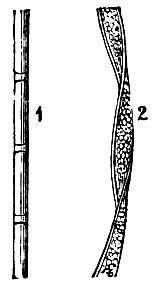
4. (By the MICROSCOPE.) The indications afforded by both the previous tests, although quite visible to the naked eye, are rendered still more palpable by the use of a magnifying glass of small power, as the common pocket lens. Under a good microscope the presence of cotton in a linen tissue is very perceptible. The fibres of cotton present a distinctly flat and shrivelled appearance, not unlike that of a narrow, twisted ribbon, with only occasional joints; whilst those of flax are round, straight, and jointed. The fibres of cotton, after being exposed to the action of strong alkaline lyes, untwist themselves, contract in length, and assume a rounded form, but still continue distinct in appearance from the fibres of linen. The engraving represents a fibre of linen (1) and a fibre of cotton (2), as they appear when magnified 155 diameters. The difference between the two may be perceived, although less distinctly through a good Stanhope or Coddington lens, provided the object be well illuminated.
Dyeing. Linen and cotton, from the similarity of their behaviour with dye-stuffs, are treated in nearly the same manner. The affinity of their fibres for colouring matter is very much weaker than that of the fibres of silk and woollen. On this account they are dyed with greater difficulty than those substances, and the colours so imparted are, in general, less brilliant and permanent under similar conditions. Linen shows less disposition to take dyes than cotton. The yarn or cloth, after being scoured and bleached in the usual manner, requires to have an additional tendency given to it, by chemical means, to condense and retain the materials of the dye-bath in its pores. This is effected by steeping the goods in solutions (mordants) which have at once an affinity for both the fibres of the cloth and the colouring matter. A similar process is employed in dyeing most other substances; but with cotton and linen, attention to this point is essential to the permanency of the dye. These matters are more fully explained under the heads Dyeing and Mordant.
The following new process for bleaching linen, having been omitted from our article on “Bleaching” is inserted here:—
Mr Hodges’ process, which is known in Ireland as the “Chemico-Mechanical Process,” owing to the patentee turning to account the advantages derivable from the employment of mechanical contrivances driven by steam, combined with the introduction of a new method of obtaining the hitherto little used hypochlorite of magnesia, may be said to date from the discovery of the substance, known as Kieserite (native sulphate of magnesia), which occurs as an essential constituent of the Abraumsalts of Stassfurth. For some time after the introduction of this substance into the market, it was considered of little value except for the production of Epsom salts; but Mr. Hodges, in the course of some investigations in bleaching jute, having had occasion to employ large quantities of hypochlorite of magnesia, it occurred to him that kieserite might be substituted for the more expensive crude sulphate of magnesia; and the importation into Ireland of the sample for this purpose was the first that was ever sent into that country for the manufacture of a bleaching liquor, or, indeed, for any other use. Mr. Hodges on experimenting with the kieserite, found that it not only supplied the place of the crude sulphate, but acted as a better precipitant for the lime of the bleaching powder, which is employed in the production of the hypochlorite of magnesia; and that it also produced a stronger and clearer solution. Without entering into a minute description of the process (which is at present successfully carried out in a factory erected for the purpose in the neighbourhood of Belfast), the following outline will be sufficient to show the nature of the methods adopted. The kieserite, which is imported from Germany in square blocks, on arriving at the works, is conveyed to a house, on the ground-floor of which it is stacked until required, when it is ground to a fine powder, and placed in barrels, is drawn up by means of a crane to a room at the top of the building, at one end of which is a row of three tanks furnished with water taps, agitators, and false bottoms. In one of the end tanks a definite quantity of the kieserite powder (varying according to its strength, is ascertained
After the yarn has been boiled, washed, and passed through the squeezers in the usual manner, it is put on to a wagon, in which it is carried, by means of a line of rails, down to the first reel box. Here it is placed on to the reels, which are made to revolve by means of steam; first in one direction and then in another, through a solution of carbonate of soda, previously heated by means of the steam-pipes before mentioned. The yarn having been sufficiently scalded and so saturated with soda, the reels to which it is attached are raised by the hydraulic pump out of the box, and the yarn allowed to drain for a few minutes, after which the travelling crane carries it on to the next box. Into this box the yarn is again lowered by the pump and made to revolve as before, but this time through a solution of the bleaching agent, which immediately re-acting on the carbonate of soda with which the yarn is charged, renders this bleaching agent free from the danger which attends the employment of chlorine, or the ordinary bleaching powder used in the older methods of bleaching. After the yarns have been brought to the desired shade in the solution of Hodges’ bleaching agent they are either removed as before to a new box, and there washed before being scoured, or they are thrown into one of the steeps filled with water for the night. These operations are repeated with weaker solutions in the remaining reel boxes, either once or twice according to the shade required.
Mr Hodges claims as the chief features of his invention that it consists, first, in the employment of a bleaching agent which has not hitherto been practically employed, and a cheap method for its production; second, in the preparation of the yarn prior to being submitted to the action of the bleaching agent, this preparation setting free not only the imprisoned chlorine of the hypochlorite, but also another powerful bleaching agent, oxygen; third, in new and improved machinery, by which the work of bleaching the yarn is greatly shortened; fourth, in doing away with the tedious and expensive operation of exposing the yarn on the grass; if this last were the only feature in Mr Hodges’ invention, the patentee would have greatly improved the process of bleaching, not only, however, does the new process supplant the old long and tedious one, but a great economy of time is additionally gained in other parts of the process, added to these advantages it is stated that a superior finish is given to the yarns, and that in consequence a much greater demand for them has arisen.
Mr Hodges contends that the absence of caustic lime from his new bleaching compound gives it great advantages over the old bleaching powder, particularly in its application to finely woven fabrics, such as muslins, &c. He also says that fabrics bleached by it receive an increased capacity for imbibing and retaining colouring matter, a fact of considerable importance to the dyer and calico-printer, as they are thus enabled to communicate to the fabrics tints which have heretofore been considered impossible. See Kieserite.
The domestic management of linen may here receive a few moments’ attention. Fruit stains, iron-moulds, and other spots on linen, may, in general, be removed by applying to the part, previously washed clean, a weak solution of chlorine, chloride of lime, spirits of salts, oxalic acid, or salts of lemons, in warm water, and frequently by merely using a little lemon juice. When the stain is removed the part should be thoroughly rinsed in clear warm water (without soap) and dried. Recent iron-moulds or ink spots on starched linen, as the front of a shirt, may be conveniently removed by allowing a drop or two of melted tallow from a common candle to fall upon them before sending the articles to the laundress. The oxide of iron combines with the grease, and the two are washed out together. If the spot is not entirely removed the first time, the process should be repeated. Linen that has
LING. The Galus molua (Linn.), an inferior species of the cod-fish tribe, common in the Northern seas, and used as a coarse article of food by the poor.
LIN′IMENT. Syn. Linimentum, L. A semifluid ointment, or soapy application to painful joints, swellings, burns, &c. The term is also occasionally extended to various spirituous and stimulating external applications. A preparation of a thinner consistence, but similarly employed, is called an ‘EMBROCATION,’ These terms are, however, frequently confounded together, and misapplied. Liniments are generally administered by friction with the hand or fingers, or with some substance (as a piece of flannel) capable of producing a certain amount of irritation of the skin. Sometimes a piece of linen rag dipped in them is simply laid on the part. In most cases in which liniments are found beneficial, the advantage obtained from them is attributable rather to the friction or local irritation than to any medicinal power in the preparation itself. The greater number of cerates and ointments may be converted into liniments by simply reducing their consistence with almond or olive oil, or oil of turpentine.
Liniment, Ac′id. Syn. Linimentum acidum, L. acidi sulphurici, L. Prep. 1. (Sir B. Brodie.) Salad oil, 3 oz.; oil of vitriol, 1 dr.; mix, then add of oil of turpentine, 1 oz., and agitate the whole well together. As a counter-irritant, in rheumatism, stiff joints, &c. It closely resembles the ‘Gulltonian Embrocation,’
2. (Hosp. F.) Olive oil, 3 oz.; oil of turpentine, 2 oz.; sulphuric acid, 1 fl. dr. An excellent alterative, stimulant, discutient, and counter-irritant, in chronic rheumatism, stiff joints, indolent tumours, and various chronic diseases of the skin.
Liniment of Albumen. (Dr Christison.) Syn. Linimentum albuminis. Prep. Equal parts of white of egg and rectified spirit, agitated together. In excoriation from pressure.
Liniment of Am′ber-oil. Syn. Linimentum succini, L. Prep. 1. From olive oil, 3 parts; oils of amber and cloves, of each 1 part. Resembles ‘Roche’s Embrocation,’
2. (Opiated; Linimentum succini opiatum, L.) From rectified oil of amber and tincture of opium, of each 2 fl. oz.; lard, 1 oz. Anodyne, antispasmodic, and stimulant. A once popular remedy in cramp, stiff joints, &c.
Liniment of Ammo′′nia. Syn. Ammoniacal liniment, Volatile l., Oil and hartshorn; Linimentum ammoniæ (B. P., Ph. L. E. & D.), L. Prep. 1. (B. P.) Solution of ammonia, 1; olive oil, 3; mix.
2. (Ph. L. & E.) Liquor of ammonia (sp. gr. ·960), 1 fl. oz.; olive oil, 2 fl. oz.; shake them together until they are mixed.
3. (Ph. D.) To the last add of olive oil, 1 fl. oz. Stimulant and rubefacient. Used in rheumatism, lumbago, neuralgia, sore throat, spasms, bruises, &c. When the skin is irritable more oil should be added, or it should be diluted with a little water.
4. (Camphorated; Linimentum ammoniæ camphoratum, Embrocatio amm. camphorata, L.)—a. (Hosp. F.) Olive oil, 3 oz.; camphor, 1⁄2 oz.; dissolve by a gentle heat, and when cold, add of liquor of ammonia, 1 fl. oz.
b. Soap liniment, 2 oz.; olive oil and liquor of ammonia, of each 2 dr. As the last; more especially for sprains, bruises, chilblains, &c.
5. (Compound; Dr Granville’s counter-irritant or antidynous lotion; Linimentum ammoniæ compositum, L.—Ph. E.)—a. (Stronger.) From liquor of ammonia (sp. gr. ·880), 5 fl. oz.; tincture of camphor, 2 fl. oz.; spirit of rosemary, 1 fl. oz.; mix. It should be kept in a well-stoppered bottle and in a cool situation.
b. (Weaker.) Solution of ammonia (·880), 5 fl. oz.; tincture of camphor, 3 fl. oz.; spirit of rosemary, 2 fl. oz.
Obs. The above formulæ are nearly identical with the original ones of Dr Granville; the principal difference being in his ordering liquor of ammonia of the sp. gr. ·872, instead of ·880. They are counter-irritant, rubefacient, vesicant, and cauterising, according to the mode and length of their application. The milder lotion is sufficiently powerful to produce considerable rubefaction and irritation in from 1 to 5 or 6 minutes; vesication, in 8 or 10 minutes; and cauterisation, in 4 or 5 minutes longer. For the latter purpose the stronger lotion is generally employed. According to Dr Granville, these lotions are prompt and powerful remedies in rheumatism, lumbago, cramp, neuralgia, sprains, swollen and painful joints, headache, sore throat, and numerous other affections in which the use of a powerful counter-irritant has been recommended. They are ordered to be applied by means of a piece of linen, 6 or 7 times folded, or a piece of thick, coarse flannel wetted with the lotion, the whole being covered with a thick towel, and firmly pressed against the part with the hand. The stronger lotion is only intended to be employed in apoplexy, and to produce cauterisation. See Counter-irritants.
6. (From SESQUICARBONATE OF AMMONIA;—Linimentum ammoniæ sesquicarbonatis—Ph. L.) Solution of sesquicarbonate of ammonia,
7. (With Turpentine.) (Dr Copland.) Syn. Linimentum ammoniæ cum terebinthina. Prep. Liniment of ammonia, 11⁄4 fl. oz.; oil of turpentine, 1⁄2 fl. oz.; mix.
Liniment, An′odyne. See Liniments of Belladonna, Morphia, Opium, Soap, &c.
Liniment, Antispasmod′ic. Syn. Linimentum antispasmodicum, L. cajeputi compositum, L. Prep. (Hufeland.) Oils of cajeput and mint, of each 1 part; tincture of opium, 3 parts; compound camphor liniment, 24 parts. Anodyne, stimulant, and rubefacient.
Liniment, Arceus’s. Compound elemi ointment.
Liniment of Arnica. Syn. Arnica opodeldoc, Linimentum arnicæ. Prep. Dissolve by heat Castile soap, 4 parts, and camphor, 1 part, in rectified spirit, 10 parts. Add tincture of arnica, 5 parts.
Liniment of Belladon′na. Syn. Linimentum belladonnæ, B. P. L. Prep. 1. (B. P.) Prepared the same as Linimentum aconitii. A fluid ounce is equal to a solid ounce. Prescribed with equal parts of soap liniment, or compound camphor liniment, and is an excellent topical application for neuralgic pain.
2. Extract of belladonna, 1 dr.; oil of almonds, 2 oz.; lime water, 4 fl. oz. In eczema, and some other cutaneous affections, to allay irritation, &c.
3. (Cutan. Hosp.) Extract of belladonna, 4 dr.; glycerine, 1 oz.; soap liniment, 6 oz. As the last.
4. (Guy’s Hosp.) Extract of belladonna 1 oz.; soap liniment, 8 fl. oz.
5. (Phœbus.) Extract of belladonna, 40 gr.; rectified ether, 1 dr.; cherry-laurel water, 2 fl. oz. As a friction to the abdomen in lead colic.
Obs. The above are reputed excellent stimulants, anodynes, antispasmodics, and resolvents, in various diseases, as rheumatism, neuralgia, painful affections of the skin and joints, tumours, &c. &c.
Liniment of Belladonna and Chloroform. (Mr Squire.) Syn. Linimentum belladonnæ et chloroformi. Prep. Belladonna liniment, 7 fl. dr.; belladonna chloroform (made by percolating the root with chloroform) 1 fl. dr.; sprinkled on piline and applied to the loins, excellent in lumbago.
Liniment of Borax. (Swediaur). Syn. Linimentum Boracis. Prep. Borax, 2 dr.; tincture of myrrh, 1 oz., distilled water, 1 oz.; honey of roses, 2 oz. Mix.
Liniment of Caj′eput Oil. Syn. Linimentum olei cajeputi, L. Prep. 1. (Dr Copland.) Compound camphor liniment and soap liniment, of each 11⁄2 fl. oz.; oil of cajeput, 1 fl. oz.
2. (Dr Williams.) Oil of cajeput, 1⁄2 fl. dr.; castor oil, 1 fl. dr.; olive oil, 41⁄2 fl. dr. A warm, antispasmodic, diffusible stimulant and rubefacient; in spasmodic asthma, colic, chronic rheumatism, spasms, chest affections, &c. See Antispasmodic L. (above).
Linimentum Calcis. (B. P.) Solution of lime, 1; olive oil, 1; mix. The best liniment for burns and scalds.
Liniment of Cam′phor. Syn. Camphorated oil, Camphor embrocation; Linimentum Camphoræ (B. P., Ph. L. E. & D.), Oleum camphoratum, L. Prep. 1. (B. P.) Camphor, 1; olive oil, 4; dissolve.
2. (Ph. L. & E.) Camphor, 1 oz.; olive oil, 4 fl. oz.; gently heat the oil, add the camphor (cut small), and agitate until dissolved. The Dublin College orders only 1⁄2 the above camphor. Stimulant, anodyne, and resolvent; in sprains, bruises, rheumatic pains, glandular enlargements, &c.
3. (Compound; Linimentum camphoræ compositum—B. P., Ph. L. & D.)—a. (B. P.) Camphor, 5; English oil of lavender, 1⁄4; strong solution of ammonia, 10; rectified spirit, 20. Dissolve the oil and camphor in the spirit and gradually add the ammonia.
b. (Ph. L.) Camphor, 21⁄2 oz.; oil of lavender, 1 fl. dr.; rectified spirit, 17 fl. oz.; dissolve, then add of stronger liquor of ammonia, 3 fl. oz., and shake them together until they are mixed.
c. (Ph. L. 1836.) Liquor of ammonia, 71⁄2 fl. oz.; spirit of lavender, 1 pint; distil off 1 pint, and dissolve in it camphor, 21⁄2 oz. The formula of the Ph. D. 1826 was nearly similar.
d. (Wholesale.) Camphor (clean), 21 oz.; English oil of lavender, 33⁄4 oz.; liquor of ammonia, 23⁄4 lbs.; rectified spirit, 7 pints; mix, close the vessel, and agitate occasionally, until the camphor is dissolved. Powerfully stimulant and rubefacient. It closely resembles, and is now almost universally sold for, Ward’s ‘Essence for the Headache.’
e. (Ethereal.) Syn. Linimentum camphoræ ethereum. Prep. Camphor, 1 dr.; ether, 1 dr.; oil of vipers, 2 dr. Mix.
Liniment of Canthar′ides. Syn. Liniment of Spanish flies; Linimentum lyttæ, Lin. cantharidis (Ph. D. & U. S.), L. Prep. 1. (Dr Collier.) Tincture of cantharides and soap liniment, equal parts.
2. (Ph. D.) Cantharides (in fine powder), 3 oz.; olive oil, 12 fl. oz.; digest for 3 hours over a waterbath, and strain through flannel, with expression.
3. (Ph. U. S.) Spanish flies, 1 oz.; oil of turpentine, 8 fl. oz.; proceed as last. The above are irritant and rubefacient; but should be used cautiously, lest they produce strangury.
Liniment of Capsicum. 1. (Dr Copland.) Syn. Linimentum Capsici. Prep. Compound camphor liniment, 1 fl. oz.; volatile liniment,
2. (Dr Turnbull.) Capsicums, 1 oz.; rectified spirit, 3 fl. oz. Macerate 7 days, and strain for use.
Liniment of Colchicum. (Ear Infirmary.) Syn. Linimentum colchici. Prep. Soap liniment, 1 fl. oz.; wine of colchicum seed, 1⁄2 fl. oz.; mix.
Liniment of Colocynth. (Heim). Syn. Linimentum colocynthidis. Prep. Tincture of colocynth, 1⁄2 fl. oz.; castor oil, 11⁄2 oz.
Liniment of Chlo′′ride of Lime. Syn. Linimentum calcis chlorinatæ, L. Prep. 1. Chloride of lime, 1 dr.; water (added gradually), 3 fl. oz.; triturate together in a glass mortar for 10 minutes, pour off the liquid portion, and add of oil of almonds 2 fl. oz.
2. (Kopp.) Solution of chloride of lime (ordinary), 1 part; olive oil, 2 parts.
3. (Waller.) Chloride of lime (in fine powder), 1 part; soft soap, 2 parts; soft water, q. s. to make a liniment.
Obs. The above are cleanly and excellent applications in itch, scald head, herpes, lepra, foul ulcers, &c.
Liniment of Chlo′′roform. Syn. Linimentum chloroformi, B. P. Prep. 1. (B. P.) Chloroform, 1; liniment of camphor, 1; mix. The oil in the camphor liniment prevents the evaporation of the chloroform. Stimulating on application to a tender skin.
2. Chloroform, 1 fl. dr.; almond oil, 7 fl. dr.; mix in a phial, and agitate it until the two unite.
3. (Tuson.) Chloroform, 1 fl. dr.; soap liniment, 2 fl. oz.; as the last. Used as an application in neuralgic pains, rheumatism, &c.
Liniment of Cod-liver Oil. Syn. Linimentum olei morrhuæ, L. o. jacoris aselli, L. Prep. (Dr Brach.) Cod-liver oil, 2 fl. oz.; liquor of ammonia, 1 fl. oz.; mix. Resolvent, dispersive; applied to glandular tumours, scrofulous enlargements, &c.
Liniment of Cro′ton Oil. Syn. Linimentum crotonis (B. P., Ph. D.), L. olei crotonis, L. o. tiglii, L. Prep. 1. (B. P.) Croton oil, 1; oil of cajeput, 31⁄2; rectified spirit, 31⁄2; mix.
2. (Ph. D.) Croton oil, 1 fl. oz.; oil of turpentine, 7 fl. oz.; mix by agitation.
3. (J. Allen.) Croton oil and liquor of potassa, of each, 1 fl. dr.; agitate until mixed, then add of rose water, 2 fl. oz.
4 (Pereira.) Croton oil, 1 part; olive oil, 5 parts.
Obs. The above are used as counter-irritants; in rheumatism, neuralgia, bronchial and pulmonary affections, &c. When rubbed on the skin, redness, and a pustular eruption ensue, and in general the bowels are acted on.
Liniment, Diuretic. Syn. Linimentum diureticum, L. Prep. 1. (Dr Calini.) Squills (in fine powder), 1 dr.; gastric juice of a calf, 2 oz.; mix.
2. (Dr Christison.) Soap liniment, tincture of foxglove, and tincture of squills, equal parts. In dropsies; rubbed over the abdomen or loins twice or thrice a day.
Liniment, Emol′lient. Syn. Linimentum album, L. emolliens, L. Prep. From camphor, 1 dr.; Peruvian balsam, 1⁄2 dr.; oil of almonds, 1 fl. oz.; dissolve by heat, add of glycerin, 1⁄2 fl. oz., agitate well, and, when cold, further add of oil of nutmeg, 15 drops. Excellent for chapped hands, lips, nipples, &c.
Liniment of Foxglove. (Dr Royle.) Syn. Linimentum digitalis. Prep. Infusion of digitalis, 2 fl. oz.; water of ammonia, 2 fl. dr.; oil of poppy seed, 4 fl. dr.; mix. To be rubbed on the abdomen 3 or 4 times a day.
Liniment of Gar′lic. Syn. Linimentum alii, L. Prep. From juice of garlic, 2 parts; olive oil, 3 parts; mix. In hooping-cough, infantile convulsions, &c.
Liniment of Gin′ger. Syn. Linimentum zingiberis, L. Prep. (Dr Turnbull.) Ginger, 1 part; rectified spirit, 2 parts; make a tincture or essence. For short-sightedness. A few drops are occasionally rubbed on the forehead for 8 or 10 minutes at a time. How this tincture came to be called a liniment we are at a loss to determine.
Liniment of Glycerin. (Mr Startin.) Syn. Linimentum glycerini. Prep. Soap liniment, 3 oz.; glycerin, 1 oz.; extract of belladonna, 1 oz.; mix. For gouty, rheumatic, and neuralgic pains. A little veratrine is sometimes added.
Liniment, Green. (Dr Campbell.) Syn. Linimentum viride. Camphor, 1 oz.; olive oil, 6 oz.; extract of hemlock, 1 oz.; spirit of ammonia, 2 oz. Mix.
Liniment of Hellebore. (Dornbleuth.) Syn. Linimentum hellebori. Prep. Soft soap, 4 oz.; hellebore powder, 2 oz.; hot water, q. s.
Liniment, Hunga′′rian. Syn. Linimentum Hungaricum, L. Prep. (Soubeiran.) Powdered cantharides and sliced garlic, of each 1 dr.; camphor, bruised mustard seed, and black pepper, of each 4 dr.; strong vinegar, 6 fl. oz.; rectified spirit, 12 fl. oz.; macerate a week, and filter. An excellent rubefacient and counter-irritant.
Liniment of Hydrochlo′′ric Acid. Syn. Linimentum muriaticum, L. acidi muriatici, L. a. hydrochlorici, L. Prep. 1. (Hosp. F.) Olive oil, 2 oz.; white wax, 2 dr.; dissolve by a gentle heat, add of balsam of Peru, 1 dr.; hydrochloric acid, 2 dr.; mix well. An excellent application to chilblains before they break.
2. (W. Cooley.) Olive oil, 1⁄4 pint; white spermaceti (pure) and camphor, of each 1⁄2 oz.; mix with heat, add of hydrochloric acid, 1⁄2 fl. oz., and proceed as before. Equal to the last, and cheaper. This was extensively employed among the seamen of the Royal Navy by Mr Cooley with uniform success.
Liniment of I′odide of Potas′sium. Syn.Linimentum ioduretum gelatinosum, L. Gelée pour le goitre, Fr. Prep. (Foy.) Iodide of potassium, 4 dr.; proof spirit, 2 oz.; dissolve, and add the liquid to a solution of curd soap, 6 dr., in proof spirit, 2 oz., both being at the time gently warmed; lastly, aromatise with rose or neroli, pour it into wide-mouthed bottles, and keep them closely corked. In goitre, &c.
Liniment of Iodide of Sulphur. (Prof. E. Wilson.) Syn. Linimentum sulphuris iodidi. Prep. Iodide of sulphur, 30 gr.; olive oil, 1 fl. dr.; triturate together.
Liniment of I′odine. Syn. Linimentum iodi (B. P.); Ioduretted liniment; Linimentum iodinii, L. ioduretum, L. Prep. 1. (B. P.) Iodine, 5; iodide of potassium, 2; camphor, 1; rectified spirit, 40; dissolve.
2. (Cutan. Hosp.) Compound tincture of iodine and laudanum, equal parts.
3. (Dr Copland.) Soap liniment, 1 oz.; iodine, 8 to 10 gr.
4. (Guibourt.) Iodide of potassium, 1 dr.; water, 1 fl. dr.; dissolve, and add to it white soap (in shavings) and oil of almonds, of each 10 dr., previously melted together. Some perfume may be added. In scrofula, glandular enlargements, rheumatism, &c.
Liniment of Ipecacuanha. (Dr Neligan.) Syn. Linimentum ipecacuanhæ. Prep. Ipecacuanha in fine powder, 4 dr.; lard, 2 dr.; olive oil, 11⁄2 fl. oz.
Liniment of Juniper. (Dr Sully.) Syn. Linimentum juniperi. Prep. Oil of juniper, 11⁄2 oz.; lard, 2 oz.; oil of aniseed, 6 drops. For scald-head.
Liniment of Labdanum. (Quincy.) Syn. Linimentum labdani; Linimentum criniscani. Prep. Labdanum, 6 dr.; bear’s grease, 2 oz.; honey, 1⁄2 oz.; powdered southernwood, 3 dr.; oil of nutmeg, 1 dr.; balsam of Peru, 2 dr.; mix. To restore the hair.
Liniment of Lead. Syn. Linimentum plumbi, L. Prep. (Gaozey.) Acetate of lead, 40 gr.; soft water, 12 fl. oz.; olive oil, 6 oz.; mix, and agitate well. Astringent and refrigerant. Useful in excoriations, especially when accompanied with inflammation.
Liniment of Lime. Syn. Liniment for burns, Carron oil; Linimentum calcis (Ph. L. E. & D.), L. aquæ calcis, Oleum lini cum calcis, L. Prep. 1. From olive oil (linseed oil—Ph. E.) and lime water, equal parts, shaken together until they are mixed. Very useful in burns and scalds.
2. (Compound; Linimentum calcis compositum, L.)—a. (Camphorated—W. Cooley.) Camphor liniment and lime water, equal parts.
b. (Opiated—W. Cooley.) Lime water and camphor liniment, of each 1 oz.; extract of opium, 5 gr.; mix. Both are used as anodynes to allay pain and irritation in severe burns, chilblains, &c., for which purpose they are excellent. All the above liniments with lime water should be used as soon as possible after being prepared, as the ingredients separate by keeping.
Liniment of Mercury. Syn. Mercurial liniment; Linimentum hydrargyri (B. P., Ph. L.), Lin. h. compositum (Ph. L. 1836), L. Prep. 1. (B. P.) Ointment of mercury, 1; solution of ammonia, 1; liniment of camphor, 1. Melt the ointment in the liniment, add the ammonia, and shake them together.
2. (Ph. L.) Camphor, 1 oz.; spirit of wine, 1 fl. dr.; sprinkle the latter on the former, powder, add of lard and mercurial ointment (stronger), of each 4 oz.; rub them well together, then gradually add of liquor of ammonia, 4 fl. oz.; and mix well. Stimulant and discutient. It resembles mercurial ointment in its effects; but though milder in its operation, it more quickly produces salivation.
Liniment of Mor′phia. Syn. Linimentum morphiæ, L. Prep. (W. Cooley.) Pure morphia, 3 gr.; put it into a warm mortar, add very gradually, of oil of almonds (warm), 1 fl. oz., and triturate until the morphia is dissolved, then add of camphor liniment, 1 oz. An excellent topical anodyne and antispasmodic, which often allays pain when other means have failed.
Liniment of Mus′tard. Syn. Linimentum sinapis, L. Prep. 1. Flour of mustard (best), 1 oz.; water, tepid, 2 fl. oz.; mix, and add of glycerin, liquor of ammonia, and olive oil, of each 1 fl. oz.
2. (Béral.) Carbonate of ammonia (in fine powder), 1 part; camphor (in powder), 2 parts; oil of lavender, 4 parts; tincture of mustard, 6 parts; mix, dissolve by agitation, add of simple liniment (warm), 56 parts, and again agitate until the whole is perfectly incorporated.
3. Black mustard seed (ground in pepper-mill or otherwise well bruised), 1⁄4 lb.; oil of turpentine, 1 pint; digest, express the liquid, filter, and dissolve it in camphor, 1⁄2 lb. Stimulant and rubefacient. A popular and useful remedy in rheumatic pains, lumbago, colic, chilblains, &c. The last is a close imitation of Whitehead’s ‘Essence of Mustard.’
4. (Lin. olei volatilis sinapis.)—a. From volatile oil of black mustard seed, 1⁄2 dr.; oil of almonds, 1 fl. oz. As a rubefacient.
b. From volatile oil, 1 part; alcohol (sp. gr. ·815), 1 to 2 parts. As a vesicant.
Liniment of Mustard (Compound). Linimentum sinapis compositum (B. P.). Oil of mustard, 1 dr.; ethereal extract of mezereon, 40 gr.; camphor, 2 dr.; castor oil, 5 dr.; rectified spirit, 32 dr.; dissolve.
Liniment, Narcotic. (P. Codex.) Syn. Liniment calmant; Linimentum narcoticum. Prep. Anodyne balsam, 8 parts; compound wine of opium, cold cream, of each 1 part. Mix.
Liniment of Ni′trate of Mercury. Syn. Citrine liniment; Linimentum hydrargyri nitratis, L. Prep. (Sir H. Halford.) Ointment
Liniment of Nux Vom′ica. Syn. Linimentum nucis vomicæ, L. Prep. (Magendie.) Tincture of nux vomica, 1 fl. oz.; liquor of ammonia, 2 fl. dr.; mix. As a stimulating application to paralysed limbs. The addition of 1⁄2 fl. dr. each of glycerin and salad oil renders it an excellent application in chronic rheumatism and neuralgia.
Liniment of Oil of Ergot. Syn. Linimentum olei ergotæ. Prep. Oil of ergot, 1 dr.; oil of almonds, or sulphuric ether, 3 dr.; mix.
Liniment of O′pium. Syn. Anodyne liniment; Linimentum opii (B. P., Ph. L. & E.), L. opii or L. anodynum (Ph. D.), L. saponis cum opio, L. Prep. 1. (B. P.) Tincture of opium, 1; liniment of soap, 1; mix.
2. Tincture of opium, 2 fl. oz.; soap liniment, 6 fl. oz.; mix.
3. (Ph. E.) Castile soap, 6 oz.; opium, 11⁄2 oz.; rectified spirit, 1 quart; digest for three days, then filter, add of camphor, 3 oz., oil of rosemary, 6 fl. dr., and agitate briskly.
4. (Ph. D.) Soap liniment and tincture of opium, equal parts.
5. (Wholesale.) Soft soap, 11⁄4 lb.; powdered opium and camphor, of each 1⁄4 lb.; rectified spirit, 1 gall.; digest a week.
Obs. This preparation is an excellent anodyne in local pains, rheumatism, neuralgia, sprains, &c.
Liniment of Phos′phorus. Syn. Linimentum phosphoratum, L. Prep. (Augustin.) Phosphorus, 6 gr.; camphor, 12 gr.; oil of almonds, 1 oz.; dissolve by heat; when cold, decant the clear portion, and add of strongest liquor of ammonia 10 drops. A useful friction in gout, chronic rheumatism, certain obstinate cutaneous affections, &c.
Liniment de Rosen. (P. C.) Prep. Oil of mace, 4 parts; oil of cloves, 4 parts; oil of juniper, 9 parts. Mix.
Liniment, Sim′ple. Syn. Linimentum simplex (Ph. E.), L. Prep. (Ph. E.) White wax, 1 oz.; olive oil, 4 fl. oz.; melt together, and stir the mixture until it is cold. Emollient; resembles spermaceti ointment in all except its consistence.
Liniment of Soap. Syn. Opodeldoc, Camphorated tincture of soap, Balsam of s.; Linimentum saponis (B. P., Ph. L. E. & D.) L. saponaceum, Tinctura saponis camphorata, Balsamum saponis, L. Prep. 1. (B. P.) Hard soap (cut small), 21⁄2 oz.; camphor, 11⁄4 oz.; English oil of rosemary, 3 dr.; rectified spirit, 18 oz.; distilled water, 2 oz.; mix the water and spirit, add the other ingredients, digest at a temperature not exceeding 70° Fahr., agitating occasionally for seven days, and filter.
2. (Ph. L.) Castile soap (cut small), 21⁄2 oz.; camphor (small), 10 dr.; spirit of rosemary, 18 fl. oz.; water, 2 fl. oz.; digest with frequent agitation until the solid substances are dissolved.
3. (Ph. E.) Castile soap, 5 oz.; camphor, 21⁄2 oz.; oil of rosemary, 6 fl. dr.; rectified spirit, 1 quart.
4. (Ph. D.) Castile soap (in powder), 2 oz.; camphor, 1 oz.; proof spirit, 16 fl. oz.
5. (Liniment savonneau—P. Cod.) Tincture of soap (P. Cod.) and rectified spirit (·863 or 41 o. p.), of each 8 parts; olive oil, 1 part.
Obs. This article, prepared according to the directions of the Pharmacopœia, from ‘soap made of olive oil and soda’ (Castile soap), is apt to gelatinise in cold weather, and to deposit crystals of elaidate and stearate of lime. This may be avoided, when expense is not an objection, by first well drying the soap, employing a spirit of at least 85%, and keeping the preparation in well-closed bottles. A cheaper and better plan is to substitute the ‘soft soap’ of the Ph. L. (‘soap made with olive oil and potassa’) for the Castile soap ordered by the College. The soft soap of commerce imparts to the liniment an unpleasant smell. The following formula, one of those commonly adopted by the wholesale druggists, produces a very good article, though much weaker than that of the Pharmacopœia.
6. (Wholesale.) Camphor (cut small), 11⁄2 lb.; soft soap, 7 lbs.; oil of rosemary, 3 fl. oz.; rectified spirit of wine and water, of each 31⁄2 galls.; digest with occasional agitation for a week, and filter. This is the ‘opodeldoc’ or ‘soap liniment’ of the shops.
Uses. Soap liniment is stimulant, discutient, and lubricating, and is a popular remedy in rheumatism, local pains, swellings, bruises, sprains, &c.
7. (With Opium.) See Liniment of Opium.
8. (Sulphuretted; Linimentum saponis sulphuretum, L. sulphuro-saponaceum—Jadelot, L.) Sulphuret of potassium, 3 oz.; soap, 12 oz.; water, q. s.; melt together, and add of olive oil, 12 oz.; oil of origanum, 1 fl. dr.; mix well. An excellent remedy for the itch, and some allied skin diseases.
Liniment of Strychnia. (Dr Neligan.) Syn. Linimentum strychniæ. Strychnia, 30 gr.; olive oil, 11⁄2 fl. oz. Ten drops to be rubbed over the temples in amaurosis.
Liniment of Sul′phide of Carbon. Syn. Linimentum carbonis sulphureti, L. Prep. 1. From bisulphide of carbon, 1 dr.; camphorated oil, 1 oz.; mix.
2. (Lampadius.) Camphor, 2 dr.; bisulphuret of carbon, 4 fl. dr.; dissolve, and add of rectified spirit, 1 fl. oz. In rheumatism, gouty nodes, &c.
Liniment of Sulphu′ric Acid. See Liniment, Acid.
Liniment, Tripharm′ic. Syn. Linimentum (Ph. L. 1746), L. Prep. Take of lead plaster and olive oil, of each 4 oz.; melt, add of strong vinegar, 1 fl. oz., and stir until cold. Cooling and desiccative; in excoriations, burns, &c.
Liniment of Tur′pentine. Syn. Kentish’s liniment; Linimentum terebinthinæ (B. P., Ph. L. & D.), L. terebinthinatum (Ph. E.), L. Prep. 1. (B. P.) Oil of turpentine, 16; camphor, 1; soft soap, 2; dissolve the camphor in the turpentine, then add the soap, and rub till thoroughly mixed.
2. (Ph. L.) Soft soap, 2 oz.; camphor, 1 oz.; oil of turpentine, 10 fl. oz.; shake them together until mixed. Stimulant; in lumbago, cholera, colic, &c.
3. (Ph. L. 1824.) Resin cerate, 6 oz.; oil of turpentine, 4 fl. oz.; mix. An excellent application to burns.
4. (Ph. E.) Resin ointment, 4 oz.; camphor, 4 dr.; dissolve by a gentle heat, and stir in oil of turpentine, 5 fl. oz.
5. (Ph. D.) Oil of turpentine, 5 fl. oz.; resin ointment, 8 oz.; mix by a gentle heat. This forms Dr Kentish’s celebrated application to burns and scalds. The parts are first bathed with warm oil of turpentine or brandy, and then covered with pledgets of lint, smeared with the liniment.
6. (Compound—a. B. Linimentum terebinthinæ aceticum.) Oil of turpentine, 1; acetic acid, 1; liniment of camphor, 1; mix.
b. (Linimentum terebinthinæ compositum, L.) Acetic: St John Long’s liniment; (Linimentum terebinthinæ aceticum, L.) Oil of turpentine, 3 oz.; rose water, 21⁄2 fl. oz.; acetic acid, 5 dr.; oil of lemons, 1 dr.; yolk of egg, 1; make an emulsion. As a counter-irritant in phthisis.
c. (Ammoniated—Debreyne.) Lard, 3 oz.; melt, and add, of oil of turpentine and olive oil, of each 1 oz.; when cold, further add of camphorated spirit, 4 fl. dr.; liquor of ammonia, 1 fl. dr. In sciatica, lumbago, &c.
d. (Opiated—Recamier.) Oil of turpentine, 1 fl. oz.; oil of chamomile, 2 fl. oz.; tincture of opium, 1 fl. dr. In neuralgia, &c.
e. (Sulphuric—Ph. Castr. Ruthena.) Oil of turpentine, 2 oz.; olive oil, 5 oz.; mix, and add of dilute sulphuric acid, 11⁄2 dr. See Acid liniment.
Liniment of Vera′trine. Syn. Linimentum veratriæ, L. Prep. (Brande.) Veratrine, 8 gr.; alcohol, 1⁄2 fl. oz.; dissolve, and add of soap liniment, 1⁄2 fl. oz. In neuralgic and rheumatic pains, gout, &c.
Liniment of Ver′digris. Syn. Oxymel of verdigris; Linimentum æruginis (Ph. L.), Oxymel æruginis (Ph. L. 1738), Oxymel cupri subacetatis (Ph. D. 1826), L. Prep. (Ph. L.) Verdigris (in powder), 1 oz.; vinegar, 7 fl. oz.; dissolve, filter, through linen, add of honey, 14 oz., and evaporate to a proper consistence.
Obs. This preparation is wrongly named a ‘liniment.’ The College, after ‘beating about the bush’ for nearly a century, found a right name for it in 1788; but, as in many other cases, soon abandoned it for another less appropriate.
Oxymel of verdigris is stimulant, detergent, and escharotic. It is applied to indolent ulcers, especially of the throat, by means of a camel-hair pencil; and, diluted with water, it is used as a gargle. Care must be taken to avoid swallowing it, as it occasions vomiting and excessive purging.
Liniment, Ver′mifuge. Syn. Linimentum anthelminticum, L. vermifugum, L. Prep. Castor oil, 1 oz.; essential oils of wormwood and tansy, of each 1⁄2 oz.; Dr Peschier’s ethereal tincture of pennyroyal buds, 20 drops; mix. Employed in frictions on the abdomen in cases of worms in children. Its activity may be still further increased by the addition of a little garlic juice. (‘Journ. de Méd.’) An excellent medicine.
Liniment, Vesicating. (Dr Montgomery.) Syn. Linimentum vesicans. For children. Prep. Compound camphor liniment, 4 fl. dr.; oil of turpentine, 2 fl. dr. To produce immediate vesication in adults. Mix one part of the strongest liquor ammoniæ, with two of olive oil, and apply six drops on spongio-piline for ten minutes.
Liniment, Ware’s. Prep. From camphor liniment, 1 oz.; solution of carbonate of potassa, 1 dr. In amaurosis.
Liniment, White’s. The old name for spermaceti ointment.
Liniment, White. Syn. Linimentum album. Prep. Rectified oil of turpentine, 2 oz.; solution of ammonia, 2 oz.; soap liniment, 3 oz.; spirit of rosemary, 1 oz. Mix in the above order, and gradually add with continual agitation, distilled vinegar, 8 oz. For chapped hands.
Liniment, Wilkinson’s. Prep. (Phœbus.) Prepared chalk, 20 gr.; sulphur, lard, and tar, of each 1⁄2 oz.; mix, and add of Boyle’s fuming liquor, 10 or 15 drops. In certain chronic skin diseases, neuralgia, &c.
Linimentum Aconiti. (B. P.) Aconite root, in powder, 20; camphor, 1; rectified spirit, to percolate, 30. Moisten the root for 3 days, then pack in a percolator, and pour sufficient rectified spirit upon it to produce with the camphor 20.
Strength, 1 in 1. Applied with a camel-hair pencil, alone or mixed in equal proportions, with a soap liniment or compound camphor liniment, and rubbed on the part. Seven parts of this, and 1 part of chloroformum belladonna, and sprinkled thinly on impermeable piline, is the best application for neuralgia or lumbago.
Linimentum Potassii Iodidi cum Sapone. (B. P.) Hard soap, in powder, 11⁄2; iodide of potassium, 11⁄2; glycerin, 1; oil of lemon, 1⁄8; water, 1. Dissolve the soap in 7 of water by heat of a water bath; dissolve the iodide of potassium in the remainder of the water, and mix
LINOLEIC ACID. C16H28O2. This may be obtained by saponifying linseed oil. It is a liquid acid, and rapidly oxidizes when exposed to the air, becoming converted into oxylinoleic acid, which is incapable of solidification even at low temperatures.
LIN′SEED. Syn. Flax seed; Lini semina, L. The seed of Linum usitatissimum (Linn.), or common flax. (Ph. L.) Oily, emollient, demulcent, and nutritive. Ground to powder (linseed meal; farina lini), it is used for poultices. The cake left after expressing the oil (linseed cake) contains, when of average quality, in 100 parts, moisture, 12·70; oil, 11·32; albumenoids, 28·21; mucilage, &c., 29·42; indigestible fibre, 12·46; ash, 5·89. It is used for feeding cattle. Under the form of tea or infusion it is used as a diluent, and to allay irritation in bronchial, urinary, and other like affections. See Infusion of Linseed.
LINSEED CAKE. See Linseed.
LINT. Syn. Linteum, L. White linen-cloth, scraped by hand or machinery, so as to render it soft and woolly. The hand-made lint is now little used; it was prepared from pieces of old linen-cloth. The machine-made lint is prepared from a fabric woven on purpose. A lint made from cotton (cotton-lint) is now largely manufactured; it is much inferior to the true lint, being a bad conductor of heat. Lint is used for dressing ulcers, either alone or smeared with some suitable ointment or cerate.
Lint, Medica′ted. Syn. Linteum medicatum, L. nigrum, L. infernale, L. Prep. 1. Nitrate of silver, 20 to 30 gr.; distilled water, 1 fl. oz.; dissolve, saturate dry lint, 1⁄2 oz., with the solution, and expose it in a saucer or capsule to the light and air, until it has become black and dry.
2. Nitrate of silver and nitrate of copper, of each 1⁄2 dr.; lint, 1 oz.; water, 11⁄2 fl. oz.; as the last. Used to dress old and indolent ulcers.
LIP SALVE. See Salve.
LIQUA′TION. The process of sweating out by heat the more fusible metals of an alloy. Metallurgists avail themselves of this method in assaying and refining the precious metals and procuring antimony and some other metals from their ores.
LIQUEFA′′CIENTS. Syn. Resolvents; Liquefacientia, Resolventia, L. In pharmacy, substances or agents which promote secretion and exhalation, soften and loosen textures, and promote the absorption or removal of enlargements, indurations, &c. To this class belong the alkalies, antimony, bromine, chlorine, iodine, mercury, sulphur, &c., and their preparations.
LIQUEFAC′TION. The assumption of the liquid form. It is usually applied to the conversion of a solid into the liquid state, which may arise from increase of temperature (fusion), absorption of water from the atmosphere (deliquescence), or the action of a body already fluid (solution).
Liquefaction of Gases. Under the combined influence of pressure and cold, all the gases may be liquefied, and some even solidified. The first satisfactory experiments in this direction were made by Faraday, who succeeded in reducing to the liquid condition eight bodies which had hitherto been regarded as permanent gases, namely, ammonia, carbonic anhydride, chlorine, cyanogen, hydrochloric acid, nitrous oxide, sulphuretted hydrogen, and sulphurous anhydride. His method of proceeding was very simple:—the materials were sealed up in a strong, narrow, glass tube, bent so as to form an obtuse angle, together with a little ‘pressure gauge,’ consisting of a slender tube closed at one end, and having within it, near the open extremity, a globule of mercury. The gas, being disengaged by the application of heat or otherwise, accumulated in the tube, and by its own pressure brought about liquefaction. The force required for this purpose was judged of by the diminution of volume of the air in the pressure gauge. By employing powerful condensing syringes, and an extremely low temperature, Faraday subsequently succeeded in liquefying olefiant gas, hydriodic and hydrobromic acids, phosphuretted hydrogen, and the gaseous fluorides of silicon and boron. He failed, however, with oxygen, hydrogen, nitrogen, nitric oxide, carbonic oxide, and coal-gas, all of which refused to liquefy at the temperature of -166° Fahr., while subjected to pressures varying in different cases from 27 to 58 atmospheres.
Within the last year, however, viz. toward the end of 1877, these hitherto refractory gases have been reduced to the liquid, and, in the case of hydrogen, to the solid state. These results have been accomplished by subjecting the gases to a pressure considerably greater than that employed by Faraday, combined with the expedient of the sudden removal of this pressure, whereby the escaping gas (previously enormously reduced in temperature) in the act of expansion robs the remainder of so much of its heat as to leave it in the fluid condition.
The liquefaction of oxygen was accomplished independently by M. Cailletet, of Paris, and M. Pictet, of Geneva; the French chemist having effected it on December 2nd, 1877, and the Swiss one on the 22nd of the same month.
Simultaneously with Cailletet’s announcement of the liquefaction of oxygen, that of carbonic oxide was made by the same chemist; who, about three weeks after at a meeting in the Paris Academy of Sciences, stated that he had also reduced hydrogen, nitrogen, and atmospheric air to the fluid state.
In the previous November he had been equally successful in converting gaseous nitric oxide into a liquid.
M. Cailletet, in a communication to the Paris Academy of Sciences, read by M. Dumas at a meeting of that body on 24th December, 1877, thus describes the process by which he liquefied the gases oxygen and carbonic oxide.
“If oxygen or pure carbonic oxide be enclosed in a tube such as I have before described, and placed in an apparatus for compression like that which has already been worked before the Academy,[17] and the gas be then lowered in temperature to 29° C., by means of sulphurous acid and at a pressure of about 300 atmospheres, the two gases preserve their gaseous state.
“But if they are allowed to suddenly expand, this expansion, according to the formula of Poisson, reducing them to a temperature at least 200° C. below their initial temperature, causes them immediately to assume the appearance of an intense fog, which is caused by the liquefaction and perhaps by the solidification of the oxygen or carbonic acid.
“The same phenomenon is also observed, upon the expansion of carbonic acid, and of protoxide and binoxide of nitrogen, when under strong pressure.
“This fog is produced with oxygen, even when the gas is at the ordinary pressure, provided time is allowed for it to part with the heat it acquires in the mere act of compression.
“This I demonstrated by experiments performed on Sunday, the 16th December, at the Chemical Laboratory of the Ecole Normale Supérieure, before a certain number of savants and professors, amongst whom were some members of the Academy of Sciences. I had hoped to find in Paris, together with the materials necessary for the production of a high degree of cold (protoxide of nitrogen or liquid carbonic acid), a pump capable of supplying the place of my compression apparatus at Châtillon-sur-Seine. Unfortunately a pump well fixed and suited to this sort of experiment could not be found in Paris, and I was obliged to send to Châtillon-sur-Seine for the refrigerating substances for collecting the condensed matters on the walls of the tube.
“To know whether oxygen and carbonic oxide are in a liquid or a solid state in the fog would necessitate an optical experiment more easy to imagine than to accomplish, because of the form and the thickness of the tubes containing them. Furthermore, chemical reactions will assure me that the oxygen is not transformed into ozone in the act of compression. I shall reserve the study of all these questions till the apparatus I am now having made is complete.
“Under the same conditions of temperature and pressure, even the most rapid expansion of pure hydrogen gives no trace of nebulous matter. There remains for me only nitrogen to study, the small solubility of which in water induces me to believe that it will prove very refractory to all change of condition.”[18]
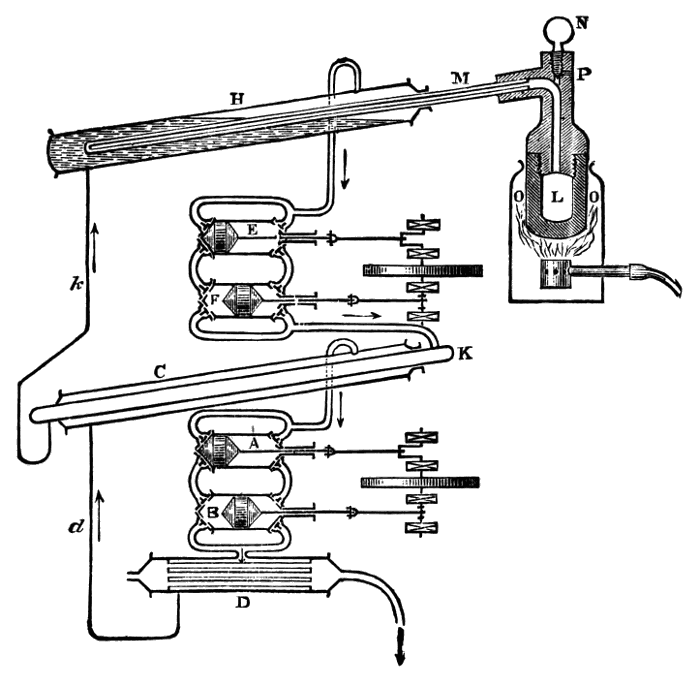
M. Pictet’s process for liquefying oxygen, although differing in the method of working, is similar in principle to that of M. Cailletet. His paper, which was read at the same sitting of the Academy as M. Cailletet’s, thus describes it:—
“A and B, in the accompanying figure, are two double section and force pumps, coupled together on the compound system, one causing a vacuum in the other in such a manner as to obtain the greatest possible difference between the pressures of suction and forcing.”
The pumps act on anhydrous sulphurous acid contained in the cylindrical receiver c. The pressure in this receiver is such that the sulphurous acid is evaporated from it at a temperature of 65° C. below zero.
The sulphurous acid is forced by the pumps into a condenser, d, cooled by a current of cold water; here it liquefies at the temperature of 25° above zero, and at a pressure of about 23⁄4 atmospheres.
The sulphurous acid returns to the receiver C as it liquefies by the little tube d.
E and F are two pumps resembling the preceding, and coupled in the same manner. They act upon carbonic acid contained in a cylindrical receiver H.
The temperature in this latter receiver is such that the carbonic acid evaporates from it at a temperature of 140° C. below zero.
The carbonic acid forced on by the pumps is driven into the condenser K, enclosed in the sulphurous acid receiver C, which has a temperature of 65° below zero; the carbonic acid here becomes liquefied at a pressure of five atmospheres.
The carbonic acid, in proportion as it liquefies, returns to the receptacle H by the small tube k.
L is a retort of wrought iron, sufficiently thick to resist a pressure of 500 atmospheres. It contains chlorate of potassium, and is heated in such a manner as to give off pure oxygen. It communicates by a tubulure with an inclined tube, M, made of very thick glass, one metre in length, which is enveloped by the receiver, H, containing carbonic acid at the temperature of 140° below zero.
A tap, N, situated upon the tubulure of the retort, permits of the opening of an orifice, P, which leads into the surrounding air.
After the four pumps have been worked for several hours by means of a steam engine of 15-horse power, and when all the oxygen has been disengaged, the pressure in the glass tube is 320 atmospheres, and the temperature at 140° below zero.
Upon suddenly opening the orifice, P, the oxygen escapes with violence, producing, in doing so, so considerable an expansion and absorption of heat as to cause a liquefied portion to appear in the glass tube, and to spirt out from the orifice when the apparatus is sloped.
It ought to be stated that the quantity of liquefied oxygen contained in the tube one metre long and 0·01 m. in internal diameter, occupied about a third of its length, and issued from the orifice P in the form of a liquid jet.
In a communication to M. Dumas, received two days after the above sitting, M. Pictet described his experiments more fully, prefacing the account by the following very interesting remarks:—“The end to which I have been tending for the last 3 years has been to seek to demonstrate experimentally that molecular cohesion is a general property of bodies without exception.
“If the permanent gases cannot be liquefied, it must be concluded that their constituent particles do not attract each other, and are therefore independent of this law.
“To succeed experimentally in bringing the molecules of a gas into the closest possible proximity, and thus to obtain its liquefaction, certain indispensable conditions are necessary, which I thus sum up:
“1. To have a gas that must be perfectly pure and without a trace of foreign gas.
“2. To have at one’s disposal very powerful means of compression.
“3. To obtain an intense degree of cold, and the abstraction of heat at these low temperatures.
“4. To have a large surface of condensation maintained at these low temperatures.
“5. To have the power of utilising the expansion of the gas under considerable pressure to the atmospheric pressure, which expansion added to the preceding means compels liquefaction.
“With these five conditions fulfilled, we may formulate the following problem.
“When a gas is compressed at 500 or 600 atmospheres, and kept at a temperature of -100° or 140°, and then let expand to the pressure of the atmosphere, one of two things must occur. Either the gas, obeying the action of cohesion, liquefies and yields its heat of condensation to the portion of the gas, which expands and is lost in the gaseous form; or under the hypothesis that cohesion is not a natural law, the gas passes beyond absolute zero, that is to say, it becomes inert, a dust without consistence. The work of expansion would be impossible, and the loss of heat absolute.”
Spite of M. Cailletet’s supposition that nitrogen would prove a very incoercible gas, his experiments showed the contrary, since he found that it easily condensed under a pressure of about 200 atmospheres and at a temperature of 13° C., the conditions as to its sudden expansion being observed.
Hydrogen, the lightest of all the gases, which M. Cailletet could only procure in the form of mist, was unmistakably liquefied by M. Pictet within less than a fortnight afterwards,
The tap which confined the gas at this pressure, being opened, a jet of a steel blue colour escaped from the orifice, accompanied by a hissing sound, like that given off when a red-hot iron is dipped into cold water. The jet suddenly became intermittent, and a shower of solid particles of the hydrogen fell to the ground with a crackling noise. The hydrogen was obtained by the decomposition of formiate of potash by caustic potash, the gas thus yielded being absolutely pure.
Cailletet states that he succeeded perfectly in liquefying atmospheric air, previously deprived of moisture and carbonic acid, but he omits to mention the pressure and reduction of temperature to which the air was subjected. He liquefied nitric oxide at the pressure of 104 atmospheres and at a temperature of -11° C.
Carbonic anhydride is liquefied on the large scale by condensing it in strong vessels of gun-metal or boiler-plate. Thilorier was the first to procure it in a solid condition. It requires a pressure of between 27 and 28 atmospheres at 32° F. (Adams.) The liquefied acid is colourless and limpid, lighter than water, and four times more expansible than air; it mixes in all proportions with ether, alcohol, naphtha, oil of turpentine, and sulphide of carbon; and is insoluble in water and fat oils. When a jet of liquid carbonic anhydride is allowed to issue into the air from a narrow aperture, such an intense degree of cold is produced by the evaporation of a part, that the remainder freezes to a solid (solid carbonic anhydride), and falls in a shower of snow. This substance, which may be collected, affords a means of producing extreme cold. Mixed with a little ether, and poured upon a mass of mercury, the latter is almost instantly frozen. The temperature of this mixture in the air was found to be -106° Fahr.; when the same mixture was placed beneath the receiver of an air-pump, and exhaustion rapidly performed, the temperature sank to -166°. This degree of cold was employed in Faraday’s last experiments on the liquefaction of gases.
LIQUEUR. [Fr.] Syn. Cordial. A stimulating beverage, formed of weak spirit, aromatised and sweetened. The manufacture of liqueurs constitutes the trade of the ‘compounder,’ ‘rectifier,’ or ‘liquoriste.’
The materials employed in the preparation of liqueurs or cordials are rain or distilled water, white sugar, clean flavourless spirit, and flavouring ingredients. To these may be added the substances employed as ‘finings,’ when artificial clarification is had recourse to.
The utensils and apparatus required in the business are those ordinarily found in the wine and spirit cellar; together with a copper still, furnished with a pewter head and a pewter worm or condenser, when the method ‘by distillation’ is pursued. A barrel, hogshead, or rum puncheon, sawn in two, or simply ‘unheaded,’ as the case may demand, forms an excellent vessel for the solution of the sugar; and 2 or 3 fluted funnels, with some good white flannel, will occasionally be found useful for filtering the aromatic essences used for flavouring. Great care is taken to ensure the whole of the utensils, &c., being perfectly clean and ‘sweet,’ and well ‘seasoned,’ in order that they may neither stain nor flavour the substances placed in contact with them.
In the preparation or compounding of liqueurs, one of the first objects which engages the operator’s attention is the production of an alcoholic solution of the aromatic principles which are to give them their peculiar aroma and flavour. This is done either by simple solution or maceration, as in the manufacture of tinctures and medicated spirits, or by maceration and subsequent distillation. The products, in this country, are called ESSENCES or SPIRITS, and by the French INFUSIONS, and are added to the solution of sugar (SYRUP or CAPILLAIRE) or to the dulcified spirit, in the proportions required. Grain or molasses spirit is the kind usually employed for this purpose in England. As before observed, it should be of the best quality; as, if this is not the case, the raw flavour of the spirit is perceptible in the liquor. Rectified spirit of wine is generally very free from flavour, and when reduced to a proper strength with clear soft water, forms a spirit admirably adapted for the preparation of cordial liquors. Spirit weaker than about 45 o. p., which has been freed from its own essential oil by careful rectification, is known in trade under the title of ‘pure,’ ‘flavourless,’ ‘plain,’ or ‘silent spirit.’ Before macerating the ingredients, if they possess the solid form, they are coarsely pounded, bruised, sliced, or ground, as the peculiar character of the substance may indicate. This is not done until shortly before submitting them to the action of the menstruum; as, after they are bruised they rapidly lose their aromatic properties by exposure to the air. When it is intended to keep them for any time in the divided state they should be preserved in well-corked bottles or jars. The practice of drying the ingredients before pounding them, frequently adopted by ignorant and lazy workmen for the sake of lessening the labour, is, of course, even more destructive to their most valuable qualities than mere exposure to the air. The length of time the ingredients should be digested in the spirit should never be less than 5 or 6 days, but a longer period is preferable when distillation is not employed. In either case the time may be advantageously extended to 10 days or a fortnight, and frequent agitation should be had recourse to during the whole period. When essential oils are employed to convey the flavour, they are first dissolved in a little of the strongest rectified spirit of wine, in the manner explained under Essence;Finings.
An excellent and easy way of manufacturing cordial liquors, especially when it is inconvenient to keep a large stock on hand, is by simply ‘aromatising’ and ‘colouring,’ as circumstances or business may demand, spirit 60 or 64 u. p., kept ready sweetened for the purpose. To do this to the best advantage, two descriptions of sweetened spirit should be provided, containing respectively 1 lb. and 3 lbs. of sugar to the gallon. From these, spirit of any intermediate sweetness may be made, which may be flavoured with any essential oil dissolved in alcohol, or any aromatised spirit or ‘infusion’ (see below), prepared either by digestion or distillation. As a general rule, the concentrated essences, made by dissolving 1 oz. of the essential oil in 1 pint of the strongest rectified spirit of wine, will be found admirably adapted for this purpose. These essences, which should be kept in well-corked bottles, are employed by dropping them cautiously into the sweetened spirit until the desired flavour is produced. During this operation the liquor should be frequently and violently shaken to produce complete admixture. If by any accident the essence is added in too large a quantity, the resulting ‘milkiness’ or excess of flavour may be removed by the addition of a little more spirit, or by clarification. In this way the majority of the liqueurs in common use may be produced extemporaneously, of nearly equal quality to those prepared by distillation. For those which are coloured, simple digestion of the ingredients is almost universally adopted. The “process by distillation” should, however, be always employed to impart the flavour and aroma of volatile aromatics to the spirit, when expense, labour, and time are of less importance than the production of a superior article.
The French liqueuristes are famed for the preparation of cordials of superior quality, cream-like smoothness, and delicate flavour. Their success chiefly arises from the employment of very pure spirit and sugar (the former in a larger proportion than that adopted by the English compounder), and in the judicious application of the flavouring ingredients. They distinguish their cordials as ‘eaux’ and ‘extraits’ (waters, extracts), or liqueurs which, though sweetened, are entirely devoid of viscidity; and ‘baumes,’ ‘crêmes,’ and ‘huiles’ (balms, creams, oils), which contain sufficient sugar to impart to them a syrupy consistence. The greatest possible attention is given to the preparation of the aromatised or flavouring essences, in France called ‘infusions.’ These are generally made by macerating the aromatic ingredients in spirit at about 2 to 4 u. p. (sp. gr. ·922 to ·925), placed in well-corked glass carboys, or stoneware jars or bottles. The maceration is continued, with occasional agitation, for 3, 4, or even 5 weeks, when the aromatised spirit is either distilled or filtered; generally the former. The outer peel of cedrats, lemons, oranges, limettes, bergamottes, &c., is alone used by our Continental neighbours, and is obtained either by carefully peeling the fruit with a knife, or by ‘oleo-saccharum,’ by rubbing it off with a lump of hard white sugar. Aromatic seeds and woods are bruised by pounding before being submitted to infusion. The substances employed in France to colour liqueurs are, for—blue, soluble Prussian blue, sulphate of indigo (nearly neutralised with chalk), and the juice of blue flowers and berries;—amber, fawn, and brandy colour, burnt sugar or spirit colouring;—green, spinach or parsley leaves (digested in spirit), and mixtures of blue and yellow;—red, powdered cochineal or brazil wood, either alone or mixed with a little alum;—violet, blue violet petals, litmus, or extract of logwood;—purple, the same as violet, only deeper;—yellow, an aqueous infusion of safflower or French berries, and the tinctures of saffron and turmeric.
A frequent cause of failure in the manufacture of liqueurs and cordials is the addition
A careful attention to the previous remarks will render this branch of the rectifier’s art far more perfect and easy of performance than it is at present, and will, in most cases, produce at once a satisfactory article, ‘fine, sweet, and pleasant.’
The cordials of respectable British ‘compounders’ contain fully 3 lbs. of white lump sugar per gallon, and are of the strength of 60 to 64 u. p. The baumes, crêmes, and huiles imported from the Continent are richer both in spirit and sugar than ours, and to this may be referred much of their superiority. Mere sweetened or cordialised spirits (eaux, of the Fr.) contain only from 1 to 11⁄2 lb. of sugar per gallon.
The purity of liqueurs is determined in the manner noticed under Brandy, Wine, &c.
The following list embraces nearly all the cordials and liqueurs, both native and imported, met with in trade in this country:—
Absinthe. Syn. Extrait d’absinthe de Suisse; Swiss extract of wormwood. Prep. From the tops of Absinthum majus, 4 lbs.; tops of Absinthum minus, 2 lbs.; angelica root, Calamus aromaticus, Chinese aniseed, and leaves of dittany of Crete, of each 15 gr.; brandy or spirit at 12 u. p., 4 galls.; macerate for 10 days, then add water, 1 gall.; distil 4 galls. by a gentle heat, and dissolve in the distilled spirit, of crushed white sugar, 2 lbs. Tonic and stomachic.
Alker′mes. This liqueur is highly esteemed in some parts of the South of Europe.
Prep. 1. Bay leaves and mace, of each 1 lb.; nutmegs and cinnamon, of each 2 oz.; cloves, 1 oz. (all bruised); cognac brandy, 31⁄2 galls.; macerate for 3 weeks, frequently shaking, then distil over 3 galls., and add of clarified spirit of kermes, 18 lbs.; orange-flower water, 1 pint; mix well, and bottle. This is the original formula for the ‘alkermes de Santa Maria Novella,’ which is much valued.
2. Spice, as last; British brandy, 4 galls. water, 1 gall.; macerate as before, and draw over 4 galls., to which add, of capillaire, 2 galls., and sweet spirit of nitre, 1⁄4 pint. Cassia is often used for cinnamon. Inferior to the last.
An′iseed Cordial. Prep. 1. From aniseed, 2 oz. (or essential oil, 11⁄2 dr.), and sugar, 3 lbs. per gall. It should not be weaker than about 45 u. p., as at lower strengths it is impossible to produce a full-flavoured article without its being milky, or liable to become so.
2. (Anisette de Bordeaux.)—a. (Foreign.) Aniseed, 4 oz.; coriander and sweet fennel seeds, of each 1 oz. (bruised); rectified spirit, 1⁄2 gall.; water, 3 quarts; macerate for 5 or 6 days, then draw over 7 pints, and add of lump sugar, 21⁄2 lbs.
b. (English.) Oil of aniseed, 15 drops; oils of cassia and caraway, of each 6 drops; rub them with a little sugar, and then dissolve it in spirit (45 u. p.), 3 quarts, by well shaking them together; filter, if necessary, and dissolve in the clear liquor sugar, 11⁄2 lb. See Peppermint (below).
Balm of Molucca. Prep. From mace, 1 dr.; cloves, 1⁄2 oz.; clean spirit (22 u. p.), 1 gall.; infuse for a week in a well-corked carboy or jar, frequently shaking, colour with burnt sugar q. s., and to the clear tincture add of lump sugar, 41⁄2 lbs.; dissolved in pure soft water, 1⁄2 gall. On the Continent this takes the place of the ‘cloves’ of the English retailer.
Bit′ters. These have generally from 1 to 11⁄2 lb. of sugar per gallon.[19]
Car′away Cordial. Prep. Generally from the essential oil, with only 21⁄2 lbs. of sugar per gall. 1 fl. dr. of the oil is commonly reckoned equal to 1⁄4 lb. of the seed. The addition of a very little oil of cassia, and about half as much of essence of lemon or of orange, improves it. See Brandy (Caraway).
Ce′drat Cordial. Prep. From essence (oil) of cedrat, 1⁄4 oz.; pure spirit (at proof), 1 gall.; dissolve, add of water, 3 pints, agitate well; distil 3 quarts, and add an equal measure of clarified syrup. A delicious liqueur. See Crême and Eau (below).
Cin′namon Cordial. Prep. This is seldom made with cinnamon, owing to its high price, but with either the essential oil or bark of cassia, with about 2 lbs. of sugar to the gall. It is preferred coloured, and therefore may be very well prepared by simple digestion. The addition of 5 or 6 drops each of essence of lemon and orange peel, with about a spoonful of essence of cardamoms per gall., improves it. 1 oz. of oil of cassia is considered equal to 8 lbs. of the buds or bark. 1 fl. dr. of the oil is enough for 21⁄2 galls. It is coloured with burnt sugar.
Cit′ron Cordial. Prep. From the oil or peel, with 3 lbs. of sugar per gall., as above. (See below.)
Citronelle. Syn. Eau de Barbades. Prep.1⁄2 dr.; corianders and cinnamon, of each 1 dr.; proof spirit, 4 pints; digest for 10 days, then add of water, 1 quart, and distil 1⁄2 gall.; to the distilled essence add of white sugar, 2 lbs., dissolved in water, 1 quart.
2. Essence of orange, 1⁄2 dr.; essence of lemon, 1 dr.; oil of cloves, and cassia, of each 10 drops; oil of coriander, 20 drops; spirit (58 o. p.), 5 pints; agitate until dissolved, then add of distilled or clear soft water, 3 pints; well mix, and filter it through blotting paper, if necessary; lastly add of sugar (dissolved), q. s.
Clairet. Syn. Rossalis des sin graines. Prep. From aniseed, fennel seed, coriander seed, caraway seed, dill seed, and seeds of the candy-carrot (Athamantia cretensis—Linn.), of each (bruised) 1 oz.; proof spirit 1⁄2 gall.; digest for a week, strain, and add of loaf sugar, 1 lb., dissolved in water, q. s.
Cloves. Syn. Clove cordial. Prep. From bruised cloves, 1 oz., or essential oil, 1 fl. dr., to every 3 galls. of proof spirit. If distilled, some common salt should be added, and it should be drawn over with a pretty quick fire. It requires fully 3 lbs. of sugar per gall., and is generally coloured with poppy flowers or burnt sugar. The addition of 1 dr. of bruised pimento, or 5 drops of the oil for every oz. of cloves, improves this cordial. See Balm of Molucca (above).
Coriander Cordial. Prep. From corianders, as the last. A few sliced oranges improve it.
Crême d’Anis. As ANISEED CORDIAL, only richer.
Crême des Barbades. As CITRONELLE, adding some of the juice of the oranges, and an additional lb. of sugar per gall.
Crême de Cacao. Prep. Infuse roasted caracca-cacao nuts (cut small), 1 lb., and vanilla, 1⁄2 oz., in brandy, 1 gall., for 8 days; strain, and add of thick syrup, 3 quarts.
Crême de Cedrat. Syn. Huile de Cedrat. Prep. From spirit of citron, 1 pint; spirit of cedrat, 1 quart; proof spirit, 3 quarts; white sugar, 16 lbs., dissolved in pure soft water, 2 galls.
Crême de Macarons. Prep. 1. From cloves, cinnamon, and mace, of each (bruised) 1 dr.; bitter almonds (blanched and beaten to a paste), 7 oz.; spirit (17 u. p.), 1 gall.; digest a week, filter, and add of white sugar, 6 lbs., dissolve in pure water, 2 quarts.
2. Clean spirit (at 24 u. p., sp. gr. ·945), 2 galls.; bitter almonds, 3⁄4 lb.; cloves, cinnamon, and mace, of each in coarse powder, 11⁄2 dr.; infuse for 10 days, filter, and add of white sugar, 8 lbs.; dissolved in pure water, 1 gall.; lastly, give the liqueur a violet tint with infusion or tincture of litmus and cochineal. An agreeable, nutty-flavoured cordial, but, from containing so much bitter almonds, should be only drank in small quantities at a time. The English use only one half the above quantity of almonds.
Crême de Naphe. Prep. From sweetened spirit (60 u. p.) containing 31⁄2 lbs. of sugar per gall., 7 quarts; orange-flower water (foreign), 1 quart. Delicious.
Crême de Noyeau. See Noyeau.
Crême d’Orange. Prep. From oranges, (sliced), 3 dozen; rectified spirit, 2 galls.; digest for 14 days; add, of lump sugar, 28 lbs. (previously dissolved in water, 41⁄2 galls.); tincture of saffron, 11⁄2 fl. oz.; and orange-flower water, 2 quarts.
Crême de Portugal. Flavoured with lemon, to which a little oil of bitter almonds is added.
Curaçao. Prep. From sweetened spirit (at 56 u. p.), containing 31⁄2 lbs. of sugar per gall., flavoured with a tincture made by digesting the ‘oleo-saccharum’ prepared from Seville oranges, 9 in number; cinnamon, 1 dr.; and mace, 3⁄4 dr., in rectified spirit, 1 pint. It is coloured by digesting in it for a week or 10 days Brazil-wood (in powder), 1 oz., and afterwards mellowing the colour with burnt sugar, q. s.
Delight of the Mandarins. From spirit (22 u. p.), 1 gall.; pure soft water, 1⁄2 gall.; white sugar (crushed small), 41⁄2 lbs.; Chinese aniseed and ambrette or musk seed, of each (bruised) 1⁄2 oz.; safflower, 1⁄4 oz.; digested together in a carboy or stone bottle capable of holding double, and agitated well every day for a fortnight.
Eau de Cedrat. Syn. Cedrat water. As CRÊME DE CEDRAT, but using less sugar.
Eau de Chasseurs. See Peppermint (below).
Eau de Vie d’Andaye. Syn. Eau de vie d’Anis; Aniseed liqueur brandy. Prep. From brandy or proof spirit, 1 gall.; sugar, 3⁄4 lb.; dissolved in aniseed water, 1 pint.
Gold Cordial. Prep. From angelica root (sliced), 1 lb.; raisins, 1⁄2 lb.; coriander seeds, 2 oz.; caraway seeds and cassia, of each 11⁄2 oz.; cloves, 1⁄2 oz.; figs and sliced liquorice root, of each 4 oz.; proof spirit, 3 galls.; water, 1 gall.; digest 2 days, and distil 3 gallons by a gentle heat; to this add, of sugar, 9 lbs., dissolved in rose water and clean soft water, of each 1 quart; lastly, colour the liquid by steeping in it of bay saffron, 11⁄4 oz. This cordial was once held in much esteem. It derives its name from a small quantity of gold leaf being formerly added to it.
Huile d’Anis. See Crême d’Anis (above).
Huile de Vanille. Flavoured with essence or tincture of vanilla. It is kept in a decanter, and used to flavour liqueurs, grog, &c.
Huile de Venus. Prep. From the flowers of the wild carrot, 21⁄2 oz., and sugar, 3 lbs. to the gall. It is generally coloured by infusing a little powdered cochineal in it.
Jargonelle. Syn. Jargonelle cordial. Flavoured with essence of jargonelle pear (acetate of amyl). Pine-apple cordial and liqueursEssence.
Lem′on Cordial. Prep. Digest fresh and dried lemon peel, of each 2 oz., and fresh orange peel, 1 oz., in proof spirit, 1 gall., for a week; strain with expression, add of clear soft water q. s. to reduce it to the desired strength, and lump sugar, 3 lbs. to the gallon. The addition of a little orange-flower or rose water improves it.
Liquodilla. Flavoured with oranges and lemons, of each, sliced, 3 in number; with sugar 21⁄2 lbs. per gall.
Lov′age Cordial. Prep. From the fresh roots of lovage, 1 oz. to the gallon. A fourth of this quantity of the fresh roots of celery and sweet fennel are also commonly added. In some parts a little fresh valerian root and oil of savine are added before distillation. It is much valued by the lower classes in some of the provinces for its stomachic and emmenagogue qualities.
Oil of Ce′drat. See Crême de Cedrat (above).
Orange Cordial. Like LEMON CORDIAL or CRÊME D’ORANGE, from fresh orange peel, 1⁄2 lb., to the gallon.
Parfait Amour. Syn. Perfect Love. Prep. Flavoured with the yellow rind of 4 lemons, and a teaspoonful of essence of vanilla to the gallon, with sugar, 3 lbs., and powdered cochineal q. s. to colour.
Pep′permint. Syn. Peppermint cordial, Sportsman’s c., X. mint; Eau de chasseurs, Fr. This well-known compound is in greater demand in every part of the kingdom than all the other cordials put together.
Prep. 1. From peppermint water and gin or plain spirit (22 u. p.), of each 1 pint; lump sugar, 3⁄4 lb.
2. (Wholesale.) English oil of peppermint, 5 oz., is added to rectified spirits of wine, 3 pints, and the mixture is agitated well together for some time in a corked bottle capable of holding 4 pints or more; it is then emptied into a cask having a capacity of upwards of 100 galls., and perfectly white and flavourless proof spirit, 36 galls., is poured in, and the whole well agitated for ten minutes; a solution of the best double refined lump sugar, 23⁄4 cwt., in about 35 galls. of pure filtered rain water, is then added, and the contents of the cask well ‘rummaged up’ in the usual manner for at least 15 minutes; sufficient clear rain water to make up the whole quantity to exactly 100 gallons, and holding in solution alum, 5 oz., is next added, and the whole is again well agitated for at least a quarter of an hour, after which the cask is bunged down, and allowed to repose for a fortnight before it is ‘broached’ for sale.
Obs. The last formula produces a beautiful article provided the ingredients are of good quality. Care on this point is particularly necessary in reference to the essential oil, which should only be purchased of some known respectable dealer. The sugar should be sufficiently pure to dissolve in a wine-glassful of clear soft water without injuring its transparency, and the cask should be a fresh-emptied gin pipe, or one properly prepared for gin, as, if it gives colour, it will spoil the cordial. When these particulars are attended to, the product is a bright transparent liquor as soon as made, and does not require fining. Should there be the slightest opacity, the addition of 2 oz. of salt of tartar, dissolved in a quart of hot water, will have the effect of ‘clearing it down’ in the course of a few days. The product is 100 galls. of cordial at 64 u. p.
Pimen′to. Syn. Pimento cordial, Pimento dram. Rather strongly flavoured with allspice or pimento. It has obtained a great repute in the West Indies in diarrhœa, cholera, and bowel complaints generally.
Rasp′berry Cordial. Prep. From raspberry brandy, capillaire, and water, equal parts. A similar article is prepared by flavouring sweetened spirit with the new ‘raspberry essence.’
Rat′ifia. The numerous liqueurs bearing this name are noticed in another part of this volume. See Ratifia.
Shrub. See the article Shrub in another part of this work.
Sighs of Love. Prep. 1. From proof spirit flavoured with otto of roses and capillaire, equal parts.
2. From sugar, 6 lbs., pure soft water, q. s. to produce a gallon of syrup, to which add, of eau de rose, 1 pint; proof spirit, 7 pints. It is stained of a pale pink by powdered cochineal. A very pleasant cordial. A drop or two (not more) of essence of ambergris or vanilla improves it.
Tears of the Widow of Malabar. Prep. As balm of Molucca, but employing cloves (bruised), 1⁄2 oz., mace (shredded), 1 dr., and a teaspoonful of essence of vanilla for flavouring. Some add of orange-flower water, 1⁄4 pint. It is slightly coloured with burnt sugar.
Tent. From plain spirit (22 u. p.) and port wine, of each 1 quart; sherry and soft water, of each 1 pint; orange-flower water and lemon juice, of each 1⁄4 pint; essence of ambergris, 2 drops (not more); sugar, 2 lbs. See Wine.
Us′quebaugh. See the article Usquebaugh in another part of this work.
LIQUEUR DE LA MOTTE. [Fr.] See Drops (Golden) and Tincture.
LIQUEUR DORÉE. [Fr.] Prep. Take of cinnamon, bitter orange peel, and Peruvian bark, of each 1⁄2 oz.; hay saffron, 1⁄4 oz.; brandy and Malaga wine, of each 3 quarts; digest for a week, strain, and add of lump sugar, 2 lbs. Tonic, stomachic, and stimulant; chiefly used as an agreeable alcoholic dram.
LIQUEUR DE PRESSAVIN. [Fr.] Prep. From oxide of mercury (freshly precipitated) and cream of tartar, of each 1 oz.; hot water, 1 quart; dissolve and filter. For use 2 spoonfulsDose. A wine-glassful 3 or 4 times a day, avoiding the use of common salt. This is simply a solution of potassio-tartrate of mercury, and may be taken in the usual cases in which mercury is administered.
LIQUODIN′NA. See Liqueur.
LIQUID-AMBAR. Syn. Copaibæ balsam. A fluid balsamic juice obtained from the Liquidamber styraciflua, an American tree. It closely resembles LIQUID STORAX in its properties, and may be applied to the same purposes. See Styrax.
LIQ′UOR. Syn. Liquor, L.; Liqueur, Fr. This term is given in the London Pharmacopœia to those aqueous solutions commonly though improperly called ‘WATERS,’ ammoniæ liquor potassæ, &c. It is now more correctly applied to the ‘WATERS’ of the British Pharmacopœia. See Solution.
The term ‘liquor’ has also, of late years, been applied to certain concentrated preparations, most of which would be more correctly termed ‘FLUID EXTRACTS,’ as they merely differ from good extracts in their consistence, and from ordinary extracts in containing less starchy matter, albumen, and gum. There is also usually a little spirit added to them to prevent decomposition. Liquors of this kind may be prepared of the finest quality by the same processes that are required for the preparation of good soluble extracts; observing to stop the evaporation as soon as the consistence of treacle is acquired, and when cold, to add 1-4th or 1-5th part of their weight (after evaporation) in rectified spirit. The addition of 3 or 4 drops of the oils of cloves and mustard seed, dissolved in the spirit, will secure them from any risk of ‘moulding’ or fermenting; in fact, with this addition many of them will keep well without spirit, provided they are evaporated sufficiently, and kept in a cool place. The liquors, which are merely concentrated infusions or decoctions, and which, in their consistence, do not even approximate to extracts, may be made in the manner directed under those heads.
Much confusion would be prevented if the terms ‘concentrated decoction,’ ‘concentrated infusion,’ &c., were adopted for those vegetable preparations possessing eight times the usual strength; ‘liquors’ for those of a higher strength, but still sufficiently liquid to be treated as such in dispensing, &c.; and ‘fluid extracts’ for those possessing considerable consistence, and approaching the common extracts in their degree of concentration and mode of preparation. See Decoction, Infusion, Essence, Extract, Solution, &c.
⁂ The following formulæ present some illustrations of the preparation of this class of medicines.
Liquor of Ammonia. Syn. Liquor Ammoniæ. Prep. Strong solution of ammonia, 1 pint; distilled water, 2 pints; mix and preserve in a stoppered bottle. Sp. gr. ·959.
Liquor of Ammonia, Stronger. Syn. Liquor Ammoniæ Fortior. Prep. Mix chloride of ammonium in coarse powder 3 lbs., and slaked lime 4 lbs., and introduce the mixture into an iron bottle, placed in a metal pot surrounded by sand. Connect the iron tube which screws air-tight into the bottle in the usual manner, by corks, glass tubes, and caoutchouc collars, with a Woulf’s bottle capable of holding a pint; connect this with a second Woulf’s bottle of the same size, the second bottle with a matrass of the capacity of three pints, in which 22 oz. of distilled water are placed, and the matrass by means of a tube bent twice at right angles, with an ordinary bottle containing distilled water 10 oz. Bottles 1 and 2 are empty, and the latter and the matrass which contains the 22 oz. of distilled water are furnished each with a siphon safety-tube charged with a very short column of mercury.
The heat of a fire, which should be very gradually raised, is to be now applied to the metal pot, and continued until bubbles of condensible gas cease to escape from the extremity of the glass tube which dips into the water of the matrass.
The process being terminated, the matrass will contain about 43 fl. oz. of strong solution of ammonia. Bottles 1 and 2 will now include the first, about 16, the second, about 10 fl. oz. of a coloured ammoniacal liquid.
Place this in a flask closed by a cork, which should be perforated by a siphon safety-tube containing a little mercury, and also by a second safety-tube bent twice at right angles, and made to pass to the bottom of the terminal bottle used in the preceding process. Apply heat to the flask until the coloured liquid it contains is reduced to three fourths of its original bulk. The product now contained in the terminal bottle will be nearly of the strength of solution of ammonia, and may be made exactly so by the addition of the proper quantity of distilled water, or of strong solution of ammonia. Density ·191, contains 32·5 per cent. of ammonia.
Antidotes.—Vinegar and water followed by acidulated demulcent drinks.
Liquor, Anodyne. See Spirit of Ether.
Liquor, Antinephritic. Syn. Liquor antinephriticus, L. Prep. (Adams.) Poppy heads, 6 oz.; water, 11⁄2 pint; boil to one third, strain with pressure, and add of nitrate of potassa, 1 oz.—Dose, 1 to 2 teaspoonfuls night and morning; in gravel and painful affections of the kidneys and bladder.
Liquor, Antipodag′ric (Beguin’s). Syn. Hoffmann’s gout liquid; Liquor antipodagricus Hoffmannii, L. Prep. From Boyle’s fuming liquor, 1 part; spirit of wine, 3 parts. Sudorific.—Dose, 20 to 30 drops; or externally, in gout, and other painful affections, either alone or combined with camphor. See Ammonium, Persulphide of.
Liquor Antipsor′ic. Syn. Liquor antipsoricus,Lotio a., L. Prep. (Van Mons.) Sulphuret of sodium, 11⁄2 dr.; hydrochlorate of ammonia, 75 gr.; dissolve each separately in water, 1⁄2 pint, mix the solutions, and filter. In itch and other moist skin diseases.
Liquor, Bleaching. See Solution of Chloride of Lime.
Liquor, Blistering. B. Syn. Liquor Epispasticus, Linimentum cantharides. Prep. Mix cantharides in powder, 8 oz.; and acetic acid, 4 fl. oz. Pack in a percolator, and after 24 hours pass ether slowly through until 20 fl. oz. are obtained. Keep in a stoppered bottle.
Liquor, Boyle’s Fu′′ming. The perhydrosulphate of ammonia.
Liquor of Calum′ba. Syn. Liquor calumbæ, L. Same as CONCENTRATED INFUSION OF CALUMBA.
Liquor of Cam′phor. See Essence.
Liquor of Chiret′ta. Same as Concentrated infusion of chiretta.
Liquor of Cincho′na. Syn. Liquor of bark; Concentrated infusion of bark, Inspissated i. or B.; Inspissated i. of b.; Infusum cinchonæ spissatum (Ph. L.), L. Prep. 1. (Ph. L.) Yellow cinchona bark (bruised), 3 lbs., is macerated in distilled water, 6 pints, at two successive operations, as directed under EXTRACT OF CINCHONA—Ph. L.; the mixed infusions are evaporated by the heat of a water bath to one fourth, and placed aside to settle; the clear portion is decanted, the remainder strained, and the mixed liquid again evaporated until its sp. gr. reaches 1·200; to this, when cold, rectified spirit is dropped in, by degrees, “so that 3 fl. dr. may be added to each fl. oz. of the liquor;” lastly, allow it to repose for 20 days, that the dregs may subside.
Obs. It is not at all clear whether the College means 3 fl. dr. of spirit to be added to each fl. oz. of the liquid before its addition, or that it is to be added so that each fl. oz. of the product shall contain that quantity. We presume the former. 1 fl. dr. of this preparation is said to represent fully 4 fl. oz. of the INFUSION OF CINCHONA—Ph. L.; but it is obvious that it must be liable to great variations in strength. “In a general way 1 fl. dr. may be considered equal to 3 fl. oz. of the infusion.” (Pereira.) As commonly met with, this preparation is nearly destitute of the cinchona alkaloids.
2. Yellow cinchona bark, bruised, 56 lbs., and water holding in solution sulphuric acid, 11⁄2 lb., are macerated together, with occasional agitation, in a covered earthen vessel, for 48 hours, after which the liquor is expressed, and the residuum or marc is treated with fresh water; the mixed strained liquid is then evaporated as rapidly as possible in earthenware, to exactly 6 lbs.; to this rectified spirit, 11⁄4 lb., is added, and the whole is set aside for a week or 10 days; the clear portion is, lastly, decanted and preserved in well-closed bottles. The product is very rich in quinine. It is 96 times as strong as the DECOCTION OF CINCHONA—Ph. L., and 12 times as strong as the above preparation of the Ph. L. This preparation resembles the ‘LIQUOR CINCHONÆ’ sold by certain houses in the trade at 24s. per lb., wholesale.
3. Exhaust the bark as above by maceration in 3 successive waters without acid, filter, evaporate the mixed liquors to 7 lbs., and proceed as before. Inferior to the last, and less rich in the cinchona alkaloids. Very thick; scarcely liquid.
4. From PALE BARK:—(Liquor cinchonæ pallidæ; Infusum cinchonæ spissatum—Ph. L.) From pale bark, as the last. See Infusion of Cinchona.
Liquor, Disinfect′ing. See Solution (Chlorides of Lime, Soda, and Zinc), and Disinfecting compounds.
Liquor of Er′got. Syn. Essence of ergot of rye, Concentrated infusion of e.; Essentia secalis cornuti, Liquor ergotæ, Infusum ergotæ concentratum, L. Prep. Recent ergot of rye (reduced to coarse powder by pounding, or preferably by grinding it in a pepper-mill), 11⁄2 lb., and boiling distilled water, 4 lbs., are digested together in a closed vessel, with frequent agitation until cold, and then put into a wide-mouthed bottle, along with rectified spirit, 2 lbs.; the whole is then allowed to macerate for a week, after which the liquor is expressed and filtered. Obs. 4 fl. dr. of this essence are equal to 1 dr. of ergot in substance. It is 8 times the strength of the INFUSION (as usually prepared according to the formula of Pereira and others), and 21⁄2 times the strength of the TINCTURE OF ERGOT of the London Apothecaries’ Hall. This is the only ESSENCE OF LIQUOR OF ERGOT known in the wholesale trade.
Liquor of Flints. See Solution.
Liquor of Gutta Percha. B. Syn. Liquor Gutta percha. Gutta percha in thin slices, 1 oz.; carbonate of lead in fine powder, 1 oz.; chloroform, 8 fl. oz. Add the gutta percha to 6 fl. oz. of chloroform in a stoppered bottle, and shake them frequently till solution has been effected. Then add the carbonate of lead previously mixed with the remainder of the chloroform, and having several times shaken the whole together set the mixture aside, and let it remain at rest until the soluble matter has subsided. Lastly, decant the clear liquid and keep in a well-stoppered bottle.
Liquor, Libavius’s. Bichloride of tin.
Liquor of Mat′ico. Syn. Concentrated infusion of matico; Liquor maticonis, Infusum maticonis concentratum, L. Prep. From matico leaves, 1 lb.; rectified spirit, 1⁄2 pint; distilled water, 32 fl. oz.; digest 10 days, express, and filter. 1 fl. dr. added to 7 fl. dr. of water is equal to 1 fl. oz. of the common INFUSION.
Liquor of Myrrh. Syn. Solution of myrrh; Liquor myrrhæ, Loco liquaminis myrrhæ,Prep. (Ph. Bor.) Extract of myrrh (Ph. Bor.), 1 oz.; distilled water, 5 fl. oz.; mix thoroughly, decant, and strain. It should be of a brownish-yellow colour, and turbid.—Dose, 1⁄2 to 1 fl. dr.
Liquor of O′pium. Syn. Liquor opii, L. o. concentratus, L. opiatus, L. See Black drop.[20]
1. (Messrs Smith.) Opium, 4 oz., is made into an extract, and ‘denarcotised’ by ether; it is then dissolved in alcohol, filtered, evaporated nearly to dryness, and redissolved in water q. s. to furnish 12 oz. of solution; to this is added, of rectified spirit, 23⁄4 oz., with water q. s. to make the whole up to 16 oz.—Dose, 3 to 12 drops.
2. (Acetic; Liquor opii aceticus, L.) See Laudanum (Houlton’s).
3. (Citric; Liquor opii citricus, L.)—a. Powdered opium, 11⁄2 oz.; lemon juice, 11⁄2 pint; evaporate to one half, cool, add of rectified spirit, 5 fl. oz., and the next day decant or filter; same strength as ‘LAUDANUM,’
b. (Liquor morphiæ citratis—Dr Porter.) Opium, 4 oz.; citric acid, 2 oz.; triturate, and add of boiling water, 15 fl. oz.; digest with agitation for 24 hours, and filter. This last has above three times the strength of ‘LAUDANUM,’ It is sadly misnamed.
4. (Hydrochloric; Solution of Muriate of Opium; Liquor opii hydrochloricus, L.—Dr Nichol.) Powdered opium, 11⁄2 oz.; distilled water, 1 pint; hydrochloric acid, 11⁄2 fl. oz.; digest a fortnight, and strain with expression. Same strength as ‘LAUDANUM,’ According to Dr Nichol, this is preferable to every other preparation of opium.
5. (Sedative; Battley’s Sedative solution of Opium; Liquor opii sedativus, L.)—a. Hard aqueous extract of opium (bruised), 3 oz., is boiled in water, 11⁄2 pint, until dissolved; to the solution, when cold, rectified spirit, 6 oz. is added, together with water, q. s. to make the whole measure exactly 1 quart; the liquor is, lastly, filtered.
b. From hard extract of opium, 22 oz.; boiling water, 13 pints; rectified spirit, 3 pints; as the last.
c. From extract of opium—Ph. L., 41⁄4 oz.; water, 1 quart; boil till reduced to 34 fl. oz.; cool, filter, and add of rectified spirit, 5 fl. oz., and water, q. s. to make up exactly 1 quart.
Obs. The first two formulæ, which vary only in their quantities, are identical with that employed by Mr Battley. As hard extract of opium is not always at hand, we have introduced a formula in which the ordinary extract is ordered. It gives a precisely similar product to the others, provided the cold aqueous decoction is filtered before adding the spirit. Battley’s LIQUOR OPII SEDATIVUS is an excellent preparation, less exciting than opium or laudanum.—Dose, 10 to 30 drops. Dr Christison states that 20 drops of Battley’s solution are equal to 30 drops of the common tincture.
Liquor, Pancreatic (Van den Corput). Syn. Liquor Pancreatini. Pancreatin and carbonate of potash, of each 10 gr.; balm water, 21⁄2 fl. oz.; syrup of orange peel, 5 dr.—Dose, 1⁄2 fl. oz. to 1 fl. oz.
Liquor of Pepsin. (Mr Squire.) Syn. Liquor pepsini. Prep. 1 drachm of Boudault’s pepsin in 1 oz. of distilled water. Salt must be added if it is to be preserved.—Dose. A teaspoonful.
Liquor of Rhu′barb. Syn. Liquor rhei, Infusum rhei concentratum, L. Prep. 1. Rhubarb (well bruised), 63⁄4 oz.; water, q. s.; rectified spirit, 1⁄2 pint; proceed as for INFUSION OF CALUMBA (conc.); to produce a quart. 8 times the usual strength.
2. See Infusion of Rhubarb (Concentrated).
3. See Extract of Rhubarb (Fluid).
Liquor of Sarsaparil′la. Syn. Fluid extract of sarsaparilla; Liquor sarzæ, Essentia sarsaparillæ, L. Prep. Either the simple or the compound liquor of sarsaparilla may be made from the corresponding decoction, or, preferably, the infusion prepared with water at 125° Fahr., by carefully evaporating it until sufficiently concentrated, and then straining it through flannel, and adding a little spirit. Jamaica sarsaparilla should be alone employed, as the other varieties, especially the Honduras, not only possess less medicinal virtue, and yield less extract, but are very liable to ferment and get mouldy, unless an undue proportion of spirit is added to them. See Extract of Sarsaparilla (Fluid).
Liquor of Sen′na. Syn. Liquor sennæ, L. Both the FLUID EXTRACT and the CONCENTRATED INFUSION OF SENNA are called by this name, but more generally the former. The following are additional formulæ:—
1. (Duncan.) Senna, 15 lbs.; boiling water, 5 galls.; proceed by the method of displacement, evaporate the product to 10 lbs., add of molasses, 6 lbs. (previously concentrated over a water bath until it begins to congeal on cooling), dissolve, and further add of rectified spirit, 11⁄4 pint, together with water q. s. to make the whole measure exactly 12 pints. Every fl. oz. represents 1 oz. of senna.
2. (Dr Tweedy.) As the last, but using tincture of ginger (prepared with rectified spirit), 11⁄2 pint, instead of the spirit there ordered.
Liquor of Soap. Syn. Liquor saponis, L. See Tincture.
Liquor, Styp′tic. Syn. Liquor stypticus, L. Prep. (Ph. Slevico-Holsat. 1831.) Alum and sulphate of copper, of each 11⁄2 oz.; sulphuric acid, 1 oz.; water, 1 lb.; dissolve, and filter.
Liquor of Tarax′acum. Syn. Fluid extract of dandelion; Extractum taraxaci fluidum, Liquor taraxaci, L. Prep. 1. Dandelion roots (dried), 28 lbs., are rinsed in clean cold water to remove dirt, and then1⁄2 lbs.; to this rectified spirit, 6 lbs., is added, and after thorough agitation the vessel is set aside for a week or a fortnight, after which the clear portion is gently poured from the sediment and preserved in well-closed bottles in a cool place. A very fine article. It represents an equal weight of the root.
2. The expressed juice of dandelion is heated to near the boiling point, strained, and evaporated, as the last, to a proper consistence; 1⁄4th or 1⁄5th of rectified spirit is then added, and the liquid is otherwise treated as before. Very odorous and pale coloured.
3. Dried root (coarsely powered), 1 lb.; water, 11⁄4 pint; rectified spirit, 1⁄2 pint; digest a week, express the liquor, pass it through a hair sieve into a bottle, and in 10 days decant the clear portion.
4. (Ph. Bor.) Extract of dandelion, 3 parts; water, 1 part (or q. s.); triturated together.
5. (W. Procter.) Fresh root, 2 lbs., is sliced and reduced to a pulp, and macerated with 1⁄6th of its bulk of rectified spirit for 24 hours; it is then subjected to strong pressure, the marc is treated with water containing a little spirit, 1 pint, and the liquid is again expressed; the mixed product is evaporated to 12 fl. oz., and when cold, rectified spirit, 4 fl. oz. is added, and the whole filtered.
Obs. Liquor of taraxacum has a very large sale. The dose is 1 to 2 fl. dr. See Extract.
Liquor of Valer′ian. See Extract of Valerian (Fluid).
Liquor of Vanil′la. Syn. Fluid extract of vanilla; Liquor vanillæ, Extractum v. fluidum, L. Prep. 1. Vanilla (sliced), 1 lb.; rectified spirit, 3 pints; prepare a tincture either by displacement or maceration, and reduce it, by distillation at the lowest possible temperature, to 11⁄2 lb.; put this into a strong bottle whilst hot, add of white sugar candy (in powder), 1⁄2 lb., cork down, and agitate the whole until it is nearly cold. Very fine. Used chiefly for its odour and flavour. It represents half its weight of vanilla.