A CYCLOPÆDIA OF PRACTICAL RECEIPTS, &c. VOLUME II (continued 33)
Reading edition
This, however, as well as other cases of a similar kind, must not be regarded as an extreme instance of healthy slumber, but as a form of lethargy or coma, as indicative of disease, as the opposite condition or sleeplessness, that is frequently an accompaniment of certain forms of fevers, inflammatory affections, and brain disorders.
Mr Durham, of Guy’s Hospital, seems to have disposed of the condition that sleep is caused by the pressure of the distended veins on the brain.
A piece of bone being removed from a dog’s skull so that the animal’s brain could be observed when sleeping, it was found, 1, the veins were not distended. 2. During sleep the brain is in a comparatively bloodless condition, and the blood in the encephalic vessels is not only diminished in quantity, but moves with diminished rapidity; and this is corroborated by the observations of Dr Hughlings Jackson on the ophthalmoscopic condition of the retina during sleep, the optic disk being then whiter, the arteries smaller, and the retina generally more anæmic than in the waking state. 3. The condition of the cerebral circulation during sleep is from physical causes, that which is most favorable to the nutrition of the brain tissue. See Bed, Watchfulness.
SLEEPLESSNESS AND COLD FEET. The association betwixt cold feet and sleeplessness is much closer than is commonly imagined. Persons with cold feet rarely sleep well, especially women. Yet the number of persons so troubled is considerable. We now know that if the blood-supply to the brain be kept up, sleep is impossible. An old theologian, when weary and sleepy with much writing, found that he could keep his brain active by immersing his feet in cold water; the cold drove the blood from the feet to the head.
Now, what this old gentleman accomplished by design is secured for many persons much against their will. Cold feet are the bane of many women. Light boots keep up a bloodless condition of the feet in the day, and in many women there is no subsequent dilatation of the blood-vessels when the boots are taken off. These women come in from a walk and put their feet to the fire to warm—the most effective plan of cultivating chilblains. At night they put their feet to the fire, and have a hot bottle in bed. But it is all of no use; their feet still remain cold. How to get their feet warm is the great question of life with them—in cold weather. The effective plan is not very attractive at first sight to many minds. It consists in first driving the blood-vessels into firm contraction, after which secondary dilatation follows. See the snowballer’s hands! The first contact of the snow makes the hands terribly cold; for the small arteries are driven thereby into firm contraction, and the nerve-endings of the finger-tips feel the low temperature very keenly. But as the snowballer perseveres, his hands commence to glow; the blood-vessels have become secondarily dilated, and the rush of warm arterial blood is felt agreeably by the peripheral nerve-endings. This is the plan to adopt with cold feet. They should be dipped in cold water for a brief period; often just to immerse them, and no more, is sufficient; and then they should be rubbed with a pair of hair flesh gloves, or a rough Turkish towel, till they glow, immediately before getting into bed. After this a hot-water bottle will be successful enough in maintaining the temperature of the feet, though without this preliminary it is impotent to do so. Disagreeable as the plan at first sight may appear, it is efficient; and those who have once fairly tried it continue it, and find that they have put an end to their bad nights and cold feet. Pills, potions, lozenges, “night-caps,” all narcotics, fail to enable the sufferer to woo sleep successfully: get rid of the cold feet, and then sleep will come of itself.—British Medical Journal.
SMALLPOX. See Pox.
Smallpox in Sheep. Syn. Variola ovina. This disease, although bearing the same name as that which attacks the human subject, is a perfectly distinct malady, and incapable of being communicated to man either by inoculation or contagion. In about ten days from the time of the animal’s having imbibed the contagion feverish symptoms set in accompanied with a mucous discharge of a purulent character from the nose. Red inflammatory pimples then begin to develop, first appearing where the skin is thin. After the pimples have been out about three days they assume a[168]
The disease being a very infectious one, the affected animals must be kept separate from the healthy ones. Thirty grains of chlorate of potash should be given three times a day, whilst the food should be nutritious and such as to tempt the animal’s appetite. It may consist of bruised oilcake, bran, and steeped oats. Professor Simonds recommends inoculation as a prophylactic measure.
Smallpox Marks, Prevention of. 1. For preventing disfigurement from smallpox marks, Dr Bernard suggests that the pustules as soon as they have acquired a certain size should be punctured with a fine needle, and then repeatedly washed with tepid water.
2. Dr Thorburn Patterson prescribes the following ointment:—Carbonic acid, 20 to 30 minims; glycerine, 11⁄2 dr.; ointment of oxide of zinc, 6 dr.
3. Cream smeared on the pustules, frequently during the day, with a feather. See also Ointments.
SMALTS. Syn. Azure, Powder blue, Siliceous b., Smalt, Azurum, Smalta, L. This consists, essentially, of glass coloured by fusing it with oxide of cobalt.
Prep. 1. Cobalt ore is roasted, to drive off the arsenic, then made into a paste with oil of vitriol, and heated to redness for an hour; the residuum is powdered, dissolved in water, and the ferric oxide precipitated with carbonate of potassium, gradually added, until a rose-coloured powder begins to fall; the clear portion is then decanted, and precipitated with a solution of silicate of potassium (prepared by fusing together, for 5 hours, a mixture of 10 parts of potash, 15 parts of finely ground flints, and 1 part of charcoal); the precipitate after being dried is fused, and reduced to a very fine powder. A very rich colour.
2. Roasted cobalt ore and carbonate of potassium, of each 1 part; siliceous sand, 3 parts; fuse them together, and cool and powder the residuum. Used as a blue pigment, also to colour glass, and for ‘blueing’ the starch used to get up linen. See Blue pigments.
SMELL′ING SALTS. See Salts, Smelling.
SMELT. A beautiful little abdominal fish abounding in the Thames, and a few other rivers, between the months of November and February. It is esteemed a great delicacy by epicures, but sometimes proves offensive to the delicate and dyspeptic.
SMOKE PREVEN′TION. Although the full consideration of this subject belongs to public hygiene and civil engineering, its immediate application and advantages are interesting and important to everybody.
The history of smoke burning scarcely commences before the year 1840, at which date Mr Charles Wye Williams obtained a patent for this purpose. Since that time a ‘thousand-and-one’ schemes, either patented or non-patented, professedly for the same object, have been brought before the public. Most of these have been supported by the most reckless statements regarding their value, made by interested parties; and the most serious inconvenience and losses have often followed their adoption. Williams’s method is to admit an abundant supply of cold air through a large number of small perforations in the door and front part of the furnace. Lark’s method is based on the admission of heated air, under due regulation, both through the door, and at the bridge or back of the furnace, by which means combustion is rendered more complete, and smoke thereby prevented.
Ivison’s plan consists in the introduction of steam by minute jets over the fire, which is thus greatly increased in intensity without the production of smoke, and with a saving of fuel. In Jucke’s arrangement the grate bars of a furnace are replaced by an endless chain web, which is carried round upon two rollers, in such a way that each part of the fuel is exposed to conditions most favorable for perfect combustion. Other inventions are based upon supplying fuel to the fires from beneath, so that the products of combustion must pass through the incandescent coals above.
For household fires, the smokeless grate, invented by Dr Arnott, will be found entirely successful, and most economical. Its general introduction would be a great advance in both domestic and public hygiene; and, being hence of national importance, should be enforced by law.
SMO′′KING. This is done, on the large scale, by hanging up the articles (previously more or less salted) in smoking rooms, into which smoke is very slowly admitted from smothered dry-wood fires, kindled in the cellar, for the purpose of allowing it to cool and deposit its cruder part before it arrives at the meat. This process requires from six days to as many weeks to perform it properly, and is best done in winter. In farm-houses, where dry wood is burnt, hams, &c., are often smoked by hanging them up in some cool part of the kitchen chimney. When the meat is cut into slices, or scored deeply with a knife, to allow the smoke to penetrate it, it is called ‘BUCANING,’
“The quality of the wood has an influence upon the smell and taste of the smoke-dried meat; smoke from beech wood and oak being preferable to that from fir and larch. Smoke from the twigs and berries of juniper, from rosemary, peppermint, &c., impart somewhat of the aromatic flavour of these plants.” (Ure.) The occasional addition of a few cloves or allspice
Hung beef, a highly esteemed variety of smoked beef, is prepared from any part, free from bone and fat, by well salting and pressing it, and then drying and smoking it in the usual manner. It is best eaten shredded. See Putrefaction, Salting, &c.
SNAKE-POISONING, Mortality from. The ‘Lancet’[169] quoting a letter from T. B. Beighton, Esq., of the Bengal Civil Service, magistrate of the Culna district of the Burdwan province of Bengal, says:—“The Culna district comprises, we presume, 80 or 100 square miles, and has a population of about 300,000. Mr Beighton says that deaths from snakebite are singularly common in the subdivision. An average of one per day is reported through the police. The actual deaths are probably double the number reported. If this daily average is meant to apply the whole year round, we should thus get in a comparatively small district the frightful death of 700 persons from snakebite. It is lamentable to think that despite the supposed remedial discoveries in this direction, we still seem to be without an agent to neutralise the effects of the bites of poisonous snakes.”
SNAKE-ROOT. See Senega. For ‘Virginian snake-root’ see Serpentary. Snakeweed (Bistortæ radix) is the root of Polygonum Bistorta (Linn.).
SNIPE. The Scolopax Gallinago, a well-known bird indigenous to this country. It is fine-flavoured, but rather indigestible.
SNOW, Foreign Bodies in. M. Bondier[170] having lately made an examination of snow, records that of the solid matters floating in the air and retained in the snow, the most abundant was found to be soot; next some cells of Protococcus virictis, and spores and filaments of other cryptograms; then granules of starch and cells and fibres of various plants. Epithelial cells and hairs of animals were also present, as well as fibres of wool and silk. These last, being dyed, indicated the presence of man, as did also the fibres of hemp, cotton, and indigo. The amount of foreign matter was greatest in the snow collected at the lowest levels, especially in the vicinity of human habitations and of woods, which are both fertile sources of floating particles. Permanganate of potassium was used to estimate the amount of organic matter dissolved by the filtered snow water.
Immediately mixed with the soot were the ferruginous corpuscles observed by Tissandier. These are regarded by the author, in opposition to the opinion of Tissandier, as of terrestrial origin.
SNUFF. Syn. Pulvis tabaci, L.; Tabac en poudre, Fr. A powder, prepared from tobacco, for the purpose of being sniffed up the nose as a stimulant or intoxicant.
The finer kinds of snuff are made from the soft portions of the best description of manufactured leaf-tobacco, separated from the damaged portion; but the ordinary snuffs of the shops are mostly prepared from the coarser and damaged portions, the mid-ribs, stems, or stalky parts that remain from the manufacture of ‘shag tobacco,’ the dust or powder sifted from the bales, and the fragments that are unfit for other purposes.
Prep. The proper material being chosen, and if not in a sufficiently mature state rendered so by further fermentation, they are sufficiently dried by a gentle heat or exposure to the air to admit of being pulverised. This is performed, on the large scale, in a mill, and on the small scale, with a kind of pestle and mortar. During the operation the tobacco is frequently sifted, that it may not be reduced to too fine a powder, and is several times slightly moistened with rose or orange-flower water, or eau d’ange, which are the only liquids fit for the superior kinds of snuff. In preparing the dry snuffs no moisture is used. The scent or other like matters are next added, and, after thorough admixture, the snuff is packed in jars or canisters.
Adult. During the grinding of tobacco it is frequently mixed with dark-coloured rotten wood, various English leaves, colouring, and other matter. Ammonia, hellebore, euphorbium, and powdered glass are common additions to snuffs to increase their pungency. We have seen powdered sal ammoniac sent by the hundredweight at one time to a certain celebrated London tobacconist. The moist kinds of snuff are generally drugged with pearlash, for the triple purpose of keeping them damp and increasing their pungency and colour. The dry snuffs, especially ‘Scotch’ and ‘Welsh,’ are commonly adulterated with quicklime, the particles of which may be occasionally distinguished even by the naked eye. This addition causes their biting and desiccating effect on the pituitary membrane. “We were once severely injured by taking snuff which, after our suspicions were awakened, we found to contain a mixture of red lead and umber.” (Cooley.)
The following circumstance related by Dr Garrod[171] in a lecture at King’s College Hospital leads to the inference that the custom of packing snuff in lead is not free from danger. The doctor says:—A gentleman, a resident in India, began to suffer some time since from nervous exhaustion, anæmia, and debility of both extremities; he was a great snuff taker, taking on an average as much as an ounce in the course of a day. He consulted several medical men in India, and they attributed his symptoms to inordinate snuff taking. He, however, continued to take snuff and to get worse, and at last came to England to seek further advice. When Dr Garrod saw him he discovered a blue line on the gums. His
Since Dr Garrod’s attention has been directed to this subject, he has spoken to a medical man recently returned from Calcutta, who told him that he had quite lately met with three cases of lead-poisoning, which, on investigation, were found to be due to the use of snuff.
Var. Snuffs are divided into two kinds—DRY SNUFFS, as ‘Scotch,’ ‘Irish,’ ‘Welsh,’ and ‘Spanish snuff,’ ‘Lundyfoot,’ &c.; and MOIST SNUFFS, or RAPPEES, including ‘black’ and ‘brown rappee,’ ‘carrotte,’ ‘Cuba,’ ‘Hardham’s mixture,’ ‘prince’s mixture,’ ‘princeza,’ ‘queen’s snuff,’ &c. The last three also come under the denomination of SCENTED SNUFFS.
The immense variety of snuffs kept in the shops, independently of the above-named conditions, depend for their distinguishing characteristics on the length of the fermentation, the fineness of the powder, the height to which they are dried, and the addition of odorous substances. Tonquin beans, essence of tonquin bean, ambergris, musk, civet, leaves of orchis fusca, root and oil of calamus aromaticus, powder and essence of orris root, and the essences or oils of bergamot, cedra, cloves, lavender, petit grain, neroli, and roses (otto), as well as several others, either alone or compounded, are thus employed. Tabac parfumée aux fleurs is perfumed by putting orange flowers, jasmins, tuberoses, musk roses, or common roses, to the snuff in a close chest or jar, sifting them out after 24 hours, and repeating the treatment with fresh flowers, as necessary. Another way is to lay paper, pricked all over with a large pin, between the flowers and the snuff.
Macouba snuff is imitated by moistening the tobacco with a mixture of treacle and water, and allowing it to ferment well.
Spanish snuff is made from unsifted ‘Havannah snuff,’ reduced by adding ground Spanish nutshells, sprinkling the mixture with treacle water, and allowing it to sweat for some days before packing.
Yellow snuff is prepared from ordinary pale snuff moistened with a mixture of yellow ochre diffused in water, to which a few spoonfuls of thin mucilage have been added; when dry, the colour that does not adhere to the snuff is separated with a fine sieve.
Red Snuff. As last, but using red ochre.
Snuff, Asarabac′ca. Syn. Cephalic snuff, Compound powder of asarabacca; Pulvis asari compositus, L. Prep. 1. (Ph. D. 1826.) Asarabacca leaves, 1 oz.; lavender flowers, 1 dr. (both dried); mix and powder them.
2. (Ph. E. 1817.) Asarabacca leaves, 3 dr.; leaves of marjoram and flowers of lavender, of each 1 dr.; as before. Both are used as errhines in headaches and ophthalmia. See Snuff, Cephalic, Asarabacca, &c.
Snuff, Cephal′ic. Prep. 1. From asarabacca leaves and Lundyfoot snuff, of each 2 oz.; lavender flowers, 1⁄4 oz.; essence of bergamotte and oil of cloves, of each 2 or 3 drops; mixed and ground to a powder, the perfume being added last.
2. (Boeli’s.) From tobacco or pure snuff and valerian root, of each 1⁄2 oz.; reduced to powder, and scented with the oils of lavender and marjoram, of each 5 or 6 drops.
Obs. The first formula is an excellent one; and the product is very useful in nervous headaches, dimness of sight, &c. See Snuff, Asarabacca (above).
Snuff, Eye. Prep. From finely levigated tribasic sulphate of mercury (‘Turpeth mineral’), 1⁄2 dr.; pure dry Scotch or Lundyfoot snuff, 1 oz.; triturate them well together. A pinch of this, occasionally, has been recommended in inflammation of the eyes, dimness of sight, headache, polypus, &c.; but it should be used with caution, and not too often.
SOAP. Syn. Sapo, L.; Savon, Fr. Spanish, Castile, or HARD SOAP, made with olive oil and soda (SAPO, SAPO EX OLIVÆ OLEO ET SODÂ CONFECTUS—Ph. L.; SAPO DURUS—B. P., Ph. E., & D.), and SOFT SOAP, made with olive oil and potash (SAPO MOLLIS—B. P., Ph. L., & E., SAPO EX OLIVÆ OLEO ET POTASSÂ CONFECTUS—Ph. L.), are the only kinds directed to be employed in medicine. The former is intended whenever ‘soap’ is ordered, and is the one which is principally employed internally; the latter is used in ointments, &c., and in some of the officinal pills.
Prep. The fatty or oleaginous matter is boiled with a weak alkaline lye (soap-lye) rendered caustic by quicklime, and portions of stronger lye are added from time to time, the ebullition being still continued, until these
In the print works of Alsace, where an immense quantity of egg albumen is consumed, there collect, as a necessary result, enormous quantities of the yolks of egg. Amongst other purposes to which these are applied that of soap-making is one. According to Kingzett, the olein is not the only ingredient of the yolk which reacts upon the soda or potash, and thus produces soap; but the yolk also contains another body, which, absorbing water under the influence of the bases, splits up into oleic and margaric acids.
“Besides the olein contained in the free state, there is,” says Mr Kingzett, “present a body called lecithine of the formula C42H84NPO9.” Gobloy, Diakonow, Strecker, Thudicum, and Kingzett have studied this substance, and express its chemolysis as follows:—
Lecithine. Water. Glycero-phosphoric acid.
C42H84NPO9 - 3H2O = C3H9PO6
Choline. Oleic acid. Palmitic acid.
+ C5H15NO2 + C18H34O2 + C16H32O2.
That is to say, bases have the power, by abstracting water, to split up lecithine into, among other products, oleic and palmitic acid; so that when eggs are used for soap-making this process actually occurs, the soda or potash employed being sufficient to effect the necessary decomposition, and the resulting soap being, therefore, the product from not only the olein, but from the fatty acids so formed.
Tessie du Mothay has proposed a method for the recovery of potash, soda, &c., from soap water, which is as follows:—He decomposes the soap water by calcium, barium, or magnesium carbonate, and then passes carbonic acid through the liquid. The bicarbonate form precipitates organic matter and other impurities, and these settle down. The solution is then evaporated or treated with baryta water, which precipitates the last portion of foreign matters, and leaves a solution of caustic alkali. At a particular stage of the process an acid is used in order to hasten the separation of the resinous substances, and, in certain cases, of the sulphides of sodium and calcium, or barium and calcium and ferric oxide, and then passes carbonic acid into the liquid. The precipitated metallic substances carry down with them the humus-like substances present.
Var. The principal varieties of soap found in commerce are:—
Almond Soap (Sapo amygdalinus), made from almond oil and caustic soda, and chiefly used for the toilet.
The P. Codex gives the following formula for its preparation:—Solution of caustic soda (1·334), by weight, 10 oz.; oil of almonds, by weight, 21 oz.; add the lye to the oil in small portions, stirring frequently; leave the mixture for some days at a temperature of from 64° to 68° Fahr., stirring occasionally, and when it has acquired the consistence of a soft paste, put it into moulds until sufficiently solidified. It should be exposed to the air for one or two months before it is used.
Animal Soap. Sapo animalis, Curd soap (B. P.). A soap made with soda and a purified animal fat consisting principally of stearin (P. Cod.). Put 5 parts of beef marrow with 10 parts of water into a porcelain or silver basin, heat, and when melted add by portions, with constant stirring, 21⁄2 parts of liquor sodæ (1·33); when saponified, add 1 part of salt; stir, remove the soap from the surface, drain it, melt it with a gentle heat, and pour it into moulds.
Castile Soap, Spanish s., Marseilles s.; Sapo Castiliensis, Sapo Hispanicus. An olive-oil soda soap, kept both in the white and marbled state. The former is said to be the purest, the latter the strongest.
Curd Soap, made with tallow (chiefly) and soda (see above).
Medicated Soaps, containing various active ingredients. The chief of these are noticed below.
Mottled Soap, made with refuse kitchen-stuff, &c.
Soft Soap (of commerce), made with whale, seal, or cod oil, tallow, and caustic potash.
N. Gräger[172] gives the following method for the easy determination of the fat and alkali in soft (potash) soaps:—25 to 50 grammes of soap are dissolved in 150 c.c. of water by aid of heat, cooled, and mixed with an excess of salt, so that a soda-soap separates out; the latter is washed on a paper filter with a saturated solution of salt. In the filtrate the free alkali is estimated by a normal acid. The precipitate is decomposed by warming with excess of normal acid, and the quantity of acid neutralised by the combined alkali, determined by a standard soda solution. The cake of fat which separates in the last operation, is dried and weighed after adding to it, while melted, a known weight of stearin or paraffin to give it hardness.
Toilet Soaps, prepared from any of the preceding varieties, and variously coloured and scented. Formulæ are given below.
Yellow Soap, Resin soap, made with
Soaps are also divided into SOFT or POTASH SOAPS, and HARD or SODA SOAPS.
Assay. 1. For the WATER. A piece, fairly taken from the sample, and weighing 100 gr., is reduced to thin shavings, which are dried by the heat of boiling water, until they cease to lose weight. The loss indicates the proportion of free water. This should not exceed 35% for ordinary curd and mottled soap, 45% for yellow soap, and about 15% to 16% for Castile soap.
2. For the ALKALI. 100 gr. of the soap are dissolved in 4 or 5 fl. oz. of boiling water, and the solution tested by the common method of alkalimetry. Curd and yellow soap usually contain from 6% to 7%, mottled soap from 7% to 8%, and Castile soap 8% to 9% of soda.
3. For the OIL or FAT. The solution tested for alkali (see No. 2) is heated, and then allowed to cool slowly; when cold the floating fatty matter is removed, freed from water, and weighed. When the fat or oil has little consistence, 100 gr. of pure white wax is added to the soap solution before heating it. The weight obtained, in grains in the one case, and the excess above 100 gr. in the other, give the proportion of oil or fat present. This, in ordinary mottled soap, should be about 68%; in yellow soap, 65%; in curd soap, 60%; and in Castile soap, 75%.
4. Unsaponified fatty matter.—a. Pure soap is entirely soluble in distilled water and insoluble in saline solution; if a film of fatty matter forms on its solution in the former, after repose, that portion has not been saponified.
b. The fat separated from soap (see No. 2), when it has been perfectly saponified, is entirely soluble in alcohol.
5. Other impurities. Pure soap is soluble in rectified spirit, forming a colourless or nearly colourless solution. The undissolved portion, if exceeding 1%, is adulteration.
Another Method of Soap Assay (M. Moffit). The constituents to be determined in an analysis of soap are alkalies (combined and free), carbonates, fatty acids, resin, glycerin, salts, colouring matters, and water.
Three portions of the finely divided soap are weighed off, containing respectively 10 grams, 20 grams, and 40 grams. Ten grams are digested with alcohol on the water-bath and filtered. The residue containing carbonates and other salts, colouring matter, &c., is dried at 100°, weighed, digested with water, and titrated with normal oxalic acid. Every c.c. of acid used indicates 0·053 Na2CO3.
Regard must be had to a slight precipitate of calcium oxalate. The weight of Na2CO3 found is subtracted from the total residue insoluble in alcohol, the difference is the weight of the salts and foreign matters. The filtrate is subjected to a stream of carbonic acid, filtered, and the precipitate dissolved in water and titrated with oxalic acid. Each c.c. of acid indicates 0·031 free soda, or 0·042 free potash. No precipitate shows the absence of free alkalies. The filtrate from the precipitate produced by the carbonic acid is, after the addition of 15 c.c. of water, evaporated to remove the alcohol. The aqueous solution, treated with normal oxalic acid to acid reaction, shows for every c.c. of acid 0·031 soda, or 0·042 potash in combination. Sulphuric acid is then added, and the whole is heated on a water bath with pure beeswax to separate the fatty acids and resin, which are then weighed, the weight of the beeswax being subtracted.
Forty grams of the soap are next dissolved in water and mixed with sulphuric acid, as long as any precipitate is formed. On standing the fatty acids separate, and can be dried and weighed. These fatty acids are digested with a mixture of equal volumes of water and alcohol, till the liquid on cooling ceases to appear milky. The solid layer is again weighed, and the difference between the weight and that obtained above shows the weight of the resin.
The melting point of the acids is next determined. Ten grams are then dissolved in alcohol, and sulphuric acid diluted with alcohol is added, till a precipitate is no longer formed. The liquid is filtered, mixed with barium carbonate, and again filtered. The sweet residue left after evaporation of the alcohol is glycerin. The weights of the carbonates, salts, and foreign matters, free and combined alkalies, fatty acids, resin, and glycerin are added together, and the sum subtracted from 10 grams gives the weight of the water.
See also Soap analysis, ‘Chem. News,’ xxxv, 2. The article is too long to allow of insertion here.
Uses, &c. The common uses of soap need not be enumerated. As a medicine it acts as a mild purgative and lithontriptic, and it has been thought by some to be useful in certain affections of the stomach arising from deficiency of bile. Externally it is stimulant and detergent.—Dose, 3 to 20 or 30 gr., made into pills, and usually combined with aloes or rhubarb.
Concluding Remarks. Prior to the researches of Chevreul, no correct ideas were entertained as to the constitution of soap. It was long known that the fixed oils and fats, in contact with caustic alkaline solutions at a high temperature, undergo the remarkable change which is called saponification; but here the knowledge of the matter stopped. Chevreul discovered that if the soap, so produced, be afterwards decomposed by the addition of an acid, the fat which separates is found to be completely changed in character; to have acquired a strong acid reaction when applied in a melted state to test paper, and to have become soluble with the greatest facility in warm alcohol; in other words—that a new
“When yellow soap is made with the cheaper kinds of fat it will hardly acquire a sufficient degree of firmness or hardness to satisfy the thrifty washerwoman. It melts away too rapidly in hot water, a defect which may be well remedied by the introduction into the soap of a little (1·20th) fused sulphate of soda; and this salt concreting gives the soap a desirable hardness, whilst it improves its colour, and renders it a more desirable article for the washing tub.” (Ure.) This process was patented by Dr Normandy, but soon proved a source of annoyance and molestation to him on the part of the Board of Excise, it being an enormous crime in law to attempt to improve and cheapen soap.
“Soda which contains sulphurets is preferred for making mottled or marble soap, whereas the desulphuretted soda makes the best white curd soap.” “The Barillas always contain a small proportion of potash, to which their peculiar value, in making a less brittle or more plastic hard soap than the factitious sodas, may, with great probability, be ascribed.” (Ure.)
The mottled appearance is usually given, in the London Soap-works, by watering the nearly finished soap with a strong lye of crude soda, by means of a watering can furnished with a rose spout. For ‘Castile soap’ a solution of sulphate of iron is so employed. See Soaps (Medicated and Toilet).
Soap, Arsen′ical. Syn. Sapo arsenicalis, L. Prep. (Bécœurs.) From carbonate of potash, 12 oz.; white arsenic, white soap, and air-slaked lime, of each 4 oz.; powdered camphor, 3⁄4 oz.; made into a paste with water, q. s. Used to preserve the skins of birds, and other small animals.
Soap, Black. Syn. Sapo niger, S. mollis communis, L. A crude soft soap, made of fish oil and potash; but the following mixture is usually sold for it:—Soft soap, 7 lbs.; train oil, 1 lb.; water, 1 gall.; boil to a proper consistence, adding ivory black or powdered charcoal, q. s., to colour. Used by farriers.
SOAPS (Med′icated). A few only of these deserve notice here:—
Soap, Antimo′′nial. Syn. Sapo antimonialis, Sapo stibiatus, L. Prep. (Hamb. Cod. 1845.) Golden sulphuret of antimony, 2 dr.; solution of caustic potassa, 6 dr. (or q. s.); dissolve and triturate the solution with medicated (Castile) soap (in powder), 11⁄2 oz., until the mass assumes a pilular consistence. It should be of a greyish-white colour.
Soap, Chlorina′ted. Syn. Sapo calcis chlorinatæ, L.; Savon antisyphilitique, Fr. Prep. From Castile soap (in powder), 11 oz.; chloride of lime (dry and good), 1 oz.; mix, beat them to a mass with rectified spirit, q. s.; (holding in solution) oil of verbena or of ginger grass, 1⁄4 oz.; lastly, form the mass into flat tablets, and wrap these in thin sheet gutta percha. A most excellent detergent and stimulant soap in various affections, admirably adapted for hospital use, and for removing stains from the skin and rendering it white. It is the most powerful known agent against infection from contagious diseases communicable by contact.
Soap, Cod-Liver Oil. Syn. Sapo olei Jecoris (Deschamps). Prep. Cod-liver oil, 2 oz.; caustic soda, 2 dr.; water, 5 dr.; dissolve the soda in the water, and mix it with the oil. An ioduretted soap is made by mixing with the above, 1 dr. of iodide of potassium dissolved in 1 dr. of water.
Soap, Cro′ton. Syn. Sapo crotonis, L. Prep. From croton oil and liquor of potassa, equal parts; triturated together in a warm mortar until they combine. Cathartic.—Dose, 1 to 3 gr.
Soap of Gamboge. Syn. Sapo gambogiæ. (Soubeiran.) Prep. Mix 1 part of gamboge with 2 of soap, dissolve it with a little spirit, and evaporate to a pilular consistence.
Soap, of Gua′iacum. Syn. Sapo guaiaci, Sapo guaiacinus, L. Prep. (Ph. Bor.) Liquor of potassa, 1 oz.; water, 2 oz.; mix in a porcelain capsule, apply heat, and gradually add of resin of guaiacum (in powder), 6 dr., or as much as it will dissolve; next decant or filter, and evaporate to a pilular consistence.—Dose, 10 to 30 gr.; in chronic rheumatism, various skin diseases, &c.
Soap I′odine. Syn. Sapo ioduratus, L. Prep. From Castile soap (sliced), 1 lb.; iodide of potassium, 1 oz.; (dissolved in) water, 3 fl. oz.; melt them together in a glass or porcelain vessel, over a water bath. Excellent in various skin diseases; also as a common soap for scrofulous subjects.
Soap of Jal′ap. See Jalap, Soap of.
Soap, Larch. Syn. Sapo laricis. (Dr Moore.) Prep. Dissolve 12 oz. of white curd soap in 24 oz. of rose water on a steam bath.
Soap, Macquer’s Acid. Syn. Sapo vitriolicus, L. Prep. From Castile soap, 4 oz.; softened by heat and a little water, and then continually triturated in a mortar with oil of vitriol (added drop by drop). Detergent. Used where alkalies would be prejudicial.
Soap, Marine. Patent. This is made by substituting cocoa nut oil for the fats and oils used in the manufacture of common soap. It has the advantage of forming a lather with salt water.
Soap, Mercu′′rial. Syn. Sapo hydrargyri. (M. Herbert.) 1. Prep. Dissolve 4 oz. of quicksilver in its weight of nitric acid without heat; melt in a porcelain basin by water bath 18 oz. of veal suet, and add the solution, stirring the mixture till the union is complete. To 5 oz. of this ointment, add 2 oz. of solution of caustic soda (1·33), porphyry slag, till a soap is formed, which is completely soluble in water. For external use, alone, or dissolved in water, in some cutaneous diseases.
2. Sapo mercurialis, L. Prep. (Sapo sublimatis corrosivi.) From Castile soap (in powder), 4 oz.; corrosive sublimate, 1 dr.; (dissolved in) rectified spirit, 1 fl. oz.; beaten to a uniform mass in a porcelain or wedgwood-ware mortar.
3. (Sapo hydrargyri, PRECIPITATI ALBI—Sir H. Marsh.) Prep. Beat 12 oz. of white Windsor soap in a marble mortar, add 1 dr. of rectified spirit, 2 dr. of white precipitate, and 10 drops of otto. Beat the whole to a uniform paste.
4. (Sapo hydrargyri, PRECIPITATI RUBRI—Sir H. Marsh.) From white Windsor soap, 2 oz.; nitric oxide of mercury (levigated), 1 dr.; otto of roses, 6 or 8 drops; (dissolved in) rectified spirit, 1 to 2 fl. dr.; as the last. Both the above are employed as stimulant detergents and repellants, in various skin diseases; also as SAVON ANTISYPHILITIQUE.
Soap of Subacetate of Lead. Syn. Sapo saturni (Bristol Infirmary). Prep. Boil 1 lb. of white soap in 4 pints of rain water; when the soap is dissolved add 1 oz. of camphor pulverised with spirit, and mixed with 2 oz. of liquid subacetate of lead, stir the whole till cold.
Soap, Sul′phuretted. Syn. Sapo sulphuris, Sapo sulphuratus, L. Prep. (Sir H. Marsh.) From white soap, 2 oz.; sublimed sulphur, 1⁄4 oz.; beaten to a smooth paste in a marble mortar with 1 or 2 fl. dr. of rectified spirit strongly coloured with alkanet root, and holding in solution otto of roses, 10 or 12 drops. In itch and various other cutaneous diseases.
Soap, Tar. Syn. Sapo picis liquidæ, Sapo PICEUS, L. Prep. From tar, 1 part; liquor of potassa and soap (in shavings), of each 2 parts; beat them together until they unite. Stimulant. Used in psoriasis, lepra, &c.
Soap, Tur′pentine. Syn. Starkey’s soap; Sapo terebinthinæ, S. terebinthinatus, L.; Savon térébinthine, Fr. Prep. (P. Cod.) Subcarbonate of potash, oil of turpentine, and Venice turpentine, equal parts; triturate them together, in a warm mortar, with a little water, until they combine; put the product into paper moulds, and in a few days slice it, and preserve it in a well-stopped bottle.
SOAPS (Toilet). Of toilet soaps there are two principal varieties:—
1. (Hard.) The basis of these is, generally, a mixture of suet, 9 parts, and olive oil, 1 part, saponified by caustic soda; the product is variously scented and coloured. They are also made of white tallow, olive, almond, and palm-oil soaps, either alone or combined in various proportions, and scented.
2. (Soft.) The basis of these is a soap made of hog’s lard and potash, variously scented and coloured.
3. Guido Schnitzer, writing to ‘Dingler’s Journal’ (cciii, 129-132),[173] says that the use of sodium silicate (ordinary water-glass) has proved of great value in the manufacture of palm oil and cocoa-nut oil soaps, as it increases their alkalinity, and gives to them greater hardness and durability. It is for these reasons the silicate is much used in the manufacture of toilette soaps.
He states that during the American war, when the price of resin soap reached a high price, sodium silicate was much used as a substitute in soap making. The soap is found to be the more active and durable in proportion to the amount of silica in the silicate.
Schnitzer made a series of experiments in order to discover a mixture which, on fusing, will yield a silicate as rich as possible in silica, without being insoluble in boiling water, and he found the following proportions yielded on fusion the best silicate for the above purposes:—
100 parts of soda ash (containing 91 per cent, of Na2CO3), and 180 of sand. In the solution of silicate obtained on treatment with boiling water, the proportion of the Na2O to the SiO2 would then be as 1 to 2·9.
After long boiling with water, there ordinarily remains a slimy residue, which, on boiling up with fresh dilute soda-lye for a long time, furnishes a concentrated solution of silicate. This residue, consisting of silica, with insoluble higher silicates, was boiled with soda solution at 6° Baume, and the solution concentrated to 40° Baume, when the proportion therein of Na2O to SiO2 was found to be as 1 to 1·, and on cooling those crystallised out, sodium silicate of the formula Na2SiO3 × 2O, in white foliated crystals.
On the small scale the perfume is generally added to the soap melted in a bright copper pan by the heat of a water bath; on the large scale it is mixed with the liquid soap, at the soap-maker’s, before the latter is poured into the frames.
The following are examples of a few of the leading toilet soaps:[174]
Soap, Bitter Al′mond. Syn. Savon d’amande, Fr. Prep. From white tallow soap, 56 lbs.; essential oil of almonds, 3⁄4 lb.; as before.
Savon au Bouquet. [Fr.] Prep. From tallow soap, 30 lbs.; olive-oil soap, 10 lbs.; essence of bergamot, 4 oz.; oils of cloves, sassafras, and thyme, of each 1 oz.; pure neroli, 1⁄2 oz.; brown ochre (finely powdered), 1⁄2 lb.; mixed as the last.
Soap, Cin′namon. Prep. From tallow soap, 14 lbs.; palm-oil soap, 7 lbs.; oil of cinnamon (cassia), 3 oz.; oil of sassafras and essence of bergamot, of each 1⁄2 oz.; levigated yellow ochre, 1⁄2 lb.
Soap, Float′ing. Prep. From good oil soap, 14 lbs.; water, 3 pints; melted together by the heat of a steam or water bath, and assiduously beaten until the mixture has at least doubled its volume, when it must be put into the frames, cooled, and cut into pieces. Any scent may be added.
Soap, Glycerin. Any mild toilet soap being liquefied, glycerin is intimately mixed with it in the proportion of from a 20th to a 25th of the weight of the soap. Sometimes a red, and others an orange tint is given to it. The scent usually consists of bergamot, or rose geranium, mixed with a little oil of cassia, to which sometimes a little oil of bitter almonds is added.
2. (Spon.) 40 lbs. of tallow, 40 lbs. of lard, and 20 lbs. of cocoa-nut oil, are saponified with 45 lbs. of soda lye, and 5 lbs. of potash lye, of 40° Baume, when the soap is to be made in the cold way. To the paste then add, pure glycerin 6 lbs., oil of Portugal, 1⁄2 oz., oil of bergamot, 1⁄3 oz., bitter almond oil, 5 oz., oil of vitivert, 3 oz.
Soap, Hon′ey. Prep. 1. From palm-oil soap and olive-oil soap, of each 1 part; curd soap, 3 parts; melted together and scented with the oil of verbena, rose-geranium, or ginger-grass.
2. From the finest bright-coloured yellow soap, scented with the oils of ginger-grass and bergamot.
Soap, Liquid Glycerin—Glycerinseife, Flüssige. Sesame or cotton-seed oil is saponified with sufficient caustic potash, and while moist is dissolved in six times its weight of spirit of wine. The solution is filtered, five-sixths of the spirit is distilled from a water bath, and the cooled residue is reduced to the consistence of thin honey, with a mixture of 2 parts glycerin and 1 part spirit. It is then perfumed.
Soap, Musk. 1. A good ox suet or tallow soap is generally used for the basis of this. The scent is composed of a mixture of essence of musk, with small quantities of the oils of bergamot, cinnamon, and cloves. The quantity of musk must be regulated by the amount of fragrance required. The soap is usually coloured with caramel.
2. Another kind is made with tallow and palm-oil soap, to which is added a mixture of the powders of cloves, roses, and gilliflowers, oil of bergamot, and essence of musk. The colouring matter is brown ochre.
Soap, Musk. As CINNAMON SOAP, but with essence of musk, supported with a little essence of bergamot and oil of cloves, as perfume, and burnt sugar, to colour.
Soap, Naples. From olive oil and potash.
Soap, Orange-flower. As Savon à la rose, with oil of neroli or essence de petit grain, supported with a little of the essence of ambergris and Portugal, for perfume.
Soap, Palm-oil. Syn. Violet soap. Made of palm oil and caustic soda lye. It has a pleasant odour of violets and a lively colour.
Soap, Pearl. Syn. Almond cream; Crême d’amandes, Fr. Prep. From a soap made of lard and caustic potash lye; when quite cold it is beaten in small portions at a time in a marble mortar, until it unites to form a homogeneous mass, or ‘pearls,’ as it is called; essence of bitter almonds, q. s., to perfume, being added during the pounding.
Savon à la Rose. [Fr.] Prep. From a mixture of olive-oil soap, 36 lbs.; best tallow soap, 24 lbs. (both new and in shavings); water, 1 quart; melted in a covered bright copper pan, by the heat of a water bath, then coloured with vermilion (finely levigated), 21⁄2 oz.; and, after the mixture has cooled a little, scented with otto of roses, 3 oz.; essence of bergamot, 21⁄2 oz.; oil of cloves and cinnamon, of each 1 oz.
Soap, Rondeletia. This is merely cinnamon soap scented with the essence made with mixed essential oils, &c., known as rondeletia. It is coloured with brown or yellow ochre.
Soap, Sha′′ving. See Paste (Shaving).
Soap, Transpa′′rent. Prep. From perfectly dry almond, tallow, or soft soap, reduced to shavings, and dissolved, in a closed vessel or still, in an equal weight of rectified spirit, the clear portion, after a few hours’ repose, being poured into moulds or frames; after a few weeks’ exposure to a dry atmosphere, the pieces are ‘trimmed up’ and stamped, as desired. It may be scented and coloured, at will, by adding the ingredients to it while in the soft state. A rose colour is given by tincture of archil; and yellow, by tincture of turmeric or annotta. It does not lather well.
Soap, Windsor. Syn. Sapo Vindesoræ, S. Vindesoriensis, L. Prep. 1. (White; S. V. albus.) The best ‘English’ is made of a mixture of olive oil, 1 part, and ox tallow or suet, 9 parts, saponified by caustic soda. ‘French Windsor-soap’ is made of hogs’ lard,1⁄2 lb. of the mixed scents is the common proportion per cwt.
2. (Brown; S. V. fuscus.) This merely differs from the last in being coloured with burnt sugar, or (less frequently) with umber. Originally it was the white variety, that had become mellow and brown with age.
SO′DA. See Sodium.
SO′DIUM. Na. Syn. Natrium. The metallic base of soda. It was first obtained by Sir H. Davy, in 1807, by means of a powerful galvanic battery; but it may be more conveniently and cheaply procured, in quantity, by the method described under Potassium. The process, when well conducted, is, however, much easier and more certain than that for the last-named metal.
Prep. The anhydrous carbonate of sodium, 6 parts, is dissolved in a little water, and the solution mixed with charcoal in fine powder, 2 parts, and charcoal in small lumps, 1 part; the whole is then evaporated to dryness, transferred to an iron retort, and treated in the manner described at page 1353.
Obs. Very important improvements have been made in the manufacture of this metal by Deville, consisting partly in the simplification of the receiver, and partly in the addition of carbonate of calcium to the mixture, which addition appears to facilitate the reduction of the sodium in a most remarkable manner.
Prop., &c. Sodium is a soft silver-white metal, scarcely solid at common temperatures, fuses at 194° Fahr., and volatilises at a red heat; it oxidises very rapidly in the air; when placed on the surface of cold water, it decomposes that liquid with great violence, but generally without flame, in which it differs from potassium; on hot water it burns with a bright yellow flame—in both cases a solution of pure soda being formed. Sp. gr. ·972; it is more malleable than any other metal, and may be easily reduced into very thin leaves (Ure); its other properties resemble those of potassium, but are of a feebler character. With oxygen it forms two oxides; with chlorine, a chloride (common salt); and—with bromine, iodine, fluorine, &c., bromide, iodide, fluoride, &c., all of which may be obtained by similar processes to the respective compounds of potassium, which, for the most part they resemble.
Uses. Until recently sodium has been regarded as a mere mechanical or philosophical curiosity; it has now, however, become of great practical importance, from being employed in the manufacture of the metals aluminium, magnesium, &c.
Tests. Sodium salts are recognised by their solubility in water, and by their giving a precipitate with none of the ordinary reagents. They give a rich yellow colour to the colourless Bunsen or the pale blue blowpipe flame. They can, to a certain extent, be also distinguished from potassium salts by the carbonate being an easily crystallisable salt, effervescing in dry air; the carbonate of potassium being crystallised with difficulty, and deliquescent. Platinum chloride does not give a precipitate with sodium chloride; neither does picric acid, perchlorate of ammonium, nor tartaric acid.
Sodium, Acetate of. NaC2H3O2. Syn. Acetate of soda; Sodæ acetas (B. P., Ph. D.), L. Prepared from carbonate of sodium as the corresponding potassium salt; but the resulting solution is evaporated to a pellicle, and set aside to crystallise. Its crystals are striated oblique rhombic prisms; it effloresces slightly in the air, and is soluble in 4 parts of water at 60° Fahr. Diuretic.—Dose, 20 to 40 gr.
Sodium, Aluminate. This salt has of late been in extensive demand by the calico printer and dyer. In France it is obtained from banxite, a native hydrate of aluminate, by treatment with caustic or carbonate of soda. If caustic soda be employed, the powdered banxite is boiled with a solution of the alkali, whereas if carbonate of soda be used, it is fused with the banxite in a reverbatory furnace. By the first process the resulting aluminate of soda is dissolved in water, and evaporated to dryness, forms the commercial article. If prepared by ignition, the semifused mass is lixiviated with water, and then evaporated to dryness. Aluminate of soda prepared as above occurs as a white powder, of a greenish-yellow hue, and dry to the touch.
It is equally soluble in both hot and cold water, and readily decomposed by carbonic and acetic acids, bicarbonate and acetate of soda, chloride of ammonia, &c. Dr Wagner states that it is used for the preparation of lake colours, the induration of stone, in the manufacture of artificial stone, and for the saponification of fats in the manufacture of stearin candle manufacture, also in the preparation of an opaque, milky-looking glass, or semi-porcelain.
Aluminate of soda may likewise be procured from cryolite, as described under Alum.
Sodium Arseniates. Syn. Sodæ Arsenias (B. P.). Arsenious acid, 10 oz.; nitrate of soda, 81⁄2 oz.; dried carbonate of soda, 51⁄2 oz.; boiling distilled water, 35 fl. oz. Reduce the dry ingredients separately to fine powder, and mix them thoroughly in a porcelain mortar. Put the mixture into a large clay crucible and cover it with the lid. Expose it to a full red heat till all effervescence has ceased, and complete fusion has taken place. Pour out the fused salt on a clean flagstone, and as soon as it has solidified and while it is still warm put it into the boiling distilled water, stirring diligently. When the salt has dissolved filter the solution through paper, and set it aside to
Sodium, Benzoate. Syn. Sodæ benzoas. (B. Cod.) Prep. Heat gently benzoic acid and water, and add caustic soda, q. s. to neutralise the acid. Filter, evaporate, and crystallise over sulphuric acid under a bell-glass.
Sodium, Bisulphate. Syn. Acid sulphate, Sodæ bisulphis. Prep. Dissolve crystallised carbonate of soda in twice its weight of water, and pass sulphurous acid in excess through the solution. Set it aside to crystallise. Its solution is used to preserve subjects.
Sodium, Bromide of. Syn. Sodii bromidum. Prepared as bromide of potassium.
Sodium, Carbonate of. Na2CO3. 10Aq. Syn. Carbonate of soda, Mono-carbonate of soda, Subcarbonate of s.†, Salt of barilla†; Sodæ carbonas (B. P., Ph. L., E., & D.), L. The carbonate of sodium of commerce (Washing soda) was formerly prepared from the ashes of seaweed, and other marine vegetables, in a somewhat similar manner to that by which carbonate of potassium is obtained; but it is now usually obtained from chloride of sodium by the action of heat, sulphuric acid, and carbonaceous matter.
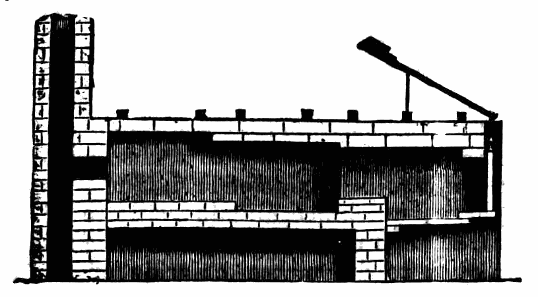
Scotch Soda Furnace.
Prep. 1. (From common salt or sulphate of sodium.) The latter is generally obtained by decomposing the former with sulphuric acid, the evolved gas being passed into water, or through flues filled with coke, over which a very small stream of cold water constantly flows, by which it is condensed, and forms ‘LIQUID HYDROCHLORIC ACID,’ a substance afterwards consumed, in large quantities, in the manufacture of chloride of lime, and for other purposes. The sulphate of sodium, obtained from this or any other source, is well mixed with an equal weight of chalk or limestone, and about half its weight of small coal, each being previously ground to powder, and the mixture is exposed to a strong heat in a ‘reverbatory furnace’ (see engr.) until the decomposition of the sulphate is complete, the mass during the calcination being frequently stirred about with a long iron rod; the semi-liquid is now raked into an iron trough, where it is allowed to cool, whilst the furnace is recharged with fresh materials. The crude dark-grey product, thus obtained, is known as ‘ball alkali,’ or ‘British barilla,’ and usually contains about 22 or 23% of pure hydrate of sodium. This is now lixiviated with tepid water, and the solution, after defecation, evaporated to dryness; the residuum is mixed with a certain quantity of sawdust, coal-dust, or charcoal, and roasted in a reverberatory furnace, at a heat not exceeding 700° Fahr., until all the sulphur is expelled. The product is the ‘soda-ash,’ ‘soda salt,’ or ‘British alkali,’ of commerce, and contains about 50% of pure sodium, partly in the state of carbonate, and partly as hydrate, the remainder being chiefly sulphate of sodium and common salt. When this is purified by solution in water, defecation, evaporation, and crystallisation, it furnishes commercial crystallised carbonate of soda. When this last is redissolved, and the filtered solution is carefully crystallised, it constitutes the ordinary carbonate of sodium used in pharmacy and medicine.
Another process for the preparation of commercial carbonate of sodium, known as the ‘ammonia process,’ has of late years met with considerable adoption. The history of this process, together with the process itself, are thus described by Dr R. Wagner:[175] “Six years ago (he was writing in 1873), when the international jury at the Paris Exhibition expressed their opinion upon the state of the soda industry at that time, all the judges, whether practical or theoretical men, believed that Leblanc’s process (that previously described) would hold the field for a long time yet. This seemed still more probable, since a process had just been introduced for recovering the sulphur from the soda residues. At that time all the soda in use was prepared by this process, excepting a comparatively small amount obtained from Chili saltpetre and cryolite, although there were already tangible indications that soda could be made on a larger scale by another method, which would be cheaper than Leblanc’s process.
“The chemical section of the international jury at the Vienna Exposition, under the presidency of Professor A. W. Hofmann, constituted a congress of chemical technology. By its labours during the course of the summer this congress of scientific men was able to authenticate the very important fact that although Leblanc’s process might in the future possess some importance for certain branches of the industry, yet in most places another soda process would be introduced in the immediate future, and entirely supersede that of Leblanc. Since the time of the Paris Exhibition this new process has grown from a small germ to a strong tree.
“The process in question, and which is called by Professor Hofmann ‘the ammonia process,’ is not new, from either a chemical or scientific point of view. It belongs to the same methods as those in which oxide of lead, bicarbonate of magnesia, quicklime, alumina, silicate of alumina, oxide of chromium, or fluosilicic acid are employed to decompose chloride of sodium,
“The sensation which the ammonia process has created in industrial circles will render a brief history of its development not uninteresting.
“So far as I know, Harrison, Dyer, Grey, and Hemming were the first to patent the ammonia process in Great Britain in 1838. Great expectations were excited by it, but it soon sank into oblivion.
“Thirty or forty years ago the manufacture of soda was by no means at the head of the great branches of industry; at that time, too, ammonia was not to be had cheaply and in immense quantities, and that branch of machine building which has furnished the necessary apparatus for chemical industries did not exist. Besides this, Anton, of Prague, in 1840, claimed to have proved that in the ammonia process a very considerable portion of the common salt still remained undecomposed.
“After a sleep of sixteen years the ammonia process again entered the field. On the 26th of May, 1854, Turck took out a patent in France, and on the 21st June, the same year, Schlœsing, chemist of the Imperial Tobacco Factory at Paris, took out a patent for France and Great Britain. The mechanical portion and machinery for Schlœsing’s process were designed by Engineer E. Rolland, director of the tobacco factory. In 1855 a company was organised to work this process. An experimental manufactory was started at Puteaux, near Paris, but, owing to its situation and arrangements, as well as the salt monopoly, it could not produce soda cheap enough to compete with the other process, and hence, in 1858, the experiment was abandoned. Schlœsing and Rolland were of the opinion that sooner or later the new process must come into use in making soda.
“It must here be noticed that in 1858 Professor Heeren, of Hanover, subjected the ammonia process to a very careful test in his laboratory.
“From his experiments and calculations it was ascertained that this process was better adapted to the manufacture of the bicarbonate than of the simple protocarbonate of soda.
“To render this sketch more complete and historically true, it must be mentioned that T. Bell, of England, took out a patent, Oct. 13th, 1857, for a new soda process, which in principle and practice was almost literally the same as that of Dyer.
“It was known when the jury was working at Paris in 1867 that essential improvements had been introduced into the ammonia process by the efforts of Marguerite and De Sourdeval, of Paris, and James Young, of Glasgow. A more important fact, however, is that Solvay and Co., of Conillet, in Belgium, actually exhibited at the Paris Exhibition carbonate of soda prepared by this new process.
“Since that time the ammonia process has been developed and perfected to such an extent, especially by Solvay, Honigmann, and Prof. Gerstenhœfer, that as early as February, 1873, A. W. Hofmann, in his introduction to the third group of the catalogue of the Exhibition of the German Empire, was able to make this remark:—‘At all events the ammonia process is the only one which threatens to become an important competitor of the now also most exclusively employed process of Leblanc.’ The Vienna Exposition has since proved the truth of this assertion.
“There are now large works in England, Hungary, Switzerland, Westphalia, Thueringia, and Baden, which employ the improved ammonia process, and some of them make fifteen tons of soda per day.
“The advantages of the new process over that of Leblanc are very evident, although the details of the process have not yet been made public.
“The chief advantage consists in the direct conversion of salt into carbonate of soda, and next from the fact, that from a saturated brine only the sodium is precipitated, with none of the other metals of the mother liquor. Besides this, the product is absolutely free from all sulphur compounds, the soda is of a high grade, the apparatus and utensils are very simple, there is a great saving of labour and fuel, and no noxious gases and waste products are produced, which is of importance from a sanitary point of view. The only weak point of the ammonia process is the loss of chlorine, which is converted into worthless chloride of calcium.
“The effect which the general introduction of the new soda process will exert upon large chemical industries in general, and especially upon the consumption of sulphur, the manufacture of sulphuric acid, and chloride of lime, cannot be overlooked.”
3. Another method for the direct preparation of soda and potash from their chlorides is described in the ‘Bayerisches Industrie und Gewerbe Blatt.’[176] The process is thus described by its author, Herr E. Bohlig:
1. Magnesium oxalate (freshly prepared when newly starting, but, after the first operation,
Since the magnesium oxalate is always obtained of the same composition and in the same quantity, it is sufficient to determine its weight once for all, and to take each time the previously common amounts of common salt. The acid need not be weighed either; it must be added in just sufficient quantity to destroy the milky appearance which the mixture first assumes.
The reaction is as follows:
MgC2O4 + HCl + NaCl = NaHC2O4 + MgCl2
Magnesium oxalate. + Hydrochloric acid. + Sodium chloride. = Sodium binoxalate. + Magnesium chloride.
The crystalline powder of sodium binoxalate is transferred to large draining filters, washed with water until the acid solution of magnesium chloride is removed, and worked up, as below described, while still moist.
The acid solution of magnesium chloride is made use of several times in succession as so much hydrochloric acid, together with a quantity of fresh acid sufficient for the reaction. Finally, when the magnesium chloride has inconveniently accumulated, it is worked up by itself into magnesia and hydrochloric acid.
2. In order to obtain the soda, the sodium binoxalate is brought together with an equivalent quantity of magnesium carbonate and water in a tight cask. As soon as the remaining air has been nearly expelled by the generated carbonic acid gas, the cask is closed, and a stirring mechanism set in motion.
A pressure gauge attached to the cask indicates a gradual rise of the pressure to two atmospheres, but, on continual stirring, this diminishes, until, finally, the gauge stands again at 0°. The cask now contains a concentrated solution of sodium bicarbonate, and a precipitate of magnesium oxalate, which latter, being coarsely granular, is easily separated from the liquid, and is used over again, after washing, for a new operation.
The solution of sodium bicarbonate is boiled for a short time with magnesia, obtained in distilling magnesium chloride, and both are thereby converted into simple carbonates. Both reactions are shown in the following scheme:
1. NaHC2O4 + MgCO3 = NaHCO3 + MgC2O4
Sodium binoxalate. + Magnesium carbonate. = Sodium bicarbonate. + Magnesium oxalate.
2. 2NaHCO3 + MgO = Na2CO3 + MgCO3 + H2O
Sodium bicarbonate. + Magnesia. = Sodium carbonate. + Magnesium carbonate. + Water
As the solution of sodium carbonate, after concentration to 40°B., is incapable of dissolving or retaining in solution any sodium oxalate, it follows that the whole of the oxalic acid is recovered. The magnesia which is required for the purpose is obtained by distilling magnesium chloride, which thereby splits up into hydrochloric acid and magnesia. One half of the latter receives, as we have seen, its carbonic acid by boiling with sodium bicarbonate; the other half is placed, whilst still moist, upon trays in great wooden closets, through which the gases of the furnace pass, and is thereby carbonated. The process may also be so modified that the sodium binoxalate is first decomposed by caustic magnesia, and that magnesium carbonate is afterwards added.
The whole mixture is then transferred to a stirring cask, provided with openings for the passage of cooled furnace gases, whereby the caustic soda present is very soon carbonated.
3. As soon as a large quantity of magnesium chloride solution has accumulated, it is tested as follows:—A small sample is mixed, while boiling, with magnesium oxalate, as long as the latter is dissolved, and then allowed to cool. There should be no crystalline deposit of sodium binoxalate formed, a proof that the solution does not contain any sodium chloride in excess, and is fit for distillation. It is first neutralised by adding some more magnesia, and evaporated over a naked fire in large kettles to a doughy consistence, short of driving off the hydrochloric acid. It is then transferred into the ordinary soda furnace, where it is distilled with a moderate fire. The eliminated hydrochloric acid is condensed in the usual manner.
The residuary mass should not be heated red hot, so as not to impair its porosity or its ready affinity for carbonic acid. If, however, the first-mentioned test shows the magnesium chloride to contain sodium chloride the whole mass must be mixed with magnesium oxalate, and after removal of the precipitated sodium oxalate, saturated with magnesia and distilled. The same process, in all its details, may also be employed for the manufacture of potassa and its carbonate.
4. Another method of manufacture of commercial soda is by treating the mineral cryolite (a double fluoride of sodium and aluminium) with either caustic, or hydrate of lime. The results of the reaction are caustic soda, sodium aluminate, and calcium fluoride.
The aluminate and caustic soda being both soluble in water, a stream of carbonic acid is passed through the solution containing them, whereby all the soda becomes converted into carbonate, whilst the alumina is thrown down as an insoluble precipitate. In the wet way, if enough hydrate of lime be employed, all the soda may be obtained in the caustic condition.
This process is largely used in Germany.
Mr Kingzett, in his work on the alkali trade, has described most of them.
When anhydrous carbonate of sodium is required (Sodæ carbonas exsiccata, B. P., Ph. L.; Sodæ carbonas siccatum, Ph. E. & D.), the crystallised carbonate is heated to redness, and, when cold, powdered.
Prop., &c. Carbonate of sodium forms large, transparent, oblique rhombic prisms, which, as ordinarily met with, and of the formulæ Na2CO3.10Aq; but by particular management may be had with fifteen, nine, seven, or sometimes with only one molecule of water of crystallisation (Fownes); it is soluble in twice its weight of water at 60°, and less than an equal weight at 212° Fahr. As a medicine it is deobstruent and antacid, and is given in doses of 10 to 30 gr. It is also, occasionally, used to make effervescing draughts. When taken in an overdose it is poisonous. The antidotes are the same as for carbonate of potassium. The crude carbonate is largely employed in the manufacture of soap, glass, &c.
Fifty three gr. of the dried carbonate are equal to 143 of the crystallised salt. The medicinal properties of both are similar. It has, however, the disadvantage of being difficultly soluble in water.
The ordinary carbonate of sodium generally contains either sulphates or chlorides, or both; and these may be detected as under Carbonate of Potassium. “When supersaturated with nitric acid, it precipitates only slightly, or not at all, chloride of barium or nitrate of silver; and 143 gr. require at least 960 grain-measures of solution of oxalic acid” (B. P.). At a high temperature 100 gr. lose 62·5 gr. of water.
Sodium, Bicarbonate of. NaHCO3. Syn. Sesquicarbonate of soda, Sodæ bicarbonas (B. P., Ph. L., E., & D.). This salt can be prepared in exactly the same manner as the corresponding salt of potassium. Another method is as follows:—Take of crystallised carbonate of sodium, 1 part; dried carbonate of sodium, 2 parts (both in powder); triturate them well together, and surround them with an atmosphere of carbonic acid gas, under pressure; let the action go on until no more gas is absorbed, which will generally occupy 10 to 14 hours, according to the pressure employed, then remove the salt, and dry it at a heat not above 120° Fahr.
Prop., &c. A crystalline white powder; it is soluble in 10 parts of water at 60° Fahr., but it cannot be dissolved in even warm water without partial decomposition; it is more pleasant tasted and more feebly alkaline than the carbonate of the same base. When absolutely pure it does not darken turmeric paper, or only very slightly. The dose is from 10 to 40 gr., as an antacid and absorbent. It is much employed in the preparation of effervescing powders and draughts, for which purpose
20 gr. of commercial bicarbonate of sodium \—————————\/——————————/ are taken with /—————————/\———————-\ 18 gr. of crystallised tartaric acid; 17 gr. of crystallised citric acid; or 1⁄2 fl. oz. of lemon juice.
The quantity of bicarbonate any given sample contains may be approximately determined by well washing 100 gr. of the salt with an equal weight of water, and filtering the solution. The residuum left upon the filter, dried at a heat of 120° Fahr., and weighed, gives the per-centage of pure bicarbonate of sodium present (very nearly). The solution of this in water will give only a very trifling white precipitate with corrosive sublimate; whilst the filtered portion, which was used to wash the salt, will give a red one, if it contains the simple carbonate of sodium.
Sodium, Chloride of. NaCl. Syn. Sodii chloridum (B. P., Ph. L., & D.), Sodæ murias (Ph. E.), L. This important and wholesome compound appears to have been known in the earliest ages of which we have any record. It is mentioned by Moses (Gen. xix, 26), and by Homer in the Iliad (lib. ix, 214). In ancient Rome it was subjected to a duty (vectigal salinarium); and even at the present day a similar tax furnishes no inconsiderable portion of the revenue of certain nations. Common salt forms no small portion of the mineral wealth of England, and has become an important article of commerce in every part of the known world. The principal portion of the salt consumed in this country is procured by the evaporation of the water of brine springs. It is also prepared by the evaporation of sea-water (hence the term ‘sea-salt’), but this process has been almost abandoned in England, being more suited to hot dry climates or to very cold ones.
Var. Bay salt; SAL MARINUS, SAL NIGER; imported from France, Portugal, and Spain, and obtained from sea-water evaporated in shallow ponds by the sun; large-grained and dark-coloured.—British bay salt, Cheshire large-grained s.; by evaporating native brine at a heat of 130° to 140° Fahr.; hard cubical crystals. Both of the above are used to salt provisions for hot climates, as they dissolve very slowly in the brine as it grows weaker. Cheshire stoved salt, LUMP S., BASKET S.; obtained by evaporating the brine of salt springs; small flaky crystals.—London’s patent solid salt; Cheshire rock salt, melted and ladled into moulds.—Rock salt, FOSSIL S.; SAL GEMMÆ, SAL FOSSILIS; found in mineral beds in Cheshire; has commonly a reddish colour; chiefly exported for purification.
Prop. Pure chloride of sodium is fixed in1⁄2 parts of water at 60° Fahr.; its solubility is not increased by heat; it is slightly soluble in proof spirit; insoluble in alcohol; decrepitates when heated; fuses at a red heat, and volatilises at a much higher temperature.
Pur., &c. The common salt of commerce contains small portions of chloride of magnesium, chloride of calcium, and sulphate of calcium; and hence has commonly a slightly bitter taste, and deliquesces in the air. To separate these, dissolve the salt in 4 times its weight of pure water, and drop into the filtered solution, first, chloride of barium, and then carbonate of sodium, as long as any precipitate falls; filter, and evaporate the clear fluid very slowly, until the last crystallises, which is pure chloride of sodium. (‘Thomson’s Chem.,’ ii, 377.) For medical purposes the Ph. E. orders the salt to be dissolved in boiling water, and the solution to be filtered and evaporated over the fire, skimming off the crystals as they form, which must then be quickly washed in cold water, and dried. A solution of pure salt is not precipitated by a solution of carbonate of ammonium, followed by a solution of phosphate of sodium; a solution of 9 gr. in distilled water is not entirely precipitated by a solution of 26 gr. of nitrate of silver. (Ph. E.)
Uses. Common salt is stimulant, antiseptic, and vermifuge, and is hence employed as a condiment, and for preserving animal and vegetable substances. It is also occasionally used in medicine, in clysters and lotions.
Sodium, Dried Sulphate of. Syn. Sodæ sulphas exsiccata, Effloresced Glauber salt. Expose the crystals to a warm dry air till they fall into powder. They lose half their weight. The dose is reduced in like proportion.
Sodium, Effervescing Citro-tartrate of. Syn. Sodæ citro-tartras effervescens. (B. P.) Prep. Mix thoroughly, powdered bicarbonate of soda, 17 oz.; tartaric acid, 8 oz.; and citric acid, 6 oz.; place in a dish or pan of suitable form, heated to between 200° and 220° Fahr., and when the particles begin to aggregate, stir assiduously till they assume a granular form. By means of suitable sieves separate the granules of uniform and most convenient size. Preserve in well-closed bottles.
Sodium, Ethylate. Prepared as Potassium ethylate, substituting sodium for potassium. Properties similar to ethylate of potassium.
Sodium, Hydrate of. NaHO. Syn. Hydrate of soda, Sodium hydrate, Caustic soda; Sodæ hydras. Prep. Exactly in the same manner from carbonate of sodium as potassium hydrate is prepared from carbonate of potassium.
The ‘Pharmaceutical Journal’[177] states that a pure hydrate of sodium is now manufactured from metallic sodium by the following method:—A deep silver vessel, of a hemispherical form, and capable of holding about four gallons of water, is employed. Into this vessel, which is cooled externally with a current of cold water, is placed a very little water, and upon the water is placed a cube of metallic sodium, of about half an inch in diameter.
The vessel is made to revolve, so as continually to bring fresh portions of liquid into contact with the metal, and by this means explosion is avoided. When the first cube of metal has dissolved, and yielded a thick syrupy liquid, a little more water and a second cube of metal are added, and the reaction allowed to take place, as before, the vessel being kept in motion all the time. In this manner several pounds of sodium may be worked up into soda.
The thick syrup so resulting is next evaporated down, heated to redness, fused, and poured into a mould.
Inasmuch as the price of sodium is five shillings a pound, the yield of soda from 1 lb. of metal being about 13⁄4 lb., it is plain that the alkali so prepared must be cheap.
The danger of explosions (which, however, are not likely to occur if proper care is taken) necessitates the employment of skilled labour in this manufacture, and constitutes a very serious drawback to the commercial success of the process.
Greyish, semitranslucent, deliquescent masses, very soluble in water, and bearing a very great resemblance to the corresponding potassium compound.
Sodium, Hypochlo′′rite of. Syn. Chlorinated soda, Chloride of soda‡; Soda chlorinata, L. Prep. (Dr Christison.) Dried carbonate of sodium, 19 parts, are triturated with water, 1 part, and the mixture placed in a proper vessel, and exposed to the prolonged action of chlorine gas, generated from a mixture of chloride of sodium, 10 parts; binoxide of manganese, 8 parts; sulphuric acid, 14 parts; (diluted with) water, 10 parts.
Sodium Hypophosphate. See Phosphorus.
Sodium, Hyposul′phite of. Na2S2O3. Syn. Sodæ hyposulphis, L. Prep. 1. Dried carbonate of sodium, 1 lb.; flower of sulphur, 10 oz.; mix, and slowly heat the powder in a porcelain dish until the sulphur melts; stir the fused mass freely to expose it to the atmosphere until the incandescence flags, then dissolve the mass in water, and immediately boil the filtered liquid with some flowers of sulphur; lastly, carefully concentrate the solution for crystals.
2. A stream of well-washed sulphurous anhydride gas is passed into a strong solution of carbonate of sodium, which is then digested with sulphur at a gentle heat during several days; by evaporating the solution at a moderate temperature, the salt is obtained in large and regular crystals.
3. (Capaun’s process.) Boil a dilute solution of caustic soda with sulphur to saturation, then pass sulphurous acid gas into the solution until a small portion, when filtered, is found to have a very pale yellow colour; when this is the case, it must be filtered and evaporated, as before.
4. (P. Cod.) Dissolve carbonate of sodium, 8 parts, in water, 16 parts; add of sublimed sulphur, 1 part, and pass sulphurous acid gas, in excess, into the solution; next boil the liquid in a glass matrass for a few minutes, filter, gently evaporate the filtrate to 1-3rd its volume, and set it aside in a cool place to crystallise.
Prop., &c. Hyposulphite of sodium crystallises in four-sided prisms, which, in the dry state, are unalterable in the air; it is freely soluble in water. It may be perfectly freed from sulphide of sodium by agitating it with about half its weight of alcohol; the alcohol dissolves out the sulphide, which may then be easily separated. This salt is now very extensively used in the practice of photography, also as an ‘antichlore,’ to extract the last traces from paper pulp.
Sodium, Iodide of. NaI. Syn. Sodii iodidum. Prep. As Iodide of Potassium. This, as well as the bromide, crystallises in clear or whitish cubes, deliquescent, and soluble in water. Used in medicine in the same manner as the corresponding potassium salts.
Sodium and Iron, Pyrophosphate of. Syn. Sodæ et ferri pyrophosphas, Natrum pyrophosphoricum ferratum. (Ph. G.) Prep. Dissolve 20 oz. of pyrophosphate of soda in 40 oz. of cold distilled water, and add, gradually, to the solution, and with constant stirring, 8 oz. (by weight) of solution of perchloride of iron (Ph. G.), previously diluted with 22 oz. of distilled water, as long as the precipitate is redissolved. Filter, and to the clear, bright green liquid thus obtained pour in 100 oz. (by weight) of rectified spirit, wash the precipitate with more spirit, press it between blotting paper, and dry by a gentle heat.
Sodium Lactate. Syn. Sodii lactas. Prep. Let lactate acid be diluted with three parts of water; saturate whilst boiling with sodium bicarbonate; then evaporate, and run into flakes.
Sodium lactate is a very deliquescent salt. The solution evaporated to the consistence of a syrup deposits flattened prismatic crystals, and stellar groups of needles.
Sodium, Ni′trate of. NaNO3. Syn. Chili saltpetre, Cubic nitre; Sodæ nitras, L. This salt occurs native like ordinary nitre, and is chiefly imported into England from South America. It is largely employed as a manure, in the preparation of nitric acid, and, recently, in the manufacture of fireworks, on account of the comparative slowness with which it burns. It is deliquescent and very soluble in water.
Sodium, Nitrite of. Syn. Sodæ nitris. (B. P., 1864.) Mix nitrate of soda, 1 lb., and charcoal, recently burned, and in fine powder, 11⁄4 oz., thoroughly in a mortar, and drop the mixture in successive portions into a clay crucible, heated to a dull redness. When the salt has become quite white, raise the heat so as to liquefy it, pour on to a clean flagstone, and when it has solidified break into fragments, and keep in a stoppered bottle.
Sodium, Oxide of. Na2O. Syn. Anhydrous soda. Prep. By burning dry metallic sodium in air. White powder, very deliquescent, and soluble in water, forming pure sodium hydrate.
Sodium, Phos′phate of. Na2PO4.12Aq. Syn. Common tribasic phosphate of soda, Rhombic p. of s.; Sodæ phosphas (B. P., Ph. L., E., & D.). Prep. 1. (Ph. E.) Take of powdered bone ashes, 10 lbs.; sulphuric acid, 44 fl. oz.; mix, add gradually of water 6 pints, and digest for 3 days, replacing the water which evaporates; then add 6 pints of boiling water, strain through linen, and wash the residue on the filter with boiling water; mix the liquors, and, after defecation, decant and evaporate to 6 pints; let the impurities again settle, and neutralise the clear fluid, heated to boiling, with a solution of carbonate of sodium in slight excess; crystals will be deposited as the solution cools, and by successively evaporating, adding a little more carbonate of sodium to the mother liquor till it is feebly alkaline, and cooling, more crystals may be obtained; these must be kept in close vessels. The formula of the Ph. D. is nearly similar. It is placed in the Materia Medica of the B. P. and Ph. L.
2. (Funcke.) To ground calcined bones, diffused through water, add a little dilute sulphuric acid to saturate any carbonate of calcium present; when effervescence ceases, dissolve the whole in nitric acid, q. s.; to this solution add as much sulphate of sodium as the bone ash used, and distil the whole to recover the nitric acid; the residuum is treated with water, and the resulting solution filtered, evaporated, and crystallised.
Prop., &c. It forms very beautiful oblique rhombic prisms, of the formula Na2H,PO4,12H2O, which effloresce in the air, dissolve in about 4 parts of cold water and in 2 parts at 212° Fahr., and fuse when heated. As a medicine it is mildly aperient, in doses of 1⁄2 to 1 oz., or even more; and antacid in doses of 20 to 30 gr., frequently repeated. It has a purely saline taste, resembling that of culinary salt, and is commonly taken in broth or soup.
Sodium Pyrophosphate (Crystallised). Syn. Sodæ pyrophosphas crystallisata. (P. Cod.) Prep. This salt may be obtained by heating, gently at first, and afterwards to a red heat, crystallised phosphate of sodium in a platinum crucible until all the water is driven off, and the salt has become fused. Dissolve the
Sodium, Salicylate of. Syn. Sodæ salicylus. Prep. Made by neutralising a solution of pure salicylic acid with caustic soda, and evaporating to dryness. It must be purified by crystallisation from alcohol. Antipyretic; given in acute rheumatism.—Dose, 10 to 20 grams.
Sodium Santonate. Syn. Sodæ santonas. This salt is made by digesting an alcoholic solution of santonic acid with carbonate of soda, evaporating, redissolving in strong alcohol, and crystallising.
Sodium, Sesquicarbonate of. Na4H2(CO3)3. A salt found native on the banks of the soda lakes of Sotrena, in Africa, whence it is exported as ‘Trona.’
Sodium Silicate. See Glass, Soluble.
Sodium, Stan′nate of. Na2SnO3. Prep. (Greenwood & Co.) Caustic soda, 22 lbs., is heated to low redness in an iron crucible, when nitrate of sodium, 8 lbs., and common salt, 4 lbs., are added; when the mixture is at a ‘fluxing heat,’ 10 lbs. of feathered block tin is stirred in with an iron rod, both the stirring and heat being continued until the mass becomes red hot and ‘pasty,’ and ammoniacal fumes are given off. The product may be purified by solution and crystallisation. Patented. (See below.)
Sodium, Stan′nite of. Prep. (Greenwood & Co.) From caustic soda, 131⁄2 lbs.; feathered block tin and common salt, of each 4 lbs.; as the last. Patented. Both the above are used to prepare tin mordants (about 12 oz. to water, 1 gall.). The stannate and stannite of potassium are prepared in a similar manner.
Sodium Sulphate. Syn. Sodæ sulphis. Prep. Pass sulphurous acid to saturation through a solution of carbonate of soda. Used internally for sarcina ventriculi, and externally as an application in skin diseases of fungous origin. Hyposulphate of soda is employed in the same cases.
Sodium, Sul′phate of. Na2SO4.10Aq. Syn. Glauber’s salt; Sodæ sulphas (B. P., Ph. L., E., & D.), Sal catharticus Glauberi†, L. This is obtained as a secondary product in various chemical processes; but it may be easily formed directly from its constituents.
Prop., &c. It forms transparent, six-sided, irregular, channelled prisms, with dihedral summits, of the formulae Na2SO410H2O, which effloresce in the air, and fall to an opaque white powder; soluble in about 3 parts of water at 60°, and in considerably less at 100° Fahr., but at a higher temperature its solubility rapidly lessens; insoluble in alcohol; fuses when heated. It is seldom wilfully adulterated. When pure the solution is neutral to test paper; nitrate of silver throws down scarcely anything from a dilute solution; nitrate of baryta more, which is not dissolved by nitric acid. It loses 55·5% of its weight by a strong heat.
Uses. It is purgative, but being extremely bitter-tasted, is now less frequently used than formerly. Its nauseous flavour is said to be covered by lemon juice.—Dose, 1⁄2 to 1 oz. The dried salts (SODÆ SULPHAS EXSICCATA) is twice as strong. Lymington Glauber’s salt is a mixture of the sulphates of soda and potassa obtained from the mother liquor of sea salt.
Sodium, Sul′phide of. Prep. (P. Cod.) Saturate a solution of caustic soda (sp. gr. 1·200) with sulphuretted hydrogen, closely cover up the vessel, and set it aside that crystals may form; drain, press them in bibulous paper, and at once preserve them in a well-closed bottle. Used to make mineral waters, and in certain skin diseases.
Of this salt Dr Ringer says—“it possesses the property of preventing and arresting suppuration, and stopping the formation of pus. Given for boils and carbuncles; it also produces excellent results.—Dose. For adults, 1⁄10th of a grain, mixed with sugar of milk every hour or two on the tongue.
The anhydrous sulphides resemble closely and are prepared in the same manner as the potassium sulphides.
Sodium, Sulpho-Carbolate. Syn. Sodæ sulpho-carbolas. (Pareira.) Prep. Mix two volumes of pure carbolic acid with one volume of sulphuric acid in a flask, and heat the mixture to 280° or 290° F. for five minutes. Let cool, dilute, and saturate with carbonate of soda, evaporate, and crystallise. The other sulpho-carbolates may be prepared in the same manner.—Dose, 10 to 30 gr., in phthisis and zymotic diseases; externally, as a lotion in ozæna and fetid ulcers.
Sodium, Sulpho-Salicylate of. Syn. Sodæ sulpho-salicylas. Mr J. Williams obtains this salt by treating very pure salicylic acid with about twice its weight of sulphuric acid, then adding carbonate of barium, and decomposing the sulpho-salicylate of barium by sulphate of soda (see ‘Pharm. Journ.,’ Sept. 30th, 1876).
Sodium Sulphovinate. Syn. Sodii sulphovinas. Prep. Sulphovinic acid is first prepared by pouring gradually, with great care, and increasingly stirring with a glass rod, 1000 grams of 60° sulphuric acid into 1000 grams of rectified 96° alcohol. The mixture is left for some hours in contact, then diluted with 4 litres of distilled water, and afterwards saturated with pure barium carbonate.
When the saturation is complete the barium sulphate is allowed to deposit on a filter. The solution of barium sulphovinate is then decomposed with pure carbonate of soda until it ceases to give a precipitate.
The liquid, evaporated in a water bath, is left to crystallise. If necessary the crystals are purified by recrystallisation. They should be kept in well-closed flasks.
Sodium sulphovinate crystallises in hexagonal tables, which are slightly unctuous to the touch, and very soluble in water and in alcohol. If heated in a capsule they give off, at 120°, the alcohol which they contain in combination. They become gradually deprived of bitterness. Sodium sulphovinate ought not to contain sulphuric acid, nor have an acid taste. It should not be precipitated by barium chloride, and especially by soluble sulphates. The possession of either of these properties is a proof of faulty preparation, and that a portion of the sulphovinic acid has been decomposed. In such a case it should be rejected.
Sulphovinate of soda is said to be a very effective, and by no means unpleasant, saline aperient, and to be unattended with subsequent constipation. The dose is from 5 to 6 dr.
Sodium, Tartrate of, and Potassium. KNaC4H4O6.4Aq. Syn. Tartrate of potassa and soda, Rochelle salt, Seignette’s s., Tartarised soda†; Sodæ tartarata (B. P.), Sodæ, potassio-tartras (Ph. L.), Sodæ et potassæ tartras (Ph. E. & D.), Soda tartarizata,†, L. Prep. (Ph. L. 1836.) Take of carbonate of sodium, 12 oz.; boiling water, 2 quarts; dissolve, and add, gradually, of powdered bitartrate of potassium, 16 oz. (or q. s.); strain, evaporate to a pellicle, and set it aside to crystallise; dry the resulting crystals, and evaporate the mother liquor that it may yield more of them. The formulæ of the other colleges are nearly similar.
Prop., &c. Large, transparent, hard, right rhombic prisms, often occurring in halves; slightly efflorescent; soluble in 5 parts of water at 60° Fahr. Its “solution neither changes the colour of litmus nor of turmeric. On the addition of sulphuric acid, bitartrate of potassium is thrown down; on adding either nitrate of silver or chloride of barium nothing is thrown down, or only what is redissolved by the addition of water.” (Ph. L.) By heat it yields a mixture of the pure carbonates of potassium and sodium.
Potassio-tartrate of sodium is a mild and cooling laxative.—Dose, 1⁄4 to 1 oz., largely diluted with water. It forms the basis of the popular aperient called SEIDLITZ POWDERS.
Sodium, Vale′′rianate of. NaC5H6O2. Syn. Sodæ valerianas (Ph. D.), L. Prep.(Ph. D.) Dilute oil of vitriol, 61⁄2 fl. oz., with water, 1⁄2 pint; then dissolve of powdered bichromate of potassium, 9 oz., with the aid of heat, in water, 31⁄3 pints; when both solutions have cooled, put them into a matrass, and having added of fusel oil (alcohol amylicum—Ph. D.) 4 fl. oz., shake them together repeatedly until the temperature, which first rises to 150°, has fallen to 80° or 90° Fahr.; a condenser being connected, next apply heat so as to distil over about 4 pints of liquid; saturate this exactly with a pint, or q. s., of solution of caustic soda, separate the liquid from the oil which floats upon the surface, and evaporate it until the residual salt is partially liquefied; the heat being now withdrawn, and the salt concreted, this last, whilst still warm, is to be divided into fragments, and preserved in well-stopped bottles.
Obs. This salt is intended to be used in the preparation of the VALERIANATES OF IRON, QUININE, and ZINC.
SOILS. These are classified by agriculturists according to their chief ingredients, as loamy, clayey, sandy, chalky, and peaty soils. Of these the first is the best for most purposes, but the others may be improved by the addition of the mineral constituents of which they are deficient. Sand and lime or chalk are the proper additions to clayey soils, and clay gypsum, or loam, to sandy and gravelly ones. Clayey soils are expensive to bring into a fertile state; but when this is once effected, and they are well manured, they yield immense crops of wheat, oats, beans, clover, and most fruits and flowers of the rosaceous kinds.
The fertilisation of soils is suggested partly by chemical analysis, practical experience, and geological observations. In cases where a barren soil is examined with a view to its improvement it is, when possible, compared with an extremely fertile soil in the same neighbourhood, and in a similar situation; the difference given by their analyses indicates the nature of the manure required, and the most judicious methods of cultivation; and thus a plan of improvement is suggested, founded upon scientific principles.
The analysis of soils may be briefly and generally described as follows:—
1. The general character of the soil, as loamy, sandy, stony, rather stony, &c., being noted, 3 or 4 lbs. of it, fairly selected as an average specimen, may be taken during a period of ordinary dry weather. From this, after crushing or bruising the lumps with a piece of wood, all stones of a larger size than that of a filbert may be picked out, and their proportion to the whole quantity duly registered.
2. 1000 grains of the remainder may be next dried by the heat of boiling water, until the mass ceases to lose weight; and, afterwards, exposed to a moist atmosphere for some time. The loss of weight in the first case, and the increase of weight in the second, indicate the absorbent powers of the soil.
3. The matter from No. 2, freed from siliceous stones by garbling, may be gradually heated to dull redness in a shallow open vessel, avoiding waste from decrepitation, &c. The loss of weight, divided by 10, gives the percentage quantity of vegetable or organic matter present (nearly).
4. Another 1000 grains (see No. 1) may be next washed with successive portions of cold water as long as anything is removed. The residuum, after being dried, indicates the proportion of sand and gravel (nearly).
5. Another portion of the soil (100, 200, orCarbonate and Alkalimetry. The loss of weight in carbonic acid indicates the quantity of Carbonate of lime present in the sample examined; 22 gr. of the former being equal to 50 gr. of the latter.
6. Another like portion of the soil may be gently boiled for 4 or 5 hours, along with dilute hydrochloric acid, in a flask furnished with a long glass tube passing through the cork, to prevent loss (see ETHER); after that time the whole must be thrown upon a filter, and what refuses to pass through (silica) washed with distilled water, dried, ignited, and weighed.
7. The filtrate and washings from No. 6 are next successively treated for alumina (pure clay), lime, phosphate of lime, phosphoric acid, oxide of iron, alkalies (potassa or soda), ammonia (both ready formed and latent), &c. &c., in the manner noticed under Glass, Guano, and the names of the respective substances referred to. See Agriculture, Manures, &c.
SOL′ANINE. Syn. Solani, Solanina, L. A peculiar basic substance, obtained from the leaves and stem of Solanum Dulcamara or bitter-sweet, and other species of the Solanaceæ.
SOL′DERING. The union of metallic surfaces by means of a more fusible metal fluxed between them. The method of autogenous soldering, invented by M. De. Richmont, is an exception to this definition. In all the cases surfaces must be perfectly clean, and in absolute contact, and the air must be excluded, to prevent oxidation. For this last purpose the brazier and silversmith use powdered borax made into a paste with water; the coppersmith, powdered sal ammoniac; and the tinman, powdered resin. Tin-foil applied between the joints of fine brass work, first wetted with a strong solution of sal ammoniac, makes an excellent juncture, care being taken to avoid too much heat. See Solution (Soldering), and below.
SOL′DERS. Prep. 1. (For copper, iron, and dark brass.) From copper and zinc, equal parts; melted together. For pale brass more zinc must be used.
2. (Fine solder.) From tin, 2 parts; lead, 1 part. Melts at 350° Fahr. Used to tin and solder copper, tin plates, &c.
3. (For German silver.) From German silver, 5 parts; zinc, 4 parts; melted together, run into thin flakes, and then powdered. Also as No. 7.
4. (Glazier’s.) From lead, 3 parts; tin, 1 part. Melts at 500° Fahr.
5. (For gold.) Gold, 12 pennyweights; copper, 4 do.; silver, 2 do.
6. (For lead and zinc.) From lead, 2 parts; tin, 1 part.
7. (For pewter, Britannia metal, &c.) From tin, 10 parts; lead, 5 parts; bismuth, 1 to 3 parts.
8. (For silver.) From fine brass, 6 parts; silver, 5 parts; zinc, 2 parts.
9. (For tin plate.) From tin, 2 parts; lead, 1 part. The addition of bismuth, 1 part, renders it fit for pewter.
SOLE. The Solea vulgaris, a well-known fish. It is perhaps more frequently eaten than any other flat fish, and, when skilfully cooked, exceeds them all in delicacy, nutritiousness, and flavour.
SOLU′TION. Syn. Solutio, L. Under the head of solutions (SOLUTIONES), in pharmacy, are properly included only those liquids which consist of water, or an aqueous menstruum, in which has been dissolved an appropriate quantity of any soluble substance to impart to the liquor its peculiar properties. When spirit is the menstruum, the liquid receives the name of alcoholic solution, spirit, or tincture. In the B. P. and the Ph. L. & D. aqueous solutions are named LIQUORS (LIQUORES), whilst in the Ph. E., and in the old pharmacopœias generally, they are termed WATERS (AQUÆ).
The following list embraces all the solutions of the British pharmacopœias, with a few others likely to be useful to the reader. Some other preparations to which the name has been given will be found under Liquors, Tinctures, &c.