A CYCLOPÆDIA OF PRACTICAL RECEIPTS, &c. VOLUME II (continued 34)
Reading edition
Solution of Ac′etate of Ammo′′nia. Syn. Liquor of acetate of ammonia, Water of a. of a., Mindererus’ spirit; Ammoniæ acetatis liquor (B. P.), Liquor ammoniæ acetatis (Ph. L. & D.), Ammoniæ acetatis aqua (Ph. E.), L. Prep. 1. (Ph. L.) From dilute acetic acid, 1 pint; exactly neutralised by sesquicarbonate of ammonia (in coarse powder), 9 dr., or q. s. Sp. gr. 1·022.
2. (Ph. E.) Distilled vinegar (preferably from French vinegar), sp. gr, 1·005, 24 fl. oz.; carbonate (sesquicarbonate) of ammonia, 1 oz., or q. s. Sp. gr. 1·011.
3. (Ph. D.) Sesquicarbonate of ammonia, 21⁄2 oz.; dilute acetic acid, 3 pints. Sp. gr. 1·012.
4. (B. P.) Carbonate of ammonia, 31⁄4, or sufficient; acetic acid (28 per cent.), 10; distilled water, 50. Dissolve the carbonate in the acid, and add the water.
Prop., &c. Free from colour and odour. It changes the colour neither of litmus nor turmeric. Sulphuretted hydrogen being dropped in, it is not discoloured, neither is anything thrown down on the addition of chloride of barium. What is precipitated by nitrate of silver is soluble in water, but especially so in nitric acid. Potassa being added, it emits ammonia; and sulphuric acid being added, it gives off acetic vapours. The fluid being evaporated, what remains is completely destroyed by heat.
Uses, &c. Solution of acetate of ammonia is a very common and excellent febrifuge andDose, 2 to 6 dr., twice or thrice daily, either by itself or along with other medicines. Externally, as a discutient and refrigerant lotion; and diluted (1 oz. to 9 oz. of water), as a collyrium in chronic ophthalmia. For this last purpose it must be free from excess of ammonia.
5. (Concentrated.) Saturate acetic acid, sp. gr. 1·038, 1⁄2 gall., with carbonate of ammonia (in powder), 21⁄2 lbs., or q. s.; carefully avoiding excess.
Obs. This article is in great demand in the wholesale drug trade, under the name of ‘concentrated liquor of acetate of ammonia’ (LIQ. AMMON. ACET. CONC.). It is very convenient for dispensing. One fl. dr. added to 7 fl. dr. of water forms the LIQUOR AMMONIÆ ACETATIS of the Ph. L.
Solution of Acetate of Lead. See Solution of Diacetate of Lead.
Solution of Acetate of Morphia. Syn. Liquor morphiæ acetatis (B. P., Ph. L., & D.), L. Prep. 1. (Ph. L.) Acetate of morphia, 4 dr.; acetic acid, 15 drops; distilled water, 1 pint; proof spirit, 1⁄2 pint; mix, and dissolve. Sixty drops (minims) contain 1 gr. of acetate of morphia.—Dose, 5 to 15 or 20 drops.
2. (B. P.) Acetate of morphia, 4 gr.; diluted acetic acid, 8 minims; rectified spirit, 2 dr.; distilled water, 6 dr.; dissolve in the mixed liquids.—Dose, 10 to 60 minims.
3. (Ph. D.) Acetate of morphia, 82 gr.; rectified spirit, 5 fl. oz.; distilled water, 15 fl. oz. 120 drops (minims) contain 1 gr. of the acetate.—Dose, 10 to 45 or 50 drops, or similar to that of tincture of opium.
4. (Magendie.) Each fl. dr. contains 11⁄2 gr. of acetate (nearly).—Dose, 5 to 15 drops. Anodyne, hypnotic, and narcotic; in those cases in which opium is inadmissible. See Morphia.
Solution of Aconitia. Syn. Solutio Aconitiæ (Dr Turnbull). Prep. Aconitia, 1 gr.; rectified spirit, 1 dr. To be applied externally by means of a sponge in neuralgic and rheumatic affections.
Solution of Al′um (Compound). Syn. Bate’s alum water; Liquor aluminis compositus (Ph. L.), Aqua aluminosa composita †, L. Prep. (Ph. L.) Alum and sulphate of zinc, of each 1 oz.; boiling water, 3 pints; dissolve, and filter (if necessary). Detergent and astringent. Used as a lotion for old ulcers, chilblains, excoriations, &c.; and, largely diluted with water, as an eye-wash and injection.
Solution of Ammo′′nia. See Liquor of Ammonia.
Solution of Ammo′′nio-ni′trate of Sil′ver. Syn. Hume’s test; Solutio argenti ammoniati (Ph. E.), L. Prep. (Ph. E.) Nitrate of silver (pure crystallised), 44 gr.; distilled water, 1 fl. oz.; dissolve and add ammonia water, gradually, until the precipitate, at first thrown down, is very nearly, but not entirely, redissolved. Used as a test for arsenic.
Solution of Ammo′′nio-sul′phate of Cop′per. Syn. Liquor cupri ammonio-sulphatis (Ph. L.), Cupri ammoniati solutio (Ph. E.), C. a. aqua, L. Prep. (Ph. L.) Ammonio-sulphate of copper, 1 dr.; water, 1 pint; dissolve, and filter. Stimulant and detergent. Applied to indolent ulcers, and, when largely diluted, to remove specks on the cornea; also used as a test for arsenic.
Solution for Anatom′ical Preparations, &c. Syn. Antiseptic solution. Prep. 1. Nearly saturate water with sulphurous acid, and add a little creasote.
2. Dissolve chloride of tin, 4 parts, in water, 100 parts, to which 3% of hydrochloric acid has been added.
3. Dissolve corrosive sublimate, 1 part, and chloride of sodium, 3 parts, in water, 100 parts, to which 2% of hydrochloric acid has been added.
4. Mix liquor of ammonia (strong) with 3 times its weight (each) of water and rectified spirit.
5. Sal ammoniac, 1 part; water, 10 or 11 parts. For muscular parts of animals.
6. Sulphate of zinc, 1 part; water, 15 to 25 parts. For muscles, integuments, and cerebral masses.
7. (Dr Babington.) Wood naphtha, 1 part; water, 7 parts; or wood naphtha undiluted, as an injection.
8. (Sir W. Burnett.) Concentrated solution of chloride of zinc, 1 lb.; water, 1 gall. The substances are immersed in the solution for 2 to 4 days, and then dried in the air.
9. (Gannal.) Alum and culinary salt, of each 1⁄2 lb.; nitre, 1⁄4 lb.; water, 1 gall.
10. (Goadsby.)—a. From bay salt, 2 oz.; alum, 1 oz.; bichloride of mercury, 1 gr.; water, 1 pint. For ordinary purposes.
b. To the last add of bichloride of mercury, 1 gr.; water, 1 pint. For very tender tissues, and where there is a tendency to mouldiness.
c. From bay salt, 1⁄4 lb.; bichloride of mercury, 1 gr.; water, 1 pint. For subjects containing carbonate of lime.
d. From bay salt, 1⁄4 lb.; arsenious acid, 10 gr.; water, 1 pint; dissolve by heat. For old preparations.
e. To the last add of bichloride of mercury, 1 gr. As the last, when there is a tendency to the softening of parts; and, diluted, for mollusca. These solutions are approved of by Prof. Owen.
11. (M. Réboulet.) Nitre, 1 part; alum, 2 parts; chloride of lime, 4 parts; water, 16 or 20 parts; to be afterwards diluted according to circumstances. For pathological specimens.1⁄4 oz.; nitre, 1 dr.; water, 1 quart. For pathological specimens.
13. (For Feathers—Beasley.) Strychnia, 16 gr.; rectified spirit, 1 pint.
Obs. These fluids are used for preserving ANATOMICAL PREPARATIONS, OBJECTS OF NATURAL HISTORY, &c., by immersing them therein, in close vessels; or, for temporary purposes, applying them by means of a brush or piece of rag. The presence of corrosive sublimate is apt to render animal substances very hard. See Putrefaction.
Solution, Antiseptic. (See above.)
Solution of Arseniate of Ammonia. Syn. Liquor arseniatis ammoniæ. (Hosp. Of St Louis.) Prep. Arseniate of ammonia, 4 gr.; distilled water, 4 oz.; spirit of angelica, 2 dr.—Dose, 12 to 30 minims. There are other formulæ for the solution, differing in strength from the above.
Dr Neligan gives us Biett’s:—Arseniate of ammonia, 11⁄2 gr.; distilled water, 3 oz.; spirit of angelica, 6 dr.—Dose, 1 to 3 dr.
Bouchardat says 6 gr. to 8 oz. of distilled water.—Dose. From 12 drops to 1 dr.
Solution of Arseniate of Soda. Syn. Liquor arseniatis sodæ. Pearson’s Arsenical solution. Prep. Arseniate of soda, 4 gr.; distilled water, 4 oz.—Dose, 12 minims to 30.
Solution of Arseniate of Soda. (B. P.) Syn. Liquor sodæ arseniatis. Prep. Dissolve arseniate of soda (rendered anhydrous by a heat not exceeding 300° Fahr.) 4 gr. in distilled water, 1 oz.—Dose, 5 to 10 minims.
Solution, Arsenical. Syn. Mineral solution; Solutio arsenicalis, Solutio mineralis, L. Prep. 1. (Devergie.) As SOLUTION OF ARSENITE OF POTASSA, Ph. L., but of only 1-50th the strength, and flavoured with compound spirit of balm, and coloured to a deep rose with cochineal.
2. (Pearson.) Arseniate of soda, 4 gr.; water, 4 fl. oz.; dissolve.—Dose, 10 to 30 drops during the day. (See below.)
Solution of Arse′′nious Acid. See Drops, Ague, and Arsenious acid.
Solution of Ar′senite of Potas′sa. Syn. Fowler’s mineral solution; Liquor potassæ arsenitis. (Ph. L.), Liquor arsenicalis (B. P., Ph. E., D., & U. S.), L. Prep. (B. P., Ph. L., & E.) Arsenious acid, coarsely powdered, and carbonate of potassa, of each 80 gr.; distilled water, 1 pint; boil until dissolved, and add, to the cold solution, compound tincture of lavender, 5 fl. dr.; water, q. s. to make the whole exactly measure a pint. Tonic, antiperiodic, and alterative.—Dose, 4 or 5 drops, gradually and cautiously increased; in agues and various scaly skin diseases. It is preferably taken soon after a meal. See Arsenious acid, &c.
Solution of Atropia. Syn. Liquor atropiæ (B. P.). Prep. Atropia, 4 gr.: rectified spirit, 1 dr.; dissolve, and add water, 7 dr.; mix.—Dose, 1 minim.
Solution of Auro-Chloride of Gold. Syn. Solutio auri ammonio-chloridi. (Furnari.) Prep. Ammonio-chloride of gold, 8 gr.; distilled water and rectified spirit, of each 10 oz.—Dose. A teaspoonful morning and evening in sugared water for dysmenorrhœa and amenorrhœa.
Solution of Bimeconate of Morphiæ. Solutio morphiæ bimeconatis. There is no standard formula for this preparation. It is made about the same strength as tincture of opium. The following contains 1 gr. in 84 minims:—Bimeconate of morphia, 10 gr.; rectified spirit, 1 dr.; distilled water, 13 dr.
Solution of Bismuth and Citrate of Ammonia. Syn. Liquor bismuthi et ammoniæ citratis (B. P.). Purified bismuth, 1; nitric acid, 2; citric acid, 2; solution of ammonia, a sufficiency; mix the nitric acid with an ounce of distilled water, and add the bismuth in successive portions. When effervescence has ceased, apply for ten minutes a heat approaching that of ebullition, and decant the solution from any insoluble matter. Evaporate the solution until it is reduced to 2, then add the citric acid previously dissolved in 4 of distilled water, and afterwards the solution of ammonia in small quantities at a time, until the precipitate formed is redissolved, and the solution is neutral or slightly alkaline to test paper; dilute with distilled water to the volume of 20.—Dose, 1⁄2 to 1 dr.
Solution of Bromine. Syn. Liquor brominii. (Pourche.) Prep. Bromine, 1 part; distilled water, 40 parts.—Dose, 5 or 6 drops, 3 times a day. A stronger solution (1 part to 10) is sometimes used externally.
Solution of Carbon (Detergent). Syn. Liquor carbonis detergens. This name is applied to an alcoholic solution of coal tar. Properly diluted it is used externally in skin diseases.
Solution, Brandish’s. See Solution of Potassa.
Solution, Burnett’s. A solution of chloride of zinc. See Solution for Anatomical preparations (above), also Disinfecting compounds.
Solution of Camphor, Carbonated. Syn. Solutio camphoræ carbonica. (Swediaur.) Prep. Water saturated with carbonic acid gas, 2 lbs.; powdered camphor, 3 dr.
Solution of Camphor and Chloroform. Syn. Solutio camphoræ et chloroformi. (Messrs Smith.) Prep. Camphor, 3 dr.; chloroform, 1 fl. dr. Dissolve. For exhibiting camphor with yolk of egg in emulsions.
Solution of Carbolic Acid. For the Toilette. Prep. Crystallised carbolic acid, 10 parts; essence of millefleur, 1 part; tincture of Quillai Saponaria, 50; water, 1000 parts. Mix. The saponine replaces soap with advantage. The above should be employed
Solution of Car′bonate of Ammo′′nia. Syn. Solution of sesquicarbonate of ammonia, Carbonate of ammonia water; Liquor ammoniæ sesquicarbonatis (Ph. L.), Aqua ammoniæ carbonatis (Ph. E.). Prep. (Ph. L. & E.) Sesquicarbonate of ammonia, 4 oz.; distilled water, 1 pint; dissolve. Stimulant and antacid.—Dose, 1⁄2 to 1 fl. dr., in water.
Solution of Carbonate of Magnesia. Syn. Liquor magnesiæ carbonatis (B. P.) Prep. Dissolve separately, each in 1⁄2 a pint of distilled water, sulphate of magnesia, 2 oz.; and carbonate of soda, 21⁄2 oz. Heat the solution of sulphate of magnesia to the boiling point, add the solution of carbonate of soda, and boil together until carbonic acid ceases to be evolved. Collect the precipitated carbonate of magnesia, and wash until what passes ceases to give a precipitate with chloride of barium. Mix the precipitate with a pint of distilled water, and in a suitable apparatus, charge with pure washed carbonic acid gas. Retain excess of carbonic acid under pressure for 24 hours. Filter to remove undissolved carbonate, and again pass carbonic acid into the solution. Keep in a bottle securely closed. (This contains about 13 gr. of carbonate of magnesia in each fluid ounce.)
Solution of Carbonate of Potas′sa. Syn. Oil of tartar†, Water of subcarbonate of potash†; Liquor potassæ carbonatis (Ph. L. & D.), L. p. subcarbonatis†, L. Prep. (Ph. L.) Carbonate of potassa, 20 oz. (10 oz.—Ph. D.); water, 1 pint; dissolve and filter (or decant). Sp. gr.—Ph. L., 1·473; Ph. D., 1·310.—Dose, 10 drops to 1 dr., as an antacid, &c.
Solution of Carbonate of So′da. Syn. Subcarbonate of soda water†; Sodæ carbonatis liquor (Ph. D.), L. Prep. (Ph. D.) Carbonate of soda (in crystals), 11⁄2 oz.; distilled water, 1 pint. Sp. gr. 1·026.—Dose, 1⁄4 to 11⁄2 fl. oz., as an antacid; in heartburn, dyspepsia, &c.
Solution of Chloride of Antimony. Syn. Antimonii chloridi liquor (B. P.). Prep. Dissolve black sulphide of antimony in boiling hydrochloric acid. Used as an escharotic, and in the preparation of oxide of antimony.
Solution of Chlo′′ride of Ar′senic. Syn. Liquor arsenici hydrochloricus (B. P.), Liquor arsenici chloridi (Ph. L.), L. Prep. 1. (Ph. L.) Arsenious acid (in coarse powder), 1⁄2 dr.; hydrochloric acid, 11⁄2 fl. dr.; distilled water, 1 fl. oz.; boil until the solution of the arsenious acid is complete, and, when cold, add enough distilled water to make the whole exactly measure a pint.—Dose, 4 to 5 drops.
2. (B. P.) Arsenious acid, 80 gr.; hydrochloric acid, 2 dr.; distilled water, 20 oz.; boil the two acids with 4 oz. of the water until a solution is effected, then add sufficient distilled water to make up 20 oz.—Dose, 2 to 8 minims.
Solution of Chloride of Ba′′rium. Syn. Solution of muriate of baryta†; Liquor barii chloridi (Ph. L. & D.), Solutio barytæ muriatis (Ph. E.), L. Prep. (Ph. L. & E.) Dissolve chloride of barium, 1 dr. (1 oz.—Ph. D.), in water, 1 fl. oz. (8 oz. Ph. D.), and filter the solution. Sp. gr. (Ph. D.) 1·088.—Dose, 5 drops, gradually increased to 10 or 12, twice or thrice daily; in scrofula, scirrhous affections, and worms; externally, largely diluted, as a lotion in scrofulous ophthalmia.
Solution of Chloride of Cal′cium. Syn. Solution of muriate of lime†; Calcii chloridi liquor (Ph. D.), Calcis muriatis solutio (Ph. E.). Prep. 1. (Ph. L. 1836.) Fused chloride of calcium, 4 oz. (crystals, 8 oz.—Ph. E.); water, 12 fl. oz.; dissolve, and filter.
2. (Ph. D.) Fused chloride of calcium, 3 oz.; water, 12 oz. Sp. gr. 1·225.—Dose, 10 drops to 1 dr., or more; in scrofulous and glandular diseases, &c.
Solution of Chloride of Zinc. Syn. Liquor zinci chloridi (B. P.). Prep. Granulated zinc, 8; hydrochloric acid, 22; solution of chlorine, q. s.; carbonate of zinc, 1⁄4; distilled water, 10. Mix the acid and water in a porcelain dish, add the zinc, and apply a gentle heat to promote the action until gas is no longer evolved; boil for half an hour, supplying the water lost by evaporation, and allow the product to cool. Filter it into a bottle, and add solution of chlorine by degrees, with frequent agitation until a brown sediment appears. Filter the liquid into a porcelain basin, and evaporate until it is reduced to the bulk of 20.
Solution of Chlo′′rinated Lime. Syn. Bleaching liquid, Solution of chloride of lime‡, S. of hypochlorite of lime; Solutio calcis hypochloris, S. calcis chloridi, Calcis chlorinatæ liquor (Ph. D.), L. Prep. 1. (Ph. D.) Chlorinated lime (‘chloride of lime’), 1⁄2 lb.; water, 1⁄2 gall.; triturate them together, then transfer the mixture to a stoppered bottle, and shake it repeatedly for the space of 3 hours; lastly, filter through calico, and preserve it in a well-stopped bottle.
2. Chloride of lime (dry and good, and rubbed to fine powder), 9 lbs.; tepid water, 6 galls.; mix in a stoneware bottle capable of holding 8 galls., agitate frequently for a day or two, and, after 2 or 3 days’ repose, decant the clear portion, and keep it in well-corked bottles, in a cool situation. If filtered, it should be done as rapidly as possible, and only through coarsely powdered glass in a covered vessel.
3. Liquor calcis chloratæ (B. P.). Prep. Blend well together, by trituration in a large
Obs. The last is the usual strength sold in trade, under various attractive names, to give it importance. It is used as a disinfectant, bleacher, and fumigation; and, diluted with water, as a lotion, injection, or collyrium, in several diseases. See Hypochlorite of Calcium.
Solution of Chlorinated lime, Spirituous. Syn. Solutio calcis chloridi, spirituosa. (Chevallier). Prep. Chloride of lime, 3 dr.; distilled water, 2 oz.; rectified spirit, 2 oz. Mix and filter.
Solution of Chlorinated Potas′sa. Syn. Solution of chloride of potash‡, S. of hypochlorite of potassa, Javelle’s bleaching liquid; Solutio potassæ hypochloris, Liquor potassæ chloridi, L. potassæ chlorinatæ, L.; Eau de Javelle, Fr. Prep. 1. Dissolve carbonate of potassa, 1 part, in water, 10 parts, and pass chlorine gas through the solution to saturation.
2. Chloride of lime (dry and good), 1 part; water, 15 parts: agitate them together for an hour; next dissolve of carbonate of potassa, 2 oz., in water, 1⁄4 pint; mix the two solutions, and after a time either decant or filter.—Uses, &c. As the last.
Solution of Chlorinated Soda. Syn. Solution of chloride of soda‡, S. of hypochlorite of soda, Labarraque’s disinfecting liquid; Solutio sodæ hypochloris, Hypochloris sodicus aqua solutus (P. Cod.), Liquor sodæ chlorinatæ (Ph. L. & D.), L. Prep. 1. (Ph. L.), Carbonate of soda (in crystals), 1 lb.; water, 1 quart; dissolve, and pass through the solution the chlorine evolved from a mixture of common salt, 4 oz.; binoxide of manganese, 3 oz.; sulphuric acid, 21⁄2 fl. oz. (4 oz.—Ph. L. 1836); diluted with water, 3 fl. oz.; placed in a retort, heat being applied to promote the action, and the gas being purified by passing through 5 fl. oz. of water before it enters the alkaline solution.
2. (Ph. D.) Chlorinated lime, 1⁄2 lb., and water, 3 pints, are triturated together in a marble mortar, after which the mixture is transferred to a stoppered bottle, agitated frequently during three hours, and then filtered through calico; in the mean time carbonate of soda (cryst.), 7 oz., is dissolved in water, 1 pint; the two solutions are next mixed, and, after agitation for about 10 minutes, the whole is filtered as before. The filtrate is to be preserved in a well-stopped bottle.
3. (B. P.) Dissolve 12 oz. of carbonate of soda in 36 oz. of distilled water, and put the solution into a glass vessel. Mix black oxide of manganese, 4 oz., and hydrochloric acid, 15 fl. oz., in a glass flask, with a bent tube attached by means of a cork to its mouth, apply a gentle heat, and with a suitable arrangement cause the gas evolved to pass first through a wash-bottle containing 4 oz. of water, and then into the solution of carbonate of soda, regulating heat so that the gas shall be slowly but constantly introduced. When the disengagement of chlorine has ceased, transfer the solution which has absorbed it to a stoppered bottle, and keep in a cool and dark place. Sp. gr. 1·103.
Obs. This solution is used as an antiseptic, disinfectant, and bleaching liquid.—Dose, 20 to 30 drops, in any bland fluid, in scarlet fever, sore throat, &c.; it is also made into a lotion, gargle, injection, and eye-water. Meat in a nearly putrid state, unfit for food, is immediately restored by washing or immersion in this liquid.
Solution of Chlo′′rine. Syn. Chlorine water; Solutio chlorinii, Liquor chlorini (Ph. L. & D.), Chlorinei aqua (Ph. E.), L. Prep. 1. (Ph. L.) On binoxide of manganese (in powder), 2 dr., placed in a retort, pour hydrochloric acid, 1 fl. oz., and pass the chlorine in distilled water, 1⁄2 pint, until it ceases to be evolved.
2. (Ph. E.) Muriate of soda (common salt), 60 gr.; red oxide of lead, 350 gr.; triturate them together, and put them into 8 fl. oz. of distilled water, contained in a stoppered bottle; then add of sulphuric acid, 2 fl. dr.; and having replaced the stopper, agitate the whole, occasionally, until the oxide of lead turns white; lastly, after subsidence, pour off the clear liquid into another stoppered bottle.
3. (Ph. D.) Introduce into a gas bottle peroxide of manganese (in fine powder), 1⁄2 oz.; add of hydrochloric acid, 3 fl. oz., (diluted with) water, 2 fl. oz.; apply a gentle heat, and cause the evolved gas to pass through water, 2 fl. oz., and then into a 3-pint bottle containing distilled water, 20 fl. oz., and whose mouth is loosely plugged with tow; when the air has been entirely displaced by the chlorine, cork the bottle loosely, and shake it until the chlorine is absorbed; it should now be transferred to a pint stoppered bottle, and preserved in a dark and cool place.
(B. P.) Liquor chlori. Prep. Put 1 oz. of black oxide of manganese, in fine powder, into a gas bottle, and having poured upon it 6 fl. oz. of hydrochloric acid, diluted with 2 oz. of distilled water, apply a gentle heat, and by suitable tubes cause the gas, as it is developed, to pass through 2 oz. of distilled water placed in an intermediate small phial, and thence to the bottom of a 3-pint bottle containing 30 oz. of distilled water, the mouth of which is loosely plugged with tow. As soon as the chlorine ceases to be developed, let the bottle be disconnected from the apparatus in which the gas has been generated, corked loosely, and shaken until the chlorine is absorbed. Lastly, introduce the solution into a green
Prop., &c. Irritant and acrid, but, when largely diluted, stimulant and antiseptic.—Dose, 1⁄2 to 2 fl. dr., in 1⁄2 pint of water, sweetened with a little sugar, in divided doses, during the day; in scarlatina, malignant sore throat, &c. On the large scale, liquid chlorine may be procured by passing the gas obtained by any of the methods named under Chlorine into water, until it will absorb no more.
Solution of Cit′rate of Ammo′′nia. Syn. Liquor ammoniæ citratis (B. P., Ph. L.), L. Prep. (Ph. L.) Dissolve citric acid, 3 oz., in distilled water, 1 pint; and to the solution add of sesquicarbonate of ammonia (in powder), 21⁄2 oz., or q. s. to exactly neutralise the liquor.—Dose, 2 to 6 fl. dr.
Solution of Citrate of Magne′sia. Syn. Solution magnesiæ citratis. See Magnesium, Citrate of.
(B. P.) Carbonate of magnesia, 100 gr.; citric acid, 200 gr.; syrup of lemons, 1⁄2 fl. oz.; bicarbonate of potash in crystals, 40 gr.; water, q. s. Dissolve the citric acid in 2 oz. of the water, and having added the carbonate of magnesia, stir until it is dissolved. Filter the solution into a strong half-pint bottle, add the syrup and water sufficient to nearly fill the bottle, then introduce the bicarbonate of potash, and immediately close the bottle with a cork, which should be secured with string or wire, afterwards shake till the bicarbonate has dissolved.—Dose, 5 to 10 fl. oz.
Solution of Citrate of Morphia. Syn. Liquor morphiæ citratis, Solutio m. c., L. Prep. (Magendie.) Pure morphia, 13 gr.; citric acid, 8 or 10 gr.; water, 1 fl. oz.; tincture of cochineal, 2 fl. dr.—Dose, 3 to 12 drops.
Solution of Citrate of Potash. Syn. Liquor potassæ citratis. Neutral mixture. (Ph. U. S.) Prep. Citric acid, 1⁄2 troy oz.; bicarbonate of potash, 330 gr.; water, 8 oz.
Solution of Copai′ba. See Solution, Specific.
Solution of Cor′rosive Sub′limate. Syn. Solution of chloride of mercury; Liquor hydrargyri bichloridi† (Ph. L.). Prep. 1. (Ph. L.) Corrosive sublimate and sal ammoniac, of each 10 gr.; water, 1 pint, dissolve.—Dose. As an alterative, 10 to 30 drops; as an antisyphilitic, 1⁄2 to 2 fl. dr., in simple or sweetened water. It must not be allowed to touch anything metallic. It also forms a most useful lotion in various skin diseases.
2. See Lotion, Mercurial.
Solution of Cyanide of Potassium. Syn. Liquor potassii cyanidi. (Laming.) Prep. Cyanide of potassium, 22 gr.; proof spirit, 9 fl. dr. This is the strength of his hydrocyanic acid, which contains 1 gr. of real acid in 1 fl. dr. Magendie’s medicinal hydrocyanate of potash consists of cyanide of potassium dissolved in 8 times its weight of distilled water.
Solution of Delphinia. Syn. Solutio delphiniæ. (Dr Turnbull.) Delphinia, 1 scruple; rectified spirit, 2 oz. For outward use.
Solution of Diac′etate of Lead. See Solution of Subacetate of Lead.
Solution, Donovan’s. See Solution of Hydriodate of Arsenic and Mercury (below).
Solution, Escharotic (Freyburg’s). Syn. Solutio escharotica, L. Prep. From camphor, 30 gr.; corrosive sublimate, 60 to 100 gr.; rectified spirit, 1 fl. oz.; dissolve. In syphilitic vegetations, and specially condylomes. It is spread over the diseased surface, either at once or after the application of a ligature.
Solution of Flints. Syn. Liquor of flints; Liquamen silicum, Liquor potassæ silicatis, L. Prep. 1. Soluble glass dissolved in water.
2. (Bate.) Powdered quartz, 1 part; dry carbonate of potash, 2 parts (3 parts—Turner); triturate them together, fuse the mixture in a Hessian crucible, and allow the resulting glass to deliquesce by exposure in a damp situation.—Dose, 5 or 6 to 30 drops; in gouty concretions, stone, &c. “It resolves the stone, and opens obstructions.” See Soluble glass.
Solution, Gannal’s. { See Solution for
Solution, Goadsby’s. { Anatomical preparations.
Solution, Goulard’s. See Solution of Subacetate of Lead.
Solution, Hahnemann’s Prophylac′tic. Syn. Liquor belladonnæ, Solutio prophylactica, L. Prep. From extract of belladonna (alcoholic), 3 gr.; distilled water, 6 fl. dr.; rectified spirit, 2 fl. dr.; dissolve. Used against scarlet fever.—Dose, 2 or 3 drops for a child under 12 months; and an additional drop for every year above that age to maturity.
Solution of Hartshorn, Succinated. Syn. Liquor cornu cervi succinatus. (P. Cod.) Neutralise true spirits of hartshorn (or a solution of 1 oz. of salt of hartshorn in 1 oz. of water) with acid of amber.
Solution of Hydri′odate of Ar′senic and Mer′cury. Syn. Donovan’s solution; Solutio arsenici et hydrargyri iodidi, Arsenici et hydrargyri hydriodatis liquor. (Ph. D.), L. Prep. 1. (Donovan.) Triturate metallic arsenic, 6·08 gr., mercury, 15·38 gr., and iodine, 50 gr., with alcohol, 1 fl. dr., until dry; to this add, gradually, of distilled water, 8 fl. oz., and again well triturate; next put the whole into a flask, add of hydriodic acid, 1⁄2 fl. dr., and boil for a few minutes; lastly, when cold, add distilled water, q. s. to make the whole measure exactly 8 fl. oz.
2. (Ph. D.) Pure arsenic (in fine powder),1⁄2 gr.; alcohol, 1⁄2 fl. dr.; triturate as before, add, gradually, of water, 8 fl. oz., heat the mixture until it begins to boil, and, afterwards, make up the cold and filtered solution to exactly 8 fl. oz. 6 fl. dr.
3. (Wholesale.) From metallic arsenic, 61 gr.; iodine, 500 gr.; mercury, 154 gr.; rectified spirit, 11⁄2 fl. oz.; distilled water, 2 quarts; hydriodic acid, 5 fl. dr.; as No. 1; the product being made up with distilled water so as to measure exactly 4 pints, or 80 fl. oz., or to weigh 5 lbs. 11⁄4 oz. (av.), when cold.
Obs. Great care must be taken that the whole of the arsenic be dissolved, which can only be effected by the most careful trituration. Soubeiran recommends the employment of 1 part, each, of the respective iodides, with 98 parts of water, as furnishing a simpler and equally effective product, proportions which are almost exactly those employed by Mr Donovan.—Dose, 10 to 30 drops, twice or thrice a day, preferable soon after a meal; in lepra, psoriasis, lupus, and several other scaly skin diseases. It is a most valuable medicine in these affections.
Solution of Hydrochlo′′rate of Mor′phia. Syn. Solution of muriate of morphia; Liquor morphiæ hydrochloratis (Ph. L.), Solutio morphiæ muriatis (Ph. E.), Morphiæ muriatis liquor (Ph. D.), L. Prep. 1. (Ph. L.) Hydrochlorate of morphia, 4 dr.; proof spirit, 1⁄2 pint; distilled water, 1 pint; dissolve by the aid of a gentle heat. 60 drops (minims) of this solution contain 1 gr. of hydrochlorate of morphia.—Dose, 5 to 15 or 20 drops.
2. (Ph. E. & D.) Muriate of morphia, 90 gr.; rectified spirit, 5 fl. oz.; distilled water, 15 fl. oz. 107 drops (minims) contain 1 gr. of the hydrochlorate.—Dose, 10 to 30 or 40 drops, or nearly as laudanum.
3. (Apothecaries’ Hall.) Muriate of morphia, 16 gr.; rectified spirit, 1 fl. dr.; water, 1 fl. oz.; 30 drops (minims) contain 1 gr.—Dose, 3 to 10 drops. See Solution of Acetate of Morphia, &c.
Solution of Hypochlo′′rite of Lime. Solution of chlorinated lime.
Solution of I′odide of Ar′senic. Syn. Liquor arsenici periodidi, L. Prep. (Wackenroder.) Each drachm contains 1⁄8 gr. of teriodide of arsenic; equivalent to 1⁄48 gr. of metallic arsenic, and 1⁄10 gr. (nearly) of iodine.
Solution of Iodide of Mer′cury and Potas′sium. Syn. Liquor iodohydrargyratis potassii iodidi, L. Prep. (Dr Channing.) Iodide of potassium, 31⁄2 gr.; binoxide of mercury, 41⁄2 gr.; distilled water, 1 fl. oz.; dissolve.—Dose, 2 to 5 or 6 drops, three times a day, much diluted; in dyspepsia, indurations, enlargement of the spleen, dropsy, &c.
Solution of Iodide of Potas′sium (Compound). Syn. Ioduretted water, Compound solution of iodine; Liquor potassii iodidi compositus (Ph. L. & D.), Liquor iodinei COMPOSITUS (Ph. E.), L. Prep. 1. (Ph. L. & D.) Iodide of potassium, 10 gr.; iodine, 5 gr.; water, 1 pint; dissolve.—Dose, 1 to 6 dr.; in the usual cases where iodine is employed.
2. (Ph. E.) Iodide of potassium, 1 oz.; iodine, 2 dr.; water, 16 fl. oz. This is 30 times as strong as the preceding.—Dose, 5 to 20 drops.
Solutions of Iodine. Syn. Liquor iodi (B. P.). Prep. Dissolve 20 gr. of iodine and 30 gr. of iodide of potassium in 1 oz. of distilled water. (Lugol’s.) Syn. Solutiones iodinii vel ioduretæ. Prep. Ioduretted waters, Nos. 1, 2, and 3; iodine, 11⁄2 gr., 2 gr., and 21⁄2 gr.; water, 1 pint. Drops.—Iodine, 1 scruple; iodide of potassium, 2 scruples; water, 9 dr. Lotions, &c.—Iodine, 11⁄2 gr. to 3 gr.; iodide of potassium, 3 gr. to 6 gr.; water, 1 pint. Rubefacient.—Iodine, 1 pint; iodide of potassium, 2 parts; water, 12 parts. Caustic.—Iodine, 1 part; iodide of potassium, 1 part; water, 2 parts.
Solution of Iodide of Iron. Syn. Liquor ferri Iodidi. (Ph. U. S.). Prep. Mix 2 oz. (troy) of iodine with 5 oz. of water, and add 1 oz. (troy) of iron filings, stir frequently, and heat the mixture gently till it assumes a greenish colour; then filter into a glass bottle containing 12 oz. of powdered sugar, and after it has passed, pour distilled water on the filter, until the filtered liquor, including the sugar, measures 20 oz., last shake the bottle till the sugar is dissolved.—Dose, 15 minims to 1 dr.
Solution of Iodine with Hemlock. Syn. Solutio iodinii cum conio. Dr Scudamore’s solution. For inhaling. Iodine, 6 gr.; iodide of potassium, 6 gr.; rectified spirit, 2 dr.; water, 5 oz. 6 dr. From 1⁄2 dr. to 5 dr. of this solution, with 1⁄2 dr. of tincture of hemlock to be added to warm water at 120° F. in a glass inhaler, and used twice a day. Two thirds of the ingredients are first put into the inhaler, and the rest added when half the time for inhaling has elapsed.
Solution of I′ron (Alkaline). Syn. Liquor ferri alkalini, L. Prep. (Ph. L. 1824.) Iron filings, 21⁄2 dr.; nitric acid, 2 fl. oz.; water, 6 fl. oz.; dissolve, decant, gradually add of solution of carbonate of potash 6 fl. oz., and in 6 hours decant the clear portion. This was intended as an imitation of Stahl’s Tinctura Martis Alkalina. It is tonic, emmenagogue, &c.—Dose, 20 to 60 drops.
Solution of Iron and Alum. Syn. Solutio ferri aluminosa. (Swediaur.) Calcined sulphate of iron, 10 scruples; alum, 5 scruples; water sufficient to dissolve them; sulphuric acid, 15 drops.—Dose, 10 to 15 drops. Once a celebrated nostrum in Germany, under the name of Tinctura nervosa.
Solution, Javelle’s. See Solution of Chlorinated potash.
Solution, Labarraque’s. See Solution of Chlorinated soda.
Solution of Lime. Syn. Lime water; SOLUTIO CALCIS HYDRATIS, Liquor calcis (Ph. L. & D.), Aqua calcis (Ph. E.), L. Prep. (Ph. L.) Upon the lime, 1⁄2 lb., first slaked (by sprinkling it) with a little of the water, pour the remainder of water, 12 pints, and shake them well together (for 5 minutes—Ph. D.); immediately cover the vessel, and set it aside for three hours; then keep the solution with the remaining lime (equally divided) in stoppered glass vessels, and, when it is to be used, decant the required portion from the clear solution (replacing it with more water, and agitating briskly, as before—Ph. E.).
Liquor Calcis (B. P.). Syn. Lime water. Put 2 oz. of slaked lime into a stoppered bottle containing 1 gall. of distilled water, and shake well for two or three minutes. After 12 hours the excess of lime will have subsided, and the clear solution may be drawn off with a siphon as it is required for use, or transferred to a green glass bottle furnished with a well-ground stopper.
Obs. Cold water dissolves more lime than hot water. 1 pint of water at 32° Fahr. dissolves 131⁄4 gr., at 60° it dissolves 111⁄2 gr., but at 212° only 61⁄2 gr. (Phillips.)
Uses, &c. Lime water is antacid, astringent, antilithic, tonic and vermifuge.—Dose. A wine-glassful, or more, 2 or 3 times a day, in milk or broth; in dyspepsia, diarrhœa, calculous affections, &c.; and, externally, as a detersive and discutient lotion.
Solution of Lime (Saccharated). (B. P.) Syn. Liquor calcis saccharatus. Prep. Slaked lime, 1; refined sugar (in powder), 2; distilled water, 20; digest for some hours and strain.—Dose, 15 to 60 minims in milk.
Solution of Lithia, Effervescing. Syn. Liquor lithiæ effervescens. (B. P.) Prep. Mix 10 gr. of carbonate of lithia and 1 pint of water in a suitable apparatus, and charge with carbonic acid gas under a pressure of 7 atmospheres. Keep in bottles securely corked.
Solution, Mackenzie’s. Prep. From nitrate of silver, 20 gr., dissolved in distilled water, 1 fl. oz. Used to wash the throat and fauces, and to sponge the trachea, in affections of those parts.
Solution of Magne′sia. Syn. Aerated magnesia water, Carbonated m. w., Fluid magnesia, Condensed solution of m., Concentrated s. of m.; Liquor magnesiæ carbonatis, Aqua m. c., L.; Eau magnesienne, Fr. Prep. (Dinneford’s.) Water and Howard’s heavy carbonate of magnesia, in the proportion of 171⁄2 gr. of the latter to every fl. oz. of the former, are introduced into a cylindrical tinned copper vessel, and carbonic acid, generated by the action of sulphuric acid on whiting, is forced into it by steam power for 51⁄2 hours, during the whole of which time the cylinder is kept in motion. Sir J. Murray’s is similar. The Paris Codex orders recently precipitated carbonate of magnesia to be used while still moist. Antacid and laxative. See Fluid magnesia.
Solution, Min′eral. See Solution of Arsenite of Potassa.
Solution of Mor′phia. See Solutions of Acetate, Hydrochlorate, and Sulphate.
Solution of Myrrh, Alkaline. Syn. Solutio myrrhæ alkalina. (Swediaur.) Prep. Carbonate of soda, 1 dr.; myrrh, 2 oz.; boiling water, 8 oz. Digest in a water bath for 2 days, frequently stirring, and strain.
Solution of Nitrate of Mercury (Acid). Syn. Liquor hydrargyri nitratis acidus (B. P.). Prep. Mercury, 4; nitric acid, 5; distilled water, 11⁄2; mix the nitric acid with the water in a flask, and dissolve the mercury in the mixture without the application of heat. Boil gently for 15 minutes, cool, and preserve the solution in a stoppered bottle. Used alone, as a caustic; 1 to 2 minims to 1 oz. of water, as a gargle; and 1 minim to 2 oz. of water, as an injection in gonorrhœa.
Solution of Nitrate of Mercury and Ammonia. Syn. Solutio hydrargyri et ammoniæ nitratis. Ward’s white drop. Prep. Nitrate of ammonia and mercury in crystals, 1 part; rose water, 3 parts; digest till dissolved.
Solution of Nitrate of Sil′ver. Syn. Liquor argenti nitratis (Ph. L.), Solutio a. n. (Ph. E.), L. Prep. (Ph. L.) Nitrate of silver (cryst.), 1 dr. (40 gr.—Ph. E.); distilled water, 1 fl. oz. (1600 gr.—Ph. E.); dissolve. Used as an escharotic, &c. It should be kept from the light. See Lotion, Nitrate of Silver, &c.
Solution of O′pium (Sed′ative). See Liquor.
Solution of Oxysulphate of Iron‡. Syn. Liquor ferri oxysulphatis, L. Prep. From sulphate of iron (in powder) and nitric acid, of each 3 dr.; triturated together for 15 minutes, and then dissolved in distilled water, 11⁄2 fl. oz.—Dose, 5 or 6 to 12 drops.
Solution of Perchloride of Iron. Syn. Liquor ferri perchloridi (B. P.). Prep. Stronger solution of perchloride of iron (see below), 1; distilled water, 3.—Dose, 10 to 30 minims.
Solution of Perchloride of Iron (Stronger). Syn. Liquor ferri perchloridi fortior (B. P.). Prep. Iron wire, 2 oz.; hydrochloric acid, 12 oz.; nitric acid, 9 dr.; distilled water, 8 gr. Mix 8 of the hydrochloric acid with the water, and pour the mixture on the iron wire, applying a gentle heat, so that the whole of the metal may be dissolved; filter the solution, and add to it the remainder of the hydrochloric and nitric acids; heat the mixture briskly, until, on the sudden evolution of red fumes, the liquid becomes of an orange-brown colour, then evaporate by the heat of a water bath until it is reduced to 10 fl. oz. Used as an application to diphtheritic patches, for injecting nævi, as a powerful styptic, and in the preparation of Solution of Perchloride of Iron. (See above.)
Solution of Perchloride of Mercury. Syn.Liquor hydrargyri perchloridi (B. P.). Prep. Corrosive sublimate, 10 gr.; chloride of ammonium, 10 gr.; distilled water, 20 oz.; dissolve.—Dose, 30 to 120 minims.
Solution of Perchloride of Mercury (Compound). Syn. Liquor hydrargyri, Perchloridi compositus, Liquor mercurielle normale (Mialhe). Prep. Distilled water, 16 oz,; chloride of sodium, 16 gr.; chloride of ammonium, 16 gr.; white of 1 egg, perchloride of mercury, 4 gr. Beat the white of egg with the water, filter, dissolve the salts in the liquid and filter again.
Solution of Permanganate of Potassa. Syn. Liquor potassæ permanganatis (B. P.). Prep. Permanganate of potassa, 4 gr.; distilled water, 1 oz.; dissolve. Diluted with 40 parts of water, it is used as a gargle or as a cleansing wash for diseased surface.—Dose, 2 to 4 dr.
Solution of Perni′trate of Iron. Syn. Solution of persesquinitrate of iron; Ferri pernitras liquor (Ph. D.), Solutio persesquinitras ferri (Kerr), L. Prep. (Ph. D.). Take of pure nitric acid, 3 fl. oz.; water, 16 fl. oz.; mix, add fine iron wire, 1 oz.; dissolve, and to the clear solution add as much water as will make the whole measure 11⁄2 pint. Sp. gr. 1·107.—Dose, 5 or 6 to 30 drops, or more; in passive hæmorrhages, mucous discharges, chronic diarrhœa with prostration, &c.
Solution of Persulphate of Iron. Syn. Liquor ferri persulphatis. Prep. Sulphate of iron, 8; sulphuric acid, 3⁄4; nitric acid, 3⁄4; distilled water, 12. Add the sulphuric acid to 10 of the water, and dissolve the sulphate of iron in the mixture with the aid of heat. Mix the nitric acid with the remaining 2 of the water, and add the dilute acid to the solution of sulphate of iron. Concentrate the whole by boiling until, by the sudden evolution of ruddy vapours, the liquid ceases to be black, and acquires a red colour. A drop of the solution is now to be tested with ferricyanide of potassium, and if a blue precipitate be formed, a few additional drops of nitric acid should be added, and the boiling renewed, in order that the whole may be converted into persulphate of iron. When the solution is cold, make up the quantity to 11 by the addition, if necessary, of distilled water. Used in making several preparations of iron; it is also a good styptic.
Solution of Phosphoric Ether. Syn. Solutio phosphori ætherea. Prep. Sliced phosphorus, 5 gr.; rectified ether, 1 oz.; mix, set the bottle in a dark place for 3 or 4 days, shaking occasionally, and decant.
Solution for Plate. Syn. Plate liquor; Solutio pro argento, L. Prep. From alum, cream of tartar, and common salt, of each 1 oz.; water, 1⁄2 gall.; dissolve. Used to increase the lustre and whiteness of silver plate, the articles being boiled in it.
Solution of Potas′sa. Syn. Solution of hydrate of potassa, Liquor of potassa, Potash water, Caustic p. w.; Liquor potassæ (B. P., Ph. L.), Aqua potassæ (Ph. E.), Potassæ causticæ liquor (Ph. D.), Aqua kali puri†, Lixivium saponarum†, Aqua kali causticum†, Lixivium causticum†, L. Prep. 1. (Ph. L.) Lime (recently burnt), 8 oz.; boiling distilled water, 1 gall.; sprinkle a little of the water on the lime in an earthen vessel, and, when it is slaked and fallen to powder, add of carbonate of potassa 15 oz., dissolved in the remainder of the water; bung down, and shake frequently, until the mixture is cold, then allow the whole to settle, and decant the clear supernatant portion into perfectly clean and well-stoppered green-glass bottles. Sp. gr. 1·063. It contains 6·7% of pure potassa.
2. (Ph. E.) Carbonate of potassa (dry), 4 oz.; quicklime, 2 oz.; water, 45 fl. oz.; boiling briskly for a few minutes after each addition of the milk of lime; to yield at least 35 fl. oz., by decantation, after 24 hours’ repose in a deep, narrow, glass vessel. Sp. gr. 1·072.
3. (Ph. D.) Pure carbonate of potassa, 1 lb.; distilled water, 1 gall.; dissolve, heat the solution to the boiling point in a clean iron vessel, gradually add to it of fresh quicklime, 10 oz., previously slaked with water, 7 fl. oz., and continue the ebullition for 10 minutes, with constant stirring; next allow it to cool out of contact with the air, and, when perfectly clear, decant it by means of a syphon, and bottle it as before. Sp. gr. 1·068.
4. (B. P.) Carbonate of potash, 2; slaked lime, 11⁄2; distilled water, 20; dissolve the carbonate of potash in the water, and having heated the solution to the boiling point in a clean iron vessel, gradually mix the slaked lime, and continue the ebullition for 10 minutes with constant stirring; decant the clear liquid.—Dose, 15 to 60 minims 3 times a day in beer, milk, or Mistura Amygdalæ.
5. (Wöhler.) Nitrate of potassa, 1 part, is mixed, in alternate layers, with clippings of sheet copper, 2 or 3 parts, and then heated to moderate redness for about 1⁄2 an hour in a copper or iron crucible; when cold, the potassa is washed out with distilled water, and the solution, after repose in a closed vessel, decanted as before. Not a trace of copper can be detected in the liquid. The clippings may be again used if mixed with a little fresh metallic copper.
6. (Wholesale.) From carbonate of potash (kali), 1 lb., and quicklime, 1⁄2 lb., to each gall. of water.
7. (Brandish’s alkaline solution; Liquor potassæ Brandishii.) From American pearlashes, 6 lbs.; quicklime and wood ashes (from the ash), of each 2 lbs.; boiling water, 6 galls. (old meas.); to each gall. of the clear product is added 12 or 15 drops of oil of juniper. This ‘solution’ is much asked for in trade. Ordinary liquor of potassa is generally sold for it.
Pur. “Nothing, or scarcely anything, is
Uses, &c. Liquor of potassa is antacid, diuretic, resolvent, and lithontriptic.—Dose, 10 to 30 or 40 drops, in any bland diluent (not acidulous); in heartburn, gout, calculi, indurations, scrofula, lepra, psoriasis, &c.
Obs. Quicklime fails to abstract the carbonic acid from the alkaline carbonates in solutions much stronger than those above referred to. Weaker solutions may, however, be easily concentrated by evaporation in iron vessels. See Potassium, Hydrate of, and below.
Solution of Potas′sa (Effervescing). Syn. Liquor potassæ effervescens (B. P.); Effervescing potash water, Supercarbonate of potassa w.; Aqua potassæ effervescens (Ph. E.), A. p. supercarbonatis, L. Prep. (Ph. L. & E.) Bicarbonate of potash, 1 dr.; distilled water, 1 pint; dissolve, force in carbonic acid gas in excess, and keep it in a well-stoppered bottle. Resembles soda water, but sits better on the stomach. It is almost specific in the early stages of scurvy.
(B. P.) Dissolve 30 gr. of bicarbonate of potash in one pint of distilled water, filter, pass in washed carbonic acid (obtained by the action of sulphuric acid on chalk) up to a pressure of 7 atmospheres. Keep in bottles closely secured.
Obs. An excellent substitute for this preparation is to pour a bottle of soda water into a tumbler containing 20 gr. of powdered bicarbonate of potash, and to drink it immediately.
Solution of Potas′sio-tar′trate of An′timony. Syn. Solutio antimonii potassio-tartratis, Antimonii tartarizati liquor (Ph. D.), L. Prep. (Ph. D.) Tartarised antimony, 1 dr.; rectified spirit, 7 fl. oz.; distilled water, 1 pint; dissolve. Strength, doses, and uses, similar to those of antimonial wine (which see), than which it keeps better.
Solution, Prophylac′tic. See Hahnemann’s solution.
Solution of Protonitrate of Mercury. Syn. Liquor hydrargyri nitrici (PROTO-NITRATIS) (G. Ph.). Prep. Protonitrate of mercury, 1 oz.; distilled water, 9 oz.; nitric acid (1·185), 46 gr. Filter.—Dose, 1 to 5 drops.
Solution of Sesquicar′bonate of Ammonia. See Solution of Carbonate of Ammonia.
Solution of Sil′icate of Potas′sa. See Solution of Flints.
Solution of So′da. Syn. Solution of hydrate of soda, Liquor of soda, Caustic soda water; Liquor sodæ (B. P., Ph. L.), Sodæ causticæ liquor (Ph. D.), L. Prep. 1. (Ph. L.) Carbonate of soda, (cryst.), 32 oz.; lime, 9 oz.; boiling distilled water, 1 gall.; proceed as for solution of potassa. “In 100 gr. are contained 1 gr. of (pure) soda.” (Ph. L.) Sp. gr. 1·061.
2. (Ph. D.) Carbonate of soda (cryst.), 2 lbs.; fresh-burned lime, 10 oz.; water, 1 gall. 7 fl. oz.; as liquor of potassa. Sp. gr. 1·056.
3. (B. P.) Carbonate of soda, 7; slaked lime, 3; distilled water, 40; dissolve the carbonate in the water, boil in a clean iron vessel, gradually mixing the lime, and stirring constantly for ten minutes; decant into a green-glass bottle, with air-tight stopper. Sp. gr. 1·047.—Dose, 1⁄2 to 1 dr.
Solution of Soda (Effervescing). Syn. Soda water; Liquor sodæ effervescens, Aqua s. e. (Ph. E.), A. s. supercarbonatis, Sodæ carbonatis aqua acidula, L. Prep. (Ph. E.) Bicarbonate of soda, 1 dr.; distilled water, 1 pint; dissolve, and force carbonic acid gas into the solution under pressure. Used as an antacid and grateful stimulant, often proving gently laxative. The soda water of the shops cannot be substituted for this preparation, as, in opposition to its name, it is usually made without soda. (B. P.) Half the strength.
Solution, Sol′dering. Prep. Dissolve zinc in hydrochloric acid nearly to saturation, add 1-5th part of powdered sal ammoniac, and simmer for 5 minutes. Used to make solder flow easily and take well; applied with a feather. See Soldering.
Solution, Speci′fic (Frank’s). Syn. Specific solution of copaiba; Liquor copaibæ alkalina, L. Prep. Take of balsam of copaiba, 2 parts; liquor of potassa (Ph. L.), 3 parts; water, 7 parts; boil the mixture for 2 or 3 minutes, put it into a separator, and allow it to stand for 5 or 6 days; then draw it off from the bottom, avoiding the upper stratum of oil, and to the clear liquid add of sweet spirit of nitre (perfectly free from acid), 1 part; should it turn foul or milky, a very little liquor of potassa will usually brighten it; if not, place it in a clean separator, and let it stand, closely covered, for a few days, and then draw it off from the bottom as before, when it will be perfectly transparent, without filtering. Some persons add the sweet spirit of nitre whilst the solution is still warm, mix it in as rapidly as possible, and immediately cork or fasten up the vessel. This is a good way when the article is wanted in a hurry, but is objectionable from the loss of spirit thereby occasioned, and the danger, without care, of bursting the separator.
Obs. A receipt for this article, upon the authority of Battley, has been going the round of the pharmaceutical works for many years. It is as follows:—Take 12 oz. of balsam of copaiba, and 6 oz, of calcined magnesia; rub together, add a pint of proof spirit, filter, and then add 1⁄2 oz. of sweet spirits of nitre. (‘Gray’s Supplement.’) The product of this formula, utterly unlike ‘Frank’s Specific Solution,’ is a colourless tincture, scarcely flavoured with copaiba, and holding very littleCopaiba, and its preparations.
Solution of Strychnia. Syn. Liquor strychniæ (B. P.). Prep. Strychnia, in crystals, 4 gr.; dilute hydrochloric acid 6 minims; rectified spirit, 2 dr.; distilled water, 6 dr.; mix the hydrochloric acid with 4 dr. of the water, and dissolve the strychnia in it by means of heat; then add the spirit and the remainder of the water.—Dose, 4 to 10 minims.
Solution of Subac′etate of Lead. Syn. Liquor of subacetate of lead, L. of diacetate of l.†, Goulard’s extract; Liquor plumbi, L. plumbi diacetatis (Ph. L.), Plumbi diacetatis solutio (Ph. E.), Plumbi subacetatis liquor (Ph. D.), L. Prep. 1. (Ph. L.) Acetate of lead, 27 oz.; litharge, in fine powder, 16 oz.; water, 3 quarts; boil for 1⁄2 an hour, constantly stirring, and then add enough distilled water to make the whole measure 3 quarts; lastly, filter, if required, and keep it in a closed vessel. The proportions, ordered in the Ph. E. are similar. Sp. gr. 1·260.
2. (Ph. D.) Acetate of lead, 6 oz.; litharge, 4 oz.; distilled water, 1 quart; boil, &c., as before; to produce 1 quart. Sp. gr. 1·066. (B. P.) the same.
3. (Wholesale.) From finely powdered litharge, 32 lbs.; distilled vinegar, 32 galls.; boil in a perfectly bright copper pan for 2 hours, cool, add water to make up 32 galls., again simmer for 1 minute, cover up the vessel, and in an hour decant the clear portion. Common trade strength. (See below.)
Solution of Subacetate of Lead (Dilute). Syn. Goulard, Goulard’s lotion, Goulard’s water; Liquor plumbi diacetatis dilutus (Ph. L.), Plumbi subacetatis liquor compositus (Ph. D.), L. Prep. 1. (Ph. L.) Liquor of diacetate of lead, 11⁄2 fl. dr.; proof-spirit, 2 fl. dr.; distilled water, 1 pint; mix.
2. (Ph. D.) Solution of subacetate of lead and proof spirit, of each 2 fl. oz.; distilled water, 1⁄2 gall.; mix, filter, and preserve it in a well-stoppered bottle.
3. (B. P.) Solution of subacetate of lead, 2 fl. dr.; rectified spirit, 2 fl. dr.; distilled water, 191⁄2 oz. Filter through paper.
Obs. Both the above preparations were formerly made with common vinegar, and hence were coloured, but those of the Pharm. are white. If wanted coloured, a little spirit colouring may be added. The stronger liquor is only used diluted; and the dilute solution is now seldom prepared by the wholesale druggist. The last (diluted solution) is employed as a sedative, refrigerant, and astringent wash, in various affections. Both are poisonous. For the antidotes, see Lead.
Solution of Sulphate of Atropia. Syn. Liquor atropiæ sulphatis (B. P.). Prep. Sulphate of atropia, 4 gr.; distilled water, 1 oz.; dissolve.—Dose, 1 to 2 minims.
Solution of Sulphate of Copper. Syn. Liquor cupri sulphatis compositus, Aqua styptica. (Ph. L. 1746). Sulphate of copper, 3 oz.; alum, 3 oz.; sulphuric acid, 2 oz.; (by wt.), water, 24 oz. For external use.
Solution of Sulphate of Indigo. Syn. Liquor indigo sulphatis. Prep. Digest 1 part of powdered indigo in 10 of sulphuric acid; when dissolved dilute it with water. Used as a test.
Solution of Sulphate of Mor′phia. Syn. Liquor morphiæ sulphatis, L. Prep. From sulphate of morphia, as the solution of the acetate or hydrochlorate. The uses, doses, &c., are the same.
Solution of Sulphate of Zinc (Compound). See Solution of Alum, Compound.
Solution of Sul′phuret of Potassium. Syn. Solution of hydrosulphate of potassa; Solutio potassii sulphureti, Liquor potassæ hydrosulphatis, Aqua potassæ sulphureti (Ph. D.), L. Prep. Take of washed sublimed sulphur, 1 part; water of caustic potassa, 11 parts: mix, boil for 10 minutes, filter, and keep the solution in well-closed bottles. Sp. gr. 1·117. The product is a mixed solution of hydrosulphate and hyposulphate of potassa.—Dose, 10 to 60 drops, diluted in water; and, externally, made into a lotion; in itch, and several other eruptive diseases.
Solution of Tartrate of Magnesia. Syn. Liquor magnesiæ tartratis. (Airat.) Prep. Tartaric acid, 151⁄4 oz. troy; distilled water, 20 pints; fresh calcined magnesia, diffused in 16 oz. of distilled water, 3 oz. troy and 1 dr.—Dose. As a purgative, 15 oz.
Solution of Veratria. Syn. Solutio veratriæ. Prep. Veratrine, 1 gr.; distilled water, 21⁄2 oz. Dr Turnbull’s solution, for external use, is—veratria, 1 scruple; rectified spirit, 2 oz.
Solution, Swan’s. Syn. Solutio sodæ hypophosphitis. Prep. Mr. Squire says this contains 3 gr. of the salt in a drachm.
SOL′VENT. Syn. Menstruum, L. The liquid in which any substance is dissolved. The substance dissolved is, occasionally, called the ‘solvend.’ (Kirwan.)
Solvent, Glazier’s. Syn. Glazier’s pickle. From soft soap dissolved in thrice its weight of strong soapers’ lye; or, from freshly slaked lime made into a thin paste or cream with twice its weight of pearlash dissolved in a little water. Very caustic. Used to soften old putty, and to remove old paint.
SOMNAMBULISM. Children are most subjected to sleep-walking. When adults are affected with it the cause may generally be traced to mental exhaustion, over-excitement, or emotional feeling. The most preferable method of awakening a somnambulist, if this be desirable, is by dashing cold water on the face. It is well to occasionally administer an
The other precautions, such as securing the feet, &c., during sleep, guarding the exits of the bed-chamber, are so obvious as to need no further allusion to.
SOOT. Syn. Fuligo. Wood soot was formerly officinal, and reputed vermifuge and antiseptic. The soot from pit-coal contains, besides empyreumatic matter, sulphate of ammonia; hence it is valuable as a manure, when not too freely applied. It is also employed by gardeners to kill insects.
SOPORIF′ICS. Hypnotics (which see).
SORBITE. A crystalline saccharine substance resembling mannite, obtained by Boussingault from the berries of the mountain ash. It was obtained from the liquid containing the undecomposed saccharine matter remaining after the juice of the berries had been subjected to fermentation.
SOU′JEE. Syn. Soojee. A species of semolina. Semoletta (semola rarita) is a still smaller variety of pearled wheat, separated from the others by means of a sieve. ‘Baster’s soojee’ is said to be a mixture of ordinary wheat flour and sugar.
SOUR KROUT. See Sauer-krout.
SOUP. A strong decoction of flesh, properly seasoned with salts, spices, &c., for the table. The different tastes of people require more or less of the flavour of spices, salt, garlic, butter, &c., which can, therefore, never be ordered by general rules. If the cook has not a good taste, and attention to that of his or her employers, not all the ingredients which nature and art can furnish will give an exquisite flavour to the dishes. The proper articles should be always at hand, and must be proportioned until the true zest be obtained. A variety of flavours may be given to different dishes served at the same time, or even to the same soup, by varying the condiments and spices. At a Parisian restaurant one cauldron is made to produce almost every imaginable variety of soup.
Soup, Cabbage, Cheap. Wash a large cabbage and cut it into narrow strips, throwing them into 1⁄2 a gallon of boiling water, containing 2 oz. of butter. Let it boil for an hour and a half; then add half a pint of milk and flavour with pepper and salt. Serve when hot.
Soup, Carrot. Ingredients required.—4 quarts of liquor in which a leg of mutton or beef has been boiled, a few beef bones, 6 large carrots, 2 large onions, 1 turnip, seasoning of salt and pepper to taste, 3 lumps of sugar, and cayenne.
Mode. Put the liquor, bones, onions, turnips, pepper and salt into a stewpan, and simmer for 3 hours. Scrape and cut the carrots thin, strain the soup on them, and stew them till soft enough to pulp through a hair sieve or coarse cloth; then boil the pulp with the soup, which should be of the consistency of pea soup. Add cayenne. Pulp only the red part of the carrot, and make this soup the day before it is wanted.
Time.—41⁄2 hours. Seasonable from October to March. Sufficient for 8 persons.
Soup, Celery. Ingredients.—9 heads of celery, 1 teaspoonful of salt, nutmeg to taste, 1 lump of sugar, 1⁄2 pint of strong stock, a pint of cream, and 2 quarts of boiling water.
Mode.—Cut the celery into small pieces; throw it into the water, seasoned with the nutmeg, salt and sugar. Boil it till sufficiently tender; pass it through a sieve, add the stock and simmer it for half an hour. Now put in the cream, bring it to the boiling point, and serve immediately.
Time.—1 hour.
Soup, Giblet. Scald and carefully clean 3 or 4 sets of goose or duck giblets; let them stew well, a pound or two of gravy beef, scrag of mutton, or the bone of a knuckle of veal, an ox-tail, or some shanks of mutton, with 3 onions, a large bunch of sweet herbs, a teaspoonful of white pepper, and a large spoonful of salt. Add 5 pints of water and simmer till the gizzards (which must be each in four pieces) are quite tender; skim nicely, and add a 1⁄4 pint of cream, 2 teaspoonfuls of mushroom powder, and 1 oz. of butter mixed with a dessert-spoonful of flour. Let it boil a few minutes, and serve with the giblets. Instead of cream, two glasses of sherry or Madeira, a large spoonful of ketchup, and some cayenne may be used for the seasoning. Add salt when the soup is in the tureen.
For the larger part of the above culinary preparations we are indebted to the excellent cooking manuals of Miss Acton and Mrs Beeton.
Soup, a Good Family. Ingredients.—Remains of a cold tongue, 2 lbs. of shin of beef, any cold pieces of meat or beef bones, 2 turnips, 2 carrots, 2 onions, 1 parsnip, 1 head of celery, 4 quarts of water, 1⁄2 teacupful of rice, salt and pepper to taste.
Mode.—Put all the ingredients in a stewpan, and simmer gently for 4 hours, or until all the goodness is drawn from the meat. Strain off the soup and let it stand till cold. The kernels and soft part of the tongue must be saved. When the soup is wanted for use, skim off all the fat, put in the kernels and soft parts of the tongue, slice in a small quantity of fresh carrot, turnip, and onion; stew till the vegetables are tender, and serve with toasted bread.
Time.—5 hours. Seasonable at any time. Sufficient for 8 persons.
Soup, Gravy. Ingredients.—4 lbs. of shin of beef, a piece of the knuckle of veal weighing 4 lbs., a few pieces of trimmings of meat or poultry, 3 slices of nicely flavoured lean ham, 1⁄4 lb. of butter, 2 onions, 4 carrots, 1 turnip, nearly a head of celery, 1 blade of mace,
Mode.—Slightly brown the meat and ham in the butter, but do not let them burn. When this done, pour to it the water, put in the salt, and as the scum rises take it off; when no more appears, add all the other ingredients, and let the soup simmer slowly by the fire for 6 hours without stirring it any more from the bottom; take it off, and pass it through a sieve. When perfectly cold and settled all the fat should be removed, leaving the sediment untouched, which serves nicely for thick gravies, hashes, &c. The flavourings should be added when the soup is heated for table.
Time.—7 hours. Seasonable all the year. Sufficient for 12 persons.
Soup, Green Pea. Ingredients.—3 pints of green peas, 1⁄4 lb. of butter, 2 or 3 thin slices of ham, 4 onions sliced, 4 shredded lettuces, the crumb of 2 French rolls, 2 handfuls of spinach, 1 lump of sugar, 2 quarts of medium stock.
Mode.—Put the butter, ham, 1 quart of the peas, onions and lettuces, to a pint of stock and simmer for an hour; then add the remainder of the stock, with the crumb of the French rolls, and boil for another hour. Now boil the spinach, squeeze it very dry, and rub it, with the soup, through a sieve, to give the preparation a good colour. Have ready a pint of young peas boiled; add them to the soup, put in the sugar, give one boil, and serve.
Time.—21⁄2 hours. Seasonable from June to the end of August. Sufficient for six persons.
⁂ It will be well to add, if the peas are not quite young, a little more sugar; where economy is essential, water may be used instead of stock for this soup, boiling in it likewise the peashells, and using rather a larger quantity of vegetables.
Soup, Hare. Cut down a hare into joints, and put it into a soup-pot or large stewpan, with about a pound of lean ham, in thick slices, 3 moderately sized mild onions, 3 blades of mace, a faggot of thyme, sweet marjoram and parsley, with about 3 quarts of good beef stock. Let it stew very gently for full three hours from the time of its first beginning to boil, and more if the hare be old. Strain the soup, and pound together very fine, the slices of ham and all the flesh of the back, legs, and shoulders of the hare, and put this meat into a stewpan with the liquor, in which it was boiled, the crumb of two French rolls, and half a pint of port wine. Set it on the stove to simmer twenty minutes; then rub it through a sieve, place it again on the stove till very hot, but do not let it boil; season it with salt and cayenne, and send it to table directly.
Ingredients.—Hare, 1; ham, 12 to 16 oz.; onions, 3 to 6; mace, 3 blades; faggot of savoury herbs; beef stock, 3 quarts; 2 hours. Crumb of 2 rolls; port wine, 1⁄2 pint; little salt and cayenne; 20 minutes.
Soup, Hare, a less Expensive. Pour on two pounds of neck or shin of beef, and a hare well washed and carved into joints, one gallon of cold water, and when it boils and has been thoroughly skimmed, add 11⁄2 oz. of salt, 2 onions, 1 large head of celery, 3 moderate-sized carrots, a tablespoonful black peppercorns, and 6 cloves.
Let these stew gently for 3 hours, or longer, should the hare not be perfectly tender. Then take up the principal joints, cut the meat from them, mince, and pound it to fine paste, with the crumb of 2 penny rolls (or 2 oz. of crumb of household bread), which has been soaked in a little of the boiling soup, and then pressed very dry in a cloth; strain, and mix smoothly with it the stock from the remainder of the hare; pass the soup through a strainer, season it with cayenne, and serve it when at the point of boiling; if not sufficiently thick, add to it a tablespoonful of arrow-root, moistened with a little broth, and let the soup simmer for an instant afterwards. Two or 3 glasses of port wine, and 2 dozen of small forcemeat balls may be added to this soup with good effect.
Ingredients.—Beef, 2 lbs.; hare, 1; water, 1 gall.; salt, 11⁄2 oz.; onions, 2; celery, 1 head; carrots, 3; bunch of savoury herbs; peppercorns, 1 teaspoonful; cloves, 6; 3 hours or more. Bread, 2 oz.; cayenne, arrow-root (if needed) 1 tablespoonful.
Soup, Haricot Bean. Take a quart of haricot beans and let them soak all night in cold water. Then pour on them 21⁄2 pints of cold water, add 1 onion, and put on the fire, and when the liquid begins to boil, let them continue to boil for 3 hours. Then remove from the fire and strain through a wire sieve, after which return to the saucepan, and season with pepper and salt; next add 2 oz. of butter and a little milk. Then just boil up, and serve. An economical and nutritious soup for the poor.
Soup, Julienne. Ingredients.—1⁄2 pint carrots, 1⁄2 pint of turnips, 1⁄2 pint of onions, 2 or 3 leeks, 1⁄2 head of celery, 1 lettuce, a little sorrel and chervil, if liked, 2 oz. butter, 2 quarts of medium stock.
Mode.—Cut the vegetables into strips about 11⁄4 in. long, and be particular they are all the same size, or some will be hard, whilst the others will be done to a pulp. Cut the lettuce, sorrel, and chervil into larger pieces; fry the carrots in the butter, and pour the stock boiling to them. When this is done, add all the other vegetables thereto, and stew gently for nearly an hour. Skim off all the fat, pour the soup over thin slices of bread cut round, about the size of a shilling, and serve.
Time.—11⁄2 hour. Seasonable all the year. Sufficient for 7 or 8 persons.
⁂ In summer, green peas, as asparagus tops, French beans, &c., can be added. When the vegetables are very strong, instead of frying
Soup, Macaroni. Throw 4 oz. of fine, fresh, mellow Naples macaroni into a pan of fast-boiling water, with about 1 oz. of fresh butter, and a small onion stuck with 3 or 4 cloves (the onion must be omitted for white soups). When it has swelled to its full size, and become tender, drain it well, cut it into half-inch lengths, and slip it into a couple of quarts of clear gravy soup; let it simmer for a few minutes, when it will be ready for table. Observe that the macaroni should be boiled quite tender; but it should by no means be allowed to burst, nor to become pulpy. Serve grated Parmesan cheese with it.
Ingredients.—Macaroni, 4 oz.; butter, 1 oz.; 1 small onion; 5 cloves; 3⁄4 hour, or more. In soup 5 to 10 minutes.
Soup, Mock Turtle. Ingredients.—Half a calf’s head, 1⁄4 lb. butter, 1⁄4 lb. lean ham, 2 tablespoonfuls of minced parsley, a little minced lemon thyme, sweet marjoram, basil, 2 onions, a few chopped mushrooms (when obtainable), 2 shalots, 2 tablespoonfuls of flour, 2 glasses of madeira or sherry, forcemeat balls, cayenne, salt and mace to taste, the juice of one lemon and 1 Seville orange, 1 dessert-spoonful of pounded sugar, 3 quarts of best strong stock.
Mode.—Scald the head with the skin on, remove the brain, tie the head up in a cloth, and let it boil for an hour. Then take the meat from the bones, cut it into small square pieces, and throw them into cold water. Now take the meat, put it into a stewpan, and cover it with stock; let it boil gently for an hour, or rather more, if not quite tender, and set it on one side. Melt the butter in another stewpan, and add the ham, cut small, with the herbs, parsley, onions, shalots, mushrooms, and nearly a pint of stock; let these simmer slowly, for 2 hours, and then dredge in as much flour as will dry up the butter. Fill up with the remainder of the stock, add the wine, let it stew gently for 10 minutes, rub it through a sieve, and put it to the calf’s head; season with cayenne, and, if required, a little salt; add the juice of the orange and lemon; and when liked, 1⁄4 teaspoonful of pounded mace, and the sugar. Put in the forcemeat balls, simmer 5 minutes, and serve very hot.
Time.—41⁄2 hours. Seasonable in winter. Sufficient for 10 persons.
⁂ The bones of the head should be well stewed in the liquor it was first boiled in, and will make good white stock, flavoured with vegetables.
Soup, Ox-tail. A very inexpensive and nutritious soup may be made of ox-tails, but it will be insipid without the addition of a little ham, knuckle of bacon, or a pound or two of other meat.
Wash and soak 3 tails, pour on them a gallon of cold water, let them be brought gradually to boil, throw in 11⁄2 oz. of salt, and clear off the scum carefully as soon as it forms upon the surface; when it ceases to rise, add four moderate-sized carrots, from 2 to 4 onions, according to the taste, a large faggot of savoury herbs, a head of celery, a couple of turnips, 6 or 8 cloves, and 1⁄2 a teaspoonful of peppercorns. Stew these gently from 3 to 31⁄2 hours, if the tails be very large; lift them out, strain the liquor, and skim off all the fat; divide the tails into joints, and put them into a couple of quarts or rather more of the stock; stir in when these begin to boil, a thickening of arrow-root or rice flour, mixed with as much cayenne and salt as may be required to flavour the soup well, and serve it very hot.
Ingredients.—Ox tails, 3; water, 1 gall.; salt 11⁄2 oz.; carrots, 4; onions, 2 to 4; turnips, 2; celery, 1 head; cloves, 8; peppercorns, 1⁄2 teaspoonful; faggot of savoury herbs; 3 to 31⁄2 hours. For a richer soup, 5 to 6 hours.
Soup, Ordinary Pea. Wash well a quart of good split peas, and float off such as remain on the surface of the water; soak them for one night, and boil them with a bit of soda the size of a filbert, in just sufficient water to allow them to break to a mash. Put them into from 3 to 4 quarts of good beef broth, and stew them in it gently for an hour; then work the whole through a sieve, heat afresh as much as may be required for table, season it with salt, or cayenne, or common pepper, clear it perfectly from scum, and send it to table with fried or toasted bread. Celery sliced and stewed in it will be found a great improvement.
Ingredients.—Peas, 1 quart; soaked one night, boiled in 2 quarts or rather more of water, 2 to 21⁄2 hours. Beef broth, 3 to 4 quarts; 1 hour. Salt and cayenne or pepper, as needed; 3 minutes.
Soup, Portable. Syn. Glaze. From skin of beef, or other like part; the soup being gently simmered until reduced to the consistence of a thin syrup, and then poured into small upright jelly-pots, with covers, or, upon flat dishes, to lie about 1⁄4 inch deep. The latter, when set, is divided into pieces, which are dried. Used to make extemporaneous soup and glazes. A similar article, prepared on the large scale, now generally forms part of every ship’s stores.
Soup, Potato. Mash to a smooth paste, 3 lbs. of good mealy potatoes, which have been steamed, or boiled very dry; mix with them, by degrees, 2 quarts of boiling broth, pass the soup through a strainer, set it again on the fire, add pepper and salt, and let it boil for five minutes. Take off entirely the black scum that will rise upon it, and serve it very hot, with fried or toasted bread. Where the flavour is approved, 2 oz. of onions minced and fried a light brown, may be added to the soup, and stewed in it for 10 minutes before it is sent to the table.
Ingredients.—Potatoes, 3 lbs.; broth, 2
Soup, Spanish Onion. Peel two large Spanish onions and cut them into rings; fry them with a little dripping in a stewpan. When the onions have browned, add 21⁄2 pints of boiling water, and let them boil for two hours and a half; add pepper and salt to flavour, and a little vinegar. Thicken with oatmeal or bread crumbs (oatmeal is the more nourishing); let the mixture boil for another half hour, and serve. A good cheap wholesome soup.
Soup, Turnip, Cheap. Wash and wipe the turnips, pare and weigh them; allow 11⁄2 lb. for every quart of soup, cut them in slices about 1⁄4 inch thick. Melt 4 oz. of butter in a clean stewpan, and put in the turnips before it begins to boil; stew them gently 3⁄4 hour, taking care that they shall not brown, then have the proper quantity of soup ready boiling, pour it on them and let them simmer in it for 3⁄4 hour. Pulp the whole through a coarse sieve or soup strainer, put it again on the fire, keep it stirred until it has boiled three or four minutes, take off the scum, add salt or pepper if required, and serve it very hot.
Ingredients.—Turnips, 3 lbs.; butter, 4 oz.; 3⁄4 hour. Soup, 2 quarts; 3⁄4 hour. Last time, 3 minutes.
Soup, Vermicelli. Drop very lightly and by degrees 6 oz. of vermicelli, broken rather small, into 3 quarts of boiling bouillon, or clear gravy soup; let it simmer for half an hour over a gentle fire, and stir it often.
Ingredients.—Bouillon or gravy soup, 3 quarts, vermicelli, 6 oz.; 30 minutes. Or soup, 3 quarts; vermicelli, 4 oz.; blanched in boiling water, 5 minutes; stewed in soup 10 to 15 minutes.
SOUR′ING. See Malt liquors and Wines.
SOY. Genuine soy is a species of thick black sauce, imported from China. Prep. Take of the seeds of Soja hispida (white haricots or kidney beans may be used for them), 1 gall.; boil them in water, q. s., until soft, add of bruised wheat, 1 gall., and keep the mixture in a warm place for 24 hours; then add of common salt, 1 gall.; water, 2 gall.; put the whole into a stone jar, and bung it up loosely for two or three months, shaking it very frequently during the whole time; lastly press out the liquor and bottle it; the residuum may be treated afresh with water and salt, for soy of an inferior quality.
Obs. The soy of the shops is, in nine cases out of ten, a spurious article made in this country, by simply saturating molasses or treacle with common salt. A better and a really wholesome imitation is made as follows:—Malt syrup, 1 gall. (or, 131⁄2 lbs.); treacle, 5 lbs.; salt, 41⁄4 lbs.; mushroom juice, 1 quart; mix, with a gentle heat, and stir until the union is complete; in a fortnight decant the clear portion.
SPAN′ISH FLIES. See Cantharides.
SPAR′ADRAP. Syn. Sparadrapum, L. Originally a cerecloth; now applied to spread plasters; as SPARADRAPUM COMMUNE, common strapping or adhesive plaster; S. VESICATORIUM, blistering plaster or tissue, &c.
The following are in occasional demand by the pharmacist:—
Sparadrap, Opium. Syn. Sparadrapum opii (M. Schœufelle.) Prep. On a piece of black sarcenet of a close and strong texture, properly stretched; spread with a brush, 3 layers of extract of opium, softened with water, to the consistence of treacle, and mixed with a sixth part of powdered gum. Keep the plaster dry.
Sparadrap, Thapsian. Syn. Sparadrapum Thapsiæ. (P. Cod.) Prep. Yellow wax, 41⁄4 oz.; resin, 11⁄2 oz.; Burgundy pitch, 11⁄2 oz.; boiled turpentine, 11⁄2 oz.; Swiss turpentine, 1⁄2 oz.; glycerin, 1⁄2 oz.; honey, 1⁄2 oz.; resin of thapsia, 3⁄4 oz. Melt the first five substances together and strain through linen. Keep them liquefied and add the glycerin, the honey, and the resin. When well mixed, and of a proper consistence, spread on strips of linen cloth.
Sparadrap, Wax. Sparadrapum cum cera, Toile de mai. (P. Cod.) Prep. White wax, 8 oz.; (by wt.), oil of almonds, 4 oz.; (by wt.), Swiss turpentine, 1 oz. Melt together and dip into it strips of linen cloth, which are to be passed between wooden rollers, to remove the superfluous plaster. Spread on paper it forms waxed paper.
SPARTE′INE. Syn. Sparteina, L. A volatile oily liquid, possessing basic properties, obtained from Spartium scoparium, or broom. It is highly poisonous, and resembles conine and nicotine in its general properties.
SPASMS. Syn. Cramp; Spasmus, L. An involuntary contraction of the muscles, generally of the extremities, accompanied with pain more or less severe. Spasms are distinguished into clonic spasms or convulsions, in which the contractions and relaxations are alternate, as in epilepsy; and into tonic spasms, in which there is continued rigidity, as in locked-jaw. That form which commonly attacks the muscles of the legs and feet, especially after great exertion or exposure to cold, is commonly called cramp. The best treatment for this is immediately to stand upright, and to well rub the part with the hand. The application of strong stimulants, as spirits of ammonia, or of anodynes, as opiate liniments, has been recommended. When spasm or cramp occurs in the stomach, a teaspoonful of sal volatile in water, or a teaspoonful of good brandy, may be swallowed immediately. When cramp comes or during cold bathing, the limb should be thrown out as suddenly and violently as possible, which will generally remove it, care being also taken not to become flurried or frightened, as presence of mind is very essential to personal safety on such an occasion. A common cause of spasm is indigestion, andAntispasmodics, and the names of the principal spasmodic diseases.
SPEAR′MINT. See Mint.
SPE′CIES. (In pharmacy.) Mixtures of dried plants, or parts of plants, in a divided state, which, for convenience, are kept mixed for use. The dry ingredients of pills, conserves, electuaries, mixtures, &c., that do not keep well when made up, or which are in little demand, may be economically and conveniently preserved in this state. The word, thus applied, is obsolete out of the pharmaceutical laboratory.
Species, Anthelmin′tic. Syn. Species anthelminticæ, L. The dried flowering tops of tansy and wormwood, and the flowers of chamomile, equal parts; mix, and keep them in a close vessel. (P. Cod.)
Species, Aperitive. See Species, Diuretic (below).
Species, Aromat′ic. Syn. Aromatic powder; Species aromaticæ, L. Prep. (Ph. Bor.) Leaves of balm and curled-leaf mint (Mentha crispa), of each 4 oz.; lavender flowers, 2 oz.; cloves, 1 oz.; dry them by a gentle heat, and then powder them.
Species, Astrin′gent. Syn. Species astringentes, L. The roots of bistort and tormentil, and bark of pomegranate, equal parts. (P. Cod.)
Species, Bechicæ. (P. Cod.) 1. Leaves of Canadian maidenhair, ground ivy, hartstongue, speedwell, hyssop tops and poppy capsules, (freed from seed), of each equal parts. Cut and mix. 2. Dried flowers of mallow, catsfoot, coltsfoot and petals of red poppy, of each 1 oz. Mix. The Fructûs Bechici are:—Dates (stored) 1 oz.; jujubes, 1 oz.; figs, 1 oz.; raisins, 1 oz.
Species, Bitter. Syn. Three bitter herbs; Species amaræ, Herbæ amaræ, L. The leaves of germander, and dried tops of lesser centaury and wormwood, equal parts. (P. Cod.)
Species, Carminative. Syn. Species carminative. (P. Cod.) Prep. Equal parts of aniseeds, caraway seeds, coriander seeds, and fennel seeds.
Species, Capil′lary. Syn. Five capillary herbs; Herbæ quinque capillares, L. Hartstongue, black maiden hair, white do., golden do., and spleenwort, equal parts. (Ph. L. 1720.)
Species, Cor′dial. Syn. Four cordial flowers; Species cordiales, L. The flowers of borage, bugloss, roses, and violets, equal parts. (Ph. L. 1720.)
Species for Decoction Woods. Syn. Species ad Decoctum liquorum. (G. Ph.) Prep. Rasped guaiacum wood, 4 oz.; cut burdock root, 2 oz.; ononis root, 2 oz.; cut liquorice, 1 oz; cut sassafras, 1 oz. Mix,
Species, Diuret′ic. Syn. Aperient roots, Aperitive species; Species diureticæ, L. 1. (Five greater aperitive roots—P. Cod., & Ph. E. 1744.) The dried roots of asparagus, butcher’s broom, parsley, smallage, and sweet fennel, equal parts.
2. (Five lesser aperitive roots.) Those of caper, dog-grass, eryngo, madder, and restharrow.
Species, Emol′lient. Syn. Species emollientes, L. 1. (Three emollient meals; Farinæ emollientes.) The meal of barley, linseed, and rye, equal parts. (P. Cod.)
2. (Five emollient herbs; Herbæ quinque emollientes.)—a. The dried leaves of groundsel, common mallow, marshmallow, great mullein, and wall pellitory, equal parts. (P. Cod.)
b. The leaves of mallow, marshmallow, French mercury, pellitory of the wall, and violet. (Ph. E. 1744.)
Species for Ene′mas. Syn. Herbs for clysters; Herbæ pro enemate, L. Mallow leaves, 2 parts; chamomile flowers, 1 part.
Species of the five Herbs. Syn. Species dietæ; Quinque herbæ. five capillary Herbs. (Ph. L. 1720.) Prep. Black and white maidenhair, spleenwort, hartstongue, and golden maidenhair.
Species for Fomenta′tions. Syn. Species pro fotu, Herbæ pro fotu, L. Leaves of southernwood, tops of sea-wormwood, and flowers of chamomile, of each 2 parts; bay leaves, 1 part.
Species, Hot. 1. (Four greater hot seeds.) The seeds of anise, caraway, cumin, and fennel.
2. (Four lesser hot seeds.) The seeds of bishop’s weed, smallage, stone parsley, and wild carrot.
Species, Lax′ative. Syn. St Germain laxative powder; Species laxantes St Germain, L. Prep. (Ph. Bor.) Senna leaves (exhausted with spirit), 4 oz.; elder flowers, 21⁄2 oz.; aniseed and fennel seed, of each 11⁄4 oz.; reduce them to coarse powder, and, when dispensing, add of powdered cream of tartar, 1 dr., to each 11⁄2 oz. of the mixture.
Species, Narcotic. Syn. Four narcotic herbs; Species narcoticæ, L. Dried leaves of belladonna, black nightshade, henbane, and thorn-apple, equal parts.
Species, Purging. Syn. Species Purgantes. Thé de santé. Thé de St Germain. (P. Cod.) Senna, 12 dr.; elder flowers, 5 dr.; fennel seeds, 3 dr.; aniseed, 5 dr.; cream of tartar, 3 dr. Eighty grains in a cup of boiling water for a dose, said to be very serviceable and largely used in France for habitual constipation.
Species, Pec′toral. Syn. Species bechicæ, Species ad infusum pectorales, L, 1. Mallow root, 4 oz.; coltsfoot leaves, 2 oz.; liquorice root, 11⁄2 oz.; aniseed, great mullein flowers and red-poppy flowers, of each 1 oz.; orris root, 1⁄2 oz. (Ph. Bor.)
Species, Refri′′gerant.—1. (Four cold SEEDS.) The seeds of cucumber, gourd, melon, and water-melon.
2. (Four lesser cold seeds.) The seeds of endive, lettuce, purslane, and succory.
Species, Resol′vent. Syn. Farinæ resolventes, L. The meal of the seeds of barley, bean, tare, and white lupin.
Species, Vulnerary. Syn. Species Vulnerariæ. Thé Siusse. Prep. Leaves and tops of wormwood, betony, bugle, calamint, germander, hyssop, ground ivy, millefoil, origanum, periwinkle, rosemary, self-heat, sage, hartstongue, water-germander, thyme, speedwell, flower of Armea, flower of catsfoot, flower of coltsfoot, of each equal parts. Cut and mixed.
SPECIF′IC GRAVITY is the comparative weights of equal bulks of different substances, the assumed standard being 1 and sometimes 1000. This standard is pure distilled water for liquids and solids, and atmospheric air for gaseous bodies and vapours.[178] In England the sp. gr., unless when otherwise expressed, is always taken at 60° Fahr.; but in France it is taken at 32° Fahr. (0° C), or the temperature of melting ice. In the ‘British Pharmacopœia,’ whenever specific gravity is mentioned, the substance spoken of is supposed to be of the temperature of 60° Fahr. In most cases, however, it is sufficient merely to note the temperature, and to apply a correction, depending on the known density of water, or air, at the different degrees of the thermometric scale.
To determine the specific gravity as a solid, we weigh it, first in the air, and then in water. In the latter case it loses, of its weight, a quantity precisely equal to the weight of its own bulk of water; and hence, by comparing this weight with its total weight, we find its specific gravity. The rule is—Divide the total weight by the loss of weight in water; the quotient is the specific gravity.
The specific gravity of a substance lighter than water may be determined by attaching it to some substance, as a piece of lead, the sp. gr., &c., of which is known. In this way, by deducting the loss in weight of the two substances, when weighed in water, from the loss sustained by the lead alone, when so weighed, we obtain a difference (a) which, added to the weight of the substance taken in air (b), gives the respective densities. From these the sp. gr. is found by the rule of three:—
(a + b) : 1 :: b : sp. gr.
The specific gravities of substances soluble in water are taken in pure oil of turpentine, rectified spirit, olive oil, or some other liquid, the density of which is exactly known. Sometimes, for rough purposes, the article is covered with a coating of mastic varnish. This last method answers for mercurial pill.
The specific gravity of a substance in fragments, or in powder, may be found by putting a portion (say 100 gr.) into a sp. gr. bottle, filling the latter with distilled water, and then weighing it. The weight of water which it is found to contain, deducted from 1000 (the weight of the bottle when filled with distilled water), gives a difference (a) which bears the same relation to the sp. gr. of water (1·000) as the weight of the powder (b) put into the bottle does to the required sp. gr. Or—
a : 1·000 :: b : sp. gr.
The specific gravity of alloys and mixtures, when no condensation has occurred, is equal to the sum of the weights divided by the sum of the volumes, compared to water reckoned as unity; and is not merely the arithmetical mean between the two numbers denoting the two sp. gr., as is frequently taught. See Beads (Lovi’s), Hydrometer, Mixtures (Arithmetic of), &c. For the mode of determining the specific gravity of gases, the reader is referred to the works on chemistry of Miller and Fownes.
The specific gravity of a liquid is found by weighing it in a sp. gr. bottle, glass flask, or other vessel of known capacity, and dividing that weight by the weight of the same bulk of water; the quotient is, as before, the specific gravity. A bottle of the capacity of 1000 water-grains (specific gravity bottle) gives the density of a liquid at once, by simply filling it to the given mark, and then accurately weighing it.
We reprint from the ‘Journal of the Chemical Society’[179] a new method of determining the specific gravity of liquids, which is said by Dr H. Sprengel, the chemist who devised it, to be both expeditious and accurate. Dr Sprengel says:
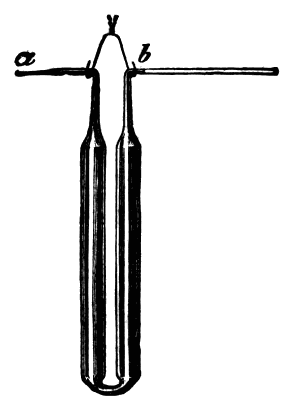
Fig. 1.
“The form of my instrument, as shown in the accompanying fig. 1, is that of an elongated U-tube, the open ends of which terminate1⁄10 milligram when loaded with 50 grams, the U-tube, when charged with the liquid, should not be heavier than 1000 gr. = (64·799 grams).
The instrument which served for my determinations, mentioned below, had a length of 17·7 cm. (7 inches), and was made of a glass tube, the outer diameter of which was 11 mm. (7⁄16 of an inch). It need hardly be mentioned that the U-shape is adopted for the sake of presenting a large surface, and so rendering the instrument sensitive to changes of temperature. The point, however, I wish to notice more particularly (for reasons explained below) is the different calibre of the two capillary tubes. The shorter one is a good deal narrower (at least towards the end) than the longer one, the inner diameter of which is about 1⁄2 mm. The horizontal part of this wider tube is marked near the bend with a delicate line (b). This line, and the extremity of the opposite capillary tube (a), are the marks which limit the volume of the liquid to be laid.
The filling of the instrument is easily effected by suction, provided that the little bulb apparatus (as represented in fig. 2) has previously been attached to the narrow capillary tube by means of a perforated stopper, i. e. a bit of an india-rubber tube tightly fitting the conical tubules of the bulb. On dipping the wider and longer capillary tube into a liquid, suction applied to the open end of the india-rubber tube will produce a partial vacuum in the apparatus, causing the liquid to enter the U-tube. As the partial vacuum maintains itself for some time (on account of the bulb, which acts as an air-chamber), it is not necessary to continue the suction if the end of the india-rubber tube be timely closed by compression between the fingers. When bulb and U-tube have about equal capacity, it is hardly necessary during the filling to repeat the exhaustion more than once.
Without such a bulb the filling of the U-tube through these fine capillary tubes is found somewhat tiresome; the emptying the U-tube is effected by reversing the action, and so compressing the air. After the U-tube has been filled, it is detached from the bulb, placed in water of the standard temperature almost up to the bends of the capillary tubes, left there until it has assumed this temperature, and after a careful adjustment of the volume, is taken out, dried, and weighed.
Particular care must be taken to ensure the correctness of the standard temperature, for a mistake of 0·1° causes the weight of 10 c.c. of water to be estimated either too high or too low by 0·14 milligram, giving rise to an error in the fifth decimal, or making 100,000 parts 100001·4 parts. These determinations have been made in Dupré’s apparatus, which, when furnished with a sensitive thermometer, allows the fluctuations of temperature to be fixed within the limits of 0·01°. If many determinations had to be made, I should avail myself of Scheibler’s (‘Zeitschrift für Analytische Chemie,’ vol. vii, p. 88, 1868) electro-magnetic regulator for maintaining a constant temperature.
A peculiar feature of my instrument is the ease and precision with which the measurement of the liquid can be adjusted at the moment it has taken the standard temperature; for it will be found that the liquid expands and contracts only in the wider capillary tube, viz. in the direction of the least resistance. The narrow capillary tube remains always completely filled. Supposing the liquid reaches beyond the mark b, it may be reduced through capillary force by touching the point a with a little roll of filtering paper. Supposing, however, that in so doing too much liquid is abstracted, capillary force will redress the fault if point a be touched with a drop of the liquid under examination; for this gentle force acts instantly through the whole mass of the liquid, causing it to move forward again to or beyond the mark.
As the instrument itself possesses the properties of a delicate thermometer, the time when it has reached the standard temperature of the bath may be learned from the stability of the thread of liquid inside the wider tube. The length of this thread remains constant after the lapse of about five minutes.
In wiping the instrument (after its removal from the bath) care should be taken not to touch point a, as capillarity might extract some of the liquid; otherwise the handling of the liquid requires no especial precaution.
The capillary tubes need not be closed for the purpose of arresting evaporation, at least that of water. I have learned from the mean of several determinations that the error arising from this source amounts in one hour to 1⁄20 of a milligram.
In cases where the temperature of the balance-room is high, and the expansion coefficient of the liquid to be examined is considerable, it may be found necessary to put a small cap (bead-shaped and open at both ends) over the extremity of the wider capillary tube, for the purpose of retaining the liquid, which during the time of weighing might otherwise be lost, owing to its expansion. When a cap is used the wider capillary tube need not be longer than the narrow one.[180]
The ‘Compte Rendus’[181] describes a new specific gravity apparatus, the invention of M. Pisani. The apparatus in question consists of a glass vessel about 5 c.c. capacity, closed with
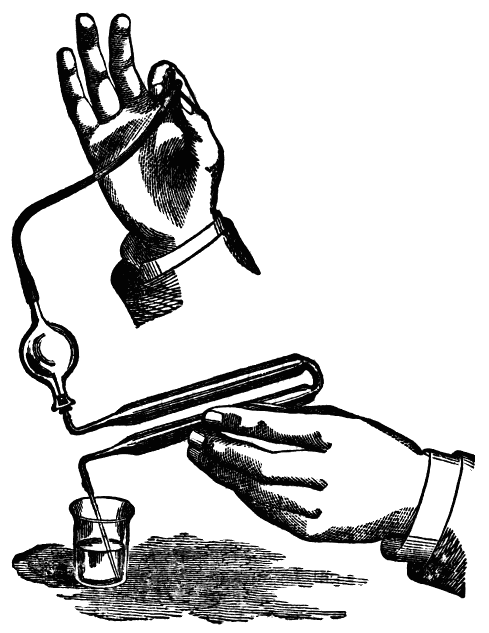
SPEC′TACLES. See Eye, Vision, &c.
SPEC′TROSCOPE. An instrument devised for examining the spectra of flames. (See below.)
SPEC′TRUM ANAL′YSIS. See Analysis, Spectrum.
SPEC′ULUM MET′AL. Prep. 1. Take of copper, 64 parts; pure tin, 69 parts; melt them separately under a little black flux; next incorporate them thoroughly by stirring with a wooden spatula, and run the metal into the moulds, so that the face of the intended mirror may be downwards; lastly, allow the whole to cool very slowly.
2. Pure copper, 2 parts; pure tin, 1 part. Used to make the mirrors of reflecting telescopes. The addition of a little metallic arsenic renders it whiter.
SPEL′TER. See Zinc.
SPERMACE′TI. Syn. Cetaceum (B. P., Ph. L., E., & D.), L. A concretion prepared from the oily matter of the head of the Physeter macrocephalus, or spermaceti whale. It is demulcent and emollient; chiefly used in ointments and cerates.
SPHEROID′AL STATE. It is found that water, or any other volatile liquid, thrown on a metallic plate heated to dull redness, is not resolved into vapour, but, assuming a somewhat globular form, remains intact, until the temperature becomes sufficiently lowered to allow of contact between the liquid and the heated surface. It is then immediately volatilised. M. Boutigny, who fully investigated this subject, has also shown that the same thing happens when a solid body containing water is substituted for the liquid in the above and similar experiments. Thus, the finger or hand, under certain restrictions, may be thrust, with perfect impunity, into a stream of molten metal, and ice may be produced by throwing water into a red-hot crucible. This last experiment, as performed by MM. Boutigny and Prevostaye, is essentially as follows:—A thick platinum crucible, of the capacity of 1 fl. oz., is heated to redness over a powerful spirit lamp, and some liquid anhydrous sulphurous acid (a very volatile substance) poured into it by means of a pipette; the acid assumes a spheroidal form, and does not evaporate; a few drops of water are now introduced into the sulphurous acid in the same way; the diluted and slightly cooled acid instantly flashes off in vapour, and, robbing the water of its caloric, leaves the latter in a frozen state; and, if the operator seizes the right moment, a solid lump of ice may be thrown out of the red-hot crucible.
By substituting for anhydrous sulphurous acid a mixture of solid carbonic anhydride and ether, and for water a few grains of quicksilver, this latter may be reduced to the solid condition, and may be turned out of the red-hot crucible in the form of a small frozen mass.
The spheroidal condition of “liquids is a complicated result of at least four distinct causes. Of these the most influential is the repulsive force which heat exerts between objects which are closely approximated towards each other. When the temperature reaches a certain point actual repulsion between the particles ensues.
“Besides this repulsive action occasioned by heat, the other causes which may be mentioned as tending to produce the assumption of the spheroidal condition by the liquid are these:—
“1. The temperature of the plate is so high that it immediately converts any liquid that touches it into vapour, upon which the spheroid rests as on a cushion.
“2. This vapour is a bad conductor of heat, and prevents the rapid conduction of heat from the metal to the globule.
“3. The evaporation from the entire surface of the liquid carries off the heat as it arrives, and assists in keeping the temperature below the points of ebullition. The drop assumes the spheroidal form as a necessary consequence of the action of cohesion among the particles of the liquid, and the simultaneous action of gravity on the mass.”[182]