A CYCLOPÆDIA OF PRACTICAL RECEIPTS, &c. VOLUME II (continued 39)
Reading edition
Leakage of pipes of any kind into a cistern or tank should be particularly guarded against. Another important precaution claiming adoption is to see that the overflow-pipe is not directly connected with the sewer, for if it be, the sewer gases will rise through it, and being prevented escaping from the cistern because of its covering, will become absorbed by the water. To obviate this, the overflow-pipe is curved, so as to force a syphon trap; but this device conduces to a sense of false security, since it mostly fails owing to the evaporation of the water in it, or to the gases forcing their way through it. The overflow-pipe, therefore, should never have direct communication with the sewer, but should always end above ground, and discharge over a trapped grating into it. For similar reasons the same tanks or cisterns should never supply the water used for culinary or drinking purposes and also the water-closets.
To the water in the tanks attached to these latter, some disinfectant substance should from time to time be added; more particularly during hot weather.
Unless a cistern be efficiently protected, particularly if it be placed in an exposed situation, various disgusting and filthy substances, such as the ordure of birds, cats, rats, and dead insects, &c., will be liable to fall into it, and foul its contents. This must not only be guarded against by the proper means, but even where the contamination may not be suspected, or likely to occur, the cistern should be frequently examined and periodically cleansed; part of the proper carrying out of which should consist in always running off the water remaining in it and renewing it with fresh.
The London and General Water Purifying Company have adopted an excellent idea in connection with tanks and cisterns; they fit them with filters, so that the water drawn from the pipes shall have been submitted to filtration previous to delivery.
TAN′NATE. A salt of tannic acid.
TAN′NER’S BARK. The best of this is oak bark; but the bark of the chestnut, willow, and larch, and other trees which abound in tannin, are also used for preparing leather.
TAN′NIC ACID. C27H22O17. Syn. Tan, Tannin, Gallo-tannic acid†; Tanninum, Acidum tannicum (B. P., Ph. L., D., & U. S.), L. A peculiar vegetable principle, remarkable for its astringency and its power of converting the skins of animals into leather.
Prep. 1. (Pelouze.) From galls, in moderately fine powder, by percolation, in a closed vessel, with sulphuric ether that has been previously agitated with water. After some time the percolated liquid will be found divided into two distinct portions, the lower andProd. About 40%.
2. (Ph. D.) From galls, in tolerably fine powder, 8 oz., and a mixture of sulphuric ether, 3 pints, with water, 5 fl. oz.; by percolation, in successive portions, like the last; the aqueous solution of tannic acid being evaporated, and finally dried at a heat not exceeding 212° Fahr.
Prop., &c. Pure tannic acid is perfectly white, but as ordinarily met with it has a slight yellowish colour, owing to the action of the air; it is uncrystallisable; possesses a powerful and purely astringent taste, without bitterness; is freely soluble in water, less so in alcohol, and only very slightly in ether; it reddens vegetable blues; when boiled with acids, it assimilates water and splits into gallic acid and grape sugar; when heated in the dry state, it suffers decomposition, metagallic and pyrogallic acids being formed; it unites with the bases, forming salts called tannates, which are characterised by striking a deep black with the persalts of iron (ink), and forming a white precipitate with gelatin.
E. Schmidt[223] gives the following comparative method of determining tanning materials, stating, preliminarily, “that the question to be solved is, knowing that a certain weight of pure tannin is required to obtain a certain result, how much of another tanning body, e.g. the extract of a wood, is required to produce the same result? None of the published methods for the determination of tannin is sufficiently precise, easy, and rapid for industrial purposes.”
The author proposes a modification of Pibram’s method with sugar of lead, the modification being as follows:
A. Preparation of the Test Liquor. Fifty grams neutral acetate of lead are dissolved in 400 grams of alcohol, of 92 per cent., and distilled water is added to make up 1 litre.
On the other hand, 1 gram of tannin is dissolved in 40 grams of alcohol of the same strength, and the solution is made up with water to the bulk of 100 c.c. This being done, 10 c.c. of the tannin solution are mixed with 20 c.c. of water, and heated to 60°. The lead liquor is then run into the hot solution from a burette, graduated to tenths of a c.c., so long as a precipitate is formed. At this temperature, and with these alcoholised liquids, the precipitate forms and settles rapidly. Iodide of potassium may be used as an indicator to show excess of lead, proceeding in the same manner as is done with ferrocyanide in titrating phosphates with nitrate of uranium. If we suppose that to precipitate 10 c.c. of the tannin solution 28° of the lead liquor have been required, then 2·8 c.c. of the latter = 0·10 gram of tannin.
B. Preparation of the Sample to be tested. Suppose that chestnut bark is to be examined. It is coarsely powdered, and 10 grams are mixed with an equal volume of washed sand, and exhausted with water at 50° or 60° C. The filtered liquid is evaporated to dryness in a water bath in a tarred porcelain capsule. After evaporation the capsule is weighed, which shows the yield of the bark in aqueous extract. This is taken up in 40 grams of alcohol at 92°, and water is added to make up 100° c.c. The liquid is filtered if needful. In this manner the resinous, albuminoid, pectic, and gummy matters are got rid of.
C. Titration. The liquid thus prepared is divided into two parts. The first, one third of the entire volume, serves for direct determination of the acetate of lead. Suppose that a gram of the dry extract of chestnut has required, for 10 c.c. of the tannin liquor, in three successive experiments, 16°, 17°, and 16° of the burette, which corresponds to 57 per cent. of tannin. Thus figure 57 represents not only tannin, but every other substance capable of precipitating acetate of lead.
The tannin is then absorbed with bone black, previously washed with hydrochloric acid, and dried at 100° C. in the following manner:—We act with bone black upon the tannin liquor, and on a solution of pure tannic, prepared at a standard somewhat lower than that indicated for the extract by the first direct titration. In the present case this solution of tannin should be prepared at 55 per cent.
From one and the same glass tube, about 1 centimètre in diameter, we cut off two lengths of 20 centimètres each, and we draw out each at one of its ends. The two tubes are fixed perpendicularly with the points downwards, and plugged with a little carded cotton. Into each is put 10 grams of the bone black, pouring into one of them the second part of the tannin liquor under examination, and into the other the same volume of the pure solution of pure tannin at 55 per cent.
Twenty c.c. of the tannin liquor (which will be found to have retained its original brown colour in spite of the bone black) are now heated to 60° C., and the standard lead liquor is added from the burette as before. Two successive trials show 16° = 8° for 10 c.c. in place of the 16° found for 10 c.c. on direct titration. On the other hand, 20 c.c. of the solution of pure tannin require 14°, or 7° for 10 c.c. Thus we see that in the tannin liquor (chestnut extract) there is a certain quantity of matter which acts upon the standard lead solutioni. e. to 357 thousandths of a centigram of tannin; 28°, therefore, correspond to 10 centigrams. The figure 57, obtained by direct titration, is, therefore, too high by 3·57 per cent., and the extract contains 57 - 3·57 = 53·43 per cent. of tannin.
Uses, &c. The value of substances containing tannin in the preparation of leather is well known. In its pure form it is used as an astringent in medicine; internally, in diarrhœa, hæmorrhages, as a tonic in dyspepsia, &c.; externally, made into a gargle, injection, or ointment.—Dose, 1 to 10 gr., in the form of pills or solution. See Gallic acid, &c.
TAN′NIN. See Tannic acid.
TAN′NING. When the skin of an animal, carefully deprived of hair, fat, and other impurities, is immersed in a dilute solution of tannic acid, the gelatin gradually combines with that substance as it penetrates inwards, forming a perfectly insoluble compound, which resists putrefaction completely; this is tanned leather. In practice, lime water is used for cleansing and preparing the skin, water acidulated with oil of vitriol for ‘raising’ or opening the pores, and an infusion of oak bark, or sometimes of catechu, or other astringent matter, as the source of tannic acid. The process itself is necessarily a slow one, as dilute solutions only can be safely used. Skins intended for the curriers, to be dressed for ‘uppers,’ commonly require about 3 weeks; and ‘thick hides,’ from 12 to 18 months.
Of late years various ingenious contrivances have been adopted, with more or less success, to hasten the process of tanning skins and hides. Among these may be mentioned the employment of stronger tan solutions, the application of a gentle heat, puncturing the skins to afford more ready access for the liquid to their interior parts, and maceration in the tan liquor under pressure, either at once or after the vessel containing them has been exhausted of air by means of an air-pump. On the merit of these several methods it has been remarked “that the saturated infusions of astringent barks contain much less extractive matter, in proportion to their tannin, than the weak infusions; and when the skins are quickly tanned in the former, common experience shows that it produces leather which is less durable than leather slowly formed.” (Sir H. Davy.) “100 lbs. of skin, quickly tanned in a strong infusion of bark, produce 137 lbs. of leather; while 100 lbs., slowly tanned in a weak infusion, produce only 1171⁄2 lbs.” “Leather thus highly (and hastily) charged with tannin is, moreover, so spongy as to allow moisture to pass readily through its pores, to the great discomfort and danger of persons wearing shoes made of it.” (Ure.)
According to Mr G. Lee, much of the original gelatin of the skin is wasted in the preliminary processes to which they are subjected, more especially the ‘liming’ and ‘bating,’ He says, that 100 lbs. of perfectly dry hide, cleaned from extraneous matter, should, on chemical principles, afford at least 180 lbs. of leather.
Morocco leather is prepared from goat or sheep skins, which, after the action of lime water and a dung bath, are slightly tanned in a bath of sumach. They are subsequently grained, polished, &c.
Russia leather is generally tanned with a decoction of willow bark, after which it is dyed, and curried with the empyreumatic oil of the birch tree. It is the last substance which imparts to this leather its peculiar odour and power of resisting mould and damp. See Leather, Tannic acid, Tawing, &c.
TANTALIC ACID. Syn. Tantalic anhydride; Columbic acid. Rose believed this substance to be a dioxide, to which he gave the formula TaO2; but the subsequent researches of Marignac, and the crystalline form of potassic tantalic fluoride 2KF, TaF5, seem to show that it is to be regarded rather as Ta2O5.
TAN′TALUM. Ta. Syn. Columbium. A rare metal discovered by Mr Hatchett, in 1801, in a mineral from Massachusetts; and by M. Ekeberg, in 1803, in tantalite, a mineral found in Sweden. It exists in most of its ores in combination with oxygen.
TAPEWORM. See Worms.
TAPEWORM CURE (Bloch, Vienna). Coarsely powdered pomegranate root bark, 125 grammes, boiled for half an hour in 800 grammes water. To this add solution of ammonia, 5 grammes; boil again for a quarter of an hour. Add kousso flowers 25 grammes. Again boil for a few minutes, and when cold add citric acid, 1 gramme; and alcohol, 30 grammes. Press, filter, and set aside. The product should weigh about 500 grammes. Klinger says this remedy is merely a concentrated essence of pomegranate root bark, and contains neither ammonia nor citric acid.
Tapeworm Cure (Jacoby, Berlin). A box containing 20 grammes of kousso powder and directions for use. (Hager.)
Tapeworm Cure (Mix). (a) A mixture containing 3 decigrammes of sulphate of quinine, with a few drops of hydrochloric acid to dissolve it in 200 grammes water. To be taken in the course of three days. (b) A box with 12 grammes kousso powder. A teaspoonful to be taken each morning in black coffee. (Schädler.)
Tapeworm Cure (Richard Mohrmann, Frankenberg, Saxony). This Mohrmann travels about in the fashion of the old charlatans, to sell his medicines. These consist of two varieties, the first being 10 grammes of extract of male fern, the second a mixture of 8 grammes each of raspberry juice and castor oil. These remedies have been used for tapeworm for almost 100 years. The doctor’s directions for use are to mix 30 grammes of the extract with the castor oil and raspberry
Tapeworm Cure (Mork, Berlin). A decoction of about 110 grammes of pomegranate root bark, yielding 400 grammes of liquid, and mixed 1 gramme of extract of male fern. The directions order that on one day one or two tablespoonfuls of castor oil should be taken, a herring salad in the evening, and the following morning, after coffee, a third of the contents of the bottle, another third half an hour later, and the remainder in yet another half hour. (Hager.)
Tapeworm Cure for Children and Adults (E. Karig, Berlin). Burned oxide of copper, 1 gramme; cassia powder, 11⁄2 gramme; sugar of milk, 10 grammes. Divide in 24 powders. (Schädler.)
Tapeworm Pills, Laffon’s, are compounded of the ethereal extract of the root of Aspidium Lonchitis, Asp. Helveticum, and Asp. Filixmas, together with the alcoholic extract of the flowers of Achillea mutellina and maschata, and the powder of the flowers of Arnica Doronicum. (Wittstein.)
Tapeworm Pills, Peschier’s.—Ethereal extract and powder of the rhizome of male fern, of each gramme 1·6 make 20 pills. Take ten at night and ten in the morning.
TAPIO′CA. Syn. Tapioca (Ph. E. & D.), L. The fecula of the root of Janipha manihot (Jatropha manihot—Linn.), which has been well washed in water, and dried on hot plates, by which it assumes the appearance of warty-looking granules.
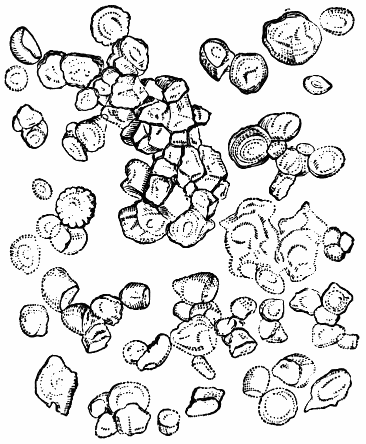
Microscopic appearance of tapioca.
Pure tapioca is insipid, inodorous, only slightly soluble in cold water, but entirely soluble in boiling water, forming a translucent and highly nutritious jelly. Its granules are muller-shaped, about 1⁄2000 of an inch in diameter, and display very marked hilums. It is used in a similar manner to sago and arrow-root. See Cassava.
TAPS, WOODEN (to prevent their cracking). The taps are placed in mother paraffin, heated to from 110° to 120°; by this means the water is eliminated from the wood, and the wood becomes thoroughly impregnated with paraffin. The taps are heated in this bath until all the aqueous vapour has been expelled, and are left in it, after the removal of the vessel from the fire, up to the very moment the paraffin begins to solidify. Wooden taps thus prepared are very durable, do not become soaked with liquids, keep very tight, and are not liable to become mouldy. The excess of paraffin is wiped off with care, and the taps are next rubbed clean with a piece of flannel. (Dr E. Kopp.)[224]
TAR. Syn. Pix liquida (B. P., Ph. L., E., & D.), L. A liquid bitumen prepared from the wood of Pinus sylvestris, and other species, by heat. The chemical constitution of tar is very complicated. Its uses in the arts are well known. As a medicine it is stimulant, diuretic, sudorific, and vermifuge.—Dose, 20 to 60 minims, made into pills with flour; in ichthyosis, &c. Externally, in lepra, psoriasis, foul ulcers, &c. See Ointment and Infusion.
Tar, Barbadoes. Syn. Pix liquida Barbadensis, Petroleum Barbadense, Petroleum (Ph. L. and E.), L. “Black liquid bitumen, exuding spontaneously from the earth.” (Ph. L.) Its properties for the most part resemble those of the last.—Dose, 10 to 30 drops; in asthma, chronic coughs, tapeworm, &c. Externally, in chilblains, chronic and rheumatic pains, &c. See Petroleum.
Tar, Coal. Produced during the distillation of bituminous coal for gas. See Naphtha, &c.
TARAX′ACUM. See Dandelion.
TAR COLOURS. Syn. Coal tar colours, Aniline colours, &c. Coal tar, the source of the aniline colours, consists of the oily fluid obtained in the destructive distillation of coal, during the manufacture of ordinary illuminating gas, and collected in a tank from the hydraulic main and condensers.
The composition of coal tar is highly complex, the most important constituents being, however, a series of homologous hydrocarbons obtained by distilling coal tar, and known as ‘coal naphtha.’ Naphtha, by rectification between 180° and 250° Fahr. (82 and 121 Cent.), yields a light yellow oily liquid, of sp. gr. ·88, the benzol of commerce.
By the action of a mixture of nitric and sulphuric acids on benzol, nitro-benzol, a heavy oily liquid with an odour of oil of bitter almonds is obtained. In commerce this substance is made in large cast-iron pots, fitted with tight covers, and provided with stirrers worked by steam power. By means of pipes the reagents are admitted and the nitrous fumes are carried off, while the nitro-benzolBenzol.
Nitro-benzol is converted into aniline in a similar apparatus, only provided with means of admitting a current of superheated steam, and condensing the aniline as it distils over. Into the vessel iron borings are placed, and acetic acid and nitro-benzol cautiously run in as the reduction is violent, stirring well all the time. A current of superheated steam is passed through, and the aniline collected as it distils over as a pale, sherry-coloured oily liquid, boiling at 360° Fahr. (182 Cent.), and of sp. gr. 1·02. See Aniline.
Mauve, Indisine, Violine, Phenamine, the first-discovered coal tar, or aniline colour, was obtained by Mr Perkins during some experiments directed towards the artificial formation of quinine, and was also first practically manufactured by Mr Perkins. Commercially, mauve is made as follows:
Aniline and sulphuric acid in proper proportions are dissolved in water in a vat by aid of heat, and when cold a solution of bichromate of potassium added, and the whole allowed to stand a day or two, when a black precipitate is obtained, which, after collecting on shallow filters, is washed and well dried. This black resinous substance is digested with dilute methylated spirit in a suitable apparatus, to dissolve out the mauve, and the major portion of the spirit distilled off. The mauve is precipitated from the aqueous solution left behind by hydrate of sodium, and after washing is either drained to a paste or dried.
The amount of mauve thus obtained is but small in comparison with the raw material, coal tar, as 100 lbs. of coal yield 10 lbs. 12 oz. of coal tar; 81⁄2 oz. of mineral naphtha, 23⁄4 oz. of benzol; 41⁄4 oz. of nitro-benzol, 21⁄4 oz. of aniline, and 1⁄4 oz. of mauve. Mauve is usually sent into the market in paste or solution, the expense of the crystals being heavy, and offering no corresponding advantages.
Other salts than the bichromate of potassium have been employed to convert aniline into mauve, as chloride of copper, permanganate of potassium, &c.; but experience has shown none to possess the same advantages as the bichromate of potassium.
Mauveine, the organic base of mauve or aniline purple, is a black crystalline powder, of the formula C27H24N3, yielding a dull violet solution. The moment, however, mauveine is brought in contact with an acid, it turns a magnificent purple colour. The salts of mauveine form beautiful crystals possessing a splendid green metallic lustre, soluble very readily in alcohol, and less so in water. The commercial salt, or mauve, is the acetate, or sometimes the hydrochlorate.
Magenta. Syn. Aniline red, Roseine, Fuchsine, Azaleine, Solferino, Tyraline. Various processes have been proposed and patented for the preparation of this commercially important coal-tar colour. Amongst these processes are—
1. Gerber-Keller’s, patented in France, October 29th, 1859. By this the aniline is treated with mercuric nitrate.
2. Lauth and Depouilly used nitric acid.
3. Medlock (patent dated January, 1860). Nicholson, and Messrs Girard and De Laire, all in 1860, separately patented the use of arsenic acid. This process, being the one now almost exclusively employed, is thus described in Crace Calvert’s work, ‘Dyeing and Calico Printing,’ edited by Messrs Stenhouse and Grove. “The manufacture of magenta, as it is now conducted in the large colour works, is a comparatively simple process, the apparatus employed consisting of a large cast-iron pot set in a furnace, provided with means of carefully regulating the heat. It is furnished with a stirrer, which can be worked by hand or by mechanical means, the gearing for the stirrer being fixed to the lid, so that by means of a crane the lid may be removed, together with the stirrer and gearing. There is also a bent tube passing through the lid for the exit of the vapours, which can be easily connected or disconnected with a worm at pleasure; lastly, there are large openings at the bottom of the pot, closed by suitable stoppers, so that the charge can be removed with facility as soon as the reaction is complete. Into this apparatus, which is capable of holding about 500 gallons, a charge of 2740 lbs. of a concentrated solution of arsenic acid, containing 72% of the anhydrous acid, is introduced, together with 1600 lbs. of commercial aniline. The aniline selected for this purpose should contain about 25% of the toluidine.
“After the materials have been thoroughly mixed by the stirrer the fire is lighted, and the temperature gradually raised to about 360° F. In a short time water begins to distil, then aniline makes its appearance along with the water, and, lastly, aniline alone comes over, which is nearly pure, containing, as it does, but a very small per centage of toluidine. The operation usually lasts about eight or ten hours, during which time about 170 gallons of liquid pass over, and are condensed in the worm attached to the apparatus; of this about 150 lbs. are aniline. The temperature should not exceed 380° F. at any period during the operation. When this is complete steam is blown in through a tube, in order to sweep out the last traces of the free aniline, and boiling water is gradually introduced in quantity sufficient to convert the contents into a homogenous liquid. When this occurs the liquid is run out of the openings at the bottom into cisterns provided with agitators; here more
If in the treatment of aniline with arsenic acid the latter be considerably beyond the proportion of aniline employed, VIOLET and BLUE dyes may be formed. The production of such has been patented by Girard and De Laire.
4. Laurent and Casthélaz have obtained aniline red direct from benzol, without the preliminary isolation of aniline. Nitrobenzol is treated with twice its weight of iron finely divided, and half its weight of concentrated hydrochloric acid. The colouring matter obtained by this process is said to be inferior in beauty to that procured from aniline.
5. Messrs Renard Brothers include in their patent the ebullition of aniline with stannous, stannic, mercurous, and mercuric sulphates, with ferric and uranic nitrates and nitrate of silver, and with stannic and mercuric bromides.
6. Messrs Dale and Curo’s (patent dated 1860) consists in the treatment of aniline or hydrochlorate of aniline with nitrate of lead.
7. Mr Smith claims the ebullition of aniline with perchloride of antimony, or the action of antimonic acid, peroxide of bismuth, stannic, ferric, mercuric, and cupric oxides, upon hydrochlorate or sulphate of aniline, at the temperature of 180°.
Coupier’s process for the manufacture of magenta without the use of arsenic acid is as follows:—He heats together pure aniline, nitrotoluene, hydrochloric acid, and a small quantity of finely-divided metallic iron, to a temperature of about 400° F. for several hours. The pasty mixture soon solidifies to a friable mass resembling crude aniline red—ordinary commercial aniline. The above processes are for the preparation of crude aniline red only. The crude colours contain some undecomposed aniline, mostly in the form of salts. They are also contaminated with tarry matters, some insoluble in water and dilute acids; others soluble in bisulphide of carbon, naphtha, or in caustic or carbonated alkalies. If, therefore, the crude red be boiled with an excess of alkali the undecomposed aniline is expelled, the acid which exists in the product being fixed. On treating the residue with acidulated boiling water the red is dissolved, while certain tarry matters remain insoluble. If now the boiling solution be filtered, and then saturated with an alkali, the colouring matter is precipitated in a tolerable state of purity. By redissolving the precipitated red in an acid, not employed in excess, a solution is obtained which frequently crystallises, or from which a pure red may be thrown down by a new addition of chloride of sodium or other alkaline salt.
Dr Hofmann and Mr Nicholson have demonstrated that pure aniline, from whatever source obtained, is incapable of furnishing a red dye, but that it does so when mixed with its homologue toluidine—toluidine by itself being equally incapable of yielding it. From this it will be evident that an aniline rich in toluidine is an essential condition for obtaining aniline red.
Magenta consists of brilliant large crystals, having a beautiful golden-green metallic lustre, and soluble in water to an intense purplish-red solution. It is a salt of a colourless base, rosaniline, which is prepared from magenta by boiling with hydrate of potassium, and allowing the solution to cool, when it crystallises out in colourless crystals, having the formula C20H19N3H2O. All the salts of rosaniline have a splendid purple-red colour, and that usually met with as magenta is the hydrochlorate, although the nitrate, oxalate, and acetate are also to be obtained.
Sugar, previously dyed with magenta, is sometimes used as an adulterant of crystallised magenta. If present, the larger crystals of dyed sugar may be readily detected by their colour being paler at the edges, when the suspected sample is spread out on a sheet of white paper in the sunshine. One of the best methods of testing magenta is to make a comparative dyeing experiment with the sample under examination, and with one of known purity, using white woollen yarn.
From magenta or hydrochlorate of rosaniline a large number of colouring matters are produced, the most important of which will be briefly described below.
Aniline Black. “Dissolve 20 parts of potassium chlorate, 40 parts of sulphate of copper, 16 parts of chloride of ammonium, and 40 parts of aniline hydrochloride, in 500 parts of water, warming the liquid to about 60°, and then removing it from the water bath. In about three minutes the solution froths up and gives off vapours which strongly attack the breathing organs. If the mass does not become quite black after the lapse of a few hours it is again heated to 60°, and then exposed in an open place for a day or two, and afterwards
Aniline Blue, or Bleu de Lyons. This dye is prepared by heating a mixture of magenta, acetate of sodium, and aniline in iron pots, provided with stirrers, &c., in an oil bath, to 370° Fahr. (190° C.), and the excess of aniline distilled over. When a good blue has been obtained the heat is removed, and the thick treacly fluid purified. This is effected for the commoner varieties by treating the crude product with hydrochloric acid, to dissolve all the excess of aniline, and the various red and purple impurities; but for the better qualities by mixing the crude product with methylated spirit, and pouring the whole into water acidulated with hydrochloric acid, and then thoroughly washing the colouring matter that is precipitated, with water and drying.
This blue, like magenta, is a salt of a colourless base, which has been named Triphenyl-rosaniline. C38H31N3, or C20H16(C6H5)3N3. Aniline blue, or Lyons blue, is sent into the market either as a coarse powder of a coppery lustre, or in alcoholic solution; as it is insoluble in water, which necessitates it being added to the dye bath in solution in spirit, a great drawback.
Mr Nicholson, by treating Lyons blue in the same manner as indigo is converted into sulphindigotic acid, has succeeded in rendering it soluble; dissolving in alkalies to form colourless salts, and decomposed by acids into its original blue colour.
By a modification of this method ‘Nicholson’s blue’ is prepared, a fine soluble blue dye. Another colouring matter called Paris blue or bleu de Paris was obtained by heating stannic chloride with aniline for 30 hours at a temperature of 356° Fahr. (180 C.). It is a fine pure blue, soluble in water, and crystallising in large blue needles with a coppery lustre.
Another method pursued in manufacture of this colour on a large scale is carried out by allowing a mixture of a salt of rosaniline, with an excess of aniline, to digest at a temperature of 150° to 160° for a considerable time. If a mixture of 2 kilogrammes of dry hydrochlorate of rosaniline, and 4 kilogrammes of aniline be employed, the operation is completed in four hours. The crude blue is purified by treating it successively with boiling water, acidulated with hydrochloric acid, and with pure water, until it is of the purest blue colour. ‘Nicholson’s blue’ is obtained by digesting triphenyl rosaniline—mono-sulphonic acid (made by dissolving triphenyl rosaniline hydrochloride in strong sulphuric acid, and heating the solution for five or six hours. On the addition of water, the acid is obtained as a dark blue precipitate, and dried at 100°), with a quantity of soda-lye not quite sufficient for saturation, filtering the solution and evaporating. It is dried at 100°. Wool dipped into a hot aqueous solution of Nicholson’s blue, especially if borax or water-glass be added, extracts it in a colourless state, and holds it so fast that it cannot be washed out with water, but on dipping the wool thus prepared into an acid the salt is decomposed, and the colouring matter is set free.
Aniline Blue for Printing. Blumer-Zweefel gives the following process:—“Mix 100 parts of starch with 1000 parts of water, and add to it while warm 40 parts of potassium chlorate, 3 to 4 parts of ferrous sulphate, and 10 parts of sal ammoniac. The well-mixed paste, when quite cold, is mixed with 70 parts of aniline hydrochloride, or an equivalent quantity of tartrate, and immediately used. The printed goods are oxidised, then passed through warm or faintly alkaline water, whereby the blue colour is developed.”
Violet Imperial. If the action of the aniline and magenta in the process of manufacturing aniline blue be stopped before it is finished, and the resulting product treated with dilute acid, a colouring matter called violet imperial is obtained. It is now, however, replaced by the Hofmann violets.
Mr Nicholson obtains another violet from aniline red, by heating it in a suitable apparatus to a temperature between 200° and 215° C. The resulting mass is exhausted with acetic acid, and the deep-violet solution diluted with enough alcohol to give the dye a convenient strength. Aniline violet, although it resists the action of light to a very considerable extent, has been shown by Chevreul to be inferior in this particular than either madder, cochineal, or indigo.
Hofmann Violets. On a large scale these violets are produced in deep cast-iron pots, surrounded by a steam jacket, and provided with a lid, having a perforation for distilling over the excess of reagents.
These vessels are charged with a solution of magenta in methylated or wood spirit, and iodide of ethyl or methyl, in proportions according to the shade required, and the whole heated by steam for five or six hours, when the excess of alcohol and iodide of ethyl is distilled over. The resulting product is dissolved in water, filtered, precipitated with common salt, and well washed.
Like most of the other colours, Hofmann violets are salts of colourless bases. That of a red shade has a formula of C22H23N3, or C20H18(C2H5)N3; of a true violet shade C24H27N3, 20H17(C2H5)2N2; and of a blue shade of violet, of C26H31N3, or C20H16(C2H5)3N3. They are all moderately fast on wool and silk, although less so on cotton, and, as they can be produced in nearly every shade of violet, are in great use, having replaced most of the other violets.
The following processes have also been proposed for the production of aniline violet:
1. Oxidation of an aniline salt by means of a solution of permanganate of potassium. (Williams.)
2. Oxidation of an aniline salt by means of a solution of ferricyanide of potassium. (Smith.)
3. Oxidation of a cold and dilute solution of hydrochlorate of aniline, by means of a dilute solution of chloride of lime. (Bolley, Beale, and Kirkmann.)
4. Oxidation of a salt of aniline by means of peroxide of lead under the influence of an acid. (Price.)
5. Oxidation of a salt of aniline in an aqueous solution of peroxide of manganese. (Kay.)
6. Oxidation of a salt of aniline by free chlorine or free hypochlorous acid. (Smith.)
Dahlia. This is prepared from mauve and iodide of ethyl, in the same manner as the Hofmann violets, and is a purple-red violet. It is a good colour, but the expense precludes its general use.
Britannia Violet. This is obtained in the same manner as the Hofmann violets, by acting on an alcoholic solution of magenta, with a thick, viscid, oily fluid of the formula C10H15Br3, obtained by cautiously acting with bromine on oil of turpentine. It is a beautiful violet, capable of being manufactured of every shade, from purple to blue, and most extensively used.
Aldehyde Green. Prepared by dissolving one part of magenta in three parts of sulphuric acid, diluted with one part of water, adding by degrees one and a half part of aldehyde, and heating the whole on a water bath until a drop put in water turns a fine blue. It is then poured into a large quantity of hot water containing three parts of hyposulphite of sodium, boiled and filtered. The filtrate contains the green, which can either be kept in solution or be precipitated by means of tannic acid or acetate of sodium. Like the other colours, this green is a salt of a colourless base, containing sulphur, the formula of which is not known, and is principally used for dyeing silk, being very brilliant in both day and artificial light.
Iodide Green. Produced during the manufacture of the Hofmann colours, and is now used for dyeing cotton and silk; its colour being bluer than that of aldehyde green, it is more useful. Iodide green, not being precipitated by carbonate of sodium, is usually sold in alcoholic solution.
Perkins Green. This is also a magenta derivative, and a salt of a powerful colourless base. It resembles the iodide green, but is precipitated by alkaline carbonates and picric acid. This colour is used chiefly for calico printing, and is quite as fast as the Hofmann colours.
Aniline Green. When treated with chlorate of potassium, to which a quantity of hydrochloric acid has been added, aniline assumes a rich indigo-blue colour. The same result occurs if the aniline be treated with a solution of chlorous acid. Similar blues have been obtained by Messrs Crace Calvert, Lowe, and Clift. Most of these blues possess the property, when subjected to the action of acids, of acquiring a green tint, called Emeraldine. Dr Calvert obtained this colour directly upon cloth, by printing with a mixture of an aniline salt and chlorate of potassium, and allowing it to dry. In about twelve hours the green colour is developed. This colour may be converted into blue by being passed through a hot dilute alkaline solution, or through a bath of boiling soap.
Aniline Yellow. Amongst the secondary products obtained during the preparation of aniline red, there occurs a well-defined base of a splendid yellow colour, to which the name chrysaniline has been given. It is prepared by submitting the residue, from which the rosaniline has been extracted, to a current of steam for some time, when a quantity of the chrysaniline passes into solution. By adding nitric acid to the solution, the chrysaniline is thrown down in the form of a difficultly soluble nitrate. The intimate relation between chrysaniline, rosaniline, and leucaniline has been shown by Hofmann.
Chrysaniline C20H17N3.
Rosaniline C20H19N3.
Leucaniline C20H21N3.
Saffranine. This dye stuff is of a bright red-rose colour. Mené says it may be prepared commercially by treatment of heavy aniline oils successively with nitrous and arsenic acids; or two parts of the aniline may be heated with one of arsenic acid, and one of an alkaline nitrate for a short time, to 200° or 212° F. The product is extracted with boiling water, neutralised with an alkali, filtered, and the colour thrown down by common salt.
Besides the above products obtained from aniline, a series of colours have been obtained from phenol, or carbolic acid, another substance obtained from coal tar.
Picric Acid. This is obtained by treating in a suitable apparatus, with proper precautions, carbolic acid with nitric acid. It is a pale yellow crystalline acid, forming dark orange explosive salts, and dyeing silk a fine yellow.
Isopurpurate of Potassium. Grenate Brown. Grenate Soluble. By treating picric acid with cyanide of potassium a very explosive salt is obtained, used to dye wool a dark maroon colour.
Aurine, or Rosolic Acid. This is obtained by heating a mixture of sulphuric, oxalic, and carbolic acids, and purifying the
Peonine, or Coralline. This dye is formed when rosolic acid and ammonia are heated to between 248° and 284° Fahr. (120° to 140° C.). It is a fine crimson dye, forming shades similar to safflower on silk, but, owing to the bad effects of acids, not much used.
Azuline. Prepared by heating coralline and aniline together. A coppery coloured resinous substance, soluble, in alcohol, and with difficulty in water, and dyeing silk a blue colour. The aniline blues, however, have superseded it to a great extent.
There are other substances obtained from coal tar that have been employed to form dyes, but of which we shall only refer to one—naphthaline. By treating this in exactly the same manner as benzol, it is converted into aniline. A solid crystalline white base, termed naphthylamine, is produced. From this substance is obtained the following dye.
Dinitronaphthal, or Manchester Yellow. Naphthylamine is converted into diazynaphthol by treatment with nitrate of potassium, and the latter, when heated with nitric acid, yields the colour. It is a weak acid, and the salt employed in commerce is the beautiful yellow crystalline calcium salt which dyes silk and wool a magnificent golden-yellow colour.
TARPAU′LIN. Syn. Tarpawling. Canvas covered with tar or any composition to render it waterproof.
TAR′RAS. Syn. Terras. A volcanic product resembling puzzolano, that imparts to mortar the property of hardening under water. Several other argillo-ferruginous minerals possess the same power, and are used under this term.
TAR′TAR. Syn. Argal, Orgol; Tartarum, Tartarus, L. Impure bitartrate of potassa. Crude tartar is the concrete deposit formed upon the sides of the casks and vats during the fermentation of grape juice. That obtained from white wine is white argol; that from red wine, red argol. After purification it forms cream of tartar.
Tartar, Ammo′′niated. Syn. Ammonio-tartrate of potassa, Soluble tartar (Ammoniated); Tartarus ammoniatus, Tartarum solubile ammoniatum, L. Prep. Neutralise a solution of cream of tartar with ammonia in slight excess, then evaporate, and crystallise. Very soluble in water. A favourite laxative on the Continent.
Tartar, Bo′′raxated. Syn. Soluble cream of tartar, Boro-tartrate of potassa and soda; Tartarum boraxatum, Cremor tartari solubilis, Potassæ et sodæ tartras boraxata, L. Prep. From borax, 2 lbs; cream of tartar, 5 lbs. (both in powder); dissolved in water, evaporated, and crystallised. See Potassium Borotartrate.
Tartar, Chalybea′ted. Potassio-tartrate of iron.
Tartar, Cream of. Bitartrate of potassa.
Tartar, Emet′ic. Potassio-tartrate of antimony.
Tartar, Oil of. Deliquesced carbonate of potassa.
Tartar, Reduced. Syn. Cremor tartari reductus, L. An article is sold, under the name of ‘British cream of tartar,’ which contains 1⁄4 its weight or more of bisulphate of potassa.
Tartar, Salt of. Carbonate of potassa.
Tartar, Sol′uble. Neutral tartrate of potassa.
Tartar, Spirit of. Pyrotartaric acid.
TARTAR′IC ACID. H2C4H4O6. Syn. Acid of tartar, Essential salt of t.†; Acidum tartaricum (B. P., Ph. L., E., & D.), Sal essentiale tartari†, L. Prep. 1. (Ph. L. 1836.) Take of cream of tartar, 4 lbs.; boiling water, 2 gall.; dissolve by boiling; add, gradually, of prepared chalk, 12 oz. 7 dr. (made into a milk with water), and, when the effervescence ceases, add another like portion of prepared chalk, dissolved in hydrochloric acid, 261⁄2 fl. oz., or q. s., diluted with water, 4 pints; collect the precipitate (‘tartrate of lime’), and, after well washing it with water, boil it for 15 minutes in dilute sulphuric acid, 7 pints and 17 fl. oz.; next filter, evaporate the filtrate (to the density of 1·38), and set it aside to crystallise; redissolve the crystals in water, concentrate the solution by evaporation, and recrystallise a second and a third time. The Edinburgh formula is nearly similar. In the Ph. L. & D. tartaric acid is placed in the Materia Medica.
2. (Gatty.) The solution of argol or tartar is first neutralised with carbonate of potassa, and to every 300 gall. of the clear liquid, at 5° Twaddell, 34 gall. of milk of lime (1 lb. of lime per gall.) are added; carbonic acid gas is then forced in, with agitation; decomposition ensues, with the formation of ‘bicarbonate of potassa’ and ‘tartrate of lime,’ the last is converted into tartaric acid in the usual manner, and the former is evaporated in iron pans, and roasted in a reverberatory furnace for its potassa.
Prop. Tartaric acid forms inodorous, scarcely transparent, oblique rhombic prisms, more or less modified, which are permanent in the air; it possesses a purely sour taste, dissolves in about 2 parts of water at 60° Fahr., and in about its own weight of boiling water; it is slightly soluble in alcohol; the aqueous solution exhibits right-handed polarisation, and suffers gradual decomposition by age.
It is free from colour; is entirely, or almost entirely, dissipated by ignition; and is entirely soluble in water.
Tests. 1. Tartaric acid is known to be such by its solution giving white precipitates with solutions of caustic lime, baryta, and strontia, which dissolve in excess of the acid.—2.
Uses, &c. Tartaric acid is chiefly employed in calico printing, and, in medicine, as a substitute for citric acid and lemon juice in the preparation of cooling drinks and saline draughts. For the latter purpose, bicarbonate of soda is the alkaline salt commonly employed.—Dose, 10 to 30 grains.
Concluding Remarks. On the large scale the decomposition of the tartar is usually effected in a copper boiler, and that of the tartrate of lime in a leaden cistern. This part of the process is often performed by mere digestion for a few days, without the application of heat. Leaden or stoneware vessels are used as crystallisers. Good cream of tartar requires 26% of chalk and 28·5% of dry chloride of calcium for its perfect decomposition. Dry tartrate of lime requires 75% of oil of vitriol to liberate the whole of its tartaric acid. A very slight excess of sulphuric acid may be safely, nay, advantageously, employed. Some manufacturers bleach the coloured solution of the first crystals by treating it with animal charcoal; but for this purpose the latter substance should be first purified by digesting it in hydrochloric acid, and afterwards by edulcorating it with water, and exposing it to a dull red heat in a covered vessel. The general management of this manufacture resembles that of citric acid. To obtain a large product, care must be taken that the whole of the tartrate of lime be thoroughly decomposed, a matter not always effected by clumsy manipulators, who do not adapt their quantities or practice to the circumstances before them.
TAR′TRATE. A salt of tartaric acid.
TARTS. These may be regarded as miniature pies, consisting of fruit, either fresh or preserved, baked or spread on puff-paste.
TARTS. To make an apple tart take about 2 lbs. of apples, peel them, cut each into four pieces, and remove the cores; then let each of the quarters be subdivided into two or three pieces, according to the size of the apple. Having done this, put half the pieces into a pie-dish, press them evenly down, and sprinkle over them two ounces of brown sugar; then add the remaining apples, and afterwards another 2 oz. of sugar, so that the apples shall form a kind of dome, the centre of which is about two inches above the sides, now add a wineglassful of water, and cover the top over with short paste. Let bake in a moderately heated oven from half to three quarters of an hour.
The quantity of sugar must depend upon the quality, and the degree of sweetness, or the reverse, of the apples used. If they are of the sweet kind or very ripe, use less sugar, but a double quantity of water; in the latter case a little of the juice of lemon will improve the flavour. Chopped lemon-peel, or cinnamon, or cloves, may also be added to the tart with advantage.
On making green rhubarb or greengage tarts it will be necessary to use a little more sugar, and to proceed as for apple tart, taking care, however, to omit the lemon juice and peel, cinnamon, or cloves. Tarts of ripe currants, raspberries, cherries, damsons, and mulberries, may be made in the same manner as rhubarb tart. Pink rhubarb does not require peeling.
TAU′RIN. C2H7NSO3. Obtained when purified bile is boiled for some hours with an excess of hydrochloric acid. By filtration, evaporation, and dissolving the dry residuum in about 6 parts of boiling alcohol, nearly pure taurin crystallises out as the solution cools. It forms with crystalline needles, which are soluble in water, and sparingly soluble in alcohol. It is remarkable for containing fully 25% of sulphur.
TAUROCHOLAL′IC ACID. See Choleic acid.
TAW′ING. In the preparation of the TAWED LEATHER used for gloves, housings, &c., the skins are first soaked, scraped, and hung in a warm room until they begin to exhale an ammoniacal odour, and the wool readily comes off; they are then de-haired, and soaked in water with some quicklime for several weeks, the water being changed two or three times during that period; they are then again beamed, smoothed, and trimmed, after which they are rinsed, and resoaked in a vat of bran-and-water, where they are kept in a state of gentle fermentation for some weeks (in this state they are called ‘pelts’); the skins are next well worked about in a warm solution of alum and salt, again fermented in bran-and-water for a short time, and are then stretched on hooks, and dried in a stove-room; they are, lastly, again soaked in water and trodden or worked in a pail or tub containing some yolks of eggs beaten to a froth with water, after which they are stretched and dried in a loft, and are smoothed with a warm smoothing-iron. Sometimes the process is shortened by soaking the skins in the following mixture after the first steep with bran:—Common salt, 31⁄2 lbs.; alum, 8 lbs.; boiling water, q. s.; dissolve, add of wheaten flour, 21 lbs.; yolks of 9 dozen eggs; make a paste. For use, a portion is to be largely diluted with water.
Chamois or SHAMMY LEATHER is generally prepared from either sheep or doe-skins, which, after dressing, liming, &c., are well oiled on the grain side, then rolled into balls, and thrown
Tawed leather differs from TANNED LEATHER in yielding size or glue under the influence of heat and moisture, in nearly the same way as the raw skins.
TAXIDERMY, Practical. The following review on the excellent work on this subject is from ‘The Bazaar,’ ‘Practical Taxidermy; a manual of instruction to the amateur in collecting, preserving, and setting up Natural History Specimens of all kinds. By Montagu Browne.’
“The author of this little book begins at the beginning, and, before detailing the process of skinning, preserving, and mounting any given vertebrate, he starts with a chapter on ‘Trapping and Decoying Birds and Animals.’ In this chapter descriptions are given of various forms of springs, snare, ‘figure-4 trap,’ clap-net, glade-net, bow-net, and box trap; and some wrinkles are imparted which may be useful to wildfowl shooters, to say nothing of gamekeepers, whose livelihood depends on their success in destroying what they are pleased to regard as ‘vermin.’ Chapter 3 is devoted to ‘Necessary Tools,’ of which not only descriptions, but figures are given, and those who have no knowledge of taxidermy will probably be surprised to learn how few tools are really necessary for the purpose.
“On the subject of preservative soaps and powders, Mr Browne has a good deal to say, and gives no less than seventeen different receipts. Many of these, however, are only noticed to be condemned, for the author has been a great experimentalist, and has tested the efficiency or otherwise of all the preparations he names, with a view of ascertaining the best, and at the same time that which is most harmless to the operator. For the preservation of birds he pins his faith to the fourth formula (p. 46), which is a preservative soap for the inside of the skin, composed of 11⁄2 lb. whiting or chalk, 1 lb. of soft soap, and 2 oz. of chloride of lime, finely pounded. These ingredients are boiled together in a pint of water, and the mixture, when properly applied, is said to be so efficacious as to completely supersede arsenical paste or soap. Presuming that it is used only for such specimens as are to be immediately cased up in air-tight cases, nothing further is needed; but as regards such specimens as are left exposed or uncased, ‘a wash of benzoline liberally applied from time to time—say twice a year—to the outside,’ is recommended.
“We have long since proved the efficacy of this fluid, not only in repelling the attacks of moths, and the larvæ of destructive beetles such as Dermestes lardarius, but in killing them in skins that have been already attacked by them. We can therefore indorse Mr Browne’s remarks, and may supplement them by a ‘wrinkle’ which he has probably discovered by this time, although he does not refer to it. It is this. If the amateur in search of benzoline applies to the nearest chemist for it, he will be served with the ‘rectified’ fluid, and will be asked three shillings or three and sixpence for an ordinary medicine bottlefull. If he proceeds, however, to an oil and colour shop, and asks for it as supplied for burning in the sponge lamps, he may get a pint for about a tithe of the cost.
“The best way to apply it is to pour some out in a saucer, saturate a pinch of cotton wool with it, and dab it on all over the fur or feathers. The great advantage about it is that, while killing or repelling insects, it does not in the least injure the specimen to which it is applied. We have seen a mounted specimen of a bird almost saturated with it, so that the feathers looked quite draggled; but as soon as the moisture had evaporated, the feathers all resumed their former shape and glossy appearance. Care should be taken not to use it by candle light, as the vapour is inflammable.
“Amongst the seventeen receipts for ‘preservatives’ of different kinds, we do not see a very simple powder which we have used with success for very small bird skins, which were almost too delicate to stand the application of a brush and paste, or soap. It is composed of burnt alum and sugar of lead, and mixed in the proportion of two thirds of the former to one third of the latter. The alum dries, the sugar of lead preserves, and if the specimen while being skinned be dusted with this mixture, it will absorb all moisture as it arises, for which purpose plaster of Paris is usually employed. A very little goes a long way, and it is desirable not to apply too much, lest the astringent nature of the alum should cause the skin to become brittle and crack.
“Possibly Mr Browne has not referred to this mixture on account of the poisonous nature of the sugar of lead. He justly remarks that too much care cannot be exercised in the employment of poisonous preservatives, and we fully agree with him.
“On the subject of his instructions for skinning birds we have not much criticism to offer, except perhaps as regards his mode of filling out the skin after the preservative has been applied, and before the skin is sewn up. We have found by experience that, after the artificial neck of tow or cotton wool has been inserted, and the wing bones tied inside, the skin is much better filled by degrees with little bits of cotton wool inserted piecemeal, instead of with an artificial body
“Few amateurs, probably, give much time to mounting their specimens, for they can get them so well done by professional taxidermists, at prices varying to suit all purses. The art of skinning wild animals and birds, however, and curing or dressing animal hides, should be acquired by every sportsman and naturalist who intends to travel and collect and bring home trophies. To such a one we may specially recommend the chapters which are devoted to this portion of the subject. In this, as in other respects, Mr Browne’s book is a ‘practical’ manual of taxidermy.”
TAXINE. A poisonous alkaloid present in the leaves and seeds of the yew (Taxus faccata).
TEA. Syn. Thea, L. The dried leaves of the Chinese tea plants (Thea Bohea and Thea viridis).
It was formerly supposed that BLACK TEAS could only be obtained from T. Bohea, and GREEN TEAS from T. viridis, but Fortune and others have proved that both sorts may be made from either species, and that the differences in colour and flavour depend chiefly on the age of the leaves and the treatment they undergo in the drying process. Another species, named Thea Assamica, furnishes Assam tea.
Mulder gives the following as the composition of tea:
Black Tea. Green Tea.
Essential oil 0·60 0·79
Chlorophyll 1·84 2·22
Wax 0·00 0·28
Resin 3·64 2·22
Gum 7·28 8·56
Tannin 12·88 17·80
Theine 0·46 0·43
Extractive matter 21·36 22·80
Colouring substances 19·19 23·60
Albumen 2·80 3·00
Fibre 28·33 17·80
Ash (mineral substances) 5·24 5·56
Dr Walter Blyth, commenting upon the above, says, the amount of theine is certainly understated.
Pur. The chief adulteration of tea which is extensively practised at the present day is mixing it with a certain portion of exhausted tea-leaves, which have been redried and curled. The collection and preparation of these occupy several hundred persons, chiefly women and children, in and about London. The leaves which have been found in the possession of the manufacturers of imitation tea are those of the sloe tree, ash tree, elder bush, and white thorn. According to Mr Warrington, a most extensive system of adulterating tea is practised in China. Many samples directly imported from that country, examined by him, did not contain a single grain of tea, being made up entirely of other leaves. The ordinary green teas he found, for the most part, spurious, being manufactured out of the cheaper black teas. These are ‘faced up’ or ‘painted’ with various colouring substances, powdered porcelain, clay, &c., which are readily perceived under the microscope, and even admit of being separated, and chemically examined.
It is a general practice among the grocers in this country to impart what they call a ‘bloom’ to their green teas by ‘rouncing’ them up with a little calcined magnesia, or finely powdered talc or French chalk. The quantity that adheres to the tea is very trifling, but it, greatly improves its appearance. Black teas are ‘faced,’ in a similar manner, with finely powdered plumbago or black-lead.
Pure China tea is not turned black by being put into water impregnated with sulphuretted hydrogen gas, nor does it tinge a solution of ammonia blue. The infusion is amber-coloured, and is not reddened by the addition of an acid. The ashes left from the combustion of genuine tea are white, and do not exceed 5 to 51⁄2%. If they exceed this they may be chemically examined with the usual tests for alumina, chromate of lead, copper, cyanide of potassium, gypsum, lime, magnesia, &c. Many of these substances may be detected by simply agitating the tea with a little cold water, when they will be detached from its surface, and render the water turbid, or, by their gravity, sink to the bottom.
Mr A. H. Allen[225] arranges the adulteration of tea under four heads, giving at the same time directions for their detection:
1. Mineral additions for increasing weight or bulk: (a) Magnetic matter. Detected by drawing a magnet under a weighted portion of the tea spread upon paper, whereby the magnetic matter is separated from the tea and may be weighed.
(b) Siliceous matter. The ash must be estimated by igniting a weighed portion of the tea. The ash of genuine tea varies from 5·24 to 6·0 per cent. The ash is then boiled with water, the insoluble part again treated with hydrochloric acid, and the silica collected and weighed. Genuine tea does not contain, on an average, more than 0·30 per cent. of ash insoluble in acid; adulterated teas sometimes contain as much as 10 per cent.
2. Organic adulterations for increasing weight or bulk: (a) Exhausted tea leaves.
α. Tannin. 5 gr. of lead acetate are dissolved in 1 litre of water, and the solution filtered after standing; 5 mgms. of pure potassium ferricyanide are dissolved in 5 c.c. of water, and an equal bulk of strong ammonia solution is added. The lead solution is standardised by diluting 10 c.c. to 100 c.c. with boiling water, and adding to it from a burette a solution of 0·1 pure tannin in 100 c.c. of water, until a few drops, when allowed to fall through a filter on to a drop of the ferricyanide solution, spotted on a slab, produce a pink colour. A solution of the tea is made by repeatedly boiling about 2 grams of the finely-powdered sample with 80 c.c. of water, until it is completely exhausted. The solution is filtered and made up to 250 c.c., and used as already described.
The amount of tannin in genuine black tea averages about 10 per cent. A small quantity of tannin, about 2 per cent., remains in the exhausted leaves. The percentage of exhausted leaves, E, in a sample may be estimated, when the per cent. of tannin, T, is known by the equation:
E = (10 - T) / 8 × 100.
β. Insoluble matter is best estimated by boiling the pounded sample repeatedly with water, and drying the residue at 120° C., until the weight is constant. The insoluble matter in black tea varies from 46·7 to 53·6 per cent., while in previously infused leaves it varies between 72 to 75 per cent.
γ Gum. The aqueous decoction is evaporated nearly to dryness, the residue treated with methylated spirit, filtered, washed with spirit, rinsed off the filter with hot water, the liquid evaporated at a steam heat, weighed, ignited, and weighed again. The loss represents gum.
δ. Soluble ash. The aqueous solution of the ash is evaporated, gently ignited, and weighed. Genuine tea contains not less than 3 per cent. of soluble ash, while in exhausted leaves this item falls as low as 0·52 per cent. If S represents the percentage of soluble ash, the percentage of exhausted leaves E may be approximately found in the absence of foreign leaves by the equation:
E = (6 - 2S) × 20.
(b) Foreign leaves. The presence of leaves, other than those of the tea plant, may be detected with some accuracy by estimating the insoluble matter, tannin, gum, and ash; but the microscope must decide this question.
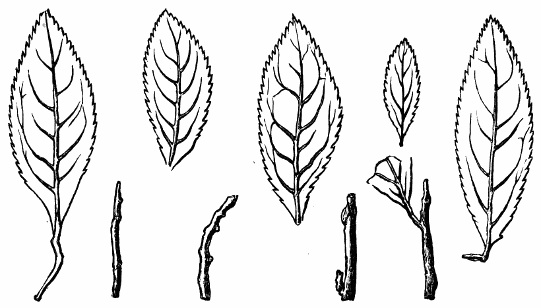
Leaves and stalks of best tea brought from China (1861) by private hand. Natural size. Generally in commercial tea the leaves are much larger and thicker, and often are cut transversely into two or three parts. Some stalks and remains of flowers are found in all tea, even the best.
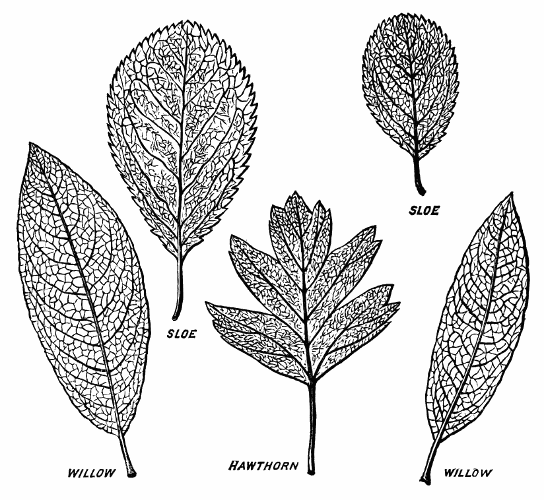
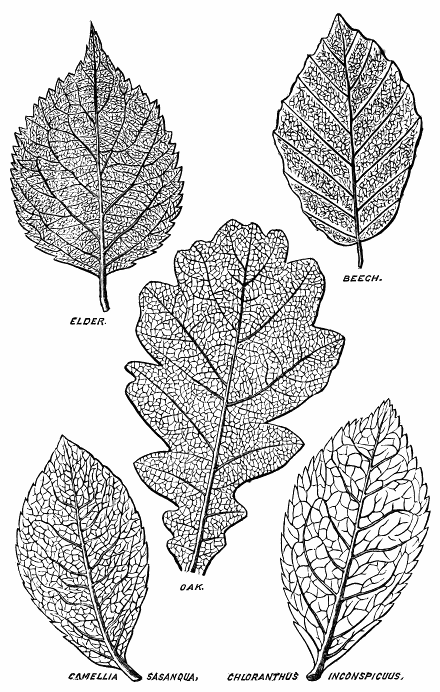
Leaves used in the adulteration of tea—the sloe, willow, oak, beech, elder, and hawthorn, have been nature-printed and then lithographed. The drawings of the chloranthus inconspicuus and the camellia sasanqua, which are said to be used by the Chinese, are copied from Hassall. The leaves of the elm, poplar, and plane are said to be sometimes used in England. Falsification with any kind of leaf is, however, now decidedly uncommon in this country.
3. Adulterants for imparting a fictitious strength. (a) Extraneous tannin matters, such as catechu, &c., are detected by an unusually high percentage of tannin, as indicated by the lead process. Tea, adulterated with catechu, gives an infusion which quickly becomes muddy on cooling. 1 gram of the sample and 1 gram of pure tea are each infused in 100 c.c. of water, and the solutions poured off from the leaves are precipitated, while boiling, with a slight excess of neutral lead acetate, filtered, and tested as follows:—About 20 c.c. of the pure tea infusion, when gently heated with a few drops of silver nitrate, gives a slight cloudiness only; while tea, containing catechu, gives a copious brownish precipitate, and the liquid acquires a distinct yellow tinge. One drop of ferric chloride gives a light green colour if catechu is present, and a greyish-green precipitate on standing; the solution from pure tea gives a reddish colour with ferric chloride, due to acetate, and no precipitate on standing. These tests are applicable only when catechu is present in tolerably large quantities.
(b) Lie tea, when thrown into hot water, falls to powder, because the gum or starch used to keep it in a compact form is dissolved. The liquid may be acidified with sulphuric acid, decolourised with permanganate, and tested for starch. The ash of lie tea is often as high as 30 or 40 per cent.
(c) Caper tea is made into little glossy masses by the aid of gum or starch; it is usually much adulterated. The insoluble matter is usually much less than in genuine tea; the gum amounts to 15 or 20 per cent. The soluble ash often falls below 2 per cent.
(d) Soluble iron salts are added to give an appearance of strength by the formation of tannate of iron. They are detected by shaking the powdered leaves with cold dilute acetic acid, filtering, and testing for iron, in the filtrate.
(e) Alkaline carbonates are sometimes added to tea. The soluble ash gives the yellow sodium flame, if sodium salts have been added; the alkalinity may also be determined in the soluble ash. The average amount of potash (K2O) in tea is about 1·62 per cent.
4. Facing and colouring materials. These may be detected under the microscope, or the leaves may be washed with warm water, the colouring matter collected and examined. Indigo is best detected by the microscope; Prussian blue, by boiling with caustic alkali, filtering, and testing for ferrocyanide by ferric chloride. The residue, insoluble in alkali, is fused with alkaline carbonate, evaporated to dryness with hydrochloric acid; the residue tested for silica, and the filtrate tested for lime and magnesia.
Moisture varies from 6 to 8 per cent.
Among domestic substitutes for tea are—the leaves of speedwell, wild germander, black currant, syringa or mock orange, purple-spiked willow herb, winter green, sweetbriar, cherry tree, sloe, &c., all of which are used for tea, either singly or mixed. The addition of a single bud of the black currant to the infusion of ordinary black tea imparts to it a flavour closely resembling that of green tea.
The brownish-coloured powder vended under the name of ‘la veno beno’ is a mixture of 2 parts of tea-dust with 5 parts of powdered
Tea, Lie. Of this compound, Dr Hassall says:—“It is so called because it is a spurious article and not tea at all. It consists of dust of tea leaves, sometimes of foreign leaves and sand made up by means of starch or gum into little masses, which are afterwards painted and coloured, so as to resemble either black or green gunpowder. The skill exhibited in the fabrication of this spurious article is very great, and we have met with at least a dozen varieties of it, differing from each other in the size and colouring of the little masses.”
The once notorious ‘Paraquay plant,’ sold in packets, was simply new meadow-hay that had been wetted with a strong infusion of catechu, then dried, chopped small, and strongly compressed. See Theine and Caffeine.
Tea. “The tea is not a meal; when it is properly used, it should not be a meal; but it has a special purpose to fulfil, which I will now explain. Tea—and under the generic term tea I include coffee—tea is usually taken three hours after dinner. This is the moment which corresponds with the completion of digestion, when, the food having been conveyed away from the stomach, nothing remains behind but the excess of the acid juices employed in digestion, these acid juices create an uneasy sensation at the stomach, and a call is made for something to relieve the uneasiness; tea fulfils that object.” “On the same principle, after the business of the dining-room, the antacid and refreshing beverage, either in the shape of tea or coffee, is prepared in the drawing-room. In taking either, the nearer they approach to the simple infusion the better; little milk or cream, and less sugar, should be the principle. But, seeing the purpose of tea, how unreasonable to make it the excuse for a meal, to conjoin with it toast, muffins, bread and butter, and id genus omne.” “Three meals a day may be taken as the standard of habit and custom; tea and coffee having a specific place and purpose as a beverage, but none as a meal.” (Eras. Wilson.) See Meals, &c.
Although tea is undoubtedly prejudicial to children and to adults of nervous and irritable temperament, there can be no question that, if its use be not abused, it possesses valuable physiological properties. On the nervous system it acts as a pleasant stimulant and restorative, its moderate use not being followed by depression. Dr Parkes says these effects are in some measure due to the warmth of the infusion. According to the same authority its use is followed by very little quickening of the pulse, whilst there is an increase in the amount of perspiration, and a slightly diminished action on the bowels. Cases, however, are not uncommon in which this latter effect is reversed.
Dr Edward Smith says that tea increases the excretion of pulmonary carbonic acid. The contention that the elimination of urea is lessened, does seem to have been not satisfactorily established. If so, the diminution is very trifling. Sir Ranald Martin says tea is most useful against excessive fatigue, especially in hot climates. The traveller in the Australian bush speaks highly of its renovating effects at the end of a long day passed in the saddle.
A cup of strong green tea without milk or sugar is a popular and frequently by no means inefficient remedy for a severe nervous headache. According to Liebig, tea and coffee resemble soup in their effect on the system. Lehmann’s experiments seem to show that they lessen the waste of tissue in the human body. Tea taken too continuously, or in excess, produces indigestion, flatulence, and constipation, besides rendering its votaries anæmic and depressed in spirits.
It is a fallacy to suppose that soft water makes the best tea. It certainly yields a darker infusion than that made from moderately hard water, but this is owing to the soft water taking up a large quantity of bitter, physiologically inert, extractive matter from the tea, the delicate flavour of which becomes thereby greatly impaired. This is why connoisseurs object to an infusion of too dark a colour. Moderately hard boiling water, on the contrary, fails to dissolve this objectionable ingredient, and hence produces a beverage in which the characteristic taste of the pleasant aromatic principle of the tea is not masked by the bitter substance. London water, which, when boiled, has a hardness of about 5 degrees (equal to 5 grains of lime salts to the gallon), makes excellent tea—better, in fact, than a water of half the hardness, the latter yielding a slightly bitter infusion. In the use of moderately hard water, it is essential that it should be allowed to remain on the tea sufficiently long. The Chinese never employ either very soft or immoderately hard water, but a water of medium hardness.
“Experimentally it is found that infusions of tea and coffee are strong enough when the former contains 0·6 per cent. of extractive matter, and the latter 3 per cent., so that a moderate-sized cup (5 oz.) should contain about 13 grains of the extract of tea, or 66 grains of coffee. These proportions will be obtained when 263 grains of tea (about 21⁄2 teaspoonfuls) or 2 oz. of freshly-roasted coffee are infused in a pint of boiling water; and the amounts of the several constituents dissolved are about as follows:—
“Constituents. Tea. grs. Coffee. grs.
Nitrogenous matters 17·2 44·0
Fatty matter — 3·0
Gum, sugar, and extractive 31·7 103·2
Mineral matters 9·1 22·8
——— ———
Total extracted 58·8 173·0
“So that tea yields, to a pint of fresh water, about 22 per cent. of its weight, and coffee about 20 per cent. Lehmann found that only 151⁄2 per cent. of tea was dissolved by water, whereas Sir Humphry Davy estimated it at 331⁄2 per cent. No doubt the quality of the water, as well as that of the tea, affects the results, for cold distilled water will extract from 40 to 44 per cent. of black tea, and nearly 50 per cent. of green; but, for all this, about 22 per cent. is a good average with boiling water.”[226]
Dr Edward Smith has shown in the following table that, when the usual custom of measuring tea into the teapot by the spoonful is followed, very varying weights of tea are employed. Thus he found that the weight of a spoonful of tea was for—
Black Teas.
Oolong 39 grains.
Congou (inferior) 52 ”
Flowery Pekoe 62 ”
Souchong 70 ”
Congou (fine) 87 ”
Green Teas.
Hyson 66 grains.
Twankay 70 ”
Fine Imperial 90 ”
Scented Caper 103 ”
Fine Gunpowder 123 ”
The attempt to make good tea will prove a failure unless the water employed is boiling. Previously to making the infusion, the teapot should always be warmed up by means of boiling water. The kettle should be filled from the tap, and not the boiler. It should also be borne in mind that neither good tea nor coffee can be obtained if they are made with water that has been in the kettle for many hours. The tea is ready to be drank after the boiling water has stood on it for five minutes.
Tea, Beef. Syn. Infusum carnis bubulæ, Jusculum cum carne bovis, L. This is merely a very concentrated soup formed of lean beef. According to the common plan, lean beef, 1 lb., is gently simmered in water, 1 quart, for about 1⁄2 an hour, when spices, salt, &c., are added, and in a few minutes the whole is strained for use. The following are other formulæ:
1. (Dr A. T. Thomson.) Take good rump steak, 1⁄2 lb.; cut it into thin slices, spread these over a hollow dish, sprinkle a little salt on them, add a pint of boiling water, and place the dish (covered) near the fire for 1⁄2 an hour; then remove the whole to a saucepan, and boil it gently for 15 minutes; lastly, strain through a hair sieve.
2. (Prof. Liebig.) Beef, free from fat, 1 lb., is to be minced very small, mixed with an equal weight of cold water, and, after digestion and agitation in the cold for about 1⁄2 an hour, heated slowly to boiling; when it has boiled for a minute or two, strain it through a cloth. It may be coloured with roasted onion or burnt sugar, and spiced and salted to taste.
Obs. Similar preparations are ordered in some foreign Pharmacopœias from calves’ lights, crayfish, frogs, mutton, pullets, snails, tortoise, veal, &c. In the Ph. L. 1746 a form was given for viper broth (JUSCULUM VIPERINUM). See Essence of Beef, Extract of meat, &c.
TEETH (The). Syn. Dentes, L. An object very subservient to health, and which merits due attention, is the preservation of the teeth; the care of which, considering their importance in preparing the food for digestion, is, in general, far from being sufficiently appreciated. Comparatively very few persons wash their mouth and clean their teeth even once a day; a feat which ought always to be practised at the conclusion of a meal, when either animal food or vegetables are eaten; for the first is apt to leave behind it a rancid acrimony, and the other an acidity, both of them hurtful to the teeth. Those who abhor a fetid breath, rotten teeth, and the toothache, would do well to invariably clean their teeth before retiring to rest. With smokers, this practice is almost obligatory. Washing the mouth frequently with cold water is not only serviceable in keeping the teeth clean, but in strengthening the gums, the firm adhesion of which to the teeth is of the greatest importance in preserving them sound and secure. Some persons think it serviceable to add a few drops of spirit or essence of camphor to the water thus employed, a plan we certainly approve of. See Breath, Dentifrices, Pastes, Powders, Tooth cements, Washes, &c.
Teeth, Stoppings for. See Dentistry.
TEETH′ING. Syn. Dentition. Children are sometimes born with one or more teeth; but, in general, the teeth, at birth, consist of mere pulpy rudiments buried in the gum. Their development is gradual. About the third or fourth month they begin to assume shape and hardness. At this period children become fretful, the saliva flows copiously, the gums grow turgid, and there is a fondness of biting hard cold objects. In nearly all cases there is more or less fever, frequently a cough or diarrhœa, and a rash commonly appears, which is called by nurses the ‘red gum.’ These symptoms generally abate after a fortnight or three weeks, and the child remains undisturbed until the seventh or eighth month. About this period the gums again become red, tender, and swollen, and often extremely sensitive, and painful. The upper part of the gum gradually becomes attenuated and pale, and, just before the tooth appears, even covered with a blister. These changes are usually attended by an increased flow ofNursing, Strophulus, &c.
TELEPHONE. Within the memory of the present generation Sir Charles Wheatstone made some experiments on the transmission of sound, which were subsequently repeated and enlarged upon by Professor Henry in America. Connecting together by means of a bar of wood the sounding boards of two pianos placed in houses on opposite sides of the street, Henry found that when the piano on one side of the street was played upon the musical sounds it gave out were reproduced by that on the other side. The next research in this direction was that of Page, in 1837, who, setting up vibrations in bars of iron, by rapidly magnetising and demagnetising them elicited from them musical notes corresponding with the velocity of the vibration. Similar effects, but more marked in character, were produced by De la Rive, in 1843, by means of a succession of electric currents transmitted through a copper wire stretched through a cylinder made of insulated copper wire.
In 1861 Reiss, of Freidrichsdorf, perfected an instrument which, by means of the vibrations of a diaphragm alternately completing and breaking the continuity of a galvanic circuit, reproduced musical sounds in an iron bar at a distance.
Varley, in 1870, obtained similar results to Reiss by the rapid charging and discharging of a condenser.
In the first of these experiments—viz. Henry’s—the sound was mechanically conducted along the bar of wood from the strings of one piano to those of the other, which, being thrown into similar vibratory movements gave rise to similar sounds.
In the other experiments, on the contrary, the sounds were not due to the chemical conduction at all, but to currents of electricity. It has been explained that Reiss’ instrument was capable of reproducing musical sounds at a distance from their origin. Reiss’ may, therefore, be regarded as the original telephone. But, although able to reproduce a musical note or sound originating at a distance, this instrument failed altogether in the case of a word or a sentence, for the simple reason that the current of electricity which passes through the wires is an intermittent one. Musical sounds differ in tone, in intensity, and quality. The tone depends upon the number of vibrations produced in the air per second; when these are less than sixteen no sound is produced. The intensity is due to the extent or amplitude of the vibrations; and the quality or timbre, to the form of the undulations made by the vibrating particles of the atmosphere. Now, of all these qualities or varieties of sound, the first only, or the tone, can be reproduced by a current of intermittent electricity, so that Reiss’ is a tone telephone, and as such is only capable of redelivering a number of musical notes. To Professor A. Graham Bell alone belongs the merit of having invented an articulating or speaking telephone, or an apparatus by means of which not only tone, but intensity and timbre of sound—in short, speech in its entirety can be electrically conveyed from one point to another, no matter how distant. The practical result of this is that a conversation can be carried on, the distance by which the speakers may be separated being of no import. To the particular species of electricity by which this is accomplished Professor Bell has given the name ‘undulatory,’ in contradistinction to ‘intermittent’ or ‘pulsatory.’ The annexed plate, which is half the actual size of Bell’s articulating telephone, represents that instrument in section.
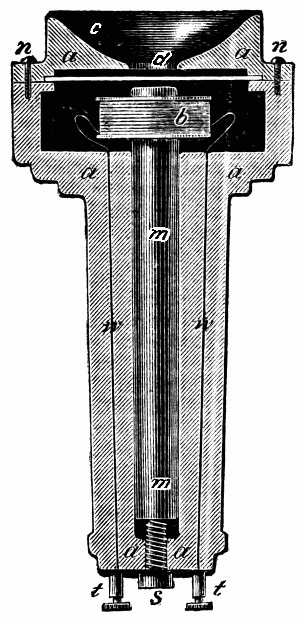
m m is a permanent bar-magnet, to the upper end of which is attached a soft iron core, which becomes magnetised by the permanent magnet. Surrounding the iron core is a coil of very fine insulated copper wire (b), the two ends of which are carried to the terminals (t t), by means of which one is connected with the line wire, and the other with the earth, d is a disc of thin iron plate, either tinned or japanned, about the size of a crown piece, and c is the cavity or mouth-piece. Upon applying the lips to this and speaking into it, the iron disc (d) vibrates towards the soft iron core, the result being that a current of induced electricity is set up in the coil (b), Which, being in connection by means of the telegraph wire with a precisely similar arrangementa a, a a, a a); n n are screws which secure the iron disk (b); s is a screw for adjusting the distance between the polo of the magnet and the disk (b).
The extreme simplicity of Professor Bell’s telephone was the outcome of several antecedent experiments, worked out by forms of apparatus gradually diminishing in complexity.
The German physicist Helmholtz had previously shown that by the agency of a current of intermittent electricity passed through a tuning-fork, he could produce simultaneous vibrations in a number of other forks connected with the first by a wire, and that by varying the loudness of these vibrations by means of resonators, so as to combine the musical notes in different proportions, the resulting sound was an imitation of certain vowel sounds, or a copy of the timbre of sound.
Professor Bell’s first telephone was an extension of Helmholtz’s device for producing vowel or composite sounds. A number of steel wires of different pitch were made into a harp, and connected by a powerful permanent magnet, the same arrangement being repeated at the other end of the circuit. In the magnetic field of the permanent magnet was an electro-magnet. When a permanent magnet is vibrated in the neighbourhood of an electro-magnet, this latter will have a current of electricity generated in it, the intensity of which will vary with the velocity of the vibrations in the permanent magnet, whilst it will be either positive or negative according to the direction of these same vibrations. So that a vowel sound, if produced by causing a number of the rods of the harp to vibrate at the same time, can be transmitted by a current of electricity, and will be reproduced by the harp at the other end of the connecting wire. If a piano were sung into whilst the pedal was down, not only would the pitch of the voice be echoed back, but an approach to the quality of the vowel would also be obtained. And theory teaches that if the piano had a very much larger number of strings to the octave, we should get not only an approximation to, but an exact vocal reproduction of the vowel. If, therefore, in the harp there were a large number of steel rods to the octave, and you were to speak in the neighbourhood of such a harp, the rods would be thrown into vibration with different degrees of amplitude, producing currents of electricity, and would throw into vibration the rods at the other end with the same relative amplitude, and the timbre of the voice would be reproduced.
The effect when you vibrate more than one of these rods simultaneously is to change the shape of the electrical undulation, and a similar effect is produced when a battery is included in the circuit. In this case the battery current is thrown into waves by the action of the permanent magnets. Hence you will see that the resultant effect on the current of a number of musical-tones, is to produce a vibration which corresponds in every degree to the moving velocity of the air. Suppose, for instance, you vibrate two rods in the harp, you have two musical notes produced, but of course if you pay attention to a particle of air, it is impossible that any particle of air can vibrate in two directions at the same time; it follows the resultant form of vibration. One curve would show the vibration of a particle of air for one musical tone, the next one for another, and the third the resulting motion of a particle of air when both musical tones are sounded simultaneously. You have by the harp apparatus the resultant effect produced by a current of electricity, but the same resultant effect could be produced in the air. There is an instrument called the phonantograph. It consists of a cone which, when spoken into, condenses the air from the voice. At the small end of the cone there is a stretched membrane which vibrates when a sound is produced, and in the course of its vibration it controls the movement of a long style of wood, about one foot in length. If a piece of glass with a smoked surface is rapidly drawn before the style during its movement, a series of curves will be drawn upon the glass. I myself uttered the vowels e, ay, eh, ah, aah. These vowels
The difficulty, however, was how to vibrate a piece of iron in the way required.
The following apparatus gave me the clue to the solution of the problem in the attempt to improve the phonantograph. I attempted to construct one modelled as nearly as possible on the mechanism of the human ear, but on going to a friend in Boston, Dr Clarence J. Blake, an aurist, he suggested the novel idea of using the human ear itself as a phonantograph, and this apparatus we constructed together. It is a human ear. The interior mechanism is exposed, and to a part of it is attached a long style of hay. Upon moistening the membrane and the little bones with a mixture of glycerin and water, the mobility of the parts was restored, and on speaking into the external artificial ear a vibration was observed, and after many experiments we were enabled to obtain tracings of the vibration on a sheet of smoked glass drawn rapidly along. This apparatus gave me the clue to the present form of the telephone. What I wanted was an apparatus that should be able to move a piece of iron in the way that a particle of air is moved by the voice.[227]
We need not follow Professor Bell through the various stages by which he arrived at his most successful solution of this problem further than to state that the simplicity of construction exhibited in the present form of instrument did not characterise the earlier articulatory telephones. Amongst the causes contributing to this simplicity may be mentioned the abandonment of an animal membrane attached to the iron plate, the diminution of the coil of insulated wire, and the substitution for the galvanic battery which formerly formed part of the circuit, of the permanent magnet.
Professor Bell records the curious fact that hardly any difference is observable in the results by varying the size, thickness, and force of the permanent magnet, and that beyond a remarkable effect in the quality of the voice, distinct articulations might be obtained from iron plates of from 1 inch to 2 feet in diameter and from 1⁄64th to 1⁄4th inch in thickness. With plates of uniform thickness, but of varying diameter, he obtained the following results. With a plate of small diameter the articulation was perfectly distinct, but the sound emitted was as if a person were speaking through the nose. By gradually enlarging the diameter of the plate this nasal effect as gradually disappeared, until when a certain diameter was attained a very good quality of voice manifested itself.
By continuing to enlarge the diameter, a coarse, hollow, drum-like effect was produced, until when the diameter became very large, the sound resembled that one hears when the head is inside a barrel, and was accompanied with a reverberating sound. By reversing the above conditions—that is, by keeping the diameter constant, and varying the thickness—it was found that with a very thin plate the drum-like sound was produced; by gradually increasing the thickness this effect passed off; then followed distinct articulation, until at a certain increase of thickness the peculiar nasal quality again developed itself.
In practice it has been found desirable, in establishing speaking communication between two distant places, to employ two telephones instead of a single one; one being applied to the mouth and the other to the ear during a conversation.
With one telephone it was no unusual occurrence for confusion to arise in consequence of the two speakers talking or listening at the same time.
So faithful is the transmission by the telephone of every variety of sound, that Mr Preece states, when in telephonic communication with Prof. Bell, through a quarter of a mile he has heard him “laugh, sneeze, cough, and, in fact, make any sound the human voice can produce.” It must be borne in mind, however, that the transmitted speech can only be distinctly heard in the immediate vicinity of the receiving apparatus; the keenest hearing fails to detect it at the distance of little more than a foot away. Hence, when a message is expected, the recipient has to place his ear to the mouthpiece of the instrument, and use it as an ear-trumpet.
A circumstance tending to impair the satisfactory working of Bell’s telephone is, that the line wire to which the ends of the coil are attached becomes inductively affected by the currents of electricity passing through the parallel and contiguous telegraph wires, the effect, on a line where there is an active transmission of telegraphic messages, being that the telephone “emits sounds that are very like the pattering of hail against a window, and which are so loud as to overpower the effects of the human voice.”[228]
This inconvenience can, however, it is stated, be remedied.
If all the arrangements of the instrument were perfect, there should be no limits to the distance through which speech could be conveyed by the telephone. Professor Bell says that in laboratory experiments “no difficulty has been found in using an apparatus of this construction through a circuit of 6000 miles;” and that he had found it act efficiently between New York and Boston, a distance of 258 miles, subject to the condition that the neighbouring telegraph wires were not in action.
Mr Preece has carried on conversations between Dublin and Holyhead, a distance of 100 miles.
Two useful applications of the telephone are recorded by Professor Bell, the one its employment in connection with the diving bell; the other as a means of communication between those above and below ground in mines. It has been largely adopted in extensive factories and in commercial houses both in America and in this country, supplementing, because of its much greater simplicity and easy application, the electric telegraphs previously in use in such establishments.
We extract the following from the ‘Journal of the Society of Arts,’[229]
“The Telephone and the Torpedo.
“A novel application of the Bell telephone is one which has been made in connection with torpedoes by Captain C. A. M’Evoy, of 18, Adam Street, Adelphi. The torpedoes to which the telephone has been applied are those of the buoyant contact class—that is, floating torpedoes, which are used for the protection of rivers and harbours. These torpedoes are held in position beneath the surface of the water by mooring lines and anchors, and it is necessary to ascertain from time to time that these deadly agents are in active working order. They are, of course, connected to the shore by electric wires by which they may be exploded. They are also arranged so that they may be exploded electrically by contact with passing vessels. For this latter purpose they are fitted with what is known as a circuit closer, which is placed in the middle of the charge within the torpedo. The testing is ordinarily performed by sending a current of electricity through the torpedo and fuse; but, in order that the fuse may not be fired, and the torpedo consequently exploded during the process of testing, an extremely weak current has to be used in connection with a sensitive galvanometer. The consequence is that the indications received are so very delicate that they are not always to be relied on. Now, what Captain M’Evoy does is to supplement the electrical test by the test of sounds, and to this end he encloses an ordinary Bell telephone in each torpedo. The telephone is so placed that the vibrating diaphragm is in a horizontal plane, and upon it are laid a few shot or particles of metal, and these are boxed in. Every motion of the torpedo causes the shot to shift their position upon the face of the diaphragm and to cause a slight noise, which is distinctly heard in the receiving telephone on shore. Thus each torpedo two or three miles away, in the restless waters of a channel, is continually telling the operator on shore of its own condition in language sometimes excited, according to the state of calmness or agitation of the water at the time. Should the torpedoes be sunk, they would lie motionless on the bottom, and the silence of the telephone would indicate the fact of their inoperativeness. The telephones are connected to the ordinary electric wires of the torpedoes, but this does not prevent them from being tested in the usual way from the battery on shore.”
TELLU′RIUM. A rare greyish-white elementary substance, found only in small quantities, associated with gold, silver, lead, and bismuth, in the gold mines of Transylvania. It has often been described as a metal, but is now commonly classed with the non-metals.
1. Tellurium may be obtained from the bismuth ore (the telluride of bismuth) by strongly heating the ore with a mixture of carbonate of potash and charcoal. A potassium telluride is formed which dissolves in water, forming a solution of a purplish-red colour, from which the tellurium deposits on exposure of the liquid to the atmosphere.
2. Schrötter gives the following method for the obtainment of metallic tellurium:—The raw material is treated with dilute hydrochloric acid as long as carbon dioxide is evolved, then with strong acid until all sulphuretted hydrogen is driven off.
The liquid is decanted from the residue, which is washed with hydrochloric acid and hot water, then boiled with aqua regia until the insoluble matter is white. From the aqua regia solution any gold that may be present is precipitated by means of ferrous sulphate, and afterwards zinc is added to precipitate the tellurium. The precipitate on the zinc is washed, dried, and heated to redness, treated with sulphuric acid to remove any silver, and the remaining tellurium is then collected.
Tellurium bears a great resemblance to bismuth in appearance, having a pinkish metallic lustre; it further resembles bismuth in being crystalline and brittle.
Below a red heat it enters into a state of fusion; at a high temperature it becomes converted into a yellow vapour. It burns in air, when strongly heated, with a blue flame having a green rim, and giving off white fumes that have a peculiar odour. When taken internally, even in very minute quantities, tellurium imparts to the breath an offensively powerful odour of garlic. Tellurium dissolves2) and the trioxide (TeO3), the first of which corresponds to sulphurous, and the second to sulphuric anhydride.
Tellurous acid (H2TeO3) is obtained by pouring a solution of tellurium on nitric acid of 1·25 into water, when the tellurous acid is precipitated as a bulky hydrate. This hydrate is slightly soluble in water and reddens litmus. It forms salts called tellurites.
Telluric acid (H2TeO4). When tellurium or tellurous acid is gently heated with nitre a potassic tellurate is formed, this being decomposed by a salt of barium, whilst the resulting barium tellurate is in its turn decomposed, and the telluric acid separated by sulphuric acid. The telluric acid occurs in hexagonal prismatic crystals, which, when heated usually to redness, becoming converted into telluric anhydride, which then assumes an orange-yellow colour. This telluric anhydride (TeO3) is entirely insoluble in water, nitric and hydrochloric acids, and alkaline solutions. Although it has but a feeble attraction for bases, telluric acid forms salts which are called tellurates. There are two chlorides of tellurium: the dichloride (TeCl2) and the tetrachloride (TeCl4). They may both be obtained by the direct action of chlorine on tellurium.