A CYCLOPÆDIA OF PRACTICAL RECEIPTS, &c. VOLUME II (continued 27)
Reading edition
The treatment of ordinary cases of smallpox resembles, for the most part, that mentioned above for chicken-pox. As soon as the febrile symptoms become marked the patient should not be suffered to lie in a hot bed, but on a mattress, in a cool and well-ventilated apartment, and antiseptic cooling drinks should be freely administered. When convulsions occur, or great irritability exists, small doses of morphine, opium, or camphor may be administered, and obstinate vomiting arrested by effervescing saline draughts. When the skin is pale and cold, the pulse weak, and the eruption languidly developed, the warm or tepid bath is often serviceable. An infusion of the root of Sarracenia pupurea, an American plant, has been strongly recommended as a preventive and cure of smallpox, but many of our most eminent physicians regard it as valueless. The application on the third day of a mask formed of thin muslin, covered with mercurial ointment, and having holes cut in it for the nostrils, eyes, and mouth, will effectually prevent ‘pitting.’ (Dr. Stewardson.) With the same intention some persons recommend the puncture of the pustules as soon as they are mature. A solution of india rubber in chloroform is now often painted over the face when the eruption has become fully developed. The chloroform quickly evaporates, leaving an elastic film of india rubber, which almost entirely removes the itchiness of the pustules and prevents ‘pitting.’ To remove the pock-marks, whether recent or old, nothing appears to be better than warm sea-bathing, or the use of tepid ioduretted lotions.
The smallpox is eminently contagious, but only attacks the same person once during life. Formerly, a milder form of the disease was propagated by inoculation, a practice introduced into England from Turkey by Lady Mary Wortley Montague, about the year 1721. At the present day, in England, inoculation, as well as the exposure of a patient labouring under smallpox, is penal, the punishment being either by fine or imprisonment. See Pox, Cow (above).
“The absolute necessity for enforcing this measure after smallpox is conclusively shown by the following cases which occurred during the late severe outbreak of the disease at Ipswich. In the first instance a young man brought a bundle of infected linen with him from London and had it washed at Ipswich. Twelve days after, the servant who washed it showed symptoms of smallpox. In another case, a woman who had been at Highgate Hospital brought with her a shawl which she had worn during convalescence, but had not been disinfected; and in fourteen days her sister, who washed the shawl, was attacked with smallpox.”—Sanitary Record.
PRECIP′ITATE. Any substance which has separated from its solution in a solid and, usually, a pulverulent or flocculent form. The substance by which such a change is produced is called the ‘precipitant,’ and the act or operation by which it is effected is called ‘precipitation.’ The old chemists gave this name to several compounds. Red precipitate, or precipitate per se, is the red oxide of mercury prepared by heat. White precipitate is the Ammoniated mercury of the B. P.
PRECIPITA′TION. The formation or subsidence of a precipitate. (See above.) When the precipitate is the chief object of the process, it is necessary to wash it, after it is separated, by filtration. This operation requires little attention when the substance thrown
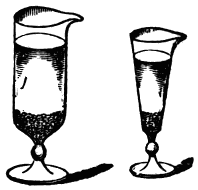
The best precipitating vessel is a very tall glass jar, furnished with a lip and spout, and narrower at the bottom than at the mouth, so that the precipitate may readily collect by subsidence, and the supernatant liquor be decanted off with more ease.
PREG′NANCY. For the preservation of the health, and the prevention of the numerous discomforts and dangers which so frequently attend this condition, nothing is so effective as exercise. It is this that is so favorable to the humble peasant, and it is its absence that inflicts such calamities on the wealthier classes. Exercise, moderate and unfatiguing, when assisted by regular habits, and a diet nutritious, but not too liberal, is, indeed, capable of not only affording pleasure and increasing the comforts of existence, but is also generally sufficient to greatly lessen the severity of the sufferings, and to ward off the not unfrequently fatal results which terminate this interesting condition.
The sickness of pregnancy may be greatly ameliorated, if not removed, by the occasional use of a saline aperient, and by effervescing draughts formed with the bicarbonate of potassa and citric acid. The oxalate of cerium is strongly recommended by Professor Simpson, of Edinburgh, as a remedy for obstinate vomiting in pregnancy.—Dose, 1 gr. to 2 gr. three times a day in pills.
PRESCRI′′BING (Art of). Besides a knowledge of diseases and their treatment, much of the success of the physician depends on circumstances connected with the form in which the remedies are exhibited. In writing a prescription it is necessary to consider the age, sex, temperament, habits and idiosyncracy of the patient, as well as the conditions of climate and season, before the selection of the leading medicament and the apportioning of the dose. The most convenient form of exhibiting it, whether it should be given alone or in some simple form, or combined with other ingredients, the compatibility of the latter, and how far these are likely to assist, impede, or modify its operation, must also receive the consideration of the practitioner. Without a careful attention to all these circumstances the most valuable remedies may be rendered worthless, and the highest medical skill and the best intentions frustrated.
A prescription generally contains several medicinal substances, which are distinguished by medical writers by names indicative of the office which each of them performs. These are—1. The BASIS, which is the principal or most active ingredient;—2. The ADJUVANT, or that which is intended to promote the action of the base;—3. The CORRECTIVE, intended to correct, modify, or control its action, or to cover its odour or taste, as when we add carminatives or diaphoretics to cathartics, or aromatics or liquorice to nauseous substances;—4. The EXCIPIENT, or that which gives the whole a commodious or agreeable form, and which, consequently, gives the prescription its peculiar character, as that of draught, mixture, pills, &c. To these, certain Continental writers add a 5th, the INTERMEDIUM, which is the substance employed to unite remedies which are not, by themselves, miscible with each other, or with the excipient. Of this character are the yolk of egg and mucilage, employed in the preparation of emulsions.
The medicinal substances, with the quantities to be taken, generally arranged as above, are said to form the ‘inscription,’—the directions as to their combination or dispensing, which usually comes next, the ‘subscription,’ and—the orders for the exhibition of the compound medicine, which follow these, the ‘instructions.’ These distinctions are, however, in many cases more technical than useful.
In choosing the form of a prescription it should be recollected that solutions and emulsions generally act with more certainty and rapidity than powders diffused through water; and these, again, than the semi-solid and solid forms of medicine, represented by electuaries, boluses, and pills. On these matters, however, the taste and wishes of the patient should not be disregarded. For this purpose the taste of nauseous medicines should be disguised as much as possible by the judicious selection of an appropriate corrective or excipient. Thus, the disagreeable flavour of Epsom salt may be in a great measure covered by dissolving it in peppermint water; that of aloes by liquorice; that of castor oil and copaiba by orange peel; and that of powdered bark by mixing it with milk immediately before taking it; whilst the bitterness of all bitter substances is concealed by strong coffee.
In order that a prescription may be well made it is not necessary to unite all the elements above referred to. The basis and the excipient are the only two which are absolutely necessary, since there are many medicines which have no need of an adjuvant. The agreeable flavour and odour of some, and the mild and harmless nature of others, often render the intervention of a corrigent unnecessary when they are employed. A single substance may also “be capable of answering two or more purposes. Thus, the adjuvant may also act as a corrigent, as when the addition of soap to aloes, or to extract of jalap, lessens their griping properties, and at theDose, Medicines, Incompatibles, Pills, &c.
PRESCRIP′TIONS. Recipes or formulæ for the preparation and exhibition of medicines intended, generally, for immediate use. See Prescribing (above).
PRESERVES′. A general term, under which are included the various fruits and vegetables which are seasoned and kept in sugar or syrup, more especially those which are so preserved whole or in slices. See Candying, Jam, Marmalade, &c.
PRESS (Correcting for the). See Proofs.
PRESSURE, BAROMETRIC, on the Phenomena of Life. M. Bert has contributed to the ‘Comptes Rendus’[122] (lxxiii, 213, 503; lxxiv, 617; lxxv, 29, 88) an account of the following experimental researches on the influence of changes in the Barometric Pressure on the Phenomena of Life:—
He finds that at pressures under 18 centimètres of mercury animals die from want of oxygen; at a pressure of one to two atmospheres, from want of oxygen and presence of carbonic acid; at 2-6 atmospheres, from the presence of carbonic acid alone; at 6-15 atmospheres, from the presence of carbonic acid and of excess of oxygen; and at 15-25 atmospheres, from the poisonous action of oxygen alone.
Animals die from want of oxygen when the amount contained in their arterial blood is not sufficient to balance a pressure of 3·5 per cent. of oxygen in the atmosphere. They die from poisoning by carbonic anhydride when the amount contained in their venous blood is sufficient to balance a pressure of 26 to 28 per cent. of carbonic anhydride in the atmosphere in the case of sparrows, of 28 to 30 for mammals, and of 15 or 16 for reptiles.
As the pressure of oxygen in the surrounding air depends on two factors, the percentage proportion and the barometric pressure, the barometric pressure may be reduced to 6 centimètres for sparrows, if the proportion of oxygen in the air is increased; and it may be raised to 23 atmospheres without causing death, if the proportion of oxygen is reduced by mixing the air with nitrogen. Aeronauts might, therefore, ascend higher than it has hitherto been possible to do by taking with them a bag of oxygen to inhale; and the danger that threatens divers of being poisoned by the oxygen in the compressed air might be averted by using a mixture of air and nitrogen.
From an examination of the gases in the blood of animals confined in rarefied air the author finds that both the oxygen and the carbonic anhydride in the blood diminish. The dyspnœa which is felt in ascending mountains is therefore due to want of oxygen in the blood. The diminution in oxygen becomes diminished at 20 centimètres pressure, yet this is the pressure under which the inhabitants of the elevated Mexican plateau of Anahuac live. The oxygen diminishes more quickly and more regularly than the carbonic anhydride. Although there are but very small quantities of gases simply dissolved in the blood, the chemical combinations in which they take part are dissociated very easily and in a progressive manner under the influence of diminished pressure, and this dissociation takes place more easily in the organisms than in experiments in vacuo.
PRINCE’S METAL. One of the names for Dutch gold. (See Gold, Dutch.)
PRINT′ING (Anastatic). A method of zincography, patented in 1845, having for its object the reproduction of drawings, engravings, and letter-press, from copies however old. To describe briefly the preparation of a plate or cylinder, let us suppose a newspaper about to be reprinted by this means. The sheet is first moistened with dilute acid and placed between sheets of blotting paper, in order that the superfluous moisture may be absorbed. The ink resists the acid, which attacks the blanks only. In all cases where the letter-press is of recent date, or not perhaps older than half a year, a few minutes suffice for this purpose. The paper is then carefully placed upon the plate with which the letter-press to be transferred is in immediate contact, and the whole passed under a press, on removal from which, and on carefully disengaging the paper, the letters are found in reverse on the plate. A preparation of gum is then applied to the plate by means of a roller, after which the letters receive an addition of ink, which is immediately incorporated with that by which they are already formed. These operations are effected in a few minutes. The surface of the plate round the letters is next bitten in a very slight degree by dilute acid, and on the fresh application of the ink it is rejected by the zinc, and received only by the letters, which are charged with the ink by the common roller used in hand-printing. Each letter comes from the press as clear as if it had been imprinted by type metal; and the copies are fac-similes, which cannot easily be distinguished from the original sheet.
When pen-and-ink drawings are to be reproduced, they are made on any paper free from hairs or filaments, and well-sized. The ink used is a preparation made for the purpose, closely resembling lithographic ink, and may be mixed to any degree of thickness in pure distilled water. It should be used fresh, and slightly warm when a fine effect is to be given. In making or copying a design a pencil may be used; but the marks must be left on the paper, and by no means rubbed with india rubber or bread. It is necessary to add that the paper should be kept quite clean and free
Before closing this notice of anastatic printing it may be proper to remark, that the great pretensions originally set up by the patentees have not been fulfilled by its extensive adoption in trade.
PRINTING (Letterpress).[123] Syn. Typography. The art of collecting together and arranging movable types for the purpose of printing, in one or more colours, by pressure applied from a flat surface or by means of a cylinder biting the paper to be printed, and which is inserted between itself and the type.
In illustration of this section, some specimen types are appended, the greater portion being from the well-known foundry of Messrs V. & J. Figgins, and should now be carefully read down to render the further remarks intelligible. The key is contained in itself by reading the column as one continuous paragraph with the help of the foot-notes. Some idea may thus be formed of the vast number of distinct kinds of type necessary to carry out the requirements of the present system of printing.
Mention there has been made that the name of the body is determined by its number of lines to a foot; but this must be qualified. The Imperial foot, or inch, or yard, is an arbitrary measure of length in reality as well as in name. When one foundry was sufficient to supply all the types that were required for use in the early ages of printing, then a name and its dimensions could be taken as absolute. But with the increase of printing, type-founders also increased; and this has produced the variations of bodies which are so annoying to the typographer, for one single letter or space taken from a body larger than its own, yet of the same name, will be enough to throw the column of type out of a straight line all the way through. Still, when we look to the fact that, according to the ancient masters, the large-sized type called Pica (No. 3 and Nos. 18, 19,20 & 21) requires 721⁄2 lines to the foot, and that Nonpareil, half its size (No. 9, and Nos. 26, 27, 28 & 29), requires 145 lines to the foot, and recollecting that the slightest variation multiplied 145 times must produce a very sensible deviation, the wonder is that each of the founders should approach each other so closely as they do. An attempt was made some years ago to introduce a certain fixity of standard for each body throughout the trade, based on the French system; the difficulties of altering the standards and matrices of each foundry were seen to be so great that the effort was unavailing.
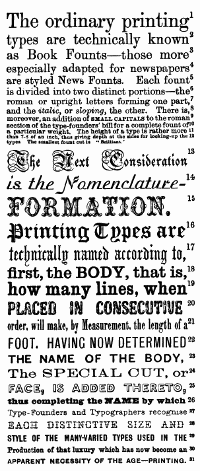
Right click: Larger.
References to the above types—by reading across.
BODY. BOOKWORK FACE. DISPLAY FACE.
1 Great Primer— Roman 14 Gt Primer Manuscript
15 Gt Primer Ext. Ornamented
16 Gt Primer Black
2 English— Roman 17 Gt Primer Condensed Black
3 Pica— Roman 18 Pica Antique
19 Pica Clarendon
20 Pica Rustic
4 Small Pica— Roman 21 Pica Narrow Gauge
5 Long Primer— Roman 22 Long Primer Condensed Sansserif
6 Bourgeois— Roman
7 Brevier— Roman 23 Brevier Grotesque
24 Brevier Extended
8 Minion— Rom. & Italic 25 Brevier Open Sansserif
9 Nonpareil— Roman 26 Nonpareil Egyptian
27 Nonpareil Hair line
28 Nonpareil Ornamented
29 Nonpareil Condensed Grotesque
10 Ruby— Roman
11 Pearl— Roman 30 Pearl Clarendon
12 Diamond— Roman 31 Diamond Grotesque
13 Small Pica 2-line (No. 4 doubled) German Text
During the latter half of the present century there has been a growing disposition to return to the cut of the letters as used by the early printers. To meet this desire, nearly all the type-founders have introduced Old-style faces,
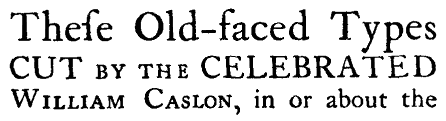
These old-faced types cut by the celebrated William Caslon, in or about the years 1716-30, are even now viewed with great satisfaction, and held in high esteem, by judges of the typographic art as master-pieces of shape and finish.
To the list of types presented, and which give a sufficient general view, may be added Emerald—between Minion and Nonpareil—for book-work, and also for borders and flowers to be used in neat and artistic work; Gem and Semi-Nonpareil for music; and Minikin, for music and Oriental work.
The larger sizes of type are, with very few exceptions, simple multiples of the Pica; for instance, 6-line Roman means a roman letter of the depth of six lines of Pica; 20-line Antique, an antique of the depth of twenty lines; and so on.
Very little more need be said on the names applied to the different faces. Letters used in Title-pages are especially cut for and styled Titling—Square, Condensed, and if very much condensed in width, Compressed or Narrow-Gauge. On the other hand, when the letters seem pulled out right and left, they are styled Extended.
If the reader will notice the type in which this volume is composed, he will observe that the bottoms of the tail letters are very close down upon the tops of the tall letters, and all but touch: this is termed solid. When a page or book is required to look light and less wearisome to the vision, the lines of type are removed from each other, and a space-line inserted between them—the page is now termed leaded. These space-lines used to be cut, by the compositor, from milled lead, first in strips of the necessary width, then of the required length; hence the term leads, by which name they are commonly known. However, they were but poor appliances at the best. Moulds are now used for casting the metal to the specified thickness in strips of about 9 inches long, then cut by a machine to a set gauge; by these means the thickness of the space-lines, or leads is not only more uniformly secured, but far greater regularity obtained in the lengths cut. Here, as in the large type, as above mentioned, Pica is the standard which regulates the lead; in other words, leads are cast as 3 to a pica, that is, 3 leads form the solid measurement of the Pica body; 4-to-pica requires 4 leads, and the body of the lead continues to decrease according to the prefixed figure, which simply denotes into how many parts the pica is to be divided. Leads are cast so delicately fine that 16 form the pica, but they are seldom used. In many of the News offices brass space-lines have superseded those cast from type-metal.
The method of manufacturing type is—
The face having been determined upon—light or heavy, round or narrow, as well as the thickness of the downstroke—a piece of prepared soft iron is taken, and upon the tip-end thereof the proposed letter is cut in relief; when this cutting is finished it is case-hardened, and afterwards styled the punch. The strike is the next operation. The punch (the letter cut upon which, by-the-bye, is backward) is now punched, or struck, into an oblong piece of copper, about 3 inches long and 1⁄3rd of an inch thick, the breadth such as the size of the letter may require: this is the matrix. A most particular part has now to be performed, called justifying; which means that the matrices shall, when placed in the mould, deliver the letters perfectly upright, and all to be true on a line as fine as a razor’s edge. When the process of justifying is accomplished, the matrix is fixed at the bottom of a mould, of the shape of a parallelogram, of the size of the body one way, of the width of the letter the other, and the depth the standard height of the type; the molten metal is forced down this tube, either by hand or by a pump worked by hand or steam, the metal filling the matrix (the sunk letter upon which is now forward) receives the shape of the letter, which is once more reversed, or in a backward position, like as the original punch was cut. The castings are released from the mould by a very ingenious method of opening from the two diagonal corners. The types as cast are forwarded on to the dressers to remove burrs and other superfluities; then are placed in long lines in a frame for finishing; next turned face downwards, and a grooving plane driven across the feet to insure correctness in height; finally looked over for blemishes, when all faulty letters are thrown out; the process is completed by ranging into lines of handy length, and tied up—ready for delivery to the typographer.
PRINT′ING INK. Prep.—a. The VARNISH. Linseed or nut oil, 10 or 20 galls., is set over the fire in an iron pot capable of containing fully as much more; when it boils, it is kept stirred with an iron ladle, and, if it does not take fire of itself soon after the smoke begins to rise, it is kindled by means of a piece of burning paper, stuck in the cleft end of a long stick; the pot is shortly afterwards removed from the fire, and the oil is suffered to burn for about half an hour, or until a sample of the varnish cooled upon a palette knife may be drawn into strings of about 1⁄2 inch long, between the fingers; the flame is now extinguished by the application of a closely fitting tin cover, and, as soon as the froth of the ebullition has subsided, black resin is added, in the proportion of 3⁄4 lb. to 1 lb. for every quart of3⁄4 lbs., is further added (cautiously), and the ingredients are again stirred with the spatula until the whole is united, the pot being once more placed over the fire to promote the combination; when this is effected, the varnish is removed from the heat, and, after a good stirring, is covered over and set aside.
b. The INK. Indigo and Prussian blue, of each, in fine powder, 21⁄2 oz.; mineral lampblack (finest), 4 lbs.; vegetable lampblack, 31⁄2 lbs.; stir them gradually into the warm varnish (a), and submit the mixture to careful grinding, either in a mill or by means of a slab and muller. On the large scale, steam power is now generally employed for this purpose.
An extemporaneous superfine black ink may be made by the following formula:—Take of balsam of copaiba (pure), 9 oz.; lampblack, 3 oz.; indigo and Prussian blue, of each 1⁄2 oz.; Indian red, 3⁄4 oz.; yellow soap (dry), 3 oz.; grind the mixture to an impalpable smoothness by means of a stone and muller. Canada balsam may be substituted for balsam of copaiba where the smell of the latter is objectionable, but the ink then dries very quickly.
Coloured printing inks are made in a similar way from the following pigments:—Carmine, lakes, vermilion, chrome yellow, red lead, orange red, Indian red, Venetian red, for red; orange chrome, chrome yellow, burnt terra di sienna, gall-stone, Roman ochre, yellow ochre, for orange and yellow; verdigris, Scheele’s green, Schweinfurt green, blues, and yellows mixed, for greens; indigo, Prussian blue, Antwerp b., cobalt b., charcoal b., for blue; lustre, bronze powders, &c., for metallic colours; and umbia, sepia, &c., for brown.
Obs. It is necessary to prepare two kinds of varnish, varying in consistence, from more or less boiling, to be occasionally mixed together as circumstances may require; that which answers well in hot weather being too thick in cold, and vice versâ. Large characters also require a thinner ink than small ones. Old linseed oil is preferable to new. Yellow resin soap is preferred for black and dark-coloured inks, and white curd soap for light ones.
A good varnish may be drawn into threads like glue, and is very thick and tenacious. The oil loses from 10% to 14% by the boiling. Mr Savage obtained the large medal of the Society of Arts for his black ink made as above.
A printer’s ink easily removed from waste paper. The following process for the preparation of a printer’s ink that can be far more readily removed from waste paper than ordinary printer’s ink has been patented by Kirscher and Ebner. Iron is dissolved in some acid—sulphuric, hydrochloric, acetic, &c., will answer, and half of the solution is oxidised with nitric acid and added to the other half and the oxide precipitated from the mixture by means of soda or potash. The precipitate is thoroughly washed, and treated with equal parts of solutions of tannic and gallic acids, and the bluish black, or pure black pigment formed, is thoroughly washed and dried, and mixed with linseed-oil varnish, and can then be immediately used for printing from type, copper, wood, steel, or stone. Waste paper printed with it can be bleached by digesting it for 24 hours in a lukewarm bath of pure water, and 10 per cent. of caustic potash or soda, and then grinding it well in the rag engine, and throwing the pulp upon cloth and allowing it to drain. It is then to be washed with pure water, containing 10 per cent. of hydrochloric, acetic, or oxalic acids, or of binoxalate of potassa, and allowed to digest for 24 hours, and may then be worked up into paper, or it can be dried and used as a substitute in the manufacture of finer paper.
PRINTS (Ackerman’s Liquor for). Prep. Take of the finest pale glue and white curd soap, of each 4 oz.; boiling water, 3 pints; dissolve, then add of powdered alum, 2 oz. Used to size prints and pictures before colouring them.
PRINTS, To Bleach. Simple immersion of the prints in a solution of hypochlorous acid (the article remaining in the solution for a longer or shorter space, according to the strength of the solution) is generally all that is required to whiten it.
PRIVIES. See Water-closets.
PROOF. See Acetimetry, Alcoholometry, &c.
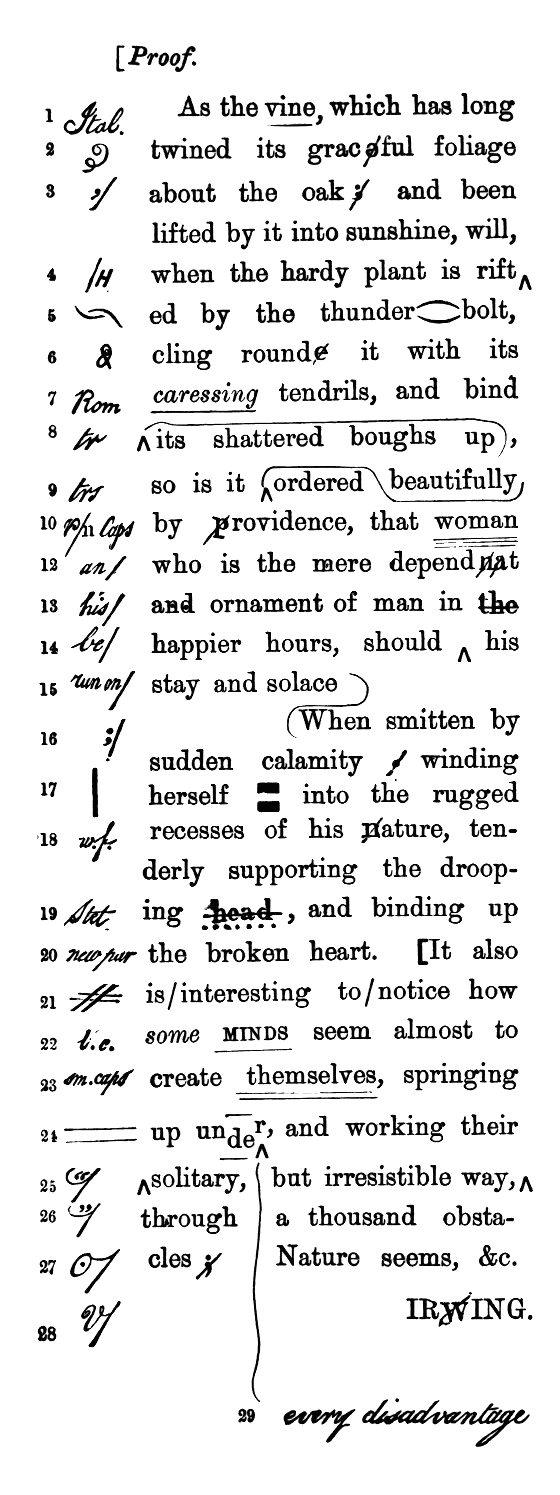
PROOFS (Correcting). The specimen below, with the notes, will, if carefully perused, put the reader into possession of all the secrets of this useful art.
[The same corrected.]
As the vine, which has long twined its graceful foliage about the oak, and been lifted by it into sunshine, will, when the hardy plant is rifted by the thunderbolt, cling round it with its caressing tendrils, and bind up its shattered boughs so is it beautifully ordered by Providence, that WOMAN, who is the mere dependant and ornament of man in his happier hours, should be his stay and solace when smitten by sudden calamity; winding herself into the rugged recesses of his nature, tenderly supporting the drooping head, and binding up the broken heart.
It also is interesting to notice how some minds seem almost to create THEMSELVES, springing up under every disadvantage, and working their “solitary, but irresistible way,” through a thousand obstacles. Nature seems, &c.
IRVING.
Explanation of the marks:
1. When a letter or word is to be in italics.
2. When a letter is turned upside down.
3. The substitution of a comma for another point or letter.
4. The insertion of a hyphen; also marked (-).
5. When letters should be close together.
6. When a letter or word is to be omitted.
7. When a word is to be changed to roman.
8, 9. Two methods of marking a transposition: when there are several words to be transposed, and they are much intermixed, it is a common plan to number them, and to put the usual mark in the margin.
10. Substitution of a capital for a small letter.
11. When a word is to be changed from small letters to capitals.
12. The transposition of letters in a word.
13. The substitution of one word for another.
14. When a word or letter is to be inserted.
15. When a paragraph occurs improperly.
16. The insertion of a semicolon.
17. When a space or quadrat stands up, and is seen along with the type.
18. When letters of a wrong fount are used.
19. When words crossed off are to remain.
20. The mark for a paragraph, when its commencement has been neglected. Sometimes the sign [, or ¶, or the word ‘break,’ is used instead of the syllables ‘New Par,’
21. For the insertion of a space when omitted or insufficient.
22. To change capitals to small letters.
23. To change small letters to small capitals.
24. When lines or words are not straight.
25, 26. The insertion of inverted commas. The apostrophe is similarly marked.
27. The insertion of a period when omitted, or in place of another point or letter.
28. Substitution of one letter for another.
29. The method of marking an omission or insertion when too long for the side margin.
PROPYLA′MINE. Syn. Tritylamine.
C3H9N, or C3H7 } N.
H
H
This compound or substituted ammonia, in which one of the three atoms of hydrogen is displaced by the radicle propyl or trityl (C3H7), is isomorphous with trimethylamine, which has been often mistaken for it.
Proposed as a remedy for acute and chronic rheumatism.
Hence it is that the commercial substance known under the name of ‘propylamine,’ which has been proposed and employed as a remedy for rheumatism, has been shown to be not propylamine, but its isomer, trimethylamine, or a mixture of this latter, in varying proportions, with ammonia.
Mendius gives the following process for the preparation of propylamine:—36 grams of cyanide of ethyl, 500 grams of common alcohol, 200 grams of water, and 50 grams of 20 per cent. hydrochloric acid, are allowed to
The distillate is put back once, and 400 grams of hydrochloric acid are added.
The product is distilled to get rid of the alcohol, then excess of alkali added to the residue, and the distillation continued, whereupon propylamine and water come over. Mendius says 36 grams of the cyanide of ethyl yield 9 grams of pure propylamine. The propylamine is dried by distillation from solid potash.
Propylamine is a bright, colourless, highly refracting, very mobile liquid, possessing a peculiar, strongly ammoniacal odour. It mixes with water, heat being generated by the mixture. It boils at 50° C., and has a sp. gr. of ·7134 at 21° C.
Propylamine combines with acids, and forms crystallised salts. The chloride is a very deliquescent salt. The sulphate occurs in crystals, and is also deliquescent. See Trimethylamine.
PROPYL′IC ALCOHOL. C3H7O. Syn. Hydrated oxide of propyl, Trityl alcohol. A liquid boiling at 204·8° Fahr., obtained by repeatedly rectifying the first products of the distillation of the fusel oil of marc brandy. It stands to ethylic alcohol (ordinary alcohol) in the same relation in which the latter stands to methylic alcohol (pyroxylic spirit).
PRO′TEIN. The name given by Mülder to a substance which he regarded as the original matter from which animal albumen, casein, and fibrin, were derived; but which is now considered as a product of the decomposition of those important principles by moderately strong caustic alkali.
Prep. (Liebig.) Albumen, casein, or fibrin is dissolved in moderately strong potassa, the solution heated for some time to 120° Fahr., and acetic acid added; a gelatinous precipitate subsides, which, after being washed and dried, is protein.
Obs. The names binoxide and teroxide of protein have been given by Mülder to products of the long-continued action of boiling water upon fibrin in contact with the air.
PRO′TIDE. A soluble, straw-yellow substance, formed, along with other products, by the action of strong solution of potassa on albumen, fibrin, or casein. See Erythroprotide.
PROTO-. See Nomenclature.
PROVI′′SIONS (Preservation of). See Putrefaction.
PRUNES. [Fr.] The fruit of cultivated varieties of Prunus domestica (Linn.). The dried fruit (French prunes or PLUMS; PRUNUM—B. P., Ph. L., PRUNA—Ph. E. & D.) is cooling and gently laxative, and, as such, is useful in habitual costiveness and fevers.
Prunes, Pulp of. Syn. Prepared prunes; Pulpa prunorum, Prunum præparatum (Ph. L.), L. Prep. The imported dried fruit is boiled gently for four hours with water, q. s. to cover them, and then pressed, first through a fine cane sieve, and afterwards through a fine hair sieve; the pulp is, lastly, evaporated by the heat of a water bath to the consistence of a confection. A better plan is to use as little water as possible, by which the necessity of subsequent evaporation is avoided. Used in the preparation of confection of senna.
PRU′NING varies according to the kind of plant or tree operated on and the particular object in view, and its skilful performance must, therefore, greatly depend on the experience and knowledge of the gardener. “In the operation of pruning, the shoots are cut off close to the buds, or at a distance not greater than the diameter of the branch to be cut off; because without the near proximity of a bud the wounds will not heal over. In shoots which produce their buds alternately the cut is made at the back of the bud sloping from it, so that it may be readily covered by the bark in the same or in the following year; but in the case of branches where the buds are produced opposite each other, either one bud must be sacrificed or the branch must be cut off at right angles to its line of direction, which is most conveniently done with the pruning shears.” (Loudon.)
PRUS′SIAN AL′KALI. Ferrocyanide of potassium.
PRUS′SIAN BLUE. Syn. Berlin blue, Paris b., Ferrocyanide of iron, Prussiate of i., Cyanuret of i. This is the well-known blue pigment of the shops.
Prep. 1. The crude but clear solution of ferrocyanide of potassium (blood lye) is precipitated by a mixed solution of alum, 2 parts, and green sulphate of iron, 1 part; the dingy greenish precipitate that falls gradually becomes blue by absorption of atmospheric oxygen, which is promoted by exposure and agitation of the liquor; as soon as it has acquired its full colour, the sediment is repeatedly washed with water, and is then drained, and dried, at first in a stove, but afterwards on chalk stones. Product large, but inferior in quality.
2. Repeatedly digest and wash the precipitate obtained by the above process in very dilute hydrochloric acid, and then in pure water; drain and dry it, as before. Superior.
3. (Paris blue.)—a. Neutralise the solution of ferrocyanide of potassium (blood lye) with dilute sulphuric acid, precipitate the liquid with a solution of any persalt or sesquisalt of iron (as the persulphate, nitrate, sesquichloride, or peracetate); well wash the precipitate with water, and dry it, as before. A very rich and intense colour.
b. (Hochstätter.) Crystallised ferrocyanide of potassium and green sulphate of iron, of each 6 parts, are each separately dissolved in water, 15 parts; after the admixture of the solutions, and frequent agitation, oil of vitriol, 1 part, and fuming hydrochloric acid, 24 parts, are stirred in; after some hours have elapsed a
Prop. Insoluble in water and in dilute acids, except the oxalic, in solutions of which it dissolves freely when pure; oil of vitriol dissolves it to a white pasty mass, which is again precipitated of the usual blue colour by water; alkalies instantly decompose it, and so do red oxide of mercury and some other oxides when boiled with it; it burns in the air like tinder, leaving an ash of oxide of iron. It is not poisonous.
Pur., &c. The quality of Prussian blue may be estimated by the richness of its colour, and by the quantity of potassa or soda required to destroy this. If it effervesces with acids, it contains chalk; and if it forms a paste with boiling water, it is adulterated with starch. It is pure if, “after being boiled with dilute hydrochloric acid, ammonia throws down nothing from the filtered liquid.” (Ph. L. 1836.) It is distinguished from indigo by exhibiting a coppery tint when broken, but which is removed by rubbing with the nail.
Concluding Remarks. The commercial Prussian blue is not pure ferrocyanide of iron, but a mixture of this salt with varying proportions of the ferricyanide of iron and potassium, which also has a fine deep blue colour. The object in employing alum is to prevent or lessen the precipitation of oxide of iron by the free alkali in the blood lye, but a portion of alumina is in consequence thrown down with the blue, and tends to render it paler and increase the product. The quantity of alum employed may be varied according to the shades of the intended blue. Samples containing this contamination must not be employed medicinally. (See page 324.)
Prussian Blue, Sol′uble. Prep. 1. (Basic Prussian blue.) By adding a solution of protosulphate of iron to a solution of ferrocyanide of potassium; a bluish-white precipitate, turning dark blue by free exposure, is formed, which, after it has acquired this colour, is washed until it begins to dissolve in the water, and colour it blue; it is then either collected and dried, or is at once dissolved in pure water. This variety is not precipitated from its solution by alcohol.
2. (Ferrocyanide of potassium and iron.) By precipitating a solution of a sesquisalt or persalt of iron (as the persulphate, pernitrate, peracetate, or sesquichloride) with a stronger solution of ferrocyanide of potassium, so that the latter may be in considerable excess. A blue precipitate is formed, which is treated as before. This variety is precipitated by alcohol. Both are freely soluble in pure water, but not in water which has the slightest saline contamination. Hence it is that lengthened exposure to the atmosphere and the use of the common steel pen causes the gradual precipitation of this substance from its solution when used as ink. See Writing fluids.
PRU′′SSIC ACID. See Hydrocyanic acid.
PSEU′DO-MOR′PHIA. A substance of little importance, occasionally found in opium. It differs from morphine chiefly in not decomposing iodic acid. It is said to contain nitrogen.
PTIS′AN. Syn. Ptisana, L. A decoction made of pearl barley, liquorice, raisins, and other like vegetable matters, either alone or so slightly medicated as to be taken as a common drink in fevers, catarrhs, &c. Those retained in English pharmacy have been already noticed. The French physicians often employ this form of medicine. The ’tisanes’ of the P. Cod. are numerous. See Decoction, Infusion, Julep, Tisane, &c.
PTY′ALIN. A peculiar animal matter, analogous to diastase, obtained from the saliva. It is soluble in water, but insoluble in alcohol.
Mialhe named ptyalin “animal diastase,” and regarded it as the principal agent in effecting the digestion of starchy foods, by converting them into soluble glucose. One part of ptyalin, according to Mialhe, was capable of transforming 800 parts of insoluble starch into sugar. It has been computed that the average daily secretion of ptyalin by an adult amounts to 116 grains. It very quickly decomposes, and in properties somewhat resembles sodic albuminate.
PUCHA PAT. Syn. Patchouli. Puchá pât is the dried foliaceous tops of Pogostemon Patchouli, an Indian species of Labiatæ. It is much used in perfumery, particularly for making sachets; but its odour, although very durable, is not so agreeable as that of many other substances, unless it is combined with lavender, bergamot, ambergris, musk, or some other like perfume.
PUD′DINGS. The instructions given under Cakes, Pies, &c., will be found, with some slight modifications, also to apply to puddings, and, therefore, need not be repeated here. Soyer tells us that every sort of pudding, if sweet or savory, is preferably dressed in a basin instead of in a cloth. If boiled in a basin the paste receives all the nutriment of the materials, which, if boiled in a cloth, are dissolved out by the water, when by neglect it ceases boiling. To cause them to turn well out, the inside of the basin should be thoroughly ‘larded’ or rubbed with butter.
In the preparation of meat puddings the first and most important point is never to use any meat that is tainted; for in pudding, above all other dishes, it is least possible to disguise it by the confined progress which the
“A pudding cloth, however coarse, ought never to be washed with soap; it should be simply dried as quickly as possible, and kept dry and free from dust, and in a drawer or cupboard free from smell.” (Soyer.)
PUD′DLING. See Iron.
PULMONI′TIS. Inflammation of the lungs.
PULP. Syn. Pulpa, L. The softer parts of plants, more particularly of fruits, separated from the fibrous and harder portions.
“Pulpy fruits, if they be unripe, or ripe and dried, are to be placed in a damp situation until they become soft; then the pulp is to be pressed out through a hair sieve; afterwards it is to be boiled with a gentle heat, frequently stirring; and finally, the (excess of) water is to be evaporated in a water bath, until the pulp acquire proper consistence.
“Press the pulpy fruits which are ripe and fresh through a hair sieve, without boiling them.” (Ph. L. 1836.)
PULVERISA′TION. The reduction of any substance to dust or powder.
On the small scale, pulverisation is usually performed by means of a pestle and mortar; on the large scale, by stamping, grinding or cutting the substance in a mill. A few soft substances, as carbonate of magnesia, carbonate of lead, &c., may be pulverised by simply rubbing them through a fine sieve, placed over a sheet of paper; whilst many hard, gritty substances can only be reduced to fine powder by porphyrisation or levigation. Elutriation, or ‘washing over,’ is adopted for several substances, as chalk, antimony, &c., which are required to be reduced to fine powder on the large scale. For some articles which are very tough, fibrous, or resisting, a rasp or file is employed. Whichever of these methods is adopted, the body to be powdered must be very dry, and where spontaneous drying is insufficient, artificial desiccation in a stove or oven, gently heated, is employed. To facilitate this, the substance should be first cut into pieces or crushed small. On the other hand, a few substances, as rice, sago, nux vomica, and St Ignatius’s bean, are often soaked in water, or steamed, before being further operated on. Whenever a substance cannot be dried completely, without an alteration of its properties, an intermedium is had recourse to, by which the moisture may be absorbed, or its state of aggregation modified. Thus, sugar is employed in pulverising civet, musk, nutmeg, and vanilla. When camphor is to be pulverised, the addition of a very small quantity of alcohol renders the operation easy. In other cases the intermedium is of so hard a nature as to assist in breaking down the substance to be powdered; thus, gold leaf is reduced to powder by rubbing it with sulphate of potassa, and afterwards removing this last by means of water. Fusible metals, as zinc and tin, are powdered by pouring them into a mortar, and stirring them rapidly whilst cooling; or, by briskly agitating them, in the melted state, in a wooden box covered with chalk or whiting. Phosphorus is powdered by melting it in urine or lime water, and then shaking the bottle until its contents have become quite cold. Glass, quartz, and silicated stones, require to be heated red hot, and in this state to be thrown into cold water, by which they become sufficiently friable to admit of pulverisation. Many salts which are reduced to fine powder with very great difficulty, and do not dissolve in spirit of wine, are easily obtained in a pulverulent form, by agitating their concentrated aqueous solution with a considerable quantity of rectified spirit; the disengaged fine crystallised powder may then be dried, and further divided by trituration. Potassio tartrate of antimony may be advantageously thus treated. A large number of salts, including nitre, sal ammoniac, and carbonate of potash, may also be reduced to powder by keeping their solutions in a state of constant and violent agitation during their rapid evaporation.
The following rules should be observed in the preparation of powders:—
1. If possible, perfectly dry articles should alone be operated on, and only in dry weather.
2. The nature of the mortar, and the mode of operating, should be adapted to the nature of the substance. Thus, woods and barks should be pulverised in an iron mortar; sugar, alum, and nitre, in one of marble or wedgwood-ware; and corrosive sublimate, only in one of glass.
3. The mortar should be provided with a cover, to prevent loss and annoyance to the operator. If much powder escapes, or if it is dangerous or disagreeable when breathed, or if the substance is rare or costly, the mortar should be covered with a skin of leather, to which the pestle is attached, so that the latter may be freely moved without causing the slightest opening for the escape of the dust occasioned by the process. When aloes or gamboge is powdered, a few drops of olive oil are commonly added with the same intention.
4. The pulverised portions should be separated from time to time by aid of a sieve, the coarser particles being returned to the mortar to be again beaten and triturated; and this alternate pulverisation and sifting is to be repeated until the process is complete.
PUM′ICE STONE. Syn. Pumex, Lapis pumiceus, L. pumicis, L. Found in the neighbourhood of volcanoes. Used, in the solid form, to polish wood, paint, &c.; also, when pulverised, as a polishing powder for glass, bone, ivory, marble, metals,
PUMP FOR USE IN CHEMICAL, PAPER, and other Works. The Perreaux Pump Valve is made of vulcanised india rubber, and is of the form of the valves in the human body. It is of the greatest, and perhaps the really only valuable improvement in valves applicable, equally, to the common hand or jack pump, and the most elaborate mechanical combinations for raising water.
The valve may be taken as the key of the pump; a perfect valve renders an indifferent pump a valuable and effective machine, whereas an imperfect valve, in an otherwise excellently constructed pump, renders it practically useless.
The pump which Simon the tanner, of Joppa, used for pumping his pits, nearly two thousand years ago, may be taken as the type of the common hand pump in use to this day. Various mechanical improvements have been made in its form and construction, but, practically, and effectively, the only real and valuable improvement is the Perreaux valve, now under consideration.
Constructed of a flexible material, and made in form, as nearly as may be, to the valves of the human body, they may be said to be automatic in their action, or self acting; upon the pump being actuated, the least motion of the pump ensuring a corresponding action of the valve, and the most rapid action of the pump, being equally responded to by the pulsation of the valves.
Although the most perfect valves for pumping clear water, because, what is mechanically termed the duty of the pump is complete, in other words, the quantity displaced is discharged, absolutely without loss, yet their most valuable feature is that they pump semi-fluids equally well as clear water.
For the pulps and stuffs in paper mills, for bleaches, dyes, and corrosive liquors, for liquid manures and other such semi-fluids, they stand alone, they are absolutely unchokable.
Used in conjunction with cylinders or barrels made of toughened glass, they form the most perfect pump where the fluid to be raised is of a caustic or corrosive nature, and where the fluid would be destructive to or destroyed by its action upon metals, such for example as the caustic bleach used in the manufacture of paper, &c. See Valves.
PUNCH. An acidulous, intoxicating beverage, composed of water sweetened with sugar, with a mixture of lemon juice and spirit, to which some aromatic, as nutmeg, mace, or cinnamon, is occasionally added. Wine is sometimes substituted for spirit. It is much less drunk than formerly. Rum punch is the most popular amongst sailors, who are now the principal consumers of this beverage.
Prep. 1. Juice of 3 or 4 lemons; yellow peel of 1 lemon; lump sugar, 3⁄4 lb.; boiling water, 31⁄2 pints; infuse 1⁄2 an hour, strain, and add, of bitter ale, 1⁄2 pint; rum and brandy, of each 3⁄4 to 1 pint (or rum alone, 11⁄2 to 2 pints). More hot water and sugar may be added if the punch is desired either weaker or sweeter.
2. (Cold punch.) From arrack, port wine, and water, of each 1 pint; juice of 4 lemons; white sugar, 1 lb.
3. (Gin punch.) From the yellow peel of 1⁄2 a lemon; juice of 1 lemon; strongest gin, 3⁄4 pint; water, 13⁄4 pint; sherry, 1 glassful.
4. (Iced punch.) From champagne or Rhenish wine, 1 quart; arrack, 1 pint; juice of 6 lemons; yellow peel of 3 lemons; white sugar, 1 lb.; soda water, 1 or 2 bottles; to be iced as cream.
5. (Milk punch; Verder.) Steep the yellow rinds of 18 lemons and 6 oranges, for 2 days, in rum or brandy, 2 quarts; then add 3 quarts more of either spirit; hot water, 3 quarts; lemon juice, 1 quart; loaf sugar, 4 lbs.; 2 nutmegs, grated; and boiling milk, 2 quarts; mix well, and in 2 hours strain the liquor through a jelly-bag.
6. (Norfolk punch.) Take of French brandy, 20 quarts; yellow peels of 18 oranges and 30 lemons; infuse for 12 hours; add, of cold water, 30 quarts; lump sugar, 20 lbs.; and the juice of the oranges and lemons; mix well, strain through a hair sieve, add of new milk 2 quarts, and in 6 weeks bottle in. Keeps well.
7. (Orange punch.) As No. 1, using oranges, and adding some orange wine, if at hand. A little curacoa, noyau, or mareschino improves it.
8. (Raspberry punch.) As the last, but using raspberry juice, or raspberry vinegar, for the oranges or lemons.
9. (Regent’s punch.) From strong hot green tea, lemon juice, and capillaire, of each 11⁄2 pint; rum, brandy, arrack, and curacoa, of each 1 pint; champagne, 1 bottle; mix and slice a pineapple into it.
10. (Tea punch.) From strong hot tea, 1 quart; arrack, 1⁄2 bottle; white sugar, 6 oz.; juice of 8 lemons; and the yellow rinds of 4 lemons; mixed together.
11. (Wine punch.) From white sugar, 1 lb.; yellow peel of 3 lemons; juice of 9 lemons; arrack, 1 pint; port or sherry (hot), 1 gall.; cinnamon, 1⁄4 oz.; nutmeg, 1 dr.; mix.
12. (Yankee punch.) Macerate sliced pineapple, 3 oz.; vanilla, 6 gr.; and ambergris (rubbed with a little sugar), 1 gr., in the strongest pale brandy, 1 pint, for a few hours, with frequent agitation; then strain with expression; add, of lemon juice, 1 pint; lemon syrup, and either claret or port wine, of each 1 bottle; with sugar, 1⁄2 lb., dissolved in boiling water, 11⁄2 pint. See Shrub.
PURG′ATIVES. Syn. Dejectoria, Purgantia, Purgativa, L. These have been divided into five orders or classes, according to their particular actions. The following are the principal of each class:—
1. (Laxatives, LENITIVES, or MILD CATHARTICS.) Manna, cassia pulp, tamarinds, prunes,
2. (Saline or COOLING LAXATIVES.) Epsom salt, Glauber’s salt, phosphate of soda (tasteless salt), seidlitz powders, &c.
3. (Active cathartics, occasionally acrid, frequently tonic and stomachic.) Rhubarb, senna, aloes, &c.
4. (Drastic or VIOLENT CATHARTICS.) Jalap, scammony, gamboge, croton oil, colocynth, elaterium, &c.
5. (Mercurial purgatives.) Calomel, blue-pill, quicksilver with chalk, &c.
In prescribing purgatives regard should be had to the particular portion of the alimentary canal on which we desire more immediately to act, as well as to the manner in which the medicine effects its purpose. Thus, Epsom salt, sulphate of potassa, and rhubarb, act chiefly on the duodenum; aloes on the rectum; blue-pill, calomel, and jalap on the larger intestines generally; and tartrate and bitartrate of potassa, and sulphur on the whole length of the intestinal canal. Again, others are stimulant, as aloes, croton oil, jalap, scammony, &c.; others are refrigerant, as most of the saline aperients; magnesia and its carbonate are both aperient and antacid; whilst another class, including rhubarb, damask roses, &c., are astringent. Further, some produce only serous or watery dejections, without greatly increasing the peristaltic action of the bowels; whilst a few occasion a copious discharge of the fæces in an apparently natural form. See Draught, Mixture, Pills, Prescribing, &c.
PURL. Prep. To ale or beer, 1⁄2 pint, gently warmed, add of bitters, 1 wine-glassful, or q. s. Some add a little spirit. A favourite beverage with hard drinkers early in the morning.
PUR′PLE. A rich compound colour, produced by the admixture of pure blue and pure red. This colour has always been the distinguishing badge of royalty and distinction. The celebrated Tyrian purple was produced from a shell-fish called murex.
Purple An′iline. Syn. Perkin’s purple, Mauve. This valuable dye-stuff is prepared under W. H. Perkin’s patent, by mixing solutions of sulphate of aniline and bichromate of potassa in equivalent proportions, and, after some hours, washing the black precipitate with water, drying it, digesting it repeatedly in coal-tar naphtha, and, finally, dissolving it in boiling alcohol. It may be further purified by evaporating the alcoholic solution to dryness, dissolving the residue in a large quantity of boiling water, reprecipitating by caustic soda, washing with water, dissolving in alcohol, filtering, and evaporating to dryness. Thus purified, mauve forms a brittle substance, having a bronze-coloured surface. It imparts a deep purple colour to cold water, though dissolving sparingly in that liquid; it is more soluble in hot water, and very soluble in alcohol. See Purple dye (below), and Tar colours.
Purple of Cassius. Syn. Purple precipitate of Cassius, Gold purple, Gold prepared with tin; Aurum stanno paratum, Purpura mineralis Casii, L. Prep. 1. Crystallised protochloride of tin, 1 part; crystallised perchloride of tin, 2 parts; dissolve each separately, mix the solutions, and add of crystallised terchloride of gold (in solution), 1 part; carefully wash, and dry the precipitate. Very fine.
2. (Frick.) Dissolve pure grain tin in cold dilute aqua regia until the fluid becomes faintly opalescent, then take the metal out and weigh it; next, dilute the solution largely with water, and add, simultaneously, a dilute solution of gold and dilute sulphuric acid in such proportion that the tin in the one shall be to the gold in the other in the ratio of 10 to 36.
3. (P. Cod.) Terchloride of gold, 1 part, is dissolved in distilled water, 200 parts; another solution is made by dissolving in the cold, pure tin, 1 part, in a mixture of nitric acid, 1 part, and hydrochloric acid, 2 parts; this last solution is diluted with distilled water, 100 parts, and is then added to the solution of terchloride of gold until precipitation ceases to take place; the powder is, lastly, washed by decantation, and dried by a very gentle heat.
4. Silver, 150 parts; gold, 20 parts; pure grain tin, 35 parts; fuse them together under charcoal and borax, cool, laminate, and dissolve out the silver with nitric acid.
Obs. Purple of Cassius is generally supposed to be a combination of oxide of gold and sesquioxide of tin, in which the latter acts as an acid. Heat resolves it into a mixture of metallic gold and binoxide of tin. It is used as a purple in porcelain painting, and to communicate a ruby-red colour to glass, when melted in open vessels.
PURPLE DYE. The purples now in vogue are the numerous shades of ‘mauve’ and ‘magenta’ obtained by the ‘aniline colours.’ (See above, also Red.) For silk and woollen goods no mordant is required. The proper proportion of the clear alcoholic solution is mixed with water slightly warm, any scum that may form is cleared off, and the goods are entered and worked until the required shade is obtained; a small quantity of acetic or tartaric acid is recommended to be added in some cases. For dyeing on cotton with the aniline colours, the cloth or yarn is steeped in sumac or tannic acid, dyed in the colour, and then fixed by tin; or it may be steeped in sumac and mordanted with tin, and then dyed. Purples were formerly, and are still occasionally, produced by first dyeing a blue in the ‘indigo vat,’ and then dyeing a cochineal or lac scarlet upon the top. See Violet dye.
PUR′PURATE OF AMMO′′NIA. See Murexide.
PURPU′RIC ACID. See Murexan.
PURPURIN. C9H6O3. Syn. Madder purple. The name given by Robiquet and Colin to a beautiful colouring principle obtained from madder.
Prep. Coarsely powdered madder is allowed to ferment with water, after which it is boiled in a strong solution of alum; the decoction is next mixed with sulphuric acid, and the resulting red precipitate is purified by one or more crystallisations from alcohol.
Prop., &c. Crystalline red needles, insoluble in cold water, but soluble in hot water, and in alcohol, ether, and solutions of alum and the alkalies. It differs from alizarin or madder red in containing 2 atoms less of carbon.
PUR′REE. Syn. Indian Yellow. A yellow substance, of doubtful origin, imported from China and India, and now extensively used in both oil and water-colour painting. According to the researches of Stenhouse and Erdmann it consists of purreic acid, a strongly tinctorial vegetable substance, united to magnesia.
PURRE′IC ACID. Syn. Euxanthic Acid. This substance is obtained from purree. It crystallises in nearly colourless needles, which are only sparingly soluble in cold water, and forms rich yellow-coloured compounds with the alkalies and earths. Heat converts it into a neutral, crystallisable substance, called purrenone.
PUS. The cream-like, white or yellowish liquid secreted by wounded surfaces, abscesses, sores, &c.
PUTREFAC′TION. Syn. Putrefactio, L. The spontaneous decomposition of animal and nitrogenised vegetable substances, under the joint influence of warmth, air, and moisture. The solid and fluid matters are resolved into gaseous compounds and vapours, which escape, and into earthy matters, which remain. The most striking characteristic of this species of decomposition is the ammoniacal or fetid exhalations that constantly accompany it.
The nature of putrefaction, and the conditions essential to its occurrence, have been briefly alluded to under fermentation, to which we must refer the reader. It may here, however, be useful to reiterate that this change can only be prevented by the abstraction or exclusion of the conditions essential to its occurrence. This may be affected by—reduction of temperature,—exclusion of atmospheric air, or—the abstraction of moisture. The antiseptic processes in common use are effective in precisely the same degree as these preventive means are carried out. Frozen meat may be preserved for an unlimited period, while the same substance will scarcely keep for more than a few days at the ordinary heat of summer. Animal substances will also remain uninjured for a long period if kept in vessels from which the air is entirely excluded, as in the process now so extensively adopted for the preservation of fresh meat for the use of our army and marine. The third condition is fulfilled when nitrogenised matter is preserved in alcohol, brine, or any similar fluid, and when it is dried. In either case water is abstracted from the surface, which then loses its propensity to putrefy, and forms an impervious layer, which excludes atmospheric oxygen from the interior and softer portion of the substance. Creasote, and most of the antiseptic salts, also act in this way.
Among special antiseptic processes are the following:
Application of cold. The accession of putrefaction is prevented, and its progress arrested, by a temperature below that at which water freezes. In the colder climates of the world, butchers’ meat, poultry, and even vegetables, are preserved from one season to the other in the frozen state. In North America millions are thus supplied with animal food, which, we can state, from personal experience, is often superior in flavour, tenderness, and apparent freshness, to that from the recently killed animal. In temperate climates, and in cold ones during their short summer, ice-houses and ice-safes afford a temperature sufficiently low for keeping meat fresh and sweet for an indefinite period. Substances preserved in this manner should be allowed to gradually assume their natural condition before cooking them; and on no account should they be plunged into hot water, or put before the fire, whilst in the frozen state.
Bucaning. A rude kind of drying and smoking meat, cut into thin slices, practised by hunters in the prairies and forests.
Desiccation or DRYING. In this way every article of food, both animal and vegetable, may be preserved without the application of salt or other foreign matter. The proper method is to expose the substances, cut into slices or small fragments, in the sun, or in a current of warm dry air, the temperature of which should be under 140° Fahr. Articles so treated, when immersed for a short time in cold water, to allow the albumen and organic fibres to swell, and then boiled in the same water, are nearly as nutritious as fresh meat cooked in the same manner. If a higher degree of heat than 140° be employed for animal substances, they become hard and insipid. Owing to the practical difficulties in the way of applying the above process to fresh meats, it is usually employed in conjunction with either salting or smoking, and, frequently, with both of them.
Exclusion of atmospheric air. This is effected by the method of preserving in sugar, potting in oil, and, more particularly, by some of the patented methods noticed below. Fresh meat may be preserved for some months in that state, by keeping it in water perfectly deprived of air. In practice some iron filings and sulphur may be placed at the bottom of the vessel, over which must be set the meat; over the whole is gently poured recently boiled
Immersion in antiseptic liquids. One of the commonest and most effective liquids employed for this purpose is alcohol of 60 to 70%, to which a little camphor, ammonia, sal ammoniac, or common salt, is occasionally added. A cheaper and equally efficient plan is to employ a weak spirit holding a little creasote in solution. A weak solution of sulphurous acid may be substituted for alcohol. Weak solutions of alum, or carbolic acid, with or without the addition of a few grains of corrosive sublimate, or of arsenious acid, are also highly antiseptic. These are chiefly employed for anatomical specimens, &c. A solution containing only 1⁄600th part of nitrate of silver is likewise very effective; but, from this salt being poisonous, it cannot be employed for preserving articles of food. Butchers’ meat is occasionally pickled in vinegar. By immersing it for 1 hour in water holding 1⁄400th part of creasote in solution, it may be preserved unchanged for some time even during summer.
Injection of antiseptic liquids into the veins or arteries of the recently killed animal. It is found that the sooner this is done after the slaughter of the animal the more effective it becomes, as the absorbent power of the vessels rapidly decrease by age. See Gannal’s process (below).
Jerking is a method of preserving flesh sometimes adopted in hot climates. It consists in cutting the lean parts of the meat into thin slices, and exposing these to the sunshine until quite dry and brittle, when they are bruised in a mortar, and pressed into pots.
Pickling in vinegar. In this method the substances, rendered as dry as possible by exposure to the air, are placed in glass or stoneware jars (not salt-glazed), or wooden vessels, when strong vinegar, either cold or boiling hot, is poured over them, and the vessel at once closely corked or otherwise covered up, and preserved in a cool situation. Meat is occasionally thus treated; vegetables frequently so. See Pickle.
Potting in oil. In this case salad or olive oil is substituted for vinegar (see above), and is always used cold.
Salting acts chiefly by abstracting water from the albuminous portions of the meat, by which its disposition to change is lessened.
Smoking. This process, which, as well as the last, is referred to further on, acts both by the abstraction of moisture and the antiseptic properties of certain substances (creasote, &c.) contained in wood smoke. Fresh meat and fish are occasionally smoked; but, in general, substances intended to be thus treated are first salted.
In Donkin and Gamble’s patent process the substances, previously parboiled, are placed in small tin cylinders, which are then filled up with rich soup; the lids are next soldered on quite air-tight, and a small hole is afterwards made in the centre; the cylinders are then placed in a bath of strong brine, or a strong solution of chloride of calcium, which is at once heated to the boiling point, to nearly complete the cooking process; after which the small hole in the lid is hermetically sealed by covering it with solder while the vessel still remains boiling hot; the tins are, lastly, again submitted to heat in the heated bath, the duration of which is proportioned to the quantity and character of their contents, the ‘dressing’ of which is to be perfected by this operation. The ends of the tins, on cooling, assume a concave form, from the pressure of the atmosphere, without which they cannot be air-tight, and the process has been unsuccessful. To determine this, the patentees expose the canisters, prepared as before, for at least a month in an apartment heated to about 100° Fahr.; when, if the process has failed, putrefaction commences, and the ends of the cases, instead of remaining concave, bulge or become convex. This is called the ‘test.’ By this process, which was invented by M. Appert in France about the year 1808, fish, flesh, poultry, and vegetables may be preserved for years in any climate.
Goldner’s process differs somewhat from the preceding, in the employment of a higher degree of heat, more hastily applied, and not prolonged or repeated after the tins are soldered up.
Gannal’s process, having for its object the preservation of butchers’ meat in the fresh state, depends on the peculiarly absorbent property of the flesh of recently killed animals, above referred to. This process consists in injecting a solution of sulphate of alumina, or, better, of chloride of aluminium, of the sp. gr. 1·070 to 1·085 (10° to 12° Baumé), into the carotid artery, by means of a syphon, as soon as the blood ceases to flow from the slaughtered animal; both extremities of the jugular vein being previously tied. 9 to 12 quarts of the solution are sufficient for an ox, and a proportionate quantity for smaller animals. A less quantity is also required in winter than summer. When the animal has been well bled, and the injection skilfully performed, it is scarcely perceptible that the animal has undergone any preparation. The injected animal is cut up in the usual way; and when intended to be eaten within 2 or 3 weeks merely requires to be hung up in a dry, airy situation free from flies; but if it is to be kept for a longer period, it is directed to be washed with a mixed solution of common salt and chloride of aluminium at 10° Baumé, and then simply dried and packed in clean air-tight barrels, and kept in a cool, dry place. If the air cannot be perfectly excluded, it should be packed in dry salt, not for the purpose of preserving it, but to prevent the vegetation of bissus, as, without this precaution, the meat becomes musty from exposure and the action
In addition to the above it may be added that both flesh and fish may be preserved by dipping them into, or brushing them over with, pyroligneous acid, and then drying them. This gives them a smoky flavour; but if pure acetic acid (Ph. L.) be used, no taste will be imparted. These fluids may be applied by means of a clean painter’s brush, or even a stiff feather. A table-spoonful is sufficient to brush over a large surface. Fish and flesh so prepared will bear a voyage to the East Indies and back, uninjured.
Fish may also be preserved in a dry state, and perfectly fresh, by means of sugar alone. Fresh fish may be thus kept for some days, so as to be as good when boiled as if just caught. If dried and kept free from mouldiness, there seems no limit to their preservation; and they are much more nutritious in this way than when salted. This process is particularly valuable in making what is called ‘kippered salmon,’ and the fish preserved in this manner are far superior in quality and flavour to those which are salted or smoked. A few tablespoonfuls of brown sugar are sufficient for a salmon of five or six pounds’ weight; and if salt be desired, a teaspoonful or two may be added. Saltpetre may be used instead of salt, if it be wished to make the kipper hard.
The well-known property possessed by ether, alcohol, pyroxylic spirit, chloroform, and certain other hydrocarbons, of averting putrefaction, has been thus applied by M. Robin:—He encloses the meat or other substances to be preserved in a glass case, along with a sponge or a capsule containing the preservative liquid, which latter is continually evolved in a vaporous condition, and exercises the preservative agency. In this way the vapours of hydrocyanic acid are found to be very efficacious. Camphor is thus employed in the MUMMY CASES in the British Museum.
It has been asserted by Mr George Hamilton that in an atmosphere of binoxide of nitrogen, in the dark, flesh preserves its natural colour and freshness for about five months; and eats well provided it be boiled in open vessels, to expel nitrous fumes. See Candying, Egg, Fish, Fruit, Milk, Pickles, Potting, Preserves, Salting, Smoking, Stuffing, Vegetable substances, &c.
PUT′TY. This name is given to the following preparations (when used alone. ‘Glazier’s putty’ is generally indicated):—
Putty, Glazier’s. From whiting made into a stiff paste with drying oil. It is used to fix panes of glass in sashes, to fill holes and cracks in wood before painting it, &c.
Putty, Plasterer’s. A fine cement used by plasterers, made of lime only. It differs from ‘FINE STUFF’ in the absence of hair.
Putty, Polisher’s. Syn. Putty powder, Calcine; Cineres stanni, Stanni oxydum crudum, L. A crude peroxide of tin, obtained by exposing metallic tin in a reverberatory furnace, and raking off the dross as it forms; this is afterwards calcined until it becomes whitish, and is then reduced to powder. Another method is to melt tin with rather more than an equal weight of lead, and then to rapidly raise the heat so as to render the mixed metal red hot, when the tin will be immediately flung out in the state of ‘putty’ or ‘peroxide.’ The products of both these processes are very hard, and are used for polishing glass and japan work, and to colour opaque white enamel. See Tin.
Putty, To Soften. Take 1 lb. of American pearlash and 3 lbs. of quick-lime. After slaking the lime in water add the pearlash, and let the mixture be made of a consistence about the same as that of paint. When required for use apply it to both sides of the glass, and let it remain in contact with the putty for twelve hours; after which the putty will have become so softened that the glass may be removed from the frame without any difficulty.
PUZZOLA′NA. Puozzolana, or, more correctly, Puzzuolana, is a volcanic ash found at Puzzuoli, near Naples. When mixed with lime it forms an excellent hydraulic cement. A good FACTITIOUS PUZZOLANA may be made by heating a mixture of 3 bushels of clay and 1 bushel of fresh-slaked lime for some hours to redness. (M. Bruyere.) See Cement and Mortar.
PYRI′TES. A term applied to several native metallic sulphides. Iron pyrites is the best known of these.
PY′RO-. The term is applied to several acids that are obtained by the action of heat on other substances; as, PYROGALLIC ACID, PYROLIGNEOUS A., &c.
PYROACE′TIC SPIRIT. See Spirit (Pyroacetic).
PYROGAL′LIC ACID. HC6H5O3. Syn. Acidum pyrogallicum, L. Prep. 1. From either gallic or tannic acid, heated in a retort by means of an oil bath, and steadily maintained at a temperature of about 420° Fahr. as long as crystals are formed in the neck of the retort, or in the receiver, both of which should be kept well cooled. Pure. If a much higher heat is employed, the product consists chiefly of metagallic acid.
2. From Aleppo galls, in very coarse powder, heated in a dish covered with thin filtering
3. (Dr Stenhouse.) By sublimation from the dry aqueous extract of nut-galls, in a Mohr’s apparatus, in the same way that benzoic acid is obtained from benzoin resin, observing the precautions referred to in No. 1 (above). Nearly pure. The product is fully 10% of the weight of extract operated on.
Prop. Light crystals, which, when perfectly pure, are quite white; freely soluble in water, but the solution cannot be evaporated without turning black and suffering decomposition; it strikes a rich blackish-blue colour with the protosalts of iron, and reduces those of the sesquioxide to the state of protoxide; when heated to 480° Fahr., it is converted into METAGALLIC ACID and water.
Uses, &c. Pure pyrogallic acid is now very extensively employed in photography. A solution of the crude acid mixed with a little spirit is used to dye the hair, to which it imparts a fine brown colour, but has the disadvantage of also staining the skin when applied to it.
PY′ROGEN ACIDS. Those generated by heat.
PYRO′LA. See Winter green.
PYROLIG′NEOUS ACID. Syn. Vinegar of wood†, Spirit of w.†, Smoking liquor†, Essence of smoke†; Acidum pyrolignosum, L. Impure acetic acid, obtained by the destructive distillation of wood in close vessels. It comes over along with tar creasote, and other liquid and gaseous matters. In this state it contains much empyreumatic matter in solution; but by separation from the tar, saturation with slaked lime or chalk, defecation, and evaporation, an impure acetate of pyrolignate of lime is obtained, which, after being gently heated, to destroy part of its empyreumatic matter, without injuring its acetic acid, is again dissolved and defecated, and then precipitated by a solution of sulphate of soda, when a solution of acetate of soda and a precipitate of sulphate of lime are formed by double decomposition. The solution is next evaporated to dryness, the dry mass (pyrolignite of soda) dissolved in water, and the new solution filtered and recrystallised. The crystals of acetate of soda, obtained by the last process, yield nearly pure acetic acid by distillation along with sulphuric acid. See Acetic acid and Vinegar.
PYROLIG′NEOUS SPIRIT. See Spirit (Pyroxilic).
PYROM′ETER. An instrument to measure high degrees of heat. Wedgwood’s pyrometer, the one best known, depends on the property which clay possesses of contracting when strongly heated. Prof Daniel’s pyrometer consists, essentially, of a small rod or bar of platinum, which acts in a precisely opposite manner to the preceding, viz., by its expansion.
PYROPH′ORUS. Syn. Luft-Zunder, Ger. Any substance that inflames spontaneously when exposed to the air.
Prep. 1. Neutral chromate of lead, 6 parts; sulphur, 1 part; triturate them with water, q. s. to form a paste, and make this into pellets; dry these perfectly by a gentle heat, then heat them in a closed tube until the sulphur is all driven off; lastly, transfer them to a stoppered phial.
2. (Homberg’s pyrophorus.) From alum and brown sugar, equal parts; stir the mixture in an iron ladle over the fire until dry, then put it into an earthen or coated glass phial, and keep it at a red heat so long as the flame is emitted; it must then be carefully stopped up and cooled.
3. (Dr Hare.) Lampblack, 3 parts; burnt alum, 4 parts; carbonate of potassa, 8 parts; as the last.
4. (Gay Lussac.) From sulphate of potassa, 9 parts; calcined lampblack, 5 parts; as No. 2.
5. Alum, 3 parts; wheat flour, 1 part; as No. 2.
6. (Lead pyrophorus—Göbel.) Heat tartrate of lead to redness in a glass tube, and then hermetically seal it. See Tartrate of Lead.
Obs. When the above are properly prepared, a little of the powder rapidly becomes very hot, and inflames on exposure to the air. The accession of the combustion is promoted by moisture, as a damp atmosphere or the breath. With the exception of the first and sixth, “they owe their combustibility to the presence of sulphide of potassium.” (Gay Lussac.)
PYROPHOSPHOR′IC ACID. See Dibasic Phosphoric acid (Phosphorus).
PYRO′SIS. Syn. Black water, Water brash, Water qualm. An affection of the stomach, attended by a sensation of heat and the eructation of a thin, sour liquid, often in considerable quantity, especially in the morning.
The following pill will be found of service in this affection:—Powdered opium, 1⁄8th gr.; subnitrate of bismuth, 5 gr.; extract of gentian, sufficient to make into 2 pills. To be taken two or three times a day, before meals.
The solution of bismuth and citrate of ammonia (Liquor Bismuthi et Ammoniæ Citratis, B. P.), in doses of 1⁄2 dr. to 1 dr., taken as above, is another medicine which may be had recourse to, should the above fail to give relief.
PYBOTARTAR′IC ACID. H2C5H6O4. Obtained by the destructive distillation of tartaric acid. See Tartaric acid.
PYROTECH′NY. The art of making fireworks.Fires (Coloured), Flame Colours, Gunpowder, Stars, Rockets, &c.
The following substances are in requisition by the Pyrotechnist:—
Zinc. This metal is employed in the form of fine powder, which is obtained as follows:—The metal, scarcely melted, is poured into a hot mortar, where it is reduced to powder, being kept during the operation at a temperature of 401° F. It is then sifted to remove any particles which may have escaped contact with the pestle.
Copper. This metal may be obtained in a state of minute division by precipitating it from a solution of sulphate of copper by means of iron, the precaution being taken of using a large quantity of iron. The precipitate, after being well washed, is dried between folds of blotting paper, and kept in well stoppered bottles.
Iron-sand. A quantity of sulphur is melted in a crucible over a slow fire, and when it is quite fluid, iron filings are thrown in while the whole is being stirred. The crucible is removed from the fire, and the contents are rapidly stirred until cold. The material is then rolled on a board till it is broken up as fine as corned powder, after which the sulphur is sifted out.
Soda Powder. This powder is prepared with the same precaution as ordinary gunpowder, the proportions which answer best being:
Nitrate of soda 630 parts.
Sulphur 125 ”
Charcoal 125 ”
——
880 parts.
As the nitrate of soda is hygrometric, this powder must be preserved in closed vessels from the moisture of the air.
Lead Powder. This mixture is also prepared like gunpowder, and the constituents are used in the following proportions:
Nitrate of lead 12 parts.
Nitrate of potash 2 ”
Charcoal 3 ”
—
17 parts.
In the manufacture of this mixture on a large scale considerable care is necessary, since the mixture of nitrate of lead and charcoal is very liable to ignite by friction.
Prepared Blood. 450 to 500 grammes of zinc is dissolved in 1340 grammes of hydrochloric acid 22° B., largely diluted with water, and filtered. This solution is again diluted with its own volume of water, and mixed with fresh blood. The whole is well stirred from time to time for 48 hours, and the clear liquor is siphoned off from the precipitate. The precipitate is well washed with water, dried, and reduced to powder, in which state it may be kept for any length of time.
Touch Paper. This paper is prepared by immersing purple or blue paper in a solution of nitrate of potash in spirits of wine or vinegar, and carefully drying it.
When the touch paper is used with small articles, a piece is tied round the orifice with thread, leaving sufficient paper to form a small tube at the end. This tube is filled with gunpowder, and the paper twisted over it, when all is ready for firing.
Touch paper for capping every description of fireworks, such as squibs, crackers, Roman candles, &c., is prepared in the following manner:—Dissolve 2 oz. of the best saltpetre in 1 quart of warm water, and take care that the water is very clean.
After the mixture has stood for half an hour, pour off 11⁄2 pint into a white basin, then cut your sheets of dark blue double-crown paper in half. The weight of the paper should be 12 or 14 lbs. per ream.
Place the paper on a slab sufficiently large to give you room to use a small piece of sponge, with which you use the liquor to wet your paper. Cover each half sheet with the liquor as quickly as possible, on one side only, and immediately this is done place it on a line,
In pasting this paper on the work, take care that the paste does not touch that part which is to burn. To use this paper correctly, cut it in strips sufficiently long to go twice round the mouth of the case, or even more if requisite. When you paste on the strips, leave a little above the mouth of the case not pasted; in small cases a little meal powder is put into the mouth, and then the paper is twisted to a point. In larger cases damp priming is used, and when dry, the capping process is proceeded with.
Crackers. The following mixtures are used for ordinary crackers:—
Meal powder parts 5 15 6 8 16
Fine charcoal ” 1 4 — 2 17
Coarse charcoal ” — — 6 — —
Sulphur ” — — 2 — 1
Saltpetre ” — — 16 1 7
Composition for crackers with Chinese fire—
Meal powder parts 9 6 16
Saltpetre ” 6 8 —
Sulphur ” 1 2 3
Charcoal ” 11⁄2 11⁄2 2
Fine iron ” 5 — 7
Sand ” — 5 —
Composition for crackers with brilliant fire—
Meal powder parts 8 8 36 18 32
Sulphur ” 1 11⁄2 1 1 3
Iron filings ” 2 21⁄2 — — —
Litharge ” — — — 2 —
Steel filings ” — — 8 3 12
The paper generally used for cartridge is that known as ‘elephant’ or cartridge, the latter being the more frequently employed.
Cartridge paper is employed in the preparation of crackers, which vary from 12 to 15 inches, and 31⁄2 inches diameter. One edge of the paper is folded down about 3⁄4-inch in breadth, then the double edge is turned down about 1⁄4-inch, and the single edge is bent back over the double fold so as to form a channel 1⁄4-inch wide. This is filled with meal powder, which is then to be covered by the folds on each side, when the whole is to be pressed very smooth and close, by passing it over the edge of a flat ruler. The part containing the powder is to be gradually folded into the remainder of the paper, each fold being carefully pressed down. The cracker is then doubled backwards and forwards into as many folds of about 21⁄4 inches as the paper will allow.
The whole is pressed together by means of a wooden vice, a piece of twine is passed twice round the middle across the folds, and the joinings are secured by causing the twine to take a turn round the middle at every turn. One of the ends of the folds may be doubled short under, which will produce an extra report, but the other must project a little beyond the rest, for the priming and capping with the touch paper. When these crackers are fired they give a report at every turn of the paper.
The crackers may also be made of two single cards, rolled over each other and covered with paper coated with paste. The crackers are partially filled with the composition by means of a tin funnel. Ordinary powder is then introduced, and the remaining space is filled with a little sawdust.
Revolving Crackers. These crackers are charged at each end with clay to a depth of two lines, and filled with a composition without gunpowder. The clay prevents the fire streaming out at the ends, and it escapes through two holes placed opposite each other. The two holes are united at the same time by connecting them by means of a quick-match, and a rotatory motion is thus communicated to the cylinder.
English Pin Wheels. Pin, or Catherine wheels are of very simple construction. A long wire about 3⁄16th of an inch in diameter is the former; on this wire are formed the pipes, which being filled with composition, are afterwards wound round a small circle of wood so as to form a helix or spiral line. The cases are generally made of double-crown paper (yellow wove), and cut into strips to give the greatest length, and of width sufficient to roll about four times round the wire, and pasted at the edge so as to bite firmly at the end of the last turn. When a number of pipes are made and perfectly dry, they are filled with composition. These cases are not driven for filling, but are filled by means of a tin funnel with a tube 3⁄4 of an inch long, made to pass easily into the mouth of the case, which is gradually filled by lifting a wire up and down in this tube, the diameter of the charging wire being half that of the tube. The dry composition being placed in the funnel, the moment an action of the wire takes place the composition begins to fall into the case, which the charging wire compresses by continuous motion until you have filled the pipe to within 3⁄4 of an inch of the top. The pipe is then removed, and the mouth neatly twisted, which will be the point for lighting.
When a number of pipes are ready, place them on a damp floor, or in any damp situation, until they become very pliant, but by no means wet; then commence winding them round a circle of wood whose substance must3⁄16th of an inch wide, and in length twice the diameter of the wheel; then paste all over thoroughly. Take a strip and paste it across the wheel diametrically, rub it down, then turn the wheel over, and place the ends down to correspond with the opposite side; when dry, the wheel will be ready for firing.
They may be fired on a large pin or held in the hand, but it is preferable to drive the pin into the end of a stick, which will prevent any accident, should a section of the wheel burst.
Squibs. These are either filled with grained powder, or with a mixture consisting of:—Gunpowder, 8 parts; charcoal, 1 part; sulphur, 1 part. The cases, which are about 6 inches long, are made by rolling strips of stout cartridge paper three times round a roller, and pasting the last fold. They are then firmly tied down near the bottom, and the end is either dipped into hot pitch or covered with sealing-wax. The cases are filled by putting a thimble full of the powder in, and ramming it tightly down with a roller, this operation being continued until the case is filled. It is then capped with touch paper.
Serpents (Marroon Squibs). A suitable case being ready, it is filled two thirds up with a powder consisting of:—Saltpetre, 16 parts; sulphur, 8 parts; fine gunpowder, 4 parts; antimony, 1 part. This, after being rammed down into the case tolerably tightly, the remainder of the space is filled with grained or corned powder.
Sparks. These fireworks differs from stars in size, being very small and made without cases. The English method of preparing them is as follows:—A mixture of
Fine gunpowder 1 part
Powdered saltpetre 3 parts
Powdered camphor 4 ”
is placed in a mortar, and some weak gum-water in which a little gum tragacanth has been dissolved, is poured over it, and the whole worked up into a thin paste. Some lint, prepared by boiling it in vinegar or saltpetre, and afterwards dried and unravelled, is placed in the composition so as to absorb the whole. This is then poured into balls about the size of a pea, dried and sprinkled with fine gunpowder.
In Germany the following compositions are used:
1 2 3 4 5 6 7 8 9 10 11 12 13 14
Chlorate of potash parts 24 40 12 20 — — — 40 21 21 14 20 96 40
Chlorate of potash and copper ” — — — — — — — — 23 23 — — — —
Chlorate of baryta ” — — — — 18 — — — — — — — — —
Nitrate of potash ” — — — — — 12 26 — — — — — — —
Nitrate of lead ” 24 — — — — — — — — — — — — —
Nitrate of baryta ” — — — 40 — — — — — — — — — —
Calomel ” — — — 13 7 — — 28 12 12 4 8 18 —
Sulphide of copper ” — — — — — — — 28 — 12 6 4 — —
Sulphate of strontia ” — — — — — — — — — — — 20 72 37
Oxalate of soda ” — 16 10 — — — — — — — — — — —
Chalk ” — — — — — — — — — — 5 — — —
Powdered zinc ” — — — — — 14 28 — — — — — — —
Powdered charcoal ” — — — — — 5 11 — — — — — — —
Sulphur ” 12 — 1 13 — — — — — — 6 3 — —
Gum lac ” 1 8 — 1 3 — — — — — — 2 18 8
Soap ” — 3 1 — — — — 3 3 3 — — — —
Starch ” — — — — — — — 10 — — — — — —
Sugar ” — — — — — — — — 4 4 — — — —
Pine soot ” — — — — — — — — — — — — 1 —
The above mixtures are intended to give coloured sparks, according to the numbers.
No. 1 gives a bluish-white colour.
” 2 and 3 give yellow.
” 4 gives green.
” 5 gives green.
” 6, 7, 8, 9 and 10 give blue.
” 11 and 12 give violet.
” 13 gives red.
” 14 gives purple.
The materials are mixed with a small quantity of a solution of starch, so as to form a thick paste, which is forced through a perforated plate, the holes in which are twice as large as it is intended the sparks should be on drying. The small pieces fall on a pasteboard, to which the workman gives a rapid horizontal motion to round the grains. They are then dried, and those which are perfectly round are selected and separated by sieves of different meshes to collect those of the same size together.
Chinese Fire.
Red Chinese or Gerbe Fire.
Calibre of the case. Saltpetre. Sulphur. Charcoal. Iron Sand. 1st order.
lbs. lbs. oz. oz. oz.
12 to 16 1 3 4 7
16 to 22 1 3 5 7 oz. 8 drms.
22 to 36 1 4 6 8
White Chinese Fire.
Calibre. Saltpetre. Bruised Powder. Charcoal. Iron Sand. 3rd order.
12 to 16 lbs. 1 lb. 12 oz. 7 oz. 8 drms. 11 oz.
16 to 22 ” 1 ” 11 ” 8 ” 11 ” 8 drms.
22 to 36 ” 1 ” 11 ” 8 ” 8 ” 12 ”
The iron sand is moistened with a little spirits of wine, and then mixed with the charcoal and saltpetre, which have been previously incorporated in another mortar.
Simple Stars or Fireballs. These are generally used in combination with other arrangements, &c., and the composition of which they are made, consists of—saltpetre, 16 parts; sulphur, 8 parts; fine gunpowder, 3 parts.
These materials are mixed with gum and as little spirits of wine as will suffice to make a very stiff paste. This paste is cut up into small squares, which are rolled up into balls on a board covered with gunpowder.
The gunpowder, which adheres, serves for the purpose of firing them. When perfectly dry, they are ready for use.
Gerbes. These fireworks display themselves as luminous jets of fire somewhat resembling a water spout. Previously to putting in the brilliant composition, put two scoops of first firing or preparatory fire, for which the following will suit, in cases not larger than 1⁄4 lb. size:—16 oz. meal powder, 6 oz. saltpetre, 3 oz. sulphur, 3 oz. fine coal. It is important to see that the interior of the cases are quite smooth and free from wrinkles.
Gold Rain. The larger rockets are filled with this material, which consists of small squares made in the same way as the simple stars. It is composed as follows:—
Ordinary. Chinese. Composition for immediate use.
Saltpetre parts 16 4 Saltpetre parts 4
Sulphur ” 8 2 Sulphur ” 2
Fine charcoal ” 2 4 Fine small coals ” 1
Pine soot ” 2 — Fine gunpowder ” 8
Meal powder ” 4 16 Coarse cast iron ” 4
A portion of the cotton is softened in linseed oil and the materials prepared in a mortar with water.
Roman Candles. These are made somewhat like gerbes and filled with the same materials, the only difference being that stars are placed between the different layers of substances. The materials must not be too tightly rammed down or the stars will be destroyed.