A CYCLOPÆDIA OF PRACTICAL RECEIPTS, &c. VOLUME II (continued 14)
Reading edition
The oil, being next separated from the alkali by subsidence, and any remains of the soda being removed from it by washing with water, is next mixed with an aqueous solution of sulphuric acid in the proportion of 5 per cent. of acid of sp. gr. 1·70. The acid removes from the oil certain basic substances derived from the tar, which, like the carbolic acid, give to it a bad odour and a dark colour. In this operation thorough admixture of the acid with the oil is important, and this is generally effected by mixing the two in vessels furnished with puddles. After a time, and when the mixture has separated into two layers, the upper one or the paraffin oil is drawn off from the lower or acid one, and well washed with water; in some instances lime water is used for the washing, in others the water is impregnated with caustic alkali. With some samples of crude paraffin oil the above operations have to be repeated two or three times,
The waste carbolate of soda resulting from the treatment of the oil with the caustic alkali, being decomposed by sulphuric acid, the liberated carbolic acid is utilised either as a disinfectant, or for saturating railway sleepers; and sometimes as a source of certain tar colours; or it may be used in the manufacture of gas, the soda which remains in the coke being extracted by lixiviation. The waste sulphuric acid combined with the ammoniacal liquors that always accompany the first stages of the distillation of the tar is made into sulphate of ammonia.
Prop. The paraffin oil of commerce is of a very pale amber colour; is bright, perfectly transparent, and remarkably limpid. Its sp. gr. is ·823. Its point of temporary ignition is 150° Fahr., that of permanent ignition being a few degrees higher. Its odour is very slight. Its rate of combustion is slow, as may be inferred from the absence of the lighter oils, as indicated by its high sp. gr. and inflaming point. At the same time its limpidity proves the absence of the heavier oils, and accounts for its rising through a long wick with freedom, and burning without charring the cotton.
Oil, Petro′leum. Syn. Kerosene oil, Refined petroleum, Paraffin oil. Most of the burning oils now in the market are derived from American petroleum. That obtained from natural petroleum is now manufactured solely in America. The native petroleums vary greatly in properties, and numerous methods of refining are employed by the manufacturers. The Canadian petroleum contains sulphuretted hydrogen, which imparts to it a very disagreeable smell, and is difficult of removal. Some make use of both acids and alkalies, others employ alkalies alone, and steam is applied at various degrees of heat. Some of the oils produced are of excellent quality, but others are inferior, and do not ascend the wick in sufficient quantity to afford a constant light. None of the native petroleums contain carbolic acid and other impurities which exist in the oils distilled from coals and shales; hence their purification is simple and comparatively cheap. “The oil prepared from petroleum is almost colourless; it has a specific gravity of about ·810, and when of good quality only a slight and rather aromatic odour.” (Payen.) See Petroleum, and above.
Oil, Shale. As we have stated, products analogous to those derived from cannel coal are obtained by the destructive distillation of bituminous shales and schists, and lignites or brown coals. On the Continent the production of shale oils has of late years declined considerably, owing to their unsuccessful competition, in point of price, with the American petroleum oils. The oil obtained from bituminous shale or from coal is generally of higher specific gravity than that procured from petroleum; it is deeper in colour, and not so pleasant in smell.
OILS (Mixed). Syn. Compound oils; Olea composita, Olea mixta, L. Under these names are commonly included various mixtures of oils and other substances that possess an unctuous appearance. When not otherwise stated, they are prepared by simply agitating the ingredients together, and, after a sufficient time, decanting the clear portion, which, in some cases, is then filtered. A few of them only possess any importance. Some of them are highly esteemed as remedies among the vulgar, and the use of others is confined to veterinary medicine.
The following include the principal mixed oils of the shops, to which the names of a few other compounds, which are frequently called ‘oils’ by the ignorant, are added, for the purpose of facilitating a reference to them:—
Oil of Turpentine, Sulphurated. Syn. Oleum terebinthinæ sulphuratum. Prep. Sulphurated linseed oil, 1 part; oil of turpentine, 3 parts.
Oil of Turpentine (for acoustic use). Syn. Oleum terebinthinæ acousticum. (Mr Manle.) Oil of almonds, 4 drams; oil of turpentine, 40 minims.
Oil, Acou′stic. Syn. Ear oil; Oleum acousticum, O. terebinthinæ acousticum, L. Prep. From oil of turpentine, 1 part; oil of almonds, 6 parts; mix. In atonic deafness, accompanied with induration of the wax. 1 or 2 drops are poured into the ear, or on a piece of cotton wool, which is then gently placed in it.
Oil, Black. Syn. Oleum nigrum, L. Prep. 1. Oil of turpentine, 1 pint; rape oil, 3 pints; oil of vitriol, 1⁄4 lb.; agitate well together with care; then add of Barbadoes tar, 3 oz.; again agitate well, and in 10 days decant the clear portion. Linseed oil is preferred for the above by many persons.
2. (Percivall.) Sweet oil, 1 pint; oil of turpentine, 2 oz.; mix, add gradually of oil of vitriol; 11⁄4 oz.; again mix, and leave the bottle open until the next day. Detersive, stimulant. Used by farriers for mange, &c.
Oil, British. Syn. Common oil of petre; Oleum Britannicum, O. petræ vulgare,Prep. From oil of turpentine, 1 quart; Barbadoes tar, 1 lb.; oils of rosemary and origanum, of each 1 oz. Stimulant. Formerly reputed to possess the most astonishing virtues.
Oil, Camphora′ted. Liniment of camphor.
Oil, Car′ron. Liniment of lime.
Oil, Chabert’s. Syn. Chabert’s empyreumatic oil; Oleum Chaberti, O. contra tæniam Chaberti, L. Oil of turpentine, 3 parts; Dippel’s animal oil, 1 part; mix, and distil 3 parts. It must be preserved from the air and light. Used in tapeworm.—Dose, 1 to 2 teaspoonfuls, in water, night and morning, until 5 or 6 fl. oz., or more, have been taken; a cathartic being given every third day.
Oil, Exeter. Syn. Oleum Excestrense. (Gray.) Green oil, 16 lbs.; euphorbium, mustard seed, castor, pellitory, of each 1 oz.; digest and strain. The original form is more complex. The following is also used:—Rape oil, 11⁄2 pint; green oil, 1⁄2 pint; oils of wormwood, rosemary, and origanum, of each half a dram.
Oil, Fur′niture. Syn. Mahogany oil, Oil stain. Prep. 1. From refined linseed oil, 1 pint; alkanet root, 1⁄4 oz.; digested together in a warm place until the former is sufficiently coloured, when it is poured off and strained.
2. Pale boiled oil, 1 pint; beeswax, 1⁄4 lb.; melted together, and coloured as before. Gives a superior polish, which becomes very tough by age.
3. Linseed or boiled oil, 1 pint; Venice turpentine (pure), 6 oz.; as before. The above are used for mahogany and other dark-coloured woods.
4. Linseed oil, 8 oz.; vinegar, 4 oz.; oil of turpentine, mucilage, rectified spirit, of each 1⁄2 oz.; butter of antimony, 1⁄4 oz.; hydrochloric acid, 1 oz. Mix.
5. Linseed oil, 16 oz.; black resin, 4 oz.; vinegar, 4 oz.; rectified spirit, 3 oz.; butter of antimony, 1 oz.; spirit of salts, 2 oz.; melt the resin, add the oil, take it off the fire, and stir in the vinegar; let it boil for a few minutes, stirring it; when cool put it into a bottle, and add the other ingredients, shaking all together. The last two are specially used for reviving French polish.
6. (Pale.)—a. As the preceding, omitting the alkanet.
b. From nut oil, 3⁄4 pint; beeswax (finest), 3 oz.; melted together.
c. To the last add of copal varnish, 3 or 4 oz.
The last three are employed for pale woods. They are all applied by means of a rag, and are ‘polished off’ with a ‘woollen rubber’ or ‘furniture brush.’ A little strong vinegar, or a few drops of hydrochloric acid, are sometimes added. See Polish.
Oil, Hair. See Oil (Perfumed).
Oil and Hartshorn. Liniment of ammonia.
Oil, I′ron. Syn. Oleum ferri, O. martis, L. The old name for the liquid formed when perchloride of iron is allowed to deliquesce by free exposure to the air. It is excessively caustic and corrosive.
Oil, Lime. See Calcium (Chloride).
Oil, Macas′sar. See Oils (Perfumed).
Oil, Mar′row. Prep. From clarified beef marrow, 1 part; oil of almonds, 3 parts; melted together, and strained through muslin. It is usually scented with ambergris, cassia, or mace, and slightly tinged with palm oil or annotta. Used for the hair.
Oils, Marshall’s. Prep. From linseed oil and rape oil, of each 1 lb.; green oil and oil of turpentine, of each 1⁄2 lb.; oil of origanum, 1⁄2 fl. oz.; oil of vitriol, 1⁄4 oz.; well shaken together.
Oils, Mixed. Syn. Oleum mixtum commune, L. Prep. From linseed oil and green oil, of each 1 lb.; oil of turpentine, 1⁄2 lb.; Barbadoes tar and balsam of sulphur, of each 2 oz.; oils of spike and origanum, of each 1 oz. Stimulant and rubefacient. Used by farriers for sprains, &c. See Oils, Stamford’s (below).
Oils, Newmarket. Prep. From oils of linseed, turpentine, and St John’s wort, of each 3 lbs.; oil of vitriol, 11⁄2 oz.; well shaken together, and the clear portion decanted in a few days. A favourite remedy for sprains in horses.
Oils, Nine. Syn. Old mixed oils; Oleum ex omnibus, L. Prep. From train oil, 1 gall.; oil of turpentine, 1 quart; oil of amber and oil of bricks, of each 5 oz.; oil of spike and oil of origanum, of each 2 oz.; Barbadoes tar, 21⁄2 lbs.; oil of vitriol, 2 oz.; camphorated spirit, 1⁄2 pint, mixed together as the last. A favourite remedy with provincial farriers.
Oil of Petre. See Oil, British (above).
Oil, Phos′phorated. Syn. Oleum phosphoratum, L. Prep. 1. (Ph. Bor.) Phosphorus (dried and sliced small), 6 gr.; oil of almonds, 1 oz.; mix, place the phial in hot water, agitate for some time, and, when cold, decant the clear oil from the undissolved phosphorus.
2. (Magendie.) Phosphorus (sliced), 1⁄2 dr.; almond oil, 1 oz.; macerate in the dark, with frequent agitation, for 14 days, then, after repose, decant the clear portion, and aromatise it with a little essence of bergamotte.
3. (B. Ph.) Prep. Take of phosphorus and oil of almonds, of each q. s. Heat the oil in a porcelain dish to 300° F., and keep it at this temperature for about 15 minutes, then let it cool and filter it through paper. Put 4 fluid ounces of this oil into a stoppered bottle capable of holding four and a half fluid ounces; then add to it 12 grains of phosphorus. Immerse the bottle in hot water until the oil has acquired the temperature of 180° F., removing the stopper two or three times to allow the escape of expanded air, then shake the oil and phosphorus together, until the latter is entirely dissolved.—Dose, 5 to 10 minims.
Obs. A fl. oz. of oil dissolves rather less than 5 gr. of pure phosphorus. The large excess ordered in the second formula must be merely for the purpose of increasing the extent of surface acted on. It is, however, with the other precautions given, quite unnecessary. The products of both formulæ have the same strength.—Dose, 5 to 10 or 12 drops, in milk, barley water, or gruel, or made into an emulsion; in chronic rheumatism, gout, &c., and as a powerful, diffusible stimulant in various diseases with debility and general prostration of the vital powers, &c. Externally, as a friction. It is chiefly to the presence of phosphorus that cod-liver owes its wonderful remedial power in these affections.
Oil, Quit′ter. Prep. 1. Red precipitate, 2 dr.; aquafortis, 1 oz.; dissolve, add of olive oil, oil of turpentine, and rectified spirit, of each 2 oz.; and agitate well and frequently for 3 or 4 hours.
2. Ointment of nitrate of mercury (Ph. L.), 1 part; nut oil, 3 parts; melt together, and stir until the mixture is cold. Used by farriers for quitters, &c.
Oils, Radley’s. From Barbadoes tar, 1⁄2 lb.; linseed oil and oil of turpentine, of each 1⁄4 pint; gently warmed, and shaken together.
Oil, Shav′ing. See Essence of soap.
Oil, Sheldrake’s. Prep. From pale boiled nut oil and copal varnish, equal parts, melted together by the heat of hot water, and, when perfectly mixed, placed aside in a bottle for a week to settle, after which the clear portion is decanted. Used by artists to grind their colours in to brighten them.
Oil of Spike. 1. (Farrier’s). From oil of turpentine, 1 quart; Barbadoes tar, 11⁄2 oz.; alkanet root, 1⁄2 oz.; digested together for a week. Used as a stimulating liniment by farriers.
2. (Painter’s.)—a. From rectified oil of turpentine, 3 pints; oil of lavender, 1 pint; mix.
b. Oil of turpentine (warm), 5 parts; lavender oil bottoms (genuine), 3 parts; agitate well together, and in a fortnight decant the clear away. Used by artists and enamellers.
Oils, Stamford’s. Syn. Lord Stamford’s mixed oils. Prep. Dissolve camphor, 1 oz., in rectified spirit of wine, 1⁄4 pint; add oil of origanum, 2 oz.; oil of turpentine, 1⁄2 pint; green elder oil, 2 lbs.; and agitate until mixed. The rectified spirit is now generally omitted, the camphor being dissolved in the green oil by aid of heat before adding the other ingredients. Stimulant. Used by farriers.
Oil, Sul′phurated. Syn. Balsam of sulphur; Oleum sulphuratum, Balsamum sulphuris, L. Prep. 1. (Ph. L. 1746.) Flowers of sulphur, 1 part; olive oil, 4 parts; boil together in a vessel lightly covered, until they assume the consistence of a thick balsam.
2. (Ph. L. 1824.) Olive oil, 16 fl. oz.; heat it in a sand bath, and gradually add of washed sulphur, 2 oz.; stirring until they combine.
Prop., &c. Balsam of sulphur is a dark, reddish-brown, viscid fluid, having an extremely disagreeable and penetrating odour, and a strong, nauseous taste. The local action of balsam of sulphur is that of an acrid and irritant; its remote effects those of a stimulant, expectorant, and diaphoretic. Externally, it is occasionally used as an application to foul ulcers; and was formerly commonly employed internally in chronic pulmonary affections, in doses of 20 to 50 drops. It is now seldom given internally except in veterinary practice.
Oils, Three. Syn. Oleum de tribus (Van Mons), L. Oils of brick, lavender, and turpentine, equal parts. As a stimulant liniment.
Oil of Vit′riol. Sulphuric acid.
Oils, Ward’s. Syn. Ward’s white oils. From powdered camphor, rape oil, oil of turpentine, rectified spirit, and liquor of potassa, equal parts, agitated together for some time, and again before use. Beef brine was formerly used instead of liquor of potassa.
Oil, Watchmaker’s. Prepared by placing a clean strip or coil of lead in a small white-glass bottle filled with pure almond or olive oil, and exposing it to the sun’s rays at a window for some time till a curdy matter ceases to be deposited, and the oil has become quite limpid and colourless. Used for fine work; does not become thick by age.
Oil, Wedell’s. Syn. Bezoar oil; Oleum bezoardicum, L. From nut oil, 1⁄4 pint; camphor, 1⁄2 oz.; dissolve by a gentle heat, and, when cold, add of essence of bergamot, 1 dr., and let it stand over a little alkanet root until sufficiently coloured.
Oils, White. Syn. White egg-oils. Prep. 1. Yolks of eggs, 4 in number; oil of turpentine, 1⁄4 pint; mix, add of liquor of ammonia, 3 fl. oz.; oil of origanum, 1⁄2 oz.; soaper’s lye, 1⁄4 pint; water, 3⁄4 pint; agitate well, and strain through a coarse hair sieve.
2. Rape oil, 3⁄4 pint; liquor of ammonia and oil of turpentine, of each 3 oz.; agitate until they form a milk.
3. (Redwood.) Whites and yolks of 2 eggs; oil of turpentine, 11⁄2 oz.; triturate together, add of Goulard’s extract, 1⁄2 oz; mix, next add of distilled vinegar, 11⁄2 pint, and, lastly, of rectified spirit, 11⁄2 fl. oz. Stimulant and detergent. Used by farriers.
Oil, Worm (Canine). Syn. Oleum vermifugum caninum. Prep. From oil of turpentine and castor oil, equal parts; tinged yellow with a little palm oil or annotta.—Dose. For a middle-sized dog, 1⁄2 oz., repeated in 2 or 3 hours if it does not operate.
OILS (in Perfumery). Syn. Scented oils; Olea fixa odorata, L. The oils which usually form the basis of these articles are those of almonds, ben, or olives; but others are occasionally used. The methods adopted for their preparation vary with the nature of the substances whose fragrance it is intended to convey to the oil. The Continental perfumers employ three different processes for
1. A sufficient quantity of the essential oil of the plant, or of the concentrated essence of the substance, if it does not furnish an oil, is added to the fixed oil which it is desired to perfume, until the latter becomes agreeably fragrant; the whole is then allowed to repose for a few days, and, if any sediment falls (which should not be the case when the ingredients are pure), the clear portion is decanted into another bottle. When alcoholic essences are thus employed, the fixed oil should be gently warmed, and the admixture made in a strong bottle, so as to permit of it being corked and well agitated with safety; and in this case the agitation should be prolonged until the whole has become quite cold. In this way all the ordinary aromatised and perfumed oils of the English druggists and perfumers, as those of bergamotte, cassia, cloves, lavender, lemon, mille-fleurs, neroli, nutmeg, oranges, roses, &c., are made, but those of a few of the more delicate flowers, and of certain other substances, can only be prepared of the first quality by one or other of the processes described below.
In general, 1 to 11⁄2 dr. of the pure essential oil, or 3 to 4 fl. dr. of the alcoholic essences, are found sufficient to render 1 pint of oil agreeably fragrant, 1⁄2 dr. of pure attar of roses is, however, enough for this purpose, owing to the very powerful character of its perfume; but even a less quantity than this is commonly employed, on account of its costliness, the deficiency being made up by a mixture of the oils of rhodium, rosemary, and bergamotte. Most of the oils of this class are intended for hair cosmetics.
2. (By INFUSION.) Dry substances, after being reduced to powder, or sliced very small—flowers or petals, after being carefully selected, and picked from the stems and other scentless portions—and soft or unctuous matters, as ambergris, civet, or musk, after being rubbed to a paste with a little oil, either with or without the addition of about twice their weight of clean sand or powdered glass, to facilitate the reduction, are digested in the fixed oil for about 1 hour, at a gentle heat obtained by means of a water bath, continual stirring being employed all the time; the mixture is then removed from the heat, covered up, and left to settle until the next day, when the clear portion is decanted into clean bottles. When flowers are employed, the free oil is drained off, and the remainder obtained by the action of a press. The process is then repeated with fresh flowers, 5 or 6 times, or even oftener, until the oil is sufficiently perfumed. For ambergris, musk, or civet, the digestion is generally continued for 15 to 20 days, during which time the vessel is either freely exposed to the sunshine, or kept in an equally warm situation.
The first quality of the oils of ambergris, balsam of Peru, benzoin, cassia, cinnamon, civet, orange flowers, orris, roses, styrax, and vanilla, are made by infusion.
3. (By the flowers.)—a. Upon an iron frame a piece of white, spongy, cotton cloth is stretched, and then moistened with almond or olive oil, usually the latter; on the cloth is placed a thin layer of the fresh-plucked flowers; another frame is similarly treated, and in this way a pile of them is made. In 24 or 30 hours the flowers are replaced by fresh ones, and this is repeated every day or every other day, until 7 or 8 different lots of flowers have been consumed, or the oil is sufficiently loaded with their odour. The oil is then obtained from the cotton cloth by powerful pressure, and is placed aside in bottles to settle, ready to be decanted into others for sale. Sometimes thin layers of cotton wool, slightly moistened with oil, are employed instead of cotton cloth.
The oils of honeysuckle, jasmin, or jessamine, jonquil, may-blossom, myrtle-blossom, narcissus, tuberose, violet, and, in general, of all the more delicate flowers, are prepared in the above manner.
b. The native perfumers of India prepare their scented oils of bela, chumbul, jasmin, &c., in the following manner:—A layer of the scented flowers, about 4 inches thick and 2 feet square, is formed on the ground; over this is placed a layer of moistened tel or sesamum seeds, 2 inches thick, and on this another 4-inch layer of flowers. Over the whole a sheet is thrown, which is kept pressed down by weights attached round the edges. The flowers are replaced with fresh ones after the lapse of 24 hours, and the process is repeated a third and even a fourth time, when a very highly scented oil is desired. The swollen sesamum seeds, rendered fragrant by contact with the flowers, are then submitted to the action of the press, by which their bland oil is obtained strongly impregnated with the aroma of the flowers. The expressed oil is then set aside in dubbers (bottles made of untanned hides) to settle. We have employed poppy seed in this country, in a similar manner, with great success.
c. The flowers are crushed in a mortar or mill, with one half their weight of blanched sweet almonds, and the next day the mass is gently heated and submitted to the action of a powerful press; the liquid thus obtained is allowed to repose for a week, when the upper portion of oil is decanted and filtered. This plan is occasionally adopted in this country for the oils of roses and of a few other flowers. (See below.)
The solution of a few grains of benzoic acid, or of gum benzoin (preferably the first), in any of the above oils, will materially retard the accession of rancidity, if it does not prevent it altogether.
The oils of the last two classes (2 and 3)
Oil of Am′bergris. From ambergris, 2 dr.; oil, 1 pint; by infusion.
Oil of Ben′zoin. From gum benzoin, 7 dr.; oil, 1 pint; by infusion.
Oils for the Hair. Syn. Huiles antiques, Fr. These are numerous. All those scented with the simple perfumes are prepared in the way explained under class 1 (above). The selection depends entirely upon the judgment of the operator or the fancy of the purchaser. In general, a mixture of two or three perfumes is preferred in these countries to the pure fragrance of any single flower, and a grossness of taste is exhibited in these matters which surprises our Continental neighbours, and the inhabitants of Italy more particularly. Some of these oils are coloured. A red tinge is given to them by allowing the oil to stand for a few hours over a little alkanet root (2 dr. to the pint) before scenting it. The application of a gentle heat facilitates the process. Yellow and orange are given by a little annotta or palm oil; and green, by steeping a little green parsley or lavender in them for a few days; or by dissolving 2 or 3 dr. of gum guaiacum in each pint by the aid of heat, and, when cold, decanting the clear portion. Huile antique au jasmin, Huile antique à la fleurs d’oranges, Huile antique à la rose, Huile antique à la tuberose, Huile antique à la violette, &c., are simple oils flavoured with the respective perfumes or their preparations.—Huile antique rouge à la rose is the ordinary oil of roses coloured with alkanet root.—Huile antique verte is simple oil coloured green, as above, and scented.—Huile antique aux millefleurs is so scented with several perfumes that none predominate. A mixture of bergamotte, lemons, lavender, neroli, pimento, and ambergris or musk, is commonly employed for the purpose.
Oil, Macas′sar. Syn. Huile de macassar. Prep. 1. (Rowland’s.) Oil of ben or almonds (reddened by alkanet root), 1 pint; oils of rosemary and origanum (white), of each 1 dr.; oil of nutmeg and attar of roses, of each 15 drops; neroli, 6 drops; essence of musk, 3 or 4 drops.
2. (De Naquet.) Oil of ben, 1 quart; nut oil, 1 pint; rectified spirit, 1⁄4 pint; essence of bergamotte, 31⁄2 dr.; tincture of musk and esprit de Portugal, of each 2 dr.; attar of roses, 1⁄2 dr.; alkanet root, q. s. to colour.
Oil, Mar′row (Perfumed). 1. Simple marrow oil, scented at will.
2. (Fluide de Java.) Marrow oil, coloured with a little palm oil and scented.
3. (Huile comogene.) Marrow oil, 4 oz.; spirit of rosemary, 11⁄2 oz.; oil of nutmeg, 12 drops.
4. (Huile philocome d’Aubril.) Cold-drawn nut oil and marrow oil, equal parts; scent at will, q. s.
5. (Huile de phénix.) Clarified beef marrow, lard, pale nut oil, and expressed oil of mace, of each 4 oz.; melt together by the heat of hot water, strain through linen into a warm stone mortar, add, of oils of cloves, lavender, mint, rosemary, sage, and thyme, of each 1⁄2 dr.; rectified spirit, 1 oz., in which has been dissolved by a gentle heat balsam of tolu, 4 dr.; camphor, 1 dr.; triturate until the whole is cold, and then put it into bottles. All the above are used to make the hair grow, and to prevent it falling off.
Oil of Musk. From grain musk, 1 dr.; ambergris, 1⁄2 dr.; oil of lavender, 20 drops; oil, 1 pint, by infusion. A second quality is made by working the same ingredients, after the oil is poured from them, with 3⁄4 pint of fresh oil. This also applies to Oil of Ambergris and Huile royale.
Oil of Musk and Am′bergris. Syn. Huile royale. From ambergris, 2 dr.; grain musk, 1⁄2 dr.; oils of cassia, lavender, neroli, and nutmeg, of each 10 drops; oil, 1 pint; by infusion. (See above.)
Oil of Sty′rax. From liquid styrax (pure), 5 dr.; oil of nutmeg, 10 drops; ambergris, 6 gr.; oil, 1 pint; by infusion.
Oil of Vanil′la. Syn. Huile à la vanille. From purest olive or almond oil, 11⁄2 pint; vanilla (finest, in powder), 2 oz.; oil of bergamotte, 1 dr.; attar of roses (finest), 15 drops; by infusion.
OILS (Volatile).[64] Syn. Olea destillata, Olea distillata, Olea essentialia, Olea volatilia, L.; Huiles volatiles, Fr. The volatile oils are an extensive and important class of bodies, derived from the vegetable kingdom, and found in almost every part of the majority of the plants which produce them, except the cotyledons of the seeds, in which, in general, the fixed oils are exclusively stored up. Their presence confers upon flowers, leaves, fruit, seeds, roots, bark, and woods their peculiar and characteristic odours; but among these they are not equally distributed in the same individual, and are often altogether absent from some of them. To them we are indebted for our most delightful perfumes, and our choicest spices and aromatics. Some of them are found to possess valuable medicinal properties, and others are invested with the highest possible interest on account of their peculiar chemical constitution, and the reactions which occur when they are brought into contact with other bodies.
The volatile oils are often called ‘essences,’ and the same loose and unmeaning term is also commonly applied to their alcoholic solutions.
Prop. The volatile or essential oils are usually more limpid and less unctuous than the fixed oils; but some of them are butyraceous or crystalline. Nearly all of them consist of two or more oils, differing in their sp. gr. and boiling points, one of which is generally liquid, the other, in some cases, crystalline. All of them, when perfectly pure, are colourless, though before rectification nearly the whole of them have a pale yellow tint, and some of them are brown, blue, or green. Their odour is that of the plants which yield them, and is usually powerful; their taste is pungent and burning. They mix in all proportions with the fixed oils, dissolve freely in both alcohol and ether, and are sparingly soluble in water, forming ‘perfumed’ or ‘medicated waters.’ Their boiling point usually ranges between 310° and 325° Fahr., and is always considerably higher than that of water. They resist saponification, and (excepting oil of cloves) do not combine with the salifiable bases. Their density fluctuates a little on either side of water. The lightest oil is that of citrons (sp. gr. ·847), and the heaviest that of sassafras (sp. gr. 1·096). When cooled sufficiently, they all solidify. The common temperature of the atmosphere is sufficient for this with some of them, as the oils of roses and aniseed; whilst others require to be cooled below the freezing point of water before they assume the solid form. In this state they appear to consist of a crystalline or semi-crystalline substance (stearopten, stearessence), and a fluid portion (eleopten, oleiessence). The two may be separated by pressing the concrete oil between the folds of bibulous paper, in the cold. By exposure to the air the volatile oils rapidly absorb oxygen, and become partially converted into resin. This is the cause of the deposit that usually forms in them (especially in the expressed oil of orange) when kept in an ill-corked vessel. The solid crystalline matter which separates from them when kept in closed vessels is stearoptene.
Class. Chemically considered, the essential oils may be divided into three great classes:—
1. Oils composed of carbon and hydrogen only (binary volatile oils, carbo-hydrogens, hydro-carbons, terebenes, camphenes), of which oil of turpentine may be regarded as the type. These are characterised by being, as a class, less soluble in rectified spirit and in water than the other essential oils. The oils of bergamot, capivi, cubebs, elemi, hops, juniper, lemons, orange peel, pepper, the grass oil of India, the laurel oil of Guiana, and some others, belong to this class.
2. Oils containing carbon, hydrogen, and oxygen (oxygenated oils), including most of those used in medicine and perfumery. These, as a class, are more soluble in rectified spirit and in water than those containing carbon and hydrogen only. To this class belong the oils of almonds, aniseed, cassia, cedar-wood, cinnamon, cumin, jasmin, lavender, meadow-sweet (Spirœa ulmaria), orange flowers, pennyroyal, peppermint, spearmint, rosemary, rose-petals, valerian, winter green (Gaultheria procumbens), and others too numerous to mention. A few of these oxygenated oils contain nitrogen.
3. Oils containing sulphur (sulphuretted oils). These are characterised by their extreme pungency, suffocating odour, vesicating power, property of blacking silver, and being decomposed by contact with most other metallic bodies. The oils of assafœtida, black mustard seed, garlic, horseradish, and onions, are of this kind. Some sulphuretted oils contain nitrogen.
Prep. The volatile oils are generally procured by distilling the odoriferous substances along with water; but in a few instances they are obtained by expression, and still more rarely by the action of alcohol.
According to the common method of proceeding, substances which part freely with their oil are put into the still along with about an equal weight of water, and are at once submitted to distillation. Those substances which give out their oil with difficulty are first soaked for 24 hours, or longer, in about twice their weight of water, to each gallon of which 1 lb. of common salt has been added, in order to raise its boiling point. The distillation is conducted as quickly as possible, and, when one half the water has come over, it is returned into the still, and this cohobation is repeated, when necessary, until the distilled water ceases to be mixed with oil. The heat of steam or a salt-water bath should be preferably employed. When a naked fire is used, the still should be deep and narrow, by which means the bottom will be better protected by the gradually decreasing quantity of water towards the end of the process, and empyreuma prevented. When the distilled water is to be repeatedly cohobated on the ingredients, a convenient and economical plan is to so arrange the apparatus that, after the water has separated from the oil in the receiver, it shall flow back again into the still. An ordinary worm-tub, or other like condensing apparatus, may be employed; but in the case of those oils which readily solidify, the temperature of the water in the condenser must not fall below about 55° Fahr.
The mixed vapours which pass over condense and fall as a milky-looking liquid into the receiver. This separates after a time into two portions, one of which is a solution of a part of the newly eliminated oil in water, and the other is the oil itself. The latter either occupies the upper or the lower portion of the receiver, according as its specific gravity is less or greater than that of distilled water. The separation of the oil and water is effected by allowing the mixed liquids to drop into a ‘Florentine receiver’ (see engr.) when the oil is the lighter of the two, by which means thea, and the water flows over by the spout b.
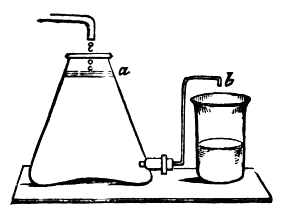
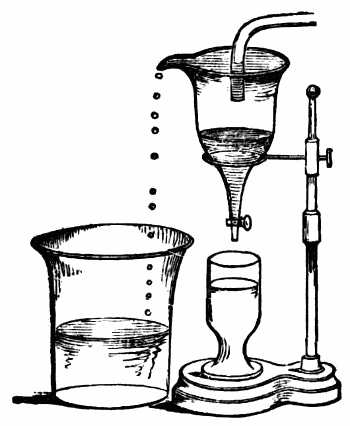
The same receiver may be employed for oils heavier than water, by reversing the arrangement; but a glass ‘separator’ (see engr.) is, in general, found more convenient. In this case the oil accumulates at the bottom of the vessel, and may be drawn off by the stop-cock provided for the purpose.
The essential oils of lemons and oranges of commerce, and of some other fruits, are chiefly obtained by submitting the yellow rind to powerful pressure; but in this way they are not so white, nor do they keep so well, as when distilled, although in the case of the fruits referred to the oils are more fragrant than when prepared by any other method.
The London College excluded the usual directions for the preparation of the essential oils from their Pharmacopœia of 1851, on the ground that these substances are seldom prepared by the druggist or apothecary, or at all on the small scale.
“The fruit of anise, caraway, and juniper, the flowers of chamomile, lavender, and elder, the berries of allspice, the tops of rosemary, and the entire recent plants of the other herbs, are to be employed.” “Put any one of these into an alembic, then pour in as much water as will cover it, and distil the oil into a large vessel, kept cool.” (Ph. L. 1836.)
The Edinburgh College directs—“As much water only is to be employed as will prevent empyreuma during the distillation. The distillation may be immediately commenced after a proper maceration, and the oil afterwards separated from the water,” in the manner already noticed.
“It is also necessary to observe, in preparing these oils, as well as the distilled waters, that the quality of the substances, their texture, the season of the year, and similar circumstances, must occasion so many differences, that it is scarcely possible to give any certain and general rules which shall strictly apply to every example. Many things, therefore, must be regulated by the judgment of the operator.”
The Dublin College directs the vegetable substances to be macerated in the still with about 5 times their weight of water, for 24 hours, when one half of the water is to be drawn over. The oil having been separated from this in the usual manner, it is to be returned to the still, and the same quantity drawn over, as before, from which the oil must again be separated.
Chevallier gives the following rules for the distillation of essential oils:—
1. Operate upon as large quantities as possible, in order to obtain a greater product, and one of finer quality.
2. Conduct the distillation rapidly.
3. Divide the substances minutely, in order to facilitate the extrication of the oil.
4. Employ only sufficient water to prevent the matter operated on from burning, and the product from being contaminated with empyreuma.
5. For substances whose oil is heavier than water, saturate or nearly saturate the water in the still with common salt, to raise the boiling point, and thus to enable the vapour to carry over more oil.
6. Employ, when possible, water which has been already distilled from off the same substances, and has thus become saturated with oil.
7. For oils naturally fluid, keep the water in the refrigerator cool; but for those oils which easily become solid, preserve it at 80° to 90° Fahr.(?)
To the above may be added—
8. Collect the oil as soon as possible after it separates from the water with which it passes over, and in its subsequent treatment keep it, as much as possible, from free contact with the air.
Dr Ure remarks, “The narrower and taller the alembic is, within certain limits, the greater will be the proportion of oil, relative to that of the aromatic water, from like proportions of aqueous and vegetable matter employed.” “Some place the plants in baskets, and suspend these immediately over the bottom of the still, under the water, or above its surface in the steam; but the best mode, in my opinion, is to stuff an upright cylinder full of the plants and drive down through them steam of any desired force, its tension and its temperature being further regulated by the size of the outlet-orifice leading to the condenser. The cylinder should be made of strong copper, tinned inside, and encased in
The newly distilled oils may be separated from adhering water, which frequently renders them partially opaque or ‘cloudy,’ by repose in a temperature between 60° and 70° Fahr., and subsequent decantation; but to render them quite dry (anhydrous), it is necessary to let them stand over some fragments of fused chloride of calcium. This is not, however, required with the commercial oils.
The rectification of the volatile oils is commonly performed without water, by the careful application of a heat just sufficient to make them flow over pretty rapidly, so that they may be kept heated for as short a time as possible. One half, or at most two thirds only, is drawn off, that left in the retort being usually mixed with raw oil intended to be sold in that state. This method often leads to much loss and disappointment, and we have known more than one rather dangerous explosion result from its use. A better plan is to rectify the oil from strong brine, and then to separate any adhering water, either by repose or chloride of calcium.
Pres. Volatile oils should be preserved in well-closed and nearly full bottles, in the shade, and should be opened as seldom as possible. By age they darken, lose much of their odour, increase in density, and become thick and clammy. It is then necessary to distil them, by which the undecomposed portion is separated from the resin. Agitation along with animal charcoal will restore their clearness and original colour, but nothing more.
Pur., Tests. The essential or volatile oils of commerce are very frequently adulterated with the fatty oils, resins, spermaceti, or alcohol, or with other essential oils of a cheaper kind or lower grade. The presence of the first three of these may be readily detected by placing a drop of the suspected oil on a piece of white paper, and exposing it for a short time to heat. If the oil is pure, it will entirely evaporate; but if adulterated with one of these substances, a greasy or translucent stain will be left on the paper. These substances also remain undissolved when the oil is agitated with thrice its volume of rectified spirit.
The presence of alcohol may be detected by agitating the oil with a few small pieces of dried chloride of calcium. These remain unaltered in a pure essential oil, but dissolve in one containing alcohol, and the resulting solution separates, forming a distinct stratum at the bottom of the vessel. When only a very little alcohol is present, the pieces merely change their form, and exhibit the action of the solvent on their angles or edges, which become more or less obtuse or rounded.
Another test for alcohol in the essential oils is the milkiness occasioned by agitating them with a little water, as well as the loss of volume of the oil when it separates after repose for a short time.
A more delicate test of alcohol in the essential oils than either of the preceding is potassium, as employed by M. Beral:—12 drops of the oil are placed on a perfectly dry watch-glass, and a piece of potassium, about the size of an ordinary pin’s head, set in the middle of it. If the small fragment of metal retains its integrity for 12 or 15 minutes, no alcohol is present; but if it disappears after the lapse of 5 minutes, the oil contains at least 4% of alcohol; and if it disappears in less than 1 minute, it contains not less than 25% of alcohol.
Boettger states that anhydrous glycerin possesses the property of dissolving in alcohol, without mixing with the volatile oils. The mode of applying the glycerin is as follows:—The oil to be examined is well shaken in a graduated tube, with its own volume of glycerin (sp. gr. 1·25). Upon being allowed to settle, the mixture separates into two layers. The denser glycerin separates rapidly, and if the essence has been mixed with alcohol, this is dissolved in the glycerin, the augmentation in the volume of glycerin showing the proportion of alcohol present.
This species of adulteration is very common, as it is a general practice of the druggists to add a little of the strongest rectified spirit to their oils, to render them transparent, especially in cold weather. Oil of cassia is nearly always treated in this way.
The admixture of an inferior essential oil with one more costly may be best detected by pouring a drop or two on a piece of porous paper or cloth, and shaking it in the air, when, if occasionally smelled, the difference of the odour at the beginning and the end of the evaporation will show the adulteration, especially if the added substance is turpentine. The presence of the latter may also be detected by agitating the oil with rectified spirit, when it will remain undissolved.
The following method, which may also be used as a test for the presence of turpentine, is based upon its power of dissolving fats:—Take about 50 gr. of oil of poppy in a graduated glass tube, and add an equal quantity of the sample of essential oil. Shake the mixture up thoroughly and then allow it to stand; if the essential oil be pure, the mixture becomes milky, and does not clear until after several days have passed, whereas it will remain transparent if even so little as 5 per cent. of essence of turpentine be present.
The purity of essential oils may likewise, in many cases, be determined by taking their sp. gr.; or, with still greater accuracy and convenience, by measuring their index of refraction, as suggested by Dr Wollaston. A single drop of oil is sufficient for the application of the last method.
The adulteration of a heavy oil with a light one, or the reverse, may be detected by agitating the suspected oil with water, when, in most cases, the two will separate and form distinct strata.
Miss Crane believes that the cohesion figures afforded by the volatile oils, like those of the fixed ones, will be found useful indications of their purity. The application of her method is precisely similar to that followed in her examination of the fixed oils as already described. She finds that—
Oil of Turpentine, by itself, spreads instantly to the whole size of the plate (a common soup plate), and almost immediately the edge begins to break into irregular shapes, when a rapid motion takes place over the surface of the film, and there seems to be a contest between the cohesion of the oil particles and the adhesion between them and the water. The oil makes repeated efforts to gather itself closer together, when the water instantly reacts, giving a wavy appearance to the whole figure.
The play of colours at this point is beautiful, and serves to bring out the lines more perfectly. In a few seconds innumerable little holes appear over the surface, which soon are separated only by threaded lines, and the figure is like the most exquisitely fine lace.
Oil of Cinnamon forms a figure not more than half the size of the last-named. In a few seconds small portions are detached, and shortly separate into distinct drops, four or five larger, and a number of smaller ones, scattered about. With mixtures in different proportions of oil of turpentine, the figures formed differently, taking more of the characteristics of the adulterant as it predominated.
Oil of Nutmeg forms a large figure instantly, the edge showing a beaded line. It gathers itself together and spreads again, very like oil of turpentine, but the surface presents more the appearance of watered silk. Within sixty seconds some holes appear, and in eighty more the surface is covered with them; these scarcely spread to more than a sixteenth of an inch in diameter, but from the first each is bordered with a dotted edge. The figure lasts some time without changing materially, except the openings lengthen out into an oblong shape, remaining entirely distinct. The play of colours is very fine. With the addition of one third of the oil of turpentine, the first spreading is little different, but openings appear in half the time, and the dotted border does not come as soon; in about four minutes the figure is most characteristically marked, and soon breaks up entirely, this being the distinctive difference between the pure oil and the mixture.
Oil of Peppermint spreads instantly to a large figure, and in ten or fifteen seconds openings appear, which increase rapidly in size. At first they look somewhat like the last-named, but are not nearly so numerous, and the border soon is more like tiny drops. In one and a half or two minutes they begin to run together, and the figure breaks up.
With the addition of turpentine oil the figure forms more slowly, and the breaking up is less rapid, but in five minutes the outlines only remain.
Oil of Bergamot spreads instantly; in thirty seconds tiny openings appear, not very abundant, and increase in size slowly; in five minutes they are not larger than oil of nutmeg at one and a half minute. At first they have a dotted border, but as they increase in size this changes to a scalloped film, which spreads, until, in eight or ten minutes, they are joined together over the whole surface. This, with the turpentine oil, gives a watered surface in spreading, much more marked, and with a fine play of colours.
Uses, &c. The volatile oils are chiefly used by perfumers and rectifiers, and in medicine. Some of the cheaper kinds are largely employed as vehicles for colours, and in the manufacture of varnishes. The dose of the aromatic and carminative oils is from 1 to 10 drops, on sugar, or dissolved in a little weak spirit. This does not apply to oil of bitter almonds, the dose of which is 1⁄4 to 1⁄2 a drop.
⁂ The following list includes short notices of nearly all the volatile oils which have been examined, as well as of some other substances of a similar character, which commonly pass under the name.
Oil of Allia′ria. From the roots of Alliaria officinalis, or sauce-alone. Identical with the oil of black mustard.
Oil of All′spice. See Oil of Pimento.
Oil of Al′monds. See Oil of Bitter almonds.
Oil of American Arbor Vitæ. Syn. Huile cedre blanc, Fr. From the fresh tops of Thuja occidentalis, or American arbor-vitæ tree. Yellow; fragrant; stimulant. Used in frictions for rheumatism. Prod. 11⁄2 to 2% (nearly).
Oil of Angel′ica. From the dried root of Angelica Archangelica. Prod. 25% (fully).
Oil of An′iseed. Syn. Oleum anisi (Ph. L., E., & D.), O. essentiale anisi, L. From the fruit (seeds) of Pimpinella anisum, or anise. Nearly colourless. It is very frequently adulterated with one or other of the cheaper oils, in which case spermaceti or camphor is added to it, to make it ‘candy.’
Prop., &c. When pure it congeals into a solid crystalline mass on being cooled to 50° Fahr., and does not melt again until heated to about 63°. Treated with iodine, it quickly congeals into a solid hard mass, with a perceptible increase of temperature, and the development of orange-coloured and grey fumes. Sulphuric acid, with heat, turns it of a rich purple-red colour, and the compound soon afterwards becomes inspissated and hard
Oil of aniseed is carminative and pectoral; and both itself and preparations have long been in favour with the masses in coughs, colds, &c. In preparing it care must be taken that the temperature of the water in the receiver and refrigerator does not fall lower than about 68° Fahr. Prod. (From the dried fruit of commerce) avoir. 2% (nearly). See Oil of Star-anise.
Oil, Ap′ple. See Amyl (Valerianate of), and Essence of Apple.
Oil of Ar′nica. Syn. Oleum arnicæ, O. a. radicum, L. From the roots of Arnica montana. Yellowish brown. Sp gr. ·940. Prod. 16 lbs. yielded 1 oz. of oil. The oil from the flowers of arnica is blue.
Oil of Asarabac′ca. Syn. Oleum asabi, O. asari liquidum, L. From the roots of Asarum Europæum. Yellow; glutinous. Two butyraceous oils pass over at the same time.
Oil of Assafœt′ida. Syn. Oleum asafœtida, L. From the gum resin. Contains sulphur. Very fetid and volatile.
Oil of Balm. Syn. Oleum melissæ, L. From the herb (Melissa officinalis). Pale yellow; fragrant. Sp. gr. ·970 to ·975. Prod. 100 lbs. of the fresh flowering herb yielding 1⁄4 oz. of oil (M. Raybaud). A mixture of oil of lemons and rosemary is commonly sold for it.
Oil of Balsam of Peru. See Cinnameine.
Oil of Ber′gamot. Syn. Bergamot, Essence of b.; Oleum bergamii, O. bergamotæ, L. By expression from the yellow portion of the rind of the fruit of Citrus Bergamia, or bergamot orange. Pale greenish yellow; highly fragrant. It is obtained purer by distillation, but its perfume is then slightly less delicate. Sp. gr. ·875 to ·885. Prod. The rind of 100 bergamot oranges yielded by distillation nearly 3 oz. of oil. (M. Raybaud.)
Oil of bergamot is frequently adulterated with rectified spirit, or with the oils of lemons, oranges, or turpentine. The presence of these substances may be detected in the manner explained under Oils (Volatile), Purity and Tests (anté), as well as by the altered density of the oil. Pure bergamot oil is much more soluble in rectified spirit than either of the others, and is further distinguished from them by its free solubility in solution of potassa, forming a clear solution.
Oil of Bit′ter Almonds. Syn. Essence of b. a.; Oleum amygdalæ amaræ, O. a. essentiale, L. From the ground cake of bitter almonds from which the fixed oil has been expressed. The common plan is to soak the cake (crumbled to fragments) for about 24 hours in twice its weight of water, to which 1⁄3rd or 1⁄4th of its weight of common salt has been added, and then to submit the whole to distillation, allowing the first half of the water that passes over to deposit its oil, and to run back again into the still. Pale golden yellow; colourless when rectified; tastes and smells strongly nutty, like peach-kernels. It consists of 85% to 90% of hydride of benzoyl and 8% to 12% of hydrocyanic acid, with a variable quantity of benzoic acid and benzoin. The density varies a little with the age of the oil, and the temperature and rapidity with which it has been distilled. Sp. gr. (recent) 1·0525; (trade crude oil) 1·079 (G. Wippel); (old) 1·081 (1·0836—Pereira). “Essential oil of almonds, free from adulteration, should have a sp. gr. at most of 1·052.” (Ure.) According to Prof. Redwood, the density may vary from 1·0524 to 1·0822. The light oil contains the most hydride of benzoyl, and the heavy oil the most benzoin. Prod. From less than ·2 to ·5%.
Pur. This oil is generally adulterated with cheaper oils, and in nearly every case with alcohol. When it is pure—Mixed with oil of vitriol, it strikes a clear crimson-red colour, without visible decomposition,—Mixed with an alcoholic solution of potassa, crystals are eliminated.—Iodine dissolves only partially and slowly in it, without further visible results.—Chromate of potassa does not affect it.—Nitric acid (sp. gr. 1·42) causes no immediate reaction, and in the course of 3 or 4 days crystals of benzoic acid begin to appear; but if only 8% or 10% of alcohol or rectified spirit is present, a violent effervescence speedily commences, and nitrous fumes are evolved. By using nitric acid, sp. gr. 1·5, the smallest quantity of alcohol may be detected.
Obs. This oil does not pre-exist in the almond, but is formed by the action of water on a peculiar crystallisable substance, called amygdalin. It is essentially the hydride of benzoyl, but it always contains a portion of hydrocyanic or prussic acid, to which it owes its very poisonous properties. It is occasionally employed as a substitute for hydrocyanic acid in medicine; but its principal consumption is as a flavouring ingredient and a perfume by cooks, confectioners, liquoristes, and perfumers. For this purpose it is dissolved in rectified spirits. See Essence.—Dose, 1⁄4 to 1 drop.
An oil closely resembling that from bitter almonds is obtained by distillation from the leaves of the peach and cherry-laurel, the bark of the plum-tree, the bruised kernels of cherries, plums, and peaches, the pips of apples, and from several other vegetable substances that possess a nutty odour and flavour.
A NON-POISONOUS OIL OF ALMONDS has been introduced. This is simply the ordinary oil of commerce freed from hydrocyanic acid, and is intended to be substituted for the crude, poisonous oil for domestic purposes. Unfortunately, the purified essence does not keep well,
1. (Liebig.) Agitate the crude distilled oil with red oxide of mercury, in slight excess, and after a few days’ contact, rectify the oil from a little fresh oxide of mercury. The product is quite pure, when the process is properly managed. The cyanide of mercury thus formed may be either employed as such, or reconverted into mercury and hydrocyanic acid.
2. (Mackay.) Commercial oil of almonds, 1 lb.; fresh-slaked lime, q. s. to form a milk-like liquid; afterwards add, of solution of potassa, 11⁄2 lb.; water, 3 pints; agitate occasionally for 48 hours, then distil over the oil, and rectify it from a fresh mixture of lime and potassa.
3. (Redwood.) The oil is mixed with an equal quantity of water, and the mixture is digested in a water bath with red oxide of mercury, and small quantities of fresh-slaked lime and protochloride of iron, with as little access of air as possible; as soon as decomposition of the acid has taken place, the whole is introduced into a copper retort, and submitted to distillation. The product is perfectly free from hydrocyanic acid. The first process is, however, the simplest, cheapest, and best.
The sp. gr. of this non-poisonous oil is 1·051. (G. Whippell.) That of pure colourless hydride of benzoyl is 1·043; it boils at 356° Fahr., is soluble in 35 parts of water, and in all proportions in alcohol and ether. Exposed to the air, it greedily absorbs oxygen, and becomes converted into a mass of crystallised benzoic acid. The purified oil of almonds does the same, only less rapidly.
Oil of Almonds (Facti′′tious). Syn. Essence of mirbane, Nitrobenzol. The preparation of this article on the small scale is explained under Nitrobenzol. It is now extensively prepared as a substitute for the oil of almonds obtained by distillation. The following is Mansfield’s process:—The apparatus consists of a large glass worm, the upper end of which is divided into two branches, gradually dilating so as to form two funnel-shaped tubes. Into one of these concentrated nitric acid is poured, and into the other benzol, which need not, for this purpose, be chemically pure. These bodies meet at the point of junction of the two tubes, and the rate of their flow is regulated by any appropriate means. Chemical reaction instantly takes place, and the new compound is cooled by its passage through the worm, which is refrigerated for the purpose. It has then only to be washed with water or a very weak solution of carbonate of soda for the process to be complete. The product has the sp. gr. 1·209, boils at 415° Fahr., has an intensely sweet taste, and an odour closely resembling, but not actually identical with, that of oil of bitter almonds. Unlike genuine oil of almonds or hydride of benzoyl, it is insoluble in water, and does not distil without suffering partial decomposition. It is chiefly used to scent soaps, and to adulterate the genuine oil. The benzol for this purpose is obtained from coal-tar. See Benzol and Nitrobenzol.
Oil of Boxwood. (Ph. L. 1746.) Syn. Oleum buxi empyreumaticum. Distilled from fragments of boxwood in a retort, with a sand bath gradually increased in heat. Anodyne, antispasmodic, and diaphoretic.—Dose, 10 to 20 drops. (Jourdan says 4 to 5 drops in gonorrhœa.) It relieves toothache.
Oil, Brandy. See Oil of Grape.
Oil of Bu′chu. Syn. Oleum barosmæ, O. diosmæ, L. From the leaves of Diosma crenata. Yellow; lighter than water; smells of the leaves.
Oil of Caj′eput. Syn. Cajeputi oil, Kyapootie o.; Cajeputi oleum (B. P.), Oleum cajeputi (Ph. L. E. & D.), L. From the dried leaves of the Melaleuca Cajeputi (Melaleuca minor, B. P.). Colourless, when pure (that of commerce is usually green); odorous; aromatic; taste hot and penetrating. Its odour has been compared to a mixture of those of camphor and cardamoms. It boils at 343° Fahr. Sp. gr. ·925 to ·927. When rectified, about 3⁄4ths of the quantity passes over colourless, and has the density ·897; the remaining portion is green, and has the density ·920 to ·925. Its green colour is derived from chloride of copper, the presence of which may be recognised by the red precipitate occasioned by agitating the oil with a solution of ferrocyanide of potassium. (Guibourt.) From the East Indies.
Pure oil of cajeput is slightly soluble in water; entirely and freely soluble in alcohol; dissolves iodine; and when dropped on water, rapidly diffuses itself over the surface, and soon completely evaporates. A spurious kind (FACTITIOUS OIL OF CAJEPUT), made of oil of rosemary, flavoured with camphor and the oils of peppermint and cardamoms, and coloured with verdigris, is occasionally met with in the shops.
Oil of cajeput is a powerful antispasmodic and diffusible stimulant.—Dose, 3 to 6 drops, on sugar; in cholera, colic, epilepsy, hysteria, rheumatism, spasms, toothache, &c.
Oil of Cam′phor. Syn. Liquid camphor; Oleum camphoræ, O. c. volatile, L. Obtained from incisions in the wood of the camphor tree of Borneo and Sumatra (Dryobalanops aromatica), in which it exists in cavities in the trunk; also by distillation from the branches of the Camphora officinarum, or laurel camphor tree. Colourless when rectified. Sp. gr. ·910. Prod. 60 lbs. of the crude brownCamphor (Liquid).
Oil of Car′away. Syn. Oleum carui (B. P. Ph. L. E. & D.), O. c. essentiale, L. From the fruit of Carum Carui (caraway seeds). Nearly colourless; aromatic; carminative. Sp. gr. ·940; (old) ·946 to ·950. Prod. Av. 5% (nearly). It is frequently adulterated with oil of cumin. Added to purgative medicines to prevent griping.
Oil of Car′damoms. Syn. Oleum cardamomi, O. c. essentiale, L. From the seed of Elettaria cardamomum, or true cardamom. Colourless; fragrant; carminative. Sp. gr. ·943. Prod. 5% (nearly). The capsules (‘lesser cardamoms’) yield only about 1% of oil. (M. Raybaud.)
Oil of Cascaril′la. Syn. Oleum cascarillæ, L. From the bark of Croton eleuteria (Swartz.), or cascarilla tree. Very fragrant. Prod. ·4% to ·75%.
Oil of Cas′sia. Syn. Oil of China cinnamon; Oleum cassiæ (Ph. E.), L. From cassia buds, or from cassia bark, Golden yellow; aromatic; fragrant. It is generally adulterated with rectified spirit. Nitric acid converts the pure oil into a crystalline mass. Sp. gr. 1·071 to 1·073; (old) 1·078 to 1·090 Prod. From the buds of 1% (barely); from the bark of commerce, ·75%. It is frequently sold for oil of cinnamon.
Oil of Cebadil′la. Syn. Oil of sabadilla; Oleum cebadillæ, L. A green butyraceous matter, obtained from Asagræa officinalis.
Oil of Ce′dar-wood. From the wood of a species of Cedrus. It consists of two hydrocarbons. One, a volatile liquid (cedrene), and the other a solid, crystalline compound containing oxygen. Prod. ·2% to 25%.
Oil of Ce′drat. Syn. Essence of cedra; Oleum cedri, O. citri finum, L. From the exterior yellow rind of the fruit of Citrus medica (Risso), or citrons, either by expression or distillation, as oil of bergamot. The first portion of oil that comes over is colourless; the latter portion greenish. Very fragrant. Sp. gr. ·847. Prod. 100 citrons yield nearly 1 fl. oz. of pale, and 1⁄2 fl. oz. of green oil. See Oil of Citron (below).
Oil of Cel′ery Seed. Syn. Oleum apii. L. From the fruit (seed) of Apium graveolens. Diuretic; stimulant. Prod. 3⁄4% to 1% (nearly).
Oil of Cham′omile. Syn. Oil of Roman chamomile; Oleum anthemidis (Ph. L. E. & D.), O. chamæmeli, O. c. florum, O. essentiale ex floribus c., L. From the flowers of Anthemis nobilis. In the Ph. L., English oil of chamomile (anthemidis oleum Anglicum) is ordered. Blue; turns yellow and brown by exposure and age; odour characteristic. Sp. gr., English (from the flowers), ·9083; foreign, ·9289. Prod. Fresh flowers, ·1% (barely); recently dried (finest commercial), 5%; av. of 6 dried samples, ·25% (nearly). If much water is employed, even the above small quantities of oil will not be obtained.
Oil of chamomile is reputed antispasmodic, tonic, and stomachic. 1 to 3 drops on a lump of sugar, taken just before retiring to rest, is an excellent preventive of nightmare, and will frequently induce quiet sleep where more active substances have failed. Unfortunately, the oil of the shops is generally either adulterated or old, and commonly both, in which case the oil acts as an irritant. A common plan is to mix it with old oil of lemons, a fraud which may be detected by the lessened density of the oil, and by its diminished solubility in rectified spirit.
Oil of Cher′ry-laurel. Syn. Oleum lauro-cerasi, L. From the leaves of Cerasus Laurocerasus, or common laurel. Closely resembles oil of almonds, but is said to be weaker. Like that substance, it is powerfully poisonous. Prod. 100 lbs. fresh leaves (undeveloped, June), 10·13 oz.; do. (half grown, June), 7·2 oz.; do. (full-grown, 8 weeks on tree, July), 4·96 oz.; do. (do., 3 months on tree, Sept.), 7·04 oz.; do. (15 months on tree), 2·24. (Christison.)
Oil of Cher′vil. Syn. Oleum chærophylli, L. From the bruised fresh herb, macerated for 2 or 3 days in salt and water, and then distilled.
Oil of Cincho′na. Syn. Oleum cinchonæ, L. From cinchona bark. Butyraceous; smells of the bark. 20 lbs. yield only 2 gr. (Trommsdorff.) The odour of bark is imitated by a solution of turmeric in potash, and by chloride of iron.
Oil of Cin′namon. Syn. Hydride of cinnamyl; Oleum cinnamomi (B. P., Ph. L. E. & D.), O. c. veri, L. From the bark of Cinnamomum zeylanicum, macerated for several days in salt and water, and then distilled. Yellowish or red; very aromatic; both odour and taste resemble that of the bark. Sp. gr. 1·035. Prod. 11 lbs. yielded 1 oz.; 100 lbs. yielded 1·56 oz. (M. Raybaud.)
Pur. Oil of cinnamon, owing to its high price, and the consequent premium for its adulteration, can scarcely be obtained pure from the shops of this country. Oil of cassia and highly rectified spirit are the substances usually employed for this purpose. The increased sp. gr. resulting from the first, and the diminished sp. gr. from the second, afford ready means of detecting these frauds. The presence of oil of cassia may also be detected by an experienced person by the odour, which differs a little from that of pure oil of cinnamon. Oil of cassia is less limpid than oil of cinnamon, and it stands a greater degree of cold without becoming turbid or congealing. “Wine-yellow, when recent; cherry-red, when old; odour purely cinnamonic; nitric acid converts it nearly into a uniform crystalline mass.” (Ph. E.) During this reaction the odour of bitter almonds is perceptible. Both oil of cassia and oil of cinnamon are thus converted
Obs. Oil of cinnamon is chiefly imported from Ceylon, where it is distilled from bark that is unfit for exportation. The dark coloured oil is usually rectified, when two pale oils are obtained, one lighter, and the other heavier, than water; but 10% of oil is lost by the process. The oil distilled from the root of the tree (O. CINNAMOMI RADICIS) is much weaker than that from the bark. The oil from the leaves (O. C. FOLIORUM), also imported from Ceylon, smells of cloves, but has a less density than oil of cloves.
Oil of cinnamon consists essentially of hydride of cinnamyl, but, unless when very recently prepared, it also contains a variable proportion of cinnamic acid formed by the oxidation of the hydride.
Oil of Cit′ron. Syn. Essence of citron; Oleum citri, L. From the lees of citron juice; or, from the peels, as oil of lemons or bergamot. The last generally goes by the name of oil of cedrat. Both are fragrant. (See above.)
Oil of Citron-flowers. Syn. Oleum citri florum, L. Amber-coloured; highly fragrant. Prod. 60 lbs. yield 1 oz.
Oil of Cloves. Syn. Essence of cloves; Oleum caryophyllorum, O. caryophylli (B. P., Ph. L. E. & D.), O. Eugeniæ c. (Ph. D. 1826), L. From the unexpanded flowers (cloves) of the Caryophylus aromaticus, or Molucca clove-tree, soaked for some time in salt and water, and then submitted to distillation; the distilled water, after having deposited its oil, being returned 3 or 4 times into the still, and again ‘worked off’ from the same materials. Nearly colourless, when recent, gradually becoming pale yellow and ultimately light brown, by age; highly aromatic, with the characteristic odour and flavour of cloves. It is the least volatile of all the essential oils. Sp. gr. 1·055 to 1·061 (1·034 to 1·061, B. P.). Prod. 16% to 22%.
Pur. Oil of cloves is frequently adulterated with inferior essential oils, especially with those of pimento, pinks, and clove-gilly flowers, and, occasionally, with castor oil.—1. Pure oil of cloves forms a butyraceous coagulum when shaken with pure liquor of ammonia, which crystallises after fusion by a gentle heat.—2. Treated with an alcoholic solution of potassa, it entirely congeals into a crystalline mass, with total loss of its characteristic odour.—3. Shaken with an equal volume of strong caustic soda lye, it forms, on repose a mass of delicate lamellar crystals—4. Solution of chromate of potassa converts it into brown flakes, whilst the salt loses its yellow colour.—5. Chlorine turns it first green, and then brown and resinous.—6. Nitric acid turns it red, and a reddish-brown solid mass is formed; with heat, it converts it into oxalic acid.—7. It dissolves freely in sulphuric acid (oil of vitriol), yielding a transparent, deep reddish-brown solution, without any visible decomposition.—8. Mixed, gradually, with about 1⁄3rd of its weight of oil of vitriol, an acid liquor is formed, together with a resin of a rich purple colour, which, after being washed, is hard and brittle, and forms a red tincture with rectified spirit, which is precipitated of a blood-red colour by water.—9. It dissolves iodine freely, without any marked reaction.—10. It dissolves santaline freely.—11. Mix one drop of the oil with a small trace of solution of aniline by means of a glass rod, and then shake with 5 or 6 c.c. of distilled water. By the addition of a few drops of sodium hypochlorite to the mixture the characteristic blue coloration due to phenol will be developed in a few minutes, if the adulterant be present; whereas with the pure oil nothing but the purplish-violet colour of aniline will be perceived. Stirring or shaking must be avoided after the addition of the hypochlorite. The presence of 1 per cent. of phenol can thus be demonstrated in one drop of the oil.
Obs. Clove oil contains a heavy oil, sp. gr. 1·079 (caryophyllic acid), and a light oil, sp. gr. ·918 (clove hydrocarbon); by rectification, much of the light oil is lost, and the product becomes denser. (1·361—Bonastre.)
Oil, Cog′nac. See Oil, Grape (below).
Oil of Copai′ba. Syn. Oil of capivi; Oleum copaibæ (B. P., Ph., L. & E.), L. 1. (Ph. E.) Balsam of capivi, 1 oz.; water, 11⁄2 pint; distil, returning the water into the still, until oil ceases to pass over.
2. (Wholesale.) From the crude oil which separates during the manufacture of ‘specific solution of copaiba’ and ‘soluble capivi,’ by distillation along with a little salt and water.
Pur., &c. Colourless when pure; that of commerce has frequently a greenish tinge, derived from the copper utensils; odour, not disagreeable when recent. Sp. gr. ·876 to ·878. Prod. 50% to 55%. When adulterated with oil of turpentine, its solubility in rectified spirit is greatly diminished, and the solution is turbid.—Dose, 10 to 15 drops, in sugar; in the usual cases in which copaiba is ordered. 20 to 60 minims, three times a day (B. P.).
Oil of Corian′der. Syn. Oleum coriandri, L. From the fruit (seeds) of Coriandrum sativum. Yellowish; aromatic; carminative. Prod. (Dried fruit) 51⁄2 to 6%.
Oil, Corn. The name given by Mulder to a peculiar fatty compound found in the fusel oil of the distilleries of Holland. It has a very powerful odour, resembling that of some of the umbelliferous plants, and is unaffected by caustic potassa. See Oil, Fusel (page 772).
Oil of Cu′bebs. Syn. Oleum cubebaram, O. cubebæ (B. P., Ph. E. & D.), L. From the fruit of Cubeba officinalis, or cubebs, coarsely ground. Aromatic, hot, and bitter tasted; odour, that of the fruit; faintly green, colourless when pure. Sp. gr. ·129. Prod. 9% to 11%.
Pur., &c. When pure, iodine has little action on this oil, and immediately gives it a violet colour, without any very marked reaction; nitric acid turns it opaque, and the mixture changes to a pale red when heated; sulphuric acid turns it of a crimson red. When adulterated with oil of turpentine, both its viscidity, solubility in rectified spirit, and its density, are lessened; when mixed with castor oil it leaves a greasy stain on paper.—Dose, 10 to 15 drops, in the usual cases in which cubebs in substance is given. 5 to 20 minims (B. P.), suspended in water by mucilage and sugar.
Oil of Cumin. Syn. Oleum cumini, O. cymini, L. From the fresh fruit (seed) of Cuminum Cyminum, or cumin. Pale yellow; smells and tastes strongly of the seeds. Sp. gr. ·975. Prod. 21⁄2% to 3%.
Obs. Oil of cumin is a mixture of two oils differing in volatility, and which may be separated by careful distillation. The more volatile one has been named cymol; the other, cuminol.
Oil of Dill. Syn. Oleum anethi (Ph. L. & E.), L. From the bruised fruit (seed) of Antheum graveolens. Pale yellow; odour, that of the fruit; taste, hot and pungent; carminative. Sp. gr. ·188 to ·882. Prod. 4% (nearly).
Oil of El′der. Syn. Attar of elder flowers; Oleum sambuci, L. From elder flowers (Sambucus nigra). Butyraceous; odour not very marked.
Oil of El′emi. Syn. Oleum elemi, L. From the resin. Isomeric with oil of turpentine.
Oil of Er′got. Syn. Ethereal o. of e.; Oleum ergotæ, O. e. æthereum, O. secalis cornuti, L. Prepared by evaporating the ethereal tincture at a very gentle heat, and, preferably, allowing the last portion of the ether to escape by spontaneous evaporation. Brownish-yellow; lighter than water; soluble in ether and solution of potassa; only partly soluble in alcohol. It appears to be a mixture of volatile and fixed oil, with some resinous matter.—Dose, 10 to 20 drops, in hæmorrhages; 10 or 12 drops every 3 or 4 hours, in diarrhœa; 20 to 50 drops, as a parturifacient, &c. Externally, in rheumatism, toothache, &c.
Obs. The above is the oil of ergot now employed in medicine. It must not be confounded with other preparations occasionally called by the same name, but which differ from it in character. Among the latter are the following:
a. A fixed oil obtained by distilling off the spirit from the alcoholic tincture. It has the odour of rancid fish oil, and the distilled spirit has also a putrid odour.
b. A fixed oil, obtained from coarsely powdered ergot by strong pressure between iron plates, at a heat of about 212° Fahr. It is fluid, coloured, smells strongly of the drug, but is nearly destitute of its leading qualities. Both the preceding contain some volatile oil and resinous matter.
c. An empyreumatic oil obtained by distilling ergot per se. It is light brown, viscid, acrid, and nauseous.
d. A volatile oil obtained by digesting powdered ergot in solution of potassa at 125° Fahr., diluting the saponaceous mass thus formed with one half to an equal weight of water, neutralising the alkali with dilute sulphuric acid, and then submitting the whole to distillation in a chloride of sodium or oil bath. It is white, adhesive, butyraceous, and tasteless. It appears a product, rather than a simple educt.
e. This is the ethereal oil, first described, in its purest form. It is colourless, translucent, oily, and acrid-tasted, with the odour of ergot; it has a high boiling-point, at which it suffers partial decomposition, but may be volatilised at a lower temperature, like the other oils. By long exposure to heat, it thickens and partly solidifies; light and air darken it; it is lighter than water, very slightly soluble in water, but sufficiently so to impart to it its peculiar odour; it is soluble in pure alcohol, in ether, the volatile and fixed oils, alkaline lyes, liquor of ammonia, creasote, and naphtha. The dilute mineral acids clear it but do not produce any marked reaction.
Oil, Ethe′′real. See Oil of Wine (below).
Oil of Eucalyptus. Syn. Oleum eucalypti globuli. See Eucalyptus.
Oil of Fen′nel. Syn. Oleum fœniculi (Ph. L.), O. f. officinalis (Ph. E. & D.), O. f. dulcis, L. From the fruit or seed of Fœniculum dulce, or sweet fennel (Ph. L.), Colourless; odour that of the plant; tastes hot and sweetish; congeals at 50° Fahr.; carminative and stomachic. It consists of two oils; the one solid and identical with that of oil of aniseed. When treated with nitric acid, it affords benzoin, Sp. gr. ·997. Prod. Dried fruit (of commerce), 3% to 3·5%. The flowering herb yields ·35% of a similar oil.
Obs. The oil of fennel of the shops is the product of the fruit of Fœniculum vulgare, or common, wild, or bitter fennel. It closely resembles that of sweet fennel, but is scarcely so agreeable either in taste or smell. It is chiefly used to scent soaps.
Oil of Firwood. Syn. Oleum pini sylvestris.Pinus sylvestris.
Oil of Fleabane. (Ph. U. S.) Syn. Oleum erigeronis canadensis. An essential oil, distilled from Canada erigeron.—Dose, 5 minims in hæmorrhage.
Oil, Fu′sel. Noticed at page 772.
Oil of Gal′banum. Syn. Oleum galbani (Ph. Bor.), L. From galbanum, 2 lb.; water, 16 fl. oz.; distilled together. Yellow; resembles oil of asafœtida, but milder.
Oil of Gar′lic. Syn. Sulphide of allyl. From the bruised bulbs or ‘cloves’ of Allium sativum, or garlic. It possesses the peculiar odour, taste, and other properties of the bulbs, in a highly exalted degree.
Obs. When a mixture of oil of black mustard and sulphide of potassium is exposed in a sealed glass tube to a temperature above that of 212° Fahr., sulphocyanide of potassium and garlic oil are formed. On the other hand, when the compound of garlic oil and chloride of mercury (formed by adding to an alcoholic solution of the oil a like solution of the chloride) is gently heated with sulpho-cyanide of potassium, mustard oil, with all its characteristic properties, is called into existence.
Oil of Gaulthe′′ria. See Oil of Partridge berry (below).
Oil of Gen′tian. Syn. Oleum gentianæ, L. From the root. Butyraceous; smells strongly of gentian. 3 cwt. yield 1 dr. (barely).
Oil of Gera′′nium. Syn. Oil of ginger grass, O. of spikenard. The oil of commerce which passes under this name and which was formerly imported from the East Indies, was not obtained from any species of Geranium or Pelargonium, but probably from a species of Andropogon. Of recent years, however, genuine geranium oil, obtained from the rose geranium (Pelargonium roseum) has been and continues to be met with in our markets. This essential oil is manufactured in immense quantities, at La Trappe de Staonelli not far from the Bay of Sidi Ferruch, in Algiers, where about forty acres of the plant are in cultivation. “Three harvests are gathered every year, and each yields from 170 to 200 kilograms of oil, or equal to 500 to 600 kilograms per annum. The value of this product never falls below forty francs the kilogram, the average gross value being therefore from 20,000 to 25,000 francs or at least £20 per acre. Seven distillatory apparatus are employed in this manufactory.”[65] A finer oil is yielded by the rose geranium, when grown in France, but it is much dearer. It is often employed to adulterate otto of roses. See Oil, Grass (below).
Oil of Gin′ger. Syn. Oleum zingiberis, L. From the dried root (rhizome) of Zingiber officinale, or ginger of commerce. Bluish-green; possesses a less agreeable odour than that of good ginger, without any pungency. Prod. 11⁄16 of 1% (M. Raybaud).
Oil of Goosefoot. (Ph. U. S.) Syn. Oleum chenopodii. Distilled from the seeds of Chenopodium anthelminticum.—Dose. From 4 to 8 drops, with treacle or milk, for 3 nights in succession, for children. For adult, 1⁄2 dr. Vermifuge.
Oil of Grain-spirit. Syn. Grain oil. Two distinct substances are found in spirit distilled from fermented grain; one of which is butyraceous and highly offensive (corn oil of Mulder——?), the other liquid (crude fusel oil). The relative proportions of these substances to each other, and to the spirits which they contaminate, vary with the materials and the management of the process. The ‘Grain oil’ of the London rectifiers consists chiefly of fusel or potato oil, mixed with alcohol and water, and with small and variable proportions of solid ethyl and amyl-compounds of certain fatty acids (œnanthic and margaric). The latter are said to be similar to the butyraceous matter before referred to, as well as the solid fat of the whisky distilleries conducted on the old plan. According to Mr. Rowney, the fusel oil of the Scotch distilleries contains capric acid. See Oil of Corn (above), and Fusel oil.
Oil, Grape. Syn. Brandy oil, Cognac o. This is essentially the sulphate of amyl. It is prepared by dissolving the fusel oil of marc-brandy in strong rectified spirit, and then adding concentrated sulphuric acid; alcohol and excess of acid is removed by washing the newly formed compound with water. Dissolved in rectified spirit, it forms ‘BRANDY ESSENCE,’ which is used to impart the Cognac flavour to plain spirit. See Sulphate of Amyl and Amyl-ether, also Oil of Marc-brandy (below).
Oil, Grass. Several of the grasses (Graminaceæ) yield fragrant volatile oils. See Oil of Geranium, Grass oil (of Namur), Oil of Lemon-grass, Oil of Spring-grass, &c.
Oil, Grass (of Namur). Syn. India grass Oil. From Andropogon Calamus aromaticus (Royle), supposed to have been the “sweet cane” and “rich aromatic reed from a far country” of Scripture; formerly supposed to be obtained from Andropogon Iwarancusa. Stimulant and highly fragrant. See Oil of Spikenard.
Oil of Hops. Syn. Oleum lupuli, L. From commercial hops, by distillation along with water. It may also be collected during the brewing of beer. Odorous; acrid; narcotic; soluble in water; becomes resinous by exposure and age. Sp. gr. ·910. Chiefly used to increase the aroma and flavour of old or damaged hops.
Oil of Horse-mint. Syn. Oleum monardæ (Ph. U. S.), L. From the fresh herb of Monarda punctata, a plant indigenous in the U.S. of America. Dark amber-coloured; fragrant; pungent; carminative; rubefacient; and vesicant.
Oil of Horse-rad′ish. Syn. Oleum armoraciæ, L. From the fresh roots of Cochlearia armoracia (Linn.), or common horse-radish. Pale yellow; heavier than water; acrid; vesicant; identical with that from black mustard. Prod. ·5% (nearly).
Oil of Hyssop. Syn. Oleum hyssopi, L. From the flowering herb of Hyssopus officinalis. Aromatic; stimulant. Prod. ·25% to ·33%.
Oil of Jargonelle Pear. See Amyl (Acetate).
Oil of Jas′min. Syn. Oil of jessamine; Oleum jasmini, O. j. volatile, L. From the flowers of Jasminum grandiflorum and J. Fragrans, carefully picked, by placing them in alternate layers with cotton wadding imbued with olive oil, in any suitable vessel, and renewing the flowers till the fixed oil becomes strongly odorous, and then distilling the wadding along with a little water. The volatile oils of hyacinths, jonquil, tuberose, violets, and most of the more delicate flowers, are obtained in the same way. Used in perfumery. From the East Indies.
Oil of Ju′niper. Syn. Juniperi oleum (B. P.), Oleum juniperi (Ph. L. E. & D.), O. è. baccis J., O. essentiale è. b. j., L. From either the wood, tops, or berries, preferably the last. The berries should be chosen fully grown, but still slightly green, and should be bruised before being placed in the still. In the Ph. L., English oil of juniper (O. juniperi Anglicum) is ordered. Colourless, or very pale greenish-yellow; odour and taste, sweet and terebinthinate; rather viscid; soluble in rectified spirit; rendered opaque and resinous by exposure and age. It is reputed carminative and diaphoretic, and possesses powerful diuretic properties, Sp. gr. ·911 (English, ·8688; foreign, ·8834—Brande). Prod. Green berries, ·25%; ripe do. (one year old), 3⁄4 to 1% (fully).
Pur. It is frequently adulterated with oil of turpentine, a fraud readily discovered by the lessened density, viscidity, and solubility, in rectified spirit, of the oil.
Obs. Oil of juniper consists of two oils—one, white and most volatile, sp. gr. ·8393; the other, dark-coloured and less volatile, sp. gr. ·8784; together with some resin left in the retort.
Oil, Krumholz. Syn. Oleum templinum, L. From Hungarian balsam, a terebinthinate exudation from the Pinus pumilio, or mountain pine of Southern Europe. Fragrant; golden yellow; tastes oily, acidulous, and resinous.
Oil of Lau′rel. Syn. Oil of sweet bay; Oleum lauri volatile, O. l. essentiale L. From either the berries or leaves of Laurus nobilis (Linn.), or sweet bay-tree. Pale yellow, clear, odorous, aromatic, stimulant, and narcotic. Sp. gr. ·871. Prod. From the leaves, 3⁄4 to 1% (fully).
Oil of Lavender. Syn. Essence of l.; Lavandulæ oleum (B. P.), Oleum lavandulæ (Ph. L.), O. l. veræ (Ph. E. & D.), O. l. spicæ, O. l. essentiale, O. l. florum, L. The oil (Oleum lavandulæ Anglicum) distilled from the flowers of ‘Lavandula vera’ (Ph. L.). Very pale lemon-yellow; highly fragrant; taste, warm and not disagreeable; carminative, antispasmodic, and stimulant. Sp. gr. ·877 to ·905. According to Brande, the sp. gr. of the oil obtained from the flowers only is ·8960; that from the whole plant, ·9206. The lightest is esteemed the best. Prod. Flowers, 11⁄2 to 2% (nearly). The whole of the flowering herb is commonly distilled. According to Raybaud, the herb, after flowering (Sept.), yields the most oil.
Pur. Alcohol is the substance commonly used to adulterate this oil; but, occasionally, oil of bergamot is used for the same purpose. If the density is below ·87, there is reason to suspect adulteration. When pure—1. Sulphuric acid turns it reddish-brown, and the reaction is accompanied by strong inspissation.—2. It fulminates quickly and violently with iodine, and the thick syrupy residue possesses a pungent, acid, balsamic odour. The oils of the other labiate plants fulminate much less powerfully with iodine. The presence of alcohol weakens, but does not destroy, the action of this test, unless it is added in an equal volume, when only a lively effervescence and a disengagement of orange-coloured vapours are produced by the iodine, without fulmination.—3. Santaline is nearly insoluble in pure oil of lavender, and exerts no marked action on it, but is freely soluble in oil of lavender adulterated with alcohol or rectified spirit.
Obs. English oil of lavender possesses the purest fragrance; and of this, the variety known as “Mitcham oil of lavender,” from the place of its preparation, is esteemed the best. The foreign oil of lavender is inferior. This last is improved by rectification. See Oil of Spike.
Oil of Lem′ons. Syn. Essence of l.; Oleum limonis (B. P.), Oleum limonis, O. limonum (Ph. L. E. & D.). From the yellow portion of the rind, grated, placed in hair bags, and exposed to powerful pressure; also by distillation, but the product is then less agreeably fragrant and sweet, but keeps better. Nearly colourless; odour that of the fruit. Sp. gr. ·8752 to ·8785. Expressed oil, ·8517, distilled do., ·845, at 72° Fahr. (Ure.) Prod. 100 lemons yield, by expression, 13⁄4 to 2 oz. (nearly); by distillation 11⁄4 to 11⁄2.
Pur. Commonly adulterated with oil of turpentine, and occasionally with nut or poppy oil. These may be detected in the manner already explained. When pure, it is soluble in all proportions in absolute alcohol, but rectified spirit only dissolves 16% of it. It also boils at 148° Fahr., whereas oil of turpentine boils at 312°, and mixtures of the two at intermediate temperatures, depending on the proportions.
Oil of Le′mon Grass. Syn. Essence of l. g., Indian grass-oil, Oil of verbena. Probably from Andropogon citratum, the Indian lemon-grass. Pale yellow; powerfully fragrant. Citronelle oil is also the product of this or of an allied species of Andropogon.
Oil of Lemon Thyme. Syn. Oleum serpylli, L.; Huile de tain, Fr. From the fresh flowering herb of Thymus serpyllum, the lemon or wild thyme of our hills and pastures. Very fragrant, used to scent soaps &c. Sp. gr. ·867. Prod. 100 lbs. yield 21⁄2 to 51⁄2 oz. of oil. When pure, it is scarcely affected by iodine, but solution of chromate of potassa acts on it with energy.
Oil of Let′tuce. Syn. Oleum lactucæ virosæ, L. From Lactusa virosa (Linn.), or strong-scented wild lettuce. Closely resembles the odorous matter of opium.
Oil of Limes. Syn. Oleum limettæ, L. From the rind of the fruit of Citrus limetta, or lime, as oil of lemons, which it somewhat resembles. Prod. 100 limes yield 21⁄4 to 21⁄2 oz. of oil.
Oil of Lov′age. Syn. Oleum levistici, L. From the leaves of fruit of Levisticum officinale, Lovage. Pale yellow, aromatic, carminative. Prod. Fresh herb, ·1% to ·15%.
Oil of Mace. Syn. Oleum macidis, O. m. essentiale, O. m. stillatitium, L. From the arillus of Myristica officinale (commercial mace). Nearly colourless; fragrant; lighter than water; closely resembles oil of nutmeg. Sp. gr. ·945. Prod. 41⁄2 to 9%.
Oil of Marc-brandy. Syn. Fusel oil of m.-b., O. of grape spirit. Obtained after the spirit (marc-brandy) has passed over during the distillation of the fermented residuum of expressed grapes. Limpid; odorous; acrid; offensive; soon turns yellow in the air; soluble in 1000 parts of water, and in all proportions in rectified spirit; 6 or 7 drops will spoil a hogshead of brandy. According to M. Balard, this oil is a mixture of potato oil and œnanthic ether.
Oil of Mar′joram. Syn. Oil of sweet m.; Oleum marjoranæ, O. oriqani m. (Ph. E.), L. From the fresh flowering herb of Origanum marjorana, or sweet or knotted marjoram. Pale yellow; odorous; tonic; stimulant. Sp. gr. ·925 (·940—Baumé). Prod. ·33 to ·35%. See Oil of Origanum.
Oil of Mea′dow-sweet. Syn. Oleum spirææ ulmariæ, L. From the flowers or flowering tops of Spiræa ulmaria (Linn.), or common meadow-sweet. This oil is a native hydride of salicyl. It is yellow, sweet-scented, and slightly soluble in water, which then strikes a deep violet colour with the persalts of iron. It boils at 385° Fahr. Sp. gr. 1·172. (See below.)
Oil of Mea′dow-sweet (Facti′′tious). This is prepared as follows:—Salicin, 1 part, is dissolved in distilled water, 10 parts, and being placed in a glass retort, bichromate of potassa (in powder), 1 part, is added, followed by oil of vitriol, 21⁄2 parts, previously diluted with 4 times its weight of water; a gentle heat is next applied to the retort, and after the first effervescence resulting from the mutual reaction of the ingredients is over, the heat is increased, and the mixture is distilled for the oil in the usual manner. The product is absolutely identical with the natural oil of meadow-sweet. (See above.)
Oil of Mil′foil. Syn. Oleum millefolii, L. From the flowers of Achillæa millefolium (Linn.), or yarrow. Blue. Sp. gr. ·852. Prod. 14 lbs. of the dried flowers yield 3 dr. of oil.
Oils, Mixed (Essential). Syn. Olea mixta essentialia. From the oils of bergamot and lemons, of each 1 oz.; oils of lavender and pimento, of each 1⁄2 oz. Used to scent ‘sal volatile drops,’ smelling-bottles, &c.
Oil of Mus′tard (Volatile). Syn. Sulpho-cyanide of allyl; Oleum sinapis nigræ, O. s. essentiale, L. From the seeds of Sinapis nigra(Linn.), or black mustard, as oil of bitter almonds. Nearly colourless; intensely acrid, pungent, rubefacient, and vesicant; slightly soluble in water; boils at 289° Fahr. It contains sulphur. Sp. gr. 1·035 to 1·038; 1·015, at 68° Fahr. Prod. Av. ·6% (fully).
Obs. This oil, like that of bitter almonds, does not pre-exist in the seed, but is the result of the action of myronic acid on a peculiar substance, myrosin, in the presence of water. Oil of black mustard has been used as a stimulant or counter-irritant in palsy, &c.; and the distilled water, or a solution of the oil in water, is said to be an excellent and cleanly remedy for the itch.
Oil of Myrrh. Syn. Oleum myrrhæ, O. m. essentiale, L. Colourless; thin; heavier than water; stimulant; smells strongly of the drug.
Oil of Myr′tle (Volatile). Syn. Essence of m.; Oleum myrtæ essentiale, L. From the flowers and leaves of Myrtus communis. 100 lbs. of the fresh leaves yield 21⁄2 to 5 oz.
Oil of Namur Grass. See Oil of Grass (Namur).
Oil of Narcis′sus. Syn. Essence of jonquil; Oleum narcissi, L. As OIL OF JASMINE. Delightfully odorous.
Oil of Nero′li. See Oil of Orange flowers.
Oil of Nut′meg (Volatile). Syn. Oleum myristicæ (B. P., Ph. E.), O. m. moschatæ (Ph. D.), L. From the officinal nutmeg or kernel of the fruit of Myristica moschata. Nearly colourless; odour and flavour that of the fruit, but more powerful. By agitation with water, it is separated into two oils—one lighter, the other heavier, than water; the last is butyraceous. Sp. gr. ·948. Prod. 41⁄2 to 7%. It is reputed to make the hair grow, and to prevent baldness.
Oil of On’ions. From the bulbs of Alliumcepa, or common onion. Contains sulphur, and smells strongly of the herb.
Oil of Or′ange. Syn. Essence of o.; Oleum aurantii, O. aurantiorum, O. a. corticis, L. From the yellow portion of the rind of either the Seville or sweet orange, preferably of the last; as oil of bergamot or lemons. Closely resembles oil of lemons, but is more agreeably fragrant. The expressed oil is very apt to become opaque, and deposit a stearopten, especially in cold weather, unless well kept from the air. Sp. gr. ·875. Prod. 100 fruits yield 4 to 5 oz. (See below.)
Oil of Orange Berries. Syn. Oleum aurantii baccæ, L. From the small unripe fruit of the orange-tree. Does not keep well. (See below.)
Oil of Orange Flowers. Syn. Neroli, Oil of n., Essence of n.; Oleum naphæ, O. aurantii florum, Aurantii oleum (Ph. E. and D.), L. From the flowers of either the bitter (Seville)or sweet orange (Citrus vulgaris or C. aurantium), by distillation with water. That from the fruit is said to be preferred, but there does not appear any actual difference between the two. Very fluid; lighter than water, in which it is slightly soluble; it is delightfully aromatic and fragrant, but the odour differs slightly from that of the flowers. Prod. 100 lbs. of flowers gathered in May or December yield 3 to 6 oz. of oil; 6 cwt. of the fresh flowers yield 1 lb. of oil.
Pur. Neroli is commonly adulterated with alcohol or essence de petit grain, and generally with both of them. The presence of the first is easily determined (see above): that of the second can only be discovered by comparing the odour evolved during the evaporation of a drop of the suspected oil, placed on a piece of white paper, with a like drop of pure neroli similarly treated. (See above and below.)
Oil of Orange-leaf. Syn. Oleum aurantii folii, L.; Essence de petit grain, Fr. From the leaves of either the bitter or sweet orange; that from the first being preferred. Delightfully fragrant. Extensively used to adulterate oil of neroli, and is itself commonly sophisticated with both alcohol and oil of orange-berries. (See above.)
Oil of Orig′anum. Syn. Oleum origani, O. o. essentiale, L. From the flowering herb of Origanum vulgare, or common or winter marjoram. Pale yellow colour; fragrant; acrid, pungent, and rubefacient. Sp. gr. ·927 (·940—Baumé). Prod. ·5% to ·75%. The dark-coloured oil of origanum of the shops is obtained from Thymus vulgare. The oil of origanum (Ph. E.) is oil of Origanum marjorana. See Oils of Marjoram, Thyme, and Lemon thyme.
Oil of Or′ris. Syn. Essence of violet; Oleum iridis, L. From the dried rhizomes of Iris Florentina, or Florentine orris-root. Fragrant. Sold for oil and essence of violets.
Oil of Par′sley. Syn. Oleum petroselini, L. From the fresh herb or dried fruit (seed) of Apium petroselinum, or garden parsley. Yellowish; smells strongly of the plant. It consists of two oils, separable by agitation with water, one of which is concrete, and melts at 80° Fahr.; the other, liquid. Prod. Herb, ·50 to 1% (nearly).
Oil of Par′tridge-berry. Syn. Oil of winter-green, Methylo-salycilic ether, Salicylate of oxide of methyl; Oleum gaul-theriæ (Ph. U. S.), L. From the leaves or the whole plant of Gaultheria procumbens, a herb common in North America, and otherwise known by the names—Box-berry, chequer-berry, partridge-berry, mountain tea, winter-green, &c. Pale yellow, growing brown by exposure and age; aromatic; sweet; highly pungent; when diluted, agreeably fragrant; mixed with a dilute solution of potassa, it solidifies to a crystalline mass (salicylate of methyl and potassa), from which the oil may be again separated by the addition of an acid. It is the heaviest of all the essential oils. Sp. gr. 1·173. Boils at 412°, and, when purified, at 435° Fahr.
Oil of partridge-berry, dissolved in rectified spirit, is in common use in the United States of America as an antispasmodic, carminative, diuretic, emmenagogue, and stimulant; chiefly as an adjunct to mixtures, &c.; and also with the view of increasing the flow of milk during lactation. It is likewise extensively used in perfumery, and is an object of great interest to the organic chemist, on account of its peculiar constitution and reaction.