Volume 3 / Part 3 — KOL
Reading edition
[This article is based mainly on Colonel Dalton’s classical description of the Mundas and Hos in the Ethnology of Bengal and on Sir H. Risley’s article on Munda in The Tribes and Castes of Bengal. Extracts have also been made from Mr. Sarat Chandra Roy’s exhaustive account in The Mundas and their Country (Calcutta, 1912). Information on the Mundas and Kols of the Central Provinces has been collected by Mr. Hīra Lāl in Raigarh and by the author in Mandla, and a monograph has been furnished by Mr. B. C. Mazumdār, Pleader, Sambalpur. It should be mentioned that most of the Kols of the Central Provinces have abandoned the old tribal customs and religion described by Colonel Dalton, and are rapidly coming to resemble an ordinary low Hindu caste.]
List of Paragraphs
1. General notice. Strength of the Kols in India. 500
2. Names of the tribe. 501
3. Origin of the Kolarian tribes. 503
4. The Kolarians and Dravidians. 504
5. Date of the Dravidian immigration. 504
6. Strength of the Kols in the Central Provinces. 508
7. Legend of origin. 508
8. Tribal subdivisions. 509
9. Totemism. 510
10. Marriage customs. 511
11. Divorce and widow-marriage. 512
12. Religion. 512
13. Witchcraft. 513
14. Funeral rites. 514
15. Inheritance. 515
16. Physical appearance. 516
17. Dances. 516
18. Social rules and offences. 517
19. The caste panchāyat. 517
20. Names. 518
21. Occupation. 519
22. Language. 519
1. General notice. Strength of the Kols in India.
2. Names of the tribe.
3. Origin of the Kolarian tribes.
4. The Kolarians and Dravidians.
Though the physical characteristics of the two sets of tribes display no marked points of difference, it has been generally held by ethnologists who know them that they represent two distinct waves of immigration, and the absence of connection between their languages bears out this view. It has always been supposed that the Mundas were in the country of Chota Nāgpur and the Central Provinces first, and that the Dravidians, the Gonds, Khonds and Oraons came afterwards. The grounds for this view are the more advanced culture of the Dravidians; the fact that where the two sets of tribes are in contact those of the Munda group have been ousted from the more open and fertile country, of which according to tradition they were formerly in possession; and the practice of the Gonds and other Dravidian tribes of employing the Baigas, Bhuiyas and other Munda tribes for their village priests, which is an acknowledgment that the latter as the earlier residents have a more familiar acquaintance with the local deities, and can solicit their favour and protection with more prospect of success. Such a belief is the more easily understood when it is remembered that these deities are not infrequently either the human ancestors of the earliest residents or the local animals and plants from which they supposed themselves to be descended.
5. Date of the Dravidian immigration.
6. Strength of the Kols in the Central Provinces.
In the Central Provinces the Kols and Mundas numbered 85,000 persons in 1911. The name Kol is in general use except in the Chota Nāgpur States, but it seems probable that the Kols who have immigrated here really belong to the Munda tribe of Chota Nāgpur. About 52,000 Kols, or nearly a third of the total number, reside in the Jubbulpore District, and the remainder are scattered over all Districts and States of the Province.
7. Legend of origin.
8. Tribal subdivisions.
The subcastes of the Kols in the Central Provinces differ entirely from those in Chota Nāgpur. Of the important subcastes here the Rautia and Rautele take their name from Rāwat, a prince, and appear to be a military or landholding group. In Chota Nāgpur the Rautias are a separate caste, holding land. The Rautia Kols practise hypergamy with the Rauteles, taking their daughters in marriage but not giving daughters. They will eat with Rauteles at wedding feasts only and not on any other occasion. The Thākuria, from thākur, a lord, are said to be the progeny of Rājpūt fathers and Kol mothers; and the Kagwaria to be named from kagwār, an offering made to ancestors in the month of Kunwār. The Desāha, from desh, native country, belong principally to Rewah. In some localities Bharias, Savars and Khairwārs are found who call themselves Kols and appear to be included in the tribe. The Bharias may be an offshoot of the Bhar tribe of northern India. It has already been seen that several groups of other tribes have been amalgamated with the Mundas of Chota Nāgpur, probably in a great measure from intermarriage, and a similar fusion seems to have occurred in the Central Provinces. Intermarriage between the different subtribes, though nominally prohibited, not infrequently takes place, and a girl forming a liaison with a man of another division may be married to him and received into it. The Rautias, however, say that they forbid this practice.
9. Totemism.
The Mandla Kols have a number of totemistic septs. The Bargaiyan are really called after a village Bargaon, but they connect their name with the bar or banyan tree, and revere it. At their weddings a branch of this tree is laid on the roof of the marriage-shed, and the wedding-cakes are cooked in a fire made of the wood of the banyan tree and served to all the relations of the sept on its leaves. At other times they will not pluck a leaf or a branch from a banyan tree or even go beneath its shade. The Kathotia sept is named after kathota, a bowl, but they revere the tiger. Bagheshwar Deo, the tiger-god, resides on a little platform in their verandas. They may not join in a tiger-beat nor sit up for a tiger over a kill. In the latter case they think that the tiger would not come and would be deprived of his food, and all the members of their family would get ill. If a tiger takes one of their cattle, they think there has been some neglect in their worship of him. They say that if one of them meets a tiger in the forest he will fold his hands and say, ‘Mahārāj, let me pass,’ and the tiger will then get out of his way. If a tiger is killed within the limits of his village a Kathotia Kol will throw away his earthen pots as in mourning for a relative, have his head shaved and feed a few men of his sept. The Katharia sept take their name from kathri, a mattress. A member of this sept must never have a mattress in his house nor wear clothes sewn in crosspieces as mattresses are sewn. The word kathri should never be mentioned before him as he thinks some great misfortune would thereby happen to his family, but this belief is falling into abeyance. The name of the Mudia or Mudrundia sept is said to mean shaven head, but they apparently revere the white kumhra or gourd, perhaps because it has some resemblance to a shaven head. They give a white gourd to a woman on the third day after she has borne a child, and her family then do not eat this vegetable for three years. At the expiration of the period the head of the family offers a chicken to Dulha Deo, frying it with the feathers left on the head, and eating the head and feet himself. Women may not join in this sacrifice. The Kumraya sept revere the brown kumhra or gourd. They grow this vegetable on the thatch of their house-roof, and from the time of planting it until the fruits have been plucked they do not touch it. The Bhuwar sept are named after bhu or bhumi, the earth. They must always sleep on the earth and not on cots. Other septs are Nathunia, a nose-ring; Karpatia, a kind of grass; and Binjhwār, from the tribe of that name. From Raigarh a separate group of septs is reported, the names of which further demonstrate the mixed nature of the tribe. Among these are Bandi, a slave; Kawar, Gond, Dhanuhār, Birjhia, all of which are the names of distinct tribes; Sonwāni, gold-water; Keriāri, or bridle; Khūnta, a peg; and Kapāt, a shutter.
10. Marriage customs.
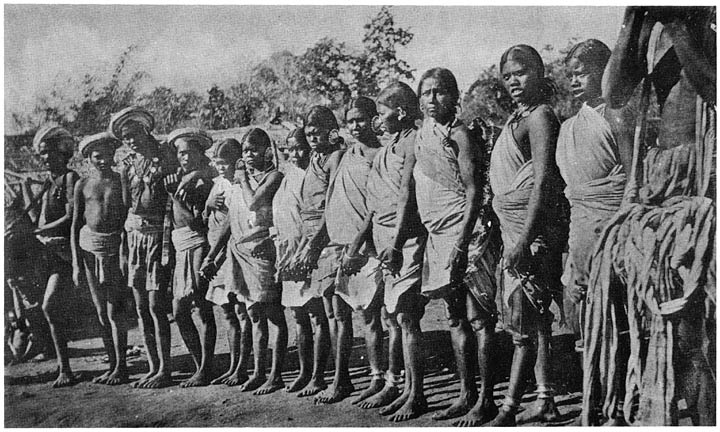
Group of Kol women
11. Divorce and widow-marriage.
Divorce and widow-marriage are permitted. In Raigarh the widow is bound to marry her deceased husband’s younger brother, but not elsewhere. Among these Mundas, if divorce is effected by mutual consent, the husband must give his wife a pair of loin-cloths and provisions for six months. Polygamy is seldom practised, as women can earn their own living, and if a wife is superseded she will often run away home or set up in a house by herself. In Mandla a divorce can be obtained by either party, the person in fault having to pay a fee of Rs. 1–4 to the panchāyat; the woman then breaks her bangles and the divorce is complete.
12. Religion.
that is, they invoke Mother Earth, Thākur Deo, the corn-god, and Bhainsāsur, the buffalo demon, to give them good crops; and as they say this they throw a handful of grain in the air in the name of each god.
13. Witchcraft.
14. Funeral rites.
15. Inheritance.
16. Physical appearance.
“The Mundas,” Colonel Dalton states, “are one of the finest of the aboriginal tribes. The men average something like 5 feet 6 inches, and many of them are remarkably well developed and muscular. Their skin is of the darkest brown, almost black in many cases, and their features coarse, with broad flat noses, low foreheads and thick lips, presenting as a rule a by no means prepossessing appearance. The women are often more pleasing, the coarseness of the features being less accentuated or less noticeable on account of the extreme good-nature and happy carelessness that seldom fail to mark their countenance. They are fond of ornament, and a group of men and girls fully decked out for a festival makes a fine show. Every ornament in the shape of bead necklace, silver collar, bracelet, armlet and anklet would seem to have been brought out for the occasion. The head-dress is the crowning point of the turn-out. The long black hair is gathered up in a big coil, most often artificially enlarged, the whole being fastened at the right-hand side of the back of the head just on a level with and touching the right ear. In this knot are fastened all sorts of ornaments of brass and silver, and surmounting it, stuck in every available space, are gay plumes of feathers that nod and wave bravely with the movements of the dance. The ears are distorted almost beyond recognition by huge earrings that pierce the lobe and smaller ones that ornament them all round.” In Mandla women are tattooed with the figure of a man or a man on horseback, and on the legs behind also with the figure of a man. They are not tattooed on the face. Men are never tattooed.
17. Dances.
“Dancing is the inevitable accompaniment of every gathering, and they have a great variety suitable to the special times and seasons. The motion is slow and graceful, a monotonous sing-song being kept up all through. The steps are in perfect time and the action wonderfully even and regular. This is particularly noticeable in some of the variations of the dances representing the different seasons and the necessary acts of cultivation that each brings with it. In one the dancers bending down make a motion with their hands as though they were sowing the grain, keeping step with their feet all the time. Then come the reaping of the crop and the binding of the sheaves, all done in perfect time and rhythm, and making with the continuous droning of the voices a quaint and picturesque performance.” In the Central Provinces the Kols now dance the Karma dance of the Gonds, but they dance it in more lively fashion. The step consists simply in advancing or withdrawing one foot and bringing the other up or back beside it. The men and women stand opposite each other in two lines, holding hands, and the musicians alternately face each line and advance and retreat with them. Then the lines move round in a circle with the musicians in the centre.
18. Social rules and offences.
Munda boys are allowed to eat food cooked by other castes, except the very lowest, until they are married, and girls until they let their hair grow long, which is usually at the age of six or seven. After this they do not take food as a tribe from any other caste, even a Brāhman, though some subtribes accept it from certain castes as the Telis (oil-pressers) and Sundis or liquor-vendors. In Jubbulpore the Kols take food from Kurmis, Dhīmars and Ahīrs. The Mundas will eat almost all kinds of flesh, including tigers and pigs, while in Raigarh they consider monkey as a delicacy, hunting these animals with dogs. In the Central Provinces they have generally abjured beef, in deference to Hindu prejudice, and sometimes refuse field-mice, to which the Khonds and Gonds are very partial. Neither Kols nor Mundas are, however, considered impure and the barber and washerman will work for them. In Sambalpur a woman is finally expelled from caste for a liaison with one of the impure Gāndas, Ghasias or Doms, and a man is expelled for taking food from a woman of these castes, but adultery with her may be expiated by a big feast. Other offences are much the same as among the Hindus. A woman who gets her ear torn through where it is pierced is put out of caste for six months or a year and has to give two feasts on readmission.
19. The caste panchāyat.
20. Names.
Colonel Dalton notes that the Kols, like the Gonds, give names to their children after officers visiting the village when they are born. Thus Captain, Major, Doctor are common names in the Kolhān. Mr. Mazumdār gives an instance of a Kol servant of the Rāja of Bāmra who greatly admired some English lamp-chimneys sent for by the Rāja and called his daughter ‘Chimney.’ They do not address any relative or caste-man by his name if he is older than themselves, but use the term of relationship to a relative and to others the honorific title of Gaontia.
21. Occupation.
The Mundāri language has no words for the village trades nor for the implements of cultivation, and so it may be concluded that prior to their contact with the Hindus the Mundas lived on the fruits and roots of the forests and the pursuit of game and fish. Now, however, they have taken kindly to several kinds of labour. They are much in request on the Assam tea-gardens owing to their good physique and muscular power, and they make the best bearers of dhoolies or palanquins. Kol bearers will carry a dhoolie four miles an hour as against the best Gond pace of about three, and they shake the occupant less. They also make excellent masons and navvies, and are generally more honest workers than the other jungle tribes. A Munda seldom comes into a criminal court.