Volume 3 / Part 3 — Halwai
Reading edition
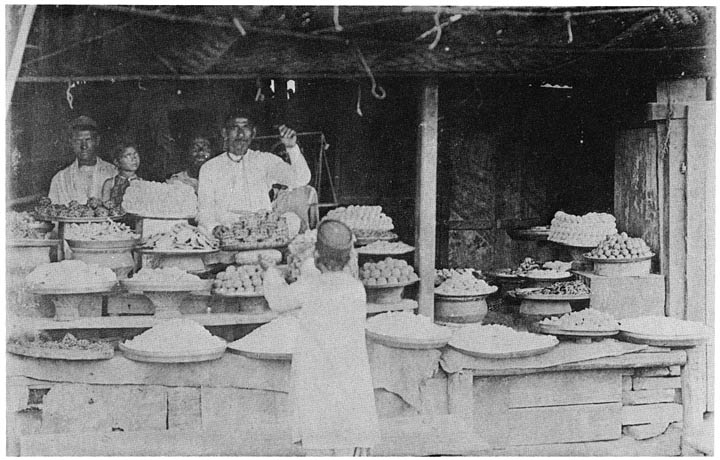
Halwai or confectioner’s shop
The real reason why the Halwai occupies a good position perhaps simply results from the necessity that other castes should be able to take cakes from him. Among the higher castes food cooked with water should not be eaten except at the hearth after this has been specially cleansed and spread with cowdung, and those who are to eat have bathed and otherwise purified themselves. But as the need continuously arises for travellers and others to take a meal abroad where they cannot cook it for themselves, sweetmeats and cakes made without water are permitted to be eaten in this way, and the Halwai, as the purveyor of these, has been given the position of a pure caste from whose hands a Brāhman can take water. In a similar manner, water may be taken from the hands of the Dhīmar who is a household servant, the Kahār or palanquin-bearer, the Barai or betel-leaf seller, and the Bharbhūnja or rice-parcher, although some of these castes have a very low origin and occupy the humble position of menial servants.
The Halwai’s shop is one of the most familiar in an Indian bazār, and in towns a whole row of them may be seen together, this arrangement being doubtless adopted for the social convenience of the caste-fellows, though it might be expected to decrease the custom that they receive. His wares consist of trays full of white and yellow-coloured sweetmeats and cakes of flour and sugar, very unappetising to a European eye, though Hindu boys show no lack of appreciation of them. The Hindus are very fond of sweet things, which is perhaps a common trait of an uneducated palate. Hindu children will say that such sweets as chocolate almonds are too bitter, and their favourite drink, sherbet, is simply a mixture of sugar and water with some flavouring, and seems scarcely calculated to quench the thirst produced by an Indian hot weather. Similarly their tea is so sweetened with sugar and spices as to be distasteful to a European.