Volume 3 / Part 3 — JOGI
Reading edition
[Bibliography: Sir E. Maclagan’s Punjab Census Report (1891); Mr. Crooke’s Tribes and Castes, articles Jogi, Kānphata and Aghorpanthi; Mr. Kitts’ Berār Census Report (1881); Professor Oman’s Mystics, Ascetics and Saints of India (London: T. Fisher Unwin).]
List of Paragraphs
1. The Yoga philosophy. 243
2. Abstraction of the senses or autohypnotism. 244
3. Breathing through either nostril. 246
4. Self-torture of the Jogis. 247
5. Resort to them for oracles. 249
6. Divisions of the order. 250
7. Hair and clothes. 250
8. Burial. 251
9. Festivals. 252
10. Caste subdivisions. 252
11. Begging. 252
12. Other occupations. 253
13. Swindling practices. 253
14. Proverbs about Jogis. 254
1. The Yoga philosophy.
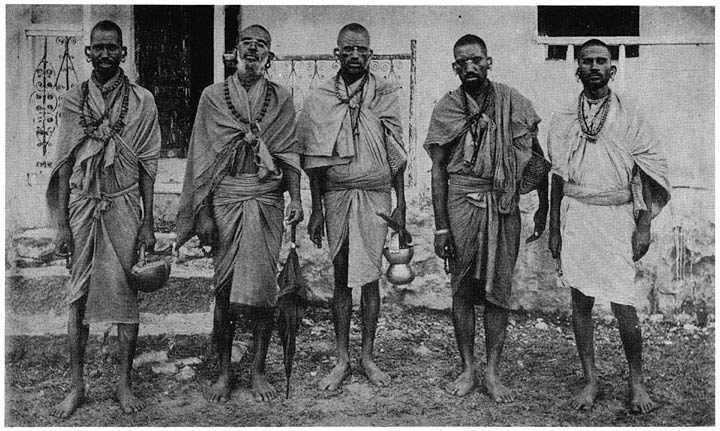
Jogi mendicants of the Kanphata sect
2. Abstraction of the senses or autohypnotism.
“Place the left foot upon the right thigh, and the right foot upon the left thigh; hold with the right hand the right great toe and with the left hand the left great toe (the hands coming from behind the back and crossing each other); rest the chin on the interclavicular space, and fix the sight on the tip of the nose.
“Inspire through the left nostril, fill the stomach with the inspired air by the act of deglutition, suspend the breath, and expire through the right nostril. Next inspire through the right nostril, swallow the inspired air, suspend the breath, and finally expire through the left nostril.
“Be seated in a tranquil posture, and fix your sight on the tip of the nose for the space of ten minutes.
“Close the ears with the middle fingers, incline the head a little to the right side and listen with each ear attentively to the sound produced by the other ear, for the space of ten minutes.
“Pronounce inaudibly twelve thousand times the mystic syllable Om, and meditate upon it daily after deep inspirations.
“After a few forcible inspirations swallow the tongue, and thereby suspend the breath and deglutate the saliva for two hours.
“Listen to the sounds within the right ear abstractedly for two hours, with the left ear.
“Repeat the mystic syllable Om 20,736,000 times in silence and meditate upon it.
“Suspend the respiratory movements for the period of twelve days, and you will be in a state of Samādhi.”
3. Breathing through either nostril.
It is clear that the effect of some of the above practices is designed to produce a state of mind resembling the hypnotic trance. The Yogis attach much importance to the effect of breathing through one or the other nostril, and this is also the case with Hindus generally, as various rules concerning it are prescribed for the daily prayers of Brāhmans. To have both nostrils free and be breathing through them at the same time is not good, and one should not begin any business in this condition. If one is breathing only through the right nostril and the left is closed, the condition is propitious for the following actions: To eat and drink, as digestion will be quick; to fight; to bathe; to study and read; to ride on a horse; to work at one’s livelihood. A sick man should take medicine when he is breathing through his right nostril. To be breathing only through the left nostril is propitious for the following undertakings: To lay the foundations of a house and to take up residence in a new house; to put on new clothes; to sow seed; to do service or found a village; to make any purchase. The Jogis practise the art of breathing in this manner by stopping up their right and left nostril alternately with cotton-wool and breathing only through the other. If a man comes to a Brāhman to ask him whether some business or undertaking will succeed, the Brāhman breathes through his nostrils on to his hand; if the breath comes through the right nostril the omen is favourable and the answer yes; if through the left nostril the omen is unfavourable and the answer no.
4. Self-torture of the Jogis.
“I have often met, generally in the territory of some Rāja, bands of these naked Fakīrs, hideous to behold. Some have their arms lifted up in the manner just described; the frightful hair of others either hung loosely or was tied and twisted round their heads; some carried a club like the Hercules, others had a dry and rough tiger-skin thrown over their shoulders. In this trim I have seen them shamelessly walk stark naked through a large town, men, women, and girls looking at them without any more emotion than may be created when a hermit passes through our streets. Females would often bring them alms with much devotion, doubtless believing that they were holy personages, more chaste and discreet than other men.
“Several of these Fakīrs undertake long pilgrimages not only naked but laden with heavy iron chains, such as are put about the legs of elephants. I have seen others who, in consequence of a particular vow, stood upright during seven or eight days without once sitting or lying down, and without any other support than might be afforded by leaning forward against a cord for a few hours in the night; their legs in the meantime were swollen to the size of their thighs. Others, again, I have observed standing steadily, whole hours together, upon their hands, the head down and the feet in the air. I might proceed to enumerate various other positions in which these unhappy men place their body, many of them so difficult and painful that they could not be imitated by our tumblers; and all this, let it be recollected is performed from an assumed feeling of piety, of which there is not so much as the shadow in any part of the Indies.”
5. Resort to them for oracles.
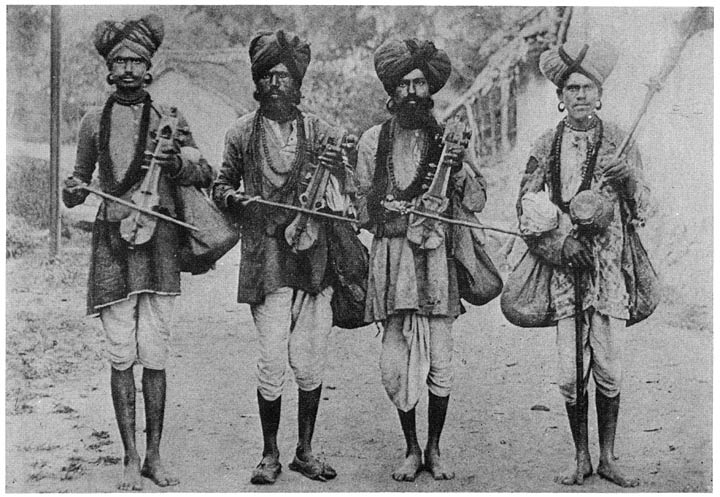
Jogi musicians with sārangi or fiddle
6. Divisions of the order.
7. Hair and clothes.
8. Burial.
The Jogis are buried sitting cross-legged with the face to the north in a tomb which has a recess like those of Muhammadans. A gourd full of milk and some bread in a wallet, a crutch and one or two earthen vessels are placed in the grave for the sustenance of the soul. Salt is put on the body and a ball of wheat-flour is laid on the breast of the corpse and then deposited on the top of the grave.
9. Festivals.
The Jogis worship Siva, and their principal festival is the Shivrātri, when they stay awake all night and sing songs in honour of Gorakhnāth, the founder of their order. On the Nāg-Panchmi day they venerate the cobra and they take about snakes and exhibit them.
10. Caste subdivisions.
A large proportion of the Jogis have now developed into a caste, and these marry and have families. They are divided into subcastes according to the different professions they have adopted. Thus the Barwa or Gārpagāri Jogis ward off hailstorms from the standing crops; the Manihāri are pedlars and travel about to bazārs selling various small articles; the Rītha Bikanāth prepare and sell soap-nut for washing clothes; the Patbina make hempen thread and gunny-bags for carrying grain on bullocks; and the Ladaimār hunt jackals and sell and eat their flesh. These Jogis rank as a low Hindu caste of the menial group. No good Hindu caste will take food or water from them, while they will accept cooked food from members of any caste of respectable position, as Kurmis, Kunbis or Mālis. A person belonging to any such caste can also be admitted into the Jogi community. Their social customs resemble those of the cultivating castes of the locality. They permit widow-marriage and divorce and employ Brāhmans for their ceremonies, with the exception of the Kanphatas, who have priests of their own order.
11. Begging.
12. Other occupations.
Many Jogis have also adopted secular occupations, as has already been seen. Of these the principal are the Manihāri Jogis or pedlars, who retail small hand-mirrors, spangles, dyeing-powders, coral beads and imitation jewellery, pens, pencils, and other small articles of stationery. They also bring pearls and coral from Bombay and sell them in the villages. The Gārpagāris, who protect the crops from hailstorms, have now become a distinct caste and are the subject of a separate article. Others make a living by juggling and conjuring, and in Saugor some Jogis perform the three-card trick in the village markets, employing a confederate who advises customers to pick out the wrong card. They also play the English game of Sandown, which is known as ‘Animur,’ from the practice of calling out ‘Any more’ as a warning to backers to place their money on the board before beginning to turn the fish.