Volume 3 / Part 3 — JOSHI
Reading edition
List of Paragraphs
1. The village priest and astrologer. 255
2. The apparent path of the sun. The ecliptic or zodiac. 257
3. Inclination of the ecliptic to the equator. 259
4. The orbits of the moon and planets. 259
5. The signs of the zodiac. 260
6. The Sankrānts. 261
7. The nakshatras or constellations of the moon’s path. 261
8. The revolution of the moon. 263
9. The days of the week. 264
10. The lunar year. 266
11. Intercalary months. 266
12. Superstitions about numbers. 267
13. The Hindu months. 268
14. The solar nakshatras. 270
15. Lunar fortnights and days. 270
16. Divisions of the day. 271
17. The Joshi’s calculations. 272
18. Personal names. 273
19. Terminations of names. 277
20. Women’s names. 277
21. Special names and bad names. 278
1. The village priest and astrologer.
2. The apparent path of the sun. The ecliptic or zodiac.
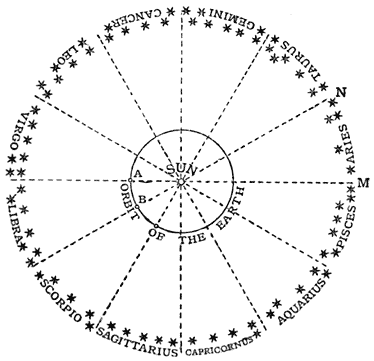
Fig. 1.—The Orbit of the Earth and the Zodiac.
Thus when the earth is at A in its orbit the sun will appear to be at M, and as the earth travels from A to B the sun will appear to move from M to N on the line of the ecliptic. It will be seen that as the earth in a year makes a complete circuit round the sun, the sun will appear to have made a complete circuit among the stars, and have come back to its original position. This apparent movement is annual, and has nothing to do with the sun’s apparent diurnal course over the sky, which is caused by the earth’s daily rotation on its axis. The sun’s annual path among the stars naturally cannot be observed during the day. Professor Newcomb says: “But the fact of the motion will be made very clear if, day after day, we watch some particular fixed star in the west. We shall find that it sets earlier and earlier every day; in other words, it is getting continually nearer and nearer the sun. More exactly, since the real direction of the star is unchanged, the sun seems to be approaching the star.
“If we could see the stars in the daytime all round the sun, the case would be yet clearer. We should see that if the sun and a star were together in the morning, the sun would, during the day, gradually work past the star in an easterly direction. Between the rising and setting it would move nearly its own diameter, relative to the star. Next morning we should see that it had got quite away from the star, being nearly two diameters distant from it. This motion would continue month after month. At the end of the year the sun would have made a complete circuit relative to the star, and we should see the two once more together. This apparent motion of the sun in one year round the celestial sphere was noticed by the ancients, who took much trouble to map it out. They imagined a line passing round the celestial sphere, which the sun always followed in its annual course, and which was called the ecliptic. They noticed that the planets followed nearly the same course as the sun among the stars. A belt extending on each side of the ecliptic, and broad enough to contain all the known planets, as well as the sun, was called the zodiac. It was divided into twelve signs, each marked by a constellation. The sun went through each sign in a month, and through all twelve signs in a year. Thus arose the familiar signs of the zodiac, which bore the same names as the constellations among which they are situated. This is not the case at present, owing to the precession of the equinoxes.” It was by observing the paths of the sun and moon round the celestial sphere along the zodiac that the ancients came to be able to measure the solar and lunar months and years.
3. Inclination of the ecliptic to the equator.
As is well known, the celestial sphere is imagined to be spanned by an imaginary line called the celestial equator, which is in the same plane as the earth’s equator, and as it were, a vast concentric circle. The points in the celestial sphere opposite the north and south terrestrial poles are called the north and south celestial poles, and the celestial equator is midway between these. Owing to the special form of the earth the north celestial pole is visible to us in the northern hemisphere, and marked very nearly by the pole-star, its height above the horizon being equal to the latitude of the place where the observer stands. Owing to the daily rotation of the earth the whole celestial sphere seems to revolve daily on the axis of the north and south celestial poles, carrying the sun, moon and stars with it. To this the apparent daily course of the sun and moon is due. Their course seems to us oblique, as we are north of the equator.
If the earth’s axis were set vertically to the plane of its orbit round the sun, then it would follow that the plane of the equator would pass through the centre of the sun, and that the line drawn by the sun in its apparent revolution against the background of the celestial sphere would be in the same plane. That is, the sun would seem to move round a circle in the heavens in the same plane as the earth’s equator, or round the celestial equator. But the earth’s axis is inclined at 23½° to the plane of its orbit, and therefore the apparent path traced by the sun in the celestial sphere, which is the same path as the earth would really follow to an observer on the surface of the sun, is inclined at 23½° to the celestial equator. This is the ecliptic, and is really the line of the plane of the earth’s orbit extended to cut the celestial sphere.
4. The orbits of the moon and planets.
All the planets move round the sun in orbits whose planes are slightly inclined to that of the earth, the plane of Mercury having the greatest inclination of 6°. The plane of the moon’s orbit round the earth is also inclined at 5° 9′ to the ecliptic. The orbits of the moon and all the planets must necessarily intersect the plane of the earth’s orbit on the ecliptic at two points, and these are called the nodes of the moon and each planet respectively. In consequence of the inclination being so slight, though the course of the moon and planets is not actually on the ecliptic, they are all so close to it that they are included in the belt of the zodiac. Thus the moon and all the planets follow almost the same apparent course on the zodiac or belt round the ecliptic in the changes of position resulting from their own and the earth’s orbital movements with reference to what are called the fixed stars.
5. The signs of the zodiac.
As the sun completes his circuit of the ecliptic or zodiac in the course of a year, it followed that if his course could be measured and divided into periods, these periods would form divisions of time for the year. This was what the ancients did, and it is probable that the measurement and division of time was the primary object of the science of astronomy, as apart from the natural curiosity to ascertain the movements of the sun, moon and planets, when they were looked upon as divine beings controlling the world. They divided the zodiac or the path of the sun into twelve parts, and gave to each part the name of the principal constellation situated on, or adjacent to, that section of the line of the ecliptic. When they had done this and observed the dates of the sun’s entry into each sign or rāshi, as it is called in Hindi, they had divided the year into twelve solar months. The following are the Hindu names and meanings of the signs of the zodiac:
1. Aries. The ram. Mesha.
2. Taurus. The bull. Vrisha.
3. Gemini. The twins. Mithuna.
4. Cancer. The crab. Karkati.
5. Leo. The lion. Sinha.
6. Virgo. The virgin. Kanya.
7. Libra. The balance. Tūla.
8. Scorpio. The scorpion. Vrischika.
9. Sagittarius. The archer. Dhanus or Chapa.
10. Capricornus. The goat. Makara (said to mean a sea-monster).
11. Aquarius. The water-bearer. Kūmbha (a water-pot).
12. Pisces. The fishes. Mina.
The signs of the zodiac were nearly the same among the Greeks, Egyptians, Persians, Babylonians and Indians. They are supposed to have originated in Chaldea or Babylonia, and the fact that the constellations are indicated by nearly the same symbols renders their common origin probable. It seems likely that the existing Hindu zodiac may have been adopted from the Greeks.
6. The Sankrānts.
7. The nakshatras or constellations of the moon’s path.
Nakshatra. Constellation. Object. Corresponding zodiacal sign.
1. Aswini. β and γ Arietis. A horse’s head. Aries.
2. Bharani. 35, 39 and 41 Arietis. Pudendum muliebre. Aries.
3. Krittika. Pleiades. A knife. Part of Taurus.
4. Rohini. α, γ, δ, ε, θ Tauri (Aldebaran). A wheeled carriage or a temple. Taurus.
5. Mrigasiras. λ, φ1, φ2, Orionis (Orion’s head). A deer’s head.
6. Ardra. Betelgeux or α Orionis (one of Orion’s arms). A gem.
7. Punarvasu. Gemini or Castor and Pollux. A house. Gemini.
8. Pushya. γ, δ and θ Cancri. An arrow. Cancer.
9. Aslesha. δ, ε, η, ρ and σ Hydrae. A wheel.
10. Magha. α, γ, ε, ζ, η and μ Leonis. A house. Leo.
11. Pūrva Phālguni. δ and θ Leonis. A couch. Leo.
12. Uttara Phālguni. β and 93 Leonis. A bed. Leo.
13. Hasta. α, β, γ, δ and ε Corvi. A hand.
14. Chitra. Spica (α Virginis). A pearl. Virgo.
15. Swāti. Arcturus (α Boötis). A coral bead.
16. Visacha. α, β, γ and ι Librae. A garland. Libra.
17. Anurādha. β, δ and π Scorpionis. A sacrifice or offering. Scorpio.
18. Jyestha. α, σ and τ Scorpionis. An earring. Scorpio.
19. Mula. ε, ζ, η, θ, ι, κ, λ, μ, υ Scorpionis. A lion’s tail. Scorpio.
20. Pūrva Ashādha. δ and ε Sagittarii. A couch or an elephant’s tusk. Sagittarius.
21. Uttara Ashādha. ζ and σ Sagittarii. An elephant’s tusk or the singāra nut. Sagittarius.
22. Sravana. α, β and γ Aquilae. The footprint of Vishnu.
23. Dhanishtha. α, β, γ and δ Delphinis. A drum.
24. Sata-bhishaj. λ Aquarii. A circular jewel or a circle. Aquarius.
25. Pūrva Bhadrapada. α and β Pegasi. A two-faced image.
26. Uttara Bhadrapada. γ Pegasi and α Andromedae. A two-faced image or a couch.
27. Revati. ζ Piscium. A tabor. Pisces.
8. The revolution of the moon.
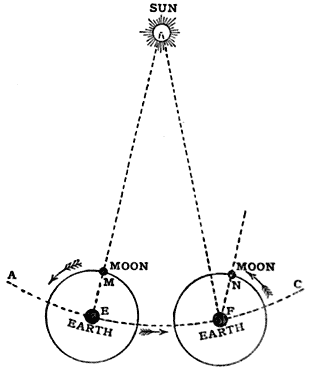
Fig. 2.—Revolution of the Moon round the Earth.
9. The days of the week.
Etwār or Raviwār. Sunday. (Ravi—the sun.)
Somwār. Monday. (Soma—the moon.)
Mangalwār. Tuesday. (Mangal or Bhauma—Mars.)
Budhwār. Wednesday. (Buddha—Mercury.)
Brihaspatwār or Guru. Thursday. (Brihaspat or Guru—Jupiter.)
Shukurwār. Friday. (Shukra—Venus.)
Saniwār or Sanīchara. Saturday. (Sani—Saturn.)
10. The lunar year.
Four seven-day weeks were within a day and a fraction of the lunar month, which was the nearest that could be got. The first method of measuring the year would be by twelve lunar months, which would bring it back nearly to the same period. But as the lunar month is 29 days 13 hours, twelve months would be 354 days 12 hours, or nearly eleven days less than the tropical solar year. Hence if the lunar year was retained the months would move back round the year by about eleven days annually. This is what actually happens in the Muhammadan calendar where the twelve lunar months have been retained and the Muharram and other festivals come earlier every year by about eleven days.
11. Intercalary months.
This method of adjusting the solar and lunar years, though clumsy, is so far scientific that the solar and lunar years are made to agree without any artificial intercalation of days. It has, however, the great disadvantages of the frequent intercalary month, and also of the fact that the lunar months begin on different dates in the English solar calendar, varying by nearly twenty days.
12. Superstitions about numbers.
It seems not improbable that the unlucky character of the number thirteen may have arisen from its being the number of the intercalary month. Though the special superstition against sitting down thirteen to a meal is, no doubt, associated particularly with the Last Supper, the number is generally unlucky as a date and in other connections. And this is not only the case in Europe, but the Hindus, Persians and Pārsis also consider thirteen an unlucky number; and the Muhammadans account for a similar superstition by saying that Muhammad was ill for the first thirteen days of the month Safar. Twelve, as being the number of the months in the lunar and solar years, is an auspicious number; thirteen would be one extra, and as being the intercalary month would be here this year and missing next year. Hence it might be supposed that one of thirteen persons met together would be gone at their next meeting like the month. Similarly, the auspicious character of the number seven may be due to its being the total of the sun, moon and five planets, and of the days of the week named after them. And the number three may have been invested with mystic significance as representing the sun, moon and earth. In the Hindu Trinity Vishnu and Siva are the sun and moon, and Brahma, who created the earth, and has since remained quiescent, may have been the personified representative of the earth itself.
13. The Hindu months.
The names of the Hindu months were selected from among those of the nakshatras, every second or third being taken and the most important constellations apparently chosen. The following statement shows the current names for the months, the nakshatras from which they are derived, and the constellations they represent:
Month. Nakshatra. Constellation.
1. Chait. Chitra. Virgo.
2. Baisākh. Visacha. Libra.
3. Jeth. Jyestha. Scorpio.
4. Asārh. Pūrva Ashādha. Sagittarius.


Uttara Ashādha.
5. Shrāwan. Sravana. Aquila.
6. Bhādon. Pūrva (E) Bhadrapada. Pegasus.
Uttara (N) Bhadrapada.
7. Kunwār or Aswīn. Aswini. Aries.
8. Kārtik. Krittika. Pleiades (Part of Taurus).
9. Aghan or Mārgashīr. Mrigasiras. Orion.
10. Pūs. Pushya. Cancer.
11. Māgh. Magha. Leo.
12. Phāgun. Pūrva (E) Phālguni. Leo.
Uttara (N) Phālguni.
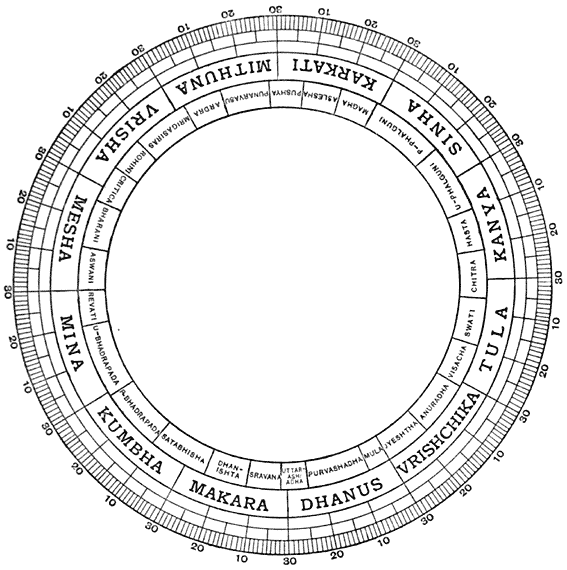
Fig. 3.—The Hindu Ecliptic showing the relative position of Zodiacal Signs and Nakshatras.
Consequently, the full moon, being nearly opposite the sun on the ecliptic, would be in the sign Chitra or near it. In southern India the months begin with the full moon, but in northern India with the new moon; it seems possible that the months were called after the nakshatra, of the full moon to distinguish them from the solar months which would be called after the sign of the zodiac in which the sun was. But no authoritative explanation seems to be available. Similarly, the nakshatras after which the other months are named, fall nearly opposite to them at the new moon, while the full moon would be in or near them.
14. The solar nakshatras.
The periods during which the sun passes through each nakshatra are also recorded, and they are of course constant in date like the solar months. As there are twenty-seven nakshatras, the average time spent by the sun in each is about 13½ days. These periods are well known to the people as they have the advantage of not varying in date like the lunar months, while over most of India the solar months are not used. The commencement of the various agricultural operations is dated by the solar nakshatras, and there are several proverbs about them in connection with the crops. The following are some examples: “If it does not rain in Pushya and Punarvasu Nakshatras the children of Nimār will go without food.” ‘Rain in Magha Nakshatra (end of August) is like food given by a mother,’ because it is so beneficial. “If there is no wind in Mrigasiras (beginning of June), and no heat in Rohini (end of May), sell your plough-cattle and go and look for work.” ‘If it rains during Uttara (end of September) dogs will turn up their noses at grain,’ because the harvest will be so abundant. “If it rains during Aslesha (first half of August) the wheat-stalks will be as stout as drum-sticks” (because the land will be well ploughed). ‘If rain falls in Chitra or Swāti Nakshatras (October) there won’t be enough cotton for lamp-wicks.’
15. Lunar fortnights and days.
The lunar month was divided into two fortnights called paksha or wing. The period of the waxing moon was known as sukla or sudi paksha, that is the light fortnight, and that of the waning moon as krishna or budi paksha, that is the dark fortnight.
16. Divisions of the day.
The day is divided for ordinary purposes of measuring time into eight pahars or watches, four of the day and four of the night; and into sixty gharis or periods of twenty-four minutes each. The pahars, however, are not of equal length. At the equinox the first and fourth pahar of the day and night each contain eight gharis, and the two middle ones seven gharis. In summer the first and fourth pahars of the day contain nine gharis each, and the two middle ones eight each, while the first and fourth pahars of the night contain seven and the two middle ones six each. Thus in summer the four day pahars contain 13 hours 36 minutes and the night ones 10 hours 24 minutes. And in winter the exact opposite is the case, the night pahars being lengthened and the day ones shortened in precisely the same manner. No more unsatisfactory measure of time could well be devised. The termination of the second watch or do pahar always corresponds with midday and midnight respectively.
17. The Joshi’s calculations.
18. Personal names.
The Joshi names children according to the moon’s daily nakshatra under which they were born, each nakshatra having a letter or certain syllables allotted to it with which the name must begin. Thus Magha has the syllables Ma, Mi, Mu and Me, with which the name should begin, as Mansāram, Mithu Lāl, Mukund Singh, Meghnāth; Purwa Phālguni has Mo and Te, as Moji Lāl and Tegi Lāl; Punarvasu has Ke, Ko, Ha and Hi, as Kesho Rao, Koshal Prasād, Hardyāl and Hīra Lāl, and so on. The primitive idea connecting a name with the thing or person to which it belongs is that the name is actually a concrete part of the person or object, containing part of his life, just as the hair, nails and all the body are believed to contain part of the life, which is not at first localised in any part of the body nor conceived of as separate from it. The primitive mind could conceive no abstract idea, that is nothing that could not be seen or heard, and it could not think of a name as an abstract appellation. The name was thought of as part of that to which it was applied. Thus, if one knew a man’s name, it was thought that one could use it to injure him, just as if one had a piece of his hair or nails he could be injured through them because they all contained part of his life; and if a part of the life was injured or destroyed the remainder would also suffer injury, just as the whole body might perish if a limb was cut off. For this reason savages often conceal their real names, so as to prevent an enemy from obtaining power to injure them through its knowledge. By a development of the same belief it was thought that the names of gods and saints contained part of the divine life and potency of the god or saint to whom they were applied. And even separated from the original owner the name retained that virtue which it had acquired in association; hence the power assigned to the names of gods and superhuman beings when used in spells and incantations. Similarly, if the name of a god or saint was given to a child it was thought that some part of the nature and virtue of the god might be conferred on the child. Thus Hindu children are most commonly named after gods and goddesses under the influence of this idea; and though the belief may now have decayed the practice continues. Similarly the common Muhammadan names are epithets of Allah or god or of the Prophet and his relations. Jewish children are named after the Jewish patriarchs. In European countries the most common male names are those of the Apostles, as John, Peter, James, Paul, Simon, Andrew and Thomas; and the names of the Evangelists were, until recently, also given. The most common girl’s name in several European countries is Mary, and a generation or two ago other Biblical names, as Sarah, Hannah, Ruth, Rachel, and so on, were very usually given to girls. In England the names next in favour for boys and girls are those of kings and queens, and the same idea perhaps originally underlay the application of these names. The following are some of the best-known Hindu names, taken from those of gods:—
Names of Vishnu.
Nārāyan. Probably ‘The abode of mortals,’ or else ‘He who dwelt on the waters (before creation)’; now applied to the sun.
Wāman. The dwarf, one of Vishnu’s incarnations.
Janārdan. Said to mean protector of the people.
Narsingh. The man-lion, one of Vishnu’s incarnations.
Hari. Yellow or gold-colour or green. Perhaps applied to the sun.
Parashrām. From Parasurāma or Rāma with the axe, one of the incarnations of Vishnu.
Gadadhar. Wielder of the club or gada.
Jagannāth. Lord of the world.
Dīnkar. The sun, or he who makes the days (dīn karna).
Bhagwān. The fortunate or illustrious.
Anant. The infinite or eternal.
Madhosūdan. Destroyer of the demon Madho (Madho means honey or wine).
Pāndurang. Yellow-coloured.
Names of Rāma, or Vishnu’s Great Incarnation as King Rāma of Ayodhia.
Rāmchandra, the moon of Rāma, and Rāmbaksh, the gift of Rāma, are the commonest Hindu male names.
Atmārām. Soul of Rāma.
Sitārām. Rāma and Sita his wife.
Rāmcharan. The footprint of Rāma.
Sakhārām. The friend of Rāma.
Sewārām. Servant of Rāma.
Names of Krishna.
Krishna and its diminutive Kishen are very common names.
Kanhaiya. A synonym for Krishna.
Dāmodar. Because his mother tied him with a rope to a large tree to keep him quiet and he pulled up the tree, roots and all.
Bālkishen. The boy Krishna.
Ghansiām. The dark-coloured or black one (like dark clouds); probably referring to the belief that Krishna belonged to the non-Aryan races.
Madan Mohan. The enchanter of love.
Manohar. The heart-stealer.
Yeshwant. The glorious.
Kesho. Having long, fine hair. A name of Krishna. Also the destroyer of the demon Keshi, who was covered with hair. It would appear that the epithet was first applied to Krishna himself and afterwards to a demon whom he was supposed to have destroyed.
Balwant. Strong. An epithet of Krishna, used in conjunction with other names.
Mādhava. Honey-sweet or belonging to the spring, vernal.
Girdhāri. He who held up the mountain. Krishna held up the mountain Govardhan, balancing the peak on his finger to protect the people from the destructive rains sent by Indra.
Shiāmsundar. The dark and beautiful one.
Nandkishore, Nandkumār. Child of Nand the cowherd, Krishna’s foster-father.
Names of Siva.
Sadāsheo. Siva the everlasting.
Mahādeo. The great god.
Trimbak. The three-eyed one (?).
Gangādhar. The holder of the Ganges, because it flows from Siva’s hair.
Kāshināth. The lord of Benāres.
Kedārnāth. The lord of cedars (referring to the pine-forests of the Himālayas).
Nīlkanth. The blue-jay sacred to Siva. Name of Siva because his throat is bluish-black either from swallowing poison at the time of the churning of the ocean or from drinking large quantities of bhāng.
Shankar. He who gives happiness.
Vishwanāth. Lord of the universe.
Sheo Prasād. Gift of Siva.
Names of Ganpati or Ganesh.
Ganpati is itself a very common name.
Vidhyādhar. The lord of learning.
Vināyak. The remover of difficulties.
Ganesh Prasād. Gift of Ganesh. A child born on the fourth day of any month will often be given this name, as Ganesh was born on the 4th Bhādon (August).
Names of Hanumān.
Hanumān itself is a very common name.
Māroti, son of Mārut the god of the wind.
Mahāvīra or Mahābīr. The strong one.
Other common sacred names are: Amrit, the divine nectar, and Moreshwar, lord of the peacock, perhaps an epithet of the god Kartikeya. Men are also often named after jewels, as: Hīra Lāl, diamond; Panna Lāl, emerald; Ratan Lāl, a jewel; Kundan Lāl, fine gold. A child born on the day of full moon may be called Pūran Chand, which means full moon. There are of course many other male names, but those here given are the commonest. Children are also frequently named after the day or month in which they were born.
19. Terminations of names.
Common terminations of male names are: Charan, footprint; Dās, slave; Prasād, food offered to a god; Lāl, dear; Datta, gift, commonly used by Maithil Brāhmans; Dīn or Baksh, which also means gift; Nāth, lord of; and Dulāre, dear to. These are combined with the names of gods, as: Kālicharan, footprint of Kāli; Rām Prasād or Kishen Prasād, an offering to Rāma or Krishna; Bishen Lāl, dear to Vishnu; Ganesh Datta, a gift from Ganesh; Ganga Dīn, a gift from the Ganges; Sheo Dulāre, dear to Siva; Vishwanāth, lord of the universe. Boys are sometimes given the names of goddesses with such terminations, as Lachmi or Jānki Prasād, an offering to these goddesses. A child born on the 8th of light Chait (April) will be called Durga Prasād, as this day is sacred to the goddess Durga or Devi.
20. Women’s names.
Women are also frequently named after goddesses, as: Pārvati, the consort of Siva; Sīta, the wife of Rāma; Jānki, apparently another name for Sīta; Lakshmi, the consort of Vishnu, and the goddess of wealth; Sāraswati, the goddess of wisdom; Rādha, the beloved of Krishna; Dasoda, the foster-mother of Krishna; Dewāki, who is supposed to have been the real mother of Krishna; Durga, another name for Siva’s consort; Devi, the same as Durga and the earth-goddess; Rukhmini, the bright or shining one, a consort of Vishnu; and Tulsi, the basil-plant, sacred to Vishnu.
Women are also named after the sacred rivers, as: Ganga, Jamni or Yamuni (Jumna); Gomti, the river on which Lucknow stands; Godha or Gautam, after the Godāvari river; and Bhāgirathi, another name for the Ganges. The river Nerbudda is commonly found as a man’s name, especially in places situated on its banks. Other names of women are: Sona, gold; Puna, born at the full moon; Manohra, enchanting; Kamala, the lotus; Indumati, a moonlight night; Sumati, well-minded; Sushila, well-intentioned; Srimati, wealthy; Amrita, nectar; Phulwa, a flower; Imlia, the tamarind; Malta, jasmine; and so on.
If a girl is born after four sons she will be called Pancho or fifth, and one born in the unlucky Mul Nakshatra is called Mulia. When a girl is married and goes to her husband’s house her name is always changed there. If two girls have been married into the household, they may be called Bari Bohu and Choti Bohu, or the elder and younger daughters-in-law; or a girl may be called after the place from which she comes, as Jabalpurwāli, Raipurwāli, and so on.