← Table of contents
The Tribes and Castes of the Central Provinces of India, Volume 3

Volume 3 / Part 3 — GŪJAR

Reading edition

List of Paragraphs

1. Historical notice of the caste. 166

2. The Gūjars and the Khazars. 168

3. Predatory character of the Gūjars in northern India. 169

4. Subdivisions. 171

5. Marriage. 172

6. Disposal of the dead. 172

7. Religion. 173

8. Character. 174

1. Historical notice of the caste.
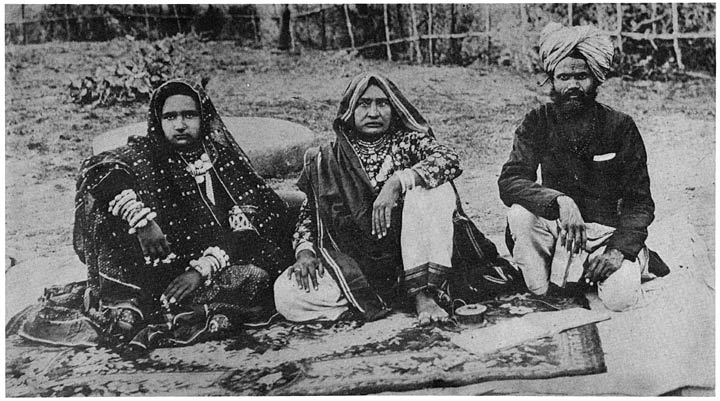
Gūjar village proprietress and her land agent

Gūjar village proprietress and her land agent

2. The Gūjars and the Khazars.

3. Predatory character of the Gūjars in northern India.

Ahīr, Gadaria, Gūjar,

E tinon tâken ujar,

4. Subdivisions.

5. Marriage.

6. Disposal of the dead.

The bodies of unmarried persons are buried, and also of those who die of any epidemic disease. Others are cremated. The funeral of an elderly man of good means and family is an occasion for great display. A large feast is given and the Brāhman priests of the caste go about inviting all the Gūjars to attend. Sometimes the number of guests rises to three or four thousand. At the conclusion of the feast one of the hosts claps his hands and all the guests then get up and immediately depart without ceremony or saying farewell. Such an occasion is known as Gūjarwāda, and the Gūjars often spend as much, or more, on a funeral as on a wedding, in the belief that the outlay is of direct benefit to the dead man’s spirit. This idea is inculcated and diligently fostered by the family priests and those Brāhmans who receive gifts for the use of the dead, the greed of these cormorants being insatiable.

7. Religion.

8. Character.

Notes in this chapter

Note 1 · Early History of India, 3rd ed. pp. 409, 411.Note 2 · Mr. Smith ascribes this discovery to Messrs. A. M. T. Jackson (Bombay Gazetteer, vol. i. Part I., 1896, p. 467); D. R. Bhandārkar, Gurjaras Note 3 · Bombay Gazetteer, Hindus of Gujarāt, Appendix B, The Gūjars.Note 4 · The Khazars were known to the Chinese as Yetas, the beginning of Yeta-i-li-to, the name of their ruling family, and the nations of the west Note 5 · See article on Panwār Rājpūt, para. 1.Note 6 · Campbell, loc. cit. p. 495.Note 7 · Tribes and Castes, article Gūjar, para. 12. The description is mainly taken from Elliott’s History of India as told by its own Historians.Note 8 · Description of the Kāngra Gūjars by Mr. Barnes. Quoted in Ibbetson’s Punjab Census Report (1881), para. 481.Note 9 · Census Report, para. 481.Note 10 · Cf. Krishna’s epithet of Murlidhar or the flute-player, and the general association of the flute with herdsmen and shepherds in Greek and RoNote 11 · Ibidem.Note 12 · Hoshangābād Settlement Report, para. 16.Note 13 · Nimār Settlement Report (1868).Note 14 · Gūjar.—A great historical caste who have given their name to the Gujarāt District and the town of Gujarānwāla in the Punjab, the peninsula oNote 15 · Sir J. Campbell identified the Gūjars with the Khazar tribe of Central Asia:3 “What is known of the early history of the Gujaras in India poNote 16 · “Admitting that the Khazar and White Hūna are one, it must also be the case that the Khazars included two distinct elements, a fair or Ak-KhNote 17 · The fact of the White Huns being tall and of fine features, in contrast to the horde which invaded Europe under Attila, accounts for these cNote 18 · or, ‘The Ahīr, Gadaria and Gūjar want waste land’; that is for grazing their flocks. In Kāngra the Gūjars generally keep buffaloes. Here theNote 19 · The Gūjars of the Central Provinces have, however, entirely given up the predatory habits of their brethren in northern India and have develNote 20 · At a Gūjar wedding four plough-yokes are laid out to form a square under the marriage booth, with a copper pot full of water in the centre. Note 21 · The household goddess of the caste is known as Kul Devi, the word kul meaning family. To her a platform is erected inside the house, and sheNote 22 · The Gūjars wear the dress of northern India and their women usually have skirts (lahenga) and not sāris or body-cloths. Married women have a
Explore with AITake your curiosity a little further.

Reading settings