Volume 3 / Part 3 — KASBI
Reading edition
List of Paragraphs
1. General notice. 373
2. Girls dedicated to temples. 374
3. Music and dancing. 376
4. Education of courtesans. 377
5. Caste customs. 380
6. First pregnancy. 381
7. Different classes of women. 381
8. Dancing and singing. 383
1. General notice.
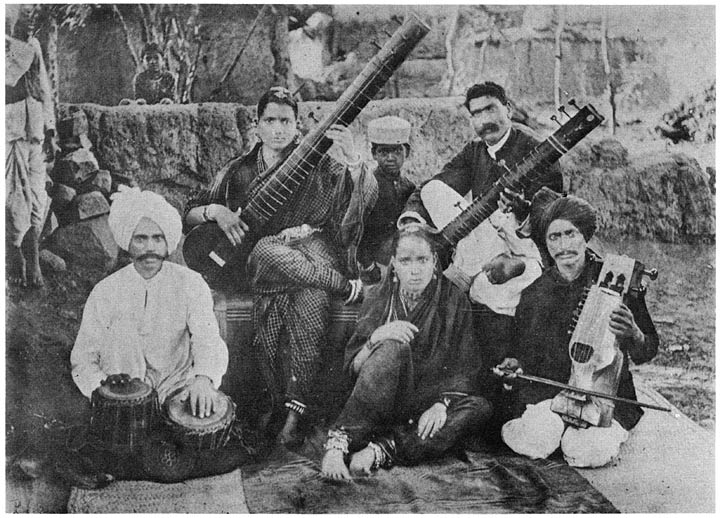
Dancing girls and musicians
2. Girls dedicated to temples.
3. Music and dancing.
4. Education of courtesans.
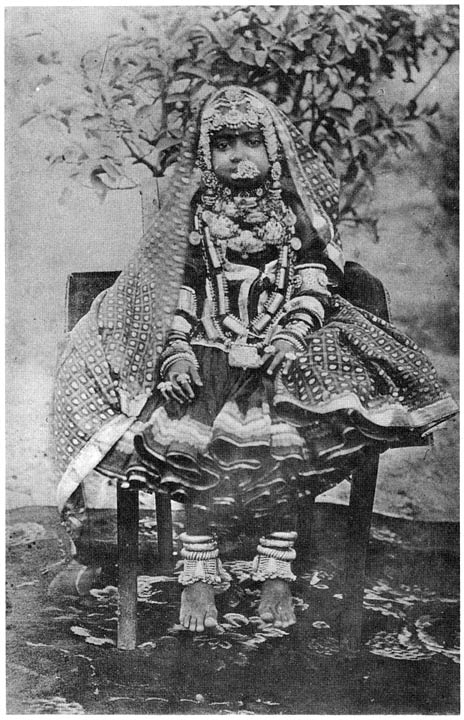
Girl in full dress and ornaments
5. Caste customs.
6. First pregnancy.
In the fifth or seventh month of the first pregnancy of a Kasbi woman 108 fried wafers of flour and sugar, known as gūjahs, are prepared, and are eaten by her as well as distributed to friends and relatives who are invited to the house. After this they in return prepare similar wafers and send them to the pregnant woman. Some little time before the birth the mother washes her head with gram flour, puts on new clothes and jewels, and invites all her friends to the house, feasting them with rice boiled in milk, cakes and sweetmeats.
7. Different classes of women.
Though the better-class Kasbis appear to have a sort of caste union, this is naturally quite indefinite, inasmuch as marriage, at present the essential bond of caste-organisation, is absent. The sons of Kasbis take up any profession that they choose; and many of them marry and live respectably with their wives. Others become musicians and assist at the performances of the dancing-girls, as the Bhadua who beats the cymbals and sings in chorus and also acts as a pimp, and the Sārangia, one who performs on the sārangi or fiddle. The girls themselves are of different classes, as the Kasbi or Gāyan who are Hindus, the Tawāif who are Muhammadans, and the Bogam or Telugu dancing-girls. Gond women are known as Deogarhni, and are supposed to have come from Deogarh in Chhindwāra, formerly the headquarters of a Gond dynasty. The Sārangias or fiddlers are now a separate caste. In the northern Districts the dancing-girls are usually women of the Beria caste and are known as Berni. After the spring harvest the village headman hires one or two of these girls, who dance and do acrobatic feats by torchlight. They will continue all through the night, stimulated by draughts of liquor, and it is said that one woman will drink two or three bottles of the country spirit. The young men of the village beat the drum to accompany her dancing, and take turns to see how long they can go on doing so without breaking down. After the performance each cultivator gives the woman one or two pice (farthings) and the headman gives her a rupee. Such a celebration is known as Rai, and is distinctive of Bundelkhand.
8. Dancing and singing.
The better class of Kasbi women, when seen in public, are conspicuous by their wealth of jewellery and their shoes of patent leather or other good material. Women of other castes do not commonly wear shoes in the streets. The Kasbis are always well and completely clothed, and it has been noticed elsewhere that the Indian courtesan is more modestly dressed than most women. No doubt in this matter she knows her business. A well-to-do dancing-girl has a dress of coloured muslin or gauze trimmed with tinsel lace, with a short waist, long straight sleeves, and skirts which reach a little below the knee, a shawl falling from the head over the shoulders and wrapped round the body, and a pair of tight satin trousers, reaching to the ankles. The feet are bare, and strings of small bells are tied round them. They usually dance and sing to the accompaniment of the tabla, sārangi and majīra. The tabla or drum is made of two half-bowls—one brass or clay for the bass, and the other of wood for the treble. They are covered with goat-skin and played together. The sārangi is a fiddle. The majīra (cymbals) consist of two metallic cups slung together and used for beating time. Before a dancing-girl begins her performance she often invokes the aid of Sāraswati, the goddess of music. She then pulls her ear as a sign of remembrance of Tānsen, India’s greatest musician, and a confession to his spirit of the imperfection of her own sense of music. The movements of the feet are accompanied by a continual opening and closing of henna-dyed hands; and at intervals the girl kneels at the feet of one or other of the audience. On the festival of Basant Panchmi or the commencement of spring these girls worship their dancing-dress and musical instruments with offerings of rice, flowers and a cocoanut.