Volume 3 / Part 3 — KOSHTI
Reading edition
List of Paragraphs
1. General notice. 581
2. Subdivisions. 582
3. Marriage. 583
4. Funeral customs. 584
5. Religion. 585
6. Superstitions. 587
7. Clothes, etc. 587
8. Social rules and status. 588
9. Occupation. 588
1. General notice.
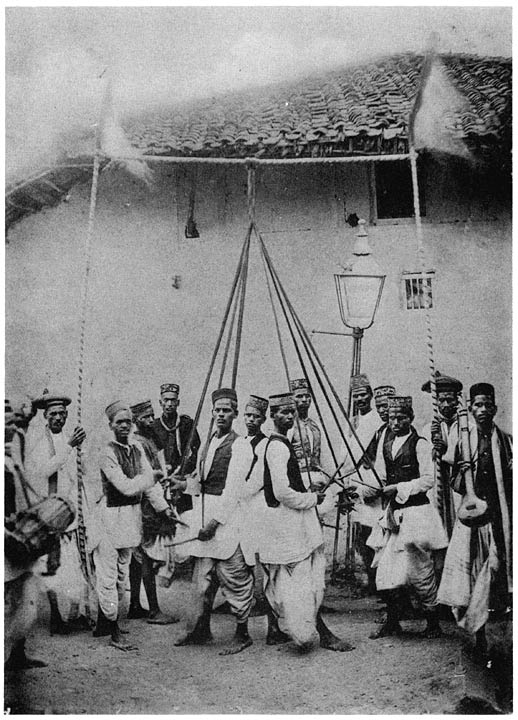
Koshti men dancing a figure, holding strings and beating sticks
2. Subdivisions.
3. Marriage.
At a Koshti wedding in Nāgpur, the bride and bridegroom with their parents sit in a circle, and round them a long hempen rope is drawn seven times; the bride’s mother then holds a lamp, while the bridegroom’s mother pours water from a vessel on to the floor. The Sālewārs perform the wedding ceremony at the bridegroom’s house, to which the bride is brought at midnight for this purpose. A display of fireworks is held and the thūn or log of wood belonging to the loom is laid on the ground between the couple and covered with a black blanket. The bridegroom stands facing the east and places his right foot on the thūn, and the bride stands opposite to him with her left foot upon it. A Brāhman holds a curtain between them and they throw rice upon each other’s heads five times and then sit on the log. The bride’s father washes the feet of the bridegroom and gives him a cloth and bows down before him. The wedding party then proceed with music and a display of fireworks to the bridegroom’s house and a round of feasts is given continuously for five days.
The remarriage of widows is freely permitted. In Chānda if the widow is living with her father he receives Rs. 40 from the second husband, but if with her father-in-law no price is given. On the day fixed for the wedding he fills her lap with nuts, cocoanuts, dates and rice, and applies vermilion to her forehead. During the night she proceeds to her new husband’s house, and, emptying the fruit from her lap into a dish which he holds, falls at his feet. The wedding is completed the next day by a feast to the caste-fellows. The procedure appears to have some symbolical idea of transferring the fruit of her womb to her new husband. Divorce is allowed, but is very rare, a wife being too valuable a helper in the Koshti’s industry to be put away except as a last resort. For a Koshti who is in business on his own account it is essential to have a number of women to assist in sizing the thread and fixing it on the loom. A wife is really a factory-hand and a well-to-do Koshti will buy or occasionally steal as many women as he can. In Bhandāra a recent case is known where a man bought a girl and married her to his son and eight months afterwards sold her to another family for an increased price. In another case a man mortgaged his wife as security for a debt and in lieu of interest, and she lived with his creditor until he paid off the principal. Quarrels over women not infrequently result in cases of assault and riot.
4. Funeral customs.
Members of the Lingāyat and Kabīrpanthi sects bury their dead and the others cremate them. With the Tirmendār Koshtis on the fifth day the Ayawār priest goes to the cremation-ground accompanied by the deceased’s family and worships the image of Vishnu and the Tulsi or basil upon the grave; and after this the whole party take their food at the place. Mourning is observed during five days for married and three for unmarried persons; and when a woman has lost her husband she is taken on the fifth day to the bank of some river or tank and her bangles are broken, her bead necklace is taken off, the vermilion is rubbed off her forehead, and her foot ornaments are removed; and these things she must not wear again while she is a widow. On the fourth day the Panch or caste elders come and place a new turban on the head of the chief mourner or deceased’s heir; they then take him round the bazār and seat him at his loom, where he weaves a little. After this he goes and sits with the Panch and they take food together. This ceremony indicates that the impurity caused by the death is removed, and the mourners return to common life. The caste do not perform the shrāddh ceremony, but on the Akhātīj day or commencement of the agricultural year a family which has lost a male member will invite a man from some other family of the caste, and one which has lost a female member a woman, and will feed the guest with good food in the name of the dead. In Chhindwāra during the fortnight of Pitripaksh or the worship of ancestors, a Koshti family will have a feast and invite guests of the caste. Then the host stands in the doorway with a pestle and as the guest comes he bars his entrance, saying: ‘Are you one of my ancestors; this feast is for my ancestors?’ To which the guest will reply: ‘Yes, I am your great-grandfather; take away the pestle.’ By this ingenious device the resourceful Koshti combines the difficult filial duty of the feeding of his ancestors with the entertainment of his friends.
5. Religion.
6. Superstitions.
Before beginning work for the day the Sālewār makes obeisance to his loom and implements, nor may he touch them without having washed his face and hands. A woman must not approach the loom during her periodical impurity, and if anybody sneezes as work is about to be begun, they wait a little time to let the ill luck pass off. In Nāgpur they believe that the posts to which the ends of the loom are fastened have magical powers, and if any one touches them with his leg he will get ulcers up to the knee. If a woman steps on the kūchi or loom-brush she is put out of caste and a feast has to be given to the community before she is readmitted. To cure inflammation in the eyes they take a piece of plaited grass and wrap it round with cotton soaked in oil. Then it is held before the sufferer’s eyes and set on fire and the drops of oil are allowed to fall into water, and as they get cold and congeal the inflammation is believed to abate. Among some classes of Koshtis the killing of a cat is a very serious offence, almost equivalent to killing a cow. Even if a man touches a dead cat he has to give two feasts and be fully purified. The sanctity of the cat among Hindus is sometimes explained on the ground that it kills rats, which attract snakes into the house. But the real reason is probably that primitive people regard all domestic animals as sacred. The Koshti also reveres the dog and jackal.
7. Clothes, etc.
The Sālewārs of the Godāvari tract wrap a short rectangular piece of cloth round their head as a turban. Formerly, Mr. Raghunāth Wāman states, the caste had a distinctive form of turban by which it could be recognised, but under British administration these rules of dress are falling into abeyance. A few of the Sālewārs put on the sacred thread, but it is not generally worn. Sālewār women have a device representing a half-moon tattooed on the forehead between the ends of the eyebrows; the cheeks are marked with a small dot and the arms adorned with a representation of the sacred tulsi or basil.
8. Social rules and status.
9. Occupation.
The standard occupation of the caste is the weaving of the fine silk-bordered cloths which are universally worn on the body by Brāhmans and other well-to-do persons of the Marātha country. The cloth is usually white with borders of red silk. They dye their own thread with lac or the flowers of the palās tree (Butea frondosa). The price of a pair of loin-cloths of this kind is Rs. 14, and of a pair of dupattas or shoulder-cloths Rs. 10, while women’s sāris also are made. Each colony of Koshtis in a separate town usually only weave one kind of cloth of the size for which their looms are made. The silk-bordered loin-cloths of Umrer and Pauni are well known and are sent all over India. The export of hand-woven cloth from all towns of the Nāgpur plain has been estimated at Rs. 5 lakhs a year. The rich sometimes have the cloths made with gold lace borders. The following account of the caste is given in Sir R. Craddock’s Nāgpur Settlement Report: “The Koshti is an inveterate grumbler, and indeed from his point of view he has a great deal to complain of. On the one hand the price of raw cotton and the cost of his living have increased very largely; on the other hand, the product of his loom commands no higher price than it did before, and he cannot rely on selling it when the market is slack. He cannot adapt himself to the altered environment and clings to his loom. He dislikes rough manual labour and alleges, no doubt with truth, that it deprives him of the delicacy of touch needed in weaving the finer cloths. If prices rise he is the first to be distressed, and on relief works he cannot perform the requisite task and has to be treated with special indulgence. The mills have been established many years in Nāgpur, but very few of the older weavers have sought employment there. They have begun to send their children, but work at home themselves, though they really all use machine-spun yarn. The Koshtis are quarrelsome and addicted to drink, and they have generally been the chief instigators of grain riots when prices rise. They often marry several wives and their houses swarm with a proportionate number of children. But although the poorer members of the community are in struggling circumstances and are put to great straits when prices of food rise, those who turn out the fine silk-bordered work are fairly prosperous in ordinary times.”
END OF VOL. III