Volume 3 / Part 3 — GURAO
Reading edition
List of Paragraphs
1. Origin of the caste. 175
2. Internal structure. 177
3. Marriage and ceremonies of adolescence. 178
4. Birth customs. 178
5. The sacred thread. 179
6. Funeral customs. 180
7. Social position. 181
8. The Jain Guraos. 181
1. Origin of the caste.
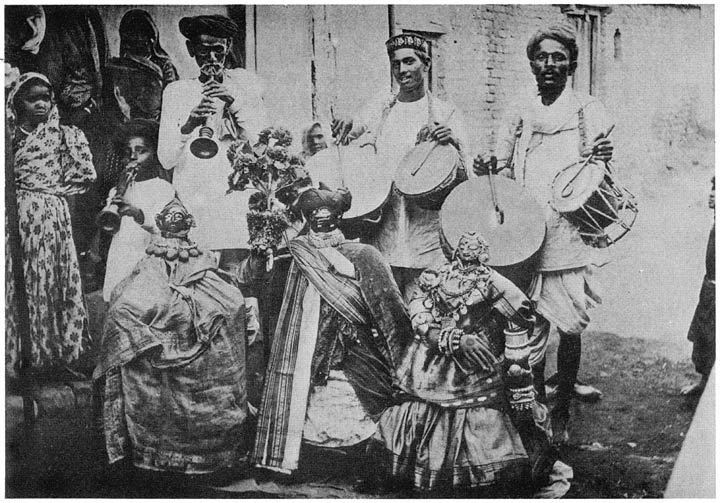
Guraos with figures made at the Holi festival called Gangour
2. Internal structure.
3. Marriage and ceremonies of adolescence.
4. Birth customs.
If a child is born at an unlucky season, they take two winnowing-fans and tie the baby between them with a thread wound many times round about. A cow is brought and made to lick the child, which is thus supposed to have been born again from it as a calf, the evil omen of the first birth being removed. The father performs the fire sacrifice, and a human figure is made from cooked rice and worshipped. A burning wick is placed in its stomach and it is taken out and left at cross-roads, this being probably a substitute for the member of the family whose death was presaged by the untimely birth of the child. Similarly if any one dies at the astronomical period known as Panchak, they make five figures of wheat-flour and burn or bury them with the body, as it is thought that otherwise five members of the family would die.
5. The sacred thread.
Boys are invested with the sacred thread at the age of five, seven or nine years, and until that time they are considered to be Sūdras and not members of the caste. From a hundred to three hundred rupees may be spent on the investiture. On the day before the ceremony a Brāhman and his wife are invited to take food, and a yellow thread with a mango leaf is tied round the boy’s wrist. The spirits of other boys who died before their thread ceremony was performed and of women of the family who died before their husbands are invited to attend. These are represented by young boys and married women of other families who come to the house and are bathed and anointed with turmeric and oil, and given presents of sugar and new clothes. Next day the initiate is seated on a platform in a shed erected for the purpose and puts on the sacred thread made of cotton and also a strip of the skin of the black-buck with a silk apron and cap. The boy’s father takes him on his lap and whispers or, as the Hindus say, blows the Gāyatri mantra or sacred text into his ear. A sacrifice is performed, and the friends and fellow-castemen of the family make presents to the boy of copper and silver coin. The amount thus given is not used by the parents, but is spent on the boy’s education or on the purchase of an ornament for him. On the conclusion of the ceremony the boy mounts a wooden model of a horse and pretends to set out for Benāres. His paternal uncle then says to him, ‘Why are you going away?’ And the boy replies, ‘Because you have not married me.’ His uncle then promises to find a bride for him and he gives up his project. The part played by the maternal uncle in this ceremony is probably a survival of the period of the matriarchate, when a man’s property descended to his sister’s son. He would thus naturally claim the boy as a husband for his own daughter, and such a marriage apparently became customary and in course of time acquired binding force. And although all recollection of the rule of inheritance through women has long been forgotten, the marriage of a brother’s daughter to a sister’s son is still considered peculiarly suitable, and the idea that it is the duty of the maternal uncle to find a bride for his nephew appears to be simply a development of this. The above account also gives reason for supposing that the investiture with the sacred thread was originally a ceremony of puberty.
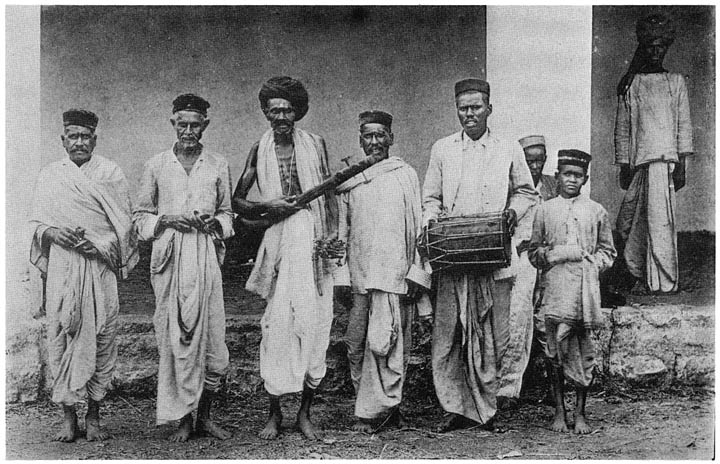
Group of Gurao musicians with their instruments
6. Funeral customs.
7. Social position.
The caste has now a fairly high social status and ranks above the Kunbis. They abstain from all flesh and from liquor and will take food only from the hands of a Marātha Brāhman, while Kunbis and other cultivating and serving castes will accept food from their hands. They worship Siva principally on Mondays, this day being sacred to the deity, who carries the moon as an ornament on his head, crowning the matted locks from which the Ganges flows.
8. The Jain Guraos.
Of the Jain Guraos Mr. Enthoven quotes the following interesting description from the Bombay Gazetteer: “They are mainly servants in village temples which, though dedicated to Brāhmanic gods, have still by their sides broken remains of Jain images. This, and the fact that most of the temple land-grants date from a time when Jainism was the State religion, support the theory that the Jain Guraos are probably Jain temple servants who have come under the influence partly of Lingāyatism and partly of Brāhmanism. A curious survival of their Jainism occurs at Dasahra, Shimga and other leading festivals, when the village deity is taken out of the temple and carried in procession. On these occasions, in front of the village god’s palanquin, three, five or seven of the villagers, among whom the Gurao is always the leader, carry each a long, gaily-painted wooden pole resting against their right shoulder. At the top of the pole is fastened a silver mask or hand and round it is draped a rich silk robe. Of these poles, the chief one, carried by the Gurao, is called the Jain’s pillar, Jainācha khāmb.”