Volume 3 / Part 3 — GOND (continued 2)
Reading edition
In order to injure an enemy they will make an image of him in clay, preferably taken from underneath his footprint, and carry it to the cemetery. Here they offer red lead, red thread, bangles, and various kinds of grain and pulse to the ghosts and say to them, “Male and female deities, old and newly buried, maimed and lame, spirits of the wind, I pronounce this charm with your help.” Then they pierce the figure with arrows in the chest and cut it with a knife in the region of the liver and think that their enemy will die. Another method is to draw the likeness of an enemy on cloth with lime or charcoal, and bury it in a pot in front of his house on a Sunday or Tuesday night so that he may walk on it in the morning, when they hope that the same result will be achieved.
47. Omens.
If a Gond, when starting on a journey in the morning, should meet a tiger, cat, hare, or a four-horned deer, he will return and postpone his journey; but if he meets one of these animals when he is well on the way it is considered to be lucky. Rain falling at a wedding or some other festival is believed to be unlucky, as it is as if somebody were crying. In Mandla, if a cock crows in the night, a man will get up at once, catch it and twist its neck, and throw it over the house as far away as he can. Apparently the cock is supposed to be calling to evil spirits. If a hen cackles, or lays eggs at night, it is also considered inauspicious, and the bird is often killed or given away. They think they can acquire strength by carrying the shoulder-bones of a tiger on their shoulders or drinking a little of the bone-dust pounded in water. If there is disease in the village, the Bhumka or village priest performs the ceremony of Gaon bāndhna or tying up the village. Accompanied by a party of men he drives a pig all round the village boundary, scattering grains of urad pulse and mustard seed on the way. The pig is then sacrificed, its blood is sprinkled on all the village gods, and it is eaten by the party. No man or animal may go outside the village on the day of this ceremony, which should be performed on a Sunday or Wednesday. When cattle disease breaks out the Bhumka makes an arch of three poles, to which is hung a string of mango leaves, and all the cattle of the village are driven under it to avert the disease.
48. Agricultural superstitions.
When there is drought two boys put a pestle across their shoulders, tie a living frog to it with a rag, and go from house to house accompanied by other boys and girls singing:
Mendak Bhai pāni de,
Dhān, kodon pakne de,
Mere byāh hone de,
or ‘Brother Frog give rain; let the rice and kodon ripen; let my marriage be held.’ The frog is considered to be able to produce rain because it lives in water and therefore has control over its element. The boy’s point in asking the frog to let his marriage be held is that if the rains failed and the crops withered, his parents would be unable to afford the expense. Another method of obtaining rain is for two naked women to go and harness themselves to a plough at night, while a third naked woman drives the plough and pricks them with a goad. This does not appear capable of explanation on any magical basis, so far as I know, and the idea may possibly be to force the clemency of the gods by showing their extraordinary sufferings, or to show that the world is topsy-turvy for want of rain. A leather rope is sometimes tied to a plough and harrow, and the boys and girls pull against one another on the rope in a tug-of-war. If the girls win they think that rain will soon come, but if the boys win that it will not. In order to stop excessive rain, a naked bachelor collects water from the eaves in a new earthen pot, covers the pot with a lid or with mud, and buries it beneath the earth; or the pot may be filled with salt. Here it may perhaps be supposed that, as the water dries up in the pot or the salt gets dry, so the rain will stop and the world generally become dry. The reason for employing women to produce rain, and men to stop it, may be that women, as they give milk, will be more potent in obtaining the other liquid, water. Nakedness is a common element in magic, perhaps because clothes are considered a civilised appanage, and unsuitable for a contest with the powers of nature; a certain idea of impurity may also attach to them. If a crow in carrying a straw to build its nest holds it in the middle, they think that the rains will be normal and adequate; but if the straw is held towards one end, that the rains will be excessive or deficient. If the titahri or sandpiper lays four eggs properly arranged, they think that sufficient rain will fall in all the four monsoon months. If only one, two or three eggs are laid, or only this number properly placed in the nest and the others at the side, then the rains will be good only in an equivalent number of months.
At the beginning of the harvest they pluck an ear of corn and say, ‘Whatever god is the guardian of this place, this is your share, take it, and do not interfere.’ The last plants in the field are cut and sent home by a little girl and put at the bottom of the grain-bin of the house. Chitkuar Devi is the goddess of the threshing-floor, and before beginning to winnow the grain they sacrifice a pig and a chicken to her, cutting the throats of the animals and letting their blood drop on to the central post of the threshing-floor. When they are about to take the kodon home, they set aside a basketful and give it to the sister’s son or sister’s husband of the owner, placing a bottle of liquor on the top, and he takes it home to the house, and there they drink one or two bottles of liquor, and then begin eating the new grain.
49. Magical or religious observances in fishing and hunting.
50. Witchcraft.
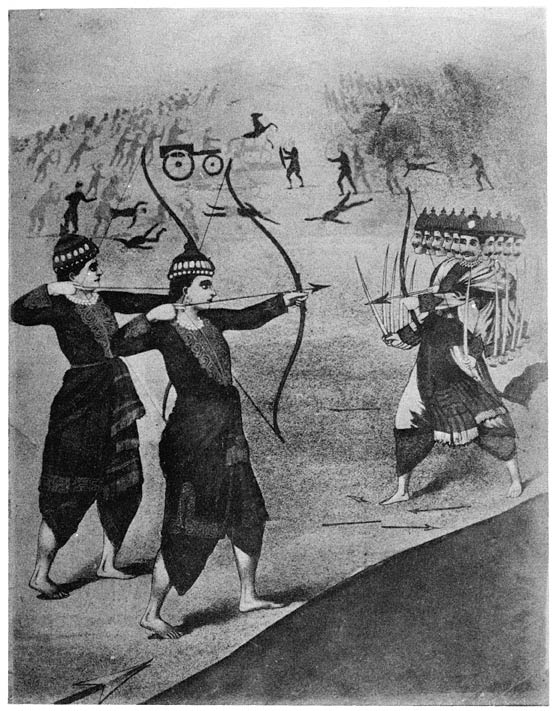
Killing of Rāwan, the demon king of Ceylon, from whom the Gonds are supposed to be descended
52. Cannibalism.
53. Festivals. The new crops.
The original Gond festivals were associated with the first eating of the new crops and fruits. In Chait (March) a festival called Chaitrai is observed in Bastar. A pig or fowl with some liquor is offered to the village god, and the new urad and semi beans of the year’s crop are placed before him uncooked. The people dance and sing the whole night and begin eating the new pulse and beans. In Bhādon (August) is the Nawākhai or eating of the new rice. The old and new grain is mixed and offered raw to the ancestors, a goat is sacrificed, and they begin to eat the new crop of rice. Similarly when the mahua flowers, from which country spirit is made, first appear, they proceed to the forest and worship under a sāj tree.
Before sowing rice or millet they have a rite called Bījphūtni or breaking the seed. Some grain, fowls and a pig are collected from the villagers by subscription. The grain is offered to the god and then distributed to all the villagers, who sow it in their fields for luck.
54. The Holi festival.
The Holi festival, which corresponds to the Carnival, being held in spring at the end of the Hindu year, is observed by Gonds as well as Hindus. In Bilāspur a Gond or Baiga, as representing the oldest residents, is always employed to light the Holi fire. Sometimes it is kindled in the ancient manner by the friction of two pieces of wood. In Mandla, at the Holi, the Gonds fetch a green branch of the semar or cotton tree and plant it in a little hole, in which they put also a pice (farthing) and an egg. They place fuel round and burn up the branch. Then next day they take out the egg and give it to a dog to eat and say that this will make the dog as swift as fire. They choose a dog whom they wish to train for hunting. They bring the ploughshare from the house and heat it red-hot in the Holi fire and take it back. They say that this wakes up the ploughshare, which has fallen asleep from rusting in the house, and makes it sharp for ploughing. Perhaps when rust appears on the metal they think this a sign of its being asleep. They plough for the first time on a Monday or Wednesday and drive three furrows when nobody is looking.
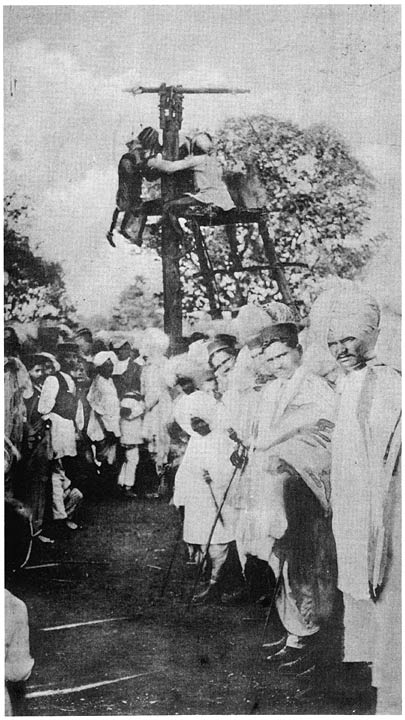
Woman about to be swung round the post called Meghnāth
55. The Meghnāth swinging rite.
In the western Districts on one of the five days following the Holi the swinging rite is performed. For this they bring a straight teak or sāj tree from the forest, as long as can be obtained, and cut from a place where two trees are growing together. The Bhumka or village priest is shown in a dream where to cut the tree. It is set up in a hole seven feet deep, a quantity of salt being placed beneath it. The hole is coloured with geru or red ochre, and offerings of goats, sheep and chickens are made to it by people who have vowed them in sickness. A cross-bar is fixed on to the top of the pole in a socket and the Bhumka is tied to one end of the cross-bar. A rope is attached to the other end and the people take hold of this and drag the Bhumka round in the air five times. When this has been done the village proprietor gives him a present of a cocoanut, and head- and body-clothes. If the pole falls down it is considered that some great misfortune, such as an epidemic, will ensue. The pole and ritual are now called Meghnāth. Meghnāth is held to have been the son of Rāwan, the demon king of Ceylon, from whom the Gonds are supposed by the Hindus to be descended, as they are called Rāwanvansi, or of the race of Rāwan. After this they set up another pole, which is known as Jheri, and make it slippery with oil, butter and other things. A little bag containing Rs. 1–4 and also a seer (2 lbs.) of ghī or butter are tied to the top, and the men try to climb the pole and get these as a prize. The women assemble and beat the men with sticks as they are climbing to prevent them from doing so. If no man succeeds in climbing the pole and getting the reward, it is given to the women. This seems to be a parody of the first or Meghnāth rite, and both probably have some connection with the growth of the crops.
56. The Karma and other rites.
During Bhādon (August), in the rains, the Gonds bring a branch of the kalmi or of the haldu tree from the forest and wrap it up in new cloth and keep it in their houses. They have a feast and the musicians play, and men and women dance round the branch singing songs, of which the theme is often sexual. The dance is called Karma and is the principal dance of the Gonds, and they repeat it at intervals all through the cold weather, considering it as their great amusement. A further notice of it is given in the section on social customs. The dance is apparently named after the tree, though it is not known whether the same tree is always selected. Many deciduous trees in India shed their leaves in the hot weather and renew them in the rains, so that this season is partly one of the renewal of vegetation as well as of the growth of crops.
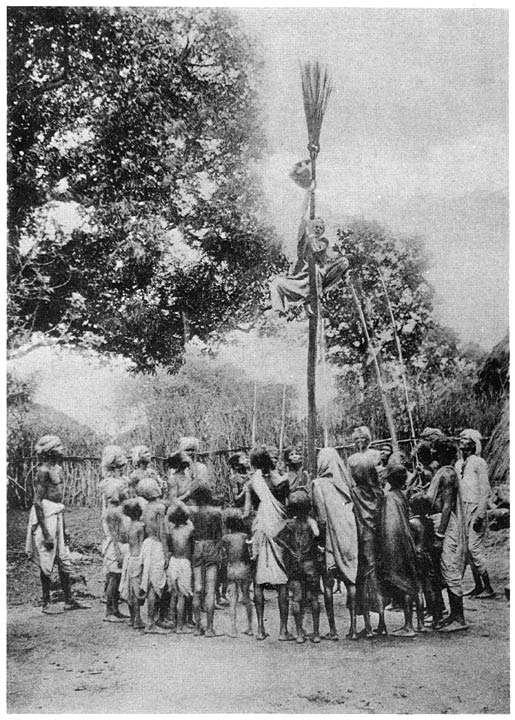
Climbing the pole for a bag of sugar
In Kunwār (September) the Gond girls take an earthen pot, pierce it with holes, and put a lamp inside and also the image of a dove, and go round from house to house singing and dancing, led by a girl carrying the pot on her head. They collect contributions and have a feast. In Chhattīsgarh among the Gonds and Rāwats (Ahīrs) there is from time to time a kind of feminist movement, which is called the Stiria-Rāj or kingdom of women. The women pretend to be soldiers, seize all the weapons, axes and spears that they can get hold of, and march in a body from village to village. At each village they kill a goat and send its head to another village, and then the women of that village come and join them. During this time they leave their hair unbound and think that they are establishing the kingdom of women. After some months the movement subsides, and it is said to occur at irregular intervals with a number of years between each. The women are commonly considered to be out of their senses.
(g) Appearance and Character, and Social Rules and Customs
57. Physical type.
58. Character.
59. Shyness and ignorance.
The Gonds can now count up to twenty, and beyond that they use the word kori or a score, in talking of cattle, grain or rupees, so that this, perhaps, takes them up to twenty score. They say they learnt to count up to twenty on their ten fingers and ten toes.
60. Villages and houses.
When residing in the centre of a Hindu population the Gonds inhabit mud houses, like the low-class Hindus. But in the jungles their huts are of bamboo matting plastered with mud, with thatched roofs. The internal arrangements are of the simplest kind, comprising two apartments separated from each other by a row of tall baskets, in which they store up their grain. Adjoining the house is a shed for cattle, and round both a bamboo fence for protection from wild beasts. In Bastar the walls of the hut are only four or five feet high, and the door three feet. Here there are one or two sheds, in which all the villagers store their grain in common, and no man steals another’s grain. In Gond villages the houses are seen perched about on little bluffs or other high ground, overlooking the fields, one, two and three together. The Gond does not like to live in a street. He likes a large bāri or fenced enclosure, about an acre in size, besides his house. In this he will grow mustard for sale, or his own annual supply of tobacco or vegetables. He arranges that the village cattle shall come and stand in the bāri on their way to and from pasture, and that the cows shall be milked there for some time. His family also perform natural functions in it, which the Hindus will not do in their fields. Thus the bāri gets well manured and will easily give two crops in the year, and the Gond sets great store by this field. When building a new house a man plants as the first post a pole of the sāj tree, and ties a bundle of thatching-grass round it, and buries a pice (¼d.) and a bhilawa nut beneath it. They feed two or three friends and scatter a little of the food over the post. The post is called Khirkhut Deo, and protects the house from harm.
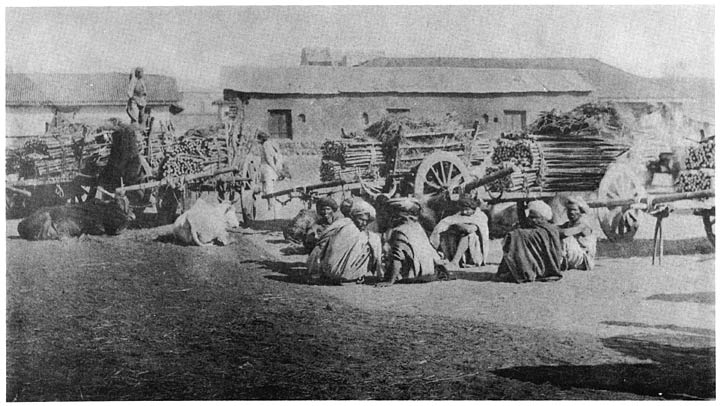
Gonds with their bamboo carts at market
A brass or pewter dish and lota or drinking-vessel of the same material, a few earthen cooking-pots, a hatchet and a clay chilam or pipe-bowl comprise the furniture of a Gond.
61. Clothes and ornaments.
In Sir R. Jenkins’ time, a century ago, the Gonds were represented as naked savages, living on roots and fruits, and hunting for strangers to sacrifice. About fifty years later, when Mr. Hislop wrote, the Māria women of the wilder tracts were said only to have a bundle of leafy twigs fastened with a string round their waist to cover them before and behind. Now men have a narrow strip of cloth round the waist and women a broader one, but in the south of Bastar they still leave their breasts uncovered. Here a woman covers her breasts for the first time when she becomes pregnant, and if a young woman did it, she would be thought to be big with child. In other localities men and women clothe themselves more like Hindus, but the women leave the greater part of the thighs bare, and men often have only one cloth round the loins and another small rag on the head. They have bangles of glass, brass and zinc, and large circlets of brass round the legs, though these are now being discarded. In Bastar both men and women have ten to twenty iron and brass hoops round their necks, and on to these rings of the same metal are strung. Rai Bahādur Panda Baijnāth counted 181 rings on one hoop round an old woman’s neck. In the Māria country the boys have small separate plots of land, which they cultivate themselves and use the proceeds as their pocket-money, and this enables them to indulge in a profusion of ornaments sometimes exceeding those worn by the girls. In Mandla women wear a number of strings of yellow and bluish-white beads. A married woman has both colours, and several cowries tied to the end of the necklace. Widows and girls may only wear the bluish-white beads without cowries, and a remarried widow may not have any yellow beads, but she can have one cowrie on her necklace. Yellow beads are thus confined to married women, yellow being the common wedding-colour. A Gond woman is not allowed to wear a choli or little jacket over the breasts. If she does she is put out of caste. This rule may arise from opposition to the adoption of Hindu customs and desire to retain a distinctive feature of dress, or it may be thought that the adoption of the choli might make Gond women weaker and unfitted for hard manual labour, like Hindu women. A Gond woman must not keep her cloth tucked up behind into her waist when she meets an elderly man of her own family, but must let it down so as to cover the upper part of her legs. If she omits to do this, on the occasion of the next wedding the Bhumka or caste priest will send some men to catch her, and when she is brought the man to whom she was disrespectful will put his right hand on the ground and she must make obeisance to it seven times, then to his left hand, then to a broom and pestle, and so on till she is tired out. When they have a sprain or swelling of the arm they make a ring of tree-fibre and wear this on the arm, and think that it will cure the sprain or swelling.
62. Ear-piercing.
The ears of girls are pierced by a thorn, and the hole is enlarged by putting in small pieces of wood or peacock’s feathers. Gond women wear in their ears the tarkhi or a little slab in shape like a palm-leaf, covered with coloured glass and fixed on to a stalk of hemp-fibre nearly an inch thick, which goes through the ear; or they wear the silver shield-shaped ornament called dhāra, which is described in the article on Sunār. In Bastar the women have their ears pierced in a dozen or more places, and have a small ring in each hole. If a woman gets her ear torn through she is simply put out of caste and has to give a feast for readmission, and is not kept out of caste till it heals, like a Hindu woman.
63. Hair.
64. Bathing and washing clothes.
65. Tattooing.

Both men and women were formerly much tattooed among the Gonds, though the custom is now going out among men. Women are tattooed over a large part of the body, but not on the hips or above them to the waist. Sorcerers are tattooed with some image or symbol of their god on their chest or right shoulder, and think that the god will thus always remain with them and that any magic directed against them by an enemy will fail. A woman should be tattooed at her father’s house, if possible before marriage, and if it is done after marriage her parents should pay for it. The tattooing is done with indigo in black or blue, and is sometimes a very painful process, the girl being held down by her friends while it is carried out. Loud shrieks, Forsyth says, would sometimes be heard by the traveller issuing from a village, which proclaimed that some young Gondin was being operated upon with the tattooing-needle. Patterns of animals and also common articles of household use are tattooed in dots and lines. In Mandla the legs are marked all the way up behind with sets of parallel lines, as shown above. These are called ghāts or steps, and sometimes interspersed at intervals is another figure called sānkal or chain. Perhaps their idea is to make the legs strong for climbing.
66. Special system of tattooing.
Tattooing seems to have been originally a magical means of protecting the body against real and spiritual dangers, much in the same manner as the wearing of ornaments. It is also supposed that people were tattooed with images of their totem in order the better to identify themselves with it. The following account is stated to have been taken from the Baiga priest of a popular shrine of Devi in Mandla. His wife was a tattooer of both Baigas and Gonds, and considered it the correct method for the full tattooing of a woman, though very few women can nowadays be found with it. The magical intent of tattooing is here clearly brought out:—
On the sole of the right foot is the annexed device:

It represents the earth, and will have the effect of preventing the woman’s foot from being bruised and cut when she walks about barefoot.
On the sole of the left foot is this pattern:

It is meant to be in the shape of a foot, and is called Padam Sen Deo or the Foot-god. This deity is represented by stones marked with two footprints under a tree outside the village. When they have a pain in the foot they go to him, rub his two stones together and sprinkle the dust from them on their feet as a means of cure. The device tattooed on the foot no doubt performs a similar protective function.
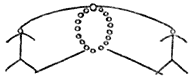
On the upper part of the foot five dots are made, one on each toe, and a line is drawn round the foot from the big toe to the little toe. This sign is said to represent Gajkaran Deo, the elephant god, who resides in cemeteries. He is a strong god, and it is probably thought that his symbol on the feet will enable them to bear weight. On the legs behind they have the images of the Baiga priest and priestess. These are also supposed to give strength for labour, and when they cannot go into the forest from fever or weakness they say that Bura Deo, as the deified priest is called, is angry with them. On the upper legs in front they tattoo the image of a horse, and at the back a saddle between the knee and the thigh. This is Koda Deo the horse-god, whose image will make their thighs as strong as those of a horse. If they have a pain or weakness in the thigh they go and worship Koda Deo, offering him a piece of saddle-cloth. On the outer side of each upper arm they tattoo the image of Hanumān, the deified monkey and the god of strength, in the form of a man. Both men and women do this, and men apply burning cowdung to the tattoo-mark in order to burn it effectually into the arm. This god makes the arms strong to carry weights. Down the back is tattooed an oblong figure, which is the house of the god Bhimsen, with an opening at the lower end just above the buttocks to represent the gate. Inside this on the back is the image of Bhimsen’s club, consisting of a pattern of dots more or less in the shape of an Indian club. Bhimsen is the god of the cooking-place, and the image of his club, in white clay stained green with the leaves of the semar tree, is made on the wall of the kitchen. If they have no food, or the food is bad, they say that Bhimsen is angry with them. The pattern tattooed on the back appears therefore to be meant to facilitate the digestion of food, which the Gonds apparently once supposed to pass down the body along the back. On the breast in front women tattoo the image of Bura Deo, as shown, the head on her neck and the body finishing at her breast-bone. The marks round the body represent stones, because the symbol of Bura Deo is sometimes a basket plastered with mud and filled with stones. On each side of the body women have the image of Jhulān Devi, the cradle goddess, as shown by the small figures attached to Bura Deo. But a woman cannot have the image of Jhulān Devi tattooed on her till she has borne a child. The place where the image is tattooed is that where a child rests against its mother’s body when she carries it suspended in her cloth, and it is supposed that the image of the goddess supports and protects the child, while the mother’s arms are left free for work.
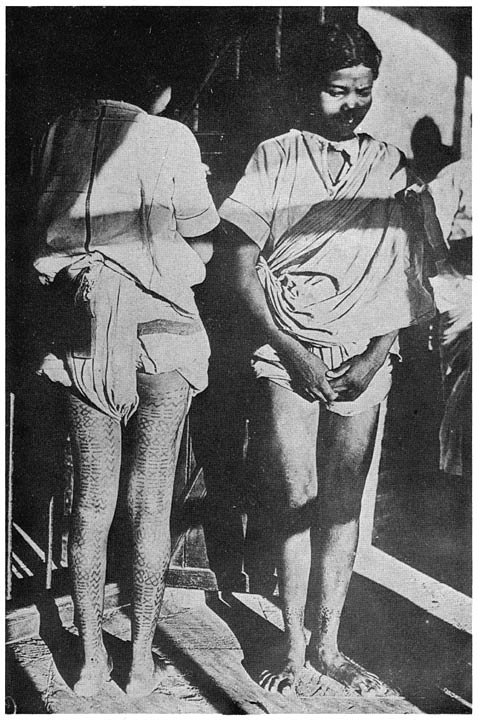
Gond women, showing tattooing on backs of legs
Round the neck they have Kanteshwar Māta, the goddess of the necklace. She consists of three to six lines of dots round the neck representing bead necklaces.
On the face below the mouth there is sometimes the image of a cobra, and it is supposed that this will protect them from the effects of eating any poisonous thing.
On the forehead women have the image of Chāndi Māta. This consists of a dot at the forehead at the parting of the hair, from which two lines of dots run down to the ears on each side, and are continued along the sides of the face to the neck. This image can only be tattooed after the hair of a woman has been parted on her marriage, and they say that Chāndi Māta will preserve and guard the parting of the hair, that is the life of the woman’s husband, because the parting can only be worn so long as her husband is alive. Chāndi means the moon, and it seems likely that the parting of the hair may be considered to represent the bow of the moon.
The elaborate system of tattooing here described is rarely found, and it is perhaps comparatively recent, having been devised by the Baiga and Pardhān priests as their intelligence developed and their theogony became more complex.
67. Branding.
Men are accustomed to brand themselves on the joints of the wrists, elbows and knees with burning wood of the semar tree from the Holi fire in order to render their joints supple for dancing. It would appear that the idea of suppleness comes from the dancing of the flames or the swift burning of the fire, while the wood is also of very light weight. Men are also accustomed to burn two or three marks on each wrist with a piece of hare’s dung, perhaps to make the joints supple like the legs of a hare.
68. Food.
The Gonds have scarcely any restriction on diet. They will eat fowls, beef, pork, crocodiles, certain kinds of snakes, lizards, tortoises, rats, cats, red ants, jackals and in some places monkeys. Khatola and Rāj-Gonds usually abstain from beef and the flesh of the buffalo and monkey. They consider field-mice and rats a great delicacy, and will take much trouble in finding and digging out their holes. The Māria Gonds are very fond of red ants, and in Bastar give them fried or roasted to a woman during her confinement. The common food of the labouring Gond is a gruel of rice or small millet boiled in water, the quantity of water increasing in proportion to their poverty. This is about the cheapest kind of food on which a man can live, and the quantity of grain taken in the form of this gruel or pej which will suffice for a Gond’s subsistence is astonishingly small. They grow the small grass-millets kodon and kutki for their subsistence, selling the more valuable crops for rent and expenses. The flowers of the mahua tree are also a staple article of diet, being largely eaten as well as made into liquor, and the Gond knows of many other roots and fruits of the forest. He likes to eat or drink his pej several times a day, and in Seoni, it is said, will not go more than three hours without a meal.
Gonds are rather strict in the matter of taking food from others, and in some localities refuse to accept it even from Brāhmans. Elsewhere they will take it from most Hindu castes. In Hoshangābād the men may take food from the higher Hindu castes, but not the women. This, they say, is because the woman is a wooden vessel, and if a wooden vessel is once put on the fire it is irretrievably burnt. A woman similarly is the weaker vessel and will sustain injury from any contamination. The Rāj-Gond copies Hindu ways and outdoes the Hindu in the elaboration of ceremonial purity, even having the fuel with which his Brāhman cook prepares his food sprinkled with water to purify it before it is burnt. Mr. A. K. Smith states that a Gond will not eat an antelope if a Chamār has touched it, even unskinned, and in some places they are so strict that a wife may not eat her husband’s leavings of food. The Gonds will not eat the leavings of any Hindu caste, probably on account of a traditional hostility arising out of their subjection by the Hindus. Very few Hindu castes will take water or food from the Gonds, but some who employ them as farmservants do this for convenience. The Gonds are not regarded as impure, even though from a Hindu point of view some of their habits are more objectionable than those of the impure castes. This is because the Gonds have never been completely reduced to subjection, nor converted into the village drudges, who are consigned to the most degraded occupations. Large numbers of them hold land as tenants and estates as zamīndārs; and the greater part of the Province was once governed by Gond kings. The Hindus say that they could not consider a tribe as impure to which their kings once belonged. Brāhmans will take water from Rāj-Gonds and Khatola Gonds in many localities. This is when it is freshly brought from the well and not after it has been put in their houses.
69. Liquor.
Excessive drinking is the common vice of the Gonds and the principal cause which militates against their successfully competing with the Hindus. They drink the country spirit distilled from the flowers of the mahua tree, and in the south of the Province toddy or the fermented juice of the date-palm. As already seen, in Bastar their idea of hell is a place without liquor. The loss of the greater part of the estates formerly held by Gond proprietors has been due to this vice, which many Hindu liquor-sellers have naturally fostered to their own advantage. No festival or wedding passes without a drunken bout, and in Chānda at the season for tapping the date-palm trees the whole population of a village may be seen lying about in the open dead drunk. They impute a certain sanctity to the mahua tree, and in some places walk round a post of it at their weddings. Liquor is indispensable at all ceremonial feasts, and a purifying quality is attributed to it, so that it is drunk at the cemetery or bathing-ghāt after a funeral. The family arranges for liquor, but mourners attending from other families also bring a bottle each with them, if possible. Practically all the events of a Gond’s life, the birth of a child, betrothals and weddings, recovery from sickness, the arrival of a guest, bringing home the harvest, borrowing money or hiring bullocks, and making contracts for cultivation, are celebrated by drinking. And when a Gond has once begun to drink, if he has the money he usually goes on till he is drunk, and this is why the habit is such a curse to him. He is of a social disposition and does not like to drink alone. If he has drunk something, and has no more money, and the contractor refuses to let him have any more on credit as the law prescribes, the Gond will sometimes curse him and swear never to drink in his shop again. Nevertheless, within a few days he will be back, and when chaffed about it will answer simply that he could not resist the longing. In spite of all the harm it does him, it must be admitted that it is the drink which gives most of the colour and brightness to a Gond’s life, and without this it would usually be tame to a degree.
When a Gond drinks water from a stream or tank, he bends down and puts his mouth to the surface and does not make a cup with his hands like a Hindu.
70. Admission of outsiders and sexual morality.
71. Common sleeping-houses.
Many Gond villages in Chhattīsgarh and the Feudatory States have what is known as a gotalghar. This is a large house near the village where unmarried youths and maidens collect and dance and sing together at night. Some villages have two, one for the boys and one for the girls. In Bastar the boys have a regular organisation, their captain being called Sirdār, and the master of the ceremonies Kotwār, while they have other officials bearing the designation of the State officers. After supper the unmarried boys go first to the gotalghar and are followed by the girls. The Kotwār receives the latter and directs them to bow to the Sirdār, which they do. Each girl then takes a boy and combs his hair and massages his hands and arms to refresh him, and afterwards they sing and dance together until they are tired and then go to bed. The girls can retire to their own house if they wish, but frequently they sleep in the boys’ house. Thus numerous couples become intimate, and if on discovery the parents object to their marriage, they run away to the jungle, and it has to be recognised. In some villages, however, girls are not permitted to go to the gotalghar. In one part of Bastar they have a curious rule that all males, even the married, must sleep in the common house for the eight months of the open season, while their wives sleep in their own houses. A Māria Gond thinks it impious to have sexual intercourse with his wife in his house, as it would be an insult to the goddess of wealth who lives in the house, and the effect would be to drive her away. Their solicitude for this goddess is the more noticeable, as the Māria Gond’s house and furniture probably constitute one of the least valuable human habitations on the face of the globe.
72. Methods of greeting and observances between relatives.
When two Gond friends or relatives meet, they clasp each other in their arms and lean against each shoulder in turn. A man will then touch the knees of an elder male relative with his fingers, carrying them afterwards to his own forehead. This is equivalent to falling at the other’s feet, and is a token of respect shown to all elder male relatives and also to a son-in-law, sister’s husband, and a samhdi, that is the father of a son- or daughter-in-law. Their term of salutation is Johār, and they say this to each other. Another method of greeting is that each should put his fingers under the other’s chin and then kiss them himself. Women also do this when they meet. Or a younger woman meeting an elder will touch her feet, and the elder will then kiss her on the forehead and on each cheek. If they have not met for some time they will weep. It is said that Baigas will kiss each other on the cheek when meeting, both men and women. A Gond will kiss and caress his wife after marriage, but as soon as she has a child he drops the habit and never does it again. When husband and wife meet after an absence the wife touches her husband’s feet with her hand and carries it to her forehead, but the husband makes no demonstration. The Gonds kiss their children. Among the Māria Gonds the wife is said not to sleep on a cot in her husband’s house, which would be thought disrespectful to him, but on the ground. Nor will a woman even sit on a cot in her own house, as if any male relative happened to be in the house it would be disrespectful to him. A woman will not say the name of her husband, his elder or younger brother, or his elder brother’s sons. A man will not mention his wife’s name nor that of her elder sister.
73. The caste panchāyat and social offences.
The tribe have panchāyats or committees for the settlement of tribal disputes and offences. A member of the panchāyat is selected by general consent, and holds office during good behaviour. The office is not hereditary, and generally there does not seem to be a recognised head of the panchāyat. In Mandla there is a separate panchāyat for each village, and every Gond male adult belongs to it, and all have to be summoned to a meeting. When they assemble five leading elderly men decide the matter in dispute, as representing the assembly. Caste offences are of the usual Hindu type with some variations. Adultery, taking another man’s wife or daughter, getting vermin in a wound, being sent to jail and eating the jail food, or even having handcuffs put on, a woman getting her ear torn, and eating or even smoking with a man of very low caste, are the ordinary offences. Others are being beaten by a shoe, dealing in the hides of cattle or keeping donkeys, removing the corpse of a dead horse or donkey, being touched by a sweeper, cooking in the earthen pots of any impure caste, a woman entering the kitchen during her monthly impurity, and taking to wife the widow of a younger brother, but not of course of an elder brother.
In the case of septs which revere a totem animal or plant, any act committed in connection with that animal or plant by a member of the sept is an offence within the cognisance of the panchāyat. Thus in Mandla the Kumhra sept revere the goat and the Markām sept the crocodile and crab. If a member of one of these septs touches, keeps, kills or eats the animal which his sept reveres, he is put out of caste and comes before the panchāyat. In practice the offences with which the panchāyat most frequently deals are the taking of another man’s wife or the kidnapping of a daughter for marriage, this last usually occurring between relatives. Both these offences can also be brought before the regular courts, but it is usually only when the aggrieved person cannot get satisfaction from the panchāyat, or when the offender refuses to abide by its decision, that the case goes to court. If a Gond loses his wife he will in the ordinary course compromise the matter if the man who takes her will repay his wedding expenses; this is a very serious business for him, as his wedding is the principal expense of a man’s life, and it is probable that he may not be able to afford to buy another girl and pay for her wedding. If he cannot get his wedding expenses back through the panchāyat he files a complaint of adultery under the Penal Code, in the hope of being repaid through a fine inflicted on the offender, and it is perfectly right and just that this should be done. When a girl is kidnapped for marriage, her family can usually be induced to recognise the affair if they receive the price they could have got for the girl in an ordinary marriage, and perhaps a little more, as a solace to their outraged feelings.
The panchāyat takes no cognisance of theft, cheating, forgery, perjury, causing hurt and other forms of crime. These are not considered to be offences against the caste, and no penalty is inflicted for them. Only if a man is arrested and handcuffed, or if he is sent to jail for any such crime, he is put out of caste for eating the jail food and subjected in this latter case to a somewhat severe penalty. It is not clear whether a Gond is put out of caste for murder, though Hindu panchāyats take cognisance of this offence.
74. Caste penalty feasts.
The punishments inflicted by the panchāyat consist of feasts, and in the case of minor offences of a fine. This last, subject perhaps to some commission to the members for their services, is always spent on liquor, the drinking of which by the offender with the caste-fellows will purify him. The Gonds consider country liquor as equivalent to the Hindu Amrita or nectar.
The penalty for a serious offence involves three feasts. The first, known as the meal of impurity, consists of sweet wheaten cakes which are eaten by the elders on the bank of a stream or well. The second or main feast is given in the offender’s courtyard to all the castemen of the village and sometimes of other villages. Rice, pulse, and meat, either of a slaughtered pig or goat, are provided at this. The third feast is known as ‘The taking back into caste’ and is held in the offender’s house and may be cooked by him. Wheat, rice and pulses are served, but not meat or vegetables. When the panchāyat have eaten this food in the offender’s house he is again a proper member of the caste. Liquor is essential at each feast. The nature of the penalty feasts is thus very clear. They have the effect of a gradual purification of the offender. In the first meal he can take no part, nor is it served in his house, but in some neutral place. For the second meal the castemen go so far as to sit in his compound, but apparently he does not cook the food nor partake of it. At the third meal they eat with him in his house and he is fully purified. These three meals are prescribed only for serious offences, and for ordinary ones only two meals, the offender partaking of the second. The three meals are usually exacted from a woman taken in adultery with an outsider. In this case the woman’s head is shaved at the first meal by the Sharmia, that is her son-in-law, and the children put her to shame by throwing lumps of cowdung at her. She runs away and bathes in a stream. At the second meal, taken in her courtyard, the Sharmia sprinkles some blood on the ground and on the lintel of the door as an offering to the gods and in order that the house may be pure for the future. If a man is poor and cannot afford the expense of the penalty feasts imposed on him, the panchāyat will agree that only a few persons will attend instead of the whole community. The procedure above described is probably borrowed to a large extent from Hinduism, but the working of a panchāyat can be observed better among the Gonds and lower castes than among high-caste Hindus, who are tending to let it lapse into abeyance.
75. Special purification ceremony.
The following detailed process of purification had to be undergone by a well-to-do Gond widow in Mandla who had been detected with a man of the Panka caste, lying drunk and naked in a liquor-shop. The Gonds here consider the Pankas socially beneath themselves. The ritual clearly belongs to Hinduism, as shown by the purifying virtue attached to contact with cows and bullocks and cowdung, and was directed by the Panda or priest of Devi’s shrine, who, however, would probably be a Gond. First, the offending woman was taken right out of the village across a stream; here her head was shaved with the urine of an all-black bullock and her body washed with his dung, and she then bathed in the stream, and a feast was given on its bank to the caste. She slept here, and next day was yoked to the same bullock and taken thus to the Kharkha or standing-place for the village cattle. She was rolled over the surface of the Kharkha about four times, again rubbed with cowdung, another feast was given, and she slept the night on the spot, without being washed. Next day, covered with the dust and cowdung of the Kharkha, she crouched underneath the black bullock’s belly and in this manner proceeded to the gate of her own yard. Here a bottle of liquor and fifteen chickens were waved round her and afterwards offered at Devi’s shrine, where they became the property of the Panda who was conducting the ceremony. Another feast was given in her yard and the woman slept there. Next day the woman, after bathing, was placed standing with one foot outside her threshold and the other inside; a feast was given, called the feast of the threshold, and she again slept in her yard. On the following day came the final feast of purification in the house. The woman was bathed eleven times, and a hen, a chicken and five eggs were offered by the Panda to each of her household gods. Then she drank a little liquor from a cup of which the Panda had drunk, and ate some of the leavings of food of which he had eaten. The black bullock and a piece of cloth sufficient to cover it were presented to the Panda for his services. Then the woman took a dish of rice and pulse and placed a little in the leaf-cup of each of the caste-fellows present, and they all ate it and she was readmitted to caste. Twelve cow-buffaloes were sold to pay for the ceremony, which perhaps cost Rs. 600 or more.
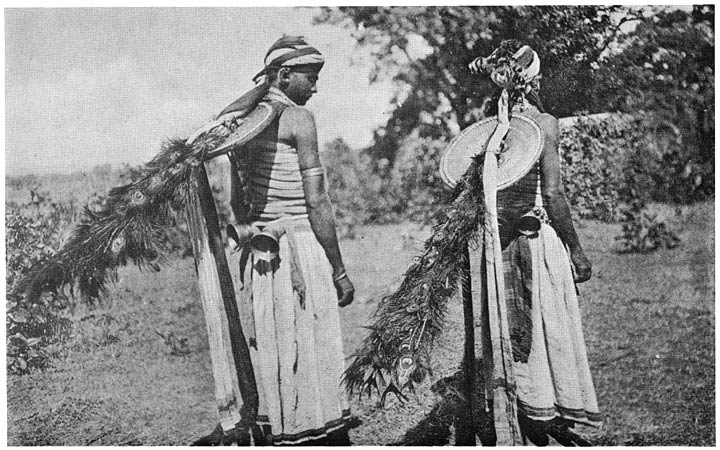
Māria Gonds in dancing costume
76. Dancing.
Dancing and singing to the dance constitute the social amusement and recreation of the Gonds, and they are passionately fond of it. The principal dance is the Karma, danced in celebration of the bringing of the leafy branch of a tree from the forest in the rains. They continue to dance it as a recreation during the nights of the cold and hot weather, whenever they have leisure and a supply of liquor, which is almost indispensable, is forthcoming. The Mārias dance, men and women together, in a great circle, each man holding the girl next him on one side round the neck and on the other round the waist. They keep perfect time, moving each foot alternately in unison throughout the line, and moving round in a slow circle. Only unmarried girls may join in a Māria dance, and once a woman is married she can never dance again. This is no doubt a salutary provision for household happiness, as sometimes couples, excited by the dance and wine, run away from it into the jungle and stay there for a day or two till their relatives bring them home and consider them as married. At the Māria dances the men wear the skins of tigers, panthers, deer and other animals, and sometimes head-dresses of peacock’s feathers. They may also have a girdle of cowries round the waist, and a bell tied to their back to ring as they move. The musicians sit in the centre and play various kinds of drums and tom-toms. At a large Māria dance there may be as many as thirty musicians, and the provision of rice or kodon and liquor may cost as much as Rs. 50. In other localities the dance is less picturesque. Men and women form two long lines opposite each other, with the musicians in the centre, and advance and retreat alternately, bringing one foot forward and the other up behind it, with a similar movement in retiring. Married women may dance, and the men do not hold the women at any time. At intervals they break off and liquor is distributed in small leaf-cups, or if these are not available, it is poured into the hands of the dancers held together like a cup. In either case a considerable proportion of the liquor is usually spilt on to the ground.
77. Songs.
All the time they are dancing they also sing in unison, the men sometimes singing one line and the women the next, or both together. The songs are with few exceptions of an erotic character, and a few specimens are subjoined.
a. Be not proud of your body, your body must go away above (to death).
Your mother, brother and all your kinsmen, you must leave them and go.
You may have lakhs of treasure in your house, but you must leave it all and go.
b. The musicians play and the feet beat on the earth.
A pice (¼d.) for a divorced woman, two pice for a kept woman, for a virgin many sounding rupees.
The musicians play and the earth sounds with the trampling of feet.
c. Rāja Darwa is dead, he died in his youth.
Who is he that has taken the small gun, who has taken the big bow?
Who is aiming through the harra and bahera trees, who is aiming on the plain?
Who has killed the quail and partridge, who has killed the peacock?
Rāja Darwa has died in the prime of his youth.
The big brother says, ‘I killed him, I killed him’; the little brother shot the arrow.
Rāja Darwa has died in the bloom of his youth.
The houses and castles fell before him, the ruler of Bhānwargarh rose up in fear.
He set the match to his powder, he stooped and crept along the ground and fired.
e. Little pleasure is got from a kept woman; she gives her lord pej (gruel) of kutki to drink.
She put two gourds full of water in it, and the gruel is so thin that it gives him no sustenance.
f. Man speaks:
The wife is asleep and her Rāja (husband) is asleep in her lap.
She has taken a piece of bread in her lap and water in her vessel.
See from her eyes will she come or not?
Woman:
I have left my cow in her shed, my buffalo in her stall.
I have left my baby at the breast and am come alone to follow you.
g. The father said to his son, ‘Do not go out to service with any master, neither go to any strange woman.
I will sell my sickle and axe, and make you two marriages.’
He made a marriage feast for his son, and in one plate he put rice, and over it meat, and poured soup over it till it flowed out of the plate.
Then he said to the men and women, young and old, ‘Come and eat your fill.’
78. Language.
In 1911 Gondi was spoken by 1,500,000 persons, or more than half the total number of Gonds in India. The other Gonds of the Central Provinces speak a broken Hindi. Gondi is a Dravidian language, having a common ancestor with Tamil and Canarese, but little immediate connection with its neighbour Telugu; the specimens given by Sir G. Grierson show that a large number of Hindi words have been adopted into the vocabulary of Gondi, and this tendency is no doubt on the increase. There are probably few Gonds outside the Feudatory States, and possibly a few of the wildest tracts in British Districts, who could not understand Hindi to some extent. And with the extension of primary education in British Districts Gondi is likely to decline still more rapidly. Gondi has no literature and no character of its own; but the Gospels and the Book of Genesis have been translated into it and several grammatical sketches and vocabularies compiled. In Saugor the Hindus speak of Gondi as Farsi or Persian, apparently applying this latter name to any foreign language.
(h) Occupation
79. Cultivation.
The Gonds are mainly engaged in agriculture, and the great bulk of them are farmservants and labourers. In the hilly tracts, however, there is a substantial Gond tenantry, and a small number of proprietors remain, though the majority have been ousted by Hindu moneylenders and liquor-sellers. In the eastern Districts many important zamīndāri estates are owned by Gond proprietors. The ancestors of these families held the wild hilly country on the borders of the plains in feudal tenure from the central rulers, and were responsible for the restraint of the savage hillmen under their jurisdiction, and the protection of the rich and settled lowlands from predatory inroads from without. Their descendants are ordinary landed proprietors, and would by this time have lost their estates but for the protection of the law declaring them impartible and inalienable. A few of the Feudatory Chiefs are also Gonds. Gond proprietors are generally easy-going and kind-hearted to their tenants, but lacking in business acumen and energy, and often addicted to drink and women. The tenants are as a class shiftless and improvident and heavily indebted. But they show signs of improvement, especially in the ryotwāri villages under direct Government management, and it may be hoped that primary education and more temperate habits will gradually render them equal to the Hindu cultivators.