Volume 3 / Part 3 — GOSAIN
Reading edition
List of Paragraphs
1. Names for the Gosains. 150
2. The ten orders. 151
3. Initiation. 152
4. Dress. 152
5. Methods of begging and greetings. 154
6. The Dandis. 155
7. The Rāwanvansis. 155
8. Monasteries. 156
9. The fighting Gosains. 156
10. Burial. 158
11. Sexual indulgence. 158
12. Missionary work. 159
13. The Gosain caste. 159
1. Names for the Gosains.
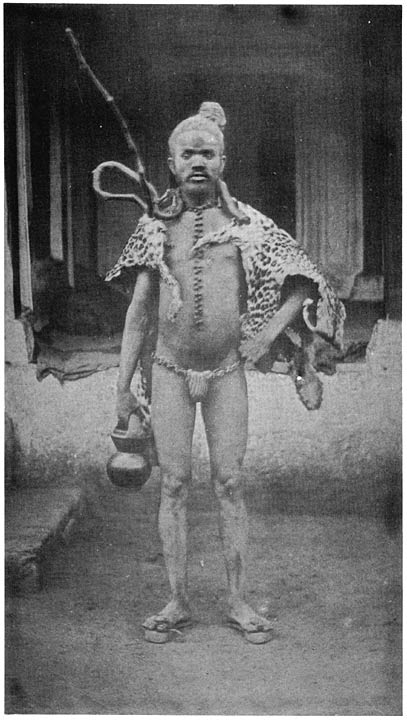
Gosain mendicant
2. The ten orders.
The Gosains consider their founder to have been Shankar Achārya, the great apostle of the revival of the worship of Siva in southern India, who lived between the eighth and tenth centuries. He had four disciples from whom the ten orders of Gosains are derived. These are commonly stated as follows:
1. Giri (peak or top of a hill).
2. Puri (a town).
3. Parbat (a mountain).
4. Sāgar (the ocean).
5. Ban or Van (the forest).
6. Tīrtha (a shrine of pilgrimage).
7. Bhārthi (the goddess of speech).
8. Sāraswati (the goddess of learning).
9. Aranya (forest).
10. Ashrām (a hermitage).
The names may perhaps be held to refer to the different places in which the members of each order would pursue their austerities. The different orders have their headquarters at great shrines. The Sāraswati, Bhārthi and Puri orders are supposed to be attached to the monastery at Sringeri in Mysore; the Tīrtha and Ashrām to that at Dwārka in Gujarāt; the Ban and Aranya to the Govardhan monastery at Puri; and the Giri, Parbat and Sāgara to the shrine of Badrināth in the Himalayas.
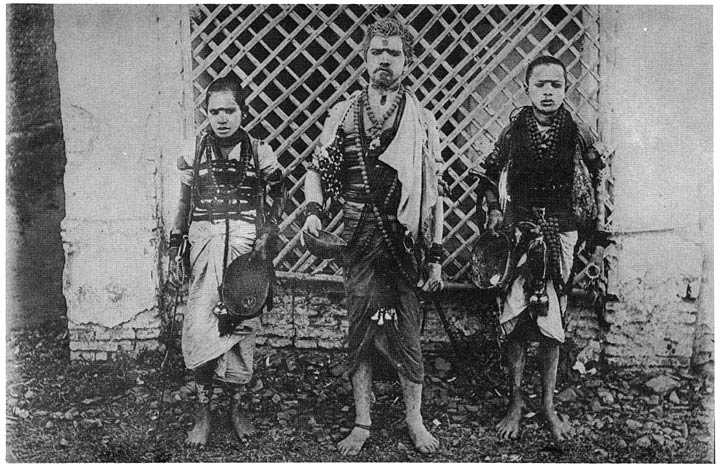
Alakhwāle Gosains with faces covered with ashes
Dandi is sometimes shown as one of the ten orders, but it seems to be the special designation of certain ascetics who carry a staff and may belong to either the Tīrtha, Ashrām, Bhārthi or Sāraswati groups. Another name for Gosain ascetics is Abdhūt, or one who has separated himself from the world. The term Abdhūt is sometimes specially applied to followers of the Marātha saint, Dattatreya, an incarnation of Siva.
The commonest orders in the Central Provinces are Giri, Puri and Bhārthi, and the members frequently use the name of the order as their surname. Members of the Aranya, Sāgara and Parbat orders are rarely met with at present.
3. Initiation.
A notice of the Gosains who have become an ordinary caste will be given later. Formerly only Brāhmans or members of the twice-born castes could become Gosains, but now a man of any caste, as Kurmi, Kunbi or Māli, from whom a Brāhman takes water, may be admitted. In some localities it is said that Gonds and Kols can now be made Gosains, and hence the social position of the Gosains has greatly fallen, and high-caste Hindus will not take water from them. It is supposed, however, that the Giri order is still recruited only from Brāhmans.
At initiation the body of a neophyte is cleaned with the five products of the sacred cow, milk, curds, ghī, dung and urine. He drinks water in which the great toe of his guru has been dipped and eats the leavings of the latter’s food, thus severing himself from his own caste. His sacred thread is taken off and broken, and it is sometimes burned and he eats the ashes. All the hair of his head is shaved, including the scalp-lock, which every secular Hindu wears. A mantra or text is then whispered or blown into his ear.
4. Dress.
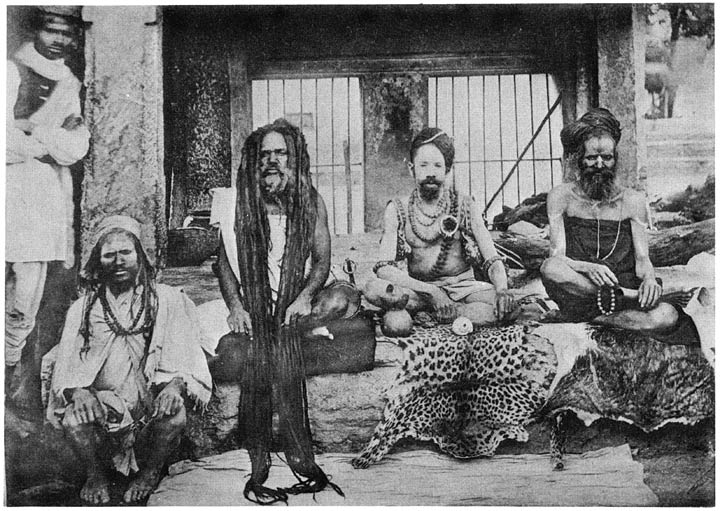
Gosain mendicants with long hair
5. Methods of begging and greetings.
They have various rules about begging. Some will never turn back to receive alms. They may also make a rule only to accept the surplus of food cooked for the family, and to refuse any of special quality or cooked expressly for them. One Gosain, noticed by Mr. A. K. Smith, always begged hopping, and only from five houses; he took from them respectively two handfuls of flour, a pinch of salt, and sufficient quantities of vegetables, spices and butter for his meal, and then went hopping home. Those who are performing the perikrama or circuit of the Nerbudda from its source to its mouth and back, do not cut their hair or nails during the whole period of about three years. They may not enter the Nerbudda above their knees nor wash their vessels in it. After crossing any tributary river or stream in their path they may not re-cross this; and if they have forgotten or left any article behind, must abandon it unless they can persuade somebody to go back and fetch it for them. Some carry a gourd with a single string stretched on a stick, on which they twang some notes; others have a belt of sheep’s hair hung with the bells of bullocks which they tie round the waist, so that the tinkling of the bells may announce their coming. A common begging cry is Alakh, which is said to mean ‘apart,’ and to refer to themselves as being apart or separated from the world. The beggar gives this cry and stands at the door of the house for half a minute, shaking his body about all the time. If no alms are brought in this time he moves on.
When an ordinary Hindu meets a Gosain he says ‘Nāmu Nārāyan’ or ‘I go to Nārāyan,’ and the Gosain answers ‘Nārāyan.’ Nārāyan is a name of Vishnu, and its use by the Gosains is curious. Those who have performed the circuit of the Nerbudda say ‘Har Nerbudda,’ and the person addressed answers ‘Nerbudda Mai ki Jai’ or ‘Victory to Mother Nerbudda.’
6. The Dandis.
7. The Rāwanvansis.
Another curious class of Gosains are the Rāwanvansis, who go about in the character of Rāwan, the demon king of Ceylon, as he was when he carried off Sīta. The legend is that in order to do this, Rāwan first sent his brother in the shape of a golden deer before Rāma’s palace. Sīta saw it and said she must have the head of the deer, and sent Rāma to kill it. So Rāma pursued it to the forest, and from there Rāwan cried out, imitating Rāma’s voice. Then Sīta thought Rāma was being attacked and told his brother Lachman to go to his help. But Lachman had been left in charge of her by Rāma and refused to leave her, till Sīta said he was hoping Rāma would be killed, so that he might marry her. Then he drew a circle round her on the ground, and telling her not to step outside it until his return, went off. Then Rāwan took the disguise of a beggar and came and begged for alms from Sīta. She told him to come inside the magic circle and she would give him alms, but he refused. So finally Sīta came outside the circle, and Rāwan at once seized her and carried her off to Ceylon. The Rāwanvansi Gosains wear rings of hair all up their arms and a rope of hair round the waist, and the hair of their head hanging down. It would appear that they are intended to represent some animal. They smear vermilion on the forehead, and beg only at twilight and never at any other time, whether they obtain food or not. In begging they will never move backwards, so that when they have passed a house they cannot take alms from it unless the householder brings the gift to them.
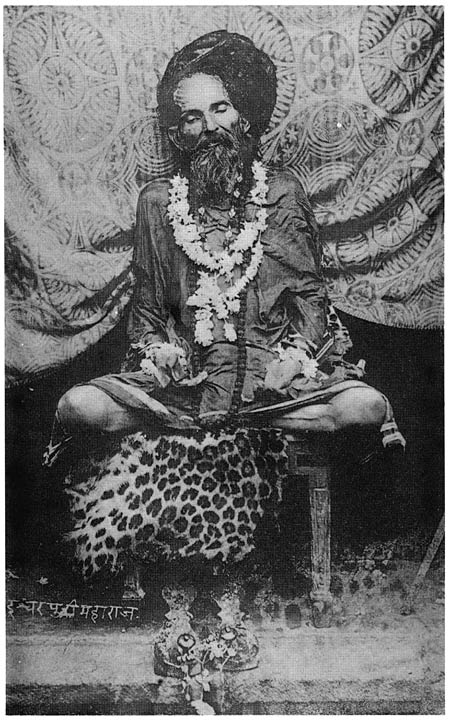
Famous Gosain Mahant. Photograph taken after death
8. Monasteries.
9. The fighting Gosains.
10. Burial.
11. Sexual indulgence.
12. Missionary work.
Nevertheless the wandering Gosains have done much to foster and maintain the Hindu religion among the people. They are the gurus or spiritual preceptors of the middle and lower castes, and though their teaching may be of little advantage, it perhaps quickens and maintains to some extent the religious feelings of their clients. In former times the Gosains travelled over the wildest tracts of country, proselytising the primitive non-Aryan tribes, for whose conversion to Hinduism they are largely responsible. On such journeys they necessarily carried their lives in their hands, and not infrequently lost them.
13. The Gosain caste.
The majority of the Gosains are, however, now married and form an ordinary caste. Buchanan states that the ten different orders became exogamous groups, the members of which married with each other, but it is doubtful whether this is the case at present. It is said that all Giri Gosains marry, whether they are mendicants or not, while the Bhārthi order can marry or not as they please. They prohibit any marriage between first cousins, but permit widow remarriage and divorce. They eat the flesh of all clean animals and also of fowls, and drink liquor, and will take cooked food from the higher castes, including Sunārs and Kunbis. Hence they do not rank high socially, and Brāhmans do not take water from them, but their religious character gives them some prestige. Many Gosains have become landholders, obtaining their estates either as charitable grants from clients or through moneylending transactions. In this capacity they do not usually turn out well, and are often considered harsh landlords and grasping creditors.