Volume 3 / Part 3 — Kaikāri
Reading edition
1. Origin and traditions.
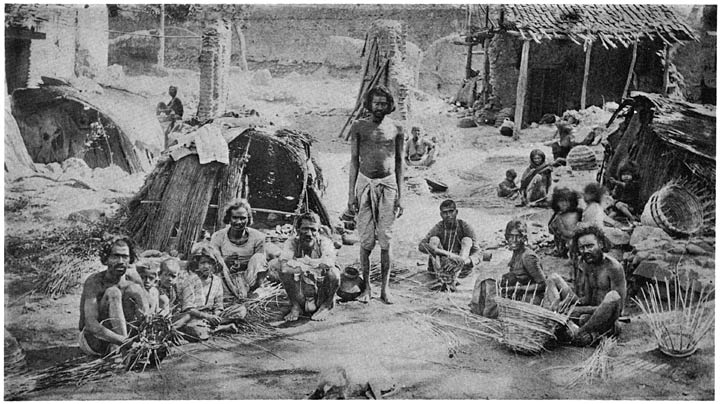
Kaikaris making baskets
2. Marriage.
Marriage within the same gotra or section is prohibited, but with one or two exceptions there are no other restrictions on intermarriage between relatives. A sister’s son may marry a brother’s daughter, but not vice versa. A man may not marry his wife’s elder sister either during his wife’s lifetime or after her death, and he may marry her younger sister, but not the younger but one. Girls are generally married between 8 and 12 years of age. If a girl cannot get a partner nothing is done, but when the marriage of a boy has not been arranged, a sham rite is performed with an akao plant (swallow-wort) or with a silver ring, all the ceremonies of a regular marriage being gone through. The tree is subsequently carefully reared, or the ring worn on the finger. Should the tree die or the ring be lost, funeral obsequies are performed for it as for a member of the family. A bride-price is paid which may vary from Rs. 20 to Rs. 100. In the southern Districts the following custom is in vogue at weddings. After the ceremony the bridegroom pretends to be angry and goes out of the mandap or shed, on which the bride runs after him, and throwing a piece of cloth round his neck, drags him back again. Her father then gives him some money or ornaments to pacify him. After this the same performance is gone through with the bride. The bride is taken to her husband’s house, but is soon brought back by her relatives. On her second departure the husband himself does not go to fetch her, and she is brought home by his father and other relations, her own family presenting her with new clothes on this occasion. Widow-marriage is permitted, and the widow is expected to marry the next younger brother of the deceased husband. She may not marry any except the next younger, and if another should take her he is expelled from the caste until the connection is severed. If she marries somebody else he must repay to her late husband’s brother a half of the expenses incurred on the first marriage. In the southern Districts she may not marry a brother of her husband’s at all. A widow cannot be married in her late husband’s house, but is taken to her parents’ house and married from there. In Nimār her family do not take anything, but in the south they are paid a small sum. Here also the marriage is performed at the second husband’s house; the woman carries to it a new earthen pitcher filled with water, and, placing it on the chauk or pattern of lines traced with flour in the courtyard, touches the feet of the Panch or caste committee, after which her skirt is tied to her husband’s cloth. The pair are seated on a blanket and new bangles are placed on the woman’s wrist, widows officiating at the ceremony. The couple then leave the village and pass the night outside it, returning next morning, when the woman manages to enter the house without being perceived by a married woman or unmarried girl. A bachelor marrying a widow must first go through the ceremony with a ring or akao plant, as already described, this being his real marriage; if he omits the rite his daughters by the widow will not be considered as members of the caste, though his sons will be admitted. Polygamy is allowed, but the consent of the first wife must be obtained to the taking of a second, and she may require a written promise of good treatment after the second marriage. A second wife is usually only taken if the first is barren, and if she has children her parents usually interfere to dissuade the husband, while other parents are always averse to giving their daughter in marriage to a man under such circumstances. Divorce is permitted for the usual reasons, a deed being drawn up and attested by the panchāyat, to whom the husband pays a fine of Rs. 8 or Rs. 10.
3. Religion.
The tutelary god of the Kaikāris is the Nāg or cobra, who is worshipped at marriages and on the day of Nāg-Panchmi. Every family has in the house a platform dedicated to Khandoba, the Marātha god of war. They also worship Marīmāta, to whom flowers are offered at festivals, and a little ghī is poured out in her honour by way of incense. When the juāri harvest is gathered, dalias or cakes of boiled juāri and a ewe are offered to Marīmāta. They do not revere the Hindu sacred trees, the pīpal and banyan, nor the basil plant, and will readily cut them down. They both burn and bury the dead. The Jādons burn all married persons, but if they cannot afford firewood they touch the corpse with a burning cinder and then bury it. The Gaikwārs always bury their dead, the corpse being laid naked on its back with the feet pointing to the south. On returning from the burial-ground each relative of the deceased gives one roti or wheaten cake to the bereaved family, and they eat, sharing the cakes with the panchāyat. Bread is also presented on the second day, and on the third the family begin to cook again. Mourning lasts for ten days, and on the last day the house is cleaned and the earthen pots thrown out; the clothes of the family are washed and the males are shaved. Ten balls of rice cooked in milk are offered to the soul of the dead person and a feast is given to the caste. After a birth the mother remains impure for five weeks. For the first five days both the mother and child are bathed daily. The navel cord and after-birth are buried by the midwife in a rubbish heap. When the milk teeth fall out they are placed in a ball of the dung of an ass and thrown on to the roof of the house. It is considered that the rats or mice, who have very good and sharp teeth, will take them and give the child good teeth in exchange. Women are impure for five days during the menstrual period. When a girl attains maturity a ceremony called god-bharni is performed. The neighbours are invited and songs are sung and the girl is seated in the chauk or pattern of lines traced with flour. She is given new clothes and bangles by her father, or her father-in-law if she is married, and rice and plantains, cocoanuts and other fruits are tied up in her skirt. This is no doubt done so that the girl may in like manner be fruitful, the cocoanuts perhaps being meant to represent human heads, as they usually do.