Volume 3 / Part 3 — KORKU
Reading edition
List of Paragraphs
1. Distribution and origin.
2. Tribal legends.
3. Tribal subdivisions.
4. Marriage. Betrothal.
5. The marriage ceremony.
6. Religion.
7. The Bhumka.
8. Magical practices.
9. Funeral rites.
10. Appearance and social customs.
11. Character.
12. Inheritance.
13. Occupation.
14. Language.
1. Distribution and origin.
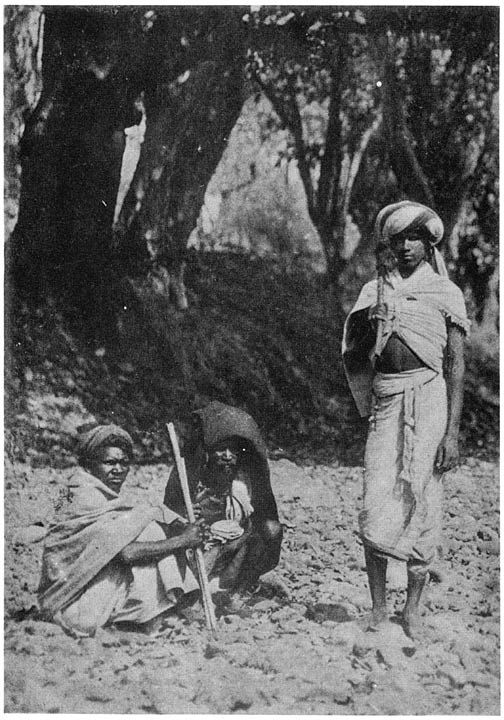
Korkus of the Melghāt hills
2. Tribal legends.
3. Tribal subdivisions.
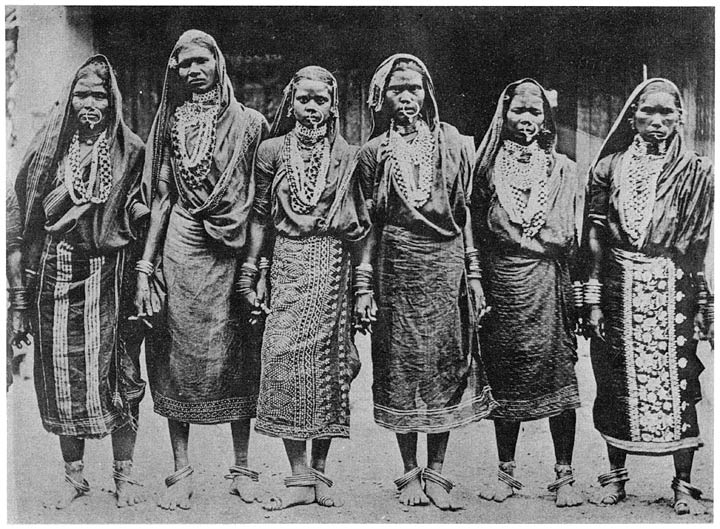
Korku women in full dress
4. Marriage Betrothal.
Marriage between members of the same sept is prohibited and also the union of first cousins. The preliminaries to a marriage commence with the bāli-dūdna or arrangement of the match. The boy’s father having selected a suitable bride for his son sends two elders of the caste to propose the match to her father, who as a matter of etiquette invariably declines it, swearing with great oaths that he will not allow his daughter to get married or that he will have a son-in-law who will serve for her. The messengers depart, but return again and again until the father’s obduracy is overcome, which may take from six months to two years, while from nine to twelve months is considered a respectable period. When his consent is finally obtained the residents of the girl’s village are called to hear it, and the compact is sealed with large potations of liquor. A ceremony of betrothal follows at which the daij or dowry is arranged, this signifying among the Korkus the compensation to be paid to the girl’s father for the loss of her services. It is computed by a curious system of symbolic higgling. The women of the girl’s party take two plates and place on them two heaps containing respectively ten and fifty seeds of a sort used for reckoning. The ten seeds on the first plate represent five rupees for the panchāyat and five cloths for the mother, brother, paternal aunt and paternal and maternal uncles of the girl. The heap of fifty seeds indicates that Rs. 50 must be paid to the girl’s father. When the plates are received by the boy’s party they take away forty-five of the seeds from the larger heap and return the plate, to indicate that they will only pay five rupees to the girl’s father. The women add twenty-five seeds and send back the plate again. The men then take away fifteen, thus advancing the bride-price to fifteen rupees. The women again add twenty-five seeds and send back the plate, and the men again take away twenty, and returning the remaining twenty which are taken as the sum agreed upon, in addition to the five cloths and five rupees for the panchāyat. The total amount paid averages about Rs. 60. Wealthy men sometimes refuse this payment or exchange a bride for a bridegroom. The dowry should be paid before the wedding, and in default of this the bridegroom’s father is made not a little uncomfortable at that festival. Should a betrothed girl die before marriage, the dowry does not abate and the parents of the girl have a right to stop her burial until it is paid. But if a father shows himself hard to please and refuses eligible offers, or if a daughter has fallen in love, as sometimes happens, she will leave her home quietly some morning and betake herself to the house of the man of her choice. If her young affections have not been engaged, she may select of her own accord a protector whose circumstances and position make him attractive, and preferably one whose mother is dead. Occasionally a girl will install herself in the house of a man who does not want her, and his position then is truly pitiable. He dare not turn her out as he would be punished by the caste for his want of gallantry, and his only course is to vacate his own house and leave her in possession. After a time his relations represent to her that the man she wants has gone on a journey and will not be back for a long time, and induce her to return to the paternal abode. But such a case is very rare.
5. The marriage ceremony.
6. Religion.
The Korkus consider themselves as Hindus, and are held to have a better claim to a place in the social structure of Hinduism than most of the other forest tribes, as they worship the sun and moon which are Hindu deities and also Mahādeo. In truth, however, their religion, like that of many low Hindu castes, is almost purely animistic. The sun and moon are their principal deities, the name for these luminaries in their language being Gomaj, which is also the term for god or a god. The head of each family offers a white she-goat and a white fowl to the sun every third year, and the Korkus stand with the face to the sun when beginning to sow, and perform other ceremonies with the face turned to the east. The moon has no special observances, but as she is a female deity she is probably considered to participate in those paid to the sun. These gods are, however, scarcely expected to interest themselves in the happenings of a Korku’s daily life, and the local godlings who are believed to regulate these are therefore propitiated with greater fervour. The three most important village deities are Dongar Deo, the god of the hills, who resides on the nearest hill outside the village and is worshipped at Dasahra with offerings of cocoanuts, limes, dates, vermilion and a goat; Mutua Deo, who is represented by a heap of stones within the village and receives a pig for a sacrifice, besides special oblations when disease and sickness are prevalent; and Māta, the goddess of smallpox, to whom cocoanuts and sweetmeats, but no animal sacrifices, are offered.
7. The Bhumka.
8. Magical practices.
9. Funeral rites.
10. Appearance and social customs.
The following description of the Korkus is given by Major Forsyth in the Nimār Settlement Report of 1868–69, with the addition of some remarks made by other observers. The Korkus are well built and muscular. The average Korku has a round face, a nose rather wide but not flat like a negro’s, prominent cheek-bones, a scanty moustache and his head shaved after the Hindu fashion. They are slightly taller than the Gond, a shade darker and a good many shades dirtier. In the wilder parts one may come across some quite too awful Korkus, from whom an intervening space of fifty yards is an insufficient protection, though strange to say there are no less than six words in their language which mean ‘to wash’; one to wash the whole body, one the limbs, one for the face, one for the mouth, one for the hair and one for the clothes, besides a word for scouring the body with a stone and another word for bathing in a stream. Their habitations on the other hand present quite a contrast to their individual want of cleanliness. They build their villages of a close bamboo wattle-work and with almost Swisslike neatness, a picturesque site being usually chosen, and the plan being one long street with a wide open roadway, or several such parallel with each other. The villages are kept remarkably clean, in striking contrast to the habitations of other aboriginal tribes. The average village contains about twenty huts, and it is the custom to bind these so closely together that forest fires often sweep through a whole village before a hut can be removed to check their course. The average hut is about fifteen feet square with a rather flat roof covered with loose grass over a layer of leaves and pressed down by outside poles. No nails are required as the posts are bound firmly together with bamboo or creeper fibre. The inmates generally sleep on the ground, and a few low stools carved from teak wood serve them for pillows. Every village has a few pigs and fowls running about, both of which are eaten after being sacrificed. The Korku is an adept in the crude process of distillation in which the only apparatus required consists of two gharas or earthen pots, a hollow bamboo, some mahua flowers, water and a fire. By this means the Korku manages to produce liquor upon which he can effectually get drunk. They are by no means particular about what they eat. Fowls, pork, fish, crabs and tortoise are all consumed, and beef and rats are eaten in some localities but not in others. The Rūma and Bondoya Korkus eat buffaloes, and the latter add monkeys to an already comprehensive dietary. The lowest caste with whom they are said to eat are Kolis. They do not eat with Gonds. Gonds, Māngs, Basors and a few other low castes take food from them and also, it is said, Bhīls. The Korkus will freely admit members of the higher castes into the community, and a woman incurs no social penalty for a liaison with a member of any caste from which a Korku can take food. But if she goes wrong with a low-caste man she is permanently expelled and a fine of Rs. 40 is exacted from the parents before they are readmitted to social intercourse. In the case of adultery with a member of the caste, if the husband does not wish to keep his wife, the offending parties have a lock of hair cut off and give a dinner, and are then considered to be married. But if the husband does not turn his wife away, he, on his wife’s account, and the seducer must give a joint dinner to the caste. They have a tribal council or panchāyat which inflicts the usual penalties for social offences, while in very serious cases, such as intercourse with a low caste, it causes the offender to be born again. He is placed inside a large earthen pot which is sealed up, and when taken out of this he is said to be born again from his mother’s womb. He is then buried in sand and comes out as a fresh incarnation from the earth, placed in a grass hut which is fired, and from within which he runs out as it is burning, immersed in water, and finally has a tuft cut from his scalp-lock and is fined two and a half rupees. The Korkus as a race are very poor, and a poor Korku manages to exist with even less clothing than a poor Gond. A loincloth of the scantiest and a wisp of turban coiled on the top of the head and leaving the centre of the skull uncovered form his complete costume for dry weather. Sometimes a large brass chain is worn in the turban or attached to the waist, and to it are suspended a flint and steel and a small dry gourd full of cotton—the implements for obtaining fire. It is also common to wear a large brass ring in one ear. A special habit of the Korku in Nimār, Major Forsyth states, is to carry a small bamboo flute behind the ear like a pen, from which he discourses a not unpleasant strain, chiefly when drunk or engaged in propitiating Bāgh Deo, Devi or any other dread power whom he reverences. The women as a rule wear only a dirty white sāri and are loaded with cheap ornaments. Necklaces of beads are worn on the neck, covering the chest, while the arms and legs are weighed down with brass and iron.
11. Character.
Like most hill tribes the Korkus are remarkably honest and truthful, slow at calculation and very indignant at being cheated. They are very improvident and great drunkards, and it is the latter habit which has aggravated the obstacles to their improvement.
12. Inheritance.
The Korku law of inheritance differs somewhat from that of the Hindus. Among them a grandson does not inherit the property of his grandfather unless it is openly and clearly granted to him during the latter’s lifetime. A married son living separately from his father has no right of succession to the paternal property, but if he is unmarried, he receives half the share of a son who is living with his father. A daughter or a daughter’s son does not inherit the father’s property unless it is granted to either of them by a deed of gift. The sons and mother share equally.
13. Occupation.
The Korkus formerly lived principally by hunting, and practised the shifting cultivation in the forests which is now forbidden. Very few of them are landowners, but some large zamīndāri estates in Hoshangābād and Chhindwāra are held by Korku proprietors, who are protected by the prohibition of alienation. Though too improvident and lazy to be good cultivators, they are in great request as farmservants and ploughmen, being too honest to defraud their master of labour or material. A remarkable change has thus taken place from their former character of notorious robbers. They cultivate mainly in the hilly tracts and grow light grains, though some have colonised the waste lands of the upper Tapti valley in Nimār and raise good crops of wheat. They do not as a rule keep cattle other than the few oxen required for cultivating the soil and hauling out timber. Game of all kinds is caught by means of heavy log traps for the larger varieties such as sāmbhar, bear and spotted deer and even leopard; while hares, jungle-fowl and the smaller sort of game are caught under heavy stones held up by nicely adjusted strings. Occasionally, when in search of meat, a whole village will sally out into the forest. The shikāri has generally a matchlock concealed in some hiding-place in the jungle, and once he is posted the others beat towards him and any animal that turns up is shot at. In the hot weather the water-hole and the bow and arrow play no small part in helping to fill the Korku larder. Another method of catching birds is to spread the pounded fruit of a certain parasitic airplant on a rock. A thick shining gum exudes which so entangles the feet of the smaller birds as to prevent their escape. Fish dams are built when the water subsides after the rains, and a cylindrical basket six or eight feet in length being adjusted at the outlet, the fish are driven into this from above. During the hot season the fruit of the ghetu is thrown into the pools, and this stupefies the fish and causes them to float on the surface of the water, where they are easily caught.
14. Language.
The Korkus have a language of their own which belongs to the Kolarian or Munda sub-family. Dr. Grierson says of it: “The Munda, sometimes called the Kolarian family, is probably the older branch of the Dravido-Munda languages. It exhibits the characteristics of an agglutinative language to an extraordinarily complete degree.” In the Central Provinces nearly 90 per cent of Korkus were returned as speaking their own language in 1911. Mr. Crosthwaite remarks: “The language is in a state of decay and transition, and Hindi and Marāthi terms have crept into its vocabulary. But very few Gondi words have been adopted. A grammar of the Korku language by Drake has been printed at the Baptist Mission Press, Calcutta.”