Volume 3 / Part 3 — GOND
Reading edition
[Bibliography.—The most important account of the Gond tribe is that contained in the Rev. Stephen Hislop’s Papers on the Aboriginal Tribes of the Central Provinces, published after his death by Sir R. Temple in 1866. Mr. Hislop recorded the legend of Lingo, of which an abstract has been reproduced. Other notices of the Gonds are contained in the ninth volume of General Cunningham’s Archaeological Survey Reports, Sir C. Grant’s Central Provinces Gazetteer of 1871 (Introduction), Colonel Ward’s Mandla Settlement Report (1868), Colonel Lucie Smith’s Chānda Settlement Report (1870), and Mr. C. W. Montgomerie’s Chhīndwāra Settlement Report (1900). An excellent monograph on the Bastar Gonds was contributed by Rai Bahādur Panda Baijnāth, Superintendent of the State, and other monographs by Mr. A. E. Nelson, C.S., Mandla; Mr. Ganga Prasād Khatri, Forest Divisional Officer, Betūl; Mr. J. Langhorne, Manager, Ahiri zamīndāri, Chānda; Mr. R. S. Thākur, tahsīldār, Bālāghāt; and Mr. Dīn Dayāl, Deputy Inspector of Schools, Nāndgaon State. Papers were also furnished by the Rev. A. Wood of Chānda; the Rev. H. J. Molony, Mandla; and Major W. D. Sutherland, I.M.S., Saugor. Notes were also collected by the writer in Mandla. Owing to the inclusion of many small details from the different papers it has not been possible to acknowledge them separately.]
List of Paragraphs
(a) Origin and History 41 1. Numbers and distribution. 41 2. Gondwāna. 41 3. Derivation of name and origin of the Gonds. 42 4. History of the Gonds. 44 5. Mythica traditions. Story of Lingo. 47 6. Legend of the creation. 49 7. Creation of the Gonds and their imprisonment by Mahādeo. 50 8. The birth and history of Lingo. 51 9. Death and resurrection of Lingo. 55 10. He releases the Gonds shut up in the cave and constitutes the tribe. 56
(b) Tribal Subdivisions 62 11. Subcastes. 62 12. Exogamy. 64 13. Totemism. 67 14. Connection of totemism with the gods. 68
(c) Marriage Customs 71 15. Prohibitions on intermarriage, and unions of relations. 71 16. Irregular marriages. 72 17. Marriage. Arrangement of matches. 73 18. The marriage ceremony. 73 19. Wedding expenditure. 74 20. Special customs. 76 21. Taking omens. 78 22. Marriage by capture. Weeping and hiding. 79 23. Serving for a wife. 80 24. Widow remarriage. 80 25. Divorce. 82 26. Polygamy. 82
(d) Birth and Pregnancy 83 27. Menstruation. 83 28. Superstitions about pregnancy and childbirth. 83 29. Procedure at a birth. 85 30. Names. 86 31. Superstitions about children. 87
(e) Funeral Rites 89 32. Disposal of the dead. 89 33. Funeral ceremony. 89 34. Mourning and offerings to the dead. 91 35. Memorial stones to the dead. 92 36. House abandoned after a death. 93 37. Bringing back the soul. 94 38. The dead absorbed in Bura Deo. 95 39. Belief in a future life. 96
(f) Religion 97 40. Nature of the Gond religion. The gods. 97 41. Tribal gods, and their place of residence. 98 42. Household gods. 100 43. Nāg Deo. 101 44. Nārāyan Deo. 101 45. Bura Deo. 102 46. Charms and magic. 103 47. Omens. 105 48. Agricultural superstitions. 106 49. Magical or religious observances in fishing and hunting. 107 50. Witchcraft. 110 51. Human sacrifice. 112 52. Cannibalism. 114 53. Festivals. The new crops. 115 54. The Holi festival. 116 55. The Meghnāth swinging rite. 116 56. The Karma and other rites. 117
(g) Appearance and Character, and Social Rules and Customs 118 57. Physical type. 118 58. Character. 119 59. Shyness and ignorance. 120 60. Villages and houses. 121 61. Clothes and ornaments. 122 62. Ear-piercing. 123 63. Hair. 123 64. Bathing and washing clothes. 124 65. Tattooing. 124 66. Special system of tattooing. 125 67. Branding. 127 68. Food. 128 69. Liquor. 129 70. Admission of outsiders and sexual morality. 130 71. Common sleeping-houses. 131 72. Methods of greeting and observances between relatives. 132 73. The caste panchāyat and social offences. 132 74. Caste penalty feasts. 134 75. Special purification ceremony. 135 76. Dancing. 136 77. Songs. 137 78. Language. 138
(h) Occupation 139 79. Cultivation. 139 80. Patch cultivation. 140 81. Hunting: traps for animals. 141
(a) Origin and History
1. Numbers and distribution.
Gond.—The principal tribe of the Dravidian family, and perhaps the most important of the non-Aryan or forest tribes in India. In 1911 the Gonds were three million strong, and they are increasing rapidly. The Kolis of western India count half a million persons more than the Gonds, and if the four related tribes Kol, Munda, Ho, and Santāl were taken together, they would be stronger by about the same amount. But if historical importance be considered as well as numbers, the first place should be awarded to the Gonds. Of the whole caste the Central Provinces contain 2,300,000 persons, Central India, and Bihār and Orissa about 235,000 persons each, and they are returned in small numbers from Assam, Madras and Hyderābād. The 50,000 Gonds in Assam are no doubt immigrant labourers on the tea-gardens.
2. Gondwāna.
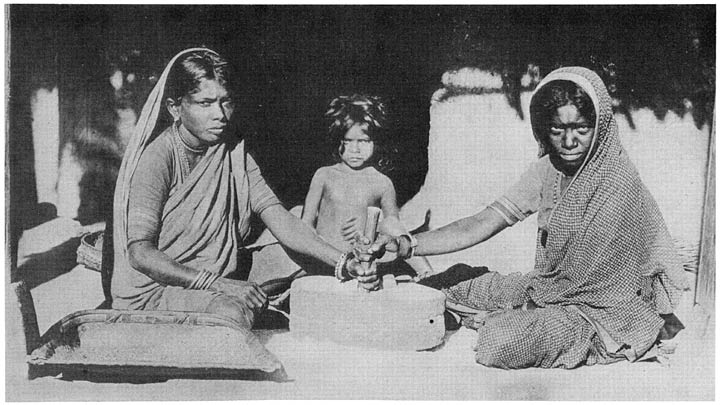
Gond women grinding corn
3. Derivation of name and origin of the Gonds.
4. History of the Gonds.
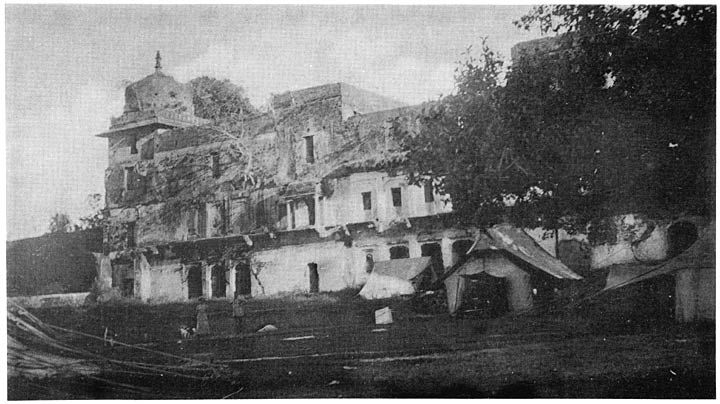
Palace of the Gond kings of Garha-Mandla at Rāmnagar
5. Mythica traditions. Story of Lingo.
6. Legend of the creation.
In the beginning there was water everywhere, and God was born in a lotus-leaf and lived alone. One day he rubbed his arm and from the rubbing made a crow, which sat on his shoulder; he also made a crab, which swam out over the waters. God then ordered the crow to fly over the world and bring some earth. The crow flew about and could find no earth, but it saw the crab, which was supporting itself with one leg resting on the bottom of the sea. The crow was very tired and perched on the crab’s back, which was soft so that the crow’s feet made marks on it, which are still visible on the bodies of all crabs at present. The crow asked the crab where any earth could be found. The crab said that if God would make its body hard it would find some earth. God said he would make part of the crab’s body hard, and he made its back hard, as it still remains. The crab then dived to the bottom of the sea, where it found Kenchna, the earth-worm. It caught hold of Kenchna by the neck with its claws and the mark thus made is still to be seen on the earth-worm’s neck. Then the earth-worm brought up earth out of its mouth and the crab brought this to God, and God scattered it over the sea and patches of land appeared. God then walked over the earth and a boil came on his hand, and out of it Mahādeo and Pārvati were born.
7. Creation of the Gonds and their imprisonment by Mahādeo.
Hither and thither all the Gonds were scattered in the jungle.
Places, hills, and valleys were filled with these Gonds.
Even trees had their Gonds. How did the Gonds conduct themselves?
Whatever came across them they must needs kill and eat it;
They made no distinction. If they saw a jackal they killed
And ate it; no distinction was observed; they respected not antelope, sāmbhar and the like.
They made no distinction in eating a sow, a quail, a pigeon,
A crow, a kite, an adjutant, a vulture,
A lizard, a frog, a beetle, a cow, a calf, a he- and she-buffalo,
Rats, bandicoots, squirrels—all these they killed and ate.
So began the Gonds to do. They devoured raw and ripe things;
They did not bathe for six months together;
They did not wash their faces properly, even on dunghills they would fall down and remain.
Such were the Gonds born in the beginning. A smell was spread over the jungle
When the Gonds were thus disorderly behaved; they became disagreeable to Mahādeva,
Who said: “The caste of the Gonds is very bad;
I will not preserve them; they will ruin my hill Dhawalgiri.”
Mahādeo then determined to get rid of the Gonds. With this view he invited them all to a meeting. When they sat down Mahādeo made a squirrel from the rubbings of his body and let it loose in the middle of the Gonds. All the Gonds at once got up and began to chase it, hoping for a meal. They seized sticks and stones and clods of earth, and their unkempt hair flew in the wind. The squirrel dodged about and ran away, and finally, directed by Mahādeo, ran into a large cave with all the Gonds after it. Mahādeo then rolled a large stone to the mouth of the cave and shut up all the Gonds in it. Only four remained outside, and they fled away to Kachikopa Lohāgarh, or the Iron Cave in the Red Hill, and lived there. Meanwhile Pārvati perceived that the smell of the Gonds, which had pleased her, had vanished from Dhawalgiri. She desired it to be restored and commenced a devotion. For six months she fasted and practised austerities. Bhagwān (God) was swinging in a swing. He was disturbed by Pārvati’s devotion. He sent Nārāyan (the sun) to see who was fasting. Nārāyan came and found Pārvati and asked her what she wanted. She said that she missed her Gonds and wanted them back. Nārāyan told Bhagwān, who promised that they should be given back.
8. The birth and history of Lingo.
He said, I will show you something; see if anywhere in your
Waistbands there is a flint; if so, take it out and make fire.
But the matches did not ignite. As they were doing this, a watch of the night passed.
They threw down the matches, and said to Lingo, Thou art a Saint;
Show us where our fire is, and why it does not come out.
Lingo said: Three koss (six miles) hence is Rikad Gawādi the giant.
There is fire in his field; where smoke shall appear, go there,
Come not back without bringing fire. Thus said Lingo.
They said, We have never seen the place, where shall we go?
Ye have never seen where this fire is? Lingo said;
I will discharge an arrow thither.
Go in the direction of the arrow; there you will get fire.
He applied the arrow, and having pulled the bow, he discharged one:
It crashed on, breaking twigs and making its passage clear.
Having cut through the high grass, it made its way and reached the old man’s place (above mentioned).
The arrow dropped close to the fire of the old man, who had daughters.
The arrow was near the door. As soon as they saw it, the daughters came and took it up,
And kept it. They asked their father: When will you give us in marriage?
Thus said the seven sisters, the daughters of the old man.
I will marry you as I think best for you;
Remain as you are. So said the old man, the Rikad Gawādi.
Lingo said, Hear, O brethren! I shot an arrow, it made its way.
Go there, and you will see fire; bring thence the fire.
Each said to the other, I will not go; but (at last) the youngest went.
He descried the fire, and went to it; then beheld he an old man looking like the trunk of a tree.
He saw from afar the old man’s field, around which a hedge was made.
The old man kept only one way to it, and fastened a screen to the entrance, and had a fire in the centre of the field.
He placed logs of the Mahua and Anjun and Sāj trees on the fire,
Teak faggots he gathered, and enkindled flame.
The fire blazed up, and warmed by the heat of it, in deep sleep lay the Rikad Gawādi.
Thus the old man like a giant did appear. When the young Gond beheld him, he shivered;
His heart leaped; and he was much afraid in his mind, and said:
If the old man were to rise he will see me, and I shall be eaten up;
I will steal away the fire and carry it off, then my life will be safe.
He went near the fire secretly, and took a brand of tendu wood tree.
When he was lifting it up a spark flew and fell on the hip of the old man.
That spark was as large as a pot; the giant was blistered; he awoke alarmed.
And said: I am hungry, and I cannot get food to eat anywhere; I feel a desire for flesh;
Like a tender cucumber hast thou come to me. So said the old man to the Gond,
Who began to fly. The old man followed him. The Gond then threw away the brand which he had stolen.
He ran onward, and was not caught. Then the old man, being tired, turned back.
Thence he returned to his field, and came near the fire and sat, and said, What nonsense is this?
A tender prey had come within my reach;
I said I will cut it up as soon as I can, but it escaped from my hand!
Let it go; it will come again, then I will catch it. It has gone now.
Then what happened? the Gond returned and came to his brethren.
And said to them: Hear, O brethren, I went for fire, as you sent me, to that field; I beheld an old man like a giant.
With hands stretched out and feet lifted up. I ran. I thus survived with difficulty.
The brethren said to Lingo, We will not go. Lingo said, Sit ye here.
O brethren, what sort of a person is this giant? I will go and see him.
So saying, Lingo went away and reached a river.
He thence arose and went onward. As he looked, he saw in front three gourds.
Then he saw a bamboo stick, which he took up.
When the river was flooded
It washed away a gourd tree, and its seed fell, and each stem produced bottle-gourds.
He inserted a bamboo stick in the hollow of the gourd and made a guitar.
He plucked two hairs from his head and strung it.
He held a bow and fixed eleven keys to that one stick, and played on it.
Lingo was much pleased in his mind.
Holding it in his hand, he walked in the direction of the old man’s field.
He approached the fire where Rikad Gawādi was sleeping.
The giant seemed like a log lying close to the fire; his teeth were hideously visible;
His mouth was gaping. Lingo looked at the old man while sleeping.
His eyes were shut. Lingo said, This is not a good time to carry off the old man while he is asleep.
In front he looked, and turned round and saw a tree
Of the pīpal sort standing erect; he beheld its branches with wonder, and looked for a fit place to mount upon.
It appeared a very good tree; so he climbed it, and ascended to the top of it to sit.
As he sat the cock crew. Lingo said, It is daybreak;
Meanwhile the old man must be rising. Therefore Lingo took the guitar in his hand,
And held it; he gave a stroke, and it sounded well; from it he drew one hundred tunes.
It sounded well, as if he was singing with his voice.
Thus (as it were) a song was heard.
Trees and hills were silent at its sound. The music loudly entered into
The old man’s ears; he rose in haste, and sat up quickly; lifted up his eyes,
And desired to hear (more). He looked hither and thither, but could not make out whence the sound came.
The old man said: Whence has a creature come here to-day to sing like the maina bird?
He saw a tree, but nothing appeared to him as he looked underneath it.
He did not look up; he looked at the thickets and ravines, but
Saw nothing. He came to the road, and near to the fire in the midst of his field and stood.
Sometimes sitting, and sometimes standing, jumping, and rolling, he began to dance.
The music sounded as the day dawned. His old woman came out in the morning and began to look out.
She heard in the direction of the field a melodious music playing.
When she arrived near the edge of her field, she heard music in her ears.
That old woman called her husband to her.
With stretched hands, and lifted feet, and with his neck bent down, he danced.
Thus he danced. The old woman looked towards her husband, and said, My old man, my husband,
Surely, that music is very melodious. I will dance, said the old woman.
Having made the fold of her dress loose, she quickly began to dance near the hedge.
9. Death and resurrection of Lingo.
Then Lingo disclosed himself to the giant and became friendly with him. The giant apologised for having tried to eat his brother, and called Lingo his nephew. Lingo invited him to come and feast on the flesh of the sixteen scores of nīlgai. The giant called his seven daughters and offered them all to Lingo in marriage. The daughters produced the arrow which they had treasured up as portending a husband. Lingo said he was not marrying himself, but he would take them home as wives for his brothers. So they all went back to the cave and Lingo assigned two of the daughters each to the three elder brothers and one to the youngest. Then the brothers, to show their gratitude, said that they would go and hunt in the forest and bring meat and fruit and Lingo should lie in a swing and be rocked by their seven wives. But while the wives were swinging Lingo and his eyes were shut, they wished to sport with him as their husbands’ younger brother. So saying they pulled his hands and feet till he woke up. Then he reproached them and called them his mothers and sisters, but they cared nothing and began to embrace him. Then Lingo was filled with wrath and leapt up, and seeing a rice-pestle near he seized it and beat them all with it soundly. Then the women went to their houses and wept and resolved to be revenged on Lingo. So when the brothers came home they told their husbands that while they were swinging Lingo he had tried to seduce them all from their virtue, and they were resolved to go home and stay no longer in Kachikopa with such a man about the place. Then the brothers were exceedingly angry with Lingo, who they thought had deceived them with a pretence of virtue in refusing a wife, and they resolved to kill him. So they enticed him into the forest with a story of a great animal which had put them to flight and asked him to kill it, and there they shot him to death with their arrows and gouged out his eyes and played ball with them.
But the god Bhagwān became aware that Lingo was not praying to him as usual, and sent the crow Kageshwar to look for him. The crow came and reported that Lingo was dead, and the god sent him back with nectar to sprinkle it over the body and bring it to life again, which was done.
10. He releases the Gonds shut up in the cave and constitutes the tribe.
And our Lingo redivivus
Wandered on across the mountains,
Wandered sadly through the forest
Till the darkening of the evening,
Wandered on until the night fell.
Screamed the panther in the forest,
Growled the bear upon the mountain,
And our Lingo then bethought him
Of their cannibal propensities.
Saw at hand the tree Niruda,
Clambered up into its branches.
Darkness fell upon the forest,
Bears their heads wagged, yelled the jackal
Kolyal, the King of Jackals.
Sounded loud their dreadful voices
In the forest-shade primeval.
Then the Jungle-Cock Gugotee,
Mull the Peacock, Kurs the Wild Deer,
Terror-stricken, screeched and shuddered,
In that forest-shade primeval.
But the moon arose at midnight,
Poured her flood of silver radiance,
Lighted all the forest arches,
Through their gloomy branches slanting;
Fell on Lingo, pondering deeply
On his sixteen scores of Koitūrs.
Then thought Lingo, I will ask her
For my sixteen scores of Koitūrs.
‘Tell me, O Moon!’ said Lingo,
‘Tell, O Brightener of the darkness!
Where my sixteen scores are hidden.’
But the Moon sailed onwards, upwards,
And her cold and glancing moonbeams
Said, ‘Your Gonds, I have not seen them.’
And the Stars came forth and twinkled
Twinkling eyes above the forest.
Lingo said, “O Stars that twinkle!
Eyes that look into the darkness,
Tell me where my sixteen scores are.”
But the cold Stars twinkling ever,
Said, ‘Your Gonds, we have not seen them.’
Broke the morning, the sky reddened,
Faded out the star of morning,
Rose the Sun above the forest,
Brilliant Sun, the Lord of morning,
And our Lingo quick descended,
Quickly ran he to the eastward,
Fell before the Lord of Morning,
Gave the Great Sun salutation—
‘Tell, O Sun!’ he said, ‘Discover
Where my sixteen scores of Gonds are.’
But the Lord of Day reply made—
“Hear, O Lingo, I a Pilgrim
Wander onwards, through four watches
Serving God, I have seen nothing
Of your sixteen scores of Koitūrs.”
Then our Lingo wandered onwards
Through the arches of the forest;
Wandered on until before him
Saw the grotto of a hermit,
Old and sage, the Black Kumāit,
He the very wise and knowing,
He the greatest of Magicians,
Born in days that are forgotten,
In the unremembered ages,
Salutation gave and asked him—
‘Tell, O Hermit! Great Kumāit!
Where my sixteen scores of Gonds are.
Then replied the Black Magician,
Spake disdainfully in this wise—
“Lingo, hear, your Gonds are asses
Eating cats, and mice, and bandicoots,
Eating pigs, and cows, and buffaloes;
Filthy wretches! wherefore ask me?
If you wish it I will tell you.
Our great Mahādeva caught them,
And has shut them up securely
In a cave within the bowels
Of his mountain Dewalgiri,
With a stone of sixteen cubits,
And his bulldog fierce Basmāsur;
Serve them right, too, I consider,
Filthy, casteless, stinking wretches!”
And the Hermit to his grotto
Back returned, and deeply pondered
On the days that are forgotten,
On the unremembered ages.
But our Lingo wandered onwards,
Fasting, praying, doing penance;
Laid him on a bed of prickles,
Thorns long and sharp and piercing.
Fasting lay he devotee-like,
Hand not lifting, foot not lifting,
Eye not opening, nothing seeing.
Twelve months long thus lay and fasted,
Till his flesh was dry and withered,
And the bones began to show through.
Then the great god Mahādeva
Felt his seat begin to tremble,
Felt his golden stool, all shaking
From the penance of our Lingo.
Felt, and wondered who on earth
This devotee was that was fasting
Till his golden stool was shaking.
Stepped he down from Dewalgiri,
Came and saw that bed of prickles
Where our Lingo lay unmoving.
Asked him what his little game was,
Why his golden stool was shaking.
Answered Lingo, “Mighty Ruler!
Nothing less will stop that shaking
Than my sixteen scores of Koitūrs
Rendered up all safe and hurtless
From your cave in Dewalgiri.”
Then the Great God, much disgusted,
Offered all he had to Lingo,
Offered kingdom, name, and riches,
Offered anything he wished for,
‘Only leave your stinking Koitūrs
Well shut up in Dewalgiri.’
But our Lingo all refusing
Would have nothing but his Koitūrs;
Gave a turn to run the thorns a
Little deeper in his midriff.
Winced the Great God: “Very well, then,
Take your Gonds—but first a favour.
By the shore of the Black Water
Lives a bird they call Black Bindo,
Much I wish to see his young ones,
Little Bindos from the sea-shore;
For an offering bring these Bindos,
Then your Gonds take from my mountain.”
Then our Lingo rose and wandered,
Wandered onwards through the forest,
Till he reached the sounding sea-shore,
Reached the brink of the Black Water,
Found the Bingo birds were absent
From their nest upon the sea-shore,
Absent hunting in the forest,
Hunting elephants prodigious,
Which they killed and took their brains out,
Cracked their skulls, and brought their brains to
Feed their callow little Bindos,
Wailing sadly by the sea-shore.
Seven times a fearful serpent,
Bhawarnāg the horrid serpent,
Serpent born in ocean’s caverns,
Coming forth from the Black Water,
Had devoured the little Bindos—
Broods of callow little Bindos
Wailing sadly by the sea-shore—
In the absence of their parents.
Eighth this brood was. Stood our Lingo,
Stood he pondering beside them—
“If I take these little wretches
In the absence of their parents
They will call me thief and robber.
No! I’ll wait till they come back here.”
Then he laid him down and slumbered
By the little wailing Bindos.
As he slept the dreadful serpent,
Rising, came from the Black Water,
Came to eat the callow Bindos,
In the absence of their parents.
Came he trunk-like from the waters,
Came with fearful jaws distended,
Huge and horrid, like a basket
For the winnowing of corn.
Rose a hood of vast dimensions
O’er his fierce and dreadful visage.
Shrieked the Bindos young and callow,
Gave a cry of lamentation;
Rose our Lingo; saw the monster;
Drew an arrow from his quiver,
Shot it swift into his stomach,
Sharp and cutting in the stomach,
Then another and another;
Cleft him into seven pieces,
Wriggled all the seven pieces,
Wriggled backward to the water.
But our Lingo, swift advancing,
Seized the headpiece in his arms,
Knocked the brains out on a boulder;
Laid it down beside the Bindos,
Callow, wailing, little Bindos.
On it laid him, like a pillow,
And began again to slumber.
Soon returned the parent Bindos
From their hunting in the forest;
Bringing brains and eyes of camels
And of elephants prodigious,
For their little callow Bindos
Wailing sadly by the sea-shore.
But the Bindos young and callow
Brains of camels would not swallow;
Said—“A pretty set of parents
You are truly! thus to leave us
Sadly wailing by the sea-shore
To be eaten by the serpent—
Bhawarnāg the dreadful serpent—
Came he up from the Black Water,
Came to eat us little Bindos,
When this very valiant Lingo
Shot an arrow in his stomach,
Cut him into seven pieces—
Give to Lingo brains of camels,
Eyes of elephants prodigious.”
Then the fond paternal Bindo
Saw the head-piece of the serpent
Under Lingo’s head a pillow,
And he said, ‘O valiant Lingo,
Ask whatever you may wish for.’
Then he asked the little Bindos
For an offering to the Great God,
And the fond paternal Bindo,
Much disgusted first refusing,
Soon consented; said he’d go too
With the fond maternal Bindo—
Take them all upon his shoulders,
And fly straight to Dewalgiri.
Then he spread his mighty pinions,
Took his Bindos up on one side
And our Lingo on the other.
Thus they soared away together
From the shores of the Black Water,
And the fond maternal Bindo,
O’er them hovering, spread an awning
With her broad and mighty pinions
O’er her offspring and our Lingo.
By the forests and the mountains
Six months’ journey was it thither
To the mountain Dewalgiri.
Half the day was scarcely over
Ere this convoy from the sea-shore
Lighted safe on Dewalgiri;
Touched the knocker to the gateway
Of the Great God, Mahādeva.
And the messenger Nārāyan
Answering, went and told his master—
“Lo, this very valiant Lingo!
Here he is with all the Bindos,
The Black Bindos from the sea-shore.”
Then the Great God, much disgusted,
Driven quite into a corner,
Took our Lingo to the cavern,
Sent Basmāsur to his kennel,
Held his nose, and moved away the
Mighty stone of sixteen cubits;
Called those sixteen scores of Gonds out
Made them over to their Lingo.
And they said, “O Father Lingo!
What a bad time we’ve had of it,
Not a thing to fill our bellies
In this horrid gloomy dungeon.”
But our Lingo gave them dinner,
Gave them rice and flour of millet,
And they went off to the river,
Had a drink, and cooked and ate it.
The next episode is taken from a slightly different local version:
O God of the crossing,
O Boundary God!
Should you be here,
Come take us across.
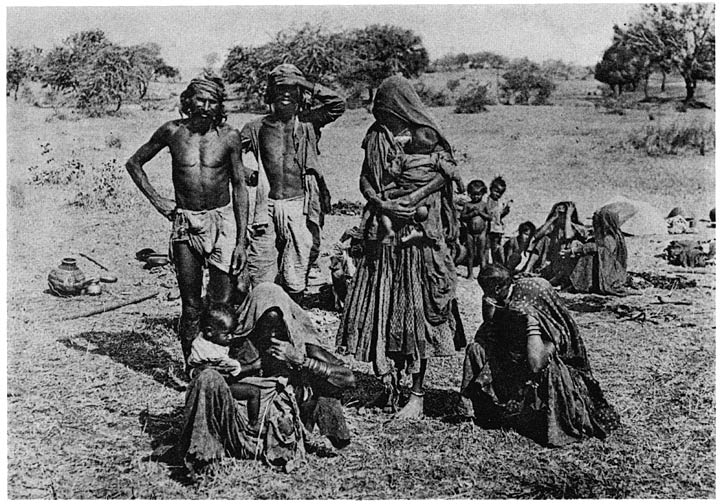
Gonds on a journey
(b) Tribal Subdivisions
11. Subcastes.
Out of the Gond tribe, which, as it gave its name to a province, may be considered as almost a people, a number of separate castes have naturally developed. Among them are several occupational castes such as the Agarias or iron-workers, the Ojhas or soothsayers, Pardhāns or priests and minstrels, Solāhas or carpenters, and Koilabhutis or dancers or prostitutes. These are principally sprung from the Gonds, though no doubt with an admixture of other low tribes or castes. The Parjas of Bastar, now classed as a separate tribe, appear to represent the oldest Gond settlers, who were subdued by later immigrants of the race; while the Bhatras and Jhādi Telengas are of mixed descent from Gonds and Hindus. Similarly the Gowāri caste of cattle-graziers originated from the alliances of Gond and Ahīr graziers. The Mannewārs and Kolāms are other tribes allied to the Gonds. Many Hindu castes and also non-Aryan tribes living in contact with the Gonds have a large Gond element; of the former class the Ahīrs, Basors, Barhais and Lohārs, and of the latter the Baigas, Bhunjias and Khairwārs are instances.
12. Exogamy.
In another part of Bastar there were found to be five classes, and each class had a small number of septs in it. The people who supplied this information could not give the names of many septs. Thus Class A had six septs, Class B five, Classes C and D one each, Class E four, and Class F two. A man could not marry a woman of any sept belonging to his own class.
The Muria Gonds of Bastar have a few large exogamous septs or clans named in Hindi after animals, and each of these clans contains several subsepts with Gondi names. Thus the Bakaravans or Goat race contains the Garde, Kunjami, Karrami and Vadde septs. The Kachhimvans or Tortoise race has the Netāmi, Kawachi, Usendi and Tekāmi septs; the Nāgvans or Cobra race includes the Marāvi, Potāri, Karanga, Nurethi, Dhurwa and others. Other exogamous races are the Sodi (or tiger), Behainsa (buffalo), Netām (dog in Gondi), Chamchidai (bat) and one or two more. In this case the exogamous clans with Hindi names would appear to be a late division, and have perhaps been adopted because the meaning of the old Gondi names had been forgotten, or the septs were too numerous to be remembered.
In Chānda a classification according to the number of gods worshipped is found. There are four main groups worshipping seven, six, five and four gods respectively, and each group contains ten to fifteen septs. A man cannot marry a woman of any sept which worships the same number of gods as himself. Each group has a sacred animal which the members revere, that of the seven-god worshippers being a porcupine, of the six-god worshippers a tiger, of the five-god worshippers the sāras crane, and of the four-god worshippers a tortoise. As a rule the members of the different groups do not know the names of their gods, and in practice it is doubtful whether they restrict themselves to the proper number of gods of their own group. Formerly there were three-, two- and one-god worshippers, but in each of these classes it is said that there were only one or two septs, and they found that they were much inconvenienced by the paucity of their numbers, perhaps for purposes of communal worship and feasting, and hence they got themselves enrolled in the larger groups. In reality it would appear that the classification according to the number of gods worshipped is being forgotten, and the three lowest groups have disappeared. This conjecture is borne out by the fact that in Chhindwāra and other localities only two large classes remain who worship six and seven gods respectively, and marry with each other, the union of a man with a woman worshipping the same number of gods as himself being prohibited. Here, again, the small septs included in the groups appear to serve no purpose for regulating marriages. In Mandla the division according to the number of gods worshipped exists as in Chānda; but many Gonds have forgotten all particulars as to the gods, and say only that those septs which worship the same number of gods are bhaiband, or related to each other, and therefore cannot intermarry. In Betūl the division by numbers of gods appears to be wholly in abeyance. Here certain large septs, especially the Uika and Dhurwa, are subdivided into a number of subsepts, within each of which marriage is prohibited.
13. Totemism.
14. Connection of totemism with the gods.
In Betūl the Gonds explain the totemistic names of their septs by saying that some incident connected with the animal, tree or other object occurred to the ancestor or priest of the sept while they were worshipping at the Deo-khulla or god’s place or threshing-floor. Mr. Ganga Prasād Khatri has made an interesting collection of these. The reason why these stories have been devised may be that the totem animals or plants have ceased to be revered on their own merits as ancestors or kinsmen of the sept, and it was therefore felt necessary to explain the sept name or sanctity attaching to the totem by associating it with the gods. If this were correct the process would be analogous to that by which an animal or plant is first held sacred of itself, and, when this feeling begins to decay with some recognition of its true nature, it is associated with an anthropomorphic god in order to preserve its sanctity. The following are some examples recorded by Mr. Ganga Prasād Khatri. Some of the examples are not associated with the gods.
Gajjāmi, subsept of Dhurwa sept. From gaj, an arrow. Their first ancestor killed a tiger with an arrow.
Gouribans Dhurwa. Their first ancestor worshipped his gods in a bamboo clump.
Kusadya Dhurwa. (Kosa, tasar silk cocoon.) The first ancestor found a silk cocoon on the tree in which he worshipped his gods.
Jaglya. One who keeps awake, or the awakener. The first ancestor stayed awake the whole night in the Deo-khulla, or god’s threshing-floor.
Sariyām. (Sarri, a path.) The first ancestor swept the path to the Deo-khulla.
Guddām. Gudda is a place where a hen lays her eggs. The first ancestor’s hen laid eggs in the Deo-khulla.
Irpāchi. The mahua tree. A mahua tree grew in the Deo-khulla or worshipping-place of this sept.
Sarāti Dhurwa. (Sarāti, a whip.) The first ancestor whipped the priest of the gods.
Suibadiwa. (Sui, a porcupine.) The first ancestor’s wife had a porcupine which went and ate the crop of an old man’s field. He tried to catch it, but it went back to her. He asked the name of her sept, and not being able to find it out called it Suibadiwa.
Watka. (A stone.) Members of this sept worship five stones for their gods. Some say that the first ancestors were young boys who forgot where the Deo-khulla was and therefore set up five stones and offered a chicken to them. As they did not offer the usual sacrifice of a goat, members of this sept abstain from eating goats.
Tumdan Uika. Tumdan is a kind of pumpkin or gourd. They say that this plant grows in their Deo-khulla. The members drink water out of this gourd in the house, but do not carry it out of the house.
Kadfa-chor Uika. (Stealer of the kadfa.) Kadfa is the sheaf of grain left standing in the field for the gods when the crop is cut. The first ancestor stole the kadfa and offered it to his gods.
Gadhamār Uika. (Donkey-slayer.) Some say that the gods of the sept came to the Deo-khulla riding on donkeys, and others that the first ancestor killed a donkey in the Deo-khulla.
Eti-kumra. Eti is a goat. The ancestors of the sept used to sacrifice a Brāhman boy to their gods. Once they were caught in the act by the parents of the boy they had stolen, and they prayed to the gods to save them, and the boy was turned into a goat. They do not kill a goat nor eat its flesh, nor sacrifice it to the gods.
Ahke. This word means ‘on the other side of a river.’ They say that a man of the Dhurwa sept abducted a girl of the Uika sept from the other side of a river and founded this sept.
Tirgām. The word means fire. They say that their ancestor’s hand was burnt in the Deo-khulla while cooking the sacrifice.
Tekām. (The teak tree.) The ancestor of the sept had his gods in this tree. Members of the sept will not eat food off teak leaves, but they will use them for thatching, and also cut the tree.
Manapa. In Gondi mani is a son and apa a father. They say that their ancestors sacrificed a Brāhman father and son to their gods and were saved by their being turned into goats like the Eti-kumra sept. Members of the sept do not kill or eat a goat.
Korpachi. The droppings of a hen. The ancestors of the sept offered these to his gods.
Mandani. The female organ of generation. The ancestor of the sept slept with his wife in the Deo-khulla.
Paiyām. Paiya is a heifer which has not borne a calf, such as is offered to the gods. Other Gonds say that the people of this sept have no gods. They are said not only to marry a girl from any other subsept of the Dhurwas and Uikas, but from their own sept and even their own sisters, though this is probably no longer true. They are held to be the lowest of the Gonds. Except in this instance, as already seen, the subsepts of the Dhurwa and Uika septs do not intermarry with each other.
(c) Marriage Customs
15. Prohibitions on intermarriage, and unions of relations.
A man must not marry in his own sept, nor in one which worships the same number of gods, in localities where the classification of septs according to the number of gods worshipped obtains. Intermarriage between septs which are bhaiband or brothers to each other is also prohibited. The marriage of first cousins is considered especially suitable. Formerly, perhaps, the match between a brother’s daughter and sister’s son was most common; this is held to be a survival of the matriarchate, when a man’s sister’s son was his heir. But the reason has now been generally forgotten, and the union of a brother’s son to a sister’s daughter has also become customary, while, as girls are scarce and have to be paid for, it is the boy’s father who puts forward his claim. Thus in Mandla and Bastar a man thinks he has a right to his sister’s daughter for his son on the ground that his family has given a girl to her husband’s family, and therefore they should give one back. This match is known as Dūdh lautāna or bringing back the milk; and if the sister’s daughter marries any one else her maternal uncle sometimes claims what is known as ‘milk money,’ which may be a sum of Rs. 5, in compensation for the loss of the girl as a wife for his son. This custom has perhaps developed out of the former match in changed conditions of society, when the original relation between a brother and his sister’s son has been forgotten and girls have become valuable. But it is said that the dūdh or milk money is also payable if a brother refuses to give his daughter to his sister’s son. In Mandla a man claims his sister’s daughter for his son and sometimes even the daughter of a cousin, and considers that he has a legitimate grievance if the girl is married to somebody else. Frequently, if he has reason to apprehend this, he invites the girl to his house for some ceremony or festival, and there marries her to his son without the consent of her parents. As this usually constitutes the offence of kidnapping under the Penal Code, a crop of criminal cases results, but the procedure of arrest without warrant and the severe punishment imposed by the Code are somewhat unsuitable for a case of this kind, which, according to Gond ideas, is rather in the nature of a civil wrong, and a sufficient penalty would often be the payment of an adequate compensation or bride-price for the girl. The children of two sisters cannot, it is said, be married, and a man cannot marry his wife’s elder sister, any aunt or niece, nor his mother-in-law or her sister. But marriage is not prohibited between grandparents and grandchildren. If an old man marries a young wife and dies, his grandson will marry her if she is of proper age. In this there would be no blood-relationship, but it is doubtful whether even the existence of such relationship would prevent the match. It is said that even among Hindu castes the grandfather will flirt with his granddaughter, and call her his wife in jest, and the grandmother with her grandson. In Bastar a man can marry his daughter’s daughter or maternal grandfather’s or grandmother’s sister. He could not marry his son’s daughter or paternal grandfather’s sister, because they belong to the same sept as himself.
16. Irregular marriages.
In the Māria country, if a girl is made pregnant by a man of the caste before marriage, she simply goes to his house and becomes his wife. This is called Paithu or entering. The man has to spend Rs. 2 or 3 on food for the caste and pay the price for the girl to her parents. If a girl has grown up and no match has been arranged for her to which she agrees, her parents will ask her maternal uncle’s or paternal aunt’s son to seize her and take her away. These two cousins have a kind of prescriptive claim to the girl, and apparently it makes no difference whether the prospective husband is already married or not. He and his friends lie in wait near her home and carry her off, and her parents afterwards proceed to his house to console their daughter and reconcile her to the match. Sometimes when a woman is about to become what is known as a Paisamundi or kept woman, without being married, the relations rub her and the man whose mistress she is with oil and turmeric, put marriage crowns of palm-leaves on their heads, pour water on them from the top of a post, and make them go seven times round a mahua branch, so that they may be considered to be married. When a couple are very poor they may simply go and live together without any wedding, and perform the ceremony afterwards when they have means, or they distribute little pieces of bread to the tribesmen in lieu of the marriage feast.
17. Marriage. Arrangement of matches.
Marriage is generally adult. Among the wild Māria Gonds of Bastar the consent of the girl is considered an essential preliminary to the union. She gives it before a council of elders, and if necessary is allowed time to make up her mind. The boy must also agree to the match. Elsewhere matches are arranged by the parents, and a bride-price which amounts to a fairly substantial sum in comparison with the means of the parties is usually paid. But still the girls have a considerable amount of freedom. It is generally considered that if a girl goes of her own accord and pours turmeric and water over a man, it is a valid marriage and he can take her to live in his house. Married women also sometimes do this to another man if they wish to leave their husbands.
18. The marriage ceremony.
The most distinctive feature of a Gond marriage is that the procession usually starts from the bride’s house and the wedding is held at that of the bridegroom, in contradistinction to the Hindu practice. It is supposed that this is a survival of the custom of marriage by capture, when the bride was carried off from her own house to the bridegroom’s, and any ceremony which was requisite was necessarily held at the house of the latter. But the Gonds say that since Dūlha Deo, the bridegroom god and one of the commonest village deities, was carried off by a tiger on his way to his wedding, it was decided that in future the bride must go to the bridegroom to be married in order to obviate the recurrence of such a calamity. Any risk incidental to the journey thus falls to the lady. Among the wilder Māria Gonds of Bastar the ritual is very simple. The bride’s party arrive at the bridegroom’s village and occupy some huts made ready for them. His father sends them provisions, including a pig and fowls, and the day passes in feasting. In the evening they go to the bridegroom’s house, and the night is spent in dancing by the couple and the young people of the village. Next morning the bride’s people go back again, and after another meal her parents bring her to the bridegroom’s house and push her inside, asking the boy’s father to take charge of her, and telling her that she now belongs to her husband’s family and must not come back to them alone. The girl cries a little for form’s sake and acquiesces, and the business is over, no proper marriage rite being apparently performed at all. Among the more civilised Mārias the couple are seated for the ceremony side by side under a green shed, and water is poured on them through the shed in imitation of the fertilising action of rain. Some elder of the village places his hands on them and the wedding is over. But Hindu customs are gradually being adopted, and the rubbing of powdered turmeric and water on the bodies of the bride and bridegroom is generally essential to a proper wedding. The following description is given of the Gonds of Kanker. On the day fixed for the marriage the pair, accompanied by the Dosi or caste priest, proceed to a river, in the bed of which two reeds five or six feet high are placed just so far apart that a man can lie down between them, and tied together with a thread at the top. The priest lies down between the reeds, and the bride and bridegroom jump seven times over his body. After the last jump they go a little way off, throw aside their wet clothes, and then run naked to a place where their dry clothes are kept; they put them on and go home without looking back. Among the Gonds in Khairāgarh the pair are placed in two pans of a balance and covered with blankets. The caste priest lifts up the bridegroom’s pan and her female relatives the bride’s, and walk round with them seven times, touching the marriage-post at each time. After this they are taken outside the village without being allowed to see each other. They are placed standing at a little distance with a screen between them, and liquor is spilt on the ground to make a line from one to the other. After a time the bridegroom lifts up the screen, rushes on the bride, gives her a blow on the back and puts the ring on her finger, at the same time making a noise in imitation of the cry of a goat. All the village then indulge in bacchanalian orgies, not sparing their own relations.
19. Wedding expenditure.
20. Special customs.
21. Taking omens.
In Bastar an omen is taken before the wedding. The village elders meet on an auspicious day as Monday, Thursday or Friday, and after midnight they cook and eat food, and go out into the forest. They look for a small black bird called Usi, from which omens are commonly taken. When anybody sees this bird, if it cries ‘Sun, Sun,’ on the right hand, it is thought that the marriage will be lucky. If, however, it cries ‘Chi, Chi’ or ‘Fie, Fie,’ the proposed match is held to be of evil omen, and is cancelled. The Koya Gonds of Bastar distil mahua liquor before arranging for a match. If the liquor is good they think the marriage will be lucky, and take the liquor with them to cement the betrothal; but if it is bad they think the marriage will be unlucky, and the proposal is dropped. Mondays, Wednesdays and Fridays are held to be lucky days for marriages, and they are celebrated in the hot-weather months of Baisākh, Jesth and Asār, or April, May and June, or in Pūs (December), and rarely in Māgh (January). A wedding is only held in Kārtik (October) if the bride and bridegroom have already had sexual intercourse, and cannot take place in the rains.
22. Marriage by capture. Weeping and hiding.
Survivals of the custom of marriage by capture are to be found in many localities. In Bastar the prospective bridegroom collects a party of his friends and lies in wait for the girl, and they catch her when she comes out and gets a little distance from her house. The girl cries out, and women of the village come and rescue her and beat the boys with sticks till they have crossed the boundary of the village. The boys neither resist nor retaliate on the women, but simply make off with the girl. When they get home a new cloth is given to her, and the boys have a carouse on rice-beer, and the marriage is considered to be complete. The parents do not interfere, but as a rule the affair is prearranged between the girl and her suitor, and if she really objects to the match they let her go. A similar procedure occurs in Chānda. Other customs which seem to preserve the idea that marriage was once a forcible abduction are those of the bride weeping and hiding, which are found in most Districts. In Bālāghāt the bride and one or two friends go round to the houses of the village and to other villages, all of them crying, and receive presents from their friends. In Wardha the bride is expected to cry continuously for a day and a night before the wedding, to show her unwillingness to leave her family. In Kanker it is said that before marriage the bride is taught to weep in different notes, so that when that part of the ceremony arrives in which weeping is required, she may have the proper note at her command. In Chhindwāra the bridegroom’s party go and fetch the bride for the wedding, and on the night before her departure she hides herself in some house in the village. The bridegroom’s brother and other men seek all through the village for her, and when they find her she runs and clings to the post of the house. The bridegroom’s brother carries her off by force, and she is taken on a bullock to the bridegroom’s house. In Seoni the girl hides in the same manner, and calls out ‘Coo, coo,’ when they are looking for her. After she is found, the bridegroom’s brother carries her round on his back to the houses of his friends in the village, and she weeps at each house. When the bride’s party arrive at the bridegroom’s village the latter’s party meet them and stop them from proceeding further. After waving sticks against each other in a threatening manner they fall on each other’s necks and weep. Then two spears are planted to make an arch before the door, and the bridegroom pushes the bride through these from behind, hitting her to make her go through, while she hangs back and feigns reluctance. In Mandla the bride sometimes rides to the wedding on the shoulders of her sister’s husband, and it is supposed that she never gets down all the way.
23. Serving for a wife.
The practice of Lamsena, or serving for a wife, is commonly adopted by boys who cannot afford to buy one. The bridegroom serves his prospective father-in-law for an agreed period, usually three to five or even six years, and at its expiry he should be married to the girl without expense. During this time he is not supposed to have access to the girl, but frequently they become intimate, and if this happens the boy may either stay and serve his unexpired term or take his wife away at once; in the latter case his parents should pay the girl’s father Rs. 5 for each year of the bridegroom’s unexpired service. The Lamsena custom does not work well as a rule, since the girl’s parents can break their contract, and the Lamsena has no means of redress. Sometimes if they are offered a good bride-price they will marry the girl to another suitor when he has served the greater part of his term, and all his work goes for nothing.
24. Widow remarriage.
The remarriage of widows is freely permitted. As a rule it is considered suitable that she should marry her deceased husband’s younger brother, but she may not marry his elder brother, and in the south of Bastar and Chānda the union with the younger brother is also prohibited. In Mandla, if she will not wed the younger brother, on the eleventh day after the husband’s death he puts the tarkhi or palm-leaf earrings in her ears, and states that if she marries anybody else he will claim dawa-bunda or compensation. Similarly in Bastar, if an outsider marries the widow, he first goes through a joint ceremony with the younger brother, by which the latter relinquishes his right in favour of the former. The widow must not marry any man whom she could not have taken as her first husband. After her husband’s death she resides with her parents, and a price is usually paid to them by any outsider who wishes to marry her. In Bastar there is a fixed sum of Rs. 24, half of which goes to the first husband’s family and half to the caste panchāyat. The payment to the panchāyat perhaps comes down from the period when widows were considered the property of the state or the king, and sold by auction for the benefit of the treasury. It is said that the descendants of the Gond Rājas of Chānda still receive a fee of Rs. 1–8 from every Gond widow who is remarried in the territories over which their jurisdiction extended. In Bastar when a widow marries again she has to be transferred from the gods of her first husband’s sept to those of her second husband. For this two leaf-cups are filled with water and mahua liquor respectively, and placed with a knife between them. The liquor and water are each poured three times from one cup to the other and back until they are thoroughly mixed, and the mixture is then poured over the heads of the widow and her second husband. This symbolises her transfer to the god of the new sept. In parts of Bastar when a man has been killed by a tiger and his widow marries again, she goes through the ceremony not with her new husband but with a lance, axe or sword, or with a dog. It is thought that the tiger into which her first husband’s spirit has entered will try to kill her second husband, but owing to the precaution taken he will either simply carry off the dog or will himself get killed by an axe, sword or lance. In most localities the ceremony of widow-marriage is simple. Turmeric is rubbed on the bodies of the couple and they may exchange a pair of rings or their clothes.
25. Divorce.
Divorce is freely allowed on various grounds, as for adultery on the wife’s part, a quarrelsome disposition, carelessness in the management of household affairs, or if a woman’s children continue to die, or she is suspected of being a witch. Divorce is, however, very rare, for in order to get a fresh wife the man would have to pay for another wedding, which few Gonds can afford, and he would also have difficulty in getting a girl to marry him. Therefore he will often overlook even adultery, though a wife’s adultery not infrequently leads to murder among the Gonds. In order to divorce his wife the husband sends for a few castemen, takes a piece of straw, spits on it, breaks it in two and throws it away, saying that he has renounced all further connection with his wife. If a woman is suspected of being a witch she often has to leave the village and go to some place where she is not known, and in that case her husband must either divorce her or go with her. There is no regular procedure for a wife divorcing her husband, but she can, if sufficiently young and attractive, take matters into her own hands, and simply leave her husband’s house and go and live with some one else. In such a case the man who takes her has to repay to the husband the sum expended by the latter on his marriage, and the panchāyat may even decree that he should pay double the amount. When a man divorces his wife he has no liability for her maintenance, and often takes back any ornaments he may have given her. And a man who marries a divorced woman may be expected to pay her husband the expenses of his marriage. Instances are known of a bride disappearing even during the wedding, if she dislikes her partner; and Mr. Lampard of the Baihir Mission states that one night a Gond wedding party came to his house and asked for the loan of a lantern to look for the bride who had vanished.
26. Polygamy.
Polygamy is freely allowed, and the few Gonds who can afford the expense are fond of taking a number of wives. Wives are very useful for cultivation as they work better than hired servants, and to have several wives is a sign of wealth and dignity. A man who has a number of wives will take them all to the bazār in a body to display his importance. A Gond who had seven wives in Bālāghāt was accustomed always to take them to the bazār like this, walking in a line behind him.
(d) Birth and Pregnancy
27. Menstruation.
28. Superstitions about pregnancy and childbirth.
29. Procedure at a birth.
Professional midwives are not usually employed at childbirth, and the women look after each other. Among the Māria Gonds of Bastar the father is impure for a month after the birth of a child and does not go to his work. A Muria Gond father is impure until the navel-cord drops; he may reap his crop, but cannot thresh or sow. This is perhaps a relic of the custom of the Couvade. The rules for the treatment of the mother resemble those of the Hindus, but they do not keep her so long without food. On some day from the fifth to the twelfth after the birth the mother is purified and the child is named. On this day its hair is shaved by the son-in-law or husband’s or wife’s brother-in-law. The mother and child are washed and rubbed with oil and turmeric, and the house is freshly whitewashed and cleaned with cowdung. They procure a winnowing-fan full of kodon and lay the child on it, and the mother ties this with a cloth under her arm. In the Nāgpur country the impurity of the mother is said to last for a month, during which time she is not allowed to cook food and no one touches her. Among the poorer Gonds the mother often does not lie up at all after a birth, but eats some pungent root as a tonic and next day goes on with her work.
30. Names.
31. Superstitions about children.
If a child is born feet first its feet are supposed to have special power, and people suffering from pain in the back come and have their backs touched by the toes of the child’s left foot. This power is believed to be retained in later life. If a woman gets a child when the signs of menstruation have not appeared, the child is called Lamka, and is held to be in danger of being struck by lightning. In order to avert this fate an offering of a white cock is made to the lightning during the month of Asārh (June) following the birth, when thunderstorms are frequent, and prayer is made that it will accept this sacrifice in lieu of the life of the child. They think that the ancestors who have been mingled with Bura Deo may be born again. Sometimes such an ancestor appears in a dream and intimates that he is coming back to earth. Then if a newborn child will not drink its mother’s milk, they think it is some important male ancestor, and that he is vexed at being in such a dependent position to a woman over whom he formerly had authority. So they call the Gunia or sorcerer, and he guesses what ancestor has been reborn by measuring a stick. He says that if the length of the stick is an even number of times the breadth of his hand, or more or less than half a hand-breadth over, such and such an ancestor is reborn in the child. Then he measures his hand along the stick breadthwise, and when the measurement comes to that foretold for a particular ancestor he says that this one has been reborn; or if they find any mark on the body of the child corresponding to one they remember to have been borne by a particular ancestor, they identify it with this ancestor. Then they wash the child’s feet as a token of respect, and pass their hands over its head and say to it, ‘Drink milk, and we will give you a ring and clothes and jewels.’ Sometimes they think that an ancestor has been born again in a calf, and the Gunia ascertains who he is in the same manner. Then this calf is not castrated if a bull, nor put to the plough if it is a cow, and when it dies they will not take off its hide for sale but bury it with the hide on.
It is believed that if a barren woman can get hold of the first hair of another woman’s child or its navel-cord, she can transfer the mother’s fertility to herself, so they dispose of these articles very carefully. If they wish the child to grow fat, they bury the navel-cord in a manure-heap. The upper milk teeth are thrown on to the roof, and the lower ones buried under a water-pot. They say that the upper ones should be in a high place, and the lower ones in a low place. The teeth thrown on the roof may be meant for the rats, who in exchange for them will give the child strong white teeth like their own, while those thrown under the water-pot will cause the new teeth to grow large and quickly, like the grass under a water-pot. Diseases of children are attributed to evil spirits. The illness called Sukhi, in which the body and limbs grow weak and have a dried-up appearance, is very common, and is probably caused by malnutrition. They attribute it to the machinations of an owl which has heard the child’s name or obtained a piece of its soiled clothing. If a stone or piece of wood is thrown at the owl to scare it away, it will pick this up, and after wetting it in a stream, put it out in the sun to dry. As the stone or wood dries up, so will the child’s body dry up and wither. In order to cure this illness they use charms and amulets, and also let the child wallow in a pig-sty so that it may become as fat as the pigs. They say that they always beat a brass dish at a birth so that the noise may penetrate the child’s ears, and this will remove any obstruction there may be to its hearing. If the child appears to be deaf, they lay it several times in a deep grain-bin for about half an hour at a time; when it cries the noise echoes in the bin, and this is supposed to remove the obstruction to its power of hearing. If they wish the boy to be a good dancer, they get a little of the flesh of the kingfisher or hawk which hangs poised in the air over water by the rapid vibration of its wings, on the look-out for a fish, and give him this to eat. If they wish him to speak well, they touch his finger with the tip of a razor, and think that he will become talkative like a barber. If they want him to run fast, they look for a stone on which a hare has dropped some dung and rub this on his legs, or they get a piece of a deer’s horn and hang it round his neck as a charm. If a girl or boy is very dark-coloured, they get the branches of a creeper called malkangni, and express the oil from them, and rub it on the child’s face, and think it will make the face reddish. Thus they apparently consider a black colour to be ugly.
(e) Funeral Rites
32. Disposal of the dead.
33. Funeral ceremony.
Among the Māria Gonds a drum is beaten to announce a death, and the news is sent to relatives and friends in other villages. The funeral takes place on the second or third day, when these have assembled. They bring some pieces of cloth, and these, together with the deceased’s own clothes and some money, are buried with him, so that they may accompany his spirit to the other world. Sometimes the women will put a ring of iron on the body. The body is borne on a hurdle to the burial- or burning-ground, which is invariably to the east of the village, followed by all the men and women of the place. Arrived there, the bearers with the body on their shoulders face round to the west, and about ten yards in front of them are placed three sāj leaves in a line with a space of a yard between each, the first representing the supreme being, the second disembodied spirits, and the third witchcraft. Sometimes a little rice is put on the leaves. An axe is struck three times on the ground, and a villager now cries to the corpse to disclose the cause of his death, and immediately the bearers, impelled, as they believe, by the dead man, carry the body to one of the leaves. If they halt before the first, then the death was in the course of nature; if before the second, it arose from the anger of offended spirits; if before the third, witchcraft was the cause. The ordeal may be thrice repeated, the arrangement of the leaves being changed each time. If witchcraft is indicated as the cause of death, and confirmed by the repeated tests, the corpse is asked to point out the sorcerer or witch, and the body is carried along until it halts before some one in the crowd, who is at once seized and disposed of as a witch. Sometimes the corpse may be carried to the house of a witch in another village to a distance of eight or ten miles. In Mandla in such cases a Gunia or exorciser formerly called on the corpse to go forward and point out the witch. The bearers then, impelled by the corpse, made one step forward and stopped. The exorciser then again adjured the corpse, and they made a step, and this was repeated again and again until they halted in front of the supposed witch. All the beholders and the bearers themselves thus thought that they were impelled by the corpse, and the episode is a good illustration of the power of suggestion. Frequently the detected witch was one of the deceased’s wives. In Mandla the cause of the man’s death was determined in the digging of his grave. When piling in the earth removed for the grave after burial, if it reached exactly to the surface of the ground, they thought that the dead man had died after living the proper span of his life. If the earth made a mound over the hole, they thought he had lived beyond his allotted time and called him Sīgpur, that is a term for a measure of grain heaped as high as it will stand above the brim. But if the earth was insufficient and did not reach to the level of the ground, they held that he had been prematurely cut off, and had been killed by an enemy or by a witch through magic.
Children at breast are buried at the roots of a mahua tree, as it is thought that they will suck liquor from them and be nourished as if by their mother’s milk. The mahua is the tree from whose flowers spirits are distilled. The body of an adult may also be burnt under a mahua tree so that the tree may give him a supply of liquor in the next world. Sometimes the corpse is bathed in water, sprinkled over with milk and then anointed with a mixture of mahua oil, turmeric and charcoal, which will prevent it from being reincarnated in a human body. In the case of a man killed by a tiger the body is burned, and a bamboo image of a tiger is made and thrown outside the village. None but the nearest relatives will touch the body of a man killed by a tiger, and they only because they are obliged to do so. None of the ornaments are removed from the corpse, and sometimes any other ornaments possessed by the deceased are added to them, as it is thought that otherwise the tiger into which his spirit passes will come back to look for them and kill some other person in the house. In some localities any one who touches the body of a man killed or even wounded by a tiger or panther is put temporarily out of caste. Yet the Gonds will eat the flesh of tigers and panthers, and also of animals killed and partly devoured by them. When a man has been killed by a tiger, or when he has died of disease and before death vermin have appeared in a wound, the whole family are temporarily out of caste and have to be purified by an elaborate ceremony in which the Bhumka or village priest officiates. The method of laying the spirit of a man killed by a tiger resembles that described in the article on Baiga.
34. Mourning and offerings to the dead.
Mourning is usually observed for three days. The mourners abstain from work and indulgence in luxuries, and the house is cleaned and washed. The Gonds often take food on the spot after the burial or burning of a corpse and they usually drink liquor. On the third day a feast is given. In Chhindwāra a bullock or cow is slaughtered on the death of a male or female Gond respectively. They tie it up by the horns to a tree so that its forelegs are in the air, and a man slashes it across the head once or twice until it dies. The head is buried under a platform outside the village in the name of the deceased. Sometimes the spirit of the dead man is supposed to enter into one of the persons present and inform the party how he died, whether from witchcraft or by natural causes. He also points out the place where the bullock’s or cow’s head is to be buried, and here they make a platform to his spirit with a memorial stone. Red lead is applied to the stone and the blood of a chicken poured over it, and the party then consume the bodies of the cow and chicken. In Mandla the mourners are shaved at the grave nine or ten days after the death by the brother-in-law or son-in-law of the deceased, and they cook and eat food there and drink liquor. Then they come home and put oil on the head of the heir and tie a piece of new cloth round his head. They give the dead man’s clothes and also a cow or bullock to the Pardhān priest, and offer a goat to the dead man, first feeding the animal with rice, and saying to the dead man’s spirit, ‘Your son- or brother-in-law has given you this.’ Sometimes the rule is that the priest should receive all the ornaments worn on the right side of a man or the left side of a woman, including those on the head, arm and leg. If they give him a cow or bullock, they will choose the one which goes last when the animals are let out to graze. Then they cook and eat it in the compound. They have no regular anniversary ceremonies, but on the new moon of Kunwār (September) they will throw some rice and pulse in front of the house and pour water on it in honour of the dead. The widow breaks her glass bangles when the funeral takes place, and if she is willing she may be married to the dead man’s younger brother on the expiry of the period of mourning.
35. Memorial stones to the dead.
In Bastar, at some convenient time after the death, a stone is set up in memory of any dead person who was an adult, usually by the roadside. Families who have emigrated to other localities often return to their parent village for setting up these stones. The stones vary according to the importance of the deceased, those for prominent men being sometimes as much as eight feet high. In some places a small stone seat is made in front, and this is meant for the deceased to sit on, the memorial stone being his house. After being placed in position the stone is anointed with turmeric, curds, ghī and oil, and a cow or pig is offered to it. Afterwards irregular offerings of liquor and tobacco are made to the dead man at the stone by the family and also by strangers passing by. They believe that the memorial stones sometimes grow and increase in size, and if this happens they think that the dead man’s family will become extinct, as the stone and the family cannot continue to grow together. Elsewhere a long heap of stones is made in honour of a dead man, sometimes with a flat-topped post at the head. This is especially done for men who have died from epidemic disease or by an accident, and passers-by fling stones on the heap with the idea that the dead man’s spirit will thereby be kept down and prevented from returning to trouble the living. In connection with the custom of making a seat at the deceased’s tomb for his spirit to sit upon, Mr. A. K. Smith writes: “It is well known to every Gond that ghosts and devils cannot squat on the bare ground like human beings, and must be given something to sit on. The white man who requires a chair to sit on is thus plainly akin to the world of demons, so one of the few effective ways of getting Gonds to open their mouths and talk freely is to sit on the ground among them. Outside every Gond house is placed a rough bench for the accommodation of any devils that may be flitting about at night, so that they may not come indoors and trouble the inmates.”
36. House abandoned after a death.
If one or two persons die in a house in one year, the family often leave it and make another house. On quitting the old house they knock a hole in the back wall to go out, so as to avoid going out by the front door. This is usually done when the deaths have been due to an epidemic, and it is presumably supposed that the dead men’s spirits will haunt the house and cause others to die, from spite at their own untimely end. If an epidemic visits a village, the Gonds will also frequently abandon it, and make a new village on another site.
37. Bringing back the soul.
They believe that the spirits of ancestors are reincarnated in children or in animals. Sometimes they make a mark with soot or vermilion on the body of a dead man, and if some similar mark is subsequently found on any newborn child it is held that the dead man’s spirit has been reborn in it. In Bastar, on some selected day a short time after the death, they obtain two small baskets and set them out at night, placing a chicken under one and some flour of wheat or kutki under the other. The householder then says, “I do the work of those old men who died. O spirits, I offer a chicken to you to-day; be true and I will perform your funeral rites to-morrow.” On the next morning the basket placed over the flour is lifted up, and if a mark resembling a footprint of a man or any animal be found, they think that the deceased has become incarnate in a human being or in that animal. Subsequently they sacrifice a cow to the spirit as described. In other places on the fifth day after death they perform the ceremony of bringing back the soul. The relatives go to the riverside and call aloud the name of the dead person, and then enter the river, catch a fish or insect and, taking it home, place it among the sainted dead of the family, believing that the spirit of the dead person has in this manner been brought back to the house. The brother-in-law or son-in-law of the dead man will make a miniature grass hut in the compound and place the fish or insect inside it. He will then sacrifice a pig, killing it with a rice-husker, and with not more than three blows. The animal is eaten, and next morning he breaks down the hut and throws away the earthen pots from the house. They will spread some flour on the ground and in the morning bring a chicken up to it. If the animal eats the flour they say that the soul of the deceased has shown his wish to remain in the house, and he is enshrined there in the shape of a stone or copper coin. If it does not eat, then they say that the spirit will not remain in the house. They take the stone or coin outside the village, sacrifice a chicken to it and bury it under a heap of stones to prevent it from returning. Sometimes at the funeral ceremony one of the party is possessed by the spirit of the dead man, and a little white mark or a small caterpillar appears on his hand, and they say that it is the soul of the dead man come back. Then the caterpillar vanishes again, and they say that the dead man has been taken among the gods, and go home. Occasionally some mark may appear on the hand of the dead man’s son after a period of time, and he says that his father’s soul has come back, and gives another funeral feast. The good souls are quickly appeased and their veneration is confined to their descendants. But the bad ones excite a wider interest because their evil influences may be extended to others. And the same fear attaches to the spirits of persons who have died a violent or unnatural death. The soul of a man who has been eaten by a tiger must be specially propitiated, and ten or twelve days are occupied in bringing it back. To ascertain when this has been done a thread is tied to a beam and a copper ring is suspended from it, being secured by twisting the thread round it and not by a knot. A pot full of water is placed below the ring. Songs are then sung in propitiation and a watch is kept day and night. When the ring falls from the thread and drops into the water it is considered that the soul has come back. If the ring delays to fall they adjure the dead man to come back and ask where he has gone to and why he is tarrying. Animals are offered to the ring and their blood poured over it, and when it finally falls they rejoice greatly and say that the dead man has come back. The ancestors are represented by small pebbles kept in a basket in the kitchen, which is considered the holiest part of the house, or they may be pice copper coins (¼d.) tied up in a little bundle. They are daubed with vermilion and worshipped occasionally. A man who has been killed by a tiger or cobra may receive general veneration, with the object of appeasing his spirit, and become a village god. And the same honour may be accorded to any prominent man, such as the founder of a village.
38. The dead absorbed in Bura Deo.
In Mandla the dead are sometimes mingled with Bura Deo or the Great God. On the occasion of a communal sacrifice to Bura Deo a stalk of charra grass is picked in the name of each of the dead ancestors, and tied to the little bundle containing a pice and a piece of turmeric, which represents the dead ancestor in the house. The stalk of grass and the bundle is called kunda; and all the kundas are then hidden in grass or under stones in the adjacent forest. Then Bura Deo comes on some man and possesses him, and he waves his arms about and goes and finds all the kundas. Some of them he throws down beside Bura Deo, and these they say have been absorbed in Bura Deo and are disposed of. Others he throws apart, and these are said not to have been absorbed into the god. For the latter, as well as for all persons who have died a violent death, a heap of stones should be made outside the village, and wine and a fowl are offered at the heap, and passers-by cast additional stones on it to keep down their spirits, which remain unquiet because they have not been absorbed in the god, and are apt to wander about and trouble the living.
39. Belief in a future life.
The Gonds seem originally to have had no idea of a place of abode for the spirits of the dead, that is a heaven or hell. So far as can be conjectured, their primary view of the fate of the spirits of the dead, after they had come to consider the soul or spirit as surviving the death of the body, was that they hung about the houses and village where they had dwelt, and were able to exert considerable influence on the lives and fortunes of their successors. An alternative or subsequent view was that they were reincarnated, most frequently in the bodies of children born in the same family, and less frequently in animals. Whether or no this doctrine of reincarnation is comparatively late and borrowed from Hinduism cannot be decided. In Bastar, however, they have now a conception of retribution after death for the souls of evil-doers. They say that the souls are judged after death, and the sinful are hurled down into a dense forest without any sulphi trees. The sulphi tree appears to be that variety of palm from which palm-liquor or toddy is obtained in Bastar, and the Gond idea of a place of punishment for departed sinners is, therefore, one in which no alcoholic liquor is to be had.
(f) Religion
40. Nature of the Gond religion. The gods.
41. Tribal gods, and their place of residence.
Besides the village gods worshipped in common with the Hindus, the Gonds have also their special tribal gods. These are sometimes kept at a Deo-khulla, which is said to mean literally the threshing-floor of the gods, and is perhaps so called because the place of meeting of the worshippers is cleaned and plastered like a threshing-floor in the fields. The gods most commonly found are Pharsi Pen, the battle-axe god; Matiya, the great god of mischief; Ghangra, the bell god; Chāwar, the cow’s tail, which is also used as a whisk; Pālo, who consists of a piece of cloth used to cover spear-heads; and Sale, who may be the god who presides over cattle-pens (sāla). The Deo-khulla of a six-god Gond should have six, and that of a seven-god Gond seven gods, but this rule is not regularly observed, and the Deo-khullas themselves now tend to disappear as the Gonds become Hinduised and attention is concentrated on the village and household gods. The collection of gods at a Deo-khulla, Mr. Tawney remarks, is called Bura Deo, and when a Gond swears by Bura Deo, he swears by all the gods of his sect. “The gods,” Mr. Tawney writes, “are generally tied up in grass and fixed in the fork of the sāj tree, or buried in some recess in the forest, except Pālo, who is put in a bag to prevent his getting wet, and Chāwar the cow’s tail. The Bhumkas or priests are somewhat shy of showing the gods at the Deo-khulla, and they may have some reason for this, for not long since, a young scamp of a Muhammadan, having determined to put to a test the reputed powers of the Gond gods for evil, hid himself in a tree near the Deo-khulla during a meeting, and afterwards took the gods out and threw them bag and baggage down a well. However, when I went there, the Bhumka at Mujāwar after some parley retired into the forest, and came out quite confidingly with an armful of gods. The Deo-khulla gods are generally all of iron, and those at Mujāwar were all spear-shaped except Pālo, who is a piece of cloth, and Ghangra, who is of bell-metal and in form like the bells ordinarily put round the necks of bullocks. When a spear-head has been lost, and another is not available, anything in the shape of a pike or spear will do, and it does not appear to make any difference so long as iron is the metal used. Women may not worship at the Deo-khulla. It seems clear that the original gods were, with the exception of Ghangra, hunting-weapons and representations of animals. Ghangra may be venerated because of his association with bullocks and also on account of the melodious sound made by bullock-bells. Of all the gods the most remarkable probably is Pālo. He is made of cloth and acts as a covering for the spear-heads at the time of worship. The one I saw was a small cloth, about 30 by 18 inches, and in the form of a shield. He is a very expensive god and costs from Rs. 50 to Rs. 80, his outside value perhaps being Rs. 5. When a new one is required it has to be made by a Katia or Rāj-Pardhān, who must live in a separate house and not go near his own till its completion. He must also be naked while he is working and may not eat, drink, smoke or perform natural functions till he has finished for the day. While engaged on the cloth he is well fed by the Gonds and supplied with fowls and spirits; it is not surprising, therefore, that the god is never finished in six months, though I would engage to make one in a week. The cloth is embroidered with figures in coloured silk, with a stitch or two of red silk in each animal, which will subsequently represent blood. The animals I saw embroidered were a bullock, some sort of deer, a gouty-looking snake with a body as thick as the elephant’s, and the latter animal barely distinguishable from it by having two legs and a trunk. When ready the cloth Pālo is taken to the Deo-khulla and a great worship is held, during which blood is seen to flow from the figures on the cloth and they are supposed to be endowed with life.” The animals embroidered on the cloth are probably those principally revered by the Gonds, as the elephant, snake, deer and bullock, while the worship of the cloth itself and the embroidery on it indicates that they considered the arts of weaving and sewing as divinely revealed accomplishments. And the fact that the other gods were made of iron shows a similar reverence for this metal, which they perhaps first discovered in India. At any rate the quarrying and refining of indigenous iron-ore is at present carried out by the Agarias, a caste derived from the Gonds. The spear-head shape of most of the gods and that of Pālo like a shield show their veneration for these weapons of war, which are themselves sacred.
42. Household gods.
“In almost every house,” Mr. Tawney states, “there is also a set of gods for everyday use. They are often the same as the village gods or those of the Deo-khulla and also include deified ancestors. These household gods have a tendency to increase, as special occasions necessitate the creation of a new god, and once he is enthroned in the house he never seems to leave it of his own accord. Thus if a man is killed by a cobra; he or the cobra becomes a household god and is worshipped for many generations. If a set of gods does not work satisfactorily, they are also, some or all of them, discarded and a new lot introduced. The form of the gods varies considerably, the only constant thing about them being the vermilion with which they are all daubed. They are sometimes all earthen cones and vary from that to miniature wooden tables. I may mention that it is somewhat difficult to get a Gond either to confess that he has any household gods or to show them. The best way is to send off the father of the family on some errand, and then to ask his unsuspecting wife to bring out the gods. You generally get them on a tray and some of the villagers will help her to name them.” In Mandla in every Gond’s house there is a Deothāna or god’s place, where all the gods are kept. Those who have children include Jhulān Devi, or the cradle goddess, among their household deities. In the Deothāna there is always a vessel full of water and a stick, and when a man comes in from outside he goes to this and sprinkles a little water over his body to free himself from any impurity he may have contracted abroad.
43. Nāg Deo.
On one of the posts of the house the image of Nāg Deo, the cobra god, is made in mud. In Asārh (June) the first month of the rains, which the Gonds consider the beginning of the year, snakes frequently appear. In this month they try to kill a cobra, and will then cut off the head and tail, and offer them to Nāg Deo, inside the house, while they cook and eat the body. They think that the eating of the snake’s body will protect them from the effects of eating any poisonous substance throughout the year.
44. Nārāyan Deo.
Nārāyan Deo or the sun is also a household deity. He has a little platform inside the threshold of the house. He may be worshipped every two or three years, but if a snake appears in the house or any one falls ill they think that Nārāyan Deo is impatient and perform his worship. A young pig is offered to him and is sometimes fattened up beforehand by feeding it on rice. The pig is laid on its back over the threshold of the door and a number of men press a heavy beam of wood on its body till it is crushed to death. They cut off the tail and testicles and bury them near the threshold. The body of the pig is washed in a hole dug in the yard, and it is then cooked and eaten. They sing to the god, “Eat, Nārāyan Deo, eat this rice and meat, and protect us from all tigers, snakes and bears in our houses; protect us from all illnesses and troubles.” Next day the bones and any other remains of the pig are buried in the hole in the compound and the earth is well stamped down over it.
45. Bura Deo.
46. Charms and magic.
When they think a child has been overlooked they fetch a strip of leather from the Chamār’s house, make it into a little bag, fill it with scrapings from a clean bit of leather, and hang it round the child’s neck. If a child is ill they sometimes fetch from the Chamār’s house water which has been used for tanning and give it him to drink. If a man is possessed by an evil spirit, they will take some coins, silver for preference, and wave them round his head with a lamp, and take them out and bury them in a waste place. They throw one or two more rupees on the surface of the soil in which they have buried the coins. Then they think the spirit will leave the sufferer, and if any one picks up the coins on the surface of the ground the spirit will possess him. Hindus who find such buried coins frequently refuse to take them, even though they may be valuable, from fear of being possessed by the spirit. Occasionally a man of a treacherous disposition may transfer an evil spirit, which is haunting him, with a daughter in marriage. The husband’s family suspect this if a spirit begins to trouble them. A Vaddai or magician is called, and he tries to transfer the spirit to a fowl or goat by giving the latter some rice to eat. If the spirit then ceases troubling they conclude that it was transferred by the bride’s father, and go to him and reproach him. If he admits that he had a spirit in his family which has given no trouble lately, they ask him to take it back, even though he may not have intended its transfer. The goat or fowl to which the spirit was transferred is then sacrificed in its name and the meat is eaten only by the father-in-law’s family, to whom the spirit thus returns. A miniature hut is built for the spirit in his yard, and a pot, a lamp and a knife are placed in the hut for its use, and an offering of a goat is made to the spirit occasionally at festivals.