Volume 3 / Part 3 — KANJAR
Reading edition
[Bibliography: Mr. J. C. Nesfield’s The Kanjars of Upper India, Calcutta Review, vol. lxxvii., 1883; Mr. Crooke’s Castes and Tribes, art. Kanjar; Major Gunthorpe’s Criminal Tribes; Mr. Kitts’ Berār Census Report (1881); Mr. Gayer’s Lectures on Criminal Tribes of the Central Provinces.]
List of Paragraphs
1. Derivation of the Kanjars from the Doms. 331
2. The Kanjars and the Gipsies. 333
3. The Thugs derived from the Kanjars. 336
4. The Doms. 336
5. The criminal Kanjars. 337
6. The Kūnchband Kanjars. 338
7. Marriage and religion. 338
8. Social customs. 339
9. Industrial arts. 340
1. Derivation of the Kanjars from the Doms.
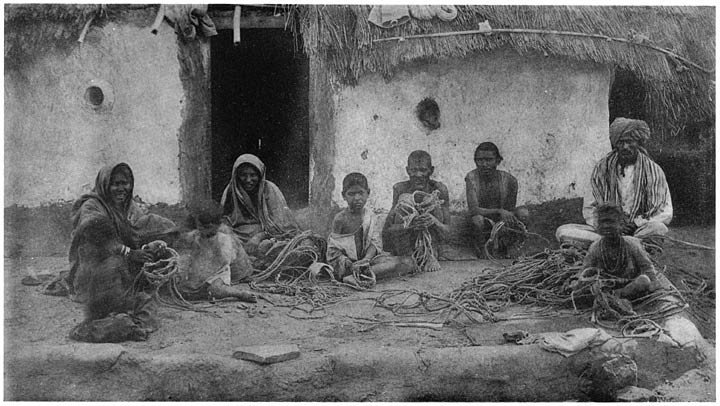
Kanjars making ropes
2. The Kanjars and the Gipsies.
Gipsy. The Rye (squire) he mores (hunts) adrey the wesh (wood)

Bhojpuri. Rai mare andal besh (Pers. بيش)
Gipsy. The kaun-engro (ear-fellow, hare) and chiriclo (bird).
Bhojpuri. Kānwāla chirin
Gipsy. You sovs (sleep) with leste (him) drey (within) the wesh (wood)
Bhojpuri. soe andal besh
Gipsy. And rigs (carry) for leste (him) the gono (sack, game-bag).
Bhojpuri. gon
Gipsy. Oprey (above) the rukh (tree) adrey (within) the wesh (wood)
Bhojpuri. Upri rukh andal besh
Gipsy. Are chiriclo (male-bird) and chiricli (female-bird).
Bhojpuri. chirin chirin
Gipsy. Tuley (below) the rukh (tree) adrey (within) the wesh (wood)
Bhojpuri. Tule rukh andal besh
Gipsy. Are pireno (lover) and pireni (lady-love).
Bhojpuri. pyara pyāri
In the above it must be remembered that the verbal terminations of the gipsy text are English and not gipsy.”
Sir G. Grierson also adds (in the passage first quoted): “I may note here a word which lends a singular confirmation to the theory. It is the gipsy term for bread, which is mānrō or manro. This is usually connected either with the Gaudian mānr ‘rice-gruel’ or with manrua, the millet (Eleusine coracana). Neither of these agrees with the idea of bread, but in the Magadhi dialect of Bihāri, spoken south of the Ganges in the native land of these Maghiya Doms, there is a peculiar word mānda or mānra which means wheat, whence the transition to the gipsy mānrō, bread, is eminently natural.”
The above argument renders it probable that the gipsies are derived from the Doms; and as Mr. Nesfield gives it as a common legend that they originated from the Kanjars, this is perhaps another connecting link between the Doms and Kanjars. The word gipsy is probably an abbreviation of ‘Egyptian,’ the country assigned as the home of the gipsies in mediaeval times. It has already been seen that the Doms are the bards and minstrels of the lower castes in the Punjab, and that the Kanjars and Sānsias, originally identical or very closely connected, were in particular the bards of the Jāts. It is a possible speculation that they may have been mixed up with the lower classes of Jāts or have taken their name, and that this has led to the confusion between the Jāts and gipsies. Some support is afforded to this suggestion by the fact that the Kanjars of Jubbulpore say that they have three divisions, the Jāt, Multāni and Kūchbandia. The Jāt Kanjars are, no doubt, those who acted as bards to the Jāts, and hence took the name; and if the ancestors of these people emigrated from India they may have given themselves out as Jāt.
3. The Thugs derived from the Kanjars.
In the article on Thug it is suggested that a large, if not the principal, section of the Thugs were derived from the Kanjars. At the Thug marriages an old matron would sometimes repeat, “Here’s to the spirits of those who once led bears and monkeys; to those who drove bullocks and marked with the godini (tattooing-needle); and those who made baskets for the head.” And these are the occupations of the Kanjars and Berias. The Goyandas of Jubbulpore, descendants of Thug approvers, are considered to be a class of gipsy Muhammadans, akin to or identical with the Kanjars, of whom the Multāni subdivision are also Muhammadans. Like the Kanjar women the Goyandas make articles of net and string. There is also a colony of Berias in Jubbulpore, and these are admittedly the descendants of Thugs who were located there. If the above argument is well founded, we are led to the interesting conclusion that four of the most important vagrant and criminal castes of India, as well as the Mirāsis or low-class Hindu bards, the gipsies, and a large section of the Thugs, are all derived from the great Dom caste.
4. The Doms.
5. The criminal Kanjars.
6. The Kūnchband Kanjars.
7. Marriage and religion.
8. Social customs.
The dead are usually buried, both male and female corpses being laid on their faces with the feet pointing to the south. Kanjars who become Muhammadans may be readmitted to the community after the following ceremony. A pit is dug and the convert sits in it and each Kanjar throws a little curds on to his body. He then goes and bathes in a river, his tongue is touched or branded with heated gold and he gives a feast to the community. A Kanjar woman who has lived in concubinage with a Brāhman, Rājpūt, Agarwāl Bania, Kurmi, Ahīr or Lodhi may be taken back into the caste after the same ceremony; but not one who has lived with a Kāyasth, Sunār or Lohār or any lower caste. A Kanjar is not put out of caste for being imprisoned, nor for being beaten by an outsider, nor for selling shoes. If a man touches his daughter-in-law even accidentally he is fined the sum of Rs. 2–8.
9. Industrial arts.
The following account of the industries of the vagrant Kanjars was written by Mr. Nesfield in 1883. In the Central Provinces many of them are now more civilised, and some are employed in Government service. Their women also make and retail string-net purses, balls and other articles.