Chapter I · EDIBLE PLUMS (continued 3)
Reading edition
PRUNUS SUBCORDATA KELLOGGII Lemmon
1. Lemmon Pittonia 2:67. 1890. 2. Wickson Calif. Fr. Ed. 2:51. 1891. 3. Greene Fl. Francis 1:50. 1891. 4. Bailey Cyc. Am. Hort. 1448. 1901.
Prunus subcordata kelloggii, named in honor of Dr. Albert Kellogg, an early explorer and settler in California, is distinguished from the species in being a somewhat taller and more slender plant.[130] The branches and bark are of a characteristic ash-gray, so distinct in color from Prunus subcordata that this is often called the “Gray-branch” plum. The leaves are orbicular or elliptical, not cordate, cuneate at the base and nearly glabrous. The fruit is bright yellow instead of red and larger than that of the species, being an inch or more in diameter with a more nearly free stone. This plum inhabits the region of Mount Shasta where it has been known since the time of the early gold diggers, attracting more attention as a food, and promising more for the cultivator than Subcordata. Botanists seem to have given this plum comparatively little attention and careful study may give it specific rank. Locally, and now somewhat in the trade, it is known as the Sisson plum, after a Mr. Sisson, living near Mount Shasta, who has brought it to notice. At present the Kelloggii seems to be the branch of promise for the improvement of the wild plums of the western coast.
15. PRUNUS UMBELLATA Elliott
1. Elliott Sk. Bot. S. C. and Ga. 1:541. 1821. 2. Sargent 10th Cen. U. S. 9:67. 1883. 3. Ibid. Sil. N. Am. 4:33. Pl. 155. 1892. 4. Waugh Plum Cult. 91. 1901. 5. Mohr Cont. U. S. Nat. Herb. 6:551. 1901.
Cerasus umbellata. 6. Torrey and Gray Fl. N. Am. 1:409. 1840.
Tree low, sometimes a shrub, seldom over twenty feet in height; trunk short, usually crooked, attaining a thickness of ten inches; bark dark brown and scaly; branches spreading, slender, twiggy but spineless; branchlets at first pubescent but becoming glabrous, bright red turning dark brown the second year; lenticels few, oblong, yellowish.
Leaves oblong-ovate, or oblong-obovate to oblong, thin and membranaceous, acute at the apex but usually obtuse or cordate at the base; margins closely and evenly serrate with glandular teeth, upper surface dark green and glabrous, lower surface pale green and more or less pubescent; petioles stout, glabrous or sometimes pubescent; glands usually two, sometimes wanting, large, dark, at the base of the leaf; stipules lanceolate, small, caducous.
Flowers medium in size, appearing before and with the leaves; usually borne in four-flowered umbels; calyx-tube obconic, its lobes entire, outer surface glabrous or pubescent, the inner densely tomentose; petals white, orbicular, clawed.
Fruit matures in late summer; one-half inch in diameter, nearly round, without cavity or suture, borne on a slender pedicel three-quarters inch long, orange-red or bright red to purple or nearly black, covered with a thin bloom; skin thick and tough; flesh coarse, thick, acid or astringent, scarcely edible; stone nearly free, flattened, acute at both ends, rugose, thin-walled.
Prunus umbellata, the Sloe, Black Sloe or Hog Plum, Oldfield, and sometimes Chickasaw and Bullace of the South, is found along the seaboard from South Carolina to central Florida, thence westward to the Gulf and along its shores to Texas. Inland it is found as far north as middle Georgia,[131] Alabama and Mississippi and southern Arkansas. Though very common in localities in the region outlined, there are vast areas of this territory in which it is scarcely found, preferring bottom lands of rivers and rich, moist soils in some instances and dry, sandy copses, open woods and borders of fields in others. In flower and fruit it is a handsome and conspicuous plant, yet, as the references show, the early botanists did not describe it, and even Elliott, who gave it its name, in 1821, passed it by with a scant description. Its neglect by the several famous botanists of the Eighteenth Century who explored this region must be attributed to their confusing it with Prunus angustifolia and Prunus maritima, one or the other of which is found in most of the region, and to the idiosyncrasies of the distribution of Prunus umbellata.
The fruit of this species is unfit for dessert purposes but is commonly gathered for culinary use and sometimes is offered for sale in the markets of the South, being highly esteemed for pies, jams and jellies. There appear to have been no efforts made to domesticate it, however, and since it is quite inferior in fruit-characters to others of the native plums, efforts to that end are probably not worth while.
PRUNUS UMBELLATA INJUCUNDA (Small) Sargent
1. Sargent Sil. N. Am. 13:21. 1902.
Prunus injucunda. 2. Small Torrey Bot. Club Bul. 25:149. 1898. 3. Mohr Ibid. 26:118. 1899. 4. Ibid. Cont. U. S. Nat. Herb. 6:552. 1901. 5. Bailey Cyc. Am. Hort. 1449. 1901.
Tree low, seldom twenty feet in height, often a straggling shrub; trunk short, crooked, attaining a diameter of eight inches; bark dark brown, nearly black; branches slender, rigid, twiggy and somewhat spiny; branchlets velvety becoming purplish and finally a dull gray; lenticels few, yellowish.
Leaves oblong-ovate to obovate, taper-pointed at the apex and obtuse or rounded at the base, margins closely and finely toothed, thin in texture; upper surface yellowish-green, wrinkled and more or less pubescent, lower surface densely pubescent and with a prominent yellowish midrib and rather prominent lateral veins; petioles stout, one-half inch in length, very pubescent; stipules lanceolate, small, caducous.
Flowers medium in size or small, usually appearing before the leaves; in four or five-flowered sub-sessile umbels; pedicels slender, three-quarters inch in length, very pubescent; calyx-tube obconic, tomentose, with erect, entire, sharply pointed, ciliate, tomentose lobes; petals white, orbicular, clawed; filaments and base of pistil tomentose.
Fruit maturing in late summer, three-quarters inch long, oblong, with but a trace of cavity and suture, dark purple with light bloom; flesh thin, sour and very astringent; skin thick, tough; scarcely edible; stone ovoid, long, flat, roughish, pointed at both ends with a groove on one edge and a grooved ridge on the other.
In 1898 Small described Prunus injucunda as a new species from what had hitherto been considered a part of Prunus umbellata. Sargent, whom we follow, gives it as a botanical variety of Prunus umbellata. Small says that the two differ as follows: Prunus injucunda has “a more rigid habit and the foliage, including the branchlets, is velvety tomentose. In place of the sub-globose drupe of Prunus umbellata we find an oblong fruit of an extremely bitter taste. The stone is correspondingly lengthened.” To these differences may be added tomentose or pubescent leaves, hairy umbels, and tomentose calyx and pistil, as characters not found in Prunus umbellata though there are occasional pubescent individuals in the species.
Small first collected Prunus injucunda in sandy soil in the granite districts about the base of Little Stone Mountain, Georgia, and reports it as occurring about Stone Mountain. Mohr reports the plant on rocky summits and among the sandstone cliffs of Alpine Mountain, Talladego County, Alabama, as a low, unsightly shrub, four feet in height, with short, straggling branches. The wild fruit is seldom fit for domestic use and with so much better material in other species the fruit-grower can hardly afford to spend time in an attempt to domesticate this one.
16. PRUNUS MITIS Beadle
1. Beadle Bilt. Bot. Stud. 1:162. 1902. 2. Britton and Brown N. Am. Trees 489. 1908.
Tree small, maximum height twenty-five feet; bark dark brown or reddish-gray; branches spreading or ascending, usually unarmed; branchlets glabrous, glaucous; leaves thin, elliptic, oblong-lanceolate, sometimes ovate or obovate, apex acute or acuminate, base narrow or rounded, margin sharply serrate; petioles less than one-half inch, densely pubescent, with two glands at or on the base of the leaf; upper surface bright green, finely pubescent, lower surface paler, also pubescent and with a prominent midrib and veins.
Flowers of medium size, appearing before the leaves; borne in sub-sessile, two to six-flowered umbels; calyx-tube obconic, smooth, its lobes triangular, pubescent on the outer and velvety on the inner surface; petals white, obovate, clawed; pedicels slender, smooth, three-quarters inch long.
Fruit ripening in mid-summer; over one-half inch in length, oblong, dark purple with a heavy bloom; stone ovoid or oval, flattened, nearly one-half inch long, pointed at both ends especially at the apex, and crested on one edge.
Prunus mitis is a newly named species from Alabama, common in dry soils in the regions where it is found wild. The species has many characters in common with Prunus umbellata to which it is so closely related that it is difficult to distinguish the two in herbarium specimens. Although nothing is yet known of its horticultural possibilities the apparent relationship does not indicate much value in the plum for the cultivator.
17. PRUNUS TARDA Sargent
1. Sargent Bot. Gaz. 33:108. 1902. 2. Ibid. Sil. N. Am. 13:23, Pl. 632. 1902.
Tree from twenty to twenty-five feet in height; trunk tall, eighteen or twenty inches in diameter; bark light brown, reddish, thick, with flat ridges and plate-like scales; branches spreading, forming an open symmetrical head; branchlets slender, at first light green and tomentose becoming glabrous, light brownish and lustrous, and the second year much darker; lenticels small, dark, scattered.
Leaves oblong to obovate, apex acute and sharp-pointed, base rounded or cuneate, margin finely serrate with incurved, glandular teeth, in texture thick and firm; upper surface glabrous, dark yellow-green, lower surface pubescent, pale green; petioles stout, tomentose or pubescent, short, eglandular or with two stalked, dark glands at the apex; stipules acicular, often bright red, small.
Flowers three-quarters inch across, appearing before and with the leaves; borne in two or three-flowered umbels, on slender, glabrous pedicels; calyx-tube narrowly obconic, hairy above, the lobes acute, entire, villose on the outer, tomentose on the inner surface; petals oblong-obovate with a short claw at the base; filaments and pistils glabrous.
Fruit maturing very late; short-oblong to sub-globose, one-third to one-half inch in length, red, yellow, purple, black or blue; skin tough and thick; flesh thick and acid; stone adhering to the flesh, ovoid, more or less compressed, very rugose, ridged on the ventral and grooved on the dorsal suture, acute at the apex, rounded at the base.
Prunus tarda, locally known as the Sloe, as are many other plums, was named from specimens collected in 1901 near Marshall, Texas, by Sargent and others. Sargent, to whom is due what field knowledge we have of the plant, gives its range from where found in Texas to western Louisiana and southern Arkansas. He says that it resembles and is often confounded with Prunus umbellata but may be distinguished from it by its bark, which differs from that of any other American plum tree, being more like that of the chinquapin chestnut with which it grows; by the pubescence on the leaves, not usually found on those of Prunus umbellata; and by its variously colored fruit which ripens much later than that of other plums in the region. From what has been published in regard to the species one gathers little in regard to its horticultural possibilities though the statements that it bears great quantities of fruit and is used locally for culinary purposes indicate that it may have some value under cultivation.
18. PRUNUS ANGUSTIFOLIA Marshall
1. Marshall Arb. Am. 111. 1785. 2. Torrey and Gray Fl. N. Am. 1:407. 1840. 3. Loudon Arb. Fr. Brit. 2:705. 1844. 4. Sargent 10th Cen. U. S. 9:66. 1883. 5. Watson and Coulter Gray’s Man. Ed. 6:152. 1889 (in part). 6. Gray For. Trees N. A. 47, Pl. 1891. 7. Sargent Sil. N. Am. 4:25, Pl. 152. 1892. 8. Mohr Cont. U. S. Nat. Herb. 6:551. 1901.
P. chicasa. 9. Michaux[132] Fl. Bor. Am. 1:284. 1803. 10. Nuttall Gen. N. Am. Pl. 1:302. 1818. 11. Elliott Sk. Bot. S. C. and Ga. 1:542. 1821. 12. Hall Pl. Texas 9. 1873. 13. Ridgway Proc. U. S. Nat. Mus. 65. 1882. 14. Chapman Fl. Sou. U. S. 131. 1897.
Plant seldom becoming a true tree, usually, however, forming a small but distinct trunk with a twiggy, bushy top; bark thin, dark reddish-brown, slightly furrowed or roughened, scaly; branches slender, usually zigzag with long, thin thorns or spine-like branchlets; branchlets slender, zigzag, glabrous, glossy, bright red; lenticels few, scattered, yellowish, raised.
Winter-buds small, obtuse, free, brownish; leaves folded upward, lanceolate or oblong-lanceolate, pointed at both ends, thin, membranaceous, margins closely and finely serrate with minute teeth, tipped with glands; upper surface glabrous, lustrous, bright green, lower surface glabrous or pubescent in the axils of the veins, dull, two-thirds inch wide and from one to two inches long; petioles one-half inch long, slender, glabrous or tomentose, bright red with two red glands near or on the base of the leaf; stipules one-half inch long, narrow-lobed, serrate with gland-tipped teeth.
Flowers appearing with or before the leaves, small, less than one-half inch across, very numerous; umbels sub-sessile, two to four-flowered, from lateral spurs or buds; pedicels glabrous, slender, one-half inch in length; calyx-tube campanulate, glabrous; calyx-lobes obtuse, glabrous outside, margins ciliate, inner surface pubescent, reflexed; petals creamy in the bud, obovate, apex rounded, narrowing into a claw at the base; filaments and pistils glabrous, the latter shorter than the stamens.
Fruit ripening early; spherical or ovoid, three-quarters inch in diameter, bright red, sometimes yellow, glossy, with little or no bloom; dots numerous, very conspicuous; skin thin; flesh tender, juicy, yellow, subacid; quality rather poor; stone small, clinging, ovoid, turgid, slightly roughened, cherry-like, edges rounded, the dorsal one grooved.
The original home of Prunus angustifolia is not known. The inference is left in most of the botanies that the species is not indigenous in the region east of the Mississippi, but that it was brought by the aborigines from the southwestern section of the Mississippi Valley or possibly the southern Rocky Mountains or Mexico. The chief reason for the belief that it does not belong where it now grows is the fact that it is usually found near human habitations and on the margins of fields and as it was known to have been cultivated by the Indians,[133] it is supposed to have escaped from their semi-cultivated plantations. Bailey[134] dissents from the current view, holding that the plant behaves like a true native in regions where he has known it, Maryland in particular. It seems to the writer that Bartram’s supposition, given in the foot-note below, has been followed too closely. A careful study of recent botanical works indicates that the species is indigenous to the southeastern United States.
Whatever the original habitat may have been it is now found in the wild state from southern Delaware to Florida and westward to the Panhandle of Texas and southern Oklahoma. It is usually found on rich soils but is found as well in worn-out fields and pastures, most often in thickets of small trees or thorny shrubs or scraggly bushes, producing under the latter conditions a small fruit so like cherries as to give it the name in some localities “Mountain Cherry” (Maryland), and in others “Wild Cherry” (Louisiana).
There has been much confusion in regard to Prunus angustifolia. The older botanists very generally mistook this species for Michaux’s Prunus chicasa which, as stated in the foot-note on page 82, is almost certainly not the plum under discussion. Practically all horticulturists ascribe to Prunus angustifolia a great number of cultivated varieties which cannot by any possibility belong here; indeed, it is doubtful if the species is cultivated at all other than very locally, and still more doubtful as to whether, as compared with other native plums, it is worth growing. In spite of this confusion the species is one of the most distinct of plums, and its characters are comparatively constant throughout the range. A careful reading of Humphrey Marshall’s description of Prunus angustifolia by subsequent botanists might have helped to keep this plum in its place. Marshall wrote of it:
“Prunus angustifolia. Chicasaw Plumb. This is scarcely of so large a growth as the former [P. americana], but rising with a stiff, shrubby stalk, dividing into many branches, which are garnished with smooth, lance-shaped leaves, much smaller and narrower than the first kind [P. americana], a little waved on their edges, marked with very fine, slight, coloured serratures, and of an equal shining green colour, on both sides. The blossoms generally come out very thick and are succeeded by oval, or often somewhat egg-shaped fruit, with a very thin skin, and soft, sweet pulp. There are varieties of this with yellow and crimson coloured fruit. These being natives of the Southern states, are somewhat impatient of much cold.”
The tree-characters given by Marshall are hardly those of the plum under cultivation which we have been calling Prunus angustifolia, and his statement that the species is “impatient of much cold” at once separates the cultivated “Angustifolias” from the true species. We shall contrast the tree-characters of the two groups of plums in the discussion of Prunus munsoniana. Of the hardiness of the two it may be said that the cultivated varieties which we have placed in the last named species are for the most part hardy as far north as Burlington, Vermont, while the true Prunus angustifolia cannot be grown to fruiting as far north as Geneva, New York. Its behavior, too, on the northern limit of its range, and the fact that it did not follow the aborigines northward as it seems to have followed them from place to place within its range, show that Prunus angustifolia belongs in the southern states.
This plum was well known by the early colonists of Virginia and southward. John Smith in Virginia, in 1607-9, and Strachey, writing a few years later, saw “cherries much like a damoizm, but for their taste and cullour we called them cherries.” Beverly in his History of Virginia, written in 1822, speaks of two sorts of plums, “the black and the Murrey Plum, both of which are small and have much the same relish with the Damasine”; the latter was probably the Angustifolia. Lawson in his History of Carolina speaks of several plums,[135] one of which, the Indian plum, must have been the fruit of the present discussion. Bruce[136] quotes a letter from William Fitzhugh, written in 1686, in which the latter speaks of the “Indian Cherry,” meaning of course, this plum; for it still passes under the same name.
Of the horticultural possibilities of Prunus angustifolia, little can be said from this Station as the trees cannot be grown here. But since the species has been so long known, and is so near at hand to fruit-growers, without more of its offspring coming under cultivation, it is not likely that it may be counted upon to bring forth much in the future for the orchard. Such trees and fruits of this species as the writer has seen are not at all promising for the cultivator.
PRUNUS ANGUSTIFOLIA WATSONI (Sargent) Waugh[137]
1. Waugh Vt. Sta. An. Rpt. 12:239. 1899. 2. Bailey Cyc. Am. Hort. 1450 fig. 1901.
P. watsoni. 3. Sargent Gar. and For. 7:134, fig. 1894. 4. Waugh Bot. Gaz. 26:53. 1898. 5. Bailey Ev. Nat. Fr. 218. 1898.
Shrub four to ten feet high; branches slender, short-jointed, zigzag, reddish-brown; branchlets at first bright red and lustrous, later becoming brownish-red or sometimes ashy-gray; lenticels few and light-colored; leaves small, ovate, apex acute, base rounded or cuneate, margins finely crenulate; upper surface glabrous, shining, lower surface paler, glabrous; petioles reddish, one-half inch in length, biglandular at the apex.
Flowers in fascicles of two to four, borne with or before the leaves and in great abundance; calyx cup-shaped, the lobes acute, eglandular, ciliate on the margins, pubescent on the inner surface; petals white, obovate, contracted into a claw at the base; filaments glabrous, anthers reddish, style slender, exserted; pedicels one-quarter inch long.
Fruit two-thirds inch in diameter, globose, sometimes oblong, orange-red, bloomless, handsome; skin thin, rather tender; flesh yellow, juicy, tender, pleasant flavor; of comparatively high quality; stone somewhat turgid, compressed at the apex, thick-walled, rounded on the ventral and sometimes on the dorsal suture.
Prunus angustifolia watsoni is the Sand plum of the plains, being an inhabitant of southern and southeastern Nebraska and central and western Kansas and possibly passing into western Oklahoma. It is usually found along the banks of streams and rivers where it often forms shrubby thickets. The wild plums are held in high esteem for dessert and culinary purposes, becoming a commercial product in parts of the region in which they grow, and are occasionally transplanted to the garden or orchard. From such transplantings a half dozen varieties have arisen. The productiveness, hardiness to heat and cold and the size and quality of the fruits should attract plum-growers in the region of its habitat and experimenters elsewhere as well. Waugh[138] gives the following interesting sketch of the use to which this plum has been put in Kansas:
“Early settlers in Kansas, before their own orchard plantings came into bearing, used to find the sand plums well worth their attention. In July and August everybody for fifty miles back from the Arkansas sand hills used to flock thither to pick, and it was an improvident or an unlucky family which came off with less than four or five bushels to can for winter. Whole wagon loads of fruit were often secured, and were sometimes offered for sale in neighboring towns.
“The fruit gathered from the wild trees was of remarkably fine quality, considering the conditions under which it grew. The plums were quite uniformly large—I would say from memory that they often reached three-fourths of an inch to an inch in diameter. They were thin-skinned and of good flavor, not having the unpleasant astringency of the wild Americana plums, which were also sometimes gathered. They were excellent for canning and made the finest of jelly.
“Naturally, the settlers who went every year to the sand hills for plums brought back trees to plant in the gardens they were opening. Almost every farm within the range mentioned above had a few or many of the dwarf trees growing. Some of these were fruitful and worth their room, but most of them have now died out, or are neglected and forgotten. This is because people have paid no attention to their selection, propagation and cultivation. Further than this, however, the sand plum has often failed signally to come up to its record when transferred to cultivation. It seems not to adapt itself readily to a wide diversity of soils and conditions.”
The sub-species is easily mistaken for the species; in herbarium specimens it is almost impossible to distinguish between them, but in general the Sand plum differs from Angustifolia in its dwarfer habit, shorter-jointed, zigzag, ashy-gray branches, smaller but thicker leaves, larger, thicker skinned and better flavored fruit which ripens later, and in a smaller and somewhat differently marked stone. In distinguishing the two groups some allowance must be made for the adaptability of plums to different environments.
PRUNUS ANGUSTIFOLIA VARIANS Wight and Hedrick
Plant a small tree, attaining a height of twenty-five feet; trunk small but well-defined; branches spreading, bushy, sometimes armed with spinescent branchlets; young wood slender, more or less zigzag, usually glabrous, glossy, reddish but approaching a chestnut-brown; lenticels few, scattered, yellowish, raised.
Leaves oblong, oval-lanceolate or rarely slightly obovate-lanceolate, one and one-fifth to two and one-fifth inches long, three-quarters to one inch broad, gradually narrowed at the base, acute at the apex; margins very minutely glandular-serrate; upper surface glabrous and somewhat lustrous; lower surface paler, glabrous or sparingly hairy along the midrib and in the axils of the lateral veins; petioles slender, usually reddish, about one-half inch long, pubescent along the upper side, eglandular or sometimes with one or two glands at the apex; stipules small, linear and glandular-dentate.
Flowers appearing from early in March and before the leaves in the South, to the middle of April and with the leaves in the North, in dried specimens about one-half inch broad; pedicels three-eighths to one-half inch long, glabrous; calyx campanulate, the tube glabrous; calyx-lobes usually shorter than the tube, oblong and obtuse, glabrous on the outer surface, glabrous or sometimes sparingly pubescent on the inner, the margin ciliate, eglandular; petals obovate, gradually narrowed toward the base, erose or entire toward the apex.
Fruit globose or sub-globose, varying from red to yellow, usually with a light bloom; stone about one-half inch long, two-fifths inch broad, turgid, ovoid to elliptic-oblong, obscurely pointed at the apex or sometimes slightly obtuse, truncate or obliquely truncate at the base, grooved on the dorsal edge, ventral edge with a narrow, thickened and slightly grooved wing, the surfaces irregularly roughened.
Yellow Transparent may be considered a typical variety. Type specimens in the Economic Collection of the Department of Agriculture were collected at the Eastern Shore Nurseries of J. W. Kerr, Denton, Maryland, (flowers) I. Tidestrom, April, 1910; (foliage and fruit) P. L. Ricker No. 2933, June 29, 1909.
In the wild, Prunus angustifolia varians forms dense thickets, the larger specimens attaining a height of ten or twelve feet. When budded and grown in the orchard it assumes the form of a small tree with well defined trunk and spreading branches, sometimes armed with rather slender spinescent branchlets. It is distinguished from the species by its usually more robust habit, by its having the young twigs less reddish and approaching a chestnut-brown in color, rather longer leaves, longer pediceled flowers, and by the stone in most cases being more pointed at the apex. Usually in more fertile soil than the species, it occurs locally from southern Oklahoma through eastern Texas southward possibly to the Colorado River, and probably westward to the Panhandle region. As yet, however, its distribution is not well defined.
Nearly all of the early ripening horticultural varieties previously referred to Prunus angustifolia belong to Prunus angustifolia varians. The fruit of the sub-species appears to be superior to that of the species though scarcely equal to that of the other southern plums now cultivated. Hybrids between this form and Prunus munsoniana undoubtedly occur freely both in the wild state and under cultivation. The varieties Eagle and El Paso have probably originated in this way. Nearly all of the plums belonging to this species, some twenty in all, are tender to cold, none, so far as is known, succeeding in the North. African, Cluck, Jennie Lucas and Yellow Transparent may be named as representative varieties.
19. PRUNUS MUNSONIANA[139] Wight and Hedrick
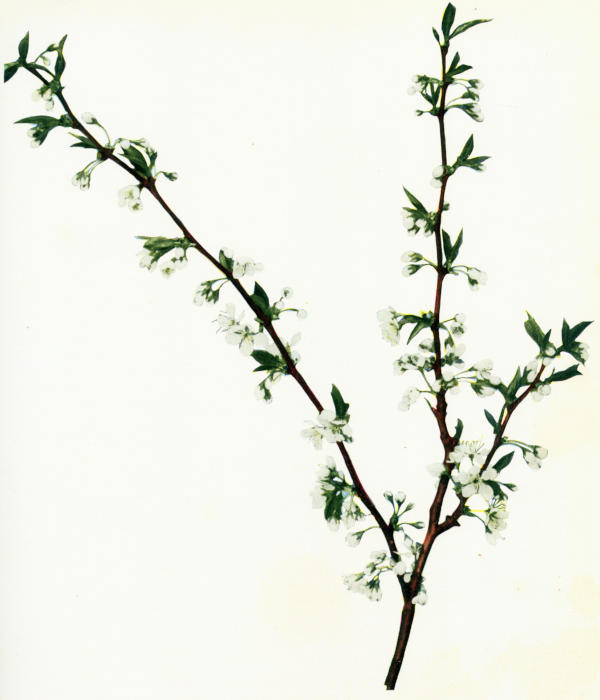
PRUNUS MUNSONIANA
Prunus angustifolia. 1. Bailey Cornell Sta. Bul. 38:58. 1892 (in part). 2. Ibid. Ev. Nat. Fr. 191-194. 1898 (in part). 3. Waugh Vt. Sta. An. Rpt. 10:99, 105. 1897 (in part).
Prunus hortulana. 4. Bailey Cornell Sta. Bul. 38:48. 1892 (in part). 5. Waugh Vt. Sta. An. Rpt. 10:99, 103-105. 1896-97 (in part).
Tree medium to large, from twenty to thirty feet in height; trunk six to ten inches in diameter; bark grayish-brown, shaggy, furrowed; branches spreading, rather slender, zigzag, little or not at all thorny; branchlets slender, zigzag, reddish, lustrous, glabrous; lenticels numerous, large, raised.
Winter-buds small, short, obtuse, usually free; leaves one and one-quarter inches wide by four inches long, lanceolate to oblong-lanceolate, sometimes broadly so, somewhat folded, apex acute or tapering, usually rounded at the base, texture thin, margins closely and finely serrate, teeth with small, dark red glands; upper surface bright green, glabrous, lustrous; lower surface dull green, pubescence sparse along the midrib and veins or sometimes tufted in the axils; petioles slender, about three-quarters of an inch long, pubescent on the upper surface, reddish, usually with two glands at the base of the leaf-blade; stipules linear, glandular, serrate.
Flowers appearing before or with the leaves, season of blooming late, about three-quarters inch across, odor sometimes disagreeable; borne on lateral spurs and buds, two or four flowers in a cluster; pedicels one half inch long, slender, glabrous; calyx-tube campanulate, glabrous, obscurely nerved, about one-fourth length of the pedicel; calyx-lobes as long as tube, ovate-oblong, obtuse at the apex, usually glabrous outside, pubescent inside at least toward the base, glandular-ciliate, erect; petals one-third inch long, white, creamy in the bud, oval or obovate, margins slightly erose, abruptly tapering into a claw, sometimes pubescent; stamens about twenty in number, equal to or shorter than the petals; filaments glabrous; anthers yellow or sometimes tinged red; pistils glabrous shorter than the stamens.
Fruit ripening early; globose or oval, shortest diameter about an inch, bright currant-red, rarely yellow; bloom thin; dots few or numerous, whitish, large or small, always conspicuous; cavity shallow, narrow; suture a line; apex rounded or slightly depressed; flesh light to dark yellow, juicy, soft or melting, fibrous, sweetish, sour at the pit, aromatic; good; stone clinging to the flesh, varying from about one-half inch in length in the wild fruits to at least three-quarters inch in cultivated varieties, turgid, oval, prolonged and pointed at the apex, usually obliquely truncate at the base, more or less roughened, grooved on the dorsal edge, thick-margined and markedly grooved on the ventral one.
The description of this species is based on both wild and cultivated material, and the variety Arkansas may be considered as a typical representative. Type specimens, deposited in the Economic Collection of the United States Department of Agriculture, were collected by W. F. Wight (flowers) at the New York State Experiment Station, Geneva, New York, No. 2721, May 15, 1909, and (foliage) at the Iowa Experiment Station, Ames, Iowa, No. 4178, September 15, 1909.
This species differs from Prunus angustifolia, with which it has long been confused, chiefly in being a much larger plant, a true tree while the other seldom reaches the size of a tree. It has coarser and less twiggy branches, shaggier bark and less red in the color of the young wood. The leaves are larger, thicker, more truly lanceolate in shape, less folded, a lighter green and less glossy. The flowers of the new species are larger, fewer in number, borne in less dense umbels which are not so nearly sessile as those of the older species and are borne on longer pedicels. The calyx-lobes are erect in this species and reflexed in Prunus angustifolia, strongly marked by marginal glands in Prunus munsoniana and eglandular in Prunus angustifolia. The fruits are larger and wholly plum-like in the newly made species and cherry-like in Prunus angustifolia. The stone is very plum-like in Prunus munsoniana but in the older species it might easily be mistaken for the pit of a cherry. The robust form is hardy as far north as Geneva, New York, at least, while the other species cannot be grown much north of Mason and Dixon’s line.
Of the varieties which certainly belong to this species by far the greatest number have originated under cultivation. There is herbarium material from uncultivated plants to show that this species is rather common in the northern part of Texas, in eastern Oklahoma and in parts of Missouri. It is a species forming dense thickets in its native habitat, where it is usually found in rather rich soils, with the older central specimens sometimes attaining a height of twenty to twenty-five feet and gradually diminishing in height to the edge of the thicket. When budded and grown in the orchard it forms a well-defined trunk and attains a height of twenty-five feet or more. The branches are little or not at all spinescent, bark of the stem in young specimens reddish or chestnut-brown, and usually rather smooth, becoming scaly and losing its reddish color with age, that of the young twigs usually chestnut-brown. Its natural range, though not yet definitely determined, probably extends from central Tennessee through northern Mississippi, northern Arkansas, central Missouri and southeastern Kansas to the valley of the Little Wichita River in northern Texas.
The Wild Goose varieties, now placed here, in the past have been considered hybrids more closely resembling Prunus hortulana than any other species. But Wild Goose and some other varieties of its group are not to be distinguished from Prunus munsoniana and beyond question belong in this species. The varieties in this division of Munsoniana are largely seedlings of Wild Goose, each variety possibly with a different male parent since Wild Goose seldom or never fruits unless cross-fertilized. Thus, of these plums, twelve are known seedlings of Wild Goose; seven others originated under cultivation; the origin of fourteen is not known and it is not certain that any beside Wild Goose came from wild plants. From such a record, and from the characters of the plants, it is probable that some of the Wild Goose varieties are horticultural hybrids, many of them from H. A. Terry of Iowa in whose work, with many varieties of several species, hybridity was the rule.
Horticulturally, this is the most important group of native plums for the South; it contains a greater number of cultivated varieties than any other native species excepting Prunus americana, no less than sixty sorts being listed in The Plums of New York, some of which are deservedly the best known of the native plums for either home or market use. For dessert or the kitchen they are particularly valuable, having a sprightly vinous flavor making them very pleasant flavored to eat out of hand or when cooked. Their bright colors, semi-transparent skins and well-turned forms make them very attractive in appearance. Considering the juiciness of most of the varieties, these plums ship and keep well. Unfortunately nearly all of the varieties of this species are clingstones. This group hybridizes more freely than any other of the plums and there are a great number of promising hybrids of which it is one of the parents. Of all plums, these are most in need of cross-pollination, some of the varieties being nearly or, as in the case of Wild Goose, wholly self-sterile. While these plums are especially valuable in the Southern States, some of them are desirable in the North as well, where all will grow at least as far north as central New York. Plums of this species are occasionally but not often used as stocks. Some recommend them for stocks for low or wet lands. The fact that Prunus munsoniana suckers very badly will probably preclude its use largely in propagating.
The leading varieties under cultivation of this species are Arkansas, Pottawattamie, Robinson, Newman, Wild Goose and Downing, all of which are described in full and illustrated in colors in The Plums of New York. The first four of these have in the past been referred by botanists and pomologists to Prunus angustifolia and the last two to Prunus hortulana.
20. PRUNUS MARITIMA Marshall
1. Marshall Arbust. Am. 112. 1785. 2. Wangenheim Amer. 103. 1787. 3. Michaux Fl. Bor. Am. 1:284. 1803. 4. Pursh Fl. Am. Sept. 332. 1814. 5. Nuttall Gen. N. Am. Pl. 1:302. 1818. 6. Elliott Sk. Bot. S. C. and Ga. 1:543. 1821. 7. Torrey and Gray Fl. N. Am. 1:408. 1840. 8. Torrey Fl. N. Y. 1:194. 1843. 9. Emerson Trees of Mass. 449. 1846. 10. Bailey Cornell Sta. Bul. 38:75, fig. No. 9. 1892. 11. Waugh Vt. Sta. An. Rpt. 12:234. 1899. 12. Bailey Cyc. Am. Hort. 1449, fig. 1901.
P. littoralis. 13. Bigelow Fl. Bost. Ed. 2:193. 1824.
P. pubescens. 14. Torrey Fl. U. S. 469. 1824.
Cerasus pubescens. 15. Seringe DC. Prodr. 2:538. 1825. 16. Beck Bot. Nor. and Mid. U. S. 96. 1833.
Shrub four to ten feet high, sometimes a low tree under cultivation; main branches decumbent and straggling or upright and stout; bark dark brown or reddish, more or less spiny, often warty; branchlets slightly pubescent at first, becoming glabrous, dark reddish-brown, straight or slightly zigzag and rather slender; lenticels few, small, dark.
Winter-buds small, long, acute, with small reddish scales; leaves oval or obovate, short-acute or nearly obtuse at the apex, rounded or nearly acute at the base, margins closely and evenly serrate, thinnish or thickish and somewhat leathery; upper surface glabrous, dull green, lower surface paler and more or less pubescent; petioles less than one-half inch long, stout, tomentose or glabrous; glands two, sometimes more, at the base of the leaves.
Flowers small, appearing before the leaves but the latest of any of the hardy plums; borne in three-flowered umbels closely set along the rigid branches; calyx-tube campanulate, tomentose; petals white, sometimes pinkish, sub-orbicular, narrowed into a claw at the base; pedicels short, slender, stiff, tomentose.
Fruit maturing in late summer in Massachusetts; one-half inch in diameter, globose, slightly flattened at the ends; cavity shallow, borne on a slender pedicel more than one-half inch in length, usually dark purple with a heavy bloom but variable, sometimes red or less frequently yellow; skin thick, tough and acrid; flesh crisp, juicy, sweetish; stone free from the flesh, small, turgid, pointed at both ends, cherry-like, acutely ridged on one and grooved on the other edge.
Prunus maritima, or as it has long been known, the Beach plum, is as yet hardly grown as a domesticated fruit. It is destined, however, in the minds of not a few, because of qualities which we shall describe, to play a more important part in the future of the cultivated plum flora than it has in the past. It has several valuable characters that should fit it alike for direct cultivation and for hybridizing with other species. It is surprising that more has not been done to domesticate the Maritima plums for they were among the first fruits noticed by early explorers and have always been used by both Indians and Whites for culinary purposes. The fact that Domestica plums thrive in their habitat is the only explanation of the non-amelioration of this plum before this.
September third, 1609, Hudson entered the river bearing his name and found “a very good harbor, abundance of blue plums, some currants brought by the natives dried and the country full of great and tall oaks.” The blue plum was the Maritima; and from Hudson’s time nearly all of the accounts of the New World given by early explorers mention this plum. It is probably one of the plums described by Captain John Smith as a cherry “much like a Damson;” by Edward Winslow in 1621, in a letter to England to a friend, as one of his “plums of three sorts”; by Francis Higginson in his New England’s Plantation in 1630; described by Thomas Morton in 1632 in his New English Canaan as having “fruit as bigg as our ordinary bullis.” John Lawson, one of the first of American naturalists, describes them rather more fully as follows:[140] “The American Damsons are both black and white, and about the Bigness of an European Damson. They grow any where if planted from the Stone or Slip; bear a white blossom, and are a good fruit. They are found on the Sand-Banks all along the Coast of America. I have planted several in my Orchard, that came from the Stone, which thrive well amongst the rest of my Trees. But they never grow to the Bigness of the other Trees now spoken of. These are plentiful Bearers.” These are but a few of the many references to the Beach plum but they are enough to show that the colonists were attracted by this wild plum found on a long stretch of the Atlantic seaboard—probably the first fruit to attract attention from Virginia to New England.
To be more explicit as to its range, Prunus maritima, in its typical form, is an inhabitant of the sea beaches and sand dunes from New Brunswick to the Carolinas, or possibly farther south, growing inland usually as far as recent ocean soil formations extend. As it leaves the seaboard marked variations make their appearance, chief of which are, smaller, more oval, smoother and thinner leaves and smaller fruit. The species has been reported as an inhabitant of the sands at the head of Lake Michigan,[141] but the writer, who is well acquainted with this region, has never seen it there, nor is it to be found in the chief herbaria of Michigan as having been collected in the state.
In the region where it is found wild the Maritima plum is a rather common article of trade. The fruit is usually sold by the quart, the price being five or ten cents, and is used for both dessert and culinary purposes though for most part for the latter.
The species is one of the most variable of the true plums and there is, probably must ever be, much disagreement as to its botanical relationships. Several botanical varieties of Prunus maritima have already been named and there are yet groups within the species which seem to be nearly as distinct as those described and possibly worth distinguishing. Since the variations show in the size, color and edible qualities of the fruit, as well as in the characters of the plant, it is to be expected that the species has a horticultural future though at present it has but one cultivated variety—Bassett. Professor J. W. Macfarlane of the University of Pennsylvania has shown well the great range of variations in this plum both from botanical and horticultural aspects.[142] He holds that these variations are sufficiently distinct to make many varieties of this plum in the wild, to which DeVries agrees with the statement that they indicate “the existence of separate races as elementary species.”[143] The plum which Small has described as Prunus gravesii, to be discussed later, is a marked variation of Prunus maritima.
As it grows on the sea-coast Prunus maritima is a low bush three to six feet high, occasionally reaching a height of ten or twelve feet. Usually the plant is straggling but sometimes it is compact or even tree-like. Inland, on better soils, or under cultivation it makes a rather handsome dwarf tree. The flowers are borne in great numbers, completely covering the plant and coming later than most of the plums bloom. The species bears fruit very abundantly, which is always attractive but of quite diverse value for food. The fruit varies in size from a half to three-quarters of an inch in diameter and is almost spherical, though sometimes oval and with or without a distinct suture. The usual color is a rich bluish-black with a waxy bloom, but red, yellow, amber and orange fruits are often found. In taste the Maritima plums range from inedible to nearly as rich a flavor as is found in the best of the Domestica plums. Besides variations in the above and other qualities, Macfarlane calls attention to the range in ripening of the fruit of this plum, showing that it extends over a period of two months, an exceptionally wide variation for a wild plant.
This plum has a number of qualities that commend it to the fruit-grower. Since in the wild it grows on sandy soils it is not likely under cultivation to make great demands on either the moisture or the fertility of soils. It is very hardy and very productive and seldom fails to bear. It seems to be free or nearly so from some of the pests of cultivated plums. Lastly, the great number of wild varieties of the plums give many starting points from which to breed cultivated varieties. Two objections to the wild fruits are that when the fruit is harvested the juice often exudes from the wound made by the parting from the stem, and secondly, the secretion of some substance forming a dark colored, hard core in the pulp which gives a very bitter taste to the fruit. The last defect is very common in the wild plums and is probably due to the sting of an insect. Under cultivation it may be possible to obtain fruits free from these faults.
It would be desirable if some of the characters enumerated above could be combined with those of other species. Burbank has hybridized the Maritima plum with other species, with promising results. Of these he writes under date of December 6, 1909, as follows:
“I first began raising Prunus maritima about 1887—twenty-two years ago—collecting myself and having specimens sent me all the way from the coast of Labrador to South Carolina, the finest of which were obtained from the eastern coast of Massachusetts. Among the seedlings, of which I raised and fruited several hundred thousands, were yellow, red, purple and almost black ones, early and late, round, oval, oblate and flattened, with big stones and little stones, free stone and cling stone, and much variety in productiveness and growth of the young bushes, but not one of them the first two or three generations were very much increased in size—probably the largest being about the size of a cranberry or a small hazelnut—and none of them of very exceptional quality, though their habit of blooming late was a tremendous advantage, as they invariably escaped our spring frosts. This, with their unusual hardiness induced me to continue experimenting with them. Finally after some ten years I obtained a very delicious variety, about an inch in length and three-quarters of an inch in diameter, tree much increased in size, larger foliage and more productive and producing enormous quantities of most delicious fruit. From this I raised a great many thousand, almost as good and a few of them even better, several hundred of which have been selected and are now bearing on my Sebastopol place. Some of these improved seedling trees grow five to ten times as large as the ordinary Maritima, with larger leaves and in every possible way improved. My greatest success with this species (and one of the most striking occurrences in my work with plums) was produced by pollinating one of the somewhat improved Maritimas with Prunus triflora.
“The very first generation, a plum was produced which is an astonishing grower for a Maritima—almost equal to the Triflora, with large, broad glossy foliage of almost the exact shape of the Maritima, Maritima blossoms, and fruit weighing nearly one-quarter of a pound each, with an improved superior Maritima flavor, Maritima pit in form, but enlarged. The most singular peculiarity of this plum, which is so enormous, is that the trees commence to bloom about with the Triflora and bloom and bear fruit all summer, so that blossoms, young fruit and the enormous deep red ripening fruit can be seen on the trees at the same time.”
21. PRUNUS GRAVESII Small
1. Small Torrey Bot. Club Bul. 24:44, Pl. 292. 1897. 2. Britton and Brown N. Am. Trees 2:249. 1897. 3. Robinson and Fernald Gray’s Man. Ed. 7:498. 1908.
Shrub low, slender, attaining a height of four feet; main trunk much branched, with dark, rough bark; branches ascending, slender, leafless, unarmed; branchlets of the season puberulent. Leaves oval-orbicular, orbicular or slightly obovate, rounded, retuse or apiculated at the apex, base truncate or at least obtuse, margins sharply serrate or crenate-serrate; upper surface sparingly pubescent or glabrous, lower surface pubescent, especially on the veins.
Flowers white, one-half inch broad; borne in two or three-flowered, lateral umbels, appearing with the leaves; calyx-tube campanulate, pubescent; petals sub-orbicular, abruptly narrowed at the base; pedicels stout, stiff, pubescent.
Fruit maturing in September; globose, one-half inch in diameter, nearly black, with a light bloom, acid and astringent; stone broadly oval, rounded at the apex, acute at the base.
Prunus gravesii is now known only in Connecticut, where it is found on a gravelly ridge at Groton near Long Island Sound. It grows in the neighborhood of Prunus maritima to which it is evidently closely related. Small in describing the species gives the following differences between the Gravesii and the Maritima plums: (1) Prunus gravesii is more slender and delicate in habit, and matures its leaves and fruit earlier in the season. (2) The leaf of Prunus gravesii is small and sub-orbicular while that of the other is larger and more elongated. (3) The new species has smaller flowers with sub-orbicular petals while those of Prunus maritima are broadly obovate and gradually narrowed at the base. (4) The fruit of Prunus gravesii is smaller and more globose and has shorter pedicels. (5) The stone is more turgid and is pointed only at the base; that of Prunus maritima is usually pointed at both ends. (6) Sprouts arising from the ground do not produce flowers as they frequently do in the case of Prunus maritima.
The cultivation of this plum has not been attempted and as compared with Maritima it promises little for the fruit-grower.
22. PRUNUS ORTHOSEPALA Koehne
1. Koehne Deut. Dend. 311. 1893. 2. Sargent Gar. and For. 7:184, 187 fig. 1894. 3. Bailey Cyc. Am. Hort. 1450. 1901.
Shrub four or five feet high; branches dense and twiggy; stems sometimes armed with slender spines; bark separating in large, loose scales; branchlets stout, slightly zigzag, reddish-brown becoming dark brown.
Winter-buds obtuse, three-lobed at maturity; leaves oblong-ovate, thin and firm, acuminate, long-pointed, two and one-half to three inches long, two-thirds inch broad, unequally cuneate or rounded at the base; margins closely serrate with incurved, calloused or rarely glandular teeth; upper surface glabrous, light green, lower surface paler and pilose; petioles slender, slightly grooved, puberulous, one-half inch long; glands two, large, at the apex of the petiole.
Flowers appearing after the leaves; borne in three or four-flowered fascicles on stout pedicels one-half inch long; calyx-tube turbinate; lobes puberulous on the outer surface, with thick tomentum, often tipped with red on the inner surface; petals narrowly obovate, rounded at the apex, narrowing at the base into slender claws, white or tinged with pink; stamens orange, exserted; style glabrous, thickened at the apex into a truncate stigma.
Fruit globose, an inch in diameter, deep red with a heavy bloom; skin thick; flesh yellow, juicy, of good flavor; stone flattened, oval, slightly rugose, deeply grooved on the dorsal and ridged on the ventral edge.
The history and habitat of Orthosepala are given by Sargent as follows: “The history of this plant as I know it, is briefly this: In June, 1880, Dr. George Engelmann of St. Louis, sent to the Arnold Arboretum a package of seeds marked ‘Prunus, sp. southern Texas.’ Plants were raised from these seeds and in 1888, or earlier, they flowered and produced fruit, which showed that they belonged to a distinct and probably undescribed species. A name, however, was not proposed for it, and in 1888, probably, plants or seeds were sent to Herr Spath, of the Rixdorf Nurseries, near Berlin, where this plum was found in flower by Dr. Emil Koehne, who has described it under the name of Prunus orthosepala.”
Of the affinity of this species Sargent says: “Prunus orthosepala is a true plum, rather closely related to Prunus hortulana, from which it can be distinguished by the smaller number of glands of the petioles, by the eglandular calyx-lobes, the dark colored fruit and smoother stone.” As the writer has seen this plum growing in the Arnold Arboretum, Jamaica Plains, Massachusetts, and the City parks at Rochester, New York, it seems well worth cultivating. Mr. J. W. Kerr writes of it as follows:
“I have P. orthosepala fruiting here, and with me its fruit is exceptionally fine in quality, sparingly produced—attributable I believe to the fact that no variety stands near enough to it for proper inter-pollination. The trees are rather dwarfish in habit, close-headed, with fine clean foliage. The fruit is globular in form; size equal to fair specimens of Hawkeye or Wyant; skin a greenish-yellow, almost entirely covered with deep red.”
W. F. Wight of the United States Department of Agriculture has collected specimens of a cultivated plum, taken from the wild, locally known as the Laire, in Rooks and neighboring counties in Kansas, with foliage very similar to Prunus orthosepela. While the identity of Laire with the species under discussion cannot be established at this time, the reported source of the seeds, “southern Texas,” from which Prunus orthosepela was grown may be an error.
23. PRUNUS GRACILIS Engelmann and Gray
1. Engelmann and Gray Bost. Jour. Nat. Hist. 5:243. 1845. 2. Torrey Pac. R. Rpt. 4:83. 1854. 3. Britton and Brown Ill. Fl. 2:249, fig. 1897.
P. chicasa var. normalis. 4. Torrey and Gray Fl. N. Am. 1:407. 1840.
P. normalis 5. Small Fl. S. E. U. S. 572. 1903.
Shrub low, attaining a height of five or six feet; branches many, straggling, more or less spiny; branchlets at first densely tomentose or soft-pubescent, becoming glabrous; leaves small, ovate-lanceolate or oval, margins finely and evenly serrate, rather thick, texture harsh and firm; upper surface dark green, glabrous or nearly so at maturity, lower surface paler, soft-pubescent becoming nearly glabrous; petiole short and stout.
Flowers white, small, appearing before the leaves; borne in sessile, several-flowered umbels; pedicels short, slender, soft-pubescent.
Fruit globose or oval, very small, not more than one-half inch in diameter, variable in color, mostly in shades of red; stone turgid, nearly orbicular, pointed at both ends.
Prunus gracilis is found in dry, sandy soils from southern Kansas and western Arkansas to central Texas. It grows most abundantly and thrives best in Oklahoma, a fact which leads Waugh to call it the “Oklahoma” plum. All who know the species agree that it is a near approach to Maritima in many of its characters. This plum is very variable and some of its forms seem not to have been well studied. As a fruit plant Gracilis is hardly known in cultivation though Torrey says it is cultivated in the region of its habitat under the name Prairie Cherry. The wild fruit is used more or less locally and is sometimes offered for sale in the markets of western towns. The quality is about the same as that of the wild Americanas and under cultivation would probably improve. The small size of plant and fruit are the most unpromising characters though the species is also much subject to black-knot.
24. PRUNUS RIVULARIS Scheele
1. Scheele Linnaea 21:594. 1848. 2. Gray Pl. Wright. 1:67. 1852. 3. Hall Pl. Texas. 9. 1873. 4. Coulter Cont. U. S. Nat. Herb. 2:101. 1891. 5. Waugh Bot. Gaz. 26:50-52. 1898. 6. Bailey Ev. Nat. Fr. 223. 1898.
Shrub three to seven feet high; branches angular, smooth, shining, ash-colored, rough; lenticels small, crowded; leaves oblong-ovate or sometimes ovate, rarely lanceolate, apex acute, margins coarsely or doubly serrate, glabrous above and sparingly pubescent below; petioles glandular, grooved, pubescent; flowers in lateral umbels, in pairs or several-flowered; fruit about one-half inch in diameter, oblong-oval, cherry-red; skin thick, smooth and tough, acid.
The preceding description is largely compiled from the authors given in the references, the writer having seen only herbarium specimens. The species is included here largely upon the authority of Professor C. S. Sargent of the Arnold Arboretum and W. F. Wight, who know the plant as described by Scheele in the field. Gray described the plant as “verging to Americana.” Bailey says “it evidently bears the same relation to Prunus americana that Prunus watsoni does to the Chickasaw plum.” Waugh is “convinced that Prunus rivularis Scheele is nothing more than one of the more distinct sub-divisions of the multiform hortulana group.”[144] T. V. Munson writes me that the Waylandi plums belong in this species. My own opinion is, from the herbarium specimens examined, from correspondence and conversation with those who have seen the plant in the field, that Scheele’s species is a good one and quite distinct from the species named by Bailey, Waugh and Munson as allied to it. It is to be looked for along the streams and bottom-lands in the neighborhood of San Antonio and New Braunfels, Texas. The plum is locally known as the Creek plum and in common with other plums is gathered for home consumption. The species seems to offer but few possibilities for the fruit-grower.