Chapter III · LEADING VARIETIES OF PLUMS. (continued 6)
Reading edition
Tree large, very vigorous, spreading, round or flat-topped, hardy, medium in productiveness; branches stocky, smooth, dark ash-brown, with lenticels of medium number and size; branchlets thick, with internodes one inch long, light brown, covered with short, heavy pubescence; leaf-buds large, of medium length, conical.
Leaves large, oval, of average thickness; upper surface dark green; lower surface pale green, pubescent; apex obtuse, margin doubly crenate, with small glands; petiole three-quarters inch long, thick, pubescent, with a trace of red, usually with two, small, globose, greenish glands at the base of the leaf.
Fruit early; thick-set, without a neck, one and seven-eighths inches in diameter, roundish, slightly angular, halves equal; cavity deep, wide, compressed; suture shallow, distinct; apex flattened or depressed; color dark purplish-red, overspread with thin bloom; dots numerous, large, conspicuous; stem eleven-sixteenths inch long, glabrous, adhering well to the fruit; skin tough, adhering; flesh golden-yellow, medium juicy, firm, subacid, mild; good; stone free, one inch by three-quarters inch in size, roundish-oval, flattened, with rough and pitted surfaces, blunt at the base and apex; ventral suture wide, prominent, often distinctly winged; dorsal suture with a wide, deep groove.
PEARL
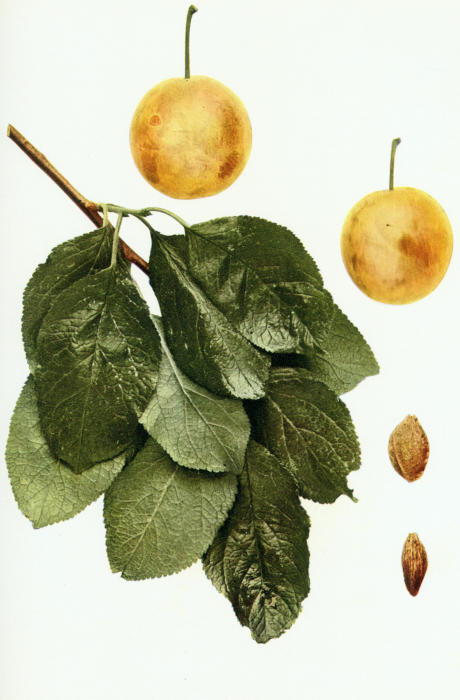
PEARL
Prunus domestica
1. Burbank Cat. 5. 1898. 2. Am. Gard. 21:36. 1900. 3. Waugh Plum Cult. 118. 1901.
One can grow seedlings of some plums with considerable certainty of getting respectable offspring—plums worth having in an orchard—but the chances of growing a variety of superior qualities are small indeed. It is a piece of good luck, a matter almost wholly of luck, when, as in this case, but one parent is known, to secure as fine a fruit as the Pearl plum. The variety now under notice is one to be pleased with if it came as a chance out of thousands; its rich, golden color, large size, fine form, melting flesh and sweet, luscious flavor, place it among the best dessert plums. In the mind of the writer and of those who have assisted in describing the varieties for The Plums of New York, it is unsurpassed in quality by any other plum. The tree-characters, however, do not correspond in desirability with those of the fruits. The trees, while of medium size and seemingly as vigorous and healthy as any, are unproductive. In none of the several years they have been fruiting at this Station have they borne a large crop. If elsewhere this defect does not show, the variety becomes at once one of great value. The fruits of Pearl are said to cure into delicious prunes—to be readily believed by one who has eaten the fresh fruits. This variety ought to be very generally tried by commercial plum-growers and is recommended to all who grow fruit for pleasure.
Pearl is a recent addition to the list of plums and though its history is well known its parentage is in doubt. In 1898, Luther Burbank introduced the variety as a new prune grown from the seed of the well-known Agen. The male parent is not known but from the fruit and tree, one at once surmises that it was some variety of the Reine Claude group, its characters being so like those of the plum named that no one could suspect that it came from the seed of a plum so far removed from the Reine Claude as the Agen.
Tree of medium size, vigorous, vasiform, dense-topped, hardy, unproductive; branches ash-gray, with numerous, small, raised lenticels; branchlets twiggy, thick, long, with long internodes, greenish-red changing to brownish-red, very pubescent early in the season becoming less so at maturity, with numerous, small, raised lenticels; leaf-buds large, above medium in length, conical, appressed; leaf-scars prominent.
Leaves broadly oval, one and seven-eighths inches wide, three and one-half inches long, thick, leathery; upper surface dark green, rugose, covered with fine hairs, with a grooved midrib; lower surface pale green, pubescent; apex abruptly pointed, base abrupt, margin serrate or crenate, with small, black glands; petiole seven-eighths inch long, thick, pubescent, tinged red, glandless or with from one to three small, globose, brownish glands on the stalk.
Blooming season intermediate in time and length; flowers appearing after the leaves, showy on account of their size, averaging one and five-eighths inches across, white, with a tinge of yellow at the apex of the petals; borne on lateral spurs and buds, usually singly; pedicels one-half inch long, thick, strongly pubescent, greenish; calyx-tube green, campanulate, pubescent; calyx-lobes broad, obtuse, pubescent on both surfaces, glandular-serrate and with marginal hairs, strongly reflexed; petals obovate or oblong, entire, tapering to short, broad claws; anthers yellow; filaments nearly one-half inch long; pistil glabrous, shorter than the stamens.
Fruit intermediate in time and length of ripening season; one and three-quarters inches by one and one-half inches in size, roundish-oval, compressed, halves unequal; cavity shallow, narrow, abrupt; suture a line; apex depressed; color golden-yellow, obscurely striped and splashed with dull green, mottled, overspread with thin bloom; dots numerous, small, whitish, inconspicuous, clustered about the apex; stem thick, three-quarters inch long, thickly pubescent, adhering well to the fruit; skin tough, separating readily; flesh deep yellow, juicy, a little coarse and fibrous, firm but tender, very sweet, with a pleasant, mild flavor, aromatic; very good to best; stone clinging, one inch by five-eighths inch in size, long-oval, slightly necked at the base, bluntly acute at the apex, with rough surfaces; ventral suture broad, blunt; dorsal suture with a wide, shallow groove.
PETERS
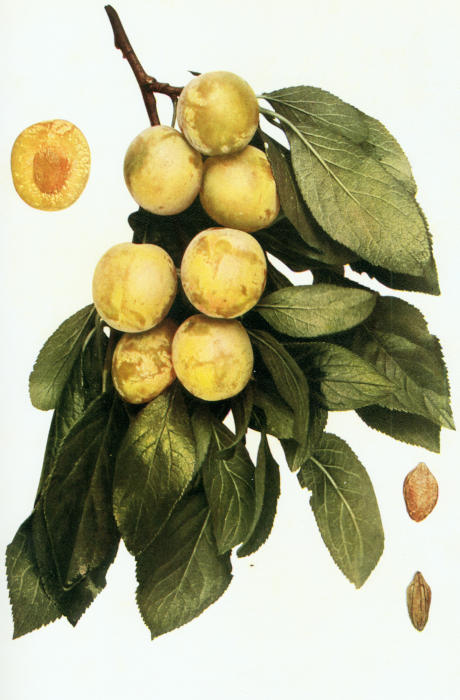
PETERS
Prunus domestica
1. Prince Pom. Man. 27. 1828. 2. Lond. Hort. Soc. Cat. 151. 1831. 3. Cultivator 8:52 fig. 1860. 4. Thomas Am. Fruit Cult. 375 fig. 392. 1867. 5. Downing Fr. Trees Am. 937. 1869. 6. Mich. Hort. Soc. Rpt. 289. 1889. 7. Mich. Sta. Bul. 103:35. 1894. 8. Cornell Sta. Bul. 131:190 fig. 45, 194. 1897. 9. Waugh Plum Cult. 118 fig. 1901. 10. Budd-Hansen Am. Hort. Man. 321, 322 fig. 1903.
Peter’s Large Yellow 1, 2. Peter’s Yellow Gage 10. Peters’ Yellow Gage 3, 4, 6, 7. Peter’s Yellow Gage 5, 8. Peters Yellow Gage 9.
Peters is an excellent old plum probably ranking in quality with the best varieties in the group to which it belongs—a sufficient recommendation to make it desirable in any home collection of fruit. This variety, however, is not equal in appearance to any one of several other sorts in its group, lacking size and color. The trees are large, hardy, robust and healthy, surpassing in these respects most of the other Reine Claude sorts. The tree-characters have made this variety a prime favorite in western New York for two generations, one pomologist after another recommending it for this section. The fruits are not sufficiently attractive to sell well, however, and the variety is now going out of cultivation except for the amateur. While a very good plum it does not appear to be worth growing in competition with Hand, Washington, McLaughlin, Jefferson, Spaulding and the latest comer among these high-quality plums, Pearl.
Of the origin of this old plum we have no certain information. William Prince, the first pomologist to mention it, gave a brief description of the variety in his “A Short Treatise on Horticulture” published in 1828 but says nothing in regard to its history. In 1831 the London Horticultural Society listed it in its fruit catalog but otherwise the variety is not mentioned in the European pomologies.
Tree very large, vigorous, round and dense-topped, hardy, productive; branches thick, ash-gray, smooth except for the numerous, rather large, raised lenticels; branchlets thick, short, with short internodes, greenish-red changing to dark brownish-drab, dull, pubescent throughout the season, with numerous, inconspicuous, small lenticels; leaf-buds medium in size and length, pointed, free.
Leaves flattened, obovate or oval, two inches wide, four inches long; upper surface covered with numerous hairs, with a shallow groove on the midrib; lower surface silvery-green, heavily pubescent; apex abruptly pointed or acute, base rather abrupt, margin slightly crenate, eglandular or with few, small, dark glands; petiole three-eighths inch long, thick, tinged red, pubescent, glandless or with one or two small, globose or reniform, greenish-brown glands usually on the stalk.
Blooming season intermediate in time and length; flowers appearing with the leaves, one and one-eighth inches wide, white, creamy at the apex; borne on lateral spurs or buds, singly or in pairs; pedicels about one inch long, below medium in thickness, pubescent, greenish; calyx-tube green, obconic, pubescent; calyx-lobes broad, obtuse, pubescent on both surfaces, glandular-serrate and with fine marginal hairs, reflexed; petals roundish-oval or obovate, dentate to slightly crenate; anthers yellow, with a slight trace of red; filaments three-eighths inch long; pistil glabrous, longer than the stamens.
Fruit late, season rather short; about one and one-half inches in diameter, roundish, compressed, halves equal; cavity very shallow, narrow, abrupt; suture shallow; apex flattened or depressed; color dull yellowish-green, often blushed or mottled on the sunny side, covered with thick bloom; dots numerous, large, whitish, conspicuous; stem one and one-eighth inches long, pubescent, adhering well to the fruit; skin thin, tough, separating readily; flesh golden-yellow, juicy, somewhat fibrous, firm but tender, sweet next the skin but sour near the center, with pleasant flavor; very good; stone clinging, one inch by three-quarters inch in size, oval, turgid, somewhat acute at the base and apex, with pitted surfaces; ventral suture wide, indistinctly furrowed, often with a short wing; dorsal suture widely and deeply grooved.
POND
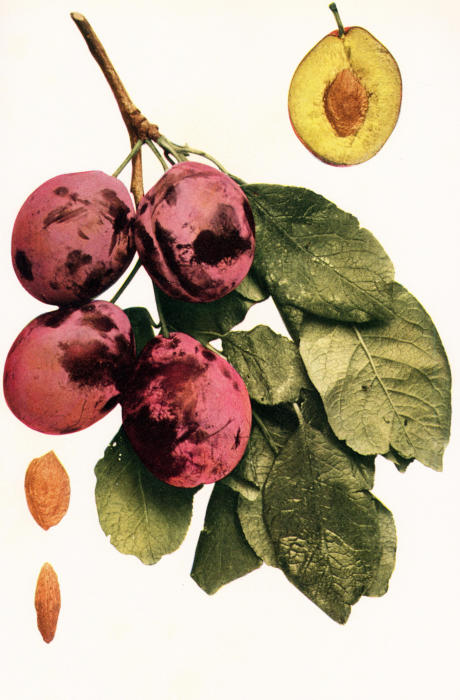
POND
Prunus domestica
1. Lond. Hort. Soc. Cat. 151. 1831. 2. Mag. Hort. 9:165. 1843. 3. Horticulturist 6:560 fig. 1851. 4. Gard. Chron. 13:228. 1853. 5. Am. Pom. Soc. Cat. 214. 1856. 6. Ann. Pom. Belge 9, fig. 1857. 7. Cultivator 8:52 fig. 1860. 8. Thomas Am. Fruit Cult. 343. 1867. 9. Downing Fr. Trees Am. 937 fig. 1869. 10. Pom. France 7: No. 2. 1871. 11. Mas Le Verger 6:5, fig. 3. 1886-73. 12. Mich. Hort. Soc. Rpt. 466. 1883. 13. Hogg Fruit Man. 717. 1884. 14. Cal. State Bd. Hort. Rpt. 292. 1885-86. 15. Mathieu Nom. Pom. 442. 1889. 16. Mich. Hort. Soc. Rpt. 465. 1893. 17. Guide Prat. 155, 366. 1895. 18. Oregon Sta. Bul. 45:29 fig. 1897. 19. Cornell Sta. Bul. 131:190. 1897. 20. W. N. Y. Hort. Soc. Rpt. 92. 1899. 21. Ohio Sta. Bul. 113:160, Pl. XVI fig. 1899. 22. Va. Sta. Bul. 134:44. 1902. 23. Budd-Hansen Am. Hort. Man. 322. 1903.
Chili (Kerr unpublished). Diamant 15 incor. Diamantpflaume 17 incor. Dorr’s Favorite 12. English Pond’s Seedling 3. Farleigh Castle 13, 15. Fonthill 4, 9, 10, 12, 13, 15, 17, 23. Gros Prune 14. Grosse Prune d’Agen 18, 20. Hungarian 18. Hungarian 20. Hungarian Prune 16, 19. Hungarian Prune 14. Oswego 20. Oswego 19. Plum de l’Inde ?3. Plum de l’Inde 9, 15. Pond’s Purple 9, 10, 13, 15, 17. Pond’s Seedling (English) 11, 14, 17. Pond’s Seedling 1, 2, 4, 5, 6, 7, 8, 9, 10, 11, 13, 16, 21. Pond’s Seedling 14, 15, 17, 18, 19, 23. Pond Seedling 20. Pond’s Samling 15, 17. Pourprée de Pond 10, 15, 17. Pride of Waterloo 20. Semis de Pond 10, 15. Semis de Pond 17.
Pond is preeminent among plums for its large size. It is distinguished also by its form and its color, both being pleasing as well as distinctive. The three characters, size, form and color make this one of the handsomest of all plums. Despite the efforts of the color-plate makers, the peculiar red of this plum is not well shown in the illustration—to the disparagement of the fruit. At one time Pond was very largely grown in New York but the fruits are not as perfect, grown here, as on the Pacific Coast and the trees are not regular in bearing. The eye is pleased with Pond but the palate is sadly disappointed; at best it is not even second-rate. The fruits, however, ship and keep well, as is demonstrated by the large quantities of this variety annually sent from California to the East for sale on fruit-stands where its showiness perennially beguiles the uninformed fruit-buyer. There is a fine opportunity for some one to cross this splendid-appearing plum with one of good quality in the hope of getting an offspring as handsome but of better quality.
This variety was obtained from seed by Mr. Pond, an English amateur grower of fruits, concerning whom there seems to be no further information. The London Horticultural Society mentioned the variety as long ago as in 1831. Another Mr. Pond, a nurseryman in Massachusetts, grew a variety very similar in appearance to the English plum and permitted his name to be given it to the great confusion of the nomenclature of the two. The Hungarian prune of the Pacific Coast is Pond, why so-called does not appear; with this as with several other plums the Pacific Coast fruit-growers persist in using a name known to have been wrongly applied to an old and well-known variety elsewhere called rightly. Oswego, a supposed seedling grown in Oswego, New York, is identical with the Pond as tested by this Experiment Station and by local growers. The American Pomological Society placed this fruit on its catalog list in 1856.
Tree of medium size, vigorous, upright, hardy, variable in productiveness; branches light gray, smooth, with small, raised lenticels; branchlets of medium thickness and length, with internodes of average length, greenish-red changing to brownish-drab, dull, sparingly pubescent, with inconspicuous small lenticels; leaf-buds large, long, conical, free; leaf-scars plump, often much enlarged at the apex of the twigs.
Leaves somewhat folded backward, oval, two and one-quarter inches wide, four inches long, thick, leathery; upper surface dark green, finely pubescent, rugose, with a grooved midrib; lower surface silvery-green, pubescent; apex abruptly pointed or acute, base abrupt, margin crenate or serrate, with small dark glands; petiole five-eighths inch long, thick, pubescent, tinged red, with one or two globose, yellowish glands variable in size, usually on the stalk.
Season of bloom intermediate in time and length; flowers appearing after the leaves, one and five-sixteenths inches across, white; borne in thin clusters on lateral spurs and buds, singly or in pairs; pedicels thirteen-sixteenths inch long, pubescent, greenish; calyx-tube green, campanulate, pubescent; calyx-lobes broad, obtuse, lightly pubescent on both surfaces, margins with few glands and hairs, reflexed; petals roundish, crenate, tapering to short, broad claws; filaments seven-sixteenths inch long; pistil glabrous, equal to or shorter than the stamens.
Fruit late, season short; two inches by one and three-quarters inches in size, obovate or oval, frequently with a slight neck, halves equal; cavity shallow, narrow, abrupt; suture very shallow, often a line; apex roundish; color varies from reddish-purple to purplish-red, overspread with thick bloom; dots numerous, small, reddish-brown, obscure, larger in size but fewer in number towards the base; stem thick, seven-eighths inch long, heavily pubescent, adhering well to the fruit; skin tough, separating readily; flesh attractive golden-yellow, not very juicy, fibrous, firm, of average sweetness, mild, not highly flavored; fair in quality; stone semi-free to free, one and one-sixteenths inches by nine-sixteenths inch in size, long-oval, flattened, the surfaces roughened and deeply pitted, tapering towards the base and apex; ventral suture heavily furrowed, with a distinct but not prominent wing; dorsal suture usually widely and deeply grooved.
POOLE PRIDE
Prunus munsoniana
1. Am. Pom. Soc. Rpt. 108. 1885. 2. Cornell Sta. Bul. 38:50. 1892. 3. Ia. Hort. Soc. Rpt. 334. 1894. 4. Wis. Sta. Bul. 63:24, 53. 1897. 5. Ibid. 87:15. 1901. 6. Waugh Plum Cult. 186. 1901. 7. Budd-Hansen Am. Hort. Man. 299. 1903. 8. Ohio Sta. Bul. 162:245 fig., 256, 257. 1905.
Kroh 1, 6. Kroh 3, 7. Poole 2, 7. Poole 6. Poole’s Pride 3, 4, 5. Poole’s Pride 2, 6, 7.
As compared with other native plums growing on the grounds at this Station, Poole Pride has considerable merit. It is very attractive in appearance, it seems to have all the characters of a long-keeping and a good-shipping sort of its species and the trees are large, vigorous, hardy, healthy and productive. It is, however, lacking in the very important character of flavor though the texture of the flesh is all that could be desired. Its very peculiar flavor, incomparable with any other plum or fruit, while disagreeable to the writer, might be liked by some. The flesh of this plum is so transparent that the pit can be readily seen when the skin is removed. To those growing native plums, Poole Pride is recommended for trial.
This variety was raised by P. H. Kroh, Anna, Illinois, and was exhibited by him under the name Kroh at the American Pomological Society meeting in 1885. Three years later the same plum was introduced by Stark Brothers, Louisiana, Missouri, under the name of Poole’s Pride. The latter name has been so much more widely used that it has been retained even though the former is correct according to the rule of priority.
Tree large, vigorous, open and round-topped, hardy, productive, healthy; branches rough, zigzag, with few thorns, dark ash-gray, with numerous, small lenticels; branchlets twiggy, slender, above medium in length, with short internodes, greenish-red changing to light chestnut-red, glabrous, with numerous, very conspicuous, large, raised lenticels; leaf-buds small, short, obtuse, plump, appressed.
Leaves folded upward, ovate or obovate, peach-like, one and three-eighths inches wide, three and one-half inches long, thin and leathery; upper surface dull red late in the season, smooth, glossy, with a narrow groove on the midrib; lower surface lightly pubescent; apex taper-pointed, base rather abrupt, margin finely crenate, with small dark glands; petiole seven-eighths inch long, slender, hairy, light purplish-red, with from one to four small, globose, reddish-brown glands on the stalk.
Blooming season late and long; flowers appearing after the leaves, five-eighths inch across, white; borne in clusters on short lateral spurs and buds; pedicels nine-sixteenths inch long, very slender, glabrous, green; calyx-tube greenish, campanulate, glabrous; calyx-lobes narrow, obtuse, heavily pubescent within and along the margin which is serrate and covered with reddish glands, erect; petals small, ovate or roundish, crenate, tapering into long pubescent claws; anthers yellowish; filaments five-sixteenths inch long; pistil glabrous, shorter than the stamens.
Fruit early, season very long; one inch in diameter, roundish-oval, not compressed, halves equal; cavity very shallow and narrow; suture a distinct line; apex roundish; color clear, dark, currant-red, with thin bloom; dots few, large, light russet, conspicuous, clustered about the apex; stem slender, five-eighths inch long, glabrous, but overspread with a grayish bloom, adhering to the fruit; skin thin, tough, separating from the pulp; flesh semi-transparent, dark amber-yellow, very juicy, fibrous, tender and melting, sweet, with a strong, peculiar flavor not pleasant; of fair quality; stone adhering, five-eighths inch by three-eighths inch in size, long-oval, slightly flattened, compressed at the base, pointed at the apex, roughish; ventral suture blunt, faintly ridged; dorsal suture acute, entire.
POTTAWATTAMIE
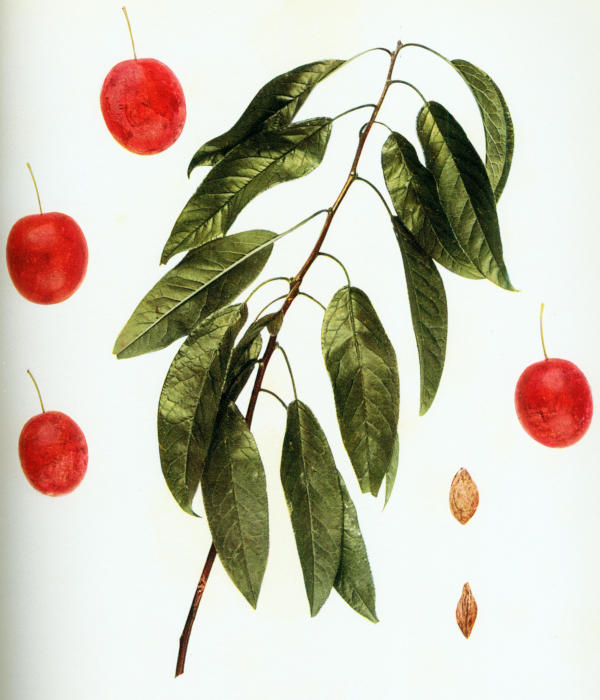
POTTAWATTAMIE
Prunus munsoniana
1. Ia. Hort. Soc. Rpt. 287. 1887. 2. Pop. Gard. 3:27 fig. 1887. 3. Cornell Sta. Bul. 38:64. 86. 1892. 4. Mich Sta. Bul. 123:20. 1895. 5. Ia. Sta. Bul. 31:346. 1895. 6. Wis. Sta. Bul. 63:53. 1897. 7. Am. Pom. Soc. Cat. 25. 1897. 8. Ohio Sta. Bul. 113:156. 1899. 9. Ia. Sta. Bul. 46:287. 1900. 10. Waugh Plum Cult. 199 fig. 1901. 11. Ga. Sta. Bul. 67:279. 1904.
The plum under notice is possibly of greater cultural value than any other of its species especially for northern latitudes. It is of high quality for a native plum, the texture of the fruit being especially pleasing in eating, and though melting and juicy it keeps and ships very well because of a tough skin. It escapes both the curculio and the brown-rot to a higher degree than most of its kind. The trees, though dwarfish at maturity, are vigorous, productive and among the hardiest of the Munsoniana plums, growing without danger of winter injury to tree or bud as far north as the forty-fourth parallel. Pottawattamie is deservedly one of the best known of the native plums and if varieties of its species are to be grown in New York, is as desirable as any.
Pottawattamie, according to the most authoritative accounts, was taken from Tennessee to Iowa with a lot of Miner trees. It came under the notice of J. B. Rice, Council Bluffs, Iowa, in 1875, and was introduced by him and named after one of the counties of his State.
Tree medium in size, strong and vigorous when young becoming spreading and somewhat dwarfish when older, round-topped, hardy at Geneva, usually productive; branches dark brown, zigzag, thorny, roughened by the numerous, raised lenticels of various sizes which are often narrow and much elongated; branchlets slender, long, with internodes of medium length, greenish-red changing to dark chestnut-red, glabrous, with numerous, conspicuous, large, raised lenticels; leaf-buds small, short, obtuse, free.
Leaves flat or folded upward, lanceolate, peach-like, one and one-eighth inches wide, three and one-quarter inches long, thin; upper surface light green, reddish late in the season, smooth, glossy, with a grooved midrib; lower surface pale green, lightly pubescent along the midrib and larger veins; apex taper-pointed, base abrupt, margin finely serrate or crenate, with small, reddish glands; petiole one inch long, slender, tinged red, thinly pubescent, glandless or with from one to five very small, globose, reddish-yellow glands usually on the stalk.
Blooming season late and long; flowers appearing after the leaves, five-eighths inch across, creamy-white as the buds unfold changing to whitish, with a disagreeable odor; borne in clusters from lateral buds, in threes, fours or fives; pedicels five-eighths inch long, very slender, glabrous, greenish; calyx-tube green, broadly obconic, glabrous, calyx-lobes narrow, somewhat acute, pubescent on the inner surface, serrate, with reddish glands and hairy margin, erect; petals small, oval, slightly toothed, narrowly clawed; anthers yellowish; filaments one-quarter inch long; pistil glabrous, shorter than the stamens.
Fruit early, season of medium length; variable in size ranging from seven-eighths inch to one and one-eighth inches in diameter, roundish-oval, slightly compressed, halves equal; cavity very shallow and narrow, abrupt; suture indistinct; apex roundish or depressed; color clear currant-red, with thin bloom; dots few, medium to large, whitish, somewhat conspicuous, clustered about the apex; stem very slender, three-quarters inch long, glabrous, adhering poorly to the fruit; skin tough, cracking under unfavorable conditions, separating readily; flesh deep yellow, juicy, fibrous, tender and melting, sweet next the skin but sour at the center, of pleasant flavor; fair to good in quality; stone clinging closely, five-eighths inch by three-eighths inch in size, narrow, long-oval, turgid, smooth, flattened and necked at the base, abruptly sharp-tipped at the apex; ventral suture acute, inconspicuous; dorsal suture blunt, faintly grooved.
PURPLE GAGE
Prunus domestica
1. Pom. Mag. 3:129, Pl. 1830. 2. Lond. Hort. Soc. Cat. 152, 153. 1831. 3. Downing Fr. Trees Am. 308 fig. 127. 1845. 4. Poiteau Pom. Franc. 1. 1846. 5. Thomas Am. Fruit Cult. 339. 1849. 6. Am. Pom. Soc. Cat. 54. 1852. 7. Ann. Pom. Belge 3:71, Pl. 1855. 8. Thompson Gard. Ass’t 519, Pl. 1. 1859. 9. Hogg Fruit Man. 377. 1866. 10. Pom. France 7: No. 9. 1871. 11. Mas Le Verger 6:3 fig. 2. 1866-73. 12. Cat. Cong. Pom. France 367. 1887. 13. Mathieu Nom. Pom. 452. 1889. 14. Guide Prat. 155, 364. 1895.
Blaue Reine-Claude 10, 11, 13 incor., 14. Die Violette Königin Claudia 13. Die Violette Königin Claudie 1. Die Violette Köning Claudie 3. Die Violette oder blaue Renoclode 10, 14. Die Violette oder Blaue Reneclode 11, 13. Purple Gage 2, 8, 10, 11, 12, 13, 14. Prune Reine Claude Violette 4, 10. Reine-Claude Alex. Dumas 14. Reine-Claude Violette 2, 7, 8, 11, 12, 14. Reine-Claude Violette 1, 3, 5, 9, 13. Violet Queen Claude 3, 5. Violet Gage 8, 9, 10, 12, 13, 14. Violette Reine-Claude 13. Violet Gage 2. Violette Queen Claude 13. Violet oder Blaue Reneclode 13.
Purple Gage is worthy of attention as one of the best flavored of all purple plums. In all but color of fruit it is a true Gage, to say which is a sufficient characterization as to quality. In size it averages larger than most of the Gages or Reine Claude plums, and in color is a rich dark purple as attractive as any of the purple plums. Another good quality of the fruit is that of hanging to the tree until it shrivels at which time it is richest in flavor. Unfortunately the trees, while averaging very well in other respects, are not productive and the variety cannot be recommended for money-making though it well deserves a place in home orchards.
Purple Gage is a European variety of unknown origin, though in the Catalogue descriptif des fruits adoptes par le Congres pomologique for 1887, it is said to have been raised by M. Galopin of Liege, Belgium. As it was not mentioned by Duhamel in his Traite des Arbres Fruitiers in 1768, it is thought to have been unknown at that date. English and American authors generally apply the name Purple Gage to this variety but in continental countries the name Reine Claude Violette is most common. It was imported into America early in the last century and in 1852 was added to the recommended list of fruits in the American Pomological Society catalog.
Tree large, vigorous, round-topped, hardy, not very productive; branches numerous, light ash-gray, with few, small, raised lenticels; branchlets thick, above medium in length, with rather short internodes, greenish-red changing to brownish-red, marked with much scarf-skin, glabrous throughout the season, with few, small, slightly-raised lenticels; leaf-buds of medium size and length, conical, appressed; leaf-scars greatly enlarged.
Leaves folded upward, oval, one and three-quarters inches wide, three and one-half inches long, thick, stiff; upper surface dark green, distinctly rugose, lightly pubescent, with a shallow groove on the midrib; lower surface silvery-green, covered with thick pubescence; apex abruptly pointed or acute, base rather abrupt, margin serrate or crenate, eglandular or with small dark glands; petiole three-quarters inch long, thick, greenish, pubescent, glandless or with one or two rather large, globose, yellowish-green glands variable in position.
Blooming season late, of medium length; flowers appearing with the leaves, nearly one and one-quarter inches across, white; borne from lateral buds, usually singly; pedicels five-eighths inch long, thick, pubescent, greenish; calyx-tube green, campanulate, glabrous; calyx-lobes narrow, obtuse, lightly pubescent on both surfaces, glandular-serrate, reflexed; petals obovate or oval, crenate, short-clawed; anthers yellow; filaments nearly one-half inch long; pistil glabrous except at the base, shorter than the stamens.
Fruit intermediate in time and length of ripening season; one and one-half inches by one and three-eighths inches in size, roundish or ovate, slightly compressed, halves equal; cavity shallow, narrow, abrupt; suture very shallow, often a line; apex variable in shape; color dark purple or purplish-black, overspread with thick bloom; dots numerous, russet, conspicuous when the bloom is removed, clustered about the apex; stem five-eighths inch long, thinly pubescent, adhering well to the fruit; skin thin, separating readily; flesh dull yellow, juicy, somewhat fibrous, firm but tender, sweet, of pleasant flavor; very good; stone semi-clinging, seven-eighths inch by five-eighths inch in size, irregular-oval, flat, often contracted at the base into a long narrow neck, blunt at the apex, with markedly rough and pitted surfaces; ventral suture swollen, rather wide, distinctly furrowed, often with a prominent wing; dorsal suture with a wide and deep groove.
QUACKENBOSS
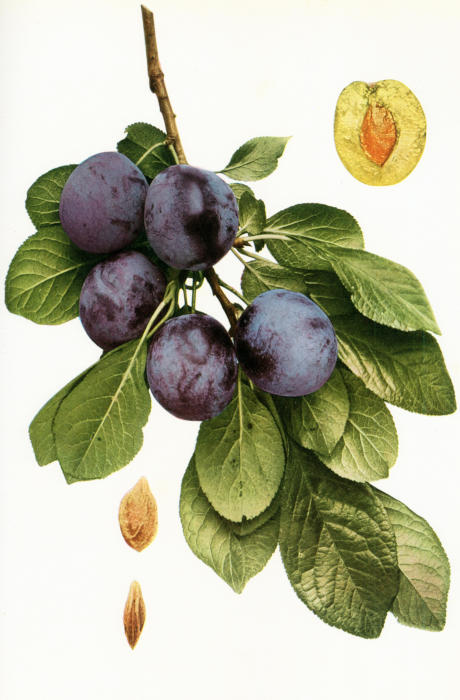
QUACKENBOSS
Prunus domestica
1. Downing Fr. Trees Am. 393. 1857. 2. Cultivator 6:269 fig. 1858. 3. Thomas Am. Fruit Cult. 345. 1867. 4. Downing Fr. Trees Am. 941. 1869. 5. Am. Pom. Soc. Cat. 24. 1871. 6. Mas. Pom. Gen. 2:151, fig. 76. 1873. 7. Barry Fr. Garden 415. 1883. 8. Mich. Sta. Bul. 103:34, fig. 6. 1894. 9. Ont. Fr. Exp. Sta. Rpt. 52. 1895. 10. Cornell Sta. Bul. 131:191, fig. 40 II. 1897. 11. Waugh Plum Cult. 119. 1901. 12. Va. Sta. Bul. 134:44. 1902.
Quackenbos 9, 12.
Though not a leading variety, Quackenboss is a prominent one in the list of commercial sorts for New York. Its fruits possess to a high degree the characters which make a good market plum; they are of large size, averaging nearly an inch and a half in diameter; round-oval, a better shape for the markets than the prune shapes; very prepossessing in color—a handsome, dark purple with heavy bloom; the flesh is tender and juicy with a sweet, pleasant flavor making it one of the good purple plums, though not one of the best in quality. The tree is large, vigorous, hardy, with a round and spreading top. This gives it great bearing capacity but though productive in the Station orchard, the variety does not have the reputation of being fruitful and fails chiefly as a commercial sort for this reason. It is a late-maturing variety and comes on the market at a time when plums are wanted for home canning, the demand for this purpose, for which it is most suitable, helping greatly its sale. The variety has two peculiarities; the petals are comparatively distinct from each other giving the flower, or a tree in flower, an odd appearance; and the leaves are remarkably variable in size.
It is not quite certain when or where this variety first came to notice. C. Reagles, a competent authority, of Schenectady, New York, in describing the Quackenboss for The Cultivator in 1858, says “There is a seedling tree of this identical sort in the garden of Mr. S. C. Groot of this city, which is about thirty years old.” If true, this puts its origin in Schenectady at about 1828. But beyond question a Mr. Quackenboss of Greenbush, New York, introduced the variety, though some years later, and it has taken his name. In 1871, the American Pomological Society placed the Quackenboss on its recommended fruit list.
Tree very large and vigorous, round-topped, hardy, productive; branches numerous, ash-gray, the trunk rough but the limbs smooth, with smallish raised lenticels; branchlets thick, with long internodes, greenish-red changing to brownish-drab over red, dull, pubescent, with numerous, small lenticels; leaf-buds of medium size and length, pointed, free.
Leaves flattened, obovate or oval, variable in size averaging one and seven-eighths inches wide by three and five-eighths inches long; upper surface very dark green, nearly glabrous, with a grooved midrib; lower surface pale green, pubescent; apex obtuse, base tapering, margin finely serrate, with small black glands; petiole five-eighths inch long, pubescent, faintly tinged red, glandless or with from one to four small, globose, greenish-yellow glands usually on the stalk.
Blooming season intermediate in time and length; flowers appearing after the leaves, one and one-eighth inches across, white, with a yellow tinge at the tips of the opening buds; scattered on lateral spurs, singly or in pairs; pedicels three-quarters inch long, above medium in thickness, finely pubescent, greenish; calyx-tube green, campanulate, glabrous; calyx-lobes obtuse, lightly pubescent, glandular-serrate, reflexed; petals obovate, crenate, with broad claws of medium length; anthers yellow with a reddish tinge; filaments seven-sixteenths inch long; pistil glabrous except on the ovary, shorter than the stamens.
Fruit late, season short; one and five-eighths inches by one and three-eighths inches in size, roundish-oval, compressed slightly, halves equal; cavity narrow, abrupt; suture shallow, often lacking; apex roundish or depressed; color bluish-black, with thick bloom; dots numerous, small, yellowish-brown, inconspicuous; stem three-quarters inch long, pubescent, adhering well to the fruit; skin tender, somewhat astringent; flesh deep yellow, juicy, tender, sweet, of pleasant, mild flavor; good; stone semi-free, one inch by five-eighths inch in size, flattened, irregular-oval, tapering to a long, narrow neck at the base, bluntly acute at the apex, with rough and pitted surfaces; ventral suture prominent, heavily furrowed, distinctly ridged; dorsal suture acute, often with a narrow, indistinct, shallow groove.
RED APRICOT
Prunus domestica
1. Knoop Fructologie 2:52, 54. 1771. 2. Kraft Pom. Aust. 2:27, Tab. 172 fig. 1. 1796. 3. Prince Pom. Man. 2:72. 1832. 4. Poiteau Pom. Franc. 1. 1846. 5. Goodrich N. Fr. Cult. 83. 1849. 6. Mas Pom. Gen. 2:127, fig. 64. 1873. 7. Hogg Fruit Man. 720. 1884. 8. Mathieu Nom. Pom. 447. 1889. 9. Lucas Vollst. Hand. Obst. 474. 1894.
Abricot Rouge 1. Abricote Rouge 3. Apricot Plum 5. Abricotée Rouge 6. Abricot Rouge 6, 7, 8. Abricotée Rouge 7, 8. Die Aprikosenpflaume 2. Fürstenzeller Pflaume 8. Fürstenzeller Reine-Claude 6. Prune d’Abricot Rouge 1, 8. Prune d’Abricos 2. Prune d’Abricot rouge 1. Prune Abricotée Rouge 4. Red Apricot Plum 3. Rothe Aprikosenpflaume 6. Red Apricot 6, 8. Rote Aprikosenpflaume 8. Rote Aprikosenzwetsche 9.
This plum, well known in Europe, is probably not now grown in America and it may not deserve recognition here except for its historical interest. Red Apricot is probably an inferior off-shoot of the Apricot plum although no definite record of its lineage is obtainable. It does not seem to have been known until nearly one hundred and fifty years after the Apricot was brought to notice. Kraft figured and described a long prune-like red plum under this name but because of its shape his plum was undoubtedly spurious. The variety was rejected by the American Pomological Society in 1856. It is described as follows:
Tree vigorous, shoots glabrous; fruit mid-season, large, roundish; color red over yellow; suture shallow; cavity small; stem an inch long, stout; flesh yellow, dryish, inferior in flavor; poor; freestone.
RED DATE
Prunus domestica
1. Parkinson Par. Ter. 576. 1629. 2. Rea Flora 208. 1676. 3. Ray Hist. Plant. 2:1529. 1688. 4. Kraft Pom. Aust. 2:43, Tab. 196 fig. 2. 1796. 5. Lond. Hort. Soc. Cat. 147. 1831. 6. Mathieu Nom. Pom. 447. 1889.
A Fleur Double 5. Dattel Pflaume 6. Dattel Zwetsche 6. Die grosse rothe Feigenpflaume 4. Figue Grose Rouge 5. Figue Grosse Rouge 6. Früh Zwetsche 6. Grosse Rote Feigen Pflaume 6. Lange Violette Dattel Zwetsche 6. Lange Violette Dattel Pflaume 6. Prune figue grosse rouge 4. Prune d’Autriche 6. Prune Figue 6. Prune Datte 6. Purpur Pflaume 6. Red Date-plum 3. Rote. Dattelzwetsche 6. Rote Feigen Pflaume 6. Turkische Zwetsche 6. Ungarische Zwetsche 6. Wilmot’s Russian 5. Zucker Zwetsche 6.
Red Date is an interesting variety because of its very peculiar shape which is that of an elongated curved date. Its flavor is agreeable and all of the characters of fruit and tree are as good as in the average variety; yet it can probably be counted as nothing more than an interesting curiosity. Parkinson described the Red Date as long ago as 1629 and it seems to have maintained a place in horticulture since then. The variety was imported from France in 1901 by the United States Department of Agriculture from which source trees were obtained by this Station.
Tree of medium size, upright-spreading, dense-topped, productive; branches thorny; branchlets developing many laterals on the new wood at right angles to the direction of growth, thickly pubescent; leaf-buds free; leaves folded backward, obovate, one and one-half inches by three and one-quarter inches long; margin crenate, with small dark glands; petiole pubescent, rather long, glandless or with from one to three small glands; blooming season intermediate in time and length; flowers appearing after the leaves, seven-eighths inch across; borne in scattering clusters on lateral buds and spurs, singly or in pairs.
Fruit mid-season; one and five-eighths inches by one inch in size, long irregular-oval, enlarged on the suture side, dark purplish-red, with thick bloom; flesh golden-yellow, rather dry, firm, sweet, mild; of fair quality; stone free, one and one-eighth inches by one-half inch in size, very long and narrow, somewhat oblique, acute and oblique at both base and apex; ventral suture blunt; dorsal suture with a long, narrow, deep groove.
RED DIAPER
Prunus domestica
1. Quintinye Com. Gard. 67, 68, 69. 1699. 2. Miller Gard. Kal. 184. 1734. 3. Knoop Fructologie 2:57. 1761. 4. Duhamel Trait. Arb. Fr. 2:102, Pl. XX fig. 12. 1768. 5. Kraft Pom. Aust. 2:36, Tab. 185 fig. 2. 1796. 6. Willichs Dom. Enc. 300. 1803. 7. Pom. Mag. 1:6, Pl. 1828. 8. Prince Pom. Man. 2:69, 90. 1832. 9. Downing Fr. Trees Am. 298. 1845. 10. Floy-Lindley Guide Orch. Gard. 285, 287, 288, 383. 1846. 11. Poiteau Pom. Franc. 1:1846. 12. Horticulturist 3:29. 1848. 13. Thomas Am. Fruit Cult. 335, fig. 261. 1849. 14. Horticulturist 4:195. 1849. 15. Ann. Pom. Belge 75 Pl. 1853. 16. Bridgeman Gard. Ass’t 128, 129, 130. 1857. 17. Pom. France 7: No. 10. 1871. 18. Mas Pom. Gen. 2:135, fig. 68. 1873. 19. Le Bon Jard. 339. 1882. 20. Hogg Fruit Man. 697. 1884. 21. Cat. Cong. Pom. France 345. 1887. 22. Mathieu Nom. Pom. 447. 1889. 23. Guide Prat. 158, 365. 1895.
Amalia Pflaume 22, 23. Bunte Herzformige Pflaume 17, 22. Cyprische Pflaume 22, 23. Diaprée de Roche Corbon 22. Dame Aubert Rouge 22, 23. Diademe Imperial 22. De Chypre 23. Diademe Imperiale 23. Diaper 1, 10. Die Blutfarbige Pflaume 5. Diaprée Rouge 3, 4, 9, 17, 18, 19, 20, 21. Diaprée Rouge 5, 8, 10, 13, 16, 18, 22. Diapre Rouge 8, 22, 23. Die Rothe Eierpflaume 14. Diaper Rouge 16. Diaper 17, 20, 22. Die Blutfarbege Pflaume 17. Diaprea rubra 17. Diademe 19. De Briancon 21. Gluhende Kohle 22. Hoheits Pflaume 22, 23. Imperial Diadem 8, 9, 13, 20, 22. Imperial Diadem 10, 16. Imperial Diademe 17, 21. Imperatrice 19. La Roche-Corbon 22. La Courbon 17. Mimms 10, 16. Mimms 9, 13, 17, 20. Mimms Plum 10, 16, 22. Mimms Plum 7, 8. Mimms Pflaume 22. Matchless 22. Prune Diaprée Rouge 11. Prune Imperatrice 15. Prune Diademe 15. Prune de Briancon 17. Prune de Chypre 22. Prinzessin Pflaume 22, 23. Roche-Carbon 22. Rote Diaprée 22. Rouge Corbon 22. Rote Eier Pflaume 22. Rote Cyprische Pflaume 22. Rote Marunke 22. Rote Osterei 22. Rote Masche 22. Rote Ross Pflaume 22. Rothe Eierpflaume 23. Rothe Marunke 23. Roche Corbon 1. Roche Courbon 2. Roche Corbon 4, 5, 8, 9, 10, 16, 17, 18, 20, 21, 22. Roch-courbon 6. Red Diaper 6, 10, 16, 17, 20, 21, 22. Roche Courbon 8. Red Egg Plum 14. Reine de Chypre 14. Red Imperial 16. Rothe Diaprée 17. Rothe Violen Pflaume 17. Red Diaper Plum 17. Rothe Eierpflaume 17. Rothe Süsse Pflaume 17. Rothe Diapre 18. Virginische Pflaume 17.
Red Diaper is of historical value only, as it is now rarely found. It does not seem to have been known as long as Violet Diaper and may be an off-shoot of the older variety. It probably originated in France, one of its synonyms, Roche Corbon, having been derived from a small village near Tours. The Mimms plum said to have been raised from a stone of the Blue Perdrigon about 1800 by Henry Browne, North Mimms Place, Hertfordshire, England, and the Imperial Diadem said to be a seedling of about the same date raised at Duckenfield, near Manchester, England, are identical with Red Diaper in spite of their supposed separate origin. The Chypre, or Prune de Chypre, thought by some to be a synonym of this variety, is undoubtedly distinct, as it is a clingstone and is earlier. The following description is compiled.
Tree of slow growth in the nursery, hardy, vigorous and productive in the orchard. Fruit mid-season; large, obovate; cavity slight; stem one-half inch in length; skin brownish-red; bloom thin; dots very numerous, brownish, conspicuous; flesh greenish-yellow, firm, fine-grained, sweet; good; stone small, free.
RED JUNE
Prunus triflora
1. Am. Pom. Soc. Rpt. 106. 1891. 2. Cornell Sta. Bul. 62:28. 1894. 3. Ga. Hort. Soc. Rpt. 95. 1895. 4. Cornell Sta. Bul. 106:60. 1896. 5. Ala. Col. Sta. Bul. 85:444. 1897. 6. Cornell Sta. Bul. 139:45. 1897. 7. Rural N. Y. 56:615. 1897. 8. Am. Pom. Soc. Cat. 26. 1897. 9. Mich. Sta. Bul. 169:242, 243, 249, 250. 1899. 10. Cornell Sta. Bul. 175:136. 1899. 11. U. S. D. A. Rpt. 386. 1901. 12. Waugh Plum Cult. 140. 1901. 13. Budd-Hansen Am. Hort. Man. 324. 1903. 14. Can. Exp. Farm Bul. 43:37. 1903. 15. Mass. Sta. Ann. Rpt. 17:160. 1905. 16. Md. Hort. Soc. Rpt. 85. 1905. 17. Ga. Sta. Bul. 68:5, 32. 1905.
Botan 14. Hytankayo 11. Long Fruit 3. Nagate no Botankyo 10, 11, 17. Red Nagate 1, 2, 3, 6, 9. Red Nagate 4, 5, 11, 12, 13, 17. Red June 2, 3. Shiro Smomo 2, 4, 7, 11, 12, 14. Shiro Smomo 9.
Red June is variously estimated by fruit-growers and pomologists. A concensus of the opinions of those who have had actual experience with the variety shows that it closely follows Abundance and Burbank in popularity among the Trifloras. The variety is distinguished from all other plums by its fruit-characters; the plums are distinctly cordate in shape with a deep cavity and a very pointed apex; the color is a mottled garnet-red overlaid with thin but very distinct and delicate bloom; the flesh is a light yellow, firm enough to endure transportation well, peculiarly aromatized, sweetish and not wholly agreeable in flavor and ranking rather low in quality; the stone adheres tightly to the flesh. The trees are large, vigorous, spreading, hardy, healthy and productive—very good for the species to which the variety belongs. Other good qualities of the variety are that it blooms late for a Triflora, and that the fruits are comparatively immune to curculio and brown-rot and hang to the trees exceptionally well for an early plum. This is one of the Trifloras that varies in season of ripening, a peculiarity of several of the varieties of this species, but usually the fruits ripen a week or more before Abundance. Red June is reported to be somewhat self-sterile and in need of cross-pollination. This variety ought to have value as an early market plum in New York.
Red June was imported from Japan by H. H. Berger and Company, San Francisco, California, under the name Shiro Smomo, about 1887. Stark Brothers, Louisiana, Missouri, obtained the variety in 1892 and introduced it as the Red June in 1893. In 1897 it was added to the fruit catalog list of the American Pomological Society. The nomenclature of this variety is much confused. The true Japanese Red Nagate (Red Nagate is one of the synonyms of Red June) has red flesh while this one has not; this variety, to which the name Shiro Smomo is most often applied, is not a Smomo plum nor is it white, (Shiro is the Japanese for white) affording another instance of the confusion in the American application of the Japanese names of the Triflora plums.
Tree large, vigorous, upright-spreading, hardy, productive, healthy; branches rough, thorny, dark brown, with numerous lenticels of medium size; branchlets slender, long, with short internodes, dark brown, marked with considerable scarf-skin, glabrous, with numerous large, raised lenticels; leaf-buds small, medium in length, conical, free.
Leaves folded upward, oblanceolate, one inch wide, two and three-quarters inches long, thin; upper surface glabrous, with a lightly grooved midrib; lower surface light green, thinly pubescent along the midrib and larger veins which are tinged red; apex taper-pointed, base acuminate, margin finely serrate, with small glands; petiole one-half inch long, slender, tinged red, slightly hairy along one side, with from one to three small, brown glands usually at the base of the leaf.
Blooming season intermediate in time and length; flowers appearing before the leaves, white; borne in clusters on lateral buds and spurs, in twos or in threes; pedicels of medium length and thickness, glabrous except for occasional hairs, greenish; calyx-tube green, campanulate, glabrous; calyx-lobes narrow, obtuse, sparingly glandular, with marginal hairs, glabrous on the outer side, thinly pubescent on the inner side, erect; petals oval, entire, tapering at the base to short claws; anthers light yellow; filaments short; pistil glabrous, longer than the stamens.
Fruit early, one and one-half inches by one and three-eighths inches in size, roundish-ovate to roundish-cordate, sides unequal; cavity large, deep, narrow, regular, abrupt; suture deep, distinct; apex very pointed; color garnet-red, mottled; bloom thin; dots numerous, small, russet; stem one-half inch long, adhering to the fruit; skin above medium in thickness, tender, slightly astringent, separating easily; flesh light yellow, fibrous, somewhat meaty, sweet except near the center; good; stone clinging, five-eighths inch by one-half inch in size, irregular-oval, slightly flattened, pointed at both ends, with pitted surfaces; ventral suture prominently winged, narrow; dorsal suture not grooved.
RED MAGNUM BONUM
Prunus domestica
1. Parkinson Par. Ter. 576, 577. 1629. 2. Rea Flora 208. 1676. 3. Langley Pomona 92, Pl. XX fig. V. 1729. 4. Duhamel Trait. Arb. Fr. 2:98, Pl. XV. 1768. 5. Kraft Pom. Aust. 2:31, Tab. 178 fig. 1. 1796. 6. Willichs Dom. Enc. 4:300. 1803. 7. Prince Pom. Man. 2:59. 1832. 8. Hoffy Orch. Com. fig. 1841. 9. Floy-Lindley Guide Orch. Gard. 292. 1846. 10. Horticulturist 4:194. 1849. 11. Ann. Pom. Belge 99, Pl. 1853. 12. Elliott Fr. Book 428, 429. 1854. 13. Noisette Man. Comp. Jard. 2:499. 1860. 14. Downing Fr. Trees Am. 943. 1869. 15. Mas Pom. Gen. 2:139, fig. 70. 1873. 16. Hogg Fruit Man. 721. 1884. 17. Am. Pom. Soc. Rpt. 61. 1887. 18. Mathieu Nom. Pom. 445, 448. 1889. 19. Ia. Hort. Soc. Rpt. 87. 1890. 20. Guide Prat. 158, 358. 1895.
Askew’s Purple Egg 12, 14, 16, 18. Blaue Kaiserpflaume 15, 18, 20 incor. Blaue Eier Pflaume 18 incor. Bockshoden 18, 20. Bocksdutten 18, 20. Bonum Magnum 18 incor., 20. Blue Imperatrice 7 incor., 8. Copper Plum 8. Die Kaiserliche veilchenfarbige Pflaume 5. Die Rothe Kaiserpflaume 10. Dame Aubert 13. Dame Aubert Violette 14, 16, 18, 20. Die Rothe Eierpflaume 14. Dame Aubert Rouge 17. Dame Aubert Rouge 19. D’Oeuf Violette 20. Early Forcing 12. Florence 12, 14, 16, 18, 20. Frühe Treib Zwetsche 18. Frühe Treibzwetsche 20. Great Imperial Plum 18, 20. Grosse Früh Zwetsche 18 incor. Grosse Ungarische Zwetsche 18 incor. Imperiall 1. Imperial 3, 6. Impériale Violette 5, 7, 8, 9, 10, 14, 16, 18, 20. Impériale Violette 4, 15, 20. Imperial Violet 7. Impériale 7, 14, 16, 18, 20. Imperiall 9. Imperial 9, 14, 18. Impériale Rouge 10, 14, 16, 18. Imperial Rouge 12, 18. Imperial Violet 14, 18. Impériale Hâtive 18, 20. Impériale rouge 20. Large Orlean 7. Mogul Rouge 16, 18. Oeuf Rouge 16, 18. Prune d’Oeuf Violette 18. Prinzessinpflaume 15. Prune-figue 13. Prune Impériale Violette 11. Prune d’oeuf 7, 14, 18. Purple Egg 7, 12, 14, 16, 18. Prune-oeuf 7. Purple Magnum Bonum 12, 14, 18. Red Magnum Bonum 8, 12, 20. Red Magnum 6. Red Imperiale 7, 8, 12, 14, 16, 18, 20. Red Bonum Magnum 3, 7, 18, 20. Red Egg Plum 10. Red Egg 12. Red Imperial 12. Red Egg 14, 16, 18. Red Aubert 17. Rote Eier Pflaume 18. Rote Kaiserpflaume 18. Rote Kaiser Zwetsche 18. 116 Riga 19. Rothe Kaiserpflaume 20. Rothe Kaiserzwetsche 20. Shepler ?14, ?18. Sainte-Catherine (Belgien) 18, 20. The Imperial Plum 2. Violette oder Blaue Kaiserpflaume 15.
Once popular, Red Magnum Bonum is now but of historical interest. Three centuries ago this variety was cultivated in England by John Tradescant under the name Imperiall. It was mentioned by all of the early horticultural writers and it seems clear that the variety was well established in Europe at least as early as the beginning of the Seventeenth Century. As all plums at that time were propagated from seed, a large number of sub-varieties of this sort were produced and as these became established the nomenclature of the variety became much involved. In 1729 Langley called it the Red Magnum Bonum, a name it has since retained. It is not known when the variety was introduced into this country but its first appearance in American literature was in 1803. After its introduction nurserymen sold any large red plum as Red Magnum Bonum and it became difficult to find the true variety. Professor J. L. Budd apparently reintroduced this plum in 1881-1882 under the name Dame Aubert Rouge. Although very extensively grown in America at one time it has never been a favorite because of its poor quality. The American Pomological Society rejected it in 1858 from a list of candidates for its catalog. The following description is compiled.
Tree hardy, vigorous, productive; young shoots glabrous. Fruit mid-season; large, oval, deep red in the sun, pale red in the shade, covered with thin bloom; stem one inch long; flesh greenish, firm, slightly coarse, dry, brisk subacid; of fair quality; stone oval, free.
REINE CLAUDE
Prunus domestica
1. Quintinye Com. Gard. 67, 68, 69. 1699. 2. Langley Pomona 93, Pl. XXIII fig. 7. 1729. 3. Duhamel Trait. Arb. Fr. 2:89, Pl. XI. 1768. 4. Knoop Fructologie 2:62. 1771. 5. Kraft Pom. Aust. 28, Tab. 173 fig. 2, 41, Tab. 193 fig. 2. 1796. 6. Forsyth Treat. Fr. Trees 20. 1803. 7. Miller Gard. Dict. 3. 1807. 8. Coxe Cult. Fr. Trees 237, fig. 14. 1817. 9. Phillips Com. Orch. 306. 1831. 10. Lond. Hort. Soc. Cat. 147, 148. 1831. 11. Prince Pom. Man. 2:48. 1832. 12. Gallesio Pom. Ital., Pl. 1839. 13. Downing Fr. Trees Am. 276 fig. 106. 1845. 14. Floy-Lindley Guide Orch. Gard. 283, 382, 419. 1846. 15. Poiteau Pom. Franc. 1:1846. 16. Horticulturist 2:178, 179, fig. 30, 291. 1847. 17. Thomas Am. Fruit Cult. 326 fig. 253, 329. 1849. 18. Hovey Fr. Am. 2:69, Pl. 1851. 19. Am. Pom. Soc. Cat. 54. 1852. 20. Elliott Fr. Book 410. 1854. 21. Thompson Gard. Ass’t 517. 1859. 22. Downing Fr. Trees Am. 917. 1869. 23. Mas Le Verger 6:55, fig. 28. 1866-73. 24. Pom. France 7: No. 5. 1871. 25. Oberdieck Deut. Obst. Sort. 434. 1881. 26. Lauche Deut. Pom. 20, Pl. IV 20. 1882. 27. Hogg Fruit Man. 703. 1884. 28. Mathieu Nom. Pom. 433. 1889. 29. Guide Prat. 154, 363. 1895. 30. Bailey Sur. Unlike 176, 243. 1896. 31. Cornell Sta. Bul. 131:186. 1897. 32. Botanical Gazette 26:423. 1898. 33. Gard. Chron. 3rd Ser. 24:465. 1898. 34. Waugh Plum Cult. 22, 106, 107 fig. 1901.
Abricot Verd 5, 9. Abricot Vert 3, 7, 10, 11, 13, 14, 21, 22, 23, 24, 27, 28, 29. Abricotée Sageret ?22, 28. Aloise’s Green Gage 22, 24, 27, ?28, 29. Blanche Grosse Espece 10. Bonne Verte 5. Bradford Gage 13, 20, 21, 22, 28, 29. Bradford Green Gage 27, 28. Bradford Queen Gage 24, ?29. Brugnon Green Gage 10, 18, 21, 22, 24, 27, 28, 29. Brugnon Gage 20, 22, 28, 29. Bruyn Gage 13, 17, 18 incor., 20, 22, 28, 29. Burgnon Gage 13, 24. Cant’s Late Green Gage 22, 28. Claudia 12. Damas Gris 24, 28, 29. Damas Verd 9. Damas Vert 7, 10, 13, 18, 21, 22, 24, 27, 28, 29. Dauphine 5, 7, 10, 11, 13, 14, 18, 21, 22, 23, 24, 27, 28, 29. Die grosse Königin Claudiapflaume, die grüne Abrikose 5. Die Königin Klaudia 5. Dauphine 3. Dauphiny 6. Drap d’Or of some 10, 18, 28, 29. Echte Grosse Reine-Claude 28, 29. Gage Verte 28, 29. Great Green Damask 22, 27, 28. Great Green Damaski 24, 29. Great Queen Claudia 11. Green Gage 2, 6, 8, 10, 11, 13, 14, 17, 18, 19, 20, 21, 22, 27, 30, 31, 33, 34. Green Spanish 14, 18. Gros Damas Vert 11, 22, 28, 29. Grosse Königin Claudiapflaume 5. Green Gage 7, 9, 23, 24, 28, 29, 32, 34. Goring’s Golden Gage 22, 24, 27, 28, 29. Grosse Reine 10, 13, 18, 20, 21, 22, 24, 27, 28, 29. Grosse Grüne Reine-Claude 25, 28. Grosse Reine-Claude 7, 25, 26, 28. Grosse Reine-Claude 3, 5, 10, 11, 13, 14, 18, 20, 21, 22, 23, 24, 25, 29. Gros Reine-Claude 14. Grüne Aprikose 5, 28, 29. Grüne Abrikose 5. Grüne Reineclaude 25. Gute Grüne 28, 29. Huling’s Reine-Claudia 22, 28. Huling’s Reine Claude 11. Ida Gage 22. Ida Green Gage 16. Ida Green Gage 20, 22, 24, 27, 28, 29. Isleworth Green Gage 13, 18, 20, 21, 22, 24, 27, 28, 29. Isleworth Green Gage 10. King of Plums 20. Königin Claudia 28, 29. Königin Klaudia 5. Large Queen Claude 11. La Grosse Reine-Claude 11. Large Queen Claudia 6. Large green claudia 11. Livingston Manor 22, 28. Louis Brun ?22, ?28. Mammola 12. Mirabelle Vert Double 22, 24, 27, 28, 29. Murray’s Reine Claudia 22, 28. Murray’s Reine Claude 11, 14, 22, 27. Prune de Reine Claude 15. Prunus Domestica Cereola 32. Prunus Domestica var. cereola 33. Prunus Domestica var. Claudiana 32. Queen Claude 2. Queen Claudia 11, 22, 24, 27, 28, 29. Reine-Claude Ancienne 23, 24, 28, 27. Reine-Claude Blanche Grosse Espece 10. Reineclaude d’oree 29. Reine-Claude Blanche La Grosse 11, 22. Reine-Claude 8, 10, 11, 13, 17, 18, 20, 21, 22, 27, 28, 33. Reine Claud 1. Reine-Claudia 2. Reine-Claude Blanche 10. Reine-Claude Dorée 22, 23, 24, 25, 28, 29. Reine-Claude Dore 18, 22. Reine-Claude Grosse 27, 28. Reine-Claude Verde Perdrigon 5. Reine-Claude Verte 23, 29. Rensselaer Gage 20, 22. Rensselvar Gage 24, 29. Rensselaar Gage 27, 28. Reine-Claude Verte Tiquetée 28, 29. Reine-Claudia Blanche La Grosso 22, 28. Royal Green Gage 28, 29. Schuyler Gage 20, incor. 22, 24, 27. Schuyler’s Gage ?13, 20, 28, 29. Sucrin Vert 10, 11, 13, 18, 21, 22, 24, 27, 28, 29. Sultaneck Erik ?28, 29. Susina Regina 12. Triomphe Garcon 24, 28, 29. Triomphe Valet 24, 28, 29. Trompe Garcon 22, 27, 28, 29. Tromp-Valet 7. Trompe Valet 22, 27, 28, 29. Verdacia 27, 28. Verdacchia rotonda 12. Verdoch 27, 32, 34. Verdochia 32. Verdochio 22, 24, 27, 28, 29. Verducia 22. Verte Bonne 3, 7, 9, 10, 11, 14, 18, 21, 22, 23, 24, 28, 29. Vert Bonne 13, 22, 27. Verte d’Espagne 23, 28, 29. Verte Tiquetée 22, 24, 27, 28, 29. Vilmot’s Green Gage 29. Vilmot’s Late Green Gage 29. Wilmot’s Green Gage 10, 11, 18, 20, 21, 22, 24, 27, 28. Wilmot’s Late Green Gage 11, 18, 20, 21, 22. Wilmot’s Late Green Gage 10, 13, 18, 20, 21, 22, 28, 29. Wilmot’s New Green Gage 10, 11, 13, 18, 20, 22, 28, 29. Waterloo 20.
In the pomological literature since Quintinye in 1699, Reine Claude has been the standard in quality for plums. For the qualities that gratify or assist in gratifying the sense of taste,—richness of flavor, consistency and texture of flesh, abundance of juice and pleasant aroma,—the Reine Claude is unsurpassed. It is, however, now probably equalled in quality by several of the great number of similar varieties which have originated in America and for which American plum-growing is justly distinguished. Under ordinary cultivation the Reine Claude is not a remarkably handsome plum but when grown on thrifty trees, the crop thinned, foliage and fruit kept free from pests and the fruits sufficiently exposed to the sun to color well, it is a beautiful fruit, its size, form and color all adding to its beauty. The tree is only of moderate size in the orchard and in the nursery is so small and wayward that nurserymen hesitate to grow it. The trees, though small, are productive and bear regularly, the chief defect being the susceptibility to sunscald whereby the bark on the trunk is killed and the beginning of the end is marked. The short life of the trees of this variety is largely due to this injury to the bark and has led to top-working on Lombard and other stocks, an operation successful only when done early in the life of the stock. Another serious fault is that the fruit cracks badly if showers occur at ripening time. Reine Claude is still one of the most profitable plums grown in New York and whether for the commercial or home plantation deserves a place in the plum orchard.
For a complete history of this variety the reader is referred to the discussion of the Reine Claude group of plums. The Bavay, a distinct variety, is called the true Reine Claude by many nurserymen and horticultural writers. Green Gage is a synonym of the Reine Claude and is preferred by some writers for this plum but since “Reine Claude” is as well known and much older it has been retained in The Plums of New York. The American Pomological Society placed this variety on its fruit catalog list in 1852.
Tree of medium size and vigor, round-topped, hardy, productive; trunk and branches of medium thickness and smoothness; branches ash-brown, with few lenticels; branchlets short, with short internodes, reddish-brown, lightly pubescent; leaf-buds large, long, conical or pointed, free; leaf-scars prominent.
Leaves four and one-half inches long, two inches wide, oval, thick, leathery; upper surface dark green, smooth, covered with fine, scattering hairs; lower surface pale green, pubescent; apex acute, margin often doubly crenate, glandular; petiole three-quarters inch long, tinged red, glandless or with one or two small, globose, greenish glands variable in position.
Fruit mid-season; one and three-quarters inches by one and five-eighths inches in size, roundish-oval, halves equal; cavity narrow, regular, abrupt; suture shallow, broad; apex pubescent, roundish or slightly depressed; color yellowish green, indistinctly streaked with green, becoming golden-yellow at full maturity, sometimes mottled on the sunny side with red, overspread with thin bloom; dots very numerous, small, grayish, conspicuous, clustered about the apex; stem thick, three-quarters inch long, pubescent; skin tough, adhering to the pulp; flesh greenish-yellow or golden-yellow, juicy, firm, sweet, mild; very good; stone semi-clinging, one inch by three-quarters inch in size, oval, turgid, tapering at the base, blunt at the apex, with thickly pitted surfaces; ventral suture wide, distinctly furrowed, often with a short wing; dorsal suture with a very wide and deep groove.
ROBINSON
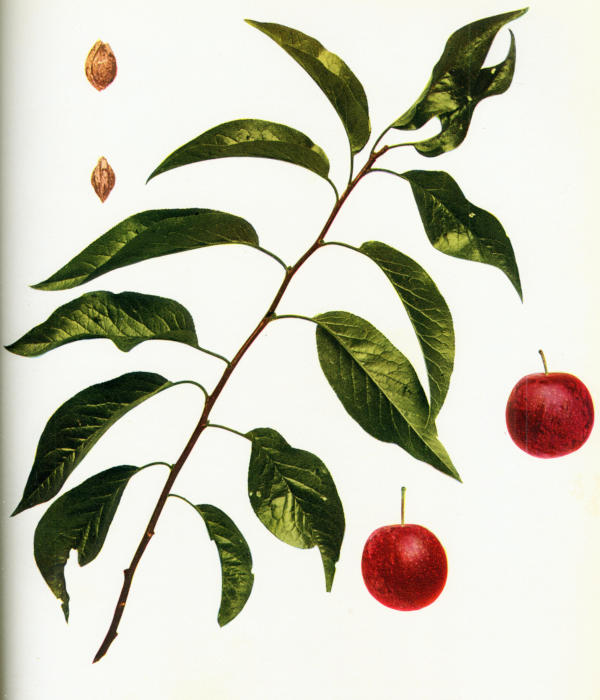
ROBINSON
Prunus munsoniana
1. Ind. Hort. Soc. Rpt. 134. 1883. 2. Am. Pom. Soc. Rpt. 151. 1891. 3. Cornell Sta. Bul. 38:64, 86. 1892. 4. Me. Sta. An. Rpt. 12:67. 1896. 5. Am. Pom. Soc. Rpt. 89. 1897. 6. Wis. Hort. Soc. Rpt. 137. 1899. 7. Wis. Sta. Bul. 87:15. 1901. 8. Waugh Plum Cult. 199. 1901. 9. Kan. Sta. Bul. 101:131. 1901. 10. Ga. Sta. Bul. 67:280. 1904. 11. Ohio Sta. Bul. 162:256, 257. 1905.
Robinson has long been one of the best known of its species though it is probably inferior in fruit-characters at least to several other Munsoniana sorts. The plums are attractive in coloring but small in size and comparatively low in quality. The trees are capricious in growth and not as hardy as some others of the species but where they can be grown are always productive. The variety is rated by some authors among those that need cross-pollination to insure large crops. Robinson may be worth growing in the South and in the States of the Plains but it cannot be recommended for any purpose in New York.
This variety is a seedling grown by a Mr. Pickett of Putnam County, Indiana, from a seed brought with him from North Carolina about 1835. In 1879, Dr. J. H. Robinson read a paper before the Indiana Horticultural Society on Chicasaw plums, and gave a very flattering description of this plum, which he had been growing since 1872. Later it was named by the Putnam County Horticultural Society in honor of Dr. Robinson. This name was used as a synonym of Miner by Downing in 1869 but at the present time that usage has almost disappeared in plum literature.
Tree variable in size, often large, vigorous, spreading, not uniform in habit, somewhat open and flat-topped, hardy, medium to productive; trunk shaggy; branches very rough, zigzag, thorny, dark ash-gray, with numerous, large, narrow and strongly elongated, raised lenticels; branchlets slender to medium, with internodes medium to below in length, greenish-red changing to dull, dark chestnut-red, glabrous, with numerous very conspicuous, large, raised lenticels; leaf-buds small, short, obtuse, free.
Leaves folded upward, lanceolate, peach-like, one and five-sixteenths inches wide, three and one-half inches long, thin; upper surface dark green, glabrous, with deeply grooved midrib; lower surface glabrous except along the midrib and larger veins; apex taper-pointed, base obtuse, margin very finely serrate, with small, dark red glands; petiole slender, five-eighths inch long, reddish, lightly pubescent along one side, glandless or with from one to seven small, globose, reddish-brown glands on the stalk and on the base of the leaf.
Blooming season medium to late, long; flowers appearing with the leaves, eleven-sixteenths inch across, whitish, somewhat self-fertile; borne in clusters on lateral buds and spurs, in twos, threes or fours; pedicels seven-sixteenths inch long, slender, glabrous, greenish; calyx-tube green, narrow-campanulate, glabrous; calyx-lobes narrow, slightly obtuse, glandular, pubescent and with marginal hairs, erect; petals ovate or oval, small, narrow, slightly crenate, tapering below to long, narrow claws; anthers yellowish; filaments one-quarter inch long; pistil glabrous, slightly shorter than or equal to the stamens in length.
Fruit early, season very long; less than an inch in diameter, roundish or roundish-oval, halves equal; cavity of medium depth and width, abrupt; suture a line; apex roundish; color clear currant-red, overspread with thick bloom; dots scattering, large, russet, conspicuous, clustered around the apex; stem slender, five-eighths inch long, glabrous, adhering to the fruit; skin tough, bitter, separating readily; flesh golden-yellow, very juicy, somewhat fibrous, tender and melting, sweet next the skin, with some astringency near the center, of mild but pleasant flavor; fair in quality; stone clinging, five-eighths inch by three-eighths inch in size, oval, turgid, very slightly flattened and necked at the base, abrupt-pointed at the apex, roughish; ventral suture blunt, slightly ridged; dorsal suture with a rather broad groove of medium depth.
ROLLINGSTONE
Prunus americana
1. Rural N. Y. 44:645. 1885. 2. Minn. Hort. Soc. Rpt. 279. 1885. 3. N. J. Hort. Soc. Rpt. 186. 1885. 4. Wis. Hort. Soc. Rpt. 32. 1885. 5. Minn. Sta. Bul. 10:73 fig. 1890. 6. Cornell Sta. Bul. 38:41, 86. 1892. 7. Am. Pom. Soc. Cat. 24. 1897. 8. Wis. Sta. Bul. 63:56, 58 fig. 28. 1897. 9. Colo. Sta. Bul. 50:45. 1898. 10. Ohio. Sta. Bul. 113:153. 1899. 11. Waugh Plum Cult. 162. 1901. 12. Ga. Sta. Bul. 67:280. 1904. 13. Ohio Sta. Bul. 162:256, 257. 1905.
Minnesota 2. Rolling Stone 3, 4.
Rollingstone is an old Americana sort which has been kept in cultivation chiefly because it is of very good quality for one of its species. The fruit is rather dull in color and small but not unattractive in appearance; the plums are little troubled by either the brown-rot or the plum curculio and ship very well because of the tough skin. The tree is dwarfish with a crooked trunk, shaggy bark, unkempt top and very twiggy—a typical Americana and most difficult to grow into a good orchard plant. The variety is characterized by long, conspicuous stamens, stigmas frequently defective and by very large leaves. The variety has little or no value in New York.
Rollingstone was found near an old Indian camping ground on the Rollingstone Creek, Winona County, Minnesota, by Mr. O. M. Lord,[220] Minnesota City, about 1852. Mr. Lord planted trees of this plum in his garden and found that they improved greatly under cultivation, so much so that they soon became very popular in the local market. About 1882 he introduced the Rollingstone to fruit-growers in general. Mr. H. M. Thompson of St. Francis, according to the Minnesota Horticultural Society Report for 1885, sent this plum out under the name Minnesota but fortunately it has not been distributed under its synonym widely enough to cause much confusion. In 1897 the American Pomological Society added Rollingstone to its fruit catalog list.
Tree dwarfish, variable in vigor, spreading, flat-topped, hardy, productive, healthy; trunk shaggy; branches dark ash-gray, thorny, rough, zigzag, with numerous, rather large lenticels; branchlets slender, twiggy, medium to short, with internodes of average length, greenish turning to dark brown, glossy, glabrous, with conspicuous, small, raised lenticels; leaf-buds medium in size and length, appressed.
Leaves falling early, folded upward, obovate or long-ovate, one and one-half inches wide, three and one-half inches long, thin; upper surface smooth, glabrous, with a narrow groove on the midrib; lower surface silvery green, lightly pubescent, the veins prominent; apex taper-pointed, base rather acute, margin coarsely and doubly serrate, eglandular; petiole slender, five-eighths inch long, tinged red, sparingly pubescent, glandless or with one or two small, globose, reddish glands on the stalk.
Blooming season late and short; flowers appearing after the leaves; three-quarters inch across, the buds creamy-white changing to white as the flowers expand; borne in clusters on lateral buds and spurs, in threes or in fours; pedicels seven-sixteenths inch long, below medium in thickness, glabrous, green; calyx-tube reddish-green, obconic, glabrous; calyx-lobes narrow, acute, eglandular, glabrous on the outer surface but lightly pubescent within, heavily pubescent on the margin and with irregular deep serrations, erect; petals oval or slightly ovate, dentate, tapering below into narrow claws reddish at the base; stamens conspicuous; anthers yellow; filaments three-eighths inch long; pistil glabrous, equal to the stamens in length; stigma often abortive.
Fruit mid-season or earlier, ripening period short; about one inch in diameter, roundish, halves equal; cavity shallow, flaring, marked before maturity with light-colored, radiating streaks; suture a line; apex roundish; color dark purplish-red, with thin bloom; dots numerous, small, light russet, inconspicuous; stem slender, nine-sixteenths inch long, adhering poorly to the fruit; skin thick, tough, semi-adherent; flesh orange-yellow, juicy, slightly fibrous, tender and melting, sweet, strongly aromatic; good; stone semi-free, five-eighths inch by one-half inch in size, roundish-oval, flattened, smoothish, blunt at the base and apex; ventral suture acute, faintly ridged; dorsal suture acute, with a narrow, shallow, indistinct groove.
ROYAL TOURS
Prunus domestica
1. Duhamel Trait. Arb. Fr. 2:81, Pl. XX fig. 8. 1768. 2. Kraft Pom. Aust. 2:35, Tab. 184 fig. 2. 1796. 3. Downing Fr. Trees Am. 313. 1845. 4. Elliott Fr. Book 423. 1854. 5. Mas Le Verger 6:53, fig. 27. 1866-73. 6. Lange Allgem. Garten. 2:420. 1879. 7. Le Bon Jard. 2:341. 1882. 8. Cat. Cong. Pom. France 368. 1887. 9. Mathieu Nom. Pom. 438. 1889. 10. Guide Prat. 160, 365. 1895. 11. Waugh Plum Cult. 120, 121. 1901.
Damas de Tours 7. Die königliche Pflaume von Tours 2. Diel’s Königspflaume 9 incor. Diels Königpflaume 10. Frühe Herrn Pflaume 9 incor., 10. Kings plum of Tours 6. Königspflaume von Tours 5, 10. Königspflaume von Tours 9. Königliche Pflaume von Tours 9, 10. Königs Pflaume 9 incor., 10. Königliche Grosse Pflaume 9, 10. Königin von Tours 9, 10. Moroccopflaume 10. Morocco 9 incor. Prune Royale de Tours 5, 9. Rothe Königspflaume 10. Roi 10. Royale 8, 10. Royale de Tours 1, 3, 5, 7, 8, 10. Royale de Tours 2, 4, 9, 10, 11. Royal Tours 3, 4, 9. Royal of Tours 4. Royal red Plum 8, 10. Worth 11.
This excellent variety should be grown generally in America for home use, at least, if it proves nearly as desirable as it is rated in Europe. Royal Tours is an old French sort supposed to have originated in the neighborhood of Tours, France. Although highly esteemed in Europe, it has not gained favor in this country and is rarely found here. Waugh states that in 1899 he secured specimens of it from North Carolina where it was grown locally under the name Worth. The following description is compiled.
Tree strong, vigorous; branches thick, short, smooth; fruit early mid-season; of medium size, irregularly roundish, swollen on one side, dark reddish-purple covered with thick bloom; cavity deep; suture prominent; stem short, thick; skin thick, firm; dots conspicuous; flesh greenish-yellow, firm, sweet; very good; stone large, oblong, rough, clinging.
RUTLAND PLUMCOT
Prunus triflora × Prunus armeniaca
1. Burbank Cat. 13 fig. 1901. 2. De Vries Pl. Br. 218. 1907. 3. Fancher Creek Nur. Cat. 10 fig. 1909.
Plumcot 1, 2.
One of the interesting novelties of recent plum-breeding is the Plumcot grown by Luther Burbank[221] from a cross between the plum and the apricot. Not having seen the fruit of this remarkable cross we are unable to judge of its value to the plum-grower. Out of a large number of extremely variable seedlings of this cross Burbank selected this, the Rutland Plumcot, named in honor of an Australian admirer of the fruit. The variety was introduced by the Fancher Creek Nursery in 1906 and 1907. The following description is partly compiled.
Tree vigorous, spreading, open, not a heavy bearer; branches thorny; branchlets rather slender, with short internodes, dull red; leaves folded upward, oval, one and five-eighths inches wide, two and seven-eighths inches long, rather stiff; margin finely and doubly crenate, glandular; petiole greenish-red, with from one to four globose glands.
The fruit in California attains a large size; suture and cavity deep; skin fuzzy like an apricot, purple; flesh deep red, subacid; quality fair; stone large, broad-oval.
SAINT CATHERINE
Prunus domestica
1. Quintinye Com. Gard. 67, 68, 69. 1699. 2. Langley Pomona 94, Pl. 24 fig. 6. 1729. 3. Miller Gard. Dict. 3. 1754. 4. Duhamel Trait. Arb. Fr. 2:97, Pl. XX fig. 5, 109, Pl. XIX. 1768. 5. Knoop Fructologie 2:55. 1771. 6. Lond. Hort. Soc. Cat. 153. 1831. 7. Prince Pom. Man. 2:76, 103. 1832. 8. Kenrick Am. Orch. 267. 1832. 9. Gallesio Pom. Ital. 2: Pl. 1839. 10. Downing Fr. Trees Am. 283 fig. 112. 1845. 11. Floy-Lindley Guide Orch. Gard. 298, 383. 1846. 12. Poiteau Pom. Franc. 1:1846. 13. U. S. Pat. Off. Rpt. XXX. 1854. 14. Ann. Pom. Belge 65, Pl. 1855. 15. Thompson Gard. Ass’t 520. 1859. 16. Am. Pom. Soc. Cat. 86. 1862. 17. Pom. France 7: No. 23. 1871. 18. Mas Le Verger 6:89, fig, 45. 1866-73. 19. Hogg Fruit Man. 724. 1884. 20. Mathieu Nom. Pom. 431. 1889. 21. Wickson Cal. Fruits 356 fig. 1891. 22. Guide Prat. 161, 365. 1895. 23. Oregon Sta. Bul. 45:33 fig. 1897.
Bricet 7. Bricette 4, 7, 12. Bricette 7, 19. Brisette 20, 22. Catherine (Prune de Ste.) 5. Catharinenpflaume 18, 20, 21. De Sainte-Catherine 22. Gelbe Catharinenpflaume 20. Gelbe Catharinenpflaume 18, 22. Gelbe Katharinenpflaume 17, 22. Gute Kathe 20. Mirabelle Tardive 7. Petite Bricette 7. Pruneau de Tours 18. Prune de Sainte Catherine 7, 17, 20. Prune Sainte Catherine 13. Prune Sainte-Catherine 18. Prune Sainte-Catherine Jaune 18. Prunier Sainte-Catherine 14. Pruneaux de Tours 13. St. Catharine 1, 2, 7, 8, 16, 19, 23. Saint Catherine 7. Sainte Catherine 11, 20. Sainte-Catharine 3, 4, 12, 17, 18, 22. Sainte-Catherine de Tours 17, 20, 22. Sainte-Catherine jaune 20, 21. Sainte-Catherine ordinaire 17, 20, 22. St. Katharine 1. Späte Mirabelle 20 incor., 22. Susina Di Santa Caterina 9. Torlo d’Ovo 9. Torlo d’Uovo 9. Yellow St. Catharine 7.
This plum is grown only on the Pacific Coast in America and even there is to be found but locally and is now passing from cultivation. It is, however, one of the well-known sorts in Europe, especially in France where it is used for prune-making. It appears to be of the Reine Claude group in which group America has so many plums of surpassing merit that this one has no place on this side of the Atlantic. It is included in The Plums of New York largely because of its historic interest and because there seems to be no complete description of it made from trees and fruits grown on this continent.
The origin of this old plum is unknown. It was first mentioned by Quintinye in 1699. Wherever it originated, it is now grown most extensively in France and is known to commerce as the Prune of Tours. The people in Northern Italy cultivate it under the name Torlo d’Ovo (References, 9). The Belgians have used Saint Catherine incorrectly for the Imperiale Violette (References, 14). In America, according to Kenrick, it was not uncommon around Boston in 1832 but it evidently did not receive much recognition, for the United States Patent Office reimported it from France in 1854 and distributed it in the northeastern part of this country. The American Pomological Society added it to its fruit catalog list in 1862 and dropped it in 1899.
Tree large, vigorous, round-topped, usually hardy, productive; branches sparingly thorny, light ash-brown, smooth except for the few raised lenticels; branchlets thick, long, with long internodes, greenish-red changing to dark reddish-brown, marked with scarf-skin, nearly glabrous throughout the season, with few, conspicuous, large, raised lenticels; leaf-buds of medium size and length, conical or pointed, broad at the base, appressed.
Leaves folded upward, oval, one and one-half inches wide, three inches long; upper surface lightly pubescent, with a grooved midrib; lower surface silvery-green, pubescent; apex and base acute, margin crenate, with small, dark glands; petiole three-quarters inch long, thick, with a red tinge, pubescent, glandless or with from one to three conspicuous, globose, bright yellow glands variable in size, usually on the stalk.
Season of bloom intermediate, long; flowers appearing after the leaves, one inch across, white, the buds tinged yellow as they open; borne on lateral spurs, in twos or in threes; pedicels nearly one inch long, slender, with thin pubescence, greenish; calyx-tube green, campanulate, glabrous; calyx-lobes small, narrow, acute, pubescent on the inner surface, erect; petals oval, entire, not clawed; anthers yellow with a tinge of red; filaments three-eighths inch long; pistil glabrous, equal to the stamens in length, often abortive.
Fruit late, intermediate in length of ripening season; small, obovate or oval, slightly necked, truncate at the base, compressed, halves equal; cavity shallow, narrow, flaring; suture varies from shallow to deep, often prominent; apex depressed; color dull green, changing to golden-yellow, overspread with thin bloom; dots numerous, small, gray, inconspicuous, clustered about the apex; stem slender, very long, often one and one-eighth inches in length, glabrous, adhering well to the fruit; skin thick, tough, clinging slightly; flesh light golden-yellow, juicy, fibrous, sweet, mild, pleasant, not high in flavor; good; stone clinging, three-quarters inch by one-half inch in size, oval, flattened, slightly acute at the base and apex, with roughened surfaces; ventral suture finely grooved, blunt; dorsal suture with a wide, shallow groove.
SAINT JULIEN
Prunus insititia
1. Miller Gard. Dict. 3. 1754. 2. Lond. Hort. Soc. Cat. 153. 1831. 3. Prince Pom. Man. 2:73. 1832. 4. Noisette Man. Comp. Jard. 2:500. 1860. 5. Downing Fr. Trees Am. 946. 1869. 6. Hogg Fruit Man. 725. 1884. 7. Mathieu Nom. Pom. 449. 1889. 8. Rev. Hort. 438. 1892. 9. Trait. Prat. Sech. Fruits 170. 1893. 10. Bot. Gaz. 26:425. 1898.
Common Saint Julian 3. Common Saint Julien 5, 7. French St. Julien 3, 5, 7. Gros Saint-Julien 3. Gros Saint-Julien 4. Kleine Blaue Julians Pflaume 7. Large Saint Julien ?3. Petit Saint Julien 4. Petit Saint Julien 3, 5, 7. Prunus Insititia var. 7. Prunus Domestica Juliana 10. Prunier Saint-Julien 8. St. Julien 6. St. Julian 3. Saint Julien 3. Saint Julien Petit ?2. Saint-Julien Petit 3, 5, 7. The St. Julian Plum 1. Weichharige Schlehen Damascene 7.
The Saint Julien plums, as we now use the name, constitute a division of Prunus insititia used as propagating stocks. Whether the name was ever applied to a specific variety can not be said. Miller, in 1754, described a “St. Julian” and gave its chief use as a stock for plums, peaches and Bruxelles Apricot. Later writers recommend them chiefly, if not only, as stocks though in France it is said the fruits are dried and sold by the pharmacists and herbalists under the name Prunus medicines (medicinal prunes). Carrière, in Revue Horticole 1892, speaks very highly of these plums as stocks and describes them as follows:
“Tree vigorous, with branches spreading-straggling, relatively short, branched at the extremity. Leaves numerous, slightly roughened by the prominence of the numerous nerves on the lower surface, short, oblong, usually rounded at the apex, attenuated at the base, where are found a few very small glands; petiole about two centimeters long, yellowish, lengthening out into a prominent midrib; buds short, oval, pointed, deep reddish-brown; dark green above, pale green below, bordered regularly with very close, short, slightly inclined teeth.
Fruits very abundant, pedunculate, spherical or oblong, peduncle a little bent, rather strong, nearly three centimeters long, inserted in a very small cavity, regularly rounded. Skin strongly attached to the flesh, even, glossy, purplish-black, more or less glaucous; flesh free from the seed, pulpy, very juicy, soft, greenish, sweet, leaving a taste a little strong, but not disagreeable; seed short oval, elliptical, flattened, ten millimeters in width, nearly fifteen to sixteen millimeters in length, with grayish-red surface roughened by small, regular projections. Matures from July to September.”
SAINT MARTIN
Prunus domestica
1. Lond. Hort. Soc. Cat. 144, 153. 1831. 2. Prince Pom. Man. 2:74. 1832. 3. Downing Fr. Trees Am. 295 fig. 119. 1845. 4. Poiteau Pom. Franc. 1. 1846. 5. Mag. Hort. 14:151 fig. 15. 1848. 6. Thomas Am. Fruit Cult. 336 fig. 260, 337. 1849. 7. Elliott Fr. Book. 423. 1854. 8. Thompson Gard. Ass’t 515. 1859. 9. Am. Pom. Soc. Cat. 40. 1867. 10. Guide Prat. 162, 365. 1895.
Catherine violette 8, 10. Coe’s Fine Late Red 8. Coe’s Fine Late Red 1, 5, 7, 10. Coe’s Late Red 3, 6, 9. Coe’s Late Red 5, 6, 7, 10. Coë’s sehr späte rothe Pflaume 10. De la Saint-Martin 10. Oktoberpflaume 10. Prune de la St. Martin 3. Prunier de Saint Martin 2, 5, 7. Red St. Martin 2, 7. Red Saint Martin 5, 6, 7. Rouge tardive de Coë 10. Saint Martin Rouge 5. Saint-Martin Rouge 1, 2, 3, 6, 7, 10. Saint Martin 2, 3, 5. St. Martin 2, 6, 7, 8. St. Martin Rouge 8. Violette d’Octobre 10. Violette Octoverpflaume 8. Violette Oktoberpflaume 10.
Saint Martin is an old French variety now hardly worth growing, brought into England by a Mr. Coe who called it Coe’s Fine Late Red, a name continued by the London Horticultural Society in its catalog. In the United States, too, it became quite generally known as Coe’s Late Red in spite of the efforts of Prince, Downing and Elliott to have it pass under its true name. The variety was mentioned in the American Pomological Society’s catalogs from 1867 to 1897. It is described as follows:
Fruit very late; of medium size, roundish, bright purplish-red with thin blue bloom; suture distinct; cavity shallow; stem of moderate length and thickness; flesh yellow, with a vinous flavor; fair to good; freestone.
SATSUMA
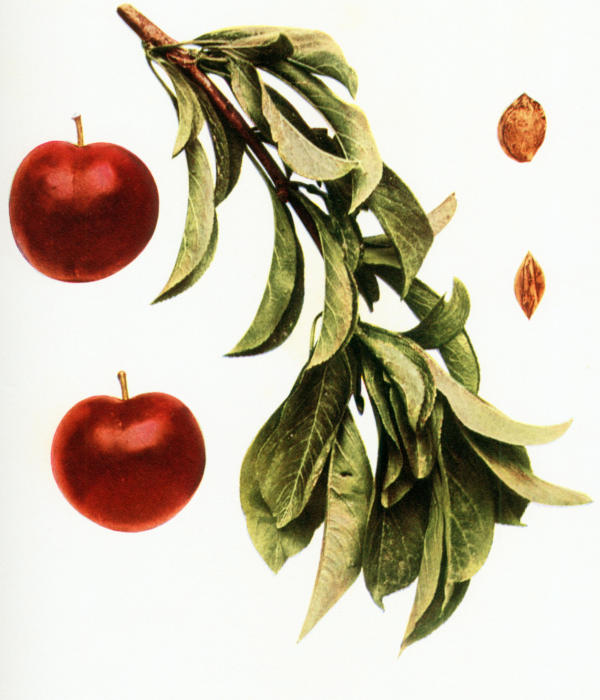
SATSUMA
Prunus triflora
1. Gard. Mon. 366, 367. 1887. 2. U. S. D. A. Rpt. 652, Pl. I fig., 636. 1887. 3. Gard. & For. 1:471. 1888. 4. Bailey Ann. Hort. 103. 1889. 5. Am. Pom. Soc. Rpt. 105, 106, 125. 1891. 6. Ga. Hort. Soc. Rpt. 54. 1892. 7. Cornell Sta. Bul. 62:29. 1894. 8. Rev. Hort. 458. 1894. 9. Ga. Hort. Soc. Rpt. 96. 1895. 10. Guide Prat. 165, 366. 1895. 11. Cornell Sta. Bul. 106:46, 53. 1896. 12. Ala. Col. Sta. Bul. 85:446. 1897. 13. Cornell Sta. Bul. 139:38, 42. 1897. 14. Am. Pom. Soc. Cat. 26. 1897. 15. Mich. Sta. Bul. 169:243, 250. 1899. 16. Cornell Sta. Bul. 175:151. 1899. 17. Ohio Sta. Bul. 113:158. 1899. 18. Waugh Plum Cult. 141. 1901. 19. Mich. Sta. Bul. 187:77, 80. 1901. 20. Ga. Sta. Bul. 68:14, 33, 34. 1905. 21. De Vries Pl. Br. 170. 1907.
Beni Smono No. 4 ?6. Blood Plum 7, 9, 16, 18, 20. Blood Plum? 1. Blood Plum No. 4 ?9, 13. Blood Plum No. 4 ?11. Honsmomo 11. Honsmomo ?9, 11. Japan Blood Plum 3. Sanguine 10. Satsuma Blood 4. Yonemomo 5, 7, 9, 16, 20. Yonesmomo 5, 20.
There is a group of several varieties of Triflora plums unique in having the flesh deep red in color and very firm and juicy. Of these red-fleshed plums, Satsuma was the first to be introduced into fruit-growing in America and is one of the parents of most of the others. While the fruit is not as large nor as handsome in color as in some of its offspring, it is still one of the best varieties for quality of fruit and its trees are possibly as good as those of any of the other sorts of red-fleshed Trifloras. Satsuma, besides being one of the best of its class in quality for either dessert or culinary purposes, keeps and ships very well and if the plums are of sufficient size and have been allowed to color properly, the variety makes a good showing on the markets. Too often, however, it is so unattractive as it reaches the market that it does not sell well. In the South the plums are said to be much attacked by brown-rot but they are not more susceptible here than other plums. The trees are rather above the average for the species in size, habit, health, hardiness and productiveness though they bear sparingly when young. They bloom early in the season and are distinguished from other Triflora sorts by having many spurs and short branches along the main branches. Satsuma might possibly be found worth growing commercially in a very small way in some parts of the State.
Satsuma was raised from the same lot of plum pits from which the Burbank came, the seeds having been sent to Luther Burbank by a Japanese agent in 1883. In 1887 Burbank’s tree was the only bearing one in America but since then it has been tested in all of the large plum regions, having been introduced by Burbank in 1889. In 1897 it was added to the fruit catalog list of the American Pomological Society. Even though this plum is very distinct, with its solid red flesh, it is much confused with other sorts. A Japanese in a letter[222] to L. A. Berckmans says “Beni-Smomo comprises a group of red-fleshed plums. In Satsuma, my native home, Hon-smomo and Yone-smomo are the most noted and familiar fruits of this group, the first is the smallest in size and deepest in color, while the second is the largest and most highly esteemed. In some districts, plums in this group are called Uchi-Beni, which means red inside.” Hon-smomo or Blood Plum No. 4 was separated from the Satsuma or Yonemomo by the Georgia Horticultural Society but Bailey found them indistinguishable.
Tree medium to large, vigorous, upright-spreading, usually quite hardy, moderately productive, bearing heavier crops as the tree becomes older; branches grayish-brown; branchlets medium to above in thickness and length, with short internodes, dark chestnut-red, glabrous, with slightly raised lenticels of medium number and size; leaf-buds small, short, conical, appressed.
Leaves somewhat lanceolate, four inches by one and one-half inches in size, of medium thickness; upper surface dark green, with a shallow, grooved midrib; lower surface light green, glabrous; margin finely and doubly crenate, glandular; petiole three-quarters inch long, tinged red, with from one to three reniform, greenish-yellow glands variable in size, usually at the base of the blade.
Blossoms white; borne in pairs or in threes; pedicels nine-sixteenths inch long, slender, glabrous, greenish; calyx-tube green, obconic, glabrous; calyx-lobes medium in width, acute, somewhat serrate, with dark colored glands, glabrous, erect; petals tapering below to claws of medium length, reddish at the base.
Fruit mid-season or later; one and seven-eighths inches by two inches in size, variable in shape, ranging from roundish-cordate to somewhat oblate, flattened at the base, compressed, halves unequal; cavity deep, narrow, abrupt, compressed; suture variable in depth, prominent; apex pointed or roundish; color dark dull red, with thin bloom; dots numerous, of medium size, russet, somewhat conspicuous, clustered about the apex; stem slender, three-eighths inch long, glabrous; skin of medium thickness and toughness, bitter, semi-adherent; flesh dark purplish-red, juicy, tender at the skin, becoming tough at the center, sweet, with an almond-like flavor; of good quality; stone semi-clinging or clinging, seven-eighths inch by five-eighths inch in size, oval, strongly pointed, rough, tinged red; ventral suture narrow, winged; dorsal suture grooved.
SAUNDERS
Prunus domestica
1. Am. Pom. Soc. Rpt. 143. 1885. 2. Can. Hort. 14:92, 223. 1891. 3. Ibid. 19:253. 1896. 4. Ont. Exp. Sta. Rpt. 45, 46. 1899. 5. Can. Hort. 27:244. 1904.
Saunders Seedling 5.
The American Pomological Society recommends this variety for trial with the statement that the quality is of the best and that it is almost free from black-knot. But on the grounds of this Station, fruiting for several years, the plums have been inferior in size and somewhat so in quality and all told much less attractive than a number of other sorts of the same season. Saunders originated with John Arris of Belleville, Ontario, Canada. It was first exhibited before the Fruit-Growers’ Association of Ontario at St. Catherines in 1883. In 1884, upon its being again exhibited before the same association, it was named Saunders in honor of the society’s noted president. The variety was mentioned in the catalog of the American Pomological Society in 1897.
Tree of medium size, round-topped, very productive; branchlets brash, slender, very pubescent; leaves flattened, obovate or oval, one and three-quarters inches wide, four inches long, somewhat velvety, rugose; margin finely serrate, eglandular or with small dark glands; petiole pubescent, glandless or with from one to three small glands; blooming season intermediate in time and length; flowers appearing after the leaves, one and one-quarter inches across, white; borne on lateral buds and spurs, usually singly; pedicels very pubescent.
Fruit early, season short; one and one-half inches by one and one-eighth inches in size, oblong-oval, greenish-yellow changing to golden-yellow, covered with thin bloom; skin thin, tender, slightly sour, cracking when fully mature; flesh yellowish, tender and melting, sweet, mild; of good quality; stone free, one inch by five-eighths inch in size, long-oval, flattened, with rough surfaces; ventral suture winged; dorsal suture with a narrow, shallow groove.
SERGEANT
Prunus domestica
1. Cal. State Bd. Hort. 49, 51. 1887. 2. Ibid. 234, 235. 1890. 3. Ibid. 105. 1891. 4. Wickson Cal. Fruits 357. 1891. 5. U. S. D. A. Div. Pom. Bul. 7:316, Pl. IV fig. 2. 1898. 6. Am. Pom. Soc. Cat. 39. 1899. 7. Waugh Plum Cult. 121. 1901.
Prune d’Ente 2. Prunier Datte 1. Robe de Sergent 2, 5, 6. Robe de Sergeant 7. Robe de Sergent 1, 3, 4.
In France, from whence Sergeant was imported to California, Sergeant, Agen and Prunier Datte are held to be identical. But in America only the first and last are identical, the Agen being quite distinct. It would seem that the French should know their own plums and that their nomenclature should be accepted but the Sergeant is now so widely distributed in America as distinct that we give a brief description of the plum. There may be more than one type of the Agen in France or American nurserymen may have received wrongly named varieties.
Tree upright, with branches and branchlets thickish, more robust than Agen; foliage large, lancet-shaped, glossy, much broader and more shiny than Agen; fruit mid-season; of medium size, roundish-oval, enlarged on one side; skin deep purple to blackish with a thick bloom; flesh greenish-yellow, juicier than Agen, sweet, high flavored; quality good; stone partially clinging; valuable for preserving and drying.
SHARP
Prunus domestica
1. Lond. Hort. Soc. Cat. 153. 1831. 2. Downing Fr. Trees Am. 315. 1845. 3. Ann. Pom. Belge 63, Pl. 1859. 4. Cultivator 8:25 fig. 1860. 5. Downing Fr. Trees Am. 948. 1869. 6. Guide Prat. 160, 358. 1895. 7. Jour. Roy. Hort. Soc. 21: Pt. 2, 222. 1897. 8. Waugh Plum Cult. 122, 123 fig. 1901.
Alderton 5. Dolphin 5. Dauphin 5. Denyer’s Victoria ?2, 5, 7. Empereur de Sharp 3, 6. Imperial de Sharp 5. Imperiale de Sharp 6. Prune Imperiale de Sharp 3. Queen Victoria ?2. Royal Dauphine 5. Sharp 8 incor. Sharp’s Emperor 1, 2 incor., 4, 5 incor. Sharp’s Emperor 3, 6, 8 incor. Sharpe’s Emperor 7. Sharps Kaiserpflaume 6. Victoria 5, 8 incor.
Sharp was briefly described in the London Horticultural Society catalog in 1831. Later, in 1845, A. J. Downing described the variety but thought it identical with the Victoria, as did other writers, as will be seen by referring to the Victoria. H. A. Pearson in the Journal of the Royal Horticultural Society, comparing these two sorts says, “Sharp’s Emperor is a second rate plum, resembling Victoria, in appearance, but very inferior in point of cropping and quality, a decided clingstone, often gumming at the stone, and ripening a fortnight later than its supposed synonym, not worthy of cultivation.” August Royer in the Annals de Pomologie Belge et Etrangere also separated the two varieties but describes them both as freestones. While there is a lack of uniformity in the descriptions yet the total evidence weighs in favor of two types which are very similar. The Victoria is probably the better plum of the two.
SHELDRAKE
Prunus domestica
Although extremely vigorous and productive this variety is so inferior in quality as to be of doubtful value. Sheldrake originated as a chance seedling on the shore of Cayuga Lake near the town of Sheldrake, New York. It was discovered and propagated by J. T. Hunt of Kendaia, New York, and has been under test at the Geneva Station since 1895.
Tree large, vigorous, round-topped, productive; branchlets thick, with long internodes, pubescent; leaves drooping, somewhat flattened, oval, nearly two and one-half inches wide, four and one-quarter inches long; margin serrate with few, small, dark glands; petiole pubescent, tinged red, thick, glandless or with from one to four rather large glands usually at the base of the leaf; blooming season intermediate in time, short; flowers appearing after the leaves, nearly one and one-quarter inches across; borne singly or in pairs.
Fruit rather early; one and one-half inches by one and three-eighths inches in size, roundish-oblong; cavity very deep, abrupt; color purplish-black, overspread with thick bloom; dots conspicuous; stem thickly pubescent; skin thin, tender, slightly acid; flesh yellow, tender, sweet next the skin, but sour near the center, inferior in flavor; poor in quality; stone dark-colored, semi-clinging, one inch by three-quarters inch in size, broadly ovate or irregularly oval, flattened, with roughened and granular surfaces; ventral suture prominent, blunt.
SHIPPER
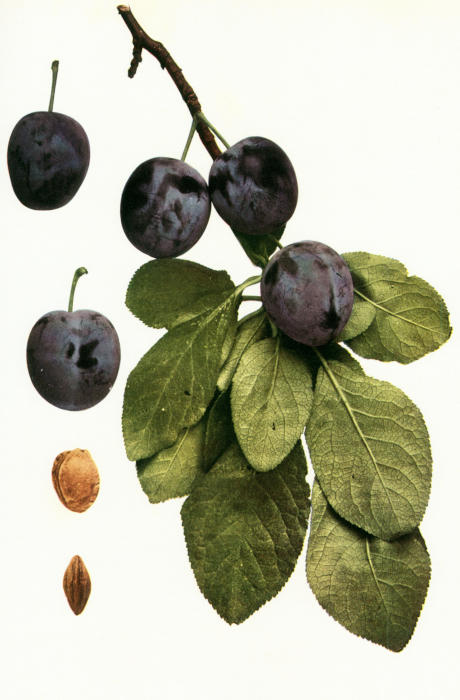
SHIPPER
Prunus domestica
1. Gard. Mon. 24:339. 1882. 2. W. N. Y. Hort. Soc. Rpt. 31:60. 1886. 3. Cornell Sta. Bul. 131:191, fig. 42. 1897. 4. Mich. Sta. Bul. 169:243, 247. 1899. 5. Can. Exp. Farm Bul. 2nd Ser. 3:56. 1900. 6. Mich. Sta. Bul. 187:77, 79. 1901. 7. Waugh Plum Cult. 119. 1901.
Pride 7. Shipper Pride 4. Shippers’ Pride 7. Shipper’s Pride 1, 2, 3, 5, 8.
This plum has never become an important commercial variety in New York yet it is offered for sale by a surprisingly large number of nurserymen. The variety has too many faults to succeed in competition with the many good plums of its color and season. The flesh is dry and the plums often shrivel on the tree, characters which fit it for shipping, but which when taken with poor quality and small size make it of little value after it reaches the market. Moreover it fruits sparingly under many conditions, though productive here, and the plums ripen somewhat unevenly and are susceptible to brown-rot. Some pomologists give a rather better estimate of the variety than that expressed here, but from all data at hand the value of the plum is not underestimated in the above statements. There are a great many better plums for New York than Shipper.
This variety was introduced by Mr. H. S. Wiley of Cayuga, New York. The plum was found by Mr. Wiley in a private garden at Port Byron, New York, about 1877. The man upon whose place it grew thought that it came from a stone of one of the several varieties in his garden but Mr. Wiley is not sure of this origin and suggests that it may have sprouted from a root.
Tree large, vigorous, round-topped, hardy, productive; branches thick, ash-gray, smooth except for the raised lenticels; branchlets of medium thickness and length, with long internodes, green changing to brownish-drab and with a red tinge, dull, covered with thick pubescence throughout the season, with inconspicuous lenticels of medium number and size; leaf-buds small, short, conical, appressed.
Leaves many, flattened or folded upward, obovate or oval, one and three-quarters inches wide, three and one-half inches long, thick, leathery; upper surface dark green, hairy, with a grooved midrib; lower surface silvery-green, thick, pubescent; apex abruptly pointed or acute, base acute, margin serrate or crenate, eglandular or with small dark glands; petiole one-half inch long, thick, pubescent, with a red tinge, glandless or with one or two globose, yellowish-green glands usually at the base of the leaf.
Season of bloom intermediate in time and length; flowers appearing with the leaves, nearly one and one-quarter inches across, white; borne on lateral buds and spurs, singly or in pairs; pedicels three-quarters inch long, pubescent, greenish; calyx-tube green, campanulate, pubescent; calyx-lobes obtuse, lightly pubescent on both surfaces, glandular-serrate and with marginal hairs, reflexed; petals broadly oval or obovate, slightly crenate or occasionally notched, with short, broad claws; anthers yellow; filaments five-sixteenths inch long; pistil glabrous, shorter than the stamens.
Fruit late, intermediate in length of ripening season; one and one-half inches by one and three-eighths inches in size, ovate, swollen on the suture side, compressed, halves equal; cavity shallow, abrupt; suture shallow; apex bluntly pointed; color purplish-black, overspread with thick bloom; dots small, russet, somewhat conspicuous; stem seven-eighths inch long, pubescent, adhering well to the fruit; skin thin, tender, separating readily; flesh greenish-yellow, rather tart, firm, sweet, mild in flavor; inferior in quality; stone semi-clinging, often with red tinge near the edge, seven-eighths inch by three-quarters inch in size, irregular roundish-ovate, turgid, rough, blunt at the base and apex; ventral suture wide, ridged, distinctly winged; dorsal suture wide, deep.
SHIRO
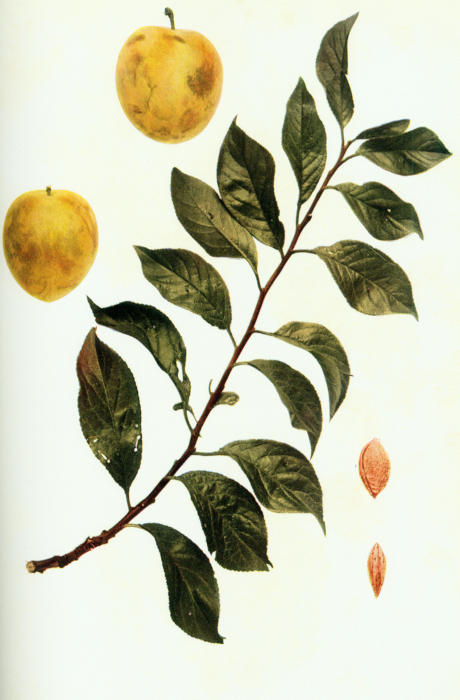
SHIRO
Prunus simonii × Prunus triflora × Prunus cerasifera × Prunus munsoniana
1. Cal. State Bd. Hort. 53 fig. 1897. 2. Burbank Cat. 1899. 3. Waugh Plum Cult. 225. 1901. 4. Rural N. Y. 62:582. 1903.
Late Klondike 1.
Shiro has been in the hands of fruit-growers too short a time to permit a just estimate of it to be made. As the variety grows on the grounds of this Station, the fruits are large and handsome in form and color, as is well shown in the illustration. The flavor lacks character and is almost insipid but the flesh is tender, melting and juicy and so translucent that the pit can be seen through the flesh. Despite the flavor, the plum is pleasant to eat and may be ranked as good in quality. Those who have had experience say that the variety ships very well if not fully mature but quickly goes down after ripening; the plums are also quite susceptible to brown-rot. The trees of this variety at Geneva are quite as vigorous, hardy, and productive as any of the sorts which Mr. Burbank gives as progenitors of Shiro and will generally, it is believed, surpass any of them in these respects. It may here be remarked that of the four species from which Shiro is supposed to have come, it most resembles Prunus triflora in both tree and fruit though the leaves have some resemblance to those of Prunus cerasifera. Shiro is still, so far as New York is concerned, in the list of plums deserving trial but with the chances against its becoming of great value either for home or commercial plantations.
This is another of Burbank’s plums and is said to be a descendant of Robinson, (Prunus munsoniana,) Myrobalan, (Prunus cerasifera), and Wickson, (a cross of Prunus triflora and Prunus simonii) from seed of Wickson. Burbank in his catalog for 1889 says that the tree resembles a Myrobalan in foliage, growth and general appearance. But as the variety grows at this Station it has all the appearances of a Triflora. Shiro was described in the California State Board of Horticulture Report for 1898 and the following year it was introduced by the originator.
Tree large, vigorous, upright-spreading, tender to cold, productive; branches smooth, somewhat thorny, dull ash-gray, with few, small lenticels; branchlets slender, above medium in length, with short internodes, greenish-red changing to brownish-drab, glabrous, with inconspicuous, scattering, small lenticels; leaf-buds small, very short, obtuse, strongly appressed.
Leaves folded upward, obovate, one and five-sixteenths inches wide, two and three-quarters inches long, leathery; upper surface faintly rugose, glabrous, with a grooved midrib; lower surface lightly pubescent along the midrib and larger veins; apex acutely pointed, base rather acute, margin finely crenate, with small, dark glands; petiole three-eighths inch long, pubescent along one side, greenish-red, glandless or with one or two small, globose, yellowish glands on the stalk.
Blooming season early and of medium length; flowers appearing before the leaves, white; borne in clusters on lateral buds and spurs; pedicels short, glabrous, greenish; calyx-tube green, campanulate, glabrous; calyx-lobes obtuse, glandular-serrate, glabrous on the outer side, sparingly pubescent within, with a pink margin, erect; petals roundish, entire, tapering to short, abrupt claws; anthers yellow with a reddish tinge; filaments below medium in length; pistil glabrous, longer than the stamens.