Chapter III · LEADING VARIETIES OF PLUMS. (continued 5)
Reading edition
Tree large, vigorous, upright, open-topped, productive; branchlets thick, dark chestnut-red; leaves obovate, one and one-half inches wide, three and one-half inches long, thin; margin finely serrate, with small, dark glands; petiole slender, glandless or with one or two small glands usually at the base of the leaf.
Fruit early; about one and three-eighths inches in diameter, roundish-truncate, dark red, changing to purplish-black, overspread with thick bloom; flesh reddish, with a tinge of yellow near the pit, fibrous, tender and melting, sweet, aromatic; good to very good; stone semi-clinging, three-quarters inch by five-eighths inch in size, broadly oval, turgid, blunt at the base and apex, with pitted surfaces; ventral suture prominent, with deep furrows and with a narrow, blunt wing; dorsal suture acute or with an indistinct groove.
McLAUGHLIN
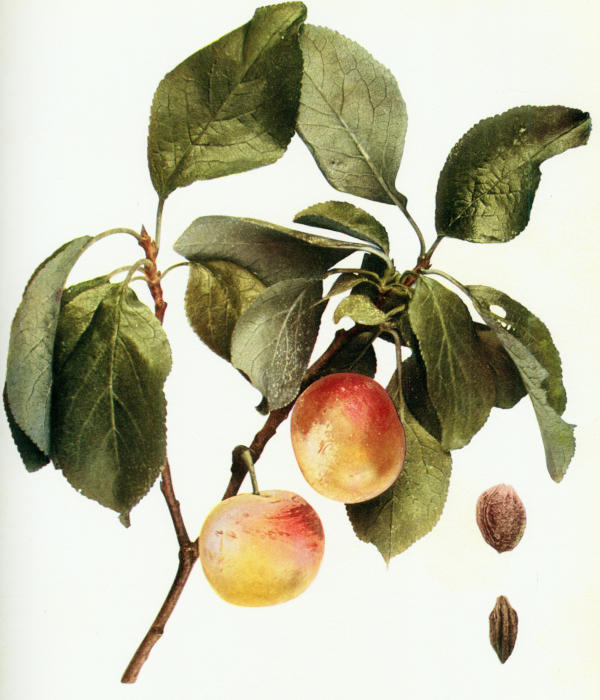
McLAUGHLIN
Prunus domestica
1. Horticulturist 1:195 fig. 54. 1846. 2. Cole Am. Fr. Book 209 fig. 1849. 3. Thomas Am. Fruit Cult. 332. 1849. 4. Mag. Hort. 16:456, 457 fig. 28. 1850. 5. Hovey Fr. Am. 2:47, Pl. 1851. 6. Am. Pom. Soc. Rpt. 36, 55. 1852. 7. Am. Pom. Soc. Cat. 231. 1854. 8. Cultivator 6:52 fig. 1858. 9. Flor. & Pom. 200. 1870. 10. Mas Le Verger 6:137, fig. 69. 1866-73. 11. Am. Gard. 14:299 fig. 1893. 12. Gaucher Pom. Prak. Obst. 97, Col. Pl. 95. 1894. 13. Cornell Sta. Bul. 131:189. 1897. 14. Mich. Sta. Bul. 169:242, 246. 1899. 15. Waugh Plum Cult. 115, 116 fig. 1901. 16. Va. Sta. Bul. 134:43. 1902. 17. Mass. Sta. An. Rpt. 17:159. 1905.
M’Laughlin 2. McLaughlin’s Gage Plum 9. MacLaughlin 12. MacLanglin 12.
McLaughlin stands well up with the best of plums in quality and when well grown is very attractive in appearance. Its flesh is sweet and yet not so sweet as to cloy the appetite; in flavor it is rich and delicate and while somewhat like that of Reine Claude, is different, so that the variety has a taste quite of its own; though the juice is abundant, the flesh is not watery; the texture is neither too coarse nor too fine, too fibrous nor too mealy, but in a fruit rightly matured is most pleasantly melting. There are few other plums in which the characters pleasing to the taste exist in such nice proportions. McLaughlin is a little smaller than some other plums of its group, but is quite large enough for a dessert plum. Unless at its best, it is not as attractive in color as Jefferson, Washington, Reine Claude and some others of its type, but at its very best, it is unsurpassed by any other plum in coloring; it has in perfection the delicate yellow skin which belongs to the Reine Claudes upon which is marbled tints of white, yellow and crimson, the blending of which the illustration shows but poorly. The fruit of McLaughlin has its imperfections, however. The flesh clings tenaciously to the stone, is too melting to keep or ship well and rots badly on the tree. These defects debar the variety in America, with present market demands, from commercial plantations. The tree is above the average in size and vigor and is as hardy as any, more so than most of the Reine Claude varieties. It comes in bearing early and is rather productive. The place for this plum, from the summary of its characters, is apparent at once—in the home orchard and in the collection of the fruit connoisseur.
McLaughlin was raised by James McLaughlin of Bangor, Maine, first fruiting about 1840. The parentage of the variety is disputed, but no one doubts that it contains Reine Claude blood, though the tree is too vigorous to have been raised from the Reine Claude self-pollinated. Judging from the tree-characters, it may have sprung from the Washington or Imperial Gage fertilized by the Reine Claude. The American Pomological Society, in 1852, placed the McLaughlin with the plums that promised well, and at the next meeting added it to the recommended list.
Tree of medium size, variable in vigor, spreading, open-topped, hardy, medium to productive; branches stocky, ash-gray, smooth, with small, indistinct lenticels; branchlets few, thick, short, with short internodes, greenish-red changing to brownish-drab, lightly pubescent, with numerous, small lenticels; leaf-buds above medium in size, long, pointed, appressed; leaf-scars swollen.
Leaves oval, two inches wide, three and one-half inches long, thick; upper surface dark green, glossy, covered with fine hairs; lower surface pale green, pubescent; apex abruptly pointed, base acute, margin crenate, with small, black glands; petiole five-eighths inch long, thick, pubescent, tinged red, with one or two small, globose, yellowish glands usually at the base of the leaf.
Season of bloom intermediate, short; flowers appearing after the leaves, fifteen-sixteenths inch across, white, with yellow tinge near the apex of the petals; borne on lateral spurs and buds, singly or in pairs; pedicels one-half inch long, thick, very pubescent, greenish; calyx-tube green, obconic, pubescent; calyx-lobes narrow, obtuse, sparingly pubescent on both surfaces, glandular-serrate and with marginal hairs, reflexed; petals obovate, crenate, tapering below to short, broad claws; anthers yellowish; filaments one-quarter inch long; pistil glabrous except at the ovary, longer than the stamens.
Fruit early, season short; one and five-eighths inches by one and seven-eighths inches in size, roundish-oblate, compressed, halves equal; cavity shallow, narrow, abrupt; suture shallow; apex flattened or depressed; color greenish-yellow, blushed and mottled with red, overspread with thick bloom; dots numerous, small, light colored; stem thick, three-quarters inch long, pubescent, adhering well to the fruit, surrounded at the cavity by a fleshy ring; skin tough, slightly adhering; flesh light yellow, juicy, sweet, mild and pleasant; very good; stone clinging, one inch by three-quarters inch in size, irregular broad-oval, very blunt at the base and apex, heavily wrinkled and deeply pitted; ventral suture narrow, distinctly furrowed, winged; dorsal suture widely and deeply grooved.
MIDDLEBURG
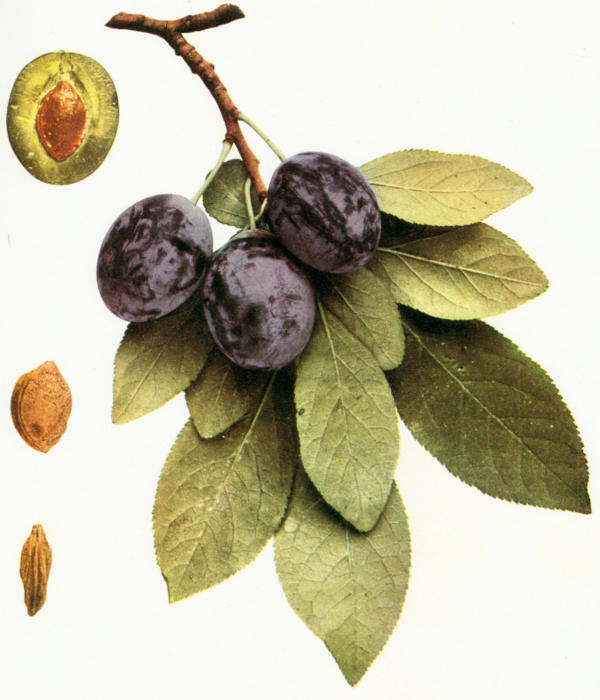
MIDDLEBURG
Prunus domestica
1. W. N. Y. Hort. Soc. Rpt. 31:60. 1886. 2. Mich. Hort. Soc. Rpt. 288. 1889. 3. Cornell Sta. Bul. 131:189. 1897. 4. Ont. Fr. Exp. Sta. Rpt. 119. 1898. 5. Mich. Sta. Bul. 169:242, 246. 1899. Ibid. 187:77, 79. 1901.
Middleburgh 1.
It is somewhat remarkable that so good a plum as Middleburg should have so long escaped the attention of fruit-growers and even of pomologists. Not even Downing has recorded it, though he lived not more than a hundred miles from the place of its origin, which must have taken place in his time. The fruits may be surpassed somewhat by other purple plums in appearance but few of them are better in quality, either for dessert or for cooking. It is especially valuable too, because it ripens late, hangs well to the tree and ships and keeps well, in the latter respect equalling the best of the prunes. Out of a collection of about three hundred sorts on the Station grounds, this would undoubtedly be chosen as the favorite purple plum of its season. The trees, while of only medium size, are robust, healthy, hardy and usually productive. In Schoharie County, eastern New York, where this variety originated and has long been grown, black-knot is usually epidemic and Middleburg and Palatine are said to be the sorts most free from the disease—so free that neither is much troubled by it. From its behavior here it is certain that, belying the looks of either fruit or tree, Middleburg will improve upon acquaintance and that when well known it will be wanted in home collections at least and more than likely some commercial fruit-growers will find it profitable.
Middleburg came from Middleburg, Schoharie County, New York, where it was found as a chance seedling. Mr. S. D. Willard, of Geneva, first called attention to the variety in 1886 at a meeting of the Western New York Horticultural Society. Its origin is much older than the date given, as it has been extensively grown in Schoharie County for a half-century or more.
Tree above medium in size, vigorous, round and open-topped hardy, productive; branches ash-gray, smooth, with small lenticels; branchlets of medium thickness and length, with long internodes, greenish-red, changing to brownish-red, overspread with light bloom, dull, somewhat pubescent, with few, inconspicuous, small lenticels; leaf-buds of medium size and length, pointed, appressed.
Leaves folded upward, oval, one and one-half inches wide, three and one-half inches long, rather thick, stiff; upper surface dark green, sparingly pubescent on the grooved midrib and larger veins; lower surface silvery-green, pubescent; apex and base acute, margin doubly serrate, with a few, small, dark glands; petiole eleven-sixteenths inch long, pubescent, tinged red, glandless or with from one to three small, globose, greenish-brown glands on the stalk or base of the leaf.
Blooming season early to medium, short; flowers appearing after the leaves, one inch across, white, borne in scattering clusters on lateral spurs, singly or in pairs; pedicels three-quarters inch long, overspread with fine, short pubescence, greenish; calyx-tube green, campanulate, pubescent at the base; calyx-lobes obtuse, thinly pubescent on both surfaces, glandular-serrate, somewhat reflexed; petals roundish or obovate, entire, with short, abrupt claws; anthers yellowish; filaments five-sixteenths inch long; pistil glabrous, equal to the stamens in length, with a large, pubescent ovary.
Fruit very late, season long; one and five-eighths inches by one and one-half inches in size, distinctly oval, compressed, halves equal; cavity very shallow, narrow, flattened; suture usually lacking; apex roundish; color varies from light to deep purplish-red, overspread with thick bloom; dots numerous, small, russet, inconspicuous; stem one inch long, thinly pubescent, adhering well to the fruit; skin thin, slightly sour, separating readily; flesh light yellow, rather juicy, somewhat coarse, firm, sprightly when first mature, becoming sweetish, strongly aromatic, pleasant flavored; very good; stone semi-free or free, one inch by five-eighths inch in size, irregular-oval, with pitted surfaces, slightly acute at the base and apex; ventral suture narrow, winged, faintly ridged; dorsal suture acute or with a shallow, narrow groove.
MILLER SUPERB
Prunus domestica
Of the two hundred and more varieties of plums which have fruited on the Station grounds, Miller Superb is one of the finest for dessert. The variety is of the Reine Claude group and is fully up with the best of these plums—all noted for high quality. In size and appearance, the plums resemble those of the well-known Bavay though usually larger. This plum originated with Colonel Charles Miller of Geneva, New York, when, is not known. About 1889, M. F. Pierson of Stanley, New York, secured cions of the plum from Colonel Miller and named the variety Miller Superb. It has never been introduced and is grown locally only to a very limited extent. Its large size, productiveness and superior quality should recommend it strongly for more general cultivation.
Tree of medium size and vigor, upright-spreading, open-topped, productive; branches rough as they approach the rough trunk; leaf-scars enlarged; leaves flattened, oval, two inches wide, three and three-quarters inches long; margin serrate or crenate, with few, small, dark glands; petiole long, thick, reddish, pubescent, with from one to three glands usually at the base of the leaf; blooming season of medium length; flowers appearing after the leaves, one inch or more across, white with yellowish tinge; borne on lateral buds and spurs, singly or in pairs.
Fruit intermediate in time and length of ripening season; one and three-quarters inches by one and five-eighths inches in size, roundish-oval or roundish-ovate, golden-yellow, mottled and splashed with green and sometimes with a blush on the exposed cheek, overspread with thin bloom; dots conspicuous; flesh light golden-yellow, juicy, firm but tender, sweet, pleasant in flavor; very good; stone clinging or semi-clinging, one inch by five-eighths inch in size, ovate or oval, somewhat flattened, usually winged; dorsal suture grooved.
MILTON
Prunus munsoniana × ?
1. Ia. Hort. Soc. Rpt. 287. 1887. 2. Ibid. 393. 1892. 3. Ibid. 334. 1894. 4. Neb. Hort. Soc. Rpt. 201. 1897. 5. Wis. Sta. Bul. 63:24, 48. 1897. 6. Am. Pom. Soc. Cat. 40. 1899. 7. Ia. Sta. Bul. 46:280. 1900. 8. Ala. Col. Sta. Bul. 112:178. 1900. 9. Terry Cat. 6. 1900. 10. Waugh Plum Cult. 187. 1901. 11. Can. Exp. Farm. Bul. 43:31. 1903. 12. Ia. Hort. Soc. Rpt. 445. 1903. 13. Ga. Sta. Bul. 67:277. 1904. 14. Miss. Sta. Bul. 93:15. 1905. 15. Ohio Sta. Bul. 162:256, 257. 1905. 16. Ill. Hort. Soc. Rpt. 420. 1905.
The special merits of Milton, as compared with other native varieties, are that it blooms late and ripens early. It thus escapes frosts, when, for example, its parent, Wild Goose, might be injured; and its early ripening prolongs the season for native plums. The fruits are large, of very good quality, though a little too juicy for pleasant eating or to ship well, very attractive in appearance, and, more important than all else for the regions in which it is likely to be grown, it is comparatively free from rot. Unfortunately, the flesh clings most tenaciously to the stone even after cooking. In its fruit-characters, Milton strongly resembles one of the Mineri plums, but the tree is very much like that of Wild Goose, its known parent. In New York, Milton is one of the best of the native plums but it is hardly so considered in the Middle West, where these plums are most grown, judging from the discussions of it in the references given above.
Milton, a seedling of Wild Goose grown by H. A. Terry, Crescent, Iowa, first fruited in 1885. The originator believed that the other parent was an Americana, but from the characters of the tree it was more likely one of the Mineri plums. The American Pomological society added Milton to its fruit catalog list in 1899.
Tree of medium size and vigor, round and dense-topped, symmetrical, hardy at Geneva, productive, healthy; branches brash, rough, thorny, dark brownish-gray, with numerous, large, narrow and much elongated lenticels; branchlets very slender, willowy, medium to long, with internodes of average length, greenish-red, changing to dull reddish-brown, thinly pubescent, with numerous, conspicuous, small, slightly raised lenticels; leaf-buds small, short, obtuse, free.
Leaves folded upward, broadly lanceolate or oblanceolate, peach-like, one inch wide, three inches long, thin; upper surface smooth, with a grooved midrib; lower surface thinly pubescent on the midrib and larger veins; apex taper-pointed; base slightly acute, margin serrate or crenate, with numerous, minute, dark glands; petiole seven-sixteenths inch long, slender, reddish, lightly pubescent, glandless or with from one to four small, globose, yellowish-brown glands usually on the stalk.
Blooming season late and long; flowers appearing after the leaves, three-quarters inch across, the buds creamy when opening, changing to white, odor disagreeable; borne in thin clusters on lateral spurs and buds, singly, in pairs, or in threes; pedicels three-quarters inch long, very slender, glabrous, greenish; calyx-tube green, obconic, glabrous; calyx-lobes narrow, slightly obtuse, pubescent within, with dark colored glands and marginal hairs, erect; petals oval, entire or deeply indented, tapering below to long, narrow claws margined with few scattering hairs near the base; anthers yellow with a faint trace of red; filaments five-sixteenths inch long; pistil slender, glabrous, equal to the stamens in length.
Fruit very early, season short; one and three-sixteenths inches by one inch in size, oval, slightly compressed, halves equal; cavity shallow, narrow, abrupt, regular; suture a distinct line; apex roundish or slightly pointed; color dark red, covered with thin bloom; dots very numerous, medium to large, russet, conspicuous; stem slender, seven-eighths inch long, adhering fairly well to the fruit; skin thin, tough, astringent, separating readily; flesh yellowish, the juice given off readily leaving a tough, fibrous pulp, sweet next the skin, but rather acid at the center, of pleasant flavor; fair to good; stone adhering, three-quarters inch by one-half inch in size, long-oval, slightly elongated at the base and apex, somewhat flattened, surface broken into irregular ridges; ventral suture blunt, faintly ridged; dorsal suture a narrow, shallow groove.
MINER
Prunus hortulana mineri
1. Horticulturist 22:332. 1867. 2. Am. Jour. Hort. 5:145. 1869. 3. Downing Fr. Trees Am. 931. 1869. 4. Ia. Agr. Soc. Rpt. 332. 1871. 5. Gard. Mon. 13:347, 348. 1871. 6. Ia. Hort. Soc. Rpt. 152. 1873. 7. Ibid. 90. 1874. 8. Am. Pom. Soc. Cat. 36. 1875. 9. Minn. Hort. Soc. Rpt. 81. 1882. 10. Cornell Sta. Bul. 38:55, 56, 58, 81, 86. 1892. 11. Mich. Sta. Bul. 118:54. 1895. 12. Guide Prat. 163, 359. 1895. 13. Vt. Sta. An. Rpt. 10:99, 103. 1897. 14. Thomas Am. Fruit Cult. 491. 1897. 15. Colo. Sta. Bul. 50:41. 1898. 16. Waugh Plum Cult. 173. 1901. 17. Minn. Hort. Soc. Rpt. 208. 1901. 18. Ga. Sta. Bul. 67:278. 1904. 19. S. Dak. Sta. Bul. 93:25, 57 fig. 1905.
Chicasaw Chief 4, 10, 14. General Jackson 4, 10, 14. Gillett 3, 14. Hinckley 3, 6, 10, 14. Hinckley 5, 7. Isabel 3, 14. Minner 12. Old Hickory 4, 10, 14. Parsons ?10, 14, 16. Robinson 3, 14. Townsend 3, 6, 14. William Dodd 4, 10, 14.
Miner has the distinction of being the first of the native plums to be named and of being the typical plum in the sub-species to which its name has been given. Though lacking but a few years of having been in the hands of civilization a century (the Indians from whom it appears to have been taken had possibly cultivated it longer), Miner is still a standard variety and while not the best of the group of which it is the type, it is one of the best. This variety has the further distinction of being, after Wild Goose, the parent of more cultivated offspring than any other of our native plums and must be credited with having transmitted its characters, those of the tree being especially good, to a high degree. Miner is one of the parents of more than two score of named native plums in nearly all of which the resemblances to each other and to the parent are very marked. The variety is not grown, so far as is known, in New York and the trees on the grounds of this Station not being in bearing, it was impossible to illustrate the fruit in The Plums of New York though to do so was greatly desired. In the Middle West, Miner is probably as widely disseminated and as largely grown as any other plum, being particularly adapted to the northern limits of the cultivation of its species. The tree of this variety is robust, healthy, probably better in habit of growth for orchard management than any other of the native plums, and usually productive. The fruits are good in quality, attractive in appearance, comparatively curculio-proof and are especially suited for culinary uses. The variety is unproductive unless cross-fertilized.
Several accounts are given of the origin of Miner, none of which can be accurately verified at this late date. When all of the data is compared and that which is reliable is put together, the history of the variety runs about as follows: In 1813 William Dodd, an officer under General Jackson, found this plum growing in a Chicasaw Indian plantation at a place called Horse Shoe Bend, on the Tallapoosa River, Alabama. The plums were so attractive in size and excellent in quality that he saved seeds of the variety and in 1814 planted them in Knox County, Tennessee. When the trees came in bearing and their merits were discovered, the new plum was at once in demand and was rather widely distributed in Knox and neighboring counties under the names “Old Hickory” and “General Jackson.” In 1823 or 1824, Dodd moved to Springfield, Illinois, taking sprouts of this plum with him. Dodd’s young trees did not thrive and he asked a brother in Tennessee who was moving to Illinois, to bring more sprouts of the new plum. The brother, instead of going to Springfield, went to Galena, Illinois, taking with him the sprouts of Old Hickory. These fell into the hands of Judge Hinckley, who distributed them among his friends, one of whom, a Mr. Townsend, propagated the variety rather extensively. At Galena, from the circumstances just noted, the variety was called “Hinckley” and “Townsend.” Meanwhile, the trees which the first Mr. Dodd had taken to Springfield came into bearing and the variety was propagated and distributed in the neighborhood as “William Dodd” and “Chicasaw Chief.” A relative of the Townsends, at Galena, took trees of this plum to Lancaster, Wisconsin, where they were propagated by a man named Joel Barber. Barber named the plum after his father-in-law, a Mr. Miner, and this name, out of the dozen or more that have been given it, is the one under which the plum is now universally known. During the process of dissemination the variety received several other local names as Isabel, Gillett, Robinson and Parsons.
Tree large, vigorous, spreading, hardy at Geneva, unproductive unless cross-pollinized; branches smooth, reddish-brown, thorny; branchlets slender, long, with long internodes, greenish-red, changing to brownish-red, glossy, glabrous, with numerous, small, grayish lenticels; leaf-buds small, short, obtuse, appressed.
Leaves falling late, long-oval or obovate, peach-like, one and five-eighths inches wide, four inches long, thick; upper surface roughish, glabrous except for a few hairs on the narrowly grooved midrib; lower surface very thinly pubescent; apex acuminate, base abrupt and nearly acute, margin serrate, with small glands; petiole five-eighths inch long, pubescent on the upper surface, often tinged red, with from two to four reniform or globose, dark amber glands usually on the stalk.
Flowers late, often self-sterile, medium to large.
Fruit somewhat late; medium in size, roundish-ovate or roundish-oblong; cavity shallow, narrow, regular; suture indistinct; apex pointed; color dull, dark red, appearing some time before maturity, covered with thin bloom; dots numerous, minute, yellowish, conspicuous at first, becoming duller; stem slender, long, adhering strongly to the fruit; skin thick, tough, somewhat astringent; flesh pale amber yellow, juicy, nearly tender, mild, aromatic; good in quality; stone adhering, small to medium, roundish-oval, flattened, pointed at the base and apex, with nearly smooth surfaces.
MIRABELLE
Prunus insititia
1. Merlet Abrege des bons fruits 1675. 2. Rea Flora 207. 1676. 3. Quintinye Com. Gard. 68, 70. 1699. 4. Langley Pomona 93, Pl. XXIII fig. VIII. 1729. 5. Miller Gard. Dict. 3:1754. 6. Duhamel Trait. Arb. Fr. 2:95, Pl. XIV. 1768. 7. Knoop Fructologie 2:52, 58. 1771. 8. Lond. Hort. Soc. Cat. 149. 1831. 9. Prince Pom. Man. 2:76. 1832. 10. Poiteau Pom. Franc. 1:1846. 11. Downing Fr. Trees Am. 282 fig. 110. 1845. 12. Thomas Am. Fruit Cult. 330. 1849. 13. Thompson Gard. Ass’t 518. 1859. 14. Hogg Fruit Man. 371. 1866. 15. Jour. Hort. N. S. 15:359. 1868. 16. Pom. France 7: No. 14. 1871. 17. Mas Le Verger 6:13, fig. 7. 1866-73. 18. Oberdieck Deut. Obst. Sort. 425. 1881. 19. Mathieu Nom. Pom. 431, 432. 1889. 20. Gaucher Pom. Prak. Obst. 93, Pl. 69. 1894. 21. Guide Prat. 163, 361. 1895. 22. Garden 50:364. 1896. 23. U. S. D. A. Div. Pom. Bul. 10:11. 1901. 24. Baltet Cult. Fr. 489, 492 fig. 326, 503. 1908.
Aprikosenartige Mirabelle 16, 19, 20, 21. Damascena Armeniacea 21. Damascena Armeniaca 19. Damas Vert 7. De Mirabelle 21. Gelbe Mirabelle 16, 17, 21. Gelbe Mirabelle 18, 19, 20. Geperlte Mirabelle 19. Green Damask? 3. Kleinste Mirabelle 19. Kleine Mirabelle 19, 20, 21. La Mirabelle 9, 19, 20, 21. Lerchenei 19, 20. Little Mirabelle 9, 19, 20. Mirababelle 20. Mirabel 3. Mirabelle abricotée 16, 19, 20, 21. Mirabelle 14, 17, 19, 21. Mirabelle Blanche 7. Mirabelle Blanche 14, 16, 19, 20, 21. Mirabelle de Metz 15, 19, 20, 24. Mirabelle de Vienne 14, 16, 19, 20, 21. Mirabelle Jaune 7, 8, 11, 13, 14, 16, 19, 20, 21. Mirabelle Perle 14, 20. Mirabelle Perlée 7, 16, 19, 20, 21. Mirabelle Petite 8, 9, 11, 13, 17, 19, 21. Mirabelle précoce 16, 17, 19, 20?, 21?. Mirabelle Petite 14. Mirabelle Simple? 7. Mirabelle Verte 16, ?21. Mirabelle Verte ?7. Petit Drap d’Or 9, 19, 20. Petite Mirabelle 9, 16, 19, 20. Petite Mirabelle 16, 17, 21, 24. P. Damascena Armeniacea 16. Prune de Mirabelle 9, 17, 19. Prune de Mirabelle 10. Small Mirabelle 9. Small Mirabelle 19, 20. Syrische Pflaume 19, 20. The Green Damosine Plum ?2. White Mirabelle 14, 16, 19, 21. White Mirable 4. Wiener Mirabelle 19, 20.
Mirabelle, though described in an American fruit book as early as 1832 and mentioned in nearly every pomology since, is hardly known in America. In Europe, especially in France, it is one of the favorite varieties and is in great demand for canning, preserves, compotes, tarts and prunes. The trees of this variety on the grounds of this Station grow very well, producing fine crops of fruit, as it is probable they would do wherever the Damsons can be grown. The small, round, yellow fruits are attractive in appearance, and the sweet, pleasant flavor of the variety should fit it admirably in this country for the purposes for which it is so largely grown by the French. The trees are small but vigorous and healthy, the last two qualities having suggested in Europe their use as stocks, to which purpose they are sometimes put in France when a dwarfing stock is needed. European writers say that the variety may be reproduced from seed.
Mirabelle is a very old plum; it was noted by the pomological writers in the latter part of the Seventeenth Century and since that date it has held a conspicuous place in all of the European plum literature. This variety, though probably sparingly introduced in America at different times, has never been widely cultivated and is not now offered for sale by any of the nurserymen whose catalogs have been consulted for The Plums of New York.
Tree small, round and open-topped, hardy; branches dark ash-gray, smooth, with numerous, small lenticels; branchlets slender, of medium length, dull brownish-red, thorny, glabrous, with numerous, small, indistinct lenticels; leaf-buds of medium size and length, conical, free.
Leaves falling early, one and one-half inches wide, three inches long, folded upward, oval, rather thin; upper surface medium green, smooth, with few hairs scattered along the grooved midrib; lower surface silvery-green, pubescent; apex acute, base abrupt, margin crenate, with small, black glands; petiole one-half inch long, tinged red along one side, glandless or with from one to three small, globose glands usually on the stalk.
Flowers appearing in mid-season, after the leaves, seven-eighths inch across, white with a yellow tinge as the buds unfold; borne on lateral spurs and buds, in twos or threes; pedicels three-quarters inch long, slender, thickly pubescent, greenish; calyx-tube green, broadly obconic, glabrous except at the base; calyx-lobes of medium width, obtuse, glandular-serrate, pubescent on both surfaces; reflexed; petals oval, crenate, tapering to short, broad claws; anthers yellow with a tinge of red; filaments three-eighths inch long; pistil glabrous, equal to the stamens in length.
Fruit mid-season, period of ripening of medium length; seven-eighths inch in diameter, roundish-oval, slightly necked, swollen on one side, compressed, halves equal; cavity very shallow and narrow, abrupt; suture indistinct; apex roundish or depressed; color light golden-yellow, sometimes blushed and mottled with red on the exposed cheek, overspread with thick bloom; dots numerous, small, whitish, inconspicuous, clustered at the apex; stem slender, three-quarters inch long, pubescent, adhering poorly to the fruit; skin thin, tough, not astringent, separating readily; flesh light yellow, not very juicy, firm, but tender, sweet, mild, but pleasant; good to very good; stone free, five-eighths inch by three-eighths inch in size, oval, blunt, broadly ridged along one edge, roughish.
MIRACLE
Prunus insititia × Prunus domestica
1. Rural N. Y. 62:594. 1903. 2. W. N. Y. Hort. Soc. Rpt. 25. 1904. 3. Rural N. Y. 64:280. 1905. 4. Oregon Nur. Cat. 4. 1906. 5. DeVries Pl. Br. 228. 1907.
Unfortunately, so far as is known, this much-talked-of plum has not been fruited in New York. About 1887, Luther Burbank imported from a French nurseryman a tree of the Prunier San Noyeau or Stoneless plum known as a curiosity in Europe for at least three centuries. With this fruit he crossed several of the best European varieties, producing hybrids which first fruited in 1893. Although there were several stoneless fruits in this lot, none were of any value and it was not until 1899 that one appeared worthy of consideration. In this seedling, developed from Agen pollen, the stone is represented by a small, hard scale near the base of the kernel. Burbank sold the new plum in 1903 to the Oregon Nursery Company by whom it was introduced in 1906. The following description is compiled:
Tree somewhat dwarfish, producing a roundish, compact head, very productive. Fruit larger than Agen, oblong, dark blue covered with thick bloom; cavity medium; stem short; flesh yellow, sweet, juicy; good; stone lacking, the kernel lying naked in the flesh.
MONARCH
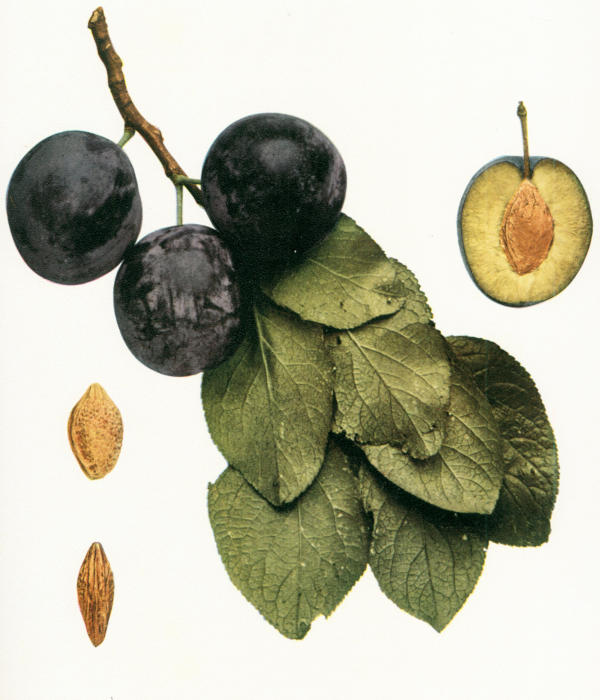
MONARCH
Prunus domestica
1. Gard. Chron. 19:815. 1883. 2. Rev. Hort. 252, Pl. 1892. 3. Guide Prat. 163, 360. 1895. 4. Cornell Sta. Bul. 131:181 fig. 40 V, 189. 1897. 5. Rural N. Y. 57:670, 671 fig. 310. 1898. 6. Mich. Sta. Bul. 169:242, 247. 1899. 7. Am. Pom. Soc. Cat. 39. 1899. 8. Waugh Plum Cult. 116. 1901. 9. Thompson Gard. Ass’t 4:158 fig. 956. 1901. 10. Garden 62:298. 1902. 11. Gard. Chron. 36:282. 1904. 12. Ohio Sta. Bul. 162:242 fig., 256, 257. 1905.
Monarque 3. Prune Monarque 2.
No plum of recent introduction has so quickly attained popularity as the Monarch. Of the great number of plums imported from the Old World, this is one of the few which has proved worthy of a place with the best American varieties for American conditions, an illustration of the importance of testing all foreign fruits. The plate shows the fruit of this variety well, though the plums look smaller in the illustration than in nature—an illusion always accompanying the reproduction in exact size of the photograph of a round object. The nicely turned form and the rich purple color of this plum make it a handsome fruit. While the quality is not of the best, Monarch ranks high among purple plums as a dessert fruit, few plums of this color being especially palatable to eat out of hand. The variety is not remarkable for any of its tree-characters, yet they average well with other plums and, with those of the fruit, make a variety quite above the average and give it a place among the best commercial sorts. Monarch is now so widely disseminated and so largely grown in New York, that we shall know shortly whether it is to hold the high place it has so quickly taken among market plums in this State.
Monarch, a seedling of the Autumn Compote, was grown by Thomas Rivers, Sawbridgeworth, England and was introduced by the originator in 1885. English publications described and figured this variety in 1883 but there are no notices of it in American pomological literature until 1897. Two years later it was placed on the fruit list of the American Pomological Society catalog and recommended for the north-eastern section of the United States. Notwithstanding the fact that the variety is relatively new, it is now offered for sale by nearly every nurseryman in this country.
Tree of medium size and vigor, upright-spreading, open-topped, hardy at Geneva, usually productive; branches ash-gray, smooth, with small lenticels; branchlets of medium thickness and length, with internodes of average length, greenish-red, changing to brownish-drab, dull, thickly pubescent, with obscure, small lenticels; leaf-buds large, long, pointed, appressed; leaf-scars somewhat swollen.
Leaves broadly oval, wide, medium in length, thick, somewhat stiff; upper surface rugose, covered thinly with hairs; lower surface pubescent; apex abruptly pointed, margin serrate or crenate, eglandular; petiole short, thick, heavily pubescent, lightly tinged red, glandless or with one or two large, reniform or globose, greenish-brown glands usually on the stalk.
Season of bloom intermediate in time and length; flowers appearing with the leaves, one and one-eighth inches across, white; pedicels three-quarters inch in length, thick, pubescent, green; calyx-tube greenish, campanulate, pubescent; calyx-lobes broad, obtuse, thickly pubescent on both surfaces, glandular-serrate, reflexed; petals oval, crenate, tapering to short and very broad claws; anthers yellow; filaments five-sixteenths inch long; pistil pubescent, longer than the stamens.
Fruit late; two inches by one and three-quarters inches in size, roundish-oval, halves unequal; cavity deep, medium to narrow, abrupt; suture shallow, often a line; apex roundish or flattened; color dark purplish-red, often with russet flecks scattered over the surface, overspread with thick bloom; dots numerous, small, reddish-brown, conspicuous, clustered about the apex; stem thick, three-quarters inch long, pubescent, adhering well to the fruit; skin thin, tender, slightly astringent, separating readily; flesh golden-yellow, juicy, somewhat fibrous, tender, sweet next to the skin, pleasantly tart towards the center, aromatic; good; stone clinging, one inch by five-eighths inch in size, long-oval, turgid, roughened and pitted, pointed at the base, blunt at the apex; ventral suture rather wide, shallowly furrowed, blunt; dorsal suture with a wide, shallow groove.
MONROE
Prunus domestica
1. Am. Pom. Soc. Rpt. 189, 210. 1856. 2. Downing Fr. Trees Am. 389. 1857. 3. Thomas Am. Fruit Cult. 356. 1867. 4. Barry Fr. Garden 414. 1883. 5. Guide Prat. 163, 364. 1895. 6. Cornell Sta. Bul. 131:189. 1897. 7. Waugh Plum Cult. 116. 1901. 8. Budd-Hansen Am. Hort. Man. 2:320. 1903.
Monroe Egg 1, 6. Monroe Egg 2, 7, 8. Monroe Gage 1, 2, 5, 7, 8. Monroe Gage 4. Reine-Claude de Monroe 5.
The fruit of Monroe is small and the trees produce well only in alternate years, defects that its high quality cannot overcome. Monroe originated with a Miss Durham, Penfield, Monroe County, New York, about the middle of the last century. At one time it was quoted by nearly all nurserymen but the variety is fast disappearing.
Tree large, vigorous, upright-spreading, hardy, productive; branchlets covered with fine pubescence; leaves oval, one and three-quarters inches wide, three and one-half inches long, thick, rugose; margin finely serrate; petiole tinged red, pubescent, with from one to three small glands.
Fruit matures in mid-season; one and three-eighths inches by one and one-quarter inches in size, oval, sometimes necked, golden-yellow, often mottled on the sunny side with red, overspread with thin bloom; stem adhering poorly to the fruit; flesh golden-yellow, tender, sweet, mild; of very good quality; stone semi-free or free, three-quarters inch by one-half inch in size, long and slightly irregular-oval, acute at the base and apex, with nearly smooth surfaces; ventral suture prominent, blunt.
MOREMAN
Prunus hortulana
1. Montreal Hort. Soc. Rpt. 91. 1885. 2. Cornell Sta. Bul. 38:49, 86. 1892. 3. Mich. Sta. Bul. 123:20. 1895. 4. Vt. Sta. An. Rpt. 11:285. 1898. 5. Bailey Ev. Nat. Fruits 177, 206. 1898. 6. Am. Pom. Soc. Cat. 40. 1899. 7. Ia. Sta. Bul. 46:280. 1900. 8. Kan. Sta. Bul. 101:135, 137. 1901, 9. Ohio Sta. Bul. 162:256, 257. 1905.
Mooreman 1.
Moreman is the hardiest of the Hortulana plums and possibly worthy of keeping before plum-growers for this reason. Its fruit-characters are not as satisfactory as those of several other varieties of its species. Dr. Wayland of Cadiz, Kentucky, according to T. V. Munson, grew a lot of seedlings from pits of wild plums found in his vicinity and either from this lot or from a seedling from them, came the Moreman. The variety was introduced by W. F. Heikes in 1881. It was listed in the catalog of the American Pomological Society in 1899. The following description is compiled.
Tree vigorous, spreading, hardy, productive; leaves of medium size, coarsely serrate; petiole usually glandless. Fruit late; small, roundish, bright red, bloomless; stem long, slender; dots numerous, yellow; flesh firm, yellow, pleasant in flavor; quality fair; stone small, roundish, clinging.
MOROCCO
Prunus domestica
1. Parkinson Par. Ter. 576. 1629. 2. Rea Flora 207. 1676. 3. Ray Hist. Plant. 2:1528. 1688. 4. Langley Pomona 91, Pl. XX fig. III. 1729. 5. Miller Gard. Dict. 3:1754. 6. Knoop Fructologie 56. 1771. 7. Abercrombie Gard. Ass’t 13. 1786. 8. Forsyth Treat. Fr. Trees 19. 1803. 9. Pom. Mag. 3:103. 1830. 10. Lond. Hort. Soc. Cat. 145, 146, 150. 1831. 11. Prince Pom. Man. 2:82. 1832. 12. Downing Fr. Trees Am. 306. 1845. 13. Floy-Lindley Guide Orch. Gard. 282, 382. 1846. 14. Thomas Am. Fruit Cult. 338. 1849. 15. Loudon Enc. Gard. 921. 1834. 16. Ga. Hort. Soc. Rpt. 28. 1876. 17. Hogg Fruit Man. 714. 1884. 18. Mathieu Nom. Pom. 430. 1889.
Black Morocco 7. Black Morocco 9, 10, 12, 13, 14, 17, 18. Black Damask 9, 10, 12, 13, 14, 17, 18. Black Damascus 13. Damas Noir 5. Damas Noir Hâtif 6, 10. Damas Hâtif 10. Damas noir hâtif 11. Early Damask 5, 8. Early Black Damask 9, 10, 13. Early Damson 10. Early Morocco 10, 12, 13, 14, 17, 18. Early Damask 9, 10, 11, 12, 13, 14, 15, 17, 18. Early Black Damask 11. Early Black Morocco 12, 18. Frühe Schwarze Pflaume 18. Frühe Platte Damascene 18. Italian Damask 12 incor., 14. Mogul 16. Morocco 16, 18. Marokko Pflaume 18. Morocco Plumb 4. Morocco 5, 8, 9. Noire Hâtif 18. Saint Cyr 11.
This variety is not popular in New York nor does it deserve to be, as there are many better plums of its season. Its faults are small size, an insipid flavor and poor keeping qualities. Morocco is one of the oldest of the cultivated plums. It has been known in Europe for three centuries at least and is undoubtedly much older, its early history not having been written. It is not known when the variety was introduced into this country but it has been grown in the Southern States for many years under the name Mogul. About 1894, it was reintroduced from England by the W. & T. Smith Nursery Company of Geneva, New York, under the name Mogul.
Tree large, vigorous, round-topped, rather tender to cold, productive; branchlets covered with heavy pubescence; leaves oval, one and three-quarters inches wide, three inches long; margin finely serrate or crenate; petiole short, thick, with one or two globose glands usually at the base of the leaf; blooming season intermediate in time and length; flowers appearing after the leaves, one and one-eighth inches across, white or creamy as the buds unfold; borne on lateral buds and spurs, singly or in pairs.
Fruit late, ripening period short; below medium in size, round to oval or obovate, purplish-black, covered with thick bloom; dots conspicuous; flesh light golden-yellow, rather dry, moderately firm, sweet next to the skin, but rather acid near the center; poor; stone clinging, medium to small, oval or ovate, flattened, with rough surfaces.
MOTTLED PRUNE
Prunus domestica
This plum is placed among the leading varieties only that a full description of it may be put on record. The fruit is attractive in color but is inferior in quality. These defects are so prominent that the variety can hardly become popular. The Mottled Prune originated in Waterloo, New York, as a chance seedling in 1887; it was introduced by E. Smith & Sons, Geneva, New York.
Tree large, round and open-topped, very productive; branches stocky; branchlets heavily pubescent; leaves folded backward or flattened, oval or obovate, one and three-quarters inches wide, three and one-half inches long, thick and leathery, rugose; margin crenate, with few, small, dark glands; petiole thickly pubescent, dull dark red, glandless or with from one to three smallish glands usually on the stalk; blooming season intermediate in time and length; flowers appearing after the leaves, one inch across, white; borne in scattering clusters on lateral buds and spurs, singly or in pairs; pedicels very pubescent.
Fruit mid-season, ripening period short; one and three-quarters inches by one and one-half inches in size, ovate, dark purplish-red, somewhat mottled, covered with thick bloom; dots numerous, conspicuous; flesh pale yellow, juicy, firm, sweet, mild; of fair quality; stone free, one inch by three-quarters inch in size, oval, flattened, strongly roughened; ventral suture deeply furrowed, often with a short wing; dorsal suture with a narrow, shallow groove.
MYROBALAN
Prunus cerasifera
1. Parkinson Par. Ter. 576, 578. 1629. 2. Gerard Herball 1498, 1500. 1636. 3. Rea Flora 209. 1676. 4. Ray Hist. Plant. 2:1528. 1688. 5. Duhamel Trait. Arb. Fr. 2:111, Pl. XX fig. 15. 1768. 6. Knoop Fructologie 55, 56. 1771. 7. Forsyth Treat. Fr. Trees 20. 1803. 8. Miller Gard. Dict. 3:1807. 9. Coxe Cult. Fr. Trees 232. 1817. 10. Lond. Hort. Soc. Cat. 144, 150. 1831. 11. Prince Pom. Man. 2:80. 1832. 12. Hoffy Orch. Comp. 2:1842. 13. Downing Fr. Trees Am. 294. 1845. 14. Floy-Lindley Guide Orch. Gard. 285. 1846. 15. Poiteau Pom. Franc. 1. 1846. 16. Jour. Roy. Hort. Soc. N. S. 15:360. 1868. 17. Hogg Fruit Man. 690. 1884. 18. Gard. & For. 1:178. 1888. 19. Mathieu Nom. Pom. 448. 1889. 20. Cal. State Board Hort. 112, 113. 1891. 21. Cornell Sta. Bul. 38:66. 1892. 22. Rev. Hort. 204. 1894. 23. Neb. Hort. Soc. Rpt. 177. 1895. 24. Guide Prat. 157, 353. 1895. 25. Bailey Ev. Nat. Fruits 190 fig. 27, 209. 1898. 26. Vt. Sta. An. Rpt. 12:211, 212, 215. 1899. 27. S. Dak. Sta. Bul. 93:66. 1905.
Arabische Kirsche 19. Asiatische Kirsche 19. American Cherry Plum 11. Cerisette 11, 18, 19. Cerizette 11. Ciriselle 6. Cerisette 6, 11. Cerisette Blanche 6. Cerise 19. Cherry 1, 11. Cherry Plum 7, 8, 11, 16, 19, 20. Cherry 13, 14, 17. Cherry Plum 9, 10, 18. De Virginie 10, 13, 14. Damasine 24. D’Amerique Rouge 10, 13, 14. Early Scarlet 10, 11, 13, 17, 19. European Cherry Plum 11. Muscadine ?1. Kirschpflaume 18, 19. Kleine Kirschpflaume 24. Mirobalan 2. Mirabilon 3. Mirabolan 5. Myrobolan 13. Mirabolanenpflaume 19. Myrobalans 7. Mirabolane 19. Mirobalan 9, 11. Myrobalane 19. Mirabolan 14. Myrobalan 10, 11, 14, 17, 18, 19. Mirabelle Rouge 24. Mirabelle Rouge 10. Miser Plum 19. Miser 12, 13, 14, 17. Prune d’Amerique Rouge 19. Prune Cerise 11. Prune Cerizette 8. Prunus Myrobalana 11, 14, 19, 23. Prunus Cerasifera 10, 11, 13, 14, 19. Prune Ceriset 11. Prune de Virginie 19. Prunier Myrobolan 15, 22. Prune Cerisette 15. Prunus Cerasifera fructu majore 19. Prunus Myrobolana 13. Queene Mother ?1. Red Mirobalane 1. Rote Kirschpflaume 19. Red Mirabelle 12. Rothe Mirabelle 24. Stambul Erik oder Irek 19. Türkische Kirsche 19. Virginian Cherry 10, 13, 14, 17, 19. White Mirobalane 1. The Myrobalane Plum 4.
Myrobalan is a group name rather than a varietal one. Plums of this group are grown from seeds and many varieties have appeared during the last three centuries, differing in color, shape, stone and in many minor characters. The red and reddish-purple plums and the round ones are apparently the most numerous though there are frequent references to the White Myrobalan and to heart-shaped fruits in this group. For a further discussion of these plums see Prunus cerasifera. The Myrobalan plums are used largely as stocks in the propagation of plums and closely allied plants; occasionally they are used for culinary purposes though with rather poor results.
NECTARINE
Prunus domestica
1. Pom. Mag. 3:148. 1830. 2. Lond. Hort. Soc. Cat. 150. 1831. 3. Kenrick Am. Orch. 264. 1832. 4. Downing Fr. Trees Am. 306. 1845. 5. Horticulturist 1:115. 1846. 6. Cole Am. Fr. Book 215. 1849. 7. Thompson Gard. Ass’t 518. 1859. 8. Mathieu Nom. Pom. 448. 1889. 9. Guide Prat. 162, 365. 1895.
Bradshaw 6. Caledonian 1, 2, 3. Calvel’s Pfirschenpflaume 8. Goliath of some 8. Howel’s 3. Howell’s Large 1, 2, 4, 7, 8. Jenkin’s Imperial 2, 4, 7, 8, 9. Louis Phillipe 4. Louis Philippe 6, 7, 8, 9. Large Early Black 6. Nectarine 1, 8, 9. Nectarine Plum 3, 7. Peach Plum 4, 7, 9. Peach 2, 8. Prune Pêche 1, 2, 3, 4, 7, 8. Pêche de Calvel 8. Prune d’Abricot 8. Pêche of some 9. Rothe Nectarine 9. Rote Nectarine 8. The Nectarine Plum 1.
Much confusion has existed regarding the identity of the Nectarine, Peach and Goliath plums. These names have been interchanged indiscriminately for the three plums and it is now difficult to separate the varieties, especially as they are very similar. The Goliath, however, may be separated from the other two by its pubescent shoots, which the others do not have. The Peach plum is the largest of the three and has a reddish cast whereas the Nectarine and Goliath are dark purple. The earlier writers knew a Nectarine as a synonym of Peach but it was not until 1830 that the Nectarine was finally described as a separate variety. Nectarine is of unknown origin. The following description is compiled.
Tree vigorous, round-topped, productive; leaves large, oval; branches glabrous. Fruit early; large, roundish, flattened at the ends, dark purple with thin bloom; flesh greenish-yellow, tinged red at maturity, rather coarse, sprightly; fair to good; stone of medium size, compressed, oval, semi-clinging.
NEWARK
Prunus domestica
This fruit has little to recommend it to the commercial plum-grower; it is small in size and unattractive in color; the quality, however, is very good and the variety is worth planting for home use. Newark originated in Newark, New York, and in 1895 was bought by E. Smith & Sons of Geneva, New York, who disseminated it two years later.
Tree medium in size and vigor, upright-spreading, rather open, very productive; branches rough; branchlets marked by scarf-skin, leaf-scars prominent; leaves flattened, somewhat drooping, oval or obovate, one and three-quarters inches wide, three and one-half inches long, thick, rugose; margin coarsely serrate, with small, dark glands; petiole thick, pubescent, glandless or with one or two smallish glands usually on the stalk; blooming season intermediate in time and length; flowers appearing after the leaves, one inch or more across, white with yellowish tinge at the apex of the petals; borne singly or in pairs; anthers yellow with a trace of red.
Fruit early, season short; one and one-half inches by one and three-eighths inches in size, oval, dull yellow mottled with red at full maturity, covered with thin bloom; dots numerous, conspicuous; flesh light greenish-yellow, rather dry, firm, sweet, mild; good to very good; stone free, three-quarters inch by one-half inch in size, irregular-oval, flat, with finely pitted surfaces; ventral suture usually winged; dorsal suture with a shallow, narrow, indistinct groove.
NEWMAN
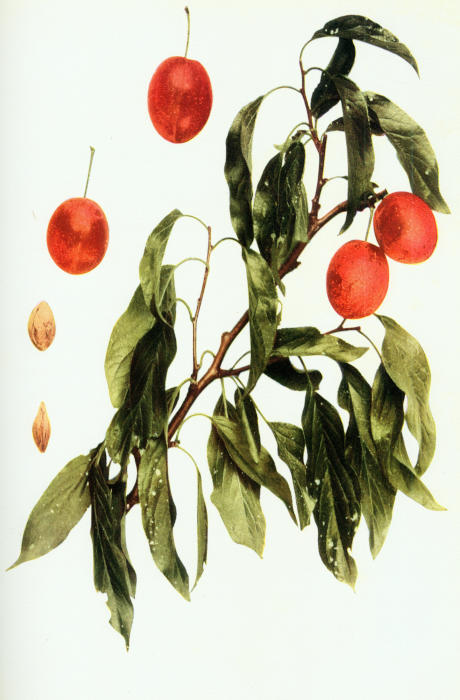
NEWMAN
Prunus munsoniana
1. Horticulturist 22:271. 1867. 2. Downing Fr. Trees Am. 934. 1869. 3. Am. Jour. Hort. 5:142. 1869. 4. Mich. Pom. Soc. Rpt. 39. 1874. 5. Am. Pom. Soc. Cat. 36. 1875. 6. Barry Fr. Garden 418. 1883. 7. Ia. Hort. Soc. Rpt. 286. 1887. 8. Cornell Sta. Bul. 38:63, 86. 1892. 9. Mich. Sta. Bul. 123:20. 1895. 10. Wis. Sta. Bul. 63:49. 1897. 11. Me. Sta. An. Rpt. 12:66. 1896. 12. Bailey Ev. Nat. Fruits 200 fig., 201. 1898. 13. Rural N. Y. 59:450. 1900. 14. Ia. Sta. Bul. 46:282. 1900. 15. Ohio Sta. Bul. 162:256, 257. 1905.
Warren? 8.
Newman is one of the oldest but still one of the standard varieties of its species. Its fruits are characterized by a firm, meaty flesh, which fits it well for shipping and storing; the plums are also attractive in shape and color but are too small and too low in quality to make the variety a first-rate one. The trees are large and vigorous and in all respects very satisfactory orchard plants. Both fruits and trees are usually reported as fairly free from diseases and insects. While the variety is gradually going out it still has some value for its crops and ought to make a good parent from which to breed a race of vigorous, firm-fleshed Munsonianas.
The origin of this plum is uncertain. In 1867 a Mr. Elliott of Cleveland, Ohio, reported in the Horticulturist that he had received samples of the “Newman Plum” from D. L. Adair, Esq., of Hawesville, Kentucky, and gave a brief description of the fruit which seems to tally with that of the variety under discussion. The American Pomological Society added this plum to its fruit catalog list in 1875 and removed it in 1891.
Tree large, vigorous, spreading, low and flat, dense-topped, hardy at Geneva, productive, subject to attacks of shot-hole fungus, the trunk shaggy; branches dark ash-gray, rough and shaggy, thorny, zigzag, with numerous, rather inconspicuous, large, elongated lenticels; branchlets very slender, twiggy, with internodes of average length, greenish-red, changing to dark brown, glabrous, with few, conspicuous, large, raised lenticels; leaf-buds small, short, obtuse, plump, nearly free.
Leaves lanceolate, peach-like, one and one-quarter inches wide, four inches long, thin; upper surface smooth, glabrous, with a grooved midrib; lower surface glabrous except along the midrib and larger veins; apex taper-pointed, base acute, margin finely crenate, with small, amber glands; petiole slender, seven-eighths inch long, lightly pubescent along one side, reddish, glandless or with from one to four very small, globose, yellowish-red glands on the stalk.
Blooming season late and long; flowers appearing after the leaves, three-quarters inch across, in the buds tinged yellow, changing to white on expanding, odor disagreeable; borne in clusters on lateral spurs and buds, in twos or in threes; pedicels eleven-sixteenths inch long, slender, glabrous, greenish; calyx-tube green, campanulate, glabrous; calyx-lobes small, narrow, slightly obtuse, pubescent on the inner surface, glandular-serrate and with marginal hairs, erect; petals ovate or oval, crenate, tapering at the base into long, narrow claws; anthers yellow, tinged with red; filaments five-sixteenths inch long; pistil slender, glabrous, equal to the stamens in length.
Fruit mid-season, ripening period very long; one inch by seven-eighths inch in size, strongly oval, not compressed, halves equal; cavity shallow, narrow, flaring; suture a distinct dark red line; apex depressed; color bright currant-red, with thin bloom; dots grayish, rather conspicuous, clustered near the apex; stem very slender, seven-eighths inch long, glabrous, adhering well to the fruit; skin thin, very tough, astringent, separating readily; flesh deep yellow, juicy, tender and melting, sweetish next to the skin, but tart at the center; fair in quality; stone clinging, five-eighths inch by three-eighths inch in size, long-oval, turgid, necked at the base, blunt-pointed at the apex, with finely pitted surfaces; ventral suture narrow, inconspicuous; dorsal suture with a narrow, shallow groove.
NEW ULM
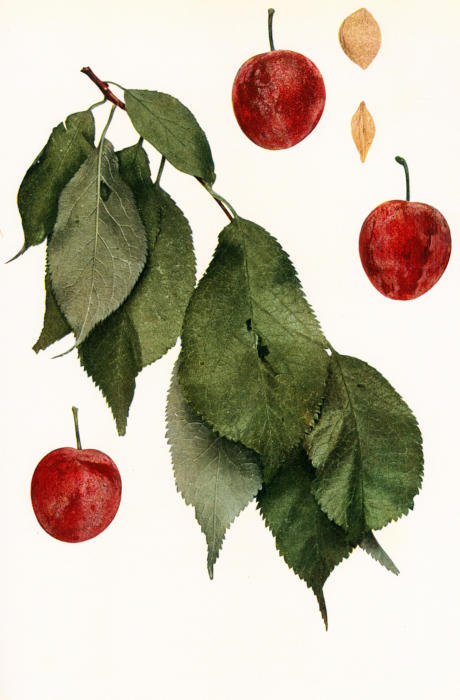
NEW ULM
Prunus americana
1. Minn. Hort. Soc. Rpt. 126. 1890. 2. Wis. Sta. Bul. 63:49 fig., 50. 1897. 3. Ia. Hort. Soc. Rpt. 111. 1899. 4. Am. Pom. Soc. Cat. 37. 1899. 5. Ia. Sta. Bul. 46:282 fig. 1900. 6. Waugh Plum Cult. 158. 1901. 7. Ont. Fr. Gr. Assoc. 143. 1901. 8. S. Dak. Sta. Bul. 93:26. 1905. 9. Ill. Hort. Soc. Rpt. 422. 1905. 10. Ia. Sta. Bul. 114:141. 1910.
Snooks 10.
New Ulm is worthy of attention because of its large, handsome, well-formed fruits. The plums are further distinguished by a peculiar flavor, somewhat suggesting that of the mandrake, pleasant to some but disagreeable to others. The flesh is a little too juicy for pleasant eating but the fruits ship well, the tough, thick skin firmly holding its contents. The fruits, however, do not keep well, for, despite the thick skin, the spores of the brown-rot find entrance and thrive so that the variety rots badly. The trees are hardy and productive but ill-shaped and hard to manage in either the orchard or the nursery for which reason the culture of the variety is discouraged by nurserymen and it is now almost impossible to buy New Ulm trees. The illustration of this variety shows well the characters of the western type of Prunus americana in leaf, fruit and stone.
New Ulm was raised from seed of a wild variety that grew in the neighborhood of the originator and introducer, C. W. H. Heideman, New Ulm, Minnesota. The fruit was exhibited at the Minnesota State Fair in 1890 where it attracted much attention, being the largest plum of fifty varieties exhibited. In 1899 the American Pomological Society placed the variety on its fruit catalog list. The Minnesota State Horticultural Society, in spite of the fact that this plum has gained a good reputation for its size and productiveness, removed it from its recommended fruit list in 1904 because of the difficulty of growing the trees in the nursery.
Tree of medium size, spreading and drooping, irregular, low and dense-topped, undesirable in habit of growth, hardy, usually productive, subject to attacks of shot-hole fungus; branches very rough and shaggy, zigzag, thorny, dark ash-gray, with large lenticels; branchlets thick, long, willowy, with long internodes, green, with a faint yellow tinge, changing to light and dark, dull reddish-brown, glabrous, with numerous, conspicuous, large, raised lenticels; leaf-buds small, pointed, strongly appressed.
Leaves drooping, folded upward, oval or ovate, two inches wide, four and three-eighths inches long, thin; upper surface dark green, changing to reddish-yellow late in the season, glabrous, with a grooved midrib; lower surface silvery green, lightly pubescent; apex taper-pointed, base abrupt, margin coarsely and doubly serrate, eglandular; petiole slender, five-eighths inch long, pubescent, tinged with red which deepens in color at the base, glandless or with from one to three globose, greenish-brown glands usually on the stalk.
Flowers intermediate in time and length of blooming season, appearing after the leaves, showy on account of the numerous pure white petals, one and one-sixteenth inches across, white; borne in dense clusters on lateral spurs and buds, usually in threes; pedicels seven-sixteenths inch long, thick, glabrous, greenish; calyx-tube red, campanulate, glabrous; calyx-lobes long, narrowly obtuse, lightly pubescent on the inner surface, thickly pubescent along the glandular-serrate margin, erect; petals oval, entire or incised, tapering below to narrow claws of medium length and with reddish base; anthers yellow; filaments seven-sixteenths inch in length; pistil glabrous, much shorter than the stamens.
Fruit mid-season, intermediate in length of ripening period; about one and three-eighths inches in diameter, roundish-ovate, halves equal; cavity markedly shallow, very narrow; suture a line; apex roundish or slightly pointed; color carmine over a yellow ground, overspread with thin bloom; dots very numerous, russet; stem five-eighths inch long, glabrous, adhering somewhat to the fruit; skin thick and tough, astringent, adhering strongly; flesh golden-yellow, very juicy and fibrous, granular, tender and melting, sweet with a strong aromatic flavor; good; stone adhering, seven-eighths inch by nine-sixteenths inch in size, oval, slightly flattened, blunt at the base, pointed at the apex, with smooth surfaces; ventral suture distinctly winged; dorsal suture narrow, shallow, grooved.
NICHOLAS
Prunus domestica
1. Am. Pom. Soc. Rpt. 61. 1887. 2. Kan. Sta. Bul. 101:121, 124 fig. 1901. 3. Budd-Hansen Am. Hort. Man. 327. 1903.
Arab No. 2 Bielaya Nicholskaya 1. White Nicolas 1. White Nicholas 2, 3.
Although a fairly good early dessert plum it is doubtful if Nicholas has any commercial value as it is inferior in most characters of fruit and tree to standard varieties; in particular it drops badly as it begins to ripen. “White,” as formerly and usually now put in the name, is a misnomer, as the fruit is red; how it came to be applied to this fruit does not appear. Nicholas was imported from Dr. Regel of St. Petersburg, Russia, by Professor J. L. Budd of the Iowa Experiment Station in the winter of 1881-82 and in 1888 was sent out for testing under the name Arab No. 2.
Tree of medium size, round-topped, productive; trunk rough; branches smooth except for the raised lenticels and longitudinal cracks in the bark; branchlets slender; leaves falling early, folded upward, obovate or oval, one and five-eighths inches wide, three and three-eighths inches long, rugose; margin serrate, with few, small, dark glands; petiole pubescent, tinged red, sometimes with several small glands; blooming season intermediate in time, short; flowers appearing after the leaves, one inch or more across, white, tinged with yellow near the apex of the petals; borne on lateral buds and spurs, in scattering clusters, singly or in pairs.
Fruit early, one and three-eighths inches by one inch in size, long-oval, dark red, covered with thick bloom; stem adhering poorly to the fruit; flesh light yellow, juicy, fibrous, tender, sweet, mild; good; stone free, one inch by five-eighths inch in size, flattened, oval, somewhat obliquely acute at the base, with granular surfaces; ventral suture prominent, rather narrow, blunt; dorsal suture with a narrow, shallow groove.
OCCIDENT
Prunus triflora
1. Rural N. Y. 57:653. 1898. 2. Am. Gard. 19:826. 1898. 3. Burbank Cat. 1899. 4. Vt. Sta. An. Rpt. 12:229. 1899. 5. Rural N. Y. 60:658 fig., 662. 1901. 6. Budd-Hansen Am. Hort. Man. 320. 1903. 7. Ga. Sta. Bul. 68:11, 37. 1905. 8. Rural N. Y. 65:730. 1906.
Burbank’s Sultan 6. Garnet 1. Garnet 2. Occident 8. Oval Blood (unpublished). Sultan 2, 3, 5, 8. Sultan 4, 7.
Occident differs little from Apple in horticultural characters and need not be discussed at length as the reader can readily turn to the color-plate and description of the last named variety. At best this sort can hardly be called more than a curiosity, though an interesting one, of use, if at all, only for cooking and as a long-keeping, rot-resistant plum. It will add novelty to any amateur’s collection because of the size, shape, color, flavor and red flesh of the fruits.
This variety was grown by Burbank and introduced by him in 1899 under the name Sultan. H. E. Van Deman, in the Rural New Yorker (References, 1), says that Occident is a cross between Wickson and Satsuma and that the name Garnet which he suggested, owing to the color of its flesh and skin, had been accepted by Mr. Burbank. About two months later the Division of Pomology of the United States Department of Agriculture called attention to the fact that “Garnet” had been previously given to another variety and the name was changed to Sultan. Waugh in 1899 substituted “Occident” for Sultan as the latter is the name of a European plum; Waugh’s name has been accepted by all recent writers. Occident undoubtedly contains Satsuma blood but it has but few characters that suggest Wickson, and if a cross, which is likely, the other parent is undeterminable. The following description is compiled:
Tree vigorous, slow of growth, straggling, somewhat variable in habit, late in coming into bearing, productive; leaves numerous, large.
Fruit ripens with Burbank, keeps and ships unusually well, resistant to rot; large, roundish; cavity of medium depth; suture shallow, distinct; color dark red over a greenish ground; dots many, yellowish; stem thick, short, adhering to the fruit; skin somewhat thin, tough, slightly astringent; flesh dark red, firm, sweet, rather acid, changing to subacid as maturity advances, sprightly; good to very good; stone free or semi-clinging, of medium size, roundish, turgid, winged, rough.
OCHEEDA
Prunus americana
1. Cornell Sta. Bul. 38:41. 1892. 2. Wis. Sta. An. Rpt. 11:344. 1894. 3. Ia. Hort. Soc. Rpt. 34:112. 1899. 4. Am. Pom. Soc. Cat. 37. 1899. 5. Waugh Plum Cult. 159. 1901. 6. Can. Exp. Farm Bul. 43:31. 1903. 7. Ill. Hort. Soc. Rpt. 420. 1905. 8. S. Dak. Sta. Bul. 93:28. 1905.
Ocheda 7.
This variety is generally regarded as one of the valuable native plums but in New York it is surpassed by a number of other plums of its species in size of fruit and color though the quality is very good. We must rank it in this State as second rate among Americanas. Ocheeda was found by P. L. Hardow in 1872 growing wild on the banks of Ocheeda Lake, Minnesota, and in 1892 was introduced by H. J. Ludlow of Worthington, Minnesota.
Tree large, vigorous, spreading, open-topped, unproductive; branches shaggy, thorny, with large lenticels; branchlets willowy, pubescent; leaves folded upward, oval, nearly two inches wide, three and one quarter inches long; margin coarsely and doubly serrate; petiole densely covered with short hairs; blooming season intermediate in time and length; flowers appearing after the leaves, seven-eighths inch across, dull white; borne in scattering clusters almost entirely on one-year-old wood, many lateral buds remaining undeveloped, the bare limbs carrying tufts or clusters of blossoms, in threes or fours; petals long-obovate, nearly three times as long as wide, tapering to long claws, reddish at the base; stigma distinctly reddish when the flowers first open.
Fruit mid-season, ripening period long; one inch by seven-eighths inch in size, ovate or roundish-ovate, slightly oblique, dull light to dark carmine over a yellow ground, somewhat mottled, overspread with thick bloom; skin slightly astringent; flesh dark golden-yellow, tender, melting, sweet, aromatic, pleasant in flavor; fair to good; stone dark colored, nearly free, three quarters inch by one-half inch in size, roundish-oval, turgid with smooth surfaces; ventral suture markedly winged.
OCTOBER
Prunus triflora
1. Cornell Sta. Bul. 106:58. 1896. 2. Cal. State Bd. Hort. 52. 1897-98. 3. Am. Gard. 20:162 fig. 1899. 4. Rural N. Y. 59:104, 690. 1900. 5. Am. Gard. 21:36, 660. 1900. 6. Nat. Nur. 8:109, 123. 1900. 7. Waugh Plum Cult. 139. 1901. 8. Rural N. Y. 62:756. 1903. 9. Ohio Sta. Bul. 162:250 fig., 256, 257. 1905. 10. Mass. Sta. An. Rp. 17:160. 1905.
October Purple 1, 2, 3, 4, 5, 6, 8, 9, 10. October Purple 7.
There are but few late plums in Prunus triflora worth cultivating and one of the needs of horticulture is a late plum of superior quality in this species. At present October is the nearest approach to the plum desired but because of several faults it falls considerably short of filling the need. The fruits are large, attractive-looking, fairly suitable for dessert, very good for culinary purposes, hang well to the tree and keep and ship much better than the average Triflora variety; but still they are not far enough from mediocrity to make the variety especially desirable. The trees are well shaped, usually robust and healthy and the fruit is well borne on lateral spurs distributed over the old wood; but in New York, at least, the trees are very tardy in coming in bearing and cannot be depended upon to bear satisfactory crops regularly—a fatal fault in a Triflora plum. October might be sparingly planted in New York to the pleasure of the amateur and possibly to the profit of the commercial fruit-grower who has a good local market.
October is said to be a cross of Satsuma and a seedling Triflora plum; it was first fruited by Luther Burbank in 1892 and was introduced by Stephen Hoyt’s Sons, New Canaan, Connecticut, in 1897. The variety was named October Purple by Burbank but “Purple” has been dropped in accordance with the rules of the American Pomological Society.
Tree variable in size and vigor, upright-spreading, open-topped, hardy for a Triflora, not uniform in productiveness, healthy; branches rough, dark, dull ash-gray, with numerous, small lenticels; branchlets slender, long, with internodes of average length, greenish-red changing to dull reddish-brown, often with a green tinge on the winter shoots, glabrous; lenticels numerous, small; leaf-buds small, short, obtuse, free.
Leaves falling early, sparse, folded upward, oval or obovate, one and three-eighths inches wide, three and one-quarter inches long, thin and leathery; upper surface slightly rugose, with a broad groove on the lightly pubescent midrib; lower surface very thinly pubescent; apex and base acute, margin glandular, doubly serrate or crenate; petiole one-half inch long, hairy along the upper side, green, with from one to three small, globose, yellowish glands variable in position.
Blooming season early to medium, of average length; flowers appearing before the leaves, thirteen-sixteenths inch across, white; borne in dense clusters on lateral spurs and buds, in pairs; pedicels one-half inch long, slender, glabrous, greenish; calyx-tube green, campanulate, glabrous; calyx-lobes obtuse, glandular-serrate, with numerous hairs along the edge, pubescent, somewhat erect; petals broadly ovate, entire, tapering to short, blunt claws; anthers yellow; filaments three-sixteenths inch long; pistil glabrous, longer than the stamens.
Fruit mid-season or later, ripening period long; one and seven-eighths inches in diameter, roundish-cordate or slightly oblate, halves unequal; cavity deep, wide, flaring, with streaks radiating from the cavity; suture shallow or a line; apex roundish to slightly pointed; color dark red over a yellowish-green ground, with bloom of medium thickness; dots numerous, large, russet, conspicuous, clustered about the apex; stem somewhat slender, five-eighths inch long, glabrous, adhering well to the fruit; skin thin, tough, sour, separating readily; flesh light yellow frequently tinged with red, very juicy, slightly fibrous, variable in firmness, sweet, mild, lacking the strong characteristic Triflora flavor; good; stone clinging, seven-eighths inch by five-eighths inch in size, roundish-oval, blunt but with a small tip, somewhat rough, ridged along the ventral, grooved on the dorsal suture.
OGON
Prunus triflora
1. Ga. Hort. Soc. Rpt. 29. 1886. 2. Ibid. 35, 58. 1888. 3. Ibid. 53, 99. 1889. 4. Col., O., Hort. Soc. Rpt. 81. 1892. 5. Cornell Sta. Bul. 62:27, 28 fig. 1894. 6. Ga. Hort. Soc. Rpt. 95. 1895. 7. Cornell Sta. Bul. 106:59. 1896. 8. Ibid. 131:194. 1897. 9. Ibid. 139:45. 1897. 10. Am. Pom. Soc. Cat. 26. 1897. 11. Rural N. Y. 57:562. 1898. 12. Colo. Sta. Bul. 50:43. 1898. 13. Mich. Sta. Bul. 169:242, 249. 1899. 14. Cornell Sta. Bul. 175:138 fig. 1899. 15. Ohio Sta. Bul. 113:157. 1899. 16. Waugh Plum Cult. 139. 1901. 17. Ga. Sta. Bul. 68:6 32. 1905. 18. Miss. Sta. Bul. 93:15. 1905.
Ogan 5. Ogden 1. Ogon 5. Shiro Smomo 6. Yellow Nagate 2.
Ogon, the Japanese for gold, is the name for one of the comparatively few varieties of Prunus triflora having a yellow color. This variety is further distinguished by being the only freestone sort of its species under cultivation in America. Ogon also has a flavor quite distinct, resembling somewhat that of the apricot, which is agreeable to some and not so to others; as the variety grows on the grounds of this Station it cannot be considered of high quality even for an early plum. The fruits crack rather badly on the tree and seem to be unusually susceptible to the attacks of curculio. In some of the references given, it is reported as making a poor tree and as having a weak constitution, and practically all agree that the variety is unproductive. These faults preclude its use in commercial plantations. The variety is distinct and interesting not only in its fruits but in its flowers which bear comparatively few stamens, many of which are abortive and show all degrees between perfect stamens and perfect petals.
Ogon was imported from Japan by H. H. Berger and Company, San Francisco, California. It was first mentioned as the Ogden in the Georgia Horticultural Society Report for 1886 and in the 1888 report of the same Society it was described as a new fruit. In 1897, the American Pomological Society added Ogon to its fruit catalog list.
Tree medium to large, vigorous, vasiform, dense-topped, hardy at Geneva, unproductive; branches slender, roughened by numerous spurs, sparingly thorny, dark gray, with numerous, small lenticels; branchlets sometimes swollen at the tips, of medium thickness and length, with internodes of average length, dark brown often with some green, partly overspread with gray scarf-skin, glossy, glabrous; lenticels medium in number and size, raised; leaf-buds small, short, obtuse, plump, free.
Leaves few, oblanceolate, peach-like, variable in size, averaging one and one-eighth inches wide, four inches long, thin; upper surface light green, shining, glabrous, narrowly grooved along the midrib; lower surface light yellowish-green, glabrous except at the base of the veins; margin finely crenate, with small, dark amber glands; petiole one-half inch long, glandless or with from one to four globose, greenish glands on the stalk.
Blooming season early and of medium length; flowers appearing after the leaves, thirteen-sixteenths inch across, white; borne in clusters on lateral spurs and buds, in threes or in fours; pedicels five-sixteenths inch long, glabrous, greenish; calyx-tube green, obconic, glabrous; calyx-lobes narrow, acute, slightly glandular-serrate, faintly pubescent, erect; petals broadly ovate, entire, tapering below to short claws; anthers yellowish, with a little pink; filaments three-sixteenths inch long; pistil glabrous, equal to the stamens in length.
Fruit early, season short; one and one-quarter inches by one and three-quarters inches in size, roundish-oblate, oblique, halves equal; cavity narrow, regular, flaring; suture variable in depth, prominent; apex roundish or slightly flattened; color lemon-yellow, with thin bloom; dots numerous, small, whitish, inconspicuous; stem slender, one-half inch long, glabrous, separating readily; skin thin, tough, astringent, inclined to crack, slightly adhering; flesh pale or amber-yellow, not as juicy as many of the Trifloras, firm and meaty, sweet, mild; of fair quality; stone free, five-eighths inch by one-half inch in size, roundish-oval, turgid, blunt but with a small short tip, oblique, slightly pitted; ventral suture faintly ridged and furrowed; dorsal suture not grooved.
ORANGE
Prunus domestica
1. Lond. Hort. Soc. Cat. 150. 1831. 2. Downing Fr. Trees Am. 282. 1845. 3. Cole Am. Fr. Book 214. 1849. 4. Mas Le Verger 6:25. 1866-73. 5. Mathieu Nom. Pom. 442. 1889. 6. Budd-Hansen Am. Hort. Man. 320. 1903.
Orange 5. Orange Gage 2, 5, 6. Pomeranzen Zwetsche 5. Wager 5, 6.
Orange belongs to the Reine Claude group. Taking its characters all in all it cannot compete with even the average varieties of the plums with which it should be compared. This variety was introduced by A. J. Downing who secured it from a Mr. Teller of Rhinebeck, Dutchess County, New York. Although Rhinebeck is probably its place of origin, it is not likely that Teller first grew the variety since it was quite generally disseminated in that vicinity at the time of its introduction. It is fast passing from cultivation.
Tree large, vigorous, upright, productive; branches roughened by the raised lenticels; branchlets numerous, pubescent; leaves oval or slightly obovate, two inches wide, four inches long, thick; margin crenate or serrate, with small grands; petiole tinged red, pubescent, with from two to three globose glands.
Fruit matures in mid-season; about one and one-half inches in diameter roundish-truncate, light amber-yellow with a blush, overspread with thin bloom; stem slender, adhering strongly to the fruit; flesh pale yellow, firm, sweet; of good quality; stone free or nearly so, one inch by five-eighths inch in size, obovate, acute at the apex, blunt at the base, with thickly pitted surfaces; ventral suture wide, usually blunt but sometimes distinctly winged; dorsal suture with a deep groove.
OREN
OREN
Prunus americana
1. Ia. Sta. Bul. 46:285 fig. 1900. 2. Waugh Plum Cult. 174. 1901. 3. Budd-Hansen Am. Hort. Man. 299. 1903.
Bartlett 1. Bingaman 1.
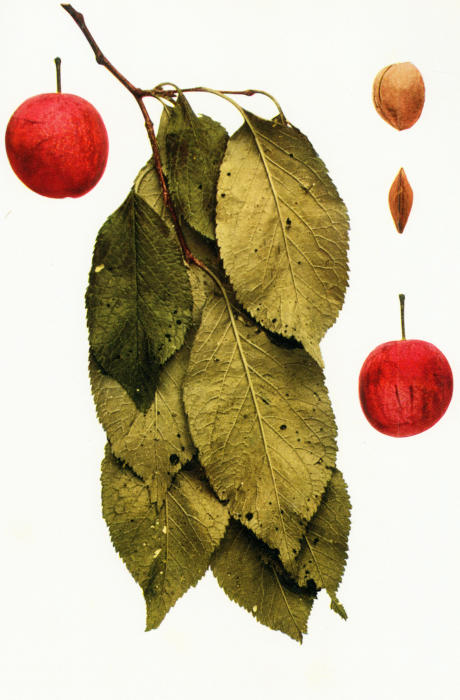
Waugh places Oren with the “Miner-like” plums but as the variety grows here it is a typical western Americana—the characters of this species in leaf, fruit and stone being well shown in the accompanying plate. It is one of the best of the Americanas in both fruit and tree. The fruits are large and of good shape, perhaps a little dull in color and not quite as good in quality as a few other Americanas but still averaging very well in all fruit-characters. The flesh is very nearly free from the stone. The trees are typical of the species, shaggy of trunk and limb, straggling and unkempt in growth of top, but hardy, robust, healthy and reliable in bearing. It would seem as if this variety is rather too good to be allowed to pass out of cultivation until there are more Americanas that are better.
Oren was taken from the wild in Black Hawk County, Iowa, about 1878, by J. K. Oren. Mr. Oren grew trees of this plum on his farm and permitted all who came to take sprouts, cions and seed until the variety was very generally disseminated locally. Who introduced it to the trade and when is not known.
Tree small, spreading, low, dense-topped, hardy, often unproductive; branches roughish, slightly zigzag, thorny, dark ash-brown, with small lenticels; branchlets slender, long, twiggy, with internodes of average length, green changing to dark chestnut-brown, glabrous, with large, conspicuous, raised lenticels; leaf-buds small, short, obtuse, free.
Leaves falling early, oval or obovate, two inches wide, three and three-quarters inches long; upper surface dark green changing to golden-yellow late in the season, smooth and shining, with a narrow, grooved midrib; lower surface silvery-green, lightly pubescent; apex taper-pointed, base abrupt, margin coarsely serrate, the serrations ending in sharp points, eglandular; petiole five-eighths inch long, thick, tinged red, thinly pubescent, glandless or with one or two prominent, greenish-brown glands.
Blooming season late and of medium length; flowers appearing after the leaves, one and one-eighth inches across, white; borne in clusters on lateral spurs and buds, in pairs or in threes; pedicels five-eighths inch long, slender, glabrous, green, tinged with red; calyx-tube red, campanulate, enlarged at the base, glabrous; calyx-lobes narrow, somewhat obtuse, pubescent on both surfaces and on the margin, reflexed; petals ovate, somewhat crenate or fringed, tapering below to long, narrow claws, sparingly hairy along the edge of the base; anthers yellow; filaments three-eighths inch long; pistil glabrous, shorter than the stamens.
Fruit intermediate in time and length of ripening season; one and three-sixteenths inches in diameter, roundish, usually truncate and slightly oblique, compressed, halves equal; cavity very shallow, flaring; suture a line; apex roundish or flattened; color dull light or dark red over a yellow ground, mottled, with thick bloom; dots numerous, very small, light russet, inconspicuous; stem slender, five-eighths inch long, glabrous; skin tough, astringent, adhering; flesh dark golden-yellow, juicy, fibrous, soft and melting, sweet; fair to good; stone semi-free, seven-eighths inch by five-eighths inch in size, irregularly roundish or ovate, flattened, blunt at the base and apex, with smooth surfaces; ventral suture strongly winged; dorsal suture acute, with a narrow and shallow groove.
ORLEANS
Prunus domestica
1. Quintinye Com. Gard. 68. 1699. 2. Langley Pomona 91, Pl. XX fig. 4. 1729. 3. Miller Gard. Dict. 3:1754. 4. Duhamel Trait. Arb. Fr. 2:78, Pl. VII. 1768. 5. Knoop Fructologie 2:52, 55, 56, 57. 1771. 6. Forsyth Treat. Fr. Trees 19. 1803. 7. Kraft Pom. Aust. 2:32, Tab. 179 fig. 1. 1796. 8. Brookshaw Pom. Brit. Pl. XI. 1817. 9. Lond. Hort. Soc. Cat. 145, 150. 1831. 10. Prince Pom. Man. 2:62, 67, 85. 1832. 11. Poiteau Pom. Franc. 1:1846. 12. Floy-Lindley Guide Orch. Gard. 289, 290, 383. 1846. 13. Thomas Am. Fruit Cult. 339. 1849. 14. Elliott Fr. Book 428. 1854. 15. Thompson Gard. Ass’t 519. 1859. 16. Downing Fr Trees Am. 935. 1869. 17. Mas Pom. Gen. 2:37, fig. 19. 1873. 18. Am. Pom. Soc. Cat. 36. 1875. 19. Oberdieck Deut. Obst. Sort. 414. 1881. 20. Mathieu Nom. Pom. 435. 1882. 21. Hogg Fruit Man. 715. 1884. 22. Guide Prat. 156, 360. 1895.
Anglaise Noire 16, 17, 20, 21, 22. Angloise Noire 5. Brignole? 1. Brugnole? 1. Brignole Violette 17, 20, 22. Brignole Violette? 5. Common Orleans 10, 16, 17, 20. Damas Rouge 10. Damas Rouge 5, 9. Damas Violet? 5. De Monsieur 17, 22. Die Herrnpflaume 7. English Orleans 10, 16, 17, 20. French Orleans 8. Hernnpflaume 17. Herrnpflaume 19. Herrnpflaume 22. Herzog von Orleans 20, 22. Italian Damask of some 14. Large Red Orleans 10. Late Monsieur 10, 16, 17, 20. Monsieur 4, 9, 10, 12, 17, 22. Monsieur 10, 13, 14, 15, 16, 20, 21. Monsieur Ordinaire 9, 10, 14, 15, 16, 17, 20, 21, 22. Old Orleans 10, 13, 14, 15, 16, 17, 20, 22. Orleans 17, 20, 22. Orleans Red Damask 20. Prune de Monsieur 10, 16, 20. Prune de Monsieur 11. Prune d’Orleans 16, 17, 20, 21. Prunelle? 5. Prune Monsieur 7. Red Damask 10. Red Damask 9, 10, 12, 13, 14, 15, 16, 17, 18, 20, 21, 22. Red Orleans 10, 16, 17, 20. Red Orleans Plum 6.
In Europe Orleans is one of the most renowned of the plums cultivated. A proof of its popularity is the great number of names, as shown in the synonymy given above, under which it passes in England and on the continent. This variety, however, is almost unknown in America though described by all of the older American pomologists and probably introduced time and again during the last hundred years in our orchards. The French fruit books say that the variety thrives better in southern than northern France and nearly all of the European writers state that it does best in high, dry, light, warm soils. It is likely that our climate, and the soils in which plums are generally grown in America, are not suited to this sort. Unfortunately this Station has no trees of this variety and the brief description given is a compilation.
The Orleans has been cultivated for more than two hundred years. Langley said of it in 1729 “The Orleans Plumb tho a common, is yet a very valuable Plumb, as well for its fine firm juicy Pulp when well ripened, as its being a constant and plentiful bearer.” The Red Damask and the Brugnole mentioned by Quintinye in 1699 are probably the Orleans; but the Prune de Monsieur of Knoop and the Monsieur of Tournefort, which are yellow, are distinct. The variety is evidently of French origin. Mas in his Pomologie Generale, 1873, states that it first bore the name Brignole Violette, but later was given the name it now bears in honor of Monsieur, Duke of Orleans, brother of Louis XIV. Damas Rouge is an old synonym, though Duhamel described it as a distinct variety. Herrnpflaume is the common name of the Orleans in Germany and Austria, while in France, it is often called the Monsieur. It has never been common in America, yet it was entered on the American Pomological Society catalog list in 1875.
Tree large, vigorous, hardy, productive, bearing annually; branches grayish, pubescent; leaves large, ovate, with crenate margins; flowers large, blooming early; petals roundish, imbricated.
Fruit early mid-season; medium in size, roundish-truncate, sides unequal; cavity usually shallow, wide; suture distinct; apex flattened; color dark or purplish-red, overspread with thin bloom, with a sprinkling of pale reddish dots; stem thick, short; skin tender; flesh yellowish, juicy, usually melting when properly matured, sweet near the skin but sprightly toward the center, pleasant-flavored; good; stone free, small, oval, flattened, with roughish surfaces.
OULLINS
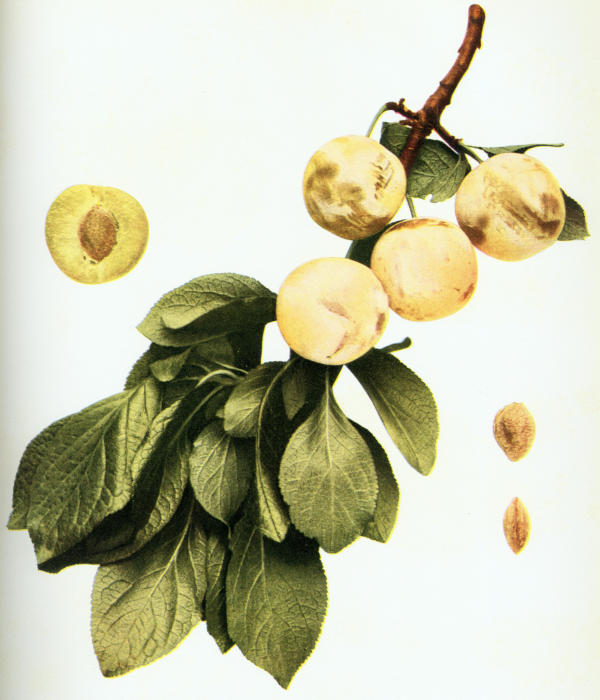
OULLINS
Prunus domestica
1. Hogg Fruit Man. 374. 1866. 2. Downing Fr. Trees Am. 935. 1869. 3. Pom. France 7: No. 15. 1871. 4. Mas Le Verger 6:43. 1866-73. 5. Am. Pom. Soc. Cat. 38. 1877. 6. Cat. Cong. Pom. France 366. 1887. 7. Mathieu Nom. Pom. 446. 1889. 8. Waugh Plum Cult. 117. 1901. 9. Thompson Gard. Ass’t 4:158. 1901.
Massot 6, 7. Monstrueuse d’Oullins 2, 7. Ouillin’s Gage 2, 7. Oullins Golden 1. Oullin’s Golden 2, 9. Oullin’s Golden 3, 4, 6, 7. Oullin’s Golden Gage 2, 7. Oullins Golden Gage 5. Oullin’s Green Gage 8. Prune-Massot 3. Reine-Claude d’Oullins 1, 2, 7, 9. Reine-Claude D’Oullins 3, 4, 6. Reine-Claude Prêcoce 1, 2, 3, 6, 7, 9. Reine-Claude von Oullins 7. Roi-Claude 3, 7.
Oullins came to America with the best of recommendations from European growers but it has fallen so far short of its reputation in Europe that it was dropped from the fruit list of the American Pomological Society and is gradually disappearing from cultivation. The fault is in the fruit which is but indifferent in quality for a plum of the Reine Claude group. In Europe the variety is rated as one of the best dessert sorts; in America it is hardly second-rate in quality. This difference may be due to differences in climate and soil; more probably, it is due to the greater number of better Reine Claude varieties grown in America with which it must compete. Hand, Jefferson, Washington, McLaughlin, Yellow Gage, Spaulding and Imperial Gage, the cream of the Reine Claude plums, are all Americans similar to Oullins but much better in quality. Oullins is hardly surpassed by any of its group in tree-characters and might well be used for breeding purposes as there are so few sorts of its kind having satisfactory trees.
This variety, probably a Reine Claude seedling, was found at Coligny, France, on the estate of M. Filliaud; it was propagated by M. Corsaint, gardener to the Baron de Toisy, near Cuiseaux (Department of Saone-et-Loire) and was introduced at Oullins (Department of Rhone) by M. Massot, nurseryman. The name is seldom spelled correctly in American fruit books, being either written with an apostrophe and s or with both left off, these spellings coming from the supposition that the name comes from that of a man, a mistake as the history shows. Oullins was placed on the American Pomological Society catalog fruit list in 1875 but was dropped when the catalog was revised in 1897.
Tree large, vigorous, spreading, open-topped, hardy, productive; branches ash-gray, somewhat rough, with numerous, large, raised lenticels; branchlets stout, the bark rough, medium to above in thickness, short, with short internodes, greenish-red changing to brownish-red, dull, lightly pubescent, overspread with faint bloom, with numerous, small lenticels; leaf-buds large, long, pointed, free; leaf-scars swollen.
Leaves oval or obovate, two inches wide, four and one-quarter inches long, thick; upper surface dark green, covered with fine hairs, the midrib grooved; lower surface pale green, pubescent; apex acute or abruptly pointed, base acute, margin serrate or crenate, with small black glands; petiole three-quarters inch long, thick, pubescent, tinged red, with from two to four globose, greenish-brown glands variable in size, usually on the stalk.
Blooming season medium to late, of average length; flowers appearing after the leaves, one and one-quarter inches across, white, with a faint yellowish tinge; arranged on lateral spurs, singly or in pairs; pedicels eleven-sixteenths inch long, pubescent, greenish; calyx-tube green, campanulate, pubescent; calyx-lobes broad, obtuse, pubescent on both surfaces, glandular-serrate, reflexed; petals broadly obovate, crenate, tapering to short, broad claws; anthers yellowish; filaments three-eighths inch long; pistil glabrous, equal to the stamens in length.
Fruit early, season short; medium to below in size, roundish, halves equal; cavity shallow, below medium in width, abrupt; suture an indistinct line; apex flattened or depressed; color greenish-yellow changing to dull light yellow, overspread with thin bloom; dots numerous, small, whitish, inconspicuous, clustered about the apex; stem of medium thickness and length, adhering well to the fruit; skin thin, slightly astringent, separating readily; flesh greenish-yellow or pale yellow, somewhat dry, firm, sweet, not high in flavor; good; stone half-free or free, three-quarters inch by five-eighths inch in size, broadly oval, flattened, roughened and pitted, blunt at the base and apex; ventral suture rather narrow, furrowed, with a distinct but not prominent wing; dorsal suture broadly and deeply grooved.
PACIFIC
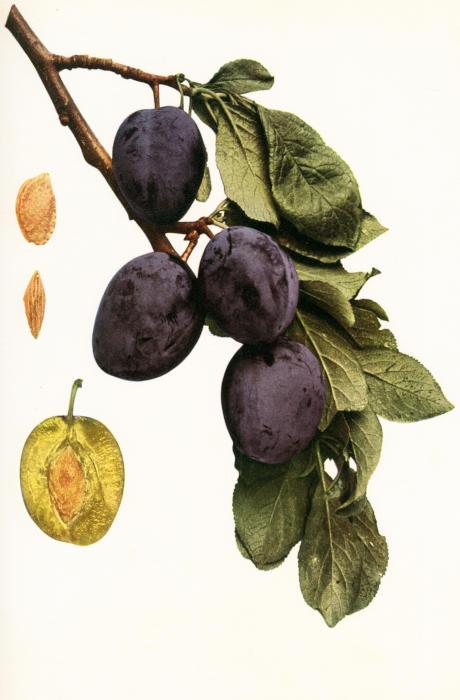
PACIFIC
Prunus domestica
1. U. S. D. A. Rpt. 292. 1893. 2. Am. Pom. Soc. Rpt. 150. 1895. 3. Oregon Sta. Bul. 45:31. 1897. 4. Oregon Hort. Soc. Rpt. 474. 1898. 5. Am. Pom. Soc. Cat. 40. 1899. 6. Waugh Plum Cult. 117. 1901. 7. Oregon Agriculturist 17: No. 24, 370. 1908.
Pacific 3. Pacific Prune 2, 3. Willamette 4, 5, 7. Willamette Prune 3.
No part of America is so well adapted to plum culture as the Pacific Coast and especially the inter-mountain valleys in Oregon. From the last-named State, though fruit-growing is a very recent development, a number of meritorious plums have been added to pomology. One of the best of these, as they grow in New York, is the Pacific, the fruits of which are well shown in the color-plate. Few purple plums are more beautiful than this in color and shape, few equal it in size and very few of its color excel it in quality. The trees are unusually robust, perfectly hardy and productive. In Oregon the Pacific has not proved a good prune-making plum but is reported as standing eastern shipment very well, which, if true, indicates that this plum would succeed as a market fruit in New York. Pacific is well worth trying in New York as a commercial variety.
This plum is hopelessly confused with the Willamette. The following is an abridged account of the two fruits as written us by H. M. Williamson, Secretary of the Oregon State Board of Horticulture, and one of the leading authorities on fruit-growing on the Pacific Coast.
“About 1875 Jesse Bullock of Oswego, Oregon, sent to Germany for pits of the Italian or Fellenberg prune, and planted the pits received in a nursery row. When the trees from these began to bear, Mr. C. E. Hoskins went to Mr. Bullock’s place, examined the fruit and selected trees which seemed promising, giving to each tree a number. From at least six of these trees he took scions, propagated them, and named them Bullock No. 1, Bullock No. 2, etc. He finally decided that only two of these, Bullock No. 1 and Bullock No. 6, were of sufficient value to justify their further propagation. Bullock No. 1 was named Champion and Bullock No. 6, Willamette. Mr. Hoskins told me these names were given by the State Horticultural Society, but I find no record of this action. He propagated and sold a good many trees of both varieties, but more of the Willamette than of the Champion.
“Mr. Hoskins was strongly of the opinion that the Pacific is identical with the Willamette. I am as strongly of the opinion that they are distinct varieties. I base my opinion, first, upon the history of the origin of the Pacific given me by Henry Freeboro, Portland, Oregon, who introduced it; and, second, upon what appear to me to be marked differences in the two prunes. A number of years ago I went to Mr. Freeboro’s place when prunes were ripe and obtained from him a supply of Pacific prunes grown on trees propagated by him from scions taken from the original Pacific tree. I took these prunes to Springbrook and compared them with the Willamette grown on Mr. Hoskins’ place. I was thoroughly convinced that the two were decidedly different in character, but Mr. Hoskins did not think so. I noticed first a marked difference in the habits of growth of the trees. The Pacific trees were of unusually vigorous growth and had a decided upright tendency. The Willamette trees were very similar to the Italian in vigor and had the rather spreading habit of growth of the Italian. The Pacific prunes are larger in size than the Willamette and vary much more in size. One of the most decided indications of difference is the far greater tendency to brown-rot of the fruit of the Pacific than is the case with the fruit of the Willamette. This has been observed when scions of the Willamette and of the Pacific have been grafted on the same tree for the purpose of comparison. I have never seen a well dried specimen of the Pacific, but this may have been the fault of the men who dried the specimens I have seen. The Willamette dries easily for a prune of its size and gives a larger percentage of dried to fresh fruit than the Italian, according to Mr. Hoskins.
“I believe the Willamette is well worthy of more attention in the Willamette Valley, whereas the Pacific, on account of its extreme susceptibility to the brown-rot, does not appear to be a safe variety here, although when perfect it is a magnificent prune for eating fresh, and one of the very largest known. I am told that in eastern Oregon where climatic conditions keep out the brown-rot, the Pacific is proving one of the best varieties for shipping fresh. At the present time the two varieties are much confused. When the Pacific prune was introduced, Mr. Hoskins and other recognized authorities, pronounced it the Willamette, and nurserymen therefore obtained scions from Willamette trees and sold the propagated trees as Pacifies, and in a more limited way the reverse was done. The greater part of the trees supposed to be Pacifics are in fact Willamettes.”
At this Station we have the two plums under discussion, the Pacific having been obtained from Fred E. Young, nurseryman, Rochester, New York, and the Willamette, under the name Pacific, from the Oregon Wholesale Nursery Company, Salem, Oregon. The differences between the two plums in New York are essentially those given by Mr. Williamson as distinguishing characters in Oregon.
Tree of medium size, upright-spreading, open-topped, hardy, productive; branches ash-gray, smooth, with small, raised lenticels; branchlets above medium in thickness, short, with short internodes, greenish-red changing to brownish-red, covered with heavy bloom and sparingly pubescent, with indistinct small lenticels; leaf-buds plump, of medium size and length, obtuse, free.
Leaves obovate, two inches wide, four inches long, the oldest thick and leathery; upper surface dark green, covered with fine hairs, with a widely and deeply grooved midrib; lower surface pale green, pubescent; apex acute or obtuse, base acute, margin crenate, with small dark glands; petiole seven-eighths inch long, thick, pubescent, tinged red, with from two to four large, globose, yellowish-green glands usually on the stalk.
Blooming season of medium length; flowers appearing after the leaves, one and three-sixteenths inches across, white; borne on lateral spurs and buds, singly or in pairs; pedicels five-sixteenths inch long, thick, pubescent; calyx-tube green, campanulate, pubescent only at the base; calyx-lobes broad, obtuse, lightly pubescent on both surfaces but heavily pubescent along the serrate margin, reflexed; petals oval, dentate, tapering to short, broad claws; stamens inclined to develop into rudimentary petals; anthers yellow; filaments seven-sixteenths inch long; pistil glabrous, equal to the stamens in length.
Fruit intermediate in time and length of ripening season; two inches by one and five-eighths inches in size, ovate, halves equal; cavity shallow, narrow, flaring; suture shallow, indistinct; apex bluntly pointed; color bluish, overspread with thick bloom; dots small, brown, conspicuous, clustered about the apex; stem thick, one-half inch long, pubescent, adhering well to the fruit; skin thin, tough, separating readily; flesh pale golden-yellow, juicy, firm, sweet, spicy; good; stone free, one inch by five-eighths inch in size, flattened, irregularly broad-oval, obliquely contracted at the base, blunt at the apex, with rough and pitted surfaces; ventral suture narrow, with numerous deep furrows, usually blunt; dorsal suture widely and deeply grooved.
PALATINE
Prunus domestica
This plum, scarcely known outside of two counties in New York, is of distinctly good quality and if all accounts are true is fairly immune to black-knot. In size and appearance the fruits are superior to many other Reine Claude plums, with which it must be compared, so much so that the variety is probably worth growing outside the region where the following interesting history shows it has been cultivated for nearly a century and a half.
Palatine, according to Mr. Washington Garlock of New York, originated in 1760 when a family of Palatines by the name of Best came from Germany to the United States and settled in Livingston Manor (East Camps) now Columbia County, New York. They brought with them plum pits which they planted and from them secured one tree. In 1762 they moved to Schoharie County, New York, taking with them the seedling tree. In their new home they propagated the variety, which they named Palatine, and disseminated it so industriously that it became thoroughly established throughout Montgomery and Schoharie counties and attained great popularity because of its apparent freedom from black-knot. That this popularity is merited is attested by the fact that after one hundred and fifty years it is still extensively grown in that vicinity.
Tree large, vigorous, spreading, dense-topped, productive; branches thick; branchlets lightly pubescent; leaves flattened, slightly drooping, obovate, one and five-eighths inches wide, three and one-quarter inches long, thick, rugose; margin coarsely crenate, eglandular or with few, small glands; petiole pubescent, glandless or with one or two small glands; blooming season intermediate in time, short; flowers appearing after the leaves, more than one inch across, white with yellow tinge at the apex of the petals; borne singly; calyx-lobes thickly pubescent on both surfaces, strongly reflexed.
Fruit intermediate in time and length of ripening season; about one and one-half inches in diameter, roundish or roundish-oval, dull yellowish-green becoming greenish-yellow at full maturity, mottled and indistinctly blushed on the sunny side, overspread with thin bloom; skin thin, slightly sour; flesh light golden-yellow, juicy, fibrous, firm, sweet, pleasant in flavor; good to very good; stone dark colored, free or nearly so, seven-eighths inch by one-half inch in size, oval, with thickly pitted surfaces; ventral suture blunt or with a short, narrow wing; dorsal suture wide, shallow.
PAUL EARLY
Prunus domestica
1. N. Y. Exp. Sta. Rpt. 12:611. 1893. 2. W. N. Y. Hort. Soc. Rpt. 42:83. 1897.
Paul’s Earliest 1, 2.
This variety seems to be under test only at this Station where it has fruited for a number of years. It is so similar to Early Rivers, a variety of small account in America, as to be an almost worthless addition to the list of plums. Paul Early originated with and was sent out by J. M. Paul, North Adams, Massachusetts, about 1888.
Tree very large, vigorous, round-topped, dense, very productive; branches covered with numerous fruit-spurs; branchlets twiggy, thickly pubescent; leaf-buds strongly appressed; leaves flattened, obovate or oval, two and three-eighths inches wide, four inches long; margin crenate, with few, small, dark glands; petiole reddish, pubescent, glandless or with one or two large glands; blooming season intermediate in time, short; flowers appearing before the leaves, one inch across; borne in scattering clusters, usually in pairs; pedicels very thick and pubescent; anthers tinged red.
Fruit very early, season short; one and three-eighths inches by one and one-quarter inches in size, roundish-oval, dark purplish-black, overspread with thick bloom; skin tender, slightly sour; flesh greenish-yellow becoming yellowish, tender, sweet near the surface but sour next the pit, mild; good; stone clinging, seven-eighths inch by five-eighths inch in size, irregular-oval, with roughened and thickly pitted surfaces; ventral suture prominent, seldom winged; dorsal suture with a narrow, shallow groove.
PEACH
Prunus domestica
1. N. E. Farmer Dict. 266. 1797. 2. Prince Treat. Hort. 27. 1828. 3. Prince Pom. Man. 2:106. 1832. 4. Downing Fr. Trees Am. 307. 1845. 5. Horticulturist 1:113, 114 fig. 34, 147. 1846. 6. Poiteau Pom. Franc. 1:1846. 7. Thomas Am. Fruit Cult. 335, 336 fig. 262. 1849. 8. Horticulturist 6:132. 1851. 9. Elliott Fr. Book 422. 1854. 10. Downing Fr. Trees Am. 367. 1857. 11. Hooper W. Fr. Book 250. 1857. 12. Am. Pom. Soc. Cat. 86. 1862. 13. Hogg Fruit Man. 375. 1866. 14. Mas Le Verger 6:73. Pl. XXXVII. 1866-73. 15. Pom. France 7: No. 7. 1871. 16. Gard. Chron. N. S. 17:144. 1882. 17. Mich. Hort. Soc. Rpt. 466. 1883. 18. Wickson Cal. Fruits 353. 1891. 19. Wash. Hort. Soc. Rpt. 136. 1893. 20. Guide Prat. 156, 361. 1895. 21. Cat. Cong. Pom. France 462 fig. 1906.
Apricot Plum 5 incor. Caledonian 15, 20. Calvels Pfirschenpflaume 14, 20. D’Abricot (of Streets of Paris) 20. Duane’s Purple 5 incor, 6, 11. Howells Large 15, 20, 21. Jenkin’s Imperial 15, 20. Large Peach 16. Large Peach Plum 3. Nectarine 15, 20. Nectarine Rouge 21. Peach 15, 20. Peach Plum 3, 5, 14, 20. Peach Plum 7, 8, 9, 10, 11, 12, 17. Pêche 14, 15, 20, 21. Pêche de Calvel 20. Prune Pêche 3, 7, 9, 10, 14, 18. Prune Pêche 4, 5, 6, 20. Prune-Pêche De Calvel 14. Reine-Claude De Berger 13, 16. Rothe Nektarine 15, ?20.
Peach, the largest early plum, is not high in quality but is justly esteemed where it can be grown for its earliness, large size and handsome appearance. Unfortunately this variety is capricious beyond most other plums as to climate and soils and refuses to thrive unless its needs are very well supplied in the matter of environment. In America it seems to find congenial soil and climate only on the Pacific Coast, and even then refuses to bear well except on strong, rich soils. In New York, even when grown upon soils similar to those upon which it does well elsewhere, the fruits are few and lacking in quality, though the trees are large, vigorous and about all that could be desired in a good plum tree. It may be possible to grow Peach in favorable locations in the East; in which case, a plum of its appearance and quality, coming as early in the season as it ripens, would make a most desirable addition to the list of plums. From its behavior elsewhere the situation that would suit it best in New York is a sunny exposure with a warm, rich, clay loam.
The origin of the Peach is unknown. Poiteau was unable to find any reference to it in the Eighteenth Century European literature and thought, therefore, that it must have been unknown to this period. Samuel Deane mentions a Peach plum in New England in 1797. It is doubtful, however, whether it is the Peach of this discussion, the name having been applied indiscriminately to several varieties, the Goliath, Nectarine and Apricot in particular. Prince, in 1832, described a Large Peach Plum which he said “had been introduced a few years since” but as his variety is oval and a clingstone, it is not the same as the Peach of Poiteau, the one discussed here, this plum being nearly round and a freestone. Judge James C. Duane of Schenectady, New York, seems to have first imported the Peach plum, with several others, from France, in 1820. The name of this variety was lost during the shipment and as the invoice called for an Apricot Plum, the names Apricot and Duane’s Plum became locally applied to what afterwards turned out to be the Peach. C. H. Tomlinson of Schenectady and A. J. Downing in 1846 made a careful study of these imported plums and showed conclusively that this Apricot or Duane’s Plum was the Peach of the French. In 1862, the American Pomological Society added Peach to the fruit catalog list and recommended it for the eastern and western sections of New York.