Chapter III · LEADING VARIETIES OF PLUMS. (continued 4)
Reading edition
Tree medium in size and vigor, spreading, open, productive; branchlets thick, very short, pubescent throughout the season; leaf-buds large, long, tipped brush-like at the apex; leaves folded upward, oval, one and one-half inches wide, two and three-quarters inches long, the young leaves bright red when opening; margin serrate or almost crenate; petiole tinged red, glandless or with one or two glands usually at the base of the leaf; blooming season intermediate, short; flowers appearing after the leaves, one inch across; borne on lateral buds and spurs, singly or in pairs.
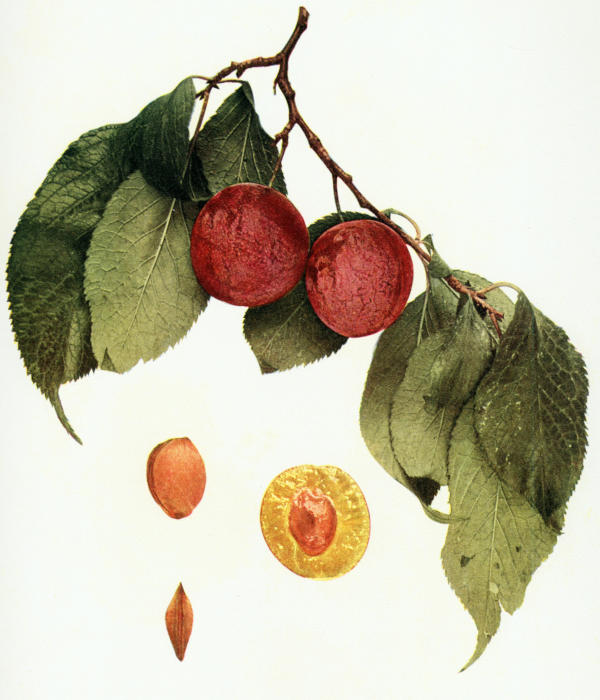
Fruit mid-season, ripening period long; about one and three-eighths inches in diameter, roundish-oblate, somewhat oblique, golden-yellow, sometimes mottled with red, overspread with thin bloom; flesh golden-yellow, firm, sweet, pleasant in flavor; of very good quality; stone clinging, five-eighths inch by one-half inch in size, oval, turgid, with slightly roughened surfaces.
HAWKEYE
HAWKEYE
Prunus americana
1. Ia. Hort. Soc. Rpt. 287. 1887. 2. U. S. D. A. Rpt. 441. 1889. 3. Ia. Hort. Soc. Rpt. 55, 85. 1890. 4. Cornell Sta. Bul. 38:38, 86. 1892. 5. Wis. Sta. Bul. 63:40, 41. 1897. 6. Am. Pom. Soc. Cat. 24. 1897. 7. Colo. Sta. Bul. 50:37. 1898. 8. Ia. Sta. Bul. 46:274. 1900. 9. Waugh Plum Cult. 151. 1901. 10. Ont. Fr. Gr. Assoc. 144. 1901. 11. Wis. Sta. Bul. 87:13. 1901. 12. S. Dak. Sta. Bul. 93:19. 1905. 13. Ohio Sta. Bul. 162:254, 255. 1905.
This variety is a very satisfactory and widely planted Americana. It is typical of its species; and its foliage, fruit and pit in the color-plate herewith presented all represent Prunus americana very well. The fruit of Hawkeye is more satisfactory than the tree, being both attractive in appearance and pleasant to eat either out of hand or cooked; the chief fault of the fruit is that it seems to be easily infected with brown-rot. The trees are crooked in body and quite too straggling and at the same time too dense in growth to make good orchard plants. It requires very careful pruning and training to keep the trees at all manageable. In some of the references given above it is stated that Hawkeye on its own roots is a better tree than otherwise propagated. This variety belongs in the middle west but it might be grown for home use in northern New York where it is too cold for the European plums.
Hawkeye is a seedling of Quaker grown by H. A. Terry,[217] Crescent, Iowa. It first fruited in 1882 and the following year was introduced by the originator. In the Iowa Horticultural Society Report for 1887, Mr. Terry stated that the original tree had borne five crops in succession and he believed it to be the most valuable variety in cultivation for the West and Northwest. The American Pomological Society placed this plum on its fruit catalog list in 1897.
Tree large, vigorous, rather upright at first, becoming spreading, low-headed, hardy, usually productive, but variable in some locations, susceptible to attacks of shot-hole fungus; branches numerous, dark brown, rough, thorny, with numerous, large lenticels; branchlets long, willowy, with internodes of medium length, green, changing to dull reddish-brown, shining, glabrous, with numerous large, raised lenticels; leaf-buds small, short, pointed, appressed.
Leaves tinged red late in the season, nearly flat, oval or slightly obovate, two inches wide, four inches long, rather thin; upper surface dark green, smooth, glabrous, with midrib and larger veins deeply grooved; lower surface light green, lightly pubescent along the midrib and larger veins; apex taper-pointed, base very abrupt, margin coarsely and doubly serrate, the serrations often becoming spiny, eglandular; petiole rather slender, nine-sixteenths inch in length, tinged with pink, sparingly pubescent along one side, glandless or with one or two globose, greenish-brown glands.
Blooming season intermediate in time and length; flowers appearing with the leaves, showy on account of the numerous, pure white, flat petals, with a somewhat disagreeable odor; borne in clusters on lateral buds and spurs, in pairs; pedicels seven-sixteenths inch in length, glabrous, green with a distinct reddish tinge on one side; calyx-tube red, broadly obconic, glabrous; calyx-lobes short, obtuse, pubescent on both surfaces, eglandular, with a hairy, serrate margin, somewhat reflexed; petals ovate, crenate, but somewhat fringed, long and narrowly clawed; anthers yellowish; filaments five-sixteenths inch long; pistil glabrous, shorter than the stamens.
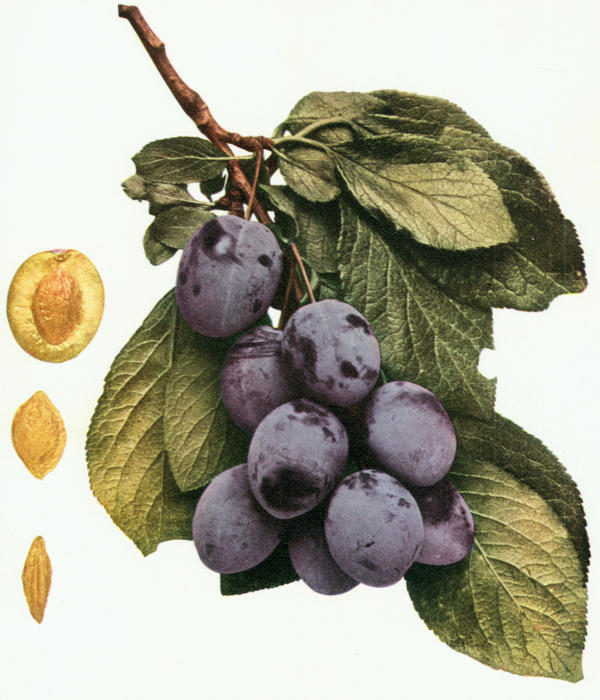
Fruit mid-season, ripening period of medium length; about one and one-eighth inches in diameter, roundish-oval or ovate, not compressed, halves equal; cavity unusually shallow, very narrow; suture an indistinct line; apex roundish; color dull carmine, covered with thin bloom; dots numerous, gray or reddish, nearly obscure, with almost none around the base; stem slender, below medium in length; skin thick, tough, astringent, adhering; flesh pale, dull yellow, very juicy, slightly fibrous, watery and melting, sweet at first with a tart and somewhat astringent after-taste; good; stone adhering to the pulp, seven-eighths inch by five-eighths inch in size, roundish-oval, flattened, smooth, blunt at the base and apex, conspicuously winged on the ventral suture, with a deep but narrow groove on the dorsal suture.
HUDSON
HUDSON
Prunus domestica
1. Mich. Hort. Soc. Rpt. 289. 1889. 2. Mich. Sta. Bul. 103:35 1894. 3. Ohio Hort. Soc. Rpt. 30:168. 1896-97. 4. Cornell Sta. Bul. 131:181 fig. 40 III, 187. 1897. 5. Am. Pom. Soc. Cat. 25. 1897. 6. Can. Exp. Farm Bul. 2nd Ser. 3:52. 1900. 7. Waugh Plum Cult. 109. 1901.
Hudson River Purple 6. Hudson River Purple Egg 1, 3, 4. Hudson River Purple Egg 2, 5, 7. Purple Egg 2.
Hudson is limited in cultivation, belonging almost wholly to the Hudson River Valley where it has long been somewhat of a favorite for both home and market planting. The variety has few qualities of fruit to commend it especially outside of the region where it is now grown and even here its value is probably overrated. The fruits are of only medium size, not markedly attractive in appearance and the quality is below the average among standard plums. The trees are for most part very good in constitution and habit of growth and in particular bear very well; they have the faults of not bearing early and of being subject to black-knot. The variety, and perhaps it is well, is being less planted than formerly.
Nothing is known of the origin of the Hudson except that it has been grown in the Hudson River Valley for a good many years. About 1870 it attracted the attention of S. D. Willard of Geneva, New York, who, thinking it a valuable acquisition, commenced its propagation. In 1897, it was listed by the American Pomological Society as a successful variety for this region. J. R. Cornell, a well informed fruit-grower of Newburgh, New York, in a letter written February 21, 1910, says, “I recall Hudson very distinctly as it was grown when I was a small boy over fifty years ago. I would not be surprised, if the facts could be obtained, to learn that the variety came from Europe, in fact, I incline to that opinion.”
Tree large, vigorous, spreading, very productive, hardy; branches ash-gray, smooth except for the small, raised lenticels; branchlets slender, with long internodes, greenish-red changing to brownish-red, dull, glabrous early in the season becoming lightly pubescent at maturity, with small, inconspicuous lenticels; leaf-buds below medium in size and length, conical, strongly appressed.
Leaves flattened, obovate or oval, two inches wide, three and three-quarters inches long; upper surface dark green, smooth, sparsely hairy along the grooved midrib; lower surface silvery-green, faintly pubescent; apex acute, base abrupt, margin serrate, eglandular or with small dark glands; petiole five-eighths inch long, thick, lightly pubescent, glandless or with from one to three greenish-yellow glands.
Blooming season short; flowers appearing after the leaves, one and one-eighth inches across, white; borne in scattering clusters on lateral spurs, singly or in pairs; pedicels nine-sixteenths inch long, glabrous except for a few scattering hairs; calyx-tube green, campanulate, pubescent at the base; calyx-lobes obtuse, lightly pubescent on both surfaces, glandular-serrate, reflexed; petals obovate, crenate, tapering to short, broad claws; anthers yellowish; filaments three-eighths inch long; pistil glabrous, longer than the stamens.
Fruit late, season of medium length; one and five-eighths inches by one and one-eighth inches in size, long-oval, halves unequal; cavity shallow, narrow, abrupt, regular; suture shallow; apex slightly pointed; color dark reddish-purple changing to purplish-black, overspread with thick bloom; dots numerous, small, russet, inconspicuous; stem slender, one inch long, sparingly pubescent; skin thin, tender, sour, separating readily; flesh golden-yellow, juicy, rather tender, sweet next the skin but sour towards the center, aromatic; good; stone one and one-eighth inches by five-eighths inch in size, sometimes reddish, ovate, roughened and faintly pitted, acute at the base and apex; ventral suture wide, with numerous ridges; dorsal suture with a wide, shallow groove.
HULINGS
Prunus domestica
1. Prince Treat. Hort. 23. 1828. 2. Kenrick Am. Orch. 261. 1832. 3. Downing Fr. Trees Am. 277. 1845. 4. Horticulturist 1:166. 1846. 5. Am. Pom. Soc. Cat. 86. 1862. 6. Hogg Fruit Man. 705. 1884. 7. Mathieu Nom. Pom. 435. 1885. 8. Guide Prat. 158, 366. 1895.
Gloire de New York, 6, 7, 8. Huling’s Superb 7, 8. Huling’s Superb 1, 2, 3, 4, 5, 6. Huling’s Treffliche 7. Keiser 2. Keyser’s Plum 3, 6, 7, 8. Superbe de Huling 8.
Hulings is one of the largest of the Reine Claude group of plums and a remarkably fine fruit in every respect. It is particularly agreeable to the taste because of its sprightliness, which so many plums of its type lack. As this variety grows in New York it has much to recommend it for commercial plantations. Its lack of popularity among planters is due somewhat to the wholesale substitution by nurserymen of spurious varieties for it. Hulings originated early in the last century with a Mr. Keyser of Pennsylvania who grew it from seed, but Dr. W. E. Hulings of the same state brought it to public notice.
Tree large, vigorous, upright-spreading, dense-topped, productive; branchlets brash, thick, pubescent; leaves unusually large, obovate, three inches wide, six and one-half inches long, thick, leathery, rugose; margin crenate or serrate; petiole thick, tinged red, pubescent, with from one to three globose glands.
Fruit maturing in mid-season; about one and seven-eighths inches in diameter, roundish, dull greenish-yellow, overspread with thin bloom; skin thin, somewhat sour; flesh greenish, firm but tender, sprightly; good to very good; stone clinging, one and one-eighth inches by three-quarters inch in size, broad-oval, medium turgid, with short, thick, slightly oblique apex; ventral suture often winged; dorsal suture wide, deep.
HUNGARIAN
HUNGARIAN
Prunus domestica
1. Knoop Fructologie 2:61. 1771. 2. Willichs Dom. Enc. 4:190. 1803. 3. Lond. Hort. Soc. Cat. 143, 148. 1831. 4. Downing Fr. Trees Am. 2nd App. 156. 1876. 5. Oberdieck Deut. Obst. Sort. 404. 1881. 6. Mas Le Verger 6:51, fig. 26. 1866-73. 7. Koch Deut. Obst. 568. 1876. 8. Mathieu Nom. Pom. 452. 1889. 9. Cal. State Board Hort. 111 fig. 11. 1891. 10. Lucas Vollst. Hand. Obst. 474. 1894. 11. Lange Allgem. Garten. 2:421. 1897. 12. Mich. Hort. Soc. Rpt. 465. 1893. 13. Oregon Sta. Bul. 45:33. 1897. 14. Waugh Plum Cult. 109. 1901.
Autriche Violette (Pr. de) 8. Blaue Dattel Pflaume 8. Blue Egg-Plum? 2. Datte de Hungrie 13. Dattelzwetsche 6. Datte Violette 8. Date de Hongrie 14. Datte de Hongrie 4, 14. Date Plum 7. D’Autriche 3. Frühe Dattelzwetsche 10. Grosse u. Lange Früh Zwetsche 8. Grosse Früh Zwetsche 8. Hungarian Date 9. Hungarian Prune? 3, 14. Hungarica 7. Hungarian Prune 4, 11, 12. Hungarian Plum 2. Lange Violette Dattel Zwetsche 8. Osterreichische Pflaume 8. Prune-Datte 3, 6. Prune Datte Violette 3. Prune d’Autriche 6, 8. Quetsche de Hongrie 8. Quetsche Datte Violette 8. Quetsche Datte 6, 8. Quetsche-Datte Violette 6. Quetsche Hongroise 1. Quetsche de Hongrie 6. Sabel Pflaume 8. Späte Dattel Pflaume 8. Ungarische Pflaume 8. Ungarische Dattelzwetsche 5. Ungarishe Sabel Pflaume 8. Violette Dattelzwetsche 6. Violette Dattelzwetsche 8. Türkische Zwetsche 8. Ungarische Zwetsche 8. Virginische Ludwig’s Pflaume 8.
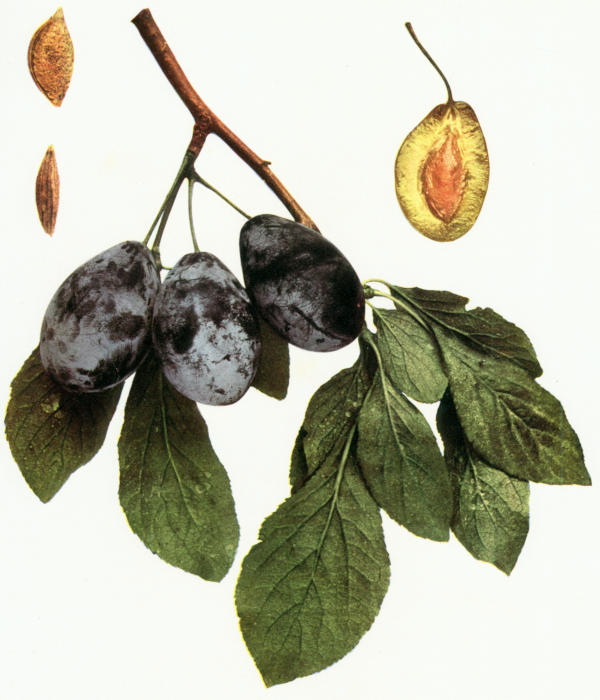
This plum, representing a type hardly known in America, may be a descendant of a species distinct from Prunus domestica, and if not, must at least be considered a well-marked division of the species named. It differs but little from typical Domestica varieties in habit of growth but the leaves are smaller, distinctly folded, and droop, giving an aspect to the tree distinct from the Domesticas in general. But it is the fruit that differs most. Fruit and stone are more elongated than in other varieties of its supposed species and the stone is larger, flatter, more pitted and more pointed at the base and apex. The stem, too, is longer than in the average Domestica. These differences in leaf, fruit and pit may be well seen if the color-plate of this variety be compared with those of well-recognized Domesticas. It is doubtful if Hungarian is worth cultivating in New York though it is larger than the commonly grown German Prune, with which it must be compared, and is fully equal if not better in quality but its type is unknown and consumers hesitate to buy the unknown. It is well worth a place in private collections.
Nothing is known of the history of this plum other than that it has been long under cultivation and that, as its name suggests, it came from Hungary. As in the case of many of the varieties which came from Hungary there are several strains of this plum. The variety that is known in America as Hungarian was reported by Downing in 1876, as originating in Belgium, a mistake, as this is known to have been widely spread for a long time in Europe and European authorities trace it back to Hungary. The Ungarish of Budd, the Hungarian Prune of the Pacific Coast which is Pond Seedling, and the Date Plum, a yellow plum of Downing, all passing under the name “Hungarian,” are distinct varieties.
Tree large, vigorous, upright-spreading, dense-topped, hardy, productive; branches ash-gray, smooth, with few, small lenticels; branchlets thick, long, with internodes of average length, greenish-red changing to brownish-red, dull, sparsely pubescent, with few, small, inconspicuous lenticels; leaf-buds of medium size and length, conical, appressed.
Leaves drooping, folded upward, oval or obovate, one and five-eighths inches wide, three and one-quarter inches long, thick; upper surface dark green, rough, hairy, with a deeply, narrowly grooved midrib; lower surface pale green, pubescent; apex and base acute, margin serrate, eglandular or with small brown glands; petiole nine-sixteenths inch long, pubescent, tinged red, glandless or with one or two globose, greenish-yellow glands usually at the base of the leaf.
Blooming season intermediate in time and length; flowers appearing after the leaves, seven-eighths inch across, the buds tinged yellow, changing to white on opening, not clustered but distributed on lateral spurs, singly or in pairs; pedicels seven-eighths inch long, very slender, pubescent, greenish; calyx-tube green, campanulate, pubescent; calyx-lobes narrow, acuminate, thickly pubescent on both surfaces, glandular-serrate, reflexed; petals narrowly ovate, serrate, converging at the base into narrow claws; anthers yellowish; filaments seven-sixteenths inch long; pistil glabrous, equal to the stamens in length, small, slender.
Fruit late, season short; one and five-eighths inches by one inch in size, distinctly oblong, somewhat necked, swollen on the suture side, compressed, halves unequal; cavity very shallow and narrow, abrupt; suture shallow; apex pointed; color dark reddish-purple, overspread with thick bloom; dots numerous, small, russet, inconspicuous; stem slender, one and one-eighth inches long, pubescent, adhering well to the fruit; skin thin, tough, slightly sour, separating readily; flesh yellowish-green, juicy, firm but tender, sweet, mild; good to very good; stone semi-free to free, one and one-eighth inches by one-half inch in size, irregular long-oval, flattened, necked at the base, acute at the apex, with thickly pitted surfaces; ventral suture wide, blunt; dorsal suture with a wide, deep groove.
ICKWORTH
ICKWORTH
Prunus domestica
1. Gard. Chron. 1:734. 1841. 2. Ibid. 2:176. 1842. 3. Downing Fr. Trees Am. 302. 1845. 4. Thomas Am. Fruit Cult. 345. 1849. 5. Elliott Fr. Book. 420. 1854. 6. Thompson Gard. Ass’t 517. 1859. 7. Mas Le Verger 6:57, Pl. 29. 1866-73. 8. Barry Fr. Garden 413. 1883. 9. Hogg Fruit Man. 706. 1884. 10. Mathieu Nom. Pom. 435. 1889. 11. Wickson Cal. Fruits 358. 1891. 12. Cornell Sta. Bul. 131:187. 1897. 13. Waugh Plum Cult. 110. 1901.
Ickworth Imperatrice 1, 2, 3, 4, 5, 6, 8, 9, 10, 11, 12. Ickworth Imperatrice 13. Imperatrice Ickworth 10. Imperatrice Jckworth 7. Jckworth Imperatrice 7. Knight’s No. 6. 3, 5, 9, 10.
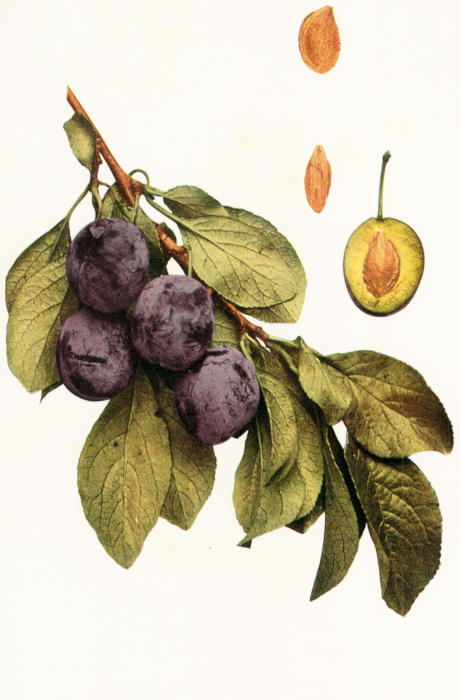
Ickworth is hardly known in America though in England it is a favorite late plum noted as being one of the best of all plums for late keeping. In New York the plums of this variety are too small for the market and are not high enough in quality for a home plum; moreover, the plums do not always ripen in this latitude. In California Ickworth has been found to make a very good prune and to ship very well in the green state but here again small size debars it from great commercial value. The habits of growth of Ickworth are very good and so markedly so that when considered with the late keeping qualities of the fruit, one wishes that this variety might be bred with a larger plum of better quality with the hope of an offspring from the union of especial value as a late plum.
Knight, the noted English pomologist, raised this plum from the Imperatrice fertilized by Golden Drop and named it after Ickworth Park, near Bury St. Edmunds. Knight aimed in raising this and other plums to produce a fruit containing sufficient sugar to keep well and not shrivel. In Ickworth he succeeded to a high degree.
Tree large, rather vigorous, upright-spreading, hardy, productive; branches dark ash-gray, roughened by the numerous, large, raised lenticels; branchlets of medium thickness and length, with internodes of average length, green changing to brownish-drab, dull, lightly pubescent, with numerous, inconspicuous, small lenticels, leaf-buds small, short, conical, appressed.
Leaves folded upward, obovate or oval, one and three-eighths inches wide, three inches long, thick, leathery; upper surface dark green, shining, pubescent only along the grooved midrib; lower surface silvery-green, sparingly pubescent; apex abruptly pointed or acute, base acute, margin crenate, with small dark glands; petiole one-half inch long, thick, greenish, pubescent along one side, glandless or with from one to four large, reniform or globose, yellowish-brown glands usually on the stalk.
Season of bloom intermediate, long; flowers appearing after the leaves, one inch across, white; borne in thin clusters on lateral buds and spurs, singly or in pairs; pedicels seven-sixteenths inch long, below medium in thickness, glabrous, greenish; calyx-tube green, campanulate, glabrous; calyx-lobes broad, obtuse, lightly pubescent, with few glands and marginal hairs, erect; petals roundish or roundish-oval, finely crenate, tapering below to short, broad claws; anthers yellowish; filaments one-quarter inch long; pistil glabrous, longer than the stamens.
Fruit very late, season long; one and three-eighth inches by one and one-quarter inches in size, oval or roundish-oval, sometimes slightly compressed, halves unequal; cavity shallow, narrow, abrupt; suture shallow, wide; apex one-sided, roundish or depressed; color purplish-red changing to purplish-black, mottled, overspread with thick bloom, dots numerous, very small, inconspicuous, scattered between irregular flecks and nettings; stem thirteen-sixteenths inch long, lightly pubescent, adhering well to the fruit; skin thick, tender, adhering; flesh dull yellowish, juicy, sweet, mild, pleasant; good; stone usually clinging, seven-eighths inch by one-half inch in size, irregularly oval, flattened, faintly pitted, acute at the base, blunt at the apex; ventral suture wide, heavily furrowed, swollen; dorsal suture widely and shallowly grooved.
IMPERATRICE
Prunus domestica
1. Quintinye Com. Gard. 67, 69. 1699. 2. Langley Pomona 95, Pl. XXV fig. III. 1729. 3. Duhamel Trait. Arb. Fr. 105, Pl. XVIII. 1768. 4. Kraft Pom. Aust. 2:45, Tab. 200 fig. 2. 1796. 5. Miller Gard. Dict. 3. 1807. 6. Forsyth Treat. Fr. Trees 20. 1803. 7. Pom. Mag. 1:33. 1828. 8. Lond. Hort. Soc. Cat. 148. 1831. 9. Prince Pom. Man. 2:60. 1832. 10. Downing Fr. Trees Am. 290. 1845. 11. Floy-Lindley Guide Orch. Gard. 287, 383. 1846. 12. Thomas Am. Fruit Cult. 344. 1849. 13. Elliott Fr. Book 416. 1854. 14. McIntosh Bk. Gard. 2:529. 1855. 15. Thompson Gard. Ass’t 515. 1859. 16. Mas Pom. Gen. 2:101. 1873. 17. Am. Pom. Soc. Cat. 36. 1877. 18. Hogg Fruit Man. 687. 1884. 19. Mathieu Nom. Pom. 423, 452. 1889. 20. Guide Prat. 161, 358. 1895.
Blue Perdrigon, of some 2. Blaue Kaiserin 19. Blue Imperatrice 9, 10, 12, 13, 14, 15, 17, 18. Blue Imperatrice 16, 19. Die Veischenfarbige Kaiserinnpflaume 4. Empress I. Empress 5, 6, 9, 18, 19. Fürsten Zwetsche 19. Fürstenzwetsche 20. Hoheitspflaume 19, 20. Imperatrice Blue 8. Imperatrice 7, 8, 9, 10, 12, 13, 14, 15, 18, 19. Imperatrice Violette 3, 16, 20. Imperatrice Violette 4, 7, 8, 9, 10, 11, 13, 14, 15, 18, 19. Late Red Imperial 9. Late Violet, of some 2. Prinzessin Pflaume 19. Prune d’Altesse? 9. Red Magnum Bonum 9. Red Imperial 9. Smith’s large October? 9. The Imperatrice Plum 7. Veritable Imperatrice 8, 10, 13, 14, 15, 19. Violette 8, 10, 13, 14, 15, 19. Violette Kaiserin 19. Violette Kaiserin 16, 20, Violet Empress 9, 19.
Imperatrice has been long known and widely grown but the variety has no especial cultural value in the United States, the fruit being too small and too poor in quality. If it has any merit, it is keeping quality, the fruit hanging well on the tree and keeping well, even improving after picking.
This is an old variety, well known in Austria, France and England during the Seventeenth and Eighteenth Centuries. Like most long-known varieties its nomenclature is badly confused. Writers have confounded it with Semiana, the Perdrigons, German Prune and other plums of similar appearance. Duhamel regarded this variety as Perdrigon Late, holding that the true Imperatrice is nearly round. Calvel, also, describes a roundish plum under this name in his Traite Complet sur les Pepinieres. It is probable, however, that both Duhamel and Calvel were mistaken as all other authors describe an obovate plum. This variety was introduced into America early in the last century but has never become popular. It is of interest, nevertheless, since it has been a leading European variety, is a parent of a number of other varieties and its name is given to a group of plums. The American Pomological Society added it to its fruit catalog list in 1877, but dropped it in 1883.
Tree large, vigorous, upright-spreading, productive; leaves obovate or oval, two and one-quarter inches wide, four and one-quarter inches long, slightly rugose; margin crenate; petiole one inch long, thick, tinged red, pubescent, glandless, or with one or two small glands usually at the base of the leaf.
Fruit late; one and one-half inches by one and three-eighths inches in size, roundish or ovate, purplish-black, overspread with medium thick bloom; flesh golden-yellow, rather dry, firm but tender, sweet; of fair quality; stone free, one inch by three-quarters inch in size, roundish-ovate, the surfaces often granular and with a reddish tinge.
IMPERIAL EPINEUSE
Prunus domestica
1. Cal. State Bd. Hort. 48, 50. 1897-98. 2. U. S. D. A. Div. Pom. Bul. 7:316. 1898. 3. Can. Exp. Farm Bul. 2nd Ser. 3:53 1900. 4. Bailey Cyc. Hort. 1378. 1901. 5. Wickson Cal. Fruits 221, 224. 1908.
Clairac Mammoth 1, 5. Imperial Epineux 3.
Imperial Epineuse is well worthy a trial in New York. It is not surpassed in quality by any other plum of its color. It is one of the largest plums in the Prune group and is made further attractive by a handsome reddish-purple color which is lighter or darker according to the exposure of the plums to the sun. As grown in two orchards near Geneva the tree-characters are exceptionally good; the crop is so borne on the main limbs as to be protected from the sun and the tree is particularly large and vigorous, its strong upright growth being a striking characteristic of the variety. If the variety proves to be as valuable elsewhere in the State in all characters as it is here it cannot but make a very desirable plum for the market.
The Imperial Epineuse was found growing as a chance seedling about 1870 in an abandoned monastery near Clairac, in the Valley of Lot, the great prune district of France. It was first brought to the United States by Felix Gillett of Nevada City, California, who received the variety with several others in 1883, three years previous to a similar importation made by John Rock of Niles, California. After testing the variety Mr. Gillett mentioned it, without a name, in his catalog in 1888 but owing to the scarcity of the trees was unable to introduce it to the trade until 1893 when it was sent out under the name “Clairac Mammoth,” from the name of its place of origin. In 1895 E. Smith & Sons of Geneva, New York, received this variety from Gillett and grew it under the name “Clarice Mammoth”.
Tree large, vigorous, spreading, fairly productive; branches numerous, covered with many fruit-spurs; branchlets twiggy, marked with scarf-skin; leaf-buds large, very free, broad at the base; leaves folded backward, obovate, one and three-quarters inches wide, three and one-half inches long, thick, rugose, glabrous except along the deeply and widely grooved midrib; petiole one inch long, tinged red, glandless or with from one to three globose glands; blooming season intermediate in time and length; flowers appearing after the leaves, one inch across, singly or in threes.
Fruit rather late, season short to medium in length; large, slightly obovate, purplish-red, darker on the sunny side, mottled, overspread with thick bloom; flesh greenish-yellow, fibrous, rather tender, sweet, agreeable in flavor; good to very good; stone clinging, one inch by five-eighths inch in size, irregular-oval, flattened, obliquely but bluntly contracted at the base, with pitted surfaces; ventral suture narrow, prominent, often distinctly winged.
IMPERIAL GAGE
IMPERIAL GAGE
Prunus domestica
1. Am. Gard. Cal. 588. 1806. 2. Prince Treat. Hort. 25, 26. 1828. 3. Lond. Hort. Soc. Cat. 147, 148. 1831. 4. Prince Pom. Man. 2:56. 1832. 5. Kenrick Am. Orch. 209. 1835. 6. Mag. Hort. 6:123. 1840. 7. Cultivator 10:167 fig. 1843. 8. Downing Fr. Trees Am. 278 fig. 107. 1845. 9. Floy-Lindley Guide Orch. Gard. 302, 383. 1846. 10. N. Y. Agr. Soc. Rpt. 343 fig. 1847. 11. Thomas Am. Fruit Cult. 325, 326 fig. 254. 1849. 12. Mag. Hort. 16:454. 1850. 13. Am. Pom. Soc. Cat. 54. 1852. 14. Elliott Fr. Book 411. 1854. 15. U. S. Pat. Off. Rpt. 148, Pl. 5 fig. 1. 1864. 16. Barry Fr. Garden 413. 1883. 17. Mathieu Nom. Pom. 443. 1889. 18. Wickson Cal. Fruits 355. 1891. 19. Mich. Sta. Bul. 103:34. 1894. 20. Guide Prat. 154, 364. 1895. 21. Cornell Sta. Bul. 131:187. 1897. 22. Va. Sta. Bul. 134:42. 1902. 23. Ohio Sta. Bul. 162:239, 254, 255. 1905.
Flushing Gage 7, 8, 11, 12, 14, 15, 17, 20. Flushing Gage 3, 9. Harper 22. Imperial Gage 17, 20. Imperial Green Gage 7. Jenkinson’s Imperial 6, 14, 15. Prince’s Gage 4, 12, 17. Prince’s Imperial Gage 4, 5, 6, 10. Prinzens Kaiser Reine Claude 20. Prince’s Kaiser Reine-Claude 17. Prince’s Imperial Gage 8, 11, 14, 15, 17, 20. Prince’s White Gage 4, 12, 17. Reine-Claude de Flushings 20. Reine-Claude Imperiale 20. Reine-Claude Imperiale 17. Reine-Claude Verte Imperiale 17. Reine-Claude Imperiale de Prince 17, 20. Reine-Claude Blanche de Boston 17, 20. Reine-Claude Verte Superieure 20. Superior Gage 9. Superior Green Gage 12, 14, 15, 17, 20. Superior Green Gage? 3. Superiour Green Gage 8. White Gage? 1, 2, 20. White Gage 14, 15. White Gage of Boston 7, 8, 11, 17.
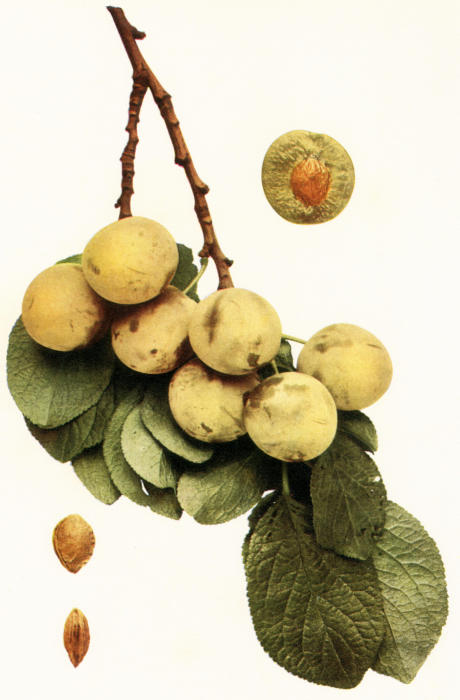
Probably there is more contradictory evidence as to the value of Imperial Gage than of any other American grown plum. It is down in some of the fruit books as being the largest of all the Reine Claude plums and in others as being too small to be desirable; in some, as being of highest quality and in others as being quite too insipid to be called a dessert fruit. These contradictions have arisen because the variety grows quite differently in different soils. The Imperial Gage is best adapted to light sandy soils, growing largest and being best in quality on such soils and making the poorest show of all on heavy clay. The illustration in The Plums of New York shows it as it grows on an unsuitable soil—small, poorly colored, worthless for a money-crop and not very desirable for home use. The technical description is also based on trees grown and fruit produced on soil to which it is illy-adapted. The trees from which these fruits came are nearly perfect in habits of growth, vigorous, hardy, healthy and bearing large crops of plums—such as they are. On suitable soils the variety possesses all the qualities that constitute a fine plum, the product being adapted alike for dessert, canning, home and market. It has an especially agreeable flavor in all the various culinary preparations in which it can be used. Its capriciousness does not warrant its being largely planted but for selected locations it will prove a most valuable fruit.
The Princes in their nursery at Flushing, Long Island, New York, about the year 1790, planted the pits of twenty-five quarts of the Green Gage plum and from these produced, among others, a plum which they called the White Gage. William R. Prince, in order to distinguish this variety from the other Gage plums, changed the name to Prince’s Imperial Gage, now shortened to Imperial Gage. In 1852, the American Pomological Society placed it on its catalog list of recommended fruits.
Tree large, vigorous, upright-spreading, open-topped, hardy, very productive; branches ash-gray, smooth, with conspicuous, transverse cracks in the bark, with lenticels of medium size; branchlets slender, short, with internodes above medium in length, greenish-red changing to dark brownish-red, dull, sparingly pubescent throughout the season, with small, inconspicuous lenticels; leaf-buds medium in size and length, conical, appressed.
Leaves folded upward, oval or slightly obovate, one and seven-eighths inches wide, three and one-quarter inches long, thick; upper surface dark green, rugose, pubescent, with a shallow groove on the midrib; lower surface yellowish-green, pubescent; apex abruptly pointed, base acute, margin crenate, with small dark glands; petiole one-half inch long, thick, pubescent, purplish-red along one side, glandless or with one or two small, globose, yellowish-green glands usually on the stalk.
Blooming season short; flowers one and one-eighth inches across, white; borne on lateral buds and spurs, singly or in pairs; pedicels three-quarters inch long, pubescent, greenish; calyx-tube green, campanulate, pubescent, with a swollen ring at the base; calyx-lobes above medium in width, obtuse, pubescent on both surfaces, glandular-serrate, slightly reflexed; petals broadly obovate, crenate, tapering below to short, broad claws; anthers yellowish; filaments three-eighths inch long; pistil glabrous, longer than the stamens; stigma large.
Fruit intermediate in time and length of ripening season; one and nine-sixteenths inches in diameter, oval or slightly ovate, compressed, halves equal; cavity very shallow and narrow, abrupt; suture shallow, often a line; apex roundish or depressed; color dull greenish-yellow, with obscure green streaks, mottled and sometimes faintly tinged red on the sunny side, overspread with thick bloom; dots numerous, small, grayish, obscure, clustered about the apex; stem three-quarters inch long, pubescent, adhering well to the fruit; skin thin, tender, separating readily; flesh golden-yellow, juicy, firm but tender, sweet, mild; good to very good; stone nearly free, one inch by five-eighths inch in size, oval, flattened, with pitted surfaces; rather blunt at the base becoming acute in the largest fruits, very blunt at the apex; ventral suture wide, ridged; dorsal suture widely and deeply grooved.
ITALIAN PRUNE
ITALIAN PRUNE
Prunus domestica
1. Lond. Hort. Soc. Cat. 152. 1831. 2. Prince Pom. Man. 2:78. 1832. 3. Kenrick Am. Orch. 262. 1832. 4. Manning Book of Fruits 106. 1838. 5. Am. Pom. Soc. Cat. 214, 220. 1836. 6. Downing Fr. Trees Am. 381. 1857. 7. Cultivator 8:52 fig. 1860. 8. Hogg Fruit Man. 366. 1866. 9. Downing Fr. Trees Am. 924. 1869. 10. Pom. France 7: No. 22, fig. 1871. 11. Mas Le Verger 6:69, fig. 35. 1866-73. 12. Oberdieck Deut. Obst. Sort. 442. 1881. 13. Lauche Deut. Pom. No. 2, Pl. 4, 22. 1882. 14. Barry Fr. Garden 412. 1883. 15. Cat. Cong. Pom. France 360. 1887. 16. Mathieu Nom. Pom. 436. 1889. 17. Wickson Cal. Fruits 358. 1891. 18. Guide Prat. 155, 362. 1895. 19. Oregon Sta. Bul. 45:23 fig. 1897. 20. Cornell Sta. Bul. 131:187, fig. 44. 1897. 21. Wash. Sta. Bul. 38:7, 8. 1899. 22. W. N. Y. Hort. Soc. Rpt. 44:92. 1899. 23. Waugh Plum Cult. 111 fig. 1901. 24. U. S. D. A. Div. Pom. Bul. 10:6. 1901. 25. Mass. Sta. An. Rpt. 17:158. 1905.
Altesse Double 8, 9, 10, 15, 18. August Zwetsche 16. Auguste Zwetsche 10, 18. Blaue Riesenzwetsche 16, 18. Bleue d’Italie 15. Couetsche d’Italie 18. Couetsche Fellenberg 10, 18. D’Italie 18. Double Blackpruim 16, 18. Fausse Altesse 16, 18. Fellemberg 14. Fellemberg 8, 16, 18. Fellenberg 5, 9, 11, 16, 18, 19, 20, 23. Fellenburg 22. Fellenberg 5, 6, 7, 9, 17. Fellenburg 25. Feltemberg 10, 18. Fellenberg Quetsche 16, 18. Fellenberger Zwetsche 12, 13, 16, 18. Grosse Früh Zwetsche? 16. German Prune 19, 22. Italienische Blaue Zwetsche 11, 16. Italianische blaue zwetsche 18. Italian Guetsche 10, 18. Italian Prune 6, 7, 10, 11, 16, 17, 18, 25. Italian Quetsche 8, 9, 15, 16. Italianische Zwetsche 18. Italienische Pflaumen Zwetsche 16. Italienische Zwetsche 11, 13. Italianische Zwetsche 10. Italianische blanc Zwetsche 10. Italienische Zwetsche 12, 13, 16. Large German Prune 17. Prune d’Italie 8, 9, 10, 16. Pflaume mit dem Pfirschenblatt 18. Pflaume Mit dem Pfirsichblatt 16. Prune Suisse 6. Quetsche 18. Quetsche Bleue d’Italie 10, 11, 16, 18. Quetsche d’Italie 1, 10, 11, 15, 18. Quetsche d’Italie 3, 8, 9, 11, 16. Schweizer Zwetsche 12, 13, 16. Schweizerzwetsche 18. Swiss Prune 17, 19, 22. Semiana 8, 10, 16, 18. Turkish Prune 22. Zwetsche von Dätlikon 16, 18.
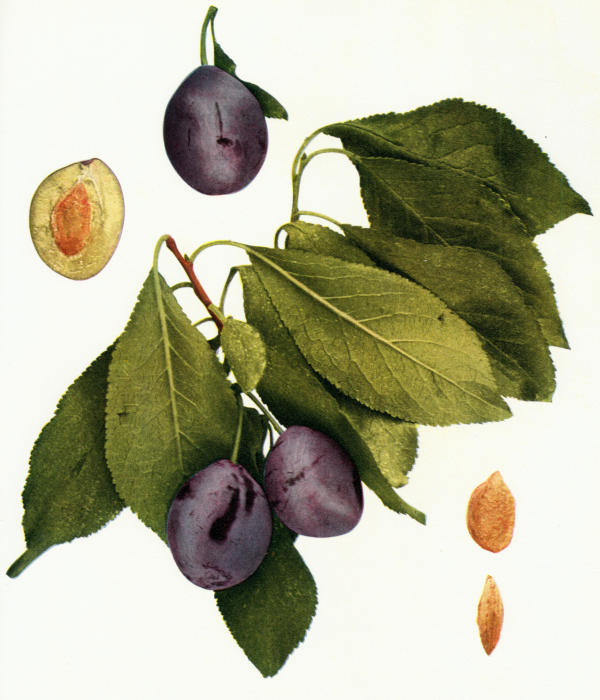
The Italian Prune is one of the most widely grown of all plums. Its home is Italy and it is grown in all of the plum regions of continental Europe; is well known in England; is third or fourth in popularity in the Atlantic States of America; is by long odds the leading plum in the Pacific Northwest where it is chiefly used in prune-making and is grown somewhat for prunes and for shipping green in California. There are several reasons why this plum is so popular. To begin with, it is finely flavored whether eaten out of hand, stewed or otherwise prepared for the table or cured as a prune. The fruit is a little too tart to be ranked as a first-rate dessert plum and yet it is one of the best of the prunes for this purpose, though it must be fully ripe to be fit for dessert; in cooking it changes to a dark, wine color, very attractive in appearance, with a most pleasant, sprightly flavor; as a cured prune the flesh is firm and meaty, yet elastic, of good color and a perfect freestone, making when cooked the same attractive looking, fine-flavored, sprightly sauce to be had from the green fruits; the prunes from this variety, too, are noted for long-keeping. In the uncured state the variety keeps and ships well. The trees are usually large, hardy, productive, well formed and bear regularly; yet they are not ideal and the variety fails chiefly in tree-characters. The trees are often capricious to soil and climate, do not always bear well, seem to be susceptible to diseases, are preyed upon by insects and suffer in particular from dry or hot weather. Were all of these troubles of the tree to befall the variety at one time it would of necessity give way to better sorts, but happily they are to be found for most part in illy-adapted conditions or in certain seasons; the Italian Prune well cared for in locations to which it is suited must long remain one of the leading plums despite the faults of the trees.
The Italian Prune originated in Italy at least a century ago and has long been common in northern Italy, especially in the vicinity of Milan. The London Horticultural Society catalog for 1831 first mentions it in England and the following year it was described in America by Prince as an excellent prune recently introduced from Europe. The American Pomological Society recommended it in 1856 as worthy of further testing and in 1862 it was added to the fruit catalog list of this society. The origin of the name Fellenberg, a very common synonym, is explained by Lauche[218] who says: “It came to Germany through a Mr. Fellenberg and is therefore spread under his name and also under the names Schweizerzwetsche and Fellenberger Zwetsche.” He further adds that the variety “is still not known in Germany as it deserves, considering its quality, size and productiveness.”
Tree of medium size, rather vigorous, spreading or upright, low-topped, hardy, usually productive; branches ash-gray, smooth, with small, raised lenticels; branchlets short, with internodes of medium length, greenish-red changing to brownish-drab, pubescent, with small lenticels; leaf-buds of medium size and length, conical, appressed; leaf-scars large.
Leaves folded upward, obovate or oval, two inches wide, four and one-half inches long; upper surface dark green, pubescent; lower surface silvery-green, heavily pubescent; apex and base acute, margin doubly crenate, with small, dark glands; petiole five-eighths inch long, above medium thickness, pubescent, tinged red, with from one to three globose, greenish-brown glands usually on the stalk.
Season of bloom intermediate and short; flowers appearing after the leaves, one and three-sixteenths inches across, in the buds tinged yellow, changing to white when expanded; borne on lateral spurs, rarely on lateral buds, singly or in pairs; pedicels three-quarters inch long, thick, pubescent, greenish; calyx-tube green, campanulate, pubescent at the base; calyx-lobes long and narrow, acute or narrowly obtuse, pubescent on both surfaces and along the glandular-serrate margin, reflexed, inclined to curl at the tips; petals oval or obovate, dentate, tapering to broad claws of medium length; anthers yellowish; filaments seven-sixteenths inch long; pistil pubescent at the base, equal to the stamens in length.
Fruit late, season short; one and seven-eighths inches by one and one-half inches in size, long-oval, enlarged on the suture side, slightly compressed, halves unequal; cavity very shallow and narrow, abrupt; suture shallow to medium; apex bluntly pointed; color purplish-black, overspread with very thick bloom; dots numerous, small, light brown, somewhat conspicuous; stem inserted at one side of the base, one inch in length, pubescent, adhering well to the fruit; skin thin, somewhat tough, separating readily; flesh greenish-yellow changing to yellow, juicy, firm, subacid, slightly aromatic; very good to best; stone free, smaller than the cavity, one inch by five-eighths inch in size, irregular-oval, flattened, roughened and pitted, necked at the base, abruptly tipped at the apex; ventral suture prominent, heavily ridged, sometimes strongly winged; dorsal suture widely and deeply grooved.
JAPEX
Triflora ×
1. N. Y. Exp. Sta. Rpt. 12:611. 1893.
Japanese Seedling X. 1.
This plum, parentage unknown, was received from Burbank by the New York Experiment Station in 1893 for testing, under the name Japanese Seedling X. While in no way wonderfully remarkable, its earliness, attractive color, good quality and productiveness have been such that it has been retained, the cumbersome name having been changed to Japex. The majority of the characters of the variety are plainly those of Triflora, yet the fruits in appearance would lead one to call it a Domestica.
Tree very large, vigorous, vasiform, very productive; branches slender, sparingly thorny; leaf-scars thick; leaf-buds unusually short; leaves obovate or ovate, two and one-quarter inches wide, four inches long; margin finely serrate varying to crenate, with few dark glands; blooming season short; flowers appearing before the leaves; borne in clusters on lateral buds and spurs, singly or in pairs.
Fruit very early, season short; one and one-eighth inches in diameter, roundish, dark purplish-red or purplish-black, covered with medium thick bloom; flesh light yellow, very juicy, somewhat melting, sweet next to the skin, but tart near the pit, aromatic; good; stone clinging, three-quarters inch by one-half inch in size, oval.
JEFFERSON
JEFFERSON
Prunus domestica
1. Downing Fr. Trees Am. 279, 280 fig. 108. 1845, 2. Horticulturist 1:11, 93. 1846. 3. Floy-Lindley Guide Orch. Gard. 420. 1846. 4. Thomas Am. Fruit Cult. 325, 326, fig. 251. 1849. 5. Mag. Hort. 16:453 fig. 25. 1850. 6. Hovey Fr. Am. 2:1, Pl. 1851. 7. Am. Pom. Soc. Cat. 54. 1852. 8. Elliott Fr. Book 411. 1854. 9. Thompson Gard. Ass’t 518, Pl. 1. 1859. 10. Mas Le Verger 6:17, Pl. 9. 1866-73. 11. Pom. France 7: No. 28. 1871. 12. Hogg Fruit Man. 707. 1884. 13. Gaucher Pom. Prak. Obst. No. 95, Col. Pl. 1894. 14. Cornell Sta. Bul. 131:188. 1897.
Bingham incor. 2, 8. Prune Jefferson 11.
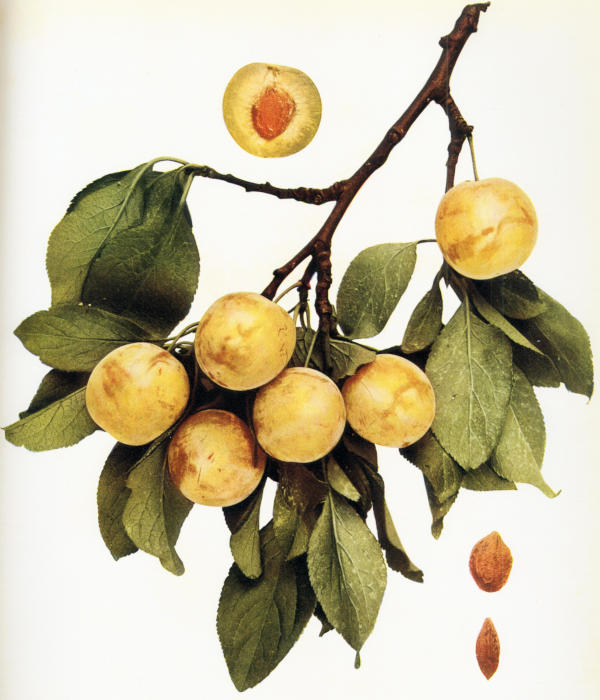
Jefferson has long been popular in America and is highly spoken of by English, French and German pomologists as well, possibly ranking highest in the Old World of all Domesticas which have had their origin in America. The popularity of the variety is waning, however, chiefly because it is lacking in the essentials demanded in a market fruit. There can be no question as to the standing of Jefferson as to quality—it is one of the best of all dessert plums. Grown under favorable conditions and when fully ripe, it is a golden-yellow with a delicate blush and bloom, large for a plum in the Reine Claude group, a well-turned oval in shape, withal one of the handsomest plums. The color-plate maker did not do it justice. It fails as a market variety because the trees are late in coming in bearing, not always certain in bearing, a little particular as to soils and not quite hardy though one of the hardiest of all Reine Claudes. Both tree and fruit are too delicate for the market-grower and the market-men. As to its value for private places and fruit connoisseurs there can be no doubt—it is one of the choicest. It would seem that there should be a place for Jefferson for the fancy trade in the markets, as it would grace the show-window of any delicatessen store; but unfortunately there are few fruit-growers in America to cater to such a trade.
Jefferson was raised by a Judge Buel, Albany, New York, about 1825. The originator presented a tree of this variety to the Massachusetts Horticultural Society in 1829, and in 1841 trees were given to the London Horticultural Society which fruited in 1845. The parentage of the variety is unknown; Floy thought it was a seedling of Washington; Elliott suggested that it was “from a seed of Coe’s Golden Drop, which in growth and wood, it closely resembles.” In 1852, the American Pomological Society placed this variety on its catalog list of fruits worthy of general cultivation.
Tree medium to large, vigorous, spreading, open-topped, hardy at Geneva, productive; branches ash-gray, smooth, with small, numerous, lenticels; branchlets slender, short, with long internodes, greenish-red changing to dark brownish-red, dull, lightly pubescent, with inconspicuous, small lenticels; leaf-buds large, long, pointed, appressed.
Leaves folded upward, obovate, one and three-quarters inches wide, three and three-quarters inches long, thick; upper surface sparingly pubescent, with a grooved midrib; lower surface yellowish-green, pubescent; apex and base acute, margin serrate, with small, dark glands; petiole three-quarters inch long, tinged purplish-red along one side, glandless or with from one to three small, globose, yellowish glands usually on the stalk.
Season of bloom medium, short; flowers appearing after the leaves, one and one-eighth inches across, white; borne on lateral spurs, singly or in pairs; pedicels three-quarters inch long, pubescent, greenish; calyx-tube green, campanulate, glabrous, with a swollen ring at the base; calyx-lobes obtuse, pubescent on both surfaces, glandular-serrate and with fine marginal hairs, erect; petals roundish or obovate, dentate, tapering to very short and broad claws; anthers yellowish; filaments five-sixteenths inch long; pistil pubescent at the base, equal to the stamens in length.
Fruit mid-season, ripening period long; one and five-eighths inches by one and one-half inches in size, roundish-oval, not compressed, halves equal; cavity shallow, narrow, abrupt; suture very shallow, indistinct; apex roundish; color greenish-yellow, changing to bronze-yellow, sometimes with faint pink blush on the exposed cheek, often indistinctly streaked and mottled with green before full maturity; dots numerous, very small, gray or reddish, inconspicuous; stem seven-eighths inch long, thinly pubescent, adhering well to the fruit; skin thin, tough, slightly adhering; flesh deep yellow, juicy, firm but tender, sweet, mild, pleasant; very good; stone semi-free, one inch by three-quarters inch in size, flattened, broadly oval, abruptly tipped, with a short neck at the base, blunt at the apex, with rough and pitted surfaces; ventral suture heavily furrowed, winged; dorsal suture with a wide, deep groove.
JUICY
JUICY
Prunus munsoniana × Prunus triflora
1. Burbank Cat. 20. 1893. 2. Cal. State Bd. Hort. 53. 1897. 3. Vt. Sta. Bul. 67:15. 1898. 4. Ohio Sta. Bul. 113:161. 1899. 5. Conn. Pom. Soc. Rpt. 155. 1900. 6. Ohio Sta. Bul. 162:256. 257. 1905. 7. Mass. Sta. An. Rpt. 17:161. 1905.
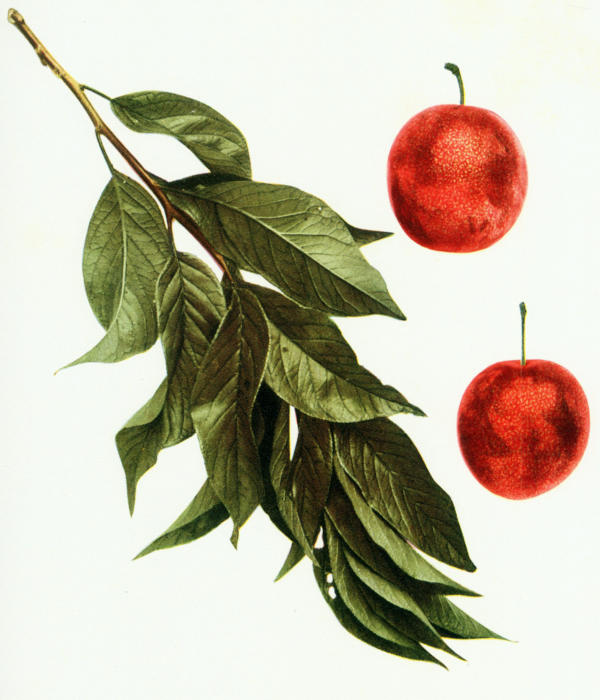
Juicy has been widely tested and in general is considered of very little cultural importance, failing chiefly because of the inferior quality of the plums. The variety is an interesting cross, however, and has given a tree so much more vigorous and so much better adapted to orchard purposes than its native parent, quite equalling the Triflora parent in tree-characters, as to suggest the value of this cross for improving the trees of our native plums. This plum, like Golden, was grown by Luther Burbank from a seed of Robinson fertilized by pollen of Abundance. In 1893 the originator sold the new variety to John Lewis Childs, Floral Park, New York, who introduced it the following year. The variety has not escaped without some confusion as to its origin for its parentage has been published as a cross between Robinson and Kelsey.[219]
Tree very large, vigorous, spreading, open-topped, productive; branches sparingly thorny; leaves broadly oblanceolate or oval, one and one-quarter inches wide, three inches long; margin finely serrate or sometimes crenate, with dark reddish-glands; petiole short, slender, with from two to five globose glands on the stalk; blooming season of medium length; flowers appearing after the leaves, three-quarters inch across; borne in dense clusters on lateral buds and spurs, in threes or fours; anthers so numerous as to give a yellowish color to the flower-clusters.
Fruit mid-season, period of ripening long; one and three-quarters inches by one and three-eighths inches in size, nearly round, dark golden-yellow with bright red blush, covered with thin bloom; flesh golden-yellow, very juicy, melting, sweet next to the skin, but tart at the pit, aromatic; of fair quality; stone clinging, five-eighths inch by one-half inch in size, oval, turgid, with slightly pitted surfaces.
KELSEY
Prunus triflora
1. Gard. Mon. 24:339. 1882. 2. U. S. D. A. Rpt. 272. 1886. 3. Gard. Mon. 29:305, 335-367. 1887. 4. U. S. D. A. Rpt. 635, 652. 1887. 5. Am. Pom. Soc. Rpt. 95, 126. 1887. 6. Ga. Hort. Soc. Rpt. 35. 1888. 7. Ibid. 51, 99. 1889. 8. Rev. Hort. 502, 542. 1890. 9. Am. Pom. Soc. Rpt. 105, 106, 125. 1891. 10. Am. Gard. 13:700. 1892. 11. Cornell Sta. Bul. 62:3, 24. 1894. 12. Tex. Sta. Bul. 32:488 fig., 489. 1894. 13. Cornell Sta. Bul. 106:53. 1896. 14. Ala. Col. Sta. Bul. 85:447. 1897. 15. Am. Pom. Soc. Cat. 41. 1899. 16. Waugh Plum Cult. 137. 1901. 17. N. C. Sta. Bul. 184:120. 1903. 18. Ga. Sta. Bul. 68:15, 31. 1905.
Botankin 7. Botankin 3. Hattankio 7. Kelsey’s Japan 2, 3, 5. Sinomo 7. Togari 7.
Kelsey is distinguished as the largest, the latest and the tenderest to cold of all Triflora plums in America. The variety is not much hardier than the fig and cannot be safely planted north of Washington and Baltimore. The tree is vigorous, well formed and productive, having for its worst fault susceptibility to shot-hole fungus. The plums are large, very attractive in color and the flesh is firm, the plums being well fitted for shipping, with a rich, pleasant, aromatic flavor making the fruit very good in quality. In the South both curculio and brown-rot attack the fruits rather badly. It is unfortunate that this plum cannot be grown in this latitude.
Kelsey, the first of the Triflora plums introduced into America, was brought into the country by a Mr. Hough of Vacaville, California, in 1870, through the United States consul in Japan. John Kelsey of Berkeley, California, obtained trees from Hough and propagated it in his nursery to a limited extent. The first fruit was shown by Kelsey in 1877, though fruit is said to have been produced in 1876. In 1883, W. P. Hammon and Company, Oakland, California, secured stock of this plum from the heirs of Mr. Kelsey and the following year extensive sales were made. The plum was named in honor of the man who did most to bring it before the public. The American Pomological Society added the Kelsey to its fruit catalog list in 1889. The following description is compiled.
Tree vigorous, upright, vasiform, tender, productive, an early and regular bearer; leaves somewhat scant, small, lanceolate, narrow; blooming season early; fruit very late, season long; keeps and ships unusually well; large, cordate, conical, halves unequal; suture variable in depth; apex pointed; color rather unattractive yellow, tinged and splashed with red, often overspread with purple, with attractive bloom, more or less marked with conspicuous dots; stem sometimes adhering poorly to the fruit; skin tender; flesh delicate yellow, juicy, firm and meaty, rich, pleasant, aromatic; good to very good; stone clinging unless well ripened, small, in an irregular cavity larger than the pit.
KERR
Prunus triflora
1. Ga. Hort. Soc. Rpt. 52. 1889. 2. Am. Gard. 12:307, 501. 1891. 3. Ibid. 13:700. 1892. 4. Kerr Cat. 1894. 5. Cornell Sta. Bul. 62:25. 1894. 6. Ga. Hort. Soc. Rpt. 95. 1895. 7. Ala. Sta. Bul. 85:443. 1897. 8. Am. Pom. Soc. Cat. 41. 1899. 9. Cornell Sta. Bul. 175:136. 1899. 10. Waugh Plum Cult. 137. 1901. 11. Ga. Hort. Soc. Rpt. XIII. 1904. 12. Ohio Sta. Bul. 162:256, 257. 1905.
Hattankio 1. Hattankio 7. Hattankin No. 2. 2, 3. Hattonkin No. 2. 4, 5, 10. Hattonkin 9. Hattankio No. 2. 6, 11. Hattankio Oblong 9, 11. Hattankio 10. Hattan 10. Hytankio 10. Hytan-Kayo 10.
Kerr is about the best of the yellow Trifloras and is one of the best of all early plums of its species. It is very productive, sometimes over-bearing, and should always be thinned. The quality of the plums is good and the fruits are attractive in appearance. The faults of the variety are that the fruits drop as they ripen, though they color if picked green, and in some localities the tree-characters are poor. This variety was imported from Japan by Frost and Burgess, Riverside, California, and was distributed under the group name Hattankio No. 2 or Hattonkin No. 2. As Georgeson was also distributed under the same name, though under a different number, confusion resulted. To better distinguish between the two, L. H. Bailey, in 1894, named Hattonkin No. 2 Kerr, in honor of J. W. Kerr, the noted plum specialist, of Denton, Maryland. In 1899 the variety was placed on the fruit catalog list of the American Pomological Society. The following description is compiled.
Tree large, vigorous, upright, very productive; leaves large, thick; blooming season late. Fruit early; of medium size unless thinned, when it becomes large, variable in form, but usually heart-shaped, yellow with thin bloom; skin thick; flesh yellow, firm, subacid, sweet; fair to good; stone clinging, of medium size, oval, turgid.
KING DAMSON
Prunus insititia
1. Watkins Nur. Cat. 48. 1892?. 2. Am. Gard. 14:146, 147. 1893. 3. Garden 53:265. 1898. 4. Can. Exp. Farm Bul. 2nd Ser. 3:51. 1900. 5. Thompson Gard. Ass’t 4:161. 1901.
Bradley’s King 5. Bradley’s King of Damsons 3. King of Damsons 1, 2.
The fruit of King Damson runs large for a Damson and the flavor is agreeable, so agreeable that the variety is really a very good dessert fruit late in the season. This Damson is little grown in America and deserves much wider cultivation. A peculiarity of the plum is that there is always more or less doubling of the petals. Very little is known regarding the history of this excellent variety, but it seems probable that it originated in Kent, England, where it is much grown.
Tree small, lacking in vigor, upright-spreading, dense-topped, usually productive; branchlets slender, pubescent; leaves folded upward, oval or slightly obovate, one inch wide, two and three-quarters inches long; margin serrate, usually with small dark glands; petiole with one or two glands on the stalk; blooming season intermediate, short; flowers appearing after the leaves, usually with more than five petals, one inch across, white with a yellow tinge at the apex; borne on lateral spurs or from lateral buds, singly or in pairs.
Fruit late, season long; one and one-eighth inches by seven-eighths inch in size, oval, slightly necked, black, with thick bloom; flesh greenish-yellow, juicy, firm, sprightly, becoming sweet late in the season; of good quality; stone clinging, five-eighths inch by three-eighths inch in size, irregular-ovate, slightly necked.
KIRKE
Prunus domestica
1. Pom. Mag. 3:111, Pl. 1830. 2. Lond. Hort. Soc. Cat. 149. 1831. 3. Kenrick Am. Orch. 263. 1832. 4. Downing Fr. Trees Am. 306. 1845. 5. Floy-Lindley Guide Orch. Gard. 281, 382. 1846. 6. Mag. Hort. 15:488 fig. 43. 1849. 7. Thompson Gard. Ass’t 518, Pl. 1. 1859. 8. Mas Le Verger 6:15, fig. 8. 1866-73. 9. Am. Pom. Soc. Cat. 36. 1875. 10. Pom. France 7: No. 26. 1871. 11. Flor. & Pom. 47. 1876. 12. Oberdieck Deut. Obst. Sort. 430. 1881. 13. Lauche Deut. Pom. 16, Pl. IV. 1882. 14. Hogg Fruit Man. 708. 1884. 15. Guide Prat. 154, 358. 1895. 16. Gard. Chron. 24:19. 1898. 17. Gaucher Pom. Prak. Obst. No. 96, Col. Pl. 1894. 18. Rev. Hort. 500. 1898. 19. Soc. Nat. Hort. France Pom. 536. 1904.
De Kirke 15. Kirke’s 2, 4, 6, 7, 9, 14, 17. Kirke’s 8, 10, 15, 17. Kirke’s Pflaume 12, 13. Kirke’s Pflaume 8, 10, 15, 17. Kirke’s Plum 1, 5, 8, 10, 11, 16, 18. Kirk’s Plum 3, 5. Kirke 17. Kirke’s Plum 15, 17, 19. Prune de Kirke 18. Prune de Kirke 8, 10, 17. Prune Kirke 19.
All English descriptions of this variety rank it very high both as a dessert and a culinary plum. The variety stands well among the purple plums growing on the grounds of this Station, but since it has been grown in America eighty years, attaining a reputation only of being mediocre in most characters, it is probably not worth planting largely. It has many more worthy competitors in its class and season. Hogg, in the reference given, says the variety was introduced by Joseph Kirke, a nurseryman at Brompton, near London, who, he says, “told me he first saw it on a fruit stall near the Royal Exchange, and that he afterwards found the trees producing the fruit were in Norfolk, whence he obtained grafts and propagated it. But its true origin was in the grounds of Mr. Poupart, a market gardener at Brompton, on the spot now occupied by the lower end of Queen’s Gate and where it sprung up as a sucker from a tree which had been planted to screen an outbuilding. It was given to Mr. Kirke to be propagated and he sold it under the name it now bears.” The variety was introduced into America between 1830 and 1840. The American Pomological Society placed Kirke upon its list of rejected fruits in 1858, added it to the recommended list in 1875, and displaced it in 1899.
Tree large, vigorous, upright-spreading, hardy, productive; branchlets with long internodes, dull, marked with yellowish-brown scarf-skin; leaf-buds large, long, pointed, free; leaves flattened, obovate or oval, one and three-quarters inches wide, three and five-eighths inches long, thick, dark green; margin crenate, eglandular or with small, dark glands; petiole one inch long, tinged red, glandless or with from one to four small, yellowish-green glands; blooming season intermediate, short; flowers appearing after the leaves, one inch across; borne on lateral spurs, singly or in pairs; filaments seven-sixteenths inch long; pistil glabrous, shorter than the stamens.
Fruit mid-season, ripening period long; about one and five-eighths inches in diameter, roundish-ovate, dark purplish-black, overspread with thick bloom; flesh greenish-yellow, fibrous, firm, sweet, mild and pleasant; good to very good; stone nearly free, one inch by three-quarters inch in size, ovate or oval, flattened, roughened and deeply pitted, tapering abruptly to a short, pointed apex; ventral suture narrow, with a short but distinct wing; dorsal suture with a wide groove.
LAFAYETTE
Prunus domestica
1. Prince Pom. Man. 2:96. 1832. 2. Tucker’s Gen. Farmer 3:153. 1839. 3. Elliott Fr. Book 427. 1854. 4. Am. Pom. Soc. Rpt. 222, 244. 1858. 5. Hogg Fruit Man. 368. 1866. 6. Downing Fr. Trees Am. 916. 1869. 7. Guide Prat. 160, 359. 1895.
Gifford’s Lafayette 1, 4, 6. Gifford’s La Fayette 2, 3.
Lafayette originated in New York sometime in the first quarter of the last century with a Mr. Gifford from a stone of the Orleans. It did not become popular and was rejected by the American Pomological Society in 1858, but just why it failed is not apparent, judging either from the descriptions given in the above references or by its behavior in the orchard at this Station. The fruit is good, though not remarkable for the richness of its flavor, its size is large and the color attractive. Moreover it is so late as to stand almost alone in its season. A retrial of this old sort commercially might be worth while. The tree is interesting because of a marked tendency in the flowers to develop petals from the stamens.
Tree of medium size, round-topped, productive; branchlets stocky, with long internodes; leaf-scars large; leaves folded upward, oval or obovate, two inches wide, four inches long, rugose; margin crenate, with small, dark glands; petiole pubescent, tinged red, having at the most three small glands usually on the stalk; blooming season intermediate in time and length; flowers appearing after the leaves, one and one-quarter inches wide, creamy-white; borne in pairs; calyx-lobes long and slender.
Fruit very late, season long; one and one-half inches by one and three-eighths inches in size, oval, purplish-black, overspread with very thick bloom; flesh greenish-yellow, medium juicy, tender, sweet, mild and pleasant; of good quality; stone free or nearly so, one inch by five-eighths inch in size, irregular-oval, flattened, with an acute and slightly oblique apex.
LAIRE
Prunus orthosepala?
Laire is cultivated locally in Rooks and neighboring counties in Kansas and is highly spoken of by those who grow it. The description of the variety is made from information sent from the United States Department of Agriculture. For a further account of this plum the reader is referred to the discussion of Prunus orthosepala, page 97. The name is derived from that of the man who first brought the plums under cultivation some twenty or twenty-five years ago.
Tree dwarfish, dense-topped, not very productive; branches spiny, zigzag; branchlets thick, reddish-brown changing to dark brown; leaves oblong-ovate, light green, acuminate, with margins closely serrate and seldom with glandular teeth; petiole slender, one-half inch long, with two glands at the apex; flowers white or tinged with pink, appearing after the leaves; borne in threes or in fours; pedicels thick, one-half inch long; petals narrowly clawed; stamens orange.
Fruit mid-season; one and one-eighth inches in diameter, roundish, greenish-yellow overlaid with deep red, covered with thick bloom; skin thick; flesh yellow, meaty, juicy, mild subacid; good to very good; stone clinging, five-eighths inch by nine-sixteenths inch in size, flattened, oval, with rugose surfaces; grooved on the dorsal and ridged on the ventral suture.
LARGE ENGLISH
Prunus domestica
1. Oberdieck Deut. Obst. Sort. 443. 1881. 2. Mathieu Nom. Pom. 429, 433. 1889.
Englische Zwetsche 2. Grosse Englische Zwetsche 2. Grosse Englische Zwetsche 1, 2. Grosse Englische Pflaumen Zwetsche 2. Grosse Zwetsche? 2. Schweizer Zwetsche 2 incor.
This appears to be a most excellent plum closely resembling the Italian Prune and surpassing that well-known variety in some respects. As compared with Italian Prune, the fruit of Large English runs larger, is slightly more conical, having the ventral swelling near the base, thus giving it more of a shoulder. The flavor is sweeter and richer than that of the Italian Prune. There appear to be practically no differences between the trees, the foliage and the flowers of the two kinds. Wherever the Italian is successfully grown it may be well worth while to try the Large English. The relation the word English has to this prune is unknown. Oberdieck, in 1881, wrote that this variety resembled the Italian Prune in fruit, but differed in that it had a noticeably broader leaf; he adds “it has been incorrectly called the Swiss Prune and is much spread in Germany under the name of Italian Prune.” E. R. Lake, of the United States Department of Agriculture, brought it to America, in 1901, from the Pomological Institute, Reutlingen, Wurtemburg, Germany. Lake’s stock was tested at this Station and the variety agrees with Oberdieck’s description.
Tree of average size, vigorous, upright-spreading, dense-topped, productive; branchlets with, long internodes; leaf-scars enlarged; leaves folded upward, oval or obovate, nearly one and three-quarters inches wide, three and one-half inches long, thick, rugose; margin crenate or almost serrate, eglandular or with small dark glands; petiole pubescent, tinged red, with from two to four globose glands; blooming season intermediate in time, short; flowers appearing after the leaves, one inch across; petals long, narrow, white, in the buds tipped with yellow; borne singly or in pairs; stamens tend to become petals.
Fruit late, season of medium length; one and three-quarters inches by one and one-half inches in size, long-ovate, purplish-black, with thick bloom; dots numerous, conspicuous; flesh yellowish with a trace of red at full maturity at both skin and stone, juicy, very sweet, aromatic, with a pleasant flavor; very good to best; stone free, the cavity larger than the pit, often brownish-red, one inch by five-eighths inch in size, irregular-oval, flattened, with an oblique apex; ventral suture prominent, usually with a distinct wing; dorsal suture with a wide, deep groove.
LATE MIRABELLE
Prunus insititia
1. Lond. Hort. Soc. Cat. 150. 1831. 2. Barry Fr. Garden 339. 1851. 3. Downing Fr. Trees Am. 388. 1857. 4. Hogg Fruit Man. 353. 1866. 5. Downing Fr. Trees. Am. 901. 1869. 6. Pom. France 7: No. 20. 1871. 7. Mas Le Verger 6:7. 1866-73. 8. Cat. Cong. Pom. France 352. 1887. 9. Mathieu Nom. Pom. 442, 449. 1889. 10. Guide Prat. 162, 360. 1895. 11. Baltet Cult. Fr. 493. 1908.
Bricette 9. Bricetta 5. Bricet 5, 9. Bricette 6, 8, 10. Brisette 6, 7, 10. Bricette 4. Die Brisette 9. Kleine Brisette 9. La Bricette 9. Mirabelle Tardive 1, 3, 6, 7, 8, 10, 11. Mirabelle Tardive 4, 5, 6, 9. Mirabelle d’Octobre 2. Mirabelle d’Octobre 4, 5, 6, 8, 9, 10. October Mirabelle 9. Petit Bricette 5, 9. Petite Bricette 4, 6, 10. Runde Brisette 9. Späte Mirabelle 6, 8, 9, 10.
In France, where all of the Mirabelles are highly esteemed, the Late Mirabelle is much grown because of its season. The variety is practically unknown in America, but, judging from its behavior at Geneva, well deserves widespread trial, as do all the Mirabelles. The history of this variety is unknown other than that it is an old sort, having been mentioned in the London Horticultural Society catalog as long ago as 1831. In 1851, Barry, of Rochester, New York, described the Mirabelle d’Octobre, which is identical with Late Mirabelle, and said that it had been recently introduced from France.
Tree medium in size and vigor, very hardy, productive; branches smooth; leaves small, oval, one and one-quarter inches wide, two inches long; margin finely serrate, with few, dark glands; petiole slender, glandless or with one or two glands at the base of the leaf.
Fruit late; small, roundish-oval, greenish-yellow, often with a light blush on the sunny side, covered with thin bloom; stem short, slender; flesh yellow, very juicy, aromatic, sweet; good; stone semi-free.
LATE MUSCATELLE
Prunus domestica
1. Lucas Vollst. Hand. Obst. 470. 1894. 2. Can. Exp. Farm Bul. 2nd Ser. 3:53. 1900. 3. U. S. D. A. Div. Pom. Bul. 10:22. 1901.
Late Muscatel 2. Späte Muskateller 3. Späte Muskatellerpflaume 1.
This variety was obtained by the United States Department of Agriculture from the Pomological Institute at Reutlingen, Germany, in 1900, and was soon after sent to this Station to test. In some respects, in fruit-characters in particular, the variety is promising, but not sufficiently so to recommend it to fruit-growers, even for trial.
Tree of medium size and vigor, upright-spreading, productive; branchlets thick; with short internodes, pubescent; leaf-scars prominent; leaves drooping, folded upward, obovate, one and five-eighths inches wide, three and three-eighths inches long, leathery; margin crenate, eglandular or with few, small, dark glands; petiole thick, pubescent, glandless or with from one to three glands; blooming season intermediate in time; and length; flowers appearing after the leaves, one inch across; borne in scattering clusters, singly or in pairs; petals white, creamy-white as they open; anthers tinged red.
Fruit late, season short; medium in size, roundish, slightly truncate, purplish-brown, splashed and mottled with russet about the base, overspread with thick bloom; flesh greenish-yellow, sweet; good to very good; stone often reddish, clinging, three-quarters inch by one-half inch in size, somewhat flat, irregular-oval, with slightly pitted surfaces.
LATE ORLEANS
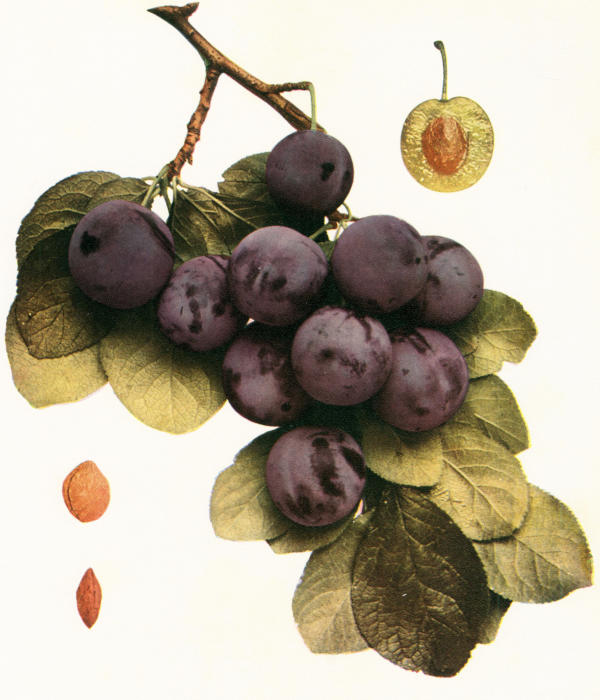
LATE ORLEANS
Prunus domestica
1. Lond. Hort. Soc. Cat. 151. 1831. 2. Mag. Hort. 164. 1843. 3. Jour. Hort. N. S. 15:301. 1868. 4. Downing Fr. Trees Am. 927. 1869. 5. Guide Prat. 161, 360. 1895. 6. Garden 49:268. 1896. 7. Rivers Cat. 33. 1898.
Black Orleans 1, 2, 5. Late Black Orleans 3, 4. Late Black Orleans 5. Late Orleans 5. Monsieur Noir Tardif 5. Orleans Late Black 5.
This is another variety having only a European reputation to recommend it in America. The fruits of Late Orleans are handsome in color and shape, but are not large enough to enable them to compete in the markets with other late purple plums and are so poor in quality as to be worthless as dessert fruits. In Europe the variety is rated high for culinary purposes and fruit-growers there like it because it hangs well to the tree and keeps and ships well. The trees are very satisfactory in practically all respects. It is doubtful if the variety is worth further trial in America.
Late Orleans was mentioned in the catalog of the Horticultural Society of London in 1831, but was not described. No account seems to have ever been published of its origin, but it is probably related to or descended from the Orleans since they are very similar in tree and shape of fruit, differing only in size and color of fruit.
Tree large, vigorous, round-topped, hardy, very productive; branches smooth, dark ash-gray, with numerous, small lenticels; branchlets medium to slender, with long internodes, greenish-red changing to dull reddish-brown, dull, pubescent, marked with gray scarf-skin and with small lenticels; leaf-buds intermediate in size and length, conical, appressed.
Leaves flattened, oval or obovate, one and one-quarter inches wide, two and one-quarter inches long; upper surface sparingly pubescent, with a deeply grooved midrib; lower surface heavily pubescent along the midrib; apex abruptly pointed, base broadly cuneate, margin finely crenate, with small, dark glands; petiole one-half inch long, slender, pubescent, faintly tinged with red, glandless or with from one to four small, globose, yellowish glands usually on the stalk.
Flowers appearing after the leaves, one inch across, white; borne on lateral buds and spurs, singly or in pairs; pedicels one-half inch long, glabrous, greenish; calyx-tube, green, obconic, glabrous; calyx-lobes obtuse, pubescent, glandular-serrate and with marginal hairs, erect; petals roundish or broadly ovate, entire, short-clawed; anthers yellow with a reddish tinge; filaments five-sixteenths inch long; pistil glabrous, equal to the stamens in length.
Fruit late, season long; about one and one-half inches in diameter, roundish, slightly compressed, halves equal; cavity shallow, narrow, flaring; suture a line; apex roundish; color dark purple, overspread with thick bloom; dots few, reddish-brown; stem three-quarters inch long, pubescent at the base, adhering well to the fruit; skin toughish, slightly astringent, separating readily; flesh golden-yellow, dry, tender, sweet, mild; fair in quality; stone clinging, one inch by five-eighths inch in size, oval, flattened, slightly roughened, blunt at the base and apex; ventral suture rather narrow, blunt; dorsal suture widely and deeply grooved.
LAWRENCE
Prunus domestica
1. Cultivator 10:167. 1843. 2. Am. Pom. Soc. Cat. 54. 1852. 3. Elliott Fr. Book 412. 1854. 4. Downing Fr. Trees Am. 928. 1869. 5. Pom. France 7: No. 29. 1871. 6. Mas Le Verger 6:75. 1866-73. 7. Hogg Fruit Man. 710. 1884. 8. Cat. Cong. Pom. France 349. 1887. 9. Guide Prat. 364. 1895. 10. Waugh Plum Cult. 112. 1901.
Favorite de Lawrence 6, 9. Lawrence Favorite 5. Lawrences Reine Claude 9. Lawrence’s Favorite 1, 2, 3, 4, 7. Lawrence’s Gage 1, 3, 4, 6, 7, 9. Lawrence’s Favorite 6, 8, 9, 10. Lawrence Gage 8. Prune Lawrence Gage 5. Reine-Claude de Lawrence 6, 9. Reine-Claude de Lawrence 4, 5, 8.
This variety is surpassed in the quality of its fruits by few plums. The trees bear young and abundantly and the fruit hangs well on the tree; unfortunately, the plums do not ship nor keep well and the variety thus fails as a market sort. It is, however, a delicious dessert fruit, deserving to be grown in every plum connoisseur’s garden. Lawrence is a seedling of Reine Claude, and was grown by L. V. Lawrence of Hudson, New York, some time during the second quarter of the last century. As its large size and superior quality became known its popularity increased, until it was cultivated not only in America, but to some extent throughout western Europe. During the last twenty-five years, however, it has waned in popularity, having been superseded by better commercial varieties, though it still ranks high as a dessert plum. The American Pomological Society placed Lawrence in its catalog in 1852, and retained it there until 1899.
Tree large, vigorous, upright-spreading, productive; trunk and branches rough, with large lenticels; branchlets brash, dark reddish-brown, pubescent; leaves folded upward, oval, two inches wide, three and three-quarters inches long, thick, leathery, rugose; margin doubly serrate, with small glands; petiole pubescent, usually with two small glands.
Fruit medium early; one and three-eighths inches in diameter, roundish, greenish-yellow, covered with thin bloom; skin thin, tender, slightly astringent; flesh yellowish, fibrous, tender, sweet, aromatic; very good; stone free, seven-eighths inch by five-eighths inch in size, oval, turgid, nearly smooth.
LINCOLN
Prunus domestica
1. Lovett Cat. fig. 44. 1890-1900. 2. Rural N. Y. 56:595 fig. 253, 598. 1897. 3. Mich. Sta. Bul. 169:242, 246. 1899. 4. Ohio Sta. Bul. 113:159. 1899. 5. Can. Exp. Farm Bul. 2d Ser. 3:53. 1900. 6. Waugh Plum Cult. 114. 1901. 7. Budd-Hansen Am. Hort. Man. 317, 318 fig. 1903. 8. Am. Pom. Soc. Rpt. 254. 1903. 9. Ohio Sta. Bul. 162:236, 238 fig., 256, 257. 1905. 10. Mass. Sta. An. Rpt. 17:159. 1905.
Lincoln has never been popular in New York, but in Pennsylvania and New Jersey it is well thought of for home use and the markets. The trees in this State grow slowly and when fully grown are rather inferior. This is one of the sorts recommended to be top-worked on better growing varieties but, as has been said before in these notes, top-working in New York is far more often a failure than a success with plums. The fruit of this variety is unusually attractive in size and color and for quality it may be named among the best of the red plums. Unfortunately, the variety is readily infected by the brown-rot which when epidemic cannot be controlled. Lincoln has been so well tested in New York without becoming popular with plum-growers that it is hardly worth recommending for further trial, though the fruits in particular have much merit.
This plum originated in York County, Pennsylvania, about forty-five years ago, supposedly from seed of the Reine Claude, and was named after Abraham Lincoln. If it be a Reine Claude seedling it comes from a cross with some other variety, since it shows many characters not in Reine Claude. Lincoln was introduced by J. T. Lovett and Company, Little Silver, New Jersey.
Tree of medium size, vigorous, upright-spreading, but somewhat variable in habit, dense-topped, hardy, productive; branches ash-gray, rough; branchlets somewhat slender, short, with long internodes, greenish-red changing to brownish-red, dull, sparingly pubescent throughout the season, overspread with thin bloom, with small, inconspicuous lenticels; leaf-buds large, long, pointed, free; leaf-scars prominent.
Leaves somewhat folded backward, oval or obovate, two inches wide, four inches long, rather stiff; upper surface slightly rugose, pubescent only in the shallow, grooved midrib; lower surface silvery-green, pubescent; apex abruptly pointed, base acute, margin doubly crenate, with small, dark glands; petiole nearly one inch long, pubescent, reddish, with from one to four rather large, globose or reniform, yellowish glands variable in position.
Season of bloom medium; flowers appearing after the leaves, over one inch across, white; borne on lateral spurs and buds, singly or in pairs; pedicels about seven-eighths inch long, slender, pubescent, greenish; calyx-tube green, campanulate, thinly pubescent; calyx-lobes broad, acute, somewhat pubescent on both surfaces, glandular-serrate, with marginal hairs, reflexed; petals oval, crenate, with claws of medium width; anthers yellow; filaments three-eighths inch or more in length; pistil glabrous, shorter than the stamens.
Fruit early, season short; somewhat variable but averaging about two inches by one and five-eighths inches in size, oblong-oval, slightly necked, halves usually equal; cavity very shallow, narrow, abrupt; suture shallow; apex roundish or depressed; color light or dark red over a yellow ground, overspread with thin bloom; dots numerous, small, light russet; stem one inch long, lightly pubescent, adhering poorly to the fruit; skin thick, rather sour, separating readily; flesh greenish-yellow, juicy, coarse and fibrous, firm but tender, sweet, mild, pleasant; good to very good; stone nearly free, one and one-eighth inches by five-eighths inch in size, long-oval, flattened, necked at the base, blunt at the apex, with markedly rough and deeply pitted surfaces; ventral suture narrow, distinctly furrowed, with a short wing; dorsal suture with a narrow groove of medium depth.
LOMBARD
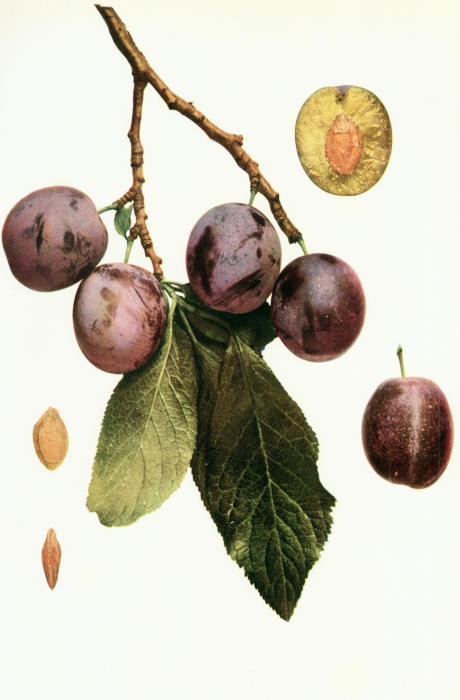
LOMBARD
Prunus domestica
1. Kenrick Am. Orch. 268. 1832. 2. Ibid. 224. 1841. 3. Downing Fr. Trees Am. 303 fig. 124. 1845. 4. Thomas Am. Fruit Cult. 345 fig. 265. 1849. 5. Goodrich N. Fr. Cult. 84. 1849. 6. Elliott Fr. Book 412. 1854. 7. Am. Pom. Soc. Rpt. 190, 210. 1856. 8. Downing Fr. Trees Am. 929 fig. 1869. 9. Mas Le Verger 6:151, fig. 76. 1866-73. 10. Country Gent. 48:981. 1883. 11. Mathieu Nom. Pom. 423. 1889. 12. Guide Prat. 160, 359. 1895. 13. Mich. Sta. Bul. 169:242, 246. 1899. 14. Ia. Sta. Bul. 46:279. 1900. 15. Waugh Plum Cult. 114 fig. 1901. 16. Can. Exp. Farm Bul. 43:34. 1903. 17. Ohio Sta. Bul. 162:240, 256, 257. 1905.
Beekman’s Scarlet 3, 6, 8, 11, 12. Bleecker’s Scarlet 3, 4, 6, 8, 12. Bleeker’s Scarlet 11. Bleeker’s Rotepflaume 11. Bleekers Rothe Pflaume 12. Bleeckers Rothe Pflaume 9. Lombard 11. Lombard Plum 1. Montgomery Prune 8, 11. Prune Rouge De Bleeker 9, 11. Rouge de Bleecker 12. Spanish King? 14, 15. Variegated Plum 1.
The Lombard plum is known by all. It is not as largely planted in New York as a few other varieties, but it is probably more widely grown than any other plum if the whole continent be considered. The preeminently meritorious characters which enable it to take first place in American plum-growing are: The elasticity of its constitution whereby it adapts itself to widely different soils and climates; the robustness, healthiness, productiveness and regularity in bearing of its trees; the fact that the fruits are comparatively free from the scourge of the crescent sign, plum-curculio; and, lastly, its showy fruits tempting to the eye and readily salable. The tree-characters of Lombard are all good, making so superior a tree that it, more than any other variety, is recommended as a stock upon which to graft weak-growing plums. It is a virile variety and from it have come a considerable number of offspring mostly from self-fertilized seeds which have given us several nearly related varieties and strains. There are also a few very good cross-bred plums of which Lombard was one parent. Lombard would be preeminently the plum “for the millions” were it not for a fatal fault—it is very poor in quality. Canned, cooked, preserved or spiced, it does very well, but as a dessert fruit it falls in a category with the Ben Davis apple and Kieffer pear, “good-looking but poor.” The variety ripens so early as to come in direct competition with the peach and this hurts it not a little as a market plum. To be at its best the crop should be thinned and should be allowed to ripen fully on the trees. Lombard is now much used in the canneries in New York and is also planted in home orchards where only hardy plums stand the climate. In the markets it is usually a low-priced plum.
Lombard was raised by Judge Platt, Whitesboro, New York, from seed received from Amsterdam (References, 2). Another writer (References, 10) reports that the trees were brought over from Holland by some of the earliest Dutch settlers of Utica and Whitesboro. The name was given to the plum about 1830 by the Massachusetts Horticultural Society in honor of Daniel Lombard of Springfield, who was the first to propagate the variety in that state. It was previously well known in New York as Bleecker’s Scarlet (References, 3), but was never formally described under that name which must, therefore, though the older, be discarded. In 1856, it was placed on the recommended list by the American Pomological Society. Several varieties, as Communia, Tatge, Spanish King and Odell, are very similar, if not identical to the Lombard and, consequently, have caused much confusion in the nomenclature of the variety. This similarity is probably explained by the fact that the Lombard produces seedlings very nearly true to type. Professor J. L. Budd, in a letter written in 1898 to this Station, says, “The fruit of Communia is much like that of Lombard, but this can be said of a hundred or more east European varieties.” Professor Budd had traveled much in Europe and knew plums very well. His statement, therefore, is entitled to credence and indicates, together with other circumstances, that Lombard is one of an old group of plums the varieties of which are very similar.
Tree of medium size, round-topped, very hardy, productive; branches stocky, dark ash-gray, smooth, with few, small lenticels; branchlets thick, medium to long, with long internodes, greenish-red changing to dull brownish-red, marked with gray scarf-skin, glabrous early in the season, becoming pubescent at maturity, with a few, inconspicuous, small lenticels; leaf-buds of medium size and length, conical, appressed; leaf-scars prominent.
Leaves long-oval or long-obovate, one and five-eighths inches wide, three and one-half inches long, medium to thick; upper surface dark green, thinly pubescent, with a grooved midrib; lower surface silvery-green, lightly pubescent; apex acute, base somewhat tapering, margin often doubly serrate, eglandular or with small, dark glands; petiole one-half inch long, thick, tinged red, pubescent, glandless or with one or two globose, yellowish-green glands usually at the base of the leaf.
Blooming season short; flowers appearing after the leaves, one inch across, the buds creamy-yellow, changing to white on expanding; borne in clusters on short, lateral spurs, singly or in pairs; pedicels nine-sixteenths inch long, slender, nearly glabrous; calyx-tube greenish, campanulate, pubescent only at the base; calyx-lobes obtuse, pubescent on both surfaces, glandular-serrate, strongly reflexed; petals oval, entire or occasionally notched at the apex, short-clawed; anthers yellow; filaments five-sixteenths inch long; pistil pubescent only on the ovary, longer than the stamens.
Fruit mid-season, ripening period long; one and three-quarters inches by one and five-eighths inches in size, oval or roundish-oval, slightly compressed, halves unequal; cavity narrow, abrupt, roundish; suture usually a line; apex roundish or flattened; color light to dark purplish-red, overspread with thick bloom; dots numerous, small, light russet; stem slender, three-quarters inch long, adhering well to the fruit; skin thin, tender, separating readily; flesh yellowish, juicy, slightly fibrous, firm and sweet, mild; inferior in quality; stone semi-free to free, one inch by five-eighths inch in size, dark colored, oval, flattened, roughened; base and apex acute; ventral suture slightly furrowed, acute; dorsal suture widely and rather deeply grooved.
LONG FRUIT
Prunus triflora
1. Wild Bros. Cat. 27. 1892. 2. Cornell Sta. Bul. 62:26. 1894. 3. Am. Pom. Soc. Cat. 26. 1897-99. 4. Waugh Plum Cult. 138. 1901.
Long Fruited 1.
Long Fruit is noted among the leading varieties of plums in The Plums of New York chiefly to condemn it. On the grounds of this Station and elsewhere in New York where tested, the trees are unproductive, the crop drops badly and the fruits are small and poor in quality. The variety was imported from Japan in 1885 by Luther Burbank.
Tree large, vigorous, vasiform to spreading, unproductive; branches roughened by numerous raised lenticels; branchlets slender, with short internodes, glabrous, marked by scarf-skin; leaves oblanceolate, somewhat peach-like, one inch wide, two and one-half inches long, thin; margin finely crenate, with small, amber glands; petiole slender, tinged with red, glandless or with from one to five small glands usually on the stalk; blooming season early; flowers appearing after the leaves, seven-eighths inch across; borne singly or in pairs; calyx-tube much swollen at the base.
Fruit early; one inch by one and one-eighth inches in size, roundish-oblate; cavity deep; color dark red over a yellow ground, covered with thin bloom; stem slender, adhering poorly to the fruit; skin thick, somewhat astringent; flesh greenish-yellow or pale yellow, tender, sweet, mild; poor in quality; stone semi-clinging, small, one-half inch by three-eighths inch in size, roundish-oval, turgid, blunt at the base, the apex terminating abruptly in a small, sharp point, with smooth surfaces.
LUCOMBE
Prunus domestica
1. Pom. Mag. 3:99. 1830. 2. Downing Fr. Trees Am. 281. 1845. 3. Floy-Lindley Guide Orch. Gard. 284, 383. 1846. 4. Am. Pom. Soc. Cat. 222. 1858. 5. Hogg Fruit Man. 711. 1884. 6. Guide Prat. 163, 358. 1895. 7. Waugh Plum Cult. 117. 1901. 8. Budd-Hansen Am. Hort. Man. 320. 1903.
Incomparable de Lucombe 6. Lucombe’s Nonesuch 2, 3, 5. Lucombe’s Nonsuch 1, 4. Lucombe’s Nonsuch 6, 7. Lucombe’s Unvergleichliche 6. Lucombe’s Nonesuch 8. Luccombe’s Nonesuch 3. Nonsuch 7. Nonesuch 8.
This old plum has a reputation of high excellence and is well entitled to it. Despite the fact that it must compete for favor with such estimable plums as Reine Claude, Washington and Hand, belonging to the same group with these, it is still much grown in England and is well thought of for home use in America. Hardly in accordance with its reputation, it was rejected by the American Pomological Society in 1858 for a place in its list of fruits. Lucombe originated as a seedling about 1825 with a Mr. Lucombe of Lucombe, Prince and Company, nurserymen, at Exeter, England, and was first described by Lindley in 1830 in the Pomological Magazine.
Tree large, of medium vigor, upright-spreading, productive; branches covered with numerous fruit-spurs; twigs very short, with heavy pubescence; leaves one and three-quarters inches wide, three and one-quarter inches long, dark green; margin finely serrate or crenate, with small, dark glands; petiole pubescent, glandless or with one or two small glands usually at the base of the leaf; blooming season intermediate, short; flowers appearing after the leaves; petals with a yellowish tinge as the buds unfold; borne on long naked spurs with tufts of leaves and flowers at the ends, singly or in pairs.
Fruit mid-season, period of ripening long; one and three-eighths inches by one and one-half inches in size, roundish-oblate or roundish-obovate, greenish-yellow, becoming golden-yellow, indistinctly splashed and streaked with green, covered with thin bloom; flesh golden-yellow, firm, sweet, pleasant, mild; very good; stone free, three-quarters inch by five-eighths inch in size, roundish, slightly necked, with pitted surfaces.
MAQUOKETA
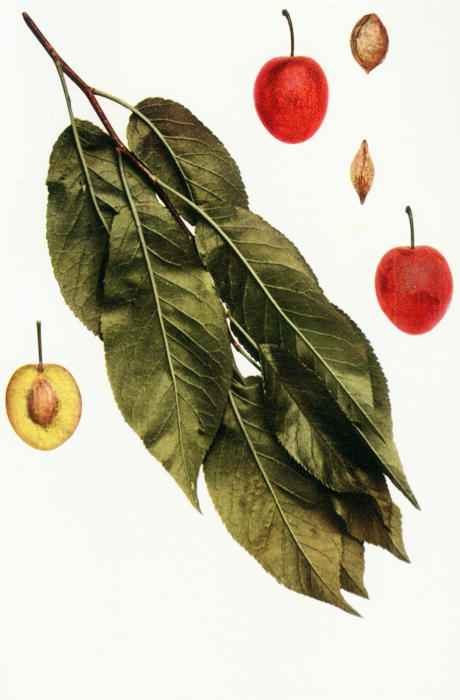
MAQUOKETA
Prunus hortulana mineri
1. Mich. Pom. Soc. Rpt. 290. 1889. 2. Ia. Hort. Soc. Rpt. 55, 85. 1890. 3. Cornell Sta. Bul. 38:40. 1892. 4. Mich. Sta. Bul. 118:53. 1895. 5. Ibid. 123:20. 1895. 6. Ia. Sta. Bul. 31:346. 1895. 7. Wis. Sta. Bul. 63:46. 1897. 8. Budd-Hansen Am. Hort. Man. 298. 1903. 9. Ga. Sta. Bul. 67:277. 1904. 10. Ohio Sta. Bul. 162:256, 257. 1905.
Maquoketa is distinguished as one of the best of the native plums for culinary purposes. Nearly all of the plums brought in from the wild in America have so much astringency, most of it coming from the skins, that they are impalatable to some. Now and then a variety is nearly free from this disagreeable taste and Maquoketa is one of these. The quality, as a dessert fruit, is very good for a native and the fruits keep and ship well. In the South the plums are subject to both curculio and brown-rot. The trees, like those of nearly all of the Miner-like plums, are rather better formed and more adaptable to orchard conditions than those of other species. After the Americana and Nigra plums, Maquoketa is one of the hardiest of our native varieties, growing even in Minnesota. The variety belongs in the South and Middle West and there are few, if any, places in New York where it is worth growing.
The origin of this plum is uncertain. It is reported in the references given as a native found on the banks of the Maquoketa River in eastern Iowa and also as a Miner seedling grown under cultivation. It has been known to fruit-growers since about 1889.
Tree of medium size and vigor, spreading, low-topped, open, hardy, variable in productiveness, susceptible to attacks of shot-hole fungus, the trunk shaggy; branches slender, rough, zigzag, with few thorns, dark, dull ash-gray, with numerous lenticels; branchlets slender, long, with internodes of medium length, green, changing to dull reddish-brown, glabrous, with numerous, conspicuous, small, slightly raised lenticels; leaf-buds very small, short, obtuse, appressed.
Leaves falling early, folded upward, broadly lanceolate, peach-like, one and three-quarters inches wide, four and one-half inches long; upper surface light green, changing to a dull red late in the fall, glossy, glabrous, with a narrowly grooved midrib and veins; lower surface silvery-green, thinly pubescent; apex taper-pointed, base rather abrupt; margin with serrations in two series, with very small, black glands; petiole five-eighths inch long, tinged with dull red, hairy, with from one to four globose, rather large, dark brownish-yellow glands.
Blooming season late and of medium length; flowers appearing after the leaves, one inch across, yellowish as the buds begin to open, changing to white, with a disagreeable odor; borne in clusters on lateral spurs and buds, varying from two to four flowers in a cluster; pedicels five-eighths inch long, slender, glabrous, greenish; calyx-tube green, narrowly campanulate, glabrous; calyx-lobes narrow, slightly obtuse, nearly glabrous on the outer surface, but pubescent within, serrate, with dark colored glands and marginal hairs, reflexed; petals oval or ovate, with long, tapering claws of medium width, sparingly hairy at the base; anthers yellowish; filaments seven-sixteenths inch in length; pistil glabrous, slender, shorter than the stamens.
Fruit late, ripening period short; below medium in size, ovate or roundish-ovate, halves equal; cavity shallow, rather wide, rounded, flaring; suture a distinct line; apex roundish or slightly pointed; colors some time before fully ripe becoming dark carmine, covered with thin bloom; dots numerous, small to medium, light brown, clustered about the apex; stem rather slender, glabrous, parting readily; skin thick, tough, astringent, semi-adherent, removing a thin layer of pulp when detached; flesh deep yellow, juicy, coarse, fibrous, nearly melting next to the skin, becoming firmer toward the center, sweet at first but astringent near the pit, with a strong flavor; inferior in quality; stone adhering, of medium size, oval, turgid, bluntly pointed at the base and apex, with slightly roughened surfaces; ventral suture acute, ridged; dorsal suture a narrow, shallow groove.
MARIANNA
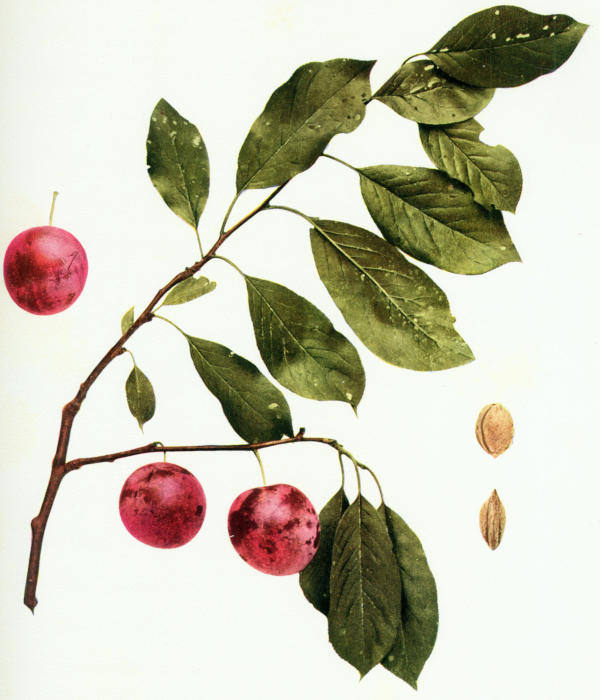
MARIANNA
Prunus cerasifera × ?
1. Ga. Hort. Soc. Rpt. 28. 1886. 2. Gard. Mon. 29:148. 1887. 3. Am. Pom. Soc. Cat. 38. 1889. 4. Neb. Hort. Soc. Rpt. 56. 1889. 5. Ill. Hort. Soc. Rpt. 63. 1890. 6. Cornell Sta. Bul. 38:66, fig., 71, 83, 86. 1892. 7. Tex. Sta. Bul. 32:479, 480 fig. 1894. 8. Rev. Hort. 278. 1894. 9. Rural N. Y. 54:600. 1895. 10. Mich. Sta. Bul. 152:210. 1898. 11. Bailey Ev. Nat. Fruits 208, 213. 1898. 12. Vt. Sta. An. Rpt. 13:336-369. 1900. 13. Waugh Plum Cult. 36, 232. 1901. 14. Ga. Sta. Bul. 67:277. 1904. 15. S. Dak. Sta. Bul. 93:67. 1905.
Marianna has little or no value for its fruit. It is illustrated and discussed at length in The Plums of New York for two reasons. First, because it has long been an enigma which has baffled both horticulturists and botanists; second, because it is extensively used as a stock upon which other kinds of plums are propagated. In 1884, a plum of unknown species was introduced to the trade. Some said the new variety belonged to Prunus cerasifera and others that it was an offspring of some native species. The characters of the first named species are so apparent in Marianna that all are now agreed that this variety is from either a self or a cross-fertilized seed of Prunus cerasifera; if the latter the other parent must have been some native species, the particular variety possibly being Wild Goose, one of the Munsoniana plums. Its behavior on these grounds, its robustness and semi-sterility and its not fitting exactly into any known species, mark it as a hybrid. A curious character peculiar to this variety is that it grows very readily from cuttings and for this reason it is a cheap stock for plums of all kinds and is used even for peaches and apricots. Besides rooting readily, the Marianna does not sprout and may be budded as late or later than the peach. It is chiefly used in propagation in the South, but, for reasons stated in the discussion of stocks in Chapter II, the Marianna is not now employed by nurserymen as largely as formerly, though there are still conditions in which it is the best of stocks. The tree is a handsome ornamental at any season of the year and its broad, spreading top makes it a good shade tree.
Marianna originated as a seedling in a mixed orchard belonging to Charles G. Fitze, Marianna, Polk County, Texas; its parentage is unknown. The originator considered it a seedling of Wild Goose, but, it is probably an offspring of DeCaradeuc and, as stated in the foregoing paragraph, undoubtedly a hybrid. In 1884, Charles N. Eley, Smith Point, Texas, introduced the Marianna to fruit-growers; in 1889 it was placed on the fruit catalog list of the American Pomological Society.
Tree large, vigorous, broad, spreading, open and flat-topped, hardy, unproductive, comparatively free from insects or diseases; trunk rough; branches numerous, usually smooth, but sometimes roughened by the cracking of the bark, thorny, dark ash-gray, with numerous, very large, raised lenticels; branchlets slender, twiggy, with internodes of medium length, green changing to dull reddish-brown, with gray scarf-skin, glabrous, with conspicuous, large, raised lenticels; leaf-buds very small and short, obtuse, appressed.
Leaves folded upward, elongated-oval, one and one-eighth inches wide, two and five-eighths inches long, thin; upper surface smooth, glabrous, with a shallow groove on the midrib; lower surface pale green, lightly pubescent along the midrib and larger veins; apex and base acute, margin very finely serrate, with small, black or amber glands; petiole slender, three-quarters inch long, pubescent along one side, usually tinged red, glandless or with from one to three very small, globose, greenish-brown glands variable in position.
Blooming season intermediate in time and length; flowers appearing after the leaves, three-quarters inch across, white; borne in clusters on lateral spurs, in twos or in threes; pedicels three-eighths inch long, slender, glabrous, greenish; calyx-tube green, campanulate, glabrous; calyx-lobes acute, sparingly pubescent, ciliate, erect; petals very small, separated from each other, broadly oval, entire, tapering to narrow claws; anthers yellowish; filaments three-sixteenths inch long; pistil glabrous, equal to the stamens in length.
Fruit early, season of medium length; one and one-eighth inches or more in diameter, oval or roundish-oval, often not compressed, halves equal; cavity shallow, narrow, abrupt, regular; suture a line; apex roundish or blunt-pointed; color bright, light red changing to darker red, overspread with thin bloom; dots numerous, small, light russet, conspicuous, clustered about the apex; stem slender, five-eighths inch long, glabrous; skin tough, bitter, inclined to crack under unfavorable conditions, parts readily; flesh yellow, tinged red under the skin and next to the stone, unusually juicy, fibrous, watery and melting, sweet next to the skin, but acid near the pit, sprightly; inferior in quality; stone clinging, three-quarters inch by one-half inch in size, elongated-oval, blunt-pointed, surfaces pitted; ventral suture blunt, wide, slightly ridged; dorsal suture widely and deeply grooved.
MARU
Prunus triflora
1. Ga. Hort. Soc. Rpt. 29. 1886. 2. Ibid. 53, 99. 1889. 3. Am. Pom. Soc. Rpt. 105, 106. 1891. 4. Rev. Hort. 515. 1891. 5. Ibid. 278. 1894. 6. Cornell Sta. Bul. 62:26. 1894. 7. Tex. Sta. Bul. 32:489. 1899. 8. Cornell Sta. Bul. 106:57. 1896. 9. Rural N. Y. 56:615. 1897. 10. Cornell Sta. Bul. 175:143. 1899. 11. Mich. Sta. Bul. 169:242, 249. 1899. 12. Waugh Plum Cult. 138. 1901. 13. Ga. Sta. Bul. 68:9, 31. 1905.
Maru is much in evidence in plum literature, the concensus of opinion being that it is little short of worthless. Its quality is not high and it comes in season about with Abundance which surpasses it in nearly all characters. The variety was introduced by Luther Burbank and is said to have been imported by him about 1885. In Japan this name is applied to any round plum, but so far in America it has been restricted to this variety.
Tree large, lacking in vigor, broad-vasiform, dense-topped, unproductive, somewhat susceptible to attacks of shot-hole fungus; trunk and branches rough; branchlets twiggy, marked with thin, russety scarf-skin, glabrous, with large, prominent lenticels; leaves folded upward, oblanceolate, peach-like, thin, one and three-eighths inches wide, three inches long; upper surface yellowish-green late in the season; margin very finely serrate, with small glands; petiole with from one to six glands usually on the stalk; blooming season early; flowers appearing after the leaves, three-quarters inch across; borne in clusters on lateral spurs, in threes or fours; pistil longer than the stamens.
Fruit early, about one and one-quarter inches in diameter, roundish-cordate, dull red, with medium thick bloom; flesh deep yellow, tender and melting, sweet next the skin, but slightly astringent near the pit; poor in quality; stone clinging, five-eighths inch by one-half inch in size, oval or roundish, turgid, with rough surfaces.
MAYNARD
Prunus triflora × Prunus simonii
1. Vt. Sta. An. Rpt. 12:226. 1899. 2. Nat. Nur. 11:5. 1903. 3. Oregon Nur. Cat. 24. 1903. 4. Can. Hort. 28:285. 1905.
The habit of the tree of Maynard is commendable and the plums are very acceptable to those who care for the Triflora fruits. The season follows Climax, a period when there is a dearth of Triflora plums. Maynard has been so widely advertised that it is hardly necessary to say that it is worthy of trial. The variety was first fruited in 1897 by Burbank after which it was tested by him for five years and was then sold to the Oregon Nursery Company by whom it was introduced in 1903. It was named by the originator in honor of Professor T. S. Maynard, then in charge of horticulture in the Massachusetts Agricultural College.