Chapter III · LEADING VARIETIES OF PLUMS. (continued 7)
Reading edition
Fruit very early, season short; one and one-half inches in diameter, roundish-conic, with halves equal; cavity intermediate in depth and width, flaring, regular; suture an indistinct line; apex roundish; color light yellow becoming deeper yellow as the season advances, occasionally with a blush of pink, with thin bloom; dots numerous, very minute, whitish, inconspicuous; stem three-eighths inch long, adhering to the fruit; skin thin, tough, sour, occasionally cracking, separating readily, although a thin coating of flesh is left clinging to the skin; flesh light yellow, semi-transparent, the stone being faintly visible, very juicy, fibrous, somewhat melting, sweet, mild, lacks character in flavor; good; stone clinging, seven-eighths inch by five-eighths inch in size, broadly oval, flattened, slightly elongated at the base, with rough surfaces; ventral suture faintly ridged and furrowed; dorsal suture very lightly grooved.
SHROPSHIRE
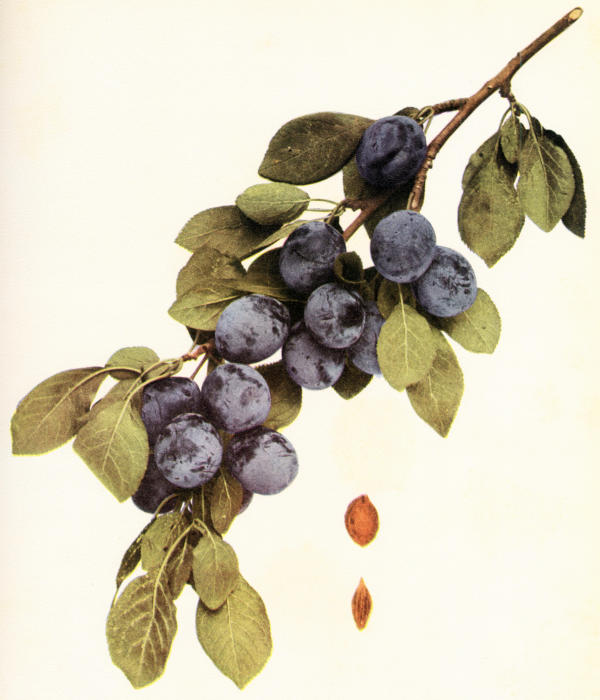
SHROPSHIRE
Prunus insititia
1. Rea Flora 209. 1676. 2. Lond. Hort. Soc. Cat. 146. 1831. 3. Prince Pom. Man. 2:90. 1832. 4. Loudon Enc. Gard. 921. 1834. 5. Downing Fr. Trees Am. 297. 1845. 6. Floy-Lindley Guide Orch. Gard. 282, 383. 1846. 7. Thompson Gard. Ass’t 520. 1859. 8. Hogg Fruit Man. 377. 1866. 9. Am. Pom. Soc. Cat. 36. 1875. 10. Hogg Fruit Man. 695. 1884. 11. Mich. Hort. Soc. Rpt. 289. 1889. 12. Am. Gard. 14:146 fig., 147, 148. 1893. 13. Cornell Sta. Bul. 131:192 fig. 46. 1897. 14. Garden 53:265. 1898. 15. Mich. Sta. Bul. 169:243, 247. 1899. 16. Waugh Plum Cult. 130 fig. 1901. 17. Va. Sta. Bul. 134:44. 1902. 18. Ga. Sta. Bul. 67:281 fig. 1904.
Cheshire 14. Damascene 8, 10, 14. Damson Plum 3. Long Damson 2. Long Damson 7, 8, 10. Pruine Damson? 1. Prune Damson 2, 4, 5, 7, 14. Prune Damson 6, 8. Prune 10. Shropshire Damson ?6, 8, 10, 15, 16, 17. Shropshire Damson 2, 3, 4, 7, 9, 11, 12, 13, 18.
In America, Shropshire is probably the best known of the Damsons, being found not only in nearly all commercial plantations but in the smallest home collections as well. The qualities which make it so generally a favorite are for most part those of the tree, the French surpassing it in size and in quality of the fruit. The trees of the variety under notice are not surpassed by any other Insititia in size, vigor, hardiness and health nor are they, except in size, by any other European plum. Shropshire is enormously productive, bearing its load of fruit year after year until it is a standard among fruits for productivity and reliability in bearing. The trees have but one defect,—unless sprayed the foliage falls prey to fungi and drops early. The trees are comparatively easy to manage in such orchard operations as pruning, spraying and harvesting as they are not so thick-topped, twiggy and spiny as other Damsons. The fruit is of very good size and while in no sense a dessert plum may be eaten out of hand with relish when fully ripe or after a light frost—a point worth considering where only Damsons can be grown. It is one of the best of its kind for culinary purposes. This old variety is still to be recommended for both home and market.
Shropshire originated in England, sometime in the Seventeenth Century. It was noted by American writers early in the Nineteenth Century and in 1875 was placed on the American Pomological Society’s fruit catalog list. Shropshire is a more familiar name in fruit literature than the references given indicate, being found in practically every English discussion of plums since 1676 and in all American notices of this fruit since Prince wrote in 1832. For a fruit so long under cultivation, it has few synonyms.
Tree large, vigorous, vasiform, hardy, productive; main branches numerous, ash-gray, smooth except for numerous scars from small spur-like branches, with many, small lenticels; branchlets twiggy, slender, with short internodes, green changing to dark brownish-drab, dull, covered with heavy pubescence throughout the season, with numerous, small lenticels; leaf-buds below medium in size, short, conical, appressed.
Leaves flattened, obovate, about one inch wide, two inches long, thin; upper surface dark green, pubescent along the grooved midrib; lower surface a paler green, with thin pubescence; apex obtuse or acute, base acute, margin finely serrate, eglandular; petiole one-half inch long, slender, greenish-red, with little pubescence, glandless or with one or two small, globose, greenish-yellow glands usually at the base of the leaf.
Season of bloom medium; flowers seven-eighths inch across, white; borne in clusters on lateral buds and spurs, singly or in pairs; pedicels three-eighths inch long, slender, glabrous, greenish; calyx-tube green, campanulate, glabrous; calyx-lobes narrow, acute, glabrous, the margin glandular-ciliate, reflexed; petals roundish-oval, entire, short-clawed; anthers yellow; filaments five-sixteenths inch long; pistil glabrous, shorter than the stamens.
Fruit late, season long; one and one-half inches by one inch in size, oval, compressed, halves equal; cavity shallow, narrow, flaring; suture an indistinct line; apex roundish; color purplish-black, overspread with thick bloom; dots numerous, small, russet, inconspicuous; stem slender, one-half inch long, glabrous, adhering to the fruit; skin thin, tender, adhering; flesh golden-yellow, juicy, firm but tender, agreeably tart at full maturity, sprightly, pleasant; stone clinging, three-quarters inch by one-half inch in size, oval, acute at the base, blunt at the apex, with nearly smooth surfaces; ventral suture broad, blunt; dorsal suture acute, with a narrow, shallow, indistinct groove.
SIMON
Prunus simonii
1. Rev. Hort. 111. 1872. 2. Horticulturist 27:196. 1872. 3. Ia. Hort. Soc. Rpt. 374, 378. 1881. 4. Ibid. 321. 1884. 5. Rural N. Y. 45:689 fig. 389. 1886. 6. Ibid. 46:766. 1887. 7. Ga. Hort. Soc. Rpt. 53, 99. 1889. 8. Mathieu Nom. Pom. 444. 1889. 9. Cal. State Bd. Hort. Rpt. 236, Pl. II figs. 1 and 2, 238. 1890. 10. Rev. Hort. 152 fig. 40. 1891. 11. Penin. Hort. Soc. Rpt. 68. 1891. 12. Cornell Sta. Bul. 51:55. 1893. 13. Mich. Sta. Bul. 103:35. 1894. 14. Guide Prat. 164, 362. 1895. 15. Neb. State Hort. Soc. Rpt. 175. 1895. 16. Kan. Sta. Bul. 73:192. 1897. 17. Vt. Sta. Bul. 67:29. 1898. 18. Am. Pom. Soc. Cat. 41. 1899. 19. Waugh Plum Cult. 14, 38, 234. 1901.
Apricot Plum 12, 19. Apricot Plum 9, 11. Plum Simon 2. Prune Eugene Simon 8. Prunier de Simon 8, 14. Prunus simoni 4, 7, 17. Prunus Simonii 2. Prunus Simonii 1, 3, 6, 8, 10, 11, 14, 16, 19. Prunus simoni 8. Simon 19. Simon’s Chinese Apricot Plum 7. Simon’s Peach 15. Simon’s Plum 5.
The Simon plum, a horticultural variety, constitutes the species Prunus simonii and has been fully discussed in the chapter of this text dealing with the botany of the plum. It is given further notice only to introduce the horticultural references and history and to estimate briefly its value in fruit-growing. As to the latter it may be said that the fruit is for most people unpalatable, and therefore of little worth as an edible product. Some of the crosses of which this variety is one parent are well known and esteemed in pomology and the Simon plum undoubtedly has value for plum-breeding in the future. The tree, where it succeeds, is a handsome ornamental. In New York the variety seems hardy wherever the peach can be grown and thrives on the same types of soils—sands, gravels and light loams. The tree is subject to diseases and unless well sprayed is liable to be short-lived. The variety can be recommended in New York only to the breeder of plums and for those who want the tree as an ornamental or a curiosity.
This interesting and distinct plum was obtained in China by Eugene Simon, a French consul, who sent it to the Paris Museum of Natural History in 1867. Later it was disseminated by the nurseries of Simon Brothers at Plantières-Les-Metz. The date of its introduction into America is unknown, though it was offered for sale by the eastern nurseries as early as 1881. Ellwanger and Barry of Rochester secured their stock from France a few years previous to the date given but whether they were the only importers cannot be said. In 1899 the American Pomological Society added Simon to its catalog list. The variety is fully described under its species.
SIMPSON
Prunus domestica
1. Ohio Sta. Bul. 113:161. 1899. 2. Ibid. 162:256, 257. 1905.
The fruit of Simpson is too small and is so much below the average of its type, that of the Yellow Egg, in quality that it is not worth general introduction. It is given attention here chiefly as a matter of record. Although unquestionably a Domestica, Simpson was found growing wild in the woods west of Peoria, Illinois. It was introduced by H. Augustine of Normal, Illinois, about 1888.
Tree large, very vigorous, upright-spreading, dense, very productive; branchlets slender, with long internodes, thickly pubescent; leaf-buds large, long; leaves flattened, oval, intermediate in width and length; margin serrate, eglandular; petiole pubescent, glandless or with from one to three globose glands usually on the stalk; flowers one inch across, borne in scattering clusters, singly or in pairs; calyx-lobes thickly pubescent on both surfaces.
Fruit mid-season; one and one-half inches by one and three-eighths inches in size, oval, golden-yellow, covered with thin bloom; flesh golden-yellow, juicy, firm but tender, sweet, mild; good; stone semi-free, seven-eighths inch by one-half inch in size, oval, acute at the base; ventral suture usually winged; dorsal suture widely and deeply grooved.
SMALL REINE CLAUDE
Prunus domestica
1. Duhamel Trait. Arb. Fr. 2:91. 1768. 2. Kraft Pom. Aust. 39, Tab. 189 fig. 2. 1796. 3. M’Mahon Am. Gard. Cat. 587. 1806. 4. Lond. Hort. Soc. Cat. 147, 148, 154. 1831. 5. Prince Pom. Man. 2:49. 1832. 6. Mag. Hort. 9:164. 1843. 7. Downing Fr. Trees Am. 288. 1845. 8. Floy-Lindley Guide Orch. Gard. 284, 383. 1846. 9. Thomas Am. Fruit Cult. 330. 1849. 10. Downing Fr. Trees Am. 913. 1869. 11. Mas Pom. Gen. 2:93. 1873. 12. Oberdieck Deut. Obst. Sort. 435. 1881. 13. Hogg Fruit Man. 732. 1884. 14. Mathieu Nom. Pom. 437. 1889.
Die kleine Königin Claudia 2. English Yellow Gage 9, 10. English Yellow Gage 11, 14. Gonne’s Green Gage 6, 7, 10, 13, 14. Gonne’s Green Gage 4. Kibitzenei 14. Kleine Dauphine 14. Kleine Reine-Claude 12, 14. Kleine Weisse Damascene 12, 14. Kleine Reine-Claude 11. Kleine Grüne Reine-Claude 11, 12, 14. Little Reine Claude 5. Little Queen Claude 7, 9, 10, 11, 13, 14. Little Queen Claude 8. Little Queen Claudia 3. Little Queen Claudia 5. Petite Reine-Claude 1, 11. Petite Reine-Claude 2, 5, 7, 8, 10. Petit Damas Vert 13, 14. Reine-Claude Petite Espece 14. Reine-Claude Blanche Petite Espece 5, 6, 7, 10. Reine-Claude Blanche 6, 7, 10, 14. Reine-Claude Petite 13, 14. Reine Claude (of some) 6. Small Green Gage 5, 7, 10, 14. Small Queen Claude 5. White Gage 6, 7, 10, 13, 14. White Gage 4. Yellow Gage 4, 6, 7, 13. Yellow Gage 11, 14.
Small Reine Claude, an old variety of unknown origin, is now probably obsolete. Thomas and Downing described it as an English Yellow Gage but it cannot be found that it is ever so called in Europe. Since the variety was known in France and Austria in the latter part of the Eighteenth Century it is quite certain that it originated on the continent. From its name and close resemblance to the Reine Claude it is safe to state that it is a seedling of that sort. It is described as follows:
Tree of normal vigor; branches smooth; flowers small; fruit medium in size, nearly spherical, truncated on the stem side and slightly on the apex; suture wide and distinct, thus differing from the Reine Claude; stem medium in length; cavity shallow; skin tender, yellowish-green, often splashed with red on the sunny side; flesh greenish-yellow, fine, a little firm, sweet, rich and pleasant; freestone; ripens earlier than the Reine Claude.
SMITH ORLEANS
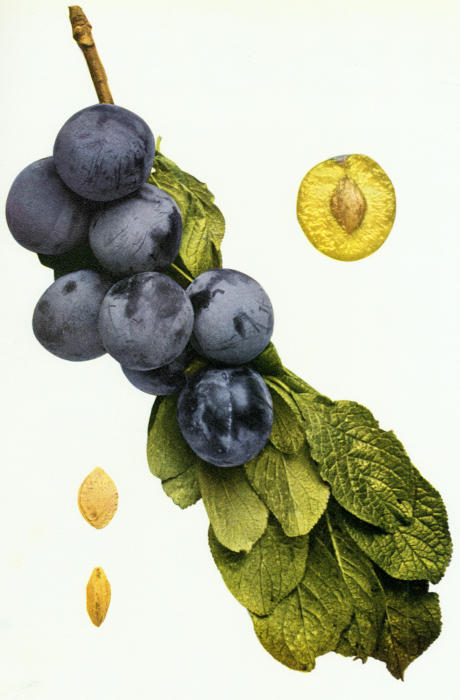
SMITH ORLEANS
Prunus domestica
1. Prince Treat. Hort. 27. 1828. 2. Prince Pom. Man. 2:68. 1832. 3. Mag. Hort. 9:410. 1843. 4. Downing Fr. Trees Am. 304, 305 fig. 125. 1845. 5. Mag. Hort. 14:152, 153 fig. 16. 1848. 6. Cole Am. Fr. Book 214 fig. 1849. 7. Thomas Am. Fruit Cult. 343. 1849. 8. Elliott Fr. Book 424. 1854. 9. Am. Pom. Soc. Cat. 210. 1856. 10. Hooper W. Fr. Book 252. 1857. 11. Hogg Fruit Man. 382. 1866. 12. Mathieu Nom. Pom. 450. 1889. 13. Ont. Fr. Exp. Sta. Rpt. 52. 1895. 14. Cornell Sta. Bul. 131:192. 1897.
Cooper’s 5. Cooper’s Large 5. Cooper’s Large Red 5. Cooper’s Red 6. Duane’s Purple 3 incor. La Delicieuse 8. Large Orleans 3. Large Purple 3 incor. Monsieur de Smith 12. Purple Magnum Bonum 3. Red Magnum Bonum incor. 3, 4, 5, 6, 12. Smith’s large Orleans 2. Smith’s Orleans 1, 2, 3, 4, 6, 7, 8, 9, 10, 11, 13, 14. Smith’s Orleans 5, 12. Smith’s Orleans Pflaume 12. Smith’s Herrn Pflaume 12. Violet Perdrigon incor. 3, 4, 5, 6, 12. Violetter Perdrigon 12 incor.
In the middle of the last century, Smith Orleans was considered about the best plum of its color in America. But the fruit is not high in quality, the texture of the flesh is coarse and it ripens at a time when fruits are plentiful, for which reasons it has ceased to be regarded with favor by either the amateur or the professional fruit-grower. The trees, however, seem to have some remarkably desirable characters and it may be that the variety should be retained for some locations and purposes and to breed from, at least. If the older pomologists have written truly few plums are adapted to a greater range of climates and soils than this one; so, too, the trees are usually spoken of as of large size, vigorous, healthy, of great productiveness and as holding the crop well. The trees in the soil and climate of this Station are quite as the older writers describe them and were the fruit only better in quality and somewhat more attractive in appearance, the variety could be highly recommended for a market plum and as a fruit for culinary purposes in the home orchard.
William Prince, in 1828, in his Treatise on Horticulture, briefly described Smith Orleans, and seventeen years later A. J. Downing gave a short history of the variety. It is a seedling of the Orleans raised about 1825 by a Mr. Smith of Gowanus, Long Island, New York. By an error the variety was sent out as the Violet, or Blue Perdrigon, a smaller and very different fruit. Charles M. Hovey of Massachusetts, who secured trees of the Cooper from Prince, about 1831, believed this variety to be identical with the Smith Orleans in all characters. Downing could not agree with him but the present writers find that the two varieties are so much alike that it is impossible to distinguish between them. As is suggested under Cooper, they may be identical or they may have come true to seed from the same parent. The American Pomological Society recommended this plum for general cultivation in 1856.
Tree large, vigorous, spreading, open-topped, very productive; trunk rather rough; branches smooth, with few lenticels; branchlets of medium thickness and length, with long internodes, green changing to dark brownish-red, covered with thin bloom, lightly pubescent early in the season becoming almost glabrous at maturity, with few, small lenticels; leaf-buds of medium size and length, conical, appressed.
Leaves flattened or somewhat folded backward, obovate, two inches wide, three and five-eighths inches long, thick, velvety; upper surface dark green, rugose, with but few hairs along the narrow, deeply grooved midrib; lower surface silvery-green, covered with thick pubescence; apex abruptly pointed or acute, base acute, margin crenate, with few small, dark brown glands; petiole one-half inch long, heavily pubescent, tinged red along one side, glandless or with one or two small, globose, yellow glands usually at the base of the leaf.
Season of bloom medium, short; flowers appearing with the leaves, one and one-quarter inches across, white, with a yellow tinge; borne in clusters on lateral buds and spurs; pedicels five-eighths inch long, pubescent, greenish; calyx-tube green, campanulate, with few scattering hairs; calyx-lobes above medium in width, obtuse, sparingly pubescent on both surfaces, glandular-serrate and with marginal hairs, reflexed; petals broad-obovate or oval, crenate, tapering to long claws of medium width; anthers yellow, filaments seven-sixteenths inch long; pistil glabrous, shorter than the stamens.
Fruit intermediate in time and length of ripening season, one and five-eighths inches by one and one-half inches in size, oval, compressed, halves somewhat unequal; cavity shallow, narrow, abrupt; suture very shallow or sometimes a line; apex roundish or depressed; color dark purplish-black, overspread with thick bloom; dots numerous small, russet, inconspicuous; stem three-quarters inch long, pubescent, adhering to the fruit; skin below medium in thickness, tender, sour, separating readily; flesh pale yellow, juicy, tender, sweet, of pleasant flavor; good; stone clinging, one inch by five-eighths inch in size, oval, with very rough and deeply pitted surfaces, usually somewhat flattened, tapering abruptly at the base, blunt at the apex; ventral suture wide, blunt; dorsal suture with a groove variable in depth and width.
SOPHIE
Prunus munsoniana
1. U. S. D. A. Rpt. 263, Pl. VI. 1892. 2. Kerr Cat. 1894. 3. Waugh Plum Cult. 189. 1901.
Sophie is fast being lost sight of among the multitudes of native plums recently introduced. Without any very distinct merits it yet stands high among plums of its kind. The variety is a seedling of Wild Goose at first supposed by the originator, J. W. Kerr,[223] of Denton, Maryland, to have been pollinated by a German Prune which stood near. This is hardly the case, however, as no trace of Domestica blood can be detected in the variety. It is mentioned by the American Pomological Society in its catalog for 1899.
Tree large, very vigorous, spreading, open-topped, productive; branches thorny, shaggy, with long and unbranched limbs; branchlets willowy, slender; leaves folded upward, oval, one and three-quarters inches wide, three and one-quarter inches long, thin; margin shallowly crenate, with small, dark glands; petiole slender, pubescent, with from one to three small glands; blooming season late, long; flowers appearing after the leaves, nearly three-quarters inch across, white, pinkish as they open, with a disagreeable odor; borne in twos or threes; anthers yellow with an orange-red tinge.
Fruit maturing later than Wild Goose; large, one and three-eighths inches by one and one-eighth inches in size, obovate, slightly necked, pear-shaped, bright red, covered with thin bloom; dots conspicuous; stem slender, long; flesh deep yellow, juicy, coarse and fibrous, subacid, flat; of fair quality; stone clinging, three-quarters inch by three-eighths inch in size, somewhat angular, irregular-obovate, with a peculiar elongated, flattened, oblique base; apex abruptly acute; surfaces rough.
SPAULDING
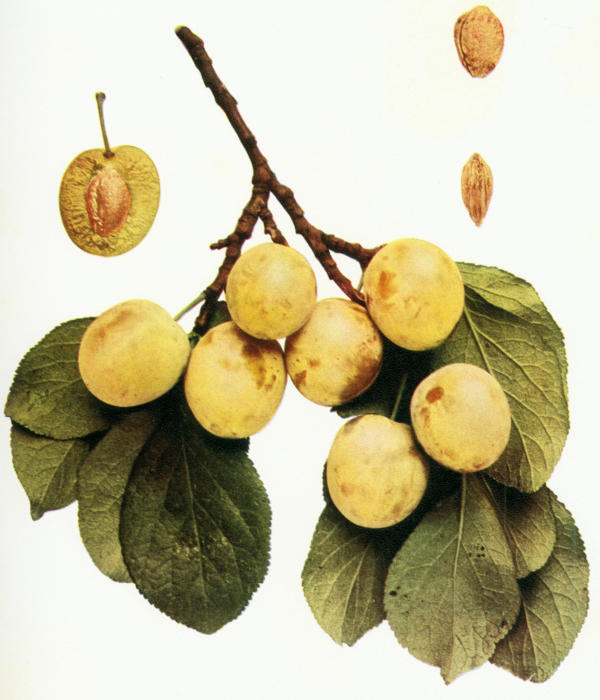
SPAULDING
Prunus domestica
1. Lovett Cat. 41, Col. Pl. 1888. 2. Cornell Sta. Bul. 131:192. 1897. 3. Mich. Sta. Bul. 169:243, 248. 1899. 4. Am. Pom. Soc. Cat. 39. 1899. 5. Kan. Sta. Bul. 101:121, 122, Pl. V. 1901. 6. Waugh Plum Cult. 122. 1901. 7. Ohio Sta. Bul. 162:239. 1905.
Among the plums of comparatively recent introduction Spaulding holds a conspicuous place. It is particularly highly spoken of for its good quality and while not recommended for commercial orchards is often mentioned as very desirable for home use. As Spaulding grows at this Station, it does not sustain the reputation it has elsewhere. It is of the Reine Claude group of plums and while of high quality is not as good a dessert plum as several other similar sorts. Moreover, the fruits are small and too light in color to be especially attractive in appearance. The plums, too, are quite susceptible to brown-rot. The tree-characters of this variety are in the main very good but not at all out of the ordinary. It is very doubtful whether this sort can compete for any purpose with such similar plums as Hand, Jefferson, Washington, Bavay, Reine Claude, McLaughlin and Imperial Gage. It may be worthy a trial elsewhere in New York with the hope that it will more nearly approach the reputation that it has in other states than it does at Geneva—at best it cannot be more than a home variety.
Spaulding was brought to the notice of fruit-growers by J. T. Lovett, Little Silver, New Jersey, who introduced the variety in 1888. The plum came to Mr. Lovett from Francis Garriel with the statement that it originated as a seedling in the yard of Mr. Garriel’s father in the Bowery, New York City. From the resemblance of Spaulding to the Imperial Gage it is probable that they are closely related. In 1899 the variety was placed on the fruit catalog list of the American Pomological Society as a successful variety in the north-eastern part of the United States and the neighboring parts of Canada.
Tree large, vigorous, upright-spreading, dense-topped, hardy, productive; branches ash-gray, smooth except for the raised lenticels of various sizes; branchlets of medium thickness and length, with long internodes, greenish-red changing to brownish-red, dull, lightly pubescent throughout the season, with obscure, small lenticels; leaf-buds of medium size and length, conical, appressed; leaf-scars prominent.
Leaves folded upward, nearly two inches wide, three and one-quarter inches long, thick; upper surface dark green, rugose, glabrous, with a shallow groove on the midrib; lower surface silvery-green, pubescent; apex abruptly pointed or acute, base acute, margin serrate or crenate, with small, dark glands; petiole nearly five-eighths inch long, thick, pubescent, tinged red, with from one to four small, globose, greenish glands usually on the stalk.
Blooming season intermediate in time and length, one inch or more across, white with a yellowish tinge at the apex of the petals in the newly opened flowers; borne on lateral spurs, singly or in pairs; pedicels three-eighths inch long, thick, pubescent, greenish; calyx-tube green, campanulate, lightly pubescent; calyx-lobes obtuse, pubescent on both surfaces, glandular-serrate, reflexed; petals oblong, crenate, not clawed; anthers yellow; filaments one-quarter inch long; pistil glabrous or occasionally with a few hairs near the base, longer than the stamens; stigma large.
Fruit mid-season, ripening period long; one and five-eighths inches by one and three-eighths inches in size, oblong-oval or ovate, compressed, halves equal; cavity small, shallow, abrupt; suture shallow, often a line; apex roundish; color dull greenish-yellow, with stripes and splashes of light green, overspread with thick bloom; dots numerous, small, whitish, inconspicuous; stem three-quarters inch long, lightly pubescent, adhering well to the fruit; skin thin, tender, separating readily; flesh greenish-yellow, juicy, fibrous, tender, sweet, mild, pleasant; very good; stone semi-free or free, seven-eighths inch by five-eighths inch in size, ovate, turgid, slightly pitted, blunt at the base, nearly acute at the apex; ventral suture rather broad, slightly furrowed, with a distinct but short wing; dorsal suture widely and deeply grooved.
STANTON
Prunus domestica
1. Gard. Mon. 29:116. 1887. 2. Mich. Hort. Soc. Rpt. 288. 1889. 3. Cornell Sta. Bul. 131:192. 1897.
Stanton’s Seedling 2.
This plum appears to be a very good late variety in several respects; it is a long-keeping fruit, is of very good quality for dessert and is a fine plum for canning and preserving. Its faults are that it is tardy in coming into bearing and the fruits drop badly from the trees as they begin to ripen; in localities where these faults are marked the variety is worthless. Stanton originated as a chance seedling in Albany County, New York, from whence it was sent to Hammond and Willard of Geneva, New York, who introduced it about 1885.
Tree very large and vigorous, round-topped, variable in productiveness; branches slender, marked by transverse cracks in the bark; leaf-scars enlarged; leaves folded upward, oval or obovate, one and one-half inches wide, three inches long; margin finely and doubly crenate, with few, dark glands; petiole short, glandless or with from one to three small glands usually on the stalk; blooming season intermediate in time and length; flowers appearing after the leaves, one and one-eighth inches across, borne in scattering clusters on lateral buds and spurs, singly or in pairs.
Fruit late, season long; about one and one-quarter inches in diameter, roundish-oblate, truncate, purplish-black, overspread with very heavy bloom; flesh bright golden-yellow, fibrous, very sweet, rather high-flavored; good to very good; stone semi-free, three-quarters inch by five-eighths inch in size, irregular roundish-oval, turgid, with a blunt and oblique base, the surfaces nearly smooth; ventral suture enlarged, often with a short, distinct wing; dorsal suture shallow.
STODDARD
Prunus americana
1. Ia. Hort. Soc. Rpt. 78. 1892. 2. Am. Pom. Soc. Rpt. 88. 1895. 3. Am. Pom. Soc. Cat. 38. 1899. 4. Ia. Sta. Bul. 46:289. 1900. 5. U. S. D. A. Rpt. 478, Pl. LXII. 1902.
Baker 2. Stoddart 1, 2.
Stoddard is usually rated as one of the best of the Americana plums and its behavior on the grounds of this Station sustains its reputation. The firmness of the fruit makes it a good shipping plum of its kind and season. This variety was discovered by B. F. Stoddard of Jesup, Buchanan County, Iowa, about 1875, growing in a garden owned by Mrs. Caroline Baker who stated that her husband secured the trees from the woods, presumably along the Maquoketa River. The variety was subsequently introduced by J. Wragg and Sons of Waukee, Iowa, at dates variously reported from 1890 to 1895.
Tree large, vigorous, spreading, open-topped, productive; trunk shaggy; branches slender, thorny; branchlets slender, with conspicuous, large, raised lenticels; leaves falling early, flattened, oval or obovate, two and one-quarter inches wide, four inches long; margin coarsely serrate, eglandular; petiole tinged red, glandless or with from one to three glands usually on the stalk; blooming season late; flowers appearing with the leaves, one inch across, white.
Fruit intermediate in time and length of ripening season; about one and three-eighths inches in diameter, roundish-oblate; suture a distinct red line; color light to dark red over a yellow ground, mottled, covered with thick bloom; skin astringent; flesh dark golden-yellow, very juicy, tender and melting, rather sweet next the skin but tart near the center, with a characteristic flavor; good; stone clinging, seven-eighths inch by five-eighths inch in size, roundish to broad-oval, strongly flattened, with smooth surfaces; ventral suture narrow, winged.
STONELESS
Prunus insititia
1. Duhamel Trait. Arb. Fr. 2:110, Pl. 20 fig. 14. 1768. 2. Kraft Pom. Aust. 2:42, Tab. 194 fig. 2. 1796. 3. Mag. Hort. 9:165. 1843. 4. Poiteau Pom. Franc. 1. 1846. 5. Mas Pom. Gen. 2:121, fig. 61. 1873. 6. Hogg Fruit Man. 726. 1884. 7. Mathieu Nom. Pom. 450. 1889.
Die Pflaume ohne Stein 2. Jean Morceau 3. Kirke’s Stoneless 6, 7. Pflaume Ohne Steine 5. Pitless 5, 7. Prune Sans-Noyau 4. Sans-Noyau 1, 5. Sans Noyau 3, 6, 7. Steinlose Zwetsche 7. Stoneless 5, 7.
This curious plum is attracting attention because of the publicity given it by Burbank in his breeding work. The variety is at least three hundred years old. It was known to Merlet, writing in the Seventeenth Century, and has been mentioned in plum literature many times since. The plum is remarkable because of the entire absence of a stone, the kernel lying naked in a cavity much larger than itself. The variety is worthless but presents opportunities for breeding purposes that should not be overlooked. Judging from the fruit-characters as given below it belongs to Prunus insititia. The Stoneless is supposed to have been introduced into England from the Royal Gardens at Versailles by George London. It was long sold as Kirke’s Stoneless, having been much advertised by Kirke, a nurseryman at Brompton, England. It is described as follows:
Fruit small, oval, dark purple, with thick bloom; flesh greenish-yellow, harsh and strongly acid at first but assuming a more pleasant flavor as it shrivels upon the tree.
SUGAR
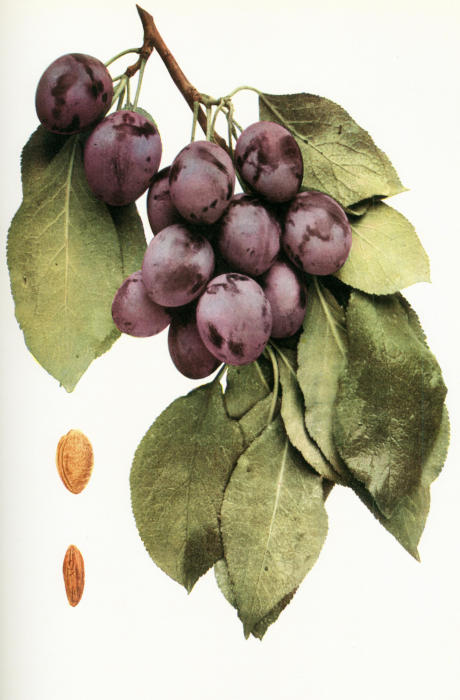
SUGAR
Prunus domestica
1. Cal. State Bd. Hort. 47. 1897-98. 2. Burbank Cat. 5 fig. 1899. 3. Waugh Plum Cult. 124. 1901. 4. U. S. D. A. Rpt. 275, Pl. XXXVI fig. 2. 1903.
Sugar Prune 1, 4.
The introduction of Sugar to the Atlantic States was preceded by very flattering accounts of it from the originator, Mr. Burbank, and from Pacific Coast plum-growers. Possibly our expectations were too high; for we have been greatly disappointed in this plum as compared with its parent, Agen, as the two varieties grow at Geneva—it should be said at once that neither grows nearly as well in New York as in California. The fruits of Sugar on the Station grounds are not larger than those of the Agen, while in California it is said to be twice or three times as large; the flavor is not as pleasant and the flesh is fibrous in the offspring and not so in the parent at Geneva, though in California the Sugar is said to be of better quality than the Agen. As the two grow here, Sugar is rather more attractive in appearance and ripens earlier, the latter character a distinct advantage since Agen is very late in New York. The trees of the two plums are much alike though those of Agen are larger and more productive than those of Sugar as grown in New York. There are, however, but two trees of the latter variety on the Station grounds and these are young, set in 1899, so that too much importance must not be attached to the comparison of the trees. Sugar is worth further trial in New York under other conditions of soil and climate but it is extremely doubtful whether it will surpass the Agen in this State.
This plum, a seedling of the well-known Agen, was introduced by its originator, Burbank, in 1899. The California Experiment Station in analyzing this plum found it to be richer in sugar than the Agen and states that it is larger and more easily dried. Sugar has become of great commercial importance in the California prune districts and has been top-grafted on other plums and even on almonds to the extent of hundreds of acres in that State and in Oregon. As yet it is only under trial in New York.
Tree of medium size, usually vigorous, spreading, dense-topped, hardy, productive; branches ash-gray, tinged red, smooth except for the numerous, small, raised lenticels; branchlets slender, with long internodes, green changing to brownish-red, dull, sparingly pubescent throughout the season, with numerous, inconspicuous, small lenticels; leaf-buds large, long, somewhat pointed, strongly appressed.
Leaves folded backward, obovate or oval, two and one-half inches wide, five inches long; upper surface dark green, rugose, covered with numerous hairs, the midrib narrowly grooved; lower surface pale green, overspread with thick pubescence; apex abruptly pointed or acute, base acute, margin serrate, with small dark glands; petiole nearly one inch long, covered with thick pubescence, lightly tinged with red, glandless or with from one to three small, globose, greenish-yellow glands at the base of the leaf.
Flowers large, intermediate in time of bloom; calyx-tube green; stamens longer than the pistil.
Fruit intermediate in time and length of ripening season; small, ovate or oval, halves equal; cavity shallow, narrow, abrupt; suture shallow, often a line; apex roundish or pointed; color dark reddish-purple changing to purplish-black, covered with thick bloom; dots numerous, small, light russet, inconspicuous; stem slender, long, pubescent, adhering; skin thin, tender, separating readily; flesh golden-yellow, juicy, coarse, fibrous, tender, sweet, mild; good to very good; stone light colored, with a tinge of red, thin, of medium size, ovate, flattened, with rough and pitted surfaces, blunt at the base, acute at the apex; ventral suture rather narrow, distinctly furrowed, slightly winged; dorsal suture with a wide, deep groove.
SURPRISE
SURPRISE
Prunus hortulana mineri?
1. Wis. Sta. Bul. 63:61 fig. 30. 1897. 2. Ia. Hort. Soc. Rpt. 112. 1899. 3. Am. Pom. Soc. Cat. 38. 1899. 4. Wis. Hort. Soc. Rpt. 69. 1900. 5. Ia. Sta. Bul. 46:289. 1900. 6. Wis. Sta. Bul. 87:18. 1901. 7. Waugh Plum Cult. 175. 1901. 8. Ia. Hort. Soc. Rpt. 228. 1904. 9. Ill. Hort. Soc. Rpt. 426. 1905. 10. S. Dak. Sta. Bul. 93:39. 1905.
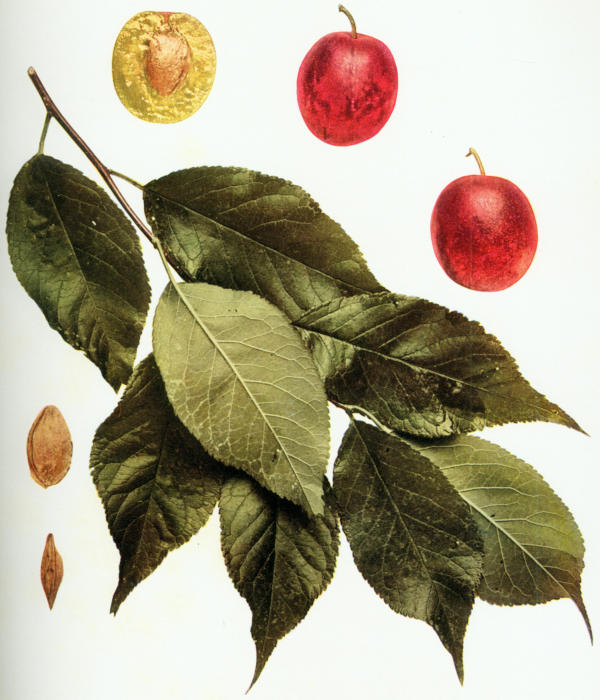
Surprise is one of the best of the native plums in the Station orchard. The fruits are very attractive in appearance and while not of the rich flavor of the Domesticas they are yet of pleasant flavor with an abundance of juice which together make this a most refreshing fruit. The fruits keep well and would probably ship well. The color is a peculiar red which serves to identify the variety; on the whole the fruits resemble the Americanas while the trees are rather more of the Miner type. The variety is productive in New York and is so spoken of in Wisconsin by Goff,[224] but in Iowa it is said not to bear abundantly. If a native plum is wanted in New York, this variety is worthy a trial.
Surprise, according to the originator, Martin Penning of Sleepy Eye, Brown County, Minnesota, is the best of a thousand or more seedlings grown from pits of De Soto, Weaver and Miner sown in 1882. In 1889, Penning introduced this plum and ten years later it was added to the fruit catalog list of the American Pomological Society. The parentage of the variety is unknown but it has usually been thought that the botanical characters indicate that it is a seedling of Miner. As the tree grows here, (they came to the Station from Mr. Penning,) it appears to be a hybrid of Prunus americana and Prunus hortulana mineri, characters of both species being evident.
Tree large, vigorous, upright, dense-topped, hardy, productive; trunk roughish; branches smooth, zigzag, thorny, dark ash-gray, with numerous, small lenticels; branchlets slender, medium to long, with long internodes, green changing to dark chestnut-red, with brownish-gray scarf-skin, glossy, glabrous, with numerous, conspicuous, small, raised lenticels; leaf-buds small, short, obtuse, plump, appressed.
Leaves falling early, folded upward, oval or ovate, two inches wide, four and one-half inches long, thin; upper surface light green, glabrous, smooth, with a grooved midrib; lower surface pale green, lightly pubescent; apex taper-pointed, base abrupt, margin often coarsely and doubly serrate, with amber glands which are not persistent; petiole thirteen-sixteenths inch long, slender, reddish, sparingly pubescent along one side, glandless or with from one to five small, globose, yellowish-brown glands usually on the stalk.
Blooming season intermediate in time and length; flowers appearing with the leaves, three-quarters inch across, creamy-white, with a disagreeable odor; borne in clusters from lateral buds, in threes or in fours; pedicels three-eighths inch long, slender, glabrous, green; calyx-tube greenish, campanulate, glabrous; calyx-lobes narrow, acute, pubescent on the inner surface, serrate and with reddish glands, erect; petals roundish-ovate, entire, narrowly clawed; anthers yellowish; filaments one-quarter inch long; pistil glabrous, equal to the stamens in length.
Fruit mid-season, ripening period short; one and three-eighths inches by one and one-eighth inches in size, halves equal; cavity shallow, flaring; suture very shallow, distinct; apex roundish or depressed; color dark red, covered with thin bloom; dots numerous, medium to large, russet, conspicuous, clustered about the apex; stem one-half inch long, glabrous, adhering to the fruit; skin thick, tough, clinging; flesh golden-yellow, juicy, fibrous, somewhat tender, sweet, insipid; quality fair; stone clinging, one inch by five-eighths inch in size, oval, flattened, pointed at the base and apex, with smooth surfaces.
TENNANT
TENNANT
Prunus domestica
1. Bailey Ann. Hort. 133. 1893. 2. Oregon Sta. Bul. 45:32. 1897. 3. Am. Pom. Soc. Cat. 40. 1899. 4. Can. Exp. Farm Bul. 2nd Ser. 3:57. 1900. 5. Waugh Plum Cult. 124. 1901. 6. Budd-Hansen Am. Hort. Man. 326. 1903.
Tennant Prune 1. Tenant Prune 4.
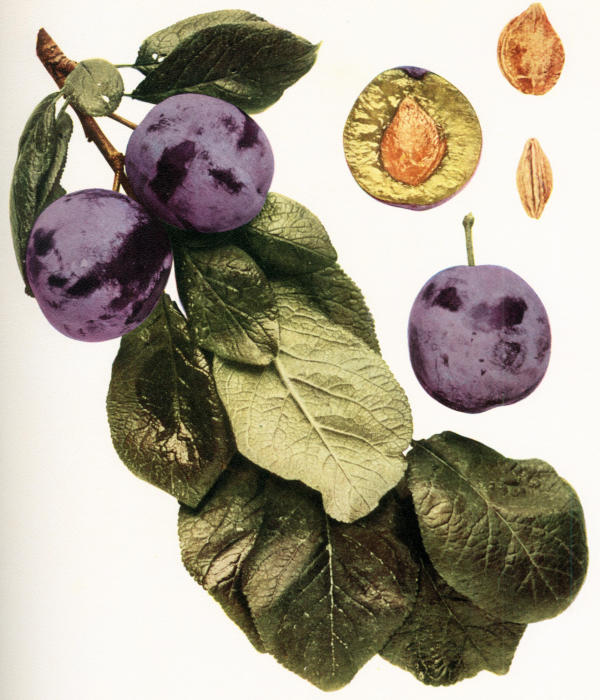
It is surprising that a variety of so much merit, especially of so great beauty, as Tennant, should not have been more widely tried in New York. In the survey of plum culture in this State in the preparation of the text for The Plums of New York, it could not be learned that the Tennant had been tried in more than four or five places. In size and beauty of form and coloring, all well shown in the illustration, Tennant has few superiors in the collection of plums growing at this Station. While it is not sufficiently high in quality to be called a first-rate dessert fruit it is more palatable than most of the purple plums. It ripens at a good time of the year, several days before the Italian Prune, and should, from the nature of its skin and the firmness of its flesh, both ship and keep well. A fault of the fruit as it grows here, a fault not ascribed to it elsewhere, is that it shrivels soon after ripening. Our trees are large, vigorous, healthy, hardy and productive—almost ideal plum-trees. This variety should be very generally tried in commercial plantations in New York and may well be planted in home collections for a culinary fruit at least. On the Pacific Coast it is cured for prunes, its meaty flesh fitting it very well for this purpose.
This is another promising plum from the Pacific Northwest. Tennant originated with Rev. John Tennant of Ferndale, Washington, and was introduced in 1893 by McGill and McDonald, Salem, Oregon. The variety is fairly well known in the region of its origin but is practically unknown in New York. It was listed in the American Pomological Society catalog in 1897 as successful in the Pacific Northwest.
Tree large, vigorous, round-topped, open, hardy, productive; trunk slightly roughened; branches stocky, smooth, with lenticels of medium number and size; branchlets thick, long, with long internodes, greenish-red changing to brownish-drab, with green patches and considerable scarf-skin, somewhat glossy, sparingly pubescent throughout the season, with small lenticels; leaf-buds large, long, pointed, appressed; leaf-scars prominent.
Leaves folded backward, oval or obovate, one and three-quarters inches wide, three and one-half inches long, thick, stiff; upper surface dark green, rugose, sparingly hairy, with a grooved midrib; lower surface silvery-green, with thick pubescence; apex abruptly pointed to acute, base acute, margin crenate, eglandular or with small, brown glands; petiole five-eighths inch long, thick, tinged red along one side, hairy, glandless or with one or two rather large, globose, brownish glands variable in position.
Blooming season early to medium, short; flowers appearing after the leaves, one inch or more across, white, the buds tinged yellow; borne on lateral spurs; pedicels one-half inch long, thick, pubescent, greenish; calyx-tube green, often with a swelling around the base, campanulate, pubescent; calyx-lobes broad, obtuse, pubescent on both surfaces, with thick, marginal hairs, erect; petals roundish-oval, entire, tapering to short, broad claws; anthers large, yellow; filaments five-sixteenths inch long; pistil pubescent at the base, equal to the stamens in length; stigma large.
Fruit intermediate in time and length of ripening season; one and three-quarters inches by one and five-eighths inches in size, roundish-truncate or roundish-oblong, with irregular surface which is somewhat ridged, halves equal; cavity narrow, abrupt, slightly compressed; suture variable in depth, distinct; apex deeply depressed; color dark reddish-purple, overspread with thick bloom; dots numerous, variable in size, whitish, conspicuous, clustered about the apex; stem thick, three-eighths inch long, pubescent, adhering well to the fruit; skin tough, adhering slightly to the pulp; flesh dark golden-yellow, somewhat dry, coarse, tough, firm, sweet, mild but pleasant; of good quality; stone clinging, seven-eighths inch by five-eighths inch in size, irregular-oval, flattened, obliquely necked, blunt at the apex, with deeply pitted surfaces, roughish; ventral suture prominent, heavily furrowed, not winged; dorsal suture usually with a narrow, shallow groove.
TRAGEDY
TRAGEDY
Prunus domestica
1. Cal. State Bd. Hort. 236, Pl. II fig. 5, 237. 1890. 2. Ibid. 109 fig. 8. 1891. 3. Wickson Cal. Fruits 358. 1891. 4. N. Mex. Sta. Bul. 27:125. 1898. 5. Am. Pom. Soc. Cat. 40. 1899. 6. Waugh Plum. Cult. 124. 1901.
Tragedy Prune 1, 3, 4.
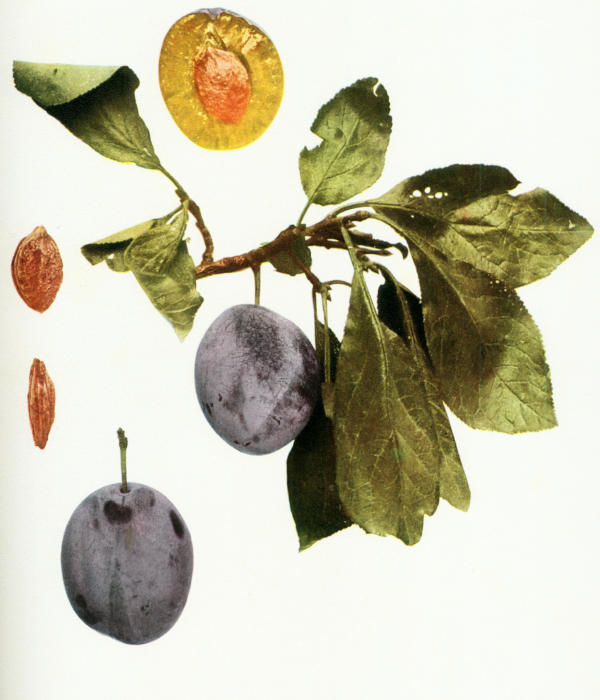
Tragedy is another western plum which, like the Tennant, has not been well tested in the East. It is an older plum than the Tennant and somewhat better known in New York but still the reports of it are not sufficient in number or of great enough range to enable a fair opinion to be given as to its merits. As the variety grows at Geneva the fruits are very attractive in appearance—above medium size, a dark, rich purple color, and having the full, rounded form much liked by consumers in a dessert plum. The flesh is juicy, tender and sweet so that the quality may be called good; possibly the flesh is a little too soft for long shipping or long keeping as it grows here, though in one of the California references it is spoken of as “valuable for eastern shipment.” The trees are very satisfactory except that in New York they are not quite as reliable in bearing as could be wished. A fault, as the variety grows here and which may be local, is that a large proportion of the pits are cracked and all are soft and granular. The tree is reported by some as “scale proof” but unfortunately this statement can neither be denied nor affirmed. A plum with the good qualities possessed by Tragedy, should be better known in New York.
The following history is contributed by Professor E. J. Wickson, Berkeley, California. Tragedy originated as a chance seedling on the farm of O. R. Runyon, near Courtland, Sacramento County, California, probably in the late seventies. It was first offered to the trade in dormant buds by W. R. Strong and Company of Sacramento in 1887. Since the German Prune and Duane Purple grew on the place of its origin and as it shows characters of both, it has been noted as a probable cross of these varieties. The name Tragedy is understood to have been given to the fruit by Mr. Runyon because the plum was noted to be desirable on or about a day upon which a certain event held to be tragical occurred in the neighborhood. In 1899, the American Pomological Society considered Tragedy worthy a place in its list of fruits.
Tree large, vigorous, round-topped, hardy, variable in productiveness; branches ash-gray, usually smooth, with raised lenticels of various sizes; branchlets twiggy, thick, medium to short, with short internodes, greenish-red changing to dark brownish-drab, covered with thick pubescence, with obscure, small lenticels; leaf-buds intermediate in size and length, obtuse, plump, appressed.
Leaves folded backward, oval or obovate, one and three-quarters inches wide, three and three-quarters inches long; upper surface dark green, glabrous except for the few hairs on the deeply and narrowly grooved midrib; lower surface pubescent; apex acute or obtuse, base acute; petiole five-eighths inch long, thick, pubescent, faintly tinged red, glandless or with one or two small, globose, greenish-brown glands usually at the base of the leaf.
Blooming season early, short; flowers appearing with the leaves, seven-eighths inch across, white; borne on lateral buds, usually in pairs; pedicels one-half inch long, thick, pubescent, greenish; calyx-tube green, with roughened surface, campanulate, glabrous; calyx-lobes acute, lightly pubescent, serrate, with many glands and marginal hairs, reflexed; petals broadly oval, crenate, short-clawed; anthers bright yellow; filaments nearly five-sixteenths inch long; pistil pubescent at the base, much longer than the stamens.
Fruit early, season short; one and five-eighths inches by one and three-eighths inches in size, oval, swollen on the suture side, compressed, halves unequal; cavity narrow, abrupt, regular; suture shallow, often an indistinct line; apex roundish; color dark purplish-black, covered with thick bloom; dots numerous, variable in size, russet, inconspicuous; stem five-eighths inch long, pubescent, adhering well to the fruit; skin of medium thickness and toughness, somewhat sour, separating readily; flesh greenish-yellow, juicy, tender, sweet, mild; good; stone clinging, one inch by five-eighths inch in size, irregular-oval, flattened, obliquely necked; apex acute; surfaces pitted, roughish; ventral suture narrow, prominent, not winged; dorsal suture narrowly and deeply grooved.
TRANSPARENT
Prunus domestica
1. Downing Fr. Trees Am. 395. 1857. 2. Flor. & Pom. 56, Col. Pl. fig. 1862. 3. Hogg Fruit Man. 383. 1866. 4. Downing Fr. Trees Am. 950. 1869. 5. Jour. Hort. N. S. 17:258. 1869. 6. Am. Pom. Soc. Rpt. 91. 1869. 7. Am. Pom. Soc. Cat. 24. 1871. 8. Pom. France 7: No. 25. 1871. 9. Mas Pom. Gen. 2:31, fig. 16. 1873. 10. Cat. Cong. Pom. France 365. 1887. 11. Mathieu Nom. Pom. 428. 1889. 12. Guide Prat. 154, 364. 1895. 13. Nicholson Dict. Gard. 3:166. 14. Waugh Plum Cult. 124. 1901. 15. Soc. Nat. Hort. France Pom. 554 fig. 1904.
Diaphane 4, 12. Diaphane Lafay 4. Durchscheinende Reineclaude 9, 12. Durchscheinende Reine-Claude 11. Prune Diaphane 9. Prune Diaphane Laffay 4, 11. Reine-Claude De Guigne 9. Reine-Claude Diaphane 1, 8, 9, 10, 12, 15. Reine-Claude Diaphane 2, 3, 4, 5, 11. Reine-Claude Transparente 9, 11, 12, 15. Reine-Claude Transparent 4. Transparent Green Gage 6. Transparent Gage 3, 4, 7, 8, 13. Transparent Gage 8, 9, 10, 11, 12, 14, 15. Transparent Gage Plum 2, 5.
In Europe Transparent is considered one of the best of all dessert plums but either it does not do as well in America or the American bred plums of the Reine Claude group, to which this variety belongs, are much better on this continent than in the Old World. At any rate in our soil and climate there are a dozen or more Reine Claude plums as good or better in quality than Transparent and much superior in other characters. It is, however, worth planting by the connoisseur for its quality and because of the transparency of skin—in the latter respect it is unique among Domestica plums. The flower-buds of this variety have a remarkable tendency to produce leaves in the place of floral organs.
Transparent is an old French variety. M. Lafay, a rose-grower at Bellevue, near Paris, raised it from the seed of the Reine Claude and named it Reine Claude Diaphane. It was grown previous to 1836, for, during this year, Thomas Rivers of England, while visiting M. Lafay, was told of its origin. In 1871, the American Pomological Society listed Transparent in its catalog as worthy of culture. The color of this variety leads to the suspicion that Reine Claude is not the only parent.
Tree large, vigorous, spreading, open-topped, hardy, productive; branches slender, ash-gray, roughish towards the trunk, with small lenticels; branchlets above medium in thickness, short, with internodes of average length, green changing to brownish-red often retaining some green, dull, pubescent, with small lenticels; leaf-buds of medium size and length, conical, somewhat appressed.
Leaves folded upward, obovate or oval, two and one-half inches wide, five inches long, above average thickness; upper surface rugose, nearly glabrous, with a grooved midrib; lower surface pubescent; apex abruptly pointed or acute, base acute, margin often doubly serrate or crenate, with small, dark glands; petiole seven-eighths inch long, thick, pubescent, faintly tinged red, glandless or with from one to four rather large, globose or oval, greenish-brown glands usually on the stalk.
Season of bloom medium, short; flowers appearing after the leaves, one and one-eighth inches across, white; borne in scattering clusters on lateral buds and spurs, singly or in pairs; pedicels five-eighths inch long, thick, pubescent, greenish; calyx-tube green, campanulate, glabrous; calyx-lobes obtuse, lightly pubescent, glandular-serrate, reflexed; petals obovate, crenate, tapering to short, broad claws; anthers yellow with a tinge of red; filaments three-eighths inch long; pistil glabrous, shorter than the stamens, often in pairs.
Fruit late, intermediate in length of ripening season; one and three-eighths inches by one and one-half inches in size, oblate, compressed; halves equal; cavity wide, flaring; suture a line; apex flattened or depressed; color red over a dark amber-yellow ground, mottled, covered with thin bloom; dots numerous, grayish or light russet, conspicuous, decreasing in number but increasing in size towards the cavity; stem thick, three-quarters inch long, pubescent, adhering well to the fruit; skin thin, adhering but slightly; flesh golden-yellow, juicy, fibrous, tender, very sweet, aromatic, pleasant; very good to best; stone clinging, five-eighths inch by one-half inch in size, roundish-oval, turgid, blunt at the base and apex, with slightly pitted surfaces; ventral suture, wide, blunt, faintly grooved; dorsal suture with a deep groove of medium width.
UNGARISH
Prunus domestica
1. Ia. Agr. Col. Bul. 50, 51. 1886. 2. Ia. Hort. Soc. Rpt. 86. 1890. 3. Mich. Sta. Bul. 118:53. 1895. 4. Kan. Sta. Bul. 101:117, 119, 120 fig. 1901. 5. Waugh Plum Cult. 109. 1901. 6. Can. Exp. Farms Rpt. 102. 1902. 7. Budd-Hansen Am. Hort. Man. 326. 1903. 8. Can. Exp. Farms Rpt. 433. 1905.
Hungarian 3, ?6. Hungarian Prune 3. Hungarian Prune 4. Hungary 1. Ungarische 8. Ungarish Prune 2, 7. Quetsche de Hongrie 1. Zwetsche Ungarische 1.
Budd’s Ungarish as grown at the New York State Experiment Station is nearly identical with the Italian Prune. The only differences to be detected are that the Italian Prune is a trifle smaller, a little more firm, not as broad and not quite as sweet as the Ungarish. The pit of the latter is usually tinged with red, while that of the former is rarely so colored. If the Ungarish prove as productive as the Italian Prune it may be more desirable because of its larger size. In 1883 Professor J. L. Budd of the Iowa Experiment Station imported trees under the name Quetsche de Hongrie or Zwetsche Ungarische from C. H. Wagner of Riga, Russia and from Wilhelm Wohler of Wilna, Russia. Budd disseminated the variety as Hungary, a name soon changed to Hungarian Prune and later to Ungarish. This is not to be confused with the true Hungarian so well known in Europe as the Quetsche de Hongrie.
UTAH
Prunus besseyi × Prunus watsoni
1. Dieck in Dippel Laubholzkunde 3:634. 1893. 2. Cornell Sta. Bul. 70:262, Pl. II fig. 3. 1894. 3. Tex. Sta. Bul. 32:490. 1894. 4. Vt. Sta. Bul. 67:21. 1898. 5. Waugh Plum Cult. 225. 1901.
Black Utah Hybrid 2, 4, 5. Utah Hybrid 1, 2, 3, 4, 5.
This interesting natural hybrid was grown by J. E. Johnson at Wood River, Nebraska, some time previous to 1870. Mr. Johnson planted seed of the native dwarf cherry which had grown near Sand plums and which supposedly had been pollinized by the plums. The resulting plants proved to be intermediates between the cherry and the plum and are now generally thought to be natural hybrids. From these seedlings, one was selected and propagated. Shortly afterwards Mr. Johnson moved to Utah taking his new hybrid with him and from there distributed it as Utah. In 1893 a German botanist, Dieck (References, 1), described this hybrid and gave it the specific name Prunus utahensis. The plant has no commercial value. It is described as follows:
Tree a dwarfish tree-like bush three or four feet in height; branches and branchlets zigzag after the habit of Prunus watsoni: leaves small, narrow-ovate, pointed at the ends; margins crenulate, glandless, sometimes small glands on the petioles; fruit early, small, round, dark mahogany-red, covered with bloom; skin very bitter; flesh melting; pleasant flavor; quality poor; stone small, round like that of a cherry.
VICTORIA
VICTORIA
Prunus domestica
1. Lond. Hort. Soc. Cat. 153. 1831. 2. Downing Fr. Trees Am. 315. 1845. 3. Ann. Pom. Belge 45, Pl. 1856. 4. Thompson Gard. Ass’t 516. 1859. 5. Cultivator 8:26 fig. 1860. 6. Am. Pom. Soc. Cat. 88. 1862. 7. Thomas Am. Fruit Cult. 349 fig. 379. 1867. 8. Downing Fr. Trees Am. 948. 1869. 9. Pom. France 7: No. 13. 1871. 10. Mas Le Verger 6:23, fig. 12. 1866-73. 11. Oberdieck Deut. Obst. Sort. 419. 1881. 12. Hogg Fruit Man. 728. 1884. 13. Mathieu Nom. Pom. 438. 1889. 14. Gaucher Pom. Prak. Obst. No. 98 fig. 1894. 15. Guide Prat. 159, 367. 1895. 16. Cornell Sta. Bul. 131:193. 1897. 17. Jour. Roy. Hort. Soc. 21:222. 1897. 18. Mich. Sta. Bul. 169:243, 248. 1899. 19. Garden 57:267. 1900. 20. Waugh Plum Cult. 122, 123 fig. 1901.
Alderton 4, 6, 8, 9, 12, 13, 14, 15. Dauphin 8, 13. Denyer’s Victoria ?2, 3, 6, 8, 9, 12, 13, 14, 15. Denyer’s Victoria 4. Dolphin 8, 13. Imperial de Sharp 8, 13. Königin Victoria 11, 13, 15. Königin Victoria 9, 14, 15. La Victorine 1. Prune Reine Victoria 3. Queen Victoria ?2, 3, 13, 14, 15. Queen Victoria 9. Reine Victoria 9, 10, 13, 14, of some 15. Royal Dauphine 8, 13. Sharp 20. Sharp’s Emperor 2, 8. Sharp’s Emperor 3, 9, 10, 12, 13, by error 15, 20. Sharpe’s Emperor, 17 incor. Victoria-Pflaume 14. Sharp’s Kaiserpflaume 13. Victoria 8, 9, 13, 14, 20. Victoria’s Kaiserzwetsche 14, 15.
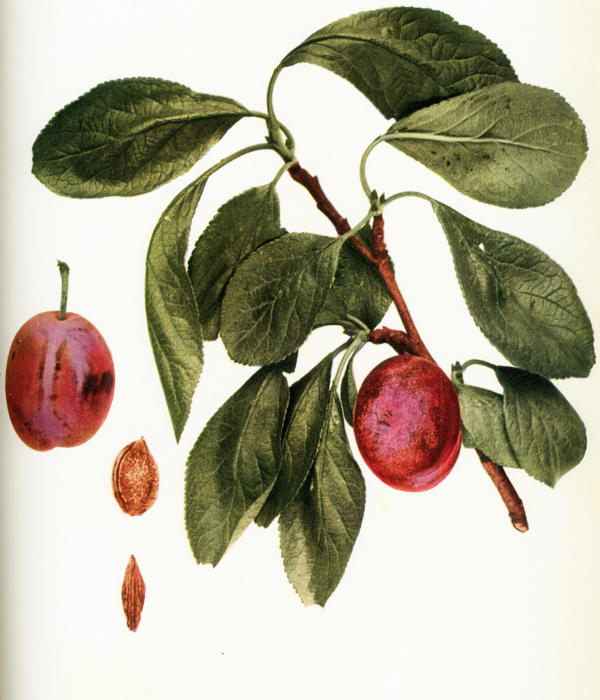
For some reason Victoria, long known in America, has never attained great popularity in this country. It is a large plum attaining nearly the size of Pond, though the color-plate does not so show it, and has much the same color as the plum with which we have just compared it. Here resemblances cease for Victoria is not the same shape as Pond, is a little better in quality, is earlier and quite different in tree-characters. It would seem that this would make a good market plum as it is firm enough in flesh to ship well, as grown here keeps remarkably well, is better in quality than the average market plum and is handsome, though Americans seem to care little for red plums, preferring the yellow sorts and still more the purple kinds. Unfortunately, Victoria does not always color well in our climate. The trees of this variety at this Station, while productive, are not large nor robust, and the foliage is a little too susceptible to fungi. These defects of the tree may account for the lack of popularity of the variety in New York though even if they are to be found in all localities, which is probably not the case, this plum is still worth growing to some extent for home or market.
The origin of this plum and even its right to the name under which it is discussed here are matters of controversy. The London Horticultural Society in 1831 mentioned La Victorine in its catalog but since no description was given it cannot be identified as Victoria. Sharp’s Emperor which has been confused with this variety, was described in the same publication. These two varieties were considered as identical by Charles Downing, Hogg, Mas and others; while Royer[225] who tested Sharp’s Emperor, obtained from Liegel, thought it to be distinct, as did Thomas, the Guide Pratique and Pearson of England. Hogg in describing the Victoria says, “This is a Sussex plum, and was discovered in a garden at Alderton in that county. It became known as Sharp’s Emperor, and was ultimately sold by a nurseryman named Denyer, in the year 1844 at Brixton, near London, at a high price as a new variety under the name of Denyer’s Victoria.” Pearson in the Journal of the Royal Horticultural Society for 1897 says the reason that Hogg and other authorities had called these varieties identical is that they had not seen the true variety. At this Station we have not seen Sharp’s Emperor but judging from the descriptions it is distinct though very similar. The American Pomological Society placed Victoria on its fruit list in 1862 but in 1871, Sharp’s Emperor was substituted as the correct name with Victoria as a synonym. This change was probably made to comply with Downing’s nomenclature of 1869. A review of the whole controversy cannot but lead to the conclusion that Victoria is the correct name and it appears also to be in most common use.
Tree of medium size and vigor, upright-spreading, hardy, productive; branches ash-gray, smooth, with few large lenticels; branchlets thick, short, stout, with short internodes, greenish changing to dark brownish-drab, dull, with thick pubescence, with few inconspicuous, small lenticels; leaf-buds large, long, conical or pointed, free.
Leaves folded backward, obovate, two and three-eighths inches wide, five inches long, thick, stiff; upper surface dark green, rugose, with a narrow groove on the midrib, sparingly hairy; lower surface medium green, thickly pubescent; apex abruptly pointed, base cuneate, margin serrate or crenate, eglandular or with small dark glands; petiole one inch long, covered with thick pubescence, tinged red on one side, glandless or with from one to three globose or reniform, yellow glands usually on the stalk.
Season of bloom medium, short; flowers appearing with the leaves, one and one-eighth inches across, white, the buds tinged yellow; borne in clusters on lateral buds and spurs, singly or in pairs; pedicels nearly three-eighths inch long, thick, heavily pubescent; calyx-tube green, campanulate, pubescent; calyx-lobes medium to narrow, obtuse, glandular-serrate, thickly pubescent on both surfaces, reflexed; petals roundish-obovate, entire or occasionally notched, tapering to short, broad claws; anthers yellow; filaments one-quarter inch long; pistil glabrous, longer than the stamens.
Fruit mid-season, ripening period of medium length; one and seven-eighths inches by one and one-half inches in size, long-oval, oblong, compressed, halves equal; cavity shallow, narrow, flaring; suture variable in depth, prominent; apex roundish or depressed; color dark red, mottled before full maturity, covered with thick bloom; dots numerous, russet, conspicuous; stem thick, three-quarters inch long, very pubescent, adhering strongly to the fruit; skin thin, tender, adhering but slightly; flesh light yellow, juicy, coarse, firm, sweet, mild but pleasant; good; stone free, one and one-eighth inches by three-eighths inch in size, broad-oval, strongly flattened, deeply pitted, roughish, blunt at the base and apex; ventral suture narrow, distinctly winged; dorsal suture widely and deeply grooved.
VIOLET DIAPER
Prunus domestica
1. Parkinson Par. Ter. 576, 578. 1629. 2. Langley Pomona 93, Pl. XXIII fig. II. 1729. 3. Duhamel Trait. Arb. Fr. 2:101, Pl. XVII fig. 1768. 4. Prince Pom. Man. 2:70, 92. 1832. 5. Elliott Fr. Book 425. 1854. 6. Koch Deut. Obst. 572. 1876. 7. Le Bon Jard. 339. 1882. 8. Hogg Fruit Man. 690. 1884. 9. Mathieu Nom. Pom. 452. 1889. 10. Guide Prat. 157, 355. 1895.
Black Diapred 1. Blaue Diaprée 9, 10. Blaue Herzformige Pflaume 9, 10. Buntfarbige Violette Pflaume 9, 10. Cheston 1, 9, 10. Cheston 4, 5, 8. Cheston Matchless 5. Cheston’s Plumb 2. Dennie 1. Diaprée noire 7. Die Violette Diaprée 10. Diaprée Violette 3, 10. Diaprée Violette 4, 8, 9. Diapre Violet 4. Friars 1. Friars 8. Friar’s Plum 9. Matchless 4, 5, 9, 10. Purple Diaper 6. Violet Diaper 5, 9. Violette Diaprée 9. Violette Violen Pflaume 9, 10. Veilchen Pflaume 9, 10.
Violet Diaper was cultivated at the beginning of the Seventeenth Century and has maintained itself in Europe until the present time although never attaining nor deserving the popularity of the Red Diaper. Matchless, cited as a synonym, is manifestly incorrect as the true Matchless is a yellow plum; but since it has been used so long and by so many writers as a synonym, it seems best to mention it as such. This plum is not grown in America. It is described as follows:
Fruit early; of medium size, oval; suture faint; cavity almost lacking; skin free; dark purple, covered with thick bloom; flesh yellow, firm, sweet; good; freestone.
VORONESH
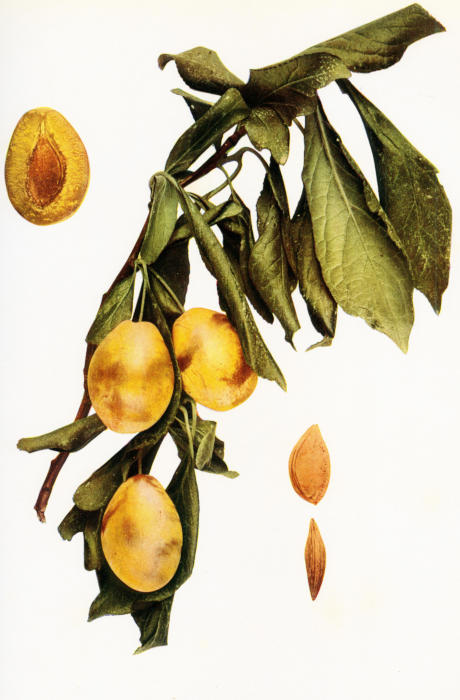
VORONESH
Prunus domestica
1. Am. Pom. Soc. Rpt. 76. 1883. 2. Ibid. 61. 1887. 3. Am. Gard. 11:625 fig. 1. 1890. 4. Waugh Plum Cult. 116. 1901. 5. Budd-Hansen Am. Hort. Man. 327, 329. 1903.
Moldavka 1, 2, 3, 4. Voronesh Yellow 3, 5. Yellow Moldavka 5. Yellow Voronesh 2.
Voronesh is a Russian sort supposed to be ironclad as to cold. It is perfectly hardy at Geneva, the trees are also very productive and the fruits are attractive enough in size and color to meet market demands but the flavor is so insipid as to make the plum unfit for dessert and hardly fit for kitchen use. It is given the honor of a color-plate because it is a somewhat distinct type. In 1881 Professor J. L. Budd secured from J. E. Fisher, Voronesh, Russia, a variety which he introduced as Voronesh Yellow. At the same time he imported a variety from Fisher under the name Moldavka which proved to be identical with his Voronesh Yellow, though Budd held that while they were very similar the Moldavka was more oval than Voronesh.
Tree of medium size, round-topped, productive; leaves drooping, folded backward, narrow-obovate, two and one-quarter inches wide, four and one-half inches long, thick; margin doubly serrate, with small, yellowish glands; petiole one-half inch long, tinged red, pubescent, sometimes with two globose, yellowish-red glands usually on the stalk near the base of the leaf; blooming season early, short; flowers appearing after the leaves, fully one and one-eighth inches across, dull white; borne on lateral buds and spurs, singly or in pairs.
Fruit mid-season, ripening period short; one and seven-eighths inches by one and one-half inches in size, ovate, necked, slightly enlarged on the suture side, dark lemon-yellow, with thin bloom; dots very numerous, of medium size, white, conspicuous; stem adhering strongly to the fruit; skin tough, sour; flesh dark amber-yellow, very tender, sweet, mild; poor; stone free, one and three-eighths inches by five-eighths inch in size, long-oval, flattened, somewhat necked, acute at the apex, the surfaces smooth or partially honeycombed; ventral suture prominent.
WALES
Prunus domestica
1. Gard. Chron. 5:837. 1845. 2. Mag. Hort. 12:340. 1846. 3. McIntosh Bk. Gard. 529. 1855. 4. Downing Fr. Trees Am. 392. 1857. 5. Thompson Gard. Ass’t 515. 1859. 6. Ann. Pom. Belge 7, Pl. 1859. 7. Mas Pom. Gen. 2:119, fig. 60. 1873. 8. Flor. & Pom. 253, Pl. 1875. 9. W. N. Y. Hort. Soc. Rpt. 21:20. 1876. 10. Hogg Fruit Man. 718. 1884. 11. Mathieu Nom. Pom. 443. 1889. 12. Ont. Fr. Exp. Sta. Rpt. 96, 120. 1896. 13. Cornell Sta. Bul. 131:190. 1897. 14. Am. Pom. Soc. Cat. 26. 1897. 15. Ohio Sta. Bul. 113:160. 1899. 16. Waugh Plum Cult. 125. 1901.
Chapman’s Prince of Wales, 3, 5. Chapman’s Prince of Wales 4, 10, 11. Chapman’s Prince of Wales’ Plum 1. Prince Albert? 11. Prince De Galles 7. Prince De Galles 6, 11. Prince of Wales 2, 4, 8, 9, 10, 12, 13, 15. Prince of Wales 7, 11, 14, 16. Prinz Von Wales 11. Prune Prince of Whales 6.
Wales, more commonly known as the Prince of Wales, seems to have much merit yet it has long been grown in America, probably three-quarters of a century, without attaining distinction with fruit-growers. In recent years it has been favorably commented upon in a number of publications and seems to be better known and more grown than formerly. Whether this tardily-given recognition is not too late is a question. So many good plums have been introduced both at home and abroad in the last few decades that a sort dating back nearly a century must be meritorious, indeed, to stand the competition. As Wales grows in New York, it is rather too poor in quality to recommend it for a home variety and the plums are too small, as they generally grow, for a good commercial fruit. The trees are enormously productive and are very satisfactory in other characters as well. In a bulletin from the Cornell Station (References, 13) this variety is said to have “much to commend it for general favor:” while in Ohio (References, 15) it is thought that Wales “ought to become popular.”
Wales, a seedling of Orleans, was raised by a Mr. Chapman, Brentford, Middlesex, England, in 1830. It was exhibited before the London Horticultural Society in 1845 where it was awarded a prize. The following year, Hovey, the American pomologist, (References, 2) described the variety but the date of the first importation to this country is unknown. It was not until 1897 that the variety was sufficiently known to be placed on the fruit catalog list of the American Pomological Society.
Tree large, vigorous, slightly vasiform, open-topped, hardy, very productive; branches ash-gray, smooth except for the numerous, small, slightly raised lenticels, often marked by concentric rings; branchlets of medium thickness and length, with long internodes, green changing to brownish-red, dull, thinly pubescent, with numerous, inconspicuous, small lenticels; leaf-buds large, long, conical or pointed; leaf-scars prominent.
Leaves folded upward, roundish-ovate or oval, two and one-half inches wide, three and one-half inches long; upper surface dark green, somewhat rugose, covered with numerous hairs; lower surface pale green, thickly pubescent; apex and base abrupt, margin crenate, eglandular or with small dark glands; petiole one-half inch long, pubescent, tinged red, glandless or with from one to three small, globose, yellowish-brown glands usually at the base of the leaf.
Blooming season short; flowers one inch across, white, with a yellow tinge; usually borne in pairs; pedicels eleven-sixteenths inch long, thick, pubescent, greenish; calyx-tube green, campanulate, lightly pubescent toward the base; calyx-lobes broad, obtuse, pubescent on both surfaces, glandular-serrate and with marginal hairs, erect; petals broadly oval, crenate, tapering to short, blunt claws; filaments five-sixteenths inch long; pistil glabrous except on the ovary, longer than the stamens; stigma large.
Fruit late, season short; one and five-eighths inches by one and one-half inches in size, roundish-oval, halves equal; cavity narrow, abrupt; suture a line; apex roundish; color reddish-purple, overspread with thick bloom; dots few, large, often tinged red, conspicuous; stem thick, one-half inch long, pubescent, adhering well to the fruit; skin tough, separating readily; flesh golden-yellow, juicy, tender, sweet, mild; good; stone semi-free or free, seven-eighths inch by five-eighths inch in size, oval, turgid, blunt at the base and apex, with slightly pitted surfaces; ventral suture narrow, often acute or with a slight wing; dorsal suture widely and deeply grooved.
WANGENHEIM
Prunus domestica
1. Cultivator 8:26 fig. 1860. 2. Mas Le Verger 6:157, fig. 79. 1866-73. 3. Am. Pom. Soc. Cat. XXIV. 1871. 4. Mathieu Nom. Pom. 453. 1889. 5. Guide Prat. 159, 367. 1895. 6. Waugh Plum Cult. 125. 1901.
Die Wangenheim 4. De Wangenheim 5. Prune de Wangenheim 4. Prune Wangenheim Hâtive 4. Quetsche Précoce de Wangenheim 2, 4, 5. Von Wangenheim Pflaume 2, 4, 5. Wangenheims Frühzwetsche 2, 5. Wangenheims Früh Zwetsche 4. Wangenheim Hâtive 4.
This variety, very well known and highly esteemed in Germany, has been grown to some extent in America both on the Pacific and Atlantic Coasts and in neither region has it proved equal to standard plums. According to Dittrich, Wangenheim originated at Beinheim, a small place near Gotha, Saxe-Cobourg, Germany.
Tree large, vigorous, upright-spreading, productive; trunk rough; branches rough, stocky; branchlets nearly glabrous; leaves folded upward, slightly rugose; margin finely serrate, with small glands; petiole tinged red, pubescent, with from one to three small glands usually at the base of the leaf.
Fruit mid-season; one and one-quarter inches by one and one-eighth inches in size, ovate, purplish-red, covered with thin bloom, yellowish, rather dry, firm, sweet, mild; of good quality; stone very free, three-quarters inch by one-half inch in size, irregular-oval, flattened, with faintly pitted surfaces; ventral suture distinctly winged; dorsal suture with a narrow, shallow groove.
WASHINGTON
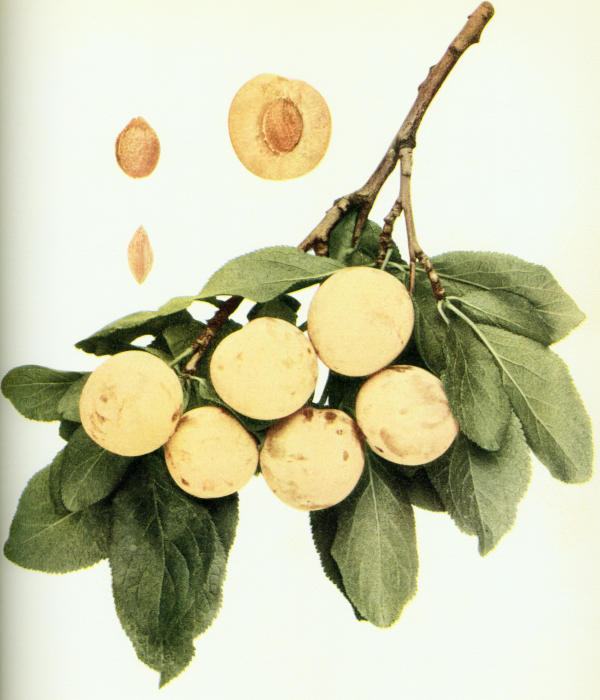
WASHINGTON
Prunus domestica
1. Prince Treat. Hort. 24. 1828. 2. Pom. Mag. 1:16, Pl. 1828. 3. Lond. Hort. Soc. Cat. 154. 1831. 4. Prince Pom. Man. 2:53. 1832. 5. Floy-Lindley Guide Orch. Gard. 298, 383, 418. 1846. 6. Cole Am. Fr. Book 210. 1849. 7. Thomas Am. Fruit Cult. 326 fig., 327. 1849. 8. Hovey Fr. Am. 1:87, Col. Pl. 1851. 9. Am. Pom. Soc. Cat. 54. 1852. 10. Elliott Fr. Book 415. 1854. 11. Ann. Pom. Belge 4:23, Pl. 1856. 12. Thompson Gard. Ass’t 520. 1859. 13. Downing Fr. Trees Am. 951. 1869. 14. Pom. France 7: No. 24. 1871. 15. Mas Le Verger 6:59. 1866-73. 16. Hogg Fruit Man. 729. 1884. 17. Mathieu Nom. Pom. 453. 1889. 18. Mich. Sta. Bul. 103:32, 33, fig. 1894. 19. Cornell Sta. Bul. 131:193. 1897. 20. Va. Sta. Bul. 134:44. 1902. 21. Can. Exp. Farm Bul. 43:36. 1903.
Anglesio 17. Bolmar 3, 6, 7, 8, 10, 12, 13, 14, 16, 17. Bolmar’s Washington 3, 7, 8, 10, 11, 12, 14, 16, 17. Bolmar’s Washington 5. Bolmer 1, 4, 13, 17. Bolmer’s Washington 1, 4, 13. Bolmore’s Washington 4. Double Imperial Gage 1, 4. Franklin 3, 4, 5, 8, 10, 11, 12, 13, 14, 16, 17. Imperial Gage (of Albany) 4. Irving’s Bolmar 10, 13, 16, 17. Irving’s Bolmer 14. Jackson 11, 13, 14, 17. Louis Philippe 14. Louis Philipp 17. New Washington 3, 4, 5, 8, 10, 11, 13, 14, 17. Parker’s Mammoth 10, 13, 16, 17. Philippe 1, 11, 13, 14, 17. Prune Washington Jaune 11. Superior Gage 1, 4, 8. Superior Green Gage 4, 8. The Washington Plum 2, 8. Washington 5, 8. Washington Bolmar 8. Washington Gage 4. Washington Jaune 13, 14, 17. Washington Mammot 14, 17. Washington Yellow 17.
Washington holds high rank among the Reine Claude varieties, plums unsurpassed for dessert purposes. The fruits are large in size for one of this group; handsome in form and color (in the latter respect the color-plate does not do the variety justice); abundant in juice yet firm and meaty enough in flesh to keep and ship well; fine in flavor though not quite equalling some others of its group in this character. The trees are large, hardy, vigorous and healthy, remarkable for their broad, glossy, abundant leaves, bear bountiful crops annually and at a favorable period of maturity. Washington thus has a combination of characters which few of its group, with which only it must be compared, possess. The variety, however, is not without defects; the fruits are subject to brown-rot, so much so that its value as a commercial variety is greatly lessened; the quality varies greatly in different locations and even in different years,—the latter very noticeable on the Station grounds; the trees are slow in coming in bearing and the crops are small for some years after fruiting begins. From the above considerations it may be seen that while this variety is almost always worth planting in a home collection, the location for it as a commercial fruit needs to be chosen with some care.
There are two accounts of the origin of this variety. William Prince gives its history as follows (References, 1): “It has always been the custom at the establishment of the author, at Flushing, to plant annually the seeds of the finest fruits, for the purpose of originating new varieties; and, about the year 1790, his father planted the pits of twenty-five quarts of the Green Gage plum; these produced trees yielding fruit of every colour; and the White Gage, Red Gage, and Prince’s Gage, now so well known, form part of the progeny of those plums; and there seems strong presumptive evidence to suppose that the Washington Plum was one of the same collection.” Michael Floy gives a different history of the Washington (References, 5). He states that he received the variety in 1818 from a Mr. Bolmar of New York who in turn had purchased his trees from a market woman in 1814. The purchased trees were produced as suckers from the roots of a Reine Claude tree which had been killed below the graft by lightning on the Delancey farm, now the Bowery, in New York City. In 1819, a few of the trees, budded the previous year by Floy, were sent to England. The American Pomological Society added the Washington to its fruit catalog list in 1852. Taking in consideration the evidence of other writers and further facts offered in other accounts by the Princes, father and son, it seems almost certain that the first history is correct and that Bolmar’s trees had their origin in the Prince nursery.
Tree large, vigorous, round and open-topped, hardy, very productive; branches dark ash-gray, rough becoming shaggy on the trunk, with small lenticels; branchlets below medium in thickness and length, with long internodes, green changing to brownish-red, thinly pubescent, with small lenticels of average number; leaf-buds of medium size and length, pointed, free.
Leaves flattened, oval, two and one-half inches wide, four and one-quarter inches long, leathery, somewhat velvety; upper surface dark green, lightly pubescent, with a shallow groove on the midrib; lower surface medium green, thickly pubescent; apex abruptly pointed or acute, base abrupt; margin serrate, eglandular; petiole five-eighths inch long, green, pubescent, glandless or with one or two smallish, globose, greenish-yellow glands at the base of the leaf.
Blooming season intermediate in time and length; flowers appearing after the leaves, one and five-sixteenths inches across, white, with yellow near the apex; borne on lateral buds and spurs; pedicels three-eighths inch long, thick, covered with fine pubescence, greenish; calyx-tube green, campanulate, pubescent; calyx-lobes broad, obtuse, pubescent on both surfaces, glandular-serrate and with marginal hairs, erect; petals broad-ovate or oval, crenate, tapering into short, broad claws; anthers yellow; filaments three-eighths inch long; pistil glabrous, longer than the stamens.
Fruit intermediate in time and length of ripening season; one and three-quarters inches by one and five-eighths inches in size, roundish-oval, compressed, halves equal; cavity shallow, narrow, flaring; suture shallow; apex roundish; color greenish-yellow or light yellow, with green stripes and splashes, occasionally with a faint blush on the sunny side, covered with thin bloom; dots numerous, white, inconspicuous, clustered about the apex; stem one-half inch long, covered with thick pubescence, adhering strongly to the fruit; skin thin, slightly sour, separating readily; flesh greenish-yellow, juicy, firm but tender, sweet, mild, pleasant flavor; good to very good; stone free, not filling the cavity, one inch by three-quarters inch in size, oval, turgid, roughened, somewhat blunt at the base and apex; ventral suture wide, marked by deep furrows, with a distinct but short wing; dorsal suture widely and deeply grooved.
WAYLAND
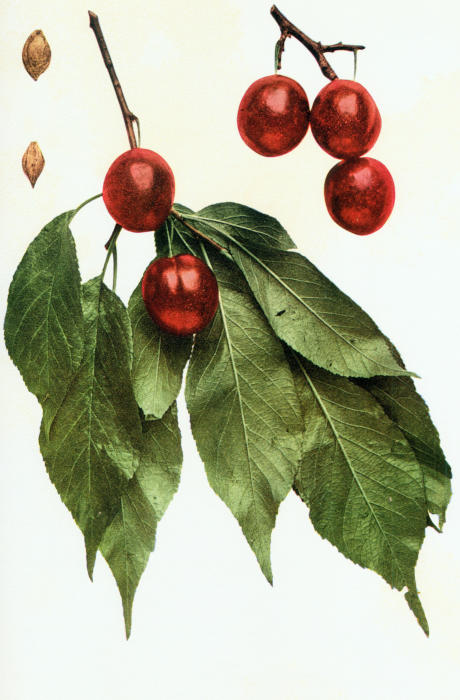
WAYLAND
Prunus hortulana
1. U. S. D. A. Rpt. 573, Pl. 5 fig. 2. 1888. 2. Am. Gard. 10:175 fig., 243. 1889. 3. Cornell Sta. Bul. 38:51, 87. 1892. 4. Wis. Sta. Bul. 63:24, 62. 1897. 5. Vt. Sta. An. Rpt. 10:99, 103. 1897. 6. Ibid. 11:281, 286 fig. 1898. 7. Ia. Hort. Soc. Rpt. 228. 1904. 8. Ga. Sta. Bul. 67:283. 1904. 9. Ohio Sta. Bul. 162:258. 1905.
Wayland is of little interest to plum-growers who grow the Domestica varieties without difficulty but in the South and Middle West it is an important representative of a valuable species. The trees withstand the hot, dry weather in the region south of central Iowa and Nebraska rather better than do those of varieties of other species and its fruits are borne in such quantities and so late that this and its kindred sorts become important plums. The fruits are quite too firm of flesh, too sour and too small to be of value for dessert purposes but they are most excellent for jellies, marmalades and preserves—any of the uses to which the Damsons are commonly put. They are, too, best adapted for long-keeping and shipping of any of the native plums. Except in size, the plums are hardly surpassed in the characters that make a fruit handsome among the native plums. The trees are large, robust and hardy in central New York, usually free from attacks of insects and fungi and, with their abundant, glossy foliage, are strikingly ornamental. Wayland is of value for New York, however, when all characters are considered, only in furnishing variety, in extending the season for native plums and as an ornamental.
Wayland was found in a plum thicket on the premises of Professor H. B. Wayland, Cadiz, Kentucky. It was sent by him about 1875 to J. S. Downer and Sons, Fairview, Todd County, Kentucky, who named and introduced it. There has been much discussion as to the botanical status of this variety, various writers having put it in at least three distinct species and Waugh and Bailey have used it as the type of the Wayland group of Prunus hortulana.
Tree very large and vigorous, spreading, somewhat drooping, flat-topped, open, hardy at Geneva, productive; trunk shaggy; branches rough, dark ash-gray, with inconspicuous lenticels, medium in number and size; branchlets slender, twiggy, long, with internodes of average length, green, changing to light chestnut-red, glossy, glabrous, with numerous, conspicuous, large, raised lenticels; leaf-buds very small, short, obtuse, plump, appressed.
Leaves folded upward, ovate or long-oval, peach-like, one and seven-eighths inches across, five inches long, thin; upper surface smooth and glossy, with a grooved midrib; lower surface sparingly pubescent; apex acuminate, base abrupt, margin unevenly serrate, glandular; petiole one inch long, slender, pubescent along one side, with a tinge of red, with from one to five very small, globose, brownish glands usually on the stalk.
Blooming season late and long; flowers appearing after the leaves, thirteen-sixteenths inch across, white, with disagreeable odor; borne in clusters on lateral buds and spurs, in threes, fours or fives; pedicels fifteen-sixteenths inch long, very slender, glabrous, green; calyx-tube greenish, narrowly campanulate, glabrous; calyx-lobes narrow, acute, erect, lightly pubescent within, serrate and with dark-colored glands; petals ovate or oval, irregularly crenate, tapering into long, narrow claws with hairy margins; anthers yellowish; filaments three-eighths inch long; pistil glabrous, shorter than the stamens.
Fruit very late, season long; one and one-eighth inches by one inch in size, roundish-ovate narrowing somewhat toward the stem, conical, slightly compressed, halves equal; cavity medium to deep, narrow, abrupt; suture usually very shallow and wide, often a distinct line; apex pointed; color dark currant-red, with inconspicuous, thin bloom; dots numerous, small to medium, conspicuous, densely clustered about the apex; stem very slender, five-eighths inch long, glabrous, not adhering to the fruit; skin thick, tough, clinging but slightly; flesh attractive light yellow; moderately juicy, coarse, fibrous, rather tender, mildly sweet next the skin but astringent towards the pit; fair to good; stone clinging, five-eighths inch by three-eighths inch in size, long-oval, somewhat elongated at the base and apex, turgid, with rough and pitted surfaces; ventral suture wide, blunt, faintly ridged; dorsal suture acute, with a narrow, indistinct groove.
WEAVER
Prunus americana
1. Mich. Pom. Soc. Rpt. 267. 1874. 2. Am. Pom. Soc. Cat. 44. 1883. 3. Mich. Hort. Soc. Rpt. 268. 1885. 4. Minn. Sta. Bul. 5:36, 37 fig. 1889. 5. Cornell Sta. Bul. 38:45, 86. 1892. 6. Can. Hort. 16:409, Pl. 1893. 7. Mich. Sta. Bul. 123:21. 1895. 8. Wis. Sta. Bul. 63:24, 62. 1897. 9. Colo. Sta. Bul. 50:46. 1898. 10. Ia. Sta. Bul. 46:291. 1900. 11. Waugh Plum Cult. 166 fig. 1901. 12. Budd-Hansen Am. Hort. Man. 302. 1903. 13. Can. Exp. Farm Bul. 43:32. 1903. 14. Ga. Sta. Bul. 67:283. 1904. 15. S. Dak. Sta. Bul. 93:41. 1905.
Weaver is an old and well-known Americana, once one of the most popular of its species because of its hardiness and productiveness. It is still listed by many nurserymen and is widely distributed throughout the country but it is now rapidly passing out of cultivation, being superseded by sorts producing larger and better colored fruits.
This variety was found growing wild on the Cedar River, in Iowa, by a Mr. Weaver. In 1873, Ennis and Patten, Charles City, Iowa, began its sale to fruit-growers. The American Pomological Society placed the Weaver on its fruit catalog list in 1883, dropped it in 1891, and replaced it in 1897. The following description is partly compiled.
Tree large, vigorous, well formed, upright-spreading, unusually hardy, productive; branches long, slender; branchlets slender, long, with short internodes, reddish-brown, glabrous, with numerous, conspicuous lenticels of medium size; leaf-buds small, conical, of average length.
Leaves falling late, four and one-half inches long, two and one-half inches wide, obovate or oval, firm, thick, leathery; upper surface dark green, slightly roughened, glabrous, with narrow midrib; lower surface pale green, pubescent on the midrib and larger veins; apex acuminate, base somewhat acute, margin deeply and coarsely serrate; petiole five-eighths inch long, stout, reddish, slightly pubescent along one side, usually with two large, globose, reddish-brown glands on the stem.
Flowers large, prominently stalked; calyx-lobes conspicuously glandular, lightly pubescent within.
Fruit mid-season or later; one inch by three-quarters inch in size, large for a native, oval or roundish-oblong, compressed, halves unequal; cavity medium to shallow, narrow, rather abrupt; suture shallow, distinct; apex roundish or depressed; color not uniform, yellowish overlaid with purplish-red, mottled, covered with thin bloom; dots numerous, small, often purplish, inconspicuous; skin thick, very tough, astringent, adhering to the pulp; flesh deep yellow, juicy, firm and meaty, sweet, mild; fair to good; stone variable in adhesion, three-quarters inch by three-eighths inch in size, long and narrow, somewhat oval, flattened, obscurely pointed at the base and apex, smooth.
WHITE BULLACE
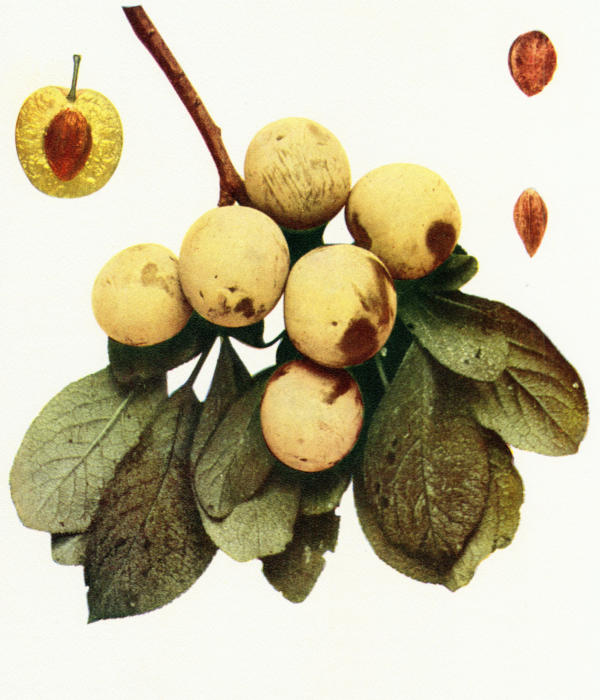
WHITE BULLACE
Prunus insititia
1. Parkinson Par. Ter. 576. 1629. 2. Abercrombie Gard. Ass’t 13. 1786. 3. Forsyth Fr. Trees Am. 21. 1803. 4. Lond. Hort. Soc. Cat. 344. 1831. 5. Prince Pom. Man. 2:105. 1832. 6. Floy-Lindley Guide Orch. Gard. 300, 383. 1846. 7. Hogg Fruit Man. 385. 1866. 8. Downing Fr. Trees Am. 952. 1869. 9. Thompson Gard. Ass’t 4:160, 161 fig. 960. 1901. 10. Can. Exp. Farms Rpt. 481. 1904.
Bullace 5. Bullace 7. White Bulleis 1.
The origin of this old sort is unknown. It was cultivated more than three hundred years ago for Parkinson described it as common in his time. He says of it “The White and the blacke Bulleis are common in most Countries, being small round, lesser than Damsons, sharper in taste, and later ripe.” It is probably one of the first of the cultivated plums. White Bullace is illustrated and described in full in The Plums of New York chiefly as a means of comparison between the plums of three centuries ago and those of the present. It has little value now for any purpose, though the Europeans still grow it rather commonly and from seeds, cions or suckers as convenience may dictate.
Tree of medium size and vigor, upright-spreading, dense-topped, hardy, unproductive; branches ash-gray, nearly smooth, with numerous, small, inconspicuous lenticels; branchlets thick, above medium in length, with short internodes, greenish-red changing to dark brownish-red, dull, with thick pubescence throughout the season, with few, small lenticels; leaf-buds small, short, stubby, obtuse, strongly appressed.
Leaves flattened, obovate, one and five-eighths inches wide, two and three-eighths inches long, thick; upper surface dark green, rugose, with few hairs along the narrow, grooved midrib; lower surface silvery green, pubescent; apex abruptly pointed or acute, base acute, margin doubly serrate, eglandular; petiole one-half inch long, green, pubescent, glandless or with one or two small, globose, greenish-yellow glands variable in position.
Blooming season medium to late, of average length; flowers appearing after the leaves, three-quarters inch across, white, scattered on lateral spurs; usually borne singly; pedicels one-quarter inch long, thick, densely covered with short hairs, green; calyx-tube reddish-green, campanulate, glabrous; calyx-lobes acute, lightly pubescent on both surfaces, glandular-serrate, reflexed; petals obovate, entire, with short, broad claws; anthers yellow with red tinge; filaments five-sixteenths inch long; pistil glabrous, nearly equal to the stamens in length.
Fruit late, ripening season of medium length; about one inch in diameter, roundish, compressed, truncate at the base; cavity rather deep and wide, abrupt; suture a line; apex flattened or depressed; color deep amber-yellow, sometimes with faint pink blush on the exposed cheek, overspread with moderately thick bloom; dots numerous, white, inconspicuous; stem one-half inch long, covered with scant pubescence, adhering strongly to the fruit; skin thin, astringent, slightly adhering; flesh deep golden-yellow, juicy, coarse, fibrous, firm, sour; poor in quality; stone clinging, five-eighths inch by one-half inch in size, ovate, turgid, blunt at the base, acute at the apex, slightly roughened; ventral suture broad, blunt, shallowly furrowed; dorsal suture with a wide, shallow groove.
WHITE DAMSON
Prunus insititia
1. Parkinson Par. Ter. 578. 1629. 2. Quintinye Com. Gard. 67, 69. 1699. 3. M’Mahon Am. Gard. Cal. 588. 1806. 4. Coxe Cult. Fr. Trees 238, fig. 15. 1817. 5. Lond. Hort. Soc. Cat. 146. 1831. 6. Prince Pom. Man. 2:88. 1832. 7. Downing Fr. Trees Am. 287. 1845. 8. Floy-Lindley Guide Orch. Gard. 300. 1846. 9. Thomas Am. Fruit Cult. 334. 1849. 10. Elliott Fr. Book 430. 1854. 11. Am. Pom. Soc. Rpt. 190, 214. 1856. 12. Hogg Fruit Man. 385. 1866. 13. Downing Fr. Trees Am. 952. 1869. 14. Waugh Plum Cult. 131. 1901.
Frost Plum 6, 13. Late Cluster 6, 13. Late White Damson 6. Late Yellow Damson 7, 9, 10, 13. Shailer’s White Damson 7, 10, 12, 13. Shailer’s White Damson 5. Small Round Damson 5. White Damascene 4. White Damascene 6, 7, 10, 13. White Damask 2. White Damson 6. White Prune Damson 7, 8, 10, 13. White Winter Damson 6, 13. White Winter Damson 3. Winter Damson 6. Yellow Damson 9.
This old plum, known since the beginning of the Seventeenth Century, is chiefly of historic interest. Downing thought this a very desirable addition to our list of plums but nearly all other pomologists who have seen the fruit of the variety think it of small importance. Unfortunately it is not in the collection at this Station and can be neither recommended nor condemned from first hand knowledge. This plum was first noted in America by M’Mahon in 1806, and fifty years later it was added to the American Pomological Society list of promising varieties. For some reason, perhaps for its color, it has never become so well known as the purple Damsons. Perhaps from the division of Prunus insititia made in The Plums of New York, this variety should be known as a Mirabelle rather than as a Damson. The following description is a compilation:
Tree vigorous, very productive; branches long, slender. Fruit matures the last of September, season long; small, oval, pale yellow sprinkled with reddish-brown dots, covered with thin bloom; flesh yellowish, sprightly, pleasant flavored; good to very good; stone clinging.
WHITE IMPERATRICE
Prunus domestica
1. Kraft Pom. Aust. 2:33, Tab. 181 fig. 2; 2:44, Tab. 197 fig. 2. 1796. 2. Duhamel Trait. Arb. Fr. 2:106. 1768. 3. Pom. Mag. 1:38, Pl. 1828. 4. Prince Pom. Man. 2:61. 1832. 5. Downing Fr. Trees Am. 285. 1845. 6. Floy-Lindley Guide Orch. Gard. 300, 383. 1846. 7. Poiteau Pom. Franc. 1. 1846. 8. Thomas Am. Fruit Cult. 329. 1849. 9. Hogg Fruit Man. 730. 1884. 10. Mathieu Nom. Pom. 454. 1889.
Die Weisse Kaiserpflaume 3, 4, 6, 10 incor. Die Weisse Kaiserpflaume 1. Die Weisse Kaiserinnpflaume 1. Imperatrice Blanche 1, 2, 3, 4, 5, 6, 8, 9, 10. The White Imperatrice Plum 3. Prune Imperatrice Blanche 7. White Imperatrice 3, 10. White Empress 5, 8, 10. Weisse Kaiserpflaume 10.
Kraft in his Pomona Austriaca, 1796, described a Weisse Kaiserpflaume and a Weisse Kaiserinnpflaume and gave Imperatrice Blanche as a synonym to both of them. The latter he gave as a variety of the Weisse Kaiserpflaume but it is probable that they are the same since no other author noted the distinction, and, in fact, the differences mentioned are wholly insignificant. According to Downing this variety was little known in this country in 1845 and it is doubtful if it is now known at all. It is described as follows:
Compared with the Saint Catherine, which it resembles, it is found to differ in that its stone is free and its flavor less high; branches smooth; leaves smaller and less shining; fruit matures in September; of medium size, obovate; suture indistinct; cavity narrow; skin yellow, spotted with a little red; bloom thin; flesh yellow, crisp, juicy, sweet.
WHITE PERDRIGON
Prunus domestica
1. Rea Flora 208. 1676. 2. Langley Pomona 92, 93, Pl. XXIII figs. V & VI. 1729. 3. Miller Gard. Dict. 3. 1754. 4. Duhamel Trait. Arb. Fr. 2:84, Pl. VIII. 1768. 5. Kraft Pom. Aust. 2:41, Tab. 193 fig. 1. 1796. 6. Lond. Hort. Soc. Cat. 151. 1831. 7. Prince Pom. Man. 2:52, 64. 1832. 8. Downing Fr. Trees Am. 287. 1845. 9. Floy-Lindley Guide Orch. Gard. 298, 301, 383. 1846. 10. Hogg Fruit Man. 386. 1866. 11. Mathieu Nom. Pom. 454. 1889.
Brignolle 11. Brignole 6, 8, 10, 11. Die weisse Duranzen pflaume 5. Diaprée Blanche 11. Maître Claude 2, 3, 7, 9. Perdrigon blanc 4. Perdrigon blanc 5, 6, 7, 8, 9, 10, 11. Maître Claude 8, 10, 11. Weisser Perdrigon 11. Weisse Diaprée 11. Weisses Rebhuhnerei 11. Prune-Pêche (of some) 11. White Perdrigon 11.
White Perdrigon is an old French variety grown extensively in the vicinity of Brignoles, France where it is used in the manufacture of the famous Brignoles Prunes. Because of its use for this purpose, it has been badly confused with a similar variety, the Brignole, which derived its name from the town of Brignoles, where it was first grown. The variety is probably not known in America and might be worth introducing. It is described as follows:
The White Perdrigon is a mid-season, medium-sized, oval plum, tapering slightly towards the base; suture shallow; cavity small; stem slender; skin rather tough, pale yellow, with thin bloom; dots numerous, small, whitish; flesh greenish-yellow, melting, juicy, sweet, aromatic; good; stone small, long-oval, free.
WICKSON
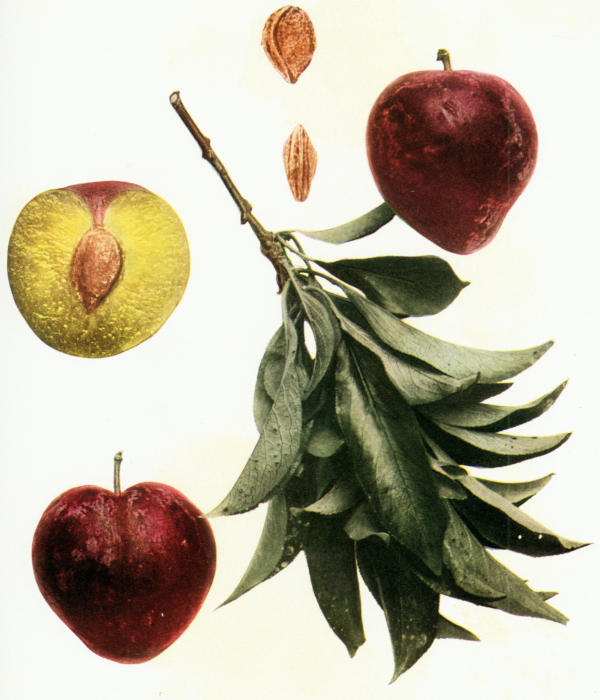
WICKSON
Prunus triflora × Prunus simonii
1. U. S. D. A. Rpt. 263. 1892. 2. Burbank Cat. 21 fig. 1893. 3. Gard. & For. 7:420. 1894. 4. Cornell Sta. Bul. 106:63. 1896. 5. Cal. State Bd. Hort. 53. 1897-8. 6. Cornell Sta. Bul. 139:46 fig. 120. 1897. 7. Can. Hort. 21:30 fig. 1272. 1898. 8. Vt. Sta. An. Rpt. 12:229. 1899. 9. Cornell Sta. Bul. 175:148, 149 fig. 38. 1899. 10. Am. Pom. Soc. Cat. 41. 1899. 11. Kan. Sta. Bul. 101:125. 1901. 12. Mich. Sta. Bul. 187:77, 80. 1901. 13. Waugh Plum Cult. 227. 1901. 14. U. S. D. A. Rpt. 387. 1901. 15. Ga. Sta. Bul. 68:13, Pl. IV, 37. 1905. 16. Md. Hort. Soc. Rpt. 85. 1905. 17. Am. Pom. Soc. Rpt. on Plums etc. 65. 1905.
Eureka 5. Perfection 1, 2. Perfection 4, 14.
It is difficult to estimate the value of Wickson in American pomology. Probably no plum of recent introduction has been on the one hand so highly lauded and on the other so condemned as this one. Its remarkable size, the largest of the Oriental plums if not the largest of all plums; its handsome color and distinct form; the firm flesh and peculiar flavor, generally considered pleasant; the narrow upright tree with its long lanceolate leaves, mark the variety as a new and for some parts of the country a valuable addition to pomology. The contradictory evidence as to its desirability arises from the fact that it can be well grown in comparatively few plum-growing regions, most of these being on the Pacific Coast and in the South. In New York, the Wickson has small value other than in private collections. The variety is a little tender in tree and bud, hardy only in favored parts of this State and not at all where the peach cannot be grown; it blooms too early to be safe from frost; it is susceptible to brown-rot; the trees are late in coming in bearing and are not reliable in fruiting; the fruits ripen unevenly; and the trees are not of good form for heavy crops. In California, however, the Wickson is one of the leading Japanese sorts, possibly the leading one, and is seemingly growing in favor. Starnes, one of the pomological authorities of the South, in his bulletin on Japan and Hybrid Plums, speaks of Wickson as a “grand plum” and as one of the best for Georgia. It is to be hoped that from the same cross which produced Wickson or from breeding this variety with some other, a plum of this type well suited to New York may sometime be offered the plum-growers of this State.
Wickson is one of the best known of Burbank’s many plums. The variety was first described in the report of the Secretary of Agriculture in 1892 under the name Perfection and as a seedling of Kelsey crossed by Burbank. In 1893 and 1894 Burbank offered for sale the control and the stock of this variety but found no buyers and in 1895 introduced it himself. The parentage of the variety is in doubt. Burbank considered it a Kelsey-Burbank cross; the Pacific Rural Press described it as offspring of Kelsey and Satsuma; Bailey, Waugh and the workers at this Station believe it to have Prunus simonii characters. The foliage, flowers, the tree, the fruiting habit, the texture of the flesh, all indicate Simon as one of its parents. According to the report of the Secretary of the California State Board of Horticulture shipments of this plum were made to New York in the season of 1897 under the name of Eureka. In 1899 it was placed on the fruit catalog list of the American Pomological Society.
Tree medium to large, vigorous, with narrow, upright head, dense-topped, tender to cold, an uncertain bearer; branches medium in smoothness, the fruit-spurs numerous, dark ash-gray with tinge of brown, with lenticels of medium size; branchlets thick and long, with short internodes, greenish-red changing to light chocolate-brown, glossy, glabrous; lenticels numerous, raised, variable in size; leaf-buds small, short, obtuse, free.
Leaves folded upward, lanceolate or oblanceolate, one inch wide, three inches long, thin; upper surface dark green, glossy, glabrous, with a slightly grooved midrib; lower surface pale green, glabrous, except along the midrib; apex taper-pointed, base cuneate, margin finely serrate, with reddish glands; petiole three-eighths inch long, lightly pubescent along one side, faintly tinged red, glandless or with from one to nine small, reniform, greenish or yellow glands variable in position.
Blooming season early and of medium length; flowers appearing after the leaves, intermediate in size, white; borne in clusters on lateral spurs, in pairs or in threes; pedicels of medium length and thickness, glabrous, greenish; calyx-tube green, obconic, glabrous; calyx-lobes acute, erect, glandular-ciliate; petals oval, entire, short-clawed; anthers yellowish; filaments below medium in length; pistil glabrous, longer than the stamens.
Fruit early mid-season, period of ripening long; variable in size, the larger fruits about two and one-eighth inches in diameter, obliquely cordate, halves unequal; cavity deep, abrupt, with yellowish concentric rings; suture often prominent and deep, with a prolonged tip at the apex; color dark red over a yellow ground, indistinctly splashed with darker red, mottled with thin bloom; dots numerous, small, yellow, inconspicuous, densely clustered about the apex; stem thick, eleven-sixteenths inch long, glabrous; skin thin, tender, separating easily; flesh amber-yellow, juicy, coarse, somewhat fibrous, firm, sweet, pleasant but not high in flavor; good; stone clinging, one inch by five-eighths inch in size, oval or ovate, pointed, with pitted surfaces; ventral suture winged; dorsal suture grooved.
WILD GOOSE
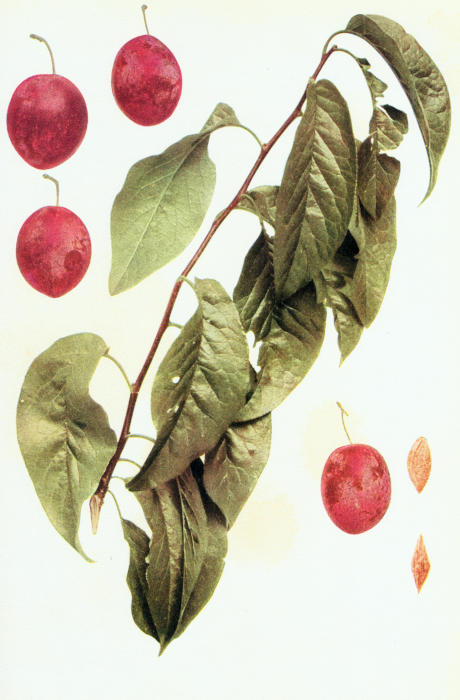
WILD GOOSE
Prunus munsoniana
1. Gard. Mon. 9:105. 1867. 2. Am. Jour. Hort. 5:147. 1869. 3. Am. Pom. Soc. Rpt. 60. 1869. 4. Am. Hort. An. 78. 1870. 5. Country Gent. 35:166. 1870. 6. Am. Pom. Soc. Rpt. 116. 1871. 7. Ibid. 44. 1875. 8. Am. Pom. Soc. Cat. 36. 1875. 9. Am. Pom. Soc. Rpt. 152, 153, 154. 1883. 10. Mathieu Nom. Pom. 454. 1889. 11. Cornell Sta. Bul. 38:51, fig. 3, 86. 1892. 12. Tex. Sta. Bul. 32:482, fig. 4. 1894. 13. Vt. Sta. An. Rpt. 10:99, 104. 1897. 14. Wis. Sta. Bul. 63:24, 63 fig. 31. 1897. 15. Ala. Col. Sta. Bul. 112:178. 1900. 16. Waugh Plum Cult. 189, 190. 1901. 17. Ga. Sta. Bul. 67:284. 1904. 18. S. Dak. Sta. Bul. 93:42. 1905. 19. Ohio Sta. Bul. 162:258. 1905.
Nolen Plum 10. Suwanee 9. Suwanee ?16.
Wild Goose is the first of the native plums to be generally grown as a distinct variety though Miner was first known and named. Wild Goose, too, is probably a parent of more sorts than any other variety of the several cultivated native species, most of its offspring so strongly resembling it that its name has been given to a group of its closely related sorts. In spite of the great number of native plums that have been introduced in recent years, Wild Goose is still a favorite—probably more trees of it are now cultivated than of any other native plum. Its good qualities are: bright attractive color; tender and melting flesh with a sprightly and refreshing flavor; a tough skin which fits the variety well for shipment and long-keeping; comparative freedom from brown-rot and curculio and a large, hardy, healthy and, when cross-pollinated, a very productive tree. Wild Goose has been more extensively planted in New York than any other plum of its kind and in a few cases has proved a fairly profitable commercial sort. It is doubtful if it is now the best of its species for this State but it can at least be recommended for home plantings and in some localities as a market plum. Wherever planted there should be some other native sort blooming at the same time for cross-pollination.