Chapter I · EDIBLE PLUMS (continued 2)
Reading edition
The Mirabelles.—The Mirabelles are round, yellowish or golden, freestone Insititias, ranging from half an inch to an inch in diameter, very slightly sub-acid or sweet. The trees do not differ from the type of the species unless it be in even greater productiveness than the other groups of Insititia, all of which bear very abundant crops. The fruits represent the highest quality to be found in the varieties of this species, approaching the Reine Claudes of Prunus domestica in richness of flavor. Indeed, the Mirabelles may almost be said to be diminutive Reine Claudes, resembling them not only in quality but in color and in shape, and so closely as to lend color to Koch’s[72] supposition that the Reine Claudes are hybrids between Prunus domestica and Prunus insititia.
In France the Mirabelles are accorded second if not first place among plums, being superseded in popularity, if at all, only by the Reine Claudes. They are used in the fresh state and as prunes, and are freely made into conserves, preserves, jellies and jams, being found in the markets in some of these forms the year round. They are much used for pastry, their size being such that one layer of fruit suffices and is none too deep for a good pie or tart. The fermented juice of these plums is somewhat largely used in the making of a distilled liquor, a sort of plum brandy. The dozen or more varieties of Mirabelles differ chiefly in size of fruit and in time of maturity. The range in size is from half an inch to an inch in diameter and in time of ripening in France from the first of August to the first of October.
The Red Mirabelle frequently referred to in pomological works is Prunus cerasifera, and the name is wrongly so used, for if not first applied to the several varieties of Insititia it now by almost universal usage belongs to these plums. The origin of the word, as now commonly used, dates back over two centuries, being found in the pomological treatises of the Seventeenth Century. The assumption is that Mirabelle is derived from mirable meaning wonderful, and the name was first so used by the French.
Unfortunately the Mirabelles are hardly known in America. These plums have so many good qualities of tree and fruit that American pomology would be greatly enriched if the best Mirabelle varieties were grown in both home and commercial orchards. They should be used in cookery much as are the Damsons, which they surpass for some purposes.
St. Juliens.—The St. Julien that the writer has seen in American and European nurseries is unmistakably an Insititia. At one time St. Julien stocks were used almost exclusively in New York nurseries, and few large plum orchards are free from trees which have through accident to the cion grown from the stock. Such trees bear fruit so like the Damson that one is warranted in saying that the two are identical, and that St. Julien is but a name used for a Damson when the latter is employed as a stock. The fruit is sweetish with a taste identical with that of the sweet Damsons.
Plum-growers who have had experience with plums on several stocks are almost united in the opinion that the St. Julien is the best of all for the Domesticas, at least. St. Julien stocks were formerly imported in great numbers from France, where it is still largely grown for European use. The name seems to have come in use in France more than a century ago, but why given or to what particular Insititia applied does not appear. There is, however, a distinct variety or type of Insititia used by the French in producing stocks, for French pomologists advise careful selection of mother-plants for the production of the young trees by suckers or layers, and caution growers of stocks in no case to use seeds which bring twiggy, spiny and crooked stocks.[73] St. Julien plums are seemingly nowhere grown at present for their fruits.
There are several ornamental forms of plums which are given specific names by European horticulturists, mentioned in the last paragraph in the discussion of the Domestica plums, which some writers place, in part at least, with the Insititias. These plums are not found in America and it is impossible to place them with certainty in either of the two species upon the contradictory evidence of the Europeans.
3. PRUNUS SPINOSA Linnaeus.
1. Linnaeus Sp. Pl. 475. 1753. 2. Hudson Fl. Anglic. 186. 1778. 3. Ehrhart Beitr. Nat. 4:16. 1789. 4. Pursh Fl. Am. Sept. 1:333. 1814. 5. Hooker Fl. Bor. Am. 1:167. 1833. 6. Torrey and Gray Fl. N. Am. 1:408. 1840. 7. Koch, K. Dend. 1:98. 1869. 8. Ibid. Deut. Obst. 143. 1876. 9. DeCandolle Or. Cult. Pl. 212. 1885. 10. Schwarz Forst. Bot. 339. 1892. 11. Koch, W. Syn. Deut. und Schw. Fl. 1:726. 1892. 12. Dippel Handb. Laubh. 3:637. 1893. 13. Koehne Deut. Dend. 316. 1893. 14. Beck von Managetta Nied. Oester. 818. 1893. 15. Bailey Cyc. Am. Hort. 1447 fig. 1901. 16. Schneider Handb. Laubh. 1:628. 1906.
Plant low, spreading, much-branched, thorny, shrubby, seldom attaining the dimensions of a small tree; branchlets distinctly pubescent; leaves small, ovate or oblong-ovate, sometimes obovate, numerous, nearly glabrous at maturity, obtuse at the apex, cuneate or rounded at the base, margins closely and finely serrate.
Flowers white, one-third or one-half inch in diameter, expanding before the leaves; borne singly, in pairs or sometimes in threes, in lateral clusters.
Fruit globose, usually less than one-half inch in diameter, dark blue, almost black, with a heavy bloom; flesh juicy, firm, with an acid, austere taste, scarcely edible for a dessert fruit but making a very good conserve; stone turgid or but little flattened, acute on one edge.
European botanists commonly break the species into a number of sub-species, as:—Prunus spinosa typica Schneider,[74] flower-pedicels and calyx-cup glabrous; Prunus spinosa praecox Wim. and Grab.,[75] pedicels short, blossoms appearing before the leaves; Prunus spinosa sessiliflora Beck,[76] with sessile flowers, possibly the same as the next preceding form; Prunus spinosa coatanea Wim. and Grab.[77], blossoming with the leaves and with long pedicels; and Prunus spinosa dasyphylla Schur.[78], flower-pedicel and calyx-cup more or less hairy. Besides these botanical sub-divisions there are several horticultural forms as follows:
Prunus spinosa flore-pleno of the nurserymen is a double-flowered form, making a beautiful little shrub or small tree much planted in gardens in Europe and somewhat in America. Its blossoms are pure white, about half an inch in diameter and not quite double, as the stamens form an orange cluster in the center of the flower. The flowers are thickly crowded on short spiny branches, the dark color of which forms a striking contrast to the white flower. Prunus spinosa purpurea is another horticultural group, more vigorous than the species, less thorny and with larger foliage. Its branches are erect, purplish in color, striated. The leaves and petioles are at first very pubescent but at maturity glabrous; the upper surface of the leaf is green marked with red, the under a deep reddish-violet. The flowers are a pale rose. One or two variegated forms of this species are also offered by nurserymen.
Schneider holds[79] Prunus fruticans Weihe[80] and Prunus spinosa macrocarpa Wallroth[81] to be crosses between Prunus spinosa and Prunus insititia.
Prunus spinosa, the Blackthorn or European Sloe, is the common wild plum of temperate Europe and the adjoining parts of Asia. It is adventive from Europe to America and is now quite naturalized along roadsides and about fields in many places in eastern United States. Prunus spinosa is considered by some authors the remote ancestor of the Domestica and Insititia plums, but as brought out in the discussion of the last named species, such parentage is very doubtful.
The Spinosa plum is a common and often pestiferous plant in its habitat, the roots forming such a mass that in general it is impossible for any other vegetation to grow in its vicinity. The plant is small, spreading and much branched and bristles with sharp thorns. The leaves are smaller than those of any of the other Old World species, ovate in shape and very finely serrate. The flowers are usually single but sometimes in pairs or threes and are borne in such number as to make a dazzling mass of white; comparatively few of these, however, set fruit. The fruit is round and small, usually less than half an inch in diameter, and, typically, so black as to have given rise to the old saying, “as black as a sloe.” The fruits are firm but rather juicy, with an acid, austere flavor, which makes them unfit for eating out of hand until frost-bitten, when the austereness is somewhat mitigated. The stone is much swollen, with one edge acute.
European nurserymen now and then offer trees of the Spinosa plum for fruit-growing, sometimes with the statement that the fruit is sweet. But pomologists do not speak highly of these cultivated Spinosas and hold that they are hardly worth cultivation. The wild plums are quite commonly picked for certain markets in Europe, however, especially those in which the Domesticas and Insititias are not common. With plenty of sugar the fruits make a very good conserve. In France the unripe fruit is pickled as a substitute for olives and the juice of the ripe fruit is sometimes used to make or adulterate cheap grades of port wine. In the country districts of Germany and Russia the fruit is crushed and fermented and spirit distilled from it.
The species is quite variable within limits, but since the wild fruits have been used from the time of the lake-dwellers of central Europe, without the appearance of desirable forms, the variations are not likely to give horticultural varieties worth cultivating for table use. The variations in the fruit are usually in color, the size and flavor changing but little. Several ornamental forms are in cultivation, of which the chief ones have been named.
4. PRUNUS CURDICA Fenzl and Fritsch.
1. Fenzl and Fritsch Sitzb. Akad. Wien. Bd. CI. 1:627. 1892. 2. Schneider Handb. Laubh. 1:628. 1906.
The few herbarium specimens that the writer has seen of this species from southeastern Europe strongly resemble Prunus spinosa but Schneider in the above reference describing it from living specimens says that it differs from the species last named as follows: “Lower growth, about one-half as high, spreading squarrose ramification, much less thorniness; leaves more like domestica, when young hairy on both sides, later above nearly and underneath more or less glabrous; petiole shorter, not exceeding one cm.; blooms later, nearly with the leaves, white, about twenty-two mm. in diameter, borne almost always single in this species; pedicel finely pilose, in Prunus spinosa almost glabrous; stamens fewer, about twenty; fruit blue black, stem longer, exceeding twelve mm.”
So far as appears from the few and scant European references to the species it has no horticultural value.
5. PRUNUS COCOMILIA Tenore.
1. Tenore Fl. Neap. Prodr. Suppl. 2:68. 1811. 2. Schneider Handb. Laubh. 1:628. 1906.
Tree shrub-like, top thick, broadly ovate; branches drooping, shoots short; branchlets glabrous, young wood olive or reddish-brown. Buds small, roundish-ovate; leaves roundish-obovate, sharply and distinctly serrated, glabrous or upon the ribs on the under side sparsely pubescent. Flowers usually in pairs, opening before or with the leaves, greenish-white, pedicels about the length of the calyx-cups. Fruit yellow, agreeable.
The writer has seen only herbarium specimens of this plant and has taken the description given from European texts. According to Schneider the species has been divided into two varieties by the Italian botanists. Prunus cocomilia typica having oblong-ovate fruit and Prunus cocomilia brutia having round fruit. Schneider holds also that Prunus pseudoarmeniaca Heldr. and Sart.[82] from Epirus and Thessaly is a variety of Prunus cocomilia differing chiefly in having more pointed leaves and smaller oblong-roundish red plums. The same author puts in this species still another plum, a hairy-leaved form from Thessaly which he calls Prunus cocomilia puberula. He places here also Prunus ursina Kotschy[83] which differs only in minor respects from the species, chiefly in having violet-red fruit though Boissier[84] mentions a yellow-fruited plum which he calls Prunus ursina flava. The last named plums come from Lebanon and North Syria.
6. PRUNUS CERASIFERA Ehrhart[85]
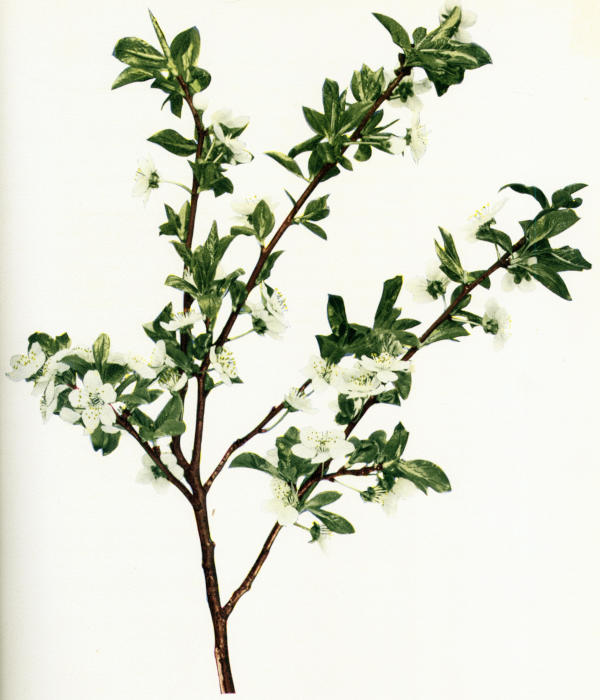
PRUNUS CERASIFERA
1. Ehrhart Beitr. Nat. 4:17. 1789. 2. Hooker Brit. Fl. 220. 1830. 3. Koch, K. Dend. 1:97. 1869. 4. Koch, W. Syn. Deut. und Schw. Fl. 1:727. 1892. 5. Bailey Cornell Sta. Bul. 38:66. 1892. 6. Schneider Handb. Laubh. 1:632. 1892. 7. Schwarz Forst. Bot. 339. 1892. 8. Dippel Handb. Laubh. 1:633. 1893.
P. domestica myrobalan. 9. Linnaeus Sp. Pl. 475. 1753. 10. Seringe DC. Prodr. 2:538. 1825.
P. myrobalan. 11. Loisleur Nouv. Duham. 5:184. 1812. 12. Koehne Deut. Dend. 316. 1893.
Tree small or a tree-like shrub, seldom exceeding twenty-five feet in height; branches upright, slender, twiggy, unarmed or sometimes thorny; branchlets soon glabrous, becoming yellow or chestnut-brown; lenticels few, small, orange in color, raised.
Winter-buds small, obtuse, short-pointed, pale reddish-brown; leaves small, short-ovate, apex acute, base cuneate or rounded, thin, membranaceous, texture firm, light green, nearly glabrous on both surfaces at maturity, though hairy along the rib on the lower surface, margins finely and closely serrate; petiole one-half or three-quarters of an inch long, slender, usually glabrous, glandless.
Flowers large, three-quarters of an inch in diameter, expanding very early or mostly with the leaves; calyx-lobes lanceolate, glandular, reflexed; petals white, sometimes with a blush, ovate-oblong or orbicular, the base contracted into a claw; borne singly, sometimes in pairs, in cymes on long, slender, glabrous peduncles.
Fruit small, one-half inch or a little more in diameter, globular or depressed-globular, cherry-like, red or yellow; skin thin and tender; flesh soft, juicy, sweet and rather pleasantly flavored; stone oval, short-pointed at both ends, somewhat turgid, ridged on one suture and grooved on the other.
Prunus cerasifera, the Cherry plum, first came to notice in pomological literature as the Myrobalan plum, a name used as early as the last half of the Sixteenth Century by Tabernæ-Montanus and given prominence in the Rariorum Plantarum Historum, published by Clusius in 1601. Why applied to this plum is not known. Myrobalan had long before been used, and is still, as the name of several plum-like fruits of the East Indies, not of the genus Prunus, which are used in tanning, dyeing, ink-making and embalming. Until Ehrhart gave it the name Prunus cerasifera in 1789 it was known as the Myrobalan plum by botanists, some of whom, and nearly all horticulturists, have continued the use of the name until the present time.
Not a few of the botanists who have used Myrobalan for this plum have called it a botanical variety of Prunus domestica. Among these were Linnaeus and Seringe. Others, as Loisleur and Poiteau, have preferred the name for the species as distinguished by Ehrhart.
Many of the early botanists, as Tournefort in 1700, Ehrhart in 1701, Loudon in 1806 and Loisleur in 1812, gave the origin of the Cerasifera plums as North America, but upon what authority does not appear. On the other hand many European botanists, including Linnaeus, gave the habitat as Europe or Asia. The supposition that this plum came from North America hardly needs discussion. The plum flora of this continent has been well enough studied so that it can be said that no plant that could by any possibility be the Cerasifera plum grows on this side of the Atlantic. Neither does it seem logical to consider this an off-shoot of Prunus domestica, for fruit and tree-characters are distinctly different, and for a member of the genus Prunus are remarkably constant. Moreover, there is abundant evidence to show that this is a distinct species and that its nativity is in the Turkish and nearby countries in Europe and Asia and that there it has been in cultivation for a long time.
It is very significant that in the old herbals and botanies a frequent name of this fruit is “the Turkish plum.” But more specific and almost conclusive proof is that two forms of plums belonging to this species are known to come from the Caucasus region. Prunus divaricata[86] is now considered by some botanists to be a synonym of Prunus cerasifera and by others to be a botanical variety of the last named species. Ledebour, who named it, found it in the Trans-Caucasian region. It differs from the type only in having much divided, wide-spreading and nearly prostrate branches. The Pissardi plum, a purple-leaved form of this species, originated in Persia. A plum now growing in the Arnold Arboretum raised from seed from Turkestan, presumably from wild stock, is identical with plants of Cerasifera of European origin. And, according to Schneider,[87] this plum is known in the wild state in Caucasus, Trans-Caucasus, northern Persia and Turkestan.
The Cerasifera plums are small trees, usually upright but in some forms with spreading branches which are commonly unarmed, glabrous and brownish in color. The leaves are ovate and smaller and thinner and with more finely serrate margin than those of the Domestica plums. It blooms prolifically and bears large, white, single or paired flowers, making a most beautiful tree when in flower. The fruit is small, round, and cherry-like, from half an inch to an inch in diameter, usually red but sometimes yellow. The flesh is soft, sweetish or sub-acid and poor. The stone is turgid, smooth and pointed. The species is variable in nearly all tree-characters, and were it not surpassed by other plums for its fruit there would undoubtedly be a great number of varieties cultivated for the markets. There are, however, but few cultivated Cerasiferas, only nineteen being described in The Plums of New York. It is very generally distributed wherever plums are grown, because of the use to which it has been put as stocks for other species. For this purpose it is held in high esteem the world over. In the nurseries of New York it is now used more than any other stock and it is common to find it fruiting here and there from plants set for or used as stocks. In fact practically all the cultivated varieties have arisen as survivals of plants meant for stocks. It is almost certain that the Cerasifera, or Myrobalan, as it is universally known by horticulturists, dwarfs the cion and that it is not equally well suited to all varieties; but it does not “sprout” as badly as some other stocks, is adapted to many soils, and the young trees grow well and are rapidly budded, giving at the start a strong and vigorous orchard tree.
The Cerasifera plums are handsome trees. The foliage is a fresh and beautiful green and whether covered with a mass of flowers or loaded with red or yellow fruit these plums are as handsome as any of our cultivated fruit trees, and as desirable for ornamentals.
The hardiness, thriftiness, freedom from disease and adaptability to soils make the species desirable for hybridizing. A number of breeders of plums have made use of it with some indications of a promising future, several interesting hybrid offspring of this species being described in The Plums of New York.
The small number of varieties of Cerasifera cultivated for their fruit indicates that but little can be expected from this species by plum-growers, since so little has come from it in the shape of edible fruits, though it has been under general cultivation for over three hundred years, at least, as an ornamental and as a stock. Several valuable groups of ornamentals have arisen from Cerasifera, of which the following are most notable:—
In 1880 M. Pissard, gardener to the Shah of Persia, sent to France a purple-leaved plum which proved to be a form of Prunus cerasifera. To this plum Dippel[88] gave the name Prunus cerasifera atropurpurea, while horticulturists very generally call it Prunus pissardi. A close study of the purple-leaved plum reveals no character in which it differs from the species except in the color of foliage, flowers and fruit; the leaves are purple, as are also the calyx and peduncles of the flowers, while the fruit is a dark wine-red. These are but horticultural characters and do not seem to be of sufficient importance to establish for this plant a botanical variety. This view is strengthened by the fact that Jack[89] reports that seeds from the purple-leaved plum have produced plants which agree in all essential particulars with the species; while Kerr[90] has grown a purple-leaved plum from a variety of Prunus cerasifera.
Besides this well-known purple-leaved plum nurserymen offer Prunus pendula, a weeping form; Prunus planteriensis, bearing double white and red flowers; Prunus acutifolia, a plum with narrow, willow-like leaves; Prunus contorta, characterized by twisted, contorted foliage; Prunus elegans, Prunus gigantea, and a variety with yellow and another with variegated leaves, etc. All of these are probably horticultural varieties of Prunus cerasifera though some of them cannot be classified with surety.
Schneider[91] calls Prunus dasycarpa Ehrhart,[92] the Prunus armeniaca dasycarpa of Borkhausen,[93] a cross between Prunus cerasifera and Prunus armeniaca, one of the apricots.
7. PRUNUS MONTICOLA K. Koch
1. Koch, K. Ind. Sem. Hort. Berol. App. 1854. 2. Schneider Handb. Laubh. 1:632. 1906.
Plant shrub-like, slender, upright, scarcely thorny, new wood more or less olive-brown. Buds short, ovate; leaves roundish or cuneiform, base oblong-ovate, point drawn out, main nerves over six on both sides, the serrations coarse and uniform in size, always glabrous. Flowers mostly in twos; borne on long, slender peduncles; calyx usually glabrous; petals white, odor slight; stamens thirty or more. Fruit small, roundish-oblong, red; stone ovoid, pointed at one end, somewhat turgid.
Prunus monticola is described by the above authors as a shrub-like plum from Asia Minor and Armenia having, so far as can be learned from European texts, little or no horticultural value. The herbarium specimens seen by the writer indicate that this species is closely related to Prunus cerasifera. The description of the species is abbreviated from Schneider.
8. PRUNUS TRIFLORA Roxburgh
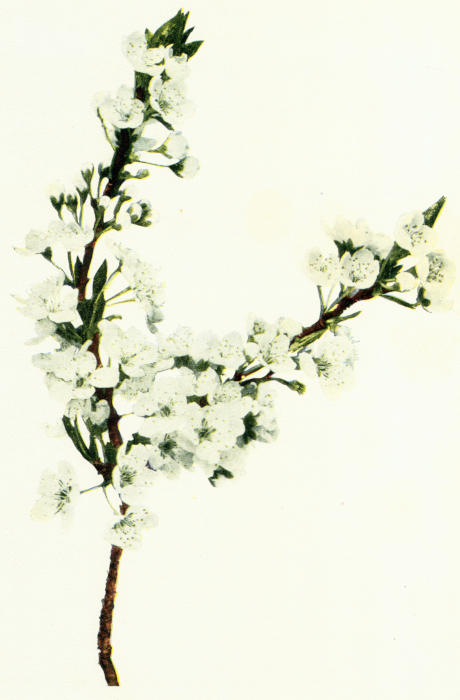
PRUNUS TRIFLORA
1. Roxburgh Hort. Bengal 38. 1814. 2. Ibid. Fl. Indica 2:501. 1824. 3. Schneider Handb. Laubh. 1:627. 1892. 4. Bailey Cornell Sta. Bul. 62. 1894. 5. Waugh Plum Cult. 42. 1901.
P. domestica. 6. Maximowicz Mel. Biol. 11:678. 1883.
P. hattan Tamari. 7. Bailey An. Hort. 30. 1889.
P. communis. 8. Forbes and Hemsley Jour. Linn. Soc. 23:219. 1886-88.
P. japonica of horticulturists (not P. japonica of Thunberg).
Tree twenty to thirty feet in height, vigorous; trunk six to twelve inches in diameter, straight; bark thick, rough, numerous corky elevations especially on the branches, reddish or cinnamon-brown, peach-like; branches long, upright-spreading, much forked, brash and often splitting at the forks; branchlets thick, straight, glaucous and glabrous, at first light red, growing darker the second year; lenticels few or many, usually small but conspicuous, light in color.
Winter-buds small and obtuse, free or appressed; leaves borne abundantly, small or of but medium size, oblong-obovate, point acuminate or abrupt, prominent, base rounded, firm, thin, membranaceous, margins finely and closely serrated, sometimes in two series, teeth usually glandular; upper surface bright green, glabrous, lower surface dull, whitish, glabrous or slightly pubescent on the veins; veins pronounced; petioles one-half inch in length, stoutish, tinged with red; glands few or several, usually globose, greenish; stipules lanceolate, very narrow, one-half inch long, caducous.
Flowers expanding early, before, with or sometimes after the leaves, first of the plum blossoms to appear, very abundant, three-quarters of an inch in diameter; usually three springing from each flower-bud, often in dense clusters on lateral spurs and lateral buds on one-year-old wood; calyx-tube green, glabrous, campanulate or obconic; calyx-lobes acute to obtuse glandular-serrate, erect, glabrous or pubescent; petals white, oval, entire or crenate, with a short claw or tip; stamens about twenty-five, shorter than the petals; anthers yellow, sometimes tinged with red; pistils glabrous, longer than the stamens; pedicels one-half inch long, slender.
Fruit varying greatly in season, from very early to late; large, from one to two inches in diameter, globular, heart-shaped or often somewhat conical; cavity deep; apex conspicuously pointed; suture usually prominent; color varies greatly but usually a bright red or yellow, never blue or purple, lustrous, with little or no bloom; dots small, numerous, usually conspicuous; skin thin, tough, astringent; stem one-half inch in length; flesh red or more often yellow, firm, fibrous, juicy; quality variable, of distinct flavor, usually good; stone clinging tenaciously or nearly free, small, rough or lightly pitted, oval to ovate, one edge grooved, the other ridged.
A study of the botanical characters of the many Triflora plums under cultivation fails to show any lines of cleavage whereby the species can be divided. Of plums commonly grown in America it is not very closely related to any unless it be Prunus simonii. There are several plums from eastern and central Asia with which we are not at all familiar in America that may show relationship with Prunus triflora, chief of which are Prunus ichangana Schneider,[94] Prunus thibetica Franchet[95] and Prunus bokhariensis Royle,[96] the last a cultivated plum from northern India. These, in herbarium specimens, have some characters reminding one of Prunus triflora, others of Prunus domestica and still others, of Prunus cerasifera.
The Triflora, or Japanese,[97] plums are now cultivated in all parts of the world where plums are grown; yet outside of Japan and China they have been grown for their fruit less than half a century. Despite the fact that these plums have been grown in Asia for several centuries the wild form is not known. Indeed, there are doubts in the minds of some as to whether it constitutes a distinct species, Maximowicz, an authority on the flora of Japan, among others, holding that it is but a form of Prunus domestica. Roxburgh in naming it gave but little definite information in regard to the species, but the herbarium specimens of his in the Kew Herbarium are readily identified as identical with our Japanese plums.[98] The confusion between Prunus triflora and Prunus domestica seems needless, as the points of difference between these two species are several and very distinct and constant, the resemblances between Prunus triflora and some of the American species being much closer. So, too, the effort, sometimes made, to make more than one species out of Prunus triflora is straining a point, for though the types under cultivation vary considerably yet the variations are not greater than between varieties of other species of the genus Prunus.
Prunus triflora is almost certainly a native of China. According to Georgeson and Sargent, who have made extensive botanical explorations in the forests of Japan, there are no indigenous plum trees in that country. Dr. K. Miyake, botanist at the Agricultural College of the Imperial University, Tokyo, Japan, writes to this Station,[99] that Prunus triflora does not grow wild in Japan but was introduced there from China from two to four hundred years ago. Bretschneider[100] in his treatise on The Study and Value of Chinese Botanical Works says that the plum has been cultivated from ancient times in China and this indicates that the original habitat was in that country. Mr. F. N. Meyer, Agricultural Explorer for the United States Department of Agriculture, who has made extensive agricultural explorations in China, writes[101] that he has seen many trees of Prunus triflora cultivated in the Chekiang Province and also about Canton but that he had not found the species growing wild. Roxburgh says[102] that the shrub had been “received from China into our gardens in Bengal.” Forbes and Hemsley[103] state that varieties of this plum are cultivated in China and that it occurs in the wild state in the mountains near Peking as well as on the Tsunglin range in Shensi and Kansu. These writers are, however, uncertain as to where it is truly indigenous.
While the above and practically all evidence points to China as the original home of Prunus triflora it is likely that the habitat of the species cannot be accurately determined until western and southwestern China have been explored by botanists, these regions as yet being almost unknown to foreign scientists.
Notwithstanding the illustrious work of Kaempfer, Thunberg, Siebold and Fortune in sending to Europe the choicest plants of Japan and China, Prunus triflora seems to have reached the Old World through America at a very recent date. At least the species was not cultivated for its fruit in Europe until introduced from the United States as Japanese plums, and even yet they are but barely known in European orchards. The species was introduced into this country from Japan about 1870 by a Mr. Hough of Vacaville, California. According to Bailey,[104] who has given much attention to these plums, Mr. Hough obtained his trees from a Mr. Bridges, United States Consul to Japan. John Kelsey, Berkeley, California, produced the first ripe fruit of the Triflora plums in America in 1876 and 1877, and impressed by their value began recommending them. Owing to Mr. Kelsey’s efforts the propagation of these plums was begun on a large scale about 1883 by W. P. Hammon & Co., of Oakland, who commemorated Mr. Kelsey’s labors by naming the plum after him. The success of the Kelsey started the importation and origination of varieties and a veritable boom in Japanese plums was soon under way.
This fruit is a most valuable addition to our pomology, no less than ninety-two varieties now being under cultivation in America. At first it was thought desirable only for the southern states, but it proved to be nearly as hardy as the Domestica plums in the northern states and was soon widely distributed north and south. Beyond question it has suffered from over-praise, which has led to over-planting. As was of necessity the case, many untested and worthless varieties were offered fruit-growers, and these, with the failure of some of the extravagant claims for the really meritorious varieties, have given the Triflora plums a bad reputation with many fruit-growers. Now we have cultivated plums of this species for forty years and there has been time for the excitement of their discovery and the consequent reaction to abate making it possible to arrive more nearly at their true place in pomology.
The plums of this species possess several striking features that commend them to fruit-growers. Undoubtedly the most valuable attribute of the Triflora plums as cultivated fruits is their wide range of adaptability. All must admit that this group of varieties is less valuable than the Domestica varieties where both succeed, but the Triflora plums are adapted to a much wider range of country and of conditions than the Domesticas. But even where both types of plums succeed the newer plum introduces several very desirable features quite aside from additional variety which the many distinct sorts furnish. Thus, as a species, the Trifloras are more vigorous, productive, earlier in coming in bearing and more free from diseases, especially black-knot and leaf-blight, than the Domestica plums. The Trifloras are also less subject to curculio than most of the native and European species. They keep longer and ship as well as the better known Europeans. As compared with native varieties the plums from Japan are larger, handsomer and better flavored and keep and ship better. Some disadvantages are that they blossom so early as to be often caught by spring frosts; they are quite subject to brown-rot; for most part they are tenacious clingstones; the species, all in all, is less hardy to cold than the Domestica plums; lastly, they are inferior in quality to the varieties from Europe. The last fault is so serious that, though the average for the Triflora plums is high, making them unquestionably more desirable inhabitants of the orchard than any of the native species, they cannot compete with the Domesticas where the two types can be equally well grown.
The botanical differences between these Asiatic plums and those from Europe and America are most interesting. In 1859 Asa Gray called attention to the striking resemblances between the east coast floras of Asia and America. The Triflora plum is one of the plants which furnishes substantial evidence of this similarity and of the dissimilarity of the east and west coast floras of the two hemispheres. In general aspect the trees of the Triflora plums in summer or winter are much more like those of the American species than like those from Europe or West Asia; so, too, the fruits are more alike in appearance and in quality, and the peach-like foliage of the Trifloras might easily be mistaken for that of some of our varieties of Hortulana or Munsoniana. In the manner in which the buds are borne and in vernation the resemblance of the Oriental species to the Americanas, Hortulanas and Munsonianas is again most striking. In Asiatic and American species the buds are borne in twos and threes, while in the European species they are more often single or double.
The importance of this similarity of the Triflora plums to the most common American species is seen when Gray’s reason for the likenesses between the two floras is considered. This, briefly, is that similar types of post-glacial plants should persist in areas having like geographical positions and like climates; hence east-coast plants in one hemisphere should be expected to be similar to those of the east coast of the other hemisphere and the same with the west coast. Triflora plums are near of kin to American plums, then, because they have been evolved under similar conditions. This is a reason why these plums from Japan are adapted to so wide a range of country in America, and why, too, they are so free from the fungus troubles which attack European plums, but from which American plums suffer but little.
As might be expected from their nearness of kin the Triflora plums hybridize readily with the American species and especially with the Hortulanas and Munsonianas, the species they most resemble. Unfortunately an amalgamation of the Oriental plums with the Americanas is not so easily accomplished and that with the Domesticas is still more difficult. Hybrids with Prunus simonii are easily made and the progeny as a rule have much merit. Hybrids of the Trifloras with our native species give most promising results, a number of them being described in The Plums of New York. The fact that the Trifloras have been cultivated for several centuries, at least, means in their hybridization with American species that there is an amalgamation of domesticated characters with the similar but wilder characters of our native species.
It has been very difficult to establish a satisfactory nomenclature for the Triflora plums now grown in America. In spite of the excellent work of Berckmans,[105] Bailey[106] and Waugh,[107] in bringing order out of what was at one time utter confusion, there is still a great deal of uncertainty as to the identification of some varieties. The confusion began with the first extensive importation of these plums from Japan when names which the Japanese applied to classes or groups or the localities from which the plums came were made to apply in America to definite varieties. Many of the names under which the plums were imported have had to be dropped and the varieties boldly renamed. Another source of confusion has been that these, of all plums, seem most variable under changed conditions. Local environment in many instances in America changes somewhat the habit and appearance of varieties, making it difficult to decide whether two or more specimens of the same sort from different localities are identical varieties or distinct. Curiously enough, too, the trees of some varieties of plums seem to bear unlike fruit in different years, especially in the matter of time of ripening; that is, trees of some varieties do not always ripen their fruit in the same sequence, being earlier than another variety one year and possibly later the next. All fruits are more or less variable in this respect, but the Triflora plums are remarkably so, a fact that has added to the confusion in their nomenclature, since it adds to the difficulty of identifying varieties.
The cultivated varieties of Prunus triflora are also very diverse as regards tree-characters, especially as to vigor, hardiness and time of maturity of the fruit. The differences seem to be horticultural or those that come from cultivation, rather than botanical. Indeed, it seems impossible to place the numerous varieties in horticultural groups that are marked with any great degree of definiteness. A distinction of groups based on color is sometimes made, but the one character is insufficient to have classificatory value. In Japan, according to Georgeson, a division of the species is made with shape as the line of division. He says[108] “The round plums are designated by the term botankio, while those of an oval or pointed shape are called hattankio.” The varieties are sometimes loosely grouped into yellow and red-fleshed sorts. A serviceable classification would have to be founded on several or a considerable number of characters. Such a classification at present is impossible.
9. PRUNUS SIMONII Carrière
1. Carrière Rev. Hort. 111. 1872.[109]
Tree small, of medium vigor, upright, dense, hardy except in exposed locations, unproductive; branches stocky, long, rough, thickly strewn with small lenticels; branchlets slender, long, with internodes of medium length, reddish, glabrous; leaf-buds intermediate in size, short, obtuse, free.
Leaves folded upward, oblong-lanceolate to obovate, peach-like, narrow, long, of medium thickness; upper surface dark green, smooth, shining, lower surface pale green, not pubescent, with prominent midrib; margin slightly crenate; petiole short, thick, faintly tinged red, often with four large globose glands on the stalk.
Flower-buds numerous on one-year wood although found on spurs on the older wood; flowers appearing very early, semi-hardy, small, pinkish-white; borne singly or in pairs, often defective in pollen.
Fruit maturing early; one and three-quarters by two and one-quarter inches in size, strongly oblate, compressed; cavity deep, wide, flaring, regular, often slightly russeted; suture variable in depth, frequently swollen near the apex which is flattened or strongly depressed; dark red or purplish-red, overspread with waxy bloom; dots numerous, small, dark colored, with russet center, inconspicuous; stem thick, characteristically short being often one-quarter inch long; skin of medium thickness, tough, bitter, adhering to the pulp; flesh rich yellow, medium juicy, tough, firm, very mild sub-acid with a peculiar aromatic flavor; of fair quality; stone clinging, about seven-eighths inch in diameter, roundish, flattened to rather turgid, truncate at the base, tapering abruptly to a short point at the apex, with characteristic rough surfaces; ventral suture narrow, acute or with distinct wing; dorsal suture very blunt or acute, not grooved.
All that is known of the history and habitat of this species is that it came from China in 1867 having been sent to the Paris Museum of Natural History by Eugene Simon, a French consul in China. The spontaneous form has not as yet been found. The general aspect of the tree is more that of the peach than the plum and the drupes are as much like apricots or nectarines as plums but when all characters are considered the fruit can better be classed with the plums than with any of the other stone-fruits named.
Prunus simonii has been widely grown in America both for its fruits and as an ornamental, but it cannot be said that it has become popular for either purpose and only one variety of the species is now under cultivation. As a food product the plums lack palatability and as ornamentals the trees are subject to too many pests. Prunus simonii has been successfully hybridized with Prunus triflora and as secondary crosses its blood has been mingled with that of some of the native species as well. Most of its hybrid offspring have more value than the parent, nearly all of them lacking its disagreeable taste. According to an article published in Revue Horticole[110] a new form of the Prunus simonii was produced in 1890 from a bud sport, the fruit of which is elongated, a little cordate, slightly unequal, and grooved on one side. So far as can be learned this sport has no very decided merits as a horticultural plant.
10. PRUNUS AMERICANA Marshall
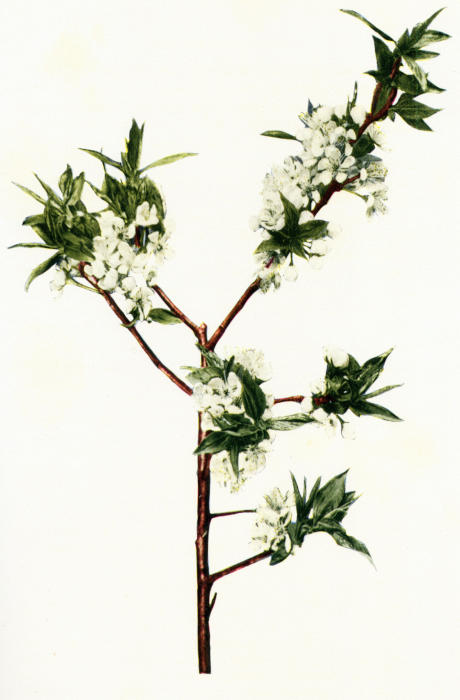
PRUNUS AMERICANA
1. Marshall Arb. Am. 111. 1785. 2. Eaton and Wright N. Am. Bot. 377. 1840. 3. Torrey and Gray Fl. N. Am. 1:407. 1840 (in part). 4. Torrey Fl. N. Y. 1:194. 1843 (in part). 5. Emerson Trees of Mass. 449. 1846. 6. Nuttall Silva 2:19. 1846. 7. Darlington Fl. Cest. Ed. 3:72. 1853. 8. Torrey Pac. R. Rpt. 4:82. 1854. 9. Curtis Rpt. Geol. Surv. N. C. 56. 1860. 10. Ridgway Proc. U. S. Nat. Mus. 65. 1882. 11. Sargent 10th Cen. U. S. 9:65. 1883 (in part). 12. Watson and Coulter Gray’s Man. Ed. 6:151. 1889 (in part). 13. Coulter Cont. U. S. Nat. Herb. 2:102. 1891. 14. Sargent Silva N. Am. 4:19, Pl. 150. 1892. 15. Rydberg Cont. U. S. Nat. Herb. 3:156. 1895. 16. Ibid. 3:494. 1896. 17. Waugh Vt. Sta. Bul. 53:59. 1896. 18. Ibid. Vt. Sta. An. Rpt. 10:100. 1896-7. 19. Chapman Fl. Sou. U. S. 130. 1897. 20. Bailey Ev. Nat. Fr. 182, fig. 1898. 21. Waugh Vt. Sta. An. Rpt. 12:231. 1899. 22. Mohr Cont. U. S. Nat. Herb. 6:551. 1901. 23. Bailey Cyc. Am. Hort. 1448 fig. 1901. 24. Rydberg Fl. of Colo. 193. 1906.
Tree attaining a height of thirty feet, slow but strong in growth, often shrubby; trunk thick, sometimes a foot in diameter, short, bearing the head at three to five feet; bark one-half inch thick, dark grayish-brown, outer surface rough, shaggy with large scales, with age becoming smoother, giving a characteristic aspect; branches spreading, crooked, long, rigid, but often pendulous at the extremities, more or less thorny, with lateral, spinescent branchlets; branchlets light green, usually glabrous, sometimes much or little tomentose, at first becoming brownish and later tinged with red; lenticels numerous, large and distinct.
Winter-buds medium in size, short, acute, appressed, reddish-brown; leaves large, obovate, oblong-obovate, or oval, acuminate at the apex and usually rounded at the base, thin and firm in texture, becoming somewhat coriaceous; margins sharply serrate, almost incised, often doubly serrate, the coarse and double serrations characteristic; teeth not glandular; upper surface more or less roughened, light green, the lower one glabrous or slightly hairy, sometimes pubescent, coarsely veined, the midrib grooved on the upper side; petioles slender, two-thirds inch in length, usually glandless; stipules long, sometimes three-lobed, falling early.
Flowers expanding after the leaves, large, an inch in diameter, borne in lateral umbels, two to five-flowered, mostly on one-year-old wood; pedicels one-half inch long, slender, usually glabrous; calyx-tube obconic, entire, glandular, reddish on the outer, green on the inner surface, glabrous; calyx-lobes acuminate, glabrous on the outer and pubescent on the inner surface, reflexed; petals white, sometimes with bright red at the base, rounded and often lanciniate at the apex, contracted into a long, narrow claw at the base; stamens about thirty in number, as long as the petals; anthers small, yellow; pistils glabrous, slender, as long as the stamens; stigma thick and truncate; anthers and pistils often defective; when in full flower emitting a disagreeable odor.
Fruit very variable in ripening period; globose, sub-globose, conical, oval, or sometimes oblique-truncate, usually more than an inch in diameter, red or rarely yellowish, mostly dull, with or without bloom; dots pale, numerous, more or less conspicuous; cavity shallow or almost lacking; suture a line; skin thick, tough, usually astringent; flesh golden-yellow, juicy, meaty, fibrous, sweetish, acid and poor but often good to very good; stone clinging or free, turgid or flattened, the apex pointed, ridged on the ventral and slightly grooved on the dorsal suture, surfaces smooth.
As Prunus americana is more carefully studied throughout the great territory it inhabits, undoubtedly one or more sub-species will be described. The plums of this species in the Mississippi Valley are distinguished from the eastern and typical form by fruits having a length greater than the diameter, by a somewhat different aspect of tree and by flatter seeds which are usually conspicuously longer than broad. All of the cultivated varieties come from the western form. The plant of Prunus americana in the dry plain regions in Kansas and Nebraska becomes shrubby in character while on the alluvial bottom lands along the streams in this region it retains the character of a tree. In the southern limit of its range, the leaves of this species are more or less pubescent on the lower surface. As the species occurs throughout western New Mexico, Colorado, Utah, Wyoming, Montana and Manitoba, it differs enough, possibly, from the eastern types to be considered a sub-species, having a wholly different aspect of tree, silvery and somewhat scurfy twigs, smaller, thinner and lighter colored leaves and smaller fruits with more roundish stones.
Prunus americana is the predominating native plum. It is the most widely distributed, is most abundant in individual specimens and has yielded the largest number of horticultural varieties of any of the native species. Because of its prominence and comparatively high degree of permanency of characters it may well be considered the type from which has sprung not only its botanical varieties but several other of the American species. Its variability, too, is shown in its many diverse horticultural varieties, and of its adaptability it may be said that it flourishes on nearly all soils and exposures, and is found wild or cultivated from Maine to Florida and northward from Mexico along the eastern slope of the Rocky Mountains well into Canada. The species was well named by Marshall “Americana.”
This plum has not played nearly as important a part in the pomology of America as its merits would warrant. It seems to have made an impression almost from the first upon the Europeans who settled America, for it is mentioned in nearly all the early records of the food products of the newly found land, yet its cultivation can hardly be said to have begun until the last half of the Nineteenth Century. But the early descriptions of this and other native plums by the colonial explorers, naturalists and botanists, show but little interest in these fruits as subjects for cultivation, and seem to contain almost no prophecies as to the possible development of a new orchard plant from them. It is probable that the Damsons, which were early introduced in America, and the Domesticas, which came at least before the Revolution, proved so adaptable to the part of the New World in which the colonies were planted that this, even though the best of the wild plums, offered small reward in comparison.
It is certain, however, that from the very first, Americana plums were much used by the early settlers as wild fruits, for the histories of all the colonies and states in which plums are found contain innumerable references to wild plums, usually with some expression showing that they were considered makeshifts until the European plums could be grown. Long before white men came to America the possessors of the continent knew and esteemed these fruits of the woods. According to some of the early writers wild plums of this species, since found where the Americanas are dominant, were planted and rudely cultivated by the natives.[111] It is likely, however, that these Indian orchards were more often the result of seeds dropped about camping places and towns rather than regularly planted orchards. It is not improbable that the wide distribution of this species in the Mississippi Valley and the country about and beyond the Great Lakes is due somewhat to the hand of the Indian, of the voyageur and of the missionary of the French regime.
The common names under which this plum passes in the states where it is found as a wild fruit are indicative of the knowledge possessed of it by the people. The Americana is nearly always the wild plum of eastern America. It shares with several other species the names in various parts of the country of Red Plum, Yellow Plum, the Horse and the Hog Plum. In Iowa this is most often the “native plum;” in Indiana it is the Goose plum; in Georgia, the August plum, while in the states bordering on the Gulf it is often called the Sloe.
The domestication of Americana plums is due to the fact that the plums of Europe will not thrive in the Mississippi Valley, the prairie states, nor, for the most part, in the South. The European species are tender both to cold and heat in these regions and they are attacked by those scourges of plum culture, black-knot, leaf-blight and curculio. If, then, the people in the West and South were to have plums at hand when wanted, the wild species had to be brought under cultivation. Where the two will grow side by side it is doubtful if any would choose to grow the Americanas in preference to the Europeans or even for the sake of variety.
The Americana plum was introduced into European gardens at an early date, for references to it are found in the pomological works of the Eighteenth Century, Duhamel having described it in his great work on pomology in 1768, under the name Prunier de Virginie, and later Poiteau[112] gives a very good description of it under the name Prune de la Gallissioniere. Just how much earlier than these dates it was taken to the Old World cannot be said, but seeds of it are likely to have been taken there by some of the returning explorers of early colonial times. The important fact is that as a cultivated fruit it has made absolutely no headway in competition in Europe with the plums of that continent though it is to be found not infrequently as an ornamental.
The domestication of these plums began less than a century ago, not through direct efforts in breeding them but as the result of the selection of the best of the wild or chance trees found in many widely separated localities. It would be most interesting to follow in detail the introduction of variety after variety of this species into cultivation, giving full credit to the men, many of them pioneers in newly settled countries, through whose efforts the amelioration of the species was begun. But space forbids, and the reader who desires to trace more fully the history and the evolution of these plums must put together the histories of the two or three hundred varieties of Americanas described in the chapters on varieties.
Are the Americanas to compete with the Domesticas, Insititias and Trifloras where all may be grown? It is very doubtful or at least not soon. The Old World plums are so superior, speaking generally, in size, appearance, and flavor, the qualities which appeal to those who eat plums, that the native varieties stand small chance for popular favor. Their place in pomology must long remain the region where the older and more highly developed groups of plums cannot be grown. Though there are now many times more of the Americana plums under cultivation than of the recently introduced Trifloras, the latter are more popular and are likely to remain so in localities where both can be grown.
The range of Prunus americana is seemingly increasing, making it almost impossible to give its present limits. The boundary line of its northern range passes through central New York to central Michigan, southern Wisconsin, Minnesota and South Dakota extending northwestward to Manitoba and reaching its western limit in Utah. It occurs locally southward through Colorado to northern New Mexico. It is rare in Oklahoma and does not occur in Texas, but is represented in Missouri by a pubescent form. East of the Mississippi River the typical species occurs in all of the states from central New York southward to northern Florida. In this great territory it is found in many diverse soils and exposures but responding in all to good soil and congenial environment. In the wild state the Americana plums are most often found along the borders of streams and swamps or in bottom lands where moisture abounds. Sometimes they are found in swamps which may be submerged a part of the year. In spite of a predilection for moist lands, however, the wild plants are not infrequently found on comparatively dry uplands, seeming to prefer soils containing considerable lime. The wild trees are usually found in thickets, often of considerable extent.
Under cultivation the range is even greater than for the wild plant. It is only in localities of extreme heat and cold, humidity or aridness, that some of the many Americanas cannot be made to grow under conditions at all favorable for orchards of any of the temperate fruits. So, too, varieties may be found for nearly all soils which permit of cultivation. This freedom from local attachments is one of the chief assets of the species.
The Americana tree is commonly small, often but a bush, and usually with a thick, thorny top. Generally the head attains a height of about fifteen or eighteen feet and sometimes it rises to twenty-five or thirty feet, spreading into many rigid branches which are often pendulous at the extremities. The species may almost always be told by the rough, shaggy, grayish bark, the large, thin, persistent plates of which give a very characteristic shagginess. In the spring the tree is covered with umbelliferous masses of pure white flowers and both at this season and later with its ample foliage or showy fruit, the plant is very ornamental. The leaves are large, oval or obovate, thin, dull and veiny, with very jagged margins.
The fruit is reddish or yellowish or a blending of the two with the red varieties predominating. Often the color is more nearly orange than red or yellow—in fact pure yellow fruits cannot be found. Wild or cultivated the fruits of the Americana plums vary greatly in season, size, shape and flavor. In the orchard the period of maturity covers a range of several weeks, beginning in New York in August and ending in October; in the wild, trees in the same thicket may vary as much as three weeks in ripening their fruit. The size of the cultivated sorts is from that of a Damson to that of some of the Gages, the shape being roundish-oval, or quite oval, sometimes oblique and sometimes truncate at one or both ends and often more or less compressed. The wild fruits usually have a pleasant flavor and this is much improved under cultivation so that when fully ripe the flesh of some sorts is sweet and luscious, hardly surpassed, if the skin be rejected, by the best Domesticas. The skin is usually thick, coriaceous, acerb or astringent, and altogether very unpleasant, making with the tenaciously clinging stones the chief defects of these fruits. In some varieties skin and stones are far less objectionable than in others.
The trees of the varieties we have as yet are not very manageable in the orchard. They make a very slow growth and are hard to control, producing at maturity many leaning trunks which are often crooked, as are also the branches which, with the unkempt heads, give an impression of waywardness and wildness. Nearly all of the varieties over-bear and unless thinned the fruits are so small as to be hardly worth harvesting; not infrequently trees die from over-bearing. A few varieties are unfruitful but usually because of defective pollination. Nearly all sucker badly on their own roots, and except in cold regions should be grown on other stocks. In general there are fewer pests to combat with these than with the European plums but yet they are far from being exempt and require on the grounds of this Station quite as much spraying as do other plums.
Waugh, who has given the subject much study, claims that the Americanas are not very strong sexually,[113] chiefly because of defective reproductive organs. He found in extensive examinations that 21.2 per ct. of the pistils were defective, ranging from nothing in some varieties to 100 per ct. in others. More seldom the anthers were defective and the flowers were sometimes proterandrous (the pollen maturing before the pistil is ready to receive it), and that they were rather frequently proterogynous (the pistils receptive before the pollen is mature). Waugh holds that in planting these plums, provision should be made for cross-pollination, and recommends as sorts most suitable for inter-planting for this purpose, other varieties of the same species.
Plant-breeders have not found that this species hybridizes as readily as most of the other cultivated native plums. This is chiefly due to a seeming lack of affinity for other species. Nevertheless there are numerous Americana hybrids, and it is likely that as the high quality of the fruit and the hardiness of the trees become better known they will be used much more for hybridizing.
The Americana plums are all hardy and some of the varieties can be grown as far north as general agriculture is practiced. These, with the Nigras, will probably always be the chief groups for dry, cold regions between the Great Lakes and the Rocky Mountains. They may also be relied upon in the colder parts of New York and New England. The flower-buds as well as the trees are hardy, having been known to withstand a temperature of forty degrees below zero. Goff[114] reports that in the winter of 1896-7 the flower-buds of Domestica varieties on the grounds of the Wisconsin Experiment Station were almost totally destroyed though the minimum temperature recorded was only twenty-three degrees below zero, but the flower-buds of Americana varieties were not at all injured. Since the blossoms open comparatively late there is less damage from spring frosts in this than in most other species even of the natives.
The number of varieties of Americana plums is a testimonial to the merits of the species. There are about 260 varieties of them more or less disseminated. There are many divergent types of these and since all are far from what may be eventually expected from the species the number of varieties will undoubtedly greatly increase and in still other directions. In the meantime the great majority have fallen by the wayside. The weeding-out process seems to be in this case the chief agent of progression. A fault with the varieties now before the public is that many of them are so similar that a difference can hardly be detected. The elimination of the great majority of the varieties of this species now in the catalogs and a much more judicious selection of varieties for future dissemination would relieve pomology of the burden it now carries in the numerous sorts of Americanas.
PRUNUS AMERICANA MOLLIS[115] Torrey and Gray
1. Torrey and Gray Fl. N. Am. 1:407. 1840. 2. Sargent 10th Cen. U. S. 9:65. 1883. 3. Coulter Cont. U. S. Nat. Herb. 2:102. 1891. 4. Sargent Sil. N. Am. 4:19. 1892. 5. Waugh Bot. Gaz. 26:50. 1898.
P. americana lanata. 6. Sudworth Nom. Arb. Fl. U. S. 237. 1897.
P. lanata. 7. Mackenzie and Bush Trans. Acad. Sci. St. Louis 12:83. 1902.
Prunus americana mollis is a western and southwestern form of Prunus americana, the sub-species being distinguished from the species by the amount and character of the pubescence on the leaves and shoots. The leaves, petioles and shoots of this plum are soft-pubescent, almost tomentose, the tomentum being pale in color and usually very dense; the calyx-lobes are pubescent on both sides and the pedicels are appressed and densely pubescent. According to Bailey, there is a form of this sub-species “with flowers as completely double as those of St. Peter’s wreath, or similar spireas.” This double-flowering plum we have not seen.
It is impossible to give the range of Prunus americana mollis as the woolly-leaved plum of the west gradually passes into the smooth-leaved species of the east and the two forms are not infrequently mixed in the South and Southwest; or possibly it would be better to say that they run into each other though the extreme forms are sufficiently distinct as to be readily mistaken for separate species. It can only be said that it is to be found in the greatest abundance in the region extending from southern Iowa through Missouri. Only two varieties of this plum, Wolf and Van Buren, are in general cultivation, both of which originated in Iowa. In neither fruit nor tree-characters do these differ greatly from the Americana plums.
A plum with pubescent leaves belonging to the Americana series known locally as the Big Tree plum, occurs from western Tennessee, south-westward through the extreme southern portion of Missouri, through Arkansas, southern Oklahoma, extending westward in central Texas, at least, as far as the Colorado River and reaching its southwestern limit in northern Mexico. From specimens of this plum in several herbaria and from studies made of it in the field by W. F. Wight of the United States Department of Agriculture, it would seem that this plum is a distinct species, its chief distinguishing character being the great size attained by the tree. So far as it is known the Big Tree has no cultivated forms unless it be Bilona, supposed to be a hybrid between this species and Prunus triflora, now growing on the grounds of F. T. Ramsey, Austin, Texas.
11. PRUNUS HORTULANA Bailey[116]
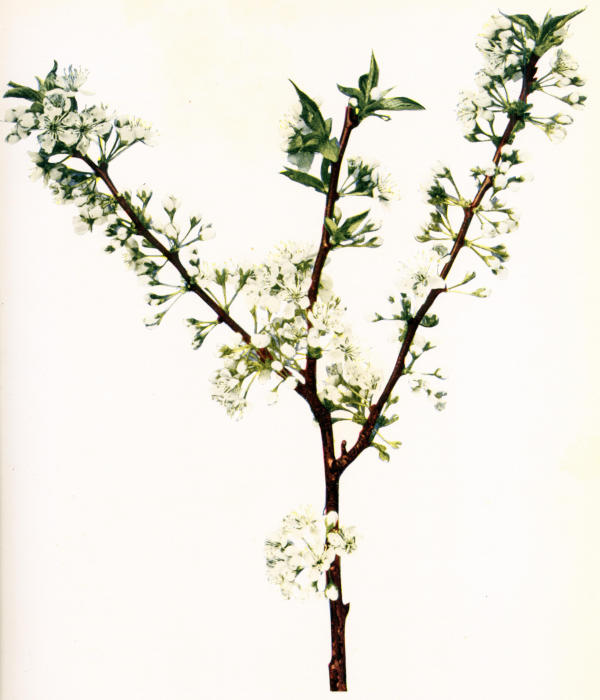
PRUNUS HORTULANA
1. Bailey Gar. and For. 5:90. 1892. 2. Sargent Sil. N. Am. 4:23, Pl. 151. 1892. 3. Waugh Vt. Sta. An. Rpt. 10:99-105. 1897. 4. Mohr Torrey Bot. Club Bul. 26:118. 1899. 5. Bailey Cyc. Am. Hort. 1450, fig. 1901. 6. Mohr Cont. U. S. Nat. Herb. 6:551. 1901.
P. americana, var.? 7. Patterson List Pl. Oquawka 5. 1874.
Tree attaining a height of thirty feet or more, vigorous in growth; trunk sometimes a foot in diameter; trunk and branches rough and shaggy becoming furrowed in age; bark gray-brown, thick and containing deposits of red cork cells which show as bright red blotches or as thick layers when the bark is sectioned, these deposits, especially in quantity, characterizing the species; branches very spreading and open, twiggy, slender, thorny; branchlets light green at first, becoming reddish-brown, glabrous and glossy; lenticels few, large, very coarse, raised, characteristic of the species.
Winter-buds plump, very small, obtuse, appressed; leaves one and three-quarters inches wide to five inches in length, long-oval with a tapering, pointed, acuminate apex, peach-like, base abrupt, texture thin, becoming leathery, margins serrate, almost crenate, sometimes in a double series, glandular; upper surface smooth, glossy, glabrous; lower surface light green, almost glabrous except on ribs and veins which are very pubescent, with characteristic orange color, midrib grooved above, rounded below, very prominent; petioles slender, an inch in length, pubescent on the upper side, tinged with red; glands two to eight, small, globose, mostly on the petioles.
Flowers expanding after the leaves, blooming later than any other cultivated plum, three-quarters inch across; odor disagreeable; clusters borne from lateral buds on one-year-old wood only, characterizing the species, the fruit-spurs making a very long growth, more like branches than the spurs of other species, two to six flowers from a bud; pedicels three-quarters inch long, very slender, glabrous; calyx-tube narrow, campanulate, glabrous, green; calyx-lobes narrow, acute, glandular-serrate, glands red, slightly pubescent on the inner side, erect; petals ovate, slightly crenate, dentate at the apex, tapering into long narrow claws; stamens about twenty in number, yellow; pistils glabrous, equal to or shorter than the stamens.
Fruit very late in ripening; globose, oval, an inch in diameter; color varying from shades of red to shades of yellow; bloom inconspicuous or lacking; dots numerous, small, conspicuous; suture very shallow or only a line; skin thick, tough, astringent; flesh golden-yellow, juicy, coarse, fibrous, firm, flavor mildly sweet, astringent at the pit, strongly aromatic; quality fair; stone clinging to the flesh, turgid, long-oval, small, prolonged at the ends, the surfaces rough and reticulated.
Prunus hortulana as established by Bailey, to quote a part of the original description, “includes a large class of plums represented by Golden Beauty, Cumberland, Garfield, Sucker State, Honey Drop, probably Wild Goose and others.” Unfortunately Bailey later added[117] a number of other plums to the group which the above varieties and some ten or fifteen others comprise, the additions in themselves constituting at least three somewhat distinct groups, and then to account for this omnibus species called it a “brood of natural hybrids.” Waugh supports Bailey’s conclusions[118] and divides the species into four groups of hybrids—the Miner group, the Wild Goose group and the Schley or Clifford group. These, Waugh says, “form an unbroken series from Prunus americana to Prunus angustifolia.” The fourth of Waugh’s groups, “comparatively distinct from the others, is made up of such varieties as Wayland, Moreman, Golden Beauty, Reed, Leptune, Kanawha and others.” These plums he designated as the “Wayland group.” This disposition of the plums under consideration leaves Prunus hortulana as the name of only a rather loosely related lot of cultivated varieties. It is probable that neither Bailey nor Waugh, had they seen the material now to be had, would have left the species as they did.
There is an abundance of herbarium material to show that Prunus hortulana as originally described by Bailey, with the varieties named as the type, leaving out Wild Goose, which is but doubtfully included, and as represented by Waugh’s “Wayland group,” is to be found wild in Illinois, western Kentucky, western Tennessee, Missouri and northern Arkansas, Oklahoma and southeastern Kansas. The writer has not seen material from states adjoining those named but the species is probably more widely spread than the range given indicates. Further, the cultivated varieties named by Bailey as members of his species, to which should be added at least American Golden, Benson, Columbia, Crimson Beauty, Dunlap, Kanawha, Leptune, Moreman, Reed, Wayland and World Beater, are so similar in all their characters and constitute a group so distinct from any other species that it is impossible to place them otherwise than in a distinct species. A group of hybrids could hardly be so uniform, and, moreover, these varieties contain characters, like late blooming, late fruiting, color, texture and flavor of fruit, leaf-serrations and deposits of red cork-cells in the bark, which other native species do not have, thereby shutting out the probability of the hybridity theory in which the supposed parents are Prunus americana and Prunus angustifolia. Lastly, and most convincing, varieties of the species come true to seed, which of course, would not be the case were these plums hybrids. From seed borne in 1893 this Station has had six seedlings of World Beater and four of Golden Beauty attain the age of sixteen years with more or less fruit for thirteen successive years. The seedlings could hardly be distinguished from the parents and showed no pronounced characters of either of the species of which Prunus hortulana has been supposed to be the hybrid offspring.
Of the sixteen varieties named as certainly belonging to this species, ten came from wild plants or seeds. Two of the remainder came from planted seeds and the origin of the remaining four is not known. One of the varieties from the wild, Golden Beauty, if its history as commonly given is correct, came from the Colorado River in western Texas. The Golden Beauty now under cultivation almost certainly belongs to Prunus hortulana, though it differs somewhat from other varieties of the group, but how it could have come from the wild in western Texas, so far from the usual range of the species, is at present unexplainable. This and other idiosyncrasies of distribution were reasons given by Bailey and Waugh for calling this species a group of hybrids. A careful study of localities from which all other Hortulana varieties than Golden Beauty have come shows them to be well within the range of Prunus hortulana. The fact that Golden Beauty is perfectly hardy at Geneva, and according to Waugh fairly so at Burlington, Vermont, suggests either that what we have as Golden Beauty did not originate in south central Texas or that the plant from which it came must have been introduced there within comparatively recent times.
Prunus hortulana gives to American pomology a very distinct and valuable group of plums which fortunately are adapted to a wide range of conditions, especially of climate. The Hortulanas are particularly well suited to the Mississippi Valley and southern states and fruit well as far north and east as New York. The product of Wayland, Kanawha and Golden Beauty, best known of the plums under discussion, is especially suitable for preserves, spicing and jelly, being unsurpassed by any other of our plums excepting the Damsons for these purposes. They are quite too acid and the flesh clings too tenaciously to the stone for dessert plums or even for ordinary culinary purposes. These plums, having firm flesh and tough skins, ship and keep splendidly and since they are the latest of the native plums in ripening, extend the season for this fruit very materially. The Wayland-like plums make very good stocks upon which may be grafted not only the varieties of the same species but those of the other native species as well. A point of especial merit with these plums as stocks is that they do not sucker as do most other species. Unfortunately they cannot be propagated from cuttings and the difficulty of obtaining seed at present precludes their use very generally. The Hortulana plums hybridize freely with other native species and their hybrids are such as to commend this species very highly to plum-breeders for hybridization.
Waugh[119] has given the name Prunus hortulana robusta to a group of hybrid plums of which Prunus triflora and various native varieties are the parents. For most part these hybrids resemble the American more than the Asiatic parent. Since these plums differ so among themselves it is doubtful if more can be said as to the characters of Waugh’s group than to mention the above resemblance. Some thirty or more varieties fall into this group of which America, Golden, Juicy, Ruby, Waugh and Gonzales are chief.
PRUNUS HORTULANA MINERI Bailey
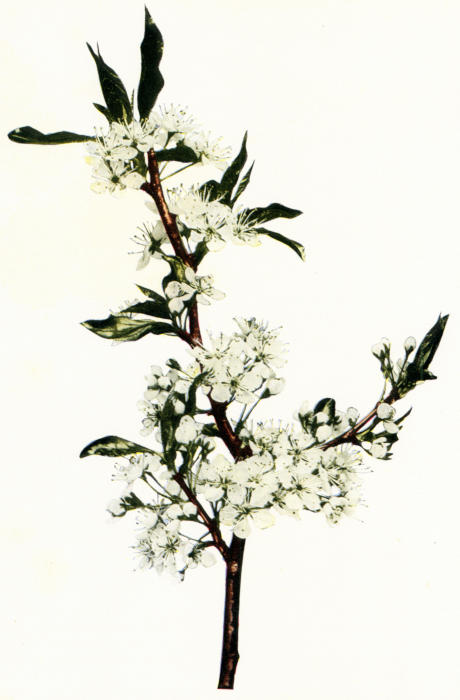
PRUNUS HORTULANA MINERI
1. Bailey Cornell Sta. Bul. 38:23, 1892. 2. Waugh Vt. Sta. An. Rpt. 10:103. 1897. 3. Britton and Brown 2:247, 1897.
It is impossible from present knowledge to say certainly whether the Miner-like plums put by Bailey into a botanical sub-division of Prunus hortulana are extreme variations of the species or, as Bailey in his last accounts and Waugh at all times have supposed, are hybrids between Prunus hortulana and Prunus americana. It is certain that all of these plums are intermediate in some characters between the two species named; neither botanists nor pomologists can agree as to whether certain varieties belong to the one or the other botanical division. There are, however, in several herbaria, specimens from the wild, and from different localities, that indicate that there is a distinct plum toward the northern limit of the range of Prunus hortulana which, if a natural hybrid, is of so ancient hybridity that the plants now come measurably true to type. The chief representatives of the Miner-like plums under cultivation, as Miner, Forest Rose, Prairie Flower and Clinton, are so like these wild plums as to lead the writer to believe that Bailey’s botanical sub-division is justified and is worth continuing even though a considerable number of the varieties now put with Miner, most of which have originated under cultivation, are hybrids and that the wild plums may have come from natural hybrids of more or less remote time.
The sub-species differs from the species in having shorter, stiffer, less graceful branches; leaves smaller, thicker, rougher and of a bluish-green cast; the blossoms of the two are much the same but those of the sub-species open a few days earlier; the fruits of the sub-species are larger than those of the species, lighter red, have more bloom, are less firm in texture, ripen earlier, yet later than those of any other species, and are quite different in flavor, having more nearly the taste of the fruit of Prunus americana; the stones, as well as the fruits, are very different, being in the sub-species larger, broader, flatter, smoother and less pointed. The differences in fruit and stone, and to some extent in the leaves, can be seen if the color-plates of Forest Rose and Wayland be compared.
In fruit-growing, the Miner-like plums behave in general much like the Americana plums. In some respects the fruits are an improvement upon those of the Americana varieties. For example the skin in the Miner-like varieties is usually less tough; is brighter in color and the flavor, in most cases, is a little better. These plums seem to be nearly or quite as hardy as the Americanas and are adapted to quite as wide a range of soils. Presumably they have the same value as stocks, though they seem not to have been tried for this purpose and they should have equal value at least in plant-breeding. The trees of the Miner-like plums are rather more amenable to domestication than those of Prunus americana having as orchard plants straighter trunks, more symmetrical and less unkempt tops and making larger trees. The fruits ripen so late as to make the varieties of this group especially valuable in prolonging the season for plums in regions where native varieties are grown exclusively. About twenty varieties of this sub-species are under cultivation.
12. PRUNUS NIGRA Aiton
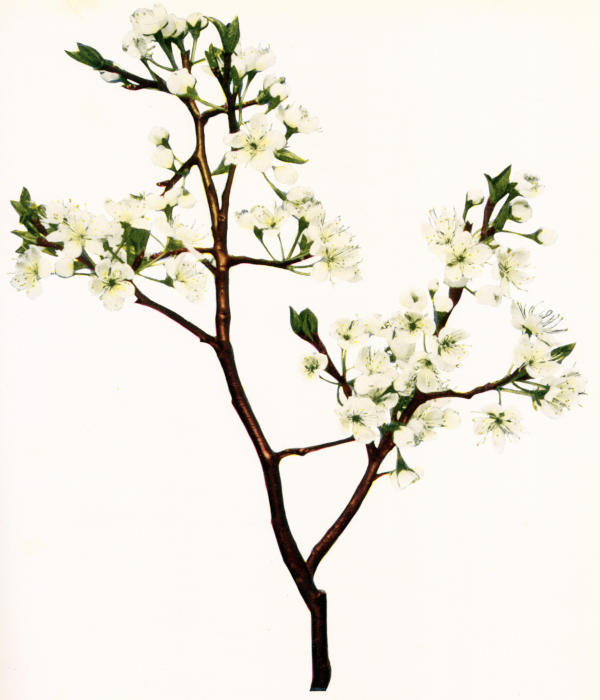
PRUNUS NIGRA
1. Aiton Hort. Kew. 2:165. 1789. 2. Sims Bot. Mag. 1117. 1808. 3. Pursh Fl. Am. Sept. 1:331. 1814. 4. Torrey Fl. U. S. 1:469. 1824. 5. Sargent Silva N. Am. 4:15, Pl. 149. 1892. 6. Small Torrey Bot. Club Bul. 21:301. 1894.
Cerasus nigra. 7. Loiseleur Nouveau Duhamel 5:32. 1812.
P. americana (in part). 8. Torrey and Gray Fl. N. Am. 1:407. 1840. 9. Torrey Fl. N. Y. 1:194. 1843. 10. Emerson Trees of Mass. Ed. 2, 2:511. 1846. 11. Nuttall Silva 2:19. 1852. 12. Sargent 10th Cen. U. S. 9:65. 1883. 13. Watson and Coulter Gray’s Man. Ed. 6:151. 1889. 14. Gray For. Trees N. A. 46, Pl. 1891.
P. americana nigra. 15. Waugh Vt. Sta. Bul. 53:60, fig. 1896. 16. Ibid. Vt. Sta. An. Rpt. 10:102. 1897. 17. Bailey Cyc. Am. Hort. 1449. 1901.
P. mollis. 18. Torrey Fl. U. S. 1:470. 1824.
Tree small, seldom exceeding twenty feet in height; trunk attaining six or eight inches in diameter, bearing the head at three to five feet from the ground; bark thin, one-quarter inch thick, from dark red to a light gray-brown, rough, but not shaggy, surface covered with thick scales; branches upright, stout, rigid, forming a compact rather narrow head, armed with stout, spiny spurs; branchlets more or less zigzag, glabrous or tomentose, green, later becoming reddish-brown; lenticels few or many, pale, slightly raised.
Winter-buds of medium size, conical or long-acuminate, reddish-brown; leaves large, broad-oval, ovate or obovate, with a long acuminate apex and cuneate or subcordate base; margins doubly crenate-serrate with teeth tipped with glands which disappear as the leaves mature; thin and firm in texture; upper surface light green, glabrous, the under surface paler, pubescent when young and pubescent at maturity on some soils; midribs coarse but veins rather slender; petioles two-thirds inch long, rather stout, with two, sometimes but one, large, dark red glands near the blade, pubescent and tinged with red; stipules lanceolate, sometimes lobed, one-half inch in length.
Flowers expanding early, before or with the leaves, large, sometimes one and one-half inches across; borne in three or four-flowered lateral umbels on slender, glabrous, red pedicels one-half inch or more in length; calyx-tube obconic, outer surface red, inner surface pink; calyx-lobes glabrous on both surfaces or with a few, straight, scattered hairs on the inner surface, pinkish, acute, glandular; petals pink, turning a darker pink in fading, rather broadly ovate, apex rounded, base a short claw, margins erose; stamens with yellow anthers; filaments one-half inch long; pistils glabrous, shorter than the stamens.
Fruit ripening comparatively early; globose or oval, usually somewhat oblong, an inch or more through the long diameter, red, orange or yellowish in color, with little or no bloom; skin thick, tough and astringent; flesh yellow, firm, meaty, often acid or astringent; stone usually clinging, large, oval, compressed, thick-walled, with a sharp ridge on the ventral and a slight groove on the dorsal suture.
It is possible that a group of Nigras, those occurring in western Wisconsin and Minnesota and about the upper extremity of Lake Superior ought to be described as a sub-species since they have a somewhat different aspect of tree and the fruits are a darker shade of red and show more bloom; the calyx is more pubescent and the calyx-glands more sessile. The differences in environment may change these characters, as indicated above, but they seem very constant in the cultivated varieties of the groups, most of which come from the west, and therefore sufficient to segregate this form from the species.
The Nigra is the wild plum of Canada. Its most common name, “Canada Plum,” is distinctly applicable and is here supplanted by “Nigra” only for the sake of uniformity. This is undoubtedly the dried plum which Jacques Cartier saw in the canoes of Indians, in his first voyage of discovery up the St. Lawrence in 1534.[120] These primitive prunes, Cartier says, the Indians called “honesta.” In his second voyage, the next year, he enumerates among other fruits the plum, “prunier,” growing on the “Ysle de Bacchus,” named from its “Vignes.” Dried plums, we learn from many later accounts, were a staple article of the winter diet of the savages. That the Indian tended the trees is probable, for the early explorers often record that plantations of plums were found about the aboriginal towns. Undoubtedly the range of this species was greatly extended by the Indians.
The Nigra is the most northern of the American plums, being an inhabitant of a region bounded on the north by a line passing from southern New Foundland westward to the Strait of Mackinac and thence southward to Lansing, Michigan. Its southern boundary can be but illy defined, but the species is common in New England, northern New York, where it is sometimes cultivated about houses, and westward at least as far as the eastern shore of Lake Michigan for the species, while the western form reaches the western boundary of Minnesota at least. Small[121] reports it as far south in the Appalachian System as northern Georgia. In the great region outlined above it is distributed in more or less scattered localities, being found usually in the valleys of rivers and streams, though often on high lands and in open woods, in the last locations preferring a limestone formation.
There has been much discussion as to whether Prunus nigra should be given specific rank or be united with Prunus americana, either as a part of that species or as a botanical variety of it. Until the revival by Sargent in 1892 of the name given the group by Aiton in 1789, the botanists of the latter half of the Nineteenth Century had for most part described the two groups under Prunus americana. Since Sargent’s re-establishment of the species, botanists have very generally regarded it as worthy of the rank. Bailey and Waugh, the leading horticultural authorities on plums, however, consider Nigra as but a botanical variety of Americana. The taxonomic characters of Prunus nigra seem to the writers of The Plums of New York to be as distinct as those of several other of the native species of Prunus, and since the species now is generally recognized by botanists, we have considered it in this work as distinct from Prunus americana.
The two species may usually be distinguished by the following differences: (1) The general aspect of the trees is very different. The tree of Americana is larger, the top is more spreading, and its branches longer, with more twigs, more slender and more pendulous. The bark on the trunk is lighter-colored and much more shaggy than in Nigra. (2) The wood of Nigra is tougher and the trees do not break as readily as those of Americana. The wood is also lighter in color. (3) The leaves of Nigra are larger, broader and the serrations are not so deeply incised nor so often double. Very distinct and very constant are the glands to be found on the teeth of the serrations on the young leaves of Nigra. These glands disappear as the leaves grow older, leaving a calloused point which makes the serrations of Nigra rounded, while those of Americana are acute, this being one of the most constant differences. (4) The flowers of Nigra appear several days earlier, are larger and are more pink than those of Americana. (5) The calyx-lobes of Nigra are glandular and the leaf-stalks are biglandular, characters usually not found in Americana. The calyx in all its parts is glabrous or at least far less pubescent than in Americana and if present the hairs are short and stiff, whereas in Americana the pubescence is soft. (6) The fruit of Nigra ripens earlier and is darker in color with less bloom and is more oblong than that of Americana. The skin of the plum is thinner and is not so objectionable either cooked or eaten out of hand. (7) The stone of Nigra is usually larger, flatter and more strongly crested. The characters of the two species vary much in different individuals and there are many intermediate forms but the differences seem as constant as between other species of this variable genus.
The Nigra plums are important horticulturally because they can be grown in somewhat colder regions than the Americanas. They not only endure more cold than the last named group, but their tough wood enables them to stand better the weight of snows and the stress of winds. Their earliness, too, prolongs the season for this type of fruit and in regions where the season is short they may be grown with more certainty than other groups. In habits and characters other than those named they are so like the Americana as to need no further discussion. About forty varieties of this species are under cultivation.
13. PRUNUS ALLEGHANIENSIS Porter
1. Porter Bot. Gaz. 2:85. 1877. 2. Ibid. Gar. and For. 3:428, fig. 53. 1890. 3. Sargent Sil. N. Am. 4:27, Pl. 153. 1892. 4. Bailey Ev. Nat. Fr. 225. 1898.
Tree low, slender, straggling, fifteen to eighteen feet in height, or a low shrub; trunk-diameter from five to eight inches; bark dark brown, surface fissured and scaly; branches numerous, upright, rigid, seldom spiny; branchlets pubescent, becoming glabrous and red, turning to dark brown; lenticels many, small, white.
Leaves ovate-oblong or lanceolate, sometimes obovate, apex acute or acuminate, base rounded, margin sharply serrate, teeth fine and tipped with glands, in texture thick and firm; upper surface dark green and glabrous; lower surface light green, glabrous except on the veins and midrib; petioles short, slender, pubescent; glands two, large, at the base of the blade.
Flowers white, fading to pink, one-half inch across, appearing with the leaves; borne in two to five-flowered umbels; pedicels slender, finely tomentose, from one-fourth to one-half inch in length; calyx-tube narrowly obconic; calyx-lobes entire, pubescent on the outer, tomentose on the inner surface; petals rounded but narrowing into claws at the base; filaments and ovary glabrous; anthers often reddish; style slender with a funnel-shaped apex.
Fruit matures in summer or early autumn; from one-quarter to three-quarters inch in diameter, sub-globose or ovoid, dark blue or purple with heavy bloom; skin thick and tough; flesh yellow, juicy, acid and somewhat astringent; stone clinging to the flesh, turgid, acute at the ends, thin-walled, ridged on the ventral and grooved on the dorsal suture.
In leaf, flower and tree Prunus alleghaniensis resembles Prunus americana. The species has long been known to be distinct, however, having been first distinguished by J. R. Lowrie of Warriorsmark, Pennsylvania, in 1859,[122] and was published as such in 1877, when T. C. Porter of Lafayette College described it as Prunus alleghaniensis. It differs from Prunus americana chiefly in the smaller size of the plant, smaller leaves and flowers, in color of flowers which fade to pink in this species, and in fruit-characters. The fruit matures earlier, is much smaller in size, is more globose, and is a dark purple or blue with very heavy bloom. The skin is thick and tough and while the texture of the flesh is as good as that of the wild Americanas the flavor is much more astringent. The stone is more swollen. The plant is commonly but a shrub, usually found along fence rows and the borders of woodlands, but intermingled among old thickets of this kind there are often a few small trees. It is a hardy species, very productive, and seemingly but little attacked by either insects or fungi, being especially exempt from black-knot.[123] In the wild state it produces great numbers of suckers which seem to spring very readily from a bruise or an exposed root.
The range of Prunus alleghaniensis is exceedingly limited. It is found in abundance only in a small territory in central Pennsylvania, being of most frequent occurrence in the barrens of northern Huntingdon County, extending from there north into Center County and northwestward over the Alleghany Mountains into Clearfield and Elk counties. It grows for the most part in elevated lands of the wildest character, being found on low, moist soils, on high and dry barrens and on limestone cliffs, reaching its greatest size in the last situation.
Specimens identified as Prunus alleghaniensis have been found in at least two places in Connecticut and the writer has just seen specimens of a closely allied form collected by W. F. Wight of the United States Department of Agriculture a few miles south of Houghton Lake, Roscommon County, Michigan.
This plum is not yet introduced into cultivation and it is doubtful if the wild fruits have sufficient merit to make an attempt at domestication promising. While the wild fruits are locally used for various culinary purposes it is so much inferior to other native plums, being almost uneatable unless cooked, that its cultivation would hardly warrant the effort. Arboretum specimens of the tree show it to be somewhat desirable as an ornamental, being a small, compact, upright plant, very floriferous, and bearing an abundance of rather attractive fruit.
14. PRUNUS SUBCORDATA Bentham
1. Bentham Pl. Hartweg. 308. 1848. 2. Torrey Pac. R. Rpt. 4:82. 1854. 3. Brewer and Watson Bot. Calif. 1:167. 1880 (in part). 4. Lemmon Pittonia 2:68. 1890. 5. Greene Fl. Francis 1:49. 1891. 6. Bailey Cornell Sta. Bul. 38:76. 1892. 7. Sargent Sil. N. Am. 4:31, 32, Pl. 154. 1892.
Tree small, rarely attaining a height of twenty-five feet, sometimes a shrub ten or twelve feet high and often a bush but three or four feet in height; trunk medium in length with a diameter of 8 to 12 inches; bark gray-brown and deeply fissured; branches stout and spreading; branchlets glabrous or pubescent, bright red becoming darker red and finally a dark-brown or gray; lenticels minute, whitish.
Leaves round-ovate, sub-cordate or truncate, or sometimes cuneate at the base; margins either sharply or obtusely serrate, sometimes doubly serrate; young leaves pubescent but at maturity nearly glabrous, somewhat coriaceous, dark green on the upper and pale green on the lower surface, with very conspicuous midribs and veins; stipules acute-lanceolate, caducous.
Flowers white, fading to rose, about an inch across; appearing before the leaves; usually borne in threes, often in pairs on short pubescent pedicels; calyx campanulate, with lobes pubescent on the outer and hairy on the inner surface; petals twice the length of the sepals, obovate, and contracted into short claws; filaments and ovary glabrous; style slender and funnel-shaped at the apex.
Fruit ripens in late summer or early autumn; roundish or oblong, about one inch in length, borne on a short, stout stem, dark red or purplish; flesh subacid, well-flavored, clinging to the flattish or turgid stone which varies greatly in size, pointed at both ends, crested on the ventral edge and grooved on the other.
Prunus subcordata, the Pacific or Western plum, is an inhabitant of the region east of the Coast Range from southern Oregon to central California. It is so rarely found on the seacoast as to have escaped the attention of the early botanists and remained unknown until the middle of the Nineteenth Century, when Hartweg, working in the interior of California, brought the plant to notice. This wild plum is not common except in the foothills of the Sierra Nevadas in northern California and southern Oregon, where it often forms thickets of small trees along streams, thriving in fresh, fertile, sandy soils, in canons, on hillsides or in the forests of yellow pine which are found in this region. Hammond[124] writes of it growing here as usually a small tree but often seen as a shrub from four to five feet high. Of the frequency of the occurrence he says: “It often sets the whole countryside ablaze in the autumn, with the abundance of its scarlet and crimson colors, mingled, of course, with red and yellow, and garnished with a sprinkling of green.” Sandberg[125] reports having collected Prunus subcordata as far north and east as Nez Perces County, northern Idaho, in the Craig Mountains at an altitude of about 2,900 feet, but this report is based on an error in determination, the specimen collected by Sandberg being clearly a European species. The tree and the fruit vary greatly according to the locality.
This Subcordata plum is one of the standard food products of the aborigines in the region in which it grows, being eaten either raw or cooked; and it is sometimes dried in considerable quantities at the harvesting places and carried considerable distances to the Indian villages.[126] The trappers, the first men to enter the habitat of this plum, followed by the gold-seekers and ranchers, all knew and esteemed the fruit. The early settlers regarded it as the most useful of all the wild fruits of the Coast and attempts were made at an early date to domesticate it. Of these Wickson says:[127]
“In 1856 there was, on the Middle Yuba River, not far from Forest City, in Sierra County, a wayside establishment known as ‘Plum Valley Ranch,’ so-called from the great quantity of wild plums growing on and about the place. The plum by cultivation gave a more vigorous growth and larger fruit. Transplanted from the mountains into the valley they are found to ripen earlier. Transplanted from the mountains to a farm near the coast, in Del Norte County, they did not thrive. One variety, moved from the hills near Petaluma in 1858, was grown as an orchard tree for fifteen years, and improved both in growth and quality of fruit by cultivation.... Recently excellent results have been reported from the domestication of the native plum in Nevada County, and fruit shown at the State Fair of 1888 gave assurance that by cultivation and by selecting seedlings valuable varieties can be obtained. It is stated that in Sierra County the wild plum is the only plum which finds a market at good prices, and that cultivated gages, blue and egg plums scarcely pay for gathering. The wild plum makes delicious preserves.”
In its typical form Prunus subcordata is a shrub and is often only a low bush but under the most favorable conditions it attains the dimension and shape of a small tree. In its roundish, roughish leaves it so closely resembles the Old World types of plums that it becomes the nearest approach to them to be found among our American species. But in the globular, red or purple subacid fruit it betrays its affinity to the American plums, as it does also in the flat, sometimes turgid, smooth stone to which the flesh tenaciously clings. The flowers are white, fading to rose and borne abundantly, making the plant an attractive ornamental in blooming time as it is also in the autumn when the foliage turns to brilliant red, scarlet or crimson with touches of yellow. The fruit is sometimes so poor in quality as to be inedible but on the other hand is sometimes quite equal to some of the cultivated plums, especially in its botanical variety, Kelloggii.
That the fruit is capable of improvement by the selection of seedling varieties and useful in hybridizing with other species can hardly be doubted. Luther Burbank, under date of December 6, 1909, writes in this regard as follows:
“The Prunus subcordata, as it grows wild, bears very heavily even on bushes two and three feet in height, bending the bushes flat on the ground when the fruit is ripe. This is a very beautiful sight. The wild ones, although almost invariably bright red and spherical, are sometimes, though rarely found, yellow. When the seed of the yellow fruit is planted a certain portion of red ones are produced, but all, practically, of the same size and quality as the original. The trees of Subcordata in the wild state are greatly variable in growth, generally much more so than in the fruit. The fruit, however, varies much in quality, but it is promiscuously gathered by those living in the vicinity of the plum grounds and considered most excellent for cooking. I commenced working on this species about twenty-two years ago and have not carried it on as extensively as with the Maritima, as I found it subject to plum-pockets, but by very careful selection I have produced most magnificent plums, oval in form or round, sweet as honey or sweet as the French Prune, greatly enlarged in size, tree improved in growth and enormously productive, the different varieties ripening through a long season. Most of these are light and dark red. Some of them, when cooked, are far superior to cranberries, having the exact delicious flavor so much liked in this fruit, and the same color.
“From the crosses of Subcordata with the Americana, Nigra, Triflora and other species, some of the most beautiful and highest flavored fruits which I have ever seen have been produced. These vary in color from almost pure white to light yellow, transparent flesh color, pink, light crimson, scarlet, dark crimson and purple; in form round, egg-shaped or elongated-oval; trees both upright and weeping, enormously productive, and in one or two cases the fruit, by hundreds of experts, has been pronounced the best plum in flavor of any in existence. Most of these selections are extremely productive.”
Wickson[128] reports that the roots of Subcordata have been used more or less as stocks for other plums but show no marked advantages over the species commonly used for this purpose. Most of those who have experimented with it condemn it as a stock because it dwarfs the cion and suckers badly.
Prunus oregana Greene[129] is from its description an interesting plum of which, however, it has been impossible to secure a glimpse even of herbarium material and of which we can therefore, only publish Greene’s description as follows:
“Evidently allied to P. subcordata, but leaves little more than an inch long, subcoriaceous, pubescent on both faces, in outline oval or broadly elliptic, never subcordate, commonly acutish at both ends, serrulate; flowers unknown; fruits in pairs or threes, on pedicels one-half inch long or more, densely tomentose when very young, more thinly so, yet distinctly tomentulose when half-grown.
“Known only from specimens collected on the Yanex Indian reservation in southeastern Oregon, by Mrs. Austin, in 1893; and a most remarkable species, as connecting true Prunus with Amygdalus. But that it is a plum and not an almond is evident.”
Without any first-hand knowledge of this species it is thought best to consider it only under the allied species, Prunus subcordata.