Chapter III · LEADING VARIETIES OF PLUMS. (continued 2)
Reading edition
Babcock 15. Babcock ?15. Bailey 3, 4, 6, 7. Bailey 9, 11, 12, 15. Chase 9, 15. Chabot 15. Douglas 15. Furugiya 7, 15. Furugiya 11, 12, 15. Hytankayo 14. Hytankayo 15. Hon-smomo 15. O-Hatankyo 11. Orient 6, 7. Orient 14. O-hattankio 15. Paragon 8. Red Nagate of some 7. Uchi Beni of some 11. Yellow Japan 9, 11, 12.
When properly handled the fruits of Chabot are far the most attractive of the many Triflora plums. They are large, beautifully molded and handsomely mottled in shades of red over yellow with occasional splashes of russet and a heavy but delicate bloom. To secure the best coloring, the fruit must be picked before ripe and be matured in dark storage. Early picking is necessary also because the season of ripening is very long and the fruit drops badly if permitted to hang to the trees until fully ripe. There should be at least three pickings for this variety. Unfortunately, the quality of Chabot belies its appearance, being at best not above the average. The fruits are firm and ship well and keep rather better than those of any other plum of its species. The trees are hardy and dependable in bearing but not as productive as could be wished. The blossoms of Chabot open later than those of most other Trifloras, enabling this sort occasionally to escape frosts which injure other varieties of this species. The stamens are often short, undeveloped and wholly or in part sterile. Because of its attractive fruit this variety might well be grown more than it is for the markets.
Chabot was imported from Japan by a Mr. Chabot of Berkeley, California, and was introduced to the trade by Luther Burbank in 1886. As with Abundance, the nomenclature of Chabot is badly confused. Several names that have been found to be synonymous with the former have also been applied to the latter. J. L. Normand, Marksville, Louisiana, imported trees from Japan, among which was a tree that was different from any growing on his grounds. He named this variety after Bailey and introduced it in 1891. Later this was found to be identical with Chabot. Furugiya, another introduction by Normand, is undoubtedly Chabot. H. N. Starnes of the Georgia Experiment Station, who has tested many of the Japanese plums, published in Bulletin 68 of his station, the additional synonyms: Chase, O-hattankio, Hytankayo, Douglas, Hon-smomo and Babcock. Orient, introduced by Stark Brothers, Louisiana, Missouri, in 1893, is Chabot as tested at the New York and Ohio experiment stations. Paragon, introduced by the Rogers Nursery Company, Moorestown, New Jersey, has also proved to be identical. In 1897 the American Pomological Society added this variety to its fruit catalog list.
Tree large, vigorous, vasiform or upright-spreading, open-topped, slow-growing, hardy, productive, susceptible to attacks of shot-hole fungus; branches roughish, the fruit-spurs numerous, dark ash-gray, with raised lenticels variable in size; branchlets slender, with short intemodes, greenish-red changing to dark chestnut-red, glossy, glabrous, with numerous, conspicuous, rather large, raised lenticels; leaf-buds small, short, obtuse, somewhat appressed.
Leaves folded upward, obovate or oblanceolate, peach-like, one and one-quarter inches wide, three inches long, thin; upper surface light green, smooth, with a shallow, grooved midrib; lower surface pale green, glabrous except at the base of the veins; apex acutely pointed, base cuneate, margin finely serrate, with small, amber or dark red glands; petiole one-half inch long, slender, slightly pubescent along the upper surface, heavily tinged with red, glandless or with from one to six small, globose or reniform, greenish-brown glands usually on the stalk.
Blooming season intermediate and long; flowers appearing with the leaves, white; borne in clusters on lateral spurs in pairs or in threes; pedicels three-eighths inch long, pubescent, greenish; calyx-tube green, obconic, pubescent at the base; calyx-lobes obtuse, glandular, somewhat serrate, pubescent at the base, erect; petals broadly oval, entire, with narrow, long claws; anthers shrivelled; filaments nearly sessile or one-eighth inch long; pistil glabrous, longer than the stamens; stigma small.
Fruit mid-season, ripening period long; one and five-eighths inches in diameter, cordate or roundish, halves equal; cavity deep, flaring, with concentric, russet rings; suture distinct; apex roundish or pointed; color light and dark shades of red over yellow, mottled, with occasional splashes of russet and with a thick but delicate bloom; dots numerous, small, russet or yellow, conspicuous unless obscured by the bloom, clustered around the apex; stem thick, one-half inch long, adhering to the fruit; skin medium in thickness, tender, bitter, separating easily; flesh golden-yellow, very juicy, coarse and fibrous, tender, somewhat melting when fully ripe, sweet, although somewhat tart at the center, sprightly, with characteristic Triflora flavor; good; stone clinging, three-quarters inch by one-half inch in size, oval, turgid, slightly necked, with pitted surfaces; ventral suture wide; dorsal suture unfurrowed.
CHALCO
Prunus simonii × Prunus triflora
1. Burbank Cat. 4. 1898. 2. Rural N. Y. 57:184, 653. 1898. 3. Vt. Sta. Bul. 67:8. 1898. 4. Vt. Sta. An. Rpt. 14:273. 1901. 5. Ga. Sta. Bul. 68:12, 35. 1905.
Chalco has been extensively advertised by several nurseries but, from the reports received, it is doubtful if it will ever be grown commercially. The trees, in the East at least, are slow in coming into bearing; the fruits are small; and the flavor such that consumers will have to learn to like it although it is much better in quality than the Simon plum, one of its parents, being quite free from the bitterness of this parent. The tree is rather better than that of the Simon plum or of the Wickson, the two plums with which it must be compared. The amateur may care to plant Chalco but here its usefulness ends. Burbank in introducing this plum in 1898, stated that it was the first fruit offered after twelve years’ work in crossing Prunus simonii with Prunus triflora and American species. The parentage of Chalco is given as a Simon-Burbank cross. The following description is compiled:
Tree vigorous, upright or somewhat vasiform, very productive; leaves large, dark green. Fruit matures shortly before Burbank; large when well grown, oblate, dark red; flesh yellowish, firm, very juicy, aromatic, sweet; good; stone small, oval, slightly flattened, semi-free.
CHAMBOURCY
Prunus domestica
1. Rev. Hort. 39. 1898. 2. Soc. Nat. Hort. France Pom. 560, fig. 1904. 3. Can. Exp. Farms Rpt. 433. 1905. 4. Cat. Cong. Pom. France 473 fig. 1906.
Reine-Claude Tardive De Chambourcy 2. Reine-Claude Tardive Latinois 1. Reine-Claude Tardive de Chambourcy 1. Reine-Claude Latinois 2, 4. Reine-Claude tardive 1. Reine-Claude Verte 4. Reine-Claude Tardive 2, 4. Reine-Claude de Chambourcy 3. Tardive de Chambourcy 4.
This fruit was found at the beginning of the Nineteenth Century at Chambourcy, France, in the garden of M. Bourgeois; no record of its parents seems to have been made. M. Latinois introduced it into commerce in 1885-1886 and consequently his name became attached to the variety. The plum is not well known in America, there being only one published American reference. This Station received the variety for testing in 1899 from the United States Department of Agriculture. It has value on account of its high quality and its lateness, and is worthy of extensive testing.
Tree small, upright-spreading, dense-topped, productive; branchlets develop fruit-spurs near the base; leaf-buds strongly appressed; leaves folded upward, long-oval or obovate, one and five-eighths inches wide, three and three-quarters inches long, somewhat leathery; margin doubly serrate or crenate, with small dark glands; blooming season intermediate in time and length; flowers appearing after the leaves, over one inch across; borne in thin clusters on lateral buds and spurs, singly or in pairs.
Fruit very late, season of medium length; nearly one and one-half inches in diameter, roundish, slightly truncate, yellowish-green, with a delicate bloom and a pink blush on the exposed cheek; flesh greenish-yellow, very juicy, firm but tender, sweet, aromatic, of high flavor; very good to best; stone semi-free or free, three-quarters inch, by one-half inch in size, irregular-oval, flattened, rather blunt at the base and apex, with roughened surfaces; ventral suture strongly furrowed, often with a distinct wing.
CHAMPION
Prunus domestica
1. Wickson Cal. Fruits 360. 1891. 2. Oregon Hort. Soc. Rpt. 147. 1893. 3. Am. Pom. Soc. Rpt. 150. 1895. 4. Oregon Sta. Bul. 45:30. 1897.
Champion Prune, 1, 2, 3.
The Champion was introduced with the expectation that it would be a valuable fruit for curing into prunes. It has not proved to be a good plum for prune-making, as it is too juicy, about three-fourths of its bulk evaporating, but the western plum-growers have found it a very good plum for shipping in the fresh state. It is very attractive in appearance, firm, free of stone, sweet and pleasant and withal of rather high quality. The tree-characters, as the plums grow in Geneva, are in the main very good, falling short, if at all, in productiveness. They are such as to lead to the recommendation of a trial for this plum by plum-growers in general in New York.
This variety is a seedling of the Italian Prune produced by Jesse Bullock, Oswego, Oregon, about 1876, and introduced by C. E. Hoskins, Springbrook, Oregon. Since the Italian Prune comes nearly true to seed it is very doubtful if this variety is a pure-bred seedling judging from the characters of the fruit as given below:
Tree of medium size and vigor, upright-spreading, open-topped, hardy, productive, an early bearer, subject to sun-scald; branches ash-gray, rather smooth, with few, small lenticels; branchlets short, with very short internodes, greenish-red changing to brownish-red, dull, sparingly pubescent throughout the season, with few inconspicuous, small lenticels; leaf-buds below medium in size, short, obtuse, free, plump.
Leaves folded upward, oval, one and five-eighths inches wide, three inches long; upper surface somewhat rugose, covered with numerous, fine hairs, with a shallow groove on the midrib; lower surface silvery-green, pubescent: apex abruptly pointed or acute, base acute, margin crenate, with small black glands; petiole one-half inch long, green, pubescent, with from one to three medium to large, globose, brownish glands mostly at the base of the leaf.
Blooming season intermediate in time and length; flowers appearing after the leaves, one inch across, white with a yellowish tinge at the apex of the petals; borne on lateral spurs, singly or in pairs; pedicels five-eighths inch long, with a few scattering hairs, green; calyx-tube greenish, campanulate, sparingly pubescent; calyx-lobes obtuse, pubescent on both surfaces, glandular-serrate, somewhat reflexed; petals roundish, crenate, tapering to short, broad claws: anthers yellow; filaments three-eighths inch long; pistil glabrous, slightly shorter or equal to the stamens in length.
Fruit earlier than Italian Prune; about one and one-half inches in diameter, roundish, compressed, halves equal; cavity very shallow, abrupt, narrow, regular; suture shallow; apex roundish, with a slight depression at the pistil-point; color dark purplish-black, with thick bloom; dots small, russet, somewhat conspicuous, clustered about the apex; stem five-eighths inch long, sparingly pubescent, parting readily from the fruit; skin thick, tough, sour, adhering but little; flesh attractive yellow, juicy, firm, sweet, pleasant flavor; very good; stone free, the cavity larger than the pit, three-quarters inch by one-half inch in size, irregular-oval, the surface distinctly roughened and pitted; ventral suture swollen, rather narrow, often with a wing; dorsal suture with a shallow, narrow, indistinct groove.
CHENEY
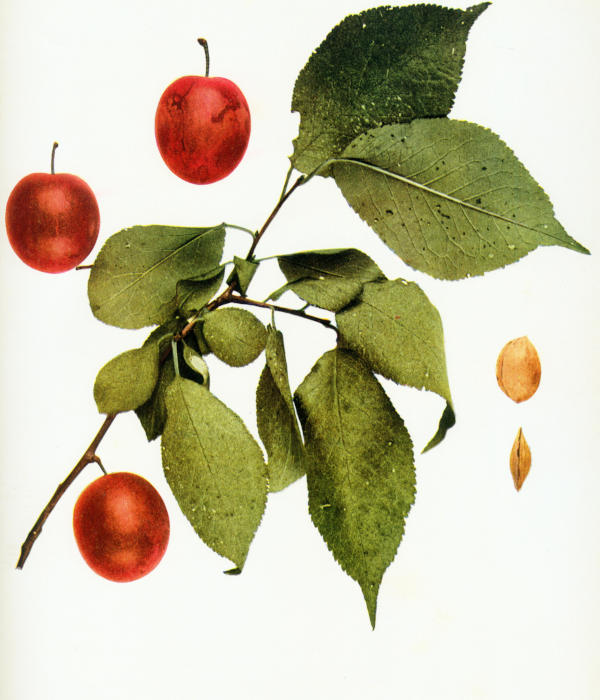
CHENEY
Prunus nigra
1. Wis. Hort. Soc. Rpt. 15, 38. 1885. 2. Minn. Hort. Soc. Rpt. 126. 1890. 3. Cornell Sta. Bul. 38:36, 86. 1892. 4. Ia. Sta. Bul. 31:346. 1895. 5. Wis. Sta. Bul. 63:24, 31 fig. 13. 1897. 6. Am. Pom. Soc. Cat. 24. 1897. 7. Gard, & For. 10:367. 1897. 8. Colo. Sta. Bul. 50:33. 1898. 9. Minn. Hort. Soc. Rpt. 412. 1899. 10. Waugh Plum Cult. 169. 1901. 11. Budd-Hansen Am. Hort. Man. 294. 1903. 12. Can. Exp. Farm Bul. 43:29. 1903. 13. Ia. Hort, Soc. Rpt. 488. 1904. 14. Ohio Sta. Bul. 162:254, 255. 1905. 15. S. Dak. Sta. Bul. 93:11. 1905. 16. Ia. Sta. Bul. 114:129. 1910.
Cherry 16 incor.
Cheney is of little value except towards the northern limits of fruit culture in America where, because of its great hardiness, it is a most desirable fruit-plant. Of the varieties illustrated and described among the leading plums in this text, Cheney is the sole representative of Prunus nigra, the wild plum of Canada and of northern United States. The accompanying description shows that while the fruit of this variety is not such as to recommend it where other species can be grown, the tree has some characters most desirable wherever plums are grown—hardiness, vigor, productiveness and good form—so that this variety might well be used in breeding plums. The trees are very ornamental whether in flower, full leaf or fruit, but especially when in full bloom as they bear a great profusion of large white flowers which change to a pleasing pink before falling.
This plum, according to a letter from the discoverer, E. Markle, of La Crosse, Wisconsin, was found in the brush on a ridge, in Vernon County, Wisconsin, about twenty-five or thirty years ago. Mr. Markle thought it must have sprung from a seed dropped by an early voyager of the Mississippi River as there were no similar plums in the region. Noting its good qualities Mr. Markle introduced the variety, the date of introduction being about 1887. The American Pomological Society added Cheney to its fruit catalog list in 1897, where, however, it remained but two years.
Tree large, vigorous, spreading, dense-topped, hardy, productive, bears early, somewhat susceptible to disease; branches numerous, dark brownish-gray, very thorny, with large lenticels; branchlets long, with long internodes, greenish-red changing to dull reddish-brown, dull, thickly pubescent early in the season, the pubescence decreasing at maturity, with raised lenticels which are variable in size; leaf-buds smallish, short, conical, free.
Leaves folded upward, oval, one and three-quarters inches wide, three and five-eighths inches long, thin; upper surface dark green, nearly smooth, pubescent only along the midrib which is deeply grooved; lower surface yellowish-green, pubescent along the midrib and larger veins; apex taper-pointed, margin crenate, usually in two series, sometimes with small, dark glands; petiole one-half inch long, rather slender, pubescent, tinged red, glandless or with from one to three small, globose, greenish-yellow glands usually on the stalk.
Blooming season intermediate in time and length; flowers appearing after the leaves, showy, about one inch across, white changing to pink; borne in clusters on lateral spurs, in pairs or in threes, very fragrant; pedicels nine-sixteenths inch long, pubescent, green with a trace of red; calyx-tube obconic, glabrous, red on the outer surface but green within and pinkish along the margin; calyx-lobes obtuse or acute, serrate, with small red glands and with marginal hairs, narrow, sparingly pubescent on the inner surface, reflexed; petals broadly oval, crenate, often toothed, tapering below to long narrow claws; anthers yellowish; filaments nearly one-half inch in length; pistil glabrous, shorter than the stamens.
Fruit mid-season, ripening period very long; medium in size, irregular roundish-oval, strongly oblique, halves equal; cavity shallow, regular, flaring; suture shallow or a line; apex roundish, somewhat oblique; color at first yellowish-green with a light carmine blush changing to deep carmine on a yellow ground, covered with thin bloom; dots numerous, very small, russet, inconspicuous, densely clustered about the apex; stem slender, five-eighths inch in length, slightly pubescent, adhering to the fruit; skin thick, tough, sour, separating readily; flesh deep yellow, very juicy, fibrous, tender and melting, sweet next to the skin but tart at the center, not high in flavor; fair in quality; stone adhering, seven-eighths inch by five-eighths inch in size, broadly oval, distinctly flattened, blunt-pointed, with ridged and furrowed surfaces; ventral suture acute, narrow; dorsal suture slightly furrowed.
CLIMAX
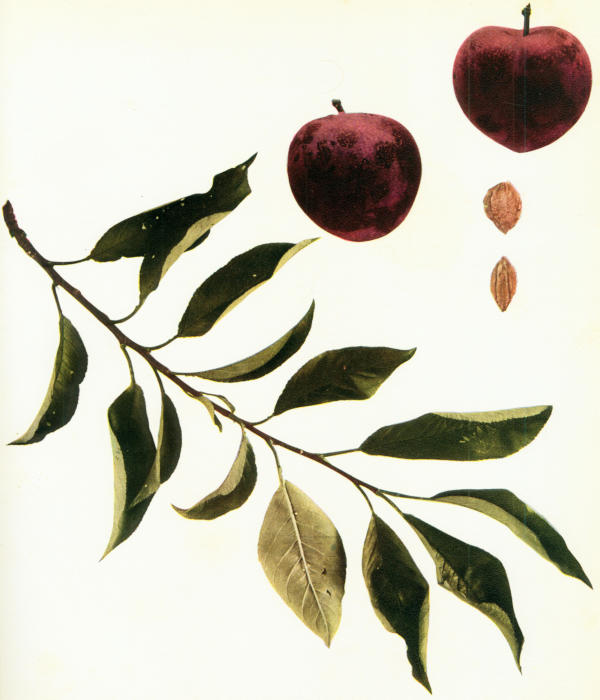
CLIMAX
Prunus triflora × Prunus simonii
1. Rural N. Y. 57:653, 818. 1898. 2. Cal. State Board Hort. 52. 1897-98. 3. Vt. Sta. Bul. 67:9. 1898. 4. Vt. Sta. An. Rpt. 12:222. 1899. 5. Burbank Cat. 2. 1899. 6. Nat. Nur. 8:117. 1900. 7. Vt. Sta. An. Rpt. 14:273. 1901. 8. Rural N. Y. 62:643. 1903. 9. Mich. Sta. Sp. Bul. 30:18. 1905. 10. Ga. Sta. Bul. 68:8, 35. 1905. 11. Ga. Hort. Soc. Rpt. 66. 1907.
Royal 1. Royal 1, 3, 4.
It is hard to judge as to the merits of this variety. From the behavior of the trees on the grounds of this Station where we have had fruit of it for eight years, we should say at once that Climax has no place in the plum-growing regions of the East but others who have grown it speak so well of it, the fruit in particular, that the unfavorable opinion of the variety formed here may be unjust. Some of the expressions regarding this fruit in the foregoing references may be dismissed at once as the most wildly extravagant and absurd to be found in plum literature. From its behavior on these grounds and in the plum-growing regions of the East in general, it seems certain that Climax cannot stand the vicissitudes of the climate, suffering both in winter and summer. The trees, in size, vigor and habit of growth, are inferior to those of most Triflora varieties, and those under observation in this part of New York are not as productive as the standard Trifloras with which Climax must be compared. The fruit is handsome in shape and color, more so in color than the accompanying illustration shows, and is of good quality. Unfortunately it is very susceptible to the brown-rot, so much so that because of this defect alone Climax could hardly become a profitable commercial plum in this region. It has been quite well tested in various parts of New York and has proved so uniformly disappointing in tree-characters, in particular, that it cannot be recommended as other than a plum for the home collection where, because of its beauty and quality, it is most desirable.
Climax is another of Luther Burbank’s plums, having been introduced in 1899. The originator states that it is a selected hybrid between the Simon and Botan plums. The variety was first described as the Royal but since this name had been previously given to a European plum it was renamed Climax.
Tree large, vigorous, upright-spreading, somewhat straggling, dense-topped, semi-hardy, medium productive; branches dark ash-gray, short and stout, with numerous lenticels; branchlets short, with very short internodes, brownish chestnut-red, glossy, glabrous, with numerous conspicuous, small, raised lenticels; leaf-buds small, short, obtuse, plump, free.
Leaves folded upward, oblanceolate, peach-like, one and one-quarter inches wide, three and three-eighths inches long, thin; upper surface light green, smooth, with a grooved midrib, glabrous; lower surface light green, glabrous except on the midrib and larger veins; apex taper-pointed, base cuneate, margin finely serrate or crenate, with small, dark brown glands; petiole nine-sixteenths inch long, sparsely pubescent, tinged red, glandless or with from one to seven small, globose or slightly compressed, reddish glands.
Blooming season early and of medium length; flowers appearing with the leaves, white; borne in clusters of three, on lateral spurs; pedicels, long, thick, glabrous, green; calyx tube greenish, obconic, glabrous; calyx-lobes obtuse, with a few hair-like glands, glabrous, erect; petals roundish-oval, entire; anthers deep yellow; filaments short; pistil glabrous, equal to the stamens in length; stigma very small.
Fruit very early, season short; one and three-quarters inches in diameter, cordate or roundish, slightly compressed, halves unequal; cavity deep, abrupt, regular, marked with faint, reddish, radiating streaks; suture deep, broad; apex pointed; color dark red, mottled; bloom of medium thickness; dots numerous, variable in size, russet, conspicuous, clustered about the base; stem thick, nine-sixteenths inch long, glabrous, parting readily from the fruit; skin thick, bitter, with a tendency to crack, separating easily from the pulp only when fully ripe; flesh yellowish, very juicy, somewhat fibrous, tender and melting, sweet, pleasant flavored, aromatic; good; stone adhering, seven-eighths inch by five-eighths inch in size, somewhat long-oval, pointed, roughish, conspicuously winged and grooved on the ventral suture; dorsal suture slightly grooved.
CLING STEM
Prunus domestica
1. N. Y. Sta. Rpt. 9:347. 1890.
This plum belongs to the Reine Claude group, a group in which there is room for new varieties only at the top. Cling Stem is inferior, falling short chiefly in quality, for a plum of its type, and it is doubtful if it is worth general planting. This Station alone seems to have tested the variety, hence the rather full description which follows of a plum which cannot be recommended. The variety was sent here in 1890 from North Ferrisburg, Vermont, by L. M. Macomber.
Tree large and vigorous, spreading, dense-topped, very productive; branches rough, the bark marked by concentric rings, with numerous spurs and with many, small, raised lenticels; branchlets short, pubescent; leaf-scars swollen; leaves folded upward, oval, one and three-quarters inches wide, three inches long, rather thick and leathery; margin doubly crenate, eglandular or with small, dark glands; petiole pubescent, tinged red, glandless or with from one to three globose glands usually at the base of the leaf; blooming season of medium length; flowers over one inch across, white with yellowish tinge near the apex of the petals; borne on lateral buds and spurs, singly or in pairs.
Fruit mid-season; one and one-half inches by one and five-eighths inches in size, nearly roundish, dull light yellow, sometimes mottled with red on the exposed cheek, overspread with thin bloom; skin thin, sour; flesh greenish-yellow, tender and melting, sweet near the surface but acid at the center, mild, pleasant, but not high-flavored; stone clinging, three-quarters inch by five-eighths inch in size, nearly round, turgid; surfaces pitted; ventral suture broad, heavily furrowed, with a short, distinct wing.
CLYMAN
Prunus domestica
1. U. S. D. A. Rpt. 574. 1888. 2. Cal. State Board Hort. 236, 239, Pl. II figs. 3 and 4. 1890. 3. Wickson Cal. Fruits 358. 1891. 4. Am. Pom. Soc. Cat. 25. 1897. 5. N. Mex. Sta. Bul. 27:124. 1898. 6. Ohio Sta. Bul. 113:158. 1899. 7. Waugh Plum Cult. 98. 1901. 8. Ohio Sta. Bul. 162:236, 237 fig., 254, 255. 1905.
Clyman has special merit as one of the earliest good Domesticas. The fruit resembles that of Lombard somewhat, but is smaller and is much better in quality. As grown in California the Clyman commands high prices for shipping eastward. Whether it could be grown profitably in the East remains to be seen but it deserves to be rather widely tested for an early home and market plum. In New York it has a few serious faults: the plums are susceptible to rot, they drop as soon as ripe and the trees seem not to be quite hardy at Geneva; though in the Ohio reference given above they are said to be “rather hardier than those of most other European sorts.” Otherwise than in hardiness the trees at this place are quite satisfactory. The variety is characterized by very long stamens. Clyman is well deserving of trial with the possibility that it may prove to be the best of our early Domesticas.
This plum was raised from a Peach plum stone planted in 1866, by Mrs. Hannah Clyman, Napa City, Napa Valley, California. The original tree was cut down but several suckers were taken from the roots and planted in an orchard. These bore fruit for many years, never failing to mature a crop. In 1886, Leonard Coates, a nurseryman and fruit-grower of Napa City, became interested in the plum on account of its extreme earliness and offered it to his customers. The American Pomological Society added Clyman to its fruit catalog list in 1897.
Tree rather large, vigorous, round and dense-topped, semi-hardy in New York, productive; branches ash-gray, nearly smooth, with numerous, small, raised lenticels; branchlets thick, rather long, with internodes of medium length, greenish-red changing to brownish-red, dull, heavily pubescent throughout the season, with numerous, indistinct, small lenticels; leaf-buds of medium size and length, conical, appressed; leaf-scars prominent.
Leaves folded backward, obovate, one and seven-eighths inches wide, three and one-quarter inches long; upper surface dark green, rugose, sparingly hairy; lower surface pale green, pubescent; apex abruptly pointed or acute, base acute, margin serrate or crenate, covered with small dark glands; petiole nearly seven-eighths inch long, pubescent, reddish, glandless or with from one to three globose, greenish-yellow glands variable in size and position.
Blooming season early and short; flowers appearing after the leaves, one and one-eighth inches across, white, the buds creamy at the apex when unfolding; borne in clusters on lateral spurs, singly or in pairs; pedicels about one-half inch long, thick, pubescent, greenish; calyx-tube green, campanulate, pubescent; calyx-lobes narrow, obtuse, pubescent on both surfaces, serrate, reflexed; petals obovate, dentate, tapering to short, broad claws; anthers yellow; filaments about seven-sixteenths inch long; pistil pubescent near the base, equal to the stamens in length.
Fruit very early, season short; one and one-half inches by one and three-eighths inches in size, oval, halves equal; cavity narrow, abrupt, regular; suture shallow and often indistinct; apex roundish or slightly depressed; color dark purplish-red, covered with thick bloom; dots numerous, small, russet, inconspicuous; stem five-eighths inches long, pubescent, adhering poorly to the fruit; skin tender, sour, separating readily; flesh pale yellow, dry, firm, sweet, mild but pleasant; of good quality; stone free, seven-eighths inch by five-eighths inch in size, somewhat flattened, irregular-oval, with pitted surfaces, tapering abruptly at the base, nearly acute at the apex; ventral suture of medium width, usually rather blunt; dorsal suture with a wide, deep groove.
COLUMBIA
Prunus domestica
1. Mag. Hort. 8:90. 1842. 2. Downing Fr. Trees Am. 292. 1845. 3. Cole Am. Fr. Book 216. 1849 4. Thomas Am. Fruit Cult. 334. 1849. 5. Am. Pom. Soc. Cat. 86. 1862. 6. Mas Pom. Gen. 2:159. 1873. 7. Hogg Fruit Man. 691. 1884. 8. Wash. Hort. Soc. Rpt. 135. 1893.
Columbian Gage 2, 4. Columbia Pflaume 6. Columbia Gage 7.
When grown on strong soils and in some climates, Columbia is possibly a plum of value and sometimes of superiority, but in New York in the average plantation it falls far short of other fruits of its type—that of the Reine Claude. The trees are productive and the fruit large and handsome but not of highest quality and moreover drops badly and is very susceptible to the brown-rot. Columbia originated early in the second quarter of the Nineteenth Century with L. V. Lawrence of Hudson, New York, from seed of Reine Claude.
Tree large, medium in vigor, upright-spreading, open-topped, productive; trunk stocky, rough; branches thick; branchlets pubescent; leaves folded upward, one and seven-eighths inches wide, four and one-quarter inches long, oval, thick, leathery; upper surface rugose; margin serrate or crenate, with small, dark glands; petiole thick, tinged red, pubescent, with from one to three globose glands.
Fruit mid-season; when well grown nearly one and one-half inches in diameter, roundish-oval, the smaller specimens rather ovate, dark purplish-red, overspread with thick bloom; stem surrounded by a fleshy ring at the cavity; skin tender, sour; flesh golden-yellow, dry, firm, sweet, mild; of good quality; stone semi-free or free, seven-eighths inch by three-quarters inch in size, roundish-oval, flattened; ventral suture prominent; dorsal suture widely and deeply grooved.
COMPASS
Prunus besseyi × Prunus hortulana mineri
1. Northwestern Agr. 348. 1895. 2. Vt. Sta. Bul. 67:10. 1898. 3. Ia. Sta. Bul. 46:266. 1900. 4. Budd-Hansen Am. Hort. Man. 294. 1903. 5. S. Dak. Sta. Bul. 93:13. 1905.
Compass Cherry 2. Heideman Sand Cherry.
In 1891 H. Knudson of Springfield, Minnesota, pollinated the Sand Cherry with pollen from the Danish Morello cherry and the Miner plum. The seed of the resulting cross, beyond question that of the Sand Cherry and the plum, was planted on August seventh of the same year and, in 1894 produced fruit for the first time. In 1893 C. W. H. Heideman of New Ulm, Minnesota, secured a cion from this tree and another the following year. In 1895 Heideman introduced as his own, under the name of Heideman Sand Cherry, a hybrid between the Sand Cherry and a plum. In the controversy which followed it developed that the two hybrids were identical and that Knudson was the real originator. Subsequently C. W. Sampson of Eureka, Minnesota, introduced Knudson’s plum under the name Compass. The variety is of interest to plant-breeders and may have some commercial value in the Northwest but is worthless for its fruit in New York.
Tree inferior in size, spreading, open-topped, productive; branches and branchlets slender, the branchlets marked by very conspicuous, large, raised lenticels; leaf-buds plump; leaves folded upward, one and one-eighth inches wide, three inches long; margin serrate; petiole tinged red, glandless or with from one to three globose glands usually on the base of the leaf; blooming season late, of medium length; flowers appearing after the leaves, seven-eighths inch across, creamy-white as the buds unfold; borne on lateral spurs, in threes and fours.
Fruit early, season short; seven-eighths inch by three-quarters inch in size, ovate or roundish-oval, light red changing to dark red at maturity, the skin speckled with small red dots before fully ripe; skin tough, astringent; flesh light greenish-yellow, very juicy, melting, subacid except near the skin; poor; stone clinging, five-eighths inch by three-eighths inch in size, large, elongated-oval, with smooth surfaces.
COPPER
Prunus domestica
1. Coxe Cult. Fr. Trees 234. 1817. 2. Prince Pom. Man. 2:93. 1832. 3. Elliott Fr. Book 425. 1854. 4. Downing Fr. Trees Am. 906. 1869. 5. Am. Pom. Soc. Cat. 36. 1875. 6. Cornell Sta. Bul. 131:183. 1897. 7. Waugh Plum Cult. 98. 1901.
Copper 2. French Copper 3, 4. French Copper 1, 2, 6.
It is supposed that Copper came from France but very little is actually known regarding its history. The round early variety described by Coxe and Prince is distinct from the Copper now grown in this country. It is probable that the Copper of Downing and of the American Pomological Society are either distinct, or are early strains of the fruit described here, since both are mid-season plums while the variety of the following description is distinctly late. This old sort has been recommended of late by nurserymen and some plum-growers and it may be worth putting on the markets again as the trees are extremely productive, the fruit ships well, and its extreme lateness might extend the plum season. The fruit is not fit for dessert but makes an attractive, dark red, well-flavored sauce.
Tree variable in size and vigor, round and dense-topped, productive; branches numerous, with large lenticels; branchlets twiggy, marked with scarf-skin, glabrous throughout the season; leaves folded upward, obovate or oval, one and one-half inches wide, three and one-half inches long; upper surface rugose; margin serrate or crenate, eglandular or with small dark glands; petiole pubescent, tinged red, glandless or with one or two globose glands; blooming time mid-season, short; flowers appearing after the leaves, seven-eighths inch across; borne singly or in pairs.
Fruit very late, season of medium length; one and one-half inches by one and three-eighths inches in size, roundish-oval, slightly necked; cavity almost lacking; color a metallic brownish-purple, overspread with thick bloom; skin thick, tough, somewhat astringent; flesh dull yellow, medium juicy, firm, moderately sweet; poor; stone free, seven-eighths inch by one-half inch in size, irregular-ovate, abruptly contracted at the base, with roughened surfaces; dorsal suture prominent.
CRITTENDEN
Prunus insititia
1. Hogg Fruit Man. 695. 1884. 2. Mathieu Nom. Pom. 426. 1889. 3. Am. Gard. 14:146. 1893. 4. Guide Prat. 163, 353. 1895. 5. Rural N. Y. 55:622. 1896. 6. Cornell Sta. Bul. 131:184. 1897. 7. Garden 53:266. 1898. 8. Waugh Plum Cult. 127, 128. 1901.
Crittenden’s Damson 2. Crittenden’s Prolific Damson 2. Crittenden’s 1. Crittenden’s Prolific 1. Cluster 1. Cluster 3, 8. Cluster Damson 2. Cluster Damson 4. Damson Cluster 4. Farleigh Damson 6. Farleigh Prolific 7. Farleigh 5. Prolific 1. Prolific Damson 2.
This Damson came to notice early in the last century in the orchard of James Crittenden of East Farleigh, Kent, England. In both Europe and America it seems to be as well known under the names Farleigh and Cluster as under its true name. Crittenden ranks high among the Damsons in England but in America it is not a great favorite; just why is hard to say. It is likely that it fails in some tree-character, for, with the exception of being a little too tart, the fruit has few faults.
Tree of medium size, upright-spreading, open-topped, productive; branches very thorny and spinescent; branchlets pubescent throughout the season; leaf-buds plump; leaves folded upward, obovate or oval, one and one-eighth inches wide, two and one-half inches long, thin; margin finely serrate, with small dark glands; petiole one-half inch long, glandless or with one or two glands; blooming season intermediate in time and length; flowers appearing after the leaves, seven-eighths inch across, densely clustered; borne usually in twos, fragrant.
Fruit late, season of medium length; seven-eighths inch by three-quarters inch in size, oval, slightly necked, purplish-black, overspread with very thick bloom; flesh greenish-yellow, medium juicy, firm but tender, sour, sprightly; probably good for preserves; stone clinging, five-eighths inch by three-eighths inch in size, oval, acute at the base, with surfaces nearly smooth.
CZAR
Prunus domestica
1. Hogg Fruit Man. 693. 1884. 2. Ellwanger & Barry Cat. 27. 1886. 3. Gard. Chron. 10:333. 1891. 4. Guide Prat. 153, 359. 1895. 5. Cornell Sta. Bul. 131:183. 1897. 6. Rivers Cat. 34. 1898. 7. Mich. Sta. Bul. 169:242, 244. 1899. 8. Ohio Sta. Bul. 113:159. 1899. 9. Waugh Plum Cult. 99. 1901. 10. Thompson Gard. Ass’t 4:157. 1901. 11. Nicholson Dict. Gard. 3:166. 12. Garden 68:303. 1905. 13. Ohio Sta. Bul. 162:236, 237 fig., 254, 255. 1905.
Le Czar 4. The Czar 2, 6, 11. The Czar 4.
Czar seems to have a very good reputation in Europe, in England especially, as a culinary fruit but in America it is but second rate for cooking and cannot be called a dessert plum at all. Its earliness might make it valuable were it not for the fact that Clyman is as early and in nearly all other respects is a better plum. The Czar, like Clyman, is not quite hardy and lacks somewhat in productiveness. The stone of Czar is usually covered with a granular, gummy exudation about the apex and its flowers are peculiar in being more or less doubled. It is doubtful if this variety is worth planting in New York. This plum was raised by Thomas Rivers, Sawbridgeworth, England, from a Prince Englebert seed fertilized by Early Prolific. It first fruited in 1874 and was named for the Czar of Russia who visited England during the same year. Ellwanger & Barry, of Rochester, New York, offered it for sale in the United States in 1886.
Tree intermediate in size and vigor, round and open-topped, not always hardy, moderately productive; branches covered with many fruit-spurs, smooth except for the numerous raised lenticels and transverse cracks in the bark; branchlets covered with thick pubescence throughout the season, with numerous small lenticels; leaf-buds large, strongly free; leaves folded upward, oval, one and three-quarters inches wide, three inches long; petiole one-half inch long, thick, pubescent, eglandular or with one or two large, yellowish-green glands at the base of the leaf; blooming season intermediate in time, short; flowers appearing after the leaves, one inch or more across, white, with a yellowish tinge at the apex of the petals; borne in clusters on lateral spurs, in pairs or in threes; filaments five-sixteenths inch long; pistil glabrous except at the base, slightly longer than the stamens.
Fruit very early, season short; one and one-half inches in diameter, irregular roundish-oval, compressed, dark purplish-black, overspread with thick bloom; flesh yellow, coarse and somewhat granular, fibrous, tender, sweet, pleasant flavor; good; stone free, three-quarters inch by five-eighths inch in size, oval or slightly ovate, blunt at the base, somewhat acute at the apex, with ridged and roughened surfaces; ventral suture wide, broadly furrowed, with a short blunt wing; dorsal suture acute or with a narrow, shallow, indistinct groove.
DAMSON
Prunus insititia
1. Parkinson Par. Ter. 578. 1629. 2. Gerard Herball 1496, 1498. 1636. 3. Quintinye Com. Gard. 67. 1699. 4. Langley Pomona 94. 1724. 5. Forsyth Treat. Fr. Trees 21. 1803. 6. Am. Gard. Cat. 588. 1806. 7. Phillips Com. Orch. 306. 1831. 8. Lond. Hort. Soc. Cat. 145, 146. 1831. 9. Downing Fr. Trees Am. 297. 1845. 10. Thomas Am. Fruit Cult. 342. 1849. 11. Pom. Soc. Cat. 86. 1862. 12. Hooper W. Fr. Book 244. 1857. 13. Mas Pom. Gen. 2:69. 1873. 14. Manning Hist. Mass. Hort. Soc. 4. 1880. 15. Hogg Fruit Man. 695. 1884. 16. De Candolle Or. Cult. Plants 212. 1885. 17. Mathieu Nom. Pom. 438. 1889. 18. Am. Gard. 14:146, 147. 1893.
August Pflaume 17. Blacke Damascene ?1. Blew Damson 1. Black Damascene 5. Black Damson ?8. Black Damson 9, 11, 17. Blew Damask 3. Black Damosine 4. Blue Damson 10, 11. Bullace 17. Common Damson 6, 15. Common Damson 8, 9, 10, 11, 13, 17. Damascene 2. Damascene 7, 16. Damson 17. Damas Noir ?8. Damascus ?8. Damas Commun 13. Early Damson of many 9, 10, 17. Haber Pflaume 17. Hafer Schlehe 17. Jakobs Pflaume 17. Kleine Blaue Julians Pflaume 17. Kreke 17. Krieche 17. Purple Damson 9, 10, 17. Prunus Insititia 17. Round Damson 8, 15. Round Black Damson ?8. Small Round Damson 8. Sankt-Julians Pflaume 17. Schlehen Pflaume 17. Wahre Schlehen Damascene 17. Zipperle 17. Zipperlein 17.
The common Damson, the Damson of the ancients, probably little changed since before Christ’s time, is still worthy of cultivation even though a score or more of its offspring are offered to take its place. In productiveness, vigor of tree and hardiness it is scarcely surpassed by any of its kind and while its fruits are smaller and more astringent than the best of its offspring they are not surpassed for the chief use of all Damsons—the making of preserves. The chief asset of the Damson is its great adaptability to various soils and climates, surpassing all newcomers of its type in this respect. So while undoubtedly some of the improved Damsons surpass the parent variety under many conditions, there yet remain localities in which the original stock is possibly most valuable.
The Damson takes its name from Damascus from whence it was brought into Italy at least a century before the Christian era. What is a Damson? In England and America it is an oval, usually black, Insititia. The European continental countries have an entirely different conception of a Damson from that of the English and Americans. The Germans speak of our common plums as Damson-like, while the French use the term Damas indiscriminately. The English, however, have not always made a sharp distinction for Parkinson in 1629 speaks of the great Damaske or Damson Plummes as sweet prunes imported from France and Gerard in 1636 described the Damson tree as synonymous to the Plum. The term Damson is applied to a group as well as to a variety. For a further history of this plum in Europe and America see the index for references to the Damson in Chapter I.
DAWSON
Prunus domestica
Dawson Seedling. American Prune.
Dawson is a prune-like plum characterized by an elongated neck, a peculiar putty-like color of flesh and by large size. The quality is very good and the trees in all characters are well up to the average of those of the plums on the Station grounds. The plum is worthy a more extensive trial than it has yet had. The following history of the variety is given by its originator: In 1884, P. P. Dawson of Payette, Idaho, planted a lot of Italian prune pits. In 1891 one of the seedlings produced fruit which was so distinct as to size that Mr. Dawson deemed it worthy of propagation. The variety was introduced by Mr. Dawson and A. F. Hitt, Weiser, Idaho, about 1898.
Tree above medium in size, vigorous, round and dense-topped, productive; branchlets thick, short, twiggy, marked with scarf-skin; leaf-scars prominent; leaves flattened, oval, two and one-quarter inches wide, four inches long, dark green, rugose; margin doubly crenate, eglandular or with small dark glands; petiole pubescent, glandless or with one or two small glands usually at the base of the leaf; blooming season late, short; flowers appearing with the leaves, white with yellowish tinge; petals fringed at the apex.
Fruit mid-season, ripening period short; medium in size, strongly obovate, distinctly necked, dark reddish-purple, overspread with medium thick bloom; flesh light but dull yellow, tinged red near the surface, dry, firm, medium sweet, mild but pleasant; of good quality; stone clinging, above medium in size, long-oval or ovate, flattened, distinctly necked, with roughened surfaces; ventral suture broad, blunt.
DECAISNE
Prunus domestica
1. Gard. Chron. 23:461. 1863. 2. Mas Pom. Gen. 2:43. 1873. 3. Cat. Cong. Pom. France 411. 1887. 4. Guide Prat. 159. 1895.
Decaisnes Pflaume 2. Prune Decaisne 1, 2.
Though a supposed seedling of Golden Drop this variety has all of the ear-marks of one of the Reine Claude group. It is inferior to several other plums of the last named group and is not worth recommendation. Decaisne was originated about 1846 by Jamin and Durand, nurserymen, at Bourg la-Reine, near Paris, France, from seed of Golden Drop. In the United States, it has been mainly distributed by Ellwanger & Barry of Rochester, New York, and by the California Nursery Company of Niles, California.
Tree intermediate in size and vigor, upright-spreading, rather open-topped, productive; trunk rough; leaves two inches wide, four inches long, oval, thick, leathery; upper surface rugose; lower surface thinly pubescent; petiole with from two to three large, globose or reniform glands.
Fruit mid-season or later; one and seven-eighths inches by one and five-eighths inches in size, oblong-oval, greenish-yellow, overspread with thin bloom; skin sour; flesh greenish-yellow, tender, mild; good; stone clinging, one inch by seven-eighths inch in size, broad-oval, with pitted surfaces; ventral suture rather prominent, heavily grooved, with a short but distinct wing; dorsal suture wide, deep.
DE CARADEUC
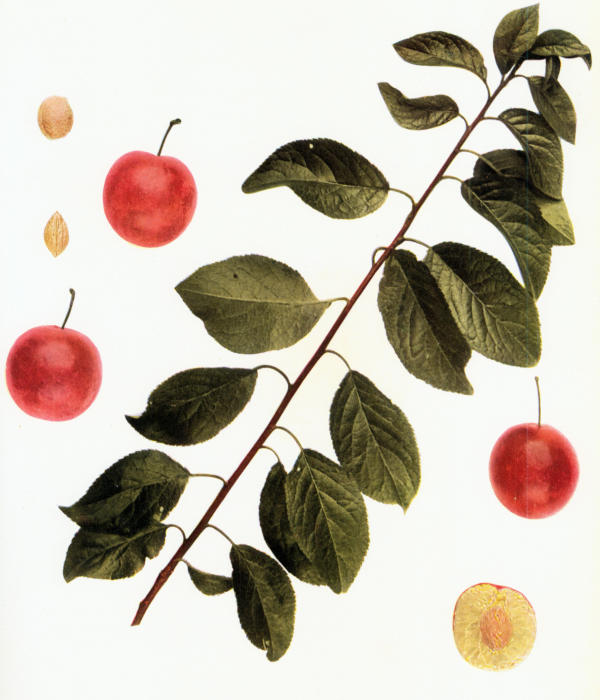
DE CARADEUC
Prunus cerasifera
1. Am. Pom. Soc. Rpt. 86. 1871. 2. Am. Pom. Soc. Cat. 38. 1877. 3. Barry Fr. Garden 418. 1883. 4. Cornell Sta. Bul. 38:66, 71, 86. 1892. 5. Bailey Ev. Nat. Fruits 212. 1898. 6. Vt. Sta. An. Rpt. 13:369. 1900. 7. Waugh Plum Cult. 230. 1901. 8. Budd-Hansen Am. Hort. Man. 310. 1903. 9. Ga. Sta. Bul. 67:274. 1904. 10. Ga. Hort. Soc. Cat. 13. 1905.
Caradeuc 1.
De Caradeuc is without value in this climate for its fruit and is described at length and illustrated in The Plums of New York only because it is one of the few representatives of Prunus cerasifera cultivated for its fruit. The plums are garnet-red, very attractive in appearance and are borne so much earlier than those of other species that the variety may be worth planting in home orchards to lengthen the season and for the sake of variety. This plum is grown rather commonly in the South where the fruits are said to keep well and not rot. The trees are handsome ornamentals bearing remarkably rich, green foliage and a profusion of white flowers which are followed by beautifully colored fruits. The variety can be recommended for lawn or park where a small, compact, flowering tree is wanted.
De Caradeuc originated with A. De Caradeuc, Aiken, South Carolina, between 1850 and 1854. Mr. De Caradeuc brought plum trees from France and planted them in the vicinity of several native plum trees. From the seed of the former he produced this variety. The originator believed his new plum to be a hybrid but practically all students of plum botany think that it is a pure offshoot of Prunus cerasifera. The variety was introduced by P. J. Berckmans of Augusta, Georgia. In 1877 De Caradeuc was placed on the American Pomological Society fruit catalog list where it is still maintained.
Tree very large, vigorous, spreading, open-topped, variable in productiveness; trunk rough; branches slender, roughish or smooth, dark ash-gray, with numerous, large, raised lenticels; branchlets very numerous, twiggy, slender, medium to long, with long internodes, tinged with red when young, changing to dull reddish-brown, glossy, glabrous, with few, small lenticels; leaf-buds very small and short, obtuse, appressed.
Leaves numerous on the branchlets, becoming scattering in the interior of the tree, folded upward, oval, one and one-eighth inches wide, two inches long, thin; upper surface dark green, sparingly pubescent, smooth, with broadly grooved midrib; lower surface pale green, pubescent; apex acute, base broadly cuneate, margin often in two series of fine serrations, without glands; petiole slender, one-half inch long, slightly pubescent, tinged red, eglandular or with one or two very small, globose, greenish glands usually at the base of the leaf.
Blooming season rather early, short; flowers appearing after the leaves, seven-eighths inch across, white; borne on lateral buds and spurs; pedicels eleven-sixteenths inch long, below medium in thickness, glabrous, green; calyx-tube reddish, campanulate, glabrous; calyx-lobes broad, obtuse, slightly glandular-serrate, pubescent, strongly reflexed; petals roundish or ovate, crenate, not clawed; anthers yellow; filaments one-quarter inch in length; pistil glabrous, longer than the stamens, somewhat defective.
Fruit very early, season short; one and one-quarter inches in diameter, roundish, halves usually equal; cavity shallow and narrow, abrupt, regular; suture a dark red line; apex roundish; color light or dark crimson-red over a yellow ground, overspread with thin bloom; dots few, light russet, clustered about the apex; stem slender, eleven-sixteenths inch in length, glabrous, adhering well to the fruit; skin thin, tough, parting readily; flesh medium yellow, very juicy, fibrous, tender and melting, slightly sweet, lacking in flavor; inferior in quality; stone clinging, five-eighths inch by one-half inch in size, roundish-oval, turgid, blunt, with somewhat pitted surfaces; ventral suture acute, furrowed; dorsal suture distinctly and broadly grooved.
DE SOTO
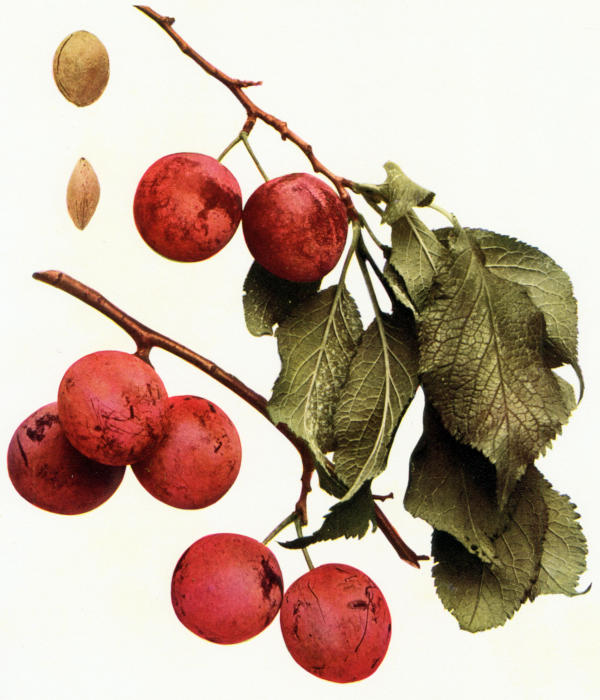
DE SOTO
Prunus americana
1. Ill. Hort. Soc. Rpt. 225. 1877. 2. Ia. Hort. Soc. Rpt. 356. 1879. 3. Ibid. 159. 1880. 4. Ibid. 237. 1882. 5. Am. Pom. Soc. Cat. 42. 1883. 6. Ia. Hort. Soc. Rpt. 366. 1883. 7. Ill. Hort. Soc. Rpt. 63. 1890. 8. Cornell Sta. Bul. 38:37, 86. 1892. 9. Wis. Sta. Bul. 63:24, 35, 36, fig. 16. 1897. 10. Waugh Plum Cult. 147. 1901. 11. Budd-Hansen Am. Hort. Man. 295. 1903. 12. Can. Exp. Farm Bul. 43:30. 1903. 13. S. Dak. Sta. Bul. 93:15. 1905.
Traer 3. Trayer 4.
De Soto probably holds first place among the Americana plums in the favor of fruit-growers. The qualities which commend it are: A tree rather better suited to the orchard than other varieties of Prunus americana having little of the waywardness of most sorts of its species and somewhat the manner of growth of the European plums. The trees, too, are enormously productive, so much so that in many cases their vitality is weakened by over-bearing unless thinned. The fruits of De Soto, while not as large nor as brilliantly colored as some of the Americanas, are not surpassed by any of the native plums in quality and keep and ship as well as any. The variety becomes, therefore, a market sort of value in some regions. The fruits are a little more subject to curculio than those of most of the native plums and the trees blight in the South somewhat and do not stand the drouths of the Mississippi Valley as well as some other varieties. Notwithstanding these defects, speaking generally, the De Soto may be recommended as one of the best of its species.
De Soto was found on the bank of the Mississippi River near De Soto, Wisconsin. The first settler to call attention to the plum was a Mr. Tupper who settled on the land where it was found in 1853 or 1854. The Trayer Brothers bought the place in 1855 and in clearing the farm they removed all the plum trees except a grove of what was at first called Trayer, afterwards De Soto. Later Stephen Heal came into possession of the property and in 1864 Elisha Hale, Lansing, Iowa, commenced to cultivate and disseminate the variety. De Soto was placed on the American Pomological Society fruit catalog list in 1883, dropped in 1891, and restored again in 1897.
Tree small, intermediate in vigor, spreading, open-topped, perfectly hardy, produces heavy crops annually, bears young; branches rough and shaggy, somewhat zigzag, thorny, dark ash-brown, with inconspicuous, small, raised, lenticels; branchlets numerous, long, green, changing to dull reddish-brown, pubescent at first, becoming glabrous late in the season, with conspicuous, large, raised lenticels; leaf-buds below medium in size, pointed, appressed.
Leaves falling early, folded upward, oval, one and three-quarters inches wide, four inches long; upper surface dark green changing to greenish-yellow, glossy, with scattering hairs and a narrow, grooved midrib; lower surface finely pubescent; apex taper-pointed, base somewhat abrupt, margin very coarsely and deeply doubly serrate, petiole five-eighths inch long, of medium thickness, pubescent, tinged red, glandless or with one or two globose, brownish glands on the stalk.
Blooming season medium to late and of average length; flowers appearing after the leaves, one and one-eighth inches across, white; borne in clusters on lateral buds and spurs, in twos and threes; pedicels eleven-sixteenths inch in length, below medium in thickness, covered with short, thick pubescence, greenish; calyx-tube green, campanulate, pubescent; calyx-lobes somewhat acute, eglandular, thickly pubescent on both surfaces, with a swollen ring at the base of the lobes, semi-reflexed; petals oblong or ovate, erose, tapering abruptly into long, narrow claws; anthers yellowish; filaments three-eighths inch in length; pistil glabrous, equal to or shorter than the stamens.
Fruit mid-season, ripening period short; one and one-half inches in diameter, roundish, varying to oval or ovate, compressed, often strongly truncate at the base; cavity shallow or medium, abrupt; suture very shallow or a line; apex roundish or somewhat pointed; color yellowish-red becoming a light or dark crimson over an orange-yellow ground, overspread with thin bloom; dots very numerous, small, light russet, inconspicuous; stem rather slender, three-quarters inch long, sparingly pubescent; skin thick, tough, very astringent, clinging to the pulp; flesh golden-yellow, very juicy, fibrous, tender and melting, of medium sweetness, mild; fair to good; stone nearly free, seven-eighths inch in size, oval, turgid, blunt-pointed, smooth; ventral suture bluntly acute and with slight furrows; dorsal suture acute, not furrowed.
DIAMOND
DIAMOND
Prunus domestica
1. Lond. Hort. Soc. Cat. 146. 1831. 2. Kenrick Am. Orch. 259. 1832. 3. Downing Fr. Trees Am. 298. 1845. 4. Lee Gen. Farmer 6:141. 1845. 5. Am. Pom. Soc. Cat. 222, 244. 1858. 6. Hogg Fruit Man. 696. 1884. 7. Mich. Hort. Soc. Rpt. 327. 1889. 8. Guide Prat. 159, 355. 1895. 9. Mich. Hort. Soc. Rpt. 382. 1895. 10. Cornell Sta. Bul. 131:183, fig. 40 VI. 1897. 11. Am. Pom. Soc. Cat. 25. 1897. 12. Vt. Sta. An. Rpt. 12:214, 217. 1899. 13. Mich. Sta. Bul. 169:244. 1899. 14. W. N. Y. Hort. Soc. Rpt. 92. 1899. 15. Garden 56:168. 1899. 16. Can. Exp. Farm Bul. 43:33. 1903. 17. Can. Exp. Farms Rpt. 423. 1903.
Black Diamond 9. Black Diamond 11, 13. Diamant 8. Diamantpflaume 8. Dymond 15. Kentish Diamond 17. Kingston 14 incor. Smith’s Prune 7. Smith Prune 14.
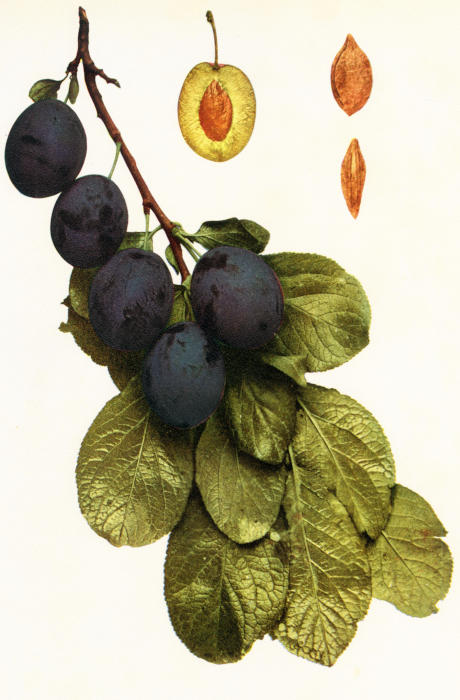
To judge Diamond by appearance would be a grievous error. It is a large, beautifully colored, well-formed plum, tempting the palate; but one taste out of hand is a sufficiency. The flesh is coarse and the flavor not at all pleasant to one accustomed to good plums. Hogg says, in the reference given, that Diamond is one of the best preserving and cooking plums but in this case we doubt Hogg’s judgment unless, as may be, Diamond is much better in England than in America. The firm flesh and tough skin of the variety commend it as a market plum and the trees are above the average in size, vigor, hardiness and productiveness—all characters excepting quality bespeaking the favor of plum-growers. It is planted largely for the markets where, of course, it sells upon its appearance.
According to Downing, this variety was raised from seed by an Englishman, in Kent, named Diamond. Kenrick and Hogg, however, state that it was raised in the nursery of a Mr. Hooker, in Kent. The London Horticultural Society briefly described this variety in its fruit catalog for 1831 so that its origin antedates that year. The American Pomological Society rejected Diamond for its catalog in 1858 but placed it in its fruit list in 1897.
Tree above average in size and vigor, upright-spreading, somewhat dense-topped, hardy, very productive; branches ash-gray, roughish, with numerous, small lenticels, the bark marked with transverse lines; branchlets of medium thickness and length, with long internodes, greenish-red changing to dark brownish-red, dull, somewhat pubescent, with numerous, small lenticels; leaf-buds large, long, pointed, appressed.
Leaves folded upward, obovate or oval, one and seven-eighths inches wide, three and one-quarter inches long; upper surface dark green, with few hairs and with a grooved midrib; lower surface pubescent; apex obtuse to acute, base acute, margin serrate, with small, brown glands; petiole five-eighths inch long, slender, pubescent, reddish, with from one to four small, globose or reniform, greenish-yellow glands on the stalk or base of the leaf.
Blooming season early or medium, short; flowers appearing after the leaves, one inch across, the buds yellow-tipped changing to white on expanding; borne on lateral spurs, in pairs; pedicels five-eighths inch long, somewhat slender, pubescent, green; calyx-tube greenish, campanulate, pubescent; calyx-lobes broad, obtuse, pubescent on both surfaces, glandular-serrate, reflexed; petals broadly oval or roundish, entire or slightly crenate, tapering to short, broad claws; anthers roundish, yellow; filaments five-sixteenths inch in length; pistil lightly pubescent at the base, longer than the stamens.
Fruit mid-season, ripening period short; one and seven-eighths inches by one and three-quarters inches in size, oval, slightly necked, swollen on the ventral side, compressed; cavity very narrow and abrupt; suture shallow, often a line; apex roundish or pointed; color deep reddish-purple changing to dark purplish-black at full maturity, with thick bloom; dots numerous, small, russet, inconspicuous; stem slender, one inch long, finely pubescent, adhering well to the fruit; skin thin, rather sour, separating readily; flesh pale or golden-yellow, sometimes with a faint red tinge next the skin, not juicy, coarse, firm but rather tender, mild subacid to nearly sweet, not high in flavor; of fair quality; stone with a trace of red, semi-clinging, one and one-eighth inches by five-eighths inch in size, long-oval, necked at the base, abruptly sharp-pointed at the apex, with pitted surfaces; ventral suture rather broad, lightly furrowed; dorsal suture widely grooved.
DOUBLE FLOWERING GAGE
Prunus domestica
1. Duhamel Trait. Arb. Fr. 2:92. 1768. 2. Knoop Fructologie 57. 1771. 3. Kraft Pom. Aust. 2:32, Tab. 179 fig. 2. 1796. 4. Prince Pom. Man. 2:49. 1832. 5. Mag. Hort. 9:165. 1843. 6. Downing Fr. Trees Am. 316. 1845. 7. Poiteau Pom. Franc. 1:1846. 8. Mas Pom. Gen. 2:47. 1873. 9. Guide Prat. 163, 363. 1895.
Die grosse Königin Klaudia Pflaume mit halbgefullter Bluthe 3. Dauphin à Fleurs semi-doubles 5. Dauphin à Fleurs doubles 5. Dauphin à fleurs semi-doubles 5. Double-blossomed 5. Double-blossomed Plum 6. Gelbe Reneclode Mit Gefullter Bluthe 8. Prune à Fleurs Doubles 8. Prunier à fleurs semi-double 8. Prunier à fleur semi-double 1, 7. Prune à Fleurs Doubles 2. Prunier à fleur semi-double 4. Prune Semi-double 4. Prune à fleurs semi-double 4. Reine-Claude Semi-Double 8. Reine-Claude à fleur semi-double 4. Reine-Claude à Fleurs Semi-double 5, 9. Reine-Claude mit Halbgefullter Bluthe 9. Semi-double flowering Reine Claude 4.
This is an ornamental variety of the Reine Claude type first noted by Duhamel in 1768. It was probably well known in Europe at this time for a little later it was mentioned by Knoop of Holland and Kraft of Austria. Duhamel described two varieties; one with small fruit which was insipid when over-ripe, and the other large and of good flavor. In 1846, Poiteau thought the latter was probably identical with a variety growing at Luxembourg but he did not think the former was extant. In the third edition of the London Horticultural Society’s catalog, yellow and purple forms were mentioned, showing that the variety has been represented by more than one type. It is worthy of note that the double blossoms, except in strong soils, are apt to degenerate and become single. The following description is compiled.
Tree irregular and spreading, unproductive; branches brown on the shaded side and blood-red on the sunny side; flowers large, semi-double, with from twelve to eighteen petals; fruit mid-season; large, spherical; suture shallow, sometimes a line; flesh greenish-yellow, tender, soft, juicy, sweet, agreeably aromatic; clingstone.
DOWNING
DOWNING
Prunus munsoniana
1. Ia. Hort. Soc. Rpt. 287, 1887. 2. Ibid. 275, 448. 1893. 3. Ibid. 334. 1894. 4. Wis. Sta. Bul. 63:24, 30. 1897. 5. Am. Pom. Soc. Cat. 24. 1897. 6. Waugh Plum Cult. 185. 1901. 7. Wis. Sta. Bul. 87:12. 1901. 8. Ia. Sta. Bul. 46:269. 1900. 9. Ia. Hort. Soc. Rpt. 445. 1903. 10. Ohio Sta. Bul. 162:247 fig., 254, 255. 1905. 11. S. Dak. Sta. Bul. 93:15. 1905.
Charles Downing 1, 2, 3, 4, 7. Charles Downing 5, 6, 8, 11.
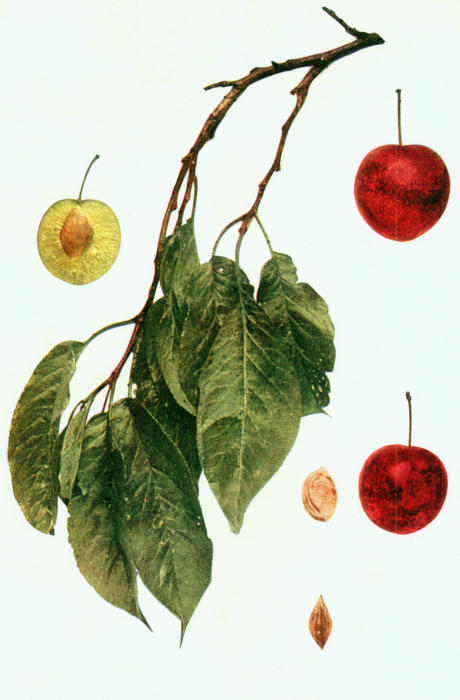
Downing is one of the best varieties of its species. The trees are large, usually productive, not often sterile as are some of its near of kin sorts and for a southern plum the variety is remarkably hardy, never having suffered in Geneva from cold. The only fault that can be found with the tree is that the foliage is quite susceptible to the shot-hole fungus. The fruit is particularly attractive with its bright, solid, garnet-red skin, golden flesh and sweet, pleasant flavor. Unfortunately the flesh is a little too fibrous and clings too tenaciously to the stone for pleasant eating. Downing adds a pleasing variety to any collection of plums and in some regions ought to sell with profit to the grower for the markets.
H. A. Terry of Crescent, Iowa, grew Downing from seed of the Wild Goose, which the originator thinks was fertilized by some Americana variety. The Downing, however, shows no traces of Americana parentage. It is reported as originating in 1882 and first fruiting in 1885. The American Pomological Society placed this variety on its fruit catalog list in 1897.
Tree large, spreading, flat-topped, hardy in New York, variable in productiveness; branches rough, dark gray, with a few large lenticels; branchlets slender, with very short internodes, greenish-red changing to dull reddish-brown, glossy, somewhat pubescent, with numerous, small, slightly raised lenticels; leaf-buds small, short, obtuse, appressed.
Leaves folded upward, broadly lanceolate, peach-like, one and three-eighths inches wide, three inches long, thin; upper surface reddish late in the fall, smooth, glabrous, with deeply grooved midrib; lower surface glabrous except along the midrib and larger veins; apex taper-pointed, margin very finely serrate, eglandular or sometimes with small dark glands; petiole thirteen-sixteenths inch long, slender, tinged with red, pubescent along one side, glandless or with from one to five small, globose, yellowish-red glands usually on the stalk.
Blooming season medium to late, long; flowers appearing after the leaves, one and one-sixteenth inches across, the buds yellow-tipped changing to white when expanded, with a strong, disagreeable odor; borne in dense clusters on lateral buds and spurs, in threes; pedicels eleven-sixteenths inch in length, very slender, glabrous, greenish; calyx-tube green, obconic, glabrous; calyx-lobes below medium in width, acute, finely pubescent on the inner surface only, somewhat reflexed, glandular-serrate, the glands numerous and dark colored; petals oval, narrow, long, crenate, tapering beneath to long, narrow claws; anthers pale yellow, with a faint reddish tinge; filaments seven-sixteenths inch in length; pistil slender, glabrous, shorter than the stamens.
Fruit mid-season, ripening period short; about one and one-eighth inches in diameter, rather large for its class, roundish-ovate, not compressed, halves equal; cavity shallow, narrow, flaring; suture very shallow and obscure; apex roundish or slightly conical; color garnet-red, with thin bloom; dots numerous, variable in size, grayish-yellow, conspicuous, clustered around the apex; stem slender, about three-eighths inch in length, glabrous, parting readily from the fruit; skin thin, slightly astringent, adhering but little; flesh golden-yellow, juicy, coarse, fibrous, tender and somewhat melting, very sweet next the skin but tart toward the center, aromatic; good; stone clinging, three-quarters inch by one-half inch in size, oval, somewhat oblique, turgid, roughish; ventral suture narrow, strongly winged; dorsal suture acute, unfurrowed.
DRAP D’OR
DRAP D’OR
Prunus insititia
1. Quintinye Com. Gard. 2:69. 1699. 2. Langley Pomona 94, 97, Pl. 24 fig. 5. 1729. 3. Duhamel Trait. Arb. Fr. 2:96. 1768. 4. Knoop Fructologie 57. 1771. 5. Coxe Cult. Fr. Trees 233 fig. 2. 1817. 6. Lond. Hort. Soc. Cat. 146. 1831. 7. Prince Pom. Man. 2:75. 1832. 8. Kenrick Am. Orch. 261. 1832. 9. Mag. Hort. 9:163. 1843. 10. Downing Fr. Trees Am. 274. 1845. 11. Poiteau Pom. Franc. 1:1846. 12. Floy-Lindley Guide Orch. Gard. 297, 383. 1846. 13. Thompson Gard. Ass’t 516. 1859. 14. Hogg Fruit Man. 359, 371, 387. 1866. 15. Pom. France 7: No. 12. 1871. 16. Am. Pom. Soc. Cat. 36. 1875. 17. Cat. Cong. Pom. France 350. 1887. 18. Mathieu Nom. Pom. 428. 1889. 19. Guide Prat. 153, 359. 1895. 20. Soc. Nat. Hort. France Pom. 538 fig. 1904. 21. Baltet Cult. Fr. 489, 503. 1908.
Cloth of Gold 2, 5, 7, 12, 14, 18, 19. Cloth of Gold Plum 15. Damas Jaune 15, 18, 19. Doppelte Mirabelle 18. Drap d’Or 1, 2. Drap d’Or Pflaume 15. Drap d’Or 7, 15, 18, 19, 20, 21. Double Drap d’Or 17. Double Mirabelle 17. Glauzende gelbe Mirabelle 15. Glänzende Gelbe Mirabelle 18, 19. Gold Pflaume 18. Goldfarbige Pflaume 15, 18, 19. Goldstoff 18. Goldzeng 18. Grosse Mirabelle ?7, 15, 18, 19, 21. Grosse Mirabelle 8, 21. Grosse Mirabelle Drap d’Or 18, 19. Mirabelle 15, 17. Mirabelle Double 19, 21. Mirabelle Double 3, 5, 6, 7, 10, 12, 13, 14, 18. Mirabelle Double de Metz 20. Mirabelle de Nancy 19, 21. Mirabelle de Nancy 14, 18. Mirabelle Drap d’Or 15, 18, 19. Mirabellen 15. Mirabelle grosse double de Metz 15, 18, 19. Mirabelle Grosse de Nancy 20. Mirabelle Grosse 15, 17, 20, 21. Mirabelle la grosse 7, 15, 18, 19. Mirabelle Grosse 6, ?7, 10, 13, 14, 15, 19. Mirabelle Perlée 15, 18, 19. Mirabelle von Metz 15. Perdrigon Hâtif 15, 20, of some 17, 18, 19. Perdrigon Jaune 20. Yellow Damask ?14. Yellow Damask 14, 18. Yellow Gage of some 5, 7. Yellow Perdrigon 9, 10, 13, 14, 15, 18, 19.
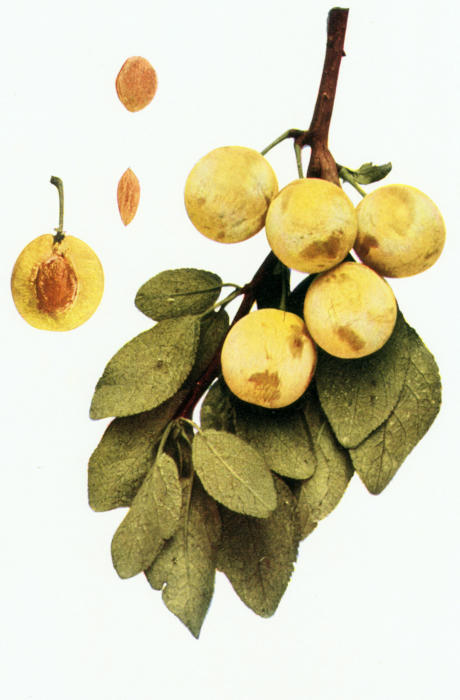
Drap d’Or represents a type of the plum hardly known in America but very popular in continental Europe and most popular of all plums in France, the chief plum-growing country of the Old World. It is probable that the division of Prunus insititia represented by Drap d’Or, the Mirabelle plums, will thrive in America as well as the commonly grown Damsons of the same species. These plums certainly deserve to be far more generally planted than they now are. It is certain from the behavior of the few trees of the Mirabelle group now growing in New York that they have very decided merit. Drap d’Or is probably not the best of the yellow, sweet Insititias but it is at least well worth trial.
According to Pomologie De La France, this variety was cited by Merlet in 1675 and is of old and uncertain origin. Merlet placed the Mirabelle and the Drap d’Or in the Damas class, but Poiteau thought that the latter was probably a cross between Reine Claude and Mirabelle since it resembled the former in quality and shape and the latter in color and size. Yellow Damask, Mirabelle de Nancy, Yellow Perdrigon, Gross Mirabelle and others have proved to be identical with the Drap d’Or as tested in Europe. Whether all of the other synonyms mentioned are the true Drap d’Or is a question; their number indicates that there are many variations in this type of the plum. The American Pomological Society placed Drap d’Or in its catalog list in 1875 and withdrew it in 1899.
Tree small, upright-spreading, dense-topped, hardy, productive; branches ash-gray, with a brownish tinge, smooth, with very few, small lenticels; branchlets of average thickness and length, greenish-red changing to brownish-red, dull, sparingly pubescent throughout the entire season, with few, obscure, small lenticels; leaf-buds of medium size and length, conical, appressed.
Leaves folded upward, oval, one and one-fourth inches wide, two and one-half inches long; upper surface slightly roughened, covered with numerous hairs, the midrib grooved; lower surface silvery-green, pubescent; apex pointed or acute, base abrupt, margin serrate or crenate, eglandular or with small dark glands; petiole one-half inch long, pubescent, tinged red, glandless or with from one to three globose, greenish-yellow glands usually on the stalk.
Flowers fifteen-sixteenths inch across, the buds creamy changing to white when expanded; borne in clusters on lateral spurs, usually in pairs; pedicels nine-sixteenths inch long, sparingly pubescent, greenish; calyx-tube green, campanulate, nearly glabrous; calyx-lobes obtuse, pubescent on both surfaces, glandular-serrate, somewhat reflexed; petals broadly oval, crenate or sometimes notched at the apex, tapering below to short, broad claws; anthers yellowish; filaments five-sixteenths inch long; pistil glabrous, equal to the stamens in length.
Fruit mid-season; one and one-eighth inches by one inch in size, roundish-oval, compressed, halves equal; cavity shallow, narrow, flaring; suture very shallow, often a line; apex roundish or depressed; color greenish-yellow changing to golden-yellow, somewhat mottled and blotched, occasionally with a faint bronze blush on the exposed cheek, overspread with thin bloom; dots numerous, small, whitish, inconspicuous; stem slender, sparingly pubescent, adhering well to the fruit; skin thin, separating readily; flesh light golden-yellow, moderately juicy, coarse, firm but tender, sweet, mild; of good quality; stone free, five-eighths inch by one-half inch in size, oval, flattened, nearly smooth, blunt at the base and apex; ventral suture wide, blunt, smooth; dorsal suture shallowly grooved.
DUANE
DUANE
Prunus domestica
1. Prince Treat. Hort. 25. 1828. 2. Kenrick Am. Orch. 260. 1832. 3. Prince Pom. Man. 2:100. 1832. 4. Downing Fr. Trees Am. 297. 1845. 5. Horticulturist 1:115, 116 fig. 36. 1846. 6. Floy-Lindley Guide Orch. Gard. 419. 1846. 7. Thomas Am. Fruit Cult. 343. 1849. 8. Elliott Fr. Book 418. 1854. 9. Horticulturist 10:253. 1855. 10. Am. Pom. Soc. Rpt. 191. 1856. 11. Hooper W. Fr. Book 244, 250. 1857. 12. Bridgeman Gard. Ass’t 3:127. 1857. 13. Downing Fr. Trees Am. 910. 1869. 14. Mich. Pom. Soc. Rpt. 303, 1878. 15. Mas Le Verger 6:77, fig. 39. 1866-73, 16. Mich. Sta. Bul. 103:32. 1894. 17. Cornell Sta. Bul. 131:184. 1897. 18. Ohio Sta. Bul. 162:254, 255. 1905. 19. Waugh Plum Cult. 100, 102 fig. 1901.
Apricot 5 incor. Dame Aubert Violet 12. Duane’s Plum 5 incor. Duane’s Purple 5, 6, 7, 8, 9, 10, 11, 13, 14, 16, 17. Duane’s Purple 15, 19. Duane’s Purple French 1, 2, 3, 4. Duane’s French Purple 12. Duane’s Large Purple 3. Duane’s Large Orleans 3. Duane’s Purple French 8, 9. English Pond’s Seedling 8. Pourprée De Duane 15. Pourprêe Duane 13. Purple Magnum Bonum of some 12, 13. Purple Egg of some 12. Red Magnum Bonum of some 9.
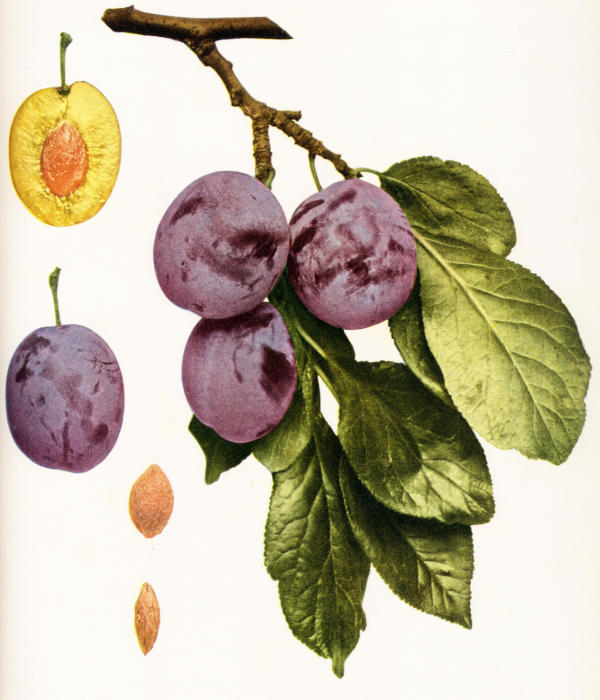
This handsome, purple plum, very well shown in the color-plate, is one of the half-dozen leading fruits of its kind grown in New York, favorably known the country over and in Europe as well. Its popularity is due to its large size, well-turned shape, royal purple color, and firm, golden flesh, characters which fit it admirably for the store and the stand. But appearance is the only asset of the fruit so far as the consumer is concerned—the flesh is dry, tough, sour and clings to the stone, making a plum unfit for dessert though it does very well for culinary purposes. The fruit ripens slowly and colors a week or more before ripe; it is at its best only when fully mature. The trees excel in size, vigor and productiveness and are usually hardy and bear their crops well distributed and not clustered as in most varieties of plums. In minor characters, the trees are distinguished by large leaves, pubescence on the under side and by grayish-drab shoots covered with dense pubescence. Duane is generally found to be a very profitable market plum and if it were only better in quality we could heartily join in recommending it.
Duane originated as a seedling in the garden of James Duane, Duanesburgh, New York, about 1820. For several years, the variety was distributed by the Prince nurseries under the name Duane’s Purple French. This error was caused by Judge Duane’s accidentally sending William Prince, of Flushing, grafts of this seedling instead of a French plum[210] which he had imported in 1820. When this mistake was discovered by Downing and Tomlinson about 1846, the word French was dropped and the plum became known as Duane’s Purple and later, according to the rules of the American Pomological Society, as Duane. In 1856, it was listed by the American Pomological Society as promising well and in 1862 it was placed on the list of the fruit catalog.
Tree large, vigorous, round and dense-topped, hardy and productive; branches ash-gray, smooth except for the numerous small, raised lenticels; branchlets medium to thick, variable in length, with short internodes, greenish-red changing to dark brownish-drab, dull, thickly pubescent, with raised lenticels intermediate in number and size; leaf-buds of average size and length, conical or pointed, free.
Leaves folded backward, obovate or oval, one and one-half inches wide, three and one-half inches long; upper surface dark green, pubescent, rugose, with a narrow groove on the midrib; lower surface silvery-green, pubescent; apex acute, base cuneate, margin serrate, eglandular or with small amber glands; petiole one-half inch long, pubescent, tinged with red, eglandular or with one or two small, globose, greenish-brown glands on the stalk or base of the leaf.
Blooming season rather early, of average length; flowers appearing before the leaves, one inch across, white; developing from lateral buds, singly or in pairs; pedicels nine-sixteenths inch long, thick, pubescent, greenish; calyx-tube green, campanulate, pubescent; calyx-lobes broad, obtuse, pubescent on both surfaces, glandular-serrate, erect; petals roundish, entire, short-clawed; anthers yellowish; filaments one-quarter inch long; pistil pubescent on the ovary, longer than the stamens.
Fruit mid-season, ripening period of average length; one and three-quarters inches by one and five-eighths inches in size, broadly oblong-oval or obovate, compressed, halves unequal; cavity shallow, narrow, abrupt; suture variable in depth; apex roundish or depressed; color dark reddish-purple changing to purplish-black on the sunny side, overspread with thick bloom; dots numerous, light russet; stem three-quarters inch long, pubescent, adhering well to the fruit; skin below medium in thickness, tough, sour, separating readily; flesh pale yellow, lacking in juice, firm, sour unless fully ripe; of fair quality; stone adhering, seven-eighths inch by five-eighths inch in size, oval, with pitted surfaces, blunt at the base and apex; ventral suture wide, blunt; dorsal suture with a broad, deep groove.
EARLIEST OF ALL
Prunus triflora
1. Gard. Mon. 368. 1887. 2. Cornell Sta. Bul. 62:32, 1894. 3. Normand Cat. 2. 1895-96. 4. Thomas Am. Fruit Cult. 516. 1897. 5. Cornell Sta. Bul. 175:130, fig. 24. 1899. 6. Waugh Plum Cult. 135. 1901.
Earliest of All 4. Wasse Sumomo 5, 6. Wasse Sumomo 3. Yosobe 1. Yosete 4. Yosebe 5, 6. Yosobe 2. Yosebe 2.
Earliest of All was imported by H. H. Berger of San Francisco from Japan under the name Yosebe, which later became changed to Yosobe, and in 1897 L. H. Bailey gave the variety the name Earliest of All to avoid the confusion in the earlier nomenclature. The Wasse Sumomo introduced by J. L. Normand, Marksville, Louisiana, in 1895, is the Earliest of All. The variety may have some value because of its extreme earliness. It is, however, too small, too unattractive in color and too poor in quality ever to be other than a kitchen plum.
Tree intermediate in size and vigor, vasiform, unproductive; branchlets dark red, marked with thick scarf-skin; leaf-scars prominent; leaves reddish late in the season, narrow-obovate, one and one-half inches wide, three inches long; margin finely serrate, with small, reddish-black glands; petiole tinged red, glandless or with from one to seven glands usually on the stalk; blooming season early; flowers appearing before the leaves, white with a little pink; borne in threes and fours.
Fruit very early; one inch in diameter, roundish or roundish-oblong, light or dark pinkish-red, covered with thin bloom; flesh light yellow, rather dry, soft, inferior in flavor; of poor quality; stone clinging, five-eighths inch by three-eighths inch in size, flattened, oval.
EARLY ORLEANS
Prunus domestica
1. Duhamel Trait. Arb. Fr. 2:80, Pl. XX fig. 1. 1768. 2. Forsyth Treat. Fr. Trees 21. 1803. 3. Lond. Hort. Soc. Cat. 150, 151. 1831. 4. Prince Pom. Man. 2:62, 68. 1832. 5. Kenrick Am. Orch. 260, 269. 1832. 6. Downing Fr. Trees Am. 304. 1845. 7. Floy-Lindley Guide Orch. Gard. 286, 289, 294, 382, 383. 1846. 8. Poiteau Pom. Franc. 1:1846. 9. Thompson Gard. Ass’t 516. 1859. 10. Hogg Fruit Man. 360. 1866. 11. Pom. France 7: No. 16. 1871. 12. Mas Le Verger 6:85. 1866-73. 13. Mathieu Nom. Pom. 430. 1882. 14. Traité Prat. Sech. Fruits 172. 1893. 15. Guide Prat. 152, 360. 1895. 16. Soc. Nat. Hort. France Pom. 542 fig. 1904.
Altesse du Roi 16. Damascena Dominicalis Praecox 13, 15. De Monsieur 16. De Monsieur Hâtive 15. Du Roi 15. Early Monsieur 12. Early Monsieur 4, 5. Early Orleans 11, 12, 13, 15. Frühe Herrnpflaume 13. Frühe Herrnpflaume 11. Frühe Herzogspflaume 11, 13, 15. Frühe Hernnpflaume 12. Frühe Herrnpflaume 15. Grimwood Early Orleans 10, 13. Grimwood’s Early Orleans 3, 6, 9, 11, 15. Hampton Court 3, 6, 7, 9, 10, 11, 13, 15. Königspflaume 11, ?13, ?15. Monsieur 11, 13 & 15 incor. Monsieur Hâtif 1, 7, 11, 12, 15. Monsieur Hâtif 3, 4, 5, 6, 7, 9, 10, 12, 13, 16. Monsieur Hâtive 4. Monsieur Hâtif de Montmorency 3, 6, 9, 10, 11, 13, 14, 15. New Early Orleans 3, 6, 9, 11, 13, 14, 15. New Orleans 3, 6, 9, 10, 13, 15, 16. New Orleans 11. Orleans 3. Prune de Monsieur Hâtif 13. Prune de Monsieur Hâtif 8. Prune de Monsieur Hâtive 12. Prunus damascena dominicalis praecox 11. Prune du Roi 14. Prune du Roi 11, 13. Red Orleans 11, 13, 15. Wilmot’s Early Orleans 4, 7. Wilmot’s Early Orleans 3, 9, 10, 11, 13, 15. Wilmot’s Large Orleans 3, 4, 6. Wilmot’s Late Orleans ?7. Wilmot’s New Early Orleans 3, 5, 6. Wilmot’s New Early Orleans 7. Wilmot’s Orleans 3, 7, 10, 11, 13, 14, 15.
Early Orleans has been planted very little in America and then chiefly because of its reputation in Europe. While it appears to be a very good plum in most respects as it grows on the Station grounds, being attractive in appearance, of good flavor, a freestone and firm enough to ship well, it surpasses in none of these characters and the fruit is so small as to make it a poor competitor among the purple plums of its season. It does not deserve the reputation in America that pomologists have given it in Europe. In France the Early Orleans, under the name of Prune du Roi, is used in prune-making but it seems not to have been so used in America.
Early Orleans is old and of unknown origin. Duhamel in 1768 considered it a variety of the Orleans, differing only in the time of ripening but there are additional differences as can be seen in the descriptions of the two. It is true, however, that these two plums are very similar. According to Kenrick, Wilmot’s New Early Orleans was raised by John Wilmot, an Englishman. Though it may be of separate origin it is practically identical with the Early Orleans.
Tree small, upright-spreading, hardy, productive; branches ash-gray, smooth, with small, inconspicuous, oval lenticels; branchlets thick, with rather short internodes, covered with thin bloom and marked with scarf-skin, dull brownish-drab, pubescent, with a medium number of small, raised lenticels; leaf-buds intermediate in size and length, conical, free, plump; leaf-scars enlarged.
Leaves folded upward, two and one-quarter inches wide, four inches long, roundish-oval or obovate, thick; apex abruptly pointed, base acute, margin crenate and with small, dark glands; upper surface light green, sparingly pubescent and with a grooved midrib; lower surface silvery-green, pubescent; petiole three-quarters inch long, thick, pubescent, faintly tinged red, with from one to three large, globose glands mostly on the stalk.
Season of bloom intermediate in time and length; flowers appearing after the leaves, nearly one-half inch across, white, the buds yellow-tipped as they unfold; borne in clusters on short lateral spurs, in pairs; pedicels one-half inch long, thick, pubescent, green; calyx-tube greenish, campanulate, thinly pubescent; calyx-lobes broad, obtuse, glandular, pubescent on both surfaces, reflexed; petals roundish, entire, not clawed; filaments five-sixteenths inch long; pistil glabrous, equal to the stamens in length.
Fruit early, season short; one and one-quarter inches in diameter, roundish-oval, slightly truncate, halves equal; cavity shallow, narrow, abrupt; suture shallow or a line; apex roundish to flattened or sometimes depressed, often oblique; color dark reddish-purple, covered with thick bloom; dots numerous, small, russet, inconspicuous; stem of average thickness, five-eighths inch long, pubescent, adhering well to the fruit; skin thin, tough, not astringent, separating readily; flesh lemon-yellow, juicy, coarse, firm, sweet, mild but pleasant; very good; stone free, three-quarters inch by five-eighths inch in size, oval, slightly oblique, blunt-pointed, with rough and slightly honeycombed surfaces.
EARLY RIVERS
Prunus domestica
1. Downing Fr. Trees Am. 314, 1845. 2. Horticulturist 4:40. 1849. 3. Elliott Fr. Book 419. 1854. 4. Downing Fr. Trees Am. 912. 1869. 5. Am. Pom. Soc. Rpt. 99. 1871. 6. Mas Pom. Gen. 2:117. 1873. 7. Jour. Hort. 30:273. 1876. 8. Oberdieck Deut. Obst. Sort. 409, 411. 1881. 9. Hogg Fruit Man. 699. 1884. 10. Mathieu Nom. Pom. 447. 1889. 11. Lucas Vollst. Hand. Obst. 470. 1894. 12. Guide Prat. 152, 356. 1895. 13. Rivers Cat. 35. 1898.
Early Fruchtbare 12. Early Prolific 4. Early Rivers 4, 10, 12. Early Prolific 2, 3, 6, 10, 12, 13. Fertile Précoce 10. Fertile Précoce 6, 12. Frühe Fruchtbare 6. Frühe Fruchtbare 8. Prolifique Hâtive 10, 12. Rivers’ Early No. 2 1, 2, 3, 4, 10. Rivers’ Early Prolific Plum 2. Rivers’ Early Prolific 4, 9, 10, 12. Rivers’ Early 6. River’s Early 5. Rivers’ Blue Prolific 7. Rivers’ No. 2 9, 10, 12. Rivers Frühpflaume 8, 11. Rivers’ Frühe Fruchtbare 10.
Early Rivers is widely known because of its earliness, productiveness, regularity of bearing and desirability for culinary purposes. In New York, however, the plums are so small and drop so badly as they ripen that the variety is worthless for commercial purposes. Hogg, in the reference given above, notes the following peculiarity of the trees of this variety: “The original tree throws up suckers, which, when removed and planted out, do not bloom for several years; but scions taken from the original tree and grafted, bloom the second year. A curious fact is that the grafted trees fruit abundantly, and the branches are so brittle they break off; in those raised from suckers the branches never break. The grafted trees in spring are full of bloom, sparing of shoots, and very few leaves; the suckers are more vigorous in growth, have no bloom, but an abundance of foliage, even when six years old.” This variety is a seedling of Early Tours raised by Thomas Rivers of Sawbridgeworth, England, about 1834. It was first disseminated under the names Early Prolific and Rivers’ Early No. 2 but, in 1866, Hogg with the permission of the originator, renamed it Early Rivers under which name it is now generally known.
Tree medium in size and vigor, round-topped, productive; branchlets thick, short, pubescent throughout the season; leaves roundish-oval or obovate, one and three-quarters inches wide, nearly three inches long, leathery; margin crenate or serrate, with few, small, dark glands; petiole pubescent, with from one to three small glands usually on the stalk; blooming season intermediate, short; flowers appearing after the leaves, seven-eighths inch across; borne on lateral buds and spurs, singly or in twos; petals roundish.
Fruit early, season short; one and one-quarter inches by one and one-eighth inches in size, roundish-oval or ovate, dark purplish-black, overspread with thick bloom; flesh dull yellow, firm, sweet, mild, pleasant; of good quality; stone semi-free, three-quarters inch by one-half inch in size, rather flat, oval, with rough and pitted surfaces.
EARLY ROYAL
Prunus domestica
1. Lond. Hort. Soc. Cat. 153. 1831. 2. Mag. Hort. 6:93. 1840. 3. Downing Fr. Trees Am. 313. 1845. 4. Thomas Am. Fruit Cult. 341, fig. 260. 1849. 5. Am. Pom. Soc. Cat. 86. 1862. 6. Mathieu Nom. Pom. 452. 1889. 7. Thompson Gard. Ass’t 4:159. 1901.
Early Royal 3, 4, 6. Marian 6. Mirian 3, 4. Mivian 2. Miviam 6. Miriam 7. Royal Hâtive 1, 2, 5, 7. Royale Hâtive 3, 4. Royale Hâtive 6. Violette Königspflaume 6.
While the fruits of Early Royal are not remarkably attractive in color, shape or size, the quality is high and its flesh is so firm that the variety should ship well. This sort is worthy of more extensive trial than it has yet had in America. Early Royal is a French variety introduced by M. Noisette of Paris, about 1830. Thompson made the first complete description of the variety in 1839 from the fruits of a tree in the gardens of the London Horticultural Society. Although recommended in the catalog of the American Pomological Society in 1862 it has not been extensively planted in this country.
Tree large, vigorous, spreading, rather open, productive; branches and trunk roughish; branchlets thickly pubescent; leaf-scars enlarged; leaves folded upward, oval or obovate, one and three-quarters inches wide, three and three-eighths inches long; margin serrate, with small, dark glands; petiole thickly pubescent, with one or two smallish glands; blooming season intermediate in time and length; flowers appearing with the leaves, one inch across, white, tinged yellow at the apex of the petals; borne on lateral buds and spurs, singly or in pairs.
Fruit mid-season, ripening period long; about one and three-eighths inches in diameter, roundish-ovate, dark reddish-purple, marked by irregular russet streaks, covered with thick bloom; dots conspicuous; stem thick, pubescent; flesh greenish-yellow, rather dry, firm, very sweet, mild, pleasant flavor; very good; stone nearly free, three-quarters inch by five-eighths inch in size, roundish-oval, blunt at the apex and base, with but slightly roughened surfaces; ventral suture prominent and with short wing; dorsal suture with a wide, shallow groove.
EARLY TOURS
Prunus domestica
1. Duhamel Trait. Arb. Fr. 2:67, 69. 1768. 2. Kraft Pom. Aust. 2:31, Tab. 177 fig. 2. 1796. 3. Lond. Hort. Soc. Cat. 151. 1831. 4. Prince Pom. Man. 2:64. 1832. 5. Kenrick Am. Orch. 265. 1832. 6. Poiteau Pom. Franc. 1:1846. 7. Floy-Lindley Guide Orch. Gard. 282, 283. 1846. 8. Hogg Fruit Man. 376. 1866. 9. Downing Fr. Trees Am. 937. 1869. 10. Mas Le Verger 6:143. 1866-73. 11. Mathieu Nom. Pom. 443. 1889. 12. Guide Prat. 156, 361. 1895.
Blue Perdrigon of some 3, 9, 11, 12. Die frühe Pflaume von Tours 2. De Monsieur 12 incor. Damas de Tours 8, 9, 11. Early de Tours 5. Early Tours 7, 9, 11. Early Violet 3, 7, 9, 11, 12. Gros Damas de Tours 1. Hâtive de Tours 12. Madeleine 11, ?12. Monsieur 11 incor. Noire Hâtive 3, 8, 9, 11, 12. Perdrigon Violet of some 3, 9, 11, 12. Précoce de Tours 1, 3, 5, 6, 7, 8, 9, 10, 11, 12. Précoce de Tours 2, 4. Prune de la Madeleine 4, 9, 11. Prune noire Hâtive 4. Prune de Gaillon 8, 9, 11. Prune de Monsieur 11 incor. Saint Jean ?11, 12. Violette de Tours 8, 11. Violette Hâtive 9, 11. Violet de Tours 9, 11, 12. Violette Hâtive 7. Violet 7.
Duhamel described this variety, Gros Damas de Tours and Gros Noire Hative in the same publication, his descriptions of the three varieties being nearly identical. Following Duhamel many horticultural authorities continued to separate the varieties, but Downing, Floy-Lindley and Mathieu give Damas de Tours as a synonym of Early Tours, and Thompson, Hogg, Downing, Mathieu and the Guide Pratique give Noire Hative as a synonym, while Prince holds Prune Noire Hative to be synonymous.
With this great similarity in the names and descriptions, it seems doubtful if these are separate varieties, but not having the fruit of the three to compare, it has been thought best in The Plums of New York to follow the nomenclature of the oldest authorities. Several writers have also named the Blue Perdrigon and the Perdrigon Violet as identical with Early Tours but neither can be, as all descriptions indicate that both are at least a month later in ripening than the variety under discussion.
Early Tours is considered in continental Europe one of the best early plums for dessert. It is said when fully ripened to be a veritable sweetmeat. As the variety grows in the Station collection it can hardly be lauded as highly as in Europe. Yet it is at least worthy of a place in a home orchard as a delicious early plum.
Tree intermediate in size, upright-spreading, rather open-topped, productive; branchlets thickish, pubescent; leaves falling early, folded upward, obovate or oval, one and seven-eighths inches wide, three and one-quarter inches long; margin crenate; petiole pubescent, glandless or with from one to three glands usually on the stalk; blooming season intermediate in time and length; flowers appearing after the leaves, one and one-eighth inches across; borne on lateral spurs or from lateral buds.
Fruit very early; one and one-quarter inches by one and one-eighth inches in size, slightly oval, dark purplish-black, covered with thick bloom; skin thick, tough, sour; flesh greenish-yellow, firm, sweet, pleasant flavored; good to very good; stone semi-free, three-quarters inch by one-half-inch in size, irregular oval.
EARLY YELLOW
Prunus domestica
1. Parkinson Par. Ter. 575, 576. 1629. 2. Rea Flora 206, 207. 1676. 3. Ray Hist. Plant. 2:1688. 4. Quintinye Com. Gard. 70. 1699. 5. Langley Pomona 90, Pl. 20 fig. 1. 1729. 6. Duhamel Trait. Arb. Fr. 2:66. 1768. 7. Forsyth Treat. Fr. Trees 19. 1803. 8. Floy-Lindley Guide Orch. Gard. 297, 382. 1846. 9. Downing Fr. Trees Am. 925. 1869. 10. Country Gent. 41:518. 1876. 11. Mathieu Nom. Pom. 424. 1889. 12. Guide Prat. 152, 354. 1895.
Amber Primordian 1, 2. Amber Primordian 3, 8, 9, 11, 12. Avant Prune blanche 9, 11, 12. Bilboa 9, 11. Catalonia 1, 2, 3, 12. Castellan 4. Catalonian 8, 9, 10, 11, 12. Cerisette Blanche 9, 11, 12. Castelane 11, 12. Catalane 11, 12. Catalonische Pflaume 11, 12. Catalonischer Spilling 12. Catalonischer Spilling 11. Catalonische Kricke 11. De Catalogne 6, 11. De Catalogne 12. D’Avoine 9, 12. Die gelbe frühzeitige Pflaume 12. Early Yellow 9, 10, 11, 12. Early John 9, 11. Early White Plum 11, 12. Gelbe Spindel Pflaume 11. Gelber Kleiner Spilling 11. Gelbe Frühzeitige 11. Gelbe frühe Pflaume 11, 12. Jaune précoce 11, 12. Jaune de Catalogne 9, 11, 12. Jaune Hâtive 6, 8. Jaune Hâtive 11, 12. Jaunhâtive 7. Jean Hâtive 9. Jean-hâtive 5. Jean White 11, 12. Kleine gelbe Früh Pflaume 11, 12. London Plumb 5. London Plum 9, 11, 12. Monsieur Jaune 11 incor., 12. Prune de Catalogne 8, 9, 11. Prune de St. Barnabe 8, 9. Prune d’Avoine 11. Pickett’s July 9, 11, 12. Prune Monsieur Jaune 9. Prune d’Altesse blanche 9,? 11. Primordian 10, 11, 12. Prunus Catalana 11, 12. Prunus Catelana 11. Prunus Catalonica 11, 12. St. Barnabée 9. Saint Barnabe 11, 12. Siebenbürger Pflaume? 11, 12.
The Early Yellow goes back as far as the history of plum-growing in northwestern Europe is recorded. Because of its synonyms it is thought to have originated in Spain whence it was gradually taken northward, crossed the boundary and spread through the fertile valleys of France. Early in the Seventeenth Century it was firmly established in England and was described by Tradescant and Parkinson. From that time till the present it has kept a place in European and American horticulture, in spite of the introduction of hundreds of improved varieties. It is described as follows:
Tree hardy, moderately vigorous and productive; branches long, slender, upright until bent down with fruit; branchlets pubescent. Fruit very early, small, obovate; stem short, slender; color pale yellow, with thin bloom; flesh yellow, tender, sweet, moderately juicy, pleasant; good; freestone.
EMPIRE
Prunus domestica
1. N. Y. Sta. An. Rpt. 9:347. 1890. 2. Cornell Sta. Bul. 131:184. 1897. 3. Ohio Sta. Bul. 162:241 fig., 254, 255. 1905. 4. Rice Bros. Cat. 15. 1908.
Empire State 4. Rood 1, 2.
It is possible that Empire deserves more attention from fruit-growers than it has had. It is attractive in appearance, pleasant in flavor and gives promise of shipping well. Wherever the variety proves productive, as it is to a fair degree on the grounds of the Station, this plum might well be grown. Empire was grown by Ezra Rood, Cortland, New York, about 1875, from seed purchased at the State Fair. In 1890, E. Smith & Sons of Geneva found this plum in Mr. Rood’s yard and procured cions of it, afterwards introducing the variety under the name Rood. The year that they made the discovery, John Hammond, also of Geneva, found the same variety at another place in Cortland and secured cions from which he subsequently disseminated the plum under the name Empire, by which it is now generally known.
Tree intermediate in size and vigor, spreading, open-topped, productive; branches covered with short, thick, fruit-spurs; branchlets short and stubby, pubescent throughout the season; leaf-scars prominent; leaves folded upward, oval or obovate, one and one-half inches wide, three and one-quarter inches long, thick, stiff; margin crenate, eglandular or with small dark glands; petiole thick, reddish, with a few large, globose or reniform glands; blooming season intermediate in time and length; flowers appearing after the leaves, over one inch across, yellowish-white; borne singly or in twos.
Fruit mid-season, ripening period very long; about one and five-eighths inches in diameter, round, dark reddish-purple, covered with medium thick bloom; dots numerous, conspicuous; stem thick, surrounded by a fleshy ring at the cavity; skin sour; flesh golden-yellow, dry, firm but tender, sweet, mild, pleasant in flavor; of good quality; stone nearly free, seven-eighths inch by three-quarters inch in size, oval, turgid, with roughened surfaces; ventral suture broad, with short but distinct wing; dorsal suture wide, deep.
ENGLEBERT
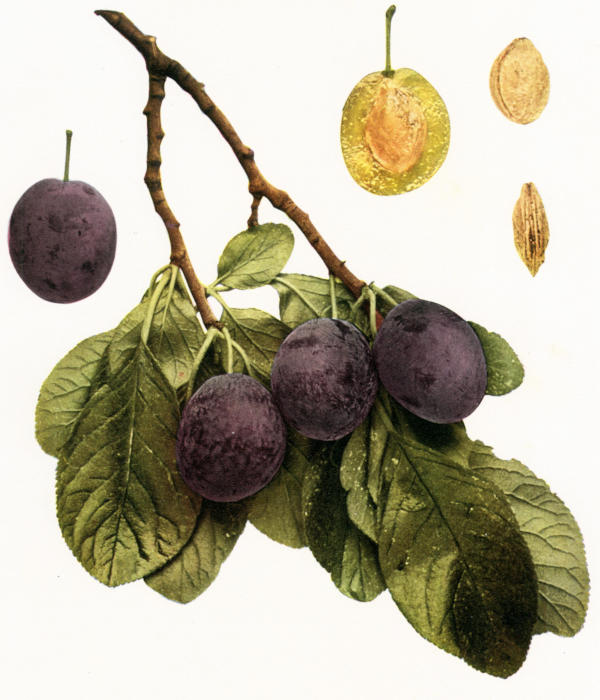
ENGLEBERT
Prunus domestica
1. Horticulturist 10:71. 1855. 2. Downing Fr. Trees Am. 392. 1857. 3. Cultivator 6:312 fig. 1858. 4. Hogg Fruit Man. 376. 1866. 5. Thomas Am. Fruit Cult. 344. 1867. 6. Am. Pom. Soc. Cat. 24. 1871. 7. Mas Le Verger 6:61. 1866-73. 8. Barry Fr. Garden 415. 1883. 9. Cat. Cong. Pom. France 357. 1887. 10. Wickson Cal. Fruits 354. 1891. 11. Guide Prat. 154, 361. 1895. 12. Cornell Sta. Bul. 131:190. 1897. 13. N. Mex. Sta. Bul. 27:125. 1898. 14. Mich. Sta. Bul. 169:242, 244. 1899. 15. Waugh Plum Cult. 101, 103 fig. 1901. 16. Va. Sta. Bul. 134:42. 1902.
Englebert 9. Prince Englebert 1, 2, 3, 4, 5, 6, 7, 8, 11, 12. Prince Engelbert 10, 13. Prince Englebert 15, 16. Prinz Engelbert 11.
In common parlance Englebert is a prune, its origin, shape, color and firm golden-yellow flesh all marking it as such, but in prune-making regions it is usually marketed in the green state, if grown at all, and is little used in curing. It cannot be said to be much more popular as a plum than it is as a prune, chiefly because it is not of high quality, but also because it is none too attractive in color, size or shape, cutting a rather poor figure in comparison with a great number of other Domestica plums. The variety fails in tree as well as in fruit. The trees are variable in size, suffer from cold in exposed situations and while rather productive bear their crops in clusters hard to pick and well placed to insure infection from brown-rot when that disease is epidemic. For some reason the fruit of this variety shrivels at this Station not only after being picked, but while still on the tree. In New York, Englebert has been thoroughly tested, has been found wanting and is not now recommended.
This variety was obtained from a seed of the “Date Prune,” by M. Scheidweiler, Professor of Botany at Ghent, Belgium.[211] The date of origin has not been given, but it was probably produced about the middle of the last century since it was described as a new fruit in the Horticulturist for 1855. Englebert was added to the American Pomological Society catalog fruit list in 1871 under the name Prince Englebert, but in 1897, according to the rules of the Society, the name was simplified to Englebert.
Tree variable in size, vasiform, dense-topped, hardy except in exposed locations, productive; branches ash-gray, smooth except for the numerous, long-oval, raised lenticels; branchlets thick, rather short, with internodes above medium in length, green changing to dark brownish-drab, dull, heavily pubescent throughout the season, with few, inconspicuous, small lenticels; leaf-buds small, short, obtuse, appressed.
Leaves folded upward, oval or obovate, one and seven-eighths inches wide, three and one-quarter inches long; upper surface covered with very fine hairs, with a shallow groove on the midrib; lower surface pale green, finely pubescent; apex roundish-pointed, base obtuse, margin finely crenate, eglandular or with small dark glands; petiole three-quarters inch long, pubescent, faintly tinged red, glandless or with one or two small, globose, greenish-yellow glands at the base of the leaf.
Blooming season early to medium, of average length; flowers appearing after the leaves, about one inch across, white except for a yellowish tinge near the apex of the petals; borne in clusters on lateral buds and spurs, usually in pairs; pedicels one-half inch long, below medium in thickness, pubescent, greenish; calyx-tube green, campanulate, pubescent; calyx-lobes obtuse, sparingly pubescent on both surfaces, glandular-serrate and with marginal hairs; petals broadly oval or roundish, crenate, abruptly tipped with short, broad claws; stamens often inclined to revert to petals; anthers yellowish; filaments five-sixteenths inch long; pistil glabrous, longer than the stamens.
Fruit mid-season, ripening period short; one and five-eighths inches by one and three-eighths inches in size; oval, swollen on the suture side, halves equal; cavity shallow, narrow, abrupt; suture a line; apex bluntly pointed or roundish; color dark purplish-black, overspread with thick bloom; dots numerous, russet; stem three-quarters inch long, pubescent, adhering well to the fruit; skin thin, sourish, separating readily; flesh golden-yellow, juicy, coarse, rather firm, sweet, pleasant-flavored, sprightly; good; stone one and one-eighth inches by five-eighths inch in size, oval or broadly ovate, strongly flattened, with roughened and deeply pitted surfaces, blunt at the base and apex; ventral suture narrow, strongly grooved, not prominent; dorsal suture acute, with a shallow, often indistinct groove.
ENGRE
Prunus triflora
1. Normand Cat. 1891. 2. Kerr Cat. 1894-1900. 3. Cornell Sta. Bul. 175:131. 1899. 4. Tex. Sta. Bul. 32:488. 1899.
This variety is one of the earliest of the Triflora plums and although the flavor is not as agreeable as that of the best sorts of its species, as Burbank or Abundance, it is much better than that of Earliest of All, with which it competes in season. Almost nothing is known regarding the history and origin of Engre. It was first mentioned in 1890 in the catalog of J. L. Normand, Marksville, Louisiana, and in all probability is one of his numerous importations from Japan. The origin of the name is not known.
Tree of medium size, vasiform, dense-topped, productive; branches slightly thorny, with numerous fruit-spurs; branchlets very short and stubby, glabrous; leaf-buds plump; leaves reddish when young, oblanceolate, one and three-eighths inches wide, three inches long; margin doubly crenate, with small brownish glands; petiole tinged red, glandless or with one or two small, reniform glands on the stalk; blooming season early; flowers appearing with the leaves, five-eighths inch across; borne on lateral buds and spurs, in twos or in threes; calyx-lobes red at the margin; anthers pinkish.
Fruit very early; about one and one-quarter inches in diameter, roundish; cavity deep; color dark pinkish-red, covered with thin bloom; dots numerous, conspicuous; skin astringent; flesh yellowish, tender and melting, sweet near the surface, but sour next the pit, low in flavor; poor; stone clinging, five-eighths inch by one-half inch in size, roundish-oval, turgid; ventral suture broad, blunt.
ESPEREN
Prunus domestica