Chapter III · LEADING VARIETIES OF PLUMS. (continued 3)
Reading edition
1. Mag. Hort. 15:298. 1849. 2. Downing Fr. Trees Am. 380. 1857. 3. Flor. & Pom. 4, Pl. 1863. 4. Downing Fr. Trees Am. 916. 1869. 5. Pom. France 7: No. 1. 1871. 6. Mas Le Verger 6:65. 1866-73. 7. Lauche Deut. Pom. 12. 1882.
Cloth of Gold Esperen 4. Cloth of Gold 2, 7. Drap d’Or of Esperin 1, 2. Drap d’Or d’Esperen 3, 6, 7. Drap d’Or Esperen 4. Drap d’Or d’Esperen 5. Drap d’Or of Esperen 6. Esperen’s Goldpflaume 7. Golden Esperen 5, 7. Golden Esperen 4. Golden Esperen Plum 3.
Were there not so many handsome, well-flavored plums of the Reine Claude group, Esperen might well be recommended to the amateur at least, for it is first class in appearance and quality. But the fruits are small and the tree-characters are not such that the variety can compete with the standard Reine Claude plums. Esperen was produced from seed in 1830 by Major Esperen of Malines, Belgium; it was first fruited in 1844, and was introduced in 1847 by Louis Van Houtte of Ghent, Belgium. It obtained the designation Drap d’Or from its close resemblance to that variety.
Tree large, vigorous, upright-spreading, productive; trunk stocky, rough; branches rough, with numerous, large, raised lenticels; branchlets brash; leaves flattened, two and one-half inches wide, five inches long, obovate or oval; margin serrate; petiole thick, tinged red, pubescent, with from two to five large, globose glands.
Fruit mid-season; about one and one-half inches in diameter, roundish-oval; cavity shallow, narrow, often lipped; color yellow streaked and mottled with green, overspread with thin bloom; skin thin, tender, rather sour; flesh yellow, tender, sweet, aromatic; of good quality; stone free, one inch by five-eighths inch in size, oval, with pitted surfaces; ventral suture blunt; dorsal suture wide, deep.
EXCELSIOR
Prunus triflora × Prunus munsoniana
1. Glen St. Mary Cat. 1891-2. 2. Am. Pom. Soc. Cat. 26. 1897. 3. Vt. Sta. Bul. 67:11. 1898. 4. Ga. Sta. Bul. 68:9, 36. 1905.
Excelsior has not fruited on the Station grounds and is placed in the list of leading varieties because of the prominence given it in the above references. The variety was originated by G. L. Tabor, Glen Saint Mary, Florida, in 1887, from seed of Kelsey supposed to have been pollinated by Wild Goose, although some authorities believe De Caradeuc to have been the male parent. It seems to be a promising variety and was mentioned in the last three catalogs of the American Pomological Society.
Tree vigorous, vasiform; branches slender; leaves of medium size, narrow; margin finely crenulate, glandular; petiole short, with from one to three small glands; flowers small, scattered; fruit early; of medium size, roundish, dark red with heavy bloom; skin tough; flesh firm, yellowish with red tinge towards the center; quality good; stone of medium size, compressed, clinging.
FIELD
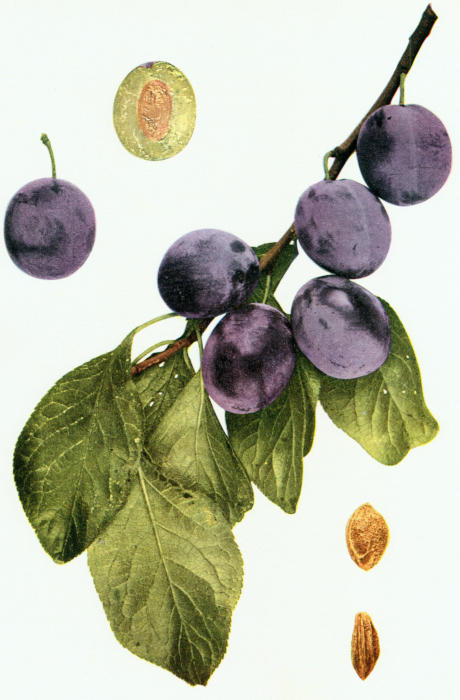
FIELD
Prunus domestica
1. Mich. Hort. Soc. Rpt. 288. 1889. 2. Am. Gard. 14:50, 395. 1893. 3. Rural N. Y. 55:622. 1896. 4. Cornell Sta. Bul. 131:184. 1897. 5. Mich. Sta. Bul. 169:244. 1899. 9. Ibid. 187:77, 78. 1901. 7. Waugh Plum Cult. 101, 104 fig. 1901. 8. Ohio Sta. Bul. 162:239, 240 fig., 254, 255. 1905.
Early Bradshaw 2.
This offspring of Bradshaw resembles its parent in tree, and in size, color and shape of fruit, though not so closely as to be readily mistaken for the older variety. Differences which distinguish the fruits of the two are: The Field is a trifle smaller, the fruit is more nearly round, lacking the prolonged neck of Bradshaw and is more plump at the base, the parent plum being markedly obovate; Field is earlier than Bradshaw, the latter difference accounting for the synonym, “Early Bradshaw.” The quality is not such as to commend either of these plums, but of the two Field is slightly the better. In tree-characters, Bradshaw excels in having a larger tree and in being more productive. The foliage of Field is very good, it ripens its wood well and begins to bear while young, but it is inclined to a biennial bearing habit which makes the average in quantity of fruit a little too low for a market plum which Field is, if worth planting at all. A good quality of this variety is that it withstands the brown-rot very well. It is doubtful if Field is worthy of a place in the fruit-growing regions of New York, unless, perhaps, where a plum of the Bradshaw type, but a little earlier, is wanted. Like Bradshaw, Field is comparatively little attacked by San José scale.
Field is a seedling of Bradshaw grown in Schoharie County, New York. It was first noted by S. D. Willard of Geneva, New York, in 1889, as “a variety worthy of cultivation.”
Tree of medium size and vigor, upright-spreading, dense-topped, hardy, productive; branches ash-gray, smooth except for the numerous, small, raised lenticels; branchlets slender, short, with internodes of medium length, greenish-red changing to brownish-drab, with a trace of red, dull, pubescent becoming slightly less so at maturity, with numerous, inconspicuous, small lenticels; leaf-buds below medium in size, short, obtuse, appressed.
Leaves folded backward, obovate, two and one-sixteenth inches wide, four and three-eighths inches long; upper surface dark green, nearly glabrous, with shallowly grooved midrib; lower surface sparingly pubescent; apex abruptly pointed, base acute, margin serrate, with a few, smallish, black glands; petiole seven-eighths inch long, thick, tinged with red, sparingly pubescent.
Season of bloom intermediate, short; flowers appearing after the leaves, one inch across, white, with a yellowish tinge at the apex of the petals; scattered on lateral buds and spurs, singly or in pairs; pedicels five-eighths inch long, thick, with few, short, scattering hairs, greenish; calyx-tube green, campanulate, glabrous; calyx-lobes above medium in width, obtuse, slightly pubescent on both surfaces, glandular-serrate, somewhat reflexed; petals broadly oval, entire, tapering below to short, broad claws; anthers yellowish; filaments three-eighths inch long; pistil glabrous, shorter than the stamens.
Fruit mid-season, period of ripening short; one and seven-eighths inches by one and five-eighths inches in size, oblong-oval, compressed, halves equal; cavity shallow, narrow, abrupt; suture shallow, broad; apex roundish; color dark purplish-red, overspread with very thick bloom; dots numerous, small, russet, clustered about the apex; stem three-quarters inch long, sparingly pubescent, adhering well to the fruit; skin thin, slightly sour, separating readily; flesh greenish-yellow, medium juicy, sweetish, mild; of fair quality; stone clinging, one inch by five-eighths inch in size, ovate with roughened and deeply pitted surfaces, blunt at the apex and base; ventral suture broad, distinctly furrowed; dorsal suture acute.
FOREST GARDEN
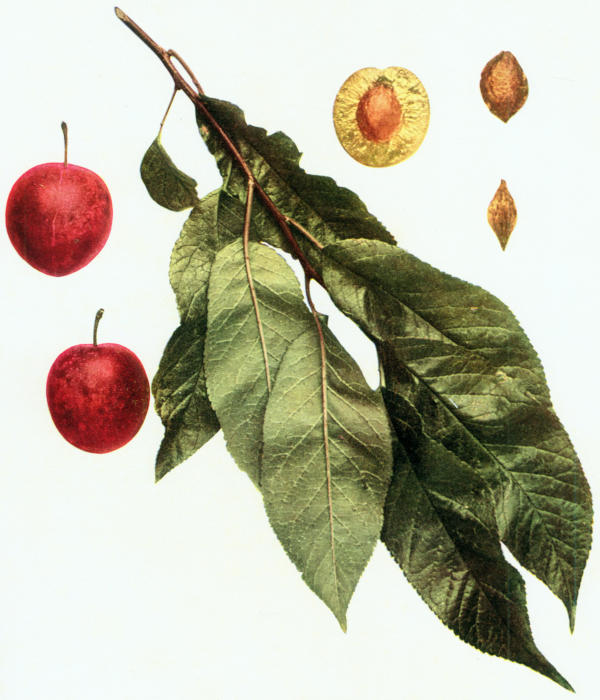
FOREST GARDEN
Prunus hortulana mineri
1. Minn. Hort. Soc. Rpt. 81. 1882. 2. Am. Pom. Soc. Cat. 42. 1883. 3. Minn. Hort. Soc. Rpt. 412. 1889. 4. Ia. Hort. Soc. Rpt. 55. 1890. 5. Cornell Sta. Bul. 38:37, 86. 1892. 6. Mich. Sta. Bul. 118:53. 1895. 7. Wis. Sta. Bul. 63:24, 37. 1897. 8. Wis. Hort. Soc. Rpt. 136. 1899. 9. Waugh Plum Cult. 148. 1901. 10. Can. Exp. Farm Bul. 43:30. 1903. 11. Ohio Sta. Bul. 162:254, 255. 1905. 12. S. Dak. Sta. Bul. 93:17, 49 & 54 Pl. 1905.
Forest Garden is placed by most horticulturists in Prunus americana, but the trees growing on the Geneva Station grounds belong to the Miner group of Prunus hortulana and the herbarium specimens of foliage and flowers sent from other stations make it probable if not certain that the trees here are true to name. This variety is little grown in the East, but it is widely distributed in the central West where both in tree and fruit-characters it seems adapted to the needs of the climate and soil. It is one of the latest of its group, maturing at a good time for shipping, for which it is further adapted by its tough skin and firm flesh. While Forest Garden is not preeminently a dessert plum, it has a spicy flavor that makes it pleasant eating and it is admirably adapted for culinary purposes, especially for preserving.
This variety is from a wild plum found in the woods bordering on the Cedar River, near Cedar Rapids, Iowa, by Thomas Hare, and introduced by H. C. Raymond, of the Forest Garden Nurseries, Council Bluffs, Iowa, about 1862. The American Pomological Society placed the variety on its fruit catalog list in 1883, dropped it in 1891, and replaced it in 1897.
Tree medium to large, often very vigorous, spreading, with sprawling habit, inclined to be flat-topped, perfectly hardy, variable in productiveness, bearing young, somewhat susceptible to shot-hole fungus; trunk small in proportion to the size of the tree, shaggy; branches rather rough, zigzag and inclined to split, thorny, dark ash-brown, with numerous, small lenticels; branchlets thick, long, willowy, with short internodes, greenish changing to dark chestnut-red, glossy, with thin pubescence when young, which disappears in autumn, with conspicuous, numerous raised lenticels; leaf-buds small, short, obtuse, plump, appressed.
Leaves falling early, folded upward, elongated-oval, or obovate, peach-like, one and three-quarters inches wide, four and one-quarter inches long, thin and leathery; upper surface smooth, with a shallow, grooved midrib; lower surface silvery-green, pubescent; apex taper-pointed, base somewhat abrupt, margin doubly crenate, glandular; petiole three-quarters inch long, sparingly pubescent, faintly tinged with red, usually with two conspicuous, globose, brownish glands below the base of the leaf.
Blooming season late and long; flowers appearing with the leaves; seven-eighths inch across, white, with a strong, disagreeable odor; borne in dense but scattering clusters on lateral buds and spurs, in threes or in fours; pedicels nine-sixteenths inch in length, slender, glabrous, greenish; calyx-tube green, narrowly campanulate or obconic, glabrous; calyx-lobes narrow, obtuse, slightly pubescent, margined with few hairs and with dark-colored glands, slightly reflexed; petals oval, erose, tapering to long claws of medium width; anthers yellowish; filaments seven-sixteenths inch in length; pistil glabrous, shorter than the stamens.
Fruit variable in season which is usually late and short; about one and one-eighth inches in diameter, rather large, roundish-ovate or nearly oval, slightly compressed, halves equal; cavity shallow, wide, flaring; suture a line; apex roundish or somewhat pointed; color light or dark red, with thin bloom; dots numerous, russet, conspicuous; stem slender, five-eighths inch long, glabrous, detaching from the fruit at maturity; skin thick, tough, slightly astringent, adhering; flesh dark golden-yellow, juicy, coarse, fibrous, melting, sweetish next the skin but rather sour toward the center, with a strong and peculiar flavor, aromatic; fair to good; stone clinging, three-quarters inch by five-eighths inch in size, oval, turgid, blunt and slightly flattened at the base, ending in an abrupt but sharp point at the apex, nearly smooth; ventral suture narrow, faintly ridged; dorsal suture acute.
FOREST ROSE
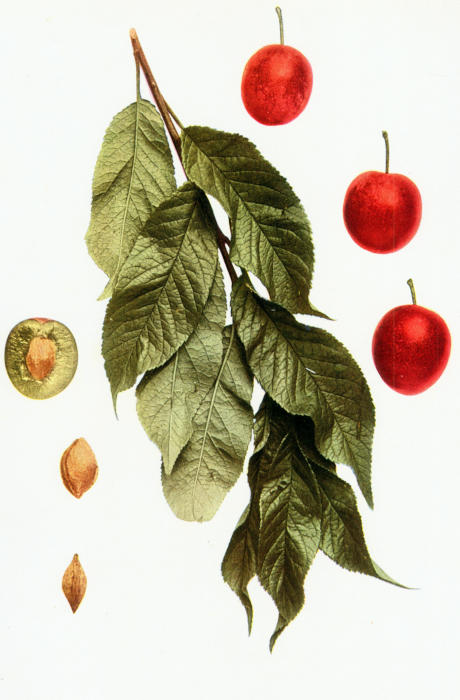
FOREST ROSE
Prunus hortulana mineri
1. Mich. Pom. Soc. Rpt. 290. 1889. 2. Ia. Hort. Soc. Rpt. 55. 1890. 3. Cornell Sta. Bul. 38:55, 86. 1892. 4. Mich. Sta. Bul. 123:19. 1895. 5. Ia. Sta. Bul. 31:346. 1895. 6. Colo. Sta. Bul. 50:36. 1898. 7. Ohio Sta. Bul. 113:154. 1899. 8. Waugh Plum Cult. 173. 1901. 9. Budd-Hansen Am. Hort. Man. 296. 1903.
Forest Rose, like Forest Garden, belongs to Prunus hortulana mineri, the two being similar in many respects. Forest Rose, however, is not as attractive in color as the other variety, the difference not being well brought out in the color-plates, is smaller and does not keep nor ship quite as well. The variety under discussion is better in quality than Forest Garden and better adapted than the last named variety for the home orchard at least. While somewhat variable in productiveness, in most localities it bears annually and abundantly. The trees are rather more thorny than most of its species.
This variety is said by H. A. Terry of Crescent, Iowa, to be a seedling of Miner, grown by Scott & Company, a Missouri nursery firm, and introduced by William Stark, Louisiana, Missouri, in 1878. Terry offers no evidence to show that this plum is a seedling of Miner and there is a question as to whether more is really known of its parentage other than that it came from Missouri.
Tree medium to large, intermediate in vigor, upright-spreading, open-topped, hardy, variable in productiveness somewhat susceptible to attacks of shot-hole fungus; trunk very rough and shaggy; branches rough, thorny, dark ash-gray, with numerous lenticels; branchlets numerous, slender, variable in length, with internodes of medium length, green changing to dull reddish-brown, glossy, glabrous, with numerous, small, raised lenticels; leaf-buds small, short, obtuse, appressed.
Leaves falling early, folded upward, elongated-oval or obovate, one and one-half inches wide, four inches long, thin; upper surface dull red in the fall, rugose, glabrous, with the midrib and larger veins deeply grooved; lower surface light green, somewhat pubescent along the midrib; apex acuminate, base acute, margin crenate or serrate, with small, dark glands; petiole slender, five-eighths inch in length, sparsely pubescent along one side, tinged with red, glandless or with from one to three small, globose or oval, greenish-brown glands on the stalk.
Flowers seven-eighths inch across, white, with a disagreeable odor; borne in dense clusters on lateral buds and spurs, in pairs or in threes; pedicels five-eighths inch long, below medium in thickness, glabrous, greenish: calyx-tube green, narrowly campanulate, glabrous; calyx-lobes short and narrow, acute, serrate, somewhat reflexed, glabrous on the outer surface, but more or less pubescent on the inner surface and along the margin, which is strewn with red glands; petals oval, dentate, tapering below into narrow, lightly pubescent claws of medium length; anthers light yellow; filaments one-half inch in length; pistil glabrous, shorter than the stamens.
Fruit late, season short; one and one-eighth inches by one inch in size, roundish-oval; cavity shallow, narrow, flaring; suture a line; apex roundish; color dull crimson overspread with thin bloom; dots very numerous, small, gray, conspicuous; stem slender, three-quarters inch long, smooth, not adhering to the fruit; skin thick, tough, astringent, inclined to crack under unfavorable conditions, adhering; flesh dull apricot-yellow, juicy, fibrous, tender and melting, sweet next to the skin but tart toward the center, aromatic; fair to good; stone clinging, five-eighths inch by one-half inch in size, oval, acute at the apex, with pitted surfaces; ventral suture somewhat blunt.
FOTHERINGHAM
Prunus domestica
1. Rea Flora 208. 1676. 2. Langley Pomona 91. 1729. 3. Miller Gard. Dict. 3:1754. 4. Forsyth Treat. Fr. Trees 19. 1803. 5. Downing Fr. Trees Am. 299. 1845. Floy-Lindley Guide Orch. Gard. 286, 383. 1846. 7. Thompson Gard. Ass’t 517. 1859. 8. Hogg Fruit Man. 701. 1884. 9. Waugh Plum Cult. 102. 1901.
Foderingham 1. Fotheringay 8. Foderingham Plum 2. Grove House Purple 5, 7, 8. Red Fotheringham 8. Sheen 2, 5, 6, 7, 8.
Fotheringham is probably one of the oldest varieties of plums now cultivated. Although but little if at all grown in this country, it has maintained its place among standard English varieties for at least two and a half centuries. The exact time of its origin is not certain, but it was undoubtedly during the first half of the Seventeenth Century as Hogg records a reference made to it by Rea in 1665. It was first grown extensively at Sheen, in Surrey, England, about 1700 by Sir William Temple, who gave it the name Sheen. The variety is described as follows:
Tree hardy, vigorous, productive. Fruit matures just before Reine Claude; of medium size, obovate; suture distinct; stem one inch long; color reddish-purple with thin bloom; flesh greenish-yellow, sweet, sprightly; good; freestone.
FREEMAN
Prunus domestica
As this variety grows in the Station orchard it is a remarkably fine plum. The fruits are attractive, of high quality and the tree-characters are for most part very good. It is certainly a desirable plum for any home plantation, and if it proves as productive elsewhere as about Geneva, it may well be worth growing in commercial orchards.
Freeman is a chance seedling found in the yard of a Mr. Freeman of Cortland, New York, about 1890 and shortly afterwards introduced by E. Smith & Sons of Geneva, New York, but is as yet hardly known by plum-growers.
Tree intermediate in size and vigor, upright-spreading, productive; branchlets slender, pubescent; leaves oval, one and one-half inches wide, two and three-quarters inches long; margin serrate or almost crenate, eglandular or with small dark glands; petiole reddish, glandless or with from one to four globose glands; blooming season intermediate, short; flowers appearing after the leaves, creamy-white, usually in scattering clusters at the ends of lateral spurs; borne singly or in twos.
Fruit mid-season, ripening period short; about one and one-half inches in diameter, roundish or roundish-oval; cavity very shallow, small, often lipped; color golden-yellow, blushed and mottled with red on the exposed cheek, covered with thin bloom; flesh light golden-yellow, firm but tender, sweet, pleasant flavor; very good to best; stone dark colored, free, seven-eighths inch by five-eighths inch in size, irregular-oval, somewhat flattened, abruptly contracted at the base, with surfaces roughened; ventral suture prominent.
FREESTONE
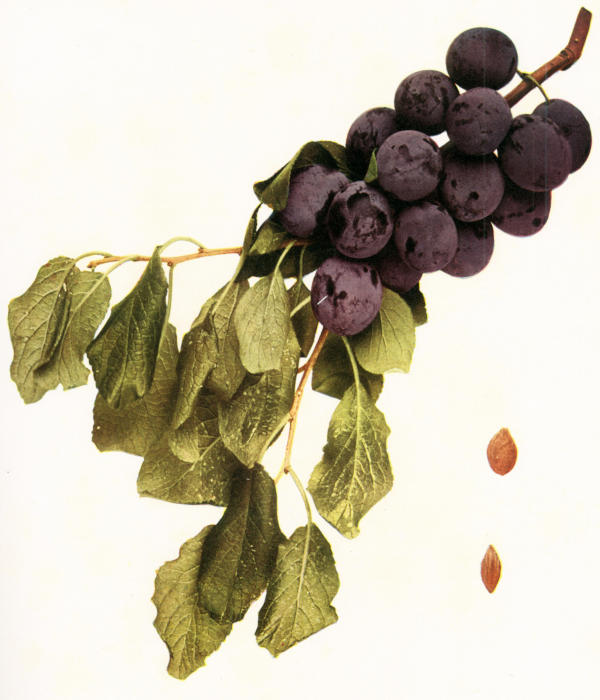
FREESTONE
Prunus insititia
1. Am. Gard. 14:148. 1893. 2. Waugh Plum Cult. 129. 1901.
Freestone Damson 2.
Freestone is a Damson separated from other Damsons chiefly in being sweeter and more free of stone. It is so inferior to varieties of its species in several particulars as to have little value for commercial planting. The fruits are smaller and the pits larger in proportion to the amount of flesh than with several better known Damsons and the trees do not bear as large crops as plums of this species should; these faults of fruit and tree condemn the plum. To offset the defects in the tree, freedom from black-knot and immunity to leaf-blight may be mentioned as compensating somewhat. Still Freestone is hardly to be mentioned as worth planting in either home or commercial orchard. The origin of this Damson is unknown. Stark Brothers, Louisiana, Missouri, who introduced the variety about 1889, describe it as “a selected sort which is very hardy, free from insects, and productive.”
Tree of medium size and vigor, upright-spreading, vasiform, hardy, not always productive; branches dark ash-gray, thorny; leaves folded upward, oval, one and one-quarter inches wide, two and one-quarter inches long; upper surface dark green, rugose; lower surface silvery-green, pubescent; margin finely serrate, eglandular or with small, brownish glands; petiole five-eighths inch long, glandless or with one or two small glands; blooming season late and of medium length; flowers appearing after the leaves, seven-eighths inch across, the buds creamy, changing to white when expanded; borne in clusters on lateral buds and spurs, usually in pairs; anthers reddish; filaments five-sixteenths inch long; pistil shorter than the stamens.
Fruit late, season long; seven-eighths inch in diameter, roundish-oval; cavity very shallow and narrow; flesh yellowish-green, juicy, tender, sweet, mild; fair in quality; stone free, tinged red, five-eighths inch by one-half inch in size, oval, turgid, with roughened surfaces, acute at the base, blunt at the apex; ventral suture broad, blunt; dorsal suture with a broad, shallow groove.
FRENCH
FRENCH
Prunus insititia
1. Mich. Hort. Soc. Rpt. 289. 1889. 2. Ibid. 64. 1891. 3. Cornell Sta. Bul. 131:184 fig. 40 I. 1897. 4. Mich. Sta. Bul. 169:245. 1899. 5. Waugh Plum Cult. 129. 1901.
French Damson 4. French Damson 1, 2, 3.
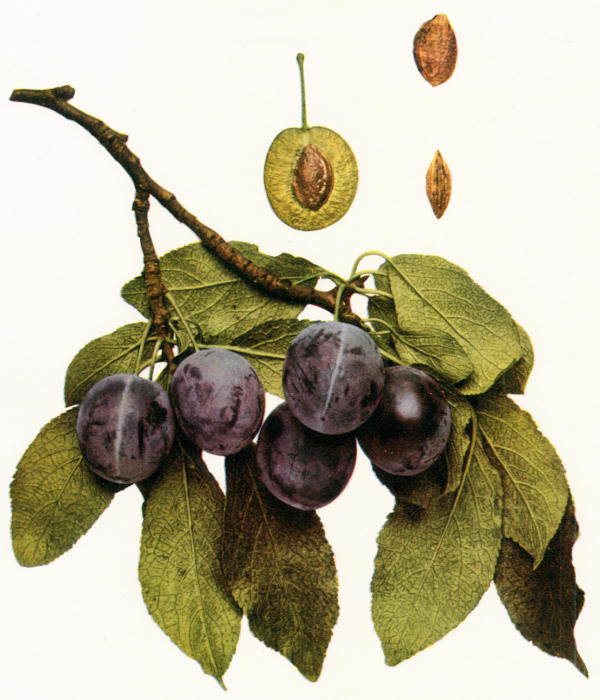
Far better than the Freestone just discussed is the French Damson, which in some respects surpasses all other plums in its group. Thus it is the largest of the Damsons, so large, indeed, as to lead many to believe that it may be a hybrid with some Domestica plum, the size of the trees, blossoms and foliage also leading to such a supposition. This excellent Damson is largely grown for the market in western New York, good quality as well as size and appearance aiding in selling the product. The fruits have but one defect, the pit is large for the amount of flesh. Curiously enough in some seasons the stone clings and in others is perfectly free. It is in tree-characters that the French plum best shows its superiority over other Damsons. The trees are large, the largest of the Damsons in New York, hardy, bear abundantly and annually and carry their foliage so well that fruit and wood usually ripen perfectly even when the trees are not sprayed. The season is a little after that of the more commonly grown Shropshire, which in most years is an advantage. French, while becoming popular, is still too little known in New York, where its behavior warrants quite general planting.
S. D. Willard, a nurseryman of Geneva, New York, probably introduced French in this country; at least it was brought to notice mainly through his recommendation. The origin is unknown, but it is probably an introduction from France and may be an old variety renamed. The figure of Prune Petit Damas Violet given by Poiteau is so very similar as to suggest that French may be identical with that sort.
Tree large, vigorous, spreading, dense-topped, hardy, productive; branches numerous, ash-gray, roughish, thorny, with lenticels variable in size; branchlets inclined to develop spurs at the base, rather slender, short, with short internodes, greenish-red changing to dark brownish-drab, dull, somewhat zigzag, thickly pubescent, with inconspicuous, small lenticels; leaf-buds intermediate in size and length, pointed, free.
Leaves folded upward, long-oval, one and one-quarter inches wide, three inches long; upper surface dark green, covered with fine hairs, with a grooved midrib; lower surface pubescent; apex abruptly pointed, base abrupt, margin serrate or nearly crenate, with a few, small, dark glands; petiole eleven-sixteenths inch long, rather slender, pubescent, faintly tinged with red, usually having two very small, globose, greenish-brown glands on the stalk or base of the leaf.
Blooming season intermediate in time and length; flowers appearing after the leaves, one and five-sixteenths inches across, white; borne on lateral spurs, usually in pairs; pedicels five-eighths inch long, slender, covered with short pubescence, greenish; calyx-tube green, campanulate, glabrous; calyx-lobes narrow, obtuse, glabrous on the outer surface, thinly pubescent along the margin and at the base of the inner surface, glandular-serrate, reflexed; petals oval, dentate or fringed, tapering below to short, broad claws; anthers distinctly reddish; filaments seven-sixteenths inch in length; pistil glabrous, equal to the stamens in length.
Fruit late; one and one-half inches by one and one-eighth inches in diameter, ovate, halves equal; cavity very shallow, narrow, flaring; suture a line; apex roundish; color dull black, overspread with thick bloom; dots numerous, small, brownish, inconspicuous; stem slender, three-quarters inch long, sparingly pubescent, adhering well to the fruit; skin thin, tough, separating readily; flesh greenish, juicy, fibrous, tender, sweet, pleasant and sprightly; good; stone variable in adhesion, seven-eighths inch by one-half inch in size, oval, roughened, acute at the base, blunt at the apex; ventral suture rather narrow, heavily furrowed and somewhat winged; dorsal suture with a shallow groove of medium width.
FROGMORE
Prunus insititia
1. Flor. & Pom. 265, Pl. 1876. 2. Mich. Hort. Soc. Rpt. 289. 1889. 3. Can. Exp. Farm Bul. 2nd Ser. 3:51. 1900. 4. Waugh Plum Cult. 130. 1901.
Frogmore Damson 1, 2. Frogmore Prolific Damson 3.
Frogmore may be considered among the best of the Damsons in quality for the culinary purposes to which this fruit is commonly put. The flesh is tender, sweet and good, but adheres rather too tightly to the stone. The tree of Frogmore is all that could be desired in productiveness and quite equals most other Damsons in general and probably surpasses them all, at least on the grounds at this Station, in length of time that the fruit hangs on the tree. The habit of growth of this variety varies from that of Prunus insititia as commonly found, the leaves being larger, the tops more spreading and the branches less thorny. The variety has hardly been tried enough in New York to warrant either recommending or condemning it. According to the Florist and Pomologist, published in 1876, this variety originated a few years previous to the date of publication in the Royal Gardens at Frogmore, England.
Tree inferior in size and vigor, round-topped, open, hardy, very productive; branches thorny, the bark on the older branches splitting transversely to the direction of growth, making grooves or rings about three inches apart and two inches or more in length; branchlets slender, almost glabrous throughout the season, covered with light bloom; leaves bright red on first opening, somewhat folded backward, obovate, one and three-eighths inches wide, three and one-half inches long; upper surface dark green, rugose; lower surface silvery-green, pubescent, margin eglandular; petiole five-eighths inch long, slender, greenish, glandless or with one or two small, globose, yellowish-green glands usually at the base of the leaf; blooming season intermediate in time and length; flowers appearing after the leaves, one inch across, white, in scattered clusters on lateral spurs; borne singly or in pairs; anthers yellow with tinge of red; filaments five-sixteenths inch long; pistil glabrous, equal to the stamens in length.
Fruit late, season of medium length; one and one-eighth inches by one inch in size, roundish-oval, compressed, purplish-black, overspread with thick bloom; flesh golden-yellow, juicy, tender, sweet; good; stone clinging, three-quarters inch by one-half inch in size, oval, smooth, somewhat acute at the base and apex; ventral suture blunt or with a short, narrow wing; dorsal suture with a narrow, shallow groove.
FROST GAGE
Prunus domestica
1. Prince Pom. Man. 2:52. 1832. 2. Mag. Hort. 4:45. 1838. 3. Hoffy Orch. Comp. 2:1842, 4. Downing Fr. Trees Am. 300. 1845. 5. Horticulturist 3:446. 1848. 6. Cole Am. Fr. Book 219. 1849. 7. Am. Pom. Soc. Rpt. 54. 1852. 8. Hogg Fruit Mun. 362. 1866.
American Damson 8. Frost Plum 4, 6, 8. October Gage 3.
Frost Gage is too small for market purposes and moreover the fruit withers rather quickly after picking; the quality is above the average. The plum is not a Gage, only green fruits being entitled to this name. At one time this was one of the most popular commercial varieties in the Hudson Valley, but because of its susceptibility to black-knot it has lost favor with growers. Downing in 1838 traced the history of this variety to a tree standing on the farm of a Mr. Duboise, Dutchess County, New York, Mr. Duboise stating that the original had been planted by his father. It is doubtful if this is the first tree, however, for in 1849 Charles Hamilton of Canterbury, Orange County, reported trees of Frost Gage thirty to forty years old on his place.
Tree of medium size, upright, very productive; branchlets thick; leaves flattened, oval or obovate, one and one-half inches wide, two and three-quarters inches long; margin crenate or serrate, with few, small, black glands; petiole short, usually with one or two glands; blooming season intermediate, short; flowers appearing after the leaves, white, with a little yellowish tinge; borne on lateral buds and spurs, singly or in twos.
Fruit late; about one and one-eighth inches in diameter, roundish, dark purplish-black, covered with thick bloom; stem slender, persistent; skin tough, sour; flesh greenish-yellow, juicy, firm, sweet, mild; fair to good; stone clinging, small, irregular-ovate, somewhat oblique.
FURST
Prunus domestica
1. Mas Le Verger 6:45. 1873. 2. Lange Allgem. Garten. 2:421. 1879. 3. Oberdieck Deut. Obst. Sort. 413. 1881. 4. Lauche Deut. Pom. 8, Pl. 1882. 5. Guide Prat. 159, 363. 1895.
Eugen Fürsts Frühzwetsche 4, 5. Fürst’s Frühzwetsche 2, 3, 4. Fürst’s Frühzwetsche 1, 4, 5. Quetsche Précoce de Fürst 1, 5.
Furst would undoubtedly be well worthy of very general cultivation in plum orchards were it not for the fact that it is very similar to the Italian Prune. The two fruits differ only in season, the Furst being a few days earlier, and in the tendency of the variety under discussion to shrivel about the neck. It may be that Furst will succeed in some localities where the Italian Prune is not a success.
Furst was propagated by the Baron of Trauttenberg, Prague, Bohemia, who had received it from Professor Pater Hackl, Leitmeritz, Bohemia, under the name Furst, given in honor of Eugene Furst, son of the founder of the School of Horticulture of Frauendorf, Bavaria. Furst Damson has been confused with this variety, but it is a different plum. Its fruits are distinctly necked and much inferior in quality, and its shoots are glabrous, while in this variety they are not. The United States Department of Agriculture introduced Furst in 1901 and through them this Station received cions for testing.
Tree of medium size, round-topped, productive; branchlets thick, marked with slight scarf-skin; leaf-scars very prominent; leaves folded upward, obovate, two and one-half inches wide, four and one-half inches long; margin doubly serrate or almost crenate, eglandular or with small dark glands; petiole thick, pubescent, glandless or with from one to three globose glands usually on the stalk; blooming season late; flowers one and one-eighth inches across, white, the opening buds tipped with yellow; borne on lateral buds and spurs, singly or in twos.
Fruit late; one and seven-eighths inches by one and one-half inches in size, oval, slightly necked, purplish-black, covered with thick bloom; dots numerous, reddish, conspicuous; stem thick; flesh greenish-yellow, juicy, very fibrous, firm, sweet, mild, with pleasant aroma; good to very good; stone one and one-eighths inches by five-eighths inch in size, free, irregular-oval, with rather long, tapering, oblique apex, the surfaces heavily pitted; ventral suture prominent, often winged; dorsal suture wide.
GEORGESON
GEORGESON
Prunus triflora
1. Ga. Hort. Soc. Rpt. 52, 99. 1889. 2. Am. Gard. 12:308, 501, 574. 1891. 3. Ibid. 13:700. 1892. 4. Cornell Sta. Bul. 62:23, 27. 1894. 5. Tex. Sta. Bul. 32:488, 489. 1894. 6. Ga. Hart. Soc. Rpt. 94. 1895. 7. Cornell Sta. Bul. 106:51, 58. 1896. 8. Ibid. 139:40, 44. 1897. 9. Am. Pom. Soc. Cat. 26. 1897. 10. Cornell Sta. Bul. 175:145. 1899. 11. Waugh Plum Cult. 136. 1901. 12. Ga. Hort. Soc. Rpt. 13. 1904. 13. Mass. Sta. An. Rpt. 17:160. 1905. 14. Ohio Sta. Bul. 162:250, 254, 255, 256, 257. 1905. 15. Ga. Sta. Bul. 68:10, 30, 32, 35. 1905.
Hattonkin No. 1. 3, 4, 7. Hattankin No. 1. 5. Hattonkin 7, 11. Hattankio 7. Hattankio ?1. Hattankio No. 1. 6, 9, 12, 15. Hattonkin No. 1. 2. Mikado 10, 11, 12, 15. Normand 4, 5, 7, 8, 14. Normand Yellow 2, 3. Normand Japan 3. Normand’s Japan 4, 5. Normand Yellow 4, 5, 7. Normand ?15. White Kelsey 10, 11, 15. Yeddo 10, 11, 15.
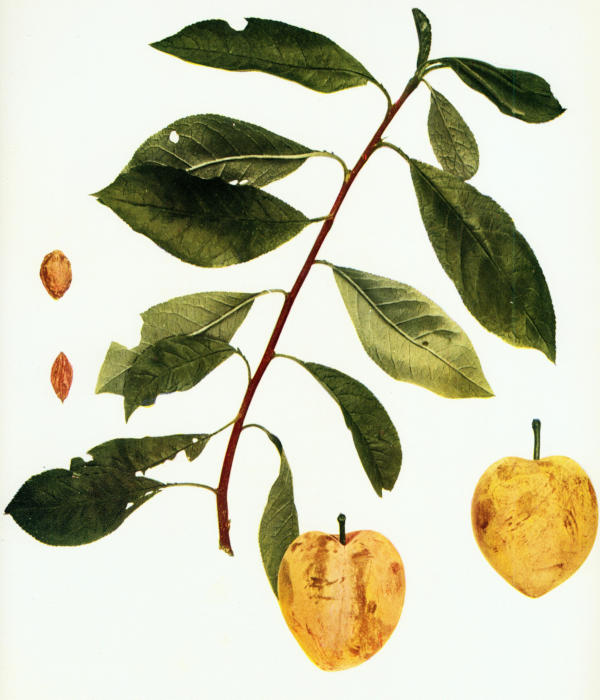
Georgeson is not worth the trouble it has caused pomologists in straightening out its nomenclature; and Professor Georgeson deserves to have his name attached to a far better plum. The rich yellow color of the fruit makes this a particularly handsome plum, but here praises end. The flesh is so astringent and clings so tenaciously to the stone as to unfit the variety for either dessert or culinary use. Moreover, the fruits are exceedingly variable in color, size and shape, in the last character ranging from flattish to round, with sometimes round and sometimes pointed apex. The tree has too much of the sprawling habit of Burbank to make it a good orchard plant. This plum, and those that have been confused with it, can be spared without great loss to American pomology.
Georgeson was imported by H. H. Berger & Company, San Francisco, California, and brought to notice chiefly by J. L. Normand, Marksville, Louisiana, who named it for Professor C. C. Georgeson, then of Manhattan, Kansas, a student of Japanese fruits. In the Georgia Horticultural Society Report for 1889, L. A. Berckmans mentions two types of Hattankio, one of which may be this variety. Normand, in 1891, said that he received two varieties of Hattonkin from different sources and in order to separate them he numbered the earlier, No. 1, the later No. 2. Bailey and Kerr, however, in 1894, published Hattonkin No. 1 as a synonym of Georgeson and Hattonkin No. 2, the later, as a synonym of the Kerr. The Georgia Horticultural Society accepted this latter nomenclature in their report published in 1895. The Mikado, White Kelsey and Yeddo as tested by this Station have proved to be identical with Georgeson, but as tested by Kerr,[212] the Mikado alone is the same. Normand, which is said to have been imported and introduced in 1891 by J. L. Normand, is also indistinguishable from this variety. In 1897, Georgeson was placed on the American Pomological Society fruit catalog list.
Tree medium in size and vigor, upright-spreading or broad-vasiform, not always hardy, productive; branches roughish, slightly thorny, often with bark cracked longitudinally, zigzag, dark ash-gray; branchlets glabrous, with characteristic raised lenticels; leaf-scars enlarged; leaves folded upward, broadly oblanceolate or obovate, one and three-eighths inches wide, three and three-quarters inches long, thin; margin crenate or serrate, with small, amber glands; petiole five-eighths inch long, reddish, with from one to ten brownish-red glands usually on the stalk; blooming season early to medium, of average length; flowers appearing before the leaves; borne in clusters on lateral spurs, in pairs or in threes; petals pinkish at the base; anthers reddish; pistil longer than the stamens.
Fruit early, ripening period short; one and five-eighths inches in diameter, roundish-cordate; cavity deep, wide, usually with concentric, russet lines; color greenish-yellow changing to deep yellow as the fruit reaches full maturity, with thin bloom; flesh golden-yellow, fibrous, firm, sweetish except near the center; fair to good; stone clinging, five-eighths inch by one-half inch in size, oval, turgid, with pitted surfaces; ventral suture broad, slightly ribbed; dorsal suture acute.
GERMAN PRUNE
GERMAN PRUNE
Prunus domestica
1. Knoop Fructologie 2:53, 61. 1771. 2. Coxe Cult. Fr. Trees 235, fig. 7. 1817. 3. Lond. Hort. Soc. Cat. 152. 1831. 4. Prince Pom. Man. 2:77, 78. 1832. 5. Downing Fr. Trees Am. 310. 1845. 6. Floy-Lindley Guide Orch. Gard. 286, 383. 1846. 7. Poiteau Pom. Franc. 1:1846. 8. Thomas Am. Fruit Cult. 335. 1849. 9. Am. Pom. Soc. Cat. 214. 1856. 10. Hooper W. Fr. Book 245. 1857. 11. Thompson Gard. Ass’t 519. 1859. 12. Hogg Fruit Man. 378. 1866. 13. Pom. France 7: No. 17. 1871. 14. Mas Pom. Gen. 2:171. 1873. 15. Lange Allgem. Garten. 2:418. 1879. 16. Lauche Deut. Pom. 1:1882. 17. Mathieu Nom. Pom. 434. 1889. 18. Wickson Cal. Fruits 355. 1891. 19. Guide Prat. 155, 362. 1895. 20. Cornell Sta. Bul. 131:185, fig. 43. 1897. 21. Oregon Sta. Bul. 45:29 fig. 1897. 22. Waugh Plum Cult. 102. 1901. 23. Ohio Sta. Bul. 162: 254, 255. 1905.
Altesse ordinaire 13, 17, 19. Backpflaume 17, 19. Bauernpflaume 17, 19. Common Quetsche 3, 5, 11, 17, 18, 19. Couetsche 4, 19. Couetche 17. Couetch 13, 19. Couetsche Ordinaire 17, 19. Covetche 5. Covetsche 17. Damas Gros 3, 5, 11, 17, 19. Damask 3, 5, 11, 17, 19. Damas Long 1. Damas Violet of some 3, 11, 17, 19. Damas Violet Gros of some 3, 5, 11, 17, 19. Deutsche Blaue Herbstzwetsche 17, 19. Die Hauszwetsche 19. D’Allemagne 19. Die Hauszwetsche 16. Dutch Prune 10. Early Russian 11, 12, 13, 17, 19. Enkelde Backspruim 17. Enkelde Blackpruim 19. Fellemberg 13, 17 incor., 19. Gemeine Zwetsche 13, 14, 17, 19. Gemeine Hauszwetsche 14. German Plum 4, 14. German Prune 3, 5, 11, 12, 13, 14, 17, 19. German Quetsche 12, 13, 17, 19. Grosse German Prune 3. Grosse Hauspflaume 17, 19. Hauszwetsche 15. Hauszwetsche 13, 14, 16. Hauspflaume 14, 17. Imperatrice Violette Grosse of some 3, 5, 11, 17, 19. Imperatrice Violette of some 3, 5, 11, 13, 17, 19. Koetsche 13, 17, 19. Large German Prune 4, 17. Leipzig 3, 12, 13, 17, 19. Leipzic 5. Leipziger Zwetsche 16, 17, 19. Monsieur tardif? 19. Monsieur Tardif 17. Prune d’Allemagne la commune 4. Prune d’Allemagne 3, 5, 11, 12, 13, 16, 17. Prune d’Altesse 1. Prune Imperatrice Violette 7. Prune Plum? 2. Prune Allemand 4. Prunier Allemand 4. Prune Plum 4. Prune Quetsch 7. Prunus Oeconomica 17. Prune Zwetschen 14. Quastche 7. Quetsch 7, 13, 19. Quetsche 4, 6, 8, 14, 17, 19. Quetsche? 1, 3, 5, 6, 11, 12. Quetsch Allemande 1. Quetsch Hongroise 1. Quetschen 4. Quetsche Commune 4, 13, 14, 16, 17. Quetsch Longue? 1. Quetsche d’Allemagne Grosse 3, 5, 11, 17, 19. Quetsche Commune 19. Quetsche d’Allemagne 3, 17, 19. Quetsche D’Allemagne 13. Quetsche des Allemands 7. Quetsche Grosse 3, 5, 17, 19. Quetsche de Lorraine 13, 14, 17, 19. Quetsche de Metz 13, 16, 17, 19. Quetsche Domestique 14. Quetsche de Malogne 13, 17, 19. Quetzen 6, 17. Sweet Prune 5, 11, 12, 13, 17, 19. Teutsche blaue Zwetsche 16, 17, 19. Wahre Zwetsche 16. Wetschen 13, 17, 19. True Large German Prune 4, 5, 17, 19. Turkish Quetsche 5, 11, 12, 13, 17, 19. Zwespe 17, 19. Zwetsche 3, 5, 7, 11, 12, 13, 14, 17, 19. Zwetschen 4. Zwetschke 3, 11, 17, 19.
Although one of the oldest plums under cultivation, probably the oldest of the prune type, the German Prune is still as largely grown, the world over, as any; and is seemingly more widely disseminated than any other plum. It is a little difficult, in America at least, to see why this fruit holds its popularity so long, for it is surpassed by other plums in many horticultural characters, and when all of its characters, most of which are very good, are combined there are still plums which it does not excel. In most of the attributes which gratify the senses, color, size, shape, taste and smell, it falls below expectations for a plum so universally planted. Undoubtedly the wide distribution of this plum is due somewhat to its many variations. The fruit comes almost true to seed and is often propagated by planting pits, a practice which has given many slightly different strains of this variety, each with somewhat different adaptations.
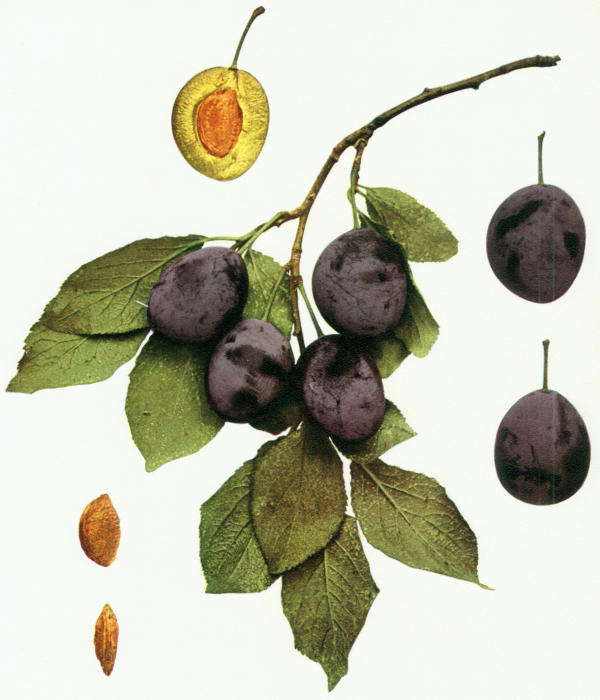
In the Old World the number of strains of this plum, especially in Germany, is legion, so many that it is probably impossible to segregate them at this late date. In America, while there are a number of these more or less distinct strains it is yet possible to distinguish the chief ones. In New York, the most commonly grown German Prune is the Rochester strain and since it agrees most closely with the fruit described in the best works on pomology, it is the strain described and illustrated in this work. The trees from which this description was made came from Ellwanger and Barry, Rochester, New York, who have long maintained a stock tree of this strain. Another German Prune, fruit of which we have not been able to obtain, is the Dansville strain grown in the nurseries of Dansville, New York. Still another of these plums is the Weedsport German Prune[213] so like the Rochester type as to be hardly worth distinguishing. The Latz German Prune is a very distinct strain; it is larger, thicker and broader than the type here described and is more of a clingstone. In some respects this is the best of the German Prunes. All accounts agree that this plum was introduced into America from Prussia by a Mr. Latz about 1850.
All of these German Prunes are characterized by large, hardy, vigorous, healthy, productive trees, characters so marked that one can say at once that it is the tree that gives the German Prune its great value. The fruit is excellent for all culinary purposes, especially for canning, and cures into a small but very good, tart, meaty, freestone, elastic prune. The chief objection to the plum for these purposes is that the fruits run small. The plums are too tart to have much value as dessert fruits. This variety is likely to remain a standard for some time in New York but will eventually be superseded by a larger fruit.
The origin of this plum is uncertain. German writers very generally hold that it came from Asia whence it was carried during the Crusades to Europe. Lauche, a German authority, says, “In the Sixteenth Century, the first dried prunes were introduced into Italy, Switzerland and Germany from Hungary. The tree on the contrary is said not to have been introduced by us until the end of the Seventeenth Century.” A Prune Plum was noted in America by Coxe in 1817, but it is impossible to say whether he meant the German Prune. Prince, however, in 1832, described the variety under its present name. In 1856, the American Pomological Society placed the German Prune on the list of the varieties promising well and six years later added it to its fruit catalog. The German Prune is used only in the fresh state in New York, but on the Pacific Coast, in some one of its several types, it is one of the half-dozen leading sorts for curing.
Tree medium to large, vigorous, round and dense-topped, hardy, usually very productive; branches ash-gray, somewhat rough, with lenticels variable in size; branchlets slender, short, with internodes of medium length, green changing to brownish-red, dull, glabrous, with numerous, small, obscure lenticels; leaf-buds intermediate in size and length, conical, free.
Leaves falling early, oval or obovate, one and one-half inches wide, three inches long, thinnish, velvety; upper surface pubescent, slightly rugose, with a shallow groove on the midrib; lower surface yellowish-green, heavily pubescent; apex abruptly pointed or acute, base acute, margin finely serrate, with small glands; petiole one-half inch long, pubescent, tinged with red, glandless or with one or two small, globose glands usually at the base of the leaf.
Blooming season intermediate in time and length; flowers appearing after the leaves, nearly one inch across, inconspicuous on account of their greenish-yellow color, which characterizes the variety; borne on lateral spurs, singly or in pairs; pedicels five-eighths inch long; below medium in thickness, pubescent, greenish; calyx-tube green, campanulate, lightly pubescent at the base; calyx-lobes long, narrow, acute, thinly pubescent on both surfaces, glandular-serrate, erect; petals narrow, long-oval or obovate, erose, tapering to broad claws of medium length; anthers yellowish; filaments seven-sixteenths inch long; pistil very pubescent at the base, equal to the stamens in length.
Fruit late, ripening period very long; one and five-eighths inches by one inch in size, oval, slightly swollen on the ventral side, halves unequal; cavity very shallow, narrow, flaring; suture a faint line; apex pointed; color purplish-black, overspread with thick bloom; dots numerous, small, brown, inconspicuous, clustered about the base; stem below medium in thickness, five-eighths inch long, adhering well to the fruit; skin tough, separating readily; flesh yellowish-green, medium juicy, firm, sweetish, mild, pleasant flavor; good to very good; stone free, seven-eighths inch by one-half inch in size, the cavity larger than the pit, flattened, obliquely long-oval, pointed at the apex and base, with rough and pitted surfaces; ventral suture narrow, conspicuously winged; dorsal suture narrowly and shallowly grooved.
GIANT
GIANT
Prunus domestica
1. Gard. & For. 7:420. 1894. 2. Burbank Cat. 5, fig. 1895. 3. Cal. State Board Hort. 47. 1897-98. 4. Cornell Sta. Bul. 131:185. 1897. 5. Mich. Sta. Bul. 169:245. 1899. 6. Am. Pom. Soc. Cat. 39. 1899. 7. Am. Gard. 21:36. 1900. 8. Mich. Sta. Bul. 187:77, 78. 1901.
Giant Prune 4, 7, 8. Giant Prune 5, 6.
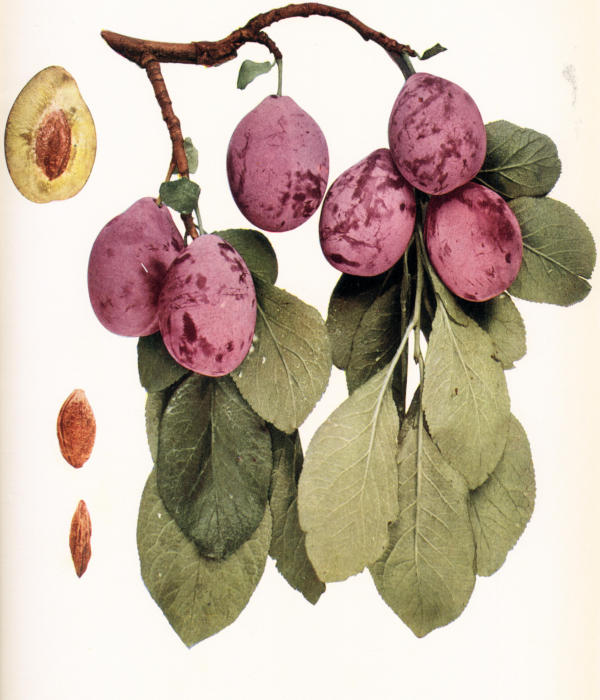
Giant is distinguished for its large size and attractive color. The accompanying color-plate shows the color and shape very well, but the fruit is a little too small. Unfortunately Giant is somewhat inferior in quality, a disappointment to all, as with Agen for a parent high quality was to be expected. In quality, as in all fruit-characters, the variety resembles the male parent, Pond. The flesh is coarse, fibrous, lacking in juice, clings more or less to the stone and rots quickly under unfavorable conditions. The trees, too, lack somewhat in both vigor and productiveness. Introduced as a prune, it was supposed that this variety would prove a great boon to prune-makers, but it does not cure well and is now hardly used for drying. Giant is proving to be one of the very best shipping plums, as would be expected because of its firm, dry flesh. It is unfortunate that so attractive a plum cannot be unqualifiedly recommended, but it is doubtful if it is worth planting on a commercial scale in New York.
Giant was grown by Luther Burbank, Santa Rosa, California, from a seed of Agen fertilized by Pond, the Hungarian Prune of the Pacific Coast. The stock of this variety was offered for sale to nurserymen in 1893 and 1894, but not to fruit-growers until 1895, and then by the originator. The American Pomological Society placed it on their fruit catalog list in 1899 as a promising variety for this region and southern California.
Tree medium in size and vigor, round and dense-topped, hardy, usually productive; branches short, stocky, dark ash-gray, with large lenticels; branchlets short, with internodes of medium length, greenish-red changing to dark brownish-red, dull, thinly pubescent, heavily marked with scarf-skin and with few, small, inconspicuous lenticels; leaf-buds small to medium, short, conical, appressed.
Leaves folded backward, obovate or oval, two and one-quarter inches wide, three and three-quarters inches long; upper surface pubescent only along the midrib; lower surface pale green, lightly pubescent on the midrib and larger veins; apex abruptly pointed or acute, margin serrate or crenate, usually with small, dark glands; petiole three-quarters inch long, tinged red along one side, sparingly pubescent, glandless or with from one to four greenish-brown glands usually on the stalk.
Blooming season intermediate in time and length; flowers appearing after the leaves, one and three-sixteenths inches across, creamy in the buds, changing to white on opening, borne in scattering clusters on short, lateral buds and spurs, singly or in pairs; pedicels three-eighths inch long, thick, glabrous, greenish; calyx-tube green, campanulate, glabrous or lightly pubescent; calyx-lobes broad, obtuse, pubescent on both surfaces, glandular-serrate, reflexed; petals oval, somewhat erose, with short, broad claws; anthers yellowish; filaments five-sixteenths inch long; pistil glabrous, longer than the stamens.
Fruit mid-season, period of ripening short; two inches by one and one-half inches in size, obovate, slightly necked, compressed, halves unequal; cavity shallow, narrow, abrupt; suture shallow; apex roundish or depressed; color light to dark purplish-red, overspread with bloom of medium thickness; dots numerous, smallish, russet, inconspicuous; stem seven-eighths inch long, thinly pubescent, adhering well to the fruit; skin of medium thickness and toughness, adhering but slightly to the pulp; flesh light golden-yellow, variable in juiciness, coarse, somewhat fibrous, firm, rather sweet, mild fair in quality; stone semi-clinging or clinging, one and one-eighth inches by five-eighths inch in size, long-oval, flattened, with rough and pitted surfaces; ventral suture strongly furrowed; dorsal suture with a shallow groove.
GLASS
Prunus domestica
1. Downing Fr. Trees Am. 3rd App. 181. 1881. 2. Am. Pom. Soc. Cat. 39. 1899. 3. Mich. Sta. Bul. 169:245. 1899. 4. Waugh Plum Cult. 104. 1901. 5. Can. Exp. Farm Bul. 43:34. 1903. 6. Am. Pom. Soc. Rpt. 57. 1907.
Glass Seedling 2. Glass Seedling 4, 5, 6.
Although found in some collections in the United States, Glass has never attained commercial importance in this country, probably because its place is taken by the Quackenboss, which it very closely resembles. The fruit is large and attractive in color and shape, but it is not high in quality and it must be rated among Domestica plums as only a mediocre fruit. The tree is said generally to give better satisfaction than the fruit. This variety originated with Alexander Glass, Guelph, Ontario, and has been cultivated extensively by Canadian growers to whom its productivity and hardiness recommend it.
Tree large, vigorous, upright-spreading, open, productive, hardy; branches rough, stocky; branchlets rather slender, pubescent; leaves folded backward, obovate or oval, one and three-quarters inches wide, three and one-half inches long; margin finely serrate; petiole reddish, pubescent, with from one to three smallish, globose glands usually at the base of the leaf.
Fruit mid-season; one and one-half inches by one and three-eighths inches in size, oblong-oval, purplish-black, overspread with thick bloom; stem adhering firmly to the fruit; skin thin, tender, rather sour; flesh light yellow, juicy, firm, sweet, mild; of fair quality; stone clinging, one inch by five-eighths inch in size, irregular-oval, with oblique apex, the surfaces rough and pitted; ventral suture prominent, winged.
GOLDEN
GOLDEN
Prunus munsoniana × Prunus triflora
1. U. S. D. A. Rpt. 263. 1892. 2. Burbank Cat. 17. 1893. 3. Am. Pom. Soc. Rpt. 74. 1895. 4. Am. Gard. 18:715. 1897. 5. Cal. State Board Hort. 53. 1897-98. 6. Vt. Sta. Bul. 67:12. 1898. 7. Ohio Sta. Bul. 113:161. 1899. 8. Am. Gard. 21:36. 1900. 9. Vt. Sta. An. Rpt. 14:274. 1901. 10. Mich. Sta. Sp. Bul. 30:18 1905. 11. Mass. Sta. An. Rpt. 17:161. 1905. 12. Ga. Sta. Bul. 68:8, 36. 1905. 13. U. S. D. A. Yearbook 500. 1905.
Gold 3, 4, 7, 8, 10, 11. Gold 6, 9, 13. Late Klondike 5.
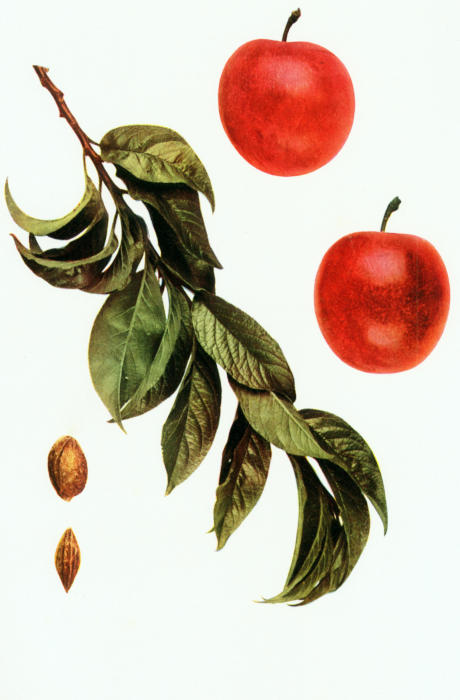
It would be hard to name another plum as showy as Golden. Large for its group, beautifully turned, it presents a most striking appearance long before it is ripe, with its bright yellow skin and crimson cheek, the whole plum turning to a brilliant currant-red with a delicate bloom at maturity. But the plum is little more than showy. The flavor is not good, the flesh is fibrous, excessively juicy and adheres to the stone, the skin is tough and astringent. In spite of the juiciness the plum ships well, owing to the tough skin, but the fruits are much attacked by brown-rot and the skin cracks badly under unfavorable conditions. The trees are rather small, uncertain in bearing, often enormously productive but do not hold the crop well, and the plums ripen unevenly. Strange to say, considering the parentage, the variety is hardy, according to Waugh standing the winters at Burlington, Vermont, almost perfectly. In tree and fruit the variety is more like its American parent than the Asiatic one. Golden can never be a money-maker in New York, but it is worth having in a home orchard for its handsome appearance.
The original tree of this variety was grown in 1887 or 1888 by Luther Burbank, Santa Rosa, California, from a seed of Robinson fertilized by pollen of Abundance. In 1892, the variety was erroneously described in the United States Department of Agriculture Report as a seedling of Kelsey fertilized by Burbank. The same year it was named Golden by Burbank and in 1893 it was offered for sale in his catalog, New Creations in Fruits and Flowers. Soon after, the original tree and the right of introduction were purchased by Stark Brothers Nurseries and Orchards Company, Louisiana, Missouri, and in 1894 the variety was catalogued and disseminated under the name Gold. This name was registered as a trade-mark in the United States Patent Office in 1905, but as the prior application and publication of Golden entitles it to precedence according to the nomenclature of the American Pomological Society, the name Gold has generally been dropped by pomologists. The confusion as to the origin and nomenclature of this variety has been increased by its parentage being published[214] as a cross of Robinson and Kelsey and by the California shippers labeling it Late Klondike.
Tree variable in size and vigor, usually small, somewhat vasiform, medium dense, hardy in all but the coldest localities, an uncertain bearer unless grown under favorable conditions, when it becomes very productive, susceptible to attacks of shot-hole fungus; trunk shaggy, sometimes gnarly; branches strong, unusually rough, grayish-brown, with longitudinal cracks in the bark, with very numerous, small, raised lenticels; branchlets willowy, numerous, long, with short internodes, green changing to dull reddish-brown, marked with gray scarf-skin, glossy, glabrous, with numerous, conspicuous, large, raised lenticels; leaf-buds small, short, conical, free.
Leaves usually flattened, broadly lanceolate, peach-like, one inch wide by three and one-half inches long, thin, somewhat rigid; upper surface light green, smooth, glabrous, with deeply grooved midrib; lower surface pale green, thinly pubescent; apex taper-pointed, base acute, margin serrate or crenate, with numerous, small, dark red glands; petiole slender, three-eighths inch in length, tinged red, sparingly pubescent along one side, glandless or with from one to seven small, globose, yellowish-green glands usually on the stalk.
Blooming season long; flowers appearing after the leaves, three-quarters inch across, white; borne in clusters on short lateral spurs and buds, in pairs or in threes; pedicels seven-sixteenths inch long, slender, glabrous, green; calyx-tube greenish, campanulate, glabrous; calyx-lobes narrow, acute, sparingly glandular-serrate and pubescent, with scattering marginal hairs, erect; petals oval, entire, clawed; anthers yellowish; filaments one-quarter inch long; pistil glabrous, longer than the stamens.
Fruit mid-season, ripening period very long; medium to sometimes large, roundish-oblate, halves equal; cavity deep, flaring, regular; suture a line; apex roundish or pointed; color golden-yellow blushed or overspread with bright red, with thin bloom; dots numerous, very small, whitish, inconspicuous, thickly sprinkled around the apex; stem five-eighths inch long, glabrous, adhering fairly well to the fruit; skin rather tough, astringent, inclined to crack under unfavorable conditions, separating readily; flesh golden-yellow, unusually juicy and fibrous, tender and melting, sprightly, sweet next the skin but tart near the center; fair in quality; stone adhering, three-quarters inch by one-half inch in size, oval, turgid, flattened at the base, abruptly sharp-pointed at the apex, with pitted surfaces; ventral suture slightly winged; dorsal suture broadly grooved.
GOLDEN BEAUTY
GOLDEN BEAUTY
Prunus hortulana
1. Am. Pom. Soc. Rpt. 162. 1881. 2. Rural N. Y. 43:53. 1884. 3. Popular Gard. 4:38. 1888. 4. Am. Gard. 10:175. 1889. 5. Cornell Sta. Bul. 38:48, 49, 86. 1892. 6. Kerr Cat. 3. 1894. 7. Mich. Sta. Bul. 118:53. 1895. 8. W. N. Y. Hort. Soc. Rpt. 41:55. 1896. 9. Am. Pom. Soc. Cat. 26. 1897. 10. Wis. Sta. Bul. 63:39, 42, 48. 1897. 11. Vt. Sta. An. Rpt. 11:284. 1898. 12. Colo. Sta. Bul. 50:42. 1898. 13. Ohio Sta. Bul. 113:155. 1899. 14. Ibid. 162:247, 254, 255. 1905.
Honey Drop 8, 10, 14. Honey Drop 5, 11. Missouri Apricot 5, 6, 8, 10, 11, 12, 13.
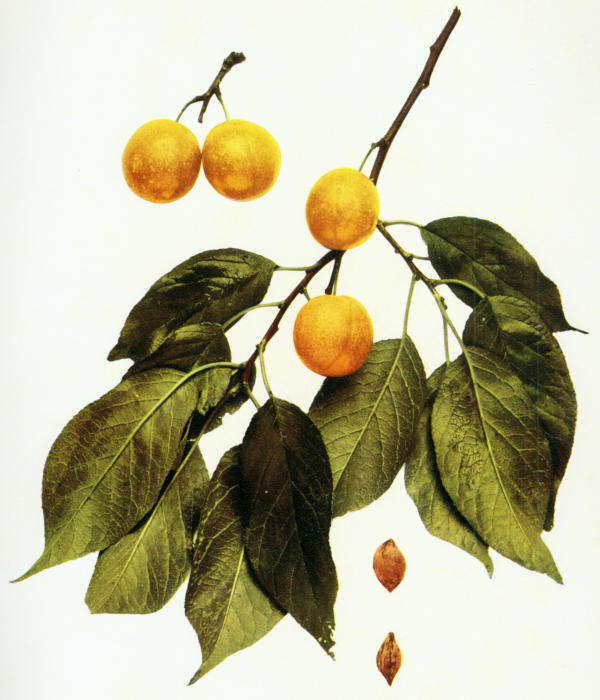
From the fruit-grower’s standpoint, Golden Beauty is of little interest. The plums are so small and the quality so poor that the variety is not worth planting either for the home or for money-making. It is true that the firm, juicy fruits are very good for table use, in jellies in particular, and that they may be shipped long distances, but these characters cannot offset the handicap of small size and poor quality. The variety is of interest to botanists because it seems to be a wanderer out of the range of the species to which it belongs. As the history which follows seems to show, Golden Beauty was found in a part of Texas where Prunus hortulana does not grow (see the discussion of this species) and quite as remarkable if it really comes from so warm a part of Texas is the fact that it should be perfectly hardy here and even farther north. There is a mystery yet to be cleared up about this plum. The variety is very ornamental in flower, foliage and fruit.
According to current account, Golden Beauty was found wild by a German on the Colorado River in western Texas during the Civil War. After the war, the German planted his new plum in a yard in Victoria County, Texas, where it attracted the attention of Gilbert Onderdonk, Mission Valley, southern Texas. Onderdonk, noting its merits, propagated and introduced it in 1874. In 1886, Stark Brothers, of Missouri, introduced the Missouri Apricot, the Honey Drop of some, which they claimed was found wild in Missouri. Several pomologists have noted the close similarity of this variety to Golden Beauty and as tested at this Station they are identical in all respects and are therefore placed under the older name. In 1897 the American Pomological Society placed this plum on its fruit catalog list.
Tree above medium in size, vigorous, somewhat irregular in habit, usually spreading, low, dense and flat-topped, hardy, variable in productiveness, somewhat subject to attacks of shot-hole fungus; trunk rough, shaggy; branches roughish, thorny, zigzag, dark ash-gray, with numerous lenticels of medium size; branchlets long, slender, twiggy, with short internodes, green changing to greenish-brown, shining, glabrous, with numerous, conspicuous, large, raised lenticels; leaf-buds small, very short, obtuse, plump, appressed.
Leaves folded upward, narrowly oval, one and seven-eighths inches wide, four inches long, thin; upper surface smooth, glabrous, with a grooved midrib; lower surface light green, sparingly pubescent along the midrib and larger veins; apex acuminate, base abrupt, margin irregularly and doubly crenate, with small, dark brown glands; petiole seven-eighths inch long, slender, green, thinly pubescent along one side, glandless or with from one to eight very small, globose, blackish glands scattered mostly below the base of the leaf.
Blooming season late and of medium length; flowers appearing after the leaves, seven-eighths inch across, white; borne in clusters on lateral buds and spurs, with from four to six flowers in each umbel; pedicels nine-sixteenths inch in length, slender, glabrous, greenish; calyx-tube green, obconic, glabrous; calyx-lobes acute, erect, thinly pubescent within, glandular-serrate, the glands reddish; petals ovate or roundish-oval, erose, tapering below into long, narrow, pubescent claws; anthers light yellow; filaments five-sixteenths inch in length; pistil glabrous, shorter than the stamens.
Fruit very late, season of medium length; one inch in diameter, roundish to roundish-oval, somewhat compressed, halves equal; cavity shallow, narrow, slightly flaring; suture very shallow or a line; apex roundish or pointed; color orange-yellow, mottled, overspread with thin bloom; dots characteristic, numerous, large and small, yellowish, decidedly conspicuous producing a somewhat mottled appearance, clustered about the apex; stem very slender, five-eighths inch in length, glabrous, adhering poorly to the fruit; skin thick, tough, adhering to the pulp; flesh golden-yellow, juicy, coarse, fibrous, tender, mildly sweet, with a faint apricot flavor, somewhat acid when cooked; fair in quality; stone adhering, five-eighths inch by one-half inch in size, turgid, oval, abruptly pointed at the base and apex, smooth and with a coating of yellowish-brown, cottony substance; ventral suture broad, lightly furrowed; dorsal suture acute or with a shallow furrow.
GOLDEN CHERRY
Prunus cerasifera
1. Hoffy Orch. Com. 2:1842. 2. Downing Fr. Trees Am. 295. 1845. 3. N. Y. Sta. Rpt. 15:293. 1896. 4. Bailey Ev. Nat. Fruits 212. 1898. 5. Can. Exp. Farms Rpt. 401. 1898.
Golden Cherry Plum 2. Market Plum 1. Youngken Golden 3. Youngken’s Golden Cherry 4. Yunkin Golden 5.
This plum is one of the few cultivated representatives of Prunus cerasifera. It offers some attractions because of real merit and because it adds variety to the list of plums for fruit-growers. Some of its qualities are strongly marked and the variety might prove of value in plant-breeding. Golden Cherry originated with Samuel Reeves, Salem, New Jersey, as a seedling of Myrobalan, in the early part of the last century.
Tree large, vigorous, spreading, dense-topped, unproductive; branches slender, sparingly thorny; branchlets twiggy; leaves oval, one inch wide, one and seven-eighths inches long; margin finely serrate, with few small glands; petiole reddish, eglandular; blooming season early, of medium length; flowers appearing before the leaves, well distributed on lateral buds and spurs.
Fruit very early; one and one-quarter inches in diameter, greenish-yellow changing to pale yellow with a tinge of red, overspread with thin bloom; flesh pale yellow, very juicy, melting, sweet next to the skin but rather tart at the pit, aromatic; good; stone clinging, five-eighths inch by one-half inch in size, oval, with a nearly smooth surface.
GOLDEN DROP
GOLDEN DROP
Prunus domestica
1. Pom. Mag. 2:57, Pl. 1829. 2. Lond. Hort. Soc. Cat. 144. 1831. 3. Kenrick Am. Orch. 256. 1832. 4. Downing Fr. Trees Am. 273. 1845. 5. Floy-Lindley Guide Orch. Gard. 295, 383. 1846. 6. Thomas Am. Fruit Cult. 332, fig. 258. 1849. 7. Mag. Hort. 15:486, 487 fig. 42. 1849. 8. Hovey Fr. Am. 1:81. 1851. 9. Am. Pom. Soc. Cat. 54. 1852. 10. Elliott Fr. Book 410. 1854. 11. Ann. Pom. Belge 43, Pl. 1855. 12. Thompson Gard. Ass’t 515. 1859. 13. Mas Le Verger 6:29, fig. 15. 1866-73. 14. Hogg Fruit Man. 691, 729. 1884. 15. Mathieu Nom. Pom. 425. 1889. 16. Guide Prat. 155, 357. 1895. 17. Oregon Sta. Bul. 45:26 fig. 1897. 18. Colo. Sta. Bul. 50:34. 1898. 19. Am. Pom. Soc. Rpt. 211. 1899. 20. Ohio Sta. Bul. 113:158, Pl. XV. 1899. 21. Mich. Sta. Bul. 169:242, 244. 1899. 22. Waugh Plum Cult. 104 fig. 1901. 23. Va. Sta. Bul. 134:42. 1902. 24. Ohio Sta. Bul. 162:242, 254, 255. 1905.
Bury Seedling 1, 2, 3, 4, 5, 7, 8, 10, 11, 12, 14, 15, 16. Coe 16, 21. Coe’s 1, 2, 7, 8, 14, 15, 16. Coe Golden Drop 16, 23. Coe Golden Drop 21. Coe’s Golden Drop Plum 1, 5, 11. Coe’s Golden Drop 5, 8, 13, 15, 16, 17, 22, 24. Coe’s Golden Drop 2, 3, 4, 6, 7, 8, 9, 10, 12, 14, 18, 20. Coe’s Golden Drop Plum 13. Coe’s Plum 12, 13, 16. Coe (Pride) 15. Coe’s Imperial 1, 2, 4, 5, 7, 8, 10, 11, 12, 14, 15, 16. Coe’s Rothgefleckte Pflaume 13, 16. Coe’s Rotgefleckte Pflaume 15. Coe’s Plum 5. Cooper’s Large 15, 16 incor. Coe’s Seedling 3. De Coe 16. Fair’s Golden 15, 16. Fair’s Golden Drop 2, 4, 5, 7, 8, 10, 11, 14, 15, 16. Golden Drop 1, 2, 7, 8, 12, 14, 15, 16. Golden Drop Plum 16. Golden Gage 2, 4, 7, 8, 10, 11, 12, 14, 15, 16. Goutte d’Or 13. Goutte d’Or 13, 16. Goutte d’Or de Coe 15, 16. King of Plums 8. New Golden Drop 1, 2, 4, 5, 7, 8, 10, 11, 12, 15 16. Nouvelle Goutte d’Or 15, 16. Parmentier? 15, 16. Prune Goutte d’Or De Coé 11. Semis de Bury 15, 16. Silver Prune 17, 19. Silver Prune 22. The Coe’s Plum 1. Waterloo of some 7, 8,? 14, 15.
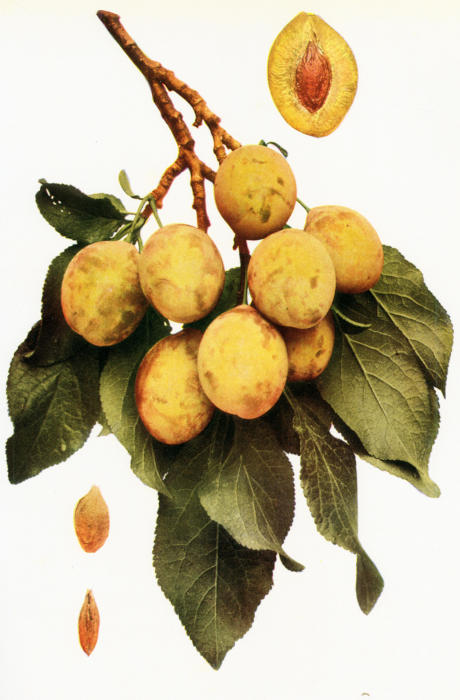
Unfortunately this fine old plum, the largest, handsomest and best of the yellow plums, is fit only for the amateur in New York and in the hands even of the most careful of amateurs it does not reach the perfection in either appearance or quality that is expected of it in Europe or on the Pacific Coast of America. In spite of special efforts to obtain specimens for illustration which would do this variety justice, the color-plate of Golden Drop is far from satisfactory as regards either size or color of the fruit. In this region trees of Golden Drop lack constitution and while hardy in tree, the fruit-buds are often caught by the cold. From lack of vigor and from injury by freezing, the variety is not productive. The trees, too, are slow in growth and the fruit needs a long season to reach perfect maturity, often failing to ripen in parts of New York where other plums mature well. Again, the trees are subject to nearly all the ills to which plums are heir and have a somewhat precarious existence because of insects and diseases though the fruit is not as subject to brown-rot as is that of the Yellow Egg with which this variety is usually compared. Golden Drop is seemingly fit for all purposes to which plums are put—for dessert, cooking, canning, preserving and prune-making. For the last named purpose it is unsurpassed for a light colored prune of large size, readily selling at a fancy price in delicatessen stores. The fruit when carefully picked and handled keeps for a month or more, shrivelling somewhat but retaining its flavor and pleasing flesh-characters. A task for the plant-breeder is to breed a plum, of which one of the parents should be Golden Drop, which will give to this region a plum as good as the Golden Drop in regions where it is at its best. With all of its defects in the North and East, it is yet worth growing for the home and often for the late market.
Jervaise Coe, a market gardener, at Bury St. Edmunds, Suffolk, England, raised Golden Drop from a seed about 1809. Lindley (References, 5) says, “He [the originator] informed me it was from the stone of Green Gage, the blossom of which, he supposed, had been fertilized by the White Magnum Bonum, the two trees of which grew nearly in contact with each other in his garden.” From a study of the fruit-characters this supposition is very probable. C. M. Hovey in discussing the synonyms of this variety writes, “The French have disseminated it considerably under the name of Waterloo; trees received under that name have fruited in our collection this year, and proved to be the Golden Drop.” Robert Hogg, in his Fruit Manual, published in 1884, described Waterloo as a separate variety, found at Waterloo, Belgium, and introduced by Dr. Van Mons; the descriptions of the two are practically identical. The Silver Prune, well known on the Pacific Coast, at one time supposed to be a new variety, turned out upon investigation to be Golden Drop, though the growers there continue to call it by the new name they have given it. The variety under discussion came to America in 1823, when Knight, of England, sent a tree of it to John Lowell of Massachusetts. In 1852, the American Pomological Society valued it sufficiently to place it on the list of the fruits worthy of general cultivation.
Tree medium to large, vigorous, spreading or roundish, open-topped, hardy, productive; branches ash-gray, roughish, with few, large lenticels; branchlets short, stout, with internodes variable in length, greenish-red changing to dull brownish-red becoming drab on the older wood, glabrous early in the season but becoming pubescent at maturity, with numerous, small lenticels; leaf-buds large, long, pointed, free.
Leaves folded upward, oval or obovate, one and three-eighths inches wide, two and three-quarters inches long, thickish; upper surface dark green, slightly rugose, pubescent, with the midrib but faintly grooved; lower surface silvery-green, pubescent; apex abruptly pointed or acute, base acute, margin serrate, eglandular or with small, dark glands; petiole one-half inch long, pubescent, tinged red, with from two to three globose, greenish-yellow glands usually at the base of the leaf.
Season of bloom medium, short; flowers appearing after the leaves, one inch across, white, borne in clusters on lateral spurs, singly or in pairs; pedicels five-eighths inch long, lightly pubescent, greenish; calyx-tube green, narrowly campanulate, pubescent; calyx-lobes obtuse, sparingly pubescent on both surfaces, glandular-serrate, reflexed; petals oval, dentate, tapering to short, broad claws; anthers yellowish; filaments five-sixteenths inch long; pistil glabrous, equal to the stamens in length.
Fruit very late, season of average length; two inches by one and one-half inches in size, oval, tapering at the base to a short neck, slightly compressed, halves equal; cavity very shallow and narrow, abrupt; suture shallow and wide; apex depressed; color golden-yellow, occasionally with a faint bronze blush, showing greenish streaks and splashes before full maturity, overspread with thin bloom; dots numerous, small, russet, conspicuous; stem three-quarters inch long, thinly pubescent, adhering well to the fruit; skin tough, rather adherent; flesh light golden-yellow, juicy, intermediate in firmness and tenderness, rather sweet, mild, pleasant flavor; good to very good; stone free, one and three-eighths inches by three-quarters inch in size, oval or ovate, slightly flattened, irregularly ridged and roughened, acute at the base and apex; ventral suture wide, often conspicuously winged; dorsal suture widely and deeply grooved.
GOLIATH
Prunus domestica
1. Prince Treat. Hort. 26. 1828. 2. Lond. Hort. Soc. Cat. 147, 153. 1831. 3. Kenrick Am. Orch. 260. 1832. 4. Mag. Hort. 9:164. 1843. 5. Downing Fr. Trees Am. 300. 1845. 6. Floy-Lindley Guide Orch. Gard. 287, 383. 1846. 7. Thomas Am. Fruit Cult. 343. 1849. 8. McIntosh Bk. Gard. 2:531. 1855. 9. Hooper W. Fr. Book 245. 1857. 10. Cultivator 8:25 fig. 1860. 11. Am. Pom. Soc. Cat. 86. 1862. 12. Hogg Fruit Man. 363. 1866. 13. Mas Pom. Gen. 2:15, fig. 8. 1873. 14. Mathieu Nom. Pom. 432. 1889. 15. Waugh Plum Cult. 105 fig. 1901.
Caledonian 1, 2, of some 5 & 8, 11, 12, 13, 14. Emperor 9. Goliath 1, 3. Goliath 9, 13. Nectarine 1, of some 2 & 8, 11 & 14 incor. Pfirschenpflaume 14. Prune-Pêche? 14. Saint Cloud 2, 3, 4, 5, 6, 8, 12, 13, 14. Steer’s Emperor 2. Steers’ Emperor 4, 5, 8, 12, 13, 14. Wahre Caledonian 13, 14. Wilmot’s Late Orleans 2, 5, 8, 12, 13, 14.
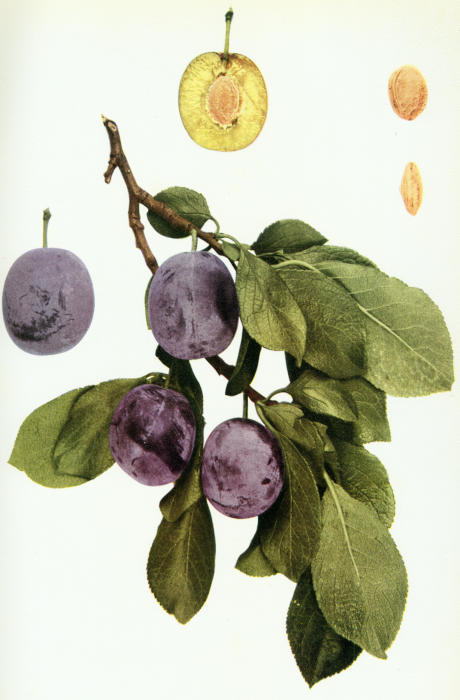
This old English plum has never been popular in America and is now scarcely known on this continent. It is a large, handsome, purple plum, as the illustration well shows, but seldom fit for dessert. “Seldom fit” because it is quite variable in quality in some seasons and under some conditions. It is an excellent culinary plum and its firm, thick, meaty flesh fits it well for shipping. On the grounds of this Station the trees behave very well in all respects and usually bear very full crops of plums that would tempt purchasers in any market. It has all of the characters usually ascribed to a money-maker variety of any fruit and why not more grown in commercial orchards cannot be said.
Nothing is known of the origin of this plum except that it is English. William Prince, in 1828, wrote: “This plum is of very large size, and has attracted much notice in England; but it is only recently introduced to this country, where it has not yet produced fruit that I am aware of.” The Nectarine plum was confused with the Goliath in the early part of the Nineteenth Century, but Robert Thompson,[215] the English horticulturist, separated them so satisfactorily that they have ever since remained distinct in plum literature. He found that this variety had pubescent shoots and fruit-stalks, while the same parts of the Nectarine were glabrous, and that the season of Goliath is considerably later. The American Pomological Society placed Goliath on its fruit list in 1862, but dropped it in 1871.
Tree large, vigorous, round-topped, dense, hardy, very productive; branches stocky, with fruit-spurs numerous, ash-gray, smooth except for the large, raised lenticels; branchlets somewhat thick, short, with internodes of medium length, green changing to dull brownish-drab, heavily pubescent throughout the season, with few, inconspicuous, small lenticels; leaf-buds of average size and length, conical, free.
Leaves somewhat flattened, obovate, two inches wide, three and five-eighths inches long; upper surface dark green, nearly glabrous, with a grooved midrib; lower surface heavily pubescent; apex obtuse or acute, base acute, margin finely serrate, eglandular or with few, small dark glands; petiole one-half inch long, thick, heavily pubescent, with a faint red tinge, glandless or with from one to three large, globose, greenish-yellow glands usually at the base of the leaf.
Blooming season early to medium, short; flowers appearing after the leaves, one inch across, white; borne on lateral spurs, singly or in pairs; pedicels nine-sixteenths inch long, pubescent, greenish; calyx-tube green, campanulate, lightly pubescent; calyx-lobes, broad, obtuse, somewhat pubescent, glandular-serrate, erect; petals unusually large, roundish, finely crenate, not clawed; anthers yellowish; filaments five-sixteenths inch long; pistil glabrous, longer than the stamens, with a large style and stigma.
Fruit mid-season, ripening period short; one and five-eighths inches by one and one-half inches in size, roundish-oblong, somewhat oblique, truncate, compressed, halves unequal; cavity narrow, abrupt, usually russeted; suture a line; apex flattened or depressed; color dark purplish-red, lighter colored on the shaded side, overspread with thick bloom; dots characteristic, numerous, large, russet, conspicuous, clustered about the apex; stem thick, three-quarters inch long, thickly pubescent, adhering well to the fruit; skin thin, sour, separating readily; flesh golden-yellow, rather dry, firm, sweet, of mild, pleasant flavor; fair to good; stone free, seven-eighths inch by three-quarters inch in size, roundish-oval, somewhat flattened, blunt at the base and apex, roughened and irregularly furrowed; ventral suture wide, winged, heavily furrowed; dorsal suture with a wide groove variable in depth.
GONZALES
GOLIATH
Prunus triflora ×
1. Kerr Cat. 1899-1900. 2. Vt. Sta. Bul. 67:13. 1898. 3. Ohio Sta. Bul. 162:252. 1905. 4. Penin. Hort. Soc. Rpt. 36. 1905. 5. Stark Bros. Cat. 1906.
Gonzales 5. Red Gold 4. Red Gold 5.
Judging from the several published descriptions, Gonzales is a very promising plum, for the South at least. The writers have not seen the variety in the North, but there appear to be no reasons why it should not succeed in some northern soils and climates. It is a chance seedling found in Gonzales, Texas, about 1894, and was introduced by F. T. Ramsey, Austin, Texas, in 1897. About all that can be determined regarding its parentage is that it is the product of some Japanese variety pollinated by a native. In 1901, Waugh used this variety to typify a new species, Prunus hortulana robusta, composed of a number of hybrids between Prunus triflora and native species. The following description is compiled:
Tree vigorous, upright-spreading, open; leaves narrow, oval, tapering at both ends; upper surface glabrous; margin minutely glandular, finely crenulate; petiole short and slender, with two glands.
Fruit mid-season; resembles Burbank in size and shape; skin toughish; color bright red, sometimes striped and splashed with dark red; flesh yellow, tinged red, firm, sweet; good; stone of medium size, oval, clinging.
GRAND DUKE
GRAND DUKE
Prunus domestica
1. Hogg Fruit Man. 703. 1884. 2. Mathieu Nom. Pom. 432, 434. 1889. 3. W. N. Y. Hort. Soc. Rpt. 39:100. 1894. 4. Can. Hort. 18:117, Pl. 1895. 5. Cornell Sta. Bul. 131:186, fig. 40 IV. 1896. 6. W. N. Y. Hort. Soc. Rpt. 42:83. 1897. 7. Am. Pom. Soc. Cat. 25. 1897. 8. Mich. Sta. Bul. 169:245. 1899. 9. Ohio Sta. Bul. 113:159, Pl. XVI. 1899. 10. Can. Exp. Farm Bul. 2nd Ser. 3:52. 1900. 11. Waugh Plum Cult. 106 fig. 1901. 12. Ohio Sta. Bul. 162:243 fig., 244, 254, 255. 1905.
Grossherzog’s Pflaume 2. Grand-Duc 2. Grand Duke 2.
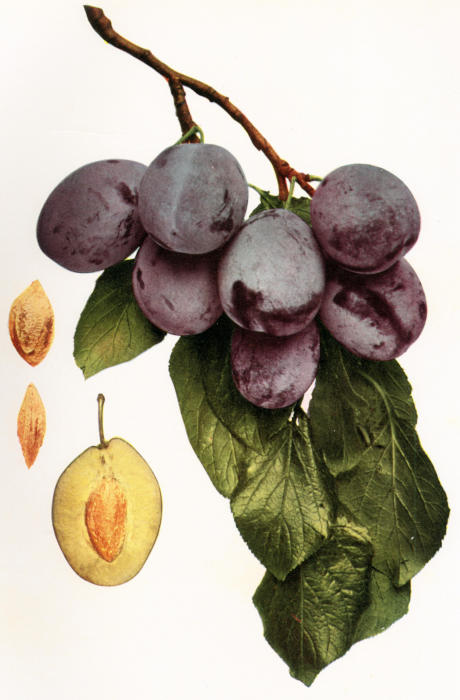
Grand Duke, now probably the favorite late shipping plum in this region, is, as stated in the history given below, a comparatively new plum in America. Its great popularity, gained in less than a quarter of a century, is due to much advertising by nurserymen coupled with such intrinsic qualities as large size, the true prune shape which seems most pleasing in some markets, handsome plum-purple and more than all else a firm, meaty flesh which fits the variety excellently for shipping. The flavor, as seems most often to be the case with these large blue plums, is not pleasant and the plum is not more than a second rate dessert fruit though it is very good in whatever way cooked for the table. The trees grow poorly in the nursery and even in the orchard are seldom large and vigorous enough to be called first class, though usually hardy. Some years ago plum-growers were advised to top-work this and other weak-growing plums on stronger stocks, but those who have tried such top-working usually condemn it because it is expensive and ineffective and because it so often gives a malformed tree. The trees come in bearing slowly but bear regularly and abundantly and hold the crop well, the plums being unusually free from rot and hanging in good condition a long time. Grand Duke deserves its popularity as a market plum and probably no better variety can be selected in New York for the last of the season.
Grand Duke is another of the many valuable plums produced by Thomas Rivers, of Sawbridgeworth, England. It was grown from an Autumn Compote stone and was sent out in 1876. When it was first introduced into America is not known, but in 1888 cions of it were distributed by Ellwanger and Barry[216] of Rochester, New York. In 1897, the American Pomological Society added this variety to its fruit catalog list and recommended it for this State and neighboring regions with similar climatic conditions.
Tree above medium in size, moderately vigorous, upright to slightly spreading, usually hardy, productive; branches ash-gray, with small, numerous lenticels; branchlets slender, short, with internodes of medium length, greenish-red changing to brownish-red, many twigs retaining a tinge of green, shining, glabrous, with numerous, small lenticels; leaf-buds large, long, pointed, strongly appressed; leaf-scars large.
Leaves nearly flat, obovate, one and one-half inches wide, three inches long, thick; upper surface shining, slightly rugose, pubescent only along the grooved midrib; lower surface yellowish-green, lightly pubescent; apex taper-pointed, base acute, margin serrate, eglandular or with small, dark glands; petiole three-quarters inch long, nearly glabrous, slightly tinged red along one side, glandless or with from one to three globose yellowish glands on the stalk and base of the leaf.
Blooming season intermediate, short; flowers appearing after the leaves, one inch across, white; borne in clusters on short lateral spurs and buds, singly or in pairs; pedicels one-half inch long, slender, glabrous, greenish; calyx-tube green, campanulate, glabrous; calyx-lobes lightly pubescent, glandular-ciliate, slightly reflexed; petals obovate, entire, short-clawed; anthers yellowish; filaments one-quarter inch long; pistil pubescent at the base, longer than the stamens.
Fruit late, season medium; unusually large when well grown, two and one-eighth inches by two inches in size, elongated-oval or slightly obovate, halves unequal; cavity shallow, narrow, abrupt; suture wide, variable in depth; apex flattened, somewhat depressed or occasionally with a short, blunt tip; color dark reddish-purple or purplish-black, overspread with thick bloom; dots numerous, small, brownish, inconspicuous; stem three-quarters inch long, adhering well to the fruit; skin variable in toughness, somewhat astringent, separating readily; flesh golden-yellow, juicy, firm, sweet, mild, not high in flavor; good; stone clinging, sometimes tinged red, one and one-eighth inches by seven-eighths inch in size, irregularly oval, slightly flattened, roughish, acute at the base and apex; ventral suture broad, slightly winged; dorsal suture with a broad, shallow groove.
GUEII
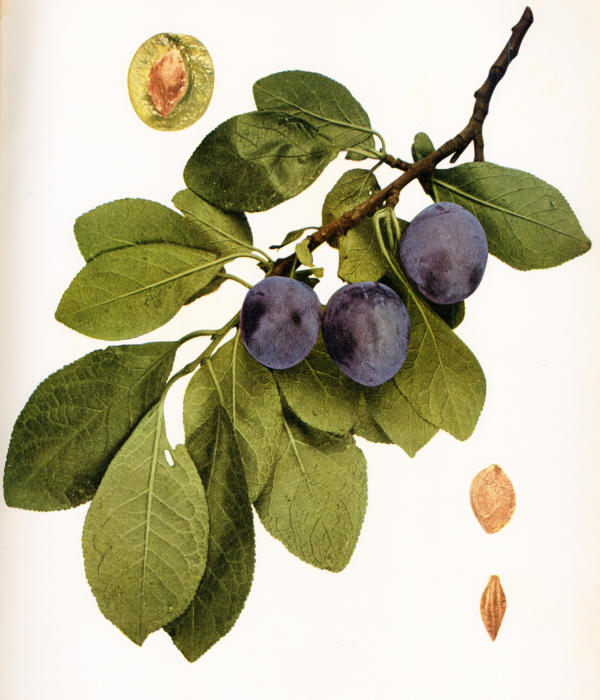
GUEII
Prunus domestica
1. Downing Fr. Trees Am. 3rd App. 181. 1881. 2. Can. Hort. 14:293, Pl. 1891. 3. Mich. Sta. Bul. 103:34, fig. 6. 1894. 4. Cornell Sta. Bul. 131:187. 1897. 5. Ont. Fr. Exp. Sta. Rpt. 120. 1898. 6. Mich. Sta. Bul. 169:242, 245. 1899. 7. Ohio Sta. Bul. 113:159. 1899. 8. Am. Pom. Soc. Cat. 39. 1899. 9. Waugh Plum Cult. 107. 1901. 10. Va. Sta. Bul. 134:42, 43 fig. 14. 1902.
Big Blue 1. Blue Magnum Bonum 1, 9. Bradshaw 1 incor. Geuii 3. Gueii 1. Guii 1, 6. Gweii 1.
Gueii is one of the standard plums of its season in New York, ranking among the first half-dozen in number of trees growing in the State, with many growers holding that it is the best general purpose plum of all Domesticas. The popularity of Gueii is due to its being a money-maker, as few would care to grow it for home consumption. The quality of Gueii is poor, especially for dessert, and it cannot even be called a particularly good-looking plum, though the illustration scarcely does the plum justice, especially in size. But the variety bears early and abundantly; the trees are large, vigorous, healthy and hardy and the plums are hardly surpassed for shipping, especially at the time at which the crop comes upon the market, about mid-season, the best shipping plums maturing a little later. The fruit is quite subject to brown-rot, a matter of more moment in other regions than in New York, and yet in some seasons very important in this State. The stone, curiously enough, sometimes clings rather tightly and under other conditions is wholly free. It could be wished that so popular a market plum were better in quality, but since high quality is seldom correlated in plums with fitness to ship well, it would be unfair to condemn Gueii for a market fruit because it cannot be eaten with relish out of hand.
This plum, according to all accounts, originated with a Mr. Hagaman, Lansingburgh, New York, about 1830. It was brought to notice by John Goeway (Gueii) and was soon called by his name. For years it was not much grown and it was not until 1899 that it was placed on the fruit catalog list of the American Pomological Society.
Tree large, vigorous, spreading, open-topped, hardy, very productive; branches ash-gray, roughened by longitudinal cracks and by numerous, conspicuous, raised lenticels of various sizes; branchlets thick, of medium length, with short internodes, green changing to dark brownish-drab, dull, thickly pubescent throughout the season, with numerous, inconspicuous, small lenticels; leaf-buds short, conical, free.
Leaves obovate or oval, one and seven-eighths inches wide, four inches long, thick; upper surface dark green, with scattering fine hairs and with a grooved midrib; lower surface silvery-green, thickly pubescent; apex abruptly pointed or acute, base variable but usually acute, margin doubly crenate, with small black glands; petiole five-eighths inch long, thick, pubescent, tinged red.
Blooming season short; flowers appearing after the leaves, one and one-eighth inches across, whitish; borne in clusters at the ends of spurs, singly or in pairs; pedicels thirteen-sixteenths inch long, pubescent, greenish; calyx-tube green, campanulate, pubescent towards the base; calyx-lobes broad, obtuse, pubescent on both surfaces, glandular-serrate, reflexed; petals roundish, entire, with very short, blunt claws; anthers yellow; filaments three-eighths inch long; pistil glabrous, equal to the stamens in length.
Fruit intermediate in time and length of ripening season; medium to above in size, somewhat ovate, halves equal; cavity below medium in depth and width, abrupt, rarely sutured; apex bluntly pointed; color dark purplish-black, overspread with thick bloom; dots numerous, small, russet, inconspicuous, clustered about the apex; stem medium in thickness and length, pubescent, adhering well to the fruit; skin thin, tender, slightly astringent, separating readily; flesh greenish-yellow changing to light golden-yellow, dry, firm but tender, sweet, mild, somewhat astringent towards the center; fair in quality; stone variable in adhesion but usually clinging, large, ovate or oval, blunt at the base and apex, strongly roughened and pitted; ventral suture faintly winged; dorsal suture acute or lightly grooved.
GUTHRIE LATE
Prunus domestica
1. McIntosh Bk. Gard. 2:532. 1855. 2. Downing Fr. Trees Am. 919. 1869. 3. Hogg Fruit Man. 705. 1884. 4. Mathieu Nom. Pom. 434. 1889. 5. Rivers Cat. 1898. 6. Am. Gard. Mag. 21:173. 1900.
Guthrie’s Minette 1. Guthrie’s Late Green 6. Guthrie Green 6. Guthrie’s Late Green 2, 3, 4. Minette 2, 3, 4. Verte Tardive de Guthrie 4.
Guthrie Late has never attained commercial importance in the United States, being found only in collections; but in England, according to Hogg, it is a very fine dessert plum, rivalling the Reine Claude in quality and ripening a month later. On the grounds of this institution it has failed because the fruits are small, dull in color and do not keep well. Of the several varieties produced from seed of Reine Claude by Charles Guthrie, Taybank, Dundee, Scotland, about the middle of the last century, Guthrie Late is the best known.
Tree large, vigorous, round-topped, dense, productive; branches stocky; branchlets pubescent; leaf-buds large, short, with a peculiar brush-like apex; leaves folded upward, oval, one and seven-eighths inches wide, three and one-half inches long, thick, rugose; margin crenate, eglandular or with small, dark glands; petiole thick, glandless or with from one to four globose glands; blooming season short; flowers appearing after the leaves, one inch across, white tinged with yellow at the apex of the petals; borne on lateral buds and spurs, singly or in pairs.
Fruit mid-season, ripening period long; of medium size, roundish-truncate, dull greenish-yellow, often irregularly splashed and striped with green, overspread with thin bloom; skin thin, slightly astringent; flesh light golden-yellow, rather dry, fibrous, somewhat tender, sweet, pleasant in flavor; of good quality; stone free, seven-eighths inch by five-eighths inch in size, ovate or oval, medium turgid, with rough surfaces.
HALE
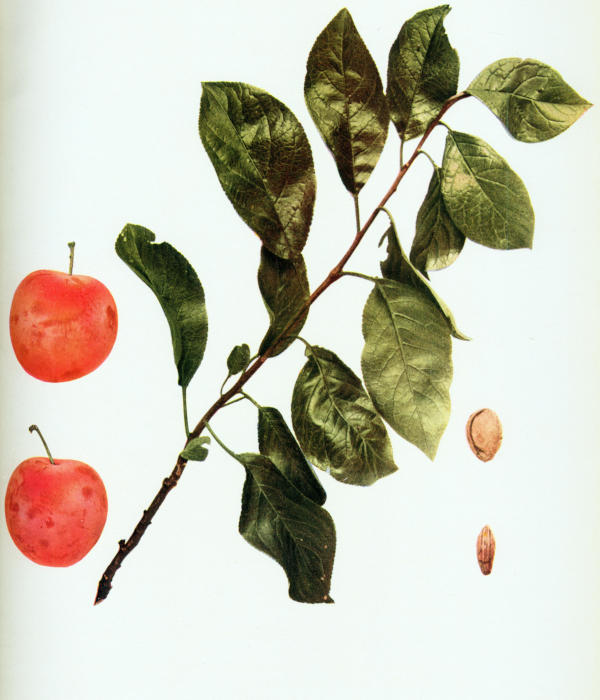
HALE
Prunus triflora
1. Burbank Cat. 19. 1893. 2. Ibid. 1894. 3. Cornell Sta. Bul. 106:52. 1896. 4. Ga. Hort. Soc. Rpt. XI. 1897. 5. Am. Pom. Soc. Cat. 41. 1899. 6. Cornell Sta. Bul. 175:147, 148, fig. 37. 1899. 7. Am. Gard. 21:36 1900. 8. Waugh Plum Cult. 136. 1901. 9. Mich. Sta. Bul. 187:77, 79. 1901. 10. W. N. Y. Hort. Soc. Rpt. 89. 1902. 11. Ohio. Sta. Bul. 162:254, 255. 1905. 12. Ga. Sta. Bul. 68:10, 30. 1905. 13. Mass. Sta. An. Rpt. 17:160. 1905.
J 1. J 3. Prolific 2. Prolific 3, 8, 12.
It is doubtful if the average person who grows the Hale would recognize it as shown in The Plums of New York, as it is supposed to be a yellow plum; nevertheless the illustration is a good one so far as the fruits go at least. When mature on the trees the fruits are yellow with a faint blush, but in storage the color quickly changes into a pale red, becoming, when the plum is at its best in appearance and quality, a light currant-red. Hale, though large and handsome of fruit, is of questionable value, failing both in fruit and tree. The flavor of this plum is good in the judgment of most fruit connoisseurs, but others find it a little too sweet and somewhat mawkish near the skin and close about the pit. All agree, however, that the flesh clings too tightly to the stone for pleasant eating and that the texture is too tender for good shipping. But it is the tree that fails most markedly. Even on the grounds of this Station, where the peach is practically hardy, Hale is but semi-hardy, failing most often because with the best of care the wood does not ripen properly. The habit of growth is not particularly good, the trees are slow in coming in bearing, are not regularly productive and are readily infected by brown-rot and the fruits much infested by curculio. On the whole, it is to be regretted that Mr. Hale did not choose a better plum to bear a name so distinguished in horticulture.
Luther Burbank offered this plum, a cross between Kelsey and Satsuma, for sale under the name J, in 1893, and the following year as Prolific. J. H. Hale, South Glastonbury, Connecticut, purchased the variety in 1894, and introduced it as the Hale in 1896. In 1899, the American Pomological Society considered it worthy a place on its fruit catalog list.
Tree above medium in size, vigorous, vasiform, open-topped, semi-hardy, variable in productiveness; branches smooth except for the numerous, small, raised lenticels, somewhat thorny, dark ash-gray, the fruit spurs numerous; branchlets willowy, of medium thickness and length, with short internodes, greenish-red changing to light brown, shining, glabrous; lenticels numerous, small; leaf-buds small, short, obtuse, plump, free.
Leaves sparse, folded upward, oblanceolate or narrowly obovate, one and three-quarters inches wide, three and one-half inches long, thin; upper surface glabrous except for scattering hairs, with a grooved midrib; lower surface light green, glabrous except along the midrib and larger veins; apex acute or abruptly pointed, base acute, margin finely serrate or crenate, eglandular; petiole nine-sixteenths inch long, slender, tinged red, glandless or with from one to four globose or reniform, greenish-yellow glands on the stalk.
Blooming season early and of medium length; flowers appearing before the leaves, white; borne in thin clusters on lateral buds and spurs, singly or in pairs; pedicels long, glabrous, greenish; calyx-tube green, campanulate, glabrous; calyx-lobes obtuse, with numerous hair-like glands, nearly glabrous, erect; petals roundish-ovate, entire, not clawed; anthers yellowish; filaments short; pistil glabrous except at the base, much longer than the stamens.
Fruit early, season short; one and three-quarters inches in diameter, roundish, halves equal; cavity of medium depth and width, abrupt, regular; suture a line; apex roundish; color light or greenish-yellow, more or less blushed with red on one side, becoming red at maturity, mottled, with thin bloom; dots numerous, small, whitish, conspicuous only where the skin is blushed; stem slender, five-eighths inch long, glabrous, detaching easily from the fruit; skin thin, tough, adhering; flesh yellowish, very juicy, fibrous, tender, melting next the skin but firmer at the center, sweet except near the pit; good in quality; stone adhering, three-quarters inch by five-eighths inch in size, roundish-oval, flattened, blunt but with a small, sharp tip, rough; ventral suture narrow and rather conspicuously winged; dorsal suture grooved.
HAMMER
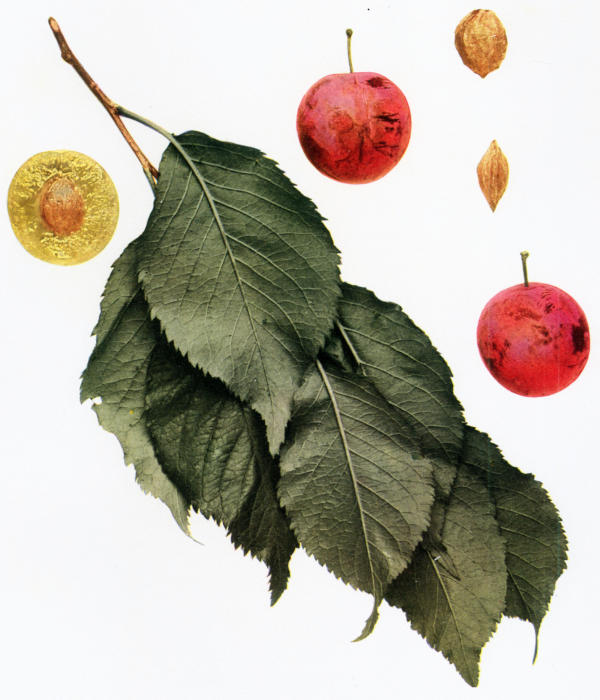
HAMMER
Prunus hortulana mineri × Prunus americana
1. Cornell Sta. Bul. 38:79. 1892. 2. Ia. Hort. Soc. Rpt. 275, 448. 1893. 3. Ibid. 334. 1894. 4. Wis. Sta. Bul. 63:24, 39. 1897. 5. Colo. Sta. Bul. 50:36. 1898. 6. Ia. Sta. Bul. 46:274. 1900. 7. Waugh Plum Cult. 150. 1901. 8. Ont. Fr. Gr. Assoc. 144. 1901. 9. Ga. Sta. Bul. 67:274. 1904. 10. S. Dak. Sta. Bul. 93:18. 1905. 11. Ohio Sta. Bul. 162:254, 255. 1905.
Hammer is one of the best native plums. On the Station grounds the trees of this variety make the best orchard plants of any of the native varieties, being large, vigorous, shapely and hardy, falling short only in being a little uncertain in bearing. The fruits are good in quality, handsome in appearance and keep and ship well, but crack badly in unfavorable weather and, according to some writers, are quite subject to brown-rot. Hammer extends the season of the Americana plums considerably, for though a hybrid, it may best be ranked with the Americanas, and is well worth planting in home orchards in New York, where the native plums are too seldom found; in particular, this variety can be recommended for the colder parts of this State where Domestica and Insititia plums are not hardy.
Hammer is one of H. A. Terry’s numerous productions and was grown from a seed of the Miner evidently fertilized by an Americana. The blood of the latter is shown by its hardiness and its broad, Americana-like foliage. The variety first fruited in 1888 and was sent out in 1892.
Tree very large, vigorous, round-topped, widely spreading, hardy at Geneva, an uncertain bearer; trunk and larger limbs shaggy; branches long, rough, brash, thorny, dark ash-gray, with many, large lenticels; branchlets thick, very long, with long internodes, green changing to dull reddish-brown, glabrous, with raised lenticels of medium number and size; leaf-buds small, short, obtuse, plump, free.
Leaves folded upward, oval or slightly obovate, two and one-eighth inches wide, four inches long, thin; upper surface somewhat rugose; lower surface pale green, very lightly pubescent along the midrib; apex taper-pointed, base obtuse, often unsymmetrical, margin coarsely and doubly serrate, eglandular; petiole three-quarters inch long, sparingly pubescent along one side, tinged red, glandless or with from one to four small, globose, greenish-brown glands on the stalk.
Blooming season medium to late, long; flowers appearing after the leaves, fifteen-sixteenths inch across, white, with a disagreeable odor; borne in clusters on lateral buds and spurs, in twos or in threes; pedicels five-eighths inch in length, slender, glabrous, greenish; calyx-tube green, campanulate, glabrous; calyx-lobes narrow, obtuse, thinly pubescent within, glandular-serrate and with marginal hairs, somewhat reflexed; petals ovate or oval, irregularly crenate, tapering below into claws of medium length and breadth; anthers yellowish; filaments seven-sixteenths inch in length; pistil glabrous, equal to or shorter than the stamens in length.
Fruit mid-season, ripening period of average length; one and one-quarter inches in diameter, roundish-oval, slightly compressed, halves equal; cavity very shallow, narrow, flaring; suture an indistinct line; apex roundish; color crimson overspread with thick bloom; dots numerous, very small, light russet, inconspicuous; stem slender, five-eighths inch long, glabrous, not adhering to the fruit; skin thick, tough, inclined to crack under unfavorable conditions, separating readily; flesh golden-yellow, juicy, fibrous, tender and melting, sweet, strongly aromatic; good; stone semi-free, three-quarters inch by five-eighths inch in size, flattened, roundish-oval, somewhat compressed at the base, abruptly pointed at the apex, rough; ventral suture rather narrow, faintly ridged; dorsal suture with a narrow, shallow groove.
HAND
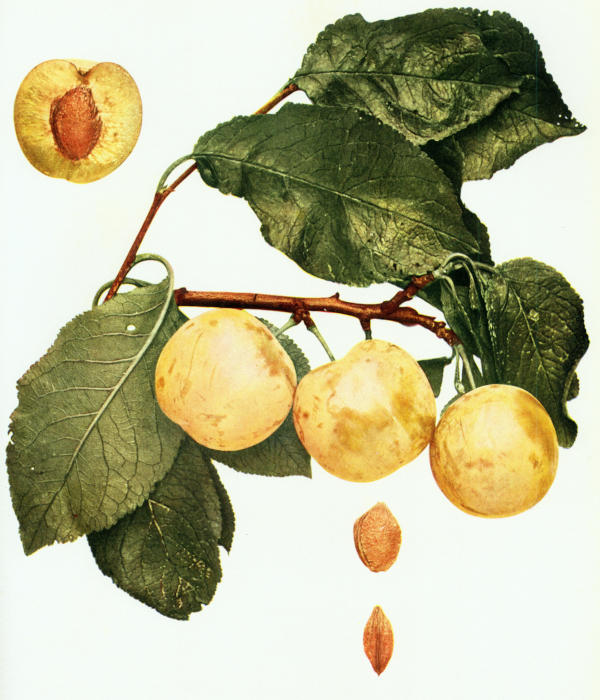
HAND
Prunus domestica
1. Horticulturist 2:436. 1847. 2. Ibid. 6:21 fig., 187, 294. 1851. 3. Am. Pom. Soc. Rpt. 190, 214. 1856. 4. Downing Fr. Trees Am. 382. 1857. 5. Hogg Fruit Man. 362. 1866. 6. Mas Pom. Gen. 2:19, fig. 10. 1873. 7. Ont. Fr. Exp. Sta. Rpt. 120. 1896. 8. Cornell Sta. Bul. 131:185. 1897. 9. Waugh Plum Cult. 108 fig. 1901. 10. Budd-Hansen Am. Hort. Man. 314, 315 fig. 1903. 11. Mass. Sta. An. Rpt. 17:159. 1905.
Gen. Hand 1, 2. General Hand 2, 3, 5, 6, 7, 8. Genl. Hand 4. General Hand 9, 10. Montgomery 3 incor.
Unproductiveness and uncertainty in bearing keep this magnificent yellow dessert plum from being one of the most commonly grown of all plums in America. Even with these handicaps, it has maintained its popularity for a century, is grown in all collections and shown in all exhibitions of note. It is the largest of the Reine Claude plums, well molded, a golden-yellow and when allowed to become fully ripe is most excellent in flavor and pleasing in all the flesh attributes of a good dessert plum. It is not as high in quality as some other of the Reine Claude plums, as, for example the Washington, with which it is often compared, for it is a little coarser in flesh and not as sprightly, but it is better than is commonly thought, because it is seldom allowed to reach its best flavor by full maturity. The trees on the Station grounds are all that could be asked for even in bearing; and elsewhere size, vigor and hardiness are usually satisfactory but productiveness is a weak point. The amateur should always plant this variety and it would seem as if it were more often worth planting in commercial orchards.
The history of this variety is well known. The original tree grew on the place of General Hand, on the Conestoga River, about a mile from Lancaster, Pennsylvania, and first fruited about 1790. Thirty years later a Mr. Miller procured grafts and succeeded in growing them. The variety was brought to the notice of fruit-growers by E. W. Carpenter, a nurseryman of Lancaster, Pennsylvania, who sent grafts to his brother, S. Carpenter, of Lancaster, Ohio, and Robert Sinclair, Baltimore, Maryland. To the latter the introduction of the Hand has been incorrectly attributed. In 1856, Hand was listed in the fruit catalog of the American Pomological Society.
Tree large, vigorous, spreading, dense-topped, hardy, variable in productiveness; branches dark ash-gray, rough, with small lenticels; branchlets of medium thickness and length, with long internodes, green changing to brownish-red, pubescent early in the season, becoming less so at maturity, with few, inconspicuous, small lenticels; leaf-buds large, long, obtuse, appressed; leaf-scars large.
Leaves folded backward, obovate or oval, two and three-eighths inches wide, four and one-half inches long; upper surface dark green, rugose, slightly hairy, with a shallow, grooved midrib; lower surface pale green, pubescent; apex and base acute, margin finely and doubly serrate; petiole three-quarters inch long, thickish, pubescent, tinged red, with from one to four small, globose, greenish-brown glands on the stalk or base of the leaf.
Blooming season intermediate in time, short; flowers appearing after the leaves, one and one-quarter inches across, white; borne sparsely on lateral buds and spurs; pedicels seven-eighths inch long, very pubescent, greenish; calyx-tube green, campanulate, pubescent; calyx-lobes broad, obtuse, pubescent on both surfaces, glandular-serrate, reflexed; petals roundish or obovate, slightly crenate, with short, broad claws; anthers yellowish; filaments three-eighths inch long; pistil lightly pubescent at the base, equal to the stamens in length.
Fruit mid-season, ripening period long; one and three-quarters inches in diameter, roundish-truncate or oblate, halves equal; cavity deep, flaring; suture shallow, distinct; apex flattened or depressed; color yellow, obscurely striped and mottled with green, overspread with thin bloom; dots numerous, whitish, inconspicuous, clustered about the apex; stem unusually long, averaging one and five-sixteenths inches in length, very pubescent, adhering strongly to the fruit; skin thick, tough, slightly astringent, separating readily; flesh golden-yellow, juicy, somewhat fibrous, firm, sweet, with pleasant, mild flavor; very good; stone semi-free or free, the cavity larger than the pit, seven-eighths inch by three-quarters inch in size, broadly oval, turgid, blunt at the base and apex, slightly roughened; ventral suture broad, sometimes winged; dorsal suture broadly and deeply grooved.
HARRIET
Prunus domestica
1. Gard. Chron. 18:441. 1882. 2. Hogg Fruit Man. 705. 1884.
Harriet is little known in America, but as the variety grows on our grounds it appears to be somewhat desirable. The type is that of Reine Claude, the fruit being slightly yellower; the quality is very good and the tree-characters are good. It is doubtful, however, in spite of these attributes to recommend it, whether, with the multiplicity of plums of this type, the variety in question can make headway in the United States. Harriet was originated by Thomas Rivers, Sawbridgeworth, England, about 1870. While considerably grown in England, it can hardly be said to be one of the leading varieties in that country.