Chapter I · EDIBLE PLUMS
Reading edition
THE GENUS PRUNUS
The great genus Prunus includes plums, cherries, almonds, apricots, peaches, and the evergreen cherries or cherry laurels. Its widely distributed species number a hundred or more for the world, nearly all of which belong north of the equator. The species of the genus are widely distributed in both the eastern and western hemispheres, the flora of eastern America and of western Asia being especially rich in species and individuals. For most part the species of Prunus belong to the Temperate Zone, but several of the evergreen cherries, usually grouped in a section under Laurocerasus, are found in the tropics and sub-tropics.
The species cultivated for their edible fruits are found only in the Temperate Zone of the Northern Hemisphere. Of these the peach and the almond are believed to have come from eastern and southeastern Asia; the apricot is thought to be a native of northern China; the wild forms of the cultivated cherries are Eurasian plants, very generally distributed in the regions to the northward where the two continents meet. The habitats of the cultivated plums are given in detail in the text that follows, as Asia, Europe and America. Presumably the genus had its origin in some of the above regions; but where the center is from which the species radiated can never be known. Indeed, with present knowledge it cannot be said in what region Prunus has most species, is most productive of individuals, or shows highest development and greatest variability,—facts which might give some evidence as to the origin of the genus. It is probable that the greatest number of combinations of the above evidences can be shown for Asia and more especially for the Eurasian region, where Europe and Asia meet; yet North America has two score or more indigenous species about half of which are arborescent.
The history of the genus Prunus is one of continual changes. Of the botanists who have done most toward classifying plants, Ray, Tournefort, Dillenius and Boerhaave, pre-Linnaean botanists, placed only the plum in Prunus. Linnaeus adopted the name used by his predecessors for the plum alone, for a genus in which he also placed plums and cherries. Adanson and Jussieu returned to the pre-Linnaean classification but Gaertner followed the grouping of Linnaeus. Necker, DeCandolle, Roemer and Decaisne held that the plum alone belongs in Prunus. Bentham & Hooker, Gray and his co-workers in the several revisions of his botany, and Engler & Prantl, great authorities of the Nineteenth Century, extend the genus to include all of the stone-fruits. On the other hand, Britton and Brown, in their recent flora of northern United States and of Canada restrict the group to plums and cherries. Horticulturists have been less divided in their opinions than the botanists and have very generally placed all of the stone-fruits in one genus. The diversity of views as to what plants belong in Prunus, indicated above, suggests that the differences separating the several stone-fruits may not be many nor very distinct. This is true, and makes necessary a discussion of the characters which distinguish these fruits.
The flowers of true plums are borne on stems in fascicled umbels and appear either before the leaves or with or after them. Flowers of the cultivated cherries are similarly borne, though the fascicles are corymbose rather than umbelliferous. But apricot, peach and almond flowers are stemless or nearly so and solitary or borne in pairs appearing before the leaves.
The fruits of plums and cherries are globular or oblong, fleshy, very juicy, with smooth or slightly hairy skins. Peaches, apricots and almonds are more sulcate or grooved than plums and cherries and the first two have juicy flesh, but that of the almond is dry and hard or skin-like, splitting at maturity thereby liberating the stone; these last three fruits are distinguished from plums and cherries by having very pubescent or velvety skins though rarely, as in the nectarine, a botanical variety of the peach, and in a few cultivated apricots, the skins are smooth.
The stone of the plum is usually compressed, longer than broad, smooth or roughened, thickish and with an acute margin along the ventral suture and thinnish or grooved on the dorsal suture. The stone of the cherry is usually globular, always much thickened, smooth or a very little roughened, ridged and grooved on the ventral suture, with a thin, scarcely raised sharp margin on the dorsal suture. The stone of the apricot is similar to that of the plum though thicker walled, with a more conspicuous winged margin, and is sometimes pitted. The stone of the peach is compressed, usually with very thick walls, much roughened and deeply pitted. In the almond the stone resembles in general characters the peach-stone, but all almond shells are more or less porous and often fibrous on the inner surfaces. The stone is the part for which the almond is cultivated and is most variable, the chief differences being that some have thick hard shells and others thin soft shells.
The leaves of plums are convolute, or rolled up, in the bud. Cherry, peach and almond leaves are conduplicate, that is are folded lengthwise along the midrib in bud while the leaves of the apricot, like those of the plum, are convolute. The manner in which the leaves are packed in the bud is a fine mark of distinction in stone-fruits. In size and shape of leaves, as well as in the finer marks of these organs, the botanist and pomologist find much to aid in distinguishing species and varieties but little that holds in separating the sub-genera. The last statement holds true with the floral organs also.
The near affinity of the stone-fruits is further shown by the fact that plums and apricots, plums and cherries, and the several species of each of the distinct fruits inter-hybridize without much difficulty. It is a fact well-known that hybrids often surpass their parents in vigor of plant and in productiveness and this has proved true with most of the hybrids in Prunus of which we have accounts, thereby giving promise of improved forms of these plants through hybridizing. The great variation in wild and cultivated native plums is possibly due to more or less remote hybridity.
Prunus is a most variable genus. This is indicated by the several sub-genera, the large number of species and the various arrangements of these groups by different authors. At their extremes sub-genera and species are very distinct, but outside of the normal types, and sometimes in several directions, there are often outstanding forms which establish well-graded connections with neighboring groups. For example, among the American plums there are but few species between which and some other there are not intermediate forms that make the two species difficult to distinguish under some conditions. There is also a wide range of variation within the species. The modifications within the species are oftentimes such as to change greatly the aspect of the plant; the trees may be dwarf or luxuriant, smooth or pubescent; may differ in branching habit, in leaf-form, in size and color of the flowers, in the time of opening of leaf and flower-buds, in color, shape, size, flesh, flavor and time of ripening of fruit, in the stone and in all such characters as climate and soil environment would be liable to modify.
This inherent variability is one of the strong assets of the genus as a cultivated group of plants, for it allows not only a great number of kinds of fruits and of species but a great number of varieties. Besides, it gives to the genus great adaptiveness to cultural environment, in accordance with climate, location, soil and the handling of the trees. The cultivator is able to modify, too, the characters of members of the genus to a high degree in the production of new forms, but few, if any, groups of plants having produced as many cultivated varieties as Prunus.
The genus Prunus is preeminent in horticulture, furnishing all of the so-called stone-fruits, fruits which for variety, delicious flavor and beauty of appearance, probably surpass those of any other genus, and which, fresh or dried, are most valuable human foods. The seeds of one of the fruits belonging to Prunus, the almond, are commercially important, both for direct consumption and for the oil which is pressed from them; in India a similar oil is obtained from the seeds of peaches and apricots, while in Europe an oil from the seeds of the Mahaleb cherry is used in making perfumes. Various cordials are made from the fruits of the several species, as kirschwasser and maraschino from cherries, zwetschenwasser and raki from plums, and peach brandy from the peach; while fruits and seeds of the several species are soaked in spirits for food, drink and medicinal purposes. The bitter astringent bark and leaves are more or less used in medicine as is also the gum secreted from the trunks of nearly all the species and which, known as cerisin, is used in various trades. The wood of all of the arborescent species is more or less valuable for lumber, for cabinet-making and other domestic purposes.
Prunus is prolific also in ornamental plants, having in common to recommend them, rapidity of growth, ease of culture, comparative freedom from pests, and great adaptability to soils and climates. The plants of this genus are valued as ornamentals both for their flowers and for their foliage. Many cultivated forms of several of the species have single or double flowers, or variegated, colored or otherwise abnormal leaves, while the genus is enlivened by the evergreen foliage of the cherry laurels. Nearly all of the plants of Prunus are spring-flowering but most of them are attractive later on in the foliage and many of them are very ornamental in fruit.
PLUMS.
Of all the stone-fruits plums furnish the greatest diversity of kinds. Varieties to the number of two thousand, from fifteen species, are now or have been under cultivation. These varieties give a greater range of flavor, aroma, texture, color, form and size, the qualities which gratify the senses and make fruits desirable, than any other of our orchard fruits. The trees, too, are diverse in structure, some of the plums being shrub-like plants with slender branches, while others are true trees with stout trunks and sturdy branches; some species have thin, delicate leaves and others coarse, heavy foliage. In geographical distribution both the wild and the cultivated plum encircle the globe in the North Temperate Zone, and the cultivated varieties are common inhabitants of the southern temperate region, the various plums being adapted to great differences in temperature, moisture and soil in the two zones.
The great variety of plums and the variability of the kinds, seemingly plastic in all characters, the general distribution of the fruit throughout the zone in which is carried on the greatest part of the world’s agriculture, and the adaptation of the several species and the many varieties, to topographical, soil and climatic changes, make this fruit not only one of much present importance but also one of great capacity for further development. Of the plums of the Old World the Domesticas, Insititias and probably the Trifloras have been cultivated for two thousand years or more, while the work of domesticating the wild species of America was only begun in the middle of the last century. There are about fifteen hundred varieties of the Old World plums listed in this work, and since the New World plums are quite as variable, as great a variety or greater, since there are more species, may be expected in America.
An attempt is made in The Plums of New York to review the plum flora of this continent, but the species considered fall far short of being all of the promising indigenous plums; not only are there more to be described, but it is probable that species here described will in some cases be sub-divided. The development of the pomological plum-wealth of North America is but begun. Not nearly as much has been done to develop the possibilities of the European plums in America as in the case of the other tree-fruits. Probably a greater percentage of the varieties of Old World plums commonly cultivated came from across the sea, than of the varieties of any other of the orchard-fruits which have been introduced. Much remains to be done in securing greater adaptability of foreign plums to American conditions. Native and foreign plums are also being hybridized with very great advantage to pomology.
The Plums of New York is written largely with the aim of furthering the development of plums in America, the possibilities of which are indicated in the preceding paragraph. With this end in view the first task is to name and discuss briefly the characters of plums whereby species and varieties are distinguished, with a statement, so far as present knowledge permits, of the variability of the different characters. It is absolutely essential that the plum-grower have knowledge, especially if he aspires to improve the fruit by breeding, of the characters of the plants with which he is to work. These are in the main as follows:
All species and some horticultural varieties have more or less characteristic trees. Making due allowance for environment—food, moisture and light—many plum groups can be readily distinguished by the general aspect of the plant. Of the gross characters of trees, size is usually most characteristic. A species, for example, is either shrubby or tree-like. Yet under varying environment, size of plant and of the parts of the plant, are probably the first to change. Habit of growth is nearly as important as size and varies but little under changing conditions. A species or variety may be upright, spreading, drooping or round-topped in growth; head open or dense; the tree rapid or slow-growing. Hardiness is a very important diagnostic character, plums being either hardy, half-hardy or tender. Both species and varieties respond in high degree to the test of hardiness, the range for varieties, of course, falling within that of the species. Productiveness, regularity of bearing, susceptibility to diseases and insects, and longevity of tree are all characters having value for species and varieties and with the exception of the first named, are little subject to variation.
The thickness, smoothness, color and manner of exfoliation of the outer bark and the color of the inner bark have considerable value in determining species but are little used in determining horticultural groups. It is well recognized that all plums have lighter colored bark in the South than in the North. The branches are very characteristic in several species. The length, thickness and rigidity of the branch and the length of its internodes should be considered, while the direction of the branch, whether straight or zigzag, are very valuable determining characters and relatively stable ones, seeming to change for most part only through long ranges of climatic conditions. So, too, the arming of a branch with spines or spurs and the structure of such organs are important. The color, smoothness, amount of pubescence, direction, length, thickness and the appearance of the lenticels, the presence of excrescences on the branchlets of the first and second year’s growth and the branching angle, are all worthy of consideration though quite too much has been made of these characters, especially of pubescence, in determining species, for they are all extremely variable.
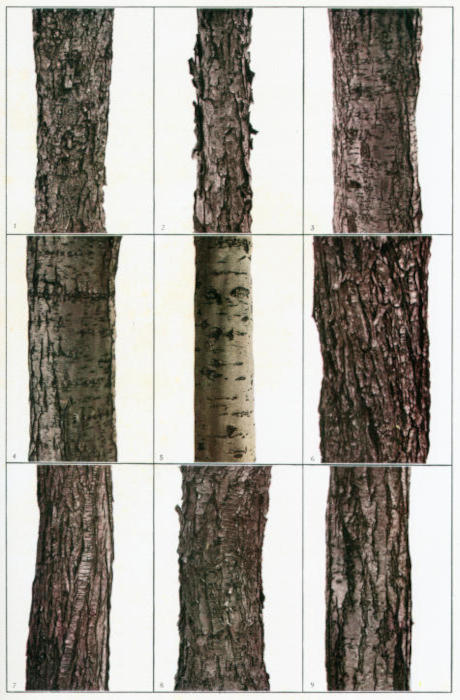
1. P. HORTULANA MINERI 2. P. AMERICANA 3. P. CERASIFERA
4. P. DOMESTICA 5. P. INSITITIA 6. P. HORTULANA
7. P. MUNSONIANA 8. P. NIGRA 9. P. TRIFLORA
The size, shape and color of leaf-buds and of their outer and inner scales and the margins of the scales differ in different species. Possibly the most evident, and therefore readiest means of identifying species, at least, is by the leaves. It is true that leaves are very variable but always within limits, and either individually or collectively in giving the general aspect to a tree they are characteristic. Modifications of leaves most often occur in very young plants, those growing in bright sunshine or deep shade and on sprouts or suckers, but none of these are usually sufficient to mislead as to species. Leaf-size and leaf-form are the first characters to be noted in determining a plum but these are closely followed in value by leaf-color, leaf-surface, leaf-thickness and leaf-margin. Leaf-size is variable, depending much upon the conditions noted above but leaf-form varies but little in the several species. So, too, the color of leaves is very constant throughout a species, for both surfaces, though impossible to describe accurately in words and very difficult to reproduce in color-printing. There is a marked difference in autumnal tints not only of species but of varieties but these are not very constant in any one location and must vary greatly under different environments. The thickness of the leaves of the several species is a distinctive character. Species of plums have very different leaf-surfaces as regards reticulation, rugoseness, pubescence and coriaceousness, all of these characters being quite constant, though it is to be noted that roughness of leaves and pubescence are increased by exposure to the sun and by the influence of some soils. There is, indeed, considerable variation in the pubescence of the leaves of all species of plums in different parts of the country and probably too much has been made of pubescence as a determining character.
The margins of leaves are very characteristic of species and scarcely vary under normal conditions if the teeth at the middle of the sides be taken rather than those toward the base or apex, these very often being crowded, reduced or wanting. The presence of glands, their position, size, shape and color, help to characterize several species and seem to be fairly constant guides. Some species and a great number of varieties have the distinguishing marks of gland-like prickles tipping the serrations in the leaf-margins. Length, thickness, rigidity and pubescence of petiole have some taxonomic value. Stipules usually offer no distinguishing marks other than those mentioned under leaves.
The blossoms of plums are very characteristic, giving in flowering time a distinctive aspect to all species and distinguishing some horticultural varieties. The flowers of all the species are borne in clusters, differing in number of individuals, according to the species; so, too, the flowers in the different species vary in size, color, in length of their peduncles, and in pubescence, especially of the calyx. Flower-characters are constant, taking them as a whole, yet there are some variations that must be noted. One of the most marked of these is in the time of appearance of the flowers; in the South they appear before the leaves but in the North with the leaves. On the grounds of this Station there are notable exceptions to the latter statement, with varieties of species showing considerable variation in this regard. There are some remarkable variations within species as regards size and color of the corolla and glands and pubescence of the calyx, depending upon the environment of the plant; but on the whole these characters are very constant. The fragrance of the flowers of plums varies from a delicate, agreeable odor to one that is quite disagreeable in some species as in Americana; the odor seems to be a constant character.
Of all structures of the plum the fruit is most variable, yet fruits are sufficiently distinct and constant, especially within species, to make their characters very valuable in classification. Species, whether wild or cultivated, may be distinguished in greater or less degree by the period of ripening of the fruits, though in this regard the cultivated varieties of the several species vary greatly and in the wild state trees of native plums in the same locality, even in the same clump, may vary in ripening as much as from two to four weeks. Species are distinguished by size, shape, color, flesh, flavor and pit among the grosser characters of the structure and by amount of bloom, stem, cavity, apex, suture and skin among the minor characters. The fruit is usually the first part of the plant to respond to changed conditions.
Characters derived from seed structures are generally accounted of much value by botanists in determining species. Such is the case with plums. This Station has a collection of stones of over three hundred cultivated varieties of plums and some specimens of nearly all the different species. The stones illustrated in the color-plates in this book show that this structure is quite variable in size, shape, in the ends, surfaces, grooves and ridges, even within a species; nevertheless in describing the several hundred forms of plums for The Plums of New York the stone has been quite as satisfactory, if not the most satisfactory, of any of the organs of this plant for distinguishing the various species and varieties.
The reproductive organs of plums afford several characters and would seem to offer means of distinguishing botanical and horticultural groups, but they are so variable in both cultivated and wild plants as to be very misleading. Not only do these organs differ very often in structure but also in ability to perform their functions. Bailey[1] has called attention to the remarkable self-sterility of some varieties of the native species of plums, due to the impotency of the pollen upon flowers of the same variety. C. W. H. Heideman[2] made some very interesting observations on what he considers distinct forms of the flowers of the Americana plums, describing for this species all of the six possible variations of flowers enumerated by Darwin in his Different Forms of Flowers in Plants of the Same Species. Heideman thinks that other species of Prunus exhibit similar variations. Waugh[3] made the pollination of plums a subject of careful and extended study and found much variation in the pistils of plants of the same species, insufficient pollen in some plants, pollen impotent on the stigma of the same flower, and considerable difference in the time of maturity of pollen and stigma in some plums, especially the Americana plums. These variations, most important to the plum-grower, are of more or less use in identifying plums.
After the discussion of the characters of plums we may pass to a detailed description and discussion of the species of plums which now contribute or may contribute cultivated forms to the pomology of the country either for their fruits or as stocks upon which to grow other plums. The following conspectus shows as well as may be the relations of the species of plums to each other.
CONSPECTUS OF SPECIES OF PLUMS.
A. Flowers in clusters of 1 or 2. (Three in P. triflora.) Old World plums.
B. Leaves drooping.
C. Shoots and pedicels pubescent.
D. Flowers mostly in twos.
E. Fruits large, more than 1 inch in diameter, variable in shape, often compressed; tree large; stamens about 30. 1. P. domestica.
E.E. Fruit small, less than 1 inch in diameter, uniformly oval or ovoid; stamens about 25; tree small, compact. 2. P. insititia.
D.D. Flowers mostly single.
E. Leaves small, less than 2 inches in length; sometimes a tree; very thorny 3. P. spinosa.
E.E. Leaves large, more than 2½ inches in length; a shrub; thorns few 4. P. curdica.
C.C. Shoots glabrous or soon becoming so, pedicels glabrous.
D. Pedicels shorter than the calyx-cup; leaves glabrous or sparsely pubescent on the under side along the rib; flowers in pairs 5. P. cocomilia.
D.D. Pedicels more than twice as long as the calyx-cup.
E. Flowers mostly single; leaves hairy along the midrib on the under side; petiole ⅕ as long as the leaf-blade; a tree 6. P. cerasifera.
E.E. Flowers in threes; leaves glabrous, petiole shining, leaf-margins finely and closely serrate, teeth glandular-pointed; stamens about 25 7. P. monticola.
E.E.E. Flowers in threes; leaves glabrous, often shining, leaf-margins finely and closely serrate, teeth glandular-pointed; stamens about 25 8. P. triflora.
B.B. Leaves upright, peach-like, glabrous, veins very conspicuous, under side barbate at axils of veins; separated from all other plums by the leaf-characters and by the large, flattened, brick-red fruits 9. P. simonii.
A.A. Flowers in clusters of 3 or more, rarely 2. American plums.
B. Plants trees. (P. angustifolia rarely a tree.)
C. Leaves broad, mostly ovate or obovate.
D. Leaves long-ovate or long-obovate.
E. Flowers white.
F. Leaf-serrations glandless, acute; petiole usually glandless; calyx-lobes entire, glabrous on the outer, pubescent on the inner surface; stamens about 30; stone turgid, large, pointed at the apex 10. P. americana.
F.F. Leaf-serrations glandular, wavy-crenate; petioles glandular; calyx-lobes glandular-serrate, pubescent on the inner surface; stamens about 20; stone turgid, small, prolonged at the ends 11. P. hortulana.
E.E. Flowers fading to pink.
F. Leaf-serrations coarse, rounded, glandular only when young; petioles biglandular; calyx-lobes glandular-serrate, not pubescent on the inner surface; stamens about 30; fruit red; bloom light; stone flat 12. P. nigra.
F.F. Leaf-serrations fine, acute, glandular-pointed; petioles biglandular; calyx-lobes entire, pubescent on the outer, tomentose on the inner surface; fruits dark purple; bloom heavy; stone turgid, acute at the ends 13. P. alleghaniensis.
D.D. Leaves round-ovate, obtusely, sometimes doubly serrate; petioles glandless; calyx-lobes pubescent on both surfaces; fruit dark red or purplish; stone turgid, pointed at both ends 14. P. subcordata.
C.C. Leaves narrow, lanceolate-ovate.
D. Leaves flat.
E. Leaves glabrous; fruits globular, usually purple at maturity but sometimes red or orange-red; bloom thin; stone turgid, cherry-like 15. P. umbellata.
E.E. Leaves pubescent.
F. Stone acute at both ends; fruit purple. 16. P. mitis.
F.F. Stone rounded at base; fruits variously colored 17. P. tarda.
D.D. Leaves more or less folded upward.
E. Fruits small, ½ inch in diameter, cherry-like; leaves lanceolate, upper surface glabrous, lustrous, lower surface pubescent in axils of veins, marginal teeth glandless; petioles biglandular; stone small, ovoid, turgid, cherry-like; rarely a tree; tender in New York 18. P. angustifolia.
E.E. Fruits large, an inch in diameter, plum-like; leaves lanceolate, peach-like, upper surface glabrous, lower surface pubescent along the midrib; petioles with from 1 to 6 glands; stone compressed and pointed at both ends; usually a tree; hardy in New York 19. P. munsoniana
B.B. Plants shrubs.
C. Fruits dark purple.
D. Leaves ovate, acute, finely serrated; shoots becoming glabrous; stones pointed at both ends 20. P. maritima.
D.D. Leaves oval-orbicular, crenate-serrate; shoots usually pubescent; stone pointed only at the base 21. P. gravesii.
C.C. Fruits red or orange, sometimes yellow but never deep purple.
D. Fruits large, 1 inch in diameter; leaves oblong-ovate, long-pointed, margin serrate with incurved sometimes glandular teeth, upper surface glabrous, lower surface pilose; petiole with 1 or 2 glands; stone oval, flattened 22. P. orthosepela.
D.D. Fruits small, ½ inch in diameter.
E. Leaves small, ovate-lanceolate or oval, margins finely and evenly serrate, upper surface glabrous, lower surface soft pubescent; petioles short and stout; fruits variable in color, mostly red; stone turgid, pointed at both ends 23. P. gracilis.
E.E. Leaves oblong-ovate, margins coarsely or doubly serrate, glabrous above and sparingly pubescent below; petiole glandular; fruits cherry-red 24. P. rivularis.
1. PRUNUS DOMESTICA Linnaeus
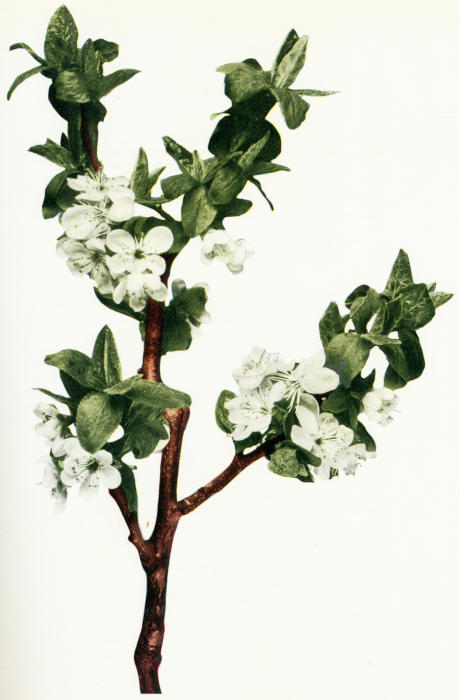
PRUNUS DOMESTICA
1. Linnaeus Sp. Pl. 475. 1753. 2. Duhamel Traite des Arb. 2:93, 95, 96. 1768. 3. Seringe DC. Prodr. 2:533. 1825. 4. Hooker Brit. Fl. 220. 1830. 5. London Arb. Fr. Brit. 1844. 6. De Candolle Or. Cult. Pl. 212. 1885. 7. Schwarz Forst. Bot. 338. 1892. 8. Koch, W. Syn. Deut. und Schw. Fl. 1:727. 1892. 9. Dippel Handb. Laubh. 3:636. 1893. 10. Lucas Handb. Obst. 429. 1893. 11. Waugh Bot. Gaz. 26:417-27. 1898. 12. Bailey Cyc. Am. Hort. 1448. 1901. 13. Waugh Plum Cult. 14. 1901. 14. Schneider Handb. Laubh. 1:630. 1906.
P. communis domestica. 15. Hudson Fl. Anglic. 212. 1778. 16. Bentham Handb. Brit. Fl. 1:236. 1865.
P. œconomica (in part) and P. italica (in part). 17. Borkhausen Handb. Forstb. 2:1401, 1409. 1803. 18. Koch, K. Dend. 1:94, 96. 1869. 19. Koehne Deut. Dend. 316. 1893.
Tree reaching a height of 30 or 40 feet, vigorous, open-headed, round-topped; trunk attaining a foot or more in diameter; bark thick, ashy-gray with a tinge of red, nearly smooth or roughened with transverse lines; branches upright or spreading, straight, stout and rigid, usually spineless; branchlets usually pubescent, light red the first year, becoming much darker or drab; lenticels small, raised, conspicuous, orange.
Winter-buds large, conical, pointed, pubescent, free or appressed; leaves large, ovate or obovate, elliptical or oblong-elliptical, thick and firm in texture; upper surface dull green, rugose, glabrous or nearly so, the lower one paler with little or much tomentum, much reticulated; margins coarsely and irregularly crenate or serrate, often doubly so, teeth usually glandular; petioles a half-inch or more in length, stoutish, pubescent, tinged with red; glands usually two, often lacking, sometimes several, globose, greenish-yellow; stipules very small, less than a half-inch, lanceolate, narrow, serrate, early caducous.
Flowers appearing after or sometimes with the leaves, showy, an inch or more across, greenish-white to creamy-white; borne on lateral spurs or sometimes from lateral buds on one-year-old wood, 1 or 2 from a bud in a more or less fascicled umbel; pedicels a half-inch or more in length, stout, green; calyx-tube campanulate, glabrous or pubescent, green; calyx-lobes broadly oblong, obtuse, pubescent on both surfaces, glandular-serrate, usually reflexed; petals white or creamy in the bud, oval to obovate, crenate, notched or entire, claw short and broad; stamens about 30, equal to or shorter than the petals; anthers yellow, sometimes tinged with red; pistils about as long as the stamens, glabrous or pubescent.
Fruit of various shapes, mostly globular or sulcate, often necked, blue, red or yellow; stem a half-inch or more long, stout, pubescent; cavity shallow and narrow; apex variable, usually rounded; suture prominent or sometimes but a line or indistinct; skin variable; dots small, numerous, inconspicuous; flesh yellowish, firm, meaty, sweet or acid and of many flavors; stone free or clinging, large, oval, flattened, blunt, pointed or necked, slightly roughened or pitted; walls thick; one suture ridged—the other grooved.
Beside the comparatively well-known groups of Domestica varieties, there are in Europe, with an occasional representative in America, especially in herbaria, numerous other groups either a part of Prunus domestica or possibly, in a few cases at least, hybrids between it and other species. European botanists place some of these in distinct species or sub-species; but few, however, even of the recent writers on the botany of the plum, agree at all closely as to the disposition of these edible and ornamental plums which may be doubtfully referred to Prunus domestica. With this disagreement between the best European authorities where these plums have long been known, where some of them have originated, and all may be found in orchards, botanic gardens and herbaria, it does not seem wise at this distance to attempt a discussion of such doubtful forms. It is certain, however, that Borkhausen’s Prunus italica and Prunus œconomica, as given in the synonymy, are but parts of Prunus domestica, the first including the Reine Claude plums and the latter the various prunes. So, too, a wild form named by Borkhausen, Prunus sylvestris, is probably a part of Prunus domestica.
Bechstein[4] gave specific names to a number of plums which Schneider[5] holds are all cultivated forms of Prunus domestica. These names are not infrequently found in botanical and pomological literature, to the great confusion of plum nomenclature. The following are Bechstein’s species:—Prunus exigua, Prunus rubella, Prunus lutea, Prunus oxycarpa, Prunus subrotunda and Prunus vinaria.
The plum in which the world is chiefly interested is the Old World Prunus domestica. The Domestica plums are not only the best known of the cultivated plums, having been cultivated longest and being most widely distributed, but they far surpass all other species, both in the quality of the product and in the characters which make a tree a desirable orchard plant. How much of this superiority is due to the greater efforts of man in domesticating the species cannot be said, for the natural history of this plum, whether wild or under cultivation, is but poorly known. It is not even certain that these plums constitute a distinct species, there being several hypotheses as to the origin of the Domestica varieties. Three of these suppositions must be considered.
Many botanists hold that what American pomologists call the species is an assemblage of several botanical divisions. The early botanists distributed these plums in botanical varieties of one species. Thus Linnaeus, in 1753, divided Prunus domestica into fourteen sub-species, and Seringe, in 1825, made eight divisions of the species. Both of these men include in this species, among others, plums which we now place in Prunus cerasifera, the Cherry plums, and Prunus insititia, the Damsons and Bullaces. Nearly all subsequent botanists who have not made two or more species of it have recognized from two to several sub-divisions of Prunus domestica. It is possible that what are called the Domestica plums should be distributed among several botanical divisions. But it is difficult to find any differential character sufficiently constant to distinguish more than one species for the several hundred varieties of these plums now under cultivation. Nor are there any cleavage lines sufficiently distinct to indicate that the edible varieties of the one species should be sub-grouped.
In coming to these conclusions the writer has studied about three hundred varieties of Domestica plums growing on the grounds of this Station and about half as many more growing in other parts of the country, the whole number representing all of the various species and sub-species which other workers have made. The differences which have been most used to classify the varieties of Domestica in several botanic divisions have to do chiefly with the fruit, as size, shape, color and flavor, characters so modified by cultivation and selection that they are artificial and transitory and of little value in botanical classification. Moreover, the botanical groups which have been founded on these characters are much more indistinct than ordinarily in botany because of the merging at many points of one group into another. This indistinctness is greatly increasing year by year through the intercrossing of varieties. When the characters of no value to man, and, therefore, little modified by cultivation, are considered, it is scarcely possible logically to place Domestica plums in more than one species or to further sub-divide the one species.
The botanists who have divided the Domestica plums into either greater or lesser botanical groups do not define their divisions with sufficient accuracy to make them clearly recognizable. Neither do they give the habitats of the wild progenitors with sufficient certainty to carry conviction that the groups were brought under cultivation from separate ancestors. Also, the several botanists who hold to the multiple species theory for the Domestica plums do not agree as to the limits of the different groups and give to them very different specific or variety names, showing that they have widely different ideas as a basis for their classification.
A second theory is that Prunus domestica is derived from Prunus spinosa and that Prunus insititia is an intermediate between the two.[6] This hypothesis is based upon the supposition that when Domestica plums run wild they revert to the Insititia or Spinosa form. It is not difficult to test this theory. A study of the origin of the several hundred Domestica and Insititia plums discussed in Chapters III and IV of The Plums of New York does not show for any one of them a tendency to reversion or evolution to other species; nor do the descriptions indicate that there are many, if any, transitional forms. During the two thousand years they have been cultivated in Europe the Old World plums have been constant to type. Domestica seedlings vary somewhat but they do not depart greatly from a well marked type. Such very few striking departures as there seem to be are more likely to have arisen through crossing with other species than through reversion or evolution. This Station has grown many pure seedlings or crosses of varieties of Domestica within the species and has had opportunity of examining many more from other parts of the State, and none of these show reversion to the other two Old World species. Nor, as we shall see, is there much in what is known of the history of these three species to lead to the belief that the Domestica, Insititia and Spinosa plums constitute but one wild species or have arisen from one.
It has been remarked that there are few, if any, transitional forms between the Domestica and other European plums. It is a significant fact that Prunus domestica can be hybridized with other species of plums only with comparative difficulty, species of plums as a rule hybridizing very freely. This is as true with the Insititia and Spinosa as of other plums, there being few recorded hybrids of either of these species with the one under discussion. Quite to the contrary the varieties of the several pomological groups of Domestica plums hybridize very freely. If all were of one species we should expect many hybrids between the Domestica, Insititia and Spinosa plums.
We are now left with the third hypothesis, which is, as we have indicated in a preceding paragraph, that the varieties of Domestica plums belong to one species; or if they have come from more than one species the wild forms have not been distinguished and must have grown under much more nearly similar conditions than is the case with Prunus domestica and any other species. Without knowledge of more than one wild form, and in view of the intercrossing of the varieties of these plums it seems best to consider all as parts of one species, leaving to the pomologist the division of the species into horticultural groups founded on the characters which make the fruit valuable for cultivation.
Assuming, then, that the plums known in pomology as Domestica plums belong to one species, the original habitat of the species may be sought. In spite of the great number of varieties of plums now grown in Europe and western Asia, and the importance of the fruit both in the green and dried state, the history of the plums cannot be traced with much certainty beyond two thousand years. Though stones, without doubt those of the Insititia or Damson and the Spinosa or Blackthorn plums, are found in the remains of the lake dwellings in central Europe[7] the pits of Domestica plums have not yet come to light. In the summer of 1909 the writer, in visiting historic Pompeii, became interested in the illustrations of fruits in the frescoes of the ancient buildings, but neither in the houses of the ruined city nor in the frescoes in the museums in Naples could he find plums, though several other fruits, as apples, pears, figs and grapes were many times illustrated. An examination of the remains of plants preserved in the museum at Naples taken from under the ashes and pumice covering Pompeii gave the same results. No stone-fruits were to be found, though if widely used these should have been on sale in the markets of Pompeii at the time of the destruction of the city, which occurred late in August,—the very time of the year at which the examination was made and at which time plums were everywhere for sale in Rome. This observation is but another indication that plums were not well-known before the beginning of Christianity, since Pompeii was destroyed in 79 A. D. In Greek literature the references to plums are few before the Christian era and these are more likely to some form of Insititia, as the Damsons, rather than to the Domesticas.
Pliny gives the first clear account of Domestica plums and speaks of them as if they had been but recently introduced. His account is as follows:[8] “Next comes a vast number of varieties of the plum, the particolored, the black, the white, the barley plum, so-called because it is ripe at Barley harvest, and another of the same color as the last, but which ripens later, and is of a larger size, generally known as the ‘Asinina,’ from the little esteem in which it is held. There are the onychina, too, the cerina,—more esteemed, and the purple plum; the Armenian, also an exotic from foreign parts, the only one among the plums that recommends itself by its smell. The plum tree grafted on the nut exhibits what we may call a piece of impudence quite its own, for it produces a fruit that has all the appearance of the parent stock, together with the juice of the adopted fruit; in consequence of its being thus compounded of both, it is known by the name of ‘nuci-pruna.’ Nut-prunes, as well as the peach, the wild plum and the cerina, are often put in casks and so kept till the crop comes of the following year. All the other varieties ripen with the greatest rapidity and pass off just as quickly. More recently, in Baetica, they have begun to introduce what they call ‘malina,’ or the fruit of the plum engrafted on the apple tree, and ‘amygdalina,’ the fruit of the plum engrafted on the almond tree, the kernel found in the stone of these last being that of the almond. Indeed, there is no specimen in which two fruits have been more ingeniously combined in one. Among the foreign trees we have already spoken of the Damascene plum, so-called from Damascus, in Syria, but introduced long since into Italy, though the stone of this plum is larger than usual, and the flesh small in quantity. This plum will never dry so far as to wrinkle; to effect that, it needs the sun of its own native country. The myxa, too, may be mentioned as being the fellow countryman of the Damascene; it has of late been introduced into Rome and has been grown engrafted upon the sorb.”
While the records are somewhat vague it is probable that the Domestica plums came from the region about the Caucasus Mountains and the Caspian Sea and especially the section east of these mountains and the sea. What seems to be the wild form of this species has been found by several botanists in this great region.[9] Here the Huns, Turks, Mongols and Tartars, flowing back and forth in tides of war-like migration, maintained in times of peace a crude agriculture probably long before the Greeks and Romans tilled the soil. The plum was one of their fruits and the dried prune a staple product. Here, still, to the east, west and north toward central Asia, plums are among the common fruits and prunes are common articles of trade. Even in the fertile oases of the great central Asian desert, plums are cultivated, but whether domesticated here or brought from elsewhere cannot be told. Koch,[10] speaking of prunes in particular, gives the following account (translated) of their Asiatic origin:
“According to my investigation Turkestan and the southern Altai Mountains are the place of origin. When in the year 1844 I found myself in Baku on the west coast of the Caspian Sea, I had plenty of opportunity to draw accounts of the fruits of their native lands from the Turkestan and Bokharan merchants, and was astonished over the high cultivation of stone fruits in these places—at the same time I was able to taste dried the most choice because best flavored, the Ali-Bokhara, that is Bokhara prune. Some of these Bokharan prunes were transplanted a long time ago to Trans-Caucasia and were especially cultivated in the ancient city and residence of the Ruler of the modern Elizabethpol. Unfortunately the cultivation is less now than in earlier times. A further spread toward the west and toward Europe, I have not been able to follow. In Greece, the prunes are even to-day an unknown fruit.”
At about the time Pliny wrote, or somewhat before, communication had been opened between the Romans and the countries about the Caspian Sea, and a few centuries later the devastating hordes of Asiatics came westward and for several centuries continued to pour into eastern Europe. What more probable than that they should have carried dried prunes as an article of food in the invasions, and eventually, as they made settlements here and there, have introduced the trees in Europe. It is certain, at any rate, as we shall see, that several of the groups of cultivated plums trace back to the Balkan countries of Europe and the region eastward. There, now as then, the plum is a standard fruit and prune-making a great industry.
The plum when first known in Europe, as described by Pliny and other early writers, seems to have been a large and well-flavored fruit, indicating that it had been under cultivation for a long while. This, and the fact that the fruit was not known by the earliest writers on agriculture, indicate that the plum was not originally an inhabitant of southern Europe, as some suppose. It is likely that the tree has escaped from cultivation and become naturalized in the localities where it is now supposed to grow wild. Prunus domestica has not been found wild nor under cultivation in eastern Asia, so far as can be learned by the botanical and horticultural explorers of China and nearby regions, Prunus triflora being the domesticated plum of that part of the continent, though it may well be surmised that some of the Domestica plums are cultivated in western China, a region as yet but imperfectly explored for its plants.
Having briefly sketched the origin of the Domestica plums in the Old World we may now consider their history in the New World—a more satisfactory task, as data are abundant and reliable.
The Domestica plums are valuable food-producing trees in America but have not attained here the relative importance among fruits that they hold in Europe. From the earliest records of fruit-growing in the New World the plum has been grown less than the apple, pear, peach or cherry, while in Europe it is a question if it does not rank first or second among the tree-fruits. The comparatively restricted area which the Domestica plums now occupy in America is due, perhaps, to the fact that they do not possess in as high degree as the fruits named above the power of adaptation to the trans-Atlantic environment. Without question the feature of environment most uncongenial to plums in America is the climate. The plum thrives best in an equable climate like that of eastern and southern Europe and of western America, and cannot endure such extremes of heat and cold, wet and dry, as are found in parts of eastern America and in the Mississippi Valley. At best this fruit lacks in what is called constitution, or ability to withstand adverse conditions of any kind, whether of climate, culture, insects or fungi. Thus in America this plum suffers severely not only from climate but from several parasites, as curculio, black-knot, leaf-blight, plum-pockets and other pests.
We find, therefore, that in North America the Domestica plums are confined to favored localities on the Atlantic seaboard, the Great Lakes region and the Pacific coast. In the first named area they are to be found thriving to a limited degree in Nova Scotia and parts of Quebec, somewhat in central New England, and particularly well in the fruit-growing sections of New York, especially in the parts of this State where the climate is made equable by large bodies of water. South of New York, excepting in a few localities in Pennsylvania, but few plums of this species are grown. The Domestica plums are grown with indifferent success in southern Ontario and in Michigan, and now and then an orchard is found to the south almost to the Gulf. In the great Valley of the Mississippi and in the states of the plains this plum is hardly known. Westward in the irrigated valleys of the Rocky Mountains and the Great Basin, the climate is favorable and the European plums are nearly as well-known as in any other portion of the continent excepting the Pacific Coast.
It is in the last named region that the foreign plum reaches its highest development in the New World. The trees in California, Oregon and Washington are very thrifty and the plums are of large size, handsome appearance and of high quality. Both tree and fruit in this favored region are free from most of the insect and fungus troubles with which the eastern plum-growers must contend. Curculio and black-knot, scourges of eastern orchards, are not troublesome on the western coast. In this region the Domesticas, practically the only plums cultivated, succeed on either irrigated or naturally watered lands.
It is probable that some of these plums were introduced into America by the first colonists, but if so, the early records do not show that the fruit was much grown in this country until toward the end of the Eighteenth Century. Certainly during the first two centuries of colonization in the New World there were no such plum plantations as there were of the apple, pear and cherry. Among the first importations of plums were those made by the French in Canada, more particularly in Nova Scotia, Cape Breton, Prince Edward Island and in favored situations such as the L’Islet County and the Island of Montreal bordering and in the St. Lawrence River.
Peter Kalm in his Travels into North America in 1771 records the culture of plums as far north as Quebec with the statement that “Plum trees of different sorts brought over from France succeed very well here,” adding further, “The winters do not hurt them.”[11] There are other records to show that the French, always distinguished for their horticultural tastes, if not the first to grow this fruit in America, at least began its culture at a very early date.
In the voyages undertaken for exploration and commerce soon after the discovery of America by Columbus the peach was introduced in America by the Spanish; for soon after permanent settlement had been made in the South the settlers found this fruit in widespread cultivation by the Indians and its origin could only be traced to the Spaniards who early visited Florida and the Gulf region. William Penn wrote as early as 1683 that there were very good peaches in Pennsylvania; “not an Indian plantation was without them.”[12] The abundance of this fruit was noted by all the early travelers in the region from Pennsylvania southward and westward but though the wild plums are often mentioned there are no records of cultivated plums until the colonies had long been established.
In Massachusetts some plums were planted by the Pilgrims, for Francis Higginson, writing in 1629, says: “Our Governor hath already planted a vineyard with great hope of increase. Also mulberries, plums, raspberries, corrance, chestnuts, filberts, walnuts, smalnuts, hurtleberries.”[13] The plums were Damsons, as a statement is made a little later that the “Red Kentish is the only cherry and the Damson the only plum cultivated.” A further reference to this plum is made by John Josselyn, when, writing of a voyage to New England in 1663, he says, “The Quinces, Cherries, Damsons, set the dames a work, marmalad and preserved Damsons is to be met with in every house.”[14]
In 1797 there is the following concise account of the plums cultivated in New England:[15]
“The better sorts which are cultivated are the horse plum, a very pleasant tasted fruit, of large size; the peach plum, red toward the sun, with an agreeable tartness; the pear plum, so-called from its shape, which is sweet, and of an excellent taste; the wheat plum, extremely sweet, oval, and furrowed in the middle, not large; the green-gage plum, which is generally preferred before all the rest.”
A search in the colonial records of Pennsylvania, New Jersey and Delaware shows no records of cultivated plums in these states until the establishment of the Bartram Botanic Garden near Philadelphia in 1728. Here John Bartram grew fruits, trees and flowers of many kinds received through exchanges of indigenous species with European correspondents. Among the plants sent over from Europe to Bartram were several varieties of plums which were propagated and distributed throughout Pennsylvania and nearby provinces. It must not be supposed, however, that the Domestica plums had not been grown in Pennsylvania previous to Bartram’s time. The plum grows fairly well in localities of this region, and without question it had been planted by the early colonists with seeds brought from across the sea. But the absence of references to the plum, where they abound to the apple, pear, peach, quince and cherry, shows that this fruit was not much cultivated by the Quakers and Swedes who settled in the three states watered by the Delaware.
In the southern colonies the Domestica plums grow but poorly, and as the early settlers of these states were chiefly concerned with tobacco and cotton, paying little attention to fruits, we should expect the plum to have been neglected. Then, too, the peach, escaped from the early Spanish settlements, grew spontaneously in many parts of the South, furnishing, with the wild plums of the region, an abundant supply of stone-fruits. Yet the plum was early introduced in several of the southern colonies.
Thus Beverly,[16] writing in 1722 of Virginia, says: “Peaches, Nectarines and Apricocks, as well as plums and cherries, grow there upon standard trees,” with the further statement that these fruits grew so exceedingly well that there was no need of grafting or inoculating them. Lawson,[17] in his history of North Carolina, written in 1714, says that the Damson, Damazeen and a large, round, black plum were the only sorts of this fruit grown in that state in 1714.
In South Carolina Henry Laurens, who should be accounted a benefactor not only of that State but of the whole country as well, about the middle of the Eighteenth Century grew in Laurens Square in the Town of Amonborough all the plants suitable to that climate that widely extended merchantile connections enabled him to procure. Thus among fruits he grew olives, limes, Alpine strawberries, European raspberries and grapes, apples, pears and plums. John Watson, one of Laurens’ gardeners, planted the first nursery in South Carolina. His plantation was laid waste in the Revolution, though it was afterwards revived by himself and his descendants and was still further continued by Robert Squib. The plum in several varieties was largely grown and distributed from this nursery.
Charleston, South Carolina, was at the beginning of the Nineteenth Century the southern center of horticultural activities and the European plum was widely distributed from here at this time. Of the several botanic gardens, really nurseries, in Charleston, one was conducted by André Michaux who was sent by the French Government in 1786 to collect American plants. Another was owned by John Champneys at St. Pauls, near Charleston, and was managed by a Mr. Williamson who grew all of the species of trees, fruits and shrubs, native and foreign, which could be procured.[18] The third of these gardens was owned by Charles Drayton at St. Andrews in which not only exotic fruits were grown but those of the region as well. The plum trees frequently mentioned in the records of the time as growing in this region came from these nurseries.
In Florida, as has been stated, the peach was introduced by the Spanish explorers, but if the plum were also planted by the Spaniards it quickly passed out with the cessation of cultivation. But later there are records[19] of this and nearly all of the fruits of temperate and sub-tropic climates having been grown at St. Augustine and Pensacola. In the remarkable colony[20] founded by Dr. Andrew Turnbull at New Smyrna, Florida, in 1763, the plum was one of the fruits cultivated. It is not probable, however, that the culture of this fruit was ever extensive in Florida as it does not thrive there.
William Bartram, son of John Bartram the founder of the Bartram Botanic Garden, set out on a botanical expedition through the Southern States in 1773, which lasted five years. He records[21] numerous observations on the horticulture of both the colonists and the Indians. At Savannah, Georgia, he found gardens furnished with all the cultivated fruit trees and flowers in variety. One of the earliest settlements made by the English in Georgia was Frederica, and here he found the peach, fig, pomegranate and other trees and shrubs growing about the ruins; though not specifically mentioned, the plum had probably been planted here with the other fruits. At the junction of the Coose and Tallapoosa rivers in Alabama, there were thriving apple trees, which had been set by the French at Pearl Island in the last named state. Between Mobile and New Orleans, Bartram found peaches, figs, grapes, plums and other fruits growing to a high degree of perfection and such also was the case on a plantation on the Mississippi in Louisiana near Baton Rouge.
These several references to plums show that this fruit was at least tried in early colonial times, but it was not until after the establishment of fruit-growing as an industry that any extensive plantings were made. Pomology really began in America, though it languished for the first half-century, at Flushing, Long Island, about 1730 with the establishment of a commercial nursery by Robert Prince, first of four proprietors. Just when this nursery, afterwards the famous Linnaean Botanic Garden, began to offer plums cannot be said, but in 1767 one of their advertisements shows that they were selling plum trees. As a possible indication that the fruit was not highly esteemed at this period, an advertisement of trees for sale from this nursery in the New York Mercury of March 14th, 1774, does not offer plums. But in 1794 the catalog of the nursery offers plums in variety. Indeed, as we shall see, William Prince had at this time taken hold of the propagation and improvement of the Domestica plums with great earnestness.
William Prince, third proprietor of the nursery founded by his grandfather says in his Treatise of Horticulture,[22] “that his father, about the year 1790 planted the pits of twenty-five quarts of Green Gage plums; these produced trees yielding fruit of every color; and the White Gage [Prince’s Imperial Gage], Red Gage and Prince’s Gage, now so well known, form part of the progeny of these plums, and there seems strong presumptive evidence to suppose that the Washington Plum was one of the same collection.” In 1828 the Prince nursery was offering for sale one hundred and forty varieties of plums which William Prince states[23] “are a selection only of the choicest kinds, in making which, the commoner fruits have been altogether rejected.” Of the kinds grown, there were over twenty thousand trees.[24] To this nursery, to William Prince and to William Robert Prince,[25] the fourth proprietor in particular, belong the credit of having given plum-growing its greatest impetus in America.
Other notable nurseries founded at the close of the Eighteenth Century, which helped to establish plum culture in America, were those of the Kenricks, of William Coxe, and of David Landreth and Son. The Kenrick Nursery was founded in 1790 at Newton, Massachusetts, by John Kenrick, under whom and his sons, William and John A., the business was continued until 1870.[26] During a large part of this period the Kenrick Nursery probably grew, imported and disposed of a greater quantity of fruit trees than any other nursery in New England. Coxe’s nursery was established in 1806, at Burlington, New Jersey, but he had been growing fruit for many years previous and was thus a pioneer pomologist before becoming a nurseryman. In his book, A View of the Cultivation of Fruit Trees, published in 1817, the first American book on pomology, he says[27] he had been “for many years actively engaged in the rearing, planting and cultivating of fruit trees on a scale more extensive than has been attempted by any other individual of this country.” The third of these nurseries, that of David Landreth and Son, was conducted in connection with the seed establishment of that family founded in Philadelphia in 1784. Their collection of fruits was among the most extensive of the time and must have forwarded the cultivation of the plum in that region.[28]
A century ago the fruit-growing of the country was largely in the hands of amateurs and patrons of horticulture. Many varieties of plums must have been introduced by these lovers of plants. Among such growers of fruit was William Hamilton of Philadelphia, who introduced the Lombardy poplar in 1784, and who in 1800 was growing all the plants and fruits procurable in Europe. Ezekiel Henry Derby of Salem, Massachusetts, one of the founders of the Massachusetts Society for Promoting Agriculture, grew many choice foreign plants in his garden, greenhouse, orchard and arboretum, and attained well merited fame as a horticulturist.[29] Dr. David Hosack, botanist and founder in 1801 of the Elgin Botanic Gardens in what is now New York City, was one of the most distinguished patrons of pomology of his time and grew many new fruits and plants from Europe, afterwards placing them in the hands of the horticulturists of the country.[30]
These are but a very few of the many men who, having wealth and leisure, were engaged in growing fruits and plants as an avocation but were adding greatly to the material and knowledge of those to whom fruit-growing was a vocation. As a further example of how much these men contributed to horticulture, a purchase made by a member of the New York Horticultural Society may be cited. At a meeting of the Society held in July, 1822, he mentioned a list of fruit trees which he had purchased in Europe, comprising 784 varieties.[31]
The period during which American pomology may be said to have been in the hands of wealthy amateurs began shortly after the close of the Revolution and did not fully merge into that of commercial pomology until the close of the Civil War. Soon after the beginning of the Nineteenth Century, horticulture, in fact all agriculture, was greatly stimulated by the publication of agricultural books[32] and magazines[33] and the formation of agricultural and horticultural societies.[34] The frequency of the names of these publications of a century ago in The Plums of New York is an indication of the contributions they made to the culture of the plum.
Having briefly outlined the history of the Domestica plums, we come now to a discussion of what we have under cultivation in this fruit. The Domestica plums, 950 or more mentioned in this text, may be divided into several more or less distinct pomological groups. These groups are of interest because in their history the evolution of the plum under consideration is further developed; because such groups are serviceable to plum-growers, as each division has adaptation for particular conditions or particular purposes; and because of their value to the breeder of plums since the largest and best differentiated groups, as a rule, have their characters most strongly fixed and may be relied upon to best transmit them to their offspring.
Groups of plums in pomology are founded for most part upon the characters of the fruit since these are most readily recognized by fruit-growers. Yet whenever possible, leaf, flower and tree-characters are considered. The name given is usually that of the best known variety in the group though in some of the divisions the name is that of the variety which seems to be intermediate in character between the other members of the group.
The groups of plums recognized by pomologists were far more distinct as we go back in their history. For, in the past, each fruit-growing region had a pomology of its own in which the varieties of any fruit were few and similar, constituting but one, or at most a very few types. The various groups of plums, therefore, largely represent distinct plum-growing regions. With the increase in intercourse between the countries of the world, cultivated plums have been taken from place to place and as new varieties have originated, often from crosses between varieties, the dividing lines between divisions have been more or less broken down. The first of the groups to be considered is:—
The Reine Claude or Green Gage Plums.—This group is so distinctive in several characters that some botanists and pomologists separate it from other Domestica plums as a sub-species or species[35] and in common parlance its numerous varieties are very generally grouped together as “green gages” as if it were quite a distinct fruit from other plums. It comprises a considerable number of relatively small, round, mostly green or golden plums of so high quality as to make them standards in this respect for all plums. The Reine Claude is one of the oldest types of which there are records. Its varieties reproduce themselves without much variation from seed though there are a few sorts, possibly crosses with some other group, which are doubtfully referred to the Reine Claudes. The later history of these plums is most interesting and is reliable, for the group is recognized and discussed by almost every European or American pomologist who has written in three centuries.[36] The early history is not so well known.
Where the Reine Claude plums originated no one knows. Koch[37] says he has eaten wild plums in the Trans-Caucasian region, which must be recorded with the Reine Claudes, but on the next page he advances the theory that the group is a hybrid between Prunus domestica and Prunus insititia. Schneider[38] puts the Reine Claudes in Prunus insititia. The group seems to be a connecting link between the two species named above, having so many characters in common with each that it is exceedingly difficult to choose between the two as possible parent species. Prunus domestica probably originated in the Caucasian or Caspian region, and it is likely, as Koch suggests, that the Reine Claudes were brought from there. This is substantiated by the early pomologists, who say these plums came originally from Armenia and were known as the Armenian plums, coming eventually by the way of Greece to Italy. If this statement of its origin be true, Columella[39] knew the fruit, for he says:
—“then are the wicker baskets cramm’d With Damask and Armenian and Wax plums.”
And so, too, Pliny refers to them[40] in his enumeration of varieties in which he says: “the Armenian, also an exotic from foreign parts, the only one among the plums that recommends itself by its smell.”
Hogg[41] says the Reine Claudes were brought from Greece to Italy and cultivated in the latter country under the name Verdochia. Hogg does not give his authority and his statement cannot be verified in any other of the modern European pomologies to which the authors of this work have had access. The very complete history of the agricultural and horticultural plants of Italy[42] by Dr. Antonio Targioni-Tozzetti does not give this name. Be that as it may, some variety of this group was introduced into England under the name Verdoch and at an early date, for in 1629 Parkinson[43] enumerates it in his sixty sorts describing it as “a great, fine, green shining plum fit to preserve.” Rea[44] in 1676 also lists and describes it as does Ray,[45] 1688.
It is doubtful if Parkinson, Ray and Rea had the true Reine Claude, however, for the Verdacchio, according to Gallesio,[46] one of the best Italian authorities, is an obovate-shaped fruit while the Claudia is a round one. Gallesio says the Claudia was cultivated in many places about Genoa under the name Verdacchio rotondo; about Rome and through Modenese, for a long time, as the Mammola; in Piedmont as the Claudia; and in Tuscany as the Susina Regina. Now (1839) he says, “it is known in all Italy under the name Claudia, and has become so common as to be found in abundance in the gardens and in the markets.”
The name Reine Claude, all writers agree, was given in honor of Queen Claude, wife of Francis I, the fruit having been introduced into France during the reign of that monarch which began in 1494 and ended 1547, these dates fixing as accurately as possible the origin of the name. Green Gage, the commonest synonym of either the Reine Claude group or of the variety, comes from the fact that this fruit was introduced into England by the Gage family. Phillips[47] gives the following account of its introduction into England:
“The Gage family, in the last century, procured from the monastery of the Chartreuse at Paris, a collection of fruit trees. When these trees arrived at the Mansion of Hengrave Hall, the tickets were safely affixed to all of them, excepting only to the Reine Claude, which had either not been put on, or had been rubbed off in the package. The gardener, therefore, being ignorant of the name, called it, when it first bore fruit, the Green Gage.”
Because of the high esteem in which the plums of this group have always been held in England the early English colonists probably brought seeds or plants of the Reine Claudes to America. This supposition is strengthened by the fact that Prince, in his efforts in 1790 to improve plums, chose the “Green Gage,” planting the pits of twenty-five quarts of plums of this variety. McMahon, in his list of thirty varieties of plums, published in 1806, gives the names of at least seven varieties belonging to this group. The varieties of the group first came into America, without doubt, under one of the Green Gage names, but afterwards, probably in the early part of the Nineteenth Century, importations from France brought several varieties under Reine Claude names though the identity of the plums under the two names seems to have been recognized in American pomology from the first.
In appearance the trees of this group are low and the heads well rounded. The bark is dark in color and cracks rather deeply. The shoots are thick and do not lose their pubescence. The leaves are large, broad, more or less wrinkled, coarsely crenate and sometimes doubly serrated, a character not usually found in Domestica plums, and bear from one to four glands. The fruit is spherical or ovoid, green or yellow, sometimes with a faint blush, stems short and pubescent, suture shallow, bloom thin, texture firm, quality of the best, flesh sweet, tender, juicy, stone free or clinging.
The leading varieties of the Reine Claude plums are: Reine Claude, Bavay, Spaulding, Yellow Gage, Washington, McLaughlin, Hand, Peters, Imperial Gage, Jefferson and Bryanston.
The Prunes.—In western America plum-growers usually speak of any plum that can be cured, without removing the pit, into a firm, long-keeping product as a prune. Such a classification throws all plums with a large percentage of solids, especially of sugar, into this group. But in Europe the term is used to designate a distinct pomological group.[48] Since we have a number of varieties of plums long known as prunes and to which no other term can be nearly so well applied, it seems wise to follow the established European custom of using the term as a group name as well as for a commercial product which is made for most part from these plums.
The prune, as an article of commerce, all writers agree, originated in Hungary in the Sixteenth Century and was at that time a very important trading commodity with Germany, France and southern Europe. If, as Koch surmises (see page 17), the prunes originated in Turkestan or farther east—and the statements of other botanists and writers tend to show that his view is correct—the spread of the varieties of this group westward is readily explained. In the migrations of the Huns, from western Asia to eastern Europe, in the first thousand years of the Christian era, some Magyar or Hun intent on cultivating the soil brought with him the prune-making plums which, finding a congenial home, became the foundation of the prune industry of Hungary in the Sixteenth Century. In subsequent commercial intercourse with western Europe the latter region was enriched by these prune-making plums from Hungary.
In America this group is now by far the most important one commercially, though prunes were not introduced into this country until comparatively recent years. The early lists of plums do not include any of the prunes and even as late as 1806 McMahon only mentions in the thirty varieties given by him but one, “the Prune Plum.” William Prince in 1828 speaks only of the “monstrous prune,”[49] but in such a way as to lead one to believe that neither it, nor any other prune, was then cultivated in America.[50] In 1831 William Robert Prince in his Pomological Manual describes from this group only the German Prune and the “Agen Date,” or Agen. Indeed, it was not until the beginning of the prune industry in California, about 1870, that the varieties of this group began to be at all popular though an attempt was made by the United States Patent Office to start the prune industry on the Atlantic seaboard by the distribution of cions of two prunes in 1854.[51]
The growth of the prune industry on the Pacific Coast is one of the most remarkable industrial phenomena of American agriculture. About 1856, Louis Pellier, a sailor, brought to San Jose, California, cions of the Agen from Agen, France. Some time afterward a larger plum, the Pond, was also imported from France, supposedly from Agen, and to distinguish the two, the first was called Petite Prune, by which name it is now very commonly known in the far west. The first cured prunes from this region were exhibited at the California State Fair in 1863; commercial orchards began to be planted about 1870, and the first shipments of cured prunes were probably made in 1875.[52] In 1880 the output per annum was about 200,000 pounds; in 1900 the yearly capacity was estimated to be about 130,000,000 pounds, valued by the producers at $450,000.[53]
The typical varieties of this group are the Italian, German, Agen, Tragedy, Tennant, Sugar, Giant, Pacific and the Ungarish.
The distinguishing characters of the group are to be found in the fruit, which is usually large, oval, with one side straighter than the other, usually much compressed with a shallow suture, blue or purple, with a heavy bloom, flesh greenish-yellow or golden, firm, quality good, stone free. The trees are various but are usually large, upright and spreading with elliptical leaves having much pubescence on the under surface.
The Perdrigon Plums.—The Perdrigons constitute an old but comparatively unimportant group of plums.[54] The name comes from an old time geographical division of Italy.[55] The Perdrigon plums, especially the varieties having this name, have been grown extensively for two centuries about Brignoles, France, where they are cured and sold as Brignoles prunes. Since they are much grown in what was formerly the province of Touraine, France, they are sometimes called Touraine plums. The early pomological writers, as the Princes, Kenrick, Coxe, and even Downing, described White, Red, Violet, Early and Norman Perdrigon plums, but these are not now listed in either the pomologies or the nurserymen’s catalogs of this country though the group is represented by Goliath, Late Orleans and Royal Tours. These plums might almost be included with the Imperatrice group, differing only in the smaller and rounder fruits.
The Yellow Egg Plums.[56]—There are but few varieties belonging to this group, but these are very distinct, and include some of the largest and handsomest plums. The origin of varieties of this group can be traced back over three centuries and it is somewhat remarkable that the size and beauty of the Yellow Egg Plums have not tempted growers during this time to produce a greater number of similar varieties. Rea,[57] in 1676, described the Yellow Egg under “Magnum Bonum or the Dutch Plum” as “a very great oval-formed yellowish plum, and, according to the name, is good as well as great.” The Imperial, which afterward became the Red Magnum Bonum, is mentioned by Parkinson[58] in 1629 as “Large, long, reddish, waterish and late.” Earlier names in France, how early cannot be said, were Prune d’Oeuf, yellow, white, red and violet, or the Mogul with these several colors, and the Imperiale with the three or four colors. Later the name d’Aubert was applied to the Yellow Egg. Though this fruit was first known in England as the Imperiall, and later as the Magnum Bonum, it has been grown for at least two centuries in that country as the Yellow Egg, and under this name came to America in the latter part of the Eighteenth Century. Koch[59] places these plums in the Date-plum family. The varieties of this group now grown and more or less well-known are Yellow Egg, Red Magnum Bonum, Golden Drop and Monroe.
The characters which readily distinguish the Yellow Egg group are,—the large size of the fruit, possibly surpassing all other plums in size, the long-oval shape, more or less necked, yellow or purple color and the yellow flesh. The plums are produced on tall, upright-spreading trees.
The Imperatrice Plums.—This is a poorly defined assemblage of varieties, of which dark blue color, heavy bloom, medium size and oval shape are the chief characters. It is impossible to trace the origin of the group or to refer varieties to it with accuracy. The Imperatrice, of which Ickworth is an offspring, seems to have been one of the first of the blue plums to receive general recognition, and can as well as any other variety give name to the type. This group contains by far the greatest number of varieties of any of the divisions as here outlined, chiefly because the color, the size, and the shape are all popular with growers and consumers. This has not always been the case, for in the old pomologies, blue plums are comparatively few in number, Parkinson, for instance, giving in his list of sixty in 1629 not more than a half-dozen Domesticas that are blue.
Among the varieties that fall into this group are:—Ickworth, Diamond, Arch Duke, Monarch, Englebert, Shipper, Arctic, Smith Orleans and Quackenboss.
About the only characters that will hold for this large and variable group are those of the fruits as given above, though to these may be added for most of the varieties included in the division, thick skin and firm flesh, clinging stones and poor quality. The trees vary much but are usually hardy, thrifty and productive, making the members of the group prime favorites with commercial fruit-growers.
The Lombard Plums.—Just as the blue plums have been thrown in the last named group, so we may roughly classify a number of red or reddish or mottled varieties in one group. If the oldest name applicable to this group were given it should be called after the Diaper plums, well-known and much cultivated French sorts of two and three centuries ago. Since they are no longer cultivated, and as the Lombard seems to be a direct offspring of them and is fairly typical of the division, the name chosen is as applicable as any. These plums differ but little from those of the preceding group, except in color and in having a more obovate shape, a more marked suture, smaller size and possibly even greater hardiness and productiveness, and if anything, even poorer quality, though to this last statement there are several marked exceptions. In this group are no doubt many varieties which are crosses between some of the old red plums and varieties of the other groups given.
The following sorts may be named as belonging here:—Lombard, Bradshaw, Victoria, Pond, Duane, Autumn Compote, Belle, Middleburg and Field.
2. PRUNUS INSITITIA Linnaeus
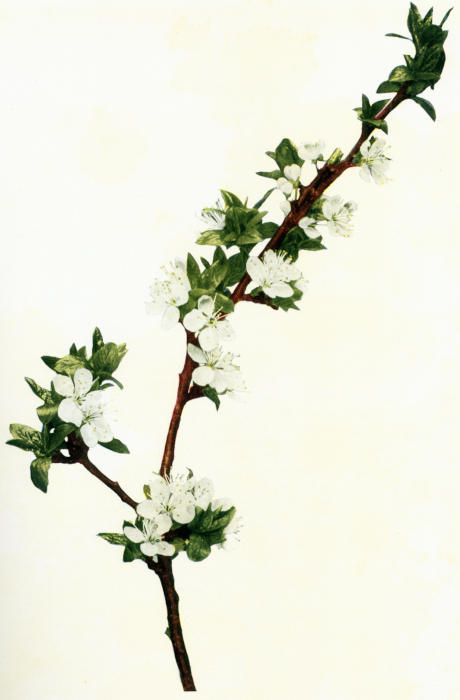
PRUNUS INSITITIA
1. Linnaeus Amoen. Acad. 4:273. 1755. 2. Seringe DC. Prodr. 2:532. 1825. 3. Hooker Brit. Fl. 220. 1830. 4. Loudon Arb. Fr. Brit. 2:687. 1844. 5. Koch, K. Dend. 1:95. 1869. 6. Ibid. Deut. Obst. 144. 1876. 7. De Candolle Or. Cult. Pl. 211. 1885. 8. Emerson Trees of Mass. Ed. 4:512. 1887. 9. Schwarz Forst. Bot. 339. 1892. 10. Koch, W. Syn. Deut. und Schw. Fl. 1:726. 1892. 11. Koehne Deut. Dend. 316. 1893. 12. Dippel Handb. Laubh. 3:639. 1893. 13. Lucas. Handb. Obst. 429. 1893. 14. Beck von Managetta Nied. Oester. 819. 1893.
P. communis (in part). 15. Hudson Fl. Anglic. 212. 1778. 16. Bentham Handb. Brit. Fl. 1:236. 1865.
P. domestica insititia. 17. Schneider Handb. Laubh. 1:630. 1892. 18. Waugh Bot. Gaz. 27:478. 1899.
Tree dwarfish but thrifty, attaining a height of twenty to twenty-five feet; trunk reaches eight inches in diameter and bears its head rather low, three to five feet from the ground; bark gray with a tinge of red, smooth, with transverse cracks; branches upright-spreading, rigid, compact, short-jointed, and more or less thorny; branchlets pubescent, slender, reddish-brown or drab.
Winter-buds small, conical, pointed or obtuse, free or appressed; leaves small, ovate or obovate; apex obtuse or abruptly pointed, base cuneate or narrowed and rounded, margins finely and closely, sometimes doubly serrate or crenate, usually glandular; texture thin and firm; upper surface slightly rugose, dark green, slightly hairy; lower surface paler and soft, pubescent; petioles one-half inch long, slender, pubescent, tinged with red; glands few or glandless.
Flowers expand with or after the leaves, one inch or less in size; borne variously but usually in lateral, umbel-like clusters, one, two or rarely three from a bud, on slender pedicels, which are pubescent and one-half inch in length; calyx-tube campanulate, glabrous or nearly so, green or tinged with red; calyx-lobes narrow, obtuse or acute, glandular-serrate, glabrous or pubescent, reflexed; petals white or creamy in the bud, broadly oval, entire or dentate, reflexed, claw short; stamens about twenty-five, as long as the petals; anthers yellow, often tinged with red; pistil glabrous and nearly as long as the stamens.
Fruit ripens from early to late; globular or oval, often necked, less than an inch in diameter, variously colored but usually bluish-black or amber-yellow, with a heavy bloom; skin thin, tough; stem slender, one-half inch long, more or less pubescent; cavity shallow, narrow; apex roundish or flattened; suture indistinct or a line; flesh firm, yellow, juicy, sweet or acid; stone clinging or free, somewhat turgid, ovoid, nearly smooth, ridged on one edge and grooved on the other.
There is a great diversity of opinion among botanists as to what Linnaeus meant to include in his Prunus insititia. His description of the species is not definite and can be made to apply to any one of several very distinct plums. But the botanists who recognize the species usually include in it, among cultivated plums, the Bullaces and the Damsons, plums which differ only in the shape of the fruit, the former being round and the latter oval. Some of the texts noted in the references for this species also place the St. Julien and the Mirabelle plums here. In The Plums of New York the authors consider the Bullaces, Damsons, the St. Julien and the Mirabelles as belonging to this species.
It is true that Linnaeus established at an earlier date than the naming of Prunus insititia his Prunus domestica damascena, in which the varietal name indicates that he meant the Damsons, but the description of the variety taken by him from Bauhin’s Pinax[60] making the plum large, sweet and dark purplish, cannot be made to apply to this fruit, nor can it be connected definitely with any other plum; this being true, and since Linnaeus refers to no type specimen, figure, or locality, his Prunus domestica damascena according to current botanical practices in America, should be rejected.
The trees of the Insititia varieties are readily distinguished from the Domestica sorts in having a dwarfer and more compact habit; much smaller and more ovate leaves with more closely serrate margins; branches more finely divided, more slender, with shorter joints, and bearing spines or spinescent spurs; having a more abundant and a more clustered inflorescence, with smaller flowers, a glabrous instead of a pubescent pistil and calyx-tube; reflexed calyx-lobes where in Domestica they are often erect; and flowers appearing nearly a week later. The number of stamens in Prunus domestica averages about thirty; in Prunus insititia, about twenty-five. The fruit-characters of Prunus insititia are even more distinctive. The fruits are smaller, being less than an inch in diameter, more nearly round or oval, more uniform in shape, never strongly compressed as in Domestica, with a less distinct suture and more often with a pronounced neck. The color is usually the Damson purple or the Mirabelle yellow, with no intermediate colors as in Domestica and with few or but slight variations as compared with the other species. The plums are sweet or sour with a very much smaller range in flavor in the case of the Insititias and withal very distinct from that of Prunus domestica. The stones are smaller, more oval and much more swollen.
In variability the Insititia plums are quite the reverse of the Domesticas, almost wholly lacking this quality. These plums have been cultivated over two thousand years, yet there is seemingly little difference between the sorts described by the Greeks and Romans at the beginning of the Christian Era and those we are now growing. So, too, one often finds half-wild chance seedlings with fruit indistinguishable from varieties under the highest cultivation. This pronounced immutability of the species is one of its chief characteristics.
There are probably several sub-divisions of Prunus insititia but material does not exist in America for the proper determination of the true place for these forms, and the Old World botanists cannot agree in regard to them. It is probable that Prunus subsylvestris Boutigny[61] and Prunus pomarium Boutigny[62] belong to Prunus insititia and almost beyond question Prunus syriaca Koehne[63] is the yellow-fruited Mirabelle of this species. Prunus insititia glaberrima Wirtg,[64] occasionally found in the herbaria of Europe has, with its small, roundish-obovate leaves, but little appearance of Prunus insititia and may be, as Schneider surmises,[65] a cross between Prunus spinosa and the Myrobalan of Prunus cerasifera.
The Insititia plums are second in importance only to the Domesticas. Their recorded history is older. This is the plum of the Greek poets, Archilochus and Hippona, in the Sixth Century B. C.[66] Theophrastus, the philosopher, mentioned it three hundred years before Christ, as did Pollux, the writer and grammarian, a century before the Savior, while Dioscorides, the founder of botany, during the last named period, distinguishes between this plum and one from Syria, presumably a Domestica. This is one of the twelve kinds of plums described by Pliny (see page 17) who calls it the Damascene, so-called from Damascus in Syria, and says of it, “introduced long since into Italy.” It is the Damask plum of Columella when in his tenth book he says:
“then are the wicker baskets cramm’d With Damask and Armenian and Wax plums.”
The yellow plums of the Roman poets, Ovid and Vergil, are probably the Bullaces or Mirabelles of this species. Indeed, its cultivation was probably prehistoric, for Heer[67] has illustrated and described stones of a plum found in the lake-dwellings of Robenhausen which can be no other than those of Insititia.
The authentic written history of this plum may be said to have begun with or a little before the Christian Era. The records of the cultivation and development through the early centuries of the present chronology and the Middle Ages to our own day may be found in the herbals, botanies, pomologies, agricultural and general literature of the past two thousand years.
Prunus insititia now grows wild in nearly all temperate parts of Europe and western Asia—from the Mediterranean northward into Norway, Sweden and Russia. The botanists of Europe very generally agree that its original habitat was in southern and southeastern Europe and the adjoining parts of Asia, and that elsewhere it is an escape from cultivation. Hooker[68] says that Prunus insititia grows in western temperate Himalaya, cultivated and indigenous, from Gurwhal to Kashmir, the type being that of the “common yellow-fruited Bullace.” A few botanical writers hold that it is truly wild in the parts of Europe where now found growing. There are also not a few botanists who, as has been stated in the discussion of the Domestica plums, unite the Insititias with the Domesticas, and others who combine these two with the Spinosa plums in one species, Prunus communis.[69]
It is possible that the species is occasionally found naturalized in eastern United States; several botanists so give it.
Wherever the habitat of the Insititia plums may have been, practically all writers from the Greeks and Romans who first mention this fruit to those of the present time, connect the cultivated varieties in one way or another with the old Semite city, Damascus. It is almost certain that the Syrians or Persians were the first to cultivate these plums, and that they were unknown in Europe as domesticated varieties until the Greeks first and the Romans afterward came in intimate contact with the people of the Orient. Thus it is often stated in the old pomologies that Alexander the Great brought these plums from the Orient after his expedition of conquest and that some centuries later Pompey, returning from his invasion of the eastern countries, brought plums to the Roman Empire.
The history of the Insititia plums in America has been given in the main in the discussion of the Domestica plums, for the varieties of the two species have never been kept separate by plum-growers, all being grouped together as European plums. It is probable, however, that the Damson plums of this species were earlier introduced and more generally grown than any other of the European plums by the English settlers of America, as the references to plum-growing before the Revolution are largely to the Damsons. The reasons for this early preference for these plums are that they come true to seed while most varieties of the Domestica do not; and trees and cions were not readily transportable in colonial times; and, too, the Damsons have always been favorite plums with the English.
When the first American fruit books were published at the beginning of the Nineteenth Century the Damsons and Bullaces were widely grown, for all writers give a relatively large number of varieties of these plums and speak well of them. Thus McMahon,[70] in his list of thirty plums gives six that belong here, ending his list with “Common Damson, etc.,” as if there were still more than those he enumerates. Prince, in his Pomological Manual, in 1832, gives at least eighteen sorts that may be referred to Insititia with the statement that one of them, the Early Damson “appears to have been brought to this country by the early Dutch settlers, or by the French who settled here at the time of the revocation of the Edict of Nantes,” adding, “It is much disseminated throughout this section of the country.” At the end of the Eighteenth Century Deane’s[71] New England Farmer or Georgical Dictionary, in a discussion of plums in general says: “The most common plum in this country is the Damascene plum, an excellent fruit for preserving, which is said to have been brought from Damasam, hence the name.”
The hardiness, thriftiness and productiveness of all of the varieties of this species commend them to those who cannot give the care required to grow the less easily grown Domesticas, and in America, as in Europe, these plums are to be found in almost every orchard and in many communities half-wild, thriving with little or no care. The fact that they are easily propagated, growing readily from suckers and coming true to seed is an added reason for their general distribution.
The Insititia plums do not seem to hybridize freely with other species—at least there are no recorded offspring of such hybrids, though Koch believes the Reine Claudes to be a hybrid group between this species and the Domesticas and there is much evidence in the fruit to show that the French Damson is part Domestica. The tree-characters of the Insititia plums are such, especially as regards vigor, hardiness, productiveness and freedom from disease, as to seemingly make hybrids with them very desirable. That this species can be hybridized with Domestica, at least, is certain from work done at this Station where we have made a number of crosses between them.
Four groups of plums, the Damsons, Bullaces, Mirabelles and St. Juliens, in all eighty-six varieties mentioned in The Plums of New York, may be referred to this species. There are so few real differences between these divisions, however, that it is hardly possible, logically, to sub-divide Insititia plums into more than two groups. But since the groups of plums given above are so often referred to in pomological works it is necessary to discuss them.
The Damsons.—The description given the species fits this division of it closely, the differentiating character for the fruit, if any, being oval fruits, while the Bullaces, most nearly like these, are round. The origin of the Damsons, as we have seen, was in Syria and near the ancient city, Damascus, their written history dating back several centuries before Christ. This plum has escaped from cultivation in nearly all the temperate parts of Europe and more or less in the eastern United States, the wild forms often passing under other names, as the Wild, Wheat, Spilling, Donkey, Ass, Hog and Horse plums. The true Damsons have a fine spicy taste, which makes them especially desirable for cooking and preserving, but a very decided astringency of the skin makes most of the varieties of Damsons undesirable to eat out of the hand; this astringency largely disappears with cooking or after a light frost. Nearly all Damsons are sour, though a few sweet Insititias are placed in this group.
Since the seeds grow readily and the sprouts are very manageable, the Damsons, with the other Insititias, are much used as stocks upon which to work other plums, especially the less hardy and less thrifty Domesticas. Although less used now than formerly for stocks it is a question if these plums, or some of their near kin, do not make the best obtainable stocks. There seems to be much difference in the varieties of Insititia in their capacity to send up sprouts. The forms which send up the fewest sprouts are much the best for use as stocks.
Curiously enough, the Damsons are highly esteemed now only by the Americans and English, being grown much less at present in Continental Europe than a century or two ago. Late pomological works and nurserymen’s catalogs from others than the English or Americans barely mention these plums.
The Bullaces.—It is impossible to distinguish between the tree-characters of the Damsons and the Bullaces, and pomologists are far from agreeing as to what differences in the fruit throw a variety into one group or the other. Some writers call a sour variety of Insititia a Damson, and a sweet one a Bullace; others make color the differentiating character, calling the purple plums Damsons and the light colored ones Bullaces; still others call oval Insititias Damsons and round ones Bullaces. If a distinction is to be made, shape seems to be the character upon which it should be based. The name Bullace applies to the round shape of the fruit, but when first used or by whom given it is impossible to say. It is commonly used in the old herbals and pomologies of both England and Continental Europe, there being many variations of the name, of which bullis and bulloes are most common with the word bullum in frequent use for the fruit of the Bullace tree. The varieties of Bullaces are few in number, and are not largely grown, being known for most part only in fruit collections, the Damsons serving all the purposes for which the Bullaces would be worth growing, and to better advantage.