Chapter III · LEADING VARIETIES OF PLUMS. (continued 8)
Reading edition
The following account of the origin of this variety, more romantic than credible, is told with several variations. About 1820, M. E. McCance, who lived near Nashville, Tennessee, shot a wild goose on his farm; his wife, in dressing the goose, found a plum seed in the craw, which, planted in the garden, produced the Wild Goose tree. The merits of the new fruit seem to have been discovered by J. S. Downer, Fairview, Kentucky, and James Harvey of Columbia, Tennessee. The former propagated, named and began the dissemination of Wild Goose to fruit-growers. Many varieties have been sent out for this plum and much confusion has arisen as to what the true variety is. Since the characters of Wild Goose, even when cross-pollinated, are transmitted to its offspring to a remarkable degree, the name now applies to a class of plums rather than to a variety. The American Pomological Society placed this variety on the fruit catalog list of the Society in 1875, dropped it in 1891, and replaced it in 1897.
Tree very large and vigorous, wide-spreading, flat-topped, hardy in New York, productive; branches rough and shaggy, dark ash-gray, with numerous, large, elongated lenticels; branchlets slender, long, with internodes of medium length, greenish-red changing to dull reddish-brown, glossy, glabrous, with many, conspicuous, large, raised lenticels; leaf-buds small, short, obtuse, free.
Leaves folded upward, lanceolate, peach-like, four and one-quarter inches long, one and one-half inches wide, thin; upper surface light or dark green changing to reddish late in the season, smooth, glabrous, with a grooved midrib; lower surface pale green, glabrous except along the midrib and larger veins; apex taper-pointed, base abrupt, margin finely serrate, with small, reddish-black glands; petiole five-eighths inch long, slender, pubescent along one side, tinged red, glandless or with from one to six globose, yellow or reddish-brown glands on the stalk and base of the leaf.
Blooming season late and long; flowers appearing after the leaves, three-quarters inch across, white, with disagreeable odor; borne in clusters on lateral buds and spurs, in threes or fours; pedicels five-eighths inch long, slender, glabrous, green; calyx-tube greenish, narrowly campanulate; calyx-lobes narrow, glabrous on the outer surface, lightly pubescent within, entire, heavily pubescent and with reddish glands on the margin, erect; petals ovate, entire, long and narrowly clawed; anthers yellow, with a tinge of red; filaments five-sixteenths inch long; pistil glabrous, equal to the stamens in length.
Fruit very early, season of medium length; one and three-eighths inches by one and three-sixteenths inches in size, oval, halves equal; cavity small, narrow, shallow, rather abrupt; suture an indistinct line; apex roundish or pointed; color bright red, with thin bloom; dots few in number, light russet, somewhat conspicuous, clustered about the apex; the stem attached to a stem-like growth from the fruit-spurs gives the appearance on the tree of a jointed stem, very slender, three-quarters inch long, glabrous, not adhering well to the fruit; skin tough, slightly astringent, separating readily; flesh yellowish, very juicy and fibrous, tender and melting, sweet next the skin but sour at the center, sprightly; fair to good; stone adhering, seven-eighths inch by three-eighths inch in size, long and narrow-oval, flattened, slightly necked at the base, acute at the apex, roughened; ventral suture wide, blunt, ridged; dorsal suture acute or with a shallow, indistinct groove.
WILLARD
Prunus triflora
1. Ohio Hort. Soc. Rpt. 81. 1893. 2. Cornell Sta. Bul. 62:31. 1894. 3. Ibid. 106:64. 1896. 4. Ibid. 131:194. 1897. 5. Am. Pom. Soc. Cat. 26. 1897. 6. Mich. Sta. Bul. 177:42, 43. 1899. 7. Cornell Sta. Bul. 175:134 fig. 27. 1899. 8. Rural N. Y. 57:515, 530, 595. 1898. 9. Waugh Plum Cult. 140. 1901. 10. Ga. Sta. Bul. 68:33. 1905. 11. Ill. Hort. Soc. Rpt. 420. 1905.
Botan No. 26 2, 3, 9. Botan 1. Botan No. 26 1. Willard Plum 1. Willard Japan 8.
Willard is about the earliest of the Triflora plums that can be shipped to the markets. When this is said all is said; as the variety has little else to recommend it, being very inferior in quality and having a reputation of being subject to shot-hole fungus. S. D. Willard, Geneva, New York, procured cions of this variety from California about 1888 from an importation made by Burbank from Japan. According to Willard, the plum was received under the name Botan and he labelled it No. 26 to avoid confusion; in 1893, it was named Willard by W. F. Heikes of the Huntsville Nurseries, Huntsville, Alabama. The American Pomological Society placed the variety on its fruit catalog list in 1897.
Tree medium to large, vigorous, vasiform, productive; leaves falling early, folded upward, oblanceolate, one and three-eighths inches wide, three and three-quarters inches long, thin, glabrous; margin finely and doubly serrate, with very small glands; petiole three-quarters inch long, with from one to five reniform glands usually on the stalk.
Fruit early, of medium size, roundish or somewhat oblong, blunt at the apex, dark red when well grown, covered with thick bloom; stem short, thick, adhering poorly to the fruit; skin sour; flesh greenish-yellow, rather firm, sweet, low in flavor; poor in quality; stone variable in adhesion, of medium size.
WOLF
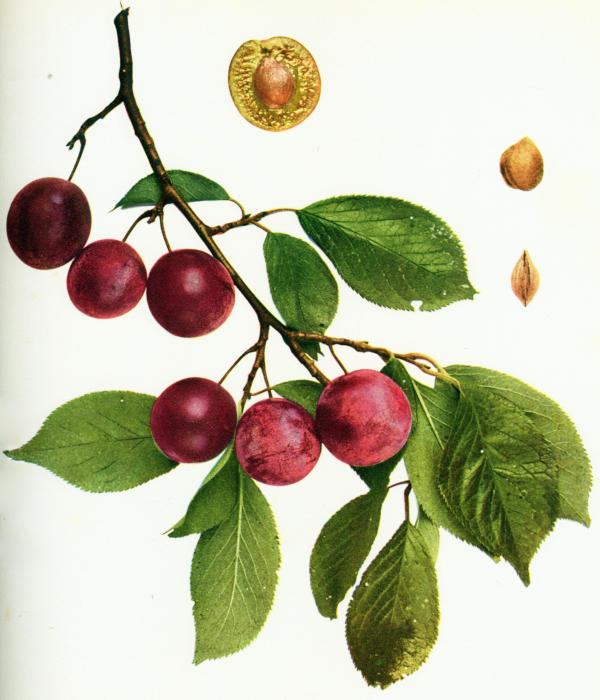
WOLF
Prunus americana mollis
1. Ia. Hort. Soc. Rpt. 367. 1883. 2. Rural N. Y. 44:645. 1885. 3. Am. Pom. Soc. Cat. 40. 1889. 4. Cornell Sta. Bul. 38:45 fig. 2, 87. 1892. 5. Mich. Sta. Bul. 118:54. 1895. 6. Wis. Sta. Bul. 63:24, 64. 1897. 7. Colo. Sta. Bul. 50:47. 1898. 8. Waugh Plum Cult. 167. 1901. 9. Ga. Sta. Bul. 67:284 fig. 1904. 10. S. Dak. Sta. Bul. 93:42. 1905. 11. Ia. Sta. Bul. 114:148 fig. 1910.
Wolf Free 4, 6. Wolf Freestone 11.
Wolf has long maintained a high place among the standard Americana plums, with which it is usually classed though put in a sub-species, and from which it differs chiefly in having much more pubescence on foliage, floral organs and branchlets. It is noted for its great hardiness, reliability in bearing, attractive and well-flavored fruits and in being one of the few freestones of its kind. This plum is remarkably well adapted for the northern part of the Mississippi Valley and there alone it is worth planting extensively. In New York it might prove valuable in the coldest parts of the State where the Domesticas and Insititias cannot be grown.
This variety was raised from a pit of a wild plum planted on the farm of D. B. Wolf, Wapello County, Iowa, about 1852. Professor J. L. Budd of the Iowa Agricultural College stated in 1885 that for over a quarter of a century the original tree had not failed to produce a partial or large crop annually on the grounds of the originator. A spurious clingstone type of the Wolf has been propagated in some nurseries but this false plum is readily distinguished from the true freestone type. The variety was added to the American Pomological Society fruit catalog list in 1889, dropped in 1891, and replaced in 1897.
Tree large, vigorous, spreading, low, and open-topped, hardy, productive, healthy; branches rough and shaggy, thorny, dark ash-gray, with numerous, small lenticels; branchlets somewhat slender, short, twiggy, with internodes below medium in length, green changing to dull brownish-drab, overspread with thick pubescence, with numerous, small lenticels; leaf-buds very small, short, conical, strongly appressed.
Leaves falling early, oval, one and seven-eighths inches wide, three and seven-eighths inches long, thin; upper surface medium green, lightly pubescent, with a narrow groove on the midrib; lower surface silvery-green, pubescent; apex taper-pointed, margin coarsely and doubly serrate, eglandular; petiole one-half inch long, velvety, tinged red, glandless or with one or two small, globose, yellowish glands on the stalk or base of the leaf.
Blooming season of average length, late; flowers opening after the leaves, one inch across, the buds tinged yellow changing to white as the flowers expand; borne on lateral buds and spurs; pedicels nine-sixteenths inch long, thickly pubescent, green; calyx-tube greenish-red, campanulate, covered with short, fine pubescence; calyx-lobes narrow, acute, heavily pubescent on both surfaces, with few marginal glands, reflexed; petals inclined to curl, long-oval, fringed, long and narrowly clawed; anthers yellowish; filaments three-eighths inch long; pistil sparingly hairy on the ovary, equal to or shorter than the stamens, frequently defective.
Fruit mid-season, ripening period short; less than one inch in diameter, roundish-oval or somewhat obovate, compressed, halves equal; cavity frequently yellowish, shallow, narrow, abrupt; suture an indistinct line; apex roundish or flattened; color dull crimson, thickly mottled, overspread with thick bloom; dots numerous, small, russet, inconspicuous; stem slender, glabrous, adhering poorly to the fruit; skin thick, tough, slightly roughened, astringent, adhering; flesh golden-yellow, very juicy, fibrous, tender and melting, sweet next the skin, but astringent toward the center; fair to good; stone semi-free to free, five-eighths inch by three-eighths inch in size, roundish-obovate, tapering at the base, blunt at the apex, with smooth surfaces; ventral suture winged; dorsal suture acute, or with a faint, narrow groove.
WOOD
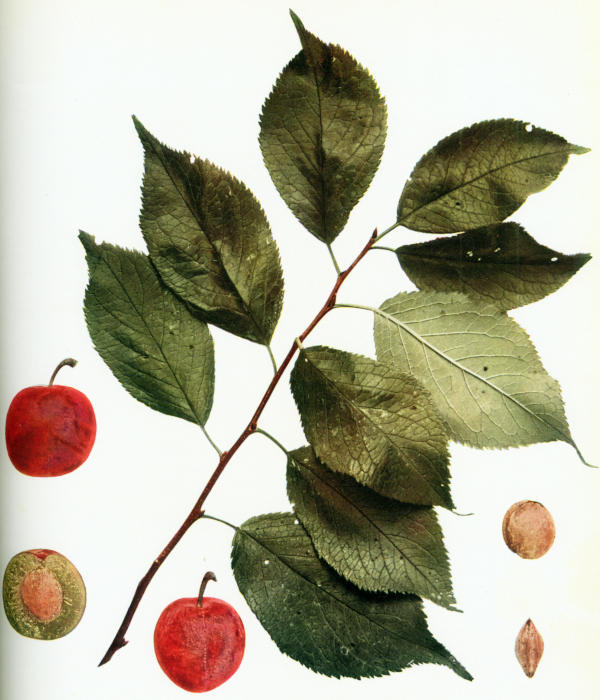
WOOD
Prunus americana
1. Minn. Hort. Soc. Rpt. 60. 1894. 2. Wis. Sta. Bul. 63:64. 1897. 3. Minn. Hort. Soc. Rpt. 433. 1898. 4. Waugh Plum Cult. 168. 1901.
Wood is one of the comparatively new Americanas and seems to have considerable merit, especially for cold climates. It is attractive in color; above the average size; good in quality, though not the best of its species; and the trees in habit of growth and in productiveness are better than most Americanas. It is sufficiently early to fit into the short seasons of northern latitudes very well. Wood is one of the sorts that can be recommended for the coldest parts of this State.
This variety, according to a letter from the originator and introducer, Joseph Wood of Windom, Minnesota, is a seedling from a choice plum found growing on the bank of the Des Moines River, Cottonwood County, Minnesota. It was not mentioned in pomological literature previous to 1894 and is of too recent origin to be widely distributed or well known.
Tree of medium size, spreading, hardy, dense-topped, an annual and abundant bearer; trunk shaggy; branches roughish, thorny, zigzag, brownish ash-gray, with numerous, small lenticels; branchlets slender to medium, above the average length, twiggy, with short internodes, greenish-red changing to dark brown, lightly pubescent when young becoming glabrous in the fall, with numerous, conspicuous, large, much raised lenticels; leaf-buds of medium size and length, conical, appressed.
Leaves falling early, ovate, two inches wide, four inches long, thin; upper surface light green, rugose, glabrous, with a narrow groove on the midrib; lower surface silvery-green, pubescent; apex taper-pointed, base abrupt, margin coarsely serrate, with long, taper-pointed teeth, eglandular; petiole five-eighths inch long, slender, tinged red, lightly pubescent, glandless or with one or two small, globose, greenish-red glands on the stalk.
Blooming season intermediate in time and length; flowers appearing after the leaves, eleven-sixteenths inch across, white; borne in clusters on lateral buds and spurs, in threes or fours; pedicels three-eighths inch long, slender, glabrous, green; calyx-tube greenish, narrowly campanulate, glabrous; calyx-lobes narrow, acute, lightly pubescent, occasionally tipped with red, serrate, with many marginal hairs, reflexed; petals oval, notched, tapering at the base to narrow claws of medium length; anthers light yellow; filaments five-sixteenths inch long; pistil glabrous, longer than the stamens, often defective.
Fruit mid-season, ripening period short; one and one-quarter inches in diameter, oblate, compressed, oblique, halves equal; cavity of average depth and width, flaring; suture a line; apex flattened or depressed; color dark red over a yellow ground, mottled, with thin bloom; dots numerous, minute, light russet, inconspicuous; stem one-half inch long, glabrous, detaches from the fruit when ripe; skin thick, tough, sour, adhering; flesh orange-yellow, juicy, coarse, fibrous, tender and melting, sweet, lacking in flavor; fair in quality; stone free, three-quarters inch by five-eighths inch in size, roundish, flattened, slightly oblique, blunt and flattened at the base, roundish at the apex, smooth; ventral suture acute, not ridged; dorsal suture acute, sometimes indistinctly grooved.
WORLD BEATER
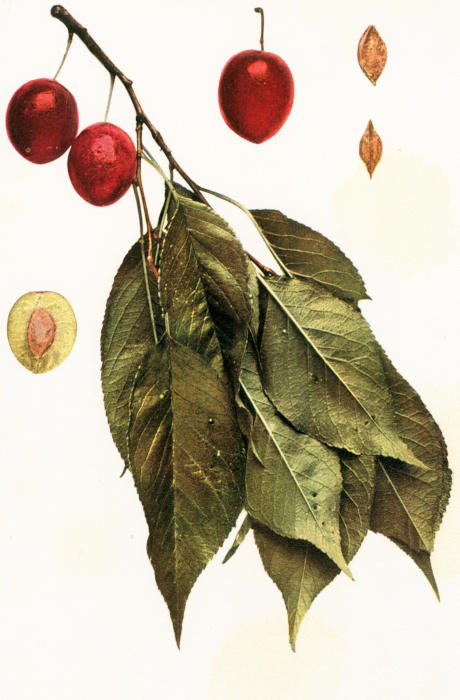
WORLD BEATER
Prunus hortulana
1. Cornell Sta. Bul. 38:52. 1892. 2. Wis. Sta. Bul. 63:65. 1897. 3. W. N. Y. Hort. Soc. Rpt. 41:54. 1896. 4. Waugh Plum Cult. 182. 1901.
World Beater is very similar to Wayland, differing chiefly in being a week earlier and, as the color-plate shows, the plums are a little smaller and more oval. In tree-characters, as the two grow at this Station, World Beater is perhaps the better plum. This variety has the same place in pomology as Wayland, a place which it fills possibly a little better. It may be recommended for culinary purposes and as a late plum for regions where the peach is hardy. Plums of this species have small value in New York except for the sake of variety.
World Beater was grown from a seed of a plum found near Nashville, Tennessee, in 1838, by J. H. Tinsley and planted in Lincoln County, Kentucky. About ten years later trees of the variety were taken to Clay County, Missouri, and were further propagated but the variety remained practically unknown until the fall of 1890 when it was introduced by Stark Brothers of Missouri.
Tree large, vigorous, spreading, open and flat-topped, hardy where the peach can be grown, productive; branches rough and shaggy, somewhat thorny, dark ash-gray, with numerous, large lenticels; branchlets medium to above in thickness and length, twiggy, with internodes of average length, green changing to dark chestnut-red, glossy, glabrous, with few, conspicuous, large, raised lenticels; leaf-buds very small and short, obtuse, plump, appressed.
Leaves folded upward, broadly lanceolate, peach-like, one and three-quarters inches wide, four and one-half inches long, thin; upper surface smooth, glossy, with a shallow groove on the midrib; lower surface pubescent on the midrib and larger veins; apex acuminate, base abrupt, margin serrate, glandular; petiole one inch long, slender, tinged red, pubescent on one side, with from two to six small, globose, brownish glands scattered on the stalk or base of the leaf.
Blooming season late and long; flowers appearing after the leaves, three-quarters inch across, white, with a disagreeable odor; borne in clusters from lateral buds, in twos, threes or fours; pedicels three-quarters inch long, very slender, glabrous, green; calyx-tube greenish, campanulate, glabrous; calyx-lobes narrow, acuminate, slightly pubescent towards the base of the inner surface, serrate and with reddish glands, erect; petals ovate, crenate, fringed, with pubescent claws of medium width; anthers yellowish; filaments five-sixteenths inch long; pistil glabrous, equal to the stamens in length.
Fruit very late, season short; one inch by seven-eighths inch in size, roundish-ovate or oval, not compressed, halves equal; cavity narrow, shallow, rather abrupt; suture a line; apex pointed; color carmine, bloomless; dots medium in number, small, whitish or sometimes reddish, somewhat conspicuous; stem slender, medium to above in length, glabrous, not adhering to the fruit; skin thick, tough, astringent, adhering slightly; flesh light yellow, juicy, coarse, melting near the skin but firmer and fibrous next the pit, sweet except near the center, strongly aromatic; fair to good; stone often tinged red, adhering, three-quarters inch by three-eighths inch in size, oval, turgid, angular, pointed at the base and apex, roughish; ventral suture wide, blunt, ridged; dorsal suture acute or with an indistinct, shallow groove.
WYANT
Prunus americana
1. Ia. Hort. Soc. Rpt. 327. 1885. 2. Ibid. 85. 1890. 3. Cornell Sta. Bul. 38:46. 1892. 4. Ia. Hort. Soc. Rpt. 448. 1893. 5. Ia. Sta. Bul. 31:345. 1895. 6. Kan. Sta. Bul. 73:192. 1897. 7. Wis. Sta. Bul. 63:24, 65 fig. 32, 66. 1897. 8. Am. Pom. Soc. Cat. 24. 1897. 9. Colo. Sta. Bul. 50:47. 1898. 10. Ia. Sta. Bul. 46:292. 1900. 11. Waugh Plum Cult. 167 fig., 168. 1901. 12. Can. Exp. Farm Bul. 43:32. 1903. 13. Ga. Sta. Bul. 67:284, 285 fig. 1904. 14. S. Dak. Sta. Bul. 93:44, 49 fig. 1905.
Wyant is one of the standard Americana plums, ranking well with the best of them in both fruit and tree-characters. While it is almost beyond question a true Americana (from its history it could hardly be otherwise,) it has a number of characters that mark it as a departure from the usual type of Prunus americana. The calyx-tube is bright red, a character found only in a few other varieties of this species; the stamens are much longer than is usual in the species and much more numerous; the pistils are often defective; the flowers are borne in greater profusion; the plums do not have the distinctive Americana taste; the flesh is less juicy than usual; the skin is free and the stones are nearly free and have pitted surfaces. Some of these characters are so valuable in a native plum that Wyant may well be used to breed from. The trees from which the description here given was made came from C. L. Watrous, Des Moines, Iowa, and to the best of our belief are true to name.
This variety, according to a letter from J. E. Wyant, Shellsburg, Iowa, was found by J. B. Wyant of Janesville, Iowa, while hunting for wild plums in 1866 on the Cedar River near his home. The following year he transplanted the tree to his yard. About 1874, J. E. Wyant told R. Royce of Shellsburg, Iowa, proprietor of the Benton County Nursery, of this tree. Royce secured cuttings from the original tree and began propagating the plum. Fruits were sent to Professor J. L. Budd, Ames, Iowa, who named it Wyant. The variety was introduced by Mr. Royce and was disseminated by him and by Professor Budd. In 1897 it was added to the fruit catalog list of the American Pomological Society.
Tree small, spreading and straggling, flat-topped, very hardy, productive, healthy; branches rough and shaggy, zigzag, thorny, dark ash-gray, with numerous, large lenticels; branchlets willowy, slender, long, with long internodes, greenish-red changing to reddish-brown, glossy, glabrous, with conspicuous, raised lenticels of average size and number; leaf-buds small, pointed, strongly appressed.
Leaves falling early, folded upward, oval, one and five-eighths inches wide, three and one-quarter inches long, thin; upper surface green, smooth, glabrous, grooved on the midrib and larger veins; lower surface silvery-green, lightly pubescent; apex acuminate, base abrupt, margin coarsely and doubly serrate, the serrations sharp-pointed, not glandular; petiole one-half inch long, tinged red, pubescent, glandless or with from one to five globose, yellowish-green glands on the stalk.
Blooming season medium to late, of average length; flowers appearing with the leaves, showy on account of the many blossoms and peculiar appearance caused by the numerous long stamens, whitish, with disagreeable odor; borne in dense clusters on lateral buds and spurs, one to four flowers in each cluster; pedicels one-half inch long, slender, glabrous, green, faintly tinged with red; calyx-tube red, obconic, glabrous; calyx-lobes narrow, acute, lightly pubescent on the inner surface, serrate and with numerous marginal hairs, erect; petals small, narrow-ovate, crenate, with narrow, long claws; stamens very numerous; anthers yellowish; filaments three-eighths inch long; pistil slender, glabrous, shorter than the stamens, often defective.
Fruit mid-season, ripening period short; one and one-quarter inches in diameter, not symmetrical in shape, oblong-obovate to nearly ovate, oblique, somewhat truncate, halves equal; cavity shallow, narrow, flaring; suture a line; apex slightly flattened; color dark carmine over a yellow ground which largely disappears as maturity advances, with thin bloom; dots numerous, very small, light russet, inconspicuous; stem slender, one-half inch long, glabrous, dehiscent; skin thin, tender, separating readily; flesh dark golden-yellow, juicy, tender and melting, sweet, with the Americana flavor less marked than in other varieties; of fair quality; stone nearly free, seven-eighths inch by five-eighths inch in size, broadly oval, flattened, blunt at the base, somewhat pointed at the apex, with pitted, dark colored surfaces; ventral suture blunt or slightly winged, shallowly ridged; dorsal suture acute, with shallow, narrow, distinct groove.
YELLOW EGG
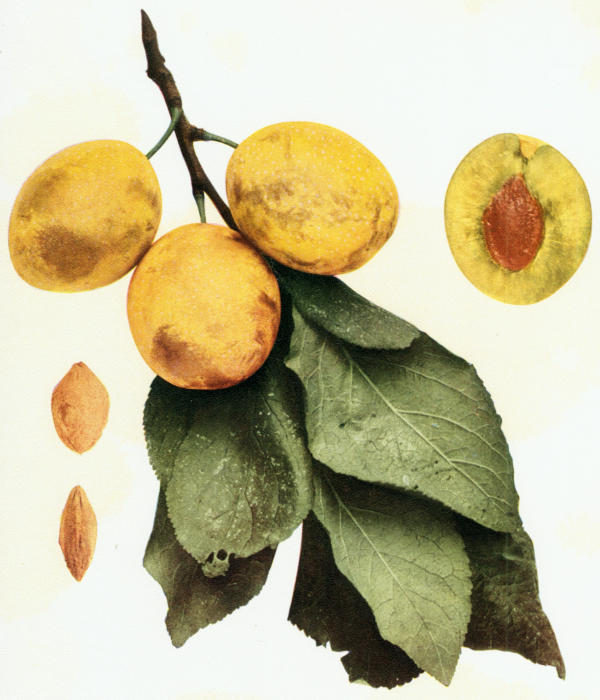
YELLOW EGG
Prunus domestica
1. Rea Flora 209. 1676. 2. Ray Hist. Plant. 2:1528, 1529. 1688. 3. Langley Pomona 95, Pl. XXV fig. VI. 1729. 4. Miller Gard. Dict. 3. 1754. 5. Duhamel Trait. Arb. Fr. 2:107, Pl. XX fig. 10. 1768. 6. Knoop Fructologie 2:59. 1771. 7. Kraft Pom. Aust. 2:29, Tab. 175 fig. 1; 38, Tab. 188 fig. 1. 1796. 8. Forsyth Treat. Fr. Trees 20, 21. 1803. 9. Coxe Cult. Fr. Trees 233, fig. 8. 1817. 10. Lond. Hort. Soc. Cat. 149. 1831. 11. Prince Pom. Man. 2:57, 58. 1832. 12. Kenrick Am. Orch. 258, 269. 1832. 13. Floy-Lindley Guide Orch. Gard. 299, 301. 1846. 14. Poiteau Pom. Franc. 1: fig. 1846. 15. Thomas Am. Fruit Cult. 333. 1849. 16. Elliott Fr. Book 424. 1854. 17. Thompson Gard. Ass’t 520. 1859. 18. Am. Pom. Soc. Cat. 88. 1862. 19. Downing Fr. Trees Am. 954 fig. 1869. 20. Pom. France 7: No. 18. 1871. 21. Koch Deut. Obst. 560. 1876. 22. Hogg Fruit Man. 730. 1884. 23. Mathieu Nom. Pom. 431. 1889. 24. Fell Cat. 49. 1893. 25. Guide Prat. 163, 354. 1895. 26. Cornell Sta. Bul. 131:193. 1897.
Aechte Gelbe Eierpflaume 25. Albert’s Damascene 23, 25. Albertus Damen Pflaume 20, 23, 25. Askew’s Golden 20. Askew’s Golden Egg 16, 19, 22, 23, 25. Aubertiana 21. Bonum Magnum 11, 20, 22, 23, 25. Bonum Magnum 1, 2. Col. Young’s Seedling 16. Dame Aubert 10, 11, 13, 17, 19, 22, 23, 25. Dame Ambert 16. Dame Aubert 5, 12. Damas Aubert 7, 23, 25. Dame Aubert Blanche 10, 17, 19, 20, 22, 23, 25. Dame Ambert Blanche 16. Dame Aubert Grosse Luisante 11. Dame Ambert Jaune 16. Dame Aubert Jaune 10, 11, 17, 19, 20, 23. Darwin Peach 24. Die Albertus Damenpflaume 7. De Besançon 25. De Monsieur 25 incor. Die Grosse Weisse Glanzende 7. Die Kaiserliche Weisse Pflaume ?7. D’OEuf 25. D’OEuf Blanche 25. Dutch Plum 1, 11. Dutch Plumb 3. Echte Gelbe Eier Pflaume 23. Edle Gelbe Eger Pflaume 20. Edle Gelbe Eier Pflaume 23, 25. Egg Plum 4, 8, 9, 10, 11, 12, 13, 16, 17, 19, 20, 22, 23, 25. Eier Pflaume 23, 25. Gelbe Eger Pflaume 20, 23, 25. Gelbe Egg 20, 23, 25. Gelbe Malonke 23, 25. Gelbe Ungarische Eier Pflaume 23, 25. Gelbe Marunke 23, 25. Gelbe Eierpflaume 23. Gelbe Eierpflaume 20, 25. Grosse Weisse Glanzende 20, 23, 25. Great Mogul ?2. Grosse Datte ?5. Grosse-Luisante 5, 7, 10, 11, 13, 14, 16, 17, 19, 20, 22, 23, 25. Gros Luisante 12. Gelbe Ungarische Eyerpflaume 20. Grosse Prune Blanche 20, 23, 25. Grosse Maronke 25. Grosse Marouk 20, 23, 25. Grosse Glanzende Alberts Pflaume 23, 25. Grosse Glanzende 20, 25. Grosse Glanzende Pflaume 23. Grosse Gelbe Eier Pflaume 23, 25. Grosse Marunke 23. Grünliche Dattel Pflaume von Besançon 23, 25. Hick’s large Egg? 11. Impériale Blanche ?5. Impériale Blanche ?7, 10, 11, 12, 13, 17, 19, 20, 22, ?23, 25. Imperial Blanc 11. Large Yellow Egg 11. Magnum Bonum 19. Monsieur’s Plum ?4, ?8. Monsieur’s Plum ?4. Mogul 9. Monsieur 11. Mogul 4, 8, 11, 23. Mogul Plum 25. Mogule Plumb 3. Mogule 11. Mogol Plum 20, 23, 25. Mogols Pflaume 20, 23, 25. Mogul’s Pflaume 23, 25. Prune de Monsieur? 4, 6. Prune de Monsieur 23 incor. Prune OEuf 20. Prune Dame Aubert 14, 20. Prune d’Oeuf 20, 23. Prune d’Oeuf blanche 6, 23. Prune d’Inde Blanc 19. Prune De Besançon 20, 23. Prune Dame d’Aubert 21. Prune d’Inde Blanche 23. Supreme ?14. Wentworth 13. Wentworth ?8, 10, 11, 12, 16, 17, 19, 23, 25. Wentworth Plumb ?3. White Imperial 9, 11, 15, 16, 19, 23. White Imperial 11. White Imperial Bonum Magnum 4, 8. White Holland 3, 4, 8, 10, 11, 12, 16, 17, 19, 23, 25. White Magnum Bonum 9, 11, 13, 15, 16, 19, 20, 23, 25. Weisse Kaiser Pflaume 23, 25. Weisse Hollandische Pflaume 23, 25. White Bonum Magnum 3, 11, 20, 23, 25. White Egg Plum 11. White Magnum Bonum 10, 12, 17, 18, 22, 23. White Mogul 10, 12, 13, 16, 19, 20, 22, 23, 25. White Egg 15. White Egg 16, 19, 23, 25. Weisser Kaiser 23, 25. Weisse Magnum Bonum 20, 23, 25. Weisse Kaiserin 23 incor. Yellow Magnum Bonum 10, 15, 16, 17, 18, 19, 22, 23, 25. Yellow Bonum Magnum 20, 23, 25. Young’s Superior Egg ?11. Yellow Egg 18, 23, 25.
The characters of Yellow Egg were given in the discussion of the group which bears its name and but little more needs to be said of the variety. As the largest and handsomest of the yellow plums it is worth consideration by either the amateur or the commercial fruit-grower in New York. At best, however, it is fit only for cooking and is none too good for culinary purposes. The trees are very satisfactory on all but very light soils. As has been suggested before, this plum ought to be crossed with varieties of better quality with the hope of getting as handsome a fruit but one which could be used for dessert purposes.
The references and synonyms show that Yellow Egg is a plum with an interesting history, but unfortunately the accounts of its origin and subsequent history have been but poorly preserved. Rea, in 1676, described the Yellow Egg as the Bonum Magnum or Dutch Plum; we may infer from this that the English obtained the variety from Holland. Knoop of Holland, in 1771, described the variety under the name Prune d’Oeuf Blanche, indicating a French origin. Knoop describes the Prune De Monsieur as similar and this plum has ever since been held as doubtfully identical. Duhamel, in Traite des Arbres Fruitiers, 1768, described Yellow Egg as the Dame Aubert. Kraft in Pomona Austriaca, 1796, gave it as the Die Grosse Weisse Glanzende, oder Die Albertus Damenpflaume. These references show that Yellow Egg was well known at an early date. Because of its close resemblance to many varieties, probably due to the propagation of seedlings from it, much confusion exists in the nomenclature of Yellow Egg. White Imperial was separated by Duhamel and Prince; but Miller, Thompson and most of the subsequent writers give it as the same. Duhamel believed the Imperial Blanche (White Imperial) to be the Grosse Datte. So, too, the Wentworth was at first separated but, later, was recorded as identical. Koch calls Yellow Egg one of the Datterpflaumen (Date Plums) though he states that there is another Date Plum known by Tragus more than three hundred years ago as Prunidactyla. De Candolle seems to hold to the names Dame d’Aubert and Aubertina for this plum. Professor Budd in exploring southwest Russia and Poland found a Dame Aubert differing from our Yellow Egg only in minor characters which he was told came from central Asia.
The exact date of the importation of Yellow Egg to this country is unknown. Coxe, in 1817, described it as the Mogul and later Prince gave it the name Yellow Egg. Owing to this change in name, we find America now and then given as its place of origin by both American and English writers. In 1862, the American Pomological Society added it to its fruit catalog list under the name White Magnum Bonum but in 1871, the name was changed to Yellow Egg. The Darwin Peach, sent out by Fell, a nurseryman in England, has proved to be identical at this Station and its distributor, in a recent letter, states that this plum, which has been growing on his place thirty years, “is apparently identical to the White Magnum Bonum” which is of course Yellow Egg.
Tree, large, vigorous, round-topped, open, hardy, very productive; trunk roughish; branches numerous, ash-gray, nearly smooth, with rather large lenticels; branchlets slender, short, with long intemodes, greenish-red changing to dull brownish-red, dull, lightly pubescent throughout the season, covered with thin bloom, with few, inconspicuous, small lenticels; leaf-buds above medium in size, long, pointed, free.
Leaves flattened or somewhat folded backward, oval, two and one-half inches wide, four and one-quarter inches long, leathery; upper surface dark green, pubescent, slightly rugose, with grooved midrib; lower surface medium green, thickly pubescent; apex abruptly pointed or acute, base acute, margin doubly serrate, with few dark glands; petiole five-eighths inch long, thick, reddish-purple, pubescent, glandless or with one or two globose, yellowish-green glands variable in position.
Blooming season short; flowers appearing after the leaves, one inch across, white, with a yellowish tinge at the tip of the petals; borne on lateral buds and spurs, singly or in pairs; pedicels one-half inch long, covered with thick pubescence, greenish; calyx-tube green, campanulate, pubescent; calyx-lobes broad, obtuse, pubescent, glandular-serrate, reflexed; petals roundish-oval, crenate or sometimes slightly notched, tapering to short, broad claws; anthers yellow; filaments three-eighths inch long; pistil pubescent, longer than the stamens; stigma oblique.
Fruit late, season short; two inches by one and five-eighths inches in size, long-oval, compressed, halves nearly equal; cavity of medium depth, narrow, abrupt; suture shallow, often a line; apex roundish; color golden-yellow, covered with thick bloom; dots numerous, small, white, inconspicuous; stem slender, one and one-quarter inches long, pubescent, adhering well to the fruit, surrounded at the cavity by a fleshy collar; skin thin, slightly astringent, separating readily; flesh golden-yellow, rather juicy, moderately coarse, firm, of average sweetness, mild; good; stone semi-free or free, one and one-quarter inches by three-quarters inch in size, oval, rather flat, acute at the base and apex, with roughened and pitted surfaces; ventral suture wide, heavily ridged, often distinctly winged; dorsal suture widely and deeply grooved.
YELLOW GAGE
Prunus domestica
1. Prince Treat. Hort. 25. 1828. 2. Prince Pom. Man. 2:108. 1832. 3. Downing Fr. Trees Am. 287, 288 fig. 115. 1845. 4. Thomas Am. Fruit Cult. 329. 1849. 5. Cole Am. Fr. Book 208 fig. 1849. 6. Horticulturist 7:403. 1852. 7. Am. Pom. Soc. Rpt. 36, 55. 1852. 8. Elliott Fr. Book 414. 1854. 9. Am. Pom. Soc. Rpt. 210. 1856. 10. Bridgeman Gard. Ass’t 3:126. 1857. 11. U. S. Pat. Off. Rpt. 190, Pl. XIII. 1865. 12. Mas Pom. Gen. 2:163, fig. 82. 1873. 13. Barry Fr. Garden 417. 1883. 14. Mathieu Nom. Pom. 443. 1889. 15. Waugh Plum Cult. 126. 1901.
American Wheat 10. American Yellow Gage of some 3, 4, 8, 11, 14. American Yellow Gage 10. Auserlesene Gelhe Reine-Claude 14. Harvest Gage 6, 8, 11, 14. Prince’s Gage 1. Prince’s Gelbe Reine-Claude 14. Prince’s Yellow Gage 2, 3, 4, 6, 7, 8, 9, 11. Prince’s Yellow Gage 5, 12, 13, 14, 15. Reine-Claude Jaune De Prince 12. White Gage of some 3, 8, 11, 14.
Yellow Gage belongs to the Reine Claude, or as it is so often called, the Green Gage group of plums. There are now a great number of these plums under cultivation in America, most of which have originated in this country and nearly all of which, as we have said before, are better than similar kinds from Europe. It is difficult to select from the numerous first-rate plums of this group the best varieties to retain in home or commercial orchards. Among these, however, Yellow Gage should be kept for the home orchard at least. It is a rather large fruit, with a beautiful color—golden-yellow often with a faint blush, with a firm and juicy yet tender flesh and a most refreshing admixture of sweet and sour together with the richness which characterizes the Reine Claude plums. The fruits come, too, at a time when the market is not overstocked with these fine plums and the season is particularly long. A review of the tree-characters in the description which follows shows that in the main they are good though some complain that the variety is not productive. This precariousness in bearing, together with the tender skin which keeps Yellow Gage from standing shipment well, probably precludes the variety from a high place in a commercial list but does not prevent its being a most desirable plum for home planting.
This excellent old variety was probably one of the first plums to originate in America. It came from a Reine Claude pit planted, with many others, by William Prince[226] in 1783 in the celebrated Prince nurseries at Flushing, Long Island. Despite its early origin and fine qualities it has never had much recognition from pomologists. Downing described it in 1845 but neither Manning nor Kenrick in their excellent books on fruits mention this plum. The American Pomological Society in 1852 listed it with the varieties of plums promising well and in 1856 placed it on the list of those worthy of general cultivation.
Tree very large and vigorous, spreading, dense-topped, hardy, productive; trunk roughish; branches dark ash-gray, smooth except for the numerous, raised lenticels of various sizes; branchlets medium to below in thickness, short, with internodes of average length, greenish-red changing to brownish-red, dull, lightly pubescent, with inconspicuous, small lenticels; leaf-buds large, long, conical, free; leaf-scars prominent.
Leaves long-oval or obovate, two inches wide, four and one-quarter inches long, thick, somewhat leathery; upper surface dark green, covered with fine hairs, the midrib grooved; lower surface silvery-green, sparingly pubescent; apex and base acute, margin serrate, with few small, dark glands; petiole five-eighths inch long, pubescent, tinged red, with from one to three smallish, globose, greenish-yellow glands variable in position.
Blooming season intermediate in time and length; flowers appearing after the leaves, one and one-eighth inches wide, white, fragrant; borne on lateral spurs, singly or in pairs; pedicels seven-eighths inch long, with short, thin pubescence, greenish; calyx-tube green, enlarged at the base, campanulate, lightly pubescent; calyx-lobes narrow, obtuse, lightly pubescent on both surfaces, glandular-serrate, reflexed; petals oval, entire, tapering to short, broad claws; anthers yellow; filaments one-quarter inch long; pistil glabrous, longer than the stamens.
Fruit mid-season, ripening period of medium length; one and one-half inches by one and three-eighths inches in size, oval, slightly compressed, halves nearly equal; cavity shallow, narrow, abrupt; suture shallow; apex roundish or depressed; dull yellow, faintly splashed and streaked with green, sometimes tinged on the sunny side with light red, overspread with thin bloom; dots numerous, small, white, inconspicuous, clustered about the base; stem three-quarters inch long, thinly pubescent, adhering well to the fruit; skin thin, rather sour, separating readily; flesh golden-yellow, juicy, firm but tender, sweet, mild, of pleasant flavor; very good; stone free, the cavity larger than the pit, one inch by five-eighths inch in size, oval, turgid, roundish, abruptly contracted at the base, blunt at the apex; ventral suture broad, blunt, faintly ridged; dorsal suture widely and deeply grooved.