Chapter III · LEADING VARIETIES OF PLUMS.
Reading edition
ABUNDANCE
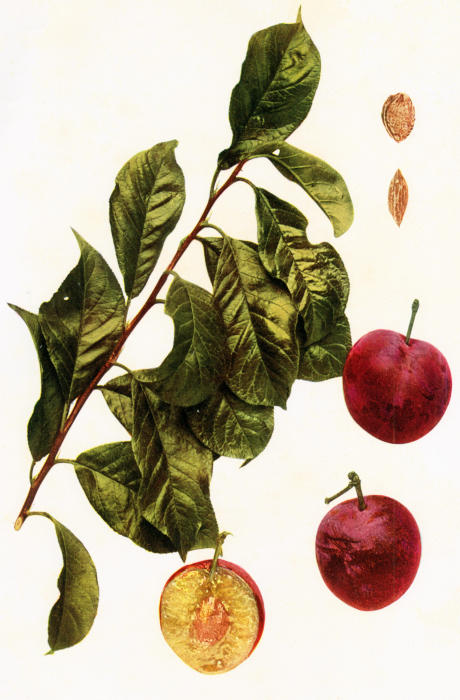
ABUNDANCE
Prunus triflora
1. Am. Pom. Soc. Rpt. 96. 1887. 2. Am. Gard. 9:360. 1888. 3. Ga. Hort. Soc. Rpt. 51, 52, 53, 99. 1889. 4. Bailey Ann. Hort. 103. 1889. 5. Am. Pom. Soc. Rpt. 106, 125. 1891. 6. Am. Gard. 13:700. 1892. 7. Rural N. Y. 52:666. 1893. 8. Cornell Sta. Bul. 62:19, 27, 32. 1894. 9. Tex. Sta. Bul. 32:488. 1894. 10. Rev. Hort. 160. 1895. 11. Mich. Sta. Bul. 118:52. 1895. 12. Cornell Sta. Bul. 106:41, 43, 44, 47, 48, 49. 1896. 13. Va. Sta. Bul. 67:96. 1896. 14. Cornell Sta. Bul. 131:195. 1897. 15. Ibid. 139:37, 38, 39, 40. 1897. 16. Am. Pom. Soc. Cat. 26. 1897. 17. Cornell Sta. Bul. 175:141, 142, 143. 1899. 18. Waugh Plum Cult. 132, 135. 1901. 19. Mich. Sta. Bul. 169:242, 248. 1899. 20. Ont. Fruit Exp. Sta. Rpt. 15. 1902. 21. Ohio Sta. Bul. 162:254, 255. 1905. 22. Texas Nur. Co. Cat. 9. 1907. 23. Ga. Sta. Bul. 68:7, 28. 1905.
Abundance 7. Babcock (?) 15, 17. Babcock 12, 16, 18. Botan 1, 2, 3, 5, 6, 10. Botan 12, 16, 18. Botankio 12. Botankio 3. Burbank No. 2, 11, 12. Chase 12. Chase 14, 15, 17. Douglas 9, 15, 18. Douglas 17. Hattankio 8, 15. Hattonkin 12. Hytankayo 8, 9. Munson 8. Munson 9, 18. Oriole 22. Sweet Botan 7. Sweet Botan 15. Yellow Fleshed Botan 3, 6, 8, 17, 23. Yellow Fleshed Botan 5. Yellow Japan 12. Yellow Japan 8, 14.
Though Abundance has been in America only a quarter of a century, it is now about as well known as any other plum, being probably the best known of the Triflora plums. The two chief assets which have given the variety its great popularity so quickly are adaptability to a wide diversity of soils and climates and, as its name implies, abundance of fruit, for it bears not only heavily but yearly. As a market plum Abundance has been overplanted since it ships and keeps poorly, is much subject to brown-rot, matures unevenly and drops rather too readily as it ripens. Whether for market or home use, the fruit of this variety should be picked before it is quite ripe as it develops in flavor best when so picked and the dropping and rot are thus avoided to some extent. It is an exceedingly variable plum and undoubtedly several well marked strains could be selected, some of which are not as hardy or otherwise as valuable as others. While Abundance has passed the heyday of its popularity it is still one of the most desirable of the Triflora plums.
This variety was imported from Japan by Luther Burbank in 1884, and was introduced by John T. Lovett, Little Silver, New Jersey, under the name Abundance, in 1888. A large number of Japanese plums that have since been introduced have proved to be either identical or so nearly like the Abundance that much confusion has arisen. Abundance was first known as Botan, but that name was dropped as it refers to a group of plums in Japan rather than to a variety. Babcock, which is said to have been imported by Burbank in 1885 and named for Colonel E. F. Babcock, a nurseryman of Little Rock, Arkansas, has been described by Bailey as indistinguishable from Abundance. Botankio, described in the Georgia Horticultural Society Report for 1889, proved to be the Abundance as tested at the Cornell Experiment Station. The Chase plum, also disseminated in New York under the name Yellow Japan, was bought by the R. G. Chase Company, Geneva, New York, for the Abundance, but as it was thought to blossom and fruit later than that variety, it was distributed as a new plum; in 1897 Bailey considered it the same as Chabot, but in 1899 he stated that it and Abundance were identical. The Douglas plum is also identical. Dr. J. T. Whitaker of Tyler, Texas, imported this variety and introduced it in 1886 under the name of Hytankayo. Bailey, who tested Whitaker’s variety from trees obtained from T. V. Munson, Denison, Texas, found a yellow-fruited strain and to distinguish the purple form named the latter Munson.[202] As this name had been applied to a native plum, R. H. Price, of the Texas Experiment Station, in 1894 renamed the variety calling it Douglas.[203] There have been two types of this Douglas plum disseminated; Bailey, in 1899, found no difference between it and Abundance except that the Douglas seemed to have a little drier flesh; others testing Douglas found it to be identical with the Chabot. Burbank No. 2, imported by Luther Burbank in 1885 and introduced by him in 1889, is very similar if not identical with the Abundance. Oriole, recently introduced by the Texas Nursery Company, Sherman, Texas, is so nearly like Abundance as to be unworthy of a separate name. The American Pomological Society added Abundance to its fruit catalog list in 1897.
Tree large, vigorous, vasiform, open-topped, hardy in New York, very productive, susceptible to attacks of shot-hole fungus; branches rough, dark ash-gray, inclined to split when overloaded, with few, slightly raised lenticels; branchlets slender, short, with short internodes, red early in the season changing to dark brown, glossy, glabrous, with numerous, inconspicuous, small lenticels; leaf-buds small, short, conical, plump, free.
Leaves folded upward, narrow-obovate or oblanceolate, peach-like, one and three-eighths inches wide, three and one-quarter inches long, thin; upper surface light green, smooth, glabrous, with grooved midrib; lower surface pale green, pubescent on the midrib and larger veins; apex taper-pointed, base cuneate, margin very finely serrate, with small, brownish glands; petiole three-eighths inch long, slightly pubescent along one side, reddish, glandless or with from one to five small, globose, green or reddish glands usually on the stalk.
Blooming season early; flowers appearing with the leaves, medium in size; borne in clusters on lateral buds and spurs, in pairs or in threes; pedicels of medium length and thickness, slightly pubescent, greenish; calyx-tube green, obconic, glabrous; calyx-lobes obtuse, with ciliate margins, glabrous, erect; petals broadly oval, entire, abruptly clawed; anthers yellowish; filaments of average length; pistil glabrous, equal to the stamens in length.
Fruit early, season short; one and three-eighths inches in diameter, roundish-ovate, halves nearly equal, slightly compressed; cavity medium in depth and width, abrupt, regular; suture shallow, distinct; apex pointed; color pinkish-red changing to darker red, mottled, with thin bloom; dots numerous, of medium size, russet, conspicuous; stem one-half inch long, glabrous, parting easily from the fruit; skin thin, tough, bitterish, separating readily; flesh yellow, very juicy, tender and melting, sweet except next to the pit, pleasantly aromatic; good; stone clinging, three-quarters inch by one-half inch in size, oval, somewhat compressed, pointed, rough, ridged along the ventral suture; dorsal suture grooved.
AGEN
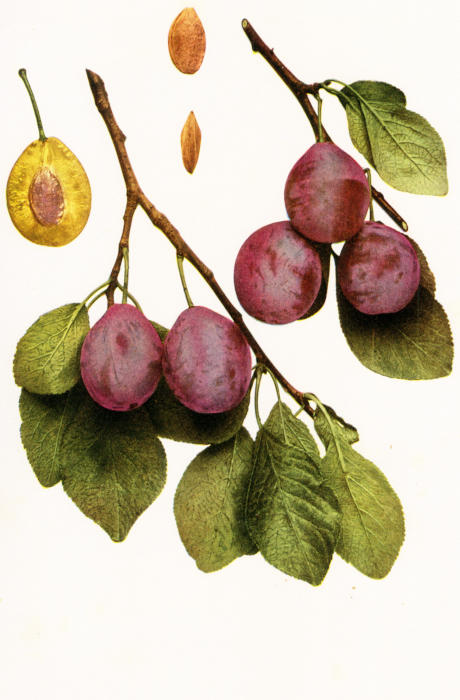
AGEN
Prunus domestica
1. Kraft Pom. Aust. 2:38, Tab. 189 fig. 1. 1796. 2. Lond. Hort. Soc. Cat. 143, 147, 152, 153. 1831. 3. Prince Pom. Man. 2:75, 100. 1832. 4. Poiteau Pom. Franc. 1. 1846. 5. Downing Fr. Trees Am. 309. 1845. 6. U. S. Pat. Off. Rpt. 30. 1854. 7. Thompson Gard. Ass’t 519. 1859. 8. Am. Pom. Soc. Cat. 86. 1862. 9. Oberdieck Deut. Obst. Sort. 427. 1881. 10. Hogg Fruit Man. 683. 1884. 11. Mas Le Verger 6:81, fig. 1866-73. 12. Cal. State Bd. Hort. 291. 1885-86. 13. Cat. Cong. Pom. France 343. 1887. 14. Cal. State Bd. Hort. 49, 50. 1887-88. 15. Ibid. 233, 235, 340. 1890. 16. Ibid. 96, 105, Pl. 1. 1891. 17. Guide Prat. 160, 353. 1895. 18. Oregon Sta. Bul. 45:24. 1897. 19. Cornell Sta. Bul. 131:191. 1897. 20. U. S. D. A. Div. Pom. Bul. 7:315, 316. Pl. IV, fig. 4. 1898. 21. Mich. Sta. Bul. 169:241, 242. 1899. 22. Cal. Fr. Gr. Con. 29. 1901. 23. Waugh Plum Cult. 94, 95 fig. 1901. 24. Baltet Cult. Fr. 495, fig. 331, 506, 507, fig. 336. 1908. 25. Wickson Cal. Fruits 225. 1908. 26. Cal. Fr. Grower 40:18, 19, fig. 1909.
Agen 22. Agener Kaiserzwetsche 17. Agen Date 3. Agen Datte 5, 10. Agener Pflaume 17. Agener Pflaume 9. Agen Prune 21. California 20. California 16. D’Agen 2, 10, 11, 17, 24. D’Agen 3, 5, 8, 13, 20. D’Ast 13, 17. Date 21. Datte 17. De Brignole 17. D’Ente 13, 17, 24. D’Ente d’Agen 13. Datte Violette 1, 13, 17. Die Blaue Dattelpflaume 17. Die Blaue Dattelpflaume 1. Du Roi 17. French 20. French Prune 15, 18, 23, 25. French Prune (?) 2, 12, 14, 15, 26. Lot d’Ente 18. Petite 20. Petite d’Agen 14, 20, 26. Petite Prune 18. Petite Prune 23. Petite Prune d’Agen 25. Prune d’Agen 5, 6, 7, 8, 15, 17, 19, 25. Prune d’Agen 14, 16, 18, 23. Prune de Brignole (of some) 5, 7, 17. Prune d’Ante 3. Prune d’Ast 5, 7, 10, 11. Prune d’Ente 7, 12, 18. Prunier d’Agen 3. Prunier d’Agen 6. Prune d’Ente 22. Prune du Roi 10. Robe de Sergent 3, 5, 7, 8, 11, 13, 17, 18. Robe de Sargent 10, 12. Roi d’Agen 2. Saint Maurin 2, 4. St. Maurin 5, 7, 10, 17. Saint Mauriniana 4. Violette Dattelzwetsche 17.
Agen is the plum par excellence for prune-making in France and America. Several qualities make it admirably fit for curing into prunes. To begin with, it has a high percentage of sugars and solids so that the plum cures readily into a firm, sweet, long-keeping prune which in cooking needs comparatively little sugar; again, the trees bear regularly, abundantly and the plums are uniform in size,—productiveness, regular bearing and uniformity of size of fruit being necessary attributes of a good prune-making plum; lastly, it hangs well on the tree as it ripens and afterwards so that the curing really begins on the tree. Besides making most excellent prunes, the Agen is a very good dessert plum—one of the best—and ought to be in every home orchard and, where it attains sufficient size, in every commercial plantation. Lack of size is the defect in this variety which has kept it from being more largely grown outside of prune-making regions. If by pruning, thinning and other cultural treatment the size of the plums could be increased, the Agen should prove a valuable commercial fruit in New York.
The name of this variety is derived from Agen, a region in France where it is extensively grown. Tradition says that on their return from the Crusades, the Benedictine monks brought with them from Turkey or Persia what was then known as the Date plum and planted it in the garden of their abbey on the River Lot, in the vicinity of Bordeaux, France, and that afterwards this became the Agen. Its first recorded importation into the United States was made in 1854 by the United States Patent Office, though it was described by Prince as early as 1832. The most important introduction was made, however, in 1856, when Louis Pellier of San Jose, California, introduced Agen on the Pacific Coast, where it soon became and still is the leading plum, though with curious persistency the fruit-growers there call it the “French Prune” and the “Petite Prune.” In 1862 this variety was added to the fruit catalog list of the American Pomological Society. There are many strains of Agen in America, due to the numerous importations of grafts from various parts of France, where the plum orchards are frequently grown from seedlings or from sprouts; some of these strains are worthy of varietal recognition.
Tree of medium size, upright-spreading, dense-topped, hardy, very productive; branches ash-gray, smooth, with numerous, large, raised lenticels; branchlets slender, short, with short internodes, greenish-red changing to dark brownish-drab, dull, pubescent, with small lenticels; leaf-buds of medium size and length, conical, free.
Leaves folded upward, obovate or oval, one and three-quarters inches wide, three and one-quarter inches long, velvety; upper surface with few fine hairs and a narrow, grooved midrib; lower surface pale green, thickly pubescent; apex abruptly pointed, base acute, margin doubly serrate; petiole one inch long, slender, pubescent, tinged red, with two or three small, globose, greenish-brown glands usually on the stalk.
Season of bloom intermediate in time and length; flowers appearing after the leaves, one and one-eighth inches across, white; borne on lateral spurs, singly or in pairs; pedicels five-eighths inch long, thick, glabrous except for a few short hairs, greenish; calyx-tube green, campanulate, pubescent; calyx-lobes obtuse, somewhat pubescent within, with glandular margin, reflexed; petals broadly oval or obovate, entire, tapering to short, broad claws; anthers yellowish; filaments five-sixteenths inch long; pistil glabrous, equal to the stamens in length.
Fruit late, season short; one and one-half inches by one and one-eighth inches in size, obovate, the base necked, halves equal; cavity shallow, narrow, flaring; suture very shallow, indistinct; apex roundish or flattened; color reddish or violet-purple, overspread with thin bloom; dots numerous, small, brown, obscure, clustered about the apex and interspersed between russet flecks; stem thick, seven-eighths inch long, glabrous, adhering well to the fruit; skin thin, tough; flesh greenish-yellow, tender, sweet, aromatic; very good to best; stone semi-free or free, seven-eighths inch by one-half inch in size, oval, flattened, with pitted surfaces, rather abrupt at the base and apex; ventral suture somewhat narrow, furrowed, with distinct wing; dorsal suture widely grooved.
AITKIN
Prunus nigra
1. Minn. Hort. Soc. Rpt. 426. 1896. 2. Wis. Sta. Bul. 63:24, 27, 28 fig. 11, 43. 1897. 3. Jewell Nur. Cat. 1899-1906. 4. Waugh Plum Cult. 169. 1901. 5. Can. Exp. Farm Bul. 43:29. 1903. 6. Ia. Hort. Soc. Rpt. 227. 1904.
Aitken 4. Beatty 6 incor. Itasca 1 incor.
Aitkin is very favorably mentioned in the references given above and undoubtedly has value for the Northwest. It was listed in the catalog of the American Pomological Society in 1899. The variety was found growing wild in Aitkin County, Minnesota, by D. C. Hazelton on land adjoining his farm. It seemed to possess merit and was introduced in 1896 by the Jewell Nursery Company of Lake City, Minnesota. Because of having originated near Itasca Lake, it has been confused with the Itasca plum, which preceded it by nearly ten years. The following description is a compilation:
Tree vigorous, productive, ripening its wood very early; fruit earliest in season of its group; large for its class, oval, deep red, with no bloom; skin thin, not astringent; flesh yellow, juicy, sweet and rich; good; stone large, oval, flattened, clinging.
ALHAMBRA
[Prunus triflora × Prunus cerasifera × Prunus domestica] × [(Prunus simonii × Prunus triflora) × (Prunus americana × Prunus nigra)]
1. Vt. Sta. Bul. 67:5. 1898. 2. De Vries Plant Breeding 213. 1907.
Although it is over a decade since Alhambra was offered to fruit-growers, it has made little headway in popularity and is chiefly of interest because of its breeding. It is not often that we can trace the pedigree of a plant for more than one or at the most two generations, but in Alhambra we are particularly fortunate. Luther Burbank, the originator, began by crossing Kelsey and Pissardi, and the offspring from this cross was fertilized with Agen pollen. This tri-hybrid was in turn fertilized with pollen from a complex hybrid of a cross of Prunus simonii and Prunus triflora pollinated by a cross of Prunus americana and Prunus nigra. As might be expected, the offspring of this final cross was extremely variable and from it was selected the Alhambra. The variety was named by the originator in 1898.
The fruit as described by Waugh is “egg-shaped, large or very large; cavity medium shallow, abruptly rounded; suture shallow; apex pointed; color dark, dull red; dots many, small, yellowish; bloom thin, purplish; skin firm; flesh yellow inside, reddish outside; stone medium to large, flat, pointed, nearly smooth, clinging; flavor brisk subacid; quality first rate.”
ALTHAM
Prunus domestica
1. Jour. Hort. N. S. 17:228. 1869. 2. Lange Allgem. Garten. 2:419. 1879. 3. Oberdieck Deut. Obst. Sort. 432. 1881. 4. Lauche Deut. Pom. 19, Pl. IV. 1882. 5. Hogg Fruit Man. 692. 1884. 6. Mathieu Nom. Pom. 420. 1889. 7. Gaucher Pom. Prak. Obst. 94, Pl. 1894. 8. Soc. Nat. Hort. France Pom. 550 fig. 1904. 9. Cat. Cong. Pom. France 468, fig. 1906. 10. Baltet Cult. Fr. 490, fig. 328. 1908.
Althan’s Reine Claude 6, 7. Althann’s Reine Claude 2, 3, 4, 6. Althahn’s Rote Reine-Claude 6, 7. Althann’s Reine Claude 7. Count Althann’s Gage 5. Count Althann’s Gage 6, 7. Graf Althan’s Reine-Claude 6. Graf Althann’s Reine-Claude 7. Hathen’s Red Gage 1. Reine-Claude Rouge de Hathen 1. Reine-Claude d’Althann 5, 6, 7. Reine-Claude Comte Althan 5, 6. Reine-Claude de Comte Hathem 5, 6. Reine-Claude du Comte Hathem 6, 7. Reine-Claude du Comte d’Althan 8. Reine-Claude Althan’s 5, 6, 7. Reine-Claude Comte d’Althan 6. Reine-Claude d’Althan 8. Reine-Claude d’Althan 6, 7, 10. Reine-Claude Rouge Comte Althan 6, 7. Reine-Claude Rouge du Comte Hethau 6. Reine-Claude rouge du comte Hethan 7. Reinette Claude Comte d’Althan 9. Reinette Claude d’Althan 9.
Altham is an excellent plum for dessert or home use. The color is a trifle too dull for market purposes and yet it is better colored than McLaughlin, which sells fairly well. The fruit is the type of the last named plum but is later. In Europe this variety is well known and highly esteemed for its quality, but unfortunately it is almost unknown in America. The variety is well worth trial in this country as a fine plum of the Reine Claude group. Altham is a seedling of Reine Claude, raised by Herr Prochaska, gardener to Count Michael Joseph Althann, of Swoyschitz, in Bohemia. It was noted in the English Journal of Horticulture for 1869 as a new plum sent out by Thomas Rivers.
Tree of medium size, upright-spreading, dense-topped, productive; leaf-scars prominent; leaves folded upward, obovate, two and one-quarter inches wide, nearly four inches long, very thick, leathery; margin doubly crenate, with few, small, dark glands; petiole thick, with from one to four globose, yellowish-green glands on the stalk; season of bloom intermediate, short; flowers appearing after the leaves, one inch across, yellowish at the apex of the petals; borne on lateral buds and spurs, singly or in twos.
Fruit mid-season; one and one-half inches by one and five-eighths inches in size, oblate, strongly truncate at the base, compressed; color dark purplish-red over a yellow ground, covered with thick bloom; dots russet surrounded with a dark red ring; stem adhering strongly to the pulp; flesh light golden-yellow, firm but tender, sweet, mild, pleasant; very good to best; stone semi-clinging, seven-eighths inch by five-eighths inch in size, flattened, irregular-oval, with pitted surfaces, contracted at the base into a short oblique neck; ventral suture prominent, heavily furrowed, often with distinct wing; dorsal suture wide, deep.
AMERICA
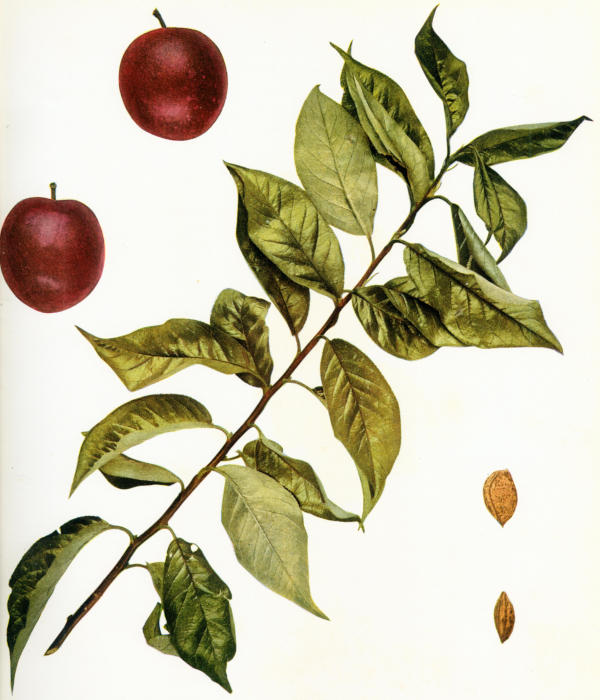
AMERICA
Prunus munsoniana × Prunus triflora
1. Burbank Cat. 3. 1898 2. Vt. Sta. Bul. 67:5. 1898, 3. Rural N. Y. 59:706. 1900. 4. Vt. Sta. An. Rpt. 14:273. 1900. 5. Mich. Sta. Bul. 205:37 1903. 6. Del. Penin. Hort. Soc. Rpt. 36. 1905. 7. Ohio Sta. Bul. 162:254, 255. 1905. 8. Ga. Sta. Bul. 68:8, 35. 1905.
America is illustrated and described in full chiefly because it is the most promising cross between Prunus munsoniana and Prunus triflora. The fruit of the variety is unusually attractive in appearance, golden-yellow with a red cheek and waxy lustre turning currant-red when ripe, ships exceptionally well and is of very good quality for cooking, but is without merit as a dessert plum. The trees are large, very vigorous, as hardy as either of its parents or possibly more so, and enormously productive. The qualities of fruit and tree are such that the variety ought to succeed in commercial plantations where any but the hardiest native plums are cultivated. America is almost phenomenally free from rot, considering its parentage.
This variety is one of Luther Burbank’s productions, grown from a seed of Robinson fertilized by pollen from Abundance. It was introduced by the originator in 1898 and has been since that time well tested at several places in the eastern states and is very generally well spoken of for a plum of its kind for the East.
Tree large, vigorous, spreading, somewhat open-topped, hardy, very productive; branches roughish and with cracked bark, slightly zigzag, dark ash-gray, with numerous, conspicuously raised lenticels; branchlets willowy, long, with short internodes, green with a reddish tinge changing to dark chestnut-red, glossy, glabrous, with numerous, small, raised lenticels; leaf-buds small, short, conical, free.
Leaves folded upward, broadly lanceolate, peach-like, one and one-half inches wide, three and one-fourth inches long, thin; upper surface reddish late in season, smooth and glossy, with deeply grooved midrib; lower surface light green, sparingly pubescent along the midrib and larger veins which are more or less red; apex taper-pointed, base abrupt, margin finely and doubly crenate and with numerous, small, dark glands; petiole one-half inch long, tinged red, pubescent along one side, glandless or with one or two small globose, reddish glands on the upper part of the stalk.
Blooming season intermediate and long; flowers appearing after the leaves, one-half inch across, white; borne in clusters on short lateral spurs and buds, in pairs or in threes; pedicels five-sixteenths inch long, slender, pubescent, green; calyx-tube greenish, obconic, glabrous; calyx-lobes obtuse, with a trace of red along the margin, glandular-serrate, glabrous, with marginal hairs, erect; petals small, roundish, entire, tapering abruptly to narrow claws; anthers yellowish; filaments three-sixteenths inch long; pistil glabrous, longer than the stamens.
Fruit early, season of medium length; one and three-eighths inches in diameter, roundish-oval, halves equal; cavity shallow, flaring; suture shallow, a distinct line; apex roundish; color clear, dark, currant-red over golden-yellow, mottled, with thin bloom; dots numerous, small, whitish, inconspicuous; stem slender, one-half inch long, glabrous, adhering to the fruit; skin thin, bitterish, separating readily from the pulp; flesh yellow, juicy, fibrous, somewhat tender, sweet, not high in flavor; fair in quality; stone clinging, seven-eighths inch by one-half inch in size, oval, pointed, with pitted surfaces, broadly ridged along the ventral suture; dorsal suture grooved.
AMERICAN
Prunus domestica
1. Oregon Sta. Bul. 61:17, 18. 1900.
American Seedling 1.
American originated with a Mr. Peterson of Elkton, Douglas County, Oregon, as a sprout from an old tree. It has never been extensively disseminated, but seems to be a variety of considerable promise. The fruit as grown on the Station grounds resembles Hand rather closely; is large for a plum of its type, is a handsome golden color, is high in quality and will probably keep and ship well. Too little is known of its tree-characters to recommend it unqualifiedly.
Tree above medium in size, vigorous, round-topped, dense, productive; branches numerous; branchlets thick, marked by grayish scarf-skin; leaves flattened, oval or obovate, two and one-quarter inches wide, four and one-half inches long, dark green; margin serrate or crenate; blooming season intermediate, short; flowers appearing after the leaves, one and three-eighths inches across, singly or in twos, fragrant.
Fruit mid-season; very large, roundish-oblate, truncate, golden-yellow, indistinctly streaked with green, mottled, covered with thin bloom; flesh light golden-yellow, tender, sweet, pleasant flavor; good to very good; stone clinging, one inch by three-quarters inch in size, broadly oval, flattened, surfaces pitted; dorsal suture wide, deep.
AMERICAN EAGLE
Prunus americana
1. Cornell Sta. Bul. 38:36. 1892. 2. Am. Pom. Soc. Cat. 37. 1899. 3. Can. Exp. Farms Rpt. 105. 1900. 4. Waugh Plum Cult. 142. 1901. 5. Can. Exp. Farm Bul. 43:28. 1903. 6. Ohio Sta. Bul. 162:254, 255. 1905.
Of the origin of this very good Americana variety little is known except that it probably came from Missouri, as it was introduced, in the fall of 1859, by the Osceola Nursery Company, Osceola, Missouri. Although an old variety it was not listed by the American Pomological Society until 1899. In regions where Americana plums are grown, American Eagle ought to be better known, its chief defect being the dull color of the fruit.
Tree vigorous, spreading; leaves large; petiole glandular. Fruit mid-season; large, varies from roundish-oval to nearly oblate, dark red, covered with thick bloom; stem short, pubescent; flesh yellow, juicy, fibrous, sweet, aromatic, with characteristic Americana flavor; of good quality; stone clinging, three-eighths inch by one-half inch in size, roundish, turgid, conspicuously winged; surface smooth.
AMES
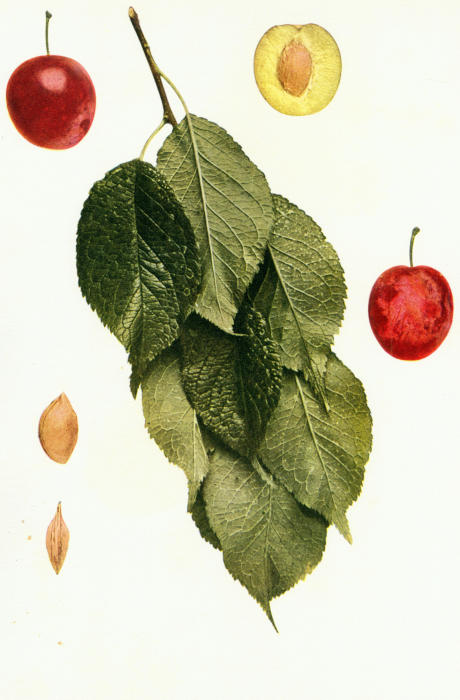
AMES
Prunus americana × Prunus triflora
1. Vt. Sta. An. Rpt. 12:220. 1899. 2. Ia. Hort. Soc. Rpt. 112. 1899. 3. Ia. Sta. Bul. 46:261. 1900. 4. Waugh Plum Cult. 203. 1901. 5. Budd-Hansen Am. Hort. Man. 293. 1903. 6. S. Dak. Sta. Bul. 93:9. 1905. 7. Ill. Hort. Soc. Rpt. 422. 1905. 8. Rural N. Y. 65:730. 1906.
De Soto × Oregon No. 3 6. Japan Hybrid No. 3 2.
Though Ames has been known to the public scarcely ten years, its good qualities have given it relatively high rank among Americana plums with which it must be compared. Though supposed to be a cross between Prunus americana and Prunus triflora, the variety shows few, if any, traces of the Triflora parentage, except, possibly in the shape and color of the fruit. The variety is distinguished from other Americana plums by reddish dots on the fruit instead of the yellowish dots commonly found on the plums of this species. The fruit of Ames is very attractive in color, the quality is fair, it keeps and ships well and it is fairly free from rot, characters which make it desirable where the native plums are grown.
This variety was produced by Professor J. L. Budd[204] of Ames, Iowa, by crossing De Soto with pollen of a “large Japanese plum received from Oregon.” For a long while it was known as De Soto × Oregon No. 3 and as Japan Hybrid No. 3, but was named Ames by Professor John Craig, now of Cornell University.
Tree of medium size, spreading, dense-topped, hardy, productive; branches roughish, thorny, the trunk shaggy, dark ash-brown, with numerous, large, raised lenticels; branchlets willowy, thick, long, with long internodes, green changing to dark chestnut-red, glossy, glabrous, thickly strewn with conspicuous, large, raised lenticels; leaf-buds small, short, obtuse, plump, appressed.
Leaves falling early, flattened, oval, two inches wide, four inches long; upper surface dark green, glabrous, slightly rugose; lower surface light green, pubescent; apex taper-pointed, base abrupt, margin coarsely serrate, the serrations ending in hair-like tips, eglandular; petiole seven-eighths inch long, slender, pubescent, tinged red, glandless or with from one to three globose, greenish-red glands.
Blooming season medium in time and length; flowers appearing after the leaves, nearly one inch across, white; borne in clusters on lateral buds and spurs, in threes or fours; pedicels one-half inch long, slender, glabrous, greenish; calyx-tube green, campanulate, glabrous; calyx-lobes narrow, somewhat acute, reflexed, pubescent on the inner surface, the margin faintly pubescent and with a trace of red; petals small, oval, somewhat dentate, tapering below to long, narrow, slightly hairy claws; anthers yellowish; filaments five-sixteenths inch long; pistil glabrous, equal to the stamens in length, frequently defective.
Fruit mid-season, one and seven-sixteenths inches by one and five sixteenths inches in size, ovate or oval, sides compressed, halves equal; cavity shallow, narrow, flaring; suture a line; apex roundish; color light to dark red over a yellow ground, covered with thin bloom; dots numerous, small, brownish-red; stem slender, glabrous; skin medium in thickness and toughness, adhering; flesh golden-yellow, juicy, coarse, fibrous, tender and melting, semi-sweet; of fair quality; stone nearly free, one inch by five-eighths inch in size, irregular-oval, flattened and elongated at the base, abruptly pointed at the apex, very smooth; ventral suture winged and furrowed; dorsal suture acute.
APPLE
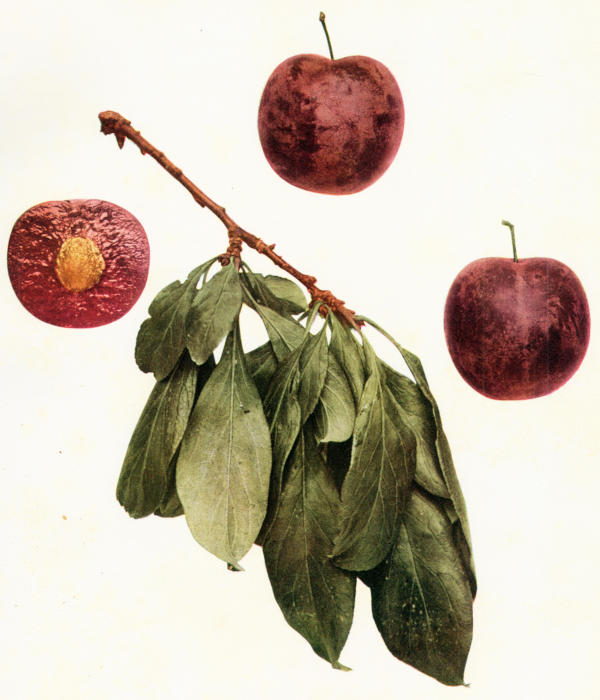
APPLE
Prunus triflora ×?
1. Burbank Cat. 2. 1898. 2. Vt. Sta. Bul. 67:6. 1898. 3. Vt. Sta. An. Rpt. 12:220. 1899. 4. Am. Gard. 21:36. 1900. 5. Waugh Plum Cult. 203. 1901. 6. Ga. Sta. Bul. 68:12, 35. 1905. 7. Mass. Sta. An. Rpt. 17:161. 1905.
The Apple is a conspicuous plum; its shape, color, size, flavor; its firm, blood-red flesh and long-keeping quality, all distinguish it. Even the tree is marked with its robust growth, flat-topped head, peculiar, light brown bark, handsome foliage and wood that can be propagated from cuttings with surprising ease. It is difficult to predict the future of this interesting plum, but probably it will remain for most part a curiosity. Its peculiar flavor is not pleasant at first taste and it is doubtful if many will learn to like it. Unpalatability is the defect of the variety which will most often be counted against it. In general the Apple is inferior for dessert or kitchen to the Satsuma, itself none too good, which it most nearly resembles of all plums. In the Station collection tree and fruit are quite susceptible to both fungus and insect pests and the fruits ripen unevenly. The fruit of the variety keeps and ships remarkably well and these qualities may be its saving grace, both so well developed as to make it valuable for breeding purposes when these characters are desired.
In his catalog for 1898 Burbank announces the Apple as a new plum and says, “Among the welcome surprises found three years ago among a lot of some twenty-five thousand plum seedlings was this one, bearing a cruel load of enormous plums when only two years old.... It was at once named Apple from the very close resemblance in form, color general appearance, and rare keeping qualities.... Its parentage is not known, except that it is a second generation seedling from cross-bred seedlings, and no doubt Satsuma and probably Robinson are in its line of ancestry.” Satsuma characters are readily detected in tree and fruit and especially its hard, red flesh, but in no way is its descent from Robinson apparent.
Tree of medium size, flat-topped, spreading, dense-topped, slow-growing, semi-hardy, productive; branches rough and thorny, with numerous fruit-spurs, dark ash-gray, reddish and with numerous lenticels; branchlets often with a rosette of flower-buds on the apex of the shoots, slender, with short internodes, greenish-red changing to dark brown, glossy, glabrous, with numerous, conspicuous, large, raised lenticels; leaf-buds small, short, obtuse, plump, appressed.
Leaves folded upward, obovate or oblanceolate, one and one-quarter inches wide, three and three-quarters inches long, thin, leathery; upper surface purplish-red late in the season, glossy, glabrous, with grooved midrib; lower surface light green, pubescent at the base of the veins; apex acutely pointed, base cuneate, margin finely and doubly crenate and with small amber glands; petiole five-eighths inch long, pubescent, red along one side, with from three to ten large, conspicuous, reniform, red or yellowish glands on the stalk.
Blooming season early and of medium length; flowers appearing before the leaves, white; borne in clusters on lateral buds and spurs, in threes or fours; pedicels medium in length and thickness, glabrous; calyx-tube obconic, glabrous; calyx-lobes narrow, obtuse, glandular-ciliate, glabrous, erect; petals oval, entire, short-clawed; anthers yellowish; filaments of medium length; pistil glabrous, shorter than the stamens, often defective.
Fruit mid-season; one and one-half inches long, one and three-quarters inches wide, roundish-oblate, compressed, halves equal; cavity medium in depth and width, flaring, with concentric russet rings; suture shallow; apex depressed and at one side; color dull dark red, with waxy bloom; dots numerous, large, russet, conspicuous, clustered about the apex; stem five-eighths inch long, glabrous; skin tough, bitterish, separating from the pulp; flesh dark red, juicy, firm but tender, sweet, with pleasant mild flavor, aromatic; good; stone clinging, three-quarters inch by five-eighths inch in size, oval or obovate, turgid, pointed, roughish, winged on the ventral, deeply furrowed on the dorsal suture.
APRICOT
Prunus domestica
1. Parkinson Par. Ter. 578. 1629. 2. Rea Flora 209. 1676. 3. Quintinye Com. Gard. 67, 69. 1699. 4. Duhamel Trait. Arb. Fr. 2:93, Pl. XIII. 1768. 5. Knoop Fructologie 2:52, 53, 54. 1771. 6. Kraft Pom. Aust. 2:28, Tab. 173 fig. 1; 2:34, Tab. 183 fig. 1. 1796. 7. Prince Pom. Man. 71. 1832. 8. Kenrick Am. Orch. 255. 1832. 9. Thomas Am. Fruit Cult. 327. 1849. 10. Elliott Fr. Book 424. 1854. 11. Noisette Man. Comp. Jard. 2:498. 1860. 12. Downing Fr. Trees Am. 896, 952. 1869. 13. Mas Pom. Gen. 2:133. 1873. 14. Le Bon Jard. 338. 1882. 15. Hogg Fruit Man. 684, 1884. 16. Mathieu Nom. Pom. 421, 431, 454. 1889.
Apricocke 1. Apricock Plum 2. Abricot de France 5. Abricot Blanc 16. Abricot Blanche 5. Abricot ordinaire 5. Abricote 5. Abricote blanc 7, 12. Abricotée 4, 13. Abricotée 6, 7, 10, 12, 16. Abricotée Perdrigon 6. Abricotée Blanche 7, 12, 15, 16. Apricot Plum of Tours 7. Abricote de Tours 7. Abricotée de Tours 7, 10, 12, 13, 15, 16. Apricot Plum 8. Apricot Plum of Tours 10, 12, 16. Abricotée Blanc 12. Aprikosenartige Pflaume 13. Apricot 13. Aprikosenartige Pflaume 16. Apricot Plum 16. Aprikosen Perdrigon 16. Die Abrikosenartige Pflaume 6. Die Morillenpflaume 6. French Apricot 9. Frühe Gelbe Kaiser Pflaume 16. Gelbe Apricosenartige Pflaume 13. Gelbe Dauphins 16. Gelbe Reine-Claude 16. Gelbe Aprikosenpflaume 16. Lieflander Gelbe Pflaume 16. Morillen Pflaume 16. Old Apricot 12, 13, 15, 16. Prune-Abricot 11. Prune Abricotée 14. Prune Abricotée Blanche 11. Prune Abricotée de Tours 8. Prune Abricote 8. Prune d’Abricot Ordinaire 5. Prune d’Abricot Blanch 5. Prune d’Abricot bigarree 5. Prune d’Abricot de France 5. Prune d’Abricot 16. Red Apricot 10 incor. Reine-Claudenartige Aprikosen Pflaume 16. Susina Massina Piccola 16. The New Apricot Plum 16. Virginale 5. White Apricot Plum 7, 12. Wahre Aprikosen Pflaume 16. White apricot 12, 16. Weisse Aprikosen Pflaume 16. Yellow Apricot 10, 12, 13, 15, 16.
Since John Parkinson described the “Apricocke” plum in 1629, several types of this variety have appeared in literature and these have become so badly confused that it is impossible to separate them. However, as the variety is nearly extinct, and will probably never be revived, this confusion is happily of historic rather than of economic interest. Nearly all writers recognize at least two types, one of which is superior to the other. The better of these can readily be identified as the “Abricotée” of Duhamel, and should be considered the true Apricot. Little is known of the early history of this variety other than that it was very generally distributed throughout Europe early in the Seventeenth Century. The American Pomological Society rejected Apricot in 1858, though it is doubtful if they had the true type. This variety is not to be confused with the Prunus simonii, commonly called “Apricot,” or the native plum of that name.
The following description is compiled: tree large, vigorous, productive; fruit mid-season; large, roundish or slightly elongated, with prominent suture, yellow, blushed with red, overspread with thin bloom; flesh yellow, sweet, pleasant, slightly musky; good; stone small, free.
ARCH DUKE
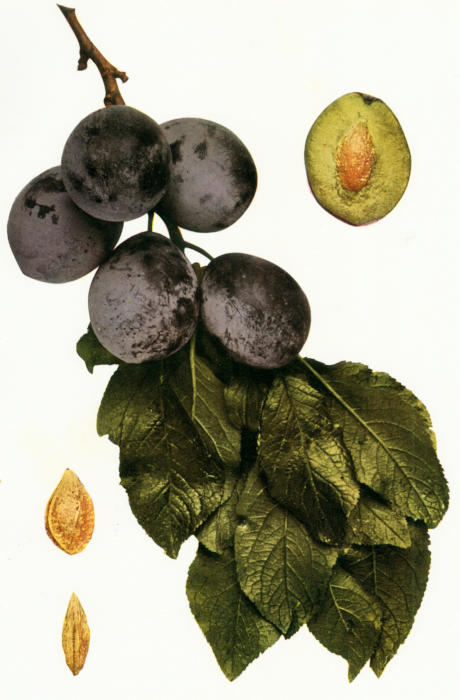
ARCH DUKE
Prunus domestica
1. Hogg Fruit Man. 684. 1884. 2. Ont. Fr. Gr. Assoc. Rpt. 35. 1891. 3. U. S. D. A. Pom. Rpt. 45. 1895. 4. W. N. Y. Hort. Soc. Rpt. 42:83. 1897. 5. Cornell Sta. Bul. 131:182. 1897. 6. Mich. Sta. Bul. 169:241, 242. 1899. 7. Ibid. 187:77, 78. 1901. 8. Waugh Plum Cult. 95. 1901. 9. Thompson Gard. Ass’t 4:156 1901. 10. Ohio Sta. Bul. 162:242, 243 fig., 254, 255. 1905.
Late Diamond 1.
Arch Duke ought to become one of the leading plums for the market in New York. The qualities which fit it for a high place among commercial varieties are: large size, handsome color—a rich, dark purple with thick bloom—and firmness of flesh and skin so that it both keeps and ships well. The accompanying color-plate does not do the variety justice, either in beauty, color or size of fruit. Arch Duke compared with Grand Duke, known by all plum-growers, is nearly as large, neck thicker, the same color, bloom heavier, quality higher, flesh firmer, stone free and ripens earlier. The tree-characters, like the fruit-characters, are all good. While this variety is suitable for both home and market use it appears after a thorough test in many parts of the State for nearly twenty years to be especially well adapted for a market fruit.
Arch Duke was raised by Thomas Rivers, Sawbridgeworth, England, from seed of De Montfort, and was sent out in 1883. It was first noted in America by the Ontario Fruit Growers’ Association in 1891 and was imported into the United States by S. D. Willard[205] of Geneva, New York, about 1892.
Tree of medium size, upright-spreading, hardy in New York except in exposed locations, very productive; branches smooth, dark ash-gray, with small, raised lenticels; branchlets of medium thickness and length, with long internodes, greenish-red changing to brownish-red, glossy, covered thinly with bloom and with sparse pubescence; lenticels numerous, very small, obscure; leaf-buds large, long, pointed, free; leaf-scars swollen.
Leaves folded upward, oval or obovate, one and five-eighths inches wide, three and five-eighths inches long, thickish, stiff; upper surface dark green, glossy, glabrous, with grooved midrib; lower surface silvery-green, sparingly pubescent; apex and base acute, margin doubly serrate, with small, dark glands; petiole three-quarters inch long, pubescent along one side, tinged red, usually with two large, globose, greenish-yellow glands on the stalk or on the base of the leaf.
Blooming season intermediate in time and length; flowers appearing after the leaves, one and one-eighth inches across, in the bud creamy-yellow changing to white when expanded; borne in scattering clusters on lateral buds and spurs, singly or in pairs; pedicels nine-sixteenths inch long, glabrous, green; calyx-tube greenish, campanulate, glabrous; calyx-lobes obtuse, pubescent on both surfaces, glandular-serrate and with marginal hairs, slightly reflexed; petals obovate or oval, crenate, with short, broad claws; anthers yellowish, with a trace of pink; filaments five-sixteenths inch long; pistil glabrous, equal to the stamens in length.
Fruit late, season very short; one and three-quarters inches by one and three-eighths inches in size, long-oval, slightly compressed and necked; cavity shallow, narrow, compressed, abrupt; suture shallow and rather broad, prominent; apex elongated; color reddish-purple changing to dark blue at full maturity, overspread with thick bloom; dots numerous, small, brownish-russet, inconspicuous; stem often inserted at one side of the base, five-eighths inch long, glabrous, adhering well to the fruit; skin tough, adhering; flesh deep golden-yellow often a little reddish, juicy, coarse, firm, but somewhat tender, sweet, pleasant and sprightly; good; stone free, the cavity larger than the pit, one and one-eighth inches by five-eighths inch in size, long-oval, necked, abruptly tipped at the apex, often reddish, rough; ventral suture broad, blunt, slightly furrowed; dorsal suture with an indistinct shallow groove.
ARCTIC
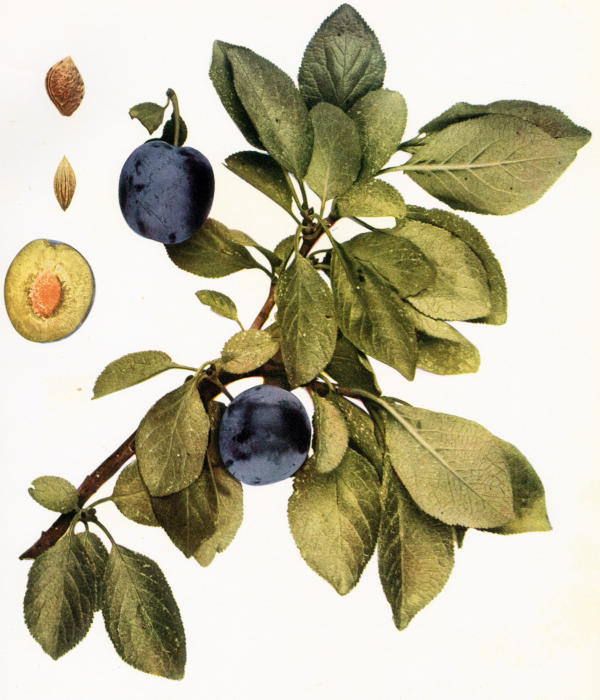
ARCTIC
Prunus domestica
1. Downing Fr. Trees Am. 3d App. 182. 1881. 2. Am. Pom. Soc. Cat. 38. 1881. 3. Country Gent. 49:106. 1884. 4. Am. Pom. Soc. Rpt. 96. 1887. 5. Mich. Pom. Soc. Rpt. 289, 290. 1889. 6. Gard. & For. 6:526. 1892. 7. Can. Hort. 16:301. 1893. 8. Mich. Sta. Bul. 103:35. 1894. 9. Ont. Fr. Exp. Sta. Rpt. 120. 1896. 10. Cornell Sta. Bul. 131:189. 1897. 11. Ohio Sta. Bul. 113:160. 1899. 12. Mich. Sta. Bul. 169:241, 242. 1899. 13. Can. Exp. Farm Bul. 43:33. 1903. 14. Budd-Hansen Am. Hort. Man. 304. 1903. 15. Ga. Sta. Bul. 67:278. 1904. 16. Ohio Sta. Bul. 162:256, 257. 1905.
Moore Arctic 8, 15. Moore’s Arctic 1, 2, 3, 4, 5, 6, 7, 9, 10, 11, 16. Moore’s Arctic, 13, 14.
Arctic is very generally supposed to be preeminent in two qualities, hardiness and productiveness. On the grounds of this Station it is both hardy and productive and from its behavior here it might well be recommended for these qualities, but as to its hardiness elsewhere pomologists do not agree. In the references given above, Downing says it is the hardiest plum known; in Michigan it is reported very tender in the nursery row; a Canadian writer says it is not hardy enough for Canada; and it is reputed in the prairie states to be not hardier than Lombard. The place of its origin, where few plums are grown, and the fact that it is one of but few that can be grown in parts of Canada and New Brunswick establish the claim that it is one of the hardiest of the Domesticas, possibly not more so, however, than Lombard, Voronesh and a few others. The small size and mediocre quality of the fruit and the dwarfish trees should rule Arctic out where less hardy varieties can be grown.
This variety was first noted in 1881 by Downing who says it originated on the grounds of A. T. Moore, Ashland, Maine, about forty miles north of Bangor. The parentage of Arctic is unknown. According to the originator, it was grown from a seed of a medium sized blue plum bought at a fruit-stand in Boston. In 1881 Arctic was added to the American Pomological Society catalog, where it still remains.
Tree small, of medium vigor, upright-spreading, very hardy, productive, an early bearer, subject to attacks of fungi; branches somewhat rough, dark ash-gray, with small lenticels; branchlets strongly inclined to develop spurs and blossom-buds, short, slender, with short internodes, greenish-red changing to dark brownish-drab, dull, sparingly pubescent, with inconspicuous, raised lenticels; leaf-buds short, obtuse, appressed.
Leaves obovate or oval, two inches wide, three and three-eighths inches long; upper surface dark green, covered with numerous hairs, the midrib grooved; lower surface silvery-green, pubescent; apex abruptly pointed or acute, base acute, margin finely serrate, with small, black glands; petiole five-eighths inch long, tinged red, pubescent, with from one to four globose, green glands usually at the base of the leaf.
Blooming season of medium length; flowers appearing after the leaves, one and three-sixteenths inches across, in the bud creamy-yellow changing to white as the petals expand; borne in clusters on lateral buds and spurs, singly or in pairs; pedicels five-eighths inch long, pubescent, greenish; calyx-tube green, campanulate, pubescent; calyx-lobes narrow, obtuse, pubescent on both surfaces, serrate, with ciliate margins, reflexed; petals narrow-obovate or oval, crenate, short-clawed; anthers yellowish; filaments one-half inch long; pistil pubescent at the base, shorter than the stamens.
Fruit mid-season, ripening period long; one and three-eighths inches by one and one-quarter inches in size, oval or ovate, slightly swollen on the suture side, compressed, halves equal; cavity very shallow and narrow, abrupt; suture shallow, indistinct; apex roundish; color dark purple becoming purplish-black at full maturity, covered with thick bloom; dots numerous, small, russet, inconspicuous, clustered about the apex; stem slender, seven-eighths inch long, pubescent, adhering to the fruit; skin of medium thickness and toughness, separating readily; flesh light yellow, juicy, coarse and fibrous, somewhat firm but tender, sweetish, mild; fair in quality; stone nearly free, characteristically small, seven-eighths inch by one-half inch in size, oval, flattened at the apex, acute at the base, rough and pitted; ventral suture ridged, faintly winged; dorsal suture broadly and shallowly grooved.
ARKANSAS
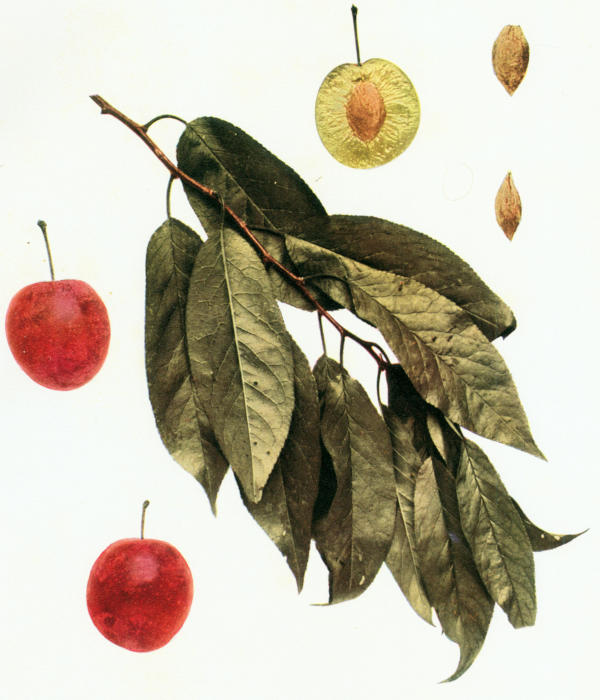
ARKANSAS
Prunus munsoniana
1. Am. Pom. Soc. Rpt. 162. 1881. 2. Cornell Sta. Bul. 38:60, 86. 1892. 3. Tex. Sta. Bul. 32:478. 1894. 4. Wis. Sta. Bul. 63:27. 1897. 5. Waugh Plum Cult. 192, 194 fig. 1901. 6. Budd-Hansen Am. Hort. Man. 293. 1903. 7. Ia. Hort. Soc. Rpt. 488. 1904.
Arkansas Lombard 1, 2, 3, 4, 7. Arkansas Lombard 5, 6.
Arkansas, as the synonymy shows, originally, and even now, usually has Lombard as a suffix, but the name is misleading as the plum is in no wise like a Lombard and following the rules of the American Pomological Society it has been dropped in The Plums of New York. On the grounds of this Station, Arkansas is one of the most valuable plums of its species, being unusually attractive in size, color and shape and one of the best in quality of its kind. Its chief fault is a lack of robustness in the tree. While it would not prove profitable as a market plum in New York, it could be well planted in a commercial orchard in regions where native plums must be grown, and in New York it would at least add a pleasing variety to any collection of plums. This variety was brought to notice by T. V. Munson in 1881. It originated in Arkansas and was introduced by J. D. Morrow & Sons of that state.
Tree small, flattened, spreading, dense-topped, symmetrical, hardy, productive, somewhat subject to shot-hole fungus; trunk shaggy; branches rough, zigzag, sparingly thorny, dark ash-gray, with numerous lenticels; branchlets slender, with very short internodes, greenish-red changing to reddish-brown, glossy, glabrous, with few, conspicuous, raised lenticels; leaf-buds small, short, obtuse, free.
Leaves folded upward, lanceolate, peach-like, one and one-quarter inches wide, three and one-half inches long, thin; upper surface light green, smooth, glabrous, with grooved midrib; lower surface pale green, sparingly pubescent along the midrib and larger veins; apex taper-pointed, base acute, margin finely serrate, with light brown glands; petiole one-half inch long, slender, pubescent on one side, dull red, with from one to six small, globose, yellow or brownish-red glands.
Blooming season late and long; flowers appearing after the leaves, five-eighths inch across, in the buds creamy-yellow changing to white as they unfold; with a strong disagreeable odor; borne in very dense clusters on lateral buds and spurs, in threes or fours; pedicels one-half inch long, slender, glabrous, greenish; calyx-tube green, campanulate, glabrous; calyx-lobes short, sparingly pubescent on the inner surface, glandular-serrate, faintly hairy and with a trace of red on the margin, erect; petals obovate, crenate, with narrow claws, somewhat hairy at the base; anthers yellowish; filaments nearly one-quarter inch in length; pistil glabrous, slightly shorter than the stamens.
Fruit early, season very long; one inch by seven-eighths inch in size, roundish-ovate, halves slightly unequal; cavity shallow, flaring, regular; suture an indistinct line; apex roundish or pointed; color bright currant-red, with thin bloom; dots smallish, white, conspicuous, clustered about the apex; stem very slender, five-eighths inch long, glabrous, not adhering to the fruit; skin thin, tough, bitter, separating readily; flesh orange-yellow, juicy, fibrous, somewhat tender and melting, sweet at the skin but sour at the center, aromatic; good; stone clinging, three-quarters inch by one-half inch in size, oval, flattened and prolonged at the base, sharp-tipped at the apex; ventral suture acute, faintly ridged; dorsal suture acute.
AUTUMN COMPOTE
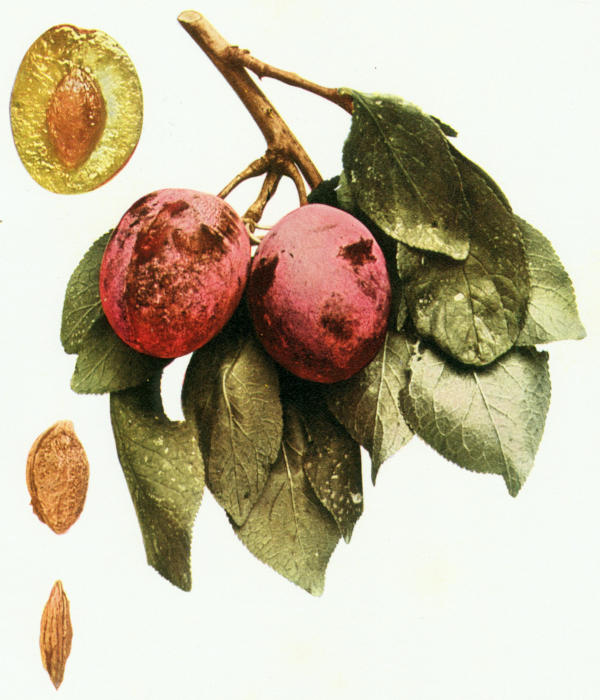
AUTUMN COMPOTE
Prunus domestica
1. McIntosh Bk. Gard. 2:533. 1855. 2. Gard. Chron. 26:364. 1866. 3. Hogg Fruit Man. 351. 1866. 4. Downing Fr. Trees Am. 897. 1869. 5. Mas Le Verger 6:71, fig. 36. 1866-73. 6. Hogg Fruit Man. 685. 1884. 7. Thompson Gard. Ass’t 4:156. 1901.
Autumn Compote 5. Compote d’Automne 5.
This plum is well and favorably known in England, but it is scarcely grown in America, though it has much in the character of its fruit at least to recommend it. The plums are attractive in appearance and while not of the highest flavor are yet far above the average in the qualities which make a good dessert fruit, while for culinary purposes it ranks among the best. The trees are productive, hardy and fairly vigorous and may be especially noted as holding their crop well. Autumn Compote is a seedling of Cooper, raised by Thomas Rivers, Sawbridgeworth, England, about 1840.
Tree of medium size and vigor, spreading, rather low and open-topped, hardy, very productive; branches smooth, dark brownish-gray, with lenticels intermediate in number and size; branchlets few, slender, very short, with long internodes, greenish-red changing to dark brownish-red, dull, sparingly pubescent early in the season, becoming heavily pubescent later, with few, inconspicuous, small lenticels; leaf-buds long, pointed, free.
Leaves drooping, folded backward, long-oval or obovate, two and one-eighth inches wide, four and one-fourth inches long, thick; upper surface dark green, smooth, hairy, with deeply grooved midrib; lower surface pale green, pubescent; apex acute, base tapering, margin crenate, eglandular; petiole thick, one-half inch long, tinged red, glandless or with from one to four globose, greenish-yellow, large glands usually on the stalk.
Season of bloom medium, short; flowers appearing after the leaves, one and one-quarter inches across, in the buds creamy-yellow changing to white as the flowers open; borne in clusters on short lateral spurs, singly or in pairs; pedicels nearly one-half inch long, glabrous, green; calyx-tube greenish, campanulate, glabrous; calyx-lobes broad, obtuse, glandular-serrate, sparingly pubescent on both surfaces, reflexed; petals oval, narrowly dentate, with very short and broad claws; anthers yellowish; filaments nearly seven-sixteenths inch long; pistil glabrous, longer than the stamens.
Fruit late, ripening period of medium length; one and five-eighths inches by one and three-eighths inches in size, oval or slightly ovate, halves unequal; cavity shallow, narrow, abrupt; suture shallow, a distinct line; apex roundish or slightly pointed; color purplish-red over a yellow ground, covered with bloom of medium thickness; dots numerous, small, light russet, conspicuous; stem glabrous, adhering to the fruit; skin thin, tender, separating readily; flesh golden-yellow, dry, firm but tender, sweet, not high in flavor; fair in quality; stone clinging but not tenaciously, one inch by five-eighths inch in size, irregularly and broadly ovate, flattened, roughish, slightly compressed and necked at the base, blunt or acute at the apex; ventral suture narrow, winged, strongly furrowed; dorsal suture acute or faintly furrowed.
BARTLETT
Prunus triflora × Prunus simonii
1. Cal. State Bd. Hort. 53. 1897. 2. Vt. Sta. Bul. 67:7. 1898. 3. Burbank Cat. 1899. 4. Can. Hort. 25:411. 1902. 5. Ga. Sta. Bul. 68:6. 1905. 6. De Vries Plant Breeding 226. 1907.
Bartlett was grown by Burbank from a cross of Prunus simonii with Delaware, the latter one of his earliest hybrids. The originator disposed of the variety in 1899 and it immediately became popular with nurserymen and was soon offered for sale in all parts of the United States. Fruit-growers have not received it so well, however, and most of those who have tried it have discarded it or hold the variety as a curiosity. The fruit is attractive in appearance and the Bartlett pear flavor is agreeable, but the skin cracks badly in this State and the flesh is too soft for shipping. The tree with its stiff, upright branches resembles a Lombardy poplar and with its bright, glossy green foliage is an attractive ornamental. It is still further peculiar in bearing thick clusters of flowers at the ends of lateral spurs.
Tree lacking in size and vigor, upright, open-topped, not very hardy, productive; branches rough, with numerous fruit-spurs; branchlets slender, short, glabrous throughout the season; leaf-buds plump; leaves folded upward, oblanceolate, one and one-half inches wide, three and one-quarter inches long, thin; margin finely serrate, in two series, eglandular or with small, dark glands; petiole slender, with from one to four small glands; blooming season early, long; flowers appearing before the leaves.
Fruit very early; one and three-eighths inches by one and one-quarter inches in size, long-cordate to slightly oval, dark purplish-red over yellow, covered with thick bloom; skin tender, bitter; flesh yellow, not very juicy, tender, sweet, with a peculiar but pleasant flavor; of good quality; stone clinging, seven-eighths inch by one-half inch in size, elongated-ovate, narrow, blunt at the base, long drawn out at the apex, the surfaces rough.
BASSETT
Prunus maritima
1. Gard. Mon. 17:335. 1875. 2. Cornell Sta. Bul. 38:75. 1892. 3. Bailey Ev. Nat. Fruits 214. 1898. 4. Waugh Plum Cult. 229. 1901. 5. Ohio Sta. Bul. 162:254, 255. 1905. 6. S. Dak. Sta. Bul. 93:10. 1905.
Bassett’s American 2, 3. Bassett’s American 4.
Bassett, the best known of the few cultivated varieties of Prunus maritima, was found growing wild in New Jersey and was turned over to a nurseryman, Wm. F. Bassett of Hamilton, New Jersey, who introduced it in 1872. After its introduction it became somewhat popular in the West, gaining quite a reputation as being “curculio proof,” However, its marked inferiority to varieties of other species, in both size and quality, has now banished it from all commercial plantings. The following description is compiled.
Tree vigorous, spreading. Fruit late mid-season; very small, roundish, dull red, covered with thin bloom; skin thick, tough; flesh greenish-yellow; quality poor; stone of medium size, roundish, smooth, free.
BAVAY
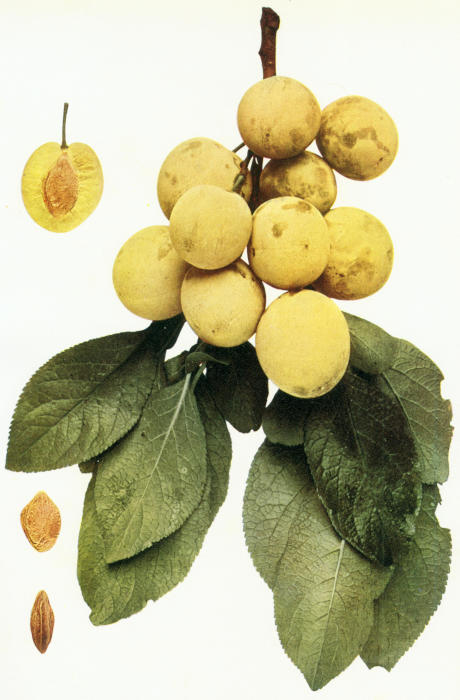
BAVAY
Prunus domestica
1. Gard. Chron. 6:65. 1846. 2. Mag. Hort. 12:340. 1846. 3. Horticulturist 1:527. 1846. 4. Lee Gen. Farmer 10:241. 1849. 5. Thomas Am. Fruit Cult. 328. 1849. 6. Elliott Fr. Book 423. 1854. 7. Am. Pom. Soc. Cat. 210. 1856. 8. Downing Fr. Trees Am. 370. fig. 1857. 9. U. S. D. A. Rpt. 190, Pl. XII. 1865. 10. Hogg Fruit Man. 379. 1866. 11. Downing Fr. Trees Am. 897. 1869. 12. Pom. France 7: No. 6. 1871. 13. Mas Le Verger 6:93, fig. 47. 1866. 14. Oberdieck Deut. Obst. Sort. 437. 1881. 15. Cat. Cong. Pom. France 363. 1887. 16. Rev. Hort. 515. 1888. 17. Mathieu Nom. Pom. 422. 1889. 18. Mich. Sta. Bul. 129:32, 33. 1896. 19. Cornell Sta. Bul. 131:191. 1897. 20. Mich. Sta. Bul. 169:241, 242. 1899. 21. Waugh Plum Cult. 96. 1901. 22. Va. Sta. Bul. 134:40. 1902. 23. Ohio Sta. Bul. 162:241. 1905.
Bavay’s Green Gage 17, 21. Bavay’s Green Gage 11. Bavay’s renkloie 12. Bavay’s Reine Claude 17. Bavays Reine-Claude 13. De Bavay 15. Monstreuse de Bavay 15. Monstrueuse de Bavay 10, 11, 12, 17. Prune de Bavay 12, 17. Queen Claude of Bavay 6. Reine Claude 21, 23. Reine-Claude de Bavay 2, 3, 4, 5, 7, 8, 9, 10, 12, 13, 15, 16, 19. Reine-Claude de Bavay 6, 11, 13, 17, 18, 21. Reine-Claude Monstreuse de Bavey 1. Reine-Claude Monot 17. Reine-Claude von Bavays 14. St. Claire 10. Saint Clair 11, 17. Sainte-Claire 17. Saint-Claire 12.
Bavay is one of the best of the green plums—a worthy rival in all respects and in some superior to its parent Reine Claude. It is unexcelled as a dessert plum and its delicious flavor is retained in cooking, making the somewhat rare combination of a first rate dessert and a first rate culinary fruit. Bavay is not only satisfactory in the qualities which make it desirable to the consumer but it is a good market plum for it both keeps and ships well. The flavor is not quite equal to that of Reine Claude, one of the best of all plums in quality, but in tree-characters the Bavay surpasses the older variety. The trees bear young, annually and heavily, sometimes too heavily, and while not as hardy, as large, as robust or as long-lived as could be wished, yet in these respects they are superior to those of most of the varieties of Reine Claude plums. Some horticulturists recommend that the Bavay be top-worked on a more vigorous, hardy and longer-lived stock but the behavior of trees so treated in this vicinity makes top-working a very doubtful expedient. Lombard is usually recommended as a stock upon which to work it. Bavay is indispensable in home orchards and can be recommended for much more general planting in commercial orchards.
This variety is a seedling of Reine Claude produced by Major Esperin of Malines, Belgium, about 1832, and dedicated by him in 1843, to M. De Bavay, Director of the Royal Nurseries, at Vilvordes, near Brussels. Though this variety is distinct from its parent in tree-characters, in having a later season, smaller fruit and a different flavor, the two plums have become confused by many nurserymen and horticulturists. In 1856, the American Pomological Society placed Bavay on its fruit catalog list where it still remains.
Tree of medium size and vigor, upright-spreading, open-topped, hardy, very productive, somewhat susceptible to sunscald; branches smooth except for the few, large, raised lenticels, light ash-gray; branchlets medium in thickness and length, with internodes of variable length, dull brownish-red, pubescent, with numerous, inconspicuous, small lenticels; leaf-buds large, long, pointed, appressed.
Leaves folded backward, oval, or slightly obovate, wide, long, thick; upper surface nearly smooth, covered sparsely with hairs; lower surface thickly pubescent, especially along the midrib and larger veins; apex acute; margin crenate, glandless; petiole thick, long, tinged lightly with red, glandless or with from one to three globose, greenish-yellow glands on the stalk or base of the leaf.
Blooming season intermediate in time and length; flowers appearing after the leaves, one and one-eighth inches across, whitish or creamy at the apex of the petals; borne on lateral buds and spurs, singly or in pairs; pedicels three-eighths inch long, pubescent, green; calyx-tube greenish, obconic, pubescent at the base; calyx-lobes rather broad, obtuse, pubescent on both surfaces, glandular-serrate, reflexed; petals broadly obovate, crenate, tapering below to short, broad claws; anthers yellowish; filaments three-eighths inch long; pistil pubescent on the ovary, longer than the stamens.
Fruit late, season long; of medium size, roundish-oval, halves equal; cavity intermediate in depth and width, abrupt; suture a line; apex roundish; color greenish-yellow changing to dark straw-yellow, obscurely streaked and splashed, covered with thin bloom; dots numerous, small, grayish, obscure, clustered about the apex; stem thick, short, pubescent, adhering well to the fruit; skin rather tough, separating readily; flesh rich golden-yellow, juicy, slightly fibrous, tender, sweet, pleasant flavor; very good; stone free, seven-eighths inch by five-eighths inch in size, oval, slightly necked, blunt at the apex, with pitted surfaces; ventral suture winged, deeply furrowed; dorsal suture widely and deeply grooved.
BEJONNIERES
Prunus insititia
1. Downing Fr. Trees Am. 898. 1869. 2. Cat. Cong. Pom. France 472. 1887. 3. Ibid. 453. 1906.
Des Béjonnières 2, 3. Prune des Béjonnières 1.
This variety is so highly prized in France that it is here recommended for trial even though the trees as they grow in this part of New York have not been productive. It is too small for a dessert plum but might become of value here if used as in France for tarts, spices, preserves and drying. The plum originated about 1827 in the nursery of Andre Leroy, Béjonnieres, Angers, France.
Tree medium in size and vigor, upright-spreading, unproductive; leaf-scars swollen; leaves oval, medium in width and length; margin with small dark glands, finely serrate; petiole with none or from one to six glands, usually on the stalk; flowers appearing after the leaves, tinged creamy-white as they open; borne on lateral buds and spurs, in pairs or in threes.
Fruit late, season of medium length; one and three-eighths inches by one and one-quarter inches in size, obovate, a little necked, yellow, blotched with red on the exposed cheek, covered with thin bloom; stem long; apex strongly depressed; flesh pale yellow, firm but tender, sweet, aromatic; very good; stone semi-clinging, three-quarters inch by one-half inch in size, oval.
BELGIAN PURPLE
Prunus domestica
1. Downing Fr. Trees Am. 373. 1857, 2. Hogg Fruit Man. 351. 1866. 3. Pom. France 7: No. 27. 1871. 4. Mas Le Verger 6:105. 1866-73. 5. Am. Pom. Soc. Cat. 36. 1877. 6. Cat. Cong. Pom. France 340. 1887. 7. Guide Prat. 153, 352. 1895.
Bleue de Perk 4. Bleue de Bergues 3, 7. Bleue de Belgique 1, 7. Bleu de Perque 1. Blaue von Belgien 4, 7. Bleu de Bergues 6. Bleu de Peck 6. Belgian Purple 4, 6, 7. Bleue de Belgique 7. Belgische Damascene 7. Bleue de Perck 7. Bleu de Belgique 6. Fertheringham 3 incor. Prune Bleue de Belgique 3.
Belgian Purple is a medium grade plum of little value for dessert but rather highly esteemed for culinary purposes, especially in Europe. It probably has but a small place in American pomology. Concerning the origin of the variety, nothing is known although it is generally believed to have originated in Belgium prior to 1850.
Tree large, vigorous, round and dense-topped, not always hardy, very productive; branchlets numerous, thick, pubescent throughout the season; leaf-scars prominent; leaves flattened or folded upward, oval, one and five-eighths inches wide, three and one-half inches long; margin serrate or crenate; petiole five-eighths inch long, glandless or with from one to two small glands usually at the base of the leaf; flowers nearly one inch across, white, with a peculiar greenish and creamy tinge near the apex of the petals and often splashed with pink towards the base; borne on lateral buds and spurs; calyx-tube thickly pubescent.
Fruit mid-season; medium to below in size, roundish-oval, purplish-black, overspread with thick bloom; flesh rich, golden-yellow, medium juicy, firm, sweet, mild; fair to good; stone nearly free, of medium size, oval, flattened, often with a distinct wing.
BELLE
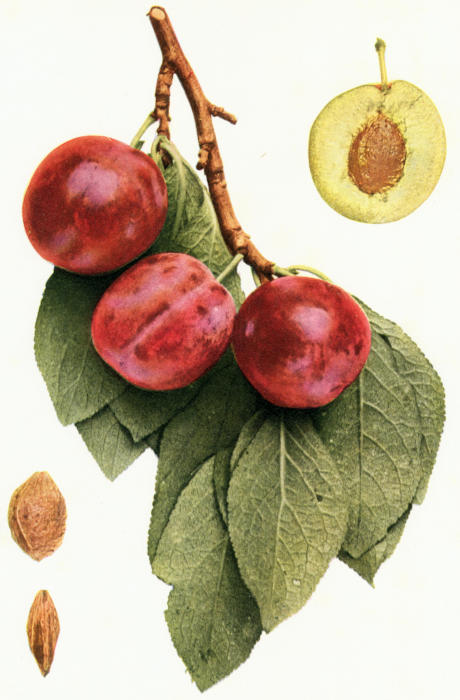
BELLE
Prunus domestica
1. Horticulturist 10:71. 1855. 2. Downing Fr. Trees Am. 394. 1857. 3. Flor. & Pom. 144, Pl. 1863. 4. Hogg Fruit Man. 351, 384. 1866. 5. Mas Le Verger 6:27, fig. 14. 1866-73. 6. Le Bon Jard. 341. 1882. 7. Barry Fr. Garden 410. 1883. 8. Decaisne & Naudin Man. Am. des Jard. 4:382. 9. Mathieu Nom. Pom. 449, 451. 1889. 10. Garden 50:295. 1896. 11. Rivers Cat. 33. 1898. 12. Fish Hardy-Fr. Bk. 2:55. 13. Thompson Gard. Ass’t 4:156. 1901. 14. Waugh Plum Cult. 96. 1901.
Autumn Beauty 11. Autumn Beauty 9. Belle de Septembre 9, 11, 14. Belle de Septembre 1, 3, 4, 7, 10, 12, 13. Gros Rouge de Septembre 3, 4, 9. Lawrence Early 9. Regina nova 6. Reine-Claude Rouge 9. Reine-Claude Rouge de Septembre 5, 9. Reine-Claude Rouge of September 2. Reine-Claude Rouge de Van Mons 5, 6, 8. Reine-Claude Rouge de Van Mons 9. Reine-Claude Rouge Van Mons 4, 9. Reine Nova (Berre) 9. Reina Nova 2, 3, 4, 9. Rote Claude 9. Reine Nova 9. Schöne September Königspflaume 9. Van Mons Königspflaume 9. Van Mons Königspflaume 5. Van Mons Red 9. Van Mons’ Red 4. Van Mons Red Gage 5, 9.
Belle is an unusually large, handsome plum but unfortunately is not of very high quality. It is much like Pond but is brighter red, a little smaller, less necked, the stem is shorter, the apex more blunt and it is more of a clingstone. European authorities say that Belle is second to none for culinary purposes and its handsome appearance gives it value across the seas as a dessert plum. As Belle grows on the grounds of this Station—it seems not to be found elsewhere in New York—the tree-characters are quite above those in the average variety of plums and when considered with the fine, late fruits, indicate that the variety might be grown with profit for market purposes. It well deserves to be tried by commercial plum-growers.
Belle came from Brussels, Belgium, and was propagated by the famous horticulturist, Van Mons. Nothing further is known of its origin.
Tree above medium in size, vigorous, upright, open-topped, hardy, productive; branches smooth, dull dark ash-gray, with small, numerous, raised lenticels; branchlets thick, with short internodes, green changing to brownish-red, often marked with scarf-skin, dull, very pubescent early in the season becoming less pubescent as maturity advances, with numerous, small lenticels; leaf-buds of medium size and length, conical, free.
Leaves flattened or folded upward, obovate, one and seven-eighths inches wide, four and one-half inches long, thick, leathery; upper surface dark green, with deeply grooved midrib, sparingly hairy; lower surface silvery-green, pubescent; apex acute, base cuneate, margin shallowly but broadly crenate, with few small dark glands; petiole one and one-eighth inches long, thick, pubescent, tinged with light red, glandless or with one or two small, globose, yellowish glands on the stalk or base of the leaf.
Blooming season late and long; flowers appearing after the leaves, one and one-eighth inches across, the buds cream-tipped changing to white on expanding; borne on lateral buds and spurs, usually singly; pedicels about seven-sixteenths inch long, thick, pubescent, green; calyx-tube greenish, campanulate, glabrous except towards the base; calyx-lobes above medium in width, obtuse, slightly pubescent on both surfaces, glandular-serrate, erect; petals broadly ovate, crenate, with short, broad claws; anthers yellowish; filaments five-sixteenths inch long; pistil glabrous, equal to the stamens in length.
Fruit late, season of medium length; one and seven-eighths inches by one and three-quarters inches in size, roundish-oval, slightly compressed, halves nearly equal; cavity shallow, flaring; suture shallow, rather wide, prominent; apex roundish or depressed; color light purplish-red over a greenish-yellow ground, overspread with thin bloom; dots numerous, small, russet, inconspicuous; stem one-half inch long, thickly pubescent, adhering strongly to the fruit, with fleshy ring about the base; skin of average thickness and toughness, sour, separating from the pulp; flesh pale yellow, juicy, coarse, firm, sweet at the skin, but tart at the center, pleasant, aromatic; good; stone clinging, one and three-sixteenths inches by three-quarters inch in size, oval, turgid, blunt at the apex, with rough and pitted surfaces; ventral suture winged, with few but prominent ridges; dorsal suture widely and deeply grooved.
BERCKMANS
Prunus triflora
1. Ga. Hort. Soc. Rpt. 53, 99. 1889. 2. Cornell Sta. Bul. 62:20. 1894. 3. Ga. Hort. Soc. Rpt. 95. 1895. 4. Cornell Sta. Bul. 106:43, 44. 1896. 5. Rural N. Y. 56:614. 1897. 6. Am. Pom. Soc. Rpt. 26. 1897. 7. Cornell Sta. Bul. 175:138, 143. 1899. 8. Rural N. Y. 62:582. 1903. 9. Ga. Sta. Bul. 68:9, 28. 1905.
Botan of some 2, 4. Botan White 6. Sweet Botan 1. Sweet Botan 2, 3, 4. True Sweet Botan 2, 4, 9. White-fleshed Botan 1. White-fleshed Botan 2, 4, 8, 9.
This variety was introduced by Luther Burbank in 1887 from imported stock. P. J. Berckmans[206] of Augusta, Georgia, who had secured some Botan trees from Burbank, noted that this plum differed from the rest and, in order to distinguish it, named it Sweet Botan. The nomenclature of Botan was confused and indefinite and Bailey, in 1894, renamed the new plum Berckmans. As it is very similar to Abundance, still more confusion has arisen in regard to it. Compared with Abundance, Berckmans is more spreading in growth; fruit less pointed, with dryer and more insipid flesh; color brighter red and the stone usually freer; but it is neither as productive nor as free from rot. In 1897 the American Pomological Society placed the variety on its fruit list. As Berckmans is inferior to Abundance and ripens at the same season, it is not worth recommending for general planting. It is to be regretted that so distinguished a horticulturist as Mr. Berckmans is not to have his name perpetuated in a better plum than the one named in his honor.
BERGER
Prunus triflora
1. Cornell Sta. Bul. 62:20, 21 fig., 31. 1894. 2. Ibid, 106:45, 62, 67. 1896. 3. Ibid, 139:46. 1897. 4. Ibid, 175:132, 133 fig. 26. 1899. 5. Texas Sta. Bul. 32:486 fig. 7, 490, 492. 1899. 6. W. N. Y. Hort. Soc. Rpt. 92. 1899. 7. Ohio Sta. Bul. 162:248 fig., 254, 255. 1905.
Honsmomo 1, 2, 3, 4, 5. Red Nagate 1, 2 incor. Satsuma 1, 2 incor. Shiro Smomo 1, 2, 5. Strawberry 1, 3, 6. Strawberry 2, 4. Uchi Bene 6. Uchi-Beni 1, 2, 5. Uchi-Beni 3, 4. Ura-Beni 1, 2, 3, 4, 5.
At first sight Berger is a wholly insignificant plum, being no larger than a sweet cherry; but the variety is so distinct in several characters that every collection should have a tree or two of it and the plum-breeder will find it most interesting and valuable. Its peculiarities are: A flavor quite distinct from that of any other Triflora plum; its cherry-like appearance; early ripening, maturing in this State shortly after the middle of July; its pronounced upright habit of growth; its light green foliage; and its habit of bearing its fruit close to the old wood. In common with many other Japanese varieties, the nomenclature of Berger is badly confused. According to Bailey, who received specimens of this variety from various sections of the country, H. H. Berger & Company of San Francisco sent out this plum under several names. Berckmans of Georgia received it as Red Nagate; N. S. Platt of Connecticut as Satsuma; to another person in the South it came as Shiro Smomo, while T. V. Munson of Texas grew it under the name of Berger, a term finally adopted by Bailey. In the meanwhile, Stark Brothers of Louisiana, Missouri, introduced a plum very similar to this under the name Strawberry but the variety was dropped by them in 1893. Whether or not this “Strawberry” or “Uchi-Beni,” as it was sometimes called, was really the Berger it is impossible to say but it is certain that both of these names have been applied to the Berger. The following description is a compilation.
Tree vigorous, upright, open-topped, medium hardy; leaves narrow, light colored; blooming season early; flowers white, small.
Fruit very early; unusually small, roundish but truncate at the ends, attractive light to dark red, covered with thick bloom; flesh firm, meaty, light yellow, sweet, of pleasant flavor; fair to good; stone very small and cherry-like, free, with smooth surfaces.
BLACK BULLACE
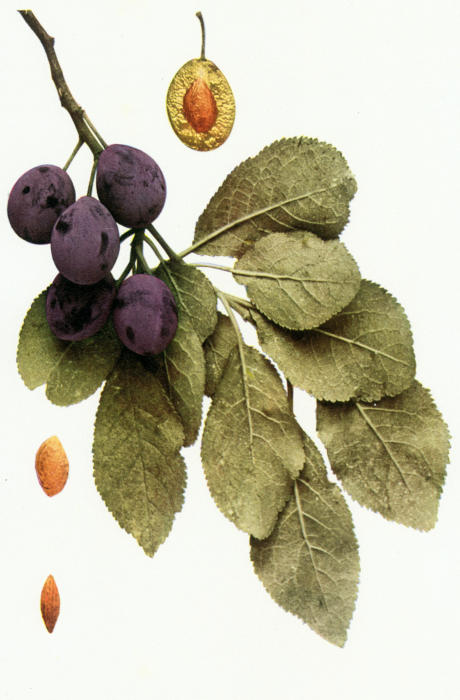
BLACK BULLACE
Prunus insititia
1. Parkinson Par. Ter. 576, 578. 1629. 2. Gerard Herball 1498. 1636. 3. Miller Gard. Dict. 3:1754. 4. Abercrombie Gard. Ass’t 13. 1786. 5. Deane N. E. Farmer Dict. 266. 1797. 6. Miller Gard. Dict. 3:1807. 7. Lond. Hort. Soc. Cat. 144. 1831. 8. Phillips Com. Orch. 306. 1831. 9. Prince Pom. Man. 2:105. 1832. 10. Hogg Fruit Man. 689. 1884. 11. Jour. Hort. 27:476. 1874. 12. Garden 59:226. 1901.
Black Bulleis 1. Bullesse 2. Earley’s November 11.
This variety is interesting chiefly as an early type of the Insititia plums, its thorny branches, wayward growth, small and austere fruit, all bespeaking a wild fruit. The plums when ripened by frost are not unpleasant to taste and are borne in prodigious quantities. The variety, however, is surpassed by many other Insititias and has little value other than to show the steps between wild and highly cultivated fruits.
Black Bullace is one of the oldest of cultivated plums and all data in regard to its origin have been lost. It resembles the wild forms of its species very closely and it may have been selected from the wild. Parkinson, writing in 1629, (References, 1) gives a short description of this variety; and Gerard, in 1636, (References, 2) says: “The Bullesse and the Sloe tree are wilde kindes of Plums, which do vary in their kind, even as the greater and manured Plums do. Of Bullesse, some are of greater and of better taste than others. Sloes are some of one taste, and some of others, more sharp; some greater and others lesser; the which to distinguish with long descriptions were to small purpose, considering they be all and every of them known even to the simplest; therefore this shall suffice for their several descriptions.” Black Bullace has long been known in England and was among the first European varieties cultivated in this country. Deane in The New England Farmer, 1797, describes this variety briefly as under cultivation at that time but it did not prove popular in North America and after Prince, 1832, it seems to have dropped from American plum literature.
Tree of medium size and vigor, upright or slightly spreading, dense-topped, hardy, very productive; branches smooth except for the numerous, small, raised lenticels, dark, ash-gray; branchlets long, with short internodes, green changing to dark brownish-drab, thickly pubescent, with numerous, inconspicuous, small lenticels; leaf-buds small short, obtuse, free.
Leaves oval, one and one-half inches wide, three and one-quarter inches long; upper surface dark green, rugose, hairy, with grooved midrib; lower surface silvery-green, heavily pubescent; apex abruptly pointed or acute, base acute, margin serrate or crenate, with a few, smallish, dark glands; petiole three-quarters inch long, green, thickly pubescent, glandless or with one or two small, globose, greenish-brown glands on the stalk or at the base of the leaf.
Blooming season intermediate in time and length; flowers appearing with the leaves, seven-eighths inch across, white; borne on lateral buds and spurs, singly or in pairs; pedicels three-eighths inch long, pubescent, greenish; calyx-tube green, campanulate, pubescent only at the base; calyx-lobes narrow, obtuse, pubescent at margin and base, with few glands, reflexed; petals oval, entire, tapering abruptly to short claws; anthers yellowish; filaments three-eighths inch in length; pistil glabrous, shorter than the stamens.
Fruit late, season long; one and one-eighth inches by seven-eighths inch in size, distinctly oval, necked, not compressed, halves equal; cavity small, shallow, narrow, flaring; suture lacking; apex roundish, with stigma usually adhering; color purplish-black, covered with thick bloom; dots numerous, small, brown, inconspicuous; stem one-half inch long, pubescent, adhering to the fruit; skin of medium thickness and toughness, slightly astringent, adhering somewhat; flesh greenish-yellow, juicy and fibrous, firm, sour or agreeably tart late in the season; stone clinging, three-quarters inch by one-half inch in size, irregularly oval or ovate, slightly necked at the base, acute at the apex, with pitted surfaces; ventral suture swollen, blunt; dorsal suture acute or partially furrowed.
BLACKMAN
Prunus hortulana × Prunus persica
1. Gara. Mon. 24:82. 1882. 2. Ibid, 29:45, 302. 1887. 3. Cornell Sta. Bul. 38:77. 1892.
Blackman is supposed to be a hybrid between the Wild Goose plum and a peach. According to Bailey, a Mrs. Charity Clark secured plum pits from an orchard of Wild Goose and Washington plums in Rutherford County, Tennessee, about 1865 and gave them to Dr. Blackman of Nashville of that State. One of the seedlings appeared promising and was disseminated by a local nurseryman under the name Blackman. A rival nurseryman in attempting to procure cions of this variety inadvertently cut them from an adjacent tree, a barren seedling from the same lot of seed. Unfortunately the spurious Blackman received a wide distribution while the true variety remained practically unknown. Afterwards in order to avoid confusion the original Blackman was rechristened Charity Clark under which name it is now known. The tree of the second Blackman is strong and vigorous but rarely produces its plum-like fruit. The foliage is about midway in character between the plum and peach; the fruit-buds are formed abundantly but seldom open. From a horticultural standpoint, the variety is of course worthless but the hybrid, one of the first of its kind, is interesting and worth recording.
BLEEKER
Prunus domestica
1. Prince Pom. Man. 25. 1828. 2. Kenrick Am. Orch. 255. 1832. 3. Manning Book of Fruits 104. 1838. 4. Downing Fr. Trees Am. 273. 1845. 5. Am. Pom. Soc. Cat. 54. 1852. 6. Thompson Gard. Ass’t 515. 1859. 7. Downing Fr. Trees Am. 899. 1869. 8. Mas Le Verger 6:21. 1866-1873. 9. Hogg Fruit Man. 686. 1884. 10. Mathieu Nom. Pom. 423. 1889. 11. Guide Prat. 158, 364. 1895. 12. Waugh Plum Cult. 96. 1901.
Bleecker’s 11. Bleecker’s German Gage 1. Bleecker’s German Gage 2. Bleecker’s Gage 2, 4, 5, 6, 7. Bleecker’s Gage 9, 10, 11, 12. Bleeker’s Gage 3. Blucher’s Gage 6. Bleecker’s Yellow 7. Bleeker’s 10. Bleecker’s Yellow Gage 7, 8, 11. Bleecker’s Gage 8. Bleeker’s Yellow 9. Bleeker’s Gelbe Zwetsche 11. Bleeker’s Gelbe Zwetsche 10. Bleeker’s Yellow Gage 9, 10. Bleeker’s Gelbe Reine-Claude 10. Bleeker’s Gelbe Renklode 11. Bleeker’s Yellow 10. German Gage 4, 6, 7, 9, 10, 11. Jaune de Bleeker 10, 11. Reine-Claude de Bleeker 10. Reine-Claude de Bleecker 8, 11.
Just why this old and one time popular plum is now so seldom grown cannot be said. It is a delicious dessert plum of the Reine Claude group, much like Yellow Gage but distinguished from it by a longer and stouter stalk. Its tree-characters in New York are good and the fruit in all the qualities that make plums desirable is as good as that of most of its class. The variety originated with a Mrs. Bleeker of Albany, New York, about 1810 from a pit given her by Rev. Mr. Dull of Kingston, New York. This stone had come from Germany and was thought to have been that of a German prune but this is probably an error as the seedlings of that variety come true or nearly so. Bleeker was listed in the catalogs of the American Pomological Society from 1852 to 1897.
Tree large, vigorous, upright-spreading, open-topped, productive; trunk and branches thick and covered with rough bark; branches slightly pubescent; leaves two and one-quarter inches wide, four inches long, oval, stiff; upper surface somewhat rugose; margin serrate; petiole five-eighths inch long, thick, tinged red, with from two to three glands usually on the stalk.
Fruit early; nearly one and one-half inches in diameter, roundish-oval, greenish-yellow, striped and splashed with green becoming golden-yellow at full maturity, overspread with thin bloom; flesh golden-yellow, dry, coarse, firm, sweet, mild; of good quality; stone semi-clinging, one inch by five-eighths inch in size, obovate, acute at the apex, medium turgid, with pitted surfaces.
BLUE PERDRIGON
Prunus domestica
1. Parkinson Par. Ter. 576. 1629. 2. Rea Flora 208. 1676. 3. Quintinye Com. Gard. 67, 68, 69, 1699. 4. Langley Pomona 92, Pl. 23 fig. 4. 1729. 5. Duhamel Trait. Arb. Fr. 2:85. 1768. 6. Prince Pom. Man. 2:66. 1832. 7. Downing Fr. Trees Am. 290. 1845. 8. Floy-Lindley Guide Orch. Gard. 280, 293, 383. 1846. 9. U. S. Pat. Off. Rpt. 287. 1853. 10. Hogg Fruit Man. 687. 1884. 11. Mathieu Nom. Pom. 452. 1889. 12. Guide Prat. 154, 361. 1895.
Blue Perdrigon 6, 7, 11, 12. Brignole Violette 7, 10, 11, 12. Battle Monument 10, 11. Blaue Fasanen Pflaume 11, 12. Blauer Perdrigon 11, 12. Blew Perdrigon 2, 3. 4. Perdrigon 1, 3, 9. Perdrigon Violet 5, 12. Perdrigon Violet 6, 8, 11. Perdrigon Violette 7, 10. Perdigon 8. Perdigevena 8. Violet Perdrigon 4, 6, 7, 10, 11. Violet Perdrigon 6, 8. Violetter Perdrigon 11. Violette Fasanen Pflaume 11. Violette Huhner Pflaume 11. Violette Rebhuhn Pflaume 11. Violette Fasanenpflaume 12. Violette Huhnerpflaume 12. Violetter Perdrigon 12. Violettes Rebhuhnerei 11, 12.
Early records indicate that the Blue Perdrigon was introduced into England from Italy. Hakluyt, writing in 1582, says, “Of late time the Plum called the Perdigevena was procured out of Italy, with two kinds more, by the Lord Cromwell, after his travel.” Gough, in his British Topography, states that Lord Cromwell introduced the “Perdrigon plum” into England in the time of Henry VII. From these accounts it would seem that this plum was established in England some time during the latter part of the Fifteenth Century. For three hundred years it thrived so well in England that writers had no hesitation in pronouncing it their best plum. From England it came early to America. Probably it was included in the shipment of plum pits ordered from England by the Governor and Company of the Massachusetts Bay Colony in New England in 1629. In spite of its Old World reputation, however, it never found favor here and is now rarely if ever seen even in collections. The older writers mentioned a Black Perdrigon which they considered distinct from the variety under discussion. Inasmuch as all plums until recently were propagated from seed, it is more than likely that there were all gradations in color and that some attempted to classify the darker seedlings as a distinct variety. This hypothesis is borne out by the fact that after grafting and budding became the common method of propagation the so-called Black Perdrigon became extinct. The following description is a compilation.
Tree vigorous, but not always productive; young shoots pubescent; fruit mid-season; medium in size, obovate, compressed on the suture side, purple or blue, with thick bloom; stem slender; skin thick, very tough; flesh greenish-yellow, firm, rich, sweet, aromatic; good; stone small, flattened, clinging; fruit hangs on the tree until it shrivels.
BODDAERT
Prunus domestica
1. Downing Fr. Trees Am. 2d App. 156. 1876. 2. Am. Pom. Soc. Cat. 36. 1877. 3. Hogg Fruit Man. 687. 1884. 4. Mathieu Nom. Pom. 423. 1889. 5. Lucas Vollst. Hand. Obst. 472. 1894. 6. Waugh Plum Cult. 97. 1901.
Boddaert’s Green Gage 1, 3. Boddart’s Green Gage 2. Boddaert’s Reine Claude 4. Boddaert’s Green Gage 4, 6. Reine-Claude de Boddaert 4. Reine-Claude Boddaert 1, 3, 4. Reine-Claude von Boddaert 4.
Boddaert has much to commend it, the fruit being surpassed by that of but few other plums of its type—that of the Reine Claude. The plums are large, attractive and of very good quality. Since the variety has been known so long it must be that the tree has some fatal defect; otherwise it would be more largely grown. Boddaert is probably a Reine Claude seedling and is of foreign origin, the details of its early history not being known. Downing, in 1876, first mentioned the variety in America; the following year it was placed on the fruit list in the American Pomological Society catalog.
Tree large, medium in vigor, upright-spreading, open-topped, productive; trunk rough; branches smooth, except for a few, raised lenticels; branchlets of medium thickness, brash, thinly pubescent; leaves oval, two and one-quarter inches wide, four inches long, thick and leathery; upper surface dark green, rugose; margin crenate, with small dark glands; petiole pubescent, thick, tinged red, usually with two globose glands.
Fruit mid-season; about one and one-half inches in diameter, roundish-ovate, strongly compressed, yellow, mottled with green before full maturity, overspread with thin bloom; stem thickly pubescent; flesh light yellow, dry, meaty, tender, sweet; good in quality; stone semi-free or free, seven-eighths inch by five-eighths inch in size, oval or ovate, turgid, with pitted surfaces.
BRADSHAW
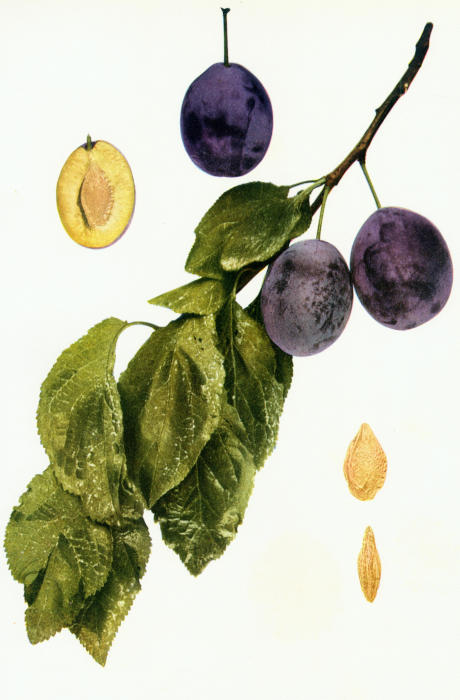
BRADSHAW
Prunus domestica
1. Mag. Hort. 12:341. 1846. 2. Horticulturist 10:15, 253. 1855. 3. Am. Pom. Soc. Rpt. 190, 214. 1856. 4. Cultivator 8:25 fig. 1860. 5. Mas Pom. Gen. 2:3, fig. 2. 1873. 6. Mich. Pom. Soc. Rpt. 303. 1878. 7. Am. Pom. Soc. Rpt. 61, 118. 1883. 8. Hogg Fruit Man. 709. 1884. 9. Rural N. Y. 44:103. 1885. 10. Me. Pom. Soc. Rpt. 130. 1888. 11. Ibid. 144. 1889. 12. Mathieu Nom. Pom. 434. 1889. 13. Mich. Sta. Bul. 103:32, 33, fig. 6. 1894. 14. Guide Prat. 157, 359. 1895. 15. Cornell Sta. Bul. 131:182. 1897. 16. Mich. Sta. Bul. 169:242, 244. 1899. 17. W. N. Y. Hort. Soc. Rpt. 44:91. 1899. 18. Thompson Gard. Ass’t 4:158. 1901. 19. Waugh Plum Cult. 97. 1901. 20. Ont. Fruit Exp. Sta. Rpt. 16, 17 fig. 1902. 21. Va. Sta. Bul. 134:40. 1902. 22. Can. Exp. Farm Bul. 43:33. 1903. 23. Ohio Sta. Bul. 162:239, 254, 255, 256. 1905.
Black Imperial 5, 14. Blue Imperial 5, 14, 19, 20. Bradshaw 9, 14. Grosse Schwarze Kaiser Pflaume 12. Hart Prune 17. Large Black Imperial 8, 14, 18. Large Black Imperial 2, 3, 12. Mooney 9, 17. Niagara 7, 9, 10, 11. Niagara 13, 15, 17, ?19, 20, ?22, 23.
Bradshaw leads all other plums in number of trees in New York, according to a survey of the leading orchards made in the preparation of The Plums of New York. A study of the variety does not justify this popularity. The trees grow rather slowly and are slow in coming into bearing; the fruit is not especially high in quality and in many regions is attacked by brown-rot too freely for profitable orchard culture. To offset these faults the trees are large and well formed, bear regularly and heavily, are hardy, robust and healthy, the best of recommendations, and the plums are large, attractive in appearance and keep and ship well especially if picked a little green. The variety, curiously enough, is not nearly as badly attacked by San José scale as other plums. Probably one of the reasons why Bradshaw is so largely grown in New York is that it is easily handled in the nursery and quickly makes a very good nursery tree. Bradshaw does not deserve the high place it holds with plum-growers, and must give way sooner or later to better varieties for commercial orchards. The value of the crop is greatly lessened in New York because it ripens in the midst of the peach season.
Unfortunately, the origin of this plum is not known. The Europeans and some Americans have held that it came from America but, since it is identical with the Large Black Imperial, it must be of foreign origin. It was named by C. M. Hovey in 1846, and was described in his Magazine of Horticulture with the following explanation: “For the want of a name to distinguish a very large and excellent plum, exhibited for three or four years in succession, by E. E. Bradshaw, Esq., Charlestown, we have called it the Bradshaw plum.” Barry, in 1855, states in the Horticulturist that he “received it from Wm. Kenrick, a nurseryman in Newton, Massachusetts, under the name of Large Black Imperial; but as it has been described in Hovey’s Magazine as Bradshaw, we have adopted that name in our catalog.” Though the name Bradshaw is incorrect according to the rule of priority, it would now cause too much confusion to change it.
Niagara, a well known variety in this State, is identical with Bradshaw in all characters, in spite of a supposedly distinct origin. According to Mr. George Atwood of the State Department of Agriculture, a Mr. Moody of Lockport exhibited, about 1870, the Mooney plum, afterwards named the Niagara. Being interested in the variety, Mr. Atwood visited Mooney, at Lockport, the man from whom Moody had secured his stock. In Mooney’s yard were found several bearing trees, which had been grown from sprouts taken from the original seedling tree, grown in Canada. These trees could not be told from the Bradshaw. If the Niagara is distinct as to origin, it is probably a seedling of Bradshaw. Bradshaw was recommended to fruit-growers as a promising variety by the American Pomological Society in 1856 and has since remained on the fruit list of the society.
Tree large, vigorous, broad-vasiform, dense-topped, hardy, very productive; branches smooth except for the numerous, small, raised lenticels, dark ash-gray; branchlets short, with long internodes, greenish-red changing to brownish-red, often with heavy gray scarf-skin, dull, sparingly pubescent, with obscure, small lenticels; leaf-buds variable in size and length, pointed, free.
Leaves drooping, folded backward, obovate or oval, two inches wide, four and one-quarter inches long, thickish; upper surface dark green, rugose, pubescent, with a shallow groove on the midrib; lower surface grayish-green, thickly pubescent; apex acute, base abrupt, margin not regular, varying from coarsely crenate to serrate, eglandular or with few, small, dark glands; petiole three-quarters inch long, pubescent, reddish, glandless or with from one to three large, globose, greenish-brown glands on the stalk or at the base of the leaf.
Season of bloom short; flowers appearing after the leaves, one and three-sixteenths inches across, the buds creamy changing to white as the flowers expand; borne on lateral buds and spurs, singly or in pairs; pedicels nearly eleven-sixteenths inch long, pubescent, green; calyx-tube greenish, campanulate, pubescent only at the base; calyx-lobes wide, obtuse, pubescent on both surfaces, glandular-serrate, margins ciliate, reflexed; petals broadly oval, erose, with short, broad claws; anthers yellowish; filaments seven-sixteenths inch long; pistil pubescent at the base, shorter than the stamens.
Fruit mid-season; two inches by one and three-quarters inches in size, oval or obovate, compressed, halves equal; cavity shallow, narrow, abrupt, with a fleshy ring around the stem; suture very shallow; apex roundish or flattened; color light purplish-red changing to dark reddish-purple at maturity, covered with thick bloom; dots numerous, small, russet, inconspicuous, clustered about the apex; stem thick, seven-eighths inch long, pubescent, adhering strongly to the fruit; skin thin, somewhat tough, sour, separating readily; flesh dull yellow, often with a trace of red when fully mature, juicy, fibrous, somewhat tender, sweet, pleasant; good; stone semi-free, flattened, one and one-quarter inches by three-quarters inch in size, irregularly oval, necked at the base, blunt at the apex, strongly roughened and pitted, often with numerous, small, deep pits near the margins of both ventral and dorsal sutures; ventral suture strongly furrowed and winged; dorsal suture with a deep, narrow groove.
BRYANSTON
Prunus domestica
1. Lond. Hort. Soc. Cat. 144. 1831. 2. Jour. Hort. N. S. 17:286. 1869. 3. Downing Fr. Trees Am. 902. 1869. 4. Am. Pom. Soc. Cat. 24. 1871. 5. Barry Fr. Garden 411. 1883. 6. Hogg Fruit Man. 688. 1884. 7. Tenn. Sta. Bul. 3: No. 5, 88. 1890. 8. Guide Prat. 155. 1895. 9. Thompson Gard. Ass’t 4:157. 1901. 10. Waugh Plum Cult. 98. 1901. 11. Mass. Sta. An. Rpt. 17:158. 1905.
Bryanstone 11. Bryanston Gage 1, 2, 6, 9. Bryanston’s Gage 3, 5, 7. Bryanston’s Gage 10. Bryanstone Gage 4. Reine-Claude Bryanston 8.
The fruits of Bryanston fall not a little short, all things considered, of being as good as those of several other of the varieties in the Reine Claude group of which this plum is a member. For this reason Bryanston is not often rated by horticulturists as one of the best plums, but the large, vigorous trees growing on the Station grounds are so especially desirable for this variety, in a group which taken as a whole is noted for poor trees, that it is here described among the leading plums. The fruit is larger than that of Reine Claude but is less attractive in color and shape and the quality is not as high. It is later than the variety with which it has just been compared and the crop is not borne as regularly. While this plum can hardly be recommended for extensive orchard plantings, it yet has too many merits to be forgotten.
This variety is said to be the result of crossing Reine Claude and Golden Drop at Bryanston Park, Blandford, England. It was first noted in the London Horticultural Society fruit catalog in 1831 but no information in regard to the date of its origin seems to have been published. In 1871 the American Pomological Society added it to its fruit catalog list but dropped it in 1897.
Tree very large and vigorous, round-topped, open, hardy, very productive; branches smooth, becoming rough near the trunk, ash-gray, with lenticels of medium size and number; branchlets somewhat slender, short, with long internodes, greenish-red changing to dull reddish-brown, marked by scarf-skin, dull, glabrous, with few, inconspicuous, small lenticels; leaf-buds above medium in size and length, pointed, free; leaf-scars prominent.
Leaves folded backward, oval or obovate, one and five-eighths inches wide, three and one-quarter inches long, leathery; upper surface dark green, sparingly hairy, with a shallow groove on the midrib; lower surface yellowish-green, pubescent; apex abruptly pointed or acute, base acute, margin crenate, bearing small, dark glands; petiole one-half inch long, pubescent, with a little red, glandless or with one or two small, globose, yellowish glands.
Blooming season intermediate in time, short; flowers appearing with the leaves, one and one-eighth inches across, white, creamy at the apex of the petals in the newly opened flowers; borne on lateral buds and spurs, singly or in pairs; pedicels one-half inch long, thick, pubescent, greenish; calyx-tube green, campanulate, pubescent at the base; calyx-lobes broad, obtuse, pubescent on both surfaces, glandular-ciliate, somewhat reflexed; petals roundish-ovate, erose; anthers yellow; filaments about one-quarter inch long; pistil glabrous except at the base, slightly longer than the stamens; stigma large.
Fruit mid-season; one and five-eighths inches by one and one-half inches in size, irregular roundish-truncate, halves unequal; cavity shallow, narrow, abrupt; suture usually shallow, prominent; apex flattened or depressed; color dull yellow with greenish streaks, sometimes with pinkish blush about the cavity, mottled, overspread with thin bloom; dots numerous, small, inconspicuous; stem thick, three-quarters inch long, pubescent, adhering well to the fruit; skin thin, tough, sour, separating readily; flesh greenish-yellow, juicy, firm but tender, sweet, aromatic; very good; stone nearly free, seven-eighths inch by five-eighths inch in size, broadly oval, turgid, slightly contracted at the blunt base, roundish at the apex, with rough and pitted surfaces; ventral suture broad, with a distinct but small wing; dorsal suture widely and deeply grooved.
BURBANK
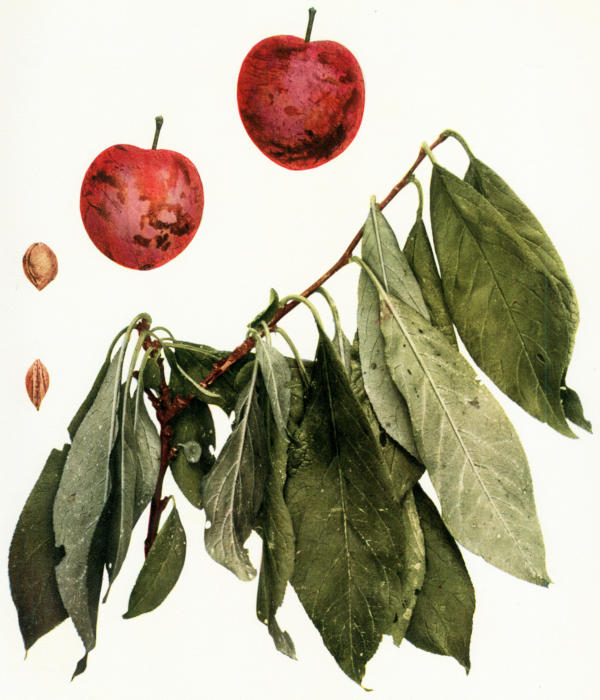
BURBANK
Prunus triflora
1. Ga. Hort. Soc. Rpt. 53, 99. 1889. 2. U. S. D. A. Rpt. 392. 1891. 3. Wickson Cal. Fruits 360. 1891. 4. Cornell Sta. Bul. 106:46, 63. 1896. 5. Ala. Col. Sta. Bul. 85:445. 1897. 6. Am. Pom. Soc. Cat. 26. 1897. 7. Am. Gard. 19:75, 132, 220, 792. 1898. 8. Mich. Sta. Bul. 169:242, 249. 1899. 9. Cornell Sta. Bul. 175:143. 1899. 10. Waugh Plum Cult. 134. 1901. 11. W. N. Y. Hort. Soc. Rpt. 88. 1902. 12. Can. Hort. 25:272. 1902. 13. Budd-Hansen Am. Hort. Man. 308. 1903. 14. Ga. Sta. Bul. 68:11, 28. 1905. 15. Ohio Sta. Bul. 162:256. 1905. 16. DeVries Plant Breeding 170. 1907.
Persing Nos. 1 & 2, 15. Russian plum 20M. 4. Wassu 4. Wassu 9.
Probably Abundance holds first place among the Triflora plums in New York but Burbank is a close second and in many localities has first preference. Abundance is in the lead chiefly because the trees of this variety are larger and better formed and bear more fruit than those of Burbank. To offset the advantages of Abundance the fruit of Burbank is of better quality, more handsomely colored, keeps and ships better and is less susceptible to brown-rot. The fruit of Burbank ripens a week or more later than that of Abundance, which in most seasons is a slight advantage for the first-named variety. The trees of this plum are distinguished from those of all other plums by their low, spreading habit, flat top and somewhat drooping branches, characters which make them more or less difficult to handle in the orchard and very difficult to manage in the nursery. The wood of Burbank is brittle, true of all Trifloras, but a serious defect in this one. In common with other varieties of its species, Burbank is less troubled with curculio and black-knot than the European plums. The fruit of this variety begins to color some days before ripe and should be picked before fully matured if it is to be kept or shipped. Usually the best specimens of Burbank come from thinned trees and thinning is a necessary operation in all commercial orchards. The variety does not thrive in the South, being poor in quality and rotting badly. In New York, Burbank is not being planted nearly so largely as a few years ago, the Domesticas being much more profitable than this or other Triflora plums. It is a very desirable variety for home plantations in New York.
Burbank was produced from a plum pit sent to Luther Burbank[207] by a Japanese agent in 1883.[208] The fruit of this variety proved to be very superior and Mr. Burbank sent specimens of it to the Division of Pomology, United States Department of Agriculture in 1887, where it was named in honor of the introducer. Wassu, introduced by J. L. Normand, and the Russian plum, 20 M, sent out by Professor J. L. Budd proved to be indistinguishable from the Burbank as tested by Bailey, but Kerr[209] thinks the Wassu is a distinct variety. The American Pomological Society added Burbank to the fruit list in its catalog in 1897.
Tree large, vigorous, distinguished by its low, sprawling habit and flat open top, unusually hardy for a Japanese variety, very productive, healthy; branches somewhat roughish, dark ash-gray, thickly covered with fruit-spurs, with few, large, raised lenticels; branchlets medium in thickness and length, with short internodes, greenish-red changing to dark brown, with gray scarf-skin, glossy, glabrous, with raised lenticels of medium size and number; leaf-buds short, obtuse, free.
Leaves folded upward, broadly oblanceolate, peach-like, one and one-eighth inches wide, three and three-quarters inches long, thin; upper surface light green, smooth, pubescent only on the deeply grooved midrib; lower surface glabrous, pubescent on the midrib; apex taper-pointed, base cuneate, margin finely and doubly serrate, with small amber or reddish glands; petiole nine-sixteenths inch long, sparingly hairy on one side, tinged red, with from one to four small, reniform or globose glands mostly on the stalk.
Blooming season early and short; flowers appearing with the leaves, white; borne in dense clusters on the lateral buds and spurs, in threes; pedicels one-quarter inch long, thick, glabrous; calyx-tube green, obconic, glabrous; calyx-lobes broad, obtuse, glandular-serrate, glabrous, erect; petals broadly oval, entire, short-clawed; anthers yellowish; filaments one-quarter inch long; pistil glabrous, longer than the stamens.
Fruit early, season long; variable in size, large when the tree is not overloaded, one and three-quarters inches in diameter, roundish-conic, halves equal; cavity deep, abrupt, regular; suture shallow; apex roundish; color dark red over a yellow ground, mottled, with thick bloom; dots numerous, large, russet, conspicuous; stem five-eighths inch long, glabrous, parting readily from the fruit; skin thin, tough, sour, separating from the pulp; flesh deep yellow, juicy, tender, firm, sweet, aromatic; good; stone clinging, three-quarters inch by five-eighths inch in size, roundish-oval, turgid, blunt but sharp-tipped, roughish, with a slightly winged ventral suture; dorsal suture acute.
CHABOT
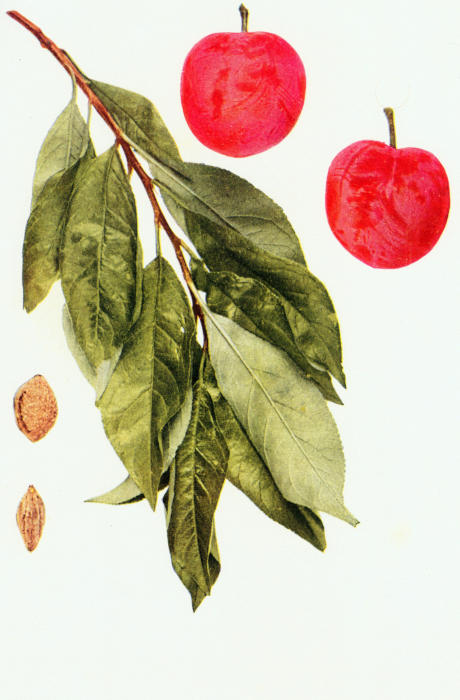
CHABOT
Prunus triflora
1. Ga. Hort. Soc. Rpt. 29. 1886. 2. Ibid. 52, 99. 1889. 3. Am. Gard. 12:501. 1891. 4. Ibid. 13:700. 1892. 5. Rev. Hort. 132, Pl. 537. 1892. 6. Cornell Sta. Bul. 62:20, 22, 28. 1894. 7. Ibid. 106:44, 48, 51, 60. 1896. 8. Rogers Cat. 9. 1896. 9. Cornell Sta. Bul. 139:38. 1897. 10. Am. Pom. Soc. Cat. 26. 1897. 11. Cornell Sta. Bul. 175:150. 1899. 12. Waugh Plum Cult. 134, 135 fig. 1901. 13. Can. Exp. Farm Bul. 43:37. 1903. 14. Ohio Sta. Bul. 162:250, 254, 255, 256, 257. 1905. 15. Ga. Sta. Bul. 68:12, 14, 28, 29, 30, 31, 32. 1905.