Chapter VI · JOHN THE GOOD AND CHARLES THE WISE
Reading edition
[1350-1380 A.D.]
The new king John was between thirty-one and thirty-two years of age. It was long since a king of France had ascended the throne in such critical circumstances. All the internal maladies which, ever since the days of Philip the Fair, had been undermining the constitution of the state had burst out at the first shock of external violence. The weakness of this monarchy, arbitrary without order, fiscal without finances, military without an army, which had failed to create for itself any other instrument or any other support than a body of legists; the fragility of this colossus with feet of clay was now revealed both to the foreigner and to France herself. A country desolated by plague, impoverished by a disastrous war and by a government more ruinous than plague and war, where the lowest depths of society were stirred by those dull mutterings which announce the distant tempest; a royalty despoiled, by deserved misfortunes, of the prestige of birth and grandeur which had survived its popularity; finally a war which set at stake not the position of some frontier but the existence of the dynasty and the independence of the nation: such was the inheritance which the first of the Valois had bequeathed to his son.b
King John inaugurated his reign by debasing the coinage to meet the expenses of the coronation which was celebrated at Rheims, on the 26th of September, 1350, with all the accustomed splendour. The brilliant train of princes who accompanied him drew upon themselves not only the glances but the hopes of the entire population.
Treachery, however, was on all sides. Already Philip of Valois had attempted to deal with it outside the regular forms of judicial procedure; the newly made king followed in his footsteps. Raoul, count of Eu and of Guines, constable of France, obtained of Edward III, whose prisoner he was, liberty on parole, and returned to Paris to present himself at court. John caused him to be arrested and confined in the Louvre. A few days afterwards the constable was beheaded, and his property given to John of Artois, who assumed the title of count of Eu.
[1350-1352 A.D.]
The office of constable was conferred upon a certain De la Cerda, Charles of Spain, brother of that Louis of Spain who had upheld the party of Blois in Brittany. The new constable, being the personal favourite of the king, found many rivals at court, and thus arose contentions that were to be the source of further troubles. For the purpose of anticipating acts of treason and of strengthening the attachment and devotion to himself of the most powerful nobles, John created a new order of chivalry; or, as Froissartg says, “A fine company, high and noble, after the manner of the Round Table which existed in the time of King Artus [Arthur].” He also had another model, the order of the Garter, recently created by Edward III. Thus was instituted the order of the Star, which had for emblem a star in gold, silver, gilt, or pearls, and which the king bestowed on the three hundred knights who had proved themselves “the most valiant at arms and the most useful to the kingdom.” He imposed upon them an oath that they would never flee before the enemy to a distance of over four arpents. On the first occasion the king designated the recipients of the order himself, but later the choice was decided by the majority of the members. This was the first time that a court order of chivalry had been created in France. The new institution was destined to be of but short duration, however, as its dissolution immediately followed the captivity of its founder.
Preparations were begun for a renewal of the war with England, and in expectation of this event John displayed great activity. Financial aid, which was to be a portion of the profits on the sale of beverages and merchandise, was voted to him by the provinces of Vermandois and Normandy, the city of Paris, and the bailiwick of Amiens, the assemblies stipulating in exchange the confirmation of certain privileges and the suppression of various abuses; among others the right of lodgment and of prise en vertu by which the king caused his expenses and those of his household to be defrayed by anyone with whom he chose to lodge.
We can form some idea of the deplorable state of the finances from the fact that during the course of the year 1351 John issued no less than eighteen ordinances altering monetary values, although neither the help of such expedients nor the subsidies voted by the provinces availed to bring about an equilibrium between receipts and expenditures. The treasury continued, as in the preceding reign, to pay annually only a part of the officers’ wages and of the interest on the debt. There were also ordinances regulating the order in which the public expenses were to be met, just as to-day, in cases of bankruptcy, the succession in which creditors are to be paid is determined by law. In the case of certain outlays the government was extremely tardy in making payment, taking for its model the nobility, to the members of which great latitude was allowed. “Let no one,” said King John, “wonder or be ill-pleased, for we take account of the respites and delays accorded to the nobles in the payment of their debts, and it would not be seemly that we should be in a worse condition than they.”
The truces, although renewed from year to year, were imperfectly kept; hostilities continued to break out from time to time at different points, and there was not a campaign during which special engagements did not take place between parties of English or French knights. There were frequent skirmishes during 1351 in the neighbourhood of St. Jean d’Angély, and in 1352 between Guines and St. Omer. The war in Brittany had been kept up in desultory fashion since the capture of Charles of Blois in 1347, when his wife, Joan de Penthièvre, took up the cause. The most celebrated of these minor combats was the combat des trente, fought in Brittany, August 1352, on the moor of Mi-Voie, between Josselin and Ploërmel.c
[1352-1354 A.D.]
Robert de Beaumanoir, governor of the castle of Josselin, challenged the English captain Richard Bamborough who commanded at Ploërmel. They met on the lands of Josselin each with twenty-nine companions. The sixty champions fought on foot with short swords. “Such a combat,” says Froissart, “had not been recorded for over a hundred years.” It did not cease until all the combatants were either killed or badly wounded—four French and nine English, Bamborough among them, lay dead on the field. The rest of the English gave themselves up to the French. But such contests did not help matters, and so the war dragged on.a
TROUBLE WITH CHARLES OF NAVARRE
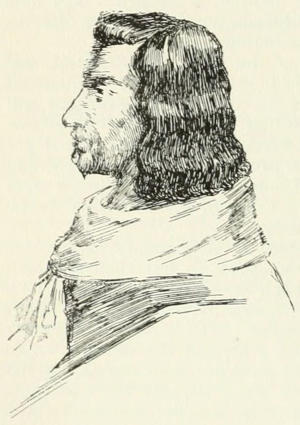
John the Good
(From an old French print)
To the exterior dangers with which France was menaced was now added the calamity of civil war. The cause for this fresh trouble was to be found in the pretensions held by the king of Navarre, and the jealousy which he conceived against the new constable, Charles of Spain. This king of Navarre was Charles the Bad, so named for the rigour with which he had put down a sedition in Pamplona. A prince of the royal house of France on the side of his father, Philip of Évreux, he succeeded in 1349 not only to the kingdom of the Pyrenees, but to the county of Évreux, and the possession of several fiefs in Normandy. He was young, ambitious, enterprising, as were also his two younger brothers, Philip and Louis; and to attach him more securely to his interests, John betrothed to him one of his daughters, then a child, to whom he promised as marriage portion an income raised from the counties of Angoulême and Mortain. These counties having been ravaged by the English, Charles of Navarre demanded another dowry, and at the same time claimed indemnity for Champagne and Brie, former possessions of his mother which had been ceded to the crown during the preceding reign, but by treaty of which all the clauses had not been put regularly in execution. John refused to acknowledge these claims, or at any rate was in no hurry to satisfy them, and gave Angoulême and Mortain to Charles of Spain.
The king of Navarre laid all the blame for this real or pretended breach of faith to the constable, and the two held a spirited altercation together in the presence of King John. With the king of Navarre was his brother Philip of Navarre, count of Longueville, who on being given the lie by the constable swore to be revenged. On leaving the scene of the quarrel he defied the constable and warned him to be on his guard against the infantes of Navarre. Charles of Spain paid so little heed to these menaces that he betook himself, insufficiently attended, to Laigle, the latest evidence of the royal favour, which was situated not six leagues from Évreux, where dwelt his enemies. As soon as the count of Longueville learned of this move he left his home at night, accompanied by a troop of men-at-arms, and entering the hôtel of the constable, murdered the latter in his bed (1354).
[1354-1355 A.D.]
The infantes of Navarre wrote letters of self-justification to several cities of France, and to the council of the king. At the same time they stocked their castles with supplies, assembled all their nobles, and opened up relations with the English, who were only too pleased to have a foothold thus established for them in Normandy. John, determined not to leave unpunished an act of personal vengeance that infringed seriously upon his own authority, marched in person against Évreux, and sent orders to the count d’Armagnac, his representative in Toulouse, to occupy Navarre with the whole strength of the southern troops.
This civil war, breaking forth so unexpectedly, was certain to renew the war with England, since it offered that country an unexampled opportunity to re-enter the lists. In fear of this event, the princes and princesses of the house of France, aided by the legate cardinal of Boulogne, offered their mediation and succeeded in bringing about an arrangement at Nantes, the 22nd of February, 1354. Payment of all that was due him, and the satisfaction of his legitimate claims were assured the king of Navarre, on condition that he should so far humiliate himself as to ask the king’s pardon in open parliament. This he consented to do, but demanded that certain hostages be sent him. “And in the presence of all he asked pardon of the king for the deed wrought upon the said constable, for he had had just and sufficient cause thereto, all of which he was ready to reveal to the king then or at any time. Furthermore he declared and swore that he had not committed the act out of contempt for the king nor for the office of constable, and that nothing would afflict him so sorely as to be in the evil graces of the king.” John accepted the excuse and took the offender back into favour.
This understanding retarded further hostilities, but only for a little time. John, who had been unaware of the secret relations entered into with the English, soon learned of them; whereupon Charles the Bad, fearing for his own safety, retired to Avignon, where he besought protection of the pope. In the month of November John entered Normandy, took possession of and sequestrated the estates of the king of Navarre, and commanded the officers who were in charge of the various castles to deliver them up to him. Six of the defenders refused to obey, among others those in charge of the castles of Cherbourg and Évreux.
The court of Avignon had not ceased its efforts to negotiate a treaty between England and France, and as it was necessary that this treaty should be a final one the king of Navarre must be included in its terms; hence the papal protection had not been refused him in his need. The negotiations were carried on actively during the winter of 1354-1355, but fell through like all preceding ones, and in the spring came definitely to an end. Edward demanded that his full sovereignty should be recognised over Guienne and Ponthieu, which provinces should be separated from the French crown. He also refused to continue to pay homage to France, and tried to stipulate for a semi-independence for Brittany. John refused to consider propositions so injurious, and in a legitimate spirit of national pride resolved to try once more the fortunes of war.
On all sides preparations for war were being carried on. The king of Navarre, having passed through Pamplona and English Guienne, embarked in July, 1355, at Cherbourg, which port it was his intention to open to Edward III. The English sovereign manned a fleet for the purpose of descending upon the north coast of France; but contrary winds held him for a long time in the Channel, in sight of Jersey, and finally obliged him to return to the harbour of Plymouth.
In spite of this mischance the English remained full of ardour, and built great hopes upon the assistance of the Navarrese. John’s counsellors represented to him that he could not with safety allow his enemies to retain allies of such energy and power, and that at any cost the interests of Charles the Bad must be separated from those of Edward III. With great repugnance, therefore, the king consented to grant certain concessions to the king of Navarre, who joyfully accepted them. A second treaty was signed at Valognes, by the terms of which Charles the Bad was reinstated in his French domains on consideration that he should make formal apology for having allied himself with the enemies of the kingdom (September 10th, 1355). He hastened to fulfil his promise, and for the second time came to the Louvre to ask public pardon of the king. His brother Philip, count of Longueville, could not be induced to follow his example, but remained true to the English side.
By depriving the English of the Navarrese alliance King John robbed them of their chief support, and obliged them to change their plan of campaign. Edward III landed at Calais, and in October made several incursions into Artois; but John marched against him in person, and prevented him from crossing the French frontier, thus paralysing all his efforts.
The English were more successful in the south, where they had sent a large army headed by the prince of Wales and the celebrated John Chandos. This army made a rapid and fruitful passage through Languedoc—pillaging Castelnaudary, Carcassonne, and a number of towns and castles—as far as the very gates of Montpellier without meeting with the least resistance. The cities were all entered, and the whole district, one of the richest in France, laid waste as Normandy had been in 1346. The English returned with five thousand prisoners and a thousand wagons laden with silver, objects of worth and merchandise, particularly cloths and velvets taken from Narbonne and Limoux. In order to transport safely all this booty to Guienne it was necessary to cross the Garonne at a distance of only three leagues from Toulouse. The count d’Armagnac, commander of Languedoc, was shut up in this town with forces more considerable than those of the English; he refused, however, to sally forth and arrest them as they passed by, in spite of the orders which had been brought to him by the new constable James de Bourbon, successor to Charles of Spain.
To meet the needs of the war, and to provide himself with a still greater force for the coming campaign, John resorted to all sorts of financial expedients. He ordered his treasurers to adjourn all payments out of the public funds, be they for what purpose they might; he made treaties for subsidies with several provinces, Auvergne, Normandy, Maine, and Anjou, and lastly convened the states-general at Paris.c
THE STATES-GENERAL OF 1355 A.D.
The estates of the north, or of the Languedoïl, convoked on the 30th of November, showed no tractable temper. It was necessary to promise them the abolition of that direct robbery called the right of seizure, and of the indirect one which was practised through the coinage. The king declared that the new impost should extend to all persons, and that it should be paid by himself, the queen, and the princes. These fair words did not reassure the estates. They put no trust in the royal word, or in the royal tax-gatherers. They required that the money should be received by themselves, through collectors chosen by them; that accounts should be laid before them, and that they should meet again on the 1st of March, and again, after the lapse of a year, on St. Andrew’s day.
[1355-1356 A.D.]
To vote and receive taxes is to reign. No one in those days was aware of the full import of this bold demand of the estates, probably not even Étienne Marcel, the famous provost of the merchants, whom we see at the head of the deputies of the towns. The assembly purchased this royalty by the enormous concession of 6,000,000 livres parisis for the pay of thirty thousand men-at-arms. This money was to be raised by two imposts, on salt and on sales—bad imposts, no doubt, and bearing heavily on the poor; but what other could be devised in so pressing an emergency, when the whole south was at the enemy’s mercy?
Normandy, Artois, and Picardy sent no deputies to these estates. The Normans were encouraged by the king of Navarre, the count d’Harcourt, and others, who declared that the gabelle should not be levied on their lands: that there should not be found a man so bold on the part of the king of France, who should enforce it, nor sergeant who should levy a fine, but should pay for it with his body. The estates gave way. They suppressed the two imposts, and substituted for them a tax on income: five per cent. on the poorest classes, four per cent. on middling fortunes, and two per cent. on the rich. The more one had the less he paid. The king, bitterly offended by the resistance of the king of Navarre and his friends, said that he should never have perfect joy so long as they were alive. He set out from Orleans with some cavaliers, rode for thirty hours, and surprised them in the castle of Rouen, where they were at table, having been invited by the dauphin. He had D’Harcourt and three others beheaded; the king of Navarre was thrown into prison, and threatened with death (April 16th, 1356). A rumour was set afloat that they had urged the dauphin to escape to the emperor, and make war on the king, his father.e
A third session of the states-general was held in Paris on the 8th of May, under the shadow of these tragic events, and new subsidies from the revenues were granted the king. John was particular to mislead the public as to the causes of the recent affair at Rouen, and it was everywhere given out that he had seized letters that furnished evidence of a conspiracy between the Navarrese and the king of England. Nevertheless the people suspected that the “real treason” of Charles of Navarre lay in his resistance to taxation, and this opinion joined to the current rumours as to the harsh treatment the captive had received, won him the compassion and the interest of the masses.
The people as a whole regarded in the same manner the captivity of the Navarrese, the execution of D’Harcourt, and the vengeance which King John took upon the authors of a revolt at Arras, which occurred almost simultaneously with the arrest of Charles the Bad. On the 27th of April the marshal D’Audeneham had entered Arras without resistance and had seized those guilty of rebellion. Twenty of these were decapitated in the market-place.b
King John, who had begun the campaign by seizing those strongholds of the king of Navarre in Normandy into which he might have introduced the English, at last advanced with a great army, as numerous as France ever lost. The whole country was covered with his runners; the English could no longer find means of subsistence. Neither of the two hostile forces knew its own position. John thought the English were before him, and was hastening to overtake them, whilst they were really behind him. The prince of Wales, no better informed, thought the French were in his rear. This was the second and not the last time the English entangled themselves blindly in the enemy’s country. Only a miracle could have saved them, and John’s blundering rashness was no less.
THE BATTLE OF POITIERS (SEPTEMBER 18TH, 1356)
[1356 A.D.]
The army of the prince of Wales, partly English, partly Gascon, numbered 2,000 men-at-arms, 4,000 archers, and 2,000 light troops, brigands hired in the south. John was at the head of the great feudal gathering of the ban and arrière-ban, making fully 50,000 men. There were John’s four sons, 26 dukes or counts, and 140 knights-banneret, with their banners displayed; a magnificent spectacle, but the army was none the better for all that.
Two cardinal legates, one of whom was a Talleyrand, interfered to prevent the effusion of Christian blood. The prince of Wales offered to give up all he had taken, and to swear he would not serve for seven years to come against France. John refused the offer, as was natural; it would have been shameful to let those plunderers escape. He insisted that, at least, the prince of Wales should yield himself prisoner, with one hundred knights.
The English had fortified themselves on the Coteau de Maupertuis, a steep hill near Poitiers, planted with vines, and flanked with hedges and thorny thickets. Their archers covered all the summit. There was no need of attacking them. No more was requisite than to keep them there; hunger and thirst would have quelled them in two days. But John thought it more chivalric to subdue his enemy by force of arms. There was but one narrow path by which access could be obtained to the English position. The king of France sent horsemen forward to the charge. The archers shot down clouds of arrows, wounded and scared the horses, and threw them in confusion one on the other. The English seized this moment to charge down from the hill, and presently all that great army was in disorder. Three sons of the king of France retired from the field, by their father’s command,[24] taking away with them an escort of eight hundred lances.
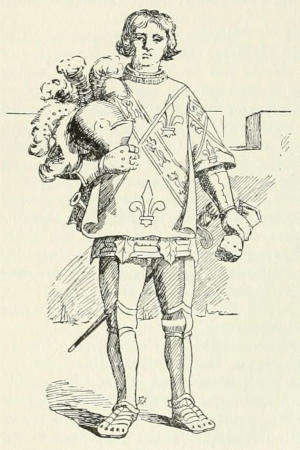
A French Knight of the Fourteenth Century
Meanwhile, the king stood fast. He had employed horsemen to charge up the hill; and with equal good sense, he ordered those about him to dismount, and fight on foot against the English, who were coming upon them on horseback. John’s resistance was as injurious to his realm as the flight of his sons. His brethren of the order of the Star were, like himself, true to their vow, and did not retreat. “And they fought by troops and by companies, as they chanced to meet and fall in together.” But the multitude fled to Poitiers, which closed its gates. “So there was on the road and before the gate such a horrible spectacle of men slaughtered and trampled down as is wonderful to think of; and the French surrendered the moment they caught sight of an Englishman ever so far off.”
Meanwhile, the field was still contested. “King John himself did wonders; he was armed with a battle-axe, with which he fought and defended himself. By his side was his youngest son, who well deserved the surname of the Bold, who guided his blind valour, crying out to him every moment: ‘Look to your right, father! to your left!’ But the throng of assailants continually increased, all being eager to make so rich a capture. The English and Gascons poured in so fast on the king’s division that they broke through the ranks by force; and the French were so intermixed with their enemies that at times there were five men attacking one gentleman. There was much pressing at this time, through eagerness of taking the king; and those that were nearest to him, and knew him, cried out: ‘Surrender yourself, or you are a dead man.’ In that part of the field was a young knight from St. Omer, who was engaged by a salary in the service of the king of England; his name was Denys de Morbeyne, who for five years had attached himself to the English, on occasion of his having been banished in his younger days from France, for a murder committed in an affray at St. Omer. It fortunately happened for this knight that he was at the time near to the king of France, when the latter was so much pulled about; he, by dint of force—for he was very strong and robust—pushed through the crowd, and said to the king in good French: ‘Sir, sir, surrender yourself.’ The king, who found himself very disagreeably situated, turning to him, asked: ‘To whom shall I surrender myself—to whom? Where is my cousin, the prince of Wales? If I could see him, I would speak to him.’ ‘Sir,’ replied Sir Denys, ‘he is not here; but surrender yourself to me, and I will lead you to him.’ ‘Who are you?’ said the king. ‘Sir, I am Denys de Morbeyne, a knight from Artois; but I serve the king of England, because I cannot belong to France, having forfeited all I possessed there.’ The king then gave him his right hand glove, and said: ‘I surrender myself to you.’ There was much crowding and pushing about, for everyone was eager to cry out: ‘I have taken him.’ Neither the king nor his youngest son, Philip, was able to get forward and free himself from the throng.”
The prince of Wales did honour to the unparalleled good fortune that had placed such a pledge in his hands. He took good care not to treat his captive otherwise than as a king; in his eyes that captive was the true king of France, and not John of Valois, as the English had been used to call him. It was of the last importance to the prince that John should be king in reality, so that the kingdom might seem itself taken captive in the person of its sovereign, and should ruin itself to ransom him. He waited on John at table, after the battle; and when he made his entry into London, he set him on a tall white horse (an emblem of suzerainty), whilst he himself followed on a little black hackney.
The English were not less courteous to the other prisoners. They had twice as many of them as there were men to guard them, and dismissed the greater part of them on parole, pledging them to come at Christmas, and pay the enormous ransoms they set upon them. The prisoners were too good knights to fail. In this war between gentlemen, the worst that could happen to the beaten party was to go and take their part in the festivities of the victors, to hunt and joust in England, and enjoy the courtesy of the English; a noble war, doubtless, which crushed none but the villein.
Great was the dismay in Paris when the fugitives from Poitiers, with the dauphin at their head, brought news that there was no longer a king or barons in France, but all were killed or taken.[25] The English, who had withdrawn for a moment to secure the captives, would, doubtless, speedily return. This time it might be expected that they would take, not Calais, but Paris and the realm.e
THE STATES-GENERAL OF 1356-1357 A.D.
[1356-1357 A.D.]
The king a captive, the nobles prisoners or destroyed—the people alone remained to save France. This younger member, disinherited in the political family of the Middle Ages, took in hand the government of the realm, now falling to pieces through the incapacity of its elder brothers. It was not this one that had been vanquished at Crécy and Poitiers. These defeats, on the contrary, brought it forward, for it was evident that, scorned as it was by the nobility, at least it had not conducted itself worse, and perhaps even may have made a better show against the English archers than the knights. The people ruling—that was a novel and extraordinary thing. Nevertheless they were not, at least in their leaders, totally inexperienced in the conduct of affairs. Former progress had prepared them somewhat; the common people were in parliament, the church, and the universities; they had control of all commerce and had formed vast industrial corporations. The clergy and commerce (which was soon to become the aristocracy of the third estate) both furnished a leader to the new movement started after the battle of Poitiers—Robert Lecoq, bishop of Laon and president of the parliament, and Étienne Marcel, provost of the merchants of Paris.
Marcel’s first care at the news of the disaster was to finish the fortifications of the capital, to place cannon on them, and to barricade the streets. The dauphin Charles arrived ten days after the battle, but the people did not make much of this young prince. His conduct at Poitiers had been decidedly equivocal; he had been one of the first to flee. He took the title of lieutenant of the king of France and convoked the states-general at Paris for the Languedoïl, at Toulouse for the Languedoc (October 17th, 1356). The assembly at Paris had eight hundred members, of which four hundred came from the cities and towns; Marcel presided over the third estate and Robert Lecoq over the clergy. The nobles were few in number; their principal leader was John de Pecquigny, lord of Vermandois, and a friend of the king of Navarre. The three orders deliberated separately, but to bring unity into their actions nominated a mixed commission of eighty members. It formulated the wishes of the states-general and demanded for the reform of the kingdom the summons and trial, before judges nominated by the states-general, of the king’s chief officers of finance and justice, accused of having perverted and sold judgments; the deliverance of the king of Navarre; the establishment of a council of four prelates, twelve lords, and twelve bourgeois elected by the states-general, without which the dauphin could give no orders and which would control the entire government. On these terms they granted the dauphin one and a half tenths for one year of the revenues of the three orders. In truth, by their revolutionary changes the people placed themselves on the throne and undertook the burden of public affairs and the public welfare. The states-general of the Languedoc, less radical, voted a levy of fifteen thousand men with the necessary money to maintain them.
The dauphin would not listen to an agreement with these conditions. He played skilfully with the deputies of the third estate, in persuading them to consult their constituents once more, while he himself would go to ask help of his uncle the emperor of Germany. Charles IV was then putting forward his famous “golden bull” in the Diet of Nuremberg. The dauphin appeared there. He had strong hopes that on his return he would find the deputies dispersed and discouraged. Far from that, the provincial councils had reassembled, approved the measures of the states-general, and the whole country declared itself in the same fashion (1357). On the 3rd of March the dauphin was obliged to call a general assembly at the palace. The bishop of Laon acted as spokesman. He demanded that the prince dismiss twenty-two of his councillors or servitors and authorise the formation of a council of thirty-six members elected by the states-general “to provide for the needs of the kingdom, and which everyone would be compelled to obey.” Commissioners at first had to be sent into all the provinces, but the states finally acquired the faculty of handling the government of its own creation by endowing itself with the power to meet twice a year without convocation. As to reforms, relating for the most part to finances and justice, the dauphin provided for them in the “grand ordinance of reformation.” By this memorable charter he promised to impose no taxes without the vote of the states-general, to divert no money from the treasury, and to leave the levy and expenditure of taxes to the states-general’s delegates, to make justice impartial and prompt, to sell judiciary offices no longer, and not to alter the coinage from a model which the provost of the merchants was to furnish. The right of seizure, forced loans, judgments by commissioners, and alienation of the crown domains were some of the abuses corrected by the ordinance which at the end declared the members of the states-general inviolable and authorised armed resistance to all illegal procedure.
[1357-1358 A.D.]
The popular government of 1357 unfortunately did not have in its bosom sufficient harmony, strength, and experience to maintain the important conquest the people had just made. Moreover its situation was one of the most difficult; its credit was shaken by King John, who from his prison forbade the states-general to assemble and the people to pay the taxes they themselves had voted. The rural committees were in the most deplorable state. Overburdened by taxes, by the heavy ransoms which their captive lords extracted by torture, the peasants could no longer cultivate a land that had moreover been ravaged in the war. They developed into vagabonds and preferred to become the accomplices rather than victims of the bands of discharged soldiers from every country, which the war had left upon French soil.f
In the fourteenth century the name brigand was given to this licensed soldiery, nearly all of whom, as we are aware, fought on foot, and were, as a general rule, but slenderly equipped; they carried, as a part of their equipment, a small fine coat of mail, which took its name of brigantine from them. The pay of the mercenaries being stopped in time of truce or between the different expeditions, they turned to the daily practice of rapine and plunder for their means of subsistence, which brought them in more than their pay. A crowd of adventurers and loafers joined forces with them, among the number being many noblemen. As to the rest, the following passage from Froissartg sets forth vividly the methods by which the brigands carried on their terrible profession:
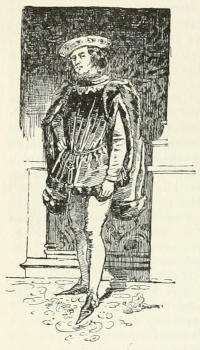
A French Nobleman of the Fourteenth Century
“And the poor brigands always succeeded in sacking and pillaging towns and castles, and got thence such wealth as was marvellous, and some of them became rich, especially those who had made themselves leaders and captains of other brigands; there were among them some who even had as much as forty thousand crowns. Indeed and in truth right marvellous were the things they did. When—and this happened very frequently—they espied a large town or a fine castle, distant a day’s journey or two, twenty or thirty brigands would band themselves together and travel night or day by secret ways, and just as day broke they would enter the town or castle they had descried and set fire to a house. The townspeople, fearing that an army of a thousand warriors had come to burn their town, escaped each as best he might, and the brigands sacked houses, coffers, and libraries, seizing whatsoever they could find and departing laden with booty.”
In spite of such horrors no profession was more lucrative or held in greater honour in the fourteenth century than that of the brigand. Even royalty, whose duty it was to protect the peasants, showed itself eager to make advances to the brigands and to reward their strange exploits. Philip of Valois proposed to Croquart, the famous chief of the brigands settled in Brittany, to knight him, marry him well, and pay him an annual income of two thousand pounds, if he would place himself at his disposal. This same king, hearing of the extraordinary cleverness by which one Bacon, a brigand who harassed Languedoc, had surprised the castle of Chambon in the Limousin, wished to keep by his side so daring and crafty a captain; so he made him his sergeant-at-arms and loaded him with honours. Too often the kings did not even attempt to protect the unhappy victims of the brigands. On the contrary they helped to complete the ruin of the peasants by authorising the abuse of le droit de prise (the right of seizure), and above all by arbitrarily raising or lowering the money standard, according to whether the question was one of levying taxes or of paying debts.h
THE DAUPHIN REPUDIATES THE GRANDE ORDONNANCE (1358 A.D.)
[1358-1360 A.D.]
Under such existing conditions the dauphin believed himself powerful enough to declare that he would no longer tolerate trustees. February 8th, 1358, he revoked the grande ordonnance, and thus destroyed the popular government. This was a complete rupture with the states-general and the resumption of absolute power by the crown.
Against the dauphin the people called Charles of Navarre, who was dragged from his prison. This ambitious prince, skilful and eloquent, became the orator of the market-places, promising to defend the country and letting it be understood that he was not without some claim to the throne of France. The dauphin hoped to balance this new kind of influence with the same means. He went to the Pré-aux-Clercs; and Paris, as if by a magical transformation, suddenly beheld herself in the midst of the Middle Ages adorned with two forums. But the dauphin lost again, by his unfortunate alteration in the coinage, the sole means indeed of raising money without calling the states-general together. Marcel had armed the bourgeoisie at once and given them, as a rallying sign, caps part red and part blue. At the head of a company of this militia he made his way into the dauphin’s palace, and had the marshals of Champagne and Normandy, the two principal officials, put to death; with his own hand he placed the red and blue cap upon the prince’s head as a pledge of security and said to him, as the two bodies were thrown to the crowd, “I demand that you sanction the deaths of these traitors, for it is by the will of the people that this has been done”—of a small portion of the people, it might be added—the Parisian bourgeoisie (1358).
Indeed, the further they went the more the revolution they undertook lost its general character. The provincial deputies separated from their constituents lost their enthusiasm, while the commune of Paris, never away from their own hearths, remained numerous, ardent, and popular. The states-general, jealous of the commune’s influence, permitted itself in part to be removed to Compiègne by the dauphin. The nobles gathered about the prince. He had seven thousand lances with whom he lived freely on the country between the Seine and the Marne, ravaging the whole land as far as Paris, which was suffering from famine. This maddened the peasantry of the Beauvoisis, of Brie, of Valois, Laon, and Soissons.f
THE JACQUERIE (1358 A.D.)
It is quite unnecessary to lay stress upon the sufferings of the villeins here. The days were no more, as we have seen, when the lords of the manor, although they considered themselves of different clay from their serfs, defended them at the peril of their lives. Of the feudal institutions, nothing remained but the oppression. Ruined by the love of luxury, by gambling, by debauchery, by the necessity of paying a heavy ransom—preferring to run into debt rather than to impose privations upon themselves, and to wrest from those around them by means of blows, imprisonment, or the pillory the miserable savings they had laid by for bad times rather than to pay their debts, which would have prevented their contracting new ones—they used and abused the right to command so far as to make all testaments, all marrying, on their estates, dependent on their express permission. They even scoffed at their victims, giving them the name of “Jacques Bonhomme” in derision, on account of their awkwardness in carrying weapons, and of their patience in enduring all things. “Save a villain from hanging, he’ll cut your throat; show a villain the steel, and he kneels,” says a proverb of these times (Oignez vilain, il vous poindra: poignez vilain, il vous oindra).
To these permanent, and in some respects regular evils, aggravated still more by the caprices, the exactions of the kings, or at least, of their officers, were added, to render them more intolerable, the accidental evils of life and war. A series of bad years had brought famine and the plague. The Navarrese of Philip of Longueville, the brigands of James Pipes, and other generals devastated all that the English had spared, and that a few only too uncommon inhabitants had not allowed to lie fallow. The Navarrese, the brigands, and the English inspired them with such terror that the unhappy villeins would leave their dwellings and fields, spend the nights on the islands or in boats moored in the middle of the river, and place one of their number in the church belfry in order that he might ring the tocsin, while they hid themselves in the bowels of the earth, in those subterranean places which were still to be found in the eighteenth century, along the Somme, from Péronne to its mouth.
Thus the hardships which nature and warfare imposed upon those living in country places made them more sensitive to those which their masters, if better advised or more humane, might have spared them. Their original devotedness had disappeared, as had their protection, of which they were no longer the object, and given place to muttered imprecations, to a vague and far-away desire to shake off the yoke. The hatred increased every day, but it still resembled a fire smouldering beneath the ashes. In order that it should burst forth, change into violence and activity, it was only necessary that a new exigency, a lesser one perhaps than many others to which they were subject, but more startling to their simple good sense, should arise in some wise to place the weapons in their hands. The occasion for movement was the fifth article of the ordinance, issued at Compiègne, which enjoined all those whom it might concern to put the strongholds in a state of defence at their own cost and expense. They whom it concerned were the unfortunate peasants, who were thus forced to pay for out of their savings, and to rebuild with their own hands, those citadels which when restored would make the oppression more intolerable than ever. This it is that caused a contemporary to say that the rebellion began with a protest against injustice.i
About a hundred of the peasants met at Clermont first, and raised the cry of “Death to gentlemen!” They elected a leader, called William Karl, or Callet, and rushed to the attack and destruction of the houses of the nobles. These hundreds soon swelled to thousands, and there was no excess of which they were not guilty: they slew the nobles themselves, with their wives and children, first treating the women with every indignity, their avowed purpose being to extinguish the race. They roasted a noble before the eyes of his family, and sought to make its members eat the flesh of the victim. Saracen or Christian, says Froissart,g never committed such iniquities.
There remains a doubt as to how far the townsfolk may have excited their rustic brethren to this revolt; but it does not appear that any great town made common cause with them. They were repulsed from Compiègne, though they entered Senlis. Marcel endeavoured to make use of the Jacques in humbling the noblesse and destroying their strongholds, without the infamy of outraging women and slaying children. But whilst Marcel was politic enough to make this attempt, the king of Navarre could not but sympathise with the noblesse, and fly to their aid. The Jacques, knowing his liberal reputation, were inclined to negotiate with him, which enabled the king of Navarre to entice the chief and some of his officers to parley. While thus engaged, they were surprised, bound, and decapitated. This is not the last instance of a magnate betraying those who trusted, and massacring those who could have best supported him. Charles afterwards attacked the army of Jacques, and slew three thousand of them.
The regent, after holding the estates of Champagne and Vermandois, and procuring their adhesion, took his principal military post at Meaux in order to straiten Paris. To this place not only did his troops repair, but the ladies of the court—the duchesses of Normandy and Orleans, as well as the wives of the noblesse—betook themselves to Meaux as to a place of safety. The market of this town, surrounded by walls and by water, had been rendered a fortress by the regent. The Jacques attacked the town, in concert with a few Parisians, and easily made themselves masters of all save the market. The count of Foix, and the captal De Buch, Gascon nobles, were returning from a campaign with the Teutonic knights of Prussia against the pagans, when they heard of the peril of the noble ladies at Meaux. Though the captal was a subject of King Edward, he nevertheless flew with De Foix to the rescue of the three hundred ladies menaced by the Jacques; and these were routed and driven into the Maine with great slaughter. The victors of Meaux then attacked Senlis; there the citizens and Jacques fought together, and made a most obstinate resistance. But the nobles, reinforced by knights and nobles from Brabant, Hainault, and the Gascon hordes, annihilated the peasantry, notwithstanding their numbers; and the insurrection of the Jacques was drowned in blood.j
DEATH OF MARCEL
The effects of the Jacquerie reached Marcel; discord appeared in the commune. Obliged to seek outside help, the provost of the merchants called upon the king of Navarre and agreed to prepare the way for him to the throne of France. On the night of July 31st, 1358, as Marcel was changing the guard at the Porte St. Denis through which Charles of Navarre was to enter, he was massacred, together with those who were with him, by the alderman, John Maillart, who had discovered the plot.[26] The dauphin returned to Paris with an army and had Marcel’s chief companions decapitated or exiled.f
It is necessary to dwell upon the memorable part played by Étienne Marcel and the municipality of Paris in the political and social crisis which followed the disaster of Poitiers and the captivity of King John. In the middle of this fourteenth century, so uncivilised and sombre, a man appeared who, by wonderful instinct, laid down and nearly succeeded in obtaining the adoption of the essential principles on which modern society is founded; that is, the government of the country by elected representatives, taxes voted by the representatives of the taxpayers, the abolition of privileges founded upon right of birth, the extension of political rights to all citizens, and the subordination of traditional sovereignty to that external sovereign known as the nation. Marcel was that man.
Doubtless there are blots in Marcel’s life. His siding with the Jacques is to be reproached against him as well as his friendship with the king of Navarre, “the third aspirant in the midst of the rival ambitions of France and England.” But it was a question of putting down an absolute, unlimited power. If the aim is the entire remodelling of the organisation of society, when the end in view is the high ambition of snatching the direction of public affairs from the hands of an entire class, history shows that such objects have never been reached without bloodshed. When, four centuries later, the substitution of a representative government for a monarchy founded upon divine right caused so many heads to fall and entailed so much agony, is it to be wondered at that the revolution undertaken by Marcel should follow the same course and suffer the same fate? After all, if the bold provost shed the blood of his adversaries, he was playing a losing game, and staking his own life against the dominion of the nobility. Which is the more illustrious victim, the marshal or himself? Which executioner should be blamed? Marcel failed apparently, because the time was not yet ripe; he had, by a great bound into the future, put himself ahead of his epoch. But he threw an external lustre over the provosts of Paris, and as an eminent historian said, when he demanded that statues should be raised in memory of Marcel, “he is the greatest personage of the fourteenth century.”k
PEACE NEGOTIATIONS; EDWARD IN FRANCE (1359 A.D.)
The dauphin had returned to Paris, but the state of the kingdom seemed desperate. People, however, spoke of peace. Weary of the sumptuous hospitality he had received at Windsor, John had treated with the king of England. He had abandoned to him the shores of the Channel, that is to say Calais, Montreuil, Boulogne, Ponthieu, and Normandy; the whole of Aquitaine, which included Gascony, Bordelais, Agénois, Quercy, Périgord, the Limousin, Poitou, Saintonge, and Aunis; also Touraine and Anjou; and besides this four million gold crowns for the king’s personal ransom. It was the greatest and best part of France, including the entrances to all the rivers. When the treaty was brought to Paris the dauphin refused to execute it, and to strengthen himself for the contest with his father called, at Paris on the 19th of May, 1359, the semblance of an assembly of the three orders, which rejected the shameful terms and added that King John must stay in England until it pleased God to show him the way out.
Five months after, October 28th, 1359, Edward landed at Calais with his four sons, the most powerful lords of his kingdom, six thousand coats of iron armour, six thousand carts loaded with ammunition, ovens, mills, forges, tents—everything necessary to live comfortably, even to falcons and hunting-packs, and skiffs of rough hides for fishing. “There was such a multitude of armed men that all the country was covered, and so richly armed and bedecked that it was a marvel and great joy to see their shining armour, waving banners, and arranged contests. And again there were five hundred pages with shovels and picks who went before the wagons and opened the way and cut the thorns and the bushes to make the transport easier.”
The weather did not favour the expedition, for it rained incessantly. On the 30th of November, the English arrived before Rheims. John de Craon the archbishop shut the gates upon them and valiantly repulsed all their attacks. Edward had announced a long time before that he wished to be crowned there. He passed some weeks before its walls, unable to take it by storm, but hoping each day that he would be attacked and win a great battle as Crécy and Poitiers. Finally, nobody appearing, he turned back, going leisurely across country to Châlons, Bar-le-Duc, Troyes, and Tonnerre; the duke of Burgundy obtained from the pillage some two hundred thousand gold crowns. Then Edward marched straight towards Paris, and established himself about two leagues from the town at Bourg-la-Reine. The English heralds approached to offer battle to the dauphin, who refused it. A knight of the enemy, Sir Walter Manny, advanced to the very ramparts, seeking for single combat, but Charles expressly forbade his warriors to go outside the barriers. He wanted none of this war as the nobles were conducting it at present.
And so the citizens shut up in their towns and the nobles in their castles let pass the storm which could not reach them behind their walls. Everything fell upon the peasants, who dared not even defend themselves. But misery finally gave them courage and despair brought them strength. They came to dare to look in the face the iron-sheathed men before whom they used to tremble, and at several points the foreign aggressor began to meet with local popular resistance, more dangerous for him than the great battles of the feudal princes. Edward himself wearied of this inert but invincible resistance. It was said that the English king and his followers making their way, weary and discouraged across the plains of Beauce, encountered a terrific storm which seemed a warning from heaven, and that the king made a vow before Notre Dame de Chartres, to do all he could to re-establish peace between the two nations. The king’s heart had not been turned suddenly by the storm; it was the fatigues of a war that was bringing no glory, for there were no battles and no booty, because everything had been captured or hidden in the fortresses.
The Story of Le Grand Ferré
One of the most curious incidents of this popular resistance is thus described by a chronicler of the age, the continuator of Nangis, in language not without charm in spite of many Latin barbarisms.l
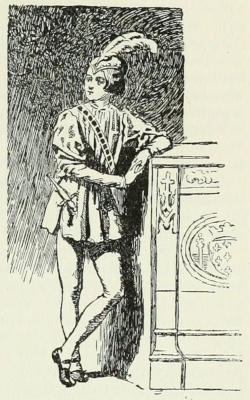
A French Page, Fourteenth Century
There was one strong enough place, in a little Longueil village, close to Compiègne. The inhabitants, seeing they would be in great peril if the enemy should take possession of it, demanded of their ruling lord, and of the abbé of St. Corneille whose serfs they were, permission to fortify their village. After having obtained this, they collected provisions and arms, chose for captain a fine strong man named Guillaume des Alouettes from among themselves, and swore to defend their town with their last breath. When this was done and became known, many hastened from neighbouring villages for protection. The captain had for servant a man as brave as he was tall and strong, known as “Le Grand Ferré” (Magnus Ferratus). In spite of his huge size and strength Le Grand Ferré had a very poor opinion of himself, and the captain could do with him what he liked.
There were about two hundred of them, all labourers and accustomed to gain a scanty livelihood with their hands. The English, who occupied a strong position near Creil, on learning of these preparations for defence, were filled with scorn for such wretched people. “Let us drive the villagers out,” they said, “the place is good and strong and we will occupy it.” And they prepared to do as they said. Two hundred English marched thither. Watch was not well kept; even the gates were open, and the enemy entered boisterously. At the noise they made those in the houses rushed to the windows, and seeing so many armed men were overcome by fright. The captain finally appeared with some of his men, and began to strike the English bravely, but was soon surrounded and mortally wounded. At this misfortune the others including Le Grand Ferré said among themselves, “Let us go down and sell our lives dearly, for we may expect no mercy.” So they collected together and suddenly appearing from different directions threw themselves with redoubled blows upon the English; they struck as if threshing wheat on the barn floor. Arms were raised and lowered and at each blow an Englishman fell.
When Le Grand Ferré reached the side of his dying captain, his grief overcame him and he threw himself furiously upon the enemy. As he was head and shoulders above his companions they could see him wielding his axe, striking and redoubling his blows, none of which missed a victim. Helmets were broken, skulls split, and arms cut off. In a short time there was a clear space around him, for he had killed eighteen and wounded many more. His encouraged comrades did marvels, and the English quit the affair and took to flight. Some jumped into the moat and were drowned, others flung themselves against the gates; but blows rained upon them thick and fast. Le Grand Ferré, reaching the middle of the street where the enemy had planted its standard, killed the bearer, and seizing the flag told one of his own men to go and throw it into the moat. The man however pointed with terror to the still thick mass of English. “Follow me,” called out Le Grand Ferré, and seizing his great axe in both hands he struck right and left, till he made a path to the moat where the others threw the enemy’s ensign into the mud. Le Grand Ferré stopped a moment for breath, but returned at once to what remained of the English. Only a very few of those who came to perform this deed escaped, thanks to God and Le Grand Ferré, who killed that day more than forty of them.
The English were very angry and disturbed to see so many of their brave soldiers perish at the hands of these peasants. The next day they returned in greater numbers, but the people of Longueil no longer feared them. They went forth to meet the enemy, Le Grand Ferré at their head. And when the enemy saw him and felt the weight of his arm and his iron axe, they wished they had never come that way. They could not get back so fast that many were not mortally wounded, killed, or taken prisoners, and among these were some men of high lineage. If the folk of Longueil had consented to ransom them as the nobles do among themselves, they would have been very rich. But they would not hear of this and killed their captives, saying that in this way the enemy would do no more harm.
In this last struggle the fighting was very hard and Le Grand Ferré became much exhausted. He drank quantities of cold water and was almost immediately seized with a fever. He managed to get back to the village to his cottage and went to bed, but keeping close to him his good axe, an iron axe so heavy that a man of ordinary strength could scarcely lift it from the ground with both hands. The English learned with joy that Le Grand Ferré was ill, and without giving him time to recover despatched twelve soldiers with orders to kill him. His wife saw them from afar and cried to him, “Oh, my poor Ferré, here come the English, what will you do?” He forgot his illness, and got up quietly. Taking his heavy axe he strode into his yard. When they entered, “Ah, brigands,” he cried, “you come to take me in my bed, but you don’t know me.” He placed his back to the wall so as not to be surrounded, and swinging his axe brought his assailants face to face with death. Of the twelve he killed five and put the rest to flight. Le Grand Ferré returned to his bed, but he had again overheated himself in dealing so many blows and drank more cold water. The violence of the fever redoubled, and a few days later, having received the sacraments, he passed away. Le Grand Ferré was buried in the village cemetery. All his companions, the whole countryside in fact, mourned his loss; for with him alive the English would never have dared approach.d
One feels, in the wealth of detail into which the chronicler enters, the sympathy of the old monk for the poor peasants. In the depths of the monasteries were narrated their valiant deeds against the pillagers of churches; these are told much more frequently in village companies. The tales spread slowly but went far. Little by little the foundations of hatred for the foreigner were laid in the hearts of the people, and a love of country whose fiercest outburst is found in Joan of Arc.
THE TREATY OF BRETIGNY (1360 A.D.)
The dauphin was still more anxious to send the English home because “France was in its last throes, and for so little as its woes might last it might perish.” A conference was opened at Bretigny, near Chartres, the 1st of May, 1360. The English negotiators demanded in the first place the whole crown of France; then they limited themselves to what had belonged to the Plantagenets; finally Edward III contented himself with the duchy of Aquitaine and all its dependencies (Gascony, Poitou, Saintonge, Aunis, Agénois, Périgord, the Limousin, Quercy, Rouergue, and Angoumois), ceded in independent sovereignty, and Calais with the counties of Ponthieu and Guines, also the viscounty of Montreuil. Thus ended the first period of the Hundred Years’ War. The king’s ransom was fixed at three million gold crowns;[27] in guarantee for which sum John had to leave in Edward’s hands a certain number of hostages taken from the highest nobles and richest bourgeoisie of the land. Edward carried them with him across Normandy, which he harassed once more, in order to embark at Honfleur, the Havre of that day. The provinces promised to the king of England were given up, despite the protests against this pretended restitution by the great majority who said, with the inhabitants of La Rochelle, “We will acknowledge the English with our lips, but never with our hearts.” For a whole year they refused to open their gates to the English.
At Abbeville things went still better. When the patriotic citizens saw in their streets the soldiers who for fifteen years had trampled France under foot, they were unable to restrain themselves; secret meetings were held; then a riot broke out which was quickly suppressed, but not before a rich citizen, Ringois, was captured. The English commandant used, however, moderation and offered Ringois his liberty on sole condition that he would take the oath of allegiance to Edward III. Ringois refused. They took him to Dover, threatening him this time with death if he were obstinate, but he persisted. They brought him even to the platform of the fortress and showed him the furthermost parapet with the sea beating furiously at its feet; if he said one word he would be saved. He still refused and the guard threw him off.
There still remained to find the money for the first payment of the ransom, and it was obtained by a shameful expedient. “The king of France,” says Matteo Villaniq the historian, “sold his flesh and blood.” For 600,000 florins he bestowed his daughter Isabella, then only eleven years of age, on Gian Galeazzo Visconti, the son of the fiercest tyrant in Italy, who hunted men in the streets of his capital and threw them living into the flames. Thanks to this money the king left Calais on the 25th of October, 1360.
THE LAST YEARS OF KING JOHN (1360-1364 A.D.)
[1360-1364 A.D.]
The 5th of December following we find an ordinance by which John announces, in spite of the great compassion he has for his people, the levy of a new tax on all merchandise sold or exported, on salt and on wine, in return for which he promises henceforth good and loyal justice to all, to put nothing but undebased coin into circulation, and to abolish the right of seizure and other abuses that fell so heavily upon the poor people. These promises did not deceive any more than the taxes profited them. What could be produced in a country ceaselessly ravaged by large forces and desolated by frequent appearances of the black death? It became necessary to fall back on other resources—loans, the revocation of all donations made by kings since Philip the Fair, and giving the Jews considerable privileges in matters of finance. With the money thus procured what did the king do? Did he use it to break up those bands of brigands, marauders, and tard venues that had just (1362) captured and killed the constable James de Bourbon at Brignais near Lyons? He made little journeys at great expense, travelling from town to town to take possession of the rich heritage of the Capetian house of Burgundy, which the death of Philip de Rouvre had recently placed in his hands. From there he journeyed down to Avignon where he spent six months in feasting, and planning a marriage with the famous queen Joanna of Naples. The pope, who had already been twice ransomed from the great companies, made John a proposition capable of appealing to his adventurous imagination—to form all these warrior bands into a crusade, which would rid France of them, and at the same time win glory for himself. It is not impossible that John would have embarked on this rash enterprise had he not learned that one of his sons, the duke of Anjou, had escaped from the English, by whom he was held in hostage. John felt for his son to do a thing like this was a slight on royal honour, and resolved to go himself to replace the fugitive. He thus escaped in a chivalrous manner from his embarrassing position and the sight of France’s misery. A part of the winter was spent in London, “in great rejoicings and recreations,” says Froissart,g “in dinners, suppers, and other fashions.” These fêtes and great repasts killed him; he died in London, April 8th, 1364, at the age of forty-four.l
Towards the end of 1361 the young duke Philip de Rouvre of Burgundy expired, leaving no issue; his marriage with the young heiress of Flanders not having been consummated. The duke possessed not only Burgundy, but Franche-Comté, Champagne, Artois, and Boulogne. An ancestor of Duke Philip had three daughters, to whom the succession now reverted. The eldest had been Marguerite, the unfortunate queen of Louis Hutin, whose daughter, married to the king of Navarre, had conveyed to the representative of that family the best right to the Burgundian succession. King John, descended from the second sister, would admit no right to the king of Navarre, nor yet to the count of Bar, descended from the third sister. He pleaded that he was nearer of kin than Charles of Navarre to the duke just deceased; and thus made use of the same claim to Burgundy that Edward III had done to France. John hastened to Dijon and installed himself there as duke, taking a solemn oath to respect all the privileges and rights of the duchy. Artois and Franche-Comté returned to the duchess-dowager of Flanders. John had no intention of uniting Burgundy to the crown, which he well knew would displease the Burgundians, accustomed from time immemorial to their native dukes and provincial independence. He therefore, in 1363, gave the duchy of Burgundy to his youngest son, Philip, who had been constantly by his side during the battle of Poitiers and his subsequent captivity. King John, indeed, assigned this reason for the gift. It was fully acquiesced in by John’s successor; and thus was founded that brilliant house of the dukes of Burgundy of the second race, which reigned from the Schelde to the Alps, and overshadowed and endangered the monarchy of France itself.[28]j
CHARLES THE WISE (1364-1380 A.D.)
Charles V was seven-and-twenty when he began to reign, and if he had followed the example of his father, he would have played the part of feudal king and fighting cavalier, as that for which he was ordained. But the young monarch saw that France had need of other defenders than feudal kings and fighting cavaliers. It needed a clear eye and a steady hand—a man at the helm, not a gilt figure at the prow; for never was there a time when the vessel of the state seemed in such danger. There was a whole people to feed and satisfy—rebellious vassals to reclaim—an open foe to guard against—riotous bands in the very heart of the kingdom to be discomfited; and for all this he had an empty treasury, a discontented parliament, ambitious communes, and a disunited nobility. But the French heart of courage and chivalrous spirit of loyalty was still entire.
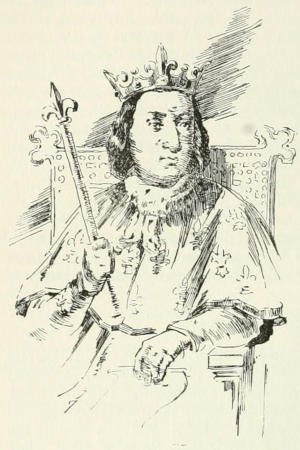
Charles V
Charles was weak in body, and over him hung the sentence of death passed on him by the physicians in his youth. Charles the Bad, it was said, in return for his arrest at Rouen, had poisoned the dauphin’s food.[29] The prince escaped destruction by the opening of a perpetual wound in his left arm. “Whenever the sore heals over,” the doctors said, “the dauphin must die.” This issue was probably only a sign of a feeble constitution, but it silenced the sneers of his enemies, who were not accustomed to see a king except in armour; it doubled the respect of the few discerning potentates of the time, who began to perceive that a cabinet might be quite as great a scene of glory as a field of battle. Edward III said he was never so resisted in open fight, as by the calm, sagacious councillor who had never drawn a sword. Before the first year was over all men perceived that things were greatly changed. There were no tournaments at the Louvre—no feasts at the palace. The king lived like an anchorite, except on state occasions, when he outshone the magnificence of oriental princes; and paid his men-at-arms their wages, and granted privileges to the trading towns, and did not increase a single tax! People must have grown ashamed of sustaining the cause of Charles the Bad against so true a Frenchman and gracious a king as Charles the Wise; yet the war continued.n
Charles V at first made use of the help of his brothers, committing to their hands the provinces most remote from the centre, Languedoc to the duke of Anjou, and Burgundy to Philip the Bold. He himself attended only to the centre; but he needed an arm—a sword. There was then hardly any military spirit except among the Bretons and the Gascons. The king attached to him a brave Breton of Dinan, the sieur Du Guesclin, whom he had himself seen at the siege of Melun, and who had been fighting for France for some years.e
Early Exploits of Bertrand du Guesclin
The childhood of Bertrand du Guesclin offers some striking peculiarities. His ugliness, his deformity, and his rough, wild bearing had won for him the dislike of his family; the harsh treatment he endured only served to embitter his character. Armed with a stick, which he invariably carried, young Bertrand was a great trouble to his mother, and the terror of all the children in the neighbourhood. He could not be taught to read. “He knew nothing of letters,” says a chronicle, “and no masters could ever be found from whom he was willing to learn; but he always wanted to strike and beat them.”
One fine day, being then about sixteen or seventeen years of age, Bertrand escaped from his father’s house, which to his youthful ardour felt like a prison, and went off in triumph to Rennes to wrestle with a young Breton, already made proud by having overcome twelve adversaries; and soon afterwards Rennes beheld him again victorious in a solemn tournament, and from that time everyone who knew him, even his parents, understood that Bertrand had a great future before him. The war between Charles of Blois and John de Montfort, the two claimants of the duchy of Brittany, afforded Bertrand a favourable opportunity for distinguishing himself; he took the side of Charles of Blois, whose cause appeared to him more French than that of his rival, and the walls of Vannes, Fougeray, and Rennes were in turns witnesses of his extraordinary valour. Charles of Blois, to show his gratitude, presented him with the valuable domain of La Roche d’Airien or De Rien. In 1359 Bertrand compelled the duke of Lancaster to raise the siege of Dinan. His battle-cry was, “Notre Dame, Guesclin. Guesclin!” When in battle, this name rang in the ears of the English; it had the effect of a clap of thunder, and even the bravest trembled before such an enemy. The most careful and complete investigations have not enabled the learned to state the precise date when Bertrand entered the service of the king of France; it is not certain whether it was to King John or to the dauphin that he first offered the support of his valour. But at least we know that in 1361 he was already in the royal pay, and that he was in command of a company of men-at-arms and archers; this fact is proved by a discharge signed at Paris by Du Guesclin, and preserved amongst the registers of the court of exchequer.
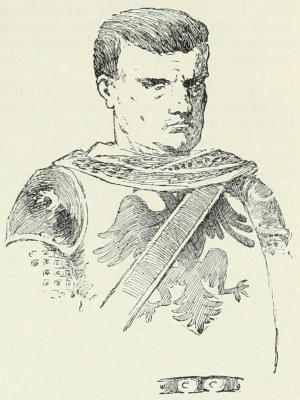
Bertrand du Geusclin
Some authors say that the governorship of Pontorson was given to Du Guesclin as a mark of special favour. Whilst fighting for the glory of the lilies of France, the Breton warrior by no means forgot the interests of Charles of Blois, his natural sovereign; thus, after driving the English out of Normandy, he marched to the siege of Bécherel and routed De Montfort’s troops. It must have been about this time that his marriage took place with Tiphaine or Thiéphaine Raguenel, a rich heiress who, if we are to believe the traditions of the fourteenth century, foretold future events. The date of this marriage is one of the points of uncertainty in the history of Bertrand.o
The new king’s first care was to recover the mastery of the course of the Seine. Mantes and Meulan belonged to the king of Navarre; Boucicault and Du Guesclin got possession of them by an act of signal perfidy. The two towns had paid the penalty of all the mischief the Navarrese had done to the Parisians. The citizens had the satisfaction of seeing twenty-eight of them hanged in Paris.
The Navarrese, reinforced by English and Gascons under the captal De Buch, desired to avenge themselves, and do something to hinder the king from going to Rheims. Du Guesclin soon advanced with a considerable body, of French, Bretons, and also Gascons. The captal retreated towards Évreux, and halted at Cocherel, on an eminence; but Du Guesclin had the address to deprive him of the advantage of the ground. He sounded a retreat and made a feint of running away. The captal could not hinder his Englishmen from descending to pursue; they were too proud to hearken to a Gascon general, though a great lord and of the house of Foix. He was, therefore, constrained to obey his soldiers and accompany them into the plain. Thereupon Du Guesclin wheeled round. The Gascons whom he had with him appointed thirty of their number to carry off the captal from the midst of his men. The other Navarrese leaders were killed and the battle was won. Won on the 16th of May (1364), it was known at Rheims on the 18th, the coronation day—a fine omen for the new royalty. Charles V gave Du Guesclin such a reward as never king before him had bestowed: an establishment on the footing of a prince, the county of Longueville, the patrimony of the king of Navarre’s brother. At the same time he beheaded the sire de Saquenville, one of the chief advisers of the Navarrese. He dealt no better with the French who were found in the ranks of the companies. Men began to bethink them that brigandage was a crime.
End of the Breton War: Battle of Auray (1364 A.D.)
The war in Brittany ended in the same year. The king of France lent Charles of Blois Du Guesclin and one thousand lances. The prince of Wales sent De Montfort John Chandos,—the only rival in Europe to the fame of Du Guesclin as general and knight,—two hundred lances, and as many archers; and with these were joined several English knights. Montfort and the English were posted on a height, like the prince of Wales at Poitiers. Charles of Blois did not care for that. That devout prince, who believed in miracles, and who himself performed them, had refused at the siege of Quimper to retreat before a flood. “If it is God’s will,” he said, “the tide will do us no harm.” He made no more account of the mountain at Auray than of the flood at Quimper. Charles of Blois had the greater strength; many Bretons, even, of La Bretagne-Bretonnante joined him, out of hatred doubtless to the English. Du Guesclin disposed the army in an admirable manner. “Each man-at-arms,” says Froissart,g “carried his lance straight before him, projecting five feet, and had a small, hard, and well-sharpened axe, with a small handle. And thus they advanced in most handsome array. They rode so close that you could not have thrown a tennis ball among them, but it would have fallen on the points of the lances.” John Chandos gazed long on the French order of battle, “the which he praised mightily within himself.” He could not conceal his sentiments, but said, “So help me God as it is true that there is here flower of chivalry, great sense, and good arrangement.” Chandos had set apart a reserve to support each corps that wavered. It was not without difficulty he prevailed on one of his knights to remain in the rear and command that reserve; prayers, and almost tears were necessary to overcome the feudal prejudice that made the front rank be regarded as the only post of honour. Du Guesclin could not have effected the same thing in the other army.
[1364-1366 A.D.]
The two adverse claimants fought at the head of their respective forces. The Bretons were weary of this war, and wished to see it ended by the death of the one or the other. Chandos’ reserve gave him the advantage over Du Guesclin, who was unhorsed and taken prisoner. The whole brunt of the battle then fell on Charles of Blois; his banner was pulled down and himself slain. The greatest lords of Brittany obstinately held out, and were likewise slain (September 29th, 1364). When the English came, with great exultation, and showed De Montfort his enemy whom they had killed, the voice of French blood, or perhaps of kindred, awoke within him, and tears started from his eyes. A haircloth was found under the dead man’s cuirass. His piety and his good qualities recurred to memory. He had recommenced the war only in deference to his wife, whose patrimony Brittany was. This saint was also a man. He made verses and composed lais in the intervals between his battles. He had been a lover, too; a bastard of his was killed by his side, endeavouring to avenge him. De Montfort got possession of all the strongest places in the country in a few days. The children of Charles of Blois were prisoners in England. The king of France, who carried no passion into the trade of war, made terms with the victor, and induced the widow of Charles of Blois to content herself with the county of Penthièvre, the viscounty of Limoges, and an income of 10,000 livres. The king did wisely. The essential thing was to hinder Brittany from doing homage to the English sovereign. There was every probability that, sooner or later, it would become weary of the protégé of England.e Peace was concluded on these terms at Guérande in 1365, and Du Guesclin was restored to liberty.
Peace also was concluded with Charles of Navarre, who was glad to accept the city of Montpellier in exchange for the places he had lost upon the Seine, and a period of rest was promised to the distracted land.
Du Guesclin Leads the Free Companies into Castile (1366 A.D.)
But the rest was impossible with so many conflicting interests to arrange, and such a spirit of unrule diffused by the recent struggles. Charles the Wise looked back with fond regret to the time of the Crusades, and meditated an exportation of the thousands of armed men of all surrounding countries to the East. But the Brabanters, English, and Saxons were very well satisfied with their present position, and had no desire to distinguish themselves against the enemies of the faith, when they could live so comfortably on the fat of abbey-lands, and occasionally put a bishop to ransom at home. The example of Montferrat, who had saved the pope at Avignon by leading the free lances of the south against the wealth of Milan, occurred also to the anxious thoughts of the king; and just at the moment when he was in greatest distress, a circumstance occurred in Spain which gave him the wished-for opportunity. Pedro, known in general history as the Cruel, but recognised in Spanish annals as the Great Justiciar, had offended a great proportion of his subjects by his relentless executions and harsh behaviour. He had poisoned his wife, a princess of Bourbon, at the instigation of his favourite Maria de Padilla, and threatened death to the surviving natural children of his father. Of these, Don Henry of Trastamara was the most popular and the best; he fled to France, and implored the aid of Charles against the murderous husband and unpitying brother. Du Guesclin saw the opening. “Sir,” he said, “the free lances are anxious for work, and will gather from all parts if I hoist my banner. Better neighbours will they be on the other side of the Pyrenees than on this.”
Charles adopted the party of the banished brother, and preparations were instantly made. Du Guesclin himself had begun as a leader of free lances, and knew their ways. Thirty thousand of them joined him in an incredibly short space of time, and he marched southward down the Rhone. The pope was as much alarmed as his predecessor had been, and sent out to know the object of their approach to Avignon. Bertrand answered with a grim smile, “We are thirty thousand poor Christian pilgrims bound on a crusade against the Saracens of Granada, and we want the holy father’s absolution, and also 200,000 livres.” “Touching the absolution, my son,” replied the nuncio, “you shall have it without fail; but with regard to the money, that is a different thing.” “Sir,” replied the knight, “there be many here who reck not of absolution, but many who desire the money, for we make them prudent men in spite of themselves.” Their prudence was rewarded with both the absolution and coin to the amount of 200,000 livres. They made a detour and Avignon was saved. When they reached Toulouse, the object of the expedition was for the first time declared to them. Plunder and battle was all they required, and a deluge of cruelty, courage, and destructiveness poured down on devoted Spain. Pedro was expelled from the throne, and fled to Portugal. Henry was crowned at Burgos with Du Guesclin at his side, and was joyously received in the other cities of Castile.
[1366-1368 A.D.]
Both nations now seemed ready for repose, and the triumph of having restored an exile and created a king was added to the other glories of the French monarch. But the Black Prince held his court at Bordeaux. Shortly after his marriage, in 1361, he was created duke of Aquitaine and had been living in his dominions since 1363. Feasts and tournaments were celebrated according to the strictest rules of chivalry, and noble ladies listened to the songs of troubadours, and the picturesque narratives of Froissart, and the adventures of fabulous warriors, as their predecessors were said to have done in the days of Charlemagne and Arthur. Suddenly the dethroned and powerless Pedro threw himself at the feet of the master of the lists; and half the stories of kingdoms lost and won by the irresistible sword of a single champion immediately rushed to their minds. All the blood of knighthood was on fire at the insolence of a people who had rebelled against their anointed lord, and Edward of Wales, as became a knight and man of honour, vowed to restore his suppliant to the throne. Crécy was renewed over again in the great field of Navarrete in 1367. Du Guesclin himself fell into the enemy’s hands, and all the work of the free lances was utterly undone. Pedro was king and justiciary in one, and let loose his royal vengeance on all the land. Murders, executions, confiscations threw the whole kingdom into despair, and the English bitterly repented of their interference in behalf of so unchivalrous, unpitying a tyrant. The dreadful heats of the south came to the support of Henry. The English died of fever and excess, and discipline became relaxed. The reinstated king declined to pay the stipulated rewards; mutiny broke out among the discontented conquerors; and in the scorching summer, and amid these disturbances, the health of the Black Prince began to fail.
Meantime, Charles the Wise endeared himself to his subjects by diminishing their burdens, by encouraging agriculture, and giving greater influence to the parliaments he convoked. The contrast was great and striking. Conquest in the field was of no avail against the steady advance of a popularity so justly founded and nobly sustained, as now grew on the vanquished side. The free lances, who had joined the prince, if not paid by the treasuries of Pedro, must be satisfied by the wealth of their employer. Edward returned to Bordeaux with barren laurels, and an empty exchequer. He laid fresh burdens on his unhappy subjects in Aquitaine, to pay for the expenses incurred in Castile, and when the population of that trampled province compared their position with that of their neighbours under the crown, dissatisfaction took a wider range, and they complained of their rulers, not only as oppressors, but as foreigners. The English, indeed, even when the languages were the same, never became acclimated in France, and now there was added the great distinction of a different tongue; for the Norman portion of the English people had now become so small that English at this time was declared to be the language of law, as it had long been of religion and commerce. Anglo-Saxon bowmen, who never spoke a word of French, served in the ranks of the Black Prince, and, of course, offended the nations by their brutal contempt for everything they did not understand. The prince, therefore, in the midst of failing health and military disappointment, perceived that his countrymen were not the masters of the land he claimed, but were only forcibly encamped on it.
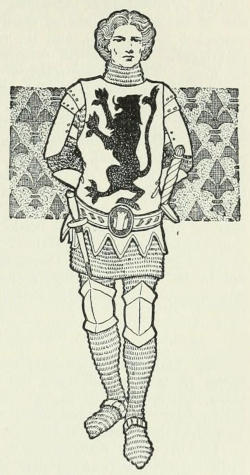
A French Knight, End of the Fourteenth Century
[1368-1369 A.D.]
From England no help was to be had. The king was old, and had fallen into the hands of a designing favourite, Alice Perrers, and her accomplices, who ruled him at their will. And nothing was wanting to the French monarch in these favourable circumstances, but warriors who could carry his plans into effect. Du Guesclin was a prisoner at Bordeaux, and all the wiser spirits in the court advised the prince on no account to let so dangerous an enemy go. But Edward was made of penetrable stuff; and on one occasion when they were in familiar conversation, he said, if the captive could collect a hundred thousand francs, he should be set at large—a vast sum in those days; but the sight of Du Guesclin, sword in hand, and released from bondage, was worth forty times the amount to the French king. The money was sent at once, and Du Guesclin lost no time in showing his arm was as strong and his heart as brave as ever. A rapid incursion into Spain and the battle of Montiel (March 14th, 1369) established Henry of Trastamara once more upon the throne, and freed him from the rivalry of Pedro, by the death of that ferocious tyrant. He was stabbed to the heart by his infuriated brother, after a personal struggle which lasted a long time. Henry was now undisturbed, and attributed his prosperity to the favour of the French king. He put the Castilian navy at the service of France.
The Peace of Bretigny is Broken (1368-1369 A.D.)
Charles was not slow in seeing the advantage of his position. Strengthened by the gratitude of his new ally, and the general favour of all his subjects, he spoke in a tone of defiance and majesty to the English prince, which sounded strange in his ears within twelve years of the battle of Poitiers. He summoned the prince of Wales to appear before his court of peers, as one of the feudatories of the realm, to answer for high crimes and misdemeanours. Edward answered, with much submission, that he would not fail to obey the summons, but would bring sixty thousand men along with him—helmet on head and spear in rest. Charles knew too well that this was but a vain boast, for the warrior was now too feeble to ride, and advanced in the exorbitance of his claims. Edward of England took up the game of brag on behalf of his son, and retorted from Windsor by reasserting his claim to the French throne, and calling himself, in formal documents, king of England and France once more. War was openly declared, and Charles summoned his states in Paris (May 9th, 1369). Never was meeting so unanimous and so sedately firm. Taxes were voted, forces were raised, and defiance was hurled against the English both in their island fastness and the lands they usurped in France. The court of peers, consulted in its turn, declared that King Edward and his, not having appeared in answer to these summons, the duchy of Aquitaine and other English holdings in France should be and were confiscated. Every village, in imitation of the enemy they had learned to fear, had butts for practice of the bow; games of manly exertion were encouraged; freedom was extended to the serfs, and the municipal towns were enriched with further privileges. Du Guesclin returned from the Spanish triumph, and visited the king. The feeling in favour of illustrious birth was then so strong that, though Charles had bestowed the highest commands on the Breton soldier, they were offices which gave him only a temporary superiority over the forces employed, and implied no permanent pre-eminence when peace should be restored. But on this occasion a stately assemblage was called. All the princes of the blood, nobles of highest rank, chancellors, judges, warriors, were assembled in the great hôtel St. Pol, and Charles gave his sword to Du Guesclin, and said: “Du Guesclin, take my sword, and use it against my enemies. Henceforth you are constable of France.” This was the highest dignity a subject could hold, and Bertrand excused himself on account of his humble extraction; but Charles persisted, and the Montmorencys, and De Coucys, and Courtenays, and Bourbons, thought the sword could not be in better wielding, and did obeisance to Sir Bertrand du Guesclin, who was now the foremost man in all the land.n
The English Invasion (1369-1370 A.D.)
[1369-1370 A.D.]
The English immediately landed at Calais, while the Black Prince prepared another attack upon the south. A French army marched to meet them, but refused to engage them and retreated as they advanced. The towns were well fortified, and none was taken; the expedition was confined to useless devastation of the surrounding country.
In 1370 they returned and the same programme was repeated. The order to refrain from combat was so rigorously observed that at Noyon, when one of the enemy’s cavalry climbed the ramparts crying out: “My lords, I have come to call on you; since you do not condescend to come out of your shell, I will come in!” he was allowed to depart safe and sound. Before Rheims, before Paris, the English encountered the same stolidity. From his refuge at St. Pol, where he had shut himself up, the king could watch the burning of the villages. But the brave Clisson himself exclaimed:
“Sire, you have no need to pit your own men against these furies; let them wear themselves out. They will not deprive you of your heritage with all these rubbish-heaps.”
“Never was a king of France less given to war,” said Edward III; “never was one who kept me so busy!” Charles V, in fact, feeble and ailing, never held a lance; he was vastly more fond of books. He had the most valuable library of the day, 910 volumes carefully guarded behind iron bars in a tower of the Louvre. He read the Bible through once every year. He corresponded with the pope and sent him presents; and again, to quote Froissart,g “my lord the king piously marched barefoot in the procession, and madame the queen also.” So good a friend of the pope, so pious a sovereign, merited the alliance of every bishop of the realm; and in fact the majority opened to him the gates of their capitals; even those upon whom the English most depended, as the bishop of Limoges, comrade of the prince of Wales, turned French.
This last act of treachery exasperated the English. The Black Prince swore by the soul of his father that he would enter into no other undertaking until he had made Limoges and the other traitors pay dearly for their treason. Having arrived before the city, he had part of the wall torn down, and his soldiers plunged through the breach into the streets. The prince had himself carried in in his litter.
“That was a sad scene,” writes Froissart,g “where men, women, and children flung themselves at his feet, crying, ‘Mercy, gentle prince.’ But he was too inflamed with excitement to attend. Their pleading went unheard, and all were put to the sword. Never a heart so hard but would have wept to have stood in that city of Limoges and witnessed so great slaughter; more than three thousand men, women, and children lost their heads that day. And may God receive their souls, for martyrs they truly were.”
[1370-1380 A.D.]
The English grew somewhat calmer at last through their interest in a new spectacle: three French cavaliers, with backs to an old wall, contended as if in the lists against the duke of Lancaster and the earls of Cambridge and Pembroke. The prince of Wales stopped his chariot near by, the better to look on; and he allowed the three cavaliers to be recommended to mercy. The bishop, the principal author of the treason, he also spared. This unfortunate exploit was the Black Prince’s last adventure; he languished for a few years, and returned to die in England (1376).
The English possessed an excellent infantry, archers whose darts pierced the best-made cuirasses, and men-at-arms almost worth a regular cavalry by their remarkable discipline and their habituation to concerted movement. To these Charles could oppose only an immense throng of nobles who, though they might be very brave, were also totally undisciplined. The part of wisdom, therefore, was to avoid encounter with large bodies; but in the intervals between expeditions he allowed his men to indulge in skirmishes. Thus Du Guesclin fought at Pont-Valain with Robert Knolles, a redoubtable English partisan (1370), and another corps near Chizey in Poitou (1373). Chandos had been killed during the first campaign. Another leader of great renown, the captal De Buch, was taken in 1372, near Soubise. The French were not always beaten back.
Meanwhile the king had his own battles to fight, and his victories are inscribed intact in the Recueil des Ordonnances. Under date of 1370 we read: “February, 1370, letters according the inhabitants of Rodez the right to trade with the entire kingdom free of duty on imports.—March, 1370, letters to the effect that the inhabitants of Figeac, now on land declaring allegiance to Edward, son of the king of England, will not have their goods confiscated if they return to French soil; ordinance setting forth privileges accorded the city of Montauban.—April, 1370, ordinance setting forth privileges accorded the city of Verfeil.—May, 1370, letters exempting the city of Milhaud from imposts during twenty years, and ordinance of privileges accorded the city of Tulle.—June, 1370, ordinance containing privileges accorded the inhabitants of the county of Tartas, the cities of Dorat and Puy-Mirol.—July, 1370, ordinances containing privileges accorded the cities of Cahors, Castres, Puy-la-Roque, Sarlat, Montégrier, and Salvetat.”