Chapter XIX · “L’ÉTAT, C’EST MOI” (continued 2)
Reading edition
One can easily imagine the effect which this magnificence had in Europe. The French were not the only ones who praised him: twelve panegyrics were pronounced on Louis XIV in different towns of Italy—an homage rendered neither from fear nor hope of favour, which the marquis Zampieri sent to the king.
He continued to extend his patronage to letters and to the arts. Proofs of this are the particular gratuities of about 4,000 livres to Racine, the fortune of Despréaux, that of Quinault, and above all that of Lully and of all the artists who consecrated their work to him. The king danced in ballets until the year 1670. He was then thirty-two years old. The tragedy of Britannicus was played before him at St. Germain; he was struck by these verses:
Pour mérite premier, pour vertu singulière, Il excelle à traîner un char dans la carrière, A disputer des prix indignes de ses mains, A se donner lui-même en spectacle aux Romains.
After that he never again danced in public: the poet had reformed the monarch. His union with La Vallière still continued in spite of his frequent infidelities to her. These infidelities cost him little trouble. He never found women who resisted him, and he always came back to the one who, by the sweetness and goodness of her character, by her sincere affection, and even by the chains of habit, had subjugated him without the aid of art. But beginning with the year 1669, La Vallière perceived that Madame de Montespan was gaining the ascendency; she fought against it with her usual sweetness; she supported for a long time, and almost without complaining, the pain of being the witness of her rival’s triumph; she still thought herself happy in being even thought of by the king, whom she continued to love, and in seeing him without being loved by him.
Finally in 1675 she embraced the resource of tender souls, which need deep and intense sentiments to subjugate them. She thought that God alone could succeed her lover in her heart. Her conversion became just as celebrated as her affection. She became a Carmelite at Paris and persevered in her resolve. To wear haircloth, to walk with bare feet, to fast rigorously, to sing at night in chorus in an unknown tongue—all this did not repulse the delicacy of a woman accustomed to so much glory, luxury, and pleasure. She lived this austere life from 1675 to 1710, under the simple name of Louise de la Miséricorde.
It is known that when Sister Louise de la Miséricorde was told of the death of the duke de Vermandois, whom she had borne to the king, she said: “I ought to weep for his birth more than for his death.” One daughter was left to her, who resembled the king the most of all his children. She married the prince Armand de Conti, nephew of the Great Condé.
Madame de Montespan
[1670-1675 A.D.]
In the meantime the marquise de Montespan was enjoying the king’s favour with much éclat and authority. Athénaïs de Mortemar, wife of the marquis de Montespan, her elder sister the marquise de Thiange, and her younger sister, for whom she obtained the abbey of Fontevrault, were the most beautiful women of their day, and all three joined to this distinction singular attractions of mind. The duke de Vivonne, their brother, and marshal of France, was also one of the men at court who had the most good taste and was best read. It was to him that the king said one day: “But what is the good of reading?” The duke de Vivonne, who was stout and red faced, answered: “Reading does for the mind what your partridges do to my cheeks.”
These four persons were universally popular by a singular style of conversation mingled with pleasantry, naïveté, and wit, which was known as l’esprit de Mortemar. They all wrote with an ease and grace peculiar to them.
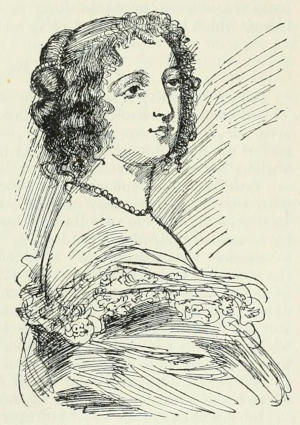
Madame de Montespan
(1641-1707)
Madame de Montespan’s triumph burst forth during a journey which the king made to Flanders in 1670. The ruin of the Dutch was prepared on this journey in the midst of entertainments. It was a continual fête, accompanied with great pomp. The king, who made all his war expeditions on horseback, made this one for the first time in a closed carriage. Postchaises had not yet been invented. The queen, Madame, her sister-in-law, and the marquise de Montespan were in this superb equipage, followed by many others, and when Madame de Montespan was alone she had four bodyguards at the doors of her carriage. The dauphin came next with his court. Mademoiselle with hers; it was before the fatal event of her marriage; she took part in all these triumphs in peace and saw with complaisance her lover, the king’s favourite, at the head of his company of guards. The most beautiful crown furniture was carried to the towns where they slept. In every city they found a masked or dress ball, or fireworks. All his military retinue accompanied the king and all his household retinue followed or preceded him. The tables were kept as at St. Germain. In this pomp the court visited all the conquered cities. The principal ladies of Brussels, of Ghent came to see this magnificence. The king invited them to his table. He made them very handsome presents. All the officers of the garrison troops received gratuities. His liberality cost the king several times fifteen hundred gold louis a day.
All the honour, all the homage was for Madame de Montespan, except what duty gave to the queen. Nevertheless this lady did not share the secrets of state. The king knew how to distinguish affairs of state from pleasure. The unfortunate experience of a maid of honour to the queen in 1673 gave rise to a new court order. The danger attached to the position of a young girl in a gallant and voluptuous court caused twelve ladies of the palace to be substituted for the twelve maids of honour, who had graced the court and the queen’s presence. After that the queens’ households were composed in that manner. This arrangement made the court larger and more magnificent, by establishing in it the husbands and families of these ladies, which increased the society and spread greater opulence.
Poisoning: The Brinvilliers Case
[1670-1685 A.D.]
About 1670 the crime of poisoning began to be prevalent in France. This revenge of cowards had not been employed during the horrors of the civil war, but, by a singular fatality, had infected France in the time of glory and of the pleasures which softened manners, even as it found its way into ancient Rome in the fairest days of the republic.
Two Italians, one of whom bore the name of Exili, worked for a long time with a German apothecary called Glaser, in quest of the philosopher’s stone. In this enterprise the two Italians lost the little they had and endeavoured, by crime, to repair the harm done by their folly; they secretly sold poisons. Confession, the greatest curb to human wickedness but which is abused in the idea that one may perform the crimes one is sure of expiating, was the means of informing the grand penitentiary of Paris that certain persons had died of poison; he apprised the government. The two Italians were suspected, and put in the Bastille; one of the two died there; Exili remained there without being convicted; and from the depths of his prison he spread through Paris those dark secrets which cost the lives of the civil lieutenant D’Aubrai and his family, and which finally led to the establishment of the Chamber of Poisons, called the Chambre Ardente.
Love was the prime source of these horrible tragedies. The marquis of Brinvilliers, son-in-law of the civil lieutenant D’Aubrai, had in his house Sainte-Croix, the captain of his regiment, a man with too handsome a face: his wife warned him of the consequences; the husband persisted in letting the young man remain in the house with his wife, a young, beautiful, and susceptible woman. What might have been expected happened: they fell in love with each other. The civil lieutenant, father of the marquise, was harsh and imprudent enough to solicit a lettre de cachet and get the captain, who needed only to be returned to his regiment, sent to the Bastille. Sainte-Croix was unfortunately put in a room with Exili: this Italian taught him how to revenge himself; the results make one shudder. The marquise did not attempt the life of her husband, who had had some indulgence for a love of which he was himself the cause, but the fury of her vengeance induced her to poison her father, her two brothers, and her sister. Amidst so many crimes she was religious; she often went to confession, and when she was arrested at Liège a general confession was even found written in her handwriting, which served not as a proof against her but as presumptive evidence. It is not true that she tried her poisons in the hospitals as the people said, and as written in the Causes célèbres, the work of a briefless barrister (François Gabot de Pitaval) and made for the people; but it is true that she as well as Sainte-Croix had secret connections with persons afterwards accused of the same crimes. She was burned in 1676 after having had her head cut off. But from 1670, when Exili had begun to make poisons, down to 1680 this crime infected Paris. It cannot be concealed that Penautier, the receiver-general of the clergy and a friend of this woman, was accused some time afterwards of having put his secrets in practice and that it cost him half his wealth to suppress the indictment.
The Bavarian princess, wife of Monseigneur,[123] at first added brilliancy and vivacity to this court. The marquise de Montespan still attracted the principal attention but finally she ceased to please, and the violent transports of her grief did not bring back a heart that was forsaking her. However, she still kept her place at court, through her high position, being superintendent of the queen’s household, and with the king through habit and through her authority. The youth and beauty of Mademoiselle de Fontanges, a son she had borne to the king in 1680, the title of duchess she had received, kept Madame de Maintenon away from the first place, to which she did not then dare to aspire but which she afterwards obtained. The duchess de Fontanges, however, and her son died in 1681.
The marquise de Montespan, although she no longer had an open rival, none the less did not possess the heart tired of her and of her complaints. When men are no longer in their youth they almost all have need of the society of an agreeable woman. Above all the weight of affairs makes this consolation necessary. The new favourite, Madame de Maintenon, who felt the secret power she was gaining every day, bore herself with that art so natural to women and which is never displeasing to men. She wrote one day to Madame de Frontenac, her cousin, in whom she placed an entire confidence: “I always send him away dissatisfied but never discouraged.” During this time, when her favour was increasing and Madame de Montespan was nearing her fall, these two rivals saw each other every day, now with a secret bitterness, now with a passing confidence which the necessity of speaking to each other and the weariness of constraint sometimes put into their interviews. They agreed to write, each from her point of view, memoirs of all that happened at court. The work never went very far. Madame de Montespan took pleasure in reading selections from these memoirs to her friends, in the last years of her life. The pious devotion which was joined to all these secret intrigues further strengthened the favour of Madame de Maintenon and weakened that of Madame de Montespan. The king reproached himself for his attachment to a married woman and felt this scruple still more since he had begun to feel no more love for her. This embarrassing situation continued until 1685, a year made memorable by the revocation of the Edict of Nantes. Very different scenes were to be seen at that time—on one side the despair and flight of a part of the nation, on the other new fêtes at Versailles; Trianon and Marly built; nature in all these places forced with delights, and gardens in which every art was exhausted. The marriage of the grandson of the Great Condé with Mademoiselle de Nantes, daughter of the king and Madame de Montespan, was the last triumph of this mistress who began to retire from court.
The Retirement of Montespan
[1685-1707 A.D.]
The king afterwards gave in marriage two other children he had had by her: Mademoiselle de Blois to the duke de Chartres, and the duke du Maine to Louise Benédicte de Bourbon, granddaughter of the Great Condé and sister of Monsieur le Duc,[124] a princess celebrated for her wit and liking for the arts.
Before the celebration of the marriage of Monsieur le Duc with Mademoiselle de Nantes, the marquis de Seignelay in honour of that event gave the king a fête worthy of that monarch in the gardens of Sceaux, which had been planted by Le Nôtre with as much taste as those of Versailles. The idyll of Peace composed by Racine was performed on that occasion. At Versailles there was a new tournament and after the marriage the king displayed a singular magnificence, for which Cardinal Mazarin had given the first idea in 1656.
Four booths were put up in the salon at Marly, filled with the richest and most select products of the industry of Parisian workmen. These four booths were at the same time so many splendid decorations representing the four seasons of the year. Madame de Montespan presided over one with Monseigneur. Her rival, Madame de Maintenon, was in another with the duke du Maine. The newly married couple each had charge of one: Monsieur le Duc with Madame de Thiange; and Madame la Duchesse, whom propriety did not permit to have one with a man on account of her extreme youth, was with the duchess de Chevreuse. The so-called gentlemen and ladies du voyage drew lots for the jewels with which the booths were decorated. The king then made presents to the whole court in a manner worthy of a king. Cardinal Mazarin’s lottery was less ingenious and less brilliant. These lotteries had been formerly put into fashion by the Roman emperors, but not one of them ever relieved its magnificence with so much gallantry.
After the marriage of her daughter Madame de Montespan did not again appear at court. She lived a very dignified life at Paris. She had a large income, but it was a life annuity, and the king always paid her a pension of 1,000 gold louis a month. She went every year to take the waters at Bourbon, and there married off the girls of the neighbourhood, whom she endowed. She was no longer at the age when the imagination, affected by lively impressions, sends one to the Carmelites. She died at Bourbon in 1707.
One year after the marriage of Mademoiselle de Nantes with Monsieur le Duc, the prince of Condé died at Fontainebleau, at the age of sixty-six, of an illness which was hastened by his desire to go to see Madame la Duchesse, who had smallpox.
Madame de Maintenon
Meanwhile, after the marriage of Madame la Duchesse, after the total eclipse of the mother, the victorious Madame de Maintenon achieved such an influence and inspired Louis XIV with so much tenderness and such scruples, that the king, by the advice of Père Lachaise, married her secretly in the month of January, 1686,[125] in the small chapel in the apartments occupied afterwards by the duke of Burgundy. There was no contract, no stipulation. The archbishop of Paris, Harlay de Chanvalon, pronounced the benediction, the confessor assisting. Montchevreuil and Bontemps, first valet de chambre, were the witnesses. Louis XIV was at the time in his forty-eighth year and the woman he espoused in her fifty-second. This sovereign, crowned with glory, desired to combine with the fatigues of governing the innocent joys of private life; this marriage bound him to nothing incompatible with his rank; it was always a problem to the court. Since Madame de Maintenon was really married, it respected her as the king’s choice, without treating her as queen.
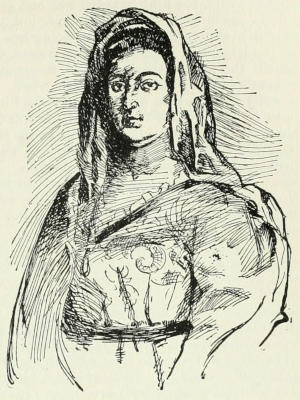
Madame de Maintenon
(1635-1719)
She was of an old family, granddaughter of Théodore Agrippa d’Aubigné, gentleman of the chamber to Henry IV. His father, Constant d’Aubigné, wishing to establish himself in business in the Carolinas, applied to the English government, and was thrown into the prison of the château Trompette, from which he escaped with the assistance of the daughter of the governor of the prison, a gentleman from Bordeaux named Cadillac. Constant d’Aubigné married his benefactress in 1627 and took her with him to the Carolinas. Returning with her to France after several years, both were imprisoned at Niort in Poitou, by order of the court. In this prison was born, in 1635, Françoise d’Aubigné, destined to know all the greatest hardships of life as well as the highest favours of fortune. Taken at the age of three to America (Martinique), brought back an orphan of twelve years, brought up with the greatest severity by Madame de Neuillant, mother of the duchess de Navailles her relative, she was only too glad to marry in 1651 Paul Scarron, who lived near her in the rue d’Enfer. Scarron came of an old family of parliament, distinguished by its important matrimonial alliances; but his profession of burlesque poet lowered him while making him popular. It was nevertheless a stroke of fortune for Mademoiselle d’Aubigné to marry this man, deformed in mind and body, and with very modest means. She abjured Calvinism, her own religion as well as that of her ancestors, before this marriage. Her beauty and wit soon made her distinguished. She was eagerly sought after by the best society of Paris, and this time of her youth was no doubt the happiest period of her life. After the death of her husband, in 1660, she was for a long time unable to obtain from the king a modest pension of 1,500 livres which Scarron had enjoyed. Finally, after several years, the king granted her one of two thousand, saying, “Madame, I have made you wait a long time, but you have so many friends that my only distinction could be in not being one of them.” Meanwhile it is proved, by the letters of Madame de Maintenon, that she owed to Madame de Montespan the slight assistance she received to relieve her poverty. It was remembered several years later, when it became necessary to bring up secretly the duke du Maine, son of the king by the marquise de Montespan, born in 1672. The duke du Maine was born with a deformed foot. The chief physician, D’Aquin, who was in the secret, decided that the child should be taken to the baths at Barèges. It was necessary to find a confidential person to be intrusted with this charge. The king suggested Madame Scarron. Louvois went secretly to Paris to propose this journey to her. From that time on she was in charge of the education of the duke du Maine—chosen for this duty by the king and not by Madame de Montespan, as has erroneously been said.
She wrote directly to the king; her letters pleased him greatly. This was the origin of her good fortune—her shrewdness did the rest. The king, who at first did not like her, passed from aversion to confidence and from confidence to love. The letters which we have of hers are of much greater importance than they would seem: they show that mixture of religion and gallantry, of dignity and weakness, which are often found in the human heart, and which certainly were in that of Louis XIV. Madame de Maintenon seemed to be filled at the same time with an ambition and a devoutness which never appeared to conflict. Her confessor, Gobelin, approved equally of both: he was spiritual guide as well as courtier; his penitent, having become ungrateful towards Madame de Montespan, always dissembled this feeling. Her confessor encouraged her in her aspirations. She called religion to the assistance of her waning charms to supplant her benefactress, now become her rival.
This strange mixture of love and scruple on the part of the king, of ambition and devoutness on the part of the new mistress, seemed to have lasted from 1681 to 1686, the date of their marriage. Her elevation was for her only a seclusion. Shut up in her apartments, which were on the same floor as those of the king, she limited herself to the society of two or three ladies, retiring like herself—she saw even them very rarely. The king came to her apartments every day after supper, and remained until midnight. There he worked with his ministers, while Madame de Maintenon read, or occupied herself with needlework; she never attempted to speak on affairs of state, seemed often to ignore them, putting far from her any appearance of intrigue or plotting; much more occupied in humouring him who governed than seeking to govern, in managing her income, and expending it with the greatest cautiousness.
Louis XIV in marrying Madame de Maintenon gained only an agreeable and submissive companion. The sole public distinction which testified to her secret elevation was, that during mass she occupied one of those small gilded stalls which were supposed to be only for the king and queen. Beyond that, no display, no grandeur. The devoutness with which she had inspired the king and which had led to her marriage, became gradually a true and profound sentiment, which age and ennui served to strengthen. She already posed at the court and before the king as a foundress by gathering together at Noisy several young girls of the nobility; and the king had already set apart the revenues of the abbey of St. Denis for that budding community. St. Cyr was built at the foot of the park of Versailles in 1686.
On the death of the king she retired for life to St. Cyr. What is surprising, is that the king left her almost nothing. He simply recommended her to the duke of Orleans. She asked for a pension of only 24,000 livres, which was scrupulously paid her, until her death on April 15th, 1719.b
Turning now from this survey of the court, let us examine the effect of Louis XIV’s policy on the nation at large.
EFFECT OF LOUIS XIV’S POLICY ON THE NATION
[1661-1715 A.D.]
Louis XIV’s reign falls into two parts, easy to distinguish, the one from the other; the first covers from 1661 to 1683, the second, and much the longer, from 1683 to 1715. In the first period, Louis XIV found four men of genius, who were also scrupulously honest men, to uphold and even direct him in everything concerning the internal government, diplomacy, warfare, and defence of the kingdom. In an equal degree Colbert, Lionne, Turenne, and Vauban exercised a salutary and fruitful influence over the king’s mind, never divorcing the welfare of the kingdom from that of the king, and seeking before all else the greatness or the security of the empire by adopting the best of the measures which had proved so successful under Henry IV, Richelieu, and Mazarin. The profound reverence which Colbert, more especially, had for the memory of Richelieu, whom he wished the king to take as his model, provoked Louis’ jests. “When any important matter was under discussion,” says a contemporary chronicle, “the late king would often exclaim, ‘Colbert there will tell us: Sire, the great Cardinal Richelieu.’ Which, however, did not prevent Colbert from pursuing his object, and moulding the king in Richelieu’s likeness.”
In the second period, Louis, prematurely aged, disillusioned, and ill, reduced to a stern performance of his duties as a man and a Christian by the froward influence of an obstinate and ambitious woman, drew inspiration from none but narrow ideals, applying the most fatal maxims to home government and foreign policy. He yielded to the advice of persons whom he had for long encouraged to flatter his prejudices, and who urged him along a path of bloody repressions. Louvois, Madame de Maintenon, Chamillard, and Villeroi were the real wielders of authority. They sacrificed the well-being of the kingdom to their own interest, which they sought to confound with the interests of the crown. They prepared the way for the ruin of the state by the most disastrous home measures, while they ruined the prestige of France abroad by changing the character of her policy.m
The trouble was not only in the royal household; it also threatened to be in the state; for Louis, violating all laws civil and religious, placed the legitimated princes side by side with the princes of the blood. He forced the court to pay equal respect to both; and public morality received a blow from which it was slow to recover. The lessons in scandal which came from the throne were not lost, and the corruption, which was fermenting in spite of the apparent austerity of the last years, was to break out under the new reign without restraint and without shame. Those dukes of Orleans and Vendôme, given up to filthy debauches, that duke d’Antin surprised in a flagrant act of theft, and so many others who contrived at play to correct the chances of fortune; those princesses of the blood who at Marly within two steps of the king and Madame de Maintenon, send for such strange pastimes[126]—that court in fine which, according to Saint-Simon,i “sweated hypocrisy,” all shows, under a king who plays the devotee, when he is no longer able to do otherwise, that human morality, conscience, and dignity can never be violated with impunity. Already, even in the very heart of Versailles, a premonitory cry is heard. In face of these gilded lives La Bruyère writes: “The great have no soul; I would be of the people.” It was at Versailles that the French nobility ruined themselves. There official ennui led to secret debauches; the habit of receiving everything from the monarch led to the belief that all was due not to services but to servility.
One irrefutable witness of the wretchedness of this period has been left to us—the memorials which the king demanded of the intendants on the condition of their provinces in order that his grandson the duke of Burgundy might by studying them become acquainted with the affairs of the administration. At every page these distressing words recur, “War, mortality, the continual quartering and passage of the soldiers, the militia, the great prerogatives, the withdrawal of the Huguenots have ruined this country.” Bridges, roads were in a deplorable state and commerce was annihilated. The frontier provinces were further crushed by requisitions and the pillage of the soldiers who, receiving neither pay nor food, helped themselves. In the generality of Rouen, out of 700,000 inhabitants 650,000 had a bundle of straw for their beds. In certain provinces the peasant was returning to a state of savagery: living for the most part on herbs and roots like the beasts; and, wild as they were, he fled if one approached. “There is no nation more savage than these people,” the intendant of Bourges says of those under his administration; “sometimes troops of them are to be seen in the country, seated in a circle in the middle of a field and always far from the roads; if one approach the band immediately disperses.”c
We have seen Louis XIV at home; let us now turn to his relations with other countries.a
FOOTNOTES