Chapter VIII · THE RESCUE OF THE REALM
Reading edition
No longer on St. Denis will we cry, But Joan la Pucelle shall be France’s saint. —Shakespeare.
[1422-1427 A.D.]
The king proclaimed at St. Denis was an infant of ten months, grandson, on his mother’s side, of Charles VI. His two uncles ruled in his name,—one the duke of Bedford in France; the other the duke of Gloucester in England. This child was recognised as sovereign of the kingdom of France by parliament, by the university, by the first prince of the blood, Philip the Good, duke of Burgundy, and by the dowager queen, Isabella of Bavaria. Paris, Île-de-France, Picardy, Artois, Flanders, Champagne, and Normandy—that is to say, almost all the country north of the Loire—and Guienne, south of that river, obeyed him.
The king proclaimed in Berri, sole surviving son of Charles VI, was a youth of nineteen years, graceful bearing, but weak in body, pale of figure, of small courage, and ever in fear of violent death; and besides, adds Chastelain,d “a good Latinist, a fine raconteur, and most wise in council.” Such indeed he was later on; but for the present and for many years to come he showed spirit only for his own pleasures and a sort of dull apathy in matters of state and in the face of peril. His authority was recognised only in Touraine, Orleans, Berri, Bourbonnais, Auvergne, Languedoc, Dauphiné, and Lyonnais. Indifferent to disaster, he was resigned to hearing himself called derisively “the king of Bourges.” To Poitiers he transported his council, his parliament, and his university. But Bourges and Poitiers were still great towns in his eyes; he dragged his little court from castle to castle, completely submissive to the sire de Giac, to Le Camus de Beaulieu, to the sire de la Trémouille, and willingly enduring the all-powerful influence of his mother-in-law Yolande of Anjou.b
The young king, brought up by the Armagnacs, found in them his chief support, and so shared their unpopularity. These Gascons were the most veteran soldiers in France, but the greatest and most cruel plunderers. The hatred they inspired in the north would have been sufficient to create there a Burgundian and English party. The brigands of the south seemed more of foreigners than the foreigners.
Charles VII next made trial of the foreigners themselves, of those who had gained experience in the English wars. He called the Scotch to his aid. These were the most mortal enemies of England, and their hatred might be relied on as much as their courage. The greatest hopes were built on these auxiliaries. A Scotchman was made constable of France; another, count of Touraine. Notwithstanding, however, their incontestable bravery, they had often been beaten in England. They were not only beaten in France, at Crevant and Verneuil (1423, 1424), but destroyed: the English took care that none of them escaped. It was asserted that the Gascons, out of jealousy against the Scotch, had not supported them.
The English narrowly escaped giving Charles VII an ally far more useful and important than the Scotch—the duke of Burgundy. So little concert was there between the two brothers, that at the selfsame time Bedford married the duke of Burgundy’s sister, and Gloucester was commencing war against him. A word as to this romantic story.
The duke of Burgundy, count of Flanders, never thought himself secure of his Flanders until he should have flanked it with Holland and Hainault. These two counties had fallen into the hands of a girl, the countess Jacqueline, widow of the dauphin John. The duke of Burgundy married her to a cousin of his own, a sickly boy. Jacqueline, who was a handsome young woman, did not resign herself to so irksome a fate, but left her sorry mate, nimbly crossed the Straits, and herself proposed marriage to the duke of Gloucester. Gloucester committed the folly of accepting the proposal (1423). He espoused Jacqueline’s cause, thus beginning against the duke of Burgundy, the indispensable ally of England, a war which, for the latter, was a question of actual existence, a war without treaty, in which the sovereign of Flanders would risk his last man. The incensed duke of Burgundy concluded a secret alliance with the duke of Brittany, and then he made pecuniary demands on Bedford. What could Bedford do? He had no money; instead of it, he offered an inestimable possession worth more than any sum of money—his whole barrier on the north (September, 1423). The bands of Charles VII came and lodged themselves in the very heart of English France, in Normandy; a pitched battle was fought before they could be expelled. It took place on the 17th of August, 1424, at Verneuil. In June, Bedford had regained the good will of the duke of Burgundy by an enormous concession, having pledged his eastern frontier to him, Bar-sur-Seine, Auxerre, and Mâcon.
All northern France was greatly in danger of thus falling bit by bit into the duke of Burgundy’s hand; but suddenly the wind shifted. The sapient Gloucester, in the midst of this war begun for Jacqueline, forgets that he has married her, forgets that at that very moment she is besieged in Bergues, and weds another, a fair English woman. This new folly had the effect of an act of wisdom. The duke of Burgundy consented to be reconciled to the English, and made a show of believing all Bedford told him; the essential thing for him was to be able to despoil Jacqueline, and occupy Hainault, Holland, and afterwards Brabant, the succession to which could not but soon be opened.
Charles VII, therefore, derived little advantage from this event which seemed likely to be so profitable to him. The only benefit that accrued to him from it was that the count de Foix, governor of Languedoc, comprehended that the duke of Burgundy would sooner or later turn against the English, and declared that his conscience obliged him to recognise Charles VII as legitimate king. He placed Languedoc in subjection to him, with the clear understanding that the king should draw from it neither money nor troops, and should not in any wise interfere with the little royalty which the count de Foix had contrived for himself in that province. The friendship of the houses of Anjou and Lorraine seemed to promise more direct advantage to the party of Charles VII. The head of the house of Anjou was then a woman, Queen Yolande, relict of Louis II, duke of Anjou, count of Provence, and pretender to the throne of Naples; she was the daughter of the king of Aragon, by a lady of Lorraine, of the house of Bar. The English having committed the egregious mistake of troubling the houses of Anjou and Aragon, as regarded their pretensions to the throne of Naples, Yolande formed against them an alliance of Anjou and Lorraine with Charles VII. She married her daughter to the young king, and her son René to the only daughter of the duke of Lorraine. Yolande was of service to her son-in-law. By her sage counsels she removed the old Armagnacs from about him; she had the address to win the Bretons back to him, and caused the constable’s sword to be conferred on the count of Richemont, brother of the duke of Brittany.
Charles VII, combining together the Bretons, Gascons, and Dauphinois, had thenceforth the real military strength of France on his side. Spain sent him Aragonese, Italy Lombards. But the war sped feebly for all that; money was wanting, and union still more so. The king’s favourites frustrated Richemont’s first enterprises; not, indeed, with impunity, for the stern Breton put to death two of them within six months, without form of trial. Since a favourite was necessary to the king, he gave him one of his own choosing, young La Trémouille, and the first use the latter made of his ascendency was to dismiss Richemont. The king, strange to say, forbade his constable to fight for him; the king’s men and Richemont’s were on the point of drawing their swords against each other. Thus Charles VII found his cause less advanced than ever.c
Meanwhile the towns were resisting the foreign domination. La Ferté-Bernard underwent in 1422 a four months’ siege and only yielded to the earl of Salisbury in the last extremity. In 1427 the English, in order to get closer to the Loire, sent three thousand men-at-arms to besiege Montargis on the Loing. The town had only a small garrison under the brave La Faille, but the inhabitants supported him well.b
MONSTRELET DESCRIBES THE SIEGE OF MONTARGIS (1427 A.D.)
Shortly after their arrival the English built some bridges and passages over the river. This being done, they began to approach the town and fortress of Montargis, and attacked and destroyed several engines of war. But despite this, the besieged defended themselves valiantly, and kept the besiegers thus employed for the space of about two months. During this time tidings were carried to King Charles of France, which informed him that, if he did not shortly send succour to the besieged, they must needs yield to their adversaries. This news came to the knowledge of King Charles, and it is said that king summoned a council, where it was concluded and determined to send help to Montargis, or, at least, to reinforce it with men and provisions. The charge of the relief was bestowed upon the bastard John of Orleans and Étienne de Vignolles, known as La Hire.
[1427-1428 A.D.]
They, with about sixteen hundred fighting men and skilful soldiers, took the road with much display, with the intention of victualling the said town of Montargis, and raising the siege. When they had come within half a league, as secretly as they could, they took counsel together and determined to make an attack upon some of the camps of the English, on both sides of the town. They had with them some of the garrison of the said town of Montargis who would direct them. They attacked the camps of the English with much violence (which attack the English had not guarded against), crying, “Montjoie St. Denis!” and began to fire a number of the camps, and killed and captured several of the English. Such was the spirit they put into their work, that the camp of Sir John de la Pole was overthrown in a short space of time; but the same lord and about eight others escaped in a small boat. The water was so high at that time that the bridges the English had made were covered, so that when they attempted to escape they fell beside these bridges and were drowned.
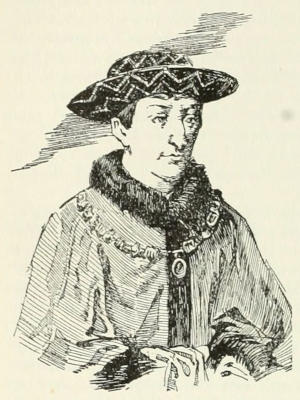
Charles VII
(From an old French engraving)
Whilst this was going on, the bastard of Orleans was on the other side of the town, attacking on foot the camp of Henry Basset, and there being much to do, the others, when they had overthrown the first camp, came to his assistance. The English, perceiving that the victory was not to them, began to retreat to the camp of the earl of Warwick, and crossed a bridge so hastily and in such numbers that the bridge gave way beneath them, and there perished miserably very many; for besides this the inhabitants of Montargis, who had sallied forth boldly to the help of their own people, slaughtered and captured many, and did not spare them.
Meanwhile, the earl of Warwick assembled his men as quickly as he could. But when he learned the great loss and pitiable defeat of his host, of which from a thousand to fifteen hundred men were either killed or captured, he departed and went his way, with the remainder of his men of which the greater number were on foot. They retreated to the castle of Landou in Nemours, and to other places under their suzerainty.e This was the first time that the bastard of Orleans was intrusted with a command of any importance, and he did not fail to justify his brilliant début.f
THE SIEGE OF ORLEANS (1428-1429 A.D.)
[1428-1429 A.D.]
The following year (1428) Bedford resolved to push military operations vigorously and to force the barrier of the Loire. In the month of June the earl of Salisbury debarked at Calais with six thousand of the best soldiers England ever had in France; Bedford joined him there with four thousand men drawn from garrisons in Normandy, and their army took Jargeau, Janville, Meung-sur-Loire, Thoury, Beaugency, Marchenoir, and La Ferté-Hubert, thus approaching Orleans step by step.
Orleans was the gate to Berri, the Bourbonnais and Poitou. This taken, the “king of Bourges” would become the king of Dauphiné and Languedoc. October 12th, 1428, the English appeared before its ramparts and at once formed around the place a series of bastilles, each of which was commanded by one of the first lords of England—by William de la Pole, earl of Suffolk; the “English Achilles,” Lord Talbot; and William Glasdale, who had sworn to kill everyone in Orleans. Salisbury was commander-in-chief. The Orléanais, who had been expecting the siege, had fortified the heart of their town by burning the suburbs. Their captain was the sire de Gaucourt whom the English had held captive for thirteen years, because he had persisted in defending Harfleur against them. The garrison did not number more than five hundred at the most, but they were all hardened warriors. Moreover, the bourgeois were looking out for themselves. They had formed thirty-four companies—and each undertook the defence of one of the thirty-four towers of the wall.
Artillery was beginning to play a great rôle in battles and sieges. That of the besiegers was badly handled, and the bourgeois laughed at the unskilful English cannoneers who threw eighty-pound balls into the town and killed no one.[39] The Orléanais artillery was very different. It was composed of seventy pieces, aimed by twelve master cannoneers, expert at firing. Each cannon had its name and its own particular duty. The good cannon Riflard (Clean Sweep) killed its man at every shot.b Another one, too, was the celebrated culverin of a skilful Lorrainian cannoneer, Maître Jean; the two, man and culverin, made the finest hits. The English came at last to know this Maître Jean; he never ceased killing them except to make game of them: from time to time he would drop down and pretend to be dead; his body was carried off into the town; the English were in ecstasy when—behold! back he would come, alive and merry, and fire upon them worse than ever.c
But the luckiest shot of all was fired by a child [according to Grafton, the son of a gunner who had gone to dinner]. This schoolboy came across a fully loaded piece on the rampart. He lit the fuse and ran away. The ball went straight into the face of the earl of Salisbury, who was standing on one of the bastilles and to whom, at that very instant, William Glasdale was saying, “My lord, behold your town.”
The English commander was dead; and the next day the bastard of Orleans, the handsome, brave Dunois, entered the town with the best knights of the time—La Hire, Saintrailles, Marshal de Broussac, and six or seven hundred soldiers. Others followed until little by little seven thousand were gathered in Orleans.b
The “Battle of the Herrings” (1429 A.D.)
The siege continued with various success to the 12th of February, 1429, with sundry episodes in the way of sorties, feigned attacks, conflicts about provision entering the town, and even duels, to amuse the two parties and try their respective mettle. They went on slowly completing their fortifications, and it was to be foreseen that the town would be at last almost entirely shut in.
However careless the king might appear about saving the appenage of the duke of Orleans, it was clear that, once that city had fallen, the English would advance unhindered into Poitou, Berri, and the Bourbonnais, would live at the expense of those provinces, and ruin the south after having ruined the north. The duke de Bourbon sent his eldest son, the count de Clermont, under whom some Scotch forces and some lords of Touraine, Poitou, and Auvergne were to succour Orleans, cast provisions into it, and even hinder the arrival of provisions in the English camp. The duke of Bedford sent a supply from Paris under the conduct of the brave Sir John Fastolf; and he had availed himself of the old Cabochian enmity of Paris to Orleans, to add to his English detachment a considerable number of Parisian arblast men, and the provost of Paris himself. They took with them three hundred wagon-loads of provisions, particularly herrings, an article indispensable in Lent. Troops and wagons all marched in narrow file, and nothing could have been easier than to break their line and destroy them. The Gascon La Hire, who was in advance of the French, burned with impatience to fall upon them, but received express orders not to do so, from the prince, who was advancing slowly with the main body of his force.
Meanwhile, the English had taken the alarm, and Fastolf had drawn his men together under cover of the wagons and a line of sharp stakes which these provident English always carried with them. The English archers were posted on the right, the Parisian arblast men on the left. In spite of all the count de Clermont could say, his men were carried away by their impetuous rancour; the Scotch leaped from their saddles to fight the English on foot, and the Armagnac Gascons rushed upon their old enemies the Parisians; but the latter stood their ground. The Scotch and Gascons having thus broken their ranks, the English issued from behind their temporary ramparts, pursued them, and killed three or four hundred. The count de Clermont remained immovable. La Hire was so furious that he turned back upon the English who dispersed in the pursuit, and killed some of them. The count’s party had to return to Orleans after this unlucky engagement, to which the Orléanais, always satirical, gave the name of the “battle of the Herrings”; in fact, the balls had burst the barrels; and the field was strewn with herrings more than with the slain.
Slight as was this check, it discouraged everyone. The most knowing hastened to quit a town that seemed lost. The young count de Clermont had the weakness to withdraw with his two thousand men; the admiral and the chancellor of France thought it would be a sad thing if the king’s great officers should be taken by the English, and they too departed. As the men-at-arms no longer hoped for human aid, and the priests did not reckon very confidently on divine succour, the archbishop of Rheims took himself off, and even the bishop of Orleans left his flock to defend themselves as they could.
They all went away on the 18th of February, assuring the citizens that they would soon return in strength. Nothing could stay them. The bastard of Orleans, who with equal skill and valour defended the appenage of his house, had in vain been telling them since the 12th that a miraculous succour should be looked for, that a daughter of God, who promised to save the town, was coming from the marches of Lorraine. The archbishop, an ex-secretary of the pope, and an old diplomatist, paid little heed to this talk about miracles. Dunois himself did not reckon so exclusively on aid from on high as to neglect employing a very human and very politic means against the English. He sent Saintrailles to the duke of Burgundy, to beg him, as a relative of the duke of Orleans, to take the latter’s town into his keeping. He was now asked to accept the grand and important possession of the centre of France, and he did not refuse the offer. He went straight to Paris, and told the affair to Bedford, who answered dryly that he had not toiled for the duke of Burgundy’s behoof. The latter, much offended, recalled all the troops he had at the siege of Orleans.
Supplies arriving with difficulty, discontent began in the town; many no doubt were of opinion that the town had made quite enough sacrifices for the sake of its lord, and that it was better Orleans should become English than cease to be. Things did not stop there. It was discovered that a hole had been made in the wall of the town; treachery was manifestly at work. Besides all this, Dunois could expect no help from Charles VII. The estates, assembled in 1428, had voted money and summoned the tenants of fiefs to fulfil their feudal duties. Neither money nor men had arrived.
We are not well acquainted with the intrigues that divided the little court of Charles. The divisions in it had naturally augmented in this its extreme distress. The old Armagnac advisers, whom Richemont and the king’s mother-in-law had for a while removed, were in the way to regain their credit. That southern party would have been well pleased to have a king of the south holding his court at Grenoble. The duchess of Anjou, the king’s mother-in-law, on the contrary, could not preserve Anjou if the English definitively passed the Loire. So far there was a community of interests between her and the house of Orleans. But the house of Anjou had so many other interests, so various and divergent, that she thought it expedient always to keep on fair terms with the English, and to negotiate perpetually. When the defence of Orleans appeared to be desperate (May, 1429), the old cardinal De Bar hastened to treat with Bedford, in the name of his nephew, René of Anjou, lest he should lose the inheritance of Lorraine, calculating that René could disavow his proceedings, should the affairs of Charles VII at any future time assume another aspect.
The impending ruin of Orleans had frightened the other towns of the Loire. The nearest, Angers, Tours, and Bourges, sent provisions to the besieged; Poitiers and La Rochelle, money; then, when the alarm increased, the Bourbonnais, Auvergne, and even Languedoc sent the Orléanais saltpetre, sulphur, and steel. Gradually all France became interested in the fate of one town, and moved with sympathy for the brave resistance of the men of Orleans and their fidelity to their lord. Orleans was pitied; so too was its duke. The captive Charles of Orleans could not defend his town.[40]
The English had one thing in their favour, namely, that their young king, Henry VI, was certainly a Frenchman by the mother’s side, and grandson of Charles VI, whom he resembled but too much as regarded the weakness of his mind. The legitimacy of Charles VII, on the other hand, was very doubtful; he was born in 1403, in the high tide of his mother’s intimacy with the duke of Orleans; and she herself had acquiesced in the acts in which he was called soi-disant dauphin. Henry VI had not yet been crowned at Rheims, but neither had Charles VII. The people in those days recognised a king but by two things, royal birth and the crown placed on his head with the church’s solemn sanction. Charles VII was not king according to religion, nor was he sure that he was so according to nature. This question, of no moment for politicians of that class who decide after their own interests, was everything for the people, who are willing to obey only the right. A woman had obscured this great question of right, and by a woman it was cleared up. This second woman bore the name Jeanne Darc. She was soon to be famous as the Maid of Orleans.
THE MAID OF ORLEANS (LA PUCELLE) (1429 A.D.)
The originality of the Maid of Orleans, and what determined her success, was not so much her valour or her visions as her good sense. Through all her enthusiasm, this daughter of the people saw the question clearly, and was able to solve it. She cut the knot which the politic and the men of little faith could not untie. She declared, in God’s name, that Charles VII was the true heir, and she set him at ease as to his legitimacy, of which he himself had doubts. That legitimacy she sanctified, taking her king straight to Rheims, and gaining over the English, by the celerity of her movements, the decisive advantage of the coronation.
It was at Domrémy, just between Lorraine of the Vosges and that of the plain, between Lorraine and Champagne, that the beautiful and brave girl was born, who was to wield the sword of France so well.
Joan or Jeanne was the third daughter of a peasant, Jacques Darc,[41] and of Isabella of Romée. She had two godmothers, one of whom was named Jeanne, the other Sibylle. The eldest son having been named James (Jacques), another Peter (Pierre), the pious parents gave one of their daughters the more exalted name of St. John (Jean). Whilst the other children accompanied their father in his field work or tended cattle, the mother kept Joan at home for sewing or spinning. She did not learn to read or write, but she knew all her mother could teach her of sacred things. She acquired religion, not as a lesson or a ceremony, but in the homely popular form of a winter night’s tale, as the simple faith of a mother.
Everybody knew her charity and her piety. They saw clearly she was the best girl in the village. What they did not know was that in her the life from above always absorbed the other life, and suppressed all vulgar development. Hers was the divine gift to remain a child in soul and body. She grew up, became strong and comely, but never knew the physical miseries of her sex. They were spared her, to the advantage of her mental growth and religious inspiration.
Joan had her share in the romantic adventures of those restless times. She saw poor fugitives arrive in the hamlet, and the kind-hearted girl assisted towards their reception, gave up her bed to them, and lay down in the hayloft. Her kindred, too, were once obliged to save themselves by flight. Then, when the inundation of brigands had passed off, the family returned and found the village sacked, the house devastated, and the church burned down. Thus she knew what war meant. She understood that anti-Christian state of things, and abhorred that reign of the devil, in which every man died in mortal sin. If, as everyone said, the ruin of the kingdom was the work of a woman, an unnatural mother, it might be that its salvation should proceed from a girl. This very fact was foretold in one of Merlin’s prophecies, a prophecy which, variously enriched and modified in the several provinces, had become thoroughly Lorrainian in the country of Joan of Arc. It was a girl of the marches of Lorraine that was to save the realm. The prophecy had probably received this embellishment, in consequence of the recent marriage of René of Anjou with the heiress of the duchy of Lorraine, which was in reality a very fortunate event for France.
One summer’s day, a fast day, Joan, being in the garden at noon with her father, close by the church, saw a dazzling light in that direction, and heard a voice saying, “Be a good child, Joan, and go often to church.” The poor girl was greatly frightened. Another time she again heard the voice and saw the light; but now she discerned it in noble figures, one of which had wings and seemed a sage counsellor. He said to her, “Joan, go to the aid of the king of France, and thou wilt restore him to his kingdom.” She answered, trembling all over, “My Lord, I am but a poor girl; I cannot ride the war-horse, or lead men-at-arms.” The voice replied: “Thou shalt go to M. de Baudricourt, captain of Vaucouleurs, and he will take thee before the king. St. Catherine and St. Margaret will be with thee to help thee.” She remained stupefied and in tears, as if she had already beheld her whole future destiny.
The sage counsellor was none other than St. Michael, the stern archangel of judgment and battle. He returned again, cheered her courage, “and related to her the pity there was in the realm of France.” Then came the white figures of female saints, surrounded with innumerable lights, their heads adorned with rich crowns, their voices sweet and melting even to tears. But Joan wept above all when the saints and angels left her. “I should have been very glad,” she said, “if the angels had taken me away with them.” Joan has told us nothing of the first inward conflict she sustained; but it is evident it took place, and endured a long while, since five years elapsed between her first vision and her departure from the home of her parents.
She encountered not only resistance but temptation in her own family. They tried to marry her, in the hope of bringing her back to a more rational way of thinking. A young man of the village alleged that she had promised him marriage when she was still a child; and as she denied the fact, he cited her before the ecclesiastical judge at Toul. It was supposed she would make no defence, but would submit to be cast by the court and married; but to everyone’s great astonishment, she went to Toul, appeared in court, and spoke—she who had always held her peace.
To enable her to escape from the control of her family, it was necessary she should find in her family itself someone to believe her; this was a most difficult problem. Failing to persuade her father, she made a convert of her uncle, who took her away with him, under the pretext of her nursing his wife in her lying-in. She prevailed on him to go to the sire de Baudricourt, captain of Vaucouleurs, and ask his support for her; but the man of war gave the peasant a very bad reception, and told him the only thing to be done was “to slap her well,” and take her home to her father. She was not cast down by the rebuff, but determined to depart, and her uncle was constrained to accompany her. The decisive moment was come; she quitted her family and her native village forever; she embraced her friends, especially her dear little friend Mengette, whom she commended to God’s keeping; but as for Haumette, the friend she loved above all others, she preferred to depart without seeing her.
She arrived then in the town of Vaucouleurs, dressed in her clumsy red peasant garments, and went along with her uncle to lodge with the wife of a wheelwright who took a liking to her. She had herself taken into Baudricourt’s presence, and said to him boldly that “she came to him on the part of our Lord to bid him tell the dauphin to keep his ground steadily, and not give battle to his enemies; for our Lord would grant him succour in mid-Lent. The kingdom did not belong to the dauphin but to our Lord; nevertheless, it was our Lord’s will that the dauphin should become king, and that he should hold the kingdom in trust.” She went on to say that, in spite of the dauphin’s enemies, he would be king, and she would take him to be crowned. The captain was amazed, and suspecting there was some deviltry at work, he consulted the parish priest, who apparently entertained the same doubts. Joan had not spoken of her visions to any churchman. The priest, therefore, accompanied the captain to the wheelwright’s house with his stole on, and adjured Joan to depart if she was sent by the evil spirit.
But the people did not doubt; their admiration was extreme; persons flocked from all parts to see her. It appears that Baudricourt sent to ask leave of the king. Meanwhile, he conducted Joan to the duke of Lorraine, who was ill and wished to consult her. He got nothing from her but advice to appease God’s anger by becoming reconciled with his wife. He gave her encouragement notwithstanding. On her return to Vaucouleurs, she found a messenger from the king, who brought the permission she desired. The disaster of the battle of the Herrings disposed the king to accept every means of which he could avail himself. Joan had predicted the battle on the very day when it took place. The people of Vaucouleurs, entertaining no doubt of her mission, clubbed together to buy her a horse. The captain gave her only a sword.
It was a rough and very perilous journey she was about to make. The whole country was overrun by armed bands belonging to either party. There was now neither road nor bridge; the rivers were swollen; it was the month of February, 1429.
Joan at the Court
The court of Charles VII was far from being unanimous in the Maid’s favour. That inspired girl, just come from Lorraine, and patronised by the duke of Lorraine, could not fail to strengthen with the king the party of the queen and her mother, the Lorraine and Anjou party. An ambush was laid for Joan at some distance from Chinon, and she escaped from it only by miracle.
So strong was the opposition against her that, after she was actually arrived, the council continued for two days to discuss the question whether or not the king should see her. Her enemies thought to postpone the matter indefinitely, by having it decided that inquiries should be made respecting her in her native place. Fortunately, she had friends also—the two queens, no doubt, and above all, the duke of Alençon, who, having recently come out of the hands of the English, was very impatient to carry the war into the north, and recover his duchy. The inhabitants of Orleans, to whom Dunois had been promising this marvellous aid since the 12th of February, sent to the king and claimed the Maid’s presence.
The king received her at last, surrounded with the greatest pomp; which, in all probability, was adopted with the hope of disconcerting her. She presented herself humbly “as a poor shepherd wench,” distinguished the king at the first glance from the crowd of lords among whom he had purposely mingled; and though he insisted, at first, he was not the king, she embraced his knees. But as he was not yet crowned, she styled him only dauphin: “Gentle dauphin,” she said, “my name is Jehanne la Pucelle. The King of heaven sends you word by me that you shall be anointed and crowned in the town of Rheims, and you shall be lieutenant of the King of heaven, who is King of France.”

The Cathedral of Rheims
The archbishop of Rheims, chancellor of France, and president of the king’s council, summoned doctors and professors of theology, some of them priests, others monks, and ordered them to examine the Maid. The doctors being introduced and seated in a hall, Joan sat down on the end of the bench, and replied to their questions. She recounted the apparitions and the words of the angels, with dignified simplicity. A Dominican met her with a single objection, but it was one of weight: “Jehanne, thou sayest it is God’s will to deliver the people of France; if such is his will he has no need of men-at-arms.” The observation did not confound her. “Ah! mon Dieu,” said she, “the men-at-arms will do battle, and God will give the victory.” Another person was not so easily satisfied. This was Friar Séguin, a Limousin, professor of theology in the university of Poitiers, “a very sour man,” says the chronicle. He asked her, in his Limousin French, “What language did the celestial voice speak?” Joan answered with rather too much sharpness, “A better one than yours.” “Dost thou believe in God?” said the enraged doctor; “well then, God will not have us put faith in thy words unless thou show a sign.” She answered, “I am not come to Poitiers to perform signs or miracles; my sign shall be to raise the siege of Orleans. Let me have men-at-arms, few or many, and I will go.”
The question of her inspiration was made to depend on the test of her virginity. The duchess of Anjou, the king’s mother-in-law, accomplished the ridiculous examination, with the aid of some ladies, to the honour of the Maid. Some Franciscans who had been sent to her native place to collect information, brought back the most satisfactory accounts. There was no more time to be lost. Orleans was crying out for help; Dunois was sending message upon message. The Maid was equipped, and a sort of establishment was formed for her. First of all they gave her for squire John Daulon, a brave knight of mature years, who belonged to the count de Dunois, and was the most respectable among his followers. She had also a noble page, two heralds-at-arms, a seneschal, and two valets; her brother, Pierre Darc, had also joined her suite. John Pasquerel, a friar, hermit of the order of St. Augustin, was assigned her for confessor.
The Deliverance of Orleans (1429 A.D.)
[1429 A.D.]
When we read the list of the captains who threw themselves into Orleans with Joan of Arc—La Hire, Saintrailles, Gaucourt, Culan, Coaraze, Armagnac; when we see that, independently of the Bretons under Marshal de Retz, and Marshal de St. Sévère’s Gascons, Florent d’Illiers, captain of Châteaudun, had brought all the nobles of the vicinity to take part in this short expedition, the deliverance of Orleans seems less miraculous. One thing, however, was by all means wanting to enable these great forces to act with advantage, an essential, indispensable thing—unity of action. Dunois might have created this, had no more been requisite to that end than address and intelligence; but this was not enough. An authority was requisite, one surpassing that of the crown; the king’s captains were not habituated to obey the king.
War had changed men into wild beasts, and these beasts required to be turned again to men, Christians, docile subjects. A great and difficult change! Some of these Armagnac captains were perhaps the most furious men that ever existed. It was a ludicrous and touching thing to see the sudden conversion of the old Armagnac brigands. They did not stop short halfway in their amendment. La Hire no longer ventured to utter an oath; but the Maid, compassionating the violence he did himself, allowed him to swear, “by his staff.” The devils had all at once been transformed into little saints.
She had begun by insisting that they should renounce their wanton women, and should confess. Then in the course of her march along the Loire, she had an altar erected in the open air, at which she took the communion, and so did they. The first night they bivouacked, she lay down in full armour, as there were no women about her; but she was not yet habituated to such hardships, and she was ill in consequence. As for danger, she knew not what it meant. She wanted to cross over to the north side of the river, and march along the English bank and between the bastilles of the invaders, who, she asserted, would not stir. Her followers would not listen to her advice, but marched along the left bank, so as to pass two leagues above Orleans. Dunois came out to meet her: “I bring you,” she said, “the best succour ever sent to anyone, the succour of the King of heaven. It comes not from me, but from God himself, who, at the entreaty of St. Louis and St. Charlemagne, has had pity on the town of Orleans, and will not suffer that the enemy should have both the duke’s body and his town at once.”
She entered the city slowly at eight in the evening (April 29th), the crowd scarcely allowing her to advance. Everyone strove eagerly to touch at least her horse. They gazed on her “as if they saw God.” Talking gently to the people all the while, she proceeded to the church, and then to the houses of the duke of Orleans’ treasurer, an honourable man, whose wife and daughter gave her welcome. She slept with Charlotte, one of the daughters.
She had entered the town along with the provisions, but the army marched down-stream again, to cross at Blois. She would, nevertheless, have had an immediate attack made on the English bastilles; but as she could not effect this, she sent a second peremptory message to those on the north side, and then proceeded to repeat her summons to those on the south. Glasdale, the captain, abused her in the coarsest terms, calling her cow-girl and ribald. In their hearts they believed her to be a witch, and were greatly afraid of her. They kept her herald, and were thinking of burning him, in hopes that this would, perhaps, break the charm.
The army not arriving, Dunois ventured forth in search of it. The archbishop of Rheims, chancellor of Charles VII, had detained the little army at Blois. The old politician was far from conceiving the existence of such an irresistible enthusiasm, or perhaps he feared it. It was, therefore, much against his will that he came to Orleans. The maid went out to meet him, with the people and the priests singing hymns. The procession passed and repassed before the English bastilles; and the army entered the town, protected by some priests and a girl (May 4th, 1429).
Joan, who, in the midst of her enthusiasm and her inspiration, had much shrewdness of apprehension, very clearly discerned the hostile temper of the new comers. She was right in surmising that there was a design to act without her. As she lay by Charlotte’s side, she suddenly started up, exclaiming, “My God! the blood of our people is running on the ground. It was ill done! Why was I not wakened? Quick! my arms, my horse!” She was armed in a moment, galloped off at full speed, and met men already wounded, whom they were carrying back from the field. The fugitives faced round on her arrival. Dunois, who had also not been called, arrived on the ground at the same time. The bastille (one of those on the north side) was attacked again. Talbot strove to succour it; but fresh forces issued from Orleans; the Maid put herself at their head, and Talbot withdrew his men. The bastille was carried. This was her first victory, the first time she looked on a field of slaughter. She sought confession for herself and her followers; and declared that she would take the communion on the morrow, being the feast of the Ascension, and pass the day in prayer.
Advantage was taken of this resolution to hold a council without her, wherein it was determined that this time the besiegers should cross the Loire and attack St. Jean le Blanc, the bastille which most impeded the introduction of provisions into the town, and that a false attack should be made at the same time on the other side. The English then did what they ought to have done before. They concentrated their strength. With their own hands burning the bastille which was to have been attacked, they retired upon the other two on the south side, the Augustins and the Tournelles. The former was instantly attacked and carried, the success in this instance again being partly due to the Maid. The French were seized for a while with a panic, and rushed back towards the floating bridge; but the Maid and La Hire disentangled themselves from the throng, threw themselves into boats, and took the English in flank.
There remained the Tournelles. The victors passed the night before it; but they obliged the Maid, who had eaten nothing all day (it was Friday), to recross the Loire. Meanwhile the council had assembled. The Maid was told in the evening that it had been unanimously resolved that, since the town was now fully victualled, they should wait for a fresh reinforcement to attack the Tournelles. It is difficult to believe that such could have been the real intention of the leaders, for delay was extremely dangerous, since the English might at any moment be succoured by Fastolf. Probably the intention was to deceive the Maid and deprive her of the honour of the triumph she had so powerfully contributed towards securing. She disappointed them.
In the morning she rode to the Burgundy gate with a multitude of men-at-arms and citizens; but the sire de Gaucourt, grand-master of the king’s household, kept it shut. The crowd opened the gate, and forced another near it. The sun was rising on the Loire when the whole concourse threw themselves into the boats. On arriving, however, at the Tournelles, they felt that they wanted artillery, and they sent for some to the town. At last they attacked the outward rampart which protected the bastille. The English defended themselves valiantly. The Maid, perceiving that the assailants were beginning to show signs of weakness, jumped into the ditch, seized a ladder, and was in the act of applying it to the wall, when an arrow struck her between the neck and the shoulder. The English sallied out to seize her, but she was carried off by her own party. She only allowed a little oil to be poured on the wound, and confessed.
Meanwhile no progress was made, and night was at hand. Dunois himself gave orders to sound a retreat. A Basque had taken out of the hands of the Maid’s squire that standard of hers which struck such dismay into the enemy. “When the standard touches the wall,” said she, “you will be able to enter.” “It is touching it.” “In then! all is your own.” And just as she had predicted, the assailants in a frenzy of enthusiasm climbed the wall “as though by one step.” The English were at this moment attacked on two sides at once.
Meanwhile the men of Orleans, who watched the fight from the other side of the Loire, could contain themselves no longer. They threw open their gates and rushed to the bridge, but there was an arch broken; they pushed a rickety plank across the opening, and a knight of St. John ventured to pass over the frail spar in full armour. The bridge was hastily repaired, and the whole multitude hurried to the other side. The English, seeing such a human sea rushing upon them, thought the whole world had come together against them. Their senses grew bewildered; some of them beheld St. Aignan, the patron of the town, others the archangel Michael. Glasdale endeavoured to retreat from the rampart to the bastille, across a small bridge; but it was shattered by a shot, and the Englishman fell into the water and was drowned, before the eyes of the maid he had so vilified. There were five hundred men in the bastille, all of whom were put to the sword.
Not one Englishman remained south of the Loire. Next day, Sunday, the besiegers on the northern side abandoned their bastilles, their artillery, their prisoners, and their wounded comrades. Talbot and Suffolk conducted the retreat steadily and in good order. The Maid would not allow them to be pursued, since they retired of their own accord; but before they withdrew out of sight of the town, she had an altar erected on a plain, at which mass was celebrated, and the people returned thanks to God in the presence of the enemy (Sunday, May 8th). The effect of the deliverance of Orleans was prodigious; everyone beheld in it the agency of supernatural power. Many attributed it to the devil, but the majority to God; it began to be generally believed that Charles had right on his side.c
Joan of Arc leads the King to Rheims
However discomfited and paralysed by the panic of their soldiers, as well as by the great diminution of their numbers in the siege, the English generals would not retreat from the Loire, but withdrew, Suffolk to Jargeau, up the stream of the river, Talbot to Meung, lower down its current. They were unmolested for a month. The French were lost in jubilation. Joan left Orleans on the 13th of May, and hurried back to the court at Tours to press the king for an army to proceed to Rheims.g
To be crowned at Rheims would have been a decisive victory for Charles over his young competitor Henry VI. It would have made him a real king of France. But once again the politicians believed themselves the wiser, and the coronation was not to be thought of until the English were driven from the Loire.b
Early in June, however, Joan was able to muster eight thousand combatants, of whom twelve hundred were knights, most of them townsmen of Orleans.g Suffolk, who had thrown himself into Jargeau, was besieged and the place stormed. Beaugency, too, was taken before Lord Talbot could receive the succours which Sir John Fastolf was bringing him from the regent. The constable De Richemont, who had long kept aloof within his own estates, came, in spite of the king and the Maid, to lend his aid to the victorious army.
A battle was imminent; Richemont came to share the honour it might afford. Talbot and Fastolf had formed a junction of their forces; but it is a curious fact, illustrative both of the condition of the country and of the fortuitous character of the war, that no one knew where to find the English army in the wilderness of La Beauce, which was then covered with coppices and thickets, until they were discovered by a stag, which, being pursued by the French vanguard, rushed into the ranks of the English.
The latter were on their march, and had not set up their defensive line of stakes as usual. Talbot alone was for fighting, furious as he was, since the defeat at Orleans, at having shown his back to the French. Fastolf, on the contrary, who had gained the battle of the Herrings, had no need of an engagement to retrieve his reputation, and said, like a sensible man, that with a disheartened army it was better to remain on the defensive. The French men-at-arms did not wait for the end of the discussion, but charged headlong, and met with no great resistance. Talbot fought with desperate obstinacy, hoping perhaps to be killed, and succeeded only in getting himself made prisoner. The pursuit was murderous; the bodies of two thousand English were strewed over the plain.
After this battle of Patay (28th or 29th of June), it was now or never the time to venture on the expedition to Rheims. The politicians wanted to remain still on the Loire, and make sure of Cosne and La Charité. This time they talked in vain; no timid counsels could now be listened to. Every day brought people flocking in from all the provinces, attracted by the fame of the Maid’s miracles, and believing only in her, and in her purpose forthwith to convey the king to Rheims. There was an irresistible outburst of the pilgrim and crusading spirit. The indolent young king himself at last yielded to the popular flood, and suffered himself to be borne along by that vast tide that set in towards the north; and off they started all together, willingly or perforce—the king, courtiers, the politic and the enthusiastic, the madmen and the sages. They were twelve thousand when they began their march, but their numbers augmented continually as they advanced; every hour brought them additional strength; and those who had no armour followed the holy expedition in plain doublets, as archers or sword-and-buckler men, even though they were of gentle blood.
The army marched from Gien on the 28th of June without attempting to enter it, that town being in the hands of the duke of Burgundy, whom there were reasons for treating with favour. Troyes had a mixed garrison of Burgundians and English, who ventured to make a sortie on the first appearance of the royal army. There seemed small chance of storming a large town so well guarded, and that too without artillery. There was only one old Armagnac councillor, the president Mâcon, who was of a contrary opinion, well knowing that in such an enterprise prudence was on the side of enthusiasm, and that men must not reason in a popular crusade. “When the king undertook this march,” said he, “he did so not by reason of the great armed force or the abundance of money he possessed, nor because the achievement seemed to him possible; he undertook it because Joan told him to advance and be crowned at Rheims, and that he would encounter little resistance by the way, such being the good pleasure of God.” The Maid then presented herself at the door of the council-room, and assured them they would be able to enter the town in three days. “We would willingly wait six,” said the chancellor, “if we were sure what you say is true.” “Six? You shall enter to-morrow!”

A French Knight, Time of Joan of Arc
She seized her standard; the whole army followed her to the ditch, and they threw into it all they could lay their hands on, fagots, doors, tables, rafters, with such rapidity that the townspeople thought the ditches would very soon disappear altogether. The English began to be dazzled and bewildered as at Orleans, and fancied they saw a cloud of white butterflies fluttering round the magic standard. The citizens on their part were in great dread, recollecting that it was in Troyes the treaty had been concluded which disinherited Charles VII, and fearing that an example would be made of their town. Already they were taking refuge in the churches, and crying out that the town must surrender. The fighting men, who desired nothing better, parleyed and obtained leave to depart with what they had.
What they had was chiefly prisoners, Frenchmen. Charles VII’s councillors, who had drawn up the capitulation, had stipulated nothing with respect to those unfortunate persons. The Maid alone thought of them. When the English marched out with their prisoners in irons, she stood at the gates and cried out, “In God’s name, they shall not carry them off!” She stopped them, in fact, and the king paid their ransom.c
Charles simply passed through Troyes, neither did he stop at Châlons, which opened its gates with alacrity; and, on July 13th, he arrived before Rheims. Two Burgundian nobles, the sires of Châtillon and of Saveuse, were in command, but they had no men. They assembled the townsmen, and asked them to hold out for six weeks only; at the end of that time they guaranteed that the dukes of Burgundy and of Bedford would arrive with so powerful an army that it would easily raise the siege. The townsfolk refused to run the risk, persuaded the two captains to retire, and sent a deputation to the chancellor of France who was at the same time archbishop of Rheims, begging him to enter his episcopal town. On July 17th Charles was at last crowned in accordance with the usual ritual, anointed with oil from the holy ampulla of Saint-Rémy and lifted up to his seat by the ecclesiastical peers.
Joan defeated at Paris (1429 A.D.)
Joan had done the two great things which her ‘voices’ told her to do: she had delivered Orleans, and had caused the king to be crowned; she now wished to return to her village. “On her entrance into Rheims,” says the Chronique de la Pucelleh “seeing how all the poor people of the country cried ‘Noel!’ and wept from joy and gladness, and how they came to the king singing Te Deum laudamus without response or anthem, she said to the chancellor of France and to Dunois: ‘In God’s name this is a good and pious people, and when it shall be my time to die, I should like it to be in this country.’
“Then the said count Dunois asked her: ‘Joan, do you know when you will die and in what place?’ She answered that that was as God willed; and said moreover to the said lord: ‘I have fulfilled what my Lord commanded me, and I wish that he would send me back to my father and mother to keep their sheep and cattle.’”
But her rôle was not ended, for the English still held a large part of the kingdom. Joan, with the same firmness which had made her go to Orleans and to Rheims, asked to be allowed to march to Paris. The king’s counsellors could not accustom themselves to these heroic deeds of daring which, at certain moments, are more estimable than prudence; they decided first to take the small towns on the road to Paris. These opened their gates of their own free will. The royal army entered Laon, Soissons, Coulommiers, Provins, Senlis, and St. Denis without trouble. But when they came to Paris the opportunity had passed.b Bedford had sent for the duke of Burgundy to secure Paris, and he came at the invitation, but almost alone; all the use the regent could make of him was to have him figure in an assembly of notables, where he harangued, and repeated once more the lamentable history of his father’s death. This being done, he took himself off, leaving Bedford, by way of aid, only some Picard men-at-arms; and even for this slight assistance, he required to have the town of Meux given to him in pledge.
There was no hope save in Beaufort. That priest was king in England. His nephew, Gloucester, the protector, had ruined himself by his own follies. In order to uplift the cardinal’s power to the highest pitch, it was necessary that Bedford should be brought as low in France as Gloucester was in England; that he should be reduced to such exigency as to call for Beaufort’s presence, and that the latter should come at the head of an army to crown Henry VI. That army Beaufort had in readiness. With it he was to secure Paris, convey young Henry thither, and crown him.
It was not until July 25th, nine days after Charles VII had been duly anointed and crowned, that the cardinal entered Paris with his army. Bedford did not lose a moment, but set out with these troops to observe Charles VII. Twice they were in presence of each other, and some skirmishes took place. Bedford, fearing for Normandy, kept watch over it, and during this time the king marched against Paris (August). This was contrary to the wish of the Maid, whose voices told her not to advance beyond St. Denis.
It was an imprudent enterprise; the French nevertheless carried a rampart. The Maid went down into the first ditch, and crossed the shelving bank between it and the second, and found the latter full of water, up to the foot of the wall. Heedless of the arrows, that fell like hail about her, she shouted to her men to bring fascines, and meanwhile sounded the depth of the water with her lance. She was almost alone, a mark for every arrow, and one passed through her thigh. She strove to bear up against the pain, and remained on the spot to encourage the troops to mount to the assault. At last, having lost much blood, she retired to the cover of the outer ditch, and it was not until ten or eleven at night she could be prevailed on to return to her quarters. She seemed to feel that this decisive check under the very walls of Paris would ruin her beyond recovery.
[1429-1430 A.D.]
Fifteen hundred men were wounded in this attack, which she was wrongfully accused of having advised. She was now vilified by her own party as well as by the enemy. She had not scrupled to make the attack on the day of our Lady’s Nativity (September 8th), to the great scandal of the pious town of Paris. The court of Charles VII was still more shocked at this irreverent deed. The libertines, the politic ones, the blind worshippers of the letter and sworn foes to the spirit, all declared bravely against the spirit the moment it showed signs of weakness. Negotiations were resolved on, contrary to the Maid’s advice, at the instigation of the archbishop of Rheims, chancellor of France, who had never been cordially in her favour. He proceeded to St. Denis, to ask for a truce; perhaps he had secret hopes of prevailing with the duke of Burgundy, who was then in Paris.
Regarded with ill will, and badly supported, the Maid carried on the sieges of St. Pierre le Moûtier and La Charité during the winter. Though almost abandoned before the former, she nevertheless stormed and took it. The siege of La Charité proceeded slowly and languidly; a panic broke out among the besiegers, and they dispersed.
Capture of Joan of Arc (1430 A.D.)
Meanwhile the English had induced the duke of Burgundy to give them effectual aid. The weaker they were, the more hope he had of being able to retain the strongholds he might take in Picardy. The English, who had just lost Louviers, offered him his own terms, and he, the richest prince in Christendom, no longer hesitated to stake men and money in a war, the profit of which he hoped to appropriate. A bribe to the governor put him in possession of Soissons. Then he laid siege to Compiègne, the governor of which was also a man of very questionable integrity; but the inhabitants were too strongly committed to the cause of Charles VII to let their town be given up. The Maid threw herself into it, and on the very same day made a sortie in which she nearly surprised the besiegers. But the latter rallied in a moment, and pressed hotly upon the besieged, up to the rampart and the bridge. The Maid, having remained in the rear to cover the retreat, was not able to get within the walls in time—whether it was that the bridge was blocked up by the crowd, or that the gates were already closed. Being identified by her costume, she was soon surrounded, seized, and dragged from her horse. Her capturer, a Picard archer, brought her to his master, the bastard of Wandomme, who sold her to John of Ligny, who belonged to the illustrious house of Luxemburg and was the duke of Burgundy’s vassal.c
Now this John of Luxemburg had need of the duke of Burgundy in order to inherit peacefully the domains of Ligny and St. Pol, to the detriment of his elder brother. The duke of Burgundy, in order not to be disturbed when seizing Brabant, Brussels, and Louvain, in spite of the rights of his aunt Margaret, needed the assistance of the English. The English were inclined to allow anything provided Joan of Arc was given up to them.b It was absolutely necessary to get her out of the hands of the Burgundians. She had been taken on the 23rd of May; on the 26th a message was sent from Rouen in the name of the vicar of the Inquisition summoning John of Ligny to give up the woman, she being suspected of witchcraft.c A violent tempered man, a Burgundian, who was willing to do anything in the hope of obtaining the archbishopric of Rouen, Pierre Cauchon, bishop of Beauvais, undertook to prove it by a trial in due form.b
[1430-1431 A.D.]
The university stepped forward, and wrote to the duke of Burgundy and to John of Ligny (July 14th). Cauchon, in his exceeding zeal making himself the agent and courier of the English, carried the letter with his own hands to the two dukes. At the same time he summoned them as a bishop to deliver over to him a prisoner over whom he had jurisdiction. In this strange proceeding, we find him pass from the part of a judge to that of a negotiator, and make offers of money; though the woman in question cannot be considered a prisoner of war, the king of England will give John of Ligny and the bastard of Wandomme 200 or 300 livres’ yearly rent, and a sum of 6,000 livres to those in whose keeping she is. Towards the end of the letter he advances as far as 10,000 livres, “as much,” he says, “as would be given for a king or a prince according to the custom of France.”
Thus on all sides that world of interest and covetousness was opposed to the Maid, or at least indifferent as to her fate. The good Charles VII did nothing for her, the good Duke Philip gave her up to her mortal foes. It was in vain John of Ligny’s wife threw herself at his feet, and implored him not to dishonour himself.[42] He was not free; he had already received English money, and he gave up Joan, not directly indeed to the English, but to the duke of Burgundy, who took her to Arras, and then to the keep of Crotoy.
Compiègne was delivered on the 1st of November. The duke of Burgundy had advanced as far as Noyon, as though it were to meet the disgraceful blow more nearly and in person. He was again defeated shortly afterwards at Germigny (November 20th). At Péronne Saintrailles offered him battle, but he durst not accept it. These humiliations no doubt confirmed the duke in his alliance with the English, and fixed his determination to give up the Maid to them.
At the moment when the English had the Maid at last in their hands,[43] and could begin her trial, their affairs were in a very bad condition. Far from having recovered Louviers, they had lost Château Gaillard; La Hire, who took it by escalade, found Barbazan a prisoner there, and let loose that redoubtable captain. The towns were going over of their own accord to the side of Charles VII, and the citizens were driving out the English. The men of Melun, so close to Paris, ejected their garrison.
The rapid downhill course of English affairs was only to be checked by some strong machinery, and such had Beaufort ready in the trial and the coronation of Henry VI. The latter entered Paris on the 2nd of December. The university had been made to write on the 21st of November to Cauchon, accusing him of tardiness, and requesting the king to begin the trial. Cauchon was in no hurry, thinking it hard, apparently, to begin the work, whilst the payment was as yet uncertain. It was not until a month later that he obtained authority from the chapter of Rouen to proceed in that diocese. He opened the proceedings at Rouen, on the 9th of January, 1431.c
Trial of Joan of Arc
[1431 A.D.]
He based the accusation on the four following points: infringement of the laws of the church, by making use of magic practices; by taking up arms, contrary to her parents’ wishes; by wearing clothes which were not those of her sex; and lastly, by announcing revelations which were not sanctioned by ecclesiastical authority. Thus a poor girl of nineteen was alone, without protection against judges who were sold to her enemies, who arbitrarily suppressed every proof of her innocence, who prevented her appealing to the pope or to the council, who sought to embarrass her by absurd and misleading questions or by extremely delicate ones, and who were often disconcerted by her heroic replies.

Costume of a French Peasant, at the Time of Joan of Arc
The maid was finally brought before her judges on the 21st of February. “Joan,” they asked her, “do you believe you have found salvation?” “If I have not, may God grant it me; if I have, may God preserve me in it!” “Did you not say that standards made by the soldiers in imitation of yours would bring them good luck?” “No; I only said, ‘advance boldly among the English,’ and I advanced also.” But she declared that she had never killed anyone. “Why was her standard carried to the church at Rheims at the coronation, more than those of the other captains?” “It had borne the burden, it was only just that it should receive the honour.” “What was the idea of those people who kissed your hands, your feet, your clothes?” “The poor people came to me gladly, because I did them no ill; I supported them and defended them to the best of my power.” “Do you think you were right to leave without permission from your mother and father? Ought one not to honour one’s father and mother?” “They have forgiven me.” “Did you not think you were sinning in acting in this manner?” “God commanded it; if I had had one hundred fathers and one hundred mothers I should have gone.” “Do you think your king did right in killing or having killed Monseigneur of Burgundy?” “It was a great pity for the kingdom of France. But, whatever may have been between them, God sent me to help the king of France.” “Do St. Catherine and St. Margaret hate the English?” “They love what our Lord loves, and hate what he hates.” “Does God hate the English?” “I know nothing of the love or hatred which God has for the English; but I know well that they will be driven from France, except those who perish here.” “Is it not a mortal sin to admit a man to ransom and then put him to death?” “I have not done so.”
The judges laid stress on the man’s clothing which Joan had assumed contrary to the laws of the church, which she was still wearing, and which she would not relinquish. The wretches affected not to understand what the poor girl did not dare to tell them—that in camp, even in prison, this dress had been, and still was, her protection.b
The Twelve Articles
Between the 2nd and 4th of April the judges, on the advice of the members of the university, caused the seventy points of accusation brought forward by the prosecutor to be summed up in twelve articles. There were two doctors of Paris, Nicholas Midi and Jacques de Touraine, who worked on this—one on the plan, the other on the final form. The twelve articles reviewed the trial in a spirit very hostile to Joan, while it eliminated the prosecutor’s accusation of impostures and brutalities. On the 12th of April twenty-two doctors and licentiates deliberated together on the twelve articles. They left the question hanging between a matter of human invention and an inspiration of Satan.f
We give herewith these twelve articles and follow them with the findings of the faculty, as they are given in the report of the trial, edited by M. Quicherat.i
I. And in the first place, a certain woman states and affirms that, when she was thirteen years of age or thereabouts, she herself saw, with her own corporeal eyes, St. Michael consoling her, and sometimes St. Gabriel appearing in bodily form; sometimes, also, she saw a great multitude of angels: and afterwards, SS. Catherine and Margaret showed themselves visible in bodily form to the same woman, and she also sees them daily and hears their voices, and has embraced them at times, and kissed them, touching them sensibly and corporeally. She truly saw the heads of the said angels and saints, but concerning their other parts or their garments she was unwilling to say anything. And that the aforesaid SS. Catherine and Margaret sometimes spoke to her at a certain spring near a large tree, commonly called “the fairies’ tree,”[44] concerning which spring and tree there was a common report that the “fates of the ladies” frequent there, and that many fever-stricken persons go to the said spring and tree for the sake of recovering health, although they are situated in a profane place. These she frequently worshipped there and elsewhere and paid them reverence.
She says, moreover, that the aforesaid SS. Catherine and Margaret appear and show themselves to her crowned with very beautiful and costly crowns, and from the aforesaid time and ofttimes subsequently spoke to the same woman concerning the command of God, that it behoved her to go to a certain secular prince promising that by the help of the same woman and by her labours the said prince would recover by force of arms great temporal dominion and worldly honour, would obtain victory over his enemies, and that the same prince would receive the said woman and would bestow on her arms together with an army of soldiers for the carrying out of what was promised. Furthermore, the said SS. Catherine and Margaret instructed the same woman concerning the command of God, that she should assume and wear male attire, which she has worn and still wears in persevering obedience to this kind of command insomuch that the woman herself has said that she would rather die than abandon this kind of dress, saying this simply at different times, and occasionally “unless it were the command of God.” She even chose rather not to be present at the offices of mass and to go without the holy communion of the Eucharist at times ordained by the church for receiving the sacrament, than to resume female and put off male attire. They were also protectors of the said woman in this matter that, without the knowledge and against the will of her parents, when she was seventeen years of age or thereabouts, she left her father’s house and associated with a number of soldiers, frequenting with them by day and by night, never or rarely having another woman with her. And many other things did the said saints tell and teach the same woman, by reason of which she says that she has been sent by the God of heaven and by the victorious church of the saints now enjoying beatitude to whom she commits all her good deeds.
She declines, however, and refuses to submit her deeds and words to the church militant, having been ofttimes required and admonished concerning this; saying that it is impossible for the same woman to act contrary to those things which she affirmed in her process, that she had acted by the command of God, nor would she render account concerning these things to the conclusion or judgment of anyone living, but only to the judgment of God; and that they revealed to the same woman that she herself will be saved in the glory of the blessed ones and she would attain the salvation of her soul if she should keep her virginity, which she vowed to them on the first occasion when she saw and heard them. By the occasion of which revelation she asserts that she is as certain of her own salvation in the kingdom of heaven as if it were already a present fact.
II. Further, the said woman declares that the sign which the prince had to whom she was sent, and by which he was influenced to believe her concerning her revelations and to receive her for the purpose of carrying on war, was that St. Michael came to the same prince accompanied by a multitude of angels of whom some had crowns and others had wings, with whom were SS. Catherine and Margaret. This angel and the woman were walking above the earth along a way like unto steps and an arch stretching a great way, other angels and the aforesaid saints accompanying them; and a certain angel delivered to the same prince a very costly crown of purest gold and the said angel bowed himself before the said prince showing him reverence. On one occasion she said that, when her prince had the sign given him, she herself thought that he was then alone although several others were near enough at hand; and on another occasion that, as she believes, one archbishop received that sign of a crown and delivered it to the aforesaid prince, several temporal lords being present, witnessing it.
III. Further, the aforesaid woman knew and was assured that he who visits her is St. Michael, by the good advice, comfort, and good doctrine which the aforesaid St. Michael gave and made for the same woman; and in that he named himself, saying that he himself was Michael. And similarly she knows St. Catherine and St. Margaret distinctly from each other through this—that they name themselves and salute her. On account of which things, concerning the appearance of St. Michael to her, she believes that he is St. Michael himself, and she believes that the words and deeds of that Michael are true and good as firmly as she believes that our Lord Jesus suffered and died for our redemption.
IV. Further, the said woman declares and affirms that she herself is certain concerning certain future things that are wholly coming to pass, and will happen, just as she is certain about those things which she indeed sees done before her; and boasts that she has and has had information concerning certain hidden things by means of revelations as far as the meaning of the word extends through the voices of St. Catherine and St. Margaret—namely, that she will be liberated from prison and that the French will do a fairer deed in her company than was ever done for the whole of Christianity; that, furthermore, she has recognised by means of revelation, as she says, some men whom she had never seen before without anyone pointing them out to her, and that she has revealed and discovered a certain sword which was hidden in the earth.
V. Further, the said woman declares and affirms that according to the command of God and that which is well pleasing to him she has assumed and worn and continually wears and clothes herself with a dress after the fashion of a man. And further, she declares that from the time that she held it to be the command of God to take male dress, it behoved her to get a short tunic, a hood, a jerkin, breeches, and boots with many tags, the hair of her head being cut off round over the tops of her ears, leaving nothing upon her body which represented or pointed out the feminine sex beyond those things which nature conferred on the same woman for the distinction of the feminine sex. And that she ofttimes received the Eucharist when wearing the aforesaid dress. She neither has wished nor does she wish to resume feminine attire. Having been ofttimes lovingly questioned and admonished about this, she has said that she would rather die than leave off male attire, sometimes simply saying so, and sometimes, “unless it were by God’s command.” And that if she were in male attire among those for whose sake she at other times armed herself and did as she used to do before her capture and detention, this would be one of the greatest benefits which could happen for the whole kingdom of France; adding that for nothing in the world would she take an oath of not wearing male attire and not arming herself, and in all aforesaid she declares that she has done and does do well in obeying God and his commands.
VI. Further, the said woman confesses and asserts that she has caused to be written many letters in some of which on the one hand these names, Jesus Maria, were added together with the sign of the cross, and at times she superadded a cross, and then she was unwilling that that should be done which she ordered to be done in her letters. In other letters, on the other hand, she caused to be written that she herself would have those put to death who were not obedient to her letters or her counsels and that “it will immediately be seen who has the greater authority from the God of heaven”; and she frequently declares that she has done nothing except by the revelation and commandment of God.
VII. Further, the said woman declares and confesses that when she was seventeen years of age or thereabouts, she went of her own accord and by revelation according as she says to a certain esquire whom she had never seen, before leaving her father’s house against the wish of her parents; who, as soon as they were aware of her departure, were almost out of their mind. The said woman requested indeed this esquire that he should lead her or cause her to be led to the prince of whom it has been before spoken. And then the said gentleman, a captain, delivered to the said woman a man’s dress together with a sword at the request of the woman herself, and deputed and ordered one soldier, one esquire, and four serving men to conduct her; who when they had come to the aforesaid prince the said woman said to the same prince that she herself wished to head the war against his enemies, promising that she would place him in great power and would overcome his enemies; and that she had been sent for this purpose by the God of heaven, saying that in the aforesaid she did well by the command of God and by revelation.
VIII. Further, the said woman declares and confesses that she, no one forcing or compelling her, threw herself down from a certain very lofty tower, preferring rather to die than to be delivered into the hands of her enemies, or than to live after the destruction of the city of Compendium (Compiègne); she declares too that she could not avoid this kind of fall and yet that the aforesaid SS. Catherine and Margaret prevented her from casting herself down, to offend whom she declares is a great sin. Yet she knows well that this kind of sin has been forgiven her after she has made confession of it. And concerning this she declares that she has had a revelation.
IX. Further, the said woman declares that the aforesaid SS. Catherine and Margaret promised her that they themselves would lead her into paradise if she kept well the virginity which she vowed to them both in body and in soul. And concerning this she declares she is as certain as if she were already in the glory of the blessed ones. Nor does she think she has committed works of mortal sin; for if she were in mortal sin, it seems to her that the aforesaid SS. Catherine and Margaret would not visit her as they daily do visit her.
X. Further, the said woman declares and affirms that God loves certain men determined and named hitherto travellers, and loves them more than he does the same woman. And she knows this through the revelation of the SS. Catherine and Margaret who speak to her frequently in French, and not in English, since they are not on their side. And since she has known by revelation that their voices were on behalf of the prince above mentioned, she has not loved the Burgundians.
XI. Further, the said woman declares and affirms that she has ofttimes shown reverence to the aforesaid voices and spirits whom she calls Michael, Gabriel, Catherine, and Margaret, by uncovering the head, bending her knee, kissing the earth over which they walked, and by vowing to them virginity and at times by embracing and kissing the same Catherine and Margaret; and that she has touched them corporeally and sensibly, and has besought of them counsel and help by invoking them at times, although they frequently visit her when not invoked, and she acquiesces in and obeys their counsels and commands and has acquiesced from the beginning without seeking advice from anyone, for example, from father or mother, curate, or prelate, or any other ecclesiastic. And nevertheless she firmly believes that the voices and revelations which she has had through male and female saints of this sort come from God and by his ordering, and she believes this as firmly as she believes the Christian faith and that our Lord Jesus Christ suffered death for us; adding that if an evil spirit appeared to her, who pretended that he was St. Michael, she would know well how to distinguish whether he were St. Michael or not. The same woman also declares that at her own request, no other person compelling or requiring it of her, she swore to the SS. Catherine and Margaret, who appeared to her, that she would not reveal the sign of the crown which was to be given to the prince to whom she was sent. And in conclusion she said that “unless she had license to reveal it.”
XII. Further, the said woman declares and confesses that if the church should wish that she should do anything contrary to the command which she declares has been given her by God she would not do that for anything, affirming that she knows well that those things which are contained in her process come by the commandment of God, and that it were impossible for her to do anything contrary to them. Nor was she willing to refer, concerning these things, to the judgment of the church militant or to any man in the world, but to one Lord God alone, whose commands she will always do; especially as to the subject-matter of the revelations and those things which she declares she has done by revelation. And she declares that she has not made this answer and other answers of herself alone, but she has made and given these answers by command of the voices and revelations made to her; although the article of faith, “one holy Catholic church,” was ofttimes explained to the said woman by judges and others there present, explaining to her that every faithful pilgrim is bound to obey and to submit his deeds and words to the church militant, especially in the matter of faith and that which touches holy doctrine and ecclesiastical sanctions.
The Findings of the Faculty
I. And in the first place as to the first article, the faculty declares by means of doctrine that the manner and matter of the revelations, the quality of the person and place, together with other circumstances, having been finally considered, they are either fictitious lies, seductive and pernicious, or the aforesaid apparitions and revelations are superstitions, proceeding from malignant and diabolical spirits, Belial, Satan, and Behemoth.
II. Further, as to the second article, that that which it contains does not seem true; yea, the latter is a presumptuous lie, seductive, pernicious, fictitious, and derogatory to the dignity of angels.
III. Further, as to the third article, that the signs contained in it are not sufficient and the said woman believes lightly and asserts easily. Furthermore in the statement which she makes she believes wrongly, and errs in the faith.
IV. Further, as to the fourth article, that in it is contained a superstition, a soothsaying and presumptuous assertion, together with empty boasting.
V. Further, as to the fifth article, that the said woman is blasphemous towards God and a despiser of God in his sacraments; a prevaricator of divine law and holy doctrine and of ecclesiastical sanctions; of evil wisdom, she errs from the faith and is an empty boaster, and is to be held suspected of idolatry and the curse of herself and of her garments by imitating the custom of the Gentiles.
VI. Further, as to the sixth article, that the said woman is a traitress, crafty, cruel, and thirsting after the shedding of human blood, seditious and provoking to tyranny; a blasphemer of God in his commands and revelations.
VII. Further, as to the seventh article, that the said woman is undutiful to her parents, a prevaricator of the precept concerning honouring parents; scandalous, blasphemous towards God, and errs in the faith and makes a rash and presumptuous promise.
VIII. Further, that in the eighth article is contained weakness of mind tending to despair, that is to say, to suicide and to presumptuous and rash assertion concerning the pardon of sin held out; and that the said woman has an evil opinion of the freedom of human judgment.
IX. Further, that in the ninth article is contained a presumptuous and rash assertion and a pernicious lie, and she contradicts herself in the preceding article and has an ill knowledge of the faith.
X. Further, that in the tenth article is contained a presumptuous and rash assertion, superstitious divination, blasphemy against SS. Catherine and Margaret, and transgression of the precept concerning the love of your neighbour.
XI. Further, as to the eleventh article, that the said woman, supposing that she had the revelations and apparitions of which she boasts with certain beings according to the first article, is an idolatress, an invoker of demons, and errs in the faith, asserts rashly, and has made an unlawful oath.
XII. Further, as to the twelfth article, that the said woman is a schismatic, having an evil opinion of the unity and authority of the church; an apostate and hitherto errs obstinately in the faith.
Here follows a deliberation and determination by manner of doctrine of the Venerable Faculty of degrees in the University of Paris upon the twelve articles concerning the words and deeds of Joan, commonly called La Pucelle, above annotated and described; which deliberation and determination the said faculty submits to the order and judgment of the great pontiff of the holy apostolic seat and of the holy general council. If the said woman being of right mind obstinately affirm the propositions declared in the above written twelve articles and in performance abide by the deeds contained in the same, it seems to the faculty of degrees, having diligently examined the aforesaid propositions, speaking in love by manner of council or doctrine:
I. That the said woman has become schismatic, since schism is unlawful division, through her disobedience from the unity of the church, and separates herself from the obedience of the church militant, in that she says, etc.
II. Further, that the woman herself errs in the faith: contradicts the article of faith contained in the lesser symbol “one holy Catholic church”; and, as says St. Jerome, by contradicting this article she acknowledges herself not only unskilful, malevolent, and uncatholic, but heretical.
III. Further, that the woman herself is also even apostate, both because with an evil purpose she caused to be cut off from her the hair which God gave her for a covering; and also because, for the same purpose having given up female dress, she imitated the dress of men.
IV. Further, that the woman herself is a liar and a soothsayer when she says that she was sent by God and spoke with the angels and saints and did not make it known by the operation of a miracle or special witness of Scripture; as when the Lord wished to send Moses into Egypt to the children of Israel, in order that they might believe that he was sent by him he gave them a sign that he should turn his rod into a serpent and the serpent into a rod again; that John the Baptist also should reform them, he brought forward a special testimony of his mission from Scripture, saying: “I am the voice of one crying in the wilderness; make straight the way of the Lord, as saith the prophet Esaias.”
V. Further, that the same woman, by her presumption of authority, and concerning right, errs in the faith both firstly, since she herself is anathema by canonical authority and has continued in the same state for a long time; and secondly, because she says she would rather not receive the body of Christ and not make her confession at the time appointed by the church than put off her male attire and resume the dress of women; she is therefore most vehemently suspected of heresy, and is to be diligently examined concerning the articles of faith.
VI. Further, the same woman also errs in that she says that she is as certain that she will be led into paradise as if she were already in the glory of the blessed ones; since, in this journey, whether the traveller be worthy of praise or tribulation is unknown but is recognised by the supreme Judge alone. Wherefore, if the aforesaid woman be charitably exhorted and duly admonished by a competent judge to return of her own will to the unity of the Catholic faith and publicly to abjure her errors at the will of the aforesaid judge, and be unwilling to show suitable satisfaction, she is to be abandoned to the power of the secular judge under obligation to receive vengeance in proportion to the quality of her crime.i
The Sentence and its Execution
Her condemnation was decided beforehand; but they wanted to obtain from her some words implicating Charles VII, and they employed all means for this purpose; they sent for the executioner to come to the prison; then they said that all was ready for the torture. She was very ill during holy week. Threats had little effect on this heroic mind; they resorted to promises, to the most pernicious for her—that of being taken from the hands of her English gaolers and given over to men of the church. She yielded, and signed the recantation which was presented to her, without even knowing what it contained: and then, out of mercy and moderation, she was only condemned to spend the rest of her days in prison, on the bread of affliction and water of sorrow, to weep over her sins.b
She was admitted by the ecclesiastical judge to do penance, nowhere else of course than in the church prisons. The ecclesiastical in pace, hard as it was, would at least take her out of the hands of the English, protect her from their insults, and save her honour. What were her surprise and horror when the bishop said coldly, “Take her back to the place whence you brought her!”
Nothing was done; thus deceived, she could not fail to retract her retraction. But even had she been willing to persist in it, the rage of the English would not have allowed her. They had come to St. Ouen, where the sentence had been delivered, in hopes at last to burn the witch; they waited in breathless expectation; and were they now to be sent off in this way, with nothing for their pains but a scrap of parchment, a signature, and a grimace? At the moment when the bishop suspended the reading of the sentence, stones flew about the platforms without respect for the cardinal. The doctors were in danger of their lives when they set foot on the ground; bare swords were everywhere pointed at their throats; the most moderate of the English confined themselves to insulting words: “Priest, you do not earn the king’s money.” The trembling doctors, shuffling away as fast as they could, said, “Be not uneasy, we shall surely catch her again.” It was not merely the common soldiers, the English mob, that showed this thirst for blood. The respectable people and the lords were not less rancorous. The king’s man and his tutor, Lord Warwick, said, like the soldiers, “The king fares badly; the girl will not be burned” (May 23rd, 1431).