Chapter XII · IMPERIAL STRUGGLES OF FRANCIS I AND HENRY II
Reading edition
Francis I, his government and his times, commence the era of modern France, and bring clearly to view the causes of her greatnesses and her weaknesses.—Guizot.b
CRITICAL SURVEY OF FRANCIS I AND HIS PERIOD
[1515-1559 A.D.]
The accession of Francis I to the crown of France, January 1st, 1515, on the death of Louis XII, may be considered as signalising the passage from the Middle Ages to modern times and from ancient barbarism to civilisation. The transformations of great masses of men amongst whom new ideas and new passions are seen to germinate, are never sudden; centuries have prepared them in silence, and an attentive eye may have discerned, in the preceding age, the authors of the age which is about to open; but their action on the people has an element of the unexpected, because the men whose minds have been formed in principles and sentiments scarcely avowed by themselves, and scarcely understood by their contemporaries, all at once perceive that they form the majority, that they are understood, that they will be followed; and they burst as it were upon the country which had not noticed them. Thus simultaneously with the reign of the young monarch there began a decided taste for arts and letters which signalised itself by the most glorious monuments; a new zest for the pleasures of society, for wit, and for gallantry which corrupted morals while it perhaps gave more elegance to manners; an esteem for learning, a zeal for study which reflected a special glory on the French magistracy in whom dignity of character soon joined itself to knowledge; and finally an independence of opinions which, while admitting men to judge what they had adored, led some to new systems of philosophy and others to the reform of religion. France, hitherto poor in writers, began to turn her attention to herself, to study herself; her follies and vices, like her virtues and learning, left their traces; and there came into being the double series of courtly and philosophic writers, of the friends of disorder and those of wisdom—a series which was not afterwards interrupted until the fall of the throne of Louis XVI.
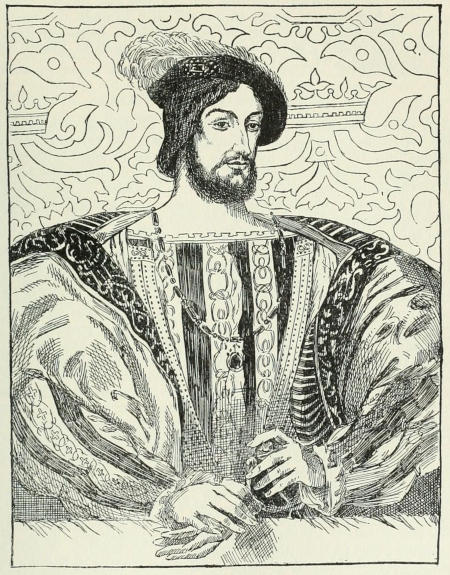
Francis I
The new sovereign, Francis d’Angoulême, duke of Valois, who gave the signal for this revolution, was not however of sufficient force to produce it. He was a son of Charles d’Angoulême, cousin german of Louis XII, and as he had been born at Cognac on the 12th of September, 1494, he was only twenty years and a few months old. His education had been begun by Marshal de Gié, whom Louis XII had replaced in 1506 by Arthur Gouffier, sire de Boisy; this last had been through all the Italian campaigns, and he had acquired in that country a taste for arts and polite literature which was scarcely ever to be met with amongst other men of noble rank. He perceived that a certain glory might be attached to the study of letters, he even accustomed his pupil to show some deference to men of learning and to seek their conversation; but if Boisy himself took pleasure in reading, it was in vain that he endeavoured to inspire the prince he was training with the desire to read any books other than the romances of chivalry. It was from them that Francis I derived his sole instruction; he modelled himself on the heroes of the Round Table and of the palace of Charlemagne, not on those of history; he desired to shine as an Amadis rather than as a sovereign; and the height of his figure, the beauty of his face, his skill in arms and in all physical exercises, his bravery which he had already had occasion to exhibit, and finally his love of pleasure which his young comrades esteemed in him more than his moral qualities, marked him out for the admiration of those who, like himself, knew the world only through the medium of romances. “He was as fair a prince,” said Bayard’s Loyal Serviteur,c “as ever was in the world; never had there been a king in France who so rejoiced the noblesse.”d
A BRILLIANT CAMPAIGN IN ITALY
[1515-1516 A.D.]
After the coronation, which was celebrated at Rheims with great pomp, and the festivities of the royal entrance in Paris, the preparations for the expedition into Italy begun by Louis XII were resumed without delay. France possessed nothing beyond the Alps since the fort at the Lantern or Fanal at Genoa had capitulated. Everyone expected to see the French retake the Milanese; but Francis I anticipated the general expectation—he wished that conquest to mark the first year of his reign.
Two things were necessary: to hinder a coalition of the great powers, and to find allies. The coalition had been dissolved in the year previous; in order that it should not be formed again two treaties were signed, with England and with the Netherlands. Henry VIII, always displeased with the way in which the other kings had abandoned him, consented to renew the alliance he had sworn with Louis XII in 1514. The young prince of Castile, Charles of Austria, freed from guardianship, took the direct government of the Netherlands, and prepared to cross into Spain; he was the first to try to regain the friendship of France, in order to secure the Belgian frontier. It was agreed that he should be affianced to Madame Renée, the second daughter of Louis XII, who had a large dowry, and that he might defer for five years the homage he owed to the crown in his character of count of Flanders. On the part of Francis I, the concessions were important but remote and eventual: the advantage was immediate. France, safe-guarded in the north on its most vulnerable frontier, and having nothing to fear from England nor the Netherlands, might proceed boldly.
France had wished to gain the court of Rome. Leo X had never ceased seeking reconciliation with France. His brother, Giuliano de’ Medici, had married a sister of Louise of Savoy in 1514. Several ambassadors were sent to him, among others the celebrated humanist, Guillaume Budé. But the pope desired peace in Italy and the grandeur of his family. A new French campaign would derange his plans, and for some months he had done everything possible to dissuade the French from such an enterprise. He refused to bind himself in any way, even that of simple neutrality.
There still remained Ferdinand the Catholic, Maximilian, and the Swiss. The king of Aragon was old and in failing health. His death was shortly expected, and he was known to be little in favour of taking the management of a new league. It was he who, by his withdrawal, had caused the failure of that of 1513. Meanwhile, fearing to lose the alliance of the Swiss, and wishing to hinder the return of the French into the peninsula, he refused to prorogue the truce of the preceding year, and signed a defensive alliance with Maximilian and the thirteen cantons. The emperor always had need of Spanish troops to continue his war against Venice; he objected all the more to the troubling of the empire by France by her levies of lansquenets. But his hostility was as harmless as his friendship was useless. As for the Swiss, finding them rejecting all offers and manifesting unqualified unreasonableness, the plan to conciliate them was abandoned. The alliance with the Venetians was always assured. Francis I renewed the treaty signed at Blois by Louis XII with the republic.
After these diplomatic precautions it was necessary to renew and strengthen the army. The gendarmerie was increased from 2,500 lances to 4,000. A national infantry was added to it, also more numerous than that of preceding years, 6,000 Basques and Dauphinois, 10,000 French adventurers, Picardians, Gascons or Bretons, and 3,000 pioneers or engineers. Part of these troops were formed by Pedro Navarro, prisoner of the French since the battle of Ravenna. The celebrated Spanish captain, not having obtained from Ferdinand the Catholic the payment of his ransom, consented to enter into the service of Francis I. The foreign infantry was composed of 26,000 lansquenets under the command of the duke of Gelderland. The artillery, more important than ever, comprised 72 large cannon, and 500 mounted pieces.f
Thus equipped, Francis crossed the Alps and entered upon that campaign which culminated in the brilliant victory over the Swiss army at Marignano, a full description of which has been given in our history of Italy.[67]a
It is related that, after the battle, Francis wished to be knighted and that he chose Bayard to give him the blow with the sword; a thing never before seen, as it was supposed that kings had no need of being knighted, as they were knights by birth.f
The victory of Francis resulted in his regaining possession of the whole of the Milanese, with the addition of Parma and Piacenza. He also signed two treaties, on November 7th, 1515, at Geneva, and November 29th, 1516, at Friburg, which established a perpetual alliance between himself and the Swiss.
The Concordat
In the course of an interview between himself and Leo X at Bologna, Francis took the important step of abolishing the Pragmatic Sanction and signed the Concordat, which gave the king the right of nomination to bishoprics and other ecclesiastical privileges. “Then it was that Francis I and his chancellor loudly proclaimed the maxims of absolute power; in the church, the Pragmatic Sanction was abolished; and in the state, Francis I during thirty-two years did not once convoke the states-general and laboured only to set up the sovereign right of his own will.”h
The first article of the Concordat, destined to replace the Pragmatic Sanction, transferred to the king the right to appoint the bishops, abbots, and priors, the pope reserving for himself the veto, in cases where the elect did not fulfil canonical conditions; by the second article, the pope renounced the rights of reversion and expectative, the reversion of livings during the life of the incumbents; but he did not renounce in any way the annats, the most exorbitant of papal exactions, and the silence of the Concordat on this subject implied their re-establishment. The rights of collators of livings were subsequently recognised and limited, and it was decreed that collators could accord only to graduates “ès universités” the livings which became vacant during the months of January, April, July, October. Every collator, having from ten to fifty livings at his disposal, was obliged to resign one to the discretion of the pope—or two if he had more than fifty. It was ordained that ecclesiastical trials should be judged in the realm, either by ordinary judges or by commissioners of the pope in reserved cases. The Concordat kept a significant silence on the rights and periodicity of the councils. A tithe on the clergy was accorded to the king, in recognition of the re-establishment of annats, but on condition that the pope and the Medici should receive their part. The abolition of the Pragmatic was then proclaimed in the Lateran Council, a servile assembly which did nothing but register the wishes of the pope, which abjured the principles of the councils of Constance and Bâle, and dissolved itself obscurely shortly afterwards, without the perception by Europe, so to speak, of its closing.
[1516-1520 A.D.]
The Concordat was an act of boldness on the part of royalty; which ceded only on a question of money (and reduced that concession when it came to practice). It was an immense stride in the direction of despotism: after the political order it seized upon the religious order; after having usurped the right of the Estates in the fixation of taxes, it usurped the right of the church in the election of its chiefs. In fact during the whole extent of the Middle Ages, the temporal power frequently troubled the liberty of elections, sometimes by force, more often by recommendations equivalent to commands. The ecclesiastical bodies were rarely in full enjoyment of their liberty, and the ancient participation of the people, and even of the lower clergy, at the election of the bishops had been reduced to a purposeless acclamation. But in the end the law remained, the best kings having recognised it, the Pragmatic had revivified it, and after the great reaction directed by the councils of the fifteenth century against the papacy, the chapters and convents proceeded more freely at elections than at any period of the preceding centuries. It was this state of things which Francis I and Leo X violently overturned in their division of what did not belong to them by a bizarre exchange where, as Mézeray says, the pope, the spiritual head, took the temporal power unto himself, giving the spiritual power to a temporal prince.k
This displacement of the Pragmatic Sanction by the Concordat is justly regarded as one of the most momentous events in French history. The effect of the new order of things upon the immorality of the upper clergy can hardly be overestimated. The Concordat remained in force until the Revolution, and much of French scepticism and philosophical criticism may be ascribed to its influence.
STRIFE BETWEEN FRANCIS I AND CHARLES V
The reign of Francis I thus opened brilliantly. That first victory was to have no complete parallel during a long reign; but it served to establish the reputation of Francis as a warrior, and to cast a glamour about his name that no subsequent defeats could quite obscure. We are now to see the victor of Marignano enter upon a struggle with that crafty monarch Charles I of Spain,[68] who, when the emperor Maximilian died, was elected to succeed him, and who came to the imperial throne as Charles V. The life-long rivalry with this most powerful monarch of the century furnishes the keynote to the reign of Francis I. Francis had himself been an eager candidate for the imperial crown.a His mortification was great when his rival was chosen by the electors. He dreamed of nothing but revenge, and fancied that an alliance with Henry VIII of England would help him to gain his object. A meeting was consequently arranged between the two kings, and took place on June 7th, 1520. So gorgeous were the garments of the kings and the trappings of their horses, that their courtiers in trying to rival them “bore thither,” the contemporary writer Du Bellayg graphically tells us, “their mills, their forests, and their meadows, on their backs.”
Meeting of Henry VIII and Francis I on the Field of the Cloth of Gold
[1520 A.D.]
Nothing equalled in splendour this meeting between the two kings and the two courts in the camp so well named “The Cloth of Gold.” It was a struggle upon both sides for pre-eminence in magnificence. It would seem as if they sought more to dazzle than to please, and etiquette, being prejudicial to cordiality, was set aside.
Both arrived on the same day, June 1st, 1520, the one at Calais, the other at Ardres. Henry VIII and Francis I exchanged visits through the most important personages of their courts and councils. Six days passed in the necessary negotiations for their meeting. All was at last arranged with a care so distrustful and minute as to suggest a mutual fear of treason. It was arranged that, leaving the castle of Guines, whither he expected to go on June 5th, Henry VIII should advance towards Francis I, who, on his side, would leave the castle of Ardres, and advance towards Henry VIII.
On Wednesday, June 7th, the kings of France and of England, mounted upon great chargers, clothed the one in cloth of gold, the other in cloth of silver, covered with pearls, diamonds, rubies, and emeralds, their heads covered by velvet caps resplendent with precious stones, from which floated magnificent white plumes, set out at the same time and at the same pace. Their constables preceded them, bare sword in hand, and the lords of their court, most gorgeously apparelled, followed in their train. Each of them was followed by a bodyguard of four hundred archers or men-at-arms. Thus escorted they descended the two hills which led into the pleasant plain of the Valdoré, where a pavilion had been erected to receive them. Their appearance was more that of two knights marching to battle than two princes going to a diplomatic interview.
The escort halted at a certain point, from whence they kept watch, so that the English archers should not approach too closely to the king of France, nor the men-at-arms of the French army to the king of England. At a short distance from each other, Henry and Francis spurred their horses, reining them in with all the grace of the experienced cavalier, when they found themselves side by side. Saluting one another in kingly fashion they then dismounted and entered the pavilion arm in arm. Cardinal Wolsey and Admiral Bonnivet, who, since the death of his brother the grand-master, Arthur de Boisy, had been the favourite of Francis I and managed his affairs, preceded them.
Francis I showed great cordiality to Henry VIII, and, giving utterance to the thought always present with him, proffered him his assistance in the hope of gaining his. “Dear brother and cousin,” said he, “I have taken much trouble to see you. You understand, I hope, that I am ready to help you with the kingdoms and lordships which are under my authority.” Henry VIII, evading any pledge, relieved himself from the obligation of helping Francis I, by not accepting the assistance offered. He contented himself with assurances of his friendship, which he still made conditional. “I have not in view your kingdoms or your lordships,” answered Henry VIII, “but loyalty and the instant execution of promises contained in the treaty drawn up between us. If you keep these, my eyes have never beheld a prince who could win more the affection of my heart.”
They then examined the treaty which had been drawn up that evening, and by which, conforming to the agreement of the 4th of October, 1518, the dauphin of France was to marry the only daughter of the king of England, and Francis I was to pay an annual sum of 100,000 francs, which is equivalent to more than 2,000,000 francs of modern money, until the celebration of the wedding, which was yet far distant. Whilst reading the introduction to the treaty, in which, according to diplomatic etiquette, the title of king of France was added to that of king of England and of Ireland, Henry VIII said with tact: “I will omit it. In your presence it is not correct.” But if he omitted it in reading, he left it in the treaty, and a little later was ambitious to make it real by invading France and wishing to reign there. After some discussion, following the custom of that time the sovereigns took wine together, and admired the nobles of their courts, whom they presented to one another and who were embraced, those of France by the king of England, those of England by the king of France. As the meetings, so the fêtes were regulated and carried through in a very ceremonious manner, with precautions that excluded intimacy, and requirements which betrayed jealousy. When Francis I went to dine with Queen Catherine at Guines, Henry VIII came to dine with Queen Claude at Ardres. The two kings held hostages for one another, and behaved in many ways as if they were in the presence of enemies. This suspicious attitude, these timid steps, were as little suited to the political views as to the trusting character of Francis I.
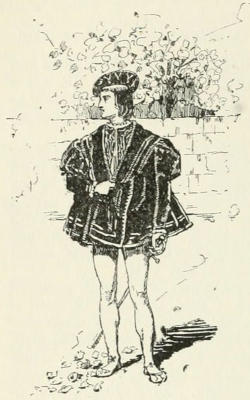
The Dauphin Francis, Son of Francis I
Wishing one day to break down this ceremonious and distrustful barrier, he arose earlier in the morning than was customary, and taking with him two gentlemen and a page, and wrapped merely in a Spanish cape, he left Ardres to go and surprise the king of England in Guines. Two hundred archers and the governors were upon the drawbridge when he arrived. At the sight of the king of France, come at such a time, so meagrely attended, putting himself thus in their hands, they were aghast. Francis I crossed their ranks with a frank and laughing countenance, and, as if he wished to take the fortress by storm, summoned them gaily to surrender to him. The king of England still slept. Francis I went straight to his room, knocked at the door, awoke Henry VIII, who, on seeing him, was even more astounded than his archers had been, and said frankly, with as much cordiality as tact: “My brother, you have done me the best turn that one man ever did to another, and showed me what confidence I ought to have in you. From this moment I am your prisoner, and pledge you my faith.” He took at the same time a beautiful collar from his neck and begged the king of France to wear it that day for love of his prisoner. Francis I went still further in his demonstrations. He had a bracelet double the value of the collar. Putting this upon Henry’s arm he asked him to wear it for love of him, and he added that he wished for that day to be valet to his prisoner. The king of France as a matter of fact handed the king of England’s shirt to him. The next day Henry VIII, imitating the confidence of Francis I, went to Ardres slightly attended, and there took place a fresh exchange of presents and courtesies between them.
This attempt to rival each other in friendship was followed by a rivalry of skill in the tournaments and games that the two kings held at their courts. Spacious lists, which ended in strong enclosures for the guards of each prince and which adjoined elegant stands erected for the queens and the ladies-in-waiting, had been prepared in a high and uncovered place. There for eight days were held jousts in which the most skilful men-at-arms of France and England took part on foot and on horseback, with lance and sword. The two kings who directed them displayed therein without contention, the one his brilliant dexterity, the other his athletic strength. Francis I, who excelled in horsemanship, broke his lances with an accomplished skill. Henry VIII, whose impetuosity could not be resisted, struck his antagonist’s helmet so violently that he unseated him, and prevented him from fulfilling his other engagements.
King Henry, who was one of the best bowmen in the kingdom, made himself remarkable by the strength with which he drew the string and the swiftness with which he struck his mark; he would also have liked to show his superiority in wrestling with Francis I. The English wrestlers had defeated the French wrestlers because through negligence the latter had not brought with them the Bretons, who are unsurpassed in this sort of game. In the evening Henry VIII, hoping to complete the victory of his men by an easy triumph, came close to Francis I and said to him roughly, “Brother, I want to wrestle with you.” At the same time he grasped him with his powerful hands and tried to throw him; but Francis I, who was a well-trained wrestler and more lithe, twisted his leg around his assailant, so that the latter lost his balance and rolled on the ground. Henry arose, crimson with confusion and anger, and wished to begin again. Only the fact that dinner was ready and that the queens intervened prevented this dangerous test, which was more likely to make bad friends of the two kings by wounding their vanity, than the recent intimacies of their long interview were likely to cement their friendship. After twenty-five days passed together in the midst of festivals and pleasures, Francis I and Henry VIII separated, apparently in cordial friendship.
Francis I and Charles V at War
[1520-1522 A.D.]
Francis I was not certain of the armed co-operation of Henry VIII, but he believed he had secured his interested and, from thenceforward, faithful friendship. He had bought it by a large annual payment which was simply a subsidy in disguise. He flattered himself that if the king of England failed to declare himself on his side in the war about to begin, at all events he would not espouse the cause of the emperor, his enemy.h
But this interview was nothing more than play-acting, as Francis soon realised when he learned that Henry on his way back to England had paid a visit to Charles V, who was close friends with Wolsey. Furious at this duplicity and at learning that Henry VIII had agreed to arbitrate on Charles’ behalf in all quarrels between him and France, Francis cast about for a pretext for war, and soon found occasions in the Low Countries, Navarre, and Italy. In April, 1521, he despatched Marshal de Lautrec to defend the Milanese against the Spaniards.a
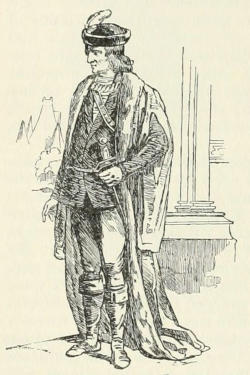
A French Baron, Early Sixteenth Century
The government of the conquered province had been such as to render the French yoke odious to the Milanese. The cause lay in the intrigues and corruption of the court. As soon as the government has grown despotic, we are instantly compelled to look for the causes of events in the scandalous chronicle of harlotry. It has been related that Anne, queen of Louis XII, had assembled around her the daughters of the French nobility; and a court was thus gradually formed, no longer composed solely of warriors and statesmen, but of the gay and idle also of both sexes. This sudden freedom had an ill effect upon public morals. The principles and habits of courtiers were not prepared for the increased temptation. The grossness of the age did not yet admit of that true and pure enjoyment of female society which modern cultivation allows. Francis, when he was suddenly released from Amboise, and found himself possessed of all power, and endowed with all attraction, in the midst of an assemblage of beauty, gave a loose rein to his passions. His wife, Claude, daughter of the late king, never had the command of his affections; and the court of Francis soon arrived at that state of dissoluteness which we find recorded in the pages of Brantôme, and from which we shrink in incredulity and disgust.
Françoise de Foix was one of those highborn maidens whom Anne of Brittany had reared near her person. That queen had given her in marriage to the count de Châteaubriant, who retained her at his remote château, far from the fascinations of a court. Francis, however, insisted on the presence of the beauty. The countess de Châteaubriant was summoned to the capital, and soon became the avowed and chosen mistress of her sovereign. Her brother Lautrec was made governor of Milan.i In spite of Lautrec’s efforts Milan fell into the enemy’s hands, and on April 27th, 1522, he lost a battle which robbed Francis of all his power in Lombardy. This was the battle of Bicocca, in which Prospero Colonna, occupying an entrenched position, repulsed the French and inflicted upon them a decisive defeat.a
Defection of the Duke de Bourbon
The rage of Francis against his unsuccessful general was extreme. He refused to see him. The duchess d’Angoulême exasperated the king’s animosity by her censures; while Madame de Châteaubriant dared not intercede for her brother. At length the constable procured Lautrec admission to the king, who covered him with reproaches. “It is not I who am to blame,” said Lautrec; “the gendarmerie have served eighteen months without pay; and the wilfulness of the Swiss, both in fighting against my wish and then abandoning me, was owing to my inability to pay them.”
“And the 400,000 crowns?” said the king. “Were never received,” was the answer. Francis summoned his treasurer, Semblançay, and asked him sternly how it came that the promised sum had not yet reached Lautrec. The treasurer replied that the duchess d’Angoulême had made him pay it to her. The king then rushed to the apartments of his mother. “It is to your avarice then, madam, that I owe the loss of the Milanese?” The duchess could not deny the receipt of the sum, but she alleged having received it on her private account. The excuse did not satisfy the monarch, and Semblançay kept his station. The vengeance of the queen-mother henceforth unremittingly followed the unfortunate treasurer. Heads of accusation can never be wanting against a man intrusted with the finances of a kingdom; and five years after, Semblançay, an honest and irreproachable minister, fell a victim to the intrigues and iniquity of the monarch’s mother, and died as a malefactor on the common gibbet.
Whilst Francis met with these reverses, which were the natural consequences of the blunders and recklessness of his administration, the emperor Charles was carefully securing every friend, and improving every advantage. The new pope, Adrian, was his creature: Wolsey’s resentment, on being disappointed of the tiara, was soothed for a time; and Henry VIII was induced not only to break with France, but to send thither an army under the duke of Suffolk, which, however, achieved nothing remarkable. The Venetian Republic, also, the last of the Italian powers that inclined to France, was estranged from his friendship, and joined the alliance against him. Not content with making every foreign potentate his foe, the French monarch had at the same time the imprudence to alienate the most powerful of his subjects. Trivulzio, we have seen, expired beneath his neglect. Charles, duke de Bourbon, and constable of the kingdom, was now driven by injustice to league with the enemies of his country. The last duke de Bourbon had left a daughter, Suzanne. The title, and a certain portion of the heritage, went by law to the male heir; but as a considerable part would be inherited by Suzanne, the paternal care of Louis XII arranged a marriage between Charles, the existing duke, and Suzanne de Bourbon, thus preserving unbroken the heritage and title of that illustrious family. The duke was of a handsome person, and on the death of his duchess, Suzanne, without issue, the duchess d’Angoulême made advances to fill her place. This she was the more forward in doing, as, being descended in the female line from a previous duke de Bourbon, she considered herself to have claims on that part of the property which might descend to a female. The constable, however, was blind to her advances, backed by this tacit menace. And the slighted duchess instantly put forward her claim to the Bourbonnais as appertaining by right to her.
Bourbon had previously received affronts from the king, who disliked his cold temper and reserved demeanour. The duke was grave and dignified, fond of war and business, and averse to join in the follies of a court. It appears, too, that Francis amused himself at the duke’s expense; and the latter bore raillery with so little good humour as to be called the “prince of small endurance.” Whatever was the cause, they certainly disliked each other; and Francis manifested this feeling first by recalling Bourbon from the government of Milan, and afterwards by giving the command of the vanguard in one of the northern campaigns to the duke of Alençon, although that post of honour was the constable’s right.
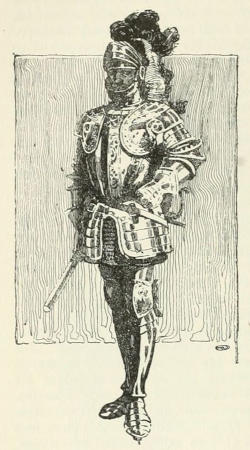
Constable de Bourbon
[1522-1524 A.D.]
Bearing all this in mind, when his hitherto unquestioned right to the Bourbonnais was called in question, the duke instantly apprehended that a league to destroy him had been planned by the king and his mother. Duprat, the chancellor, was but a creature of the latter; and to hope for justice in the event of trial was absurd. Bourbon was, therefore, driven to look abroad for a refuge or for vengeance. The emperor’s emissary was at hand, proffering him that prince’s sister in marriage, and many advantages, if he would join the emperor’s party, and raise a civil war in France against its monarch. Bourbon hesitated long, but finally acceded to the proposals of Charles. Francis in the meantime had been roused from the lap of pleasure by the league of all Europe against him. He was at Lyons, on the way to Italy at the head of an army, when Bourbon was about to take the fatal step. Francis tried to soothe him: he showed his confidence by appointing him lieutenant-general of the kingdom; and assured him that whatever might be the result of this unfortunate process, he would not see him despoiled. The object of Francis seems to have been the gratification of his mother, and the driving of Bourbon to a marriage with her. This failed, however, like every act of the monarch’s policy. The constable determined to join the emperor. But Francis was now near, accompanied with forces; and as circumstances had awakened his suspicions, he called on the constable to accompany him to Italy. Bourbon feigned sickness, and took to his couch, as a pretext for delay; till at length, seeing that it would be dangerous to trifle any longer with the impatient Francis, the constable dispersed his suite and fled, followed by a single attendant, into the dominions of the emperor. Francis gained by this desertion, as he confiscated the wide domains of Bourbon. Charles acquired what he least wanted—a general, and an unfortunate claimant.
A Disastrous Campaign in Italy: The Battle of Pavia
Bonnivet, the personal enemy of Bourbon, was now intrusted with the command of the French army. He marched without opposition into the Milanese, and might have taken the capital had he pushed on to its gates. Having by irresolution lost it, he retreated to winter quarters behind the Ticino. The operations of the English in Picardy, of the imperials in Champagne, and of the Spaniards near the Pyrenees, were equally insignificant. The spring of 1524 brought on an action, if the attack of one point can be called such, which proved decisive for the time. Bonnivet advanced rashly beyond the Ticino. The imperials, commanded by four able generals, Lannoy, Pescara, Bourbon, and Sforza, succeeded in almost cutting off his retreat. They at the same time refused Bonnivet’s offer to engage. They hoped to weaken him by famine. The Swiss first murmured against the distress occasioned by want of precaution. They deserted across the river; and Bonnivet, thus abandoned, was obliged to make a precipitate and perilous retreat. A bridge was hastily flung across the Sesia, near Romagnano; and Bonnivet, with his best knights and gendarmerie, undertook to defend the passage of the rest of the army. The imperials, led on by Bourbon, made a furious attack. Bonnivet was wounded, and he gave his place to Bayard, who, never intrusted with a high command, was always chosen for that of a forlorn hope. The brave Vandenesse was soon killed; and Bayard himself received a gunshot wound. The gallant chevalier, feeling his wound mortal, caused himself to be placed in a sitting posture beneath a tree, his face to the enemy, and his sword fixed in guise of a cross before him. The constable De Bourbon, who led the imperials, soon came up to the dying Bayard, and expressed his compassion. “Weep not for me,” said the chevalier, “but for thyself. I die in performing my duty; thou art betraying thine.”
[1524-1525 A.D.]
Francis, in the meantime, alarmed by the invasion, had assembled an army. He burned to employ it, and avenge the late affront. He marched upon Milan, whose population was spiritless and broken by the plague, and took it without resistance. It was then mooted whether Lodi or Pavia should be besieged. The latter, imprudently, as it is said, was preferred. The siege of Pavia was formed about the middle of October. Antonio de Leyva, an experienced officer, supported by veteran troops, commanded in the town. By the month of January, 1525, the French had made no progress; and the impatient Francis despatched a considerable portion of his army for the invasion of Naples, hearing that the country was drained of troops. This was a gross blunder, which Pescara observing, he forbore to send any force to oppose the expedition. He knew that the fate of Italy would be decided before Pavia.i
During the night of the 23rd of February the emperor’s generals harassed the royal camp by a lively cannonade and a series of feigned attacks, while the main body of their troops was approaching in silence the walls of the park. Masons undermined and tore down a considerable portion of the wall, and through the breach thus effected the imperial advance-guard, under the young marquis del Guasto, cousin to Pescara, closely followed by the remaining troops, rushed into the park. In the light of the breaking day the French saw the imperial columns defile rapidly by the king’s quarters and set out in the direction of Pavia. The hostile troops were obliged to cross a wide clearing that was raked by the shot of the artillery posted along the king’s entrenchments, and so terrible was the fire opened out upon them by the veteran Galiot de Genouillac that, says Martin du Bellay,j “one after the other great breaches were made in the enemy’s battalions, and there was nothing to be seen but flying arms and heads.” Their ranks thinned by this frightful cannonade, the imperials began running in single file towards a valley, where they hoped to be out of range of the royal batteries.
When Francis I saw this movement he believed the enemy to be in full flight and his own victory assured; it had, moreover, been reported to him that the division under Alençon and Chabot had routed a Spanish battalion in the park and captured several cannon. Rallying his gendarmerie, he rushed forth from the camp in pursuit of the flying enemy, thus masking his own batteries and reducing them to silence at the very moment when they might have been the most destructive; the remainder of the army followed the king.
Bourbon and Pescara, transported with joy, hastily formed their line of battle, while Del Guasto rushed up with his advance-guard, reinforced by Antonio de Leyva, and the flower of the garrison of Pavia, which the guard left in charge of the camp had been unable to hold back. The division of the duke of Alençon formed the left wing of the French army and was separated by a large body of Swiss troops from the king, who commanded the centre; between the king and the right wing commanded by La Palisse were placed four or five thousand lansquenets, the remnant of the old bands of Gelderland and Westphalia who were used to fighting under French banners against the house of Austria, and to being placed under the ban of the empire by Charles V. The shock of the meeting between these two armies, inconsiderable as to numbers but composed of the bravest fighting-men in Europe, was terrific. Fallen upon by the lansquenets of Charles de Bourbon and left without assistance by the Swiss, the king’s lansquenets were overwhelmed by force of numbers and crushed between two battalions of the enemy. Nearly all these brave men perished, as did also their two chiefs, the duke of Suffolk (the White Rose) and Francis de Lorraine, brother of the duke de Lorraine and of Count Claude de Guise. Bourbon and his victorious infantry next turned against the French right wing which was engaged in a hot contest with a Spanish-Italian cavalry corps. The right wing, after many great but useless exploits, shared the fate that befell the French lansquenets, and it was on this field that the veteran Chabannes de la Palisse ended his glorious career. His horse having been killed under him, he was about to surrender his sword to the Neapolitan captain Castaldo, when a Spaniard, envious of Castaldo’s good fortune, killed the illustrious prisoner by a shot from his arquebuse.
No less furiously did the combat rage in the centre where the king, at the head of his gendarmerie, overpowered an Italian squadron under the command of the marquis de Saint Angelo, a descendant of the great Scanderbeg; it is said that the king slew this nobleman, as well as several other knights, with his own hand. The squadron of the Franc-Comtois suffered overthrow in its turn; the Spanish cavalry would have had a similar fate had not Pescara devised a manœuvre which was as successful as it was terrible in its effects. This was to mingle with his horsemen fifteen hundred or two thousand Basque musketeers whose agility enabled them to slip into the ranks of the French to choose their victims, and who by their deadly fire checked the advance of the gendarmerie and threw all the squadrons into confusion. The richest coats of mail, the most gallantly plumed helmets were the marks selected in preference by these sharpshooters, and one after the other the famous leaders who had raised French arms to glory during the last thirty years were seen to fall—Louis de la Trémouille, Louis d’Ars, teacher and friend of Bayard, the grand equerry San Severino, the bastard of Savoy, and the marshal De Foix-Lescun, all were killed or mortally wounded. The king and those immediately about him continued to fight desperately, a furious charge having brought Pescara to the earth and put to flight Lannoy. Victory might still have been on the side of the French had Alençon and the Swiss done their full duty; but the duke, on learning of the confusion into which the right wing had been thrown, fled precipitately, carrying with him almost all the gendarmerie and the left wing, while the Swiss, left uncovered by the desertion of Alençon and menaced on their left flank by the imperial cavalry, turned their backs in their turn, instead of repulsing the enemy’s attack and flying to the succour of the king, and set out in confusion on the road to Milan. This battle should have served as a terrible lesson to the kings of France, who were in the habit of buying the services of mercenaries at a high price rather than place arms in the hands of their own subjects.
All the stress and burden of the battle now fell upon the king and the valiant body of nobles who pressed about him; Bourbon, Castaldo, Del Guasto, De Leyva, and the viceroy Lannoy had successively joined Pescara, and there remained to the French gendarmerie but to sell their lives as dearly as possible. Diesbach, the Swiss general, and Admiral Bonnivet decided not to survive—the one, the ignominious retreat which was to tarnish the fame of the league, and the other the sad “misadventure” for which he himself had been mainly responsible. They both flung themselves upon the pikes of Bourbon’s lansquenets and at once found death. Bonnivet, the favourite of Madame d’Angoulême as well as of the king, had taken the most active part in the persecution of the constable, and Bourbon was now seeking him all over the field of battle. When he finally perceived his enemy’s mutilated corpse, “Unhappy man!” he exclaimed with sadness, “you are the cause of France’s ruin and my own!”
The French gendarmerie at last succumbed to the superior numbers of the enemy; they were broken, dispersed, and cut to pieces. Francis I, wounded in the leg and in the face, defended himself bravely for some time longer, but his horse, on being dealt a fatal blow, fell and bore him to the earth, where he would have been despatched by the soldiers who struggled to reach him had not Pompérant, the companion of the constable’s flight, recognised the king and rushed to his rescue. Pompérant proposed to the king to pledge his faith to Bourbon, but Francis indignantly refused; then Pompérant sent for Lannoy, viceroy of Naples, who bent his knee to receive the bloody sword of the king, and proffered his in exchange.
Eight thousand French and auxiliaries had met death; and all the leaders—the king of Navarre (Henry d’Albret), the count of Saint-Pol, Fleuranges, Montmorency, Brion—who were not stretched upon the battle-field, shared the captivity of Francis I. The king begged his captors not to take him back to Pavia where he would be a “spectacle and a laughing-stock to those upon whom he had formerly inflicted fear, evil, and fatigue.” He was conducted to the tent of the marquis del Guasto, where his wounds were properly attended to. In the evening Charles de Bourbon presented himself with every mark of respect before the monarch upon whom he had taken so cruel a vengeance. Both, according to the accounts most worthy of credence, displayed great self-control and admirably concealed feelings, of triumph on the one hand, of grief and humiliation on the other; the king’s only departure from this reserve was in the reception he gave Pescara, which was warm compared to his attitude towards Bourbon. Francis I had at least one consolation in his misfortune, the one that would most appeal to a nature such as his: the imperial soldiers had been so struck by his prowess in the field that they divided his effects as relics among themselves, and evinced so strongly their desire to see him that the viceroy of Naples experienced some alarm. The German mercenaries, without taking into account the immense booty they had gained, demanded more imperatively than before the battle their arrears of pay, and Lannoy feared that they would seek to seize the king as surety, perhaps even go over to the royal side. He averted this danger by sending Francis I to Pizzighettone under the guard of a Spanish captain of whose fidelity he was sure, and by extorting heavy contributions from the pope and the smaller Italian states, in order that the soldiery might be induced to wait in patience.
[1525-1526 A.D.]
It was in the imperial camp near Pavia, on the eve of departure for Pizzighettone that Francis I wrote to his mother the celebrated letter that tradition has greatly altered by giving it this laconic form: “Madame, all is lost save honour.” The true text is as follows: “Madame, To let you know the full extent of my misfortune I have but to say, of all things there remain to me only honour and my life; and that this news may be of a little comfort to you in your adversity I have prayed them to let me write you this letter, which prayer they have readily accorded; I also beg of you to allow yourself to come to no harm but to make use of your accustomed prudence, for I have hope that in the end God will not abandon me. I recommend to you my children and your grandchildren, and pray you to let pass the bearer of this to Spain and back, for it is his mission to see the emperor to inform him of the treatment I receive.”k
Francis Captive in Spain: The Treaty of Madrid
Although Francis had hoped to overcome his conqueror, he did not fear to humiliate himself before him. This rôle of captive and suppliant was so new to him that he rather overdid it and rather bore in mind his present fortunes, which might change, than his kingly dignity which he should never lose. Thus, in three letters written by him to Charles, three times he affected to call himself his slave.
“Having no other comfort in my misfortune than the hope of your goodness, by which, if it please you, use me, the fruits of your own victory, with all fairness. I have firm hope that your virtue will not constrain me to do anything dishonouring, and I beg you to let your heart decide what you will do with me. Wherefore may it please you to have the kindly pity to assure the safety which is due the king of France as prisoner, then will you render me friendly and not despairing, you will make an acquisition instead of a useless prisoner, and have a king forever your slave. So I end my humble petitions which have no other end to expect but that you will style me, instead of a prisoner, your good brother and friend Francis.”
But when Francis heard the rigorous conditions, when he saw he had in vain humiliated himself before his enemy, death appeared less horrible than captivity for him, and ruin and shame for France. “Tell your master,” he cried, “that I would rather die than submit to his terms. My kingdom is still intact, and for my deliverance I neither can nor will harm it. If the emperor desires treaties, let him speak another language.” The opportunity was propitious for Lannoy, and he well knew how to use it. “Your majesty,” said he, “had made a better bargain with the emperor by treating directly with him. Go yourself to Spain and put yourself in the hands of my master. He will be touched by this proof of confidence and will certainly not abuse the rights victory has given him.” Francis allowed himself to be taken in the trap, and judging his enemy by himself the chivalrous monarch resolved to put himself at the discretion of Charles V. He had sent from Marseilles six of his galleys to aid in the transport of troops which were to serve him as escort, and forbade his admirals to alarm the imperial crews during the crossing. He embarked at Genoa May 7th, 1526, and Lannoy was clever enough to persuade Bourbon and Pescara that he was conducting his prisoner to Naples.
Charles V was unaware of Lannoy’s project; it was a pleasant surprise, then, to learn that the king of France, whom he had thought in Italy, was on Spanish soil. He immediately had him transferred to his castle at Madrid, leaving it himself for fear of meeting him. Francis, always liable to be deceived, had counted on prompt deliverance. While waiting, he had imagined himself treated by his conquerors as a guest and not as a prisoner. But seeing he had been tricked by Lannoy, guessing the astuteness of Charles behind that of his minister, he immediately fell ill of grief. Soon his life was in danger. The people of Madrid, moved with sympathy for this knightly king, more fitted than Charles V to reign over Spain, hastened in crowds to the churches to ask God to cure him. Charles, who calculated everything, even his pity, realised that if he allowed his prisoner to die he would lose a possible ransom. He then decided to pay him a visit, and, lavish of fine words, succeeded in raising Francis’ courage. But his object gained and the sick man saved, Charles forgot all his promises, refused to see his prisoner again, and reinsisted on the hard terms of release.l
France in the meantime, though stunned and disordered by the first news of the disaster of Pavia, was recovering its composure and force. The duchess of Angoulême was regent; the count de Vendôme, cousin of the constable De Bourbon, did not take advantage of his being first prince of the blood to embroil the kingdom. The parliament, indeed, displeased with the imperious character of the king, and angered on account of the Concordat and other causes, gave the regent some trouble. But new allies flocked to France in her distress. The Italian states were all ready to combine against the emperor, whose power they now dreaded. Henry VIII of England instantly flung his support into the scale of the discomfited Francis, and concluded a treaty with the regent, stipulating that the kingdom should on no account be dismembered. Large numbers of the people of Alsace had taken advantage of the opportunity to rise and invade France, excited by that religious zeal which scorns restraint. The count of Guise mustered some forces, fell upon them in time, and cut them to pieces. It was for this service that Francis afterwards created the county of Guise into a duchy-peerage—an honour heretofore granted solely to princes of the blood. The parliament made great opposition to this novelty; but the king was resolute in his friendship, and Guise became one of the high noblesse of France, a duke and peer.
Negotiations for the liberation of the king proceeded, with little prospect of success, at Madrid. Bourbon had betaken himself thither; his presence and his claims were no small source of difficulties. The emperor had promised him his sister Leonora, queen-dowager of Portugal, in marriage; but as Francis, to disappoint Bourbon, offered to marry this princess himself, the constable was obliged to forego the honour. The marquis Pescara dying at this time, the emperor offered the command of his Italian armies to Bourbon, who was urged to accept of it, and was thus got rid of. Still the terms offered to Francis were so harsh that he could not accede to them. His sister, the duchess of Alençon, had come to tend him in his illness and captivity. She was now about to return; and Francis put into her hand his absolute resignation of the kingdom, that he might be considered as dead, and no further efforts be made for his liberation. This alarmed the emperor, who became willing to relax in some degree. Still his demands were so exorbitant and unreasonable that Francis at length consented to extricate himself by a breach of faith, and to swear to a treaty the stipulations of which he was determined not to perform.
With these opposite views—grasping severity, that over-reached itself, on the one side, and premeditated bad faith, the almost compulsory resource of Francis, on the other—the Treaty of Madrid was concluded. By it the king agreed to give up Burgundy, to renounce all right to Milan and Naples, as well as to Flanders and Artois. He was to be set at liberty, and to espouse Leonora of Portugal, the emperor’s sister. He was, moreover, to abandon his allies, the king of Navarre, the dukes of Gelderland, of Würtemberg, and the count de la Mark; and he was to re-establish Bourbon in all his property and privileges. Moreover, the two sons of Francis were to remain as hostages for the performance of these conditions, the king himself promising to return into captivity if they were not fulfilled. On the 14th of January, 1526, the treaty was signed; Francis taking the precaution to protest secretly, in presence of his chancellor, against the validity of such exactions. Charles himself could not but mistrust the sincerity of Francis, and he even retained him prisoner a month after the signature. The king’s health again declined in consequence; and at length Charles, in a hurried and irresolute way, gave orders for his final liberation. He was led to the river Bidassoa, which separates the countries: his sons, who appeared on the opposite bank, were exchanged for him, and Francis, mounting a horse of extreme swiftness, galloped without drawing rein to St. Jean de Luz, and thence to Bayonne.
Further Dissensions and the “Ladies’ Peace”
Thus freed from captivity, on terms which, if fulfilled, must ruin his kingdom, and if unfulfilled must stain his honour, Francis, it might have been expected, would be instantly occupied in the duty of defending himself and retrieving his affairs. His first act on arriving at Bordeaux, however, was to become enamoured of Mademoiselle d’Heilly, better known as the duchess d’Étampes, who superseded the countess of Châteaubriant in his affections, and held thenceforward the greatest influence over the monarch.
The liberation of Francis was the signal for a general league against the emperor. The Italian powers were ever disposed to unite against the strongest. Sforza had already rebelled against Charles, and had been driven from Milan by Pescara. All of them—the pope, the Venetians, the Florentines—now formed an alliance with the king, on condition that Sforza should remain in possession of Milan. A treaty to this effect was signed at Cognac, but was kept secret for some time. The states of Burgundy had assembled, to protest against the transfer of their province to the emperor. The king, they said, had no right nor power to make such a stipulation without their consent. When Lannoy, on the part of Charles, demanded the cession of Burgundy, Francis referred him to the answer of the states. The emperor, on learning this evasion of the treaty, called on Francis, as a man of honour, to redeem his word and return into captivity.
This was a trying moment for Francis, who piqued himself on possessing all the chivalric virtues. He could not openly deride the credulity of Charles, as Louis the XI or Ferdinand the Catholic would have done. He was perplexed, distressed, and could only allege the necessity of the case; a plea which by no means satisfied his nice notions of honour. He therefore resolved on taking the advice of his subjects. Despotic as he was, he felt in this case at least the necessity of having the nation to participate his responsibility. To call together the states-general of the kingdom was obviously the natural step in such a case. But no; Francis dreaded the very name of that assembly, in which the vulgar tiers état, or people, had a voice. The legists and judges of the parliament had for some time taken upon them to represent the nation, in demurring to taxes and to edicts. Francis, and his minister Duprat, though not wholly contented with the parliament, yet deemed that preferable to an assembly of bourgeois. It was resolved therefore between them that the voice of the nation should now be taken, not in the good old states-general, but in what has since been called an assembly of notables—one of the most unfortunate inventions or innovations that despotic craft could have imagined.
[1526-1527 A.D.]
This assembly of notables, or, as some historians will call it, this bed of justice, was held in December, 1526. It consisted of prelates, nobles, courtiers, gentlemen, the parliament of Paris, and the presidents of the provincial parliaments; the only admixture of democracy being the provost of merchants and the four sheriffs of the city of Paris. Before those Francis made a long discourse; entering at large into the affairs of the kingdom, its finances and resources. He recounted the misfortunes of his captivity, and declared his readiness to return to it, if his people thought that either their interest or his honour so demanded. The reply of each class, for all answered separately, was that he was absolved from an unjust and compulsory oath, against which he had previously protested, and the fulfilment of which the privileges and welfare of his people alike forbade. They at the same time accorded to him the liberty of raising two millions for the ransom of his sons, assuming in this particular all the rights of the states-general. Thus satisfied, Francis published the general league against the emperor, denominated “holy,” because the pope was at its head. Not only the Italian states, but the Swiss and the king of England acceded to it; so that the reverses of Francis, if they had stripped him of territories, rendered him much stronger in alliances than his rival.
The emperor, on his side, promised to Bourbon the investiture of the Milanese, if he succeeded in expelling Sforza. This the constable accomplished, subsisting his mercenary troops on the unfortunate inhabitants of Milan—for of money Charles had as notorious a lack as his grandsire Maximilian. Milan taken, pillaged, and wasted, how was Bourbon to support his army—that army by which he lived? For since his exile the prince had inhabited camps, and was averse to any more orderly way of life. He loved his soldiers, rapacious and licentious as they were; and was beloved by them, as a valiant and successful leader inclined to tolerate the license of the freebooter. Since his treason, Bourbon had met everywhere with insults and ingratitude from the French, the Spaniards, the emperor, and his brother generals. This situation made him misanthropic, and his character degenerated into that of the reckless and ferocious corsair. To obtain plunder for his army of lansquenets, in lieu of pay, became indispensable; and he accordingly led them south, menacing all the great cities of the peninsula, and uncertain which he should attack. Florence and Rome had both declared against the emperor; Bourbon fixed upon the imperial city as the more glorious prey, and accordingly marched thither his mercenary army. Pope Clement was terrified at his approach, and used all his country’s artifices to avert the danger. It approached nevertheless, and Clement shut himself up in the castle of St. Angelo.
The army of Bourbon attacked Rome in the morning of the 5th of May, 1527. Bourbon himself applied the first scaling-ladder, and was in the act of mounting it, when the first shot from the walls struck him and put an end to his disastrous career. His army passed over his body to the assault, and Rome was carried by storm. The pillage was general, so merciless were the soldiery. Not all the ravages of Hun and Goth surpassed those of the army of the first prince in Christendom. The cruelty of the German soldiers was unequalled: they indulged in the most horrid extravagance of debauch and impiety. For two months they remained masters of the city; and the pontiff himself was finally obliged to surrender himself a prisoner.
[1527-1528 A.D.]
This new triumph of the emperor, over the head of the church too, roused the zeal of Henry VIII. He already meditated a divorce from Catherine, Charles’ aunt; and it therefore became his policy to befriend and protect the pope, whose assistance he would chiefly require, against the emperor. Wolsey was therefore despatched to France; the treaty between the crowns was renewed; and a joint army was raised, to march into Italy under the command of Lautrec. That general now compensated for his former ill success. He made himself master of Genoa by the aid of Andrea Doria; and took Pavia by assault, abandoning it to pillage, in revenge for the defeat which the French had suffered under its walls. The conquest of Milan would have been easy; but as that city was now to belong to Sforza, the French general turned from it towards Rome, in order to procure the liberation of the pope. His approach effected this: the emperor became less harsh in his terms, and Clement soon found himself free at Orvieto.
It was about this time, towards the commencement of 1528, that challenges and defiances passed between Charles and Francis. The former, in his reply to the French envoy, reproached the restored king with an infamous breach of faith; and hinted that he was ready to support his charge as a true knight, sword in hand. Francis, indignant, sent a reply that the emperor “lied in his throat”; and demanded a rendezvous, or champ clos, for the duel; but notwithstanding the choler of both parties, it never took place. It is singular that in this affair of the single combat the cold and politic Charles seems to have been most in earnest, whilst the obstacles and delays were raised by the headlong and chivalric Francis.
Lautrec in the meantime advanced to the conquest of Naples. He marched to the eastern coast, and soon reduced the provinces bordering on the Adriatic. The command of Bourbon’s army had devolved on Philibert, the last prince of Orange of the house of Châlons, another French chief of talents and influence, whom the petulance of Francis had alienated from him and driven into exile. With some difficulty this prince withdrew his army from the spoils of Rome to the defence of Naples. He was not strong enough to face Lautrec in the field: the prince of Orange, therefore, and Moncada, the new viceroy, shut themselves up in Naples, where they were soon besieged by Lautrec. Andrea Doria, a faithful partisan of France, held the sea with his Genoese galleys, and blockaded the port. It was proposed to reduce the town by famine. After some time Moncada, fitting out all the galleys in port, made an attack on the Genoese, then commanded by Filippino Doria, Andrea’s nephew. The attempt failed: the Spaniards were beaten, Moncada slain, and most of the captains taken; amongst others, the marquis del Guasto, and two brothers Colonna. Naples thus became in prospect an easy prey to Lautrec. Its fall might have brought the final submission of the kingdom; but the same blunder which Francis persevered in committing throughout his whole reign lost him this advantage, among so many others.
Such was the fatal habit of the French king to disgust and alienate his best and most attached friends. Doria, for example, like Trivulzio, was an Italian who united with a love of his own country a firm attachment to the French. His exertions had but just torn Genoa from the emperor to give it to Francis: he was now doing the very same by Naples, when it pleased the French court to insult and disoblige him. The prisoners he had won in action were taken from him, and no allowance was made for their ransom. These insults to himself Doria might have passed over; of wrongs offered to his country he was more sensible. The French undertook to fortify Savona, and to raise it into a rival of Genoa. They removed thither the trade in salt, one of the most lucrative sources of the Genoese commerce. Doria expostulated; and another admiral, Barbescenas, was sent to supersede him and bring him prisoner to France. When the admiral arrived, Doria received him, saying, “I know what brings you hither: the French vessels I deliver to you; the Genoese remain under my command. Do the rest of your errand if you dare!” The consequence of this blindness and ingratitude on the part of Francis was soon seen; Genoa declared herself free, and allied herself with the emperor. The blockade of Naples by sea was raised; and the influx of fresh troops and provisions enabled the city to defy its besiegers. These, encamped under a midsummer sun, ill supplied, and harassed, were soon attacked by pestilence. Lautrec their general died of it. The marquis of Saluzzo, who succeeded him, raised the siege and retired to Aversa, where he soon after surrendered to the prince of Orange; and thus another unsuccessful Italian expedition was added to the long list of French disasters.
[1528-1529 A.D.]
Another army led by the count of Saint-Pol into the north of Italy met with as little success. Francis felt that he could not re-establish his fortunes: he sickened of the love of glory that had hitherto animated him, and showed himself willing to treat for peace on any terms, provided the cession of Burgundy was not insisted on. Charles by this time saw that the nation would never consent to such a sacrifice: he therefore waived this part of the Treaty of Madrid. The negotiations on both sides were carried on by the duchess d’Angoulême and Margaret of Austria. The king gave up all his claims to possessions in Italy, Milan, Naples, and even Asti, and abandoned all his allies in that country; he renounced all right of sovereignty over Flanders or Artois; he ceded Tournay and Arras; two millions were to be paid as ransom for the young princes; the lands of the house of Bourbon were to be restored to the heirs of that family (a stipulation, by the by, never performed); and, finally, the treaty was to be sealed by the marriage of Francis with Leonora, the emperor’s sister. This Peace of Cambray, called also the “Ladies’ Peace,” was concluded in August, 1529: it was as glorious for Charles as it was disgraceful to France and her monarch. The emperor remained supreme master of Italy; the pope submitted, and obtained the re-establishment of the Medici in Florence, with hereditary power; the Venetians, who said that Cambray was destined to be their purgatory, were shorn of their conquests. Charles forgave Sforza, and left him the duchy of Milan. Henry VIII reaped nothing save the emperor’s enmity by his interference: the English monarch showed himself generous to Francis, by remitting to him, at this moment, a large debt. Thus was Europe pacified for the time.i
INTERNAL AFFAIRS
[1525-1547 A.D.]
The melancholy Peace of Cambray will not be of long duration; the wars of Italy are not wholly finished; Francis I has not sincerely renounced “his heritage” beyond the mountains, the theatre of his former glory; he will continue to meditate and more than once to attempt, with some partial success, to shake his rival’s dominion over Italy. But neither great expeditions nor great events in the heart of the peninsula will again be seen under his reign. The essential interest of the history of France is no longer there: it returns to the interior; it is in the moral, intellectual, and social condition of that nation—thrown back upon itself after having failed in conquest, and confronted at home and abroad by the problem, growing daily more formidable, of a religious revolution or reaction which will compromise its destiny for centuries. The question is no longer whether France will snatch Italy from the political domination of Spain united with the empire, but whether France will find, in the elements which the Renaissance has brought her, the strength and light necessary to maintain or redeem her political and religious independence between those two genii of the north and south, Teutonic Protestantism and Hispano-Roman Papism[69] which, coming into collision, are about to make an attempt to drag everyone into their whirl.
We will not here enter on the religious history, whose crisis does not appear in all its intensity till some years after the Treaty of Cambray. We will first take a glance at the economical situation of France, at the industrial arts and particularly at the fine arts, at letters and science, at that Renaissance movement which continued to develop under the patronage of Francis I. The taste for a civilisation elegant and learned, picturesque and varied, was the sole affection to which Francis always remained faithful. He had a more genuine right to the title of “father of letters” (père des lettres) than to that of “knightly king” (roi chevalier). Even his own mistakes and the misfortunes of the allies he had abandoned were made to contribute to the progress of the arts among the French, a progress whose advance in a good direction remains, indeed, questionable. The fall of Florence, the persecutions of the partisans of France at Naples and in Lombardy, sent a multitude of emigrants, the flower of the Italian population, streaming across the Alps; and France, as she was so often obliged to do, at least opened an asylum to the friends she had not managed to protect. The king endeavoured to palliate the wrong he had done Italy by favours to Italians, and the exiles experienced some consolation in finding on the banks of the Seine and the Loire the tastes, fashions, habits of thought, and almost the language of their own country.
Many refugees were pensioned or invested with distinguished posts in the army and in diplomacy. The Florentine Strozzi and the Neapolitan Caraccioli, prince of Melfi, became marshals of France. Italy not only sent France artists and politicians, but merchants and skilful manufacturers, who brought into her cities their industry and the remains of their fortunes which had escaped the hands of the tyrants. The pre-eminence of the manufactures of Lyons dates from the fall of Florence: Louis XI had made Lyons a great commercial city and an international entrepôt by instituting three annual fairs which caused the decline of those of Geneva, and had endeavoured by the aid of Italian workmen to develop the manufacture of silk goods, simultaneously at Lyons and Tours: still Lyons, where various manufactures had rapidly developed, did not begin to rival Tours in silks until about 1525; the Florentine refugees soon gave her the superiority; two Genoese are also mentioned amongst the chief founders of the manufactures of Lyons.
A bank was instituted at Lyons. An import duty of two gold crowns per piece on velvet or silk goods protected the French silk manufactures against foreign competition; as to the cloths and woollen goods of Spain and Perpignan, they were absolutely prohibited in favour of the cloths of Languedoc. In the north the manufacture of the cloths of Darnétal near Rouen was very considerable; the edict of May, 1542, which regulated the manufacture at Darnétal, qualities it as almost inestimable. An edict of the 18th of July, 1540, had decreed that foreign stuffs in gold, silver, and silk should enter France by Susa if they came from Italy, by Narbonne or Bayonne if they came from Spain: they were to be taken straight to Lyons and, there only, unpacked and exposed for sale. This privilege must have enormously increased the prosperity of Lyons. Yet in 1543 one of those sumptuary edicts which the rigid spirit of the parliament from time to time wrung from the kings forbade the wearing of gold and silver stuffs. French merchandises were subjected to a uniform export duty of one sou per livre. In 1540 a royal ordinance attempted to establish a uniform measure as already planned by Louis XI: an ell of three feet, seven inches, eight lines was prescribed for use throughout the kingdom. But commercial relations were not yet sufficiently active for the advantage of such an improvement to be generally felt; local practice protested and prevailed: the edict was revoked in 1543.
The French navy was making remarkable progress: Dieppe had raised its head since the expulsion of the English and had resumed its ancient preponderance amongst the French ports on the ocean; Norman and Breton navigators gleaned, so to speak, on the tracks of the Spaniards and Portuguese and tried to take up the threads of their old commercial relations with Africa, and to open new ones with both Indies. Such expeditions were full of peril, for the haughty rulers of the western and eastern seas treated as pirates those competitors who ventured into their domains. Captain Denis of Honfleur had touched at Brazil as early as 1504, before the Portuguese, who discovered it in 1500, had founded any settlement there; the French navigators continued to traffic with the savage tribes who sold them those precious woods from which Brazil has derived its name, and who “gave a better welcome to the French than to the Portuguese and other European peoples.” In 1529 two ships from Dieppe, under the command of Jean Parmentier, made a voyage to Madagascar and Sumatra. During this time attempts which had more lasting results were directed to the north of America, towards the countries whither the Spaniards had not turned their steps. In 1506 Denis of Honfleur had visited the island of Newfoundland which was then taken for a portion of the continent; in 1508 Aubert, a native of Dieppe, followed him there with a vessel fitted out by Jean Ango, the father of the illustrious shipowner of the same name; the Bretons for their part discovered and named the island of Cape Breton, and the annual codfishery was founded on those coasts. The French government at last decided to second private enterprise, and to claim its share of the New World. In 1524, by order of Francis I, the Florentine Verazzano undertook a voyage of discovery, reconnoitred all the coasts from Cape Breton and Acadia to Florida, and took possession of them in the name of Francis I. Ten years afterwards, in 1534, the Breton Jacques Cartier of St. Malo, commissioned by the king at the suggestion of Admiral Chabot de Brion, satisfied himself that Newfoundland was an island, penetrated into the vast gulf which that great island bars, and reconnoitred the mouth of the St. Lawrence: the year following he ascended this immense river as far as the spot where Quebec was afterwards built, and discovered Canada. The name of New France (Nouvelle-France) was imposed on the whole northern part of America.
In 1540 Roberval, a Picard gentilhomme, was appointed viceroy of Canada by Francis I, and set out with a squadron of five ships which Cartier commanded under his orders; the colony was installed at Cape Breton. The severity of the climate, so different from the magnificent regions conquered by the Spaniards, the insufficiency of supplies, the improvidence and negligence of the royal government were the cause of the failure at the close of a few years of this first attempt at colonisation, which was not renewed till the reign of Henry IV; but the sailors of Normandy, Brittany, and La Rochelle continued the codfishery and the fur trade with the peoples of Canada. A wealthy shipowner of Dieppe, Jean Ango, whom the documents of the time describe as “merchant of Rouen and viscount de Dieppe,” made himself one of the glories of the French nation by his great enterprises, by his taste for the arts, and the energy with which he sustained the honour of the French flag against the rulers of the seas, particularly the Portuguese. His beautiful manor of Warengeville, farm-house rather than château, still charms the traveller amongst the green woodlands of the Dieppe coast. This family of Ango was probably the same whence came the architect Roger Ango who built the Palais de Justice at Rouen.
The French Renaissance
Whilst industry and navigation were thus progressing, the arts surrounded Francis I with a splendour which Charles V and Henry VIII in vain attempted to rival: for example, the king and all the nobles contended with one another in erecting buildings, and there sprang from the earth all those Renaissance châteaux which arose on French soil to take the place of the feudal fortresses, and which like them have unfortunately in great part disappeared. There was Madrid, the elegant retreat of the Bois de Boulogne, so called because Francis loved to recall the weariness of the prison in the midst of pleasures and liberty; there was La Meute (by corruption La Muette), and St. Germain, and Villers-Cotterets and Chantilly and Follembrai and Nantouillet, the splendid residence of Duprat. The national architecture, threatened by the growing invasion of the Italian taste, seemed to concentrate all its forces to protest against it by a last creation of brilliant originality (1526). He who has not seen Chambord does not suspect all the fantastic poetry that was to be found in the French art of the sixteenth century. There is something indescribable in this palace of the fairies, rising suddenly before the eyes of the traveller from the depths of the gloomy woods of La Sologne with its forests of turrets, spires, aërial campaniles, the beautiful tints of their pearl gray stones, chequered with black mosaics standing out on the sombre slates of the great roofs. This impression could only be surpassed by the spectacle which delights us on the terraces of the keep at the foot of the charming cupola which terminates the grand staircase, the centre and pivot of this vast and varied whole and which stands up radiant above the terraces like a flower one hundred feet high. Everywhere between the lacs d’amours and crowned F’s, mysterious salamanders, vomiting flames, climb on the pediments, curl round the medallions, or hang from the cornices and panels of the vaults, like the dragons which watch over the enchanted castles of old legend, waiting the return of the master who will come no more.k
Francis I had at first been the pupil of the Italian, Baldassare Castiglione, author of a book called Il Cortegiano, or “the perfect courtier.” Struck by the qualities of the Italian people, the French monarch cherished for them a peculiar love, and drew about him the most celebrated men of the peninsula. Leonardo da Vinci died at Fontainebleau almost in the arms of the king. Primaticcio, Il Rosso, Andrea del Sarto, and Benvenuto Cellini came with alacrity at his call, and some of their greatest works were destined to be the property of France. The early and most illustrious French artists, among them Jean Goujon, were trained in the school formed by these masters, and it was to the construction and embellishment of Chambord and Fontainebleau that the king devoted their inspired brushes and chisels.
The type of the old fortress-castle of feudal times gradually gave place to another and less repellent one, that of the great pleasure-mansions which included among their attractions everything that the most luxurious and refined taste could devise. The court journeyed without ceasing from castle to castle and from feast to feast, eliciting loud complaints from the foreign ambassadors, who, though unable to afford the expense of such continual moving about, were yet obliged to follow.
Not satisfied with the presence of foreign artists about him, Francis I offered great inducements to men of science to visit his court. Erasmus, the literary oracle of Europe, was warmly solicited to leave Holland and establish himself in France, but he consented merely to make the voyage thither. Many Italians, however, among whom was the poet Alamanni, and a number of Greeks with the aged Lascaris at their head, established for themselves a second fatherland in France. The famous Guillaume Budé, guardian of the king’s library and one of the most learned men of the century, was, with the Estiennes, deputed by the king to show these colonists all the honours of the land. Francis I gave his envoys to Turkey the mission of procuring for him manuscripts in Greek, and the translation into French of ancient documents was undertaken; while the art of printing, introduced in France during the reign of Louis XI, underwent rapid development; the presses of Lyons, where a numerous Italian colony had become established, gaining a celebrity for the town almost rivalling that of Venice or Bâle.
The College of France, called in the beginning College of the Three Tongues, was founded in 1529 after a plan indicated by Budé, less with the object of giving general instruction than for the purpose of promoting the study of the three languages of learning, Latin, Greek, and Hebrew. The institution bore a great resemblance to the Italian academies. Philology, its chief object, was the science most in vogue at that time, as it was held to be the initiatory stage in the study of antiquity. Thus conceived, the College of France left all instruction, properly speaking, in the hands of the old Sorbonne, the ancient university. True to its old scholastic spirit, opposed to innovations, and attached to its ancient privileges which it now believed to be menaced, the Sorbonne entered upon a bitter war against the new institution; but the latter, strong in the royal favour and patronage, issued victorious from the conflict. The number of chairs was increased, to the study of languages was added that of science, particularly mathematics, and beginning with the very first years of its existence the College of France gained the reputation of being the most brilliant and complete of all the European institutes of learning.
The reason for the creation of this college and for its rapid success and growth may be found in the tendencies of an age that was rich in discoveries of all kinds. There are, in the history of the human mind, certain happy periods when the horizons of thought seem to become enlarged on all sides at once. A new field was opened to philological research, as the Middle Ages had had but little knowledge of Greek and less of Hebrew. A corresponding progress was also made in geography and the natural sciences by the study of climates and races hitherto unknown.
Always powerful over the entire country, the influence of the court increased under Francis I, and was no less beneficial to letters and society in general than it was to the cause of learning. The king, beloved of his men-at-arms because he was the best knight in the kingdom; of artists and scientists because he so generously patronised and encouraged them, commended himself equally to courtiers, men of letters, and ladies because no one in his realm carried to such a point as he the love of the beautiful. Aided by his mother and sister and later by his daughter-in-law Catherine de’ Medici, he made his court the most remarkable in Europe, not only for the luxury it displayed but for its wit and grace and a certain elegant not to say corrupt refinement of manners that was best exemplified in the foreign princess brought up under the eyes of Catherine, Mary Stuart.
Never had the French court counted so many members. Under Louis XII it had been composed of a few favourites, a definite number of officers, and a guard of a hundred nobles. Francis I increased in enormous proportion the number of court officers, which he intended to bestow on upstarts who could in this manner rise to nobility. The posts were mostly filled, however, by landless gentlemen of birth upon whom were also bestowed detached titles. Thus arose a company of marquises and dukes possessing neither marquisates nor duchies. These two innovations alone would have sufficed to make the court the point upon which converged all ambitions and hopes of fortune. Francis I desired that women should share the offices and dignities of the court, and should have a hierarchy of their own; he loved to shower upon them, as upon his nobles, the marks of his liberality. Two of his mistresses, Madame de Châteaubriant, sister of Lautrec and of Lescun; and afterwards Mademoiselle de Heilly, whom he made Duchess d’Étampes, reigned for a long time side by side with the king, and patronised artists as well as distributed remunerative posts.
Unfortunately one cannot have much to say about this court without speaking of its corruption, to which Francis I himself contributed by the changes he brought about and by his personal example. Destroying as they did the simplicity of former modes of living, the innovations introduced by him resulted in confusion to the rules and usages of the nobility, and fostered fawning and intrigues. His own many scandalous deeds as well as those that were with impunity committed around him, have heavily burdened his memory with the charge of violating the public morality.
It would, however, be most unjust to view the court of the Valois only through the biased medium of Brantôme’sp chronicle of scandals, or the writings of contemporaneous Calvinists. As for these latter, they have neglected no means by which they could blacken the fame of the prince and personages who were the first to persecute their co-religionists; hence, on many points, their testimony is not to be believed. The letters of Venetian envoys, on the other hand, who were observers of great depth and keenness, reveal the warmest admiration for a court of which they, among all foreigners, were the quickest to feel the great seduction and charm. All the literature of this century, in fact, imaginative as well as historical, attests with striking force the elevated character of the influence exercised by the court of Francis I over public opinion.
Particularly prominent among the writers of that time are Marguerite de Valoisq and Marot,r the king’s valet, from whose works the fairest judgments may be formed concerning the tastes of the court—its gallantry, its love of wit and social pleasures, the esteem in which it held pure learning and the tolerance it accorded free thought. Severely as we may condemn certain of their works, they are nevertheless worthy to serve as models for sentiment, beauty of form, and light, poetic grace. To these two writers compare Rabelais, the author of the people, the creator of that strange and inexplicable encyclopædia wherein, as the product of a great intellectual debauch, the whole sixteenth century passes by us in review, and you will be able to judge on which side lay delicacy and taste, in what degree the literature of the court was qualified to elevate and refine the literature of the people.f But, on the other hand, Rabelais[70] remains a classic in our own day, while these other writers are forgotten. Rabelais, indeed, is not merely the greatest writer of this time, but by common consent he is named as one of the three or four greatest humourists of any age or country.a His work is in itself sufficient proof that Francis I destroyed neither the liberty of his subjects nor their originality. Although more absolute than his predecessors, Francis always took account of public opinion and had the insight to distinguish, as Rankes ingeniously puts it, enforced obedience from that which is rendered voluntarily.
Thus even in those personal memoirs wherein the individuality of the writer is most wholly revealed, it is to be observed that the tendency of the century was all toward expansion, in height as well as breadth. We note the origin, the preliminary flights of that freedom of thought and research that was later to soar so high. Apparent as are the excesses of the age, we must not judge it by its faults alone; its very shortcomings raised controversies that served to form public opinion in a graver, sterner mould. More ado was made about the use or abuse of supreme power, which was for the first time subjected to control. The writer who passes the severest judgment on Francis I and his court is Gaspard de Saulx-Tavannes, the representative of the most radical of the independent nobility.f
A word must be said about another phase of intellectual development—that which found expression in the words and deeds of Luther and Calvin and their followers.a The new opinions early crept into France; their first converts were men of letters. All the great French jurisconsults of that century, in secret or openly accepted the Reformation. A party at the court itself inclined towards it. Louise of Savoy appears not to have been opposed to it. Her daughter Marguerite, queen of Navarre, an independent genius and the author of mysteries and novels, openly professed the principles of the German reformers; the duchess of Étampes, the king’s mistress, made a point of protecting them. Lefèbre d’Étaples (Faber Stapulensis), and Louis Berquin, both men of learning known and esteemed by Francis, sustained these in their favour: the first had begun six years before Luther. Finally the favourite court poet, Clement Marot, abandoned his elegies and epigrams to translate the psalms of David, which the reformists of Paris sang about the Pré-aux-Clercs. At first Francis, far from being alarmed at these symptoms, would fain have attached to himself Erasmus of Rotterdam, the king of the learned and of the men of letters of the century, who was accused of having prepared the way for Luther by his attacks on the monks. But when the German peasants, following out the new doctrines to their socialistic consequences, would have overturned all authority, Francis I thought that the Reformation, which was a revolt against the pope, was in danger of leading politically to a revolt against the king; and if he remained the interested friend of the German Protestants he had no wish to allow their doctrines to gain ground in his own states.
During the king’s captivity two Lutherans had been burned in the capital. He had put a stop to these executions, but in 1528 a statue of the Virgin was mutilated at Paris. Francis declared that “if he knew one of his own members to be infected with this doctrine he would tear it away for fear lest the rest should be corrupted,” and from that day he persecuted the innovators. Berquin, who refused to retract, was burned on the place de Grève (1529); at Vienne, at Séez, at Toulouse there were other executions. The necessity of propitiating the Protestants of Germany mitigated the persecution. Again in 1536 six unfortunates were sacrificed on different squares in Paris in presence of the court.m
WAR AGAIN BETWEEN FRANCIS I AND CHARLES V
[1528-1535 A.D.]
But we must not pause for further details of this character;[71] we must return to the sweep of political events in France, and the renewed quarrels of Francis and his old enemy Charles V. A lasting peace between such rivals as Charles and Francis was not to be expected. Even if the latter could have confined himself to the pursuit of pleasure, to the internal regulation of his kingdom, and to the patronage of the arts, the spirit of Charles, ever restless in the cabinet, could not fail to have provoked him. At one time the emperor sent him a summons, requiring his aid against the Turks, and ending with the accusation that he had called Suleiman to invade Europe. Francis was now on the closest terms of alliance with Henry VIII, who was bent on divorcing the emperor’s aunt. The French king used all his influence with the pope to procure the necessary license for Henry, but was still baffled by the influence of Charles. Clement VII was the potentate whose alliance was most warmly disputed by the rival sovereigns. And both assailed the pontiff on a pontiff’s weak side, by the offer of aggrandisement to his family. Charles proposed that Clement’s niece, Catherine de’ Medici, should espouse Francesco Sforza, duke of Milan; by which means the Medici would necessarily be ever adverse to the claims of the French kings on Milan. Francis, in opposition, offered his second son, Henry, duke of Orleans, as a husband for Catherine; and Clement, elated by the honour of an alliance with the royal house of France, exulted at the proposal. The emperor, who knew the proud character of Francis, could not believe that he would sincerely permit his son to ally with such upstarts as the Medici; and this incredulity neutralised the exertions that he might otherwise have made to obstruct the match. It took place, however, in 1533, at Marseilles, where Clement and Francis met to honour the ceremonial, and to arrange the conditions of their future friendship. One of these, there is no doubt, was the vigorous prosecution and extirpation of heresy. Francis, however, reaped as usual little advantage from the negotiation. He failed to obtain for Henry VIII the dispensation required, and that impatient monarch broke with the church in consequence. Clement himself died in the year following, and was succeeded by Paul III of the house of Farnese.i
[1535-1537 A.D.]
Francis I and Charles V vied with each other in seeking alliance with the church. Francis burned heretics in the great cities, and made adhesion to the new opinions a crime against the crown. Charles, on the other hand, led an expedition into Africa, and slaughtered the infidels in a new crusade (1535). Victorious over Barbarossa, the usurper of Tunis, and followed by the blessings of the thousands of Christian captives whom he had delivered from slavery, he made his way to Rome. There, in presence of the pope, he stood forth and made his complaint against Francis. He declared his readiness to invest one of his sons with Milan, on such conditions of suzerainty and subjection as he should afterwards choose to name; failing that, to meet his enemy foot to foot, on horseback, or in a boat, armed cap-à-pie or naked to their shirts; or, finally, to declare internecine war upon him, binding himself by an oath never to sheathe the sword till he had made him the poorest gentleman that ever lived. After this decent and courageous bravado, at which the pontiff must have been greatly amazed, the assembly broke up in most admired disorder, and the dogs of war were let loose. An invasion of France was resolved on, and Charles already counted his victory so secure that he distributed the estates of the French nobility among his favourites (1536). An army of Spaniards and Italians was to overrun Provence, and another of Flemings to break in on Picardy. Between the two, Francis was to be crushed.