Chapter XVIII · THE SUPREMACY OF MAZARIN (continued 2)
Reading edition
Turenne had with difficulty saved the wreck of the Spanish army at Rethel when, instead of a general of the king of France, he had been made the lieutenant of a Spanish general; the prince of Condé had the same fate before Arras (August 25th, 1654). He and the archduke besieging this city, Turenne attacked them in their camp and forced their lines; the troops of the archduke were put to flight; Condé, with two regiments of French and Lorrainers, sustained alone the attack of Turenne’s army; and, while the archduke was in flight, he defeated Marshal d’Hocquincourt, repulsed Marshal de la Ferté, and retired victorious, covering the retreat of the defeated Spaniards.
The relief of Arras, the forcing of the lines, and the rout of the archduke covered Turenne with glory; and it is to be observed that in the letter concerning this victory written in the name of the king to the parliament the success of the entire campaign is ascribed to Cardinal Mazarin and that Turenne’s name is not even mentioned. The cardinal had been in fact a few leagues from Arras with the king. He had even been in the camp at the siege of Stenay, which Turenne had taken before relieving Arras. Councils of war had been held in the presence of the cardinal. On this basis he ascribed to himself the honour of the events; and this vanity brought upon him a ridicule that all the authority of his ministry could not suppress. The king was not present at the battle of Arras. He had gone into the trenches at the siege of Stenay, but Cardinal Mazarin was unwilling that he should further expose his person, upon which the tranquillity of the state and the power of the minister seemed to depend.
Thus on the one side, Mazarin, absolute master of France and of the young king, and on the other, Don Luis de Haro, who governed Spain and Philip IV, continued in the name of their masters to carry on the war, but with little vigour.
These two men vied with each other in directing their policies towards forming an alliance with Cromwell, the English Protector, who for some time enjoyed the satisfaction of seeing himself courted by the two most powerful kingdoms of Christendom. The Spanish minister offered to help him take Calais; Mazarin proposed to besiege Dunkirk and restore that city to him. Cromwell had to choose between the key of France and that of Flanders. He was also much solicited by Condé, but he did not wish to negotiate with a prince who had nothing left but his name and who was without a party in France and without power in Spain.
ALLIANCE WITH CROMWELL (1655 A.D.); WAR IN FLANDERS (1656-1658 A.D.)
[1655-1657 A.D.]
In May, 1655, the Protector decided in favour of France, but without making any special treaty or a division of conquests in advance. He wished to shed lustre on his usurpation by greater enterprises. His design was to wrest Mexico from the Spaniards, but the latter were warned in time. Cromwell’s admirals, however, took Jamaica from them. It was not until after the Jamaican expedition that Cromwell signed his treaty with the king of France, but without making any mention of Dunkirk. The Protector treated as equal with equal; he forced the king to give him the title of brother in his letters. In the copy of the treaty that remained in England his secretary signed before the French ambassador; but he negotiated really as a superior by forcing the king to drive out of his dominions Charles II and the duke of York, the grandsons of Henry IV, to whom France owed an asylum. A greater sacrifice of honour to fortune could not have been made.
While Mazarin was making this treaty Charles II asked for one of his nieces in marriage. The bad condition of his affairs that drove the prince to this step also brought upon him a refusal. It has even been suspected that the cardinal wished to marry to the son of Cromwell the niece whom he refused to the king of England. This much is certain—that when he afterwards saw the way to the throne more open to Charles II he wished to renew this marriage; but was refused in his turn.
The war continued in Flanders with varying success. Turenne, having besieged Valenciennes along with Marshal de la Ferté, suffered the same kind of reverse that Condé had sustained at Arras. The prince, assisted this time by Don John of Austria, who was more worthy to fight at his side than the archduke had been, forced La Ferté’s lines, took him prisoner, and relieved Valenciennes (July 17th, 1656). Turenne did what Condé had done in a similar rout. He saved the defeated army and opposed the enemy everywhere; a little later he even besieged and took the little town of La Capelle (September 27th). This was perhaps the first time that a defeated army had dared to make a siege.
This famous march of Turenne, which was followed by the taking of La Capelle, was eclipsed by an even finer march of the prince of Condé. Turenne had laid siege to Cambray when Condé, at the head of two thousand cavalry, forced a passage through the besieging army, and having driven back all who tried to stop him threw himself into the town (May 31st, 1657). The citizens received their deliverer on bended knees. Thus these two men, opposed to each other, exhibited the resources of their genius. We admire them in their retreats as well as in their victories, in their good conduct and even in their faults, which they were always able to retrieve. Their talents alternately arrested the progress of each monarchy; but the financial disorder in Spain and in France was a still greater obstacle to their success.
[1657-1658 A.D.]
The alliance with Cromwell finally gave France a more marked superiority. On the one hand, Admiral Blake was about to burn the Spanish galleons and cause the loss of the sole treasure with which the war could be maintained. On the other hand, twenty English vessels had just blockaded the port of Dunkirk and six thousand veterans of the English Revolution reinforced Turenne’s army. Then Dunkirk, the most important place in Flanders, was besieged by sea and land. Condé and Don John of Austria, having united all their forces, came forward to relieve it. The eyes of Europe were upon this event. Cardinal Mazarin brought Louis XIV near the scene of war without allowing him to get to it, although he was nearly twenty years old. The prince stopped at Calais, and hither Cromwell sent to him a pompous embassy, at the head of which was his son-in-law, Lord Falconberg. The king sent to him the duke de Créqui, and Mancini, duke de Nevers, a nephew of the cardinal, followed by two hundred noblemen. Mancini presented the Protector a remarkable letter from Cardinal Mazarin in which he said that he was sorry not to be able to pay him in person the respect due to the greatest man in the world.
Meanwhile the prince-marshal Turenne attacked the Spanish army, or rather the army of Flanders, near the Dunes. The latter was commanded by Don John of Austria, son of Philip IV and an actress, who two years later became the brother-in-law of Louis XIV. The prince of Condé was with this army but not in command; hence it was not difficult for Turenne to gain the victory (June 14th, 1658). The six thousand English soldiers contributed to the victory, which was complete.
The genius of the Great Condé was of no avail against the best troops of France and England. The Spanish army was destroyed. Dunkirk surrendered soon afterwards (June 23rd). The king came up with his minister in order to see the garrison pass out. The cardinal did not allow Louis XIV to appear either as warrior or as king. He had no money to distribute to the soldiers, and was poorly attended. When he was with the army he dined with Mazarin or with Marshal Turenne. This neglect of royal dignity was not in Louis XIV the effect of contempt for pomp, but of the confusion in his affairs and of the pains the cardinal took to unite splendour and authority in himself. Louis entered Dunkirk only to turn it over to Cromwell’s ambassador, Lord Lockhart. Mazarin tried whether by finesse he could not evade the treaty and not give up the place; but Lockhart threatened, and English firmness got the better of Italian subtlety.
Several persons have asserted that the cardinal, who had attributed to himself the victory of Arras, tried to induce Turenne to yield to him again the honour of the battle of Dunes. Du Bec-Crépin, count de Moret, it is said, came on behalf of the minister and proposed to the general to write a letter in which it would appear that the cardinal had himself arranged the entire plan of operation. Turenne received these hints with contempt and would not make a statement that would have brought disgrace upon a general of the army and ridicule upon a man of the church. Mazarin, who had been so foolish, now had the misfortune of remaining on ill terms with Turenne until his death.
[1658-1659 A.D.]
In the midst of this first triumph the king fell ill at Calais and for several days was near death. Immediately all the courtiers turned towards his brother, Monsieur. Mazarin lavished deference and flattery upon Marshal du Plessis-Praslin, the former tutor of this young prince, and upon count de Guiche, his favourite. A cabal was formed in Paris that was bold enough to write to Calais against the cardinal. He made preparations to leave the kingdom and to conceal his immense riches. An empiric of Abbeville cured the king with emetic wine that the court physicians called poison. This good man seated himself upon the king’s bed and said, “This is a very sick boy, but he is not going to die.” When the king became convalescent the cardinal banished all who had intrigued against him.
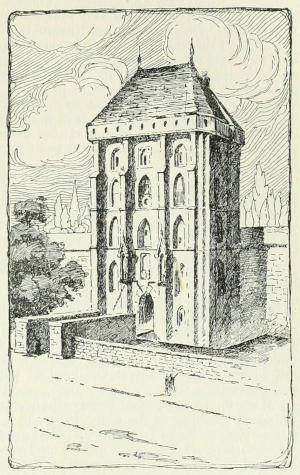
Entrance Gate to the Château de Vincennes
A few months later Cromwell died (September 13th, 1658) at the age of fifty-five, in the midst of his projects for the strengthening of his power and the glory of his nation. Richard Cromwell succeeded peaceably and without opposition to the protectorate of his father, as a prince of Wales would have succeeded a king of England. The emperor Ferdinand III had died in 1657. His son Leopold, who was seventeen years old and already king of Hungary and Bohemia, had not been elected king of the Romans during the lifetime of his father. Mazarin wished to attempt to make Louis XIV emperor. This was a chimerical idea; it would have been necessary either to coerce or to bribe the electors. France was neither strong enough to seize the empire nor rich enough to buy it; so the first overtures made at Frankfort by Marshal de Grammont and by Lionne were abandoned almost as soon as they were proposed. Leopold was elected. All that Mazarin’s politics accomplished was to form an alliance, known as the League of the Rhine, with certain German princes,[107] to observe the Treaty of Westphalia, and to furnish a check to the authority of the emperor over the empire (August, 1658). France, after the battle of the Dunes, was powerful in her foreign relations through her glory and her arms as well as through the condition to which the other nations were reduced. But the country itself was suffering; it was stripped of money, and there was need of peace.
THE TREATY OF THE PYRENEES (1659 A.D.)
The cardinal had to do two things in order to bring his ministry to a happy close—make peace and insure the tranquillity of the state by the marriage of the king. The intrigues during the latter’s illness made Mazarin feel how necessary an heir to the throne was to the splendour of the minister. All these considerations determined him to marry Louis XIV promptly. Two princesses were proposed—the daughter of the king of Spain and the princess of Savoy. The king’s heart had made another choice: he was desperately in love with Mademoiselle Mancini, one of the cardinal’s nieces. Born with a tender heart and a firm will, full of passion and without experience, he would have been capable of resolving to marry the lady of his choice.
Madame de Motteville, the favourite of the queen-mother, whose Mémoires have a great air of truth, claims that Mazarin was tempted to let the king’s love have its way and to place his niece on the throne. He had already married another niece to the prince de Conti, and one to the duke de Mercœur. The one whom Louis XIV loved had been asked in marriage by the king of England. These were titles enough to justify his ambitions. He adroitly sounded the queen-mother. “I fear,” he said, “that the king has too great a desire to marry my niece.” The queen, who knew the minister, understood that he desired what he feigned to fear. She replied to him with all the haughtiness of a princess of the blood of Austria, daughter, wife, and mother of kings, and with the bitterness which she had felt for some time towards a minister who affected to be independent of her. She said to him, “If the king were capable of this indignity I would place myself with my second son at the head of the whole nation against the king and yourself.”
Mazarin, it is said, never forgave the queen this reply; but he took the wiser course of thinking as she did. He made it a point of honour and merit to oppose the passion of Louis XIV. His power did not need a queen of his own blood to support him. He even feared the character of his niece; and he believed he would further strengthen the power of his ministry by avoiding the dangerous glory of elevating his own house too high.
In the year 1656 he had sent Lionne to Spain to negotiate peace and to ask the hand of the infanta; but Don Luis de Haro, convinced that, feeble as Spain was, France was not less so, rejected the cardinal’s offer. The infanta, daughter of Philip IV by his first wife, was intended for the young Leopold. By his second marriage Philip had at that time only a son whose sickly infancy caused fears for his life. It was desired that the infanta, who might be the heir to many states, should transfer her rights to the house of Austria and not to a hostile dynasty; but finally, Philip IV having had another son, Don Philip Prosper, and his wife being again enceinte, the danger involved in giving the infanta to the king of France seemed to him less great, and the battle of the Dunes made peace necessary to him.
The Spaniards promised the infanta and asked for a suspension of hostilities (1659). Mazarin and Don Luis de Haro repaired to the isle of Pheasants on the frontier of France and Spain. Although general peace and the marriage of the king of France were the objects of their conference, more than a month passed in regulating ceremonies and settling difficulties of precedence. The cardinals called themselves the equals of the kings and the superiors of other sovereigns. France, with greater justice, claimed pre-eminence over the other powers. Don Luis de Haro, however, assumed perfect equality between France and Spain.
The conferences lasted four months. Mazarin and Don Luis employed all the resources of their respective policies; that of the cardinal was strategy, that of Don Luis delay. The latter never gave promises: the former only equivocal ones. The genius of the Italian was to try to surprise; that of the Spaniard, to keep from being surprised.
Such are the vicissitudes of human affairs that of this famous Peace of the Pyrenees, signed November 7th, 1659, not two articles have endured. The king of France retained Roussillon which he would have kept anyway, without this peace, also Artois and Cerdagne; but the Spanish monarchy has no more possessions in Flanders.
But if Don Luis de Haro said that Cardinal Mazarin could deceive, it has been said since that he could foresee. He long meditated the alliance of the houses of France and Spain. This famous letter of his, written during the negotiations at Münster, is cited: “If the most Christian king could have the Netherlands and Franche-Comté as dower upon espousing the infanta, then we might aspire to the Spanish succession, whatever we might have to relinquish to the infanta; and it would not be a very long wait, since there is only the life of the prince her brother that could exclude her from it.” This prince was Balthazar, who died in 1649.
The cardinal was evidently deceived in thinking that the Netherlands and Franche-Comté could be given to the infanta as her marriage portion. Not a single city was stipulated for her dower. On the other hand, important cities that had been conquered, like St. Omer, Ypres, Menin, Oudenarde, and other places, were restored to the Spanish monarchy. Some were retained. The cardinal was not mistaken in believing that this relinquishment would be useless some day. But those who gave him the honour of this prediction make him also foresee that Prince Don Balthazar would die in 1649; that later the three children of the second marriage would be cut off in the cradle; that Charles, the fifth of the male children, would die without issue; and that this Austrian king would one day make a will in favour of a grandson of Louis XIV. But at any rate Cardinal Mazarin foresaw what value this relinquishment would have in case the male line of Philip should become extinct: and after more than fifty years strange events justified him.
Maria Theresa, the infanta, able to have as dower the cities that France restored, brought by her marriage contract nothing else than 500,000 gold crowns; it cost the king more than that to go to receive her at the frontier. These 500,000 crowns, equivalent to 2,500,000 livres, were the subject of a great deal of dispute between the two ministers. In the end France never received but 100,000 francs. Instead of this marriage bringing any other real and immediate advantage than that of peace, the infanta renounced all rights she might ever have to any of her father’s lands. Louis XIV ratified this renunciation in the most solemn manner.[108]
[1659-1661 A.D.]
The duke of Lorraine, Charles IV, against whom France and Spain had much cause to complain, or rather who had much to complain of against them, was included in the treaty; but only as an unfortunate prince who was punished, because he could not make himself feared. France restored his states to him, demolishing Nancy, however, and forbade him to maintain troops. Don Luis de Haro forced Cardinal Mazarin to receive Condé into favour again, by threatening to leave in the sovereignty of the prince Rocroi, Le Catelet, and other places of which he was in possession. So France gained both these towns and the Great Condé. He lost his dignity of grand-master of the royal household, which was afterwards given to his son, and returned with scarcely anything but his glory.
Finally (August, 1660) Cardinal Mazarin brought the king with his new queen to Paris.[109] Mazarin acted exactly like a father who would marry his son without giving him charge of his own property. He returned more powerful and more jealous of his power, and even of honours, than ever. He required parliament to address him through deputies. This was something unparalleled in the monarchy, but it was not too great a reparation for the wrong that parliament had done him. He no longer gave his hand to the princes of the blood as formerly. He who had treated Don Luis de Haro as an equal tried to treat the Great Condé as an inferior. He went about with royal pomp, having besides his guards a company of musketeers, which was ever afterwards the second company of king’s musketeers. There was no more freedom of access to him. If anyone was a poor enough courtier to ask a favour of the king, he was lost. The queen-mother, so long the stubborn protectress of Mazarin against France, was without credit as soon as he had no more need of her. Her son, the king, brought up in blind submission to this minister, could not shake off the yoke that she had imposed upon him as well as upon herself; Louis XIV could not reign during the lifetime of Mazarin.
LAST YEARS AND DEATH OF MAZARIN (1659-1661 A.D.)
A minister is excusable for the evil he does when the helm of state is forced into his hands by tempests; but during a calm he is answerable for the good that he fails to do. Mazarin did good only to himself and his family. Eight years of absolute and undisturbed power, from his final return until his death, were marked by no glorious or useful establishment; for the college of the Four Nations was only created by his will.[110]
He controlled the finances like the steward of a lord involved in debt. The king sometimes asked money of Fouquet, who replied, “Sire, there is nothing in your majesty’s coffers, but the cardinal will lend you some.” Mazarin was worth about two hundred millions, reckoning in the money values of to-day (i.e., the middle of the eighteenth century). Several memoirs say that he amassed part of it by means far beneath the grandeur of his position. They relate that he shared with privateer captains the profits of their voyages. This has never been proved; but the Dutch suspected him of it, and they never would have suspected Cardinal Richelieu.i
In high spirits was Mazarin at the moment of signing the great treaty at Bidassoa (Treaty of the Pyrenees). He wrote to Paris: “All will soon be over. I shall not stay long in the Basque country, unless I find amusement in watching them hunt whales, in learning their language and their dances.”
However, the dancer was soon smitten by gout. His lungs became affected. The bed of the moribund, covered with cards, was a gaming table over which offices were sold. Cards and the sacrament went pell-mell.b It is said that on his death-bed he felt remorse, but outwardly he displayed courage. At least, he feared for his property, and he made the king a complete donation of it believing that the king would return it to him. He was not mistaken; the king returned the gift in three days. Finally he died at Vincennes, March 9th, 1661, and no one but the king seemed to mourn him, for this prince already knew how to dissemble. The yoke was beginning to weigh heavily upon him; he was impatient to reign. Nevertheless he wished to seem affected by a death that put him in possession of his throne. Louis XIV and the court wore mourning for Cardinal Mazarin, an unusual honour, and one which Henry IV had paid to the memory of Gabrielle d’Estrées.
We will not undertake [says Voltaire] to decide whether Mazarin was a great minister or not; his actions must speak for themselves. There is often a popular idea of a vast breadth of mind and an almost divine genius in those who have governed empires with some success. It is not a superior power of penetration that makes statesmen; it is their character. Men, if they have ever so little good sense, nearly all perceive their own interests. In this respect a citizen of Amsterdam or of Bern is as wise as Sejanus, Ximenes, Buckingham, Richelieu, or Mazarin; but our conduct and our enterprises depend solely upon the temper of our soul, and our successes depend upon fortune. For example, if such a genius as Pope Alexander VI or his son Borgia had had to take La Rochelle, he would have invited the principal leaders to his camp under a solemn oath and would have made away with them. Mazarin would have entered the city two or three years later by winning over and dividing the citizens. Don Luis de Haro would not have risked the enterprise. Richelieu built a dyke along the sea, after the example of Alexander, entered and took La Rochelle; but a less strong tide or a little greater promptness on the part of the English would have saved La Rochelle and made Richelieu seem foolhardy.
The character of men can be judged by their enterprises. It may well be said that the soul of Richelieu breathed pride and vengeance, that Mazarin was wise, pliant, and avaricious. But in order to tell in how far a minister has genius one must either have frequently heard him talk, or one must read what he has written. What is seen every day among courtiers often happens among statesmen: he who has most genius fails, while he who has in his character more of patience, force, pliancy, and persistence succeeds. On reading the letters of Cardinal Mazarin and the Mémoires of Cardinal de Retzj one easily sees that De Retz was the superior genius. Nevertheless Mazarin was all-powerful and De Retz was overthrown. Finally, it is quite true that to make a powerful minister often nothing is needed but a mediocre mind, good sense, and luck; but to be a good minister a man must have love for the public welfare as his dominant passion. The great statesman is he who leaves to his country great and useful memorials.
The memorial that immortalises Cardinal Mazarin is the acquisition of Alsace. He gave this province to France at a time when France was enraged at him; and by a singular fatality he did more good for the kingdom when he was persecuted than in the tranquillity of absolute power.i
Mazarin’s end [says Michelet] was at least consistent with his life—he lived and died a cheat. He believed he had cheated the future. Fortunate player, he had all his plans well laid. The prophecies of his youth were fulfilled. He had appeared, at the age of twenty-five, upon a field of battle crying, “Peace! Peace!” From the noble and serious workers who had died painfully in preparing his opportunities, he filched the glory of the triumphant Peace of Westphalia and that of the Pyrenees. Richelieu sowed, Mazarin harvested. The one created the administration, the army, the navy, and died on the eve of Rocroi. The other spoiled everything and succeeded in everything. Great through the greatness of Condé, and greater through that of Turenne, his position was strengthened by even the futile tempest of the Fronde; he retains at least the honour of that forced and fatal peace into which France fell through sheer lassitude. This pedestal is still left him; his features even after death wear the mask of the Angel of Peace.
Was it really peace? Too late it had arrived: Germany, agonising in ruin, found no peace in the Treaty of Westphalia; Spain, dead and done with, was in no condition to reap benefit from the Peace of the Pyrenees. And France herself, entering by this door into a fifty years’ struggle for the Spanish succession, was to find in this peace fiscal war at home and bloody strife abroad.b
FOOTNOTES